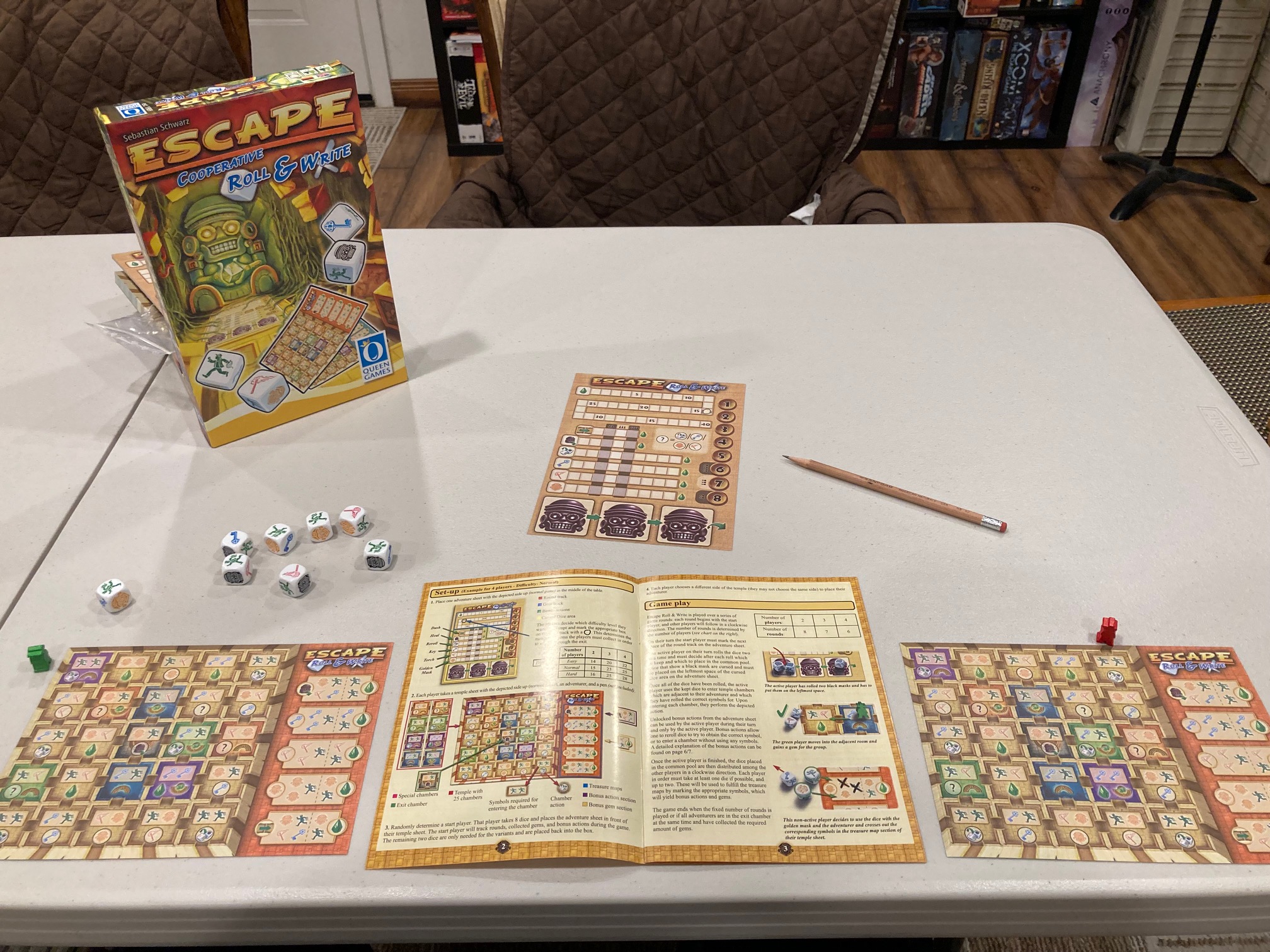
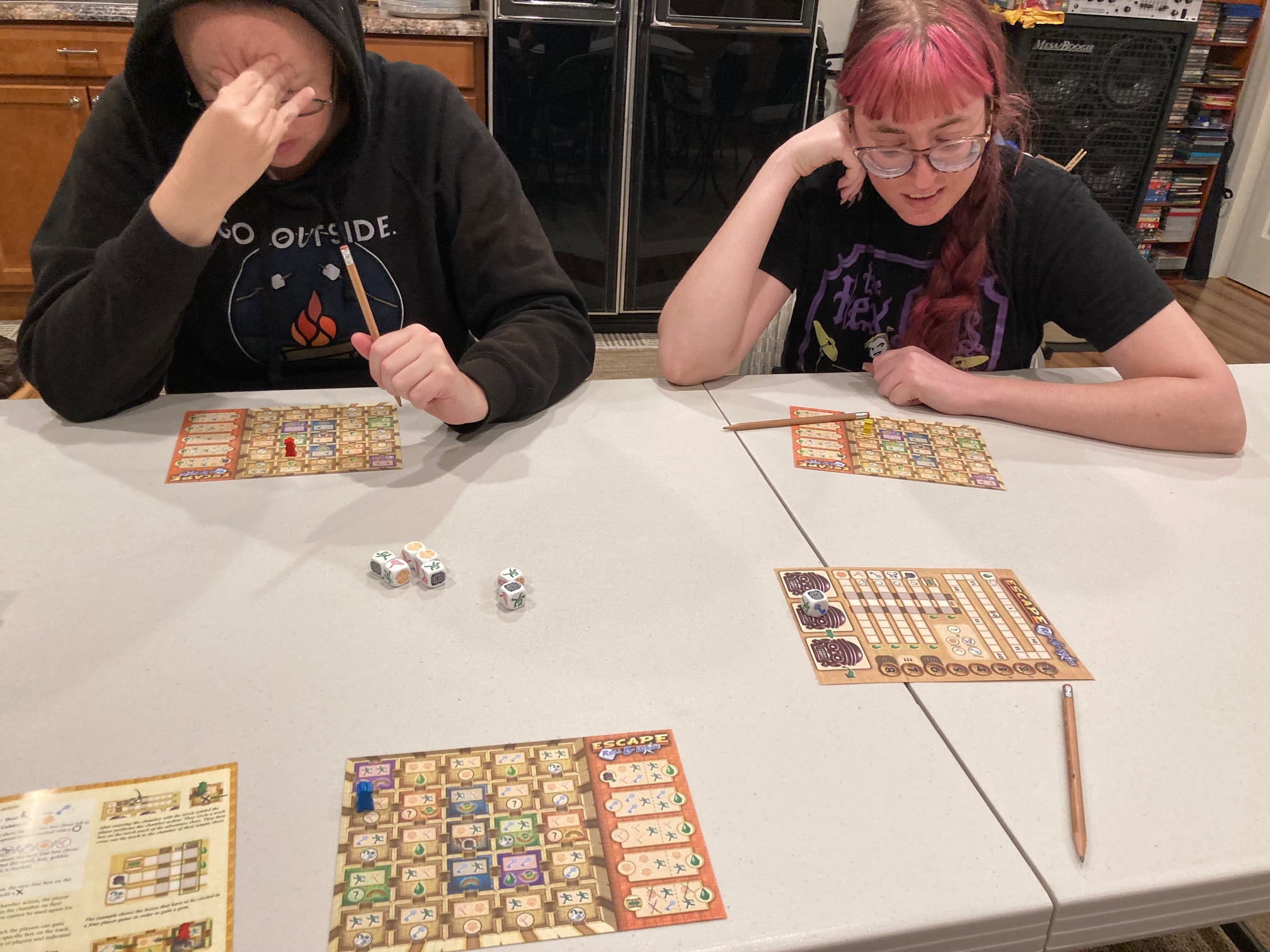
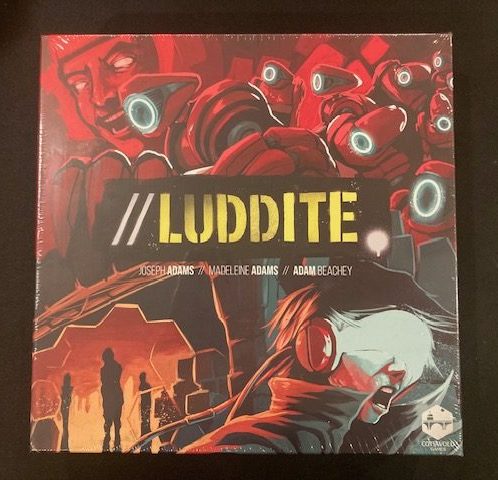
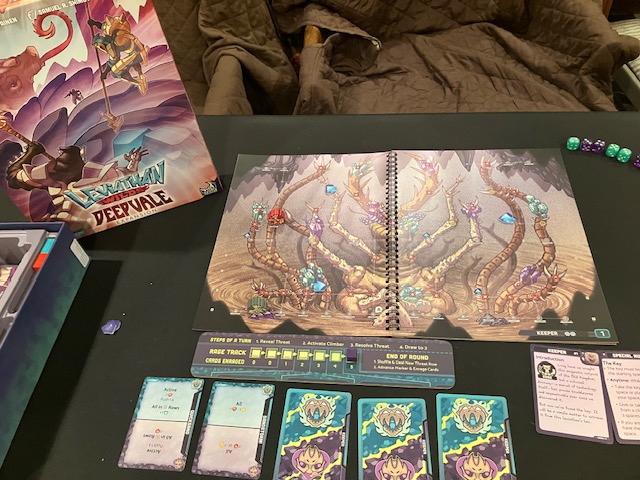
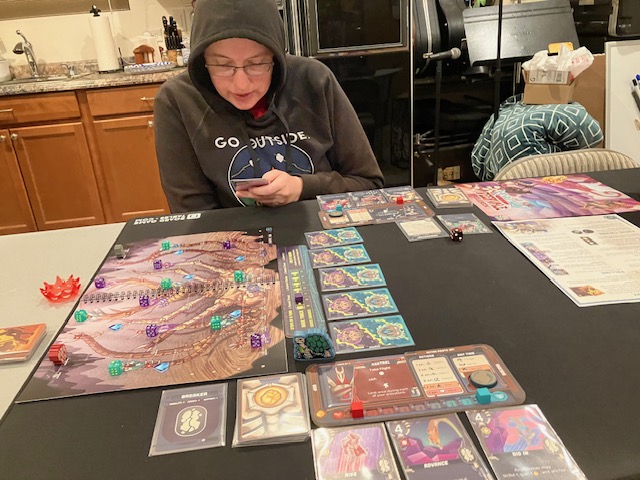
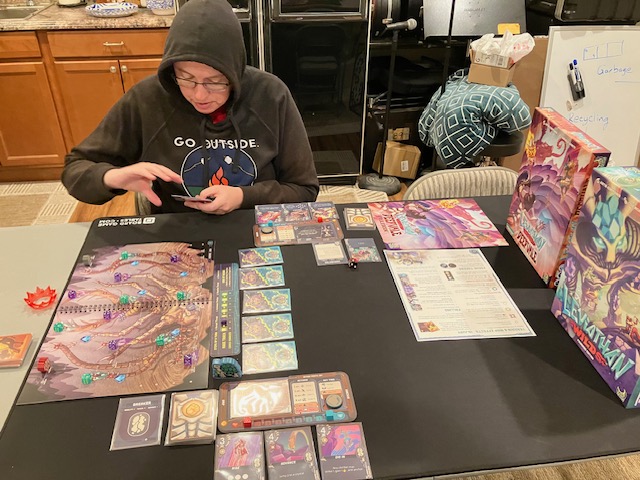
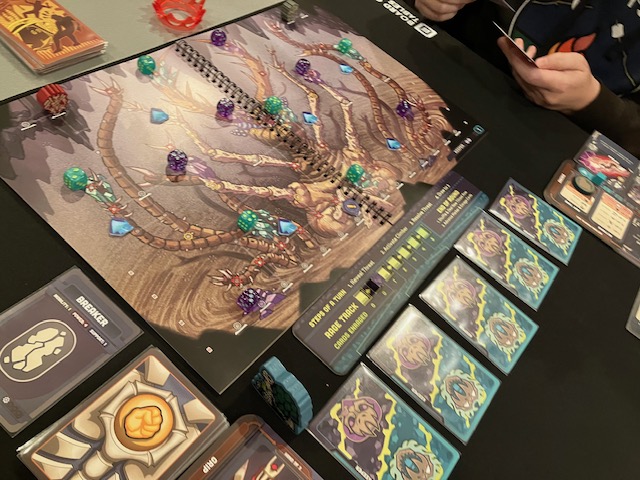
Top 10 Solo/Cooperative Trick-Taking Games

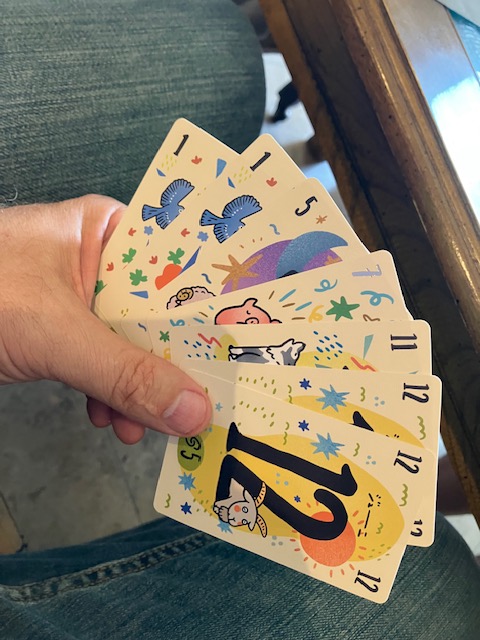
Trick-taking games are a genre that’s been around for ages: Bridge, Hearts, and a more gamery games like Rage! We’ve now reached a point where there are a lot of solo and cooperative trick-taking games as well! To be cooperative, every single one of these games has a pretty severe notion of Limited Communication … if you could just communicate anything, most of these games would become trivial! So, most games on this list have very constrained notions of communication! Interestingly, most of these games also have a very constrictive player count, so we take note of that as well! Let’s take a look below!

(We also note that two of these are in German, which required me getting a translation, and a third was mostly German but luckily included English rules!)

10. Park Life

Player Count: 1-4

This cooperative Trick-Taking game is a little misleading because, depending on the version of Park Life you get, there’s a very different trick-taking game! 

The Deluxe Hedgehog version (above) has a different version of a trick-taking game …

.. than The Deluxe People Edition (above)! 

Both games have a solo game, but the game is a little better with more people.  These games are at the bottom of this list because they seem the least developed: they are very cute and have some interesting ideas for trick-taking games, but feels like they could use a little bit of either explanation or work.   

Still, you may play these and fall in love with them because of the cute art!

9. Lindyhop

Player Count: 2-Player Only

This game presents is an interesting theme, as a trick-taking game recreating a dance from 1928 (from the African American communities of New York City).  Two players “dance” with each other, with trick-taking simulating the back-and-forth/give-and-take as players try to “groove” together.

Players traverse a path together, picking up tokens if they land on exact spaces. See above.

Players play cards and the difference in card value is how far they move!  The art is gorgeous (see above) and very thematic: there are even special powers on some of the cards!

The only reason this is a little lower on the list is because there is really only one opportunity to strategize: at the beginning of the game!  But it’s a fun little romp that’s easy to bring out.

8. Claim with the Expansion Claim: Alliances

Player Count: 2-Player Only

Claim by itself is a 2-Player only competitive trick-taking game.

But, with the Claim: Alliances expansion (see above) this becomes a cooperative trick-taking experience!

This is one of the games that was originally in German, luckily I was able to find English rules online!

Since the way to play cooperatively is to use the Alliances expansion, you first have to learn the base game! The game proceeds in two phases, both powered by trick-taking! In the first phase, you play tricks to try and recruit cards for the next phase. The winner of each trick gets the named recruit, and the loser gets the “random” top-deck recruit! The second phase has the players trying to win factions (using trick-taking): whomever wins the most factions, wins!

In the cooperative game, some Alliance cards are added to the mix. During the recruit phase, the winner has to take an Alliance card, which includes bad guys and commanders, and at some point, both sides must have a commander whose factions they MUST win!

This is a little lower on the list because you have to get the base game under your belt before you can play the expansion. But there are some cool ideas in here, including the two phase system and some special powers on some factions!

7. The Fox in the Forest Duet

Player Count: 2-Player Only

This is a 2-Player trick-taking game where players play tricks to move around a forest map collecting gems.

The art is cute and the game is pretty light.  The Communication Limitations are fairly draconian once you have your cards (you can’t even discuss strategy), but you can discuss strategy between rounds. We had fun playing it; it’s a lighter game that isn’t crazy rule heavy.

6. Trick ‘n Trouble (Fangt Doc Crazy!)

Player Count: 3-Player Only

What???? A 3-Player only game???

This is a bit of a surprise as a 3-Player only cooperative game! It has kind of a spooky (silly spooky) theme!

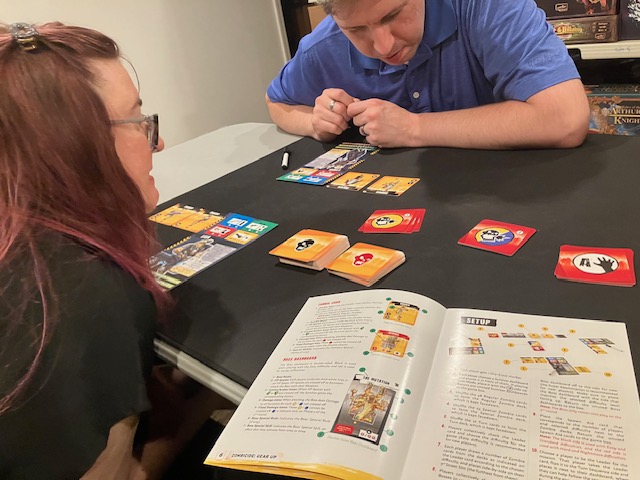
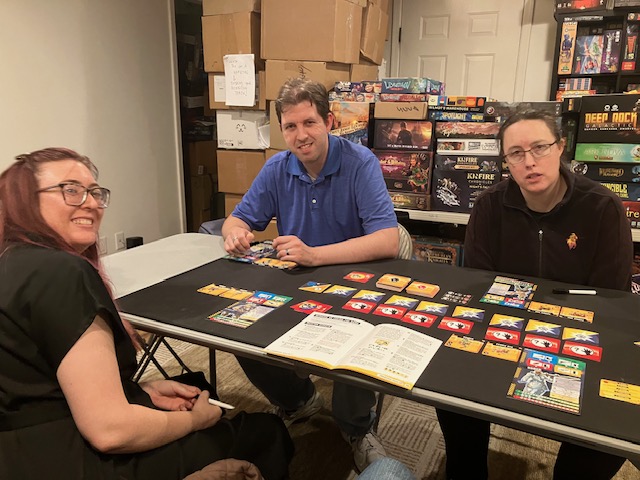
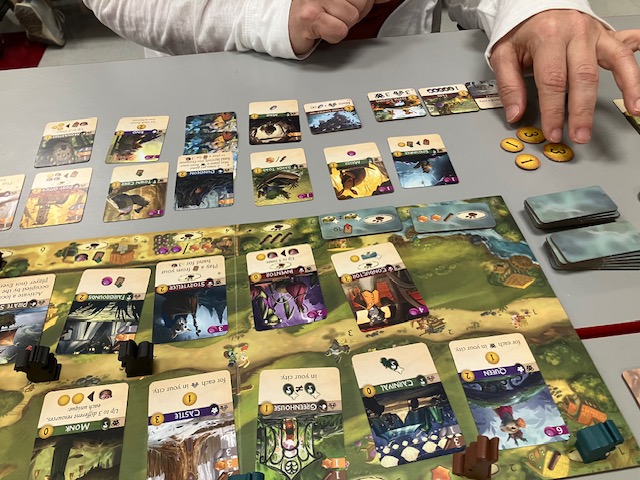
Players try to fulfill tasks based on the cards from “won tricks”: The players have a tableau of tasks to fulfill (see above).

The “trick” in this game is that some of the cards are double-colored, and you can use them as you wish.

This was a surprisingly fun little game, even if the 3-Player only count is a little different.  Like most cooperative trick-taking games, the limited communication permeates and you can’t really talk about the cards in your hand.

5. Sail

Player Count: 2-Player Only

I’ve been able to get Sail to the table a number of times with Sam and Kurt over the past year!  It’s a fun theme as you use trick-taking to help move a ship towards its final destination! 

Winning a trick means “usually” moving the boat in your direction (towards you), but there are many different things that happen along the way! 

Can you avoid the Kraken?  Can you move forward when you really need to?

Using trick-taking as a means to move the ship forward is real interesting mechanism!  If you like Sail, be aware that Sail Legacy is coming to Kickstarter soon!

4. For Northwood

Player Count: 1-Player Only

Yes, that’s right, this is a solo trick-taking game! It sounds like this can’t work, but it works really well! The tricks are “conversations” with fiefs, and you try to make fiefs “friendly” to you by winning them over with conversation! It’s a pretty thin theme, but it works pretty well as a trick-taking schema.


This is a tiny little game with super cute art!

There are special powers you can activate!

Winning is a victory point threshold, as you count how many friendly fiefs you obtain (and count the stars)! Because this is a solo-only game, there is no notion of Limited Communication!  This is a really unique little game that I had to scour all the gameshops to find!  I think there were reprints, so I believe this is back in stock!

3. Jeckyl and Hyde vs. Scotland Yard

Player Count: 2-Player Only

The two players cooperatively play the two sides of Dr. Jeckyl and Mr. Hyde, vying for control! 

This is a fascinating idea, using trick-taking as a way to take control of the personality!   To keep ahead of Scotland Yard, the two players must win tricks in such a way as to keep Scotland Yard off their tail!

The two players each play a different side of the personality!

I, unfortunately, was unable to get the English version for some time, so I ended up using Google translate to translate the German text to English!  But this game was so cool, the art was so neat, and it had such neat ideas, I really liked it!  That’s why, despite only having a German copy, this made it all the way to #3!  (And I did finally get the English version: it is available more widespread now!)

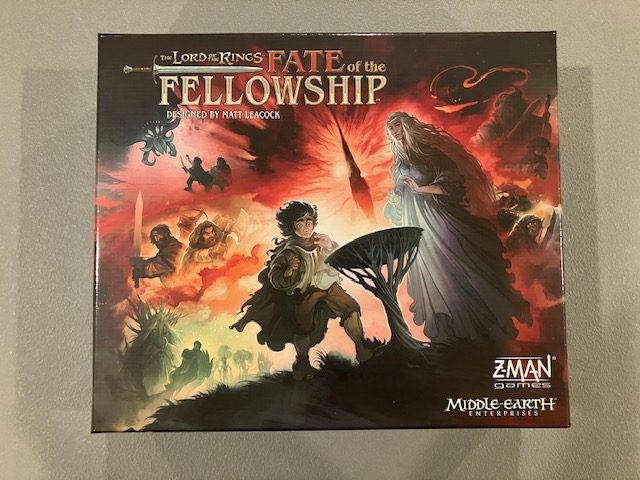
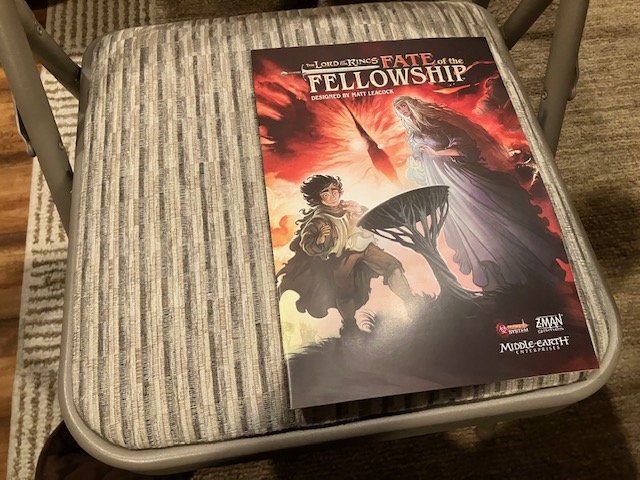
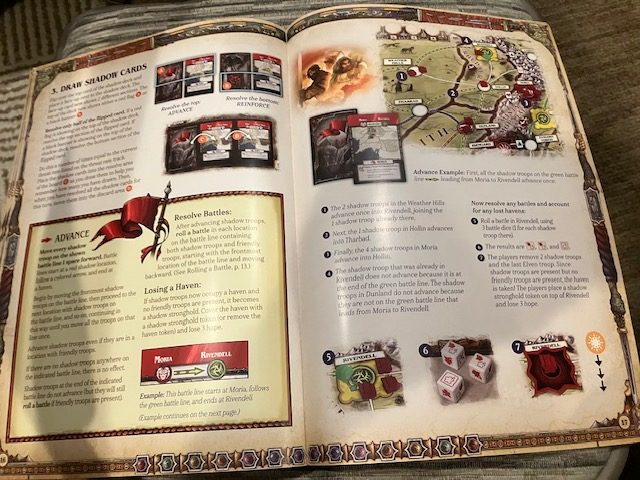
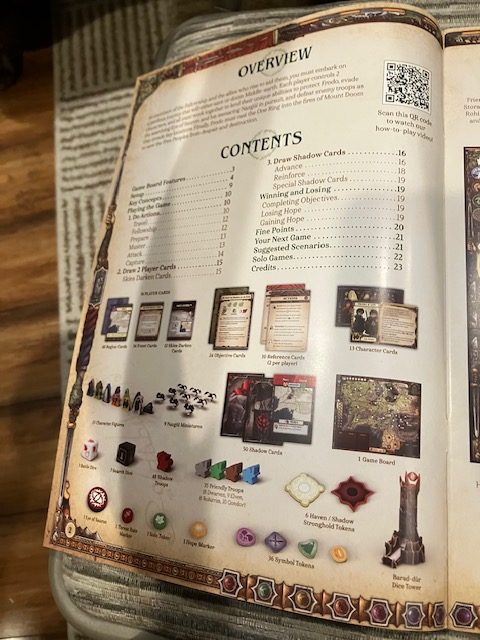
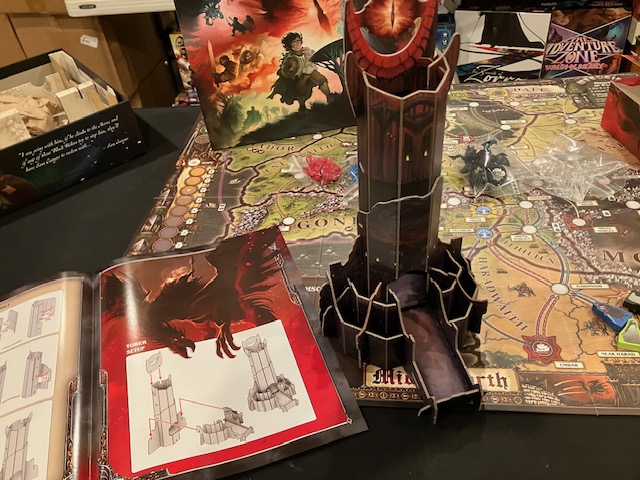
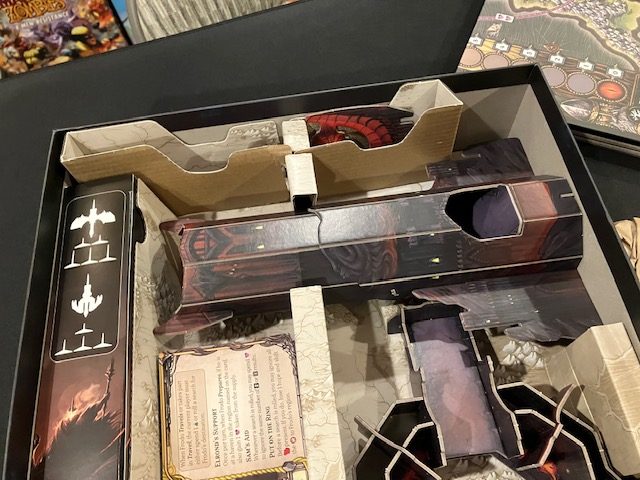
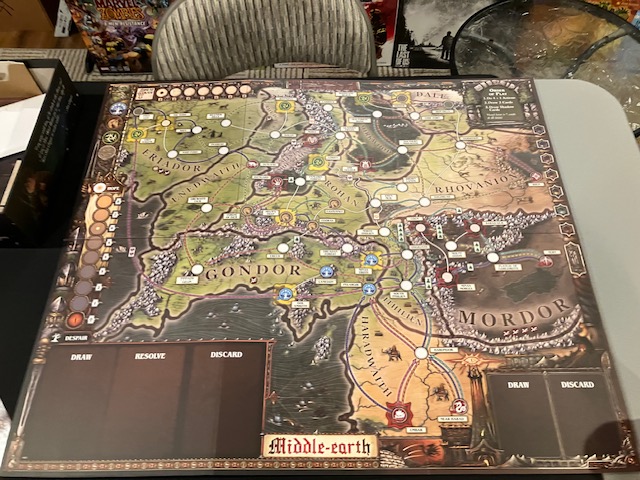
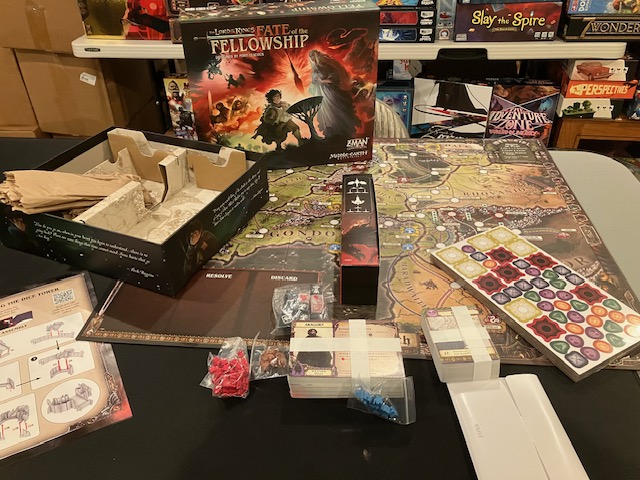
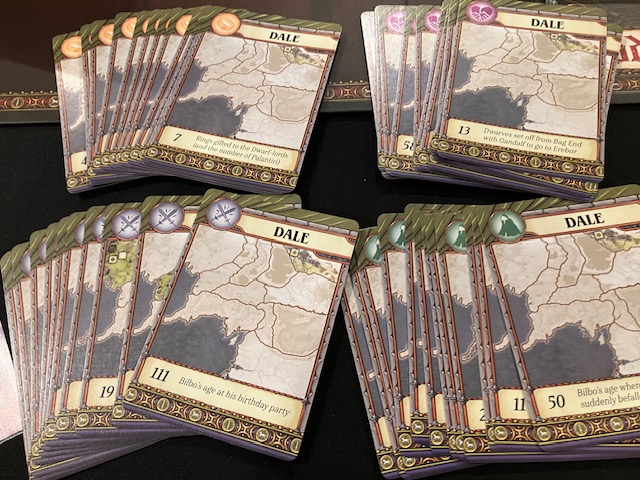
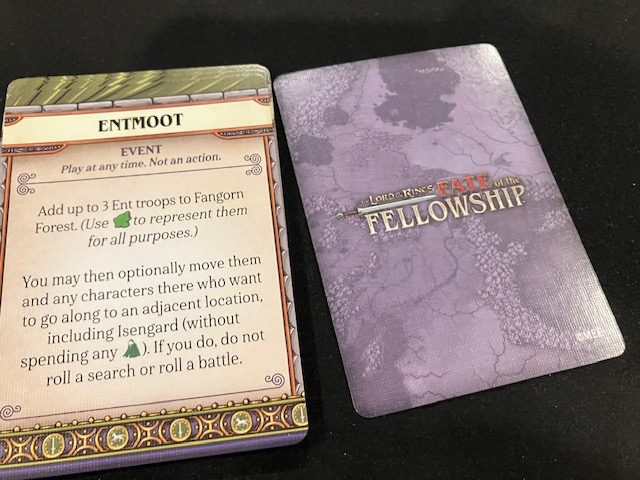
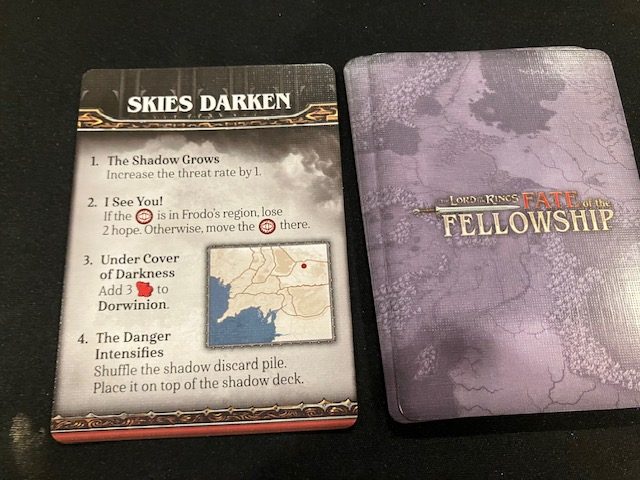
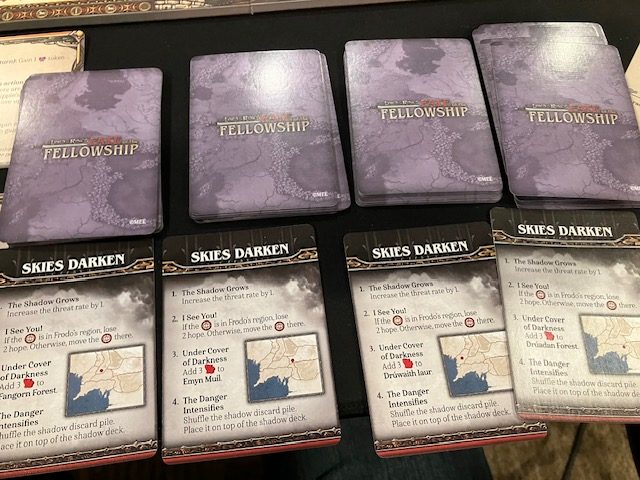
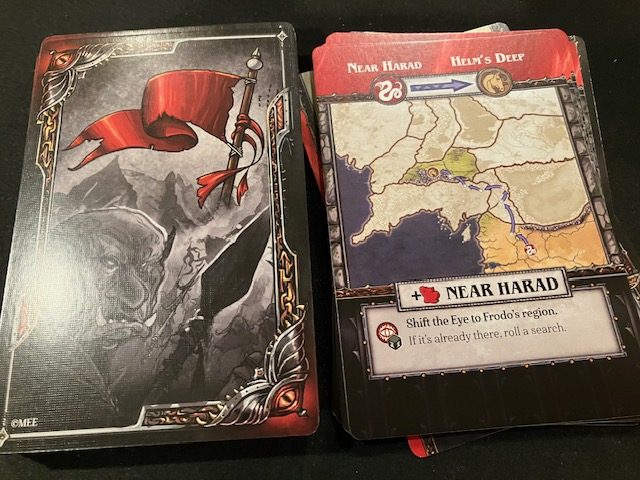
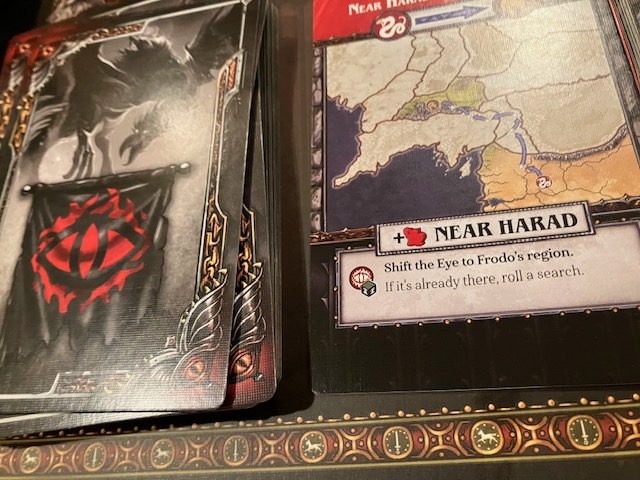
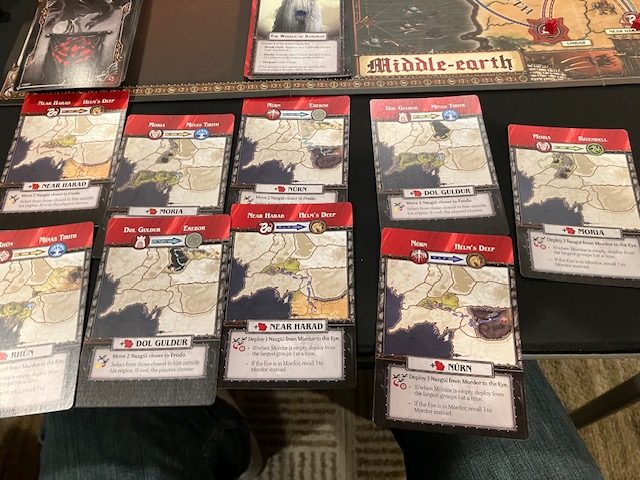
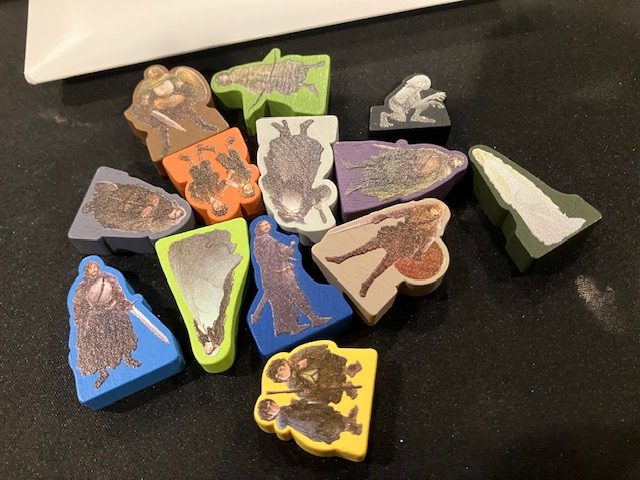
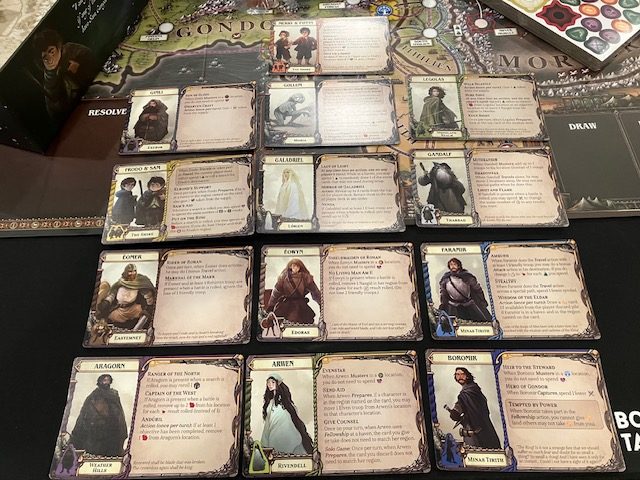
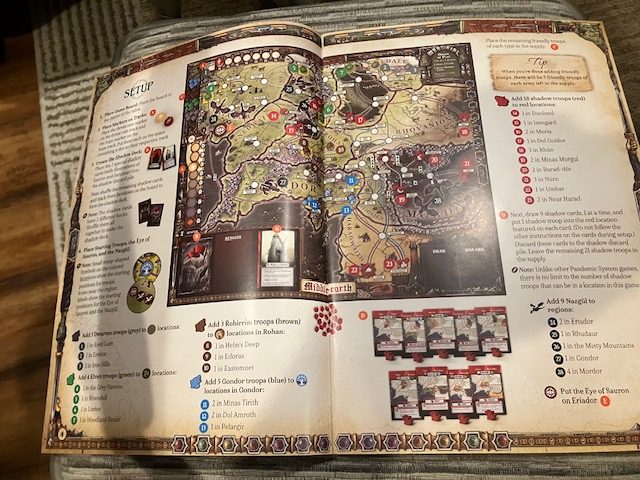
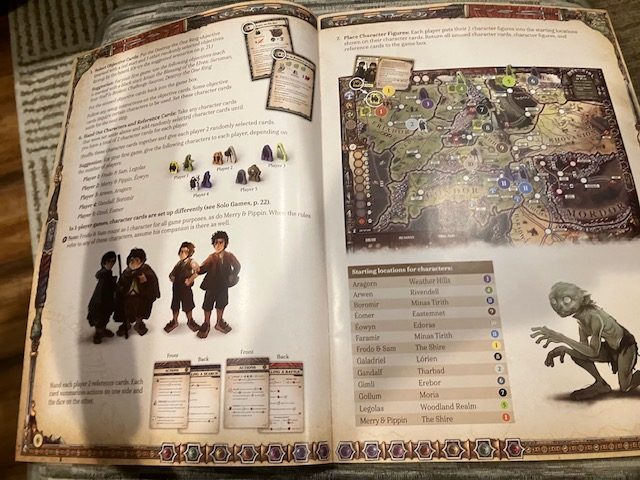
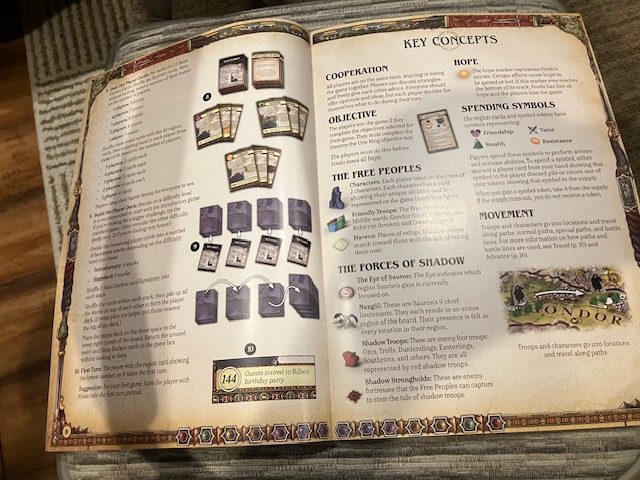
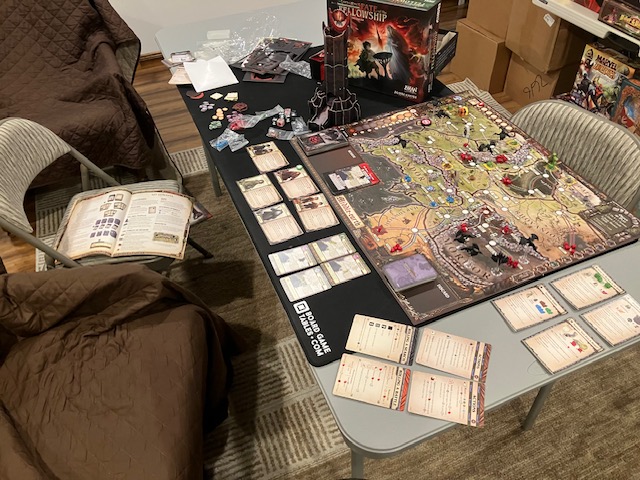
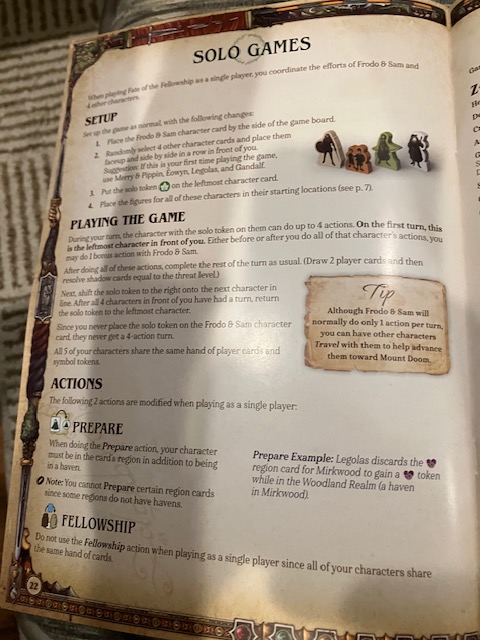
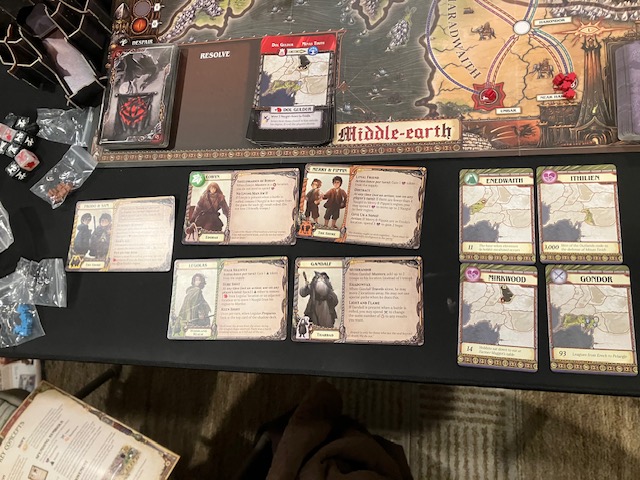
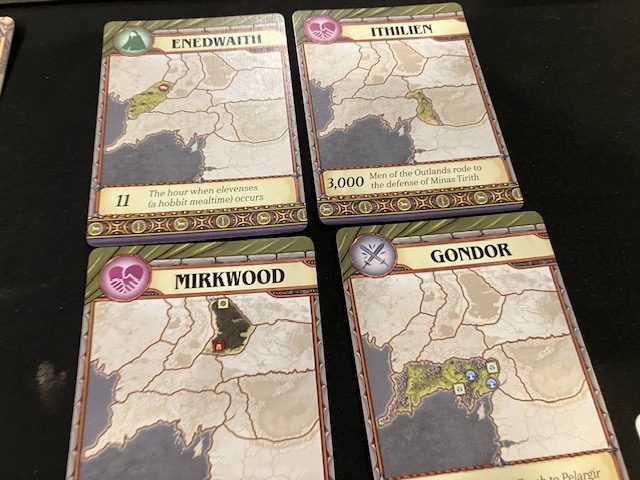
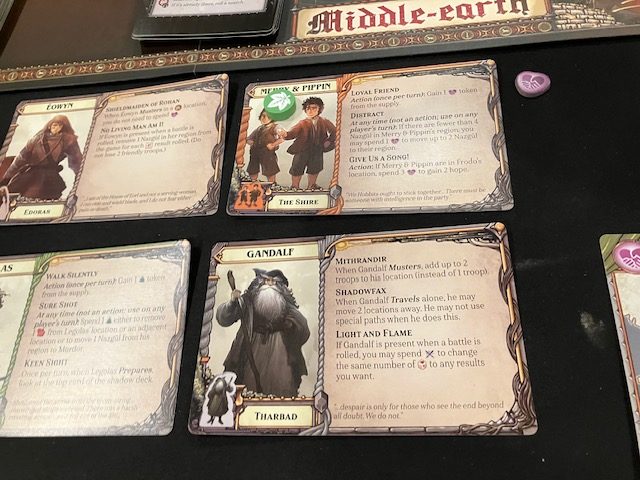
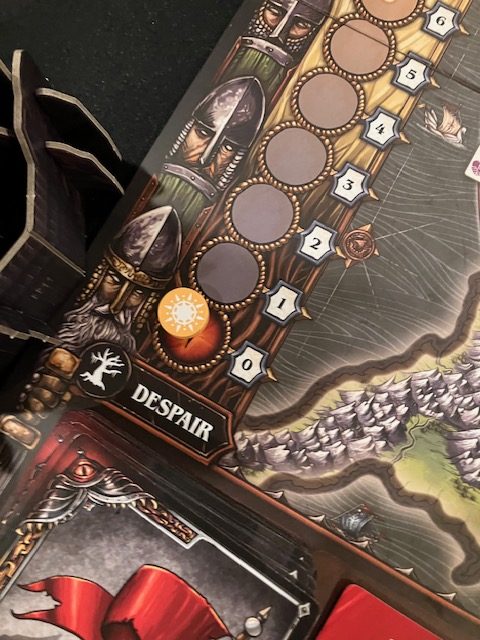
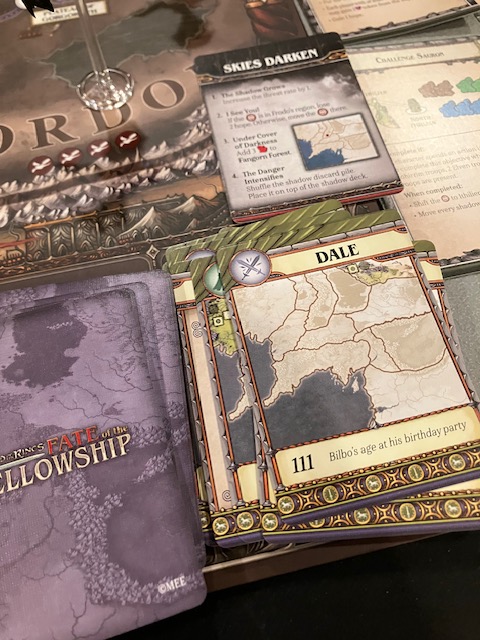
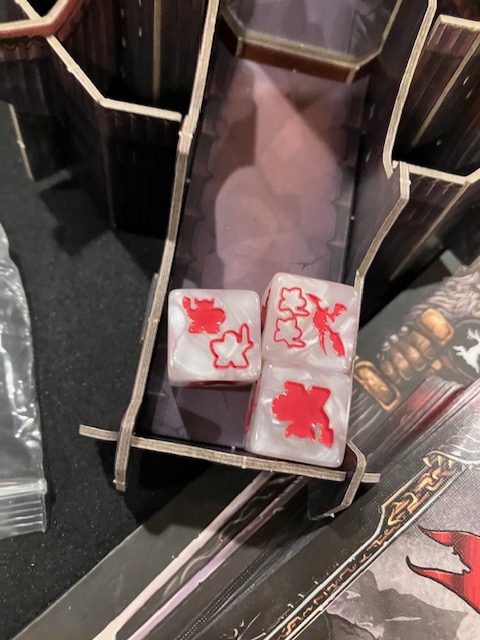
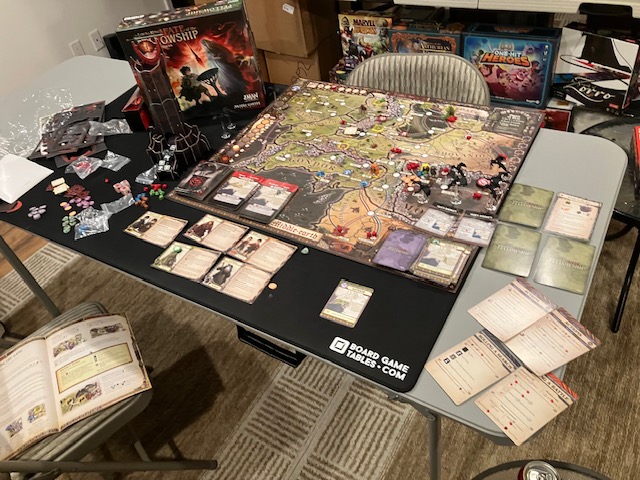
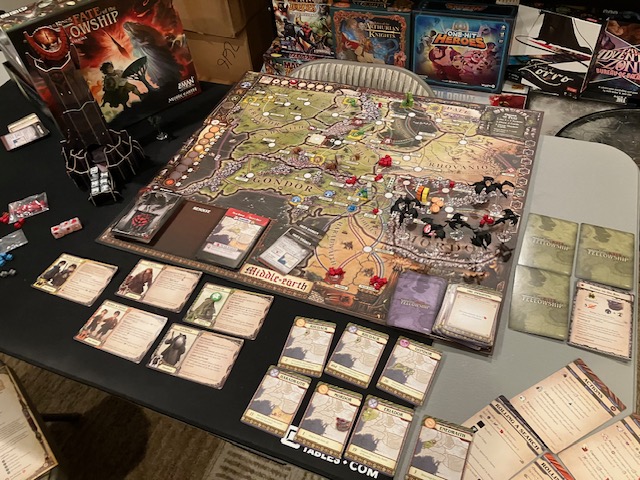
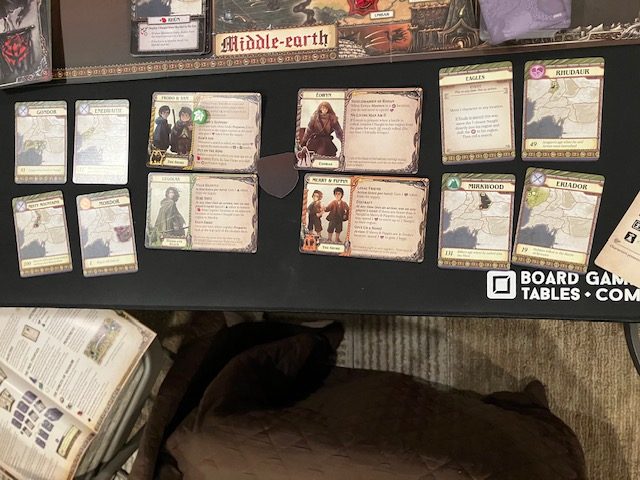
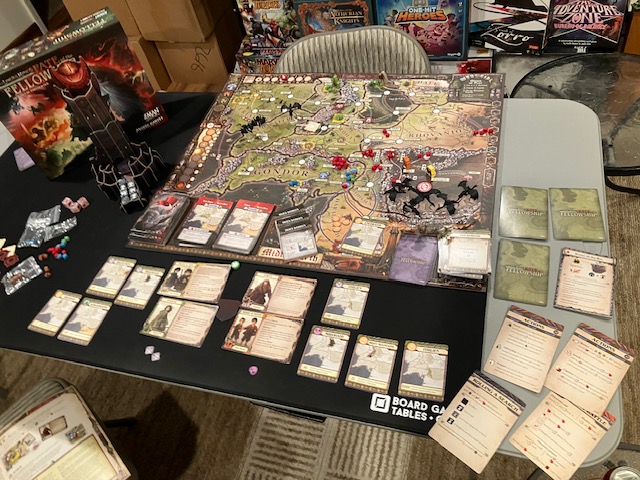
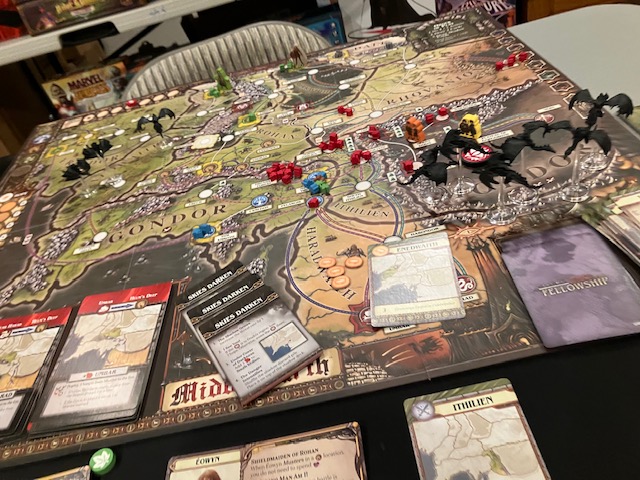
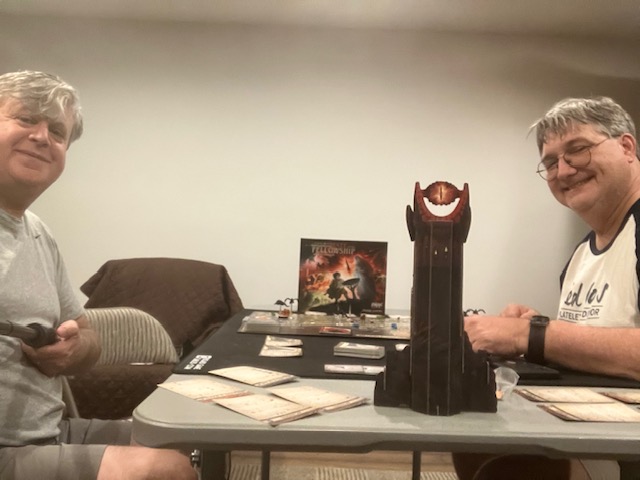
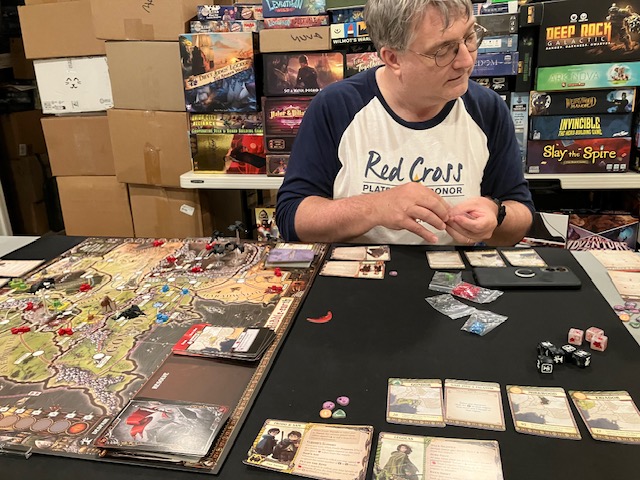
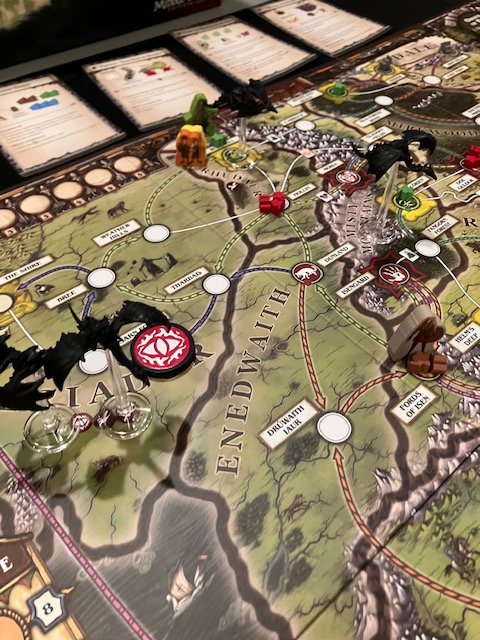
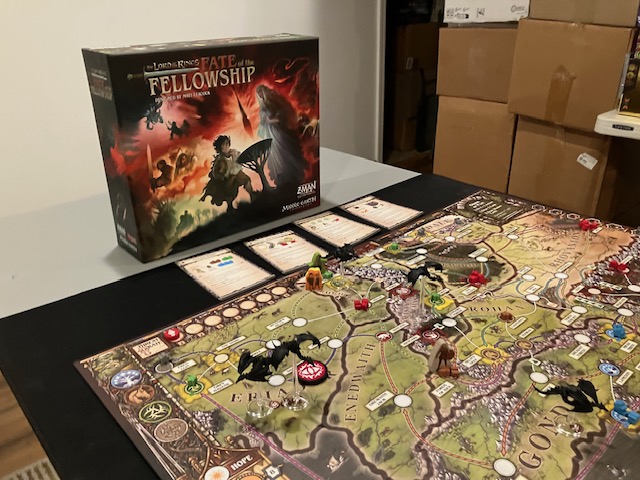
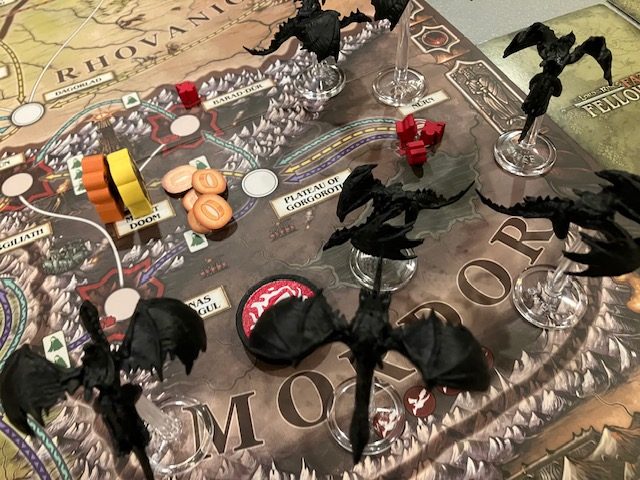
2. The Lord of the Rings: The Fellowship of the Ring Trick-Taking Game

Player Count: 1-4 Players

This game has taken my game groups my storm: everyone loves it!  

I played it solo when I was sick, and had a wonderful time going through the whole campaign solo! 

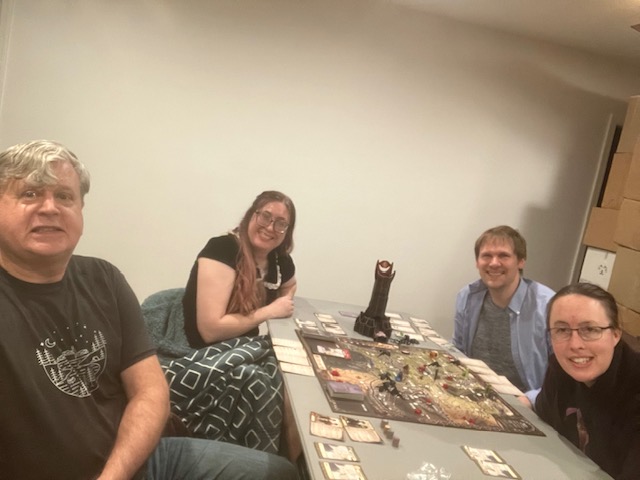
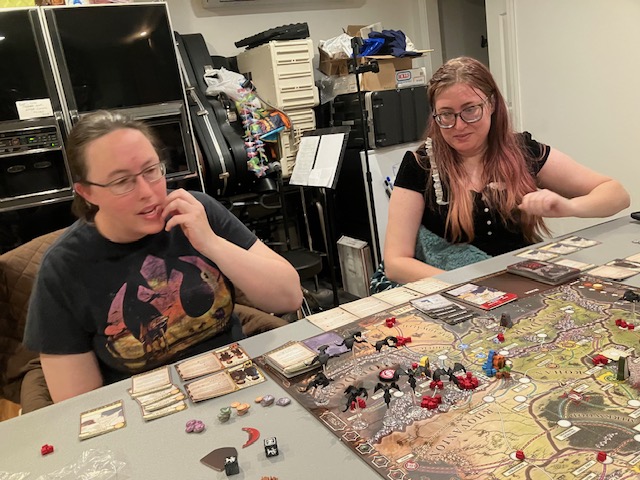
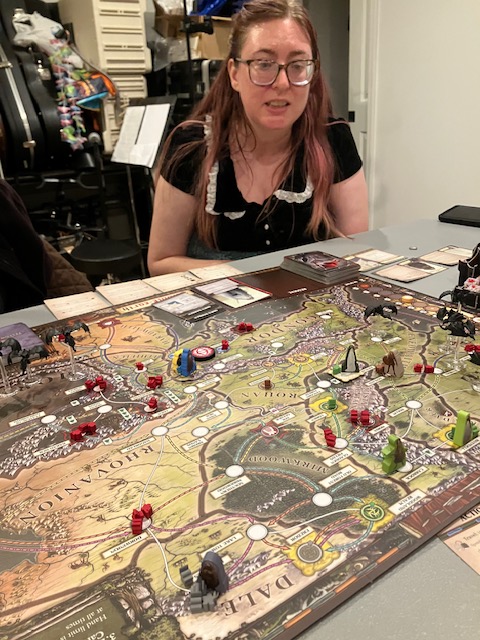
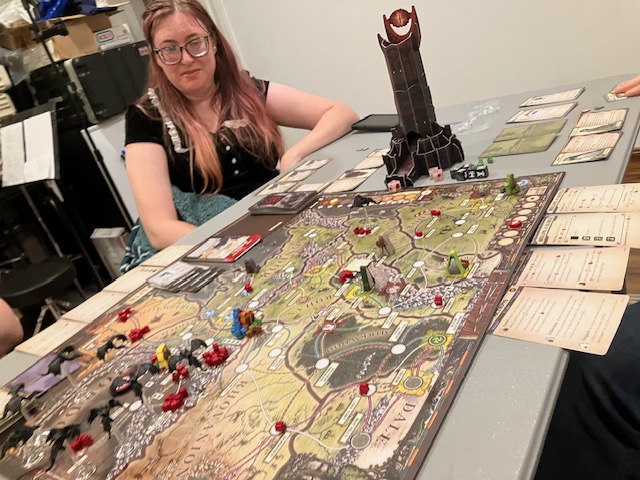
My friends in Las Cruces have played through the entire campaign as a 3-Player game and love it!  See our review here!   I played a bunch 3 and 4-Player games at Dice Tower West with my friends Becca and Tricia and had a ball!

The reason this game is so high on the list is that everyone seems to really enjoy it!  The fact that it can play at so many player counts speaks volumes to the design team!  The solo game is very different from the 2-Player game, which is very different from the 3 and 4-Player game, and yet all the different modes seem to work, and work well!  The theme seems to come through fairly well! My friend Andrew was surprised this was #2 and  NOT #1 on my list!

1. The Crew: Either The Quest For Planet Nine or Mission Deep Sea

Player Count: 3-5 Players (sorta 2-Player)

There are two different versions of this game, but they are essentially the same kind of game. Like Fellowship of the Ring: Trick-Taking game, the game players differently depending on the player count. There is a 2-Player mode, but it’s very clumsy and probably not the way you should play.

Players play tricks, but have to fulfill missions in order to win the game!  The missions give the game focus, and change every game! 

Honestly, even though I have the physical copy of both games (which are arguably the same game), I have played this game SO MUCH on BoardGameArena! During the Pandemic, this was the goto game for me and my friends! It was so easy to just bring this out and play for hours. Something called The Crew brought us together; there is probably some deeper meaning there.

What makes this #1 on the list for me is the brilliant rule that you can communicate WHEN IT REALLY MATTERS! You have a token that allow you to communicate once during your turn, by sharing the lowest, highest, ot “only one” of your hand. This is so unique: all the other trick-taking game have very restricted communication, but essentially there’s none or high-level “strategy” communications. With this one mechanism, The Crew makes it feel like your CHOICES MATTER: It matters when you choose to communicate, it matters when you choose to hold off, it matters!

This is the #1 on my list because I have played it so much more than every other game, and it’s so easy to play online or in person, and you feel like your limited communiques matter.

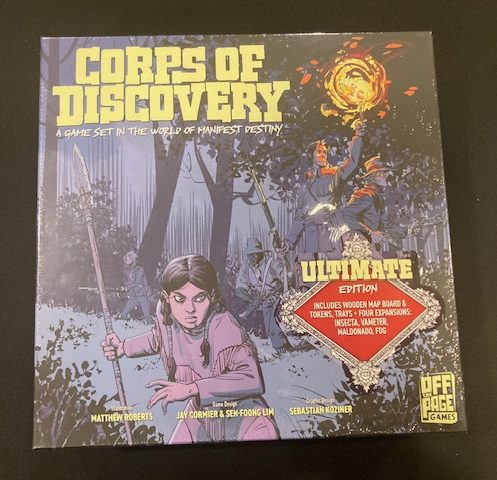
Corps of Discovery: A Cooperative and Solo Game

Corps of Discovery is a cooperative game that was on Kickstarter back in May 2024. This promised delivery in Jan 2025, and it was about 3 month late, arriving in late April 2025.

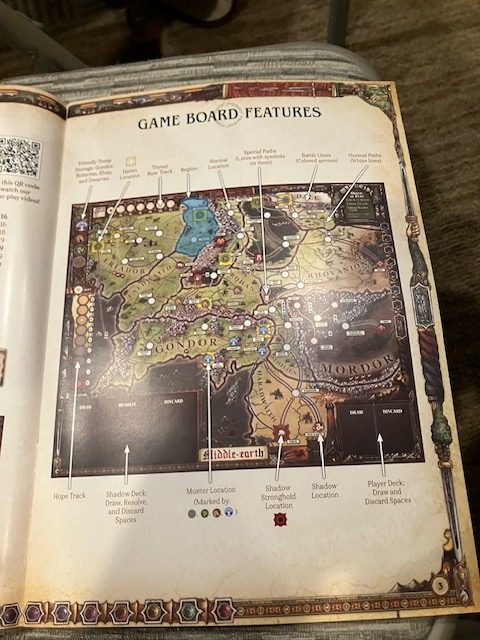
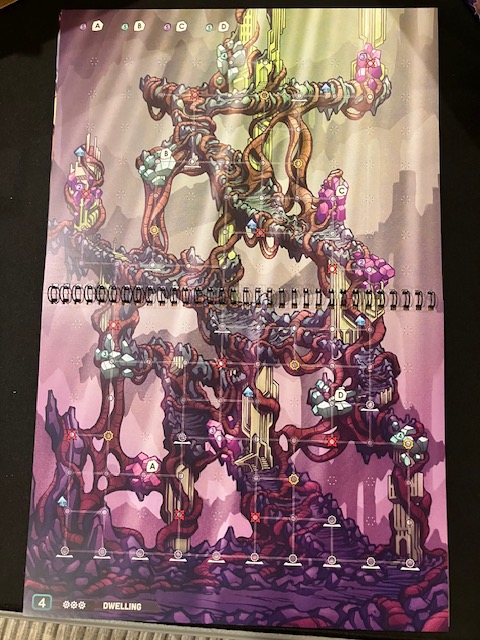
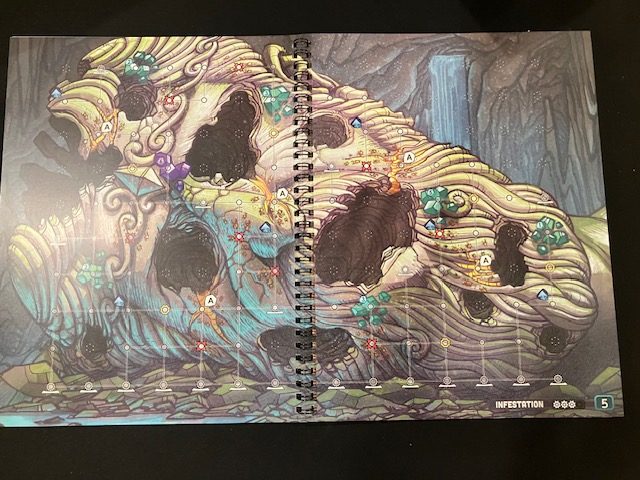
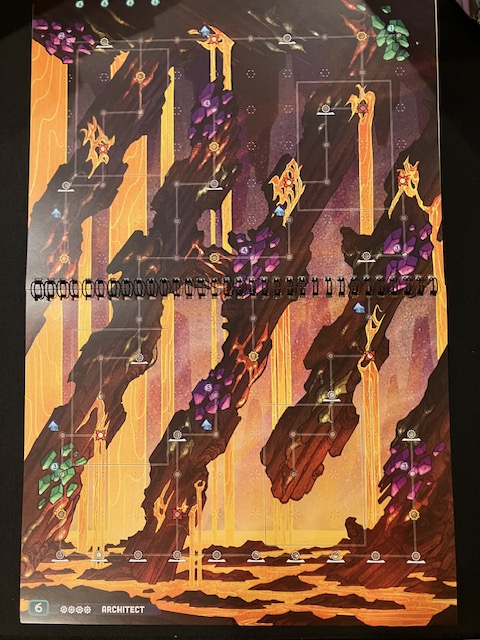
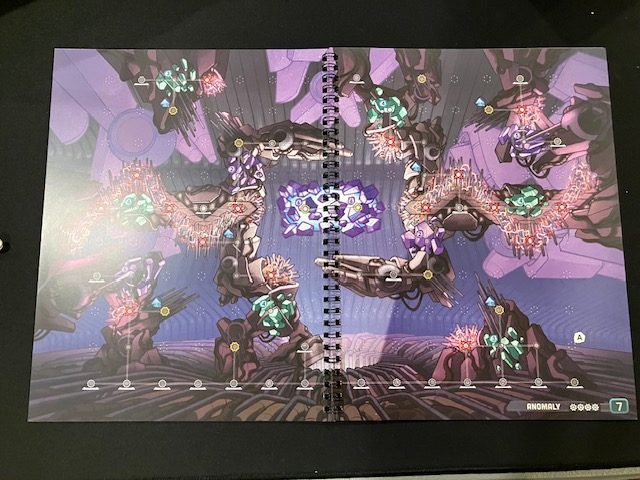
This looks like a thematic adventure/exploration game set the in era of Manifest Destiny and Lewis and Clark!  And it is NOT!  This is a deduction game, with bare hints of theme.  The text on the back of the box even hints at this being a thematic game:

“Take command of Lewis and Clark’s Corps of Discovery and lead them on a cross-country mission to explore the land … and kill demonic monsters.”

Sounds like a thematic exploration adventure, huh? Nope nope nope nope nope nope nope! Corps of Discovery is a deduction game! A cooperative deduction game, but a deduction game nonetheless! You need to know that going in or you will be severely disappointed by that description.

Let’s take a look!

Unboxing

Corps of Discovery is a pretty standard sized Ticket To Ride style box.

Now, we are showing the Ultimate edition of the game, which has slightly nicer components and a few expansions (see above).

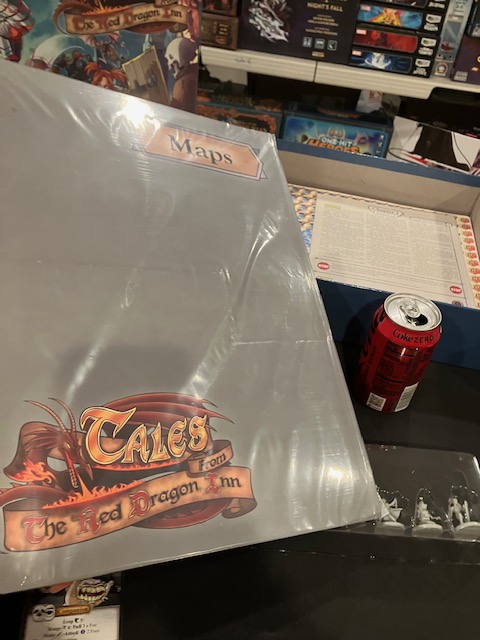
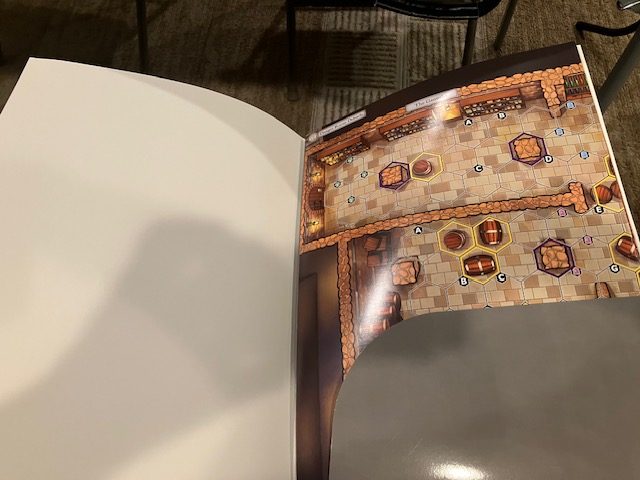
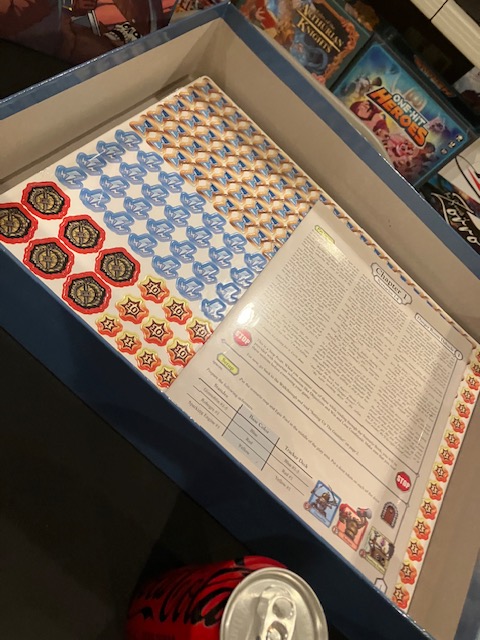
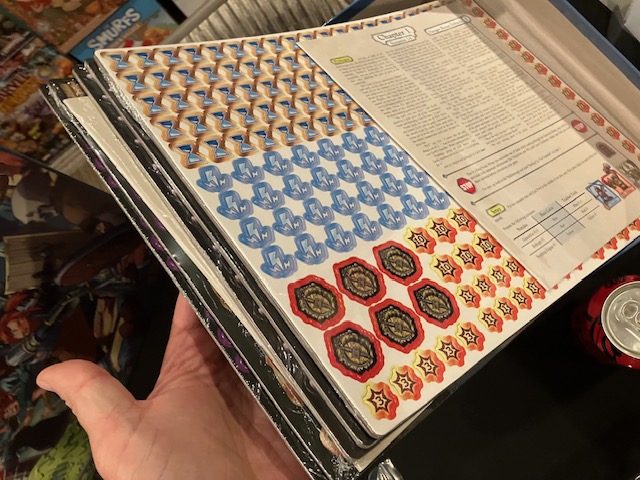
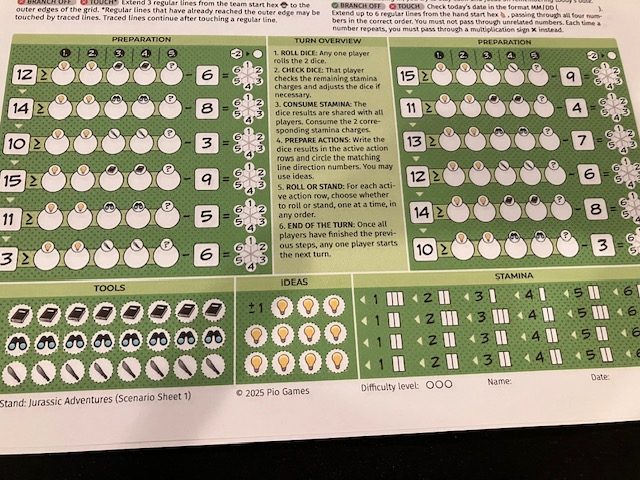
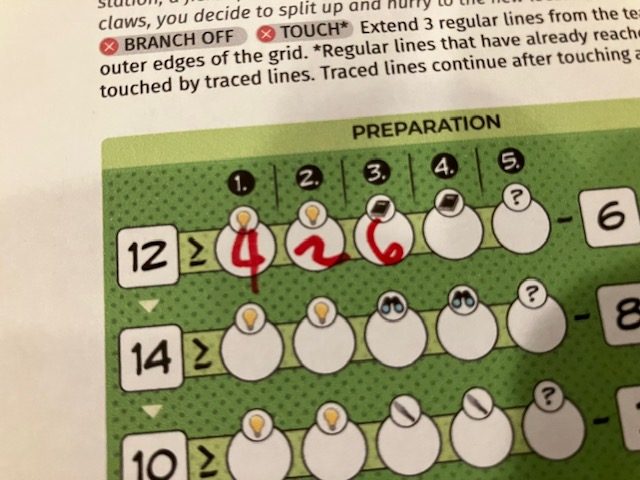
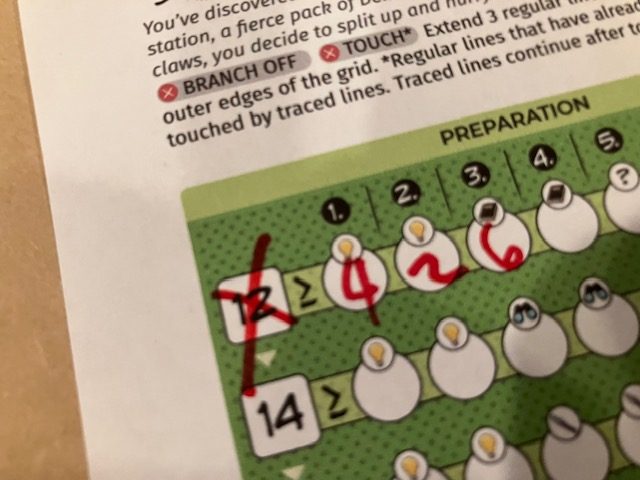
The unboxing starts poorly, as you have to “fix” some maps in the game.

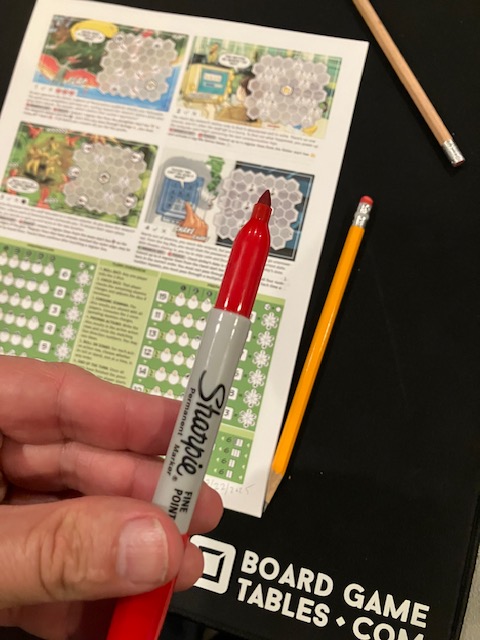
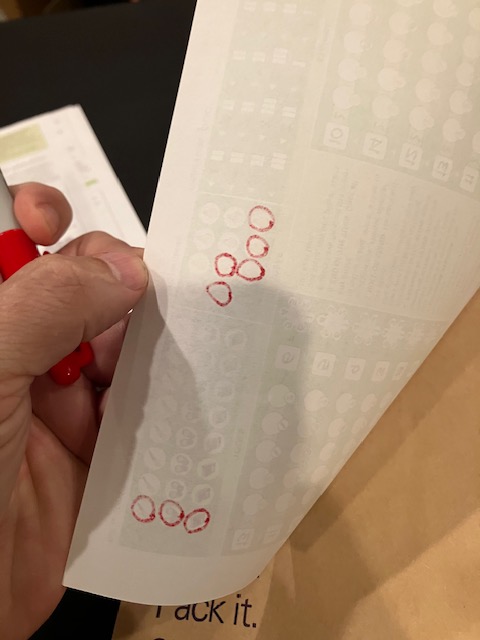
See above: as I have to X (or notate) which maps are bad.  Now, they aren’t full maps, there are just partial maps, so one side of the maps is good and the other side is bad!!  So, you still have to keep your “bad” maps, because one side is ok.   This started me off a little grumpy, but at least they fixed the problem.

The main part of the game, the key part of the game is the map holder above: in the Ultimate Edition, this is a beautiful wooden map.

There are some resource tokens (and a holder, which got very badly shaken up in delivery).

Underneath all that are BUNCHES and BUNCHES of maps!

There are different “themes” of folders with different maps: see the training mission folder above.

See the Flora map pack above.

See the Insecta map pack above.

See Vameter map pack above.

Coupled with these folders of maps are missions and the goals. See above.

Underneath all the maps are holders for the tokens for each Map pack.  Note that mine got shaken up a little, so the components are a little wonky.  I wish there had been a discussion somewhere of what all these things were, but you will figure it out … it could have been easier.

Basically, under each hard card are some components for the necessary map pack.

See above for some core components under the Core Game hard card.

The components are pretty nice, but you have to like the comic-book art style of the game. I do, but others may not.

The quality of these maps is a little flimsy, which isn’t a big deal if you are careful.

I was a little underwhelmed by the quality of the components, especially because of the errors on the maps! I did like the variety of maps, the comic-booky art, the wooden resources, and the wooden map holder. My friend Lon texted me after he got his copy: he was less than thrilled with the quality:

I saw you posting about Corps of Discovery. I will say, I am not super happy with detail and packing quality. The manuals and the backs of the expansion tiles have different numbers of items (that is just bad), so I don’t know which is right. Also, I’m missing 8 tokens…at least I think so. Since I don’t have an actual list of the number of individual resources, but it looks like I’m missing several of those, plus I know I’m missing two water, and 1 Tipi. On top of that they had the errored maps and tokens, with I’ll say substandard ways to fix them (proxy the tokens, and to save a few pennies, we’ll have you “x” out the bad maps, so we can print 2 sheets instead of 4).

Lon is also talking about the components page: it doesn’t give an accurate count of the resource tokens, so we don’t know if we got them all!!

You saw how messed up they were.  So, are we missing some?  I don’t know! They aren’t clearly enumerated the rulebook!

The component quality left a little to be desired, but I think Lon was grumpier about the components than I was.  The rulebook, however, left me MUCH grumpier than Lon.

Rulebook

I have not been this frustrated with a rulebook in a very long time.  The rulebook looks like it might be okay (it actually gets an A- on the Chair Test),  but for a deduction game where every word matters, this rulebook struggles to specify the rules well.

A few weeks ago, I didn’t love Soul Raiders, but I even reprimanded the rulebook for too many examples.  Oh, if only that were the case this week!

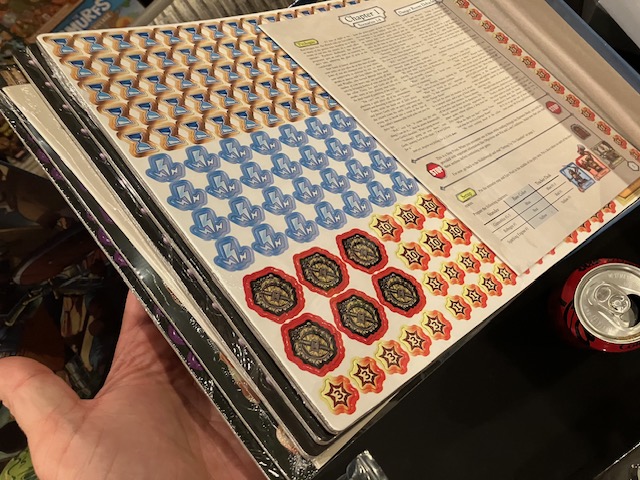
There was essentially ONE example on page 9; and it didn’t do a great job: the example crossed page boundaries, so it made it it harder to correlate the rule with the example.  It also was too small!  I struggled to read the page because it was a little too small in the rulebook! Also, some of the rules we so small because they were hidden in the text of the box!  

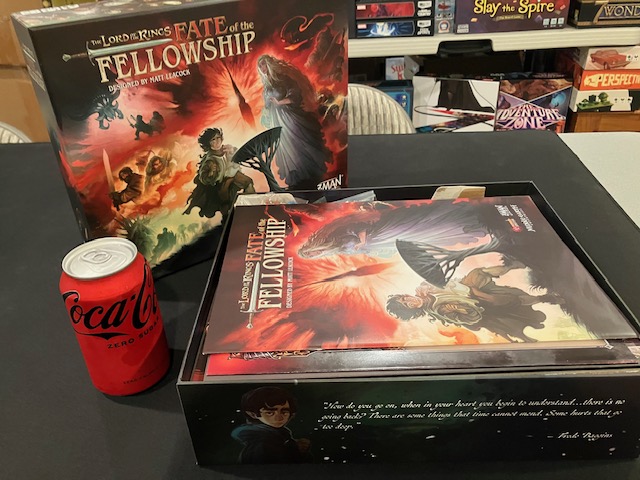
See Coke can above for scale: it’s too small!

This is a game where a single resource can make the difference between winning and losing.  Yet, there are so many places where things are poorly specified.    Some examples:

What happens when you discard a Challenge? (see Bait and Trap card above) Are there rules about which one? Can you discard one in progress?  Do you keep the path tokens for the next challenge that replaces it?  This makes a HUGE difference!   The summary icon page at the back of the rulebook DOES NOT show this and offers no explanation in the rulebook.

What happens when you add a Challenge?  (see Pass/Fail on Sweltering Challenge above).  Can you specify where the challenge goes in the day?  Before? After?  Can you put it to the front?  Can you choose NOT to add a challenge?  (Usually, you want to, but sometimes you want to move to the end of the day to reset all your Gear).  Again, there’s no specification anywhere and these rules make all the difference in the world.

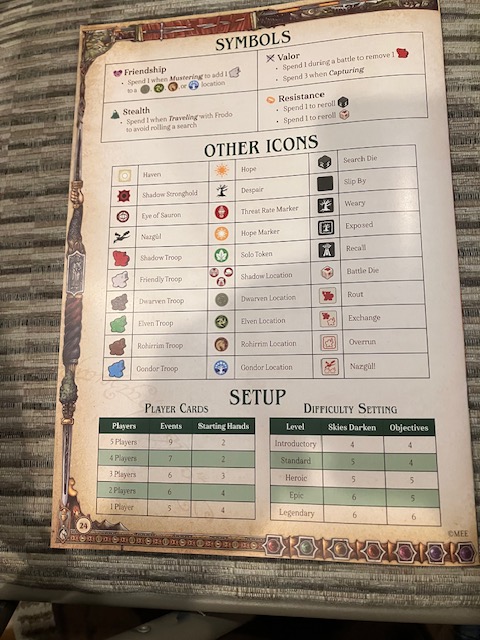
What does the ?/Water notation mean?  See above on the bottom of the Landslide card.  I went spare looking for it! 

It’s not on the back page with the summary of icons!! See above!! I figured it could maybe mean three things:
1) discard a water or some other token (I think this is the actual interpretation)
2) make it so the minotaur lines don’t require lossage
3) lose a water ONLY IF it’s on the ? side, or off the board (or remove a ? water from the board)
This is one place where the token iconography failed: the ? side is useful for the players to “mark” what they think resources are.  Corps of Discovery conflates the meaning of ? to be “any single resource” and also “notate where a resource might be”.  Which is it? 


The final meaning is not where you expect it on the rulebook: I expected an explanation on the last page with the icons: NOPE!  It’s hidden next to the path rules and Monster Threat Effect on page 10????  It’s not even clear if it’s supposed to be a token?   It sure looks like it from the picture, but I have none of these tokens in my game!!

Another problem: this page 9, which is arguably most important page in the rulebook, does not specify all the rules that appear in the Training Scenario!  It alludes to some of the rules, but isn’t clear.   See this posting over on BGG: With a little help from the internet, I figured out what was going on here.  But I feel like this page needs to explain a few more rules.

In a thematic game, I don’t mind making a few snap judgements for rules, but deduction is all about precision.  This game needs an Index, more examples, more clarifications, and some rules need to be actually specified.

Gameplay

If I said this played like Minesweeper, would you get mad at me?  Players uncover spots of the board grid using deductive rules (board sideways to maybe not give any spoilers; each map is unique).  What’s revealed leads to more clues about what’s around you!

These spots have resources which you use to overcome challenges and monsters.

It’s Minesweeper, with resources and a lot more deduction rules.

10 Plays

I gave myself 10 plays to play the game: I played two of the Training Scenario, six of the Fauna Scenario, and two of the Flora Scenario.  This took place over two weekends with pretty much my the last weekend being consumed by this game.

I was able to beat the Minotaurs reliably in the Fauna scenarios after about 5 plays.

The Flora Scenarios kicked me around.  I lost.  Hard. And I didn’t have fun.

By the end, I was tired of looking for the fun in this game.  After my 10th game, I was done.

Randomness

Like I said, I was able to defeat the Minotaurs reliably after 5 games. But I noticed that my score ranged from 3 to almost a perfect score (27)!  I got “lucky” and just happened to have the right cards come out and the right resources emerge so I was just able to trounce the minotaurs!  This was right after a game where I barely won, and I got 3 points.  The score was more of a representation of “how lucky” I was; one game, I got lucky and obtained almost a perfect score! One game, where I got trounced by my Misfortunes, I won … but barely.   The score meant nothing:  It just noted how lucky I was.  To be clear, I didn’t play THAT differently between games.

In the Fauna games, the game felt VERY lucky; how far you could advance, and when you get the Flora Terrain tokens, just felt very lucky.  (Uncovering Flora tokens means you don’t get the resource, and you have NO IDEA if you will uncover a plain resource or a Flora resource).

In a game where Deduction is such an important part of the strategy, there seemed to be too much luck for me to want to come back to this.

Conclusion

I wanted to like this game so much.  I was initially a little disappointed that it wasn’t particularly thematic, but I still really like Deduction Games, so I was still so happy to move forward with what it was. A deduction game needs tight, well-written, and well-documented rules; sadly, that was not the case with this game!  The rulebook was one of the most frustrating rulebooks I have encountered in sometime.  To add insult to injury, I felt like a lot of scenario-specific rule were also under-specified.  Even powering through the rules and making the “best I can” with the rules as given, I found the game just too random for a game that just leans so heavily on hard deduction.

I gave Corps of Discovery so many chances; I forced my way through ten games, hoping to “finally” overcome the hump of rules.   But I rarely had fun playing: I was always just so angry at the randomness and poorly specified rules.  I am selling my copy. 

Maybe you’ll like it if you can power through it; maybe being forewarned about the pitfalls will help you like it.  Corps of Discovery has a really original premise, and it has some great ideas, but it just never came together for me.  Maybe it will for you.

EDIT: My copy has been sold.

More Solitaire than Sherlock: A Review of Sherlock Solitaire (the Solo and Cooperative Game)

This review has been sitting in my hopper for over a year now; not sure why I didn’t get it out earlier!

IMG_3314

Sherlock Solitaire is a very small cooperative card game for 1-2 players.  This released early in 2024: I had heard about it from my friend Sam and so I quickly ordered it from Wise Wizard website about a month ago (early March 2024).  It delivered pretty quickly!  I got it to the table solo, but I didn’t want to finish my review until I tried it two-player cooperative .. Sam really wanted to play, but he was busy most of March.  

IMG_3318

This is a very small and thin package.   It plays 1-2 players, is about 20 minutes, and plays ages 12+.

Let’s take a look!

Unboxing

IMG_3316

Sherlock Solitaire is a teeny tiny box and very thin: see the Coke can above for perspective.

IMG_3319

Except for the instruction pamphlet, it’s all cards .. just 55 cards.

IMG_3335

The cards are pretty gorgeous.

IMG_3337

The game is very pretty on the table: see above.  

Rulesheet Not a Rulebook

IMG_3315

The rulebook is not a rulebook but a rulesheet: see above.  Sigh. It’s a pamphlet.

IMG_3320

Considering it’s a pamphlet, it actually does ok on the Chair Test!  It fits on the chair next to me and I can read it!  The font is a little small (because it’s a folded pamphlet), but it worked on the chair next to me, as I consulted it during gameplay.

IMG_3322

The set-up was pretty good: see the picture above.

IMG_3323

The rules are a little sparse, but they does work.

IMG_3324

It even does a decent job at showing examples and counter-examples of “what is a set”! I appreciated that set of pictures!

IMG_3328

Given the constraints of a pamphlet, this rulesheet worked pretty well.  The pictures were all informative.  There were a number of places where some clarifications could have been provided, but the ruleset was simple enough and consistent enough that we were able to extrapolate rules when needed.

This was a decent to pretty good rulesheet.  

Gameplay

IMG_3331

Choose a starting scenario: The Intro Case (The Valley of Fear) is just to get you into the game, so it has simpler win conditions.  The Final Problem has a much harder win condition.

IMG_3329

Each player (works for 1-2 players) takes either the Watson card or the Sherlock Holmes card.  See above.   The bottom of the card shows the special abilities of each player!

IMG_3334

Basically, each character gets 4 cards on their turn to play to one of two areas: the Crime Scene or the Office.   There are two types of cards: Investigator cards (labelled 1-4: see above) and Threat Cards (labelled A-D, see below).

IMG_3336

Over the course of the game, the player(s) must play two cards to the Crime Scene and two cards to the Office each turn.

IMG_3343

In the Office, you are trying to make sets of cards: you have to alternate investigator and threat cards  (numbers and letters … see above).  All investigators (numbers) must be in the same column, and all letters must be distinct in a column: these are the “sets” the players are making.  If you get 3 full sets (4 investigators), you win!

IMG_3344

However, you still have to play two cards to the Crime Scene as well: see above.  If you ever get 2 of any type of card, you immediately discard those two cards and “do something!”  

IMG_3347

Two threat cards?  You take a wound! See two threats above …

The wound card is a “timer” of sorts: if you ever get 3 wounds, you lose!

IMG_3649

If you get two investigators on the Crime Scene, you invoke your special powers!

IMG_3342

The rulesheet does a nice job of summarizing of how to use your special powers … see above.  

IMG_3346

If you get enough sets, you win!  If you get 3 wounds, you lose!  It all happens in about 20 minutes.

Solo Play

IMG_3323

A game called Sherlock Solitaire had better have a solo mode! It does (thank you for following Saunders’ Law): it’s the main way to play!

IMG_3349

Once I got past my first few games (after I had to decipher the rulesheet), the game moved pretty quickly.  

IMG_3342

The best part of the game was when I could be clever and play my special abilities in a clever way to move cards to/from the Crime Scene/Office.   The worst part was when I just played cards and didn’t feel like I had a lot of choice.  The game was a fairly engaging way to spend 20 minutes.  It really did feel like a game of Solitaire as I moved cards around.

More Solitaire Than Sherlock

IMG_3317

With a name like Sherlock Solitaire, you might be expecting something more like a mystery. No, this is a lot more Solitaire than Sherlock: you are just playing cards like a game of Solitaire.

IMG_3335

Don’t get me wrong: I love the art! The art that comes with this game is gorgeous and very evocative of the Sherlock Holmes stories!

IMG_3341

In the end, though, there is no mystery to solve. There isn’t really a lot of theme: this could have been a Cthulu game, a Zombie game, or a Smurf game. Or anything. Nothing about the gameplay really has to be in a Victorian Sherlock Universe.

IMG_3338

The art is really the only thing that makes you think of Sherlock Holmes: and it is phenomenal art!

Two Player Game

IMG_3656

I had to wait almost a whole month to play with Sam!! He was interested in the game, but was busy with family and work all March.

IMG_3643

There are two ways to play Sherlock Solitaire 2-Player: 

  1. Play as the solo game, but both players together make all the decisions
  2. Each player takes Sherlock and Watson, and alternates turns

We chose to alternate turns.  The solo game with 2 players making all the decisions seemed less fun … and at that point, it’s just the solo game anyways.

IMG_3646

What we found was that … the second player got a little bored.   There is no strategy in a 2-Player game, as you have no idea what cards you get until your turn.  What that means is that if you are waiting for you turn,  you can do nothing useful!!  You just sit there waiting for your turn.

IMG_3648

The two-player game was much less interesting, as someone was always “waiting” with nothing to do.

… until we tried a little house rule.

House Rule for Two Players

IMG_3649

When it’s not your turn, draw some cards! Instead of sitting there “doing nothing” during your friend’s turn, you can then “be thinking” about what you want to do when it’s your turn! To keep this from being too overpowering (from the game balance perspective), we choose to just draw two cards at the end of the turn and two at the beginning of the turn.

IMG_3648

That way, we were still playing four cards per turn, but had a hint of what we could on our turn.

Weirdly, me and Sam didn’t feel like this changed the game balance too much, and in fact didn’t change our turn too much, but it felt like it mattered!  With this simple rule, we both felt more engaged, even if it didn’t change the game too much!  We felt like we mattered more, even if it was just a small amount! And that made a big difference.

Conclusion

IMG_3321

If you were expecting something with a mystery of some sort, then Sherlock Solitaire may be a big disappointment.  There’s a lot more Solitaire than Sherlock in this game: it’s basically just a card game about making sets and moving cards.

IMG_3319

The special powers of the Sherlock and Watson characters make the game interesting, as you can make many moves in the game that make you feel clever. 

IMG_3337

And despite the lack of theme to this all card game, the art is still very nice and evocative.

IMG_3648

As a solo game, I’d probably give a 5.5 or 6/10.  I might play it again: it’s pretty straight forward and quick … and there are moments where I feel clever.  I freely admit that the art brings it up the score a little bit: the fantastic look makes this game stand out on the table.

IMG_3656

As a two-player game, I would give the unaltered game a 5/10: there was just too much downtime between turns. If, however, we played with our house rule (always having two cards in your hand), then I would bump this up to a 6.5/10! We felt much more engaged even if it was just our preception! My favorite way of playing Sherlock Solitaire was 2-Player with our house rule: that’s probably how I’d play it again.

Soul Raiders: A Solo and Cooperative Review

Soul Raiders is a cooperative fantasy adventure game that was on Kickstarter back in July 2021 and promised delivery in December 2022.  I backed the deluxe Grimoire Edition (above). Well, it finally arrived last month (March 2025), so it’s about 2.3 years late.  This wasn’t on my Top 10 Anticipated Cooperative Games of 2022, but it probably was my #11 or #12!

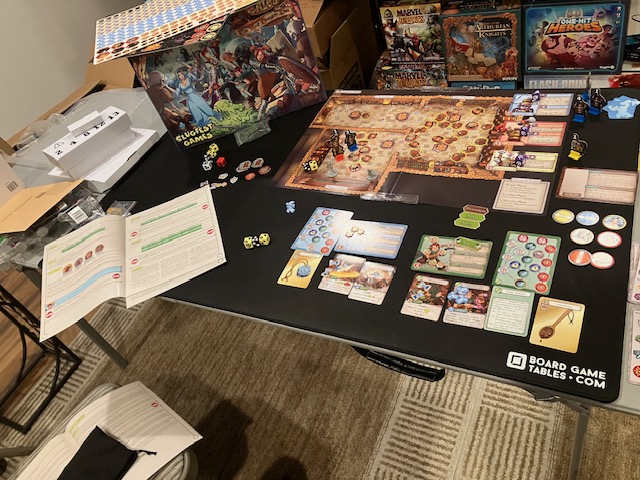
This sat unplayed in the box longer than it should have; I think I was scared of how big it was! Look how big it is!!!  Did I have the cycles to even try it?

Well, I finally got around to getting out and trying it … was it worth it?

Unboxing

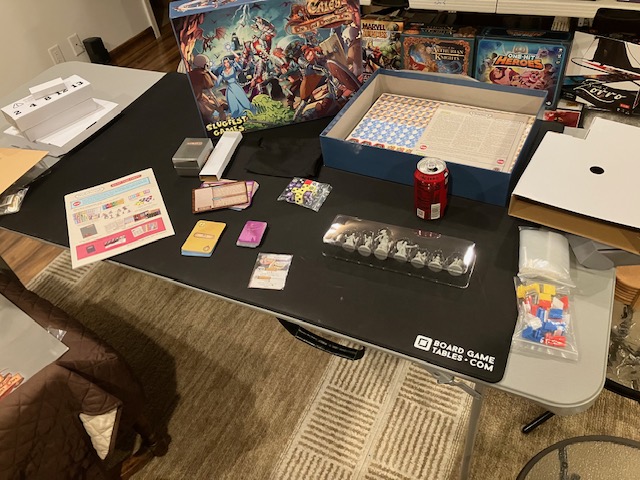
Although this unboxing here is to show you what’s in the box, it’s also here to remind me how to put the box together!  So, it’s for me and you!

This is a BIG box.  This is the Grimoire Edition.

It’s got a lot of stuff packed in: see the character boxes above (this is a cooperative fantasy adventure game).

This game is so grandiose, it has it’s own lore book!

If you really want to get into a fantasy universe, this might be the right game for you!

This dual-layered board (above) keeps track of a lot of shared attributes and state of the game.

There’s lot of little boxes to store your game between sessions.

There’s some fabulous minis.


The campaign notebook allows to save the game between chapters.

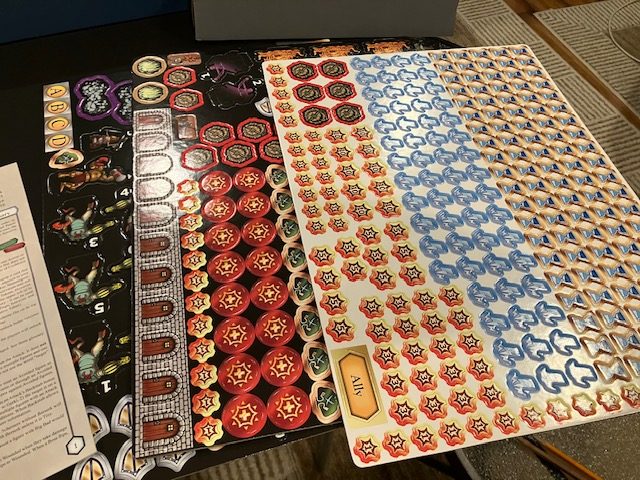
There’s a bunch of cardboard tokens.

And boards for the characters.

Underneath all that, are the three main chapters of the game.

The cards of the game are in two boxes: see above.

Each of the chapter boxes has huge Location cards and little cards.

This game is GORGEOUS.  The production is GORGEOUS.

Consult the pictures above for when you need to repack your box!

Rulebook

The rulebook is good.  Well, ish.

It gets about a B+ on the Chair Test: it overhangs on the chair next to me just a little (see above), but it lays flat and open, it has a big readable fonts, and it has lot of pictures.

The components page is well-labelled and notated (see above).  It even breaks up the cards by chapters.

The set-up works pretty well, although it doesn’t show how the story cards will be laid out (which we need to discuss more).

This is a gorgeous rulebook that’s written pretty well, it has lots of examples and lots of pictures.

It even ends with a very useful summary of icons on the back!

Although I liked this rulebook a lot, it made the mistake of putting too much content into the examples.  I like it when rules have clear definitions, then maybe use the examples to help explain and/or clarify.  Unfortunately, I think this leaned a little too much into using the examples AS the rules a few times.    Don’t get me wrong, I am glad the examples are there, but I wanted clear succinct rules as well.  (I think the last time we noticed this “rules in examples” phenomena was back Sleeping Gods rules: see link here).

The rulebook was generally good, and it frankly looks gorgeous (like the rest of the game).

Gameplay

The best way to describe this game? It feels like it a video game: a  Point-And-Click (fantasy) Adventure game with lots of monster fighting.

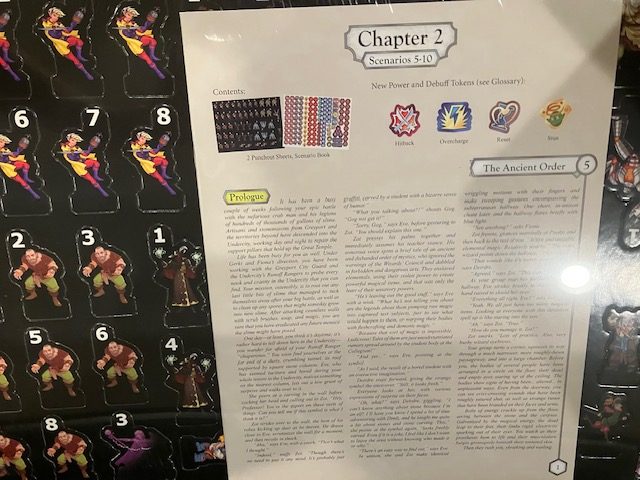
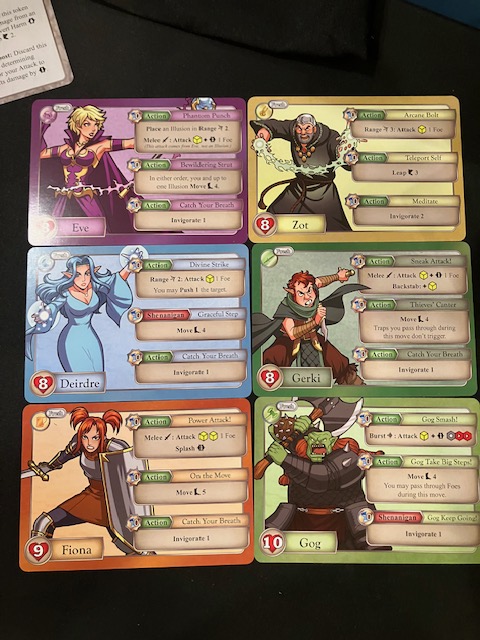
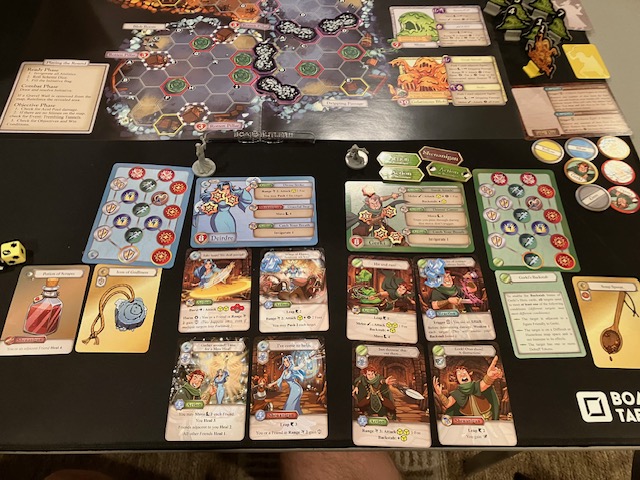
Each player takes the role of one of six characters: see the character boxes above.

Each character has his own set of cards: there’s basic Action cards (above top) and Heroic Action cards (above bottom).  Notice the Heroic Action cards have a special foil on them so you can tell them apart!

These Heroic Action cards are earned (in order) by spending Heroism tokens (3 to earn a new Heroic Action card).  Cool fact; you can spend 3 Heroism tokens at ANY time to immediately earn a new card! Very useful when you need a card immediately!

You get Heroism tokens are various plot points in the story, but the most reliable way to getting Heroism Tokens is by defeating BIG BAD MONSTERS!  Defeating the one above opens Story Card 14, but also earns the player 2 Heroism tokens!

By the end of Chapter 1, I had been able to earn 6 new Heroic Actions cards! (Heroic Action Cards must be earned in order: note the numbers on far right).

The cards are you primary currency for “getting things done”.  Some cards are more attuned to movement (as you must explore) … see above …

… and some cards are more attuned to fighting!  See above.  Basically, you can always use the value on the card for whatever you want, but the card will have “bonuses” if you use it for the specific specialization!

For example, Heroic Action card #6 (the top one) has a basic value of 5, but if you use it for fighting, you get an extra +3!

Example above: Even though the cards I drew were all movement-centric, I can use the values on the cards for fighting: 4+4 = 8 takes out the first shield on the bad guy, and 4+2 = 6 takes out the second shield!  I used all my cards, and I didn’t get any advantages, but I was able to do what I needed!

Basically, your character explores the world, moves around, interacts with the world, and fights monsters!  All actions are based on the values on your cards!

Basically, you character(s) move around on the Location sheets and explore!

The Locations have arrows which tell you how much its cost to move between Locations: see above and below.

For example, to move to Location 2, I need to spend 4 points from my cards.

This is kind of a choose-your-own adventure tale!  You decide which paths to take, which monsters to fight, which puzzles to interact with!  It feels very much like a choose-your-own adventure!

What’s cool is that each Location has pretty great art (a little comic-booky, but I like it) which describes all the things you can do at that Location … kind of like a choose-your-own-adventure book does in each section.

See above as the character starts on the maps!

An interesting thing that happens is that there is a “clock” pushing the game forward.  At the end of every “turn” after you’ve played all your cards, the Vitae track moves down.  Basically, every time it “wraps around” back to 30, you drop the Action token one space (upper right).  If your threat or the action space ever get to the end, the game is over!

To win, you need to find the Red Stars on the story cards.  If you don’t find appropriate story cards, you lose!

Explore, fight monsters, interact with your world: this is an adventure game!  The way the movement works, it feels very much like a choose-your-adventure game (as the Locations could just be pages numbers in a book!)   This game also feels like a Point-And-Click Adventure game too!  See our Top 10 Point-And-Click Adventure Board Games for more discussion of this genre!

Solo Play

So, this game supports the solo player (thank you for following Saunders’ Law).  This is a true solo game: the solo player operates one character.

The only real change for solo play is on the Game board:

On the Game Board, the final space has a “3” marker on it (instead of 2).  This is the number of cards you draw every turn, so the solo player has that extra advantage that (on the last set of rounds) they get three Action cards instead of two.  And that’s the only change!

The solo player explores, fights, and interacts … but just by himself!  There’s no real balancing anywhere else.    It seems a little weird that there are no other balancing mechanisms, but basically what tends to happen is that more enemies come out as more people play, so that tends to balance the game.  We’ll address that a little more in the cooperative section.

Cooperative

The cooperative game brought up a lot of rules I didn’t have to deal with in the solo game!  When you explore new Locations, whether or not someone is already there “changes” how the Location works!

Unfortunately, the Icons were very confusing about this.  A slight change of color AND whether its on side A or B makes a big difference.  It actually took us almost half the game sessions to get this right!

Although the cooperative game has a sense of Player Selected Turn Order, there really is no turn order!  Players just play when they want and support each other if it made sense.  Although I love this idea, as it should make the game go faster, the game tended to serialize as each player waited to see what happened to see if they needed help.  “Let’s wait to see what Sam gets!”   I love this from a cooperative point of view, as it lets us support each other!! Unfortunately, what really happened more often than not is that the game really just slowed down behind one (the current active player).  To be fair, there were also plenty of times when concurrent play kept the game moving forward.  This system worked pretty well from a cooperative point of view.  From a length of game point of view, this was not optimal.

Although this game is a 1-4 Player game, I was the fifth player and “the rules guy”.  I just read the rules and taught the game and looked up clarifications.  Sadly, this was a very busy position for most of the game!  I would constantly be looking up rules clarifications, icon clarifications, and other things.  I had played the solo game for about 8 hours, and I was still struggling to find some rules!

There are good moments of cooperation as the players supported each other.  Me being the “rule guy” actually worked pretty well, although it was sort of depressing that I had to fill this role.

Urgency

This game has, essentially, a built-in clock.  Every time you have finished playing all your cards, you have to take “Vitae” damage (basically, a shared hit point pool) based on the the current.  The threat will go up occasionally as monsters or other things happen.   And you can’t “usually” just rest on a Location: almost all Locations force you to fight new monsters if you stay there.

So the game is just always pushing forward:   This is both good and bad.  If you are looking for a contemplative adventure/exploration game, this isn’t really it.  If you want an adventure game that doesn’t stand still, but presents a sense of “you have to keep moving“, this is the adventure game for you.   Here’s a very bad analogy; some sharks have to keep moving in water or they die.  That’s kind of what you feel like here: players always have to keep moving (exploring) or you die.

Whether you like that urgency or not is up to you.

Kind of a Big Mess

When you take out the Location cards, there’s no real rhyme or reason to them.  They don’t form a map (like Arydia Locations did: see that review here), they are more like “pages of a book”.  See my big mess after finishing chapter 1!

The problem is that you WANT to see the connections from previous Locations you visited!  So you try to keep a lot of Locations out as you play so you can see how you came here.  And you can see my big mess above as I try to keep some Locations out.  To be clear: the Locations DO NOT form a map! (The rulebook even emphasizes this point).

So, the Locations that come out are kind of a mess.  Shrug.  It feels like there should be a better way to deal with it?

Portals

There are some very cool minis for portals!  See above!

You can see above as I have built at least one early in the game!  I was hoping to make this spot an easy one to come back since there are no “monster spawners” there!

And yet, I don’t think I took full advantage of the portals.  At all. I don’t think I used them once.  Which is a real shame, because they are so nice!

This is where I feel like this is even more like a Video game … where you replay the level to get the highest score and use the portals to their best advantage.  I played Chapter One and got a few extras, but not enough.  I feel like what I would do in a video game is replay it until I got the perfect score for that level!  I think to do that, I think you’d almost have to use the portals.

Maybe the portals will become more useful later on.  I was … disappointed with them.  Given how you never really get to just “think” (see Urgency section above), the only time it feels like you might be able to take full advantage of them is to replay the level.  Remember how I said this feels like a video game?  That min-max feeling emphasizes that point even more …

Save Game

This is a campaign.  You will need to save you game between chapters.  Unless you can leave the game set-up (and it is a table hog), you will have to save your game.

You can either use the campaign book   (above) …

Or just take a picture of your game and extras at the end (see above).  The cards are pretty well marked.

Let’s be clear: this is a campaign you can reset!  I have a solo game going, but we are also playing a cooperative game at the same time.  Sure, I’ll have to “pick” the cards out I want, but it’s fairly easy to reset the campaign to replay it from scratch.  This is not a legacy game.

Too Many Rules?

For such a lavish game, it’s both really simple and really complicated.  The basic card play is really straight forward, but all the little rules for combat and especially movement feel very complicated.  If you enter a Location with someone else, it has a different effect depending on the Icon in there, which has subtle difference between other Icons.

The fact that my role as “The Rules Guy” (as the 5th player and NOT playing the game) was pretty active the entire game might be an indicator that maybe there’s a few too many rules.

Reactions

Oof, Soul Raiders did not go over well with my group. My friends compared this to Tainted Grail (see part I and part II here) where it was just a grind to explore.   Andrew even commented: “This doesn’t feel like an exploration game, even though it kind of looks like one!  I have no mental model for how the map lays out because it’s so clumsy!”  Sara commented that the “.. Exploration feels like Tainted Grail because you just keep getting monsters!  You don’t really feel like you advance!”

Andrew pointed out, “It’s not even really choose-your-own Adventure, because you don’t really have a lot of choices!  You left, right, or forward most of the time! And it feels randoms!”   

The reactions were ok to not great.

Sara and Andrew: 5/10.  “Don’t really want to play it again.  It didn’t feel like exploration. It felt too grindy like Tainted Grail.”

Sam: 5.5/10 “I’d play it again, but I really didn’t love it.  I thought Luddite from last week was more thematic than Soul Raiders!”

Teresa:  6.5/10 “I had okay fun and would play again.”

Rich: As a cooperative game, I definitely saw what my friends saw with the grindiness, and I could see why my friends didn’t love it.  As a solo game, I’m right on the fence of recommending it:  I’ll give it a 7/10 for the solo game, and maybe I could see it working as an intimate 2-Player game.  I think as a solo player, I became more invested in the story, but I still had some of the problems that my friends had. I love the art, and I really like the simplicity of the card system.  I also really like the upgrade system (where you can IMMEDIATELY grab a card with 3 Heroism).  I think there is some interesting stuff happening in the story, but the game does fall to the grind sometimes.

Conclusion

Soul Riders is a gorgeous cooperative adventure with a sense of urgency.  That urgency adds to it’s video game feel: it’s kind of a Point-And-Click Adventure in a board game, with exploring and interacting, but also lots of fighting!

Unfortunately, this game didn’t go over very well with my friends as a cooperative game, with scores ranging between 5/10 and 6.5/10.  Soul Raiders reminded my friends too much of the grindiness of the original Tainted Grail in both its exploration and fighting.  And that grindiness was a big turn off. Having said that, the system worked well from a cooperative perspective, because my friends seemed to cooperate well!

As a solo player, I become fairly invested in the story and I enjoyed it a little more.  I think the solo player can reflect a little more than a cooperative team, so maybe that urgency in the game is less intrusive for the solo player?  I do think that an intimate  2-Player game could go over well as the solo game.

Hopefully this review can tell you whether or not that Soul Raiders is right for you.

Luddite Can Be An Experience, If You Let It. A Review

Luddite arrived at my house about a month or more ago, but I have been afraid to open it.  Why?  I mean Luddite was the #5 entry on my Top 10 Anticipated Cooperative Games of 2024!  I paid money and Kickstarted it!! Why was I worried?

Luddite “looks” big because it has a graphic novel associated with it; there’s a lot of story here.  I was afraid I’d mentally have to prepare myself to embrace it.

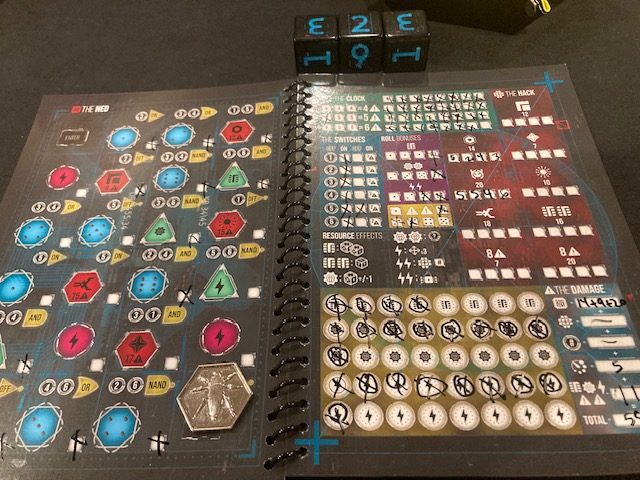
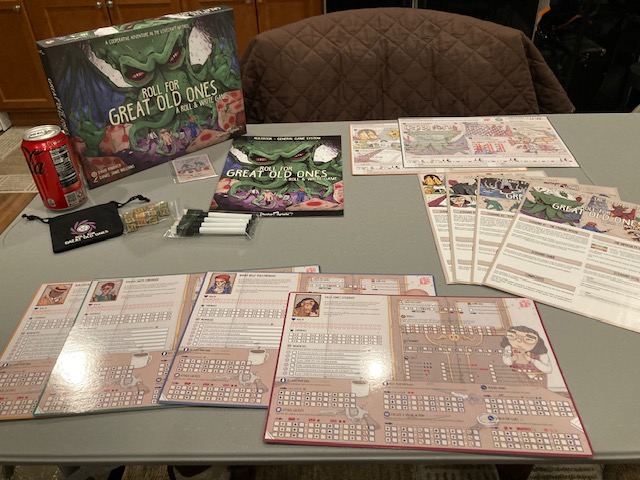
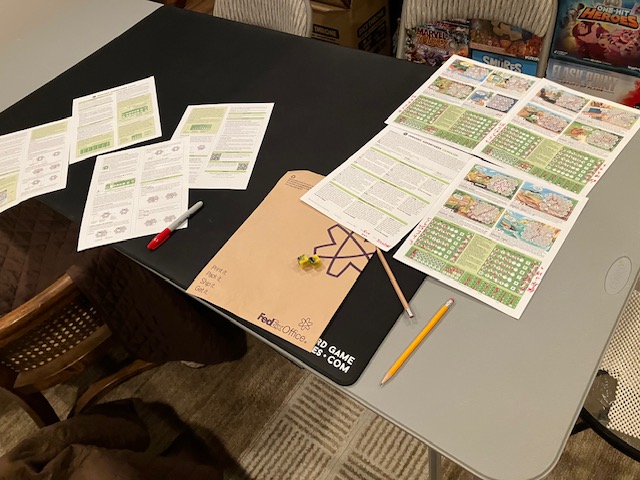
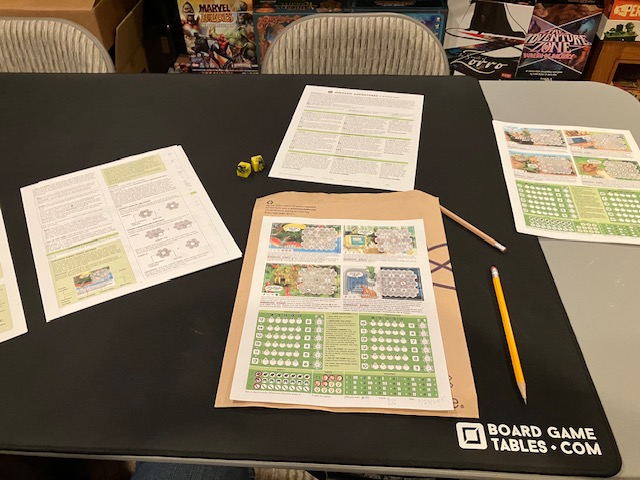
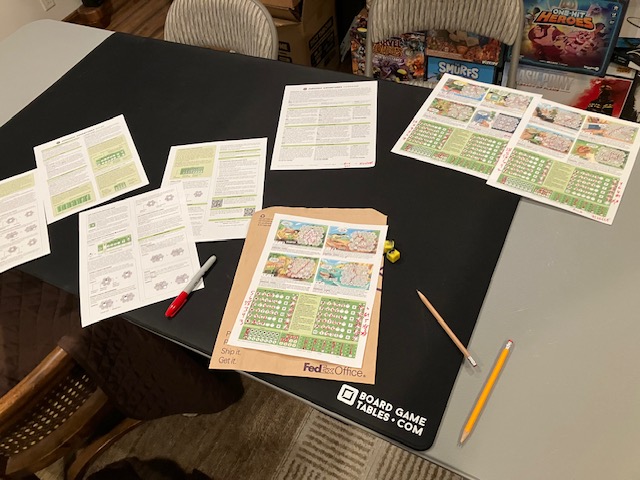
I don’t know why I worried!  At the end of the day, this is “just” a roll-and-write game!   You roll 3 dice, mark off spaces on your sheet above (See above) and try to score points (aka damage)! The base game is pretty straight-forward!

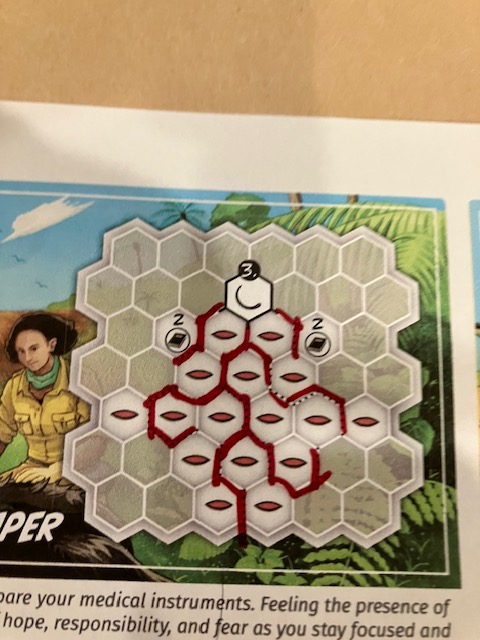
The object is to do enough damage to move to the next level! You need 60 at easy difficulty; see above as I miss by 1!  Heart-breaking!

In order to inflict the damage, you have to “move” the metal token (left side above; from the START to the END): if you don’t move that token, you can’t do any damage at all!  So, while trying to get “points” (aka, damage), you also have to make sure the token above moves!

The game plays solo, cooperatively, and competitively.  The solo game is all about doing enough damage,  and the competitive game is “who can do the most damage to win”.   The cooperative game is really just multiplayer solitaire: take the scores of all players and average them to get a score; if that score is high enough, players collectively win!

To be clear, there is NO cooperation in the cooperative game; each player just takes their own book and plays completely independently.  Players can’t help each other, they can’t share anything, they can’t use a dice on another players board … nothing.  This is as multiplayer solitaire as you can get.   If you want an experience where you are working with your friends, chatting, strategizing, working together, … this isn’t the game for you.  BUT if you have friends who are “suspicious” of cooperative games, or people who don’t like the cooperative games, this can still work for you! 

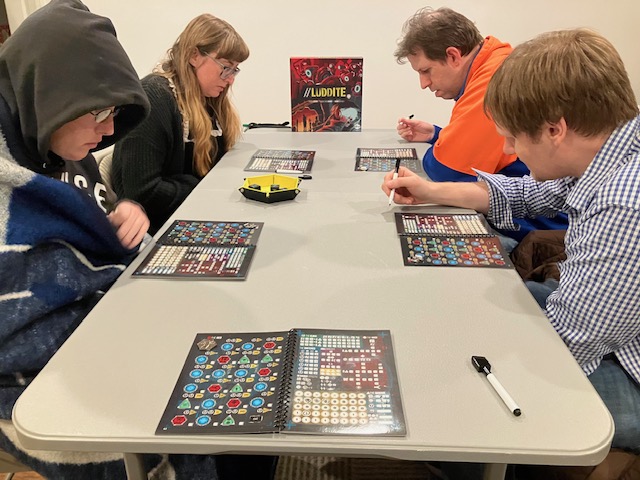
No one will tell you what to do, as everyone’s head is down and looking at their own board! See above!  And no one gets in anyone else’s board in any way!

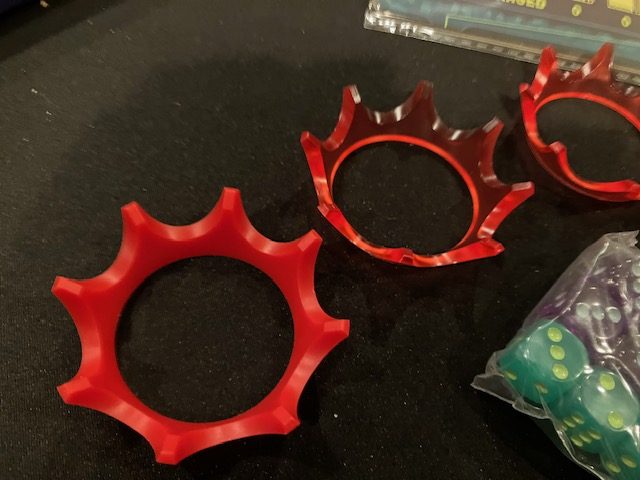
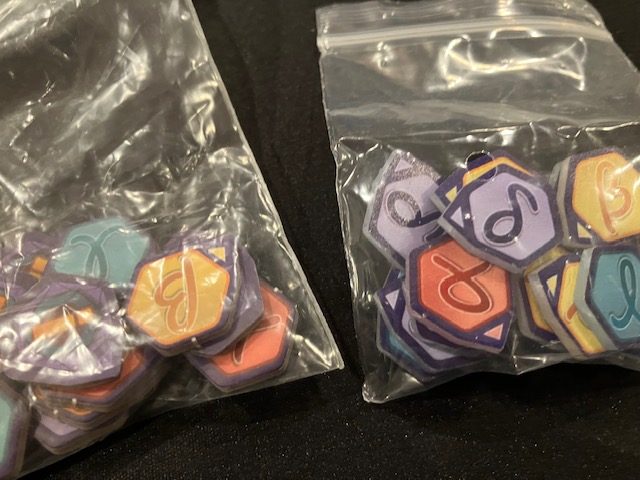
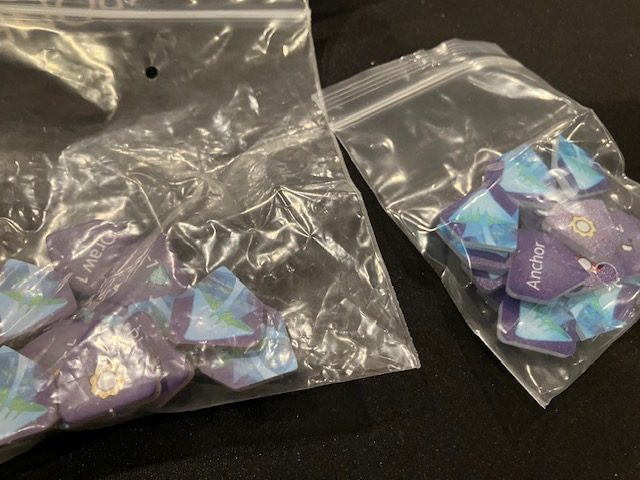
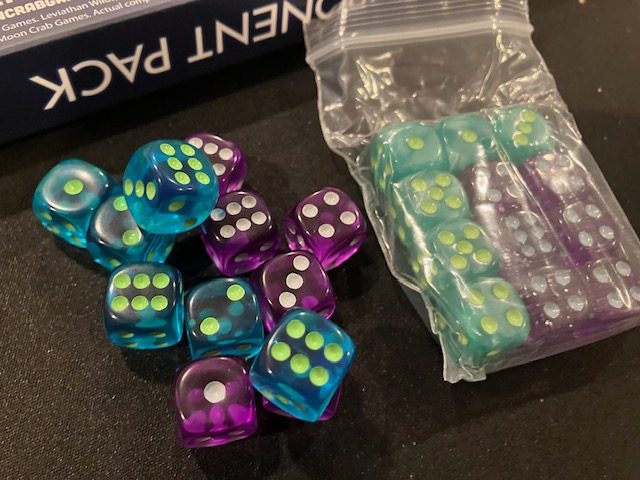
I made the mistake of getting 3 more “Additional Player Packs” (see above), but what this means is that 3 more people can play!    Basically, Luddite can scale to as many people as you want because there is no interaction between players!!  I am thinking of trying a 7-Player game of Luddite at RichieCon this year! (I have 4 packs in the base game and 3 packs from additional buys = 7 player boards!)

So, you can view this complete lack of player interaction as a good thing or bad thing, depending on the group you are playing with.

Solo Experience

If this was all there was to Luddite, there’s not much making it stand out, is there?  It’s a pretty good roll-and-write game for the solo player, and it’s a pretty good cooperative roll-and-write that scales to any number of players … even if there is no player interaction.

However, if you let it … this game can be an experience!  The Graphic Novel that comes with the game tells the story of some people who have been “made redundant” by AI and how they are fighting back!

The Graphic Novel gives you a back-story, then at certain places, tells you what chapter/pages to turn to! See above!

This was more immersive than I expected.  If you let it, this game can feel very immersive.  For my solo experience, I read the graphic novel that came with the game …

… and each new game is a progression of the story, even if the boards look very similar. See above as I win (solo) chapter 3!

Somehow, it seems for a game named Luddite (Luddite: someone who eschews technology) … that you HAVE to read the physical graphic novel, right?

Cooperative Experience

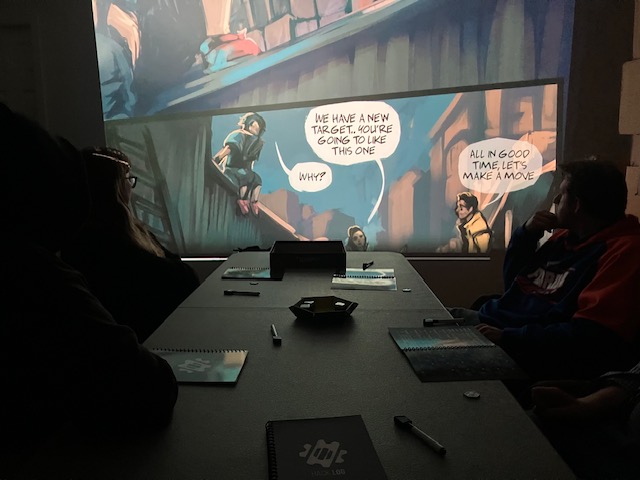
It turns out, the comic book is also online … in a video!  It has voice-acting, and shows the comic progressing!  See above!

For the cooperative game, it’s “harder” to enjoy the graphic novel in its physical form … you have to pass it around, or wait for others to read it, or read over people’s shoulders.  But, if you go to the Cotswold Group website, they have the entire graphic novel online! (And even a little tutorial)

So, even though it’s seem against the spirit of a gamed named Luddite, the cooperative experience is made so much better by watching the comics-turned-to-videos!  Arguably, that experience engulfs you and all your friends into the game!  It’s a shared story you are all experiencing!

To be fair, it helps the experience if you can show the video on a big screen or TV: see above. It feels more immersive that way.

House Rule/Hack (Get it? Hack? In a game about Hacking?)

The dice are a shared resource everyone shares in the cooperative game: they are rolled and placed in the middle for everyone to see!  But sometimes, in the heat of playing, you may forget which dice you used for which activity.  Surprisingly, there’s no place on the sheet to “notate” which dice we used !!

Since you don’t compute your damage until the very end of the game,  you can use the Damage section!  

This little house rule/hack made it easier to play the game cooperatively, as you could all independently note the dice rolled and how/when/where you used them.  

Conclusion

If you let Luddite be an experience that carries you along in its story (either as a graphic novel or comic-turned-video), I think this can be a really fun and immersive experience.

A reductionist might say “Luddite just a roll-and-write” …  but at least it’s a good one. I really enjoyed all my plays of this.   The base game is pretty straightforward and quick, and it has lots of meaningful decisions.

The cooperative game has literally no interaction between players, which can be a curse or a blessing, depending on the group you are playing with.   But, because of that lack of interaction, this game can scale to pretty much any number … as long as you have the boards!

This is a good solo roll-and-write (7/10), and a pretty good cooperative roll-and-write (6.5/10 or 7/10, depending on what you want), but it’s the story and experience that elevates this just enough that I would recommend you try this: 7.5/10.

I still think it’s hilarious that a game called Luddite has such a great online presence.  I mean, a game called Luddite should ONLY have the physical version, right?

Appendix: Binding

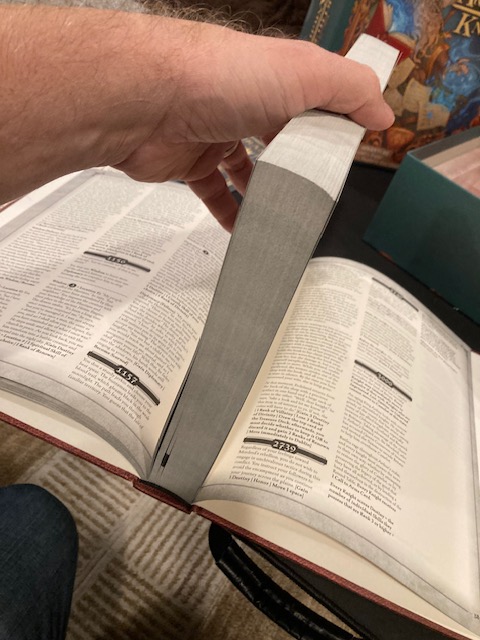
I normally despise this kind of binding, especially on something you need to hold open! See my review of War Story, Freedom Five, and Forests of Admiron if you don’t believe me!  For a graphic novel, it’s “okay” since you are just reading it and holding it open. See below.

Where this binding fails is when you have to read the directions in the back of the book!  See below as I try to wedge the book into the edge so it’ll stay open!  I hate this kind of binding for rulebooks!

See above as I attempt to hold it open!!!   Honestly, the rules should have been in a second standalone book that could be lain flat and open.  As a graphic novel, this kind of binding is “fine”.  But the rules portion of the graphic novel (in the same book, this really made me grumpy.  


One-Hit Heroes: A Solo and Cooperative Review. Insert Funny Phrase Here.

I know, I know. You really want me to make some kind of funny phrase like “One-Hit Heroes is a one-hit wonder” or “One-Hit and it’s out!” But those aren’t really apt descriptions, so insert your own funny phrase above! Let’s look below to see what it’s REALLY like!

One-Hit Heroes is  cooperative boss-battling game I backed on Kickstarter back in April 2024.  It promised delivery in March 2025, and lo-and-behold, it arrived March 29, 2025!  So, it made it! Barely!

I hav to admit I was a little spicy with the delivery, as they literally left it ON THE STREET!  See picture above!  The package is literally on the street in front of my mailbox! Oi!

Luckily, everything was fine: the box and everything was in perfect shape.  (I got two little upgrades with the box; a epilogue box and an extra hero pack: see above).

I was pretty excited for this! This was #6 on my Top 10 Anticipated Cooperative Games of 2025!

Let’s take a closer look!

Unboxing

This is a medium sized box; see above and below for perspective.

It does have a slightly weird shape; it’s not a Ticket To Ride sized box.  However, it’s not too bulky or too awkwardly shaped.

It contains some cards and tokens, as well as three separate “Episodes”.  See above.

The components are all pretty high-quality. The cards are NOT linen-finished and are all very shiny.  That’s actually my major complaint with the components of the game; when playing, the games seems very “shiny”: the cards, plastic trays, are all “shiny” and can be distracting.

Rulebook

The rulebook is good.

The rulebook feels like it has a weird form factor (look how loooooong and thin it is above) …

… but when you open it up, it fits PERFECTLY on the chair next to me! See above!! The rulebook stays open, it’s easy to read, and there is no pages drooping over the edges!  One-Hit Heroes gets an A on the Chair Test! See above!

The Component page is nice; it shows and adds correlative text to everything.

The Set-Up page looks good and is easy to follow, for both the Heroes and the Boss.  See above.

It does a great job explaining the player mats!

Overall, the text is big, easy to read, has a legible font, and is annotated with many pictures describing play.  There are also parenthetical phrases notated for “extra information”.

The back of the rulebook could have been a little better, but whatever, this was a good rulebook.  It explained the game, showed the components and set-up, and was fairly easy to read.

Gameplay

Players work together to take down a boss; a single boss battle takes about 20 minutes (the box is pretty accurate in its time).  An “Episode” in the game is 4 to 5 boss battles, which each boss getting harder and harder.

Each player takes and plays one character of the six above.  Each deck has 11 cards with very different personalities.  Take Sofia, for instance; her story is on the back of her card!

What do her cards look like?

See some of the cards from Sofia above.

Each player grabs a tray  (above) for their character and puts the cards into the tray (below).

As the game name implies (One-Hit Heroes), the Heroes can only take one hit before they die! Even more so, if any character dies, all players lose!  It’s up to the players to stop from getting hit!

Each character has two items slots for Items that “help” (see above), but arguably the Items are more important for stopping a hit!  Players can destroy an item to avoid a hit!  (Thematically, the item takes the hit instead of the character).

Items are a coarse way to stop hits; it’s usually better to stay out of way of hits if possible (since you only have two items)!  One-Hit Heroes uses a notion of an “Aggro track” for each hero.  See the track running left to right at the top of the tray? It’s empty for Will right now.

… but Edric (above) has a track almost full of Aggro!  Basically, the fuller the track, the more likely you are to incur the wrath of the boss and take a hit!

This is a boss-battler after all!  The Punch-Bot (the very first boss from the very first episode) only attacks when a Heroes’ Aggro is in the “red range”.  So, if the players can keep their Aggro low, Punch-Bot won’t even attack!

But, Aggro will go up.  Either from bad news cards  (like above) …

… or every Attack you do ups your own Aggro! If Sofia uses here Sidearm (above) to so one yellow damage, then does one damage to the Punch-Bot, but takes 1 Aggro!  Every attack you do that does damage causes Aggro back to yourself!

Luckily, each player has cards to manage Aggro; some cards (like Taunt above) will move Aggro around, and other cards will just discard it.    Every Hero has a different way of dealing with Aggro; some move it around, some discard it, some avoid it as much as possible, and some have cards that help others!  Each Hero has a different flavor of cards!

Interestingly, there are two different kinds of damage: yellow and orange (light and heavy damage, respectively).

To take out a boss, you have to do both all yellow and all orange damage.  Punch-Bot (above) needs to take 10 light damage and 5 heavy damage to take him out.

If players can defeat the Boss before said boss does one-hit to anyone, the players win! If the boss does one-hit to anyone (and it can’t be blocked or avoided), all players lose!  It’s a boss-battler!

Solo Play: Built-In Mode

The box is confusing; it implies there are no solo modes!  2-4 Players means no solo mode, right?  Nope!  There are actually two solo modes!

The first  solo mode is described in the Hero Set-up on page 3 (see above).  Basically, the solo mode is that the solo player has to alternate between two Heroes!  The solo description (above) is simple and very functional; it’s all you need.

For my first solo game, I played Will and Edric against Punch-Bot from Episode 1!  See above!

The game balance in this game is kept by having a Hero go, the Boss go, the next Hero go, and so on.  Basically, heroes and the boss alternate, so you can “kinda” have any number of heroes.

From a game balance perspective, I always worry that you need to adjust the hit points for the number of players … but since each Hero has exactly 1 hit point, that’s not really a problem here, is it?  Well, it didn’t seem to be: I was able to play all the way through Episode 1 (four boss battles) and I had a great time!  It was close; strictly speaking, as I lost a battle at one point, but it’s very easy to reset and play again since the game is only 20 minutes per boss.

This solo mode emphasizes that characters must work together to keep Aggro under control; in order to survive, both players will be doing things to move and discard Aggro.

Solo Mode 2: Do66-0 Pack

The second Solo mode does NOT come with the game; you must purchase the D066-0 Hero Pack (see above).

There is a little discussion of the DO66-0 pack (and a link) in the back of the instruction book.

Basically, the DO66-0 mode is a companion that you play in solo mode INSTEAD of a second Hero.

It’s much easier to play with DOGG-0:  DO66-0 gets a turn without having to provoke an extra Boss turn.    But, he also can’t do much, as he has no cards to play!  All he can really do is block and roll the damage dice … no cards.

In fact, it’s so easy to play, you can give DOGG-0 to younger players and have them play with you (that’s what Beginner Mode is).

I got to be honest, I didn’t enjoy DO66-O solo mode that much.  DO66-0 does very little on his turn: “about” one damage per turn, depending on what you roll on the damage dice. (He does add new stuff once you start drafting, and that does make him a little better).

I actually think the better use of DO66-0 is to bring in younger kids so at least they can participate; he’s so simple to play and kids can feel like they are helping.

I prefer the base (original) solo mode; it’s two characters and is how the game as meant to be played.  The base solo mode emphasizes how important the sharing and cooperation is in the game, especially to mitigate Aggro problems.    This DO66-0 solo mode was “fine”, but I probably won’t come back to it.

Cooperative Mode: Casual Gamers

My first experience cooperatively was with some casual gamers: my nieces.  We just played through a single boss: a 20-minute game.

The game was easy to explain to non-gamers!  They got the gist of the game pretty quickly, but needed a few clarifications.

I think my nieces liked the game and appreciated how short it was.  They did want to play again, but we ran out of time (it was like, Spring Break or something).

What I found: One-Hit Heroes is a pretty simple game to explain, even to non-gamers.  The hardest part was explaining some of the text on the cards, but even that wasn’t so bad.  My nieces like the game and would play again.  They also appreciated how simple it was to learn and play.

Cooperative Play: Gamers


Me and a subset of my gaming group played through Episode 1 cooperatively.

One-Hit Heroes has a nice way of eliciting cooperation; you will lose if you don’t.  🙂 Maybe a better way to say that is that the game goes cause conversations to happen: “Uh oh! I am about to die!  Can anyone save me?  Should we do some stuff before the next villain?”

The cooperation seems to come out fairly organically; and thank goodness everything is open hand with full communications!  There’s no “oh, I can’t show you this because of limited communication“.  Nope!  People talk, people realize they might die, so people cooperate to block, steal Aggro (in a good way!), and try figure out the best way to move forward.

And the ability to see what’s coming ALSO helps!  By seeing the bad news coming up, but not actually here yet, seems to encourage discussion and cooperation.

Overall, the Episode 1 went well; we cooperated, we discussed, we planned, we had a good time.

Teresa was a 7/10, Andrew was a 6.5/10 (which is actually quite high for him).

Episodes

A single Boss battle is about 20 minutes.  If that’s all this game were, I’d be a little down about it.  Luckily, the Episode really fills out the game.  An Episode is a series of 4-5 related bosses, with upgrading happening between bosses!

Episode 1 has four bosses: see above.  All the bosses are all very different, and have very different arcs as you fight them.

Arguably the best part of this game are the upgrade decks!  After you defeat each boss, players get a chance to draft and add two new cards to their deck!

Skip the next few pictures if you don’t want too many spoilers.

Basically, the players “draft” and each get two cards to upgrade their deck!  This is basically deck-advancement like we saw in Adventure Tactics (see here): your deck gets better and better between games!

The decks are also labelled at the bottom right so you can separate them back to their original decks.

And after every boss, you get another 2 cards until you finish the episode!

I will say this: the game says to “draft” until you get two cards, but I think it might be more cooperative to just ‘decide as a group’ what you get.  This is the House Rule we implemented: let me and my friends choose the paths we want our heroes to take!  I understand why “drafting” works, because then you don’t have to worry about arguing over cards, Alpha Players telling people what to take, and so on.  But, if you have anything of a reasonable group, I would suggest just choosing as a group the cards you each want.  Caveat Emptor.  If you have a slightly contentious group (or are playing at a convention where you don’t know anyone), maybe drafting is the better solution.

I’ll say this again: the upgrades are probably one of the funnest parts of the game.  Unfortunately, your upgrades don’t travel with you between Episodes: you have to start fresh to a new Episode.

Things I Liked

Upgrades: Upgrading your deck is one of the more satisfying and fun parts of the game!

Arcs:  Given how simple this game is, the arcs on the different types of Bosses are all very different! It’s actually quite impressive how differently each boss plays! And fun!

Components: The components are pretty nice and I like art. It’s comic-booky and attractive without being too “cute”.

Simple: This game is easy to teach and easy to learn.  I found even casual gamers got into it pretty quickly.

What I Didn’t Like

Too Random: The game can be too random.  I lost a few games because of one die roll.  It’s not too big of a deal because it’s just 20 minutes per game, but it is frustrating that an entire game can go amiss because of one die roll!

Too shiny: It’s too hard to capture in pictures, but the game is too shiny.  The cards aren’t linen-finished, so they tend to have glare, especially in harder light.  And the plastic trays also have a lot of glare: I tried to capture some of that in the picture above.  I think this game would be a lot better with duller, linen-finished cards and a tray that was less shiny.  The glare was distracting enough that we had to point it out.

No Continuations? As cool as the Episodes are, and even thematic within, the game game doesn’t feel super thematic.  While there is continuation within an episode as you keep getting upgrades, there’s no hook that keeps you vaulting into the next episode: remember, you lose ALL your upgrades between episodes, so you start fresh.  That actually feels a little debilitating!  I’d rather the episodes built on each other you felt the deck was YOUR CREATION … as it is, you start anew every episode.   There’s no “hook”: your deck resets and you start over.  Kind of a bummer? I just spent the episode building my deck … and now it’s gone.

Conclusion

One-Hit Heroes fits well into many groups; casual gamers, gamery gamers, and even solo gamers!  The base game is easy to teach and play at 20 minutes, which makes it easy to bring out.  My favorite part of the game, though, was upgrading my deck within an Episode!  It’s fun to figure out how you want to advance your character!

The game looks great on the table and has a fun table presence!

My only real complaint is that I feel that there’s a theme or overriding reason to keep playing after I finish an Episode. I really like the upgrading my deck between Bosses in an Episode, and it’s sort of frustrating that you just “throw it all away” at the end of an Episode!

As a solo player, I’d probably give this a 7.5 or 8/10.  The game is much more fun, I think, as a cooperative experience at an 8.5/10.  It would actually give it a little higher score if the dice rolls didn’t make or break so many games!  But, since the game is so quick at 20 minutes per game, it’s usually not a big deal. 

Neat game.  I think you’ll have fun with just about any group you bring it out to.

Top 10 Cooperative Cat Games (Board and Card Games)

Yes, yes. We are really doing this: we are doing a a Top 10 Cooperative Cat Games! To be clear, these are cooperative board or card games that have an upfront and distinct cat theme to them! Some games have cats in them (like Cyber Pet Quest from a few weeks ago), but those games aren’t “cat-centric”. The 10 games below are all cooperative games where the cats are the main focus … and that’s just how the cats like it!
10. Max

IMG_5596

Players: 1-8
Ages: 4 to 7 Years old
Time: 10 Minutes
Supports Solo?  Yes
Type: Cooperative Roll-And-Move

It’s kind of hard to recommend this, as it’s a game meant for very very young players: the recommended age range for Max is 4-7 years old. 

IMG_5598

And the production isn’t great: see above.

IMG_5600

But, this may be just what you are looking for to give your younger cat lover!  It’s a cooperative game for young kids, and that right there makes it worth mentioning! (even if it’s not the most beautiful game in the world)

IMG_5602

Trying to save the creatures from Max is a fun little theme that is surprisingly charming.   Be aware: this is a roll-and-move game, the production isn’t great, it’s meant for young kids, and the game is very light.  But, it’s kind of charming as a cooperative cat game, so it makes our list.

9. Endangered
IMG_5588

Players: 1-5
Ages: 10+ Years old
Time: 60 Minutes
Supports Solo?  Yes
Type: Cooperative Dice Placement Game

This is a cooperative dice placement where players play in together in multiple realms: diplomacy in the UN, conservation in the jungles, and gaining resources in the real world!

IMG_5619

This only made out #9 because just a few scenarios are about cats (Tigers in the base game and Jaguars in the expansion),  but they are constantly making more and more expansions all the time!  And during those scenarios, the cats take center stage!

IMG_5626
A losing first game!

This has some really interesting ideas; the cooperative dice-placement mechanic is very well implemented!

Take a look at our review of Endangered to see if this might be for you.

8. Magical Kitties Save The Day!

IMG_8198

Players: 2-7
Ages: 6+ Years old
Time: 60-120 Minutes
Supports Solo?  Sort of, there’s a solo Adventure that comes with the game to teach it
Type: Cooperative Role Playing Game (RPG)

So, I am in the camp that views RPGs as cooperative games; I view the Dungeon Master/Game Master (DM/GM) as a shepherd for herding cats through an adventure (analogy chosen on purpose).  The players are cooperating to get the best outcome for the group, and the GM is just trying to help the players. I know this GM view isn’t shared by everyone, but the vibe of this particular RPG is certainly very cooperative.

magickittiesback

Players plays as cats going on adventures to save the day … that sounds like a cooperative game to me!  This is a fun and goofy cooperative game that will require a GM to run it.

The solo comic book that comes with for teaching the game is pretty awesome!

7. Cat Crimes

IMG_5583

Players: 1+
Ages: 8 to Adult
Time: 15-30 Minutes
Supports Solo?  Yes, solo first! Cooperative by group
Type: Cooperative Logic Puzzles

Cat Crimes is more of a solo logic puzzle than a game per se, but you can play it cooperatively by having all players work together as a group to solve the puzzles! 

IMG_5588

Player(s) take a challenge card (from Beginner to Expert: see above) and try to solve the puzzle!  Who Ruined The Shoes?

IMG_5591

Players use the hints on the card to deduce, via logic only, the order of the cats around the table!

IMG_5592

Once the cats are placed around the table correctly, that pinpoints the culprit! See above as Duchess ruined the shoes!!

This is a fun little logic game where the cats are cute: the theme helps keep it from taking itself too seriously. But the puzzles are whatever challenge your group is up for!

6. Space Cats Fight Fascism

IMG_7292

Players: 2-4 
Ages: 13+
Time: 45-60 Minutes
Supports Solo?  No  (although you can play solo via 2-handed solo)
Type: Cooperative Dice and Card Management Game

This little cat game came out of nowhere for us: it’s from a very small publisher (TESA) and it really doesn’t have a lot of buzz around it.

IMG_7296

The components are a little wonky and the art is a little wonky.  It’s a pretty small game.

IMG_7310

But this little game is surprisingly fun! It has a Pandemic feel as cats fly around the galaxy trying to stop facism (removing cubes like Pandemic).  Space Cats Fight Fascism isn’t really political (despite the name); it’s really just a surprisingly cute cooperative game with its own “vibe”.  The cat theme works surprisingly well, considering this game could be just an abstract, but somehow the cats in this game give it its own flavor, its own soul, and its own sense of humor. 

5. Cat Rescue

IMG_0549

Players: 1-4
Ages: 8+
Time: 15 Minutes
Supports Solo?  Yes
Type: Cooperative Tile Placement/Tableau Management Game

Cat Rescue is a very cute game that was on Kickstarter, but it’s actually incredibly hard to find now.  I ended up finding the original blister pack version (see above).

IMG_0545

Players put some very cute cats in a 4×4 grid (see above and below).

IMG_0547

The main mechanic is that you “push” cats along a row or column, trying to push a cat that’s “ready for adoption” (flipped) out of the grid.  You continue until you run out of cards and then score how many you saved!

IMG_0548

It’s very cute, simple to explain, and easy to play.  Cat Rescue is sort of a cross between a tile placement game and a tableau building game.  It is hard to find, but there is hope for a reprint.

UPDATE: As of right now, March 30th, 2025, there is a Kickstarter coming in Spring 2025! See information here!  Thanks to Lon for pointing this out!

4. Run Run Run!

IMG_7037

Players: 1-4
Ages: 8+
Time: 30 Minutes
Supports Solo? Yes, minimal rule changes
Type: Cooperative Tile-Laying Game

This cute game about cats invading an Egyptian tomb is quite fun!

IMG_7078

The components in this cooperative tile-laying game are gorgeous! The tiles are thick and easy to read!  

IMG_7118

The game is easy to teach, easy to play, and plays rather quickly in about 30 minutes!  Take a look at our review of Run Run Run! here to see if it might be something you might like!

This game could easily make our Top 10 Cooperative Tile-Laying Games!  But that list came out before we played this game …

3. Nekojima

IMG_5371

Players: 1-5
Ages: 8+
Time: 15-30 Minutes
Supports Solo? Yes, minimal rule changes
Type: Cooperative Abstract Dexterity Game

IMG_5378

Nejokima is a very cute cooperative dexterity game for 1-4 players; this can probably best be described as cooperative Reverse-Jenga!  In Nekojima, players work together adding wood blocks on a platform, hoping not to knock anything over! (whereas Jenga has players removing wood blocks from a tower, hoping not to knock anything over)! In both cases, players try not to knock the structure over!  See below!

IMG_5386

At the end of the day, this is almost an abstract game, but the game leans so heavily into the cat theme (with a cat placemat, the cat tokens, and the “cat always lands on its feet” in the rules), that I think you can call it a cat game.

IMG_5404

Take a look at our review of Nekojima to see if this is something you think you might like.

2. Hissy Fit!

IMG_3068

Players: 1-4
Ages: 8+
Time: 20 Minutes
Supports Solo? Yes, minimal rule changes
Type: Cooperative Hand Management game

IMG_3099

Hissy Fit! is a light little cooperative cat card game (20+ minutes) about trying to get your cat into its carrier!  Players move the kitty (above) along (using cards) until it reach the carrier!

IMG_3096

Players cooperatively play Human cards (purple) to try to keep the Cat Cards (orange) under control!  This is a light, quick game that really encourages cooperation with a simple follow mechanic (allowing other players to play cards even when it’s not their turn)!

IMG_3119

The art is absolutely adorable and is quite thematic!  The Towel Wrap keeps the cat from scratching you and from moving away!  The Robot Vaccuum moves the cat closer to the carrier!

IMG_3136

This game is light and adorable and quick and easy to teach: there is a very good chance this will make our Top 10 Cooperative Games of 2024! UPDATE! It did! See here!

Take a look at our review of Hissy Fit! to see if this is something you might enjoy!

1. Race To The Raft
IMG_8571

Players: 1-4
Ages: 8+
Time: 40-60 Minutes
Supports Solo? Yes, with some changes to base game
Type: Cooperative Tile Placement Game

IMG_8772

Players need to work together to save the cats (see above) from the burning island (see below)!  They need to move the cats to the raft before the fire consumes the island!

IMG_8746

This cooperative tile-placement game has players making all sorts of choices cooperatively or solo: which cats to move, which tile stack to draw from, where you place a tile, where to place burning trees, when to move cats!  There so many great decisions in this game!  This was such a great surprise it made the #3 position on our Top 10 Cooperative Games of 2023!  Honestly, it should have been #1, but 2023 was such a strong year for cooperative games!

IMG_8697

See our review here of Race To The Raft to see if this cooperative tile-playing game is something you would enjoy! It’s probably the most complex game on this list, but it also has the most choice!

A Cooperative Traitor Game? Wait, What? A Review of Infiltraitors

If you are like me, when you first heard the description of Infiltraitors, you thought, “Wait, What? Is this a cooperative traitor game?”

Look at the back of the box above! “Enemy Spies have infiltrated the Organization!  It’s up to you to work together to expose and eliminate all the traitors before it’s too late…”  That sounds like a cooperative traitor game, but the next line tells the real story:  Infiltrators is a cooperative deduction game for 2 to 5 players”.

Ah, it’s a deduction game!  But it really has a feel of a traitor game like Avalon!  Players are going on missions, deducing things about traitors … that sounds like the traitor game, Avalon, right?

I think the game’s title misspelled Infiltraitor on purpose to imply there are traitors in this game.  The real spelling should be Infiltrator.  I really think they did that on purpose to imply this is a cooperative traitor game … I think they mean it to replace something like Coup or Avalon.  Does it?

Let’s take a look!

Unboxing and Gameplay

For a mostly card game, this has a surprising number of cardboard components! It’s also a pretty small box (about the size of Avalon or Coup maybe?) See Coke Can above for perspective.

The bullets are a limited resource for how many “guesses” you have to find the traitors!  The gun is just a silly gimmick!

When you are ready to Eliminate a Traitor, you must physically pick up the Gun and a Bullet and “make a guess” what the traitor is (I used what instead of who … you’ll see why)!  I think the idea is that you must be very clear that you are making a guess, and picking up that gun makes it very clear to everyone!  If you are right, you eliminate that traitor and you are closer to winning! If you are wrong, … well, you have wasted a bullet … hopefully you have enough bullets left to take out the remaining traitors!

As clues come out to identify the traitors, players mark off the Clue Boards: see above.  There will be one clue board per suspect.

The rest of the game is in the cards.  There are (up to) 5 different suits, each with numbers 1-15.

There are a number of Suspects (face-down cards), depending on the Mission and number of players.  The player’s job: use clues to find the identity of all the Suspects before you run out of bullets!   If it isn’t clear, you are “eliminating” the infiltrators with bullets!

There are 20 missions described in the rulebook; they get harder and harder.  (No state is saved between Missions; each Mission is a brand new game).  The first mission, a tutorial, describes how the game works: see above!

Some number of cards are taken from the deck and turned FACE DOWN: these are the Suspects the players must cooperatively identify.    (The first Mission has only 2 Suspects: see above).

One player becomes “responsible” for  a suspect and will reveal information about the suspect as the game goes on.

Each player will have a hand of cards and use those to help reveal information about a Suspect.

To Eliminate a suspect, the players must guess the color and rank of the face-down Suspect!

How do you guess the Suspect’s color and rank?  A player will place a card down; if the color matches OR the rank matches the number or factors or multiples, then it’s considered a match!  All matches are turned up-and-down!  The lack of a match turns the card sideways.  See above as the guess yellow 10 is turned up-and-down!  It’s a match!  But does it match the color? Or maybe it matches the rank exactly?  Or it’s a multiple of 2 or 5 or 10?   This is where the deduction kicks in!  You have to use the cards you have to try to slowly deduce what the Suspect is!

It takes a little getting used to matching the multiples and factors, but luckily every card in the game lists ALL the factors and multiples it uses!  So, it seems harder than it is; once you get used to it, it flows quickly!

To be clear, one player knows who the suspect is, and all the other players are giving clues (placing cards) to help deduce!  Nominally, each player tends to take responsibility for one or more Suspects, but it’s dynamic! Players can choose when to take a Suspect and become “responsible” for it as the game flows.

If you eliminate all Suspects, you win!  If you run out of bullets, you lose!  The Infiltraitors win!

Solo Game

There is no solo game! See above: this is only for 2-5 Players!  However, this would be an interesting game to apply The Changing Perspectives idea to!  See a link here for The Changing Perspectives Idea!  Since all information is public (the clues are all public: there’s no implications or subtle innuendo), you can make deductions solely based on the information presented.

I leave this an exercise to the reader: I think you can play this solo if you want to! Much like Shipwreck Arcana (see review here), this is a deduction game where you can pretend to play both sides, using only public information for deduction.  If you get to a point where you have to randomly choose something (you are out of cards, and only one one bullet left), you can always roll a dice to decide the outcome.

Cooperative Game

As a cooperative game, this went over pretty well.  The first time we played, we played through the first three missions and had a blast!

It’s sort of ridiculous how much fun the gun and bullets were!  It sort of drew us into the game!

The first few missions are pretty straight forward, just getting a little harder each time.  You use more suits (which makes the color harder to guess) and more ranks (making the rank harder to guess).

This game came out two weeks in a row!  For a little card game, it was surprisingly popular in my game groups!  See above and below!

The cooperation worked really well; people would say “I know how to get that suspect!  You work on the other one!”  The fact that there are multiple suspects in play really also worked well—players could choose where to spend effort, both individually and cooperatively.

The Sticking Point

The game doesn’t quite explain matching rank very well … and it’s the most important part of the game! There are two basic interpretations, which the example (in the rulebook) DOES clarify.  Consider the following example: Do these two cards below “match”? (Obviously, they don’t match in color, but what about rank?)

Interpretation 1: If the lists of numbers on both cards has some number in common, they match!  Under that interpretation, the two cards above match!  (6 has 2,3,6,12;  9 has 3,9:  Both have a 3! They match!).  (((TO BE CLEAR, this is the WRONG interpretation!!!!)))
Interpretation 2:  If the hidden card (on the right, say the 9) LISTS the other card, it’s a match!  In this case, it’s NOT a match, as 6 is NOT in the list of number on 9: (3, 9).  They DO NOT match!

If you go in with Interpretation 2, that seems to be the rule as clarified by the rulebook (see above).  It took us a few games to “get” this rule.  This is possibly the biggest bugaboo that may make people dislike the game if you can’t get this rule about matching!!   I think the best way to “explain” the match rule is via Interpretation 2 of the rules above:

The Suspect card will list all the cards that it matches“.

With that simple explanation, the match rule goes from baroque to simple.  And I think it will open it up to players who might be “scared away” by discussion of factors/multiples and math!!

Traitor Experience

After bringing this out at a second game night and playing through the game with a new group, we were able to solidify our thoughts:  This feels like a traitor/social deduction game like Coup or Avalon because you are trying to deduce the identity of the traitor!  That feeling of trying to deduce “Who is the Traitor?” is really captured by this game … without being a traitor game!

I don’t really like traitor games.  They have the Disparity of Experience problem (see here) where people who have played more than you will have a distinct advantage.   And I don’t want to lie, yell, scream, accuse with my friends.  I just want to work with them and have fun!  If you like the process of trying to find the traitor, that deduction process, I think Infiltraitors really captures that feeling!   Granted, Infiltraitors replaces social deduction (which has its own flavor of play) with plain deduction, but I think Infiltraitors does a pretty good job of replicating that social deduction feeling in a purely cooperative game.

Conclusion

Does Infiltraitors  (a fully cooperative game that’s nominally about traitors) replace Coup or Avalon (games with traitors?)  Infiltraitors does a pretty job replicating the experience of finding traitors!  It may not quite your cup of tea, as it replaces social deduction with plain deduction, but if you like the idea of finding traitors but don’t like all the social baggage of traitor games, Infiltraitors might be right for you!

I think me and my groups would give this an 8.5/10!   We enjoyed it!  It was easy to get out, easy to play a few games, and it was a fun experience working together!
BUT, if you pull this out, be very very clear explaining the match rule to new players or you might scare them away!  The talk of factors and multiples may scare them away!  Don’t explain it that way, and don’t even bring it up!  Just explain the Suspect card lists all the numbers it matches; easy-peasy.

If you are looking for a game to replace Coup or Avalon, this might a really good possibility. It still feels like you are hunting traitors, but replaces the social deduction framework with a deduction framework, and it does so in a fully cooperative game.

Santorini: Pantheon Collector’s Edition and Riddle Of The Sphinx Review, Mostly the Solo and Cooperative Experiences

Santorini: Pantheon Collector’s Edition and Santorini: Riddle of the Sphinx both arrived at my door February 28th, just in time for weekend!  

These were originally on Kickstarter back in April 2023, and promised delivery May 2024: so it’s not quite a year late, but it is pretty late.  At least it finally made up!  I have been waiting a while for this game: it was #8 on my Top 10 Anticipated Cooperative Games of 2024!

I was very excited for Santorini: Riddle of the Sphinx (which we’ll just call Riddle of the Sphinx from now on), as it promised to take the base game Santorini and make it into a solo and cooperative experience!  

However, Riddle of the Sphinx is an expansion: you must have one of the Santorini  base games to play it (for some of the components).  This particular Kickstarter offered up the “deluxe” Santorini: Pantheon Collector’s Edition, so that’s the one I backed.  

I ended up playing pretty much all weekend, so let’s see how that unraveled!  Was this worth the wait?

Day 1: The Game Arrives and Santorini Gets Played!

February 28th, 2025: The package arrives with both games!  

The acrylic tokens bag opened up and spread them everywhere … make sure you pick up all yours!

You can’t play Riddle of the Sphinx until you know how to play the base game of Santorini. So, that’s where we started.

This edition has quite a bit of extra stuff.

The white blocks and domes are the key components to the game: these are what gets built on the main board.  Those little white blocks have quite the toy feeling!

These blocks are the main pieces that will be shared with Riddle of the Sphinx.

There’s some neat bags with lots of components.  A lot of these aren’t necessary for the main game.

But the workers (in the blue bag) are important; they are what moves around the map.

The purple bag has a lot of stuff … that I don’t think you will need until you play a LOT of Santorini and want more content.

The most important piece for the main game is the board (packed upside down).

It looks gorgeous!  

There’s even a lazy susan for it to rotate on!

There are some God Cards here (God Cards give each player special powers).  We need these cards for the base game, but we will NOT need them for Riddle of the Sphinx.

This is a really nice production.  It just looks gorgeous.  I probably spent too much money to get the deluxe Pantheon Collector’s Edition, but it looks nice.

The rules are hidden on the bottom of the box!

Normally, I would give rules that take up the whole box an F on the Chair Test, but since the rules are ALL ON ONE SIDE, I am going to give this an A!   The rules lay out and are easy to consult!!

These rules are succinct and terse, but still pretty darn clear.  The game can be described in one page! 

There’s a really nice little “first game set-up” which takes you through your first step or two of Santorini with Demeter vs. Artemis!

As you play your first game (I played Me vs Me), you get a sense how everything works.  And the buildings that pop-up look really cool! See above!

At the end of my first game, I felt like I understood the mechanisms!  This was a simple abstract strategy game that looks really cool!  I see why Santorini has survived in the board game zeitgeist for so long! It’s easy to play, easy to describe, easy to learn, but has tons of interesting and strategic decisions.  This is a neat game.  

For the record, I do want to mention that it’s not too hard to pack everything back into the box … there’s a little graphic on the side that shows how to do that!

So, I was able to play and learn the base game!  I look forward to learning Riddle of the Sphinx tomorrow!

Day 2: Unboxing and First Games of Riddle of the Sphinx

First thing Saturday morning, March 1st, I woke up and was excited to get to Riddle of the Sphinx

It turns the competitive base game of Santorini into a co-op and solo game!

Riddle of the Sphinx has a weird form factor: see above.

It’s a very wide box that opens like a book: see above (with Coke can for perspective).

The Acrylic tokens replace the cardboard tokens.

Off to the left are the bridges, figures, dice, and cards. I am glad I took a picture of this, because when I went back to repack the game, I had to consult my pictures!

The rulebook … is huge. Not from a length perspective, but huge as in “the form factor of this book is very wide and very tall!

This rulebook completely fails the Chair Test as it droops over the edge and makes it very hard to consult on the chair next to me.  See above.

The standard workaround for rulebooks this big is to put them across TWO CHAIRS, with the spine in the middle.  (We first discovered this “workaround” when we looked at Batman: Gotham City Chronicles: see here).  This makes it so can consult the rulebook on the chairs next to you.  Sigh: this rulebook has a terrible form factor!  It’s far too engulfing!

The weird thing is, you almost don’t need the rulebook???? The Book of Riddles (which we’ll discuss below) has an EXCELLENT tutorial built in!

The Book of Riddles (see above) is the main component of this expansion.  There are 22 “riddles” in here which the player(s) must solve!  

The Book of Riddles throws you into the first game with some pretty pictures and flavor text …

A quick note: we’ll be playing solo, which means we have some weird special rules.  We have to have a figure called the “Wanderer” whose sole purpose is to make sure we never do the same action twice in a row!

The Wanderer is the middle guy (we’ll see the Sphinx and other dude later).


Using the Wanderer,  the solo player selects an action each turn (one of the four above), but can never choose the same action twice in a row.

The first Scenario is Sunshine and Seashores: see above! 

The opposite side of the page has a painfully precise (in a good way) description of how to play the first riddle!  This is a complete, step-by-step run-through of a winning game so you can see how all the rules work together!  This tutorial is a fantastic way to learn how Riddles work!

The only thing you “really” need from the original Santorini box are the blocks and the workers.  That’s it!  See above!  All that other stuff you saw as I unboxed Santorini: Pantheon Collector’s Edition?  Completely useless here!
In fact, I made the mistake of thinking we needed the original board (above right) when I played my first game!  Nope!  

Riddle of the Sphinx has its own God Cards: see Base Gods above and Friendly Gods below!

There’s even a notion of Blessings that comes out in later games!

The Gods are a little different here; you kind of use them up and throw them away!!

The Gods give you powers, but if you complete their quest (at the bottom of the card), you (usually) get a new piece you can build.  Why is that so important?

Riddle of the Sphinx is a game about scarcity.  You don’t have all the pieces you need to build your towers and edifices, so you have to earn them as you play.  By having Gods complete their quests, you get new pieces so you can build as you need to. 

The coins on the map describe what you need to build: see above as I need to build a level 1 building underneath the coin to get it!
And then I do!
The coin goes to the top (or bottom) of the page to denote you have “finished” that subgoal.    Usually, you need to get all Gold coins to complete the Riddle, and all the Silver coins give you extra help/bonuses.

See above as we build everything, as we try to understand how to solve a Riddle! It’s all about building towers when pieces are scarce!  You have to earn the pieces to build what you need!  

I need to be clear here; this tutorial is great!  I jumped right in and was able to start playing right away!  The tutorial held my hand for the first game, and then threw me into my second game.  And I was felt so comfortable jumping in after that!

See above for an example of how good that Tutorial is!

After the Tutorial is Riddle 1!  As I jumped into Riddle 1, they added some new rules: The Sphinx’s game!

The Sphinx’s Game allows you to roll the dice and “hopefully” get one of the gems! If  you get a gem, you get  free piece to build! If you fail (because the gem is gone), you lose a worker!

Just like our Tutorial, the game board does a real good job describing set-up on the same page as the Riddle itself. It’s interesting, I don’t think I ever looked in the rulebook for any rules in the first few games: almost everything I needed was presented in the set-ups of the various riddles.

Look how great this looks: see above.

At the end of Day 1,  I unboxed Riddle of the Sphinx and played through two scenarios solo;  this gave me the sense of how everything worked.  

This is a puzzle; you have to figure out when to build, when to recruit god powers, when to finish a god quest (so you can get more pieces), and when to finish the Riddle (which usually means building a tower on a gold piece place!).

Day 2: Campaign and More Play

So, Riddle of the Sphinx is kind of a campaign game.  Included in the rulebook are two pages per campaign: The Adventure Map and the Constellation Tree.  

The Adventure Map has you “mark” off bubbles on how well you did when you finished a puzzle.   (There are multiple conditions you can satisfy, see below).

See above as there are Silver, Gold, and Heroic (above) conditions you can satisfy. Godlike not pictured.

The bubbles you mark off in the Adventure Map corresponds to how many bubbles you can mark off in the Constellation Tree! See above!  Basically, the Constellation Tree unlocks what are called Friendly Gods!  The more Friendly Gods you have, the more control you have when you attempt a puzzle (remember, God powers are pivotal to doing the riddles, especially if the powers are useful).

Rather than sully my pristine books, I went to make a copy of the two pages …  well, it’s too big for my copier, but you CAN just print them directly from Roxley’s web site.  So, to play a campaign, you need both pages (see above).  After every Riddle, you mark off how many achievements you did!  And then you can “maybe” unlock a Friendly God or two!

I used a pencil (see above): Warning! You should probably use a red marker or something VERY distinct.  It’s REALLY HARD to tell what you marked with a pencil.  Can you tell above?  Even zoomed in, I can barely read it!   Learn my mistake, use a more “colorful” writing implement so you can see the marks.
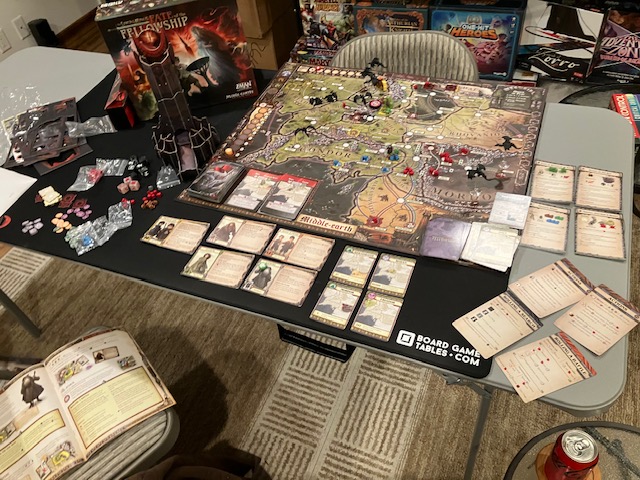
So, the first part of my Sunday was getting the Campaign maps marked up for my first few games, when I headed into more puzzles!

At one point, the Sphinx even made an appearance!

By the end of Day 3, I had played 6 Riddles and started my way into a solo campaign.

This is a puzzle; make no mistake about it.  It’s more puzzle than game.  I loved it. You may not.

Cooperative Play


So, this is different week: I am at Dice Tower West and not with my normal gaming group. I brought Riddle of the Sphinx with me to play it cooperatively with “some people”.  My core game group and I have a base level of trust and respect, so cooperative games are easy for us to jump into.  Sometimes, it’s a little harder to jump into a cooperative game with people you don’t know.  How did that go for us with Riddle of the Sphinx?

I met a real nice fellow named Charles.  He and I had a very frank discussion about the Alpha Player problem  before we started the game.  I worry, since this is more of a puzzle than a game, that Riddle of the Sphinx might drift towards having Alpha Players take over.  

From our very frank discussion, we made it clear that we would be supporting each other but still occasionally having suggestions: no Alpha Playering.   I admit, I had never thought of this solution to the Alpha Player problem: just talk about it and agree to not do Alpha Player each other.  And you know what? That worked fine!

Charles and I started from scratch and played the first 4 riddles (plus tutorial) in about 2 hours.  We had a good time and got some riddles done.  (Since I had played solo previously, I was able to shepherd the game and make it much faster to teach and learn).

Two observations came up during co-op play:  
1) Even though this is a puzzle (which tends to attract the Alpha Player more), because we have God Powers (i.e., assymetric powers: Charles had Asklepios, see above, and he was pivotal!), it’s harder to Alpha the other players because all the God Powers are very different.  It’s not impossible, but it does make it harder to keep track if each player is cycling through God Powers fairly quickly.

2) You can solve the game without burning your brain(s).  In a convention environment, you just want to have fun and play.  If you “ignore” the silver goals and just concentrate on “winning” a game, you can just do the gold goals, and the game isn’t too hard. It becomes a lot harder if you want to do ALL the silver goals!    You can adjust the level of difficulty of the game as you are playing!  You can choose to just go for the win, OR you can choose to get as many objectives as you want! The former is a more “light-and-fun” mode, whereas the latter is a more “brain-burny” mode.   
So yes, because this is more of a puzzle, it could have easily turned into an Alpha Player experience.  But, between diverting the Alpha Player with a frank discussion, and having the asymmetric God Powers, the Alpha Player Problem wasn’t a problem.

The puzzle was fun cooperatively.  

Curse and Blessing

One of things that blew me away was how easily I was able to learn the game as I wen by reading the little blurbs on the board: see above as a Riddle 3 game introduces “Blessings” and “Friendly Gods” to the base game.   I mean, this was absolutely a fantastic way to learn the rules.  New rules are explained AS THEY COME out, and it makes sense.

… until I turned the page and started working on the next puzzle.  “Wait, what were the rules for Blessings again?”  Once I had set-up the next puzzle, I couldn’t go back and re-read that rule.  Frustratingly, the rulebook sometimes didn’t have this same text.  How do I look up that rule again?  I did go to BoardGameGeek a few times, and I did Google some things.

This way of learning is both a blessing and a curse.  It’s a blessing because it’s so easy to jump right in, and the rules are on the page themselves!  It’s a curse because you can’t go back and re-read those rules once you’ve set-up the next puzzle.
The rulebook probably should have replicated the on-page instructions from the Adventure book  in the rulebook  (or somewhere). The same text I used the learn the rule would help me solidify the rules in my head.   If you feel like you CAN’T go back, it’s frustrating.  Imagine in a classroom:

“Teacher, could you explain the Blessings rule again?  I didn’t quite get it.” 
“No, that’s on a blackboard in another classroom.”   

I found the rulebook, especially for the Riddle of the Sphinx to not be great at helping me find rules and disambiguations. See next section for another example!

Occupied/Unoccupied

One rule that particularly seemed frustrating was the occupied rule.  You can’t build a piece on a space that’s occupied.  Or move onto a space that’s occupied.  In the base game, the only things that can occupy spaces are workers/figures or blocks/domes.  Is a coin or a blessing on a space considered occupied?  Physically, yes!! That coin or blessing coin is physically occupying the space, so it prevents me from moving there, right?  Intellectually, I think the idea is that the coins/blessings are just goal markers, so they are NOT occupying, just notating!! 

It wasn’t until 100% clear until Riddle 5, when one of the workers actually started on a space with the Coin (bottom left, blue worker), that coins don’t block you.  It’s pretty clear you can move through coins, I think, if you can start on a coin.  

The rules for Riddle of the Sphinx, and especially Santorini, are brief and succinct.  But I think they omit some clarity.  A few more sentences here and there would have helped.  This particularly issue seemed vexing, and I felt like I was “cheating” if I moved through/onto a Coin.  “It’s physically blocking me … should be it a game blocker too?”  I think that it is NOT a blocker but a notation … it could have been clearer.

Things to Watch Out For

Magnetic Clasp Not Secure: The binding holding the Riddle of the Sphinx box closed is a magnetic clasp.  It did’t feel very secure; I would recommend a rubber band or something to hold it more secure.  See above for my rubber band solution.

Use Bright Marker: When you mark bubbles on the Constellation Tree or the Adventure Map, don’t use a pencil like I did (see above).  Use a sharpie or red marker or something that really stands out.


Print out:  Rather than sully your Adventure book, just print out a copy of the Adventure Map and Constellation Tree from your printer.  See above. Not only do you keep your original books pristine, the copies from your printer will be on paper that you can actually write on (the paper from the original is very slick).

Conclusion

Riddle of the Sphinx is clearly more puzzle than game.  There are elements of randomness that make it more gamey (which base gods do you get, do you risk rolling a die, etc), but in general: this a puzzle.  You need to know that before going in; you may love the idea of a solo or cooperative puzzle using the base rules of Santorini!  You may hear that it’s a puzzle to solve and run screaming.  Do what you will.

The solo game worked really well; it’s easy to come back to because the rules are pretty straight forward, and it’s easy to save in campaign mode.    You can play as much or as little of the campaign as you want.

The cooperative game can succumb to the Alpha Player problem if you aren’t a little careful; Riddle of the Sphinx is a puzzle after all is said and done, and puzzles tend to bring out that Alpha Player.  We suggest having a frank discussion about the Alpha Player problem (it worked for us), or just play with a group you already trust and respect.  The rapid cycling of asymmetric God Powers did help alleviate the Alpha Player problem a little.


I would absolutely play Riddle of the Sphinx again as a solo game; it’s like an 8.5 or 9 out of 10 for me.  It was really fun, and the components were great.  The cooperative game, I would play again, because you can adjust the difficulty as you play.    I would, however, be very cautious of the Alpha Player issues before I suggested Riddle of the Sphinx  to a group, just because, as a puzzle, it’s too easy to fall into the Alpha Player trap.  That trap make it a little harder to get out as a cooperative game, so maybe it’s a 7.5 or 8/10 for a cooperative game.  It’s fun, it’s adjustable, but you have to be a little careful.

Good game.

War Story: A Choose-Your-Own Adventure Game Where Choices Really Matter

I pre-ordered War Story from GameNerdz on Oct 17th, 2024. I wanted to play it as soon as possible, so I went ahead and paid full shipping for it (I normally try to get to $75 or so to get free shipping); that’s how excited I was to get this! I paid for shipping to get it sent separately ASAP!

War Story arrived at my house on February 21, 2025 (I noted the date on the tab on the back).  Over about three days I played the entire campaign solo: one chapter a day for three days.  (This is a fully replayable campaign game, but you can also just play single chapters if you like).

What is War Story and why was I was I so excited to get it?  This is a Choose-Your-Own Adventure game set in World War II, but it is unique and different.

Let’s check it out!

Unboxing

This is a smaller box (see Coke Can above for perspective) but it’s actually quite heavy; it’s brimming with books!

There’s thee Mission Books (see above), three big envelopes, one small envelope, a status pad, cards, and tokens. See above: there seems to be quite a bit in here for a Choose-Your-Own Adventure game!

To preserve the longevity and replayability of the game, I went and made a few copies of the status sheets (see above).   See, even though this is a Choose-Your-Own Adventure game, it’s fairly replayable!   You need a status sheet for each game/campaign you play.

There’s a bunch of punchouts and tokens.  The cubes all have different uses that become clear as you play.  Spoiler: the orange cubes are the Nazis! (Although the are called red, they look more orange to me).

As you might guess from the components, there’s more to this game than first meets the eye.  Don’t be fooled by the Choose-Your-Own Adventure monicker: this is a pretty different game.

Rulebook

The rulebook is good.

The rulebook gets an A on the Chair Test: it can sit wide open on the chair next to me, within easy view when I need to see it (which is weird because the Mission Book completely fails the Chair Test: see more discussion below); they really got the Rulebook form factor right.

The Components and Set-Up pages are fine.  It’s a little confusing because the set-ups are intermingled between the mission books and the rulebooks, and there’s a few things that aren’t quite clear (unless you read closely): I had trouble finding where to setting the entry for starting tokens (at the top of the Status sheet).  Just be patient and I think everything reveals itself to you as you read.

And the Rulebook ends with a nice summary of Icons. 

One quick note: I usually don’t like it when rulebooks use “thematic” fonts (this one uses a typewriter monospace font: see pictures above).  This thematic font doesn’t detract too much from reading the rules here, so I’ll give it a pass.

Good rulebook.

Gameplay

There’s a few minor minor spoilers in the pictures below, but they are from the first few minutes of the first mission, so they shouldn’t spoil too much.  Out of context, they aren’t much of a spoiler, but feel free to skip this section if you don’t want any surprise.

War Story nominally plays 1-6 players, but honestly it’s just a solo game where the other players just all help decisions together (kind of like Eila and Something Shiny: see review here).   The player(s) lead a group of 8 resistance fighters in France during World War II.  Your first choice in the game is to choose your crew of 4 for the first missions.

These 4 characters, whose names you must write down, will serve as your Agents during the missions.  You use the tokens to mark where the Agents act (there are 2: one to keep on the card for and one to move into the field; this way you remember which agent is which).

Your Status Sheet gives you a hint of what can happen to your Agents as you play: Survived, Killed, MIA.  See above.  If you think all your Agents are getting out alive, well, good luck to you.

And again, notice we wrote their names down.   I think it brings an emotional connection to the characters a little more than usual.

At this point, you open the first envelope and being reading the Mission Parameters!  See the Top Secret note above (too small to see anything unless you go zooming in, but that’s on you). See above!  This tells you what you need to do to “win” this mission!

Off to the right of the Status sheet are marks for the Primary and Secondary Objective(s); did you succeed? Partially Succeed? Fail?  These will all influence your final score.  

From here on out, it’s all about making choices and reading from the Mission Book. (Mission Book page blurred on purpose).

As you read from the book, things will happen, you make choices turn to entry 17, make a choice, turn to entry 31, and so on.

You have Locations you can visit as you start, and what entry you get in the rulebook depends on the time of day.

As the game unfolds, you will be told to “advance time” and move to the next time space (see As we move fro Early night to Late night).  What this means; what happens when you visit a location depends on the time of day.

It’s a Choose-Your-Own Adventure game!  Player read and choose, read and choose, read and choose … until it’s clear their chapter is up!

Combat

You will get into combat as you play, and combat will also be resolved using a Choose-Your-Own Adventure mechanism.  That’s right, your French Resistance fights the Nazis using a Choose-Your-Own Adventure mechanism!  “Do you shoot the guy coming right at you? Read section 12! Do you shoot the guy hiding in the bushes?  Read section 701!”

And let’s be clear, your Agents can die.

Death

Death is part of this game. You kill Nazi guards with your gun. You blow up Nazis with grenades. And your Agents will die. See above as Christian is the only survivor of Chapter 1. He definitely has some PTSD going.

Granted, you are generally “trying” to sneak around to achieve your objectives, and usually the sneakier you are, the better. But, combat will inevitably come up. And even it though it might seem weird at first to use Choose-Your-Own adventure books as a combat resolution mechanism, it does work. In some sense, you feel more vested in the combat as you are making hard decisions: “Do I shoot the guy coming at me because he is an immediate threat, or do I shoot the guy trying to come up behind me who might be an even worse later threat?” Somehow it feels more immediate.

So, combat will happen. People will die. Your Agents might die. Or you might have to put a bullet in the Nazi’s head. Be aware that death is at the forefront of this game. If that sounds too intense for you, then I suspect this game is not for you and you should just get out now.

Choices Matter

I know some of you (including myself) blanche a little when you hear Choose-Your-Own Adventure.  I still remember (40 years later?) how random my first Choose-Your-Own Adventure book was: The Cave of Time (see above).  What seemed like the right choice lead nowhere and the dumb choice led you to a cool adventure!  It didn’t seem like your choices mattered, you just “did stuff” and see what happened.  Choices didn’t “really” matter; you were just along for the ride.

That is very much NOT the case in War Story.  Of all the Choose-Your-Own Adventure games I have played, it feels like this is the one where the choices matter the most.

First of all, there are other choices in the game besides which entry you read. There will be Skill checks: “If your Sneak is 4+, read entry 12, else read entry 11″. You can choose to raise your Sneak by using Advantage tokens (either from a shared pool or sometimes a separate pool, depending on the Agent): see tokens above. You start with a limited amount of Advantage/Firearms tokens, and you have to choose when it’s best to choose a middling result or when you REALLY need an extraordinary success!!!

Second of all, as the progresses, the choices you made earlier WILL AFFECT your outcomes.  Did you let that Nazi survive?  Maybe that was a good choice, maybe that was a bad choice, but either way … it affects what happens to you later in the game!  See the State Tracker above for game 2 as Events G and M were circled.  Was it good I left that Nazi alive and showed mercy? Or not? Was that Event G?  I hope that doesn’t came back to bite me!!  And it might bite you, or it might help you.

Your choices matter here. They really matter.

Emotional

So, this game is pretty emotional.  You feel … close to the war, you feel close to the resistance, you feel close to death.  My second game of the campaign, all my Agents on the mission died.

I was left with one Agent left (poor Francois) as I headed into Chapter 3.  How well could I do with one agent?  There was so much emotion as my entire squad died … and poor Francois was all that was left.

Over three nights I played through the story.  This game is pretty emotional. Be aware.  

Binding

I need to say something about the binding on the Mission books:  I hate it.  War Story uses the thick glue binding for a large book.   This binding does NOT stay open; it is the worst choice for board games!

We had this same problem with the binding on the Freedom Five books from last year  (see review here), and the binding on the rulebook for the Forests of Admiron (see review here), and the binding on the Batman: Gotham City Chronicles Solo/Cooperative Expansion (see review here).  This type of binding does not lay flat.

You can’t hold these books open unless you completely counterfold the books!  (See above as I try to hold the Mission book open with a little leather thingee).  Even then, the books don’t really stay open!  It’s very frustrating!  If you “slip” and lose your place in the book, you lose the page you were on, as the book closes on you!!!  In my third chapter, I slipped a few times and had to literally replay the introduction three times so I could find where I left off!  It was very annoying and almost put me off the game.

This binding does not work.  Please, I beg you board game companies, don’t use this binding ever again!

I came in to play this game the first day I got it … I was so excited!!!  I saw the binding on the Mission books and I was immediately turned off.  In fact, I was so turned off by the binding, I went inside my house and did my Income Taxes.  The binding was so debilitating that I did my Taxes instead of playing this WONDERFUL game.  

Conclusion

And I don’t feel like I can say too much more, because I don’t want to give anything else away. I liked War Story! This is NOT the Choose-Your-Adventure books of yore, where nothing really matters: this is a Choose-Your-Own Adventure game where choices really matter! And you feel like you have choices!

Be aware that War Story is not for everyone: it’s gritty and people will die.  Nazis will die. Your Agents will die.  You will actively take part in the resistance and shoot Nazis in the head.  But this was the life of the French Resistance in World War II.  I think this game really captures the spirit and vibe of that time.  

I can’t give it a rating except to say you will probably know if you will like it based on the description in this review. I liked it, and I am glad I played it: It felt very emotional and really captured the vibe of World War II (I think; I wasn’t there). But I think you will know if this is for you or not.