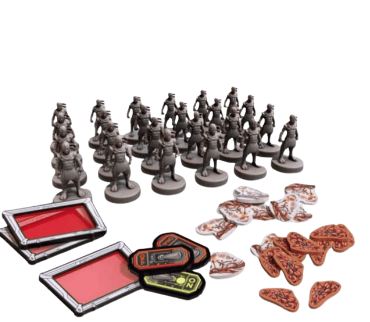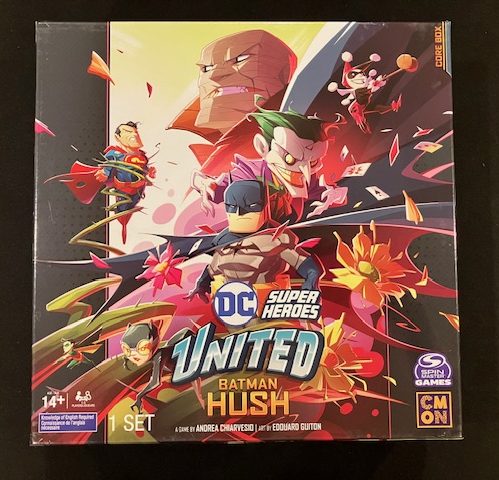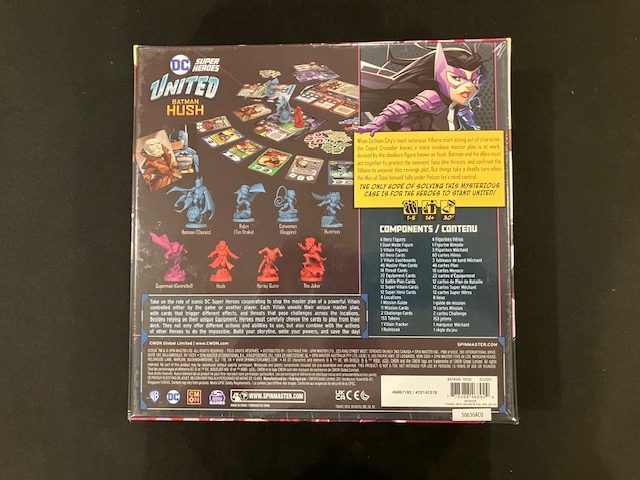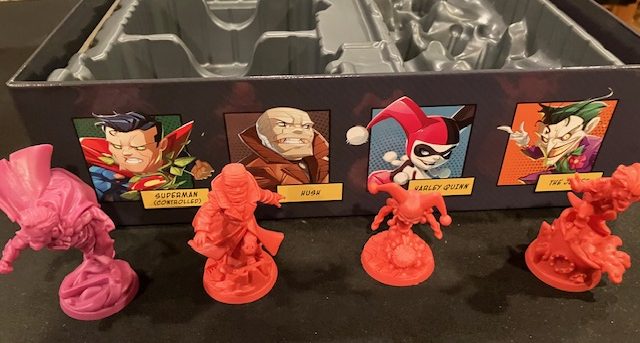
Probably My Favorite Game of 2025! DC Super Heroes United: Batman Hush

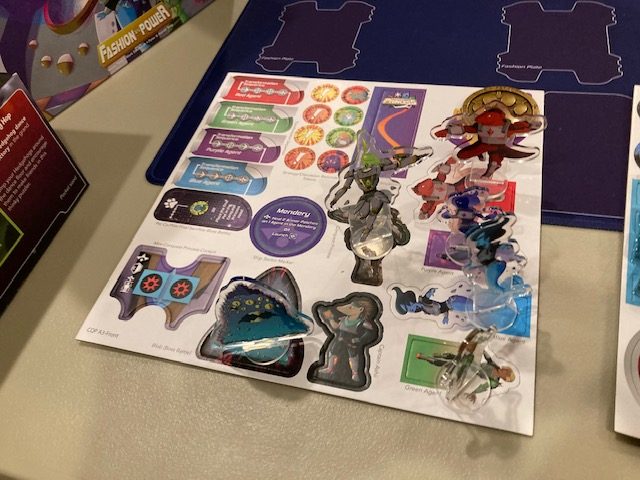
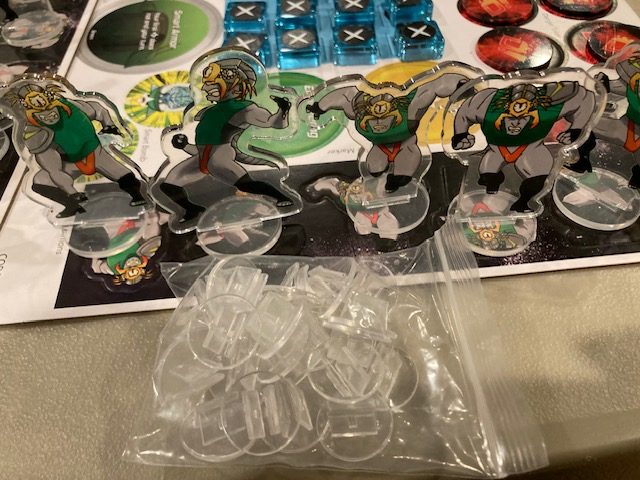
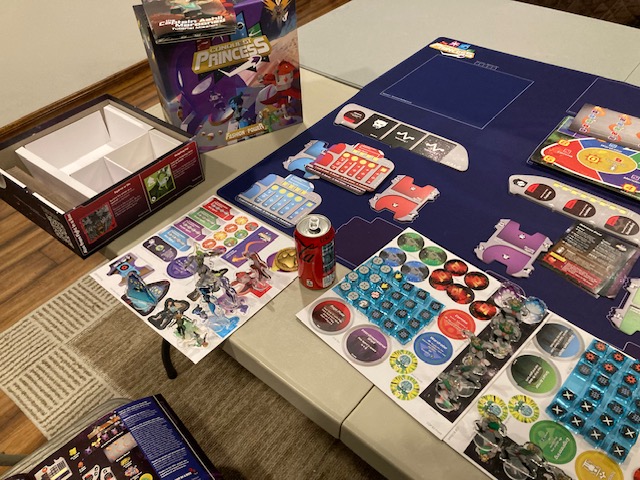
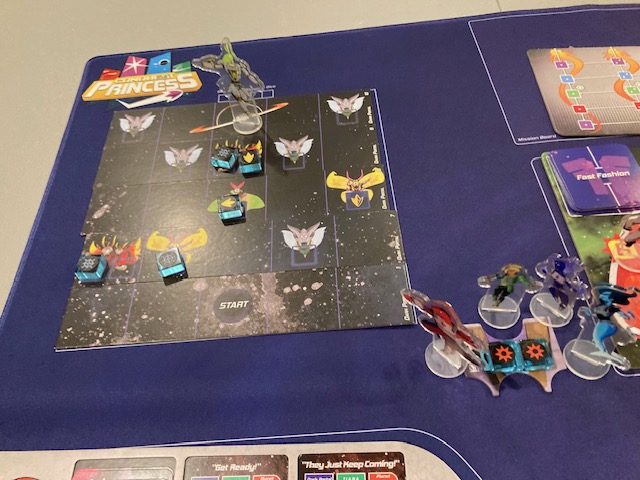
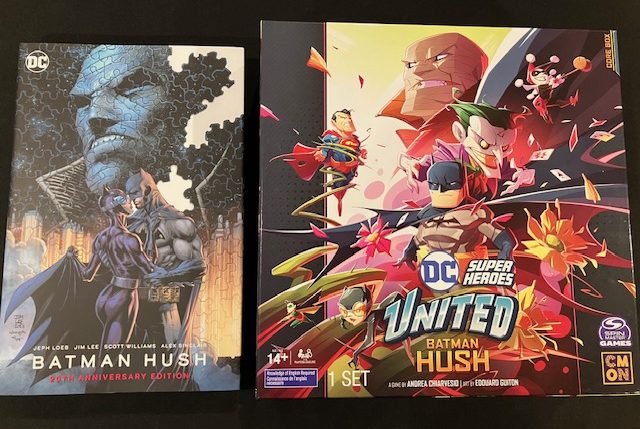
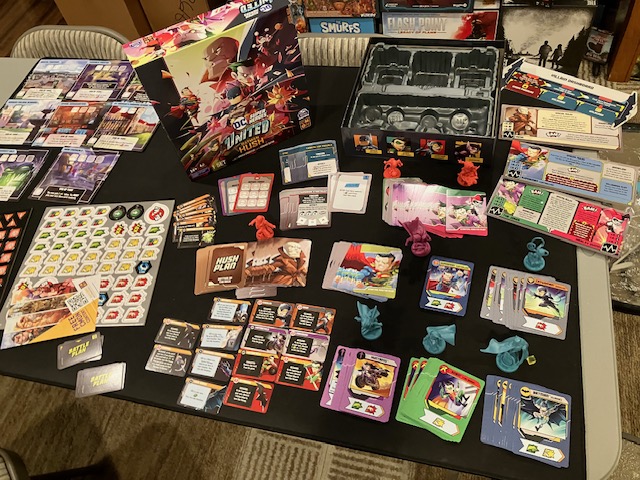
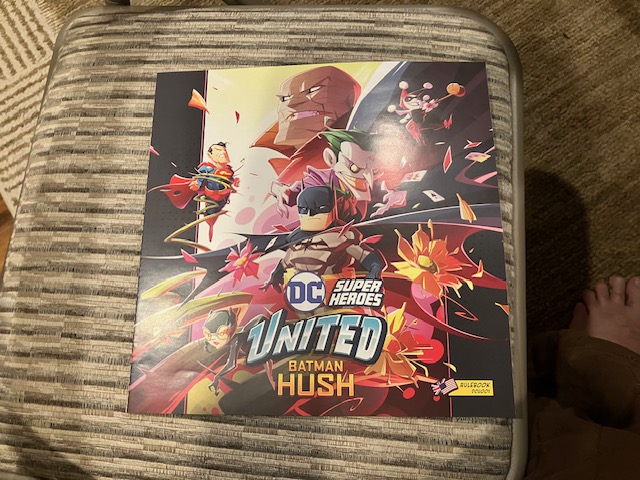
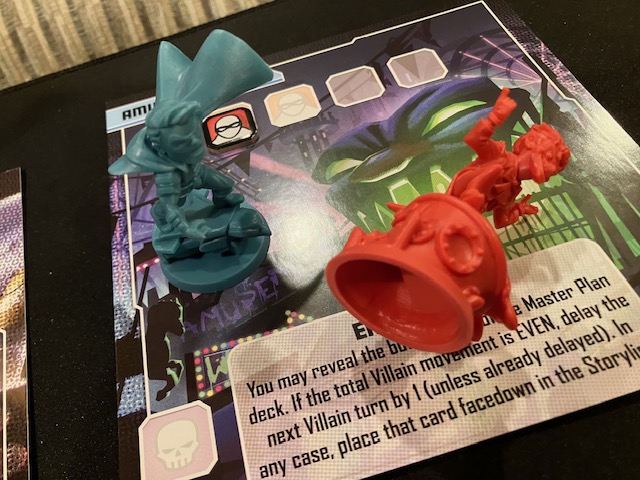
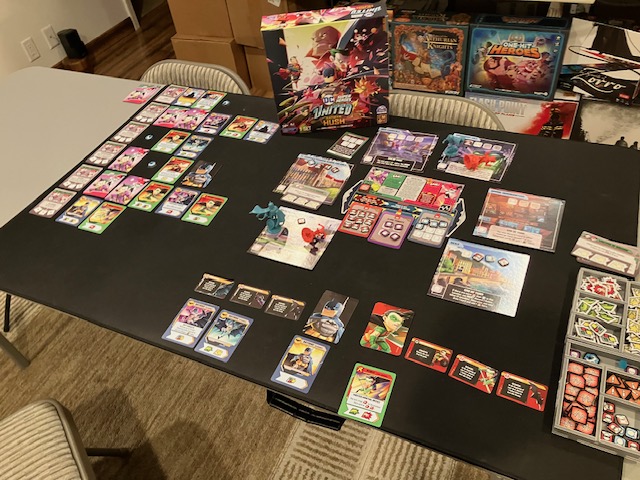
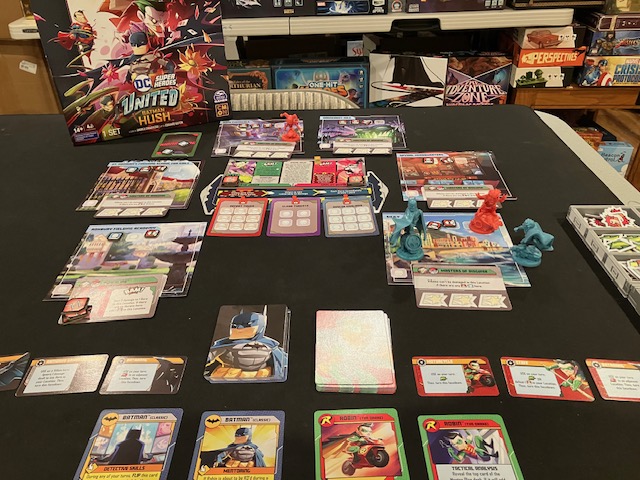
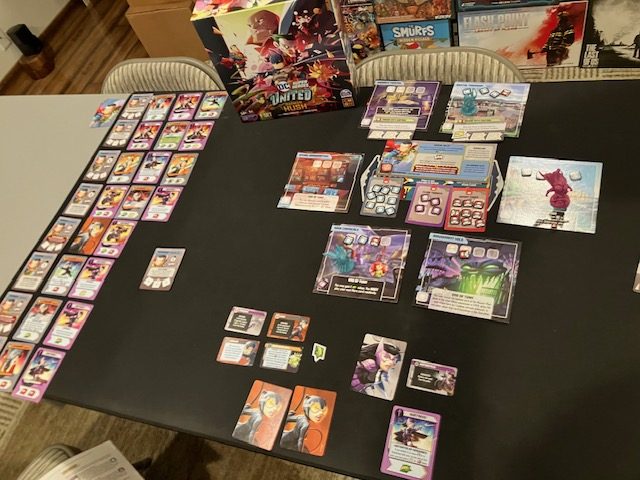
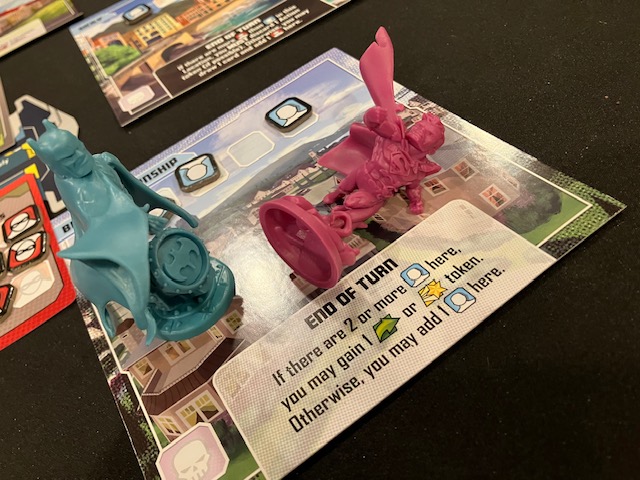
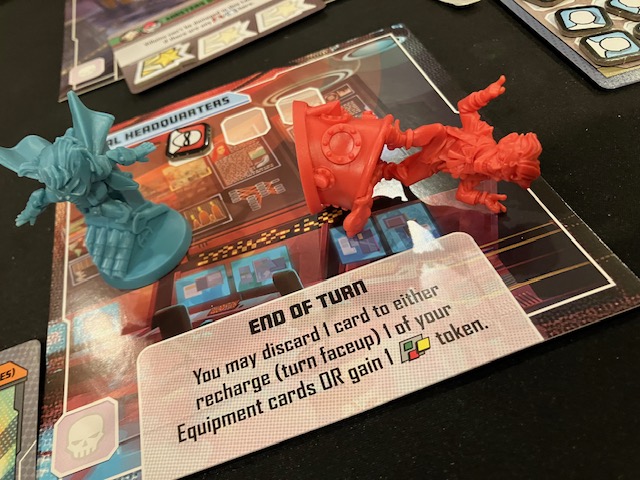
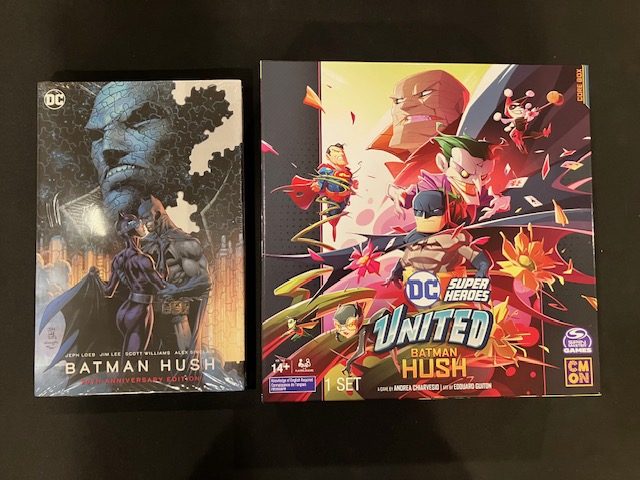
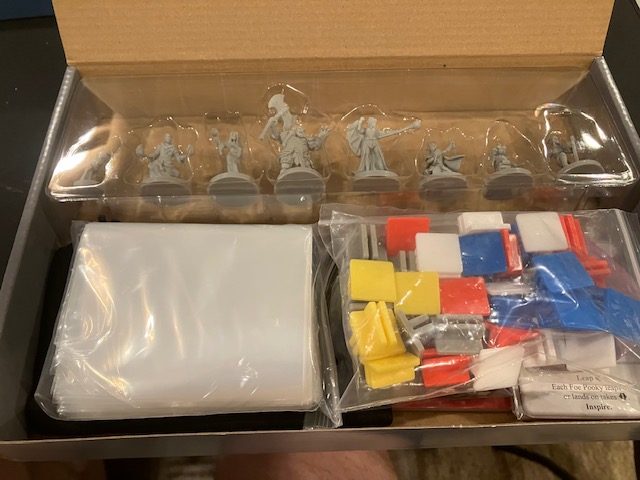
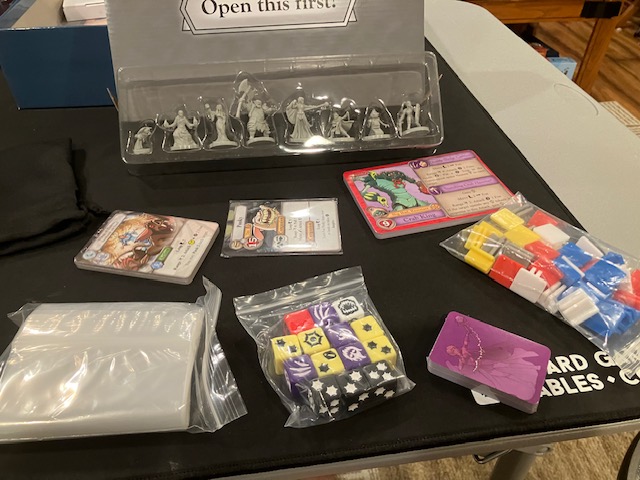
While we wait for the full delivery of DC Super Heroes United (which has run into multiple issues; CMON money issues, tariff issues, and staffing issues), CMON did manage to release DC Super Heroes United: Batman Hush (which we’ll just call Hush from now on, thank you). See above!

This was a “surprise” release that was available from Amazon sometime in August 2025; I ordered it instantly as soon as a I found out about it.  No one really expected this?  EDIT: Well, I missed a some memos … I didn’t expect it.  I mean, we expected DC United (it was #1 on our Top 10 Anticipated Cooperative Games of 2025 list), but Hush was not part of the original Kickstarter!

This game arrived at my house September 10th, 2025.

What is this?

Hush

This game Hush is a standalone game in the Marvel/DC United series of games.  Yes, it is standalone; you don’t need any other sets to play this.  This is a cooperative superhero game where players take the role of your favorite DC Superheroes (Batman, Robin, Superman*, etc) and work together to defeat the villain!

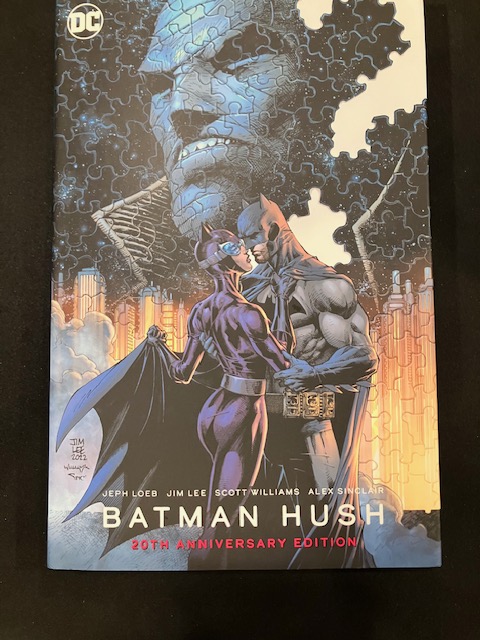
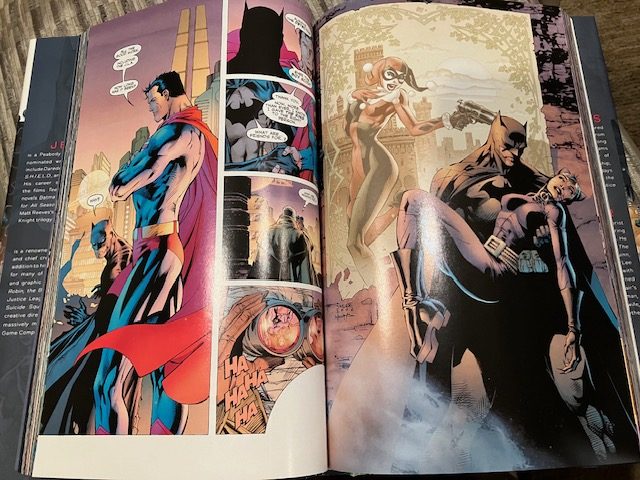
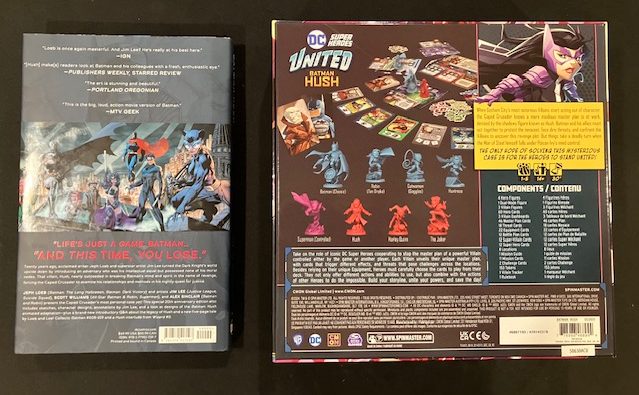
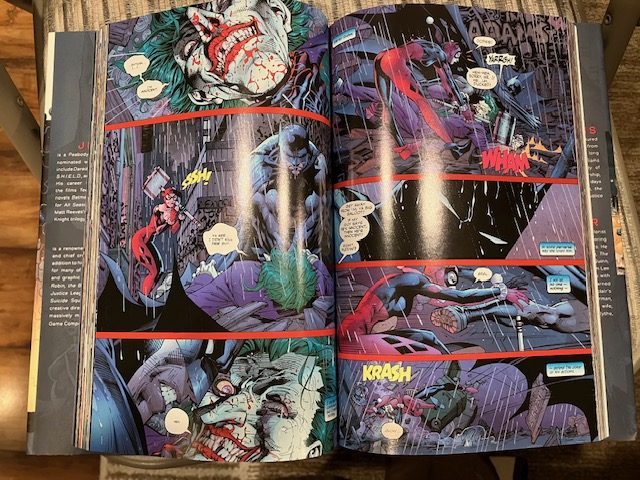
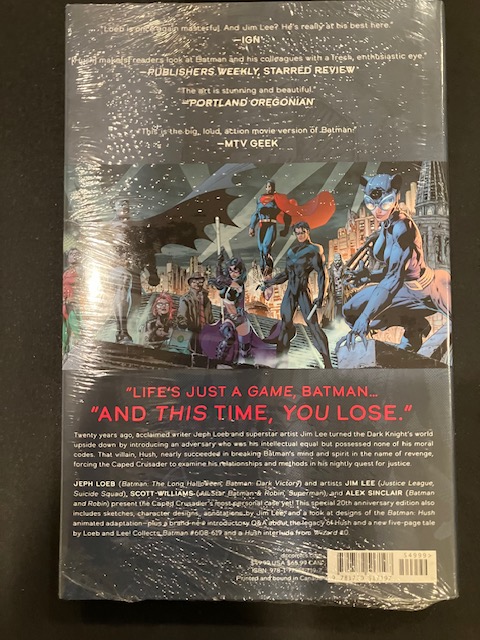
Hush is loosely based on the Jeph Loeb/Jim Lee/Scott Williams/Alex Sinclar Batman series called Hush: see the 20th Anniversary Edition hardback above.

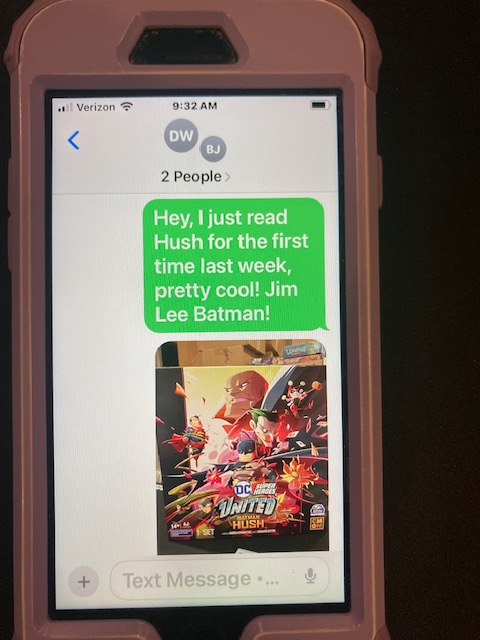
Surprisingly, I had never read Hush, which is weird because I love Batman and I love Jim Lee.  How have I never read this???  I texted my friends Bryan and Diana, who are huge Batman and Jim Lee fans about this!

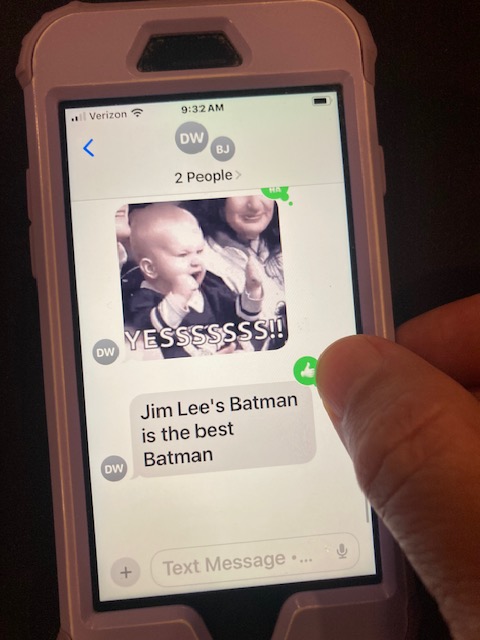
They think Jim Lee’s Batman is the best Batman (see above).  I went ahead and devoured the story over about 3 hours (below).

Hush is a great story; I’d recommend reading it if you’ve never read it.  It gives much more depth to the Hush villain(s) in the box.

Strictly speaking, you do NOT to read the Hush graphic novel/series to play the game; it just helps flesh out the game.  So, if you are intimidated by the giant Hush graphic novel, don’t despair!  The game works fine without knowing the series, but be aware that there can be spoilers.  (Still, Hush was pretty cool; you should read it!)

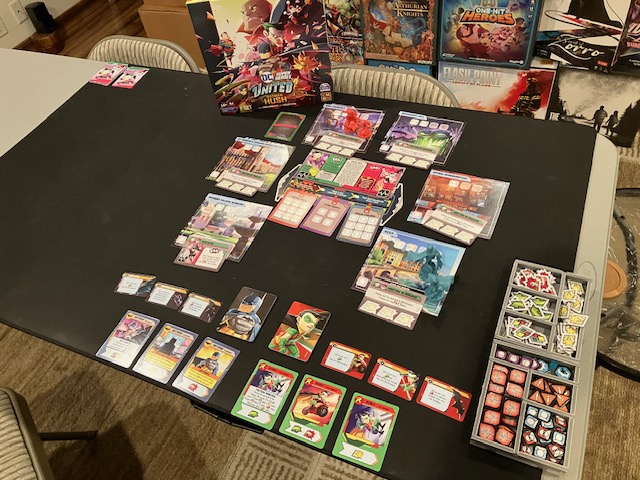
Unboxing/Gameplay

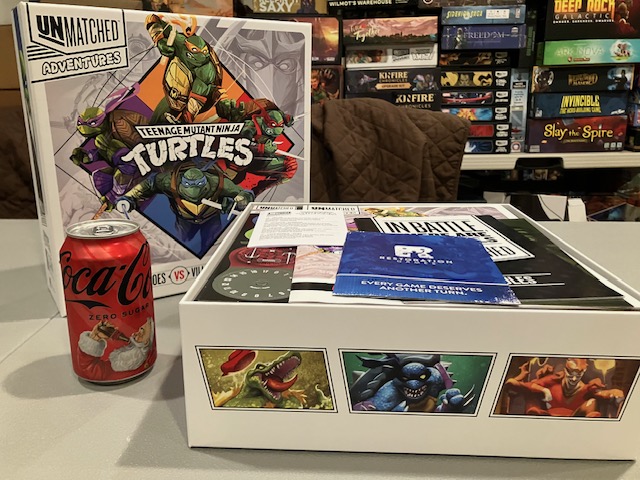
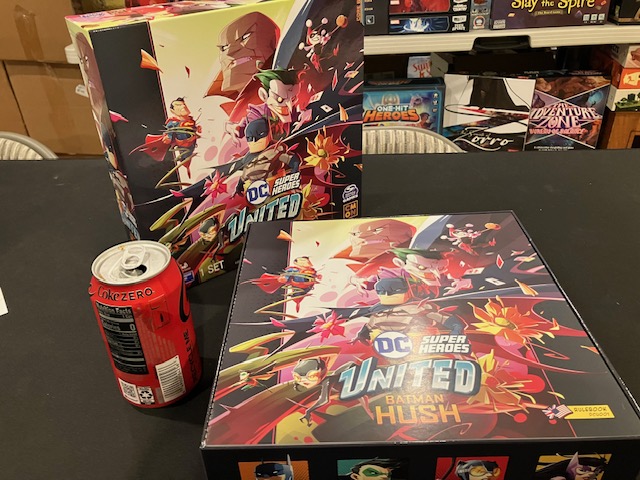
See box above with can of Coke for scale.

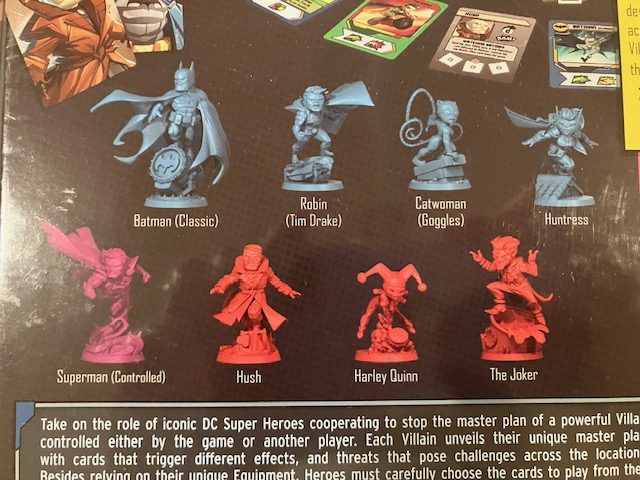
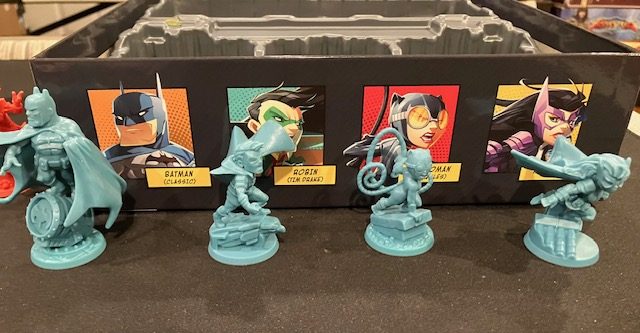
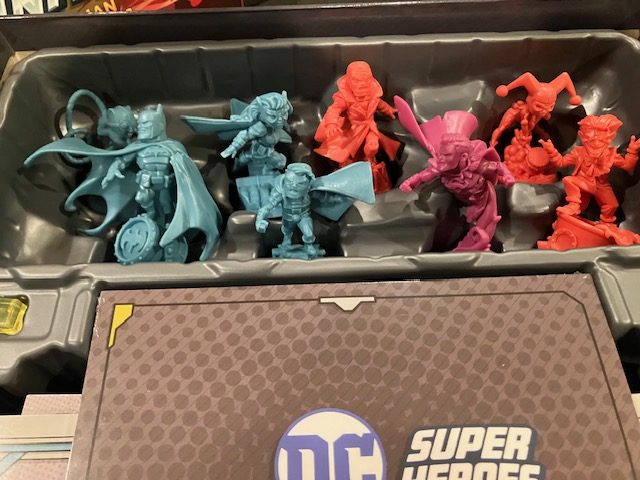
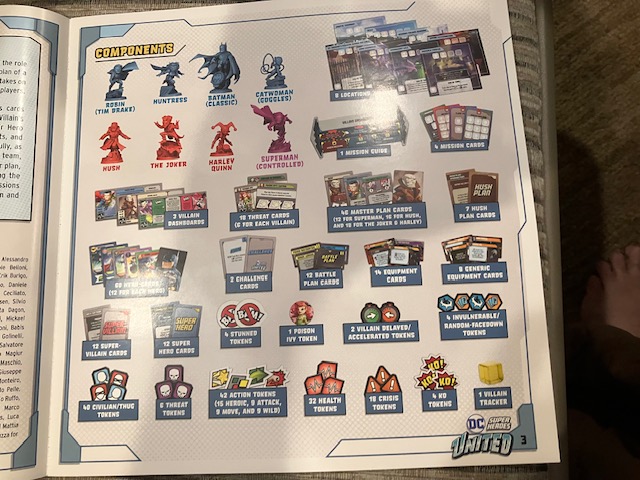
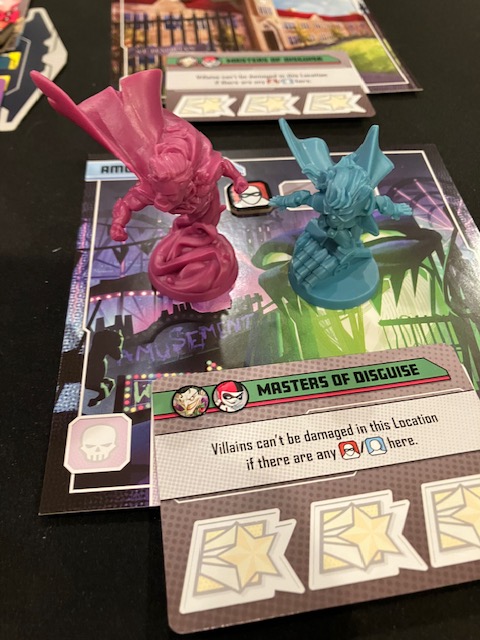
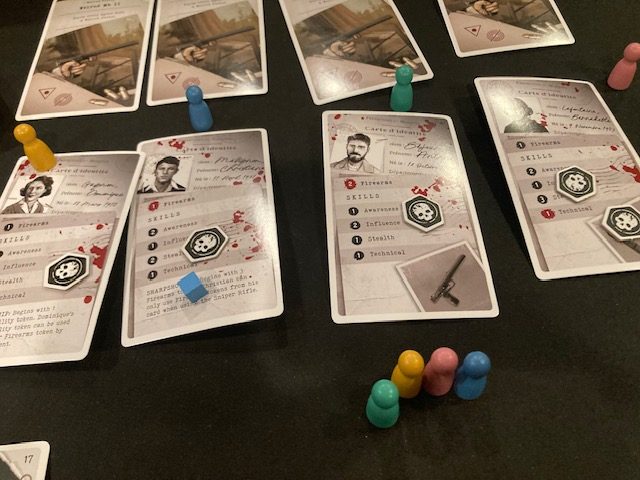
Each player chooses a hero to operate: Batman (classic), Robin (Tim Drake), Catwoman, or Huntress.

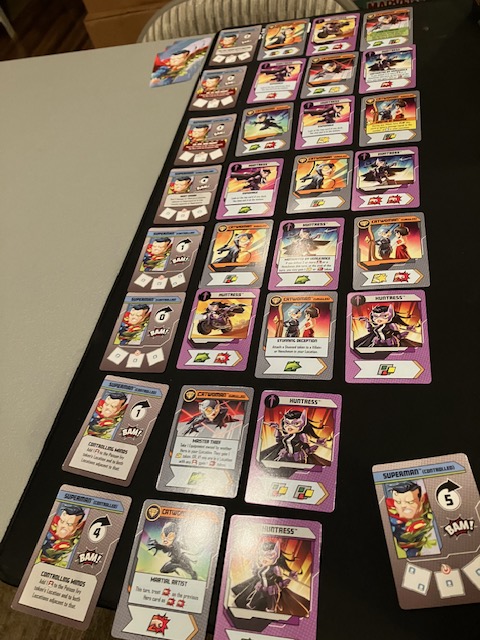
There must be a villain to fight: Hush, Harley Quinn, The Joker, or Superman (controlled).  Superman (controlled) can also be played as a Hero.

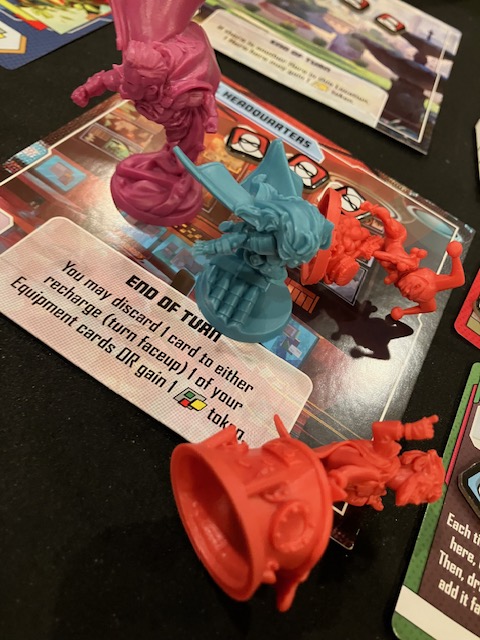
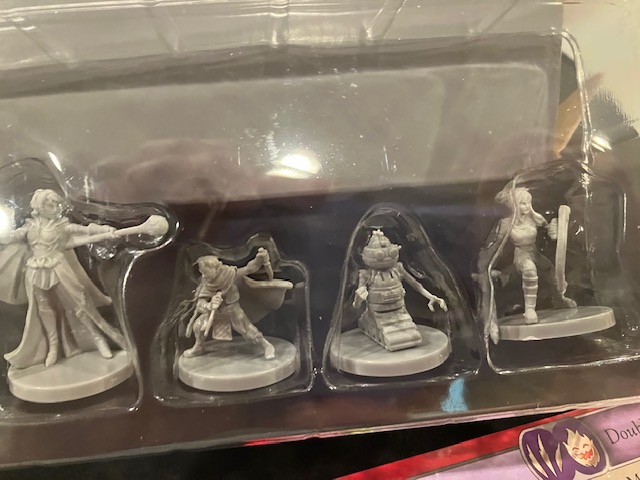
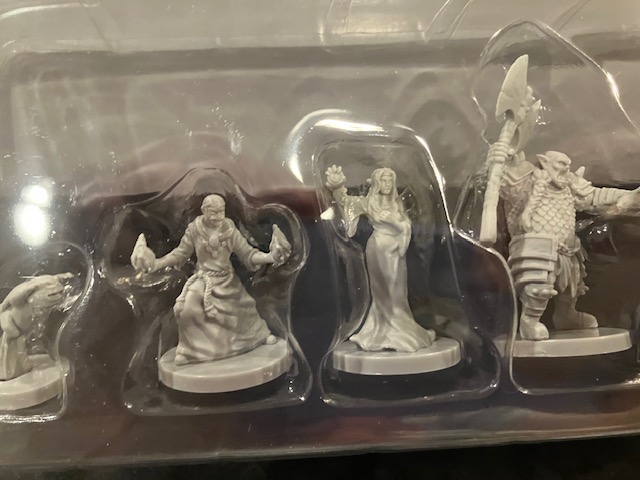
I recommend taking a picture of how the minis fit into the insert (or use mine above).  If they all get out out-of-whack, you can’t put the plastic cover over the minis (see below).

Each Hero gets their own deck, and each Villain gets their own (Master Plan) deck and Threats deck.

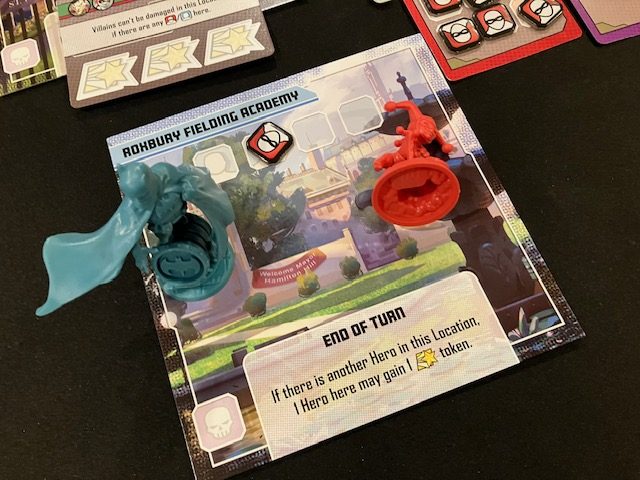
There are 8 locations that come with the box; you will set 6 of them out in a circle representing the city.

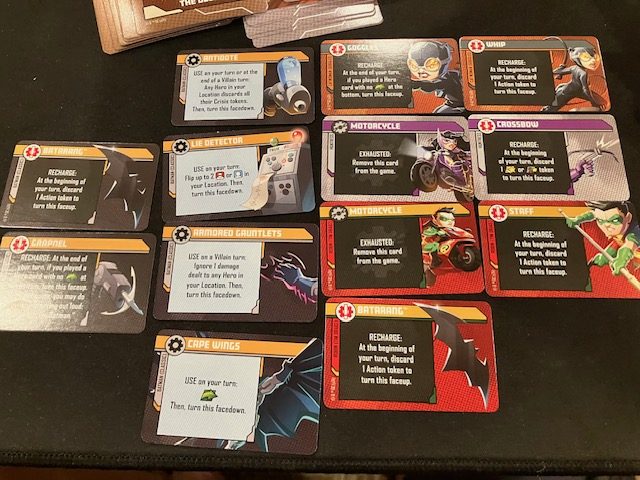
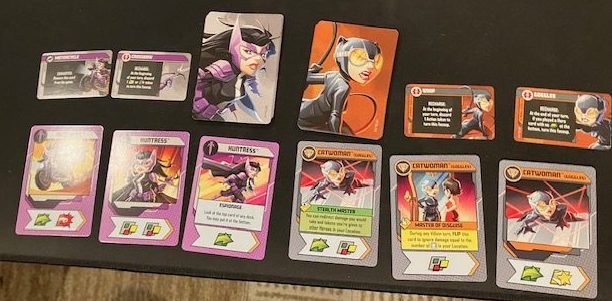
Most of the characters have equipment; the equipment cards are “newish” to Marvel United: they were introduced in Spidergeddon, but we were found we loved them in Marvel United: Multiverse (see review here).   The equipment cards augment the heroes, and basically give them more choices on their turn; however, they will either be discarded or need a recharge to reuse them.  See above.

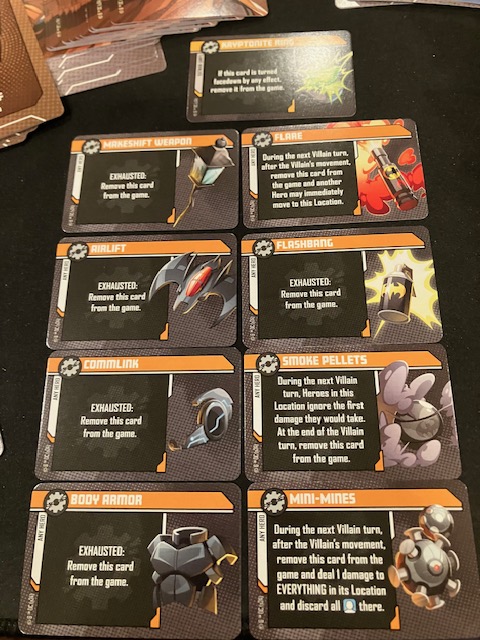
For heroes who don’t have equipment, there are also “generic” equipment cards any hero can use (see above).

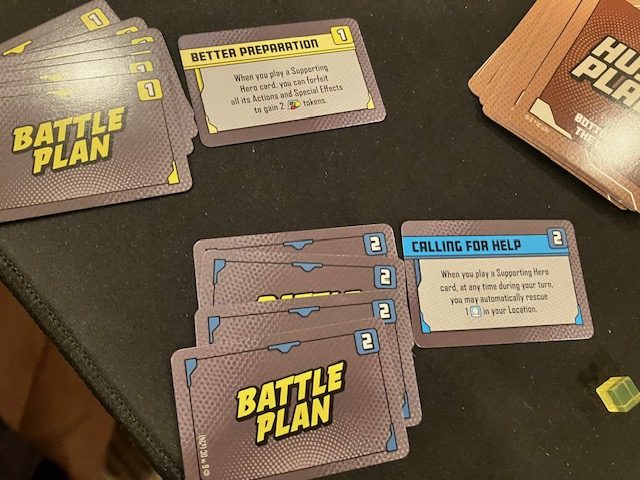
The game also comes with Battle Plan cards; they are for the built-in solo mode called Commander Mode.

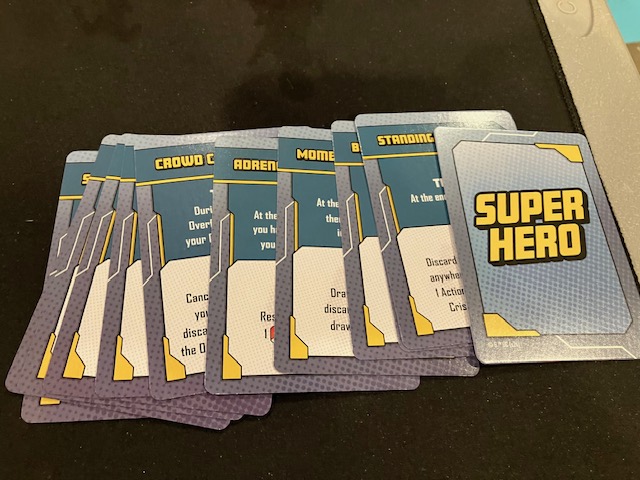
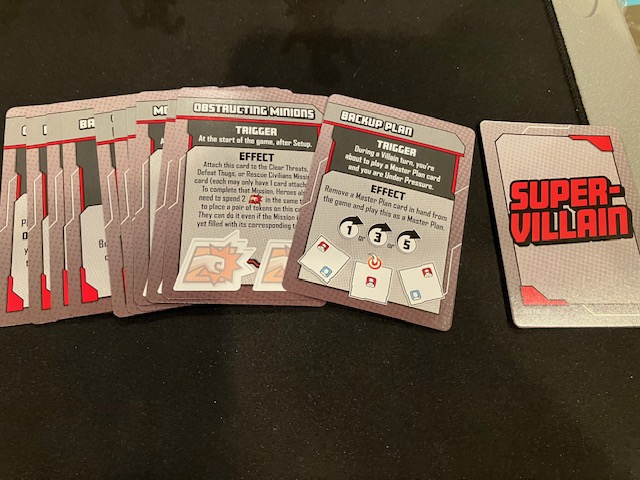
There is another way to play where one player can take control of the Villain and plays against all the heroes: this is a 1 vs. many mode using the Super-Hero and Super-Villain cards above.  We won’t be discussing this mode any more in this review; this is strictly a solo and cooperative mode review.

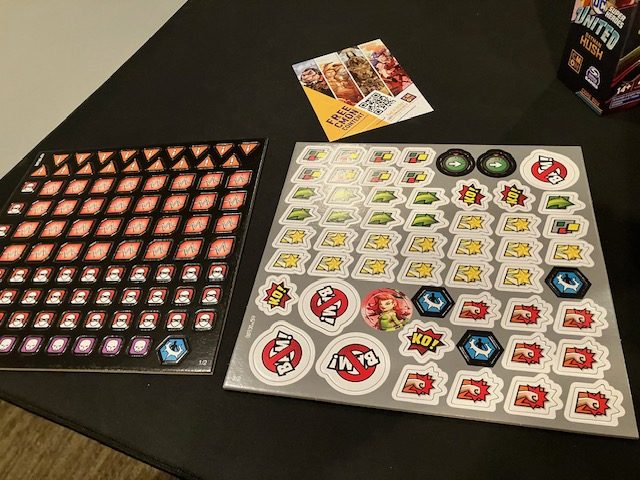
There are a tons of tokens for health, KOs, etc. See above.

Overall, this game looks consistent and great.  The artwork and minis in the game are consistent with the look-and-feel of all the previous Marvel United games (except this is DC instead of Marvel).  For previous looks at Marvel United games, see here, here, here, here, here, and here.

Rulebook

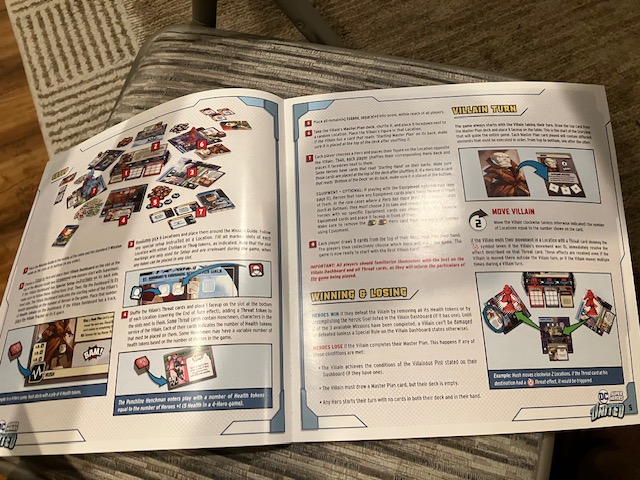
The rulebook is good (it had better be after so many iterations), except for the form factor.

This gets a C+ or B- on the Chair Test; it does stay open on the chair next to me, it has a good-sized and readable font, it has lots of pictures, and it’s easy to read.  Unfortunately, it hangs down just enough to be annoying.  It does work with only one chair, if you sorta fudge it diagonally.

The Components page is great: see above.

The Set-Up is across two pages, but they are in the same span, and the picture and labels work well.

Some, not all, icons are on the back.

In general, this is a good rulebook: good components, good set-up, good font, good pictures, good back. The only complaint is the form factor.

What’s New?

Most everything in Hush  we’ve seen in one of the previous Marvel Uniteds.  I have played a lot of Marvel United, but it’s hard to say you’ve played EVERYTHING across the massive amount of content in Seasons 1,2, and 3!  Here’s what was new to me:

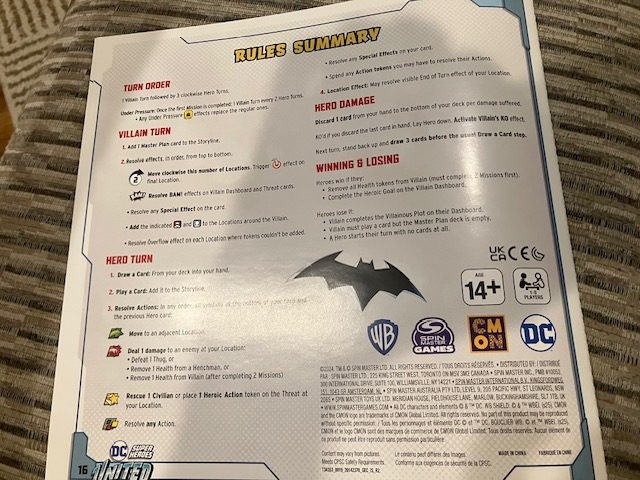
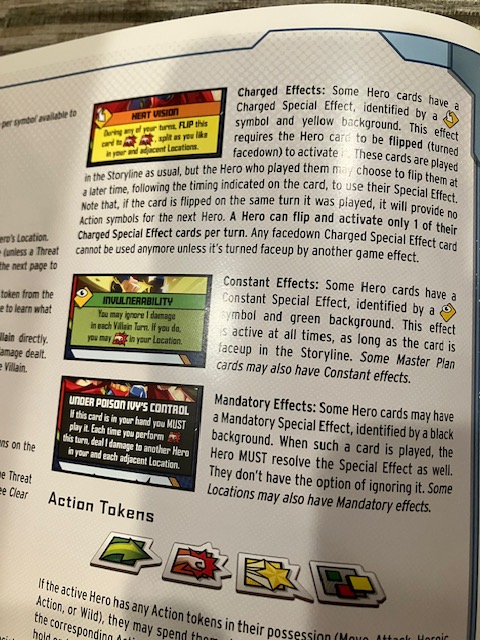
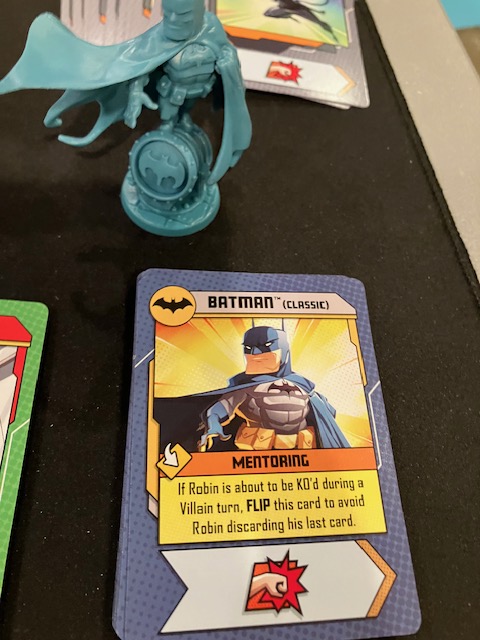
Charged Effects: The little yellow area/flip card allows to flip a card in the Storyline once it’s up.  In the example above, you can flip Batman’s card (only if it’s in the Storyline) above to stop Robin from being KO’d!  This is kinda neat; it’s like a one-time only effect that can only be activated AFTER the card has been put into play.

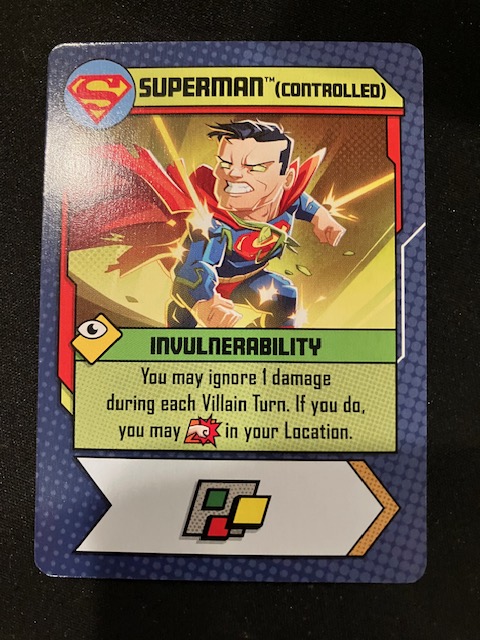
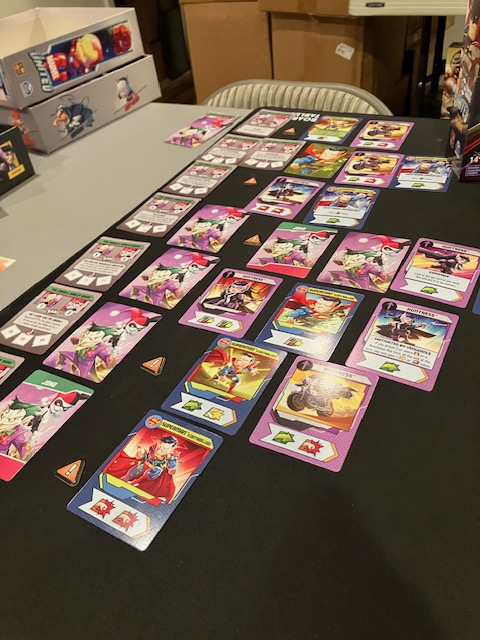
Constant Effects: These cards keep an ability active always once they are in play in the storyline! See above as Superman’s Invulnerability keeps damage off him!

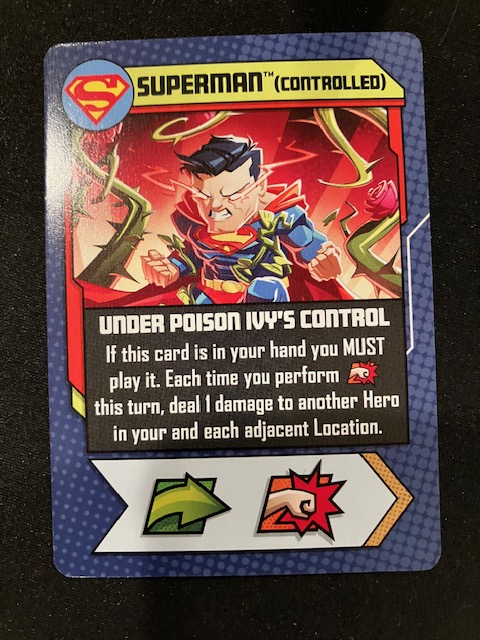
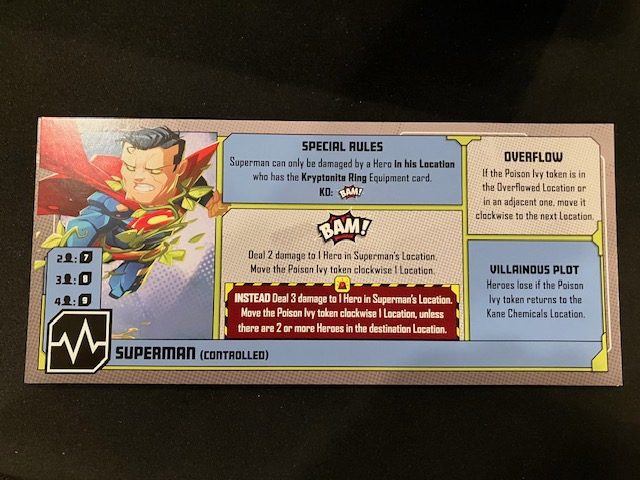
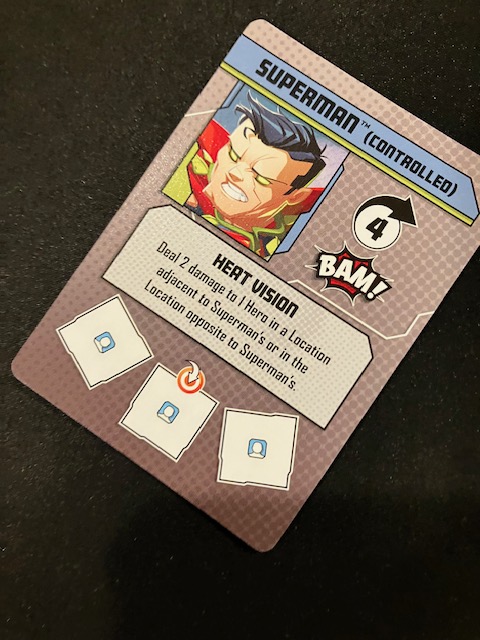
Mandatory Effects: These are mandatory things you MUST do on the card.  This Superman is controlled, and occasionally reverts to his controlled self … doing damage to Heroes around him.  See above.

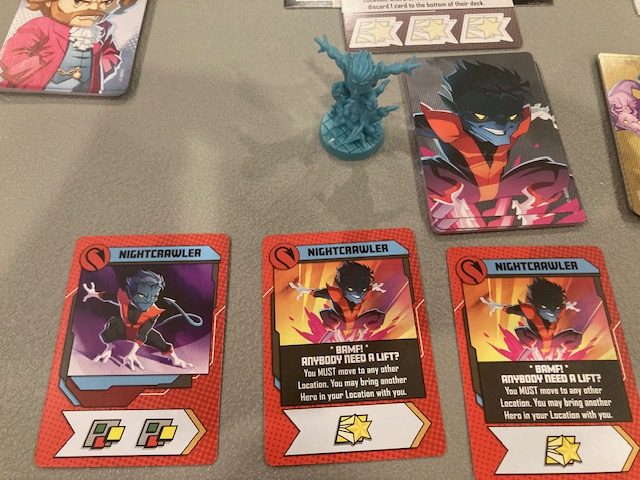
To be fair, we did see Mandatory Effects on the Nightcrawler’s cards back when we did the Dark Phoenix Saga: see here.

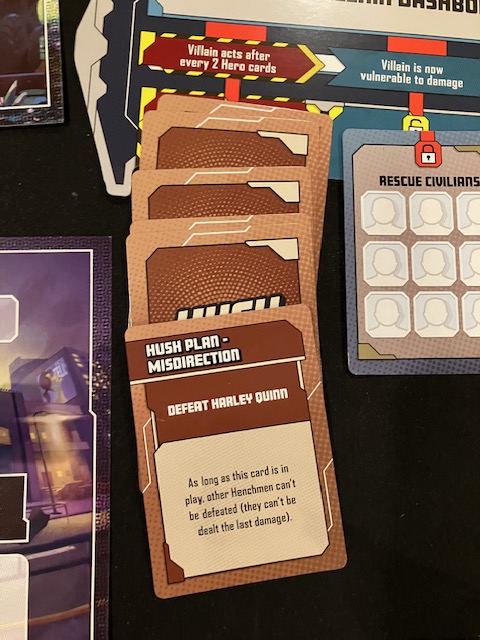
Hush Deck: if you are playing Hush, the Hush Plan deck replaces the Clear Threats on the dashboard.

Generally, the DC Superheroes United: Hush Batman or Hush feels very much like  the newer Marvel Uniteds with equipment, Charged Effects, Constant Effects, and Mandatory Effects being the newer things.  Otherwise, it feels like Marvel United, but DC instead!

Solo Mode Discussion

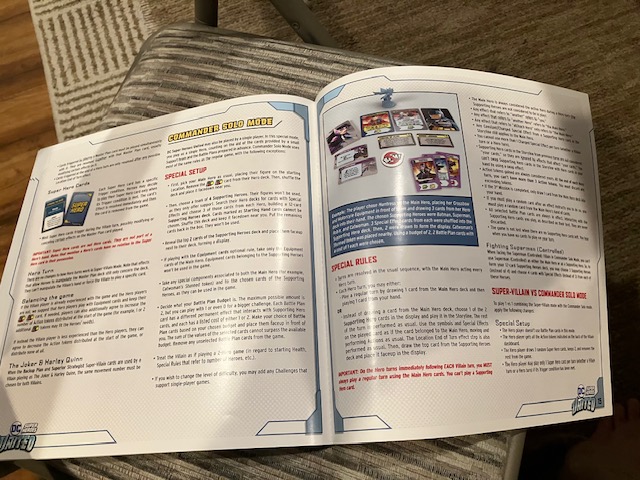
There is a solo mode called Commander Solo Mode (thanks for following Saunders’ Law and giving us a solo mode) that spans two pages.  And it’s pretty complicated.  But it is a true solo mode; you only operate one hero.

I think we saw the Commander Solo Mode first back in Spidergeddon, and we kinda liked it better than the solo mode in the original Marvel United … but frankly it still just feels too complicated.  It’s almost two pages of exceptions, new rules, changes, and special rules!  Look closely at those two pages above!  There’s SO MANY RULES FOR COMMAND SOLO MODE!

Frankly, it’s so easy to just pull out two heroes and alternate between them and just play solo (operating two heroes); it’s the way the game was meant to be played.  This is the way we play solo, partly because it’s significantly easier, partly because it’s easier to jump in (so we concentrate on the new rules of the Villain), partly because it’s the way Marvel United was meant to be played: 2-4 Players, and partly because we have to teach the cooperative game to our friends (so it’s better to play without all the solo rules exceptions for a better learning to teaching game).

You can disagree with me if you like, but I feel very strongly about this! Every time someone tries to put a solo mode in, I find it’s usually better and easier to just play two-handed solo instead (Leviathan Wilds, Leviathan Wilds: Deepvale Expansion, Lord of the Rings Pandemic to name just a few).  Frankly, the built-in solo mode for Lord of the Rings Pandemic almost caused me to hate the game … it wasn’t until I played 2-Handed solo that I found joy in Lord of the Rings Pandemic.

Play solo operating two heroes.  You’ll thank me.

Game 1: Batman and Robin vs. The Joker and Harley Quinn

Solo game: two-handed solo (one player operating Batman and Robin independently)

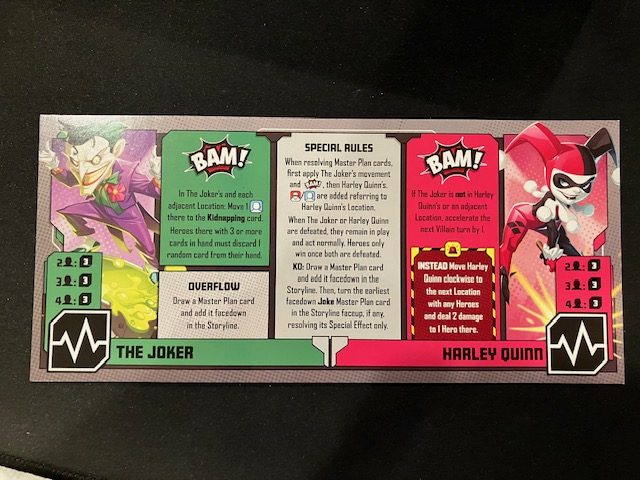
Our first game was Batman and Robin vs. The Joker and Harley Quinn.  Note that Harley Quinn and The Joker are a “team” you are playing against!  You can’t win until they are BOTH down!

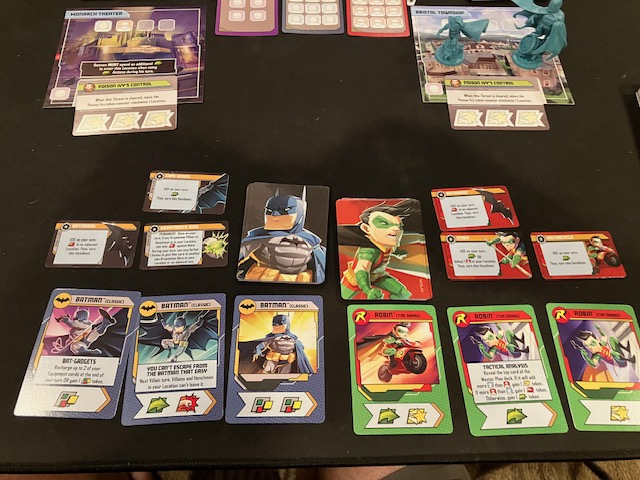
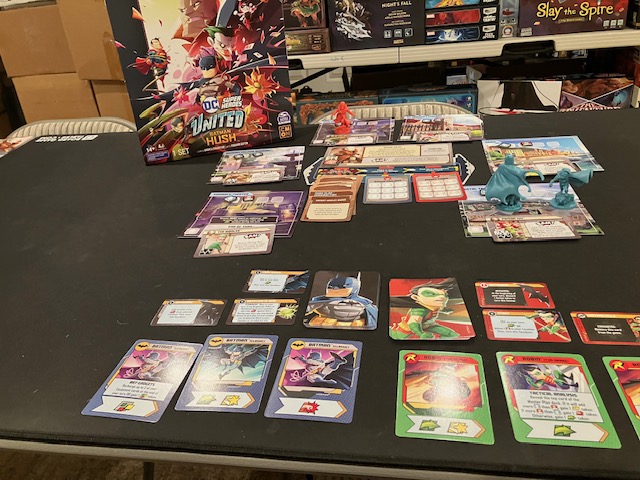
See Batman and Robin get ready to go!

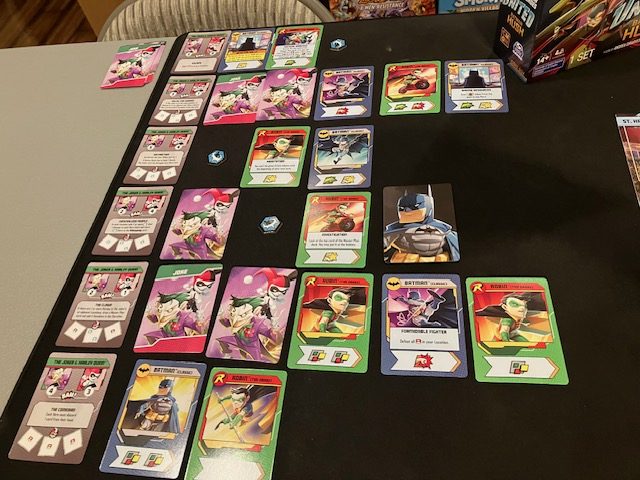
The storyline for Joker/Harley Quinn got convoluted as many times we’d have to put Master Plans into the storyline … they can come up at a later time, or when a character gets KO’d!

In the end, Batman  and Robin prevailed.  Batman took out Harley Quinn …

… and Robin (Tim Drake) took out the Joker.

There are some neat ideas here, as the Joker kidnaps civilians (something he would SO DO in the comics),  Harley causes the Master Deck to dwindle, and “Jokes” appear in the Storyline!  This is a game about keeping the Master Plan deck under control by indirection!  Sometimes you do stuff to STOP the Master Deck from getting too small! If the Master Deck ever becomes empty … you lose!

The Joker and Harley Quinn scenario felt incredibly thematic: Joker kidnapping, Harley causing chaos, and Joker’s “jokes” in the storyline occasionally springing on the Heroes! (It also had roots back in the Hush series: see snapshot above).

Batman and Robin’s decks were also on point: they both had the ability to “be a detective” and look at the next Master Plan card coming!  This was both incredibly useful and very thematic.

Games 2, 3, and 4: Catwoman and Huntress vs. Superman (controlled)

Solo game: two-handed solo (one player operating Catwoman and Huntress independently)

So, Superman (controlled) is hard.  I guess he should be; he’s Superman!

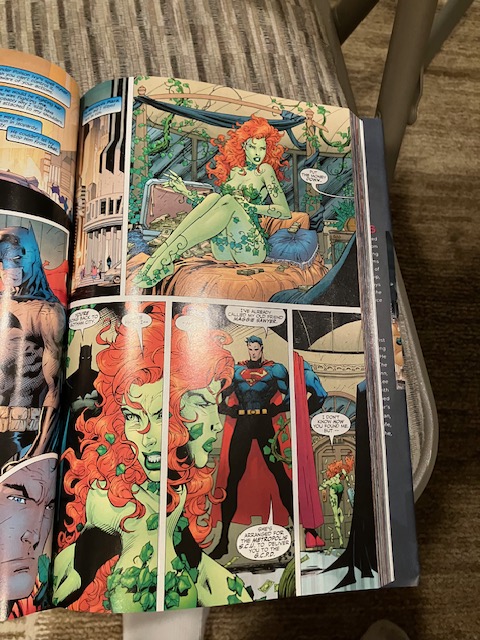
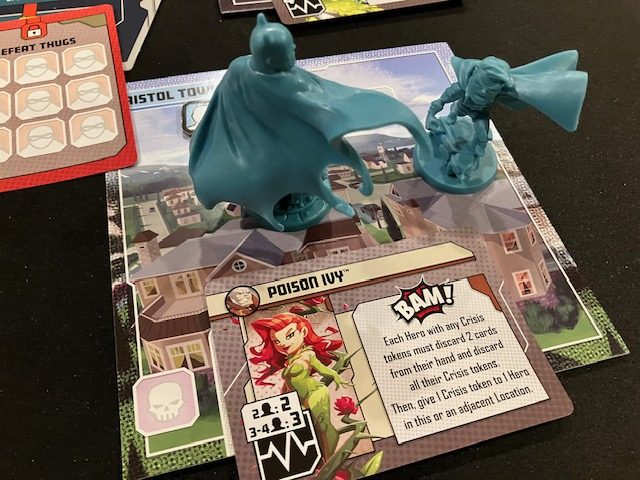
Superman is bad guy here because Poison Ivy is controlling him! See a still from the comic above!

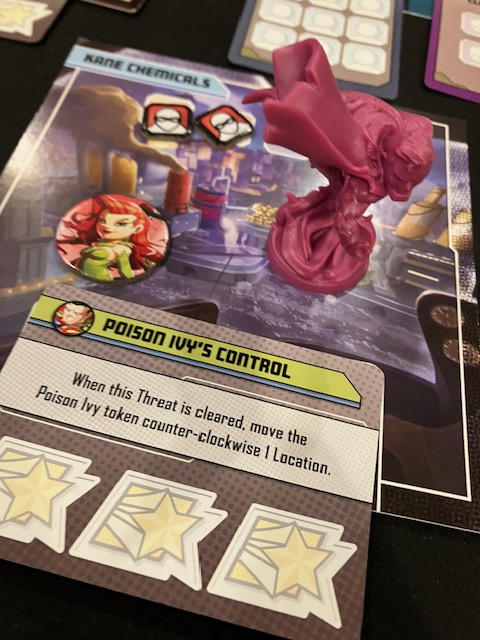
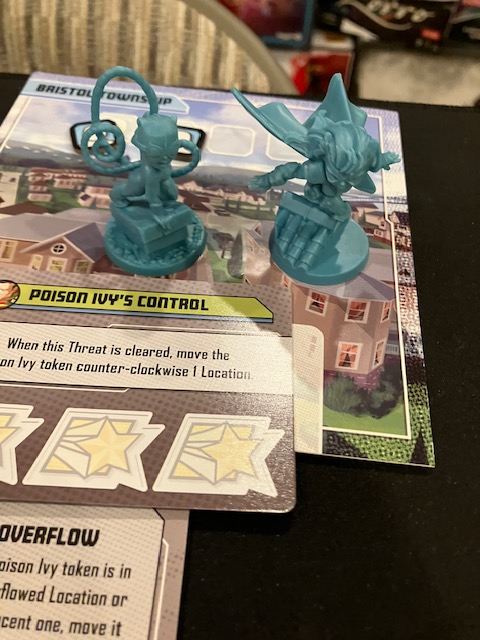
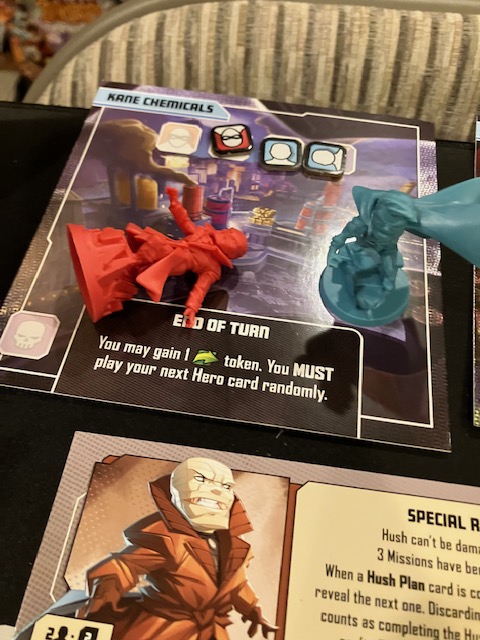
Superman is controlled by Poison Ivy (see above).   If Poison Ivy makes it around the board back to Kane Chemicals, the bad guys win!

Over 3 games, Huntress and Catwoman struggled! They lost three games in a row!  In this particular scenario, heroism is very important!  Unfortunately, Huntress and Catwoman seem to have more punch than heroism!

Huntress felt very thematic, as she could look at the top of the Master Plan deck (with espionage) and was very mobile and punchy.  Similarly with Catwoman, she had some disguise cards and was very punchy and mobile.  Unfortunately, they were a bad team against Superman (controlled). Honestly, this makes sense thematically: neither Catwoman or Huntress are known for their Heroism in the comic books … they tend to be more “self-interested” heroes!

Still, I thought the Superman (controlled) villain was pretty cool! It felt thematic … and you even had to have a Kryptonite ring to hurt him!

I have played SO MANY games of Sentinels of the Multiverse where you lose because you just have the wrong heroes.  And that feels very much like the comic book universes!  (Sometimes, Spidey has to go visit Doctor Strange to handle a mystic bad guy!)  In this case, Huntress and Catwoman are the wrong Heroes for Superman … or at least, it’s a LOT harder to play them.

Game 5: Batman and Robin vs Superman (controlled)

Batman and Robin did much better against Superman (controlled): they defeated him in one game.

Batman and Robin control the Master Control deck much better and have a lot more Heroism to deal with Threats and civilians.

This win felt very thematic: Batman and Robin use their detective skills and heroism to keep the bad guy (a Superman controlled by Poison Ivy) at bay.

Game 6: Batman and Robin vs Hush

Solo game: two-handed solo (one player operating Batman and Robin independently)

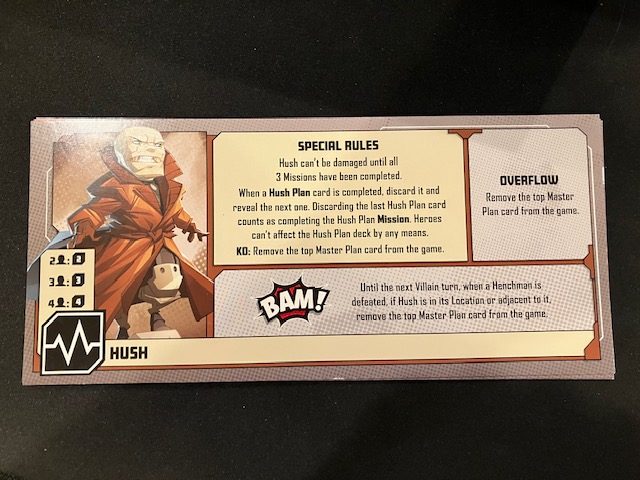
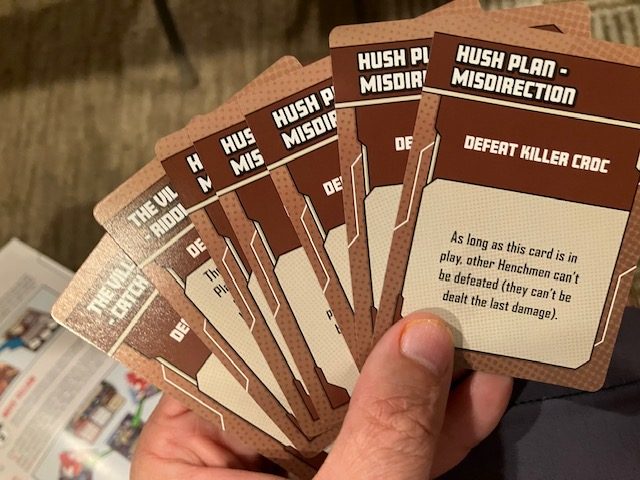
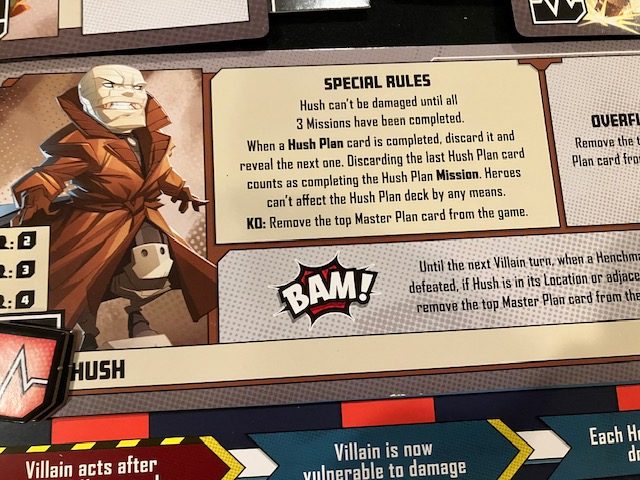
The Hush Villain is probably the most complicated to play.  You must complete all three Missions, but instead of Clear Threats, you have to clear six “Hush” threats (see below).

Like the comic book (very minor spoiler), the Hush Plan cards makes you “focus” on a particular Henchman on the board: you can only defeat them in a certain order.  This constrains how you have to defeat them!

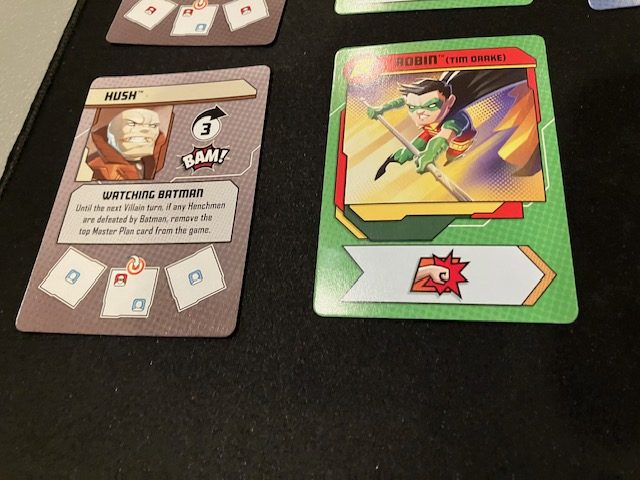
The Hush villain is much more about taking down Henchmen a little at a time, while “defeating” them in a particular order.  Batman and Robin have to “balance” how they spend their resources.

Of course, lots of things (like KO’s, see above) get rid of Master Plan cards.  Do you defeat a Henchman this turn at the cost of losing a Master Plan card?  Or do you wait a turn?  Defeating Hush is all about balance for the Heroes.  Hush himself is sewing Chaos into the world and dwindling the Master Plan deck!

In the end, Robin had a good run and was able to move to Hush and take him down.

Even though it wasn’t a full saga like the comic, Hush felt like the story that unraveled in the comic.  Batman and Robin get “distracted” by Henchmen along the way as they try to uncover who Hush is … and that’s the last card of the Hush Plan deck!

Although you can play the Hush Villain without reading the story, I strongly recommend you do read it before playing!  There is a major spoiler at the end of the Hush Deck that will spoil the entire Hush comic book.  The other two Villains (Superman and Joker/Harley Quinn) you can play without reading, but I suggest you probably read Hush before playing he Hush villain.

Game 7: Superman (controlled) and Huntress vs. Joker and Harley Quinn

Don’t forget; you can play Superman (controlled) as a hero as well!

Supes deck is pretty strong.  And Huntress is great at punchy and movement.

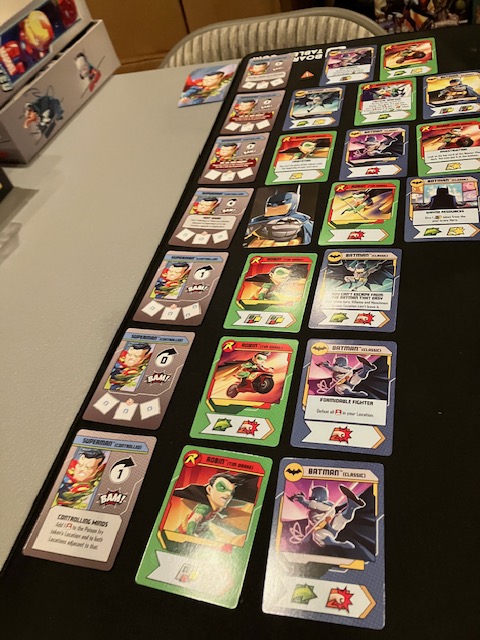
Superman’s deck has a minor flaw that he might have to punch other Heroes (since he still has some residual control): see above.   That card kind of “balances” a very strong deck by giving him a “forced” card. Don’t you hate it when Poison Ivy asserts her control at exactly the wrong time?  That feels so comic booky!  I kind of enjoyed this!  Supes is great … except for the one time he isn’t!

And Huntress redeemed herself by helping out Superman.

Game 8: Catwoman and Huntress vs. Joker and Harley Quinn

Just to make sure Catwoman and Huntress are good decks, I took them for a run against Joker and Harley Quinn.

After losing to Superman three times, they acquitted themselves and beat Joker and Harley Quinn.

Cooperative Game

There weren’t any real surprises from the cooperative play; we’ve played this before as a team!

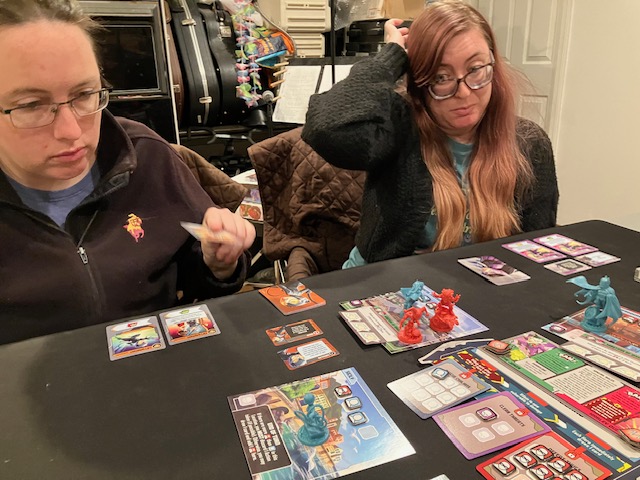
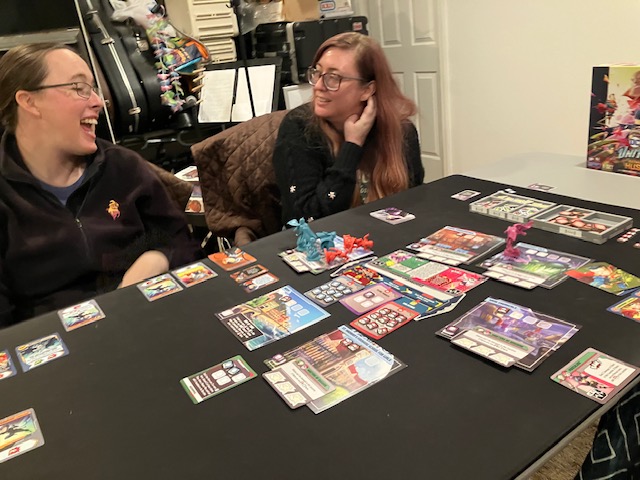
People discussed!  At one point, Andrew HAD to play a Controlled Superman card and he said “I suggest you all NOT be adjacent to me! I will punch you!”  So, Sara and Teresa made sure there was movement on previous cards.  Most of the discussion is “Oh! If you give me this … Oh!  What do you need?” and stuff like that.

My group had a fun time playing this cooperatively.  The new abilities and equipment made them enjoy it that much more.

Judging by my group’s responses, I think this is the best version of the Marvel/DC United system so far.

Core Game?

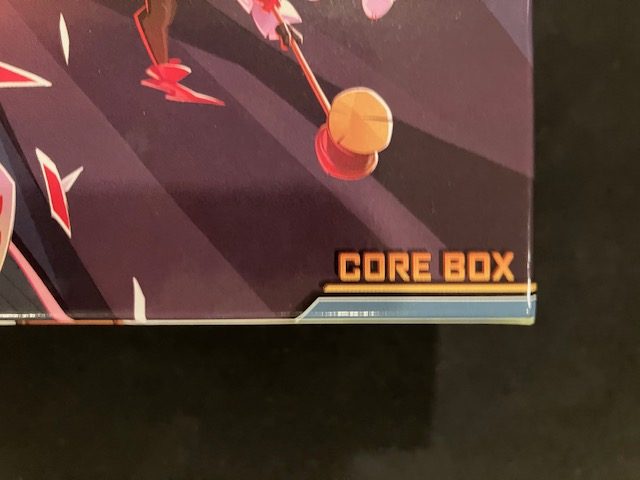
I am somewhat surprised that Hush is a core box!  That means this is a completely standalone game!  I loved what I saw, but this doesn’t feel like it should be a “core set”?  The heroes in this set are great for new players, but the villains are really complicated!  Superman (controlled) is probably the easiest Villain to operate, but maybe the hardest to defeat?!  And both Hush and Joker/Harley Quinn are very different than most base Marvel United villains! They are much more complicated than (say) Red Skull from Marvel United, or even Ghost Rider from the Multiverse set!

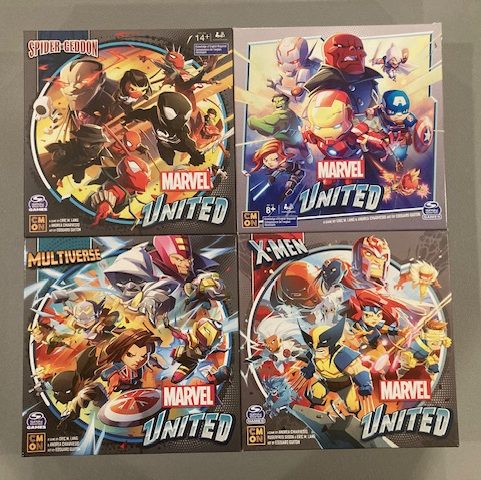
If I were to recommend someone start with a core set, I’d recommend the base Marvel United, Marvel United: X-Men, or Marvel United: Multiverse over DC SuperHeroes: Batman Hush… I think Hush is too much for a starting player.  Which is too bad, if you LOVE DC, this is the only set you can currently get! I am afraid Hush might accidentally turn off some intro players because of its extra complexity.

Plays Well With Marvel United?

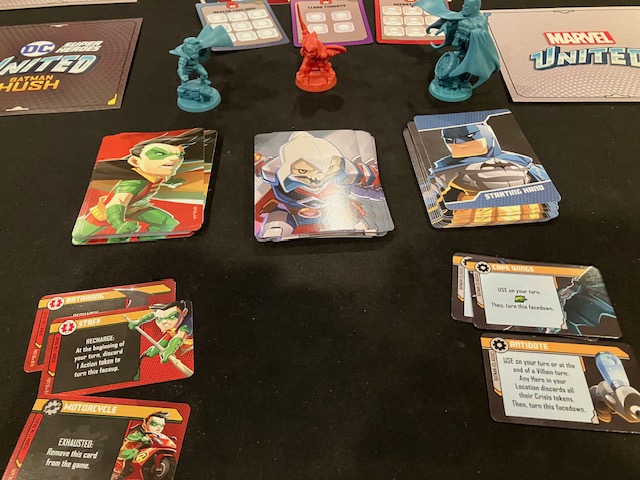
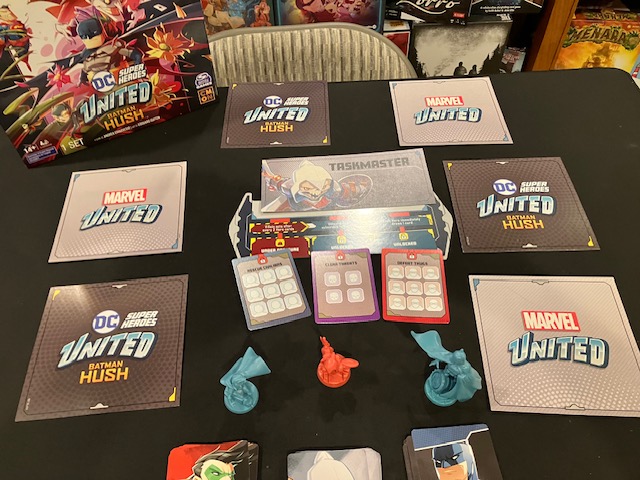
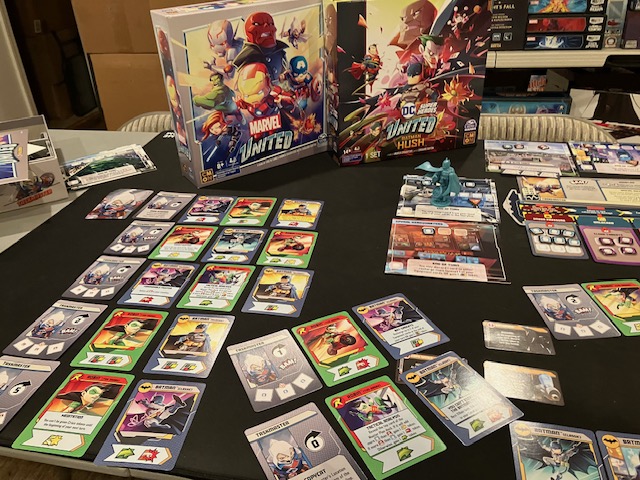
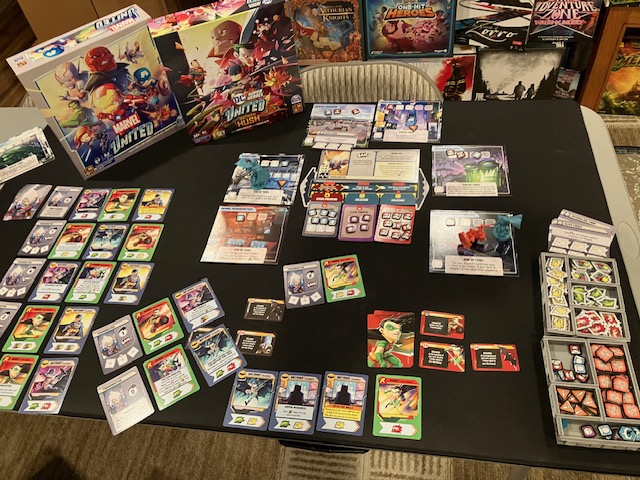
Of course, I had to make sure this played well with Marvel United, so I had Batman and Robin take on Taskmaster (from the base Marvel United set)!

For funzies, I also used half of the Locations from Marvel United and half of the Locations from Hush!  See above.

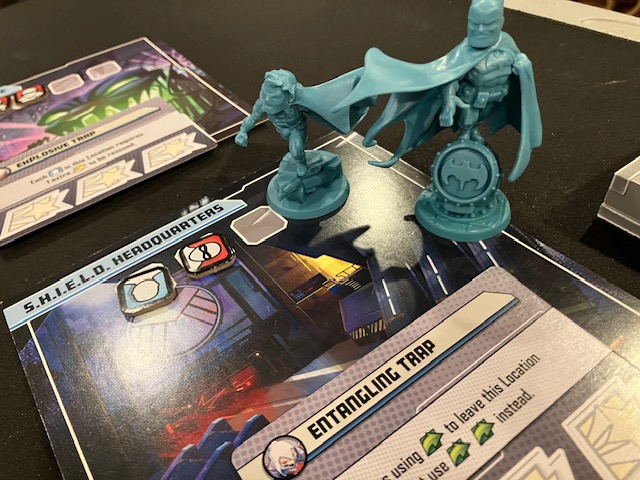
I got SUCH a kick out of mixing universes! I started giggling to myself when I had Batman and Robin start the game on SHIELD Headquarters!

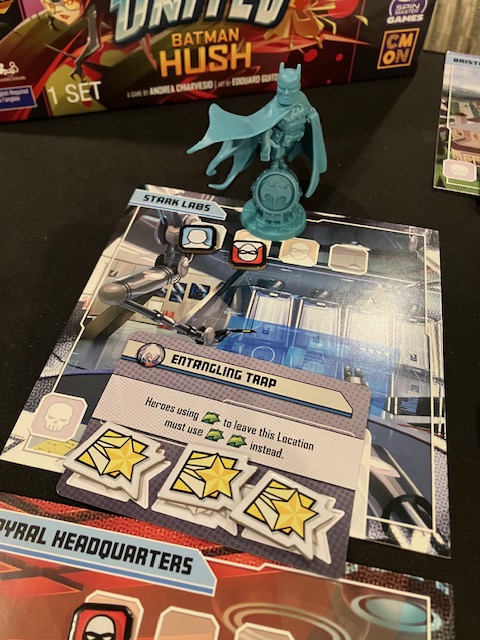
Then later in the game, Batman solved the Threat at Stark Labs!  I giggled even more thinking of Batman disassembling a Trap in Tony Stark’s lab!

For the record, Taskmaster posed little threat to Batman and Robin.  More like “Lamemaster”.

I will say that I think later Heroes and Villains are stronger than earlier Heroes and Villains in the Marvel United games.  This game demonstrated that a little … but I still had a grand time!

Conclusion

Currently, Hush is my game of the year for 2025!  I have played about 10 games of Hush and want to keep trying more and more!  I want to try Batman and Robin vs the Sentinels!  Will Superman do a great job against Galactus?  Can Batman and Spiderman team up?  How would Superman and Gladiator pair up as compatriots?  What about Superman vs. Gladiator?  There are SOOOO many cross universe games I want to try!

Even with all the fun things I can try combining Marvel United and DC Superheroes United, I still loved the Hush box by itself.  Each Villain presented a different puzzle to solve!  Each Hero has their own flavor and personality: Catwoman is more punchy than Robin, but Robin is more heroic!  And these differences are very flavorful!

This box also introduced me to the wonderful world of Jim Lee Batman (who is the best Batman according to Diana)! I am grateful that I got to experience Jim Lee’s Hush for the first time!

My only complaint is that the Villains in this box are all pretty complicated; I wish there had been a “simple” Villain (for newer players).  If you are an experienced Marvel United player, then this box is a no-brainer.  If you are a more introductory Marvel United player, I might recommend a different core box.

After all is said and done, Hush is a full up 10/10 for me.  I played so many games over a 2 week period and each one was a blast!  Even when I lost, it was fun to try to figure out “why I lost” and come back and revisit the game!

Even though Hush is an unexpected DC Superheroes United (this wasn’t part of the original announcements for DC United), there’s a reason DC Superheroes United  was #1 on my list of Top 10 Anticipated Cooperative Games For 2025!

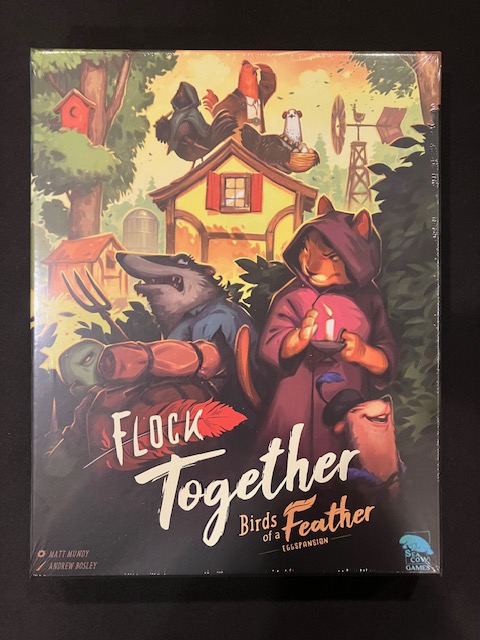
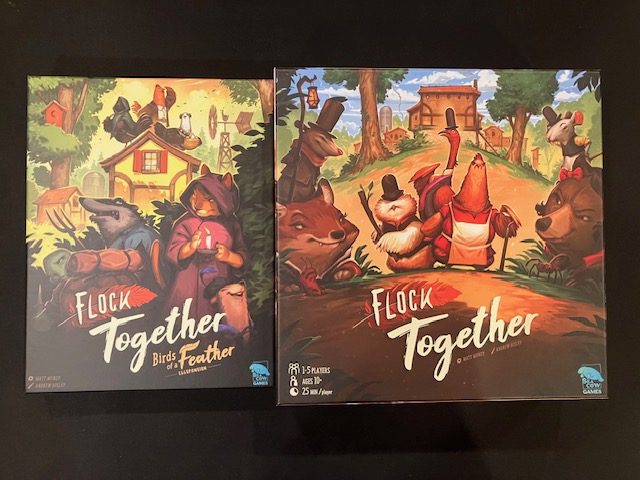
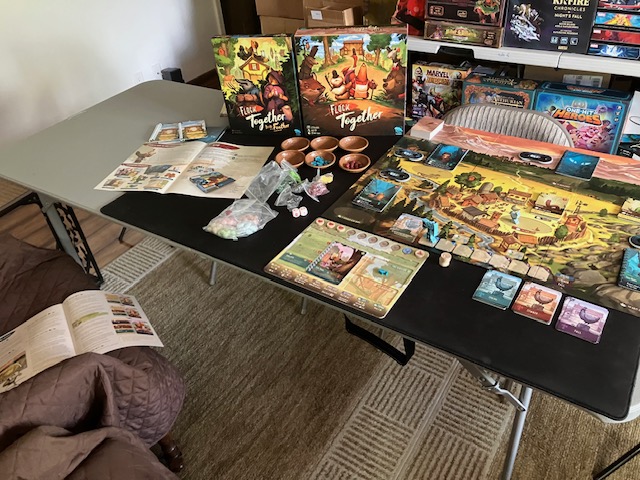
What Eggactly Is In This Eggspansion? A Review of Birds of a Feather Eggspansion for Flock Together

Birds of a Feather is an expansion … pardon me … eggspansion for the cooperative boss-battler game Flock Together.  This eggspansion (be prepared for a lot more chicken puns) was on Kickstarter back in Novemeber 2024 and promised delivery in August 2025.  You know what?  They even delivered a little early!  I want to say  I got my copy in June 2025, so nice job!

Flock Together was pretty popular in my groups; it made the #8 spot on our Top 10 Cooperative Games of 2024!  Usually, extra kickstarters are like this a way to keep the flow going … if you hadn’t ordered the original Flock Together game, you could get that AND this new eggspansion!

So, what’s inside?  Let’s take a look!

Unboxing

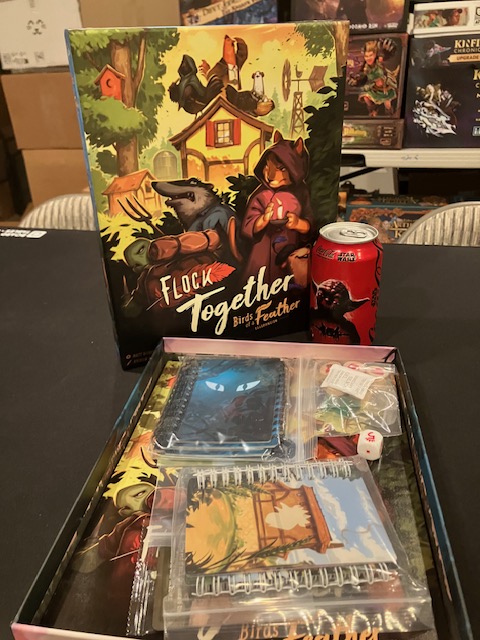
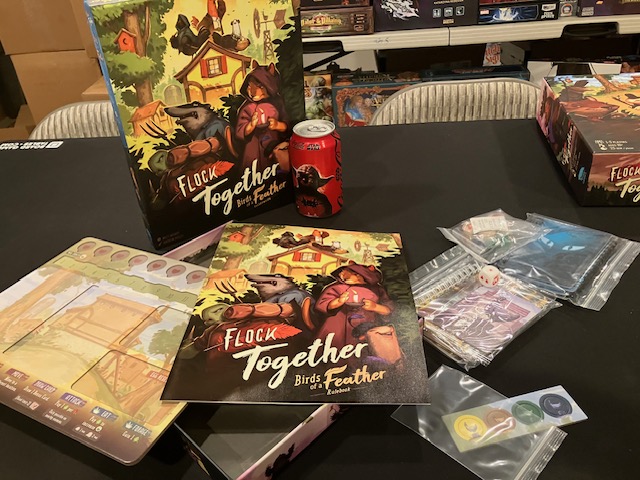
This is a smaller box than the original, and pretty thin too: see the Coke can above for perspective.

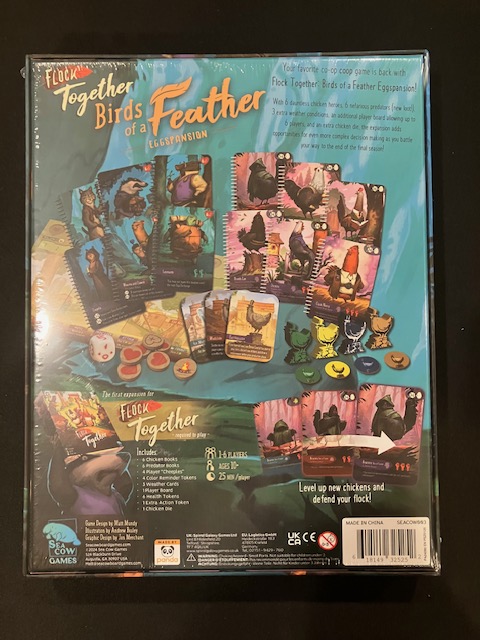
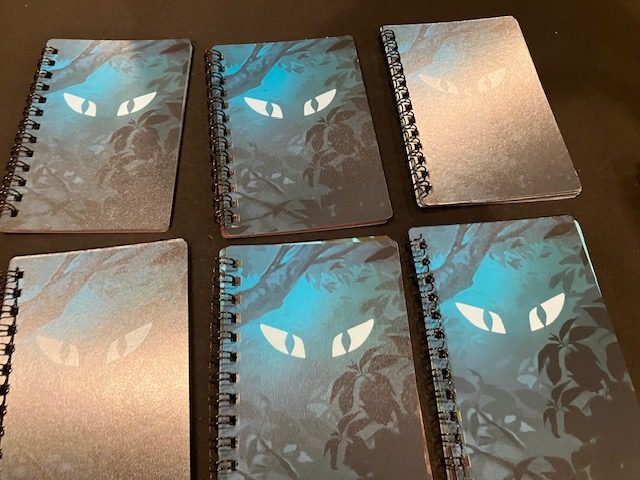
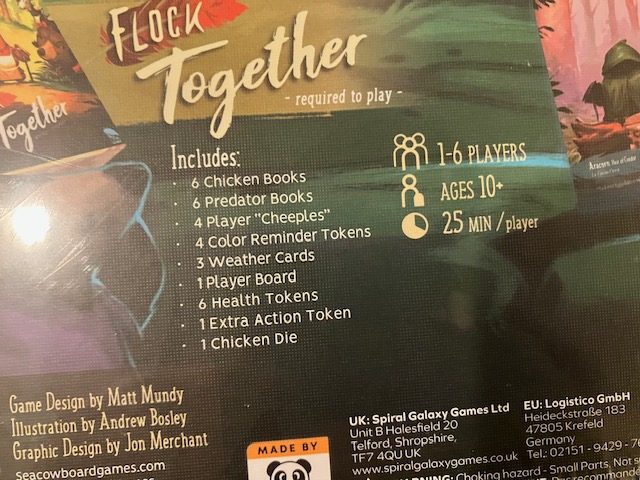
There’s not that much new here.  There’s 6 new Predators!

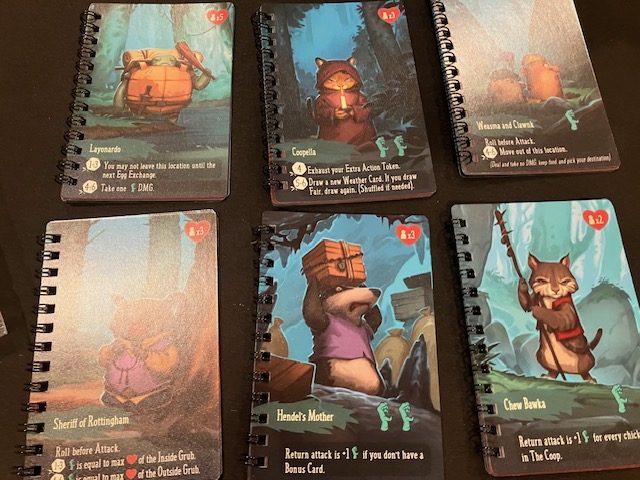
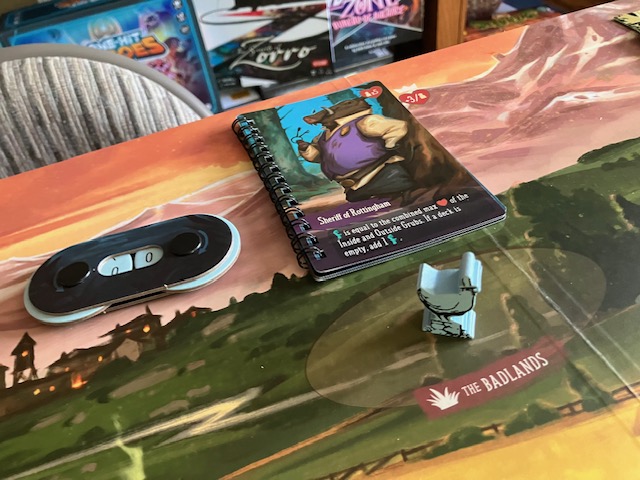
With lots of new puns!  Chew BawkaSheriff of Rottingham?  Oi!

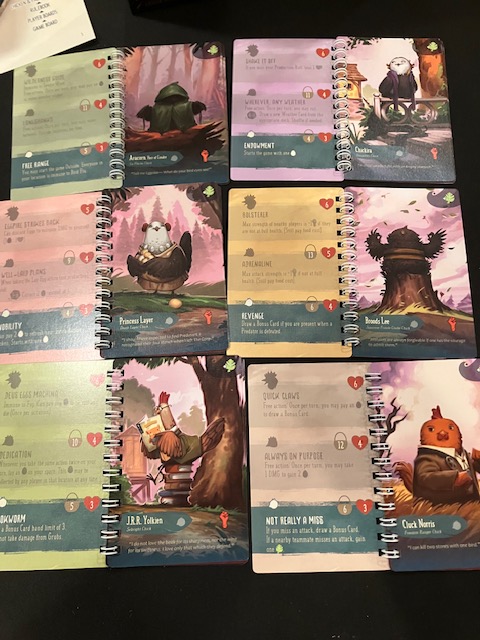
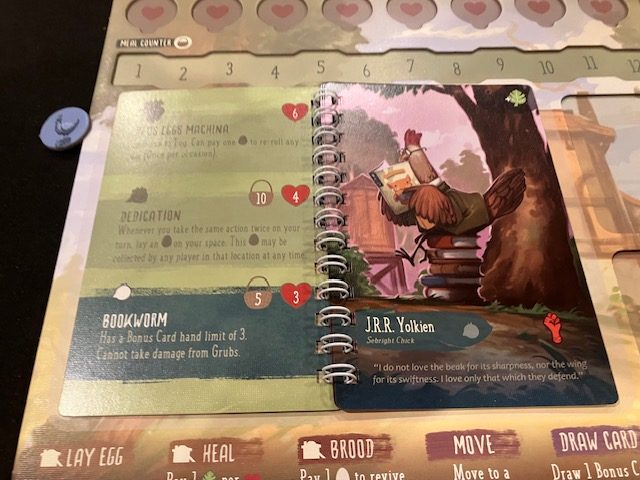
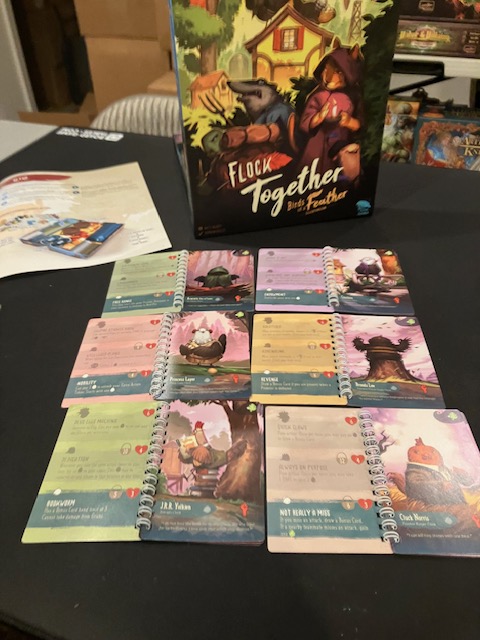
But this game is built on the bedrock of Chicken Puns!  There are 6 new Chickens you can play: J.R.R Yolkien, Broods Lee, Princess Layer, Chickira, Aracorn (Heir of Condor), Cluck Norris, … so … many … chicken … puns!

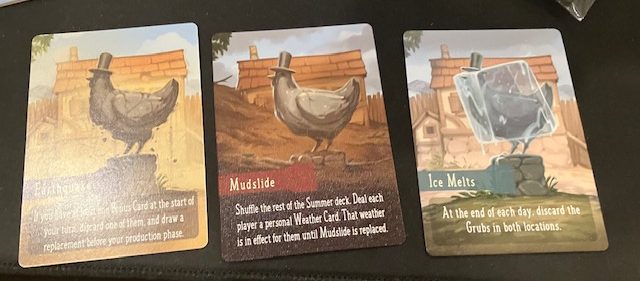
There’s only 3 new Weather cards …

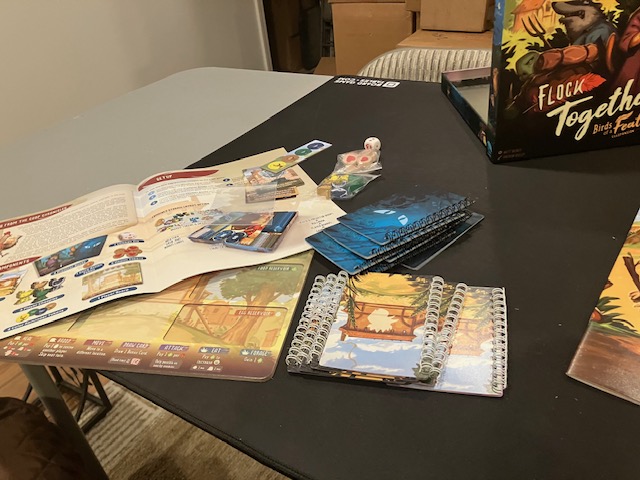
And basically another player board so you can have up to 6 players.  This eggspansion also expands the game to 6 players!  (The original only played 1-5).

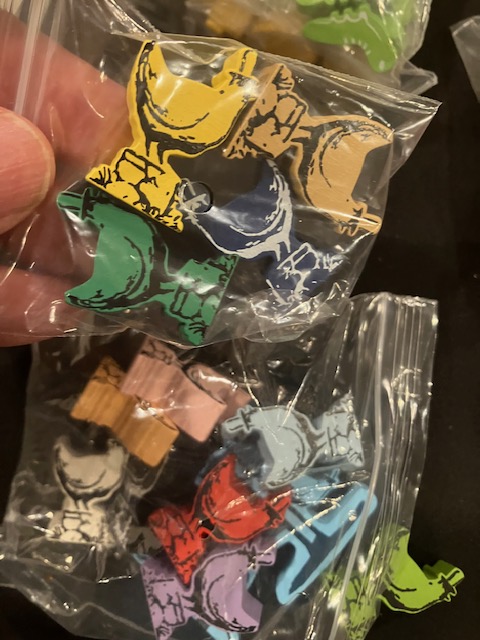
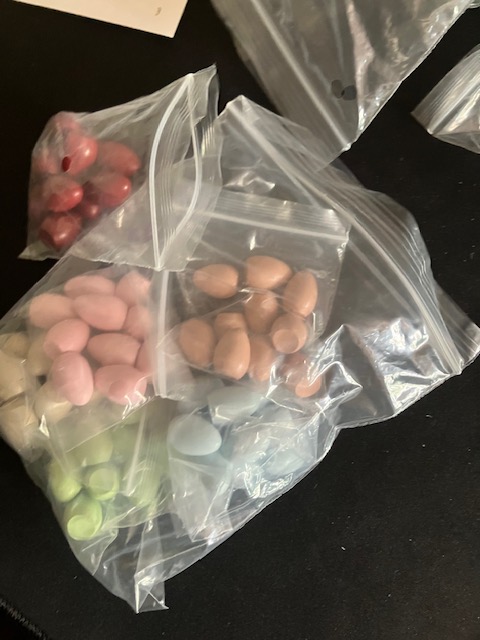
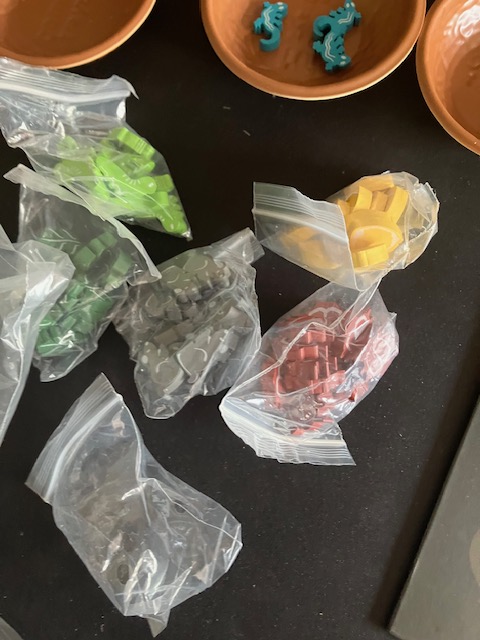
There’s a few new options for chicken color (see wooden … cheeples … above … yes, that’s right: cheeples are chicken meeples).

The game looks very consistent with the original, both of which have great art from Andrew Bosley!

How Is It?

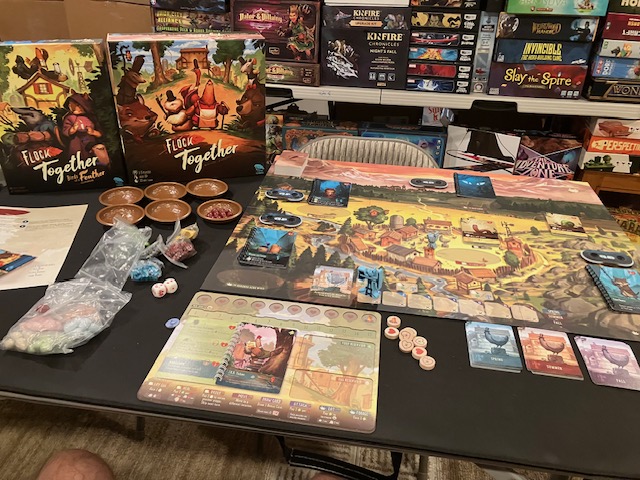
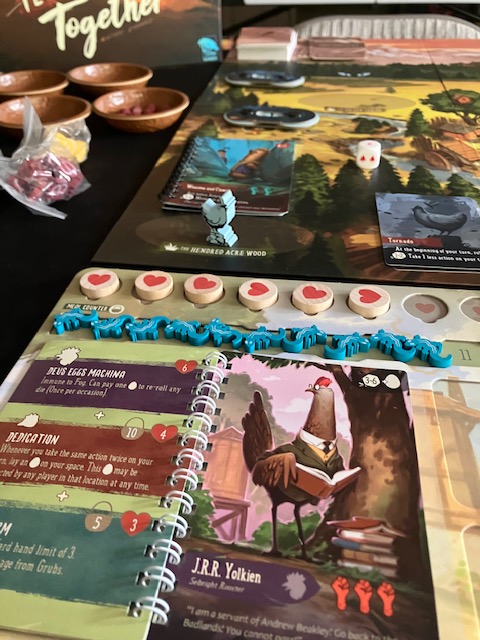
I played a solo game with J.R.R. Yolkien (oi), and it’s pretty much the same game!

I used new Chickens and new Predators, and everything else (Bonus cards, board, counters, etc) comes from the original box!  See above!

The game plays the same; it’s still fun and silly.  (I did add the 3 new Weather cards in as well).  I just had a new Chicken and all new predators!

More Stuff

This expansion is pretty simple: more stuff.  6 new Predators, 6 new Chickens, more tokens so you can play 6-Players, and 3 new Weather cards.  That’s pretty much it!

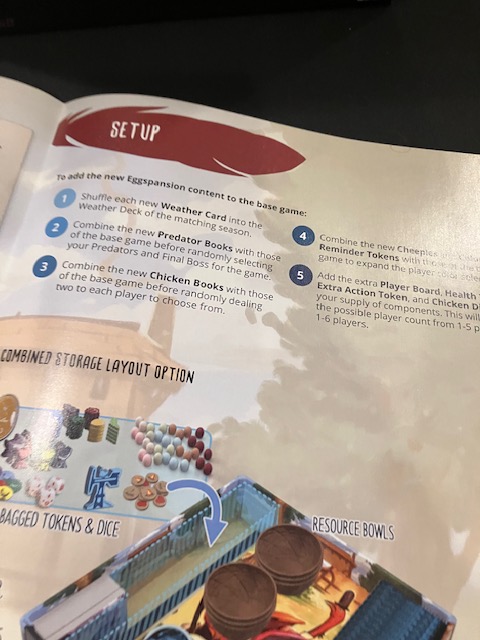
The rulebook discusses how you can just mix this in with the original game and never see the expansion box ever again!

This eggspansion  just adds a little more. There’s no real game changers here.

Missed Opportunity

One of my complaints about the original game (see review of Flock Together here) was that the eggs and food were all different looking (see above and below) …

… for no reason.  I always thought that there should be some rules to take advantage of these differences!  Maybe different colored eggs have different bonuses/minuses for different seasons?  Maybe you can’t get certain food until you go to certain parts of the board?   I always thought it was weird that we have these very distinct food and eggs … and these differences means nothing in the game.

I was kind of hoping this expansion would expand the universe and give a reason these eggs and food were so different!!!  Make them mean something!!

Nope.

Conclusion

This is a fine expansion; it gives us more chicken puns and a little more life to the game.  But I think the publishers missed an opportunity to do something cool with the distinct eggs and food.

If you see the eggspansion Birds of a Feather in a store, and you like the original game Flock Together the base game, you can’t go wrong with this eggspansion; it doesn’t change the game AT ALL! It just adds a little life with new Predators, new Chickens, and a 6th player.

I am glad I got this; it’s an excuse to play Flock Together again!  But I think they could have done a little more, especially with the distinct eggs and food.

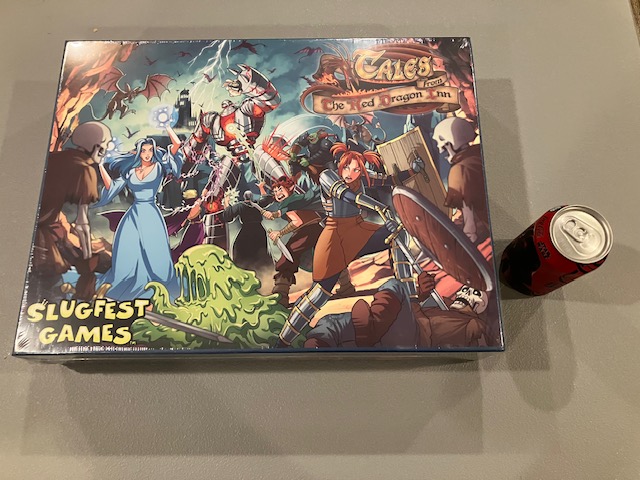
Late To The Party, But The Party’s Still Going! A Solo and Cooperative Review of Tales from Red Dragon Inn!

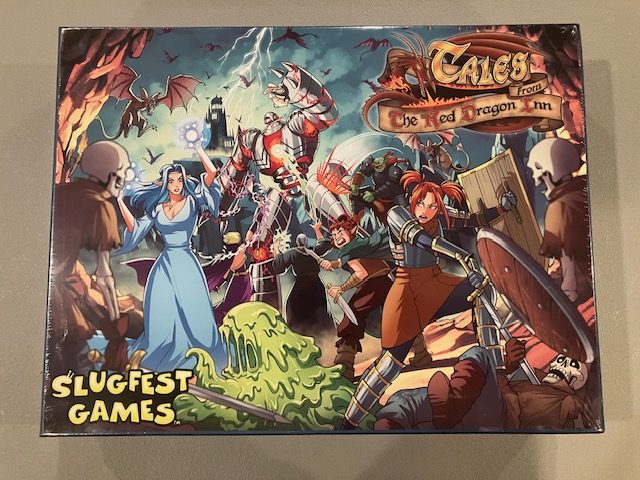
So, the original Tales from Red Dragon Inn was on Kickstarter way back in October 2021, and delivered to backers in 2024.  It was so popular, they had a second Kickstarter in June/July 2024, and that’s the one I backed!   This cooperative dungeon crawler for 1-4 players looked really cool!

Why didn’t I back the original? I think I was afraid of getting YET ANOTHER DUNGEON CRAWLER (YADC) campaign that I wouldn’t play!

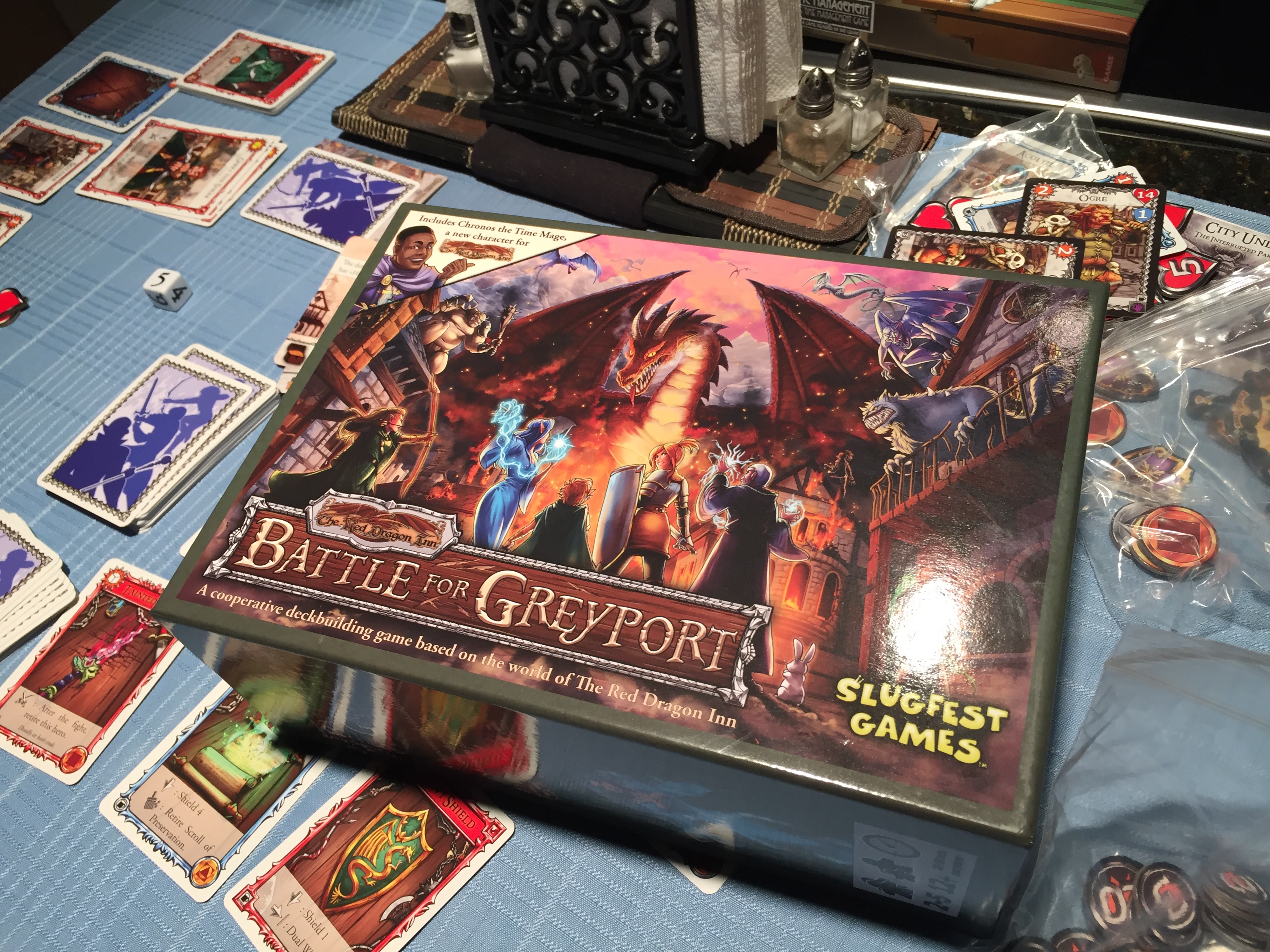
I do love this universe … especially the Red Dragon Inn cooperative Deck-Building game called Battle for Greyport (see review here and here: It’s also in our Top 10 Cooperative Deck-Building Games!)! I love the art-style and the silly vibe of this universe!

Let’s take a look!

Unboxing

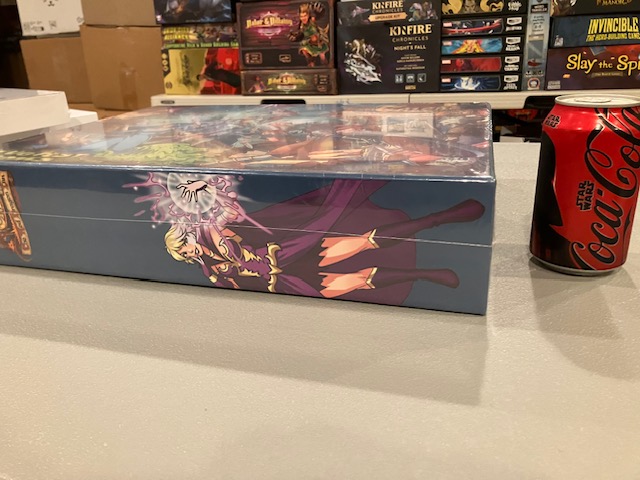
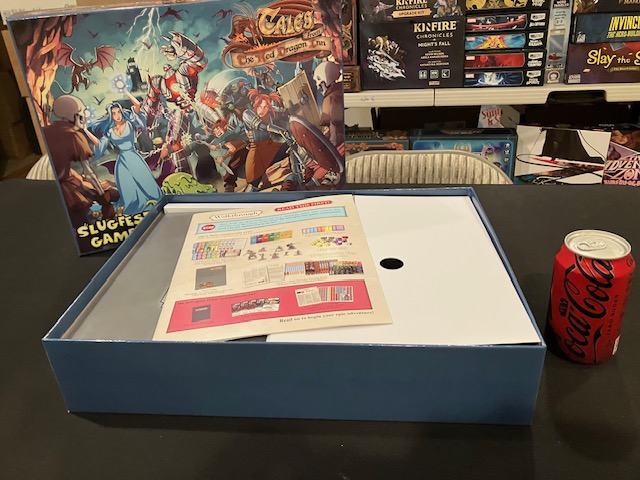
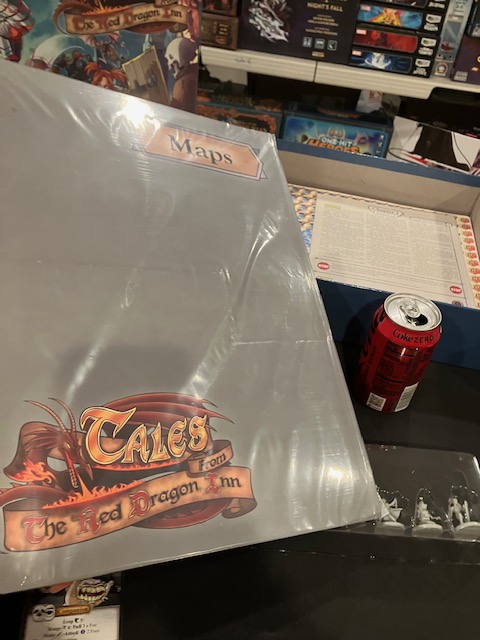
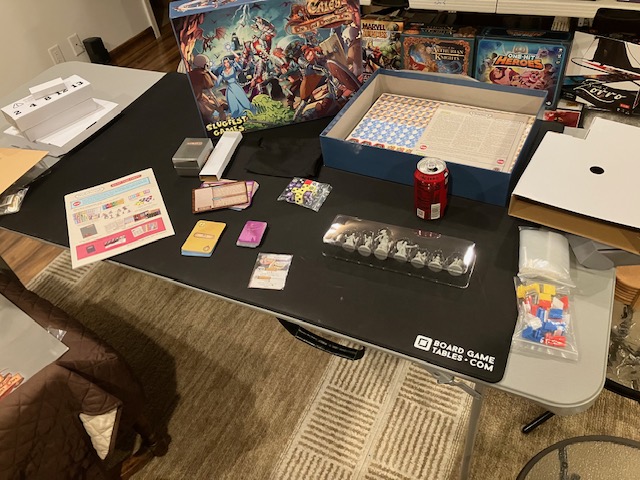
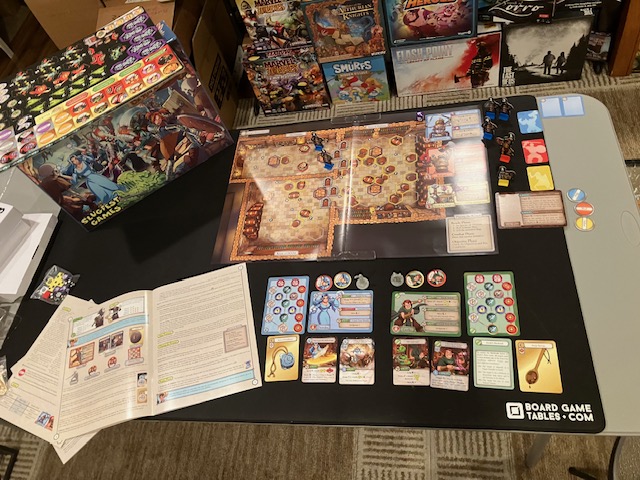
This is a fairly big mama-jamba of a box: see Coke can above and below for scale.

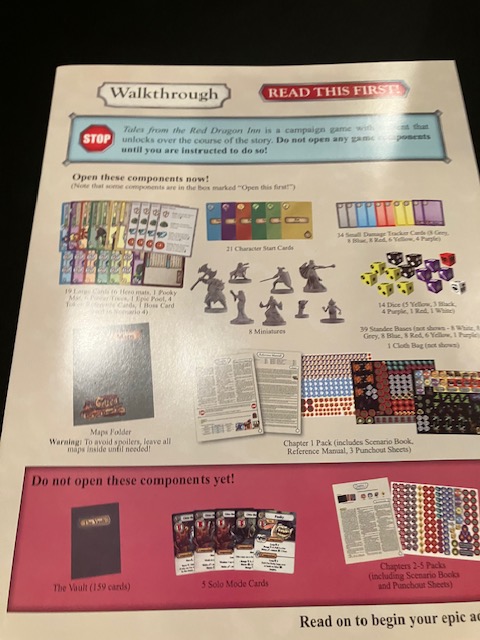
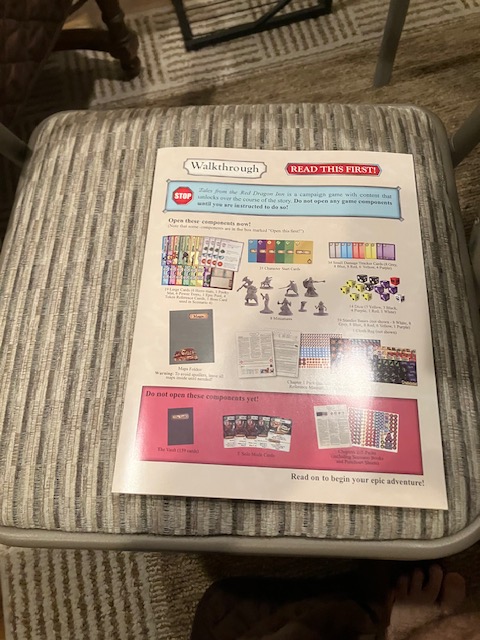
Ah, this game comes with a first-play walkthrough!  This is a really good walkthrough!

What’s in here?

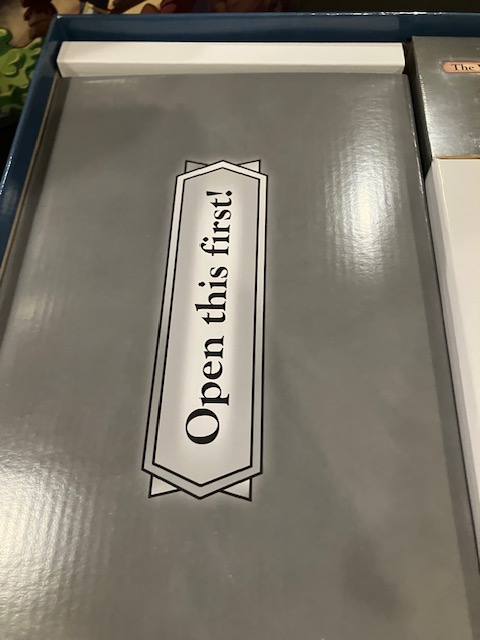
The game comes with most of the cards and minis in this little grey box.  (Grey box?  Greyport? Get it?)

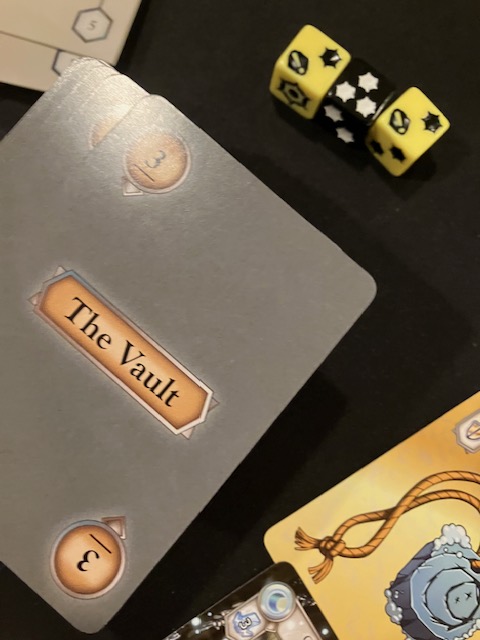
And some dice.

The minis are pretty good.

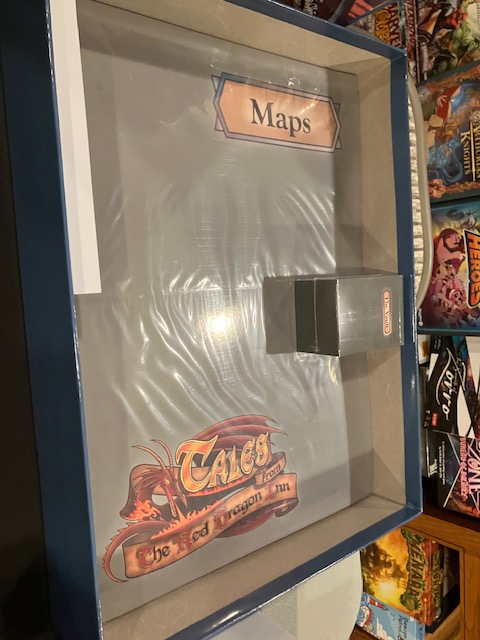
Underneath all that are the map packs.

This map pack is pretty huge! See Coke can above for scale.

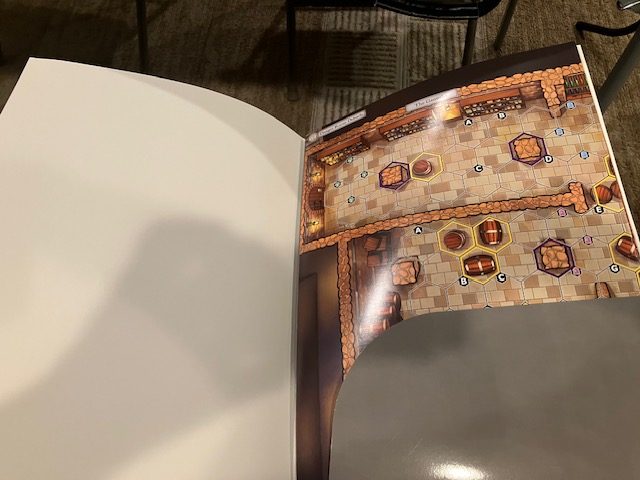
… and there are quite a few maps for the adventurers to go on!

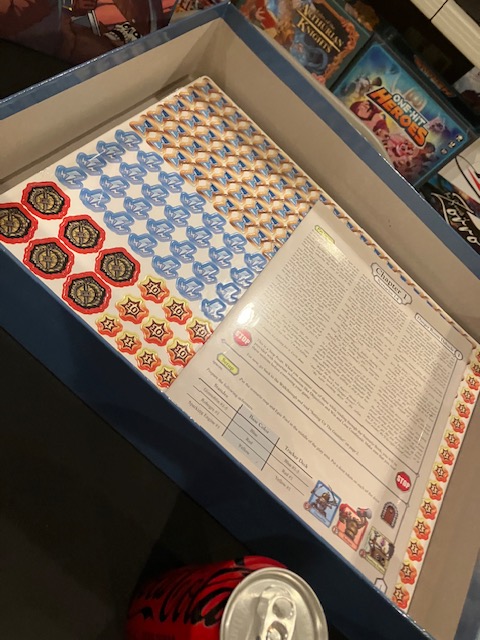
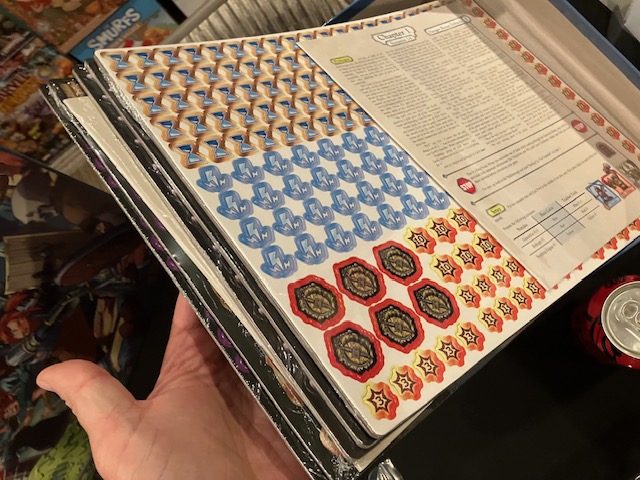
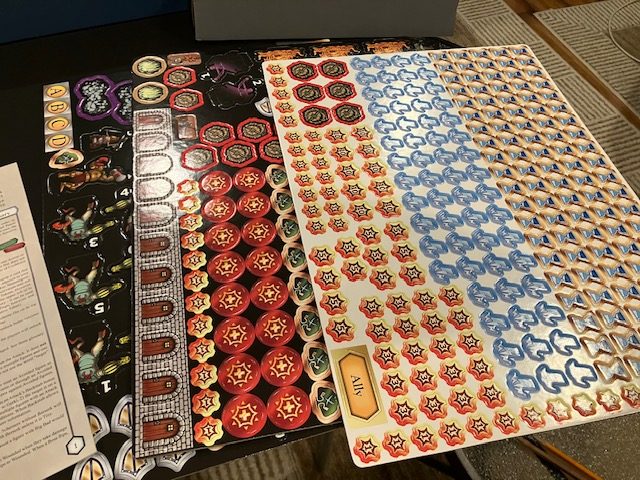
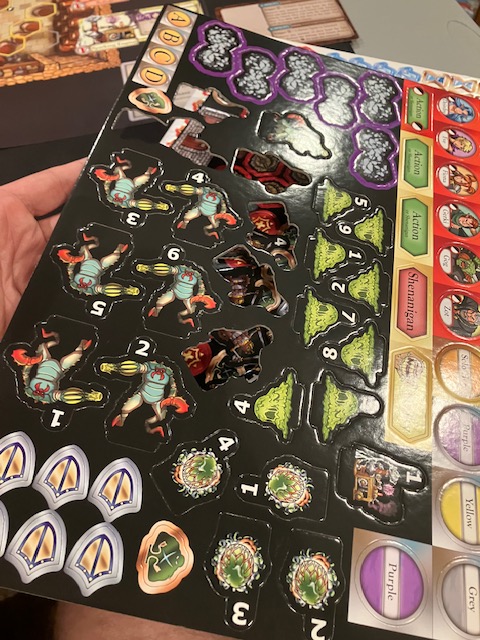
Underneath the maps are TONS OF PUNCHOUTS.  And by tons, I mean tons by weight!

There are 5 individually wrapped punchout sets (with multiple punchout sheets per set!)

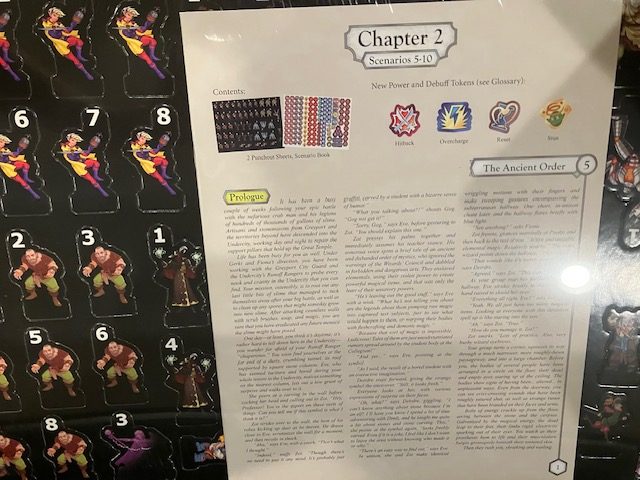
And a new chapter rulebook per set!  Whew!

There are … so …. many … punchouts!

But overall, this looks pretty cool!  I am just scared of how many punchouts there … (but keep reading below …)

Gameplay

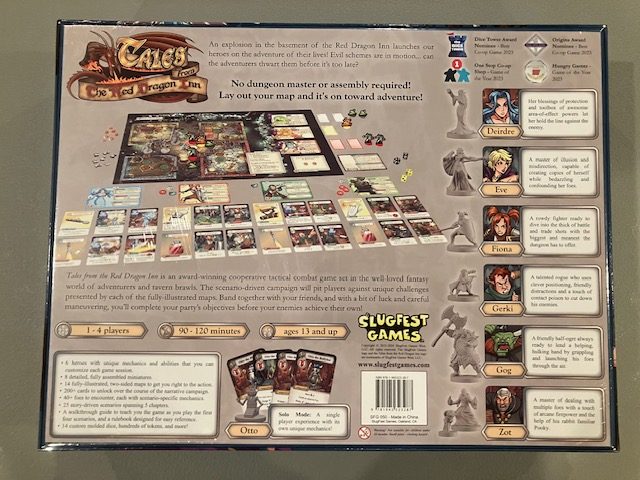
This is a cooperative dungeon-crawler where each player takes the role of a different hero … the typical Dungeons and Dragons archetypes are all here: thief, fighter, barbarian, etc.  Despite the classes being fairly generic, these characters have so much … character! 

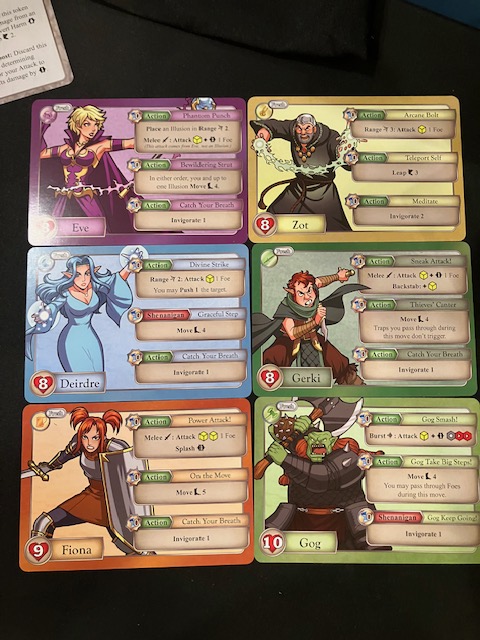
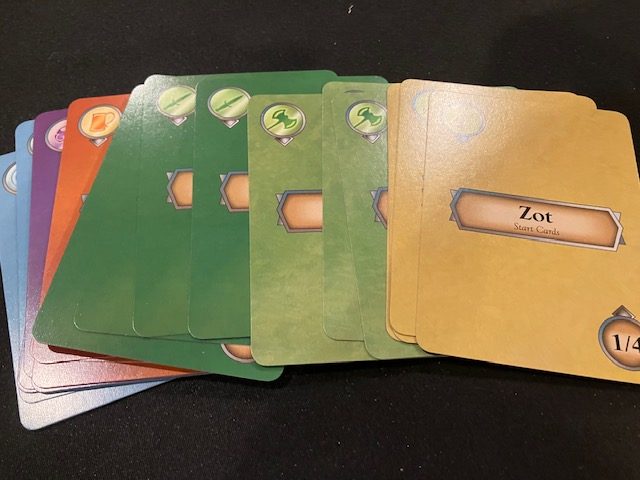
Each character has some character specific cards giving the asymmetric powers.

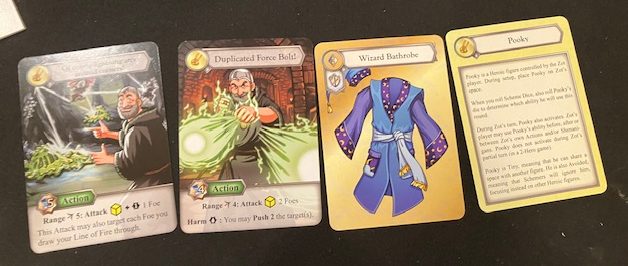
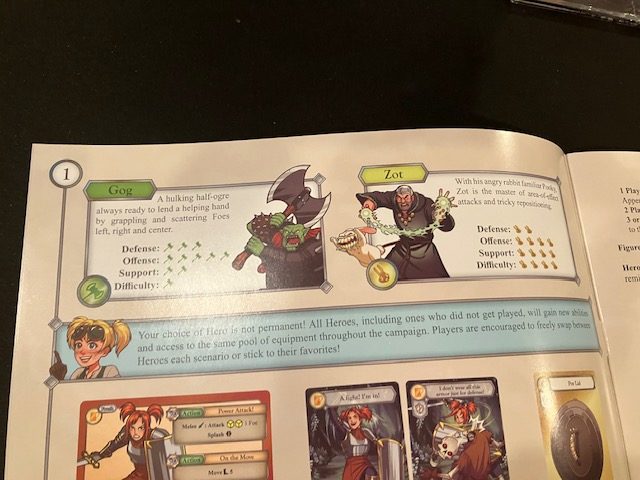
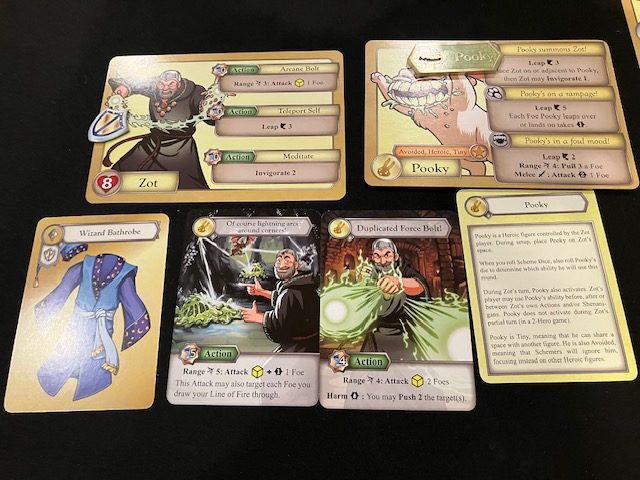
For example, Zot (above) has some special Actions specific to his character!  But notice the art and the feel!  This is not your typical dungeon crawler!  There’s character and a sense of humor here!  The game looks light and fun … and surprise! It is!  And pooky!

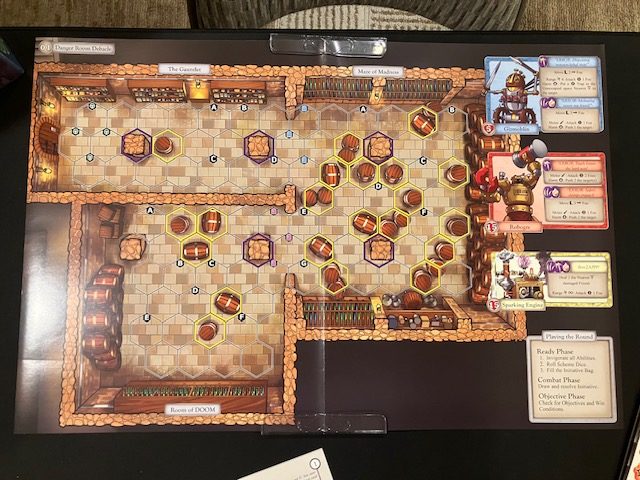
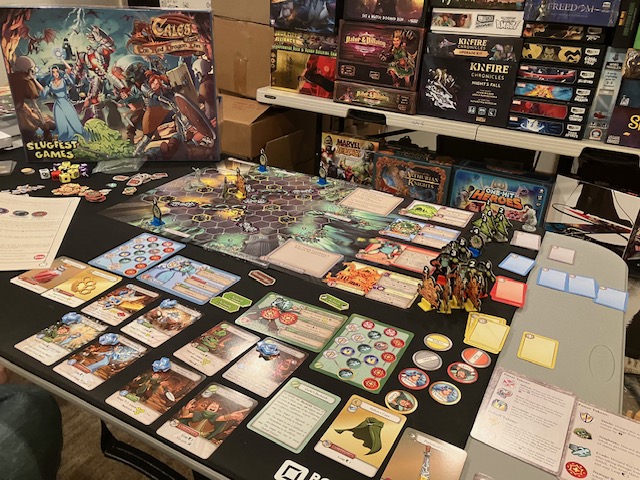
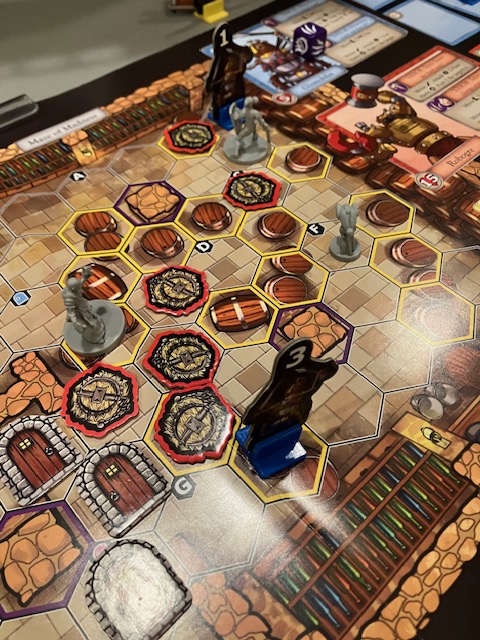
Players will set up the Chapter of their campaign; see scenario 1 of Chapter 1 above!

One of the coolest parts of this game is that the monsters are all described ON THE MAT!  So, you don’t have to go searching books or monster manuals for the monster info!

The minis are color-coded via bases, and this system works great. I was a little worried that the bases might “harm” the cardboard standees ( … Gloomhaven: I am looking at you …), but the standees stand well and the bases DO NOT harm the cardboard (NOTE: After a number of plays, there’s a little bit of wear and tear, but it doesn’t ruin the cardboard: it just indents it a little).

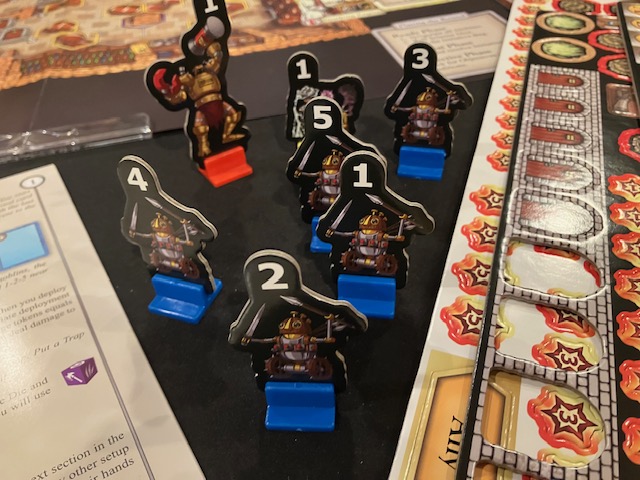
To keep track of hit points, each mini has a number above it, and  it also a little card associated with the number. See above.

It makes it really easy to correlate the mini with its hit point card!  This system is simple and works surprisingly well! They used colors really well here.

Players operate these heroes, explore the dungeon, and fight the baddies!

This is a fight-em-up dungeon crawler!

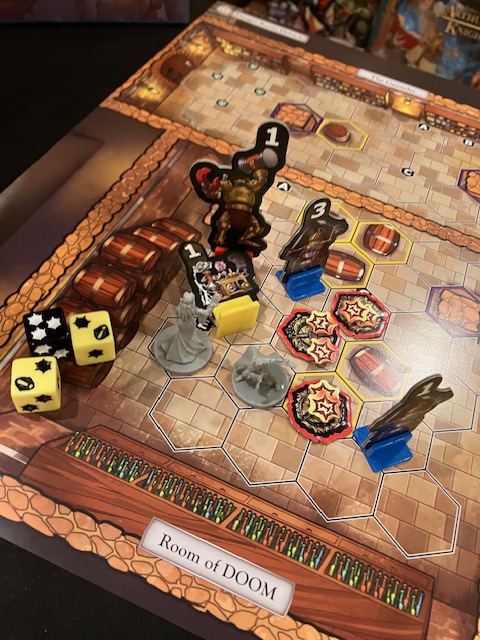
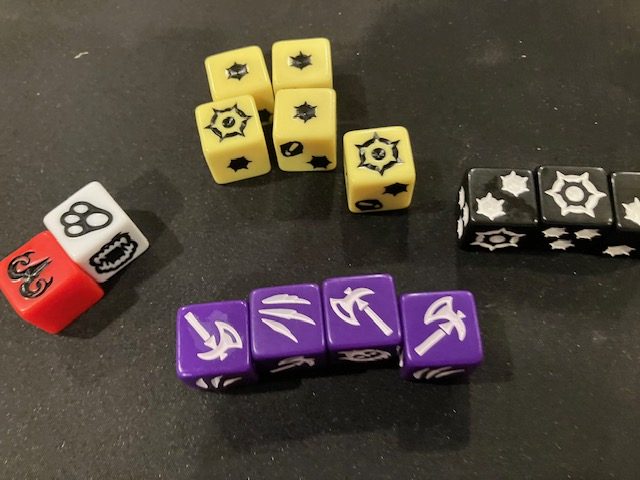
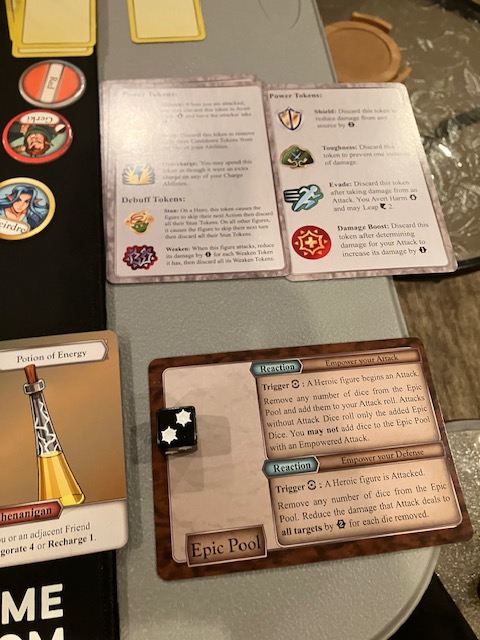
Combat is decided by the yellow and black dice.  You might be worried that the game is too random if dice decide a lot, but the dice are pretty consistent.  You will always get at least one success per dice, sometimes you will get exploding dice (which you can reroll over and over) and sometimes you will get some extra epic dice for FUTURE rolls!

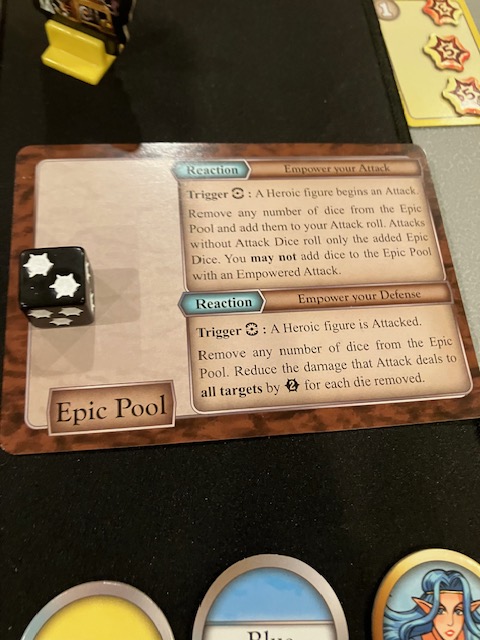
If you roll the ! (exclamation point) symbol on the yellow dice, you get an Epic black die (modulo some rules) which you can use on a future turn! My favorite part of this is that you can CHOOSE when to use the Epic dice on a future turn!  This reminds me a little of the Hour of Need system (see review here and here) where current rolls can contribute to future successes WHEN YOU WANT/NEED THEM!  You choose when to use those Epic Dice!  That’s so cool!

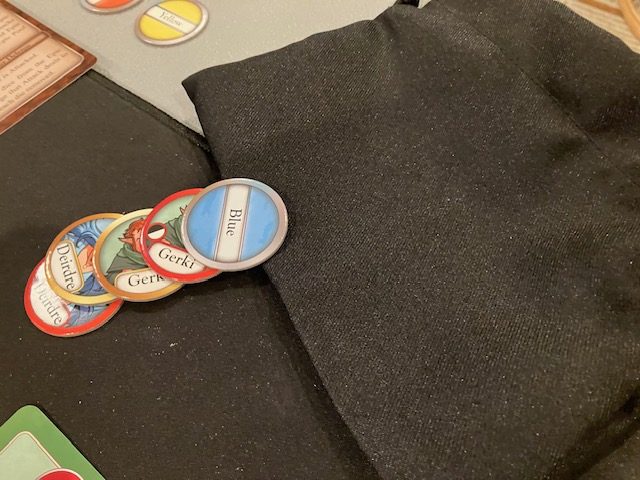
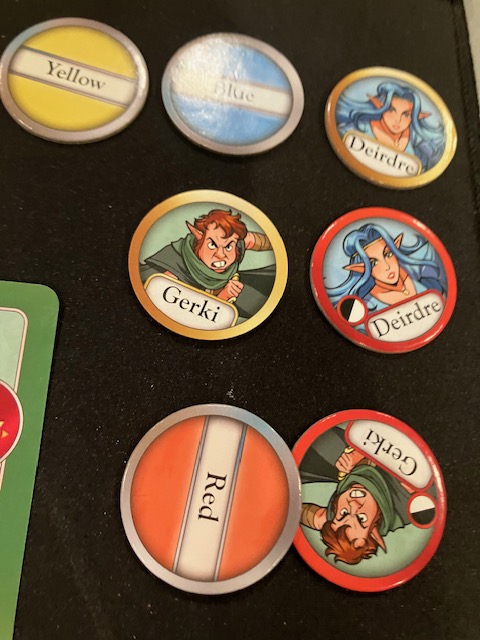
This is a Variable Turn Order game: each player and each set of monsters gets a token and one players pulls the token out of a bag to decide when each one goes.  See above.  I was very worried when I saw Variable Turn Order: was I going to have to worry about all the problems and try to come up with a solution?  See a very in-depth discussion of Variable Turn Order and its problems/solutions here!

After all was said and done, the Variable Turn Order system didn’t seem to suffer from the problems we normally see!

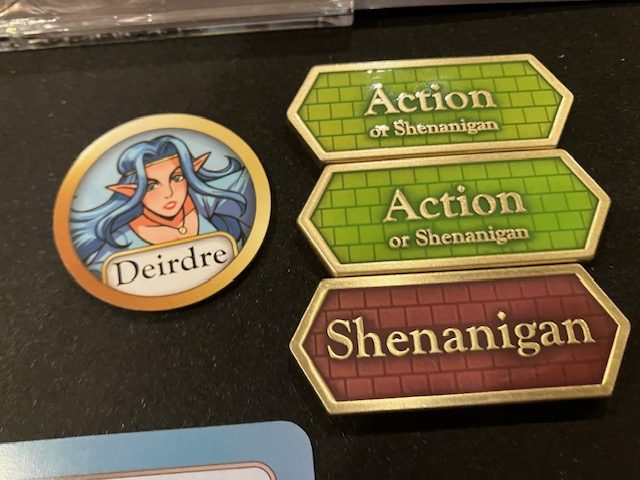
Depending on the token you draw, you either get 2 Actions and 1 Shenanigan …

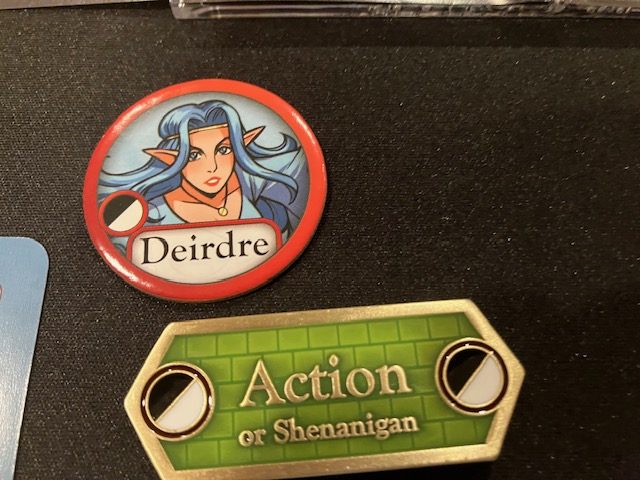
Or 1 Action or Shenanigan! (1 and 2-Player games with partial actions).

Your Actions and Shenanigans are well defined on your cards!  See above!

Note that every character has very different Actions and Shenanigans! It’s funny, that one word Shenanigans kind of implies the overall vibe in this game …

This is all about your characters moving around the maps and fighting baddies!

If you reach the final objective (killing the yellow slime above for scenario 1: see above), you win (… if you survive to the objective phase…)! If any character dies, you lose! There are other losing conditions too, as you get further into the game.

It’s a fun dungeon crawler! And you get to level-up your characters too! As the game gets further along, you can get new cards from THE VAULT which you can use to choose upgrades!

Walkthrough

By far the best part of this game is HOW GOOD the first play walkthrough is!

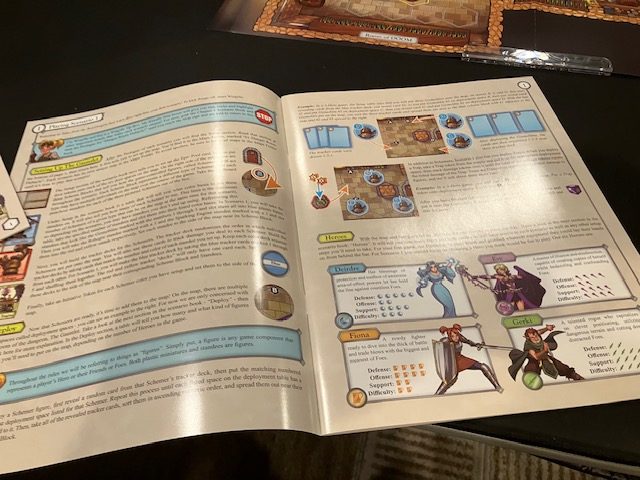
This Walkthrough takes you through the first 4 scenarios of Chapter 1 in great detail!  There’s no need to read the rulebook ahead of time (well, because there isn’t one) … you are just learning the rules as you play from the Walkthrough!

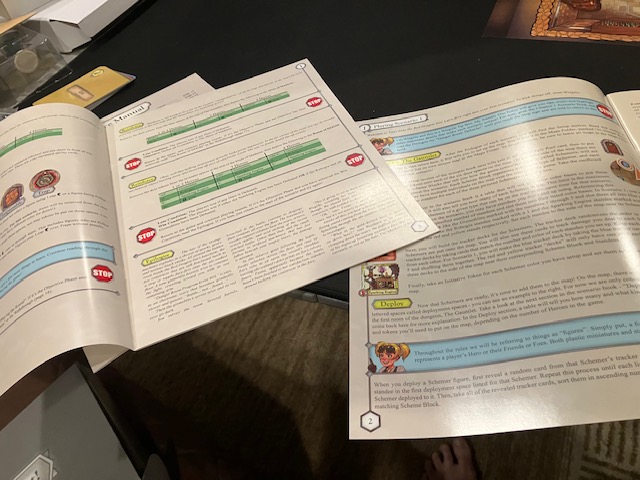
Coupled with the Walkthrough is also the Chapter Guide (see above).  The Walkthrough tells you when to look at the Walkthrough and when to look at the Chapter Guide for specific set-up.

I can’t tell you HOW MUCH I liked this walkthrough!  Worried about getting into the game?  Naaah … this Walkthrough is fabulous!  It slowly introduces you to all the rules as you go.  This reminds me very much a video game training mode; it works so well!

Incremental Punchout

One thing I was VERY worried about was punching out ALL THOSE TOKENS before you can play!  And guess what!  You don’t have to!  You can punchout what you need as the game flows!

Do you need some monsters?  Just punch them out now when you need them!

This Incremental Punchout philosophy worked really well with the way that the Walkthrough taught the rules; learn a little bit at a time, punchout a little bit at a time!!! So, don’t get overwhelmed by all the tokens … just take tokens as you need them.  I wish the rulebook had emphasized this point, because just LOOKING at the token sheets gave me heartburn! 

I strongly recommend you punchout as you go and do not do everything at once: you’ll get right into the game that much quicker!

What Is This?

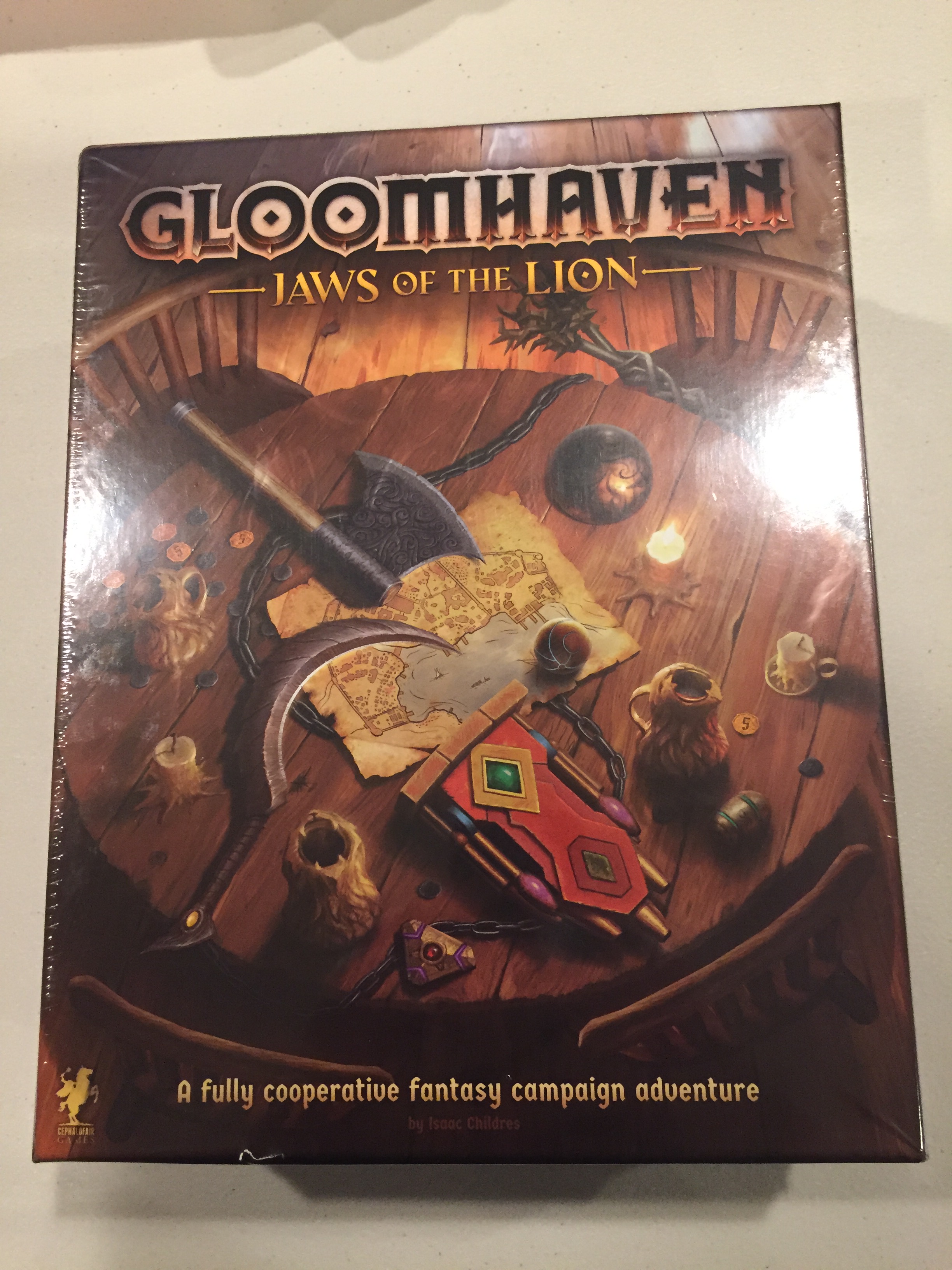
How would I describe this game?  In one word: LighthavenTales From Red Dragon Inn has a lot of similarities to Gloomhaven: it’s a cooperative dungeon-crawler campaign!  Players explore the world, fight monsters, upgrade characters, and quest quest quest.  But the gameplay is lighter, the rules are lighter, the world is “lighter”, the art is lighter and cuter … there’s no Gloom here!  

Like Gloomhaven, Tales from Red Dragon Inn does have a lot of components, but this world just feels just so easy to jump into.  

There is some story here: about as much story as Gloomhaven.  If you are looking for more adventure games, consider games like Arydia (see review here) or storybook games like Tales of the Arthurian Knights (see review here).  If you want story story story, this probably isn’t the game for you … this is a dungeon crawler where you fight monsters!

Solo Play

So, Tales from the Red Dragon Inn does support a solo mode!   (Thanks for following Saunders’ Law!)   In fact, two solo modes!

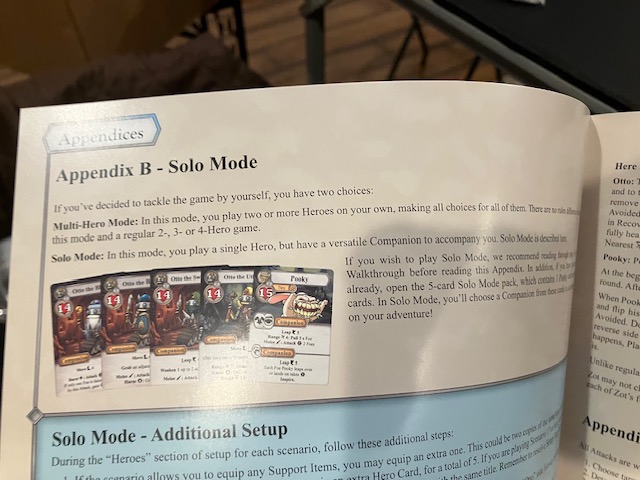
It’s a little bit of a bummer that the solo play isn’t addressed right up front … you have to go looking for the solo rules in the Glossary (a very complete book!) that comes with the game.  See above.  There are two solo modes; play normal, but alternate between some characters like a multiplayer game …  or play a solo character with a Companion.

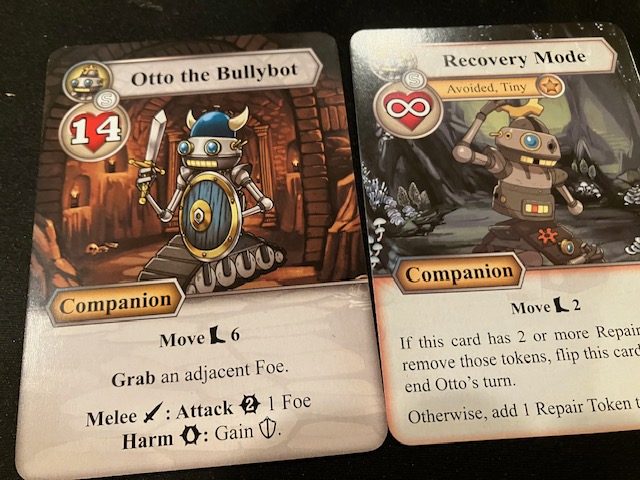
The Companion has a special set of cards: see above.  The Companion rules also take up a full page on the Glossary with lots of exceptions to gameplay.  I usually HATE solo modes with lots of exceptions to the rules, so I opted to just alternate between two characters because there are NO RULES CHANGES.  I strongly recommend this is how you play solo; the Companion is still an “extra” thing to play and doesn’t save that much context switch overhead.  At this point, I have played the first Chapter all the way through with two characters and didn’t have any problem going back and forth between characters. In other words, the context switching between two characters didn’t seem to cause me any issues as I played solo.

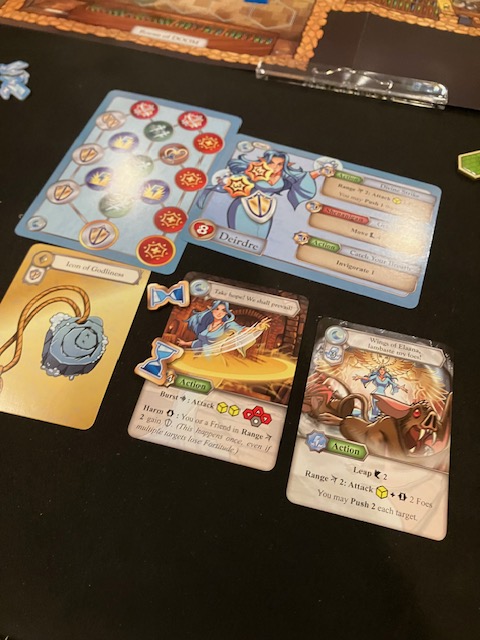
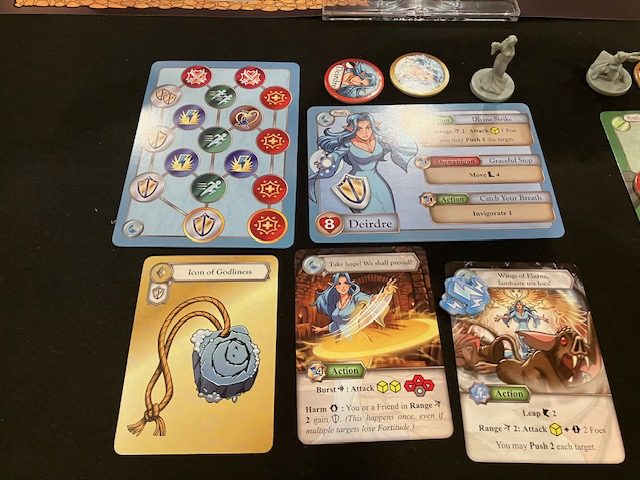
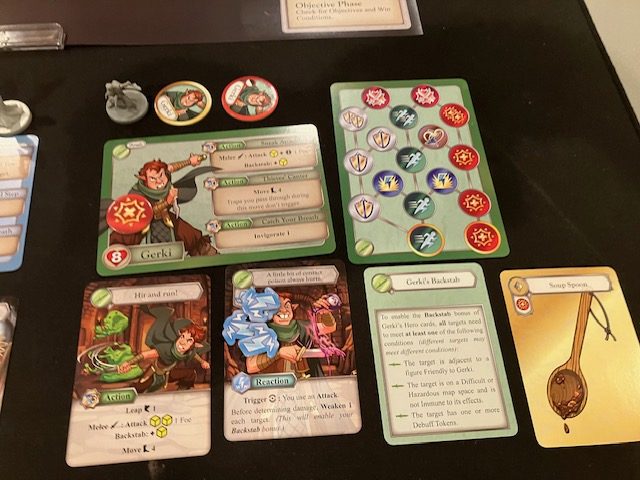
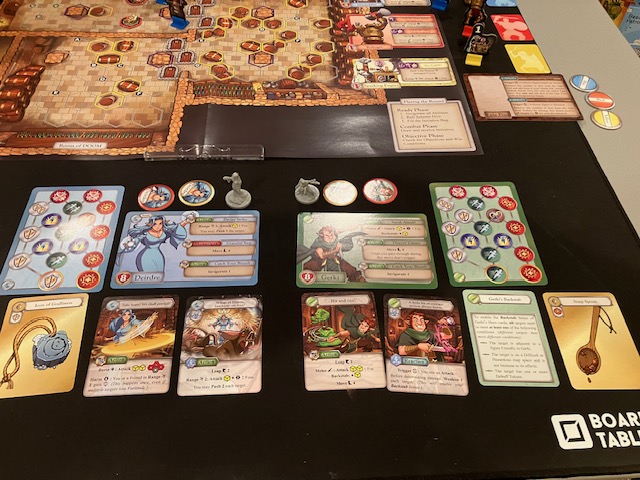
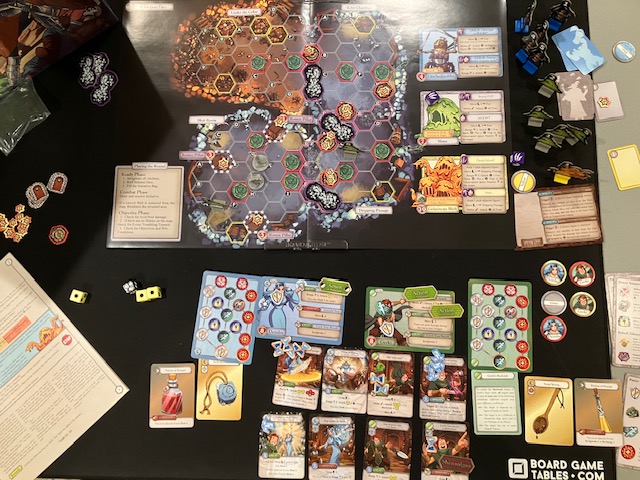
My solo game was operating Deidre and Gerki.  They made a great team!  These two characters really worked well together; Deidre is better at long distance stuff, but occasionally she’ll get in there and help Gerki!  If she stands NEXT TO some monsters, Gerki gets his backstab ability (an extra die!)  The amount of cooperation between the two was quite good.  

I have spent about 15 hours playing the game solo.  I learned the game solo, set-up the game solo, upgraded, read the Walkthrough solo, and played all 4 scenarios of Chapter 1!  I had a blast!  I loved the simplicity of the system, I loved how the characters can work together well and support each other, I loved the “sense of humor” the art implies, I loved the art, I loved the vibe!

Once you know the game, your sessions can be quicker, but be prepared for your first 4 sessions to take about 15 hours or so!  But, it flies by!  You are having fun and always doing something!

I look forward to more solo sessions, but I had to reset the game (this is not a legacy game, but it is a campaign game and you can reset it) so I could play it cooperatively with my friend(s).

Cooperative Play

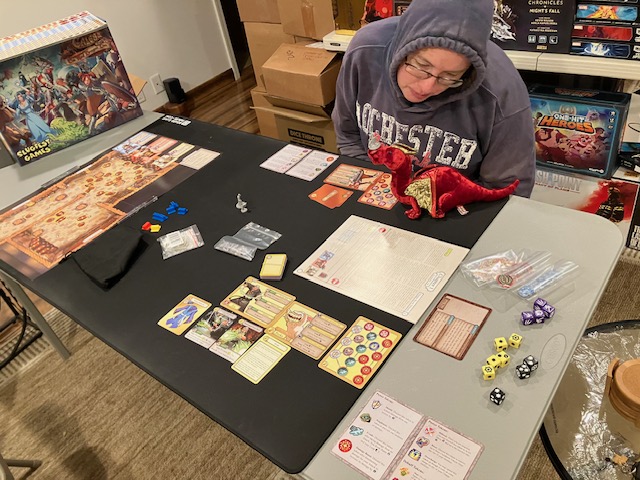
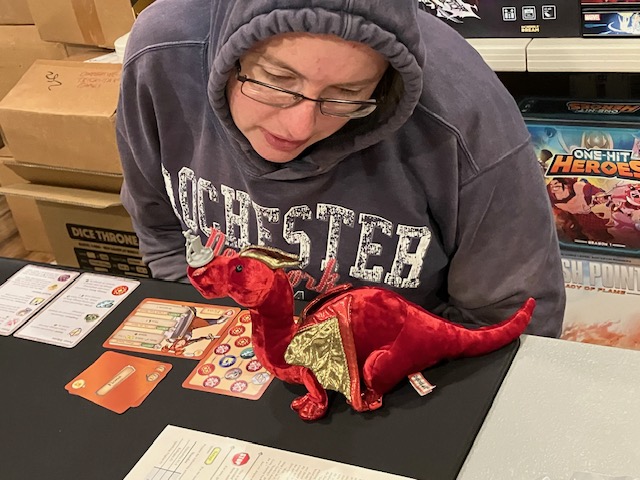
My first cooperative experience was a 2-Player game with Teresa.  She brought over a little red dragon as a mascot … it was quite apropos!

For a different experience from the solo game, I played Zot the wizard.  He was funny!

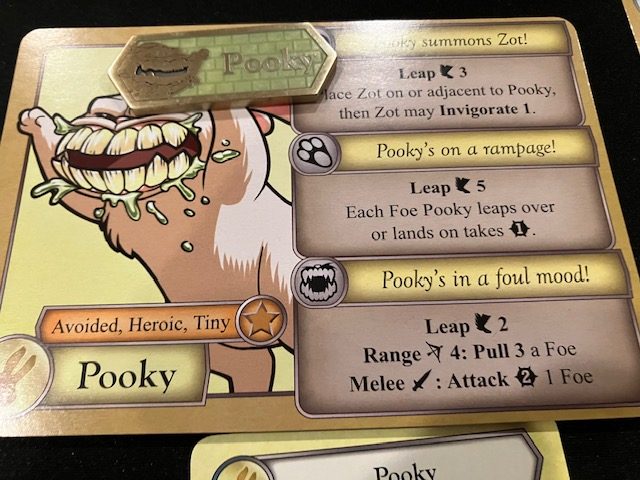
It’s hilarious that the little guy POOKY who helps Zot summons HIM!  (Not the other way around) See above!  That’s hilarious!  And yes, we are convinced this is the rabbit from Monty Python and The Holy Grail.

Like the solo game, we saw some good cooperation as Teresa’s Fiona Character was all melee, while Zot was all distance!  A good combo!

The game also moved much more quickly since I had already played the entire Chapter 1 solo.  A lot of those “15 hours” I spent in the first 4 solo games were shortened considerably!  I think Teresa and I got through Scenario 1 is about an hour!

Playing solo ahead of time significantly increased how quickly we were able to get into this game.  

Will we play more?  Basically, Teresa wants to wait until Sara comes back and then we’ll start a 3-Player campaign!  

I think it was a success cooperatively: it’s always a good sign when your friends ask to continue the campaign!

Story vs Flavor Text

There’s not a lot of story per se, but there is a lot of flavor text that gives the game direction and charm, and helps establish the parameters of the game.   To be clear, you really don’t HAVE to read the flavor text … I didn’t read it all in my solo play, but it didn’t really detract from the game by not reading it.  Teresa LOVES flavor text, so we did read it (see above) and it did contribute to the atmosphere of the game: see above.

What I Liked

Charm: This game has so much charm!   The art style that permeates this game is just so much fun! It stays within the Red Dragon Inn universe … Dragonverse?

Unique Characters: The characters are also so unique and different! For example: the fact that Pooky (the little familiar) summons Zot is hilarious!

Walkthrough:  This first play Walkthrough is exceptional and makes it easy to jump in!

The Dice System:  I was really worried the dice system would be too random, but it’s really not.  You always get at least one success, you can get exploding dice, and you can choose to use Epic Dice if you want for “extra help”!  The Epic Dice system worked well!  You could choose when to use the Epic Dice when you really needed a win!  

Vibe:  This is a light-hearted Gloomhaven … it could have easily been called Lighthaven! Yet, it’s still a deep game with lots of play and meaningful decisions!

Level-Up:  Levelling-up is easy and interesting!  Every character levels up, but it’s not described u pages and pages of tables in a book!  You just grab the cards destined for you, or choose some! It’s really easy!

What I Didn’t Like

SO MANY PUNCHOUTS!  The sheer number of punchouts in this game is terrifying.  Word of advice, just punch out tokens as you need them.  In fact, I ended up trying to put the monsters BACK into the token sheets when I was done with them!  Partly I did this to reset the game, but the game just stores easier if you keep things in the punchout sheets as much as possible. I know, that’s not ideal. 

Part of this was a little foreshadowing too … you saw how many punchout sheets are coming, right?  Do you REALLY think you are going to be able store ALL THESE tokens in bags back in the box?  So, I put as many tokens as a I could back into the punchouts as a favor to future me.

Conclusion

Well, Tales from Red Dragon Inn should have made my Top 10 Cooperative Games of 2024 because the first release came out in 2024.  But I didn’t get it until the second Kickstarter, so I didn’t get it until 2025!  So, it will probably make my Top 10 Cooperative Games of 2025 … but it might have to be an honorable mention, just because it wasn’t released in 2024.  Or maybe I’ll just count it as 2025 since I backed the second Kickstarer … not sure …

This is a fun and light dungeon-crawler, but still lots of depth and meaningful decisions.  You fight monsters and you have fun as a group of adventurers!  There is some story here, but it’s mostly just fun flavor text.

Tales from Red Dragon Inn is a great solo and cooperative game: 9/10. It’s so fun!

I think the only reason this didn’t get a 10/10 was because the Variable Turn Order can sometimes be … disappointing.  I wish there had been a way to mitigate/control the Variable Turn Order, but it didn’t get in the way that much. 


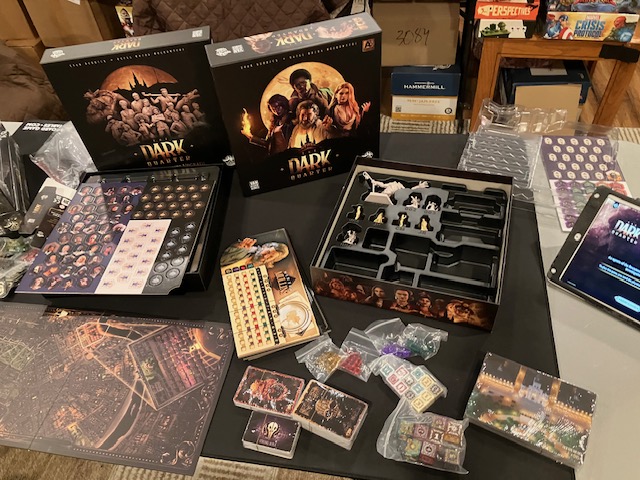
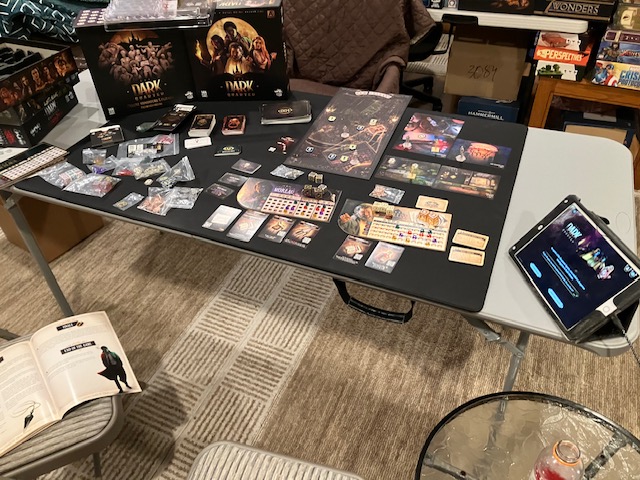
The Dark Quarter: Into the Muck

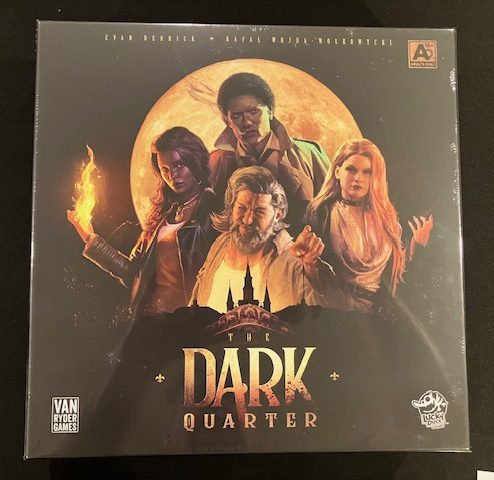
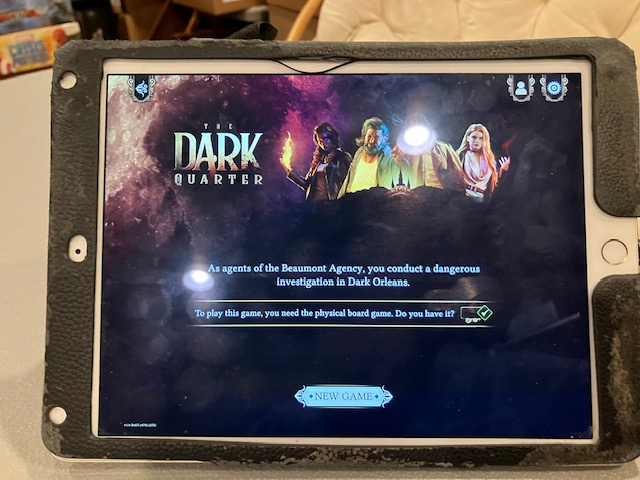
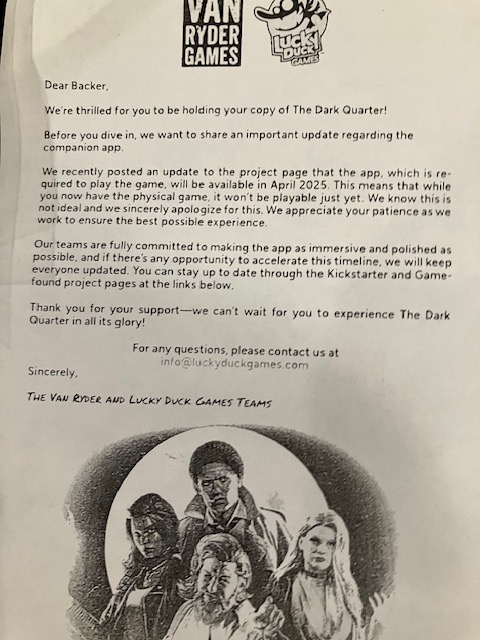
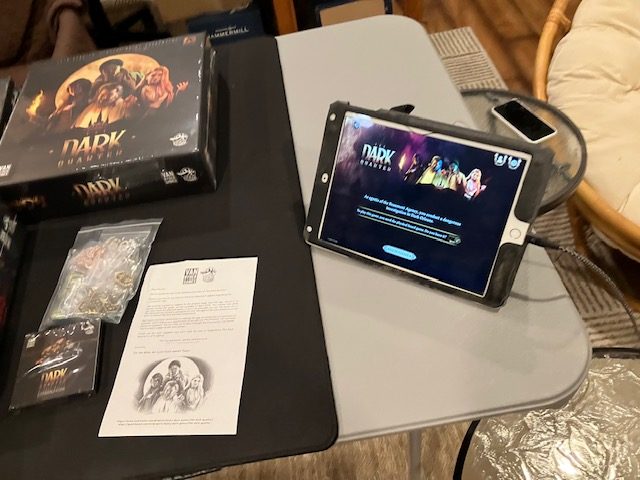
It arrived!  No, not the physical copy of The Dark Quarter!  That arrived like early 2025!  

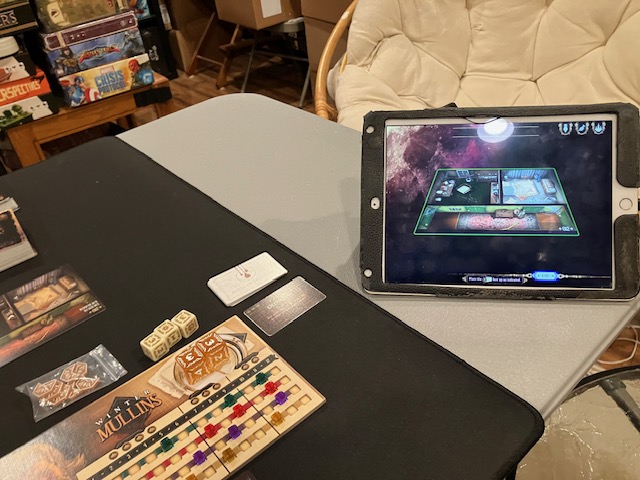
But the APP finally arrived at the iOS store!  See above! Late May 2025!  This game is completely unplayable without the app, so my physical copy of The Dark Quarter sat silently in the corner for months, waiting for the APP to be available!  And it finally arrived!  I think I downloaded it May 25, 2025.  I have been really looking forward to this, as it was my #4 on my Top 10 Anticipated Cooperative Games of 2023 … it’s years late at this point!

So, in any other year, this might be considered weird to get the physical game before the APP is ready, but with the Tariff situation changing daily, I think Lucky Duck/Van Ryder games did the right thing getting to us ASAP!  

Let’s take a look!

Unboxing

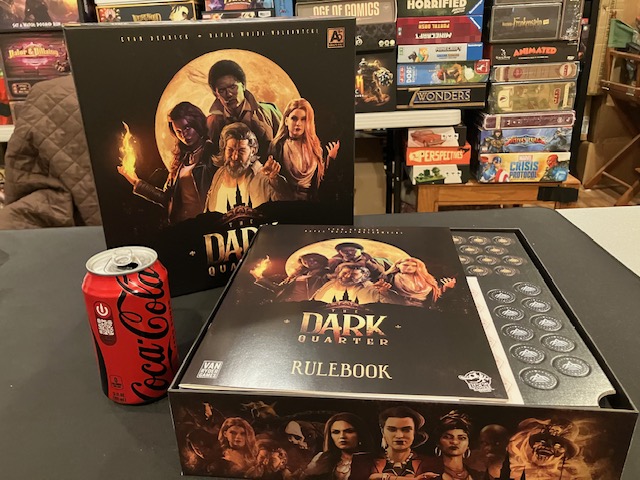
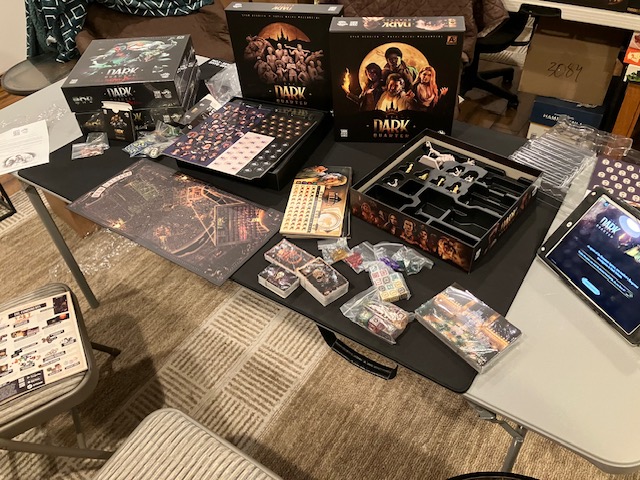
This is a pretty standard sized box; see Coke can above for persepective.

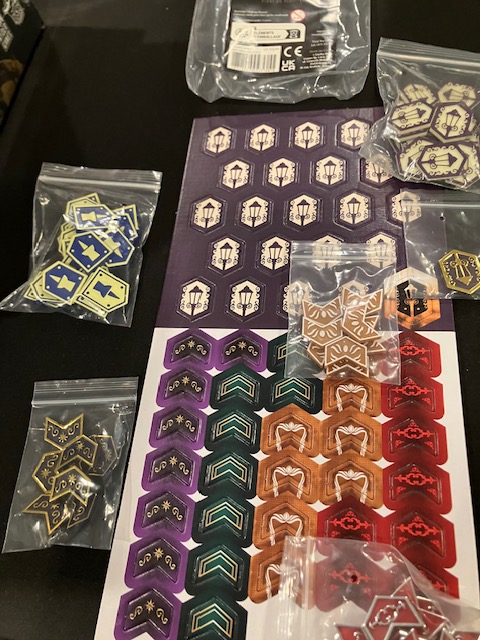
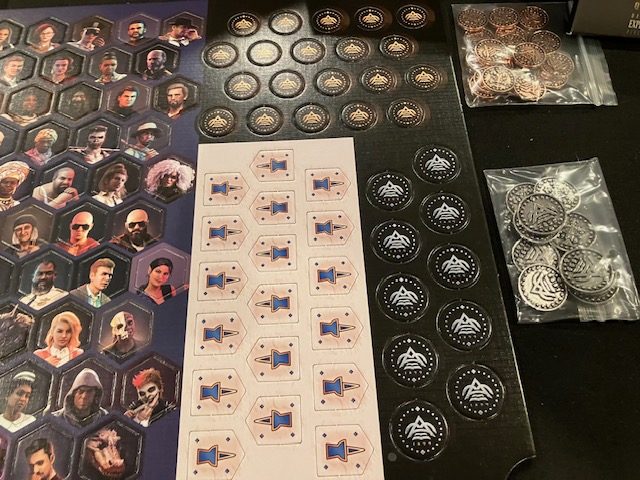
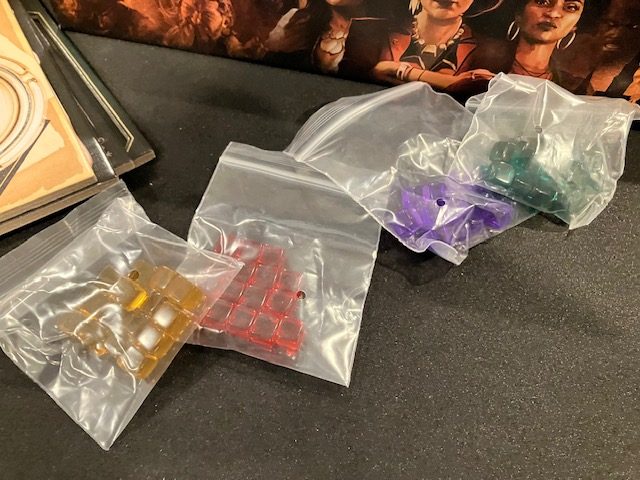
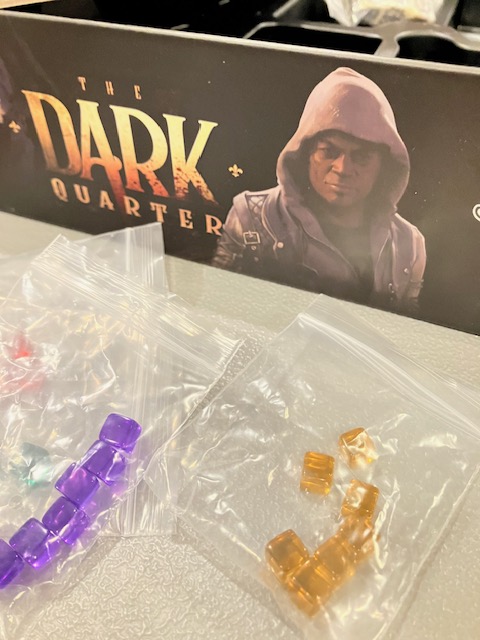
The game comes with a lot of cardboard tokens (see above),  but I had gone all-in on the Kickstarter and got the nice plastic tokens as well.

I also got the metal coins (see above).

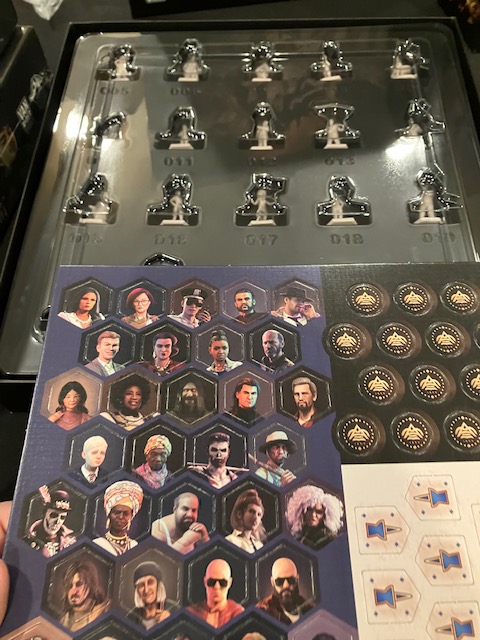
Even though I got the miniatures expansion as well, you will still need some of the little hexes with people on them.

You could play this game just fine with the cardboard, but the upgraded components make you feel…. like you’ve spent more money. 🙂  No, they are nice.

The little plastic cubes denote your ability scores.

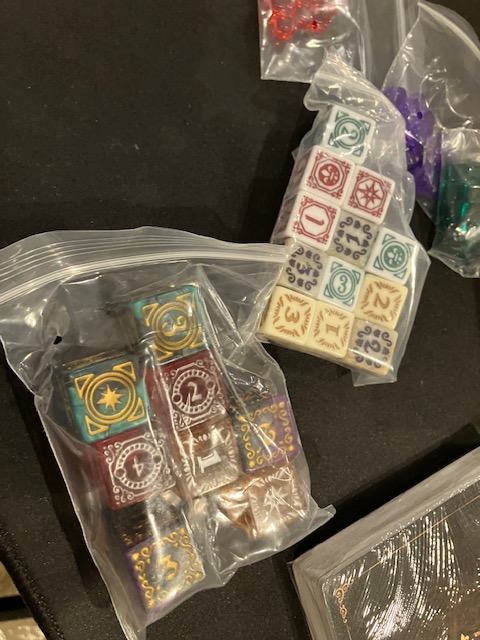
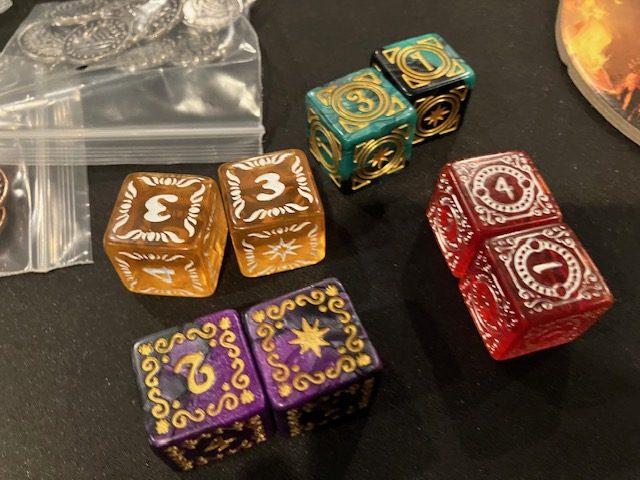
And each player will get their own dice (see above, as the dice as color-coded for the 4 players).

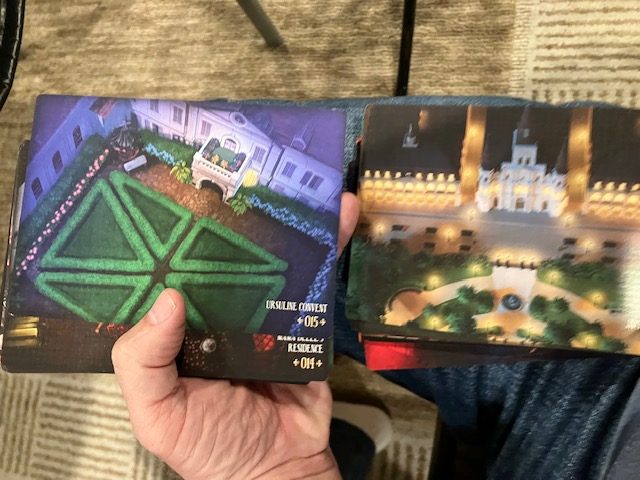
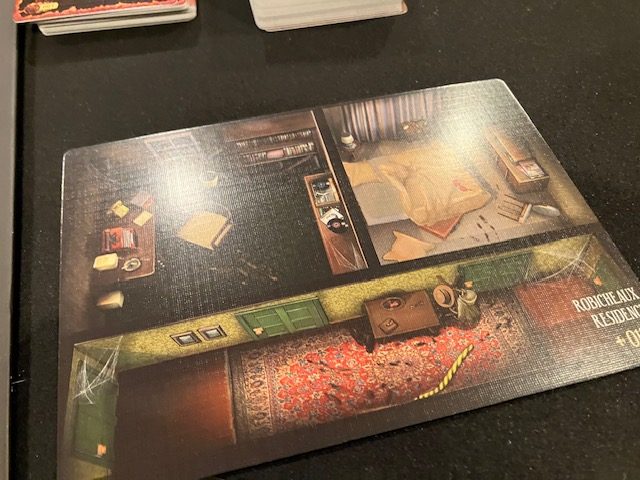
There’s some nice Location  cards that will come out (see above) as you explore.

And there’s both objects (see above) and story cards (see below).

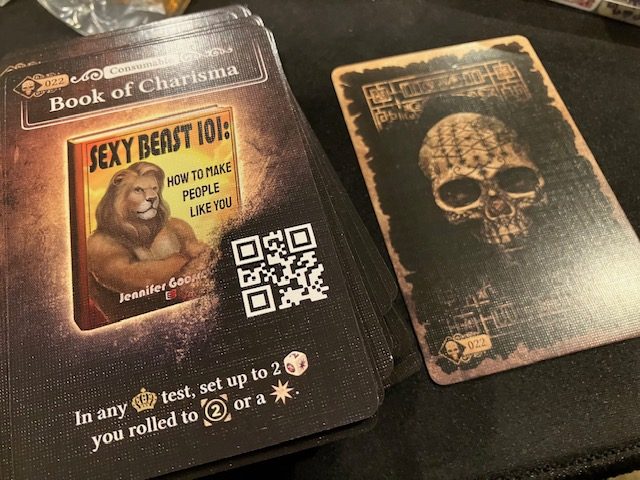
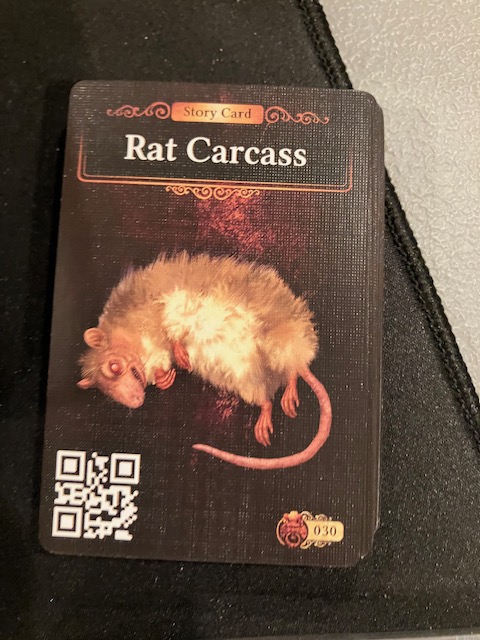
What’s that?  Yes!  A QR code!  These cards will be scanned when you play!

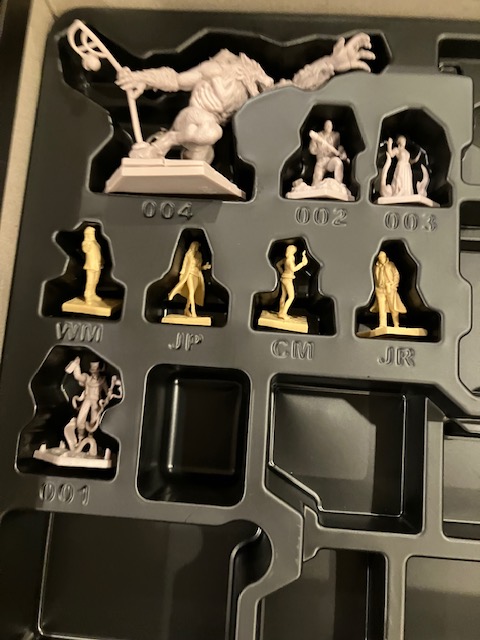
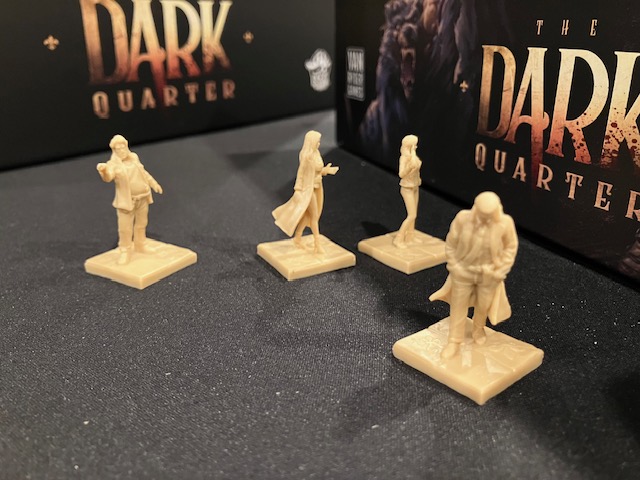
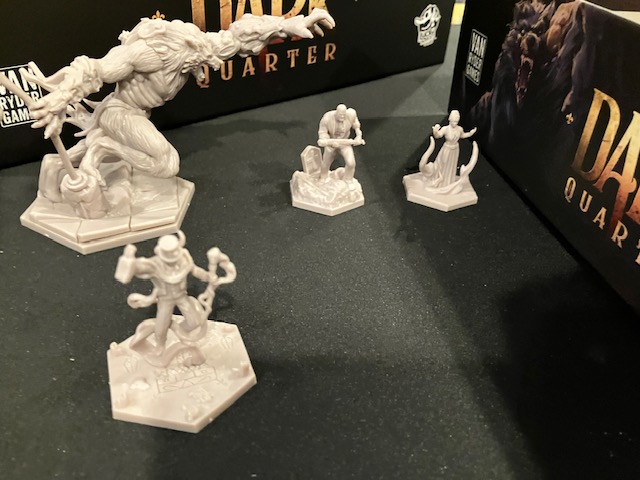
The minis are pretty good, but not great.

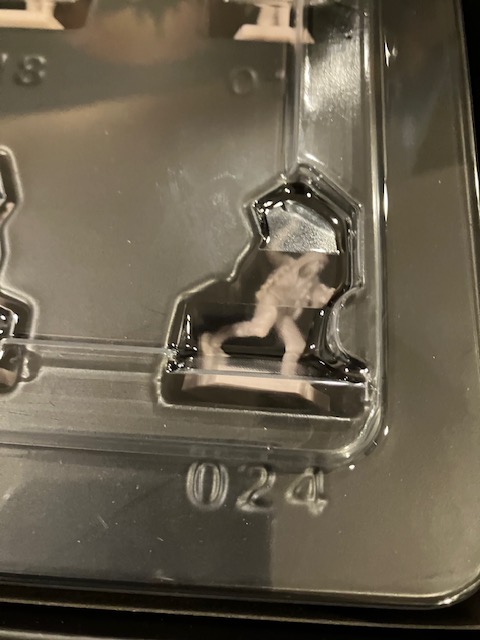
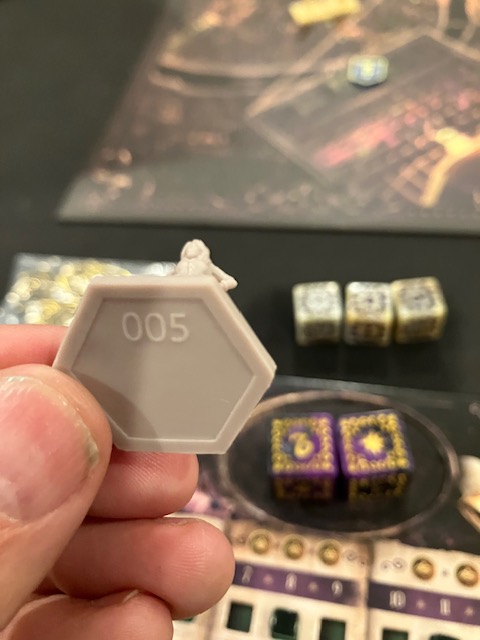
But the minis are notated with a number on the bottom so you can put them back where they belong (see above and below).

I mean, this game looks pretty good, ya? 

Rulebook

The rulebook is fine.

It fits pretty well on the chair next to me open flat, and the font is pretty big.  This is venturing into A territory (although it maybe could have used a few more pictures) for The Chair Test.

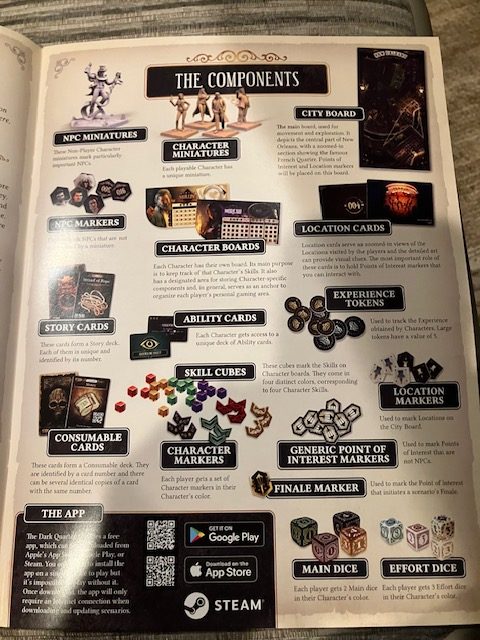
The Components page is well-labelled.

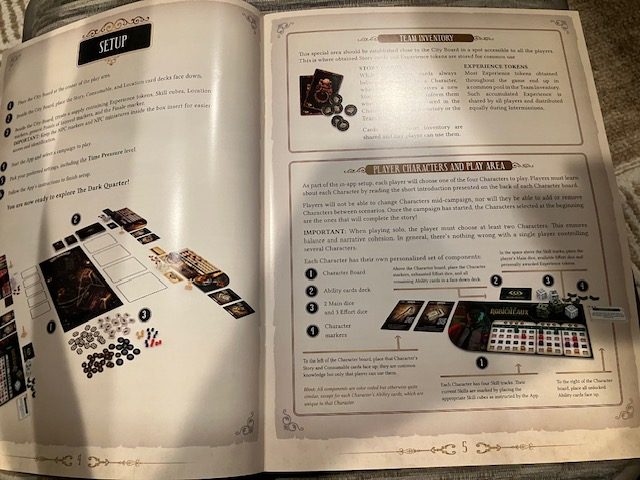
The set-up is pretty good, although there is always confusion in an APP based game: usually the APP sets you up, so do you need this?  You kind of need both the rulebook and the APP for set-up.

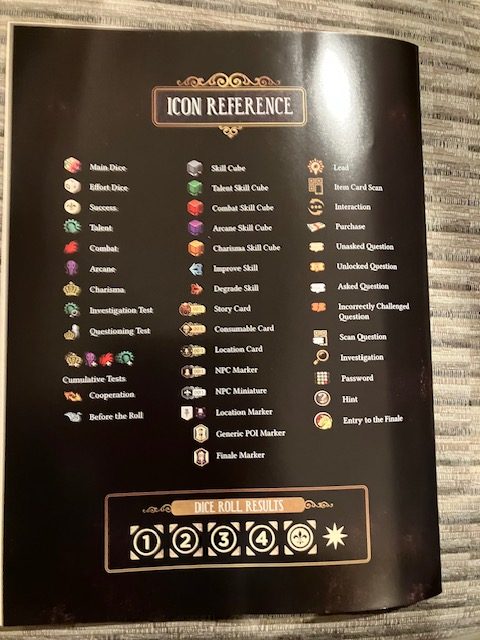
The last page has an ICON summary, which is great! … but I don’t think I ever used it once in all my solo or cooperative gameplays.

The rulebook is pretty good, but you don’t spend a lot of time there; you are always in the APP.

Warning! 18+!

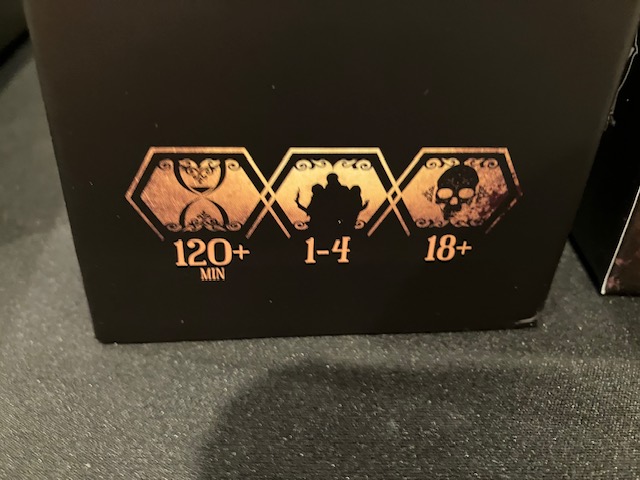
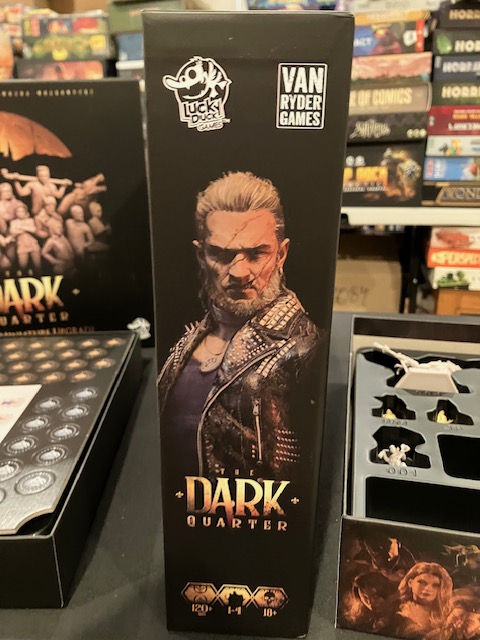
You may miss it, even though it is clearly on the box (see above) but this is clearly an 18+ game!  Between language, grisly murders, some sexual references, and just dark imagery, you probably don’t want to play this unless you are ready for a dark, grimy, and morally ambiguous world.

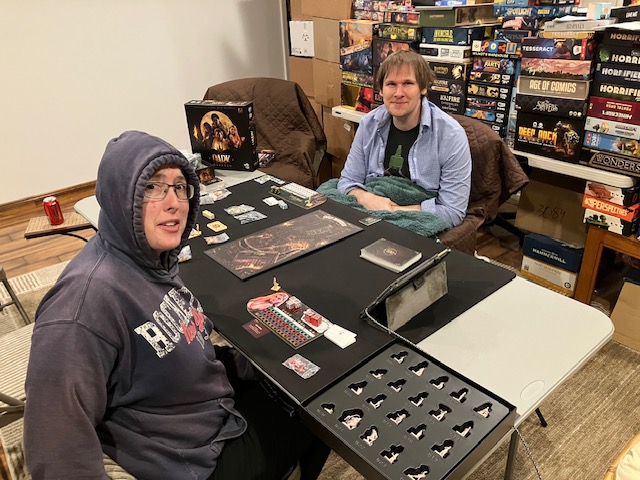
Teresa, who started out censoring the bad language from the APP, was swearing like a sailor by the time we finished our first session!  She really embraced this world! Be aware, this game will corrupt … something?

Gamplay

Each player takes the role of an “investigator/consultant” for the Beaumont Detective Agency.  Each character is flawed in some way, but they are generally seeking redemption (but that’s your choice to make).  

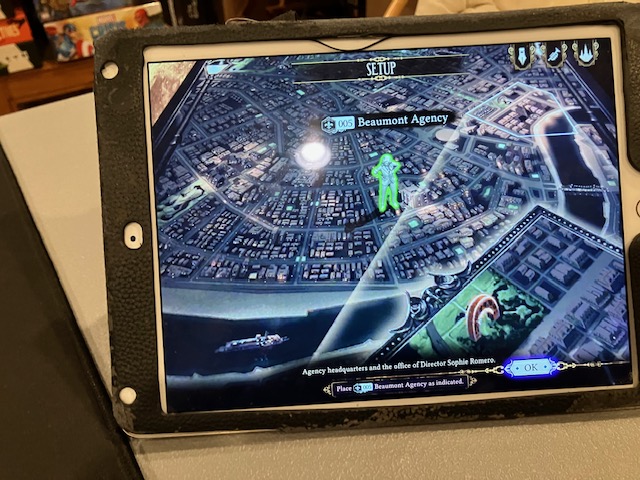
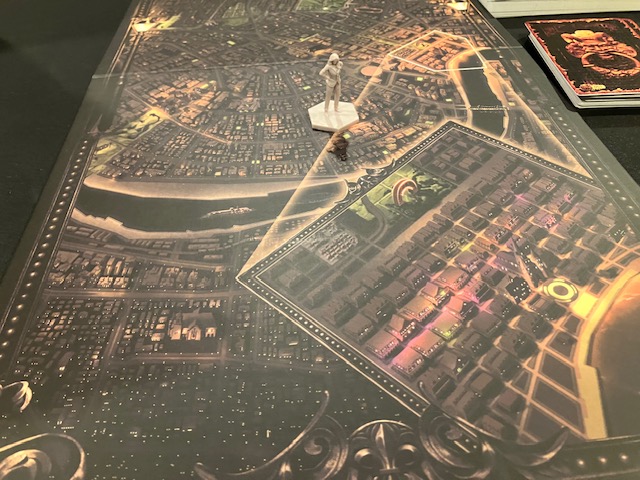
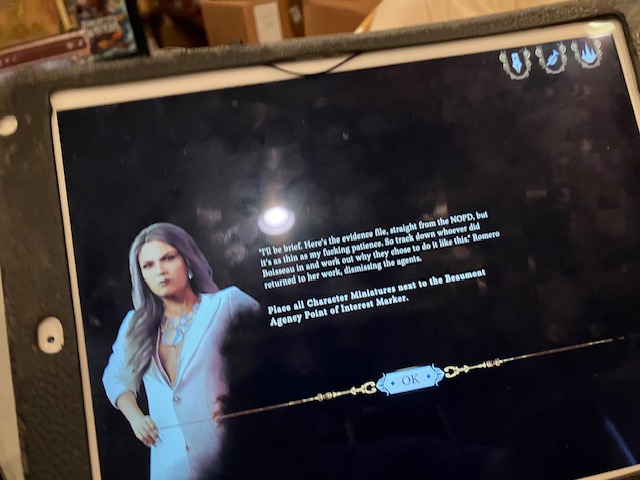
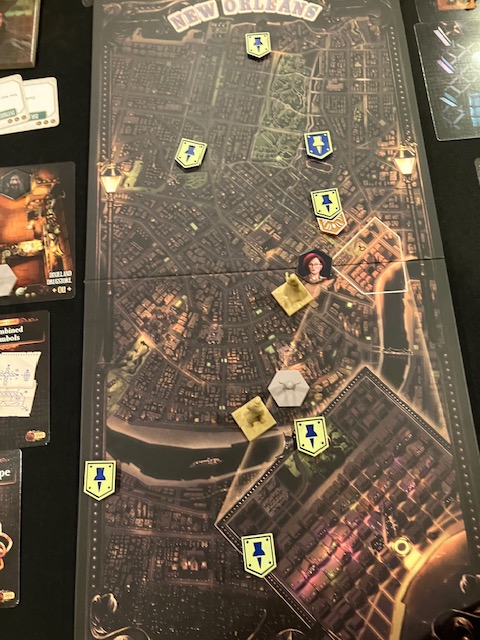
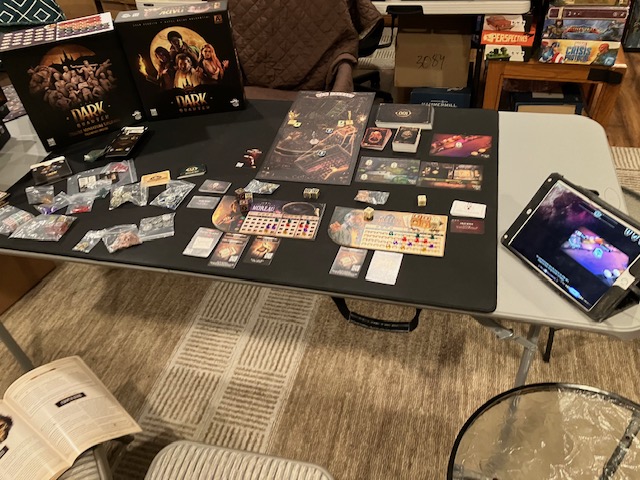
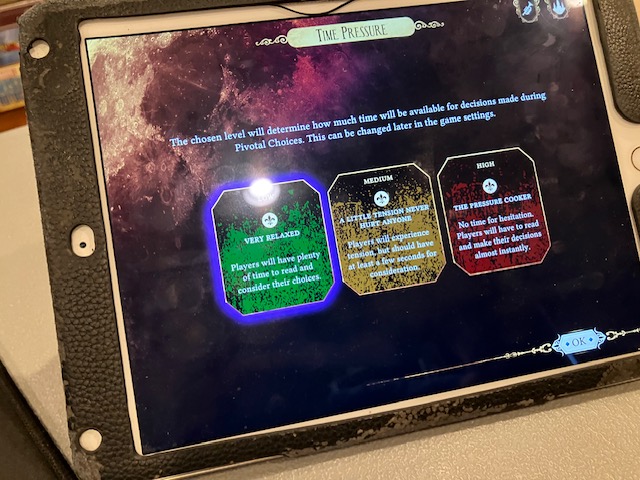
Players use the APP to guide the game.  The APP shows how to set up places of interest (see above):

And you reflect that on your game board.

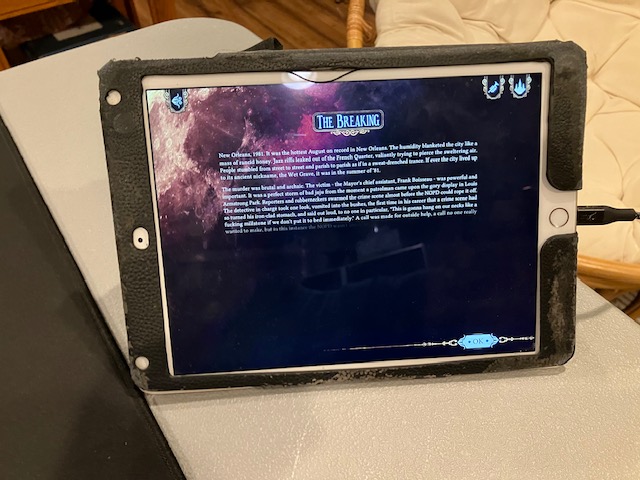
The boss lady tells you what to do in the APP, and you explore a 1980s New Orleans investigating a murder!

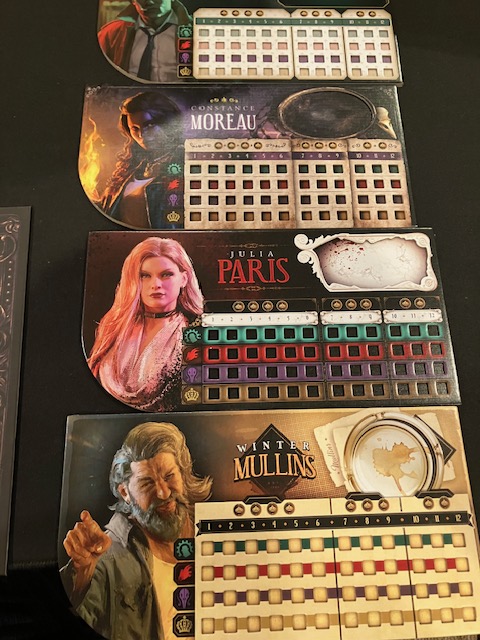
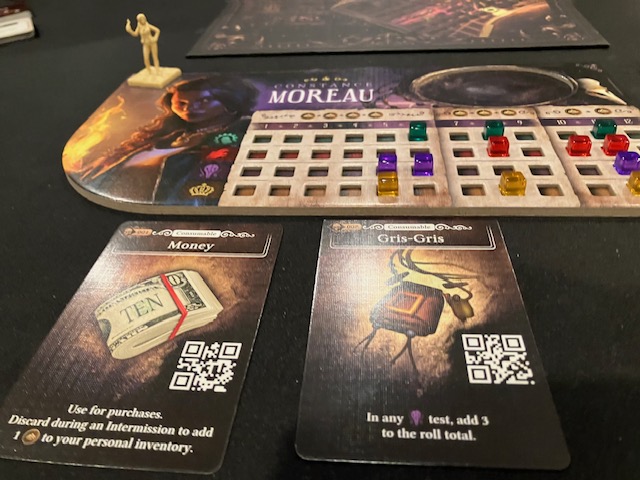
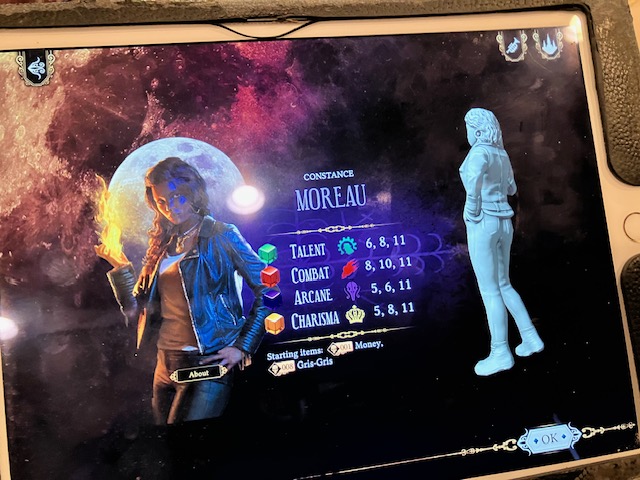
Each characters gets some items they can use, and has some level in 4 different skills/abilities (see above).  These abilities are rolled against, and however many you surpass is how many successes you get.

This is absolutely a dice game!  Almost every turn, you will roll the dice to do “some skill check”.  You always get your two base dice (color coded for the characters: see above), and some extra effort dice.

These effort dice are enabled as you play.  You always get one effort die at the start of your turn, but sometimes you will get more through other actions.

Players explore the city, trying to investigate a murder!  The APP controls the narrative, with the players making choices, and the dice determining success or failure.

You’ll notice a lot of items have a QR code (see above): you will be scanning your items to interact with them.  This may remind you of Chronicles of Crime (that made our Top 10 Cooperative Detective Games), and it should!  Lucky Duck (who teamed up with Van Ryder Games to make The Dark Quarter) also made Chronicles of Crime!

Honestly, playing this game reminds me of playing out a Detective series on HBO or Apple+ mini-series.  Story happens, characters develop (or regress!), and a lot of swearing and adult situations occur.   

Solo Play

So, you can play solo (thank you for following Saunders’ Law).  

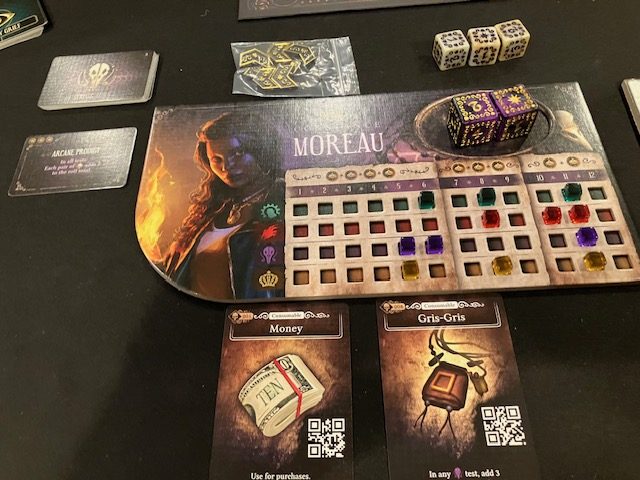
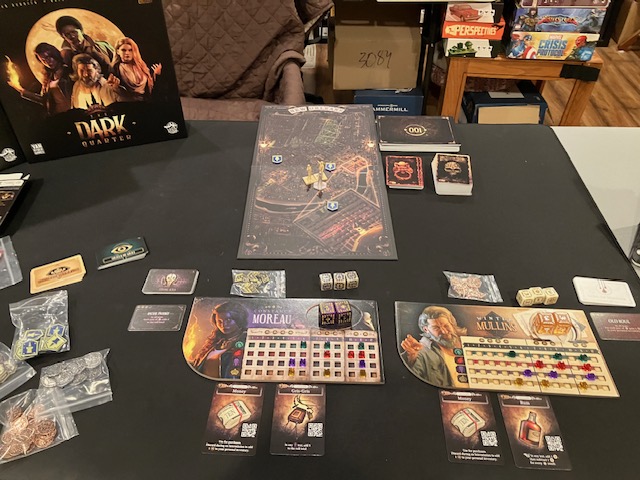
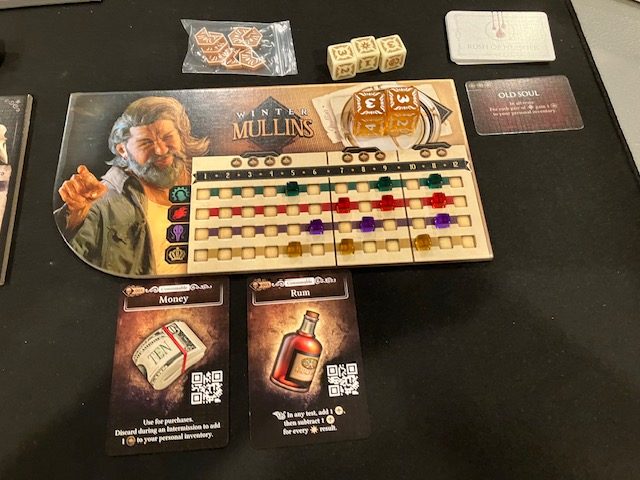
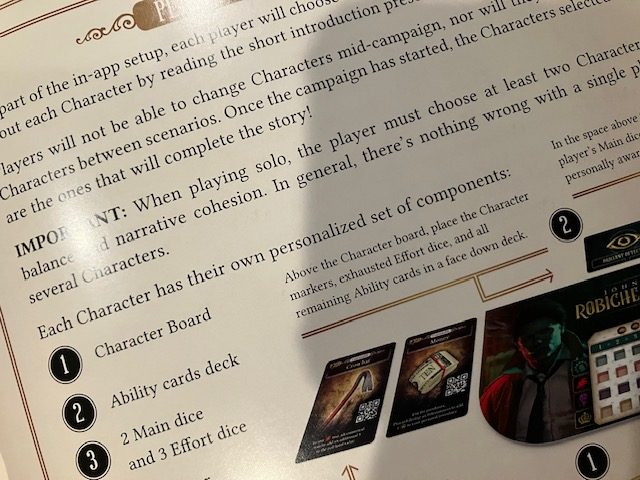
However, solo play has you take control of two characters: there is no true solo play. See above as I chose to operate both Constance Moreau and Winter Mullins.  

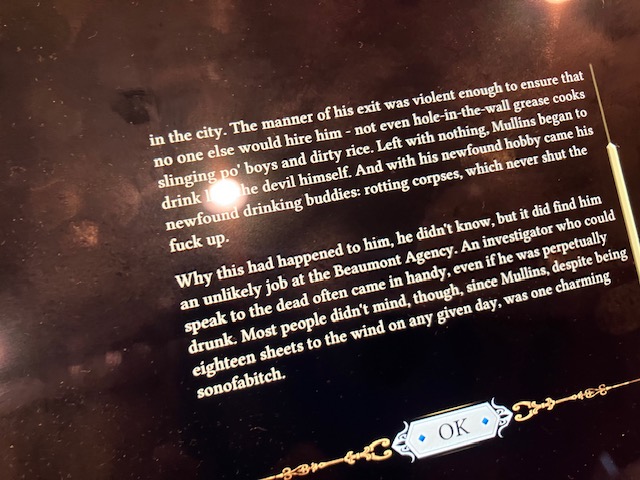
The rules do cover the case where the solo player has to play two characters (see above), and justifies needing at least two characters as “the stories are intertwined; you need at least two characters to get the best out of this!”  And that makes sense; these characters destinies are all tightly coupled!

So, I started a game.  And went back and forth between the two characters.  And I didn’t enjoy it.

The back and forth between the two characters as a solo gamer just didn’t work for me.  It felt like I couldn’t get any thing done, as just as I did one thing at a Location, I’d have to immediately go to the next character.  I remember loving Detective: City of Angels (A Van Ryder game also in our Top 10 Cooperative Detective Games) because you had four precious actions on your turn and how you spent those actions mattered! It felt like you could concentrate on a Location and get stuff done!  In The Dark Quarter, I frequently felt like I got to do just “one” thing, and then it was the next character’s turn.  

I played out the first two sessions as a solo player, but … I kinda stopped caring.  I felt like I couldn’t get anything done as a solo player, I was so busy “advancing the story”, I felt like I wasn’t playing the characters or solving the mystery.  I felt like the game was playing me.  

The story was interesting, but I felt like I couldn’t focus.  Some of that  lack of focus was the context switching between two characters, and some of that was going back and forth between the game and the APP, some of that was all the dice-rolling, and part of it was just how “little” I felt like I could do on my turn.  I just had to swap between too many things, and it took me out of the game.

I hoped a lot of these issues would go away when I played cooperatively.  I was expecting to love and adore this game straight out of the box.   I didn’t, and my solo experience wasn’t great.

Cooperative Play

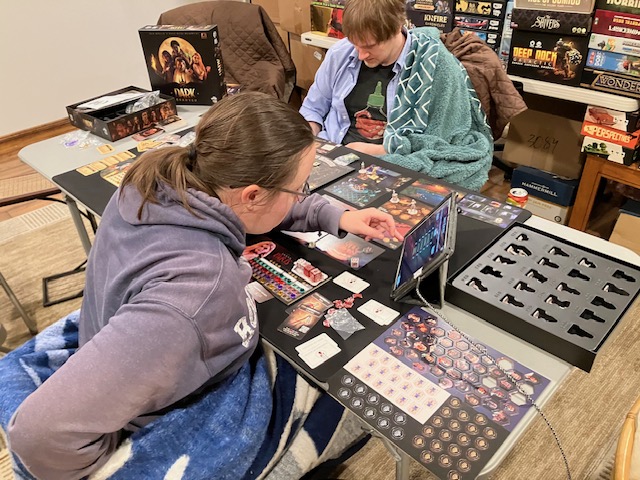
Whew. Luckily, the cooperative experience was much better!  The fact that the focus moves around quickly between characters is actually good in the cooperative game, as most people feel like they get their chance to play; quickly and regularly.

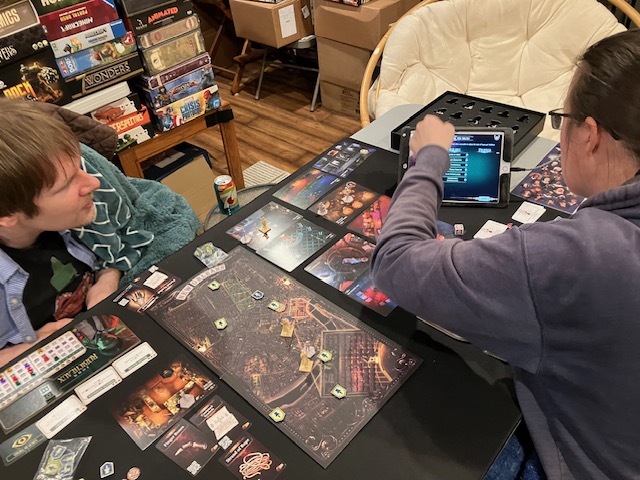
You can see as the board and locations expand out!  The world definitely envelops you as you play!

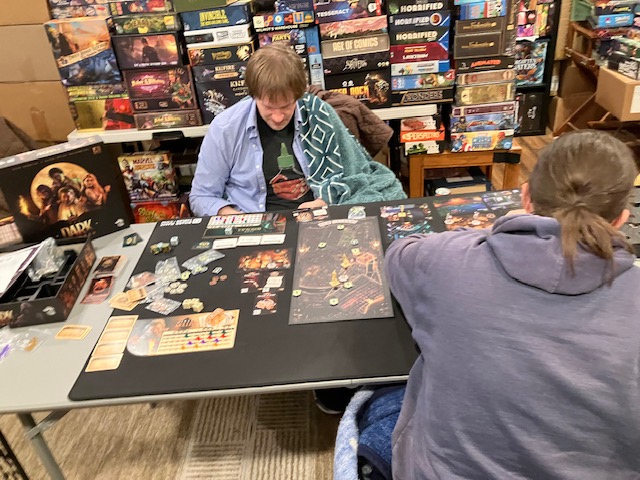
This game feels “tuned” to work best as a cooperative experience.  The 3-Player game we played was fun!  We ended up playing about 3 hours and still didn’t finish the first play!  But, we still wanted to play more, so we kept playing …

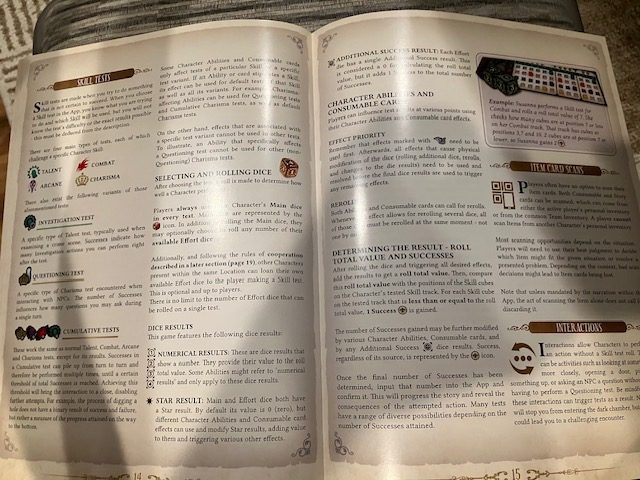
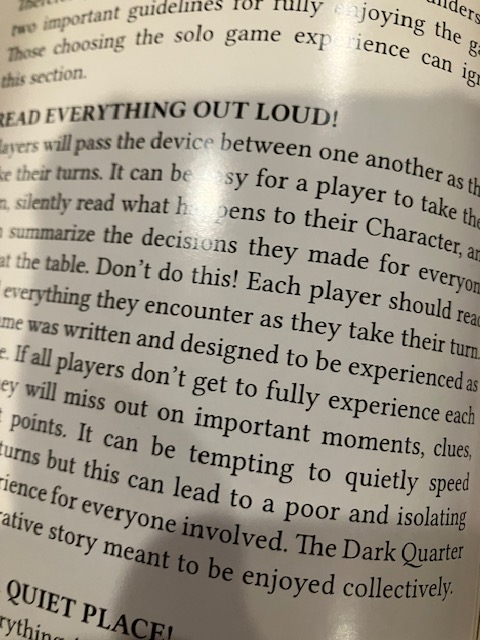
The game, in the rulebook, does a really good job of emphasizing “READ EVERYTHING OUT LOUD!”  See excerpt above.  This really encourages everyone to stay involved with the story and all the decisions in the game.  Even if some decisions are only character-based, everyone stays involved.  I am glad to see that emphasis in the rulebook (see above), and I think that is the best way to play the game.

Good times.  The cooperative play has been a success.  Currently, we have played two weeks in a row, having invested about 6 hours into the game … and wanting to play more!

Solo Vs. Cooperative

It’s really interesting to me that the solo experience fell flat for me, and the cooperative experience worked so well!  It makes sense; the game seems “tuned” to keep stories and plot points coming out, as to keep the players all involved! 

Like a car “tuned” for Sports mode instead Eco mode, The Dark Quarter seems “tuned” to cooperative mode.  The solo mode will work, but the game operates (in my opinion) at a lesser gait.  At least, that was my experience.   (And you have to understand, I love mystery games!)

Length of Game

The game is long. Longer than you might expect.  We played for three hours straight the first session! And three hours the second session!  And we still had a lot to see!  And we still have more to go!

Luckily, the APP can help you save the game between sessions.  There are several points where you can save the game; these intermissions happen about every 45 minutes or so.  So, if you really wanted to, you could just take up about 45 minutes. But given how much set-up and tear-down there is, you probably want to play at least two sessions.  We ended up playing three on our first playthrough.

The App

The APP is pretty good.  We didn’t encounter any real glitches or problems in solo or cooperative play.  Although it took them a while, the publishers did get the APP out and stable.

One problem: the font is probably too small.  We had trouble reading all that text (to be clear; the players read the text out, not the APP), and we wished we had a control to resize the font.  

Another gripe about the APP; there was no UNDO!  This is one of my biggest pet peeves in cooperative APPS; the lack of UNDO makes me me grumpy!  If this were a completely physical board game, UNDOs are easy:  “Oops!  I meant to go to the Graveyard!  Back me up!”.  Nope.  There is no UNDO in this app.   I think this actually slows down gameplay a little: “Are you SURE you want to do that?  We can’t back up!”

In general, the APP seemed to work fine for us in both solo or cooperative play.  It was pretty good.  Be aware, the players still have to read all the text out loud!! The APP does NOT read the text for you!

Dice and Murder

I said this earlier, almost everything in this game is a skill check with dice.  The game seems pretty balanced.   For instance, if you fail, the game typically gives you an “extra” effort die for your next die roll (which I appreciated).

But in the end, The Dark Quarter is still kind of a dice game.  Which I don’t love!  I feel like a detective game should be about following the evidence, making best use of your resources, and generally trying to be smart/clever.

Detective: City of Angels, Sherlock Holmes: Consulting Detective, are detective games where you have to be smart.    Although The Dark Quarter is a nominally a detective game, it has more drama in it than I expected.   The dice contribute to that drama, because they make the game more random and unexpected!

When I play Detective: City of Angels or Sherlock Holmes: Consulting Detective, I feel like I am playing a detective show like Death in Paradise, or Midsomer Murders where the mystery is front and center.  When I play The Dark Quarter, I feel more like I am playing a police drama where the mystery is less pronounced.  It’s not bad, it’s just not quite what I was expecting.  

If you want to jump into a police drama in New Orleans in the 1980s with lots of magic and character development and story, this is the right game for you!  If you want more of a mystery, well this isn’t quite that.  But there’s still more than enough mystery to keep you going!

Conclusion

The Dark Quarter is a really interesting game, but you have to know where it fits best.  I don’t think it works great solo, it’s more random than most mystery games, it’s very dependent on the APP, and the 18+ age requirements are pretty stringent.

But, if you find a group that wants to jump in to a 1980’s drama/mystery with lots of adult twists and turns, The Dark Quarter is the game for you!  It’s got great story, interesting interactions, and plenty of character development/regression!   Instead of watching an adult mystery/drama on HBO or Apple+ tonight, consider playing The Dark Quarter instead!

Solo play: 6/10. Cooperative Play: 8/10.  I think most people would probably give this a 9/10, but I think I wanted just a little more mystery and a little less dice-rolling. It’s still really good though.

Top 10 Cooperative Cat Games (Board and Card Games)

Yes, yes. We are really doing this: we are doing a a Top 10 Cooperative Cat Games! To be clear, these are cooperative board or card games that have an upfront and distinct cat theme to them! Some games have cats in them (like Cyber Pet Quest from a few weeks ago), but those games aren’t “cat-centric”. The 10 games below are all cooperative games where the cats are the main focus … and that’s just how the cats like it!

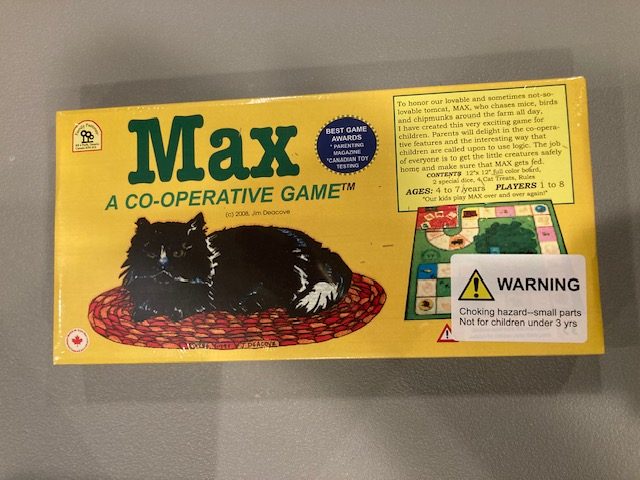
10. Max

IMG_5596

Players: 1-8
Ages: 4 to 7 Years old
Time: 10 Minutes
Supports Solo?  Yes
Type: Cooperative Roll-And-Move

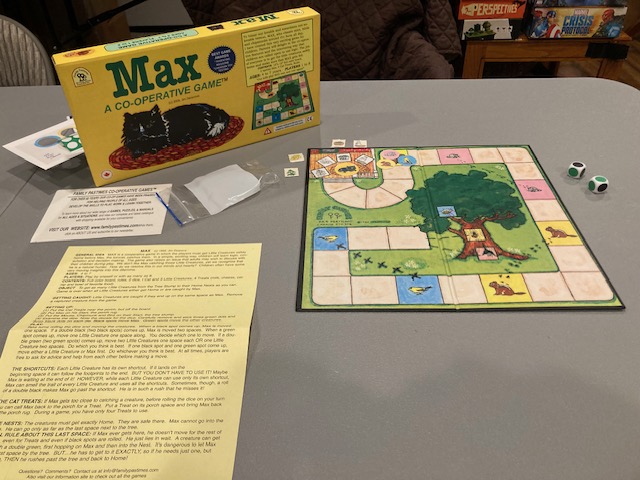
It’s kind of hard to recommend this, as it’s a game meant for very very young players: the recommended age range for Max is 4-7 years old. 

IMG_5598

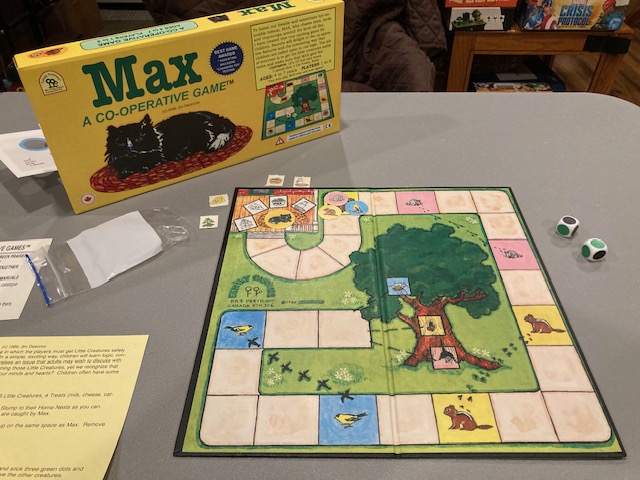
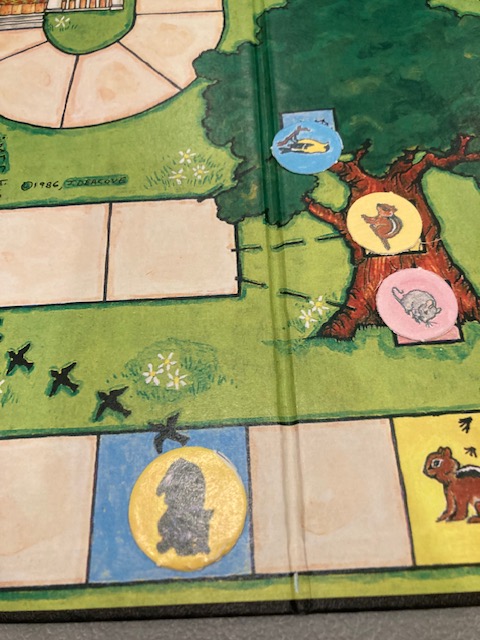
And the production isn’t great: see above.

IMG_5600

But, this may be just what you are looking for to give your younger cat lover!  It’s a cooperative game for young kids, and that right there makes it worth mentioning! (even if it’s not the most beautiful game in the world)

IMG_5602

Trying to save the creatures from Max is a fun little theme that is surprisingly charming.   Be aware: this is a roll-and-move game, the production isn’t great, it’s meant for young kids, and the game is very light.  But, it’s kind of charming as a cooperative cat game, so it makes our list.

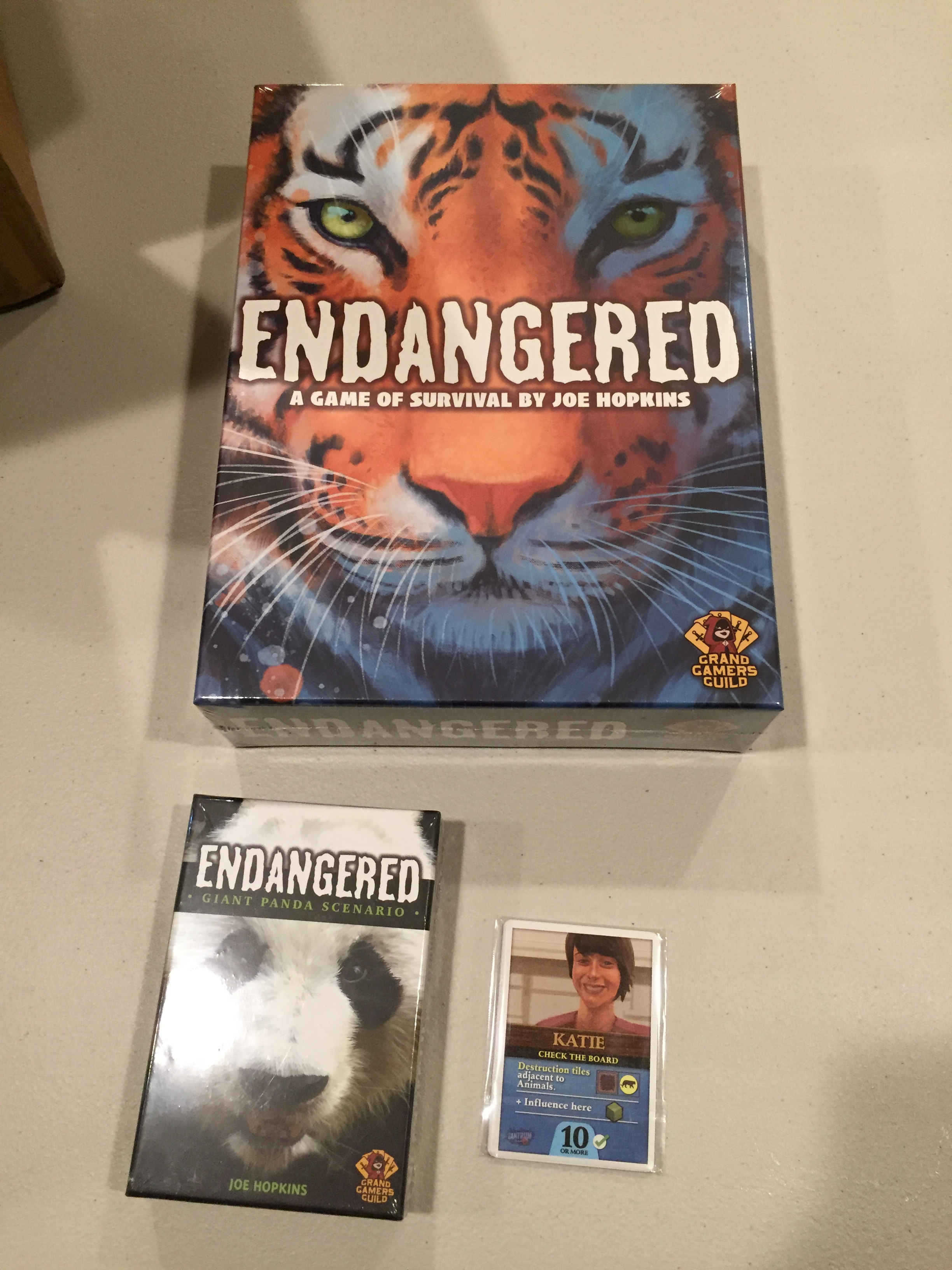
9. Endangered
IMG_5588

Players: 1-5
Ages: 10+ Years old
Time: 60 Minutes
Supports Solo?  Yes
Type: Cooperative Dice Placement Game

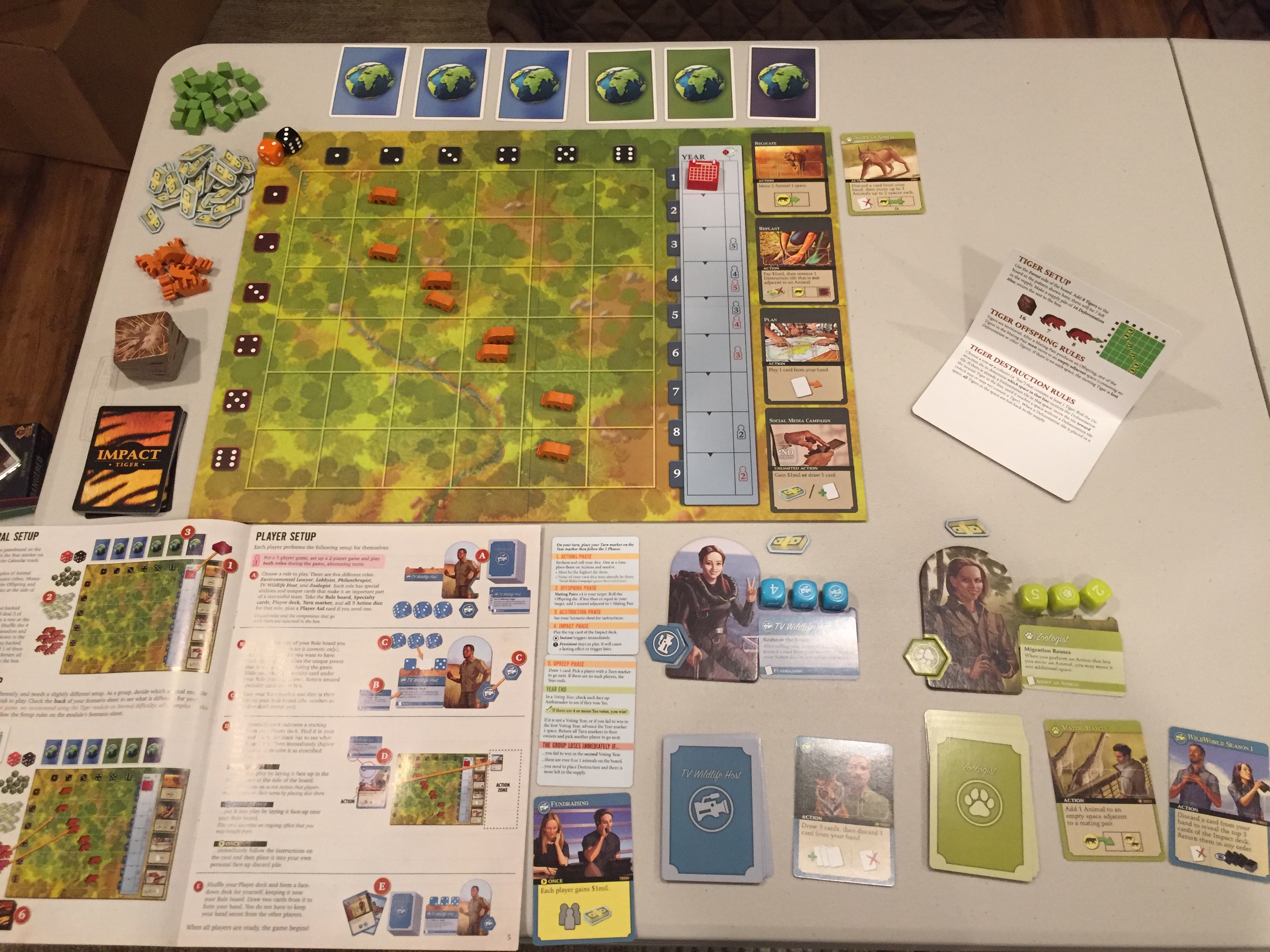
This is a cooperative dice placement where players play in together in multiple realms: diplomacy in the UN, conservation in the jungles, and gaining resources in the real world!

IMG_5619

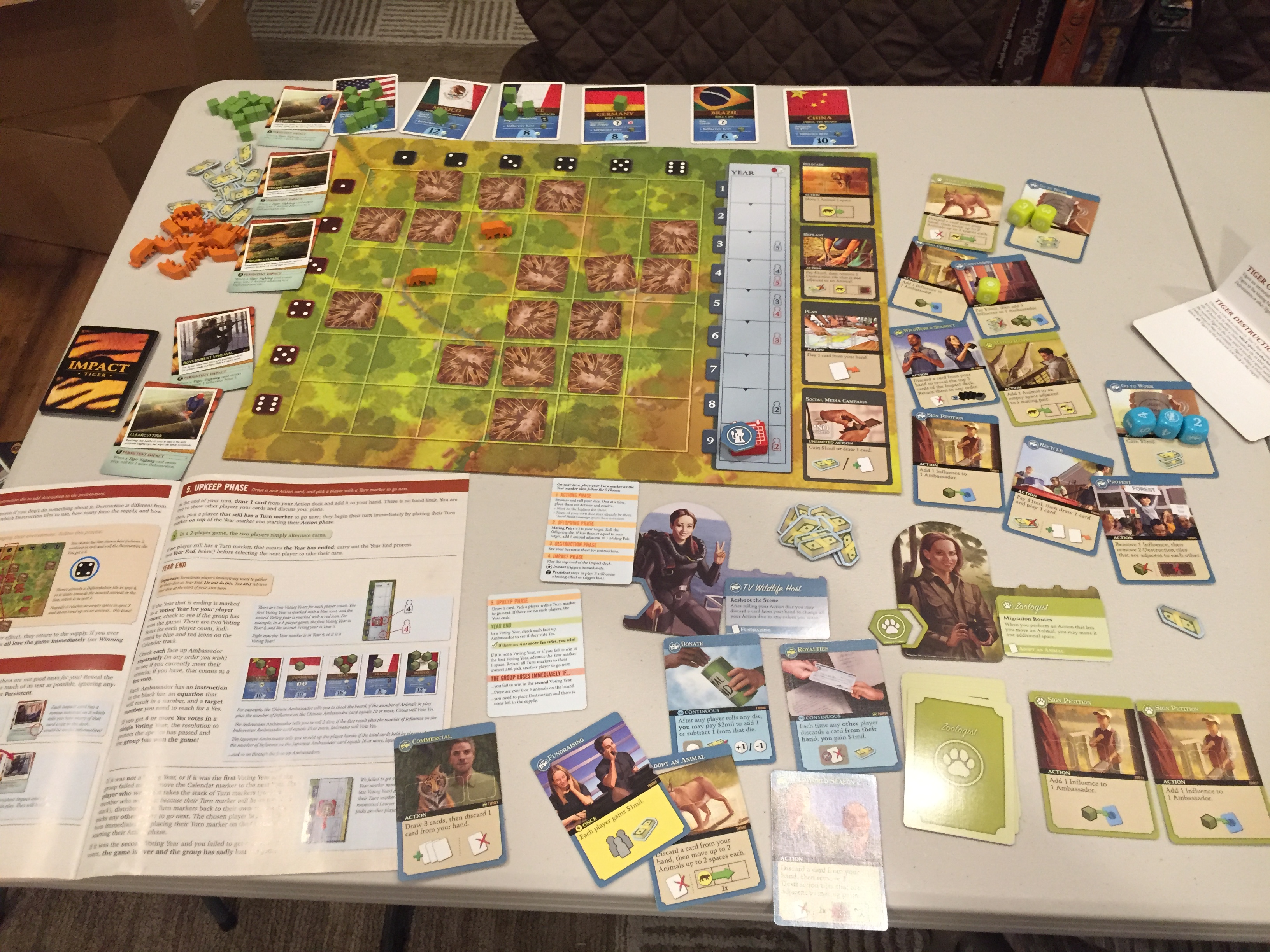
This only made out #9 because just a few scenarios are about cats (Tigers in the base game and Jaguars in the expansion),  but they are constantly making more and more expansions all the time!  And during those scenarios, the cats take center stage!

IMG_5626
A losing first game!

This has some really interesting ideas; the cooperative dice-placement mechanic is very well implemented!

Take a look at our review of Endangered to see if this might be for you.

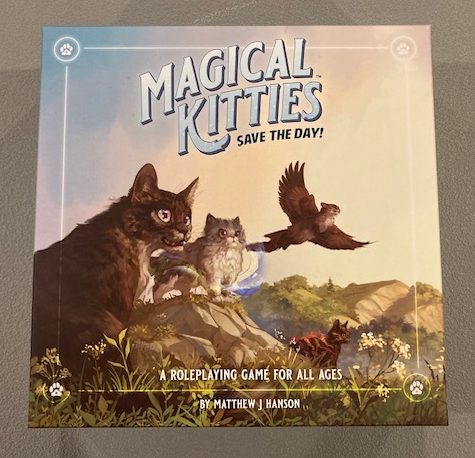
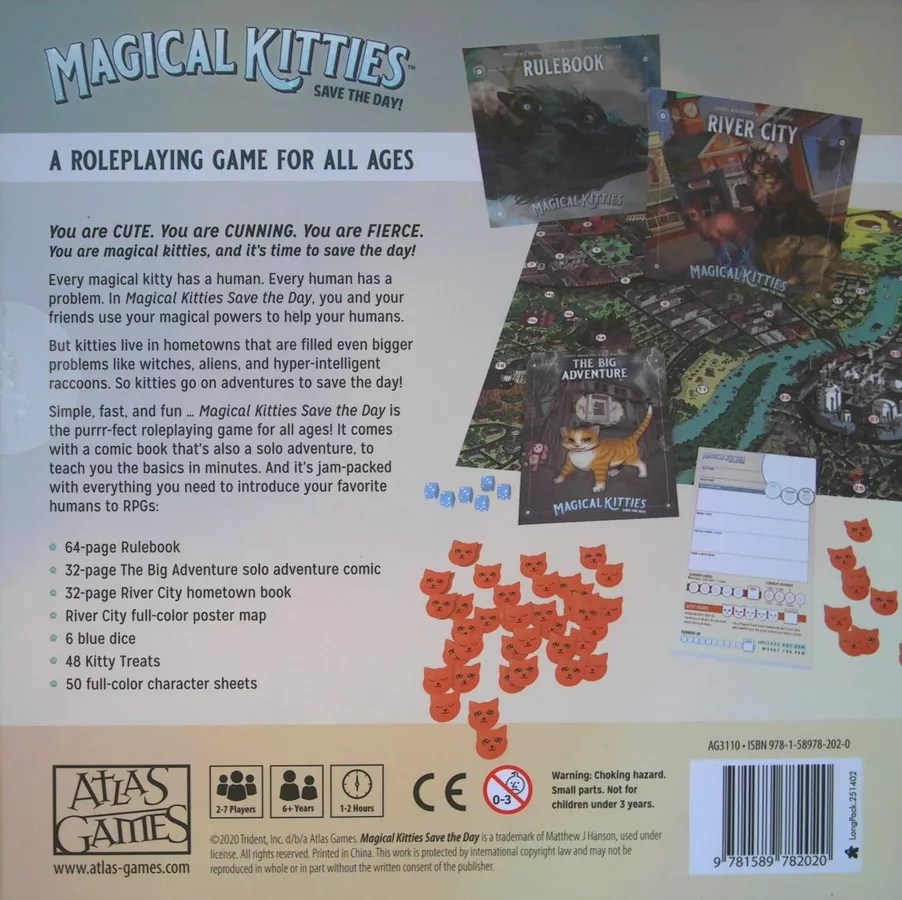
8. Magical Kitties Save The Day!

IMG_8198

Players: 2-7
Ages: 6+ Years old
Time: 60-120 Minutes
Supports Solo?  Sort of, there’s a solo Adventure that comes with the game to teach it
Type: Cooperative Role Playing Game (RPG)

So, I am in the camp that views RPGs as cooperative games; I view the Dungeon Master/Game Master (DM/GM) as a shepherd for herding cats through an adventure (analogy chosen on purpose).  The players are cooperating to get the best outcome for the group, and the GM is just trying to help the players. I know this GM view isn’t shared by everyone, but the vibe of this particular RPG is certainly very cooperative.

magickittiesback

Players plays as cats going on adventures to save the day … that sounds like a cooperative game to me!  This is a fun and goofy cooperative game that will require a GM to run it.

The solo comic book that comes with for teaching the game is pretty awesome!

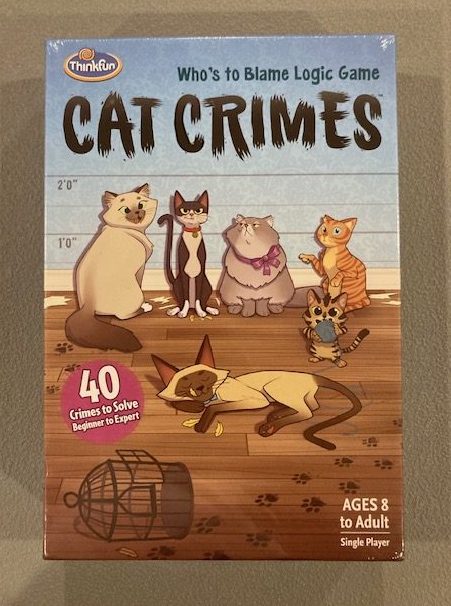
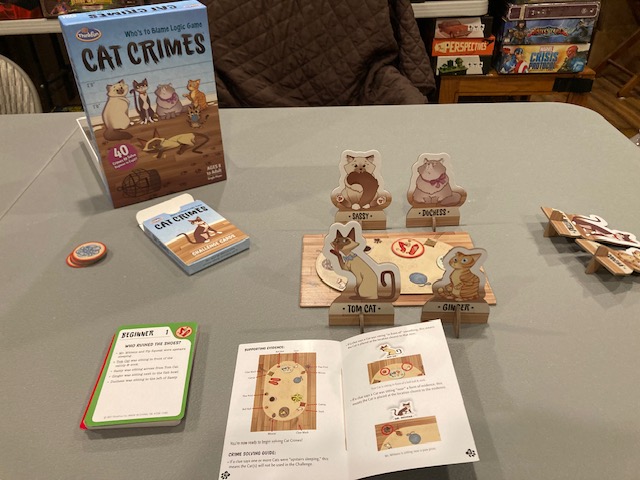
7. Cat Crimes

IMG_5583

Players: 1+
Ages: 8 to Adult
Time: 15-30 Minutes
Supports Solo?  Yes, solo first! Cooperative by group
Type: Cooperative Logic Puzzles

Cat Crimes is more of a solo logic puzzle than a game per se, but you can play it cooperatively by having all players work together as a group to solve the puzzles! 

IMG_5588

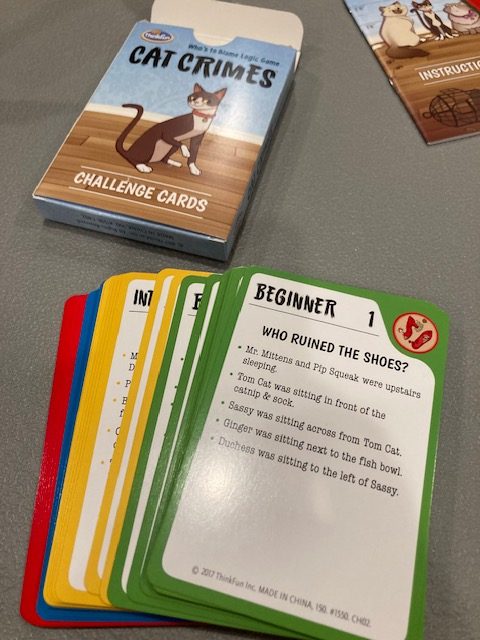
Player(s) take a challenge card (from Beginner to Expert: see above) and try to solve the puzzle!  Who Ruined The Shoes?

IMG_5591

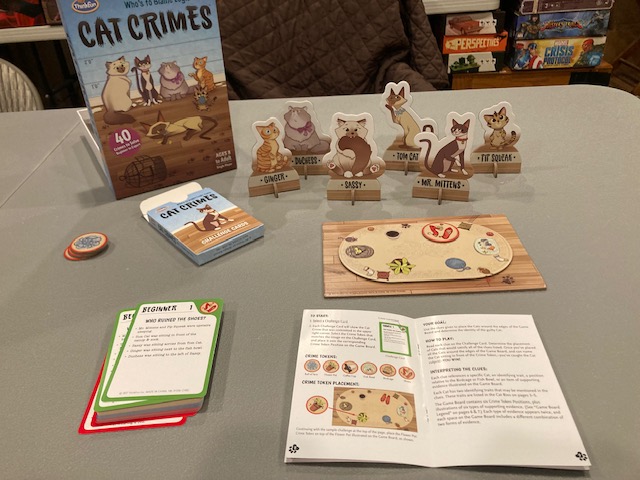
Players use the hints on the card to deduce, via logic only, the order of the cats around the table!

IMG_5592

Once the cats are placed around the table correctly, that pinpoints the culprit! See above as Duchess ruined the shoes!!

This is a fun little logic game where the cats are cute: the theme helps keep it from taking itself too seriously. But the puzzles are whatever challenge your group is up for!

6. Space Cats Fight Fascism

IMG_7292

Players: 2-4 
Ages: 13+
Time: 45-60 Minutes
Supports Solo?  No  (although you can play solo via 2-handed solo)
Type: Cooperative Dice and Card Management Game

This little cat game came out of nowhere for us: it’s from a very small publisher (TESA) and it really doesn’t have a lot of buzz around it.

IMG_7296

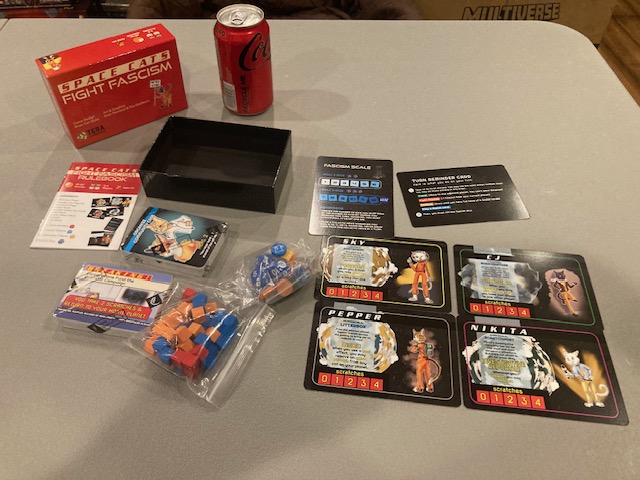
The components are a little wonky and the art is a little wonky.  It’s a pretty small game.

IMG_7310

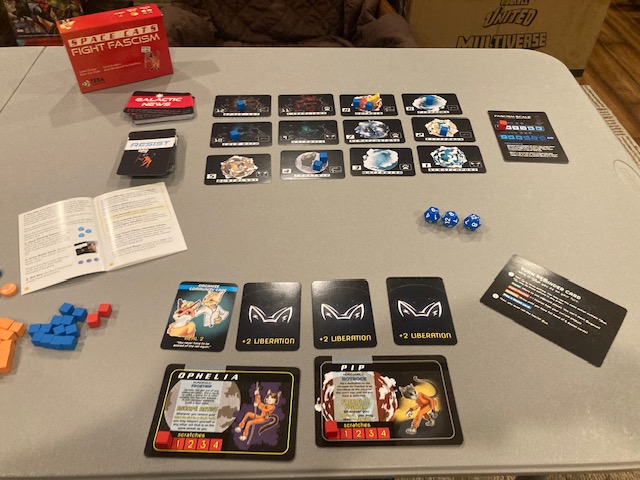
But this little game is surprisingly fun! It has a Pandemic feel as cats fly around the galaxy trying to stop facism (removing cubes like Pandemic).  Space Cats Fight Fascism isn’t really political (despite the name); it’s really just a surprisingly cute cooperative game with its own “vibe”.  The cat theme works surprisingly well, considering this game could be just an abstract, but somehow the cats in this game give it its own flavor, its own soul, and its own sense of humor. 

5. Cat Rescue

IMG_0549

Players: 1-4
Ages: 8+
Time: 15 Minutes
Supports Solo?  Yes
Type: Cooperative Tile Placement/Tableau Management Game

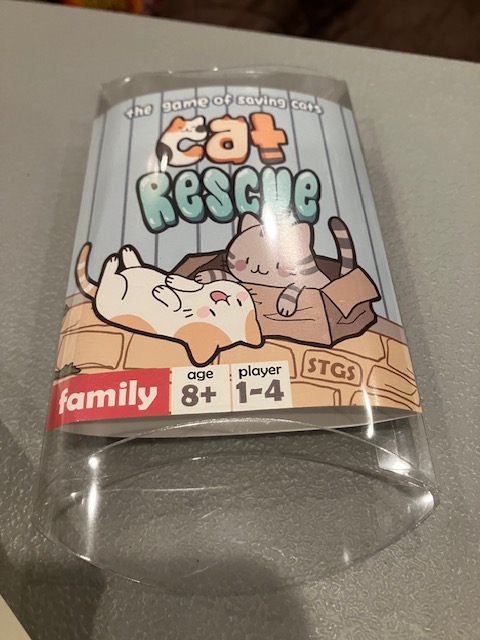
Cat Rescue is a very cute game that was on Kickstarter, but it’s actually incredibly hard to find now.  I ended up finding the original blister pack version (see above).

IMG_0545

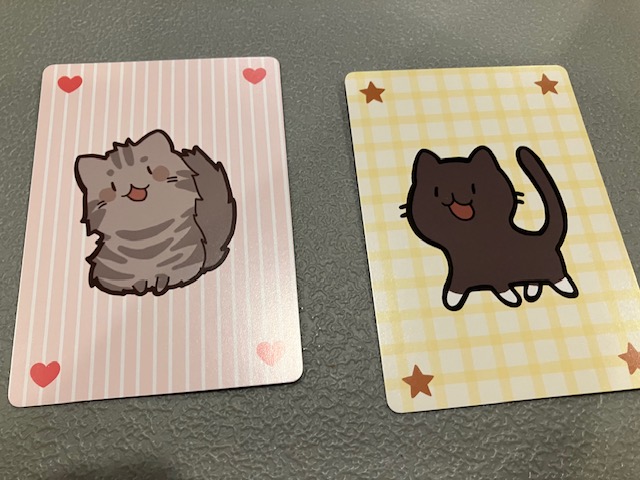
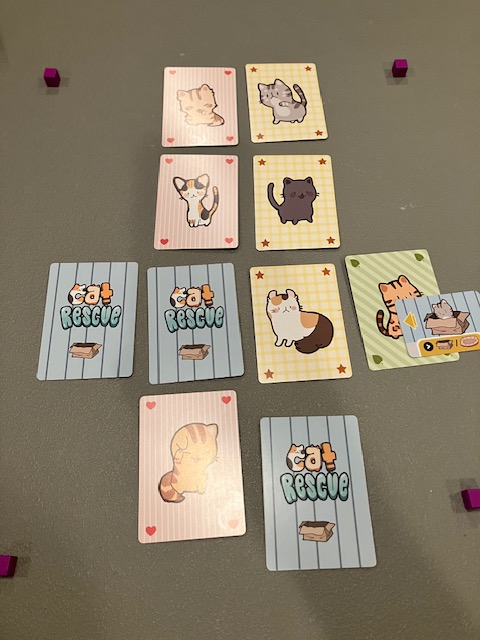
Players put some very cute cats in a 4×4 grid (see above and below).

IMG_0547

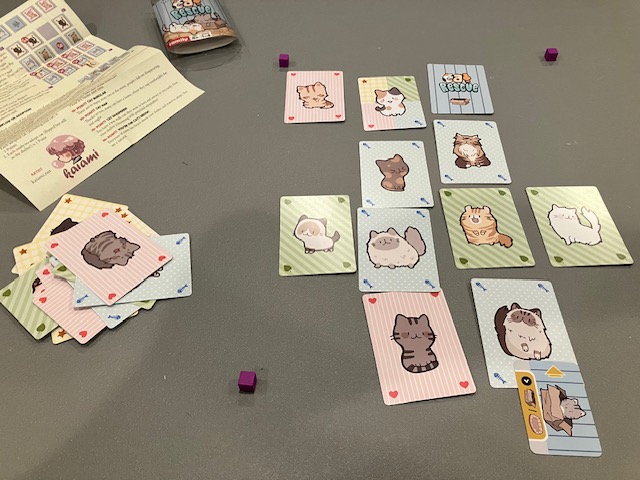
The main mechanic is that you “push” cats along a row or column, trying to push a cat that’s “ready for adoption” (flipped) out of the grid.  You continue until you run out of cards and then score how many you saved!

IMG_0548

It’s very cute, simple to explain, and easy to play.  Cat Rescue is sort of a cross between a tile placement game and a tableau building game.  It is hard to find, but there is hope for a reprint.

UPDATE: As of right now, March 30th, 2025, there is a Kickstarter coming in Spring 2025! See information here!  Thanks to Lon for pointing this out!

4. Run Run Run!

IMG_7037

Players: 1-4
Ages: 8+
Time: 30 Minutes
Supports Solo? Yes, minimal rule changes
Type: Cooperative Tile-Laying Game

This cute game about cats invading an Egyptian tomb is quite fun!

IMG_7078

The components in this cooperative tile-laying game are gorgeous! The tiles are thick and easy to read!  

IMG_7118

The game is easy to teach, easy to play, and plays rather quickly in about 30 minutes!  Take a look at our review of Run Run Run! here to see if it might be something you might like!

This game could easily make our Top 10 Cooperative Tile-Laying Games!  But that list came out before we played this game …

3. Nekojima

IMG_5371

Players: 1-5
Ages: 8+
Time: 15-30 Minutes
Supports Solo? Yes, minimal rule changes
Type: Cooperative Abstract Dexterity Game

IMG_5378

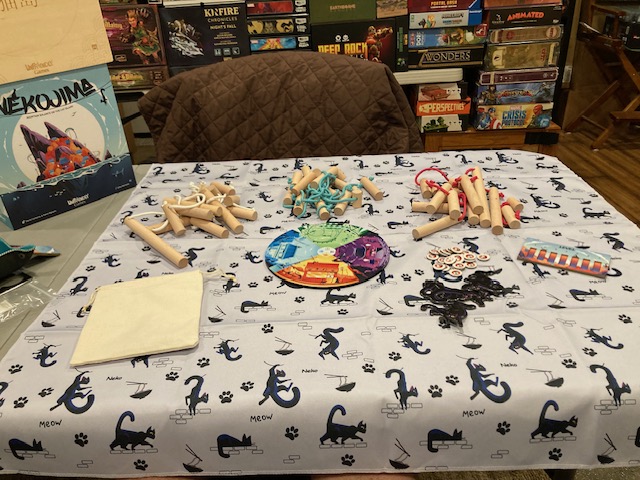
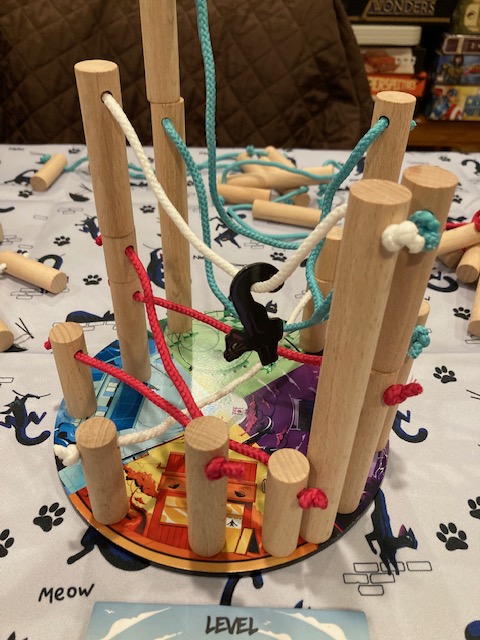
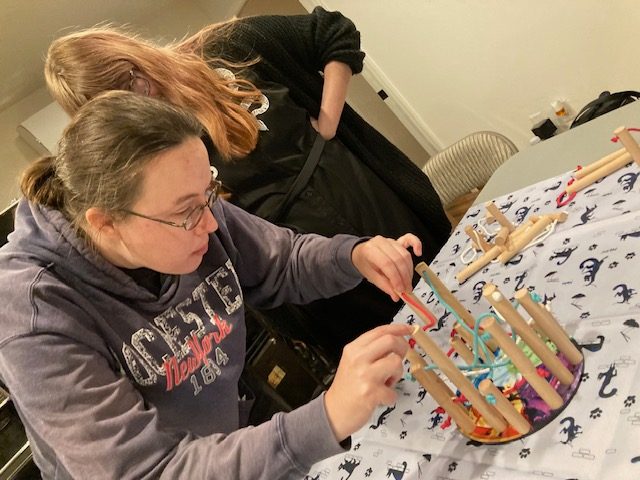
Nejokima is a very cute cooperative dexterity game for 1-4 players; this can probably best be described as cooperative Reverse-Jenga!  In Nekojima, players work together adding wood blocks on a platform, hoping not to knock anything over! (whereas Jenga has players removing wood blocks from a tower, hoping not to knock anything over)! In both cases, players try not to knock the structure over!  See below!

IMG_5386

At the end of the day, this is almost an abstract game, but the game leans so heavily into the cat theme (with a cat placemat, the cat tokens, and the “cat always lands on its feet” in the rules), that I think you can call it a cat game.

IMG_5404

Take a look at our review of Nekojima to see if this is something you think you might like.

2. Hissy Fit!

IMG_3068

Players: 1-4
Ages: 8+
Time: 20 Minutes
Supports Solo? Yes, minimal rule changes
Type: Cooperative Hand Management game

IMG_3099

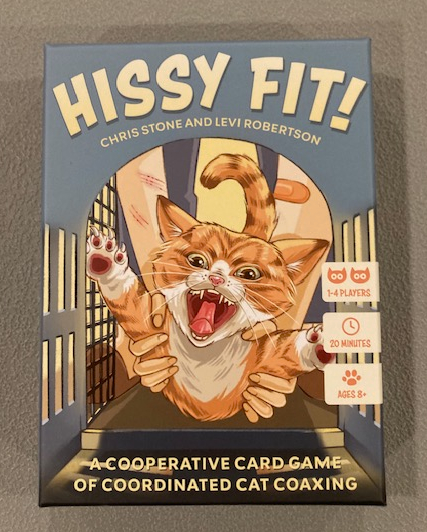
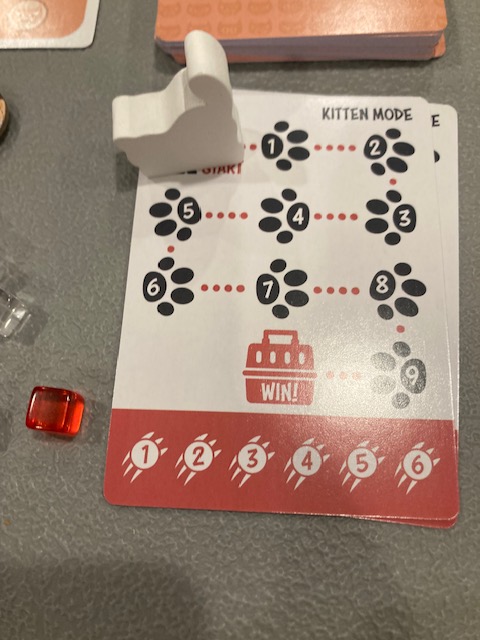
Hissy Fit! is a light little cooperative cat card game (20+ minutes) about trying to get your cat into its carrier!  Players move the kitty (above) along (using cards) until it reach the carrier!

IMG_3096

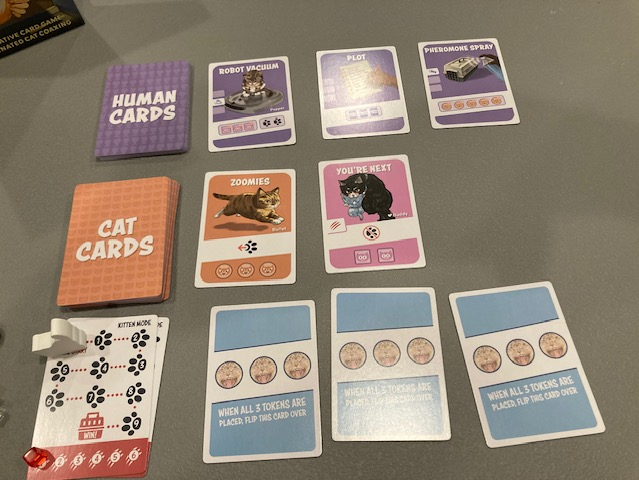
Players cooperatively play Human cards (purple) to try to keep the Cat Cards (orange) under control!  This is a light, quick game that really encourages cooperation with a simple follow mechanic (allowing other players to play cards even when it’s not their turn)!

IMG_3119

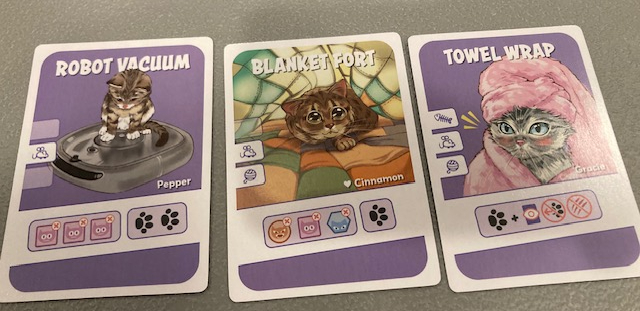
The art is absolutely adorable and is quite thematic!  The Towel Wrap keeps the cat from scratching you and from moving away!  The Robot Vaccuum moves the cat closer to the carrier!

IMG_3136

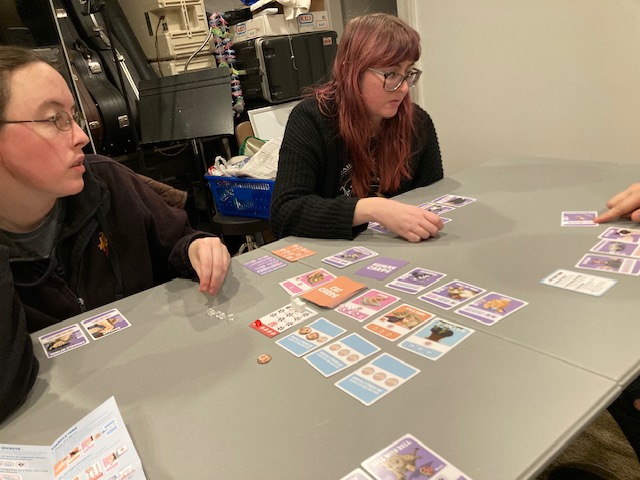
This game is light and adorable and quick and easy to teach: there is a very good chance this will make our Top 10 Cooperative Games of 2024! UPDATE! It did! See here!

Take a look at our review of Hissy Fit! to see if this is something you might enjoy!

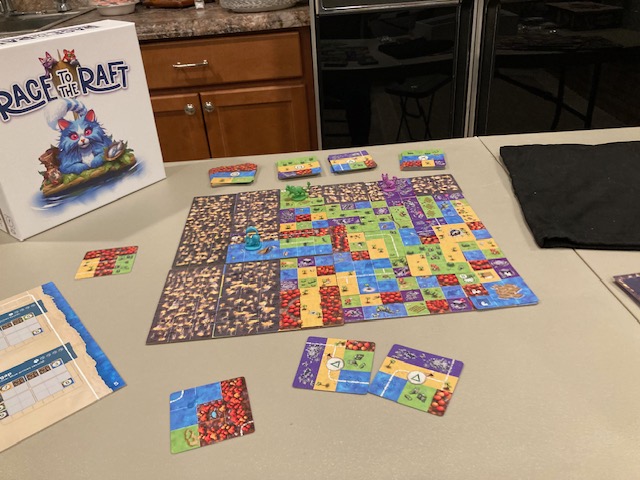
1. Race To The Raft
IMG_8571

Players: 1-4
Ages: 8+
Time: 40-60 Minutes
Supports Solo? Yes, with some changes to base game
Type: Cooperative Tile Placement Game

IMG_8772

Players need to work together to save the cats (see above) from the burning island (see below)!  They need to move the cats to the raft before the fire consumes the island!

IMG_8746

This cooperative tile-placement game has players making all sorts of choices cooperatively or solo: which cats to move, which tile stack to draw from, where you place a tile, where to place burning trees, when to move cats!  There so many great decisions in this game!  This was such a great surprise it made the #3 position on our Top 10 Cooperative Games of 2023!  Honestly, it should have been #1, but 2023 was such a strong year for cooperative games!

IMG_8697

See our review here of Race To The Raft to see if this cooperative tile-playing game is something you would enjoy! It’s probably the most complex game on this list, but it also has the most choice!

War Story: A Choose-Your-Own Adventure Game Where Choices Really Matter

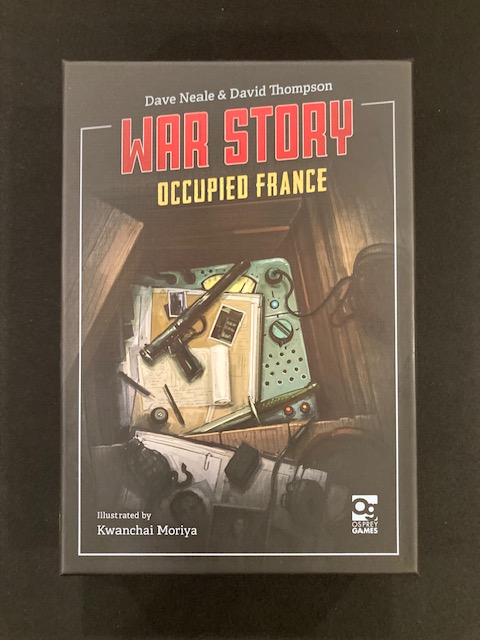
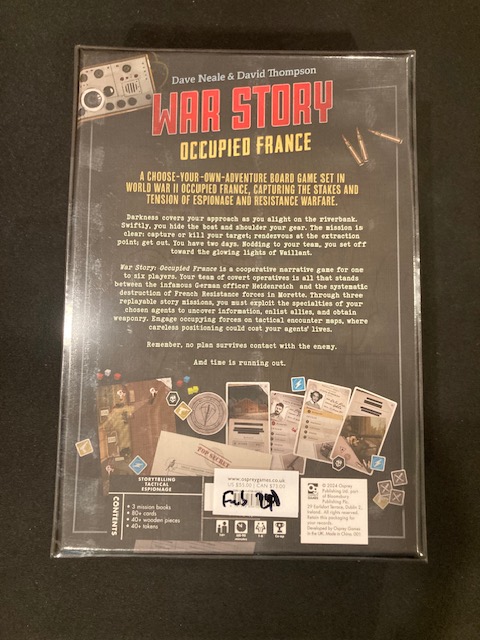
I pre-ordered War Story from GameNerdz on Oct 17th, 2024. I wanted to play it as soon as possible, so I went ahead and paid full shipping for it (I normally try to get to $75 or so to get free shipping); that’s how excited I was to get this! I paid for shipping to get it sent separately ASAP!

War Story arrived at my house on February 21, 2025 (I noted the date on the tab on the back).  Over about three days I played the entire campaign solo: one chapter a day for three days.  (This is a fully replayable campaign game, but you can also just play single chapters if you like).

What is War Story and why was I was I so excited to get it?  This is a Choose-Your-Own Adventure game set in World War II, but it is unique and different.

Let’s check it out!

Unboxing

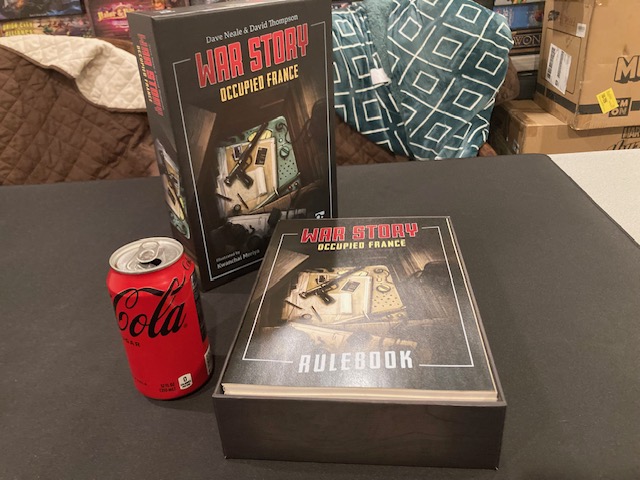
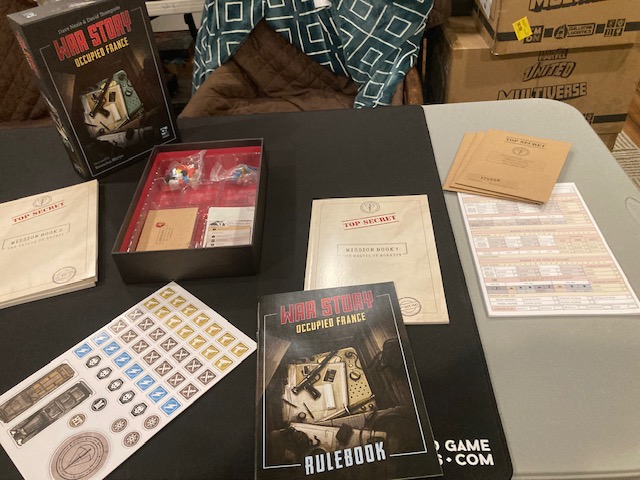
This is a smaller box (see Coke Can above for perspective) but it’s actually quite heavy; it’s brimming with books!

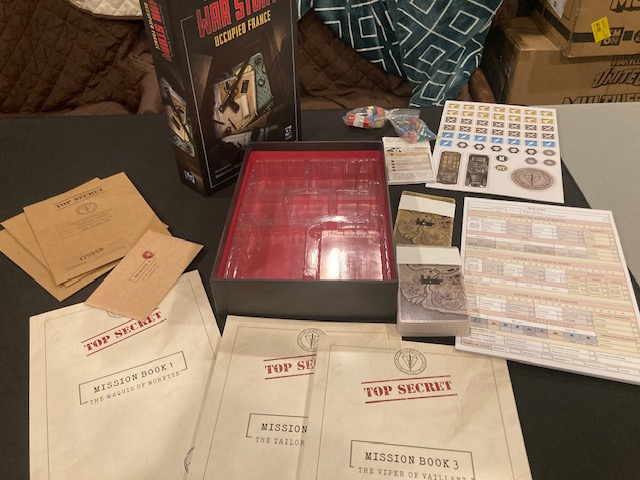
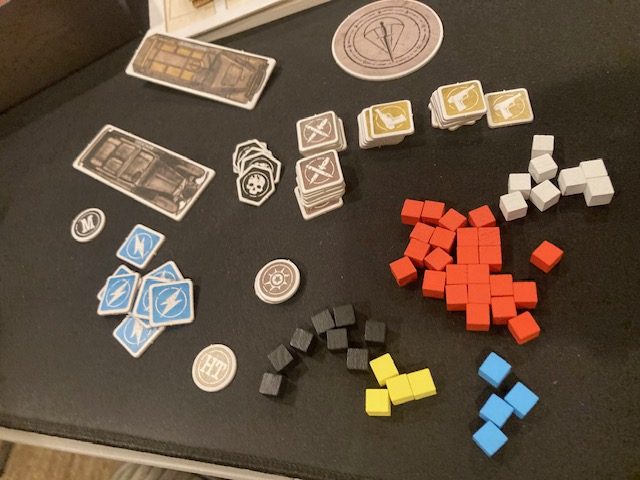
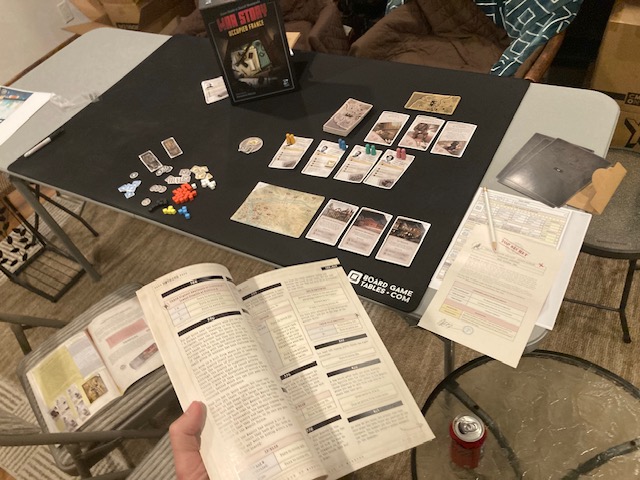
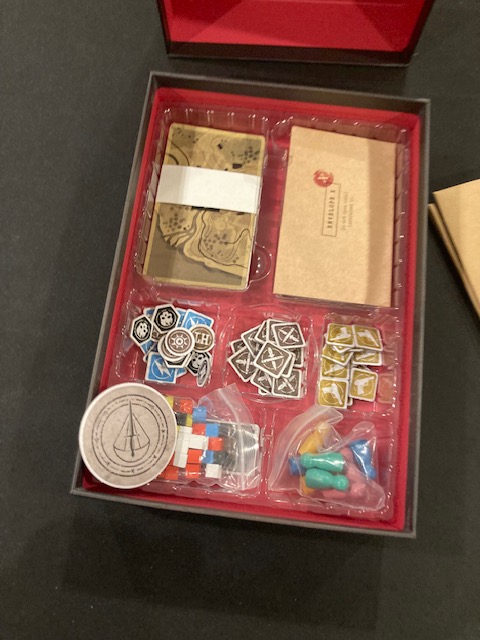
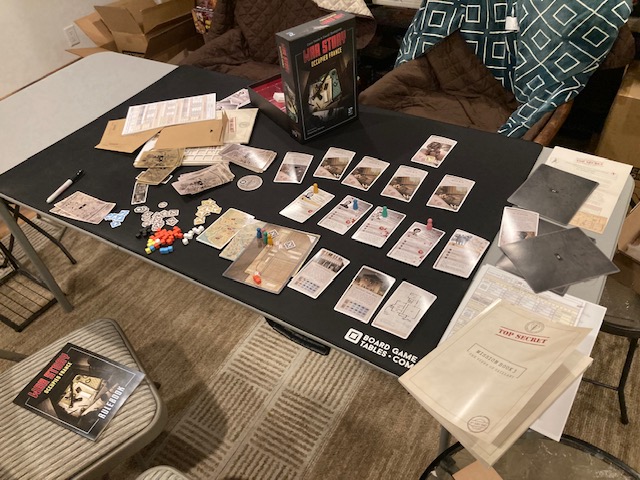
There’s thee Mission Books (see above), three big envelopes, one small envelope, a status pad, cards, and tokens. See above: there seems to be quite a bit in here for a Choose-Your-Own Adventure game!

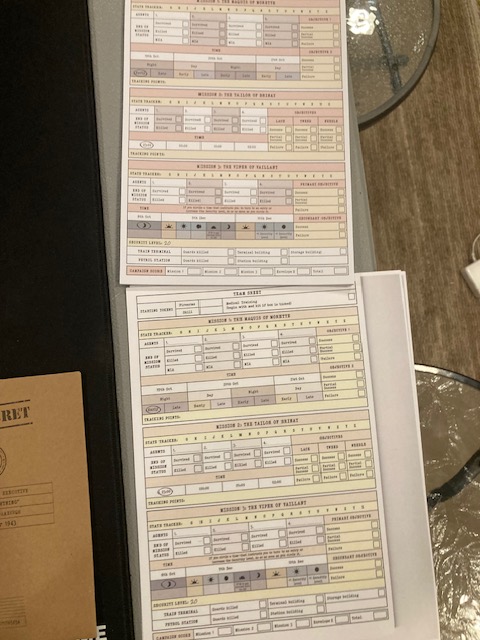
To preserve the longevity and replayability of the game, I went and made a few copies of the status sheets (see above).   See, even though this is a Choose-Your-Own Adventure game, it’s fairly replayable!   You need a status sheet for each game/campaign you play.

There’s a bunch of punchouts and tokens.  The cubes all have different uses that become clear as you play.  Spoiler: the orange cubes are the Nazis! (Although the are called red, they look more orange to me).

As you might guess from the components, there’s more to this game than first meets the eye.  Don’t be fooled by the Choose-Your-Own Adventure monicker: this is a pretty different game.

Rulebook

The rulebook is good.

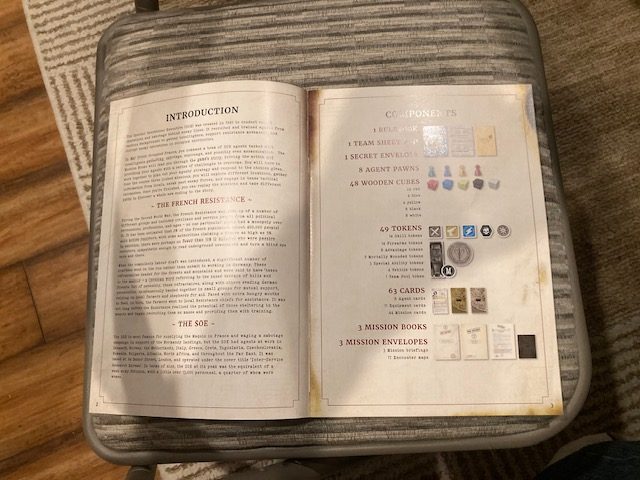
The rulebook gets an A on the Chair Test: it can sit wide open on the chair next to me, within easy view when I need to see it (which is weird because the Mission Book completely fails the Chair Test: see more discussion below); they really got the Rulebook form factor right.

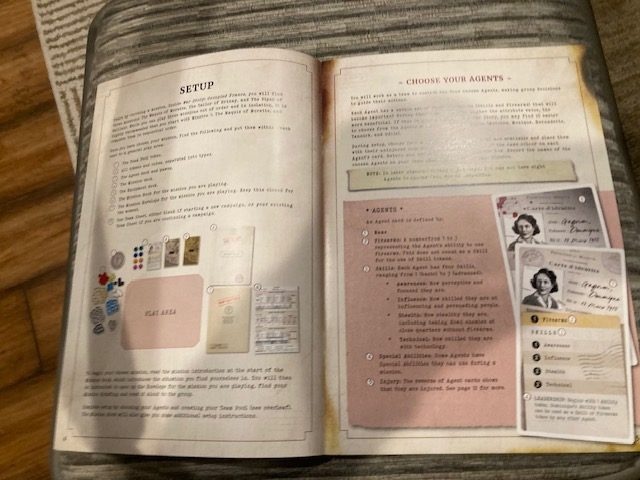
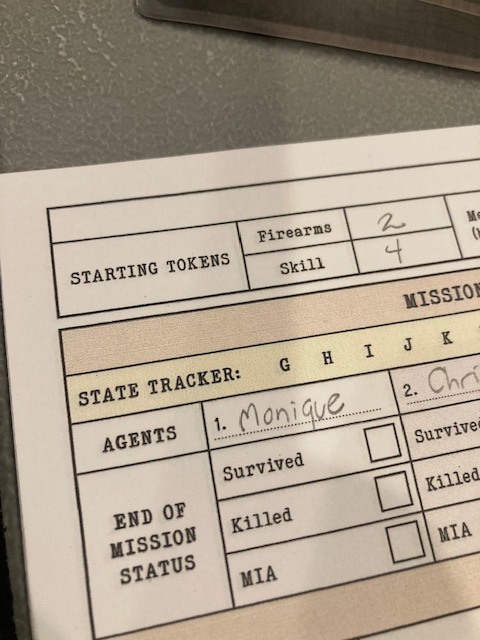
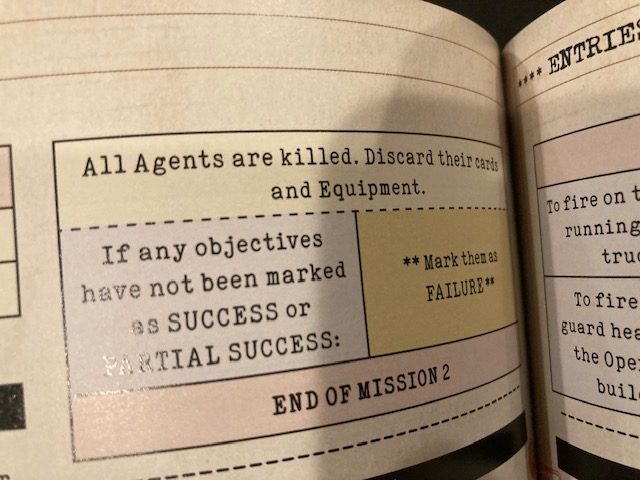
The Components and Set-Up pages are fine.  It’s a little confusing because the set-ups are intermingled between the mission books and the rulebooks, and there’s a few things that aren’t quite clear (unless you read closely): I had trouble finding where to setting the entry for starting tokens (at the top of the Status sheet).  Just be patient and I think everything reveals itself to you as you read.

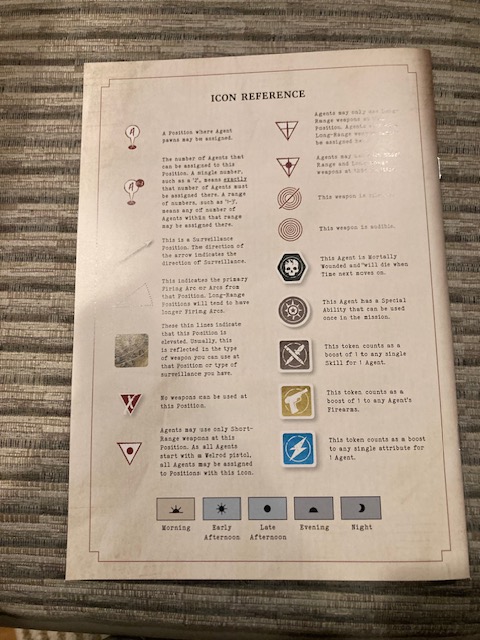
And the Rulebook ends with a nice summary of Icons. 

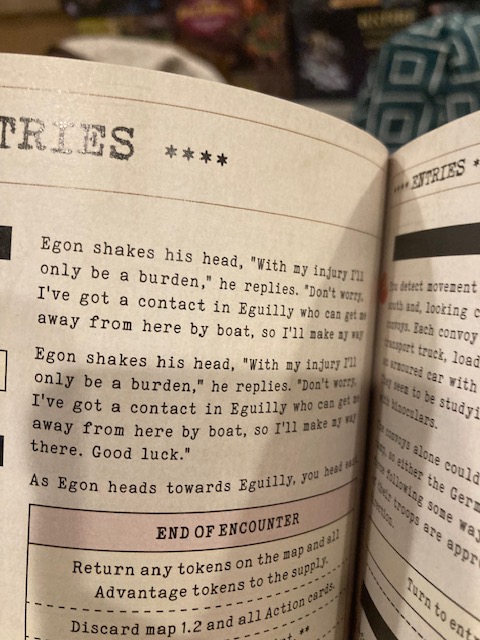
One quick note: I usually don’t like it when rulebooks use “thematic” fonts (this one uses a typewriter monospace font: see pictures above).  This thematic font doesn’t detract too much from reading the rules here, so I’ll give it a pass.

Good rulebook.

Gameplay

There’s a few minor minor spoilers in the pictures below, but they are from the first few minutes of the first mission, so they shouldn’t spoil too much.  Out of context, they aren’t much of a spoiler, but feel free to skip this section if you don’t want any surprise.

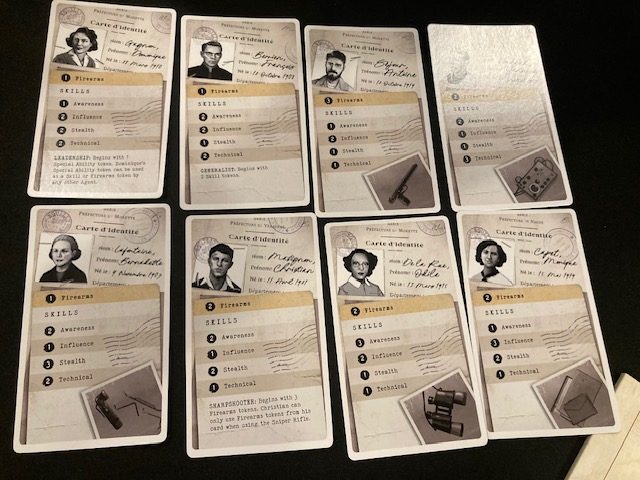
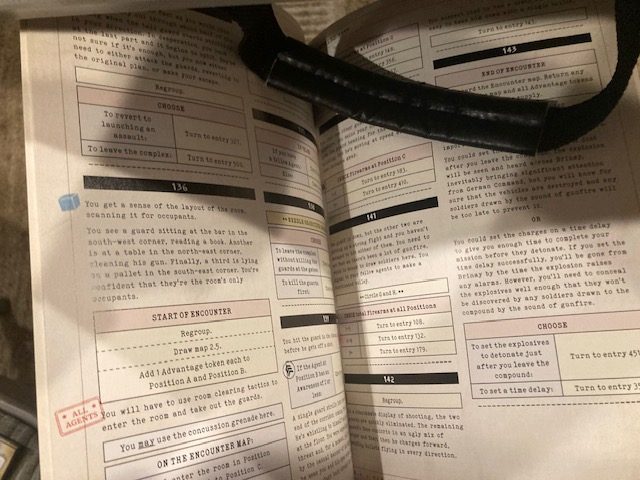
War Story nominally plays 1-6 players, but honestly it’s just a solo game where the other players just all help decisions together (kind of like Eila and Something Shiny: see review here).   The player(s) lead a group of 8 resistance fighters in France during World War II.  Your first choice in the game is to choose your crew of 4 for the first missions.

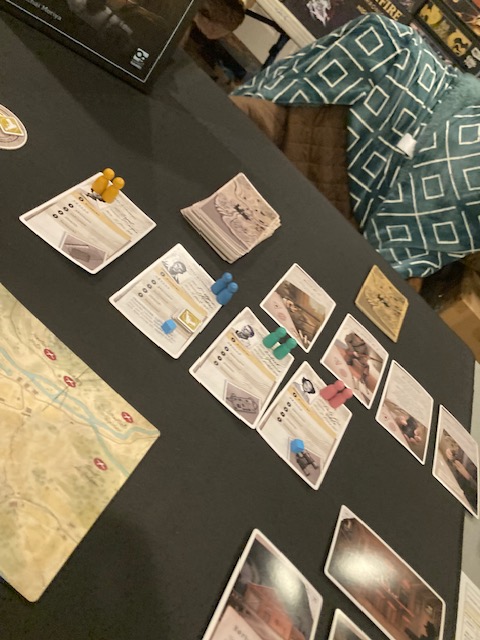
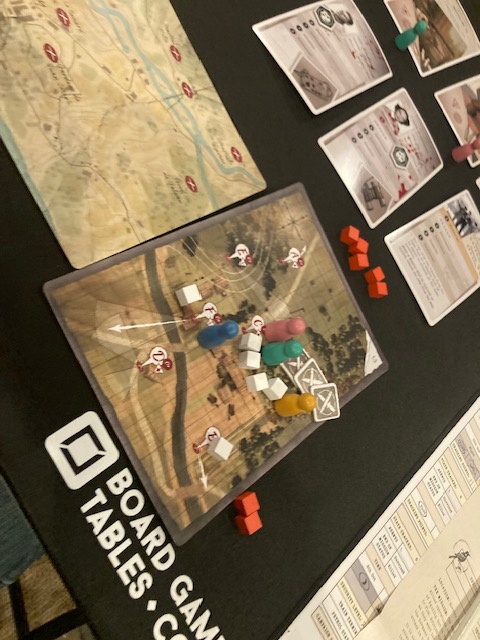
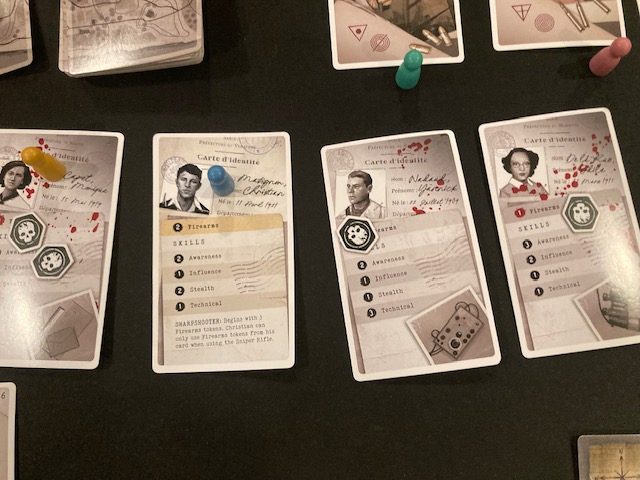
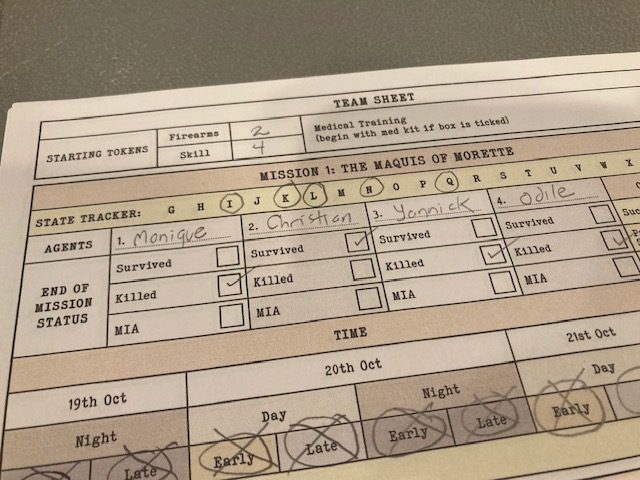
These 4 characters, whose names you must write down, will serve as your Agents during the missions.  You use the tokens to mark where the Agents act (there are 2: one to keep on the card for and one to move into the field; this way you remember which agent is which).

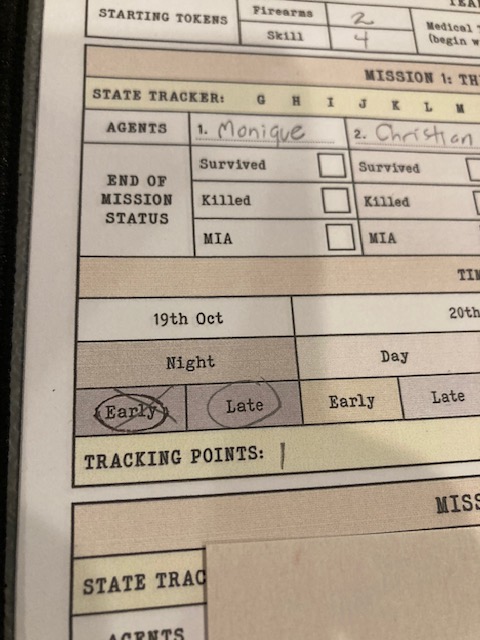
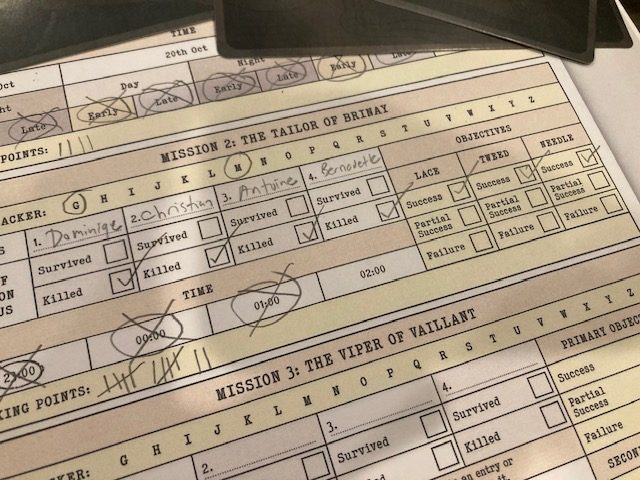
Your Status Sheet gives you a hint of what can happen to your Agents as you play: Survived, Killed, MIA.  See above.  If you think all your Agents are getting out alive, well, good luck to you.

And again, notice we wrote their names down.   I think it brings an emotional connection to the characters a little more than usual.

At this point, you open the first envelope and being reading the Mission Parameters!  See the Top Secret note above (too small to see anything unless you go zooming in, but that’s on you). See above!  This tells you what you need to do to “win” this mission!

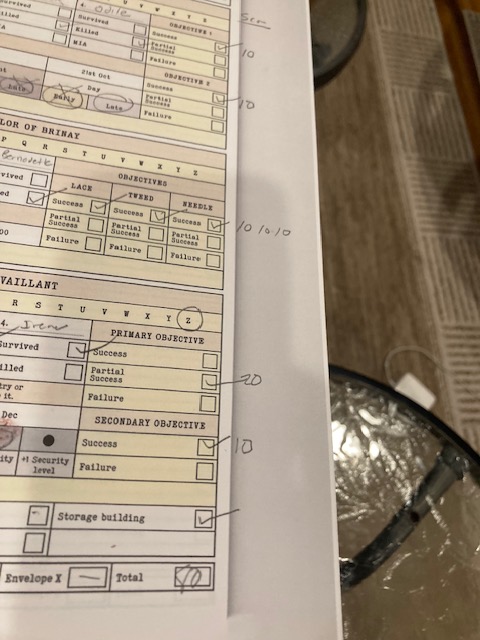
Off to the right of the Status sheet are marks for the Primary and Secondary Objective(s); did you succeed? Partially Succeed? Fail?  These will all influence your final score.  

From here on out, it’s all about making choices and reading from the Mission Book. (Mission Book page blurred on purpose).

As you read from the book, things will happen, you make choices turn to entry 17, make a choice, turn to entry 31, and so on.

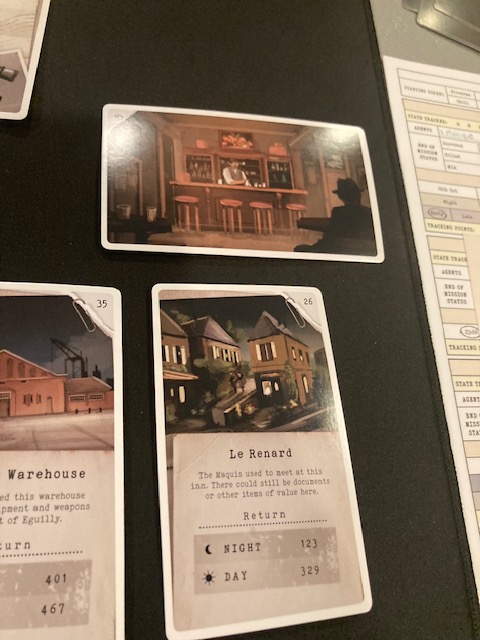
You have Locations you can visit as you start, and what entry you get in the rulebook depends on the time of day.

As the game unfolds, you will be told to “advance time” and move to the next time space (see As we move fro Early night to Late night).  What this means; what happens when you visit a location depends on the time of day.

It’s a Choose-Your-Own Adventure game!  Player read and choose, read and choose, read and choose … until it’s clear their chapter is up!

Combat

You will get into combat as you play, and combat will also be resolved using a Choose-Your-Own Adventure mechanism.  That’s right, your French Resistance fights the Nazis using a Choose-Your-Own Adventure mechanism!  “Do you shoot the guy coming right at you? Read section 12! Do you shoot the guy hiding in the bushes?  Read section 701!”

And let’s be clear, your Agents can die.

Death

Death is part of this game. You kill Nazi guards with your gun. You blow up Nazis with grenades. And your Agents will die. See above as Christian is the only survivor of Chapter 1. He definitely has some PTSD going.

Granted, you are generally “trying” to sneak around to achieve your objectives, and usually the sneakier you are, the better. But, combat will inevitably come up. And even it though it might seem weird at first to use Choose-Your-Own adventure books as a combat resolution mechanism, it does work. In some sense, you feel more vested in the combat as you are making hard decisions: “Do I shoot the guy coming at me because he is an immediate threat, or do I shoot the guy trying to come up behind me who might be an even worse later threat?” Somehow it feels more immediate.

So, combat will happen. People will die. Your Agents might die. Or you might have to put a bullet in the Nazi’s head. Be aware that death is at the forefront of this game. If that sounds too intense for you, then I suspect this game is not for you and you should just get out now.

Choices Matter

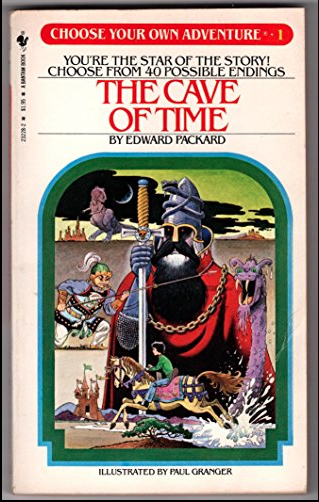
I know some of you (including myself) blanche a little when you hear Choose-Your-Own Adventure.  I still remember (40 years later?) how random my first Choose-Your-Own Adventure book was: The Cave of Time (see above).  What seemed like the right choice lead nowhere and the dumb choice led you to a cool adventure!  It didn’t seem like your choices mattered, you just “did stuff” and see what happened.  Choices didn’t “really” matter; you were just along for the ride.

That is very much NOT the case in War Story.  Of all the Choose-Your-Own Adventure games I have played, it feels like this is the one where the choices matter the most.

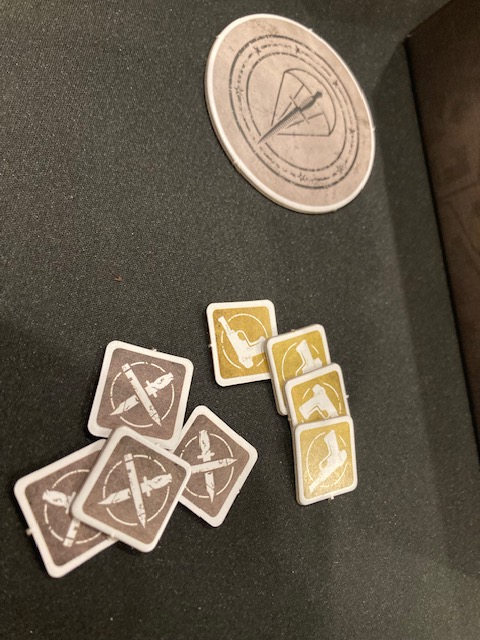
First of all, there are other choices in the game besides which entry you read. There will be Skill checks: “If your Sneak is 4+, read entry 12, else read entry 11″. You can choose to raise your Sneak by using Advantage tokens (either from a shared pool or sometimes a separate pool, depending on the Agent): see tokens above. You start with a limited amount of Advantage/Firearms tokens, and you have to choose when it’s best to choose a middling result or when you REALLY need an extraordinary success!!!

Second of all, as the progresses, the choices you made earlier WILL AFFECT your outcomes.  Did you let that Nazi survive?  Maybe that was a good choice, maybe that was a bad choice, but either way … it affects what happens to you later in the game!  See the State Tracker above for game 2 as Events G and M were circled.  Was it good I left that Nazi alive and showed mercy? Or not? Was that Event G?  I hope that doesn’t came back to bite me!!  And it might bite you, or it might help you.

Your choices matter here. They really matter.

Emotional

So, this game is pretty emotional.  You feel … close to the war, you feel close to the resistance, you feel close to death.  My second game of the campaign, all my Agents on the mission died.

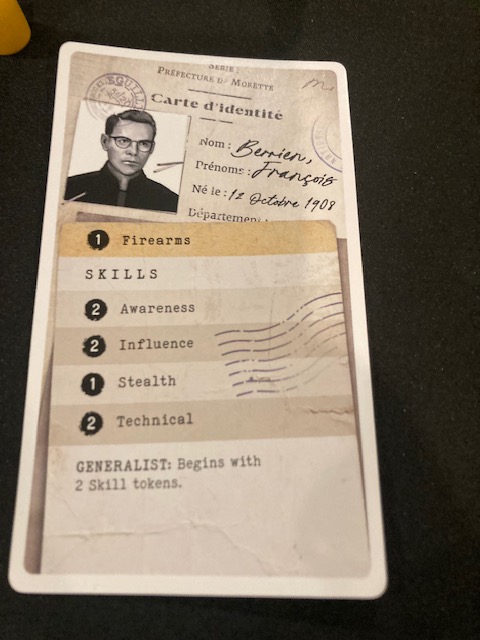
I was left with one Agent left (poor Francois) as I headed into Chapter 3.  How well could I do with one agent?  There was so much emotion as my entire squad died … and poor Francois was all that was left.

Over three nights I played through the story.  This game is pretty emotional. Be aware.  

Binding

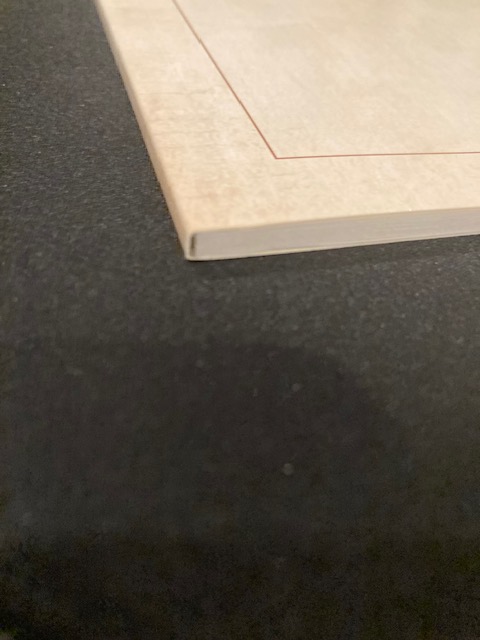
I need to say something about the binding on the Mission books:  I hate it.  War Story uses the thick glue binding for a large book.   This binding does NOT stay open; it is the worst choice for board games!

We had this same problem with the binding on the Freedom Five books from last year  (see review here), and the binding on the rulebook for the Forests of Admiron (see review here), and the binding on the Batman: Gotham City Chronicles Solo/Cooperative Expansion (see review here).  This type of binding does not lay flat.

You can’t hold these books open unless you completely counterfold the books!  (See above as I try to hold the Mission book open with a little leather thingee).  Even then, the books don’t really stay open!  It’s very frustrating!  If you “slip” and lose your place in the book, you lose the page you were on, as the book closes on you!!!  In my third chapter, I slipped a few times and had to literally replay the introduction three times so I could find where I left off!  It was very annoying and almost put me off the game.

This binding does not work.  Please, I beg you board game companies, don’t use this binding ever again!

I came in to play this game the first day I got it … I was so excited!!!  I saw the binding on the Mission books and I was immediately turned off.  In fact, I was so turned off by the binding, I went inside my house and did my Income Taxes.  The binding was so debilitating that I did my Taxes instead of playing this WONDERFUL game.  

Conclusion

And I don’t feel like I can say too much more, because I don’t want to give anything else away. I liked War Story! This is NOT the Choose-Your-Adventure books of yore, where nothing really matters: this is a Choose-Your-Own Adventure game where choices really matter! And you feel like you have choices!

Be aware that War Story is not for everyone: it’s gritty and people will die.  Nazis will die. Your Agents will die.  You will actively take part in the resistance and shoot Nazis in the head.  But this was the life of the French Resistance in World War II.  I think this game really captures the spirit and vibe of that time.  

I can’t give it a rating except to say you will probably know if you will like it based on the description in this review. I liked it, and I am glad I played it: It felt very emotional and really captured the vibe of World War II (I think; I wasn’t there). But I think you will know if this is for you or not.

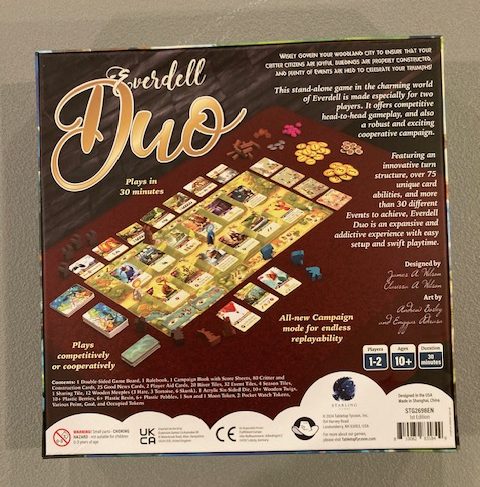
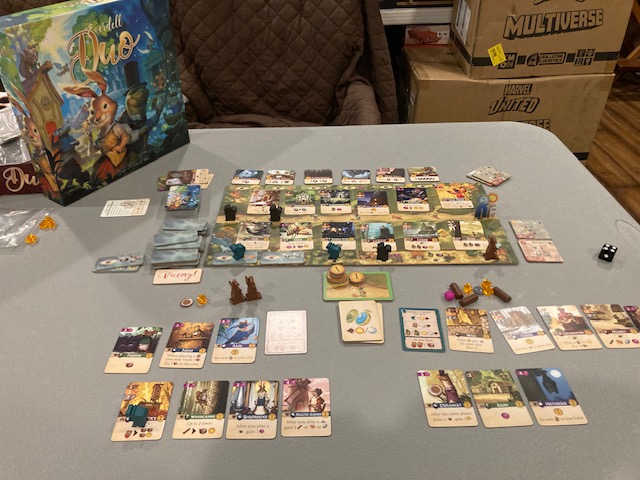
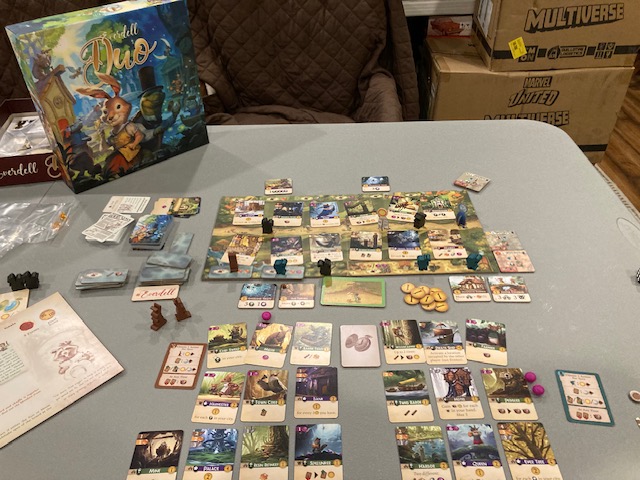
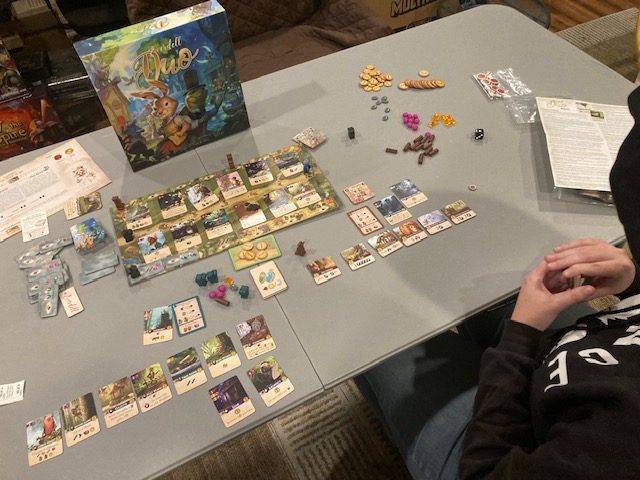
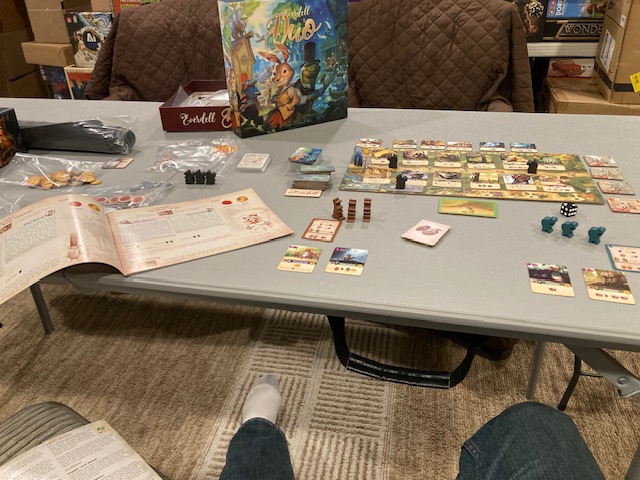
Over Hill Over Dale, Will Everdell: Duo Fail? A Review of the Solo and Cooperative Modes of Everdell: Duo

IMG_8763

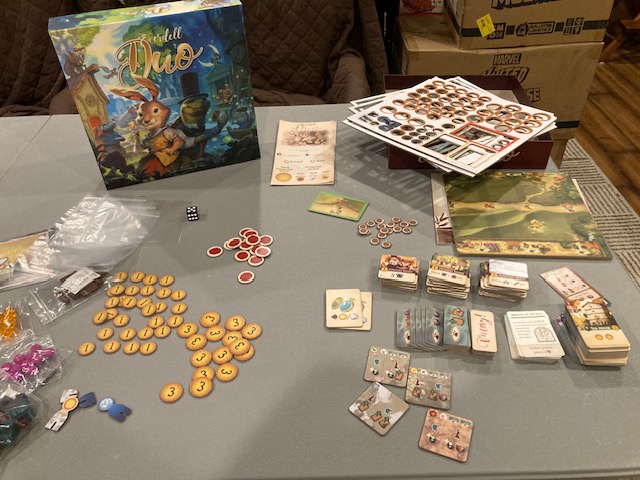
Everdell: Duo is a competitive or cooperative worker placement game for 1-2 players.  It was up on Kickstarter in Aug/Sept. 2024.  It promised delivery in March 2025, but it delivered to me on November 25th, 2024!  Yes, almost 4 months early!

IMG_8764

This is a worker placement game in the Everdell universe.  Strictly speaking, I have never played any of the Everdell games, but I was excited about the cooperative mode of this worker placement game!  It plays both solo and cooperatively with 2-Players!  We saw another cooperative worker placement game that went over quite well this year with Endeavour: Deep Sea.  Will Everdell: Duo find that same success?

Unboxing

IMG_8768

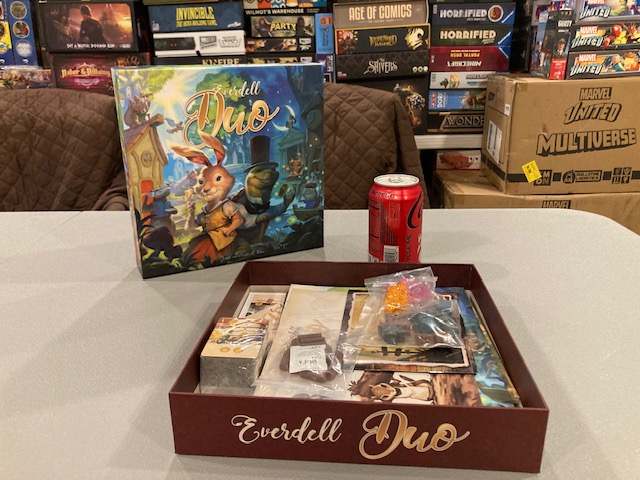
This is a smaller box: see Coke Can above for perspective. 

IMG_8865

I was slightly grumpy at the Kickstarter because they shipped it in a padded envelope, and my box got a little banged up!  See above.  There are some dents, and the top is squished a little, so it feels like I got a Ding-And-Dent day special for this.  So, I was already a little feisty when I opened this. 

IMG_8769

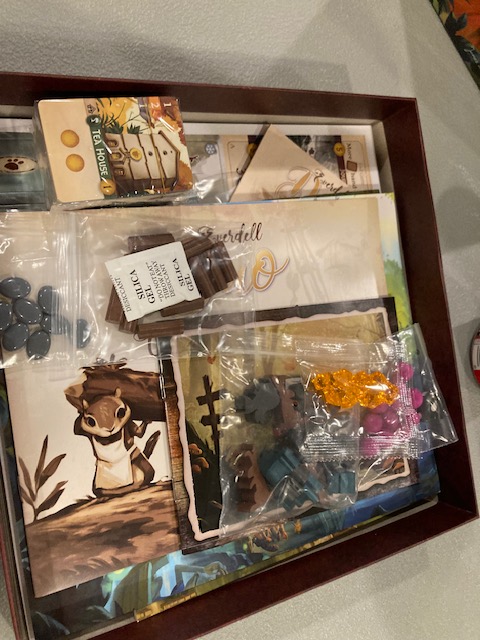
And there is really no insert to speak of.  Everything just flops around all willy-nilly in the box!

IMG_8773

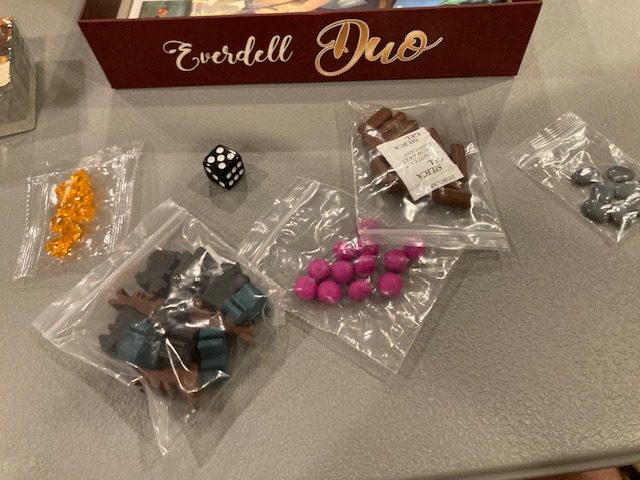
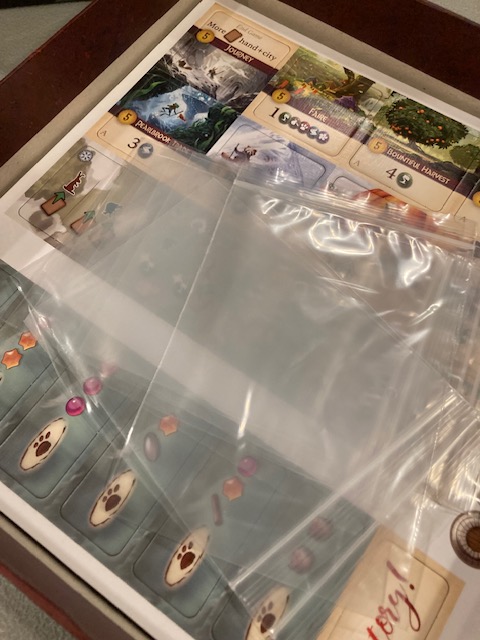
Luckily, they did include a lot of plastic bags (see above and below) so you organize it.

IMG_8792

IMG_8793

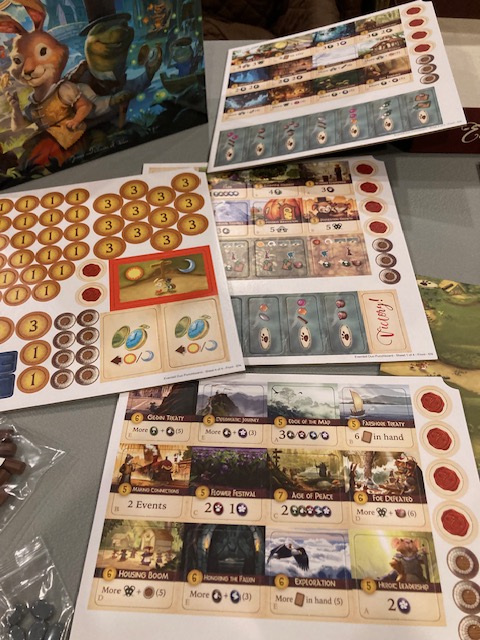
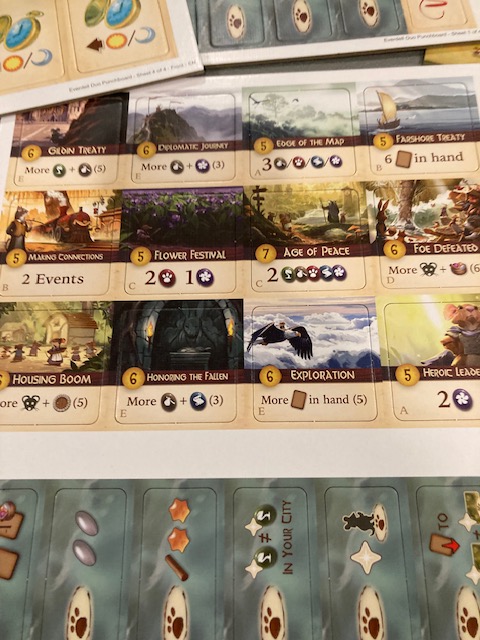
There’s 4 punchout sheets and the art is pretty groovy on them (see above and below).

IMG_8794

IMG_8803

Most of the game is on the cards; there’s quite a number of them.

IMG_8811

The game looks good: I love that Andrew Bosley art.  See above.

Rulebook 

IMG_8775

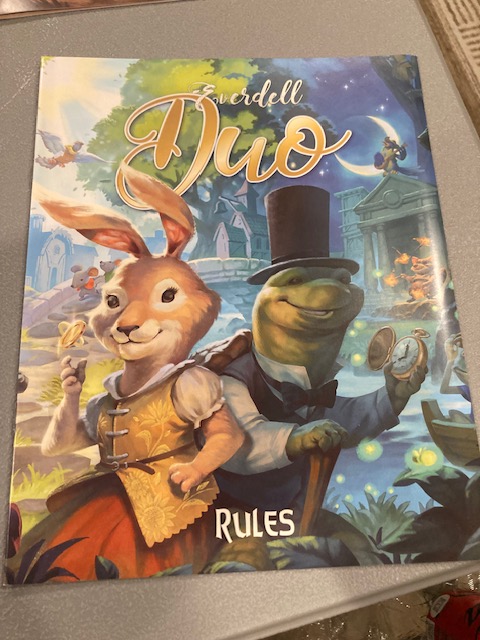
This rulebook is a mixed bag.

IMG_8776

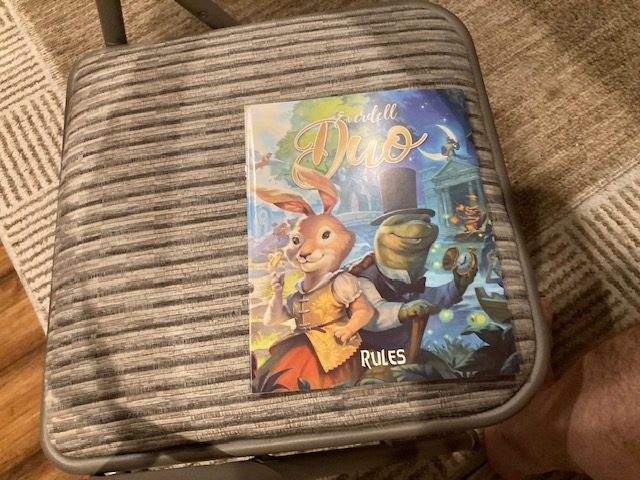
It passes the Chair Test with flying colors! It’s an A! It’s just the right size so that it can fold over perfectly!

IMG_8782

See above as the rulebook lays flat and fits perfectly; it’s so easy to read!

IMG_8777

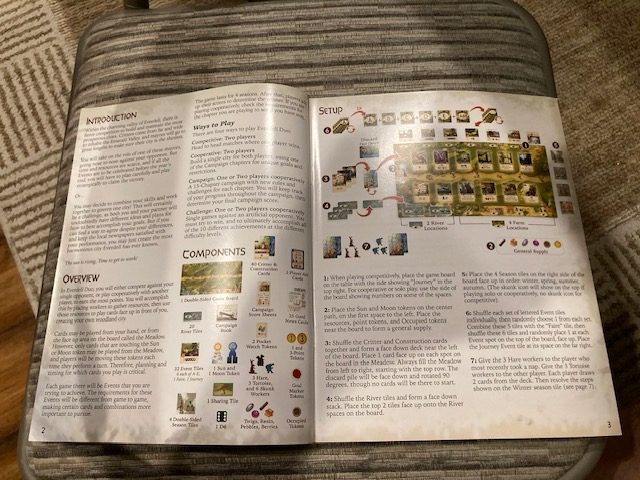
The Components list is pretty minimal (lower right of 2nd page, see above), but it works well enough.  The set-up takes up all of page 3, works, pretty well, and is decently notated.  So, things are starting off on a good note.

IMG_8778

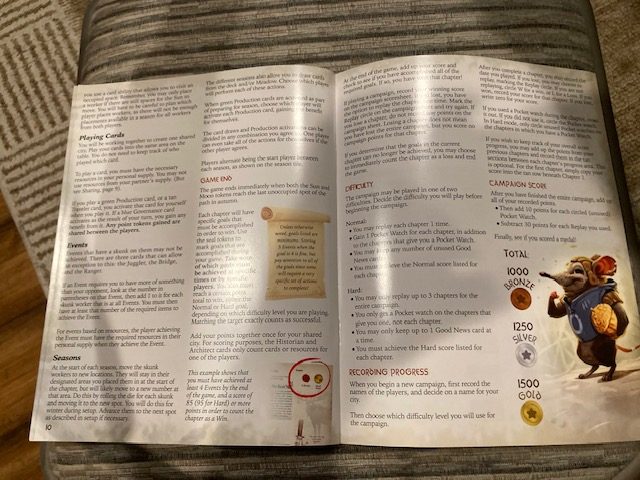
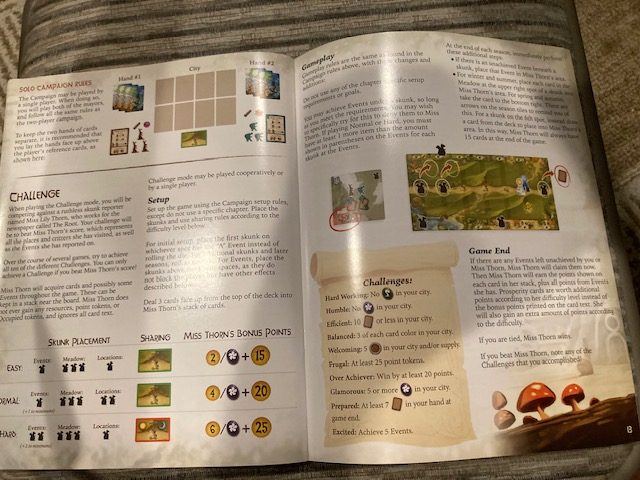
The Gameplay concentrates on the competitive mode, so the cooperative (and solo) mode take second fiddle a little bit.  For example, the rulebook fully lists/describes the Season card effects for competitive mode, but the cooperative mode Season effects (which are different enough to warrant some text) doesn’t get any explanation.  The game mechanisms are “generally” the same in either competitive or cooperative mode, but of course,  the players have to approach the game differently depending on the mode. 

IMG_8786

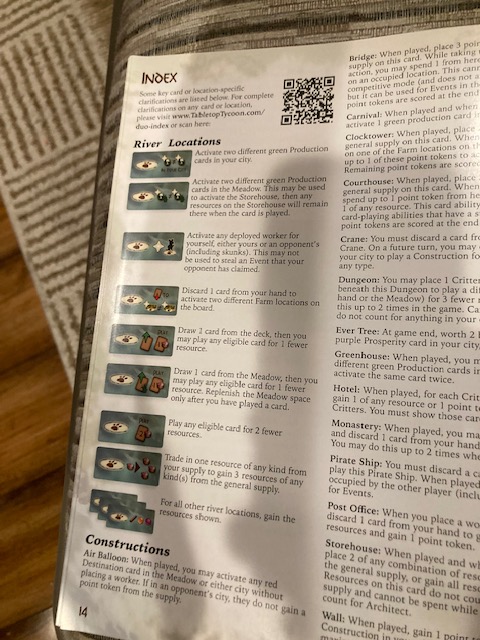
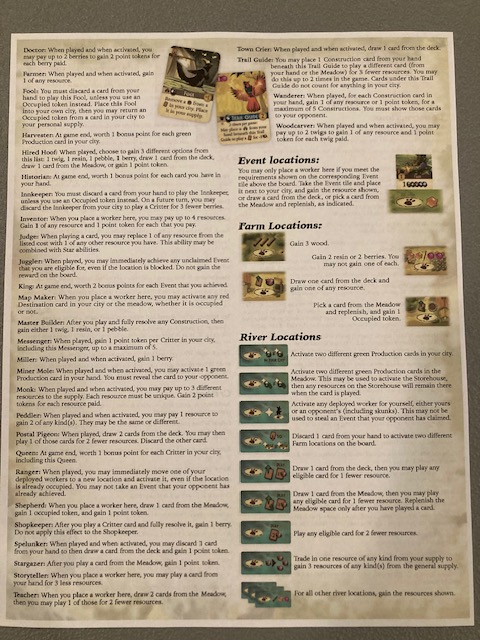
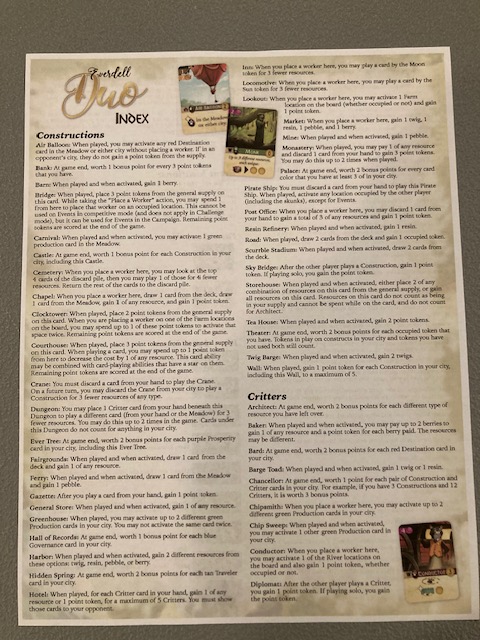
This also irked me:  they mislabelled the “Card Summary” as an Index! See above!!  An Index is a list of sorted “important” words, with page numbers following in a list: this is NOT an index!  This is a Summary!  Even worse, as a Summary, it’s incomplete!  You MUST print out the special sheet from the website to get all the rules.  I remember looking for the the Inn in the rulebook … it’s not there?

IMG_8850

IMG_8849

Ah, there it is … at the top of the page!  (NOT an Index).  Do yourself a favor, makes sure you print out a full copy of the (what they call) the Everdell Duo Index!  You need that to play or you will not be very unhappy.

IMG_8783

The rulebook taught the game, but I was constantly looking up stuff.  Also, there’s no real picture or great explanation of “town” or tableau.  I think you have to have played enough of these types of games to get that your “town” was the set of cards in front of you.  Again, this could have been clearer.

The rulebook taught the game.  Let’s just leave it at that.  Make sure you print out (what they call) the Everdell Duo Index, or you will be missing some important card descriptions!

Gameplay

IMG_8765

This is a worker placement game for 1-2 players.  You can play competitively or cooperatively (the solo mode is just the cooperative mode with one player operating both characters).

IMG_8830

There are always two characters in play: the Hare and the Tortoise.  See above as the Hare is on the left hand side, and the Tortoise on the right.

IMG_8821

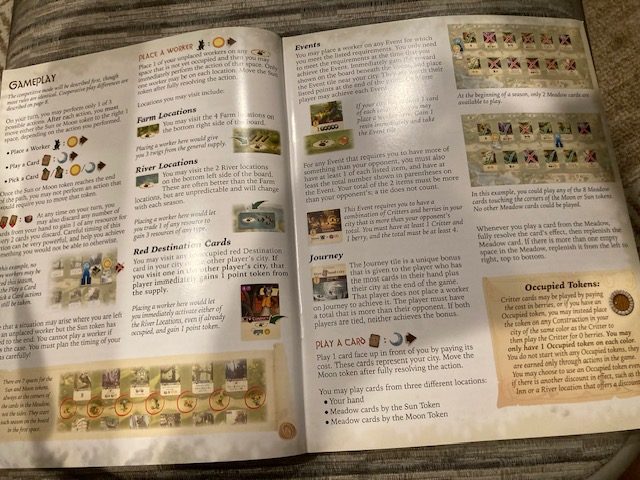
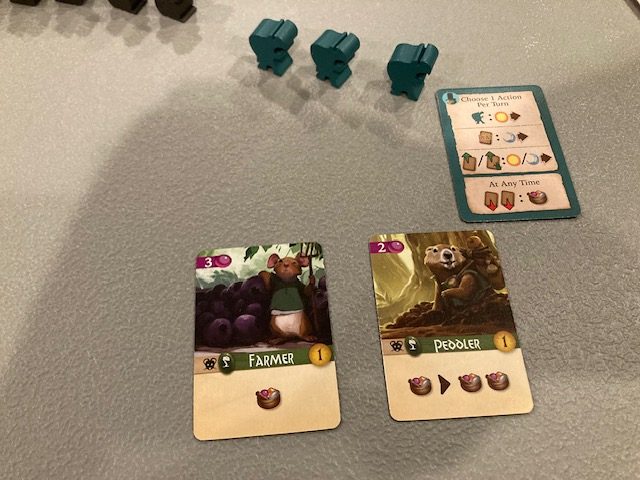
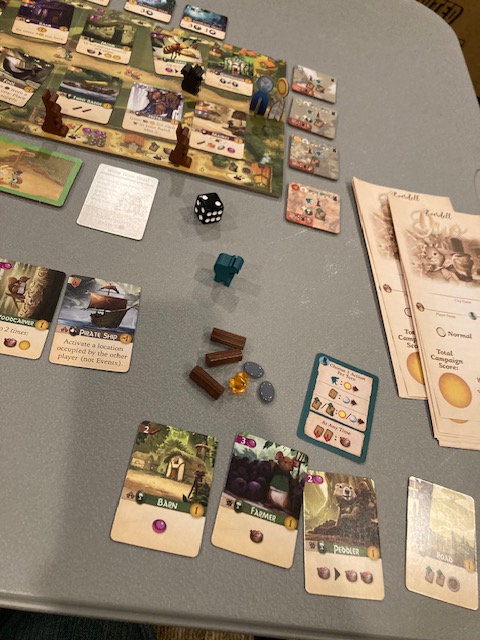
During the game players “usually” do one of two things on their turn; (1) place a worker placement token (see the 3 Tortoise tokens above) or (2) play a card from their hand into their “town” or tableau (see Farmer and Peddler as cards in their hand).

IMG_8789

The top and bottom of the board is the worker placement zones. 

IMG_8872

The bottom part of the board are spaces that basically give resources (wood, berries, resin, or stone) to a player.  See above. 

IMG_8871

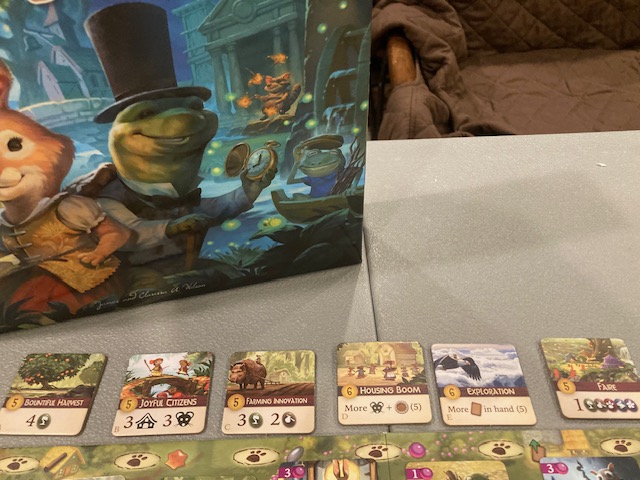
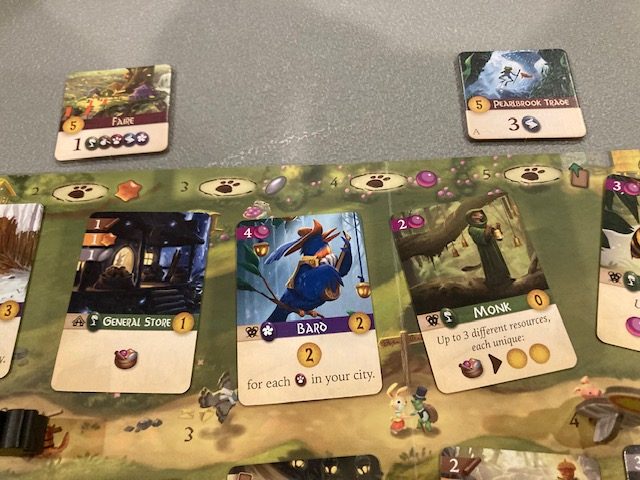
At the top of the board (accented by the big tiles) are the big rewards, but they have significant prerequisites.  The Bountiful Harvest (to the left) requires 4 green Production cards, but gives a whopping 5 victory points.

IMG_8827

This is generally a victory point game, even in the cooperative mode (but see more discussion below).  For the competitive games, players are competing to get the most victory points.  For the cooperative mode, players (at first at least) need a certain number of victory points as a group to win.

IMG_8835

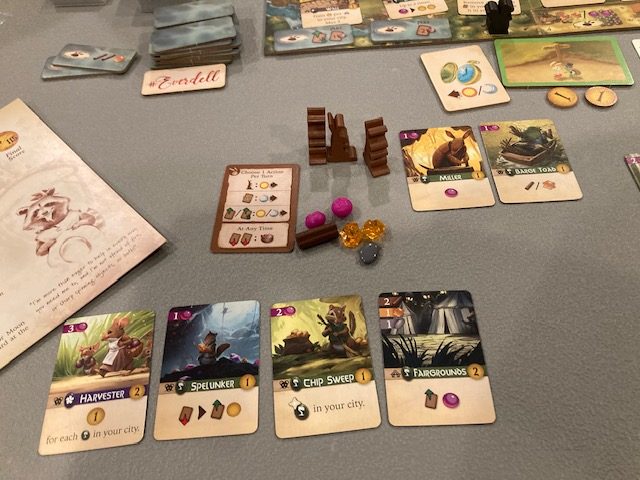
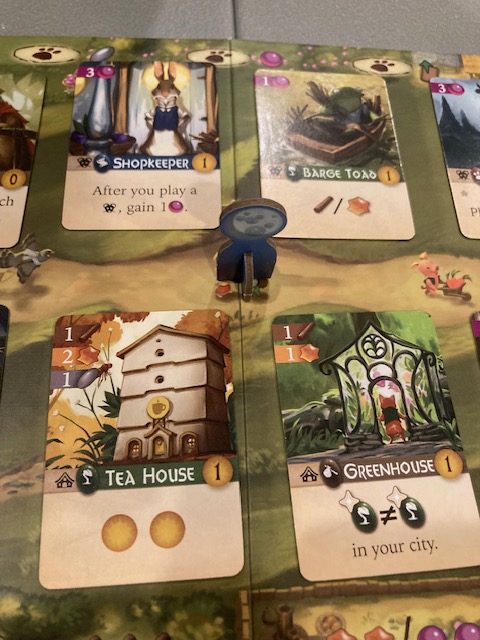
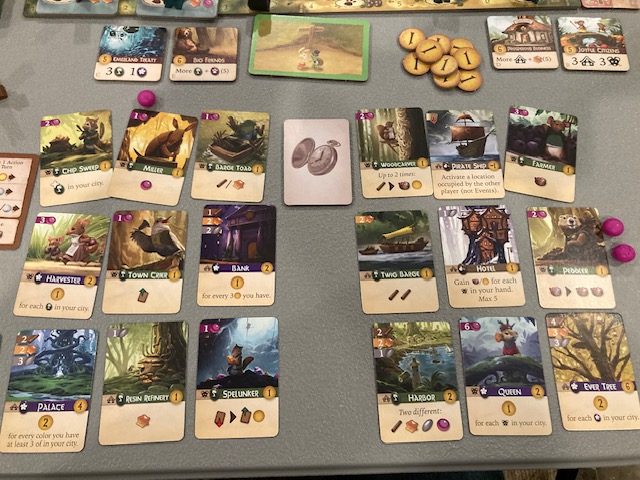
The second most common action is playing cards from your hand (or board) to your “town” or tableau.  It’s not clear from the instructions, but each character has a HAND of cards they can play on the board, and cards they HAVE played into their “town”.  See above as the Harvester, Spelunker, Chip Sweep, and Fairgrounds are in the Hare’s town (with Miller and Barge Toad in hand; they haven’t come out yet).

IMG_8802

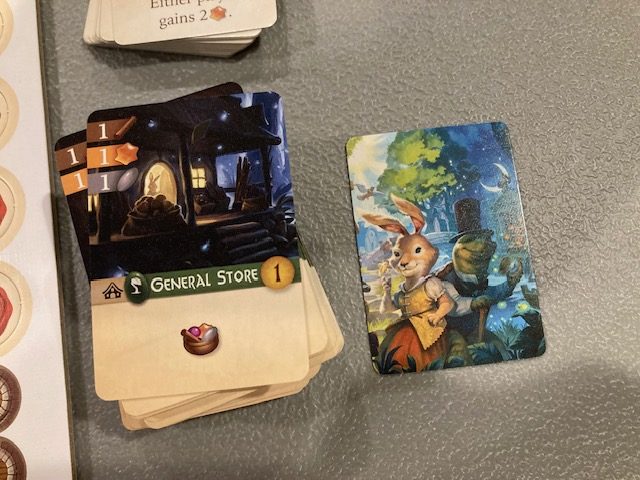
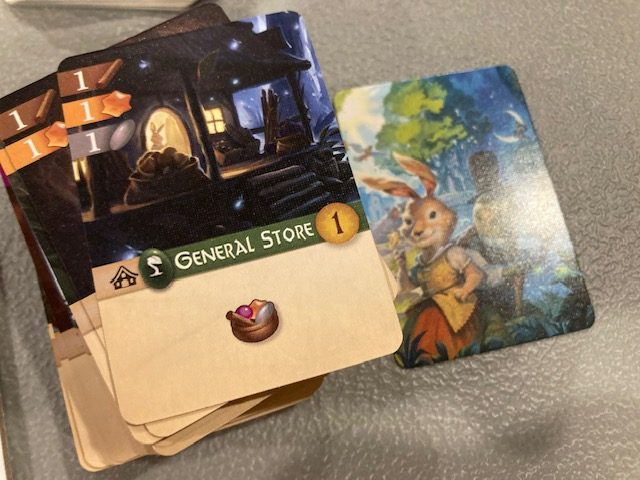
In order to play a card into your “town” or tableau, the player must pay the resources on the upper left of the card.  For the General Store (above), it’s one Wood, one Resin, and one Stone. If you don’t have the resources, you can’t play the card.

IMG_8840

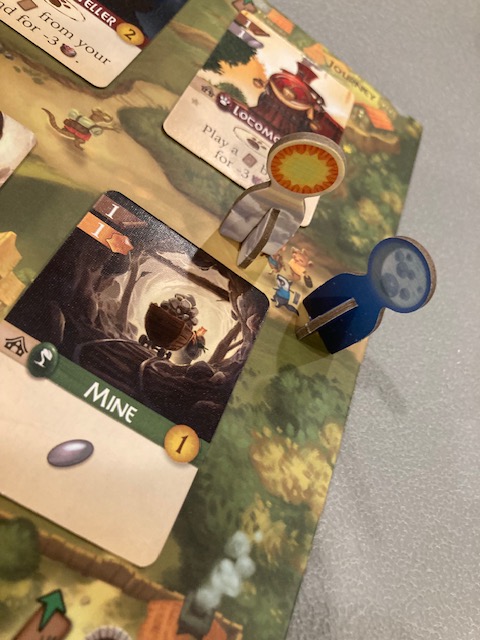
Interestingly, you can also play cards from the board (the Meadow) into your “town”!  It really depends on where the Sun and the Moon are!!

IMG_8869

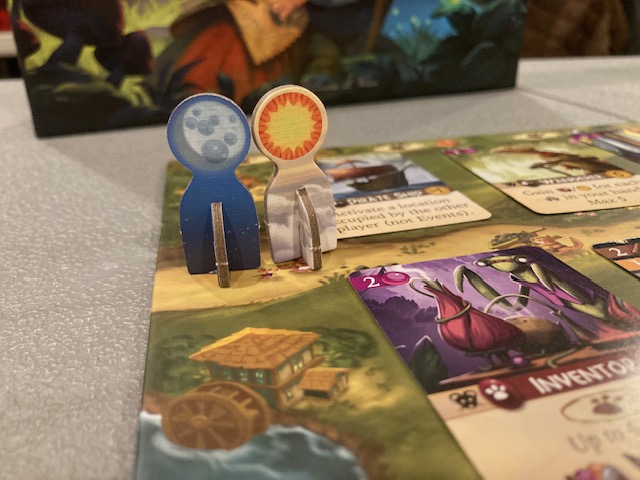
The Sun and Moon are tokens that move left to right on the board.  See above.  Once they have both reached the last space, that season is over!   There are 4 Seasons total: Winter, Spring, Summer, Autumn. Once all seasons are done, the game is over! Add up point to see who won!

IMG_8807

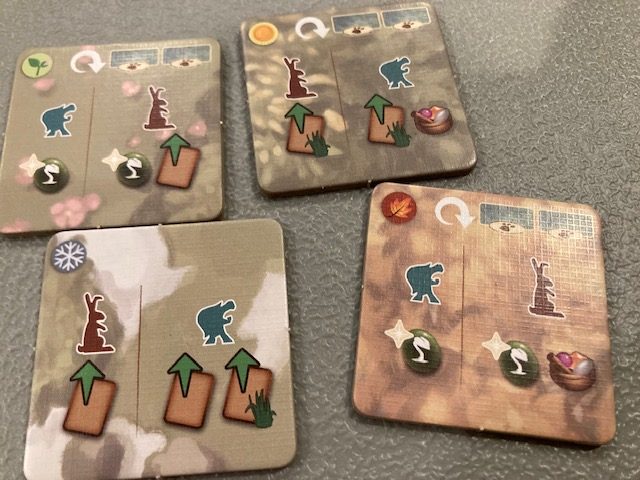
At the end of the season, each characters gets some special effects (draw a card from the meadow (the board), create resources from Green cards, get resources, etc).  The Season tiles above also specify who goes first!

IMG_8867

The Sun and Moon tokens add an unusual twist in the game.   The Sun token advances whenever any player plays a worker.  There are only 5-7 or so spaces for the sun (depending on the mode, campaign, etc), so that means that maybe a limited number of worker placement actions total; someone may likely get screwed out of a worker placement action!

IMG_8868

The Moon token advances whenever anyone buys a card from the board or their hand.  See above; if a character buys, they can instead buy any of the 4 adjacent cards to the moon!  That’s kind of different and interesting!

IMG_8847

The game is all about trying to get the right resources to get the right cards to get the right combos to get the most victory points!

Solo Play

IMG_8766

There are two solo modes (Congratulations on following Saunders’ Law)! One of two solo mode for this game is playing the cooperative mode (2-Player only), except that the solo player plays both the Hare and the Tortoise; this is the Campaign solo mode.   For 4 seasons, the solo player alternates between the Hare and Tortoise until the Sun and Moon reach the end of the track … then head to the next season!

IMG_8837

The solo mode (really, the two-handed cooperative mode) is, at least in the beginning, a victory point game.  The sum of the victory points of the Hare and the Tortoise need to exceed some threshold!

IMG_8825

The cooperative mode is really is actually a campaign (sort of) of 15 ever harder chapters!  The first  game of the campaign (see above) is a simple start: get at least 85 Victory Points collectively and also get at least 4 Events (the big rewards)!  Luckily, you can play any campaign chapter you want as a one-shot: this is both Boon and Bane!  It’s Boon because you can play any of the 15 chapters of the campaign at any time, but it’s Bane because there’s really NO levelling up in this game.  It’s not really a campaign in the sense “your character gets better”; it’s just 15 scenarios that get harder.

IMG_8827

What’s different about the Campaign solo/co-op mode is that there are SKUNKS blocking certain locations on the board!  See above as two SKUNKS blocks two spots on the Sun/Moon path (thus reducing the number of actions) and one SKUNK on the Worker Placement part of the bottom (this blocking one action).  This is how the game “simulates” blocking; every turn the players roll the die and move the SKUNKS to block spaces. 

IMG_8843

I have to admit I struggled a little with the randomness of this game at first.  The cards in your hand or meadow are ENTIRELY random every game, and where the SKUNKS end up is ENTIRELY random.   I was very afraid I wouldn’t like the game because of this.  But, I think after getting through a bunch of games and getting the flow of the game, there always seemed to be ways to mitigate that randomness.  You can always top-deck a new card, you can usually play a card out of your hand if you can’t play from the Meadow, you can always choose to draw any card from the meadow, and you can always find SOME worker placement action to help you, even if it wasn’t exactly what you wanted.   Basically, you have to be able to pivot.   The game is more tactical than strategic, as you react to the current set-up of the game.

IMG_8839

But, this Campaign solo/co-op mode is much more strategic; since you can work together (with yourself as the Tortoise and Hare) and plan together, your actions be more far-reaching!  

Note there is a Challenge solo/co-op mode in the game where you play against an AI opponent. I feel like, with the rules as they are,  the Challenge mode is a much more tactical game.   I strongly prefer the Campaign solo/co-op mode, as it feels like you can mitigate the randomness of the game much more by having the Tortoise and Hare collaborate.

IMG_8833 

There are two related issues I want to discuss more below.  But for now, let me say that I do like the solo 2-handed Campaign mode as it’s more strategic.  The Challenge mode was less to to my liking, as it felt more tactical.

And for solo mode, I completely ignored the Limited Communication rules; It makes sense to ignore this in the solo mode (of course you can communicate with yourself).   More discussion below.

Cooperative Play

IMG_8851

Even after three solo games, I was still getting a few rules wrong.  As Teresa and I headed into a cooperative game (the campaign mode, not Challenge mode), she was the Hare and I was the Tortoise playing Chapter 1 of the Campaign.

IMG_8854

There are rules for Communications Restrictions … which we completely ignored.  There are some restrictions on what you can communicate: “You may not tell your partner which cards you have in your hand, but you may tell them what color and types (Critter or Construction) you have, and what resources you want”.  We generally adhered to these rules, but that’s because we respect each others space.   Sometimes we would share a little more, but that made the game more engaging: “Ugh! I am struggling! I can’t do anything, how can I help you?”   I understand why cooperative games like this have Communications Restrictions:  they don’t want the game ruined by The Alpha Player (a player who tells everyone what to do!).  If you are playing Everdell: Duo with a person you trust and respect, these rules are insulting and take away from the enjoyment of the game.  I prefer to encourage working with my friends rather than hamstringing them with arbitrary Communications Limitations. 

IMG_8852

That got more preachy than I wanted, but the game still seems to work even in you ignore the Communications Limitations. And it’s more fun.

IMG_8852

Over one night, Teresa and I played and lost our first game. Then, Teresa liked the game so much, she wanted to play again!!

And we lost the second game too.  But we had fun playing!

Sharing

IMG_8826

With the gameplay description I have given above, this game sounds very much multiplayer solitaire. And it mostly is, except for two things.  First of all, there is a “share” space!  At the end of every turn, each character can decide to share a single thing and put it on the tile above!  That thing can be a card, a resource, or an Occupied token.  

IMG_8780

Interestingly, different Chapters of the Campaign turn on/off this sharing space, or reduce its scope (so you can only use it in the middle).  I noticed that I didn’t win a solo game until I actively started using the Sharing space.  It’s there for a reason, as it does encourage cooperation and strategy!

It might seem, other than the Sharing space, this game is just multiplayer solitaire.  After all, each player just tries to do they best they can on their turn, right?   I think, after several plays, I would say that is not true!  Because of the Sun/Moon move mechanism, each Season is restricted by how many worker placement and card buys characters can do—in order to get a full robust turn, the players must discuss the best play to enact a plan to make best use of the Season!  And that makes the game very cooperative!

What I Liked

IMG_8767

The Components and Art:  The art of Andrew Bosley permeates this game, and it’s very striking.  The game is gorgeous and cute, and it looks nice on the table.

IMG_8817

Cooperative Worker Placement:  The cooperative worker placement works very well in this game.  Everdell: Duo uses the SKUNKS to help block spaces, and with the characters collaborating, this works far better than I expected it to!

IMG_8851

Duo: I really like playing this as a cooperative 2-Player game (in Campaign mode).  It seemed to work really well.  Of course, the solo mode was great too … because it is the same mode!

What I Didn’t Like

IMG_8787

The Rulebook:  There were some great things about the rulebook, and some not so great things.  I think this rulebook needs one more pass by an editor.  In the end, I was able to learn the game from it, but it seemed harder than it should have …maybe it’s because I never played the original Everdell?  Maybe they expected me to know more about the game?

IMG_8827

Randomness: I was worried about the randomness of the game; between the SKUNKS positions being decided by die rolls and the pure randomness of the Meadow, I was very worried the game might feel like too much. I will say, after playing a whole bunch of games solo and cooperatively, I haven’t seen this be a problem. I still worry about it.

Conclusion

IMG_8842

Everdell: Duo worked for me as a solo game and for my friend as a 2-Player cooperative game.  The Campaign mode (misnamed, because no state changes between games) offers lots of replayability for the future.  Although there is a Challenge solo/co-op mode, I feel like the Campaign is the better mode, as it allows the players to be more strategic in a game that is fairly tactical overall.  

IMG_8855

The games are  fairly short, but they offer a lot of interesting choices.  We found that, even if we lost, we wanted play again!  This was a testament to how much fun the game was.

IMG_8828

If I were to suggest one major revision, I would eliminate the Communication Restrictions.  Just let me and my friend have fun and play how we want; I play games with my friend because I want to work with them and cooperate.  Restricting the Communication takes too much away from the cooperation, to the point of being less fun.

IMG_8764

Overall, this is probably a 7.5 from both me and Teresa. It’s easy to pull out and play either solo or cooperatively, it’s gorgeous on the table, and it’s very cute. 

A Fashionable Cooperative Space Game! A Review of Conquest Princess

IMG_8548

Hear me out; this game is better than it looks. I know, I know, I don’t love that cover either, but once you get inside, this game really does come alive.
IMG_8378

Conquest Princess is a cooperative bag-building game with elements of boss-battling and collection.  This game was on Gamefound back in June 2023.  It had a fairly small pledge group of about 668 people but it did succeed in being funded.  I went all in!  I got the base box, plus the mat, plus the acrylic tokens, and the bags!
IMG_8381

If I were to describe this game to you, I would describe it as The Captain is Dead (which is a cooperative space game we reviewed here, here, and here) meets a bag-builder like Invincible (a cooperative bag-builder we reviewed here).  

Let’s take a look!

Extra Specials

IMG_8378

I am very pleased I went all-in on this; I got some pretty great stuff.  Normally, I worry that a game with such a small crowdfunding presence won’t have great all-in stuff, but boy was I pleasantly surprised!  I am SO PLEASED with the extras!
IMG_8384

This is a bag-building game, remember?
IMG_8385

This upgraded “extra” bag is fantastic! 
IMG_8459

It can even stand-up on its own! See above!
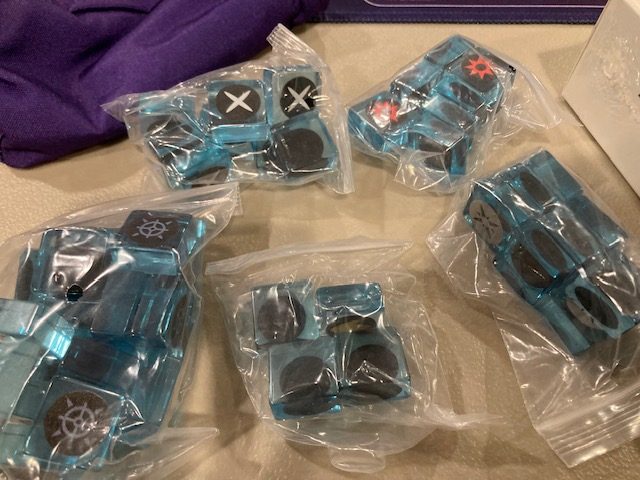
IMG_8388

And the acrylic tiles that come with it are gorgeous! Bag of Destiny: totally worth it.
IMG_8389

Standees of Utmost Elegance?  Very good!  Anyone who know follows this blogs knows that I love the acrylic standees, even over miniatures! The acrylic standees from Tokyo Sidekick (see here) and from Kinfire Chronicles (see here) have convinced me that I prefer the acrylic standees!
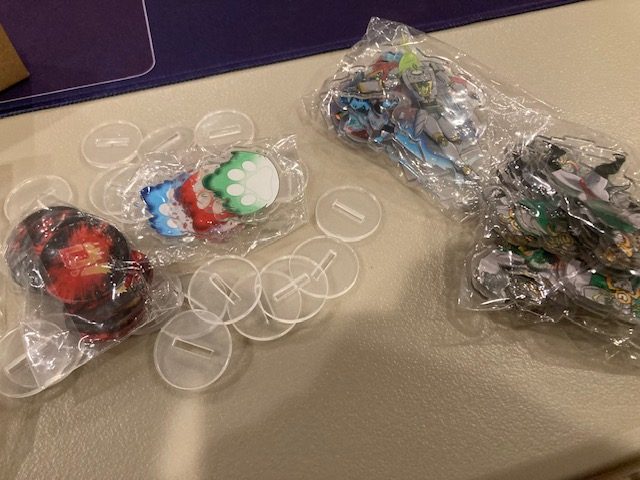
IMG_8392

The Standees of Utmost Elegance box comes with a bunch of standees (right), bases (middle) and some acrylic danger tokens (left): see above.
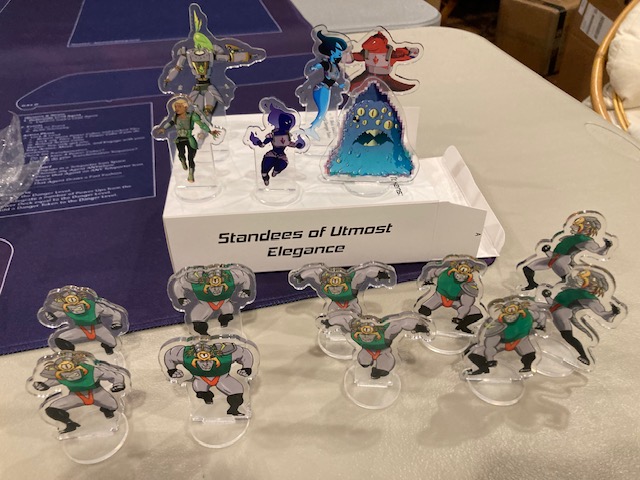
IMG_8396

All assembled, those look pretty great! See above!  The art is a little cartoony, but I think that’s why the clear acrylic standees work so well in this game; they accent that comicy nature!  I am very very happy with The Standees of Utmost Elegance!  I wish the art was just a touch nicer, but I still liked it.
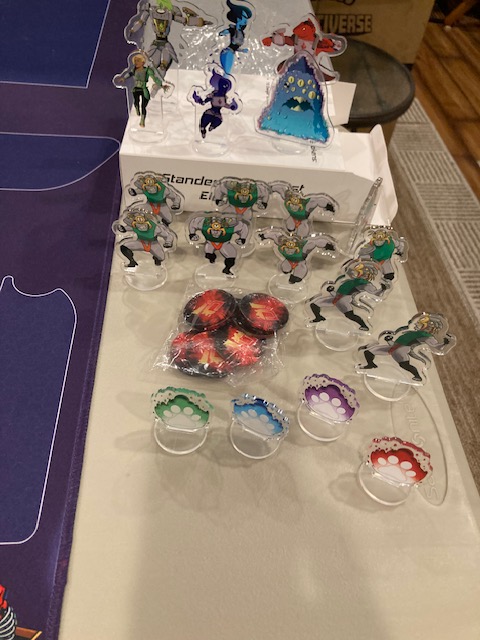
IMG_8402

Look at all that great acrylic standee stuff!
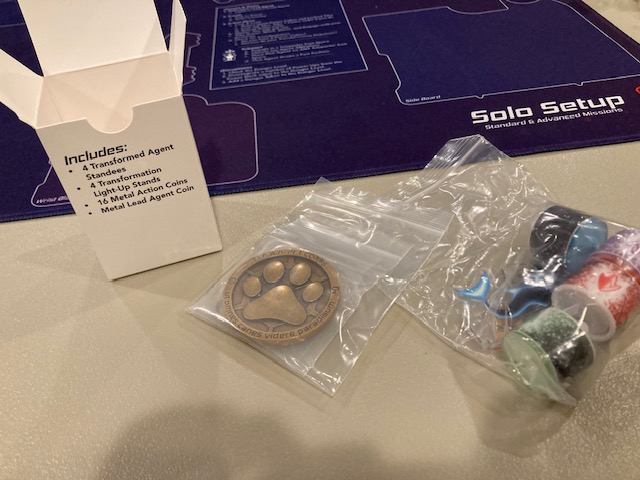
IMG_8403

The third and final box is the coolest: Lights Of Opulent Extravagence!  
IMG_8404

It includes metal first player token (right: above) and 16 action coins (left). Wow!
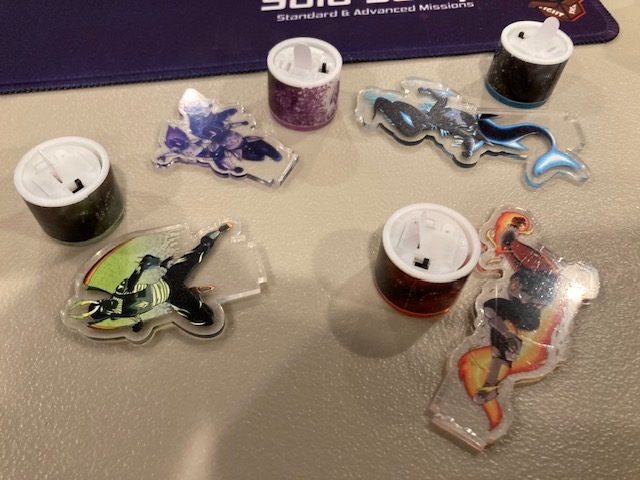
IMG_8405
More importantly, it includes the light-up standees.  You heard me.  Light-up standees!
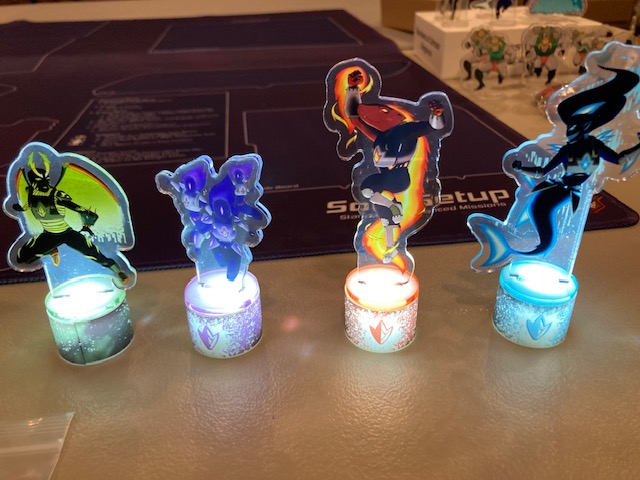
IMG_8407

Each character can “transform” in the game, and when they do, they get the cool light-up standee! See above!
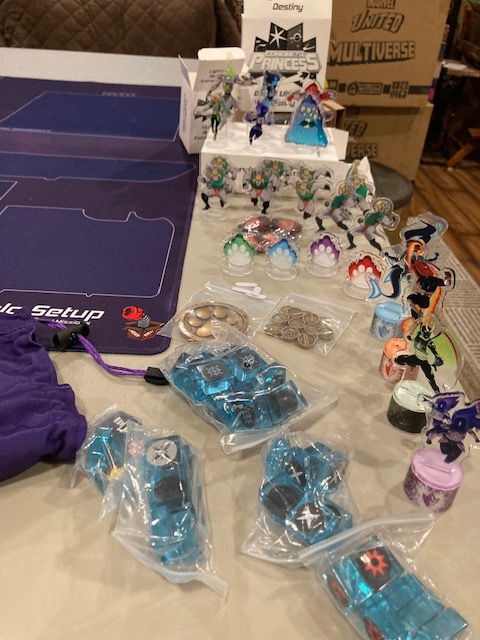
IMG_8410

The extra specials for this game gave me a WOW and put a giant smile on my face!  This is the feeling I wanted when I opened Freedom Five from a few weeks ago.  I got that WOW feeling from Conquest Princess instead!!

Totally worth getting the extras and all-in. 

Upgraded components are great, but what about the game?

Unboxing and Some* Unpunching Required
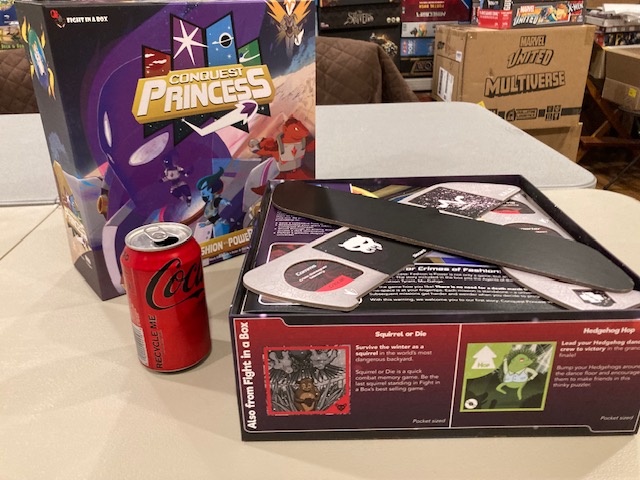
IMG_8550

The base box is fairly tall, but width and height is pretty standard. See Coke can above for perspective.
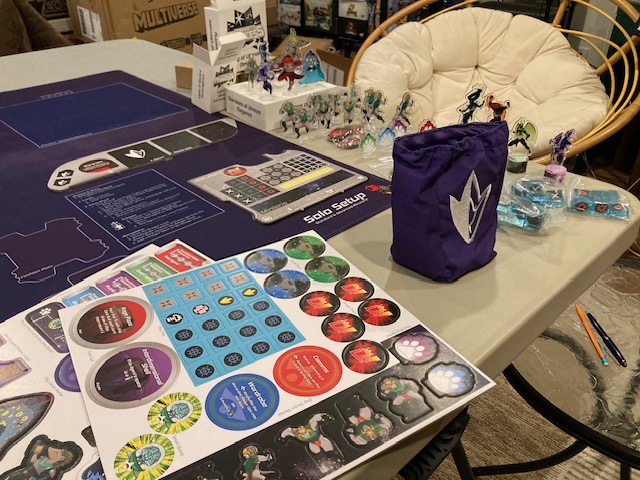
IMG_8451

I sort of had a weird dillema when I opened everything up!  A lot of the tokens are already acryclic, so which ones do I punch out?
IMG_8452

IMG_8453

IMG_8454

So, I ended up punching out about half  the cardboard punchouts; the other half were from the acrylic standees and metal tokens.
IMG_8455

IMG_8458

I mean, everything looks pretty cool, right?

Gameplay
IMG_8444

1 to 4 Players assume the roles of the 4 characters in the game: see above and below.
IMG_8537

This is an action point game; actions are notated on the Wrist Blaster board (bottom board in photo above). Each character gets 4 action points on their turn, denoted by the metal tokens.  The player will slide the token down to indicate a move, shoot, or engage action.  Occasionally, you can use energy to get an extra action (last column).   The armor on the side is armor to prevent damage.

The Fashion Plate board (above and below) is where you place special cards, pets, and powers. 
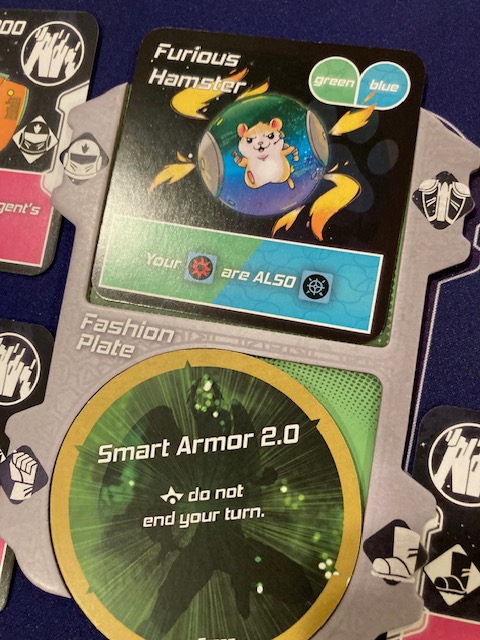
IMG_8542

This game is a space game with a large dollop of fashion in the theme!  You heard me, fashion!!! One of the catch phrases of the game is “Fashion is Power!!”  Generally, this is a space game, where some of the equipment you’d get in a pure space game is instead accented as fashion accessories.  
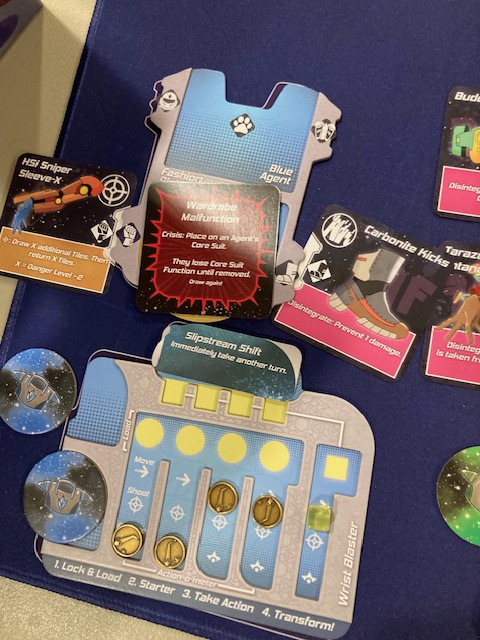
IMG_8540

You can see a little of that in the gear (I mean fashion accessories) above: Carbonite Kicks, Hsi Sniper Sleeves.  It’s more fashion accessories than gear, but it’s also gear.

I’ll say this: if you want to play Conquest Princess as a pure, straight-up space-theme game, you can almost ignore the fashion part and just pretend it’s a pure space-themed game. But if you really want to embrace the “Fashion is Power!” vibe, you can have a lot of fun with that.  This weird cross-pollination of space and fashion may seem like a turn-off, but it’s not; you can choose to embrace either side (or both sides!) of that theme and it still works.  I generally played it solo as a pure space game; whereas my cooperative games with my girl friends embraced the fashion part.
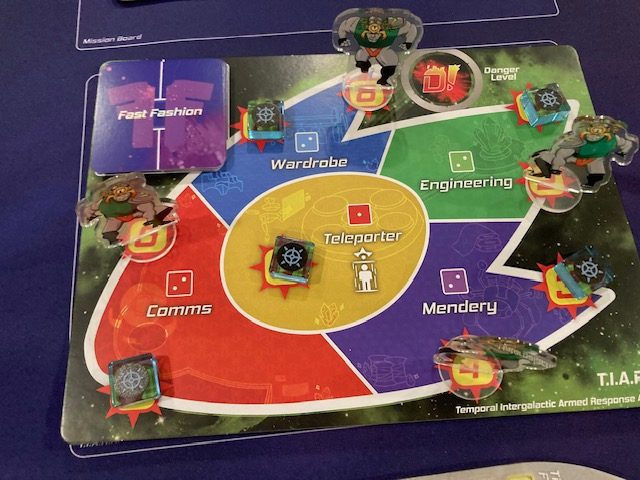
IMG_8480

The T.I.A.R.A (above) is generally the main ship and this is where I get a lot of The Captain is Dead vibe from! Players move around the ship taking out the Minions in orange thongs (yes, you heard me right, orange thongs) and keeping the ship clear of baddies.
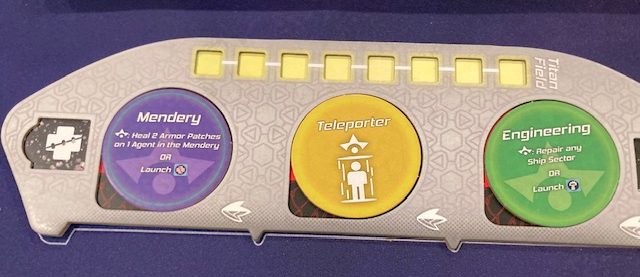
IMG_8471

The ship has all sorts of different subsystems: Teleporter (above: for moving off ship), Engineering (above: for repairing subsystems), Mendenry (above: sick-bay), Comms (below: show upcoming bad news cards) and finally the Wardrobe (below: the weapons sills).
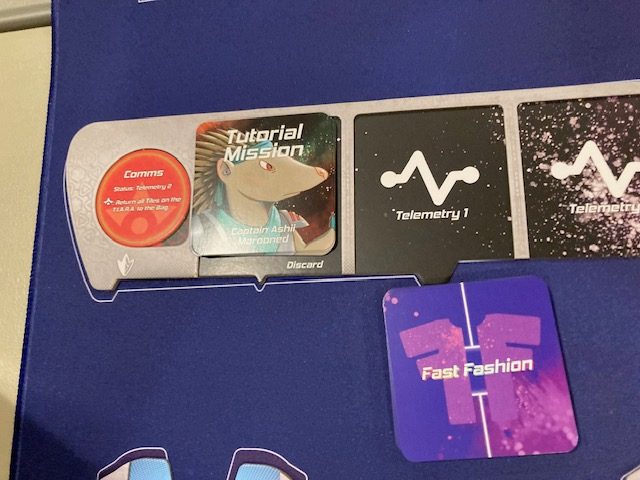
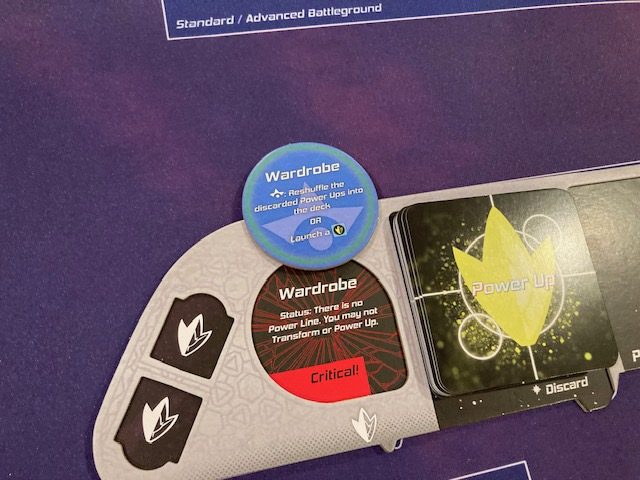
IMG_8473

IMG_8472

If the minions get attacks off while in the ship, they put those subsystems into disrepair.  See above as the Wardrobe has been critically damaged!    Keeping the ship healthy and in repair is a huge deal; it keeps your systems active.   Every single one of these subsystems is useful! Healing! Better gear (I mean fashion accessories)! Looking ahead at Bad News! Teleportation! 
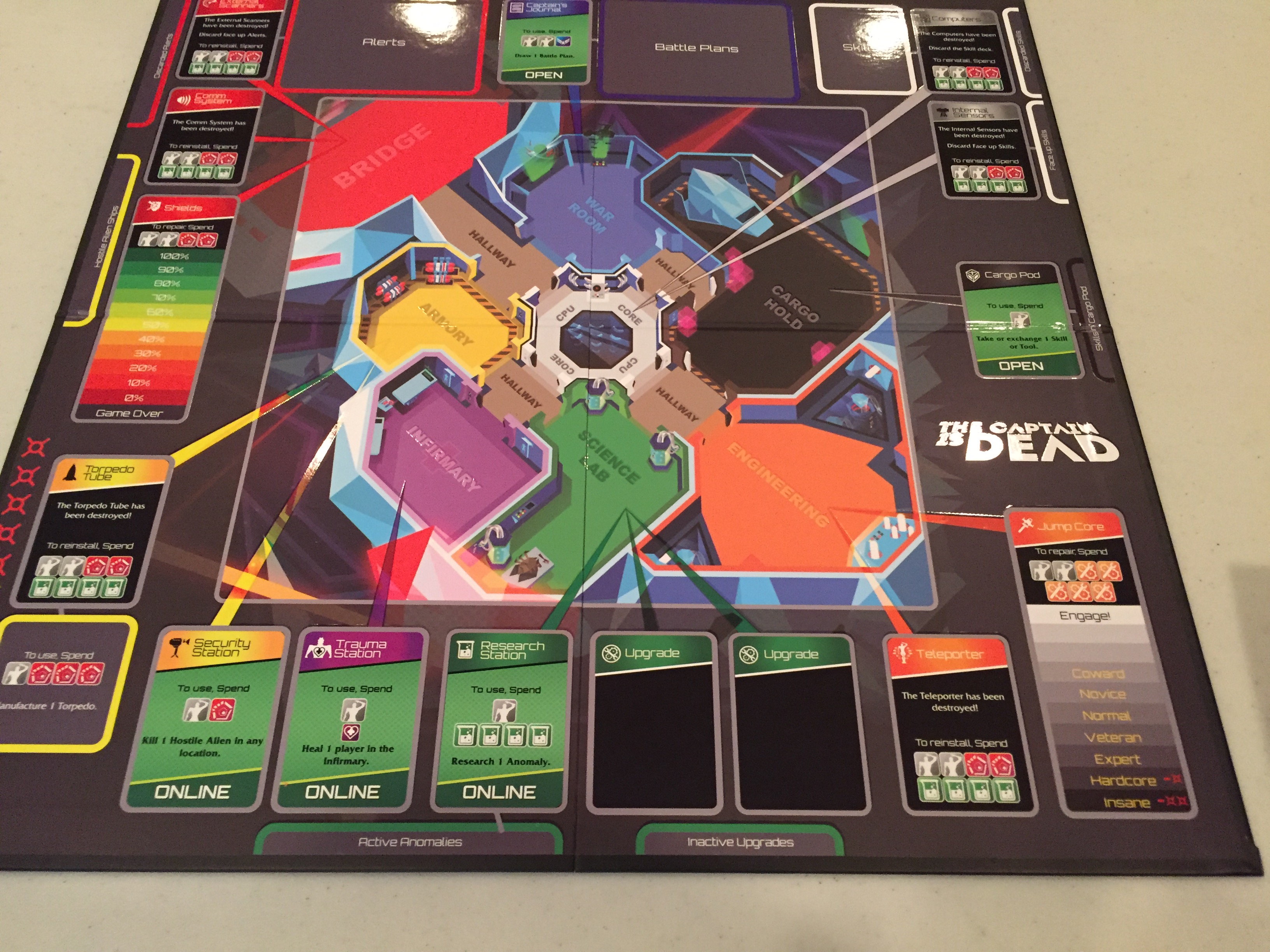
IMG_3168

Those of you who have played The Captain is Dead (see board above) will find this subsystem stuff very familiar!
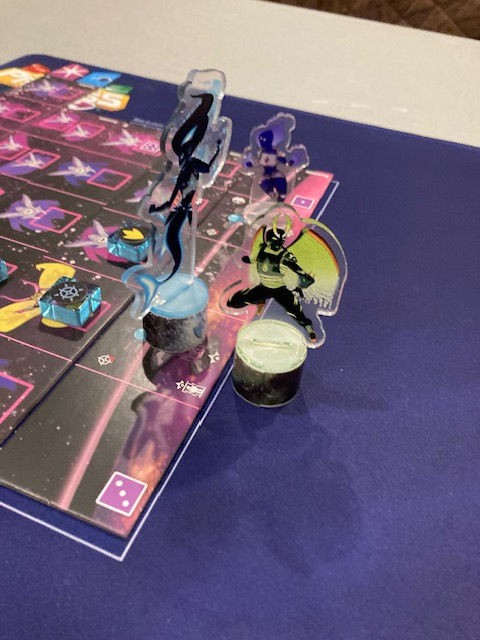
IMG_8526

If all you did was keep baddies off the ship, the game wouldn’t be very interesting! In the Standard Game, you have to worry about two planets where stuff is happening! On Planet 1  (standard game) is the Invasion! See above!
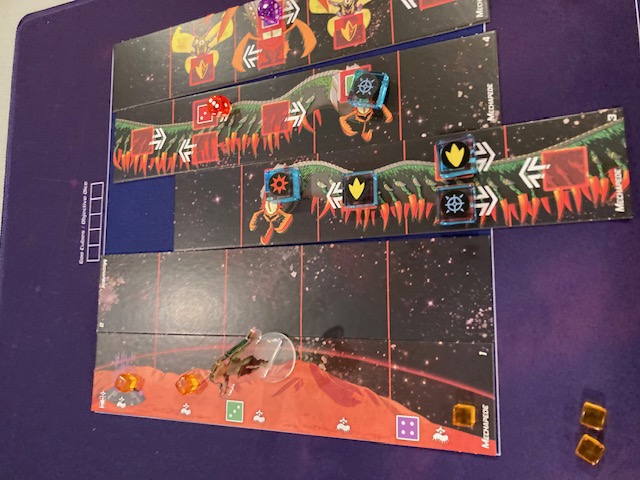
IMG_8546

On Planet 2 is the Mechapede!  

IMG_8593

These Planets do change: in the Advanced game, there is the Dark Portal (see above).

So, while you are keeping baddies off your ship, you are also teleporting to the planets to achieve your mission goals!  Sometimes your missions are to collect items, sometime your missions are to keep the chaos on planets under control, and sometimes your mission is to move to the Dark Portal! 
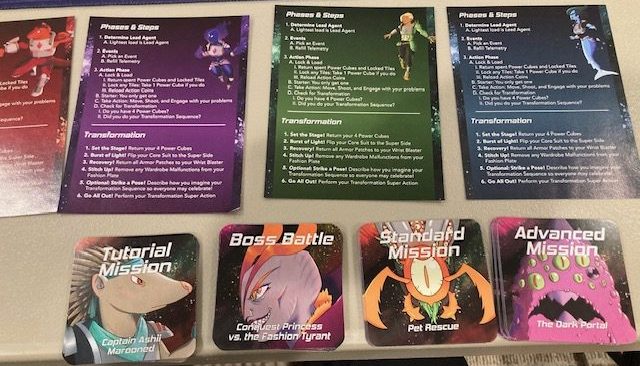
IMG_8466

What you do depends on which of 4 scenarios you are playing! See the four scenarios that come with the box above! For the record, you can play any of the scenarios, but it’s recommended you play them in order as a campaign from Tutorial, Standard Mission, Advanced Mission, to Boss Battle! The game just gets harder and harder!
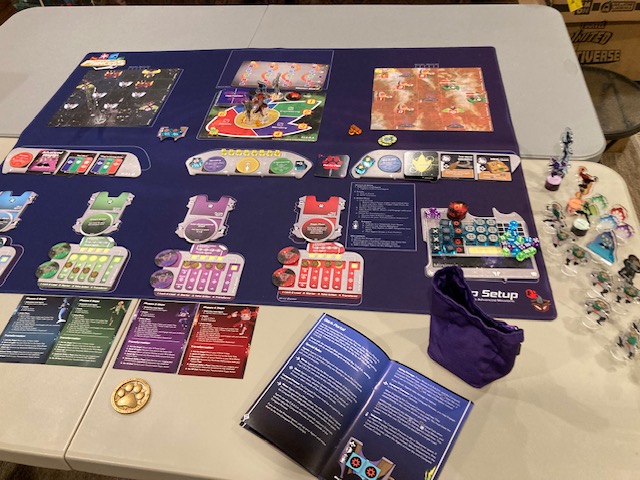
IMG_8580

So, Conquest Princess is a balancing act of keeping the ship free of baddies, the planets under control, and staying alive!  
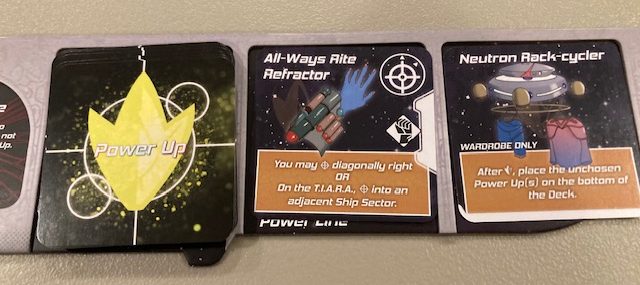
IMG_8599

This game has a peculiar, but consistent and interesting loss mechanic: you cannot lose unless you run out of power!  You only run out of power if the Power Up deck (above) is ever empty! It starts with 28 cards!
IMG_8598

But every time something goes bad that would immediately end the game (where a character takes a third damage, or too many minions overrun the ship, etc, etc) instead you take a disruption!  Your ship has a time-travel mechanism to prevent the bad thing, but the cost to stopping the badness is huge!  A disruption causes players to discards Power Up cards equal to the Danger Level (most games start with a Danger Level of 2: see above), and every disruption increases the Danger Level by 1!  If you ever can’t discards enough cards to handle a disruption, players immediately lose!

I like this loss mechanism, as it scales, it is simple to explain, and handles all endgame cases consistently.  There is only one loss mechanism; just don’t run out of of power!!!
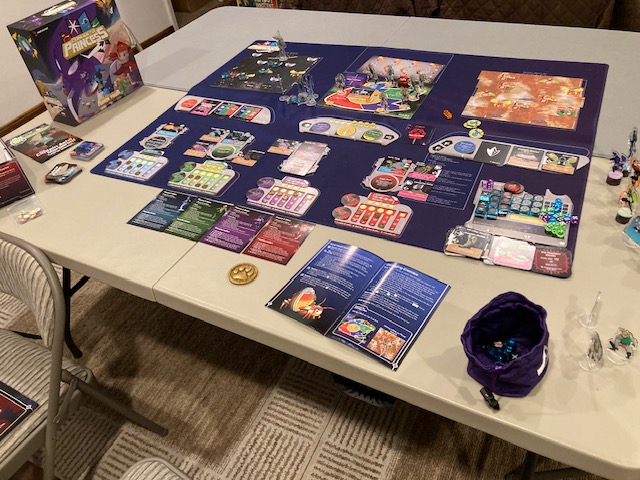
IMG_8594

If players can collectively succeed in their quests before the power runs out, they win!

Comic/Tutorial/Scenario Book
IMG_8412

There’s quite a bit of reading material.
IMG_8441

The comic book is just flavor for the adventures; you don’t have to read it.
IMG_8442

I found the art inconsistent with the rest of the game (see above), so I thought it actually detracted from the experience.  My friends read it while I was making dinner and they said it offered some nice thematic basis; they liked it.   Read it if you want, you don’t have to.
IMG_8511

The Tutorial, on the other hand, was AMAZING!  See above!  It walks the players through the first 3 rounds of the game very explicitly!   You ABSOLUTELY must and should read the playthrough from the Tutorial!  This does what a great Tutorial does; explain what you can do, what you shouldn’t do, and make you feel like you can play without needing too much of the rulebook!  The Tutorial is a shining star in this game.
IMG_8513

Finally, the Scenario Book (not particularly well marked, above) has the directions for play and set-up for the other three scenarios in the game.   It was … okay.   There are a LOT of new rules in later scenarios, and it could have done a little better job explaining some stuff.  I think it just needed some more edge cases explained.    I think you will be going on BoardGameGeek a lot for these scenarios to look up rules.  In general, this scenario book was ok.

Rulebook
IMG_8456

This rulebook is generally okay.  It has some flaws but some nice features too.
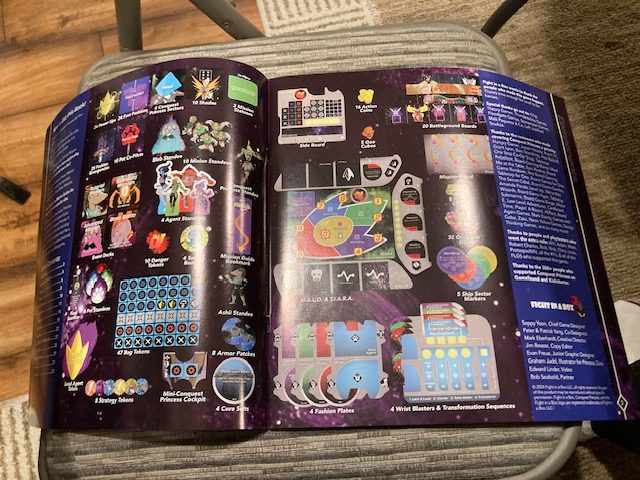
IMG_8450

See above as it flops over the edges on the chair next:  it’s not great.  I’d give this a D in the Chair Test: the fonts are good, the pictures are good, but the rulebook is just too big and can’t sit on the chair next to me; it flops over the edges. See above!!
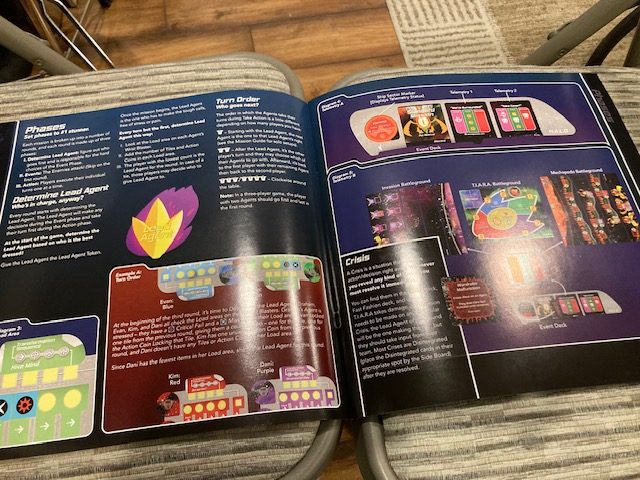
IMG_8468

We’ve seen this “rulebook-too-large” problem a lot lately (See our  Batman: Gotham City Chronicles and Tidal Blades 2 reviews): luckily, there’s a decent workaround! Put it on TWO chairs next to you (with the spine in the middle so it stays open). See above.

I wanted to like this rulebook; it has a good-sized font, lots of pictures, and even an Index! At the end of the day, I didn’t love it.  I feel like there were some edge cases missing, and I didn’t like the way the certain things were expressed.  But, they made a good faith effort to make a good rulebook, so I will say this was good enough.

In a Second Edition of the game, I want another pass by an editor please. And a smaller form factor, please.

Solo Play
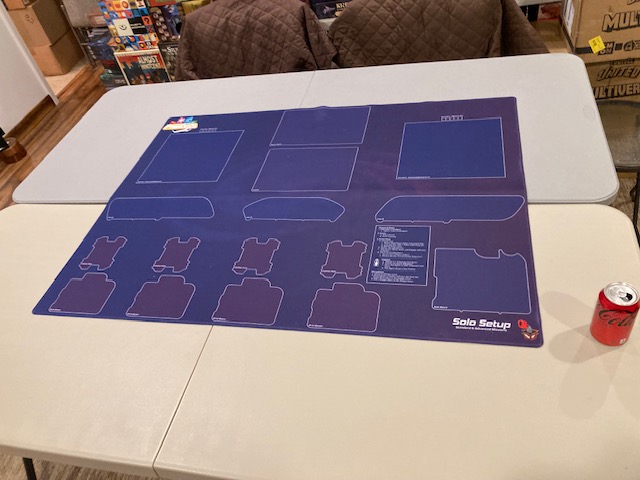
IMG_8377

If you get the player Mat with the game, recognize that it is two-sided.  One side has the set-up for SOLO play: see above.  That’s the way I played.  For the record, this is THE BIGGEST player mat I have (even bigger than Robinson Crusoe: Collector’s Edition from a few months back!!).
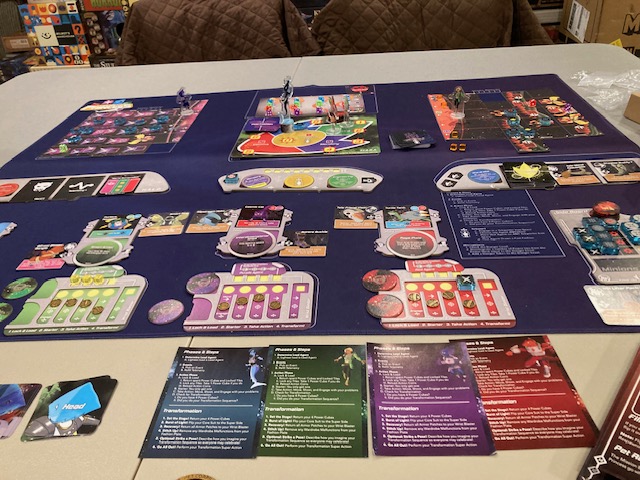
IMG_8545

So there is a solo mode!  (Thanks for following Saunders’ Law!) Unfortunately, like Heroes’ Resistance, Set A Watch, or Cyber Pet Quest (from last week), the solo character must control all 4 characters!  In fact, no matter the player count, all 4 characters must be in play.

IMG_8580

Of course, a 4-character solo play isn’t ideal; there is context-switching overhead as you switch from character to character (you play one character at a time), there is extra maintenance as you play (as typically the maintenance scales linearly with the number of characters), and there is simple intellectual pressure to use all four characters well together.

I will say that Conquest Princess works well as a solo game if you like a longer solo game and if you embrace Player Selected Turn Order (we’ll discuss this down below).  Conquest Princess is  basically a puzzle to solve with spinning plates: you try to keep the bag in a good state (remember, this is a bag-building game), while keep the ship and planets under control.
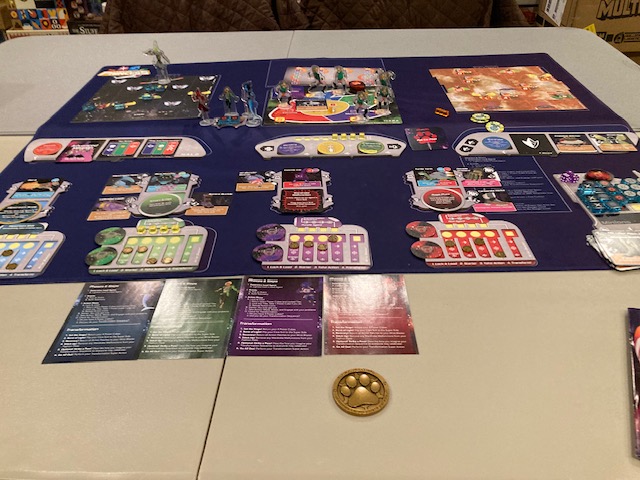
IMG_8595

Solo, I have now played the Tutorial once, the Standard Games about 4 times, and the Advanced Game once.  The Tutorial was relatively quick, but the Standard and Advanced Games were pretty long games, taking about 2 to 2.5 hours each.  
IMG_8383

The extra context switching and maintenance overhead tends to elongate the solo game that much more! The box says 45-70 minutes? No way. It’s at least 2 to 2.5 hours for a solo game.  
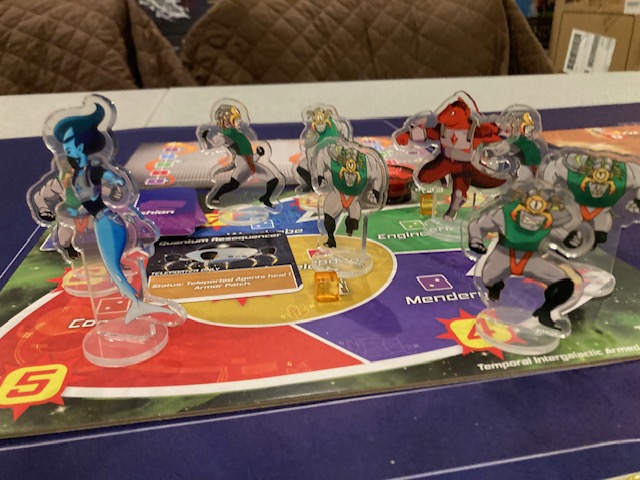
IMG_8590

But, I feel like every step matters in this solo game: each character gets 4 actions (5 if you waste a power token), and each turn matters!  What’s the best way to keep the chaos under control AND keep the bag in good shape?

I liked the solo game.  A lot.  It was fun trying to figure out how to keep the characters working well together.   And the solo game did a really good job at teaching the game so I could teach my friends. Again, that Tutorial is phenomenal for the solo player (and the cooperative players).

Cooperative Play
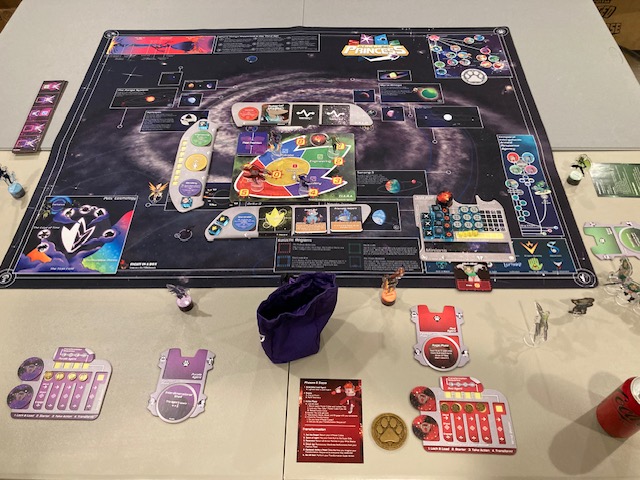
IMG_8556

The other side of the Player Mat made the weird choice to have no set-up information or templates for the cooperative: it has only flavor text and pictures.   It wasn’t too bad, but I thought it was busy (from a graphic design perspective) and got in the way just a little bit.  It was fine, but the Mat for the solo mode was much more helpful. See above.
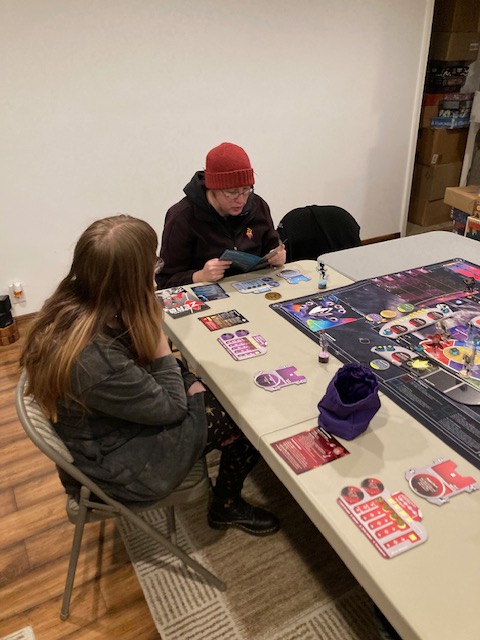
IMG_8557

Cooperative play at 2 and 4  players is ideal: in 2-Player mode, each player operates two characters. In 4-Player mode, each player gets their own character!
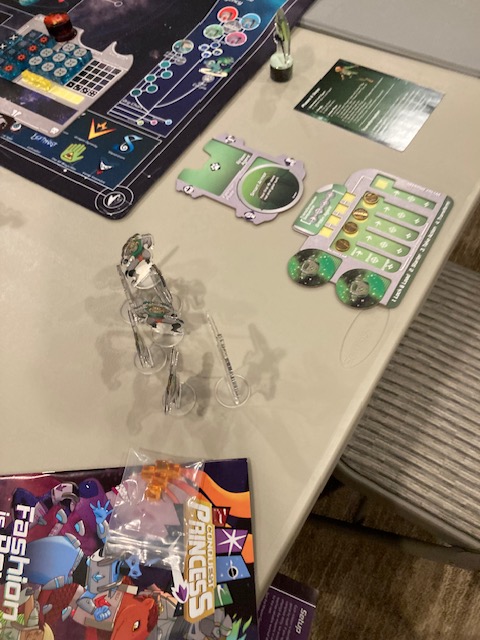
IMG_8559

Unfortunately, 3-Player mode makes one player operate two characters (which is usually me, since I have played the game more than anyone).  
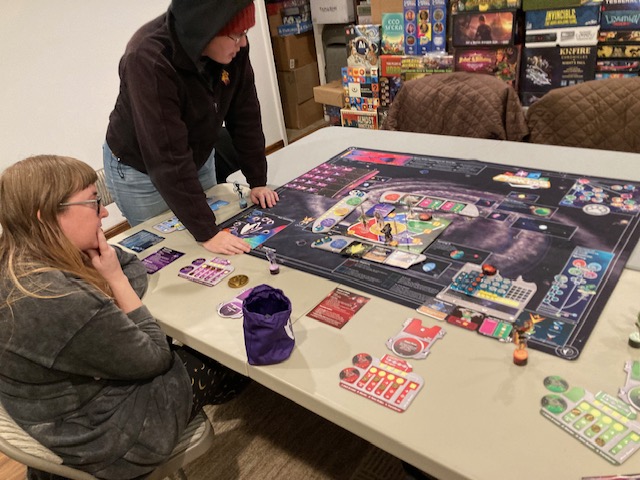
IMG_8561

Whereas my solo plays embraced the pure space game, my cooperative plays embraced the fashion parts!  That is probably because I played with the two friends Sara and Teresa!
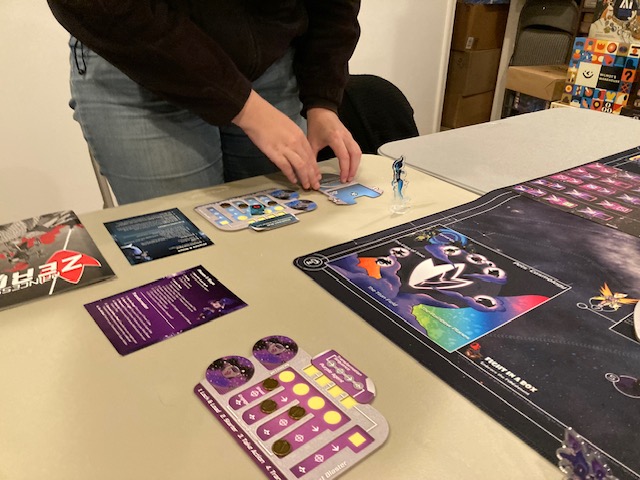
IMG_8566

There’s a decent amount of discussion going on as you play, as players need to figure out how to work together and share their fashion plates.

IMG_8542

For example, players WANT to be on the same space as the Green character because then they can do multiple ENGAGE actions (usually, a single ENGAGE ends your turn).  So, sometimes players may travel in packs to reuse their Fashion Plates!  But then, you can’t get enough done if you stay together, so sometimes they have to split up!  What’s the best thing to do?   The sharing of Fashion Plates and that discussion really does facilitate the cooperation in the game.

IMG_8557

The Tutorial also worked fantastically in the cooperative game! Players would read the parts of the tutorial relevant to their character and then act it out!  Again, this tutorial worked really well.
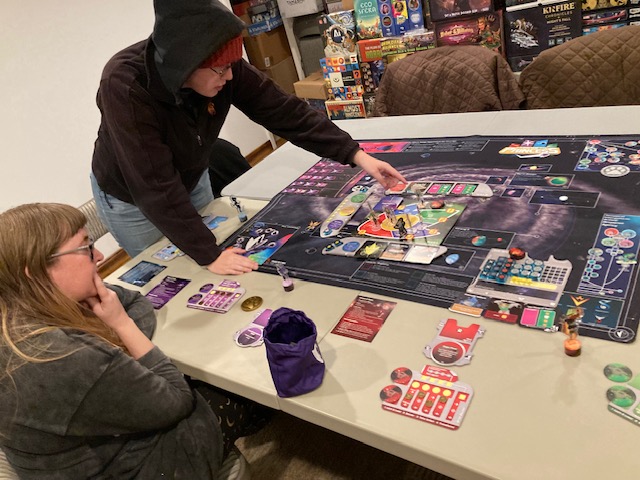
IMG_8560

And the cooperative game also moved along a little faster, as there was shared maintenance, and each character had the agency of a single player!   The game still feels a little longer than 45-70 minutes, but it was definitely shorter than the solo game.
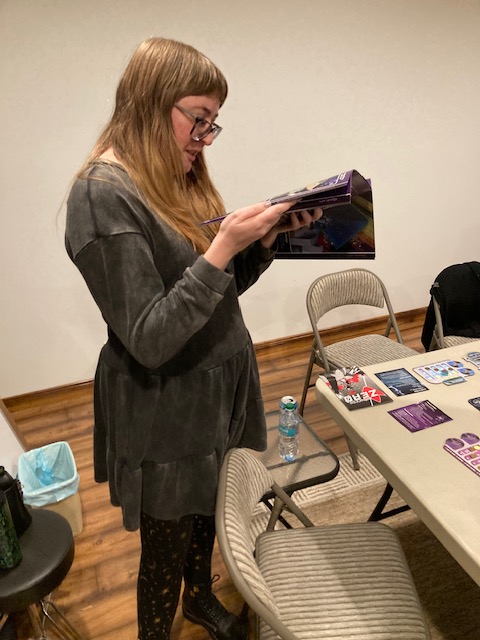
IMG_8567

Generally, my friends had fun and want to play again.  One major complaint was that the rulebook wasn’t great for edge cases (a similar complaint we had initially: see as Sara tries to find a ruling and fails).

Player Order
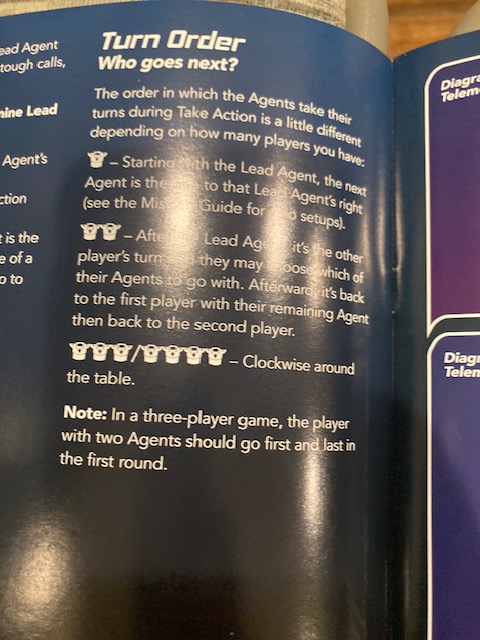
IMG_8476

In the rulebook and rules (page 8 above), there is an entire page discussing player order and who is Lead Agent (first player).  The rules are complex and they depend on something called “LOAD” and how many players are playing.  If there is any question about LOAD then players select. What is LOAD? LOAD is a messy notion about the number of MISS tokens on your board.
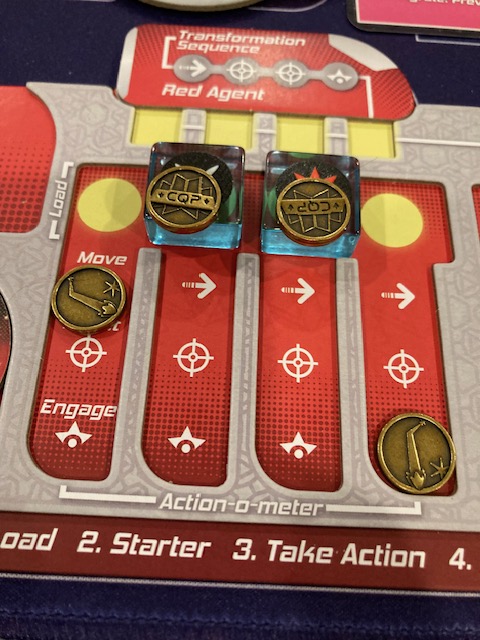
IMG_8597

See above as the RED player has too much LOAD, so probably can’t go first.
IMG_8492

We need to get real for a second.  I like this game.  A lot.  but there is a LOT of randomness that can detract from me liking this game.  There is just enough mitigation between bag maintenance and special powers and so on to keep me involved.  But I am on the cusp.    The rules for first player need to be completely streamlined: it’s too much intellectual effort and it feels … random.  “Oh, I should go first, but I can’t because I drew poorly and got LOAD last turn??”  No no no no no no no.  

This game needs Player Selected Turn Order:  players simply should simply decide the order they play on their turn.  This will allow characters to support each other to feel like they have gigantic turns!  Get the RED character to help you so you shoot better; get the GREEN character to move to you so you can ENGAGE twice!  These are decisions the PLAYERS should make, not have some esoteric mechanism (Lock and Load and LOAD) deciding player order.

Blow away all the rules for player order (an entire page in the rulebook) and just let the players decide what order they want to go!  This makes the game that more cooperative as players will now discuss the order they should go!  It helps cooperation!!  Without Player Selected Turn Order, this game becomes too random for me and I would give it a 6 or 6.5/10.  With Player Selected Turn Order, I feel powerful, potent, cooperative, and engaged! And the game is much better, an 8/10 or 8.5/10.  It makes THAT big a different for me.

Yes, this is a House Rule.  Play with or without it, but I suspect you like the game that much more with Player Selected Turn Order.  Decide for yourself.

What I Liked
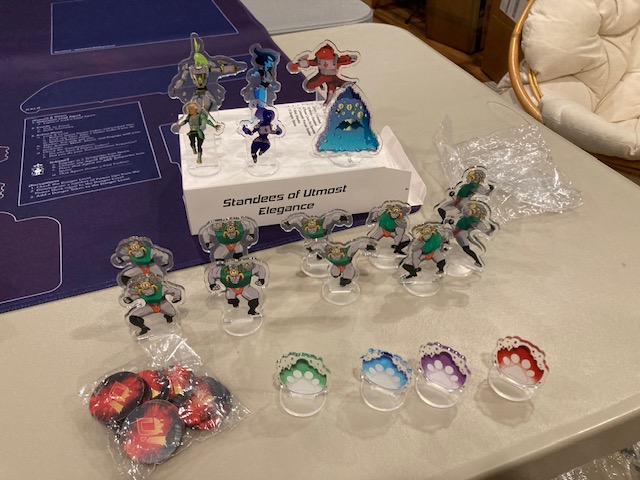
IMG_8401

Acrylic Standees: If you can get Acrylic Standees, I would recommend it. They really complement the comicy vibe of the game, and they just look great on the table.
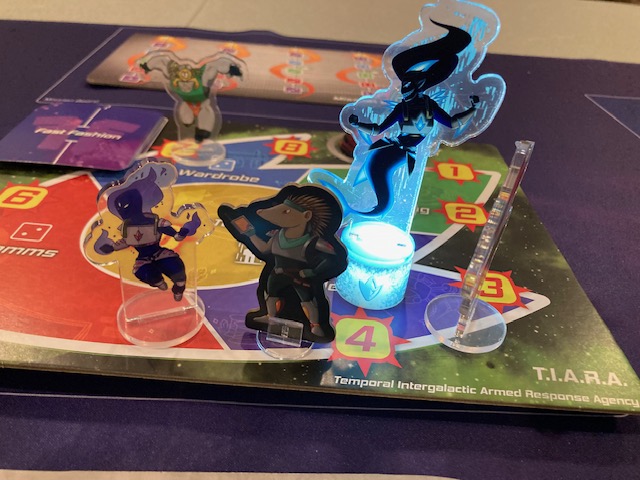
IMG_8508

Transformation: It’s very cool when you transform!  If you have the light-up standees, that makes it even cooler, but it is such a cool moment in the game when a character transforms to their super!  The character gets an immediate power, becomes more powerful, and heals up!  It feels like a movie moment when a character becomes powerful just in time to save the crew!
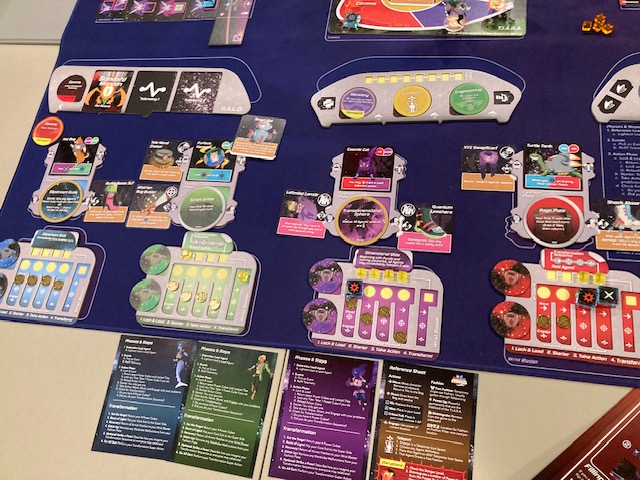
IMG_8573

Components: Even if you just get the retail version of the components, the components are still nice. I am very glad I got all the premium upgrades, but that’s up to you.

IMG_8597

Bag Maintenance: This is a bag-building game, and you have to keep the bag in shape! If you have too many “MISS” tokens in the bag, you just won’t be able to do well you attack, so you have to make sure to keep as many “HIT” tokens in the bag as possible! You may to use the COMMS ENGAGE action to scoop up all the HOT tokens on the ship, or take out one line of the MECHAPEDE to put all those hit tokens in the bag! As you go around, you must keep the bag state in mind or you will lose! Even if you do draw MISS tokens (see above), you can trade them for POWER tokens in future turns! (You can use POWER tokens for future actions or to transform!). I love that!! Even if you fail, you can still do something good LATER in the game! I hated Freedom Five from a few weeks ago because all failures were independent … at least here, a Failure can bring you choice! (And putting a failure on your board keeps it out of the bag too! Maybe you keep it out of the bag just to help your friends!!)

There are just enough mechanisms in the game to help you keep the bag state under control that you feel like you have agency in how the bag is. I love that; It doesn’t feel too random.

IMG_8594

Star Trek Vibe: There is a Star Trek vibe here in Conquest Princess. Just like The Captain is Dead. Now, I love The Captain is Dead, but it was always centered on the ship only, and Star Trek is all about beaming down to the Planet. Here, in Conquest Princess, we can beam to TWO planets! And they are very different! I feel like Conquest Princess does a pretty good job of embracing that Star Trek vibe.
IMG_8588

Sense of Humor: This game has an sense of humor. Wardrobe Malfunction as a card name? Ha! It’s even thematic as you lose your core suit. There are little bits like this all over the game.

IMG_8458

Play How You Want: Play this as either a pure space game or embrace the fashion aspects, or both! If you don’t like the fashion aspect, don’t let it drive you away: this is a good space game.

What I Didn’t Like

IMG_8567

Rulebook: The rulebook and scenario book need some work; mostly edge cases need to be specified more.  There were just too many times when it wasn’t “clear” what needed to done or how to deal with something.  I’ll give the rulebook credit; they did a lot of things right.  It’s just that each scenario has SO MANY rules, it’s hard to get everything right.
IMG_8475

Turn Order: Jettison the entire set of rules for player order and lead player (an entire page!) and just use Player Selected Turn order. It’s simpler to explain and makes the game more cooperative. The game even makes it easy to notate as you have to move the action tokens!

Conclusion
IMG_8569

Conquest Princess was a bit of surprise! I didn’t expect to like it as much as I did!  At first it looks like just a pure space  themed game, but it has a strange auxiliary fashion theme which you can choose to embrace or not!  So, don’t be turned off by some of the fashion references; you can play this as a pure space game and still really enjoy it!  Or you can embrace the fashion theme wholesale!
IMG_8529

There are so many great things about this game; from the Transformations, the bag-building, keeping the ship intact, keeping the bag well-seeded, helping each other, and communicating!  There are no communication limits in this game, thus players can work together well!
IMG_8474

I can’t recommend this game unless you jettison the turn-order and first-player rules; they are complicated, messy, full of exceptions, and take up an entire page (page 8) in the rulebook.  With the turn-order rules as-is, I would probably give this game a 6 or 6.5/10: those action rules are too complex and make the game too random so that players can’t support each other!  If, instead, you throw away page 8 of rules and instead embrace Player Selected Turn Order, this game moves to an 8 or 8.5/10!  When players support each other, the game feels more engaging! Players have more agency!  Players have more powerful turns!  Players communicate more!  Yes, this is a house rule, but I think it’s critical if you are considering this game.

IMG_8595

I love all the upgrades they have for this game, and maybe you will too; just be aware it’s a fair chunk of change to get all the upgrades.
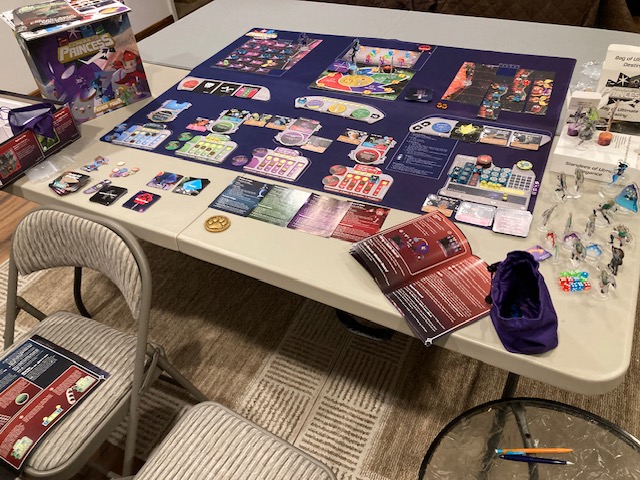
IMG_8547

Despite the 4-character solo mode, I had lots of fun playing this as a solo game.  This may make my Top 10 Solo Games of 2024!

So, there it is; I like this game and would recommend it but only if you embrace Player Selected Turn Order.  I guess it’s not a surprise I liked this game: it’s basically the Captain is Dead meets Invincible, and I love both of those games.

Wilmot’s Warehouse: Can A Cooperative Memory Game Work?

IMG_6511

Wilmot’s Warehouse is a cooperative memory game for 2-6+ players; it also has some real-time aspects as well.

IMG_6510

Wait!  Don’t run away yet!  Despite it being both a memory game and a real-time game, it’s actually pretty good.   Really.   I’m not kidding.  Keep reading!  Please!  

Gameplay

IMG_6518

There’s not much to the game:  as a group, you place tiles down “cooperatively” down on a board: this board is the warehouse in Wilmot’s Warehouse.  (And I have no idea who or what Wilmot is).

IMG_6516

Players have some random tiles (see above) that originally come out of a bag. Players, as group, get to look at the tile and decide cooperatively what it is! See tile above: “What is this? A yo-yo? A Coffee cup?

IMG_6517

Once players, as a group, have decided “what it is”, they place it facedown on the board.  To help remember it, players (as a group) are coming up with a “story” or “theme” to help remember WHAT IT IS and where they placed it!! There will be 35 facedown tiles(!)  by the end of the game (7 cards “per day” over 5 days), so players need something to help remember what’s what.

For example, we had a row which was “food stuff”.  And some stories about Mario.

IMG_6513

The first 7 tiles (Monday) are easy, but the each day, management has “new requirements” that make the game sillier and harder. For example, Language Barrier is what we drew (see above): we couldn’t talk, but we could grunt and point. Yes, we became cavemen. Yes, this sounds stupid, and it was. But it was surprisingly fun.

IMG_6521

After all 35 tiles have been placed facedown, there’s a real-time phase where players take “customer cards” and have to match them to the facedown tiles!

IMG_6514

There’s a lot of these customer cards: some of them will be on the board, but most of them won’t!  As a group, you are going through these cards AS FAST AS YOU CAN to find the cards you are using, while tossing the ones you aren’t.

IMG_6524

The object is to memory-match the real customers to the real facedown tiles. I KNOW!  I KNOW!  This doesn’t sound fun.  But it was really was!
IMG_6523

Your “score” is based on how fast you matched, as well as how many you mismatched (you gain a penalty of like 10 seconds for each failed match). Then, you can lookup a video telling you how well you did: see Matt from Shut-Up and Sit-Down telling us how well we did!

Solo and Cooperative

IMG_6520

This game is officially for 2-6+ players (with the + implying you can play more). We found that it worked great for 4 players. Could you play it solo? I think you could, as a way to “explore your memory palace”, but, it would get a bit “samey” solo. What keeps the game silly and fun are the limitations cards!
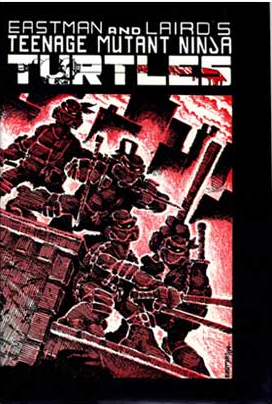
IMG_6513

In a solo game, the Language Barrier (above) would have no effect (“I can’t talk to myself, ok”) and wouldn’t make the game more fun .. and most limitation cards are something that affects how the players may communicate with each other. In a solo game, these limitation cards would have no effect: It would just make each round about the same … which is not a bad thing, but the variety of these cards made the game quite fun. (One limitation made us only be able to talk with words that started with one of W I L M O or T. Very silly!)

IMG_6521

As a cooperative experience, this game really shined!  We all talked (well, when we could talk) and explored ideas together as we had to “classify” and “organize” the tiles.  This game felt very cooperative: everyone participated and had fun.
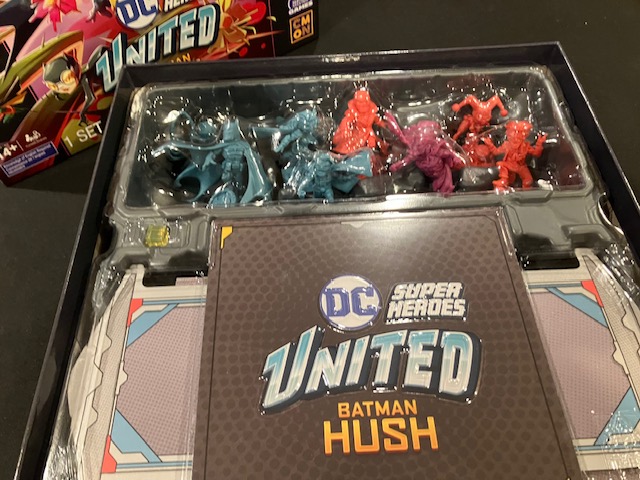
Conclusion

IMG_6512

Wilmot’s Warehouse is easy to describe and easy to jump into.  I was very skeptical of this game at first (“A cooperative memory/real-time game?  I don’t know …“), but my group had a surprisingly good time playing this.  In the end, this feels like a heavier party game: it’s silly enough that you could classify it as a party game, but it’s heavier than you might expect, as you have to spend some real brain-power to play the game.
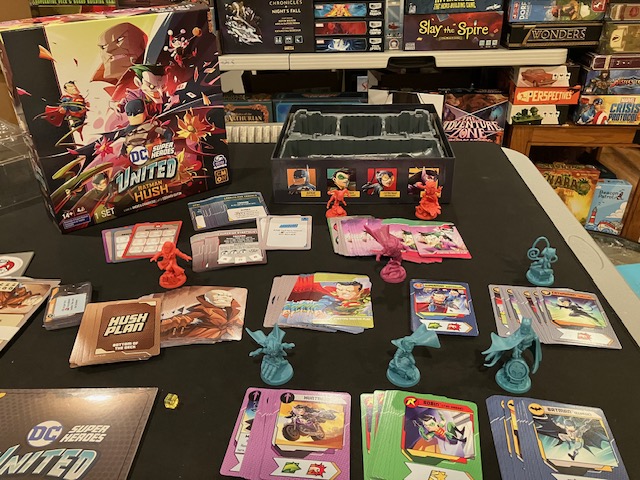
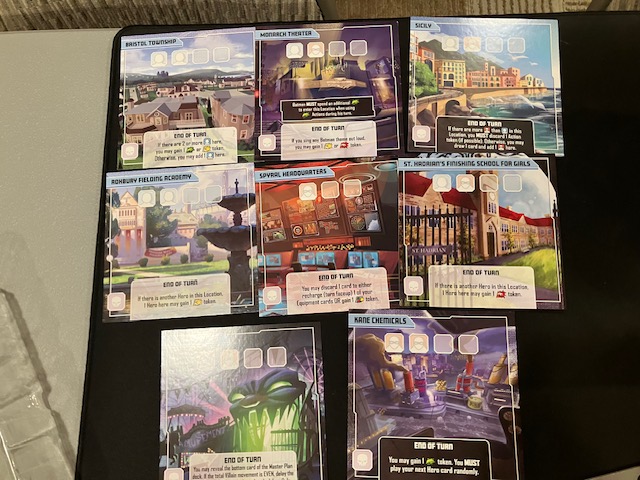
IMG_6526

Pretty unanimously, this would get a 7/10 from my game group! They liked it, and they would play it again. The only real major problem is that you can only really play Wilmot’s Warehouse once a night: the memory overhead makes it a little cumbersome to try multiple times in one night. “That’s it! My brain is full!”

A Review of Valroc and The Cooperative Expansion: The Legend of Aquiny

IMG_5215

I wasn’t sure if I wanted to pick up Valroc.  It was on Kickstarter again in September 2022: see here.  This second Kickstarter offered the base game and a cooperative expansion called Valroc: The Legend of Aquiny

IMG_5217

The base game is a fully competitive drafting and worker placement game (with a solo mode).  See back of the base game above.

IMG_5219

The expansion (The Legend of Aquiny) promises a fully cooperative mode with lots of envelopes to open!  Ooooh fun! See above.

IMG_5220

The Valroc Kickstarter promised delivery in September 2023, but it ended up delivering in April 2024 sometime. See above.  For a Kickstarter, 6 months late isn’t bad.

Let’s take a look at this game!

Unboxing The Base Game

IMG_5222

The base game is a fairly normal sized box: see Coke can above for perspective.

IMG_5242 (1)

The game comes with a nice board: this board is for the worker placement part of the game.

IMG_5244

There’s a lot of buying of things and acquiring of money: I ended up getting the metal coins (called Vals) which are quite nice.  The money is used to help you stuff in your worker placement phase.

IMG_5267

This game is all about buying of the creatures in the game: see a bunch above (You have to get 6 to invoke the competitive endgame).   The right hand side of the card are all the resource prerequisites needed to acquire the creature.

IMG_5246 (1)

There’s a lot of colored cubes and meeples: 4 colors for the 4 different players.

IMG_5252

There’s a bunch of multi-use Action cards: see above. These same cards are used for digging, offerings, and training.  The section of the card you use depends on the activity; the cards are nice enough. 

IMG_5254

IMG_5253

IMG_5241

IMG_5239 (1)

The components are all quite nice and consistent.  Probably my favorites pieces in the game are the dual-layer player boards: see above.

IMG_5247

In general, I think these guys did a great job with the production.  I thought the game looked really nice! See above!

Rulebook for Base Game

IMG_5223

The rule book was okay.

IMG_5224

It’s a little too big of The Chair Test (maybe a C+), but I can still read it.  At least it stays open and the font is readable. There’s a lot of white space: this could have easily been a smaller form factor to fit better on the chair next to me.

IMG_5225

I was grumpy that there was no correlating pictures with the list of components.  The rulebook can “sorta” get away with that because there’s not too many components in the game.  I think, since this is a dual-language game (I think French and English), everything is labelled with abstract symbols, which was a little frustrating until you got used to it.

The set-up was decent, although they interspersed NUMBERS and LETTERS???  Each step should have been marked with one or the other: I found this unintuitive.  A couple of steps had multiple things exposed, which is why mixed NUMBERS for the steps and LETTERS for the items, but I felt like this would have been better served by having JUST numbers.  I think there were trying to do double duty and have the components list and set-up on only one pages.   I would have rather had the first 2 pages (which had ONLY a picture and some flavor test) list the components and then had the set-up steps be NUMBERS and labelled with NUMBERS.

Regardless, I was able to figure out what was going on.

IMG_5226

I was also grumpy because the rules specify special set-up for 2 and 3 players .. what about the solo game?  Nope, you gotta wait for that … (so I can’t set-up the solo game just yet?)

IMG_5228

There’s a very very nice list of creature cards to se for your first game.  

IMG_5229

The rules were okay.  It’s very clear this game was originally a competitive game and the solo and cooperative modes were grafted on: Everything about this rulebook puts the competitive mode first and foremost. 

IMG_5230

IMG_5233

Later in the rulebook (why aren’t the pages numbered?) they finally have rules for the solo mode.  So, they are in there, but only after elaborating the competitive game.

IMG_5235

There’s some nice explanations of symbols: see above.

IMG_5238

The back cover has something called the Archmages path … which is really only useful to the solo player (see solo discussion in a later section below).

IMG_5236

There is no index and this game really needs one!  Boo!  But there is a further elaboration of many of the cards later in the rulebook.

The rulebook was probably best for the competitive mode: first and foremost, this is a competitive game.    The lack of an index really hurt this game, because I was frequently trying to look up rules in the game, and I struggled to find things.  

The rulebook taught the game decently: I was able to learn the game from the rulebook.

Gameplay

IMG_5239

Each player takes the role of a mage in the game. There’s no different deck or asymmetric powers: the mage color is used only to disambiguate players.

IMG_5260

Each player starts the game with 3 worker placement tokens: left-to-right above: the assistant (tiny one), Wizard (hat), and Mercenary (nun hat?).   Each wizard also has resources: Fire, Water, Earth, and Air.   The mage himself slowly grows his resources in the game so he can acquire the creatures.

There’s also some MP (magic points in blue) that are used for many operations in the game.

IMG_5258

Money is also an important resource the game: each player starts with 3 Vals.  

IMG_5268

After you choose your Mage, you set-up for getting Creatures to acquire.  If you playing competitive, you draft (7 Wonders style) the creatures.  If you are playing solo or cooperative, you set-up a “river” of creatures (see above).

Either way, these represent the creature you can acquire: the resource prerequisites are on the right side of the creature cards.

IMG_5264

The rest of the game is Worker Placement!  Players place their workers at one of the 8 spaces on the board (see above).  Some spaces can ONLY be used by the Wizard, some spaces can only be used by NOT the Wizard!  If you make an offering, you can also get the Monk worker for one round.

IMG_5294

The players continue to play until they get to the endgame!   The solo, cooperative, and competitive games all have different ending conditions.  

But at its core, this is a worker placement game. Players manage money, MP, resources, creatures, their workers, and try to make the best tradeoffs they can.

Solo Game

IMG_5234

Valroc does have a solo mode (thank you for following Saunders’ Law)!  My first play of a new games is almost always a solo game, as I have to learn the game to teach my friends!

Unfortunately, the solo mode seems to be less well-described in the rulebook. 

IMG_5233

The pages describing the solo mode are full of text with almost no pictures (see above). I really struggled to get the solo mode going, especially the Offering phase.  There’s a LOT of rules changes for the solo mode, and I don’t think two pages was quite enough to cover everything.  Or at least, the solo rules needed some more elaborations.

IMG_5263

I was able to get through a solo game to see how everything worked.

IMG_5271

Instead of a drafting phase, creatures can only be acquired from the River (see above) … there is no drafting in the solo mode.

IMG_5270

At it’s core the solo mode is basically the 2-Player mode, with a solo deck of cards controlling the second (opposing) player.  See above: the solo card tells you where to place the “opposing” players worker pawns. It’s basically an automata placing pawns to simulate “blocking” you.

IMG_5257

The solo mode did work: I was able to play a learning game to get most of the concepts in the game so I could teach my friends.

IMG_5259

I had three major problems with the solo mode.

IMG_5235

One, it’s not quite the same as the competitive mode.  What do I mean by that?  For my purposes, I learn the solo game to play that game with my friends. The more”different” the solo mode is from the base game, the less useful it is for me.  The solo mode, although it introduced a lot of ideas of Valroc, was different enough in rules to be frustrating.  A bunch of rules had to change to play solo, so it was harder to switch gears that to the base game.

IMG_5286

Two, the solo mode was exhausting: see above as it takes over the table!!  The solo player has to do everything, including playing the second opposing player! And the rules for the second opposing player are different than your rules.  So, I frequently had to stop and discern “What does it mean when the opposing player goes there versus when I go there?” I found the solo mode to be a lot of upkeep work, as I placed my workers, the opposing players workers, all the while trying to lookup rules differences.

IMG_5238

Third, the solo mode “win” condition is not very satisfying … it is not a win condition but a CAMPAIGN win condition?   You have to play 8 to 10 FULL GAMES and try to get as many checks on the Archmages path (the chart on the back of the rulebook: see above).  At first, I thought that was a misprint!  Surely, they can’t mean you need to play 8 to 10 FULL GAMES to “win”?  In other words, you can’t just play a single solo game for fun to see if you win … a win is described ONLY as a result of a 8 to 10 game campaign!!!  If there was a more meaningful “single solo play” win condition, I might like the solo game more, but I don’t want to feel like I am tethered to a 8 to 10 FULL GAME CAMPAIGN to enjoy this!   

I liked the solo mode well enough, and it taught me most of the game basics, but as an entry point into the Valroc universe, it could have been significantly better.

Competitive Mode

IMG_5322

At its core, I think Valroc is best as a competitive Worker Placement game.  The rulebook puts the Victory point/Worker Placement game first … because I suspect that’s how it was developed.

IMG_5319

The core drafting phase is kind of fun: this sort of reminds of many competitive games like Res Arcana or Seasons where players draft at the start of the game to get the initial game going.

IMG_5318

The competitive game isn’t too cut-throat: it tends to be more multi-player solo, where each player does his own thing (unless we get in each others way).  There were a few take-that cards and mechanisms in the game (mostly in the Dark Magic area, and the University area with the Lessons cards), but they only came out occasionally.  I would probably consider taking the take-that cards out of the game: none of my groups particularly like that aspect.

IMG_5255

The funnest part of this game is trying to balance all your resources (Vals, Fire/Earth/Water/Air, Magic Points, Creatures) to maximize your victory points at the end of the game. How do you place your workers to get the best results for yourself while steering your opponent(s) away? 

IMG_5326

I feel like this game is best for people who like Seven Wonders and Lords of Waterdeep: the drafting is fun to set-up the game, and the worker placement is fairly straight-forward like Lords of Waterdeep.

Sam texted me after we played through the competitive game: He said something like:

Valroc reminds me a lot of Res Arcana.  The drafting in the beginning, the resources, and such make me feel that people who like Res Arcana might like this game”.

The Legends of Aquiny Unboxing

IMG_5273

The cooperative mode was the reason I picked up this Kickstarter. It’s a full box with a “whole new game mode” for playing Valroc cooperatively!

IMG_5275

This is obviously a campaign cooperative mode.  Look at all those cool envelopes!  My group and I were excited for this … we were looking forward to opening the envelopes!  What do we get??

IMG_5277

The Adventure book (above) outlines the campaign and the rulebook (below) describes the changes.

IMG_5279

Basically, this is a campaign over 10 Chapters … see above.

IMG_5282

We look forward to these envelopes!

Cooperative Play

IMG_5291

We were all excited for the cooperative play!  The cooperative play appeared to be a real full expansion!   Remember when we got a cooperative expansion for Thunderstone Quest!? It was its own thing!

IMG_5298

Unfortunately, the cooperative game didn’t go well.  My friends did not enjoy this at all.

IMG_5280

First of all, my friends hated the Limited Communication.  You can only communicate in the Communications phases (see rules above).  You could be standing next to each other in the Arena or any place on the board, but you still can’t talk!   I might take a creature from the river that my friend wanted and he couldn’t say anything!

IMG_5293

There’s the notion of a Communication token (which you can use ONCE per game), but even that didn’t feel like enough communication.

IMG_5297

It just felt like we took our turns in silence as we played.  We even “narrated” our turns just to break the silence.  

IMG_5282

We also didn’t like how slow the upgrade path was.  Remember those cool envelopes?  Finishing a chapter in the campaign made it so we could open an envelope! COOL!  … but only one player could upgrade??? And you were told which character!!!   So, the next chapter would have one character being stronger … and no one else would be …  It wasn’t fun for the rest of the players.  I looked at a few more envelopes … it was more of the the same.  We all said the same thing: Lame.  We ALL want to upgraded every adventure!!

IMG_5295

The cooperative rules were okay.  They worked.  

Me and my friends didn’t like the cooperative rules.  The cooperative rules felt grafted on: they didn’t seem to enough of the fundamental change needed to make Valroc feel cooperative. 

Communications Limitations

IMG_3734

Recall that we just ended up “ignoring” a lot of the communication limitations in Hacktivity  weeks ago … because it didn’t seem like a big deal.  Hacktivity is a lighter game, and having real communication made the game more fun!!   Here in Legends of Aquiny … it felt like breaking this limitation would break the game.  I don’t know, we did NOT like this limitation.  Our turns were couched in silence.

IMG_5290

A lot of time, Communications Limitations feel like a “crutch” designers use:

“You can make a game cooperative by just adding Communications Limitations!!  Just play the game cooperatively but you can’t talk!” 

The typical justification is that, by limiting communications in cooperative games:

 1. You can get rid of the Alpha Player: the Alpha Player can’t tell you what to do if he can’t talk!

2. You can avoid analysis paralysis: If you can’t talk, you can’t talk with each other to over-analyze

3. You can shorten the game: the game is quicker if you can’t talk!

Here’s the thing: I want to talk to my friends!  If it means I am enjoying the game by discussing things with my friends, I am okay with that.  If my friends want to find a better and optimal path, sure, let’s over-analyze  a little!  At least I am engaged and talking with my friends as opposed to sitting in silence as we play!

IMG_5292

One of my friends (I forget who) made this brilliant observation:

Limited Communication may actually cause analysis paralysis as you try to guess and figure what each other player might do! If they can tell you what they can do, that gets rid of the extra analysis!”

I think they are onto something: Limited Communication can cause the same Analysis Paralysis they are trying to get rid of!

In the end, my friends and I prefer cooperative games without Limited Communication.  Limited Communication is just less fun.

Conclusion

IMG_5213

Valroc seems best as a competitive worker placement game for 2-4 players: it feels as that as how it was first designed and how it plays best.  If you like Res Arcana, Seven Wonders, or Lords of Waterdeep, this might be a good game for you. This is probably a 6.5/10 or 7/10.

IMG_5286

The solo mode is okay and works, but there’s too much upkeep per turn, the win condition is not satisfying (it requires a 8 to 10 game campaign), and the rules seem less well-described in the rulebook.  The solo mode is probably a 5.5/10.  With a few tweaks (give me better descriptions in the rulebook and a more satisfying single game win), this could get a better score: I would welcome a second edition for the solo mode.  The rulebook does teach most of the principles of the game if you want to try it solo.

IMG_5273

If you, like me, you picked up Valroc (and the expansion) for the cooperative game, I think you will be deeply unsatisfied.  Legends of Aquiny feels very much like a grafted-on cooperative mode: the limited communication feels stifling and the upgrade path in the envelopes is too slow.  I can’t recommend the cooperative game.  It worked as a game, but it wasn’t fun.  My group would probably give it a 4/10 overall: they did not have fun and they did not want to continue playing.  

IMG_5299

Valroc seems best as the base game: a competitive worker placement game.