First Impressions of Indiana Jones: Sands of Adventure

IMG_8219

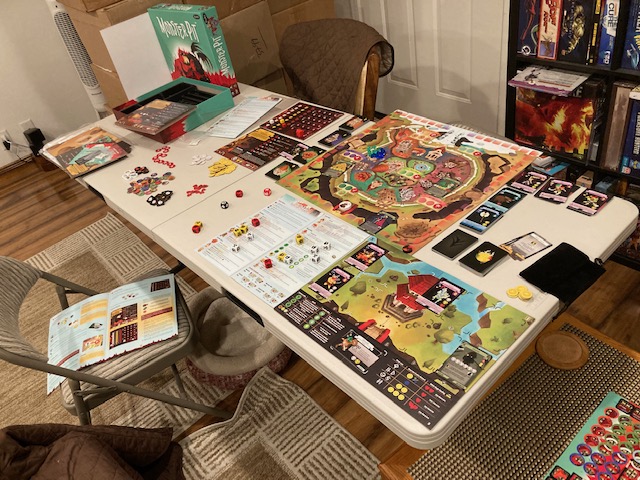
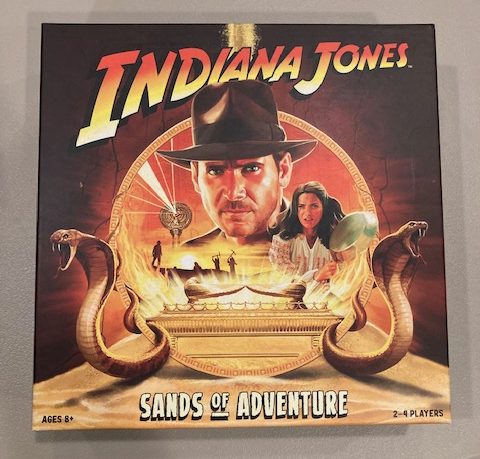
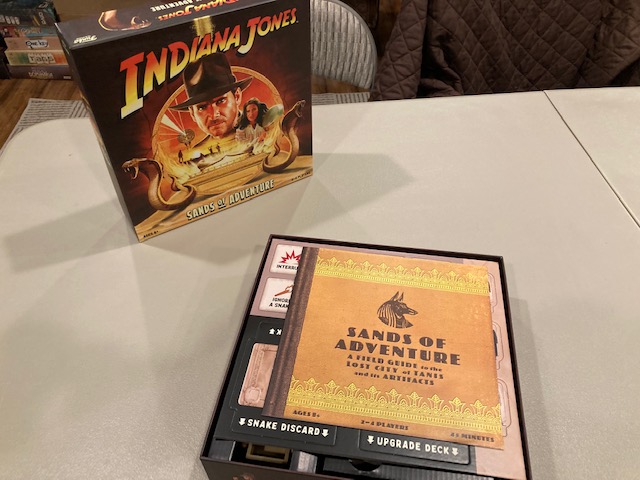
Indiana Jones: Sands of Adventure is a real-time cooperative game for 2-4 players, Ages 8+ and lasting about 45 minutes. I pre-ordered my copy online from Target back in January when I first heard about: A cooperative Indiana Jones game? Count me in!

IMG_8221

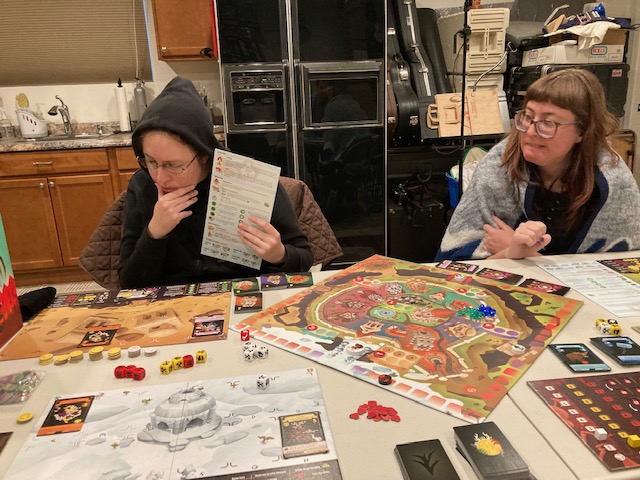
So, this arrived at my house June 18th, 2023 at about 1:30pm. I know the date and time because I had invited a friend over to play the game with me at noon, and it still hadn’t arrived! While we were waiting, we played through Bogeyman: a cooperative kind of horror game by Antoine Ferrara (we’ll take a look at this in the future). It finally arrived! Let’s take a look!

Components and Gameplay

IMG_8222

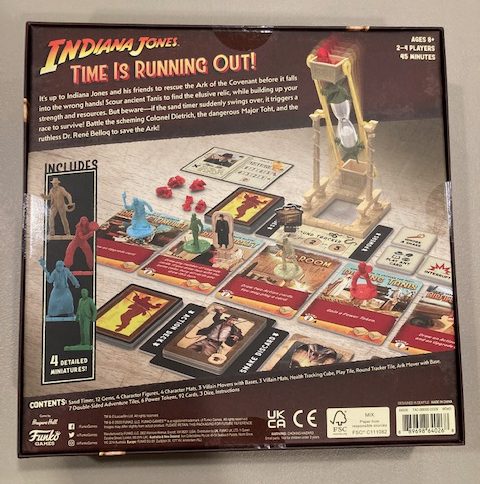
This is a smaller size box from Funko games. It’s about the size of Lord of the Rings Adventure Book Game from a few weeks ago. This size makes sense: the cooperative games from Target all seem to be about the same size. I believe, at the time of this writing, that this is currently a Target exclusive game.

IMG_8224

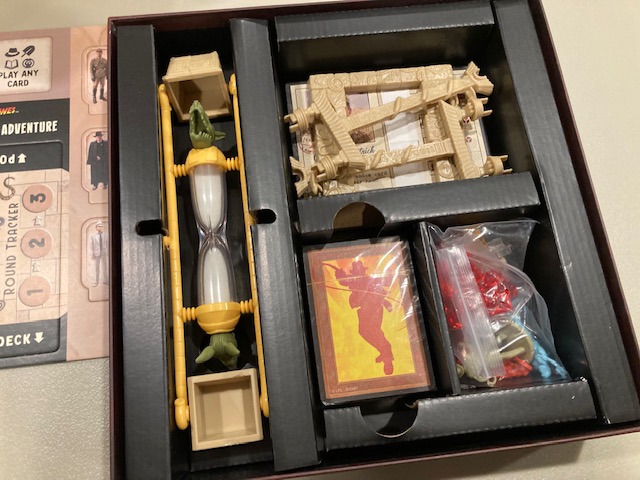
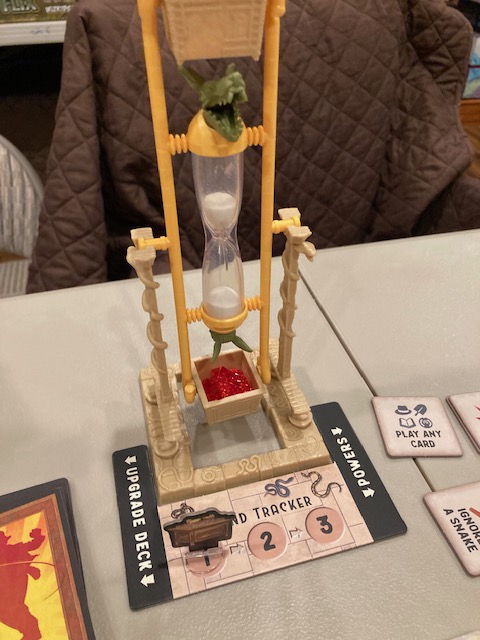
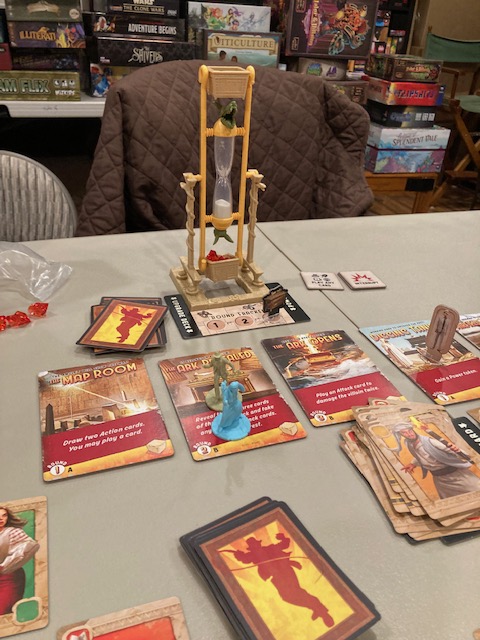
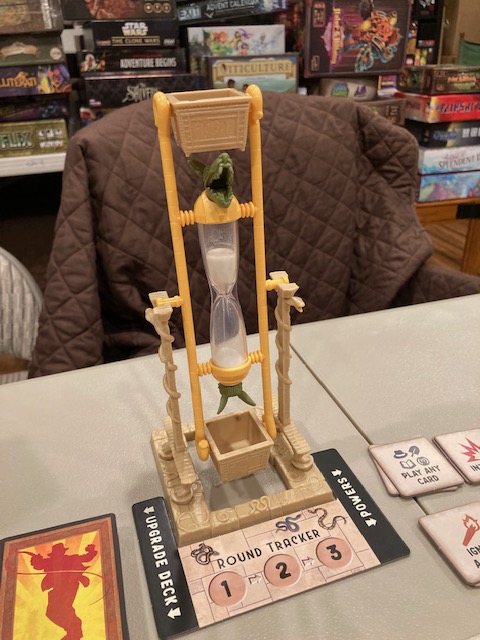
There is a major toy factor going on here in the timet! The timer is actually a fairly complicated structure!

IMG_8230

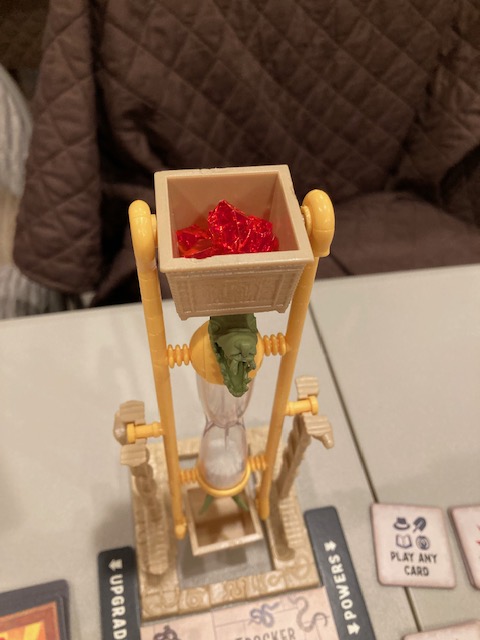
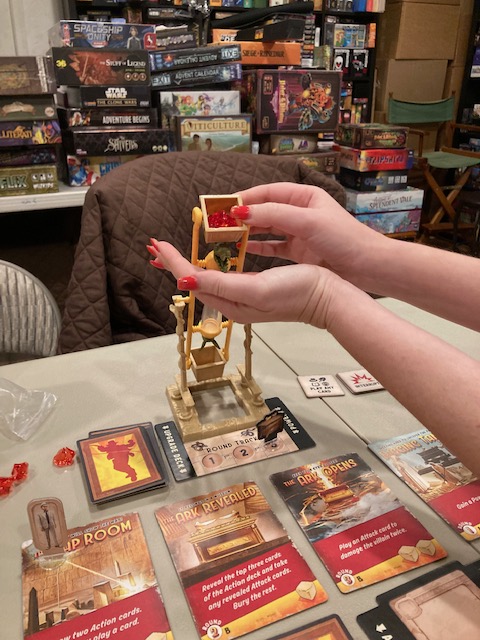
The timer structure has to be assembled, see above. It is supposed to swing upside down as you fill the bucket on top with gems:

IMG_8241

This is the main centerpiece of the game and it looks amazing on the table!

IMG_8249

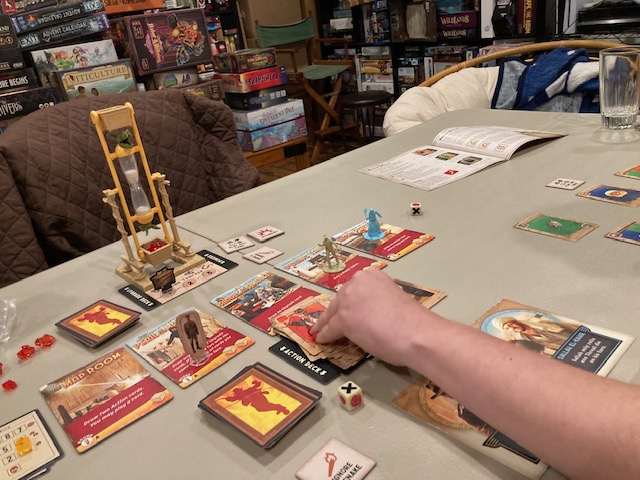
There are two parts to the game: the gather phase (which is not real-time) and the fight phase (which is real-time!). During the gather phase, you are trying to build up your hand to fight the bad guys. To win: you have to defeat all three bad guys over 3 rounds of gather/fight.

IMG_8252 (1)

Each bad guy has an ever-increasing number of hit points! You don’t have to take out the first two to win, but not defeating the first two bad guys puts you at a disadvantage on the the next round: you DO have to defeat Rene Belloq to win!

IMG_8232

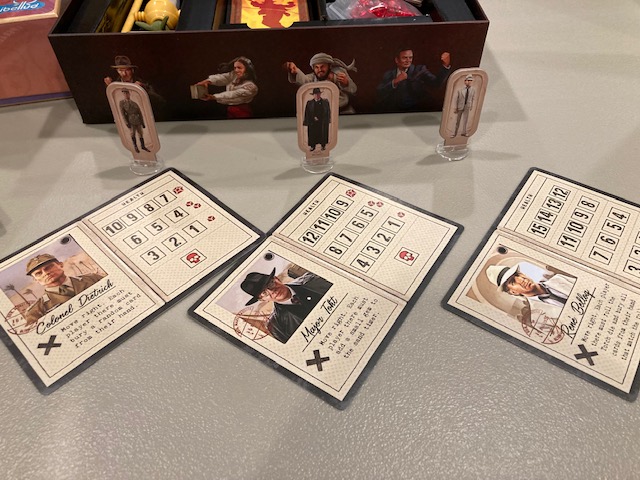
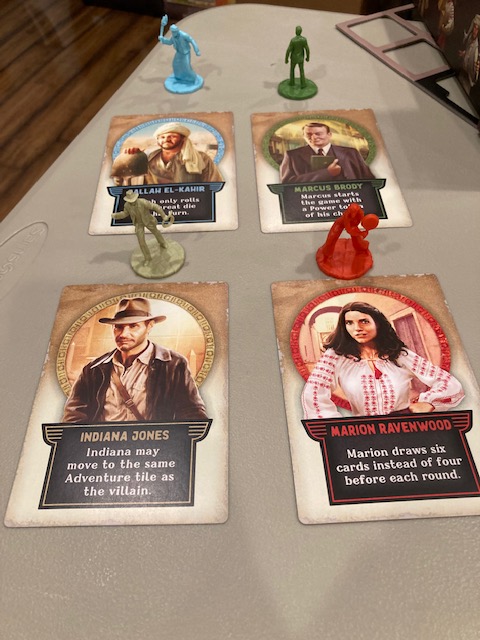
Each player takes the role of an iconic Indiana Jones character, with a special power! See the 4 choices above!

IMG_8240

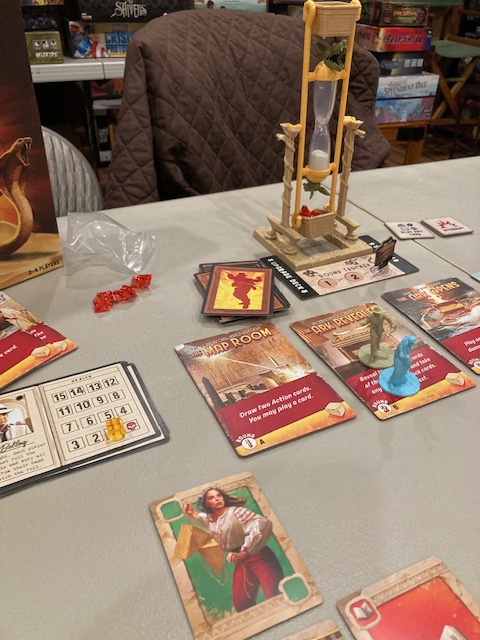
On their turn during the gather phase, players move to any location on a track of five: see above; once they take the action there, they have to roll a dice to see the “consequences”.

Generally the consequences are losing cards or putting a gem into the timer tower!

IMG_8239

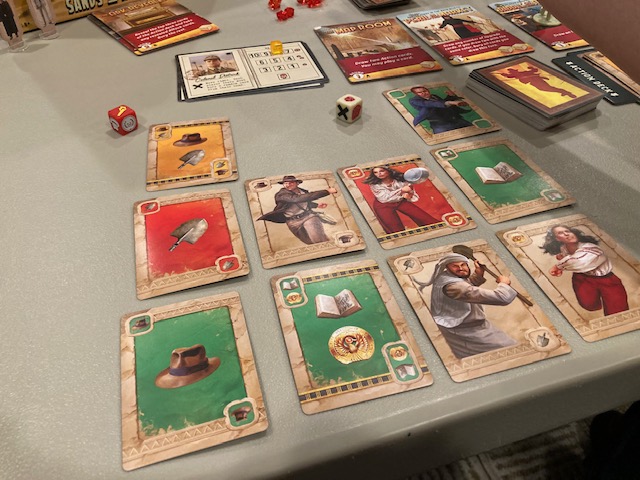
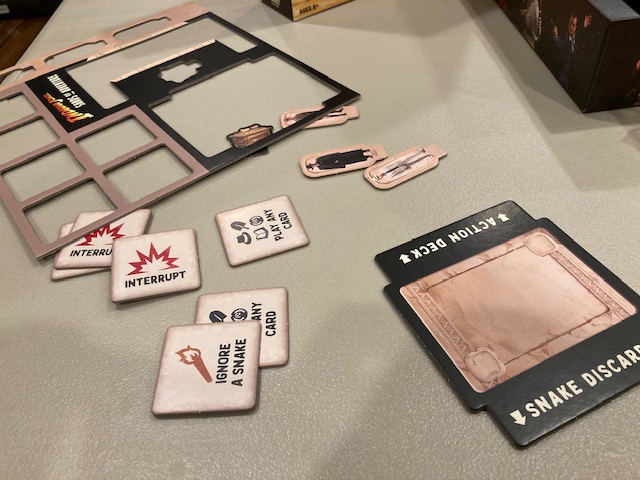
As players “gather”, they are collecting cards with symbols and colors and “fight”: see above. The cards are like UNO cards in many ways, because you can only play a card on the deck if you match the current top symbol or color!

IMG_8238

The only way to win to to play enough “fight” cards (see the character cards above) to knock out the current bad guy, but you can only play those “fight” cards if you can match the card on top (symbol or color).

IMG_8243 (1)

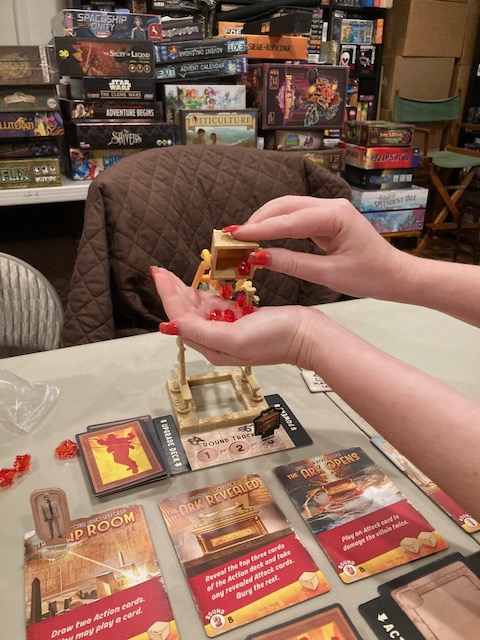
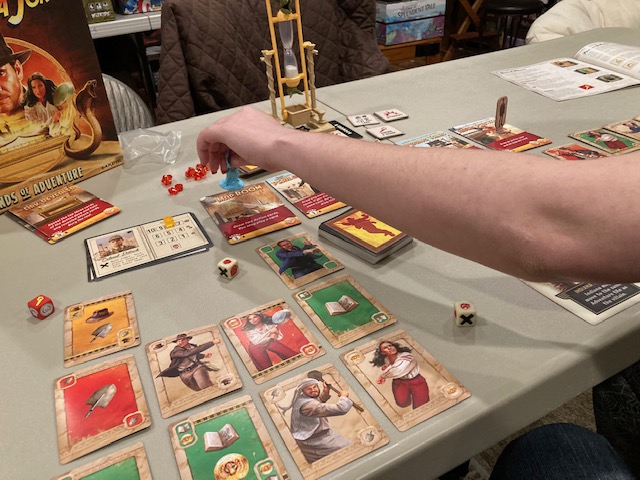
Once you have played too many gems, the timer tower will flip! See above! That’s when the real-time phase starts! This part of the game reminded us of Escape: Curse of the Temple! You are trying to play fight cards and draw cards as fast as possible, but if you ever draw a SNAKE card, you have to roll the red dice until you defeat the snake!

IMG_8242 (1)

The real-time phase is furious! You are trying to play fight cards as fast as you can to knock out the bad guy! If you do before the time runs out, you move on to the next gather/fight round!

IMG_8251

This is a really great production!  That timer tower is really cool to see in action!
 

Movie Arc

IMG_8223

This game really felt like it had a movie arc: as you playing in the “gather” phase, it felt like you were trying to gather information about the bad guy, occassionally hurting him, but making the final fight inevitable! Once the timer tower flips, it feels like the battle at the endof the movie has started! It’s furious! It’s crazy! It’s fun!
IMG_8225

The game really does feel like an action movie.

Replayability

IMG_8250

Our major concern for this game is replayability: there are only 3 villains and you fight the same three every time. Also, the locations are a little limited: they do have an A and B side AND you get to change one of them every round, but a few more villains or locations might have helped this game. We enjoyed the game, but you play the same three rounds every time: gather/fight, gather/fight, gather/fight.

Other Thoughts

IMG_8244

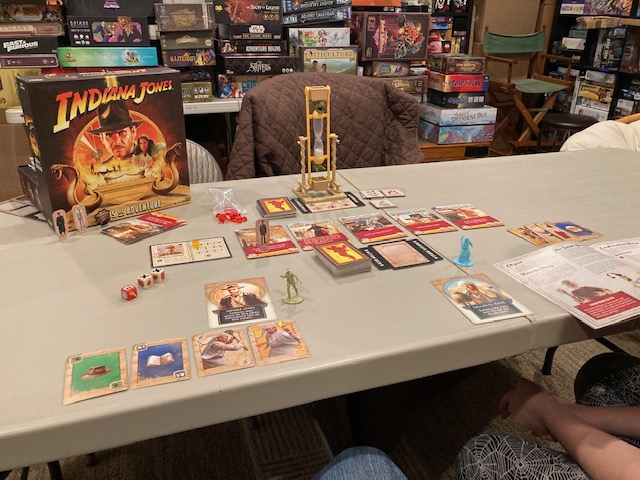
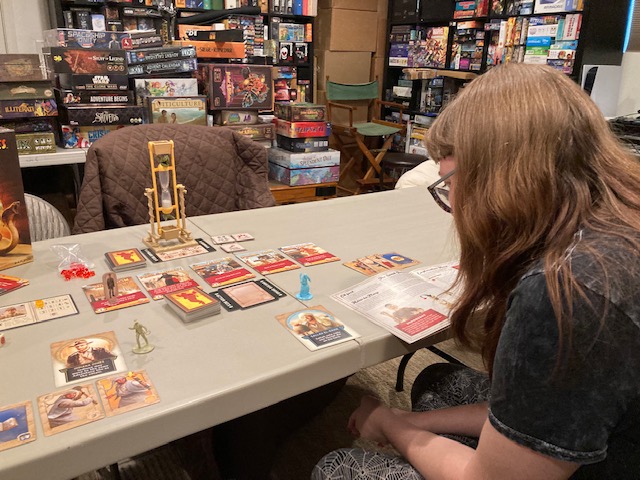
This game looks great on the table, If you have this set-up, I’ll bet a bunch of people will stop by! It’s very appealing visually!

The rulebook was pretty good: we read the rulebook as a team, and we got going on the game pretty quickly. It had a big font, was easy to read, and enough good pictures (including set-up).

IMG_8239

You may want to consider sleeving your cards: you touch them a lot, and you handle them a lot during the sweaty, grody, real-time phase. The cards aren’t linen-finished, so they will grody faster.

The Lost Arc of the Covenant In The Room

IMG_8236

So, if you like real-time, you will probably like this.  If you don’t tend to like real-time … you may still like this.  The real-time phase is easy to teach and easy to play: it’s frantic without too much annoying freneticism.  I personally don’t tend to like real-time games, but I like this.


Conclusion

IMG_8248

Indiana Jones: Sands of Adventure was a surprisingly fun real-time game, and I don’t like real-time games generally. The game felt you were in a movie:the gather phase feeling you were gathering information and resources, but knowing that a big battle was coming … you just didn’t know when! When that timer flips, it’s an adrenaline rush!

IMG_8233

The game looks fantastic on the table, and the toy factor of the timer tower cannot be denied! You will want to play this just to see the tower! And it will attract others to you .. “What is that you are playing?”

IMG_8239

The cards could be better (you may want to sleeve them), but the biggest concern is the replayability! Indiana Jones: Sands of Adventure was a blast to play, and we had fun, but the game is pretty much the same game every time with the same three villains and the same game arc. It might have been nice had there been a few more scenarios (find the arc, find the crystal skull) to vary the game.

IMG_8234

Your first play is so dynamic and fun, you might give it an 8.5/10 out of the gate because it’s so quick and fun and cool! You will probably calm a little and drop it to a 7/10 or less after a while just because the game arc doesn’t change.

IMG_8231

I’m glad I got this: I will be pulling it out at RichieCon 2023 and introducing to everyone I can! This feels like a perfect convention game!

Component Errata: Legends of Sleepy Hollow

Just Arrived! Component Errata To Legends of Sleepy Hollow!

IMG_8128

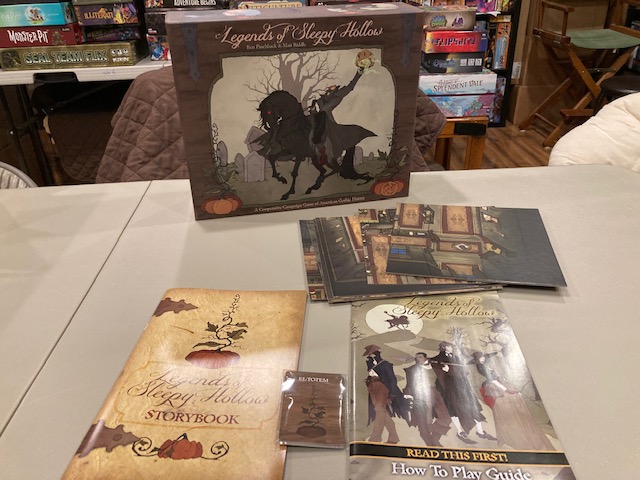
We love Legends of Sleepy Hollow … despite its component issues. We discussed a lot of the component issues in our review here, but it is still worth noting that Legends of Sleepy Hollow made our Top 10 Cooperative Games of 2022!

IMG_8102

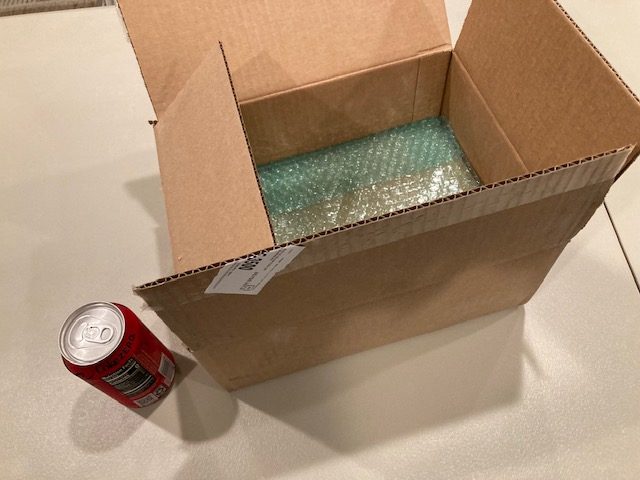
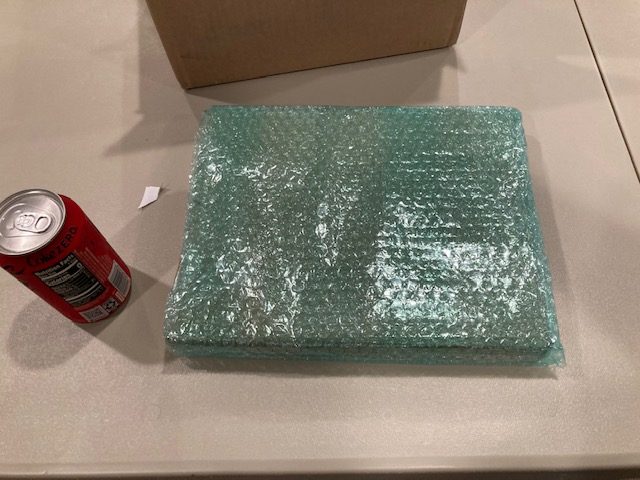
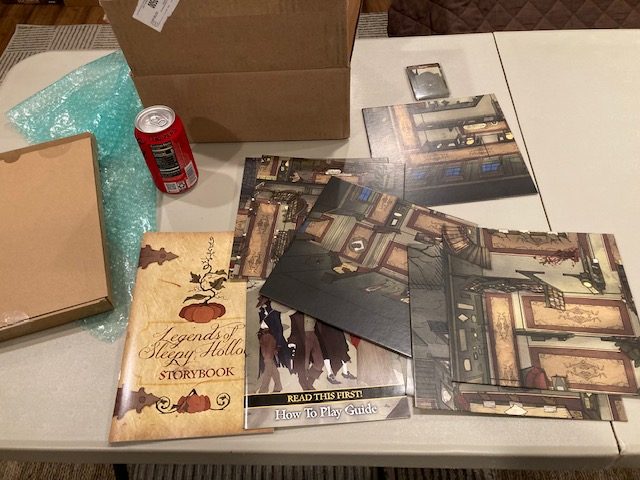
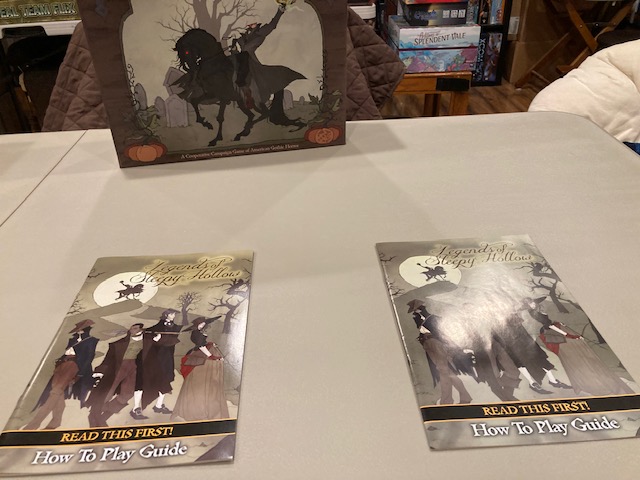
The Kickstarter has been talking about printing and upgrading the pieces for some time! My upgrades/errata (see above) finally arrived June 13, 2023. It’s a surprisingly big box (see above) for such a smallish product (see below).

IMG_8103

Inside the box are (1) upgrades for a map (2) some replacement cards (3) a new rulebook (4) a new adventure book!

IMG_8105

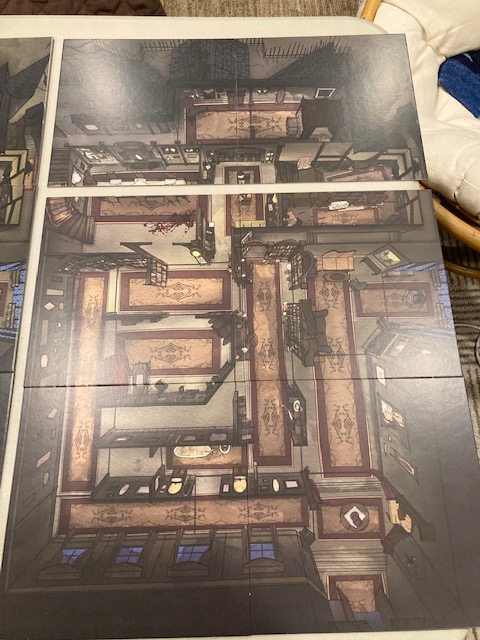
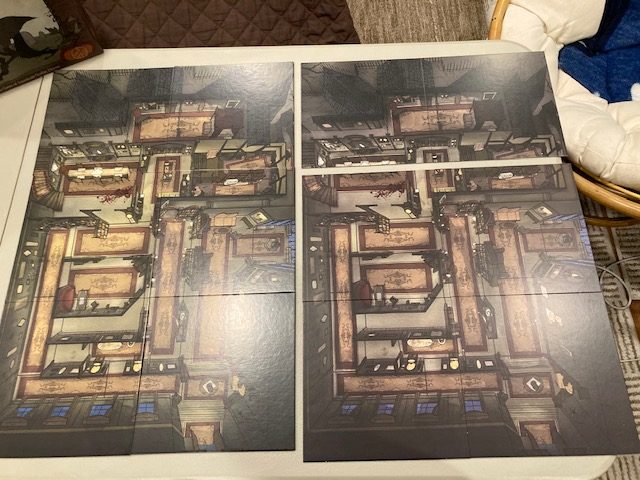
The original map for Chapter 2 was definitely problematic: it was too dark and it had discontinuities!

IMG_8108

See the original map above: I have it separated where the discontinuity is: you can see that the map pieces don’t quite line up AND it’s a little dark.

IMG_8106

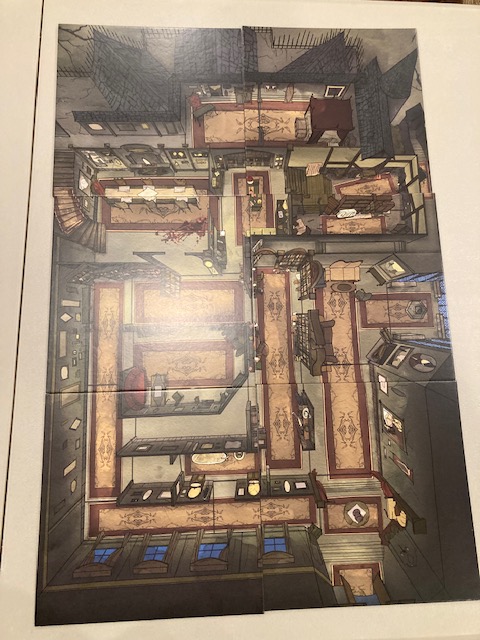
The newer map is both brighter (a little hard to tell from my picture) and it all fits together: see above.

IMG_8109

You can see the differences are much more pronounced when you put the new (left) and old (right) maps next to each other!! See above and below! I am very happy we have a new map.

The next thing was a new rulebook. This rulebook needed a little updating: I am glad to see that it got one! See below.

IMG_8112

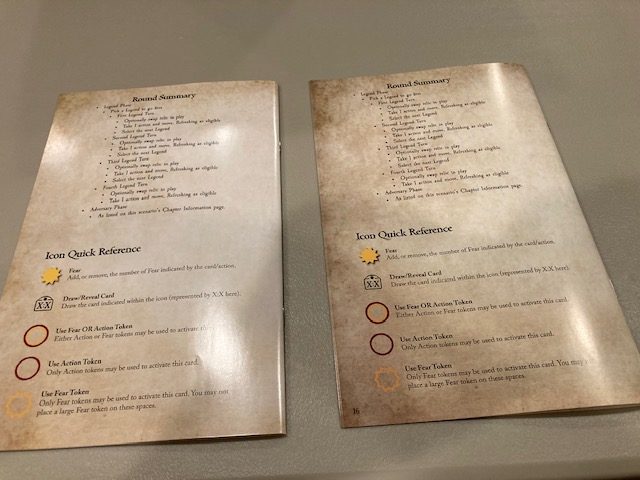
It’s hard to tell the difference between the rulebooks in the first few pages: they seem almost the same.

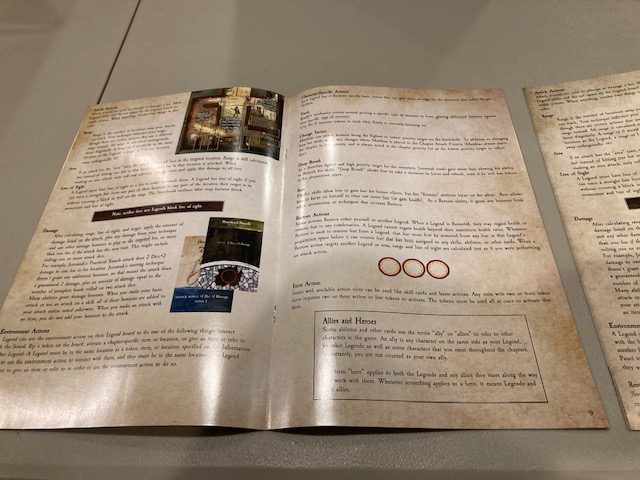
Once you get to page 9, you can see some new rules were added in!

IMG_8116

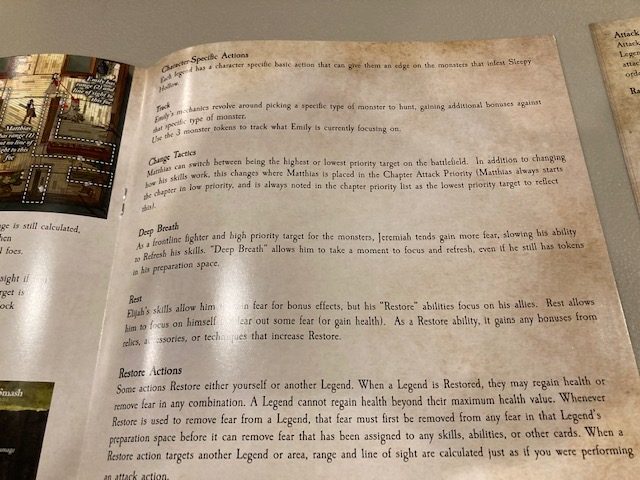
There’s basically about 5 new sub-bullets for Character Special Abilities, new on page 9.

IMG_8118

A few new rules show up near the end as well:

It’s good to see further elaborations on the Spawn rules and a few other rules. I think these all help.

IMG_8123

One comment I made in my review was that sometimes the boards/game was too dark. You can see they took that to heart as well: the newer rulebook (left) is lighter than the original (right) (and to a lesser extend, the Storybooks below).

IMG_8124

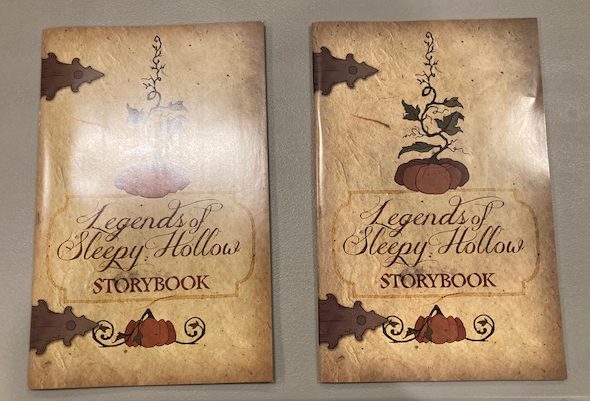
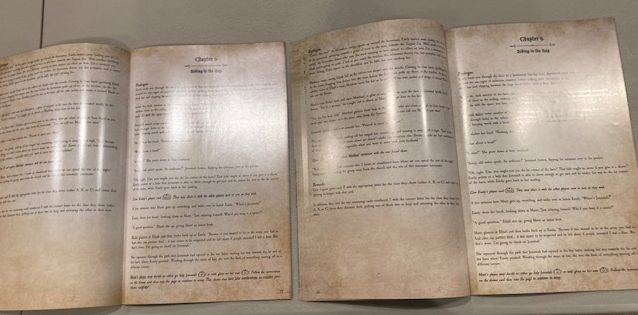
The Storybook, although there is a new one, appears very similar to the original. There don’t appear to be that many differences at first blush: I went through both storybooks at the same time, doing a quick visual comparison and didn’t really see any differences. I am guessing the editing was tighter.

IMG_8126

There was one minor difference we spotted:

IMG_8125

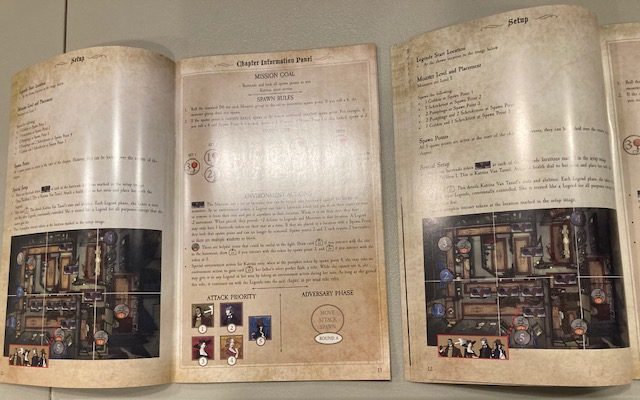
Because the second chapter map was updated, I think the chapters that references to the map looked updated and cleaner.

IMG_8127

The final updates are the cards: those seem to be minor fixes (typos) to make the game better: they seem to just replace the equivalent card in the game.

IMG_8128

I am very happy that Greater Than Games sent me these component upgrades. Honestly, the component issues kept me from wholeheartedly recommending the game: I believe now that these issues have been resolved, I can say without reserve that Legends of Sleepy Hollow is a fantastic game if you want a rich and deep storytelling game! Supposedly, the errata pack will be free to order from Greater Than Games website if you bought this from a retailer (I went looking fo a link to post here and couldn’t find one, but this literally just came out, so wait?). If you bought the Kickstarter (like I did), it should be coming to you free of charge.

A Review of the Mists Over Carcassonne: The Cooperative Carcassonne

My friend Nevin (yes, he’s that Nevin from the C++ committee) introduced me to the competitive game of Carsassone many years ago: he and I live in different cities, but base Carcassonne was a game we could play over the Internet. At the time, it was one of a very few games you could play online. At a hotel in Chicago, Nevin showed me the game, hoping to strike my fancy so we could play online! Alas, it didn’t really strike my fancy. Nevin tried a few times afterwards to get me interested, but for some reason, Carcassonne didn’t work for me.

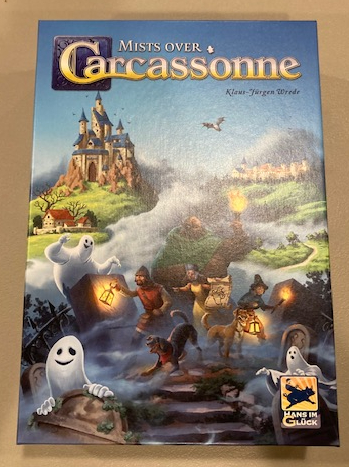
Fast-forward to 2022: Mists Over Carscassone is a cooperative version of Carcassonne taking Germany by storm! It even becomes a nominee in the 17th Annual Golden Geek Awards for 2022 for best cooperative game! I have heard about this game for sometime, but I haven’t been able to get it over the USA! Officially, I believe it’s due to be released in the USA August 2023, but I was able to find a US store that had a copy in stock and ordered it! It arrived late May 2023.

IMG_7962

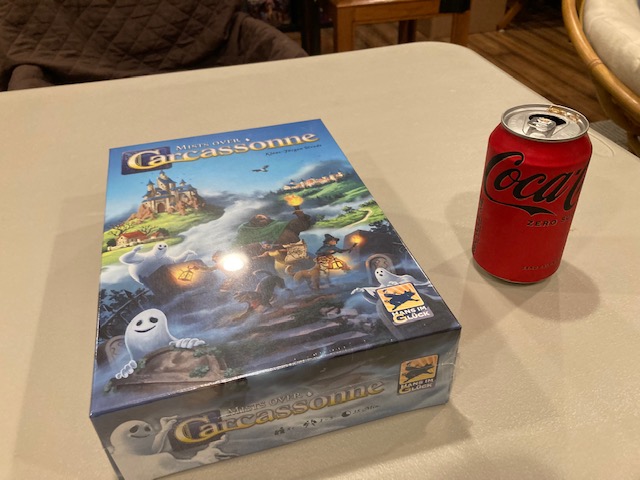
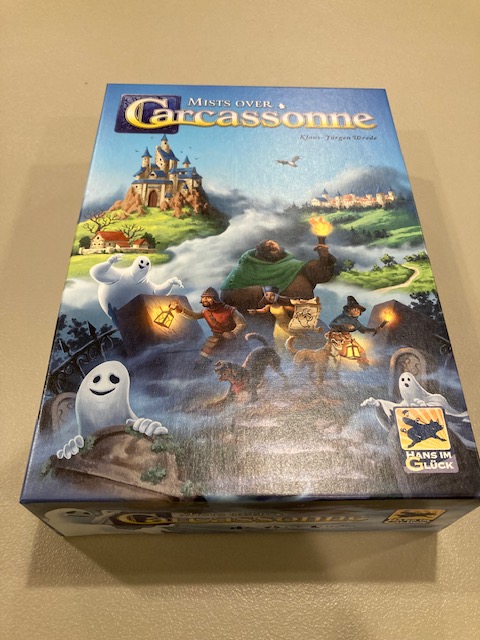
Mists Over Carcassonne is a cooperative tile-playing game for 1 to 5 Players: it is for ages 8 and up and lasts 35 minutes, as per the box. These parameters seem in sync with reality.

To be clear: this is a standalone game! You do not need the original Carcassonne to play.

Components

IMG_7959

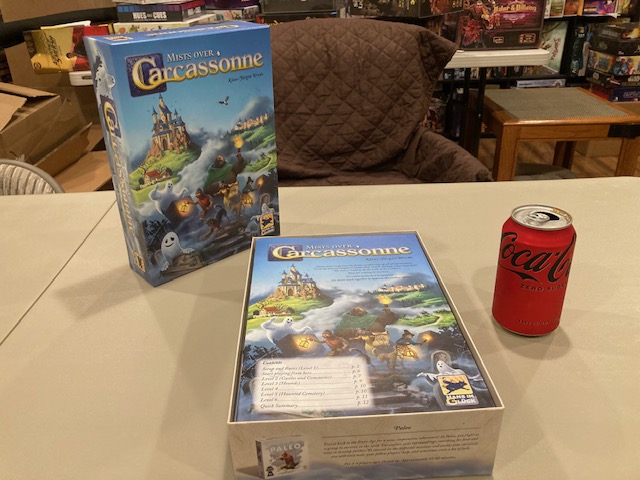
This is a smallish box. It’s a pretty standard size for a Euro game (about the size of Agricola), but it looks small compared to all the kickstarters we have been looking at lately (Deep Rock Galactic, Valor and Villainy: LLudwick’s Labyrinth, The Isofarian Guard, etc.).

IMG_7973

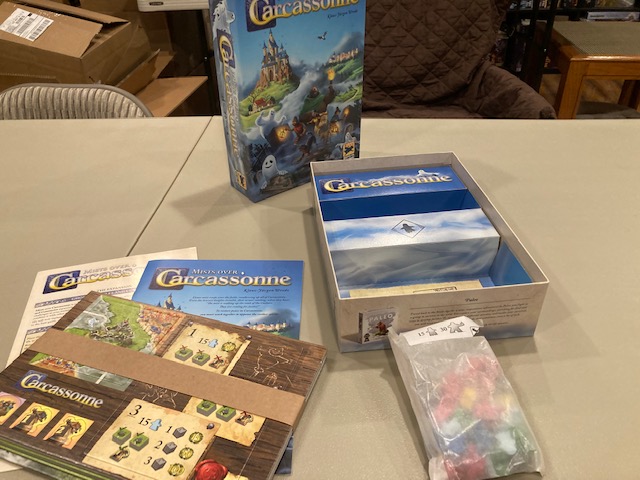
This is a tile-laying game, so the majority of the pieces will be tiles in punchout boards. There are also some meeples (and ghosts), a rulebook, and an expansion manual.

IMG_7975

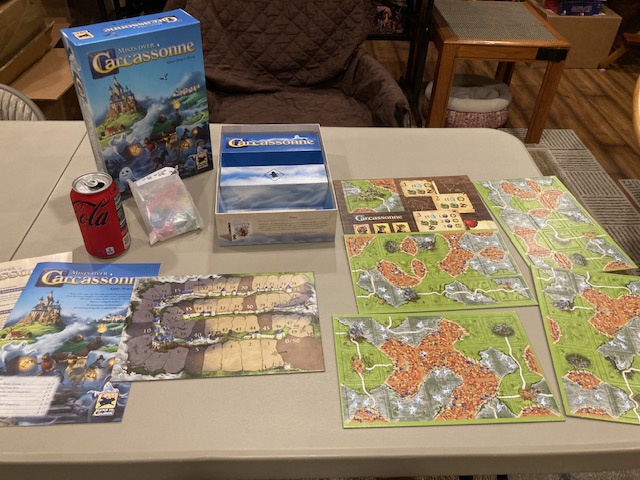
You can see a lot of the tiles above in “pre-punchout” form (above) and “post-punchout” form (below).

IMG_7976

The meeples are in a curious wax packet.

IMG_7978

The game’s components are good enough: they are usable and easy to read.

Rulebook

IMG_7970

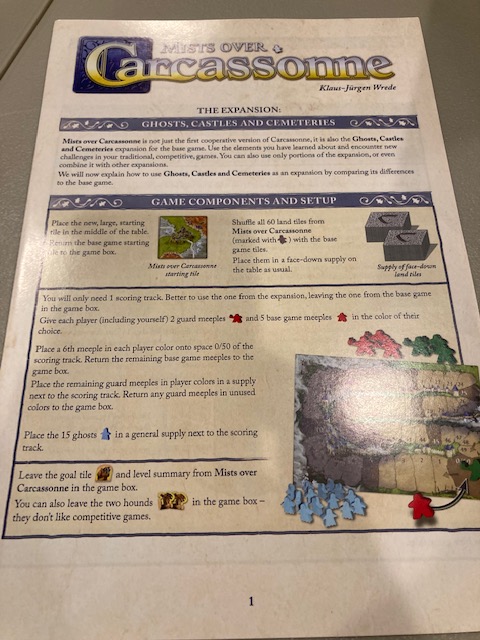
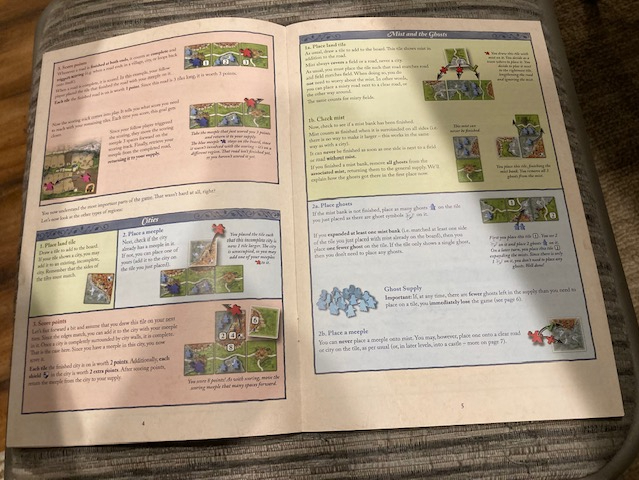
The rulebook is good: it explains the game well even to people haven’t played Carcassonne! (Well, I did play 15-20 years ago, but I don’t remember a thing).

IMG_7971

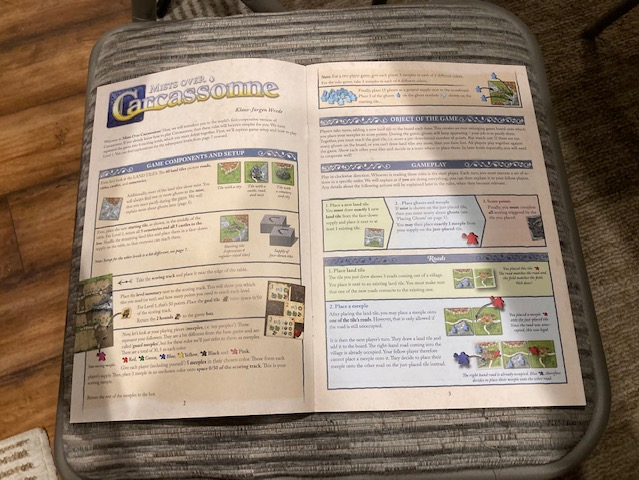
Mists Over Carcassonne gets a full A on the Chair Test: the rulebook fits perfectly on the chair next to me, and is easy to look up rules!

IMG_7972

My only real complaint is the game shows how the game plays though examples with limited description of the rules. This works because, through a well-selected series of examples, you see how the game plays. But I felt like I could never go look up a rule: I’d just have to look at the example to understand the rules. This style is great for a first time player like myself, but I don’t like it when I don’t have a full grasp on the rules. I suspect this rulebook style has evolved over time for the Carcassonne series; they’ve certainally had a lot of feedback and chances to make the best rulebooks: maybe this style works best for them.

It may just be me: I had this same problem with Sleeping Gods rulebook, The Flourish rulebook, and (to a lesser extent) The Isofarian Guard rulebooks. Please, just tell me succinctly and completely what the rules are, using the examples to illustrate the point: don’t let the example become the sole realization of the rule.

“Excuse me, Rich? Rich? Are you paying attention? Look At the back of the Rulebook!”

IMG_8015

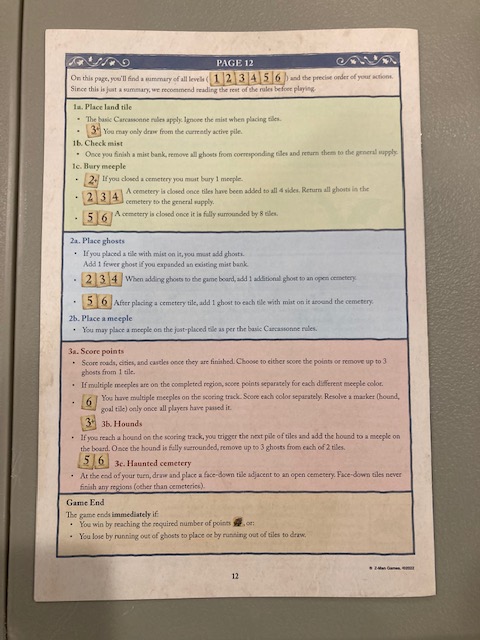
Oh! After playing the game like 6 or 7 times, I finally saw the back of the rulebook! This is the best of all worlds: this is a very concise description of all the rules, with an explicit ordering of operations (many of our questions came up were order of operations questions) AND it uses the back of the rulebook for something useful. Okay, I am eating crow here … this rulebook is great. Just make sure you look at the back cover!!!

IMG_7968

I learned the game from the rulebook: the font was good, the text was readable, the examples were good. Job well done. Just make sure you look at the back of the rulebook!

Gameplay

IMG_7979

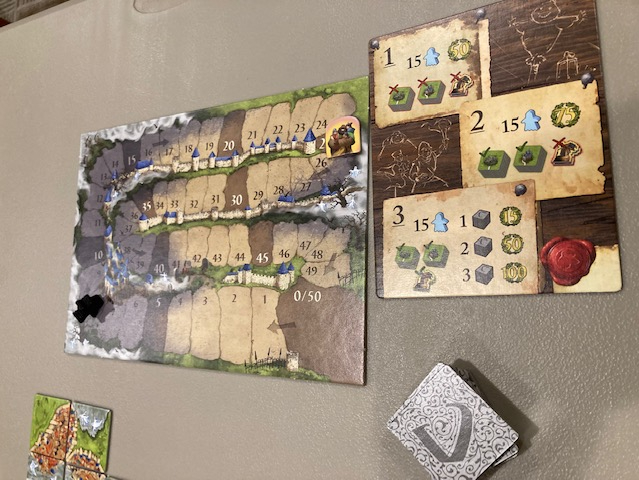
This is a Victory Point game: in order to win, the players must work together to get the desired score (as set by the level). There are 6 levels of difficulty in the game, with different scoring constraints.

IMG_7999

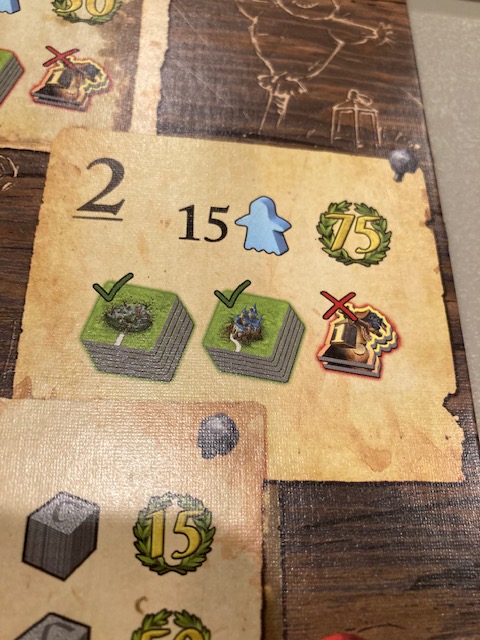
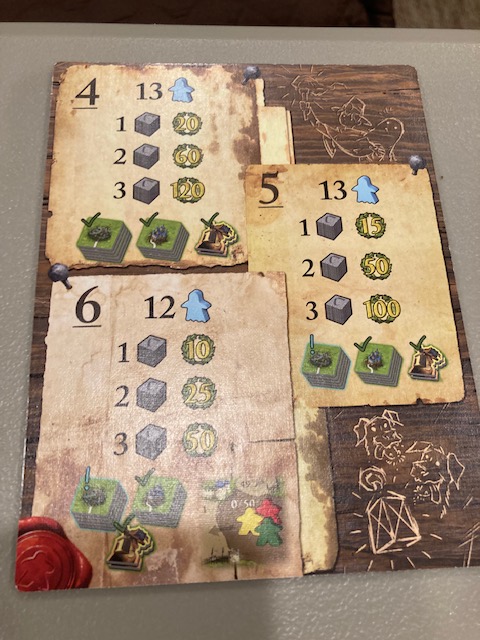
The Victory Points needed are described very iconically on one of the boards: for level 2, you need 75 victory points: See above. This same board also describes the starting conditions: for level 2, you start with 15 ghosts, the graveyards, and the castles, but not the hounds.

IMG_7982

Levels 4, 5, 6 starting conditions get worse and worse as the game gets harder and harder … see above!

IMG_7985

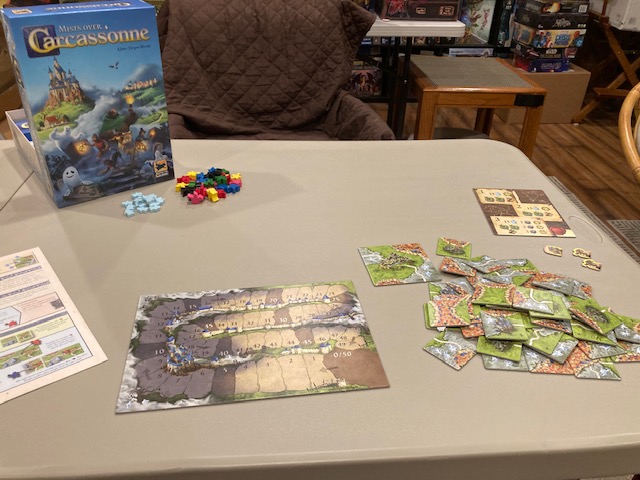
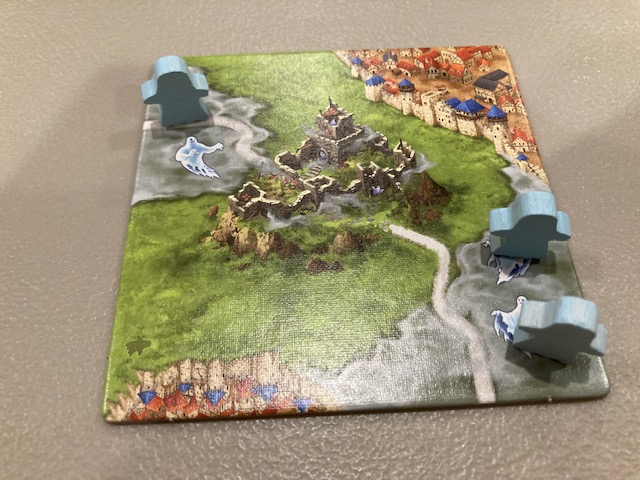
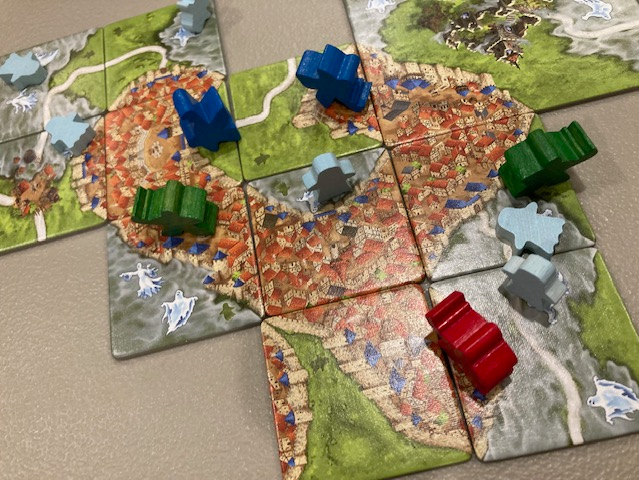
The starting tile is placed out (above) with starting ghosts. This is a tile-laying game: you place a tile every turn, trying to score points while trying to keep the ghosts under control. If you ever place a tile and can’t place the appropriate number of ghosts, you immediately lose. The ghosts are a limited resource: you have to keep them under control as you play.

IMG_7989

See above as the tile place will have 2 ghosts.

Basically, a player has a very simple turn: pick a tile (face-down, you can’t get see it), place it legally (roads must connect roads: no dead-ends, stuff like that), and then place a meeple on the placed tile if legal and desired. The meeple placed on the tile helps that player to “own” that road, castle, city, etc. for scoring later. When you actually “close” a road, city, whatever, then you have the opportunity to score!

IMG_7990

Notice the tile above closes the city so players can score!

Cities score 2 points for each tile in the close city, Roads score 1 point per tile in the closed road, and there are other scoring criteria.

IMG_7996

You only score when you “close” something, so if you make it to the VP limit after scoring, you immediately win!  You lose if you run out of ghosts or tiles.  That’s it!

Ghosts

IMG_8002

Although you can lose my running out of tiles, every single game we have lost were because we ran out of ghosts! See a losing game with too many ghosts above! (Strictly speaking, we lost because we couldn’t place enough ghosts on the next tile to come out).

There are three ways to mitigate ghosts:

  1. When you would score (because you “closed” something), you may instead chose to remove 3 or fewer ghosts from any single tile.
  2. When you place a tile and “close” a mist area, you can remove all ghosts in the closed mists
  3. When you place a tile and “extend” a mist area, you put one fewer ghost out

This gives the players really interesting choices every single turn: do I set-up a scoring opportunity, do I “close” mists to mitigate ghosts, or can I do both and reduce the number of ghosts? The hardest choice is to forego scoring in order to keep the ghosts in line!  Such a hard decision!

What I enjoyed about this is that a tile is both good news AND a bad news at the same time!  Does the tile have what I want? How many ghosts do I need to worry about?  Can I leverage my tile to do any good?  Do I just have to mitigate ghosts?   And the players have so many choices on their turn.

Ghosts “scare” The Alpha Player Away!

IMG_7997

One of the nicer things about Mists Over Carcassonne is that the Alpha Player can be kept at bay (the Alpha Player is that annoying guy who attempts to takes over the game: See our full discussion of the Alpha Player “Problem” here). How? Because on your turn, you get a tile in your hands and you have the agency to to try to place it. The other players can’t necessarily see the tile, so the Alpha Player can’t see your tile, unless you choose to show it! But, you can ask for help with the tile, if you like!! Each player can do what they want: what I’ve found is that everyone helps by pointing out places the tile can/can’t go, reminds each other of the ghosts situation, reminds each other of places we’ve set-up cooperative scoring, but in the end: it’s the player’s choice where the tile goes! It really depends on how play is evolving: if the game feels collaborative, the player can place the tile and show all players the tile …. but if the game feels “Alpha Playery”, the player can just keep the tile hidden in their hand until they are ready to play.

IMG_7991

By physically taking a tile into his hands, that player is “owning” the tile and tacitly rebuking the Alpha Player: “This is my tile, let me place it”. The Alpha Player Problem is typically not a problem with most of my game groups, but I believe Mists Over Carcassonne is a cooperative game that will have less issue with The Alpha Player.

Solo Play

IMG_7983

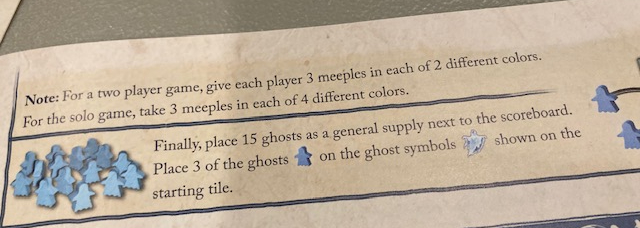
This game fully supports solo play (thank you for following Saunders’ Law): At the top of page 3 of the rule is simple and explained: “For the solo game, take 3 meeples of 4 different colors”.

IMG_7994

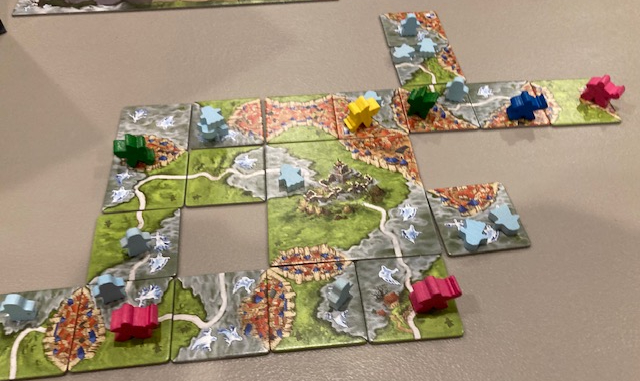
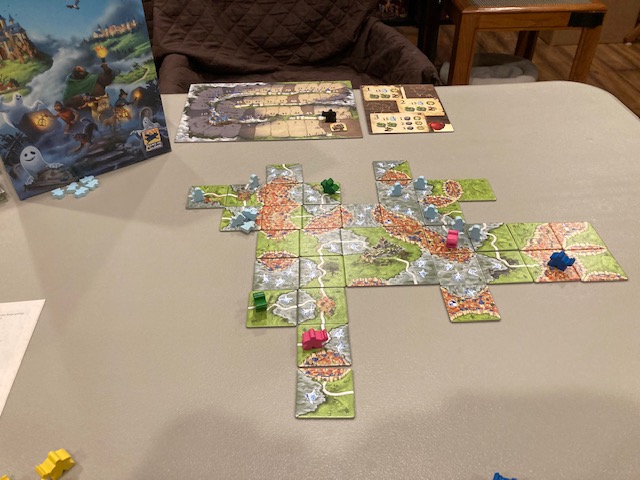
As the solo player plays, he has the choice to play different colored meeples out when places a tile: see above as the solo player has a many different colored meeples out!

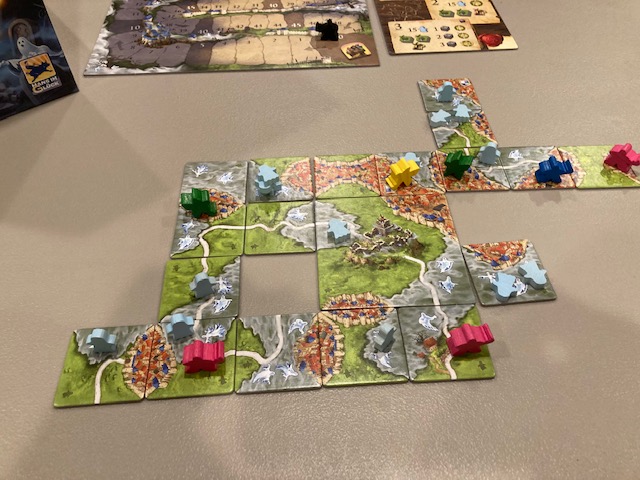
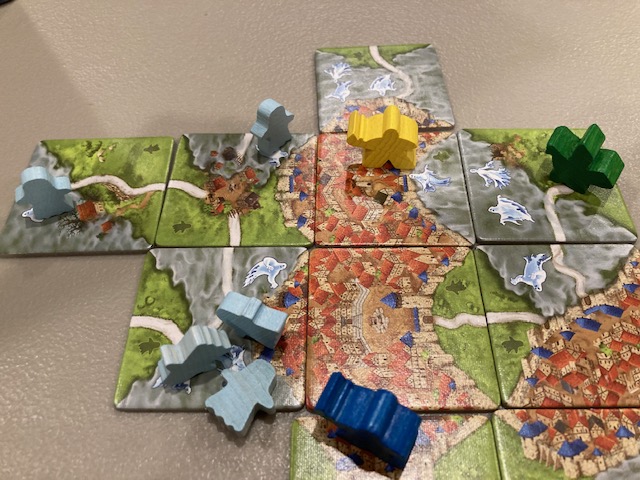
You might ask, “Why does the solo player have 4 different colored meeples?” One rule we haven’t covered yet is that when you close an area, you can close an area belonging to multiple different meeples, and you score for each colored meeple! Consider the example above: When the solo player closes the city, both the pink and blue meeples are in that same city, so when it’s closed, BOTH colors score! Blue scores 5 tiles*2 points=10, pink scores 5 tiles*2 points=10 so this one tile scores the group (or solo player) 20 points!

IMG_8006

This shared points rule is critical to winning the game, as they are worth so much! It makes Mists Over Carcassonne more strategic, as you try to set-up more complex scoring opportunities! Again, more choices for the players: do I try to set-up a shared point situation so we can all score? Even at the cost of the ghosts going crazy?

IMG_8004

I played about 4 to 5 solo games over a couple of nights: I was able to beat Level 1 a few times, then got trounced at Level 2. The thing is, this game is so easy to set-up and get to the table quickly, and it really is about 35 minutes. If you want a nice “end of the night” puzzle, the solo game works well for that. It’s a nice, quiet puzzle. If it ever gets too easy, there are 6 levels to try, each harder than the last!

Oh yes, and the solo game did its job: I was able to learn the game so I could teach it to my friends.

Cooperative Play

IMG_8005

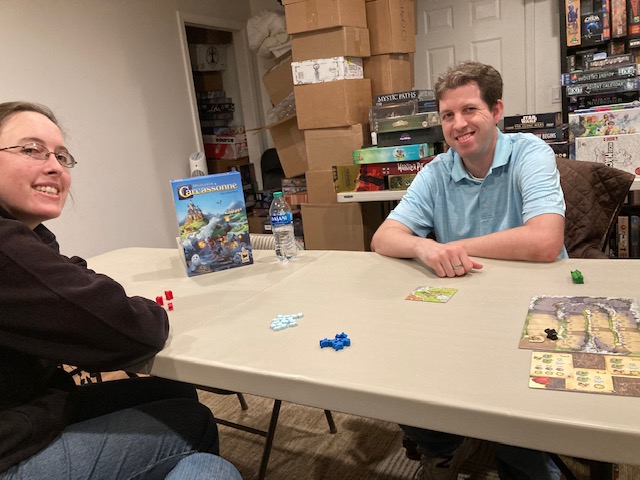
Cooperative plays worked fabulously: it was easy to teach the game … and my friends jumped right in. 

The best part of cooperative play is that so many discussions flowed easily, as everyone saw things others didn’t see!  There is a maxim in Open Source software called Linus’ Law:  “given enough eyeballs, all bugs are shallow “.  I think that same idea applies here: many eyeballs on all the tile possibilities really opened up the game. 

After we trounced Level 1, we jumped to Level 2: This is a good sign: my friends wanted to keep playing even after we won our first game!

Conclusion

IMG_7967

This is a really easy game to get to the table: both solo and cooperatively. Mists Over Carcassonne has lots of hidden depth and strategy for such a simple set of rules. Every turn feels juicy as you have many choices: do I set-up scoring, do I score, do I mitigate ghosts, do I set-up shared scoring, and the best turns are when you can do many things with just one tile!

IMG_8008

The solo game feels like a nice puzzle: do I want a puzzle for 35 minutes? Mists Over Carcassonne quickly sets-up and presents a nice challenge, which can easily be scaled to your ability (via the Level system).

The cooperative game works really well too, as the system tends to encourage discussion: your compatriots see things that you don’t! The collaborative strategizing about shared scoring and ghost mitigating seems to naturally flow.

Even if you didn’t love Carcassonne (I am one of those few), Mists Over Carcassonne solo and cooperative modes might be something that still appeals to you. This game is easy to teach to anyone and offers lots of replayability with its Level system. Fantastic Game: 8.5/10

IMG_7966

Oh yes, Mists Over Carcassonne is also a straight-up expansion to competitive Carcassonne. So, even more reason to consider it!

Yes Nevin, you are probably getting this for your Birthday…

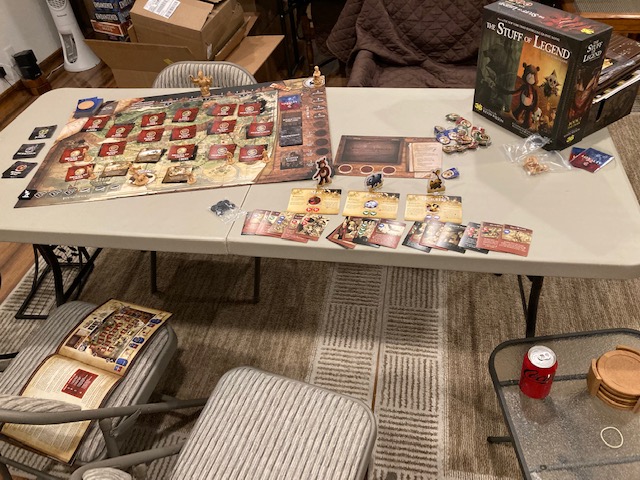
A Review of The Stuff of Legend: A Hidden Traitor Game That Can Be Fully Cooperative

IMG_7848

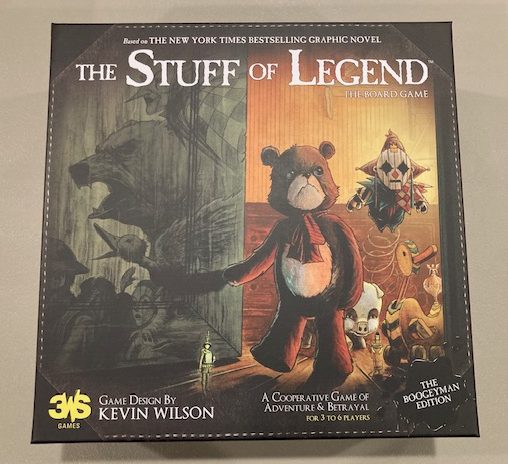
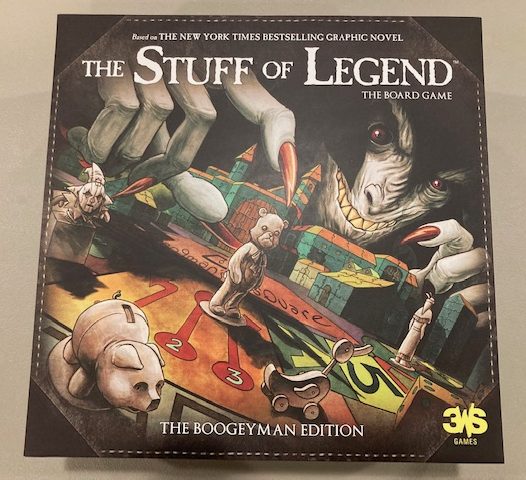
The Stuff of Legend is a Hidden Traitor game that was on Kickstarter back in October 2021.  We’ve been looking forward to this for a while:  it was on our Top 10 Anticipated Cooperative Games of 2022  mostly because this is a Kevin Wilson design (one of the people responsible for the amazing Arkham Horror 2nd Edition).   The game promised delivery in June 2022, but it didn’t arrive at my house until May 27th, 2023, so it is just about a year late.

IMG_7932

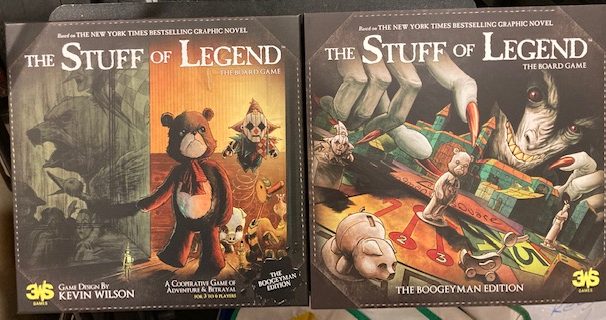
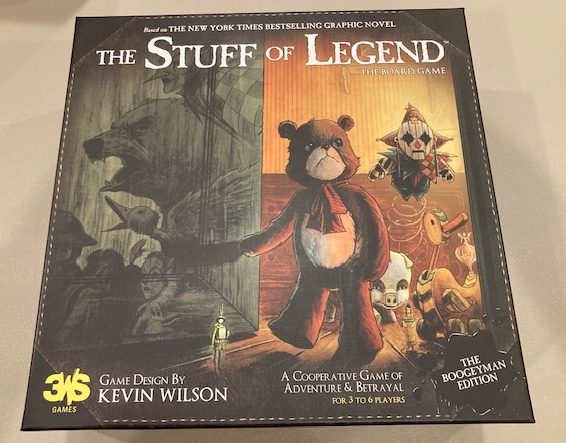
The version we got was the Kickstarter Bogeyman version, with a slip cover: see above right.  The retail/normal version will look more like the above left.  We’ll discuss differences later below.

The Stuff Of Legend

IMG_7866

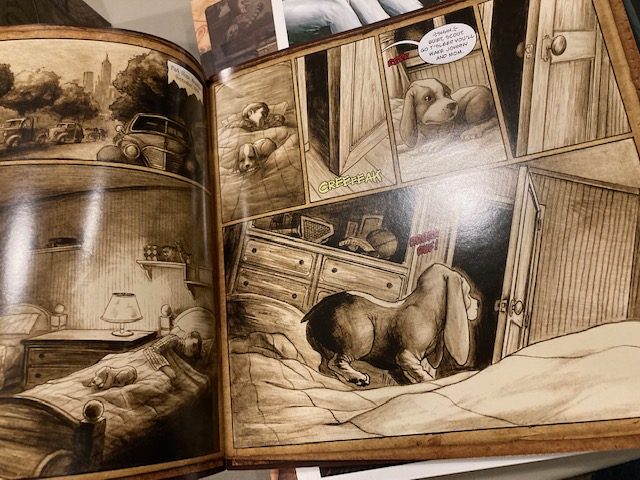
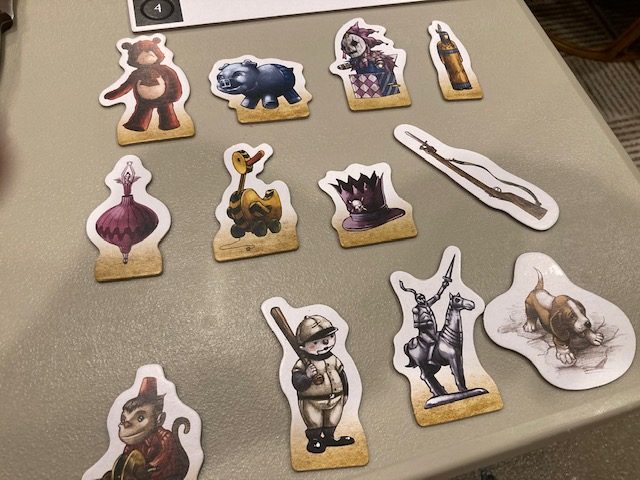
The Stuff Of Legends is a best selling Graphic Novel … which I knew nothing about when I backed this game. The Stuff of Legends universe basically provides the backstory and setting for this game: players take the role of toys trying to save their kidnapped boy from the Bogeyman!

IMG_7867

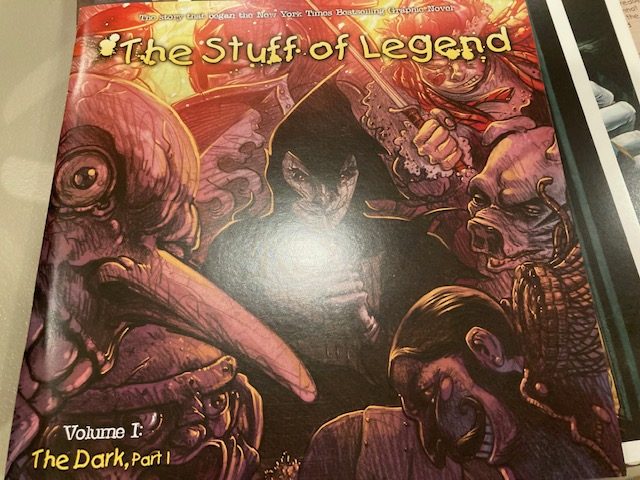
Even though I didn’t know the IP, the universe and art are quite compelling.  In fact, my Kickstarter version came with a nice-sized comic book called The Dark, Book I.

IMG_7868

The art is fantastic in this graphic series, if a little dark.

Components

The production is very good. 

Cooperative or Hidden Traitor Game?

IMG_7847

Those of you paying attention might have notice that the game box says that this is a Cooperative game (see above), but we introduced it (at the start) as a Hidden Traitor game: which is it?  It’s kind of both and neither. Let me explain.

IMG_7951

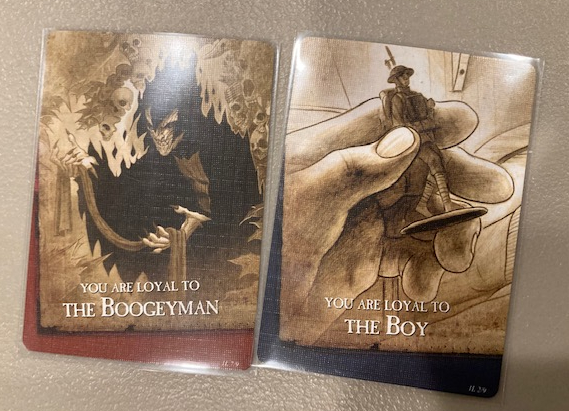
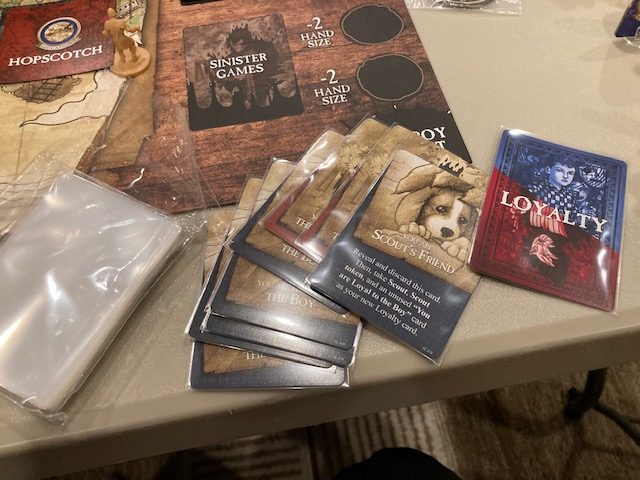
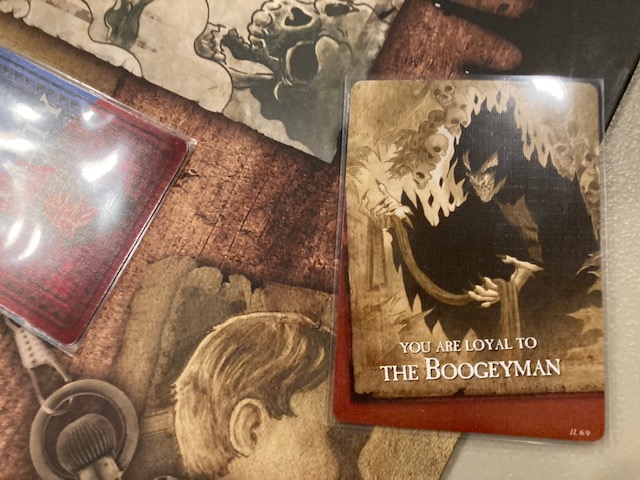
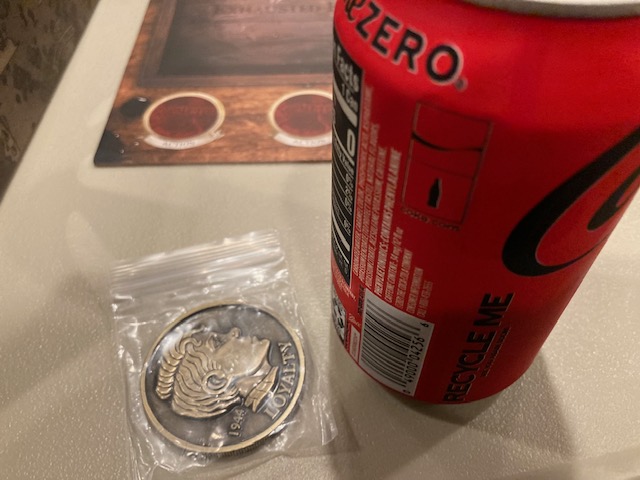
Like many Hidden Traitor games you might have seen, everyone is given a loyalty card at the start of the game.  All players are on one of two teams: the toys trying to save their boy (Loyal to the Boy) or trying to help the Bogeyman kidnap the boy (Loyal to the Bogeyman).   Most players are Loyal to the Boy, and at most 1 or 2 (depending on the number of players) are loyal to the Bogeyman.

IMG_7920

Here’s the thing: At player counts 3 and 4: there is a 50-50% that no one is loyal to the Bogeyman!! At the start of the game, you shuffle together 1 Boy Loyalty card and 1 Bogeyman loyalty card, and only one of them it goes into the the deck with all the other loyalty cards.  So, it’s possible that no one is loyal to the Bogeyman at the start of the game!  The remaining card is placed on the board, and through a wacky card called “Muddying the Waters” players can swap loyalty cards with that!

sahad

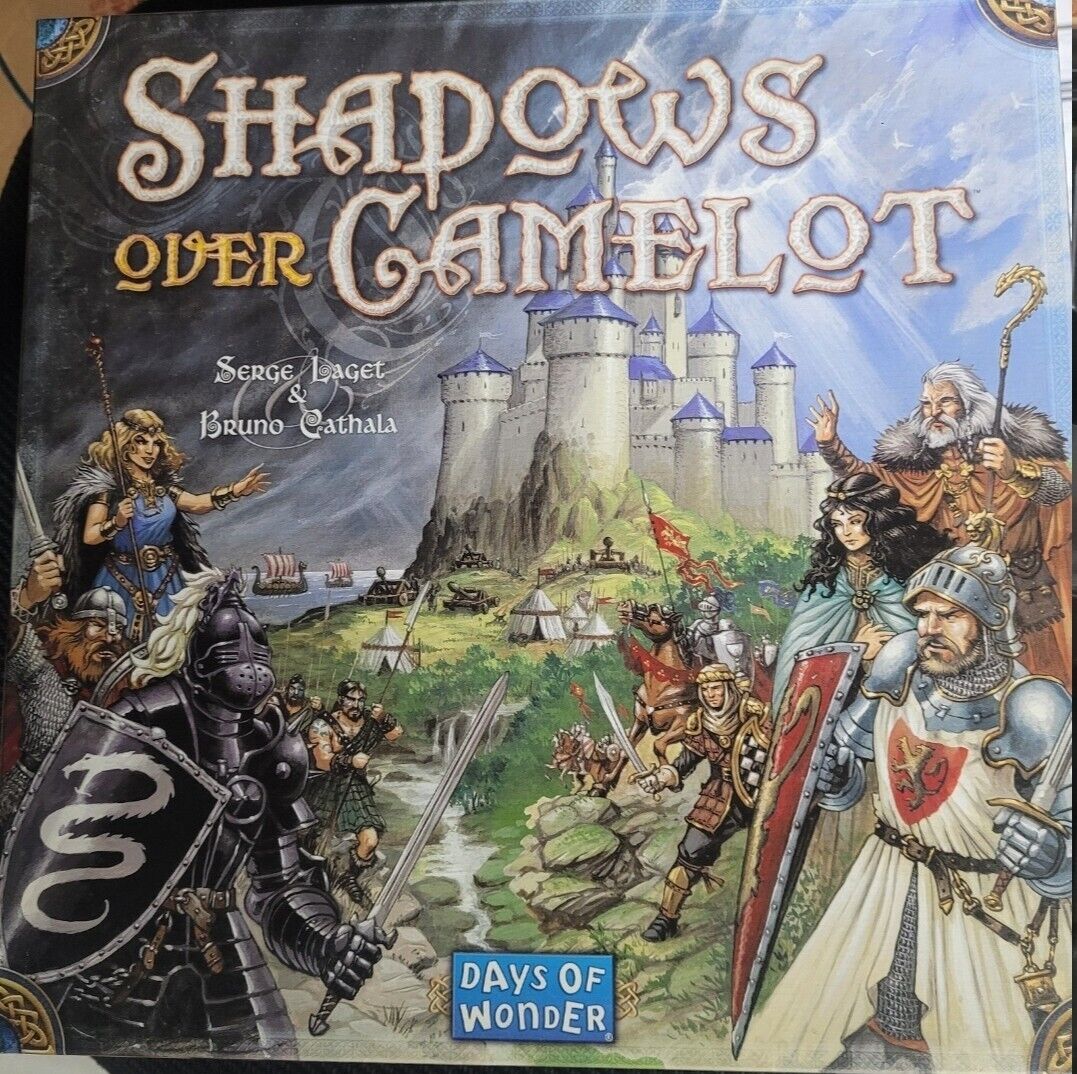
Those of you who follow hidden traitor games may find this seems reminiscent of Shadows Over Camelot, the old Days of Wonder game (out of print for many years).  It’s possible that no one is a traitor in that game as well! In fact, we tend to play Shadows Over Camelot with a house rule that makes the game fully cooperative by never selecting traitor cards: See our Top 10 Games That Can Be Played Fully Cooperatively.

IMG_7914

Having said that, if you play with 5 or 6 Players, you are guaranteed to always have at least 1 and maybe 2 loyalty cards of Bogeyman.  

What’s weird is that there is a card called “Muddying the Waters” that can really mess with this: it allows you to swap your loyalty card with the one in the center.  If it looks your team is about to lose, you can play that and maybe swap teams!  Your loyalty can be dynamic in this game.

“But Does It Make Sense to Play Fully Cooperatively?”

IMG_7936

Does it make sense to play this fully cooperatively?  I think it does!  We played a 4-player game and they just barely scraped by a win for the Boy team.  I ended up being the Traitor!  Here’s the thing: I couldn’t do very much to sabotage the other team: since actions are mitigated by voting, I couldn’t do anything too horrid.  And there is no special advantage to the Bogeyman team for revealing! In Shadows Over Camelot and many other Hidden Traitor games (like Battlestar Galactica and Unfathomable), once you reveal the Traitor card, you get some special actions to sabotage the others!  Nope!  Nothing like that here!  At the end game, all I could do was just say “I don’t have anything I can do” and discard a card or two, hoping to cause a Coin Flip.  

IMG_7914

This lack of special traitor ability is both bone and bane for this game: if you have to have special rules for the traitor team (Bogeyman), then you have to obliquely ask to see the rulebook and try to find all the things you can do.  But then you sometimes feel like you can’t do a lot, even if you are a traitor!  In fact, about the only thing you can do near the end of the game is try get your hand discarded quick so you can force a Coin Flip (which forces the endgame closer).

From a cooperative perspective, I feel like this game could be played fully cooperatively because the game was still hard!  At the end of the game, the Boy Loyalists still had to guess to win, and they had a 20% chance of losing still!  I think we could house rule this and say “Let’s just play cooperatively and force all of us to have Boy Loyalist cards”.  I think this still works (but only at 3 to 4, since the balance of the game shifts with more players).

Solo Play

IMG_7844

Straight out of the box, you can’t play this solo.  This is a Hidden Traitor game, so you typically need lots of people.  But, as we pointed out in the cooperative section, just above, you can play this fully cooperatively!  And our experience was that the game was still hard even when playing cooperatively!  So, what if we simply play solo as the fully cooperative house-ruled game?  What if the solo player plays two or three toys and manages them as if it were a 2 or 3-player cooperative game?

IMG_7930

So, we are stepping beyond the bounds of this game!  We are stretching the rules to make it fully cooperative! Then we are stretching it again to make it solo!  Does it work?

IMG_7941

It does!  See above as I play a solo game handling 3 characters!  It’s a bit overwhelming managing three hands, but I was able to play this way.  In fact, the extra overhead of managing three hands sort of balances the fact that you have perfect information in the solo game: playing only two hands might be too easy.

IMG_7949

You might think “Oh, this game is too easy if you have perfect information”.  It didn’t seem that way to me!  I lost my solo game because I chose the wrong exit!  The thing is: I had to make a choice of exits, because I was running out of time!  The Boy would have been lost had I not chosen an exit!!  I needed to look at more of the exits, but I ran out of time.  

That extra intellectual overhead of managing 3 hands helps balance the perfect information, so it was still an interesting game solo.

Kickstarter Version

IMG_7843

So, I backed the deluxe Kickstarter version of The Stuff of Legend called The Bogeyman Edition.  Here’s the thing: I think the normal version is probably the way to go if you are interested in this game.  Why do I say that?

IMG_7856

First of all, the miniatures that come with the Kickstarter version, as great as they are, seem  … less useful.

IMG_7902

The cardboard standees seem thematic to the game as you are playing toys.  The miniatures represent the toys in their “violent phase”, which is also kind of a light-toned color reminiscent of flesh.  I think, if there were a reveal moment in the game, where the traitor flips from toy to traitor, maybe these miniatures would have made sense (I got from toy to standee!) But there is no such moment in the game! 

IMG_7937

You “suspect” who the traitor(s) are, but there’s no accusation mechanic in the game which causes a reveal.  Maybe you can do that if you are accused? But why would you?  There’s NO reason to reveal you are the traitor: there’s literally no special rule or advantage for the traitors once they are revealed.  It’s better to just stay hidden and sow lingering doubt as to whether you are the traitor or not.

IMG_7908

Every one of my friends preferred the cardboard standees (over the minis) for the action selector: it seemed to evoke a more a sad toy vibe, which seems more representative of the overall vibe of the game.  After all, you are trying to save your boy, so you are sad toys until you rescue him!

In fact, the only time we used the miniatures for action selection was when Sara said “I’m being violent and shooting troops this turn, so I’ll use the mini instead!”  A silly reason probably not worth the extra $$$ I spent.

IMG_7876

Another reason: even though the Kickstrarter metal coin (which is needed to flip) is super cool as a giant metal coin (and it’s really big), it is actually harder to flip than the same size plastic coin! People were so scared of ruining the coin or the board as they flipped the coin, they just made me (the owner of the game) flip it, as any damage it did was mine! It’s cool, but may be easier to flip as a plastic coin!

IMG_7953

As crazy as it seems, I think the retail version might be the way to go if you are interested in this game: it’s just easier to play, cheaper, and maybe more thematic. Decide for yourself.

Interesting Hidden Traitor Ideas

IMG_7952

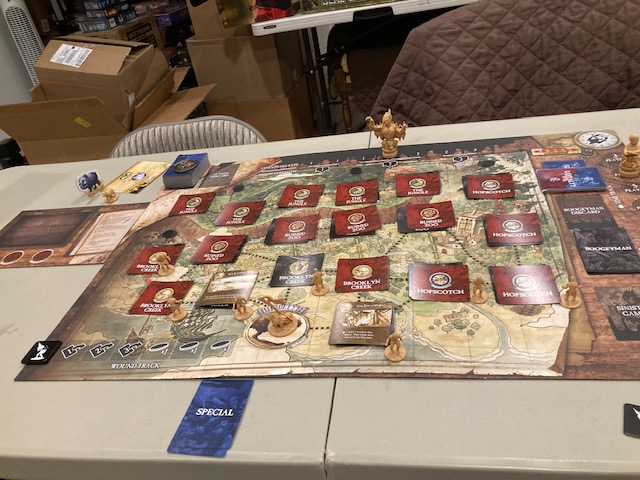
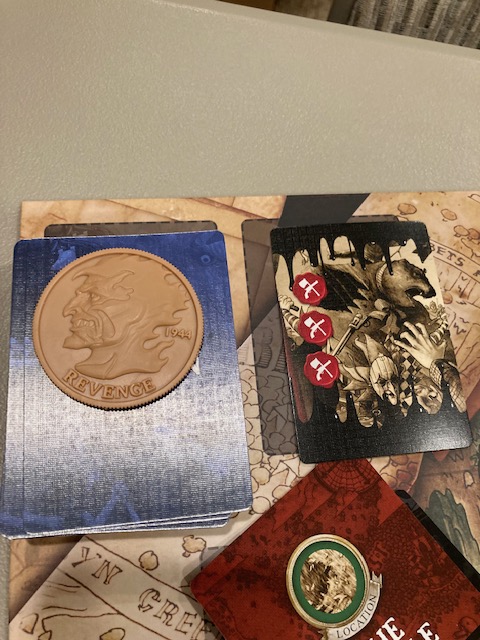
One of the most innovative ideas in this game is that your hand of cards is a scarce resource: every time you run out of cards, you have to flip the loyalty coin to refresh your hand.  Every time you flip that coin, something bad happens:  the Boy moves closer to death or the Bogeyman acts!

IMG_7920

The Boy is a maker on the right side of the Board: every time the Boy side is seen, he advances one space. If he ever makes it to the bottom, the Boy Loyalists lose!

IMG_7877

If, on the other hand, your coin flip reveals the Bogeyman, you have to draw bad news Bogeyman card!

IMG_7954

This whole tension of trying to use your cards as best you can to avoid coin flips is really interesting!  Am I discarding early because I am trying to force coin flips, or do I really just have bad cards and need a new hand?

IMG_7952

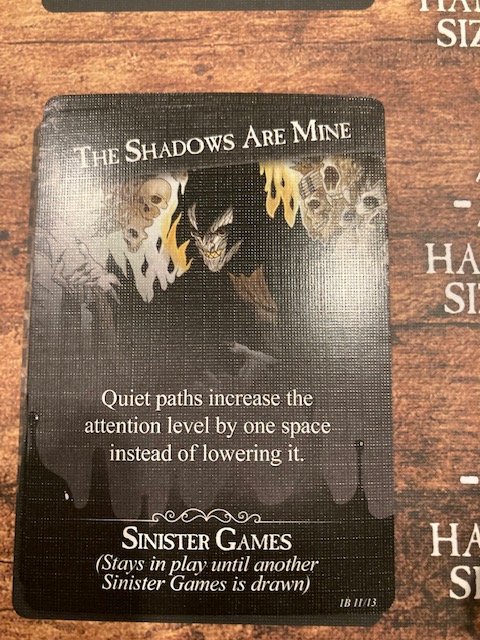
There’s also an interesting idea of stained helper cards. Sure, many hidden traitor games have the idea of “helping out” with support cards, but any card that has the black ink (see the card above) is “tainted” and causes the character to invoke his weakness!

IMG_7883

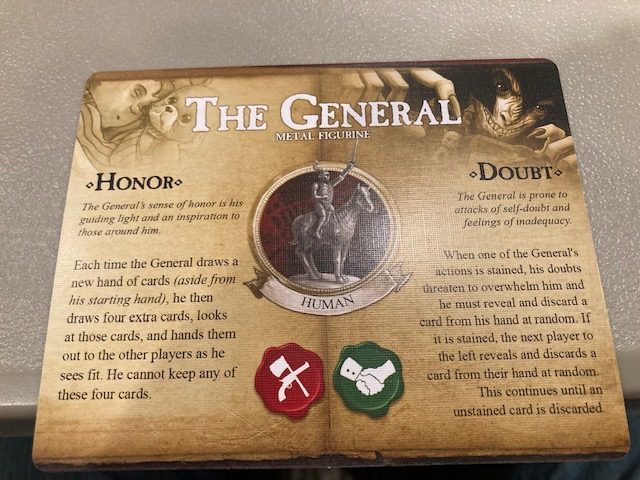
For example, the General’s weakness (Doubt) will cause him to discard a random card if any of actions becomes stained. Again, this is interesting: “I can only offer 3 red symbols if they are stained!” Is the person offering to help because that’s all he has, or is it because he is a traitor and wants to stain your action? Remember that action cards are a scarce resource: you may have to settle for a stained action rather than causing yet another coin flip!

Exploration

IMG_7945

Something that’s unique to The Stuff of Legends is the exploration! I haven’t seen many Hidden Traitor games is the idea of exploring! (Arguably Battlestar Galactica has it, but that board is much more static) But, The Stuff of Legend has it! Lots of Location and Encounater cards are randomly laid out at the start of the game. The players must explore the world of the Stuff of Legend to find the proper exit, but exploration has painful consequences, invoking troops and leaders and general bad stuff! But then there are mitigation cards for exploration (you can peek and swap Encounters and avoid a path), which makes it feel like you have some agency on your exploration!

IMG_7949

Every location in the game has some cards which will generally cause bad stuff to happen, but every so often you find a way to peek at the exits!

IMG_7955

This exploration worked really well in both the Hidden Traitor and Fully Cooperative version of this game. As cool as the exploration is (I prefer games with exploration), it does tend to make the game longer. Generally, most hidden traitor games are shorter: under an hour or even under 20 minutes. The exploration does tend to make this game longer: about 1.5 to 2 hours. Caveat Emptor. (Interestingly, my solo game clocked in at one hour).

Conclusion

IMG_7845

From an objective point of view, The Stuff of Legends adds some interesting ideas to the Hidden Traitor genre: the stained Action Cards, the Action Cards being the scarce resource that cause coin flips, the exploration mechanism, and the dynamic loyalty cards. It’s a little frustrating as the Hidden Traitor because you can’t do too much to sabotage the others, even when it’s clear you are a Hidden Traitor: that’s probably the biggest complaint we had. But, the gameplay was interesting: the game can sit in this weird almost cooperative phase which just makes the game tense and interesting. Completely objectively, I would probably give this a 7.5/10. If you like Hidden Traitor games, this is really different: it may be a bit long (mostly from the exploration), so I suggest you give this a try and see if you like it! It’s probably better at higher player counts, like most traitor games.

IMG_7947

Completely subjectively, I don’t like Hidden Traitor games, and if that’s all The Stuff of Legend were, I would probably immediately sell it! But, with a little nudge, you can play this fully cooperatively. The game is still hard enough even without the traitor(s), so it does make sense to play this cooperatively: Extending that idea even further, you can play this 3-handed as a solo game, and it works as a solo game.

Objectively, this is a 7.5/10 if you like Hidden Traitor games. The fully cooperative game is probably a 6.5/10 or 7/10. The solo game is probably a 6.5/10. If you like solo or fully cooperative games, you can play it that way and it’s still pretty good.

Of course, if you like the Stuff of Legend graphic novel, that probably adds a full point to the rating: there’s a lot of theme here. We saw our rating of Deep Rock Galactic go up recently when we played Deep Rock Galactic with someone who really liked the video game!

Appendix

IMG_7914

I sleeved my Loyalty cards because I was worried we’d be touching them a lot. Nope, not really. BUT the Loyalty cards have to stay pristine: any imperfections in the backs (a ding on the edge, a scratch) will make them identifiable to other players even when flipped. It’s probably best to sleeve them anyways: It was only 9 cards.

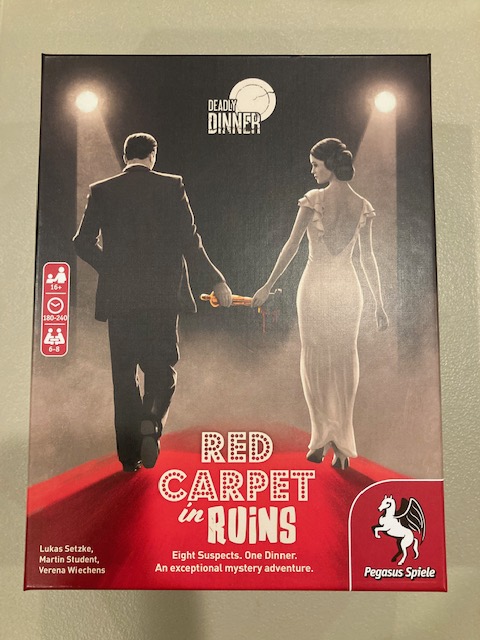
A Review of Red Carpet In Ruins

IMG_7402

I don’t think I’ve played a murder mystery game in 8 years! The last time that I played was at a Murder Mystery Party hosted by Charlie and Allison sometime before the pandemic.

IMG_7401

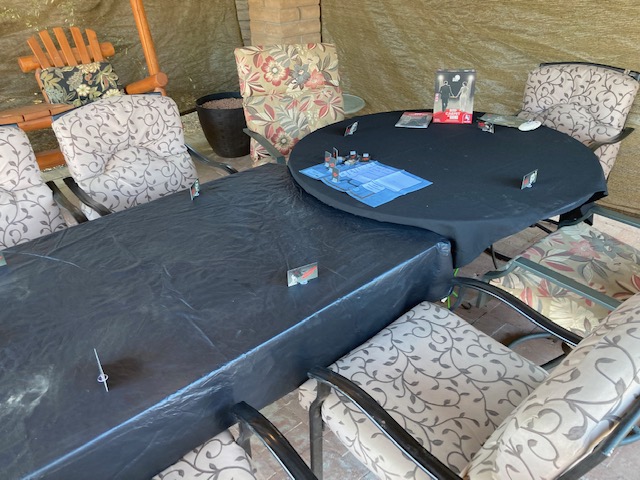
Recently, Sara was rooting through some of my new games and found Red Carpet in Ruins. She started looking at it, and said “Hey! We should play this!” I called Charlie and Allison right then and there. Although it took us a week to all agree on a date, we finally got a group of 8 together to play through Red Carpet in Ruins last night.

Murder Mystery 

IMG_7400

In case you’ve never seen a murder mystery game, someone is murdered (pretend, not for real) in a group involving 6 to 8 characters: your group has to work together to find said murderer!

IMG_7403

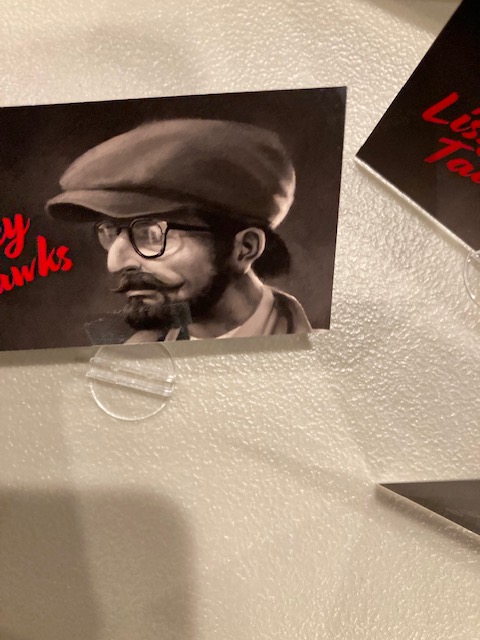
Each of these characters (see above) has a motive to murder the victim! In Red Carpet In Ruins, we are role-playing characters from a 1959 Hollywood film set where the main actor has been murdered! The group must uncover the murderer! However, there is a catch: the murderer is in the group of folks, and he/she will do anything to cover up the murder! Over the course of a night (3 to 4 hours), each player role plays a single character, usually going as far to dress up!

IMG_7489

Throughout the night, little books tell you where you were, when you were, how you were, and things that need to be revealed as you play. At some point, after everyone has revealed all the relevant plot points, accusations start flying! Everyone writes down who they think did it, and you reveal the final murderer!

Differences

IMG_7485

Charlie and Allison have played a lot of these (according to them, all of the “How to Host a Murder Party” mysteries) and they pointed out a few differences in this game:

  1. Times are very well-defined: Inside the character books, players times are very well-established, so if you are ever asked about your whereabouts you can very clearly articulate your location
  2. Map and character standees are included: If you really want to note where people were, a map and standees are included—many murder party games don’t included this
  3. You know if you are the murderer right way: Some Murder mysteries don’t tell you that you are the killer (or not) until the final act—in this game, you know before you even come to party.

Charlie and Allison, the connoisseurs, liked all these new changes.  Although we didn’t really use the map that much to show movements, we could have. And knowing you are the murderer lets you concoct better alibis. 

Although, the murderer in our group confesses that it was very stressful knowing they were the murderer all night: they actually would have preferred not knowing (like some of the older games).

Preparations

IMG_7404

Unlike most of the games in our Top 10 Cooperative Detective Games, there is an awful lot of preparation for a Murder Mystery Party! This isn’t a game you can just pull off the shelf and say “Hey! Let’s just play this now!”

You have to send out invitations early: people have to know when it is so they can prepare.  Players have to prepare in multiple ways: they have to get costumes (although strictly speaking, you don’t need to wear costumes, it helps make the evening more fun), and they have to read about their character in their informational booklet.  See below: each character gets an invitations and an informational booklet.

IMG_7406

Also, it’s very important than everyone commits to coming: even the host doesn’t know who the murderer is, so the game can run aground if not all players show.  This is why it’s so important to spend some time making sure everyone agrees on a date: the game will not work if everyone doesn’t show. (There are some mitigation strategies, but even those are limited because the info packet is needed to run a character: if the info packet is not there for a character, it’s unlikely the night can continue).

So that makes the Murder Mystery Party a little fragile: one player, by not bringing their info packet can completely derail the evening. Make sure everyone is committed.

Costumes

IMG_7494

Costumes aren’t strictly necessary, but they really do throw you into the theme of the game.

IMG_7498

My group didn’t go crazy, but we did just enough costuming to get us into the mood.  It’s up to your group how much you want to get into it: we did just enough to make it fun for us.

Do whatever your group finds fun!

Gameplay

IMG_7499

Gameplay proceeds in three rounds over a night.  Each round is about an hour, and in that hour “pivotal plot points” need to be revealed: each character has many points (as described by their informational booklet) that need to be revealed: who they saw, what they heard, when they saw said things, and so on.  Once everyone (except the killer) has revealed the important plot points, play proceeds to the next round.  

IMG_7501

We punctuated our rounds with dinner (between rounds 1 and 2) and dessert (between rounds 2 and 3): the game strongly encourages this ethic, and even provided suggestions of music and food on their web site! After the final round, accusations are made and everyone makes a guess as to the killer! And the final murderer is revealed!

One thing to point out: everyone has to tell the truth to the best of their abilities: this is how plot points gets revealed … except for the murderer: he/she is doing everything he/she can to lie and stop the truth from coming out!

Hard Core Board Gamer Thoughts

IMG_7483

There is a weird thing I realized after playing last night: Murder Mystery games like Red Carpet in Ruins are Social Deduction games and Hidden Traitor games disguised as Detective games!  The accusations I saw flying around last night reminded me of games of Coup or Avalon: people behave just like Social Deduction games! Finger pointing! Yelling! Accusations! And then, there’s the Hidden Traitor element where the murderer tries to lie and remain hidden! Just like Shadows over Camelot or Nemesis!

I point this out because, on the surface, Murder Mystery games “feel” like they should go into Top 10 Cooperative Detective Games.  Nope nope nope nope nope.  Although there are elements of sleuthing and detective-type deduction, Red Carpet in Ruins was much much more of a Social Deduction Game with some Hidden Traitor elements. The lack of detective game is even worse if you are the murderer: you don’t get to play the detective part of the game at all … you just become the Hidden Traitor and lie lie lie.

I realized after playing that I don’t like Social Deduction games and I don’t like Hidden Traitor games.  The detective parts and engaging times with my friends kept this enjoyable, but I didn’t like the Murder Mystery genre nearly as much as I remember.  Caveat Emptor: Murder Mystery Games are not nearly as much a Detective game as you might think.

Reusing The Game

IMG_7405

You can reuse the game when you are done: the only “non-resuable” pieces are the invitations. You’ll notice I just made a copy of the invitations and that worked fine.

My wife’s co-worker wants to try this, so I reset the game: I put the Objects back in their envelopes (there are objects that are revealed as the game plays), gathered the info packets, and put everything back in the box. I will pass it on, and suggest she makes copies of the invitations so she can pass it on …

Conclusion

IMG_7486

The fun part of Red Carpet in Ruins was spending 3-4 hours with my friends: we got to dress up, solve parts of a mystery, and be roleplay silly 1959 Hollywood stereotypes for a night. Do you enjoy being a bit of an extrovert and roleplaying with your friends? Then you will enjoy this … just be aware there is a lot of preparation. If, on the other hand, you are an introvert and don’t like the roleplaying, this may not be for you. And to be clear, Red Carpet in Ruins is more of Social Deduction game (with a Hidden Traitor) than a strict mystery game. If you are an introvert hoping to engage in just the detective part of the game, you may be sorely disappointed.

Me and all of my friends had a good time last night. Decide for yourself if this is something you’d like .. maybe I can pass it along to you!

A Review of Illiterati: A Cooperative Word Game

IMG_7630

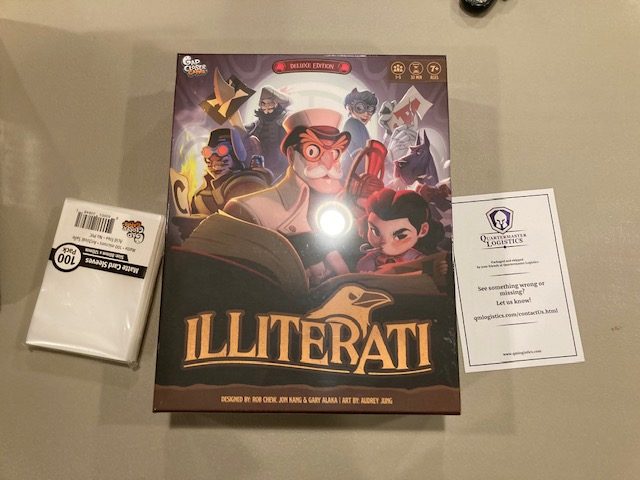
Illiterati is a cooperative word game for 1-5 players, Ages 7+, and about 30-45 minutes long. I backed this on Kickstarter back in March 2022 and it just arrived at my house today, May 10th, 2023. It originally promised delivery in April 2023 … that means it only missed by 10 days! That’s absolutely fabulous in Kickstarter terms, to be only 10 days late, so: good job guys!

IMG_7625

The Kickstarter version came with Matte Card sleeves.

IMG_7626

This box is a beautiful cover that pulls open, kind of like a hardcover book in a case: see below.

IMG_7704

Let’s take a look.

Unboxing, Components, and Gameplay

IMG_7670

This is a smaller than normal box: about the size of a big book like an encyclopedia … and I am guessing that’s the vibe they were trying for: this is a cooperative game about spelling words for books.

IMG_7638

This is a word game: you will be spelling words using tiles. Players will work together and can share letters, but this is still a word game.

IMG_7668

The letters  are on really nice tiles: they are drawn from this amazing draw bag … and discards go in the other bag. These bags are fantastic: I can fit my whole hand in!  They are NOT too small! 

IMG_7676

On each player’s turn, they draw some letters … (depending on # of players and some other things) … trying to spell relevant words!

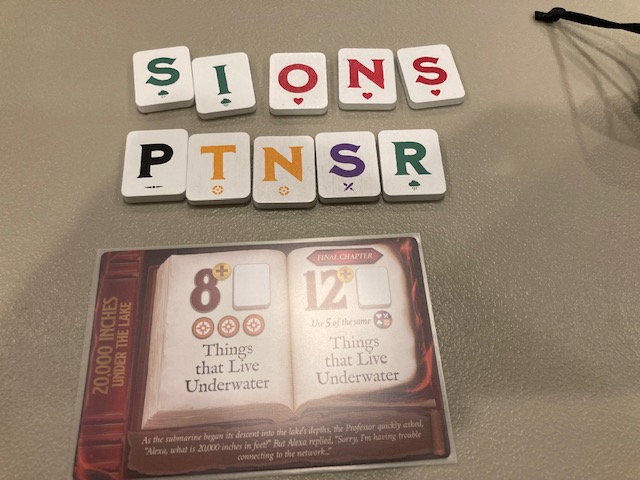
There are two types of books every player needs to “complete”: a red book and blue book (see above).  Each book has its own criteria: see above and below.

IMG_7680

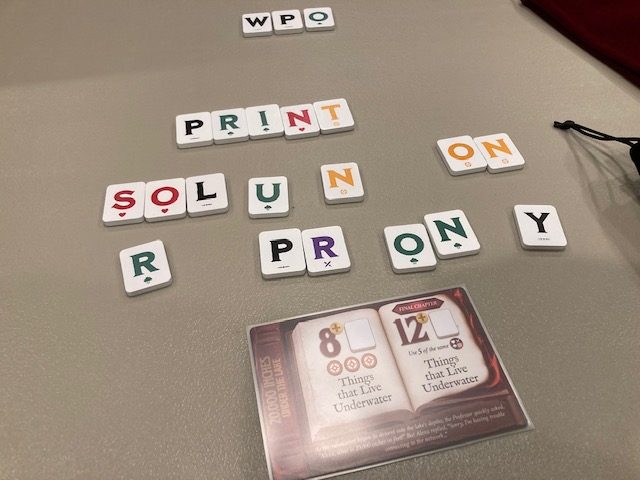
The basic flow of the game is that you have to spell words that match the book you currently have. Above, you can see the RED book criteria: I have to spell words (with a total of 8+ letters between them) that are “Things That Live Underwater“. There’s an additional criteria: the words have to use 3 (or more) letters with the yellow sun sign. (Ignore the right side of the card: that’s for final play!!!)

IMG_7689

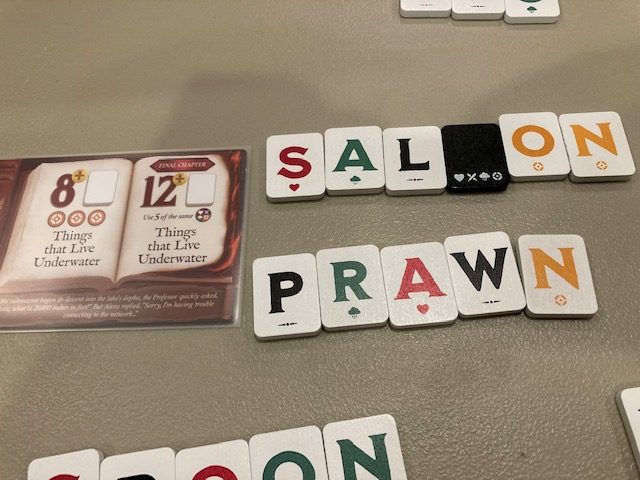
In the second round, I am able to satisfy the book criteria (spelling SALMON and PRAWN, with ONN being yellow letters), and I can “complete” this book. I discard the letters to the bag, turn the the book over (to show it’s complete) and draw my next book.

IMG_7691

My next BLUE book requires 2 words that rhyme over 4 letters each!

IMG_7684

Of course, this wouldn’t be a cooperative book if there weren’t some sort of Bad News cards every turn! The Illiterati cards (see above) are the bad guys: they are trying to stop us from completing books! At the end of every turn, an Illiterati card is flipped and something bad happens! See above!

IMG_7699

If the same Illiterati comes up again, then he/she activates the new bad news AND the old bad news! See above!

IMG_7686

Although you want to spell words for your book, this game is about survival from round to round: if you ever have unused letters that aren’t part of a word, you may have to burn letters! If you have to burn too many letters, then you lose!

IMG_7695

The Burn Tracker tracks how many letters you have burned: see above. Interesting side note: no one can complete a book if any letters have to be burned on your turn!

IMG_7700

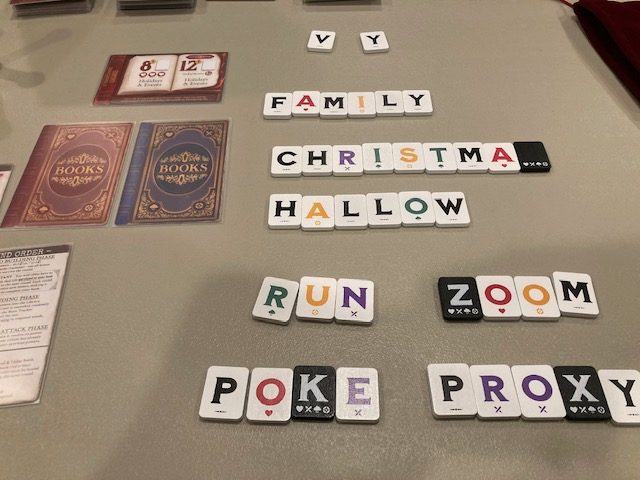
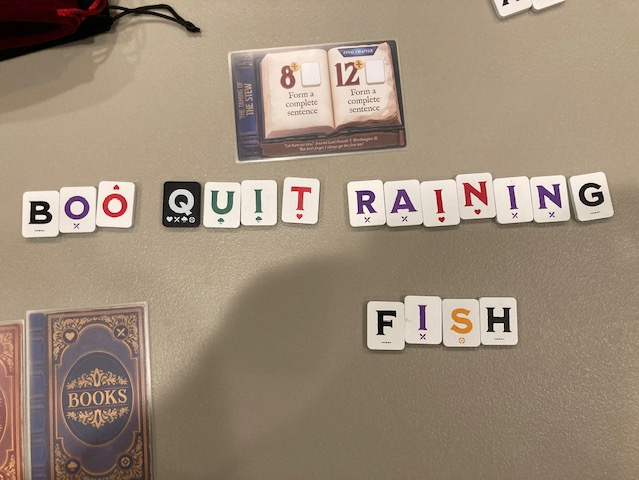
Once each player has completed their own two books, then cooperative players have to do a Final Chapter! Independently! Above I have to spell “Holidays or Events” using 12 or more letters AND there has to be a match of 5 symbols! Whew! Note that the V and Y aren’t burn letters because there is a small shared “library” of letters that don’t have to be used and can float from round to round.

IMG_7667

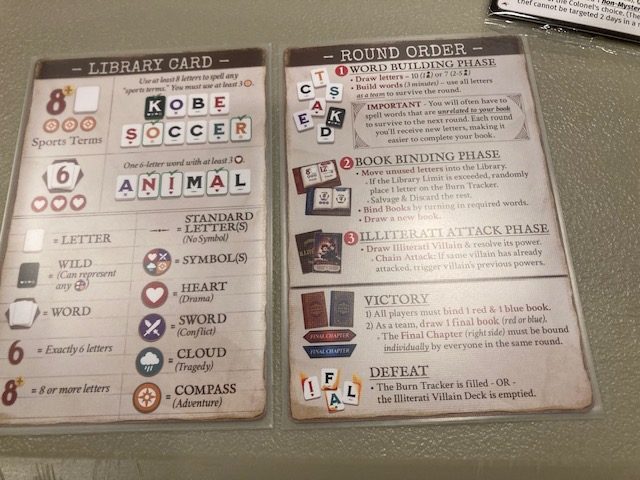
If you forget the rules, the summary cards are very good: See above.

IMG_7666

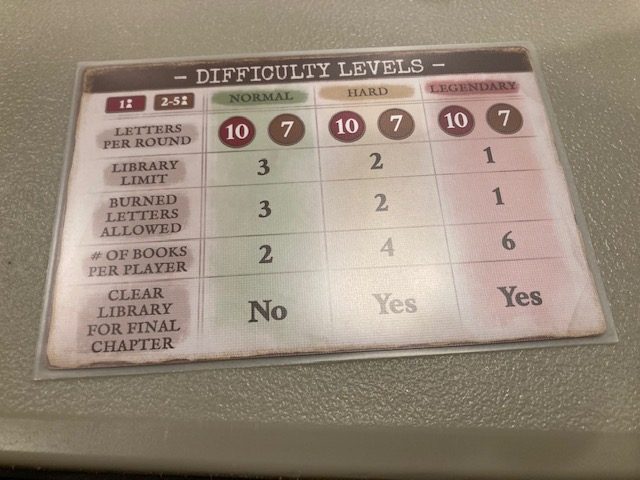
In fact, you almost don’t need the rulebook: the difficulty Levels and rules are summarized on just a few cards.

IMG_7655

All-in-all, this is a really nice production. See above.

Rulebook

IMG_7658

The rulebook is pithy and short.  Thank goodness: we’ve had so many games with ridiculous rulebooks lately.

IMG_7659

The game gets an A- on the Chair Test (it hangs over the side just a little). It’s easy to look over at the rulebook on the chair next to me when I have questions: in this way, I never have to take up precious table space, as the rulebook is easily accessible next to me.

The components and set-up are good enough.  I was displeased that the Set-up did NOT tell us to shuffle any of the cards: it’s obvious after you play once, but it really needs to be stated (for example, last week Valor and Villainy: Lludick’s Labyrinth went out of its way to tell when to NOT shuffle and when to!).  There were also a few times when I went to look for a rule clarification, and I couldn’t find one.  Luckily, most cooperative games make this easy to move on (and this one works: “What should we do?  Let’s come to a quick consensus”), but it was slightly annoying.

Overall, it was a pretty good rulebook.

Solo Play

IMG_7662

The back of the rulebook gives us rules for Solo Play. Thank goodness they are so simple (and thank you for following Saunders’ Law)! The only real change is that you draw 10 tiles at the start of your turn instead of 7: This makes the game flow essentially the same (i.e., no real big changes for solo play).

IMG_7682

See a solo game set-up above. I enjoyed the game solo. It wasn’t anything special, but I really like word games, so I had fun. It was, in a weird sense, like Bananagrams: if you’ve never played that game, you just spell words until you run out of letters. There was an element of that in there, because you almost never have the right letters for your Book (“Things that live underwater”) on the first round or two, so you just spell words to stay alive.

IMG_7686

See me trying to spell words, just to stay alive! There’s not a lot of “sea” words in this lot!

IMG_7689

After my second round, I got the right letters to spell some “sea” words, so I could move forward.

I generally had fun. I would play this again solo, but see the caveat below.

Cooperative Play

IMG_7719

Cooperative Play worked well, and it didn’t. Let me explain: The cool part of cooperative play is that you can share ANY letters you want! I would call out “I need an X? Anyone got an X I can use?” Generally, you were looking at your own area, but occasionally helping your neighbor. Cooperation abounded as we shared letters and ideas for words! If someone got done early on their book, they could offer another brain!

IMG_7714

My problem, and this might be just me, is that I like my word games to be … quiet. When we were playing cooperatively, people were asking for letters (“I need an E!”), muttering under their breath (“What is a Kwijybo?”), and helping each other (“Oh! You can spell QYZBUK!”), and generally making a lot of noise. This is good in MOST cooperative games, but not for me in a word game. This may be a me-only problem. In general, this was not too much of an issue … but a few times, I found that I couldn’t think about my letters with so much noise.

IMG_7718

So, to be clear, the game has elements of frenzy, which may be fine for you. In a word game, that type of frenzy is not for me. I think I would prefer this game at two or maybe three players: at four and five players, this would be too much for me.

Realtime

IMG_7692

So, this game has a timer … and we pretty much ignored it. This is SUPPOSED to be a real-time game, but we really don’t enjoy real-time games. There is definitely some notion of “you can play without the timer if you want” in the rulebook, and by gum, we did not use that timer! Like I said earlier, I don’t like my word games to be frenzied, and the timer exacerbates that chaos even more!

IMG_7720

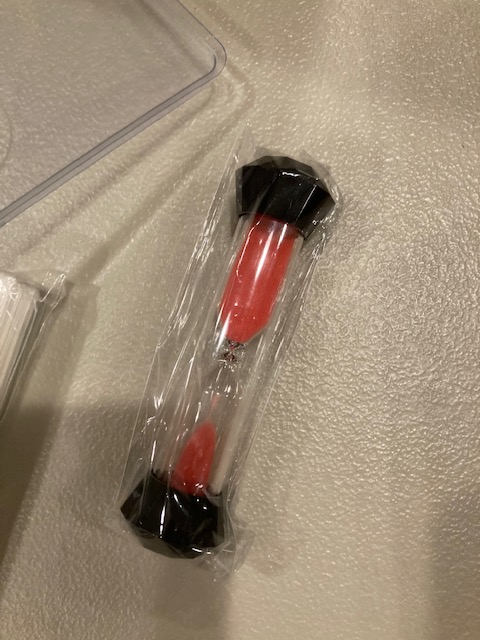
What’s even more funny is that the TIMER GOT STUCK SO MANY TIMES!! I tried using the timer a little in my first few solo games, and the sand would just stop falling. Once I poked the timer, it would start up again, but I can’ t tell you how many games I played where the timer just got stuck!

IMG_7643

In end, the fact that we do not real-time games, I personally don’t like frenetic word games, and the timer didn’t work … completely discouraged us from using the timer. At all.

The only reason to use the timer, we think, was to avoid Analysis Paralysis for certain friends. I have friends who would probably spend 20 minutes on letters per round if left to their own devices (you know who they are). That’s fine if that’s how you want to play, but you have to know what kind of game you want. In the end, none of my primary game group has Analysis Paralysis, but we see the necessity of the timer “in certain situations“. Decide for yourself: we think using the timer “twice” would be the sweet spot: so, about 6 minutes. You just may have to use a different timer.

Word Games

IMG_7715

I love word games! I mentioned in my review of Paperback Adventures that I love the idea of cooperative word games, because they are games I could play with my Mom! So, Illiterati is a word game I could play with my whole family, including my Mom! Illiterati’s game rules are quick and easy to learn. I think Paperback Adventures is the better cooperative word game: it’s not real-time, it’s easier to collaborate quietly, and it has more depth. But, having said that, I do like Illiterati: it’s a lighter cooperative word game that’s easy to bring out.

Illiterati is probably easier to bring out as a solo game than Paperback Adventures: if I want a quick word game, then Illiterati is much more accessible. Also, Illiterati works with 1-5 players, whereas Paperback Adventures only works with 1-2 players. That extra player count comes at the cost of a more manic and frenetic word game: Paperback Adventures is more subdued at only 1-2 players.

If you like cooperative word games, I think Paperback Adventures and Illiterati are both good choices: it just depends on what you want in your game.

The Vowel Problem

IMG_7716

One problem to look out for is the Vowel Problem, wherein you have an assortment of letters with no vowels! In some games of Scrabble, you can get stuck without any good letters and no vowels!! Paperback Adventures has the innovative way of avoiding he Vowel Problem problem by always have a vowel from the monster you fight! In all my plays of Paperback Adventures, I always felt like I had a good assortment of letters to spell interesting words.

IMG_7717

Illiterati almost has the Vowel Problem! Luckily, there is a quick rule you might miss on your first pass through the rulebook:

IMG_7661

The Redraw Rule (on bottom of page 6): “When life gives you LMNS…” .. basically, you can redraw up to seven letters at the cost of an extra Bad Guys draw when you draw the Bad Guys. We didn’t use this rule, because it’s easy to forget in the heat of the moment, but it’s good to know it’s there for when you get LMNS … and no vowels.

Optional Rules

IMG_7674

Do you want silliness? Completely optional are some silly rules called Pandemonium Powers on page 7 (see picture above). You don’t have to play with them (and we didn’t, as they weren’t our cup of tea), but I could see families liking these rules. They are just silly rules to make the game more fun for some groups: “Choose 1 player: They cannot use their hands this round!”

I like that they are optional. Generally, it feel like Illuminati has done a good job of making this package have enough ways to play for any group.

  • Don’t like real-time? You don’t have to play with the timer!
  • Want some silliness? Play with the optional Pandemonium Powers!
  • Want PVP?  There’s a Player vs Player mode
  • Want to play with younger kids? There’s a Junior Mode!
  • Want a Solo mode? There’s a solo mode!

Seriously, I appreciated that: My group doesn’t like real-time, and we still could have fun with this game.

Conclusion

IMG_7713

I liked Illiterari: it’s a lighter cooperative word game that works. The components for Illiterati are top-notch and I love the art and book aesthetic of the game. Even though the game is supposed to be real-time, we just never found ourselves playing that way (either solo or cooperative). The timer also didn’t work: the rules say it’s perfectly fine to pay without the timer, but we can see that timer being necessary for certain groups which are prone to Analysis Paralysis.

I think I would prefer Illiterati at no more than 3 people total: I liked the solo game, but cooperative game had too much frenzy. Too many people makes it harder to think about words. I prefer my word games to be quiet: at higher player counts, this game is not quiet! That may be just be me, but be aware of that.

I would give this a 7/10. I liked it, I would play it solo (especially when I want a quick word game), and cooperatively with one or mayyyybe two more people. You may love the frenzy and prefer the large player count for the whole family!

Appendix

IMG_7704

This is a book game, so we have to have an Appendix, right?

IMG_7642

We also got some bookmarks (that aren’t used in the game, but pretty cool).

The sleeves that came with the came were very nice, but I am not sure they were necessary. The cards were linen-finished, and you don’t handle them that much.

IMG_7703

We also got a small expansion for another game: see above.

A Review of Valor And Villainy: Lludwick’s Labyrinth. Our Next Campaign? Part I: Unboxing, Solo Play, and First Impressions

IMG_7519

I Kickstarted Valor and Villainy: Ludwick’s Labyrinth sometime ago: back in July 2021. This promised delivery back in September 2022 … it didn’t quite make it. My Kickstarter copy delivered to my house about May 7th, 2023. I have been looking forward to this game: it made the #10 position of my Top 10 Anticipated Cooperative Games of 2022!

Strictly speaking, Valor and Villainy: Lludwick’s Labyrinth is a standalone expansion to the original game Valor and Villainy: Minions of Mordock. See below.

IMG_7507

The original of Valor and Villainy: Minions of Mordork was a one-vs-many game, where one player took the role of the Villain and the rest of team fought against him.  This new expansion Valor and Villainy: Lludwick’s Labyrinth is fully cooperative and offers a campaign where all the players work together to fight the villainous bosses controlled by the game!  Although this expansion is completely standalone, you can do some combining of it with the original game.  

IMG_7521

The Lludwick’s Labyrinth plays 1-6 plays, Ages 14+, and takes about 25 Min/Player. If you believe the box. Let’s take a look below.

Shipping Box Unboxing

IMG_7504

This is the Kickstarter Deluxe Edition that came in a box … with a box within a box!

IMG_7505

Note that I also got the expansion: Valor and Villainy: Antagonist’s Arsenal, which can make the original game of Minions of Mordok solo and cooperative, as well as the deluxe token token set! See below.

IMG_7510

I am very curious about this Antogonist’s Arsenal expansion, because I can turn the original game into a co-op! That will probably have to wait until another day before we get through today’s game: Lludwick’s Labyrinth!

IMG_7506

Today’s game is Valor and Villainy: Lludwick’s Labyrinth (are you following all these games in the Valor and Villainy universe?): It’s a cooperative boss battler game, with an underlying campaign. It’s a big boy.

IMG_7512

This isn’t quite as big as The Isofarian Guard from a few weeks ago, but it’s close!

IMG_7513

This big mama-jama takes up the entire box!

IMG_7516

See the poor Coke can tremble in fear at the size of this box!

Game Unboxing

IMG_7522

Upon opening the box, you see … a pizza?

IMG_7523

Ah! On the other side is a discussion of this deluxe edition of the game! This is great! It discusses how the deluxe edition of the game works with minis, cardboard tokens, and how the upgrades work.

IMG_7525

My favorite moment in this unboxing is reading the last sentence of the second paragraph: “Once you have read this sheet, you can -DESTROY IT!” This tips me off that the game has a sense of humor and has really thought about how to explain how the Deluxe Edition fits in. I think I knew I was hooked when I read that!

IMG_7526 (1)

The rulebook is next: it’s a good size and very readable.

IMG_7541

Note that the side of the box shows you how to put this back together! That’s awesome!

IMG_7543

The next two books are the Campaign Book at the reference sheet. Note how thick the Campaign Book is! I also am worried about this binding … I don’t like it when books won’t just stay open on their own! we will deal with this by GASP folding the rulebook … I didn’t like it, but we had to do it!!!

IMG_7545

See above as it doesn’t stay open without some help. 

IMG_7544

There’s a real nice reference sheet too!

IMG_7549

Under all these books are … envelopes!

IMG_7550

I said this was a campaign game: the campaign unfolds from the envelopes (you can reset the game: there are no legacy elements according to the rulebook). There are 8 chapters.

Underneath the campaign envelopes are the GameTrayz for the tokens.  Note that there are two of them: one for each side of the table!  This makes it really easy to unbox the game: just pull out the trayz!

IMG_7553

Under the trayz are miniatures! Oooh! Pretty spiffy!

IMG_7554

The little cardboard holder holds all the cards of the game.  Be careful not to necessarily unpack all your cards right away! The order of these cards is very important: these cards will guide your campaign and need to come out in a very specific order!

IMG_7555

Ah! There’s all of the miniatures!

IMG_7575

IMG_7556

Under the minis are the dice and boards for the heroes (and a few other odds and ends).

IMG_7560

You may THINK we are done, but no! Under the tray with the boards are a BUNCH of punch out boards Seriously! They are kinda “secretly hidden” under the last insert! I didn’t realize they were there until I went looking for the Board of Doom!

IMG_7562

If you get the the upgrade tokens, you won’t need to punch out everything, so hold off on unpunching these too.

IMG_7558

What a fantastic looking game! I love how this looks! I was so excited to moving forward!

Unwrappening and Unpunchening

IMG_7557

Before I could move forward and actually PLAY, I did have to devote some cycles to unwrapping, unpunching, and filling the GameTrayz.  This was a little more chaotic than it should have been. 

IMG_7563

First of all, the Deluxe Tokens have to go into the GameTrayz! The game box side shows a picture, but they aren’t notated very well. I had to kinda go by picture and guess.

IMG_7567

This was not as easy as it seems. First, it’s not 100% clear which deluxe tokens replace which cardboard tokens. And it turns out, you still need SOME of the cardboard tokens!

IMG_7570

See above as I punch out the shields but NOT a lot of of other tokens? Because not all tokens have replacements, but most do!

IMG_7528

I spent a lot of time trying to sort the tokens: probably too much. It was good, in the sense that I had a better sense of all the tokens in the game, but annoying because the deluxe tokens aren’t labelled. They are kinda labelled in the pizza sheet on top.

IMG_7561

And this just made me laugh: you are REQUIRED to keep the cardboard skeletons! They are needed to prop up up the inserts after you punch out what you need!! I was laughing my head off at this! I am the only person I know that keeps Cardboard Skeletons!! (I did a whole article on them here) So, it was funny to see a game require them! See below as the punchboard skeletons go back in the bottom of the box …

IMG_7583

A lot of the other punchouts are either (a) tiles to explore or (b) backings for cards.

IMG_7578

IMG_7576

You have to be careful with the cards: I initially unwrapped all the cards, but the order of the cards matters!  A lot of these cards are revealed as you play!

IMG_7577

Notice the DO NOT EVER SHUFFLE!

IMG_7579

It’s also a little chaotic because you are uncardening and it tells you GOTO THE CAMPAIGN BOOK!! But but but … I am not ready!! Nope, get over to the campaign book now!

And that leads to the first play.

Rulebook(s)

IMG_7526

The base rulebook is quite nice.

IMG_7527

The rulebook gets an A- on the chair test: it sits on the chair right next to me very well (very little droopage). I used the rulebook a little, but the tutorial was so good, I didn’t really need to…

Tutorial

IMG_7596

This is probably one of the best, if not the best, tutorials I have done! This really felt like I was doing an in-game Video Game Tutorial that taught all the basic rules! Two decks (Story deck and Event deck) guide you through an entire game!!! The decks showed WHAT to do, what NOT to do, explained what your choices were, how the game unraveled, how you explored, how to set-up the dungeon, how to fight, how to upgrade, how to get loot. Seriously, this was the most fantastic tutorial I have ever seen. Take a look at how intricate and well-spoken the tutorial card above is.

IMG_7597

You can see the tutorial decks above: the Event deck and Story deck. These were so good at laying out the game. I feel like I haven’t seen a tutorial this good since Tainted Grail (see our review Part I and Part II here) And you know what? If I had a tutorial this good for The Isofarian Guard, I may not have sold that game.

IMG_7611

This Tutorial filled me with confidence: I still see a large rulebook full of rules, but I feel like I understand a lot of the game from this tutorial. That really helps take the edge off how daunting this game looks.

Bright and A Sense of Humor

IMG_7522

In case it’s not clear from the art and some the monsters … and the pizza on top of the game as you open it … this game has a sense of humor. I think that’s why I gave this a chance on Kickstarter: the game doesn’t take itself too seriously! I love the art! This game doesn’t feel like every other depressing fantasy game (speaking of Tainted Grail) out there! The art is bright and crisp! The game looks silly but still professional and fun!

It is still a boss battler with a lot of rules (which the tutorial really helps with), but you are chasing demons who stole the pizza making guy. Seriously! Or should say, … not so seriously. Grin.

This game would be a contender for my Top 10 Cooperative Games With a Sense of Humor.

Solo Play

IMG_7606

The tutorial took me through my first play. See the Game set-up above (and we had to fold the Campaign book to keep it open! Nooo!)

IMG_7603

Something that is a little weird is the border: it’s easy to set-up (surprisingly so: just follow the marks), but it constrains the dungeon to be no more than 5×5.

IMG_7615

The first play has you play two characters: Welliam …

IMG_7617

… and Rowan.

IMG_7598

You use their miniatures on the map, and the Tutorial guides you through movement, combat, exploration, treasure. It tells you places you could make different choices, as well as things you CANNOT do. Like I said, a fabulous tutorial.

I had a great time. The nice thing about this tutorial is that it scales for 1-6 players: each player just alternates reading the cards, and all players just play the two characters out. Once you start getting into the game, you get to play your own character.

Cooperative Play

IMG_7709

We used the same tutorial to play through with 4 players. It worked great.

IMG_7705

I promised my group that if we tried this game, we’d watch the intro video on the big screen! See above, with the silly animation showing the kidnapping of Guiseppe, the pizza-making guy!

IMG_7706

The video was silly but it gave a nice backstory and sense of what’s to come. It also doesn’t take itself too seriously: I get so tired of depressing fantasy.

IMG_7712

As a group, we played through the same tutorial I played as a solo player. At the end, I asked the group “Do you want to continue playing?” The answer was: yes! We’ll be starting the full campaign next week. The real question is: will this be like Tainted Grail where we played for a while and stopped because were sick of it? Or will this be like Roll Player Adventures where we played all the way through and loved it? Only time will tell!

Conclusion

IMG_7708

So, Valor and Villainy: Lludwick’s Labyrinth is a silly boss battler with amazing components and just about the best tutorial system we have ever seen. This tutorial gives both me and my group a lot of confidence to move forward and try the full campaign. We’ll be running through the campaign over the next few months!

My game group has finished Roll Player Adventures and are looking for a new campaign (Spoiler Alert: We loved Roll Player Adventures! It made the #3 spot our Top 10 Cooperative Games of 2021). At the moment, we are intrigued by Valor and Villainy: Lludwick’s Labyrinth: a funny, well-produced, brilliantly presented, cooperative boss battler. Check back in a while: we’ll let you know how it’s going. I suspect this will end up in my Top 10 Cooperative Games of 2023! (Or will that be Top 10 Cooperative Expansions of 2023? Strictly speaking, this is an cooperative standalone expansion for the original Valor and Villany!)

A Review of The Legends of Storm City: A Cooperative, Superhero, Print & Play, Roll-and-Write Game

IMG_5018

So, we are going to do something a little different this week: this week’s game is a Print & Play game that was #2 on our Top 10 Anticipated Cooperative Games of 2022! I think the reason we were so interested in it was because they haven’t been too many cooperative roll-and-write games! We’ve seen Escape: The Cooperative Roll and Write (see our review here), and there are a few more coming out this year … and that’s about it! We are also super interested (no pun intended) because we really like cooperative Superhero games here at Co-op Gestalt! See our Top 10 Cooperative Superhero games here!

IMG_5019

However, this is a new experience for us! This is a Print & Play from Kickstarter (see the Legends of Storm City Kickstarter here). It was released this January 2023! And when we say released … we mean that we got a bunch of PDFs in a google drive that we have to print ourselves.

Print: Headed to the Print Shop

IMG_4989

My printer at home isn’t great for Print & Play (and the ink costs are ridiculous), so I though I’d head to my local FedEx store and print it there, using their super high-quality color printers.

IMG_5014

It all fit in a paper bag (which will end up being the final home for it once we pack it away). What was the cost? And what did we get?

IMG_5015

You can see out costs above and below:

IMG_5016

So, 36 pages cost $20.33 + tax = $21.98. The printer was even smart enough to realize that some of the pages were black and white, so I only got charged 17 cents per page instead of 64 cents for the color pages.

IMG_5020

Overall, they printed very well and look nice.

Cut: They forget a step!

IMG_5024

I think they forgot a step when they named these games: They call these games Print & Play, but I think a better name is Print & Cut & Play! You still have to go through a lot of work to cut everything up before you can play!!!

IMG_5021

Since this is a roll-and-write, you write on the sheets(s) and then throw away the sheets when you are done: think of a Yahtzee pad that you fill in and then throw away when done. That’s what a roll-and-write typically does.

What are our options?

  • Print multiple copies of the game sheets like Yahtzee!  Mark up the sheets as I play, and then throw the sheets away when the game done.  Expensive, as you saw the prices from the Print step
  • Do some erasing to reuse the sheets, but eventually throw them away.  Okay for the short term, but as saw from the printing prices, I don’t want to print more than I have to!  And erasing always makes the sheets look yucky
  • Laminate the Cards and use dry-erase markers.  Great idea, but the margins are quite thin on sheets, and laminating only works when you have lots of plastic on all the edges.

None of these are great choices for this game. However, in this case, all the cards are basically “standard” card size: If I use card sleeves, then I can cut the cards out and place them in sleeves! Then, I can write on the card sleeves!

IMG_5022

The card sleeves fit perfectly! See above. The only problem is that paper I printed on was pretty weak, so I chose to reinforce the card sleeves with real cards.

IMG_5023

I have a bunch of empty cards from GamesCrafter, so I chose to use those, but I could easily see using cards from a plain deck of cards as well for reinforcement.

IMG_5024

Cutting this out was … not fun. I even have a very nice little cutting helper, and it still took me 1.5 hours to cut everything out and sleeve it.

IMG_5025

You can see above that I got decent results. If you are OCD, you probably don’t like that the papers don’t fit flush against the card stock: basically the white outline of the cards needs to be centered. Depending on how OCD you are, you can spend the time to center the pieces of paper … I didn’t spend that much time on that.

IMG_5031

I spent 1.5 hours cutting and fitting.

IMG_5030

A little tip: keep the PDFs nearby, or take a picture of your full sheets (like I did above). As you cut up the cards, you forget which backs go with which cards because the backs aren’t labelled. (They probably should be).

IMG_5033

There are 6 cards types and 6 backs. See above.

IMG_5034

By the time I was all done, I was pretty tired: this was a lot of work. I kind of wished I could have spent $30 to have the game printed and shipped to me. I paid $5 for the kickstarter PDF files, $21.98 for printing for $26.98. Them I spent 1.5 hours of my life cutting and fitting sleeves (not to mention the .5 hour at the FedEx store) .

I would have preferred a $25 kickstarter with $5 shipping. I don’t think I realized how much work a Print&Cut&Play was until now.

One final note: I want to say that the Legends of Storm City people did a phenomenal job making all the PDFs aligned! It was easy to just cut many sheets at once because everything was precisely aligned on the page. That probably cut (no pun intended) an extra hour of the cutting process. Thank you! It could have been a lot worse!

Read: Oops, Another Step

IMG_5035

Before we play, we have to read the rules.  I think that turns this into a Print&Cut&Read&Play!

IMG_5047

The rules are on standard pieces of paper … because that’s how I printed them. Strictly speaking, I did NOT have to print the rules or the scenario book (which would have dropped the printing price quite a bit): I could have looked at the rules on my phone or padd. In the end, I prefer to get away from my technology when I play games, so I went ahead and printed all the pages.

IMG_5049

The joke here is that I only get a B on the Chair Test: the pages tend to flop over the edges of the chair a little! This is funny because I printed the rulebook, so it’s my fault the form factor isn’t a little better! It was nice, however, to have the rules easily flippable on the chair next to me as I played.

IMG_5017

I will say, these rules aren’t great. I’ve had to read through them several times to get what’s going on. Some of the word choice and tense choice suggests this is a translation, so that explains parts of it. There were a bunch of places where I just had to “move on” as I read in hopes the rules would be clearer later.

I’ve played through now a few times, and the game does start to make sense. The rules are mostly there. I think the rulebook needs some better elaborations and organizational rethinks. Look, I only paid $5, so I can’t complain too much, right? Still, it was a frustrating read. But I did finally understand most of the game.

Go And Get Your Own Components!  This is a Print&Play After All

This seems like another step: Go And Get Your Own Components or GAGYOC.  Since this is a Print&Cut&Read&GAGYOC&Play game, we need to bring our own components (besides the sheets) to the table. The only components we’ve had up until now are the sheets we printed.  But, we need more!

IMG_5028

The most important thing for us is the Ultra Fine dry erase marker!!  Because we want to be able to reuse all the cards, we have sleeved them: we will be using a dry erase marker to mark up the cards.  It is VERY IMPORTANT to get the ultra-fine for this system: the little boxes on the cards are pretty tiny, and any bigger marker will be completely illegible.  Even the Ultra Fine isn’t perfect (see below), but it works.  (We saw how important Ultra Fine Markers were when we reviewed another game with dry-erase boards: The Forests of Adrimon.  See our review here and how much we complained for NOT having ultra-fine markers).

IMG_5063

We also need a bunch of 6-sided dice:

IMG_5053

6 black dice (brown) for the bad guys,  6 white Dice for the good guys, 2 red dice for bad guy threats, 2 yellow Dice for good guy abilities, and one green dice for bad guy abilities (not shown).  Since I didn’t have any yellow 6-sided dice, I chose to use a 10 and 20-sided and re-roll when I don’t get a 1-6.   Hey, I am scraping by to get all the dice I need, all right?

IMG_5036

The final step to GAGYOC is to gather some tokens. Now, the tokens come on a sheet you can cut-up (left above), but I think the Scythe metal coins work as perfect replacements! I don’t have to cut anything else!

IMG_5037

The Scythe metal coins worked surprising well: it was pretty obvious what coins should be what tokens. See above.

IMG_5051

So, that’s kinda all your components!

Set-Up: Are We Ready to Play yet?

Nope! One more step!  Gotta set everything up!  Let’s got through the cards and choose the appropriate cards to use:

IMG_5043

Above are the 4 Hero Cards: each player takes a card to take the role of one of these heroes.  The game can play 1-4 Heroes.

IMG_5044

The goal of of the game is to take out the Elite Villain before his/her Main Plan come to fruition.  Choose one Villain to fight (above, right) and take his/her Main Plan (above left).

IMG_5042

Each Elite Villain also has some Henchmen: See above.  These are the Henchmen cards: you’ll choose three sets of these when you play, maybe all different, maybe some if the game.  These Henchmen work for the main villain!  (The Scenario book will help you choose these).

IMG_5045

There are also Side Plans which cause problems for the Heroes: players must choose 1 Side Plan as well.

IMG_5046

Finally, there are Intervention Plans (see above). Players will choose two of these.

IMG_5048

The Set-Up from the book will show you how to set-up: see above.

IMG_5051

In the end, your board should look something like this!

Play: We Made It!

IMG_5054

So, we made it to the Play step of the increasingly misnamed Print&Play! I think, in the future, we will call these Print&Cut&Read&GAGYOC&Set&Play games. I mean, it was a lot of work to get here! The name should reflect that!

IMG_5056

The main mechanic of the game is to roll dice and assign them to something. The Elite Villain, 3 Henchmen, and 2 Plans are all marked with a “random” but unique number from 1 to 6 (and marked on the card at the start of the game). On the Villain turn, when we roll the Brown dice and roll that number, we activate the appropriate card! The red dice activate threats in a similar way. Above, you see the Main Plan activated once (with a 5), the Side Plan activated twice (two 6s), and the little tiny die (supposed to be green) activates the special ability on the Henchmen (henchman 4).

IMG_5057

It’s a little easier to see up close: See above as the Ninja is activated on 1s (1 in the white diamond tells us which card).

The bad guys do damage to use trying to take us out. Villains win if they activate the main plan, or if they defeat one of the heroes.

In fact, the Heroes lost their first game as Strike One lost all health (white, orange, blue, and yellow blobs).

IMG_5072

The Heroes win if they defeat al Elite Villains or deactivate the main plan. Nefertary was only one point away from being defeated!

IMG_5070

IMG_5068

Actually … maybe we did win, since we took out the Main Plan before Nefertary killed us!! Heroes deactivate spaces (marked with Xs), Villains activate spaces with Os. Villains roll a 6 on the black dice to activate, Heroes roll 6s on white dice to deactivate.

IMG_5060

The Hero turn is similar, except they roll and assign White Dice! (And you get one reroll). White dice on Henchmen or Villains means you need to roll again to attack, White dice on Plains deactivates them one space.

IMG_5061

There are much more specific rules to the Villains and Heroes, but that’s the crux of the game: alternate between Villain and Hero turns until someone wins!

Solo Play

IMG_5065

This game supports Saunders’ Law and allows solo play. And thank goodness! Since the rules aren’t very good, the solo player really needs time to go over the rulebook a few times and get a few games under his belt before he teaches the game!

IMG_5067

Once the solo play gets going, it has a nice flow of rolling black dice, figuring out bad guy effects, then rolling white dice for good guys effects (with a possible reroll). I generally had fun once the game started moving, but it was pretty hard to get to that point. The rules made this hard to learn.

Cooperative Play

IMG_5814

This was one of the more “interesting” plays we’ve had in a while.  Unfortunately, not in a good way.

IMG_5813

Since I hadn’t played solo in a while, there was quite a bit of downtime upfront rereading the rules. And I was reminded how many rules there were!

IMG_5816

We were using the crappy dice I had, when Andrew remembered I had Roll Player Adventure! With real properly colored dice!

IMG_5819

From then on, he dice were SO MUCH better! That helped a lot!

IMG_5820

This 4-Player game took about 1.5 hours.

IMG_5821

And my friends did not like this.

IMG_5830

In the end, we won, but we completely smashed it. It wasn’t really that hard.

Conclusion

IMG_5075

This was my first real experience with Print&Play, and I think it really needs to be renamed to Print&Cut&Read&GAGYOC&Set&Play to represent all the work it takes to get to the final play!  I guess I don’t honestly think they’ll change the name, but I didn’t expect there to be so much work.

If you have a printer with cheap ink, then I think printing at home is probably good for you. Unfortunately,  the printing costs for me seemed to suggest I print someplace more professional, but I did pay for it!  With a $5 cost for the Kickstarter and $21.98 cost for the printing, and then several hours of work to assemble everything, I think I would have paid a little extra, like $30 for the game to be professionally printed and boxed and shipped.

IMG_5823

In the end, I liked the game, but friends really didn’t.  Their scores were quite low: 3/10 from both Sara and Andrew, and 5/10 from Teresa. Essentially, they never felt involved, there were too many rules for a small roll-and-write, there weren’t a lot of choices, and they never connected with their hero.

What I would really love to happen is to see a bigger company pick this up: there’s a good game in here, but it’s a diamond in the rough.  The rules need to be really tightened and cleaned up.  And the assembly is so much work.  The best thing, I think, is if the game got a professional printing and you could write on the cards!  Silver and Gold is a great game where you can write on the cards with dry-erase markers: that’s just what this game needs! I suspect this game could even fit in the same sized box as Silver and Gold!  (Just make sure you get an ultra-fine dry erase marker)

pic4883502

I like The Legends of Storm City, especially once you get into the swing of things. But it needs some work: I’d give it a 5/10. I like it and I’d play it again, but I just worry about forgetting the rules because the rulebook isn’t great. As a counterpoint, remember that my friends didn’t really like this at all.

That said, I’ll bet I would bump this to 6 or even more if they tightened the rules and professionally printed Legends of Storm City like Silver and Gold.

Did You Know That There Is a Game Design Boy Scout Merit Badge?

IMG_6995

Recently, my friends Mike and Dustin, the Scoutmasters for a local Boy Scouts troop, invited me to discuss some board games I had designed. I learned, upon arriving, that this talk was to satisfy one of the requirements of a Game Design merit badge for the Scouts! I did even not know such a merit badge existed!

gamedesignbadge

It turns out there is an 8-step list of requirements you need to meet.  The full list and discussion is here but here’s a quick rundown of the requirements for a Game Design merit badge:

  1. Analyze previous art
  2. Discuss possible directions with a counselor
  3. Discover what Intellectual Property is
  4. Take an existing game and vary some of its rules as an exercise
  5. Design a New Game
  6. Create a Prototype and Test your New Game
  7. Blind test your New Game
  8. Meet with a professional to discuss game design

IMG_6994

So, my meeting with the group satisfies item 8 from the list. Strictly speaking, I am a professional, as I made money from my board game designs of Co-op: The co-op game and Sidekick Saga. Even though I didn’t make a lot of money, strictly speaking, I do qualify as a professional!

IMG_7007

Over about 20 minutes, I brought out various prototypes of my games (from 3×5 index cards to in-between prototypes to full professional printing), talked about the importance of keeping a journal, discussed the importance of testing, and implored the group to be receptive to feedback. Even as an adult, it’s hard to hear criticism of something you have put a lot of time and effort into: I wanted younger kids to be aware that feedback/criticism can be essential to learning and improving!

IMG_7004

We also discussed the differences between Game Design and Game Publishing: Designing a game is very different than trying to Kickstart and sell your games!

IMG_7008

In the end, I ended up hanging out for a little bit and talking about game design and watching the kids and their games in various states.

IMG_7009

Thanks to Mike and Dustin and the troop 2020! It was great talking to you guys!

IMG_7010

A Review of Skytear Horde: A Cooperative Tower Defense Card Game

IMG_5834

Skytear Horde is a cooperative tower defense card game that was on Kickstarter back in January 2022. It promised delivery in October 2022, but was about 5 months late as it just delivered to me in early February 2023.

IMG_5836

The game plays 1-3 players, but it’s only cooperative at two players (the third player plays the Horde). As a solo or 2-Player cooperative game, players assume the role of the the good guys (“The Alliance”) , keeping the bad guys (“The Horde“) from destroying our tower.

IMG_5837

Let’s take a look!

Unboxing

IMG_5838

This is a tower defense game and it’s mostly cards, so the box isn’t really that big: see the Coke Can above.

IMG_5839

The Kickstarter version I have has the magnetic sealing box. It also has some pretty great art o the inner cover.

IMG_5848

IMG_5841

There are some cardboard punchouts (which we won’t need, see below):

IMG_5840

And the rulebook, which we’ll discuss more below.

IMG_5842

This is mostly a card game: see cards above.

IMG_5843

What’s this thing? A really awesome game mat … that only comes with the Kickstarter version (but it looks like you can buy it here).

IMG_5849

The Kickstarter version comes with a bunch of plastic tokens; these replace the cardboard versions (it looks like you can also get these here).

IMG_5846

IMG_5845

The game looks great!  It is definitely a card game mostly!

Rulebook

IMG_5840

This rulebook was very concise: it’s only 16 pages, but I generally liked it.

IMG_5850

It has a nice little Table of Contents. Notice how readable the font and the layout are!

IMG_5851

This rulebook does something I haven’t seen before: it puts the “card breakdown” with the Components list. What a nice way to save space in the rulebook! We list all the components as well as the breakdowns! This is just one of many example where the rulebook is the model of concision.

IMG_5852

One small issue I have is that set-up without the playmat is different from the set-up with the playmat! I would have strived to make the set-up work the same regardless. Note that the Minion cards are above the play area without the playmat (see above) …

IMG_5890

… whereas the minions are off the left and right with the playmat. It’s not a big deal: at least the playmat labels the spaces so you know where everything goes.

IMG_5853

The overview is nice (except for one major flaw, which will discuss later below after we understand the game better).

The next pages describe the seven stages of the game (very well I might add). There are pictures, the font is big and readable, the prose is concise and to the point.

It’s not quite a FAQ, but there’s both a “Edge Cases” section and a Glossary, and a Cards and Decks section on the last page of the rulebook. Taken all together, these three sections tends to answer most of my questions as I played the game.

This sounds dumb, but I liked the paper of the rulebook as well (it’s not as nice as Canvas’ linen paper, but it still felt nice).

The fact that the rulebook was only 16 pages made the game seem that much less daunting to play. The font and layout were easy to read: things were easy to find, and elaborations were generally somewhere in the rulebook (the Glossary and Card and Decks section were particularly helpful). Sometimes concision comes at a cost: there weren’t a lot of examples in the rulebook, but I don’t think I needed them.

IMG_5901

Oh, and the rulebook fares very well on the Chair Test: A! On the chair next to me, the rulebook is very readable, it has very big fonts and simple layouts, and it fits perfectly on the chair.

IMG_5864

And the back cover is used for something useful: Cards and Decks list. Fantastic!

NOTE: the rulebook also did a good job of suggesting cards and decks to play for your first game. It wasn’t a flashy first play guide, but enough to get you going.

Components and Gameplay

IMG_5887

This is a Tower Defense Game.  There are two sides: the Alliance and the Horde.  In the solo and cooperative games, the players play as the Alliance.  In the PVP game, one players take on the role of Horde, and the others(s) take the role(s) of the Alliance.  Since we are only discussing the solo and cooperative modes here, we will always be playing the Alliance.

The Alliance must choose a Castle to defend (since this is a Tower Defense game): see above. The first playthrough recommends Gaping Maw.

IMG_5866

Each Alliance player gets a deck of 40 cards:

IMG_5899

There are four very different factions for the solo (or 2 players) player to choose from: see above. They are nicely color coded so you know which deck is which.

IMG_5867

Most Alliance cards are Allies (see above); The allies will fight for the alliance! The allies will go into the Lanes on the playmat to fight the Monsters of the Horde. For example, The Shaidrus (above) will do 3 damage when fighting (lower left), has 7 hit points (lower right), and costs 6 Mana (upper left) to buy.

IMG_5875

To win, the Alliance must defeat the Outsider! Players choose an Outsider to fight at the beginning of the game. See The Dreaming Matriarch Outsider above: you will have to do 8 damage to him to defeat him!

IMG_5892 (1)

The Outsiders don’t start in play: you have to destroy a series of Portals to get the Outsider!!! Most Portals are damaged like the Monsters (via Hit points, bottom right). Example: the Portal above has 6 hit points. The portals can be varied for different difficulties and modes: there are many different Portal cards.

IMG_5869

IMG_5872

Along the way, the Outsiders will be summoning Monsters from the Horde deck: see above. At the start of the game, you typically choose one set of Monsters to fight: the upper right corner has a symbol which indicates the monster set.

Basically, to build the monster deck, you take the Common Monsters (upper right) and a Monster faction of your choice (upper left) and shuffle them together. This is the Horde to fight against!

IMG_5884

The purple cards are the bad guys: the Horde.

IMG_5874

Oh, and just to annoy you … there are the Minions. They can’t really be killed, but they keep coming back. Every time you defeat them, you essentially reset them back to nothing. You need to keep the Minions under wraps though, because they keep getting stronger and stronger as the game proceeds! And the stronger they are, the more cards you have to discard at the end of the turn! (The Minions “pillage” cards from you if you don’t engage them)

IMG_5891

The game follows the standard cooperative tropes: bad guys go, good guys go, some other stuff happens, things fight! There are seven phases to the game: see above, but it’s essentially about the Alliance fighting the Hoarde.

IMG_5898

The lanes on the playmat are where combat happens: there are some rules about how the Horde always slides to the left. Battle take place in those lanes: upper card vs lower card. (If there’s no monster to fight, your Ally damages the Portal. If there’s no Ally to battle the monster, your Castle takes damage)

IMG_5893

The Alliance gets some Mana at the start of the every turn (as specified on the Portal card). This is how the Alliance buys new cards from their hand!

IMG_5894

The only way to draw new Alliance cards is to defeat a Horde or Minion card! So you are constantly fighting as much as possible to keep your hand full.

IMG_5914

Basically, the game ends when Alliance’s tower is destroyed:

IMG_5910

OR the Outsider is defeated and the Alliance wins!

IMG_5913

Solo Game

IMG_5904

Like I alluded to earlier, the rulebook was inspiring enough that I felt like I could jump right in!  See a solo game all set-up above!  I chose the Blue Alliance cards with the Gaping Maw Castle to defend.  The suggested Outsider to defeat is The Hatred Bringer (who is mislabelled as such in the rulebook)!

IMG_5898

Interestingly, my first play went very quickly … because I played it very wrong.  The problem is the Portal rules are poorly specified (see discussion below). My second game went a lot better and it lasted a good hour and a half.  I think I still got a few rules wrong, but generally the game seems to flow pretty well.  You have to make interesting choices: which Allies do you summon?  How much Mana do you use this turn?  Do you save Mana  up?  Do you exhaust characters to get something special?  Do you send Allies in to die to keep the Minions under wraps?  Do you go after the Portal?

IMG_5911

There were a lot of interesting decisions. The game also felt fairly balanced: I felt I could have lost, but I also always felt like I had a chance.

It took me three games to get the solo game right, but I enjoyed the solo game quite a bit.

Cooperative Play

I couldn’t seem to get my group interested in this game for some reason.  Granted, Skytear Horde feels like mostly a solo game anyways, but I was a bit surprised I could never interest my group to try it out. Caveat emptor!  

Portal Rules

IMG_5903

Unfortunately, as much as I like the rulebook, the Portal rules are very poorly specified/inconsistent/wrong! And this is a major part of the game: how many portals do you have to destroy before you can start fighting different phases of the Outsider? The text says “Once the stage 1 portal is destroyed, the stage 1 outside will be summoned.” But the picture shows the Stage 1 Outsider being summoned after Stage 2 or Stage 3 portal!!! What’s going on? Even worse, the text afterwards says “After you defeat the stage 1 Outside, the stage 2 Outsider is summoned”.

This is why my first play went so quickly: I destroyed the first Portal, summoned the Outsider (phase I), killed him, summoned Stage 2 and was done! After playing a few times, I think you must keep destroying Portals to summon the next Phase of the Outsider. I think? The rules are really unclear here, and it really tarnished my view of the first few plays of the game.

Conclusion

IMG_5906

I like Skytear Horde: it’s about a 7/10. There’s a lot of interesting decisions, the cards look nice, the rulebook is good and concise, and the game feels like there’s a challenge. There’s always a chance you could lose, but if feels like (if you play smartly), you can pull off a win.  It’s also easy to vary the game difficulty by using different Portals or Outsiders. There’s also a lot of variety in the game with all the different Alliance forces and the different Horde forces.  Generally, this was fun and it didn’t feel too random.

IMG_5740

I’ll wax philosophical for a second and wish Skytear Horde had more story: you just choose decks, Portal cards, Alliance forces, and  Horde decks without any background informing you.  Sure, it’s cool and easy to just throw some decks together and play, but it’s not particularly compelling.  Compare Skytear Horde to a few weeks ago Tower Defense Game called Deck of Many Things which had a real great progressive story!  I want the story from Deck of Many Things! But I want the gameplay from Skytear Horde!  It’s interesting how we got two cooperative (but mostly solo) Tower Defense games almost back-to-back!  I want the best of both worlds: the story of Deck of Many Games but with the smoother and more balanced  Skytear Horde mechanisms.