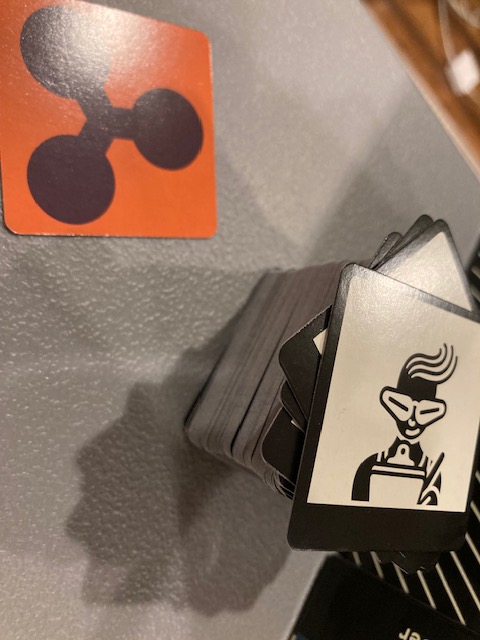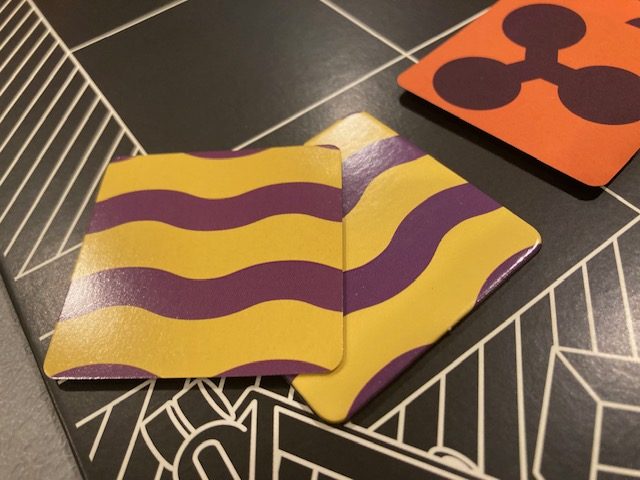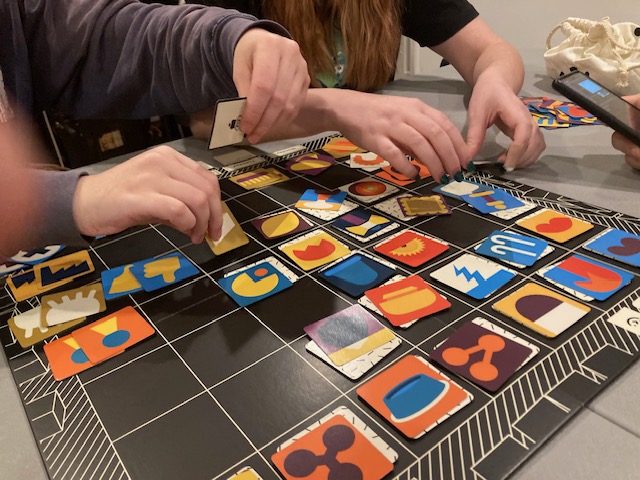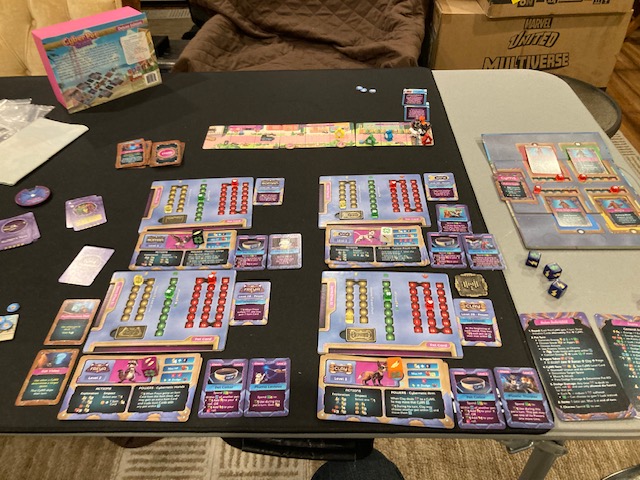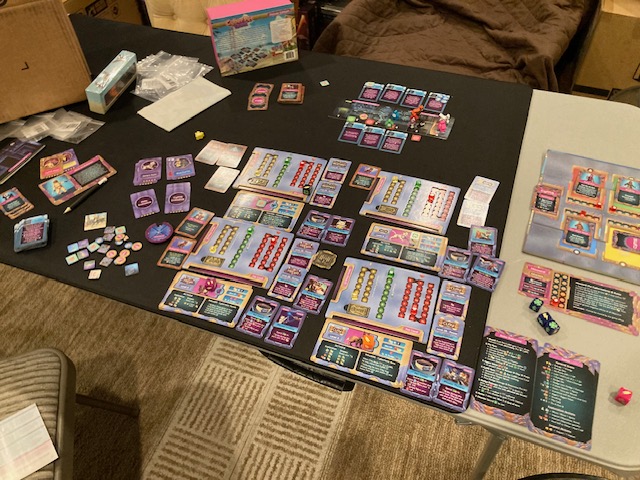
YANG: Yet Another Nature Game. A Review of the Cooperative Nature Deck-Building Game Ecosfera

IMG_7223

Ecosfera (Eco sfera as implied by the cover) was a game on Kickstarter in April 2023: See here.

IMG_7224

This is a cooperative deck-builder with a few push-your-luck elements. This is also a nature themed game! Nature is a very hot theme for games right right, so I call this Yet Another Nature Game (YANG). Many nature games are competitive, so this stands out as a cooperative YANG.

IMG_7226

This is a game intended for 1-4 players, ages 8+. The intended time is 45-60 minutes, which is about right, but see more discussion below.

Let’s take a look!

Unboxing and Gameplay

IMG_7228

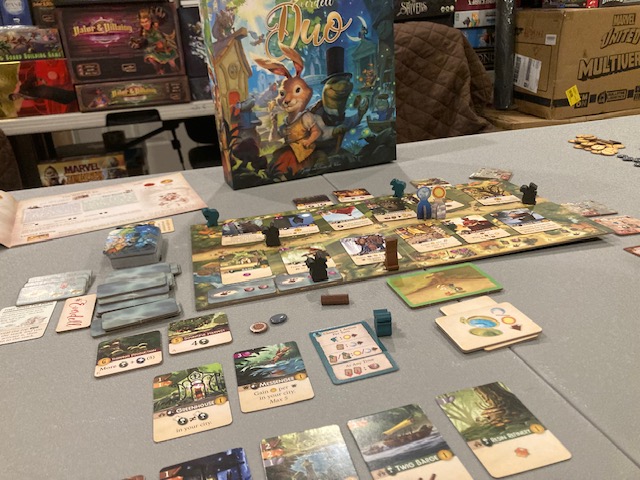
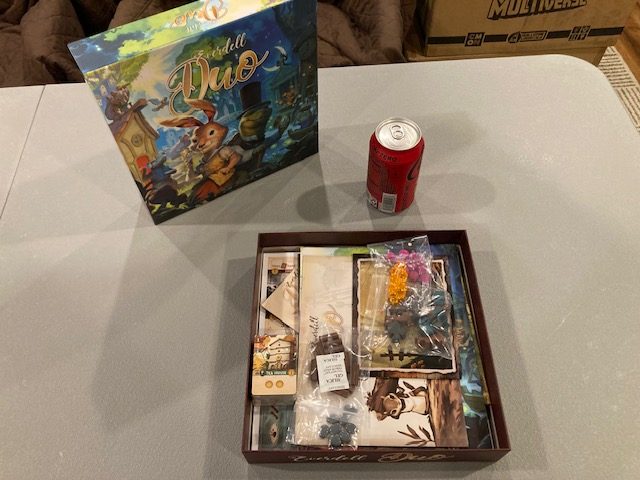
Ecosfera is a smaller box game: see Coke Can above for scale.

IMG_7237

Ecosfera is mostly a card game, but it also has a lot of punch out tokens: see above.

IMG_7348

This is a deck-builder with three different “currencies” of buying.  Elements buy plants, plants buy animals, and animals buy biomes.  See the offering of elements, plants, and animals above!

IMG_7243

The base currency is the elements: the multi-colored cards above are also multi-labelled cards to avoid color-blind issues.  These elements can only buy plants.

IMG_7278

See two plants above: notice the element symbols on the BOTTOM of the cards. You can only buy a plant if you have the elements (we need two winds to buy the Papever radictum). You can be missing one element and still buy a plant … if so, you get that extra missing element for free into your hand. You’ll also notice the symbols at the TOP of the cards: these are the currency for buying the next level: animals.

IMG_7355

Animals can ONLY be bought if you have two plants with matching symbols on that animal!  Again, the cost to buy animals is on the BOTTOM of the card.   Using the two plants from above, we can buy a Penguin, because we have two of the Tundrus symbol!

IMG_7290

Finally, the animals buy biomes.  If you have two animals sharing some biomes, you can immediately spend them to buy the overlapping biomes!  Using the penguin and the lizard above, we can acquire the Aquaticus biome since the animals share that!

IMG_0884

If you make all biomes, you win!

IMG_7244

Along the way, many things can go wrong: you can get the Disaster cards (see above: the different symbols mean nothing)! These cards clog your deck, preventing you from buying things along the way!

IMG_7270

If you can’t buy anything on your turn (either a plant or animal or biome), you get a Disaster card in your deck. By itself, the Disaster card doesn’t do anything: it clogs your deck mostly.

IMG_7286

But, if you ever get 3 Disasters in your hand (see above) …

IMG_7247

… your turn immediately ends and you get an Extinction Tile! (If you get 4 Disasters, you immediately get 3 Extinction Tiles!)

IMG_7285

If you ever get 7 Extinction Tiles, you lose!

IMG_7248

Along the way, each Player gets some tokens to help them.  The Plus (+) can be spent to pull an extra card, the Star (*) can be spent to refresh a line of cards (to get better buy options), and the Arrow is the most important symbol in the entire game: you can use it to move cards to other players OR to cull cards (ya, but you can’t EVER cull Disaster card).

These are one-time usage, however, you do refresh them every time you have an animal pair that matches a biome in your hand.  (So even if you can’t buy a new biome, you can still refresh your tokens).

IMG_7275

You’ll notice that some of the cards ALSO have these symbols: you can choose to use these symbols from your hand as well! (Only one OR the other)
IMG_7276

To help remind you which cards have been used, the game provides some leaf reminders: see above as we use to remind ourselves that we used the + and can’t use that card again.

IMG_7249

This game is quite lovely to look at: the art and tokens are easy to read, and cards are a very nice linen-finish.  In all my game groups and plays, the players commented on how nice the art on the cards is.   This is a beautiful production.

Rulebook

IMG_7231

The rulebook was okay.  It looks a bit daunting because it’s very thick, but it also have 4 translations in it.  It only take about 9 pages to get the rules across.

IMG_7254

Although the rulebook works fairly well on the chair next to me, and the font is a decent sized, I was slightly annoyed that I had to hold the rulebook open many times! I want my rulebook to lay open on the chair next to:  this ventures into C territory for The Chair Test, but since I can “break the spine” to get the rulebook to stay open, I’ll give this a B- on The Chair Test.

IMG_7233

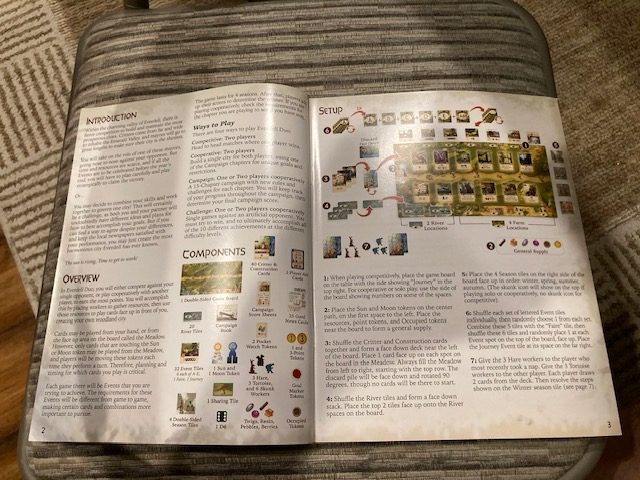
The set-up and components were fairly well-notated on the first two pages.  This allowed me to jump in fairly quickly, which was nice.

IMG_7255

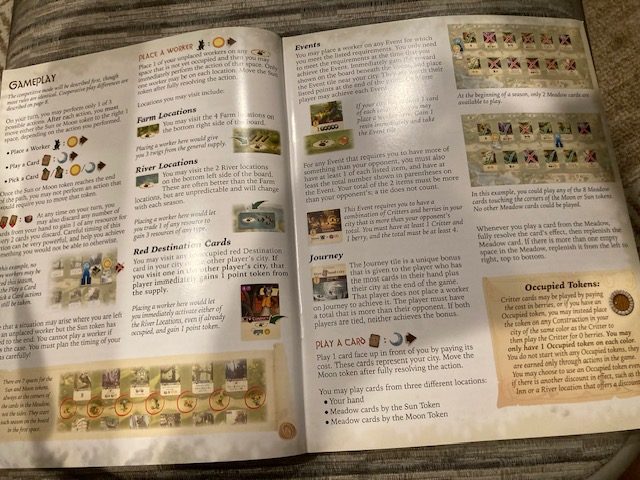
The rules had some nice pictures showing how the game flows and plays (see above).

IMG_7256

I felt like some of the organization was a little off: they spent precious space showing simple rules, but then failed to elaborate more complex rules in a few places. 

IMG_7257

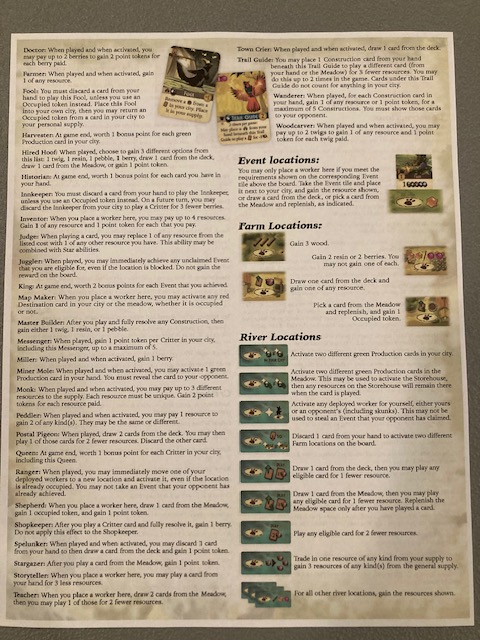
The rulebook was fine: it taught the game, but sometimes you will have to go hunting for a rule.

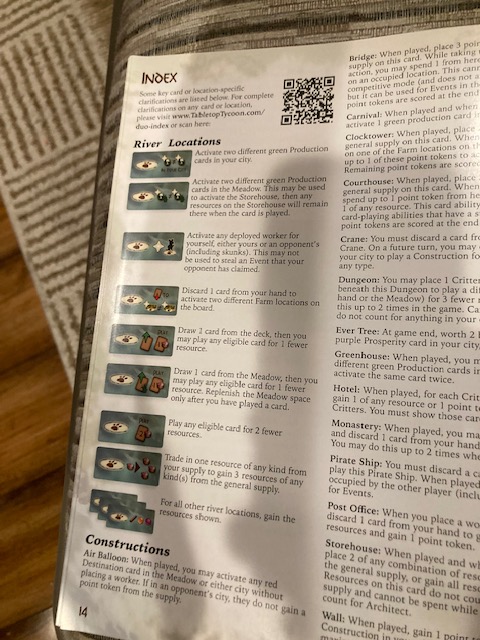
I won’t ding this for the lack of an index because it is a pretty simple game overall; it doesn’t need one.

Player Count

IMG_0881

More than any other game I have played in some time, the Player Count matters for this game.  It’s either a slog of playing of cards that play themselves, or a dynamic event! 

Solo Game

IMG_7268

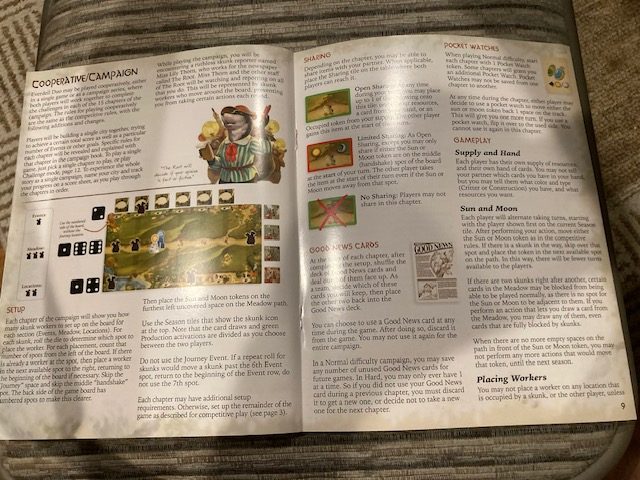
This game does support solo play (see top of page 10): Thank you for following Saunders’ Law and giving us a solo mode. The only real difference is that the Arrow symbol means that you can’t share cards with anyone else (you can still cull), you can only share with yourself and give yourself an extra card.

IMG_7252

See above as I have a solo game set-up!  The solo mode does allow you to learn the game: I have played this game quite a bit solo.

IMG_7285

My first solo game was a slog and I hated the game. What am I missing? I found this thread on BoardGameGeek where someone else had the same experience: What Am I Missing? Armed with that information, I tried again and did a little better.

The most important thing you learn from a few games is that the Arrow symbol is critical.

IMG_7277

The major problem with solo mode is that your deck just builds and builds (see how huge my solo deck is) and many times you feel you have no agency!   You just draw cards and hope you get the cards you need.  You can either do something or not.  That’s it.  The game feels like it plays itself!!!  If you have used all your tokens, well, it’s even less fun.  Right now, the solo game hovers at a 4/10 for me.  (I will revisit this below)

I had enough information to teach my friends AND emphasize the Arrow. Maybe the game works better with more people?

Two Player

IMG_7361

Sam came over and we gave it a a try: I made sure to emphasize the Arrow symbol and that we needed to talk.

IMG_7353

The game went a little better as we tried to be intelligent about the use our symbols. Again, the most important feature is to use Arrow to share cards at the right times.

IMG_7359

The decks still got pretty big (see above), and many turns had nothing happen as we acquired Disaster after Disaster. See below.

IMG_7349

IMG_7356

We started to see a little more strategy: maybe it made sense to move a card to my compatriot, maybe it made sense to cull this card.  There was more sharing as we tried to help each other.

In the end, we won, and there was some sharing.  And there was some discussion.  And there was some strategizing.  But there were a whole lot of turns where nothing happened and we just acquired a Disaster.   During those turns, it just felts like the game was playing itself.

In the end, Sam gave the 2-Player game about a 6/10.  I was a little more down on the game after my solo play and I gave it a 5.5/10.    The decks got huge, and there were still a lot of turns where nothing happened, but we saw a glimmer of the sharing and strategy.

3- Player and 4-Player

IMG_0882

We saw, in the first 3-Player game that this game CAN be fun!  As long as you use all the symbols on the cards, and try to use the Arrows to move and cull cards, and communicate and cooperate, the game feels like you have agency!

IMG_0883

The difference between a solo/duo game and a 3 to 4-Player game is the number of opportunities!  More players means more opportunities to share resources smartly!

“I can share this card, but Sara doesn’t have any animals.  AH!  But Andrew does! I’ll share this with him so we can get the last biome!” 

All of a sudden, people are looking around the table for opportunities to share!  People are talking, people are communicating, people are cooperating!  

IMG_0885

The 3 and 4-Player game is fun!  As long as you exploit the shared opportunities, this game can be quite fun!  My friends all had fun and wanted to play again.  

I mentioned the problems with  solo and duo play, and my friends said “There’s just more opportunities to be smart with more players!”

Be aware, if you are looking for a game that is good as a multiplayer solo game, this isn’t the game for you!  If you play Ecosfera like multiplayer solitaire (no one really works together and everyone just plays by themselves), Ecosfera will have all the problems of the solo game … and it won’t be fun.  In order to truly enjoy this game, you need 3 or 4 players with a group that will engage with each other! 

You need to have opportunities to share.  You also need to strategize to use those opportunities well.  There’s a lot more of this in the 3 and 4-player game.

Conclusion

IMG_7287

If you are looking for a solo game, I can’t recommend this game: although the solo game is good enough to teach the game, it leaves a bad taste in the mouth that this game plays itself.  It’s about 4.5/10 at a solo play because it just barely works.

IMG_7361

Even a 2-Player game isn’t quite right: there’s not enough quite opportunities for intelligent sharing; the game still feels like it’s playing itself too much of the time.  It’s better at 2-Player than solo (maybe a 5.5 or 6/10), but I still can’t recommend it.

IMG_0881

It’s not until you get to 3 or 4 players together that this game opens up and becomes fun!  There are so many more opportunities to work together and strategize together as a group when you have 3 or 4 players!!!   In that configuration, I can recommend this game, as can my friends: they have suggested we play again! This is a 6.5 or 7.0/10 for 3 to 4 players.  Just make sure you play with a dynamic group!

I don’t think we’ve ever had a game that is so player count dependent! If you want a solo game or something to play with your partner, I can’t recommend this game.  If you want a game that plays multiplayer solitaire with little interaction, again, I can’t recommend this game.   I think this game only works with 3 to 4 players with a dynamic group … and then it’s fun.

The Nature theme is fairly thematic, the art is pretty, and the game is gorgeous …. but that will only get you so far: Be aware of when this game works and when it doesn’t before you pick it up.

Project PEGASUS: A Campaign for Marvel United

IMG_7430

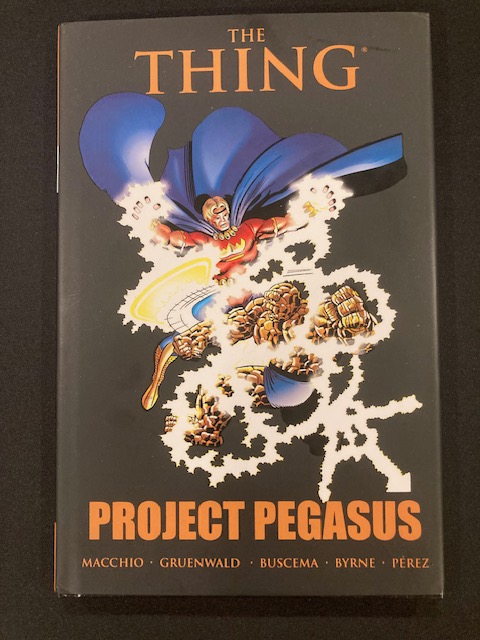
The Project PEGASUS series was one of my favorite comic series when I was a kid. It took place in Marvel Two-In-One Issues 42, 43, and 53-58 back in 1978 and 1979. There are several reasons I liked this story: it featured the Thing and a really interesting cast of characters, including Quasar and Man-Thing! Plus, it’s one of the few times you see the art of John Byrne and George Perez together.

IMG_7404

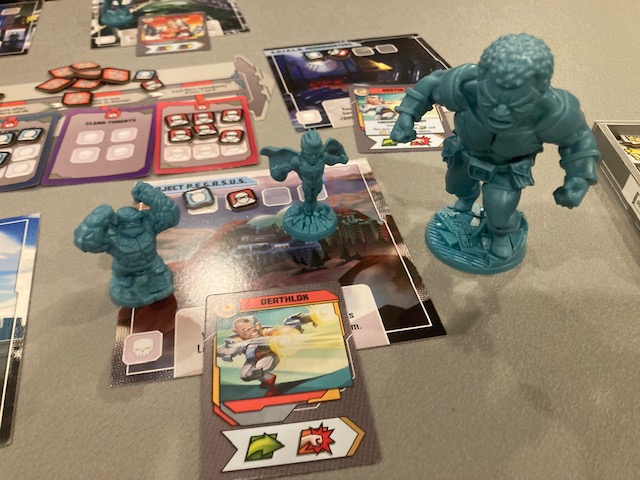
Once Season 3 of Marvel United arrived, I saw that Project PEGASUS was indeed a Location from the Multiverse base set: see above (we reviewed the base Multiverse set here)!

IMG_6665

We also got a chance to play some of the campaigns that came from the Marvel United Campaign Decks!   See last week as we reviewed some of these experiences!

IMG_6672

See all the great series of Marvel Comics!  But where’s the campaign for Project PEGASUS?

Never mind, I’ll do it myself.

The Road To Development

IMG_7386

Over the past month, I have read and re-read the Project PEGASUS series (a burden of joy) to get a sense of what its campaign might look like.  See above as I have taken out most of the content I need!

IMG_7368

After coming up with a general outline of what the Villains, Heroes, and Games should be, I started to put something together!  See above for written notes on the first draft of this campaign.

IMG_7388

I’ve have also had some play testing from my friends, as well as many many many solo games (with 2, 3, and 4 Heroes).

In the end, I am very proud of the Campaign I came up with: it follows the story of Project PEGASUS pretty well and adds some new ideas to Marvel United.

IMG_7429

Over the last few weeks, the campaign has evolved quite a bit: I have some added some new Villains and Heroes for the final cut. 

IMG_7406

Some of the ideas in the Project PEGASUS campaign are a little outside the box, because even though Season 3 made this all possible, I will still missing some pieces (Heroes/Villains/etc) to make the campaign complete.  So, I had to improvise using what I had. 

I am very proud of what I did for Games 1 and 5, and especially Game 2.  But be aware that those games are a little different.

What Do I Need?

IMG_7017

Like all of the campaigns, The Project PEGASUS campaign needs a lot of pieces stolen from all parts of Marvel United. See the complete list below.

• Base Marvel United
• Spider-Geddon Marvel United
• Multiverse Marvel United
• Season 1 Stretch Goals
• Season 3 Stretch Goals
• Fantastic Four
• World War Hulk
• Annihilation
• Civil War
• Enter The Spider-Verse
• War of Kings

Current State

IMG_7431

The current draft of the campaign is at version 1.0.1.  I fully expect there to be revisions made as me and others playtest it. 
UPDATE: We are now at 1.1.0: we had some explanation clean-up and a few balance adjustments to Game 1!
Oct 20th, 2024 UPDATE: Updated to 1.2.0: Added explanation of how to play solo, updated Game 2 with better descriptions and a rules fix/clarification.

Feel free to download the PDF below and give it a try!!!   If there is interest, I can try making the form factor more like cards (with Rules cards and Event cards), but right now the Events are presented alongside the Games of interest in the PDF document below.

 If you have any feedback (too easy, too hard, spelling problems, unclear rules), please email us at returnfromsubroutine @ gmail.com

We’d love to hear from you!  How did it go?


Campaign Decks for Marvel United: How Much Story Do They Add?

IMG_6665

The Campaign Decks were part of the Multiverse Marvel United Absorption Expansion Explosion (where we received so much new context for Marvel United)! !

IMG_7013

The Campaign Decks give you just that: campaigns you can play through using the Marvel United system.

Let’s take a look!

Unboxing and Gameplay

IMG_6666

This is a surprisingly small box of cards: see Coke Can above for scale.

IMG_6667

The game comes with a very small pamphlet (sigh, I am not a fan of pamphlets) and 114 cards for 8 campaigns.

IMG_6672

Each campaign is 8 to 23 cards each, with Age of Ultron and Maximum Carnage being 8 cards, X-Cutioner’s Song and World War Hulk being 13 cards,  War Of Kings and Dark Phoenix Saga being 16 cards,  Avengers vs X-Men being 17 cards, and The Age of Apocalypse being a whopping 23 cards!

IMG_7015

Each campaign has two types of cards: Campaign Set-Up and Rule cards (top cards: each game in a campaign is defined by one of these) and Campaign Event cards (bottom cards: which are brought out during certain points of the campaign).

IMG_6673

The front of the Campaign Set-Up and Rules card define the parameters of each encounter: the Villain you will fight (Emma Frost above), the Heroes you can operate (Prof. X, Storm, Wolverine, Colossus above), and special set-up or rules (split the start-up, must start with HANGAR BAY, etc.). See above.

IMG_7014

The back side of the Campaign Set-Up and Rules defines special rules for that scenario, as well as  triggers to bring out Event cards: see above.  Warning: minor spoiler below!!

IMG_6868

Events are related to the scenario you are fighting: see as Event 01 brings some rules into play once you rescue Kitty Pride.  Many times, Events just add Heroes to your roster: this is important, as it gives you more choices of Heroes to play when you fight (and some Heroes are better in certain scenarios).

Basically, these cards control the progression of games.

IMG_6668

Generally, you need almost all of the Marvel United content to play these Campaigns.  The back of the pamphlet tells you ALL the base games/expansions you need to play through!

IMG_7017

See how The Dark Phoenix Saga, Age of Ultron, and Maximum Carnage all require a whole bunch of expansions! And a very disparate set of expansion as well!

IMG_6669

These expansion all look really cool … but how do they play?

Campaign Flavors

Not all campaigns are created alike.

IMG_6836

The World War Hulk campaign requires players to play in the one-vs-many mode known as Super Villain Mode in the game: this is definitely not solo or full cooperative!

IMG_6832

The Maximum Carnage campaign requires the players to do The Carnage Challenge (at least for games 2 and 3).

IMG_6835

The War of Kings requires team vs. team mode, at least for the first game, then the game goes back to being solo and/or cooperative for games 2, 3, and 4.

IMG_6837

The Avengers vs X-Men is mostly Super Villain Mode (one-vs.-many), and game 1 is a special PVP mode: Clash of Heroes.

IMG_6841

The rest of the decks (Age of Apocalypse, Age of Ultron, X-Cutioner’s Song, and Dark Phoenix Saga) can all be played solo or cooperatively.

We’ll only be looking at those decks you can play solo or cooperatively today.  Over about 2 weeks, we were able to get through a few campaigns.  Let’s take a look!

Campaigns and Spoilers?

IMG_6888

So, to talk about the campaigns, we have to talk about some of the stuff that happens.  However, that could mean spoilers.  We have done two full playthroughs in this review: decide if you want to read them or just jump ahead to the Conclusion!

The first campaign is the Age of Ultron story.  There are some very minor spoilers in this section (just below), but if you want to go in the game without knowing anything, skip to the Conclusion!

The second campaign is the Dark Phoenix Saga. There are some pretty significant spoilers in that playthrough, both in terms of reveals and stories!   If you know X-Men #131-137, the story won’t have have any spoilers, but some of the events/happenings may still be spoilers.  Since this playthrough has Major Spoilers, we’ve moved this section ALL THE WAY TO THE END to the Appendix section.  Feel free to read it if you want more of a feel what the Campaigns look like, and you don’t care about Major Spoilers

You have been warned. 

Age Of Ultron Campaign: Minor Spoilers Ahead

IMG_6677

The Age Of Ultron campaign is 3 to 4 games long (depending on how well you do). This is probably the best campaign to start with.  (There a few minor spoiler ahead: skip ahead to the Conclusion if you want to avoid any spoilers).

IMG_6680

Basically, you fight Ultron a LOT, and he gets stronger and stronger as you play!

IMG_6681

Each game will usually have a different set of Heroes you can play: I started the campaign with Wolverine and Iron Man, but was told (by the Campaign Set-Up and Rules card) that I had to use some different Heroes for Game 2.  I liked that I had to change Heroes (it kept the game interesting), as I had to try to pick a good set of Heroes to play together.

IMG_6700

Winning or losing a game usually gets you an event: so far, many good events I see add a new Hero to the Campaign Roster (see above as Spider-Man joins the roster as a new Hero I can play!)

IMG_6697

My second game used Emma Frost and Black Widow together.  Wow, were they good together!  Black Widow‘s predictive power made a huge difference!  They took out Ultron!

IMG_6704

Finally, I used Captain America and Iron Man for my Game 3!  They (barely) kept Ultron under control …

IMG_6710

Basically, by (barely) defeating Ultron in game 3, I was able to avoid a final Game 4 (which gives a few more chances to defeat Ultron).

There wasn’t a lot of story per se in this campaign, as my Heroes were just doing the best they could in each Game.  It was, however, very thematic to have Ultron get better and better and better in each game! Really, he was quite tough by the time Cap and Iron Man took him on. I probably should have lost (and had to play Game 4).

IMG_6709

It was fun to play the Age of Ultron campaign, Ultron had an interesting progression, but there really wasn’t any story. 

Conclusion

IMG_6840

In the end, the Campaign Decks reminded me a lot of Set A Watch: Doomed Run (see our review here).   Why is that?  Each particular game of Set A Watch: Doomed Run is thematic, but the story tying them together is very very loose: it’s so loose you can drop players in and out of the campaign as you play!  And I think that’s true here as well! Each Campaign game is thematic and fun, but it doesn’t really twist and turn very much; each Campaign is fairly linear.  If you were looking for a thematic story with lots twists and turns to entertain you, the Campaign Decks aren’t really that.

IMG_7017

There’s a few “twists” I saw, but in general, I think the purpose of the Marvel United Campaign Decks is an excuse to relive your favorite comics and an excuse to play through the ridiculous amount of Marvel United content.  There’s a lot of theme, especially if you know the stories involved, but the Campaign Decks don’t present a deep, dark, complex adventures: they are just an excuse to play Marvel United and relive your favorite comics!  As long as you know what the Campaign Decks are, they might be right up your alley.

Just be aware HOW MUCH Marvel United Content you must have in order to play these!

Appendix: Dark Phoenix Saga Campaign: Major Spoilers!!

IMG_7015

NOTE: There are MAJOR SPOILERS ahead!  Skip this Appendix if you don’t want any spoilers!!

The Dark Phoenix Saga campaign is a little longer at five games.  Honestly, it will probably be more: you will almost certainly lose a few games, because the game gets hard! I lost two games along the way, but was able to come to a successful conclusion (so six games total).

IMG_6845

I was really looking forward the Dark Phoenix Saga: when Jean Grey fights for her life in X-Men #137, it was a very powerful and moving story. Could the Campaign capture some of this?

IMG_6844

Well, the Dark Phoenix Saga starts Game 1 with Emma Frost and Kitty Pryde (ShadowCat): see set-up above! This is reminiscent of issue X-Men #131 where Kitty Pryde wanders the Hellfire club trying save her compatriots … see below.

kityp

IMG_6848

In this Game 1, I had Wolverine and Professor X take on Emma Frost.  Remember, you have choices of which heroes you can use!  Part of the fun of the campaign is trying to find the best heroes…

IMG_6851

Well, it turns out I played my first game so very wrong (I missed some of the threat effects and special rules about accelerating the Master Plans, and didn’t realize I was supposed to find Kitty), so I restarted halfway through.  

IMG_6868

Wolverine and Professor X were able to find Kitty and take out Emma Frost.

IMG_6869

This led to Game 2:

IMG_6872

IMG_6875

Game 2’s villain is Sebastian Shaw: a Hellfire club member!  We are firmly in issues #131-#137 of the X-Men now!  It feels like we are in X-Men #132 fighting Shaw!

xmen132

IMG_6882

We were required to play Jean Grey and Cyclops: definitely very thematic!

IMG_6883

And why isn’t Jean Grey called Marvel Girl like in the comic … but I digress … I mean, her secret identify is her hero name?  No, she should be Marvel Girl (Jean Grey).

IMG_6887

Shaw was rough: I ran out of cards (losing the game) and had to flip Event 5.  To be fair, this loss feels very thematic, as Sebastian Shaw really trounced the X-Men in this particular series of comics!!

IMG_6890

Too late!  But, at least I had Nightcrawler on my Roster now …

IMG_6891

The next game up (Game 3) had us fight the villain Mastermind: he’s the evil creature trying to take over Jean Grey‘s mind!

IMG_6894

IMG_6893

We get to choose heroes in this Game!  If you look carefully at the Threats, you realize you want to try to keep the Heroes together (bad things happen to lone heroes).  Nightcrawler pretty much HAS to teleport every turn (the black text on his cards means you are forced to do that), so it would be easy to keep the Heroes together.  When the Heroes WOULD take damage, Kitty was able to phase and mitigate that!!  This was a great combination of Heroes for this game.  And it felt thematic: Kitty’s phasing kept them safe, and Nightcrawler’s teleportation kept them together.

IMG_6899  

This was thematic from the character’s perspective.  The story not as much (I should have used Wolverine: Wolverine fights alone!)

IMG_6904

Then Jean Grey becomes Dark Phoenix.  Oof!!!!  There’s some really thematic stuff that happens in this part of the game, but I don’t want to give away too much.

IMG_6905

Dark Phoenix was one of the hardest battles I have ever had.  

IMG_6906

I started with Kitty and Cyclops, but after losing to Dark Phoenix once,  I had to “remove Kitty” from play.  I could only keep playing as long as I had 4 Heroes in my Roster.

IMG_6917

See above as Dark Phoenix easily takes out Cyclops and Kitty.

IMG_6924

I get to try again: For my next trial against Dark Phoenix, I brought out Nightcrawler  (and you are required to keep Cyclops).

IMG_6927

I was able to eke out a win, but just barely.

IMG_6914

Dark Phoenix’s Master Plan cards are just rough!

IMG_6910

I fully expected to need 3 or more games to beat Dark Phoenix.  I mean, she’s Dark Phoenix.

IMG_6930

Even though the X-Men were able to defeat Dark Phoenix, … things happened while Jean Grey was Dark Phoenix. Like, she ate a sun and destroyed a world, so she must stand trial. 

darkphoenixsaga18

And Gladiator is the one to deal with her. 

IMG_6936

Jean Grey must fight, since she’s fighting for her own life.  The choice of Wolverine is important here: we know from playing Gladiator from the War Of Kings, it’s important to always have a full hand!  Since Wolverine has his healing factor, he is an exceptional character to play against Gladiator.

IMG_6953

In the end, Wolverine and Jean Grey were able to defeat Gladiator.  And win the campaign!

IMG_1884a

Although, technically, Jean Grey doesn’t survive … they don’t tell you that … see above …

IMG_6952

I know the Dark Phoenix story and wow, this felt incredibly thematic!   From how hard Dark Phoenix herself is, to some events in the deck, the Dark Phoenix Saga Campaign Deck was very thematic.  To be fair, the Campaign Deck didn’t “tell a story”, but it sure reminded me of one of my favorite X-Men stories of all time. 

Run Run Run! See Cats Run! Run Cats Run! A Review of Run Run Run!

IMG_7037

Run Run Run! is a cooperative game from Kickstarter: it was up on Kickstarter in February 2024 (with several other games) promising delivery in May 2024. It actually delivered in late August 2024, so it was about 3 months late. Eh, that’s pretty good for Kickstarters.

IMG_7041

With a name like Run Run Run!, this sounds like it should be a real-time cooperative game, but it’s mostly cooperative tile-laying game. See our Top 10 Cooperative Tile-Laying Games for more discussion of the tile-laying genre.  Run Run Run! is also a little bit of a boss-battler game.

IMG_7042

This is a light-weight cooperative game for 1-4 players taking about 30 minutes: the game time listed on the box seems accurate enough.

IMG_7128

So, this game was part of an “import Kickstarter” where they found games from around the world and imported them to the USA.  Apparently, this is an older game by Bruno Cathala and Antony Perone.  BoardGameGeek lists the game as a 2021 game, although for some of us here in USA, this is a brand new game (including me).  This is the 2nd Edition of the game, so I guess it’s new in that respect.

Let’s take a look!

Unboxing and Gameplay

IMG_7068

This is a game with a LOT of tiles: more than half the box was filled with punch outs. The first 30 minutes of my unboxing was just punching out all the tiles and other components! We did say this was a cooperative tile-laying game!

IMG_7079

Players assume the roles of one of four explorer cats (Catventurers to use the nomenclature of the game)! See above! Each explorer cat has a special power that is invoked when they roll a ‘?’ on the dice …

IMG_7080

This is also a cooperative boss-battler game: you will face one of the three Final Boss Mummy’s above! To win, you have to take out the Final Boss before it makes it back to the Relic room!

IMG_7081

Along the way, lesser Mummies will be summoned to slow you down. If any of the Mummies ever make it to the room with the Relics of the Pharaoh, all players instantly lose! You need to keep all Mummies OUT of the that room!!

IMG_7105

Players lay out tiles, one at a time, trying to build a maze out.

IMG_7111

To unlock the Final Boss, you have to build three tiles adjacent to each other with different symbols!  And you have to do this three times (or more)!!  See above!  This is the only way to unlock the Final Boss, but every time you do that build, you invoke a “trap”!  See above as the Mummy  summon triggers a “trap” that gives the Final Boss 5 more hit points!

IMG_7106

Torches are an important part of the game: you need to put torches in rooms to see!  You start with 5 collective torches, and if you can’t place a torch, you get closer to summoning a Mummy!

IMG_7096

At the start of the Mummies’ turn, you roll a die (or  more…)! If you roll the monster symbol (see above), you have to move all Mummies closer to the Relic Room AND you also come closer to summoning a new Mummy!

IMG_7108

Every time you roll a monster, you have to put a heart on the current top Mummy tomb!

IMG_7101

If a mummy get 5 hearts, it has been summoned the Mummy and that Mummy goes on the board! Where on the board? Player’s decide!

IMG_7102

Usually you put the mummy as far away from the Relic Room as possible (see above), or right next to a Catventurer so they can fight it!

IMG_7107

Mummies are defeated by rolling dice!  See the attack dice above!  Some symbols give you a successful Attack: note above we do 4 damage to a Mummy with 7 hit points! But since we have have the x2 token, we do all 8 damage and take it out in one shot!

How do we get dice?

IMG_7114

Every exit on a tile you discard give you an attack die!  For example, to get all 6 attack die above, we can discard the one tile with all 6 exits to get all 6 dice (6 is the max).

IMG_7104

How did we get the x2 token?  Whenever we explore a Sarcophagus room (with the little golden coffin, see above), we get a Sarcophagus token … one of which may be a 2x!  See above!

IMG_7112

Oh yes, if we ever run out of torches, we can get new ones in a couple of ways. One: if we build three rooms adjacent (see above) the same symbol, we immediately get 5 torches!

IMG_7345

There’s also a cooperate action which can give more torches (or tiles if needed). See above.

IMG_7195

If we can take out the Final Boss before he reaches the Relic Room, we win! See above as we LOSE as the Mummy enters the Relic Room!

IMG_7078

The production for this game is pretty great with tons of thick cardboard tokens! The art is super cute and the game looks like a high quality, but cute, production!

Oh, and this is a cooperative cat game! It may not be clear at first, but we are all cats working together!

Rulebook

IMG_7059

The rulebook is good.

IMG_7066

The rulebook gets an almost perfect score on the Chair Test with an A!  See above as it fits perfectly on the chair next to me, it stays open, it has readable fonts, and it has good pictures!  This would probably get an A+ on the Chair Test if the fonts were just a little bit bigger.  

IMG_7060

The Components page is great: it shows all the components with annotations. See above.

IMG_7061

The set-up pages are perfect: the entire set-up is pictured and each step is labelled with a relevant number!  I can leave this open, and set-up the entire game from these two pages!

IMG_7063

The rest of the rulebook is pretty good.

IMG_7064

My only real complaint is that they didn’t show/explain all the possible Trap tokens that can come out. I had to “guess” what they meant.   It was mostly intuitive, but not always.

IMG_7067

The last page of the rulebook is useful: this is where I wish they would listed all the trap and Sarcophagus tokens with more description. Still, at least the back of the rules was useful.

There’s no index, but this is a 30 minute game, so I don’t think it needs it.

In general, this is a good rulebook.

Solo Play

IMG_7084

 This has a solo mode! (Congratulations on following Saunders’ Law!).  So, there’s a very small section describing the Solo Mode on the very last page of the rulebook.  See above.  The solo game basically plays true solo: you play one Catventurer (the Cat Explorer) and play the game as-is!  The only rule that needs some “slight” expansion is the COOPERATE action: you can still play the COOPERATE action, but only the solo cat gets the rewards!  This is great!  No real changes: just play the game as-is!

IMG_7120

My first game was a win, as I killed the final Mummy on his way to the end! See above!

IMG_7095

My initial tile selection wasn’t great (as only one room has more than one exit), but I soon got a lot more branching rooms.   I also had a lot of Sarcophagus rooms …

IMG_7099

Those Sarcophagus rooms enabled me to get some great tokens at the start of the game!  I saved those 2x tokens for the end game, because I knew how hard the final Mummy would be!

IMG_7118

I played my first game very well: I kept the Mummy’s under control and I had plenty of tiles going into the final battle, and I was able to build enough space so that the Mummies were far enough back that I could take them out!

IMG_7191

My second game was a close loss: I made the mistake of not having enough of the temple built!  

IMG_7195

I was able to knock the Mummy down to 5 hit points, but he just moved too fast!  He made it to the Relic Room and I lost! See above!

I admit my final loss was depressing because I rolled so poorly; not on the Attack dice but on the Mummy movement!  It’s basically a 50% chance that the Mummy will move every turn, and he moved EVERY TURN after he came out!  The Mummy screamed to the exit and I lost!

Cooperative Play

IMG_7199

Cooperative play went pretty well.

IMG_7198

There was shared workload setting up and playing.  There are enough components in the game (torches, tiles, 5x torch, sarcophagus tokens, mummies, player tokens, etc) that it was nice to share the workload of taking care of the tokens.

IMG_7203

We were able to take out the final mummy!

IMG_7202

Basically, after he came out, were were able to all pounce on him and do as much damage as we could!

IMG_7200

The cooperation in this game was interesting.   We didn’t “love” that you couldn’t talk about the tiles you have, but you were allowed to “point” to to where you were going to build, and that seemed enough to allow us to all move forward.  There was never any “fine-grained” cooperation (“I’ll build this tile, you build this tile”) as we played … because there can’t be!   The cooperation was more “coarse-grained” in that each cat did their own thing on the way to helping the party:  “I’ll take out the light mummy if you can just build!  Oh! I need help with this!”  The game was kind-of multiplayer solitaire with many moments of high-level cooperation.

IMG_7201

If you don’t like cooperative games because of Alpha Player Syndrome (because the Alpha Player tells everyone what to do), then Run Run Run! is game that keeps the Alpha Player at bay pretty well. Because you can’t do any fine-grain cooperation with tiles, the group decides more of the high-level actions together! Everyone stays involved on their turn by choosing the tile to play, but everyone stays involved with the group as they makes high-level decisions together.

With some retrospective, I liked the amount of cooperation the game elicited, even if we did have some communication restrictions.

Communications Restrictions

IMG_7203

My groups don’t tend to like communications restrictions because we get together to play, talk, and strategize together!  We are friends and we want to talk to each other!   Some games with communications restrictions work, and some don’t!  And it’s a razor’s edge of difference.

IMG_7196

Run Run Run! works mainly because it doesn’t stop all communications: you can’t really show your tiles and talk about them precisely.  The rule is (from page 2):

“Also, even though you may openly discuss your intentions, you may not show the tiles from your hand to the other players, nor describe them precisely. You may, however, point a finger to a specific Room, without saying anything…”

The rule is still imprecise (“What does it mean I can’t describe them precisely? Can I tell you it’s a symbol?“), but I think the intent seems to be don’t tell/show others your hand.  Other than that, talk as much as you want!  That seems to work!

IMG_6529

Compare this against the Communications Restrictions in Defenders of the Wild (see our review here):

“At the start of each round, all players must cease communication and maintain silence while choosing a defender card from their hand to play…”

The restriction is much more draconian, and squanders an opportunity to make a multi-player solitaire game even more cooperative!

IMG_6713

What’s the difference?  In Run Run Run!, you simply can’t share your tiles, but in Defenders of the Wild, you can’t talk at all (for that phase)!!  I think this very minor difference makes a world of difference: I liked playing and talking and cooperating in Run Run Run!, and I am annoyed in Defenders of the Wild by the restriction.  (I still don’t think the communications restriction rules work at all in Defenders of the Wild, but maybe the rule should have been simply been “You can’t show/discuss your Defenders“).

It’s a fine line, but the Communications Restriction works in Run Run Run!, but not in Defenders of the Wild.

Try It Out

IMG_7100

Since this game has communication restrictions, one of the things you are NOT allowed to do it show your tiles to any other person.  The problem is, sometimes you want to “try stuff out!” See above as we have a bunch of tiles we want to play with and see what we can do!

IMG_8771

In our review of Race To The Raft (another cooperative cat game with tile-laying), we saw the same problem!  You aren’t allowed to share what you have in your hand in Race To The Raft either, and many times you want to “try” stuff out! 

IMG_8766

In Race To The Raft, we developed the house rule “look away while I try stuff” so we didn’t break the spirit of the game!  That way, you can still try stuff out, while preserving the confidentiality of the tiles.   We ended up doing something like this in Run Run Run!

It’s a shame: neither Run Run Run! nor Race To The Raft nor many of the cooperative tile games games on our Top 10 Cooperative Tile-Laying/Tile-Placement Games have any acknowledgement of this very human phenomenon: People want to try stuff out!  Please, if you make a cooperative tile-laying game, please have some sort of rule for addressing this issue:

“If you wish to try out some tile layout ideas on your turn, please ask others to look away so you don’t overshare your tiles!”

Otherwise, you make people dislike your game because no one feels like they can “play with” and/or “try stuff”! Or people come up with a house rule like the one above anyways.  

Acrylic Standees

IMG_7039

I am a huge fan of acrylic standees!  I loved them in Tokyo Sidekick (see review here) and Kinfire Chronicles (see review here) and Weirdwood Manor (see review here)! So, when this Kickstarter offered a deluxe side of Acrylic Standees, I was in!

IMG_7040

This is a small box full of replacements for the wood standees that come with the game.

IMG_7045

It’s a small box (it turns out, you can fit that box into the final game box with some creative packing).

IMG_7046

See above the the standees!

IMG_7048

They are pretty nice! See above!

IMG_7050

Unfortunately, I had two that were broken.  I think they can be fixed with a little glue, but it was still a bummer. (They had fallen out if their standees, and they really didn’t fit back in).

IMG_7054

My friends and I did a comparison of the Acrylic Standees to the wood meeples: see above and below.

IMG_7057

Which do you prefer?

IMG_7056

In the end … both me and friends preferred the COLORED wooden meeples.  Whaaaattttt???? It’s not that the acrylic standees weren’t gorgeous, but the wooden ones were (1) more HEFTY and  (2) we could distinguish the colors easily from the wooden standees!  The wooden meeples made the game easier to play.

IMG_5465

In our review of Weirdwood Manor, we also loved the Acrylic Standees!  See above!  One of the major differences here as that Weirdwood Manor standees are color-coded ON THE BASE!  See above!  This color-coded base makes it that much easier to distinguish the standees across the table!  I think if Run Run Run! had added color to bases,  that would have made them that much better!

IMG_7085

In the end, my friends preferred the wooden meeples.  And I think I do too.  

IMG_7087

A good compromise might be to mix them: use the wooden meeples for the characters (so you can see each player’s color very easily) and then use the acrylic standees for the mummies!  That way, you get a nice differentiation on the board between the good guys and the bad guys!

IMG_7086

But, you really don’t have to get the Acrylic Standees; the wooden meeples that come the game are very very very good.  

What I Liked

IMG_7196

One: This Is A Little game! This is a fun little cooperative game that’s only 30 minutes.

IMG_7057

Two: Wooden Standees: The wooden standees that come with the game are much better than you think; it is nice that you have the option for Acrylic standees, but you don’t need them.

IMG_7077

Three: High Quality: The components are pretty high-quality, from thick cardboard tiles, wooden standees, and thick readable tokens.

IMG_7197

Four: Limitations Okay: I generally don’t like Communications Limitations in my cooperative games, as they tend to suppress the reason I get together with my friends: to talk!   In this game, the restriction on NOT sharing your tiles didn’t seem to get in the way of us still communicating: we still made plans as a group and had a good time.

What I Didn’t Like

IMG_7088

One: Acrylic Standees: I am slightly annoyed that the Acrylic Standees weren’t better: some of mine were broken, and they really needed colored bases to help distinguish them on the board.   They are still gorgeous, but not as “mind-blowing” as I had hoped.

IMG_7195

Two: Random. The game is pretty random; it all depends on what you roll on the monster dice and what tiles you draw!!!   

Maybe you get terrible starting tiles!! I think there needs to be a Mulligan House Rule at the start of the game where you can redraw your tiles).   

Also, the monster dice gets rolled every turn and there’s a 50-50 chance (greater with more dice) that something bad will happen.   I lost my last solo game because the monster moved EVERY SINGLE TURN when I rolled badly 5 turns in a row!  I simply couldn’t stop him and there’s no dice mitigation for that!

Reactions

IMG_7194

Rich: “I generally liked it.  As I look reflect back on it, I liked it a little better cooperatively than solo. Even though I generally don’t like communications limits, we still strategized as a group and were able to get stuff done, while still having agency on our own turns.  The randomness of the game is a little much (as dice and tile draws control the fate of the party), but since it’s only 30 minute game, it’s not a big deal if you get wrecked.  It’s probably a 6.5/10 for solo, 7/10 for cooperative”

Andrew: “5.5 or 6? It was pretty good. I like cat games.”

Teresa: “6 or 7, it was pretty fun.”

Conclusion

IMG_7058

Run Run Run! is a light cooperative tile-playing game which just so happens to be a boss battler.  The game seems to unfold as multi-player solitaire, as each player cannot share what tiles they have.  But, a higher level cooperation seems to emerge as players take on high-level roles as they play (“You kill the mummy, I’ll build out!“)  If you are looking for a game with mechanisms that tend to suppress Alpha Player Syndrome without losing too much cooperation, Run Run Run! seems to strike a good balance of being cooperative but still giving each player some agency.

IMG_7096

There is some randomness in the game, as it really depends what you roll and draw!  Luckily, this is only a 30 minute game, so even if you get wrecked, it’s a short game.

IMG_7056

I would recommend Run Run Run! if you like the theme and are looking for a light cooperative tile-laying game … with cats!! I am very sad that I can’t recommend the Arcylic Standees: all of my friends (and myself) preferred the wooden meeples that come with the game.  

Run Run Run! would probably make my Top 10 Cooperative Tile-Laying/Tile-Placement Games, just not near the top of the list.

A Message From the Stars: A Cooperative Word and Math Deduction Game. A Review.

IMG_4351

A Message From The Stars is a cooperative word game that was on Kickstarter back in October 2023.  It was a group of games (Through the Desert, Switchbacks, and A Message From The Stars) that was part of the same Kickstarter: see link here.   The only game we care about here today is A Message From The Stars.  This arrived at my house in last April 2024, after promising delivery in May 2024!  That’s right! It delivered early!  Congratulations to All Play for delivering early!

IMG_4350

As a Kickstarter, it came with a little bit extra: fancy dice and dice holders!  See above right.

IMG_4352

At first blush, this looks like it might be a party game!  It’s a smaller box and the player count is 2-8+ !

IMG_4353

You should heed the label on the back of the game: The Strategy Line (see above).  This isn’t really a party game?  I guess Codenames, another word game, is considered a party game, but this is deeper than Codenames and much harder. Message From The Stars is much more of a deduction game with math and word elements.

Let’s Take A Look!

Unboxing and Gameplay

IMG_4354

Even the size of the box suggests it might a party game: it’s relatively small.  See the Coke Can above for scale.

IMG_4365

This is a game about two teams: the Aliens and the Scientists!  The two teams are trying to guess (cooperatively) each others words and some important letters!   This is, at its core, a word game.

IMG_4378

Each team gets a card with some words on it: see above. The words are in three groups.

IMG_4385

Each team (Aliens or Scientists) rolls some dice to choose randomly a word per column.  The Kickstarter expansion that came with the game (see more discussion of this below) holds the card and the dice; this is so you can see what words the Alien (pink above) is trying to communicate to the Scientists! The words are  Pollution (2), Mirrors (5), and President (6).

IMG_4383

The Scientists do something similar: the words the Scientists are trying to communicate to the Aliens are Atlantis (2) , Field (4), and Factory (5).  See above.

IMG_4363

You might think this sounds like a lot of party games.  But hold on! It gets more complicated! It this were just about guessing words, then, ya, this would be a by-the-numbers party game.  What makes this more complex is that you are also trying communicate which letters are important as well as the words!

IMG_4376

There is a deck of 26 cards with the letters on the alphabet.  Each label is labelled with its frequency in words in the English Language: A is a very common letter (green above) and Z is a very very uncommon and labelled a “tough” letter (red above).  The Alien will be randomly choosing 6 of these letters!

IMG_4359

Behind the Alien Screen are places for 6 letters: Trust, Amplify, and Suspicious letters. See above and below.

IMG_4390

To be clear: this isn’t a cooperative game where you “win” or “lose”!  You just get a final score that tells you how well you did!  The final score of this cooperative game is a metric of how well the Scientists and Aliens communicated!  The final score is the number of words guess correctly (max 6: 3 words from the Aliens and 3 words from the Scientists) plus the number of letters guessed correctly (max 6)!  The maximum score is 6 + 6 = 12, which represents perfect communication.

IMG_4377

The game last 4 rounds (in the cooperative mode), which each side providing single word clues to the other side in a round.

IMG_4393

For example, over the course of the game, you can see the 4 clues the Aliens (above) provided to the Scientists.

Basically, in just 4 words (and a hash value), the Aliens have to communicate their 3 words and 6 letters, and the Scientists must communicate their 3 words similarly!

IMG_4387

The hardest part of this game, which takes it away from a party game and into a deduction game, is that each clue word is also “scored” by how many matching letters it has!

IMG_4391

Remember those 6 letters the Alien has?  If the word clue contains some of those 6 letters, the “hash score” value is given along with the word.  Disgusting is given a score of  – 2  for three reasons:

  1. It contains the letter T (Trust +1), which starts the value off at 1
  2. It contains the letter G (Trust +1), which increments the value to 2
  3. Finally, it contains the S (Suspicious -), which negates the value to -2

The rules for the score are not simple, and it takes a few turns to kind of get what’s going on there.  You’ll notice that the word DISGUSTING is doing double-duty: it’s trying to communicate some of the letters AND also a clue on the first column (“Pollution”)!  Is DISGUSTING enough to imply POLLUTION?

IMG_4355

There are a number of dry-erase boards for helping keep track of the word “hash scores” so you can try to reverse-engineer why the score was made!

IMG_0393

See as Jeff (above) tries to reverse engineer “Hibernate” and “container” to see why they got their scores. Notice how nice and thin the letters are!

IMG_4363

This game has fantastic components: everything in the game is dry-erase (the cards and the boards) so it’s easy to re-use them over and over!  Perhaps the best part is that the game uses ultra-fine dry-erase markers!  Recall how “thick” dry-erase markers ruined both The Revenant Society (see link here) and The Forests of Admiron (see link here).   I am glad to see the A Message From The Stars got the better dry-erase markers!!  This makes a huge difference in a word game!

IMG_4364

For a game that looks like party game, A Message From The Stars has really, really good components.  Except for the die that comes with the base game …

IMG_4363

The base game comes with just a single die you roll.  See above.  You probably want the expansion (below) with the cool dice.

The Expansion

IMG_4367

You probably want to get the dice and box expansion (see above). It makes the game that much easier to play.

IMG_4372

As a warning, there are absolutely NO INSTRUCTIONS on how to build the dice holders!  I had to look up an image online to see what they looked like!  As a community service, I am providing some pictures (below) of the what they look like when assembled!

IMG_4373

Almost there …

IMG_4374

Done!  Notice how nice the dice are too.  These holders just make the game a little easier to play.

Solo Play

IMG_4353

There is absolutely no solo play in this game!  See the box above!  This is a game for 2 to 8+ players!  Boo for not following Saunders’ Law!!

IMG_4391

Since there was no solo play, I just “pretended” to play both sides (mostly the Alien side) so I could get a sense of how everything works.  Once you see how the scoring system works, it clicks!  But it does take a little bit to “get” how this game works.  “Oh, my WORD is supposed to be both a clue for the words AND the letters!! Oh, that’s hard!

IMG_4389

I get why there’s no solo mode: you really can’t have any knowledge of what the other side is doing for their clues.  This is a game with a lot of implications and connotations and indirections with your word clues: it requires a good grasp of the English language and some math skills, but also knowledge of implicit and explicit meanings of words.

IMG_4448
Basic Set-up (for a solo game): After a few turns where the DOOM token has moved up to 3, and the Guesses token is only at 0! I haven’t guessed anything right yet!

We’ve discussed The Changing Perspectives Idea here before, where you run both sides and “pretend” you don’t know what the other side is doing.  That’s a lot harder here in A Message From the Stars because the clues have so much open interpretation!  The Changing Perspectives Idea works so well in Shipwreck Arcana (see link here) because all information is precise: you can use logic to dictate your choices rather than any implications.   Here, in A Message From The Stars, not only do your words have connotation and denotation and context, but they also are chosen to help with the letters! There’s too much “innuendo” and “vaguery” in words for a clean Changing Perspectives Idea to work here.

So, no solo mode.  

Cooperative Mode

IMG_4614

So, we’ve tried this a number of groups.   Sara and Teresa and myself played a 3-Player game (I was the Alien, they were the Scientists).

IMG_4613

They groked this game pretty quickly, and we got into it.  They liked it!  Sara and I have had good luck with Word Games; I played the Paperback Adventures, another word game, with Sara and we both loved it! See our adventures here!  And Teresa is very smart and precise.  Between the two of them and myself, we had a very good time.  But, me, Sara, and to a lesser extent Teresa, really like word games.   And the math Sara didn’t know, Teresa filled in on.  They were a perfect complement to each other.

IMG_0387

Unfortunately, not all my sessions went that well.  See above, as Robert’s look of confusion (upper right) belies his disinterest in the game!  Robert’s a smart guy, but the rules are a little intimidating.  I give Robert a little bit of a pass because he was busy trying to get some work done in the background.  We didn’t have his full attention … and it’s clear this game requires your full attention!

IMG_0390

At some point, Robert just walked away and left me and Jeff to play.

IMG_0394

Jeff and I had a good time.  But Jeff didn’t love the game: his Math and deduction skills were good, but he doesn’t like word games.  He generally expressed an “admiration” for the game: “This is a good game, just not for me”.

Group Dependent

IMG_4612

This is a game that is very group dependent. It has a weird cross-section: you have to like word games, you have to be able to do some math, and you have to be able to do logical deductions. It’s a very cool cross-section! And I love it! I love word games! I love math! I love deduction!

IMG_0391

But the rules, especially for scoring the letters, can be very intimidating.  This definitely does not feel like a party game: it’s a very contemplative game as you traverse word, math, and deduction skills.

IMG_0390

That picture of Robert walking away is kind of ominous and a little telling: you have to be completely focused on this game for it to be fun.   Otherwise, it’s too easy to get lost.

Know your group.  This game is very group dependent, more than many other games.

Conclusion

IMG_0389

I give A Message From The Stars a very strong recommendation … but only for certain groups.  That cross-section of people who like words, maths, and deduction seems like a small set.   I think you’ll know from the description of the game whether this is for you or not.  

IMG_4364

The components are great, and the production is quite good for this word game.  They even used ultra-fine dry erase markers!  That’s a gold star from me!  

I really liked this game, but you need to decide for yourself if this is a game for you and your friends.  If you are unsure, give the game a try at a convention or a game store.  I really liked it, and so did some of my friends.  But not all of them.

The Inhumans: War of Kings! A Marvel United Review

IMG_6728

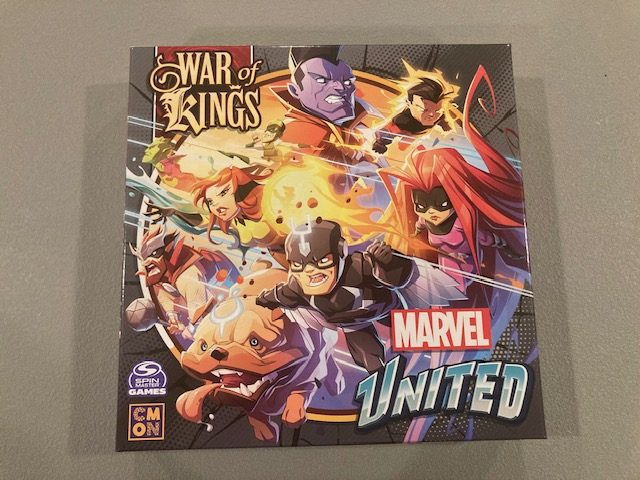
War of Kings: Marvel United is the next expansion we will look at from the Absorption Expansion Explosion of Multiverse Marvel United!  To be clear, you need one of the base games in order to play this: this is truly an expansion only.

IMG_6727

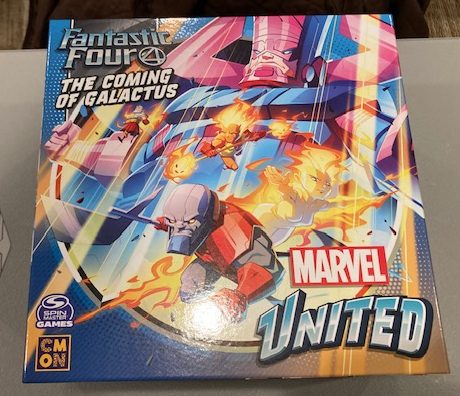
We’ve looked at The Coming of Galactus  (see review here) and the Stretch Goals box/Team Decks (see review here), as well as the base game Multiverse Marvel United (see review here).

This week, we’ll dig deep into the heroes and villains from this set!

Why This One?

IMG_6186

You might remember that there are 8 major expansions in this delivery of Multiverse (see 7 of them above).  Why are we concentrating on the lesser known War of Kings?

IMG_6827

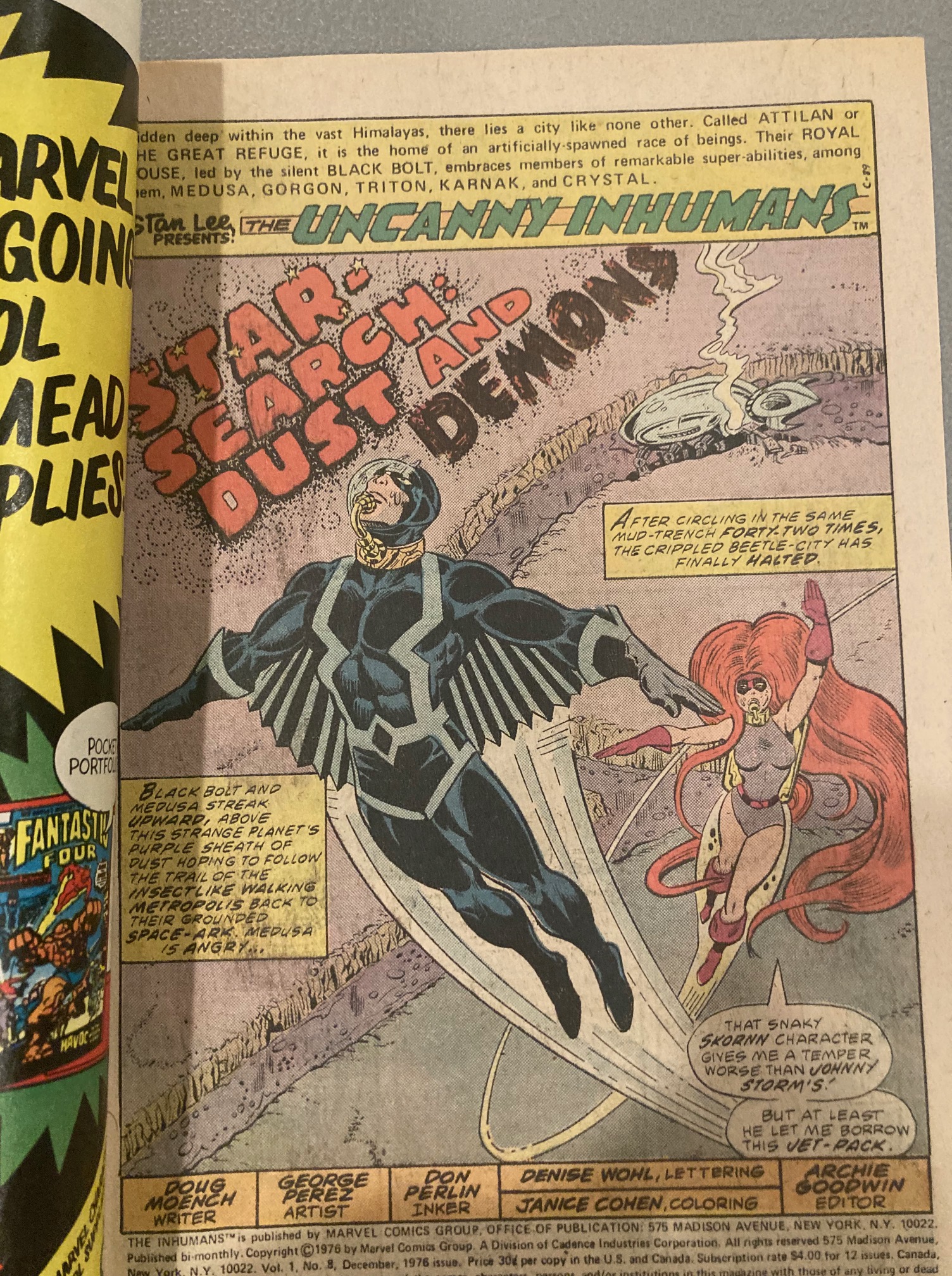
I was first introduced to the Inhumans (the heroes of The War of Kings expansion) back in December 1976. I still have the original comic where I met them! See above and below!

IMG_6828

Something about this group of misfits enchanted me: the stern quiet of Black Bolt, his loyal wife Medusa, and the interesting group of heroes!

IMG_6829

I try to remember why the Inhumans made such an impression on me … and I think the artist George Perez (see above) may have had something to do with that. I have always loved his art! In fact, George Perez was responsible for the art in Future Imperfect, the defining Maestro story (which we saw last time in Multiverse Marvel United).

IMG_6830

Over the years, I have always loved The Inhumans cameos in The Fanastic Four! Issue #240 by John Byrne (see above and below) was a defining moment in their history as they move Attilan to the moon!

IMG_6831

There’s something glorious and regal about the Inhumans. So, they had to be my next set to open!

Unboxing

IMG_6729

The War of Kings is a standard (if smaller stature) sized box in the Marvel United line.  See above with a Can of Coke for perspective.

IMG_6734

There are a bunch of distinct tokens you need for this set: we’ll see them as they come out in our games (see later below).

IMG_6735

War of Kings comes with 4 new Locations: Attilan (remember that city Black Bolt lifted in Fantastic Four #240?), Blue Area of the Moon, Watcher Citadel … all part of the Inhuman’s mythology!  (For those of you who don’t know, the Watcher’s house is on the moon is near where the Inhumans live now).

IMG_6736

War of Kings comes with two bad guys you can fight:  Gladiator (hero and villain, i..e., an anti-hero) and Vulcan (definitely a villain). They both operate VERY differently!  

IMG_6738

There are seven Inhumans in this box (8 heroes if you count Gladiator): Medusa, Black Bolt, Lockjaw, Crystal, Karnak, Gorgon, Triton and Gladiator (left to right, top to bottom).

IMG_6740

IMG_6741

IMG_6742

IMG_6743

The minis are all pretty fantastic, with Crystal’s looking the most stunning!

IMG_6748

The hero decks look great (not as great as Perez or Byrne, but still great and consistent with Marvel United).

IMG_6745

The Villain decks also look great.

Over the course of 4 games, we were able to playthrough all villains and heroes to get a sense of this set! Each game revealed something interesting about each of the heroes and villains! Let’s go through the games and see what we saw!

Vulcan vs. Black Bolt and Medusa

IMG_6749

In the comics, Black Bolt and Medusa are husband and wife (king and queen).  The new mechanism of bond seems to be very thematic: it allows you to choose which Black Bolt/Medusa card you want from the storyline!  See above. This cool feature pretty much dictated that I needed to play with Black Bolt and Medusa  in my first two hero game!  I wanted to see how well that worked!

IMG_6750

IMG_6752

Also, both Black Bolt and Medusa have the Terrigenesis card as their Starting Hand card.  What is that crazy thing Terrigenesis?

IMG_6732

The Terrigen Mist tokens go into the board (one at each location) and if a Terrigen Mist token is there (and a Terrigenesis card is up), that hero may draw that token! See rules above.

IMG_6754

See a sample Terrigen Mist token above.  It’s turned face-down: if you draw it, you must use the symbol immediately!   Most of the Inhumans have this as their starting Hand card (Lockjaw and Karnak don’t … we’ll see why below).  This mechanism is just a nice way to add “a little more power” to the Inhumans.   It’s not game-breaking, as you don’t know what symbol you might get, and it really just gives you one more symbol you might be able to use!  But it’s something all the Inhumans “share”.

IMG_6753

Take a look at Black Bolt’s Terrigenesis card above.

IMG_6755

The Villain here is Vulcan, and he’s rough!!! 

IMG_6759

Every time the heroes get KO’d, they have to take a KO token: if the heroes are ever KO’d too many times, they lose (4 times in 2-Player game, more for more players)!  See above as Medusa has been KO’d twice and Black Bolt once!

IMG_6757

Another thing that’s rough about Vulcan is that when he BAMS, he makes players discard a card (at the start of his turn) for every card with Special Effects!  That makes you rethink the cards you play the cards with Special Effects!!  See above, as Medusa knows she might have to discard a card: her Bond with Black Bolt will be used against here! Interestingly, this isn’t called damage, implying damage mitigation techniques won’t work against it.

IMG_6766

This is a very difficult mechanism to play against, as most heroes have many Special Effects.  I wish this had been specified a little better, as I think there are some open questions about this:

One: What’s Damage? Discarding a card is akin to damage, so does it count as “damage”?  We don’t think so, as it’s not explicitly called damage, just “discard 1 card”.  See above. (This would useful for Triton, we can stop all damage with some Special Effects).

Two:  What’s Blank? One of the Threat cards in Vulcan’s set is Power Suppression which “…treat Special Effects on all their cards as blank this turn”.  What does that mean? Can Heroes use the BAM effects against Vulcan and NOT take damage if we start on one of those Locations??  It’s really not clear, but the phrasing suggests “this turn” which is just for the Hero’s Turn? Maybe?  It’s not clear. It would be cool if we could be strategic and try to use those Locations against Vulcan.  But, I think the phrasing suggests you can’t do that: the duration of the effect is just the player’s turn, I think?

The problem with too many expansions is that sometimes things can get underspecified: this is an example of that.  We saw some of this underspecificity in the Absorption Expansion when we fought Emma Frost.  To move forward and not bog down, we went ahead and played with the interpretations that hurt the heroes the most (discarding 1 card is NOT damage, and Special Effects are only blank during the Hero turn).

IMG_6756

Moving forward, it was an interesting battle!  Since Vulcan does damage to 3 Locations (his and adjacent) when he BAMS (and he BAMS a lot), we had to work to make sure Black Bolt and Medusa were far enough away from each other so that Vulcan’s BAMs didn’t damage both of them (every KO is a KO token that brings us closer to end game).  We had to mitigate that as much as possible to keep the KOs under control!

IMG_6761

The use of the Special Effects was worrisome too, as it made you reconsider when to use them!  In the end, it was Medusa’s Bond with Black Bolt that allowed her to use Black Bolt’s double-double wild to take down Vulcan!

IMG_6760

Despite the issues with underspecificity of some of Vulcan’s rules, this made for a really interesting puzzle: when do you use Special Effects card and when do you not?  And the Special Effects on Black Bolt and Medusa seemed very thematic.   This was a great game: thematic and engaging with lots of thought and strategy!

Vulcan vs. Lockjaw and Crystal

IMG_6762

Crystal has Terrigenesis like the other Inhumans.

IMG_6763

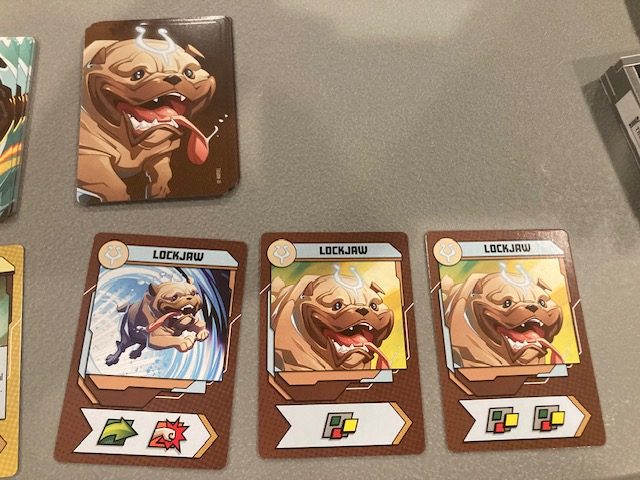
Lockjaw is a dog, so he doesn’t have Terrigenesis.  He’s a dog.  A smart dog, a cute dog, a good dog, a loyal dog, a teleporting dog (!),  but still a dog.

IMG_6765

Crystal and Lockjaw really struggled against Vulcan, losing after too many KOs!

IMG_6767

There’s something sad about seeing LockJaw KO’d on his turn: What villain would do this to a dog???

IMG_6769

Crystal even has a cool power to put up a Seismic Barrier: see above!  … but it didn’t work as we as hoped, because Vulcan still does damage to his location AND adjacent Locations, so even when he was stopped, he still did damage to Crystal!

IMG_6772

In the end, Vulcan won by KOing Crystal one too many times.

IMG_6775

I think that Crystal’s cards are cool, but she doesn’t seem ideal against Vulcan.  To use the Seismic Barrier against Vulcan requires two plays in the Storyline: one to put it down, and one to get away!  

IMG_6774

One important lesson I got from this session is that Lockjaw is probably the perfect hero for newer players!!!  He’s a dog, which most people love, and he’s cute, and he’s not too hard to play.  Lockjaw isn’t the most powerful or more interesting deck, but he’s fun and simple to play.

IMG_6770

Crystal is interesting, but you have to know how to use her deck well.

Gladiator vs. Karnak and Gorgon

IMG_6776

Gorgon is just kind of a heavy weight attacker: his Starting Hand card is Terrigenesis, like most of the Inhumans.

IMG_6777

Karnak is a little different for Starting Hand: his Foresight card (see above) allows players to do a little more planning (by looking at the top few Master Plan cards).  I didn’t use this ability too much with Gladiator, as we were too busy taking out threats/civilians/thugs.  

IMG_6779

Gladiator is SO DIFFERENT from any other  villain from Marvel United!  

IMG_6781 

As an anti-hero, Gladiator has a Hero Hand … which you use when he is a villain! Whaaat??

IMG_6780

Gladiator can’t be defeated by doing damage to him.  (Gladiator is basically one of Marvel’s answer to Superman).  Basically, he duels the players every so often, and you keep score!  Whosoever has more points wins!  In a 2-Player games the Heroes need 3 victories to win (see Heroes Duel Track above),  but Gladiator wins if he gets 3 victories (see Gladiator Duel Track above)!

IMG_6784

A duel is all about Matching symbols on cards!  When you duel Gladiator, he draws a number of Hero cards (usually 2, sometimes 3 if a particular threat is on the board), and you have to match symbols one card at a time!  See above as Karnak has a duel ready to go!

IMG_6785

The first card is revealed: and Karnak can match the Wild!  The duel is underway!

IMG_6788

But, the second Gladiator card is revealed and it’s a wild!   Karnak has no wild to match a wild!  Karnak loses this duel!!  Had Karnak matched the second wild, he would have won!

IMG_6801

Karnak and Gorgon had a fantastic time dueling with Gladiator!

IMG_6798

Before you go into a duel, you assess your hand: “Do I have enough variety of symbols to do a reasonable duel?”  It’s a very different way to think about fighting!  You can’t take down Gladiator, but you can gain his respect in combat!

IMG_6792

And yes, you can use two cards to match symbols on a single card (see above, as Gorgon matches the second card with TWO cards).

IMG_6731

While Vulcan’s rules are very poorly specified, Gladiator’s duel rules are VERY WELL specified!  See the rule sheet above.

IMG_6808

On the end, Karnak and Gorgon gained Gladiator’s respect!  So much so, that he joined their team!

Vulcan vs. Gladiator and Triton

IMG_6801

Gladiator was so impressed with the Inhumans, he joined them as friends!

IMG_6810

Gladiator as a hero is pretty intense: he is a butt-kicker.  His Starting Hand is amazing (with two amazing cards), as he heals AND fends off Crisis tokens!! Holy cow! See above!

IMG_6812

Triton is arguably the most interesting of all the Inhumans, as he puts Water Tokens out.  If these Water Tokens are on his space, he can some cool things!

IMG_6819

See above as Communion With Water allows Triton to get a Wild token if there’s water!  There’s a bunch of cards like this Triton’s deck!  

IMG_6813

Triton and Gladiator had little trouble taking out Vulcan.  

IMG_6817

Although Vulcan’sDiscard 1 card for Heroes with Special Effects” was problematic (and still caused issues),  Gladiator and Triton made a good team.  Gladiator beat the crap of out Thugs and certain Threats, and Triton helped manage the other Threats.

IMG_6824

It was no surprise when Gladiator beat the crap out of Vulcan to win the game!

Thoughts: What I Liked

There’s some really great ideas in this set:

  1. Triton is fun to play, as he has to manage his Water Locations; he has to thoughtfully place and use his water cards.  This makes him different and really fun to play!
  2. Black Bolt and Medusa’s bond cards were very interesting and effective: it really does encourage playing them together, as they really work well together.
  3. Lockjaw, although one of the lesser heroes in this set, is still fun!  I would pull him out to newer players, or just to people who like dogs.  How can you go wrong with Lockjaw?  He’s such a good dog!
  4. Gladiator is one of the more powerful hero characters I have played!  His specials allow removing crisis tokens!  And heal!!  And he has so many attacks!  I may have to bring him out as backup if I am having troubles …
  5. Gladiator as a villain was so interesting!  The duel mechanic was just a breath of fresh air in this set!
  6. Vulcan was a real a tough villain: the Special Effects and KO issues associated with him really make you rethink how you play …
  7. Crystal can be interesting hero to play, but I think you have to know a little more about her deck before you dive in.
  8. The Teregenesis effects were  … ok.  They weren’t game changing, but added a fun element to the game.
  9. Karnak is a different flavor of hero with his Foresight: that ability could be game changing in some games!
  10. Gorgon was cool!  He was a butt-kicker too!

What I Didn’t Like

IMG_6766

The biggest complaint from this set was how poorly many of the rules around Vulcan were specified.  Does Power Suppression work in the player’s favor too? (I think the answer is no).  Does the BAM effect count as DAMAGE? (I think the answer is no).  Oh yes, and you aren’t allowed to play powers that affect Vulcan’s cards in the Storyline, but it seems to imply you can affect  the deck (which is not the storyline, so we did that a few times) … again, not 100% clear.

Given how much space they spent on specifying Gladiator’s duel, a few sentences describing Vulcan’s rules would have made this game that much more enjoyable.  I wouldn’t have been guessing.

Conclusion

IMG_6825

Even though I still have many many Marvel United expansion boxes in shrink wrap, I can very definitely see The War of Kings this coming out again soon!

IMG_6765

All the heroes and villains in this box are very interesting in some way!  Even Lockjaw, in his dog-like simplicity, becomes a hero I think people will want to play!

The War of Kings is a great expansion for Marvel United: 9/10 (probably would be 9.5/10 if Vulcan were specified better).

Marvel United Multiverse: What If This is The Best of the Standalone Sets?

IMG_6400

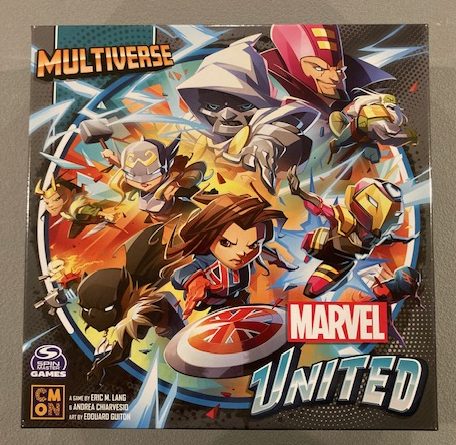
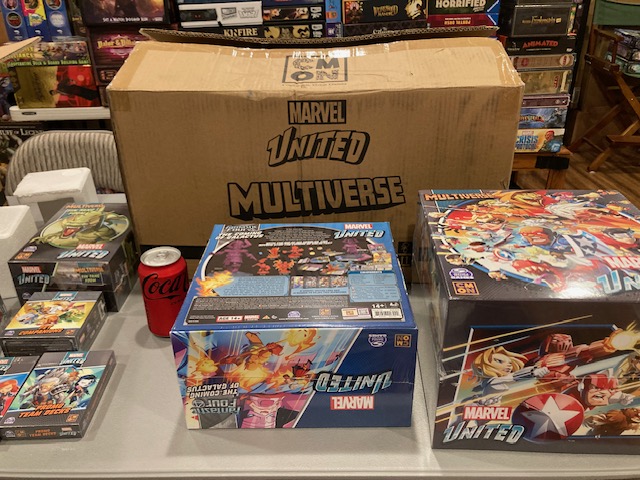
So, The Marvel Multiverse set finally materialized! See The Expansion Absorption Explosion for more! This week, we are just looking at the standalone box: Multiverse: Marvel United. In order to play any of the many many expansions we got during The Expansion Absorption Explosion, you need at least one of the standalone Marvel United boxes.

IMG_6724

There are four standalone boxes!!! See above!! Which one do you want? If you like Avengers, the original (top right) Marvel United is your best best. If you like the X-Men, the X-Men Marvel United (bottom right) is probably for you. If you like Spider-Man and the animated movies, Spider-Geddon Marvel United (upper left) is for you! Finally, if you like Marvel Multiverse shows on Disney+ (like Loki and What IF?), the Multiverse Marvel United (bottom left) set is probably best for you.

IMG_6401

So, why would you want this Multiverse box? We’ve discussed all the other standalone boxes somewhere else: you might consider looking at those posts before moving forward: Marvel United (see here and here), X-Men Marvel United, (see here), and Spider-Geddeon Marvel United (see here)!

Let’s take a look at the Multiverse version of the game!

Unboxing

IMG_6402

This is the same size as all the other standalone boxes: see Coke can above for scale.

IMG_6404

The production is very similar to the others: there’s two giant token sheets (this is one of the reasons you need a standalone version of the game: so you can get the tokens).

IMG_6405

The miniatures for this game are just as good as any of the standalones!  Se above as the villains (red) rest with the heroes (blue) and one anti-hero (purple)!

IMG_6406

There’s a bunch of new Locations, thematic to the heroes and villains we have in this set (another reason you need a standalone box: every game needs 6 locations).

IMG_6409

It’s the cards that you need to play: there’s a deck of heroes, and a deck of villains!  And, something new … Equipment cards!

IMG_6415

The equipment cards are new thing we’ll talk about below.

IMG_6412

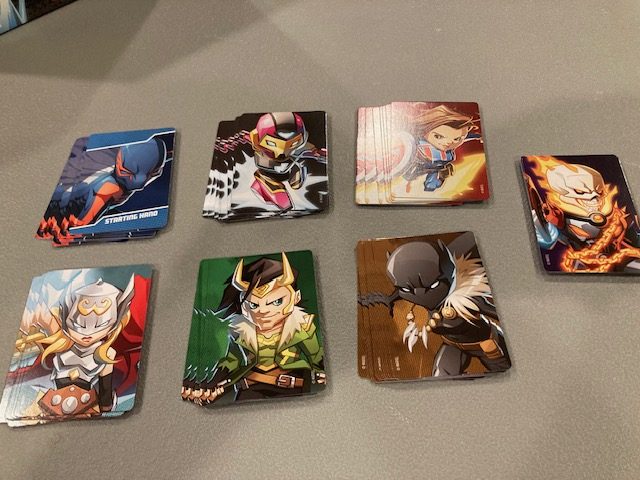
There’s 7 new heroes: Captain Carter (from What If?), Loki (a good guy: from the Loki TV show), Spider-Man 2099 (from the comic), IronHeart, Mighty Thor, Black Panther Suri, and Cosmic Ghost Rider!  See their decks above!

IMG_6413

The new villains (with their threats) are Immortus, Emperor Doom, Maestro, and Cosmic Ghost Rider!

IMG_6417

Each of the new Villains is very different: we’ll talk more about them below!

IMG_6410

Overall, this looks great, just like every other standalone Marvel United box!

Equipment

IMG_6418

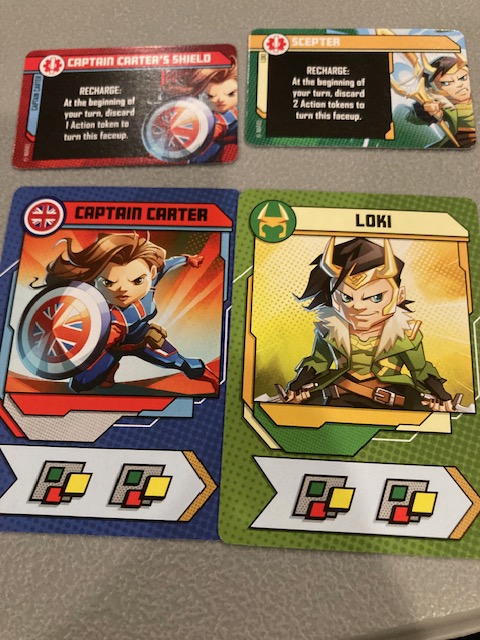
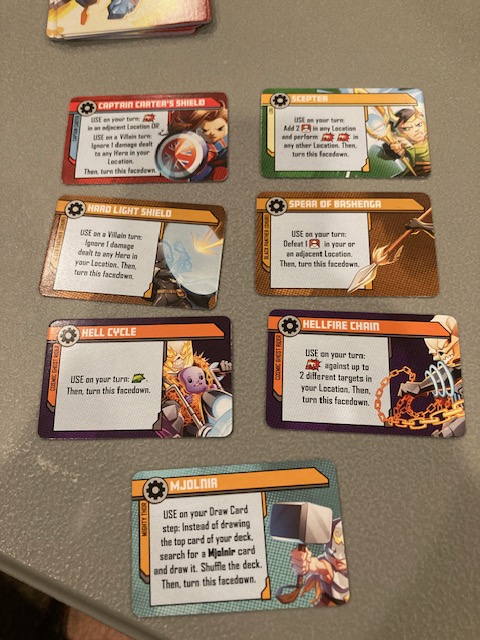
This is a brand new thing: equipment cards.  See above!  Most (but not all heroes), can get some equipment cards!   Captain Carter gets a shield, Mighty Thor gets Mjolnir, Loki gets a Sceptre, Black Panther Suri gets a spear, and Cosmic Ghost Rider gets two things: A Hell Cycle and a Hellfire Chain!

IMG_6426

Equipment is optional: if you want to take your equipment, you have to take your double-double wild card out of your deck … for game balance.  See above as Captain Carter and Loki trade out their double-double wilds for equipment!

IMG_6421

Equipment has an active and inactive side: when active, you can use it effects listed: see Captain Carter’s shield above on the active side.

IMG_6420

Once you use it, it becomes inactive, and has to be recharged to flip back over.  Typically, some hero cards can recharge it, or you can take the recharge action on the card (see above).  This is why you have to get rid of your double-double wilds: the items can be used multiple times!

IMG_6423

Even if you don’t get a “specific” item, there are generic equipment cards that any hero can get (at the cost of a double-double wild card).  See above.

IMG_6415

Interestingly, there are Equipment cards for heroes from OTHER sets: see some Equipment for Wasp and Spider-man, and others!  If you have the original Marvel United with Wasp, you can use these equipment cards!  

IMG_6436

Overall, Equipment cards are my favorite new thing in the Marvel United system: the cards give you more choices during your turn!  And they make the heroes feel even more thematic (well, the specific equipment does).  Loki’s Scepter doesn’t feel that great, until he uses it to bash Maestro from across the board and take him down! It’s just like him to misdirect …

Playthroughs

IMG_6651

Over about 2 weeks, I played through all 4 villains of the game, with a wide assortment of the heroes (usually a different pair of heroes per game).  Mostly, they were solo plays, but there was one cooperative play as well.  We’ve talked so much about the gameplay for Marvel United elsewhere (from the Expansion Absorption to any of our reviews), we’ll just concentrate on all the villains!  And along the way, we’ll take a look at the heroes in here!

Cosmic Ghost Rider vs. Captain Carter and Loki!

IMG_6432

Cosmic Ghost Rider is the recommended first villain: he does seem the easiest.   

IMG_6444

The Cosmic Ghost Rider is collecting the souls of evil men (the thugs), and if he gets enough souls (his track goes high), he wins!

IMG_6431

I chose Captain Carter and Loki to battle Cosmic Ghost Rider.

IMG_6437

Good times: Loki and Captain Carter didn’t have too many problems taking out Cosmic Ghost Rider, but they showed the power of their equipment: see above as Loki takes out Cosmic Ghost Rider with his Scepter from afar!

IMG_6440

Good times.  We also got to see the flavor of Captain Carter: that shield makes her much more interesting! It can be used as defense or offense as needed: very thematic!! And Loki’s special effects are so interesting and thematic: he can redirect damage to somewhere else, or … the best bit … he can redirect a moving villain to any Location!  It totally fits with his trickster persona.

IMG_6428

Captain Carter is probably my favorite Hero from this set ..

IMG_6427

But Loki, with this Tricker abilities, is a close second!

It’s clear: the equipment cards work and they work well.  I am not sure I will ever play without them if I can.

Immortus vs.  Captain Carter and Loki

IMG_6455

Immortus is an interesting villain: he’s an immortal, so you can’t “kill” him! All you can do to win is to complete all three missions: see a winning game above!

IMG_6456

I liked Immortus: it changed up the gameplay enough to get around the normal arc the game takes (almost do two missions at the same time, so you can defeat the villain but get three turns as long as possible); in this case, you are working on all three missions all the time!

IMG_6446

Immortus wasn’t hard or easy: he was a good challenge.

IMG_6447

We stayed with Captain Carter and Loki for battling Immortus: they are my favorite combo!

Maestro vs. Cosmic Ghost Rider and Mighty Thor!

IMG_6464

Maestro is by far the hardest villain in this game!

IMG_6467

He heals ABOVE HIS STARTING HEALTH whenever a Hero is KO’d or an Overflow happens!  And the KO’s happens a lot, because Maestro Does 3 Damage to 1 Hero!! BAM!

IMG_6460

At first, Mighty Thor’s Mjolnir equipment wasn’t that great (because it can only summon 2 cards). I almost reverted her back to having her extra double-double wild.

IMG_6461

Cosmic Ghost Rider was an absolute blast to play! His two equipment cards give even more options when playing! And he babysits a baby Thanos! Cosmic Ghost Rider is probably my third favorite from this set.

IMG_6469

The Maestro destroyed us in three games: see above as he moves to us and KO’s Mighty Thor!!

IMG_6485

The problem is that the Maestro has a ton of hit points by the time you have to take him out (8? 9? 10?)  And you just can’t do enough damage!!!

IMG_6472

Oh! And Rick Jones has to be on the same Location as The Maestro  (this is so thematic: this comes right out of the Comic book: Future Imperfect! ) or Maestro IGNORES the first two damage you do to him! See Rick Jones above!  He’s just a token …

maestro

IMG_6490

We finally did defeat Maestro with Mjolnir!  We kept Mjolnir summon card at the bottom of Mighty Thor’s Deck when she was KO’d … so when we needed the full power of Mighty Thor and her hammer, would could summon her!!  Our fourth and final game resulted in a win!

IMG_6486

Without a doubt, The Maestro is the hardest villain from this set.  He may even be harder than Galactus!  (See our review of the Coming of Galactus from a few weeks ago!).

IMG_6477

Mighty Thor is great with her hammer … if you can use it right.  It may take a few plays before you get the hang of how to use the Mjolnir card.  Cosmic Ghost Rider was just fun to play with his equipment: you always felt you could do something interesting on his turn.

Emperor Doom vs. Captain Carter and Loki

IMG_6650

I asked Sam who he wanted to play … he wanted to play Loki!  So, I played Captain Carter and we played a two player cooperative game against Emperor Doom!

IMG_6649

Emperor Doom was a challenge: his little Doom tokens take over everything! If you don’t do something about them, you will lose!  Me and Sam squeaked out a win.

Emperor Doom is probably the second hardest villain of the bunch; we probably should have lost.

Conclusion

IMG_6453

What If? is probably my favorite show out of the newer Marvel Universe stuff, and Captain Carter makes a great showing in that universe!  She is my favorite character by far in this set! Loki  redeems himself (in his Loki TV show), becoming a good guy! His hero character is so thematic with his trickster capabiltiies!

IMG_6411

Most people probably don’t care as much about Mighty Thor and Black Panther Suri and Spider-man 2099 and some of the more obscure characters in this set (it’s not like Captain Carter is known outside of What If?).  And, if I were recommending a base Marvel United, it would be a hard sell to start with this one.

IMG_6425

And yet, I think Multiverse Marvel United is my favorite of the standalone Marvel United titles!  The Equipment cards really enhance the game thematically and mechanically, given each Hero more flavor and more choice!

IMG_6412

This set contains an odd assortment of characters, but if any of them speak to you personally, I would recommend Multiverse Marvel United.  For example: My friend Derek and I both loved What If? and Loki.  We’d have long discussions about the shows when the episodes were out.  He is a more recent board gamer, and if I were to try to get him into Marvel United, I would probably start with this set; I think these characters would speak to him.

The Equipment Cards are that cool: I think we’ve gotten to the point where Multiverse Marvel United has entered into 9.5 or even 10 territory.  I  love this game, and the Equipment cards make the game that much better.

The Absorption Expansion Explosion: Marvel Multiverse Arrives! or Help! I’m Drowning!

IMG_6181

In early August, The Marvel United Multiverse set arrived: see above and below. This is the #1 entry in my Top 10 Anticipated Cooperative Games of 2024!  

IMG_6180

This is crazy, because now we have the original Marvel United stuff, the X-Men Marvel United Stuff, and now the Multiverse Marvel United Stuff!  Have we lost our mind?  Yes.  Yes we have.

Unboxing

IMG_6182

The bigger box comes with a bunch of expansions: Coming of the Galactus (which we reviewed a few weeks ago), War of Kings, Age of Apocalypse, World War Hulk, Annihilation, Maximum Carnage, Civil War, and Secret Invasion.  Whew!  That’s right: each one of those is an expansion for Marvel United!

IMG_6187

We aren’t done yet! The other box comes with the Stretch Goals (the big box with more heroes and villains), The base Game Marvel Multiverse, Campaign Decks, Team Decks, Pet Companions, and a few other Stretch goals!  Oh, and how can we forget Fin Fang Foom? Whew!!

Is This Ridiculous?

IMG_6186

Yes.  Yes, this is ridiculous.  Do you want to know why?  I still have about 10 of the original Marvel United expansions STILL IN SHRINK WRAP!  I am super excited to play The Sinister Six!  Thanos! Asgard!  And yet, they are still in shrink wrap.  And here I am, ordering 7 new expansion, 1 new base game, and a bunch of other extras.  

Why do I do it?  I love my Super Heroes.  I know, someday, I will play all of them.  Even if I am in the Old Folks home playing through them, I will play through them.  I actually think I will.

In the meantime, I am trying to enjoy what I have when I can.

IMG_6197

Stretch Goals Unboxing

IMG_6274

The Stretch Goals box is pretty mammoth.

IMG_6277

IMG_6278

Look at how many new heroes and villains we have! Holy Cow!

IMG_6279

IMG_6280

IMG_6281

IMG_6282

The four sides of the box (after the lid has been taken off) so all the heroes and villains in play here!

IMG_6283

The Stretch Goals box has a new mat (for a new Wrecking Crew play), some new Locations, some new Tokens, and a few new rules (see the rulebook above).  

IMG_6284

Underneath the minis are all the cards: heroes and villains.

IMG_6286

IMG_6288

There are SO MANY cards in the Stretch Goals box.

IMG_6289

The top-level (3 levels of minis) are the villains (red) and one hero (blue).

IMG_6290

The middle layer is a mix of heroes (blue) and anti-heroes (purple: characters that can be either villains or heroes).

IMG_6291

The bottom layer is all heroes.  Note that Cassie from Ant-man is a HUGE mini, as is Moon Girl and Devil Dinosaur.

IMG_6293

The upper left corner is empty!!! What’s that supposed to be?

IMG_6294

Relax, It’s just Iron Lad: it’s included as a special Stretch Goal box.

IMG_6296

IMG_6299

IMG_6301

IMG_6304

IMG_6307

IMG_6308

IMG_6309

Oh my goodness, there are so many cards. So many heroes. So many villains.

Playing From the Multiverse Stretch Goals

IMG_6298

Cypher is new in this box.  He is a New Mutants character that was killed off.  

IMG_6316

Even though Warlock comes from the previous set, he seems the proper character to team-up with Cypher: there were inseparable in the New Mutants.

IMG_6322

Who are they fighting?  Illyana … err, Darkchild … she went a little “bad” for a while.  But it’s up to Cypher and Warlock to bring her back to sanity!  Darkchild is an anti-hero in the new Multiverse set.  

IMG_6321

IMG_6325

I had a fabulous time playing my old friends (well, they felt like old friends) and trying to bring Illyana back from the dark side!  

IMG_6334

In the original Absorption Expansion mess, I was worried about how well “untried” combinations would work together; recall, we have some trouble with Emma Frost.  Part of the issue is just that there are so many heroes and power and villains and new things,  I do worry that they may not work well together.   

Luckily, most of my games from this set so far have seemed fairly balanced.

Team Decks

IMG_6319

The Team Decks are a new way to give you more choice!  Basically, there are “two extra” choices you can use on your turn; instead of your own cards, you can choose to not draw and just use one the Team Deck cards instead (there are usually 6 Team Cards total).

IMG_6318

There’s a price to use the Team Decks …  well, two prices … well, three prices …
1) All members of the team have to get rid of the double-double wild card from their deck (for balance). 
2) There is also a “bad” Team Deck card, where you have to play it facedown to the storyline to get rid of it!  
3) You actually have to be a member of that team …

The Team Decks adds a little more “drama” to the game, but it also adds more choices!  It’s not affected by KO’d effects, it’s just another option in case you don’t have quite what you need.

I liked the idea of Team Decks; it simply adds more choice to the game.

IMG_6302

The New Mutants Team Deck was in the Promo Team Packs, but there are several other Team Decks …  like tons of Teams and Team Decks.

IMG_6271

IMG_6272

I would recommend the Team Decks to “add some spice” to your Marvel United games.  Find a group of heroes you like, and use Team Decks!  I wouldn’t recommend using the Team Decks unless you are fairly experienced: Team Decks may throw off new-comers off for their first few games.

Help! I’m Drowning, But In a Good Way!

IMG_6339

I am very happy I got the new Marvel United Multiverse set, despite the fact that I am drowning in Marvel United content.   Find me when I am in the Old Folks home in a number of years, and I’d be happy to play any of the Marvel United expansions that are still in shrink at that point … I mean, I promise I will play them eventually … the good news is that they will still be playable for many years to come! 

A Strange Beast: A Review of Defenders of the Wild

IMG_6529

Defenders of the Wild is a cooperative tactical fighting game that was on Kickstarter back in October 2023.  It promised delivery in August 2024, and lo and behold, it arrived at my house in early August 2024!  A Kickstarter that delivers on time!  That never happens!

IMG_6596

I was initially drawn to this game because of the art.  See above: The art of Meg Lemieur permeates the game and it is gorgeous.  I think that art is a big component of why this made the #9 spot on my Top 10 Anticipated Cooperative Games of 2024!

IMG_6532

The game looks to be something like a cooperative version of Root: cute animals are at war …  not with each other, but with the machines threatening to take over the forest!

IMG_6534

This looks to be a cooperative game with some strategy and tactics.

IMG_6619

I see a hex map (see above) and the game immediately has a war game quality to it. And that’s not a wrong assessment for this; Defenders of the Wild has elements of a cooperative war game.

IMG_6533

This a slightly deeper and more technical game than some cooperative games, so the 14+ age requirement is fairly accurate. Most of my playtimes have been about 20% longer than listed (maybe 1 hour 20 minutes or so), but the play time on the box is still fairly accurate. I have also played the game at 1, 2, and 3 players, and it seems to work at all those player counts.

Let’s take a closer look!

Unboxing and Gameplay

IMG_6530

I was surprised when Defenders of the Wild arrived: it’s a smaller box than I expected! See above and below with a Coke can for scale.

IMG_6536

Despite the smaller size, the game is gorgeous.

IMG_6562

In the game, each player chooses one of 4 factions to play: the factions define which deck of cards you get (see above) and the tokens you get (see below).

IMG_6572

You can see why a Root comparison is obvious here with the cutesy but fighty meeples (above). Even the colors of the meeples seem to imply Root.

IMG_6576

Each player then grabs up their player board, cards, camp, and chooses one of the two Organizers: the Organizers (see Thexuloa and Nextor above) are the “leaders” of your faction, and form the flavor of the Defender deck you get.

IMG_6581

You don’t get all the Defenders from a deck: you only get a subset.  If you choose Thexulia, you get the Defenders listed above.

IMG_6582

Nextor (above) gives your Defenders deck a slightly different flavor from the same deck of Defenders.

IMG_6584

The Defenders (like Rintraw above) are the cards you play during the game.  You have twelve Defenders that you cycle through (and then reshuffle if needed).

IMG_6580

Every turn, you must play a Defender: each Defender gives you three things (See Rintraw above as an example):
1) The number of action points (lower left: 4 for Rintraw above): how many actions can you do that turn?
2) Preferred terrain (upper left: Plains for Rintraw): what terrain do you travel best through?
3) Special: when you reveal “something” usually happens (bottom of card): what happens when I reveal the card?
IMG_6586
Depending on where you are in the game, you will have three or fewer Defenders to choose from: see above as we have a full complement of Defenders.

IMG_6602
You DO NOT get a new Defender card every turn: you ONLY draw back to your hand limit (3) when you build a new camp!  See above as the Zyrinn prepares to build a camp and get her three Defenders back!  You must be building all the time to get your Defenders back!

IMG_6603

You can only build a camp if you have enough “support” in the game:  The little pawn on the circular support board above denotes “how much support” you have: you can’t build a camp until the pawn reaches the next campsite!

IMG_6566

How do you get support?  A bunch of actions each give you one support: see the Summary cards above! Every time you Clear Pollution, Destroy a Mech, Breach a Wall, Rewild a Factory, you get a +1 support and your pawn moves forward closer to a camp.

IMG_6609

This is a tactical game (with some strategy): players will be moving around the map cleaning up the pollution (the little hexes), taking out Mechs (the small silver claws) and breaching walls built by the machines!

IMG_6632

This is a game about cleaning up the wilds: the pollution, toxic waste, the mechs, and the factories.  Players loses if too much of the forest becomes toxic, a factory needs to be built and there’s no more, or 2 Defenders from the same Habitat are killed.

IMG_6645

How do factories, mechs, and pollution come about?  From the Machine cards: see above.  One machine card comes out after every turn and builds factories, spreads pollution, or generates more mechs.  The same 7 cards are shuffled and come out over and over.  Each Machine card is very distinct and generates “bad stuff” in a very particular way.

IMG_6615

Players win if they “rewild” all of the 5 the 5 factories (see the purple hexes above: they used to be factories) and build all of their camps!  

IMG_6592

The game has beautiful art and a very good production.

IMG_6567

The components are high-quality with
1) wooden meeples, camps, and organizers
2) linen-finished cards
3) thick cardboard hexes
4) beautiful art

IMG_6570

The game unboxes and makes you think: “This game looks cool“.

Rulebook

IMG_6537

The rulebook is okay.   There are certain things I really like about it, and certain things I really don’t.

IMG_6540

It gets a B- on the Chair Test: The font and form factor are both a little small, so it’s a little harder to see it on the chair text to me.  Also, there is a lot of text in the book (see above): it really needed more accompanying pictures.  But, it stays in the B range because the rulebook does NOT flop over the edges: it stays open and I can consult it on the chair next to me.

IMG_6541

The Components page is great: it shows all the components and marks them so you can correlate the stuff.  Good job!

IMG_6542

The set-up is pretty good, but it has some flaws.  For one, there’s a lot of text, especially since it spills over in the next page.

IMG_6544

There is generally a lot of text in the rulebook (see above); it feels like a few more pictures would have helped.  Also, sometimes the rulebook reads like a legal document.

An index would have been nice; there’s a lot of rules in this rulebook.

IMG_6555

The rulebook ends with a description of the cards/Defenders in each deck.  This wasn’t the most useful thing to put on the back because the descriptions don’t say anything more than the cards.  I would have preferred a glossary or something close to an index.

The rulebook was very text-heavy, needed some more pictures, needed a few more elaborations (see sections below), and it probably needed a glossary or index (as it’s very rules heavy).  It was ok. I was able to learn the game from the rulebook pretty well, but it took a few tries.

Solo Plays

IMG_6533

Defenders of the Wild supports solo play (congratulations for following Saunders’ Law).  See the back of the box above.

IMG_6553

Unfortunately, the solo rules take up half of a page, full of rules that are exceptions to the base game. See above.  The basic idea is that you play as a 2-Player game, but with some non-standard way of handling the Defender cards.

IMG_6592

This game has so very many rules, I can’t recommend throwing another set of rules at the solo player.  I ended up just playing all my solo games as a two-handed two-player game, where I alternated between players like a normal 2-player game.  There are no exceptional rules when you play two-handed two-player; the game plays normally and  this seemed to work just fine.  For your first learning game, I absolutely recommend playing this way: there are far too many rules for you to be throwing another half-page of new rules at the players.  

IMG_6618

My first solo game ended in a win, as I rewilded all the factories without dying!  See above. BUT, as it turns out, I got a lot of rules wrong.   It took me about four (five?) gameplays to get all the rules down; there are a lot of rules in this game.

IMG_6629

My second and third solo games were pretty rotten. 

IMG_6632

I got smashed by toxic waste in my second game (when three pollutions congregate on a single spot, it turns into toxic waste).  Too many toxic wastes came out, and I just lost quickly!  It was very depressing.

IMG_6638

My third game, where I got most of the rules right, was a defeat as my second Defender got crushed (recall: you lose if a SECOND Defender from a faction dies).  I started to get the cadence of the game by the third game, as I was close to a win: I had one factory left.

IMG_6623

Unfortunately, my loss on the third game had me worried that the game might be too random. Whether I won or lost depended on just a few die rolls or card flips.

Cooperative Games

IMG_6639

My first cooperative play (after 3 solo games) was a 2-Player game with Sam. There were still one or two rules I was getting wrong: having Sam there forced me to rethink/resolve some of those.

IMG_6646

Our 2-Player game was also lost by too much Toxic Waste: see above. We couldn’t get into the Factories to rewild them (for various reasons), so the Build Factories action becomes “spew pollution” when there is no enclosed space for a factory.

IMG_6642

We were doing “okay” in the game until the Bad News (the Machine cards) just seemed to conspire against us: we had 4 factories built in so many rounds, then pollution just spilled out as we couldn’t clean up or shut them down.  It was very depressing.  We didn’t feel like we could do anything about it.

IMG_6713

My next cooperative game was a 3-Player game.

IMG_6722

Even after five games under our belt (solo and co-op), we were still “discovering” or “reinterpreting” the rules.  

IMG_6717

For example: You lose if you can’t build the final factory, but what does that mean?  Does there have to be an enclosed area out (we think so, but we weren’t sure)?

IMG_6721

Our game ended in a loss because of one card flip: we had no way to mitigate the Machine card that came out!  All Teresa had to do was use one action to build her final camp, and we lost because of the way the Machine cards came out.  I suppose it was suspenseful that we lost on a final Machine card, but it felt anti-climactic.  “Oh, we lost because of something random we can’t do anything about?”

IMG_6714

One thing I will say: the game feels “easier” with more players.  Why? You have more Defenders that can die (6 = 3 * 2 for a 3-Player game), you have more camps on the board where you can rest or gain tokens at (as the camps are much more likely to be in reach with more players, as there are more of them), and Defender cards that help all players help more players, and there’s more “reach” as players can spread out to get the Factories/Pollution/Toxic Waste under control quicker.

In a 1 and 2-Player game, I/We struggled hard to get stuff done, to move, to clean, to build.  In a 3-Player game, it seemed a little easier to get stuff done.

What I Liked

IMG_6591

One: This game looks good on the table and the components are high quality.

IMG_6609

Two: I like how the woodland creatures are well-colored coded and consistent, and the Mechs are all silver and metallic. It’s very clear what are the natural forest pieces, and what are the metal intruders.

IMG_6595

Three: I love the art in this game. Meg Lemieur knocked it out of the park.

IMG_6550

Four: This rulebook isn’t great, as it misses some elaborations/descriptions of rules, but it does something that most cooperative games don’t do: Defenders of the Wild tries to specify what happens in all edge cases when there are questions.  Most cooperative games just throw their hands up in the air and say “players just choose something together if there’s a question” … which I always think is a cop-out.  I write about this issue in more detail here in Resolving Ambiguity in Cooperative Games.   For all of its issues, I really have to applaud Defenders of the Wild for trying to specify all edge cases!  This leads to some weird/fiddly rules (“you have to preserve the arrow direction on the factories when you move or flip them”, “Machines reset on hex boundaries after scanning in the direction of the Direction Circle”), but it’s all in the name of specifying the behaviour of the Bad Guys. 

I stand-up and applaud Defenders of the Wild for this.  It’s refreshing to see a cooperative game try to be complete in specifying edge cases.

What I Didn’t Like

IMG_6594

One: Why are there Communication Restrictions? I didn’t discuss it in the overview, but this game has restrictions on communications when choosing the Defender to play: all players all shut-up, can’t say anything, and must choose the Defender to play in silence.  See rules page 10 (above).

I hated this Communication Restrictions and my friends hated this Communication Restriction.  Rules like this are almost always to keep the Alpha Player in check (so one player doesn’t tell everyone what to do).   In this game, I don’t think that’s much of an issue.  In fact, it made the game less cooperative, less strategic, and less fun.  Each player’s turn “tends” to be like a multiplayer solitaire turn anyways: a player takes his turn and others don’t really get involved; in fact, there’s nothing anyone else can do on your turn!  So, each player tends to take their turn “maybe” with some advice from others.

So, by taking away the ONE decision point where players might be able to help each other, this rule makes the game even less cooperative and strategic.  I really think this rule is a misstep; this game needs every little bit of strategy it can get.  Otherwise it becomes a random slog.

IMG_6603

Two: Not enough choice! There’s a rule that you only get new Defenders when you build a camp. I understand why this rule sort of “forces” you to build camps, as camps are an important part of the game: This rule strongly encourages you to build camps. But not having a full hand of three Defenders completely takes away your choice during the game. When you have a full hand of three Defenders (see above), the game feels strategic: “I can make choices relevant to the state of the board and the future and my friends“. If, for some reasons (say too much randomness, see below), you can’t get a camp built (and you have no more Defenders), you are completely at the mercy at the top card of your Defender deck (which you can’t even see). So, the game is playing itself! You just turn over the top Defender card and “see” what happens that turn! It is not fun, it doesn’t feel like you have any choice, and it feels like the game is playing you.

I really feel like a very simple house rule could fix this: it would be something like “you can draw a card after every turn“. There’s still a chance to play a support cards (which will exhaust your cards faster), but maybe building a camp STILL refills your hand to three Defenders. I feel like I should always have some sort of choice, or why I am even here? The game is just playing itself.

IMG_6563

Three: Too much randomness!  We haven’t discussed it at all, but there is a 6-sided die in the game.  Whenever you perform an action next to a sniper Mech (see more Sniper issues below) or on the same space as a Hunter mech, you must roll the die.  A sniper hits you 50% of the time for 1 point of damage. A Hunter hits you 33% of the time for 2 damage and 50% of the time for 1 damage (83% of the time, you will take damage)!  That may not seem like much, but 4 damage kills a Defender!  And two dead Defenders means the end of the game.

If you roll poorly AT ALL during the game, you have to start play very conservatively!  Let’s say I was aggressive for one turn and rolled poorly, killing a Defender.  For the rest of the game, I CANNOT take any chances, as another dead Defender means Game Over!!  So, the game becomes like you are walking around on your tip-toes to get anything done.  It’s not fun as you feel like you can’t do anything. 

“We need to rewild that factory!  I’ll do it! Oh wait, I just 2 damage from a mech, one more roll and we lose the game, I’ll just run away, heal, and come back.”  

You might just say “stay away” from the mechs. That’s impossible; they are constantly being spewed out, and the middle of the board (where you need to be for rewilding factories) is full of snipers who will just pick away at you. Since you can NEVER enter the core, you just have to take it (unless you happen to get a Defender, there’s just a few who can kill Mechs from afar). This becomes a game of running up, doing one little thing, then running away.

In many games, I just felt like I couldn’t get anything done because of a few early bad rolls: once you have one dead Defender, your moves seem so tentative and dull and not fun …and you have to be careful, otherwise you will probably lose.

IMG_6645

Four: Machine Cards are also too Random! In my first 2-Player game, we got 4 factories built in quick succession, just because of the way the cards came out, they spewed pollution and caused so much Toxic Waste! We had no chance! We couldn’t clean it up fast enough, and we couldn’t rewild the factories. We got destroyed.

If you have a few factories out and then get the two Factories at the end of the deck, reshuffle, then also get those Factories at the beginning, you can get 4 pollution spews in a row! You can’t come back from that! This is like the Variable Turn Order problem we see in games like Aeon’s End or The Plum Island Horror. If the “Bad News” cards come out in just the wrong way, you can get totally screwed. See our full Discussion here in A Discussion of Variable Turn Order and How To Mitigate Its Randomness!

That discussion does offer a potential solution: maybe the players can have a few “fate” tokens which they can spend to “skip” or “redraw” a bad news. I am not proposing getting rid of a Machine card for a turn, but it would be nice if the players had a “hacker” token (more thematic than a Fate token) where they could choose one of the top two Machine cards. Only spend it when it matters and it would allow the players to feel like they have some agency in their own fate.

IMG_6549

Five: Too many things underspecified. This is harder to say, because I really like how this game tries to specify everything. It misses some important things, and some things are so subtley described, it’s not clear. I sometimes feel like I needed to read the rulebook like a legal document.
Some examples:

IMG_6565


Rockets: Rockets kill one Mech without a dice roll. It does NOT say whether it’s on the current space ONLY or also an adjacent space? A Rocket, thematically, feels like it could reach a space next to it. I am fine believing it’s just the current space (and that’s the way I played it), but it’s not clear. One sentence would clear this up. Or MAYBE a Rocket even will destroy ANY mech on the board? That would be game-changing! But it’s not clear. UPDATE: After the 5th game, we found a Defender whose text said “Rockets can be used to target adjacent hexes”, implying they could only be used in the current space all other times.

IMG_6598

Hunters vs Snipers: A Sniper is defined by being a mech in a Factory, and a Hunter is defined by being a mech in a Habitat space. I think. I don’t think a Sniper can ever becomes a Hunter or vice-versa. I think. Why is this not clearer? What I did, as a house rule, was to place SNIPERS with the prongs on the top, and the HUNTERS as the mechs with the prongs on the bottom: see picture above. This seems like a very easy way to help visually distinguish the two types of mechs, but the rulebook just calls them both mechs. It’s very easy to miss the difference as you are playing. Again, I just wanted a few more sentences on this: the description in the rulebook feels like a legal document. “We are defining a sniper to be a mech on a factory”. (Does a Sniper turn into a Hunter if a tile is rewilded? Technically, a rewilded factory is still a factory, so maybe, but a few sentences would be helpful).

IMG_6630

The Factories Machine card:  All the rules are NOT written on this card.  When you build a factory, you are ALSO supposed to deploy 2 Snipers to the Core.  (And you have to move everything with the new factory).  This is nowhere to be found on the factory card!!!  A few simple sentences on the Factories Machine card that would help make the game easier to play.  It feels like you have to keep your nose in the rulebook at all times or you might miss a rule!  I like the art of Meg Lemieur on the Factories Machine card, but I would rather have the Machine cards more complete and functional than pretty.

These are just some examples of missing or rules needing better descriptions.  If you don’t play with the right interpretation of any of these, this game becomes substantially different.

House Rules

IMG_6624

We really want to like this game.  We love the art, we love the universe, we love the ideas, we love the basic idea of a cooperative kind of wargame.  But we are really struggling with the game, as it feels too random.   Here’s a set of House Rules that you might try in your game if you are struggling with it like we are;  maybe try some and keep the ones you like.

  1. Always draw a Defender card at the end of your turn.  This isn’t a panacea, as you can still get down to fewer cards by using support actions, but it least it generally keeps you feeling like you have choices every turn.  A camp build will always bring you back to 3.
  2. Turn the mechs upside down to denote Snipers, and rightside up to denote Hunters.
  3. Have a pool of 2 or 3 (4?) Hacker tokens.  When a Machine Card is drawn that is decided to be too devastating, you can discard a Hacker token to take the next Machine card instead.  This helps give the players a little control over the pure randomness of the Machine deck.
  4. Get rid of all Communications Restrictions. The game already feels like multiplayer solitaire! Allow the players to find the best Defenders to help everybody AS A GROUP so the game feels more cooperative!! (If you are having Alpha Player issues with this rule, then either don’t play with that person, or put a timer on Defender choosing).
  5. Allow players to discard a Defender card rather than take a damage; not killed, but it definitely leaves the game: maybe it’s KO’d.  The randomness of the die is NOT fun: I wish there were more mitigation methods for it  (This rule is probably the one we feel most unsure about).

Granted, these will all make the  game easier, but the game is already pretty hard.  If you feel like these House Rules make the game too easy, there are also DIFFICULT Machine Cards which make the game substantially harder.

House Rules 2 and 4 are probably ones I would absolutely recommend for everyone!  You can probably take or leave House Rules 1, and 3 and … especially 5.

Reactions

IMG_6640

Sam: “I currently give it a 6, I would like to play it some more to refine my opinion.

Rich: “I am really struggling with this game. I want to like it so much, but it is far too random for me. There’s a lot of great things in the game, and I feel like there are people who would like this game as-is: Objectively, I would give it a 6/10. Subjectively, as-is, I would give it a 4/10 because I don’t ever want to play it again: it’s too random. With some House Rules, I would maybe move up a couple of points to a 6/10 or maybe more. There is so much to like in this game.”

Sara: “This is under a 5 for me. It wasn’t fun, and I was glad when it was done. It was just too random. I might play it again if someone really really wants to play, but probably not. I really wanted to like it.”

Teresa: “I dunno, a 5 or a 6. It was frustrating, but I had fun with the little animals. “

Conclusion

IMG_6589

Defenders of the Wild is a game that introduces a wonderful world with a wonderful production.  The randomness of the game (from random die rolls to random Machine cards) held this back for me and my groups.  After a number of plays, it’s clear that you can get to strategies where you mitigate some of that randomness (as you do get better as you play more), so it’s not just a random slog.  But the question is: is it fun to get there?  My groups didn’t think so, but that’s just some opinions.

IMG_6572

I think the target audience for Defenders of the Wild might be war-gamers looking for a cooperative adventure.  War-gamers are used to dealing with swings of randomness from skirmish to skirmish in pursuit of a greater victory: it’s clear, you can get better at this game as you play, so there is definitely both strategy and tactics.  If you were looking for a cooperative Root, this might be a decent pick for you! It has the cuteness of Root, the war-gamer nature of Root, but in a cooperative game!

IMG_6722

This game seems to be better with more players, as there seem to be more opportunities to get stuff done on your turn (more camps, more chances to push your luck since dying isn’t quite as critical, etc), and that seems to lead to better mitigation of some of the randomness.  Unfortunately, the one and two player games just seem to succumb to the randomness too quickly.  

This might be the perfect game for you and your group: take a look at what we saw. Be aware that the randomness and some of the underspecificity of the game led my group to rate this from 4/10 to 6/10.  I don’t think any of us thought this was a bad game, but it just wasn’t for us.  

If you do find yourself wanting to try this out, I recommend playing this out with bigger groups for the best chance of a good experience.

Less Violent Than The Cartoon or Comic! A Review of Invincible: The Hero Building Game!

Invincible_Issue_75

Invincible is comic book series about a kid with “super-man” like powers; this comic book series is unique because it has one voice (Robert Kirkman) through the entire run of the series.  Most comics are lucky if they get a consistent voice for 3 years.  The series started at issue #1 in January 2003 and finished up with issue #144 in February 2018.  For 15 years, over the run of the series, we saw Mark Grayson mature and evolve from a kid to a man.  It’s a very mature series, but it is very well written.  Even the art stayed consistent (between two artists:  Cory Walker and Ryan Ottley) over the run of the series!

I really liked this comic book series (having collected the entire run from beginning to end), but it is quite mature: there is quite a number of mature topics.  The series is also incredibly violent and has very graphic fights.

IMG_5878

Fast forward to July 2024: Dire Wolf has come up with an Invincible board game called Invincible: The Hero-Building Game!

IMG_5873

This is a cooperative board game for 1-4 Players, 45-90 minutes with Ages 13+.  See above! Invincible is a cooperative boss battler game where players have to take out the big baddie (and do other heroic stuff along the way).  I will say this: the board game is much much much less violent and graphic than the cartoon or the comic series.  If you were worried about the violence or maturity, especially for a boss-battler game, don’t fret!  That 13+ for ages is an accurate depiction.

IMG_5872

Invincible: The Hero-Building Game is an interesting twist on the cooperative super-hero genre: it’s a bag-building game!  We’ll see elements from other modern board games: Orleans (with its bag-building, especially with the Invasion cooperative expansion), Marvel United (with its super-hero theming and civilians mechanisms), Marvel Champions (with its super-hero theming and Threat mechanism), and Quacks of Quedlingburg (for the push-your-luck).

I ordered my copy from the Direwolf website, and it arrived at my house in early July 2024.  Let’s take a look!

Unboxing and Gameplay

IMG_5879

I was grumpy when I opened my box: the rulebook had shifted around during shipping and got all folded and messed up!

IMG_5881

See the can of Coke for perspective: this is a normal sized box.

IMG_5903

Each player assumes the role of one of 4 characters from the Invincible universe: Invincible, Atom Eve, Rex Splode, or Robot.  See above and below.

IMG_5910

Each player also gets a standee. See above.

IMG_5906

This is a bag-building game (we mentioned earlier), so each player gets their own bag to put cubes into: see above for the bags and the cubes.

IMG_5902

There’s a bunch of scenarios that come in the game.  You can choose to play them in order, as one-shots, or in an ordered campaign. See the first “suggested” scenario above.

IMG_5912

There’s a bunch of civilians to protect: if the players ever have too many civilian casualties, the game is over! Players lose!

IMG_5956

The game board is three regions of a city (A, B, and C).  Bad guys appear and fight our heroes, or threaten civilians (if there are any in their zone).  If a zone is ever bereft of civilians, the game is over!  So, it’s a bit of balancing act making sure the civilians are safe while still taking out the big bads.

IMG_5948

The mechanism for keeping track of civilian casualties is pretty simple: there’s actually a casualties track below the main city boards.

IMG_5939

Bad guys appear in the city and cause havoc, threatening civilians or just doing damage to our heroes!

IMG_5931

Each players starting bag contains the cubes above: 6 black and 3 orange, yellow, blue, purple.  The cubes are used to “power” abilities in the heroes.

IMG_5955

As the game progresses, you can “buy” more powers: see above as Invincible has more powers to put cubes on!

IMG_5975

It’s fairly intuitive how to place the cubes: obviously, a single yellow cube will activate the power above!  And there’s also orange, purple, blue, and black cubes in the game!

IMG_5922

The black cubes are a mixed blessing: they are wild (so can be used for any color on any power), but if you ever draw 5 black cubes, you crash!  A crashing hero has to stop and will take some damage (because he pushed himself too hard).   You can save a hero from crashing, but it stops another player.

IMG_5927

A crashing player will roll the black/red dice to see how damage the “crash” did.  If someone tries to save the hero, then the white dice will indicate how successful the save was!  You aren’t even guaranteed to save a crashing hero!

IMG_5945

There are also “bad news” cards (this is a co-op game after all): the event cards come out after all players decide to finish and quit drawing from their bag.  These symbols will cause different villains to do different things … usually hitting the heroes or threatening civilians!

IMG_5950

If the heroes can handle the final villains, they win!   The above scenario needs the the heroes to defeat 3 Flaxans in order to win!

IMG_5908

This is a boss-battling bag-building game!  (Say that three times fast!) The components are decent, but not super high-quality.  Most of the cardboard is kind of thin.  The cards aren’t great quality (they need linen-finishing I think), but the art of the cards is very consistent with the Invincible universe.   Unfortunately, this is not the same level of production as a giant Kickstarter: I can imagine a world where the cards are linen-finished, the boards are nicer, some of the villains have special tokens, and the hero standees are acrylic standees!  But that’s not what we have here.  Still, everything was very readable, and all the components worked.  UPDATE: After about 5 plays, the blue bag for Invincible has developed a hole in the bottom! Grrr…

Rulebook

IMG_5883

The rulebook was pretty good.

IMG_5886

It gets about a B on the Chair Test: I can put it on the chair next to me, keep it open flat, and consult it while I play.  It only gets a B because it’s just a little bigger and the paper quality is a little flimsy.  (Maybe I am just grumpy my rulebook got smashed before I even opened my box).

IMG_5887

The Components page is excellent: it spans two pages and is easy to correlate all the components against their labels.

IMG_5911

The rulebook even does a good job of separating what components you will need for your first game (Episode 1) vs a Full Game vs. Episode-Specific Components!  See above! That’s really nice!

IMG_5890

The set-up pages do just what I want: two full pages (well three pafe) labelling and showing the steps with a giant picture showing up what things look like!  See above!  The set-up even separates “Episode 1” (first play) from Full Game!  Again, really nice!

IMG_5891

Generally, this rulebook was good at showing pictures and explaining how everything works.

IMG_5892

There’s no index (booo!) and no glossary (boooo!), but there is a Keywords and Card Mechanisms section.  This isn’t a super complex game, and I was able to find rules when I needed them, but an index would have been helpful.

IMG_5899

The back cover was quite useful with a list of a lot (but not all) icons.

In general, I was happy with the rulebook.   The lack of index and my squished rulebook were my two main complaints.

Onboarding

IMG_5913

It’s been a while since I had a game direct me through my first game so nicely.  The Episode 1 deck is all set for you: you don’t shuffle it at all!

IMG_5916

The Episode 1 game is a simplified version of the game, showing off the main mechanisms before jumping into the full rules.    That first Episode 1 deck has everything separated out to easily set-up and play.

IMG_5926

Luckily, there are instructions to resetting the first scenario!  I have played the first game (both solo and cooperatively) and the full game a few times, but I plan to teach this game a lot at RichieCon, (and I did: see here) so I will reset the game back to “Episode 1” for teaching purposes.   I think it might have been nice to label the Episode 1 cards so it would be a little easier to reset, but heck, I am just happy they had a list of instructions for that reset!

The onboarding was pretty darn good!  It wasn’t quite as good as onboarding as Valor and Villainy: Lludwick’s Labyrinth (that game sets the bar very high for your first game: see our review here for more discussion), but it was pretty darn good.

Solo Play

IMG_5897

There are solo rules!  Huzzah! The game follows Saunders’ Law and has a viable solo mode!

IMG_5933

In the solo mode, you still have to take control of 2 heroes: See above as the solo player takes control of Invincible and Atom Eve.  

IMG_5931

Basically, the solo player alternates between the two characters as-if it were a 2-Player game.  There is no true solo play (one character) in this game.  I suspect it’s because you need 2 characters to be able to catch each other when you crash (see Gameplay section above); that crash mechanism is brutal, and a second character helps mitigate that.

IMG_5932

There’s some strange rules about sharing/not sharing the hands and confidence during the training phase … which I just ignored.  I just played the solo game as if it were a full 2-Character game: no exceptional rules. Having these weird sharing/non-sharing powers/confidence rules from the solo section takes me away from the main flow of the game! I want to be able to feel like I am playing the main game with no exceptions.  I understand why they wanted to do this: it feels like you have to think less about which powers to buy, but in the end since every other rule is just like a 2-Character game, (including maintaining two bags, two characters, and every other rule), I just played solo as 2 characters.  And it worked fine.  I recommend this way for playing solo!

IMG_5973

There is quite a bit of maintenance to operate the game, as you operate two characters, the bad guys, the event deck, the confidence phases, and everything else!  But it never felt too overwhelming; I felt like the turns moved along pretty quickly.

IMG_5935

My first game was Episode 1 with the two characters Invincible and Atom Eve.  The game took away just enough of the extra rules to make the game more palatable to set-up and play, but it still taught the core of the game.  I also appreciated that specific bad guys were chosen to come out: they were all “simple bad guys”, which is what you want in your first game.

IMG_5974

I have learned now to keep two chairs out for games with Episodes: The rulebook and episode guide (see above).

IMG_5949

I lost my first game because one too many civilians died in Zone C.  (Remember, if any zone is bereft of civilians, you lose!).  So, I “pretended” one civilian had survived, so I made my may to the endgame, just so I could see what that endgame looked like.

IMG_5950

With that one change, I was able to defeat Flaxan Invasion! (Take out three Flaxan baddies: see above).

IMG_5951

Obviously, the game was a bit challenging since I (strictly speaking) lost!  But it was close, and I had a good time learning how the game worked! See above for my “winning” game!

IMG_5967

My second game was Episode 2: This is the full game!  Welcome to the Big Leagues!

IMG_5969

IMG_5973

The game still unfolds the game way, but now you have more powers to manage! Set-up is not too much more difficult, as (remember) the rulebook does have good descriptions for Episode 1 and Full Game mode!

IMG_5977

Players now have Signature Powers and Ultimate Powers! The Ultimate Powers go beneath a power you have and can only be activated if the the power above has already been activated!

IMG_5972

The Signature Power now goes on your board: See as Atom Eve has her Bubble Up Signature Power (in addition to get Starter Power: Convenient Creation!)

IMG_5980

The game becomes a lot harder now, as you have to generally start worrying about more! Not only do you have to save the civilians and beat-up the bad guys, but you have to worry more about Threat!  Dealing with Threat reminds me of Marvel Champions: instead of fighting on a turn, you may try to add Threat markers (see Villain above) to stop him!  Above, the Villain is trying to blow-up the heads on Mount Rushmore, so you have to “eliminate that Threat!”

IMG_5981

In the Full Game, you character ends up with a lot more Powers!  See above as Invincible has bought 3 Powers, and 2 Ultimate Powers, most of these needed for dealing with Threat!

IMG_5958

The Full Game is great: I am really glad they have the Episode 1 on-boarding experience, but it felt great to jump into Episode 2!  It was challenging and interesting the whole way!

IMG_5884

I look forward to more solo plays.  This is just a blast!  And you can play any Episode in any order!

IMG_5983

But, I suspect my next few plays will be teaching this game cooperatively to my friends at my Game Groups and at RichieCon (Editor’s Note: I did teach it cooperatively at RichieCon!)!  I think Invincible will be a hot game at RichieCon!  (One thing to note for Set-Up: leave space beneath your character card for 2 cards so it’s easy to add Ultimate Powers!  You can see I didn’t quite leave enough space, and the Ultimate Powers are hanging off the board).

Cooperative Play

IMG_6013

Cooperative play went smoothly: Sam and I started with Episode 1, and frankly it was very easy to teach.  We had a smooth time!  Sam didn’t even really know who Invincible was, but he still enjoyed the game.  I am an avoid Superhero gamer, but Sam was fairly neutral on the theme … but he still liked it!

IMG_6011

Now that I have some plays under my belt, this was a breeze to teach.  The cooperative elements worked really well: we were able to “save each other” from crashes twice!  I asked for help a number of times: “Hey, if you can do one more damage, we can take this guy out!”  And Sam would ask for help when he needed it!

IMG_6015

Sam liked the game! He said to me “After RichieCon, I want to play the campaign! This was fun!”

I also had ulterior motives to teach Sam the game: I wanted him to be able to teach Invincible at RichieCon!  I am pretty sure this will be a hot game!!!  The TV show is hot right now, the game is  getting good buzz!   If I can’t teach, Sam will be my goto teacher!

Things I Liked

IMG_5940

O1) One of my favorite aspects of this game is that it embraces Player Selected Turn Order (PSTO): fine grained: See above as the rules describe how “Players can pull and play their cubes in any order they wish!”  This allows players to hold back a little when needed to coordinate their actions! It’s also cool because it’s fine-grained (meaning players can intersperse their actions across turns)!   But, what tends to happen is very similar as we saw in Slay The Spire: (see review here):  Play tends to proceed simultaneously (everyone draws from their bag and plays simultaneously) until we get the points where it’s clear we need to coordinate … if someone crashes, or we need to save some civilians (to not lose), or to take out a baddie completely, or whatever makes sense!   Like Slay The Spire, we paradoxically have Simultaneous Actions (which moves the game along) but also fine-grained Player Selected Turn Order (which keeps up cooperation when needed)!  I love how this works in Invincible!

IMG_5985

2) I loved how you always feel like you are getting better and better in this game!  Every turn you typically buy a power and a new cube for your bag!  You just always feel like you get better and better as you play!  And you get choices: Which powers do I buy?  Which color cube do I buy? The level-up system just keep you invested in the characters!

IMG_5968

3) I like how this game really embraces the Invincible comic vibe: the art on every card is different, like a “snapshot” from the Invincible universe!   People like me, who love the comic, really appreciate how this makes it feel like the comic.  People who don’t know the series can still enjoy the comic-booky vibe that permeates the game!

Things I Didn’t Like

IMG_5905

one) At the end of the day, what you draw from the bag is still random.  And the Event Deck can be a little too random.  Although there are countless mitigation techniques for drawing cubes (you can add cubes, you can redraw one pull, you save another hero from crashing, etc.), sometimes that randomness can just get you … and it’s frustrating.  It’s very frustrating when you pull 3 black cubes on your first turn!  Ergh.  Like I said, there are plenty of mitigation techniques (including you can get KO’ed three times before the game ends) .  As for the Event Cards: I do remember Episode 1 ending because the event card  just destroyed so many civilians … I never saw that coming!  This randomness is just something to be aware of … but since this is a boss-battler, there has to be some elements of randomness to keep it spicy.

IMG_5908

2) It feels like the production could be a little better: the cards aren’t great quality (even though the art is), and a lot of the boards feel a little cheap. And my Invincible bag developed a hole!!! I would love if there were acrylic standees this this! But, we get cardboard standees.  And, like I said earlier, the blue bag has already developed a hole in it! Argh!!

Conclusion

IMG_5983

Invincible is a really good cooperative bag-building boss-battler.  Despite a slightly lesser production quality and some innate randomness, this game could easily be my favorite game of the year!

IMG_5982
The upgrade path is fantastic as you feel like you are always upgrading and leveling-up your character!  The Player Selected Turn Order (fine-grained) and Simultaneous Actions make the game flow quick when it needs to and become contemplative when it needs to!  The game just naturally ebbs and flows!

IMG_5959

The solo game is fantastic, as is the cooperative game! I could see chipping away at the campaign over time!  It’s so easy to get this to the table! It’s fun as a solo game, despite still having to run two characters!

Objectively, I would give Invincible a 9/10, but if you love the comic world like I do, maybe you’d bump it to a 9.5/10 or a 10/10!  This is a great game!  Invincible would easily make my Top 10 Cooperative SuperHero Games!