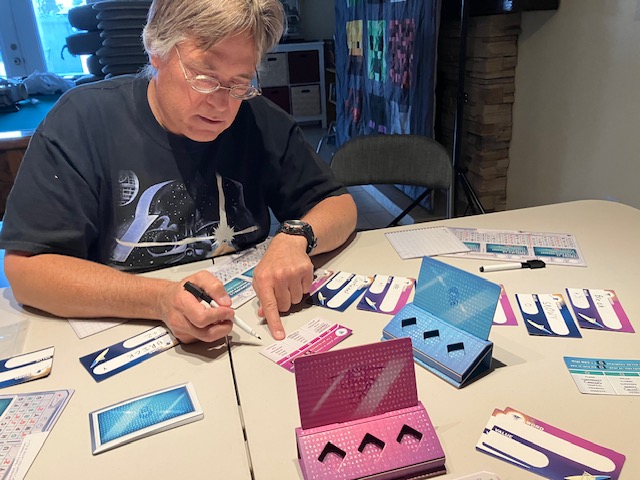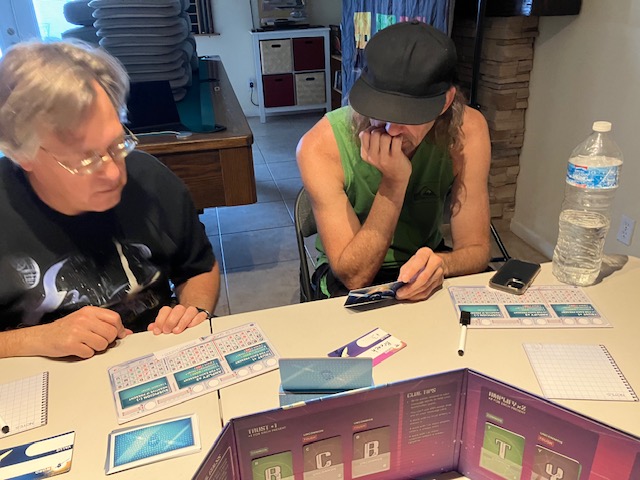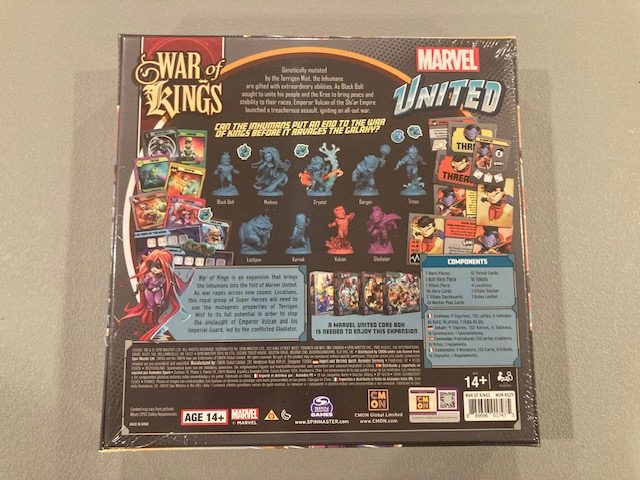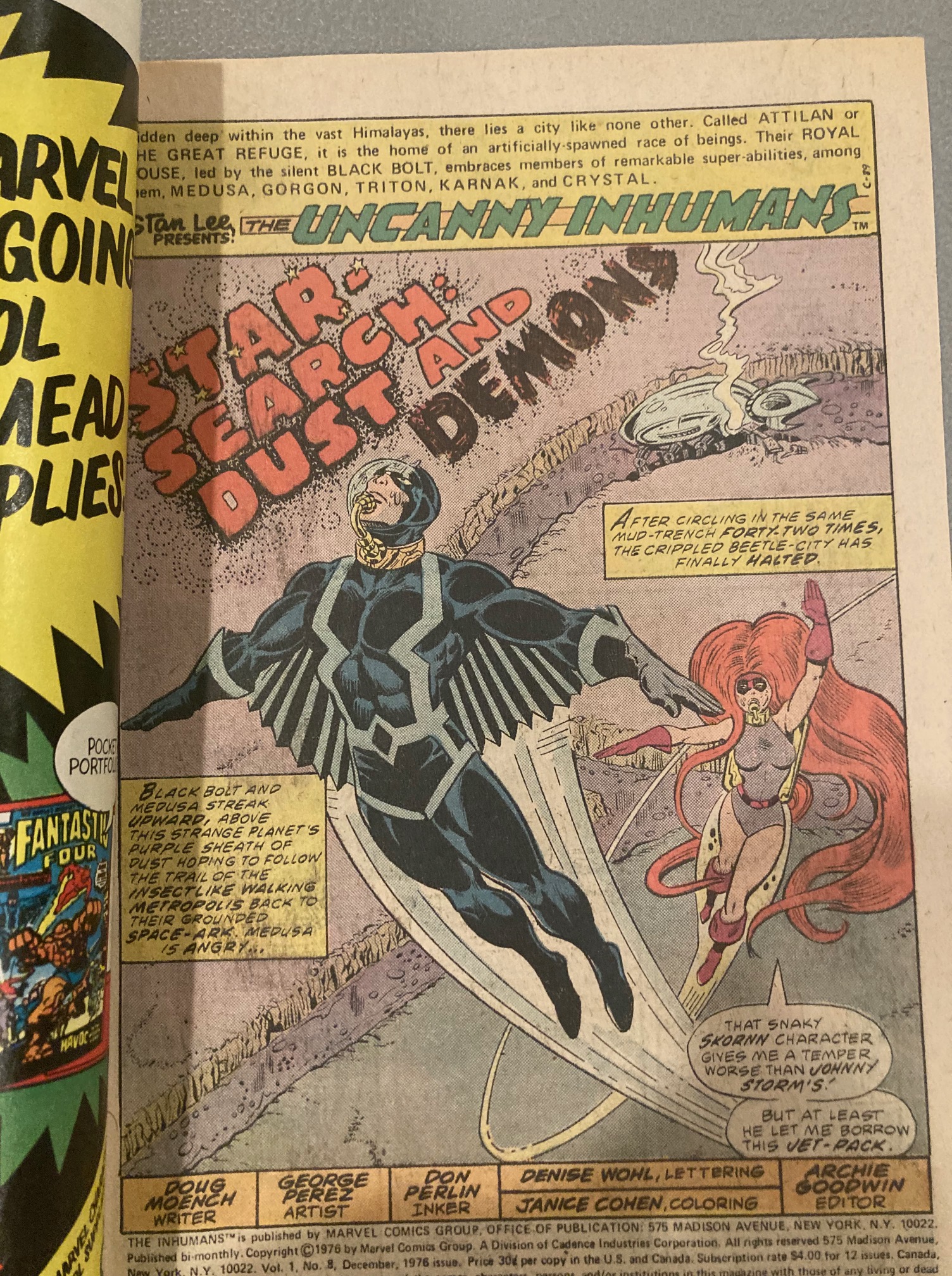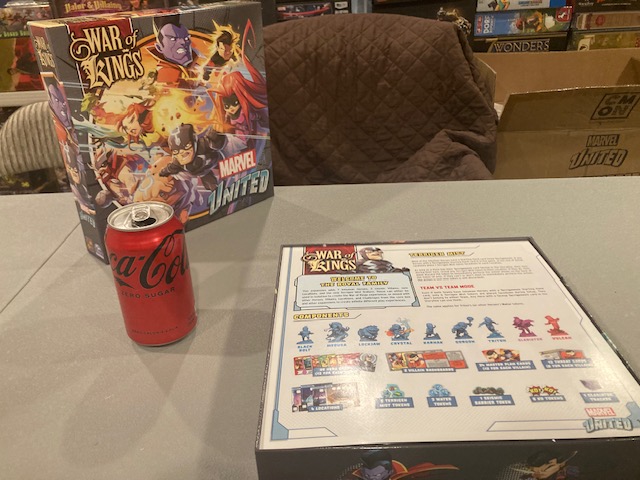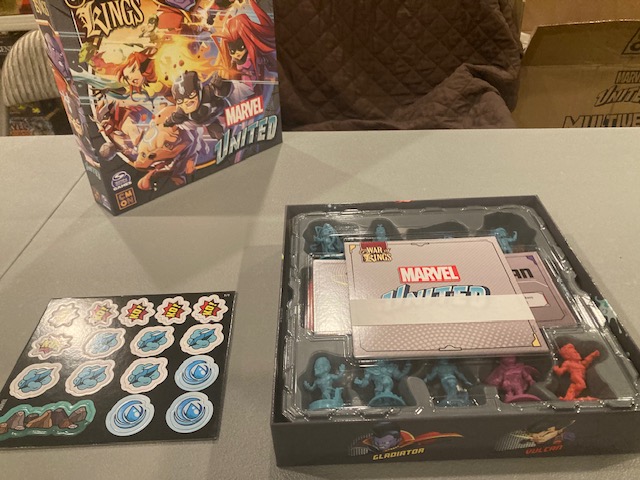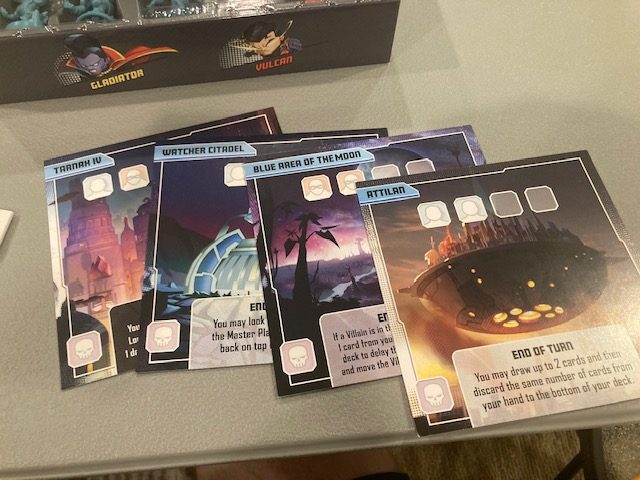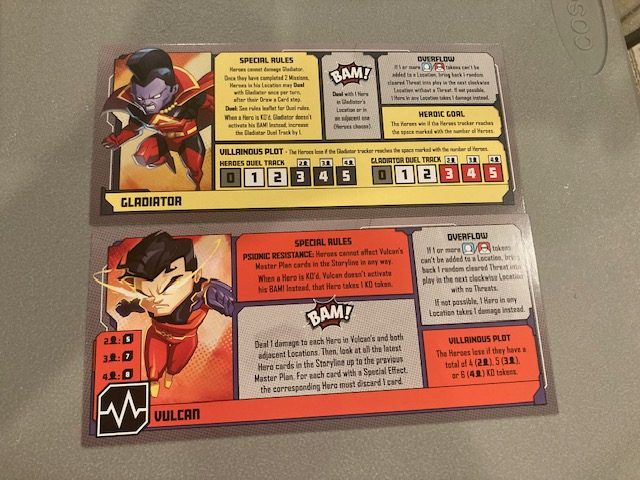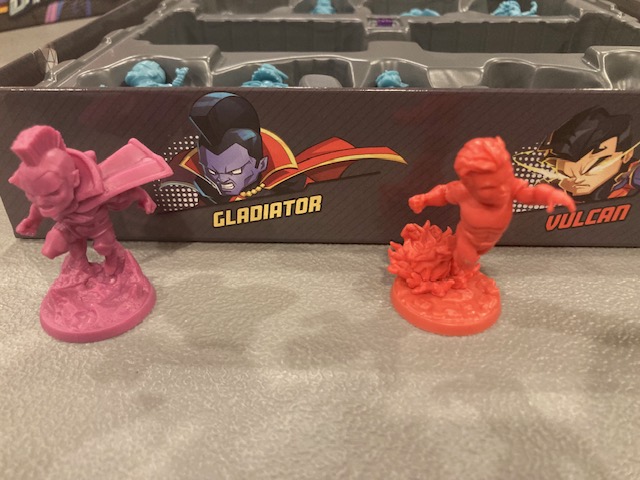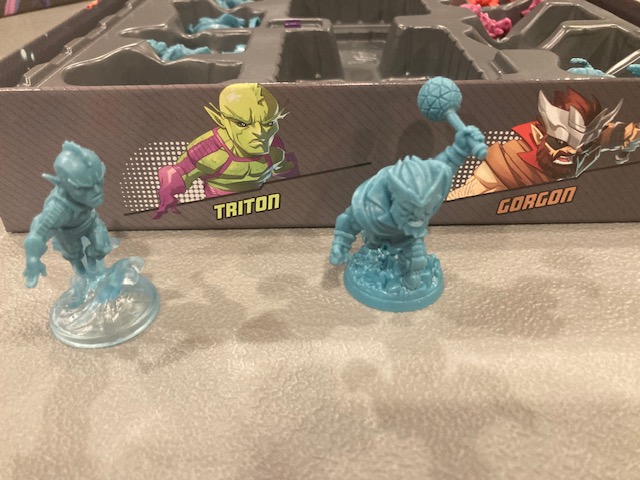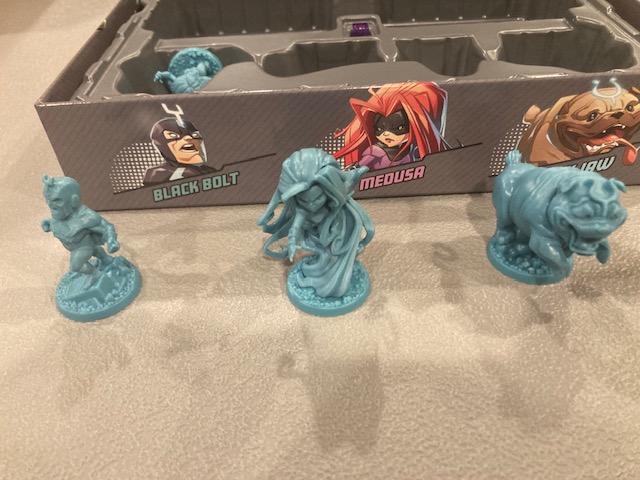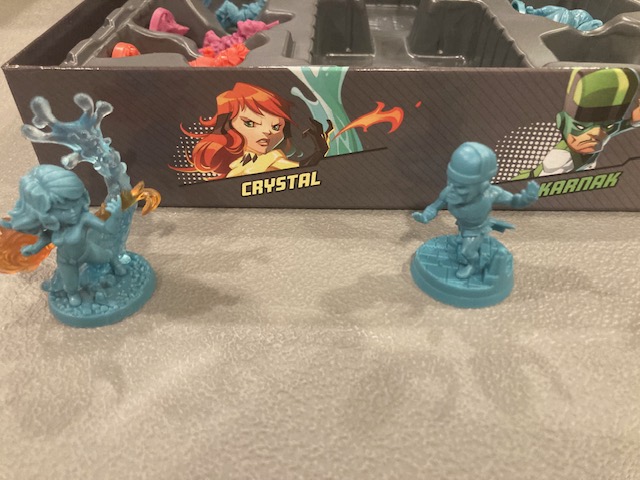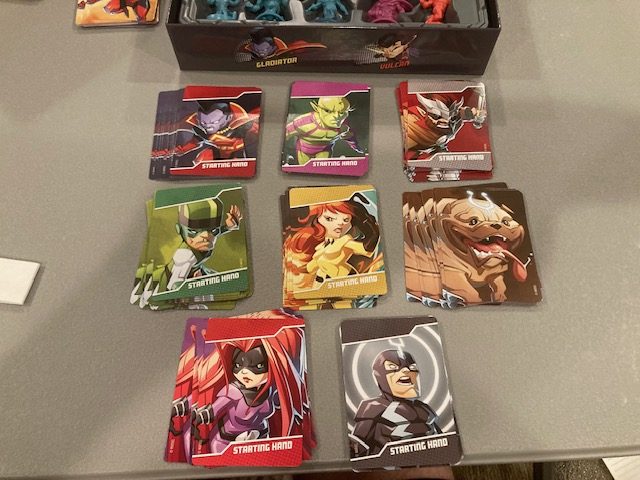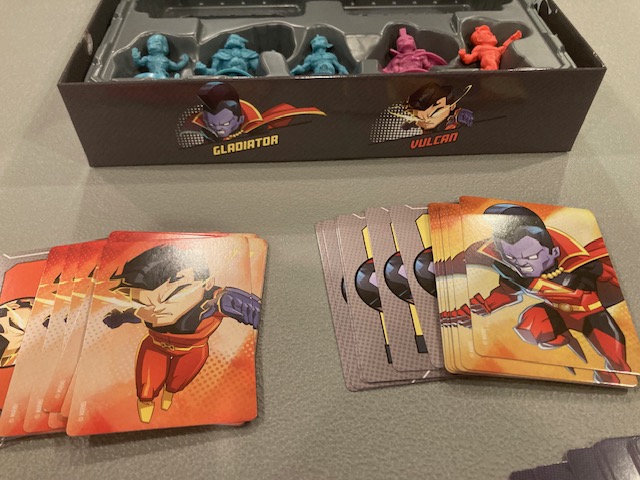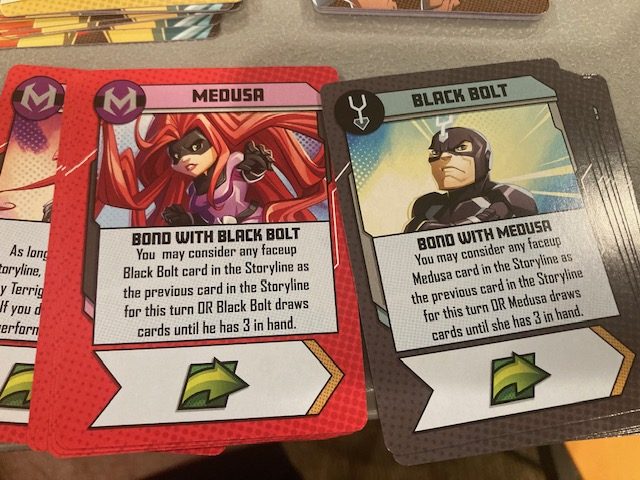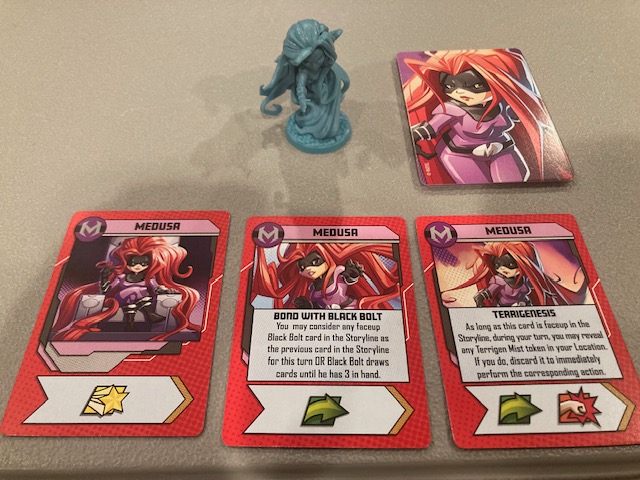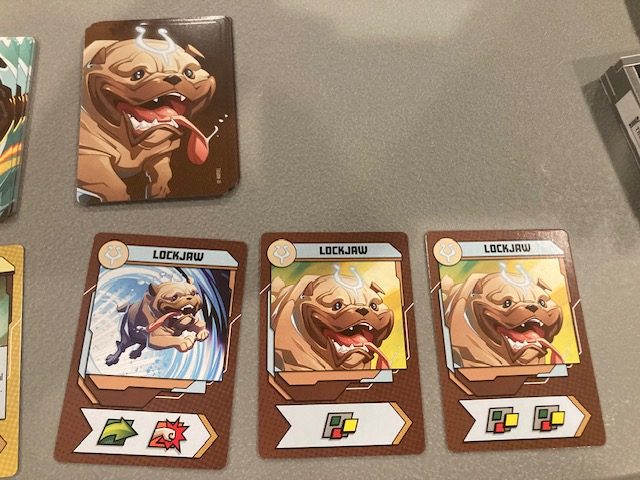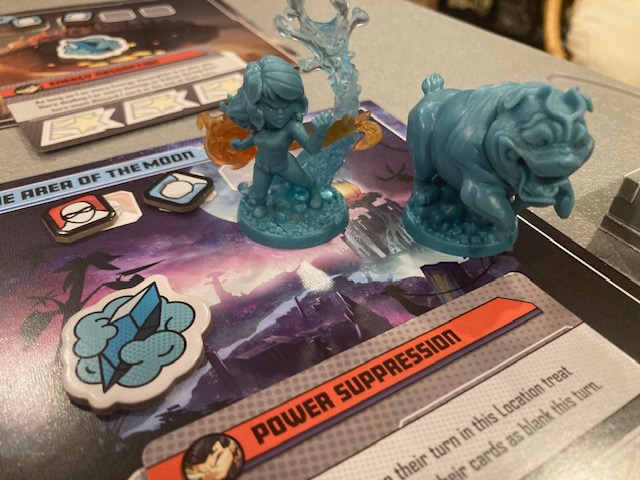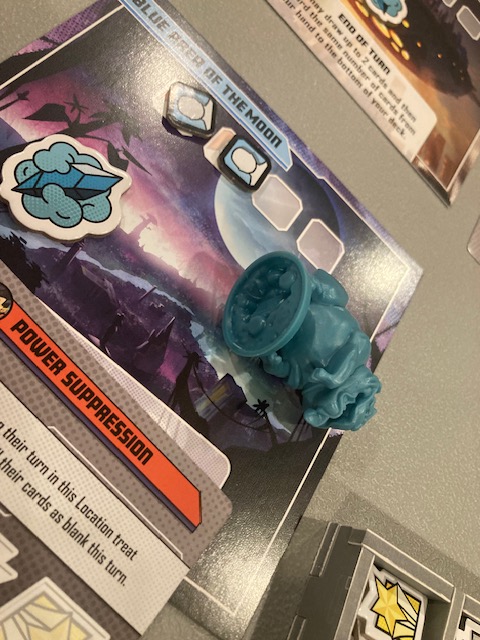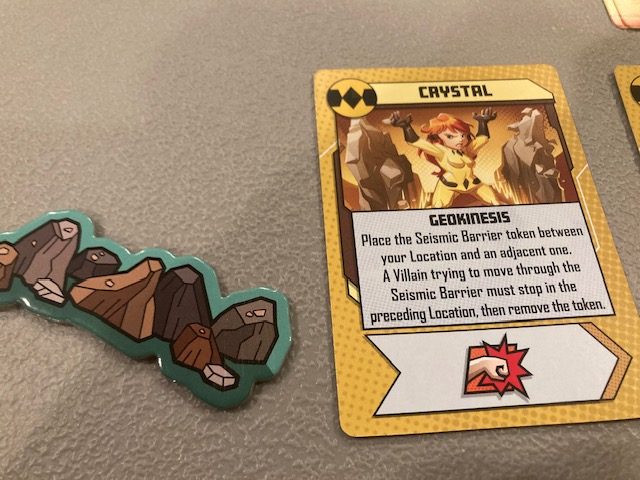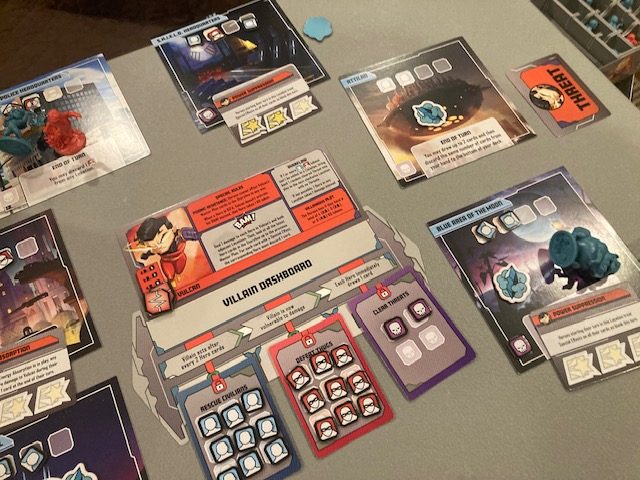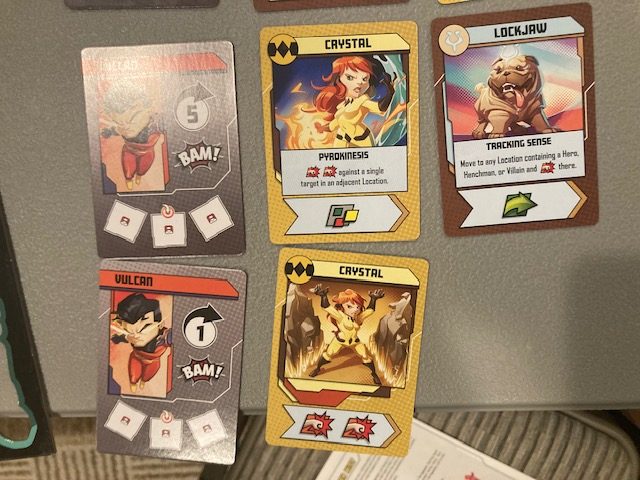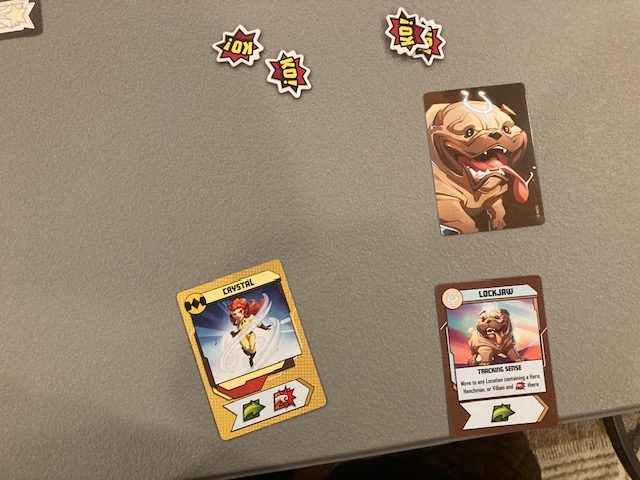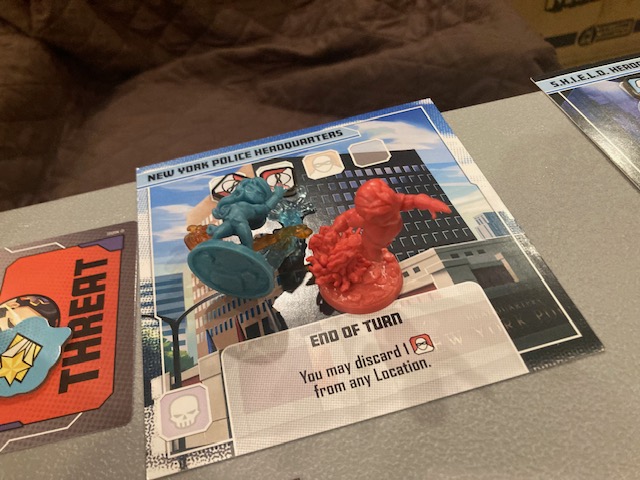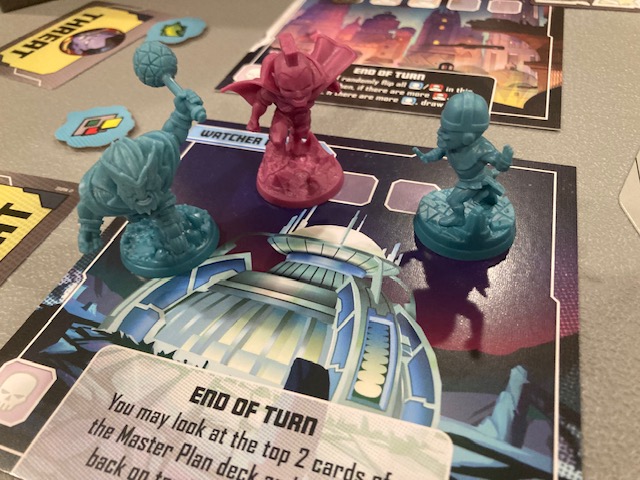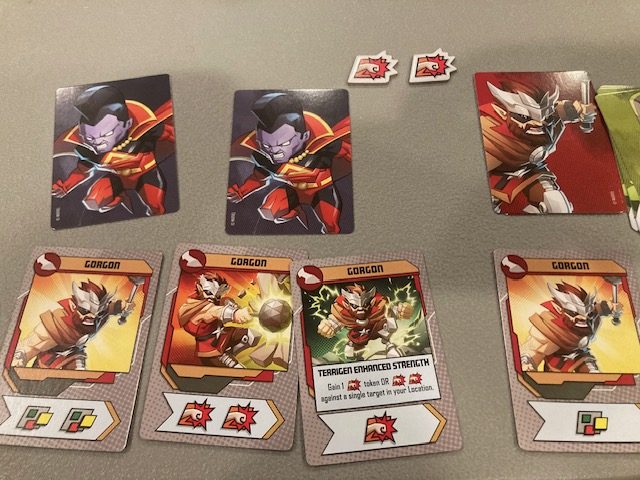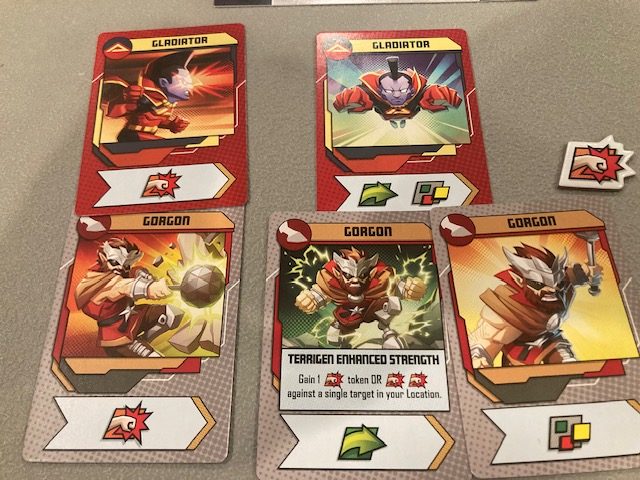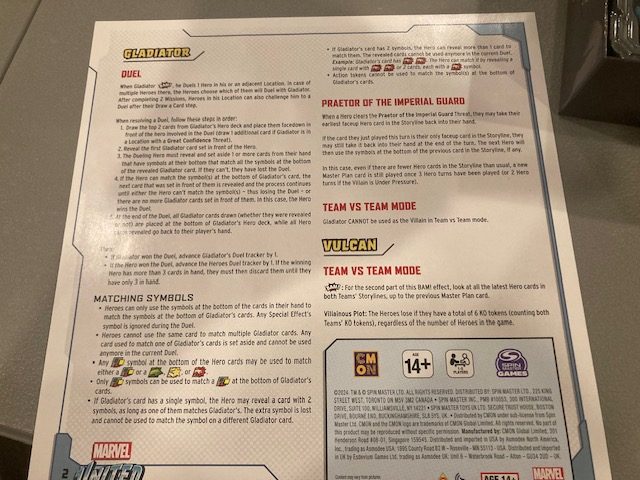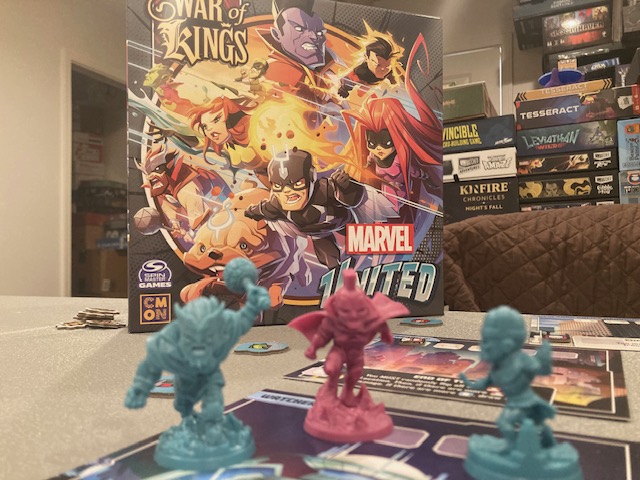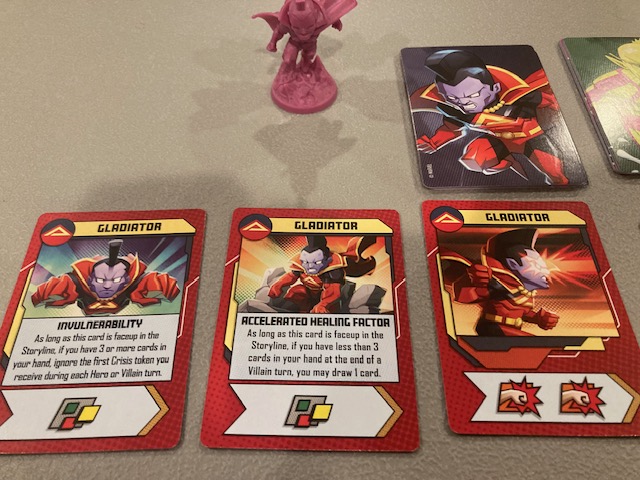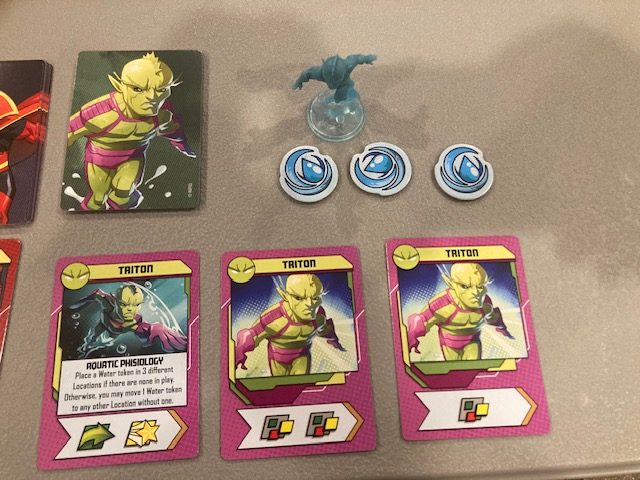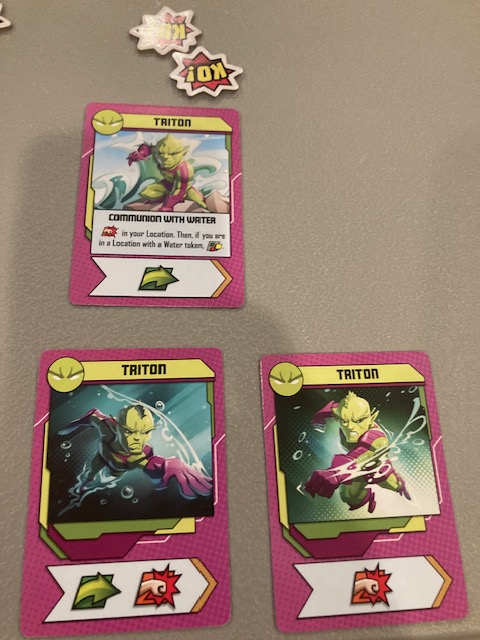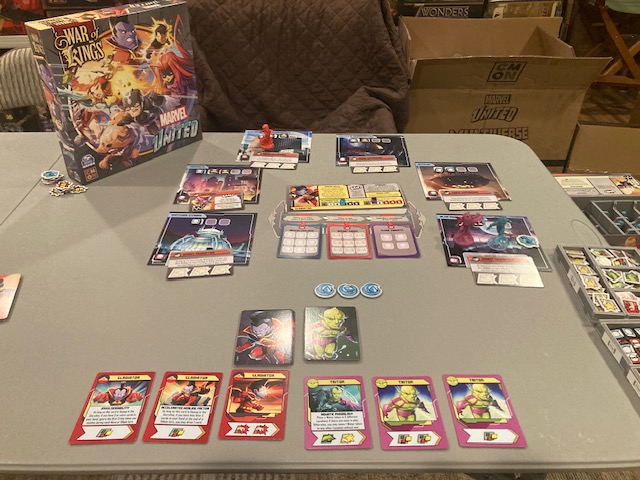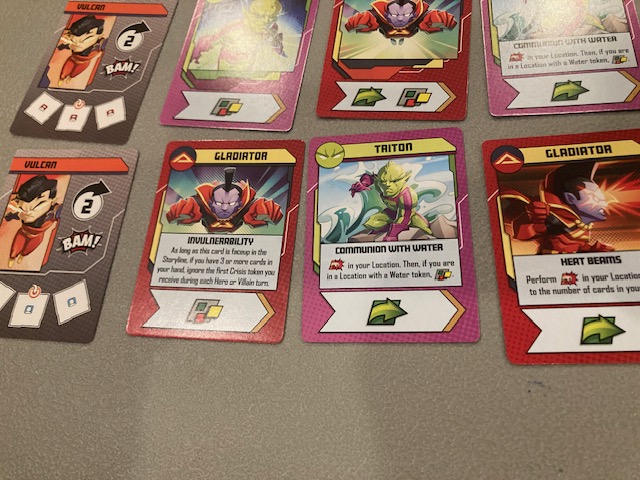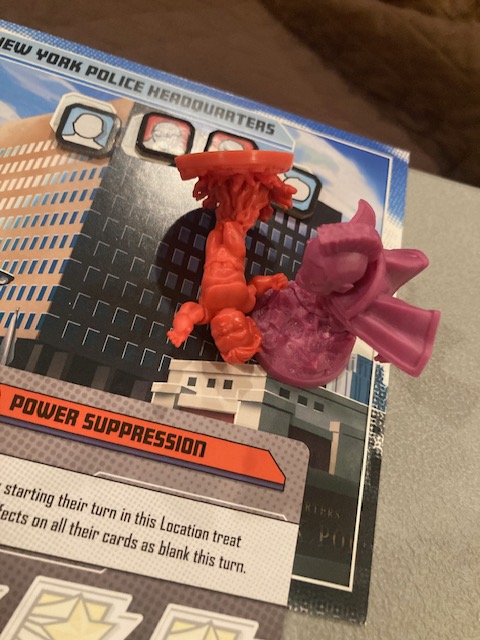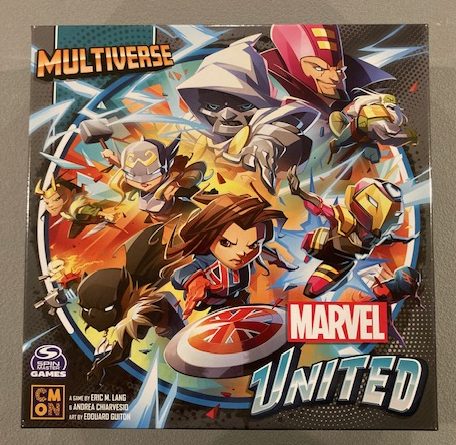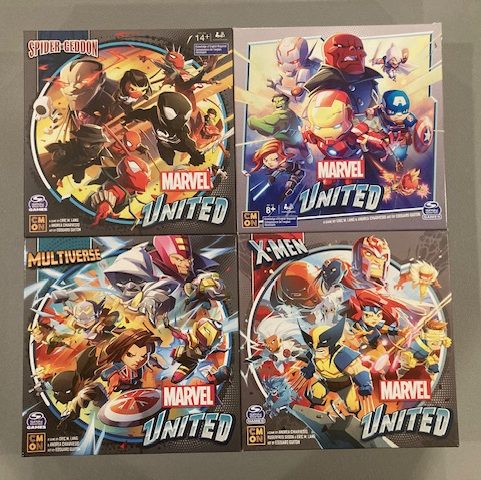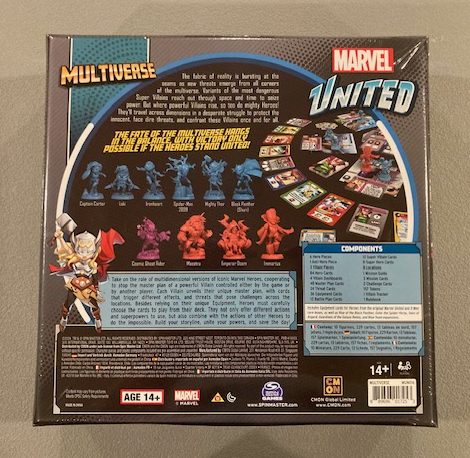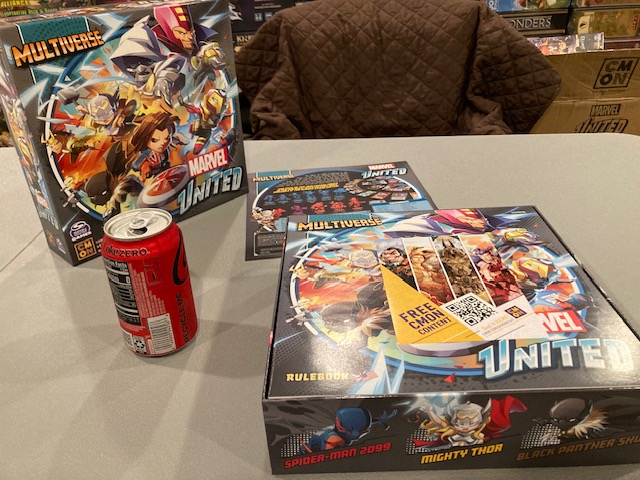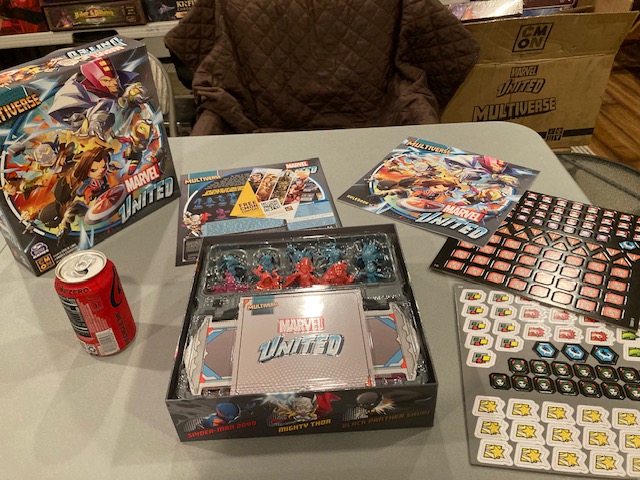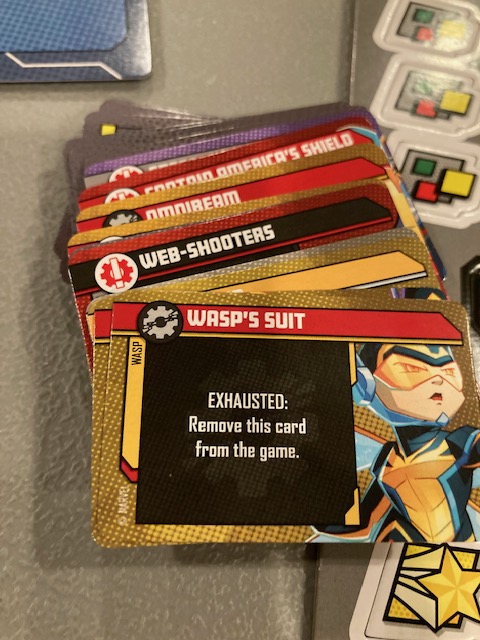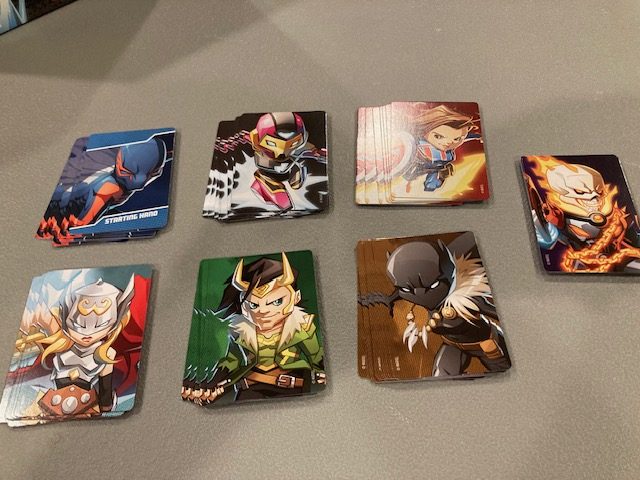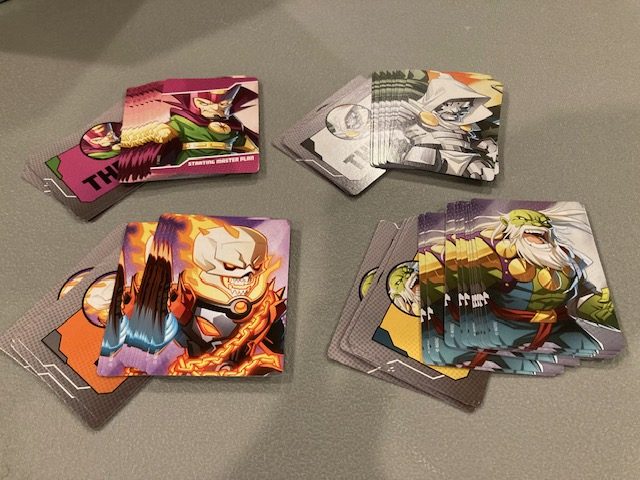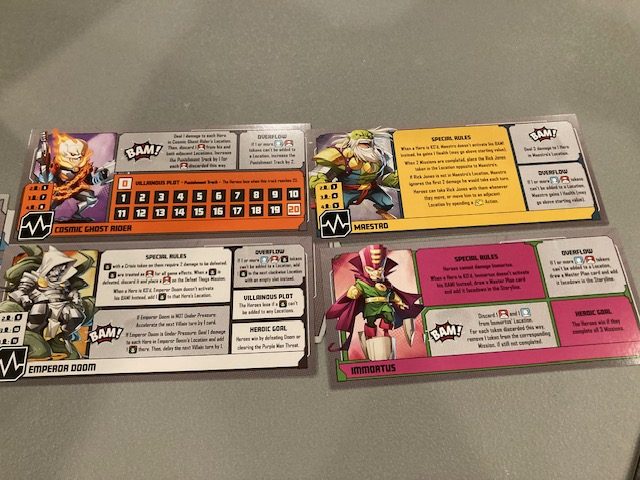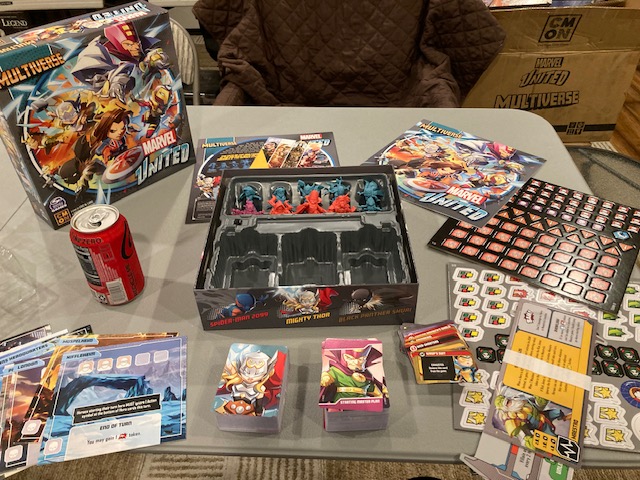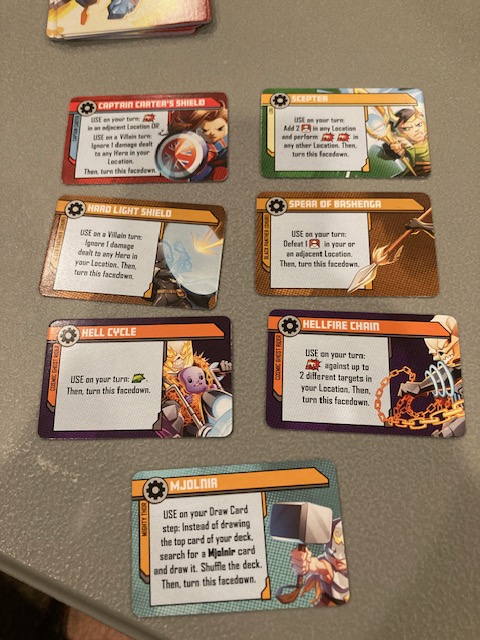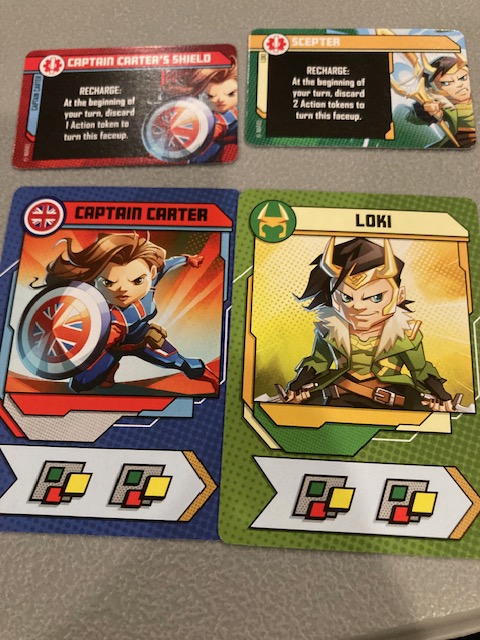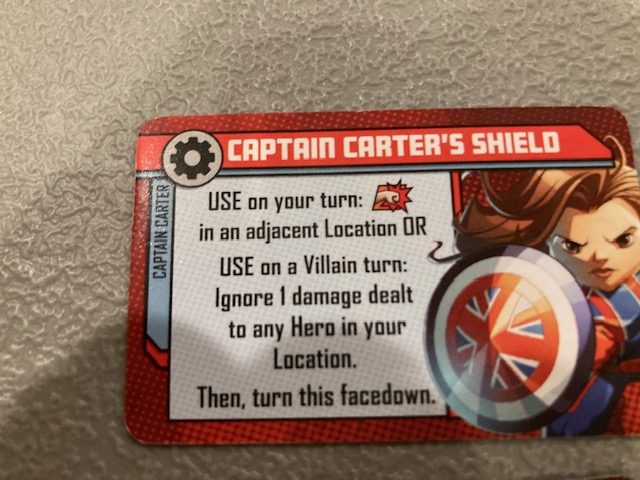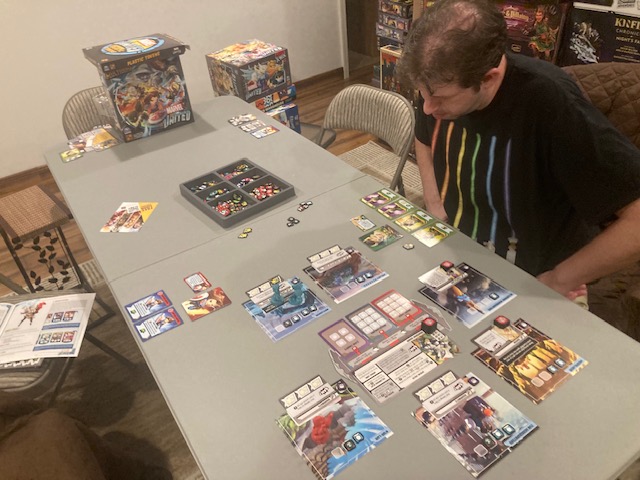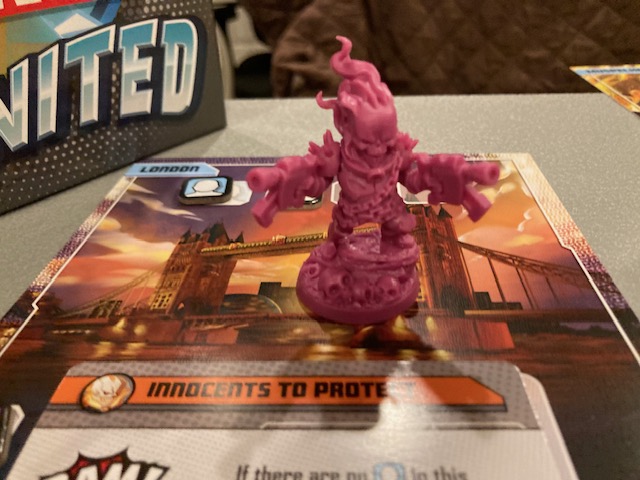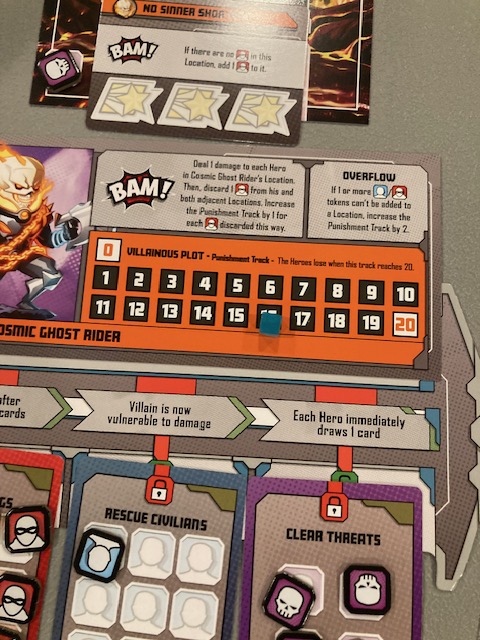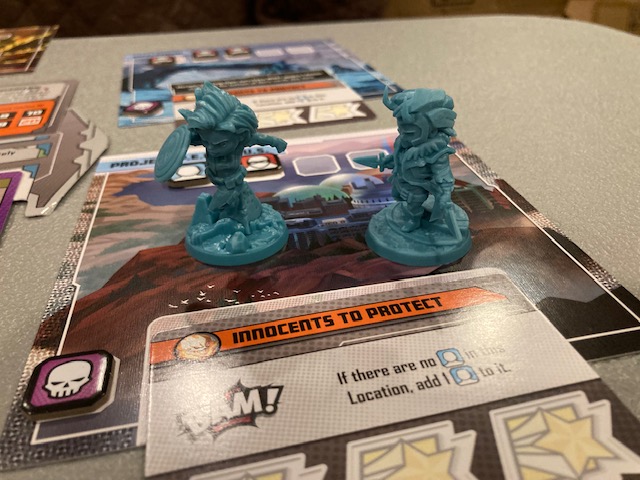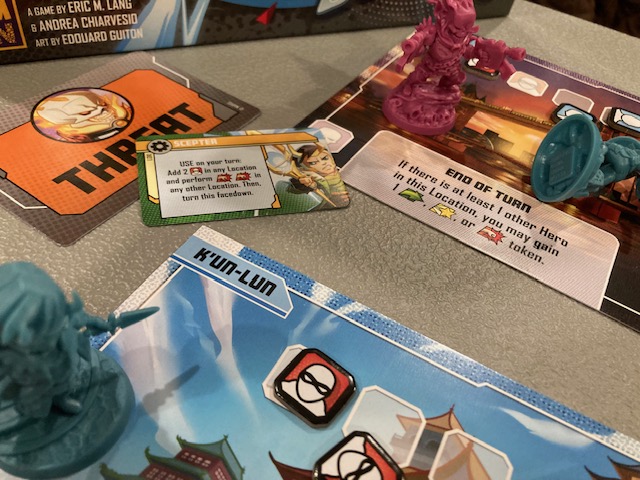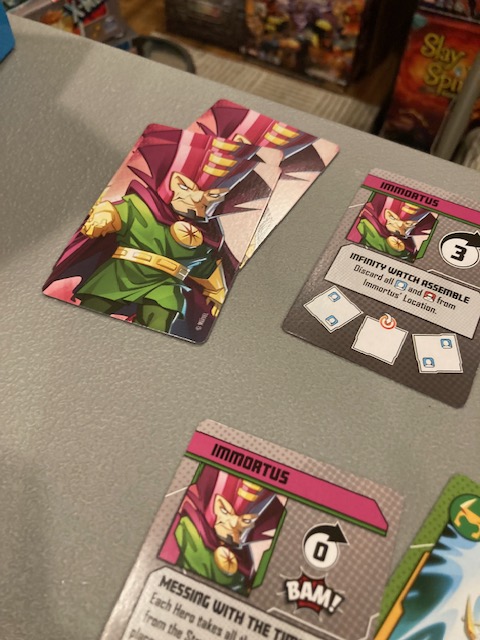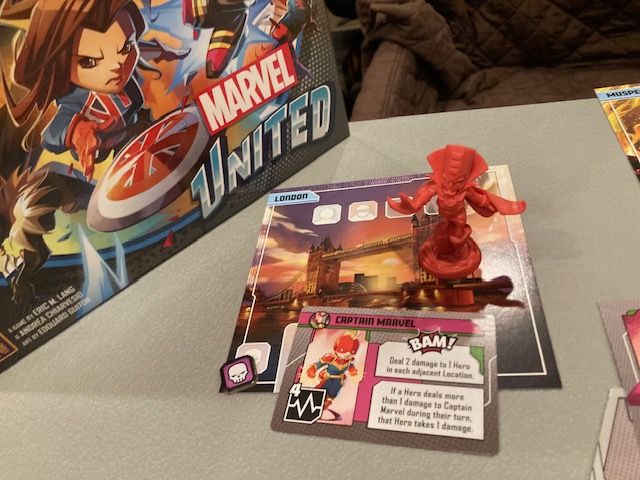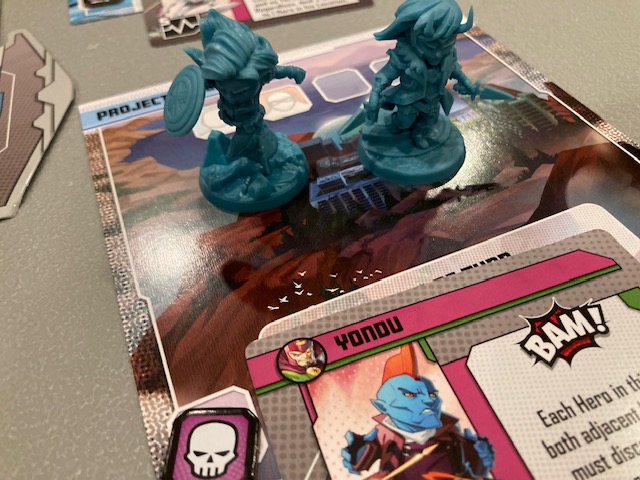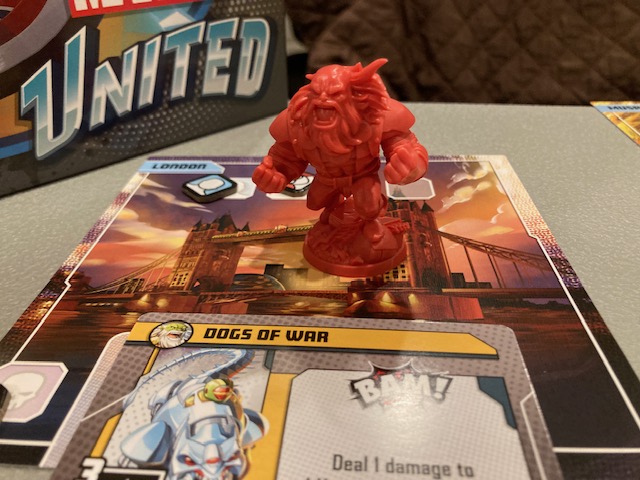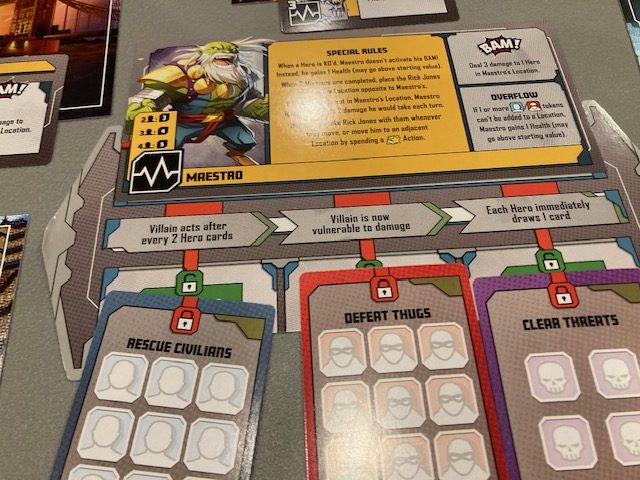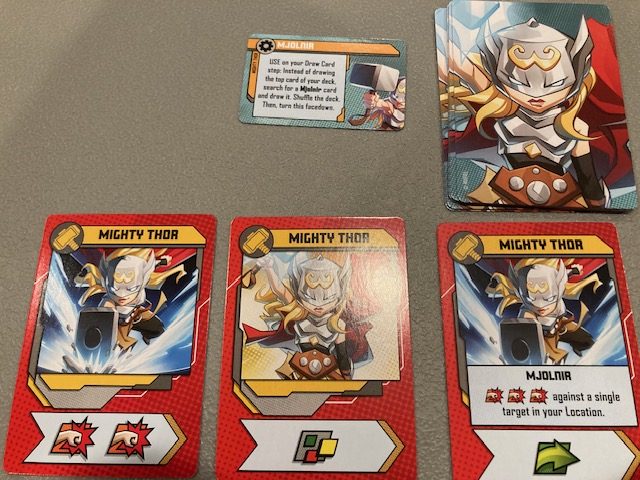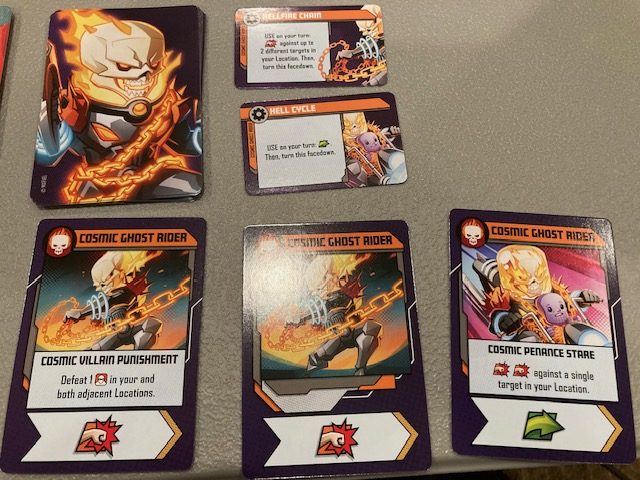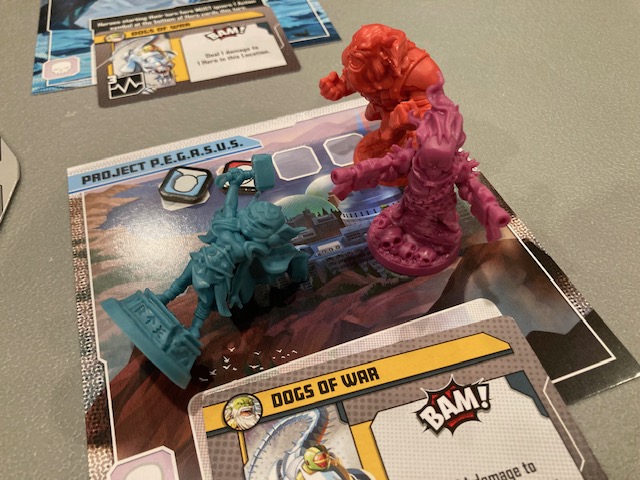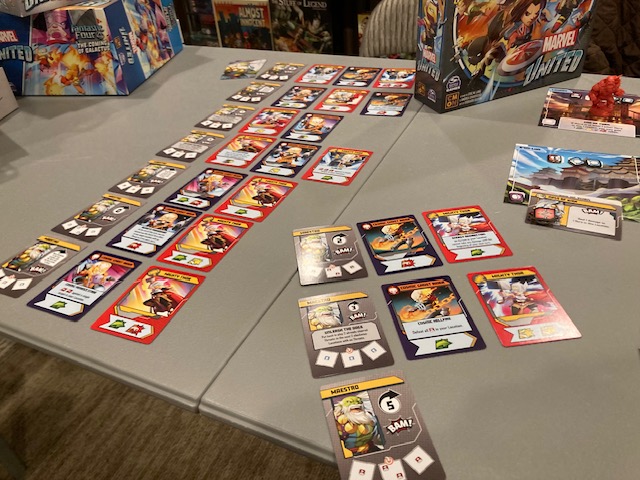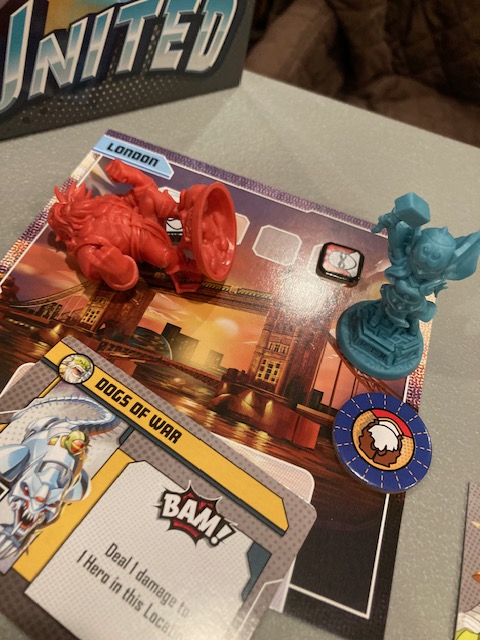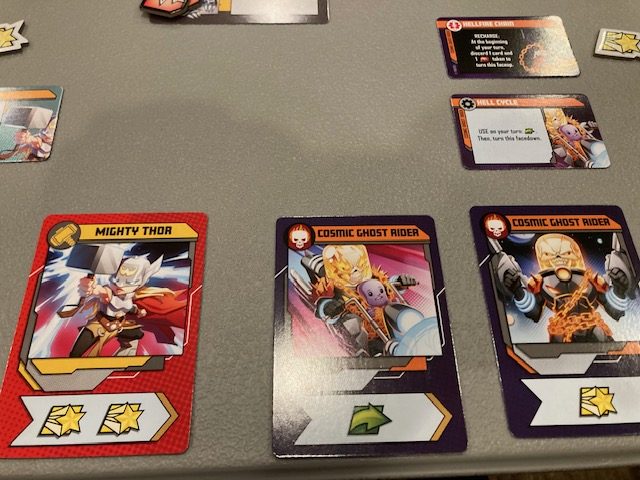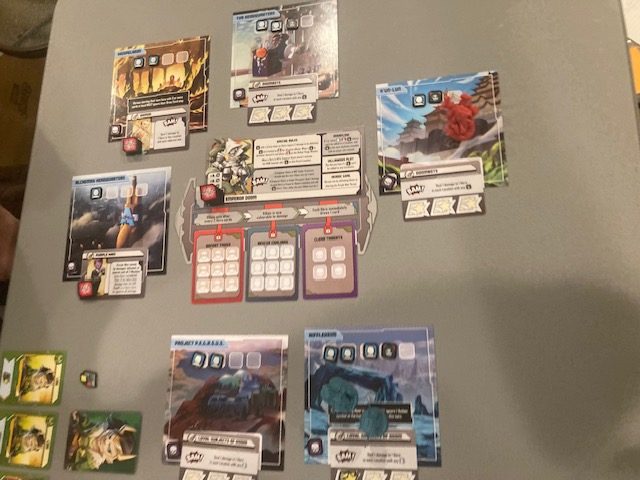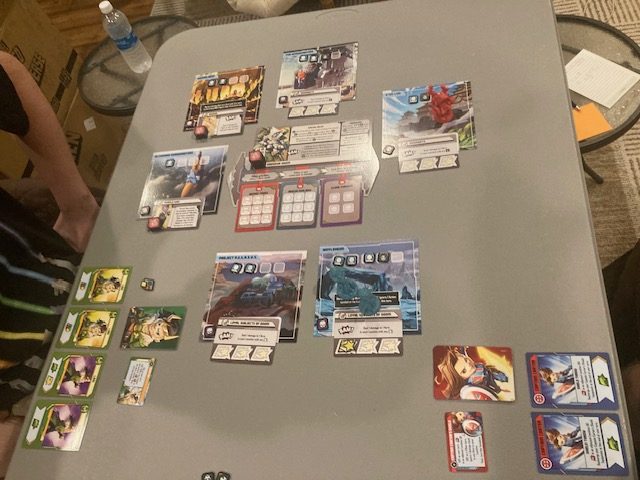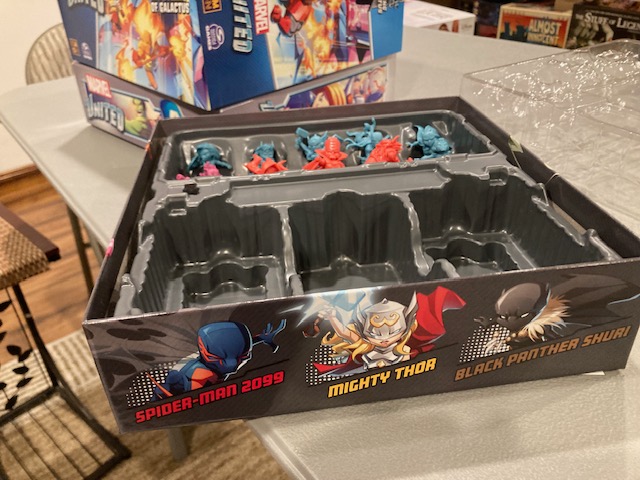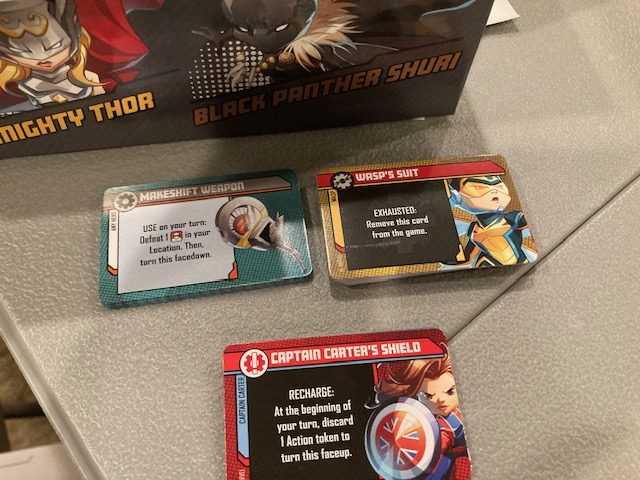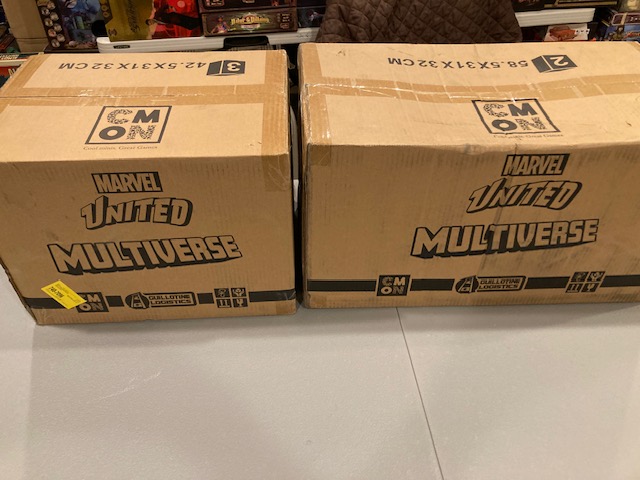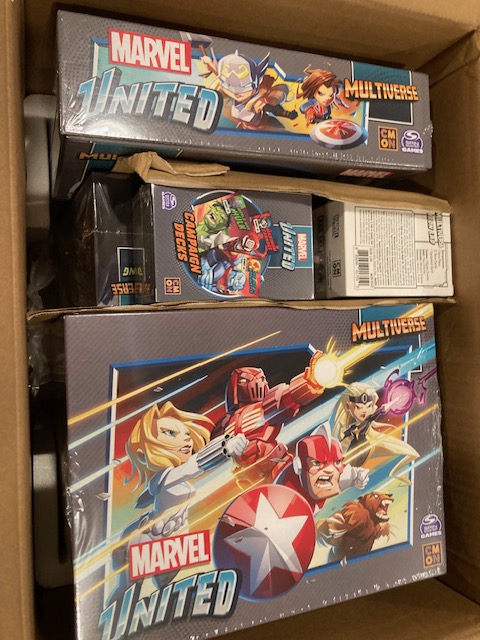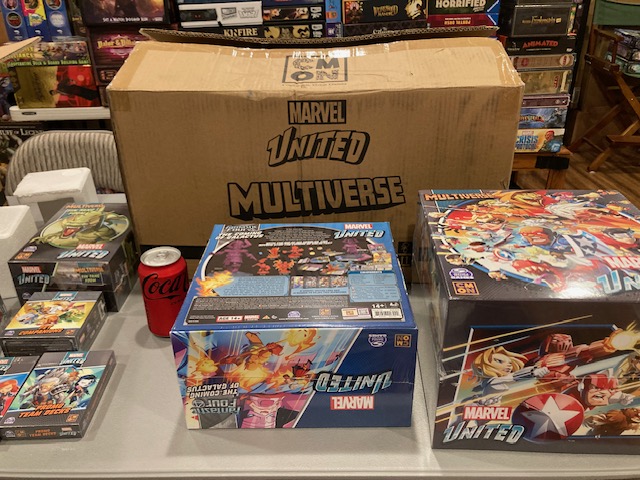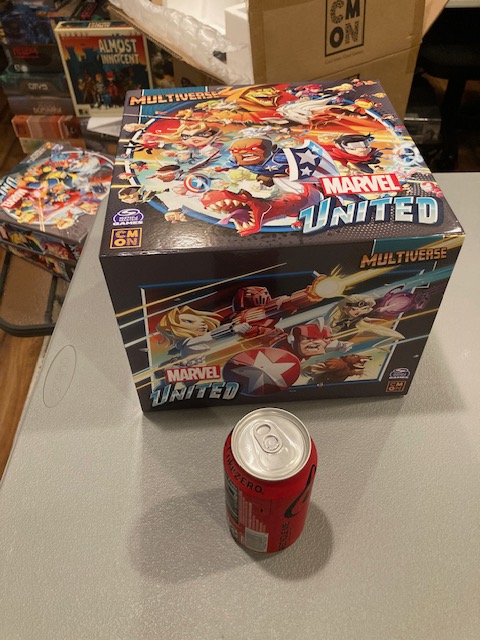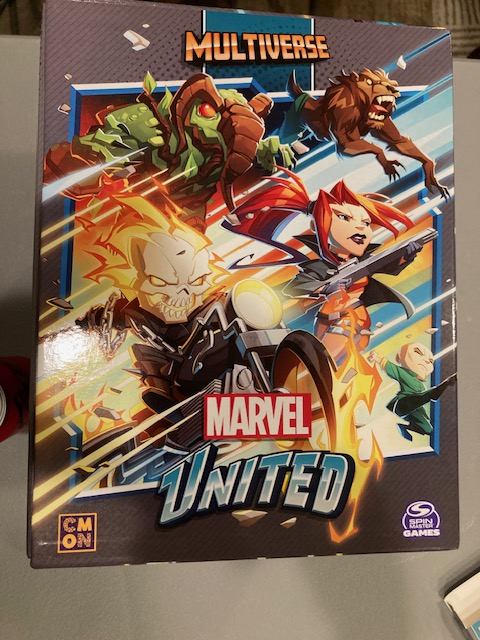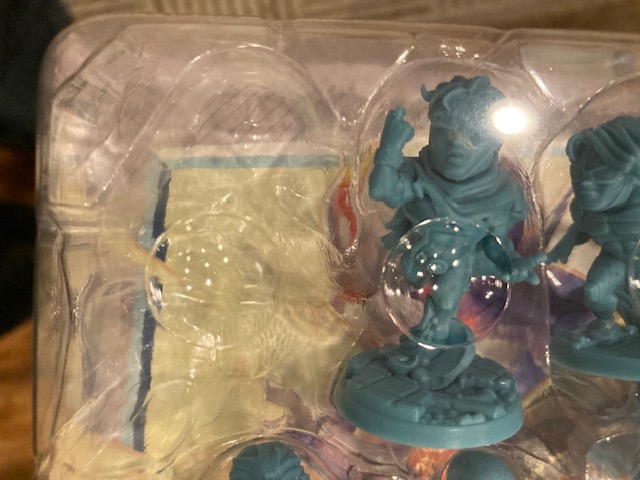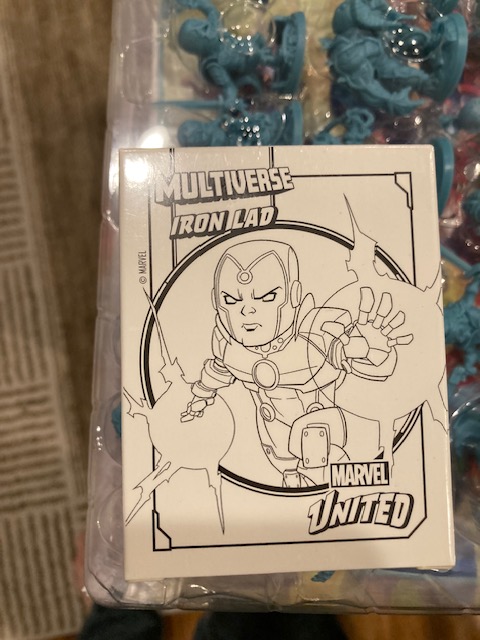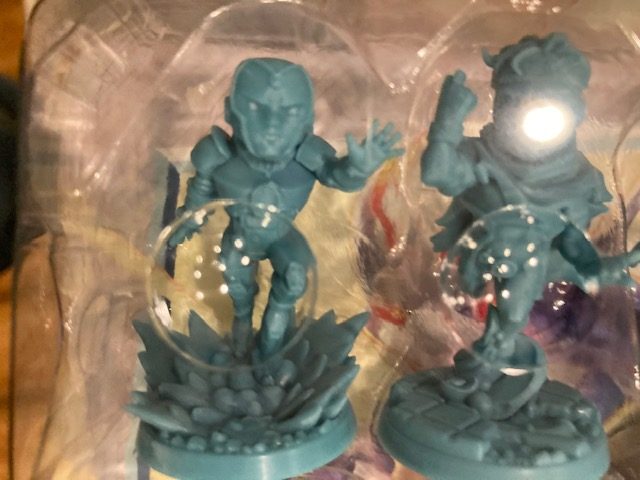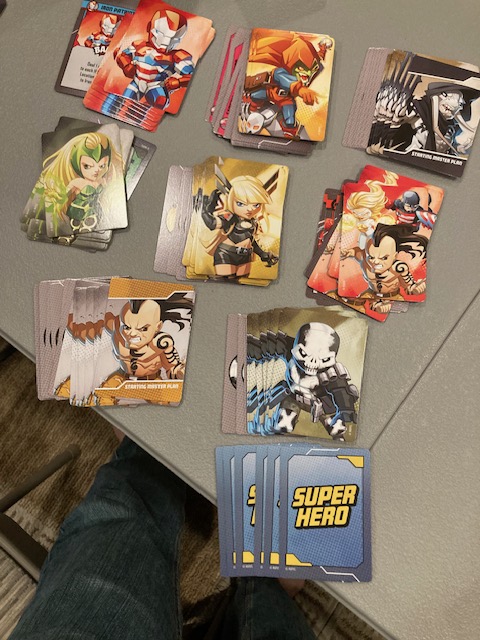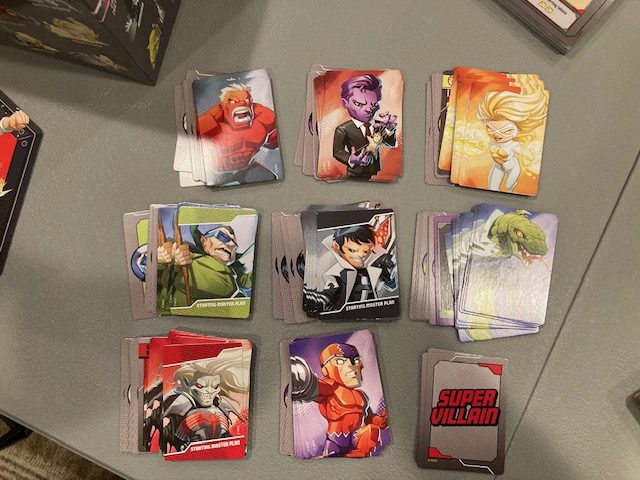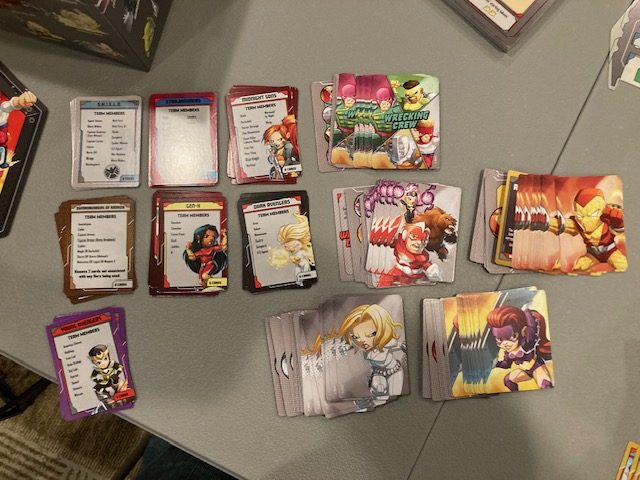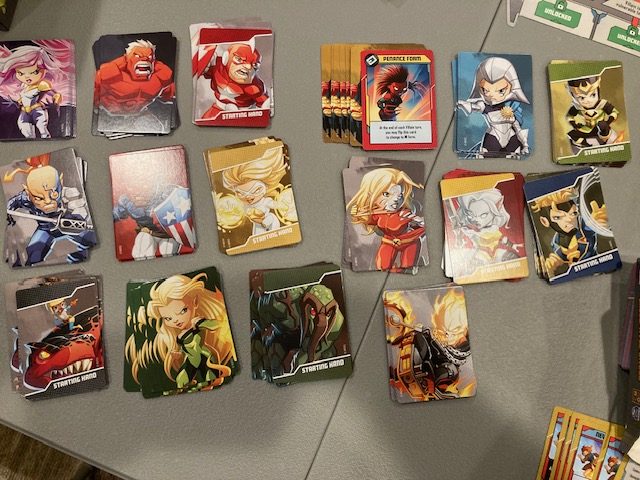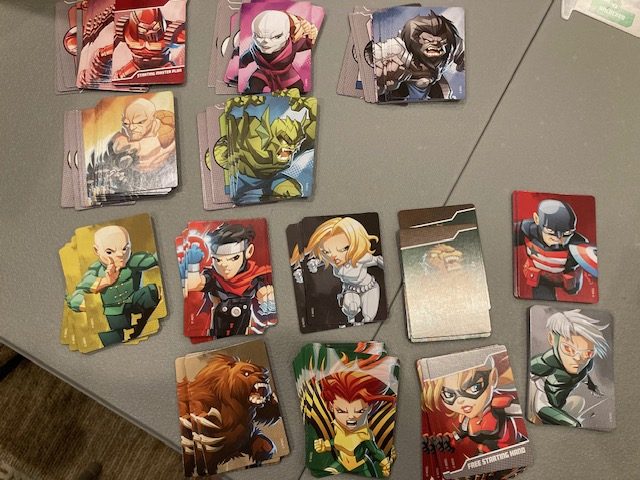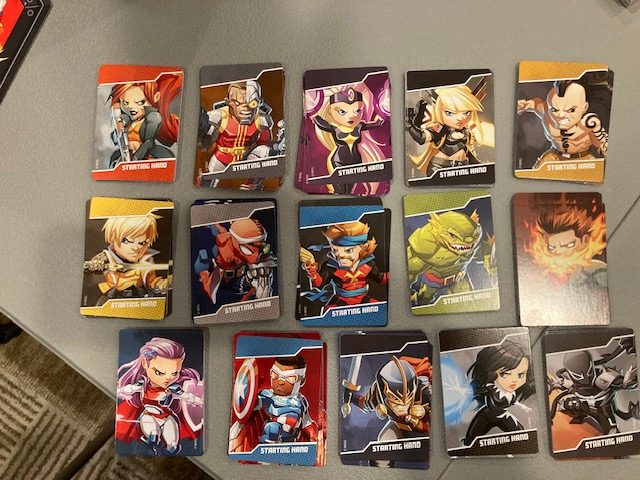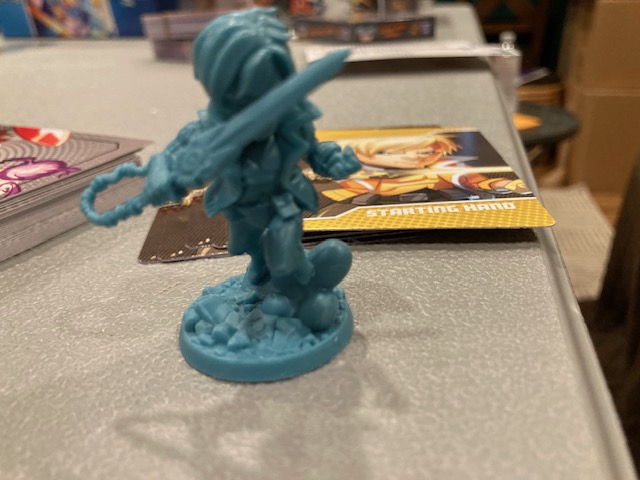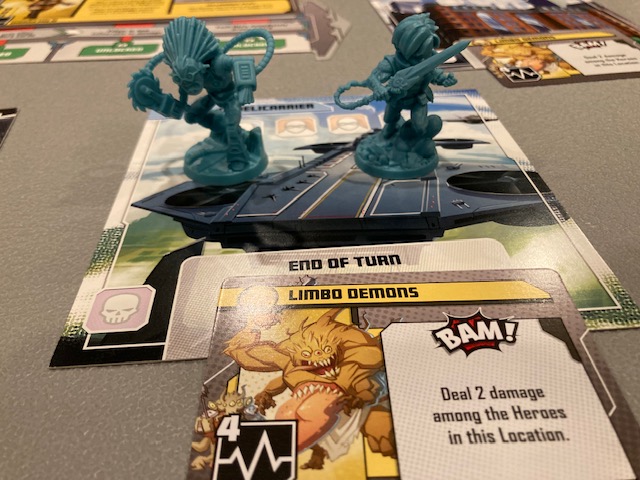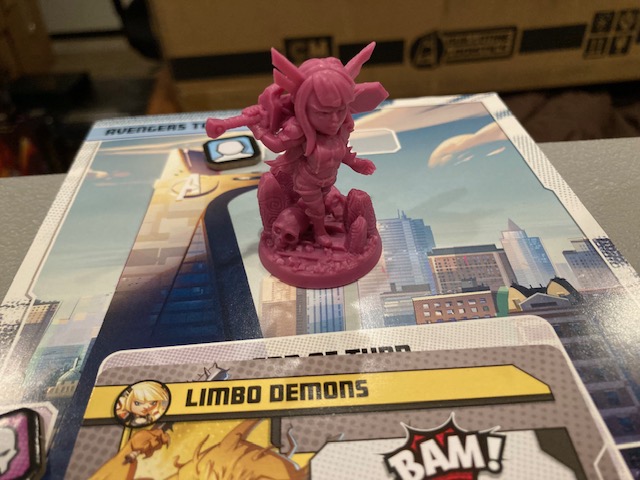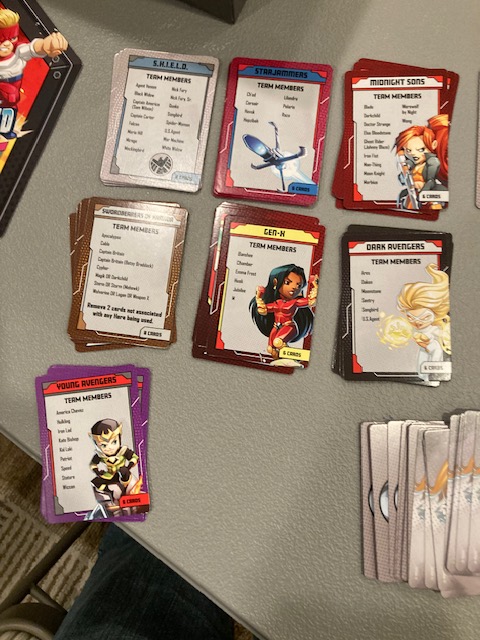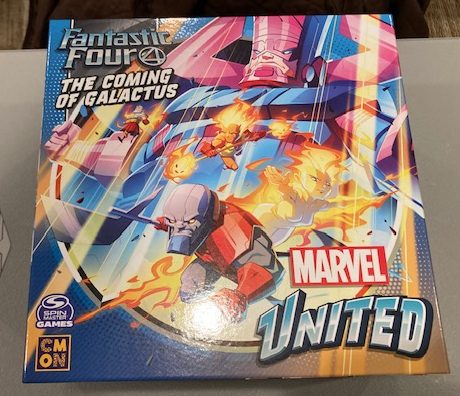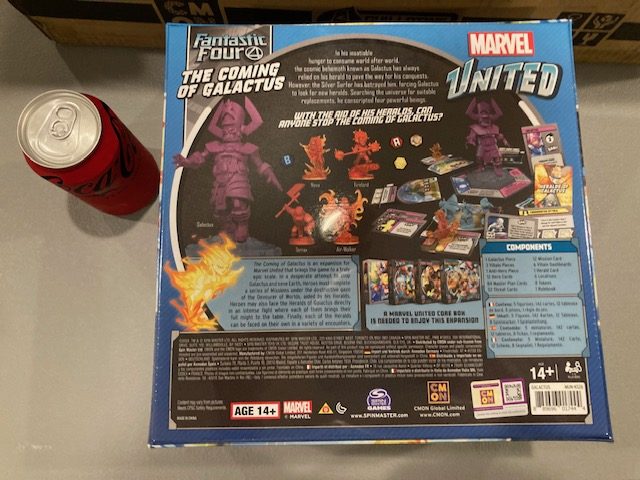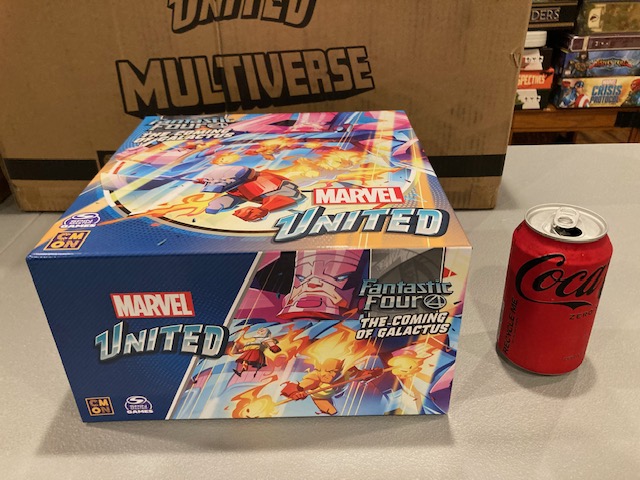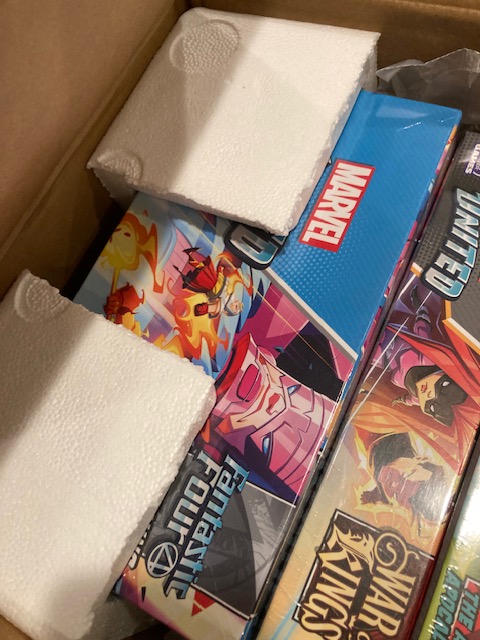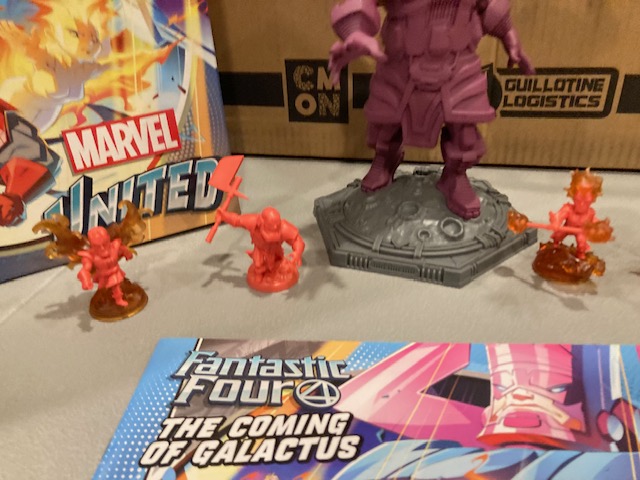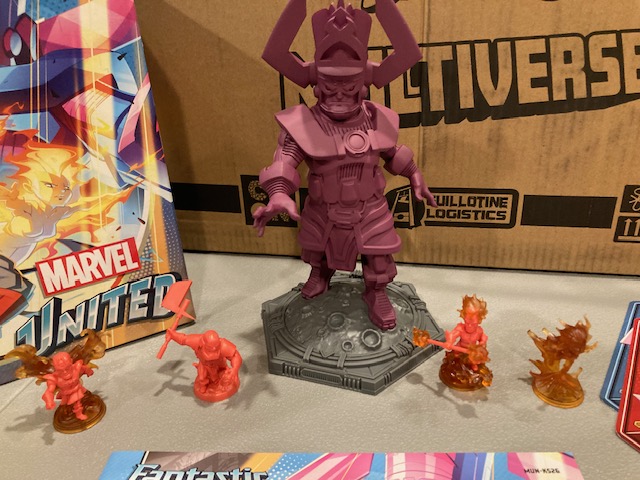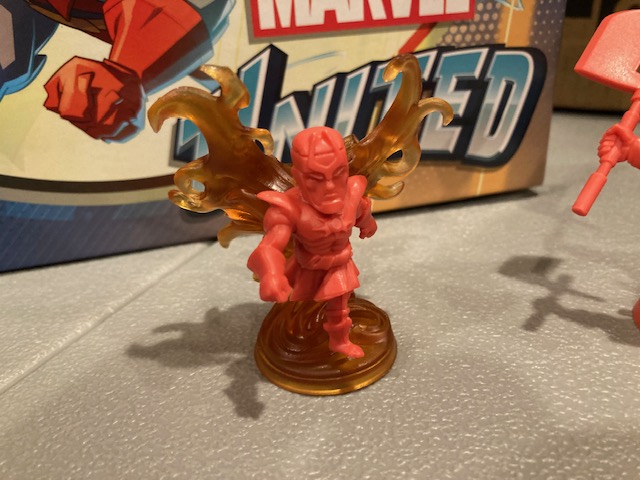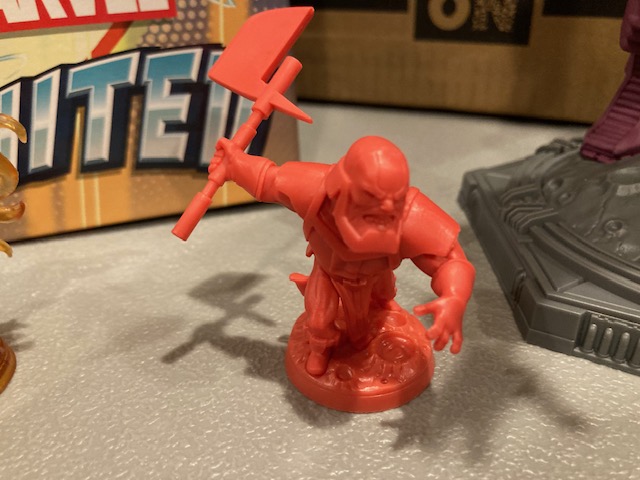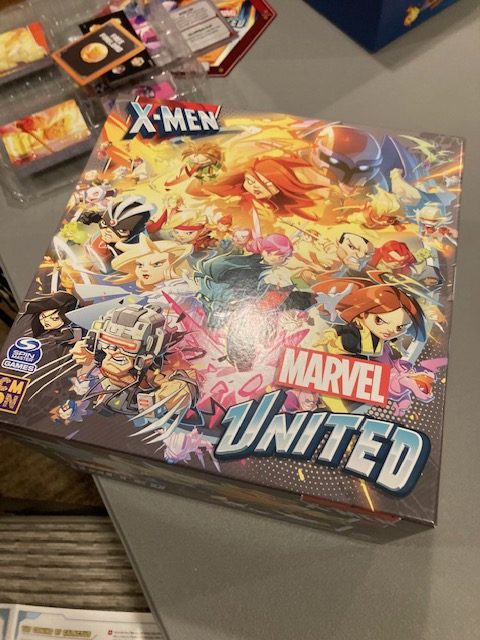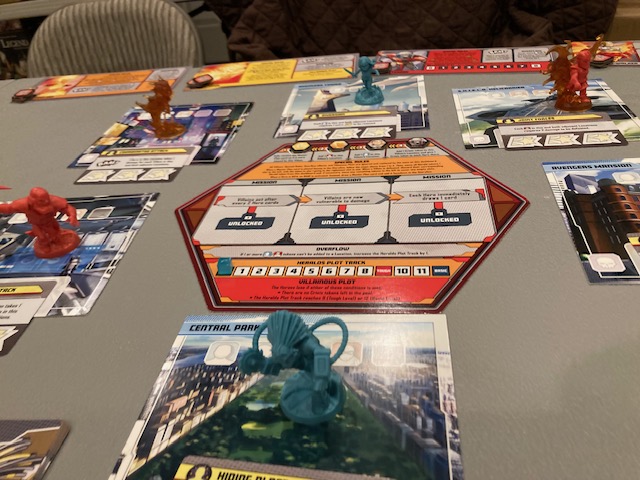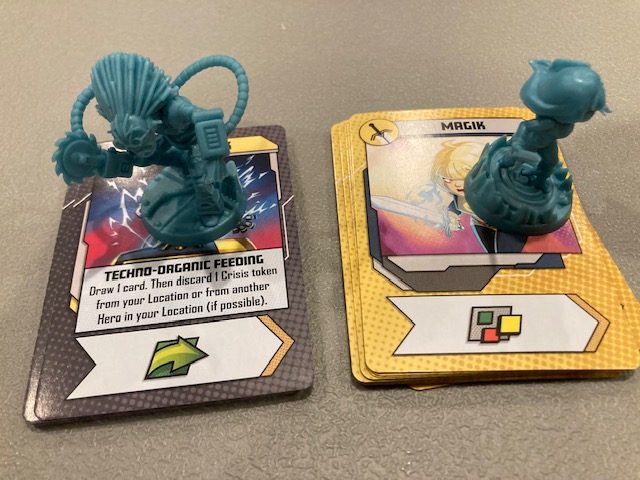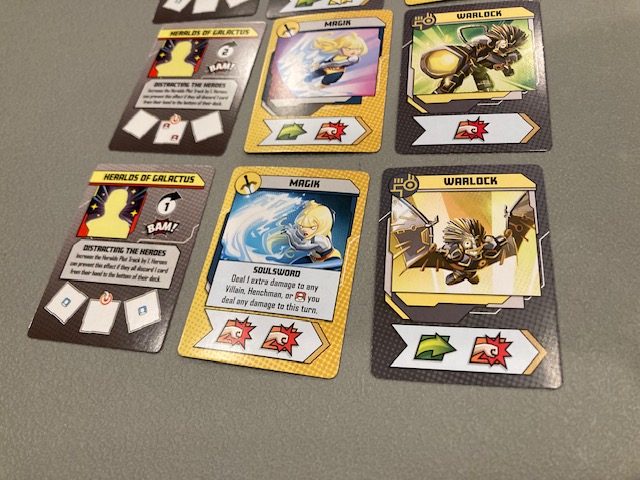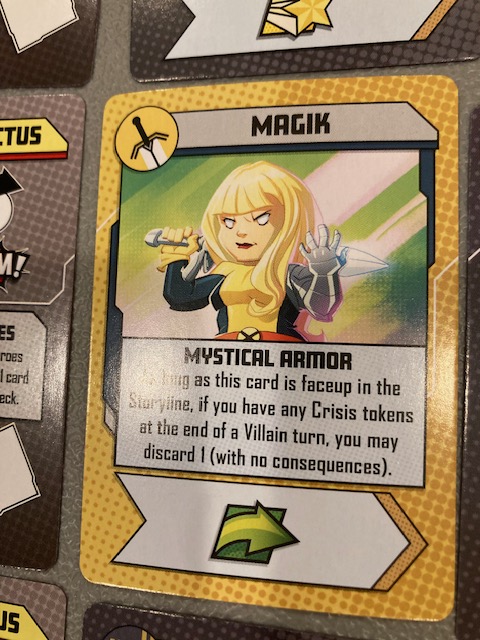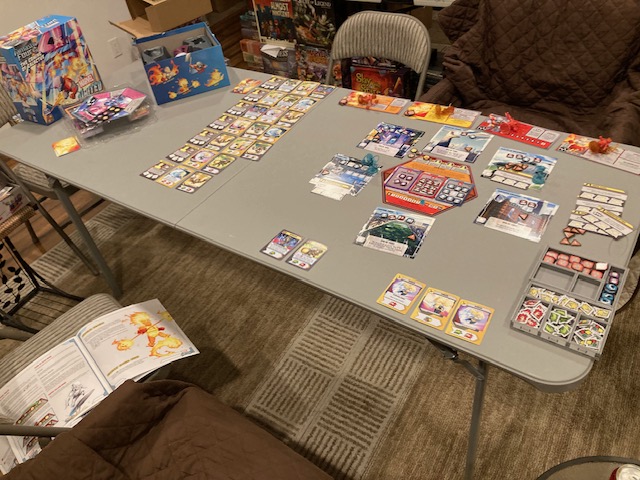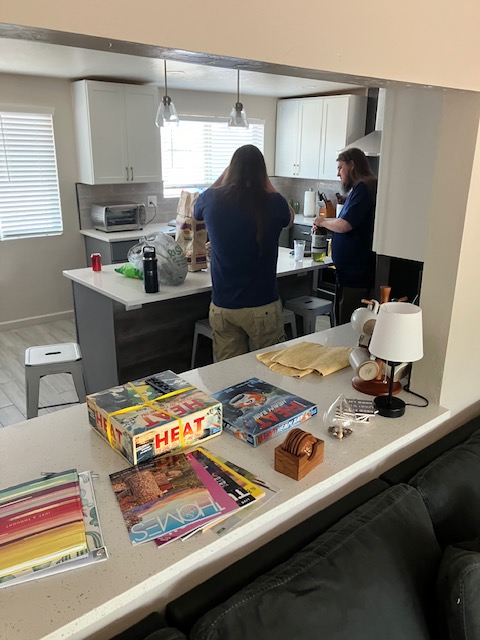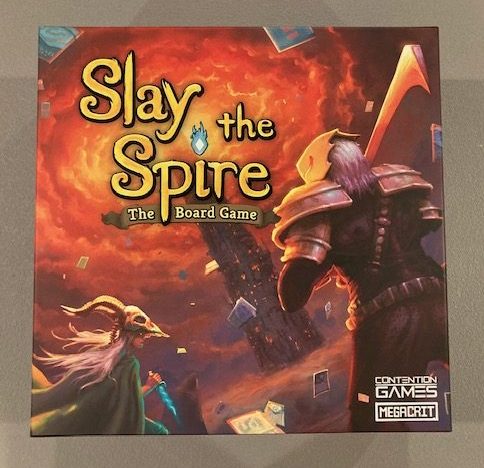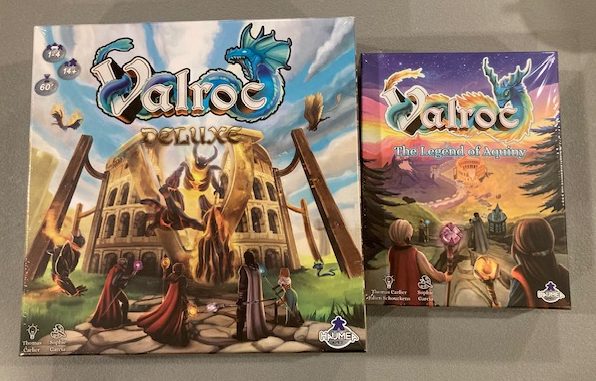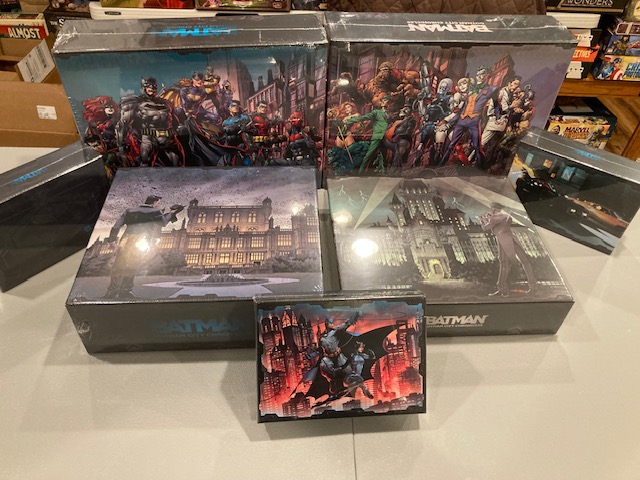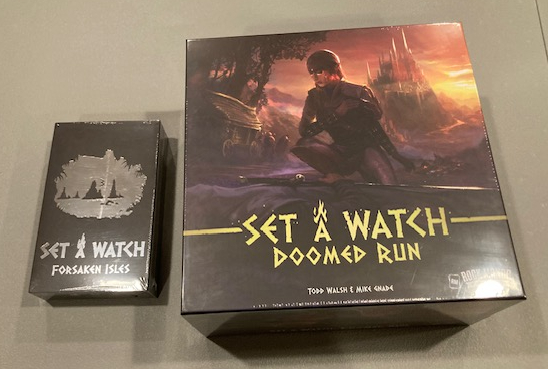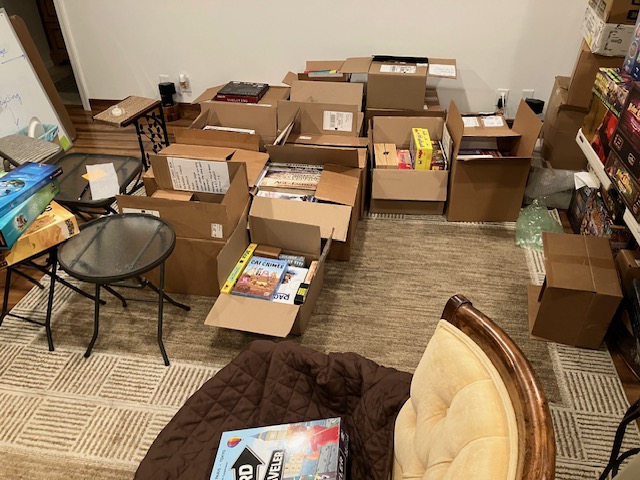
This is crazy, because now we have the original Marvel United stuff, the X-Men Marvel United Stuff, and now the Multiverse Marvel United Stuff! Have we lost our mind? Yes. Yes we have.
Unboxing
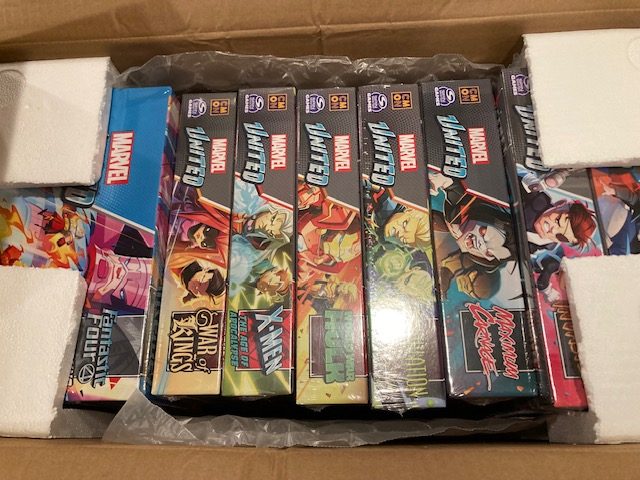
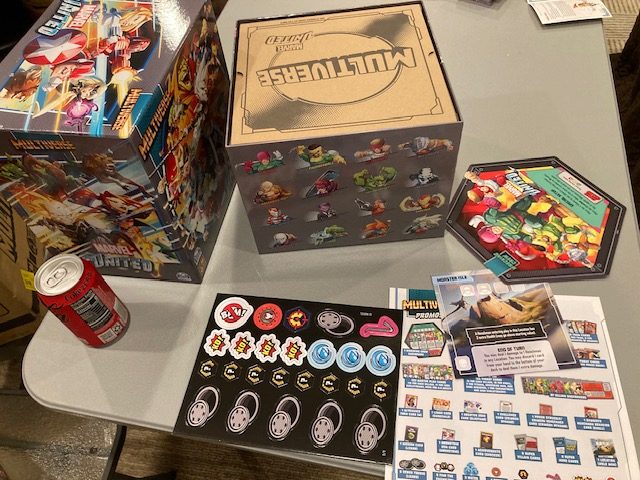
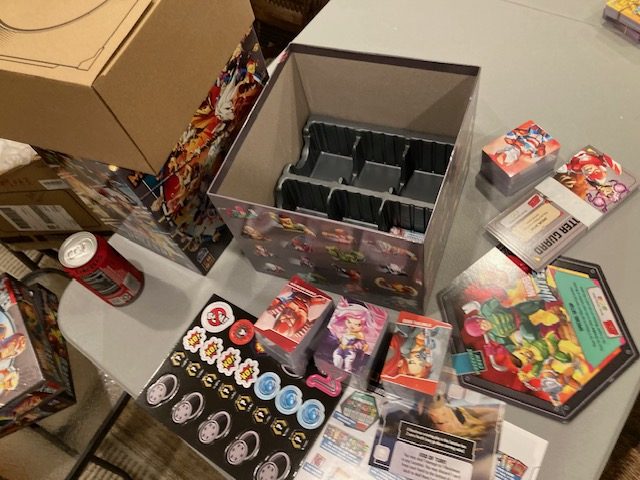
The bigger box comes with a bunch of expansions: Coming of the Galactus (which we reviewed a few weeks ago), War of Kings, Age of Apocalypse, World War Hulk, Annihilation, Maximum Carnage, Civil War, and Secret Invasion. Whew! That’s right: eachone of those is an expansion for Marvel United!
We aren’t done yet! The other box comes with the Stretch Goals (the big box with more heroes and villains), The base Game Marvel Multiverse, Campaign Decks, Team Decks, Pet Companions, and a few other Stretch goals! Oh, and how can we forget Fin Fang Foom? Whew!!
Is This Ridiculous?
Yes. Yes, this is ridiculous. Do you want to know why? I still have about 10 of the original Marvel United expansions STILL IN SHRINK WRAP! I am super excited to play The Sinister Six! Thanos! Asgard! And yet, they are still in shrink wrap. And here I am, ordering 7 new expansion, 1 new base game, and a bunch of other extras.
Why do I do it? I love my Super Heroes. I know, someday, I will play all of them. Even if I am in the Old Folks home playing through them, I will play through them. I actually think I will.
In the meantime, I am trying to enjoy what I have when I can.
Stretch Goals Unboxing
The Stretch Goals box is pretty mammoth.
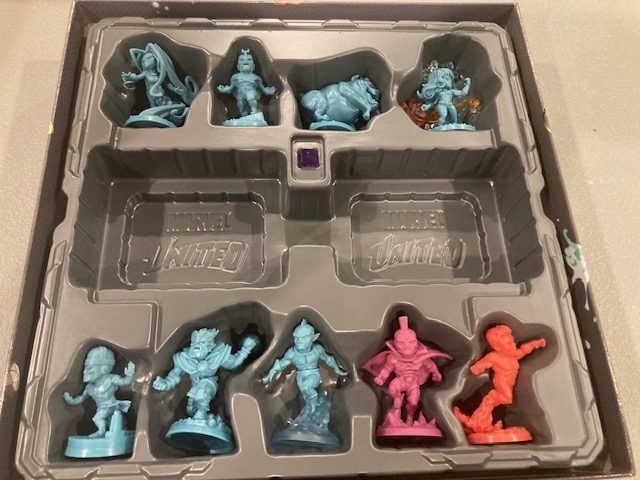
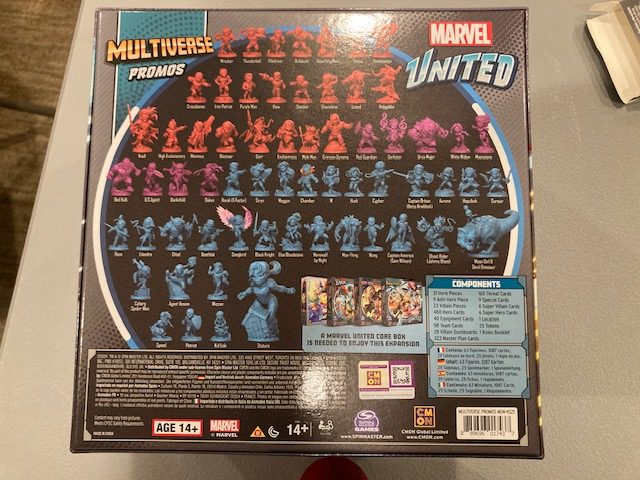
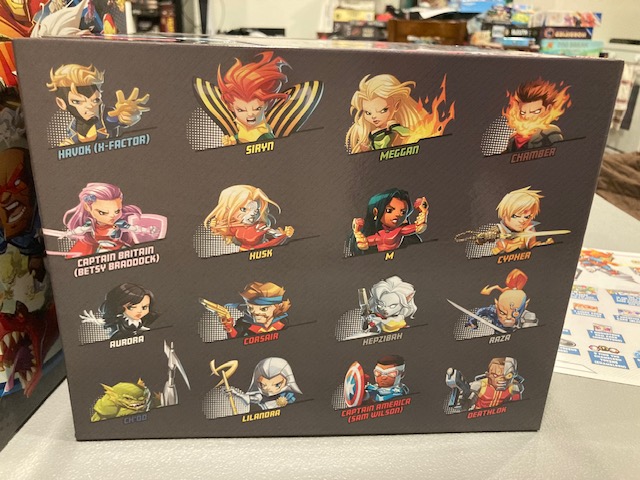
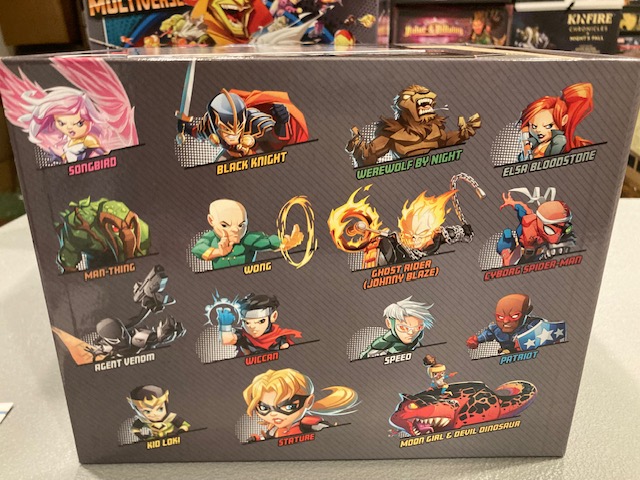
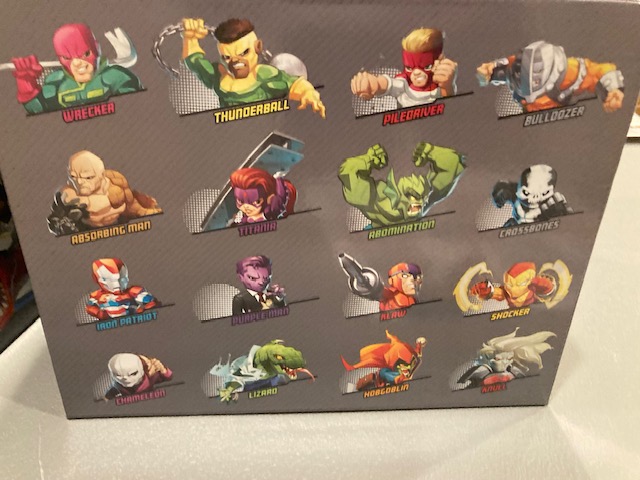
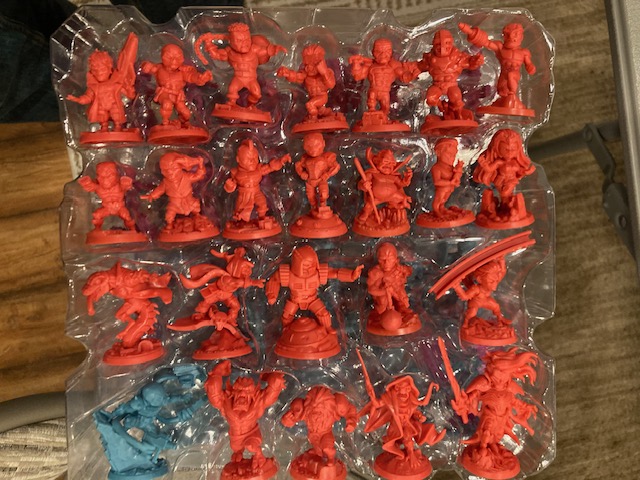
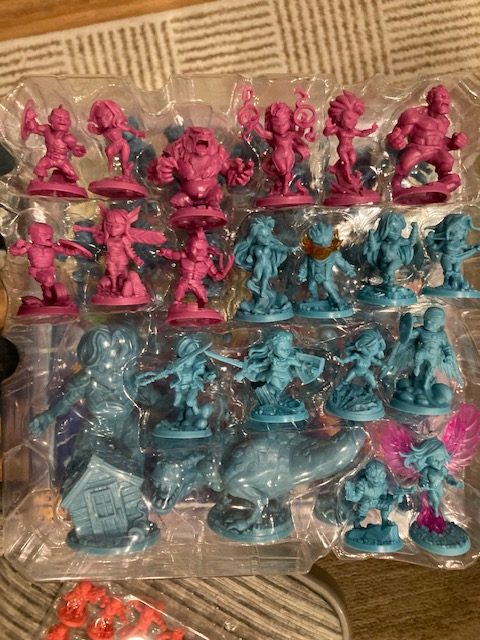
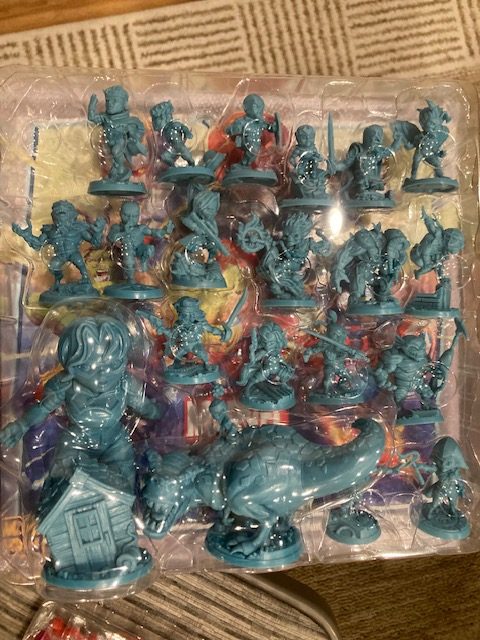
Look at how many new heroes and villains we have! Holy Cow!
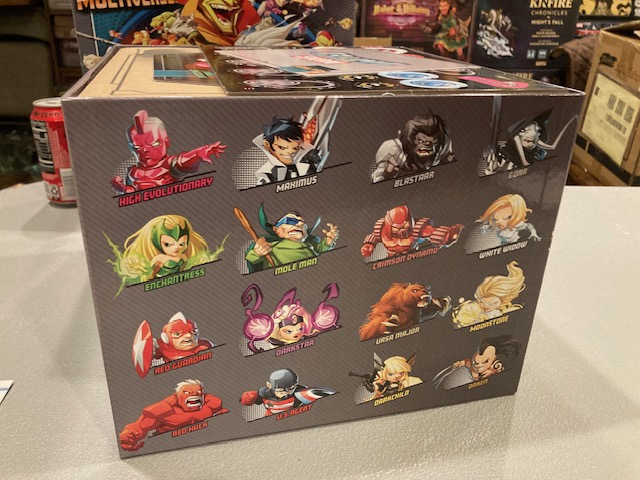
The four sides of the box (after the lid has been taken off) so all the heroes and villains in play here!
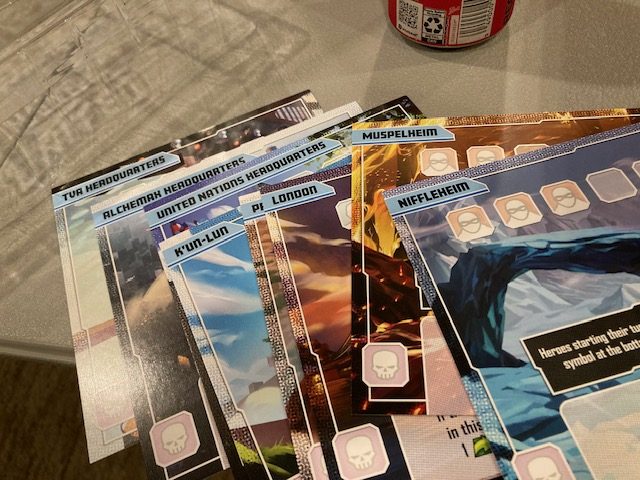
The Stretch Goals box has a new mat (for a new Wrecking Crew play), some new Locations, some new Tokens, and a few new rules (see the rulebook above).
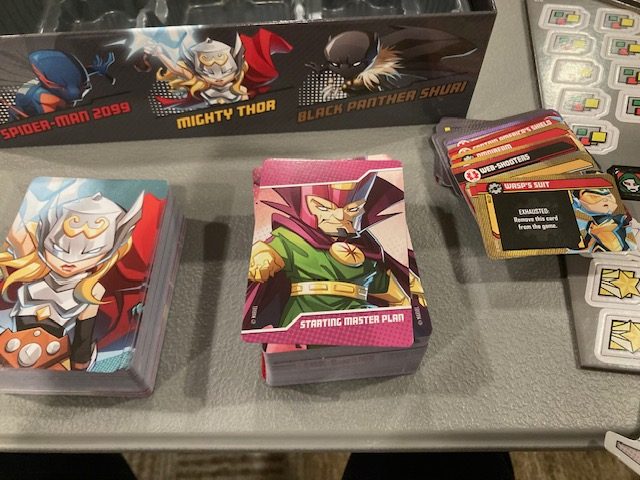
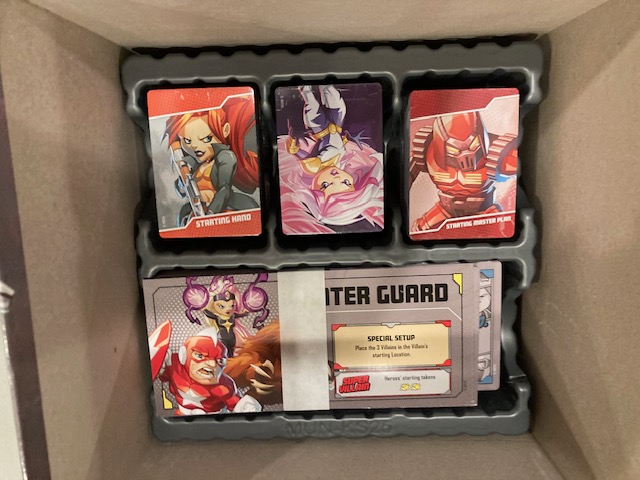
Underneath the minis are all the cards: heroes and villains.
There are SO MANY cards in the Stretch Goals box.
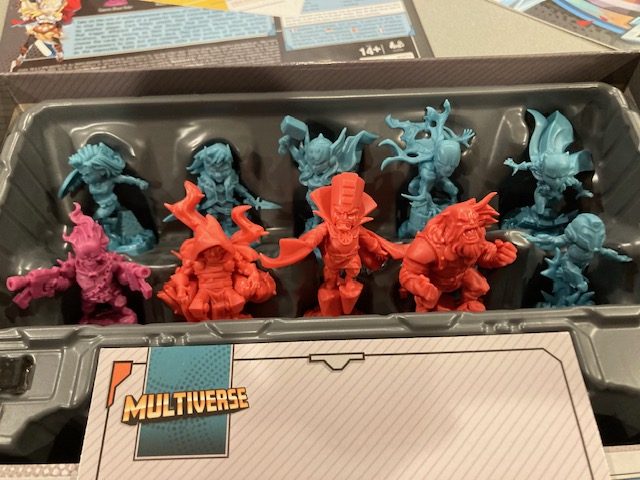
The top-level (3 levels of minis) are the villains (red) and one hero (blue).
The middle layer is a mix of heroes (blue) and anti-heroes (purple: characters that can be either villains or heroes).
The bottom layer is all heroes. Note that Cassie from Ant-man is a HUGE mini, as is Moon Girl and Devil Dinosaur.
The upper left corner is empty!!! What’s that supposed to be?
Relax, It’s just Iron Lad: it’s included as a special Stretch Goal box.
Oh my goodness, there are so many cards. So many heroes. So many villains.
Playing From the Multiverse Stretch Goals
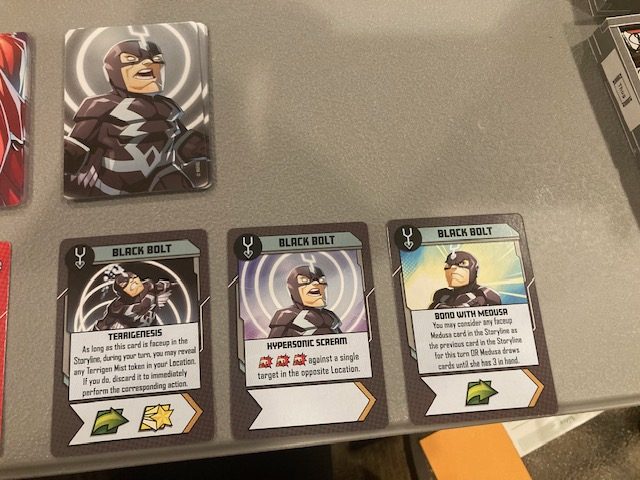
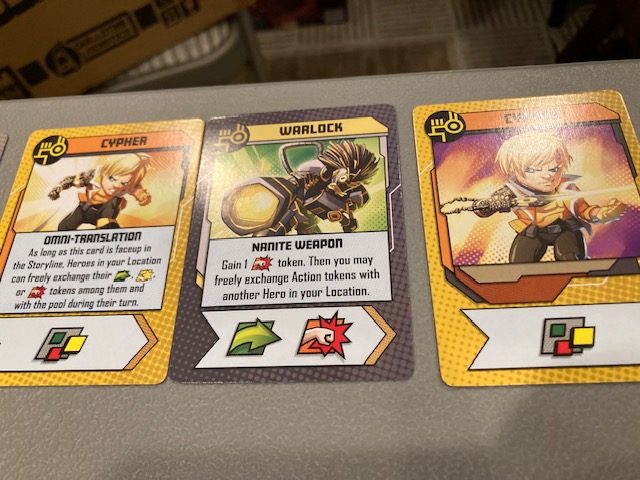
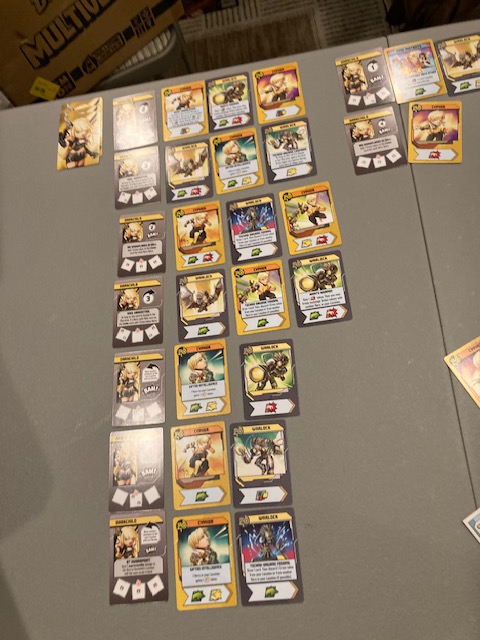
Cypher is new in this box. He is a New Mutants character that was killed off.
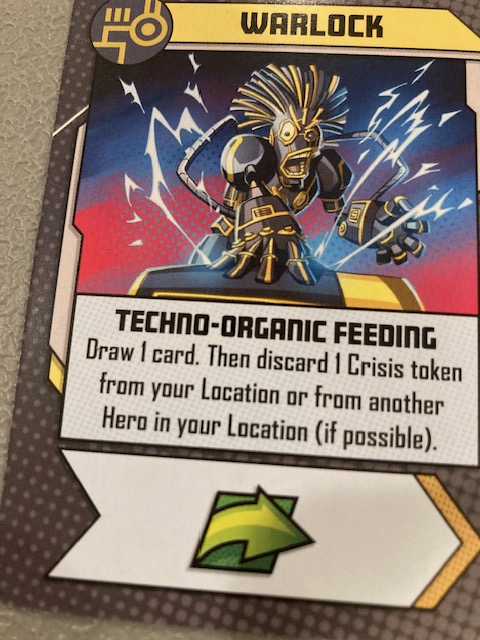
Even though Warlock comes from the previous set, he seems the proper character to team-up with Cypher: there were inseparable in the New Mutants.
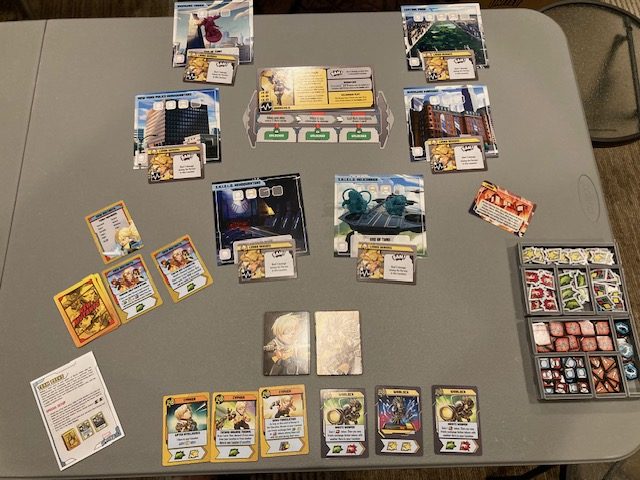
Who are they fighting? Illyana … err, Darkchild … she went a little “bad” for a while. But it’s up to Cypher and Warlock to bring her back to sanity! Darkchild is an anti-hero in the new Multiverse set.
I had a fabulous time playing my old friends (well, they felt like old friends) and trying to bring Illyana back from the dark side!
In the original Absorption Expansion mess, I was worried about how well “untried” combinations would work together; recall, we have some trouble with Emma Frost. Part of the issue is just that there are so many heroes and power and villains and new things, I do worry that they may not work well together.
Luckily, most of my games from this set so far have seemed fairly balanced.
Team Decks
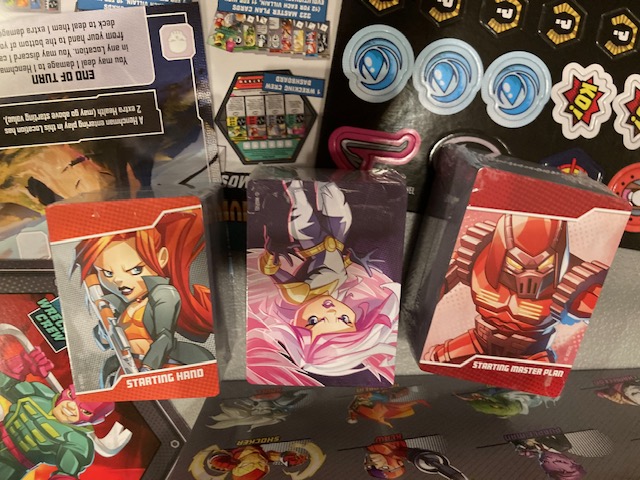
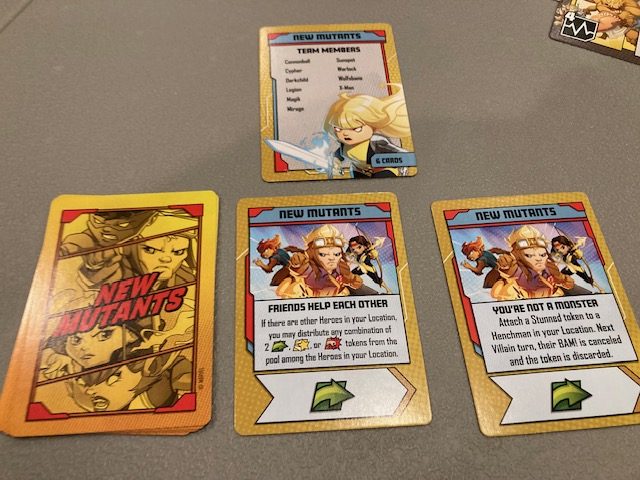
The Team Decks are a new way to give you more choice! Basically, there are “two extra” choices you can use on your turn; instead of your own cards, you can choose to not draw and just use one the Team Deck cards instead (there are usually 6 Team Cards total).
There’s a price to use the Team Decks … well, two prices … well, three prices … 1) All members of the team have to get rid of the double-double wild card from their deck (for balance). 2) There is also a “bad” Team Deck card, where you have to play it facedown to the storyline to get rid of it! 3) You actually have to be a member of that team …
The Team Decks adds a little more “drama” to the game, but it also adds more choices! It’s not affected by KO’d effects, it’s just another option in case you don’t have quite what you need.
I liked the idea of Team Decks; it simply adds more choice to the game.
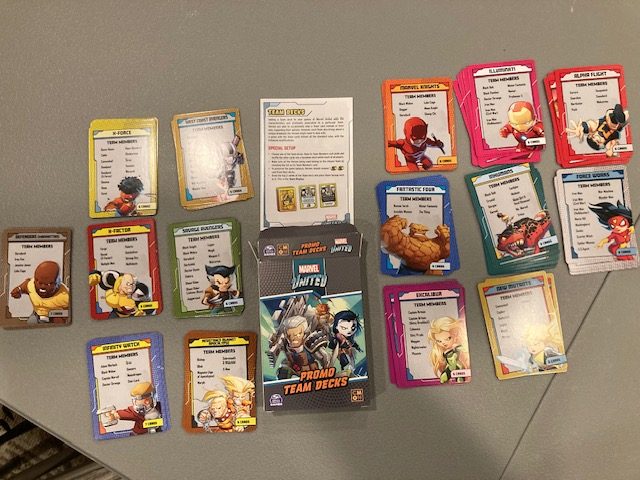
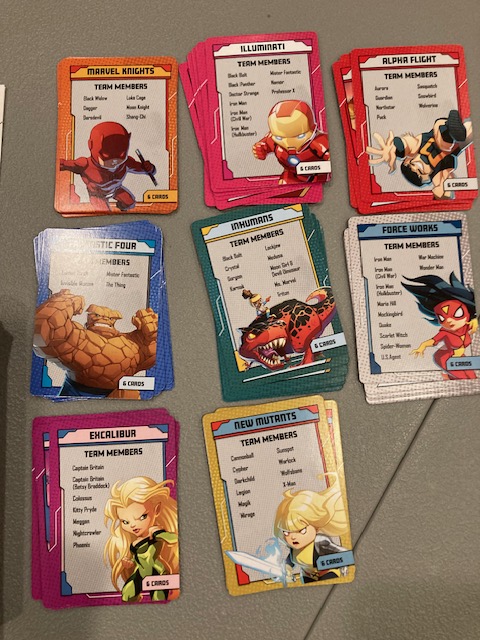
The New Mutants Team Deck was in the Promo Team Packs, but there are several other Team Decks … like tons of Teams and Team Decks.
I would recommend the Team Decks to “add some spice” to your Marvel United games. Find a group of heroes you like, and use Team Decks! I wouldn’t recommend using the Team Decks unless you are fairly experienced: Team Decks may throw off new-comers off for their first few games.
Help! I’m Drowning, But In a Good Way!
I am very happy I got the new Marvel United Multiverse set, despite the fact that I am drowning in Marvel United content. Find me when I am in the Old Folks home in a number of years, and I’d be happy to play any of the Marvel United expansions that are still in shrink at that point … I mean, I promise I will play them eventually … the good news is that they will still be playable for many years to come!
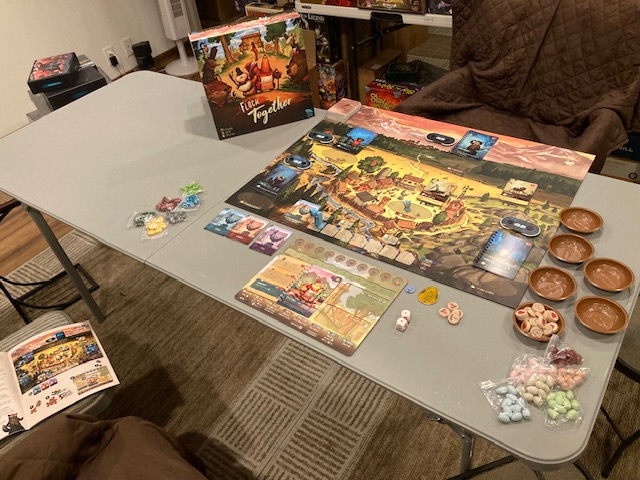
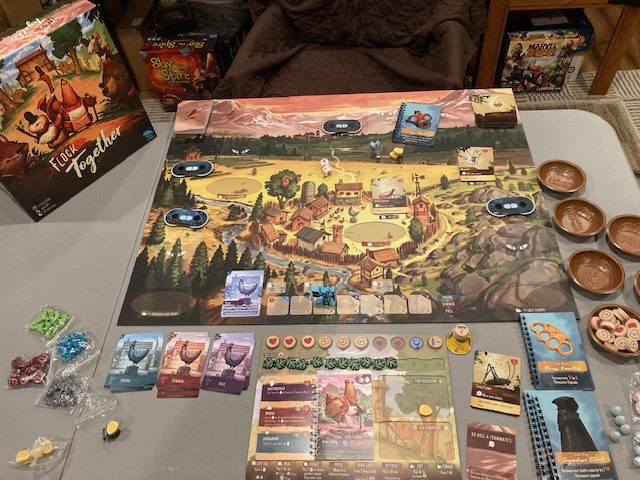
Defenders of the Wild is a cooperative tactical fighting game that was on Kickstarter back in October 2023. It promised delivery in August 2024, and lo and behold, it arrived at my house in early August 2024! A Kickstarter that delivers on time! That never happens!
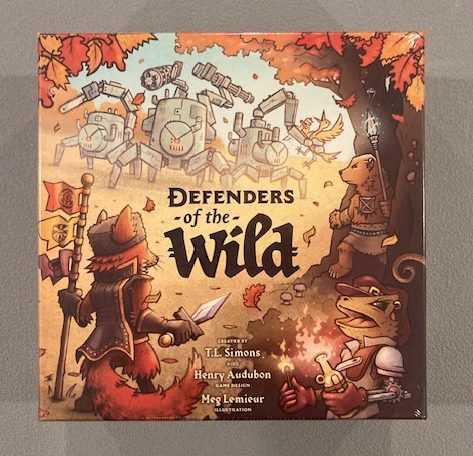
I was initially drawn to this game because of the art. See above: The art of Meg Lemieur permeates the game and it is gorgeous. I think that art is a big component of why this made the #9 spot on my Top 10 Anticipated Cooperative Games of 2024!
The game looks to be something like a cooperative version of Root: cute animals are at war … not with each other, but with the machines threatening to take over the forest!
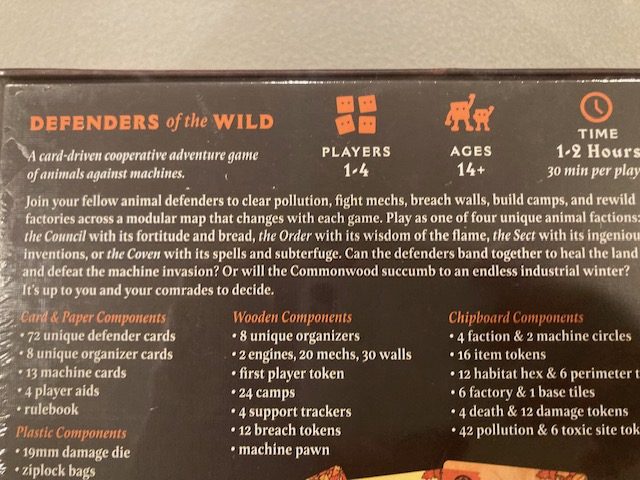
This looks to be a cooperative game with some strategy and tactics.
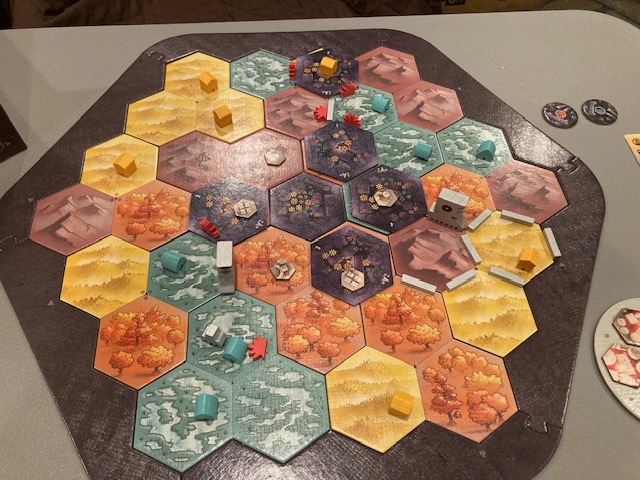
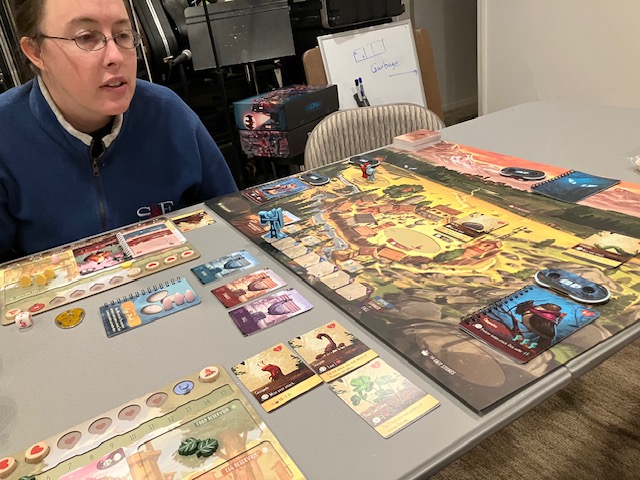
I see a hex map (see above) and the game immediately has a war game quality to it. And that’s not a wrong assessment for this; Defenders of the Wild has elements of a cooperative war game.
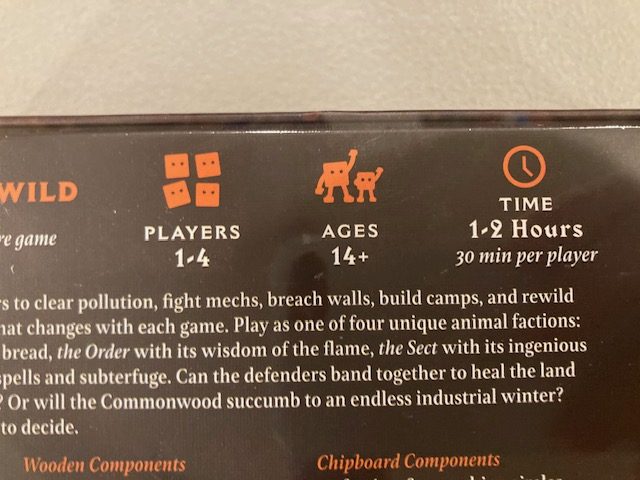
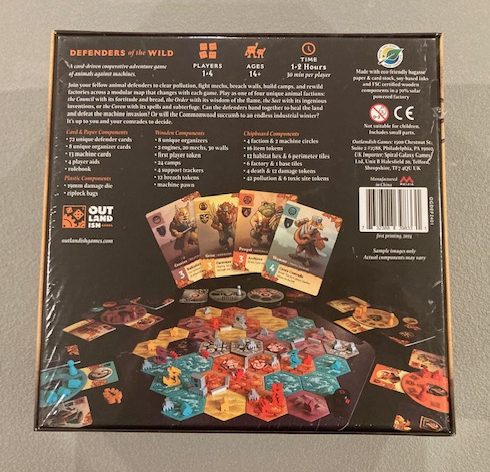
This a slightly deeper and more technical game than some cooperative games, so the 14+ age requirement is fairly accurate. Most of my playtimes have been about 20% longer than listed (maybe 1 hour 20 minutes or so), but the play time on the box is still fairly accurate. I have also played the game at 1, 2, and 3 players, and it seems to work at all those player counts.
Let’s take a closer look!
Unboxing and Gameplay
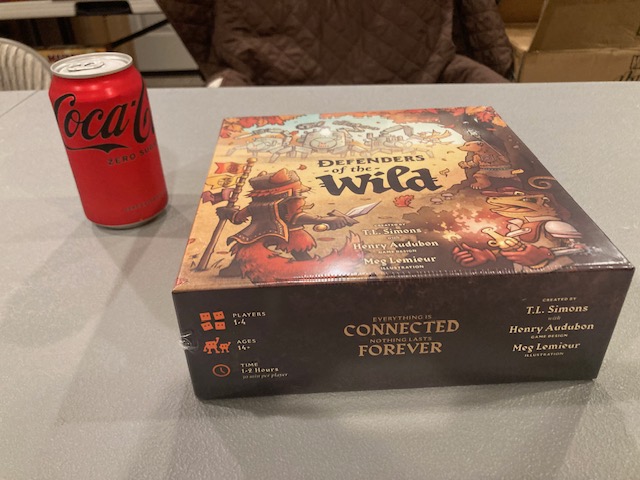
I was surprised when Defenders of the Wild arrived: it’s a smaller box than I expected! See above and below with a Coke can for scale.
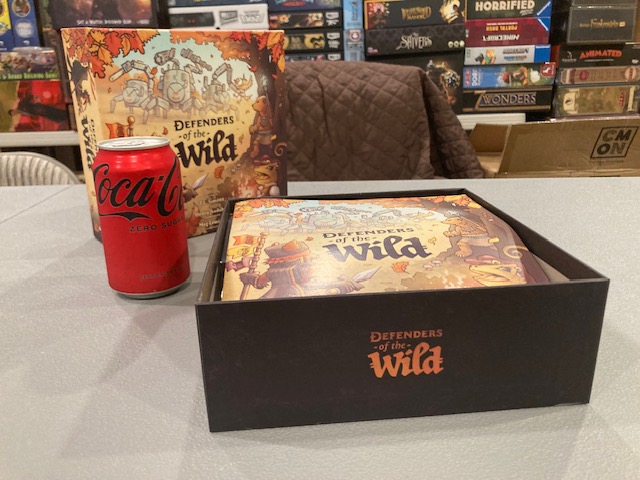
Despite the smaller size, the game is gorgeous.
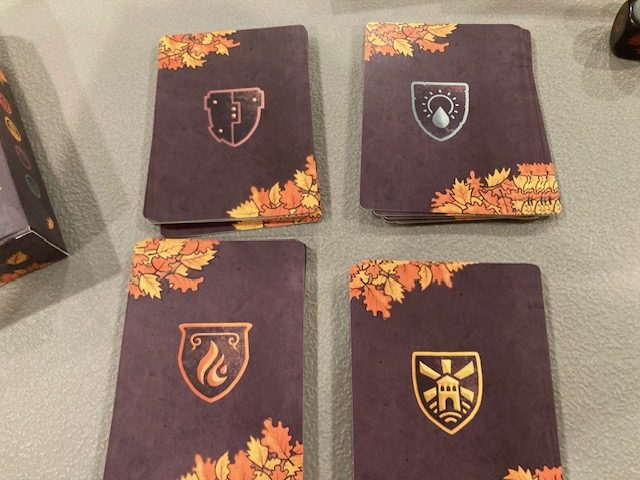
In the game, each player chooses one of 4 factions to play: the factions define which deck of cards you get (see above) and the tokens you get (see below).
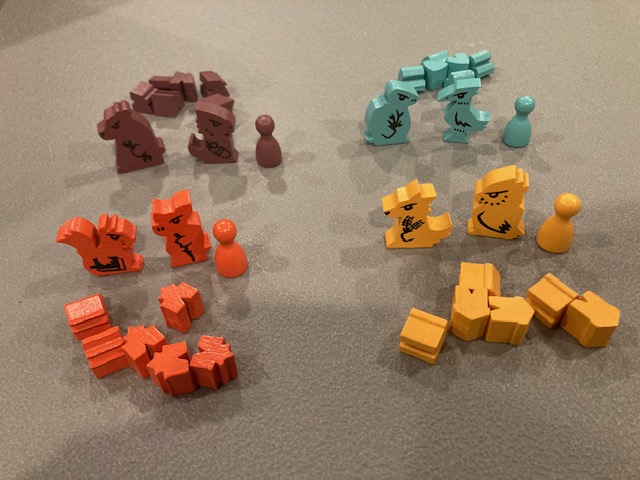
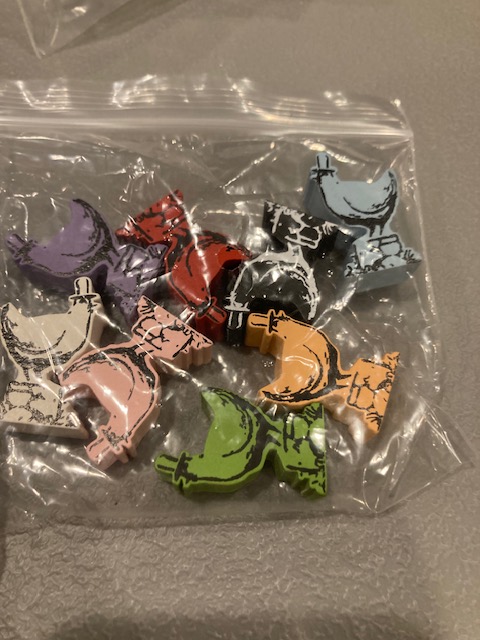
You can see why a Root comparison is obvious here with the cutesy but fighty meeples (above). Even the colors of the meeples seem to imply Root.
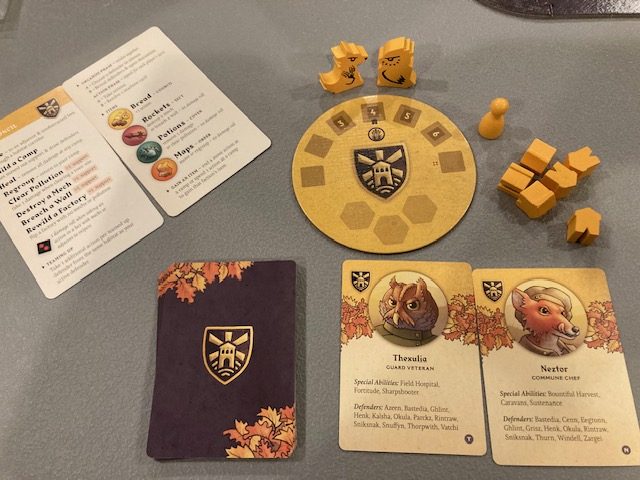
Each player then grabs up their player board, cards, camp, and chooses one of the two Organizers: the Organizers (see Thexuloa and Nextor above) are the “leaders” of your faction, and form the flavor of the Defender deck you get.
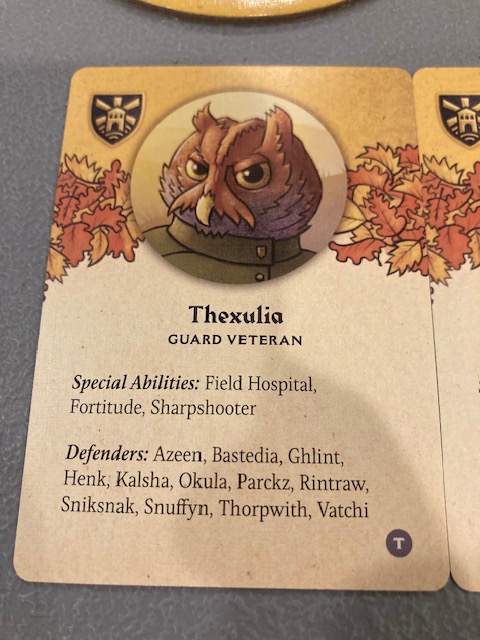
You don’t get all the Defenders from a deck: you only get a subset. If you choose Thexulia, you get the Defenders listed above.
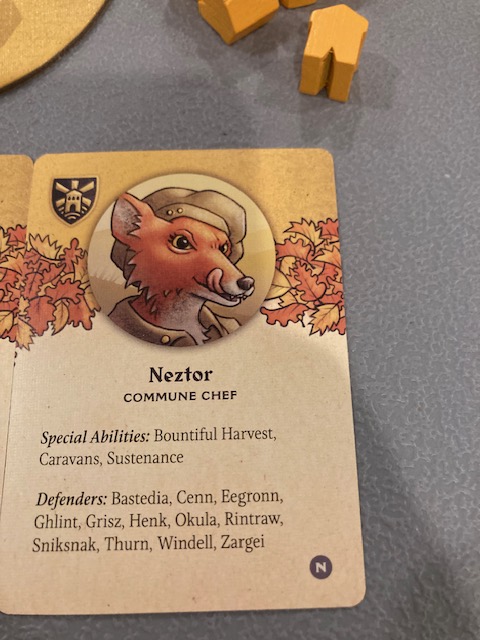
Nextor (above) gives your Defenders deck a slightly different flavor from the same deck of Defenders.
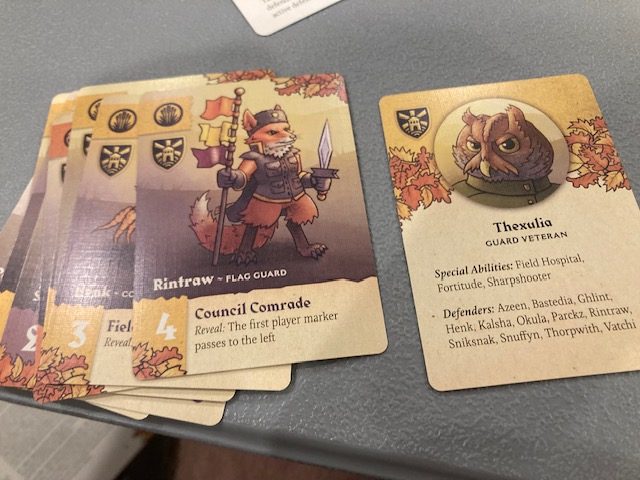
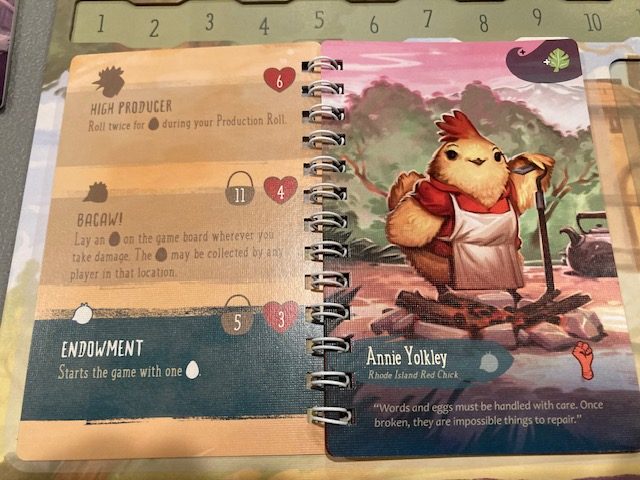
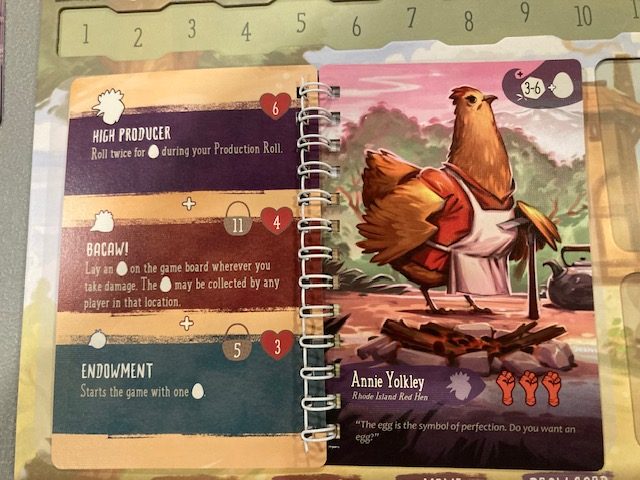
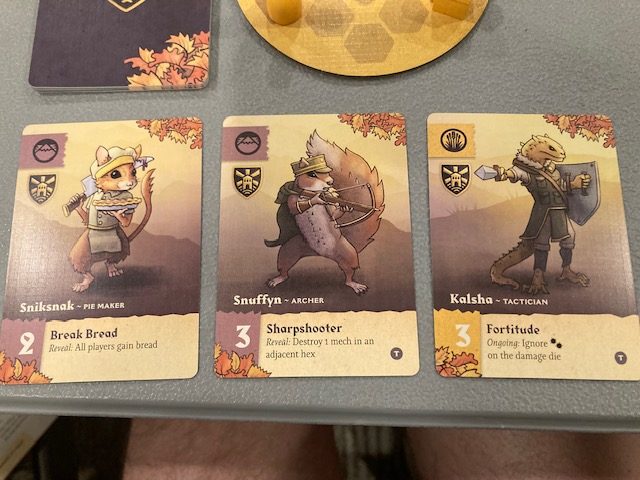
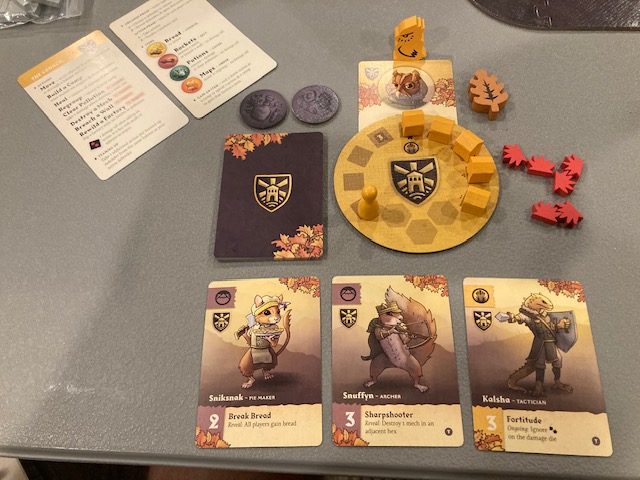
The Defenders (like Rintraw above) are the cards you play during the game. You have twelve Defenders that you cycle through (and then reshuffle if needed).
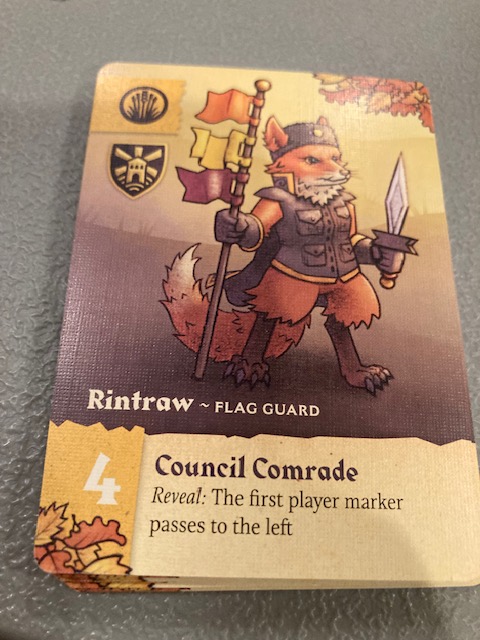
Every turn, you must play a Defender: each Defender gives you three things (See Rintraw above as an example): 1) The number of action points (lower left: 4 for Rintraw above): how many actions can you do that turn? 2) Preferred terrain (upper left: Plains for Rintraw): what terrain do you travel best through? 3) Special: when you reveal “something” usually happens (bottom of card): what happens when I reveal the card? Depending on where you are in the game, you will have three or fewer Defenders to choose from: see above as we have a full complement of Defenders.
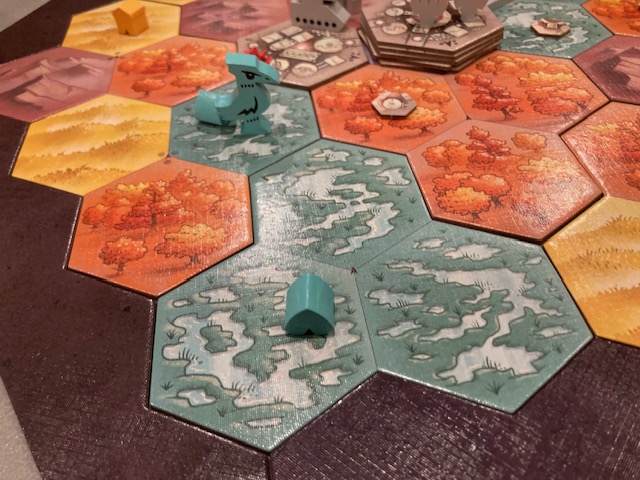
You DO NOT get a new Defender card every turn: you ONLY draw back to your hand limit (3) when you build a new camp! See above as the Zyrinn prepares to build a camp and get her three Defenders back! You must be building all the time to get your Defenders back!
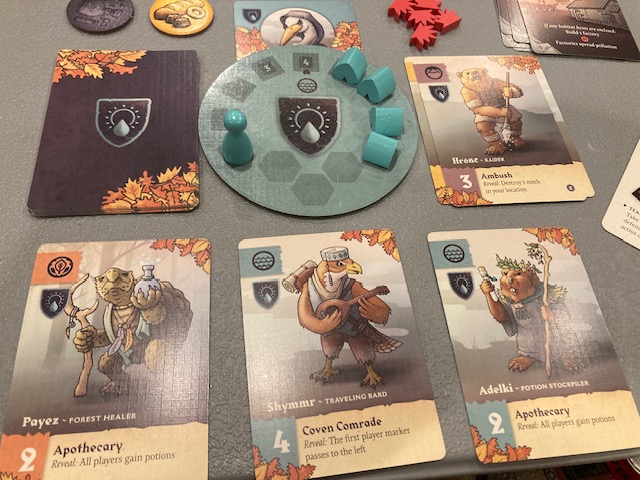
You can only build a camp if you have enough “support” in the game: The little pawn on the circular support board above denotes “how much support” you have: you can’t build a camp until the pawn reaches the next campsite!
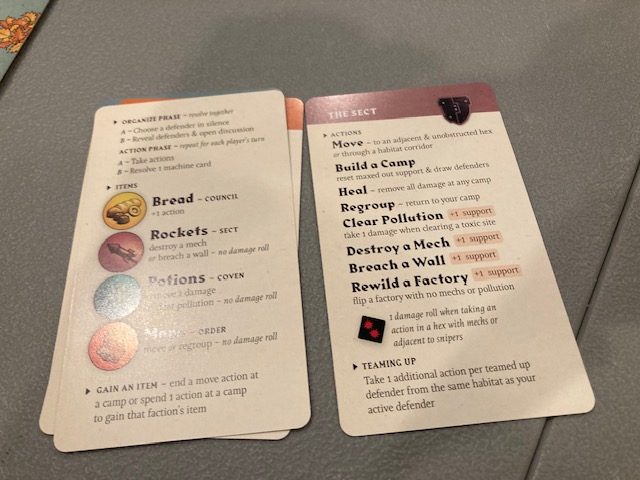
How do you get support? A bunch of actions each give you one support: see the Summary cards above! Every time you Clear Pollution, Destroy a Mech, Breach a Wall, Rewild a Factory, you get a +1 support and your pawn moves forward closer to a camp.
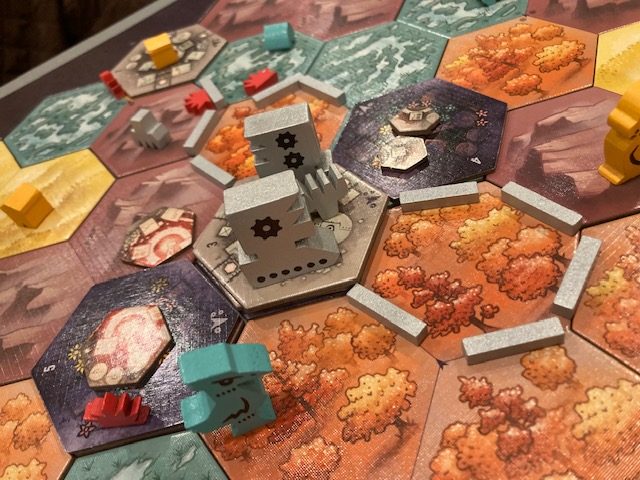
This is a tactical game (with some strategy): players will be moving around the map cleaning up the pollution (the little hexes), taking out Mechs (the small silver claws) and breaching walls built by the machines!
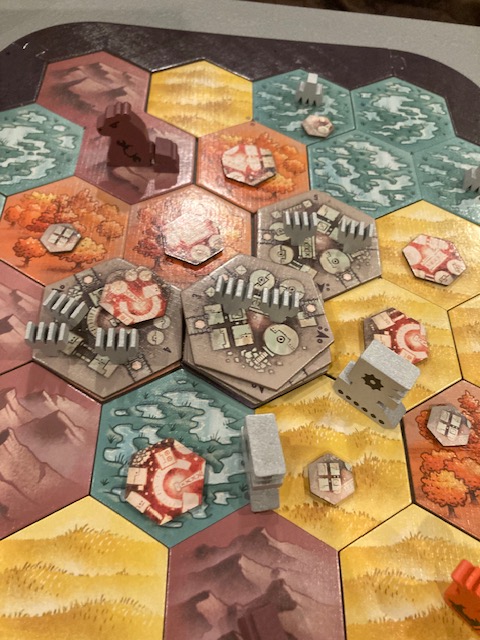
This is a game about cleaning up the wilds: the pollution, toxic waste, the mechs, and the factories. Players loses if too much of the forest becomes toxic, a factory needs to be built and there’s no more, or 2 Defenders from the same Habitat are killed.
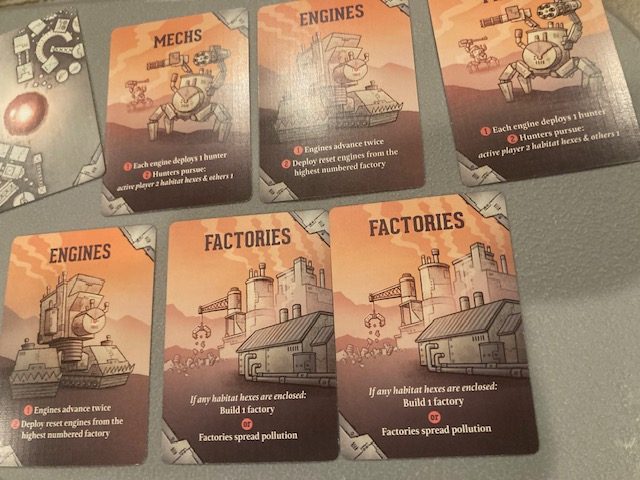
How do factories, mechs, and pollution come about? From the Machine cards: see above. One machine card comes out after every turn and builds factories, spreads pollution, or generates more mechs. The same 7 cards are shuffled and come out over and over. Each Machine card is very distinct and generates “bad stuff” in a very particular way.
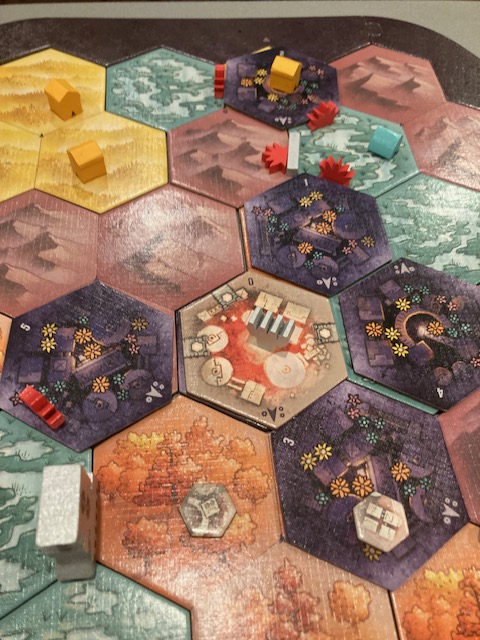
Players win if they “rewild” all of the 5 the 5 factories (see the purple hexes above: they used to be factories) and build all of their camps!
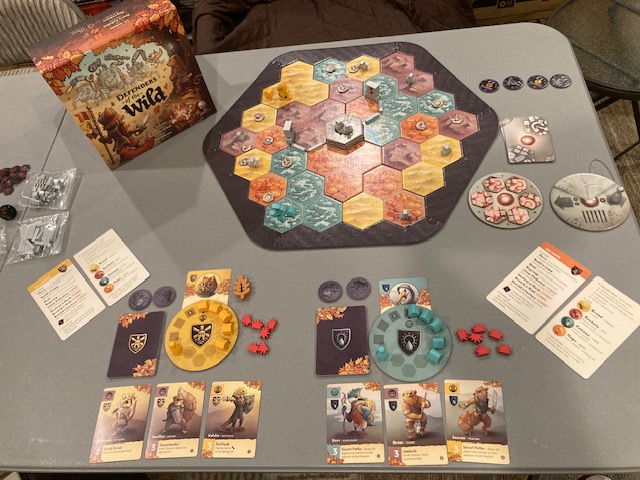
The game has beautiful art and a very good production.
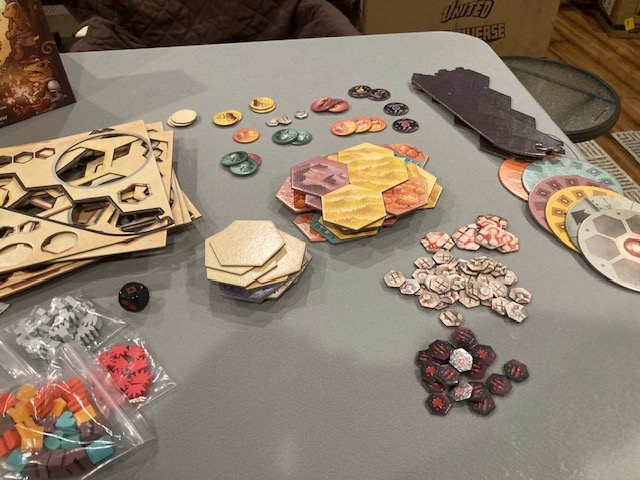
The components are high-quality with 1) wooden meeples, camps, and organizers 2) linen-finished cards 3) thick cardboard hexes 4) beautiful art
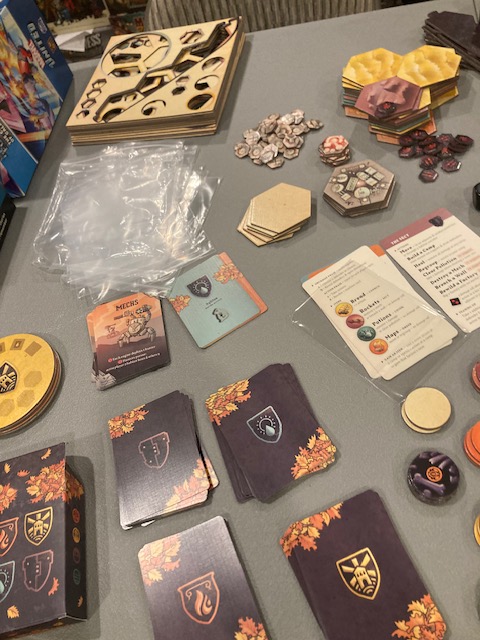
The game unboxes and makes you think: “This game looks cool“.
Rulebook
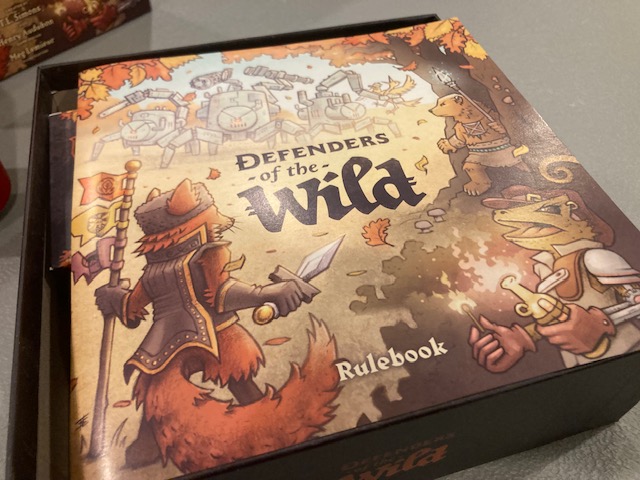
The rulebook is okay. There are certain things I really like about it, and certain things I really don’t.
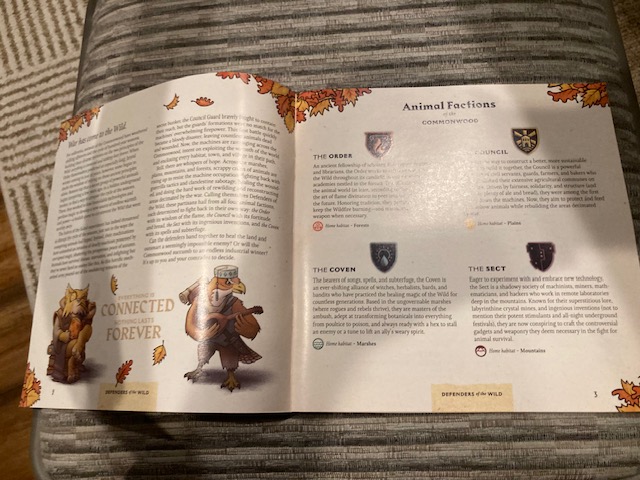
It gets a B- on the Chair Test: The font and form factor are both a little small, so it’s a little harder to see it on the chair text to me. Also, there is a lot of text in the book (see above): it really needed more accompanying pictures. But, it stays in the B range because the rulebook does NOT flop over the edges: it stays open and I can consult it on the chair next to me.
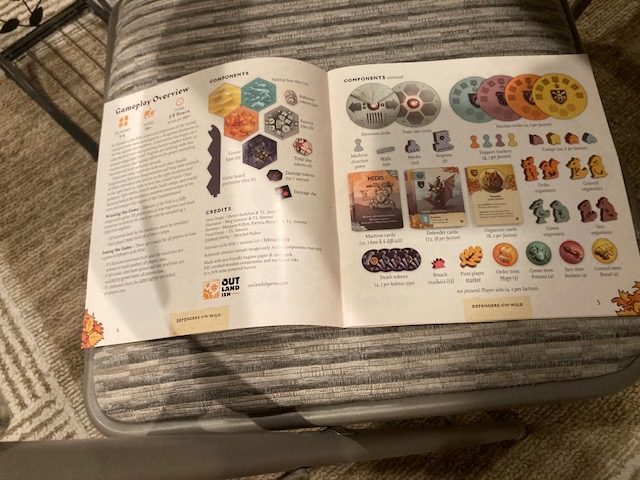
The Components page is great: it shows all the components and marks them so you can correlate the stuff. Good job!
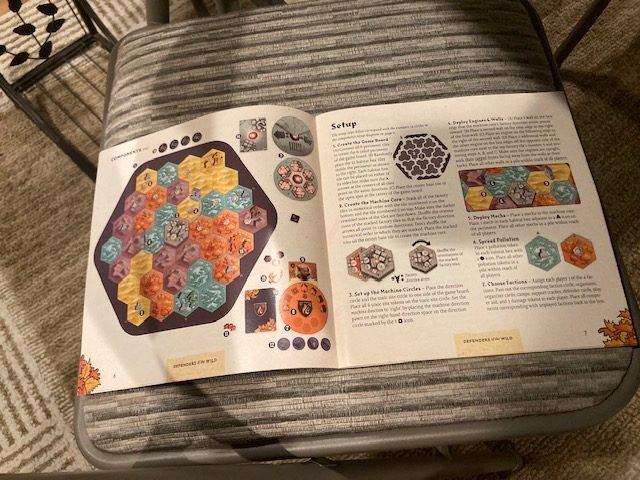
The set-up is pretty good, but it has some flaws. For one, there’s a lot of text, especially since it spills over in the next page.
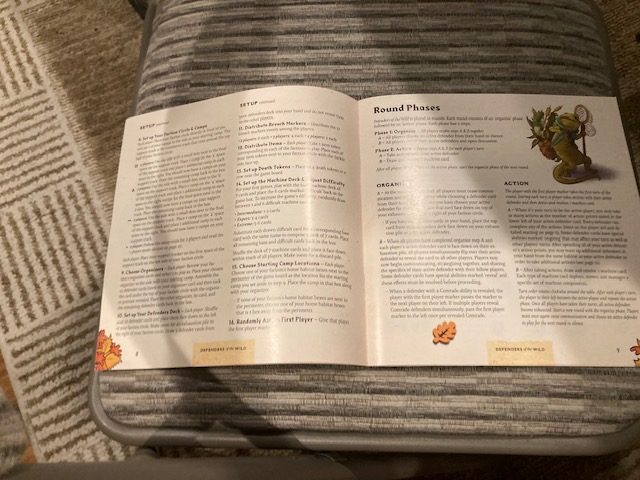
There is generally a lot of text in the rulebook (see above); it feels like a few more pictures would have helped. Also, sometimes the rulebook reads like a legal document.
An index would have been nice; there’s a lot of rules in this rulebook.
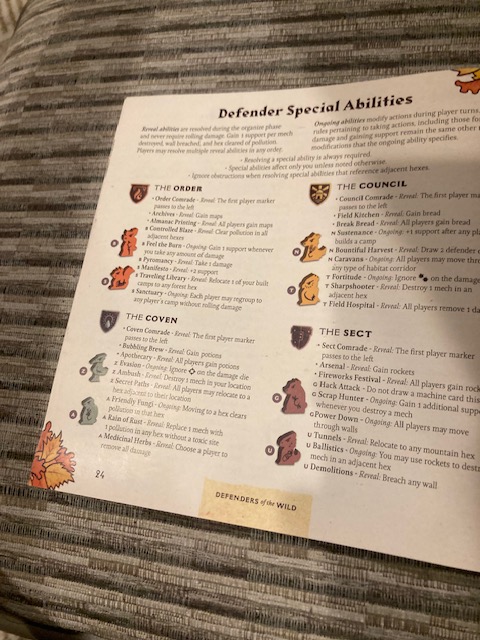
The rulebook ends with a description of the cards/Defenders in each deck. This wasn’t the most useful thing to put on the back because the descriptions don’t say anything more than the cards. I would have preferred a glossary or something close to an index.
The rulebook was very text-heavy, needed some more pictures, needed a few more elaborations (see sections below), and it probably needed a glossary or index (as it’s very rules heavy). It was ok. I was able to learn the game from the rulebook pretty well, but it took a few tries.
Solo Plays
Defenders of the Wild supports solo play (congratulations for following Saunders’ Law). See the back of the box above.
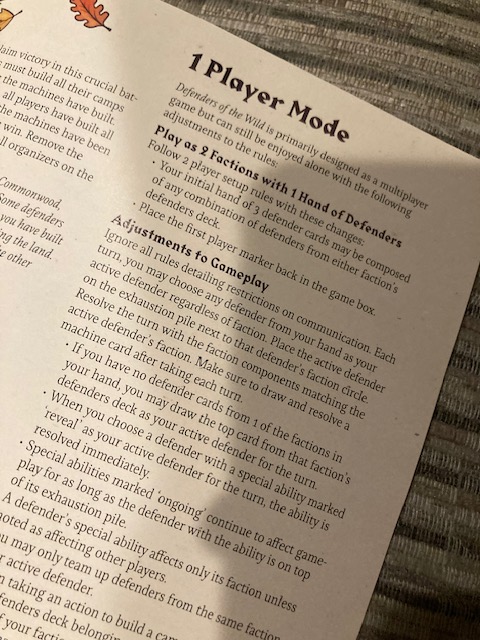
Unfortunately, the solo rules take up half of a page, full of rules that are exceptions to the base game. See above. The basic idea is that you play as a 2-Player game, but with some non-standard way of handling the Defender cards.
This game has so very many rules, I can’t recommend throwing another set of rules at the solo player. I ended up just playing all my solo games as a two-handed two-player game, where I alternated between players like a normal 2-player game. There are no exceptional rules when you play two-handed two-player; the game plays normally and this seemed to work just fine. For your first learning game, I absolutely recommend playing this way: there are far too many rules for you to be throwing another half-page of new rules at the players.
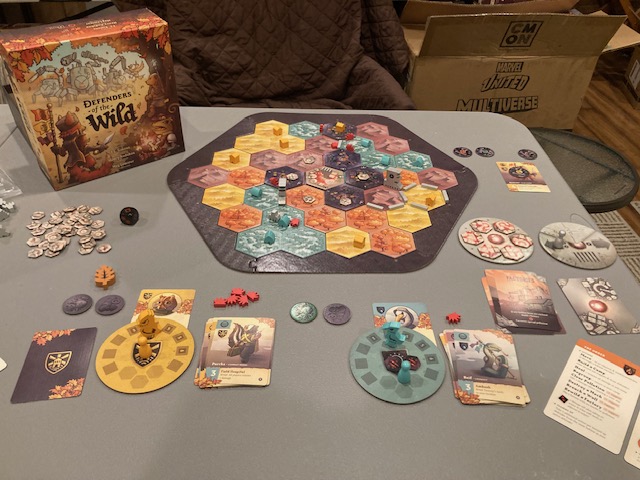
My first solo game ended in a win, as I rewilded all the factories without dying! See above. BUT, as it turns out, I got a lot of rules wrong. It took me about four (five?) gameplays to get all the rules down; there are a lot of rules in this game.
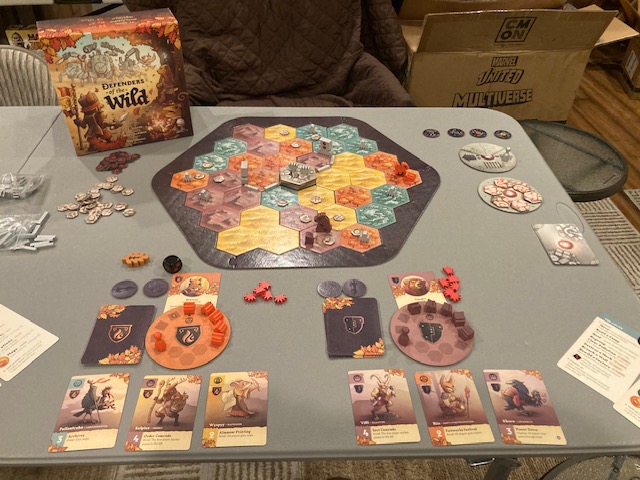
My second and third solo games were pretty rotten.
I got smashed by toxic waste in my second game (when three pollutions congregate on a single spot, it turns into toxic waste). Too many toxic wastes came out, and I just lost quickly! It was very depressing.
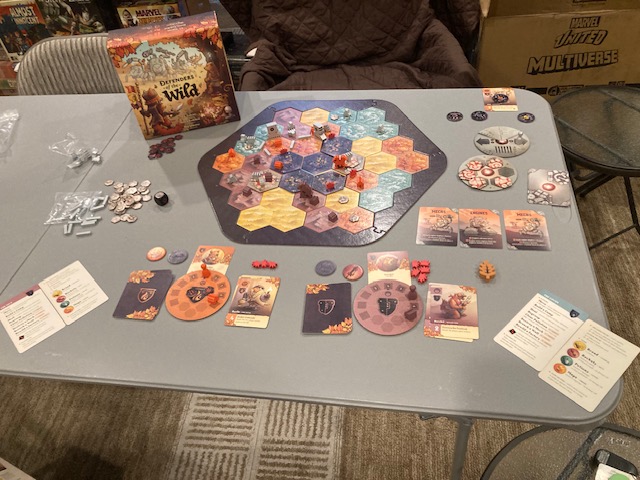
My third game, where I got most of the rules right, was a defeat as my second Defender got crushed (recall: you lose if a SECOND Defender from a faction dies). I started to get the cadence of the game by the third game, as I was close to a win: I had one factory left.
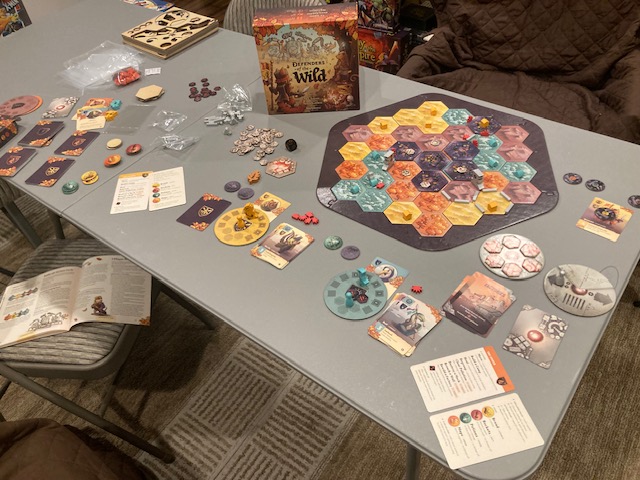
Unfortunately, my loss on the third game had me worried that the game might be too random. Whether I won or lost depended on just a few die rolls or card flips.
Cooperative Games
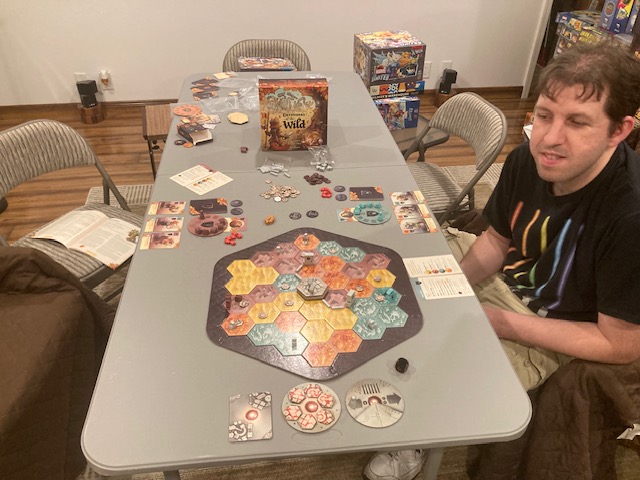
My first cooperative play (after 3 solo games) was a 2-Player game with Sam. There were still one or two rules I was getting wrong: having Sam there forced me to rethink/resolve some of those.
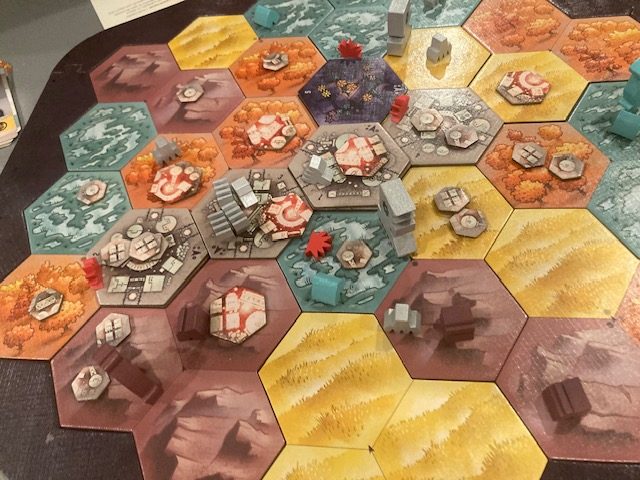
Our 2-Player game was also lost by too much Toxic Waste: see above. We couldn’t get into the Factories to rewild them (for various reasons), so the Build Factories action becomes “spew pollution” when there is no enclosed space for a factory.
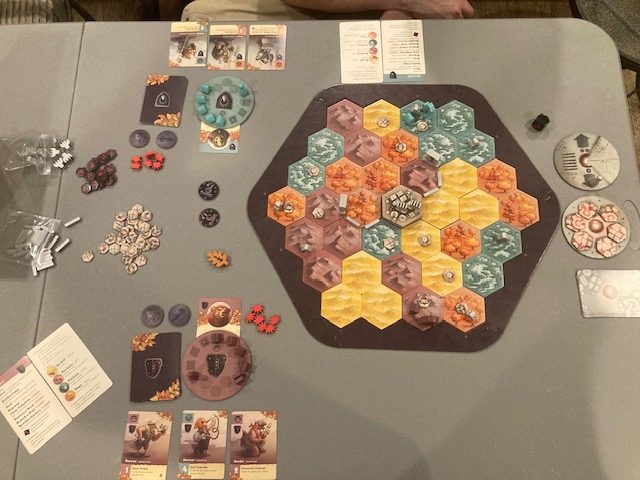
We were doing “okay” in the game until the Bad News (the Machine cards) just seemed to conspire against us: we had 4 factories built in so many rounds, then pollution just spilled out as we couldn’t clean up or shut them down. It was very depressing. We didn’t feel like we could do anything about it.
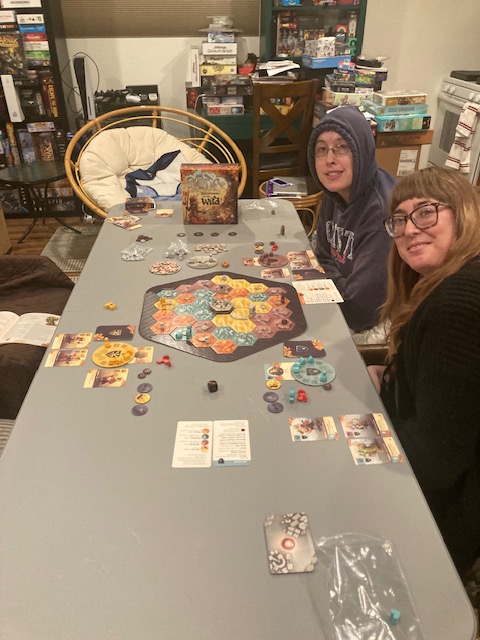
My next cooperative game was a 3-Player game.
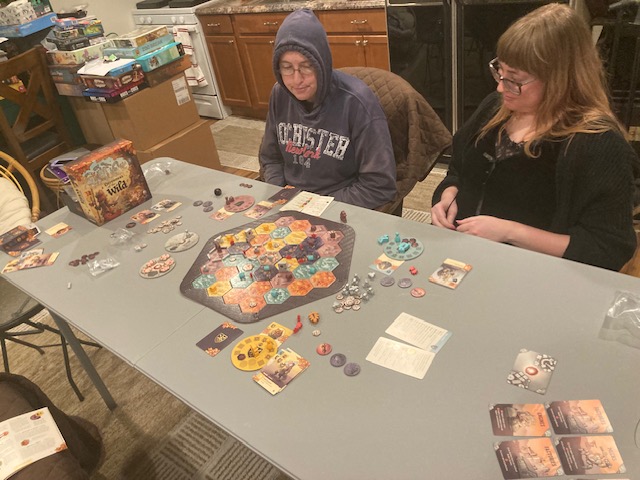
Even after five games under our belt (solo and co-op), we were still “discovering” or “reinterpreting” the rules.
For example: You lose if you can’t build the final factory, but what does that mean? Does there have to be an enclosed area out (we think so, but we weren’t sure)?
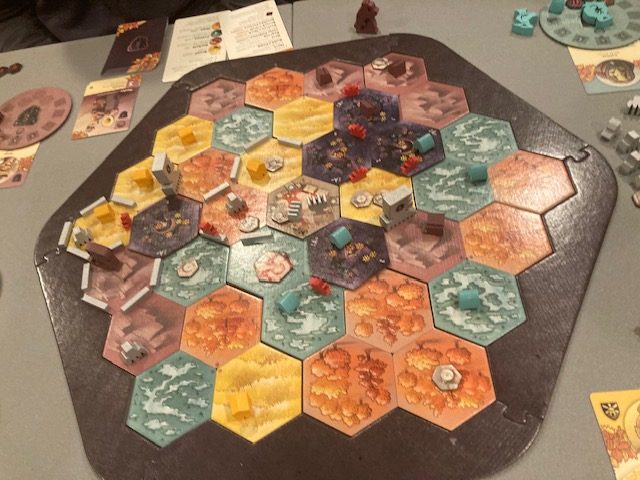
Our game ended in a loss because of one card flip: we had no way to mitigate the Machine card that came out! All Teresa had to do was use one action to build her final camp, and we lost because of the way the Machine cards came out. I suppose it was suspenseful that we lost on a final Machine card, but it felt anti-climactic. “Oh, we lost because of something random we can’t do anything about?”
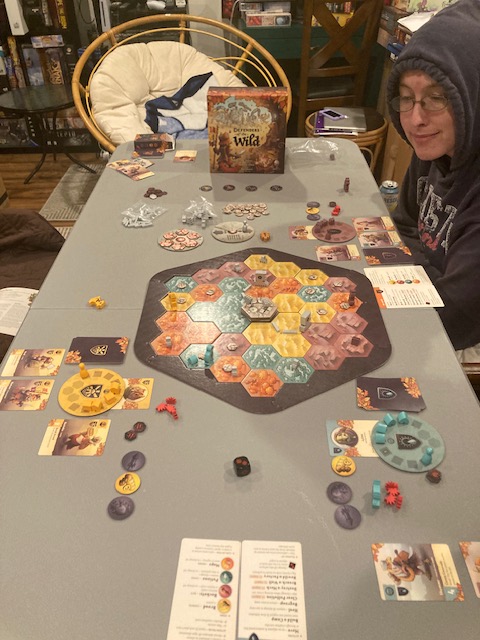
One thing I will say: the game feels “easier” with more players. Why? You have more Defenders that can die (6 = 3 * 2 for a 3-Player game), you have more camps on the board where you can rest or gain tokens at (as the camps are much more likely to be in reach with more players, as there are more of them), and Defender cards that help all players help more players, and there’s more “reach” as players can spread out to get the Factories/Pollution/Toxic Waste under control quicker.
In a 1 and 2-Player game, I/We struggled hard to get stuff done, to move, to clean, to build. In a 3-Player game, it seemed a little easier to get stuff done.
What I Liked
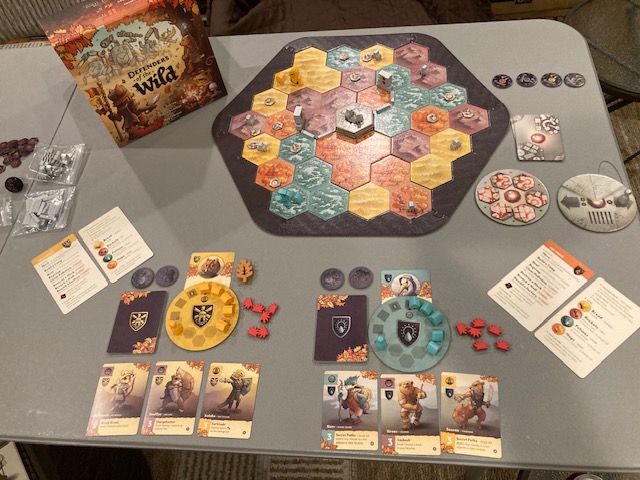
One: This game looks good on the table and the components are high quality.
Two: I like how the woodland creatures are well-colored coded and consistent, and the Mechs are all silver and metallic. It’s very clear what are the natural forest pieces, and what are the metal intruders.
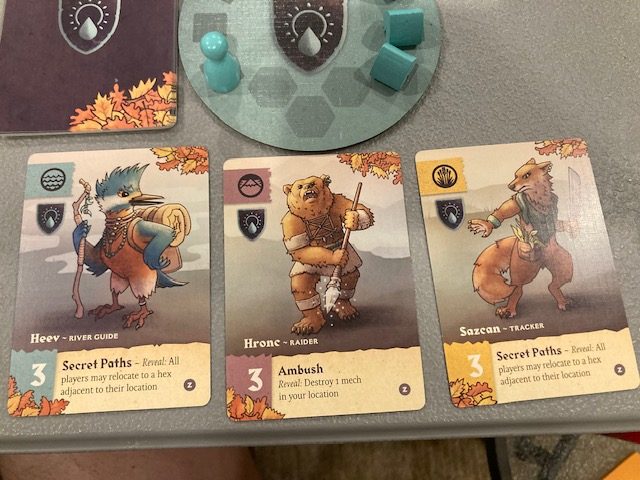
Three: I love the art in this game. Meg Lemieur knocked it out of the park.
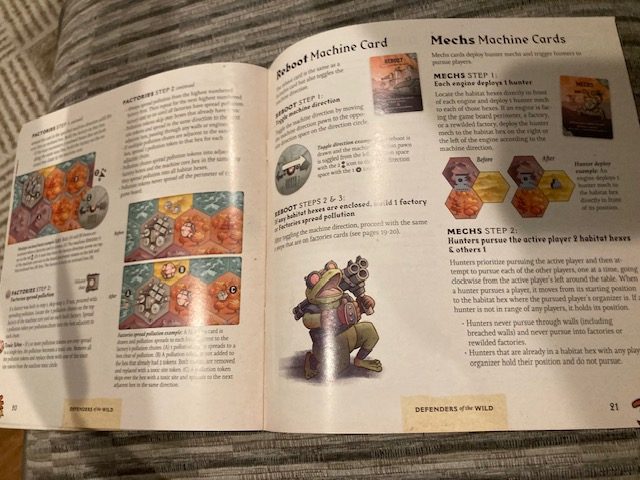
Four: This rulebook isn’t great, as it misses some elaborations/descriptions of rules, but it does something that most cooperative games don’t do: Defenders of the Wild tries to specify what happens in all edge cases when there are questions. Most cooperative games just throw their hands up in the air and say “players just choose something together if there’s a question” … which I always think is a cop-out. I write about this issue in more detail here in Resolving Ambiguity in Cooperative Games. For all of its issues, I really have to applaud Defenders of the Wild for trying to specify all edge cases! This leads to some weird/fiddly rules (“you have to preserve the arrow direction on the factories when you move or flip them”, “Machines reset on hex boundaries after scanning in the direction of the Direction Circle”), but it’s all in the name of specifying the behaviour of the Bad Guys.
I stand-up and applaud Defenders of the Wild for this. It’s refreshing to see a cooperative game try to be complete in specifying edge cases.
What I Didn’t Like
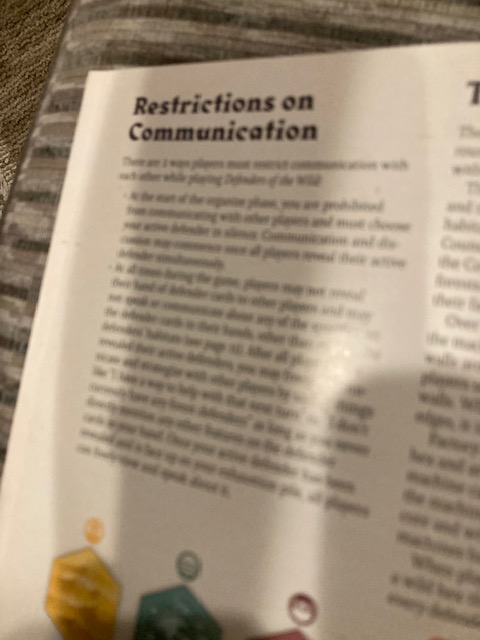
One: Why are there Communication Restrictions? I didn’t discuss it in the overview, but this game has restrictions on communications when choosing the Defender to play: all players all shut-up, can’t say anything, and must choose the Defender to play in silence. See rules page 10 (above).
I hated this Communication Restrictions and my friends hated this Communication Restriction. Rules like this are almost always to keep the Alpha Player in check (so one player doesn’t tell everyone what to do). In this game, I don’t think that’s much of an issue. In fact, it made the game less cooperative, less strategic, and less fun. Each player’s turn “tends” to be like a multiplayer solitaire turn anyways: a player takes his turn and others don’t really get involved; in fact, there’s nothing anyone else can do on your turn! So, each player tends to take their turn “maybe” with some advice from others.
So, by taking away the ONE decision point where players might be able to help each other, this rule makes the game even less cooperative and strategic. I really think this rule is a misstep; this game needs every little bit of strategy it can get. Otherwise it becomes a random slog.
:
Two: Not enough choice! There’s a rule that you only get new Defenders when you build a camp. I understand why this rule sort of “forces” you to build camps, as camps are an important part of the game: This rule strongly encourages you to build camps. But not having a full hand of three Defenders completely takes away your choice during the game. When you have a full hand of three Defenders (see above), the game feels strategic: “I can make choices relevant to the state of the board and the future and my friends“. If, for some reasons (say too much randomness, see below), you can’t get a camp built (and you have no more Defenders), you are completely at the mercy at the top card of your Defender deck (which you can’t even see). So, the game is playing itself! You just turn over the top Defender card and “see” what happens that turn! It is not fun, it doesn’t feel like you have any choice, and it feels like the game is playing you.
I really feel like a very simple house rule could fix this: it would be something like “you can draw a card after every turn“. There’s still a chance to play a support cards (which will exhaust your cards faster), but maybe building a camp STILL refills your hand to three Defenders. I feel like I should always have some sort of choice, or why I am even here? The game is just playing itself.
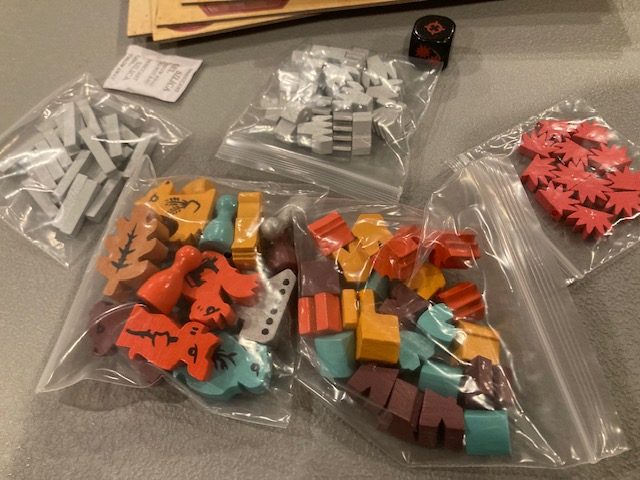
Three: Too much randomness! We haven’t discussed it at all, but there is a 6-sided die in the game. Whenever you perform an action next to a sniper Mech (see more Sniper issues below) or on the same space as a Hunter mech, you must roll the die. A sniper hits you 50% of the time for 1 point of damage. A Hunter hits you 33% of the time for 2 damage and 50% of the time for 1 damage (83% of the time, you will take damage)! That may not seem like much, but 4 damage kills a Defender! And two dead Defenders means the end of the game.
If you roll poorly AT ALL during the game, you have to start play very conservatively! Let’s say I was aggressive for one turn and rolled poorly, killing a Defender. For the rest of the game, I CANNOT take any chances, as another dead Defender means Game Over!! So, the game becomes like you are walking around on your tip-toes to get anything done. It’s not fun as you feel like you can’t do anything.
“We need to rewild that factory! I’ll do it! Oh wait, I just 2 damage from a mech, one more roll and we lose the game, I’ll just run away, heal, and come back.”
You might just say “stay away” from the mechs. That’s impossible; they are constantly being spewed out, and the middle of the board (where you need to be for rewilding factories) is full of snipers who will just pick away at you. Since you can NEVER enter the core, you just have to take it (unless you happen to get a Defender, there’s just a few who can kill Mechs from afar). This becomes a game of running up, doing one little thing, then running away.
In many games, I just felt like I couldn’t get anything done because of a few early bad rolls: once you have one dead Defender, your moves seem so tentative and dull and not fun …and you have to be careful, otherwise you will probably lose.
Four: Machine Cards are also too Random! In my first 2-Player game, we got 4 factories built in quick succession, just because of the way the cards came out, they spewed pollution and caused so much Toxic Waste! We had no chance! We couldn’t clean it up fast enough, and we couldn’t rewild the factories. We got destroyed.
If you have a few factories out and then get the two Factories at the end of the deck, reshuffle, then also get those Factories at the beginning, you can get 4 pollution spews in a row! You can’t come back from that! This is like the Variable Turn Order problem we see in games like Aeon’s End or The Plum Island Horror. If the “Bad News” cards come out in just the wrong way, you can get totally screwed. See our full Discussion here in A Discussion of Variable Turn Order and How To Mitigate Its Randomness!
That discussion does offer a potential solution: maybe the players can have a few “fate” tokens which they can spend to “skip” or “redraw” a bad news. I am not proposing getting rid of a Machine card for a turn, but it would be nice if the players had a “hacker” token (more thematic than a Fate token) where they could choose one of the top two Machine cards. Only spend it when it matters and it would allow the players to feel like they have some agency in their own fate.
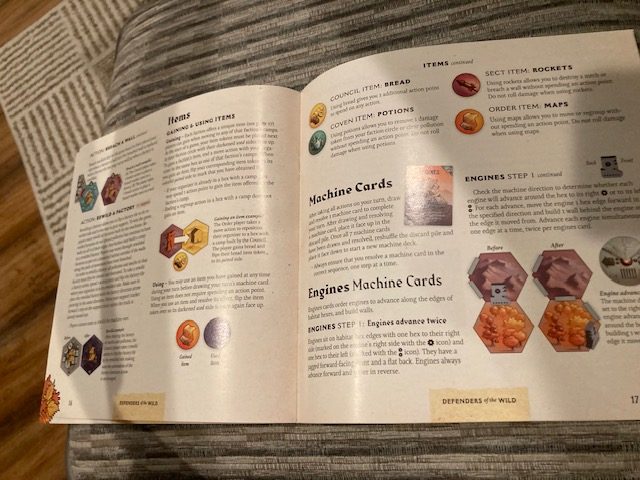
Five: Too many things underspecified. This is harder to say, because I really like how this game tries to specify everything. It misses some important things, and some things are so subtley described, it’s not clear. I sometimes feel like I needed to read the rulebook like a legal document. Some examples:
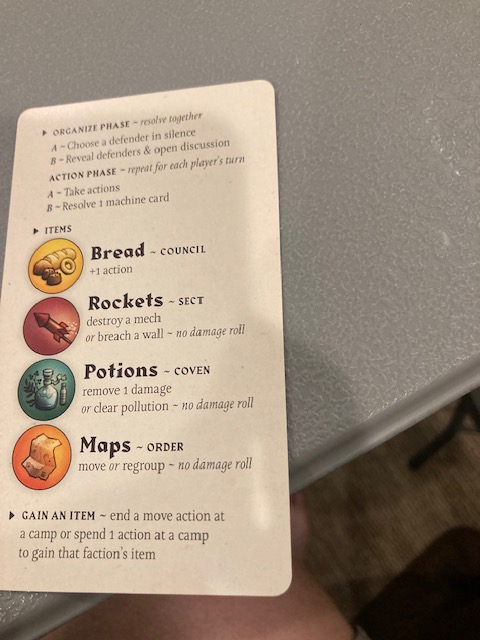
Rockets: Rockets kill one Mech without a dice roll. It does NOT say whether it’s on the current space ONLY or also an adjacent space? A Rocket, thematically, feels like it could reach a space next to it. I am fine believing it’s just the current space (and that’s the way I played it), but it’s not clear. One sentence would clear this up. Or MAYBE a Rocket even will destroy ANY mech on the board? That would be game-changing! But it’s not clear. UPDATE: After the 5th game, we found a Defender whose text said “Rockets can be used to target adjacent hexes”, implying they could only be used in the current space all other times.
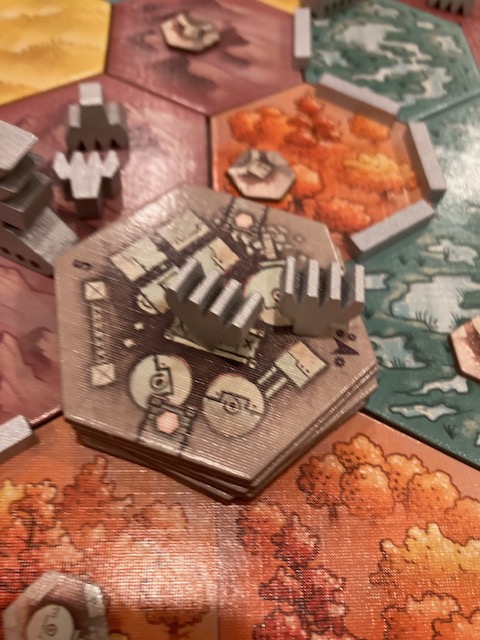
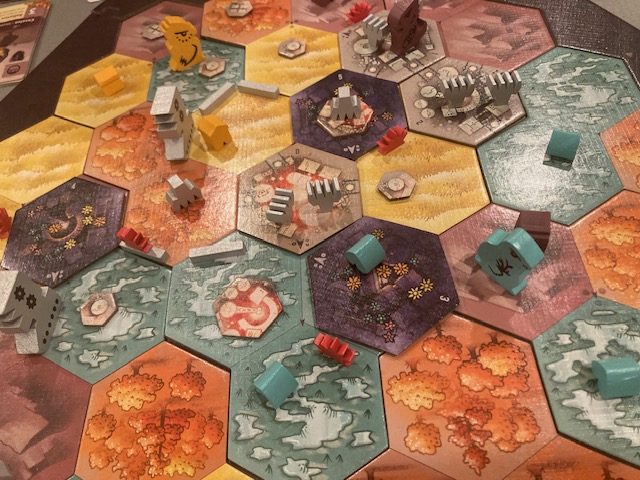
Hunters vs Snipers: A Sniper is defined by being a mech in a Factory, and a Hunter is defined by being a mech in a Habitat space. I think. I don’t think a Sniper can ever becomes a Hunter or vice-versa. I think. Why is this not clearer? What I did, as a house rule, was to place SNIPERS with the prongs on the top, and the HUNTERS as the mechs with the prongs on the bottom: see picture above. This seems like a very easy way to help visually distinguish the two types of mechs, but the rulebook just calls them both mechs. It’s very easy to miss the difference as you are playing. Again, I just wanted a few more sentences on this: the description in the rulebook feels like a legal document. “We are defining a sniper to be a mech on a factory”. (Does a Sniper turn into a Hunter if a tile is rewilded? Technically, a rewilded factory is still a factory, so maybe, but a few sentences would be helpful).
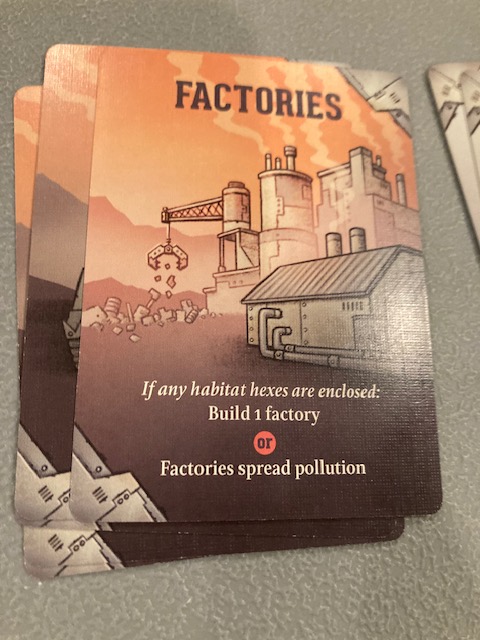
The Factories Machine card: All the rules are NOT written on this card. When you build a factory, you are ALSO supposed to deploy 2 Snipers to the Core. (And you have to move everything with the new factory). This is nowhere to be found on the factory card!!! A few simple sentences on the Factories Machine card that would help make the game easier to play. It feels like you have to keep your nose in the rulebook at all times or you might miss a rule! I like the art of Meg Lemieur on the Factories Machine card, but I would rather have the Machine cards more complete and functional than pretty.
These are just some examples of missing or rules needing better descriptions. If you don’t play with the right interpretation of any of these, this game becomes substantially different.
House Rules
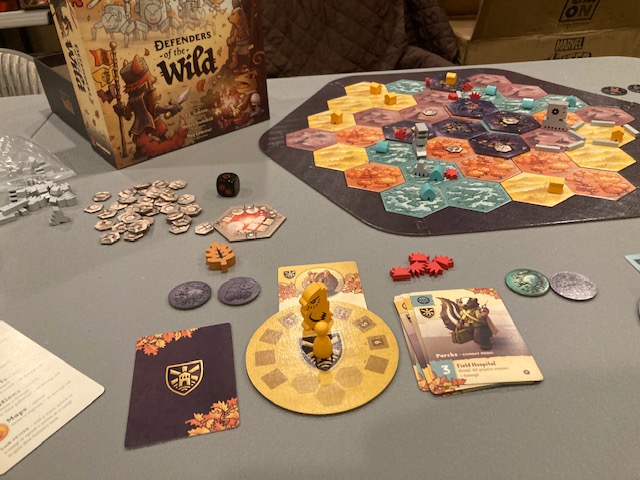
We really want to like this game. We love the art, we love the universe, we love the ideas, we love the basic idea of a cooperative kind of wargame. But we are really struggling with the game, as it feels too random. Here’s a set of House Rules that you might try in your game if you are struggling with it like we are; maybe try some and keep the ones you like.
Always draw a Defender card at the end of your turn. This isn’t a panacea, as you can still get down to fewer cards by using support actions, but it least it generally keeps you feeling like you have choices every turn. A camp build will always bring you back to 3.
Turn the mechs upside down to denote Snipers, and rightside up to denote Hunters.
Have a pool of 2 or 3 (4?) Hacker tokens. When a Machine Card is drawn that is decided to be too devastating, you can discard a Hacker token to take the next Machine card instead. This helps give the players a little control over the pure randomness of the Machine deck.
Get rid of all Communications Restrictions. The game already feels like multiplayer solitaire! Allow the players to find the best Defenders to help everybody AS A GROUP so the game feels more cooperative!! (If you are having Alpha Player issues with this rule, then either don’t play with that person, or put a timer on Defender choosing).
Allow players to discard a Defender card rather than take a damage; not killed, but it definitely leaves the game: maybe it’s KO’d. The randomness of the die is NOT fun: I wish there were more mitigation methods for it (This rule is probably the one we feel most unsure about).
Granted, these will all make the game easier, but the game is already pretty hard. If you feel like these House Rules make the game too easy, there are also DIFFICULT Machine Cards which make the game substantially harder.
House Rules 2 and 4 are probably ones I would absolutely recommend for everyone! You can probably take or leave House Rules 1, and 3 and … especially 5.
Reactions
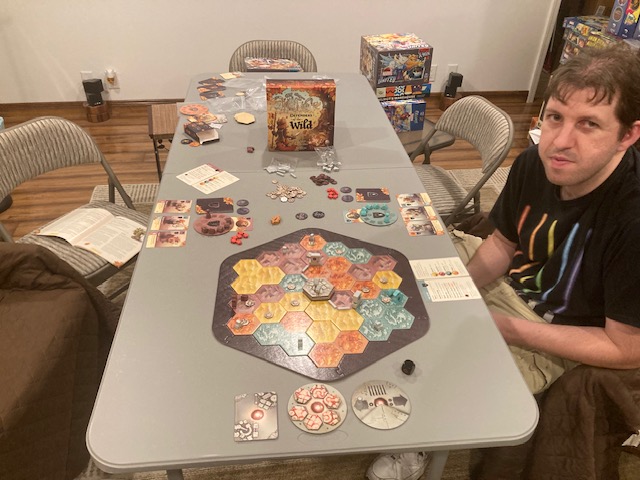
Sam: “I currently give it a 6, I would like to play it some more to refine my opinion.“
Rich: “I am really struggling with this game. I want to like it so much, but it is far too random for me. There’s a lot of great things in the game, and I feel like there are people who would like this game as-is: Objectively, I would give it a 6/10. Subjectively, as-is, I would give it a 4/10 because I don’t ever want to play it again: it’s too random. With some House Rules, I would maybe move up a couple of points to a 6/10 or maybe more. There is so much to like in this game.”
Sara: “This is under a 5 for me. It wasn’t fun, and I was glad when it was done. It was just too random. I might play it again if someone really really wants to play, but probably not. I really wanted to like it.”
Teresa: “I dunno, a 5 or a 6. It was frustrating, but I had fun with the little animals. “
Conclusion
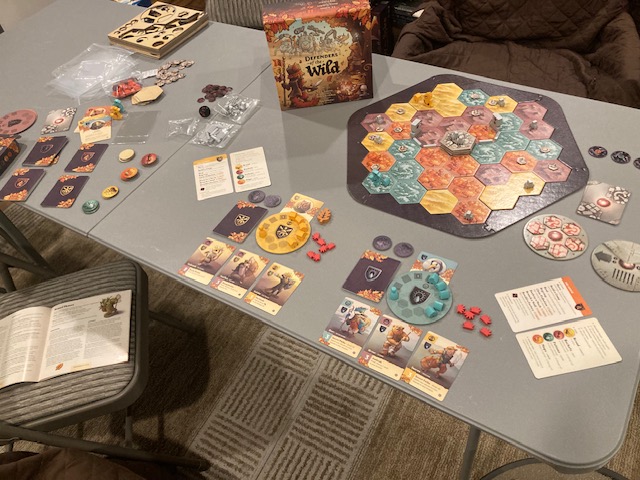
Defenders of the Wild is a game that introduces a wonderful world with a wonderful production. The randomness of the game (from random die rolls to random Machine cards) held this back for me and my groups. After a number of plays, it’s clear that you can get to strategies where you mitigate some of that randomness (as you do get better as you play more), so it’s not just a random slog. But the question is: is it fun to get there? My groups didn’t think so, but that’s just some opinions.
I think the target audience for Defenders of the Wild might be war-gamers looking for a cooperative adventure. War-gamers are used to dealing with swings of randomness from skirmish to skirmish in pursuit of a greater victory: it’s clear, you can get better at this game as you play, so there is definitely both strategy and tactics. If you were looking for a cooperative Root, this might be a decent pick for you! It has the cuteness of Root, the war-gamer nature of Root, but in a cooperative game!
This game seems to be better with more players, as there seem to be more opportunities to get stuff done on your turn (more camps, more chances to push your luck since dying isn’t quite as critical, etc), and that seems to lead to better mitigation of some of the randomness. Unfortunately, the one and two player games just seem to succumb to the randomness too quickly.
This might be the perfect game for you and your group: take a look at what we saw. Be aware that the randomness and some of the underspecificity of the game led my group to rate this from 4/10 to 6/10. I don’t think any of us thought this was a bad game, but it just wasn’t for us.
If you do find yourself wanting to try this out, I recommend playing this out with bigger groups for the best chance of a good experience.
Invincible is comic book series about a kid with “super-man” like powers; this comic book series is unique because it has one voice (Robert Kirkman) through the entire run of the series. Most comics are lucky if they get a consistent voice for 3 years. The series started at issue #1 in January 2003 and finished up with issue #144 in February 2018. For 15 years, over the run of the series, we saw Mark Grayson mature and evolve from a kid to a man. It’s a very mature series, but it is very well written. Even the art stayed consistent (between two artists: Cory Walker and Ryan Ottley) over the run of the series!
I really liked this comic book series (having collected the entire run from beginning to end), but it is quite mature: there is quite a number of mature topics. The series is also incredibly violent and has very graphic fights.
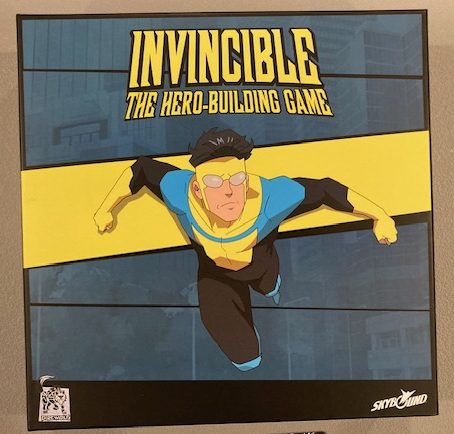
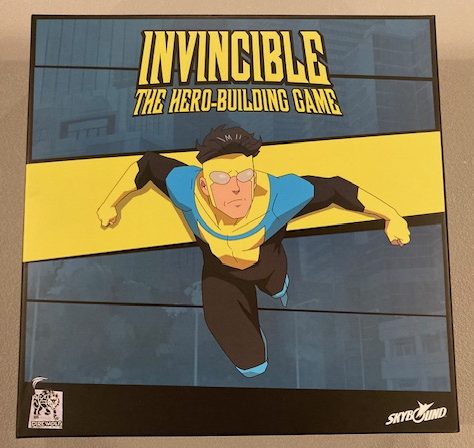
Fast forward to July 2024: Dire Wolf has come up with an Invincible board game called Invincible: The Hero-Building Game!
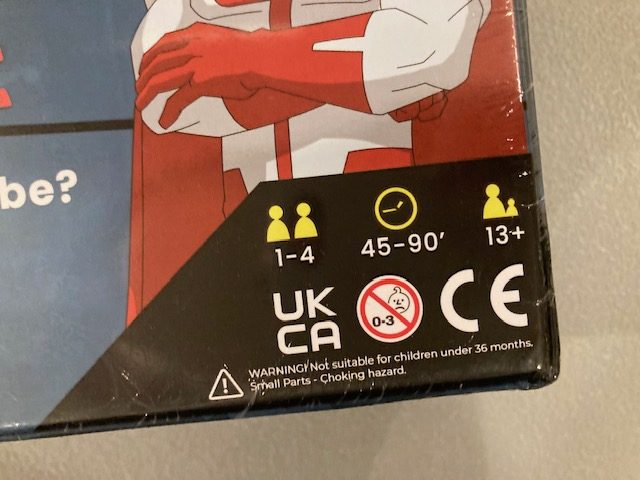
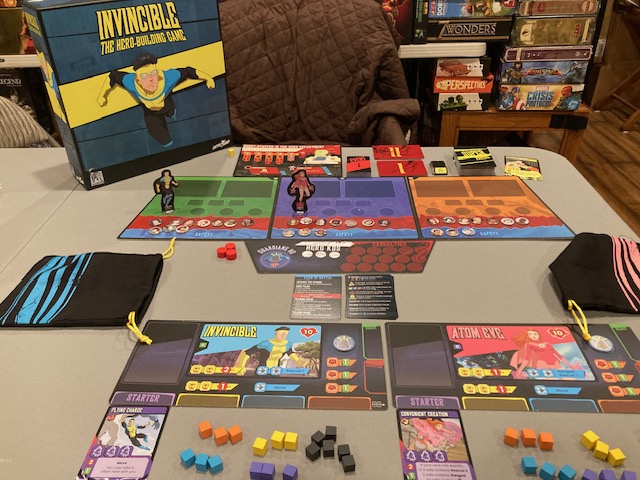
This is a cooperative board game for 1-4 Players, 45-90 minutes with Ages 13+. See above! Invincible is a cooperative boss battler game where players have to take out the big baddie (and do other heroic stuff along the way). I will say this: the board game is much much much less violent and graphic than the cartoon or the comic series. If you were worried about the violence or maturity, especially for a boss-battler game, don’t fret! That 13+ for ages is an accurate depiction.
Invincible: The Hero-Building Game is an interesting twist on the cooperative super-hero genre: it’s a bag-building game! We’ll see elements from other modern board games: Orleans (with its bag-building, especially with the Invasion cooperative expansion), Marvel United (with its super-hero theming and civilians mechanisms), Marvel Champions (with its super-hero theming and Threat mechanism), and Quacks of Quedlingburg (for the push-your-luck).
I ordered my copy from the Direwolf website, and it arrived at my house in early July 2024. Let’s take a look!
Unboxing and Gameplay
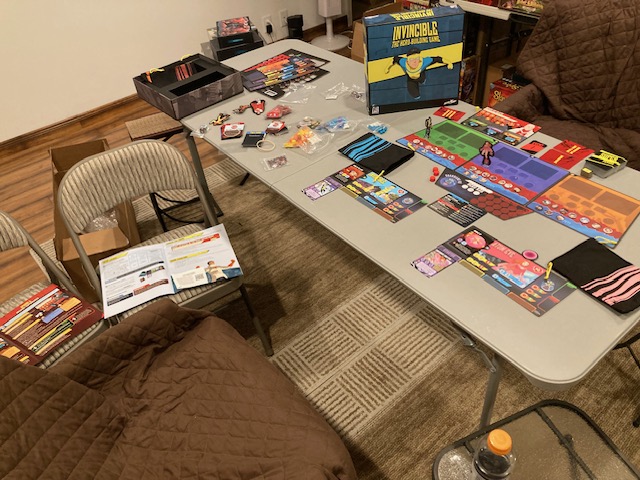
I was grumpy when I opened my box: the rulebook had shifted around during shipping and got all folded and messed up!
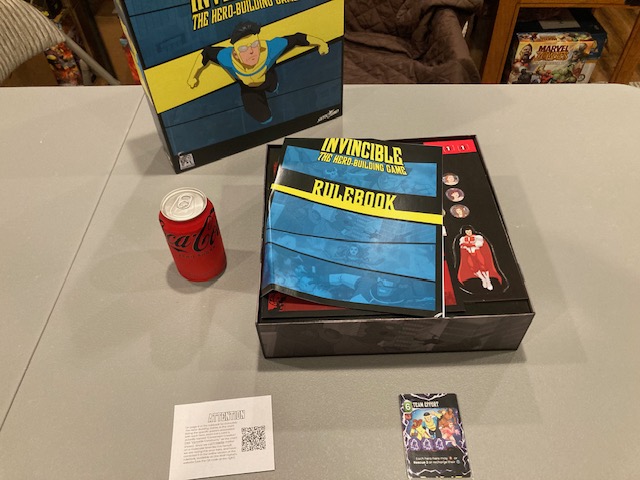
See the can of Coke for perspective: this is a normal sized box.
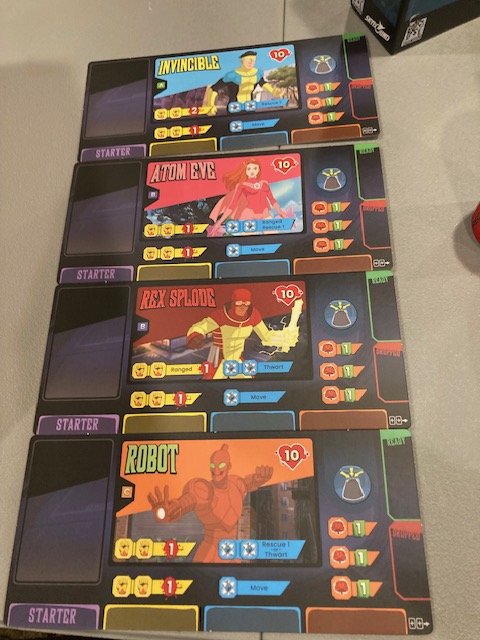
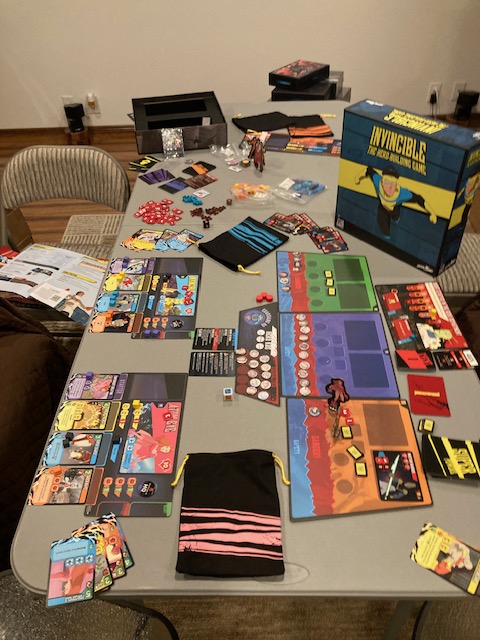
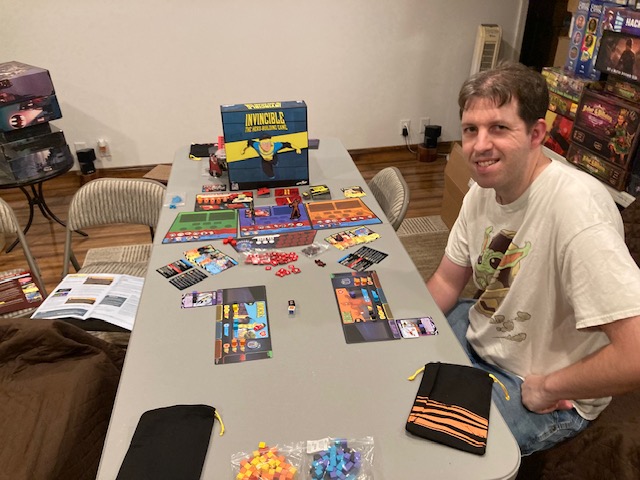
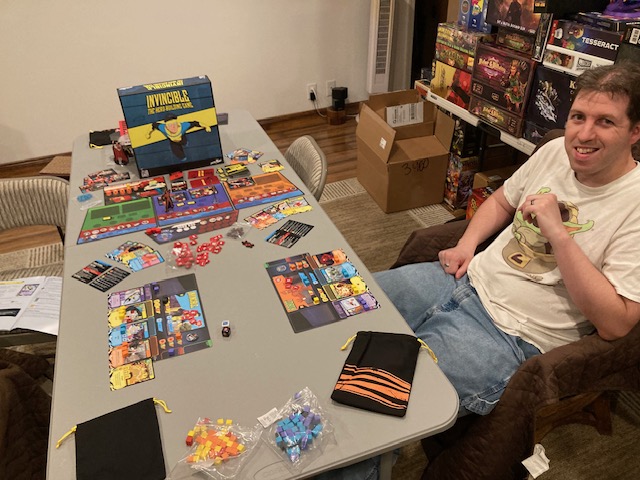
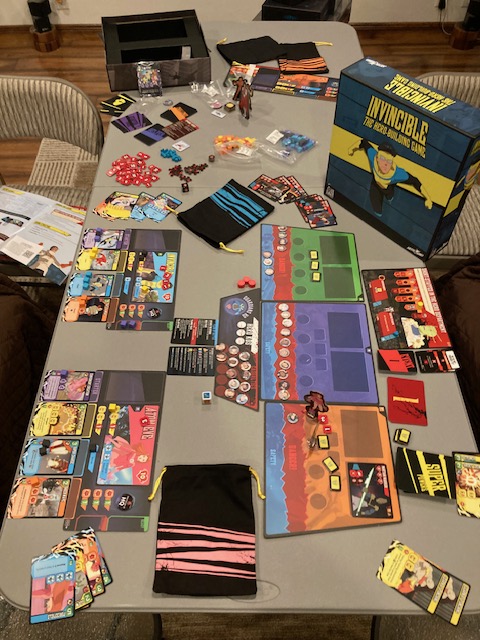
Each player assumes the role of one of 4 characters from the Invincible universe: Invincible, Atom Eve, Rex Splode, or Robot. See above and below.
Each player also gets a standee. See above.
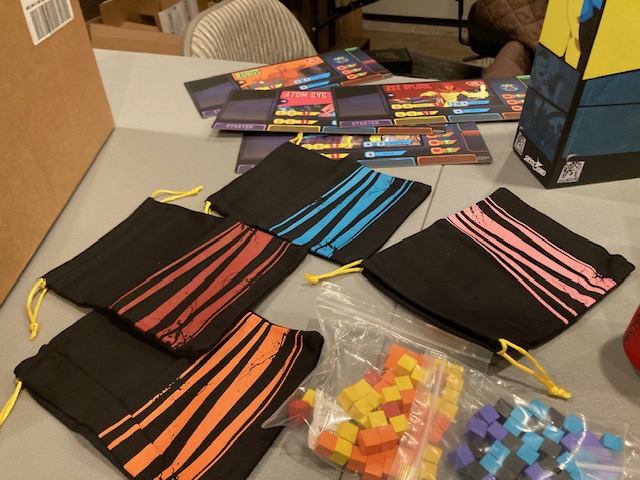
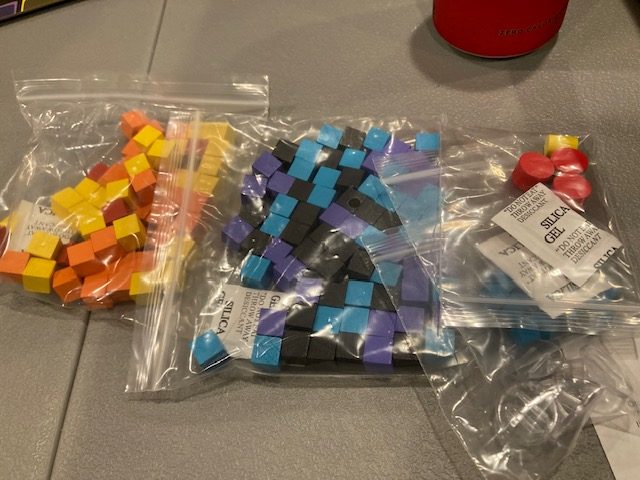
This is a bag-building game (we mentioned earlier), so each player gets their own bag to put cubes into: see above for the bags and the cubes.
There’s a bunch of scenarios that come in the game. You can choose to play them in order, as one-shots, or in an ordered campaign. See the first “suggested” scenario above.
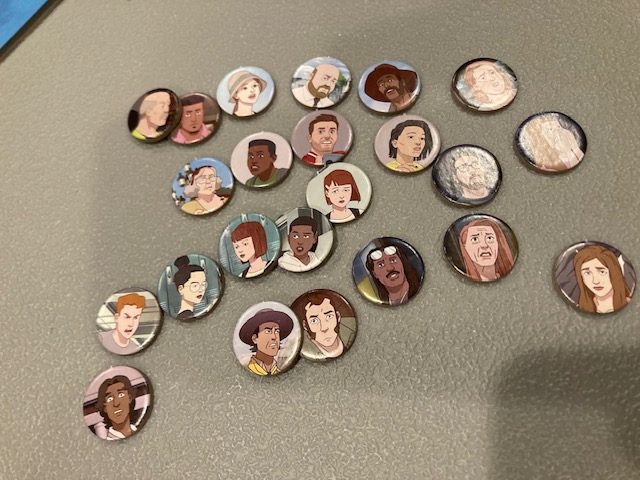
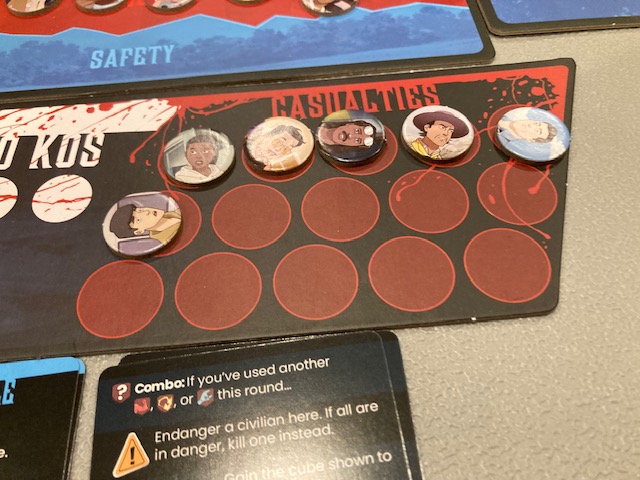
There’s a bunch of civilians to protect: if the players ever have too many civilian casualties, the game is over! Players lose!
The game board is three regions of a city (A, B, and C). Bad guys appear and fight our heroes, or threaten civilians (if there are any in their zone). If a zone is ever bereft of civilians, the game is over! So, it’s a bit of balancing act making sure the civilians are safe while still taking out the big bads.
The mechanism for keeping track of civilian casualties is pretty simple: there’s actually a casualties track below the main city boards.
Bad guys appear in the city and cause havoc, threatening civilians or just doing damage to our heroes!
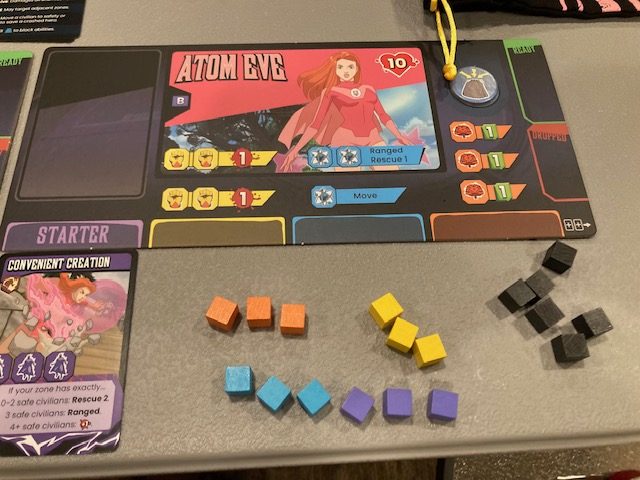
Each players starting bag contains the cubes above: 6 black and 3 orange, yellow, blue, purple. The cubes are used to “power” abilities in the heroes.
As the game progresses, you can “buy” more powers: see above as Invincible has more powers to put cubes on!
It’s fairly intuitive how to place the cubes: obviously, a single yellow cube will activate the power above! And there’s also orange, purple, blue, and black cubes in the game!
The black cubes are a mixed blessing: they are wild (so can be used for any color on any power), but if you ever draw 5 black cubes, you crash! A crashing hero has to stop and will take some damage (because he pushed himself too hard). You can save a hero from crashing, but it stops another player.
A crashing player will roll the black/red dice to see how damage the “crash” did. If someone tries to save the hero, then the white dice will indicate how successful the save was! You aren’t even guaranteed to save a crashing hero!
There are also “bad news” cards (this is a co-op game after all): the event cards come out after all players decide to finish and quit drawing from their bag. These symbols will cause different villains to do different things … usually hitting the heroes or threatening civilians!
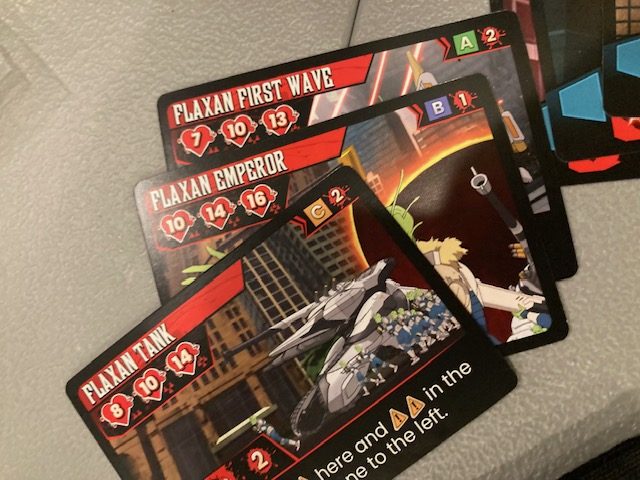
If the heroes can handle the final villains, they win! The above scenario needs the the heroes to defeat 3 Flaxans in order to win!
This is a boss-battling bag-building game! (Say that three times fast!) The components are decent, but not super high-quality. Most of the cardboard is kind of thin. The cards aren’t great quality (they need linen-finishing I think), but the art of the cards is very consistent with the Invincible universe. Unfortunately, this is not the same level of production as a giant Kickstarter: I can imagine a world where the cards are linen-finished, the boards are nicer, some of the villains have special tokens, and the hero standees are acrylic standees! But that’s not what we have here. Still, everything was very readable, and all the components worked. UPDATE: After about 5 plays, the blue bag for Invincible has developed a hole in the bottom! Grrr…
Rulebook
The rulebook was pretty good.
It gets about a B on the Chair Test: I can put it on the chair next to me, keep it open flat, and consult it while I play. It only gets a B because it’s just a little bigger and the paper quality is a little flimsy. (Maybe I am just grumpy my rulebook got smashed before I even opened my box).
The Components page is excellent: it spans two pages and is easy to correlate all the components against their labels.
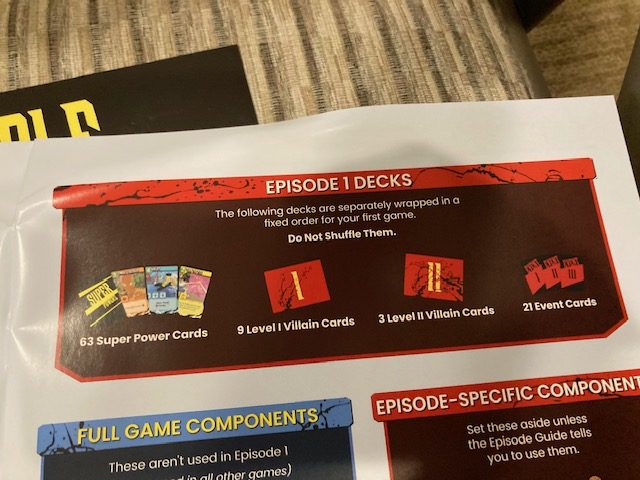
The rulebook even does a good job of separating what components you will need for your first game (Episode 1) vs a Full Game vs. Episode-Specific Components! See above! That’s really nice!
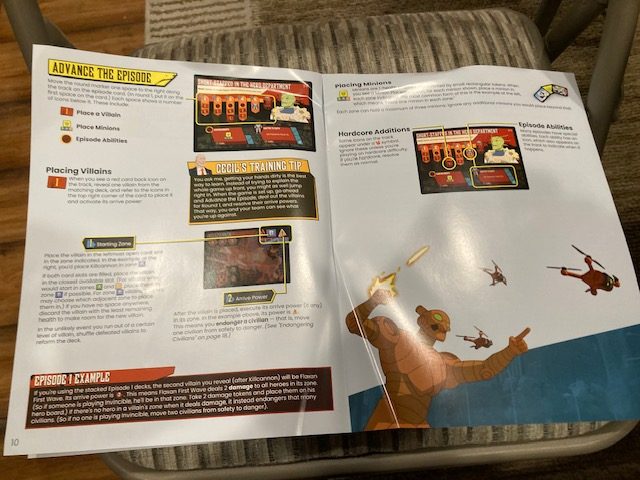
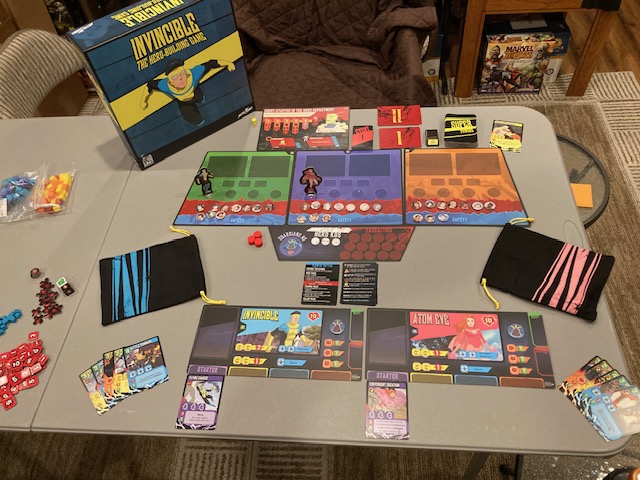
The set-up pages do just what I want: two full pages (well three pafe) labelling and showing the steps with a giant picture showing up what things look like! See above! The set-up even separates “Episode 1” (first play) from Full Game! Again, really nice!
Generally, this rulebook was good at showing pictures and explaining how everything works.
There’s no index (booo!) and no glossary (boooo!), but there is a Keywords and Card Mechanisms section. This isn’t a super complex game, and I was able to find rules when I needed them, but an index would have been helpful.
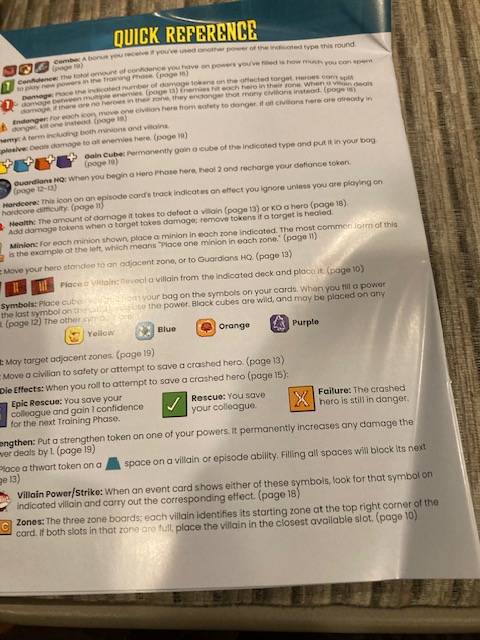
The back cover was quite useful with a list of a lot (but not all) icons.
In general, I was happy with the rulebook. The lack of index and my squished rulebook were my two main complaints.
Onboarding
It’s been a while since I had a game direct me through my first game so nicely. The Episode 1 deck is all set for you: you don’t shuffle it at all!
The Episode 1 game is a simplified version of the game, showing off the main mechanisms before jumping into the full rules. That first Episode 1 deck has everything separated out to easily set-up and play.
Luckily, there are instructions to resetting the first scenario! I have played the first game (both solo and cooperatively) and the full game a few times, but I plan to teach this game a lot at RichieCon, (and I did: see here) so I will reset the game back to “Episode 1” for teaching purposes. I think it might have been nice to label the Episode 1 cards so it would be a little easier to reset, but heck, I am just happy they had a list of instructions for that reset!
The onboarding was pretty darn good! It wasn’t quite as good as onboarding as Valor and Villainy: Lludwick’s Labyrinth (that game sets the bar very high for your first game: see our review here for more discussion), but it was pretty darn good.
Solo Play
There are solo rules! Huzzah! The game follows Saunders’ Law and has a viable solo mode!
In the solo mode, you still have to take control of 2 heroes: See above as the solo player takes control of Invincible and Atom Eve.
Basically, the solo player alternates between the two characters as-if it were a 2-Player game. There is no true solo play (one character) in this game. I suspect it’s because you need 2 characters to be able to catch each other when you crash (see Gameplay section above); that crash mechanism is brutal, and a second character helps mitigate that.
There’s some strange rules about sharing/not sharing the hands and confidence during the training phase … which I just ignored. I just played the solo game as if it were a full 2-Character game: no exceptional rules. Having these weird sharing/non-sharing powers/confidence rules from the solo section takes me away from the main flow of the game! I want to be able to feel like I am playing the main game with no exceptions. I understand why they wanted to do this: it feels like you have to think less about which powers to buy, but in the end since every other rule is just like a 2-Character game, (including maintaining two bags, two characters, and every other rule), I just played solo as 2 characters. And it worked fine. I recommend this way for playing solo!
There is quite a bit of maintenance to operate the game, as you operate two characters, the bad guys, the event deck, the confidence phases, and everything else! But it never felt too overwhelming; I felt like the turns moved along pretty quickly.
My first game was Episode 1 with the two characters Invincible and Atom Eve. The game took away just enough of the extra rules to make the game more palatable to set-up and play, but it still taught the core of the game. I also appreciated that specific bad guys were chosen to come out: they were all “simple bad guys”, which is what you want in your first game.
I have learned now to keep two chairs out for games with Episodes: The rulebook and episode guide (see above).
I lost my first game because one too many civilians died in Zone C. (Remember, if any zone is bereft of civilians, you lose!). So, I “pretended” one civilian had survived, so I made my may to the endgame, just so I could see what that endgame looked like.
With that one change, I was able to defeat Flaxan Invasion! (Take out three Flaxan baddies: see above).
Obviously, the game was a bit challenging since I (strictly speaking) lost! But it was close, and I had a good time learning how the game worked! See above for my “winning” game!
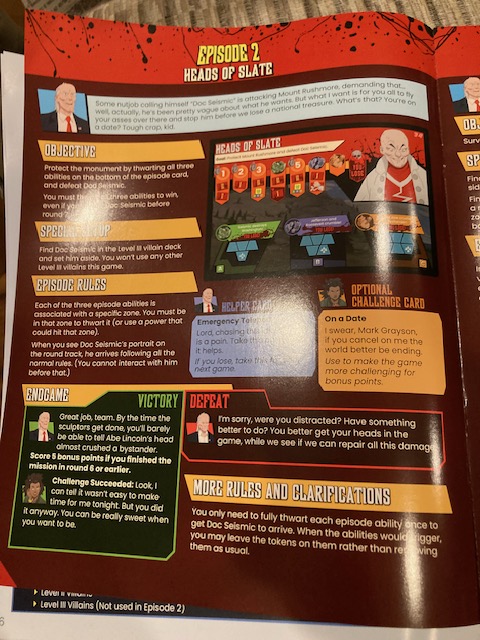
My second game was Episode 2: This is the full game! Welcome to the Big Leagues!
The game still unfolds the game way, but now you have more powers to manage! Set-up is not too much more difficult, as (remember) the rulebook does have good descriptions for Episode 1 and Full Game mode!
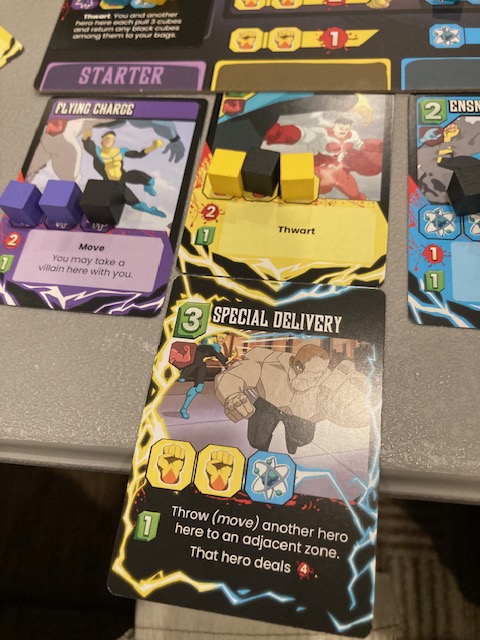
Players now have Signature Powers and Ultimate Powers! The Ultimate Powers go beneath a power you have and can only be activated if the the power above has already been activated!
The Signature Power now goes on your board: See as Atom Eve has her Bubble Up Signature Power (in addition to get Starter Power: Convenient Creation!)
The game becomes a lot harder now, as you have to generally start worrying about more! Not only do you have to save the civilians and beat-up the bad guys, but you have to worry more about Threat! Dealing with Threat reminds me of Marvel Champions: instead of fighting on a turn, you may try to add Threat markers (see Villain above) to stop him! Above, the Villain is trying to blow-up the heads on Mount Rushmore, so you have to “eliminate that Threat!”
In the Full Game, you character ends up with a lot more Powers! See above as Invincible has bought 3 Powers, and 2 Ultimate Powers, most of these needed for dealing with Threat!
The Full Game is great: I am really glad they have the Episode 1 on-boarding experience, but it felt great to jump into Episode 2! It was challenging and interesting the whole way!
I look forward to more solo plays. This is just a blast! And you can play any Episode in any order!
But, I suspect my next few plays will be teaching this game cooperatively to my friends at my Game Groups and at RichieCon (Editor’s Note: I did teach it cooperatively at RichieCon!)! I think Invincible will be a hot game at RichieCon! (One thing to note for Set-Up: leave space beneath your character card for 2 cards so it’s easy to add Ultimate Powers! You can see I didn’t quite leave enough space, and the Ultimate Powers are hanging off the board).
Cooperative Play
Cooperative play went smoothly: Sam and I started with Episode 1, and frankly it was very easy to teach. We had a smooth time! Sam didn’t even really know who Invincible was, but he still enjoyed the game. I am an avoid Superhero gamer, but Sam was fairly neutral on the theme … but he still liked it!
Now that I have some plays under my belt, this was a breeze to teach. The cooperative elements worked really well: we were able to “save each other” from crashes twice! I asked for help a number of times: “Hey, if you can do one more damage, we can take this guy out!” And Sam would ask for help when he needed it!
Sam liked the game! He said to me “After RichieCon, I want to play the campaign! This was fun!”
I also had ulterior motives to teach Sam the game: I wanted him to be able to teach Invincible at RichieCon! I am pretty sure this will be a hot game!!! The TV show is hot right now, the game is getting good buzz! If I can’t teach, Sam will be my goto teacher!
Things I Liked
O1) One of my favorite aspects of this game is that it embraces Player Selected Turn Order (PSTO): fine grained: See above as the rules describe how “Players can pull and play their cubes in any order they wish!” This allows players to hold back a little when needed to coordinate their actions! It’s also cool because it’s fine-grained (meaning players can intersperse their actions across turns)! But, what tends to happen is very similar as we saw in Slay The Spire: (see review here): Play tends to proceed simultaneously (everyone draws from their bag and plays simultaneously) until we get the points where it’s clear we need to coordinate … if someone crashes, or we need to save some civilians (to not lose), or to take out a baddie completely, or whatever makes sense! Like Slay The Spire, we paradoxically have Simultaneous Actions (which moves the game along) but also fine-grained Player Selected Turn Order (which keeps up cooperation when needed)! I love how this works in Invincible!
2) I loved how you always feel like you are getting better and better in this game! Every turn you typically buy a power and a new cube for your bag! You just always feel like you get better and better as you play! And you get choices: Which powers do I buy?Which color cube do I buy? The level-up system just keep you invested in the characters!
3) I like how this game really embraces the Invincible comic vibe: the art on every card is different, like a “snapshot” from the Invincible universe! People like me, who love the comic, really appreciate how this makes it feel like the comic. People who don’t know the series can still enjoy the comic-booky vibe that permeates the game!
Things I Didn’t Like
one) At the end of the day, what you draw from the bag is still random. And the Event Deck can be a little too random. Although there are countless mitigation techniques for drawing cubes (you can add cubes, you can redraw one pull, you save another hero from crashing, etc.), sometimes that randomness can just get you … and it’s frustrating. It’s very frustrating when you pull 3 black cubes on your first turn! Ergh. Like I said, there are plenty of mitigation techniques (including you can get KO’ed three times before the game ends) . As for the Event Cards: I do remember Episode 1 ending because the event card just destroyed so many civilians … I never saw that coming! This randomness is just something to be aware of … but since this is a boss-battler, there has to be some elements of randomness to keep it spicy.
2) It feels like the production could be a little better: the cards aren’t great quality (even though the art is), and a lot of the boards feel a little cheap. And my Invincible bag developed a hole!!! I would love if there were acrylic standees this this! But, we get cardboard standees. And, like I said earlier, the blue bag has already developed a hole in it! Argh!!
Conclusion
Invincible is a really good cooperative bag-building boss-battler. Despite a slightly lesser production quality and some innate randomness, this game could easily be my favorite game of the year!
The upgrade path is fantastic as you feel like you are always upgrading and leveling-up your character! The Player Selected Turn Order (fine-grained) and Simultaneous Actions make the game flow quick when it needs to and become contemplative when it needs to! The game just naturally ebbs and flows!
The solo game is fantastic, as is the cooperative game! I could see chipping away at the campaign over time! It’s so easy to get this to the table! It’s fun as a solo game, despite still having to run two characters!
Objectively, I would give Invincible a 9/10, but if you love the comic world like I do, maybe you’d bump it to a 9.5/10 or a 10/10! This is a great game! Invincible would easily make my Top 10 Cooperative SuperHero Games!
So, Marvel United: Multiverse was the #1 spot on our Top 10 Anticipated Cooperative Games of 2014: it has so many expansions for Marvel United! But, let’s get one thing straight! The main reason we were so looking forward to this was one reason: Galactus. And his Heralds.
The Coming of Galactus: Marvel United was easily our most anticipated game or expansion of 2024! This expansion is yet another expansion in the Marvel United line; we have reviewed the base game (see here and here) and the Marvel United: X-Men (see here and here), and we talked about the Expansion Absorptionhere. In general, we have raved about Marvel United! Marvel United is a cooperative super-hero game for 1-4 players (there are one vs. many expansions that that player count to 1-5, but we aren’t discussing those here).
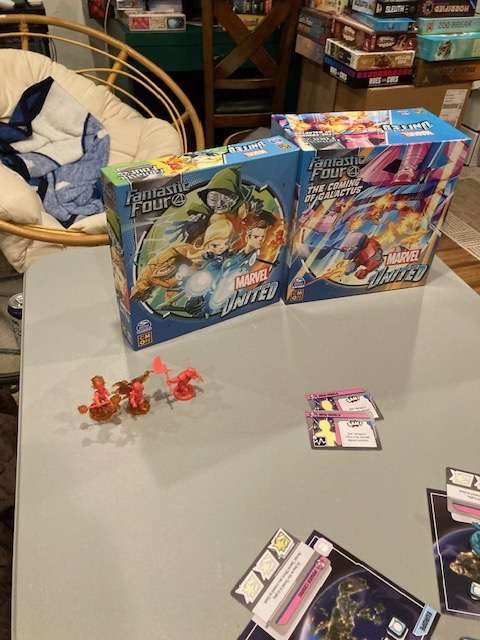
To be clear: you need at least one of the four base Marvel United games to play The Coming of Galactus: This is NOT a stand-alone game. You need at least one of: Marvel United, X-Men: Marvel United, Spider-Geddon: Marvel United, or the newest Multiverse: Marvel United.
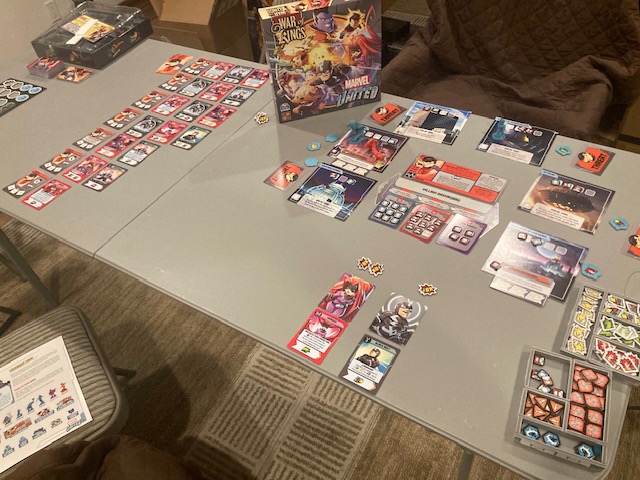
See Multiverse: Marvel United above.
Let’s take a look!
Unboxing (Admit It: You Just Want To See The Minis)
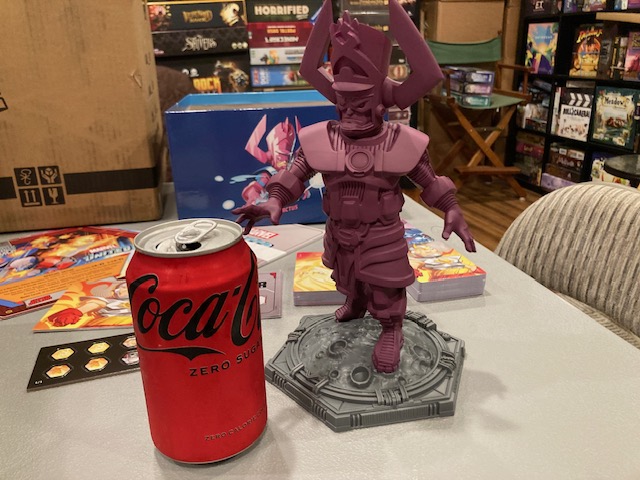
This is a pretty big boy of a box. See the box with a can of Coke for perspective.
It’s the same width and height of all the other Marvel United expansions, but it’s a very deep box! The Marvel United people have done a good job at keeping all the boxes consistent so it’s a little easier to store.
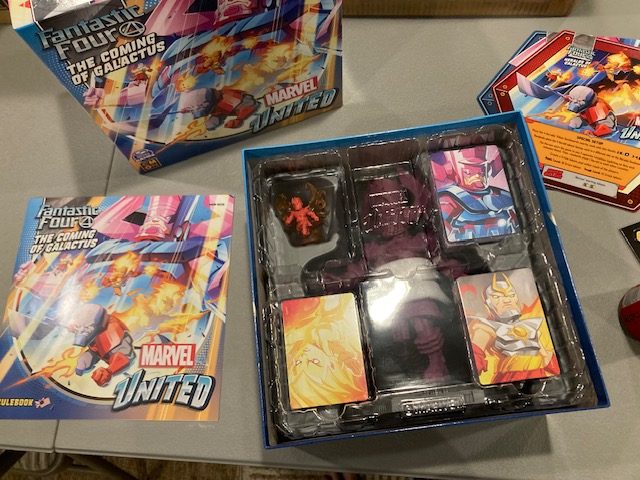
This looks pretty cool when you open it up: you can see Galactus peering at you: there’s an 8-page rulebook and some new center locations.
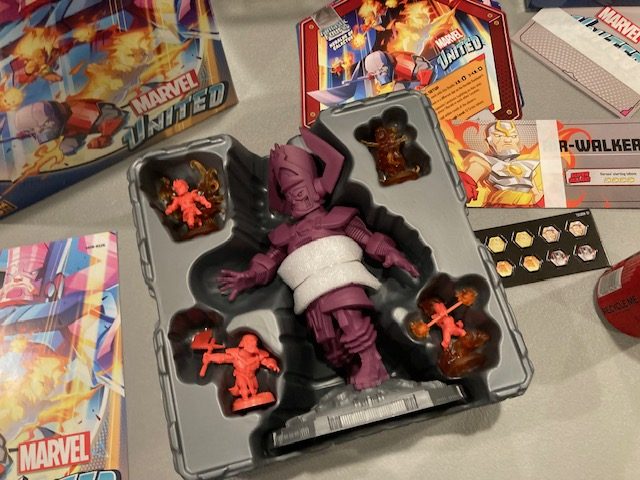
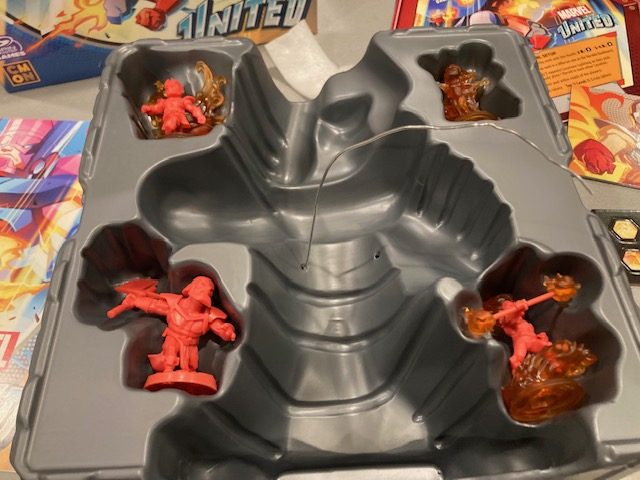
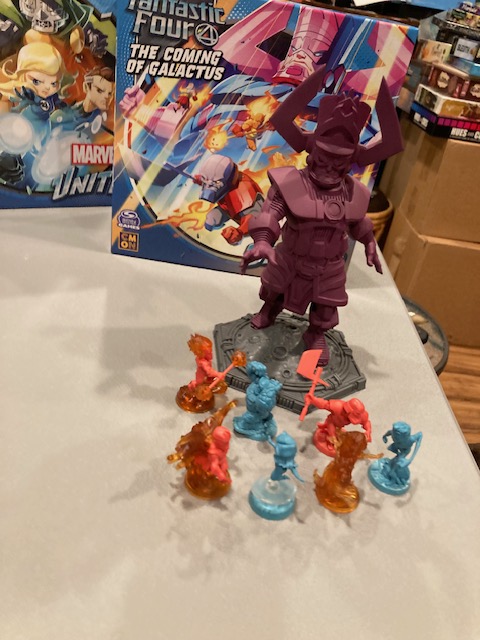
Admit it, you just want to see the Galactus mini! See above as we he is “swaddled” in a little foam blanket with a wire holding him in.
I think Galactus is just invading Earth because he wants a Coke. See above.
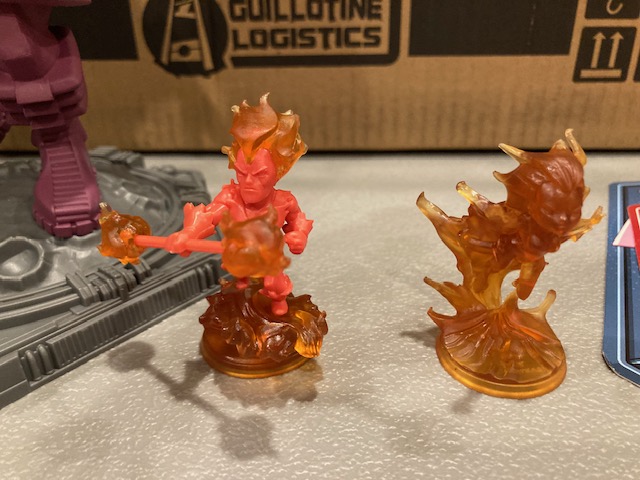
His heralds are also pretty cool minis (see the wire sticking out from Galactus above). See above and below.
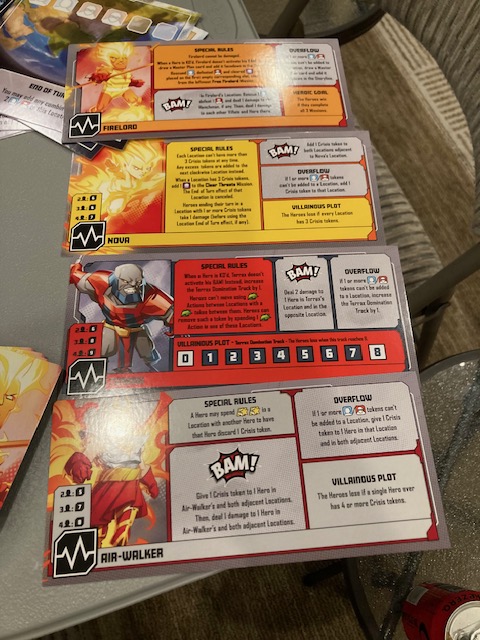
Gabriel: The Air-Walker!
Terrax!
Firelord and Nova (aka Frankie Raye)!
Each Herald also has his own Villain Sheet. See above.
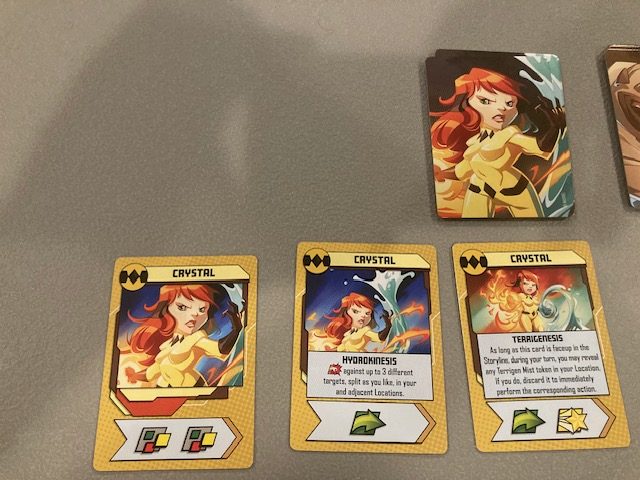
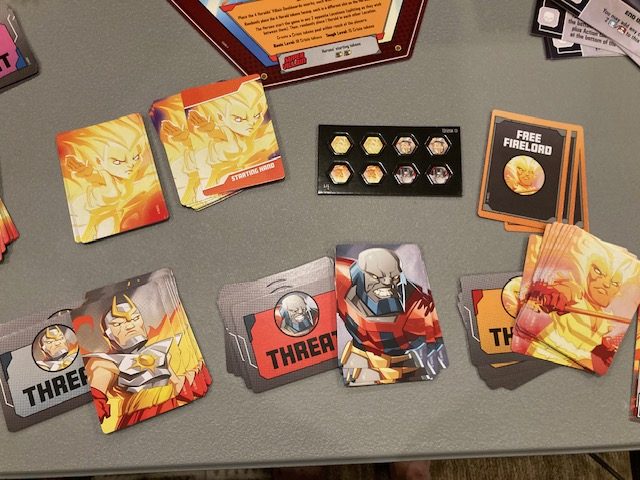
The Herald bad guys cards are pretty cool: see above. Also note that Frankie Ray (Nova) is can be either a bad guy or a good guy! Did you know Nova was in the Fantastic Four for a short time???
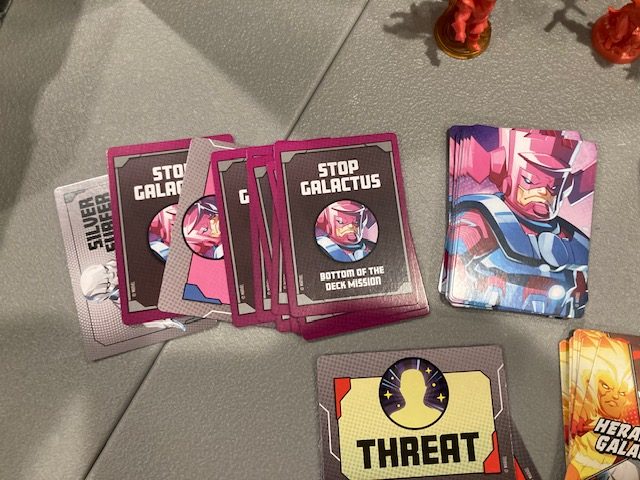
But, it’s Galactus‘ cards that we care about!! See above.
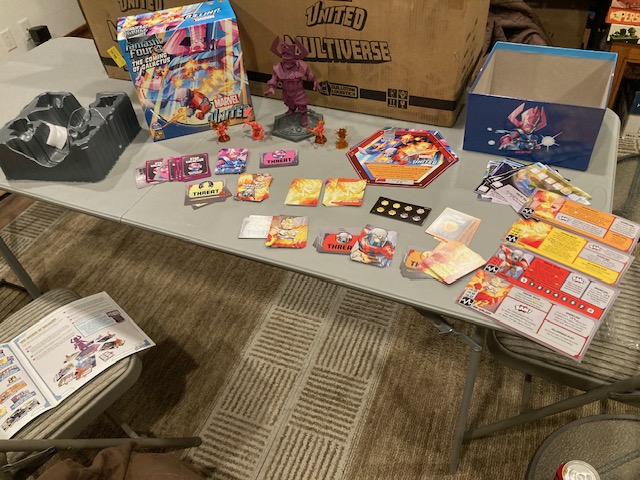
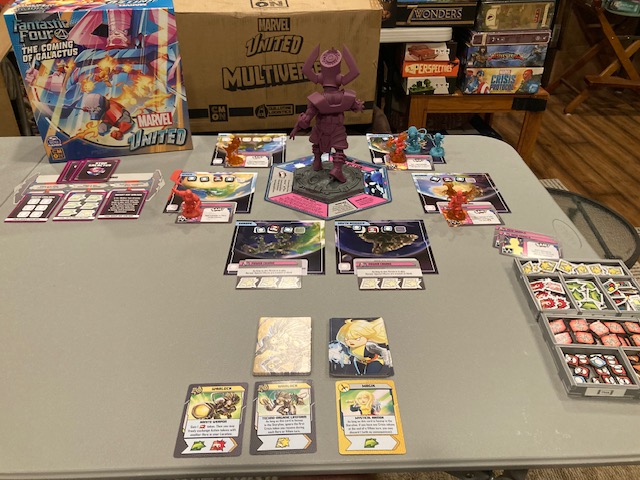
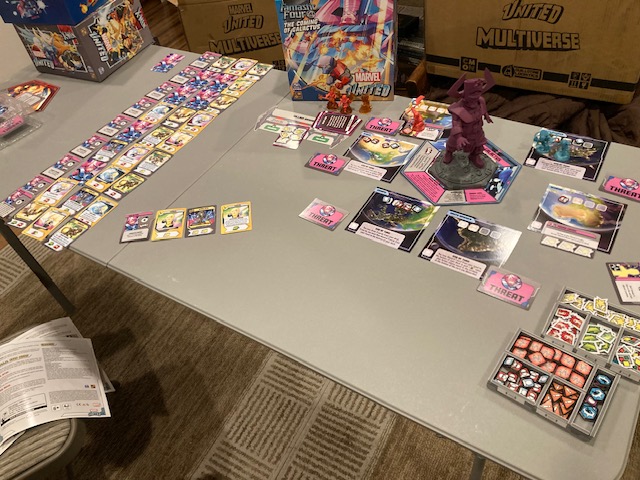
This expansion looks fantastic. I was so excited to get it played! See it all unpacked above!
Gameplay (The Coming of Galactus Mode)
There are basically two gameplay modes in this expansion. The first one is fighting Galactus; this is called The Coming of Galactus.
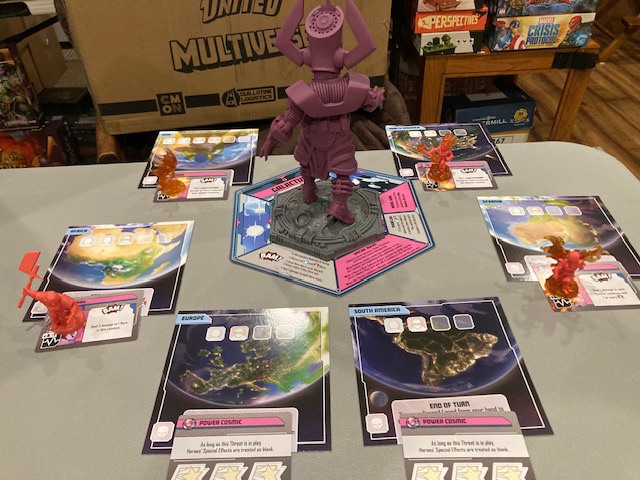
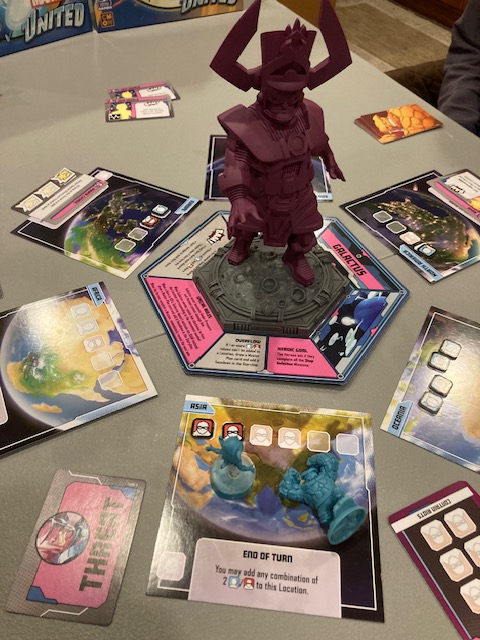
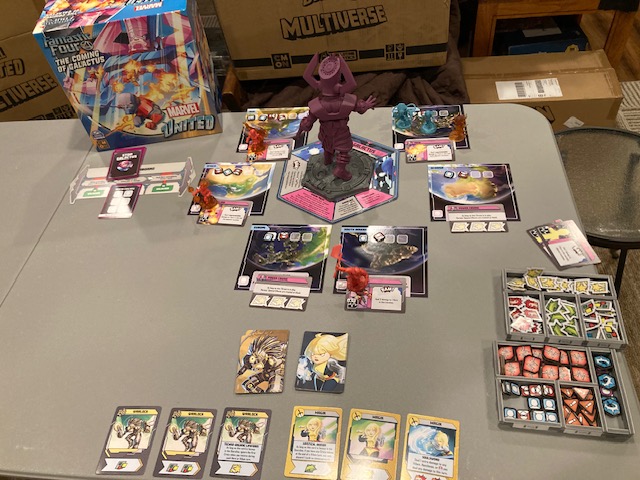
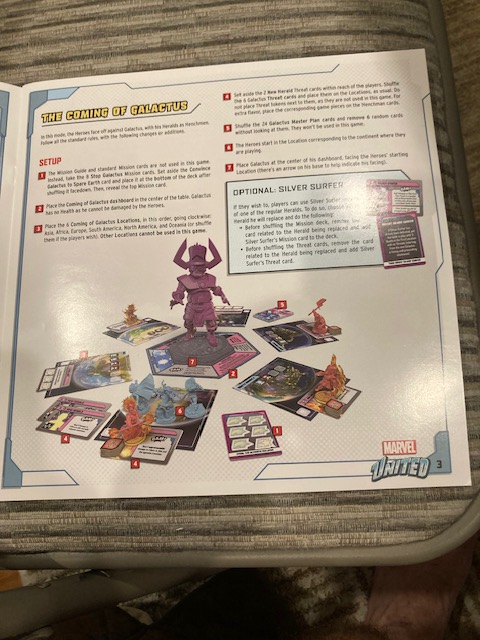
Galactus sits in the middle of 6 regions of Earth: these are all special locations that come in the box. Note that the game has a funny starting condition: the players start in the region of Earth they are playing the game in!
Galactus’ Master Plan cards have him rotate (kind of like Thanos rotates in Thanos Rising, if you have ever played that game). The region he stops on gets hit pretty hard.
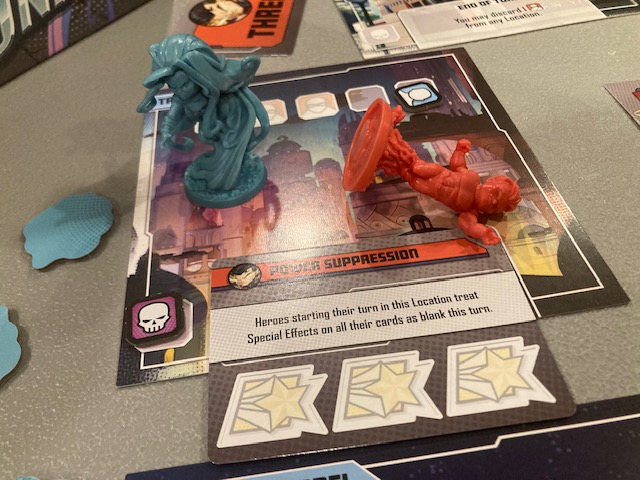
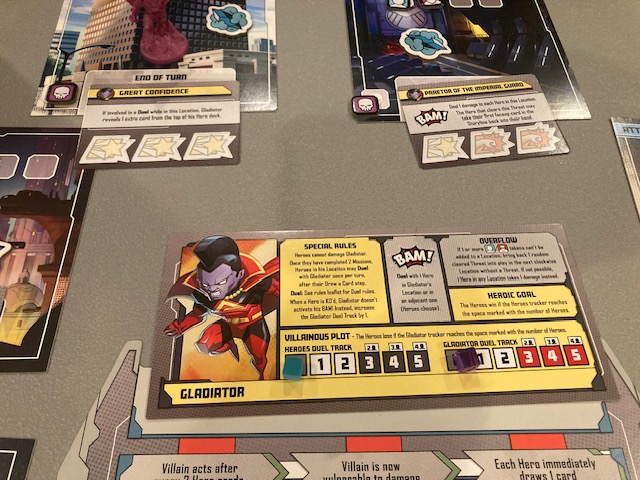
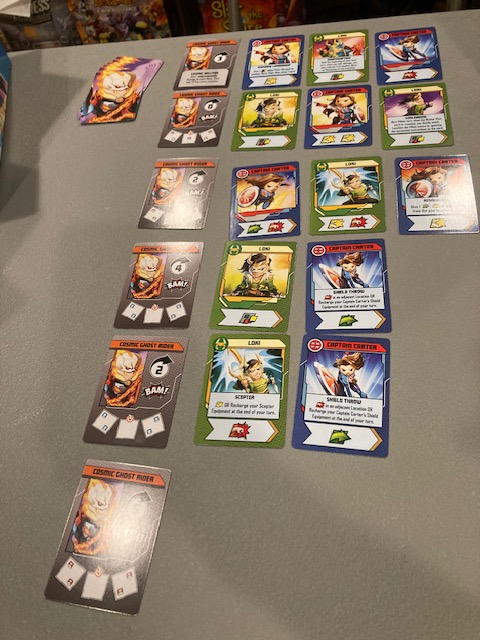
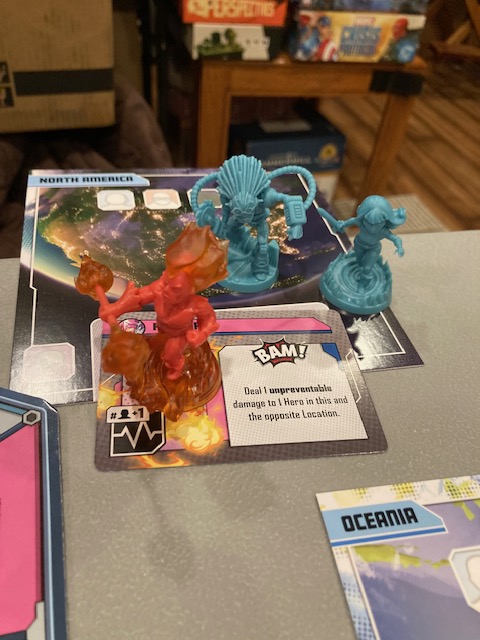
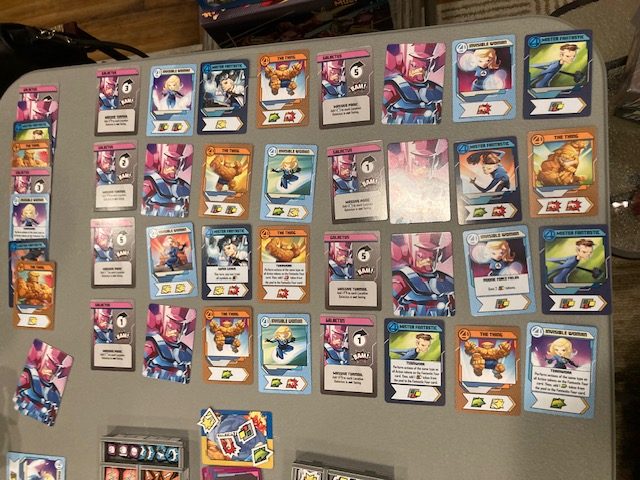
When Galactus BAMS! a region, everyone takes a damage, all civilians and thugs are removed, and all the other BAMS! activate. It’s pretty brutal if he rotates to your space. See above as the Thing gets KO’d!
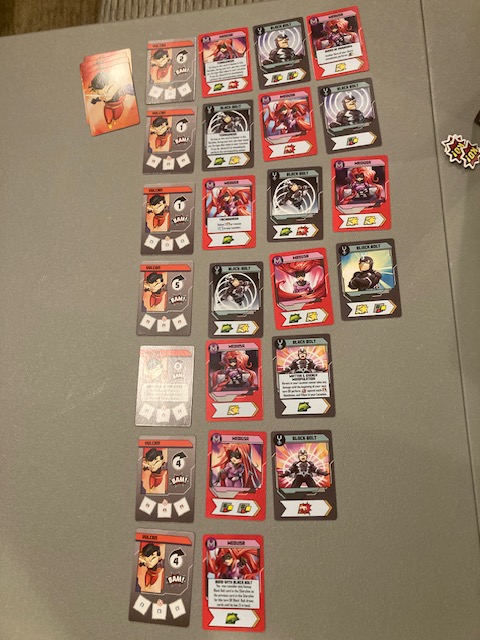
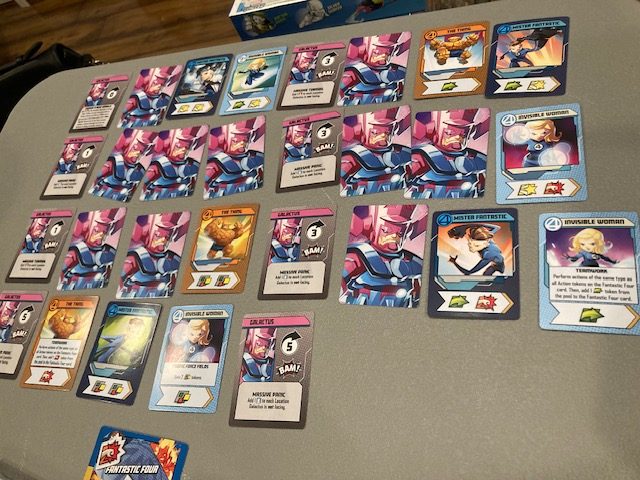
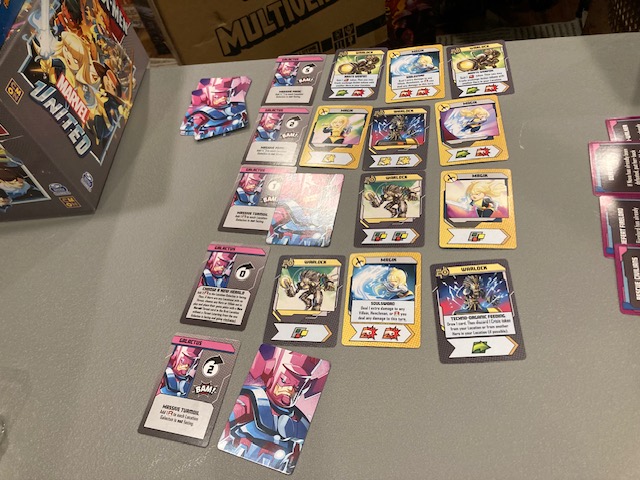
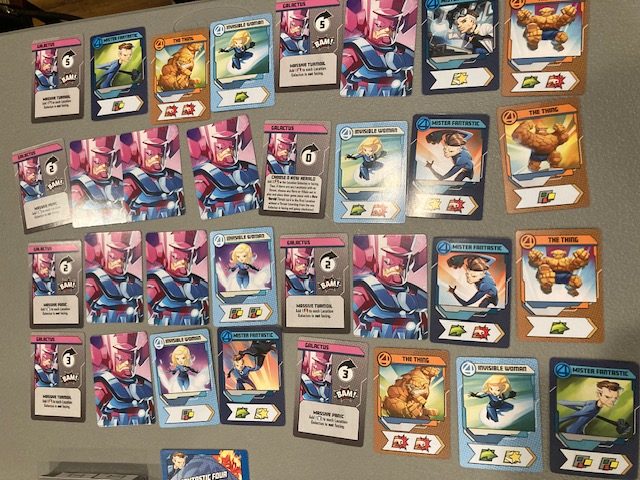
If a region ever gets overfilled OR a hero is KO’d, then a Galactus Master Plan card is put face down in the storyline! This makes it even harder for the good guys to get anything done, as Galactus is taking away actions! See above as heroes lose because Galactus just takes over the storyline and the heroes can’t get anything done!
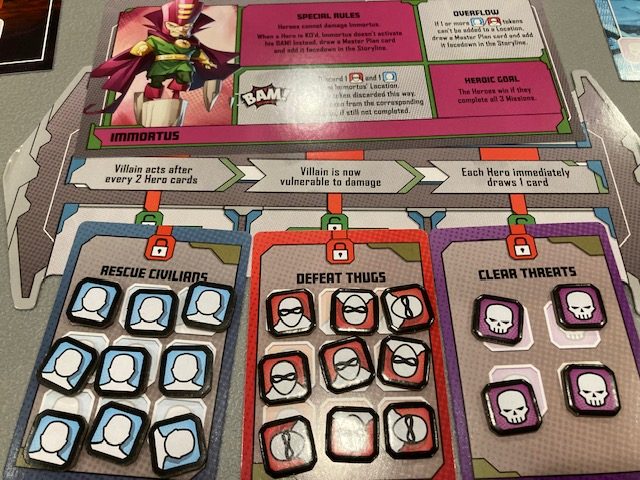
To win, the players must overcome 8 challenges! Calm Down Civilians, Steal The Ultimate Nullifier, Take Down Air-walker, etc (see three of them above)!
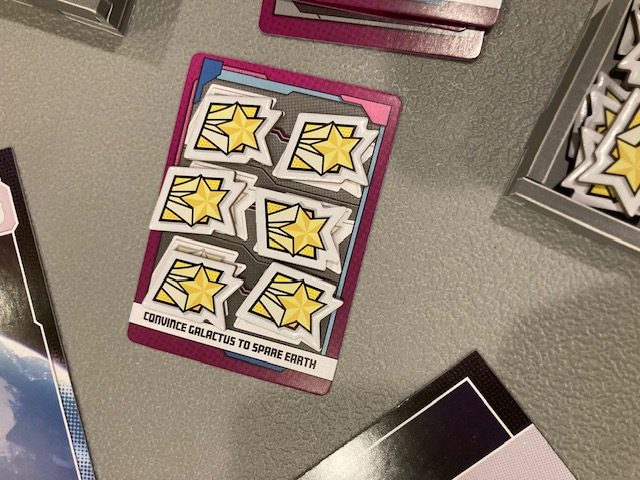
The final Challenge is always the same: “Convince Galactus to Spare Earth!” Yes, you cannot take down Galactus, buy you can reason with him. This is an interesting new mechanism, as you have to put the tokens down in PAIRS (i.e., no single stars) to succeed on this Challenge.
If you ever run out of storyline cards, or any hero completely dies, the game is over as Galactus has eaten earth! Your one chance to win is to “reason” with Galactus!
Solo Play (The Coming Of Galactus)
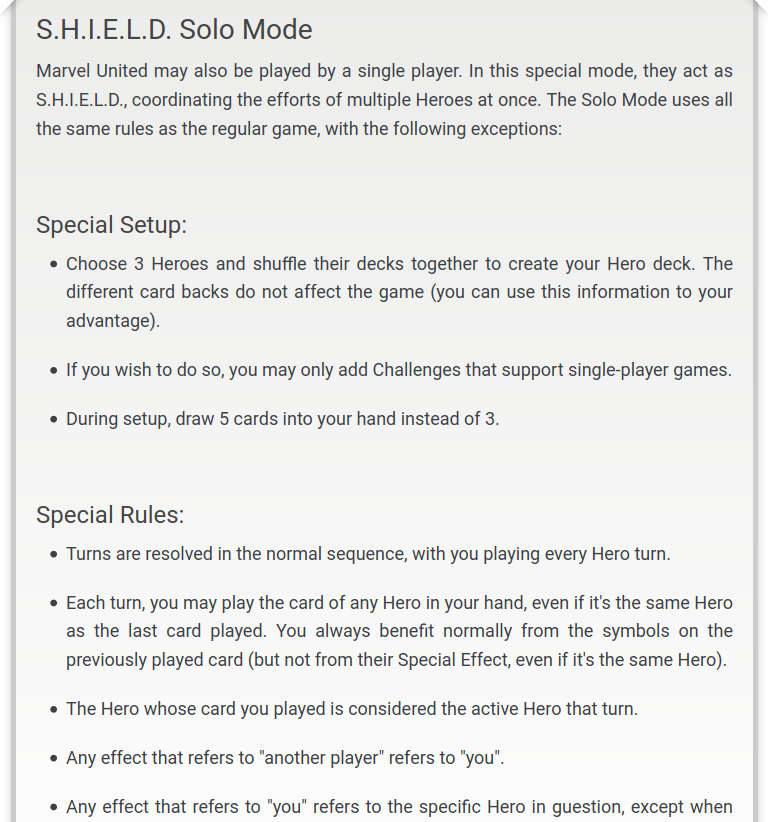
So, Marvel United has two official Solo Modes and one unofficial Solo Mode. (Thank you for following Saunders’ Law!) The original Marvel United and X-Men: Marvel United have a fairly contorted solo mode (called S.H.I.E.L.D. solo mode: see SOME of the rules above) which was far too complex; it wasn’t appealing to us at all. In fact, it became a standard counter-example in our discussion of solo modes: How To Play A Cooperative Game Solo?
The newest Spider-Geddon: Marvel United (and Multiverse: Marvel United) has a new solo mode called Commander Mode! We definitely liked it more than the original S.H.I.E.L.D. solo mode! Spider-Geddon: Marvel United made our Top 10 Solo Games of 2023 because of the new solo mode!
But, at the end of the day, I prefer two-handed solo for Marvel United. Why? Because it’s easy: there are no special rules, you just play Marvel United the way it’s “meant” to be played!! Since there are SO MANY NEW THINGS for Marvel United (Team Decks, Items, New Expansions, etc), the last thing I want are new rules that I have to consult for solo mode. Alternating between two heroes playing is the easiest way to get going so I can concentrate on all the new stuff.
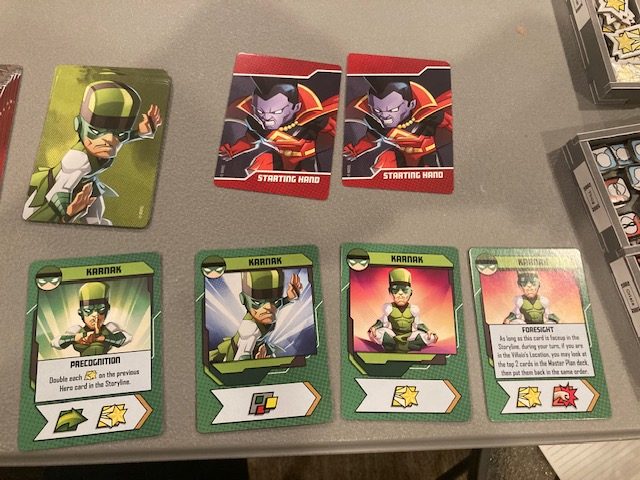
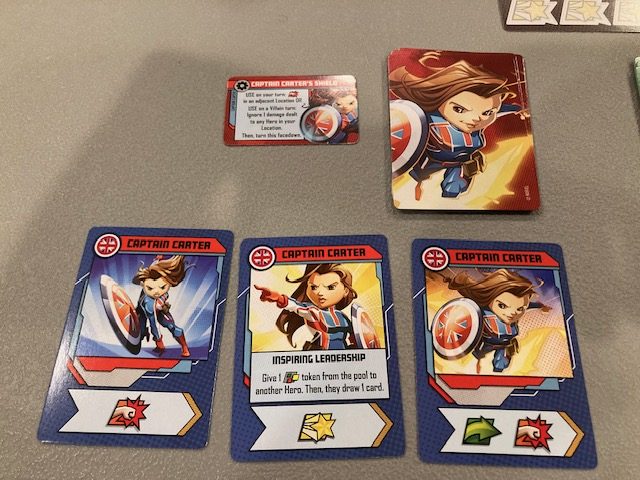
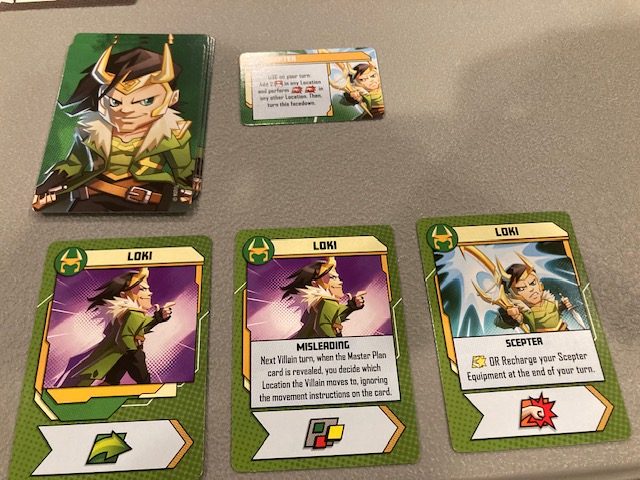
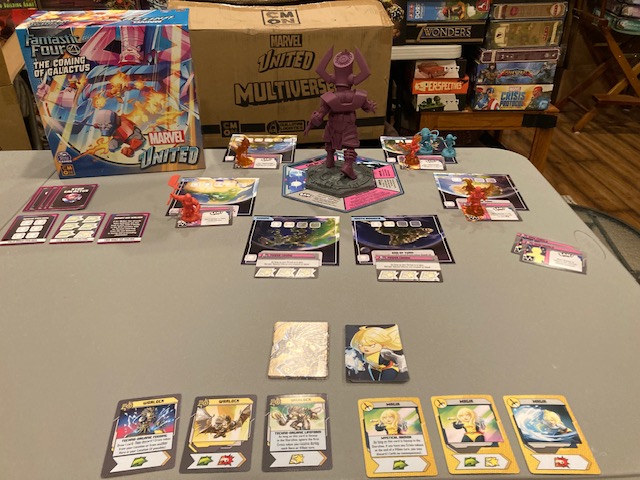
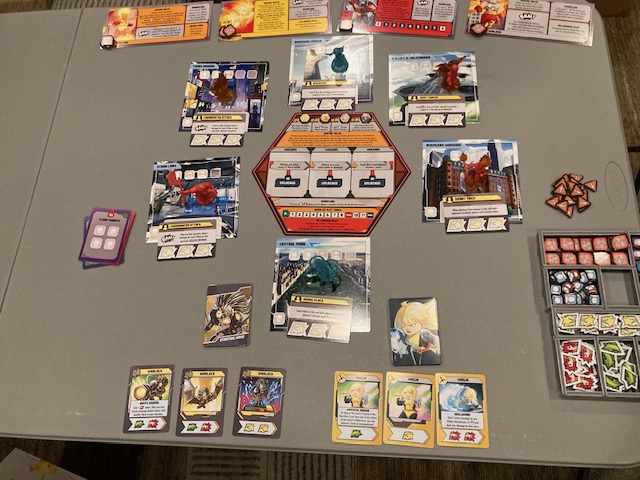
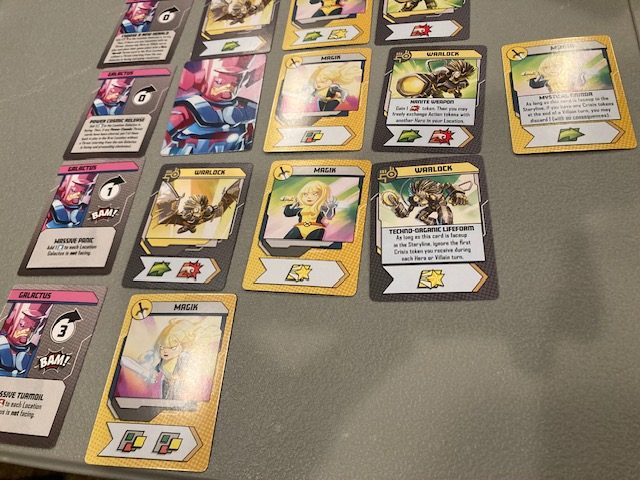
For The Coming of Galactus first play, I chose Magik and Warlock (see above) from the X-Men: Stretch Goals set (see below). Those are my favorite two characters! Since I am learning a bunch of new rules, I wanted to play with characters I already knew. This is called “change as few things as possible to make it easier to learn“.
Somehow, it seemed right that a galactic refuge outcast like Warlock and a dimension hopping outcast like Magik would take on Galactus. The outcasts are the only ones crazy enough to take on the World-Eating Villain!
So, I ended up playing two games with these heroes: I won the first and just barely lost the second. But I cheated in the first game.
How did I cheat in my first solo game? I kept three of the Challenges out all times (see above). Recall, the only way to win is take get to the last Challenge and defeat that! But I think the right thing to do is only show a single Challenge at a time!! So, I think I won the first game because I cheated. Learn my mistake: only one Challenge is active at a time!
One of the things that makes the Galactus scenario so hard is that every KO (and overflow) causes Galactus to put a Master Plan face down! See above as an overflow happens and Galactus clogs the storyline! This is terrible because you lose a turn (Magik and Warlock only have two plays now before the next Master Plan) AND Galactus is closer to winning!
My second game was a loss, but a heart-breaking loss as I simply ran out of cards! This time, I played correctly with the Challenges (only one Challenge up at any time).
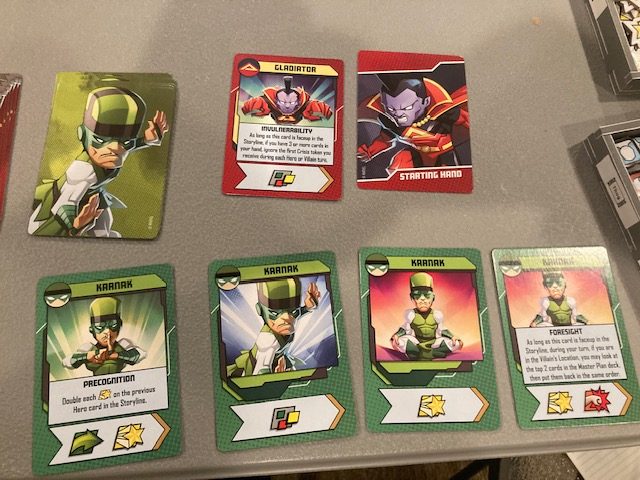
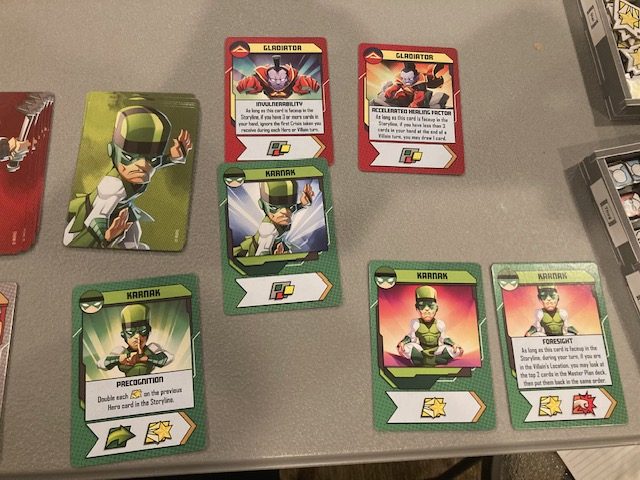
See above as Warlock and Magik need literally one more card to win! This was both cool and heart-breaking at the same time! I think if I had Magik’s Soul Sword (Items are new in the Multiverse expansions), I may been able to pull this off!
What a blast! Magik and Warlock were a surprisingly good team against Galactus. This is partly because their Special Effects don’t matter as much with Galactus (as their special Effects tend to deal with Crisis tokens: see above)! Why do I say that?
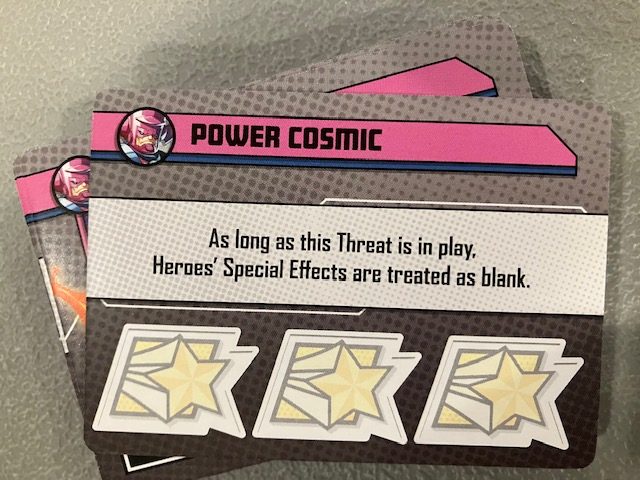
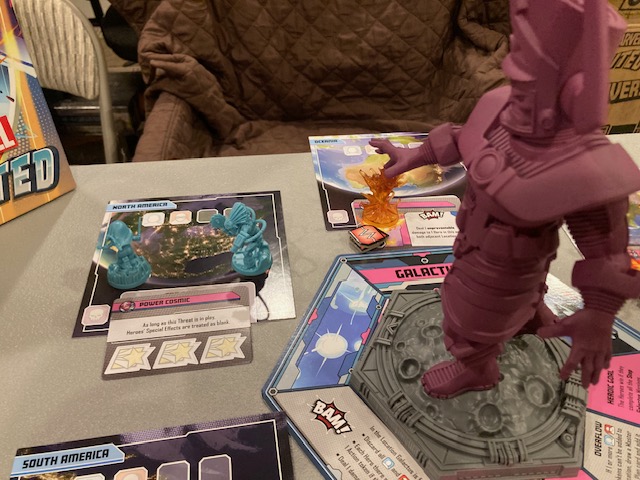
The two Power Cosmic Threat cards (see above) disable ALL SPECIAL EFFECTS until you defeat them!!! This game is so tight, you almost never have a chance to disable these Power Cosmic Threats, so all the Special Effects you have become useless! In a game without Crisis tokens, Warlock and Magik didn’t care too much that their “specials” are disabled. I remember thinking when I first started: “Oh, Magik and Warlock are bad choices, because their specials mostly deal with Crisis tokens“. Nope! Since they are disabled most of the time (if not the entire game), they didn’t care!
Overall, I had a great time playing solo. This was SO MUCH FUN!
Cooperative Mode (The Coming Of Galactus)
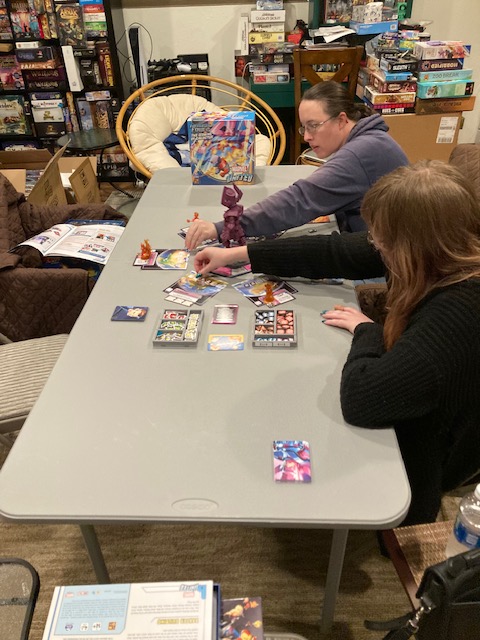
For cooperative mode, we played a 3-Player game with members of the Fantastic Four. The Fantastic Four is a special expansion for the base game: we reviewed it here.
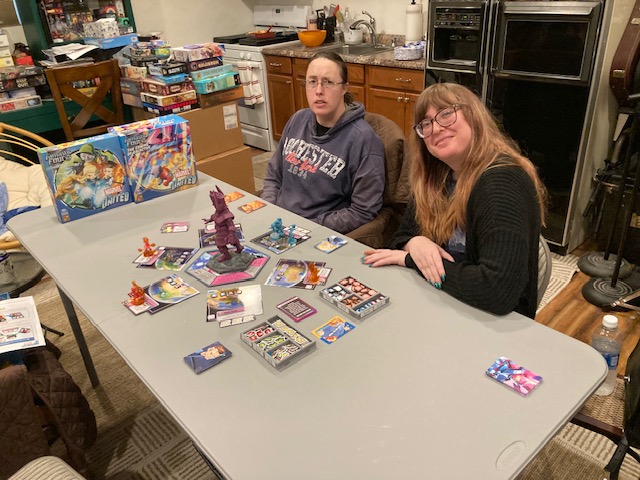
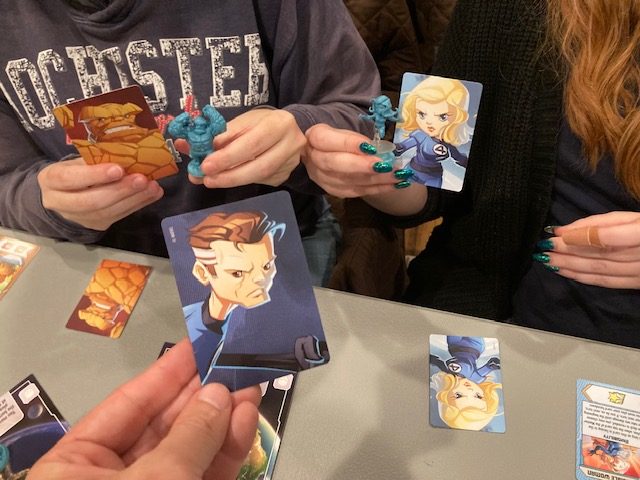
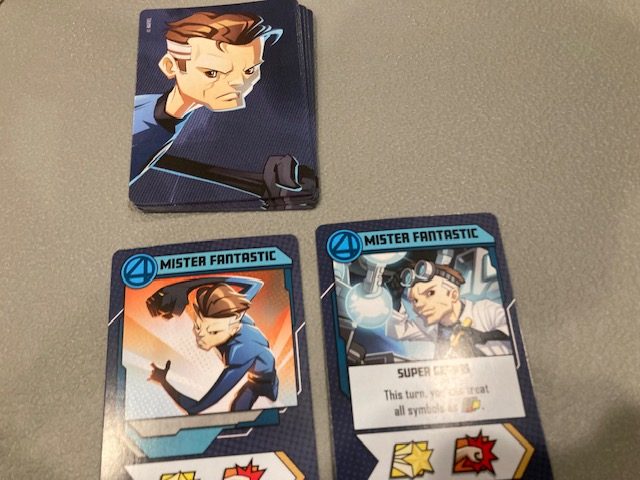
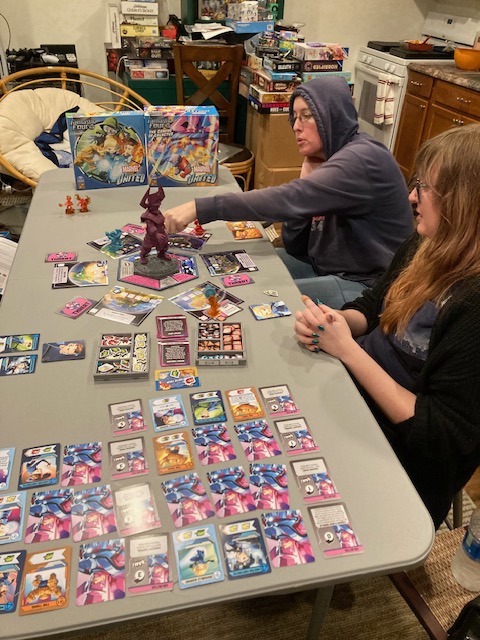
I played Mr. Fantastic, Sara played Invisible Girl, and Teresa played The Thing.
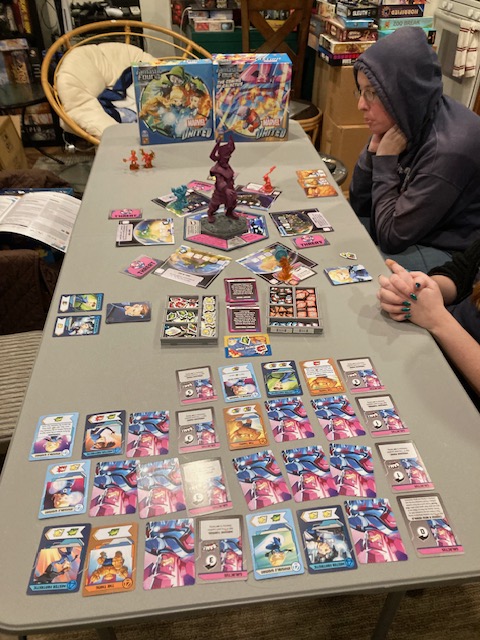
Over the coarse of one night, we ended up playing The Coming of Galactus three times!
Our first loss was crushing, as we got KO’d and overflowed so many times that Galactus clogged the storyline. We learned a lot from this first play: most importantly, don’t let the Civilians or Thugs overflow! The consequences are too dire!
It was a crushing defeat (see above), but we all wanted to try again!
We did significantly better the second time, but still lost as we ran out of time! See above!
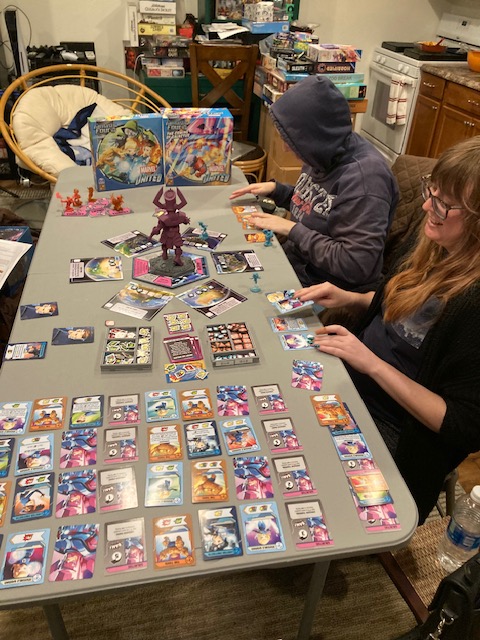
In our third and final play, we were able to win! We learned a lot about the game: what to do, what NOT to do, what strategies to take!
That hardest part of this is that it’s just so easy to be crushed by Galactus if you aren’t careful, but the game is quick enough to reset and play again! After three plays, we finally eked out a victory. We had fun, but we all started getting a little loopy:
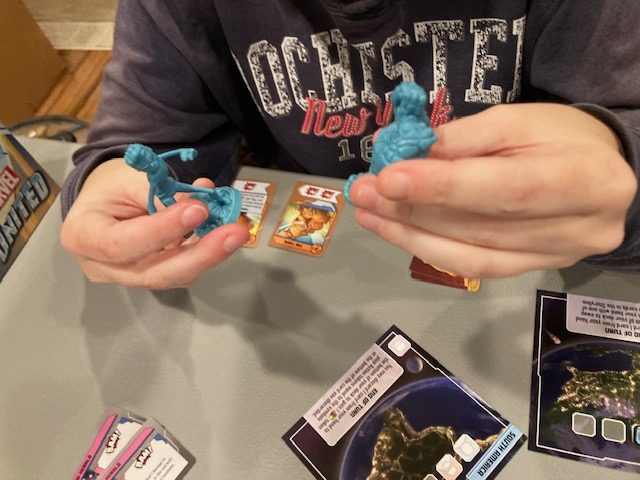
When I wasn’t looking, Teresa started playing with the figures. Apparently, Sue Richards ran off with Nova.
Solo Play (The Heralds of Galactus)
The Heralds of Galactus is a secondary way to play this expansion.
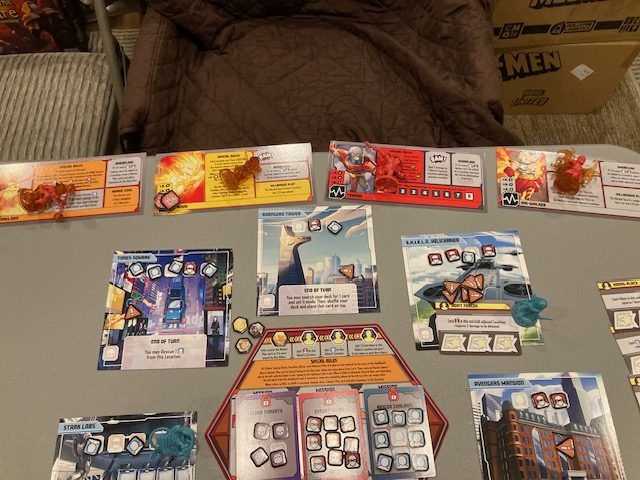
While each of the Heralds has its own board (see above), and you can play each Herald separately as the main Villian, the mode: The Heralds of Galactus has you fighting all the Heralds at once! See below!
This is a really interesting way to run the Heralds: all of them are out on the board, and all of the their dashboards are out as well. As you play, the Heralds cycle-through each other.
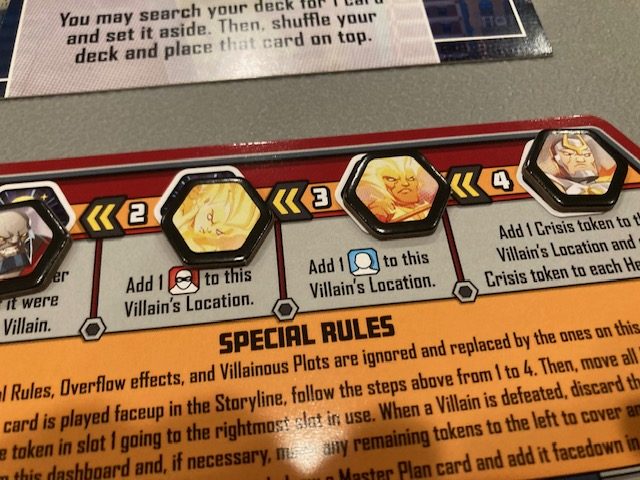
There’s a little track at the top that keeps track of which Herald is next.
This was a fun way to play; the Heralds each got a chance to do their thing, but it wasn’t too overwhelming as each Herald gets their “special” BAM! every 4 turns (as they cycle through). It’s kind of cool that this mode does seem to work.
I played this mode solo with .. you guessed it: Magik and Warlock.
In the The Heralds of Galactus mode, Magik and Warlock are perfect choices! Why?
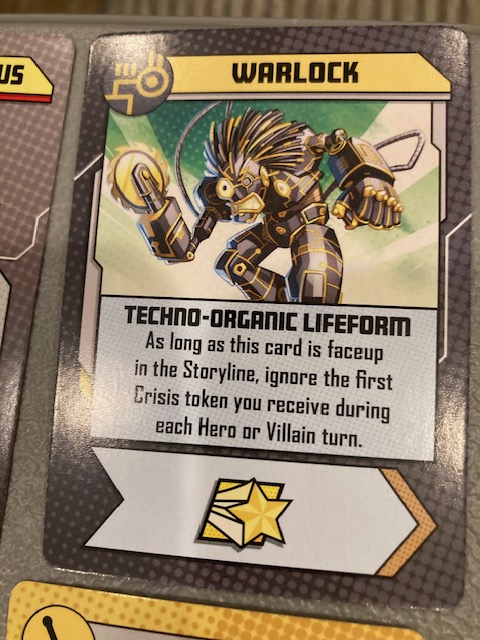
This Scenario focuses quite a bit on the Crisis Tokens. Both Magik and Warlock manage Crisis tokens VERY WELL! See Magik’s Mystical Armor above and Warlock’sTecho-Organic Lifeform below!
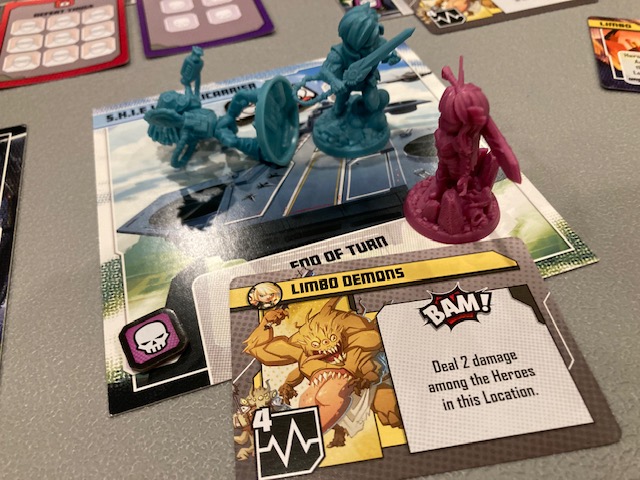
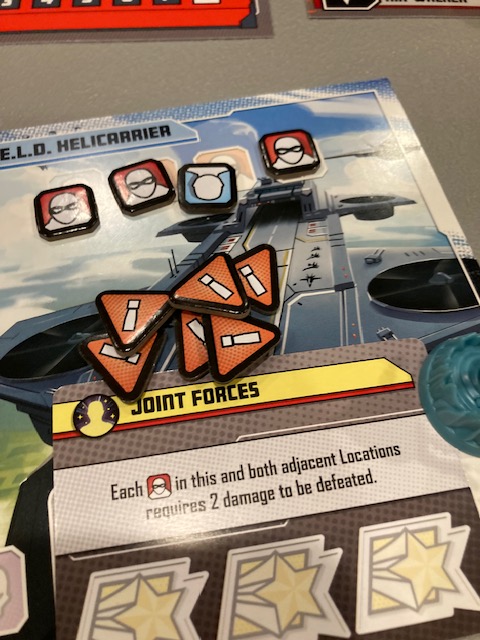
One of the things the Heroes need to worry about is the dwindling supply of Crisis Tokens that come out during play: if they ever all come out, the player’s immediately lose! See above as the S.H.I.E.L.D. Hellicarrier gets a lot of Crisis tokens!
In my solo game, I was never in danger of losing by running out of Crisis tokens! Warlock’s first card allows him to discard Crisis! And once Magik got her Armor out, she didn’t have to worry about Crisis tokens either. The Heroes could concentrate on what mattered and mostly ignore the Crisis tokens! Warlock and Magik did a great job taking down the Heralds!
In the end, this mode (The Heralds of Galactus) is a little more of a by-the-numbers expansion, but I liked it. I liked thee way the Heralds cycled through to create a unique experience.
Controversy! What Does Facedown Mean?
There has been some discussion on BoardGameGeek (see this thread here) about what it means to “put a Villain Master Plan facedown into the Storyline“. This is especially important to the Galactus scenario, as a Hero getting KO’d forces a Galactus Master Plan to get added facedown to the storyline … and we know heroes get KO’d all the time with Galactus!
My original stance is that a card facedown takes up space in storyline and causes the players to have fewer actions. Other people in the BGG thread feel that you shouldn’t lose turns because it doesn’t explicitly say that.
Let’s explore this issue.What does it mean to place a Master Plan card facedown in the storyline?Let’s take a look at the Point and Counterpoint!
Point:A Facedown card causes the Heroes the lose an action!
1. Simplicity: If the purpose of the facedown rule is to simply reduce the number of cards in the Villain’s Master Plan deck (and thus end the game earlier), the rule would have been written to be simpler:
“Discard a card from the Villain’s Master Plan deck”.
If the rule were written like that, I would 100% agree that the players don’t lose an action.But since the rule states explicitly to place a card facedown in the Storyline, it implies it takes up space!What does it mean to take up space? To lose an action!
2. Thematic/Cartoon
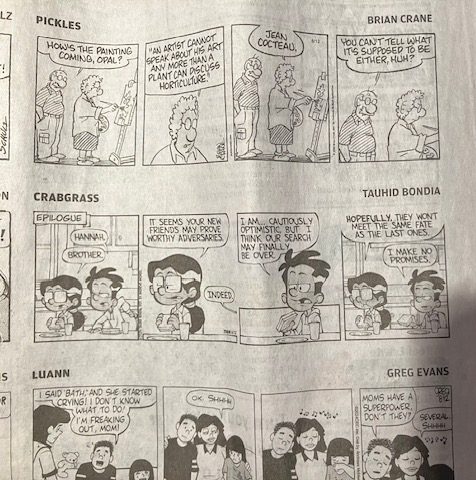
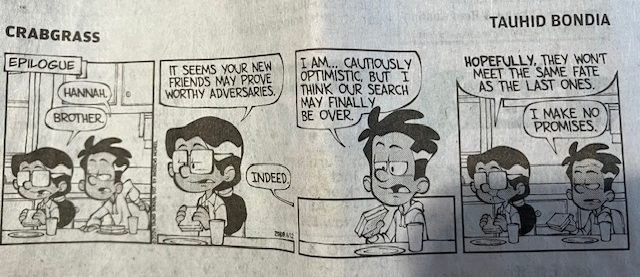
Take a look at this snapshot of a cartoon page from a newspaper.
In this snapshot above, each panel of each cartoon takes up space. If a panel is removed or covered, then there is physically less space!
That lack of space means the cartoons have less space to tell their stories.
Much like the storyline in Marvel United: reduced space means fewer panels for the players to act and tell their story!
3) Thematic/Game Balance
It always struck me that a KO should be fairly devastating: a hero has been knocked out, and it feels it should be a big deal!
So, when a KO from Galactus causes “one Master Plan facedown in the storyline”, that feels it should be reasonably devastating!If we just lose one Master Plan card, but keep all three turns, that feels lame to me!It doesn’t feel like it is thematic or balanced! In fact, I have seen players gets KO’d on purpose just so they could get back to full cards!
If the heroes must lose an action (because there’s less space in the story), then it feels more thematic and frankly more balanced.
A KO should be a big event the players try to avoid: it should have grave repercussions.That leads me to believe the players should lose an action as well as reduce the number of Master Plan cards. (In Galactus especially: there are 18 Master Plan cards, so it’s almost never a problem that you run out of Master Plan cards, at least in my experience!)
4) Symmetry
Take a look at the cartoon page again. See above.
Now, take a look at a storyline where the players lose a turn whenever a Master Plan is played facedown to the storyline. It looks symmetric: like a page of a comic. See above.
Now, take a look at a storyline were players get all three turns; the facedown Master Plan cards cause the storyline to have ragged edges and no longer look like a real comic page.
Humans naturally like symmetry: I would argue that the natural tendency is for humans to want the symmetry of the panels and suggests that the panels should stay symmetric and avoid the ragged edges.
In conclusion, the rule about placing a Villain Master Card facedown in the storyline, both thematically and physically, implies less space and fewer actions for the players.The fact that the rule is NOT written in the simpler form of “discard a card from the Villain Master Plan” implies there’s more to the rule than just reducing the cards in the Villain Master Plan Deck; it implies reduced space and thus fewer actions.
Counter Point: The facedown card in the storyline should NOT cause players to lose an action!
The rule that says “place a Villain Master Plan card facedown in the storyline” says nothing about losing turns.Since it’s not said explicitly, players do not lose turns.
—————————————-Choose a side.Which side do you land on?
If you chose that side that facedown implies fewer actions, the game becomes harder, as the heroes have fewer actions in the game in response to the Villain.
If you choose the side that that says “facedown does NOT imply fewer actions”, the game becomes easier, as the characters always get all three of their actions.
From my playtesting, I have tried the game with both facedown interpretations (fewer actions or full actions) … and in both solo and cooperative modes!! And guess what? The game still works either way.
One way is just harder than the other.
What I Liked
One) The minis are all amazing.
Two) The new idea in this expansion (have to place PAIRS of tokens, 8 challenges, cycling through Heralds) keep this game new and fresh.
Three) I still love how this game looks, especially with the storyline. It feels like you are looking at a comic book storyline!
Four) I like that the Coming of Galactus mode is hard, but it seems like you can still learn from it to come up with strategies!
Five) I had such a good time playing this solo (two-handed solo mode).
What I Didn’t Like
One) My friends didn’t like this nearly as much a I did. Their main criticism was “the game was too random“. I agree there is a lot of randomness in the game (Where does Galactus turn to? What cards come out? Where are the Heralds?), but I would argue that, after three cooperative games, we had discovered strategies that worked because we got better every game! We were able to win! And I think we could do it again!
Two) In The Coming of Galactus mode, you simply have to take damage and get KO’d. Some Marvel United expansions MIGHT have a player or two get KO’d. Not here! Each hero will probably get KO’d at least once or twice or more! You have to get comfortable with the idea: “you will have to take damage and you will have to get KO’d multiple times”. If you don’t like that feeling, then this game will not be for you. Once you sort of “get used” to that, I don’t think it’s that bad.
Three) I wish the rules were explained just a little better. A sentence being more explicit and saying “There is only one Challenge active at any time: once you complete the Challenge, flip over the next!”. This is the problem with so many expansions; sometimes they don’t have time to make things a little clearer.
Four) The Power Cosmic is the most frustrating Threat in the Coming of Galactus mode! And there are TWO COPIES of it! So, for most of the game, you don’t get to take advantage of your Special Effects on your Hero cards! All the things that make the Heroes “special” are taken from them! I got “lucky” in my solo games and used two characters (Magik and Warlock) that didn’t really care, but The Fantastic Four were really hampered by this! But, I think we won our very last cooperative game because we were able to enable the Fantastic Four Special Powers in the very last few rounds!
This can be very thematic: “The Fantastic Four lost a lot of their powers, but once they got them back, they rocked!!!” I could see this being comic book arc: the heroes must overcome obstacles to get their powers back, and then rally in a climactic ending! BUT this can be very frustrating if you don’t deal with it correctly. My friends did not like this: they said it made it feel like you couldn’t do very much, and it was frustrating.
Conclusion
This was a very divisive expansion. The Coming of Galactus might be my favorite expansion of the year so far at a 9.0/10, Teresa likes it at about a 7/10, but my friend Sara gives it a 4.0/10. Her thoughts were that the randomness of Galactus, the absolute beating the heroes takes, and Power Cosmic Threat cards take away from the fun. And I get that. But I thought that it was all very thematic! Once you get comfortable with the idea that “you will get beaten up a lot“, you can strategize and come up with ways to defeat Galactus … which we did, but it just took us three games.
I will point out that we all WANTED to play three games to defeat Galactus. It was easy enough to replay three games in one night, and very satisfying once we were finally able to defeat the mighty Galactus.
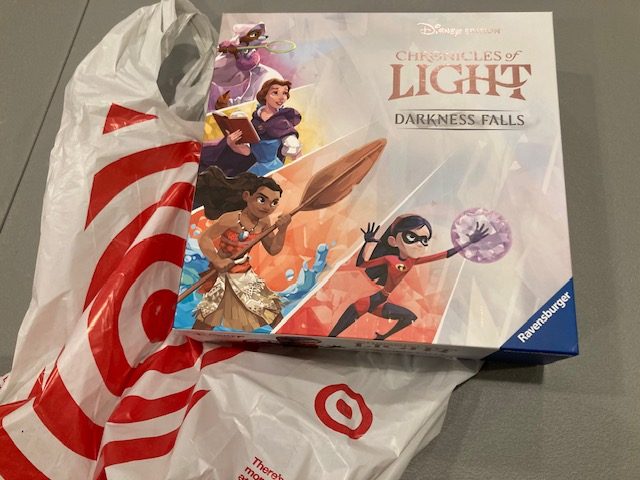
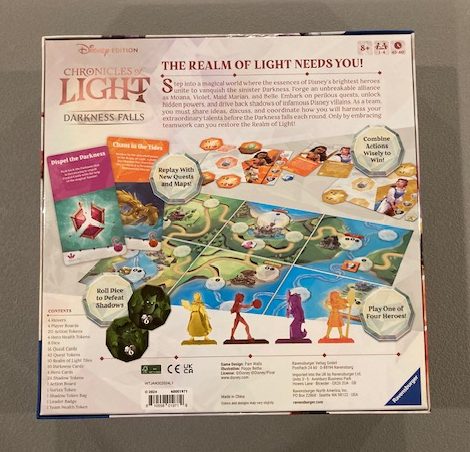
I picked up Chronicles of Light: Darkness Falls from Target on August 3rd, 2024. I think it literally just came out that day or just a few days before.
I had already pre-ordered it from GameNerdz or Miniatures Market, but I was just so excited to try it out, I picked it up at Target as soon as I saw it! I suspect the extra copy of my Chronicles of Light: Darkness Falls will be a Christmas present for some family friends this year!
You’ll notice I said “…a Christmas present for some family…”; This is a light-weight cooperative game that I believe is intended for families. It really is a mass-market game. Chronicles of Light: Darkness Falls is a Disney themed game with Disney princesses: Moana from Moana, Belle from Beauty and the Beast, Violet from The Incredibles, Maid Marian from Robin Hood. It contains some lesser components, but it is still a decent price: I paid $29.99 (full MSRP) + tax.
This is a cooperative game for 1-4 players, taking 45-60 minutes, and it is good for ages 8+. In fact, that 45-60 minutes might even be an exaggeration: I was able to play a few games in about 30 minutes!
Let’s take a look!
Unboxing and Gameplay
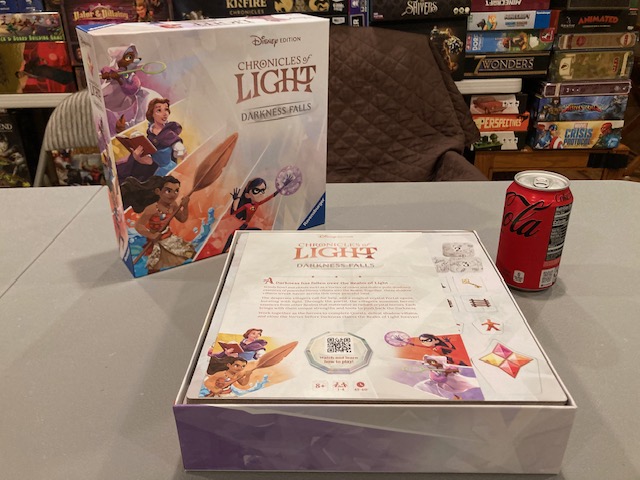
Chronicles of Light: Darkness Falls is a smaller box: see Coke Can above for scale.
Unpacking the box, you see that the components are pretty decent for a mass-market game. None of the cards are linen-finished, but it’s still a nice production.
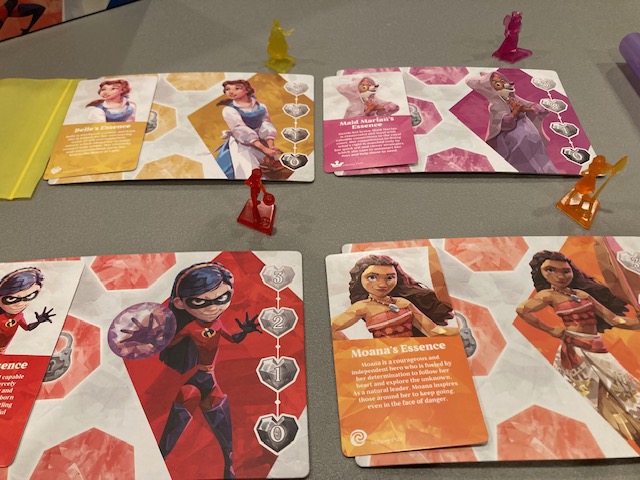
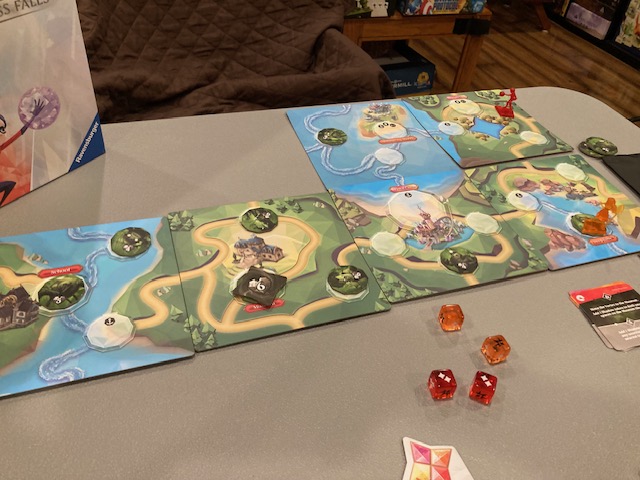
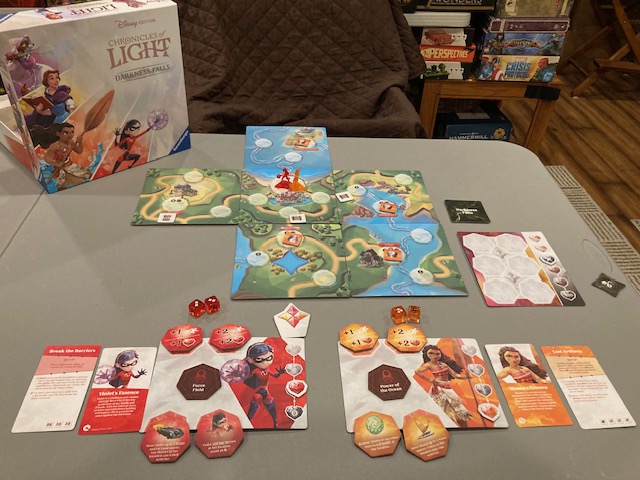
In this game, each player takes control of one of the Disney Princesses: see the four boards above.
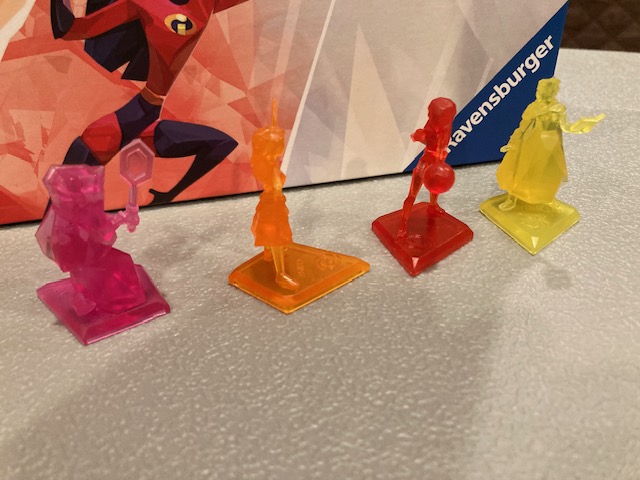
The minis are a little formless, but the clear plastic and color scheme makes it very clear which princess is which!
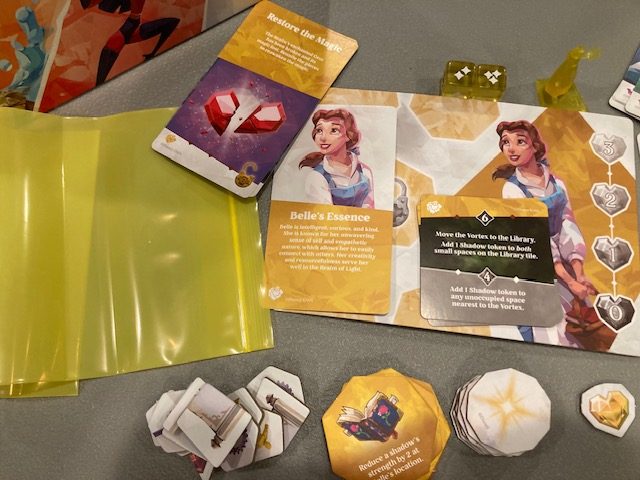
This game does a very good job of noting which components belong to which princess from the color scheme! The Belle character’s pieces are all yellow! See above.
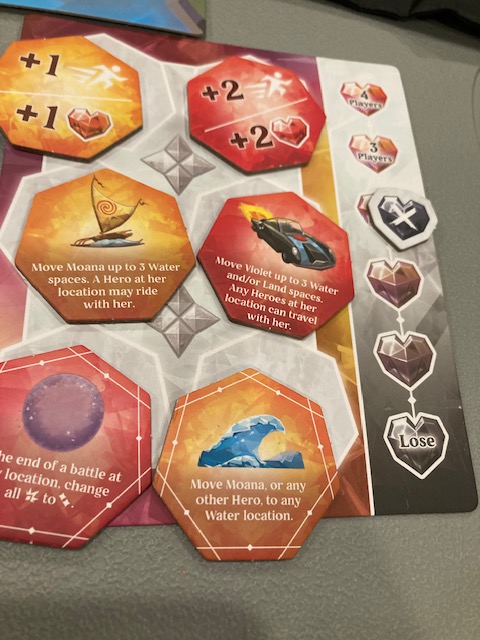
Moana‘s pieces are orange (see above).
Violet‘s pieces are red (see above)! (Should they have been violet?)
And Maid Marian’s pieces are purple!
In fact, the game even goes the extra mile by having plastic storage bags color-coded to the princesses!
You might be wondering “Why have all these princess’s from diverse Disney properties banded together? Why are they here?” (If you said “Money: Disney wants money”, you far too cynical to play this game, and you should probably stop reading here). A magic crystal Portal has opened and swept all these diverse Disney princess’s together into one realm! They need to work together to defeat the shadow creatures, close the portal, and solve their own personal quests to win!
The shadow creatures are creatures that invade the lands the princesses have been swept to! Note that each princess has her own set of creatures (the back is labelled in her color) that followed her through the portal! See above! One of three winning conditions is that you need to take out all Shadows!
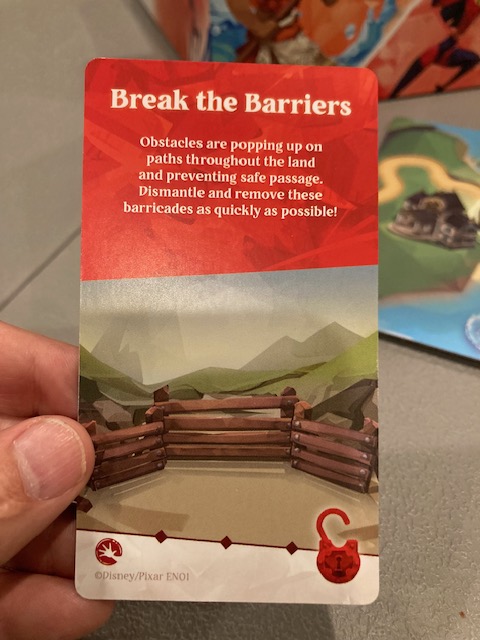
Each Princess also has her own quest: the game comes with 4 quests per character, and players randomly choose one! See above as Violet has to Break The Barriers!
These quests all have slightly different flavors: pick-up and deliver, collect resources, remove resources, etc. But, all characters must complete their quest in order to win the game!
Each player has 5 actions they can do: see above. Each character is very different and has action tokens which describe what they can do.
There’s no set turn order in the game, as each player chooses a token to act! These tokens allow players to do what’s needed on their turn. Once 6 total tokens have been played, the day ends and players take their token back, starting a new day!
Since this is a co-op game, there must be Bad News cards, right? These are called Darkness Falls cards (see above) and they form a timer to how long until a game ends. At the start of every day, one of these is drawn and resolved. In a 2-Player game, there are only 5 Darkness Falls cards … so the game only lasts 5 turns! Like I said, this game is over quickly!
This game has pretty darn nice components (see above), despite it being a mass-market game. And the color-coding of the characters is very consistent and makes it easy to discover which pieces belong to which Princess.
Rulebook
For a family game and mass-market game, this rulebook is actually pretty good.
It gets an A- on The Chair Test! This rulebook is easy to consult if I put it on a chair next to me: it has a big font and lays open just fine. The only reason it’s an A- is that the rulebook is actually slightly smaller than I wanted!
The components list is great for cross-referencing all the component! See above!
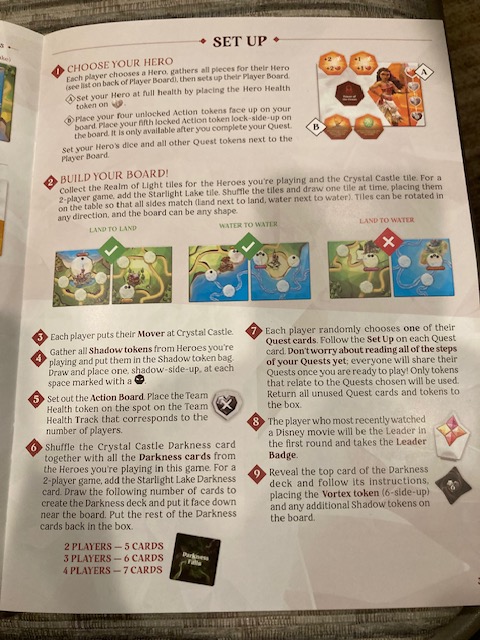
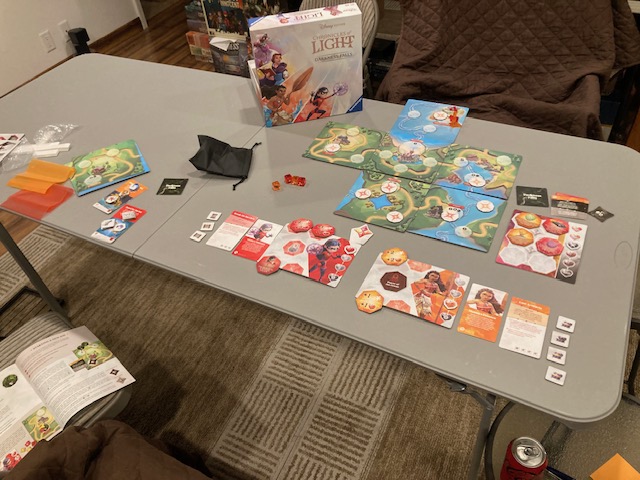
The Set-up is remarkably well done on just one page as well! See above! The only thing missing is a picture of a complete set-up: it’s a minor thing, but I like having pictures of set-up. Still, this set-up still worked pretty well.
The rulebook is also quite short: only 8 pages! And yet it (mostly) does everything it needs! There could be a few more pictures, but in general, it was very readable.
It really is easy to read: see above.
Interestingly, the rulebook ends with a description of how to win/lose, and the solo rules.
The game is simple enough that I won’t fault it for lacking an index or glossary, but it probably needs a few more elaborations of rules. For example: Violet can take out the IncredibleCar to take out barriers, but can she double-back once she breaks a barrier? That one rule might make a huge difference because movement is so precious in this game. And there’s lot of places, as you play, where you just have to make a ruling. It’s not the end of the world, because the game is so simple, but I think the game needs a few more elaborations to be a great rulebook.
Otherwise, this was a pretty darn good rulebook.
EDIT: Unfortunately, we did find out after this review that there was one major issue with the rulebook: it’s not clear, but you can’t destroy the vortex until you’ve completed all quests. The designer spoke up in this BoardGameGeek thread and said:
Fyi, you cannot destroy the Vortex until all quests have been completed and all shadows defeated. I re-read the rules and I agree this isn’t explicitly clear. I will make a note of this to clarify if the game gets a re-print.
Solo Play
Congratulations to Chronicles of Light: Darkness Falls for having a solo mode! Thanks for following Saunders’ Law! It’s not a true solo mode: you always need at least two princesses’ playing: see the rules above:
For Solo Players: “Take control of a dynamic duo! Set up for a 2-Player game and play as both Heroes!”
It’s real easy to get this to the table as a solo game. See above as Violet and Moana work together to take out the Barricades and collect Moana’s treasure! Oh ya, and take out the shadows! Oh ya, And the portal!
This system of choosing tokens to play for an action works really well! The actions (above) are notated very well on the tokens:
And there’s no “player order” or “take a turn”: you just play the tokens you need to get stuff done!
It’s very cool that each Hero has their own quest, and sometimes others can help with the quest, and sometimes they can’t! Only Violet can pilot the Incredibile (I would have called it IncredibleCar: Incredibile looks like a misspelling) to take out barricades.
It’s interesting how movement and topology really matter in this game, considering that the board is not huge! Movement is precious in this game, and part of the fun is trying to figure out the best order to “deal with” things! Do we take out some shadows first? The portal? Do we get a quest done ASAP to unlock a special? The order in which players “deal with” things may depend strongly on the topology and location of items!! Players will have to plan their actions together if they want any chance of winning!
For example, in my opening game, I lost horribly as I didn’t really take into account the shadows! I had done my quests, but I didn’t take down the shadows OR the Portal! My first game was a disaster … but fun.
For my second game, I rebuilt the map differently! One of the set-up steps is that you “build the map!” The first time through, the topology of the map doesn’t seem that important, but it really is! It sets the tone for how hard it is to move around! Like I said, movement is precious in this game!
My second game went much better as a I strategized (with myself) the best order to deal with the Portal, the shadows, and my quests! It is very important to look at the map!
For a very different solo game, I brought in Maid Marian and Belle to see how different they would be. What really changes the game:
The action tokens for all characters are all different (although all players still have a +1 and +2 move/heal token)
The quest: each character has 4 different quests
As a solo game, this is very easy to get the table and set-up. The color coding makes the process that much easier.
I had fun solo, but it’s not too hard a puzzle once you get the flow of the game. It’s a simple game The solo game works well for teaching me the game so I can teach others. I think the game is better cooperatively, as a group experience.
Cooperative Play
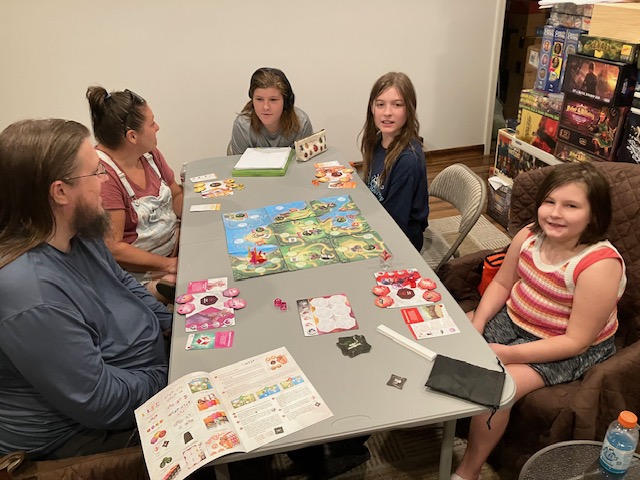
For cooperative play, I taught the game to some family friends. See above as two girls (9 and 11) play with their parents.
With the younger audience, I ended up being more like a shepherd. The game is pretty straight forward to teach and play, but with a lot of stuff going around, it was easier to ease the kids into the game by teaching the rules (and not playing). I would recommend learning this game before teaching it. Not that the game is hard, but it just makes it easier to ease “attention-challenged” kids into a game if you know it well.
They ended up playing and winning their 4-Player game! See above. I was a little worried that the 4-Player experience would be too much, but it wasn’t … as long as I was keeping everyone involved. Since there is no turn order, I think you have to be extra careful to keep everyone on track. For families, I again would recommend a shepherd.
Did my family friends like this game? I asked them: “Would you like Chronicles of Light: Darkness Falls for Christmas?” I got a very excited “YES!” from the girls, so I think this was a hit.
What I Liked
The system for Player Selected Turn Order (PSTO):coarse-grained (see PSTO here) works really well here! One of the harder things to notate in PSTO is “who has gone and who hasn’t”. By having the tokens to notate when you have played them (on the team board above), that solves that problem! See the player board above!!! In fact, these tokens also solve the problem of “what can I do on my turn”: the tokens are very well notated, so it’s very clear all the things a player can do on their turn! We always love PSTO, as it usually adds an extra level of cooperation to a game as players work out the order in which they act: PSTO “makes” players talk and interact that much more!
The fact that PSTO is in a mass-market game makes this game all the more impressive! Sure, we have seen PSTO in gamery games like The Reckoners, Set A Watch, and X-Men: Heroes Resistance, to name a few. But to see PSTO here in this mass market game is great!
The color-coding of the characters is very strong and makes the game easy to set-up and tear-down! It’s very clear which things belong to which Princess! This just makes the game “feel” easier to play, even if it’s just an optical illusion. See above.
For a mass-market game, the components are really pretty nice! I’ve tried to show lots of pictures in this review to demonstrate that. See above.
I appreciate, in general, how good the rulebook is. See above.
Variability: the fact that each princess has one of four different quests gives this game some variability! Even if you play Violet a couple of times in a row, so can have a different quest each time, which gives the game some variability to extend the life of the game. See above.
The fact that each Princess has her own 5 action tokens adds to the variability of point 5.
What I Didn’t Like
1. I have played a number of games now, and unfortunately, to win, the game arc will be the same. You almost HAVE to take the Portal out in the first turn to have any chance of winning. The Portal spits out Shadows every turn … and you have to kill all Shadows (as one of the winning conditions) in order to win! My first game was a disaster because I let the Portal run wild. It’s very clear: in order to win, you must take out the Portal first, then proceed to the rest of the game. That makes the game arc a little “samey” each time. EDIT: See rulebook discussion above, as we found after this review came out. The designer spoke up in this thread on BoardGameGeek and said:
Fyi, you cannot destroy the Vortex until all quests have been completed and all shadows defeated. I re-read the rules and I agree this isn’t explicitly clear. I will make a note of this to clarify if the game gets a re-print.
2. Although I really like that the actions are well-labelled on the tokens, and that the tokens are different, they aren’t THAT different. Everyone has a +1, +2 move/heal. A lot of heroes have “something” that helps them move fast (move to another hero, move 3 over water, move 3 with a car), and then maybe one or two special. Don’t get me wrong: this is very cool, but the tokens aren’t THAT different. I almost wish each Princess had a special power not connected to their action tokens to make them more distinct.
3. At the end of the day, this is still a dice game. They are some player actions to mitigate the dice, but it’s still easy to be overwhelmed by bad rolls.
4. My boards were a little warped. It wasn’t a big deal, the game was still playable, but it was noticeable. See pictures above of the player boards and the maps boards.
Conclusion
I like Chronicles of Light: Darkness Falls. It’s a light cooperative game that’s fun for families, or for the end of the night when you want something “less thinky”. Many heavier gamers will probably balk at the lightness of this game. I tend to like solo games for their puzzly nature, and although the solo puzzle presented here isn’t that challenging, I could see this being a really good gateway solo game!!
The niceness of the components, color-scheme, and gameplay can’t be overemphasized for a mass-market game. I am personally very glad to see a cooperative mass-market game with Player Selected Turn Order (coarse-grained); that mechanism really tends to elevate cooperative games for me. These are some minor issues with the game (see previous section: “What I Don’t Like“), but in general I found Chronicles of Light: Darkness Falls to be a bright, fun, world to inhabit for about 45 minutes: 7/10.
Most importantly, my friends want it for Christmas!
RichieCon 2024 has come and gone! This year there were some twists and turns, but everything worked out in the end! For those of you who don’t know: RichieCon 2024 is the gathering of Richie and his friends … honestly, it’s just an excuse to play games every year! It’s not even really a Con, but we like to put a little pomp into it to make it sound more bombastic. This is actually the 10th year of RichieCon, but only the 9th actual convocation (as we skipped a year for CoVid).
This year’s RichieCon 2024 token is cool: it’s actually hollowed out and you can only see the year and RTS symbol if you hold it up to the light! See above! You need the Token to get into the Con, and it can only be obtained through “secret means!” (Find me or Max in the Hall). Thanks to Josh M. for designing it and Max M. for printing it!
The name RichieCon is a bit of a joke: I asked my friend Kurt many many years ago: “Hey, you wanna go this board game convention that’s far away?”
Kurt said, “Man! That’s like a $1000 plane ticket and then a $1000 hotel bill! Why don’t you host your own convention and call it RichieCon! It’ll be a lot cheaper!”
And thus, RichieCon was born.
PreCon
The week before RichieCon is a lot of putting boxes in boxes. To have some semblance of order, I try to put related games in bigger boxes and label what’s in there. See the “hot games” box above!
Sam and Teresa and Sara usually come over and help me put everything together. A big thanks to those three for all their help this year! See some of the boxes we put together above!
RichieCon Day 0: Secret RichieCon House
RichieCon has a lot of out of town guests that come into town a day early (Friday) and randomly show up with no place to go. I learned many years ago that it’s nice to have a “secret” RichieCon house for out-of-town guests to hang out on Friday before the Con.
The “secret” RichieCon house is modeled after the out-of-towners dinner you have for out-of-town guests for a wedding. It’s a way to say “thank you” for coming from so far away! This year, we had guests from Portland WA, Austin TX, Denver CO, Phoenix AZ, Las Cruces NM, Albuquerque NM, and from as far away as Madison WI!
RichieCon Day 1: Morning Pivot!
RichieCon Day 1 hit a scheduling SNAFU, so we had to pivot and hold RichieCon Day 1 partly at the “secret” RichieCon house! I guess it’s not so secret anymore!
Thanks to everyone who helped me move boxes and boxes and boxes of games to the “secret” RichieCon house! I couldn’t have done it without Sam, Charlie, Jeremy, Joe, Kurt, and a bunch of other people I didn’t see moving boxes because I was so busy! RichieCon is a community effort!
RichieCon Day 1: Part II! This Time, It’s Personal
Once we got into the Rec Center for the second half of the day, many games were played!
RichieCon Day 2: More Games!
Sound Mitigation
If you have ever been to a board game convention, you know there is a lot of background noise. We had some issues last year with the background noise being too much, so we tried some sound mitigation techniques. Basically, the Rec Center has very hard sonic surfaces, so sound bounces and echoes a little too much. Luckily, the Rec Center bought a fairly large carpet (see above) to help with some of that.
We also bought 5 CostCo rugs (for $18 each) to augment the sound mitigation of the hard sonically bright floors. See above and below.
I also have some friends who work in theater and they were able to hang up up some “quilts” on the wall:
These quilts (see above) were hanging and absorbed some of the sound.
The general consensus was that the rugs and quilts all helped, but not quite as much as we hoped. We will probably hang more quilts and get more rugs for next year! Thanks to Becca and Jeff for providing the hanging quilts!
Games of the Con
I think the game of the Con was Slay The Spire! I saw this game played more than any other game! I think I taught it 3 to 4 times over the course of 3 days and it was played more time than that! See above!
Flock Together was pretty popular! I saw this played a bunch of times! See above!
The Cat Box was a running joke: “Play Games from the Cat Box!” But, there were a lot of games played from here! Race To The Raft! Cat In The Box! Hissy Fit! Power Hungry Pets! I saw all of those games played at least once!
The Astro Knight games were popular: I saw both the base game and Astro Knights Eternity being played! I suspect that’s my fault … see below …
Casting Shadows was quite popular! I think that was played at least 3 times!
The weirdest game I played was the RPG Fiasco: It reminded me a lot of Spirit of 77! The point is to make each other laugh as you make up crazy stuff!
Forest Shuffle may have the other big game of the Con after Slay The Spire: Kurt taught this game many many times! See above!
SO many great games played! Set A Watch! See above!
Leviathan Wilds was also quite popular! I taught that at least three times, and I saw other people playing it!
Interesting Games
Every year, we stop the Con for a little bit to have a “meeting of the souls” where we all talk about our favorite board games! It’s a chance for everyone to give feedback on games they’ve enjoyed since last we met!! The real point of this is to try to recommend games that people might be interested in. What happens is that we recommend games, and then we end up teaching them the rest of the Con!
#6 What game from the last year surprised you the most? Good or bad surprise?
Rich:
Slay The Spire was a huge surprise to me! I almost didn’t back it on Kickstarter, but wow! My games groups loved it and it was probably the most played game at RichieCon!
Sam:
– Hissy Fit. It’s a light, fast, cute game about getting your cat into the carrier to go to the vet. It is also surprisingly fun to play.
#5 What game in the last year do you disagree with reviewers on?”
Rich:
Two weeks ago, Daybreak won the Spiel Des Jahres. Everybody seems to love this game except for me. I generally love Matt Leacock designs, but this one felt way too random for me.
Sam:
Tom Vasel didn’t like Race to the Raft. However, I really enjoyed the puzzley nature of creating the path and moving the cats to get them all off the island.
#4 What game (that you paid for) did you really dislike? It’s easy to dislike games other people paid for, but what did you pay for that you disliked?
Rich: The cooperative expansion for Valroc: The Legend of Aquiny. The base game of Valroc is a card-drafting, worker placement game that’s pretty good. The cooperative expansion looked cool with campaign envelopes, but the limited communication was too limited and the very very slow upgrade paths made this not fun. I would still recommend people try the base game Valroc.
Sam:
I picked up a copy of Call to Adventure (a story crafting game) and felt kind of meh about my plays of it. I’m hopeful that it may grow on me as I play more and actually get the rules all the way right.
#3 What game that came out in the last year that you liked but other’s didn’t?
Rich:
Gotham City Chronicles: Solo and Co-operative Expansion. This was so much work to get to the point where I could play solo (6 days of reading and printing and setting-up), but in the end I had fun. I don’t think most people like Gotham City Chronicles, especially Shut-Up & Sit-Down, because it’s so much work. But I still like it!
Sam:
Almost Innocent. I really enjoyed the logic puzzle aspect of it. Richie didn’t enjoy it but was also really tired that night and not necessarily sharp enough to do heavy logical deduction.
#2 What was your favorite expansion that came out in the last year?
Rich: Set A Watch: the new stand-alone expansion and the Set A Watch: Doomed Run! (Strictly speaking, they came from the same kickstarter)! I love this system because even if you roll badly, you can still place dice on powers to activate them!
Sam:
– +1 on Set a Watch: Doomed Run. I only played one of the missions but it was fun to play the characters that were assigned to me and use their powers and items. The two I had ended up chaining together pretty well.
To be different:: Astro Knights Eternity. It’s a good cooperative deck building game and the story parts surrounding the scenario were really good too.
#1 What was your favorite game that came out in the last year?
Rich:
A cooperative bag-building super hero game set in the unique world of Invincicble? Sign me up! This game was so much better than I expected, the upgrade paths makes this game engaging and keep you involved!
Sam:
+1 to Invincible (Richie) and World Wonders (Kurt)
To be different: Age of Civilization. It’s a really tight worker placement game where you draft your unique civilization powers which include number of workers and then use your workers to research technology, get money, build wonders, and go to war to get victory points. Bonus points: it’s a small box, has good solo modes, and takes 45 minutes to an hour.
Theme Song
During the “meeting of souls” and sharing of games, Joe shared with us his version of the theme Song for RichieCon! Sung to the tune of the Suffragette City by David Bowie! And yes, the entire room said said “Hey Man!” at the appropriate places!
RichieCon City: sung to the tune of Suffragette City by David Bowie (new lyrics by Junkerman)
Hey Man, you gotta play in the game Hey Man, custom pieces ain’t no shame! Hey Man, your kickstarter is drear. She said your package should be shipping by the end of the year
Hey Man, you really gotta choose Hey Man, which game you gonna lose Hey Man, you better learn all the rules She said you’re getting killed by Sauron or the Cult of Cthulu
[Chorus] Oh don’t lean on us man cuz you can’t defeat the wizard I’m back in RichieCon City! Well don’t lean on me man cuz you blew up all the kittens You know my RichieCon City! It’s outta sight, it’s alright!
Conclusion
As we bring all the games back to the house …
As we clean the Rec Center and put it back the way it was ..
And we lock the door .. heading home … we wonder …. was it all worth it?
Yes! It was! It so much fun to see everyone, despite the issues! We look forward to seeing everyone next year!
As we head into RichieCon soon, I wanted to highlight some games that I think a lot of people will want to play during RichieCon: Flock Together is one of them. Spoiler Alert! We liked this game! I think a lot of my friends will really enjoy this game!
This is game all about chickens with asymmetric powers! (There’s a sentence you never thought you’d hear!) It’s all about chickens leveling up and working together to fight off the invading predators! My friends and I joke that this is Coop: the co-op game as players cooperatively defend the chicken coop!
Flock Together plays 1-5 players, ages 10+ (but I think younger players could handle this), and lasts about 25 minutes per player. This is what the box says, and that feels fairly accurate.
This was on Kickstarter back in Sept 2023 and it promised deliver in June 2024. It arrived at my house in early July 2024, so it’s a few weeks late. In the grand scheme of Kickstarters, a few weeks late is on time!
Let’s take a look!
Unboxing And Gameplay
This is standard size board game box: see Coke can for perspective above.
The components are first class! There was only one level backing this Kickstarter, so I think everyone will be getting this amazing production when it comes to retail!
Each player plays a chicken! Bock! Each players chooses 1 of 11 chicken books! See two above!
Each chicken has kind of punny name: see General Tso above. My friends and I found these puns funny and not too annoying. It also sets the mood: this is a lightish, fun game.
Each player then takes a player board (see the dual-layered board above) …
I want to point this out because it’s really nice: the spine of the chicken book fits into an indent on the player board! See the indent above!
And that little book fits nicely into the board! See above!
As your chicken plays, she levels up the more she eats!
You start as a chick (level 1: see above) with only the power highlighted at the bottom.
If Annie eats 5 food (the little basket tells you how much food you need to eat), you turn the page to get to level 2: A Pullet! Now, Annie Yokley has two powers and 1 more hit point! See above!
And finally at 11 food, Annie is a Hen! With 6 full hit points and 3 full powers!
Each player takes a colored chicken (see above) to move around the board (see below)!
The board is a beautiful scene with the chicken coop in the middle (“inside”) and the world surrounding it (“outside”)! Chickens move around in this world to do stuff!
The actions that a player take on her turn are all listed at the bottom of the board! See above. Note that there are “outside” actions (little grass symbol) and “inside” actions (with a coop symbol).
The player has two action points on her turn and can do any two of these actions (and can repeat). It makes the game feel a little like worker placement, because you have to move your chicken either “inside” or “outside” to perform certain actions, but I can’t really call this worker placement (as players can share spaces).
Although this doesn’t look like it, this is really a boss-battler game! You have to fight 3 predators, and then you can fight the final boss to win! The predators use the same book system as the players: they can level up just like the players!
Basically, at the end of a “season” (see Spring, Summer, Fall above), the predators level up! Each season has its own set of “bad news” cards.
This is co-op game, so you have to have “bad news” season cards! These don’t come out every turn, they come out between the 1, 3, and 6th turn of the season. It’s fairly well notated on the board: see above. A season ends on the 7th space and a new one starts!
If you go through all 3 seasons without defeating all 4 bosses, you lose!
This is a game about needing resources: food (above) …
…and eggs. The food is used to power most actions in the game (attacking, levelling up), but they are slightly more volatile. The eggs can become food, if you choose to convert during them between rounds. The eggs are more resilient to weather (“bad news”) than the food, but they must be converted to food to be useful.
If the players can defeat the three easy predators (see two above) …
They uncover the big boss who is immediately revealed at level 3! If the players can defeat the big boss before the last season runs out, they win!
Oh, to gain confidence and a few special abilities, players can also fight grubs (yellow cards above) or get a power up card (brown).
Rulebook
This is a great rulebook. And I am not just saying that because it’s linen-finished and feels really nice.
This rulebook gets an A- on the Chair Test: it lays flat, doesn’t flop too much, and has a big readable font. It’s easy to consult on the chair next to me when I need to look up rules. This game has an excellent form factor.
The Components page (above) is well-notated and easy to consult. I always like to correlate components with their names: this components list even spans the same two opposite pages so it’s very easy to consult on the chair next to me.
The set-up has a great picture: it is well-notated, well-labelled, easy to read, and spans two opposite pages easily so you can correlate the picture with the directions! Fantastic! What an easy set-up!
The rest of the rulebook is the same caliber: it’s easy to read and get into. In general, it dos a great job of teaching the game.
It even ends with useful notes on the back.
This is one of the better rulebooks we have seen in a while. And the linen-finish just takes the cake.
There is one complaint, which I will discuss below. Otherwise, this is a fantastic rulebook.
Solo Play
This game has only one real note for how to do solo play: it’s in the set-up for describing solo play! See above! Fantastic! This game follows Saunders’ Law! And it’s a great solo game: all the rules stay the same except for one: you are your own teammate! There’s no long list of rules exceptions: this is such an easy game to get to the table solo.
For balance, the hit points of each of the bosses is a multiplier of the number of players! This is how the game scales the difficulty for the number of players! So, Professor Moltiarity (above) has 2 *1 + 3*1 = 5 hit points for a solo game (and would have 2*2 + 3*2=10 hit points for a 2-Player game, etc).
My first solo game was playing Annie Yokley (see above) and my final boss was Professor Moltiarity!
The game sets-up quickly and easily. See above as I have the rulebook open on the chair next to me and the game set-up (with Annie) on the table! It really pops!
The game is light and plays quickly: you take your two actions per turn, leveling up while you eat, attack grubs, attack predators, and forage for food! You can always go back to the coop to heal if you need to.
My first game ended in about 20 minutes with a win! I don’t feel like I got any rules wrong (I tend to get a few rules wrong in many of my first plays), as the rules are easy and well-described in the rulebook!
At the end of my game, I felt confident I could teach my friends this game; it was fun and breezy. I enjoyed the puns and flavor text on the cards. It was only a 20 minute game and I had fun. I could see Flock Together getting slightly repetitive if the game lasted any longer, but the solo game felt just the right length! And there was always something interesting to do on your turn, even if you only had two actions! The game moved quickly and I had a good time.
I am not sure how often I would get the game out just to play solo though. But the solo game teaches the game well.
Cooperative Play
My first cooperative play went pretty well. My friend Teresa loved this world! She loved the art, the cute game, the flavor text, and she loved the chickens! And of course, we made tons of chicken jokes as we played: we were poultry in motion!
The game doesn’t take itself too seriously and that flavor (chicken flavor) seems to come out as you play! It really kind of elevates our spirits!
Early in the game, turns are a little more “multiplayer solitaire”, and each player needs to level up. Your actions will be just trying to get your chick into something that can fight!
But to win, you will almost certainaly have to cooperate in the end game! See above as Teresa and I fight the Big Bad together.
The amount of cooperation kind of depends on the chickens you choose and the powers (and one-shots) you get: cooperation isn’t baked-in to the main actions (pun not intended … well, maybe it was intended)! You can’t share resources or actions or do anything necessarily cooperative with your base actions: it seemed like most cooperative endeavors were from specials. It worked fine for us, but it’s possible your game won’t be particularly cooperative if you don’t get the cards/powers that enable that cooperation. It’s not a dig against the game: it’s just not quite as cooperative as you might hope, especially early on. We do have a suggestion that would make it more cooperative (see below).
Teresa and I had fun playing cooperatively. Teresa says she really wants to play this with her sister! A good sign!
My second cooperative game wasn’t quite as successful: Sam and I ran out of time and couldn’t defeat the final boss.
Honestly, it was the weather cards that destroyed us: the weather had us doing 1 less damage to a predator. We did look back on the game and realized we made a few strategic mistakes, but the bad news weather cards screwed us more than we cared to admit.
Sam didn’t love Flock Together.
Play Order
The first player token in this game is a gorgeous metal token! See above! It indicates who the first player is!
And the rules specify that the game proceeds clockwise (see above, from page 9).
The first question was: does the play order token move or does the first player always the first player? The rules, as great as they are, do not specify this! Most “modern” board games have the player order token move clockwise so that each player gets a chance to go first. So, do we do that? Or does it always stay at the same player? Not clear?
As we played, we actually got annoyed at this first player marker: we kept passing the player token back and forth, but since none of the rules say anything about when to do this, we forget a few times and lost track of who the first player was!
In the end, we just reverted to Player Selected Turn Order (coarse-grained). We would decide cooperatively, per turn, who would go first (if it made a difference)! Then we’d just take our turns in that order that we chose. In fact, since we didn’t even have turn order, we could take our turns simultaneously sometimes (if we didn’t interfere with each other) … and the game would move along that much quicker!
This is totally a house rule: it’s not in the rulebook. However, I recommend Player Selected Turn Order in your game of Flock Together: it will make the game move faster and the game will be more cooperative. I love that first player marker, but it wasn’t working for us (especially since the rules seems silent on it).
What I Liked
This production is magnificent.
The cards are beautiful and linen-finished with Andrew Bosley art! Just so nice!
Even the rulebook is linen-finished! And it’s a very good rulebook (modulo the First Player issue).
I didn’t mention the Power cards too much in the overview, but if you ever have a turn where you might have a “wasted” action (“I need to move to the coop, but what else can I do?“), you can always use an action to get a Power card: see above. You never feel like you have a wasted action (which you could sometimes get in other games with Action Points, like Pandemic), as you can always take a Power card!
The comedy in this game, although silly, seemed to land for us. See Cleopoultra (oof, what a pun) above!!
What I Didn’t Like
All the eggs (above) and food (below) are different colors … and that difference means nothing.
I thought different colored eggs would have different powers or something! Nope! All eggs are the same! I actually found that distracting and thought “Oh did I miss a rule? Why are they all different?” Maybe an expansion down the road will make that mean something? Sure, it’s pretty, but I actually think it’s distracting.
This one is related to the different colors: how are you supposed to sort the eggs and food? We have 6 (really cool) trays to hold the resources, but because there are 6 kinds of food and 6 different kinds of eggs, which ones do you put in trays? This sounds dumb, but the instructions don’t tell you how to use the trays (well, they sorta do on page 6, bullet 8, but it doesn’t tell you how to distribute them). I mean this sounds like a dumb complaint, especially since the trays are so nice, but it does make you pause during the (otherwise great) set-up instructions.
The Player Turn Order rules don’t work great: this games needs a house rule: use Player Selected Turn Order. It makes the game more cooperative, more fun, and even moves it along quicker!
The Weather cards can be a little random and really mess with the dynamic of the game. It can be frustrating. But since the game is short, it’s not too big a deal.
Although you have all your actions on your player board, a turn summary/outline would have been nice: if we had one of these, we could have addressed the first player issue! It also would have reminded us of our actions at the end of each turn. It seems silly, given that this game is pretty easy, but a little turn order card would have been useful.
Reactions
Teresa gives this a 7 or 8 out of 10. “I want to play this with my sister! It’s on a list of games I want to play at RichieCon again!”
Richie gives it the same? It’s very light (7/10), but it trends up (7.5? 8? /10) because the game is so uplifting with its amazing art, breath-taking components, silly puns, and light gameplay! The only real complaint “might be” that it can get random, but since the game is so short, that really hasn’t been too big of a deal.
Sam didn’t like it quite as much as us: “Flock 6.5/10: I liked the silliness of the theme but felt like we didn’t have enough actions and the turns were too short to keep track of the round upkeep tasks“
Conclusion
Me and (most of) my friends recommend Flock Together! The components and art are just stunning, the game has a silly vibe which puts you in a good mood, and the gameplay moves quickly!
If you find yourself interested in this game, we recommend playing with the house rule of Player Selected Turn Order to make the game feel a little more cooperative and engaging. The game is cooperative, but it may feel less so, depending on the power cards that emerge or characters you choose; The Player Selected Turn Order helps elevate the game’s cooperation factor.
Averaging me and my friends scores, this is probably something like a 7/10 or 7.5/10. The cuteness and simplicity of the game may elevate that score for you.
Come along with me on my journey as I learn (from complete scratch) how to play Batman: Gotham City Chronicles in its newly released solo and cooperative modes! It’s a bit of a rough trip, but that experience has many moments along the way that will help inform whether this expansion is for you!
Batman: Gotham City Chronicles has been on Kickstarter multiple times. Season 1 (see here) and Season 2 (see here) offered a ton of content and a ton of miniatures! The only problem for me was that the base game is a 1 vs. many game … neither cooperative nor solo. Since this blog (CO-OP Gestalt) is all about solo and cooperative games, it didn’t make sense to pick it up! As much as I love Batman and my Superheroes (see our Top 10 Cooperative Superhero Games), I had to pass on these first two Kickstarters…
The Season 3 Kickstarter (see here), however, offered an expansion for the game that makes it both solo and cooperative! See the expansion box above!! (It also offered an RPG, but that wasn’t what I was interested in). I mean, that art also helps me like it! That’s a great cover!
This box (see back of box above) transforms Batman: Gotham City Chronicles from 1 vs. many into solo and cooperative! That’s something I might enjoy playing!
So, this means I have to get quite a bit of stuff: the base game (see below) as well as the expansion!
Wait … is this what I want to do this?
Trepidation
There was definitely some trepidation in getting this, because this meant that I had to get the base game … and it’s not cheap!
I also freely admit that some of my trepidation came from the Shut-Up & Sit-Down review of the original Gotham City Chronicles! (See link above) This is one of my favorite videos from those guys, but they pretty much trashed it. If you haven’t seen the video, there’s a link above! They do a good job of discussing gameplay and ideas … as well as destroying the game!
I love the Shut-up & Sit-Down videos, but over time, I realize that I am anti-correlated to their opinions! They loved Arkham Horror the Card game and hated Marvel Champions! I was completely the other way around! So, maybe I would love Batman: Gotham City Chronicles with the solo and co-operative expansion?
So, with some trepidation, I took the plunge and ordered the base game, some expansions … and the new solo/co-op expansion!
Day 0: Ummm
I got two big boxes from Monolith in late June. Ummm … I don’t have time to deal with this right now! But I know exactly what this is! I just don’t have time!
There’s a lot of stuff here. I knew I’d have to “deal” with it. Not now. It’s very daunting … as excited as I was, I knew this would eat up a few days. I wasn’t wrong.
Day 1: Unboxing
I got a lot of stuff, but the first thing I opened was the solo/co-op box.
Two things stood out about the box: it’s surprisingly small and surprisingly sturdy! It’s a hefty box! See the picture above with a Coke can for perspective.
The solo/co-op box comes with both the English Directions/Cards and the French Directions/Cards. There’s also a few language independent punch outs and a die. Half of what I paid for was the French content, which I would never use. That made me a bit grumpy.
The cards will be used to direct the AI in the solo/co-op games. These are very readable: see above.
Unfortunately, there are production issues. The rulebook contains the solo/co-op changes for the set-ups for the Scenarios from the game. Although most of the English Scenarios are in English, both rule books had the last 10 or so Adventures in French!! See above as I have the English rulebook and French rulebooks next to each other … and they are BOTH in French!!!
If I ever want to play these Scenarios, I will have to use Google Translate to translate them to English. That seems less than ideal. I hope Monolith recognizes the problem and sends out another copy? Or at least some kind of fix? Monolith: please publish these scenarios in English on your web site so I can print them!!
Given how long I have been waiting for this, the solo/co-op box was a little disappointing: there’s not much here, it has a small but thick rulebook, it has some French content I will never use, and some scenarios are in French only.
Still Day 1: Rulebook
The solo/co-op rulebook basically gets an F on the Chair Test.
The binding makes it so it can’t stay open on the chair next to me! And the book is tiny. And the font is tiny (because the book is small), so it’s harder to read. I can’t put this on the chair next to me at all. (There is an okay workaround, see below).
Compare this to the original Rulebook and Scenario Book for the base Batman: Gotham City Chronicles! These two (above) both get about an A- on the Chair Test, as they stay open, are large, and can sit on the seat next to me so I can consult them easily! It’s very frustrating that the solo/co-op book is so hard to consult.
After playing around a little, I realized I could use the solo/co-op expansion box to “hold open” the rulebook! See above as I carefully set the rulebook in the box, and it “kinda” stays open. This is a workaround for The Chair Test: it wasn’t perfect, but it’s a hack that might help you too. At least now I can “kinda” hold the book open and keep it flattish to consult it …
But then came the moment I was dreading, but I was pretty sure I’d have to deal with eventually. In the first paragraph of the solo/co-op rulebook were these words:
“Therefore, you must know how to play the regular multiplayer game before learning the Solo/Coop mode”
At this point, it was time to stop reading here and start learning the base game. That took the wind out of my sails, so I stopped for the day.
Day 2: Base Game and Essential Stuff/Printing
So, it’s day 2: time to learn the base game!
I was hyper-aware that the rulebook for this game was supposedly problematic, so I was very nervous heading into Day 2.
Apparently, I have Rulebook version 2.0: see above!! Have they fixed a lot of stuff up? I think so … this rulebook worked for me.
I was able to (start to) learn the rules straight from the rulebook. I had read a LOT of rulebooks, and this wasn’t that bad. I think Monolith has really fixed it up since the original version. There’s a decent set-up, table of Contents, no Index (booo!), but at least it has a Glossary (yaaay!). It was actually pretty good.
However, I encountered my NEXT roadblock: “Where’s the Skills and Traits Booklet?” The Components page (above) references that, the Map Board References, and Skill Sheets. I did not have any of those????? It turns out, you had to order the Batcomputer Files expansion box (or get it from the Kickstarter). See this link on BoardGameGeek for the discussion. I happened to miss that you needed that when I ordered my stuff.
Hope is not completely lost: you can print many of the things yourself! The Monolith website has most of the content listed so you can print it.
So I couldn’t get the exact Skills and Traits rulebook, but I was able to print the two sheets above! They were good enough.
Unfortunately, much like the Scenarios in the solo/co-op rulebook, some of the content was still in French (even though the downloads were in the English section)! See below.
See above as the content is still in French (even though it’s in the English downloads area).
However, I printed most of what I needed. The most important things seem to be:
The Map Reference Sheets
The Character Sheets
The Skill Sheets (Villain and Hero)
The Map Reference Sheets: The board above above looks super cool and thematic! But you have no idea how to traverse it! What’s on different levels? Where are the walls? Where does Line of Sight work?
The Map Reference Sheets have a much much more useful description of the topography! See above. Honestly, I can’t imagine playing without these! I found it easier to print each map separately on its own sheet of paper (you can save some space by printing double-sided, but my printer isn’t great for double-sided).
The Character Sheets are just as important, as they take the icon-rich sheet like above …
… and condense it down to a readable sheet of abilities! Again, I think having these is critical! For my printer, it made sense to have each one on its own sheet (also, since you never know which heroes you will use, it makes sense to have each character sheet separate).
Finally, you should print the Villain Skills and Traits. I wouldn’t go two-sided: you want both sides up. You can’t play the Villains without this: period. This information is in no rulebook that I have.
So, when I am playing the Heroes: the Hero sheet is right there! See above! So much easier to play!
And the Map Reference Sheet and Villain Traits are right there next to the Villain! So much easier to see and play!
I think Batman: Gotham City Chronicles is probably nigh unplayable without these extras. Make sure you get the Batcomputer Expansion Box (which has these sheets) or print them yourself from the Monolith website. These sheets DO NOT come with the base game.
To be clear: this game is unplayable without these.
Day 3: Set-Up and Reading
After getting everything I needed, the next day was all about reading all the rules and setting-up the game. These actually kind of went hand-in-hand, as I learned rules, I set-up the game and I set-up the game, I learned the rules. See above as I get ready to play!
This rulebook is 60 pages. Yep, it’s longer than Gloomhaven’s rulebook (I remember that the original Gloomhaven rulebook is 56 pages)! And this is just the base game! I methodically went through all the rules to understand the base game. And before you say, “Why didn’t you just watch the video?” (which there is one), I find that videos don’t work for me: I like to be able to go back and look at rules in written form.
And don’t forget, I still have to read and synthesize the solo rules! So this was a full day.
There’s been a lot bad press about how bad the Gotham City Chronicles rulebook is: I didn’t think it was that bad, but I also had version 2.0.
Day 4: Solo and An Icy Welcome
In the Missions Book is a list of all the Scenarios (see above) and how many characters come into play! I chose, for my first solo play, a true solo experience with one hero: “An Icy Welcome!” You can absolutely play solo with multiple characters, but especially after last month’s solo experience with Weirdwood Manor, I prefer true solo to learn the rules for complex games!
I finally got everything set-up to play Batman vs Mr. Freeze!“An Icy Welcome!” See above!! The board is all set-up with cool minis, the Map Reference is next to it, Batman is below with his reference sheet, the co-op scenario changes are to my right, the Villain’s board and set-up are to my leftish, while the rulebook is on a chair next to me, and finally the Villain sheet is on the table … within reading distance if I need it! Whew! It’s a bit much to get everything set-up!
The full Scenario is described in the “Missions Booklet” that comes in the main game (see above).
The changes to the co-op/solo mode Scenario are described in the solo/co-op book. See above.
In this Scenario, Batman has to collapse an abandoned subway line to stop Mr. Freeze from getting access to the Bank! To do this, he has to traverse the map, fight Thugs and Brutes (and maybe Mr. Freeze), and prime 3 bombs to stop the plans of Mr. Freeze!
To prime the explosives, he has to roll 3 successes! See above as Batman primes one of the three bombs with 3 successes!
And then, heartbreakingly, Batman fails to prime the last bomb on the last turn! Batman loses! This is an especially frustrating roll (no successes at all), because you need at least 2 rerolls to fix it! Batman loses in the last turn! Arguably, this was incredibly thematic and tense, but it still kinda sucked to lose.
Here’s the thing: I had fun playing this, but operating the solo/co-op AI is a lot of work. I mean, a lot of work.
The AI is pretty straight forward to operate, (basically the AI does one of three things: attack, protect, or advance), but it still is a lot of work. On Batman’s turn: I do a few things and I am done. On the AI’s turn, I have to activate every mini of interest! For example: the AI above activates the Villain group in position 1 in the river; it happens to be the Thugs: so, we have to activate all three Thugs! Each Thug mini activation requires thought: “Can I actually complete this operation?” Basically, if you can’t “complete” the action (you can’t attack, you can’t move, or you can’t advance), you have to fall through the next action (which is why all three actions are listed on the card). So, for every Thug on the board, you can have to make a determination of what to do! Which is work. And then, they may attack! Or advance! Which means further work … for each mini!
And then you have to do that AGAIN for the next column on the card.
Every AI activation card is a lot of work. You get used to it, but then you still have to consult the Scenario to see what the special rules are for the villain. And remember, these rules for the AI are ON TOP of all the rules in the base game! Remember that 60 pages of rules for the base game?
There’s a lot of work to set-up (it took me a few days to get there, but once you get it, it’s not quite as bad), there’s a lot of work to run the AI, and there’s a lot of work to tear down the game after you win/lose. The solo player has an inordinate amount of work to keep the game going.
And yet, in spite of all the maintenance needed to operate the solo mode, I still had fun. I was Batman, counter-attacking, using Parkour to move around the city, using Martial Arts, throwing Batarangs, and just being Batman! “I’m Batman!”
My biggest complaint was just everything is decided by dice. In the final round I lost, not because of something I did wrong, but because I rolled badly. There are lot of places where rerolls are built-in, and you can always choose to use your action cubes for rerolls, so it’s not pure chance. But it was still frustrating.
Day 5: Solo and Deadly Riddles
With one solo game under my belt, I wanted to try another solo game and see how things went. This time I have to save the civilians (the orange minis)!
This time, I chose “Deadly Riddles”! In this one, Batman has to save 4 Citizens and/or solve riddles that the Riddler has put forth!
With some practice from the previous scenario, operating the AI was a little less work.
I still had to consult the solo/co-op book quite a bit, because each scenario has differences that need explaining! See above!! What I really want is for the solo/co-op book to be two separate books! One for the Scenarios (which I can keep open with a decent binding), and one for the actual rules (which I can consult when I have questions)!
Set-up was better, as I knew what I was doing. See above!!! I moved the Missions Book to a chair next to the Rulebook chair (see my left), I kept the solo/co-op book in the box (see my right), but I moved the Villain Traits and Hero’s Traits to the table so they were easier to consult! In general, the set-up was easier, as I knew where everything was. The set-up doesn’t quite as daunting this time.
The maintenance on the AI turn was still a bit much. I think I fudged it a few times. It almost feels as is the AI needs a flowchart: there are a lot of rules to operating the AI that can get lost in the sea of rules of Batman: Gotham City Chronicles.
The second game actually was a loss as well! On the last turn, Batman failed to roll 3 successes on three dice … just like the first game!
This was heartbreaking, as Batman moved through the Drones to solve the final riddle of the Riddler, spent most of his points, but could NOT roll three successes, even with a reroll! It was very frustrating. Again.
Things went better for the second game: set-up was quicker, the AI was a little easier to run, and tear-down was quicker. Still, the AI was a chore to run.
Cooperative Play: Two Weeks Later
Because of the nature of game groups, it took about 2 weeks (after my solo game plays) to get some cooperative play in.
I did forget some rules and had to look some stuff up in realtime, but my friends were patient with me. Over about 2 hours, we were able to get the game set-up and played!
Now, we did miss a few rules as we played (mostly Villains traits), but the game moved fairly smoothly once we got going.
The solo burden I had setting up the game was now shared: Sara looked for the character sheets and displays, Sara helped set-up the board with Teresa, and I unpacked all the Villain cards. It certainly helped that I set-up the game by myself a few times; I was able to direct my friends in shared set-up. This “set-up burden shared” actually kind of made the game feel more cooperative! That’s a crazy thing to say, but we were all so “invested” in the game because we all spent so much time setting up. I guess you could call that the equivalent of “Stockholm Syndrome” for board games! Nevertheless, we all felt involved in the game because we were all invested in the game because we all set it up!
The game itself seemed to have its own cadence based on the Scenario we chose: Batman was the fighter, Catwoman took out the Bombs (the real goal of the scenario), and Orphan was there to “lure” the Villains away from Catwoman. It’s not quite what we planned, or maybe even wanted, but based on our powers, that’s how we won.
Just like there was the “shared burden” for setting up, there was the “shared burden” of maintenance per turn. Teresa and Sara helped execute the maintenance (moving/attacking/protecting) while I tracked down rules. I became the default rules-guy (since the game is so rules heavy), and Sara and Teresa helped keep the game moving.
One of things that we enjoyed was there was no turn order: players can spend energy however they want, in whatever order they want, to execute their actions! I’ve said it many times: Player Selected Turn Order makes a game feel that much more cooperative! We can decide (as a group) the order in which we want to play, engaging the group in cooperative strategy. “Let me set-up Catwoman so she can get to the bomb: I’ll clear the way! “
So, I liked this cooperatively: me and my friends had a good experience. The girls liked the game, but they just noticed “there are a lot of rules here“! I had to explain to them that our enjoyable two-hour session was the evolution of many days and reading and printing and set-up! I had gotten to the point where I could shepherd the cooperative experience fairly well. And that made a potentially horrendous experience into something fun and palatable. We had fun.
The game was better cooperatively, but I think it’s only better cooperatively if the solo player has gone though all the pain to get through a couple of games. Said another way, this is good cooperatively, but only if there’s a good shepherd. A good shepherd can help guide the players through the rules, help distribute the “shared burden” of set-up, help distribute the per-turn “shared burden” of maintenance, and keep the game flowing. I think this can only happen if the shepherd is experienced enough in the solo game.
This game would have been a disaster if we tried to learn everything “as a group”. My friends would have bailed, and I would have been left with an expensive toy. Learn the game solo: if you like it enough, keep playing a few more games until you become a good shepherd. Only then should you bring this out cooperatively! At that point, the shepherd will run the game smoothly with the “shared burdens” of set-up, maintenance, and tear-down making the game an enjoyable cooperative experience.
Reflections
Now that I have played enough, here’s some things to keep in mind.
Since this is solo/co-op: you can rewind the game if you want. In my second game, I chose to pursue solving an “elaborate riddle”, so I started down that route … but after I got to the room of interest, I forgot about hindrance rules! With the Riddler in the room when I tried to solve the riddle, I realized I needed one more success: WHICH I COULDN’T GET on the dice I had?? So, I backed everything up and took a different tact. In the 1 vs. many game, you could never do that because that’s basically cheating! But, since the alternative is to start over, the solo/co-op mode can just “rewind time” and try again with minimal effort. This “rewind” helps take some of the sting out of the incredibly long set-up and tear-down of the game. In that way, the solo/co-op makes the game better.
I also think this is a lifestyle game: this is a game with so many rules, especially with the new solo/co-op rules, that unless you play this frequently, you are likely to forget the rules. Case in point: See the previous section on Cooperative Play! After only 2 weeks, I started to forget some rules! If this is only a game you pull out from time to time, I think it’s much harder to get back into it.
I have a group of friends who play FrostHaven once a week: they all love Fantasy and don’t mind the complexity of that world. I could see me and a group of friends playing Batman: Gotham City Chronicles once a week … but I don’t have any friends who love the Batman world as much as myself.
Counterpoint To Shut-Up & Sit-Down
I previously mentioned the Shut-up & Sit-Down video where they trashed the game. I want to reflect on a major point they made during their video, now that I have some experience with the game:
0) “We like hitting each other”. One of SU&SD’s complaints is that the game requires players to be judicious about how they use their energy, rather than just beating each other up! I actually like the thinky aspect of the game! It makes it a puzzle! And this thinky-ness is incredibly thematic, especially for a Batman game! Batman is all about being smart: knowing when to rest, knowing when to attack, and knowing when NOT to attack! I think the way this works is quite clever, so I completely disagree with SU&SD‘s point on this.
Conclusion
I don’t think I can, in good conscience, recommend the solo/co-op expansion unless you adore Batman. The solo/co-op mode had so many production issues (French/English issues, rulebook form factor issues, needing separation of Scenarios and Rules issues, small book factor, binding issues), and there is so much maintenance per turn to operate the AI, I can’t objectively give this more than a 5.5/10. The solo/co-op mode works, but there are a lot of issues.
And then the randomness of the game with the dice can also be very frustrating, especially after spending so much time in set-up, AI operations, and tear-down.
Despite all these issues, I subjectively am going to give this expansion a 7.0/10.0. Why? Because I did really feel like Batman moving around, trying to be “smart” about how to use my energy, fighting only when I needed to (like Batman does), and trying to figure out the puzzle of trying to stop the bad guys! I can finally play Batman! I enjoyed the set-up with the minis, I enjoyed putting the board together, I enjoyed the experience, even as much work as it was. But, realize this is a me-rating: if this were a fantasy game, a space game, a Smurfs game, an Aliens game, I would probably hate this game. But the Batman theme makes me like this game: I like living in this world with these Heroes and Villains!
At the end of the day, can I recommend getting Batman: Gotham City Chronicles if you just want the solo/co-op mode? You’ve seen my journey: from knowing nothing, to set-up, to reading rules, to printing augments, to reading expansion rules to finally playing solo and co-op!! It was quite a rough road to get there! But, you know yourself better than me! Maybe all you needed was this solo/co-op expansion to finally dive into Batman: Gotham City Chronicles! Decide for yourself based on everything you’ve seen here!
If you do pick this up and want to play cooperatively, I think it’s imperative that someone plays the game solo to become a shepherd for the game. Without a good shepherd, I think the cooperative game will end in disaster. With a good shepherd, the cooperative game will be a fun experience! But it’s a very thin line!
This is a super light cooperative card game for 1-5 Players, taking 10 minutes to play, for ages 10+.
Unboxing
This … is pretty small. It’s a deck of 48 colorful cards, 5 Player Aids, and a pamphlet (sigh) of instructions. See the box above and below (with a Can of Coke for perspective).
The cards are very colorfully labelled numbers 1-8 in six colors: 6 * 8 = 48 cards. See above.
The pamphlet isn’t great, but it does teach the game. See above and below.
Probably the most important part of the instructions are how to make a match … see the nice graphic on the back of the rule sheet.
This same match information is replicated on the Player Aid cards. Once you have the game down, it moves real quickly, but this Player Aid is quite nice to have.
There’s not much else to it!
Gameplay
Players make a pyramid of cards and try to make matches (on revealed cards) to slowly eat away those cards, until all the cards in the pyramid are gone! If you matched ALL the cards in the pyramid, you win! If you run out of cards (in your hand) on the way, you lose! See above at the starting game!
As the game progresses, you remove cards from the pyramid: you can only match and remove the revealed cards. Once you match a card, you take it away. If you ever take away both cards covering the level above, you flip the new card! Think 7 Wonders Duel! See above as we have uncovered the leftmost card …we can now flip it so it can take part in matches!
To get rid of cards out of the pyramid, you must make matches. You can match in one card: either the color or the number. In the example above, the player hand is at the bottom: the green 6 can either match the Green 2 (color) at the bottom or the red 6 (number)! Sometimes, you need two cards to match: in which case you can do math and add/subtract!
For example, Yellow 7 – Blue 5 is Green 2 … so that’s a match!
It turns out you can also combine colors (additively) to match! So the match above: BLUE + YELLOW = GREEN would also match!
Ultimatch
The reason this game is called Ultimatch: if you match BOTH color AND Number, then you get a special match called The Ultimatch! You strive for The Ultimatches! Why? Because you start the game with a limited number of cards, and the Ultimatch is the ONLY WAY to get more cards! When you make the Ultimatch, you discard both cards (and the card from the pyramid), but you get 2 cards back!
Your life is about to change. All you do is look for is the Ultimatches once you start playing this game.
Solo Play
Kudos to Ultimatch for having a solo mode (and following Saunders’ Law)!
The solo player is given 13 cards (see the bottom) and told to get going! The only new cards the solo player can ever get is from making Ultimatches, so the solo player tries to find all the Ultimatches he can!
I played 5-6 solo games in a row: it was so easy! Ultimatch really is about 10 minutes long per game. But, I made mistakes, I forgot rules, but after about 5 games, I was starting to see some of the strategies: primary colors tend to be more valuable than composite colors because you can combine primaries to make composites, but not the other way around! And it’s better to match with 1 card if possible! And there’s all sorts of little things you learn.
Part of the fun of Ultimatch is playing a bunch of games quickly to discover some of the strategies.
I could easily see playing this solo while waiting for some friends to come over … it’s just so quick!
Cooperative Play
But I think this game shines in cooperative mode. It’s also a little harder:
There’s a trade phase you have to think carefully about
You can’t share information about what’s in your hand
You CAN share the Alta-hand and talk about how you might use the Alta-hand
The Alta-hand is a shared group of 3-5 cards (see photo above, the Alta-Hand is below the pyramid). The players share the cards in the Alta-Hand: they can use those cards (as well as the unshared cards in their hands) to make matches. Managing this resource (Alta-Hand) is key to winning.
We found, after losing quite a bit, that the trade action (action 1, “Trade A Card“: see above) is quite important! It allows people, who may not have an Ultimatch, to offer cards that may help. It does double duty: a trade may give you an Ultimatch, but it may just be sharing information about the cards available.
Just like the solo game, we had to play multiple times to start figuring out a winning strategy. But since the game is SO QUICK, it’s easy to try a bunch of hands and start developing strategies. One strategy that worked for us was trying to get primary colors in the Alta-Hand!
Bandersnatch, Cumberpatch, Smoochy-Pants
The funniest thing happened: my friend, while looking at the scene above asked me:
“What’s the big matchee thingee called again? Ulti-smash?” “Um, it says on the back of the cards. It’s the name of the game.”
From that moment on, the name of the game changed and morphed into Bandersnatch, Cumberpatch, Smoochy-Pants and many other variants!
The game is so light and fluffy that it’s easy to have some conversation going while you are playing! So, the name of the game devolved into the funniest variants of the word Ultimatch we could think of! We joked as we played.
I think this is a real feature of the game: it’s offers a challenge, but it’s still light enough you can have fun conversation going around the table. And it’s cooperative, so you don’t hate each other like you do after a game of Uno.
Reactions
Generally, everyone liked the game! But not everyone.
CC: “It was elegant, simple, easy to learn, challenging but not impossible to win, quick to set up and put away. Solid nine. Only thing missing is a theme or some kind and a way to vary play for some more replayability. I plan to pick it up.”
Joe: “Game 8/10, Name 10/10”
Kurt: “It was cute but not something I’d gravitate to. Maybe a 6? I’d play it but I wasn’t wowed by it.”
Rich: “Good times. Solo game was pretty good: 7/10. The cooperation really shone through in the multiplayer game: 8.5/10”
Conclusion
If you want to replace Uno with a light card game that’s cooperative, Ultimatch might be what you are looking for. It’s easy to learn, easy to teach, and is quick to play. We found ourselves wanting to play over and over to hone our strategies in the game.
Ultimatch is light enough to have fun conversation going on while you play: we ended up trying to come up with funny variations of the name: Bandersnatch, Cumberpatch, Smoochy-Pants! That was suprisingly fun. Ultimatch is fun: you’ll find yourself playing multiple times to try to win!
Weirdwood Manor was #7 on our Anticipated Cooperative Games of 2024! This is a bit of a weird entry into the cooperative games space: it’s a cooperative boss-battler worker placement euro game with elements of Pandemic! Whew!
I backed Weirdwood Manor when it was on Kickstarter in April 2023, and it promised delivery in April 2024. My copy of the game arrived in June 2024, so it’s about 2 months late … which is actually quite good in Kickstarter terms.
This is a cooperative game for 1-5 Players, Ages 13+. I think the 90-120 minutes (as reported by the box above) is too short: It’s been more like 2 hours + 20 minutes per player in my plays. All of my 4-Player games have been 3.5 hours or more!
Let’s take a look!
Unboxing
This is a pretty big boy, but it still seems about standard box sizes: see above with Can of Coke for reference.
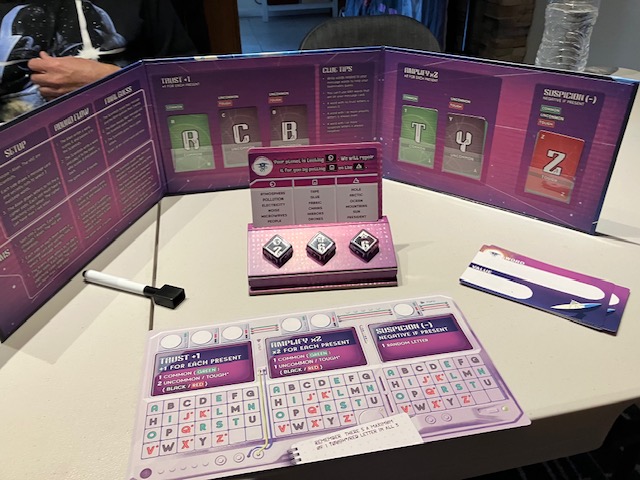
This is gorgeous production! See above!
Rulebook
The rulebook is pretty good overall, but has two major flaws.
First problem: Weirdwood Manor makes the fatal mistake of making the rulebook the same width and height as the box! It’s a giant square! It gets like a C+ on The Chair Test, as I can’t really lay it on the chair next to me! It flops over the edges and is harder to read.
The second major problem: there is no index. In many games, that’s not a huge deal, but Weirdwood Manor is a very complicated game with many, many, many, many rules: it is in dire need of an Index!
Other than those two flaws, this rulebook is pretty good.
The Components page is great, even differentiating between the deluxe and retail versions!
The Set-Up was mostly really good.
In general, this rulebook is pretty good: it’s just long! This is a very very very very complicated game with lots of moving parts (both literally and figuratively)! The rulebook does a pretty job of explaining most of the pieces and showing nice pictures/examples! See above!
I always feel like the rulebook is doing something right if the back cover contains a summary of rules/flow/icons, which Weirdwood Manor does. See above.
This rulebook is pretty good, besides the square form factor and lack of index. It taught the game pretty well. Just be aware: it’s a long rulebook because it’s a pretty complicated game.
Good Guys and Bad Guys
Each player takes the role of one of 6 characters (see above) in the game: these characters are all magically oriented. These are the good guys! They have magic powers and spells! Note how nice those dual-layer boards are!
Each player takes the corresponding standee: I have the deluxe version which has the acrylic standees (they are just cardboard standees in the normal version of the game). See above.
Each player gets their own very specific deck of cards. Every turn, each player must play exactly one of their cards to “do something”! See the decks above!
As a cooperative boss-battler game, players choose one of three bosses (see above) to fight. Each one is very different!
As a cooperative boss battler, there will be a lot of dice rolled when attacks and defenses happen! See above!
The monsters (and Lady Weirdwood, off to the left above) are also acrylic standees!
The good guys characters and the bad guy monsters are all very different! The good guys each have a different deck of cards with different emphases! See some above!
Each character also has a different experience track! When you “do stuff” in the game, you get experience which you can immediately spend to upgrade your character! With experience points, you choose which track to advance, and each character has different annotations (see above) on their three experience tracks!
Other things make the characters asymmetric:
when the character rolls a STAR, a special ability (for that character) only activates
each players has different start resources
each character has VERY different spells they can activate
each character has a different progression to get dice
In general, these characters are VERY different and will play very differently!
The Manor: Worker Placement Rooms!
The core play of the game is in the Manor (mansion) above. It’s a bit of chore to build!
You place tiles in concentric rings: the outer ring (above)…
The middle ring … (see above) …
And the inner ring! See above!
Players place their standees on the entrance to begin: see above.
This game almost has a worker placement feel as well: when you end your turn in a room (see above), you activate the special ability of the room. See above for two rooms! The top one will allow you to get resources and the bottom one will allow you to rewind time! Each room has a very different ability to activate in the game!
When the Manor is all built (see above), it has a very daunting table presence! See above!
Resources
There are a number of different resources in the game you get (usually from activating a room): Power (pink), Scarabs (yellow), flame (blue), or books (green). See above! These resources are spent for many different things in the game: activating spells, buying dice, buying Companions, and many more things!
The small twist here is that the Scarabs, even though they are resources you need (yellow, see above) are also the “Bad News” tokens and they spread “kind of like” the disease cubes of Pandemic!
Scarabs in a room make it so you CANNOT activate the special ability there! You would have to go into the room and specifically fight them to get rid of them … and if you kill all the Scarabs on your room, you may still activate that room at the end of your turn.
Scarabs advance from the inner rings to the outer rings when “The Scarab Phase” happens. It reminds me of Pandemic for two reasons: 1) the Scarabs will “blight” a room if there are ever two or more in them (not unlike losing a city in Pandemic Legacy). This blight causes you to lose the room as a worker placement spot! (Don’t despair, you can always repair a blighted room) 2) The progression as Scarabs are always coming out and spreading … just like the disease cubes in Pandemic are always coming out and spreading!
Generally, flames and books are easy to get from rooms, Scarabs have to be obtained from fighting, but power is harder to get!
There are limited rooms with power tokens, but most power tokens comes from advancing the Power track on your character (the pink track above).
There’s a reason we call this a cooperative boss-battler worker placement euro (with elements of Pandemic)! The worker placement and resource management aspects feel very euro.
Time
Many cooperative games have some flavor of timer on it: you must win in so many turns, you must win before the Bad News deck runs out, and so on. Time is handled very interestingly in this game! In between the concentric circles of the rooms are two rotating rings that tell time! The first ring (above) is like the hour clock: as you play, time advances from sunrise to morning, to afternoon, to night, and back around! See above!
The outer ring is like a day clock: it has numbers from 1-12 on it (see above)! Every time the inner ring advances from night to sunrise, the outer ring spins! If the outer ring ever moves from 12 to 1, players lose! They have run out of time!
How does time advance? In two ways! First, the Monster “bad news” card moves the inner hour circle; see above as the monster card will cause hour time to advance 4 spaces!
The second way is that a player’s card is to be placed in one of the 4 positions above his character sheet: see above. Each position is labelled with a time of day: The Lore Master Meditation card (above, far right) has been played above the Night symbol, which means the player MUST SPIN the inner circle to the next night phase symbol! Every turn, the player MUST play a card to one of the spaces above. Part of the choices are trying to advance time as little as possible.
This time advancement mechanism must be balanced against matching symbols on the top of the card: see above as Prepare Defenses shield matches the Touch the Fae card! (Wild) If these symbols match, the player gets that symbol’s effect (a shield gives one more defense in combat). Sometimes you may choose to waste more time to get a better symbol match!
This is just one of the many choices players make when playing a card: Which card? How does time advance? How do symbols match?
Doors and Connectivity
These spinning concentric circles of time also controls the connectivity between rooms! See above as the characters in the room with the Chaos Ogre can’t get out to the middle rings! There’s NO DOOR between the middle ring and outer ring! When the day counter spins, the doors will spin and an exit will emerge!
These “moving” doors take a few turns for players to get: “Wait, playing my card will move the rings before I move my character?” Most of the time, we would “pretend” to advance the ring to see what connections would open up and then if the connections looked right, … then we would commit. I do admit, this is very daunting the first few times until you get a handle on it.
Spells
Each player has three spells on their character board: see above (Upper right of the board). These spells vary tremendously between characters! Some characters are more help-focused, some are more defense-focused, some are more combat-focused Each character’s spells are very different.
The spells are activated by spending resources … with Power usually being one component. See above! This is why Power is such an important resource in the game component! The spells are incredibly powerful, many times making the difference between a winning and losing combat!
Companions
Players can also recruit Companions to help them! Companions cost resources (of course), but give two main abilities! First, they usually give a nice little power you can use once (before you recharge).
Possibly more important, the Companions give another position to play cards, so you reset time less often! (Every reset causes a Scarab phase!) See above as Oliver has two companions, so he can play two cards without resetting!
Solo Game: True Solo With One Character
The game has rules for a solo variant (congratulations on following Saunders’ Law)! Basically, you can play as many characters as you want! The game recommends playing two characters, to get some synergies between characters going!
You might notice, I spent quite a bit of time describing the components and mechanisms of this game! I don’t know about you, but playing two characters seemed a little much for my first solo game! I ended up choosing to play my first solo game as a true solo game: one character. See above.
The game really needs no changes to play solo with one character: the main balancing mechanism of the game is advancing time for each play, so the total number of plays of the characters remains about the same. Very approximately, a game is “about” 2 * 12 = 24 turns total. Each character moves up the hour wheel by 1 or 2 spaces per turn, but the monster moves the hour wheel by 2-5 spaces per turn. On average, it takes about 2 player turns to advance one day, so at 12 days, the games lasts about 24 turns. So a true solo player will have about 24 turns, a 2-Player game would have each player take 12 turns, and so on.
The point of all that is — Sure! You can play this game true solo without any real rule changes! I always love it when the solo game follows the main rules: it’s usually so much work to apply solo rule exceptions to a game!
After playing a true solo game, let me say three things:
This is a pretty fun game solo.
It is a bit long. I think it took about 2 hours 30 minutes?
I absolutely would suggest your first game be a true solo game! This game has SO MANY RULES! And SO MANY INTERACTIONS! Your first game will struggle with rules, discrepancies, and just getting the game. The last thing you want to do is to context switch between two characters! Remember, every character is very different and plays very differently! Context Switching between two characters (as we’ll see below) is rough.
The true solo game works, and it works pretty well.
Solo Play: Alternating Between Two Characters
So, because the rulebook “suggests” that two character solo is the preferred way to play, I ended up playing a two character game that way by myself. At this point, I had at least one true solo game under my belt, so I at least felt ready with a decent understanding of the rules.
You can see above as the game table became even busier! And I remember this solo mode working, but I felt like I just had to “get through” it. There was so much work context switching between characters that it was overwhelming. I’ve emphasized this point quite a bit: the characters in this game are very distinct and very complicated to play! Each character requires a lot of focus to play it well.
Maybe this is your favorite game of all time! Maybe you want to explore all the characters and how they work together! I remember in Set A Watch (a cooperative dice placement game we reviewed most recently here), the 4-Character solo seemed daunting! Over time, I came to love that 4-Character solo mode after I had totally absorbed the game! Maybe the same thing will happen here?
But, I think focusing on a single character is a lot more fun. The 2-character solo play felt a little like a slog; don’t get me wrong, it worked, but I just felt like I was going through the motions. But, maybe after I absorbed this game some more, maybe I will come back to the 2 character solo mode? Maybe?
Right now, I can only recommend the true solo game, especially if it’s your first game!
Cooperative Play
I was able to get two big cooperative games together: both of 4 players.
These game groups are very different, but two things seemed to remain the same between the groups.
One: This game is very long: both 4-Player games took more than 3.5 hours. Some of this time will go away since it’s a learning game, but all my friends are seasoned gamers and jumped right in (with my help: I taught the games knowing the rules pretty well by this point). It feels like Weirdwood Manor is going to last at least 3 hours no matter what. See above as we all go away to dinner, leaving the game set-up to finish later!!!
Two: All the games I have played had the players “multi-player solo” in the beginning of the game, but engendered cooperation more in the later game. Well, we strictly speaking, didn’t have to cooperate, but we would have lost if we hadn’t! Many times, we had to figure out cooperatively how to engage the boss, but someone would have correct the topology (remember the rotating rings?), or defeat Scarabs protecting the boss, or any other issues … someone had to “blaze a path” for the next player! Or the next player had no chance!
Early in my first 4-Player game, I had to “clean-up”the Scarabs in the middle of the board (to protect Lady Weirdwood), but it meant I had to “take one for the team” to do this! It meant I had to lose a lot of resources and be behind the ball for leveling up my character! But we ABSOLUTELY had to do this, or we would have lost! (If Lady Weirdwood dies, we lose!) So, I took one for the team … enabling my compatriots to continue!
Generally, the game starts out very “multi-player solo” because everyone is in dire need of resources! To get anything going in this game, players have to concentrate on themselves … then, as the game gets further along, it’s clear players HAVE to cooperate, or they will lose!
Some characters had more abilities or spells that enticed cooperation, so the choice of characters also can affect how much cooperation there is!
What I saw in my game groups was that the Alpha Player was kept at bay because (as we saw in the solo section) there’s just too much to keep track for a single character! It’s much much harder to Alpha Player when you are busy concentrating on running your own complex character. The cooperation happened more organically by people asking for help!
“Hey, can you get rid of those Scarabs? I need to attack the boss!”
“Hey can you make sure time doesn’t advance too far? I need to make sure the boss isn’t angry yet!”
In general, there was a decent amount of cooperation, it just happened more in the later game.
Things I Liked
The production is amazing. The game pops on the table!
The Bad News cards (the Monster cards) are labelled on the back with a “hint” of the basic operation of the card! The Monster Card (see above) tells us that the Monster will “move somehow”! You flip the card and find the monster moves! This is a fantastic mechanism! It allows players to try to play cards with some general knowledge of what the bad guy will do! I remember seeing a variant of this mechanism in the cooperative game Paleo (see our review here) where the back of the wilderness cards was labelled with a generic icon as to what was coming! (We think a mechanism like this could have helped my friends like Hacktivity, from a few weeks ago, more).
I adore the acrylic standees. These alone made the Deluxe version worth getting! They are beautiful, well-labelled, and just pop on the table. They even emphasize the color on the bottom!
Playing cards into a slot to control the time advancement is really neat and interesting.
The rotating rings being used for both TIME and TOPOLOGY is very different and interesting! It took a little getting used, but it was cool.
The experience point tracks work really well: you get to make choices and advance your character at the same time! I think this one mechanism engages players more than might have expected: you become attached to your character as you care how he levels up! And your character just gets better and better as the game goes on, so you feel like you are doing something!
What I Didn’t Like
Probably the biggest detriment is the length of the game: several of my friends complained how long the game was. There’s that table (above) left set-up while we went to dinner because the game was so long …
As cool as the rotating rings are, sometimes we struggled to rotate them: this is a physical issue! We had to readjust the board on the table to avoid the crack in the middle! Even when it lay flat on another table, sometimes it didn’t advance great? It usually worked, but it just needs a slight tweak to make it easier to rotate the rings.
Speaking of the rings, why does time advance COUNTER-CLOCKWISE in the game???? When time advances in the game, you spin the rings COUNTER-CLOCKWISE!! In real life, when a clock advances forwards, it’s CLOCKWISE … thus the name CLOCKWISE! The rulebook even used the terms clockwise and counter-clockwise in descriptions! It knows the terms! This seems very counterintuitive to me!! It really seems like time moving forward should have been CLOCKWISE (like clocks). I dealt with it, but this little thing really bothered me!!
Complexity: this is a very complicated game with lots of moving parts and a long rulebook. It will take a while to absorb this, and some people may bounce off of it hard because of the complexity.
Even though this game has a lot of euro elements (worker placement, resource acquisition) and a lot of predictable elements, there’s still enough randomness to that it might just frustrate you. The game is, at its core, a boss-battler with lots of dice! You will be rolling dice and you might roll great and you might roll poorly! My friend CC got completely screwed early in one game, and had trouble recovering: he got completely smashed by the boss, and spent the rest of the game trying to recover … meanwhile watching while the rest of us were doing really well!
That element of randomness … might make one of your friends have a bad game.
Reactions
The reactions to this game from my friends was generally positive, well, except for CC who got trounced. CC’s reaction was probably the most nuanced:
I think I might have liked Weirdwood Manor more if I had gotten to play to the end. Sounds like my character got to be useful later on, which was a feeling the game had lacked for me in the turns I got to play. I liked the theme of that one and some of the mechanics were fun, but I got pretty frustrated when I kept getting shut down while watching other players advance. Nice table presence, though, and it felt like it was telling a story in a cool environment which I liked.
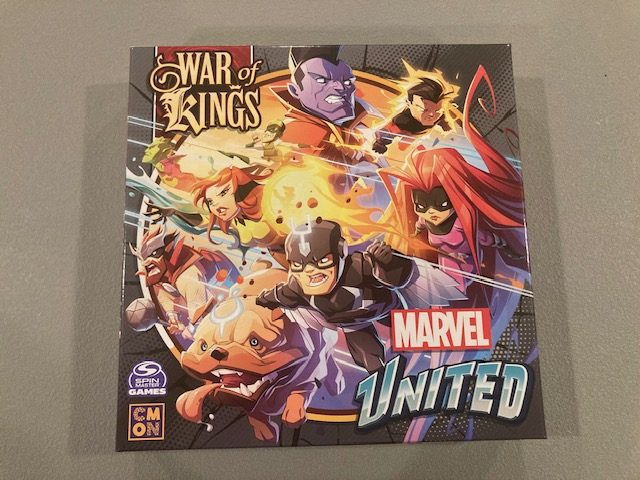
Kurt: He started at a 7.5, but upped his bid to 8 or 8.5/10. He really liked it! Joe: 7.5/10 Teresa: 7/10 Sara: 6-7/10, but want to play it again for more precision Andrew: 6 -7/10, but wants to play it again for more precision Me: Solo (true solo), 7.5/10, Solo (two character) 6.5/10, (Cooperative) 8.5/10
Conclusion
Weirdwood Manor is a beautiful cooperative game with a beautiful production! But you have to know what you are getting into! This is a very long and complicated game with euro worker placement elements. The game always seems to start “multiplayer-solo”, but evolves into more cooperation as the gameplay advances … if you don’t cooperate in the endgame, you will lose!
I could easily see Weirdwood Manor being someone’s favorite game of 2024! It has so many unique and quirky mechanisms, satisfying advancement, and engaging play! Just be aware how complicated this game is! The extra complexity does have the advantage of keeping the Alpha Player at bay!
I recommend staying with true solo (take control of one character) to learn the game, and only tackle solo with multiple characters if you want more challenge.
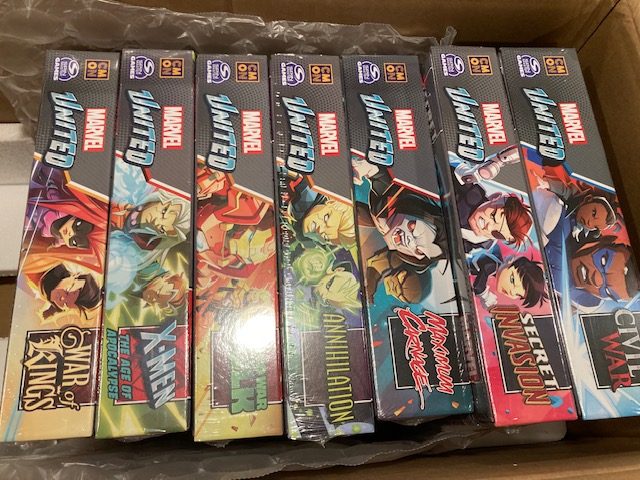
My groups all like the game, with ratings between 6 and 8.5, with most people giving it at least a 7.
Hopefully this review helps you decide if Weirdwood Manor is for you!