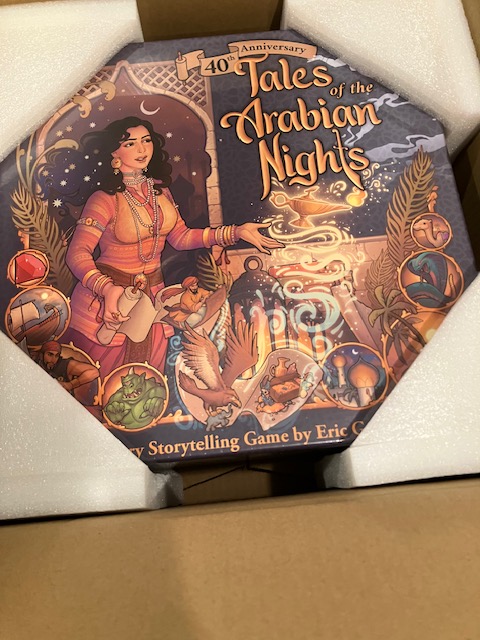
Tales Of The Arabian Nights: 40th Anniversary Edition Review: There’s a Solo Mode??? And If You Squint … A Cooperative Mode???

Tales of the The Arabian Nights is a game I both hate and love. When it’s at its worst, it’s random with banal crap happening to you that you have almost no control over; it’s long and tedious. At its best, it creates some of the most memorable stories (with laughter and tears) on game nights that you’ll remember forever. It’s the best of times that I remember, and so that’s why I chose to back the 40th edition on Gamefound (see above) when it came out.
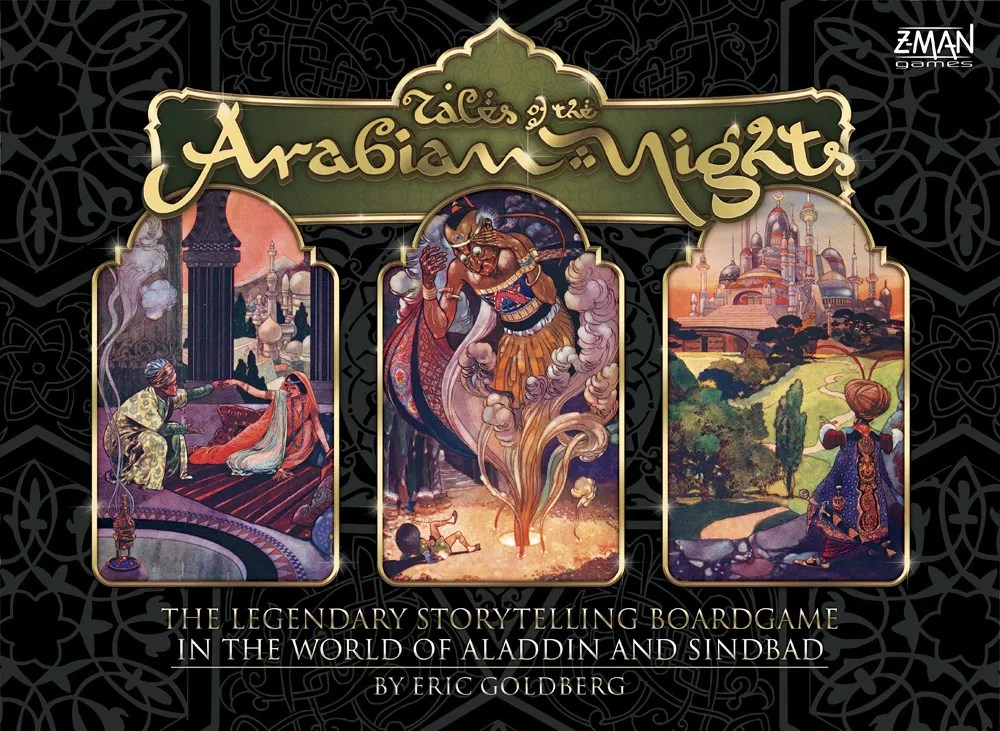
The original edition of Tales of the Arabian Nights (see above) got quite a bit of play back in my playgroups in Las Cruces. And at first, I hated it. It seemed so random; things would just happen to you!! If you were “lucky” (if you had the right skill at the right time), … things would just go your way. But, if you were unlucky, your entire story became a slog as you failed check after check. If, however, you just realize this is an adventure that “just happens to you”, and you just enjoy it for what it is, you can really have a good time. But ya, you could still have a very bad game. And it could still suck.

BUT in order for this to be a good experience, everyone has to know what they are getting into, and how random this, and how you just “gotta grin and bear it” sometimes. If you play with someone who is too serious, or who get aggravated by random stuff, or who just think “this is unfair” … you will not have a good time. Everyone has to be in on the joke. And you kinda have to be in the mood for it. That one person who doesn’t enjoy this will bring this game down very quickly. So, in some ways, this is a very brittle game because one player can easily ruin it. But if you get the right group, with the right frame of mind, with the right mood, with the right sense of humor, this can be a magical Arabian Night!

Does It Need An App?
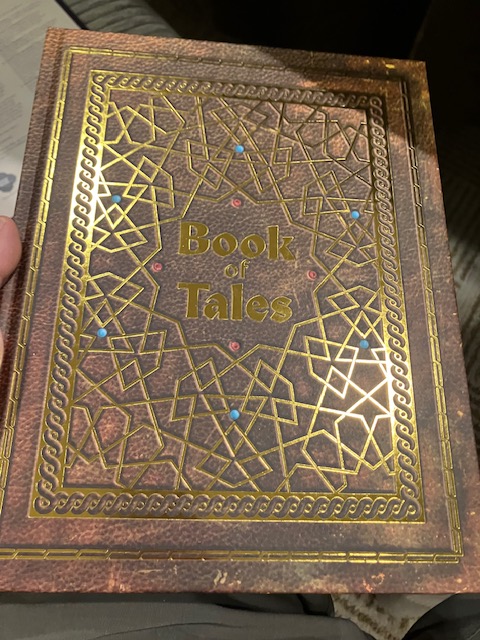
So, this is a storybook game with a great physical storybook (see above and below). You read lots and lots of flowery text to each other.
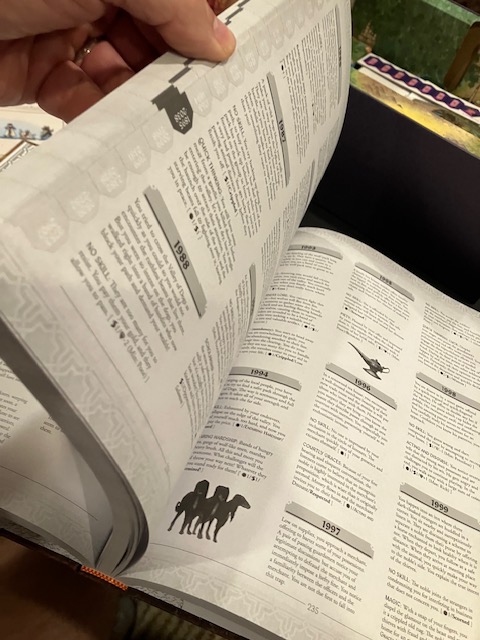
I remember when we used to play the original version of Tales of Arabian Nights, and we’d all say “Ah, I think this game would so much better if it had an App. These books are huge! It’s so hard to remember how to look stuff up! And there’s some fiddliness! It would be better as an App!” Sure, an App could make looking up the text simpler. Sure, an App could handle the fiddliness. Sure, an App might make this easier to haul around if there were no books. But now, after reflecting back to the original version and the new version: it’s better with the books.
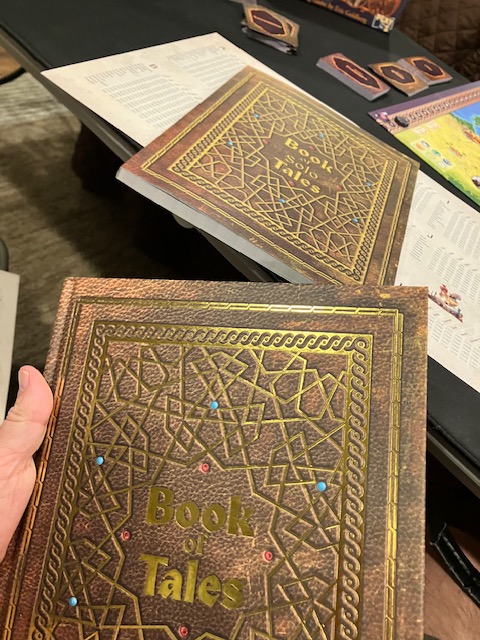
The books invest people into the game; people have to dig into the book and get involved! It’s a commitment to consult the grid and find the right entry! The person on your left and the person on your right are helping you look-up things in physical books! You make the choices, but everyone is staying involved! There’s a certain sweat equity in looking up and reading passages from a book;“This had better be good, darn it, because I am doing some work to make sure it moves forward!” You are invested because you are making the choices, and your neighbors are invested because they are consulting grids and charts! Everyone is invested in your ridiculous story!
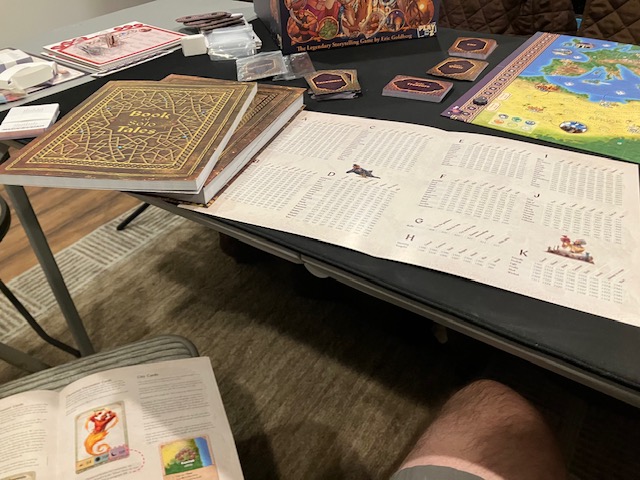
It’s the physical investment in books and charts that makes this game magic. That’s the magic word; invested. You are physically and mentally and emotionally invested.

Don’t get me wrong; some of my favorite storybook games have Apps: Forgotten Waters, Freelancers, Wandering Galaxy are all excellent storybook games that take great advantage of the electronic genre with voice acting, dynamically generated content, and constantly improving stories!
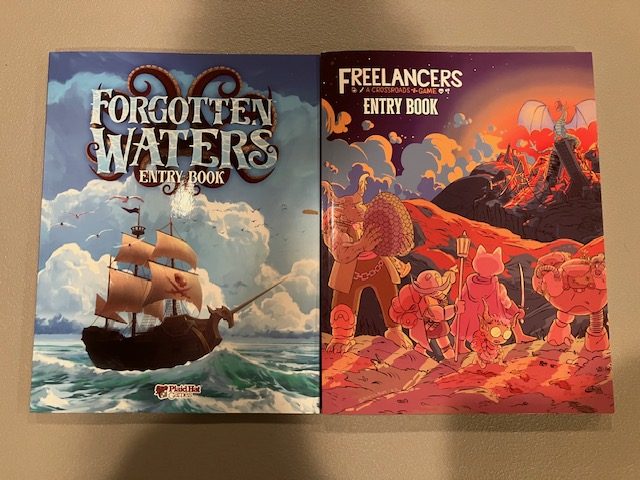
Yet, Plaid Hat games did go out of their way to make physical copies of their storybooks (see above). Why? Because there is a certain magic to the physical books.

Solo Mode
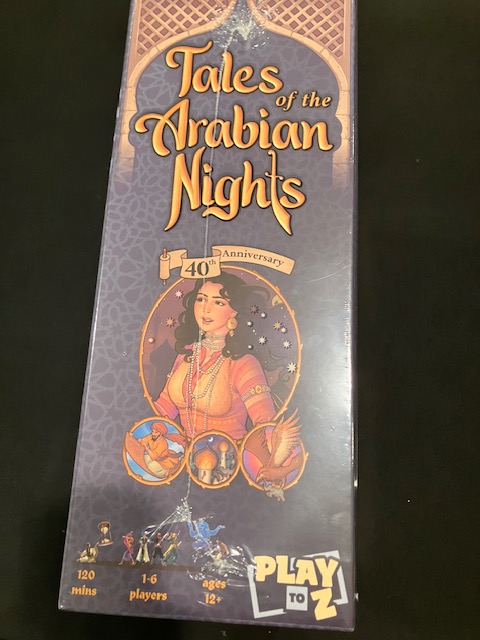
Crazily enough, they made a solo mode for this game. Whaaaaat? Let’s be 100% clear here: the original Tales of the Arabian Nights did not have a solo mode! And it seems weird to have a solo mode because the fun of the multi-player game is the shared reading and shared experiences in this world. But, I think the randomness of the base game is just too much for a solo player. In the multi-player game, we can laugh at the stupid and random things that happen to each other (“Remember the time that Efreet enslaved you? That was hilarious!” “Yes It was!” ), but somehow that seems less fun in a solo mode.
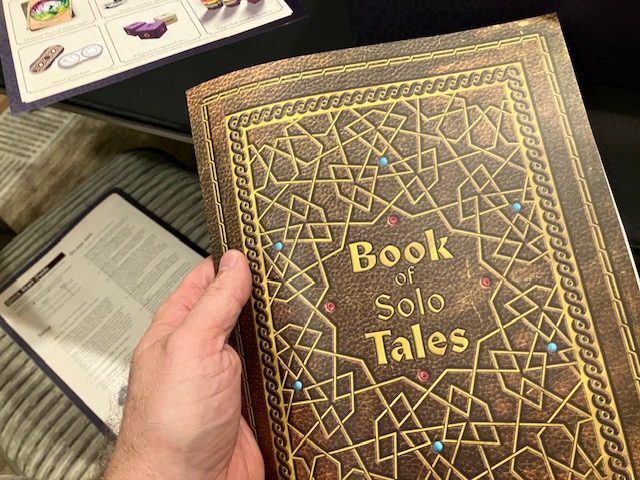
So, PlayToZ wrote some solo adventures and added it to the box! The solo adventures come in their own booklet (see above) with about 15+ directed adventures. Note my use of the word directed—you still explore this world, but there’s a real underlying and scripted story that unfolds for each adventure in the game. To be clear, there are still plenty of random moments (as you still take some turns like the original game), but about half of the game is a story that’s really unfolding (from the Solo Tales book) and the other half of the game are the silly and random stuff from the base game (from the main Storybook).
My first adventure felt like I was playing a novel! The writing seemed quite good and the story was engaging! This was more like a Choose Your Own Adventures tale with real story and real writing!
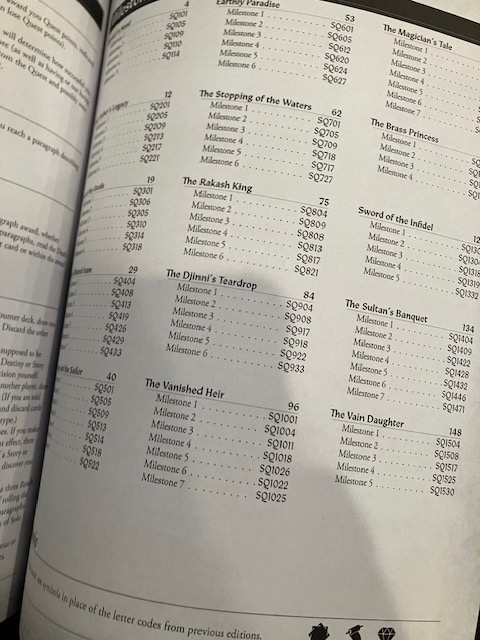
The only problem with the solo mode is that the stories are limited: there are only 15+ adventures in the Solo Storybook (see above). Sure, that’s probably enough for most people, but it can limit replayability. The good news is that the story path you take does change if you make different choices, so you can play an episode again and get a different story line, a different timeline. Anyways, after 15+ stories, I will probably forget them and so I could start over. If you have an eidetic memory, you won’t be able to play the stories over without some repeats.

I am shocked this has a solo mode. But it really works well.

Base Game
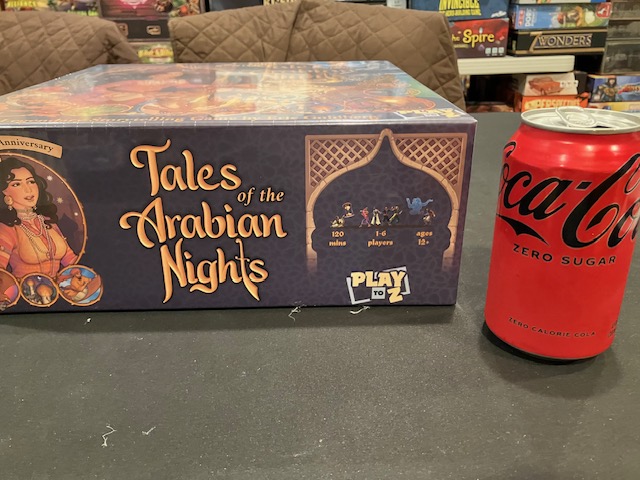
So, this is a cooperative games blog, but the base game, the game everyone knows and loves, is not cooperative; it’s competitive! Tales of the Arabian Nights is a competitive game about who can get the right glory and destiny (two kinds of victory points) and make it back to Baghdad! “But Rich, you can’t talk about games that aren’t cooperative! That’s off brand for you!! You only talk about cooperative games! And sometime solo games!”

Ah, but there’s two issues here I want to address;

  1. The game is cooperative in the sense in that you are having a shared experience and working together to read the adventures out of the book.
  2. With the advent of the solo adventures, you can make this game truly cooperative by playing team solo: play the solo mode as a group pretending to be the solo player!

Granted, the base game actually has a lot of take-that mechanisms (“Choose a reaction for your opponent! “If you have a disease, you can give it to others!”), so I have to admit it’s not really cooperative. Okay, you got me there. But the reading of the storybook gives you that shared experience which feels like a cooperative game.

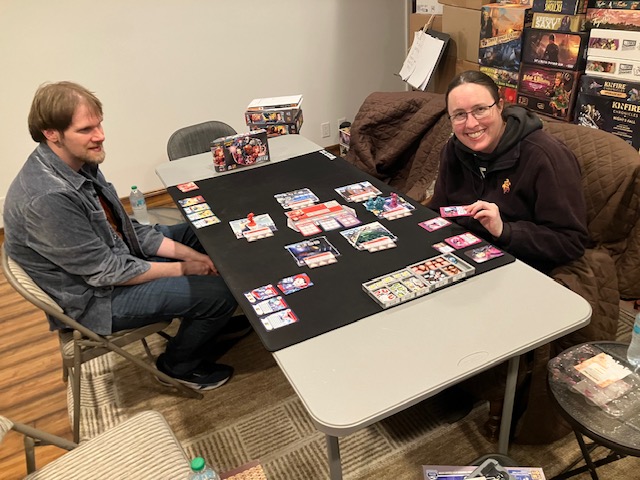
But the team solo is truly cooperative! You can play through the solo adventures as a team! The solo mode is a little clunky, as the solo player has to choose reactions, look-up in the grid, find the storybook entry, read it to himself, then “pretend” not to see too much on the page (so he doesn’t cheat). With a group of friends playing team solo, all this maintenance (like the base game) can be shared.

So, ya. The team solo is totally a fake thing that’s not in the game; it’s a house rule we made up. But it really works as a cooperative game.

The Base Competitive Game
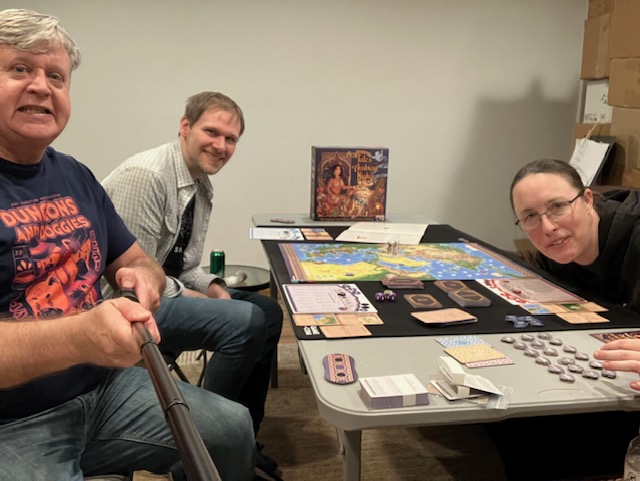
Like I said, I love and hate the base game. And me and my friends played a competitive game of Tales of Arabian Nights the way it should be played … and I loved it and hated it.
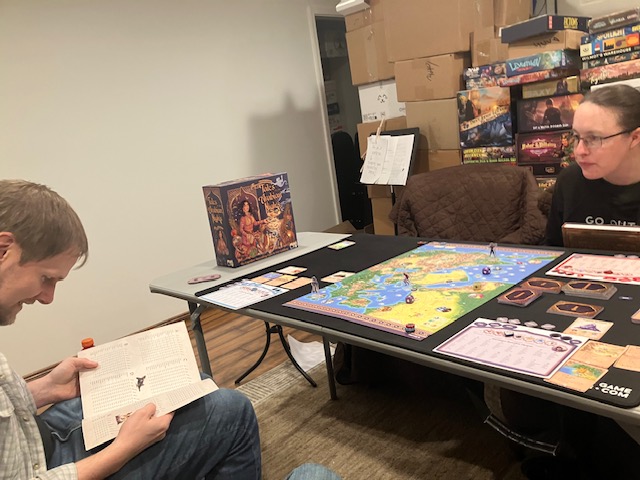
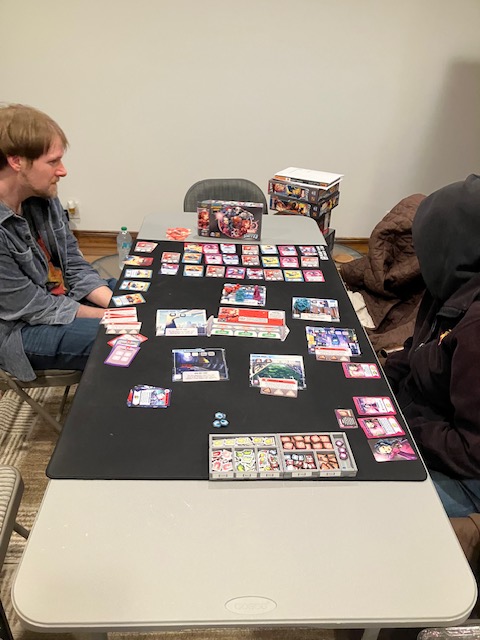
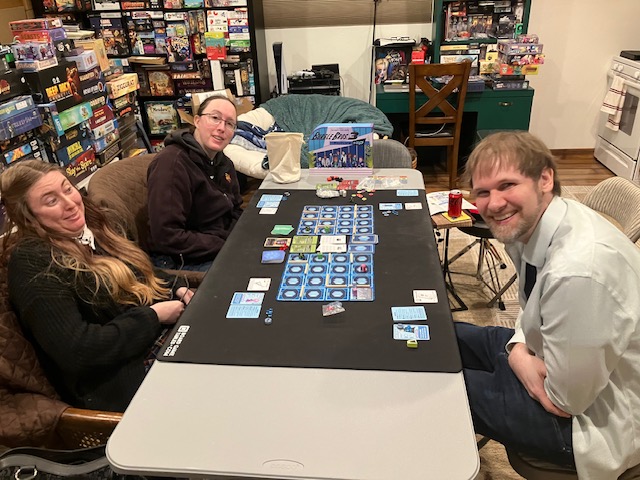
I love it because I loved all the shared mechanisms, the cooperation, the interaction as everyone stays involved. See a 3-Player game above: everyone is involved in reading , listening, and consulting.
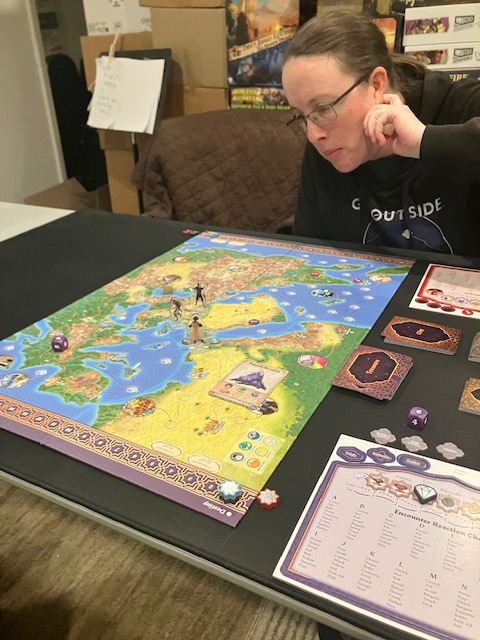
And yet, I still kinda hated it. The randomness from the original game is still there if you play the competitive game. It’s still goofy, it’s still fun, you still have to be in the right state of mind, and I still loved it, but I still kinda hated the randomness of the base game. I would maybe give the base competitive game a 6 or 7/10 … it’s very random. But still fun.

Team Solo!
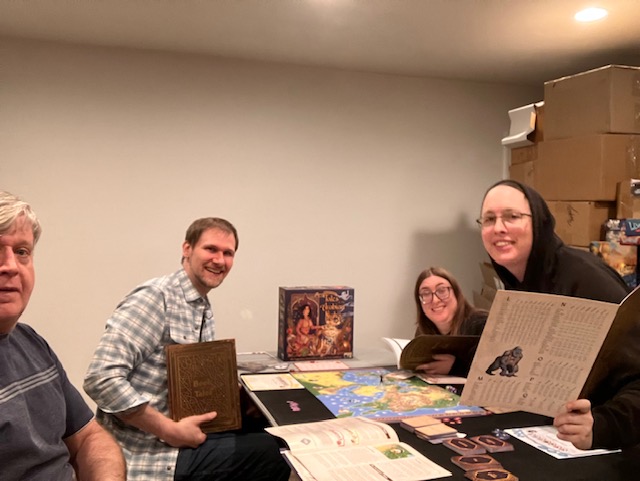
We played as Team Solo one night! All 4 of us playing the solo mode as a group! What happened was that we simply played the game like the solo game, but the books and active player would rotate through everybody. I thought the game would be more cooperative, but what ended up happening was more that the active player tended to make “the choice” and we’d just say “I don’t know if that’s a good idea …” or “That sounds great!”
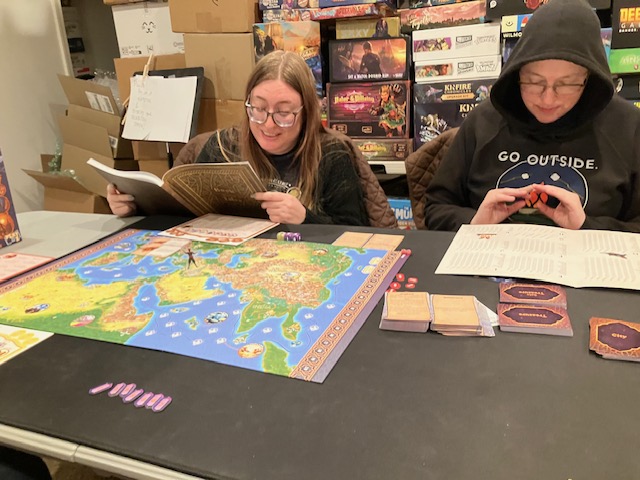
But, like I’ve said so many times in this review, just the act of consulting charts and reading books is very cooperative! So, instead of inflecting disease upon our fellows, we participate in the shared story … with one person being in the hot seat every turn “making decisions”.

I personally prefer Team Solo mode much more than the base competitive game, but some of my friends actually prefer the base competitive game (“because there are more choices”). So, I had more fun this week (Team Solo!) and Andrew and Teresa had more fun last week (competitive mode). In fact, Teresa likes Tales of Arthurian Knights better in the cooperative mode!

I think the team solo works for a cooperative mode (I liked it), but Tales of Arthurian Knights (see review here) is a stronger cooperative game.

Conclusion

So, this 40th edition of the game is really nice. The base game essentially feels the same as the original Tales of the Arabian Nights! If you play in the original mode, this still feels like the original game. Like I said, it’s a game I both love and hate. If you have a group in the right mood with the right sense of humor, the crazy and random things that happen to you can be hilarious! It can also be very brittle: a single player who isn’t getting it can bring down an entire game, or too many random events can just make the game feel unfun.

The solo mode is probably the most surprising addition to the game, partly because it works so well! It takes the base gameplay and adds direction and true story to the game, giving the solo player a very satisfying experience! I was also very impressed by the writing in the solo mode stories!

But, if you squint, you can also make this a cooperative game! The team solo idea works reasonably well; we tried it out one game and were happy with the gameplay. If you want Tales of Arabian Nights to be a truly cooperative game, you can do it!! Just play the solo mode as team solo … but it wasn’t everyone’s favorite way to play.

If you think you will hate the basic ideas (reading from storybooks to each other, suffering random effects as you play, even in the solo and cooperative mode), you will hate this; you know you. But if this idea of a storybook game with crazy things and lots of reading appeals to you, I think you can have some amazing experiences! And if your group is looking for a little more story, a little more cohesion, a little more cooperation, the solo mode can bring it … for both the solo player or team solo.

9 out of 10 for me for everything this does for solo! This is a fantastic production! I love it! Just be aware of what this is; you may hate it. I honestly would give this a 7/10 if it were only the original base game, but the new solo mode really expands the ways you can play the game! Solo! Cooperative! Competitive! And I liked the cooperative mode of team solo, but my friends still like the original competitive mode better.. as broken and random as that can be.

If you just want a good cooperative storybook game, Tales of Arthurian Knights is better. For a more directed solo game, Tales of Arabian Nights is better. For the competitive game, I think whichever theme appeals to you is probably better.
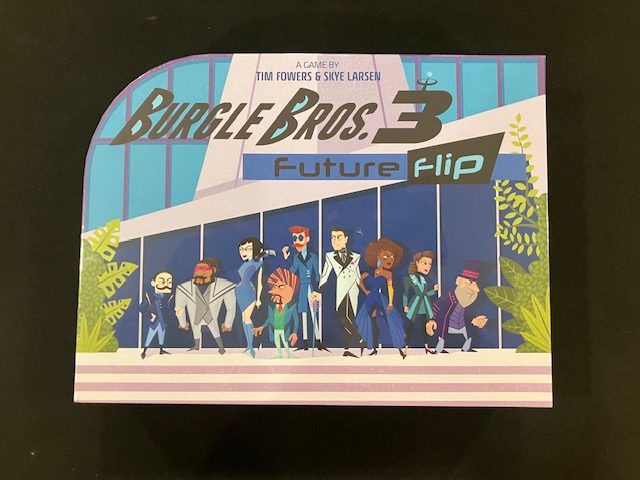
Burgle Brothers 3: Future Flip. A Solo and Cooperative Review

This is my official first true game of 2026! It came in mid January 2026!

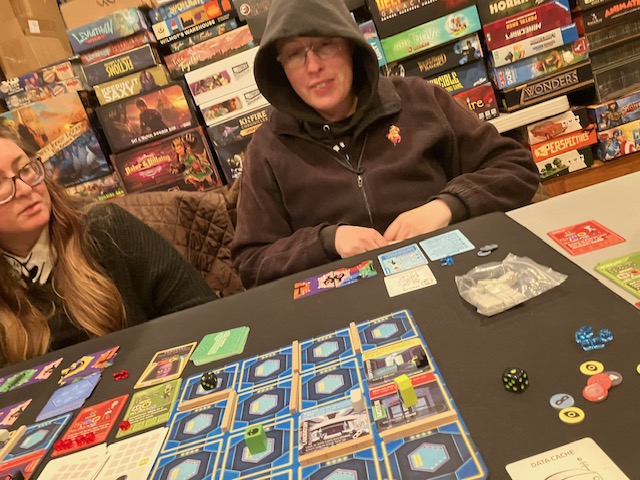
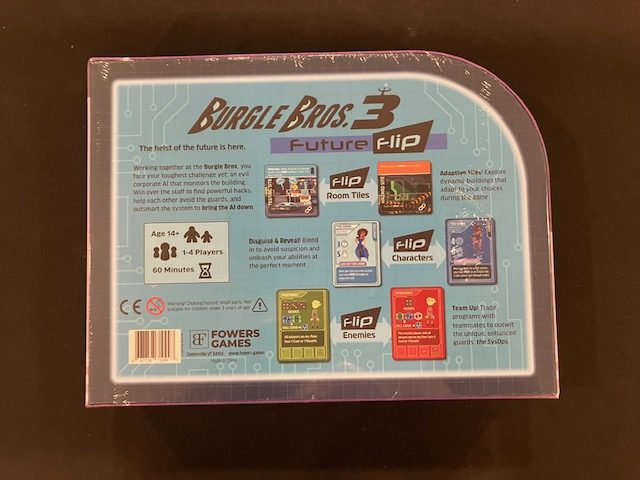
Burgle Bros. 3: Future Flip is a cooperative exploration/grid movement game for 1-4 players. You and your fellows are doing a heist, but it’s in the future! You have to hack the main mainframe and get out to win! This was on Kickstarter in July 2024 and promised delivery April 2025; it arrived mid January 2026, so it’s more than a few months late.

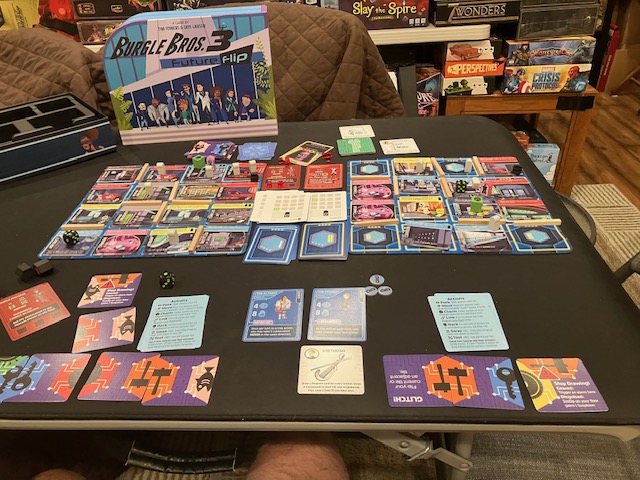
This is definitely a little outside the theme of the previous Burgle Bros games!  Burgle Bros (the original) is a small game about doing a heist! The second one, Burgle Bros 2, was a bigger game, but still a casino heist!  See our review here of that.  Although this game, Burgle Bros 3: Future Flip has the same DNA, with floors to explore and tiles to flips and enemies to evade, it does feel a little different.

Let’s take a look!

Unboxing and Gameplay

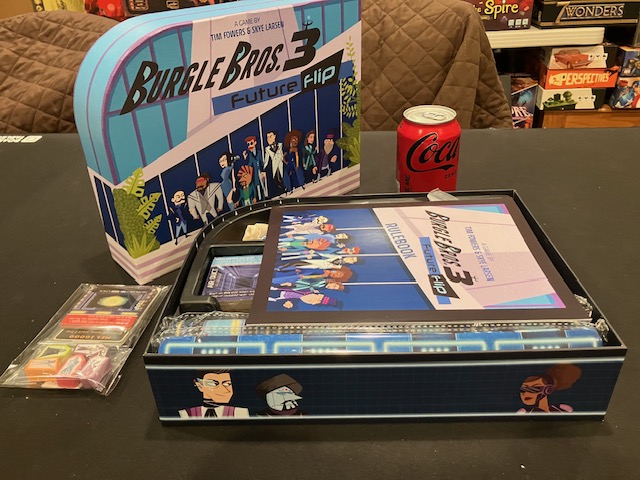
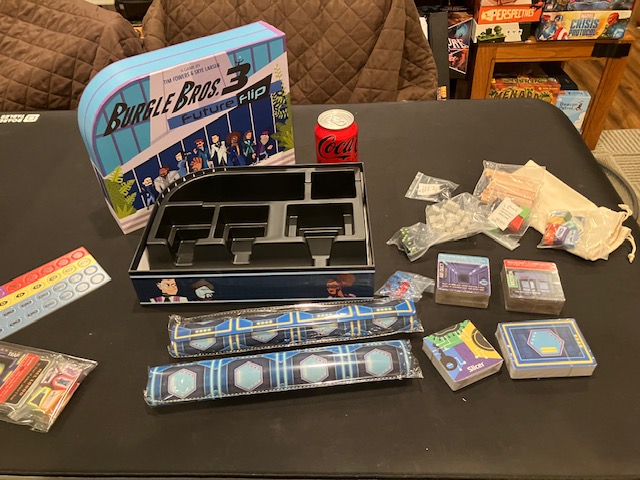
This is an interestingly shaped box: see above for the curved corner!  The corner doesn’t seem to get in the way (I have opened and closed it multiple times and it hasn’t been a problem), so it does look cool but it doesn’t cause issues.  Also, see can of Coke for persepective.

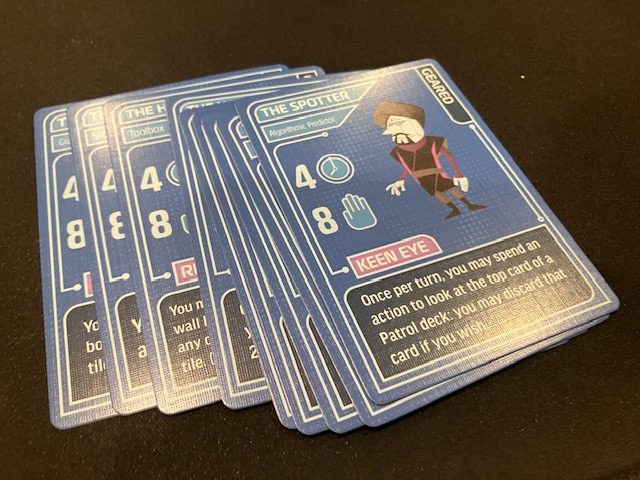
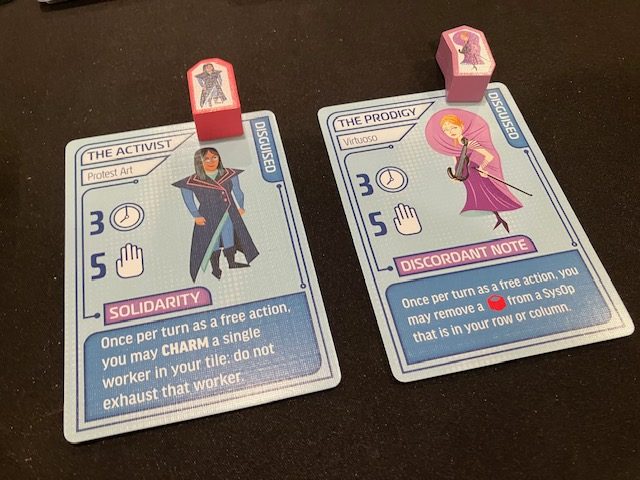
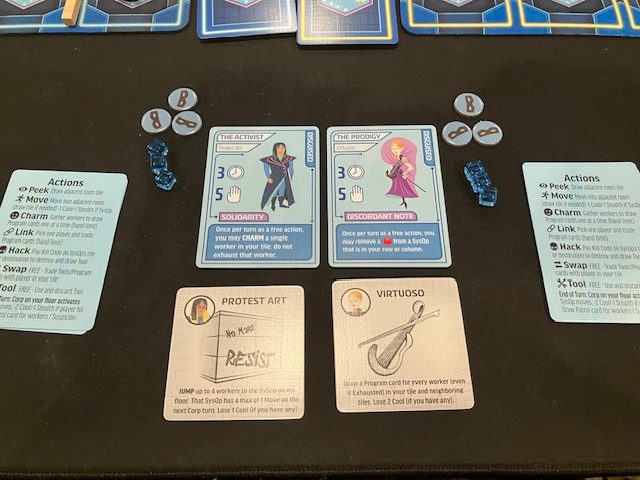
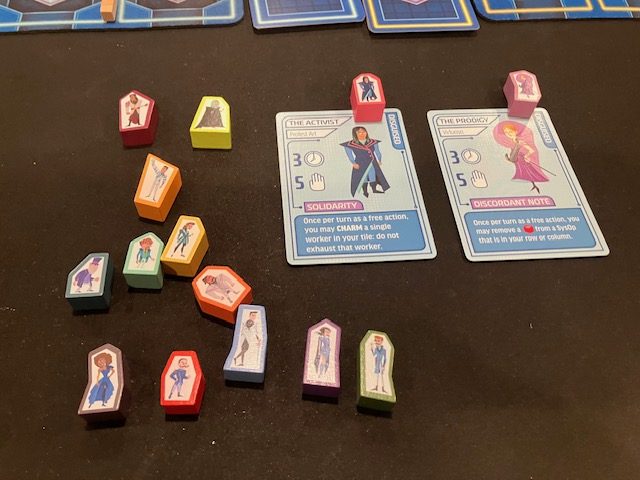
Each player chooses one of the 10? 14? (if you got the Kickstarter, you got a few more characters) characters that comes with the game.  You’ll note that each character has a special ability, as well as number of actions (clock) and hand limit (hand).  This is a cooperative action point game; each player will get so many actions on their turn.

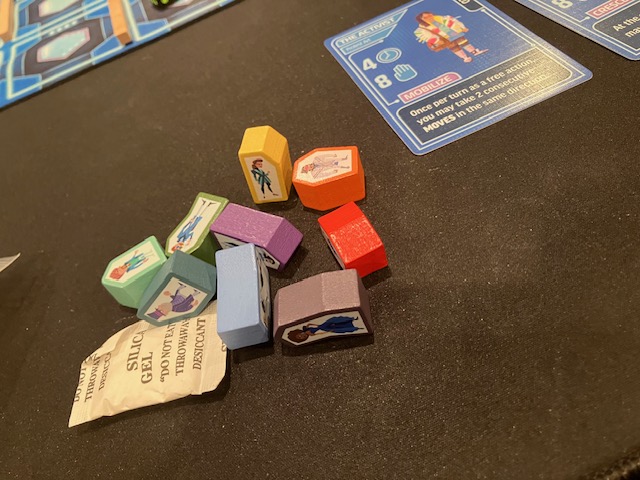
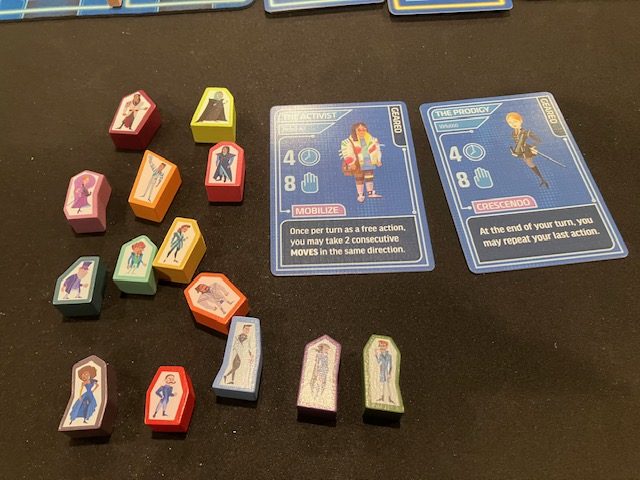
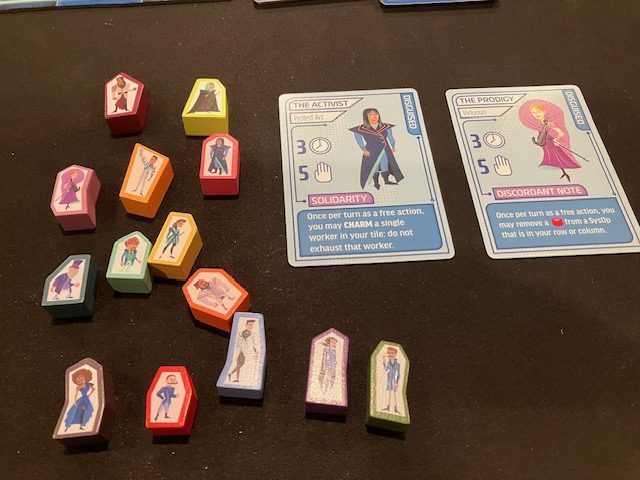
The wooden meeples correspond to the players.  Weirdly, they chose NOT to have the character cards be the same color as the wooden meeples?

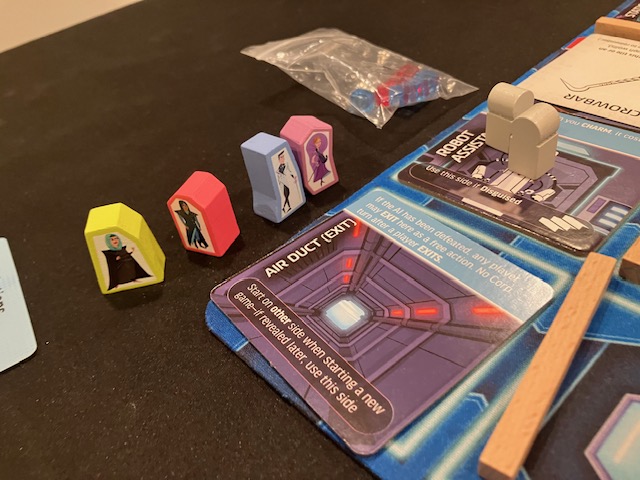
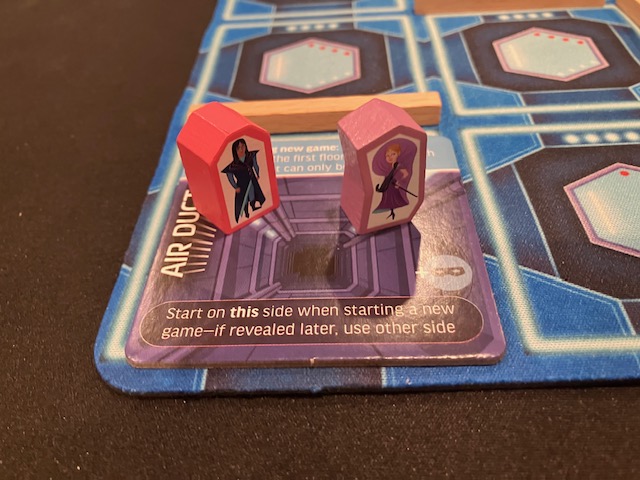
In fact, if you aren’t careful, you may get flummoxed when you can’t find your character!  Where’s the character meeples for the two characters above???

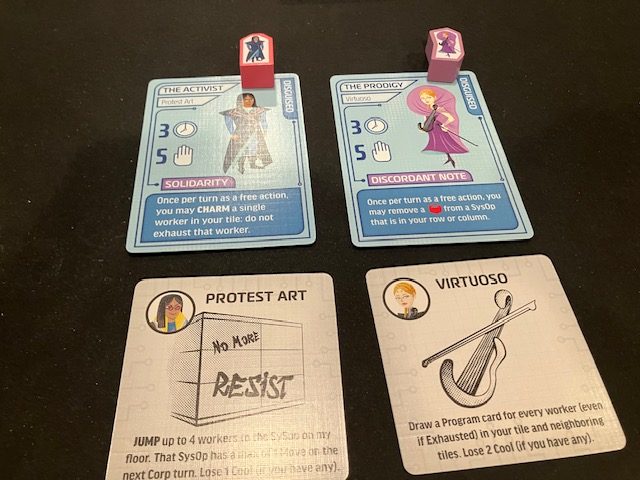
It turns out each character has TWO sides: geared and disguised, and the meeples  ONLY correspond to the disguised side.  See above.  I am pointing this out because it might trip you up a little in your first play.   

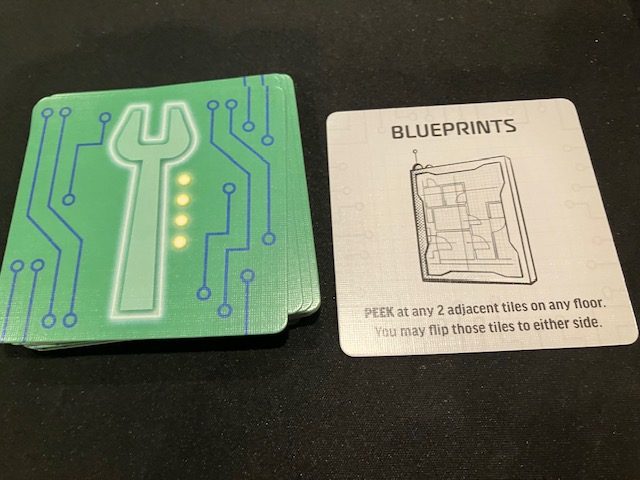
Each character also has their own personal gear: note the little character symbol in the upper left of the gear cards.  These are special cards that are one-use abilities during the game.

There are also plenty of generic gear you can pick up after you hack a SysOp; it’s your reward for a successful hack!

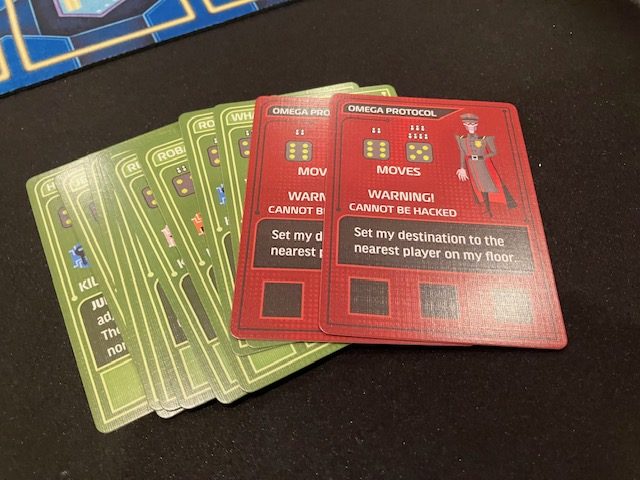
The SysOps are various flavors (green, red, and OMEGA PROTOCOL): these are the baddies roaming the floors of the building trying to keep it under control.

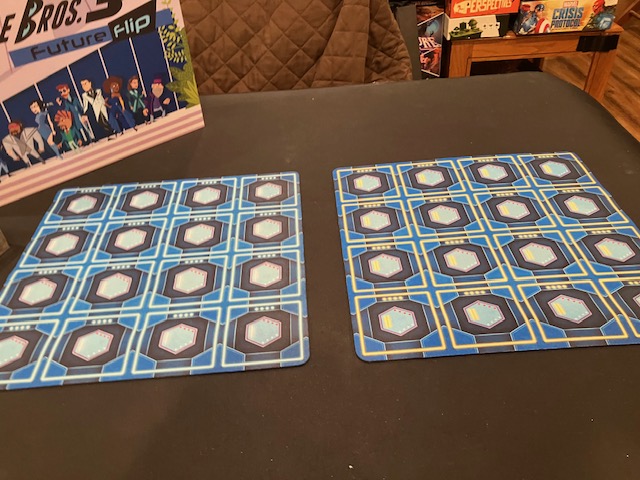
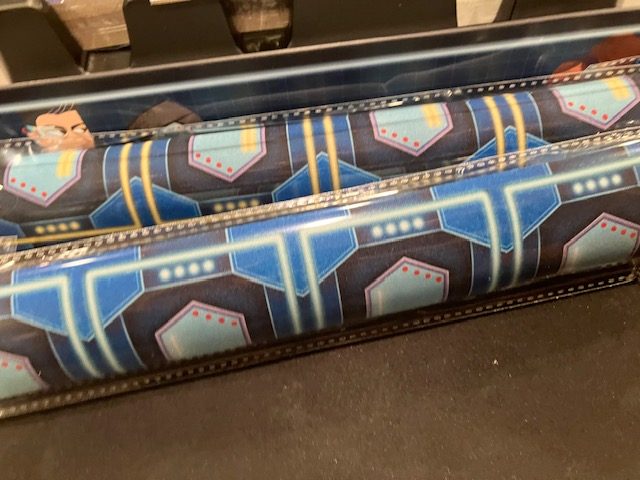
The floors of the building are represented by neoprene mats; one for each floor!  And yes, I believe these come standard with all versions of the game!

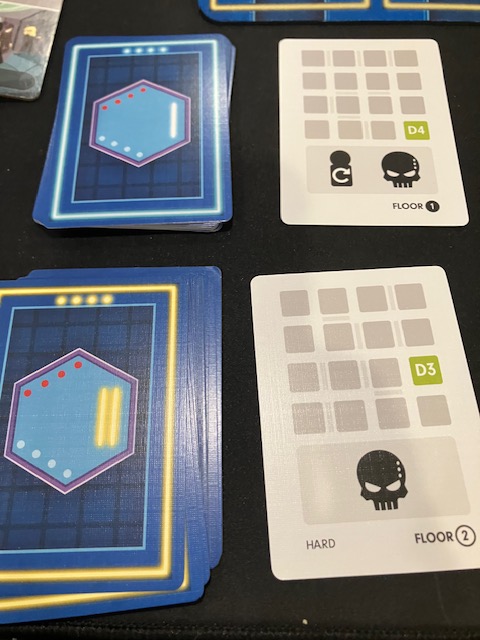
The Patrol cards (above) control the movement of the SysOps: see above as they set the destination of the SysOp (D3 or D4).   Note that there is a different pile for each floor.

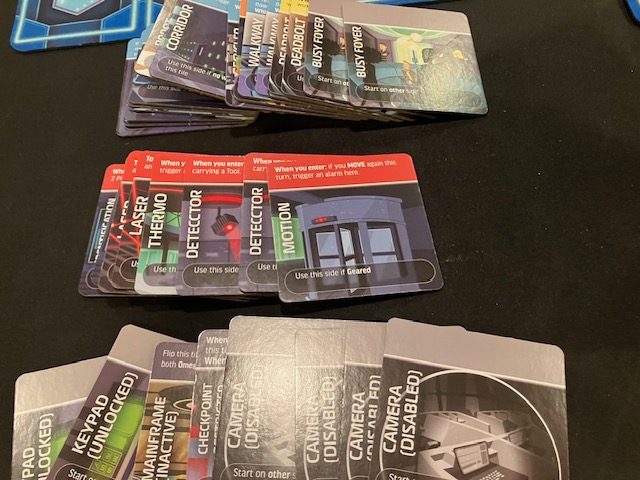
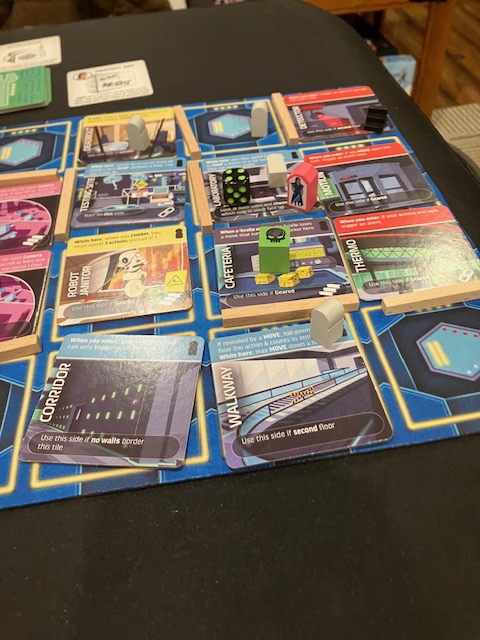
As the characters explore the floors, various tiles come out; see them above!

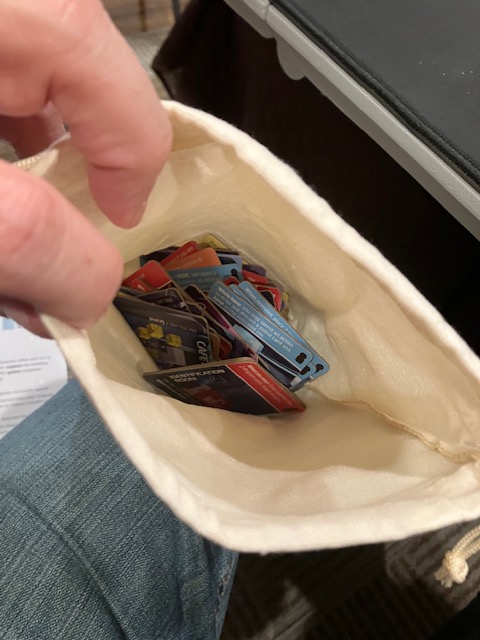
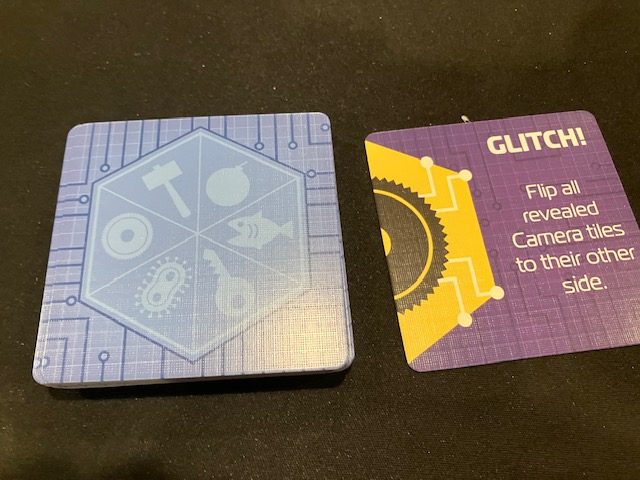
These are all kept in a nice bag (really, it’s nice and it fits all the tiles well).   The reason for the bag is that the tile you choose depends on either the floor you are on, whether your geared or disguised, or various other things!  This is different from other Burgle Bros games where you just put the tiles out and flip ’em when you PEEK or MOVE.  Here, in Burgle Bros 3, you have to draw a tile and flip it to the appropriate side!  And yes, that’s why it’s called Burgle Bros 3: Future Flip!

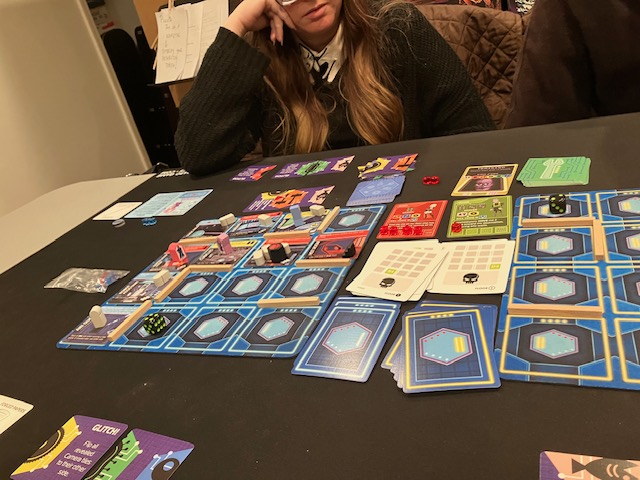
As the game unfolds, the floor unfurls and you can see where alarms, walkways, coridors, etc are.   

One of the most important things in the game is to stay out of the SysOps ways as they roam the floors!  Each player has some “cool” and some “stealth”. (eee above: the blue cube are “cool” cubes, and the masks are “stealth” tokens).  While you are cool, you are in your disguised mode but if the SysOps moves to you, you lose 1 or 2 cool cubes!  Once you “lose all your cool”, you flip to the geared side!  And now, when they move to you, you lose stealth! If you are ever reduced to zero stealth, ALL PLAYERS LOSE THE GAME!

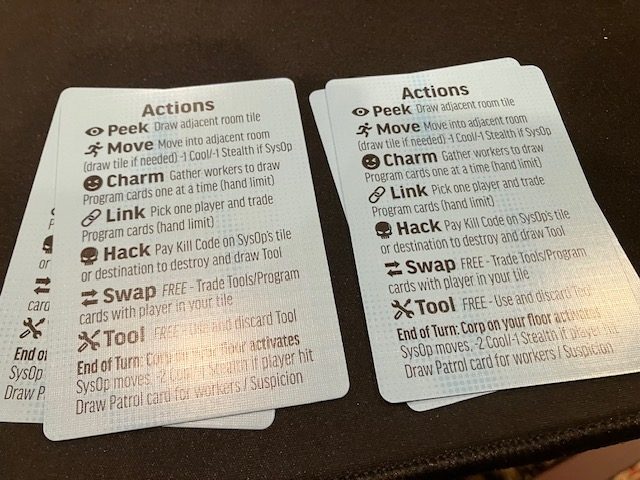
The nice little summary cards list all the things the players can do: PEEK at a tile next to you (to avoid setting off an alarm maybe), MOVE to a tile and activate it (because you need to reveal stuff quickly), CHARM (to get some hack cards), LINK and SWAP (to share gear or hacks) or use your Tool.

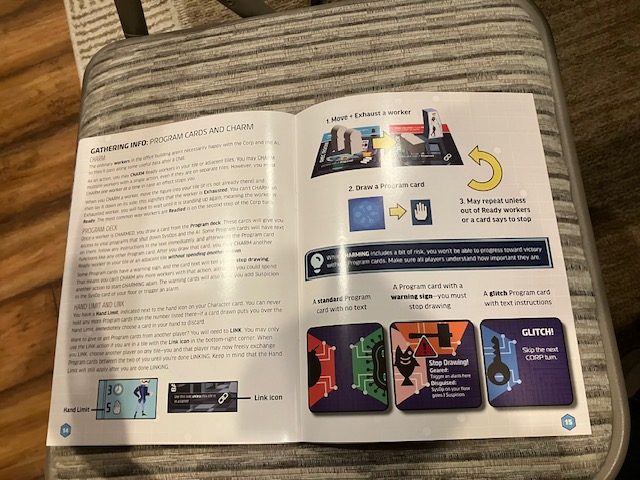
What’s this CHARM thing??? That seems new???  You can CHARM the co-workers of the building (hey, most people don’t like working for evil corporations and will help you with a little coercion) to give you HACK cards.  Well, they are called PROGRAM cards, but these are the cards you use to HACK the SysOps!

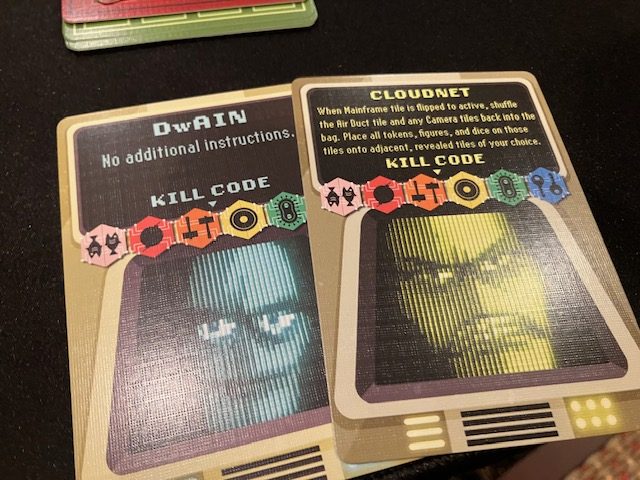
To win the game, you have to HACK the final SysOp on the Mainframe space!  See two such evil baddies above!  Note how many Program cards you will need to hack the final SysOp!  (There are some other preconditions: both floors have to be in OMEGA PROTOCOL and you have to be on the Mainframe space and you have to have all the Program cards!)

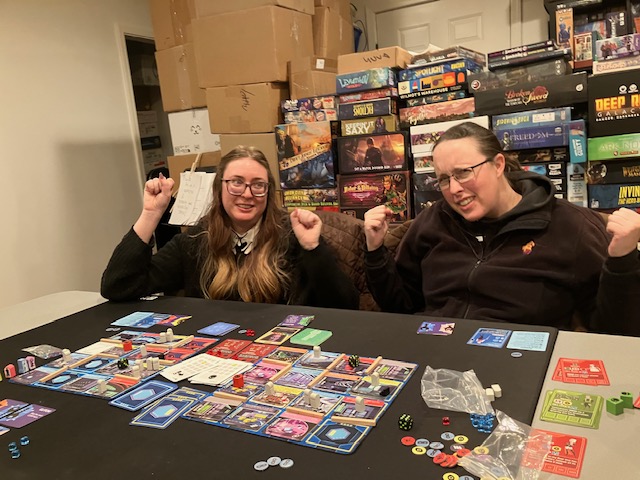
Once the main SysOp has been hacked, if all players make it back to the Air Ducts (see above), we all win!  Shared victory!! If anyone loses all their stealth, we all lose!!

Really, this production is fantastic.  I feel like they fixed a few problem we had in Burgle Bros 2!  We’ll discuss that more in the What We Liked Section below.

Overall, great production.

Rulebook

This was a very good rulebook.

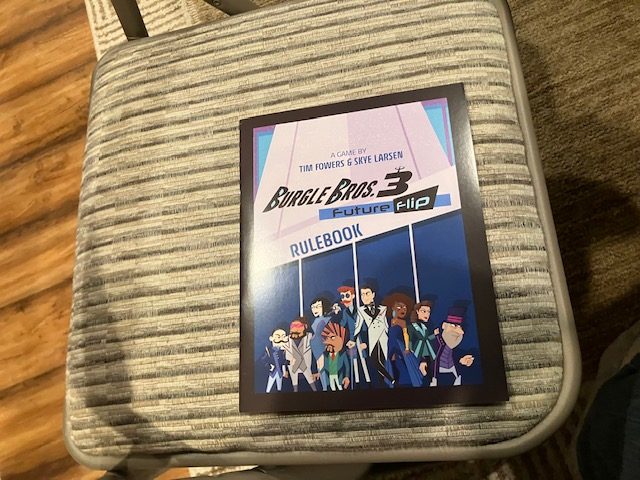
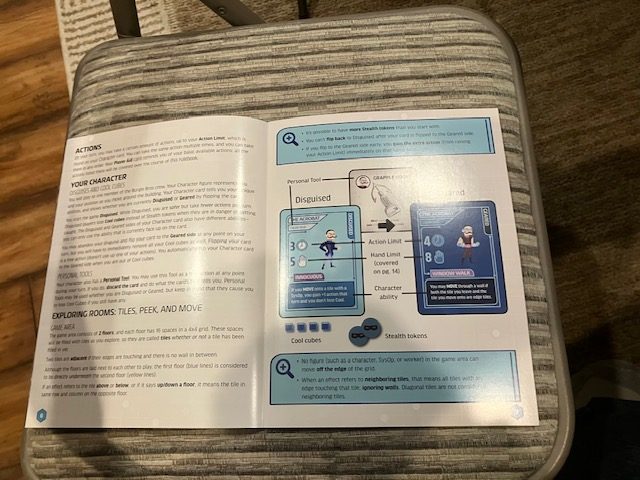
It gets an A on The Chair Test: the rulebook fits perfectly on the chair next to me, it stays open, and it has a big, easy-to-read font.   There are also plenty of examples and well-notated parenthetical boxes.  See above.

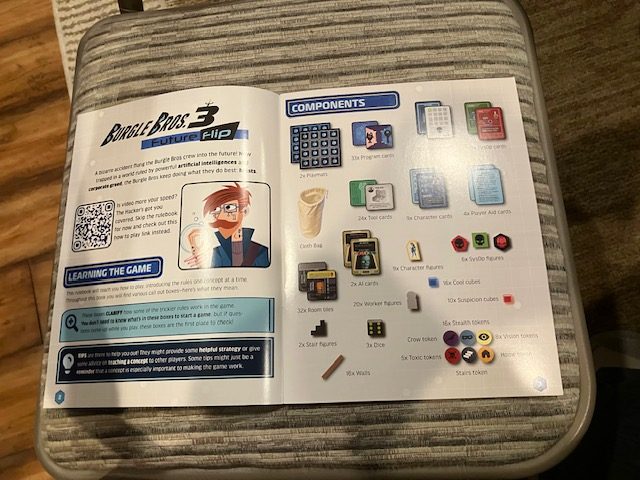
The Components list is what you want: pictures of all components with an annotation underneath,

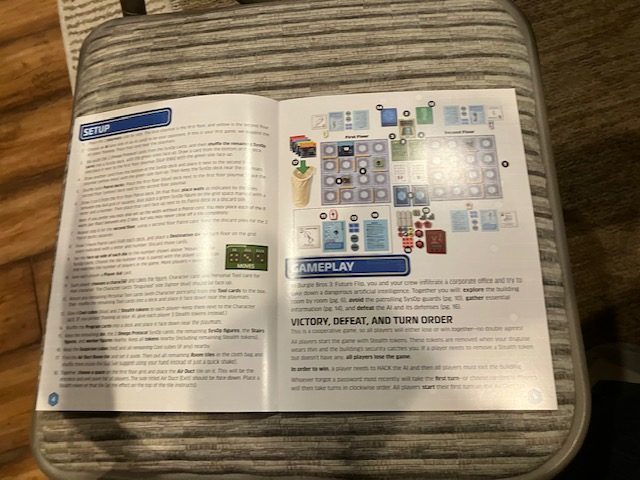
The set-up is perfect; it spans two adjacent pages, so you can set-up without having to spill over into other pages!  It’s got a picture for set-up, and it’s well marked.

In general, this was a very good rulebook.

I am on the fence on wether this should have had an Index; this is a pretty straight-forward game, so I am not sure it needed one.  But it would have nice to have an Index to differentiate things like MOVE vs ENTER and a few other concepts.  The rules are all there, not always quite where I expected them, but they didn’t take too much time to find.

This was a good rulebook.


Solo Play

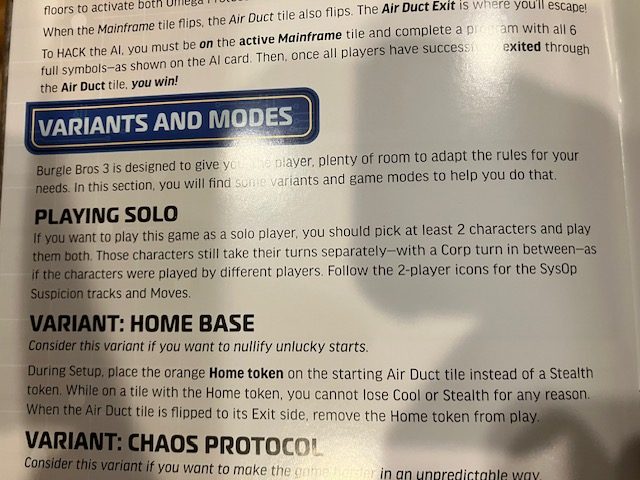
Interestingly, Burgle Bros 3 lists solo play as a Variant (see above)  But I loved this!  They specified the  solo mode perfectly.  This is how I want to play solo modes!  Two-handed solo!  Thank you !

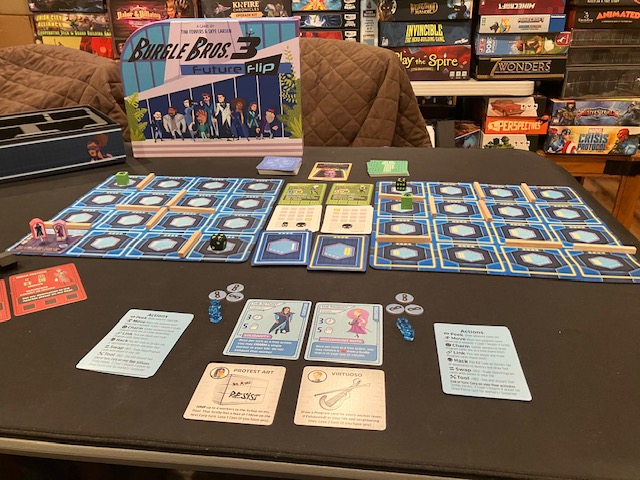
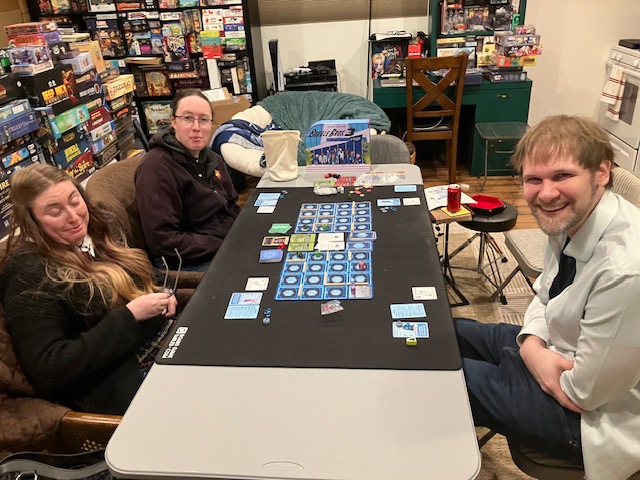
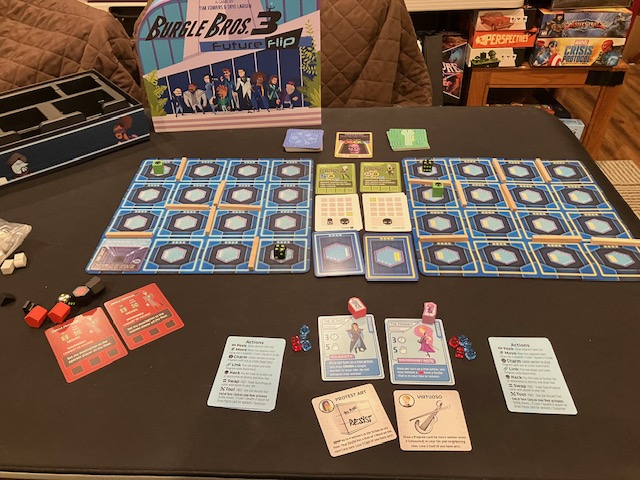
See above as I am set-up for a solo (two-handed, playing two characters)!

Your characters start on the Air Duct space, getting ready to explore!

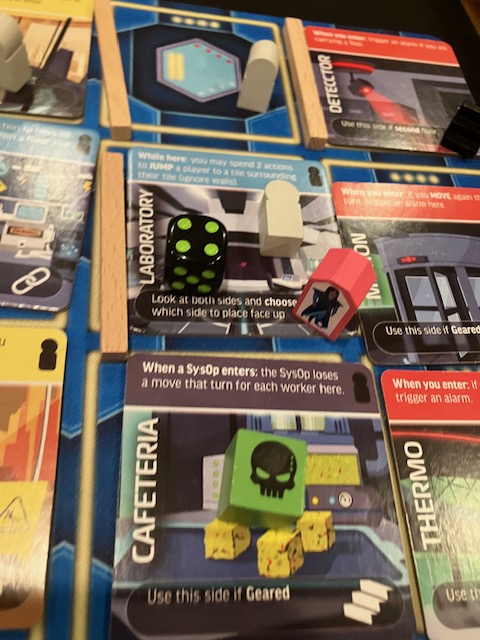
I have to admit, I didn’t enjoy my solo game.  Many, many times, I got stuck.  It’s clear you don’t want to go near the SysOps, because you lose cool/stealth.  Sometimes, you just get stuck in a corner; you could move over the SysOps, but then you lose your precious cool.   The overall theme for this game is patience.  Sometimes, your turn is almost nothing.  It’s unfortunate, if you don’t move on your turn, there’s usually very little you can do.   Sometimes you can CHARM, sometimes you can LINK/SWAP.  But many times your turn is “well, I’d better stay here or the SysOp will move over me”.

I lost my first solo game pretty badly.  I got stick in corners too frequently, and the luck of the dice and Patrol cards just went sour.

I was very frustrated.


Cooperative Game

The cooperative game went a little better, but not much.

The same problems that plagued the solo game plagued the cooperative game.  Sometimes, a character would just get stuck in a corner and couldn’t do anything.  They’d have maybe one viable action, but have to basically just waste their turn.  They’d get stuck because a KEYCARD space came out, or the pattern on the floor cornered a character, or the SysOps simply always was coming towards you!  It’s even harder to predict what the SysOp will do when 3 people play after you!  Will you lose your cool???

The best part of the game was the endgame.  Once all the tiles had been revealed, then we could be smart and try to figure how to get out of the building!  In the endgame, we had fun as we tried to puzzle out the best way to use the spaces on the board!!

Unfortunately, I didn’t like the process of GETTING to the endgame.   It just felt so  … reactive.  All we could do was “react” to the state of the board on our turn.  There was a little bit of strategy about where people might go, but sometimes the board layout or the SysOps pattern just stopped you from doing anything.  The game felt like … stuff was just happening to me and I could do very little about it.

I hate to say it, but the game just felt too random.

What I Liked

Rulebook: this is an amazing rulebook; it’s so well done.  The parenthetical notes were just icing on the cake!

Meeples: In Burgle Bros 2, we joked that puting the stickers on the meeples was a legacy game!  Don’t mess up the stickers!  Here, in Burgle Bros 3, they got it right: have the meeples come pre-noted.  See above.

Bag:  The bag is well-done.  It would be easy to screw up how this bag worked, but they didn’t.  it’s easy to pull tiles from it and “shuffle tiles” inside.

Neoprene Mats:   The neoprene mats work well, and they fit back in the box.  (This was another potential issue from Burgle Bros 2: the mats fit weirdly).

Two Share Actions!  I adore that there are TWO kinds of sharing actions!  If you are on the same space, you can SWAP!  If you are both far away, but on a LINK space, you can still share stuff!  Most cooperative games only have one notion of sharing, and I really really liked this!  In fact, it made the endgame so much more fun because we had multiple ways to get Program cards to people to do the final hack!  

Production: In general, the production is fantastic modulo one or two issues.

Endgame: Once all the tiles were out, you could be smart. I loved how the endgame played out.

What I Didn’t Like

Frustration.  Many times, you feel like you can’t do something on your turn.  Sure, you have to be patient, but it just felt there were too many turns where “the smart thing” to do … was to do nothing.  In fact, the frustration was so palpable in the cooperative game and I noticed us getting testy with each other.  I think this is a function of the frustration level!
Colors?  Why aren’t the character cards color-coded to match the meeples?   This seems a strange decision especially because the meeples are kind of small!  The color is the main feature you can see! Making the character cards all the same color makes it harder to distinguish who is who.

Reactions

Andrew liked this the best; he was always thinking of ways to get around stuff.  He gave this a 6 or 6.5, which is actually quite high for him.

Sara liked it okay, but she got frustrated a lot.  She gave the same rating: 6 or 6.5, maybe leaning towards a 6.

Teresa generally liked it.

Rich had to most trouble with it.  He found it too frustrating and too random.  The solo game he’d give a 5, and maybe maybe a 6 to the cooperative game.


Conclusion

Burgle Bros 3: Future Flip is an amazing production; the rulebook, the cards, the meeples, are all great.  In order to enjoy this game, you have to be patient.  You have to be able to suffer turns where you do nothing.  If that doesn’t sound like fun, you won’t enjoy this game.   In fact, the game can be down right frustrating when you get stuck.

The best part of the game is the endgame; if you can make it to the point where the board is unfurled, then you can be clever and win the game and get out!  Unfortunately, in order to get to that point, you have to suffer through the random flips and turns which may lead to frustration when you feel only reactive.

This game was a little divisive in my group; some people liked it, some people didn’t.  Hopefully this review will help you decide if this is for you.

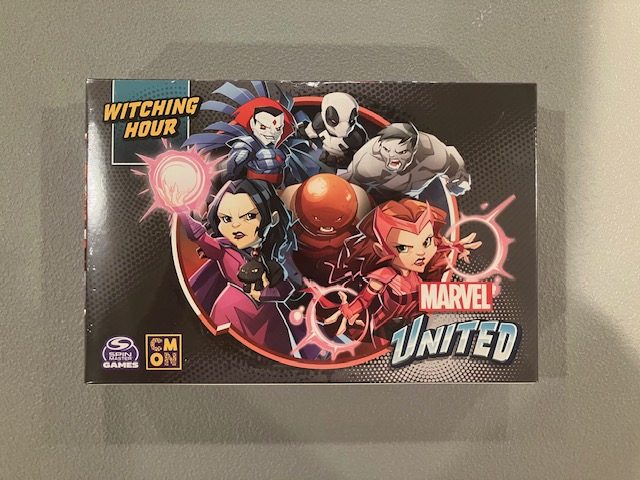
Which Witch Is Which? A Review of The Witching Hour

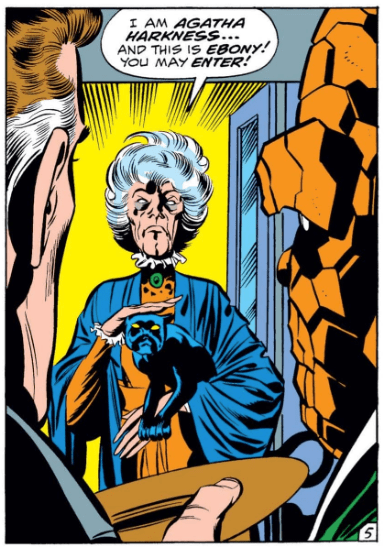
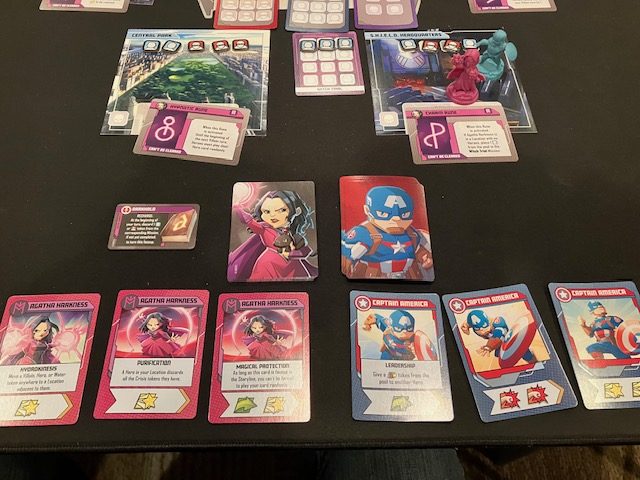
To me, Agatha Harkness will always be the old lady from the Fantastic Four comics who helped out the Fantastic Four when they needed magical consultations! But, of course, this Marvel United expansion is set squarely in the Marvel Cinematic Universe, with Scarlet Witch being a Villain (like the second Dr. Strange movie), and Agatha Harkness being an anti-hero; both hero and villain from her own Marvel TV show. And yes, there is a reference to the song “Agatha All Along” within this set.
The Witching Hour is an expansion for the cooperative super-hero game Marvel United.

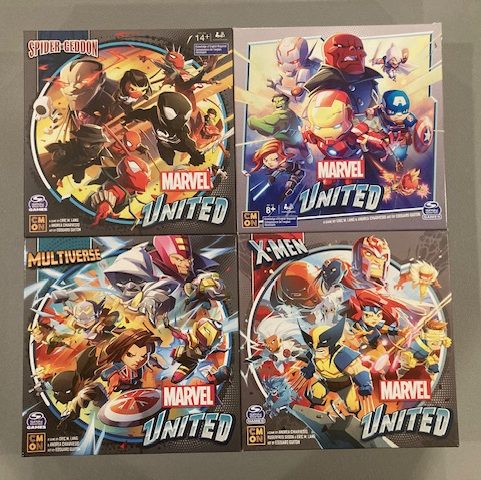
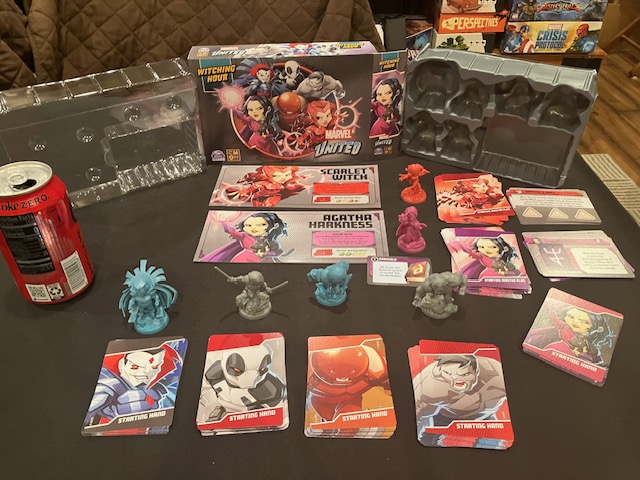
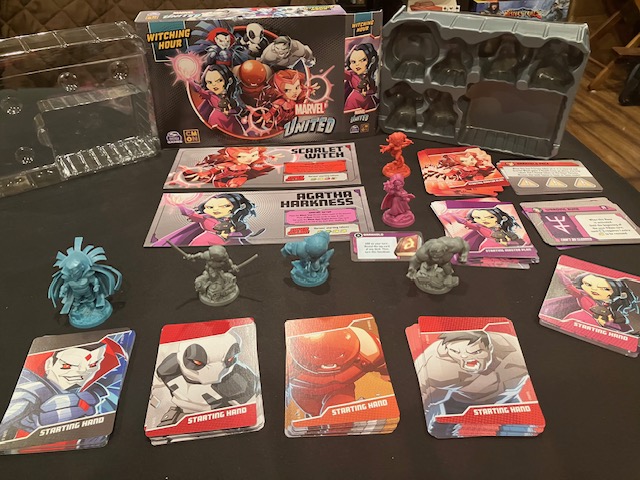
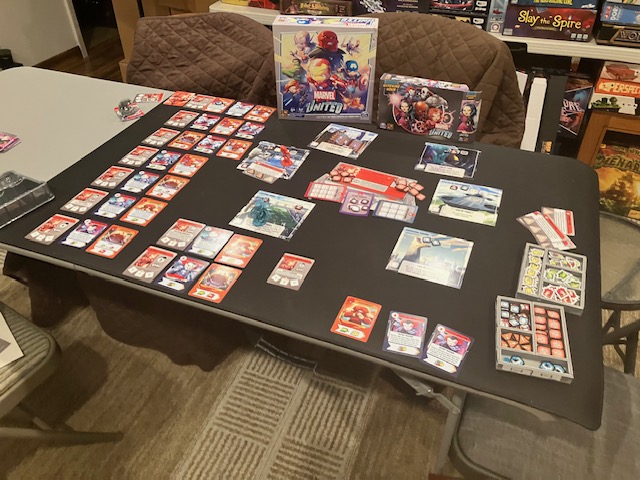
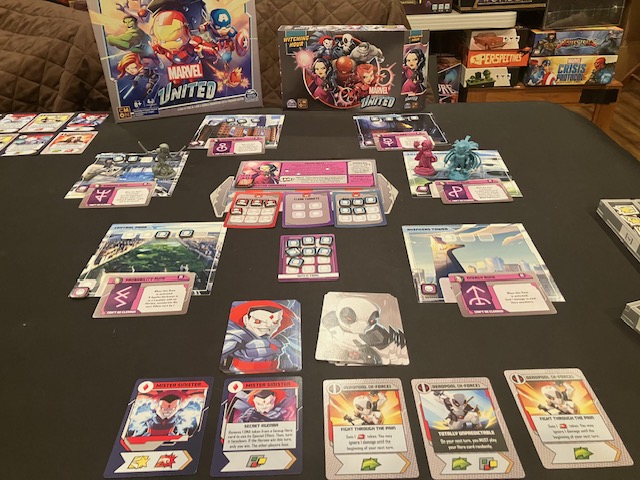
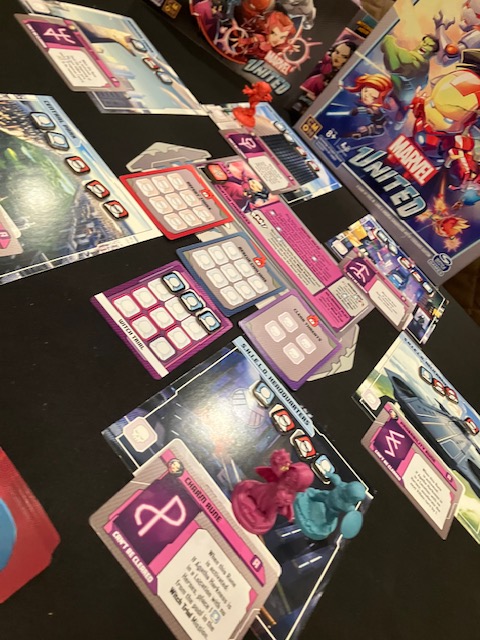
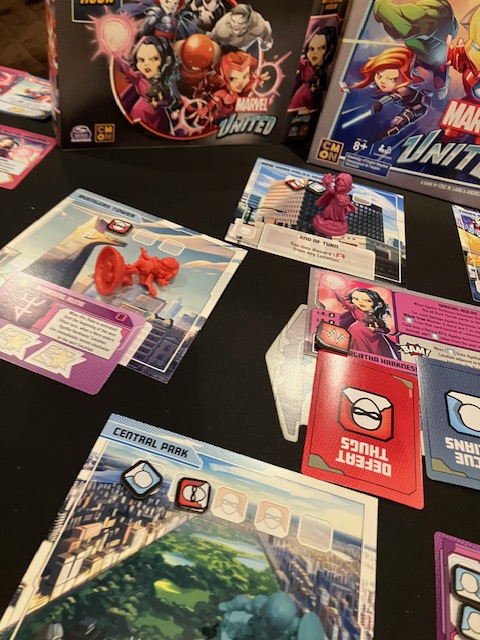
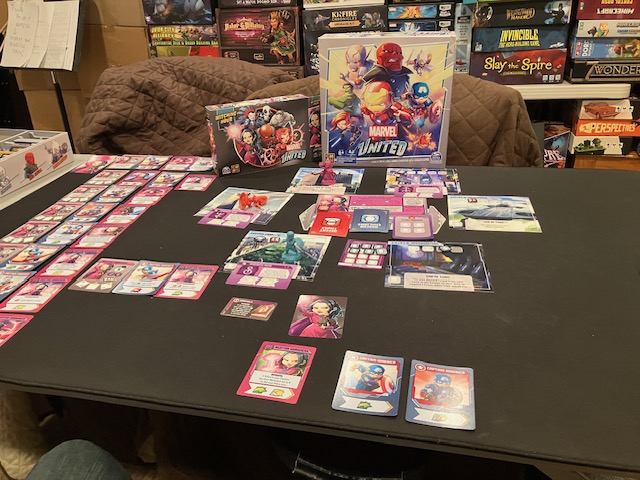
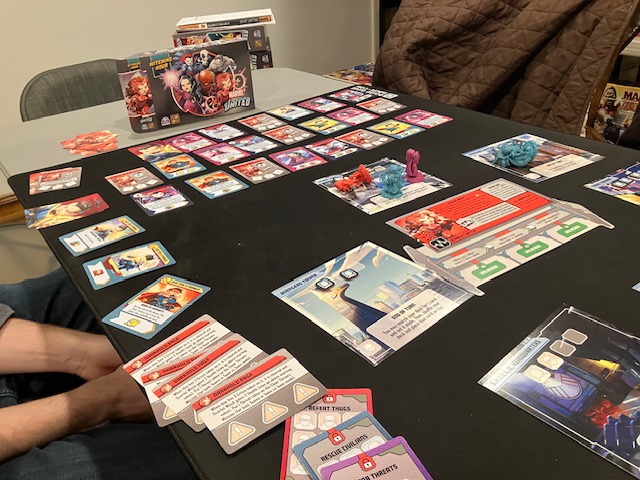
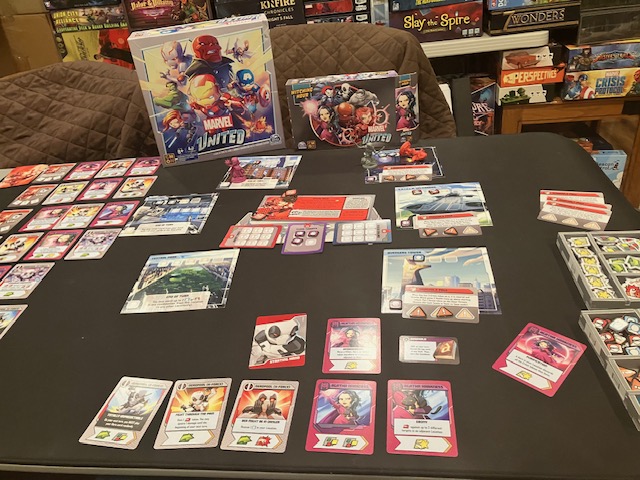
In order to play this, you need the tokens, cards, and Locations from one of the many base games: see above.  You can ALMOST play The Witching Hour by itself, as it has a bunch of heroes and villains (their cards and minis).  Alas, you need one of the base boxes.

This was originally on Gamefound about a year ago: January 2025!  It promised delivery in June 2025, but it is almost 6 months late.  Usually I don’t mind when a kickstarter is late, but in this case The Witching Hour has been available at Amazon for almost 6 months BEFORE we got ours!  (It was, now it’s not?  But I do see it at GameNerdz and other places) Basically, I could have ordered from Amazon, gotten free delivery, and gotten it 6 months earlier!  That didn’t sit well with me.  It turns out the one available on Amazon was the 1st edition with some errors in the printing, so waiting for the 2nd edition meant I got the corrected version.  So, that’s good I guess.

Let’s take a look!

Unboxing

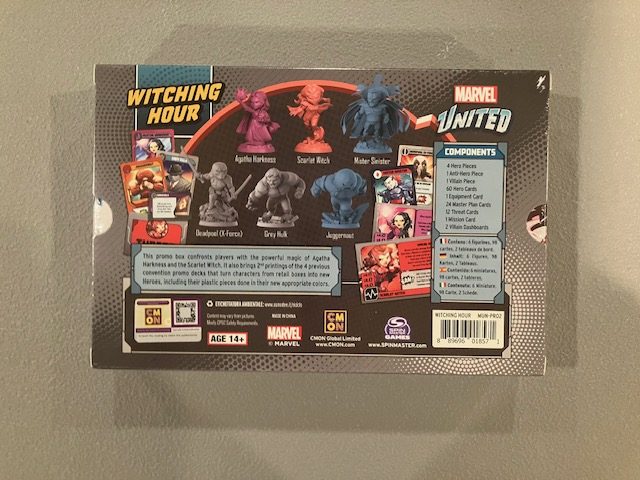
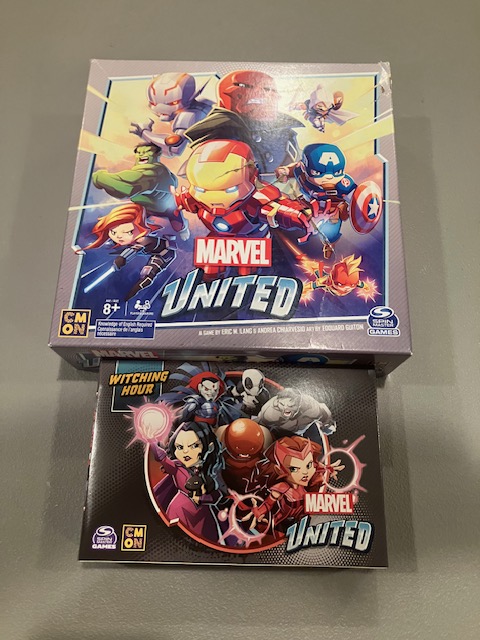
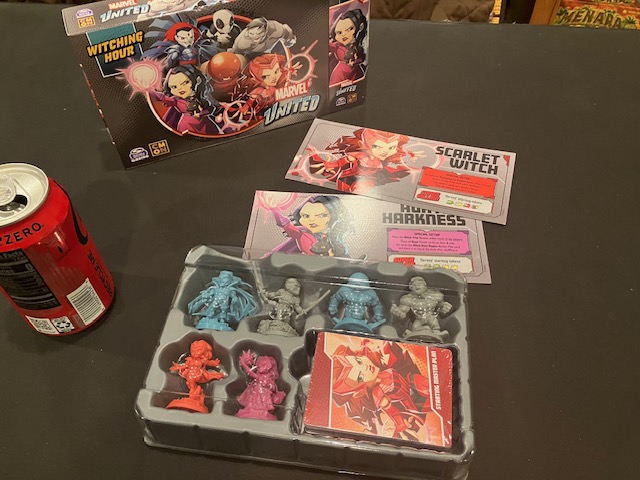
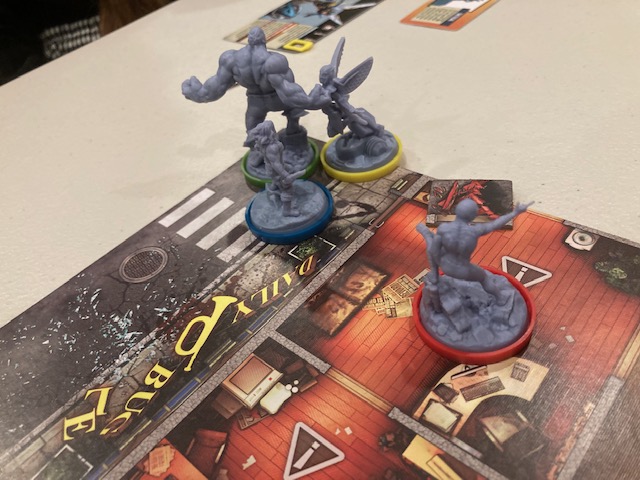
I am used to my Marvel United expansions being about the same size as the original box.  Nope!  This one is a lot smaller! See above and below.

This little box is packed to the brim with cards and minis.  See above with Can of Coke for scale.

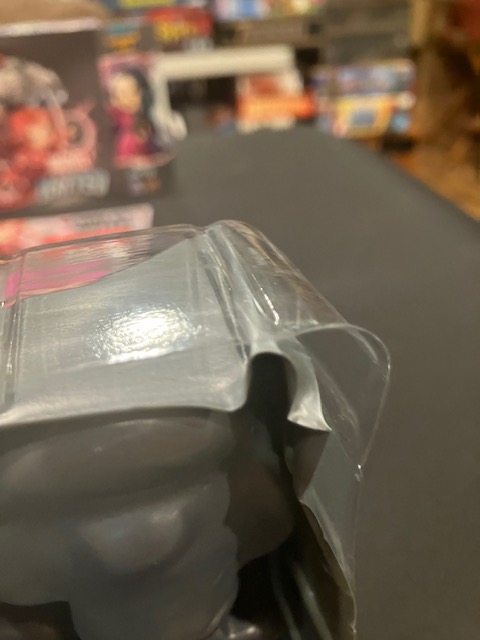
The quality of the insert isn’t great; see above as just the slightest pressure causes it to bend.

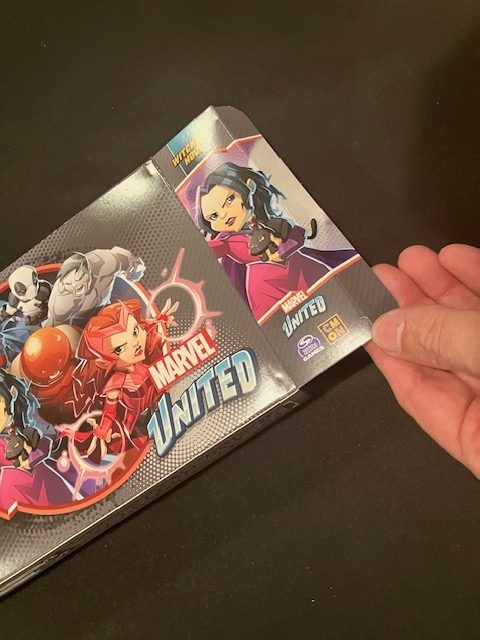
And it’s also a tuck box?  Tuck boxes are one of my least favorite ways to store things.  They always seem to cause damage to something when you fold the tab in.

Besides those issues, this looks great! The quality of the cards and the art and the minis is all consistent with Marvel United in general.

Be careful; there is an equipment card in the game that’s very small and easy to lose!  It’s also crucial when you play Agatha!  Don’t let this fall out of the box!

The quality of the cards and minis is great.  The insert is ok, if a little cheap.  I also don’t love the tuck box. 

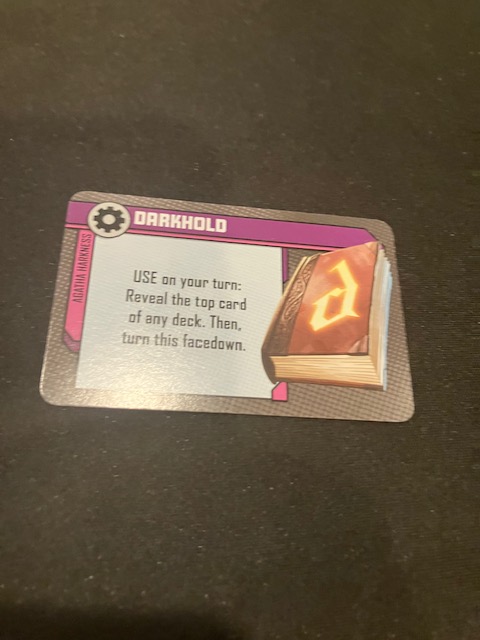
And be careful with the Darkhold!  I guess that goes without saying …


Villain Centric

We’ll take a villain-centric view of this expansion.  What do I mean by that?  We are going to fight all the villains, with all sorts of different combos of the Heroes.  Those combos will show the strengths and weaknesses of the Heroes, but it’s the villain who will define each session.

The other reason for this is that most of the heroes in this set are a hodge-podge of heroes from Convention promos and other sources that weren’t mainstream.  The heroes are a pretty eclectic collection, and not really thematic to the magical motif of this set.

So we’ll just squint as say this set is “Witchy Villains!” … and some Heroes  (Which are all pretty cool but not witchy).

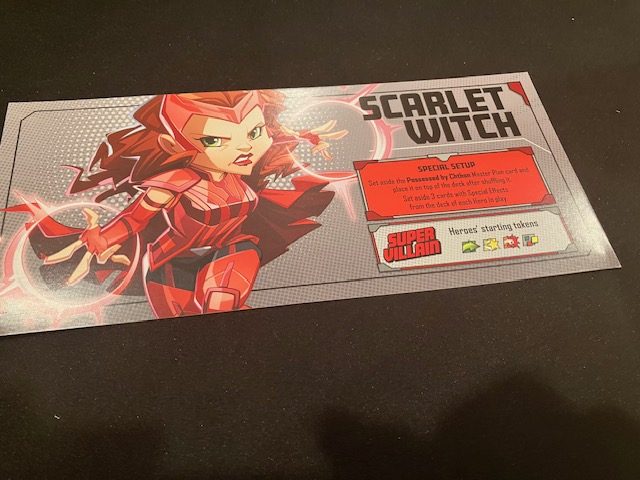
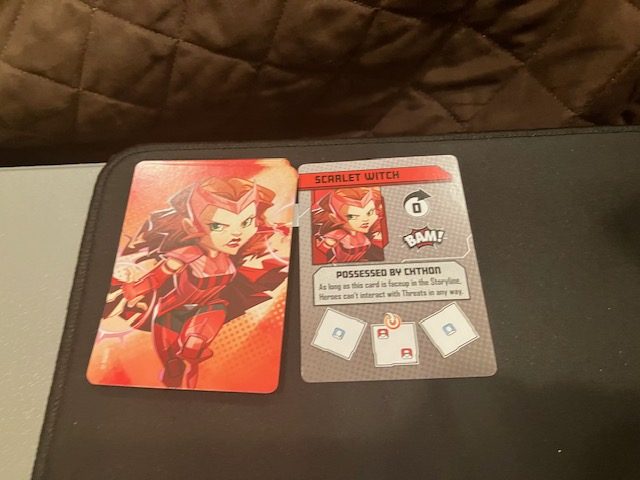
There are two new villains; Agatha Harkness and The Scarlet Witch

I mean, I know Scarlet Witch is both a Villain and Hero in the comics (depending on when you find her), but in this set she’s a Villain.  (Her Hero version is in the Season 1 Stretch Goals set).  Also, be careful, as there is another Villain Scarlet Witch/QuickSilver in the X-Men: First Class Marvel United expansion set (which we reviewed here).

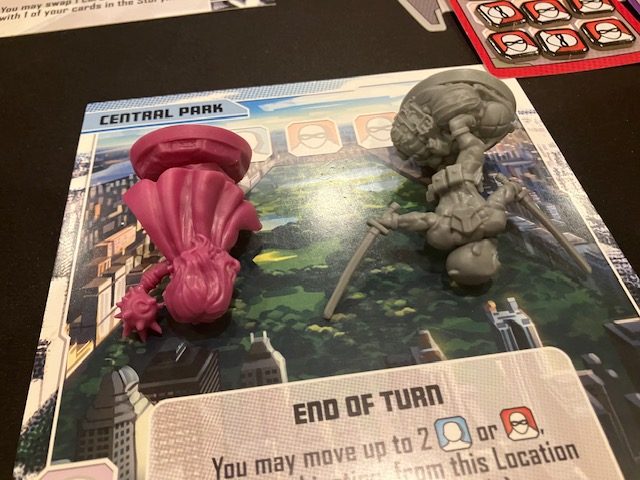
Strictly speaking, Agatha is an anti-hero (which is why her figurine is purple) which means she can be either a hero (blue) OR a villain (red).  She just can’t be both, because you only have one figurine.  Although … I could imagine something where you used another figurine for the villain.  Maybe Agatha’s body got taken over by Scarlet Witch!!!  Or something silly like that.  Somehow, something crazy like that seems like it would happen to Agatha anyways, …. you know what, I think I just an idea for a new session …

We’ll take the heroes and villains through their paces and see what we see!

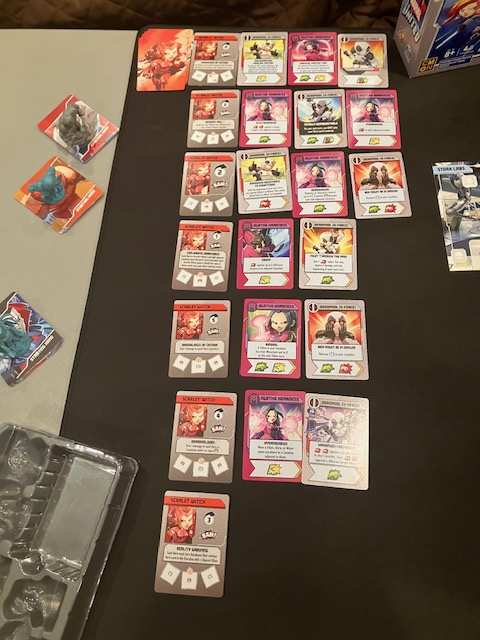
Sessions 1,2, and 3: Scarlet Witch vs Agatha and Deadpool (X-Force version)

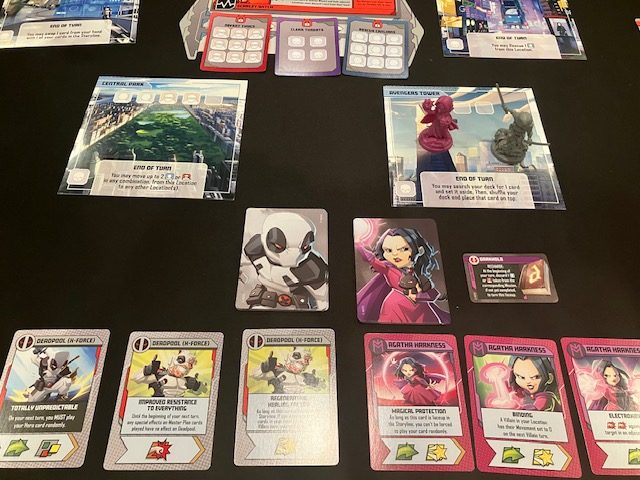
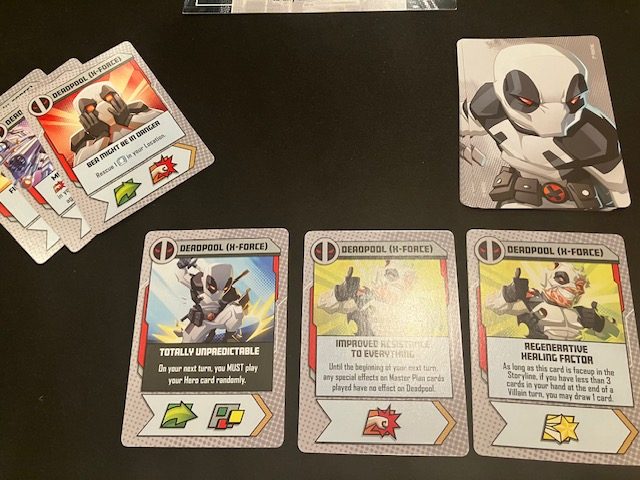
This is an unlikely pairing:  Deadpool from X-Force and Agatha!  Note that Agatha has the DarkHold equipment.  Spoiler Alert: it makes a big difference in helping the heroes!

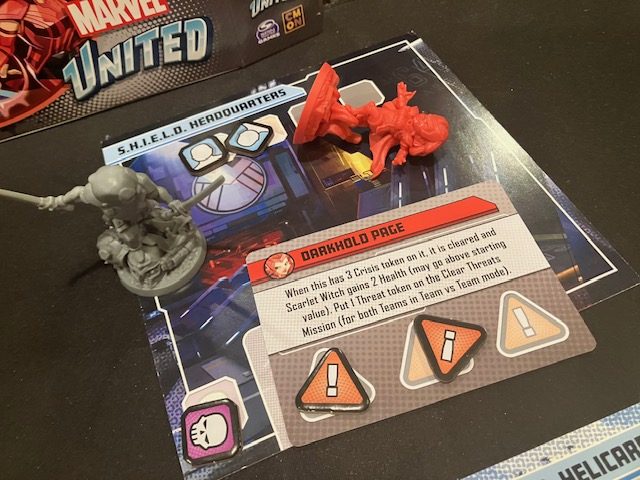
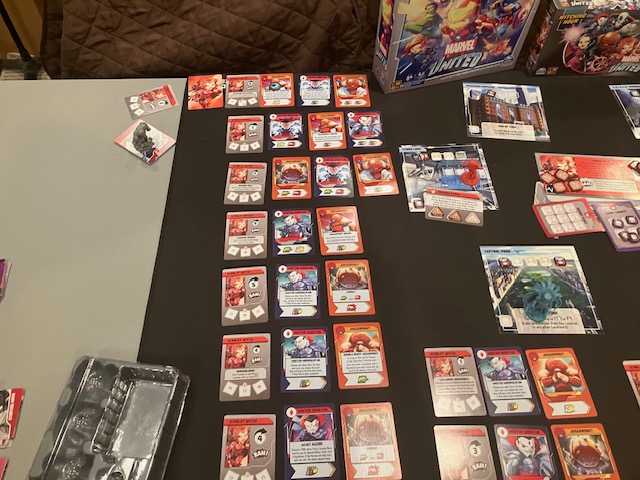
The Scarlet Witch is a harder villain.  She has a 6 Darkhold pages (Threats) on the board! 

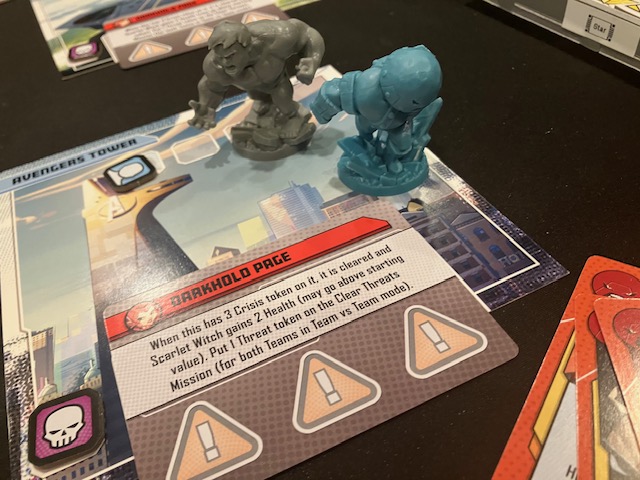
Whenever a Darkhold Page gets 3 crisis tokens on it, it clears!  This might seem like a good thing (as it reveals the special ability on the Location), but  …

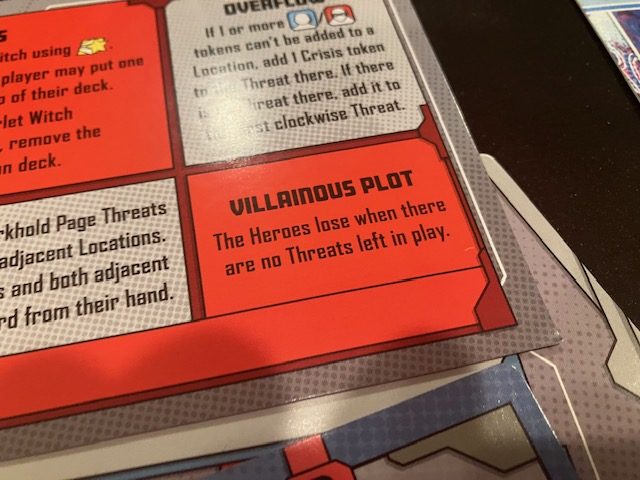
… Scarlet Witch wins if she gets all 6 Darkhold pages!!! (“clears all threats”).   After numerous games against Scarlet Witch, I can tell you that she usually wins by clearing the threats!

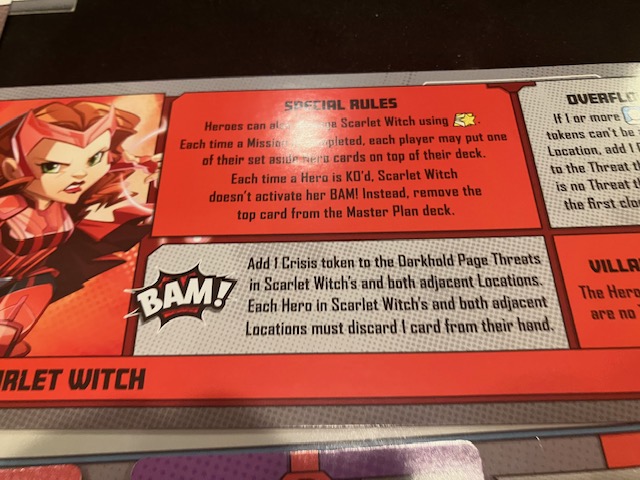
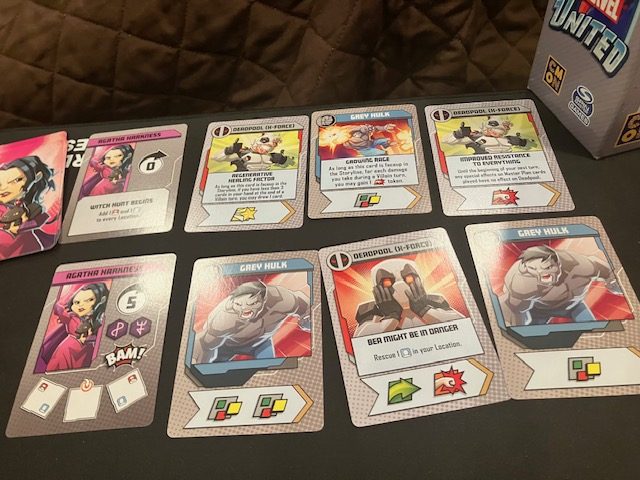
She’s also very interesting in that anything that deals with Crisis tokens on threats is completely disabled! See her starting card above!  I suspect this is simply to handle any edge cases that might happen: simply disallow it.

My first game was a loss as Scarlet Witch found all Darkhold pages!  I think I didn’t realize how important it was to try to keep the Threats from all being cleared!  Usually, you WANT all threats cleared … not here!

My next game, just a replay of the first game, armed with a little more knowledge.

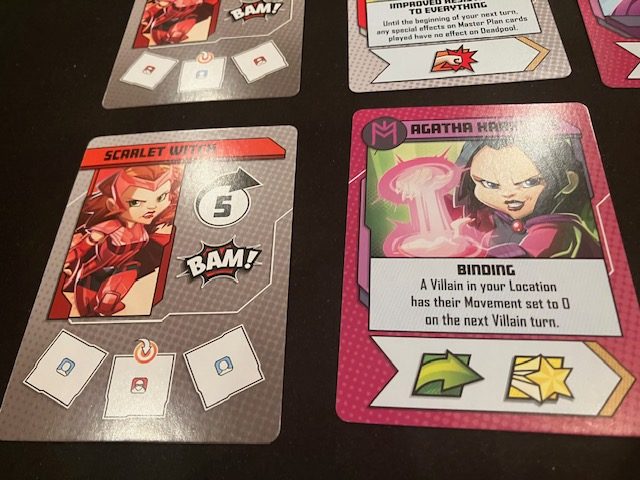
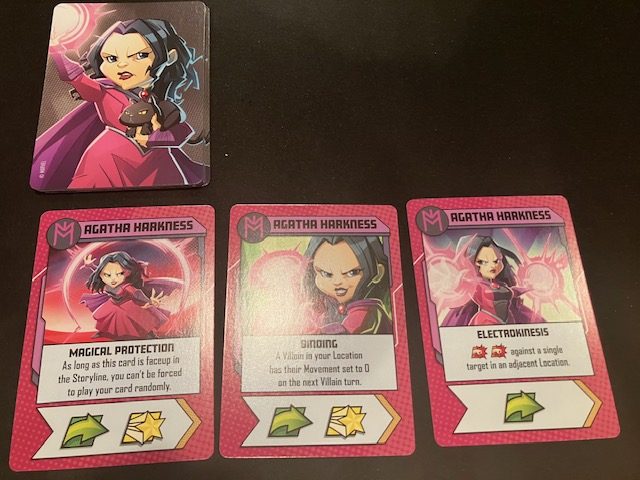
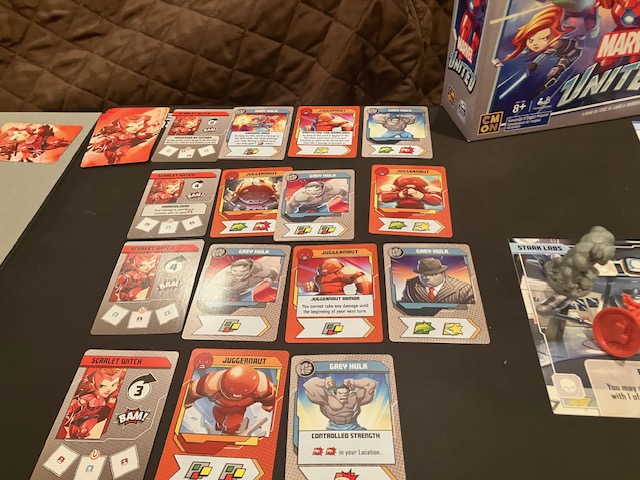
See binding above!!! Basically, since Agatha stopped Wanda from moving, I kept her from finding all the pages and Deadpool was able to beat her senseless!  However, I didn’t realize I stopped her moving, so we played put the last turn and we lost! If I count the Binding as happening, we won!

An important rule you might easily miss is that you can use Heroism (as well as punchees) to do damage to Scarlet Witch.

After one loss, one pseudo-win, and one absolute win, I can declare we beat Scarlet Witch. 

Deadpool is all about the punches, but his Regenerative Healing Factor (see above) always kept him with plenty of cards, which gave him plenty of options on his turn.    His Improved Resistance to Everything was useful here (as it mitigates the Master Plan effects), but almost feels too overpowered?  It’s pretty awesome; we’ll revisit this resistance in Agatha’s villain section!

Agatha was, in general, great.  As cool as her Magical Protection is (which is a unique card in her deck), it didn’t really make much of a difference in the Scarlet Witch villain; I think other places she would be HUGE.

Honestly, Agatha using the Darkhold was both thematic and very useful, as it allowed us to plan for what Scarlet Witch would do.  It’s cost is high to recharge (losing a Thug or Citizen from a mission), but somehow it seems thematic for this morally ambiguous character to recharge it all the time.  “Who cares if we  lose another thug in the world? We’re trying to save the world!”

These games with Agatha, Deadpool (from X-Force) vs. Scarlet Witch were very cool.  This is why I like Marvel United so much!  This was a very different kind of fight with very different heroes and villains!


Session 4: Scarlet Witch vs Juggernaut and Mr. Sinister

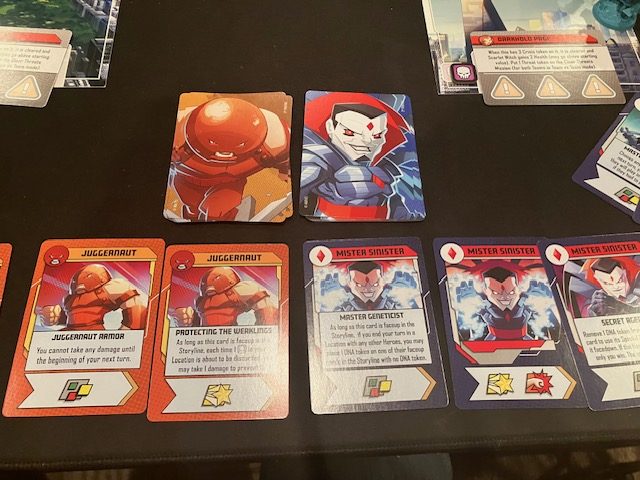
Just to bring out the more heroes, I tried Juggernaut and Mr. Sinister against Scarlet Witch.  They got their lunch eaten.

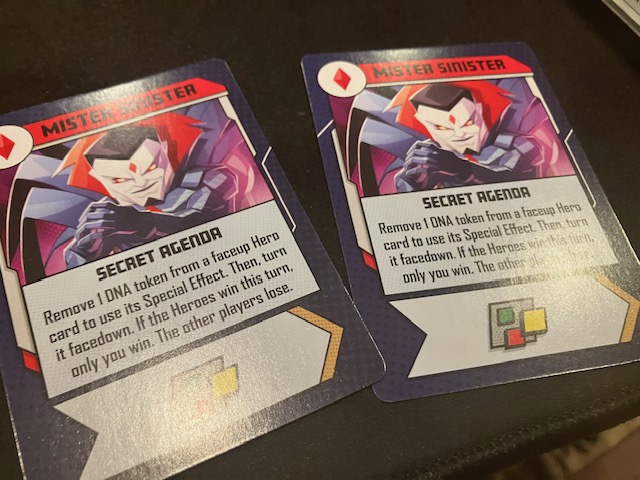
The problem is that Mr. Sinister special abilities require him to occasionally be on the same space as other heroes.  In a 2-player/2 -Hero game of Marvel United, he never got to use his special ability!    Players are too busy chasing down Scarlet Witch and saving citizens and thugs … if they don’t, they will lose!  Unfortunately, this means Mr. Sinister almost never ends on the same space as another hero … so his special powers are never invoked, which make him less useful.

Mr. Sinister probably needs to be in a game of 3 or 4 Heroes to be useful (so more heroes can be close by).

Juggernaut was mostly smashy-smashy…kind of what you expect.  

These two did not make a great pairing.

Session 5: Scarlet Witch vs Grey Hulk and Juggernat

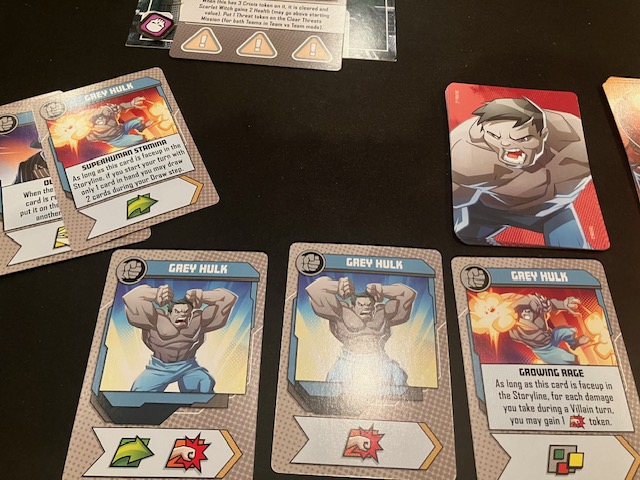
Surprisingly, Grey Hulk and Juggernaut made an effective team against Scarlett Witch!

Both heroes are pretty punchy-punchy.  But that worked for them!  They went in a beat up Scarlet Witch pretty badly once she because vulnerable!

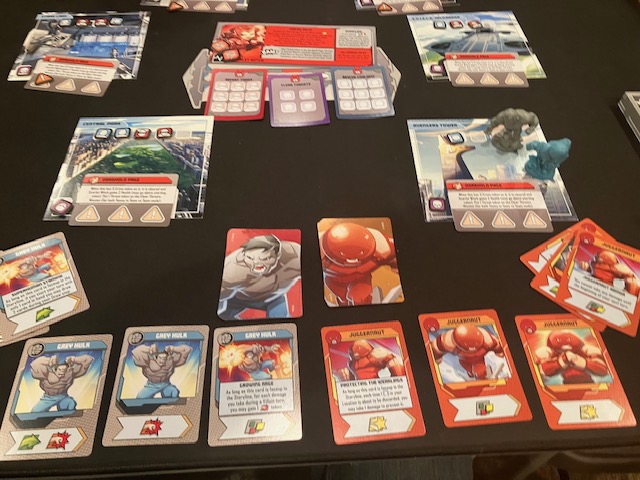
See above as Hulk and Juggernaut beat the heck out of Scarlet Witch in round 4!

Sometimes raw punchee is what you want.


Session 6: Agatha Harkness vs. Deadpool and Mr. Sinister

Agatha is a very interesting and very different villain!

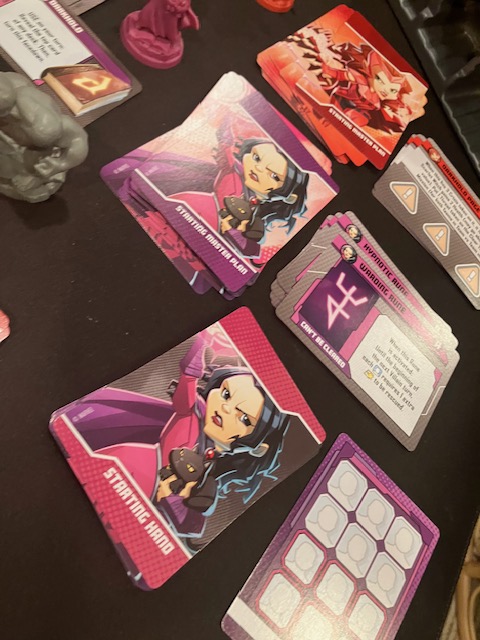
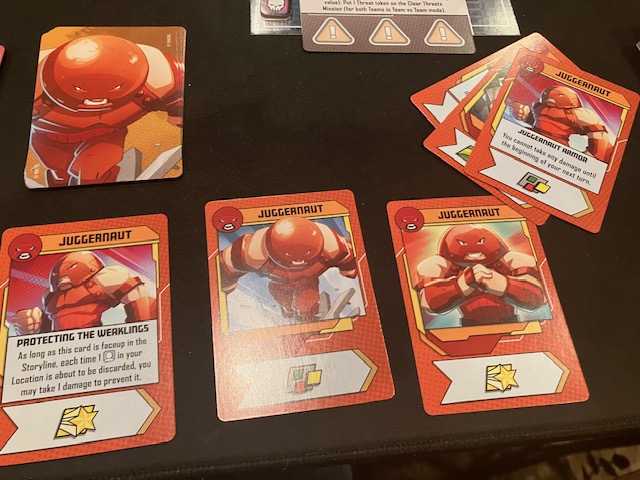
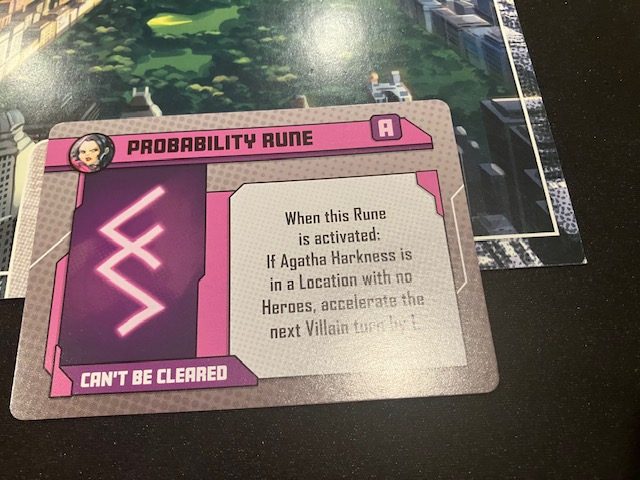
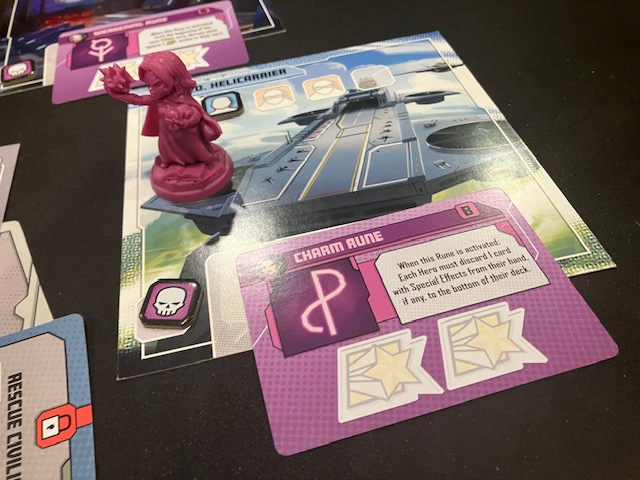
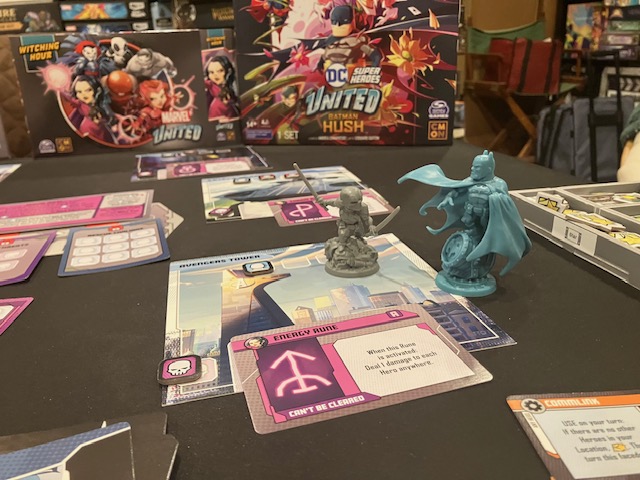
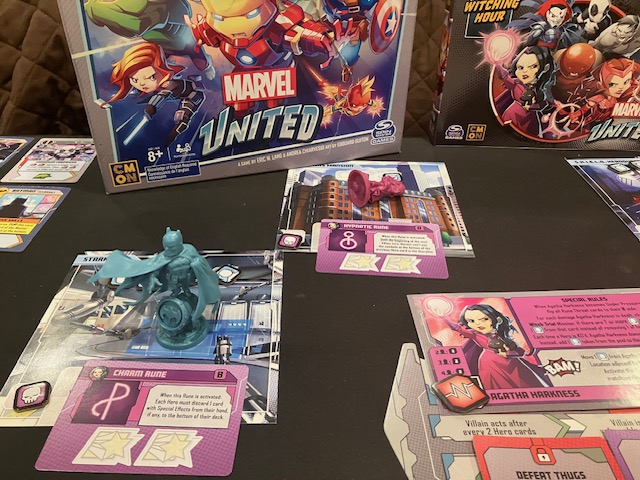
The threats she puts down are RUNES!  See above!!  Her Master plan cards  activate whatever RUNES are on the board!

When Agatha comes under presure, the RUNES flip to the opposite side, which allows Heroes to dispatch them … but they are still active!  These are pretty powerful!

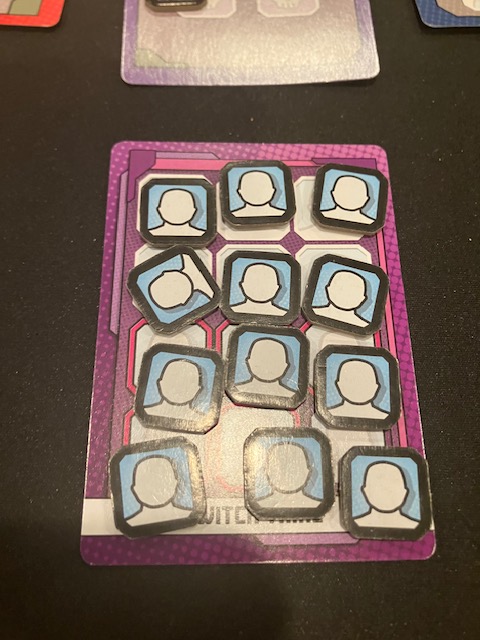
Agatha also has a special Mission: the Witch Trial!  If it ever fills up with civilians, you lose!

As we noted earlier, Mr. Sinister is terrible in a 2 Hero game.  Deadpool and Mr. Sinister lost.

The real question is: does Deadpool’s resistance ability apply to Agatha’s spells?  Since the runes are activated by the Master Plan special effects, you could argue YES!  But since the RUNES themselves aren’t actually on the Master Plan, you could argue NO!  Also, it’s a matter of how you define “special abilties” on Agatha’s cards … do they count as special powers?

The interpretation of Deadpool’s resistance can mean the difference between winning and losing.

Session 7: Agatha vs Deadpool and Grey Hulk

It’s clear after Grey Hulk and Deadpool lost, that punchees are not enough.  It was very clear that heroes with tons of heroism are needed!  Basically, you need to save civilians as fast as possible because Agatha’s Witch Trial will remove them from the board … and you lose almost certainly lose because the Witch Trial fills up.


Sessions 8 and 9: Agatha vs Deadpool and Batman (?) (!)

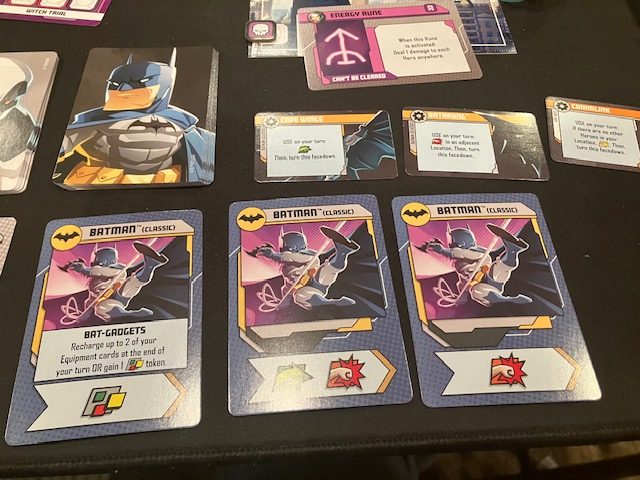
It was very clear that we needed a hero with lots of Heroism!  The morally ambiguous lot from The Witching Hour is probably not the best group of heroes to display Heroism.  But Batman (fresh from the DC United: Batman Hush set: see review here) has a lot of Heroism.  And his toys help too.  

The first game was close; but we still lost.  Batman’s gadgets were VERY helpful is getting things under control early,but we still had a run of bad luck.  

This was very comic-booky!  We lost the first round, but Batman and Deadpool learned from their mistakes and were able to take out Agatha on their second pass!

Heroism was key, but Batman’s gadgets were pivotal in cleaning things up early.

Session 10: Agatha vs Agatha and Captain America

So, it turns out you CAN play Agatha vs Agatha … with a little help.

This was kind of a silly game, but it was really fun.

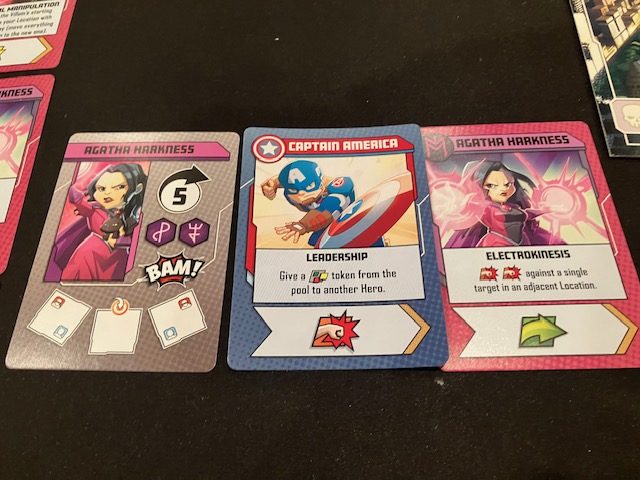
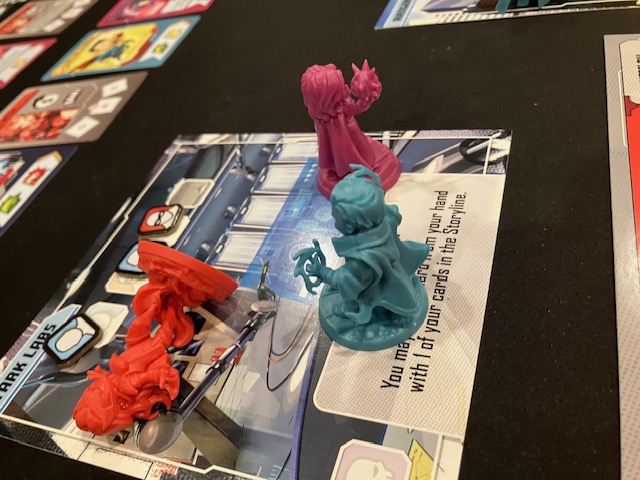
We used Agatha (purple) figure as the hero figure and Scarlet Witch (“Who took over my body? I am possessed by an Agatha from a different multiverse!!!”) as the evil Agatha!  See above.

This was a blast, as good Agatha used the Darkhold to see what evil Agatha was going to do!  And Captain America is FULL of Heroism, which is so critical to take out Evil Agatha!

So, you can play Agatha vs Agatha, and it works well.  You just have to squint and use a different mini.

Cooperative Play

You may noticed the last 10 games were solo two-handed games.  Let’s just make sure this still works cooperatively!

So, we tried a 3-player game against Scarlet Witch!  Me as Mr. Sinister, and Teresa as Agatha!

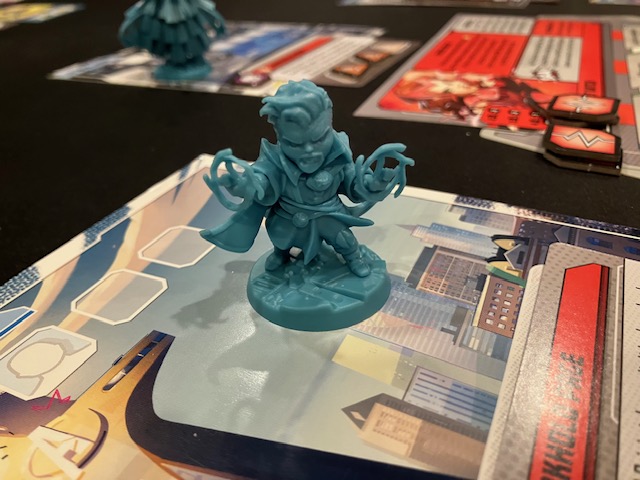
The only way I could get Andrew to play was to promise him Dr. Strange!  And it turns our Dr. Strange makes the game REAL interesting! 

With Dr. Strange, you can remove Scarlet Witch’s starting card from the master plan!  Once you do that, you can actually keep the Crisis tokens under control!  We took this tack to give ourselves a little more time to get to Scarlet Witch, because she usually wins by getting all threats removed!  Dr Strange, and his Eye of Agamammmasdjhajhsjdhjkasfhjajksdf (I think that’s how you spell it) were able to disable Scarlet Witch’s Cthon Master Plan card …. which enabled us to last longer and kill Scarlet Witch!

The cooperative game was full of highs and lows as all of us got KO’d!  The Master Plan deck was almost out of cards!  But than Agatha went in for the kill and punched and heroismed for the final takedown!

The game was fun, cooperative, as we discussed what symbols to put out to help ourselves as well as our compatriots!  Generally, it worked well!

And what about Mr. Sinister?  He was able to use his DNA ability … once.  I still feel like I didn’t take best advantage of his ability.  But it was still better to use him in a 3-Hero game than a 2-Hero game.

Conclusion

The fact that I played eleven games of this silly expansion with a crappy plastic insert and awful tuck box should tell you what I thought: I’d liked it quite a bit!

Scarlet Witch and Agatha (as Villains) and Agatha (as hero) are the reasons to pick this up.  The other characters were fun, but I think the witches were the winners.

If you liked Agatha All Along and you want play some games with these Witchy characters, pick up the Witching Hour.  Even if you don’t love the Marvel show, these villains in particular are pretty interesting and fun.  The heroes (other than Agatha) are fine (and to be clear: Agatha is so interesting!) , but none of them really spoke to me (except maybe Deadpool X-Force)?  Hopefully this far too wordy and pictory review will give you a sense of whether or not you may like it.

I liked it a lot.  That’s why I played eleven games with it!


The Case For Adding Player Selected Turn Order as a Mechanism to BoardGameGeek

For turn order in many traditional board games, many games use the simple tried-and-true model that “play proceeds clockwise around the table”. The turn order is dictated by where you sit. It turns out, in many modern cooperative games, we have seen a rise in a new mechanism called Player Selected Turn Order which changes this up!

What Is It?

Player Selected Turn Order is a mechanism by which players in a (almost always cooperative) game select as a group the order in which they take their turns. Players together choose the order of play within a turn! This cooperative mechanism gives the players more agency as they can choose the order in which they takes their turns, so as to reinforce another character, set-up another character for a combo, or just get out of another player’s way. Surprisingly, there is no official name for this mechanism!

We have written a few articles about the mechanism over the years:

  1. Player Selected Turn Order In Cooperative Games: This is a high-level article from many years ago surveying the landscape. See https://coopgestalt.com/2018/02/06/player-selected-turn-order-in-cooperative-games/. The same article was put on bgg, and there were some interesting follow-ups. https://boardgamegeek.com/thread/1934592/player-selected-turn-order-in-cooperative-games
  2. Fastball Special: This is an article discussing why something like Player Selected Turn Order is necessary in cooperative games so you can set-up combos like Wolverine and Colossus’ Fastball Special: see https://coopgestalt.com/2016/07/15/fastball-special/
  3. Seven House Rules For Cooperative Games: This is article talking about some House Rules which make some games more fun; #7 is Adding Player Selected Turn Order to a Cooperative Game. See https://coopgestalt.com/2020/09/20/seven-house-rules-for-cooperative-board-and-card-games/

A game that most people know with Player Selected Turn Order (even if that’s not what they call it) is Marvel Zombicide: Heroes’ Resistance. In this game, the players control 4 Marvel heroes (always 4 heroes), and the heroes are allowed to go in any order they want.

“Spider-man gets out of the way so Hulk can smash! If Hulk smashes enough, Wasp can move and attack other zombies, otherwise, she can finish off the the zombies that will eat J. Jonah Jameson!”

By allowing the players to choose the order they activate their heroes, they can strategize together and also react to the results of the previous heroes’ turn! They can plan strategies and back-up strategies by choosing the order the Heroes play.

  • Player Selected Turn Order makes sense in solo games as well as cooperative games; for example in Heroes’ Resistance, the game requires that there always be 4 heroes in play, so the solo player gets to make activation order choices just like the cooperative game.

Coarse-Grained vs Fine-Grained

There are two flavors of Player Selected Turn Order: coarse-grained and fine-grained. The difference only shows up when a player can do multiple actions on their turn.

Consider Heroes’ Resistance: each hero gets 4 actions to perform on their turn, but they must complete all 4 actions before the next player can go!! This is coarse-grained Player Selected Turn Order: each players must take take their entire turn before the next player can do anything. It is called coarse-grained because the turns are “coarse” and large; all actions must be taken before proceeding.

In games with fine-grained Player Selected Turn Order, each hero gets some number of actions, but these actions can be interspersed among the players!

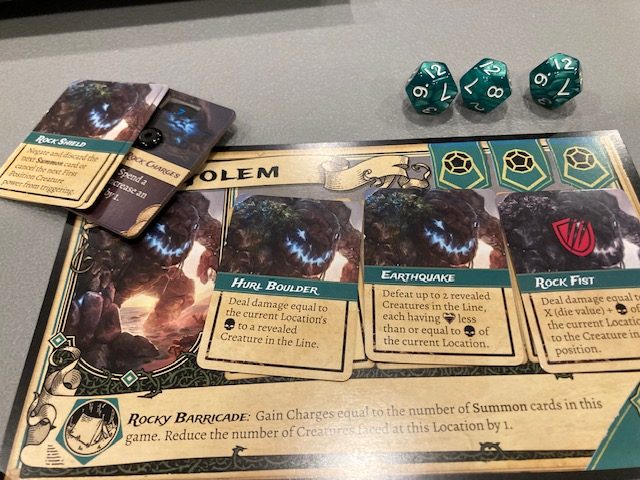
An example of a game with fine-grained Player Selected Turn Order is Set A Watch: Forsaken Isles (or any of the Set A Watch games). In these games, each player rolls some dice, and each die can be “activated” to do something (used for damage or activating a special power). When it is the players’ turns, they can choose to activate a die in whatever order they want! The Golem can take out the front heavy hitter with his 12, and he can keep going, or let someone else go. Maybe after everyone else has gone, the Golem can use his last two dice to play clean-up! It’s up to the players to decide the order they will activate their dice (or powers)! No one has to “complete a turn”, players just activate their dice in any order they want!

Basically, with fine-grained Player Selected Turn Order, the actions of the players can be interspersed however they want; there’s no notion of a player completing their turn before another. See above as each character has 3 dice to activate, and they can be activated in whatever order the players’ choose!
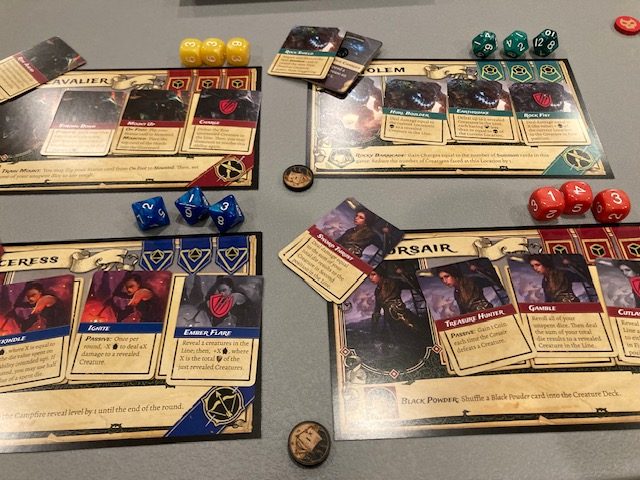
It’s called fine-grained Player Selected Turn Order because the player’s full turns are broken up into a finer sub-actions, and these sub-actions can be activated in any order the player’s choose.

No Official Mechanism?

Given how prevalent cooperative games are now, and given how many modern cooperative games have Player Selected Turn Order, it’s surprising that BoardGameGeek (the world’s authority and go-to place for board games) has no notion of this mechanism when it describes game!

When you go the mechanisms of a game, say Heroes’ Resistance (see link here or picture above), you’ll see no notion of Player Selected Turn Order for this game! It’s Cooperative, has Variable Player Powers, but … does it have Player Selected Turn Order? We happen to know it does, but it’s not clear from the mechanisms page!

Proposal

We’d like to propose that BoardGameGeek add the Player Selected Turn Order to their list of mechanisms so that cooperative and solo games can list it! It probably makes sense to add both Player Selected Turn Order (fine-grained) and Player Selected Turn Order (coarse-grained) since they are technically important sub-genres of Player Selected Turn Order!

In the next section, we document about 30+ modern cooperative and solo games that have Player Selected Turn Order (with notes of fine-grained vs. coarse-grained, if known). This is definitely an incomplete list that we will keep adding to! We also include links back to some of our original reviews so that we “document” that the game has Player Selected Turn Order.

Some Games With Player Selected Turn Order

Arkham Horror: The Card Game. See bgg link here.
Battle For Greyport: coarse-grained PSTO. See link here.
Chronicles of Light: coarse-grained PSTO. See link here.
CO-OP: The co-op game: coarse-grained PSTO. See link here.
Daedaelus Sentence: fine-grained PSTO. See link here.
Darkest Night (1st Edition): coarse-grained PSTO. Currently the earliest example of PSTO? See bgg link here.
Descent: Journeys Into the Dark: coarse-grained PSTO. See bgg link here.
Etherfields: fine-grained PSTO. Thanks to Hans
Fateforge: fine-grained PSTO. Thank to Hans
Hacktivity: fine-grained PSTO. See link here.
Invincible: The Hero-Building Game: fine-grained PSTO. See link here.
Mansions of Madness: coarse-grained PSTO. See bgg link here.
Marvel Zombies: Heroes’ Resistance: coarse-grained PSTO. See link here.
Marvel Zombies: X-Men Resistance: coarse-grained PSTO. See link here.
… and so many Zombicide games
OathSworn: fine-grained PSTO. Thanks to Hans
Paleo: coarse-grained PSTO. See link here.
Reckoners: fine-grained PSTO. See link here.
Sammu-Ramat: fully coarse-grained PSTO in solo mode, stilted in cooperative mode. See link here.
Secrets of Zorro: fine-grained PSTO. See link here.
Sentinels of the Multiverse RPG: coarse-grained PSTO.
Set A Watch: fine-grained PSTO. See link here.
Set A Watch: Doomed Run: fine-grained PSTO. See link here.
Set A Watch: Forsaken Isles. fine-grained PSTO. See link here.
Set A Watch: Swords of the Coin: fine-grained PSTO. See link here.
Sharknado: I don’t think this ever came out? See link here.
Space Cadets: Away Missions: coarse-grained PSTO. Thanks to Scott R.
Slay The Spire: fine-grained PSTO. See link here.
Spark Riders 3000: fine-grained PSTO. See link here.
Spirit Island. fine-grained, as players play. See bgg link here.
Texas Chainsaw Massacre Slaughterhouse: coarse-grained PSTO. Thanks to Edgar
Viticulture World: coarse-grained PSTO (a little stilted like Sammu-ramat). Thanks to Lon.

Are there any we are missing?