An Epic Struggle! A Review of Lord of the Rings: Fate of the Fellowship

Over the course of a few weeks, I played Lord of the Rings: Fate of the Fellowship many many many times and different ways trying to find the joy and fun. I have to admit, it was an Epic Struggle! I gave this game way more chances than I should have because of its theme and designer, but I struggled with it. Follow me in my journey to see if I keep Lord of the Rings: Fate of the Fellowship in my collection or throw it into Mount Doom along with the Ring!
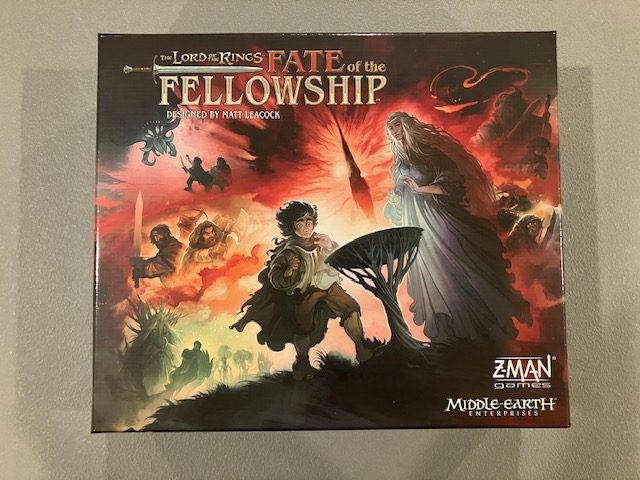
My journey to play Lord of the Rings: Fate of the Fellowship began back in January 24, 2025!  The game was up for pre-order on the Asmodee web site, and I pre-ordered with an expectation that it would arrive in late May or early June (as was the original promise).
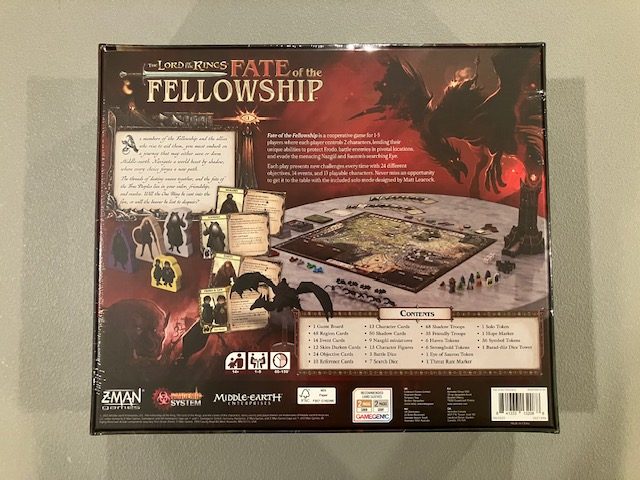
Well, things changed (Asmodee had trouble shipping) and it didn’t deliver to me until Monday August 19th.  This was frustrating because I had seen SO MANY people put up reviews on BGG, and yet, as a paying customer who ordered early, I didn’t get mine until 7 or 8 months later.
I was very excited for this: this is a game in the Pandemic System (see above)!  What that means is that it’s not quite Pandemic, but if you squint, you can see the elements of Pandemic in the game!  I generally love Pandemic and its ilk (see reviews of Pandemic: Ibera, Star Wars : The Clone Wars Pandemic, and World of Warcraft Pandemic), but I have not loved all Pandemics (see our review of Freedom Five).  Will this be a good Pandemic or a bad Pandemic? (What a strange sentence)

Let’s follow this Journey!

Rulebook
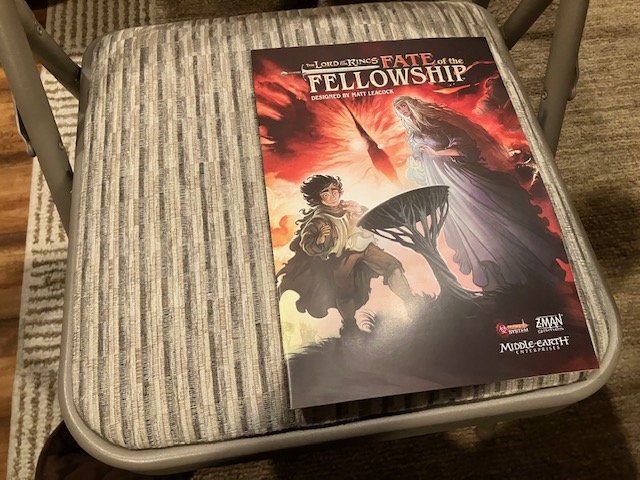
The rulebook is very good and is the first thing you see when you unpack the game.  This rulebook gets an A on the Chair Test!
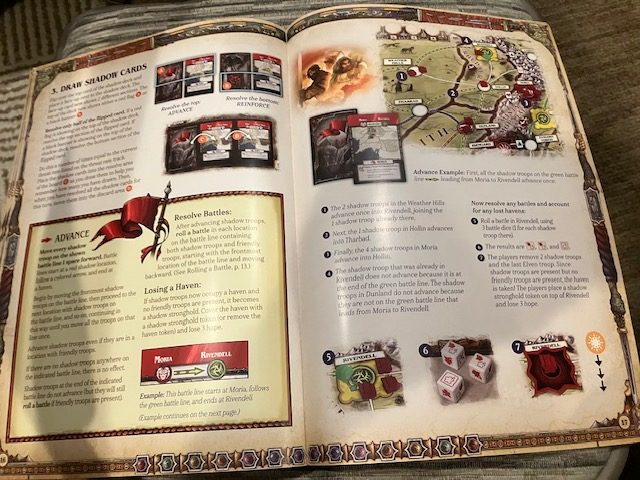
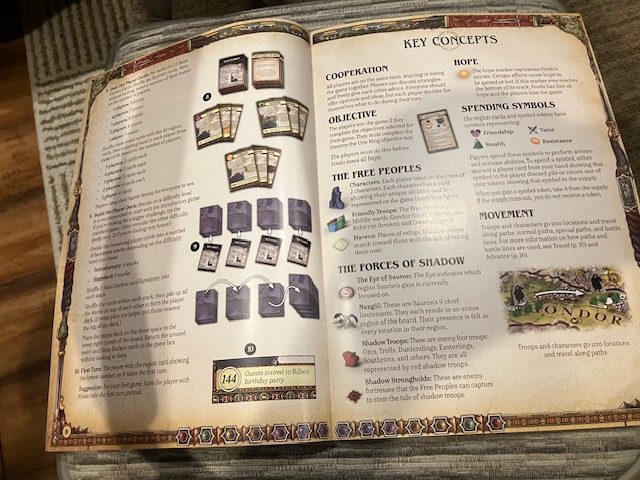
The rulebook opens up and stays open on the chair next to me.  The font is big, the pictures are well-annotated, and it’s easy to read on the chair next to me!
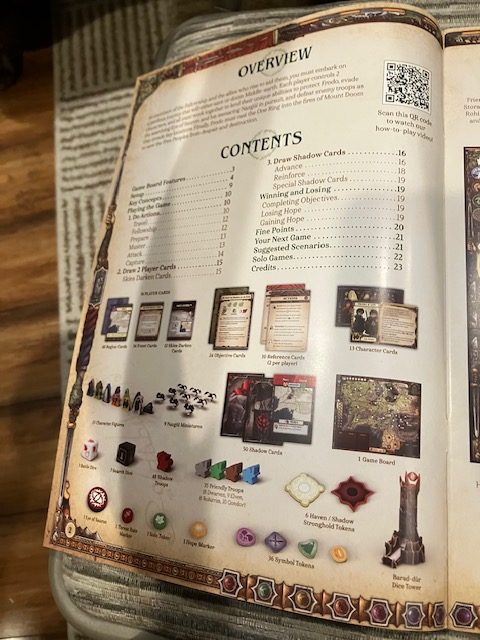
The Component page is well-labelled with pictures and text: see above.
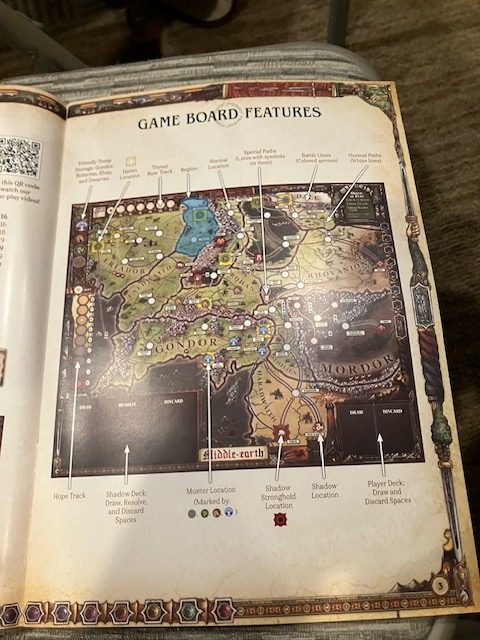
The Game Board Features is really nice as you try to understand this world.
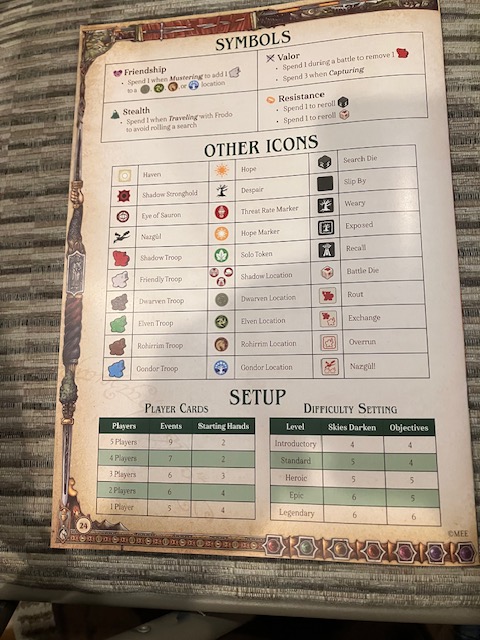
Generally, this was a good rulebook with a Table of contents (yay), but no Index (boo!).  The back of the rulebook shows useful info and icons.

There is one issue with solo rules that’s not well-specified (see below).

Generally, this was a good rulebook.

Unboxing and Set-Up: Building the Dice Tower!

Total time: it took me about 2 hours to unbox and set-up for my first game
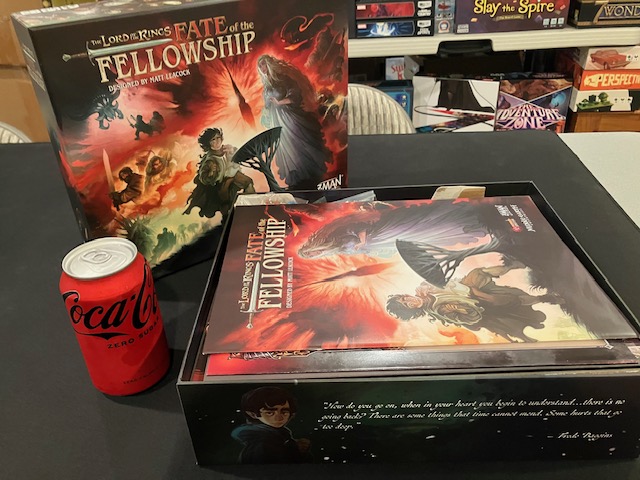
See Box above with Can of Coke for scale.
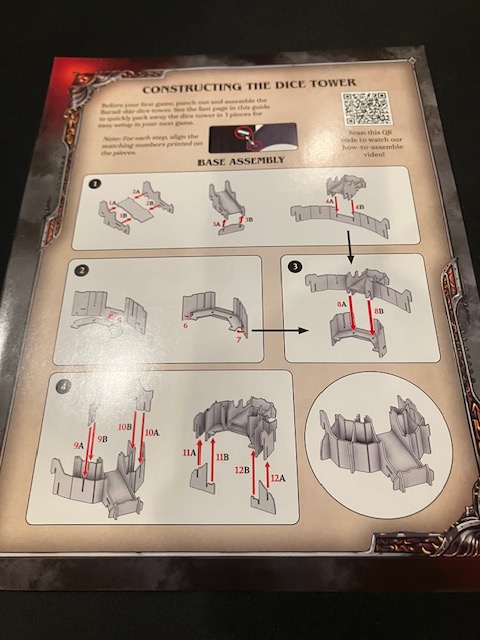
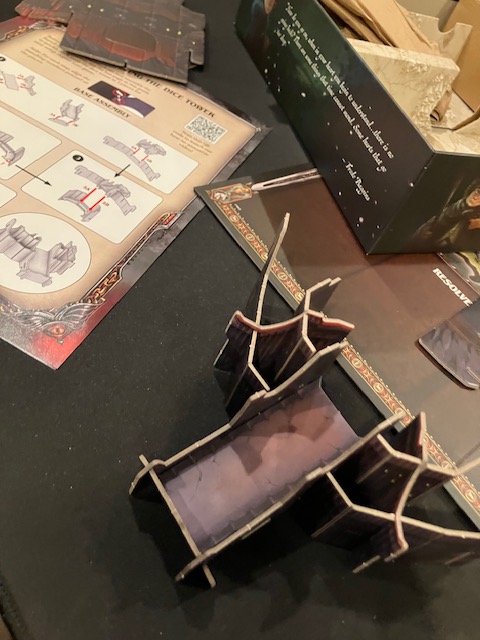
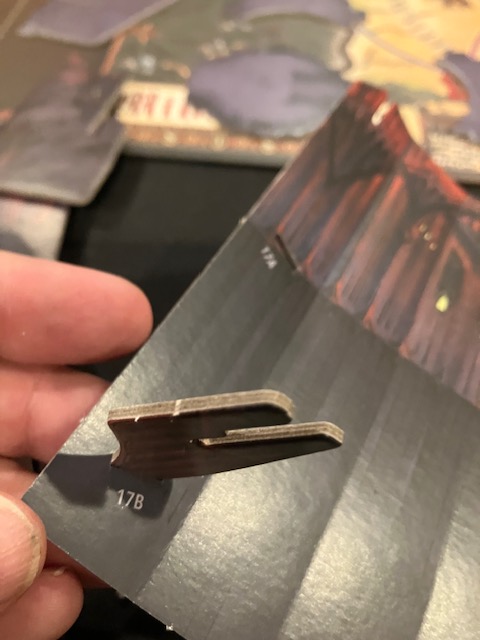
The first part of the game unboxing was building the dice tower: this consumed about 20 minutes!  The directions are pretty good, but it was annoying.  Unfortunately, this was a little foreshadowing for the game itself.
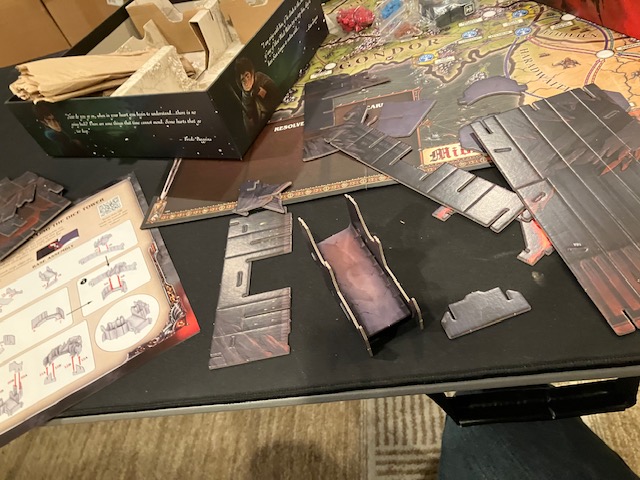
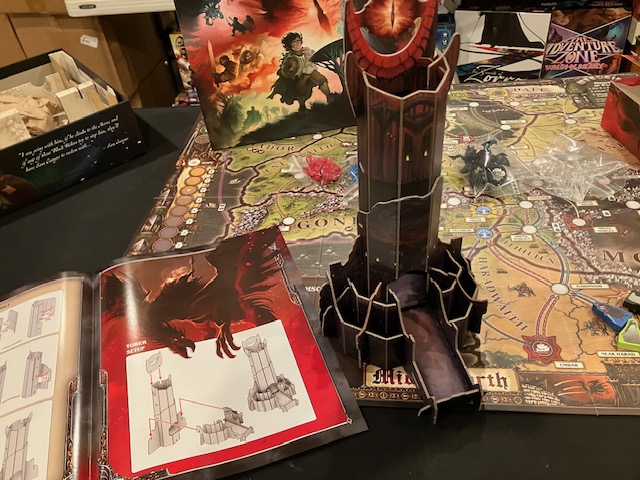
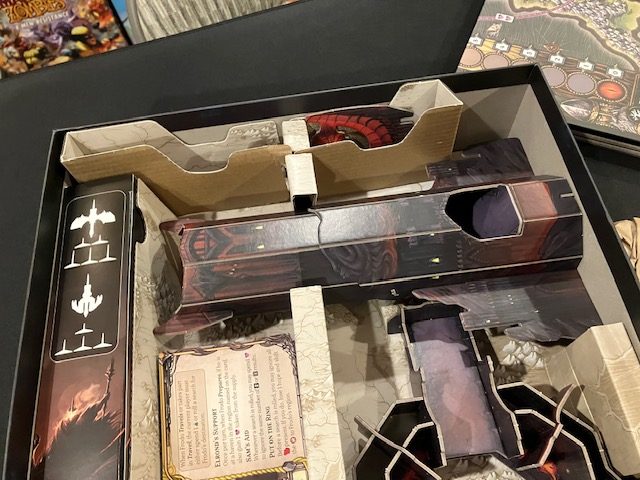
In the end, the Dice Tower looks really cool (see above), but holy cow, this was kind of annoying to build.  Once you’ve built it, it does come apart easily and go back into the box (in 3 pieces: see below).
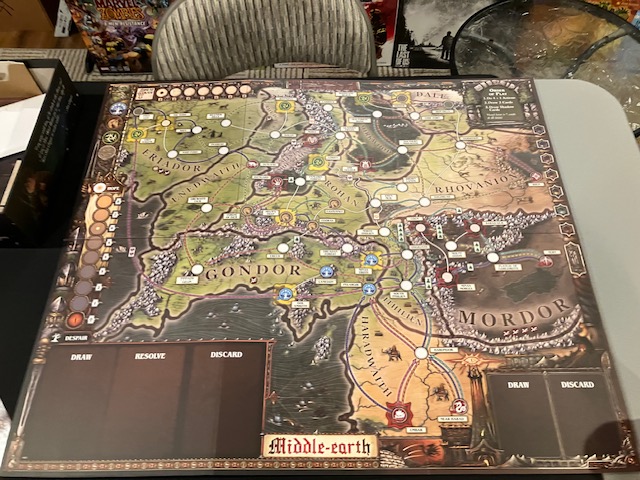
The board is a huge 6-fold board.  It’s very busy and very daunting at first glance: see above.  It does get better once you get to know the board, but, yes, it is very busy.
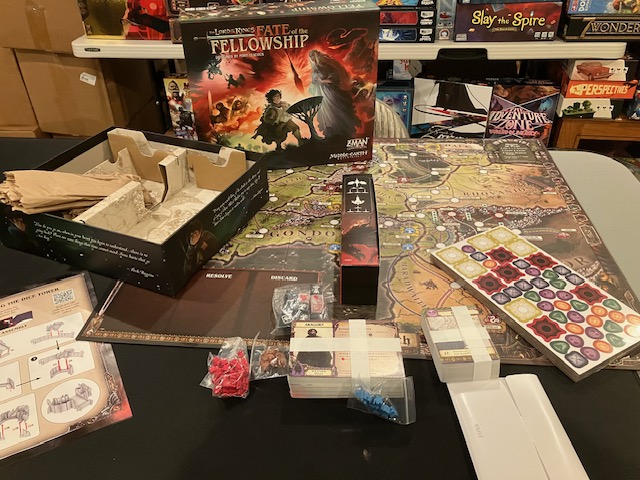
I was told by my friends who LOVE Lord of the Rings that this board is very accurate and consistent with the map at the front of the books. 
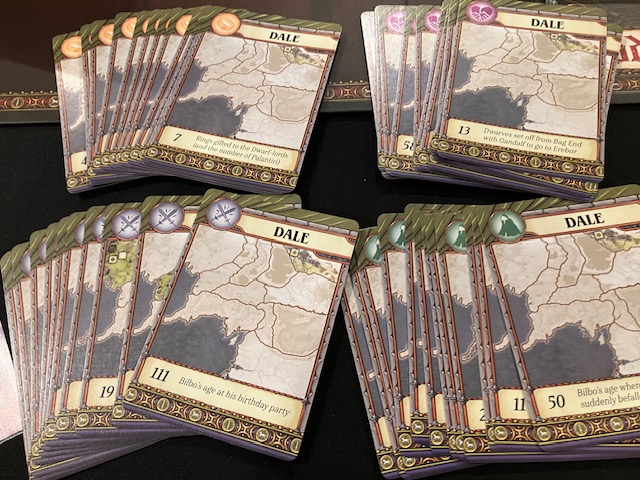
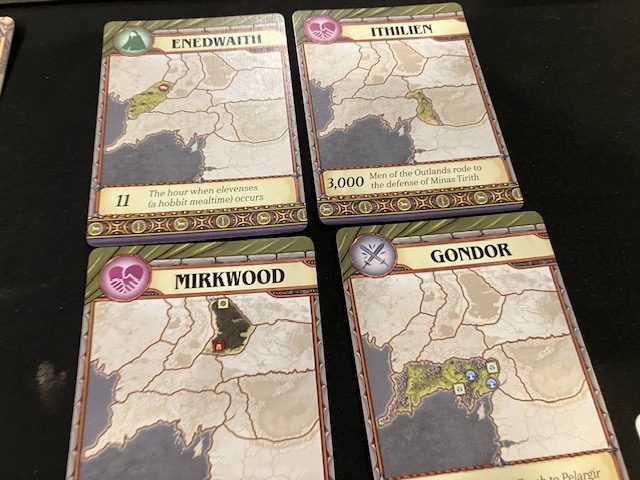
If you squint, you can see the Pandemic underneath!  The Region cards feel very similar to the player cards we’ve seen from Pandemic!
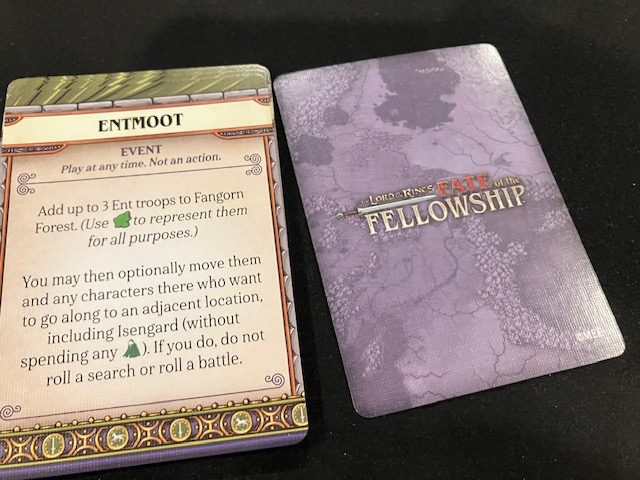
Just like Pandemic, there’s Events (of course, they are flavored for this universe).
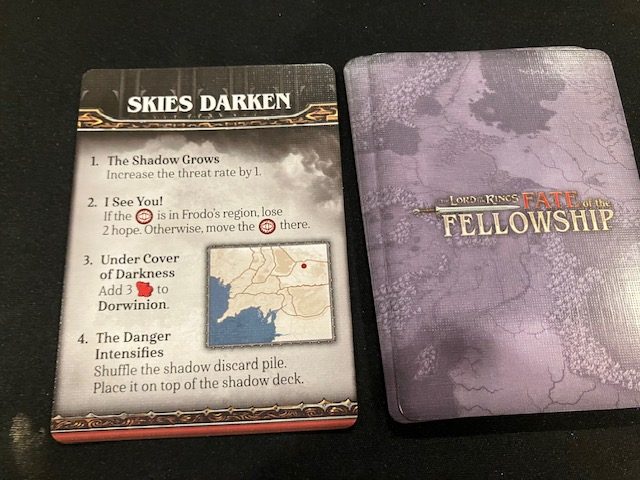
The Skies Darken cards (above) are very much like the Epidemic cards from the original Pandemic!
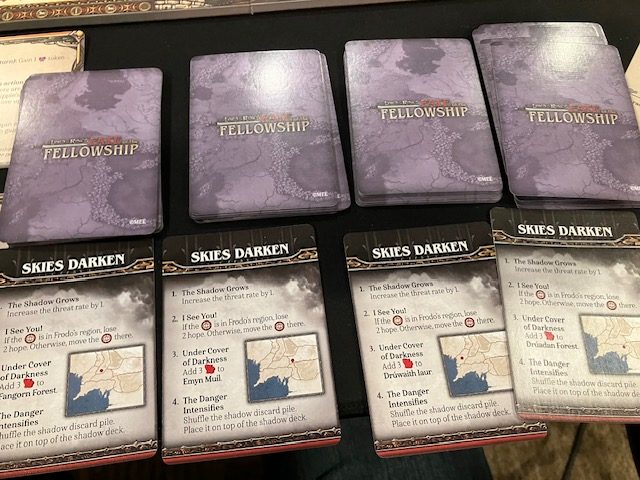
Like the original Pandemic, you divide the deck into fourths and put one of these “bad news” into each part of the Region cards.  That way you get one Skies Darken at about every quarter of the game!
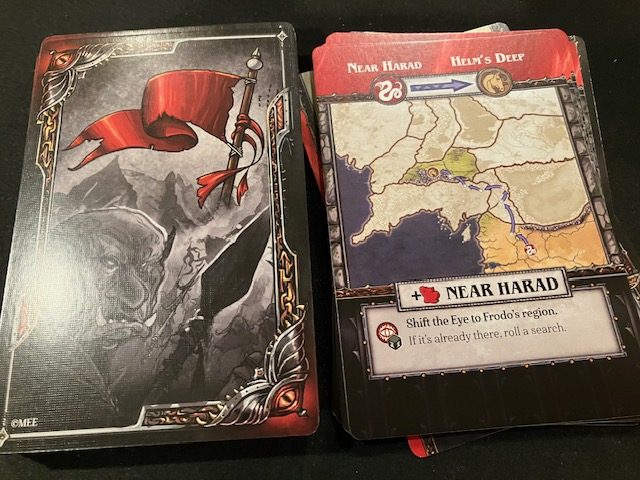
The true Bad News deck is the called the Shadow Cards; you get two (or more) per turn.  This is just like the Infection Deck from Pandemic.   There’s a big difference though!  If the Shadow Card to the left of the card you play is a red banner (see above), you activate the TOP part of card!
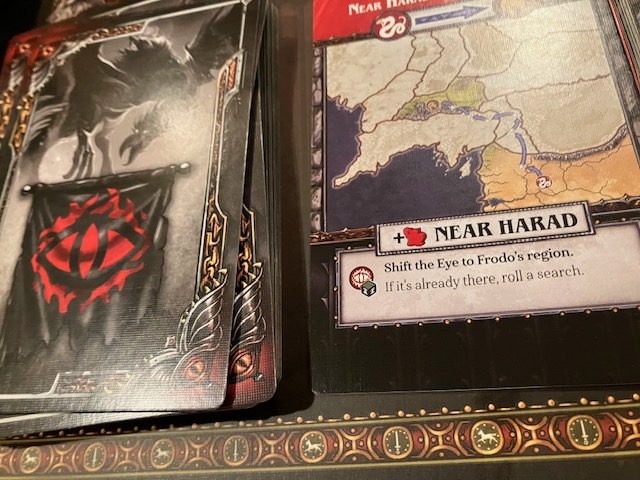
If the left card is a black Banner, you activate the BOTTOM part.  The bad news you get depends on the top card of the deck!  This can have wild swings to the game!
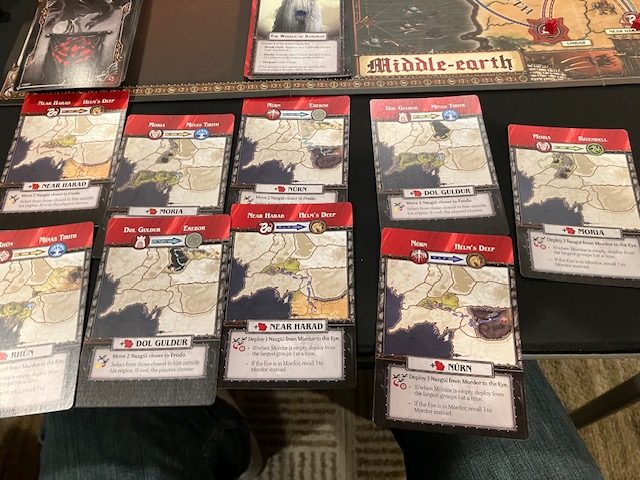
Like Pandemic, these Shadow Cards go to the top of the Shadow Deck and will come out again and again, whenever you draw a Skies Darken!  You seed the game with “troops” (not disease cubes) very much like the disease cubes.

If you’ve played Pandemic in any form, those Skies Darken cards will feel VERY familiar.
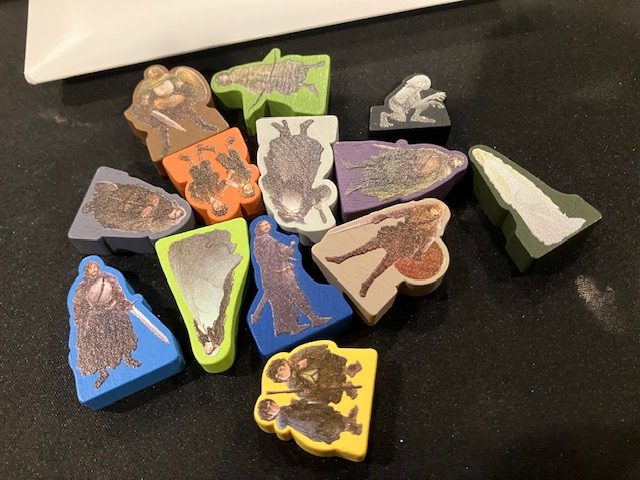
Every player will play TWO characters! Not just one! That’s different!
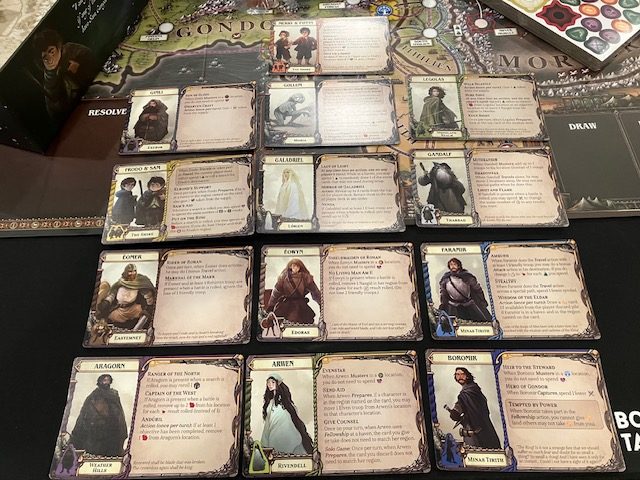
The characters should be very familiar to the LOTR fans! See above!

One characters gets 4 actions (like Pandemic), and other only gets 1 Action Point. That’s a little different.
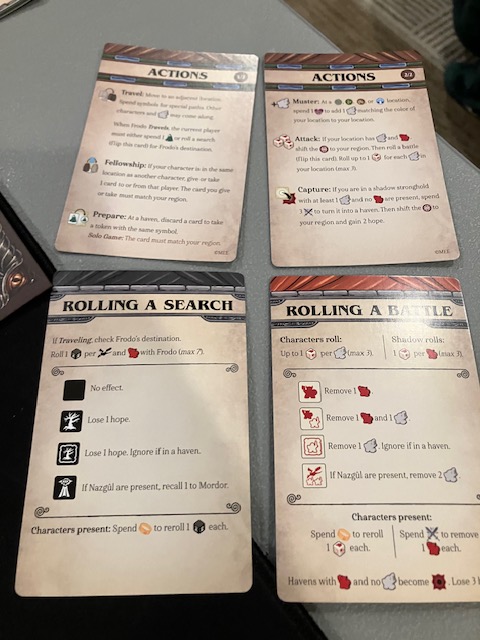
With those 4 Actions (see documented above), you do things like Pandemic.  However, there are a lot of differences here!  This is where the game starts to drift from the original game a LOT more, as you can attack (with dice), capture Havens, Prepare, Fellowship!  There’s SOME Pandemic here, but the actions you get really are very different.  For example, you can trade in a card for token for hand-management reasons, but only at a Haven!
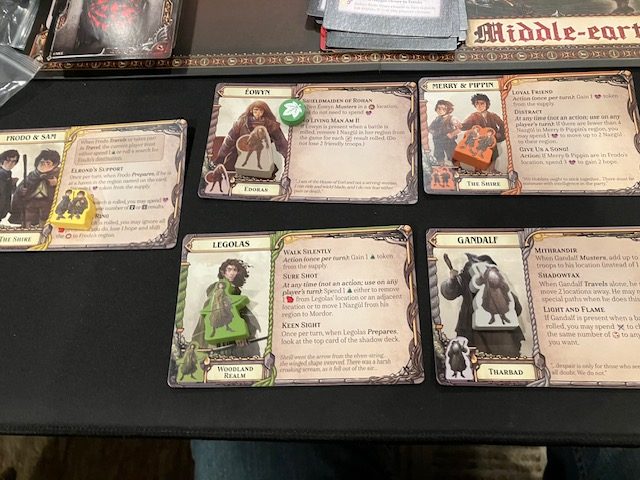
So I decided to start my journey using the Solo Rules/Set-up! See above as I operate 5 characters (well, 4 and 1).
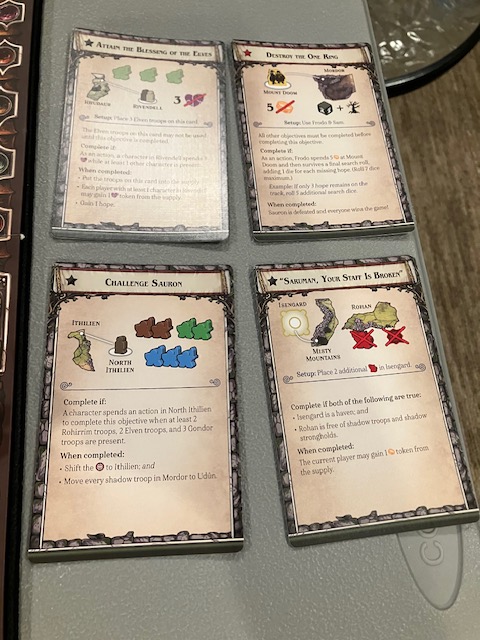
Winning, as you might guess, is throwing the Ring into Mount Doom: see above, top right!  But before you can do that, you must fulfill the previous three missions!  Each of these missions (see above) is very different: Attain the Blessing of the Elves, Challenge Sauron, Sauraman Your Staff Is Broken!  This is reminiscent of Pandemic, where you had to stop 4 diseases!  Here, you have to fulfill 4 very different missions!  (There are actually a number of different missions to choose from, but you always have Destroy One Ring as the final mission!)
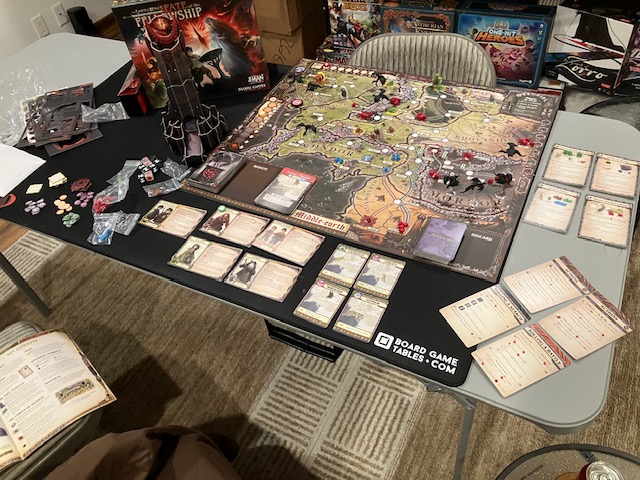
At the end of Day 0, I was pretty exhausted!  Putting together the Dice Tower and setting up the game took a lot of work!
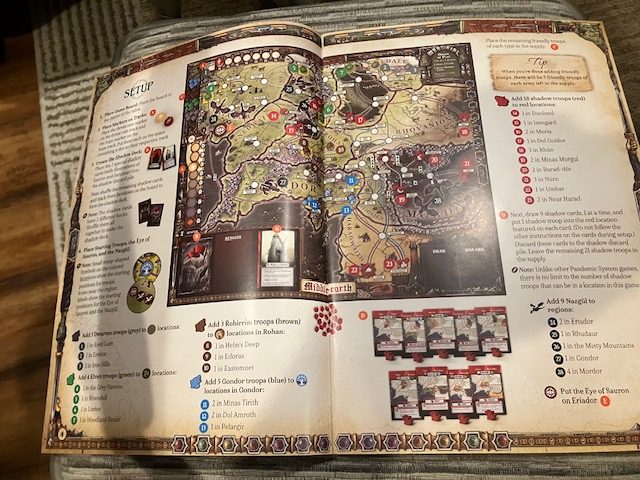
The Set-up actually spans 5 pages!  That’s right, 5 pages! 
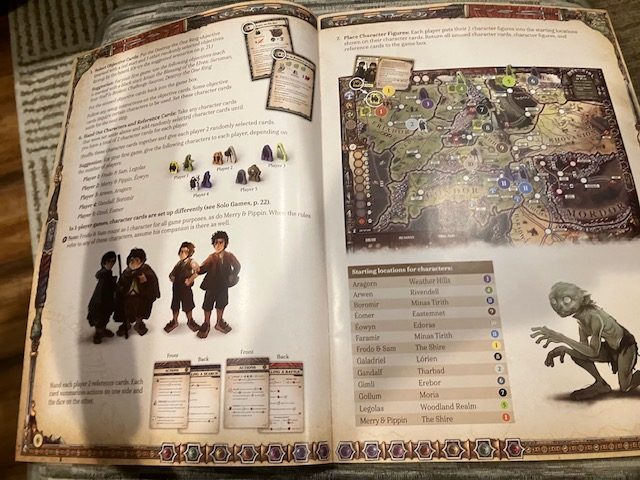
At the end of Day 0, I was too tired to move forward and play my first game.
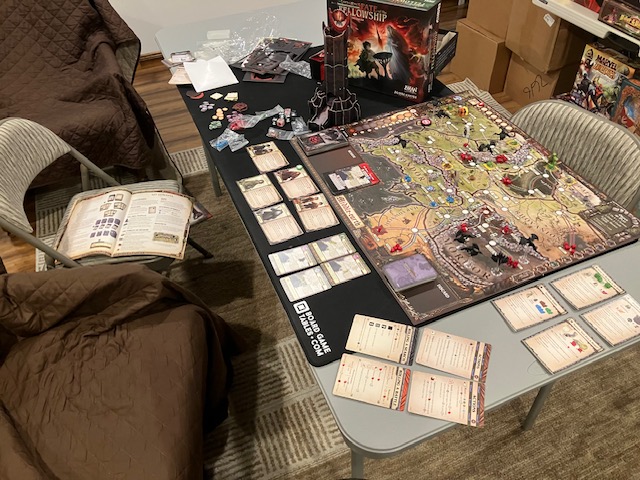
It looks cool set-up on the table though!  See that Dice Tower!  That cool LOTR board!

Playing Solo Mode Using Two Kinds of Solo Rules
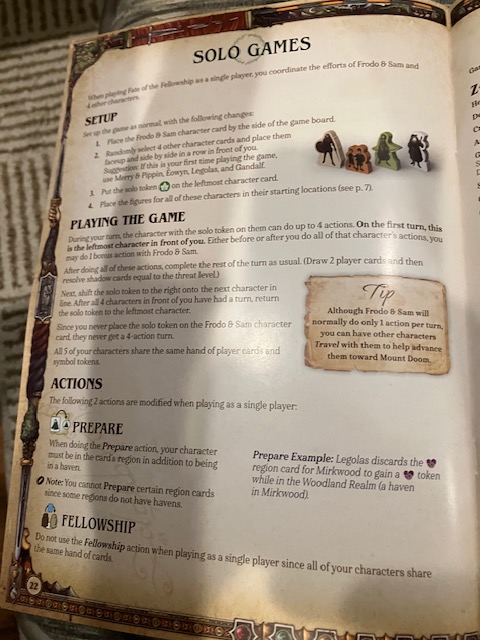
The solo rules are well documented on page 22.  See above! (And thank you for following Saunders’ Law!)  These rules are generally very good and very clear. One problem I had: it’s not quite clear if you can share the tokens between all 5 characters, … but you can sort of infer that you can (because when a single players plays two characters, they can share tokens); it should have been stated more explicitly. EDIT: Yes, the rule is there! I missed it, and I could have sworn I looked like 3 times. My mistake!!!
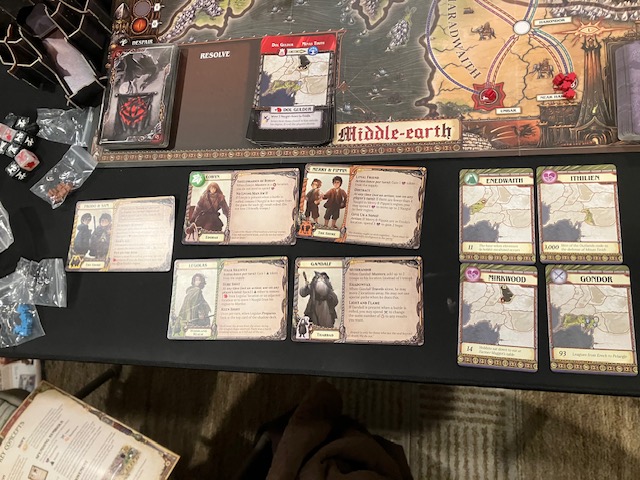
The solo player plays 5 characters … well 4 characters and (Frodo and Sam).   You choose 4 characters to play (although the rulebook suggests characters for your first few games), but you always get Frodo and Sam (since Frodo has to throw the Ring Into Mount Doom) as the fifth character.  Yes, Frodo and Sam is considered one character.
There is only one hand of cards for the solo player, so all the cards are shared among the 5 characters.  This is both boon and bane; you don’t have to worry about sharing cards (indeed, the Fellowship action which shares cards, is disabled in the solo game), but you also are stuck with the 7-Card hand limit for all characters.  
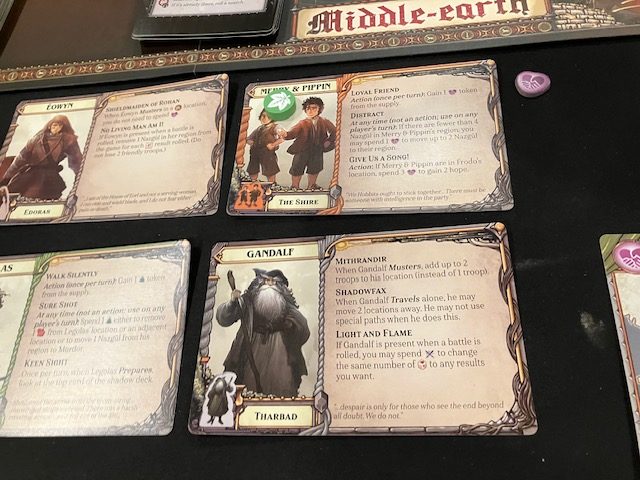
You move the little green solo token around (above) to show which character you are activating this turn; the character you activate gets 4 actions, and then Sam and Frodo get one action.  That’s right, Sam and Frodo always get one action and the other character gets four actions.
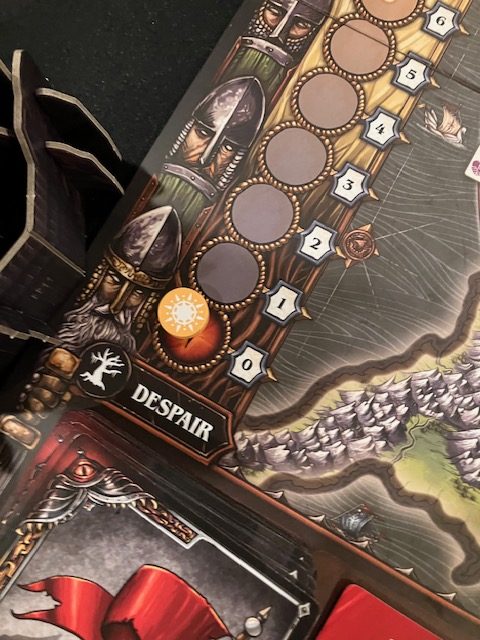
My first game ended in a loss after about 14 turns as my Hope went to zero.  That’s right!  If your Hope track ever goes to zero, you immediately lose!  There are MANY things that cause your Hope to suffer: Search Checks, Losing a Haven, running out of cards.   In other Pandemics , the end generally comes when the player cards runs out.  Every game of Fate of the Fellowship I have lost was because the Hope went to zero very early in the game.  It’s VERY EASY to lose via Hope in this game. You have to be very careful with Hope, and it’s generally hard to get Hope back (but not impossible).
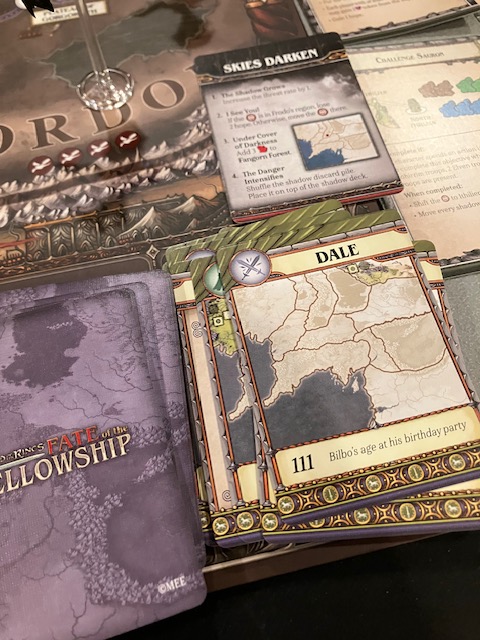
It was very weird to me that I lose before I was even barely one-fourth through the game: I had only gotten one Skies Darken!
Although I lost because I lost Hope, generally my combats were terrible; I rolled poorly.
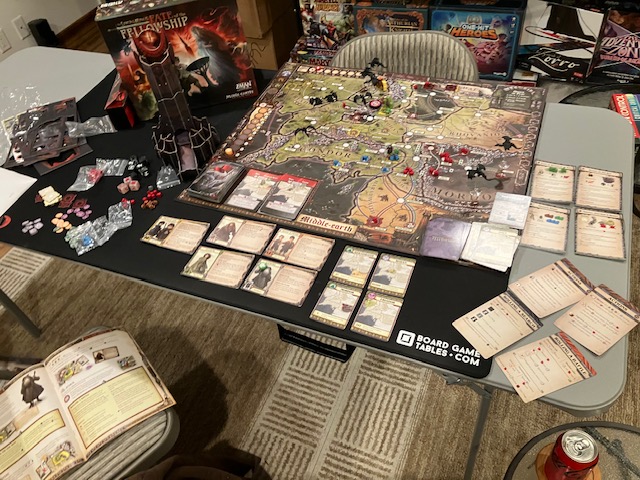
Nonetheless, I realized I had played a LOT of rules wrong.   You have to understand that there are lots and lots and lots and lots and lots and lots of little rules in this game that you have to keep track of.  As someone who has played many many many games of Pandemic, I think I expected something more akin to the original Pandemic.  Nope!  This game is very different and requires you to bend your brain a lot more.

I was grumpy how hard I lost (as I said, I have played lots of Pandemic), but I realized how many rules I got wrong and things I missed, so my first game just got me the “feel” of the game; I should expect to lose.
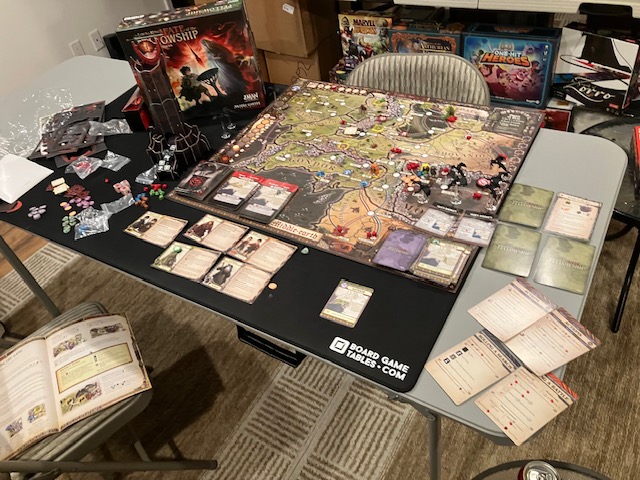
My next solo game was a win, but I realized I STILL got a bunch of rules wrong.  
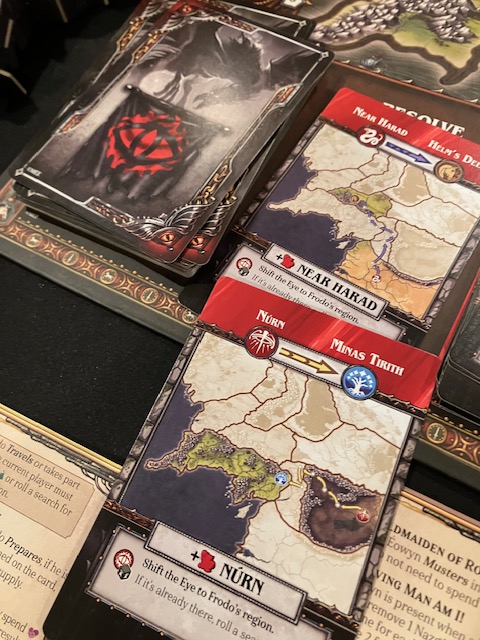
My third game was a complete loss in 3 turns.  That’s right, 3 turns! I got two “Shift The Eye To Frodo’s Region” and the Eye was there.  I had 5 search dice to roll, twice.  I lost because I lost all hope.  In turn 3.  That’s right, 3 turns.

I was ready to throw this game into Mount Doom; this games feels so messy and random.   Sure, I’ve had games of Pandemic go bad, but never this bad. Lost. In. 3. Turns.
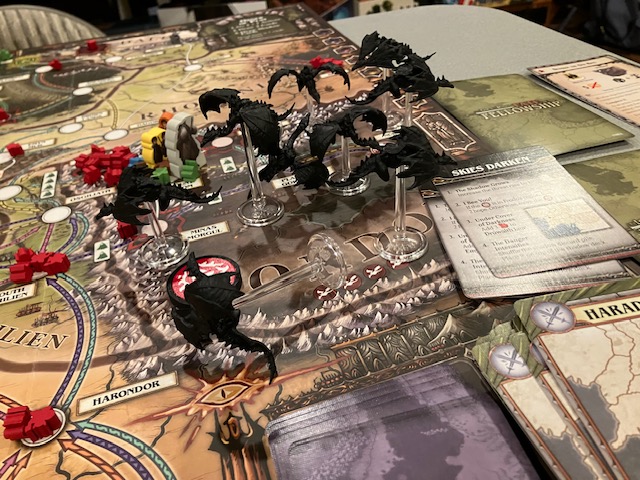
I played a fourth game and lost after about halfway through the deck. By losing Hope of course.
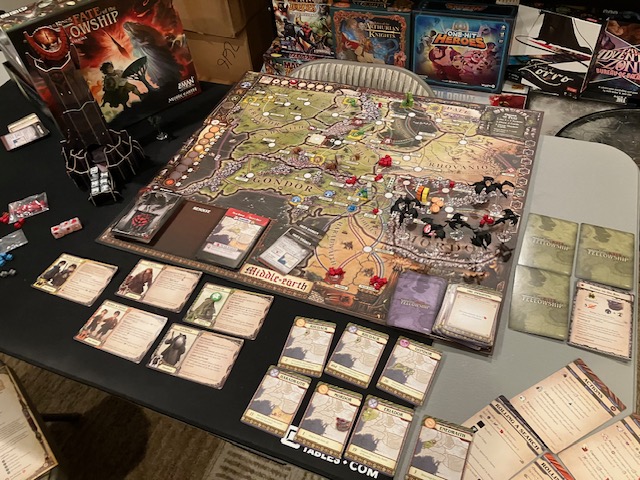
I took a break to think about this. I realized that one of my problems was that I sometimes felt like I couldn’t do anything because I ran out of cards quickly.  This is because all 5 characters share the (7-card limit) deck.  When you have turns where you maybe don’t want to move (or can’t move), then you can spend some actions turning cards into tokens at a Haven.  With all characters sharing this hand, this “sometimes” action causes your hand to go to zero cards quite a bit.
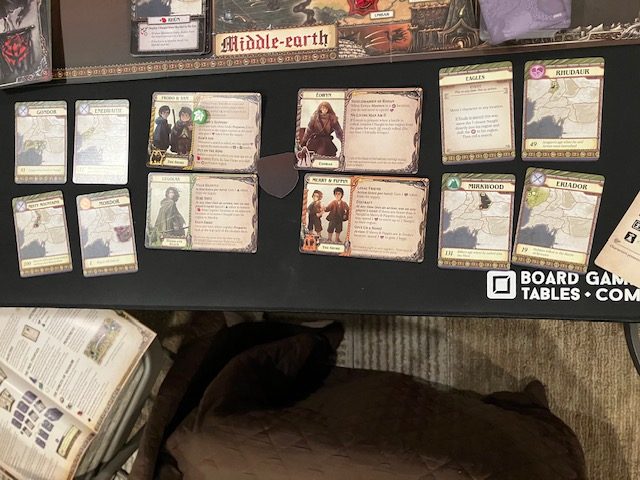
So, I decided to play the traditional solo game: play the cooperative game two-handed, alternating between two players. See above.  After playing this way, I don’t think I can go back to the solo mode as written.  With playing 2-handed solo, I felt like I had more options (“how should I activate my characters? 4 or 1 or 1 and 4? Who should move?  Do I need to share?”).  Basically, the Fellowship option is important, but you don’t use it that much in a game—it’s generally better to have more cards in the 2-Player mode.
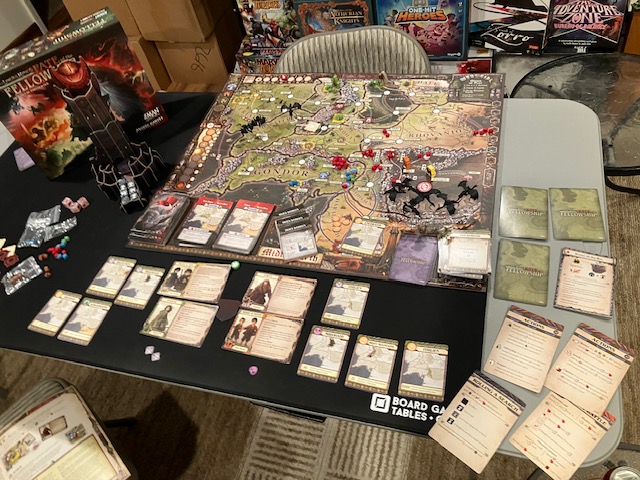
After 7 solo games, I think that the two-handed solo game is superior way to play solo. The solo player simply feels like he has more choice in actions (to choose how to divvy actions), more cards work with (spread over two hands), more mobility around the board (to deal with bad news as it pops up). To be honest, I didn’t start having fun until I started playing 2-handed solo.
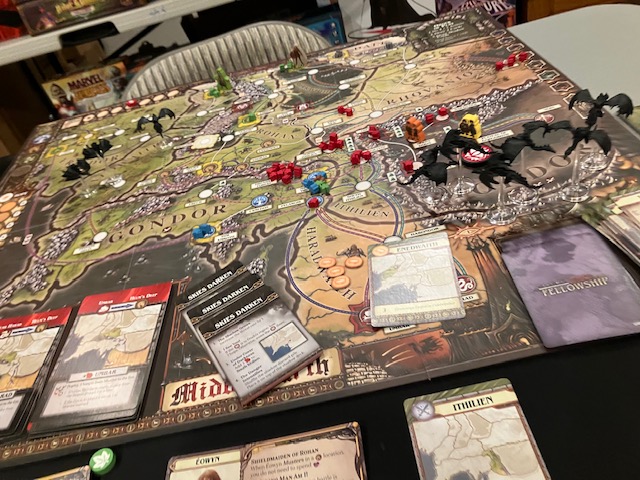
I felt like the built-in solo mode might actually do the game a disservice. I kind of hated my first five solo games; it wasn’t until I went to the two-handed solo mode that I actually started having fun. If you had caught me in my first 5 solo games, this game would be burning in Mount Doom right now. I am someone who loves Pandemic, I am someone who loves Matt Leacock designs, I am someone who has played a lot of Pandemic in his life. Yet, the built-in solo mode almost caused me to hate this game. Caveat Emptor.

I recommend the two-handed solo mode.

Two Player
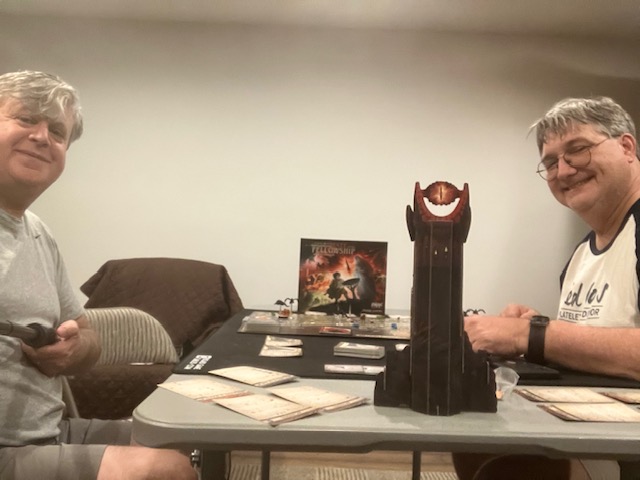
One of the things that convinced me that the 2-Player solo game was superior to the built-in solo mode was playing two players!
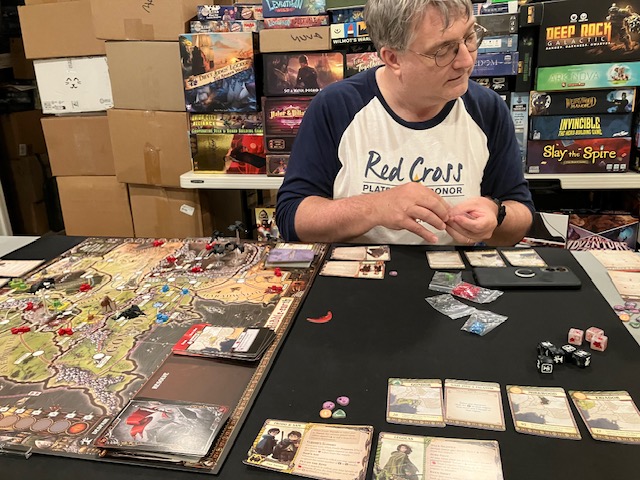
Over one Sunday, my friend Don and I played a 2-Player game and had fun!  Now, be aware that I had played many many solo games my this point, so I had the rules down, I had the strategy down, I had the teach down.  
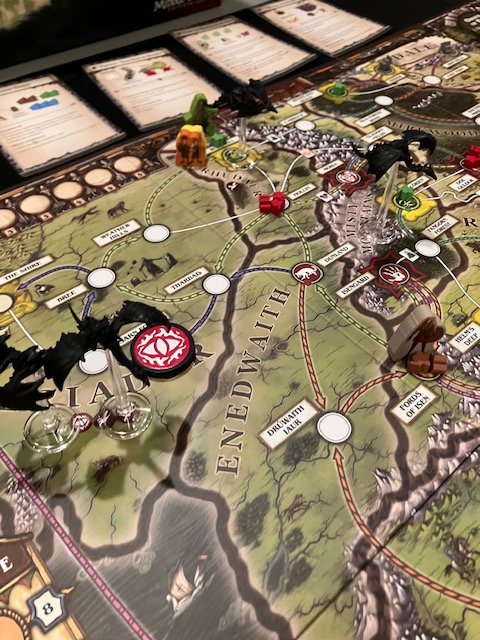
I think we lost, but I don’t care?  We had fun: Don definitely knows like LOTR better than me and he thought it was fun.  He also reminded me that several of his Pandemic games went south in a few turns.  
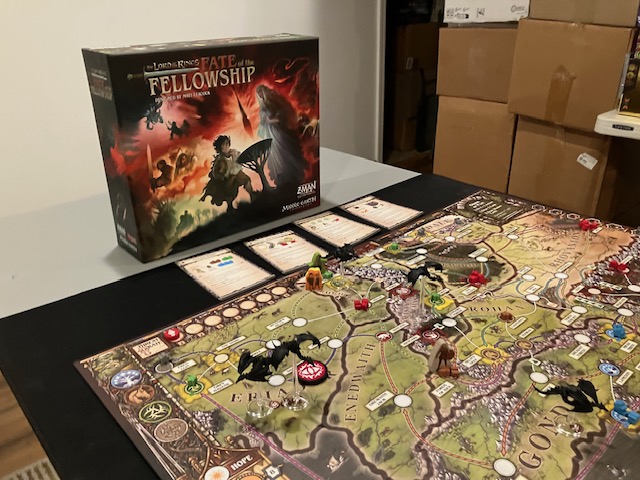
It felt like there were more options in a 2-Player game. This cemented, in my mind at least, that the 2-handed solo mode is superior.

4-Player Game
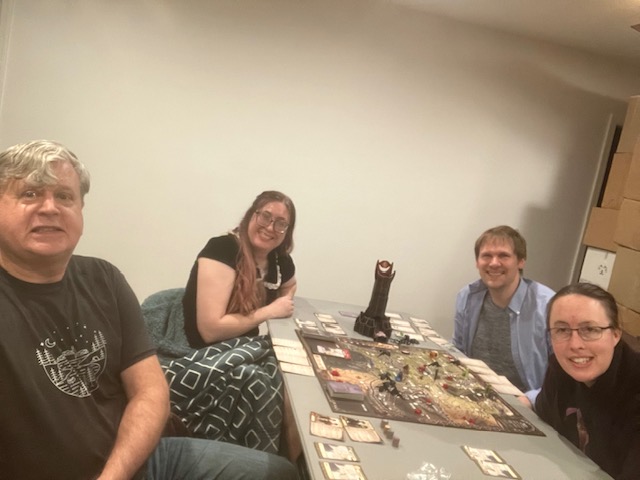
So, after teaching the 2-Player game, we went into the 4-Player game.
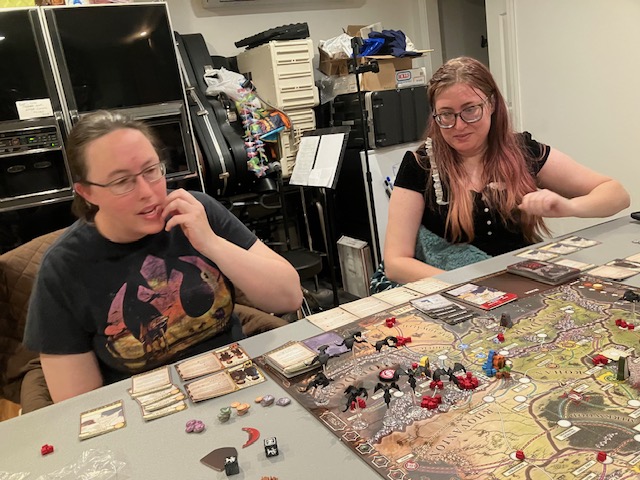
The game was fun, but we saw more of the randomness emerge  It was also frustrating that sometimes players couldn’t do anything.  The muster action can only be done on certain locations IF you have friendship cards.  The Prepare action can only be done on a Haven.  So, if you didn’t have friendship or weren’t on a Haven (because you were out fighting), sometimes turns felt a little anti-climactic (as you couldn’t do much).
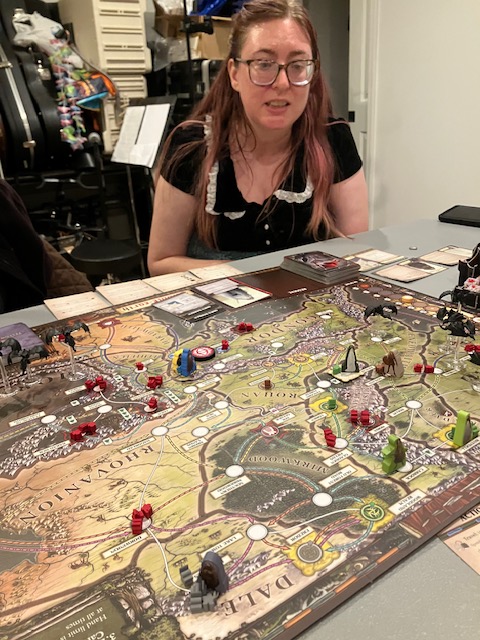
I was reminded by friends Charlie and Allison (after they played Pandemic Legacy: Season 1), that 2-Player Pandemic is easier than 4-Player Pandemic.  Usually because 2-Players can deal with Bad News “quicker”, as you only have to alternate players.  In a 4-Player Pandemic, the only person who can deal with some “bad News” is 3 turns away.
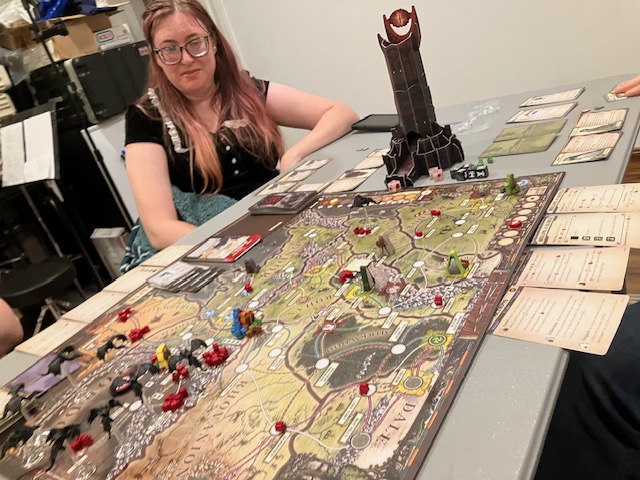
I think we saw this in our game of Pandemic; we came close to winning, but needed just a few more turns.  We didn’t “quite” deal with the Bad News as efficiently as we should have.
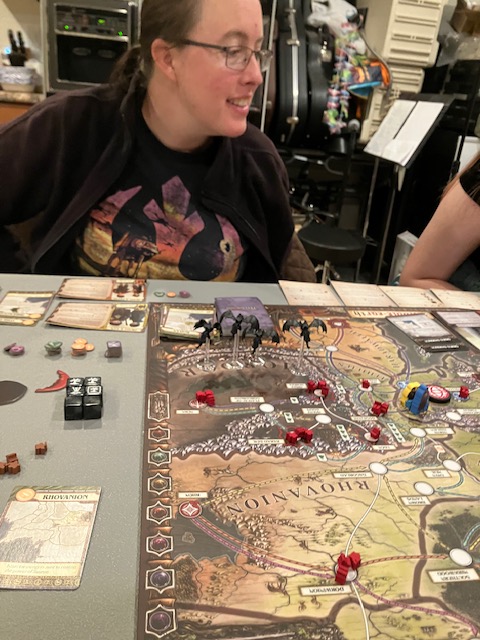
Did we have fun? Yes.  Did we love it?  No?  We liked it.   We would play again, if only to wipe the shame from our faces for losing.

Randomness

There are 4 major axes of Randomness in this game.
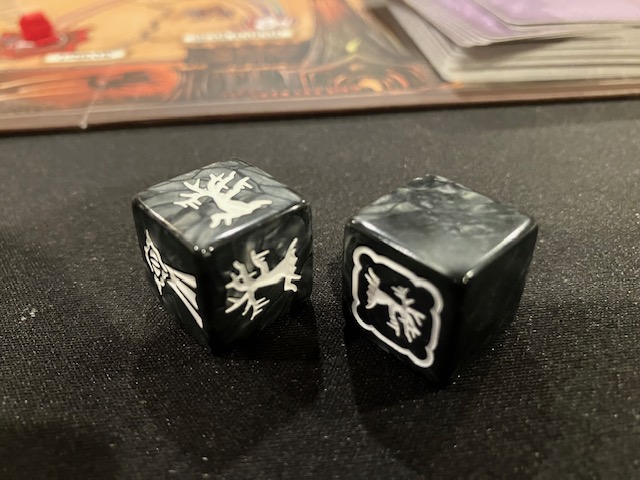
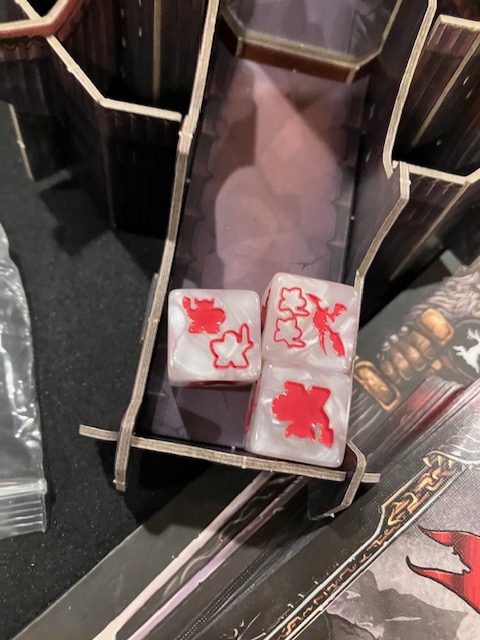
Axis 1: The Search Dice.  These must be rolled whenever Frodo travels (if he can’t sneak), or if a Shadows card forces a Search roll.   The number of dice depend on the number of Nazguls in your region.  See above for all 6 faces.   If you roll an “evil tree” (see above), you lose Hope.  Remember, if your Hope goes to 0, you lose.  You can re-roll some dice, at the cost of some resources.  They are re-rolls, not guarantees.
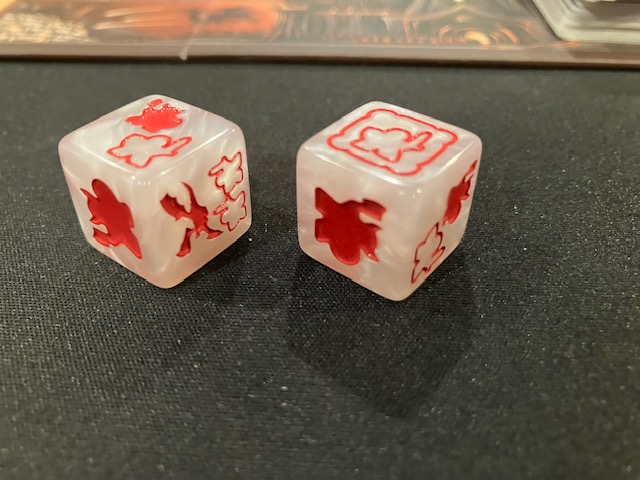
Axis 2: Combat dice. See above for all 6 faces. The red faces mean the bad guys lose a troop. The white faces mean the good guys lose a troop. A particularly bad roll can wipe out all the good guy troops and completely screw you. You can re-roll if you have a character in the region, at the cost of a ring. You can use swords to eliminate bad guys if you still have anything left (if you have a character there).

Axis 3: Shadow Cards.  What bad news do you get?  Even though the Shadow cards go back to the top of the deck (like Pandemic), the bad news you suffer depends on the next card at the top of the deck.  That little difference almost adds an extra axis of randomness.
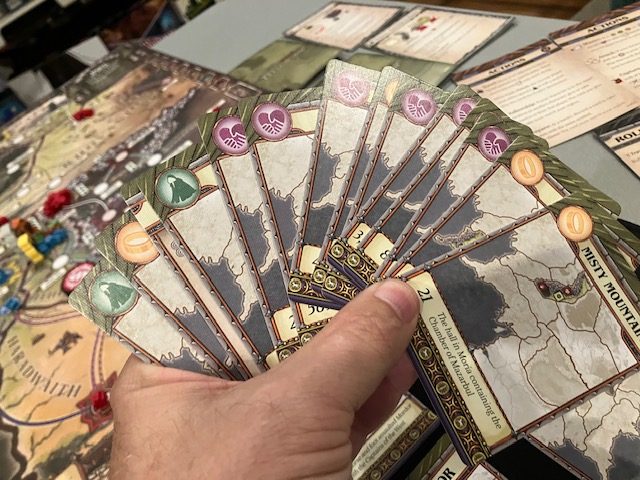
Axis 4: Cards.  Which cards do you get? In one game, I waited 10? 12? 14? turns and could not get a sword!  See above! This basically meant my mission to win Isengard was thwarted and wasted time/resources.

This 4-axes of randomness (5 axes if you count the extra randomness of Shadow cards) can be debilitating.   There are ways to mitigate this, of course, but sometimes you just get screwed.  Pandemic kind of only had the 2-axes of randomness, and it felt plenty hard.

Be aware.  This game is much more random than the original Pandemic.  It may be too random for you.

Conclusion

It’s hard to recommend Fate of the Fellowship.   The extra randomness (relative to base Pandemic) inherent in the game with the Search Dice and Combat Dice can really bring your game down.  I also think that the recommended solo mode is flawed; and I think it will do a disservice to players if they decide to start with that. If you do want to play solo, I recommend 2-handed solo: you will feel like you have more options and more choices.
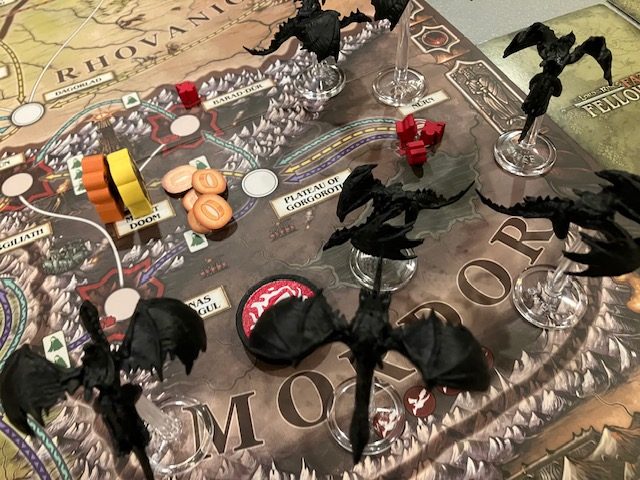
The game also feels like you can’t do things sometimes; you can only muster at hubs, you may only prepare at Havens, you may not move Frodo unless you either sneak or roll search.  The game feels like there are a lot more constraints on “useful” things you can do you on your turn … because there are more constraints, I think part of this experience is just realizing how important Havens and hubs are and getting used to that.  But, it “feels like” you can do less and that can be frustrating.

It took me almost 6 plays before I started having fun and figuring out the game works.  There are a lot of complex systems, there is a lot more randomness, there are many more constraints on player actions.  It may take you a while to really get this game; it has a huge learning curve.

Having said all that, Fate of the Fellowship is incredibly thematic, with the map, the missions, the special powers, and the characters!   All of my friends who love Lord of the Rings really feel like they nailed the game.

So what’s my final recommendation?  If you love the theme, you can probably suffer through learning the rules and love this game.  If you are a Lord of the Rings fan, you will probably enjoy this world despite all the complexity and randomness.  Losing is just excuse to embrace this universe and game some more!

If you just like Lord of the Rings, be aware that this game has a huge learning curve, a lot of complexity, and a lot of randomness! Much more so than base Pandemic.  If you can get past all that and learn the game, you can come to like it, but be aware it may take quite a number of plays to get to that point.  However, if you have a good shepherd (someone who knows the game and strategies), those first few games can be much more fun: my friends all had fun playing right away because I had done all the painful prep work.

My final score is a range: 4 to 7 out of 10.  That’s a huge range because I hated the extra randomness (that’s the 4), but when it was fun, it was fun (that’s the 7).  So am I keeping it? Yes. 
Be aware this probably won’t work for you right out of the box; you may have to live with it.

Was this a good Pandemic or a bad Pandemic?  It was a Grey Pandemic.
Top 10 Cooperative Roll-and-Write/Flip-and-Write Games!

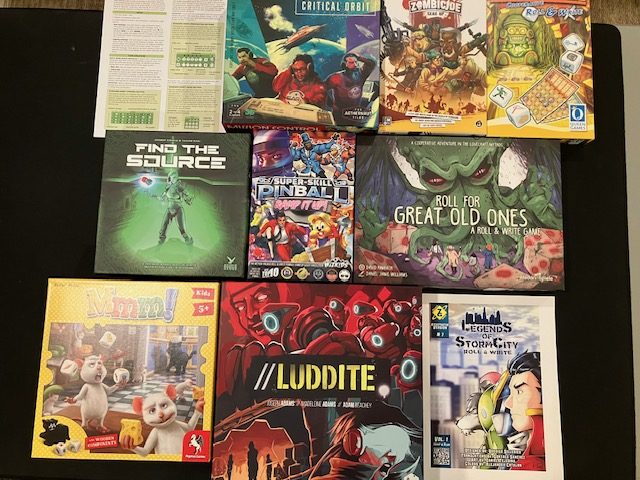
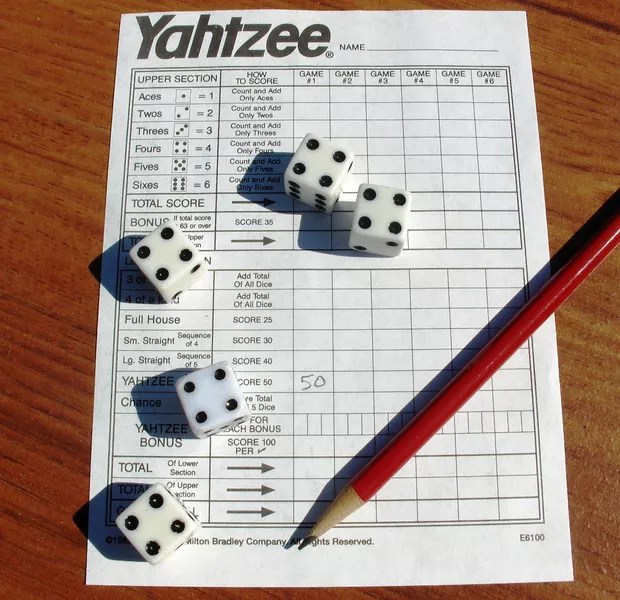
When most people think of roll-and-write games, they think of games like Yahtzee!  See above!  Players roll dice, mark things off a sheet, and try to get the best score to win!  Surprisingly, there have been a considerable number of cooperative roll-and-write games over the last few years! That’s right! Players roll dice and cooperatively mark-up sheets to solve/win together!  Now, flip-and-write games are very similar; instead of rolling dice, you flip up a card to show what you are dealing with.  It’s the same idea, it’s just the randomness is a deck of cards instead of some dice!  

Below, we list our Top 10 Cooperative Roll-and-Write Games!  We also rate each game from 1 to 5 on how cooperative it is, with 1 being “multiplayer-solitaire” and 5 being “very cooperative“!  We also note if the game works solo: surprisingly, not all play solo!  Most roll-and-write games are about getting the best score you can collectively, but some have a more precise win condition!

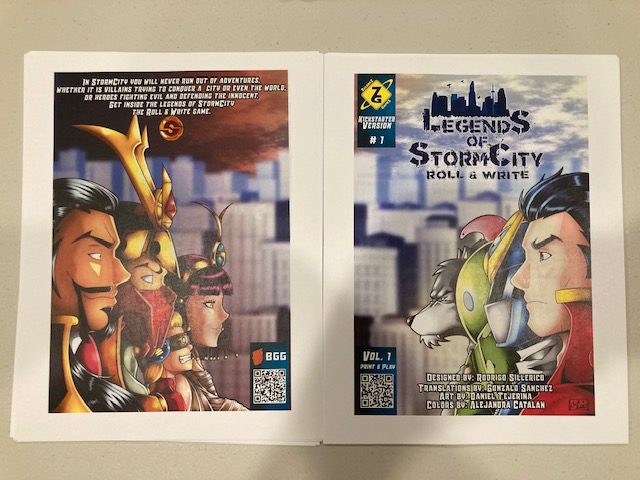
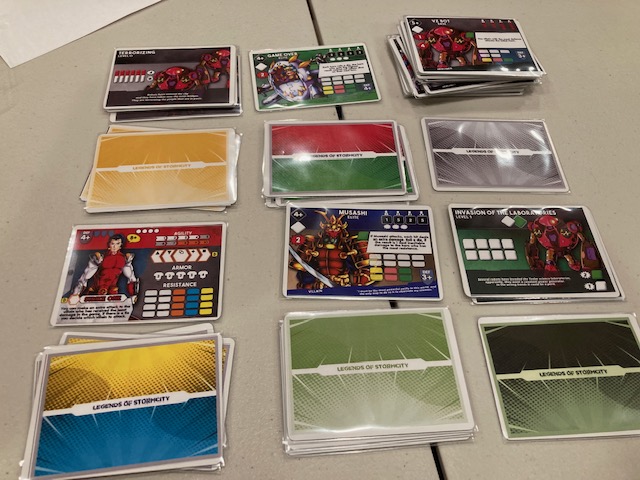
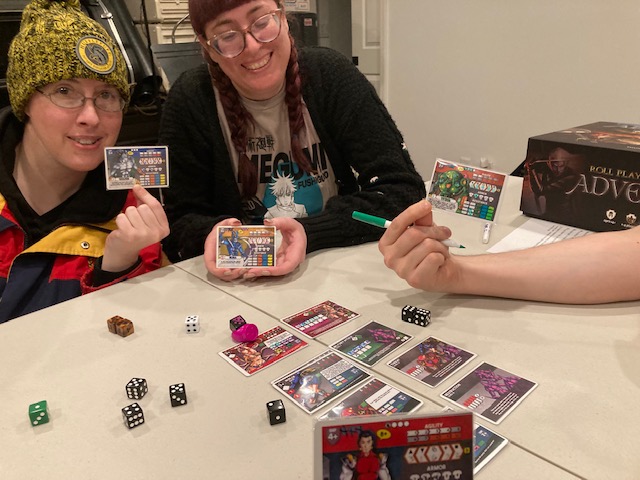
10. Legends of Storm City


Supports Solo?  Yes
How Cooperative? 2/5
Player Count? 1-4
Print and Play? Only means available
Type?  roll-and-write
Win Condition? Defeat all Elite Villains or Deactivate the Main Plan

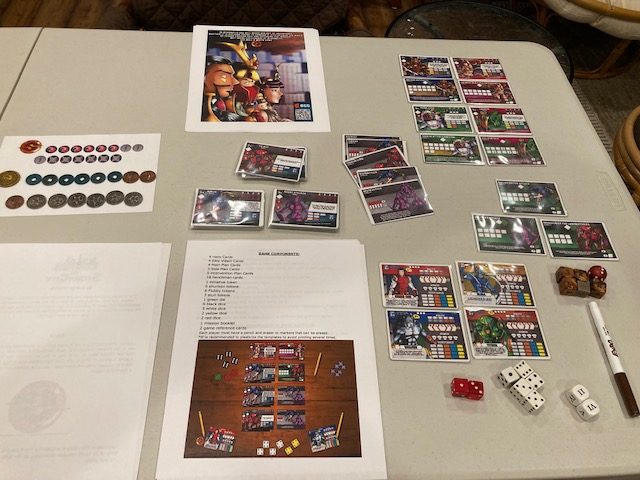
This roll-and-write has a special place in my heart, because it was the first print-and-play I have ever done!  And boy, was it a learning experience!  It also has a cool Superhero theme!

In the end, I liked the game a lot more that my friends; so that’s why this makes the bottom of our To 10 list.  

I liked the way this looked, and I loved the Superhero theme!  Take a look at our review of Legends of Storm City to see if this is something you might like!

9. Mmm!

Supports Solo?  Yes
How Cooperative? 2/5
Player Count? 1-6
Print and Play? No, must buy box!
Type?  roll-and-write*
Win Condition? Mark off all the food!

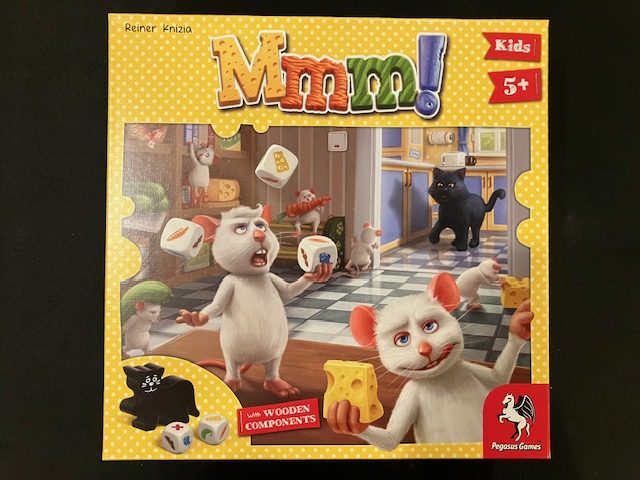
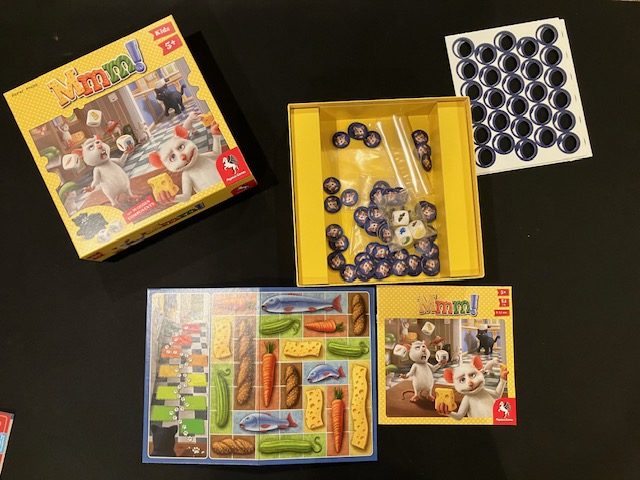
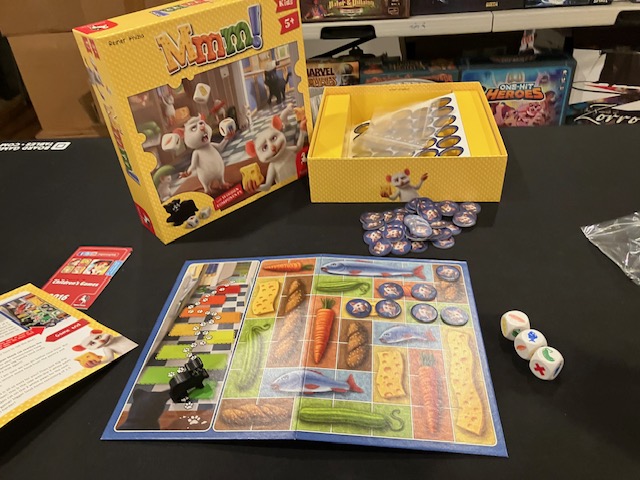
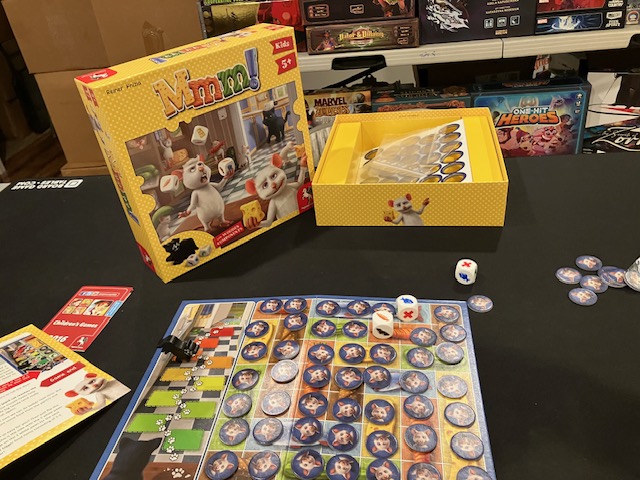
This is a little bit different than most roll-and-writes on our list: it’s intended for kids 5+, so it’s pretty simple.  The kids roll the dice every round and mark off food before the cat reaches them!  The cat only moves if some piece of food isn’t completely marked off, so kids have to learn when to push their luck and when to stay!

This is also a little different because the “write” part of roll-and-write is “mark-with-a-token” rather than write-on-a-piece-of-paper.  See above.  But it’s the same idea: you are just marking up a board!

It’s also interesting that the board is shared cooperatively among all players, so players will need to talk to help each other “set-up” the board for them on their turn!  This is a Renier Knizia game for kids, but it is kind of a neat little roll-and-write kind of game, even if it’s not “quite” roll-and-write … more like roll-and-mark!

8. Roll or Stand: Forbidden Adventures

Supports Solo?  Yes
How Cooperative? 1.5/5
Player Count? 1-100
Print and Play? Only means available
Type?  roll-and-write
Win Condition? Make it through all 4 puzzles on a page!

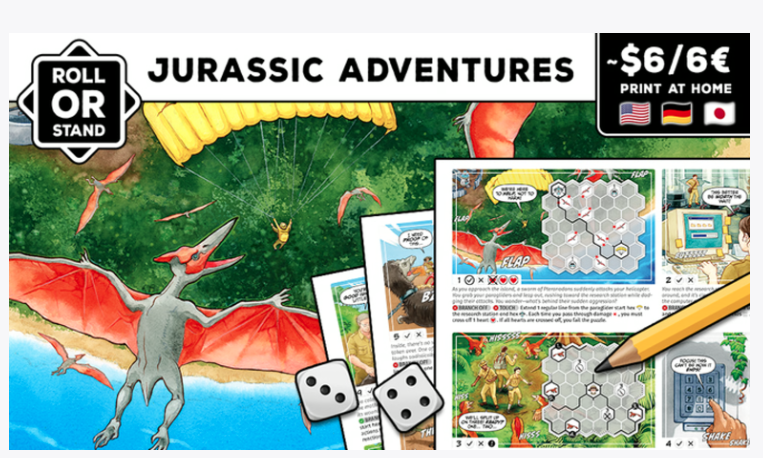
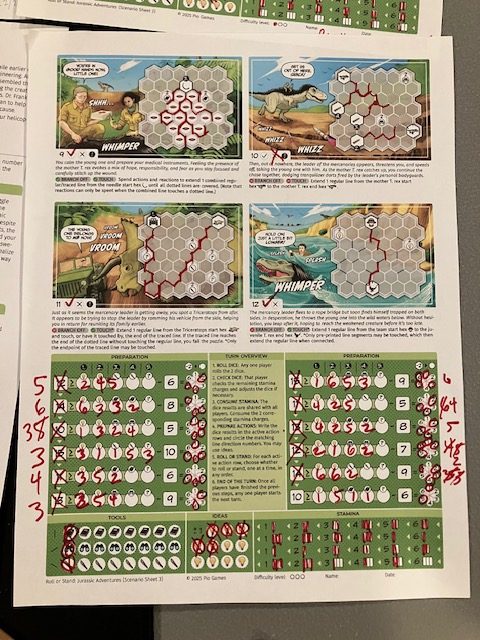
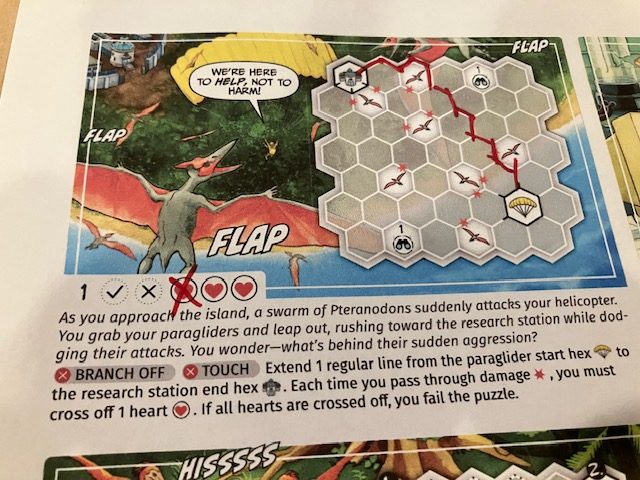
This roll-and-write has 4 puzzles per page, and has a “blackjack-like” mechanism where you push your luck to get more actions and more directions!  But if you get a number that busts, you lose an entire set of actions!  

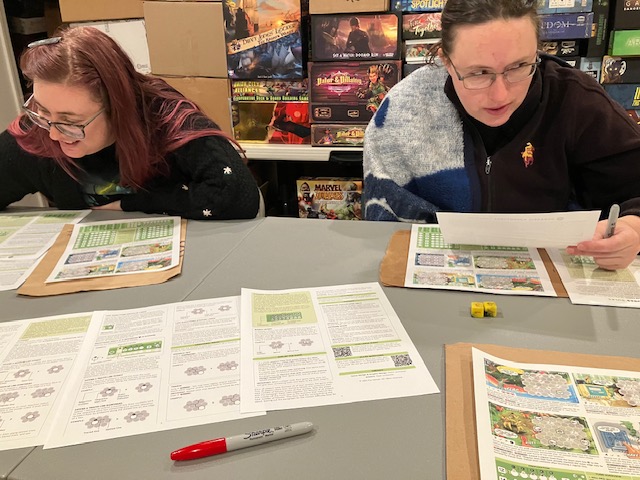
Each player has their own sheet and uses the dice as given to them, so it’s mostly multiplayer solitaire!  There is a mechanism for sharing, but resources are so limited in this game, we found that we didn’t really use the sharing too much! That’s why it’s 1.5/5 for cooperation … this is a mechanism, but we found we didn’t really use it!

Still, there’s a really neat physical aspect to this roll-and-write as you have to use the numbers marked to move around one of the four puzzles!  See above!  All-in-all, this is a pretty neat roll-and-write game!  See our review here of Roll or Stand: Jurassic Adventures to see if this might be right for you!

7. Mission Control: Critical Orbit

Supports Solo?  Yes
How Cooperative? 4/5
Player Count? 2-4
Print and Play? No, must buy box!
Type?  roll-and-write
Win Condition? Success in mission!

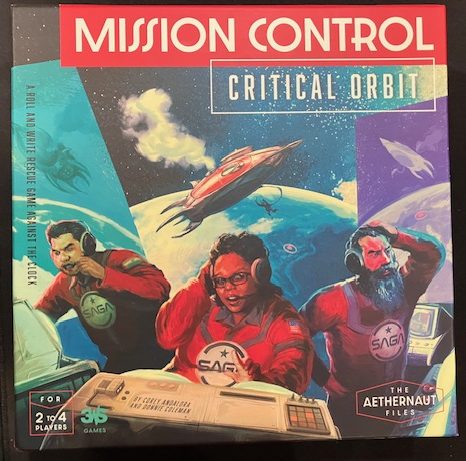
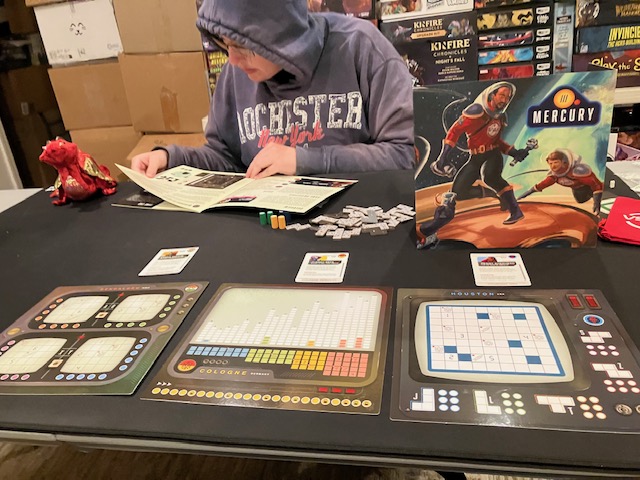
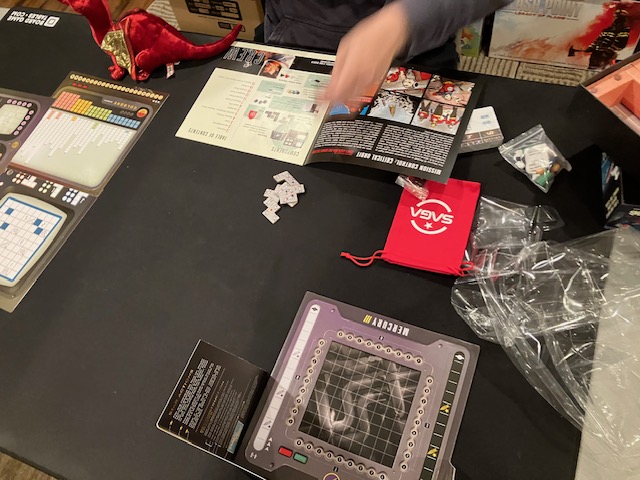
This is an interesting perturbation on roll-and-write games: First, there’s no solo play!  This is only a 2-4 Players game! Second, one player (Mercury) hides information behind a screen, and the other 1,2, or 3 players each operate some other boards!

This is also a polyominoes game, where the Mercury player has to fill in a grid!  It’s a weird cross-section of roll-and-write, hidden information, cooperation, and polyominoes!  But it’s really fun!

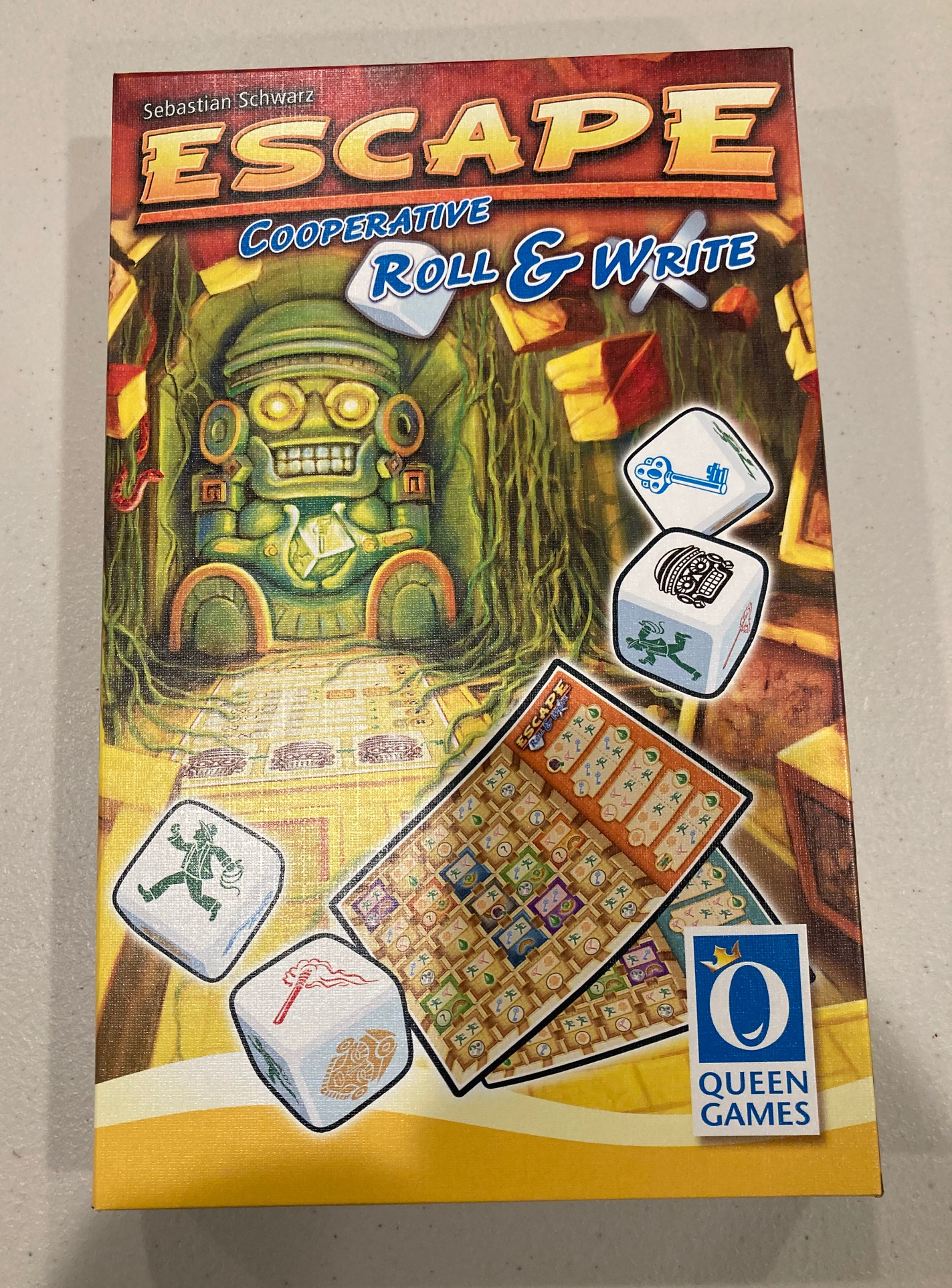
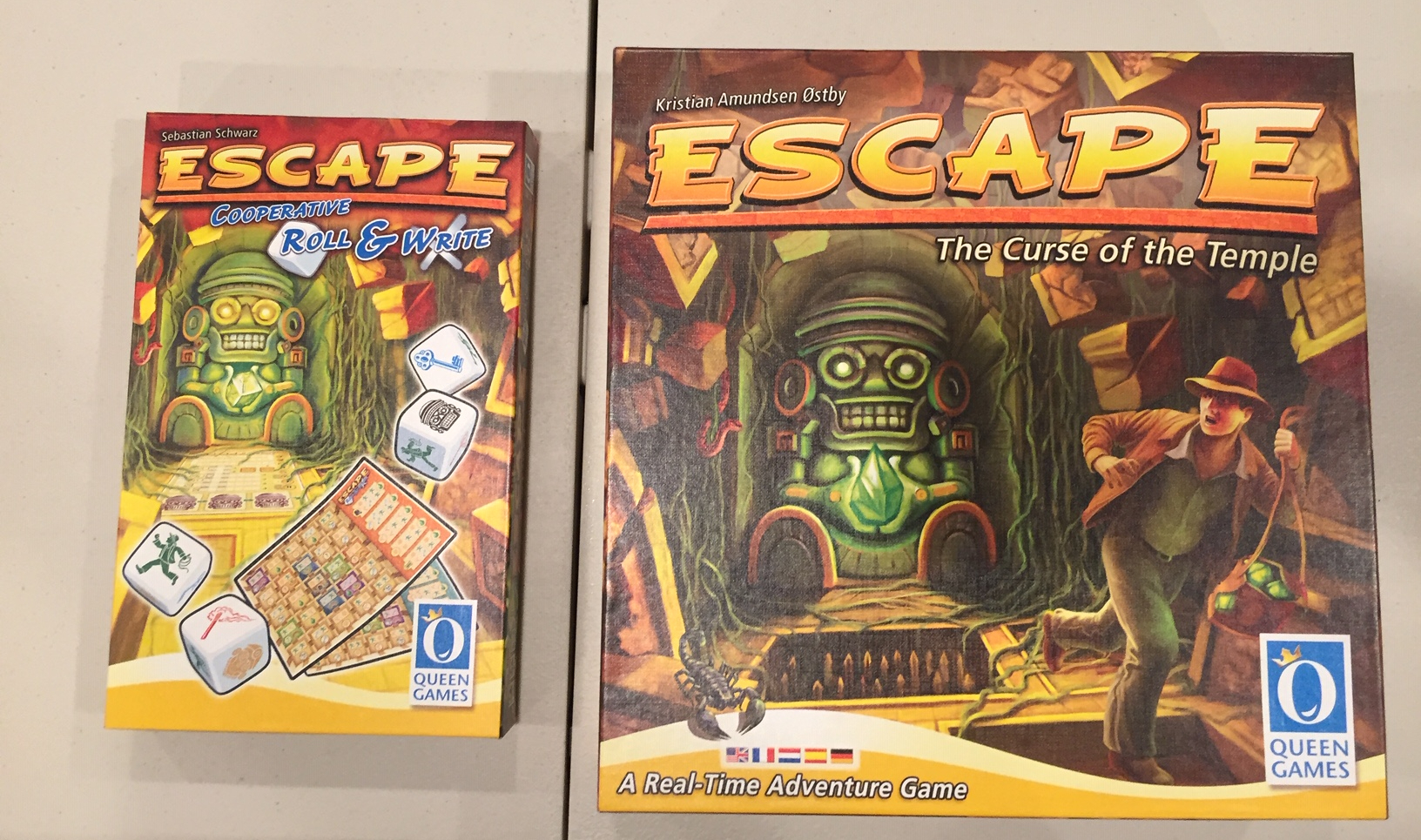
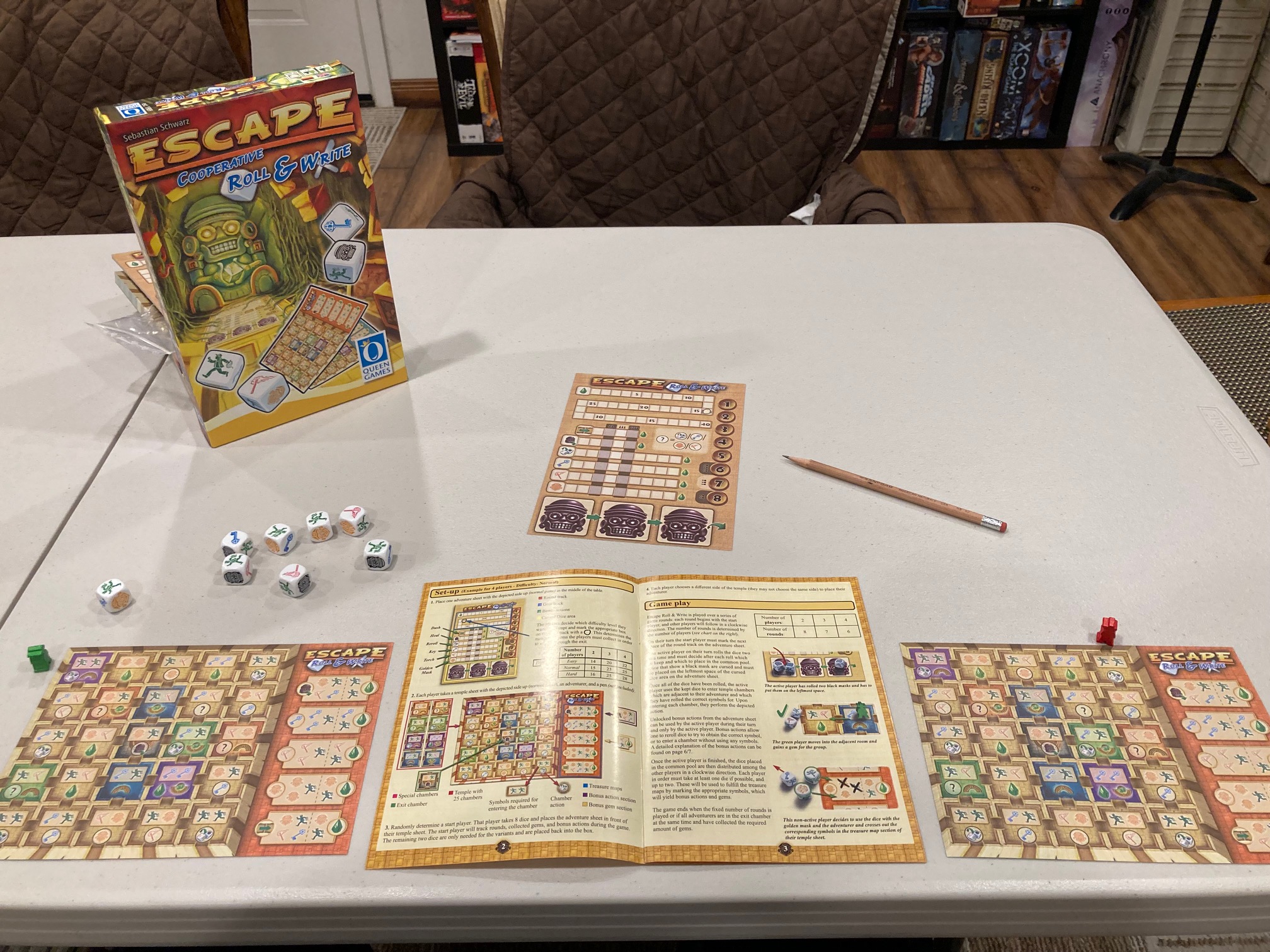
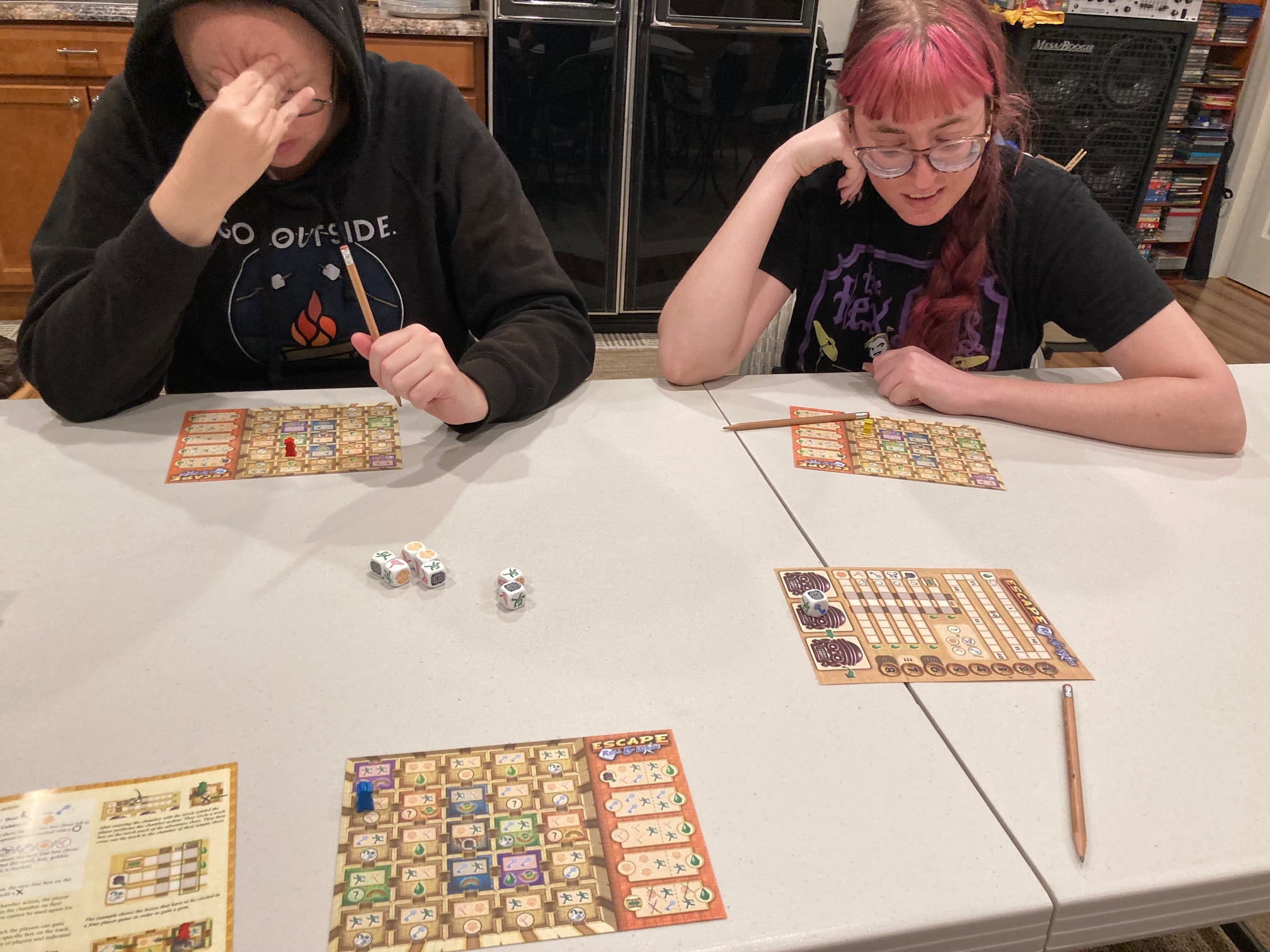
6. Escape: Roll and Write

Supports Solo?  No (but you can simulate solo my playing as-if it were a 2-Player game)
How Cooperative? 2.5/5 
Player Count? 2-4
Print and Play? No, must buy box
Type?  roll-and-write
Win Condition?  Collect enough gems and all players need to be on their end space!

Those of you who know the original Escape: The Curse of the Temple game might be confused by this: “There’s a roll-and-write Escape game?”  Yes! 

It even uses the same dice as the original Escape game!  This roll-and-write is all about the active player rolling dice, using them to move around the temple, and the remaining dice are used by everyone else!  So, there’s some cooperation and discussion about which dice the active player takes!   It’s not super cooperative, as each player moves through their own board separately, but there are still some elements!

This game didn’t take the world by fire, but it’s colorful and fun!  See our review of Escape: Roll & Write to see if this is a game you might enjoy!

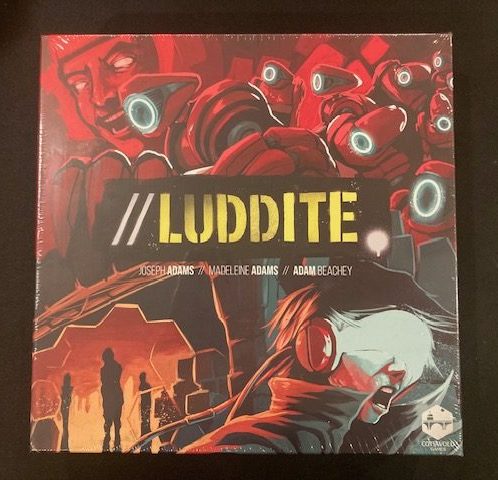
5. Luddite

Supports Solo?  Yes
How Cooperative? 1/5 
Player Count? 1-100 (1-4 in base box, but you can keep expanding)
Print and Play? Yes, but there is also a boxed version with really nice components!
Type?  roll-and-write
Win Condition?  Move your hack marker to the end, making sure you do enough damage along the way!

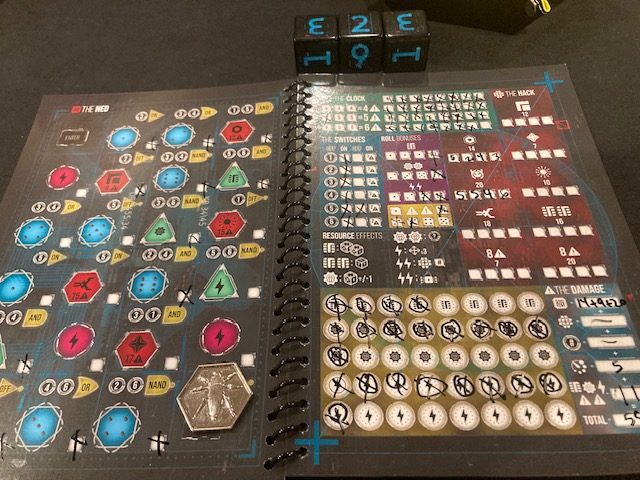
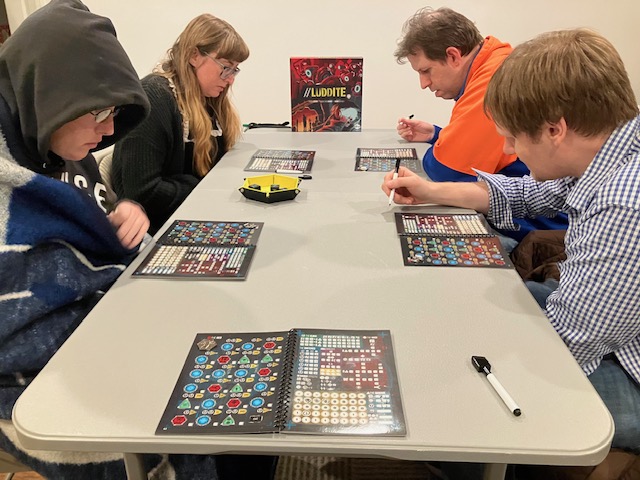
This game is probably the least cooperative and least interactive game on this list!  It’s cooperation is really to average the scores of all players and make sure that average exceeds a threshold to win!  That’s the only cooperation! 

Other than the averaging scores, this game is pretty much multiplayer solitaire!  See above! So, why did this make our list?  Firstly, some people can suspicious of cooperative games: this is a first game that’s easy for people who want to put one toe into the water of cooperative game!

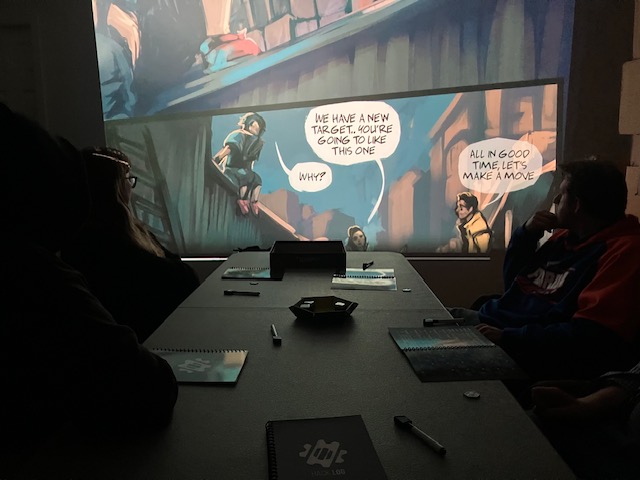
Secondly, this game has quite the story, in either graphic novel or movie form (see above)!  This story really keeps everyone involved in the game!   Luddite can be a real interesting experience if you let it!  See our review of Luddite here!

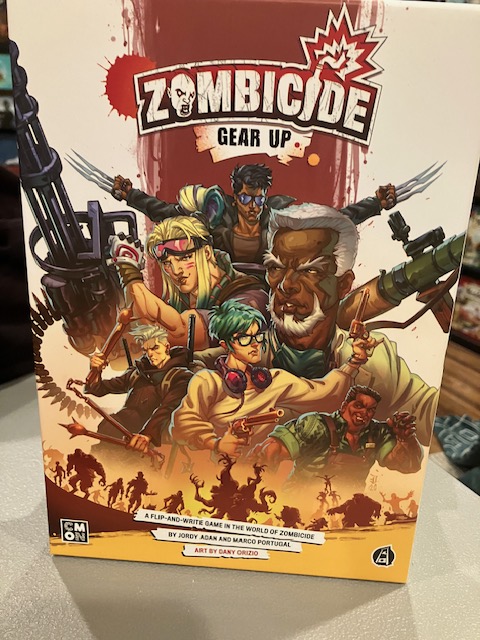
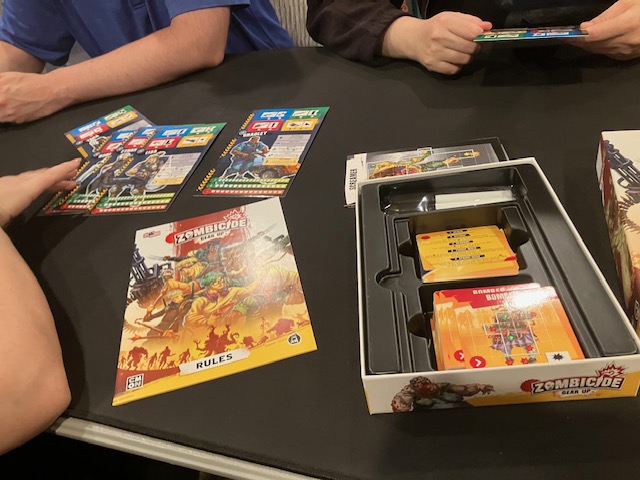
4. Zombicide: Gear Up

Supports Solo?  Yes
How Cooperative? 3/5 
Player Count? 1-6
Print and Play? No, must buy box!
Type?  flip-and-write
Win Condition?  Take out the Big Bad!

This is a gorgeous flip-and-write in the world of Zombicide!  The components are really great with nice dry-erase boards and cards!   This game is very thematic, as it simulates zombies invading your personal space! But in a flip-and-write game!

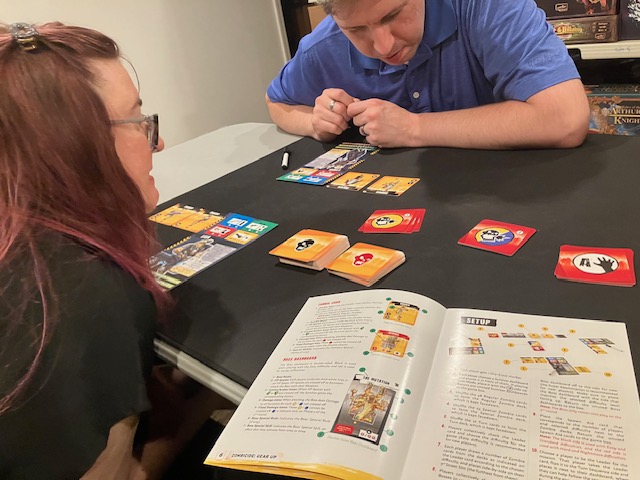
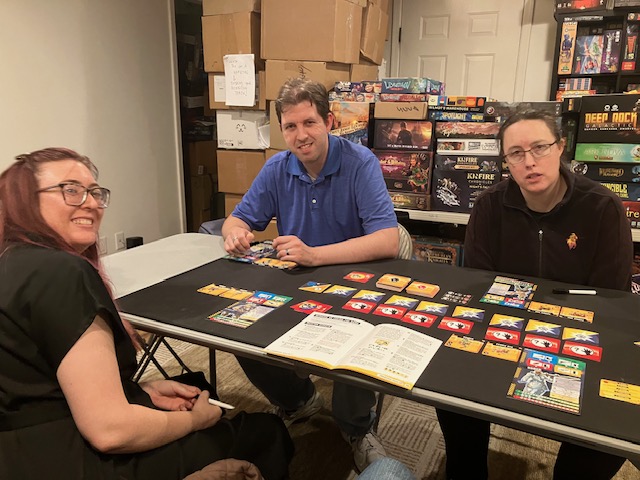
Each player deals with zombies on “their board”, but can help out their neighbors (on adjacent boards) using ranged weapons!  This is surprisingly cooperative as you have to decide (with your group) who takes which zombies, and when to use your limited resources to help your neighbors!  

Zombicide: Gear Up went over surprisingly well with our group!  It really felt like zombies were invading … in a flip-and-write game!

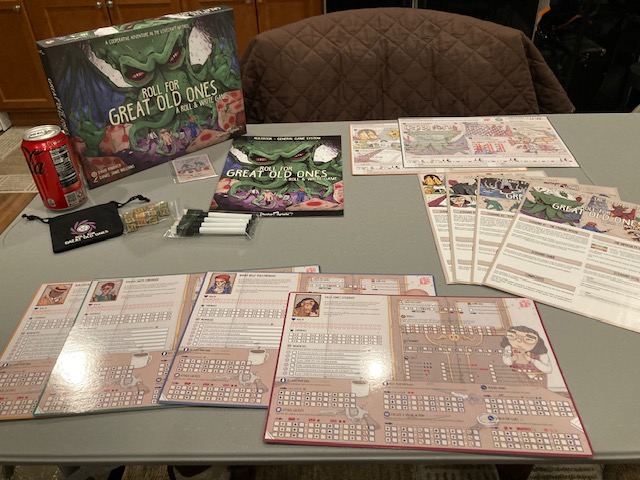
3. Roll For Great Old Ones

Supports Solo?  Yes
How Cooperative? 2/5 
Player Count? 1-4 
Print and Play? Yes, but there is also a boxed version with really nice components!
Type?  roll-and-write
Win Condition?  Take out a Great Old One!

Players roll dice and must each choose one of the dice to use on their sheet!  The cooperation comes out in having players decide, collectively, who gets what dice!  After that, each player focuses on their own board to do things!

The art is a little odd, but this game is surprisingly thematic! This game made our Top 10 Solo Games of 2023!  Check out our review of Roll For Great Old Ones to see if this is something you might like!

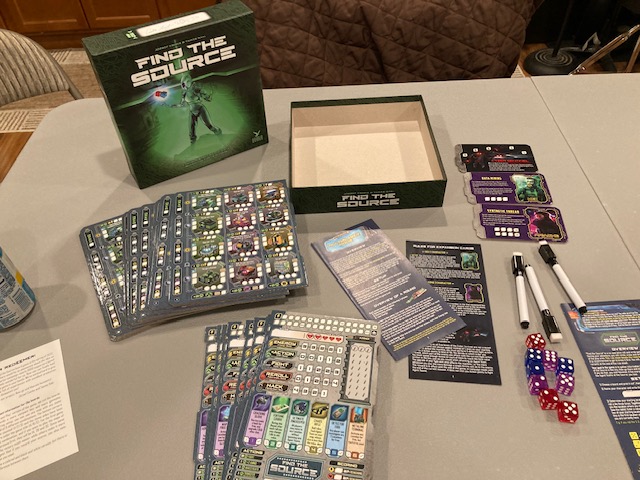
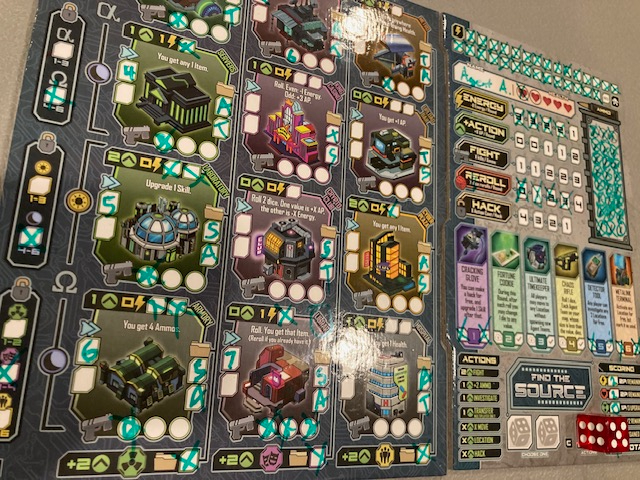
2. Find the Source!

Supports Solo?  Yes
How Cooperative? 3/5 
Player Count? 1-3 
Print and Play? Yes, but there is also a boxed version with really nice components!
Type?  roll-and-write
Win Condition?  Find the Source! … then get the best score you can.

Find The Source was a game from Kickstarter; it was originally a print-and-play, but the Kickstarter upped the ante and delivered a very nice production with nice art and high-quality board!   See above!

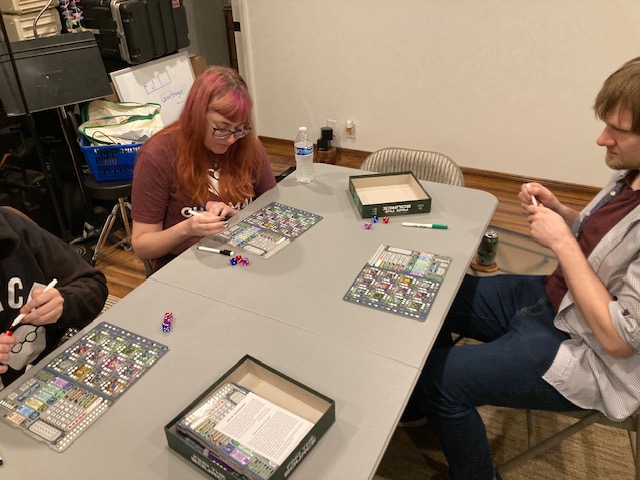
The solo game is quite fun, but the cooperative has players sharing resources easily for one action point.  There’s still a lot of multiplayer solitaire on your own board, but the sharing of resources and hacking inspires a lot of cooperation and discussion!

This was really fun to play!  It even made our Top 10 Solo Games of 2023See our review of Find the Source to see if this is for you!

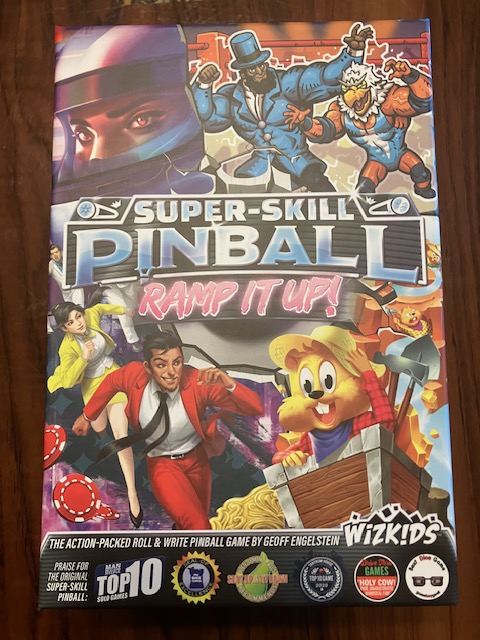
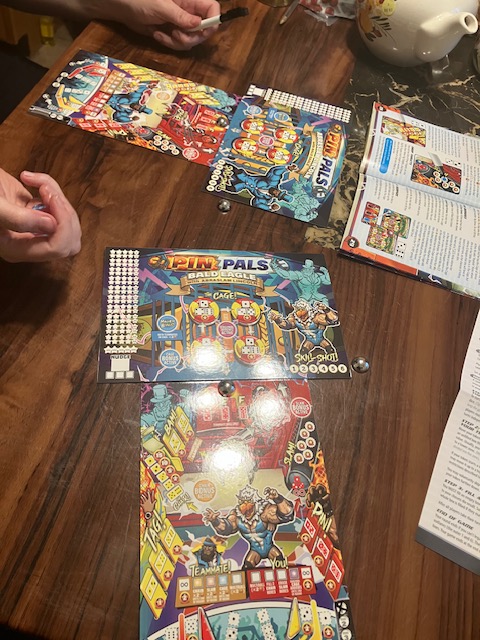
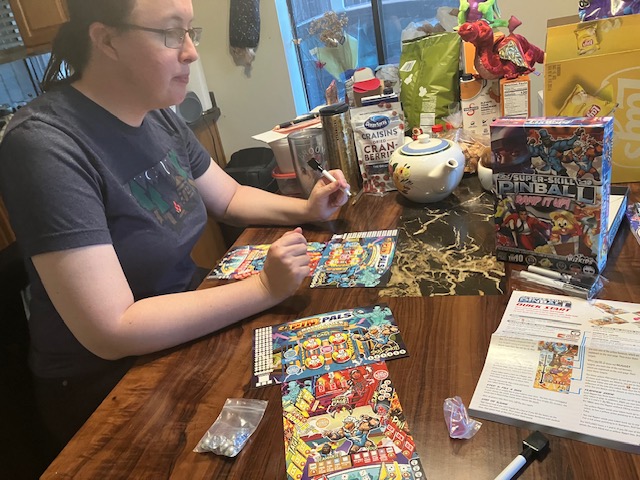
1.  Super-Skill Pinball: Ramp It Up! (Pin Pals)

Supports Solo?  Yes* 
How Cooperative? 5/5 
Player Count? 1-4 (but really only 2 or 4 players for Pin Pals)
Print and Play? No, have to buy box!
Type?  roll-and-write
Win Condition?  Get the best score you can collectively: it’s pinball!

This is a weird choice for #1 for many reasons!  First of all, there’s only one cooperative scenario of the four in this box!  That is the Pin Pals game! The rest of the scenarios are solo/competitive!  Second of all, the cooperative game is really only for 2 people (although you can have two groups of two playing at the same time), so it has limited playability!

Despite these limitations, this was our favorite cooperative roll-and-write game!  You mark off things to help your compatriot all the time as you are playing!  The game moves so quickly!  It feels like pinball!  This was very interactive as we both played pinball on our own boards, but talked as we tried to give each other bonuses!

The wrestling theme was goofy, but worked really well as we “tag-teamed” each other, marking off bonuses for each other as we played!  Even though there is only one cooperative scenario in the box, it was worth it!  I highly recommend the Super Skill Pinball system and the Pin Pals board as a cooperative roll-and-write!  It just moved along so quickly and cooperatively!


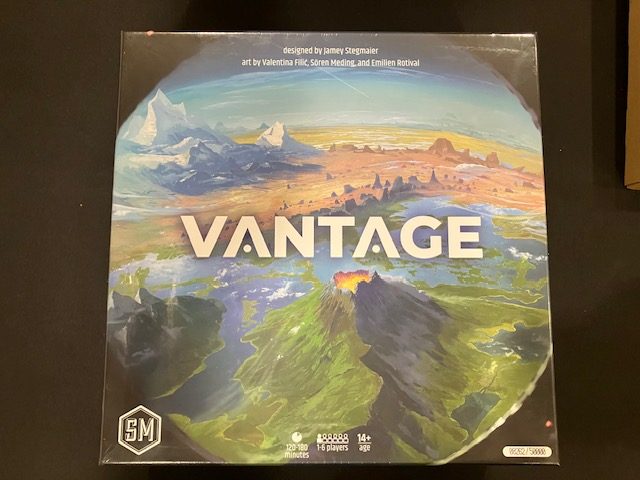
What Vantage Is and Isn’t: A Review of Vantage

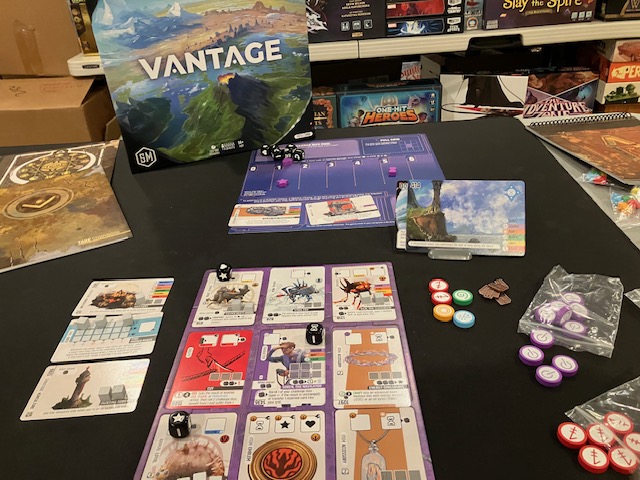
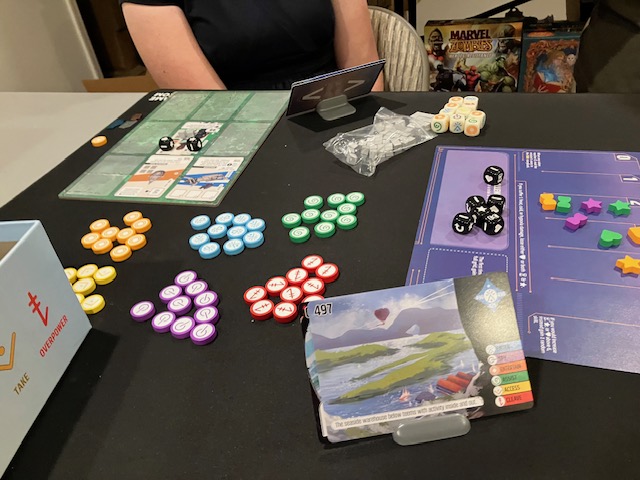
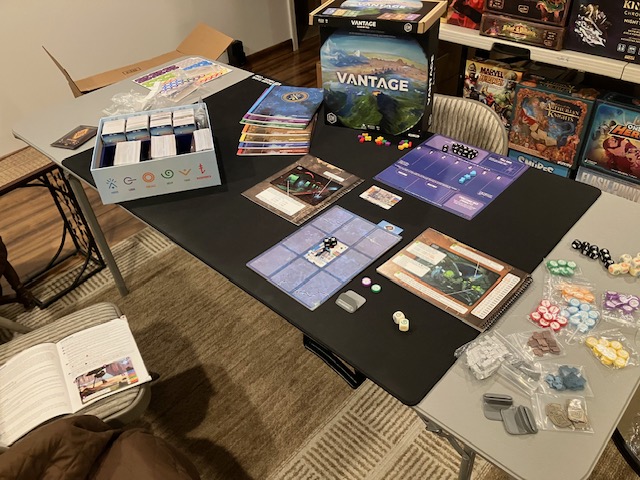
This week we take a look at a very hot game called Vantage: this is an open world game with thousands of cards! We show pictures of the game with some cards, and although they could be classified as spoilers, all of these pictures are out of context so I don’t think they are really spoilers. If you are really worried about spoilers, just jump to the Conclusion and avoid all the pictures!

There’s already been a ton of reviews of Vantage: reviewers who got it early for free and Stonemaier Champions (members of a club who get Stonemaier games early with a discount).   I am neither of these: I am a plain Jane game player who paid full price for my copy of Vantage! I pre-ordered it from the web site like any schlub and I just got my copy about 2 weeks ago.  I am not a rabid Stonemaier fan,  nor I am not a prepaid reviewer!  I am just a guy who like cooperative games who pays for every single game he gets and never gets ANY consideration from any publisher.  So, my review may sound a little different than the others.

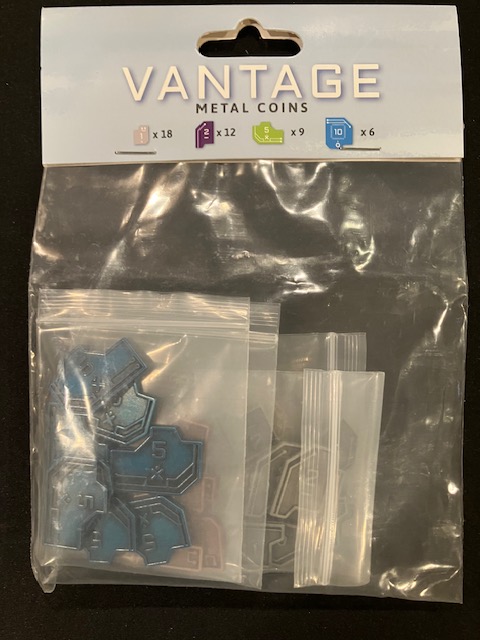
The funny thing is that I pre-ordered the Vantage coins about a year ago and they arrived a year ago.  Yes, they actually had the coins for the game a year ahead of the game itself!  That’s kinda funny.  The fact that I ordered these tells you, yes, I was interested in the game.

We are going to try something a little different: we are going to talk about what Vantage is and what Vantage isn’t.  Vantage doesn’t really fit directly into any mold of what other games are; it’s its own thing!  But, is it something you will want to play?  Is it something you will want to buy?  Let’s look more closely.

Unboxing

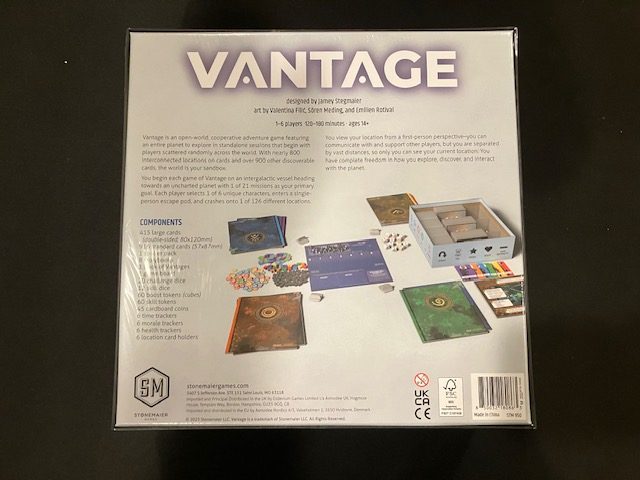
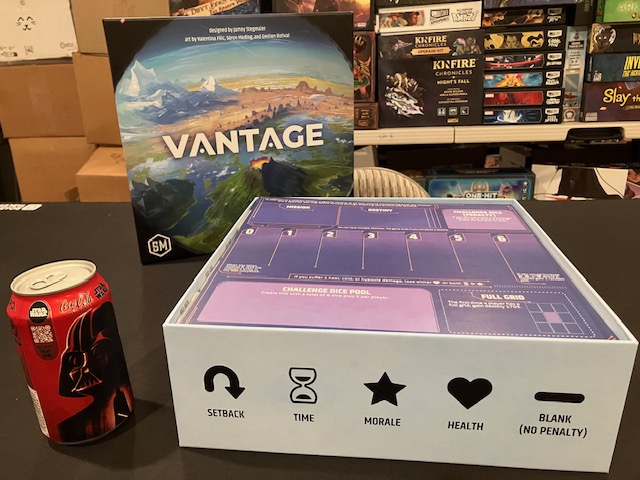
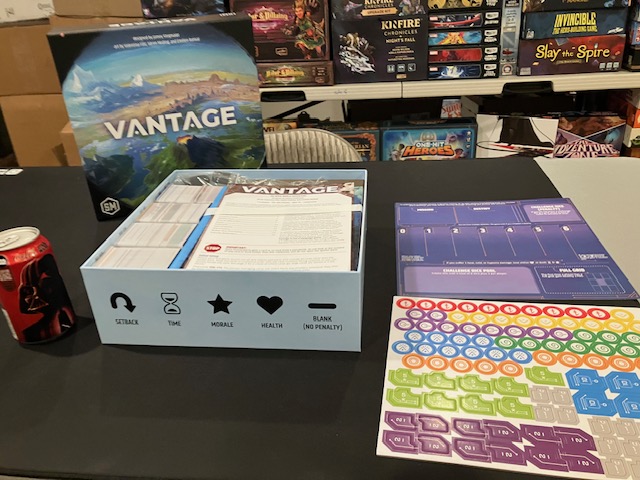
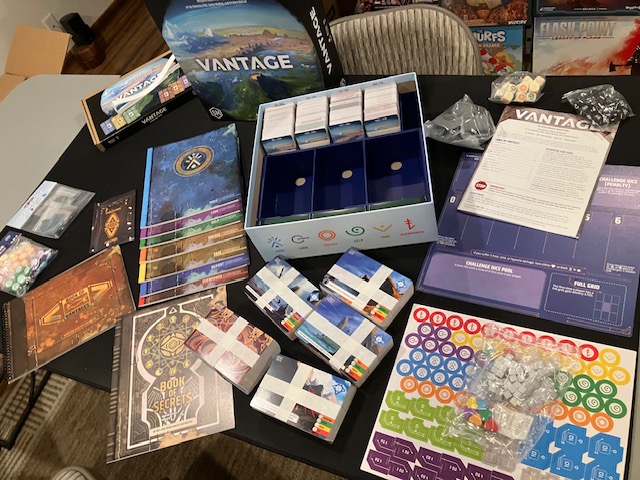
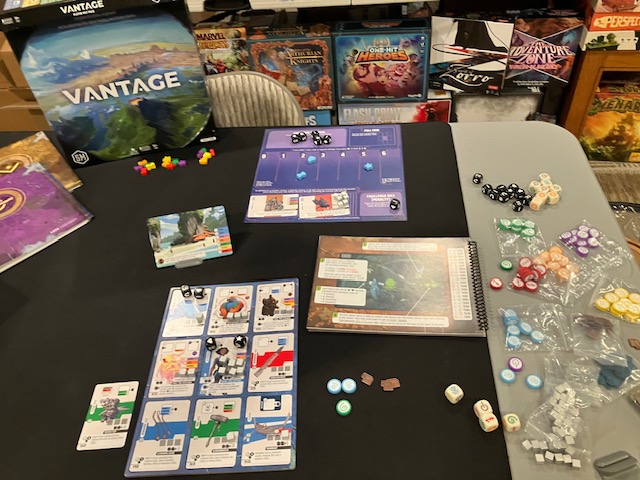
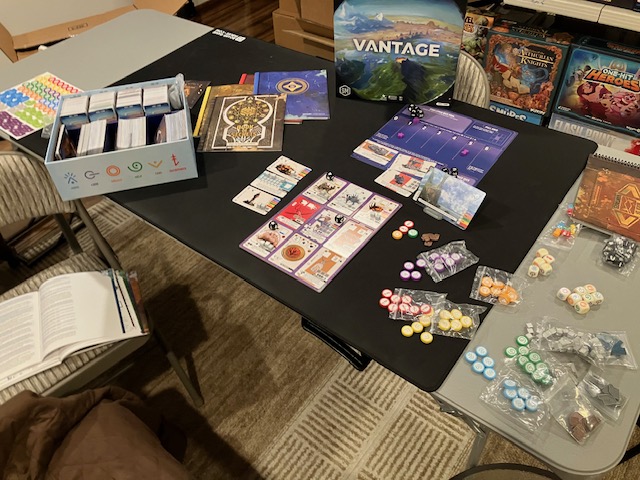
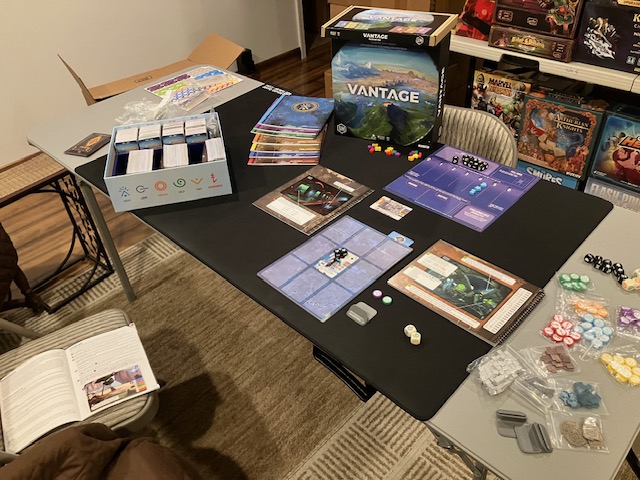
Vantage is a fairly standard sized box: see Coke Can above for scale.

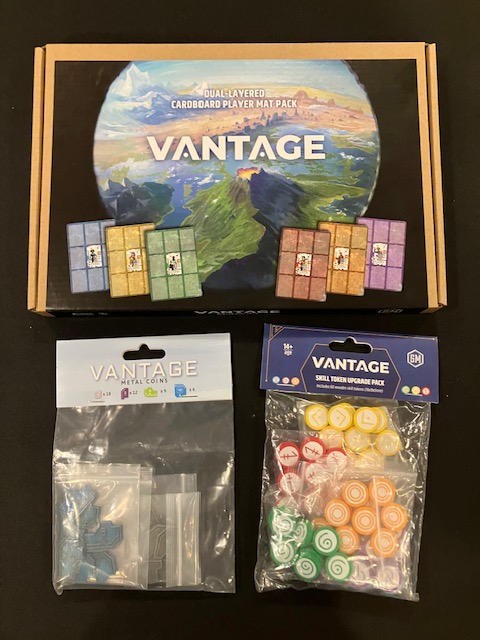
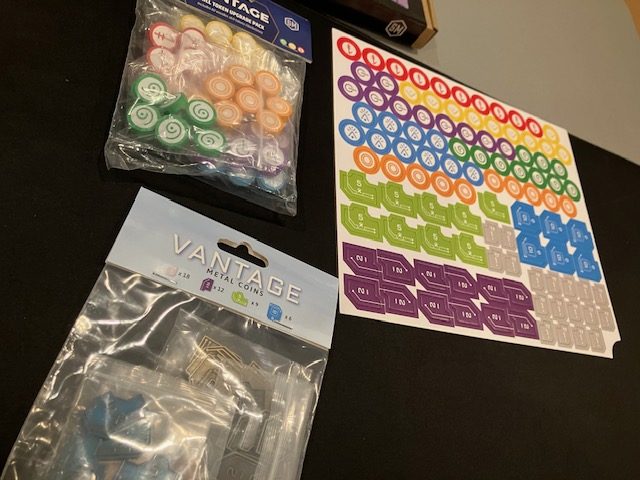
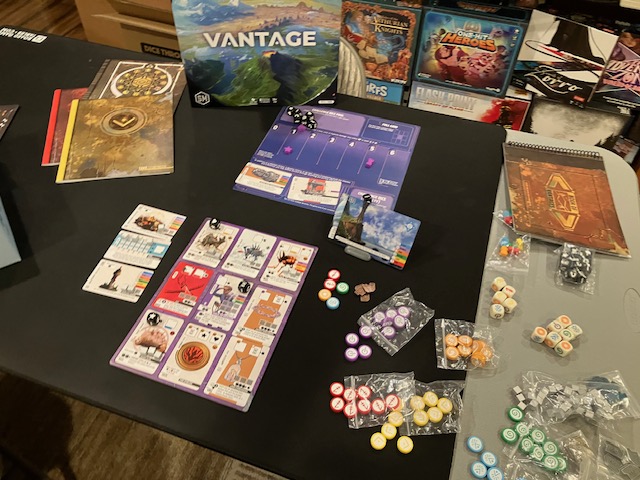
Let’s be clear: I bought ALL the extras for this game!  The wooden skill tokens, the metal coins, and the 2 layer player boards (see above).  I was very excited about this!

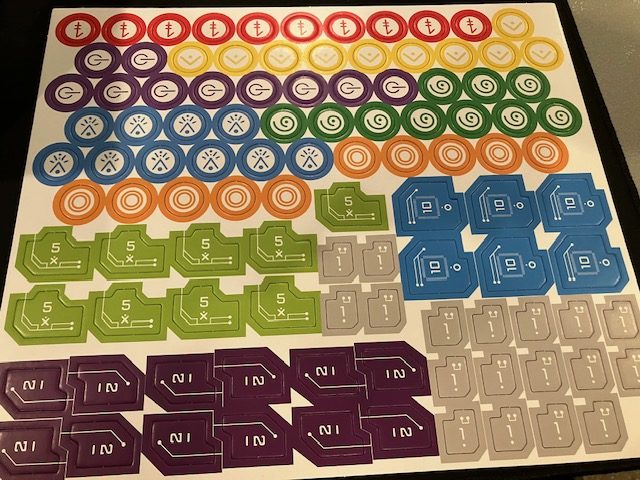
Because I bought all the extras, I didn’t need to punchout anything.  I just left this sheet untouched.

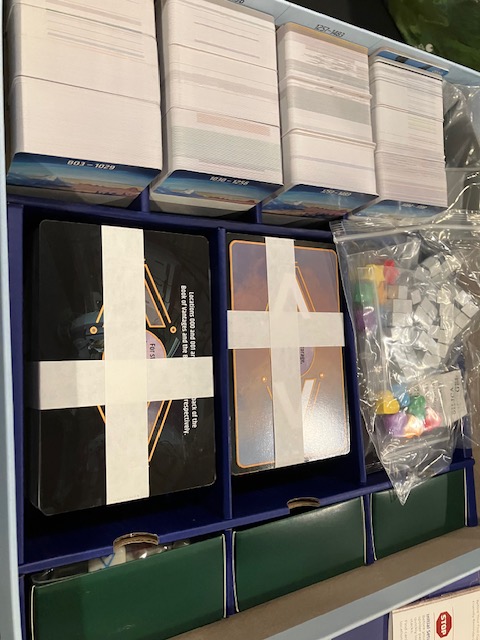
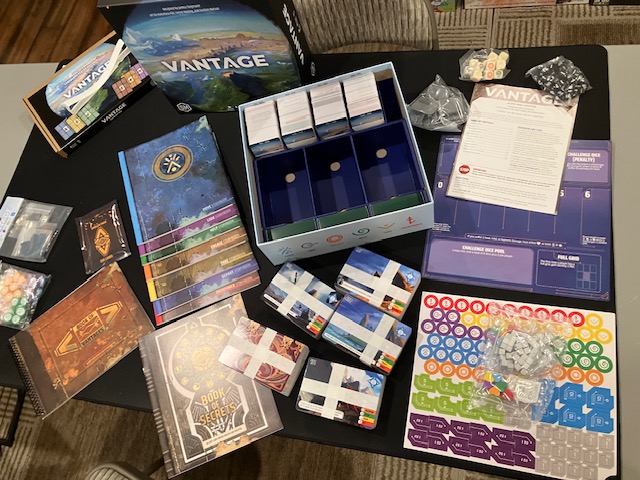
As you look at the box, you can see it’s got a lot of cards!  It’s actually pretty heavy!

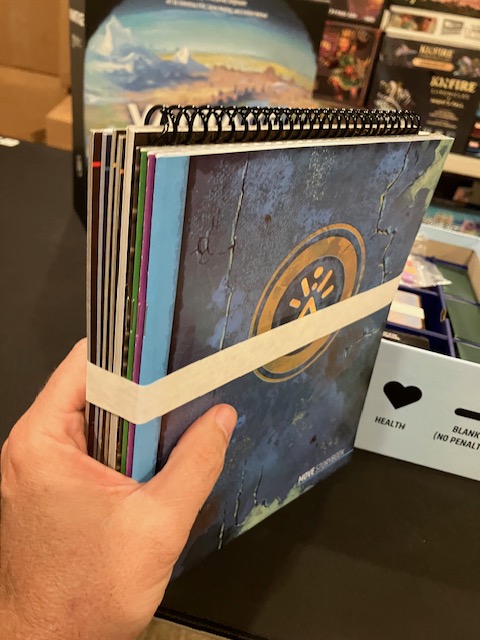
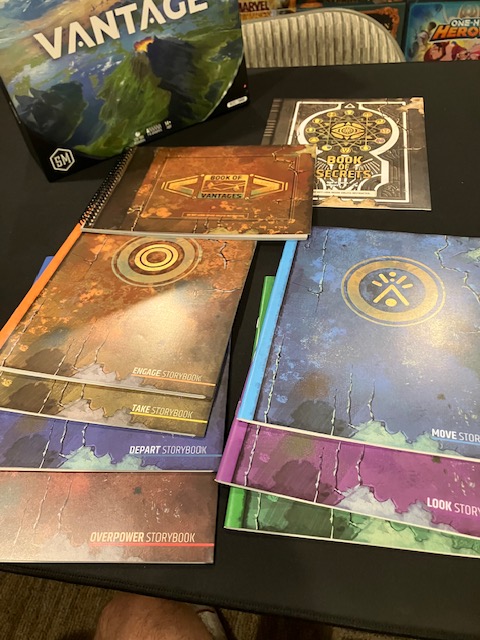
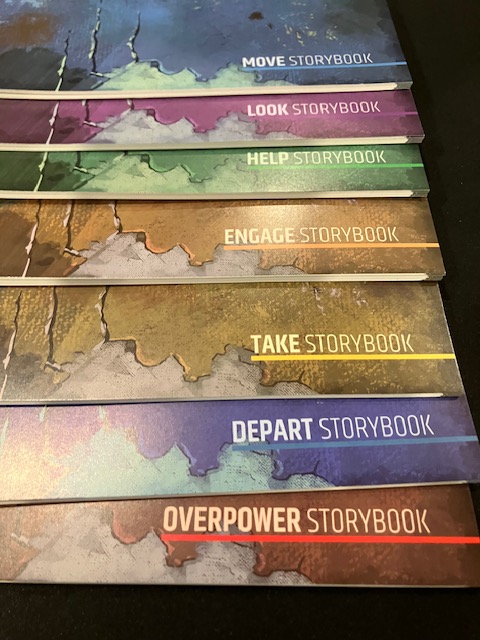
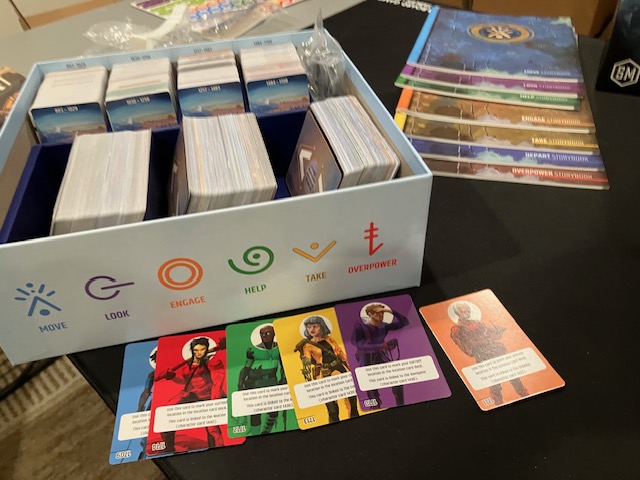
There are a LOT of books: see above.

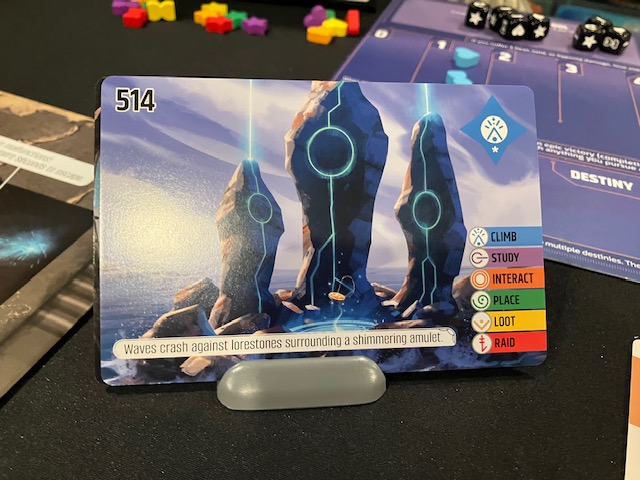
There are two flavors of cards: giant Location cards (see above) ..

And generic “little” cards which will come out as you play. Items, animals, … just different stuff that emerges with gameplay.

Notice just how many books there are!  They are called Storybooks: we’ll revisit that nomenclature later.

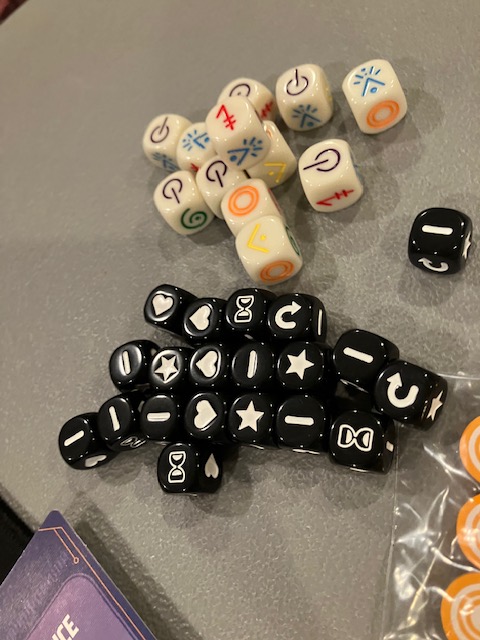
There’s two kinds of dice: Challege (black) and Skill (white) dice.

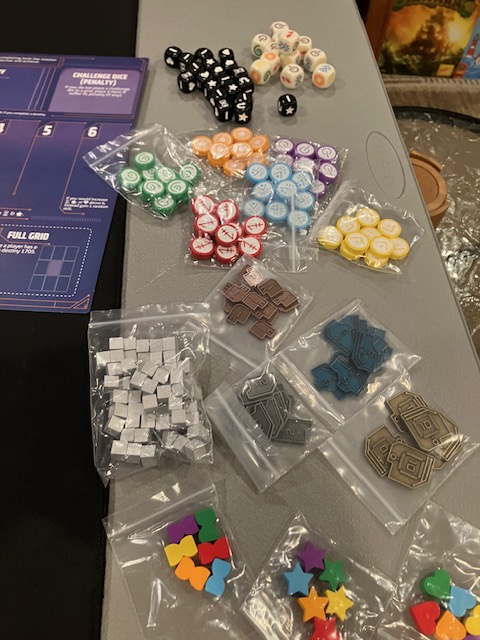
And there’s a ton of tokens!

Overall, there is a LOT that comes with this box!  It looks really nice!

Rulebook

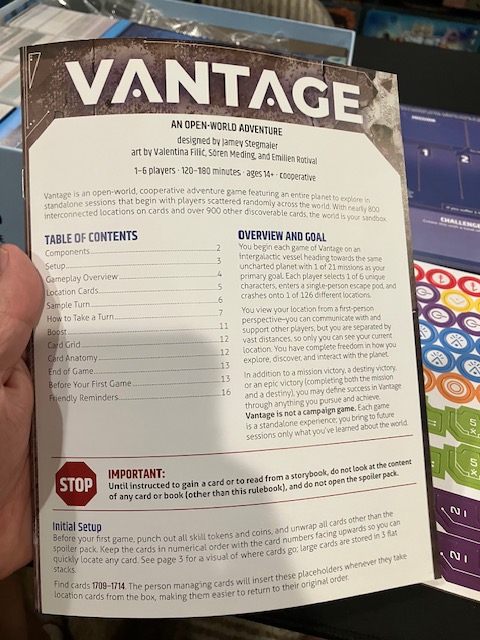
The rulebook is very good, modulo one or two issues.  The paper is a special “silky” paper that feels really nice.  Note! It has a Table of Contents!  Yay!  But no index!  Boo!

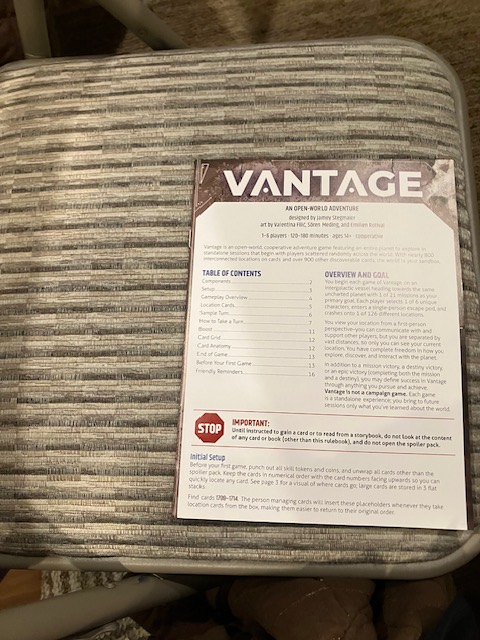
The rulebook gets a straight-up A on the Chair Test!

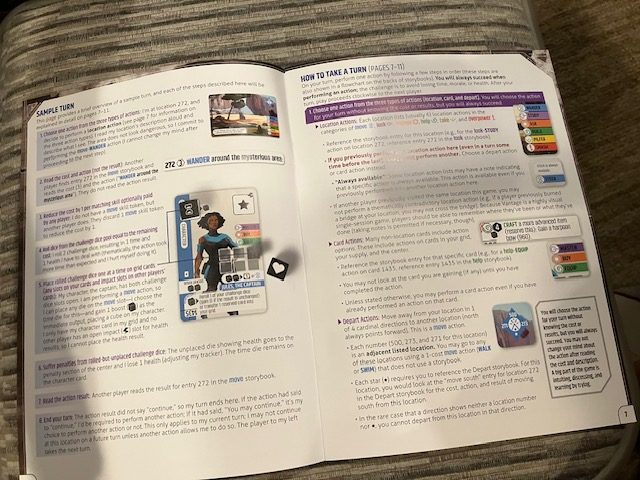
The rulebook fits PERFECTLY on the chair next to me, and it can lay open just right (see above).  The font is nice: it’s a good size (not too small, not too big) and it very readable.   It’s been a while since we’ve had a rulebook that gets a straight-up A on the Chair Test. Nice job!

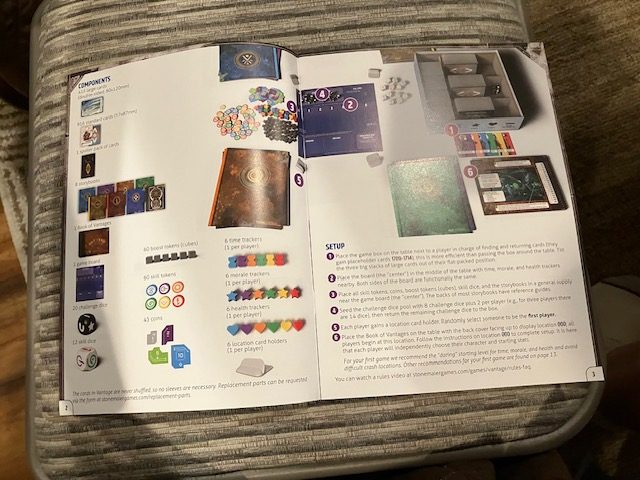
The Components and Set-Up are great: they are all on the same page, so it’s easy to correlate what things are and where they go!  Granted, Set-Up is pretty  “easy”, but this works really well. And the Components have pictures and are labelled.  Very nice!

The rest of the rulebook is good: lots of pictures, lots of color to help distinguish things, and sidebars that help explain an issue (without being the only reference to that rule!).

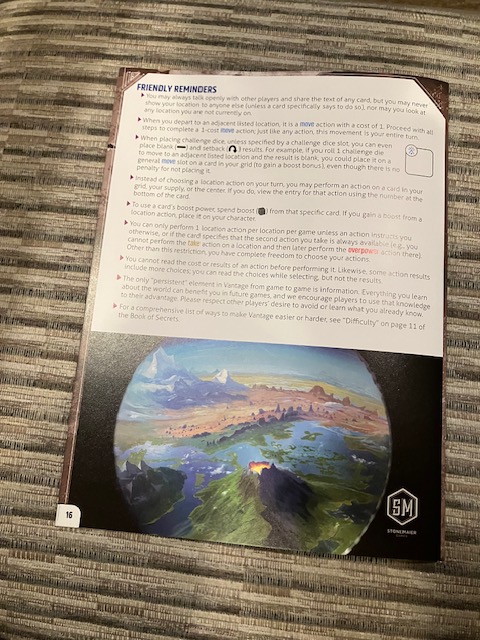
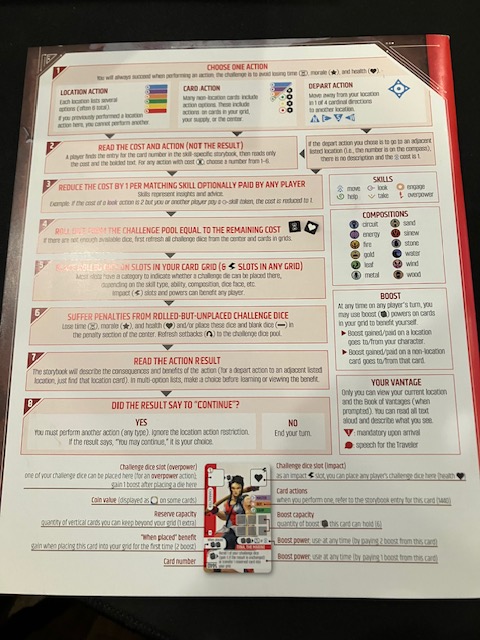
My only complaint is that the back of the rulebook doesn’t have a list of all Icons.  It has friendly reminders (see above), but I feel like that should inside the rulebook.

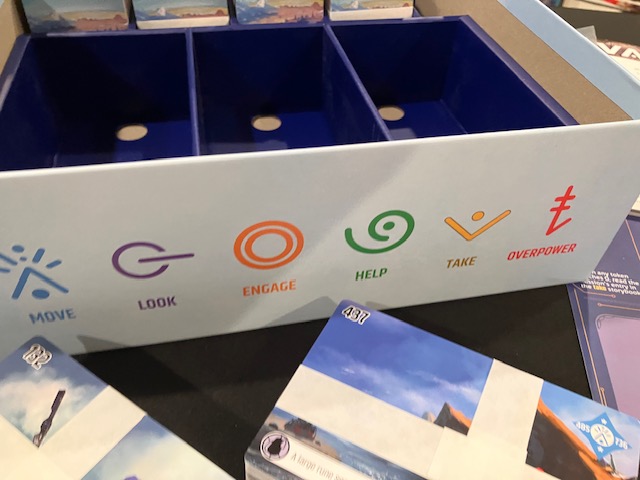
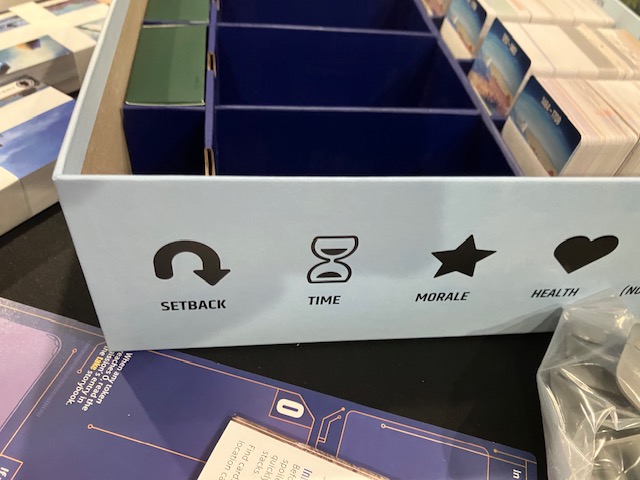
Now a lot of these Icons are on the side of the box (see above and below)

Or on the back of the books:

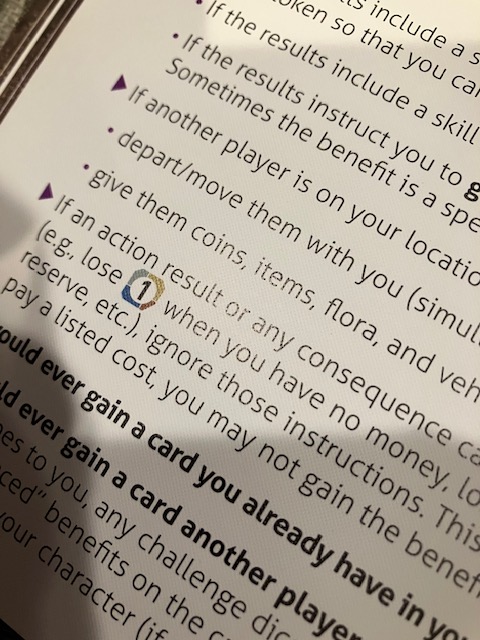
However, I was very annoyed that I couldn’t find what the little circle meant:

… until I just happened to find in the rulebook!  I think that means MONEY!  See, it frustrated me that I had to go searching for this.  It should have been on the back of the rulebook with a list of Icons!  I don’t know where this is defined except for the passing reference on page 10 where you have to infer the meaning!

That’s a pretty minor quibble, but it did slow me down for long enough that I was annoyed. And it really shouldn’t have been an issue, especially when the rest of the rulebook is so good!

But overall, the rulebook was very good.

What Is This?

The game bills itself as an Open-World Adventure (see the top of the page).  What does this mean?  We are going to explore this issue via what this game is … what this game isn’t !   If we hack away at the positive space of what the game IS and the negative space of what the game ISN’T, then hopefully that will be enough information for you to figure out if this is for you!

Is This a Storybook Game?

We’ve talked about Storybook games for years here at CO-OP Gestalt; we tend to love them! See our Top 10 Cooperative Storybook Games!

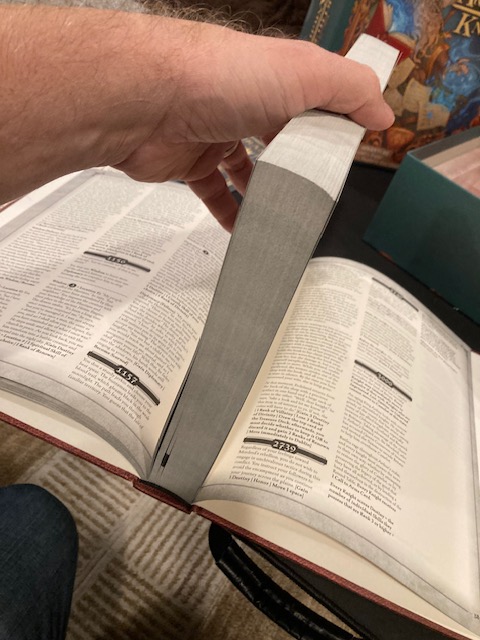
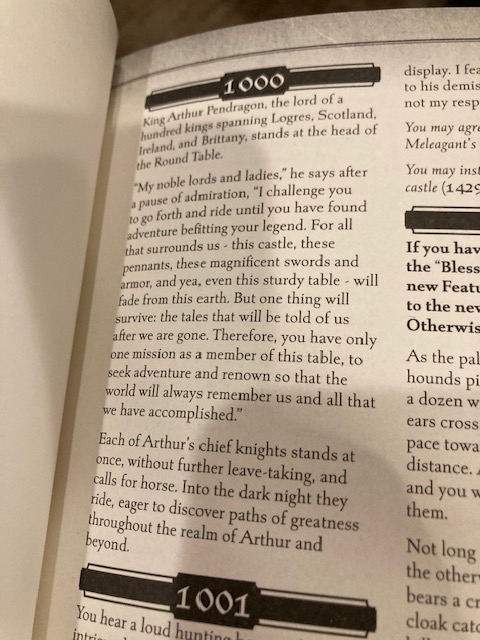
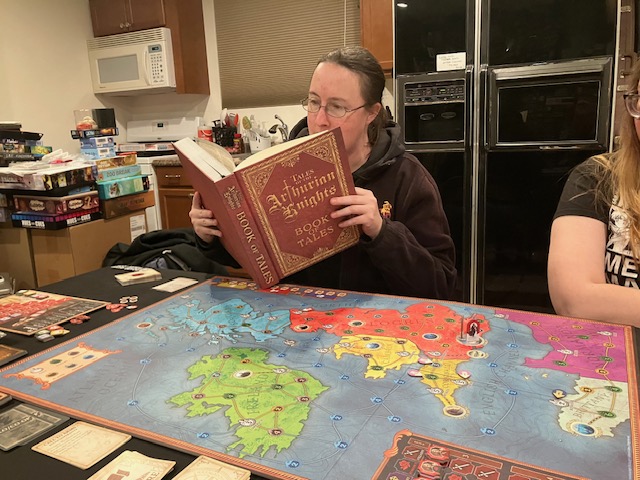
Recently, we reviewed and loved Tales of Arthurian Knights!  There is no question Tales of Arthurian Knights is a Storybook game with a beautiful hardbound book and tons of text! See above!

The text in the book flows and paints a picture of Arthur’s Knights! See how flavor exudes from the text above!

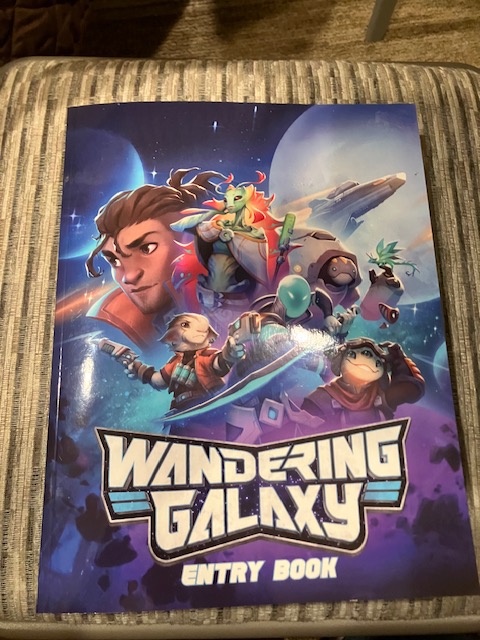
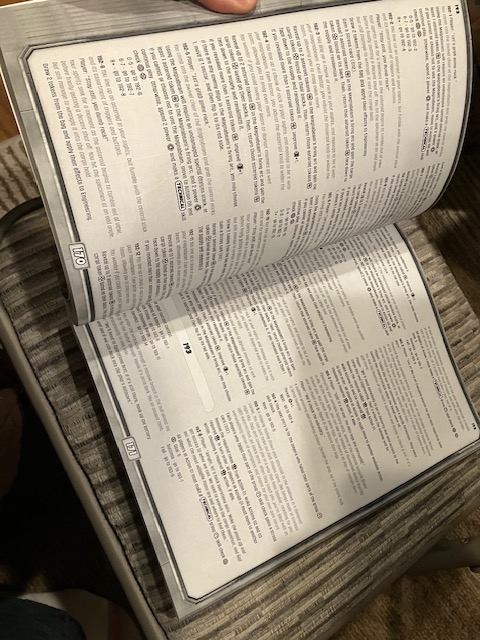
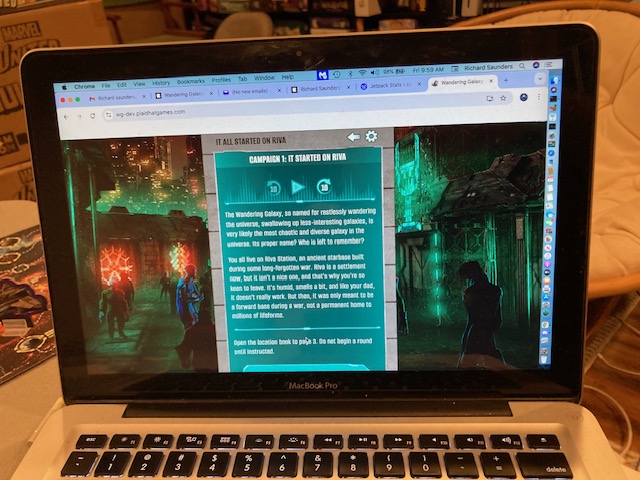
Another game that’s a Storybook game is Wandering Galaxy (see our review here).  In fact, the recent Kickstarter included two ways to enjoy this Story! On way is a full text experience from the entry book (above and below)!

See more flavor exude from the text above!

However, you can also enjoy the story text is from the app: it shows the story, but also has Voice Actors read out the text!  But there’s still a lot of flavor! (And silliness)  It’s very … flavorful!

Why am I going into so much detail about Storybook games?  Because I think Vantage is both a Storybook game and NOT a Storybook game!  It depends on how you look at it! What do I mean by this?

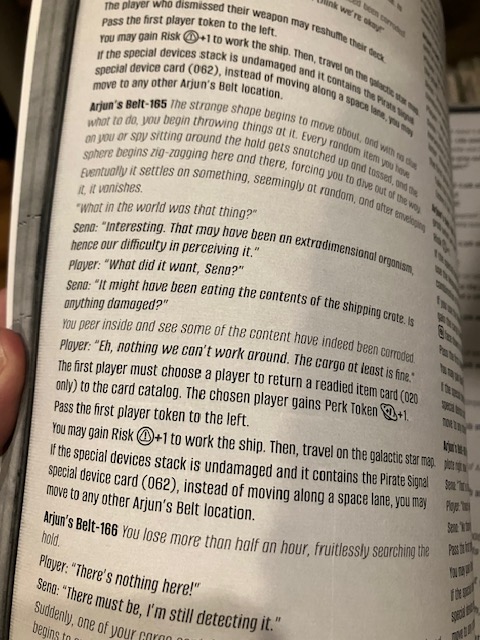
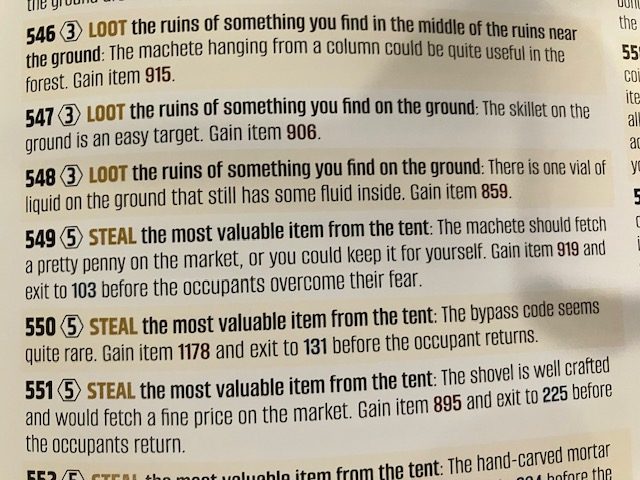
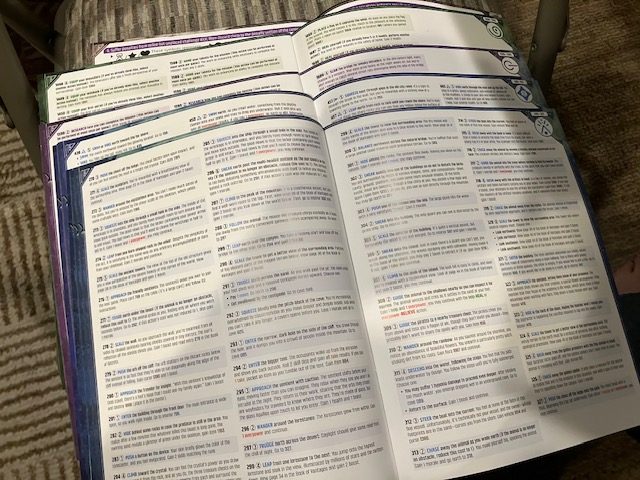
Many, if not most entries in the Storybook, are very very terse; almost like directions.  See above for examples. There’s not of flavor or story in this text!  Sure, there are entries with more flavor and story, but it feels like most of what’s in here is more directions than story.  I struggle a little with the appellation Storybook when that’s not much story.  That’s why I think this ISN’T a Storybook.

My friends LOVE Storybooks and text (see above), and Tales of Arthurian Knights is probably their favorite game of the year!  There is so much flavor, so much story, so much … flowery text in the storybook!  My friends LOVE this type of Storybook!

Before you go off and write me hate mail, I realize that a lot of people don’t like lots of flavor or Story text!  Some people prefer to just get to the game!  You could argue that this is just a very concise Storybook, but it’s still a Storybook!   That’s a very reasonable argument!

But I wanted to point out that some people would see the lack of flavor as a reason NOT to call this a Storybook game.  

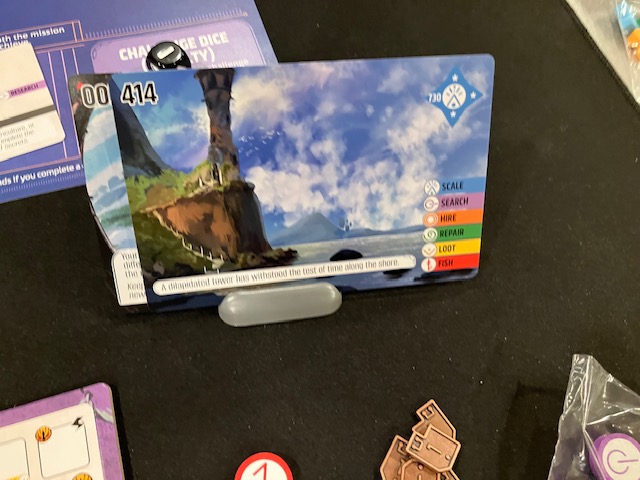
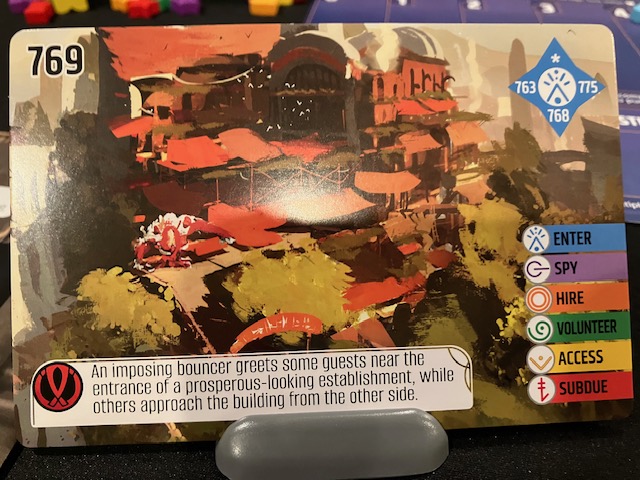
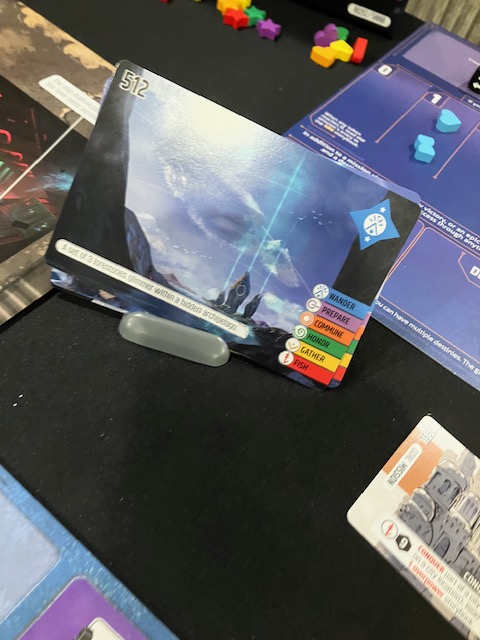
It’s also worth pointing out that a lot of Story in Vantage comes from the Location cards!  As you explore the world of Vantage, these little scenes truly paint a picture of what you see!  There’s no need for flowery text in a Storybook because you have beautiful images to tell the story!  Who needs flowery text when a picture paints a thousand words?

The Location cards are, strictly speaking, distinct from the Storybook.  You could argue that because the Location cards are technically not part of the Storybook, that makes the argument that the-Storybooks-aren’t-Storybooks even stronger!  The story is REALLY on the Location cards, not the Storybooks themselves!

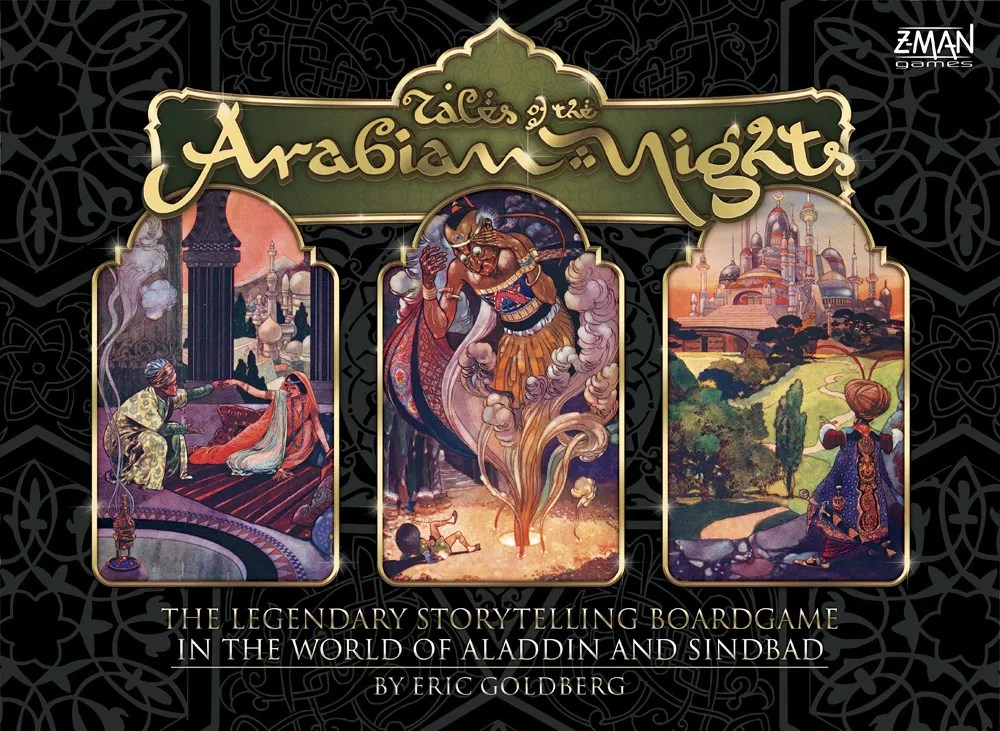
That’s a silly argument because Vantage as a full game includes lots of story.  But this is why I wanted to talk about why you could consider Vantage’s  Storybook NOT a Storybook!  These distinctions helps define what this game is.  There’s still story, but arguably it’s distributed among the cards and Storybook.  The Storybook is NOT the traditional Storybook of Tales of the Arabian NightsVantage’s Storybook is … different: it’s more like directions.

If you love flavor text and like reading flowery text aloud (like my friends do with Tales of Arthurian Nights or Wandering Galaxy), then Vantage maybe isn’t the game you are looking for.  But, you may still like the way the story comes out in Vantage (with the art and Storybook giving directional text).

Is This An Adventure Game?

On the surface, the obvious answer seems “Yes! Vantage is an adventure game! Players explore and go adventures and interact with the objects/stuff around them!”

This is basically the same definition we gave for Point-And-Click Adventure games in our Top 10 Cooperative Point-and-Click Adventure Games!  

“What makes a board game a point-and-click adventure game? For us, it breaks down into three fundamental elements:

  1. You move along in a story!  You are part of a story: this is interactive fiction!
  2. You explore a world!  The game is about exploration and discovery, as you “move” from location to location.  In the point-and-click video games, you could “point-and-click” to move around a map!
  3. You solve puzzles by combining objects!  You need to find objects and combine them in unique ways to solve puzzles. In the point-and-click video games, you would “point-and-click” on items/verbs to combine them!”

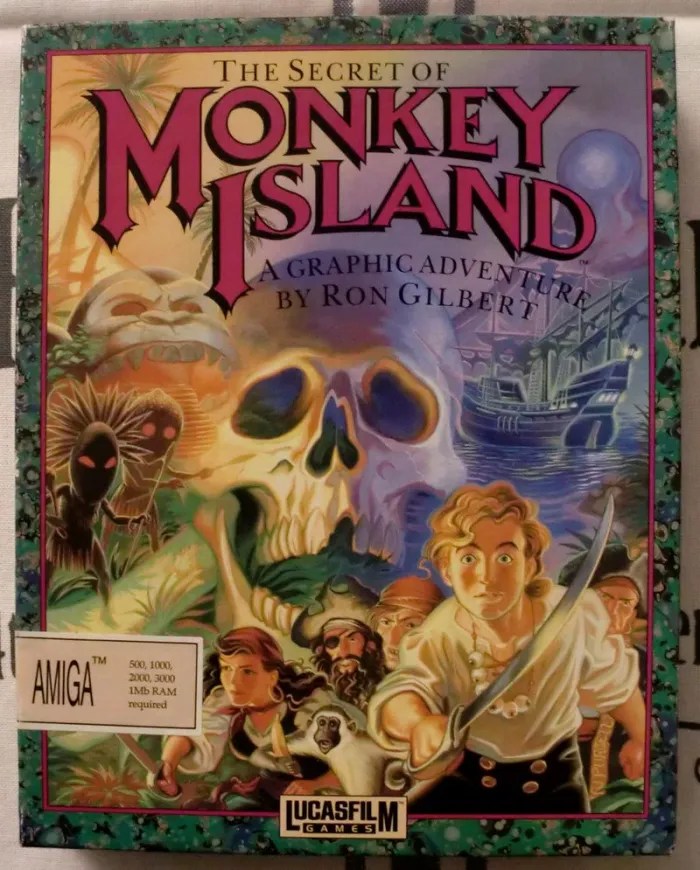
On the surface, it looks like Vantage meets these criteria … because it mostly does.  But let’s look deeper into the interactive fiction portion: although there are stories that emerge as you play Vantage, it’s not “quite” the same as interactive fiction where there is an overall story./puzzle you are completing.  This point can be countered by pointing out that there are many many stories in Vantage waiting to emerge!  That’s a fair point, but it’s worth pointing out that there’s not some overall story to this.  If you want a novel or plot to emerge (like The Secret of Monkey Island or Thimbleweed Park), Vantage is not the same thing.

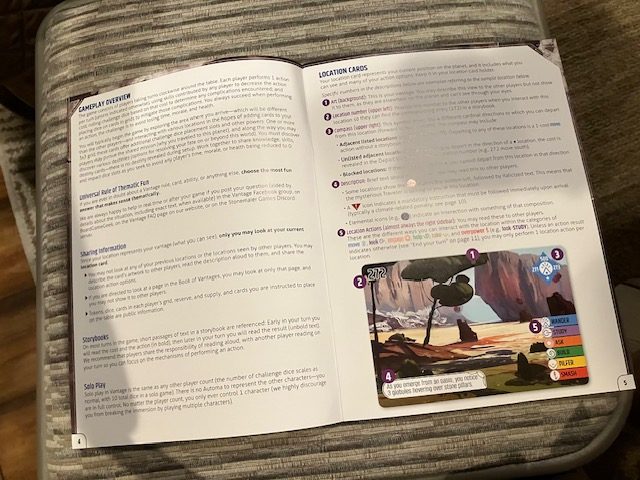
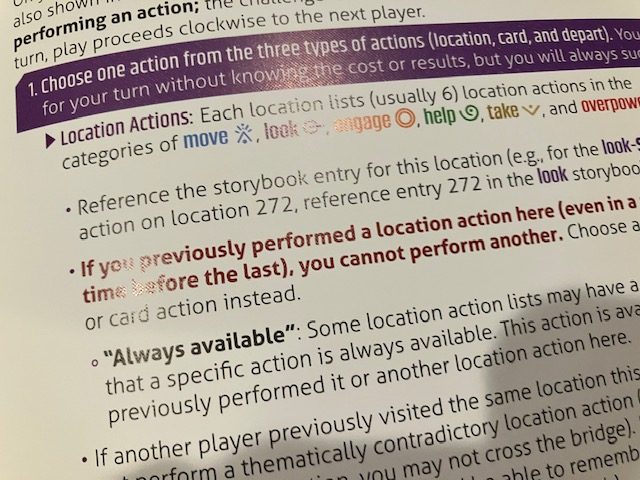
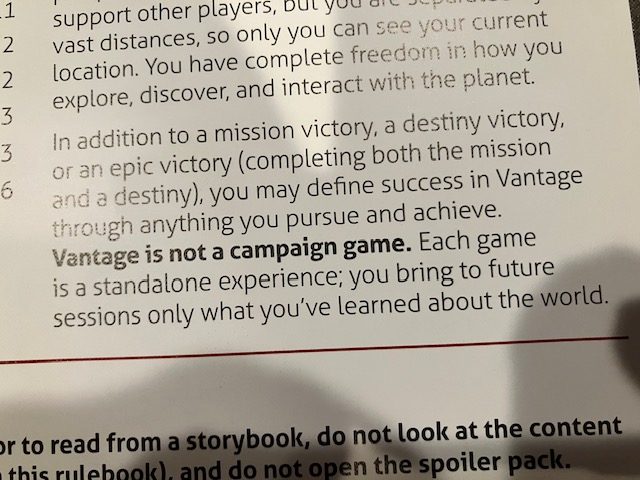
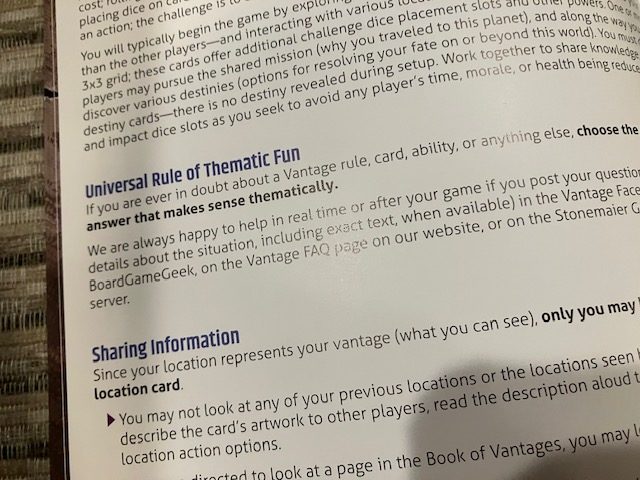
The more crucial thing is the rule that you can’t interact with a Location more than once!  See the rule from the Vantage rulebook above!  In most point-and-click adventures, it’s fundamental that you can go back and revisit a Location and interact in a different way or multiple times or just look everywhere!   This particular restriction seems … strange.  It’s one major reason I would call this NOT an Adventure game.  Or at least not a point-and-click Adventure game?  Maybe that’s the difference?  

Maybe we should revisit our definition of point-and-click Adventure games and add something like “You can generally interact with the environment over and over“.  (And to be fair, there are places in Vantage where you do get a few extra chances to interact with a Location, so don’t go sending me hate mail).

So, this is an Adventure game, but maybe not fully a point-and-click Adventure game?

One other thing also marks this down a little from the Adventure game for me: the exploration.

Is This An Exploration Game?

To say this isn’t an exploration game is crazy!  Players wander!  Players interact with new places!  How could you claim Vantage is not an exploration game?

Consider Earthborne Rangers: a prototypical cooperative exploration game where I joke it’s a 4x game: Explore, Explore, Explore, and Explore! See review here!

In Earthborne Rangers, you can play over and over and over … and come back to where you left off!  You have a map, and you get a feel for the world!  There’s a lot of adventures in this world … just like Vantage!  Like Vantage, you can keep coming back over and over and see more of the world!

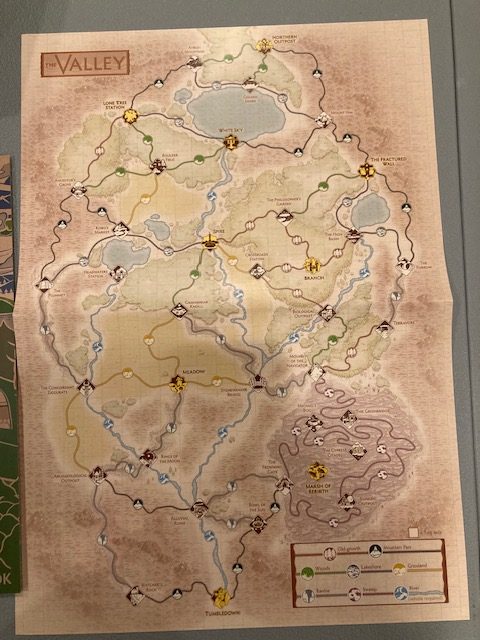
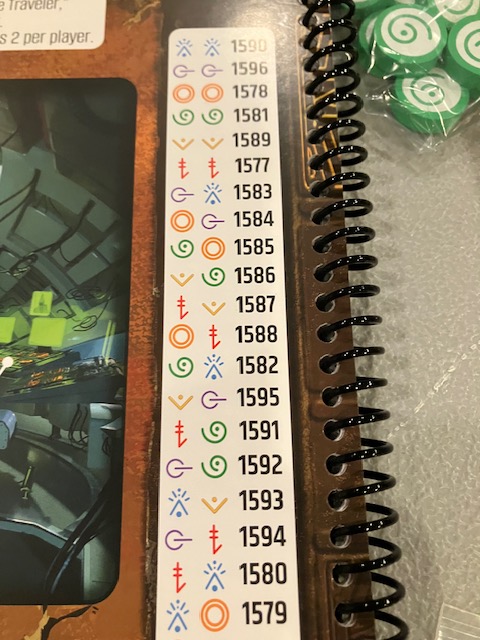
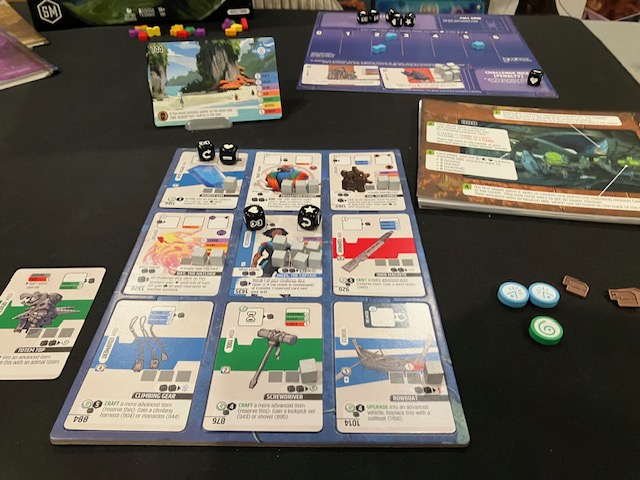
Vantage isn’t  a campaign.  You just crash land on the planet every time at a different place: see the chart above.   Every game is different, as seeded by the chart above.

So I finish a game of Vantage.  And it’s over.  My progress is essentially lost.  In Earthborne Rangers, I can continue where I left off and keep exploring.   That’s the difference; your exploration is lost in Vantage (but see below).

When I say I want to explore a topic, when I want to explore an issue, when I say I want to explore … I don’t want to lose all my progress!   Lack of progress can make the exploration feel pointless.   If I don’t have any vested interest, if I don’t have a desire to continue, it doesn’t feel like exploration, it just feels like random-stuff-happening-to-you.  And that (admittedly subtle point) is why the exploration in Vantage may not feel like exploration.

My first solo game of Vantage ended in a win… it was fine!  But it felt vaguely unsatisfying as “Well, I explored this world, but so what? I have no idea where I was or what I was going! I may never come back this way again, so who cares?”

This unease went away a little when I played my second solo game: if you just take the game for what it is, as a carpe diem game and just enjoy it for what it is, then it’s a lot more fun!  This isn’t a game about trying to explore and keeping track of this planet, you just make decisions and live with them!  

Of course you explore when you play Vantage, but it’s not the type of exploration that persists from game to game.   But see below.

Is This a Campaign?

The rules state very clearly that this is NOT a campaign game.  See rule above!

If you play this sporadically and infrequently, then this is absolutely not a campaign.  There’s no memory of previous games.

But what if you play just enough that you start to remember things?  Then is it a campaign game because you can take advantage of what’s you’ve seen before!   Stated in a more mathematical way, as the number of plays going to infinity, this becomes a campaign game!  

I don’t know if you remember Dollhouse; it was a TV show where dolls (people) were wiped of their memories and implanted with new ones weekly. Over time, some of the dolls started to remember what they did in previous runs … and that’s kind of what Vantage feels like over time.  You are a doll from Dollhouse, and some of those implanted memories … stick.  I don’t know of any other game like this;  It’s a very different way to look at a game.

Vantage isn’t a campaign game.  But over time, it can become one.  Sorta.

Starfleet Mode

After my first solo play, I was a little depressed.  I liked this world!  I liked the pictures in the game!  I liked the basic gameplay!  And yet, all the exploration I did was lost.  All that work, gone.  In a later game (I want to say it was my third game), I got to a place where I could keep exploring for a while … and that was cool!  I like being in this world!  But whenever I finish a game, I think “I’d really like to come back to where I was and continue exploring and get to know this world better!”  I get a little depressed when I did all that exploration … for no reason?  

What I want is a Starfleet Mode or Exploration Mode or … frankly, a Campaign mode.  I understand that the game is all about getting your nine cards in a grid, and once you do that, the game kind of ends.  Maybe there could be a way to “continue” the game; maybe you just lose some of your cards and continue?  

The rulebook is very “open” about how you play the game, from the Universal Rule of Thematic Fun (see above), to victory conditions even being kind of what you want!  It’s very open.  But I wanted a more systematic way to explore this world!  Every game starts fresh with you crash landing on a new place on the planet!    Sure, you can make up your own rules for a Starfleet Mode (My current set is: keep all but three cards and keep exploring, but get rid of your old destiny), but this feels like something we should more direction on (from the rulebook).

I want to continue exploring this planet in Starfleet Mode (my own term, it basically means  Campaign Mode) but it kind of bugs me off that I don’t have a systematic or defined way as defined by the rulebook.

Solo Mode

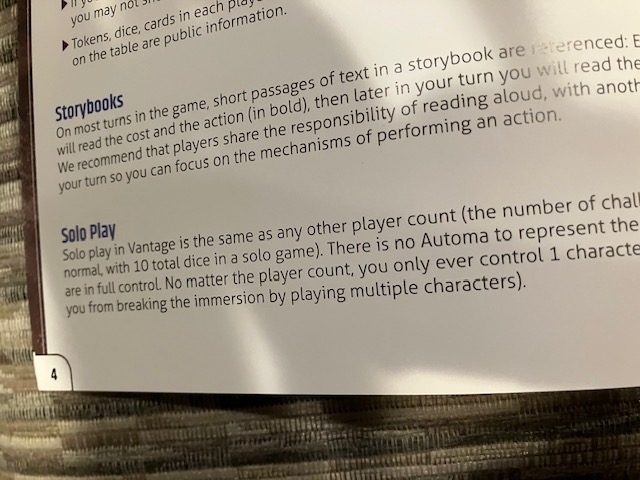
Vantage plays well solo: the rules are very well-defined at the bottom of page four.  (Thank you for following Saunders’ Law)!

My first three games were solo games; I think it’s very important to play solo before you teach others.  There’s just enough rules that it’s better to have a sense of the game before you bring this out to a group.  Luckily, the solo mode is easy to get into and learn the game.

My first solo play left me a little … depressed.  I wanted more exploration, but I felt a little unsatisfied that I lost all the exploration I had done.   After thinking about this for a few days, I came back and played my second game.  This time, I was in carpe diem mode: I just played, made decisions, and took the consequences of my actions without caring too much.  I know I probably won’t come back to this part of the world anytime soon, so I just enjoyed what I was doing.  And my second game was much more enjoyable.  But I feel like I almost had to get depressed in my first game to appreciate what this is and what this isn’t.

A third solo game had get to do a little exploration.  And after my third game, I realized that every single one of solo games was VERY DIFFERENT.  I explored more Locations in some games, I interacted in others, the items I got influenced more what I did in other games.  That’s quite an accomplishment for a game! 

To teach the game: absolutely play this solo first, then bring this out to your friends.  Do I like this game enough to continue playing it solo?  Maybe?  If you enjoy the carpe diem flavor of this, where you just enjoy this game for what it is, then I think you will love the solo mode!  But, if you are like me, and wanted more persistent exploration, then you may feel a little unsatisfied.

I think a Starfleet Mode would make me want to play this again solo MUCH MORE.  Sure, I can make my own rules for that, but why aren’t these in the rulebook?  NOTE: (For all I know, the Starfleet Rules are in hidden somewhere in the Secret pouch, or the Books of Secrets, or somewhere else.  But I can only tell you that after about 5 plays, I haven’t seen anything like that).

Cooperative Mode

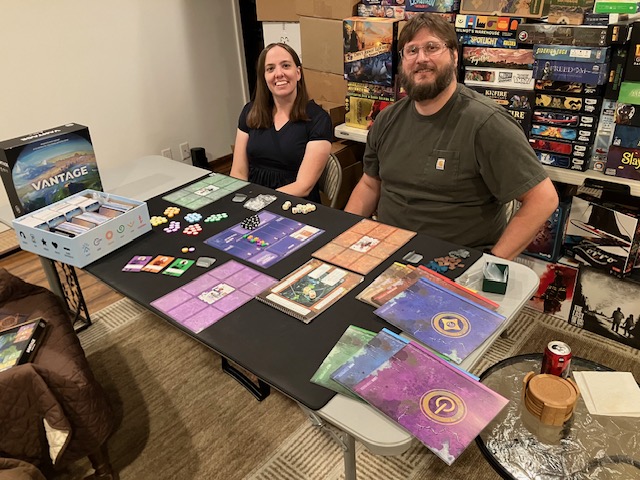
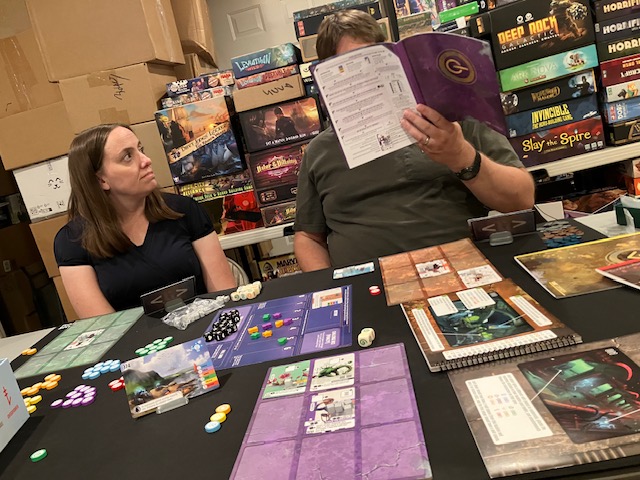
I invited my Escape Room buddies (Charlie and Allison) to play this with me.  

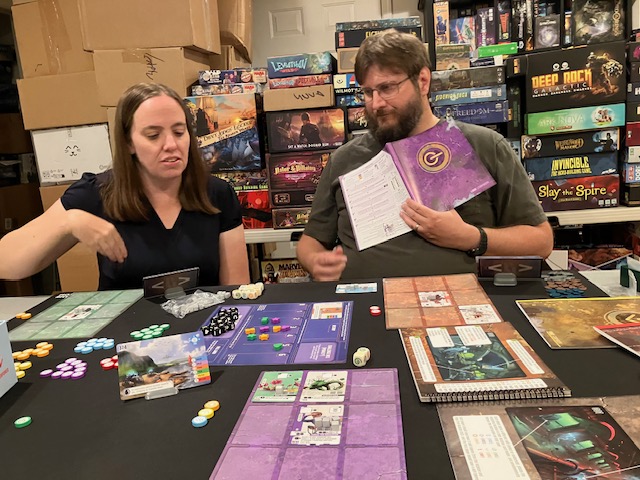
It was a hit!  We played a two-hour game and had a fun time exploring and reading to each other!  One of things you forget in Storybook games is that everyone stays involved as you read the Storybooks to each other!  

I asked Charlie and Allison what they thought? Would you play again?  Absolutely!  The vague sense of dissatisfaction I had in the solo game went away in the cooperative game, as we all stayed involved and just enjoyed the game for what it was.

The cooperation was .. interesting.    In the cooperative game, we have all crash-landed at different points on the planet, so we are “kind of” playing multiplayer solitaire.  We each have our own viewpoint or vantage (see what I did there?), and we don’t really interact with other (although you can if you end up on the same space, but that’s generally not what happens).

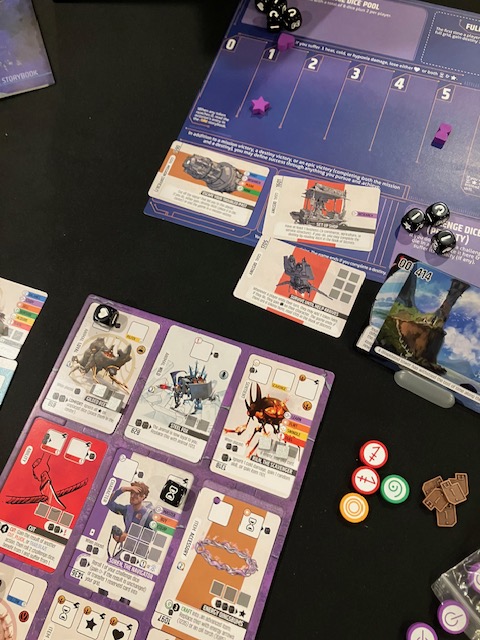
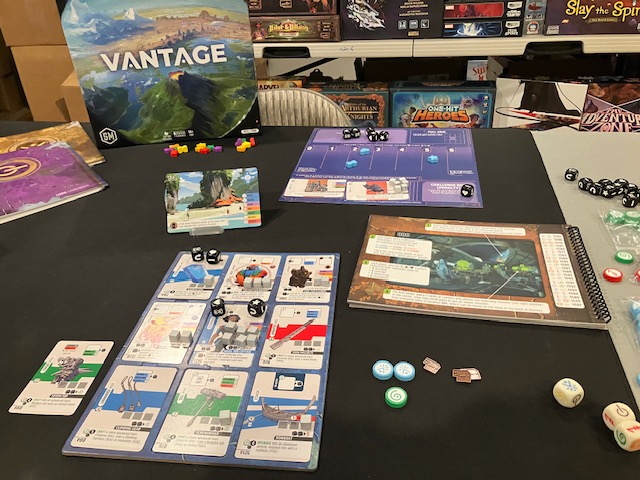
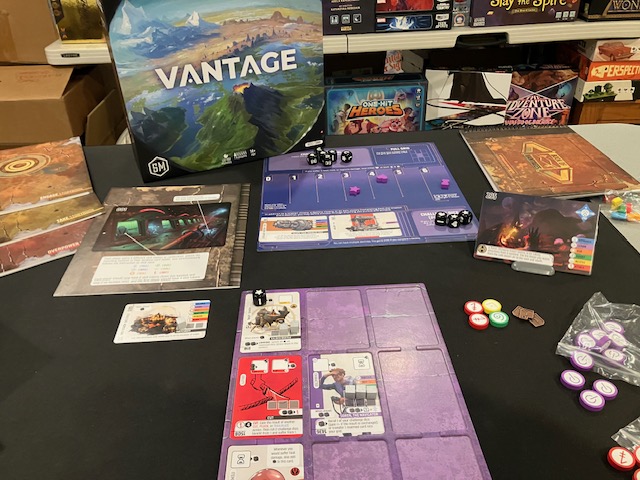
The cooperation comes in by either sharing skill tokens with each other (to mitigate die rolls), or sharing dice-placement locations with each other.  When you make Challenge rolls, you have to deal with the consequences;  you can mitigate the dice-rolls by doing dice-placement on appropriate spaces on characters.   See above as the Blue character can always mitigate a die for a Explore (blue) type roll.  Also, she has a “global” place for any character to mitigate Morale (the lightning bolt means “global: any character may use”).

Any dice you can’t mitigate are either Morale, Health, or Time losses.  See above as each character has their own Morale, Health, and Time.  If any of these go to zero, the game is “over”.

Thematically, it’s a little specious that we can share skill tokens and dice-placement spaces, because we aren’t on the same Locations (usually).   My own interpretation of this: I like to think that we are all in constant communication over some intercomm system, and we can share each other’s expertise!  So, the sharing skill tokens and dice-placement spaces, at least in my mind, is sharing expertise“Don’t eat that! Purple plants are generally dangerous!”  I kind of wish the rulebook had done more to explain this cooperation thematically.  But hopefully my explanation of sharing expertise works for you.

One more thing, I kind of think three or four is the best player count; With three, you are only “not involved” every third turn, and you can care about your friends stories … because there’s only three or four of them.  At higher player counts, I think you will “stop caring” and the game will become much more multiplayer solitaire (and you might get bored waiting for your turn).

Things We Were Unsure About

Locations: Charlie and Allison didn’t love that we couldn’t see each other’s Location pictures: but the rules are very clear about this.   I think the game would offer the explanation that it would “break immersion” if we could share pictures: you should only be experiencing your own story.  While I understand this explanation and maybe even might agree with it in theory, it’s so much more fun and cooperative to say “Look how cool this Location is!” .. and show it to everyone. It would actually make the game more cooperative, or at least more interactive.  In fact, if we go with premise that we have an intercomm system that we are communicating on, I’ve got to believe we have a camera on our phone!   🙂 Maybe the game should just allow you to share pictures every so often … the rules are a little draconian on this point, but maybe a little too much.

Bottleneck: The major bottleneck in the game was almost always waiting for Rich (me) to get the cards.  It was probably the most annoying part of the game.  The rulebook suggests that only one player should handle the cards … as it makes the game move faster …  but it feels there could be a better way to share the load on this. Me, as Rich, ALWAYS did all the work and it was annoying.  An easy easy thing would be to let one person handle the Location cards and one person handle the items.  At least then 2 people would be doing that in parallel and share the load!!   The decks can always easily be divided as well.  Maybe it’s too chaotic to split these decks, but I feel like there’s got to a better way to share the load: this is a cooperative game for goodness sakes.   

Conclusion

You might think, that after reading this, that I didn’t like this game.  But I did!  I just wanted to explore a lot of the issues so you understand what this game is and isn’t!  It’s not a campaign game, but it can be over the long haul.  It’s an exploration game, but it’s kind of not as you forget all the exploration you’ve done from game to game (usually).  It’s an adventure game, but it’s kind of isn’t as you can only interact with Locations once.  It’s a Storybook game, but it’s kind of not as the Storybook is more like directions (and the story exists in the Locations).  Vantage is just a little different, and I hope you got that from this review.

I liked the solo mode: it works well and it really teaches the game.  Be aware that you might feel vaguely dissatisfied in the solo game because you don’t get to continue your exploration from game to game.  If you go into the solo game with a carpe diem mindset, and just enjoy this for what it is, you will be much happier!   I’d probably give this a 7/10 for solo mode, but if there were a more systematic way to explore the Planet and keep the exploration going (especially in the solo mode), I’d probably bump this up to an 8 or a 9/10.  It’s a pretty neat world!

The cooperative mode was a hoot and we had a fun time playing!  The cooperation feels a little athematic unless you think of us all sharing an intercomm system!  Then the sharing of skills and dice-placement mitigation spaces is like sharing expertise amongst ourselves; that little premise really goes a long way towards making the game feel cooperative.  Of course, the Storybook reading to each other makes the game very interactive and fun too!  I’d give this 8/10 for cooperative play.  I’d probably never play with more than four players though.

If you are interested in Vantage, you should give this a try to see if you like it: It’s very different from other Storybook games like those in our Top 10 Cooperative Storybook Games!!  I freely admit I didn’t love my first play of Vantage that much; I had to play it a few times.  Maybe you want more flowery prose, maybe you want more story, then consider Wandering Galaxy or Tales of Arthurian Knights instead.   Maybe you want more persistent exploration, consider Earthborne Rangers instead.  But Vantage is such a different beast than many games out there, don’t judge it right away.  Give it  few times to see if you like it.  And it’s okay if you don’t like it.  It’s also okay if you do like it!


Late To The Party, But The Party’s Still Going! A Solo and Cooperative Review of Tales from Red Dragon Inn!

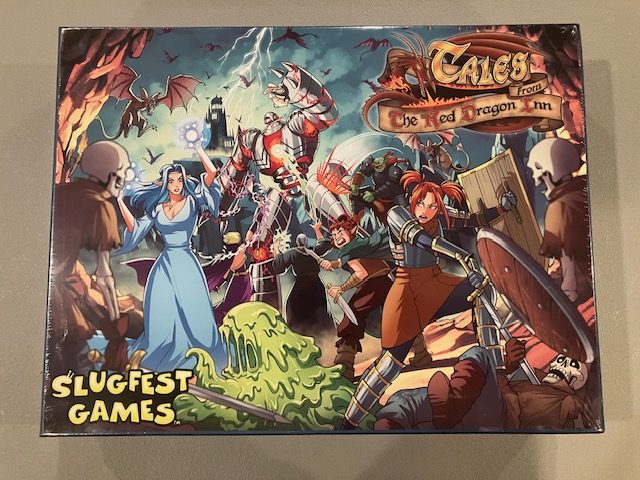
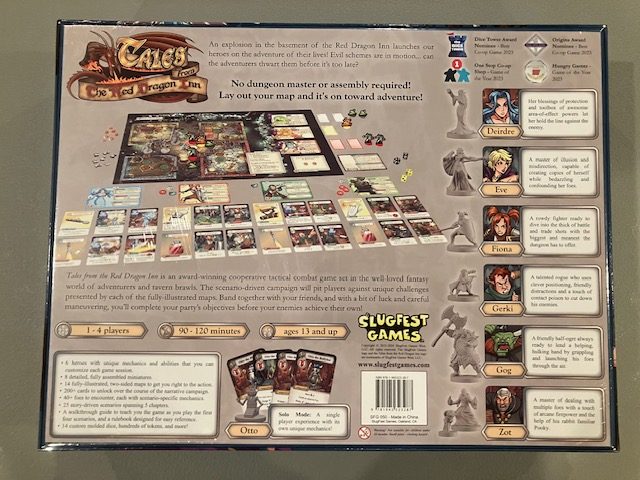
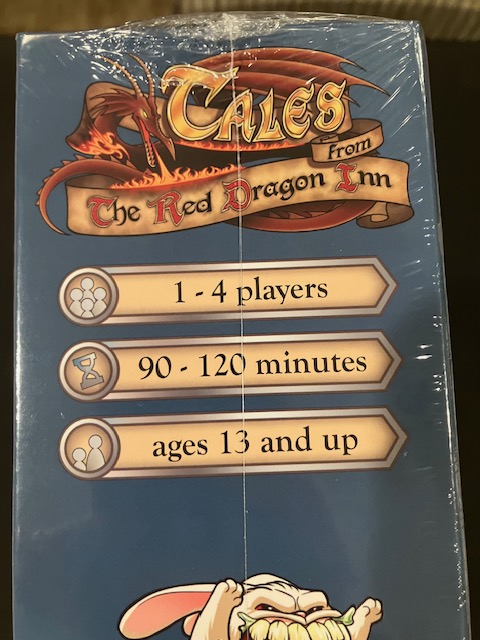
So, the original Tales from Red Dragon Inn was on Kickstarter way back in October 2021, and delivered to backers in 2024.  It was so popular, they had a second Kickstarter in June/July 2024, and that’s the one I backed!   This cooperative dungeon crawler for 1-4 players looked really cool!

Why didn’t I back the original? I think I was afraid of getting YET ANOTHER DUNGEON CRAWLER (YADC) campaign that I wouldn’t play!

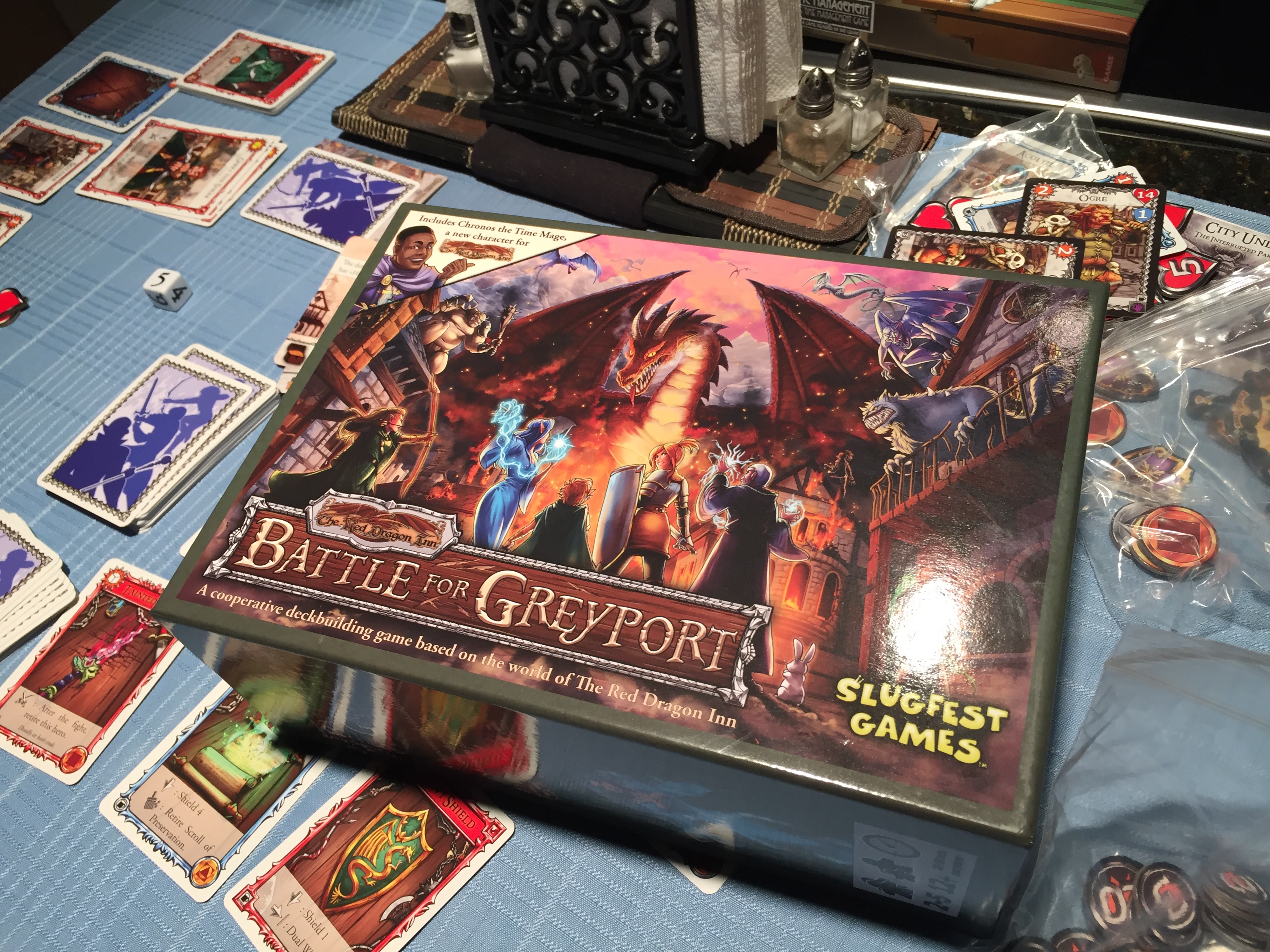
I do love this universe … especially the Red Dragon Inn cooperative Deck-Building game called Battle for Greyport (see review here and here: It’s also in our Top 10 Cooperative Deck-Building Games!)! I love the art-style and the silly vibe of this universe!

Let’s take a look!

Unboxing

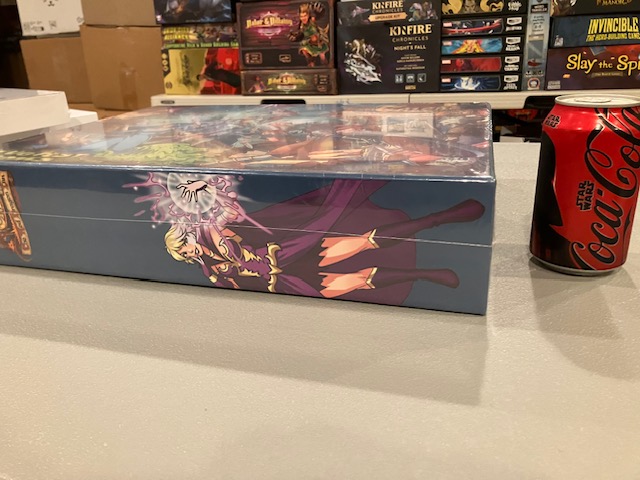
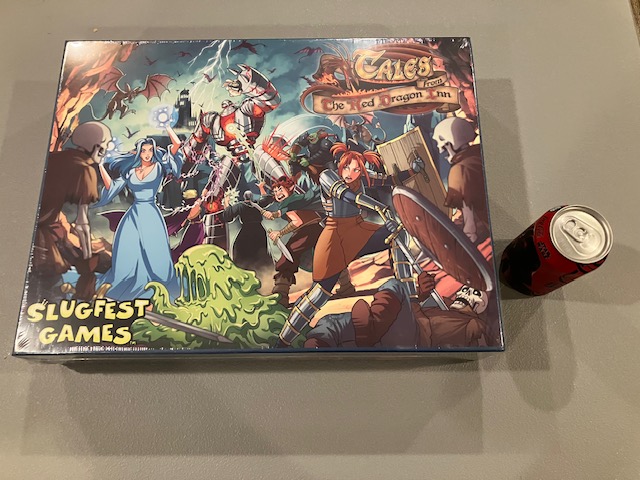
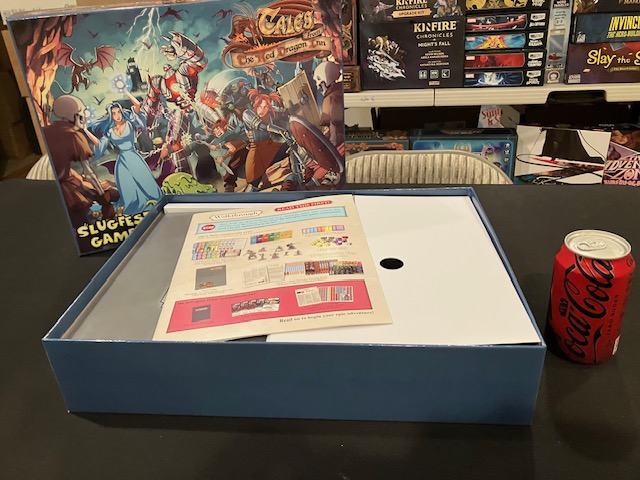
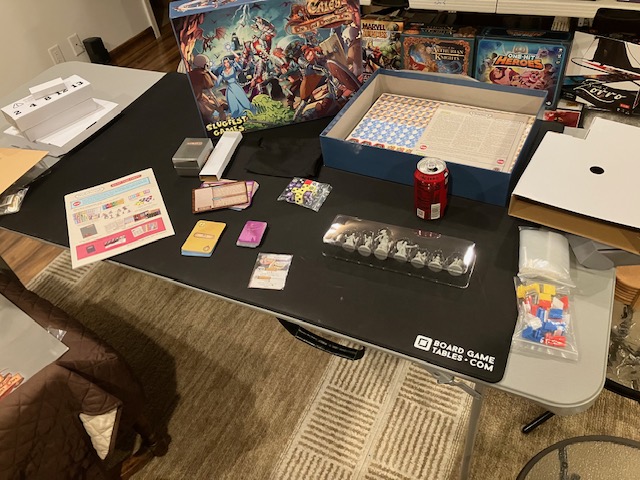
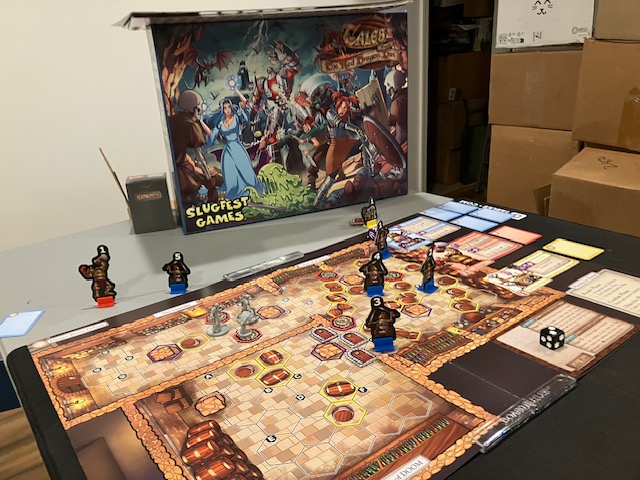
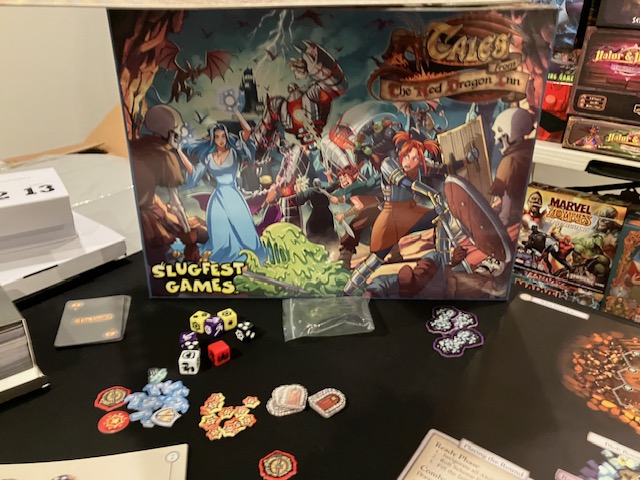
This is a fairly big mama-jamba of a box: see Coke can above and below for scale.

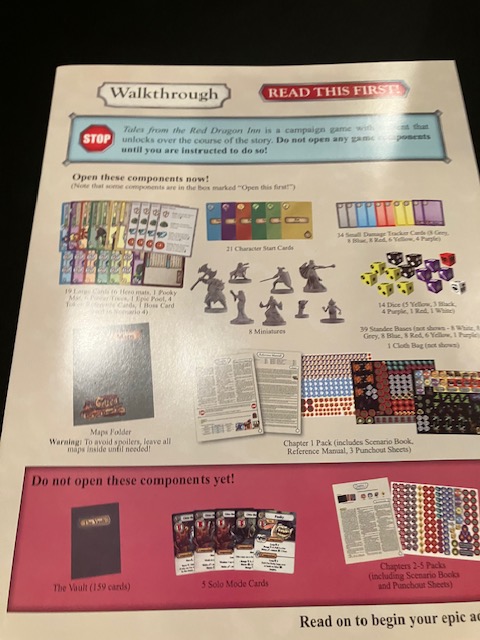
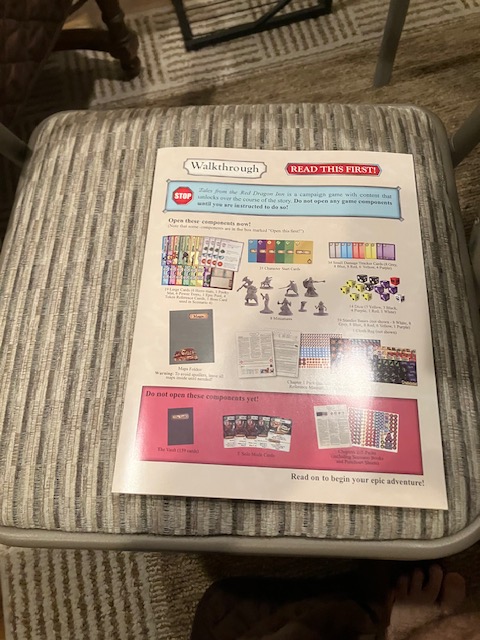
Ah, this game comes with a first-play walkthrough!  This is a really good walkthrough!

What’s in here?

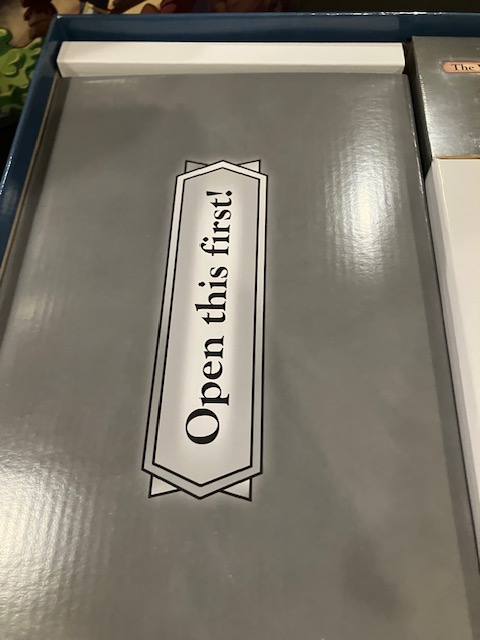
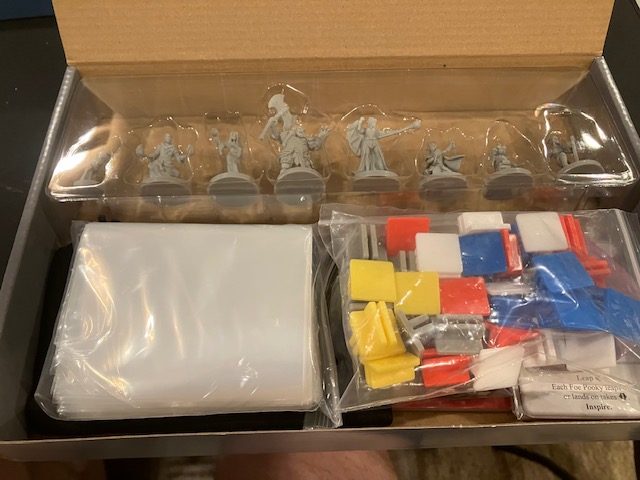
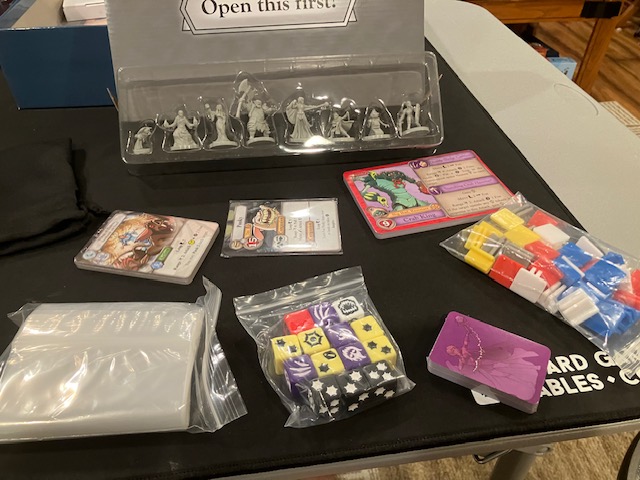
The game comes with most of the cards and minis in this little grey box.  (Grey box?  Greyport? Get it?)

And some dice.

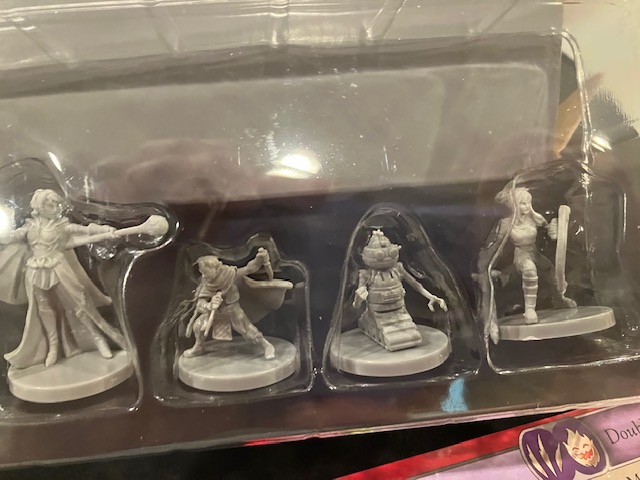
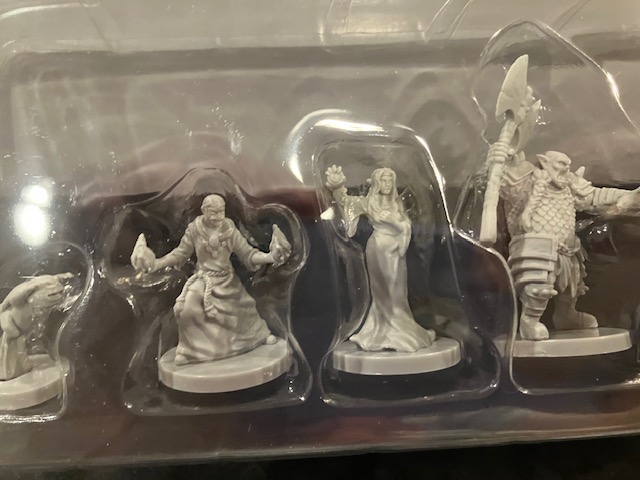
The minis are pretty good.

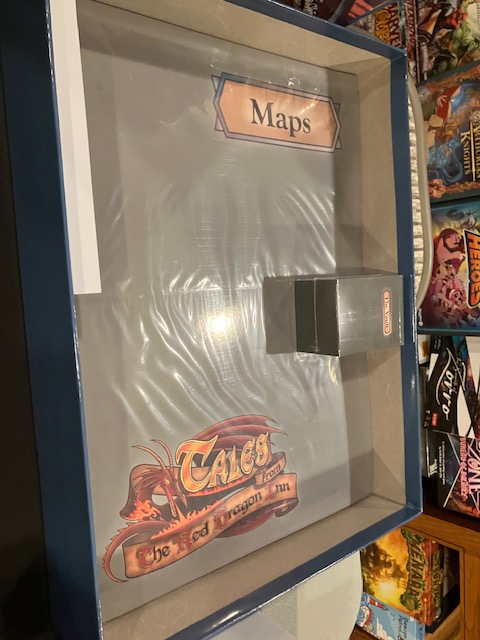
Underneath all that are the map packs.

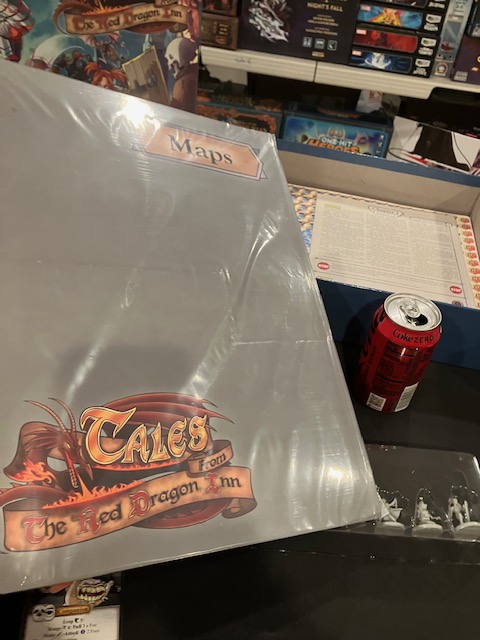
This map pack is pretty huge! See Coke can above for scale.

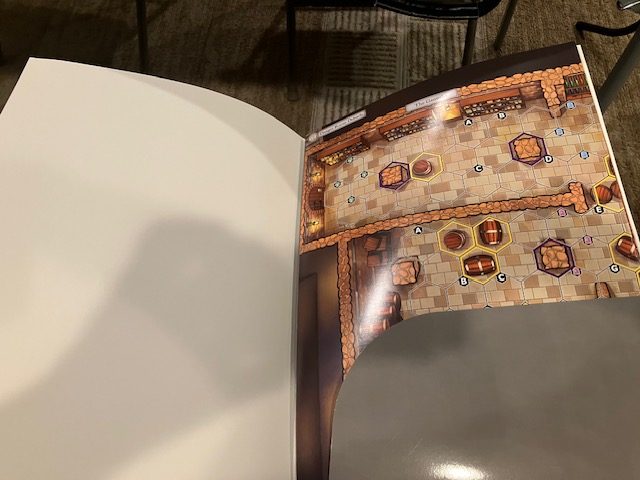
… and there are quite a few maps for the adventurers to go on!

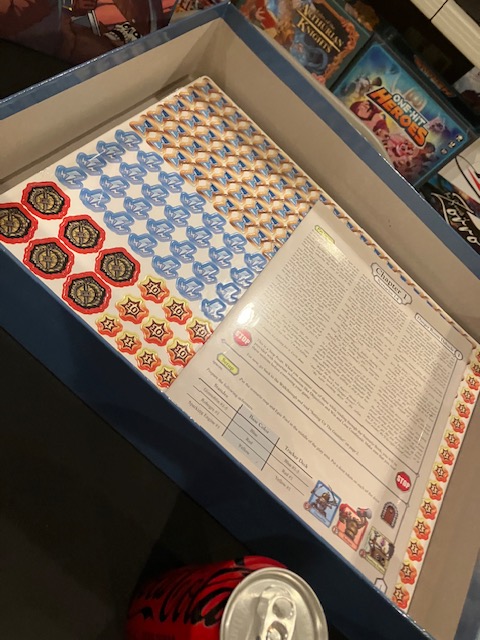
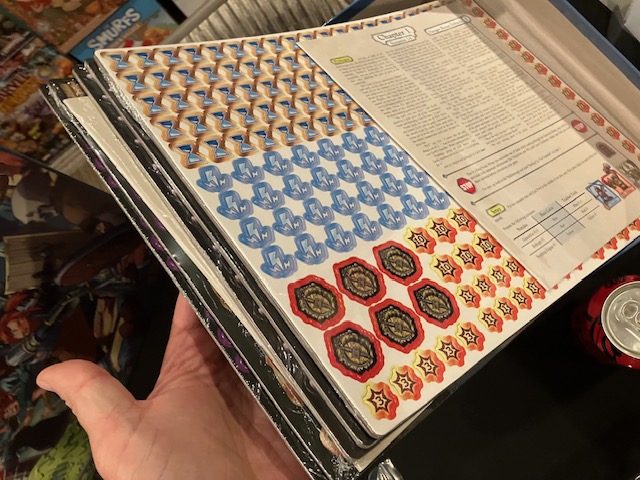
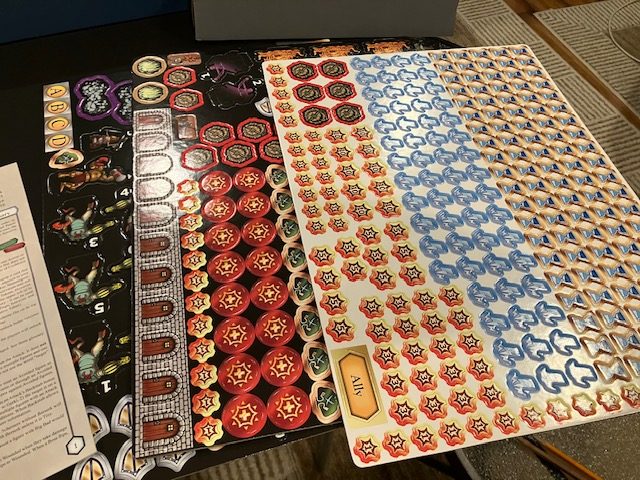
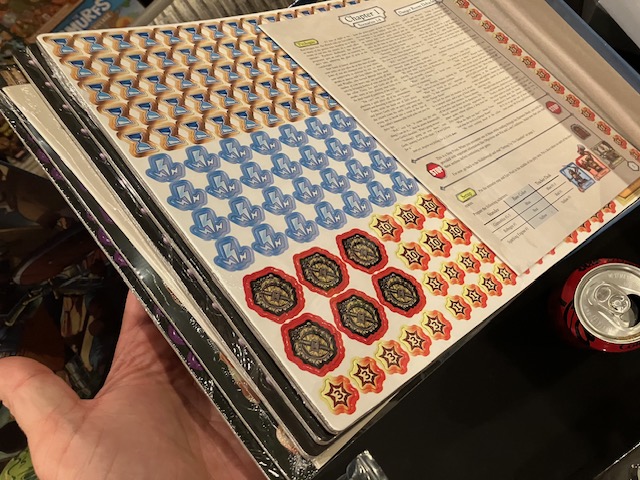
Underneath the maps are TONS OF PUNCHOUTS.  And by tons, I mean tons by weight!

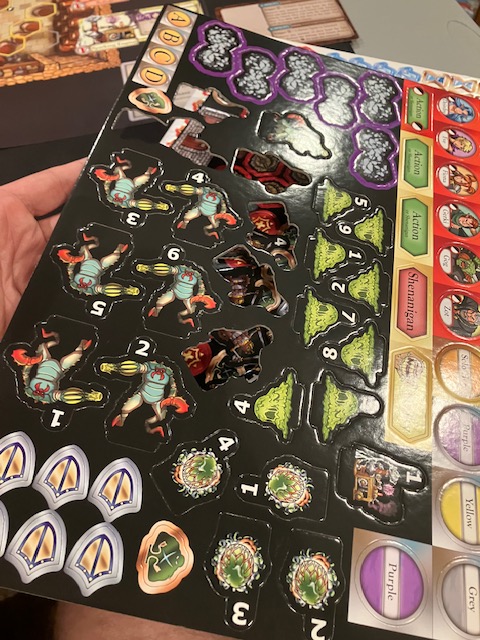
There are 5 individually wrapped punchout sets (with multiple punchout sheets per set!)

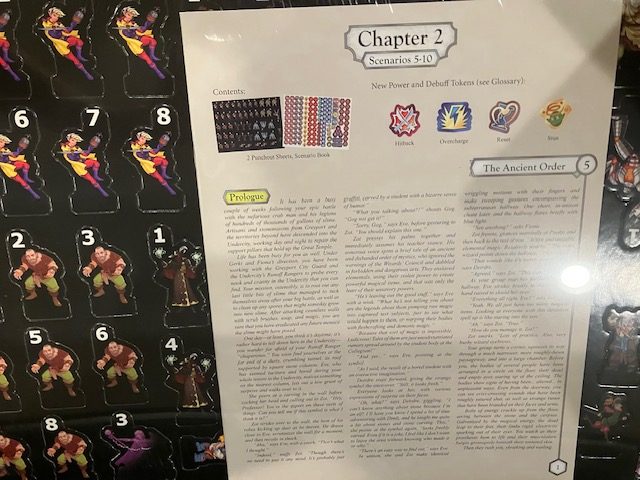
And a new chapter rulebook per set!  Whew!

There are … so …. many … punchouts!

But overall, this looks pretty cool!  I am just scared of how many punchouts there … (but keep reading below …)

Gameplay

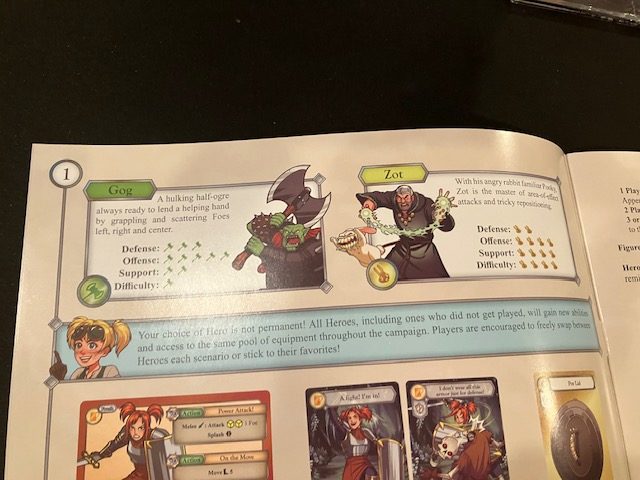
This is a cooperative dungeon-crawler where each player takes the role of a different hero … the typical Dungeons and Dragons archetypes are all here: thief, fighter, barbarian, etc.  Despite the classes being fairly generic, these characters have so much … character! 
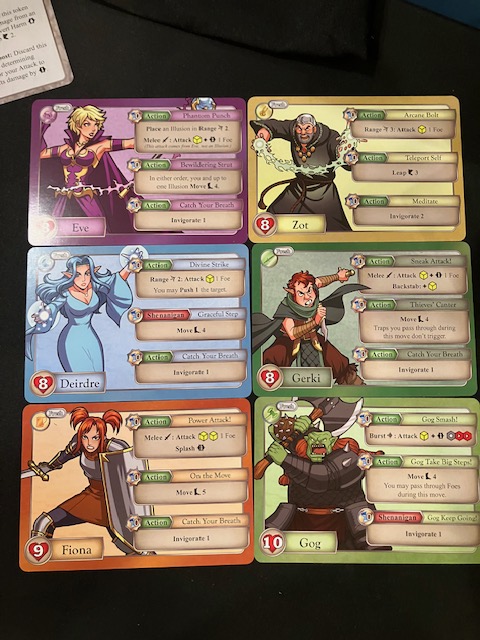
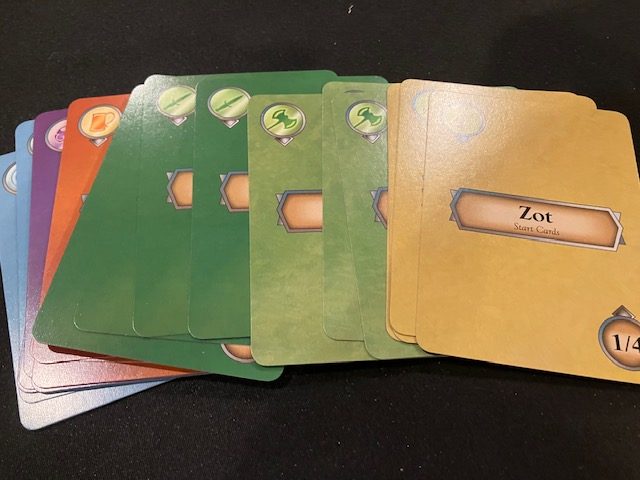
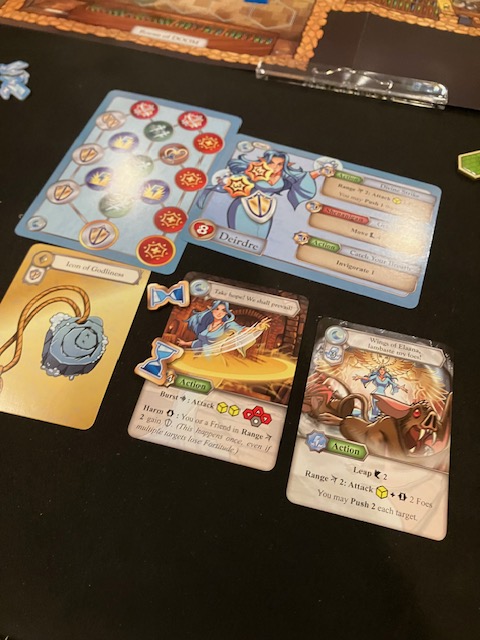
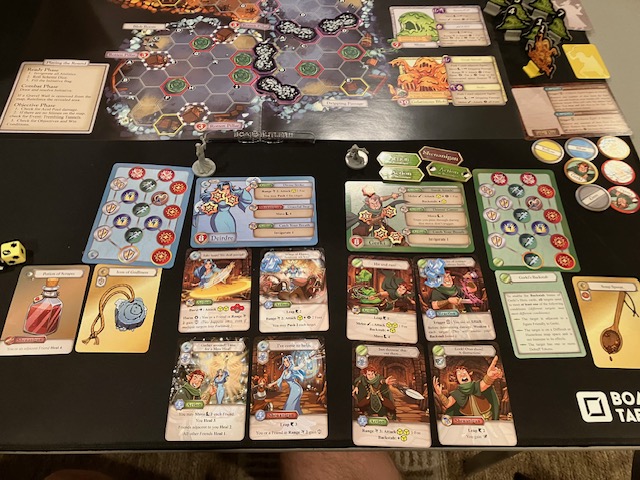
Each character has some character specific cards giving the asymmetric powers.
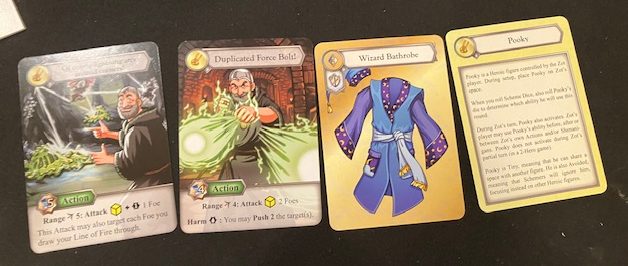
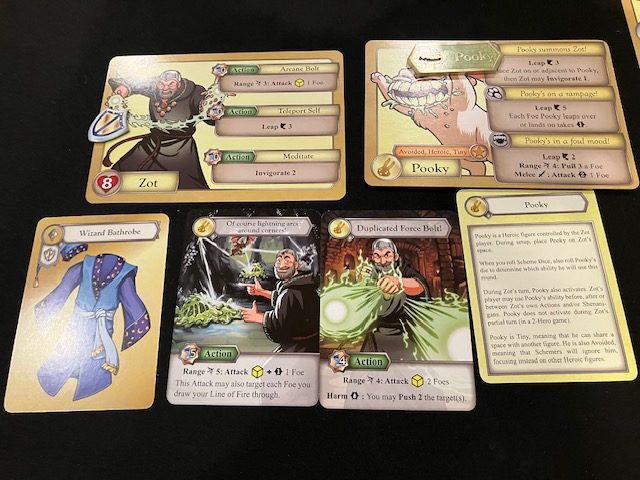
For example, Zot (above) has some special Actions specific to his character!  But notice the art and the feel!  This is not your typical dungeon crawler!  There’s character and a sense of humor here!  The game looks light and fun … and surprise! It is!  And pooky!

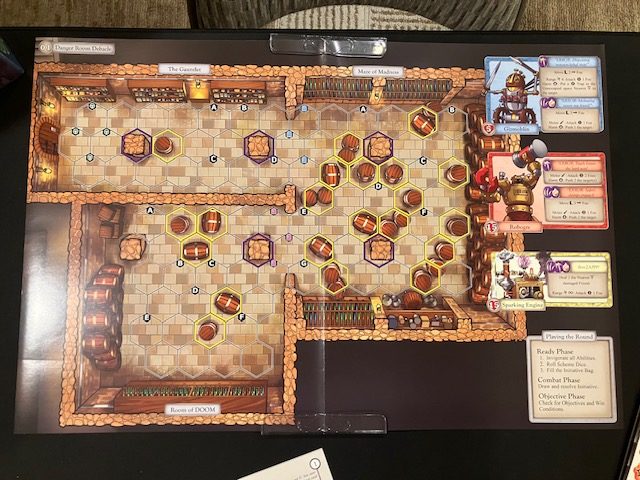
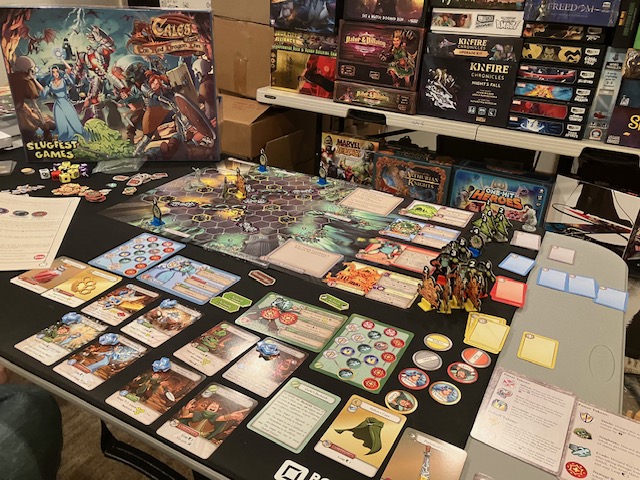
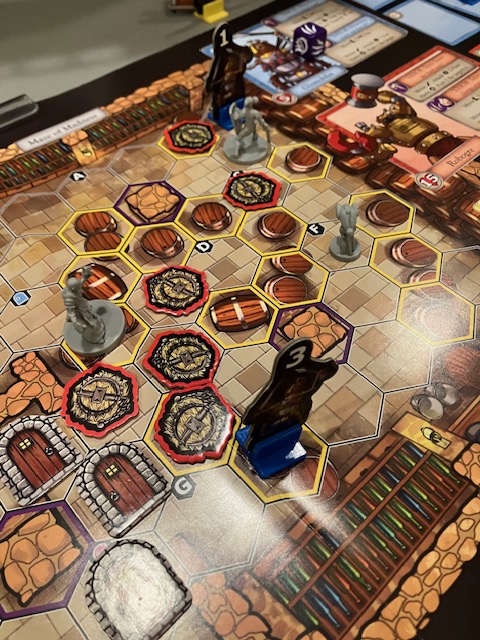
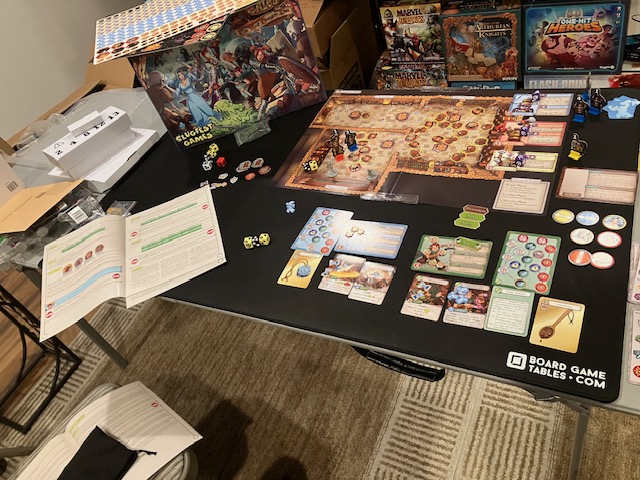
Players will set up the Chapter of their campaign; see scenario 1 of Chapter 1 above!

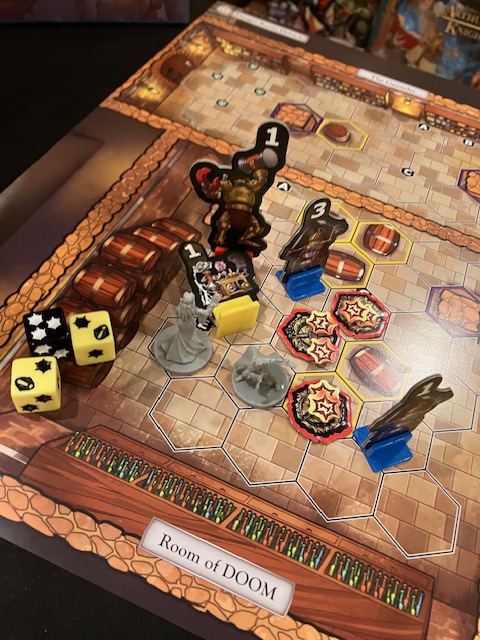
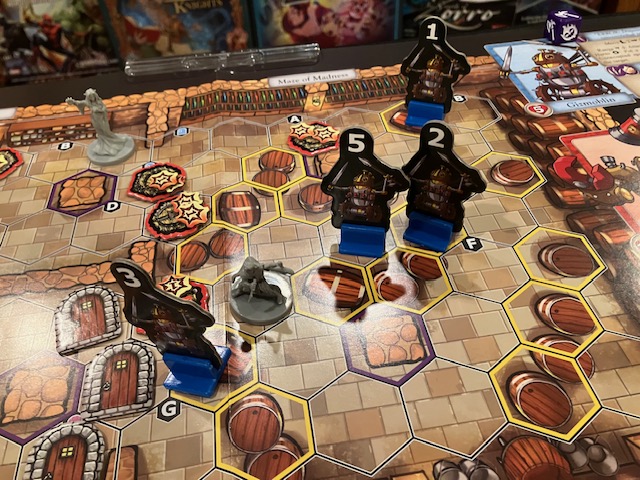
One of the coolest parts of this game is that the monsters are all described ON THE MAT!  So, you don’t have to go searching books or monster manuals for the monster info!

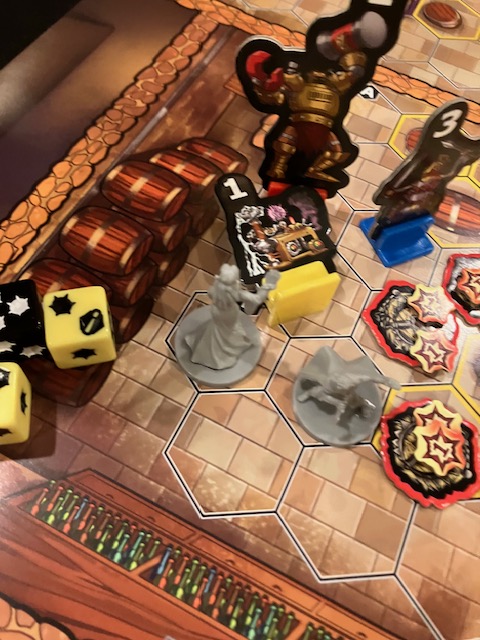
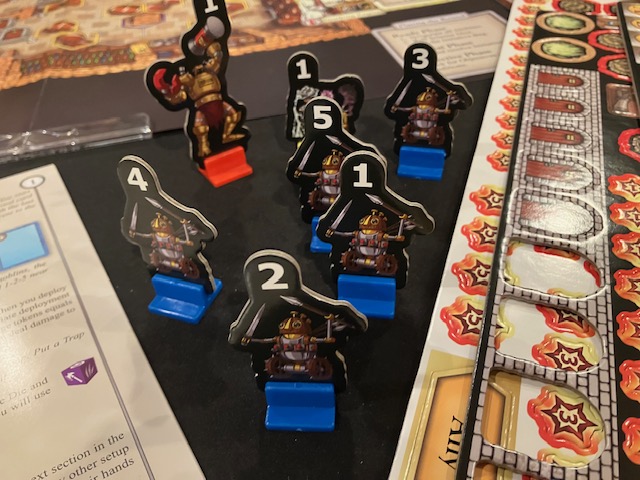
The minis are color-coded via bases, and this system works great. I was a little worried that the bases might “harm” the cardboard standees ( … Gloomhaven: I am looking at you …), but the standees stand well and the bases DO NOT harm the cardboard (NOTE: After a number of plays, there’s a little bit of wear and tear, but it doesn’t ruin the cardboard: it just indents it a little).
To keep track of hit points, each mini has a number above it, and  it also a little card associated with the number. See above.

It makes it really easy to correlate the mini with its hit point card!  This system is simple and works surprisingly well! They used colors really well here.

Players operate these heroes, explore the dungeon, and fight the baddies!

This is a fight-em-up dungeon crawler!

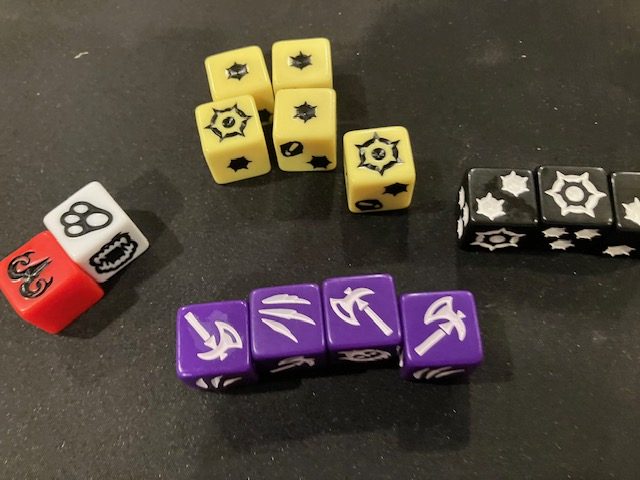
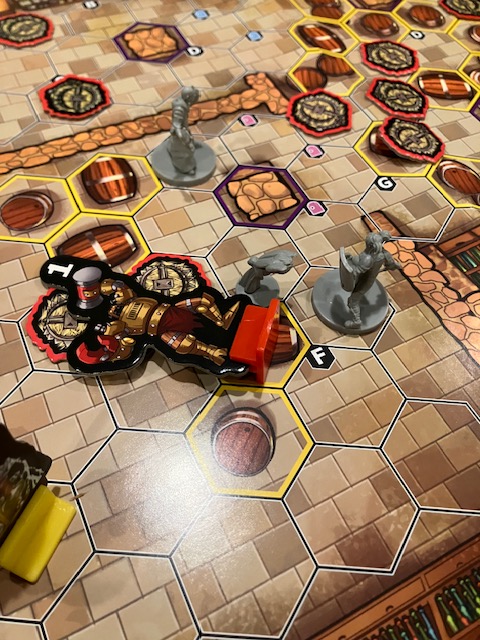
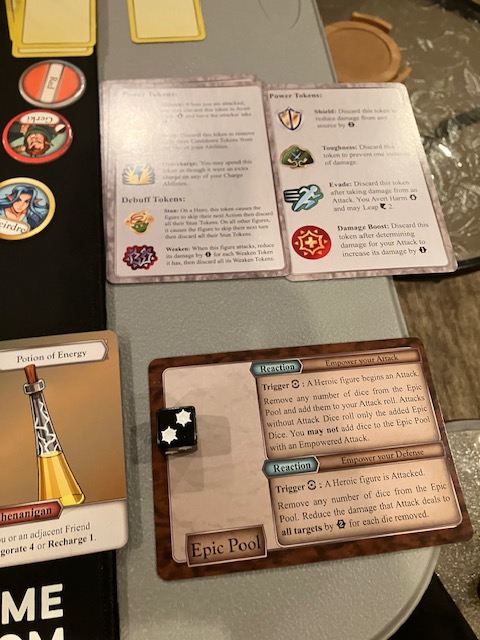
Combat is decided by the yellow and black dice.  You might be worried that the game is too random if dice decide a lot, but the dice are pretty consistent.  You will always get at least one success per dice, sometimes you will get exploding dice (which you can reroll over and over) and sometimes you will get some extra epic dice for FUTURE rolls!

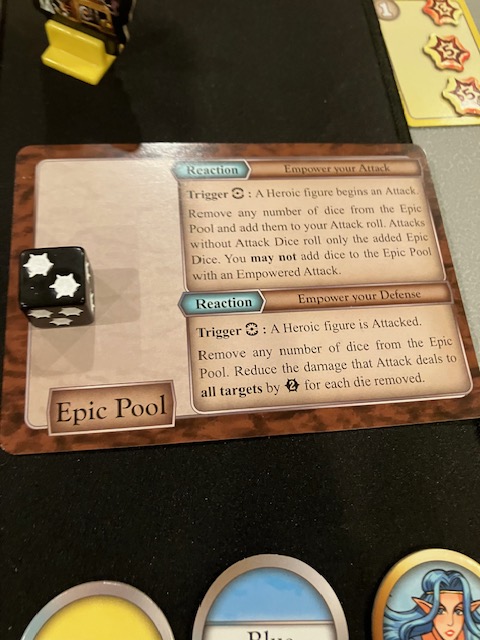
If you roll the ! (exclamation point) symbol on the yellow dice, you get an Epic black die (modulo some rules) which you can use on a future turn! My favorite part of this is that you can CHOOSE when to use the Epic dice on a future turn!  This reminds me a little of the Hour of Need system (see review here and here) where current rolls can contribute to future successes WHEN YOU WANT/NEED THEM!  You choose when to use those Epic Dice!  That’s so cool!

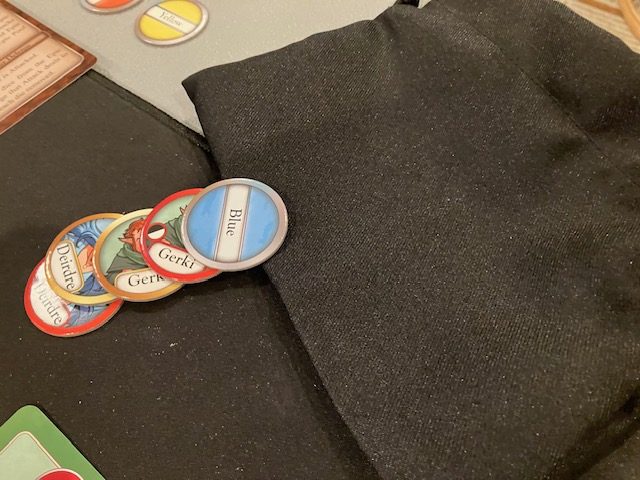
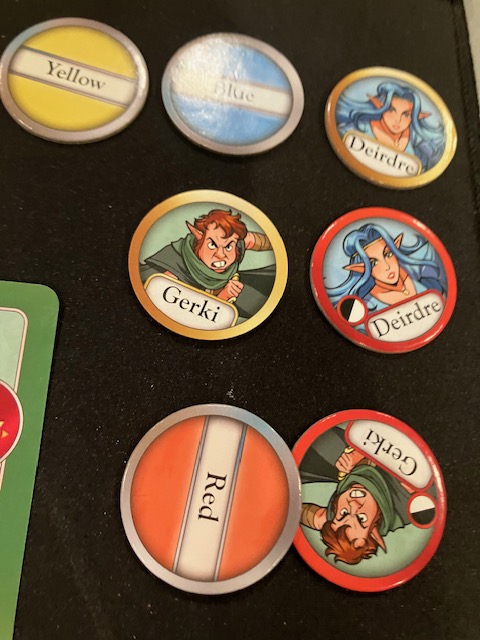
This is a Variable Turn Order game: each player and each set of monsters gets a token and one players pulls the token out of a bag to decide when each one goes.  See above.  I was very worried when I saw Variable Turn Order: was I going to have to worry about all the problems and try to come up with a solution?  See a very in-depth discussion of Variable Turn Order and its problems/solutions here!

After all was said and done, the Variable Turn Order system didn’t seem to suffer from the problems we normally see!

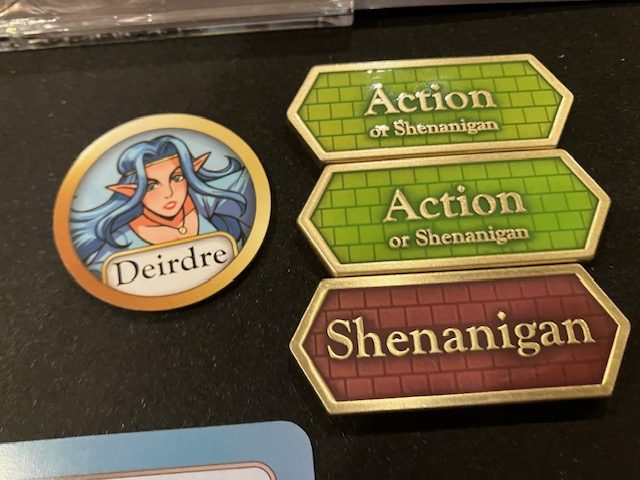
Depending on the token you draw, you either get 2 Actions and 1 Shenanigan …

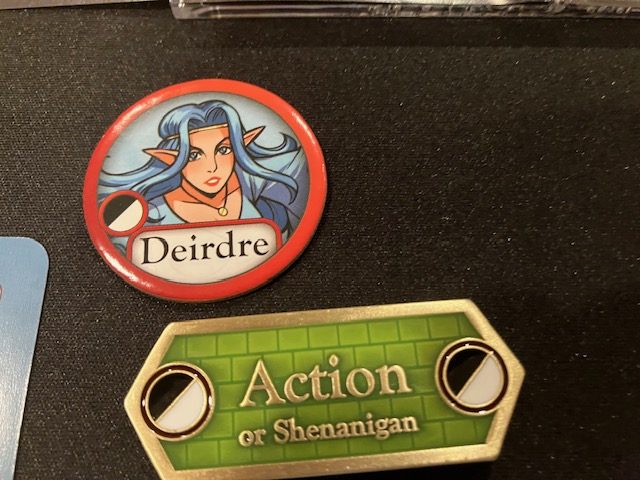
Or 1 Action or Shenanigan! (1 and 2-Player games with partial actions).

Your Actions and Shenanigans are well defined on your cards!  See above!

Note that every character has very different Actions and Shenanigans! It’s funny, that one word Shenanigans kind of implies the overall vibe in this game …

This is all about your characters moving around the maps and fighting baddies!

If you reach the final objective (killing the yellow slime above for scenario 1: see above), you win (… if you survive to the objective phase…)! If any character dies, you lose! There are other losing conditions too, as you get further into the game.

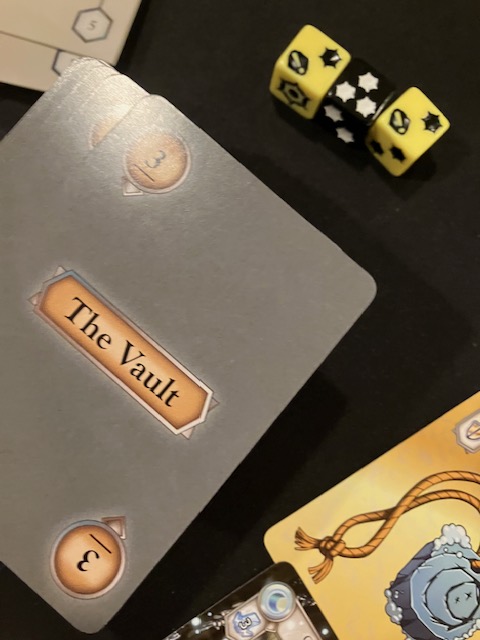
It’s a fun dungeon crawler! And you get to level-up your characters too! As the game gets further along, you can get new cards from THE VAULT which you can use to choose upgrades!

Walkthrough

By far the best part of this game is HOW GOOD the first play walkthrough is!

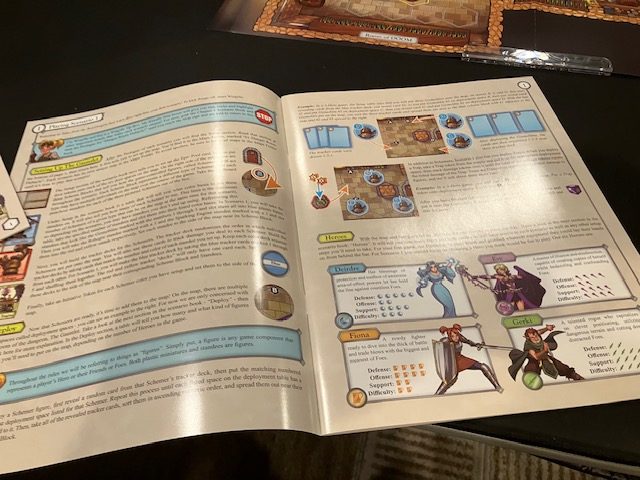
This Walkthrough takes you through the first 4 scenarios of Chapter 1 in great detail!  There’s no need to read the rulebook ahead of time (well, because there isn’t one) … you are just learning the rules as you play from the Walkthrough!

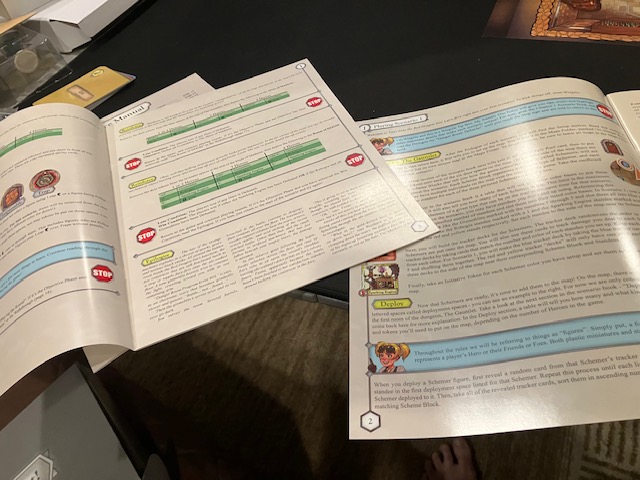
Coupled with the Walkthrough is also the Chapter Guide (see above).  The Walkthrough tells you when to look at the Walkthrough and when to look at the Chapter Guide for specific set-up.

I can’t tell you HOW MUCH I liked this walkthrough!  Worried about getting into the game?  Naaah … this Walkthrough is fabulous!  It slowly introduces you to all the rules as you go.  This reminds me very much a video game training mode; it works so well!

Incremental Punchout

One thing I was VERY worried about was punching out ALL THOSE TOKENS before you can play!  And guess what!  You don’t have to!  You can punchout what you need as the game flows!

Do you need some monsters?  Just punch them out now when you need them!

This Incremental Punchout philosophy worked really well with the way that the Walkthrough taught the rules; learn a little bit at a time, punchout a little bit at a time!!! So, don’t get overwhelmed by all the tokens … just take tokens as you need them.  I wish the rulebook had emphasized this point, because just LOOKING at the token sheets gave me heartburn! 

I strongly recommend you punchout as you go and do not do everything at once: you’ll get right into the game that much quicker!

What Is This?

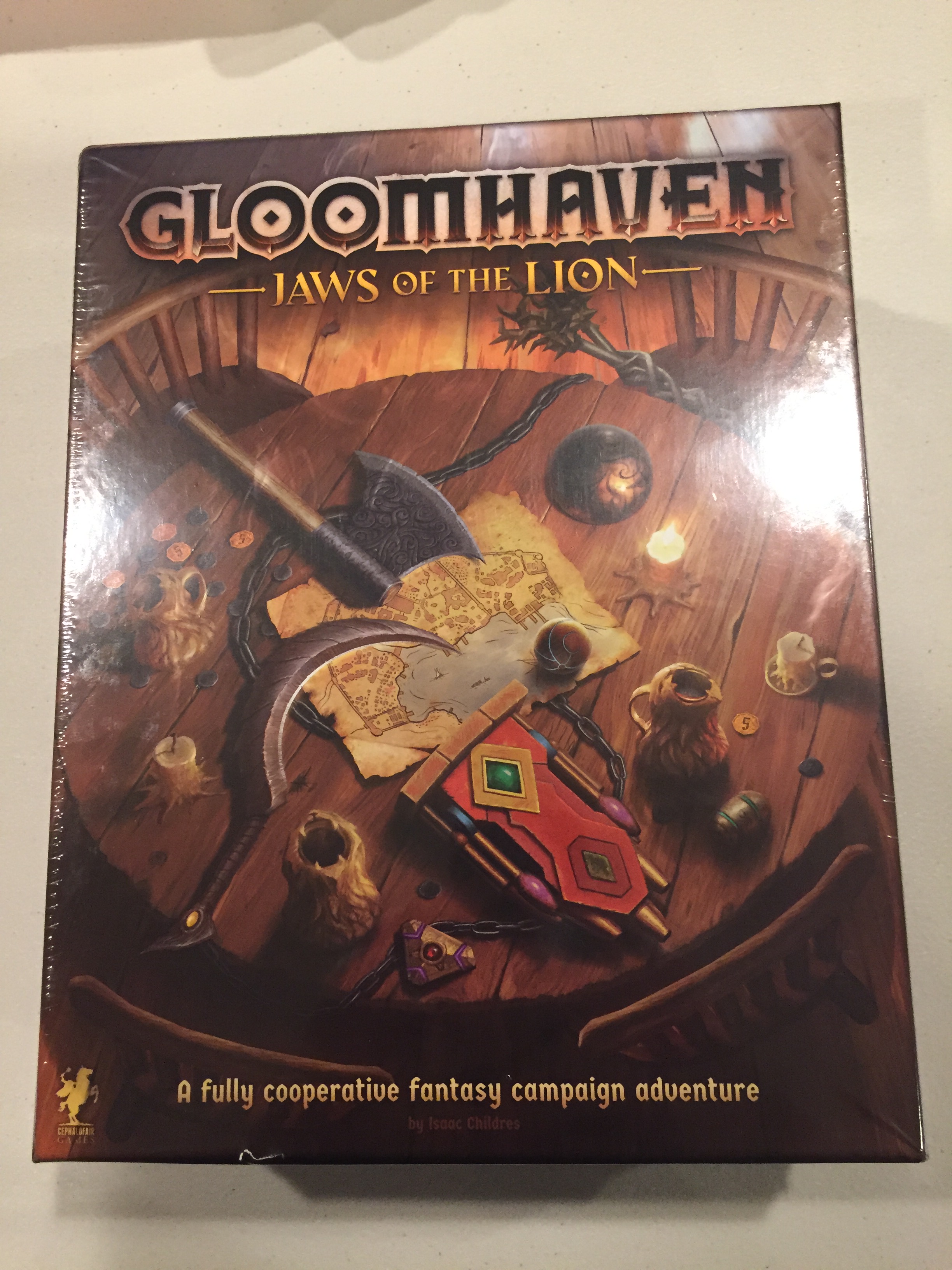
How would I describe this game?  In one word: LighthavenTales From Red Dragon Inn has a lot of similarities to Gloomhaven: it’s a cooperative dungeon-crawler campaign!  Players explore the world, fight monsters, upgrade characters, and quest quest quest.  But the gameplay is lighter, the rules are lighter, the world is “lighter”, the art is lighter and cuter … there’s no Gloom here!  

Like Gloomhaven, Tales from Red Dragon Inn does have a lot of components, but this world just feels just so easy to jump into.  

There is some story here: about as much story as Gloomhaven.  If you are looking for more adventure games, consider games like Arydia (see review here) or storybook games like Tales of the Arthurian Knights (see review here).  If you want story story story, this probably isn’t the game for you … this is a dungeon crawler where you fight monsters!

Solo Play

So, Tales from the Red Dragon Inn does support a solo mode!   (Thanks for following Saunders’ Law!)   In fact, two solo modes!

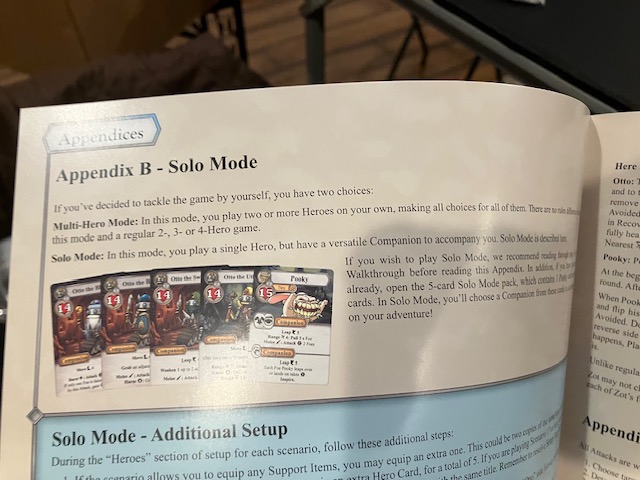
It’s a little bit of a bummer that the solo play isn’t addressed right up front … you have to go looking for the solo rules in the Glossary (a very complete book!) that comes with the game.  See above.  There are two solo modes; play normal, but alternate between some characters like a multiplayer game …  or play a solo character with a Companion.

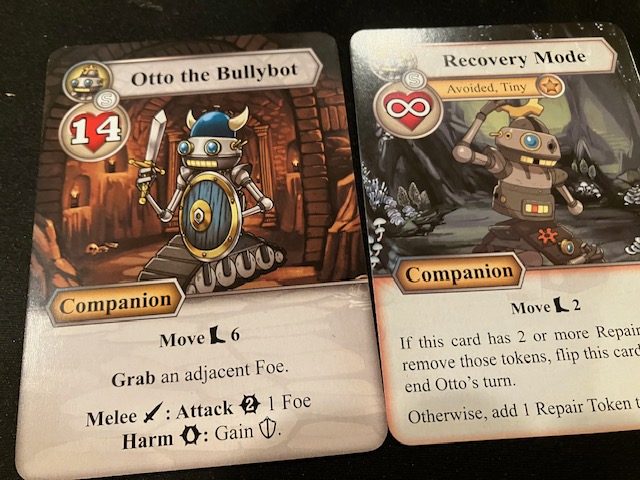
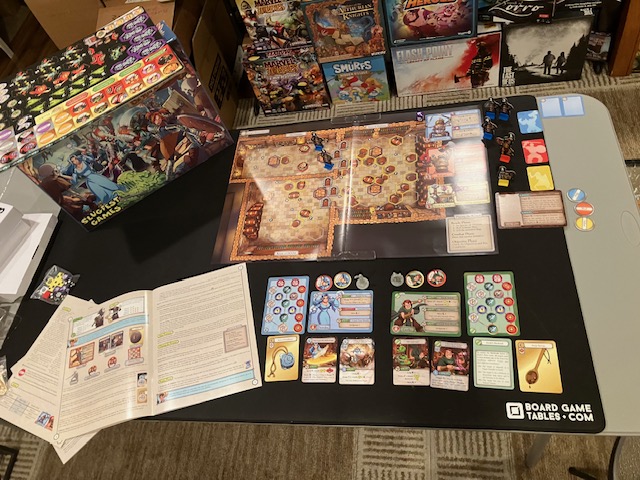
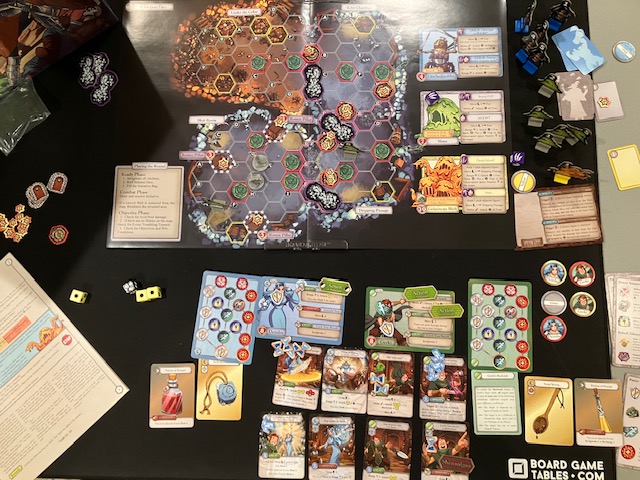
The Companion has a special set of cards: see above.  The Companion rules also take up a full page on the Glossary with lots of exceptions to gameplay.  I usually HATE solo modes with lots of exceptions to the rules, so I opted to just alternate between two characters because there are NO RULES CHANGES.  I strongly recommend this is how you play solo; the Companion is still an “extra” thing to play and doesn’t save that much context switch overhead.  At this point, I have played the first Chapter all the way through with two characters and didn’t have any problem going back and forth between characters. In other words, the context switching between two characters didn’t seem to cause me any issues as I played solo.

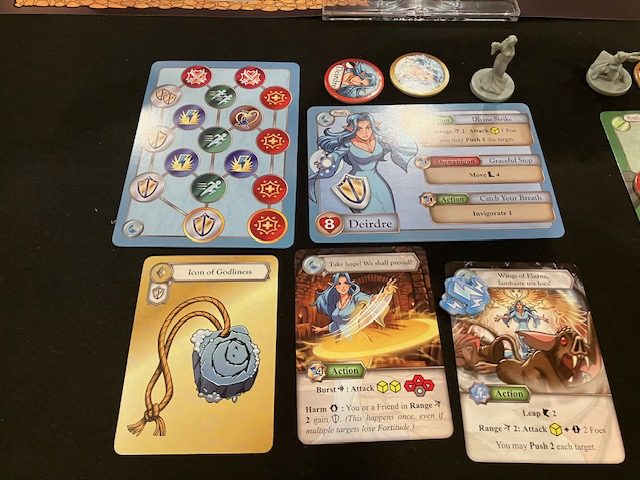
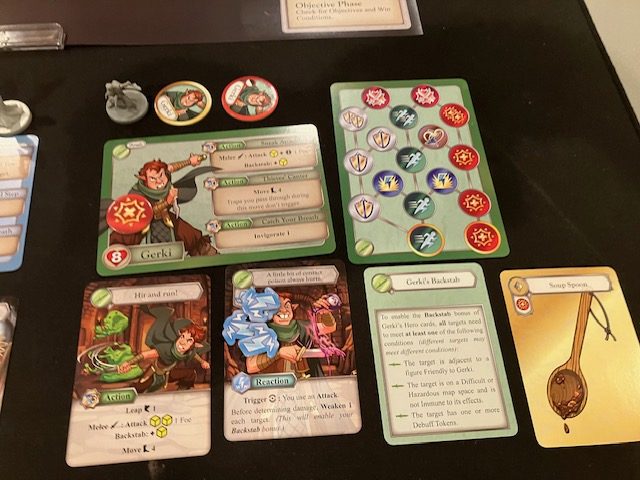
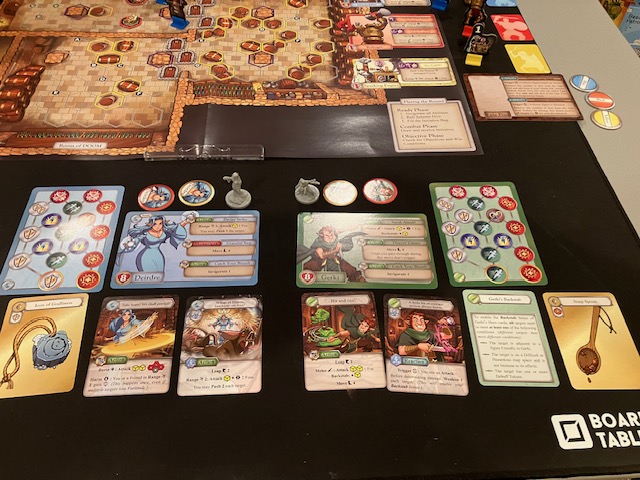
My solo game was operating Deidre and Gerki.  They made a great team!  These two characters really worked well together; Deidre is better at long distance stuff, but occasionally she’ll get in there and help Gerki!  If she stands NEXT TO some monsters, Gerki gets his backstab ability (an extra die!)  The amount of cooperation between the two was quite good.  

I have spent about 15 hours playing the game solo.  I learned the game solo, set-up the game solo, upgraded, read the Walkthrough solo, and played all 4 scenarios of Chapter 1!  I had a blast!  I loved the simplicity of the system, I loved how the characters can work together well and support each other, I loved the “sense of humor” the art implies, I loved the art, I loved the vibe!

Once you know the game, your sessions can be quicker, but be prepared for your first 4 sessions to take about 15 hours or so!  But, it flies by!  You are having fun and always doing something!

I look forward to more solo sessions, but I had to reset the game (this is not a legacy game, but it is a campaign game and you can reset it) so I could play it cooperatively with my friend(s).

Cooperative Play

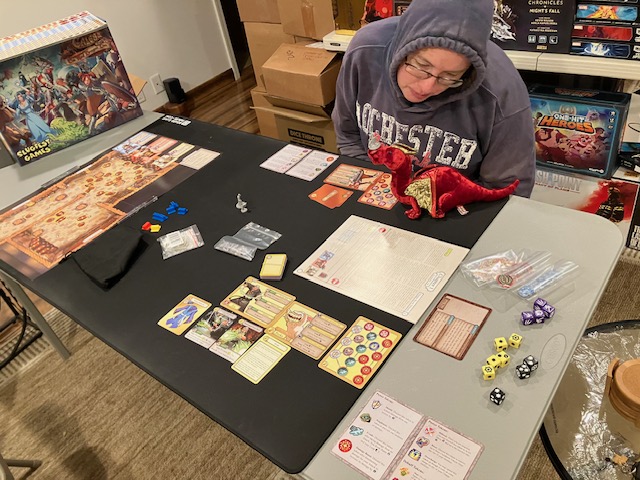
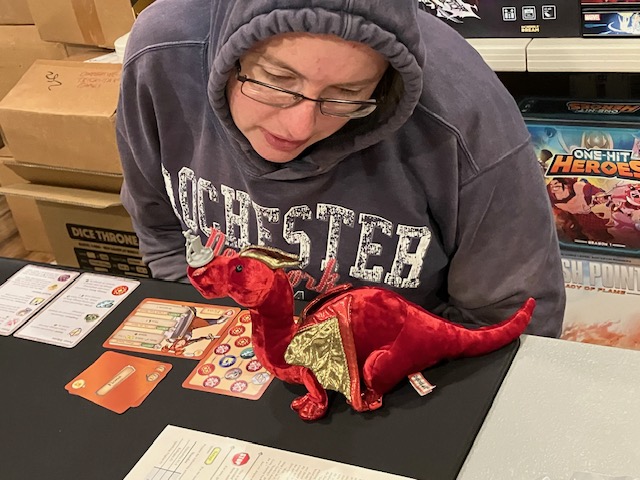
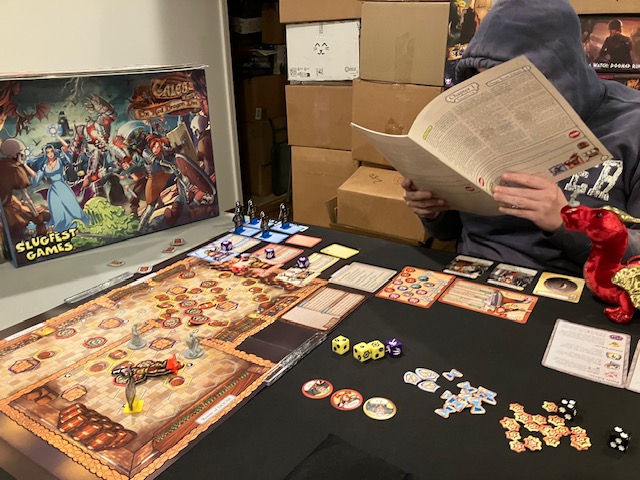
My first cooperative experience was a 2-Player game with Teresa.  She brought over a little red dragon as a mascot … it was quite apropos!

For a different experience from the solo game, I played Zot the wizard.  He was funny!

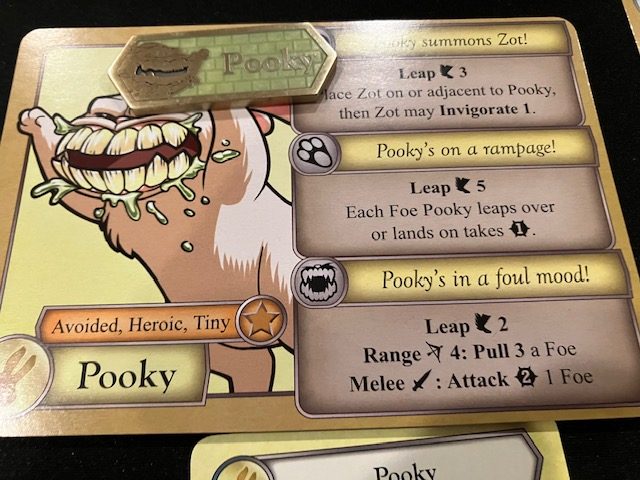
It’s hilarious that the little guy POOKY who helps Zot summons HIM!  (Not the other way around) See above!  That’s hilarious!  And yes, we are convinced this is the rabbit from Monty Python and The Holy Grail.

Like the solo game, we saw some good cooperation as Teresa’s Fiona Character was all melee, while Zot was all distance!  A good combo!

The game also moved much more quickly since I had already played the entire Chapter 1 solo.  A lot of those “15 hours” I spent in the first 4 solo games were shortened considerably!  I think Teresa and I got through Scenario 1 is about an hour!

Playing solo ahead of time significantly increased how quickly we were able to get into this game.  

Will we play more?  Basically, Teresa wants to wait until Sara comes back and then we’ll start a 3-Player campaign!  

I think it was a success cooperatively: it’s always a good sign when your friends ask to continue the campaign!

Story vs Flavor Text

There’s not a lot of story per se, but there is a lot of flavor text that gives the game direction and charm, and helps establish the parameters of the game.   To be clear, you really don’t HAVE to read the flavor text … I didn’t read it all in my solo play, but it didn’t really detract from the game by not reading it.  Teresa LOVES flavor text, so we did read it (see above) and it did contribute to the atmosphere of the game: see above.

What I Liked

Charm: This game has so much charm!   The art style that permeates this game is just so much fun! It stays within the Red Dragon Inn universe … Dragonverse?

Unique Characters: The characters are also so unique and different! For example: the fact that Pooky (the little familiar) summons Zot is hilarious!

Walkthrough:  This first play Walkthrough is exceptional and makes it easy to jump in!

The Dice System:  I was really worried the dice system would be too random, but it’s really not.  You always get at least one success, you can get exploding dice, and you can choose to use Epic Dice if you want for “extra help”!  The Epic Dice system worked well!  You could choose when to use the Epic Dice when you really needed a win!  

Vibe:  This is a light-hearted Gloomhaven … it could have easily been called Lighthaven! Yet, it’s still a deep game with lots of play and meaningful decisions!

Level-Up:  Levelling-up is easy and interesting!  Every character levels up, but it’s not described u pages and pages of tables in a book!  You just grab the cards destined for you, or choose some! It’s really easy!

What I Didn’t Like

SO MANY PUNCHOUTS!  The sheer number of punchouts in this game is terrifying.  Word of advice, just punch out tokens as you need them.  In fact, I ended up trying to put the monsters BACK into the token sheets when I was done with them!  Partly I did this to reset the game, but the game just stores easier if you keep things in the punchout sheets as much as possible. I know, that’s not ideal. 

Part of this was a little foreshadowing too … you saw how many punchout sheets are coming, right?  Do you REALLY think you are going to be able store ALL THESE tokens in bags back in the box?  So, I put as many tokens as a I could back into the punchouts as a favor to future me.

Conclusion

Well, Tales from Red Dragon Inn should have made my Top 10 Cooperative Games of 2024 because the first release came out in 2024.  But I didn’t get it until the second Kickstarter, so I didn’t get it until 2025!  So, it will probably make my Top 10 Cooperative Games of 2025 … but it might have to be an honorable mention, just because it wasn’t released in 2024.  Or maybe I’ll just count it as 2025 since I backed the second Kickstarer … not sure …

This is a fun and light dungeon-crawler, but still lots of depth and meaningful decisions.  You fight monsters and you have fun as a group of adventurers!  There is some story here, but it’s mostly just fun flavor text.

Tales from Red Dragon Inn is a great solo and cooperative game: 9/10. It’s so fun!

I think the only reason this didn’t get a 10/10 was because the Variable Turn Order can sometimes be … disappointing.  I wish there had been a way to mitigate/control the Variable Turn Order, but it didn’t get in the way that much.