

The A.R.T. Project is a cooperative game from The Op which was first available in November 2023: I had seen it in previews and reviews, but I wasn’t able to get a copy until The Op put it on sale on their web site in November 2023. It arrived in mid November, and I was excited to get it to the table!

This is a cooperative game for 1-6 players (we’ll come back to that) and plays pretty quickly: the box says 40 minutes, but we’ve gotten through games a little quicker.
Let’s take a look!
Unboxing

I mean, you can’t NOT comment on that cover: that’s one of nicest covers I have seen this year! It is distinctive, colorful, and just beautiful!! That Vincent Dutrait art is just fantastic.
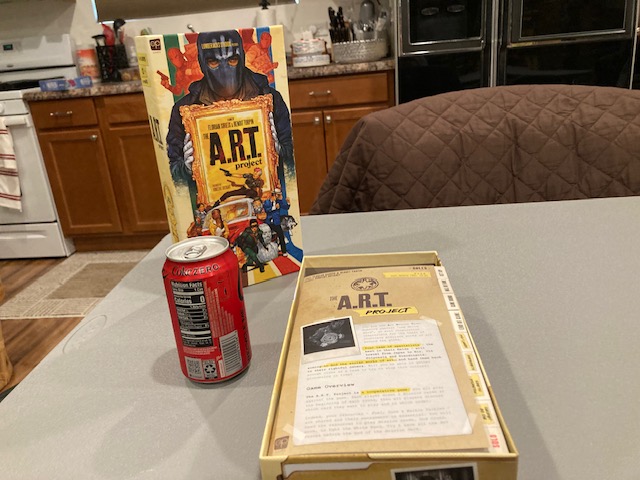
This game box has a weird profile: it’s long and thin, but it is surprisingly thick. See a picture with a coke can above: it feels about the size of 4 coke cans. It’s a weird size.
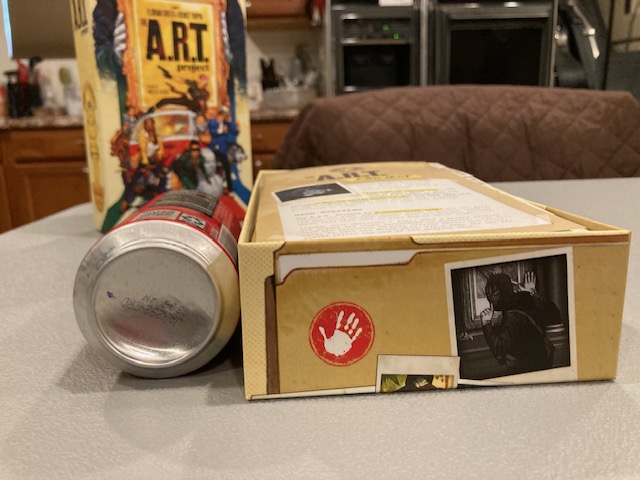
Seriously weird size.

The rulebook is pretty good (see discussion below).

There are a lot of little components in the game: mostly wood. They are pretty nice: the little crates are kinda cool too: see above and below.


There are three double-sided maps, and a punchout van, all beautifully illustrated by Vincent Dutrait. See above.
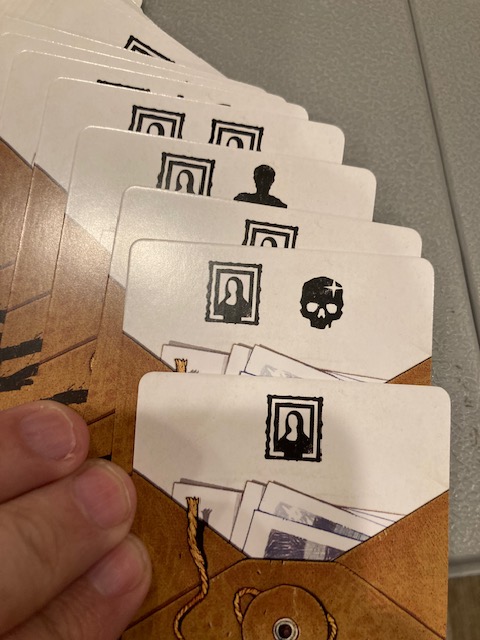
There are a bunch of cards: mostly Mission/Clue cards with icons (see above).
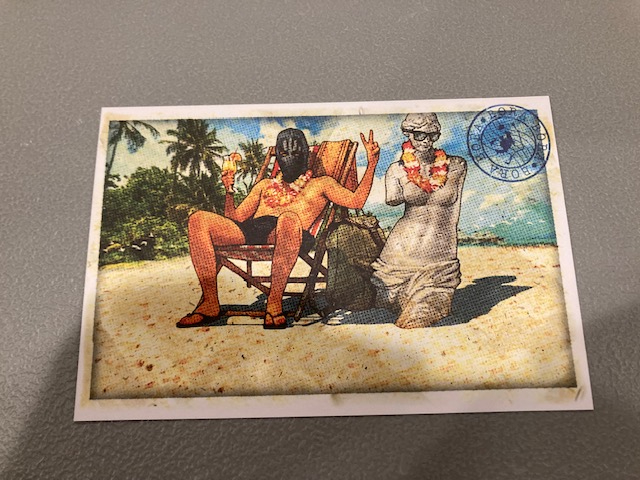
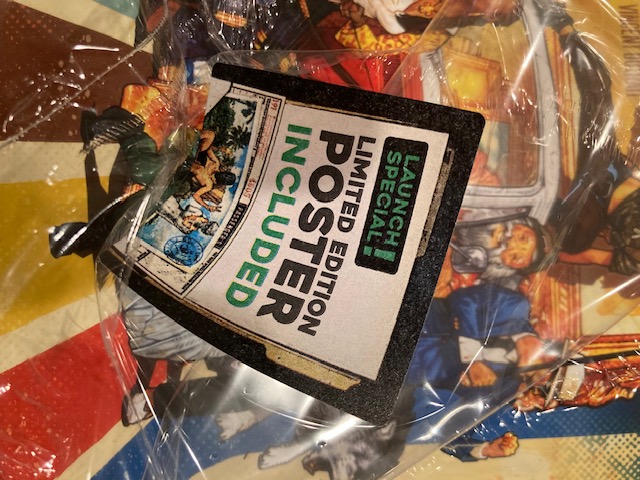
And the game comes with a postcard … I am not making this up: see above.

Overall the game components are pretty great: the Vincent Dutrait art especially stands out.
Rulebook

The rulebook is pretty good. I was able to learn the game from it.
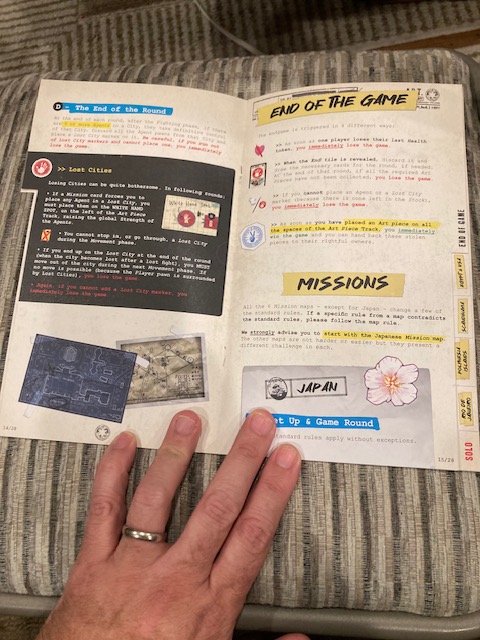
It gets a C+ on the Chair Test. It does fit well on the chair next to me, but I had to hold it open … which means I had to fold against the spine to force it to stay open without my hand. Not a big deal, but somehow it feels “wrong” to have to break the spine (not really) of the rulebook to keep it open.
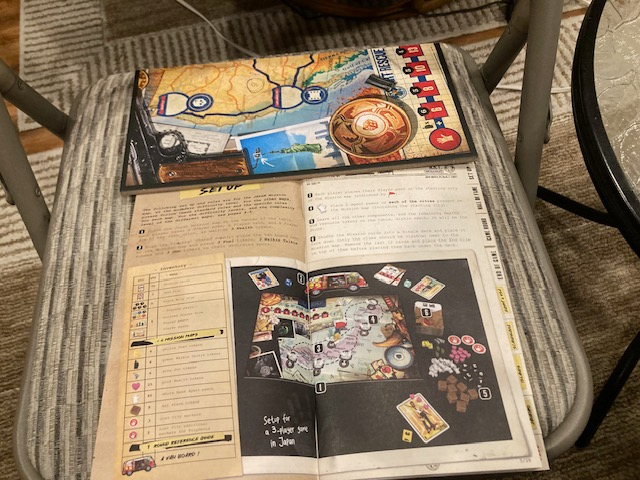
Even after “breaking the spine”, I still needed to hold the rulebook down with an unused board.

The font choice is interesting: it’s a mono-width font! It looks like a typewriter or computer terminal. I think the idea is that the typewriter font is thematic as a “briefing font” (the rulebook is organized as an old-timey folder). I normally don’t like thematic fonts (see our review of Oblievaeon), but they didn’t detract too much from reading in this case. I think what saved the font is that it was BIG and easy to read.
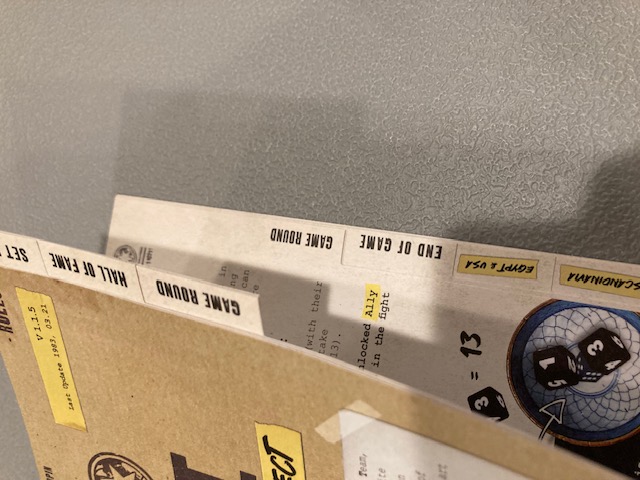
One thing that did work really well in the rulebook is the tabs: it was easy to thumb to the place you want. Unfortunately, this game didn’t have an index. I needed to look up some rules a few times and had to page through the entire book to find what I wanted.

Despite the rulebook not staying open and lack of an Index, it was pretty good. I learned the rules from it.
Gameplay

This game has a very Pandemic vibe: you roam a map keeping cities from being lost (overrun in Pandemic), and occasionally picking up art at specific location (meeting up in Pandemic).

If too many HAND Agents (5) are ever at a city, the city becomes lost (Pandemic Legacy anyone?) and players can neither move through nor pick-up art there. HAND Agents also block players from picking up Art: See above as there are four HAND Agents blocking us from picking up two pieces of art (crates)!

To eliminate HAND agents, you’ll roll dice (your colored die, colored compatriot dice, and black ally dice if you can get them) and try to beat the current HAND combat value (notated at the top of the board).
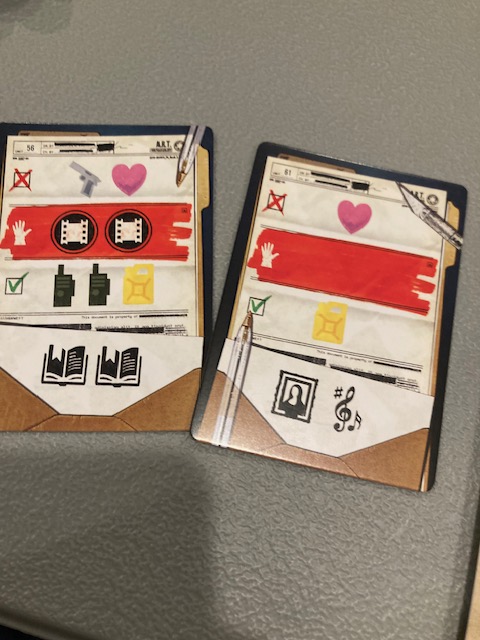
At the start of each round, each player will choose one of two Mission cards to execute: the card then executes top to bottom. The top “red X” is the penalty (lose heart or lose heart and gun), the red line is where the HAND Agents show up, and the “green check” mark shows your immediate reward. The other reward you get is a “clue” where art might show up .. note the Icons on the bottom of the card. When you get three Icons of the same type, you “find” a piece of art in that city! (A Mission card, once executed “flips” and becomes said clue)

See above as we collect a lot of clues, but not enough to find any art! (You can also discard clues for rerolls).

If you can find all 7 pieces of Art (represented by crates) before the Mission/clue deck runs out, anyone dies, there are 3 lost cities, or it’s impossible to get art, you win!
There are some other rules but that’s the gist.
Solo Play

There is an entire section (well, 2 pages) of the manual devoted to solo play: there is a viable solo mode (congratulations on following Saunders’ Law).

The main difference in solo mode is that you draw 3 Mission cards per turn (instead of 2) and choose 2 of them (instead of 1): see above. The other rule is that you have a helper (see green pawn below) who can pick up art and roll dice WITH you, but can’t attack HAND agents without you.
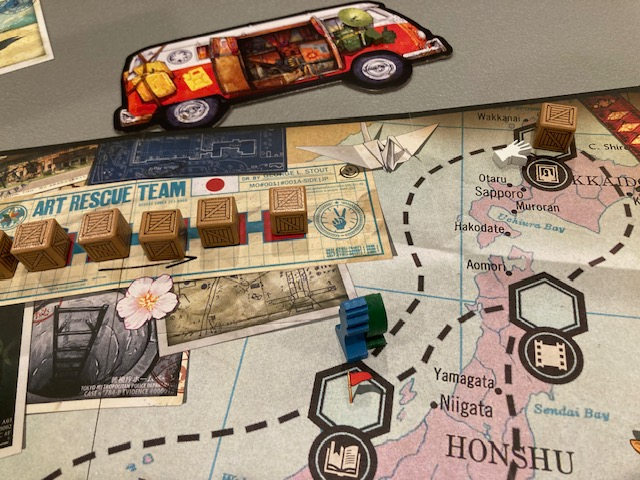
And that’s about it!! The solo game moves pretty quickly. I was able to learn the rules playing solo, but I think I could have taught this game without too much work if I hadn’t played solo. It’s a pretty straightforward game.

I have to admit to being a little underwhelmed by my solo game; It was okay. I spent quite a bit of time trying to decide why I was underwhelmed: we’ll discuss that more below.
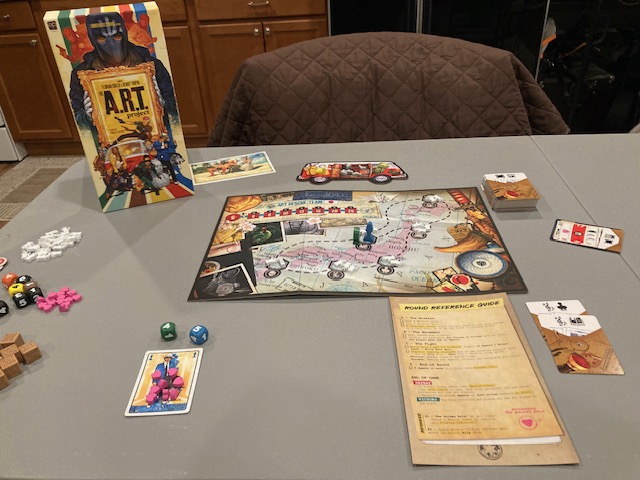
The solo game was okay. I am not sure I’ll play it again?
Cooperative Mode

The cooperative mode was better than the solo mode. The best part of the cooperative mode was discussing which Mission cards to execute and in what order!
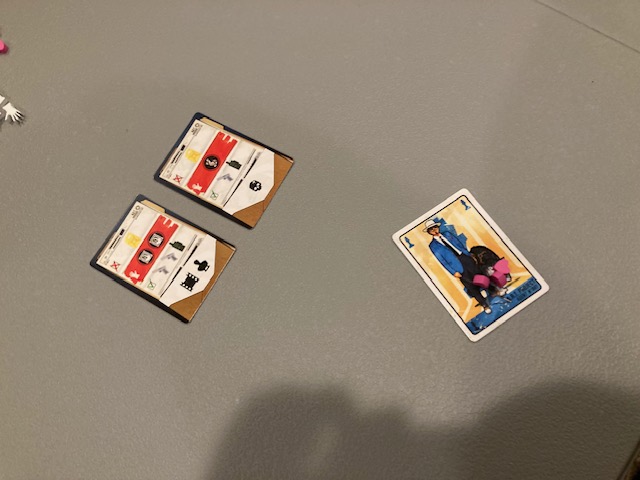
There is no player order, which I really like! Thus, the players must work together to discuss the order in which Mission cards are played!!! There are a lot of competing constraints! We have try keep the Art crates within reach, while trying to keep both the HAND Agents under control BUT not losing any cities! The choices of which cards to execute (and the order) and that discussion are probably the best part of the game!

In a 3-Player game, there was a lot of discussion! There was a lot of “what if”, there was a lot of “we should do this”, there was a lot of what “what do we do next turn”. This was a nice cooperative experience.
Themeless
As great at the components are, as great as the Vincent Dutrait art is, as great as this idea is (saving art), … at the end of the day, the game felt rather themeless.

Part of the issue is that you spend most of the game looking at black-and-white icons! Although they are supposed to represent “art”, they could be anything! We would rescuing refugees from around the world! We could be fighting guerillas! We could be curing diseases!
And then, what you find is not “art”, but “crates”! The crates are cool components, but I never felt like I was saving art … anything could have been in those crates! Drugs? Guns? People? I really wanted to see the art in the A.R.T. Project!
That Vincent Dutrait cover is AMAZING! It may be my favorite cover this year!! I wanted Vincent Dutrait’s art renderings of paintings, busts, film, … art!

What we got … were brown crates.
For a game named The A.R.T. Project, I expected a lot more art … and I got black-and-white icons and brown crates.
Player Count

This is a game where the player count will make or break the game. The solo game is good enough to show the game, but not necessarily great. The 2 or 3-Player mode is probably optimal for offering the best experience! There’s just enough banter choosing the clues cards to execute, but not enough choice to overwhelm: we all made choices and we felt like we mattered.

In a 4-6 player game, there’s almost no way you could find optimal Mission card orderings without either (a) taking too long (which isn’t fun) or (b) making sub-optimal choices (which will lose the game). The resources (gas cans, walkie-talkies, etc) are also very limited to 6, which makes them even more constrained in a large game. The 4-6 players games are just be too chaotic. The rulebook itself even warns players away from the 5-6 player game until you’ve played a lot: I am not convinced I would ever want to play with more than 3 players!
No Variable Powers
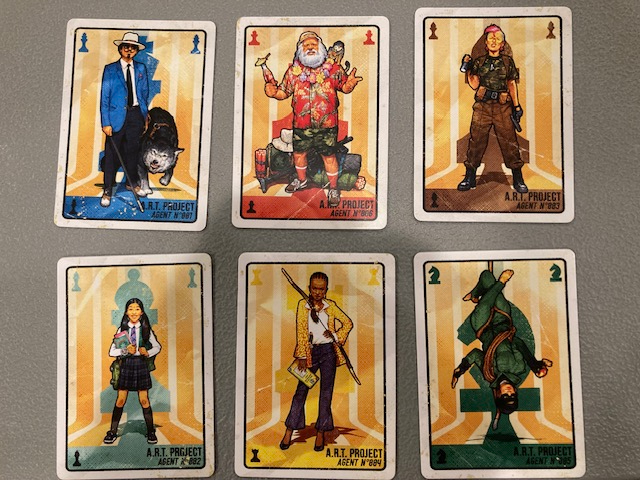
At the start of the game, each player chooses one of 6 characters! See the amazing Vincent Dutrait art above! I wanted the blue guy because of the dog!! What cool thing could the dog do??
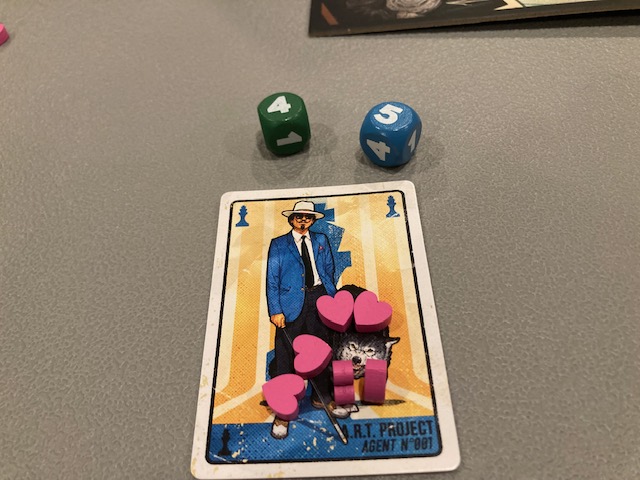
The answer: nothing. The characters aren’t distinct in any way. It doesn’t matter what character you play, except for your pawn color: I think this was a missed opportunity. Once you choose your character, it doesn’t really matter anymore once the game goes on.
This is another reason the game felt “themeless”: I had no attachment to my character at all. I just moved a blue pawn on the map picking up brown crates.
Conclusion
I really wanted to love The A.R.T. Project, but I was underwhelmed by it. I was expecting this amazing art and theme, but the main gameplay centers on black-and-white icons and brown crates … which could be anything! Granted, the art you do get from Vincent Dutrait is amazing, but that art is outside the main game arc: you don’t really embrace it. The lack of variable player powers was also surprising too: all players felt exactly the same, further contributing to the theme feeling pasted on.
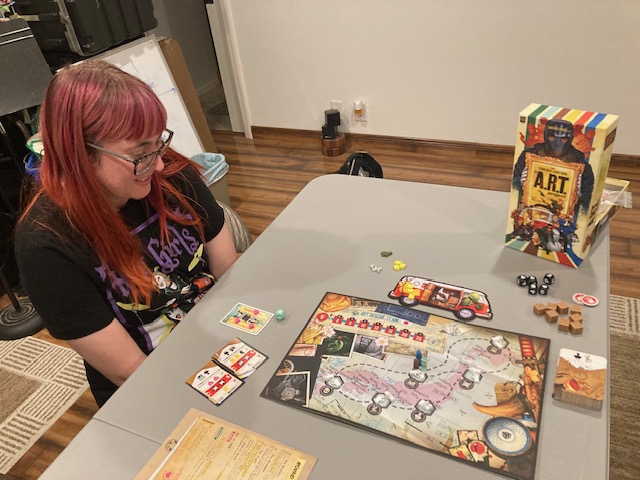
There is a decent game here. The game shines best in a small group of 2-3 Players , with the choosing the Mission cards being the highlight of the game (as you choose both the good things and bad things together). At this optimal number of players (2-3), I would give it a 7.0/10, but my friends would still only give it a 6/10 (Teresa) and 5/10 (Sara); Sara and Teresa were even more disappointed by the themeless/artless nature of the game than I was.
The solo game is probably a 6/10. And I would avoid player counts above 3: I think the game really becomes significantly worse at higher player counts.

Even though I don’t love this game, I will keep it: it’s a light and quick (at about 20-30 minutes) cooperative game which I might bring out for new players .. Or if I want a quick cooperative game. If you do decide to get The A.R.T. Project, I strongly recommend keeping the game to 1-3 players or you might hate it.
 coopgestalt