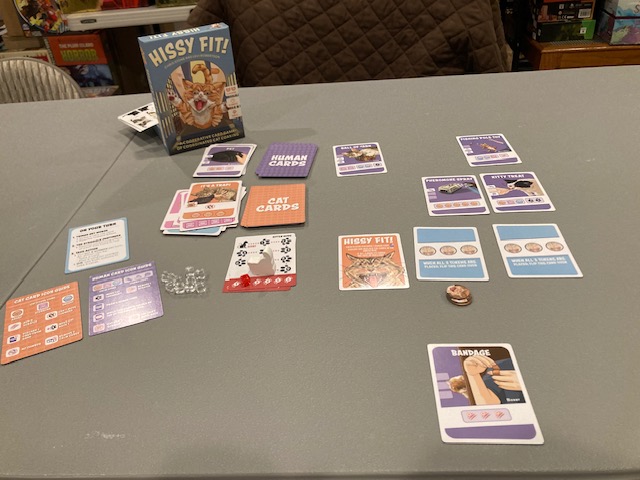
Taking Cats To The Vet: Really? This is the Theme? A Review of Hissy Fit!

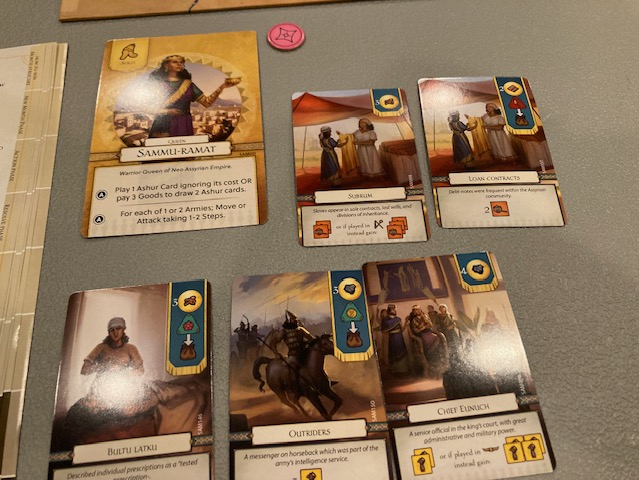
Welcome back to Cooperative Surprise Month! After being surprised (in a good way) by Sammu-Ramat a few weeks ago (see our review here), and finding an old review of Chainsomnia (see our review last week), we take a look at a quirky cooperative game with a surprisingly unique theme! Let’s take a look at Hissy Fit!

Really, the theme of this game, Hissy Fit!, is taking cats to the veterinarian. I am not making this up!

Hissy Fit! is a cooperative card game for 1-4 players that plays in about 20 minutes. Hissy Fit! was on Kickstarter back in January 2023; it promised delivery in November 2023, but it didn’t deliver to me until late February 2024. So it was about 3-4 months late; that’s not a big deal in Kickstarter land.

IMG_3073

I picked Hissy Fit! up because it looked cute, and it was cheap: it was only $20 on Kickstarter (plus shipping).  Did I get my money’s worth?

Unboxing

IMG_3074

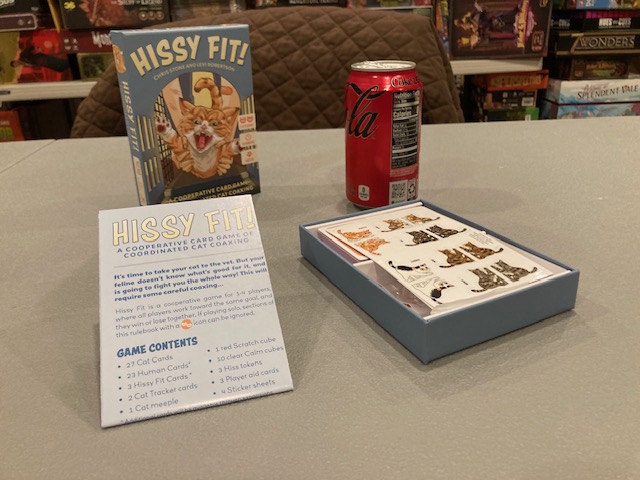
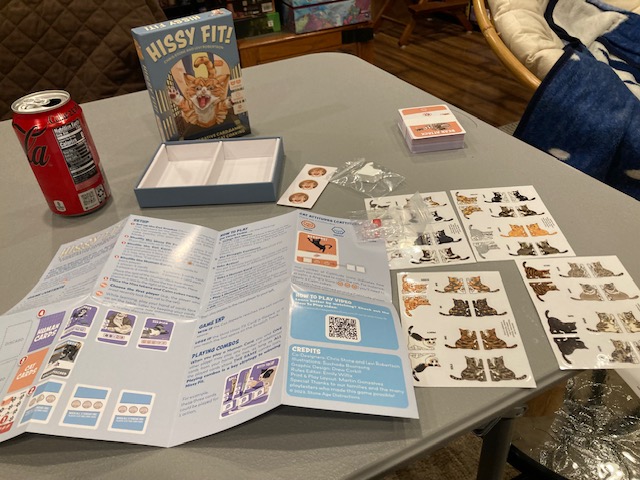
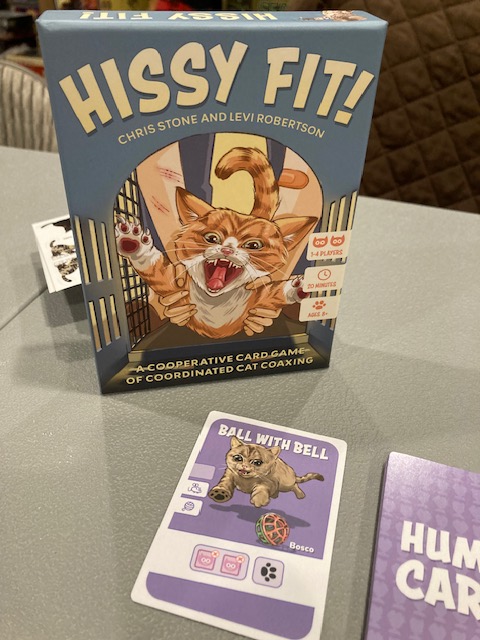
Hissy Fit! is a small cooperative card game in smallish box: see the Coke Can for  perspective above.

IMG_3096

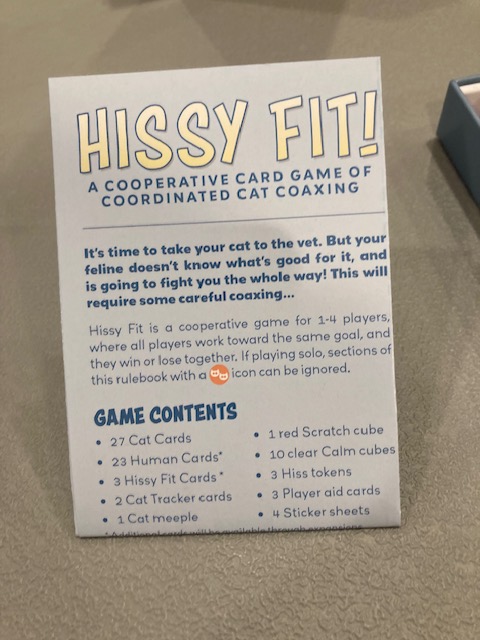
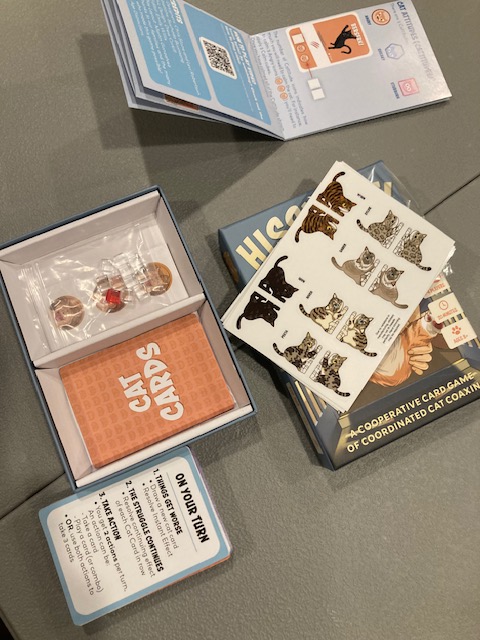
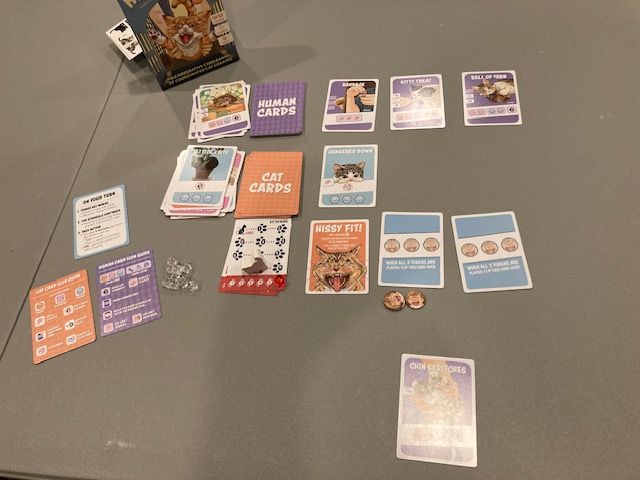
There are 58 cards in this game (see many above) and some supporting tokens and sheets (see below).

IMG_3144

IMG_3088

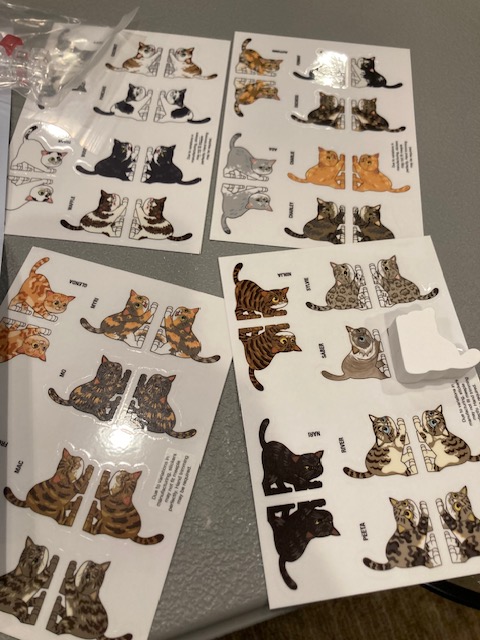
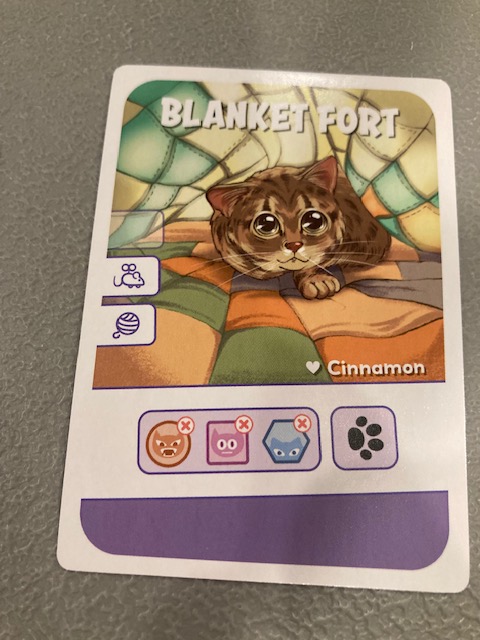
If you are a cat fan (which is probably why you are here), you have a myriad of choices for “what cat sticker” goes on the cat meeple: see above.

IMG_3078

This game is cute, everything is very readable, and it’s very cute (I know, I said that already).  If you like cats, you will probably like this game.  If you don’t like cats … you may still like this game: keep reading!

Rulebook … I mean … Pamphlet.

IMG_3073

The rulebook is a pamphlet. Sigh.

IMG_3075

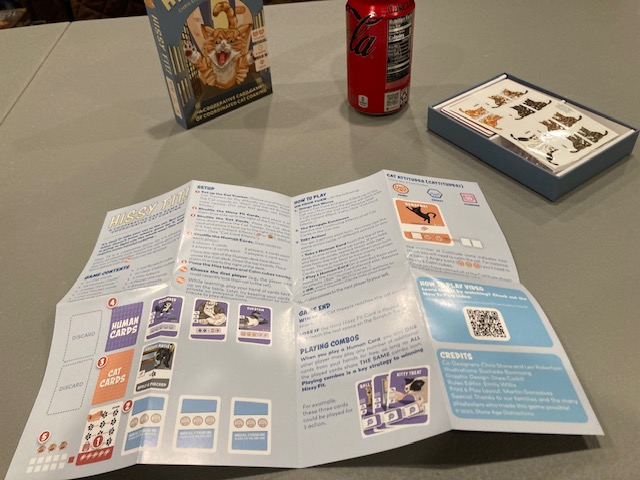
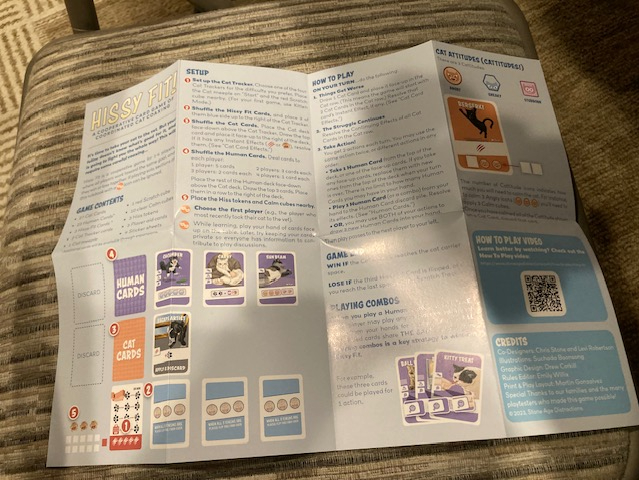
It folds out, and it’s quite readable, despite it’s largish footprint.

IMG_3118

It even gets a decent grade on the Chair Test (maybe a B): it basically fits and has a good size font with a lot of good pictures and examples.

IMG_3090

The set-up is good: it has a picture (with annotations! see above) and is very well done.

IMG_3078

This rulebook is better than I expected.  It teaches the rules pretty well and it’s pretty easy to read.  Its major sin is  that “it’s just a pamphlet”, but it surprisingly good.  (There’s no index or chapters, but it doesn’t need one: this is a relatively simple game).

Gameplay

IMG_3099

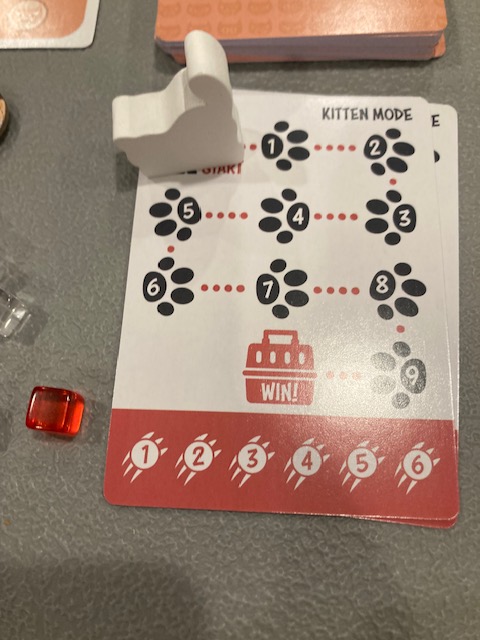
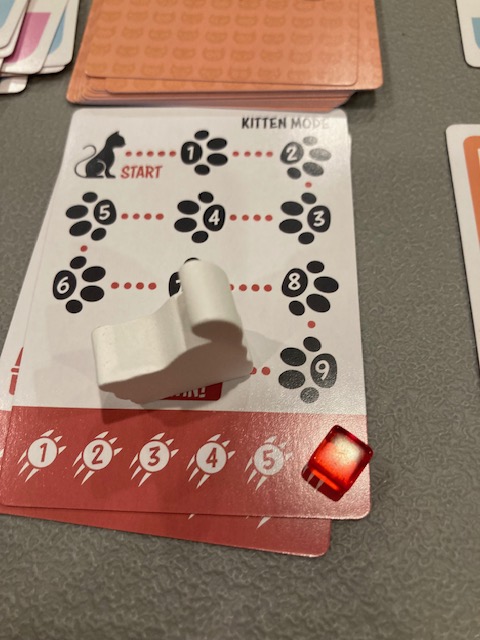
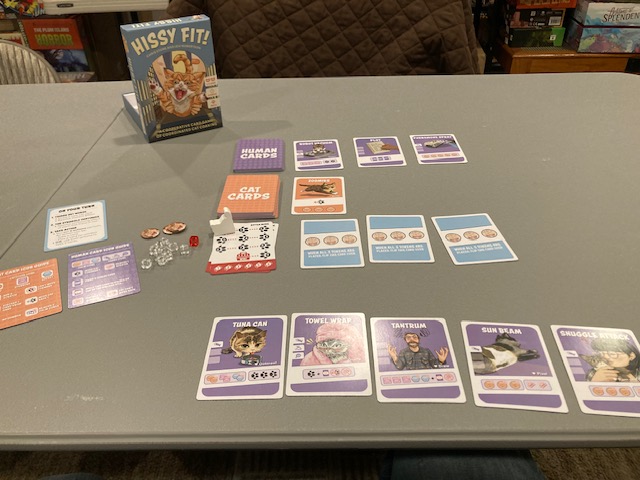
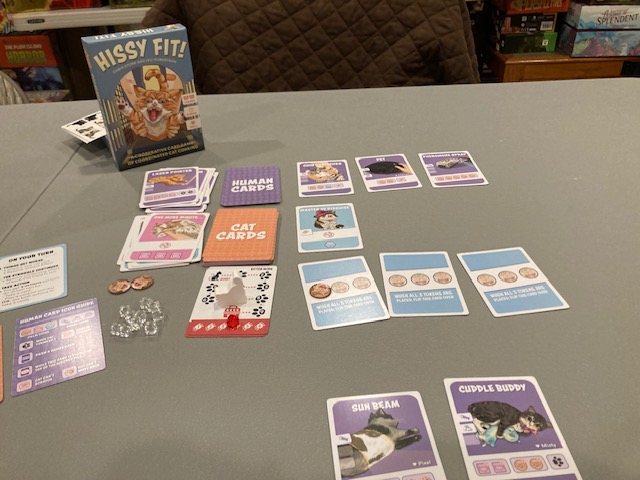
The humans need to get the cat to the vet, but of course, the cat uses all its wiles to not go! The Cat Tracker card (see above) show how much you need to do to get the cat to the vet! Basically, this is a race! You are trying to move the cat meeple from the start to the cat carrier (see above)! If players can cooperatively move the cat meeple to the end, they win! Huzzah!

IMG_3081

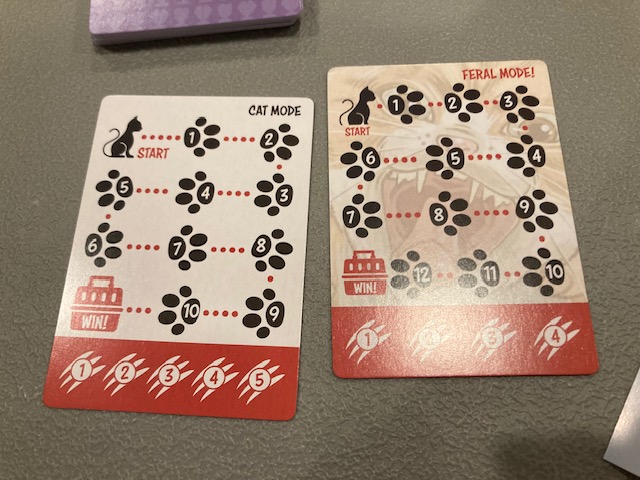
There are 4 difficulties to the game, depending on how hard you want the game! There’s  Kitten mode, Cat mode, Fierce Mode, and Feral mode! See two Cat Tracker cards above for Cat mode and Feral Mode!!

Feral mode (above right) is the hardest mode, as you have fewer scratches you can can endure and further to go!

IMG_3115

Players win if they get the cat meeple to the end, but if the players ever get too many scratches (the red cube at the maximum number of scratches), they lose!

IMG_3083

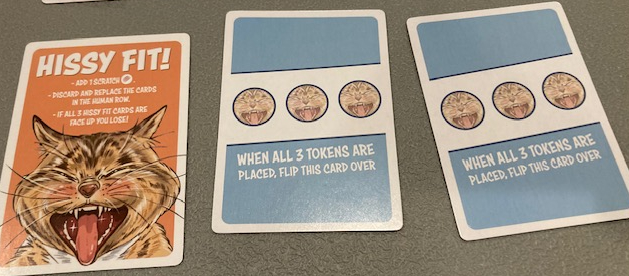
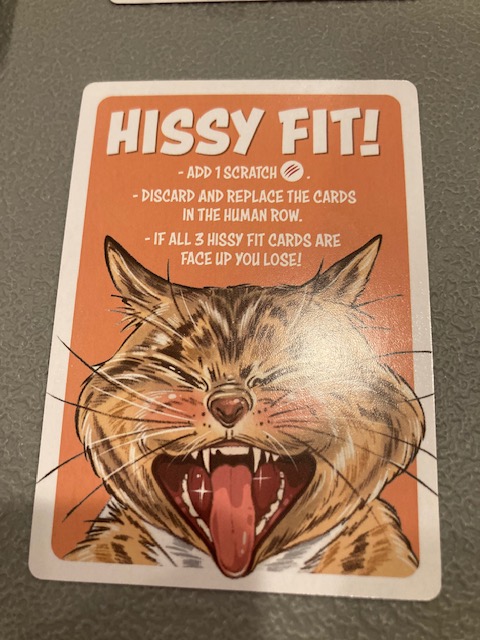
Players also lose if the cat has three hissy fits! 

IMG_3113

Every hissy fit icon on the cards will advance the hissy fit card … if you ever get three tokens on the card, the hissy fit happens!

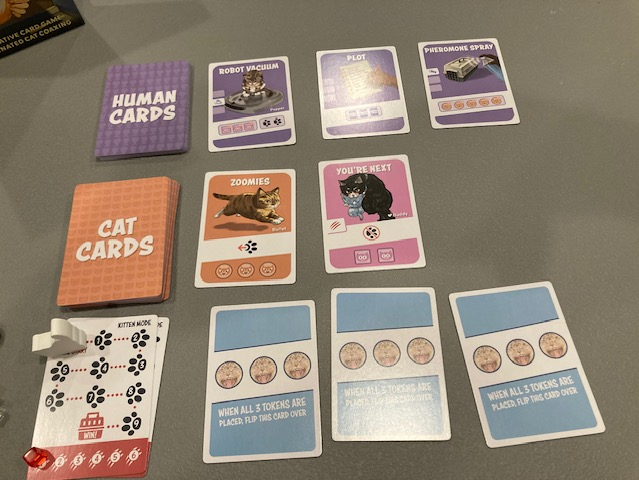
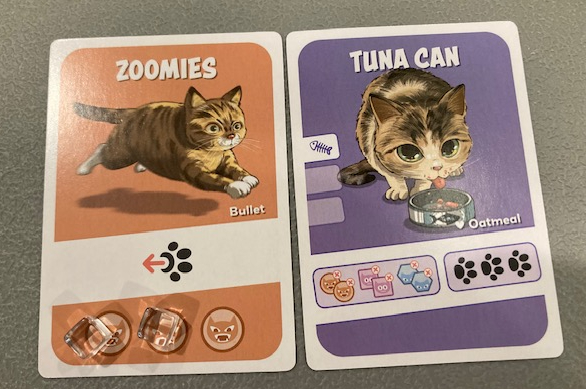
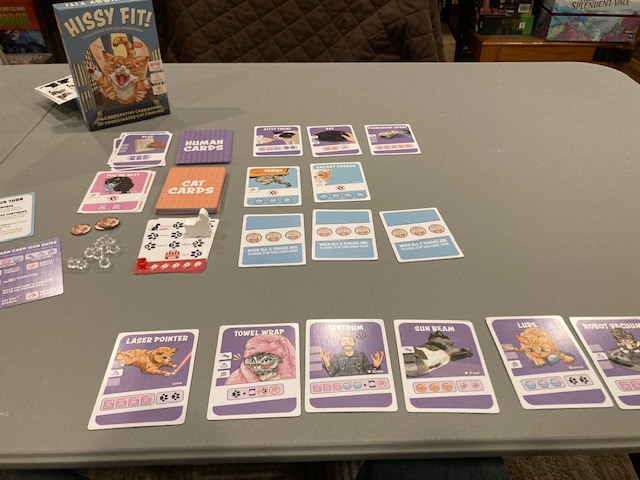
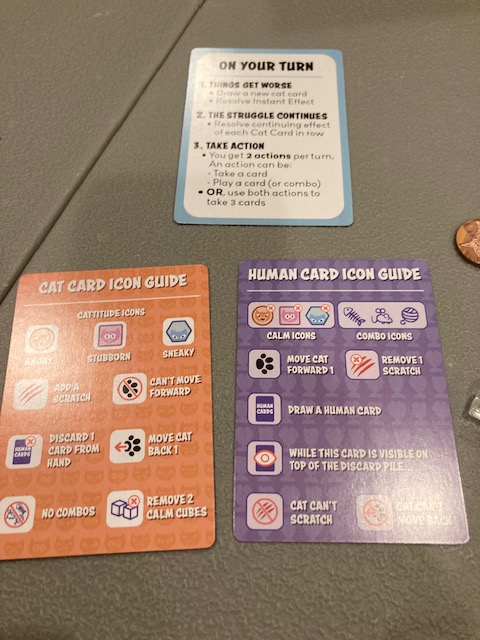
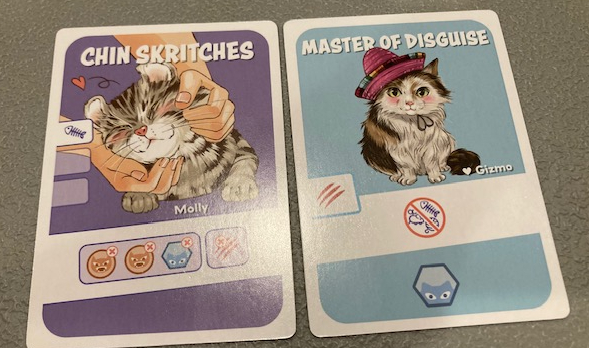
The game has a fairly typical cooperative game arc: “bad news” cards start the round, and players play “good news” cards to help. The “bad news” cards are the Cat Cards (see above). As these cards come out, they cause continual bad stuff to happen! For example: In the white panel above is a backward paw: it causes the cat meeple to go backwards unless you get rid of that Zoomies card!

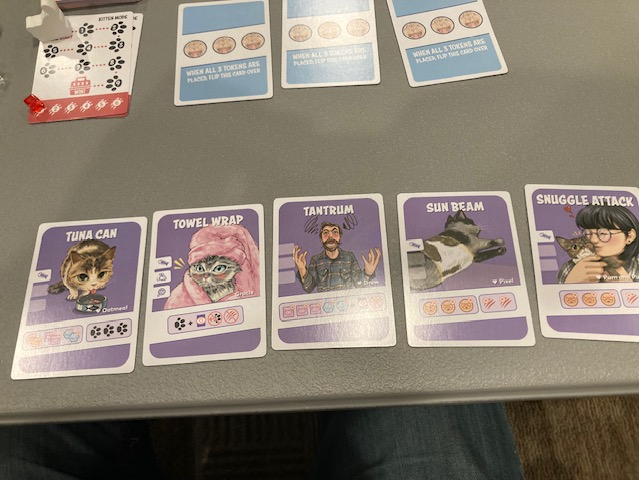
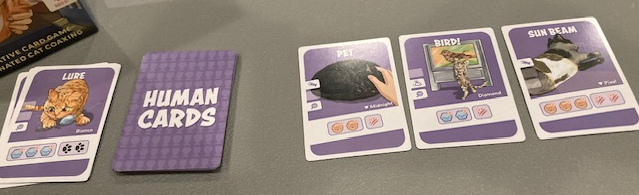
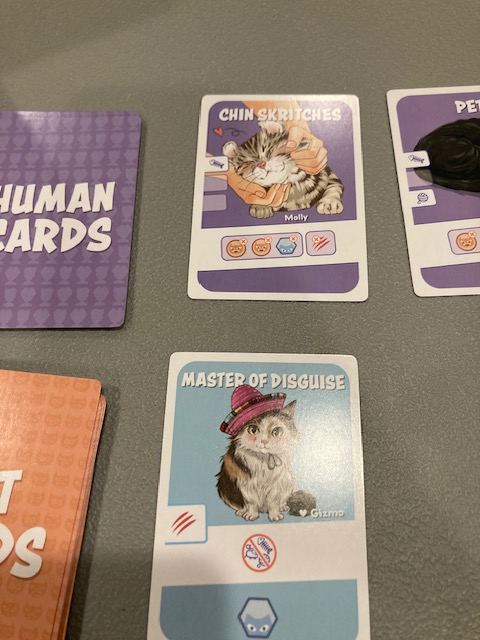
The players play Human Cards to help deal withe Cat Cards.  When you play a Human Card, you choose one of the good effects (in the white strip) on the card.  The rightmost effect (see above) would move the cat meeple forward three spaces!  The leftmost effect would give two resources of each type of Cat Attitudes: you place cubes on the Cat Cards appropriately.
IMG_3145

If you get enough Cat Attitude resources, you can get rid of the Cat Card!  For example, when we play the Tuna Can card to stop the Zoomies (see above), we only have 2 Angry Cat resources (brown), so we can only partly stop the Zoomies: we need to play another human card with the Angry cat (brown) symbol: we use the clear cubes to note what we have already played.  Unfortunately, the Zoomies stays out another turn.
IMG_3096

Turns are pretty quick and easy: the current player draws a Cat Card and suffers its bad effects, then that current player gets to do 2 things: play a Human Card or draw a Human card!  You can choose any Human Card in the display, or you can blindly draw the top.   Once you are done, move left to the next player! Play continues until the cats win or the humans win!

IMG_3094

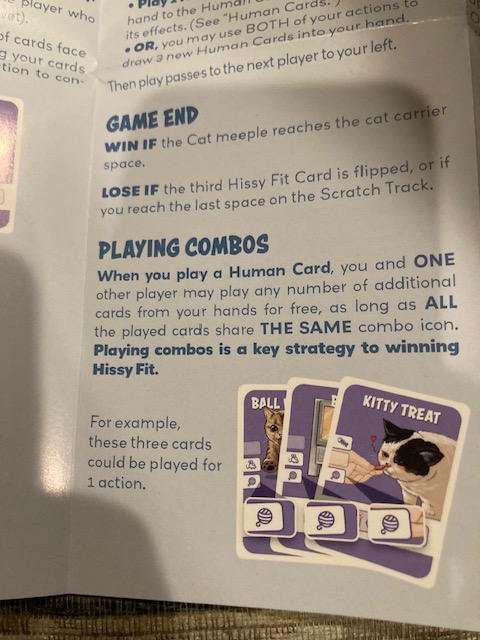
One of the most important rules in the game is playing combos: when any player plays a card, another player can follow and play a card with the same symbol!  See the example above (from the rules) with the yarn ball symbol allowing the players to play three cards!  

This combo rule is critical to winning the game: it allows you to play many cards in one shot if you really need to!

Solo Game

IMG_3091

The solo game is well-specified and very simple (thank you for following Saunders’ Law): there is only one player, but he starts the game with 5 Human Cards.  The solo player simply keeps taking his turn over and over, basically rotating back to himself.  Cat Card, Two Actions, Cat Card, Two Actions, repeat!

IMG_3095

The victory and loss conditions are exactly the same: the only thing that really changes depending on the number of players is how many cards the player(s) starts with! 

IMG_3117

I was able to learn, then play the game twice in the same night as my friends came over!   I lost my first solo game and won my second (on Kitten Mode).  I started groking it pretty quickly.
IMG_3119

I lost my first game because I didn’t take the rulebook/pamphlet seriously!  The game is all about playing combos to win!  See above as I play three Human Cards that all have the mouse icon! Yep, you gotta play combos to win!

IMG_3123

This is a light solo game that plays in 20 minutes.  It’s pretty fun. If I am waiting for someone and just want to kill 20 minutes, this would be a fun and easy game to play: it’s not too thinky, but it’s still very engaging.
Cooperative Game

IMG_3133

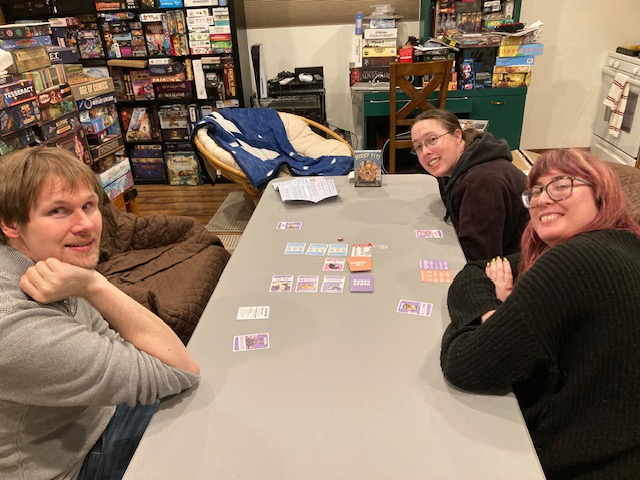
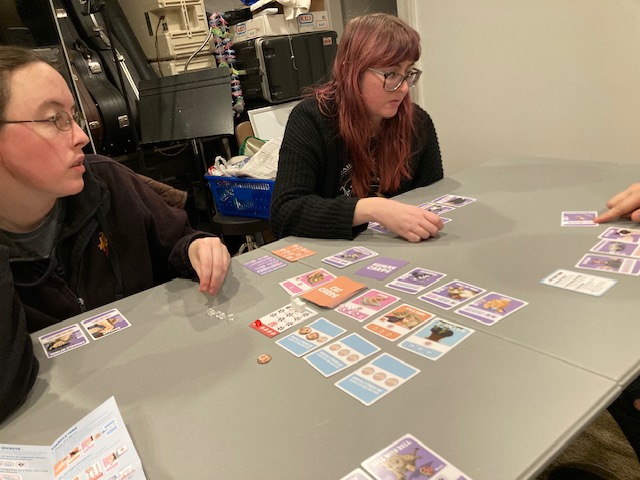
The cooperative game flowed well.  After I learned the game, I was able to teach everyone the game fairly quickly: part of that is because the solo game is still the main game!  It’s really easy to get into it!

IMG_3137

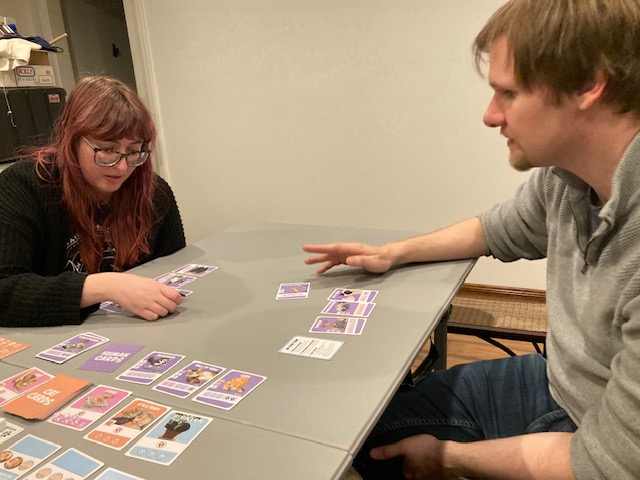
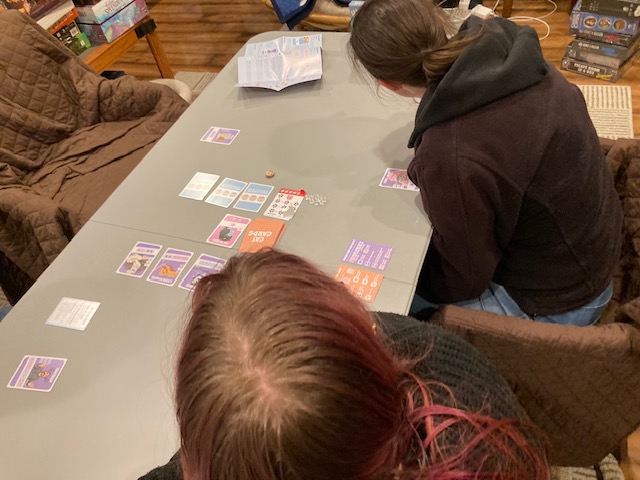
This game is smooth and easy to play cooperatively.  There’s a lot of engagement as players realize “we need to play this combo!!!” See above as Sara and Andrew try to figure out how to combo to take out the 3 Cat Cards!

IMG_3136

The game was still about 20-25 minutes and moved quickly.  This game was easy to learn and pretty fun to play.

What I Liked

IMG_3108

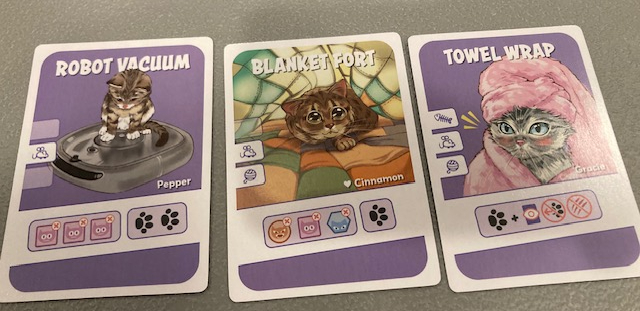
The art is adorable.  And the cards are easy to read.

IMG_3104

The game is super easy to set-up and understand.

IMG_3134

It worked well as both a cooperative game and a solo game.

IMG_3138

In the end, the gameplay was just so smoooooth and easy. Anyone can play this.

IMG_3119

The combo mechanism is fantastic: it reminds of the “follow” mechanism that so enchanted us from the Plum Island Horror (see our review here).  By allowing ANY player to play a Human Card that matches the current symbol, everyone can stay engaged even when it’s not their turn!  This one mechanism made this fairly standard cooperative game stand out for me: it kept everyone engaged!

What I Didn’t Like

IMG_3120

There aren’t enough Human Cards. You will see all of them in your first game! There needs to be quite a bit more for better variety.

IMG_3114

I don’t love the cover, but I was absolutely in the minority on this. I think the art is so cute in the game (see the Ball With Bell above), but I don’t think the cover captured just how cute this game is! Again, I am in the minority: all my friends disagree with me on this.

IMG_3138

I don’t love the pamphlet form factor. Whatever, it’s still a pretty good set of rules.

IMG_3100

It’s not super deep. You’ll get it pretty quickly: that may limit its replayability.

Conclusion

IMG_3105

Hissy Fit! is surprisingly fun! It’s a light game that’s easy to teach: you can teach and start playing right away! This is a quick solo and cooperative game that plays in about 20 minutes! Are you looking for a light and quick solo/cooperative game? Hissy Fit! might be right for you!

IMG_3112

And you don’t have to love cats to like this game: the gameplay is solid, especially with the combo mechanism keeping everyone engaged as they play!   The gameplay is just smooth.

IMG_3097

I give this a solid 7.5/10 and Teresa gives this a 7/10. Andrew and Sara would give it a 7, but the small number of Human Cards reduces some of the replayability for them, so they give it a 6.5/10. I think an expansion which added a lot more Human Cards would move this to a 7/10 for them.

IMG_3107

This small game has a sense of humor and a wacky theme, but it plays so smoothly.  It’s a surprise to me how much I liked Hissy Fit! given how weird and quirky it is.  Yes, I got my money’s worth for $20.

A Review of Chainsomnia

Welcome back to Cooperative Surprise Month! Last month we looked at the brand new game (Sammu-ramat) which was so surprisingly good! This week, we surprised ourselves by finding an old review which we never published! This is a review for the cooperative game Chainsomnia by Seiji Kanai! Let’s take a look!

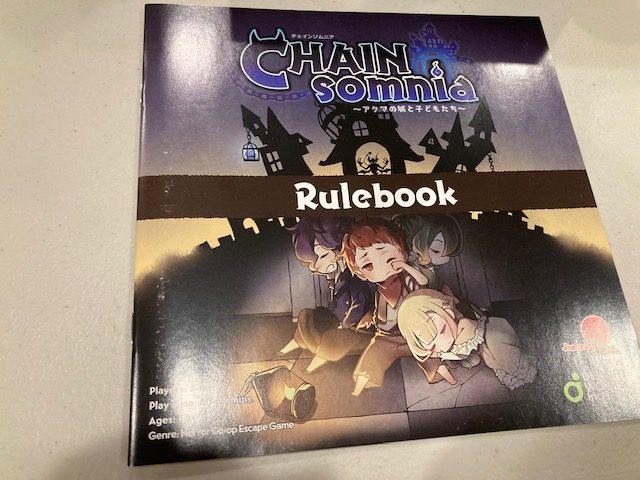
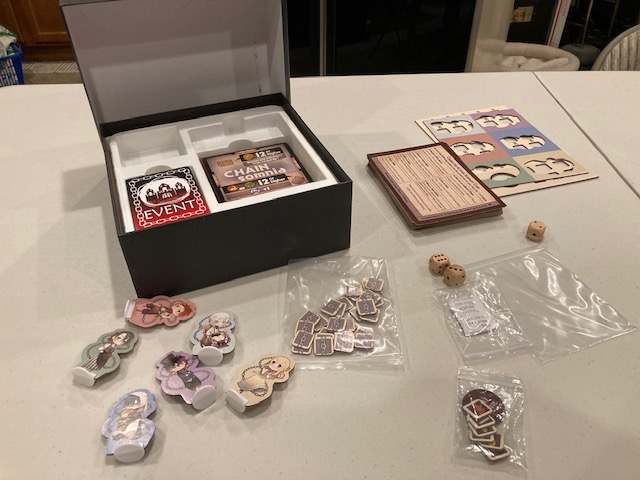
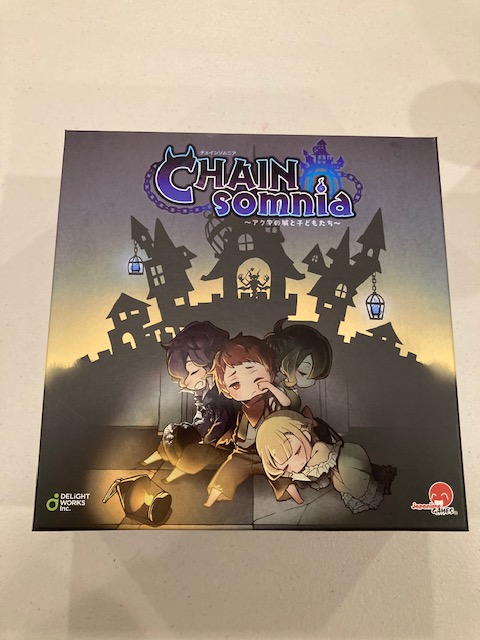
Chainsomnia was a cooperative game I picked up from GameNerdz fairly recently (EDITOR: at the time this was written, it was June 2023 .. ahem).  It was a Kickstarter game, but I didn’t know that when I ordered it from GameNerdz (I guess I missed the Kickstarter).  Chainsomnia was appealing to me because it looks like a light cooperative game from the designer (Seiji Kanai) of Unicornus Knights!  I think that Unicornus Knights is something of a hidden gem (see Part I and Part II of our review), as it made our Top 10 Cooperative Games of 2017!

IMG_6696

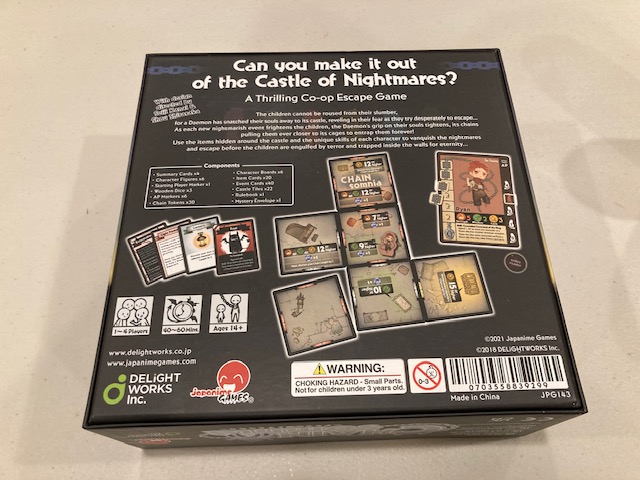
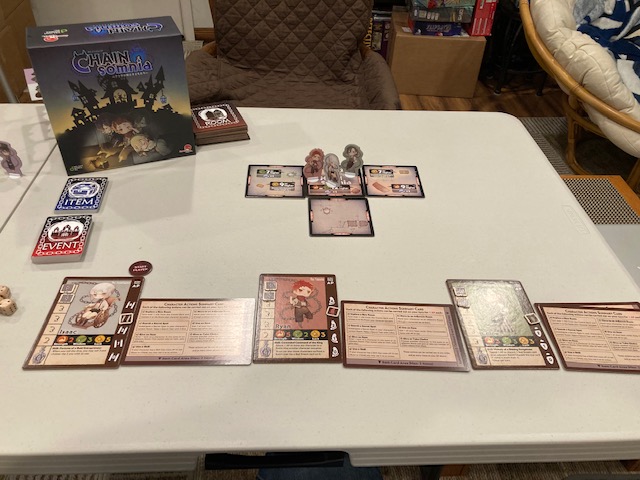
This game is about a bunch of nightmare-ridden little kids trying to get out of a castle of nightmares! It’s for 1-4 players, 40-60 minutes, and ages 14+. Let’s take a look.

Unboxing and Gameplay

IMG_6697

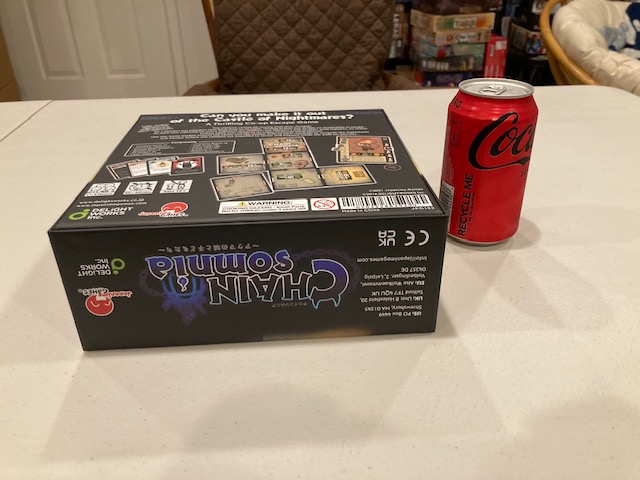
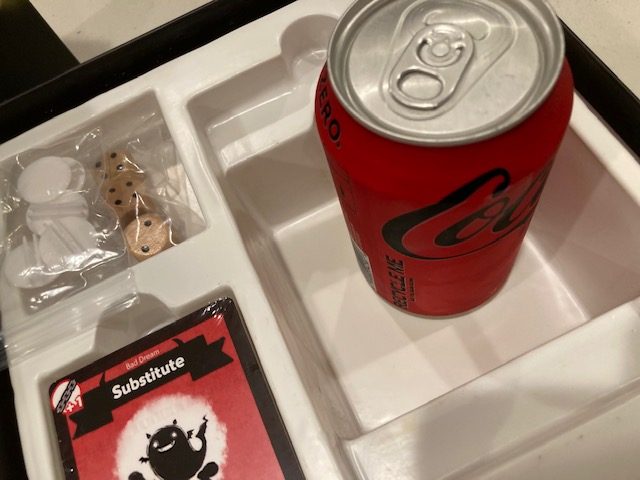
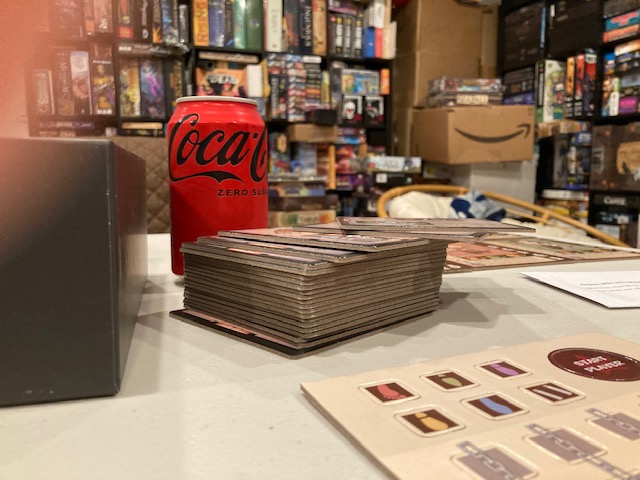
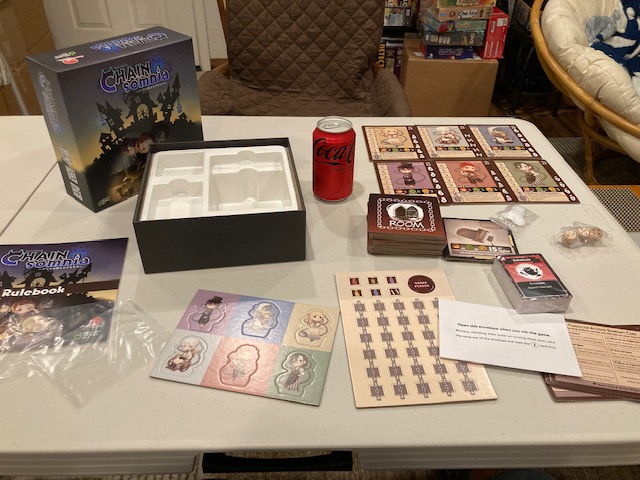
This is a pretty deep box.  The Coke Can actually fits inside it pretty well!

IMG_6720

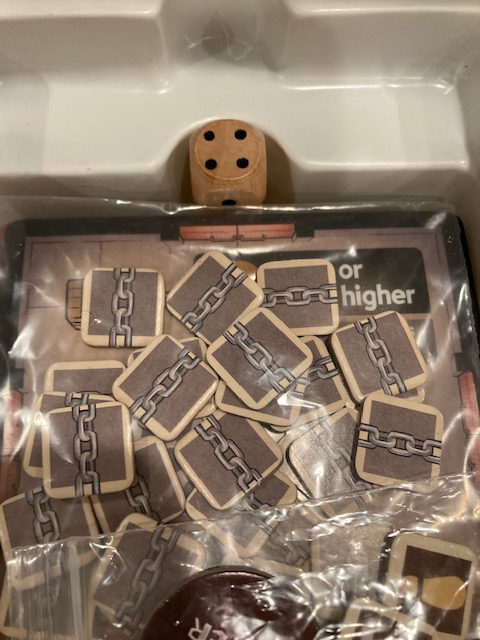
Seriously, this is a pretty deep box: mostly for the tiles.

IMG_6721

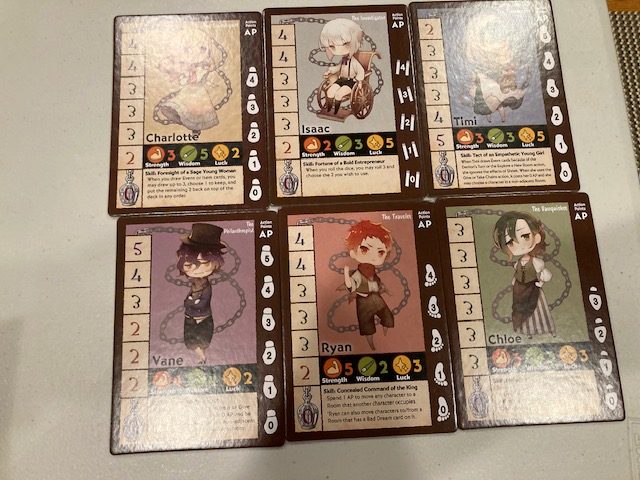
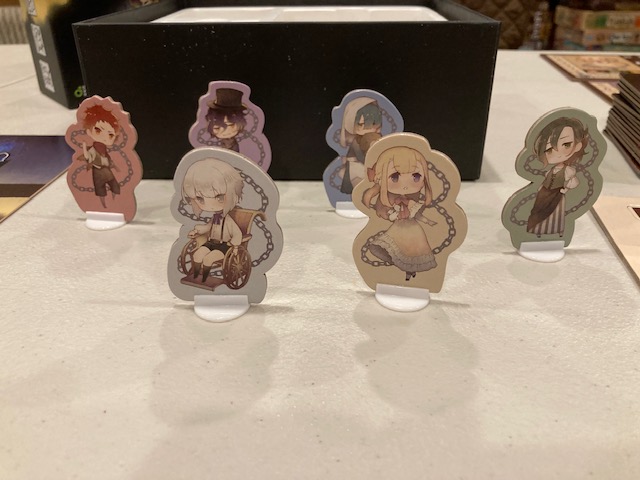
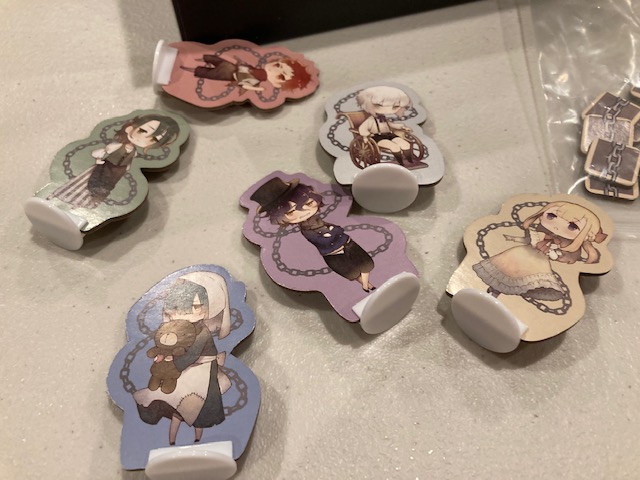
Each character takes the role of a child trapped in the castle:

IMG_6716

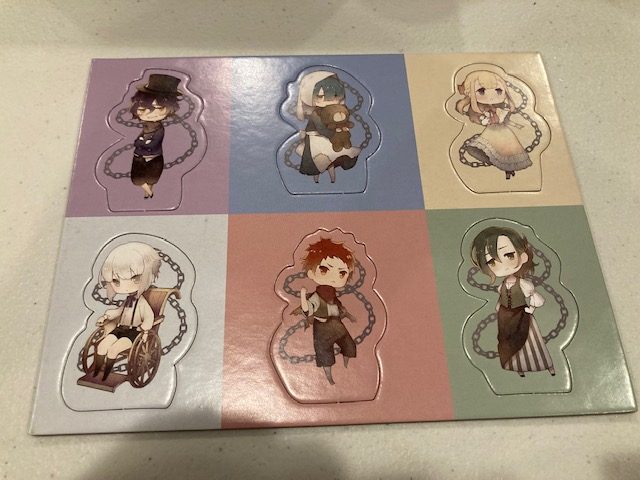
Each character has a standee and a character sheet.

IMG_6717

IMG_6725

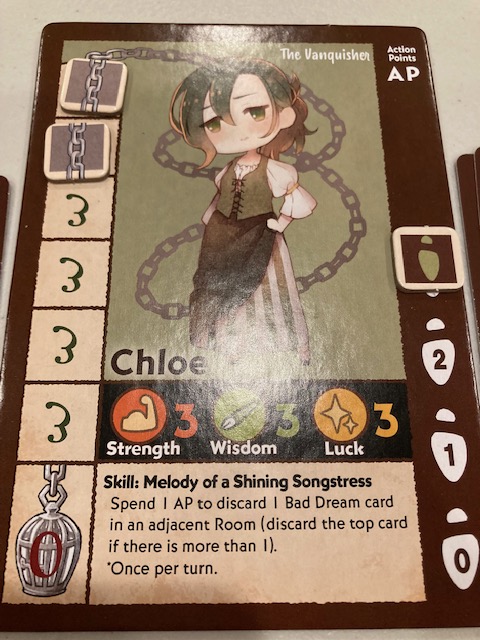
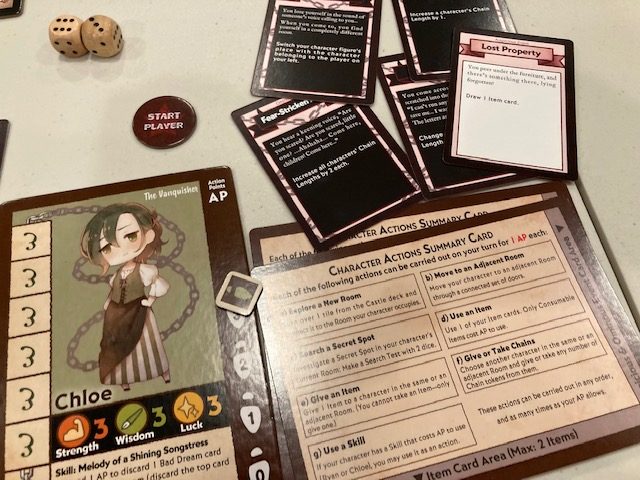
Each character has some abilities (Strength, Luck, and Wisdom) which will form the the basis of a two-dice ability role.

IMG_6747

For example, Chloe above has 3 Strength, 3 Wisdom and 3 Luck.  She can also get rid of Bad Dream easily with an AP (Action Point).

IMG_6748

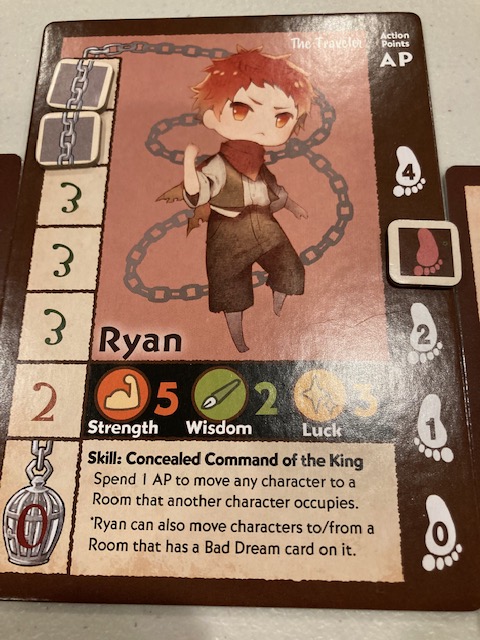
AP stands for Action Point.  The little chart to the left shows you how many AP you have per turn.  As you get Chains in the game (Ryan above has 2 chains), it reduces the number of AP you have per turn.

IMG_6718

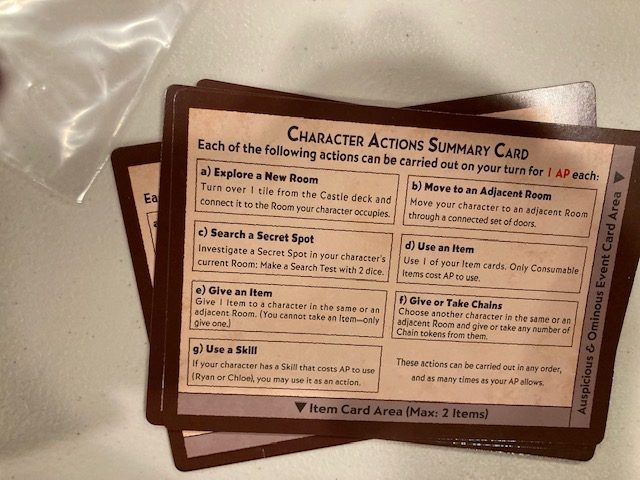
The Summary Cards summarize what you can do, but basically explore, search, give, skill, move, use or take.

IMG_6755

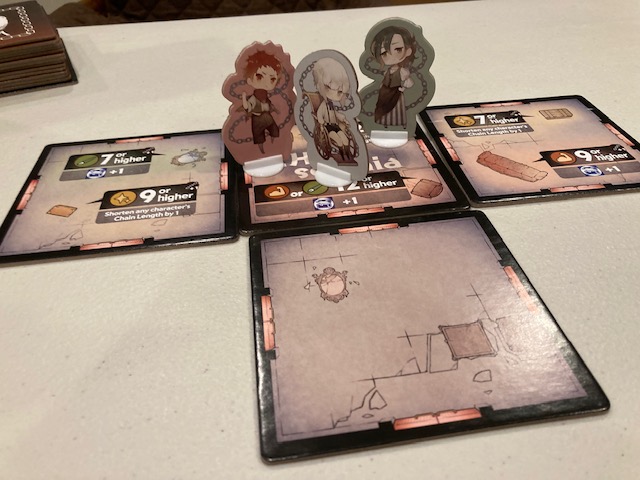
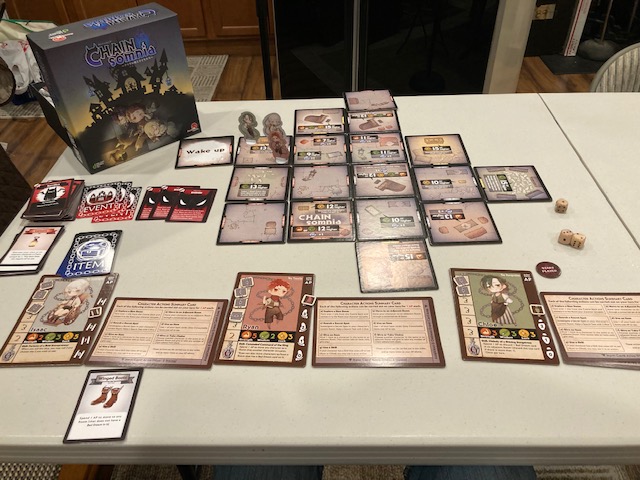
In order to win, the characters must cooperatively explore the Castle to find the way out: the Way Out is the last card in the tile deck.  See Chloe winning the game for everyone by finding the Way Out … when there are no Bad Dreams on the board.

IMG_6728

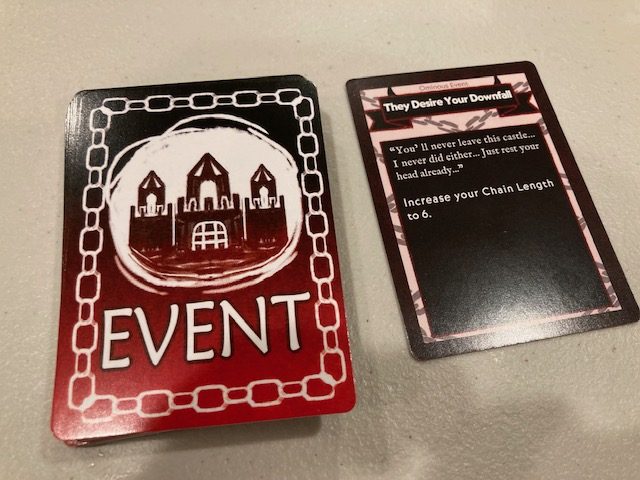
Like most cooperative games, there are “Bad News” cards that come out.  In this case, the Bad News cards are called “Events” and come out every time you explore and discover a new Room.

IMG_6753

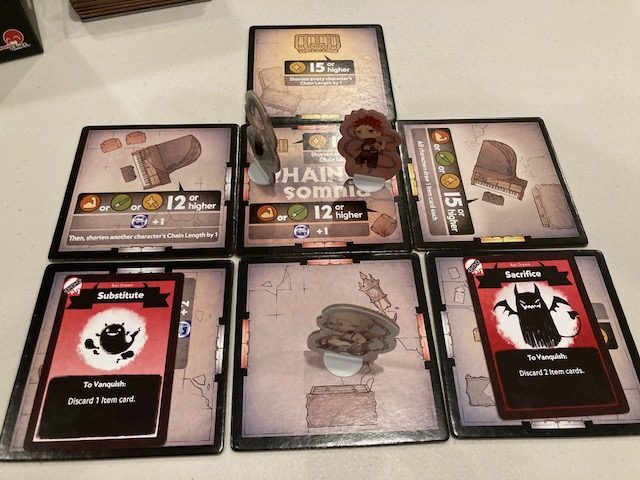
Generally speaking, the Event cards are full of nightmares that clog up the rooms.  You can’t enter a room with a nightmare until you take it out.  How do you take it out?

IMG_6735

Each Bad Dream is different (for example, above you have to discard an Item), but generally you have to make a skill check on 2 dice, and roll higher than your skill.  If Ryan’s Strength is 5 and requires a 11+ Strength to Vanquish, then Ryan will need to roll a 6 or more (6+5 >= 11) on two dice to succeed in the Skill check.

IMG_6727

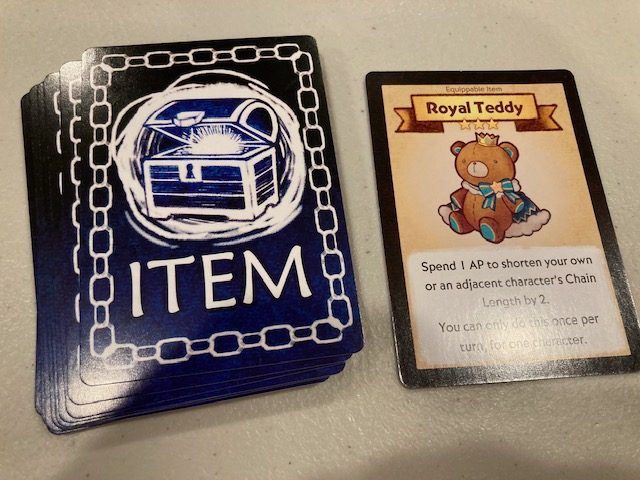
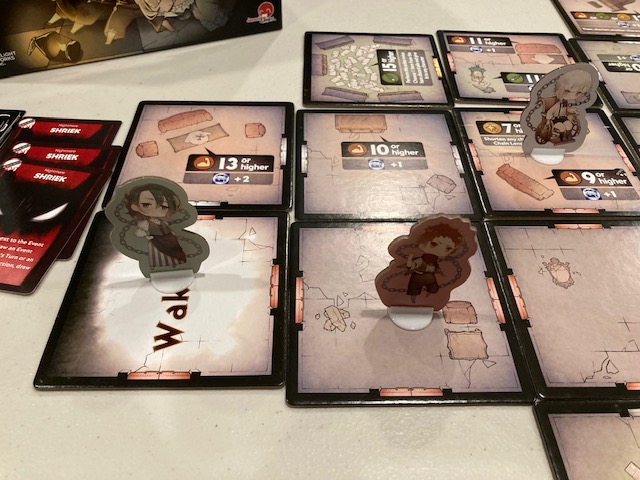
Incidentally, skill checks are how you get Items (very useful tools): generally, each room will tell you what you need to roll to get one.  In the first room (see below), if you roll a 12 or higher on any skill check, you get an item.

IMG_6739

IMG_6759

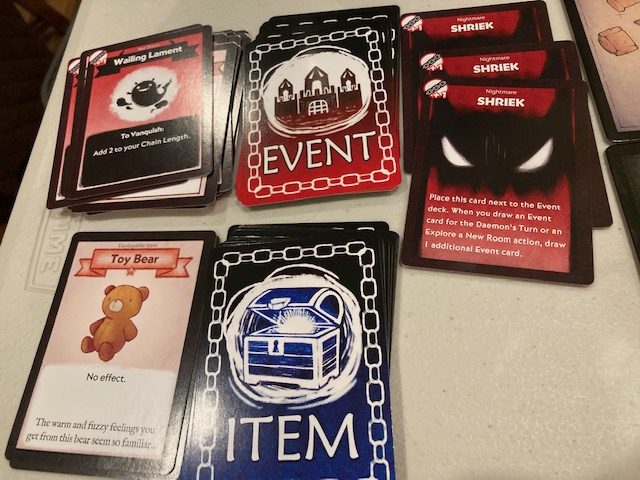
There are other very bad cards that modify the Event Deck (see Shriek above) but if you make it through all Event cards without finding the Way Out you lose.  If you can get to the Way Out and defeat all Bad Dreams on the board you Win!

IMG_6724

The components are quite cute, if a little minimal.  The cards are not linen finished.

Rulebook

IMG_6700

The rulebook is good, except that it doesn’t talk a lot about edge conditions.  As we played the game, a bunch of questions came up (“Are Action Points dynamic?  Do you immediately lose/gain an AP as a result of a chain change?”).  There was a FAQ, but it didn’t answer the questions that seem to come up with us.

IMG_6701

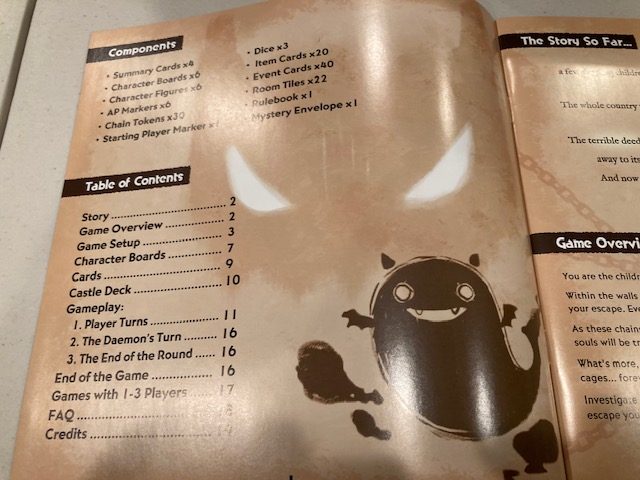
The components list had no pictures, but the Set-up was well-labelled to counteract that.   In general, there were appropriate pictures and the game was explained well-enough.  I even like that it had a FAQ, it just didn’t seem to address the questions we had.  I’ll call the rulebook good enough.

Solo Mode

IMG_6738

Congratulations to Chainsomnia for following Saunders’ Law and having a solo mode!

IMG_6713

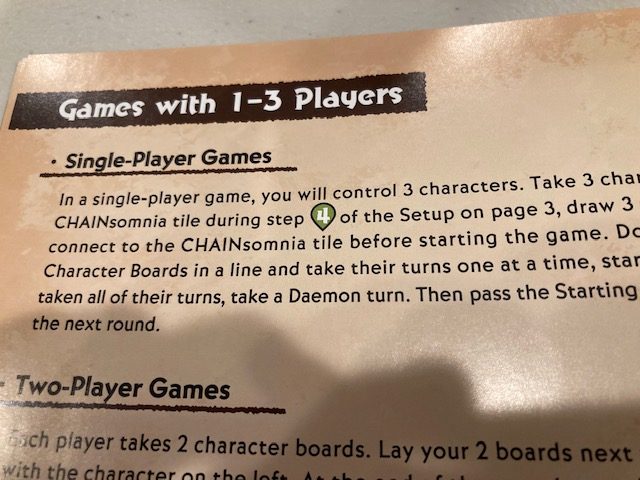
Unfortunately, the solo player must take control of 3 characters.  Similarly, a 2-Player game would have each player take control of 2 characters.  Basically, there must always be 3 or 4 characters in the game.  This isn’t ideal for the solo because there’s always the context switch issue as you jump from character to character, playing each one separately.

IMG_6748

Luckily for the solo mode, the context switch issue is not too problematic: each character has a pretty simple character with one “major” power.   For example, if one of your characters were Ryan (see above), it’s easy to remember he’s strong (strength of 5) and can also eliminate one monster for one AP.   There’s not too much to remember for each character, so context switching from character to character isn’t a big deal. Contrast this to the characters from Marvel Zombies: Heroes Resistance where each context switch becomes heavier and heavier as the characters get more and more abilities in the game (see our review here).  While the extra abilities in Marvel Zombies: Heroes Resistance are cool, it makes it significantly harder to play multiple characters.

IMG_6752

It took me two solo games to get a win.  I remember losing my first game and saying, “Nope! I wanna play again! I know what to do now!”   I think your strategy really depends on the characters you choose, so my second game was with the same 3 characters.

IMG_6765

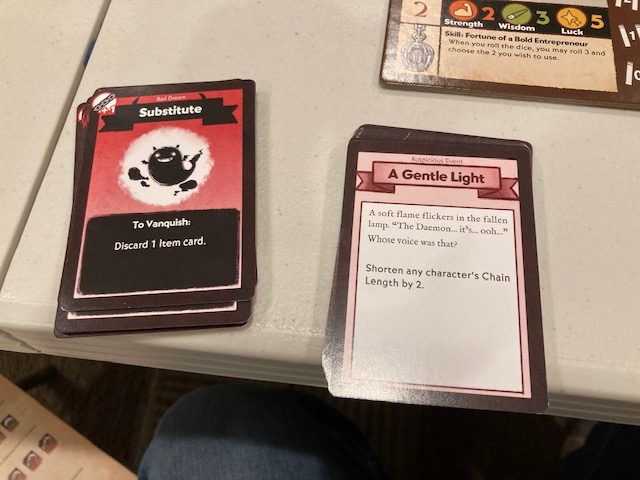
I made one major mistake in both solo games: I forgot to save my Ominous Event cards and my Auspicious event cards.  In most every other cooperative game, you throw away events when you are done … Nope!  Here, they are a measure oh how well you did.

IMG_6719

When you open the secret envelope, you need those cards.  I didn’t realize this until after my second game! 

(Picture deleted from review to avoid spoilers)

Minor Spoiler: Basically, you measure your victory (in the event of a win) by how many Auspicious Events and Ominous Events you got.    That was kind of cool: it’s a hidden and secret way to measure success, and gives you a reason to play again to try for a “better” win.

IMG_6755

I didn’t love solo mode (mostly because of the 3 character issue), but it was fun enough to play again.  It also gave me enough insight to teach to my friends.

Cooperative Mode

IMG_6862

This game went over pretty well as a cooperative game: probably better than I expected.  Since you always need at least 3 or 4 characters in play (this totally reminds me of Unicornus Knights), a 3 or 4-player game is probably ideal: that way every player gets exactly one character to operate, and it’s easier to inhabit and connect with the game if you are “that character”.

IMG_6864

I noticed that, as we were playing, we really did consult each other a lot … and console each other a lot.  “Hey, don’t worry: I can take care of that nightmare!”  “Hey, don’t worry, I can get you an item!”  Sara’s character’s power allowed here to give items to other people anywhere on the board … this was huge! It allowed us to power up!  Even if we had a bad role, the game evoked a pathos: “It’s all right, we’ll get you out of that mess.”  Maybe there’s something about being a little kid that brings out the best in people, and makes them want to help each other?

IMG_6861

There were a lot of fun little moments playing cooperatively.  I knew the game had gone well when we spent the post-game talking about all sorts of other ways we could have won/lost, been more strategic, etc.  People cared enough to keep thinking about the game, even when it was over!

Repacking

IMG_6766

What’s going on with this box?  It has a huge insert, but the game doesn’t fit back into the box unless you do one of two things:

  1. Always remove the plastic bases
    OR
  2. Pack the dice into the fingerholes!

IMG_6767

Those of you who have played GloomHaven know the problem with constantly removing/adding the plastic bases!  Basically, the bottom tears!  So, I chose to leave the plastic bases on.  Which means the game box WHICH IS HUGE doesn’t fit the game!  I had to be clever … and put the dice in the fingerholes.

IMG_6770

Yup, not ideal, but then the game fits. See below for pictures of how I fit the game in.

Conclusion

IMG_6694

Chainsomnia was pretty fun.  Although the rules were missing a lot of edge cases, the game was still pretty easy to teach and play.  The group liked it, but didn’t love it:

  • Teresa, Rich: 7/10, liked it, would suggest it
  • Sara: 6.5/10 liked it, would happily play, maybe wouldn’t suggest it as first choice
  • Andrew: 6/10 Liked it well enough, would play again

The biggest issue with the game was that it felt a little “samey” after a few plays.  You could mitigate that by switching up the characters to have different strategies.  It was also maybe a little too lucky with so much emphasis being placed on the dice.

Chainsomnia was fun enough.  We actually would not recommend this for kids: even though this game is cute, the nightmares attacking kids might not go over well with younger players.  This game is more for older kids who like light cooperative games with an anime look.

EDITOR: At the time Our Top 10 Cooperative Tile-Laying/Placement games was written, Chainsomnia just barely squeaked onto the list as #10. I hate to say it, but I think Race for The Raft came along, moved to the top of the list, and pushed everything down one space (see our review here: it’s that good)! So that means Chainsomnia is #11 now …

Wait, A Cooperative Euro Wargame? A Review of Sammu-ramat The Board Game

Welcome to the Start of Cooperative Surprise Month!  This month, we take a look at some of the surprises we have encountered recently in our cooperative game journeys! We start this month with a cooperative game called Sammu-ramat, which ended up being a huge surprise!

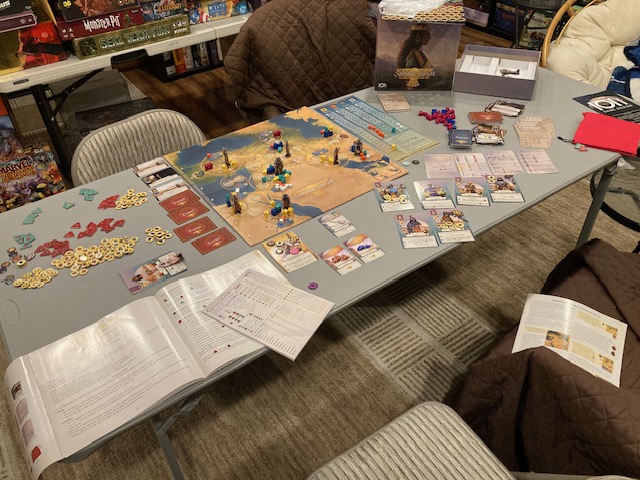
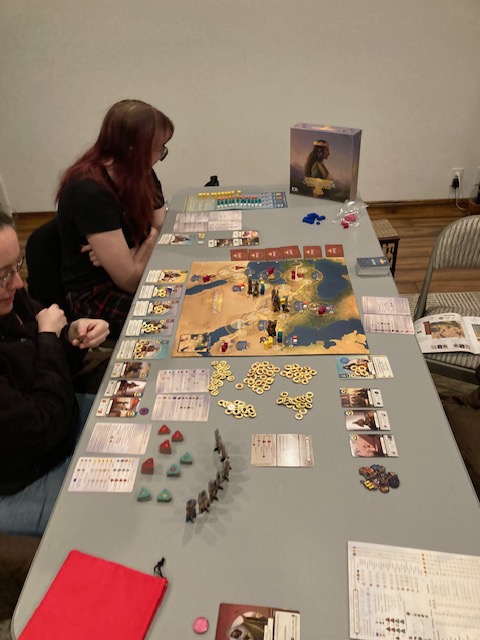
Wait, what just happened?  I just spent five days straight playing Sammu-ramat! This was a cooperative game on Gamefound back in November 2021, and it finally delivered to my  house just a few days ago (Wednesday, February 15th, 2024).  I have been playing it non-stop since it arrived at my door!

IMG_2698

This obsession is really weird, because I was on the fence for Sammu-ramat when it was on Gamefound. The game didn’t look “great”, but the idea of this cooperative resource-driven war game looked interesting, so I backed it.

IMG_2700

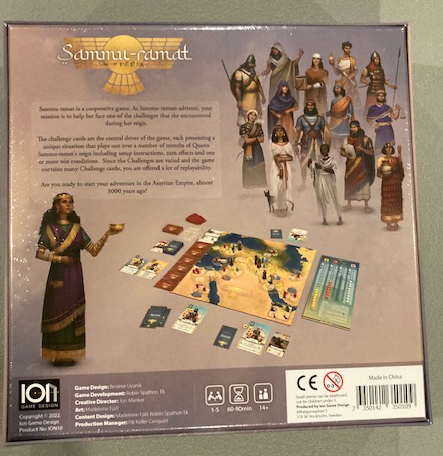
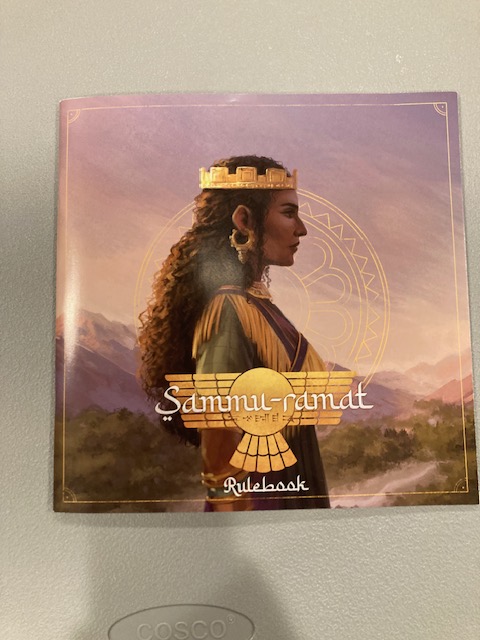
I have to admit: I wasn’t wowed by the production.  The cover isn’t great and this box was just okay.  If I were to see Summu-rammat at a game store, I might pass right over it.  It doesn’t look like anything special.

IMG_2855

But at the risk of giving away my thoughts early, it would be a crime to pass up this game!  Despite a lot of issues with components, production, and the rulebook, this is a very good game!  I adored it and couldn’t stop playing it for five days!

Let’s take a closer look!

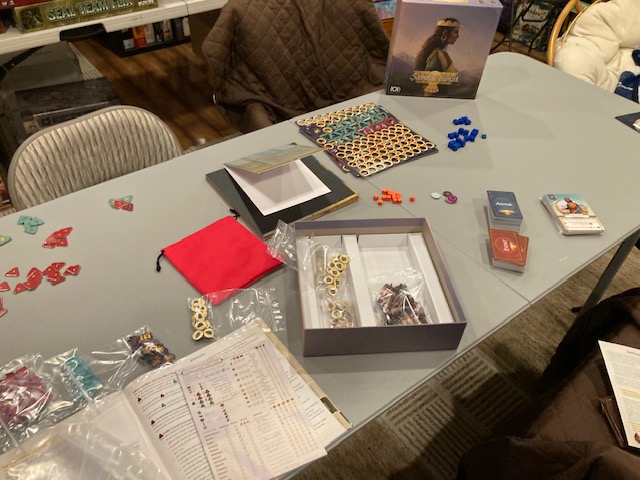
Unboxing and Plutorial

IMG_2705

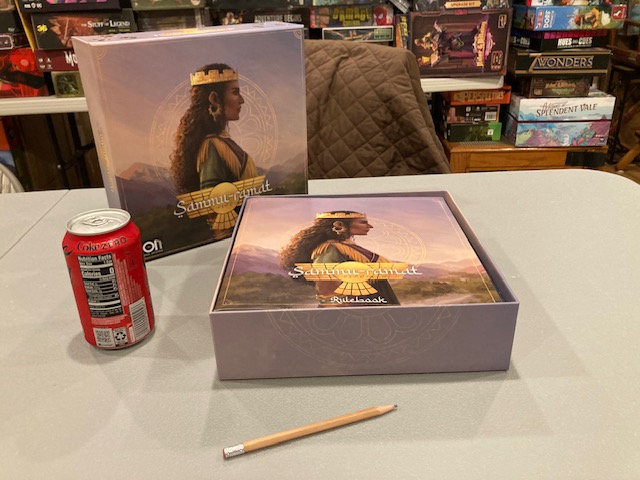
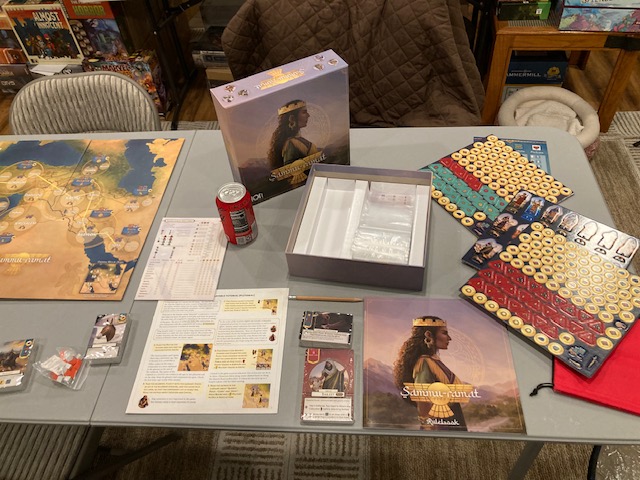
The first day the game came in, I unboxed it.  It’s a little smaller than a Ticket To Ride style box.  See the Coke can and #2 pencil for perspective (see above).

IMG_2706

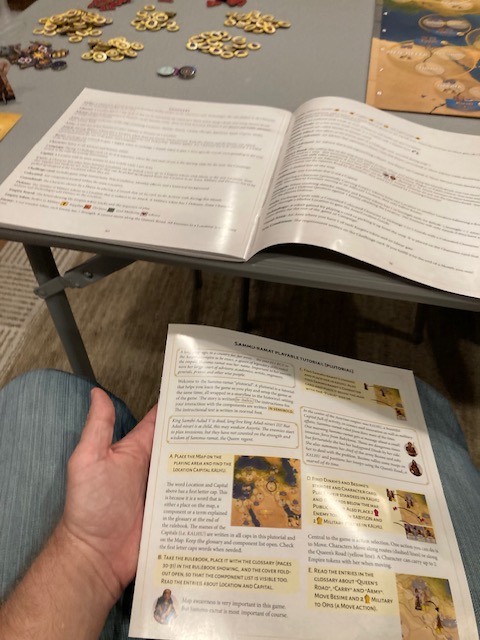
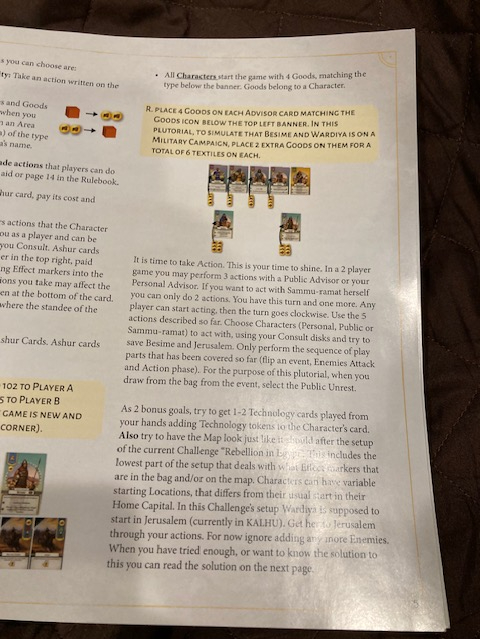
Just under the rulebook is the Summu-ramat Plutorial. What’s a Plutorial you may wonder? A playable tutorial!

IMG_2707

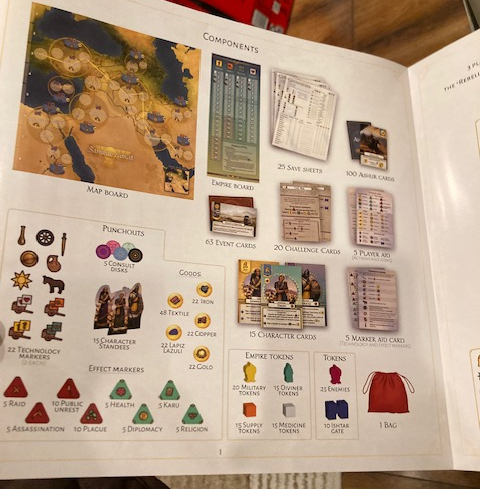
The Empire Board is a way to track resources.

IMG_2708

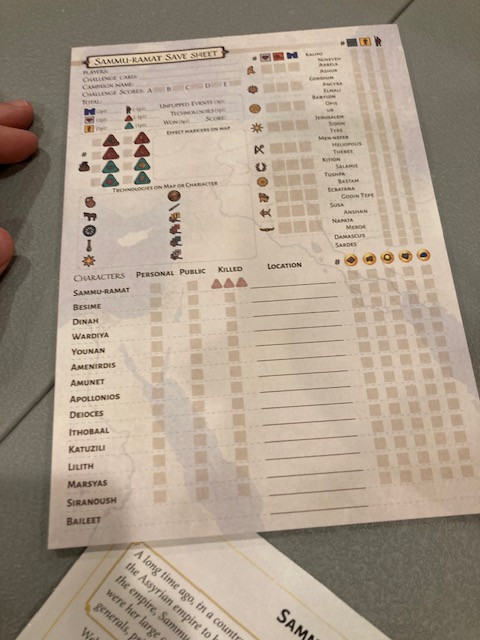
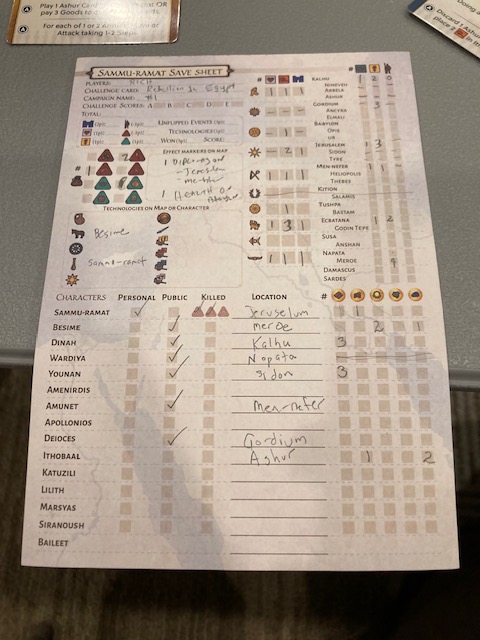
The “save state” pad is useful for the campaign mode: Spoiler! The game comes with many campaigns!  But don’t worry, you can still easily play one-off games.

IMG_2710

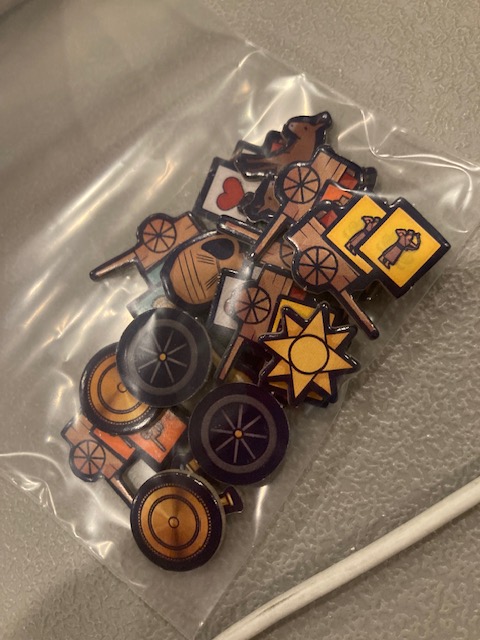
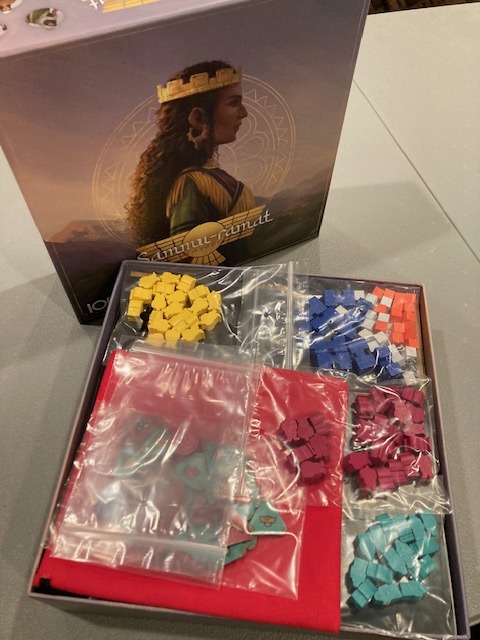
There are quite a number of punchouts.  Most of the tokens are Goods tokens (yellow resources), good (green) tokens, or bad (red) tokens for the token bag,

IMG_2765

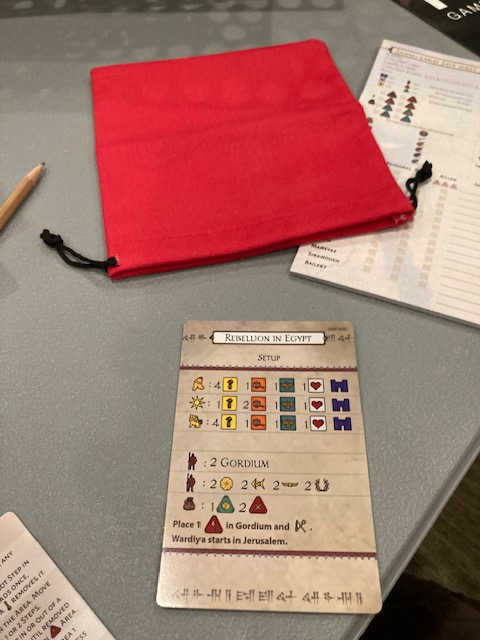
There is a pretty nice token bag: it’s not a main mechanic in the game, but there are times throughout the game when you will put/pull tokens (good green or bad red).

IMG_2711

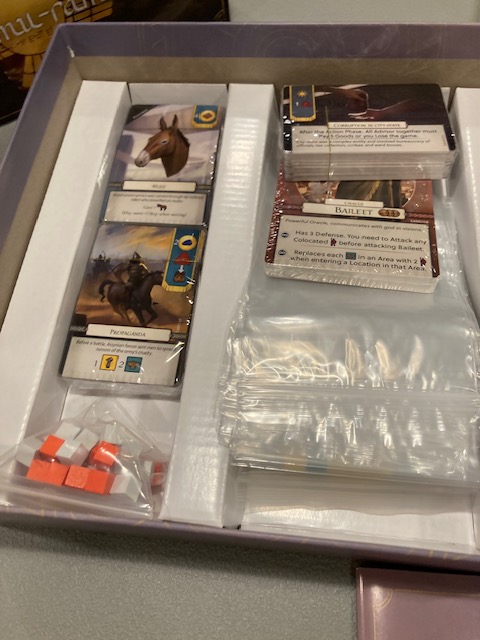
There are a ton of plastic bags (for bagging the game up later), and some cards.  We’ll see these cards later!

IMG_2763

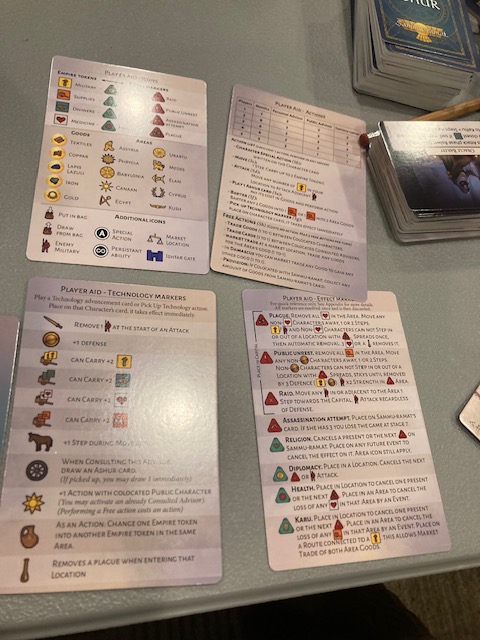
It’s important to point out that the game has a fairly extensive set of player aid cards for all players! See above.

.IMG_2740

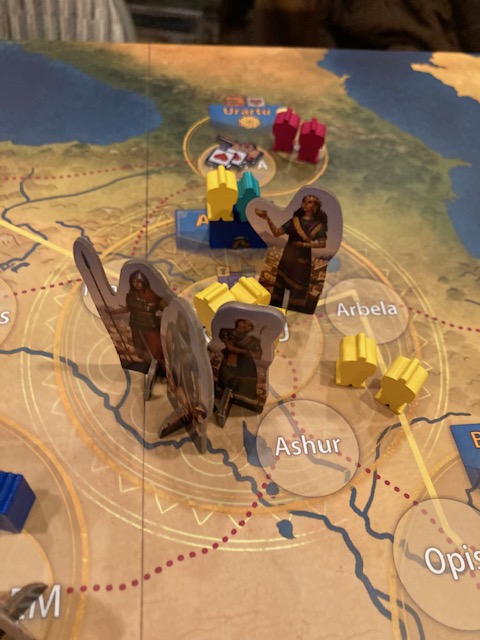
A lot of the punchouts are also characters you can play.  See above.   The meeples are generally military (red bad guys, yellow good guys). 

IMG_2713

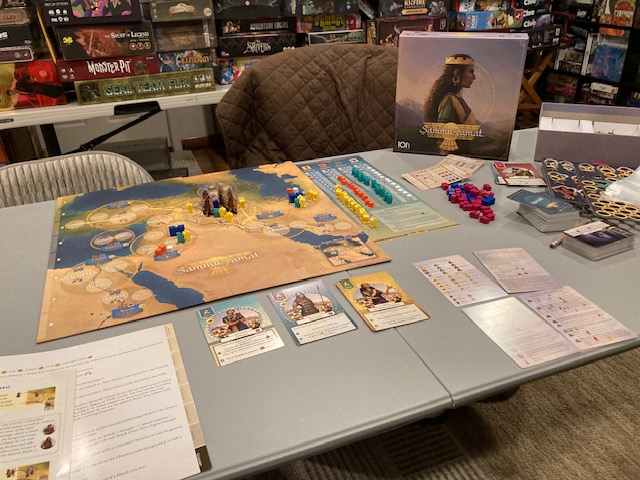
Overall, the game production looks pretty good. There are a few issues we’ll point out later.


Plutorial: Playthrough and Tutorial

IMG_2706

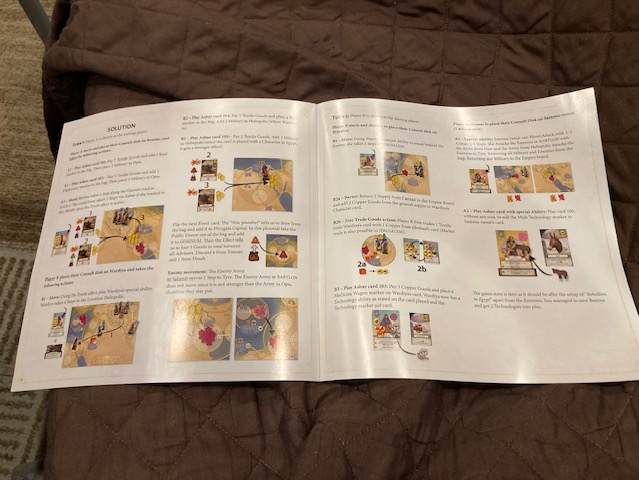
This introduction shows the first few turns of a game, as it teaches you some of the core rules.  The Plutorial is well-notated and clear (modulo a few sections) as it takes you through some of the major pieces of the game: combat, characters, gathering resources, the Empire Board, the player aids, the maps, Areas vs Locations, and even reading the Glossary at the end of the rulebook!

IMG_2748

This Plutorial is absolutely essential to starting the game off on the right foot.  There are a lot of rules to Sammu-ramat, and I could have very easily lost interest in the game if I didn’t have this to guide me into the game.   

IMG_2751

The game is just complex enough that just reading the rulebook might turn off a lot of people (the rulebook of 32 pages and fairly technical).

IMG_2774

The Plutorial very clearly notates why things happen in the game, and even sets-up a little “puzzle” for you to solve (with a clear solution at the end). I think after I finished the Plutorial, I felt like I knew enough to jump into Sammu-ramat feet first. This Plutorial made me feel like I could understand enough to start playing the game … and that’s a win for a game this complex.

Rulebook

IMG_2884

This rulebook is okay.  It taught the rules, but it had a few problems.

IMG_2734

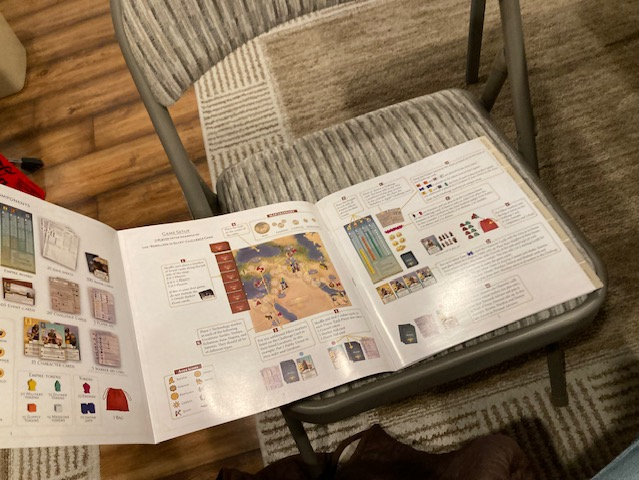
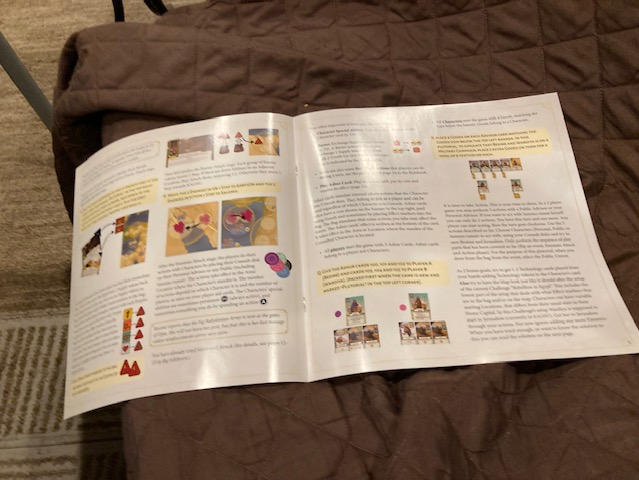
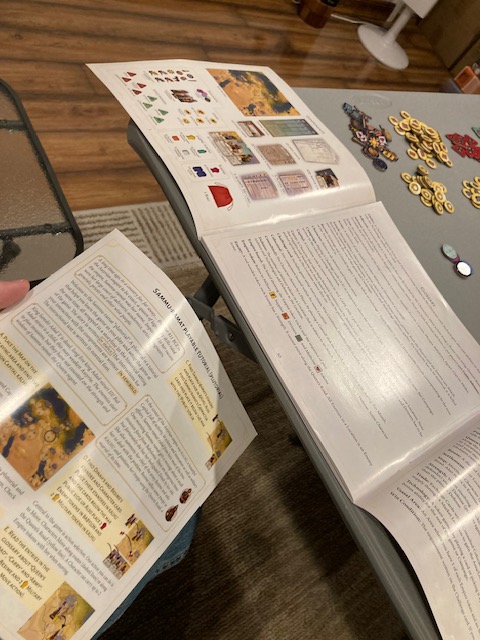
The first was the trifold nature in the first few pages.  I think this might be a clever way to have the components page always available while reading the rest of the rulebook, but it’s simply too unwieldy in real life.  I applaud them trying something new: I really like the basis of the idea!  I really like having the components page always available.  In the end, they would have been better served having the components list of a separate sheet that wasn’t awkwardly attached to the rulebook.

IMG_2718

The rulebook would probably get a B or B- on the Chair Test.  It doesn’t quite fit on the chair next to me.  In the end, it ended up on the table the entire time I played, taking up valuable table space.  I really wish the form factor had been a little smaller.

IMG_2721

The game had a nice components page, despite the form factor.

The set-up was also very well notated: see above.

IMG_2768

In general, the rulebook was okay, but it did read like a technical manual.  Without the Plutorial, this rulebook would have been much more difficult to get through.

IMG_2736

I think the rulebook must be also a translation: there were several points where the verbs seem misconjugated (that’s usually a dead giveaway of a translation) in number and/or tense. 

IMG_2782

The fact that the rulebook had a glossary was a major plus!  I just wish it had an index.

The back of the rulebook was used for something kind of useful: I wish it had been an icon summary, but at least it was something kind of useful.

IMG_2827

Overall, this rulebook needed just a few points of clarification, a better form factor, an index, and another pass by an editor.  Having said that, it was decent at presenting the rules.

IMG_2867

You can learn the game from the rulebook.  Just be aware that you will have to hunt for rules a few times.  I have played the game probably 10 times by the time you read this, and I still find myself searching the rulebooks for clarifications.

IMG_2737

But, the rulebook worked.

What Is This Game?

IMG_2841

At the end of the day, Sammu-ramat is a puzzle.

IMG_2757

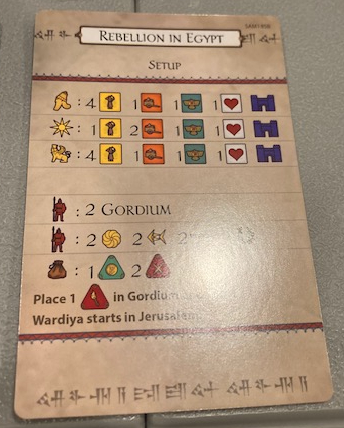
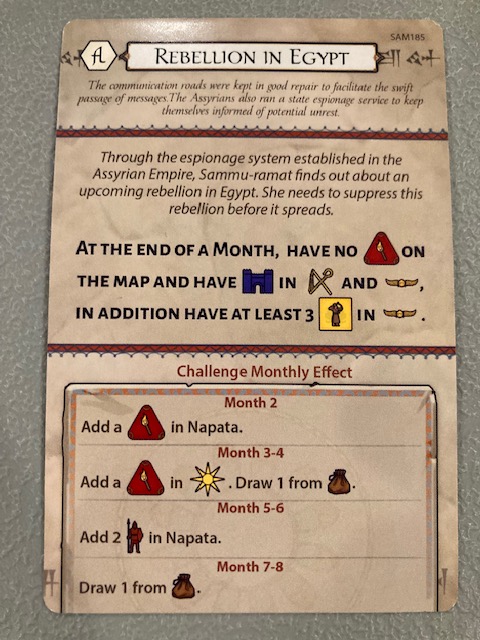
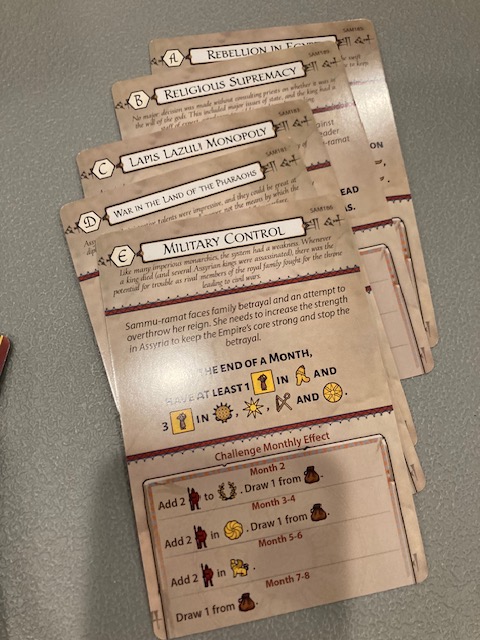
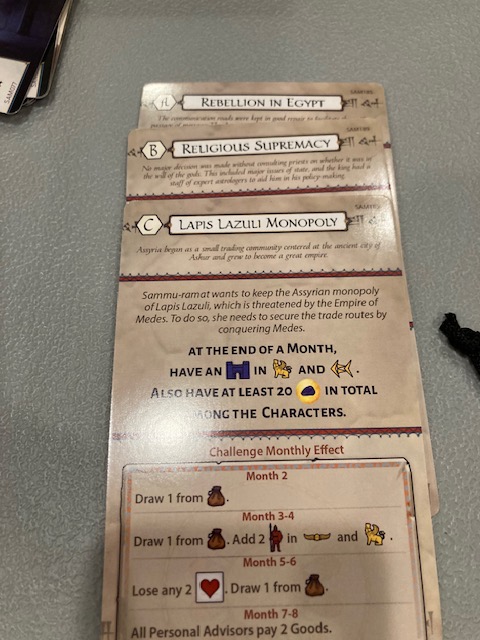
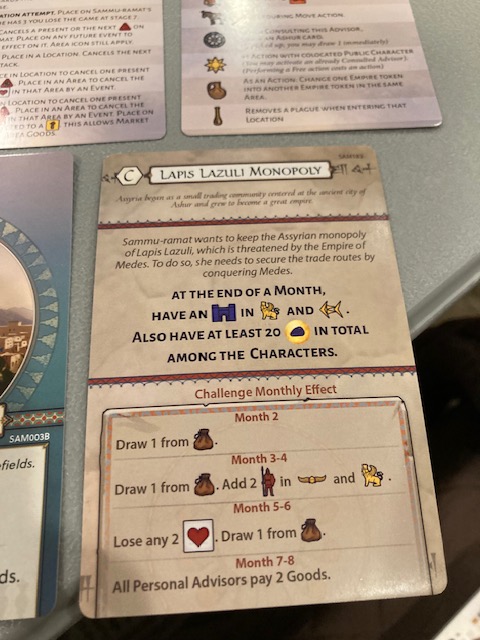
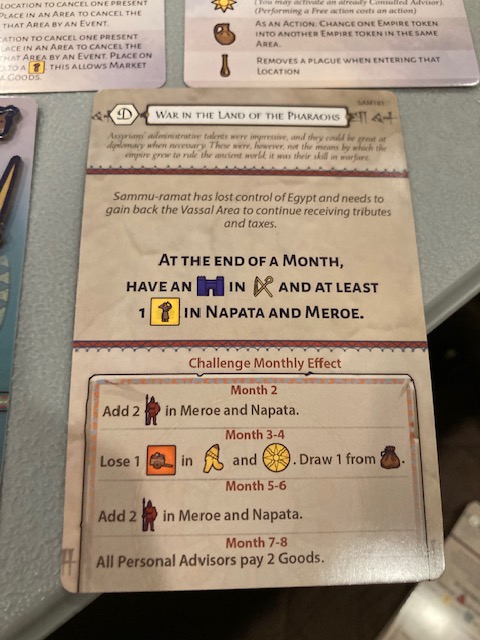
The Challenge Cards (see above) define the puzzle for you.  The front side tell you how to set-up the puzzle: where to put Goods and Empire pieces for the players, as well as starting locations for the bad guys and “bad tokens” in the game.

IMG_2882

The back side of the Challenge Card then tells you what to do to win, as well as the bad things that will happen as you play!  To be clear, you know what some of the bad news that will happen before you play!

IMG_2797

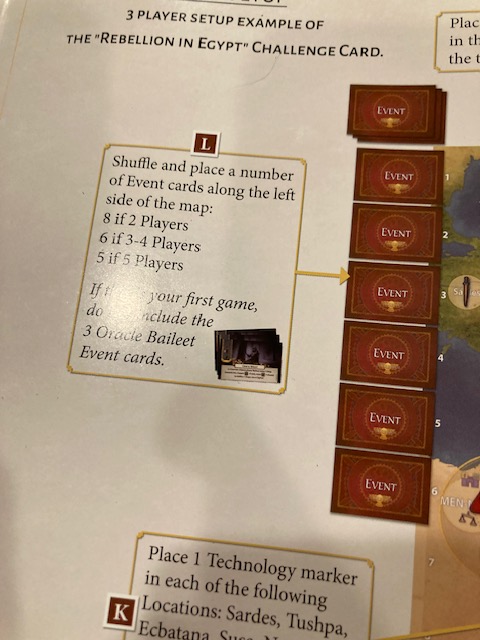
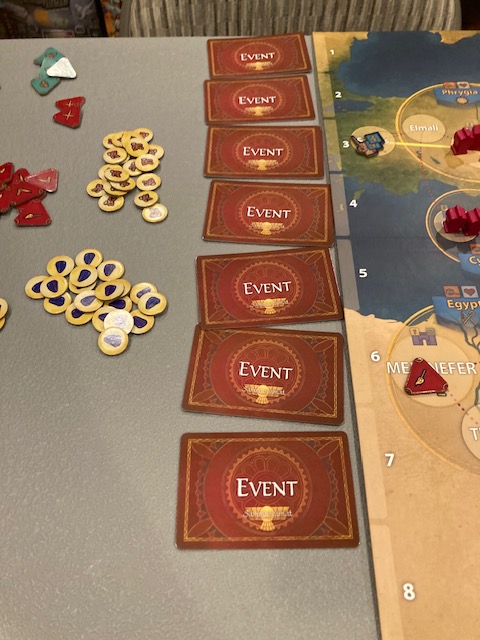
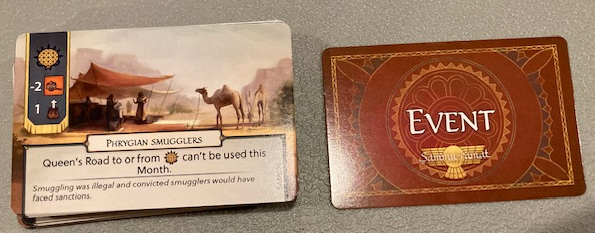
The game proceeds over 8 rounds (7 for solo and other adjustments for different player counts).  The event cards usually are usually bad things, but occasionally helpful.   Most of the game, you know what’s coming, but the events are probably the most random part of the game.  (It has been my experience over about 10 games that there is usually one event that usually completely messes you up, but the rest are manageable).

IMG_2738

The event cards effects are notated in the upper left.  For example, for the event card above, the effects are localized to Phrygia (the spiky ball at the stop left), losing 2 Supplies in that area (orange cart), and drawing one token the bag (1 and arrow up from bag).

IMG_2761

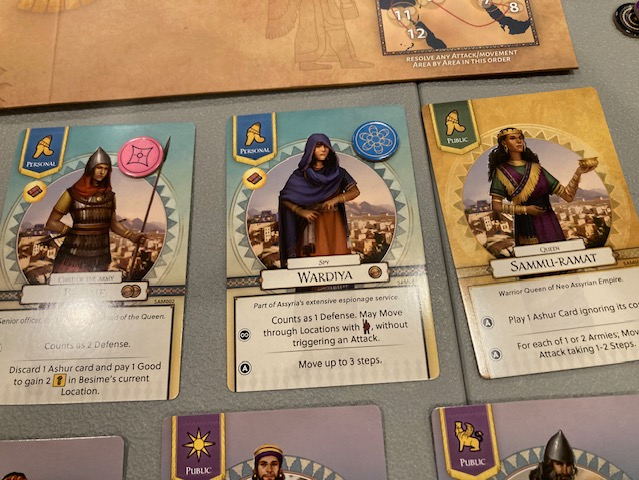
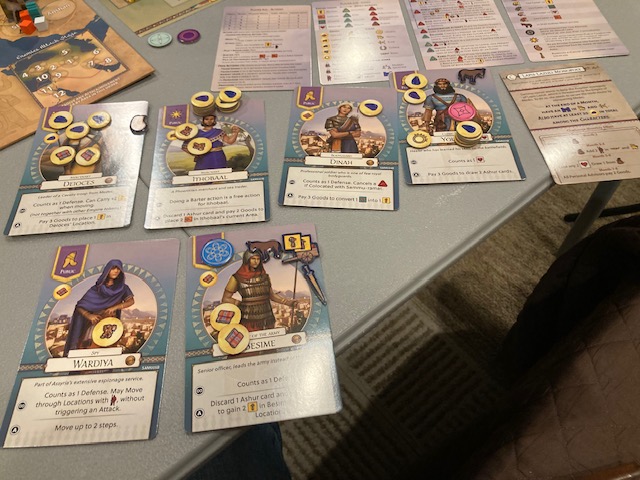
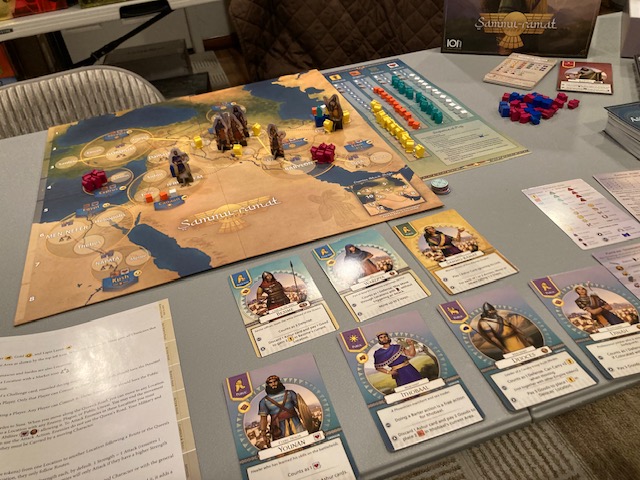
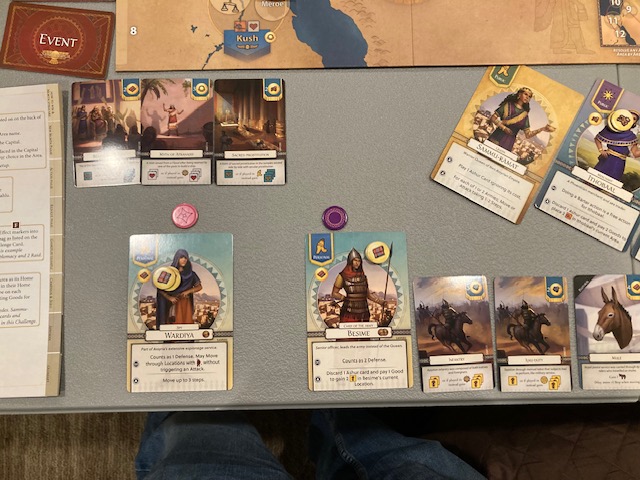
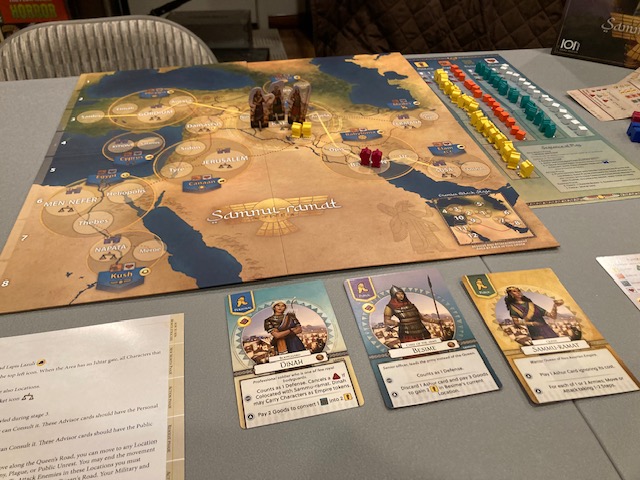
Each player assumes the role of a single advisor (putting the personal side up), and then other advisors are revealed (based on where Ishtar Gates are at the start), who will be helpful as well.  Only the solo player may play Sammu-ramat directly.   Note that each advisor has their own powers: one that’s always on (infinity symbol) and an action only that advisor can take (A).  

IMG_2756

Interestingly, you don’t always have to play your character on your turn: you may choose to activate a different advisor (maybe they are closer to a problem that needs solving), but usually it’s in your best interesting to activate your personal character, as they typically have an exra action per turn.

IMG_2739

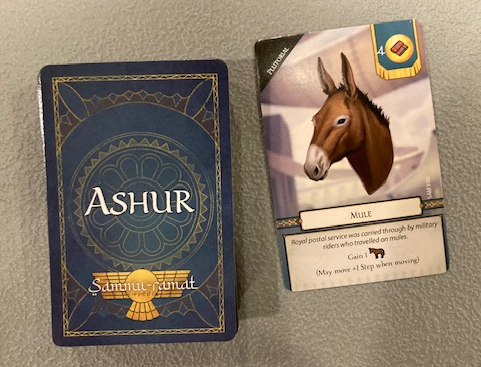
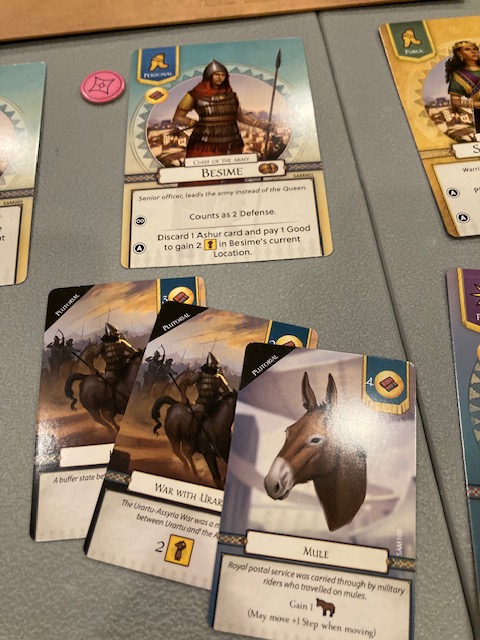
To help the players, they have Ashur card, which are all good news cards.  They all have a resource prerequisite on the upper right.  For example, the mule above needs 4 textiles in order to be bought.   The Ashur cards are key to the game: they help you do special actions, get resources, move further, get technology and so many other things!  

IMG_2844

This game is a euro because a major theme to the game is getting Goods (resources) to power your actions.   By playing a Ashur card, or activating a special action, or trading goods, or bartering, the players need to assimilate Goods!  The Goods power so many important actions in the game: For example, you need 4 Goods (the Textiles) to buy the Mule (Ashur Card from above)!  Sammu-ramat is a Euro because it’s all about turning Goods into other Goods for the problem at hand!  

IMG_2777

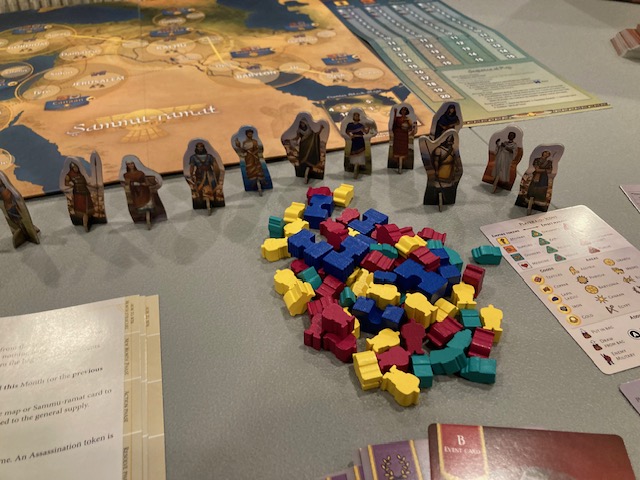
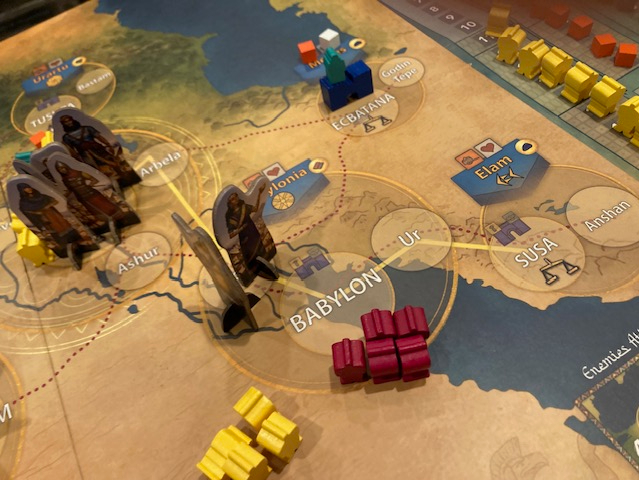
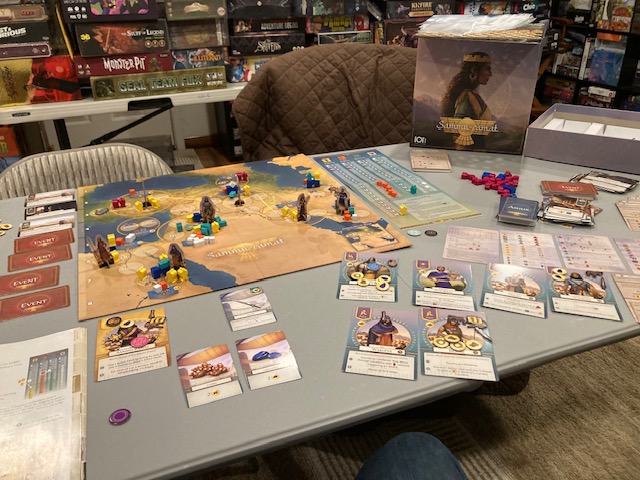
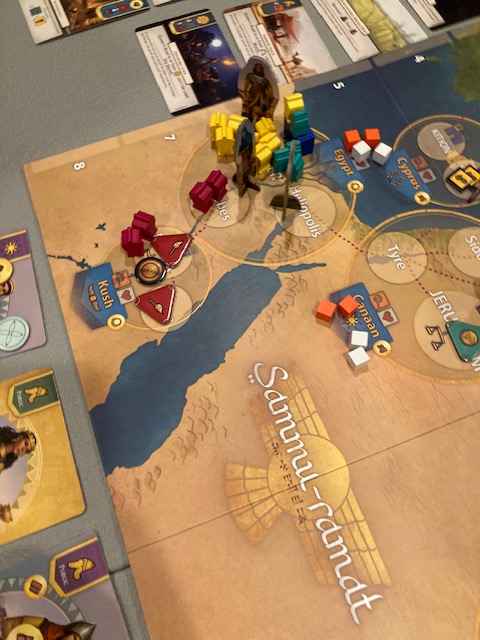
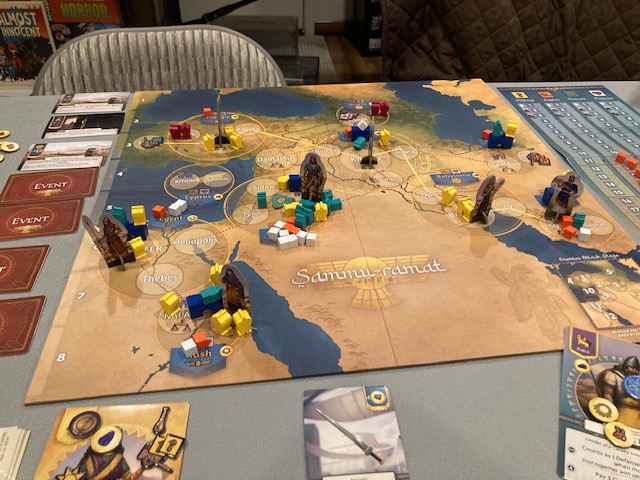
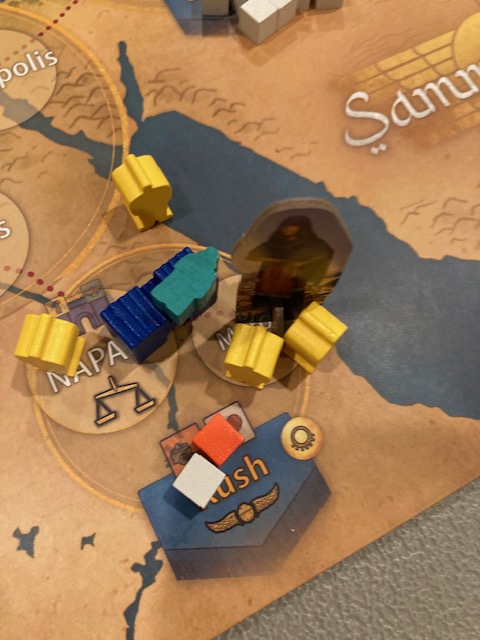
This game is a wargame because you need to make sure you stop the advancing troops that all heading to seat of power: Assyria!  The red meeples (above) are the bad guy troops, or the enemies: when they appear on the map, their job is to take over Capitols along the way, but head to Kalhu!  You can only stop the enemies with the military (the yellow meeples).   There is no randomness to the fighting in this game: when you initiate a fight, it’s a 1:1 battle: each side loses 1 enemy/1 military until one side wins!!   Before you head into a fight, you should know if you will win or not!!  Military is one of the resources you buy with special actions, Goods, or Ashur cards!

IMG_2846

This is a cooperative game: all players work together to decide on the best actions to win the puzzle! 

IMG_2863

Putting all this together: Sammu-ramat is a cooperative, euro, wargame!  But it’s really a puzzle: how can you work together to solve the objective on the Challenge Card?

Solo Mode

IMG_2881

So, the game comes with a built-in solo mode (thank you for following Saunders’ Law).  

IMG_2798

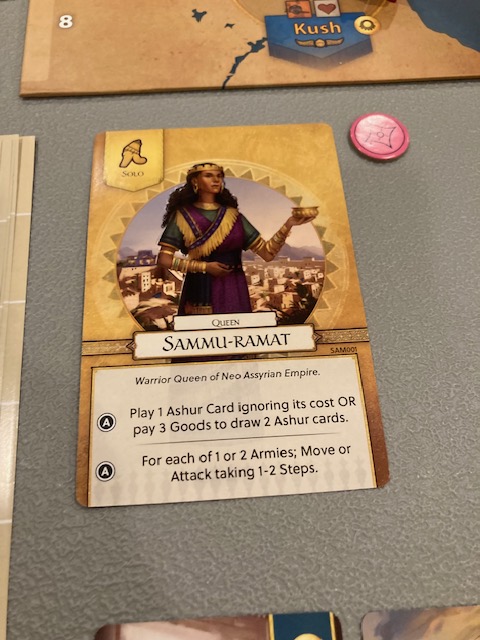
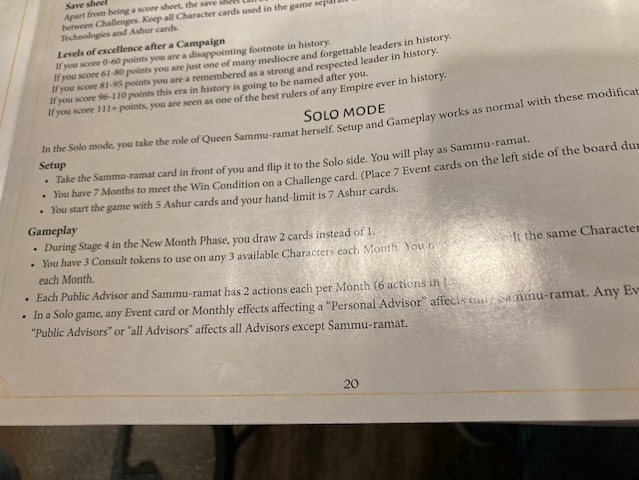
In the solo mode, the solo player takes  Sammu-ramat card as their player card and flips it to the solo side.

IMG_2796

There is about a half a page description on page 20 of the rulebook.  There are a couple of changes, mostly pretty straight-forward.   The one change I forgot multiple times was that Stage 4 draws 2 cards instead of 1: you will forget this rule! The only place it’s notated in the entire game is on page 20.   It’s way too easy to forget this rule, and I wish there had been a way to notate that (maybe on the Sammu-Rammut solo card).

IMG_2842

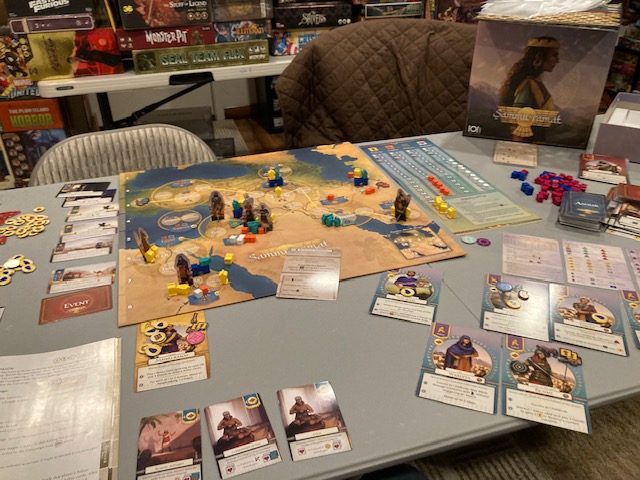
Most of the of games of Sammu-ramat I have played were solo … and they were excellent.  There is so much thought and consideration that goes into every action!  Everything you do matters!  That’s what makes this solo game so great: you feel like your choices really do matter.  It’s also great as a solo game because you can spend as much time as you want considering and reconsidering your choices.   Many times, I would start out a few actions, but then realized I had to do it a different way, so I would rewind … I would only rewind in Phase 5 and redo the player actions.  I don’t consider this cheating because I was only “trying” my actions to see what the effects were … I never let a rewind cross out of Phase 5 to use information I didn’t have.  And that’s the great thing about the solo mode: you can just try stuff out.  It’s a puzzle!

IMG_2759

Now, there is another way to play so: pretend you are playing a two player cooperative game and operate two characters!  Even though I have played most of my solo games with the official solo rules (playing Sammu-ramat), I think the two-handed solo game might be better … why?  Why, you ask?  Because there’s no exceptions! The official solo mode described on page 20 of the rulebook has about a third of a page of “new rules” (with the 4th stage extra card being the most persnickety).  If you play two-handed solo, you are just playing the base game with no exceptional rules: the game is as it was meant to be played. 

IMG_2784 

The two-handed solo definitely feels different, mostly because each character usually has about 3 actions per phase, whereas the solo player in the offficial solo game has 2 actions for three characters. Both essentially get 6 actions per turn, but there’s something more satisfying about getting to do three actions on your turn: you feel like you can “complete” things you need to do.

Two-handed solo also has to worry more about card management, as there’s more work to manage two hands of Ashur cards.  So there’s that: it’s a little more maintenance.   But, if you are just going to learn Sammu-ramat solo just to teach the game to others to play cooperatively, I recommend using the two-handed solo mode: it feels more like how the game will flow cooperatively.  

IMG_2773

It might also be easier to learn the solo game two-handed because that’s what the Plutorial teaches!   My first game was two-handed solo to learn the game, and then I went to the official solo mode for my first campaign (as there is slightly less maintenance in the official solo mode).

It’s up to you: both solo modes work well!  Two-handed solo reflects more what the game feels like cooperatively, at cost of a little more maintenance.  The official solo mode has less maintenance per turn, but has enough exceptional rules to occasionally throw you for a loop.

Campaign

IMG_2877

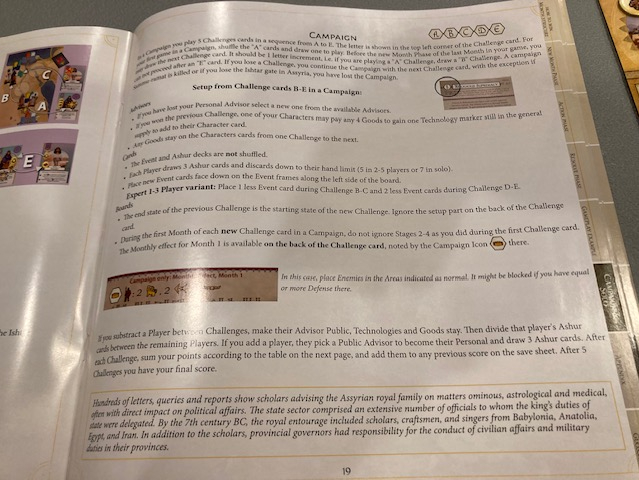
Although you can play just a one-off game of Sammu-ramat, there’s a lot of fun to trying one of the campaigns.  Basically, the campaign is 5 games in a rows from Challenge Cards labelled A,B,C,D,E (there are multiple of each letter to give the campaign some variety).  

IMG_2820

What’s different is that you save state between games!  See above as I record the state of the my game at the end of Challenge A.  To start the next game, you start in “whatever state you left the game in”, and continue!

IMG_2867

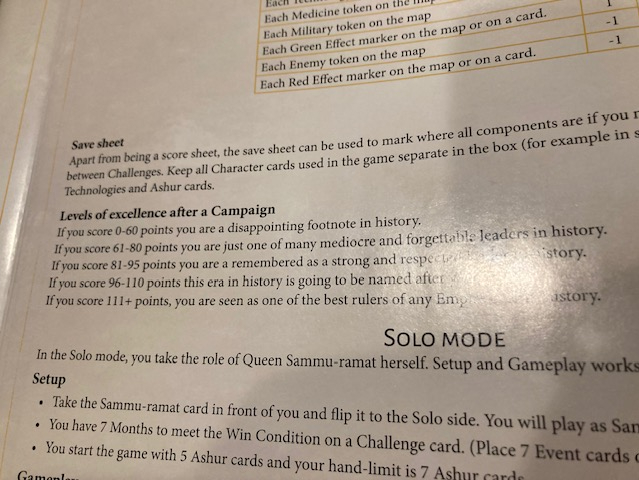
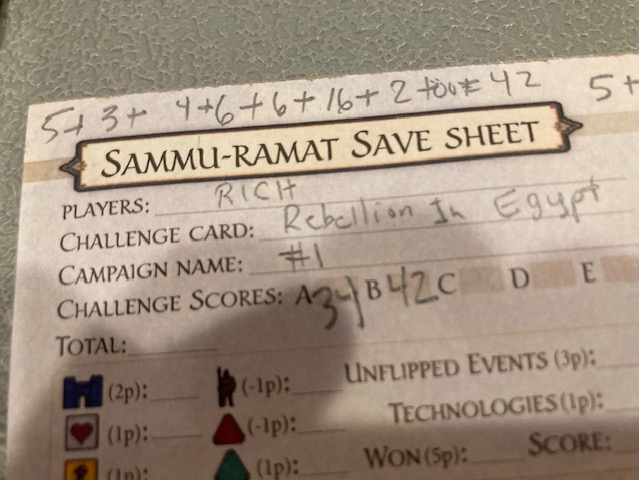
After each Challenge card is complete, you score that gives you a sense of how well you did: yes, this is a “score-based” assesment.  

IMG_2837

I didn’t do great, but I did make it to mediocrity at the end of my full campaign.  I guess it’s better than being a forgotten ruler.

IMG_2850

What’s great about the campaign is that it’s only 5 puzzles (5 challenges), but what you do matters even more, as you set yourself up for he next game!  Maybe you’ll spend an extra turn to win so you can set-up something great in the next game!  

IMG_2869

I spent the entire weekend playing through the campaign as a solo player (official mode), and I had a blast.

Cooperative Play

IMG_2905

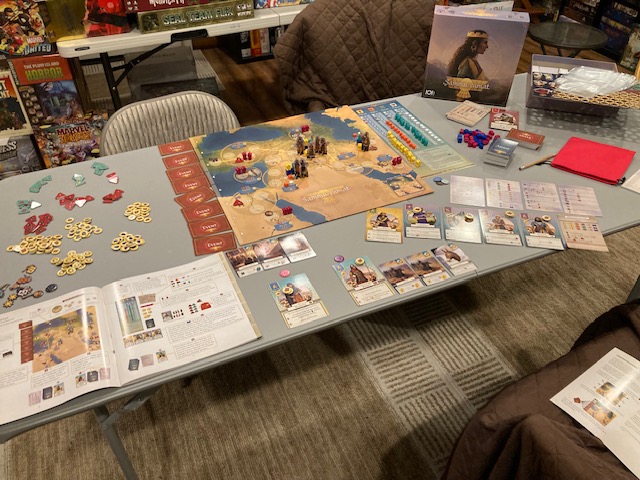
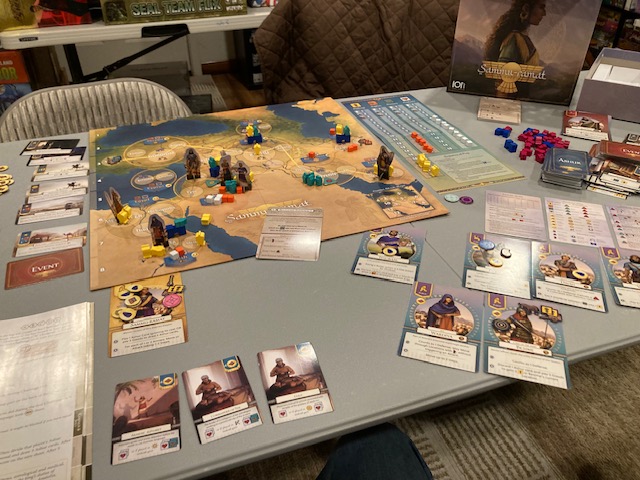
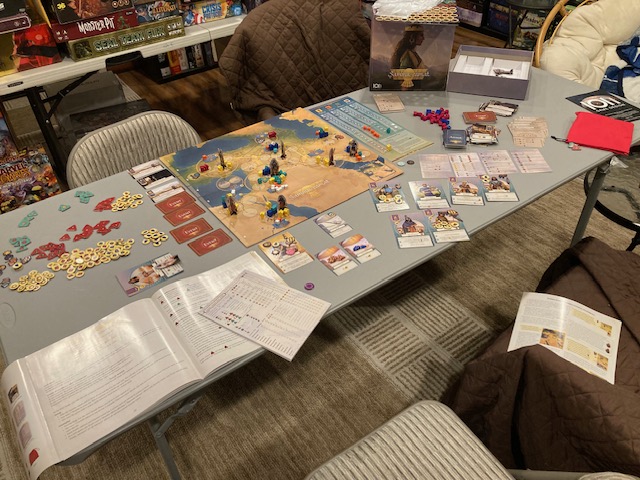
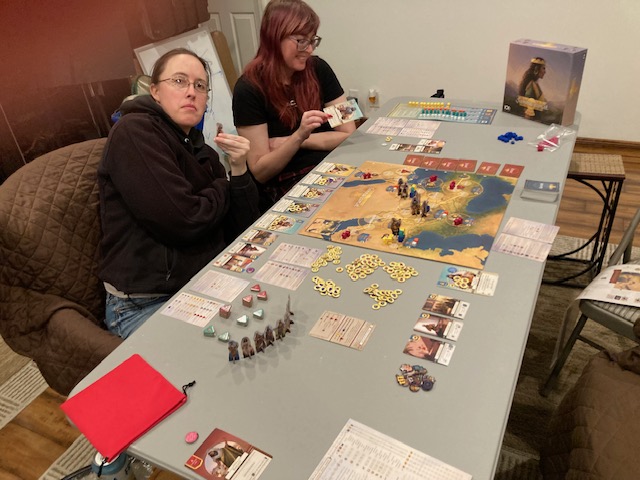
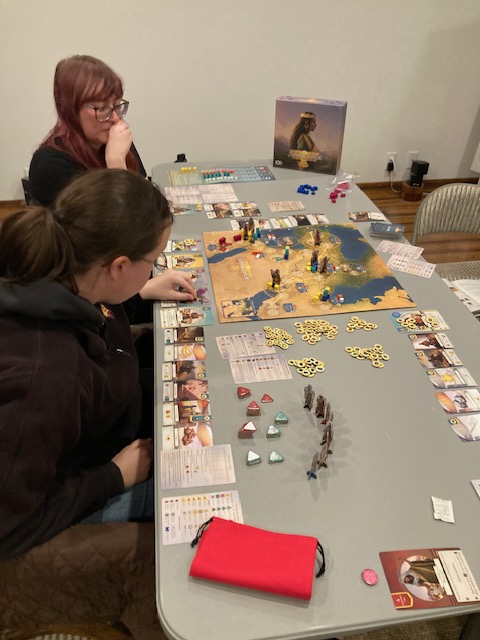
Although most of my plays have been solo and/or the campaign, I was able to get the game to the table with game group: we got a 3 player game going and had a good time.

IMG_2910

We did play with full Player Selected Turn Order (see below for more discussion), as Sara pointed out that it makes you feel more involved: each player chooses a character, and by allowing us to go in whatever order we want, we are more engaged and invested in our character (“I chose this character, and I can’t play it in the right order??!!?”)

IMG_2909

Unfortunately, we did lose, but it was because we were too concerned for keeping all the Ishtar Gates, as opposed to the servicing the goals!  I think the plan is to try again. 

IMG_2908

We had fun playing even though we lost!  We talked, discussed what we needed to do, and executed our plans!  This game could easily go sideways with an Alpha Player, if someone really knows the game.  Luckily, there are so many moving systems, it does mitigate that a little. 

IMG_2905

It was a good, engaging, cooperative game.  It’s clear, this game needs a good teacher though: I think going into this game without someone knowing the game is a recipe for disaster.  There’s too many systems to lean this game “on-the-fly”.   if you do want to play this game cooperatively, make sure someone shepherds you into the game for the best experience.

Randomness

IMG_2843

There isn’t much randomness in this game.  Combat is predictable: there’s no dice.  The “bad news” that comes from the Challenge Cards is completely known to you at the start of a Challenge: you know what’s coming.

IMG_2797

The greatest source of randomness was the Event Cards. There is no way (that I’ve seen at least) to predict what Event will come out, so you just have to deal with it.  In general, the events were’t devastating, but they did cause things to be dealt with.  It did seem, once per game, one event would just completely screw you!  But, it always felt you could come back from it!  The randomness did NOT seem debilitating by any means. 

IMG_2771

The other source of randomness was the Ashur Cards, as you didn’t know what you would get from turn to turn. But, the randomness there was usually not an issue: you could either use a Ashur card to power an ability, or you could draw extra Ashur Cards if you really needed something.  In general, the Ashur cards were more of a resource that was sometimes more or less useful, but it didn’t seem too random.

IMG_2863

All of this goes to say: I don’t think the randomness of this game is untethered.  Most of the actions have known outcomes (combat, Challenge Card bad news, actions), but there’s just enough randomness to keep the game spicy (between the random Events and the much less random Ashur cards).   Sammu-ramat is not a wargame with lots of dice and randomness; it is a fairly explicit puzzle.

Some House Rules To Consider

IMG_2799

This game uses a stilted version of Player Selected Turn Order (PSTO) (see our discussion of PSTO here to learn more).  On the first turn of each month, players talk and figure out which player goes first: hurray!  Players select the order for the first player … but then, play rotates clockwise!!   So, the players only get Player Selected Turn Order for the beginning of the turn!

IMG_2798

This is a strange decision to limit the PSTO because the (official) solo game has full selected Player Turn Order: the solo player gets to activate three characters in whatever order he wants every turn!  So, this seems a strange decision to limit the PSTO. Usually, it’s because many people aren’t used to PSTO and it can sometimes be harder to notate (see more discussion here).  I suspect adding full PSTO to the cooperative game would be more fun, as it would make the players feel like they have more choice?  It’s already been play-tested in the solo mode, so why not add it to the cooperative mode?

IMG_2883

One tool the players have to help them is technology.  The technology tokens are lain around the board, and players can pick them up as they explore the map. See a bunch above of technology above: the shield gives +1 defense, the mule gives +1 movement, etc.

IMG_2844

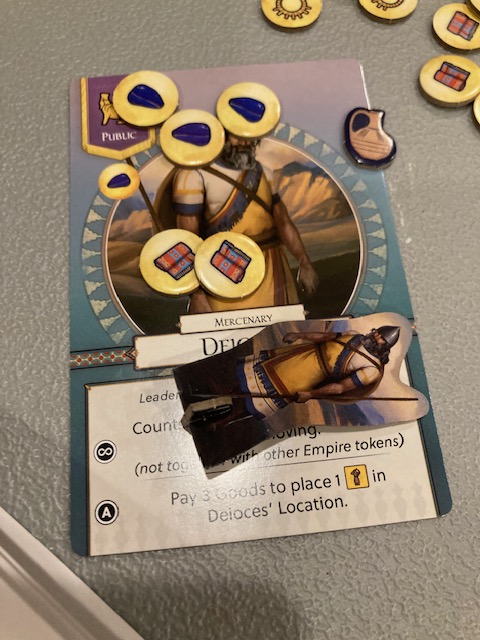
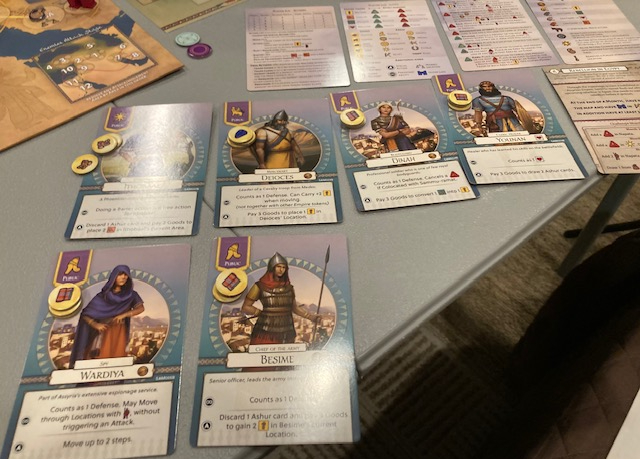
You can see Deoices has picked up the Amphora (vase) above (with 5 Goods as well) and it’s on his character card!  He can now use it!  It’s got a cool ability … but it can’t be traded.  Almost everything else can be traded (Ashur cards,  goods) …why not technology?  From a game perspective, all the technology pieces are physical things that should be able to traded (sword, vial, shield, etc), so it makes sense from that perspective that they can be traded.  BUT, by not mentioning explicitly that you can trade technology, it’s clear that the rules don’t allow it.   The physical nature makes me think they should be, so thematically it makes sense. In fact, you might accidentally trade if you don’t look too closely at the rules!  

IMG_2803

I would suggest two minor house rules to make the game more consistent:

  1. Allow trading of technology as Goods and Ashur cards (so it’s more consistent with other trading rules).  If you are worried about balance with this rule, you can make a trade of technology a full action rather than a free action.
  2. Allow full Player Selected Turn Order (so it’s more consistent with the solo game)

Of course, caveat emptor: both of these rules might change playtesting and balance.  The game is pretty hard as it is, so I don’t think these minor changes will do anything except make the game more fun: it’s a more consistent application of rules and gives the players more choice!

What I Loved

IMG_2838

I loved the puzzle of this game.  There were always enough options (between Ashur cards and special abilities) that I always felt I could solve the puzzle.  

IMG_2851

There’s quite a bit of variety in here on the Challenge cards!  There’s always a different kind of puzzle to solve even if you master one Challenge!

IMG_2877

The campaign is a really good way to extend the replayability of the game.  I love that you can start from scratch and play a game, but it’s such an interesting puzzle to see what happens if you leave the game state between Challenges!  The Campaign will be very different every time!

IMG_2865

I love this game as a solo game.  The fact that you can play solo two ways is also great, depending on what you are in the mood for.

IMG_2749

The Plutorial (Playthough and Tutorial) really drew me into the game.  I am very worried I would not have suffered through the rulebook without the Plutorial.  I love that this exists, and I wish more heavy games would have very explicit set-up and playthroughs like this!

Component Issues

IMG_2879

As much as I like this game, there were a number of physical component issues.

IMG_2795

A very minor component issue is that the little cardboard stands fell off all the time: the cardboard bases really needed to be plastic bases.

IMG_2872

You are supposed to put a military and a diviner on top of the Ishtar Gate, but they frequently fell off, especially when you were moving around other tokens near it (see above). The corrugated tops of the Ishtar Gates was a nice effect, but it made the tops even more precarious.

IMG_2865

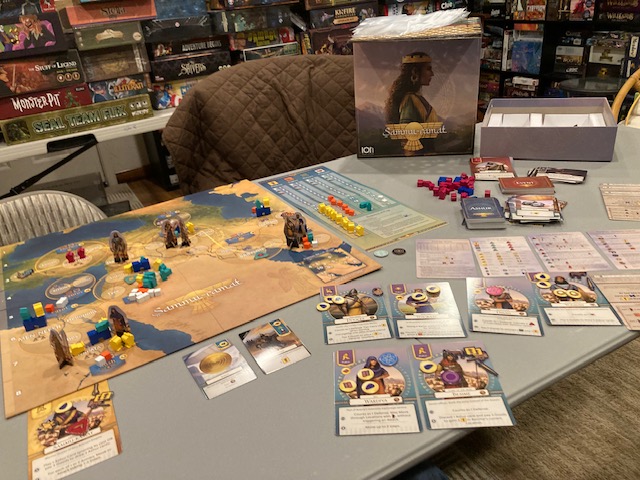
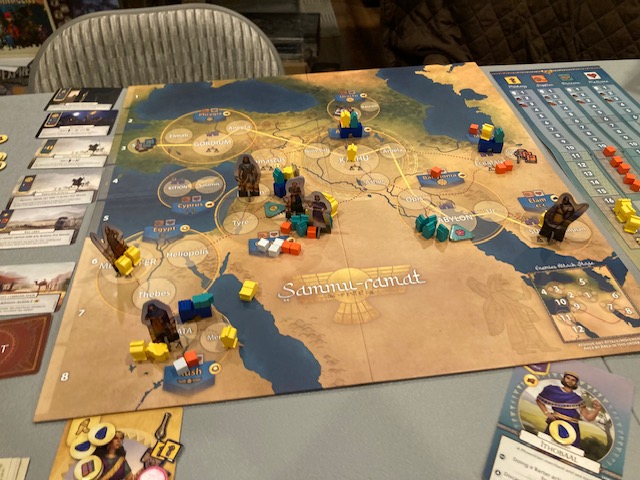
The board is reasonably sized and looks decent, but it doesn’t take good advantage of space! The is a ton of “empty space” near the top and the bottom (middle) that is never used for anything! There are two obvious things it could have been used for: One would be useful charts and info (technology descriptions for instance). A second, better use, would have to have made each area and location bigger! I can’t tell you how many times I would move or knock over tokens because there were so many in one area! See above as Canaan was just overrun and had too many tokens.

IMG_2809

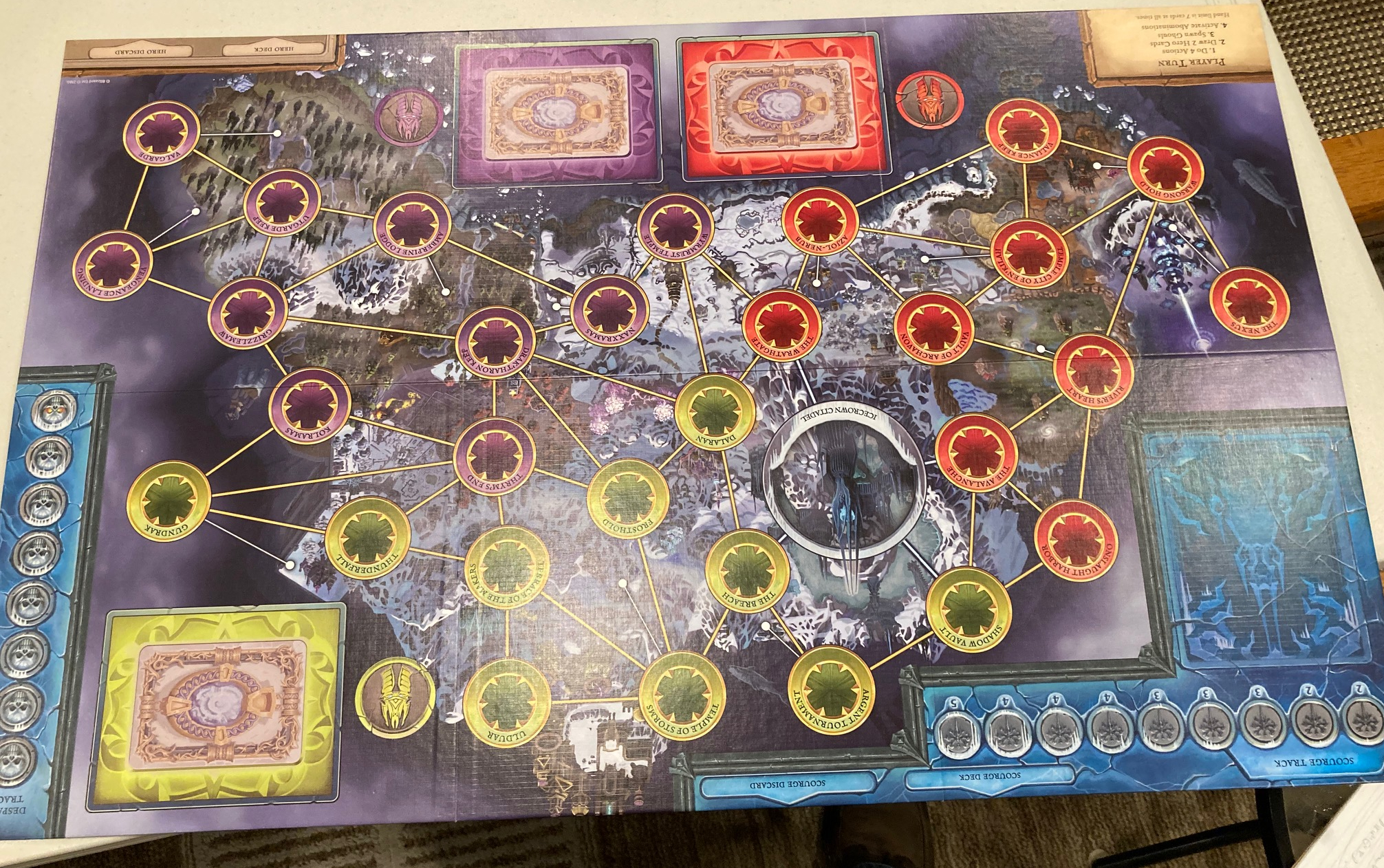
For example, at the start of the game especially, you might have 4 characters in Kahlu (see above) and they just barely fit! I would have loved to somehow made the areas and location on the board bigger to take advantage of the unused space at the top and bottom of the board. I suspect part of the issue was trying to make the area more geographically correct, which makes sense since this game a educational bent as well. Games like Pandemic: World of Warcraft, however, have solved the map issue by simply having an expanding magnifying glass view expanded “away” from the location. Take a look at the map from Pandemic: World of Warcraft below:

IMG_8874

Notice how the boards spaces the Locations fairly consistently, even if the actual map location is pointed to by the area? I suspect the usability of the Sammu-ramat map could have been helped by some technique like this.

IMG_2809

Related to that, sometimes you couldn’t see what Goods were produced by a Area because of the labelling as behind all the tokens!  What Goods does Assyria produce?  You can’t see, but it’s Textiles!

Honestly, the smaller areas/locations is my biggest problem with the game: Sammu-ramat could have played so much smoother if the areas/locations were even bigger! There’s a lot of rules to absorb in this game, and anything that helps facilitate that play experience makes it easier to absorb those rules.

Theme

IMG_2700

So, this game has an educational bent: it immerses the players into Queen Sammu-ramat’s rule of Assyria in 9th century BC, as guided by her advisors.

IMG_2805

Near the end of the rulebook are backstories for each of the advisors.

IMG_2885

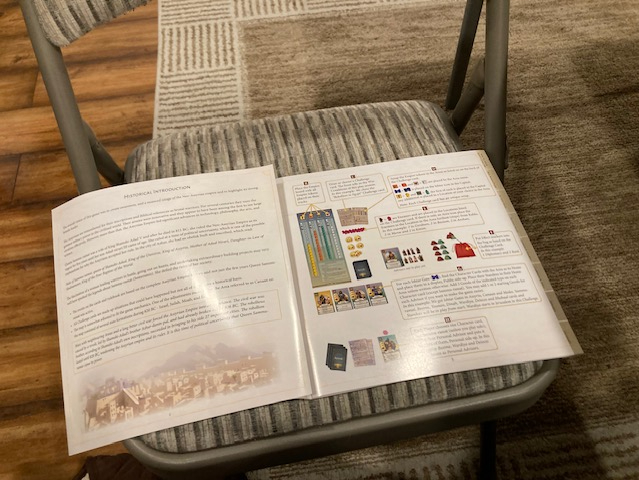
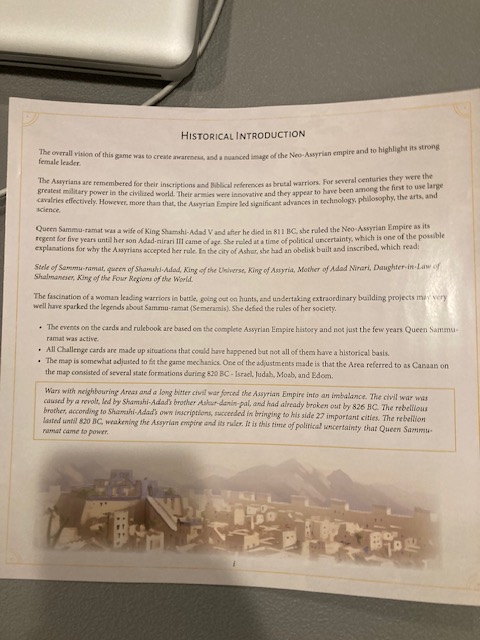
Also, the Historical introduction (at the very front of the rulebook) gives a quick discussion of this world.

For me, the theme does nothing. Let’s be clear: the research and historical basis in this game is to be commended! I suspect a lot of time was put into the research and history of this game: that’s very clear and impressive.

I feel like I did learn a little geography and some history from the characters of the time. In general, I probably wouldn’t have picked this up if something didn’t grab me on Gamefound originally. I am really glad I picked it up, but I think I would have preferred a re-theming:

bp2

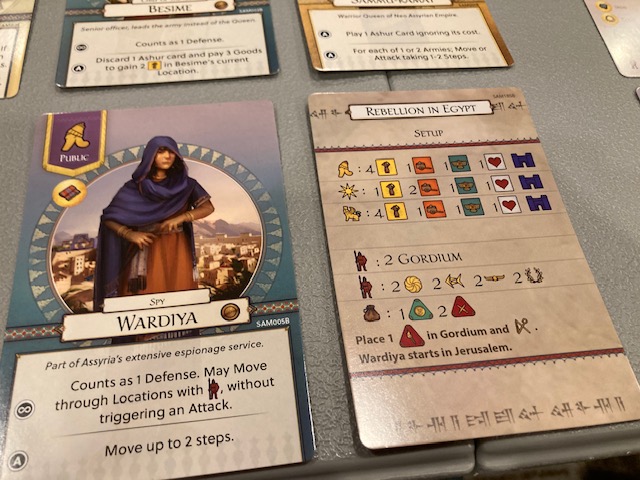
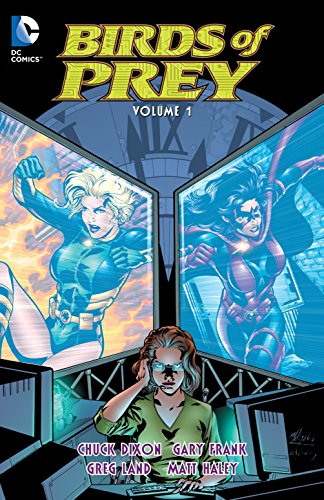
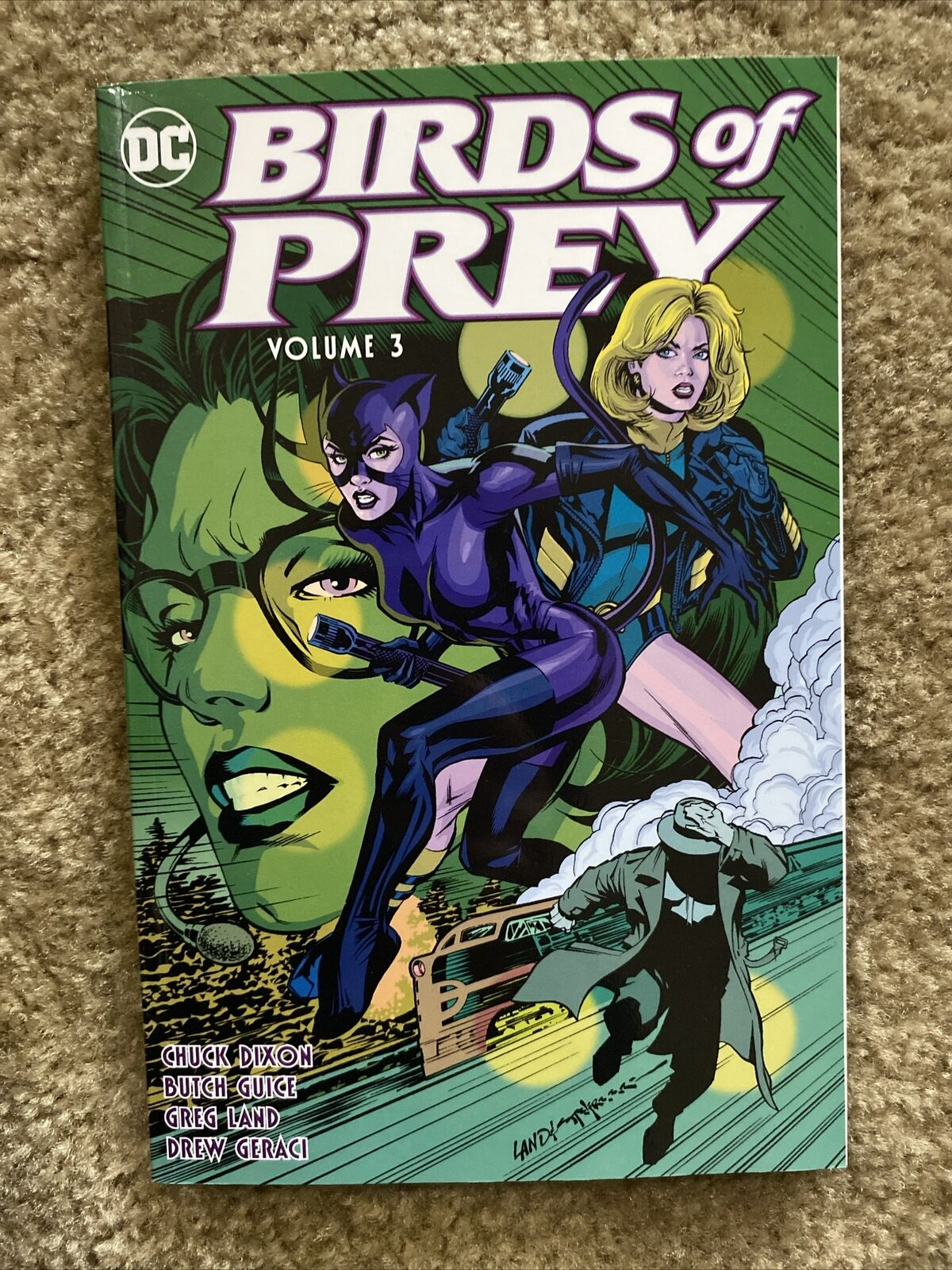
I would have loved for this to be a Superhero game based in the DC Universe! Instead of Assyria, have the setting be the streets of Arkham! Imagine if this were a Birds of Prey series! It would still preserve the role of the women being in charge, but perhaps the DC theme would be more engaging for more people! Oracle would be Sammu-ramut, trying to orchestrate the heroes to keep the streets of Arkham under control! The advisers would be the heroes: Black Canary as Dinah (her secret identity is even Dinah in the comic books), Commissioner Gordon as Deoices, Nightwing as Wardiya, … just to name a few! Getting an Ishtar Gate would be like cleaning up a neighborhood: getting a hospital (medical), food (supplies), protection (police), and good samaritans (diviners) makes a neighborhood safe again!

birdsofprey

I’m telling you, it would be so easy to re-theme this game, and I’ll bet you Kickstarter would go crazy for this game if it were called Birds of Prey: Arkham Nights! There is a fantastic core game with the base of Sammu-ramat. I’m not trying to be disrespectful of all the amazing work here, I am just saying a theme that would perhaps be more accesible: I’d love to see a version of this emerge called Birds of Prey: Arkham Nights (A Sammu-ramat game)!

Conclusion

IMG_2870

Despite my having no connection to the theme, there being some component quality issues, and some issues relating to clarity in the rulebook, I could see this being one of my top games of the year! Sammu-ramat is a fantastic puzzle! It somehow manages to be a cooperative euro game (gathering scarce resources) while also being a cooperative wargame (keeping bad guys under control)! The puzzles set-up by Sammu-ramat with its Challenges cards offer endless variety to keep me coming back for more!

IMG_2907

The cooperative game is good: my friends gave it a 6.5 or 7/10: we had fun.  We definitely recommend embracing full PSTO for the cooperative game.  The more important thing is to make sure someone shepherds you into the cooperative game: there’s too much game to learn this “on the fly”.

IMG_2752

As a solo game, this is either a 8.5/10 or even 9/10 for me! I think I would like this game even more if they fixed the production issues and had a retheming to Birds of Prey: Arhkham Nights: I think that would bump this to a 9.5 or even 10/10 for me. This game is that good.

IMG_2878

The game had a very small Gamefound campaign: $12,461 crowdfunded by 235 backers. This game is fantastic and deserves a much bigger release!

A Review of The A.R.T. Project: A Cooperative Art Game With Not a Lot of Art

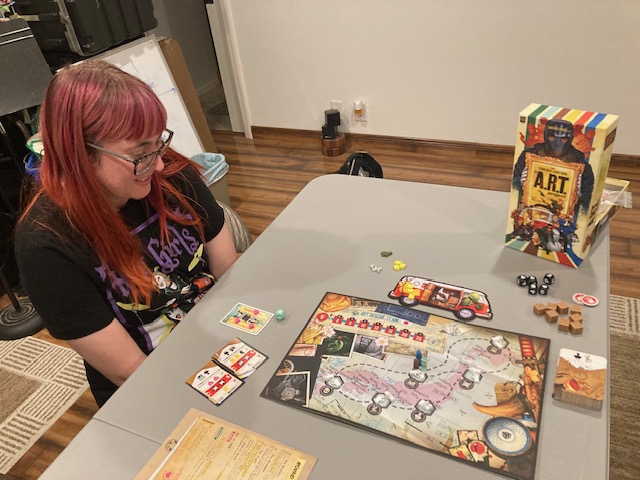
The A.R.T. Project is a cooperative game from The Op which was first available in November 2023: I had seen it in previews and reviews, but I wasn’t able to get a copy until The Op put it on sale on their web site in November 2023. It arrived in mid November, and I was excited to get it to the table!

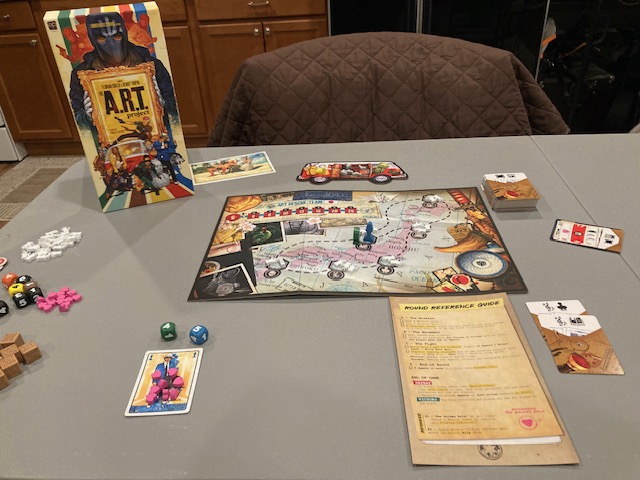
IMG_1126

This is a cooperative game for 1-6 players (we’ll come back to that) and plays pretty quickly: the box says 40 minutes, but we’ve gotten through games a little quicker.

IMG_1127

Let’s take a look!

Unboxing

IMG_1188

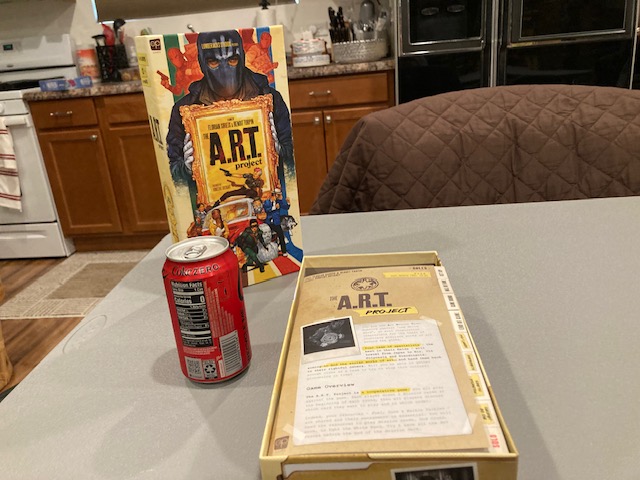
I mean, you can’t NOT comment on that cover: that’s one of nicest covers I have seen this year!  It is distinctive, colorful, and just beautiful!! That Vincent Dutrait art is just fantastic.

IMG_1128

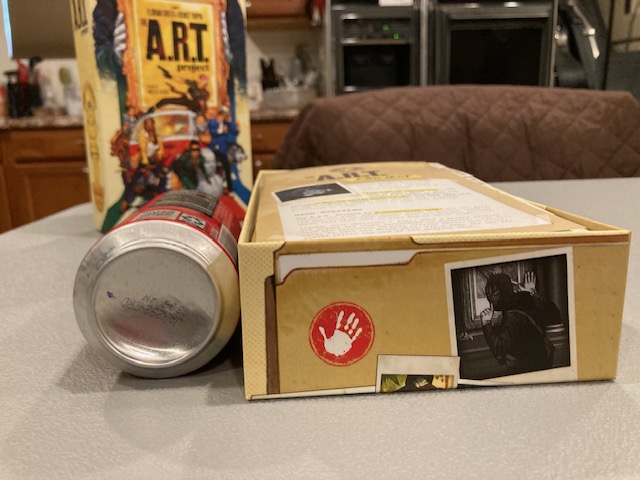
This game box has a weird profile: it’s long and thin, but it is surprisingly thick. See a picture with a coke can above: it feels about the size of 4 coke cans. It’s a weird size.

IMG_1129

Seriously weird size.

IMG_1130

The rulebook is pretty good (see discussion below).

IMG_1136

There are a lot of little components in the game: mostly wood. They are pretty nice: the little crates are kinda cool too: see above and below.

IMG_1149

There are three double-sided maps, and a punchout van, all beautifully illustrated by Vincent Dutrait. See above.

IMG_1144

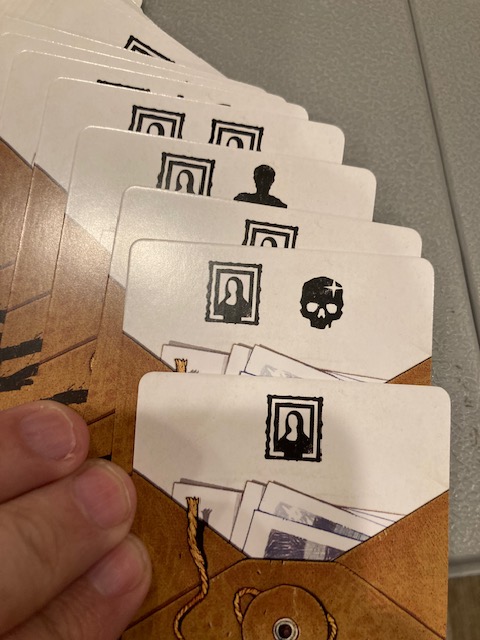
There are a bunch of cards: mostly Mission/Clue cards with icons (see above).

IMG_1186

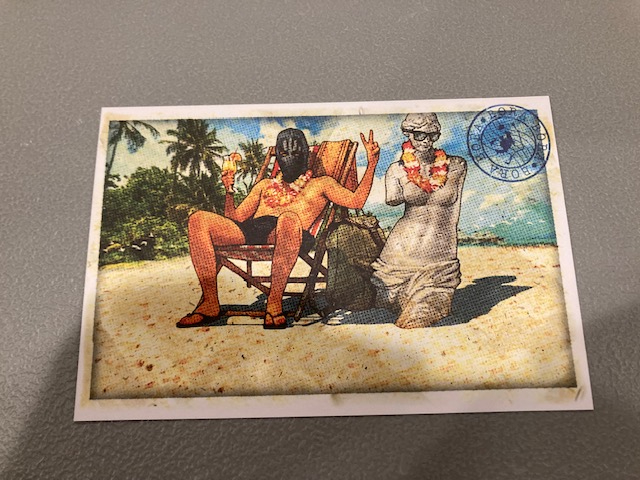
And the game comes with a postcard … I am not making this up: see above.

IMG_1141

Overall the game components are pretty great: the Vincent Dutrait art especially stands out.

Rulebook

IMG_1142

The rulebook is pretty good.  I was able to learn the game from it.

IMG_1148

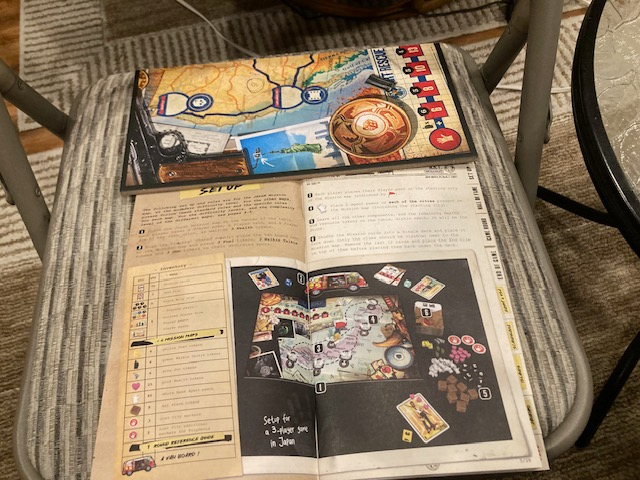
It gets a C+ on the Chair Test.  It does fit well on the chair next to me, but I had to hold it open … which means I had to fold against the spine to force it to stay open without my hand.  Not a big deal, but somehow it feels “wrong” to have to break the spine (not really) of the rulebook to keep it open.

IMG_1150

Even after “breaking the spine”, I still needed to hold the rulebook down with an unused board.

IMG_1157

The font choice is interesting: it’s a mono-width font! It looks like a typewriter or computer terminal. I think the idea is that the typewriter font is thematic as a “briefing font” (the rulebook is organized as an old-timey folder). I normally don’t like thematic fonts (see our review of Oblievaeon), but they didn’t detract too much from reading in this case. I think what saved the font is that it was BIG and easy to read.

IMG_1131

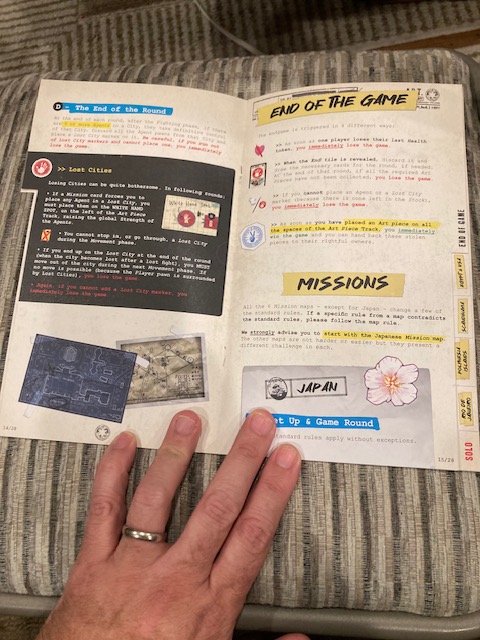
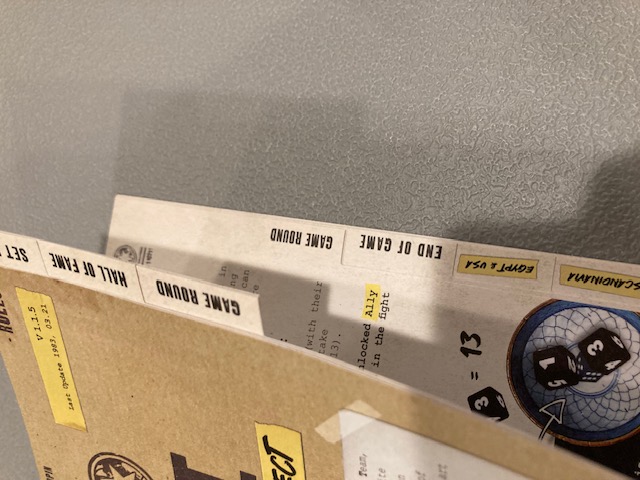
One thing that did work really well in the rulebook is the tabs: it was easy to thumb to the place you want. Unfortunately, this game didn’t have an index. I needed to look up some rules a few times and had to page through the entire book to find what I wanted.

IMG_1154

Despite the rulebook not staying open and lack of an Index, it was pretty good. I learned the rules from it.

Gameplay

IMG_1415

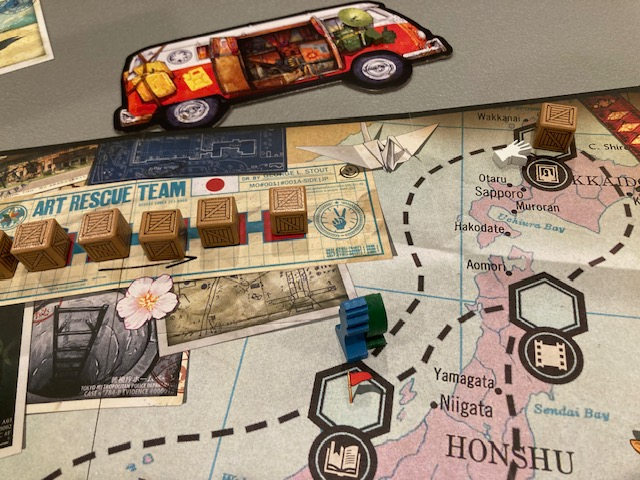
This game has a very Pandemic vibe: you roam a map keeping cities from being lost (overrun in Pandemic), and occasionally picking up art at specific location (meeting up in Pandemic).

If too many HAND Agents (5) are ever at a city, the city becomes lost (Pandemic Legacy anyone?) and players can neither move through nor pick-up art there. HAND Agents also block players from picking up Art: See above as there are four HAND Agents blocking us from picking up two pieces of art (crates)!

IMG_1405

To eliminate HAND agents, you’ll roll dice (your colored die, colored compatriot dice, and black ally dice if you can get them) and try to beat the current HAND combat value (notated at the top of the board).

IMG_1176

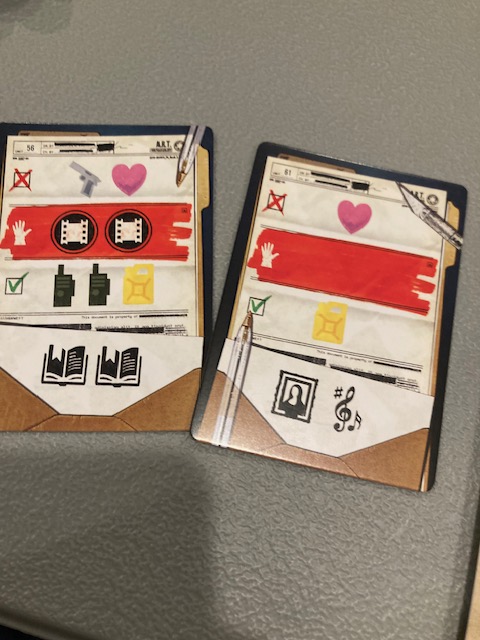
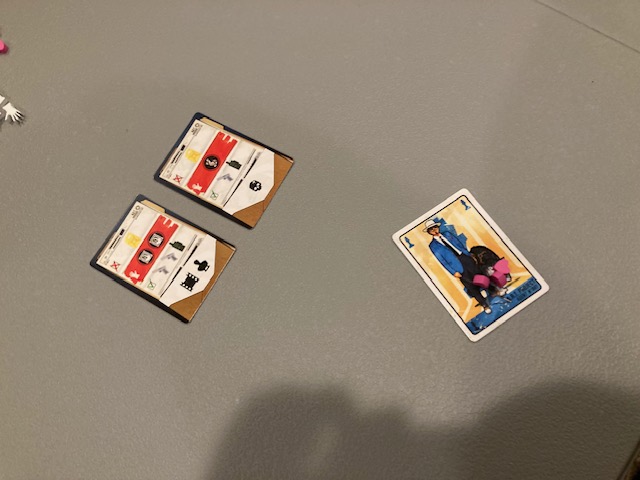
At the start of each round, each player will choose one of two Mission cards to execute: the card then executes top to bottom. The top “red X” is the penalty (lose heart or lose heart and gun), the red line is where the HAND Agents show up, and the “green check” mark shows your immediate reward. The other reward you get is a “clue” where art might show up .. note the Icons on the bottom of the card. When you get three Icons of the same type, you “find” a piece of art in that city! (A Mission card, once executed “flips” and becomes said clue)

IMG_1175

See above as we collect a lot of clues, but not enough to find any art! (You can also discard clues for rerolls).

IMG_1416

If you can find all 7 pieces of Art (represented by crates) before the Mission/clue deck runs out, anyone dies, there are 3 lost cities, or it’s impossible to get art, you win!

There are some other rules but that’s the gist.

Solo Play

IMG_1166

There is an entire section (well, 2 pages) of the manual devoted to solo play: there is a viable solo mode (congratulations on following Saunders’ Law).

IMG_1171

The main difference in solo mode is that you draw 3 Mission cards per turn (instead of 2) and choose 2 of them (instead of 1): see above. The other rule is that you have a helper (see green pawn below) who can pick up art and roll dice WITH you, but can’t attack HAND agents without you.

IMG_1182

And that’s about it!! The solo game moves pretty quickly. I was able to learn the rules playing solo, but I think I could have taught this game without too much work if I hadn’t played solo. It’s a pretty straightforward game.

IMG_1178

I have to admit to being a little underwhelmed by my solo game; It was okay. I spent quite a bit of time trying to decide why I was underwhelmed: we’ll discuss that more below.

IMG_1170

The solo game was okay. I am not sure I’ll play it again?

Cooperative Mode

IMG_1399

The cooperative mode was better than the solo mode. The best part of the cooperative mode was discussing which Mission cards to execute and in what order!

IMG_1401

There is no player order, which I really like! Thus, the players must work together to discuss the order in which Mission cards are played!!! There are a lot of competing constraints! We have try keep the Art crates within reach, while trying to keep both the HAND Agents under control BUT not losing any cities! The choices of which cards to execute (and the order) and that discussion are probably the best part of the game!

IMG_1177

In a 3-Player game, there was a lot of discussion! There was a lot of “what if”, there was a lot of “we should do this”, there was a lot of what “what do we do next turn”. This was a nice cooperative experience.

Themeless

IMG_1415

As great at the components are, as great as the Vincent Dutrait art is, as great as this idea is (saving art), … at the end of the day, the game felt rather themeless.

IMG_1172

Part of the issue is that you spend most of the game looking at black-and-white icons! Although they are supposed to represent “art”, they could be anything! We would rescuing refugees from around the world! We could be fighting guerillas! We could be curing diseases!

IMG_1416

And then, what you find is not “art”, but “crates”! The crates are cool components, but I never felt like I was saving art … anything could have been in those crates! Drugs? Guns? People? I really wanted to see the art in the A.R.T. Project!

IMG_1188

That Vincent Dutrait cover is AMAZING! It may be my favorite cover this year!! I wanted Vincent Dutrait’s art renderings of paintings, busts, film, … art!

What we got … were brown crates.

For a game named The A.R.T. Project, I expected a lot more art … and I got black-and-white icons and brown crates.

Player Count

IMG_1413

This is a game where the player count will make or break the game. The solo game is good enough to show the game, but not necessarily great. The 2 or 3-Player mode is probably optimal for offering the best experience! There’s just enough banter choosing the clues cards to execute, but not enough choice to overwhelm: we all made choices and we felt like we mattered.

IMG_1402

In a 4-6 player game, there’s almost no way you could find optimal Mission card orderings without either (a) taking too long (which isn’t fun) or (b) making sub-optimal choices (which will lose the game). The resources (gas cans, walkie-talkies, etc) are also very limited to 6, which makes them even more constrained in a large game. The 4-6 players games are just be too chaotic. The rulebook itself even warns players away from the 5-6 player game until you’ve played a lot: I am not convinced I would ever want to play with more than 3 players!

No Variable Powers

IMG_1145

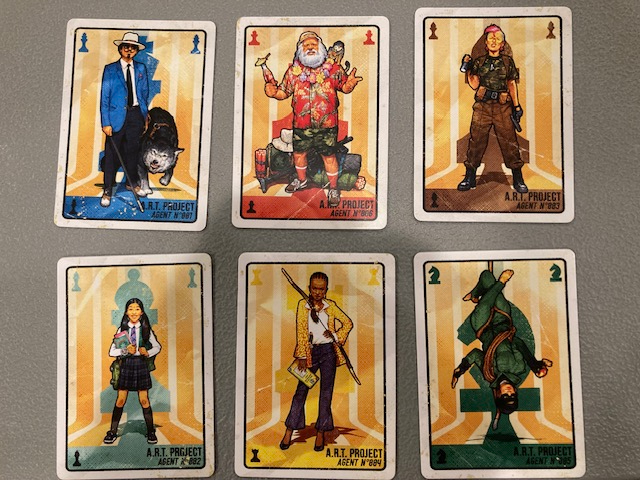
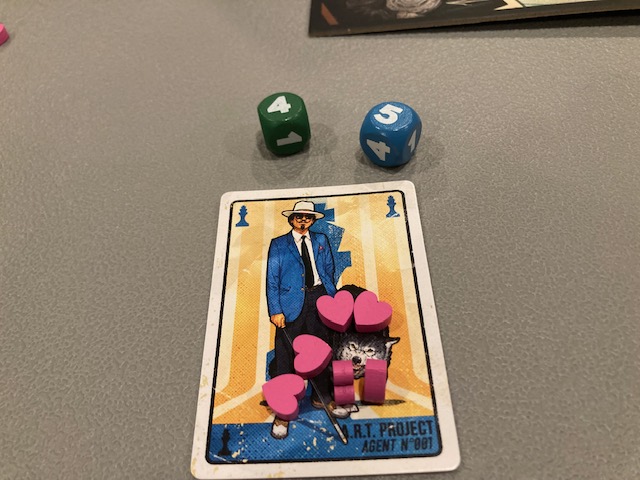
At the start of the game, each player chooses one of 6 characters! See the amazing Vincent Dutrait art above! I wanted the blue guy because of the dog!! What cool thing could the dog do??

IMG_1168

The answer: nothing. The characters aren’t distinct in any way. It doesn’t matter what character you play, except for your pawn color: I think this was a missed opportunity. Once you choose your character, it doesn’t really matter anymore once the game goes on.

This is another reason the game felt “themeless”: I had no attachment to my character at all. I just moved a blue pawn on the map picking up brown crates.

Conclusion

IMG_1415

I really wanted to love The A.R.T. Project, but I was underwhelmed by it. I was expecting this amazing art and theme, but the main gameplay centers on black-and-white icons and brown crates … which could be anything! Granted, the art you do get from Vincent Dutrait is amazing, but that art is outside the main game arc: you don’t really embrace it. The lack of variable player powers was also surprising too: all players felt exactly the same, further contributing to the theme feeling pasted on.

IMG_1404

There is a decent game here. The game shines best in a small group of 2-3 Players , with the choosing the Mission cards being the highlight of the game (as you choose both the good things and bad things together). At this optimal number of players (2-3), I would give it a 7.0/10, but my friends would still only give it a 6/10 (Teresa) and 5/10 (Sara); Sara and Teresa were even more disappointed by the themeless/artless nature of the game than I was.

The solo game is probably a 6/10. And I would avoid player counts above 3: I think the game really becomes significantly worse at higher player counts.

IMG_1406

Even though I don’t love this game, I will keep it: it’s a light and quick (at about 20-30 minutes) cooperative game which I might bring out for new players .. Or if I want a quick cooperative game. If you do decide to get The A.R.T. Project, I strongly recommend keeping the game to 1-3 players or you might hate it.