
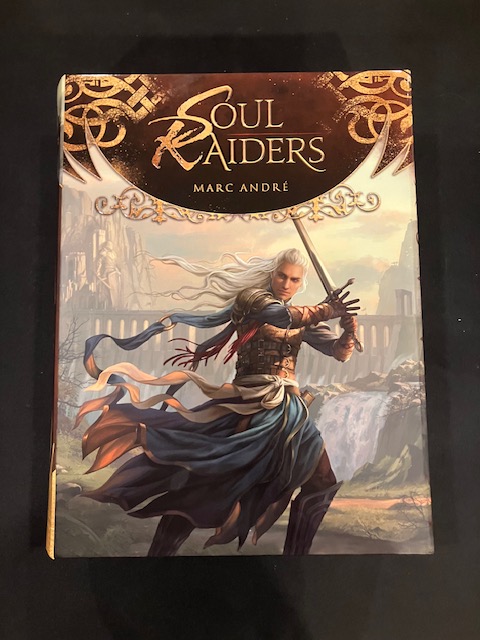
Soul Raiders is a cooperative fantasy adventure game that was on Kickstarter back in July 2021 and promised delivery in December 2022. I backed the deluxe Grimoire Edition (above). Well, it finally arrived last month (March 2025), so it’s about 2.3 years late. This wasn’t on my Top 10 Anticipated Cooperative Games of 2022, but it probably was my #11 or #12!
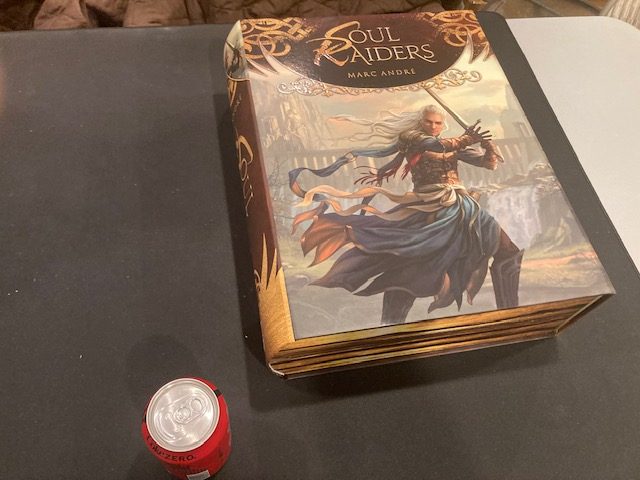
This sat unplayed in the box longer than it should have; I think I was scared of how big it was! Look how big it is!!! Did I have the cycles to even try it?
Well, I finally got around to getting out and trying it … was it worth it?
Unboxing
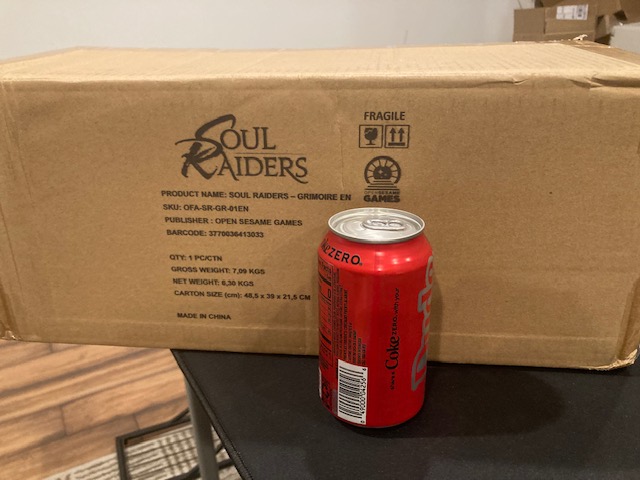
Although this unboxing here is to show you what’s in the box, it’s also here to remind me how to put the box together! So, it’s for me and you!
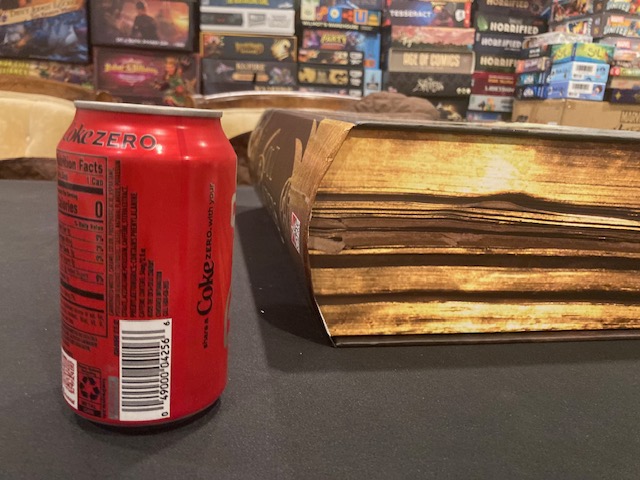
This is a BIG box. This is the Grimoire Edition.
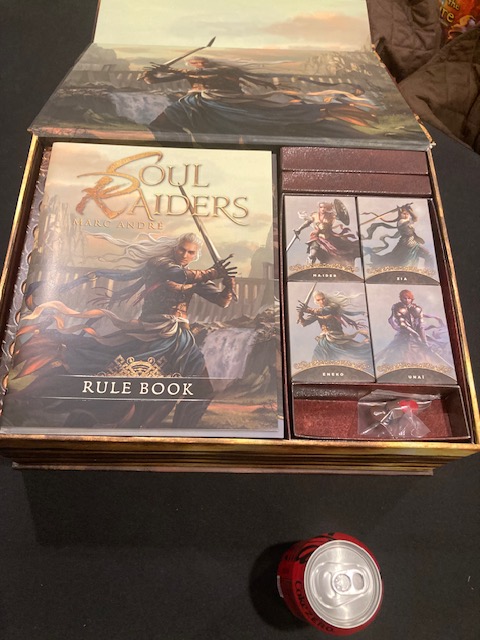
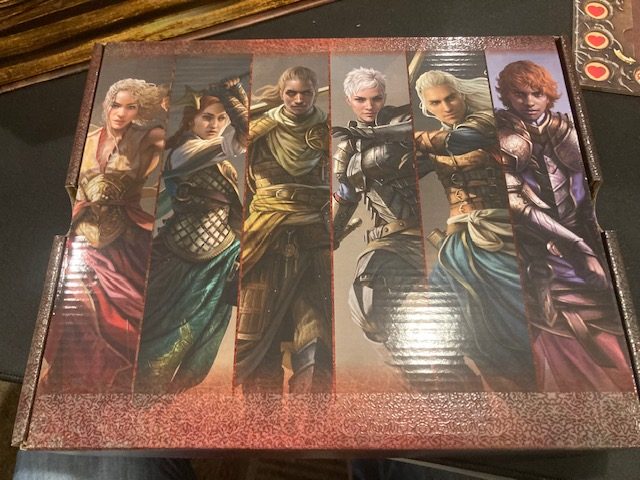
It’s got a lot of stuff packed in: see the character boxes above (this is a cooperative fantasy adventure game).
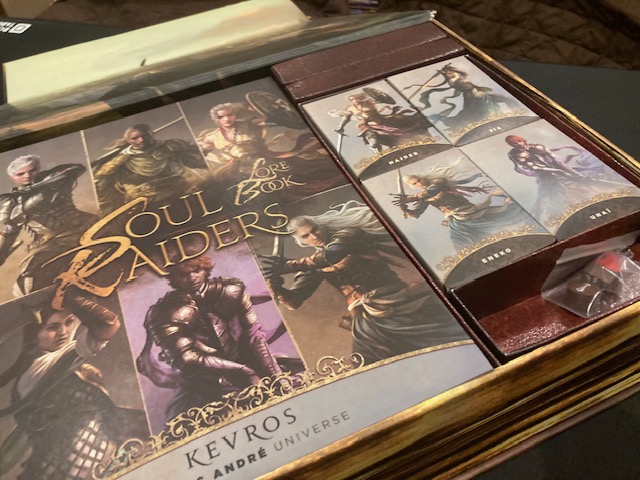
This game is so grandiose, it has it’s own lore book!
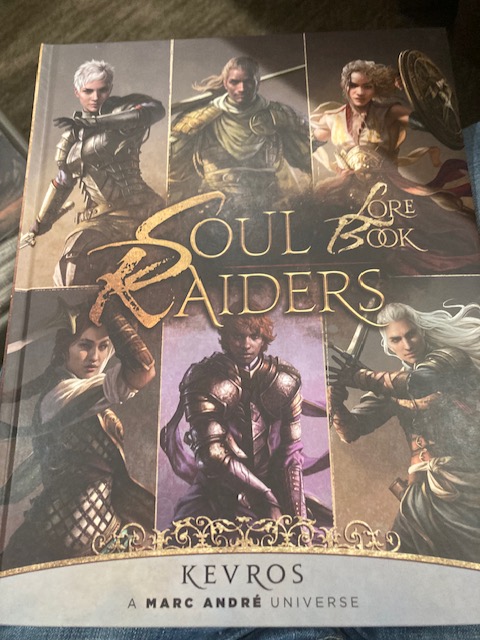
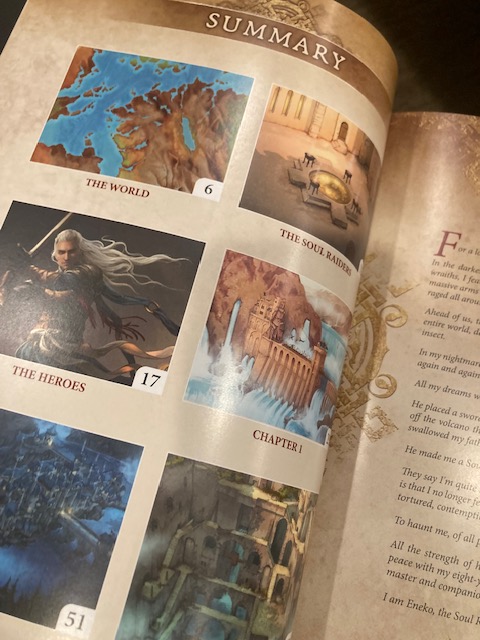
If you really want to get into a fantasy universe, this might be the right game for you!
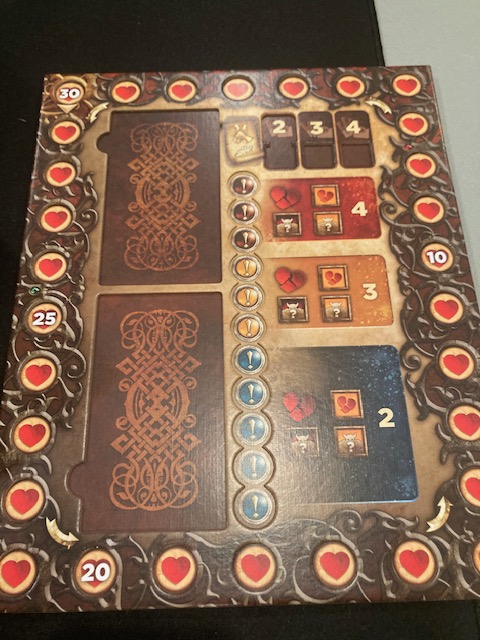
This dual-layered board (above) keeps track of a lot of shared attributes and state of the game.
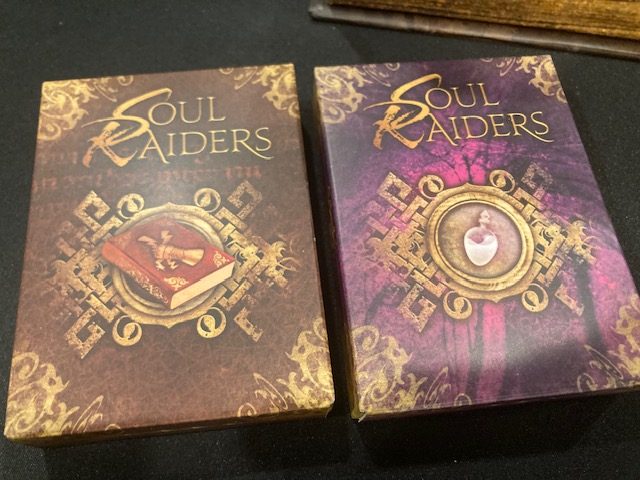
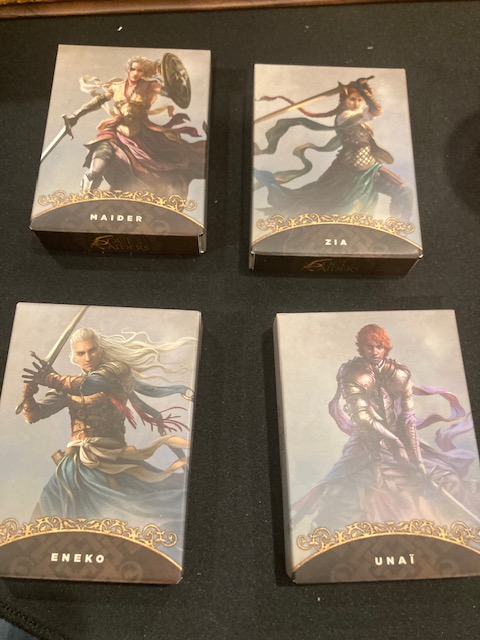
There’s lot of little boxes to store your game between sessions.
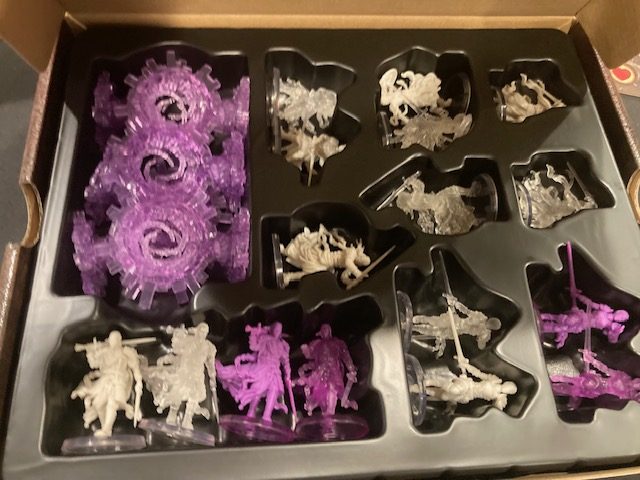
There’s some fabulous minis.
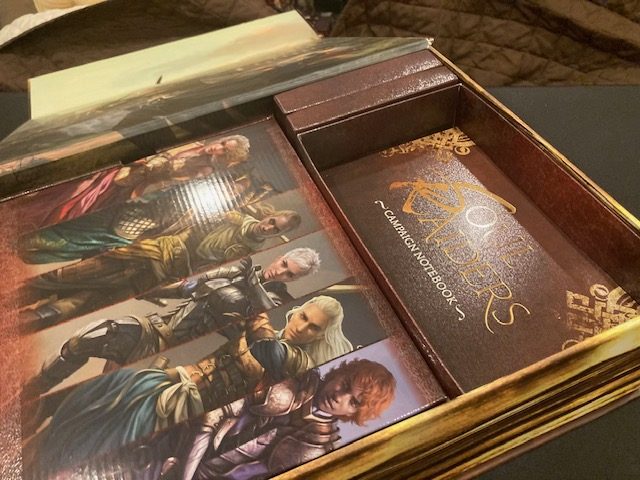
The campaign notebook allows to save the game between chapters.
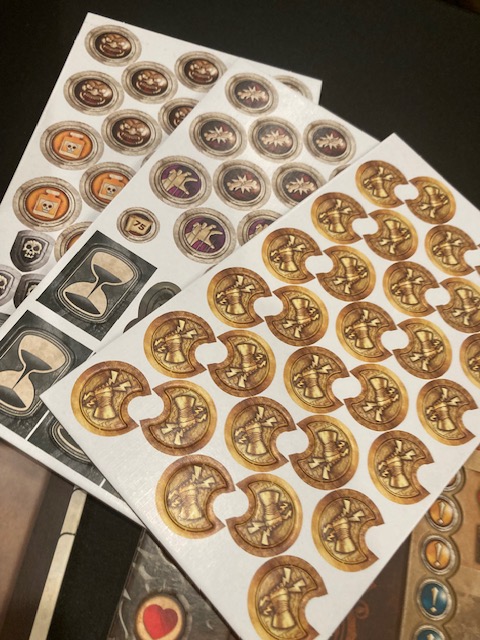
There’s a bunch of cardboard tokens.
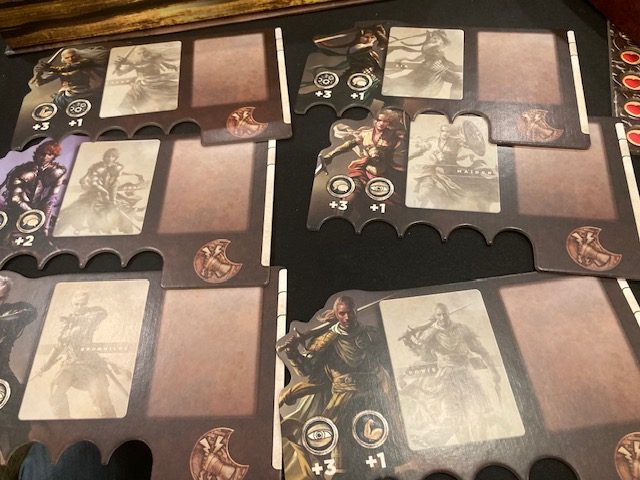
And boards for the characters.
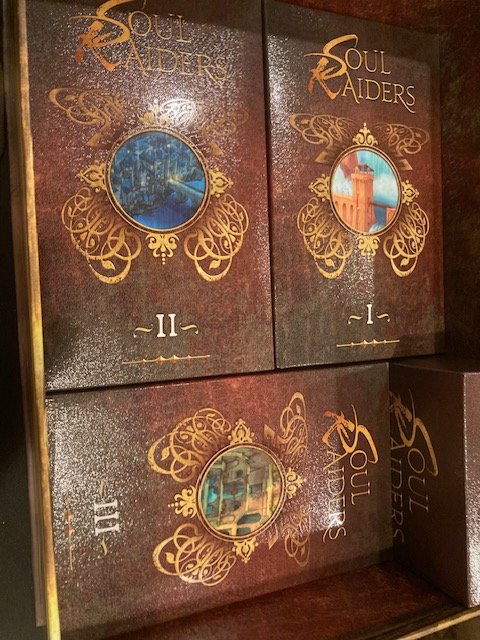
Underneath all that, are the three main chapters of the game.
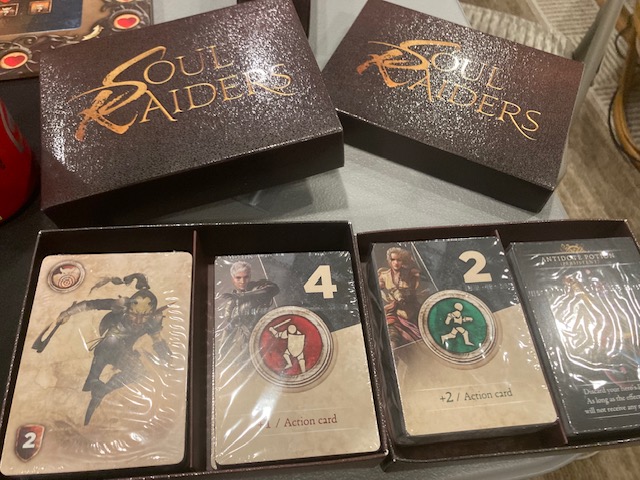
The cards of the game are in two boxes: see above.
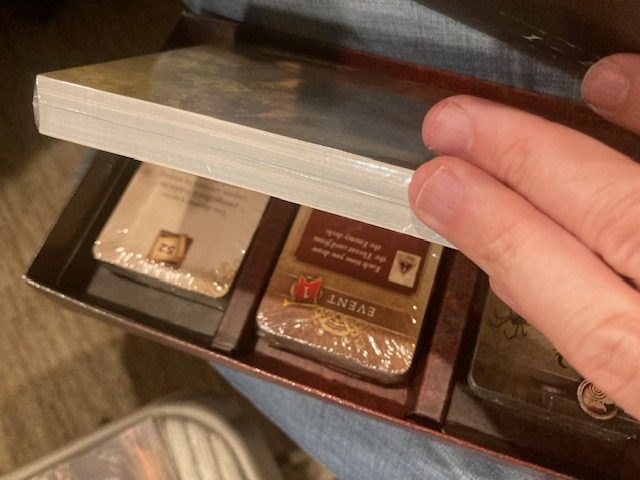
Each of the chapter boxes has huge Location cards and little cards.
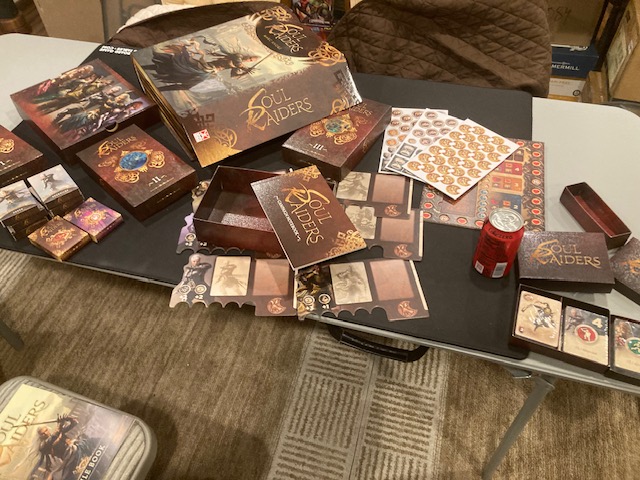
This game is GORGEOUS. The production is GORGEOUS.
Consult the pictures above for when you need to repack your box!
Rulebook
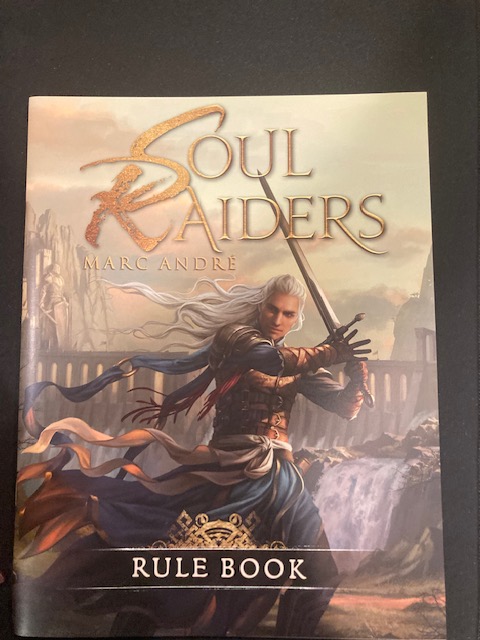
The rulebook is good. Well, ish.
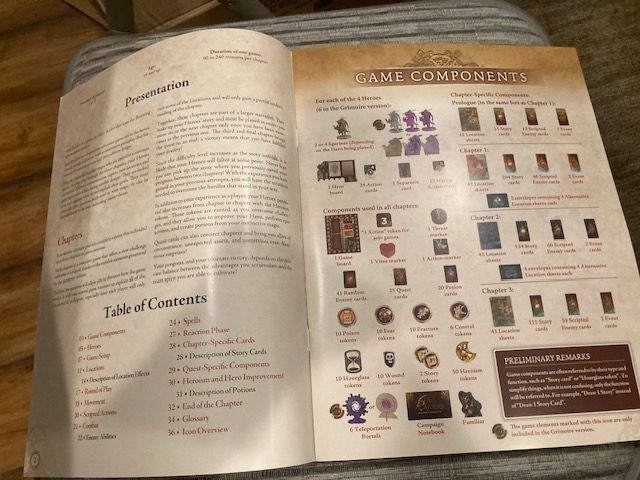
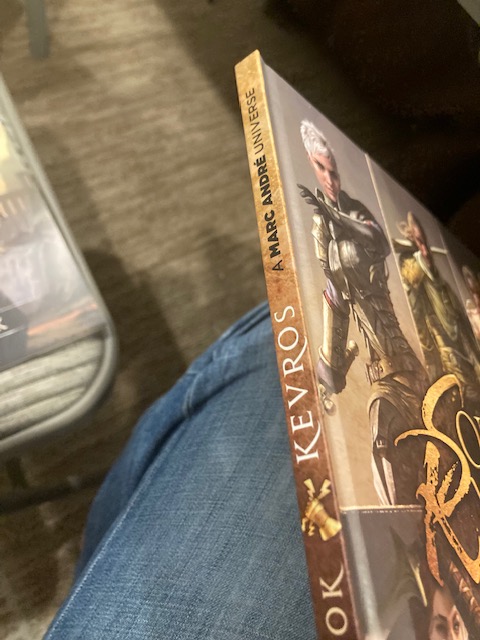
It gets about a B+ on the Chair Test: it overhangs on the chair next to me just a little (see above), but it lays flat and open, it has a big readable fonts, and it has lot of pictures.
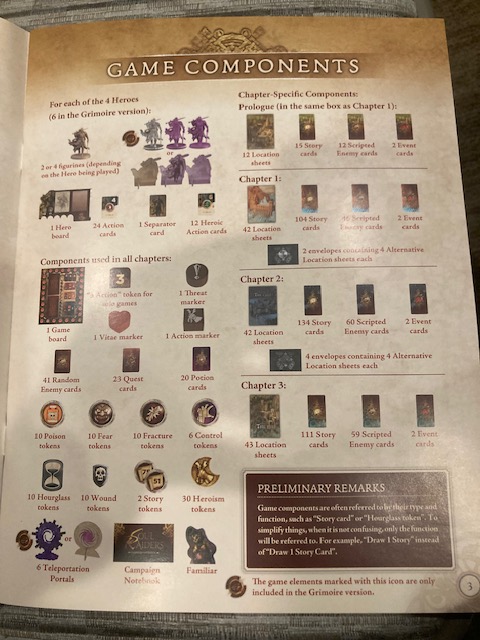
The components page is well-labelled and notated (see above). It even breaks up the cards by chapters.
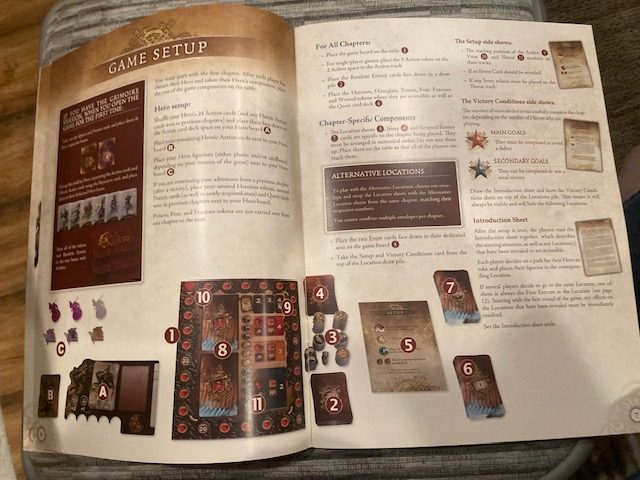
The set-up works pretty well, although it doesn’t show how the story cards will be laid out (which we need to discuss more).
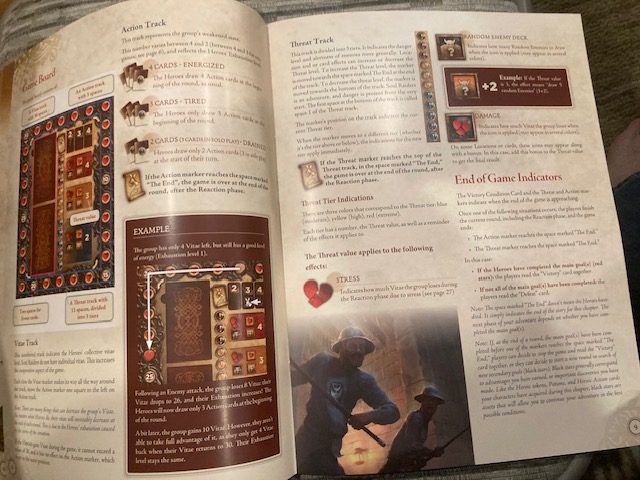
This is a gorgeous rulebook that’s written pretty well, it has lots of examples and lots of pictures.
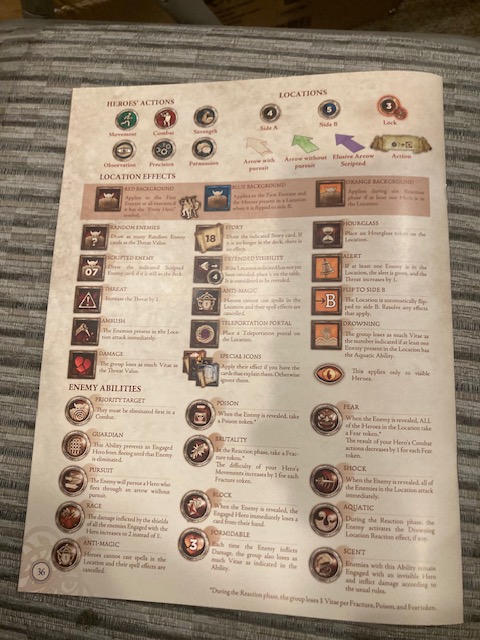
It even ends with a very useful summary of icons on the back!
Although I liked this rulebook a lot, it made the mistake of putting too much content into the examples. I like it when rules have clear definitions, then maybe use the examples to help explain and/or clarify. Unfortunately, I think this leaned a little too much into using the examples AS the rules a few times. Don’t get me wrong, I am glad the examples are there, but I wanted clear succinct rules as well. (I think the last time we noticed this “rules in examples” phenomena was back Sleeping Gods rules: see link here).
The rulebook was generally good, and it frankly looks gorgeous (like the rest of the game).
Gameplay
The best way to describe this game? It feels like it a video game: a Point-And-Click (fantasy) Adventure game with lots of monster fighting.
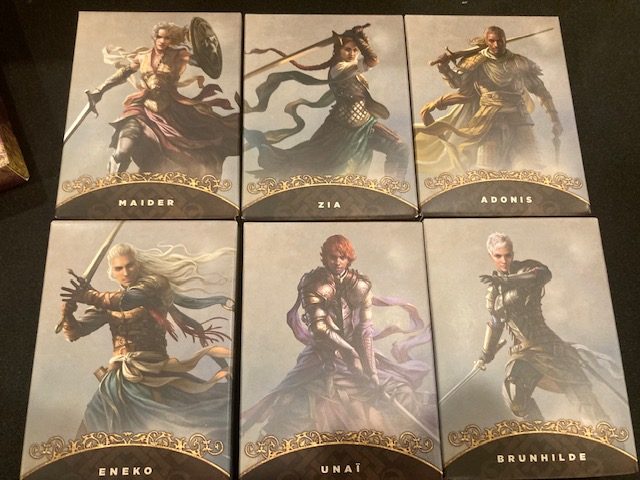
Each player takes the role of one of six characters: see the character boxes above.
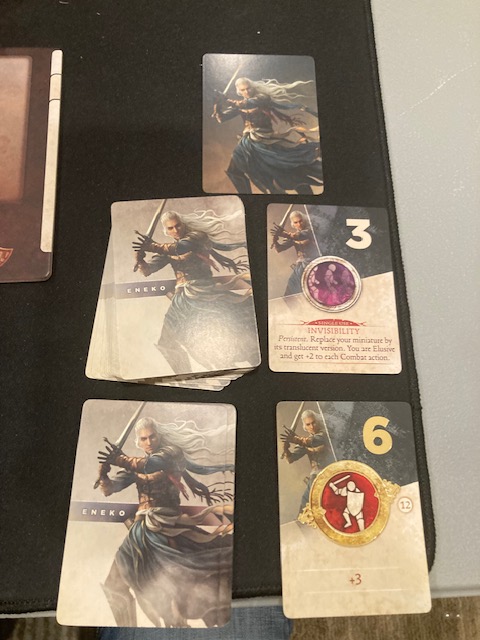
Each character has his own set of cards: there’s basic Action cards (above top) and Heroic Action cards (above bottom). Notice the Heroic Action cards have a special foil on them so you can tell them apart!
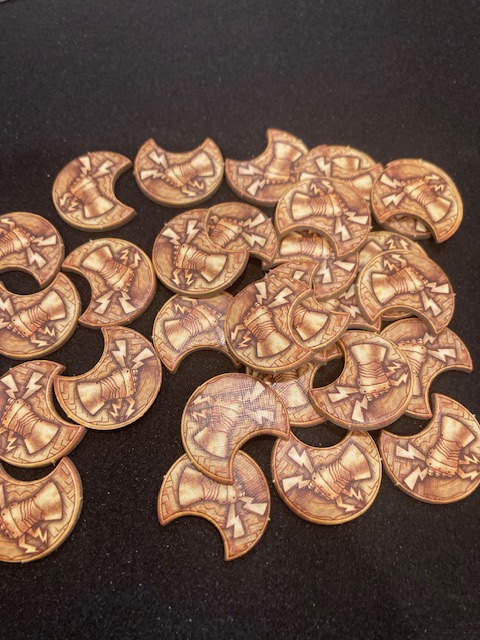
These Heroic Action cards are earned (in order) by spending Heroism tokens (3 to earn a new Heroic Action card). Cool fact; you can spend 3 Heroism tokens at ANY time to immediately earn a new card! Very useful when you need a card immediately!
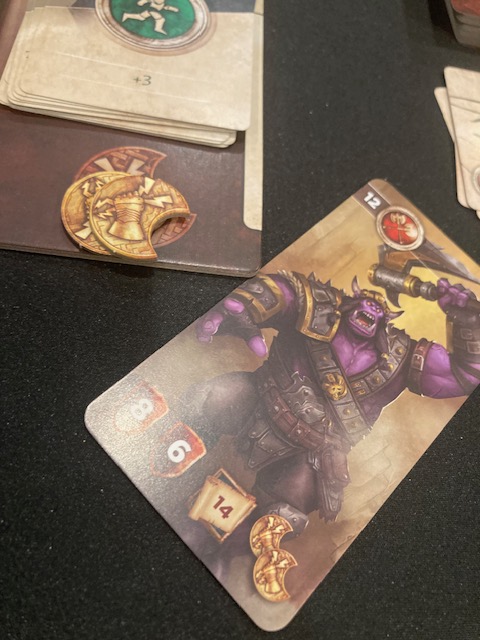
You get Heroism tokens are various plot points in the story, but the most reliable way to getting Heroism Tokens is by defeating BIG BAD MONSTERS! Defeating the one above opens Story Card 14, but also earns the player 2 Heroism tokens!
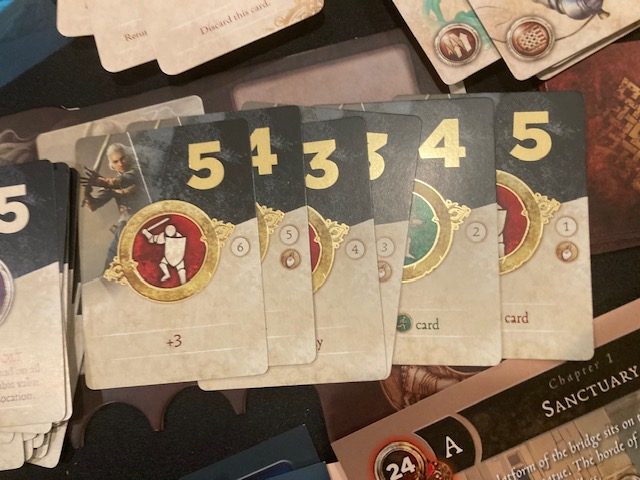
By the end of Chapter 1, I had been able to earn 6 new Heroic Actions cards! (Heroic Action Cards must be earned in order: note the numbers on far right).
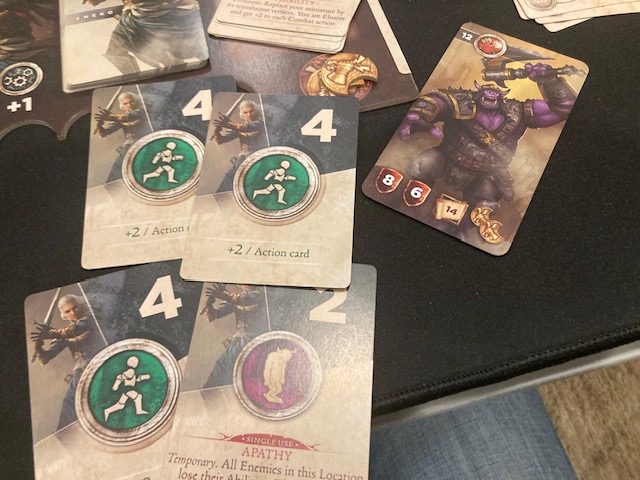
The cards are you primary currency for “getting things done”. Some cards are more attuned to movement (as you must explore) … see above …
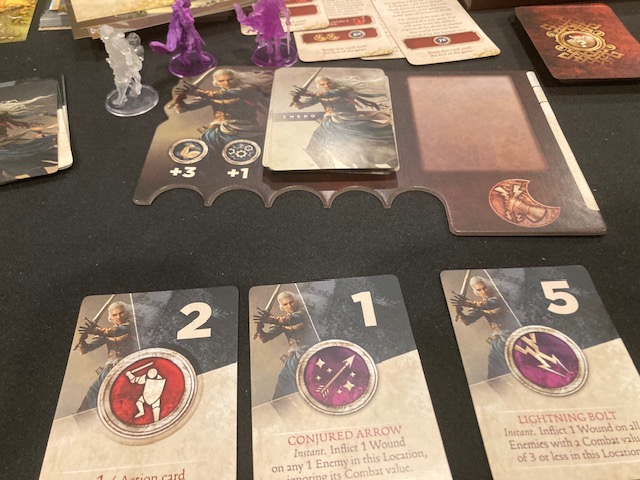
… and some cards are more attuned to fighting! See above. Basically, you can always use the value on the card for whatever you want, but the card will have “bonuses” if you use it for the specific specialization!
For example, Heroic Action card #6 (the top one) has a basic value of 5, but if you use it for fighting, you get an extra +3!
Example above: Even though the cards I drew were all movement-centric, I can use the values on the cards for fighting: 4+4 = 8 takes out the first shield on the bad guy, and 4+2 = 6 takes out the second shield! I used all my cards, and I didn’t get any advantages, but I was able to do what I needed!
Basically, your character explores the world, moves around, interacts with the world, and fights monsters! All actions are based on the values on your cards!
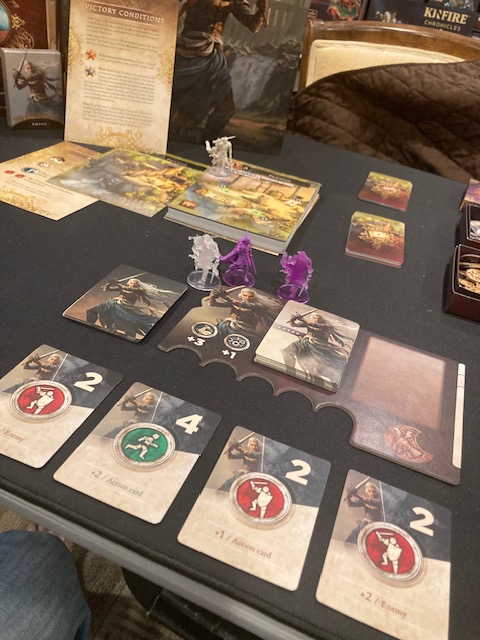
Basically, you character(s) move around on the Location sheets and explore!
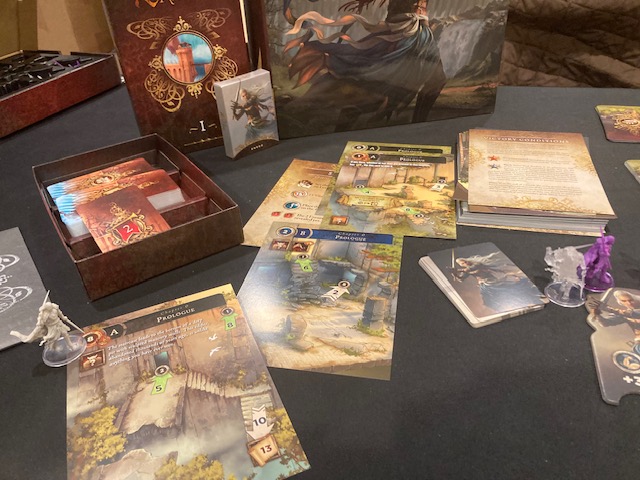
The Locations have arrows which tell you how much its cost to move between Locations: see above and below.
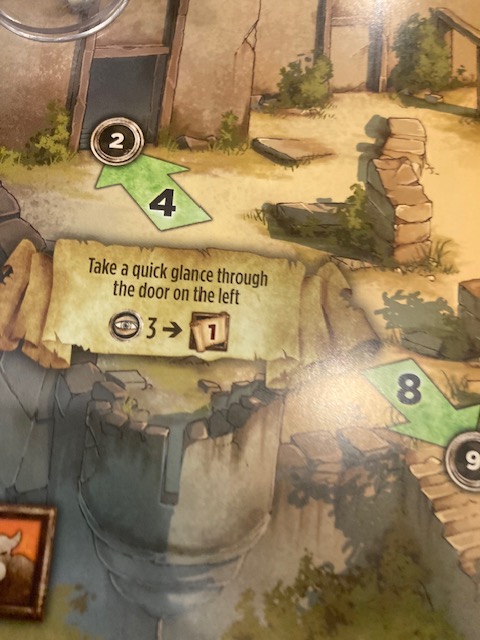
For example, to move to Location 2, I need to spend 4 points from my cards.
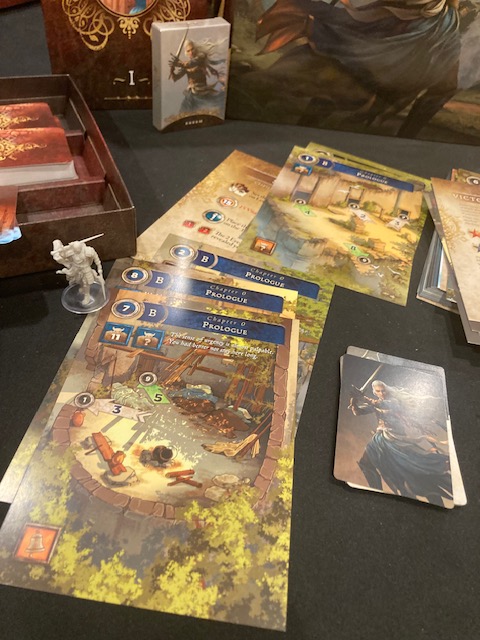
This is kind of a choose-your-own adventure tale! You decide which paths to take, which monsters to fight, which puzzles to interact with! It feels very much like a choose-your-own adventure!
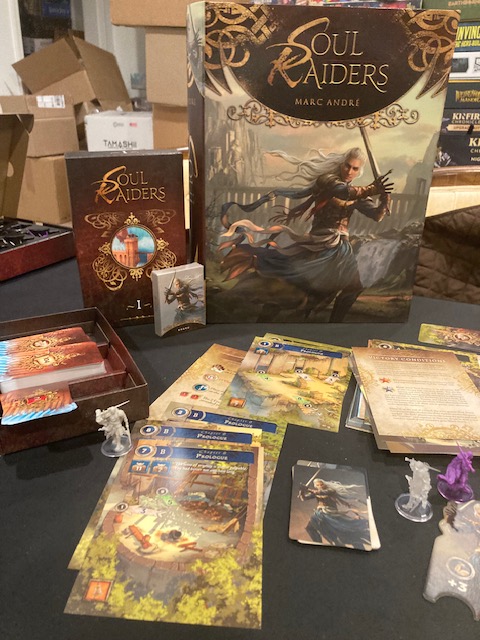
What’s cool is that each Location has pretty great art (a little comic-booky, but I like it) which describes all the things you can do at that Location … kind of like a choose-your-own-adventure book does in each section.
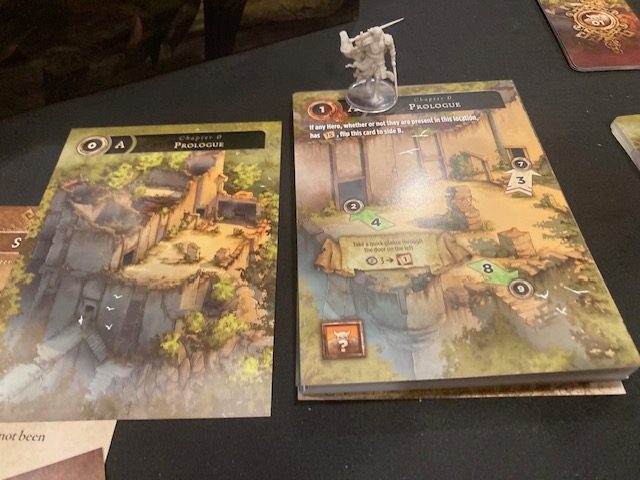
See above as the character starts on the maps!
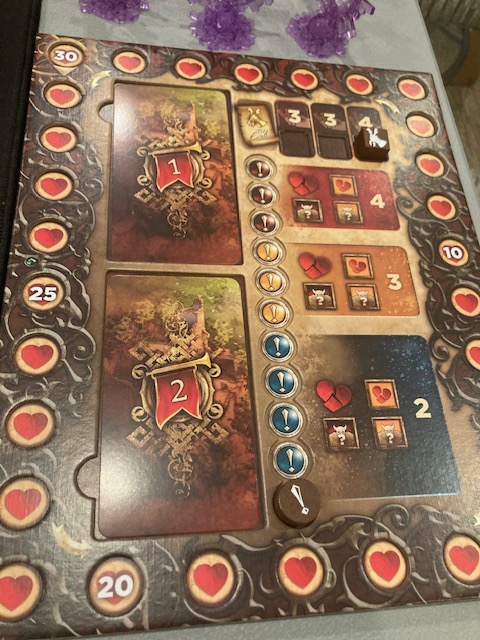
An interesting thing that happens is that there is a “clock” pushing the game forward. At the end of every “turn” after you’ve played all your cards, the Vitae track moves down. Basically, every time it “wraps around” back to 30, you drop the Action token one space (upper right). If your threat or the action space ever get to the end, the game is over!
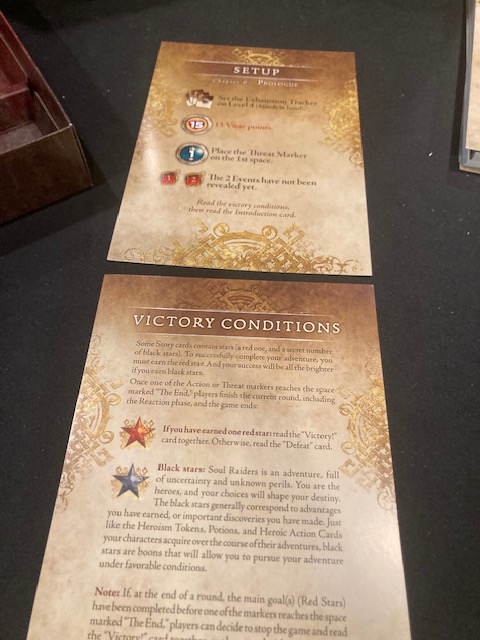
To win, you need to find the Red Stars on the story cards. If you don’t find appropriate story cards, you lose!
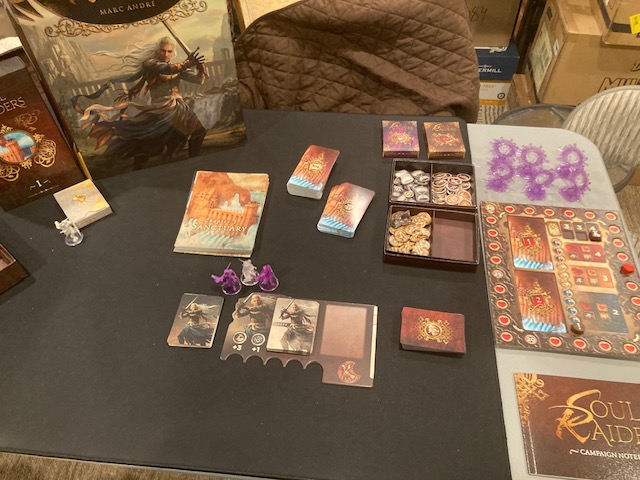
Explore, fight monsters, interact with your world: this is an adventure game! The way the movement works, it feels very much like a choose-your-adventure game (as the Locations could just be pages numbers in a book!) This game also feels like a Point-And-Click Adventure game too! See our Top 10 Point-And-Click Adventure Board Games for more discussion of this genre!
Solo Play
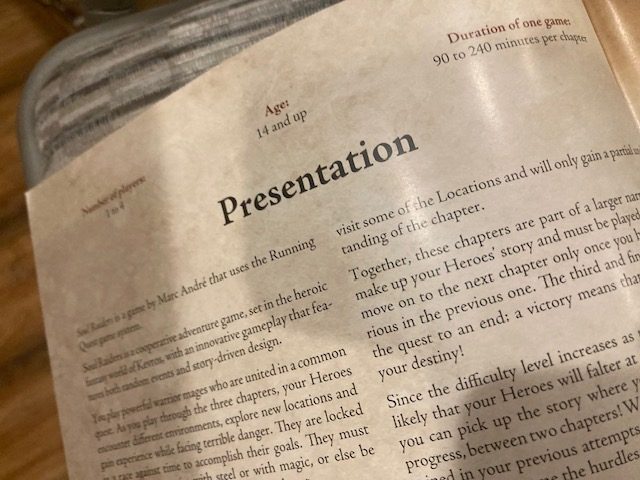
So, this game supports the solo player (thank you for following Saunders’ Law). This is a true solo game: the solo player operates one character.
The only real change for solo play is on the Game board:
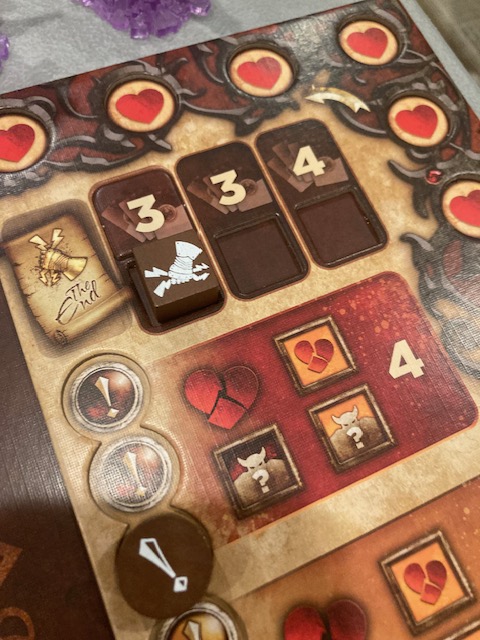
On the Game Board, the final space has a “3” marker on it (instead of 2). This is the number of cards you draw every turn, so the solo player has that extra advantage that (on the last set of rounds) they get three Action cards instead of two. And that’s the only change!
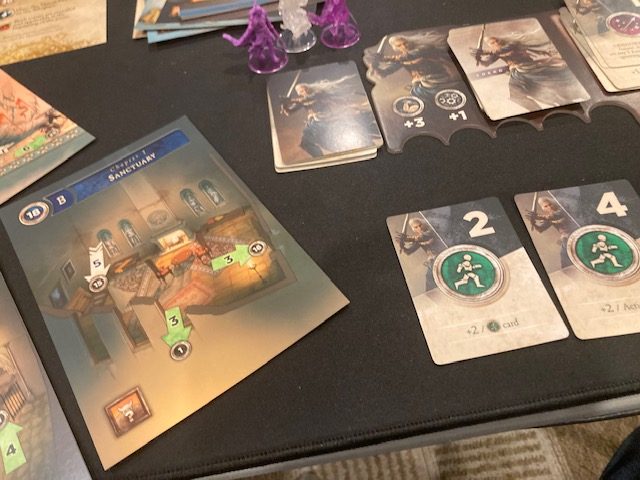
The solo player explores, fights, and interacts … but just by himself! There’s no real balancing anywhere else. It seems a little weird that there are no other balancing mechanisms, but basically what tends to happen is that more enemies come out as more people play, so that tends to balance the game. We’ll address that a little more in the cooperative section.
Cooperative
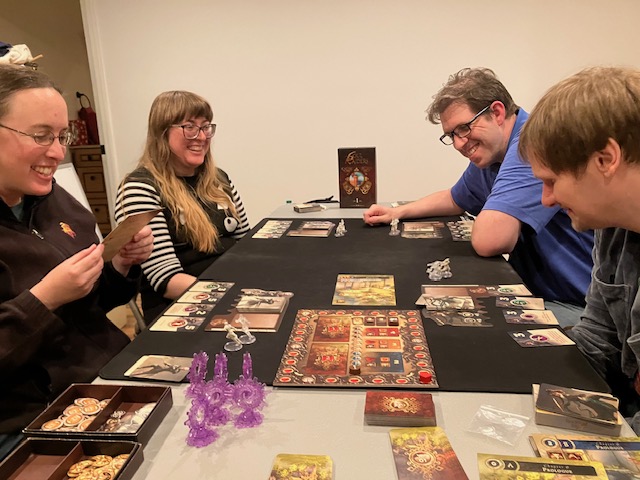
The cooperative game brought up a lot of rules I didn’t have to deal with in the solo game! When you explore new Locations, whether or not someone is already there “changes” how the Location works!
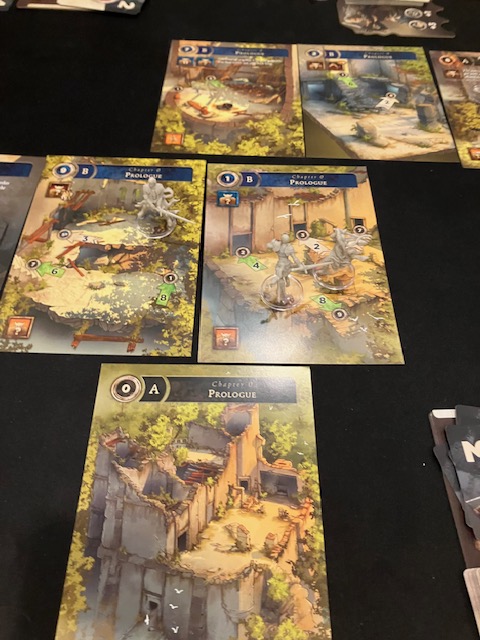
Unfortunately, the Icons were very confusing about this. A slight change of color AND whether its on side A or B makes a big difference. It actually took us almost half the game sessions to get this right!
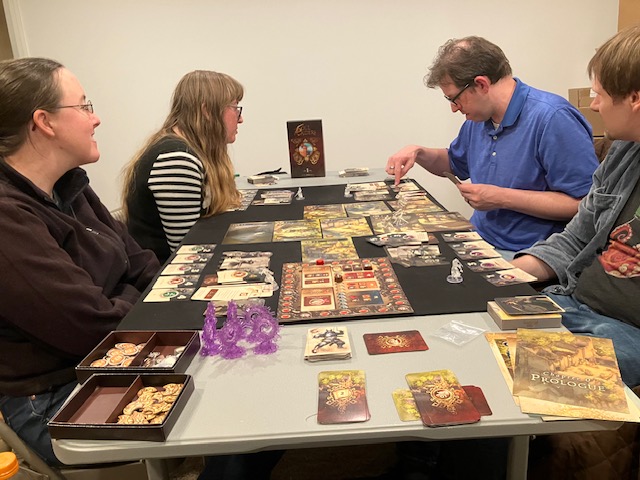
Although the cooperative game has a sense of Player Selected Turn Order, there really is no turn order! Players just play when they want and support each other if it made sense. Although I love this idea, as it should make the game go faster, the game tended to serialize as each player waited to see what happened to see if they needed help. “Let’s wait to see what Sam gets!” I love this from a cooperative point of view, as it lets us support each other!! Unfortunately, what really happened more often than not is that the game really just slowed down behind one (the current active player). To be fair, there were also plenty of times when concurrent play kept the game moving forward. This system worked pretty well from a cooperative point of view. From a length of game point of view, this was not optimal.
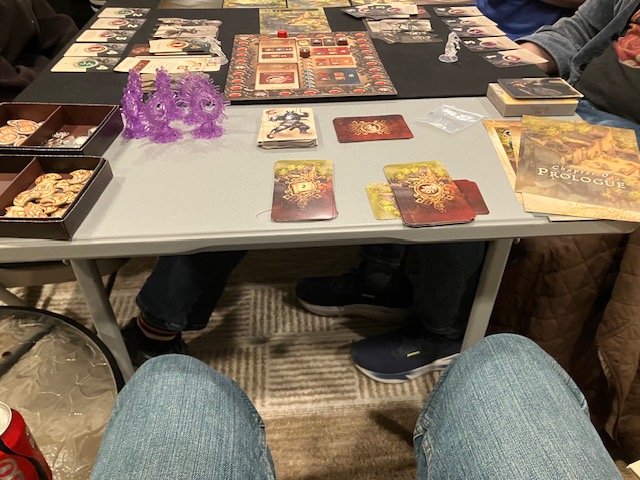
Although this game is a 1-4 Player game, I was the fifth player and “the rules guy”. I just read the rules and taught the game and looked up clarifications. Sadly, this was a very busy position for most of the game! I would constantly be looking up rules clarifications, icon clarifications, and other things. I had played the solo game for about 8 hours, and I was still struggling to find some rules!
There are good moments of cooperation as the players supported each other. Me being the “rule guy” actually worked pretty well, although it was sort of depressing that I had to fill this role.
Urgency
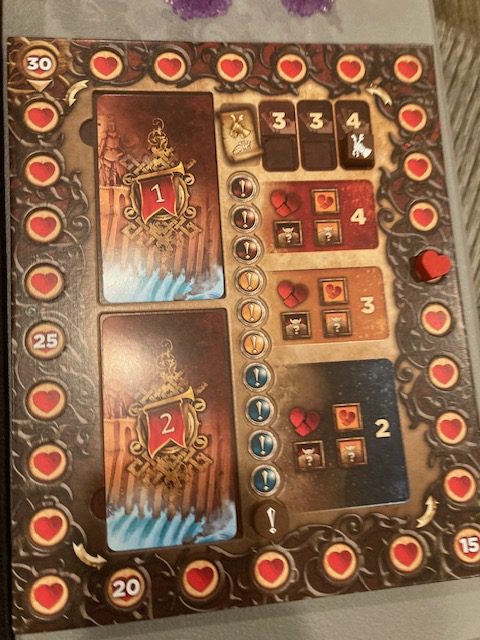
This game has, essentially, a built-in clock. Every time you have finished playing all your cards, you have to take “Vitae” damage (basically, a shared hit point pool) based on the the current. The threat will go up occasionally as monsters or other things happen. And you can’t “usually” just rest on a Location: almost all Locations force you to fight new monsters if you stay there.
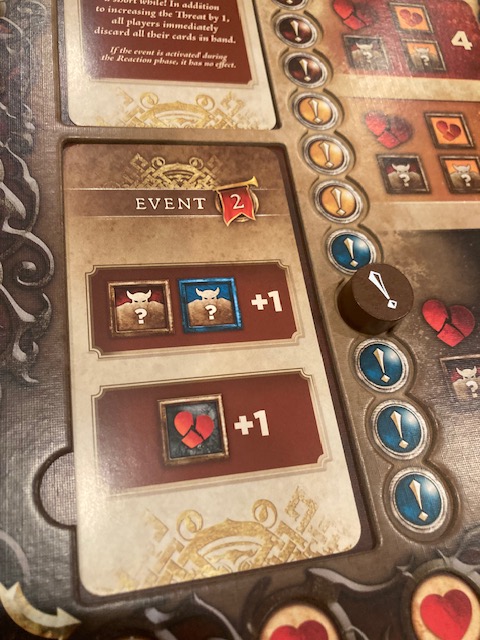
So the game is just always pushing forward: This is both good and bad. If you are looking for a contemplative adventure/exploration game, this isn’t really it. If you want an adventure game that doesn’t stand still, but presents a sense of “you have to keep moving“, this is the adventure game for you. Here’s a very bad analogy; some sharks have to keep moving in water or they die. That’s kind of what you feel like here: players always have to keep moving (exploring) or you die.
Whether you like that urgency or not is up to you.
Kind of a Big Mess
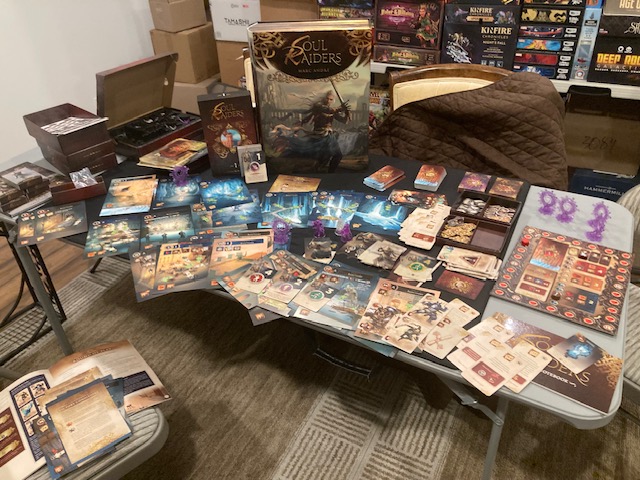
When you take out the Location cards, there’s no real rhyme or reason to them. They don’t form a map (like Arydia Locations did: see that review here), they are more like “pages of a book”. See my big mess after finishing chapter 1!
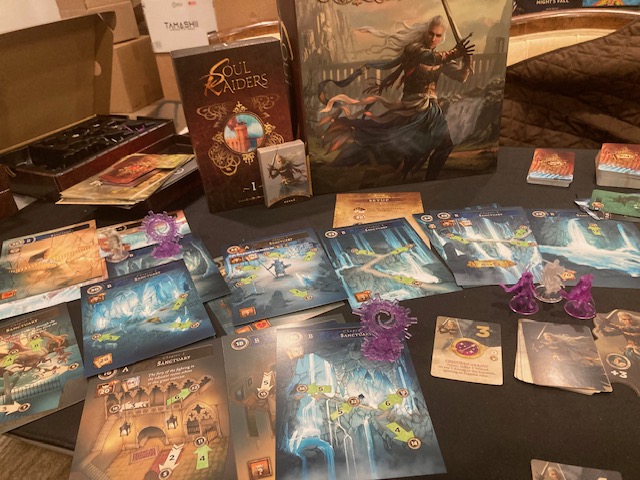
The problem is that you WANT to see the connections from previous Locations you visited! So you try to keep a lot of Locations out as you play so you can see how you came here. And you can see my big mess above as I try to keep some Locations out. To be clear: the Locations DO NOT form a map! (The rulebook even emphasizes this point).
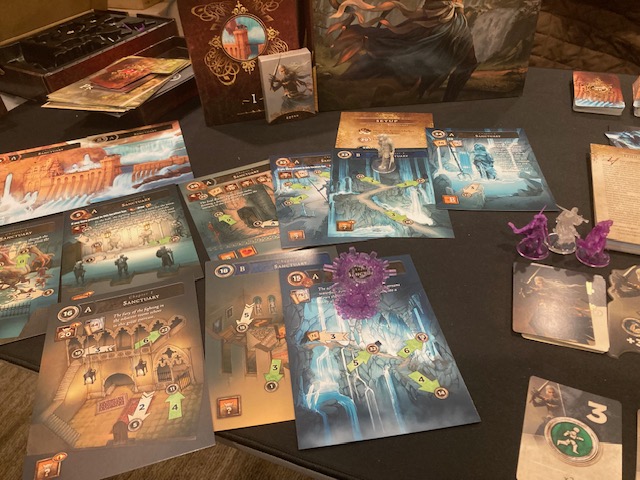
So, the Locations that come out are kind of a mess. Shrug. It feels like there should be a better way to deal with it?
Portals
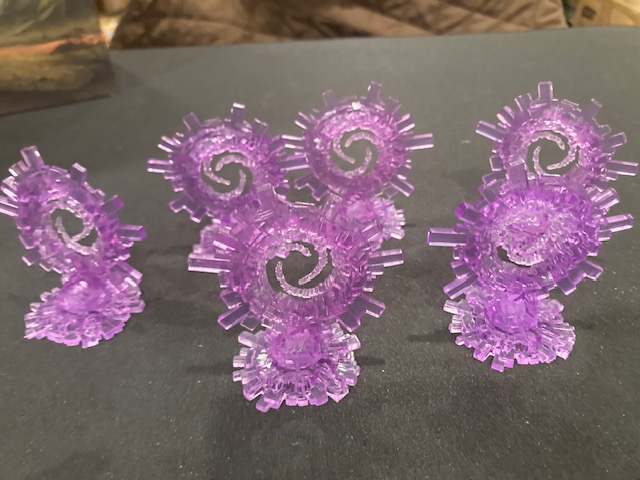
There are some very cool minis for portals! See above!
You can see above as I have built at least one early in the game! I was hoping to make this spot an easy one to come back since there are no “monster spawners” there!
And yet, I don’t think I took full advantage of the portals. At all. I don’t think I used them once. Which is a real shame, because they are so nice!
This is where I feel like this is even more like a Video game … where you replay the level to get the highest score and use the portals to their best advantage. I played Chapter One and got a few extras, but not enough. I feel like what I would do in a video game is replay it until I got the perfect score for that level! I think to do that, I think you’d almost have to use the portals.
Maybe the portals will become more useful later on. I was … disappointed with them. Given how you never really get to just “think” (see Urgency section above), the only time it feels like you might be able to take full advantage of them is to replay the level. Remember how I said this feels like a video game? That min-max feeling emphasizes that point even more …
Save Game
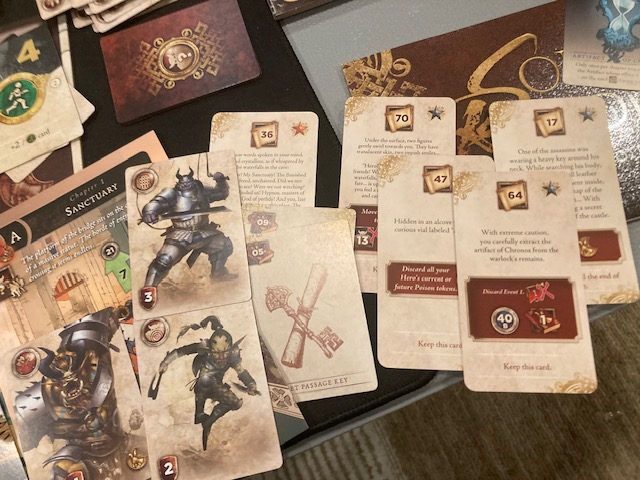
This is a campaign. You will need to save you game between chapters. Unless you can leave the game set-up (and it is a table hog), you will have to save your game.
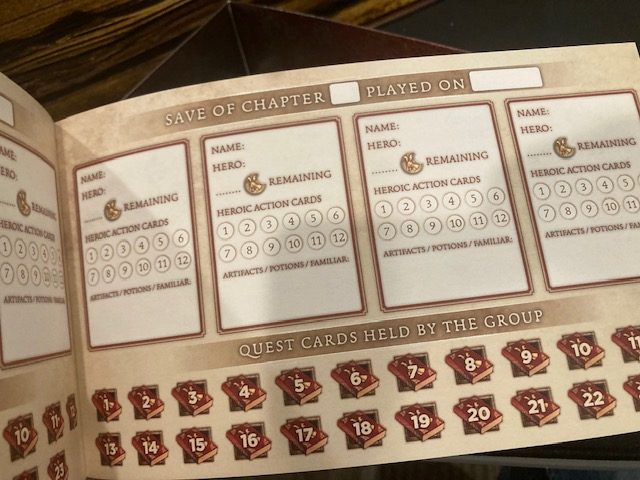
You can either use the campaign book (above) …
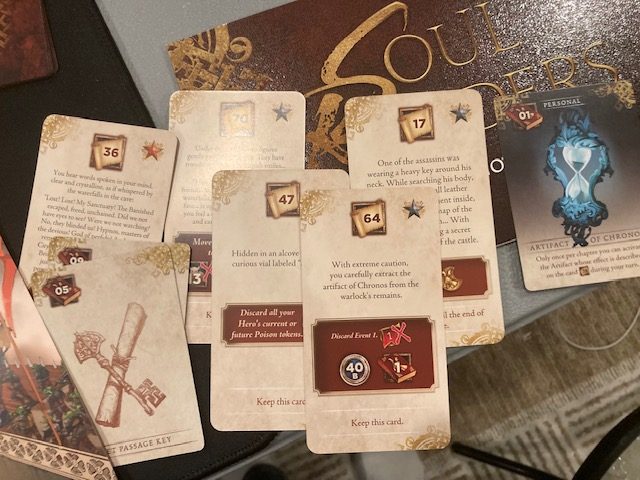
Or just take a picture of your game and extras at the end (see above). The cards are pretty well marked.
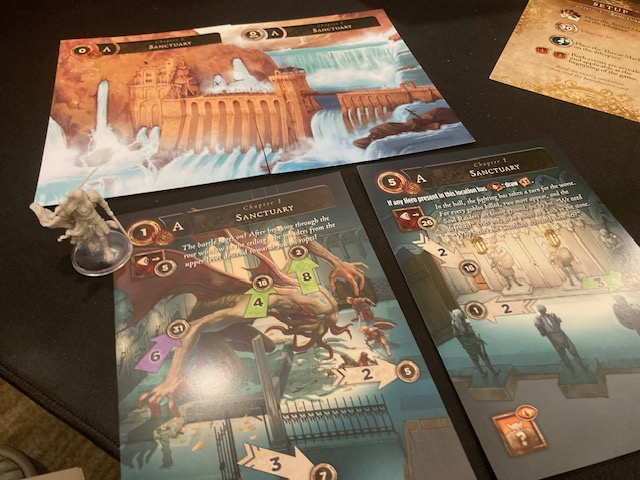
Let’s be clear: this is a campaign you can reset! I have a solo game going, but we are also playing a cooperative game at the same time. Sure, I’ll have to “pick” the cards out I want, but it’s fairly easy to reset the campaign to replay it from scratch. This is not a legacy game.
Too Many Rules?
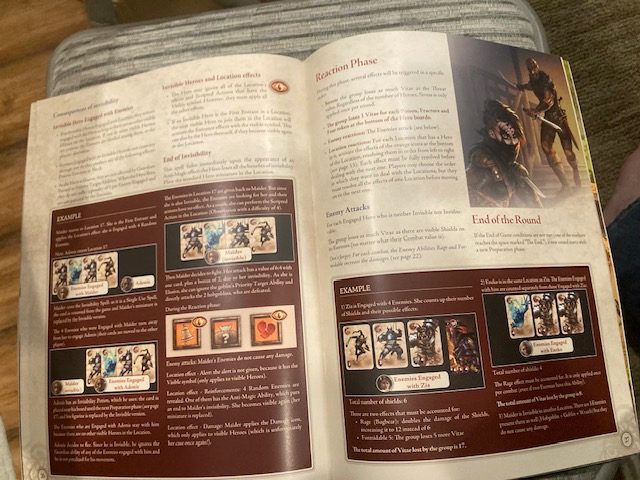
For such a lavish game, it’s both really simple and really complicated. The basic card play is really straight forward, but all the little rules for combat and especially movement feel very complicated. If you enter a Location with someone else, it has a different effect depending on the Icon in there, which has subtle difference between other Icons.
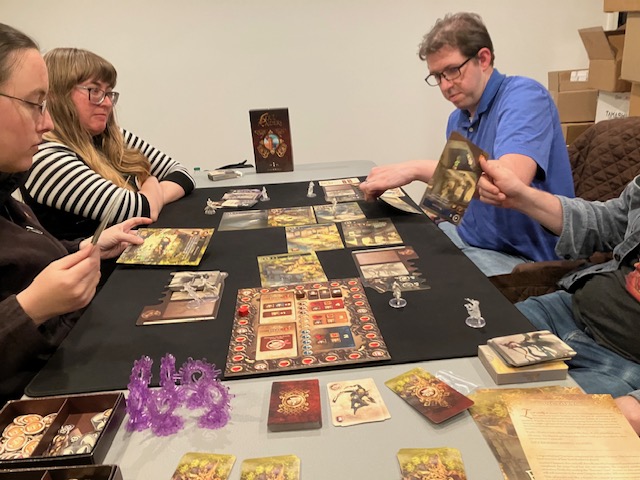
The fact that my role as “The Rules Guy” (as the 5th player and NOT playing the game) was pretty active the entire game might be an indicator that maybe there’s a few too many rules.
Reactions
Oof, Soul Raiders did not go over well with my group. My friends compared this to Tainted Grail (see part I and part II here) where it was just a grind to explore. Andrew even commented: “This doesn’t feel like an exploration game, even though it kind of looks like one! I have no mental model for how the map lays out because it’s so clumsy!” Sara commented that the “.. Exploration feels like Tainted Grail because you just keep getting monsters! You don’t really feel like you advance!”
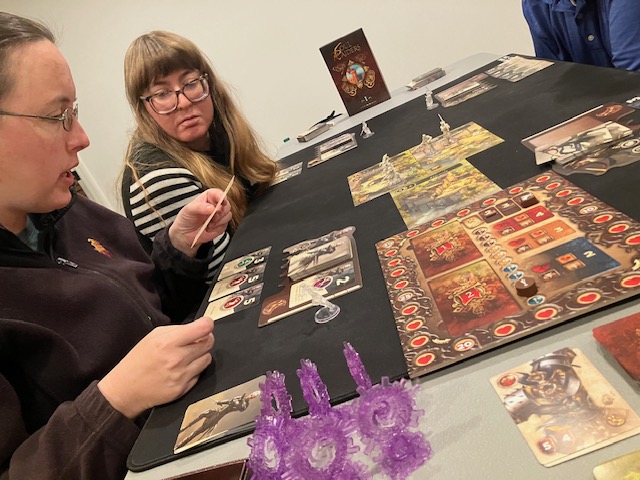
Andrew pointed out, “It’s not even really choose-your-own Adventure, because you don’t really have a lot of choices! You left, right, or forward most of the time! And it feels randoms!”
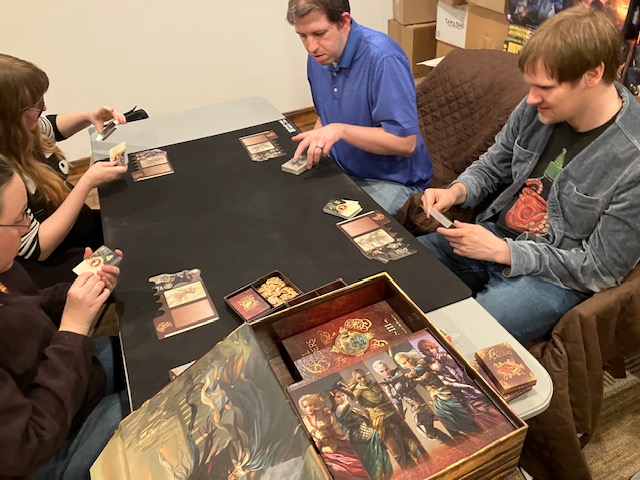
The reactions were ok to not great.
Sara and Andrew: 5/10. “Don’t really want to play it again. It didn’t feel like exploration. It felt too grindy like Tainted Grail.”
Sam: 5.5/10 “I’d play it again, but I really didn’t love it. I thought Luddite from last week was more thematic than Soul Raiders!”
Teresa: 6.5/10 “I had okay fun and would play again.”
Rich: As a cooperative game, I definitely saw what my friends saw with the grindiness, and I could see why my friends didn’t love it. As a solo game, I’m right on the fence of recommending it: I’ll give it a 7/10 for the solo game, and maybe I could see it working as an intimate 2-Player game. I think as a solo player, I became more invested in the story, but I still had some of the problems that my friends had. I love the art, and I really like the simplicity of the card system. I also really like the upgrade system (where you can IMMEDIATELY grab a card with 3 Heroism). I think there is some interesting stuff happening in the story, but the game does fall to the grind sometimes.
Conclusion
Soul Riders is a gorgeous cooperative adventure with a sense of urgency. That urgency adds to it’s video game feel: it’s kind of a Point-And-Click Adventure in a board game, with exploring and interacting, but also lots of fighting!
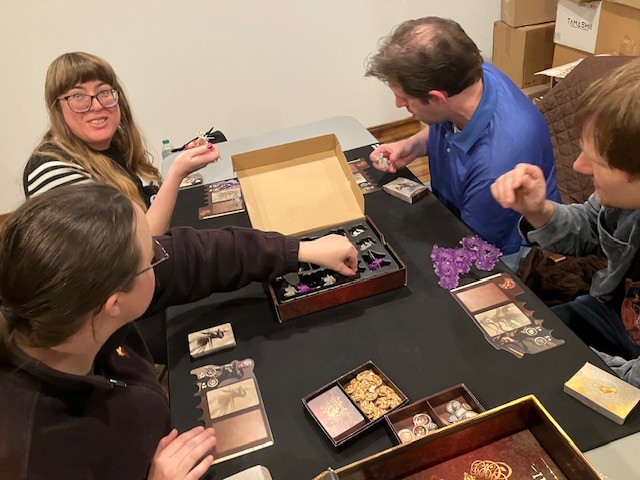
Unfortunately, this game didn’t go over very well with my friends as a cooperative game, with scores ranging between 5/10 and 6.5/10. Soul Raiders reminded my friends too much of the grindiness of the original Tainted Grail in both its exploration and fighting. And that grindiness was a big turn off. Having said that, the system worked well from a cooperative perspective, because my friends seemed to cooperate well!
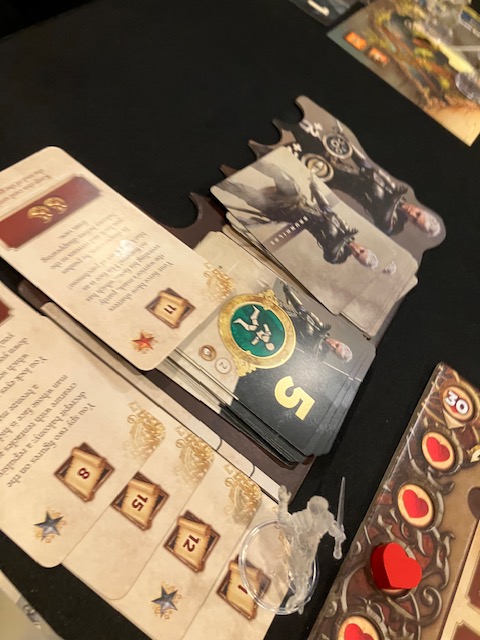
As a solo player, I become fairly invested in the story and I enjoyed it a little more. I think the solo player can reflect a little more than a cooperative team, so maybe that urgency in the game is less intrusive for the solo player? I do think that an intimate 2-Player game could go over well as the solo game.
Hopefully this review can tell you whether or not that Soul Raiders is right for you.



















 coopgestalt