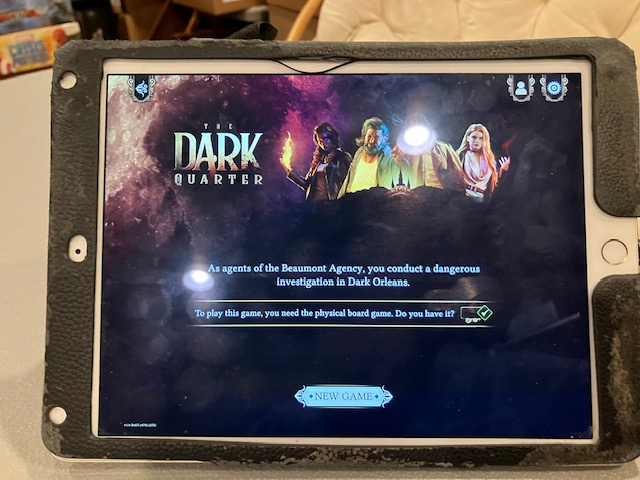
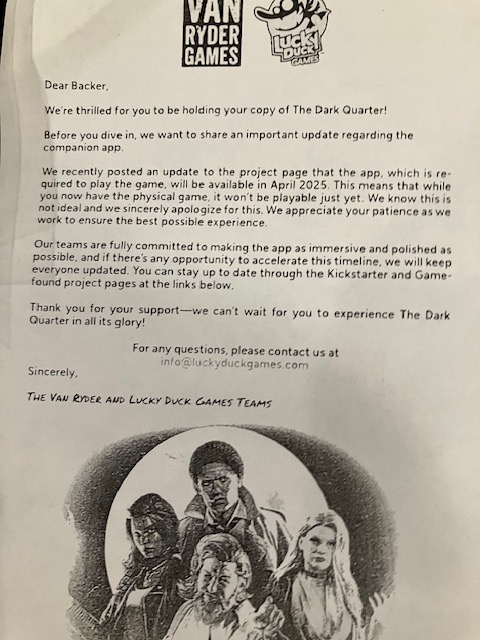
It arrived! No, not the physical copy of The Dark Quarter! That arrived like early 2025!
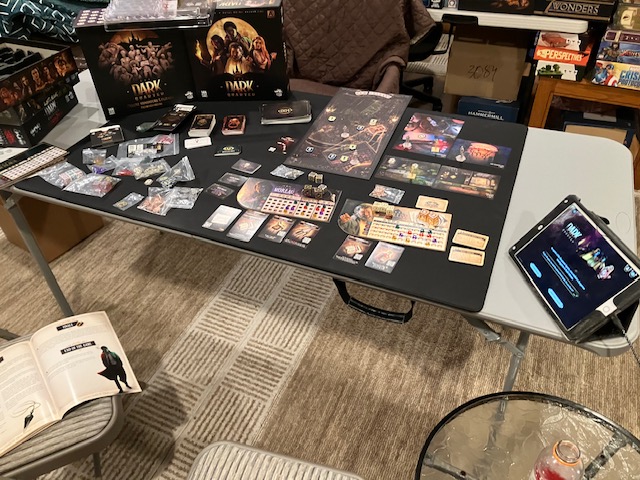
But the APP finally arrived at the iOS store! See above! Late May 2025! This game is completely unplayable without the app, so my physical copy of The Dark Quarter sat silently in the corner for months, waiting for the APP to be available! And it finally arrived! I think I downloaded it May 25, 2025. I have been really looking forward to this, as it was my #4 on my Top 10 Anticipated Cooperative Games of 2023 … it’s years late at this point!
So, in any other year, this might be considered weird to get the physical game before the APP is ready, but with the Tariff situation changing daily, I think Lucky Duck/Van Ryder games did the right thing getting to us ASAP!
Let’s take a look!
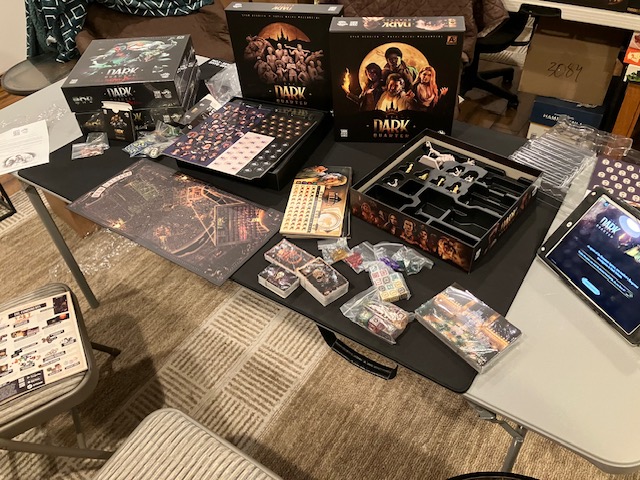
Unboxing
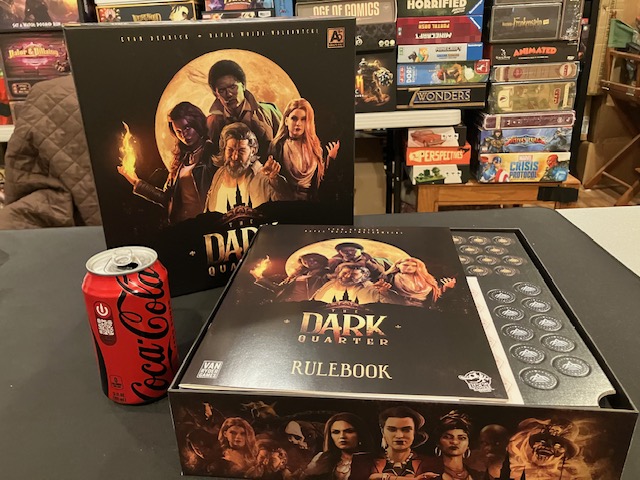
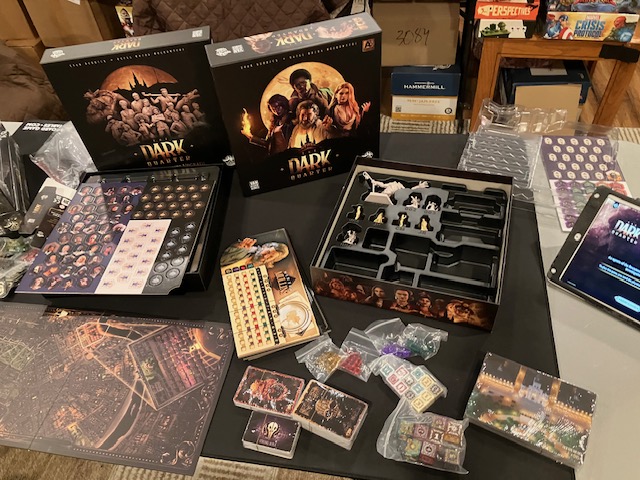
This is a pretty standard sized box; see Coke can above for persepective.
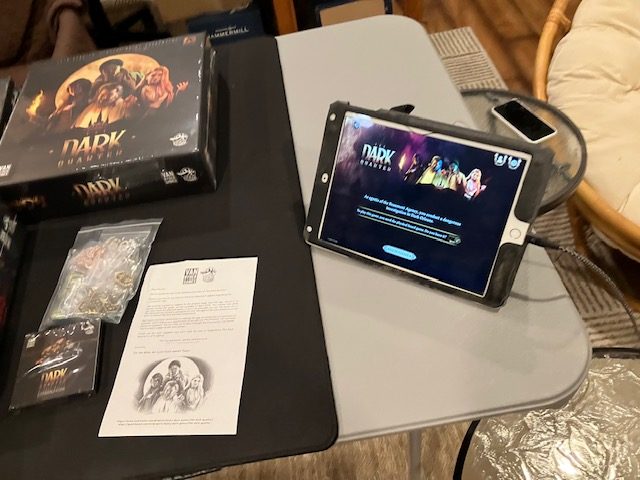
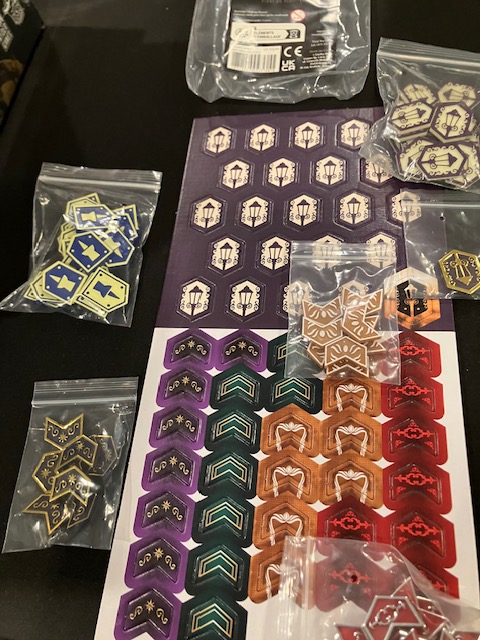
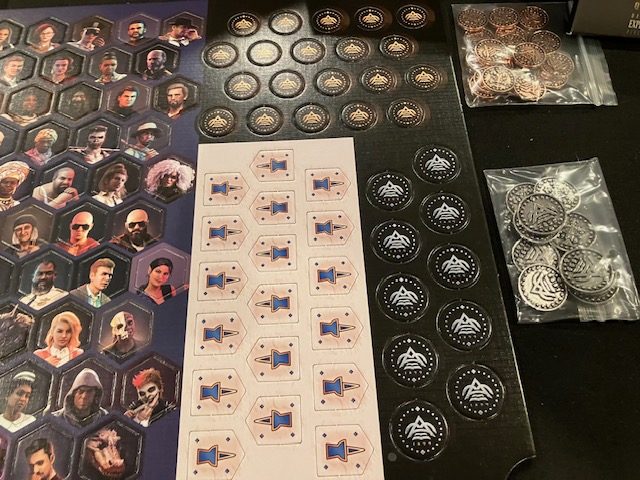
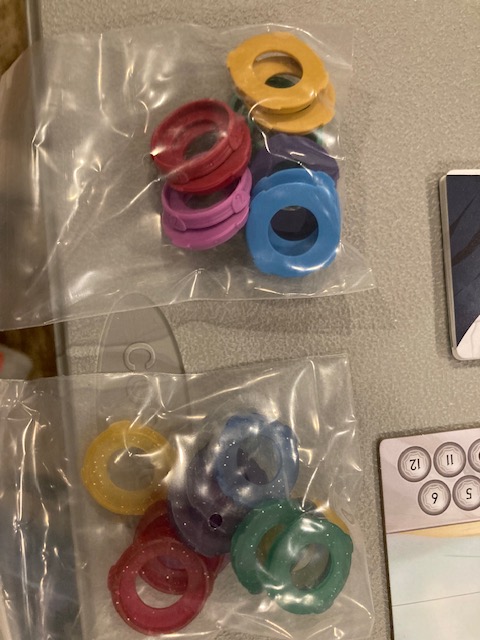
The game comes with a lot of cardboard tokens (see above), but I had gone all-in on the Kickstarter and got the nice plastic tokens as well.
I also got the metal coins (see above).
Even though I got the miniatures expansion as well, you will still need some of the little hexes with people on them.
You could play this game just fine with the cardboard, but the upgraded components make you feel…. like you’ve spent more money. 🙂 No, they are nice.
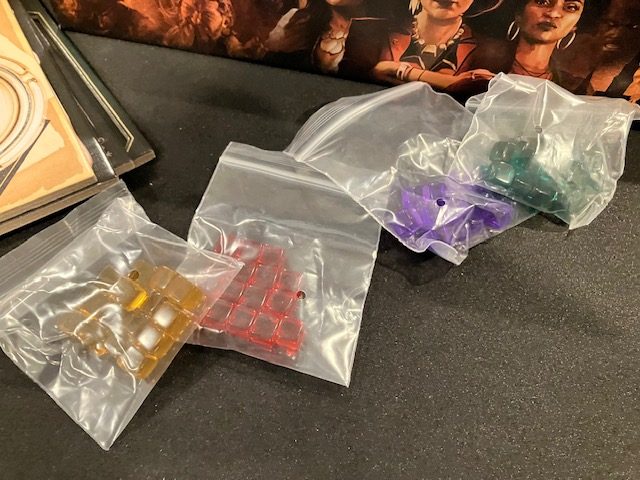
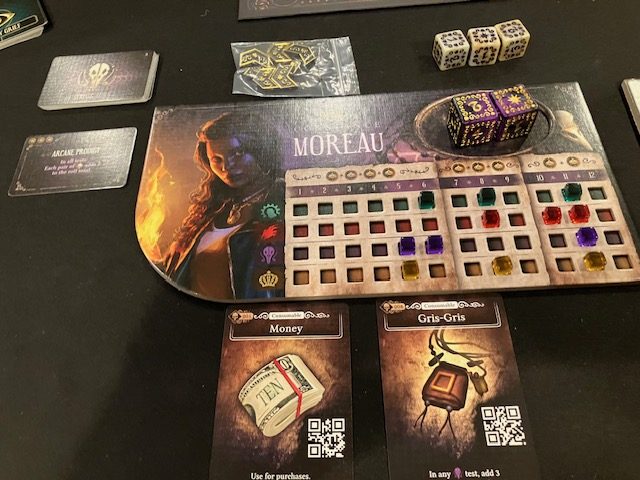
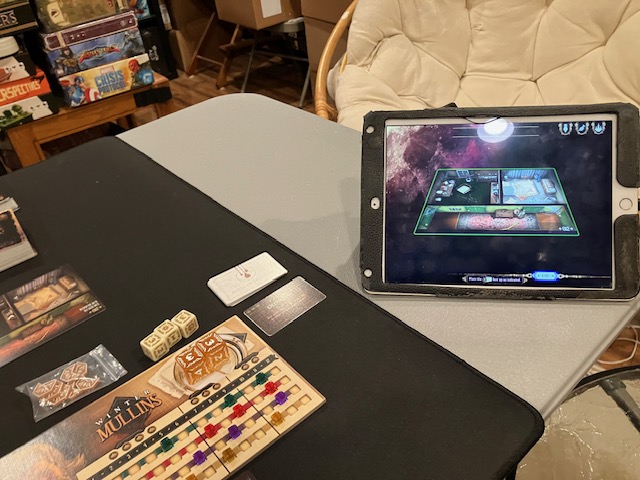
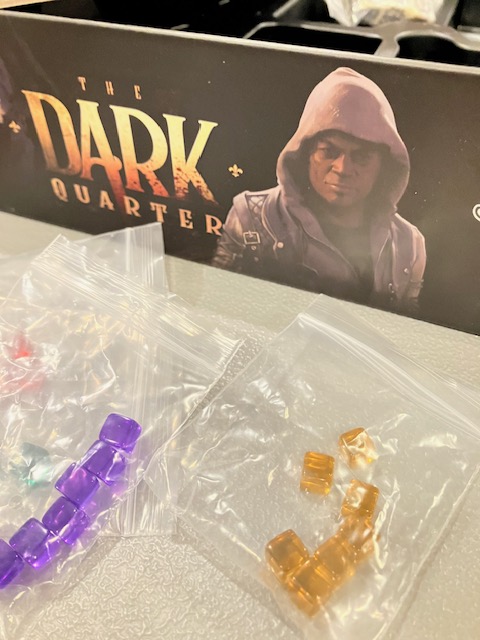
The little plastic cubes denote your ability scores.
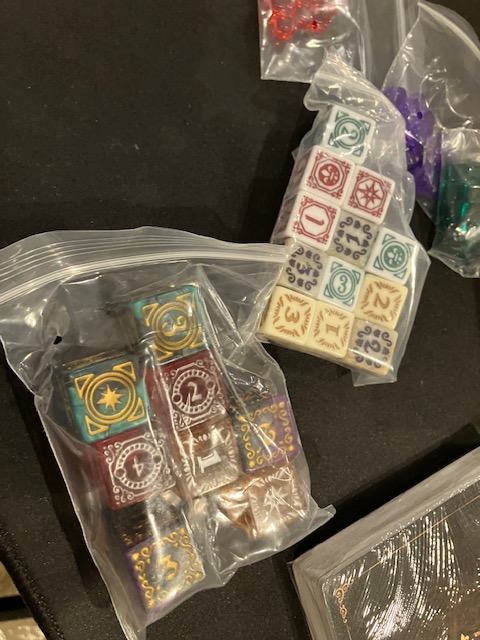
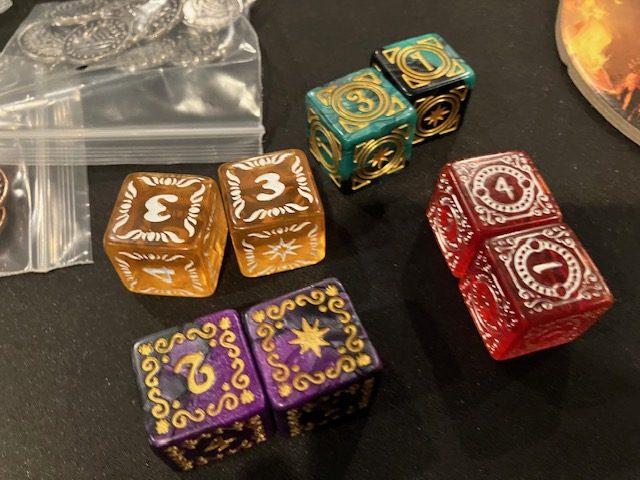
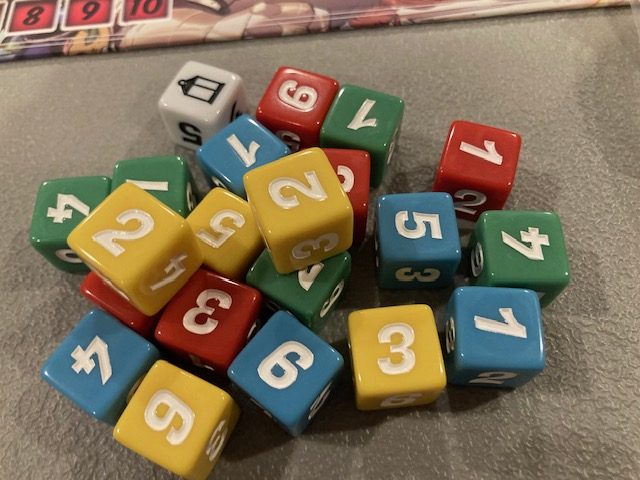
And each player will get their own dice (see above, as the dice as color-coded for the 4 players).
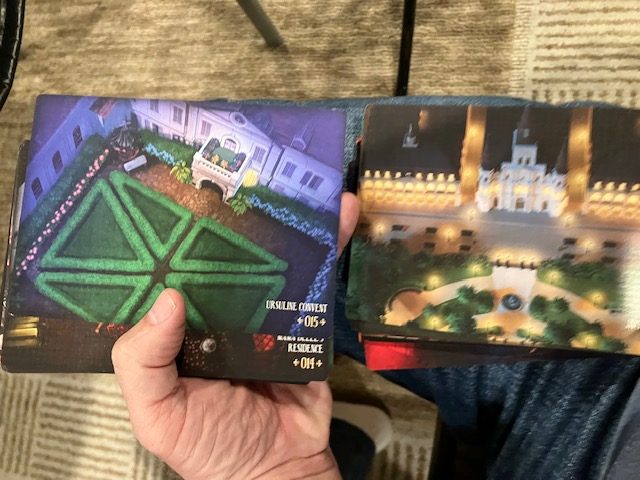
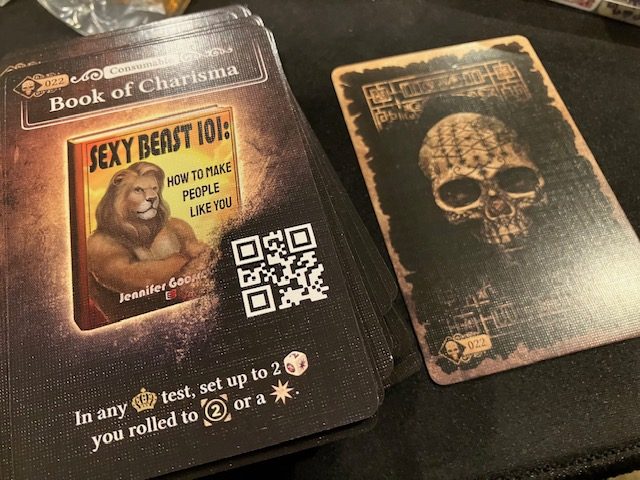
There’s some nice Location cards that will come out (see above) as you explore.
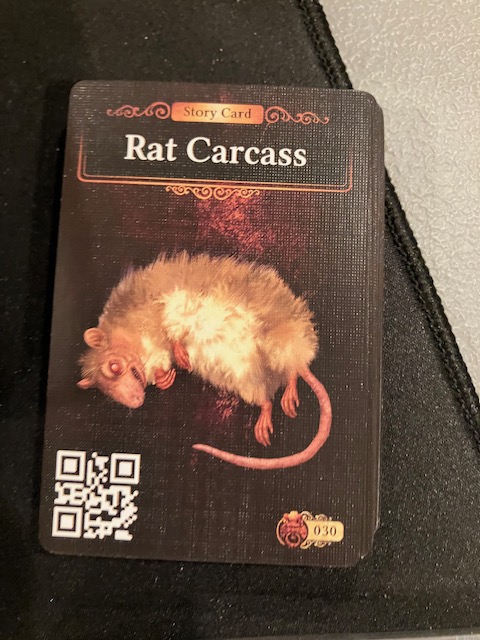
And there’s both objects (see above) and story cards (see below).
What’s that? Yes! A QR code! These cards will be scanned when you play!
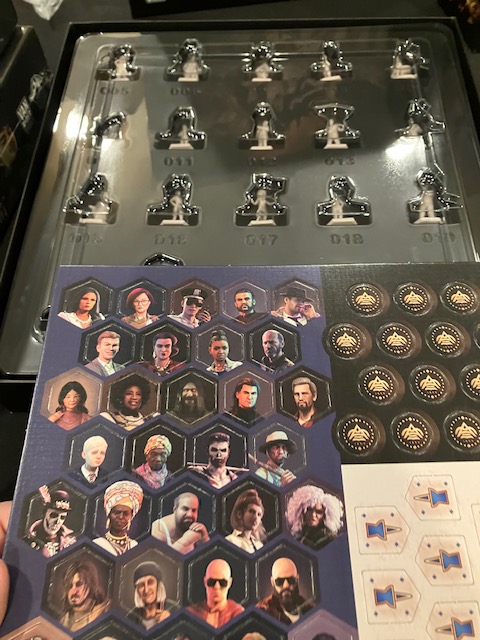
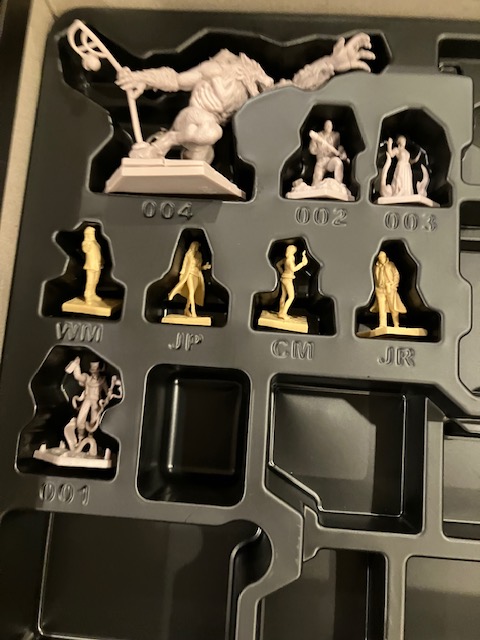
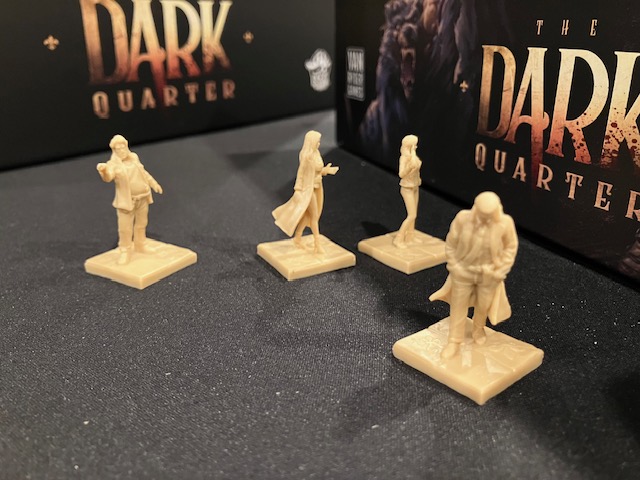
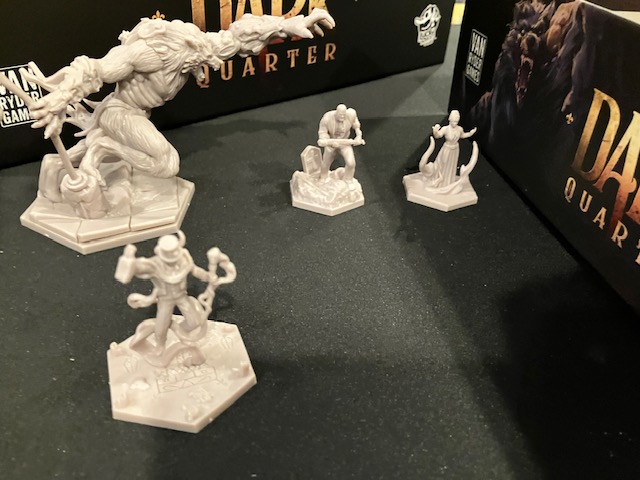
The minis are pretty good, but not great.
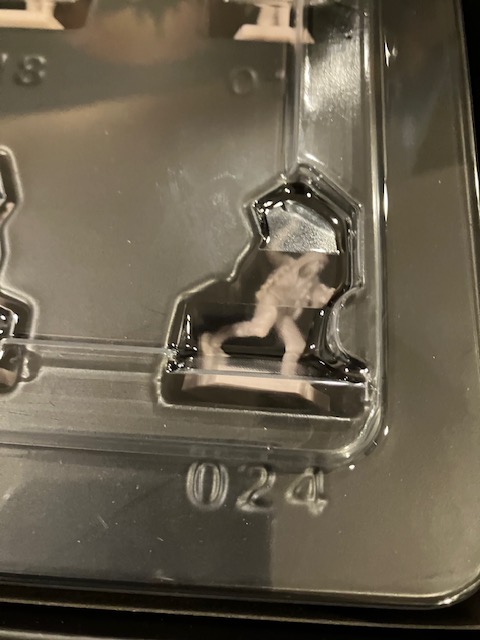
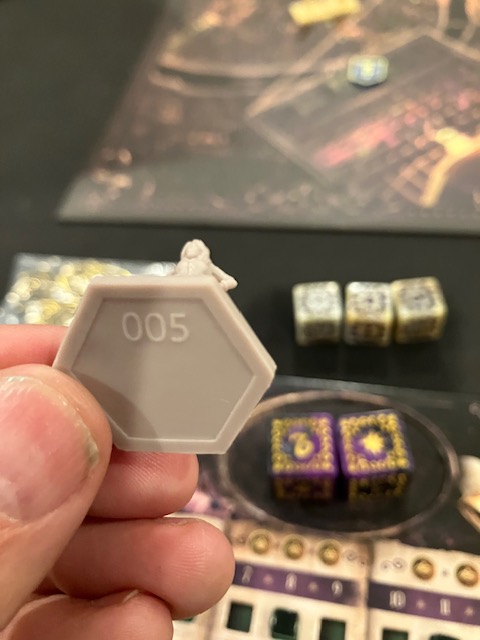
But the minis are notated with a number on the bottom so you can put them back where they belong (see above and below).
I mean, this game looks pretty good, ya?
Rulebook
The rulebook is fine.
It fits pretty well on the chair next to me open flat, and the font is pretty big. This is venturing into A territory (although it maybe could have used a few more pictures) for The Chair Test.
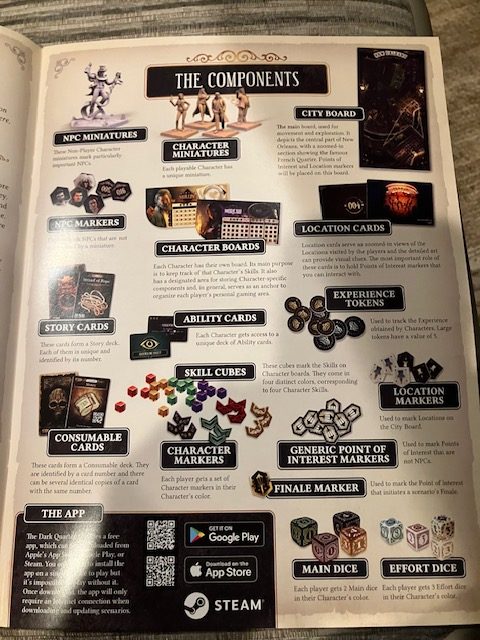
The Components page is well-labelled.
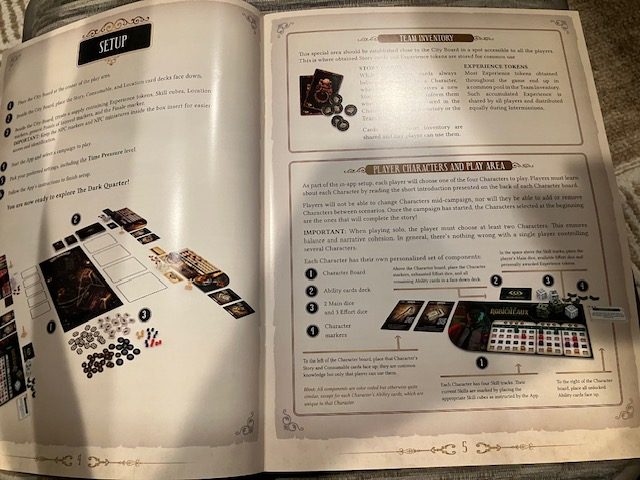
The set-up is pretty good, although there is always confusion in an APP based game: usually the APP sets you up, so do you need this? You kind of need both the rulebook and the APP for set-up.
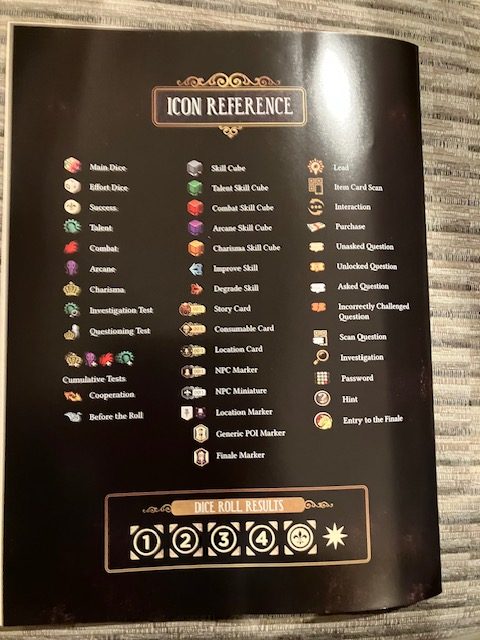
The last page has an ICON summary, which is great! … but I don’t think I ever used it once in all my solo or cooperative gameplays.
The rulebook is pretty good, but you don’t spend a lot of time there; you are always in the APP.
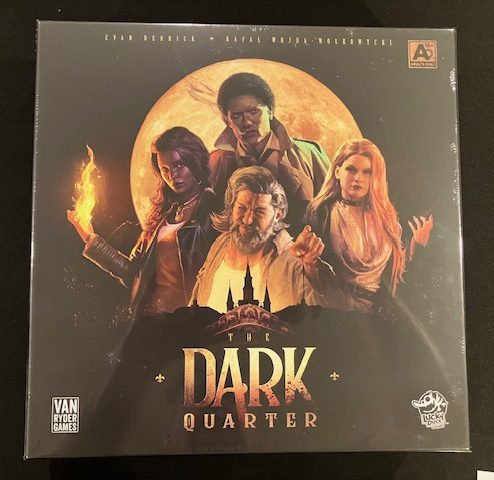
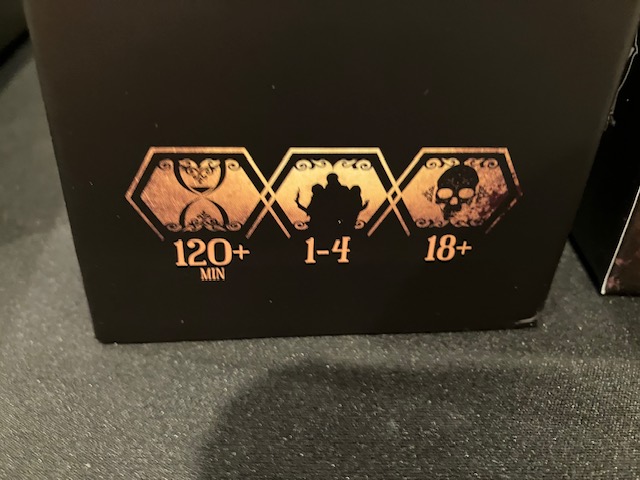
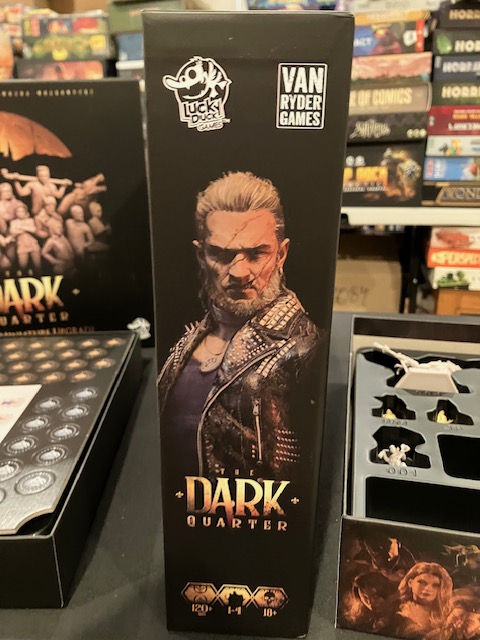
Warning! 18+!
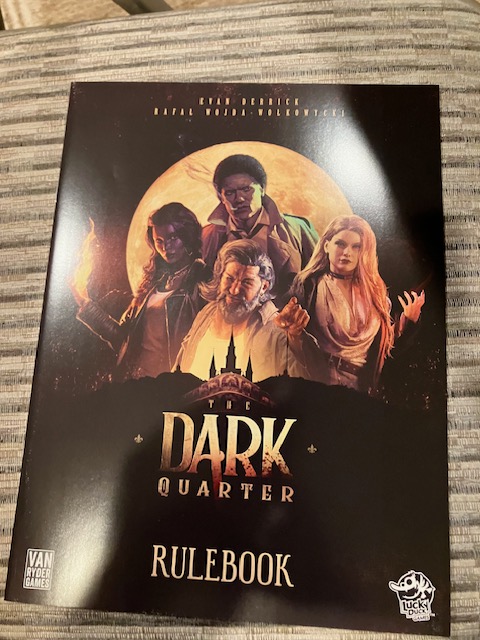
You may miss it, even though it is clearly on the box (see above) but this is clearly an 18+ game! Between language, grisly murders, some sexual references, and just dark imagery, you probably don’t want to play this unless you are ready for a dark, grimy, and morally ambiguous world.
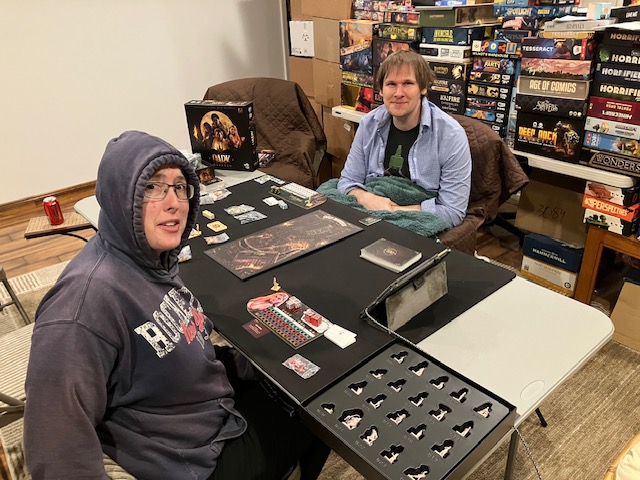
Teresa, who started out censoring the bad language from the APP, was swearing like a sailor by the time we finished our first session! She really embraced this world! Be aware, this game will corrupt … something?
Gamplay
Each player takes the role of an “investigator/consultant” for the Beaumont Detective Agency. Each character is flawed in some way, but they are generally seeking redemption (but that’s your choice to make).
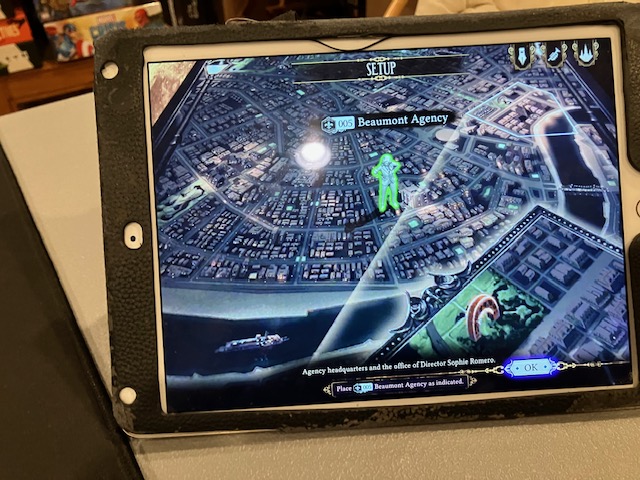
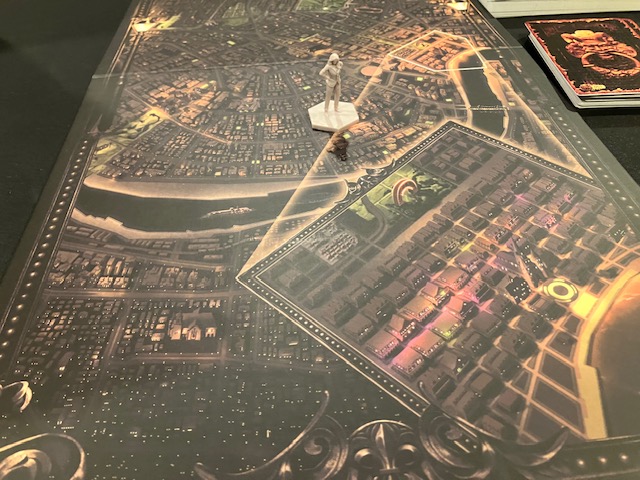
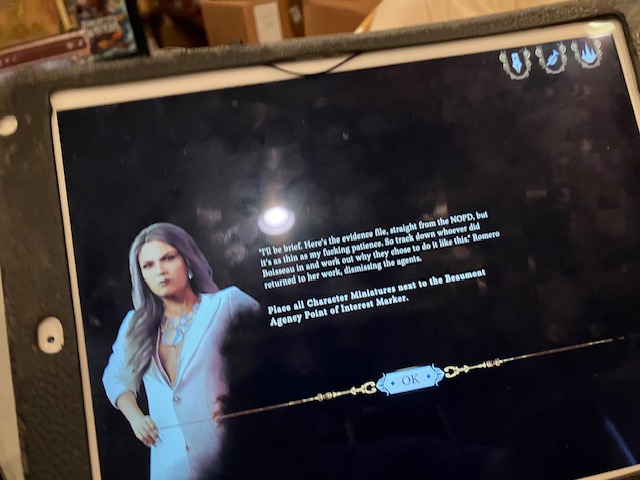
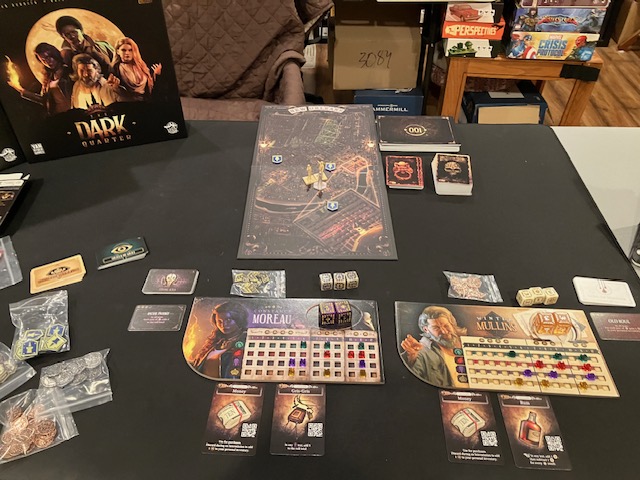
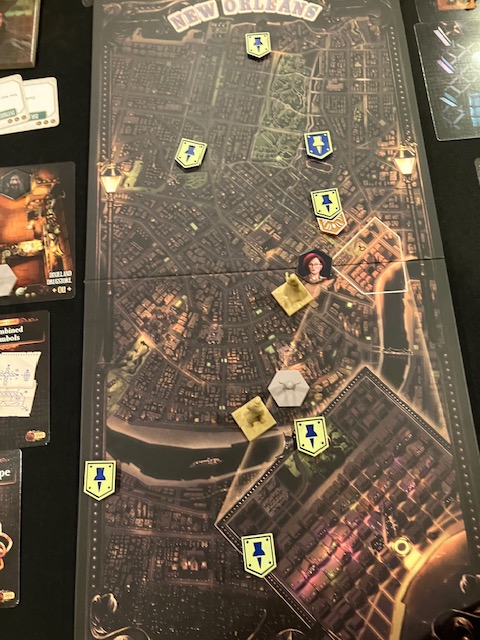
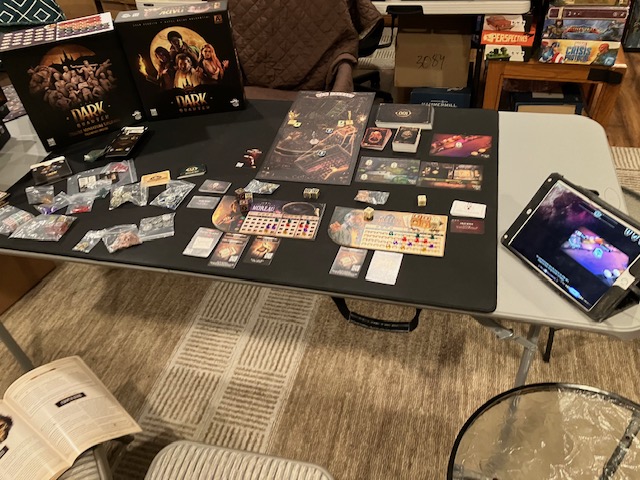
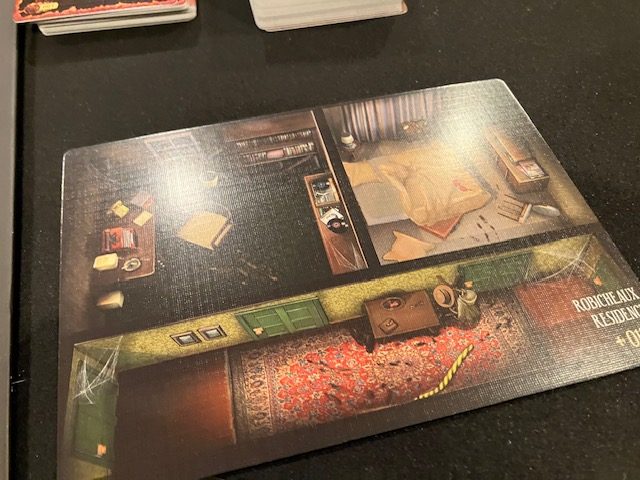
Players use the APP to guide the game. The APP shows how to set up places of interest (see above):
And you reflect that on your game board.
The boss lady tells you what to do in the APP, and you explore a 1980s New Orleans investigating a murder!
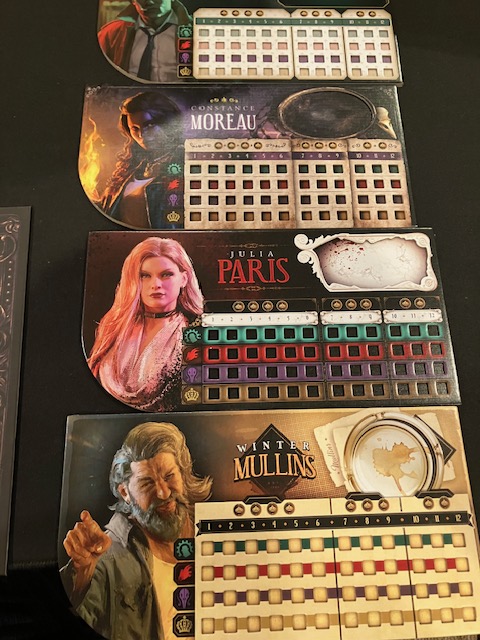
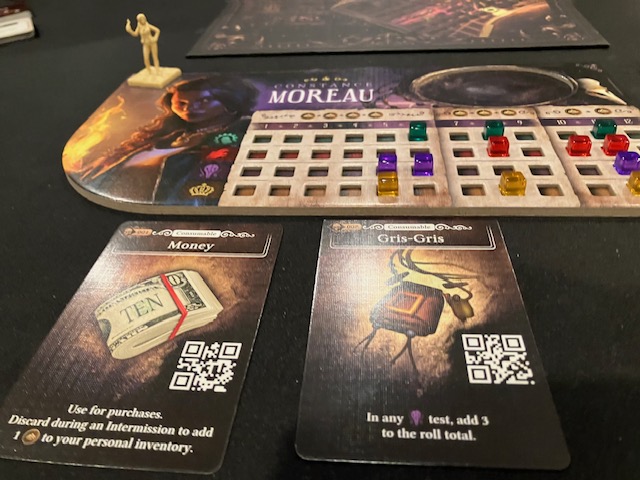
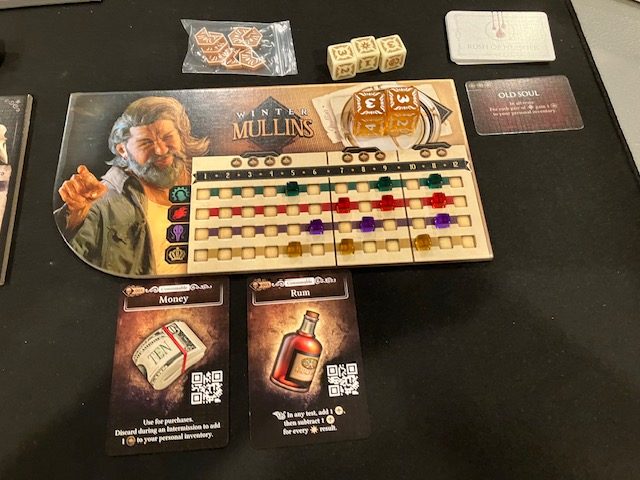
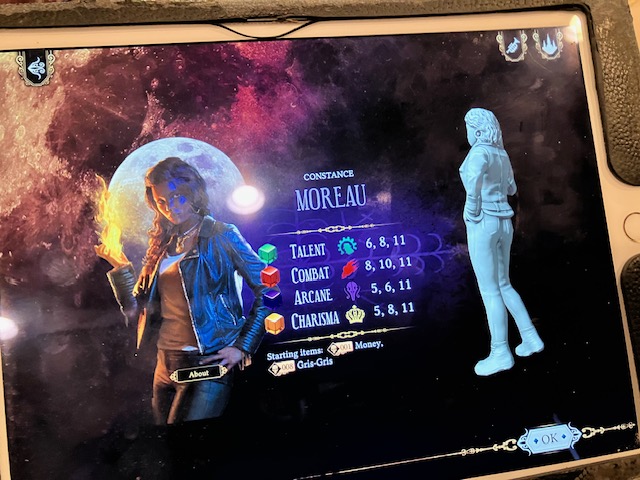
Each characters gets some items they can use, and has some level in 4 different skills/abilities (see above). These abilities are rolled against, and however many you surpass is how many successes you get.
This is absolutely a dice game! Almost every turn, you will roll the dice to do “some skill check”. You always get your two base dice (color coded for the characters: see above), and some extra effort dice.
These effort dice are enabled as you play. You always get one effort die at the start of your turn, but sometimes you will get more through other actions.
Players explore the city, trying to investigate a murder! The APP controls the narrative, with the players making choices, and the dice determining success or failure.
You’ll notice a lot of items have a QR code (see above): you will be scanning your items to interact with them. This may remind you of Chronicles of Crime (that made our Top 10 Cooperative Detective Games), and it should! Lucky Duck (who teamed up with Van Ryder Games to make The Dark Quarter) also made Chronicles of Crime!
Honestly, playing this game reminds me of playing out a Detective series on HBO or Apple+ mini-series. Story happens, characters develop (or regress!), and a lot of swearing and adult situations occur.
Solo Play
So, you can play solo (thank you for following Saunders’ Law).
However, solo play has you take control of two characters: there is no true solo play. See above as I chose to operate both Constance Moreau and Winter Mullins.
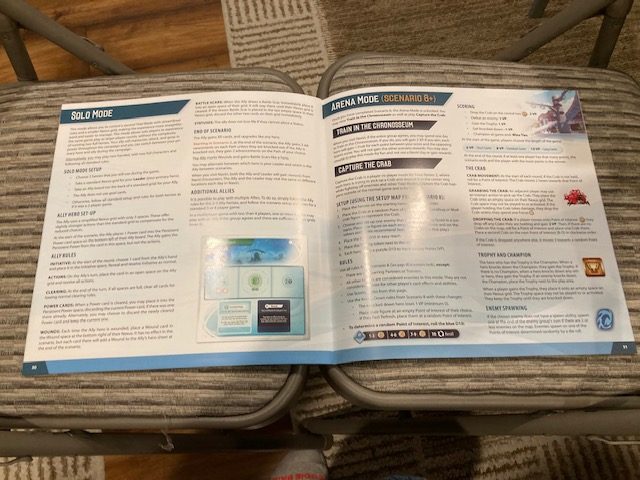
The rules do cover the case where the solo player has to play two characters (see above), and justifies needing at least two characters as “the stories are intertwined; you need at least two characters to get the best out of this!” And that makes sense; these characters destinies are all tightly coupled!
So, I started a game. And went back and forth between the two characters. And I didn’t enjoy it.
The back and forth between the two characters as a solo gamer just didn’t work for me. It felt like I couldn’t get any thing done, as just as I did one thing at a Location, I’d have to immediately go to the next character. I remember loving Detective: City of Angels (A Van Ryder game also in our Top 10 Cooperative Detective Games) because you had four precious actions on your turn and how you spent those actions mattered! It felt like you could concentrate on a Location and get stuff done! In The Dark Quarter, I frequently felt like I got to do just “one” thing, and then it was the next character’s turn.
I played out the first two sessions as a solo player, but … I kinda stopped caring. I felt like I couldn’t get anything done as a solo player, I was so busy “advancing the story”, I felt like I wasn’t playing the characters or solving the mystery. I felt like the game was playing me.
The story was interesting, but I felt like I couldn’t focus. Some of that lack of focus was the context switching between two characters, and some of that was going back and forth between the game and the APP, some of that was all the dice-rolling, and part of it was just how “little” I felt like I could do on my turn. I just had to swap between too many things, and it took me out of the game.
I hoped a lot of these issues would go away when I played cooperatively. I was expecting to love and adore this game straight out of the box. I didn’t, and my solo experience wasn’t great.
Cooperative Play
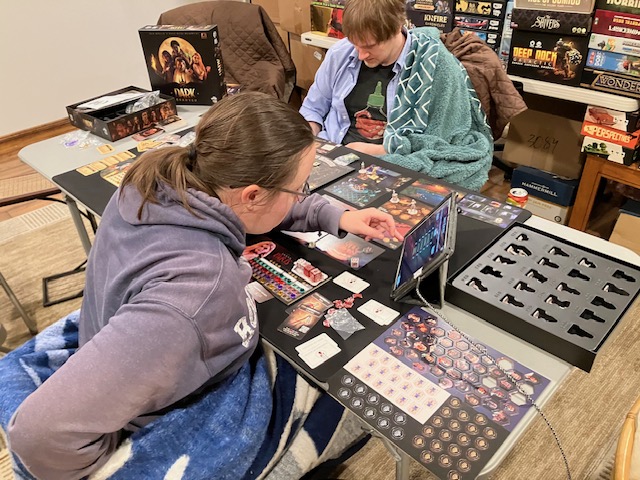
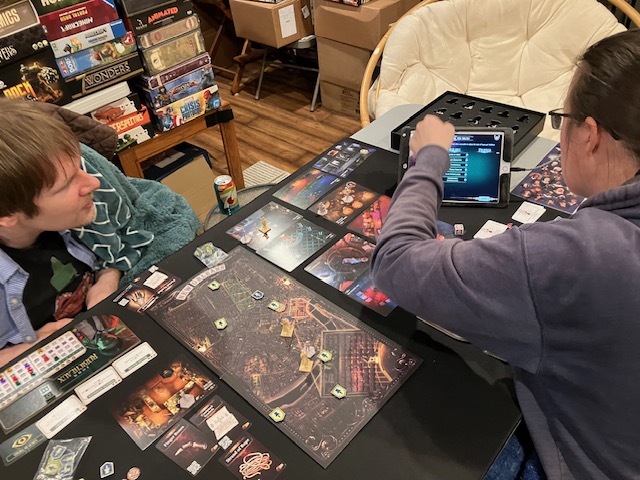
Whew. Luckily, the cooperative experience was much better! The fact that the focus moves around quickly between characters is actually good in the cooperative game, as most people feel like they get their chance to play; quickly and regularly.
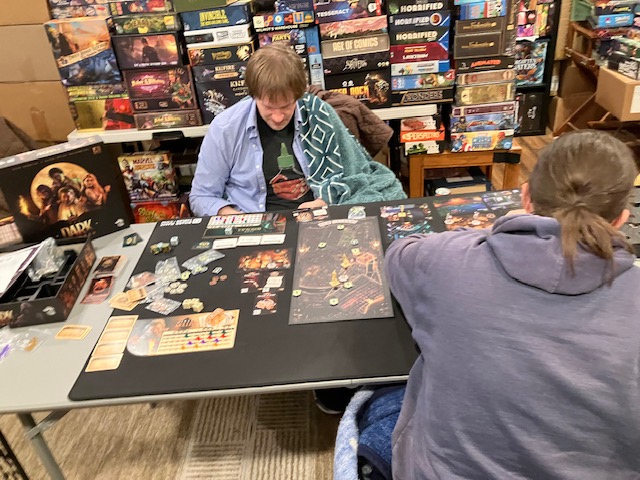
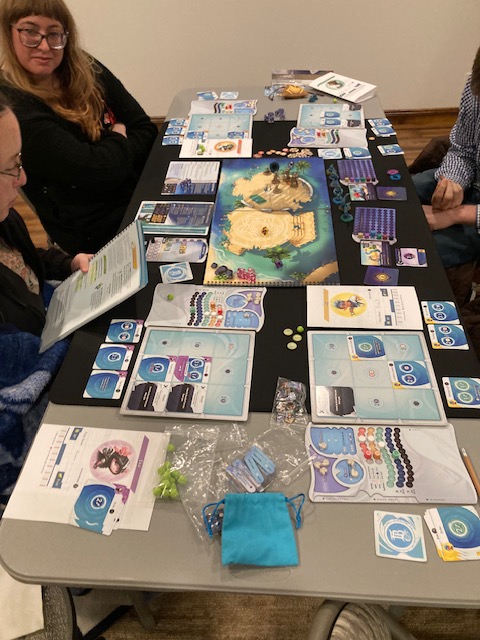
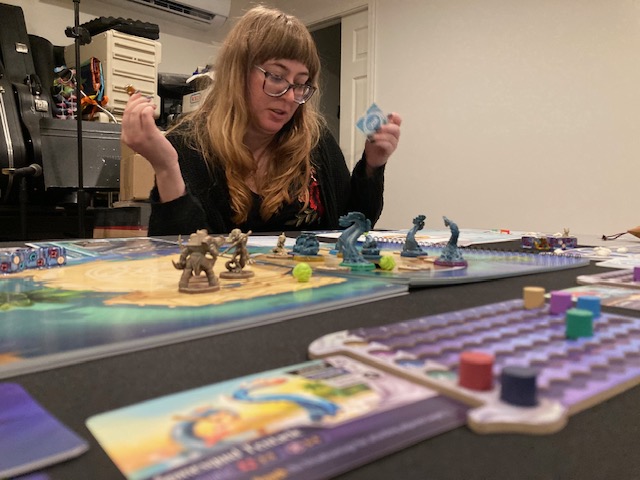
You can see as the board and locations expand out! The world definitely envelops you as you play!
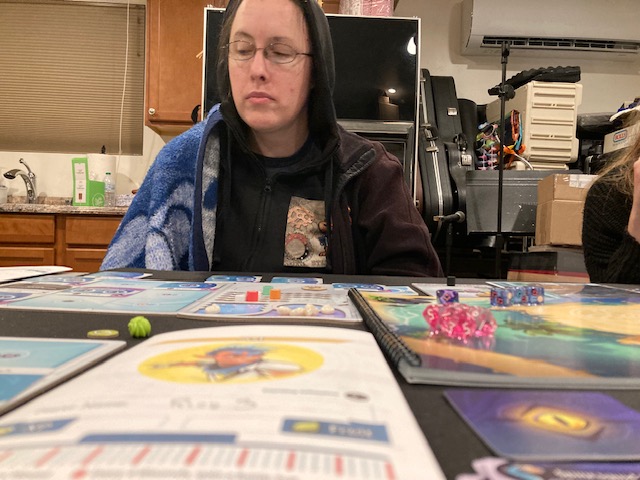
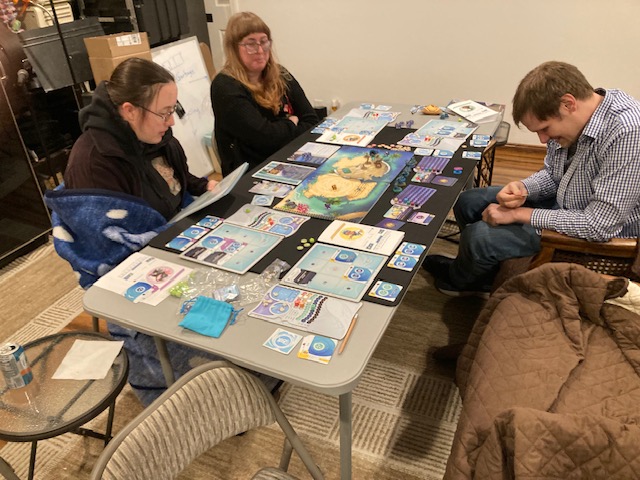
This game feels “tuned” to work best as a cooperative experience. The 3-Player game we played was fun! We ended up playing about 3 hours and still didn’t finish the first play! But, we still wanted to play more, so we kept playing …
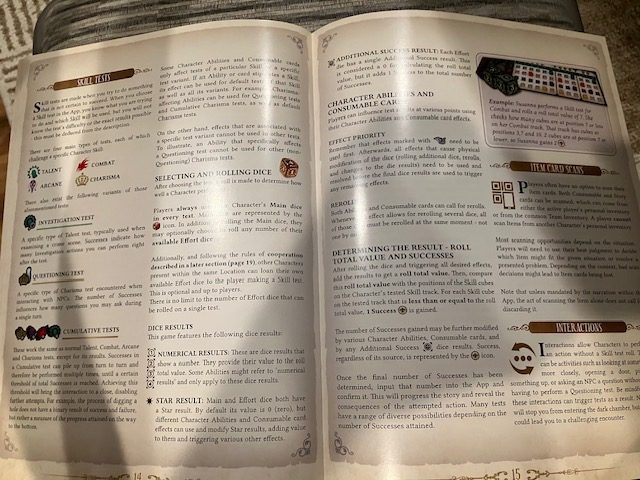
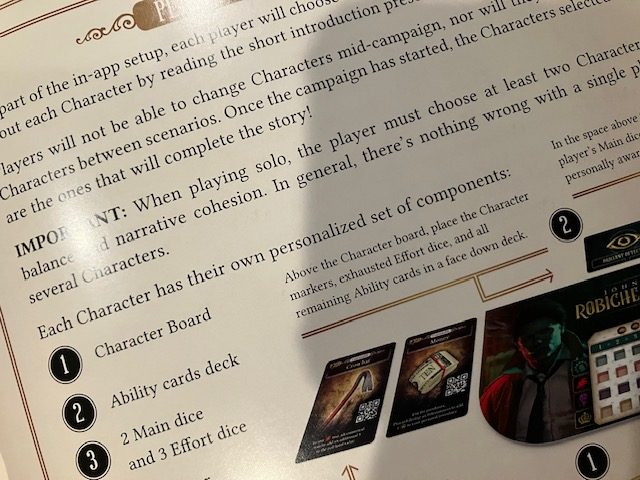
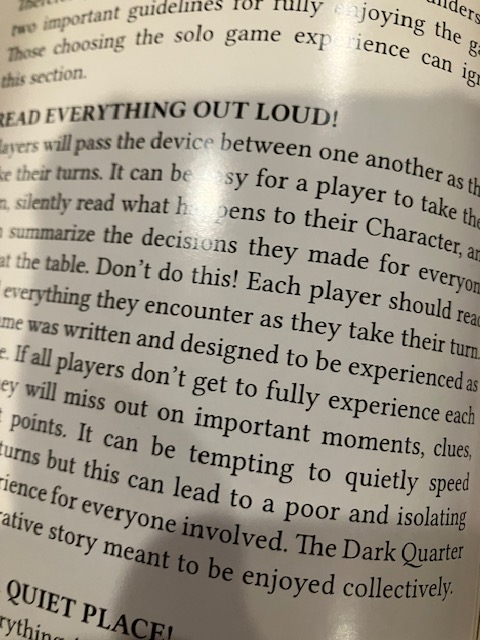
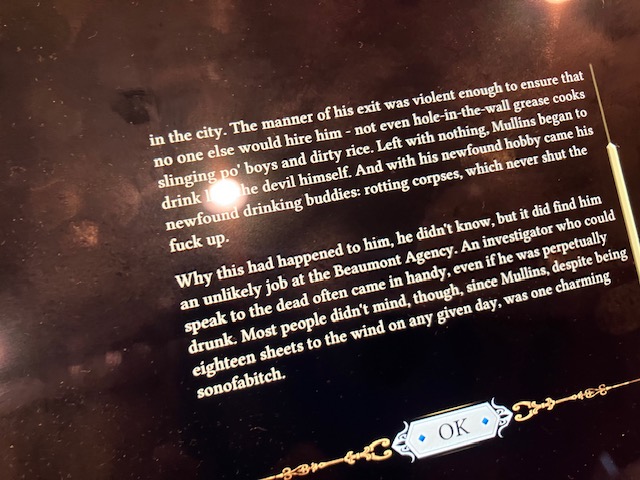
The game, in the rulebook, does a really good job of emphasizing “READ EVERYTHING OUT LOUD!” See excerpt above. This really encourages everyone to stay involved with the story and all the decisions in the game. Even if some decisions are only character-based, everyone stays involved. I am glad to see that emphasis in the rulebook (see above), and I think that is the best way to play the game.
Good times. The cooperative play has been a success. Currently, we have played two weeks in a row, having invested about 6 hours into the game … and wanting to play more!
Solo Vs. Cooperative
It’s really interesting to me that the solo experience fell flat for me, and the cooperative experience worked so well! It makes sense; the game seems “tuned” to keep stories and plot points coming out, as to keep the players all involved!
Like a car “tuned” for Sports mode instead Eco mode, The Dark Quarter seems “tuned” to cooperative mode. The solo mode will work, but the game operates (in my opinion) at a lesser gait. At least, that was my experience. (And you have to understand, I love mystery games!)
Length of Game
The game is long. Longer than you might expect. We played for three hours straight the first session! And three hours the second session! And we still had a lot to see! And we still have more to go!
Luckily, the APP can help you save the game between sessions. There are several points where you can save the game; these intermissions happen about every 45 minutes or so. So, if you really wanted to, you could just take up about 45 minutes. But given how much set-up and tear-down there is, you probably want to play at least two sessions. We ended up playing three on our first playthrough.
The App
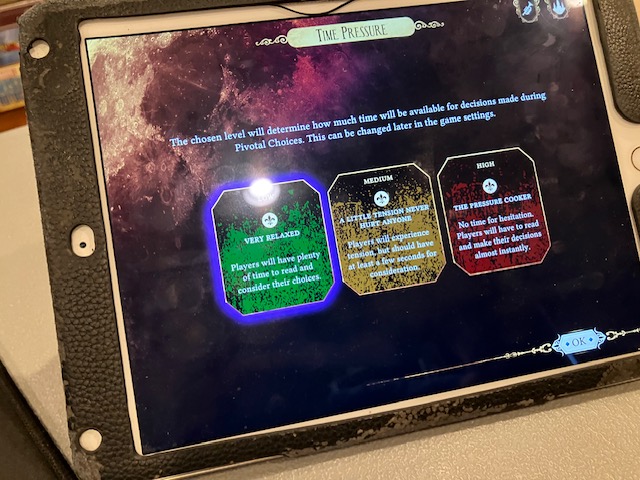
The APP is pretty good. We didn’t encounter any real glitches or problems in solo or cooperative play. Although it took them a while, the publishers did get the APP out and stable.
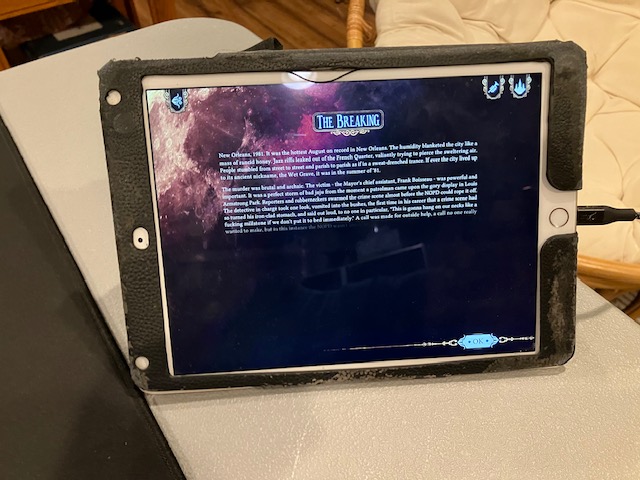
One problem: the font is probably too small. We had trouble reading all that text (to be clear; the players read the text out, not the APP), and we wished we had a control to resize the font.
Another gripe about the APP; there was no UNDO! This is one of my biggest pet peeves in cooperative APPS; the lack of UNDO makes me me grumpy! If this were a completely physical board game, UNDOs are easy: “Oops! I meant to go to the Graveyard! Back me up!”. Nope. There is no UNDO in this app. I think this actually slows down gameplay a little: “Are you SURE you want to do that? We can’t back up!”
In general, the APP seemed to work fine for us in both solo or cooperative play. It was pretty good. Be aware, the players still have to read all the text out loud!! The APP does NOT read the text for you!
Dice and Murder
I said this earlier, almost everything in this game is a skill check with dice. The game seems pretty balanced. For instance, if you fail, the game typically gives you an “extra” effort die for your next die roll (which I appreciated).
But in the end, The Dark Quarter is still kind of a dice game. Which I don’t love! I feel like a detective game should be about following the evidence, making best use of your resources, and generally trying to be smart/clever.
Detective: City of Angels, Sherlock Holmes: Consulting Detective, are detective games where you have to be smart. Although The Dark Quarter is a nominally a detective game, it has more drama in it than I expected. The dice contribute to that drama, because they make the game more random and unexpected!
When I play Detective: City of Angels or Sherlock Holmes: Consulting Detective, I feel like I am playing a detective show like Death in Paradise, orMidsomer Murders where the mystery is front and center. When I play The Dark Quarter, I feel more like I am playing a police drama where the mystery is less pronounced. It’s not bad, it’s just not quite what I was expecting.
If you want to jump into a police drama in New Orleans in the 1980s with lots of magic and character development and story, this is the right game for you! If you want more of a mystery, well this isn’t quite that. But there’s still more than enough mystery to keep you going!
Conclusion
The Dark Quarter is a really interesting game, but you have to know where it fits best. I don’t think it works great solo, it’s more random than most mystery games, it’s very dependent on the APP, and the 18+ age requirements are pretty stringent.
But, if you find a group that wants to jump in to a 1980’s drama/mystery with lots of adult twists and turns, The Dark Quarter is the game for you! It’s got great story, interesting interactions, and plenty of character development/regression! Instead of watching an adult mystery/drama on HBO or Apple+ tonight, consider playing The Dark Quarter instead!
Solo play: 6/10. Cooperative Play: 8/10. I think most people would probably give this a 9/10, but I think I wanted just a little more mystery and a little less dice-rolling. It’s still really good though.
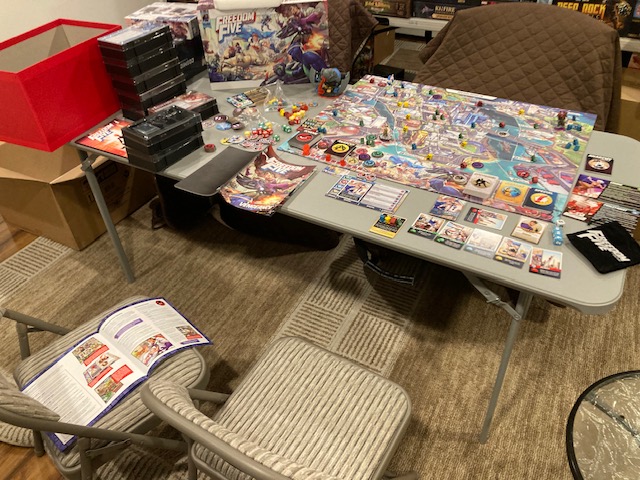
I am very depressed as I write this. Freedom Five made the #2 spot on my Top 10 Anticipated Cooperative Games from 2021! I was so looking forward to this! But I find myself very disappointed by it.
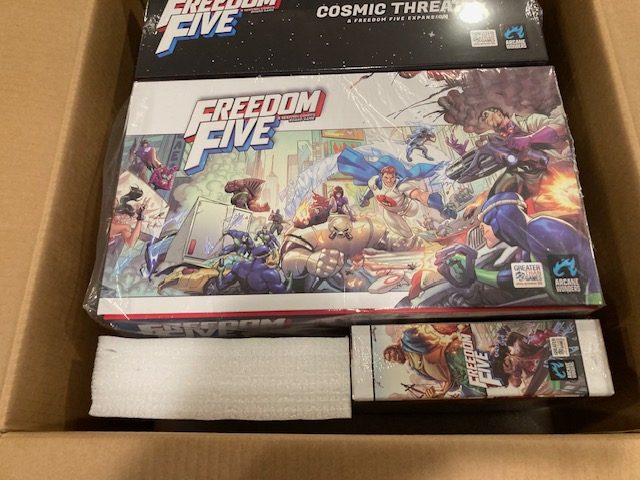
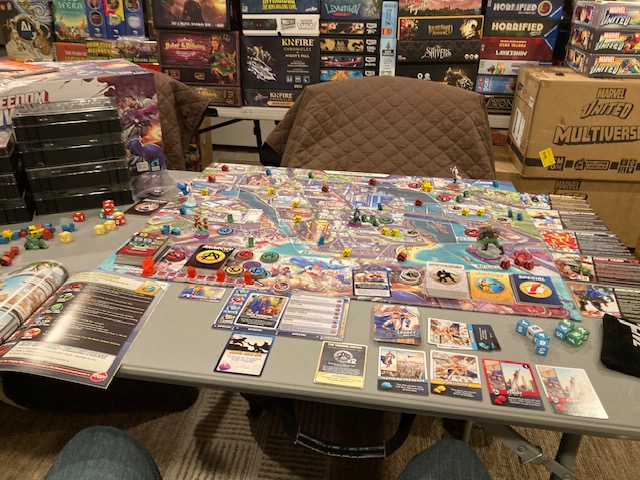
It’s not that I didn’t get a lot of stuff: I got so much! The box arrived at my door October 26, 2024. Freedom Five was on Kickstarter in Oct 2020, and it promised delivery in Nov. 2021. So, it’s three years late. And it’s been four years since I Kickstarted it!
There’s so much stuff here: no, they delivered everything they promised. Well, most of it. I still seem to be missing some stuff … (A Dice Tower unboxing showed them getting more stuff…)
This is going to be a little different than most reviews I do.
What Is This?
Freedom Five is a basically Defenders of the Realm with Sentinels of the Multiverse theming, i.e, it’s a superhero game! And I love my Superhero games!
Defenders of the Realm itself is just a gyration on the game system Pandemic: in very coarse terms, Defenders of the Realm is really just Pandemic with dice.
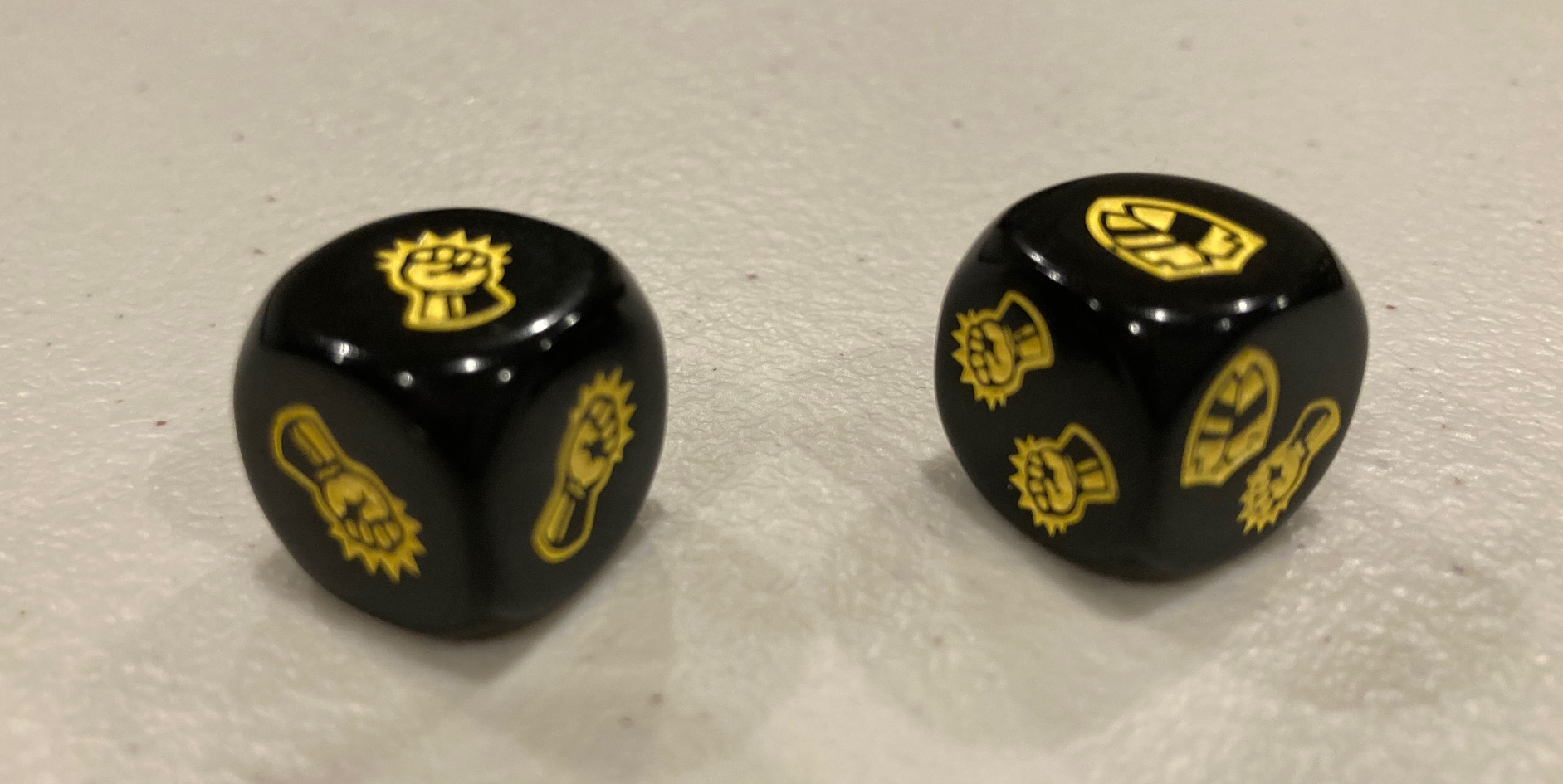
In Pandemic, you fight disease cubes, but the randomness is mostly in the decks of cards; most players turns are very deterministic and players can make progress against the badness. In Defenders of the Realm, every fight or check is a dice roll. Let me repeat that: every fight or check is a dice roll.
Freedom Five is the newest game in the Defenders of the Realm game system. Every fight or check is a dice roll.
Too Random
First and foremost: this game, Freedom Five, is simply too random. Everything in the game is a dice check: 1) Fighting Henchmen (like removing disease cubes in Pandemic: you have to roll dice to get rid of Henchmen! And you frequently can’t do anything else on a space until you get rid of all Henchmen!) 2) Skill Checks: roll appropriate dice 3) Anarchy Checks (which are arguably just Skill Checks) 4) Fighting Villains or Masterminds: roll dice based on how many cards you discard
The problem is that the Defenders of the Realm system is simply too random and frankly it feels out-of-date. If this game came out 10 or 20 years ago, Freedom Five would have had quite the “wow” factor. But now, we have seen many games in the Pandemic with dice ilk that do the dice better! Here’s four more recent games that improve the Pandemic with dice genre … two of them are actually Pandemic games!
The dice: no bad outcomes! All good stuff!
1) World of Warcraft: A Pandemic System (see our review here). This is Pandemic with dice, but the dice are much less random: essentially, all good outcomes! See above! Some of the outcomes are just slightly better than others. When you roll, you have a really really really good idea what you will get.
2) Star Wars: The Clone Wars (A Pandemic system) (see our review here). The same idea happens here as in World of Warcraft, except the “dice” is one 12-sided die with essentially all good outcomes, again some are slightly better than others (sometimes the hero takes a damage). See above.
Exploding Dice!
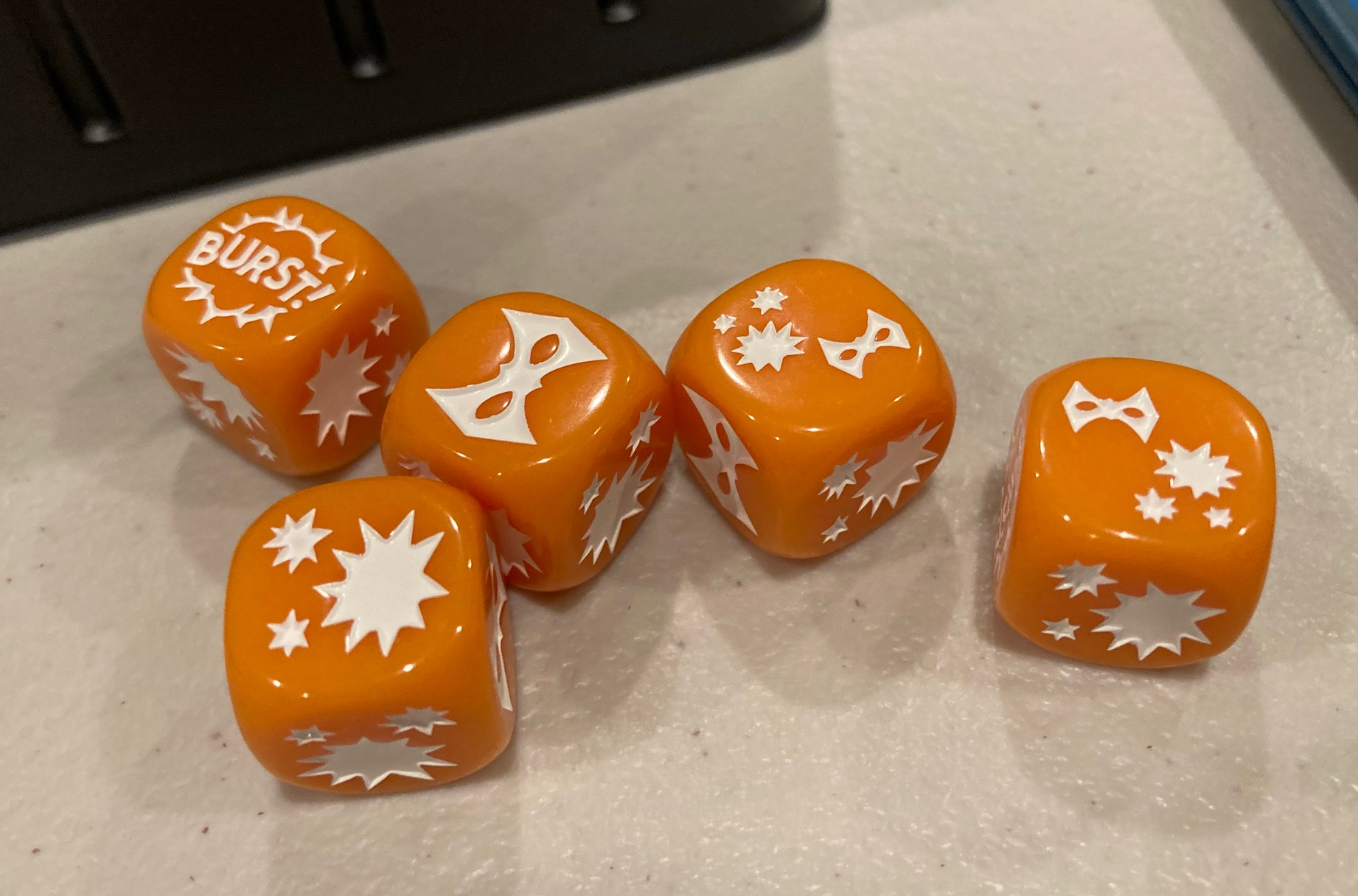
3) Hour of Need with it’s exploding dice! (see our review here). See above! This is one of my favorite dice systems: even if you fail (explosions are successes, masks are failures), you still get a FOCUS token for every failure … which you can turn a failure into a success at a later date! This feels intuitively like you are “learning from your mistakes”! It also makes it so you can still succeed even if you roll poorly! Even if you roll poorly, those FOCUS tokens turn failures into successes!
Given that Hour of Need is a Superhero game, this dice system is perhaps the most relevant here, and we will discuss it more later.
4) Tidal Blades 2: Rise of the Unfolders (see our review here): The dice here are similar to World of Warcraft; they almost always succeed, but if you are clever and have flanking or enough FOCUS, you can do better! Let me repeat that: If you are clever, you can do better!
These four newer games all improve on the basic dice formula; they don’t feel very random and there seems to be a predictable baseline of success which allows you to be smart. Freedom Force feels much more random as you can fail on every die when you roll. You have to roll above a threshold to succeed (just like Defenders of the Realm). You cannot have any sense of how successes you will get, as you have to roll “above” a number, …. but, if you roll all 1s … you are screwed! (Yes, yes, there are dice mitigation methods, but they are limited).
My problem with so many things dependent upon these dice (and almost everything in the game is a dice check) is that Freedom Five is a game that makes me feel impotent and unlucky; I can’t tell you how many turns I had where I simply lost an entire turn (5 actions) when I couldn’t roll anythinggood!! In fact, in some turns, I actually caused more problems: many of the Anarchy checks cause problems when you fail! How is this fun? You are supposed to be a Superhero and you can’t even take down one henchman?????
There is an old mantra: “I’d Rather Be Lucky Than Smart” … and that mantra applies wholesale to Freedom Five. It doesn’t matter how “smart” I play, if I roll poorly (which is easy), I will lose. And that’s the fundamental problem I have with this game: I can’t be smart. I can just try my best and hope I’m lucky. Even worse, though, this is NOT a short game. A game with this much randomness needs to be short, but the first few games I have played have lasted 3 hours?
I don’t feel like I want to play this again because it feels sooooooooooo random. Right now this is a 4/10 for me. You heard me. A Superhero game with great components: a 4/10.
However, there is hope. See below.
Other Problems
There are other problems I had with the game. Given that I waited four years for this, I am still frustrated at some of the issues that came up: these issues also contributed to my 4/10.
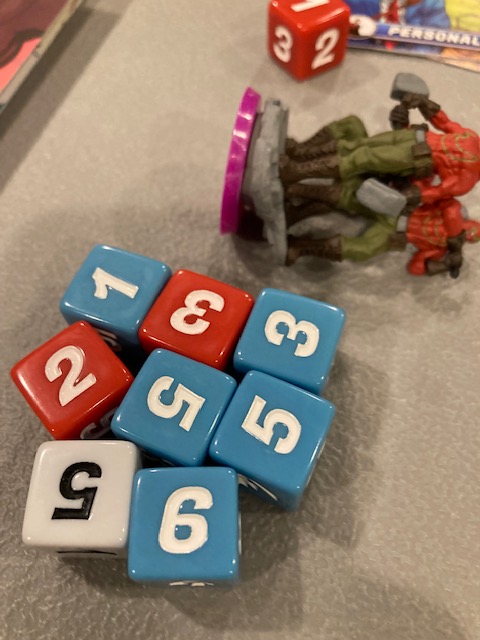
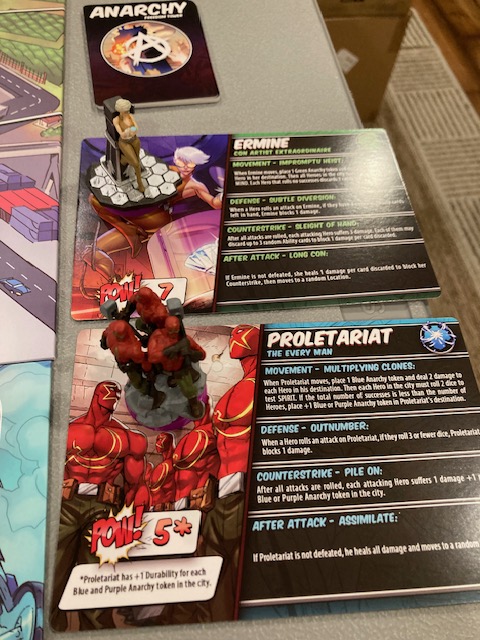
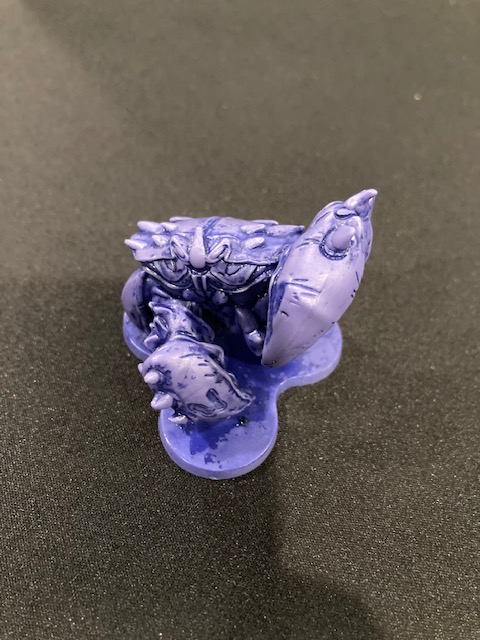
Bases: The bases of the miniatures should be the SAME COLOR as the type on the card! And they are not!!! See above as Proletariat is BLUE type, but his base is purple?? Ermine is green and her base is not green! Looking across the board, I’d like to be able to correlate the Villain to his relevant color!! I don’t think the colors ever change for the Villains, so this is very frustrating visually. This is especially hard after coming off of Tidal Blades 2: Rise of the Unfolders (see our review here) where the minis all had color-coded bases!
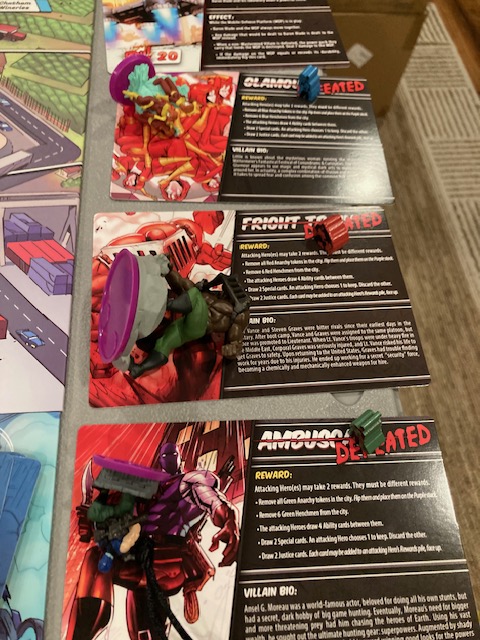
Backs of Villain cards need to be better: When you defeat a villain, you flip his card to show he’s been defeated! But, you have NO IDEA what color he was??? Why do you care? Because the BLUE henchmen (who Proletariat was) are easier to defeat and it’s good to have a visual reminder! But the back of the card has NO INDICATION of what the color of the villain was! (If it had a color-code base … see previous point … that would work).
Hint: I ended up putting a colored meeple on the DEFEATED side so I could remember which Villain was which color. See above. (And get rid of the BIO: replace it with instructions what do when you battle a defeated HENCHMEN).
Back of rulebook: There are no player help cards, or Turn Summary cards. It might have been nice if they put the turn summary on the back of the rulebook. Or symbols or anything useful to gameplay.
Upgrades: When you get an “upgrade” to your deck, THE NEW CARDS AREN’T LABELLED WHERE THEY CAME FROM!!! The “better Flight” card (left) is from envelope #1. From now on, I take pictures of my upgrades so I know where they came from. That way I can reset my game.
Bystanders: There are 42 bystanders. Note the Best Friends #1. You know how unlikely we are to get all 3 best friends? More untethered randomness.
And some bystanders cause penalties. Whee. That was fun. In a game where I have so much randomness, it’s good to know some bystanders will cause issues. It’s maybe thematic, but it’s not fun.
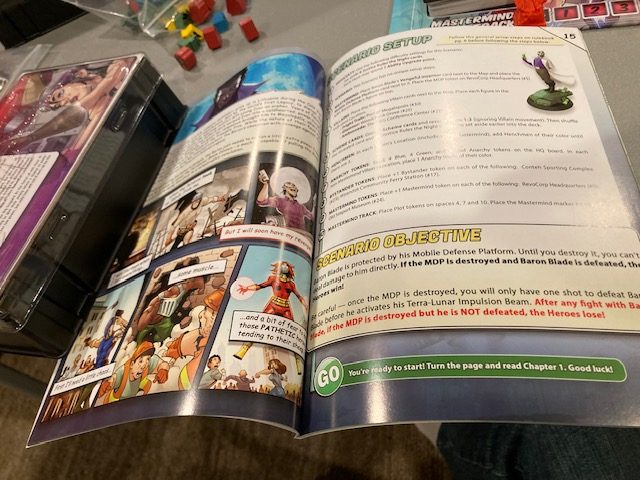
Binding: This binding on the scenario books is UNFORGIVABLE. You have to have the pages of the book open to see the rules, the end of turn actions, and it’s SO HARD TO KEEP OPEN without overfolding/destroying the binding. See above. We saw this WAAAAAY back when we reviewed The Forests of Admiron when we hated the binding on the rulebook. I can’t keep the scenario book open (easily) to look up the rules. This is unforgivable; the scenario book should have been a book that could lay flat.
I ended up using one of the unused character boxes to hold it open. That was a workaround: see above.
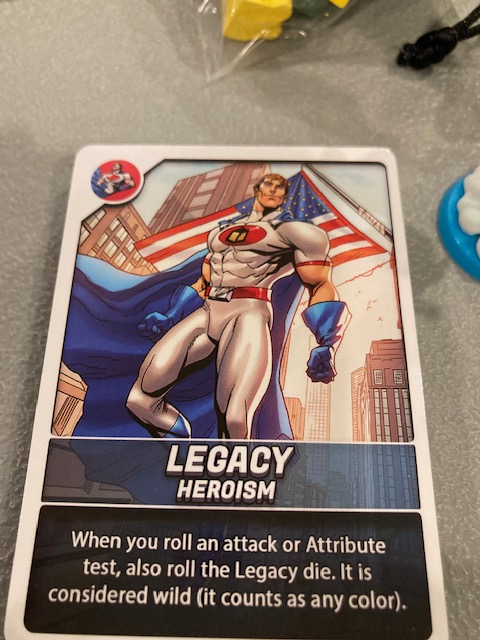
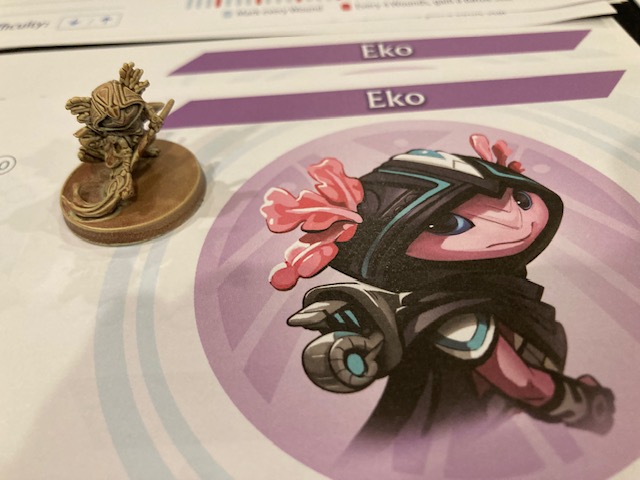
Minis: The minis are just … okay? I got the prepainted minis … and they look a little soul-less? See Legacy above.
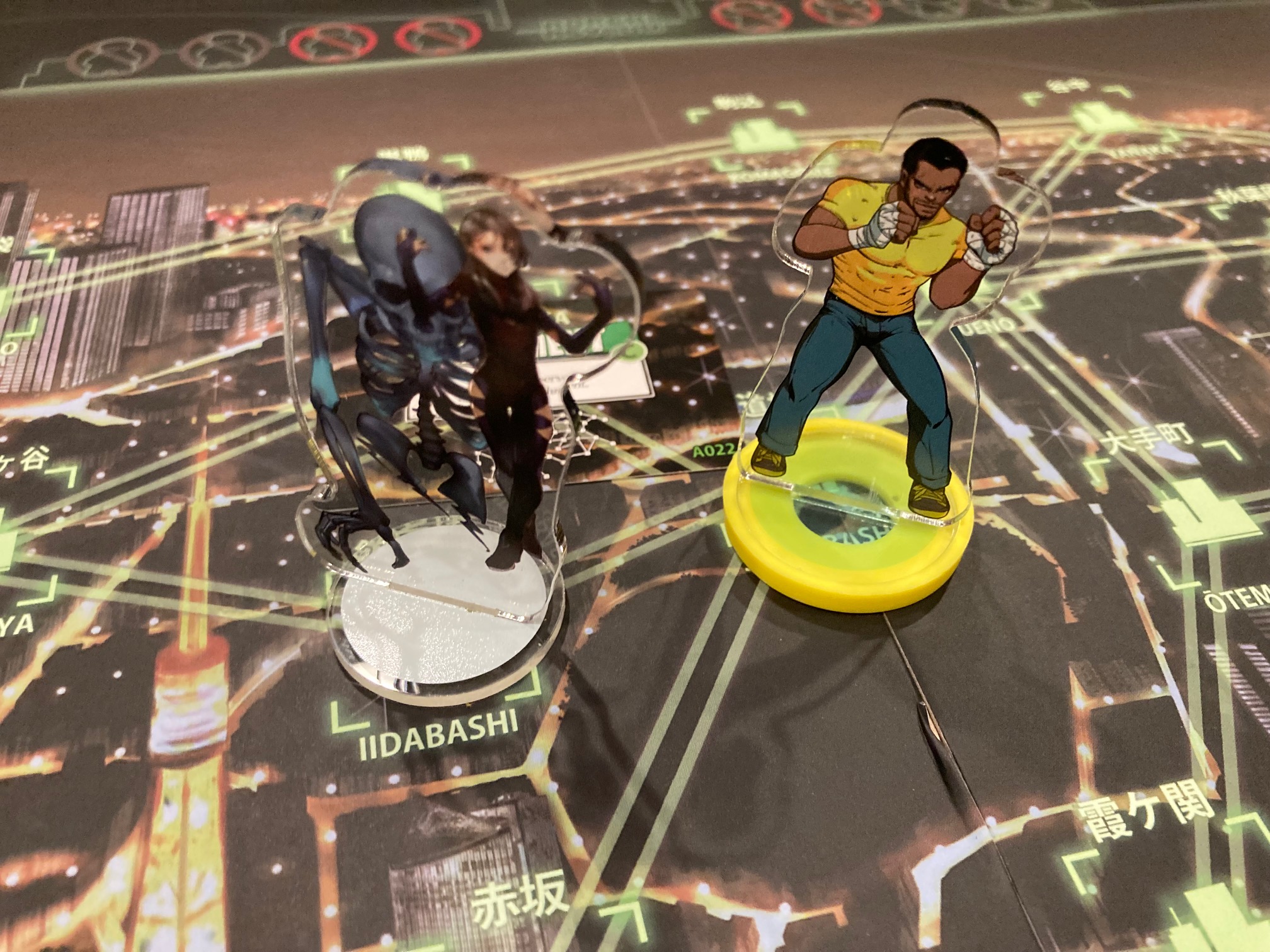
Compare the minis to acrylic standees in another superhero game: Tokyo Sidekick (see our review here). See above.
I kind of think Acrylic Standees with Legacy’s art (see above) would have been so much cooler.
No Solo Rules: I played my first three or so games solo, but there is no acknowledgement of solo rules anywhere in the rulebook!? I think you can play solo with one character, but I don’t know. In fact, Legacy has cards that affect “other heroes” … so do they affect no one? Himself only? Does the solo game change slightly so that they affect himself? I think the game is “probably” better with 2-handed solo (the solo player playing two characters), but I wanted ONE SENTENCE in the rulebook:
“You can play Freedom Five solo with one hero: the only change is that any hero card that affects other heroes will instead affect the solo hero.”
I am genuinely surprised there are no solo rules. The only acknowledgement of any solo mode was a 1-5 Players notation on the bottom of the box.
And the bottom of the box is so hard to read!
Conclusion
Several of my friends have asked me “Are you going to sell the game? Or can you come up with some House Rules to save it?” Firstly, I have only played this game solo. It’s possible the game will get better with more people, as they can maybe (maybe) help mitigate some of the randomness I hate so much.
At first I thought: “This game was irreparably random; there’s no way I can fix it“. But all my friends encouraged me to try to come up with some house rules. Given that I spent $375 on all this, maybe it’s worth a little extra time. And after recovering from my depression about this game, I actually think I have some ideas that might help.
Right now, Freedom Five is a 4/10. But that’s only from solo plays. Come back in a few weeks after I get some cooperative plays, and maybe I try some house rules. Maybe then I can recommend it?
I hope so. I really really really want to like this game. As it is right now, I don’t.
UPDATE: I sold it. I couldn’t bring myself to play it anymore, and there’s too much negativity when you propose house rules. Those of you who are interested, I wanted to use the Hour of Need dice system (current failures become future successes) for all dice rolls EXCEPT the four villain rolls! There is a lot of fun when you roll 14 dice to see if you can take out the final Villain! But the piddly dice rolls for Henchmen and stuff, that wasn’t fun; that’s what I think needed the Hour of Need dice system.
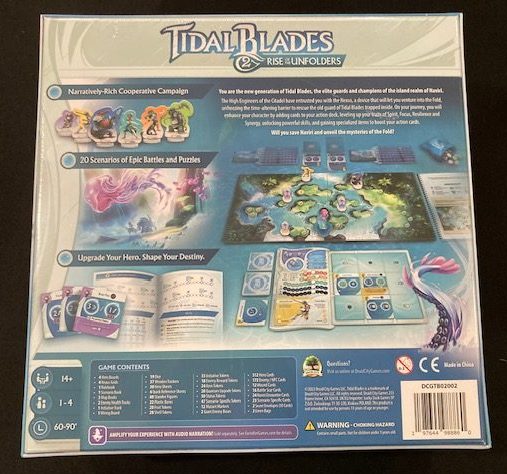
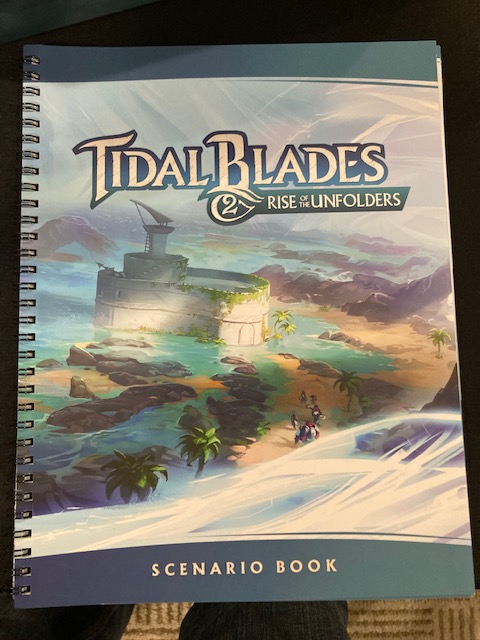
Tidal Blades 2: Rise of the Unfolders is a cooperative campaign that was on Kickstarter back in April 2022. This was the follow on to the original Tidal Blades game (which is really more of a head-to-head skirmish game). I knew nothing about the original Tidal Blades when I backed this: only that the components looked really cool. I backed it because it looked like it had a cool solo and co-op campaign.
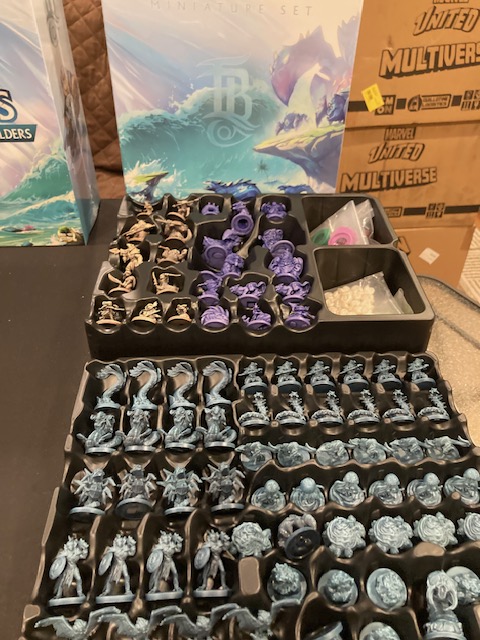
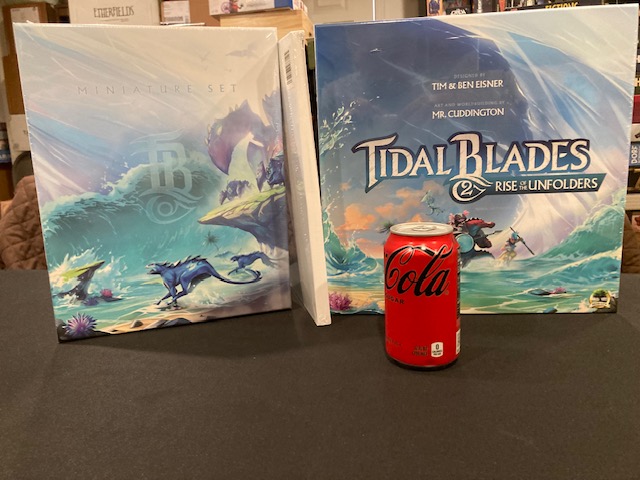
I went all-in and got the base game (lower right), the stretch goals (upper), and the miniatures (lower left): See above. This is the deluxe version with awesome miniatures!
The most important thing to realize is that this is a standalone solo or cooperative campaign game! I.e., you don’t need the previous game at all!!!
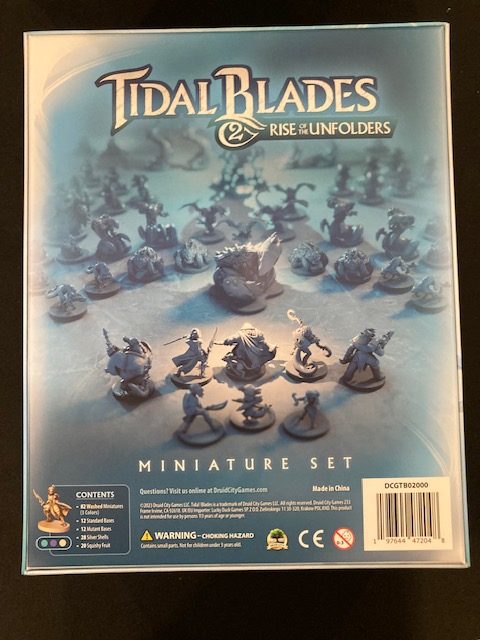
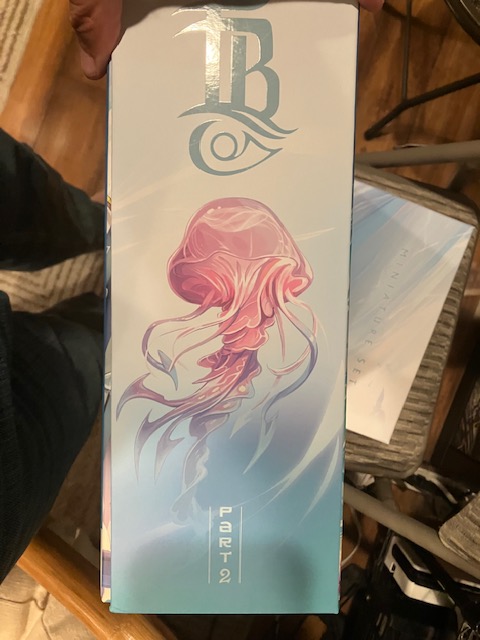
It’s a little confusing because the side of the box says “Part 2” (see above), but this is really just the next game in the same universe! Tidal Blades 2 continues with the ideas of the original Tidal Blades (which was NOT cooperative) but in a solo and cooperative game!
So, in some sense, this is still a skirmish game, as players play cooperatively against monsters in the game. Honestly, this game really gives me a Gloomhaven (see review of Jaws of The Lion here) or Batman: Gotham City Chronicles (solo or cooperative mode: see our review here) vibe! Players move around on a map in a book and fight monsters! You’ll see what I mean more below.
Let’s take a closer look!
Unboxing the Miniatures
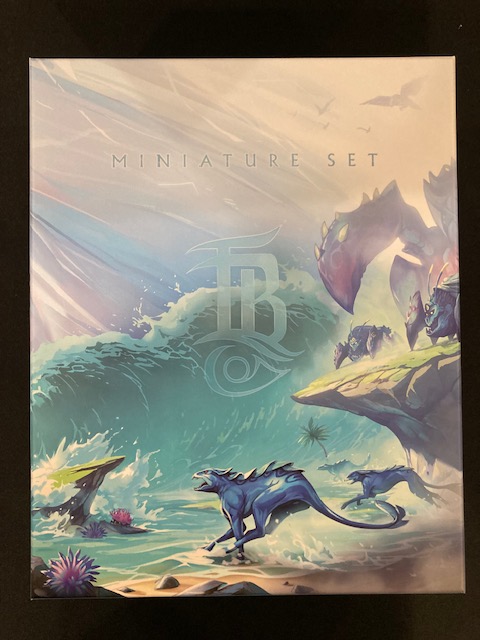
As much as you really want to see what’s in the main box, I gotta show you the miniatures first. They are fantastic!
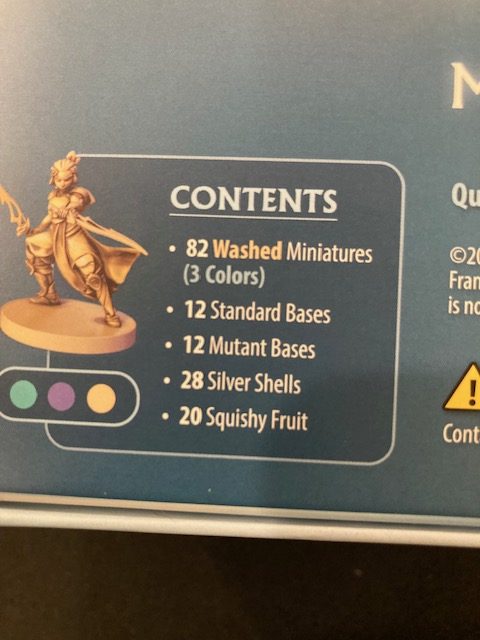
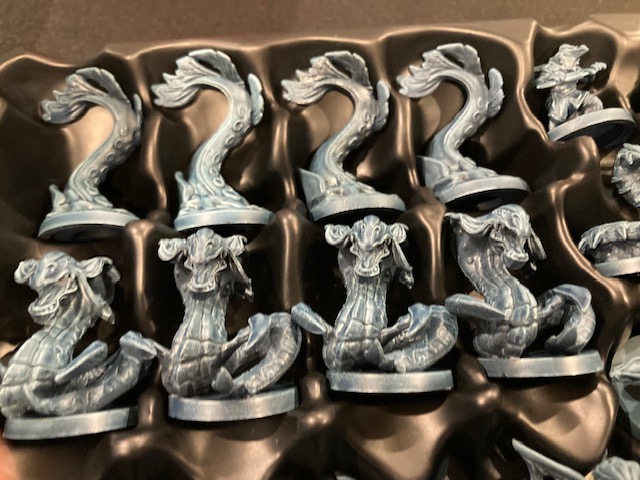
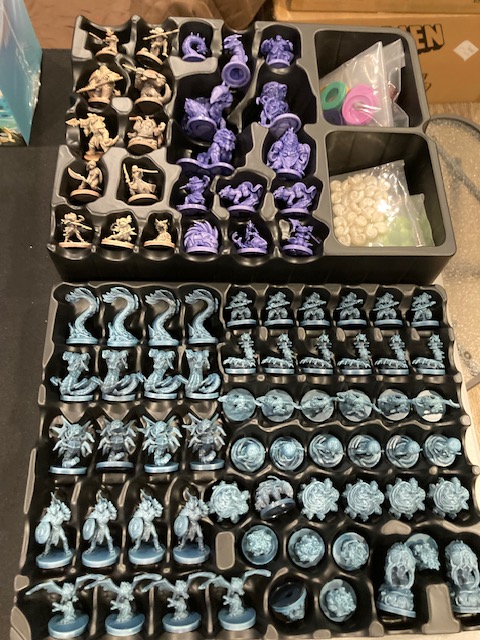
The minis are washed, they are tri-color, and they have 2 sets of bases! These are some of the nicest miniatures I have seen!
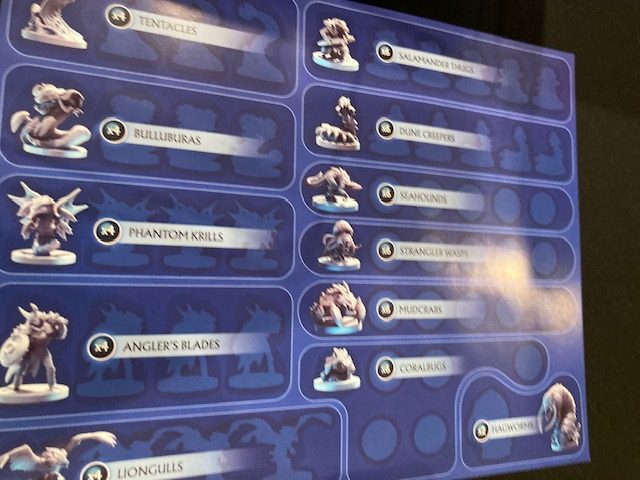
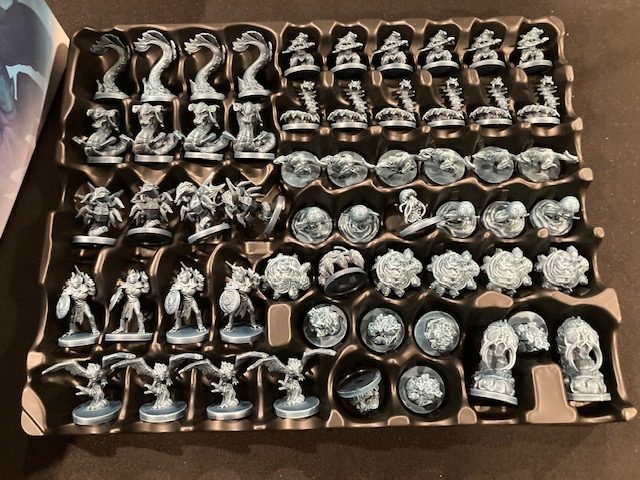
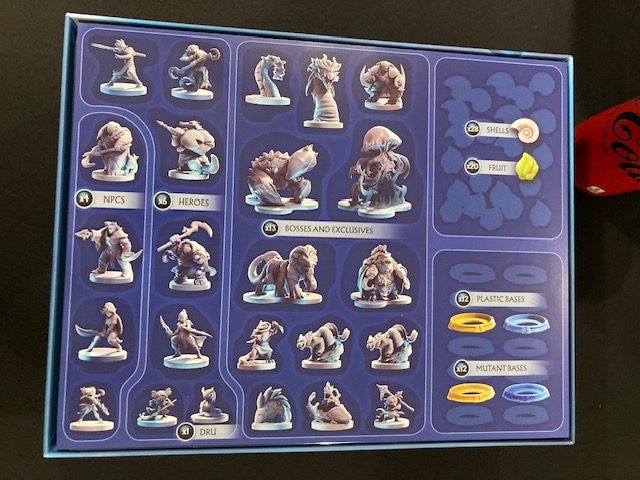
The top part of the box comes with the monsters you fight: they are all notated on a sheet (and, eben better, are labelled where they are in the box!!!) at the top of the box.
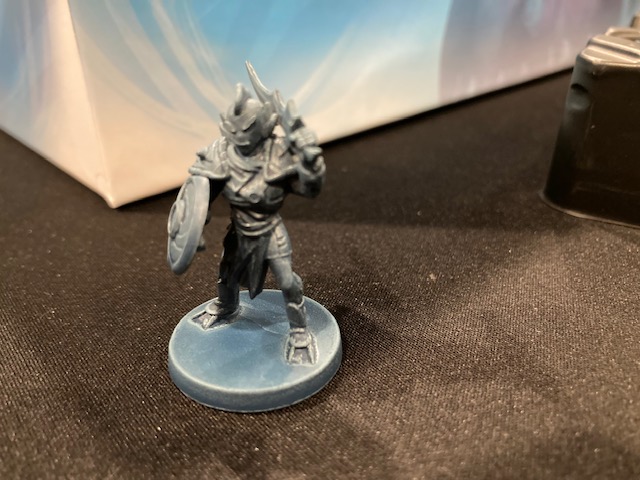
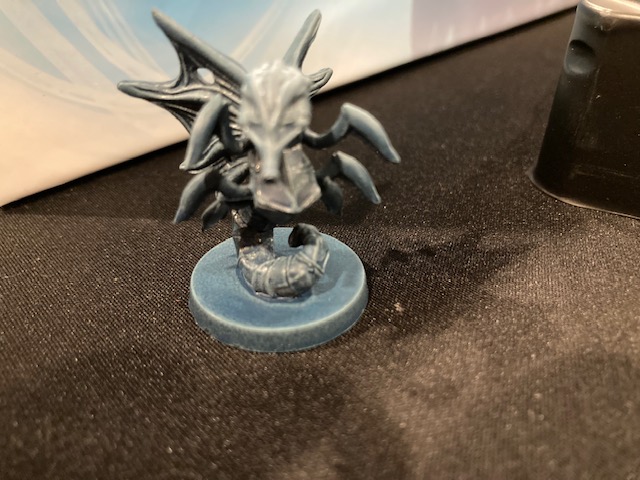
Wow! The monsters are all bluish and really great! See above! Let’s take a look at a few!
These are pretty awesome! Below the tray with the monsters are the Heroes and Boss Monsters!
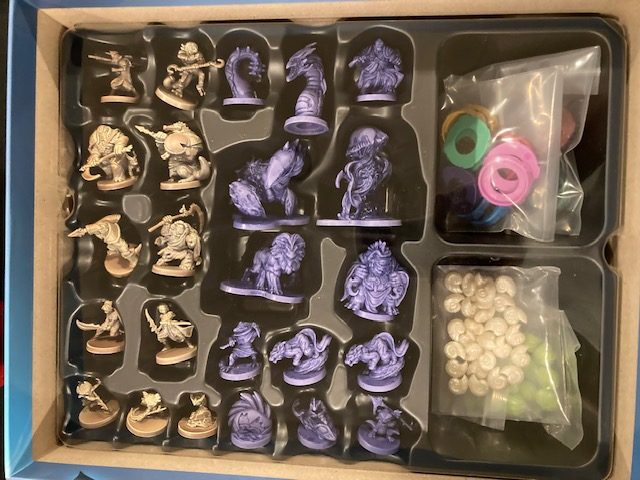
The Heroes are light brownish, and the monsters are very purple: see below.
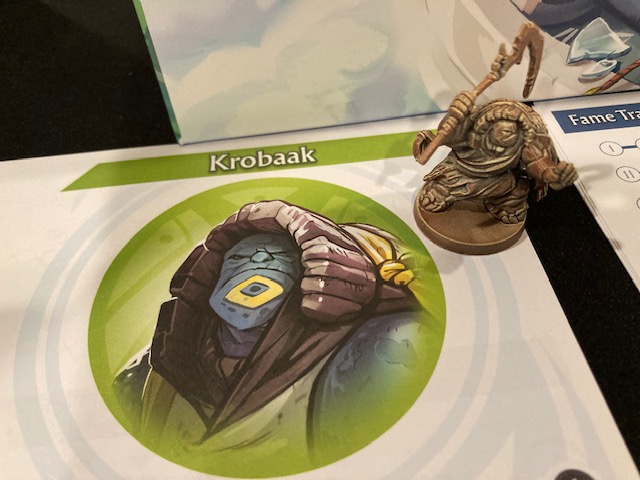
Let’s take a closer look at some Heroes (below):
The Boss Monsters are very purple! See below.
These miniatures are just awesome!
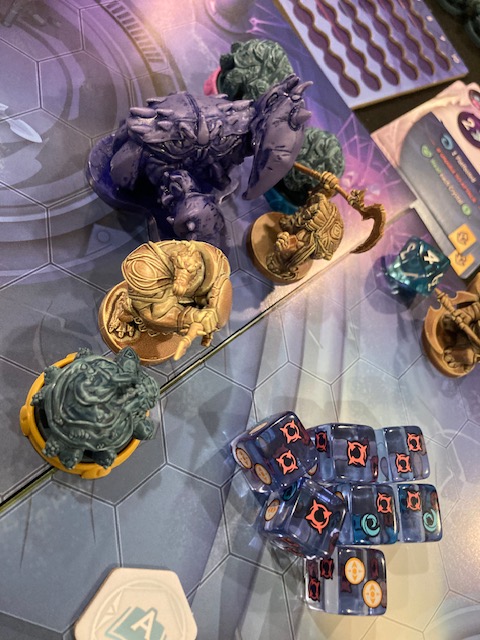
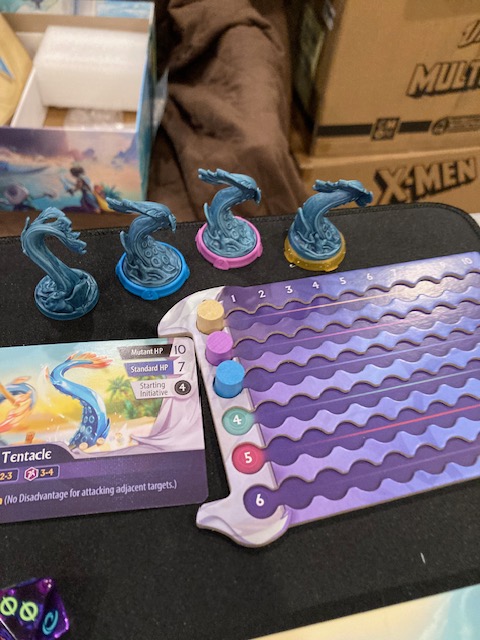
The game also comes with plastic bases for the minis so you can tell them apart. The normal bases denote the normal monsters, and the sparkly bases denote the “mutant” monster (like the Elite monsters in Gloomhaven). The “mutants” are just the tougher version of the monsters!
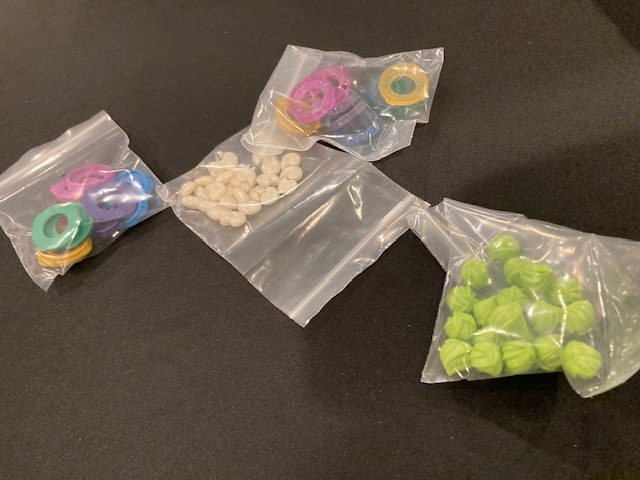
We also have really nice plastic Fruit and shells (replacing the cardboard from the base game).
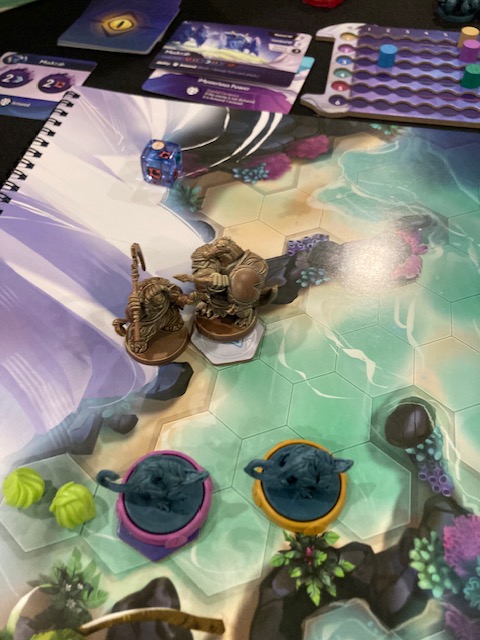
See above as the colored hit point tracks match the colors of the base? And the “sparkly” yellow one is the mutant!
These bases really make it easier to tell monsters apart so you can track the hit points.
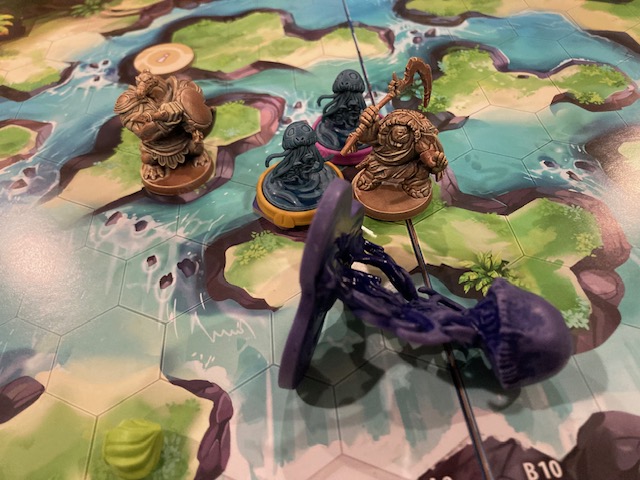
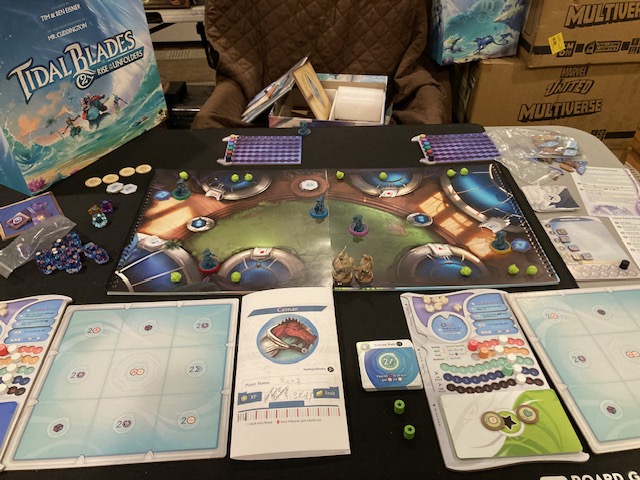
Overall, the colors and bases are well-thought out and make each entity stand out on the table. See above with some monsters, characters, and a boss monster all in the same frame!
These minis are just fantastic.
Rulebook
The rulebook is quite good. But it has two major flaws.
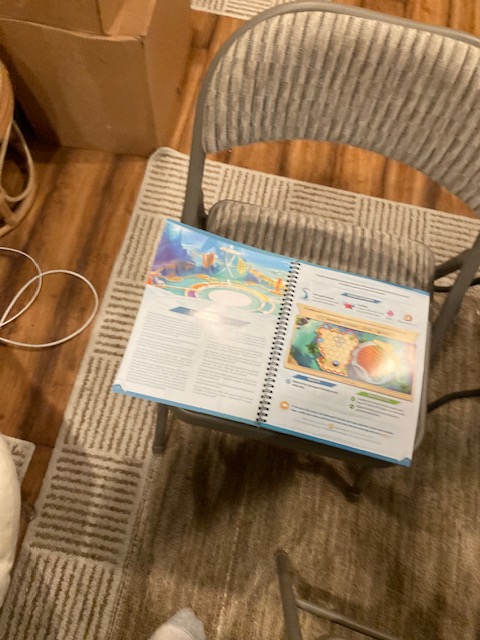
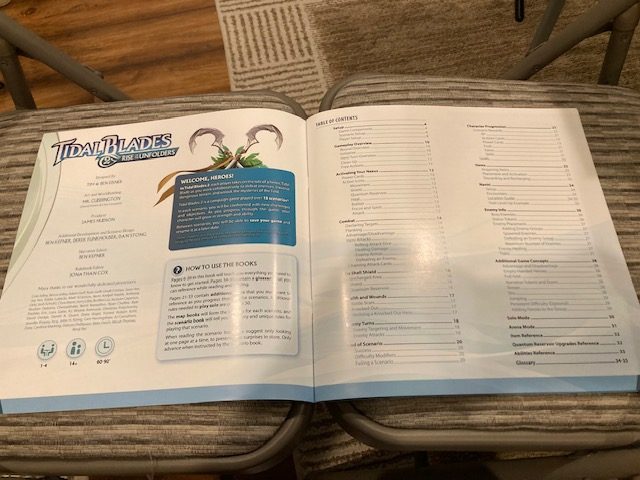
The rulebook completely fails the Chair Test! See above as it flops over both edges being almost unusable! This rulebook made a fundamental error by being the same size as the box!
Much like Batman: Gotham City Chronicles, the solution is to use TWO chairs, and have the spine of the rulebook sit in between! See above as we can keep the rulebook open and useful! I do like that the fonts are big! And the rulebook is full of good pictures! It is easy to see the rules on the chair next to me … once there are TWO chairs!
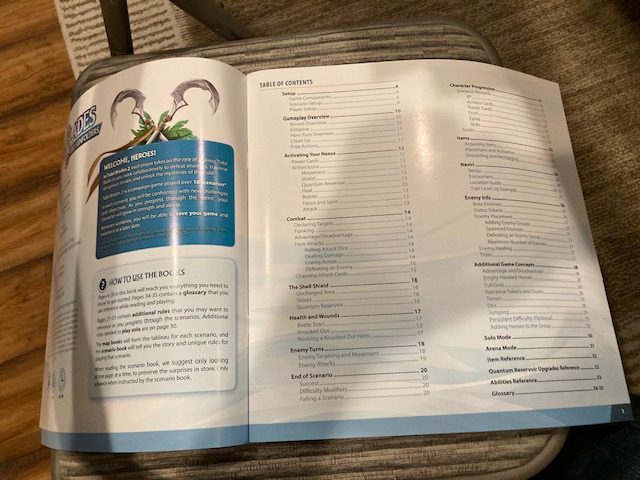
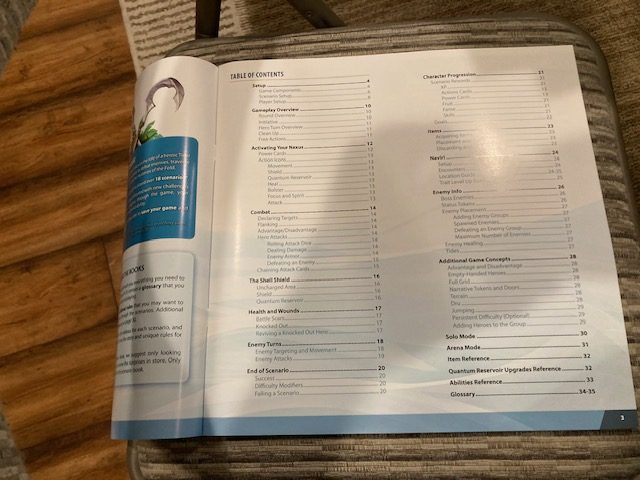
The rulebook has a Table of Contents that make it easy to look stuff up! Nice!
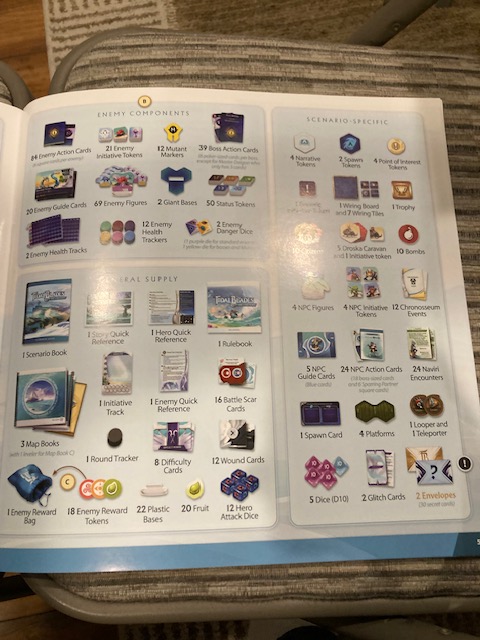
The components pages are great, with every component having a picture and being well-labelled!
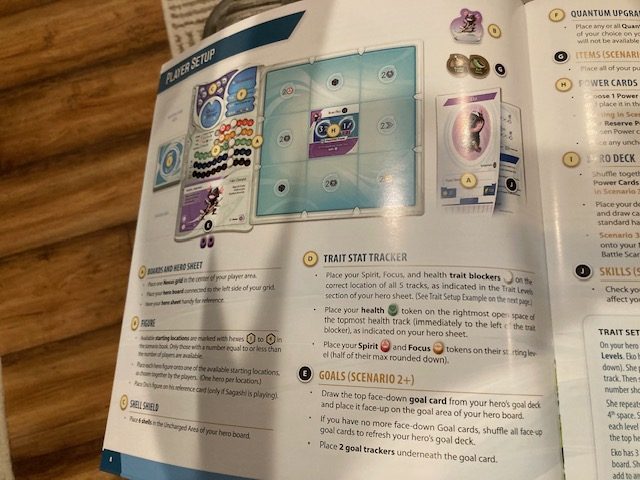
The set-up is nice (it’s over three pages), but some of the set-up is deferred to the campaign book. See above.
In general, I thought this rulebook was great. There’s a nice glossary in the back (ya), but no index. I’ll forgive the lack of index because the glossary and Table of Contents were great.
My other major complaint (besides the form factor) was that the combat wasn’t quite as well specified as I want. We’ll discuss that below.
Otherwise, great rulebook!
Unboxing the Base Game
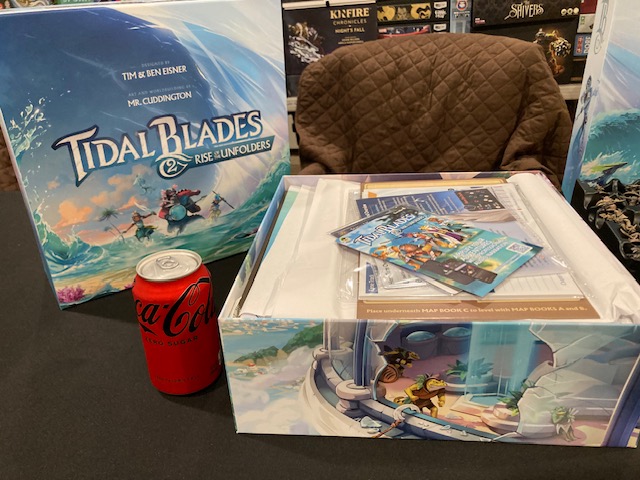
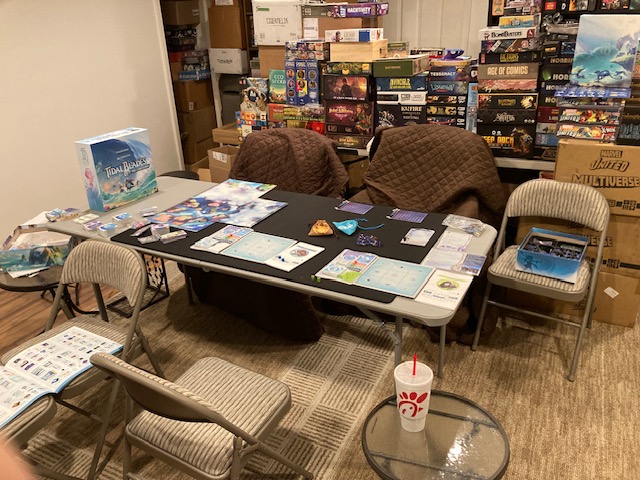
This base box (and the minis box) and both pretty big! My friends lifted the main box and were surprised how heavy it was! What’s in this gargantuan box?
See how tall the box is too (relative to a can of Coke)!
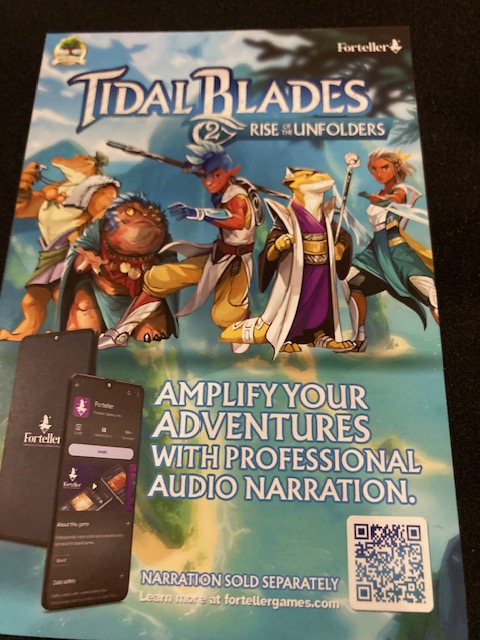
If you want, you can use the Foreteller app to read the “plot” as you go: this is a campaign game where a story unfolds and you may want to get some professionals reading it aloud. I didn’t get the Forteller narration … and it was just fine without it (but it does have the option: sold separately).
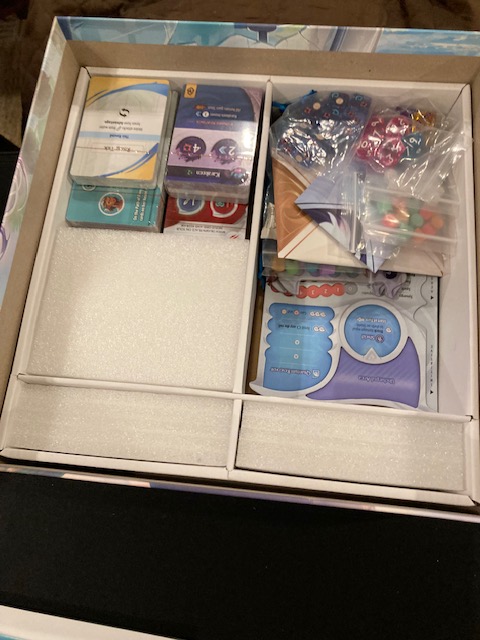
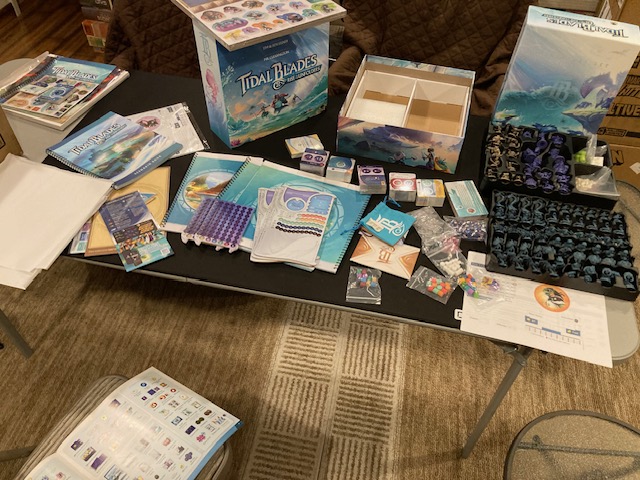
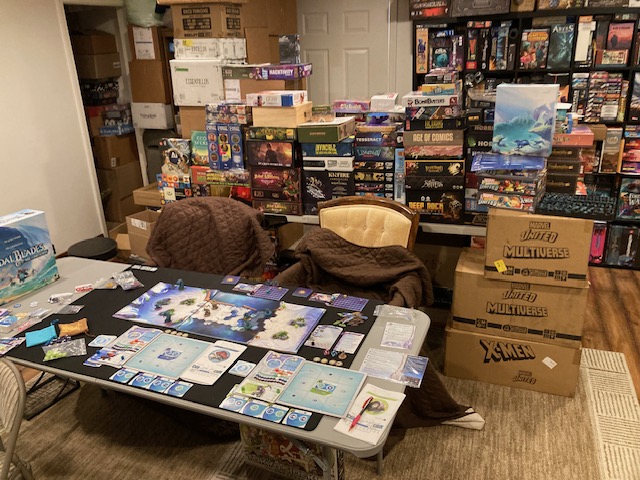
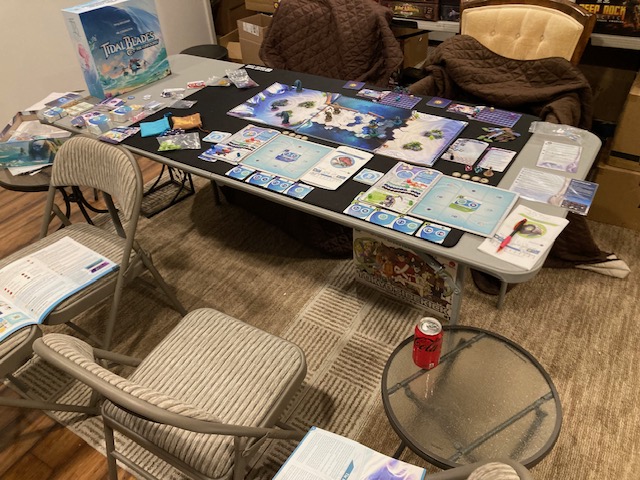
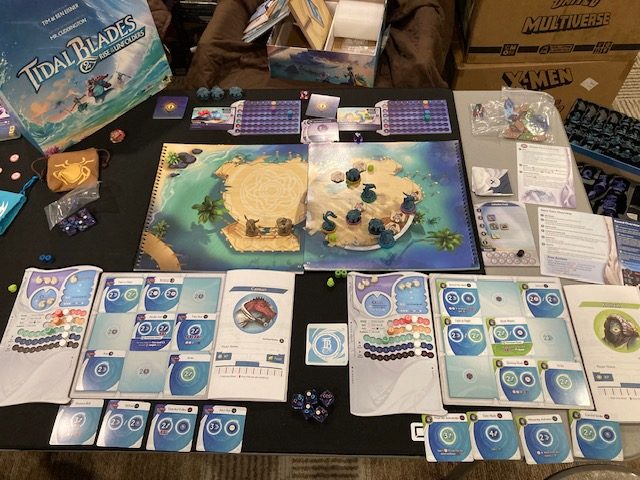
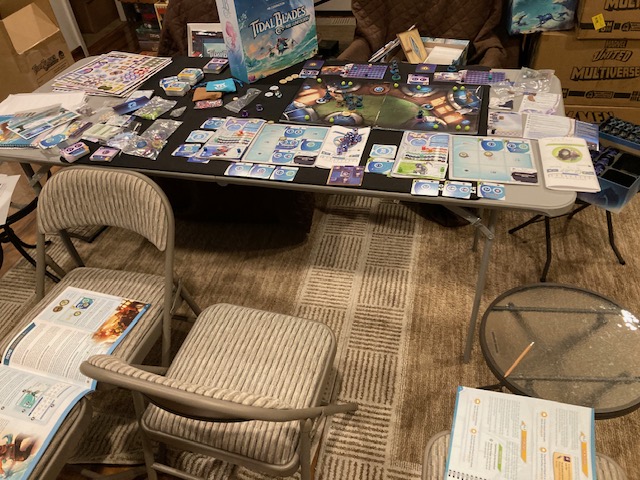
There’s a LOT of stuff when you unbox (see above); we’ll go through the components as we discuss gameplay.
Gameplay
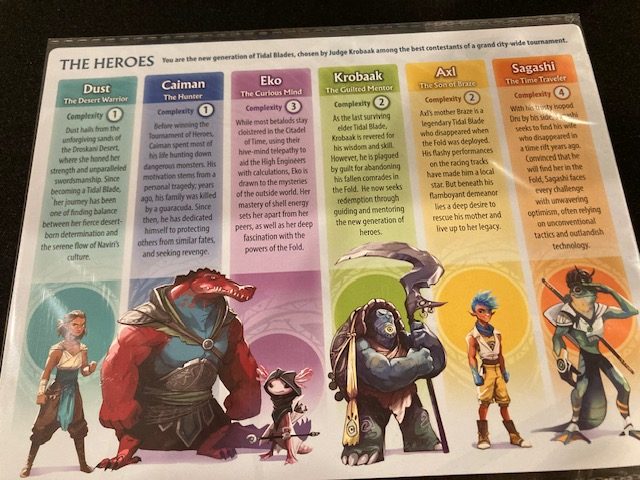
Each player (1-4 players) chooses a Tidal Blade warrior to play. See the six options above and below.
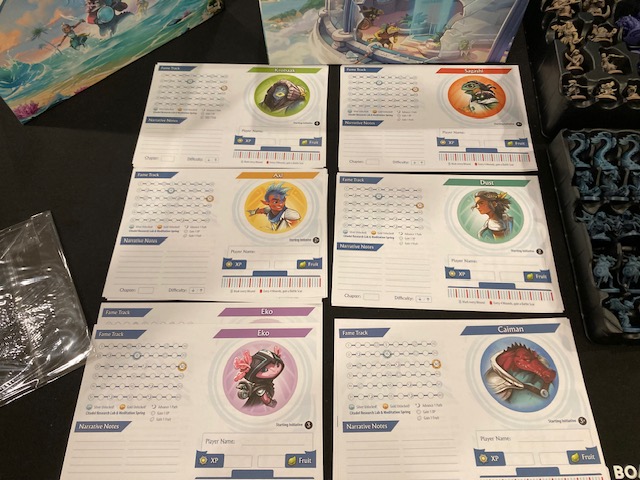
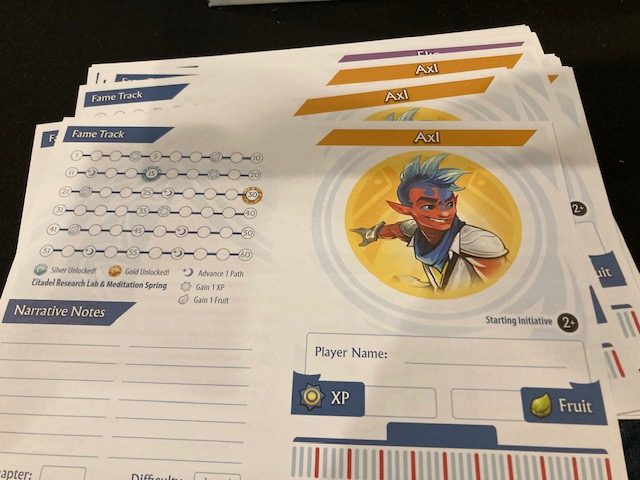
Each player gets a sheet with their character: see the six above and one (closer, below).
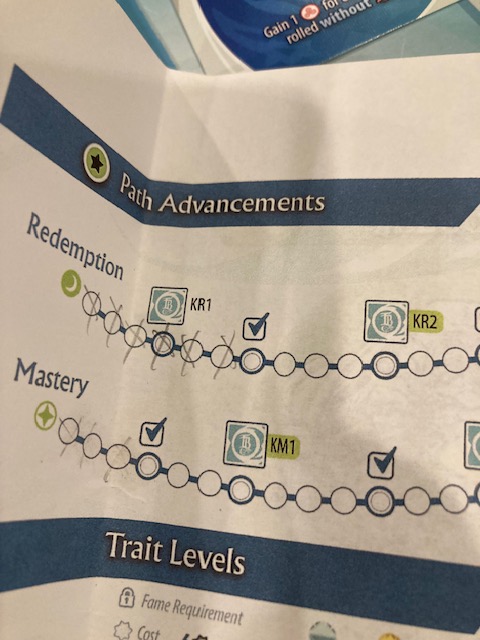
Each character sheet is for recording stuff as your character levels up during the campaign. Tidal Blades 2: Rise of the Unfolders is campaign game! Characters will be leveling up; you will be making decisions about how to do that! This sheet will become incredibly marked up as you play…
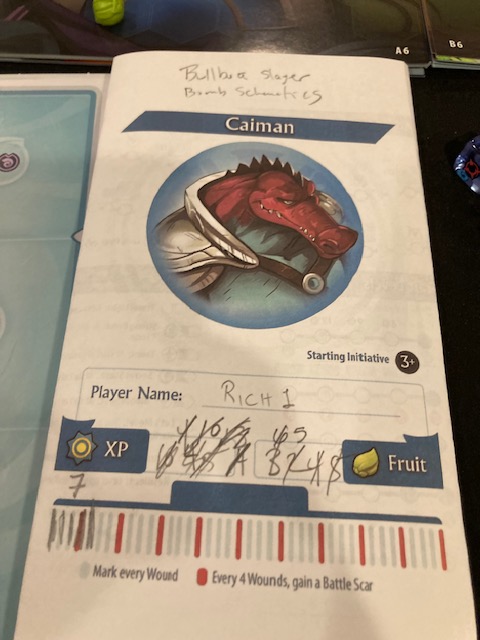
See above as Caiman has experienced a lot and marked up his character sheet!
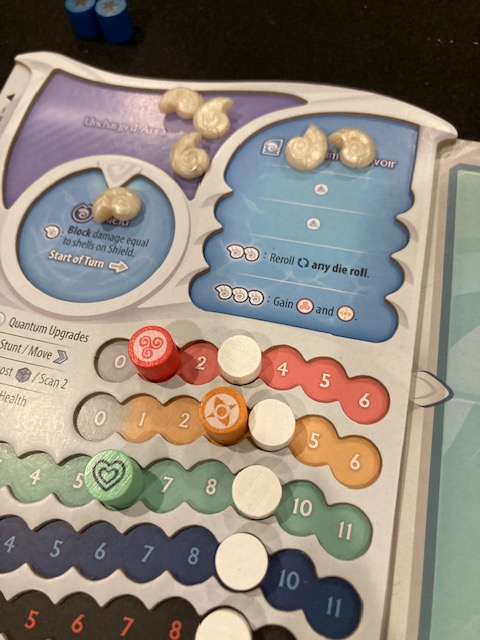
On the back of your character sheet are “tracks” where you will make choices about how you use experience points and other forms of up-levelling. To be clear: each character is different! They have a different sheet with different cards and powers that can be activated!
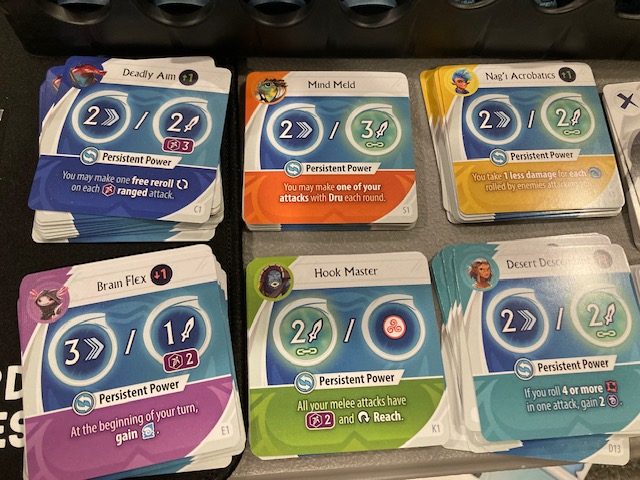
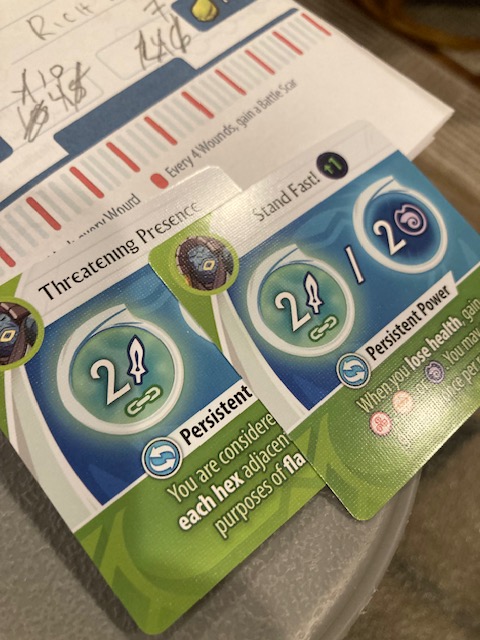
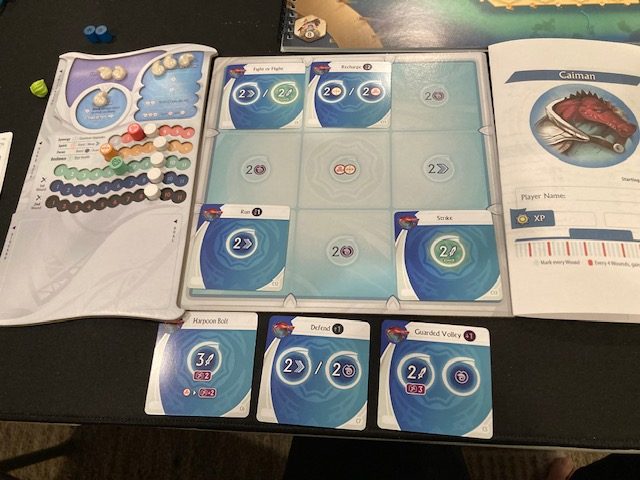
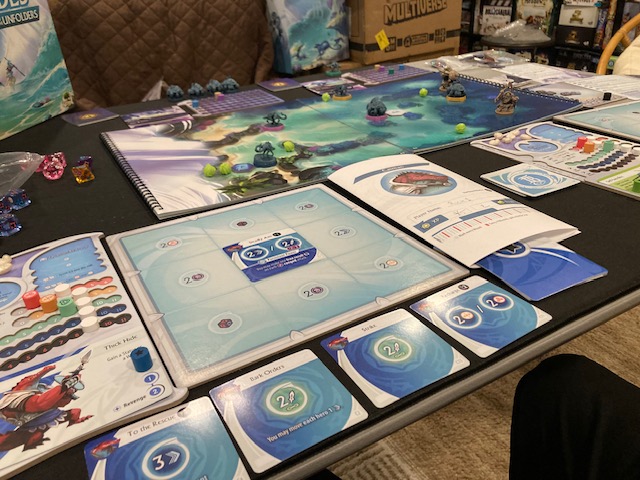
But, what really distinguishes the characters are the combat decks: see above!!! Each player has a different Persistent Power (see above) when they start, as well as a different deck!!! (Well, some cards are in common, but generally the decks are different!!) These decks will be augmented, culled, and clogged as you play! To be clear, Tidal Blades 2 is not a deck-building game per se (as that implies you are dynamically changing the deck as you play), it’s what we called a deck-advancement game. We made this distinction back in our review of Adventure Tactics: See that review here for more discussion of the difference. Suffice to say, your combat deck only changes/updates at the end/beginning of each chapter of the campaign.
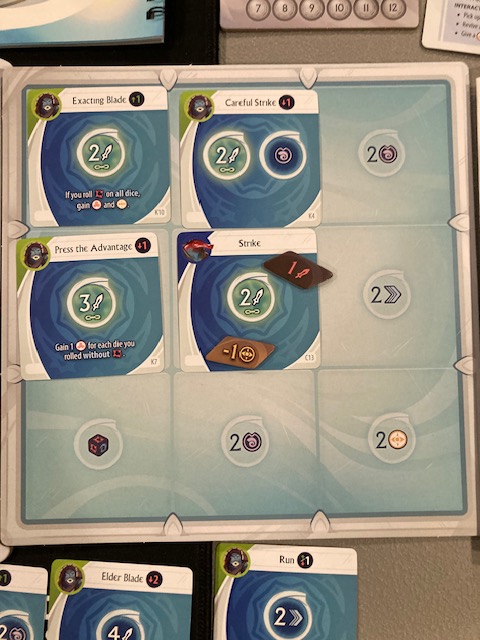
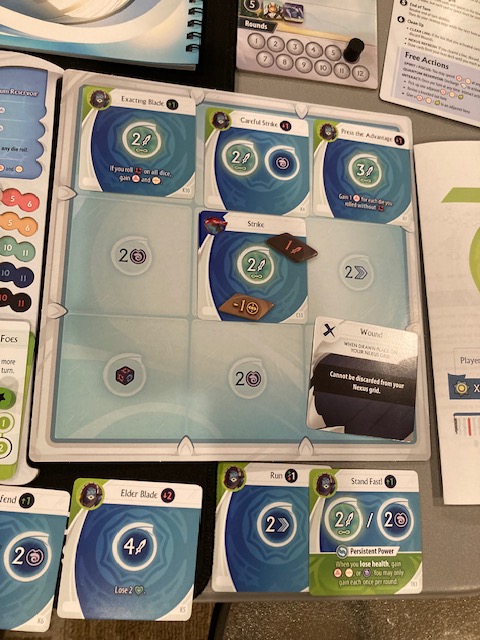
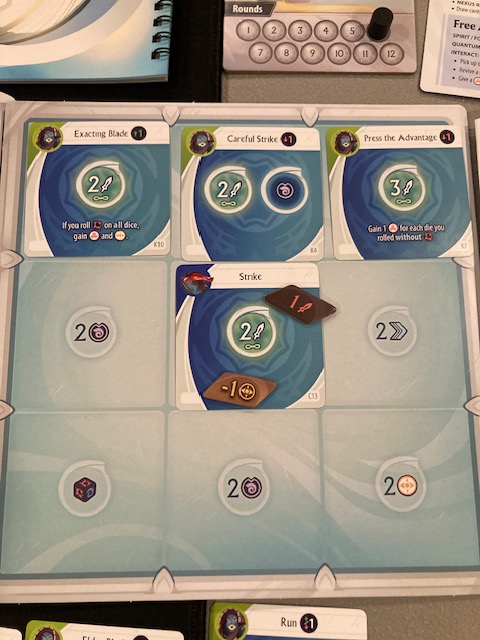
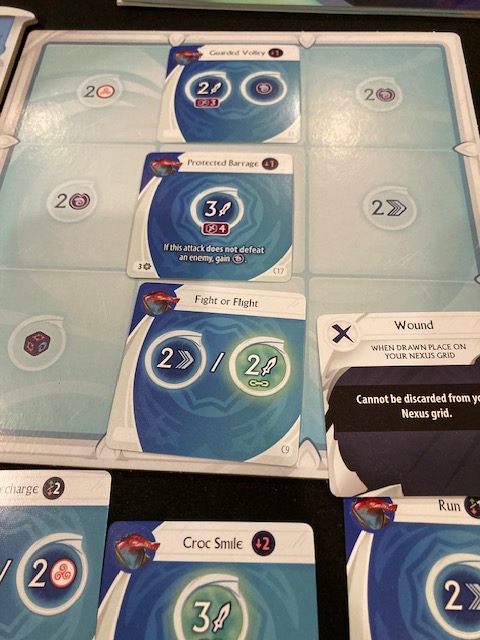
What’s even cooler is that when you use of the cards during play, you activate either a row or a column on your board! What this means, of course, is that you piggy-back on our previous turn! For example, if we just played Careful Strike to the board (top middle), we are allowed to activate ALL the actions in either the middle column or the top row! Some actions give you shells (armor), some actions allow melee strike (swords), some actions give you resources (yellow/pink), some actions give you movement, and so one!
As your character takes excessive damage throughout the game, you can take WOUNDS (see bottom right) which clog your board! Now, if activate the last row or column, you can’t use anything from that last space!
This mechanism of playing a card to a row is central to the game! What card you choose dictates your initiative (Stand Fast! gives me +1 initiative), your current turn, and what actions you might want to play on future turns! And it’s really fun, because you feel like you have a lot of choices:
1) Which card do I play? It affects my current turn and initiative! 2) Where do I place my card? It affects which “core” symbols I block! 3) Which row or column do I activate? What previous cards do I want to leverage? 4) Do I want to finish a row with 3 cards? I may clear it, but I get a very powerful one turn! Each turn is just rife of choice!
Each character also has spirit, focus, and some “shells” which can serve as armor or activate other abilities! Armor in the game is handled by putting shells from your uncharged area into your blocking area! So, if you want to play defensive for a round, you can choose the shells action! Yet another type of choice: defensive or offensive!
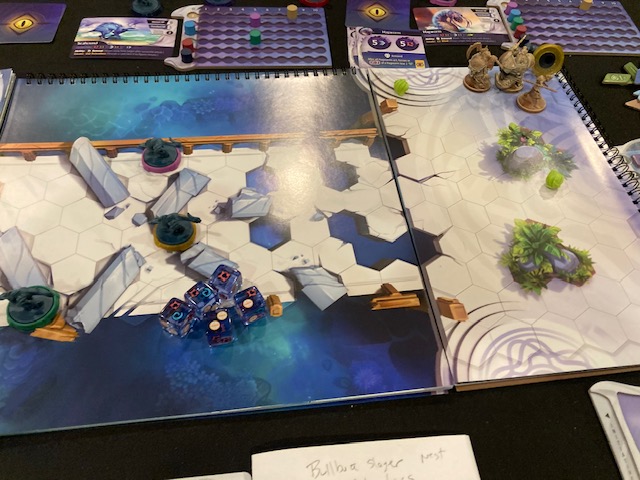
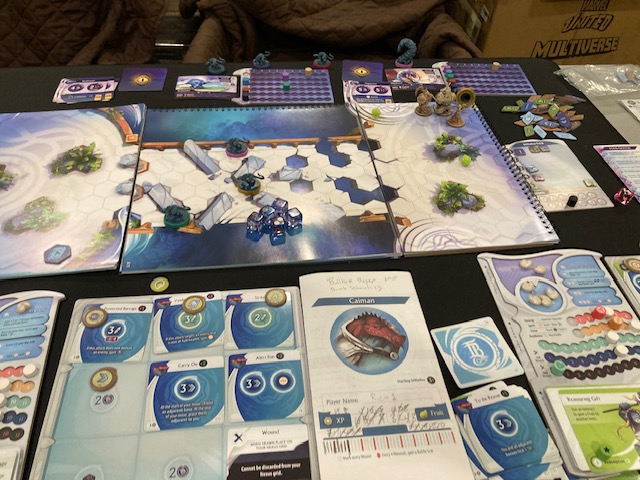
Players move around a map of hexes, fighting creatures! (Sound familiar? Gloomhaven, I am looking at you…) See above.
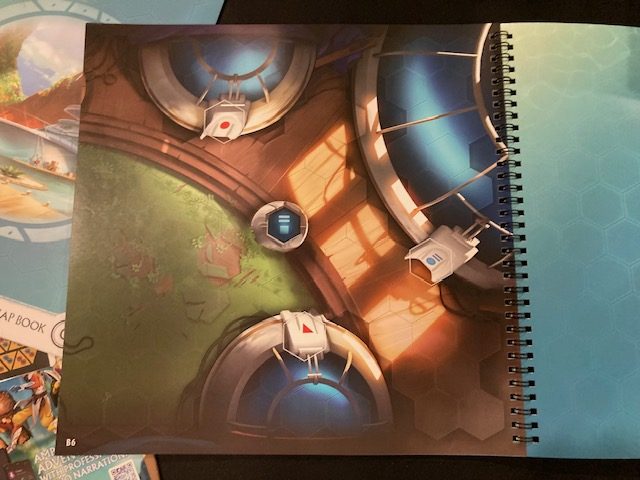
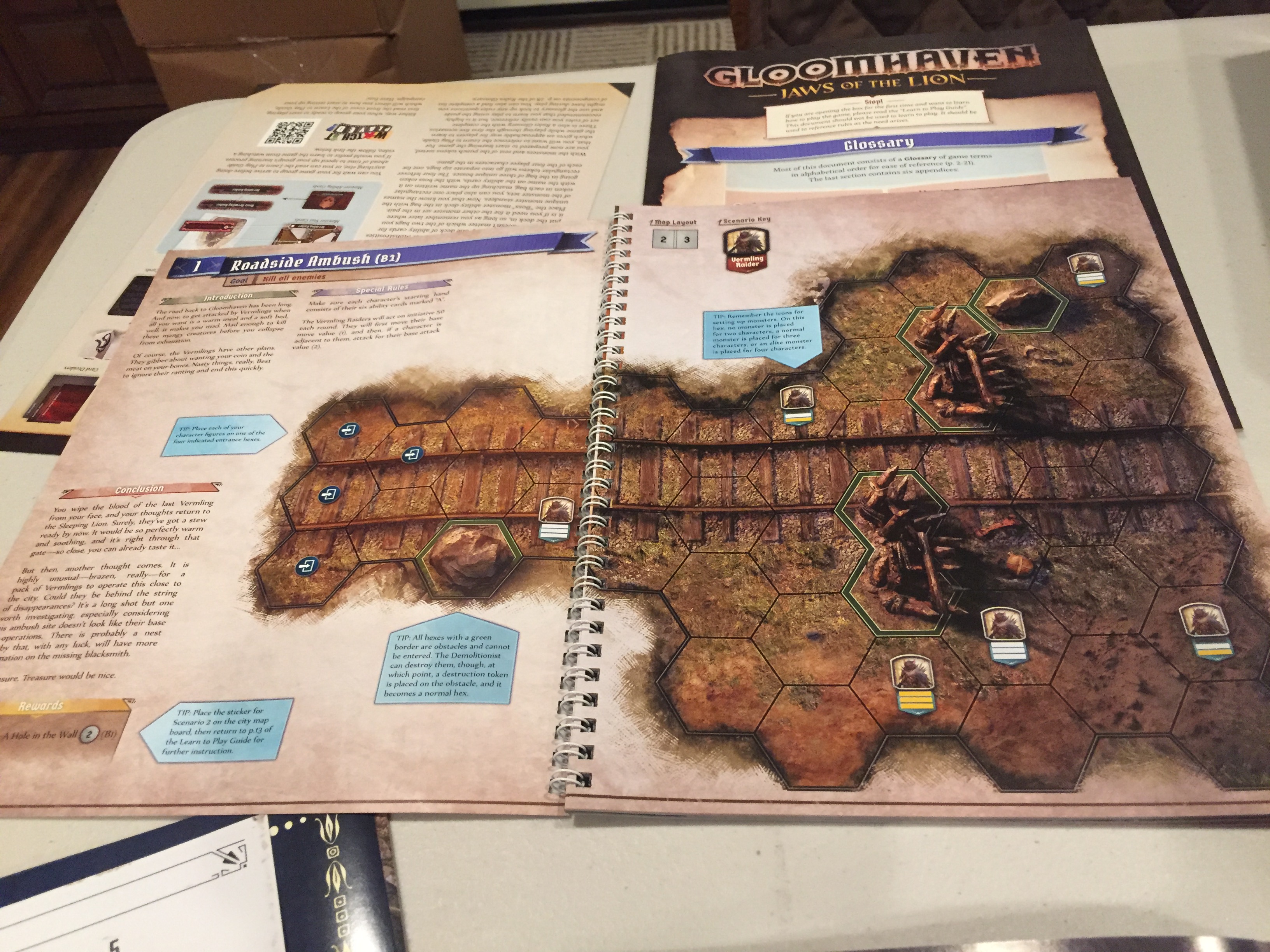
The map books remind me a little of Gloomhaven: Jaws of the Lion, as you just set-up the board from a book of maps and go! This map book was the key innovation in Gloomhaven: Jaws of the Lion. What’s cool, is that Tidal Blades 2 furthers that innovation!
The storybook is the play area! Set-up is easy! Just turn to that page!
Players move around the map, but the stupid spiral binding gets in the way of the map in Jaws of the Lion! See above.
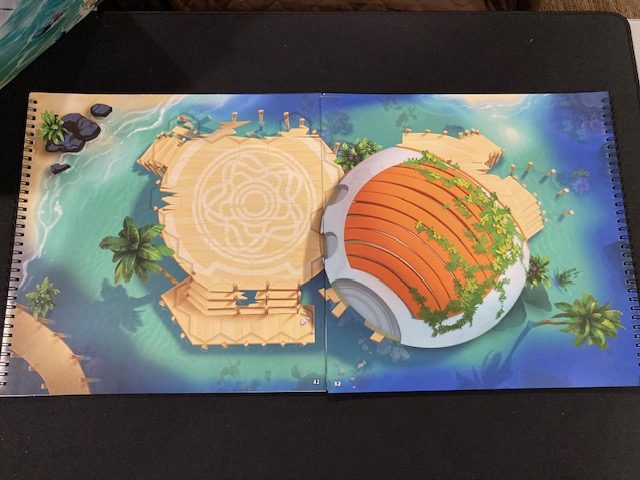
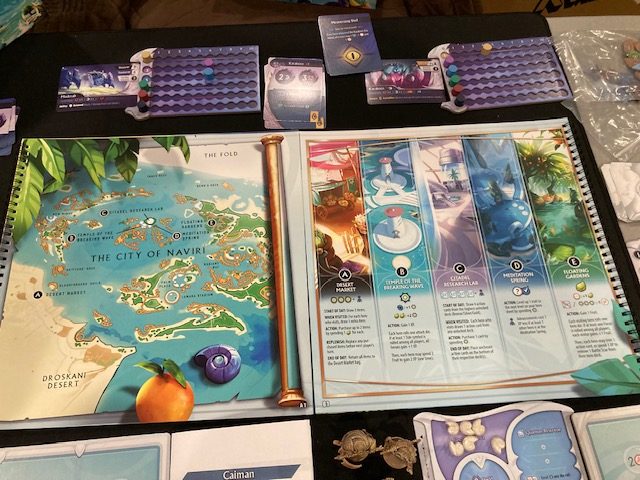
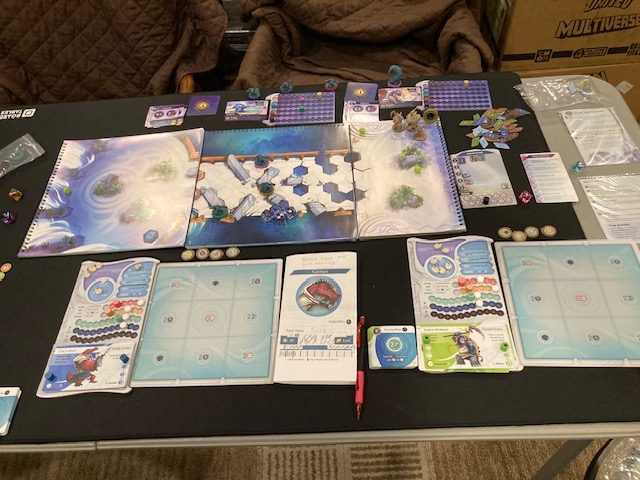
What Tidal Blades 2 does is very clever! Rather than just one map book, Tidal Blades 2 has two map books (actually 3), but each book is rotated so that the spiral bindings are on the outside! Instead, the middles just touch and make a contiguous surface! See above! The middle of the board, where a lot of action is, in untainted by the spiral bindings! It looks more like a contiguous surface!
It’s really easy to set-up each chapter of the campaign! Just turn the book to the proper pages!
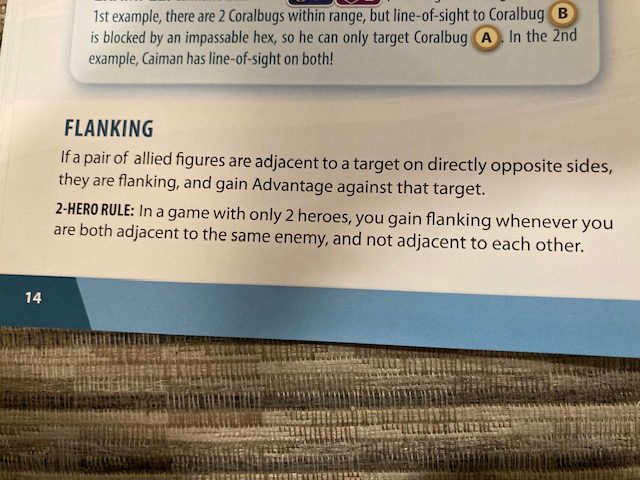
Combats are decided by dice: every SWORD you generate from your cards gives you a die! Red symbols are a straight-up hit, blue CAN be a hit if you have advantage (if your compatriots are flanking), and yellow focus CAN be a hit … if you spend a focus point! And that decides how much damage you do!
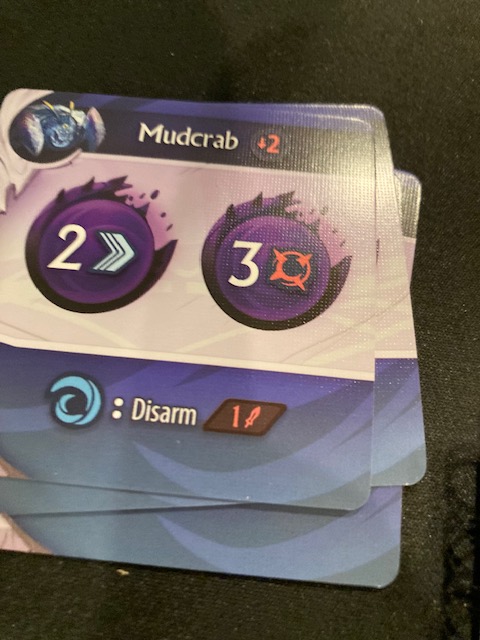
Monster combats are similar: all monsters perform the actions of their current card: see above as the mudcrabs move 2 (to the closest character) and then just do 2 straight damage! (This is modified a little by a damage die).
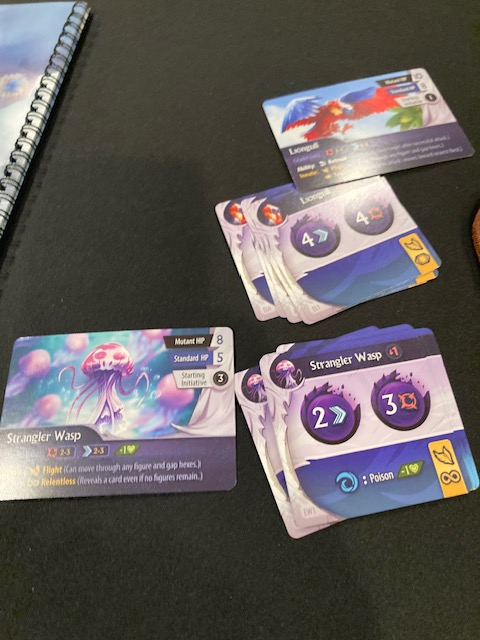
There’s all sorts of monsters with all sorts of abilities! Some poison you! (See above)
Each monster is tracked by a hit point track (see above) with the bases differentiating them. The purple die (lower left) modifies every monster attack!
There’s a lot more to this game, but that’s the “flavor” of the game!
Campaign
Let’s be 100% clear: this is a campaign game! It last about 18 chapters, and each game is about 2 to 2.5 hours (including set-up and tear-down: a lot of your time will be set-up and tear-down).
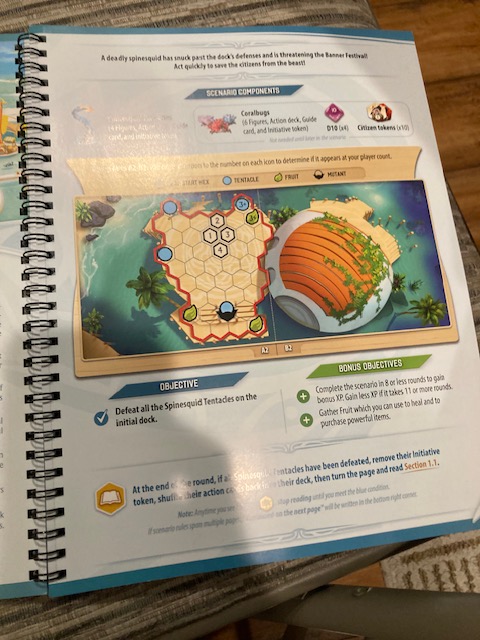
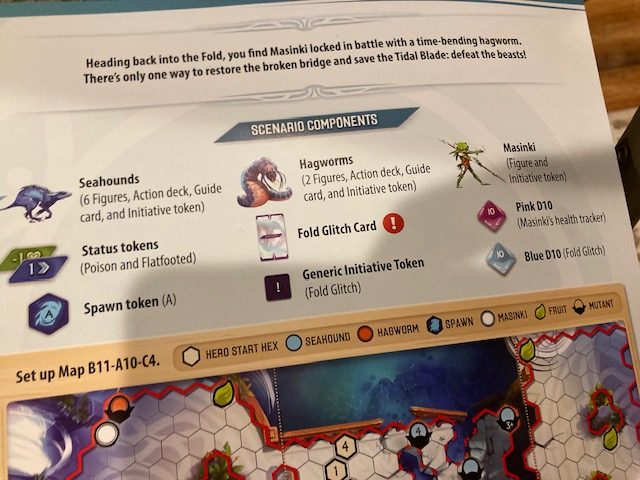
Each chapter describes in great detail which maps you need, which monsters you fight, and what the set-up is! See the first chapter above! (Minor spoilers above).
There is a story unfolding (pun not intended) about the folds of time. Each chapter begins with some text describing the story (picture blurred on purpose above).
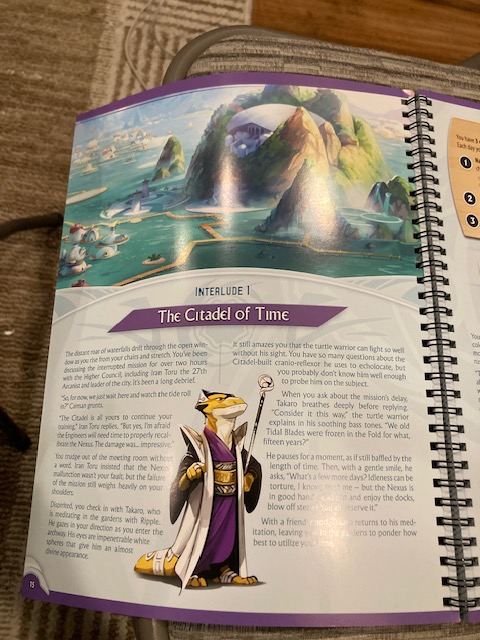
After a few chapters, there will be Interludes which give you a chance to level up. To be clear, there is SOME levelling-up after most chapters, but the Interludes offer significant levelling-up!
At these Interludes, Players choose where to go to “spend” their resources: the market? The floating gardens? It depends how you want to level-up your character. Cull cards? Add Items? Add skills? Whatever you want!
Although this is a campaign, the Stretch Goals pack (see above) comes with 5 one-shot scenarios.
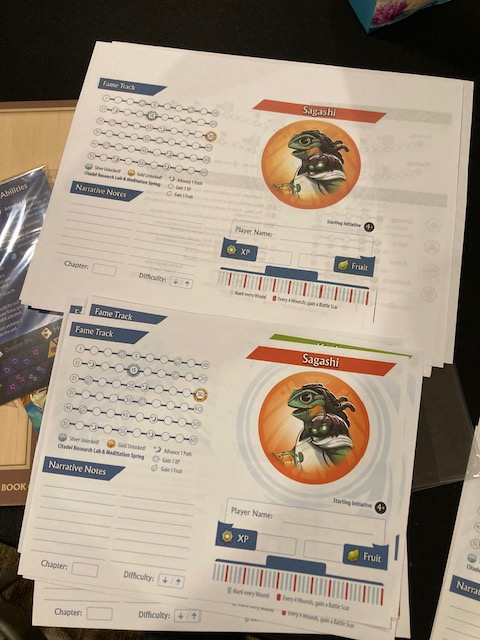
Since this is a campaign, and you have to mark up your sheet, I went ahead and made a copy of all the character sheets so I don’t have to sully the originals. There are enough sheets in there that you “probably” don’t have to do this, but I prefer not to mark up the originals if possible.
Solo Play
So, Tidal Blades 2: Rise of the Unfolders has two solo modes! (Congratulations for following Saunders’ Law!) The simpler of the two solo modes is to just play two-handed: choose two characters and operate them as-if it were a 2-Player game. This is the route I chose. And so should you!!
If you REALLY REALLY REALLY want a solo mode where you only play 1 character (but then still kinda have to operate some other pets/creatures anyways) with complicated exceptions, there is a second solo mode. I usually eschew complicated solo modes because the exceptional rules are always SO HARD to keep track of! Play two-handed: you’ll thank me for embracing the simpler mode … the simpler two-handed solo mode has NO exceptions to rules; you just play the game they way it was meant to be played.
At the time of this writing, I am eight chapters into the campaign! I have seen boss battles, several maps, several different ideas (jumping, running water, flying, etc), and some really great miniatures! Every new chapter introduces new monsters and new ideas and keeps the game fresh!
Playing two characters is juuuust about the right level of complexity. Sometimes it’s a little overwhelming, since each character has their own deck with their own unique cards, but since the system is well-described and well-notated (seriously! The icons are VERY intuitive), it doesn’t make it too hard to context switch back and forth between the characters.
One drawback is that there is a lot of maintenance for the solo player: set-up, run character 1, run character 2, operate the initiative track, operate the villains, lather-rinse-repeat, tear-down. This is really where the vibe felt like Batman: Gotham City Chronicles: there’s just a lot of work to keep the game going! But, it’s kinda fun! Everything is so bright and well-notated! The monsters are well-tracked (with the bases and colored hit point tracks), and the rules are pretty solid (so there’s not much second guessing, modulo one issue).
I really like this solo mode: I hope to finish this campaign at some point during the year. I am currently playing two campaigns: my solo campaign with 2 characters and a cooperative campaign with the other 4 characters (with my friends).
I fully expect this to make my Top 10 Solo Games of 2024: it’s that good! There are just so many good choices! Where do I go? What cards do I play? How do I level-up my character? The choices keep me involved the whole time, even if there is quite a bit of maintenance per turn.
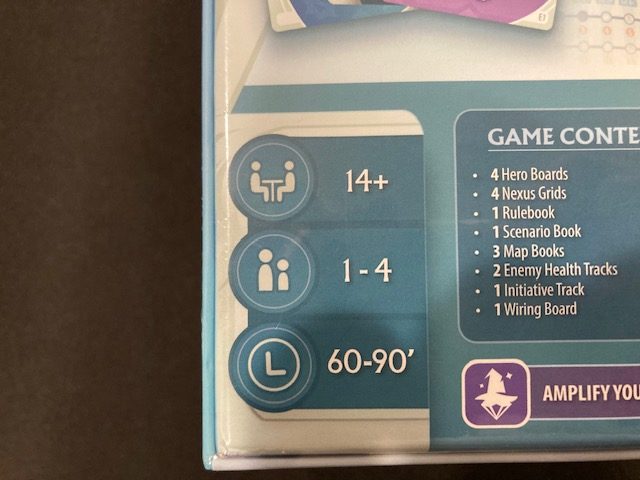
The solo game took longer to play than perhaps it should: the box says 60-90 minutes but I frequently was at 2 hours; I also tend to like a little analysis paralysis when I play by myself. There’s no one around, so I can try lots of things without fear of wasting someone else’s time.
Cooperative Play
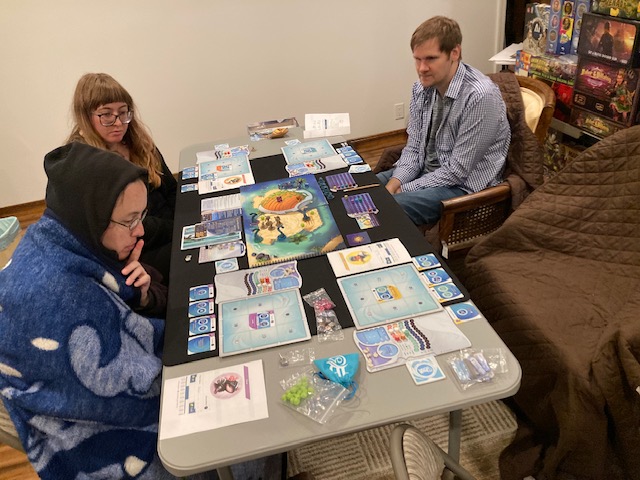
The cooperative experience is just in its infancy as we are only two games in, but my friends still keep wanting to play it! “Let’s keep playing it!” They really like it!
Every player has agency on their turn; the game is just too complicated for an Alpha Player to come in and ruin a player’s experience … there are just too many choices for a single player: the Alpha Player will be too busy figuring out his own turn!! At the same time, there’s plenty of cooperation and players plan when to flank (see below), which enemies to engage, which actions to take, when to defend vs. attack! This has a good blend of agency and cooperation.
One of the things we DIDN’T like about the cooperative game Endeavor Deep Sea (from two weeks ago: see review here) was that the game didn’t “really” have any mechanisms for helping each other too much; players had a lot of multiplayer solitaire going on in Endeavor Deep Sea. That’s not the case here! Even you though you can choose to play multiplayer solitaire, you can also do quite a few things to directly help your compatriots! You can spend shells to allow your friends to re-roll dice (if they run out of re-rolls)! You can set-up flanking opportunities! You can use skills that help everyone within 2 spaces! There’s a number of mechanisms where the sole purpose is to help your compatriots! And that does increase the level of cooperation! Even choosing the initiative order can be an act of cooperation! And THANK GOODNESS there are no Communications Limitations in this game! Just last week, we saw how the Communications Limitations ruined that cooperative game! Luckily, you can talk all you want and work together in Tidal Blades 2!!
The only real negative for the game is that sometimes it can take a while to get back around to your turn (as there is no simultaneous play): players must play in initiative order. Like any game with lots o choices, sometimes a little Analysis Paralysis can slip in and slow down the game. It’s still not too bad, because you can always be talking with your friends or figuring your own turn out while waiting for others.
It’s easier to overlap turns in a cooperative game (like Tidal Blades 2) because you can ask your friends to leave the board “in a certain state” so you can preplan your turn! In a competitive game, you always have to wait until the previous turns are over to re-assess the board every turn! With a little cooperation, there can be much more overlap! And we saw some of that overlap here in Tidal Blades 2! It’s a minor point, but that overlap can make cooperative games (without simultaneous actions) move a little faster.
Overall, this game was a lot of fun cooperatively. It’s a good blend of agency and cooperation, and there are many ways players can help each other. It’s fun to talk and plan with your friends!
Flanking and Advantage
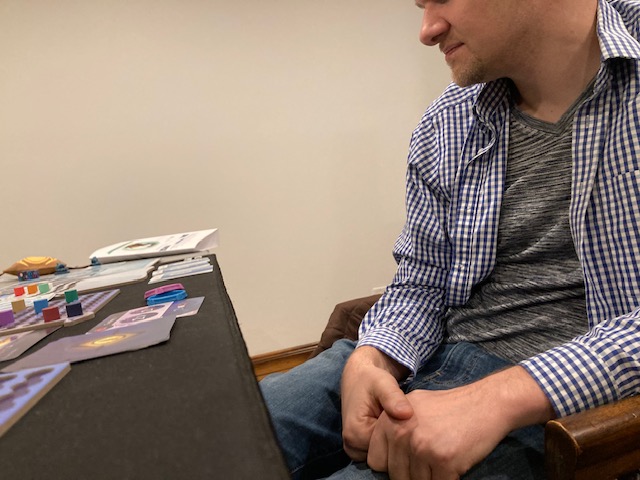
So, this is, at its core, a miniatures fighting game! Which means you have rules for flanking and advantage! If you flank (players surround an enemy adjacently from opposite sides), you can get advantage (which allows you to turn the blue wave symbols on dice into hits)! This is very cool, because it is a mechanism that encourages the players to cooperate and coordinate their attacks! The best results come if you cooperate, flank an enemy and maybe get 50% more hits because you can gain advantage!
If you saw “Flanking and Advantage” and thought “What is this … 5th Edition Dungeons and Dragons?” You are not the only one who thought that!!! But, these ideas in this game really do help improve the cooperation: they encourage an easy way to increase the odds of hits!
What I Liked
The minis! You can get the game and just use cardboard standees, but I would strongly recommend getting the miniatures! See above!! They are so well done, with the different bases, the beautiful sculpts, the different colors to highlight the different types! I feel like they really made the game feel more thematic. The minis add to the cost of the game (as you buy them separately), but I think in this case, they were worth it.
Combat Mechanism! The combat mechanism of choosing a card, then choosing where to put it, then choosing a row or column to activate is so cool! Your choices affect your current turn as well as future turns!! This mechanism is at the core of the game, and it makes you feel like you have choices at all times!
Well-done Monsters! The monsters are pretty easy to run (modulo one problem, see below)! The cards clearly specify what to do, the bases clearly denote which monster is which, and it’s pretty quick to set-up a game! Heck, I spent more time putting plastic bases on monster minis than I did setting up the cards! It really is easy and quick to SET-UP and RUN the monsters!
Not too much Randomness! I was very worried that there would be too much randomness with dice deciding combat … but here’s the thing, there’s not that much randomness! There is usually at least one hit per die and sometimes your focus shows (which means you may have to spend focus if you want extra hits). See the dice above! If you roll XXX dice, you will probably get about XXX hits! If you have extra focus to spend, or some special abilities, or flanking (see below), you may need much better! It’s like having a baseline of hits, and you choose (by having focus, or flanking) if you need to do better! I really like this system! I usually dislike the randomness of dice, but how it’s done here works for me!
Easy-to-Read! The components are well-labelled, bright, and have very easy-to-discern icons! This game is very intuitive and easy to read!
The Components! The components (even if you don’t get the miniatures ) are fantastic!! The dual-book system solves the spiral middle problem, the cards are linen finished, the dice are clear and beautiful, and the cardboard components are well-done … just overall the components are a joy!
Cooperation and Agency! The game has many many ways to encourage cooperation, but still allow each character to have their own agency. The card choice mechanism is very intense and full of choice; players are allowed to coordinate if they like (there are no silly communication limits)!! Players must decide who goes after what! Players must decide if it makes sense to flank! But, you can’t really Alpha Player the game because each deck is so different, and frankly, each character is so involved (in a good way) to run! Players will have intense agency on their turn to operate their character, while still having to work together to come up with a plan! And that flanking mechanism I think really encourages finer cooperation: it’s so good to gain advantage, you just need to!
Loot 2.0! In some ways, Tidal Blades 2 feels like it should be called Gloomhaven 2.0. One of the things we house ruled in Gloomhaven was the Loot Rule (see discussion here: Top Seven House Rule for Cooperative Games). Basically, stopping to pick up loot takes you out of the flow as you have to stop and use actual resources to do that. The nice thing in Tidal Blades 2 is that you can a free action every turn to “interact” with one item! So, maybe you can’t pick up three pieces of fruit or five rewards, but you can move by something and pick it up without needing to spend one of your precious actions. Granted, you may still have to spend movement, but usually a reward (when you kill an enemy) comes out right next to you, and you just pick it up! We enjoyed this free interaction SO MUCH more than Loot in Gloomhaven!
What I Didn’t Like
Wait, What Am I Unfolding? I love story in my games (it’s why I like Astro Knights: Eternity better than the original … it has a compelling story!!), but the story and the writing here feels … forced and a little turgid. And I like story! But it felt like Tidal Blades 2 were trying to hard to have their own “surfer-techno” lingo, and it just didn’t work for me. I tended to just skim over the exposition and head straight into the scenarios.
Enemy Movement: As easy as the monsters are to set-up and operate, the AI for the monsters movement is a little weak. There’s some nonsense about “clockwise heading north” in the case of ties, but the description in the text and the picture don’t match (for me anyways). In the end, the final rule for specifying things is done using “Fastest Initiative”: the character with the fastest initiative is the tie-breaker … that tended to be my goto rule! Many times, that was the tie-breaker (when it was really unclear) for us because it just make things easier. Otherwise, the enemy movement phase becomes an overwrought “look at all possibilities”, which isn’t fun. Gloomhaven did a better job at specifying the enemy AI, but at the cost of more rules.
The AI basically works, but if you focus too much on it, the game can become overwrought. I worry that zealots for rules will make playing this less fun as you spend the entire game getting the AI rules “just right”. And that’s fine if that’s what you want, but I think most people won’t love that. Just play the game; it’s good!
Bases didn’t Work? Some of the mutant bases didn’t quite work: the miniature just kind of “slipped” out the base: see the video above. It wasn’t all the mutant bases, and most of them worked, but it was weird that some of them didn’t work!
Reactions
Rich: This is probably a Top Ten Game of the year, both solo and cooperatively! I am keeping my solo campaign alive as I still venture cooperatively with my friends! There is just so much to like! This feels like the next evolution of Gloomhaven! This is a 9.5/10 for me. I just wish the AI was better and the story was better: that’s what keeps it from a 10/10. Sara: I really liked it! Let’s keep on playing it! It’s probably a 7 for me! Andrew: Ya! Let’s keep playing it! A 6.5 or 7 for me! Teresa: I loved the minis and how the game worked, 7 or 8 for me! It was like a better Gloomhaven, and not nearly as dark!
Conclusion
Tidal Blades 2: Rise of the Unfolders is a fantastic game! I still am not quite sure what we are unfolding (I think we are unfolding space and time), but there are so many things to love in this campaign miniatures skirmish game! The components are first-class, the miniatures are stellar, the cards are easy-to-read and intuitive, the combat system has so many great choices, the leveling up is fun, and the campaign is really interesting! In some ways, Tidal Blades 2 is the next evolution of Gloomhaven as Tidal Blades 2 evolves the map book ideas, the Loot rules, and the combat with the row/column mechanism!
The card “activate column/row” mechanism works so well, that I think it elevates the game significantly. It’s such a unique mechanism and makes the player feel like they can do so much! I expect to see this mechanism in upcoming games because it just works so well.
This is a 9.5/10 for me, with my group rating in highly with 7s and 8s as well. This will make our Top 10 Solo Games of 2024 and the Top 10 Cooperative Games of 2024!
















 coopgestalt