
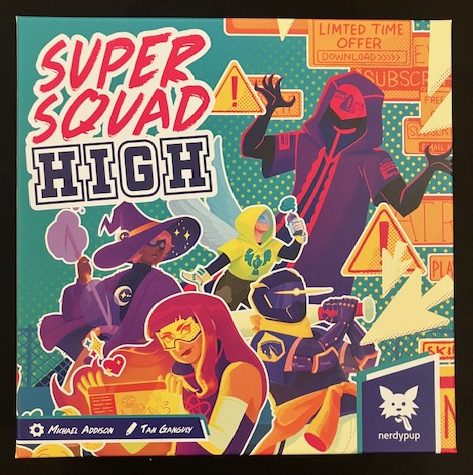
Super Squad High is a cooperative and solo Superhero game that was on Kickstarter in April 2024. It promised delivery in March 2023, and it was just a month or two late (which is pretty good in Kickstarter terms).
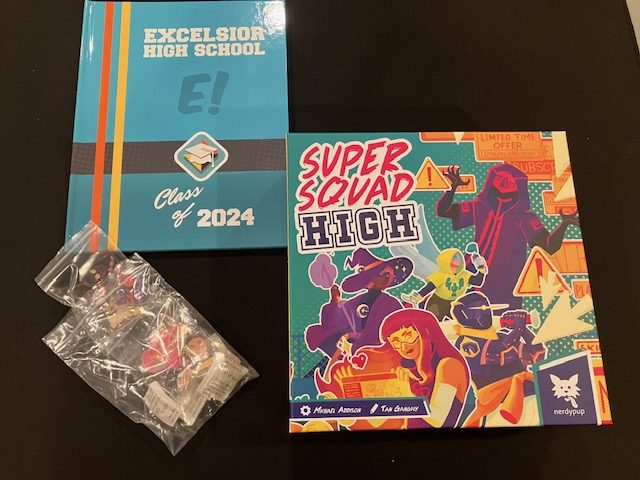
I went ahead and backed the high-end version and got the Arylic pins and Art Book: See above.
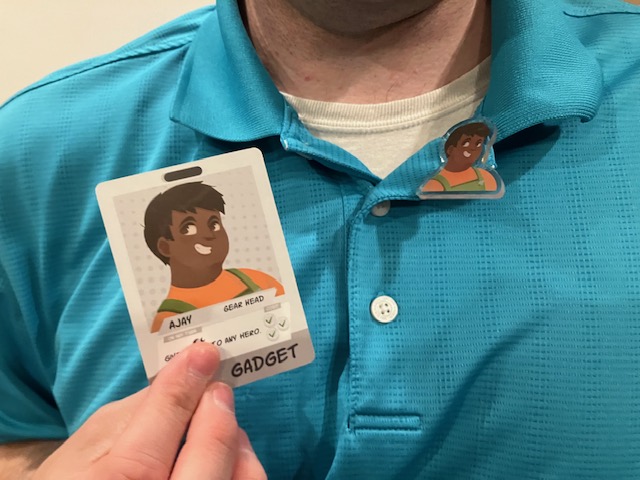
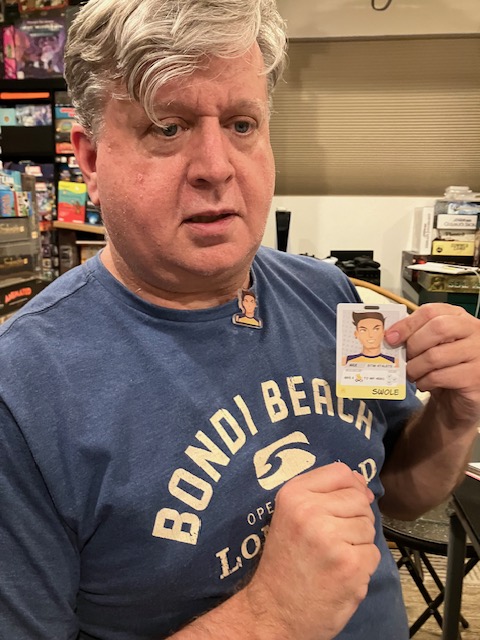
The Arylic pins are completely superfluous and you don’t need them, but we had fun picking our characters using the pins (and then wearing the pins): see above.
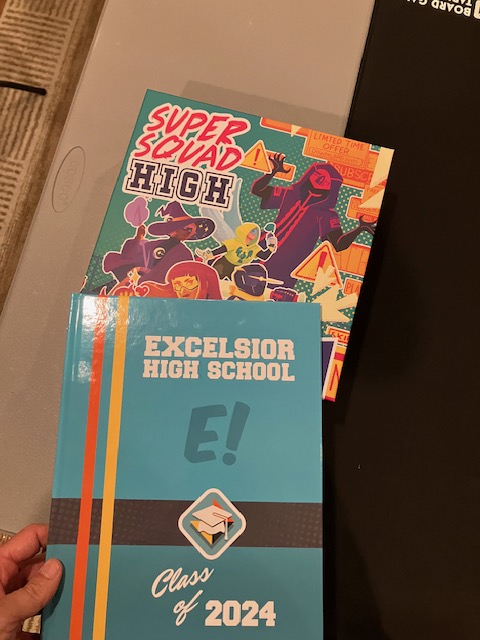
Let’s take a look!
The Rulebook
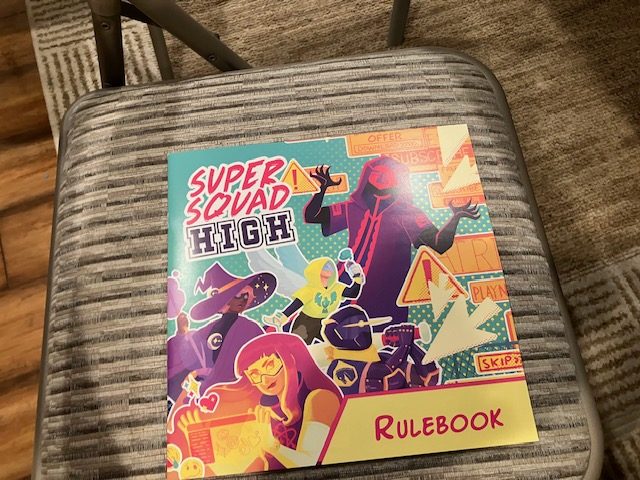
The rulebook was just okay.
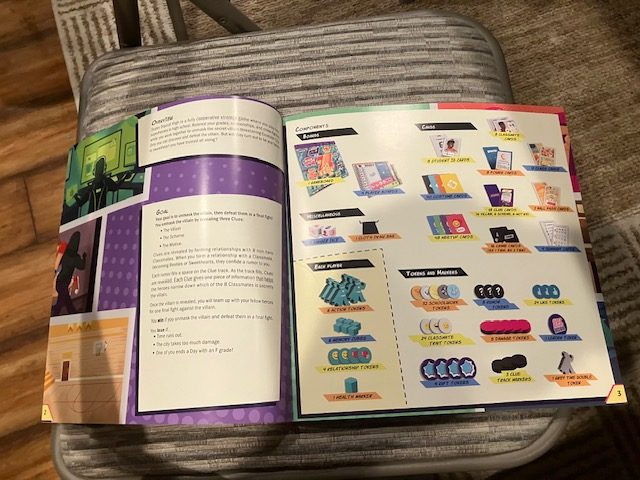
The rulebook ventured into low C territory for The Chair Test. It does kinda fit on the chair next to me, and it does stay open, but it does droop a little too much for my liking.
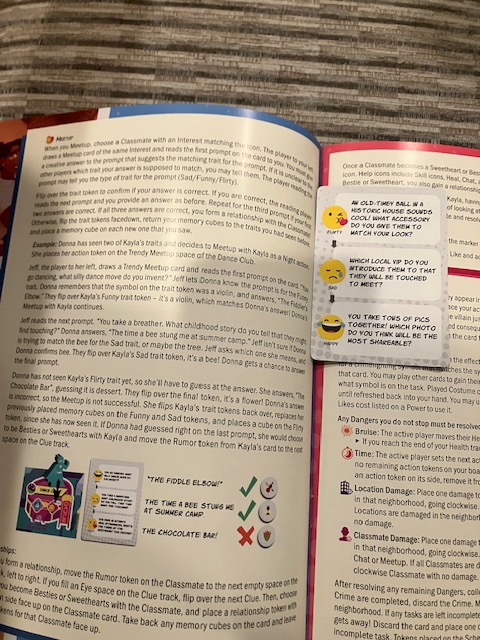
There tended to be a LOT of text without too many pictures. Luckily, it seems like most of the rules are there (modulo one solo rule for Crime cards). Also, the font was a little small.
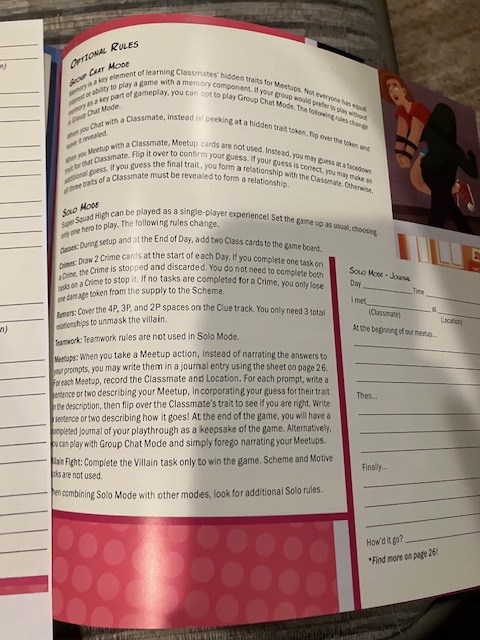
There also seemed to be a lot of “space” around the edges that was just “flavor”, when I would have preferred more pictures and a larger font.
The components page was pretty good.
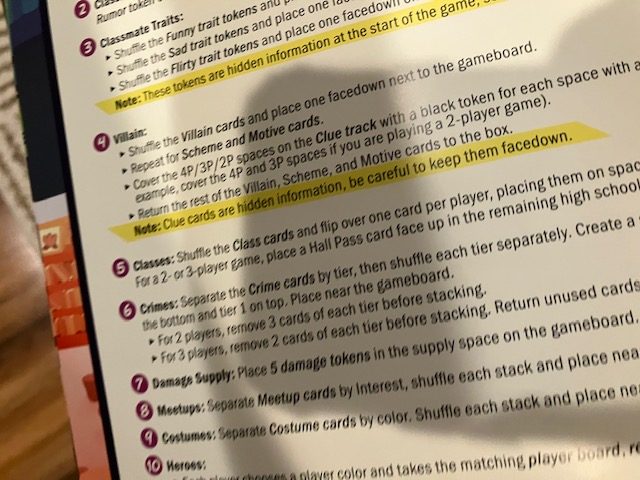
The Set-Up worked pretty well, especially since the directions were on one side, and a picture on the other.
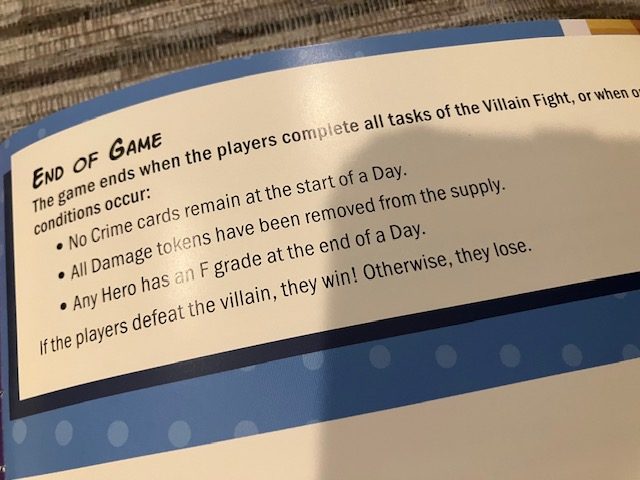
I got through the rulebook, and most of the rules were in there in a logical place. I think the rulebook could have been made better in a lot of ways, but the fact that it did seem to have all the rules goes a long way. In the end of the day, it was fine, but it could have been better.
Unboxing, Components, and Gameplay
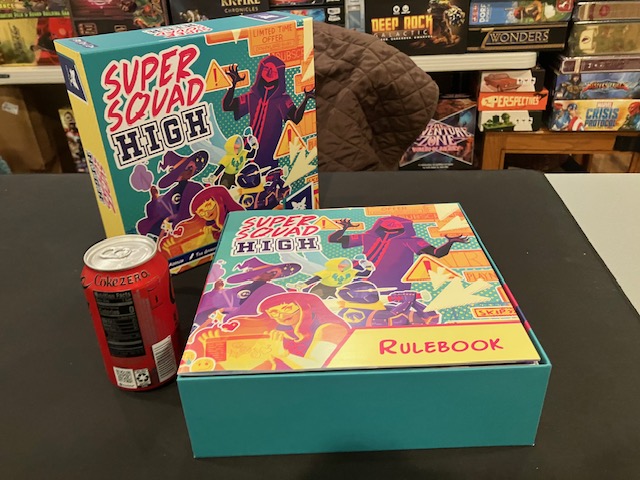
This is a pretty standard sized game box: see Coke Can above for scale.
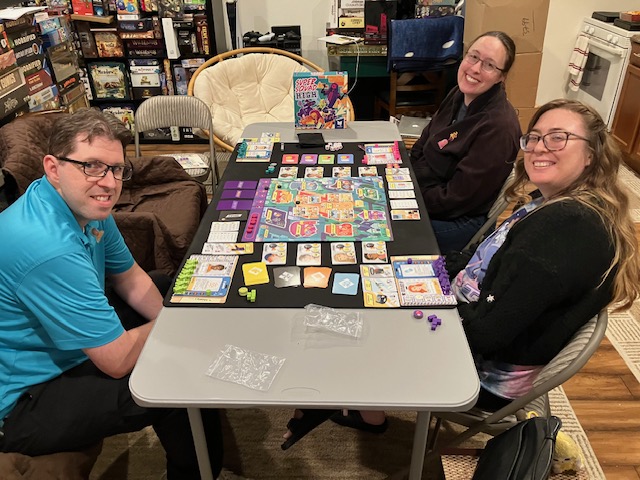
1-4 Players each take the role of a SuperHero in a High School!
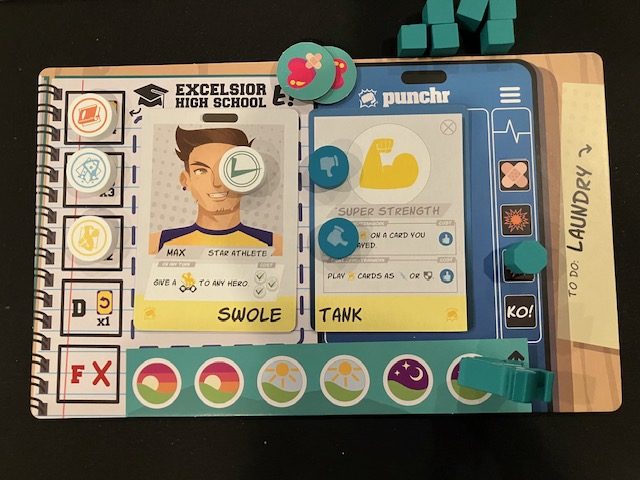
Each hero gets a Student ID and Power card: see above. These two cards form your character! My character was the “Swole Tank” and he has Super Strength! See above!! Players get to choose from one of two Student IDs and one of two Powers at the start of the game, so there is some choice about who/what you get!
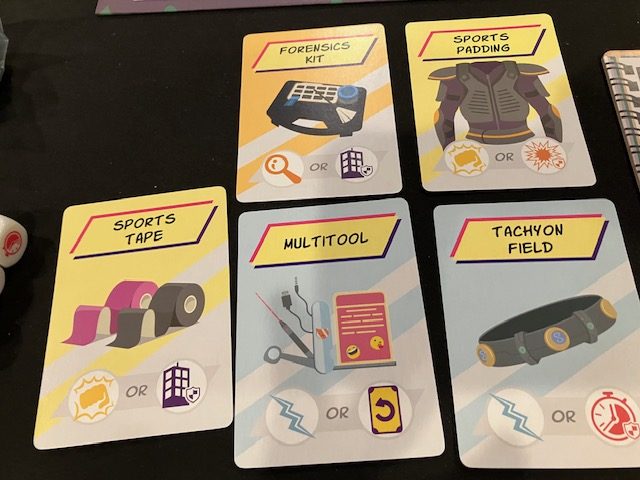
Players gets “Costumes” (cards above) throughout the game. These cards are basically used to fight crime!
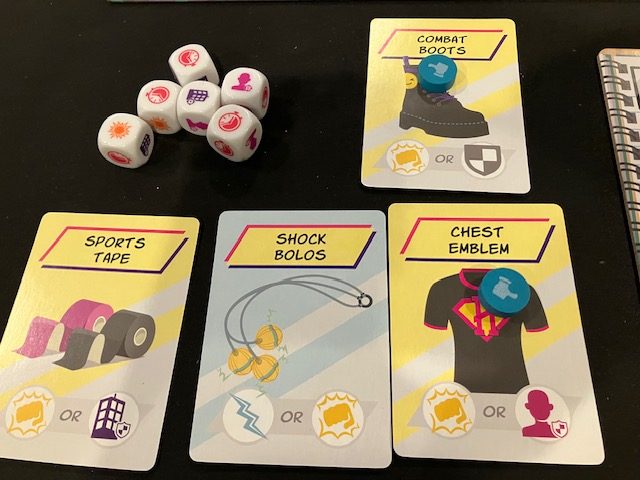
Generally, the Costume cards are used to the stop the elements of crime … that appears from the Danger Dice! See the Danger Dice above, and that the Costume cards correspond to some of the symbols. Basically, if you can’t “block” all Danger Dice with your Costume Cards, then something takes damage (either the city, you, or an innocent bystander)!
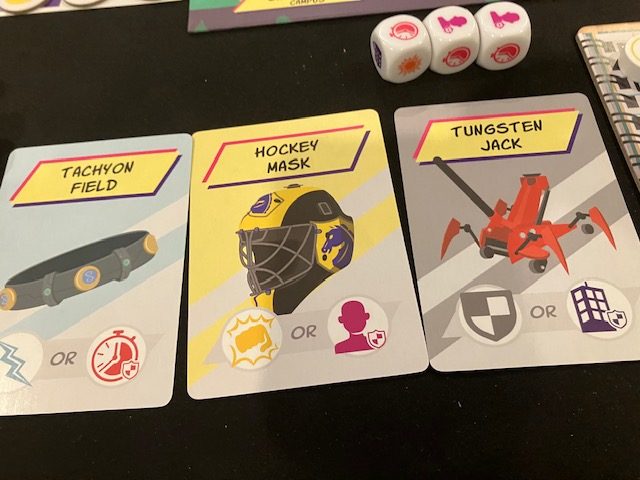
See above as the Tachyon Field, Hockey Mask, and Tungsten Jack block all bad effects from the crime! And even though the Tungsten Jack doesn’t match exactly to block, this was a “grey” or Tools-related crime, so all Tools cards are wild and can stop anything!
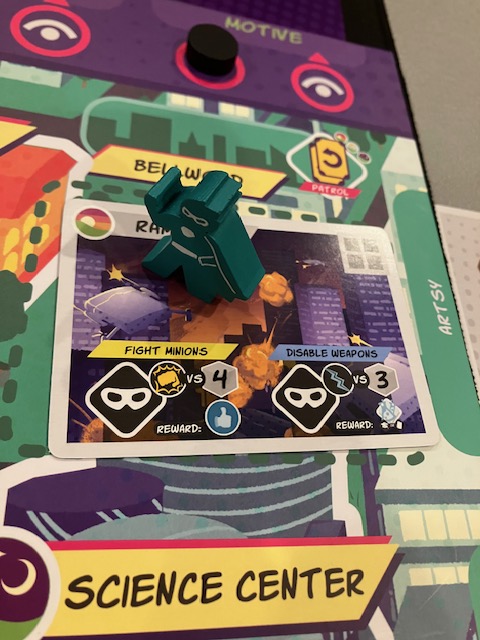
Crimes come out as the Heroes play! See above as the Rampage hits the Science Center! In order to take out that crime, you have take care of Minions AND Disable the Weapons! If you fail, then some damage happens to the city!
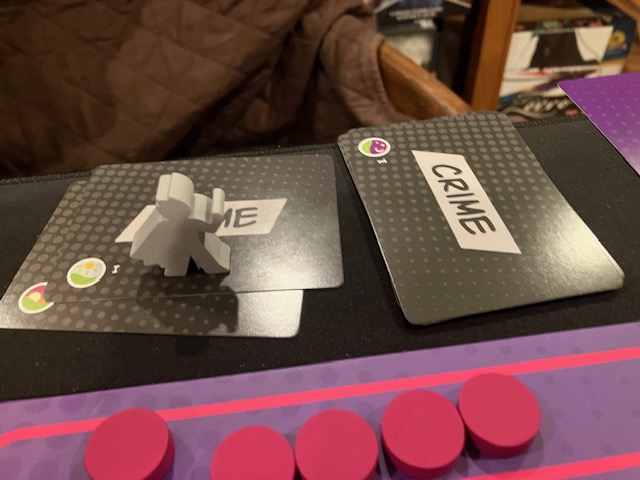
At the top of the board are “damage tokens”: if there is ever too much damage (usually from letting crimes go), then the players lose! The heroes MUST keep the crime at bay!
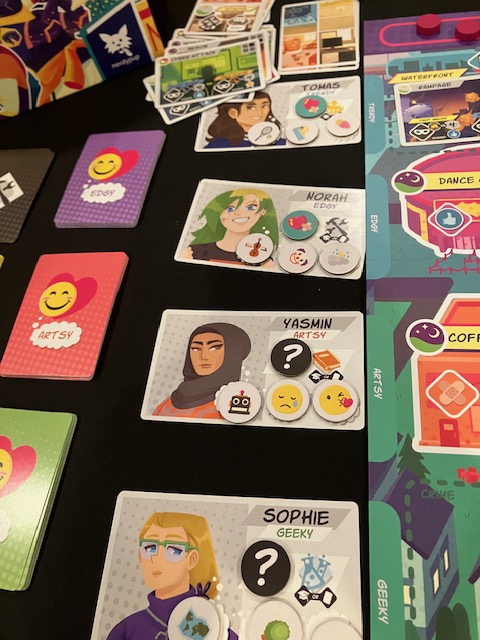
Although keeping crime at bay is important, it’s not how you win the game! You have to talk to your schoolmates to try to deduce WHO is the big bad villain, what their scheme, and what is their motive! See schoolmates above!
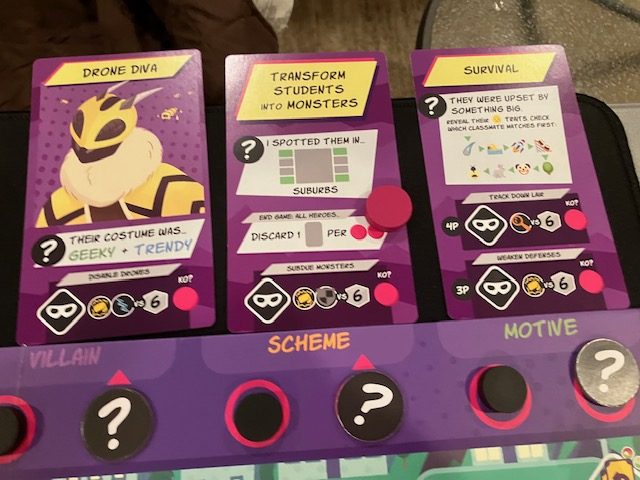
The more students you befriend and have successful “meetups”, the further you get! To win the game, you must uncover all three: Villain, Scheme, and Motive (see above). You must do this before the clock runs out! (The clock is the Crime deck running out of cards). Even after you unmask the Villain, you STILL have to have a final fight!
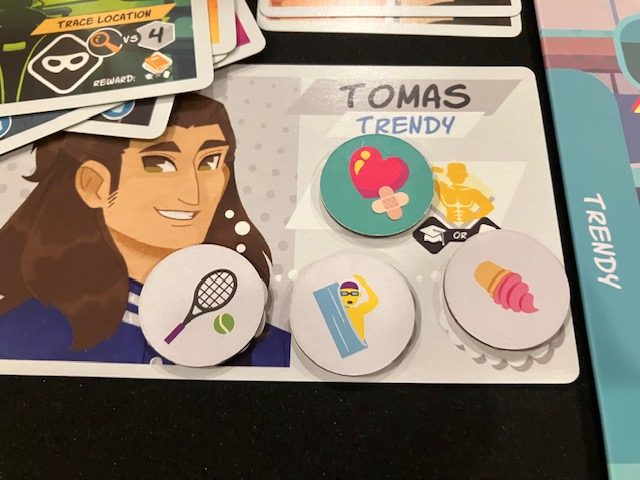
Students are befriended by finding out about them (their Flirty, Sad, and Funny interests). In order to truly befriend someone, you must discover their interests and what makes them tick!
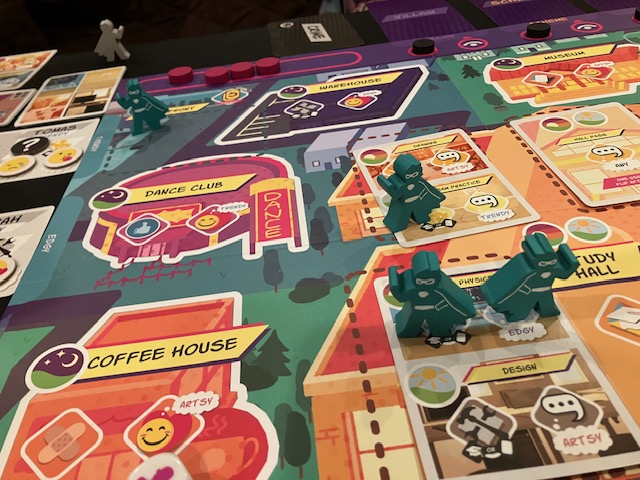
You move your tokens on the board to “talk” to people: see above as one token talks to some Edgy student (to uncover one of their traits).
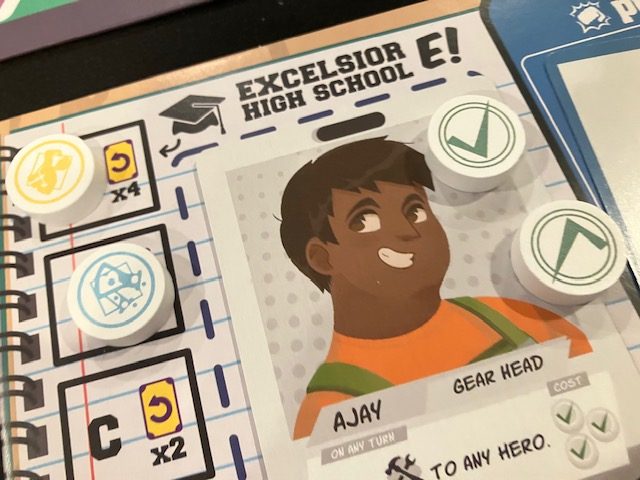
Crazy enough, with all this going on, you still have to keep up with your homework! Doing your homework won’t win the game, but if ANYONE is ever failing, all players lose the game!
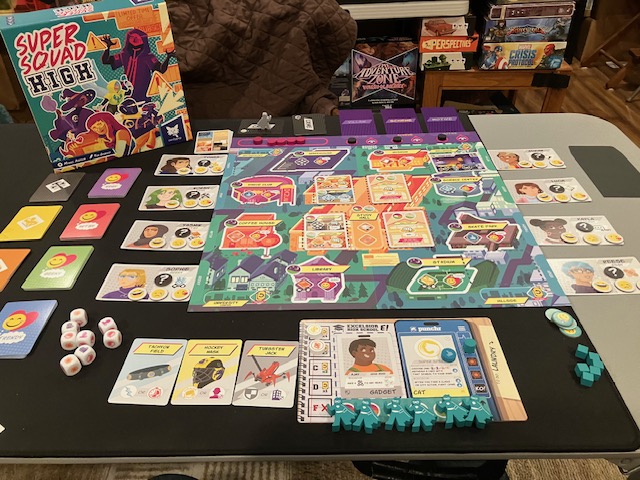
If you can keep crime at bay, keep your homework under control, speak to your classmates, and do your laundry, maybe you can uncover the Villain, Motive, and Scheme! After such a reveal, you have to win one final battle with the SuperVillain to win!
Worker Placement
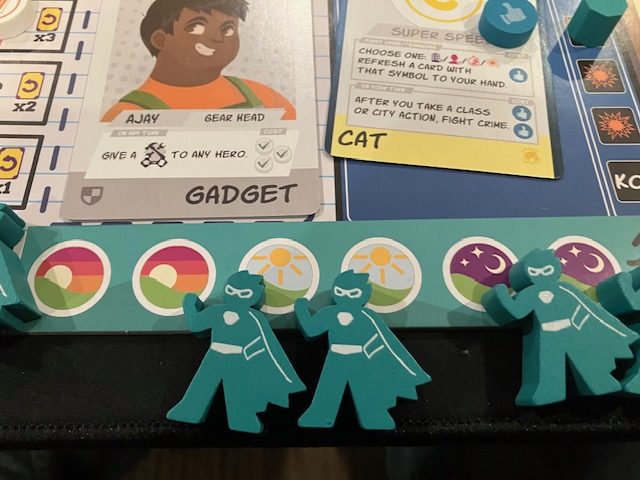
This is nominally a Worker Placement game, as you have to put out your tokens out to do stuff. Each player gets two tokens in the Morning, two in the afternoon, and two at Night.
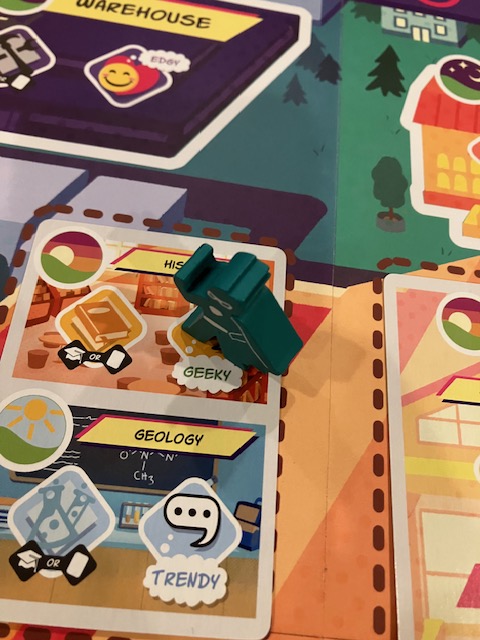
These tokens go on the board to do stuff! Notice above as a token goes on “Geeky” to talk to a Geeky schoolmate! Also notice that the Locations can ONLY be visited at certain times of day. In the morning and afternoon, you can usually only do things at school (like Homework or talk to schoolmates) or sometimes upgrade your Costume Deck!
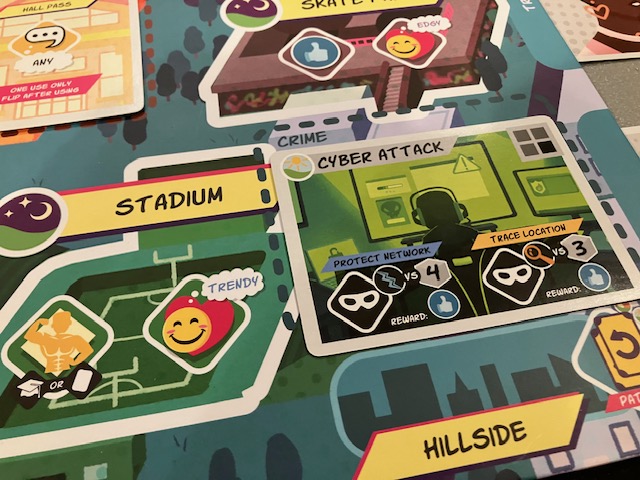
Usually, things are the city can only be activated at night! See above as the Stadium can only be activated at night!
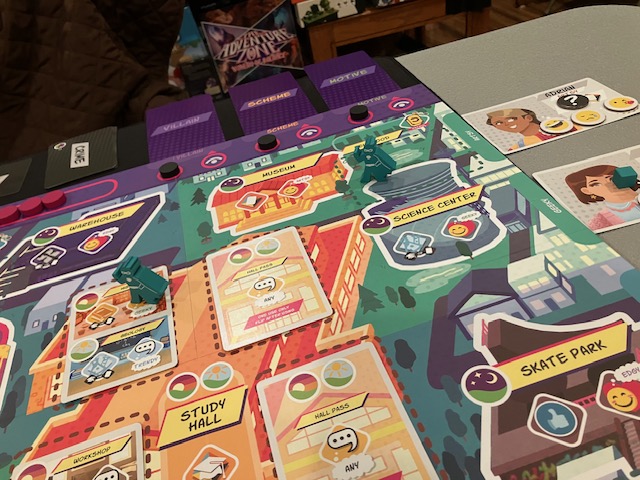
From a cooperative point of view, the rulebook was never “clear” on how to place your tokens. The only rule seems to be “Starting with the Leader, players take turns taking actions”. I think that probably means clockwise … but given the lack of clarity, we chose to simply use Player Selected Turn Order! As a group, we can decide when to place our tokens. Since this is a fully cooperative game, it doesn’t matter “too much” the order they are placed, as long as everyone agrees with basically where they go! (This was probably a House Rule: we’d recommend it to you).
“I really need to do my Chemistry homework, or I fail and we lose! You need to let me go there!”
“I really need to talk to that Geeky girl, is that okay, or do you need to talk the other Geeky guy?”
“We really need to deal with this crime! I can do the punchy part, can someone else do the gadgety part? Or can you back me up nearby?”
These (above) are typical phrases that got uttered during our gameplay!
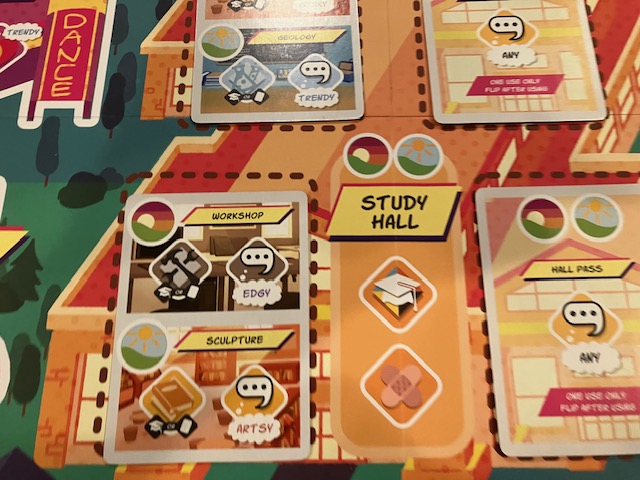
The Worker Placement as a mechanism to fight crime, do homework, talk to schoolmates, and upgrade our decks seemed to work pretty well. It was intuitive and the icons worked pretty well.
It was also interesting to note that you could only use certain spaces at certain times of the day. This made planning ahead more critical!
Deduction
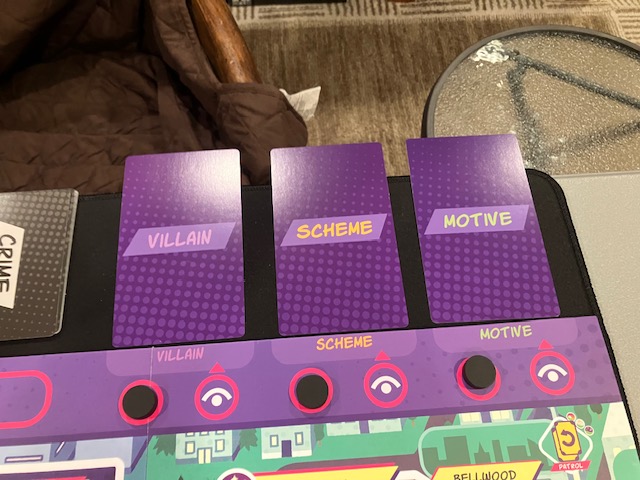
This is nominally a deduction game … ish? You have to uncover the Villain, Scheme, and Motive in order to win the game!
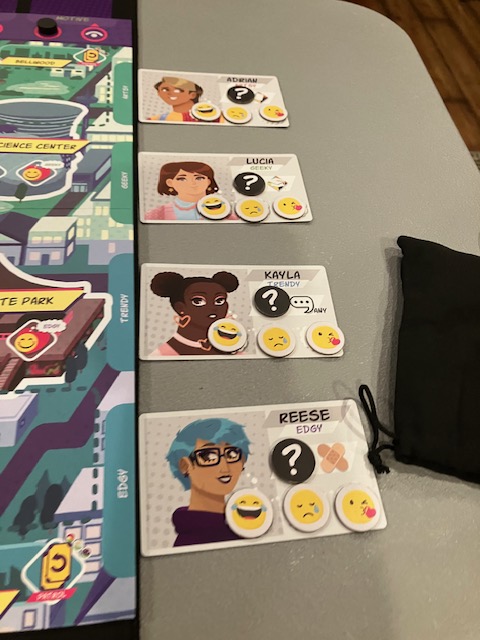
You can only move forward by talking to your class mates and befriending them! Once you have truly befriended a classmate, you can get closer to revealing one of the Villain/Motive/Scheme cards!
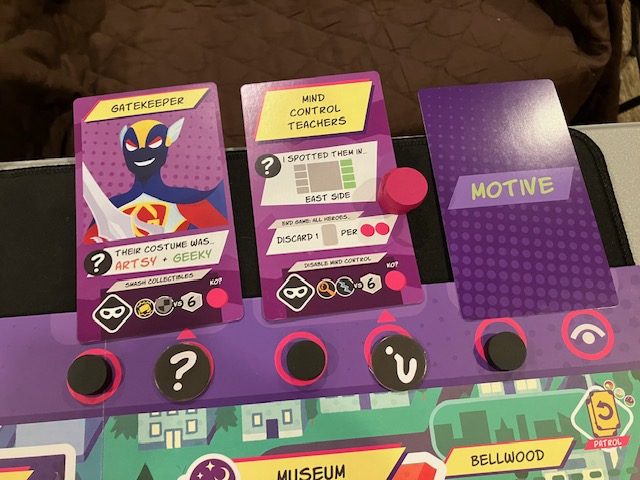
This mechanism worked pretty well, but it wasn’t really “that” deductive. I was hoping for more deduction, but the mechanism worked. It was just simpler and easier than I expected. That’s not a bad thing, but this doesn’t “really” have that much deduction.
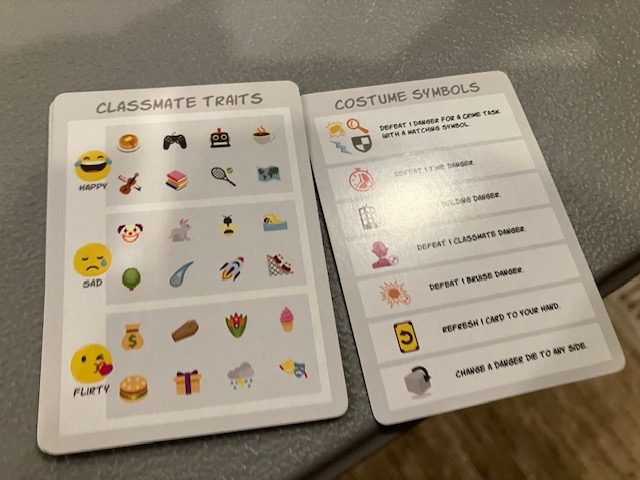
The Summary cards show what all the trait tokens can be, but unless you have uncovered “most” of them, guessing is a real shot in the dark. You can try to befriend someone without knowing all their traits, but you have to guess the unknown traits! It might be easier to just talk to them ahead of time directly rather than wasting a turn and “maybe” befriending them. I was hoping for a little more deduction … this just felt like you just had to spend your turns judiciously to make sure you talked to the person enough. Befriending someone was more about proper use of time rather than deduction.
Crime
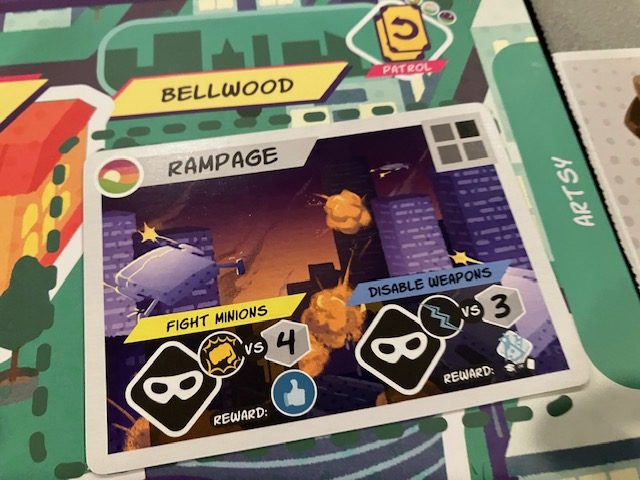
The Crime fighting part of the game seemed to work pretty well. I was worried because so much of the Crime fighting is dice based, but since certain cards are wild when you fight crime (yellow cards are wild when fighting minions, and blue cards are wild when Disbabling Weapons: see above), you actually have a pretty good idea of if you will succeed or not. If you engage the crime, YOU WILL DEFEAT IT, … but can you pay the cost? Can you afford to damage to the city? Yourself? Innocent Bystanders? I was really worried that the dice mechanism would be too random for me, but it really wasn’t.
Superhero?
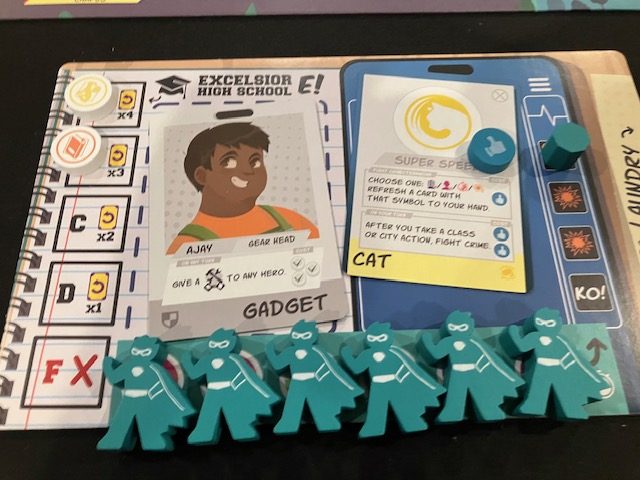
Is this a Superhero game? Yes … mostly. The High School part makes this feel more like the movie Sky High than Avengers or Thunderbolts! Don’t get me wrong, I actually really liked the movie Sky High, but not everyone will love this “let’s be superheroes in High School” theme! The Superhero theme does come through, but it is a little silly. There’s a certain … silliness (?) to the game. It’s more that this game doesn’t take itself too seriously, but it’s still pretty good.
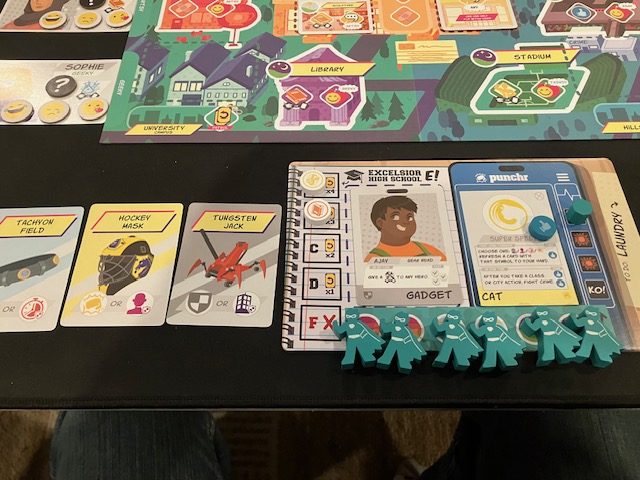
I think the art style and sillyish costume cards contribute to that lighter feeling. See some above.
If you even know what the movie Sky High is and you like said movie, I think you will like this game! Even if you don’t, you may still like this game. The theme may turn you off, but there’s still some fun to be had. But, if that theme would just turn you off completely … I’d say “give it a try”.
I don’t think this would make my Top 10 Cooperative Superhero Games, but that’s not because it’s bad or anything; it’s just that the high school theme detracts a little from the Superhero part.
Roleplay
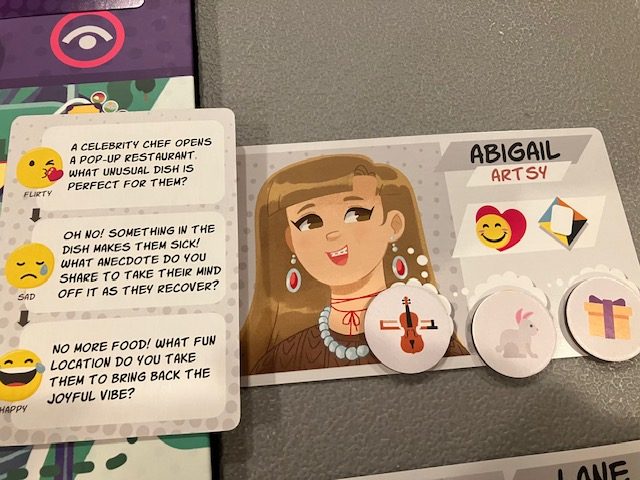
There is an element of this game that will make you love or hate this game. When you are doing the “deduction” for the traits of your classmates, one player is reading the questions and seeing if you can answer correctly for the traits. See above and below for examples of some questions!!! For some people, this will be the funnest thing in the world as you answer questions for the traits to show you know them! For some people, this will be the dumbest thing in the world and they will hate it.
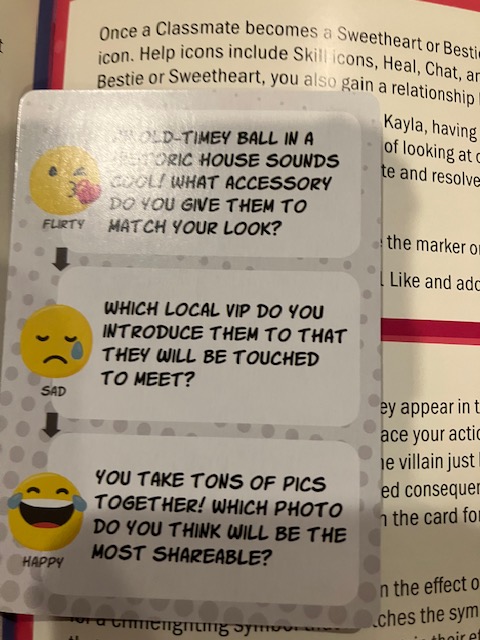
You probably know which one you are. If you hate this, the solution is simple: don’t play with it: just guess and ignore the question cards. If you love this, the solution is simple: play with it. The game will work both ways.
This one element may repel or attract you completely; don’t let it define the game for you, as you can play with it or without it easily. And it won’t affect the gameplay. I say this because there is a pretty good game here, and I’d hate for this one thing be the reason that you don’t play it.
You know yourself and what you think of this question/answer roleplay. Take appropriate action if you play.
Solo Play
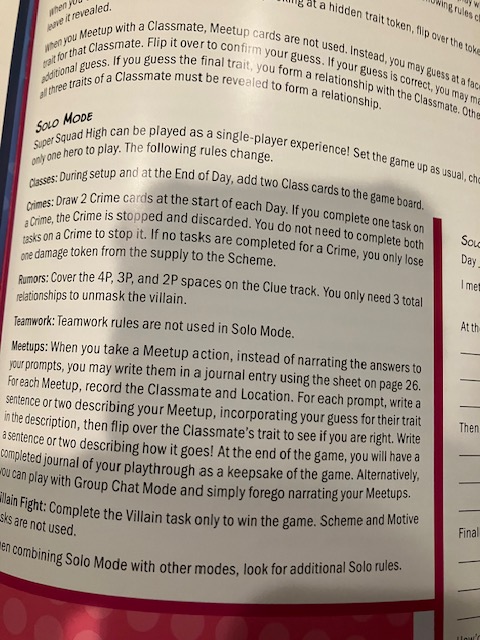
Luckily, this game does support solo play (congratulations for following Saunders’ Law)!
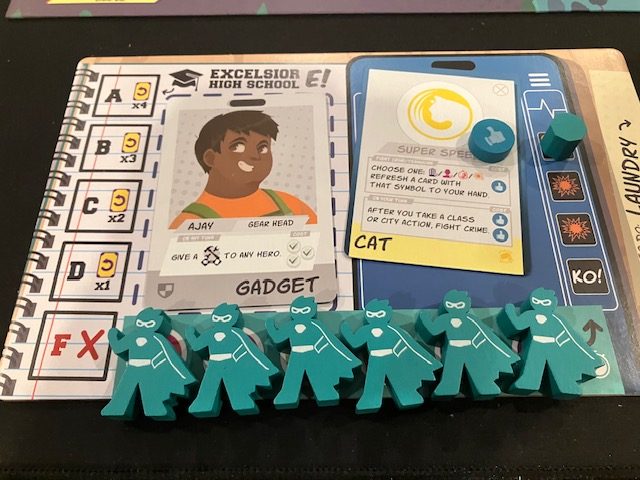
This is true solo play, as the solo player takes control of one hero! See above as the solo player becomes Gadget Cat!
It’s unfortunate that the rules for solo play are later in the rulebook after everything else. I get that, but the set-up portion for solo rules could have EASILY been in the set-up section of the rulebook, and I was frustrated that I had to page back and forth between this section and the solo section, especially since solo play was my first few plays!
Even worse, one of the solo play rules was not well specified: how many Crime cards do you use? I figured out the hard way (by just trying and seeing it it felt balanced) that the solo player uses the same number of cards as the 2-Player game. This was mostly the only rule that wasn’t well-specified, I was able to figure everything else out.
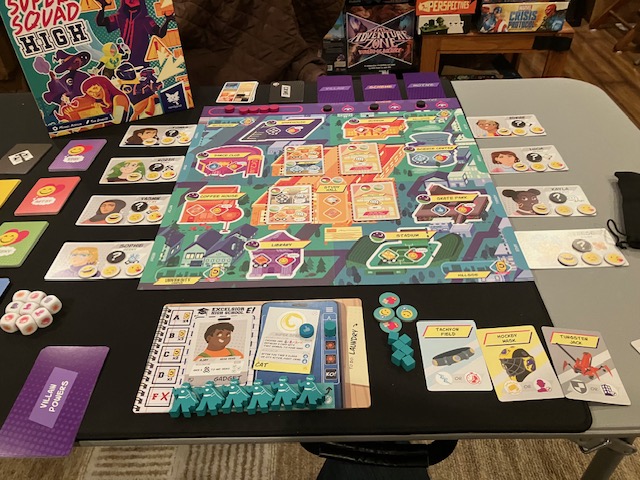
The solo game proceeds pretty much like the cooperative game, with only a few exceptions: there’s no teamwork, the Villain is easier to defeat, and the Crimes can be defeated with only one defeat (instead of both on the card).
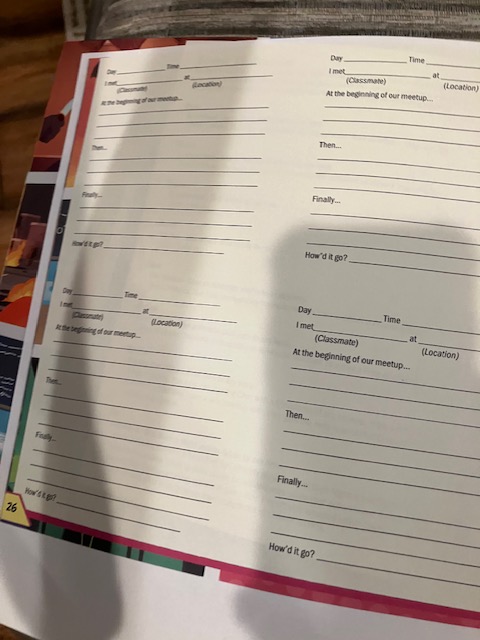
The question/answer roleplay rules we mentioned earlier (that you will love or hate) can be approximated in the solo game with writing stuff out: see a page above. Meh, this felt like work and not fun, so I chose to bypass this part.
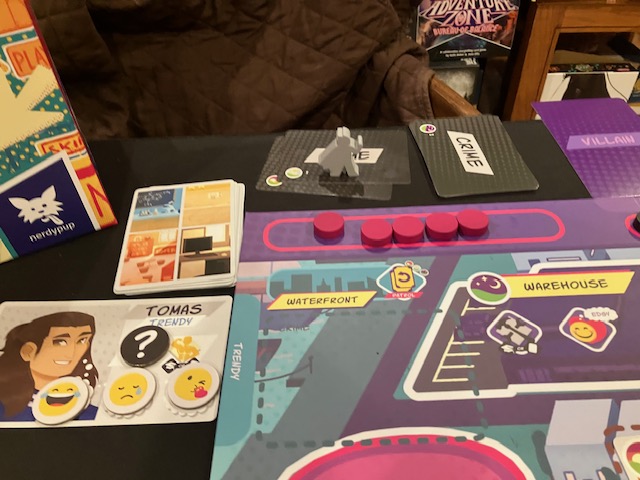
The solo game worked pretty well: it was hard and I realized near the endgame that I had to concentrate on questioning students to figure out who did it! The game could have gone either way at the end, but after I buckled-down … I was able to reveal the Villain, Scheme, and Motive just before the endgame! That was exciting!
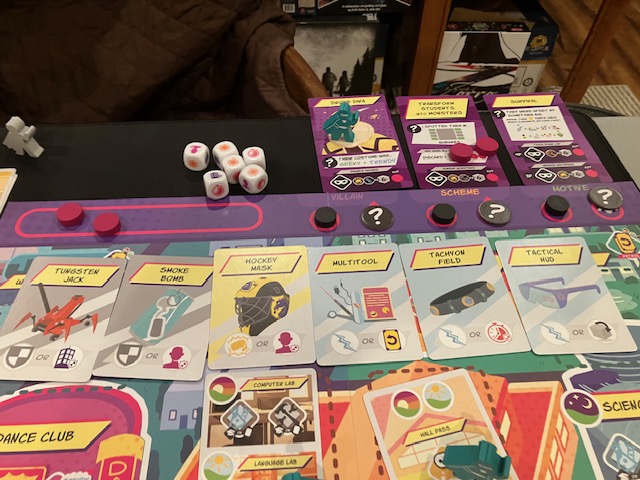
The final battle went pretty well as I was able to take down the final Villain! (In the solo game, you only have to fight the final as if it were a crime: you have to fight more in the cooperative game). See above.
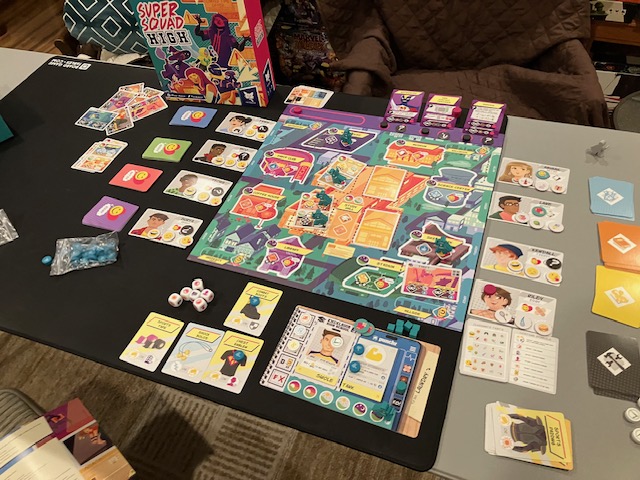
I played a couple of solo games, and the game was pretty good: it was challenging and there were interesting decisions to make, but it wasn’t super hard. I liked it, but I didn’t love it. I think I didn’t love it because it felt like the game arc would be mostly the same every time. It didn’t feel like it would be that different between games.
The solo game (despite the Crimes deck rules flaw) taught the same pretty well. I just don’t know if I’ll play it again solo, but I had fun.
Cooperative Game
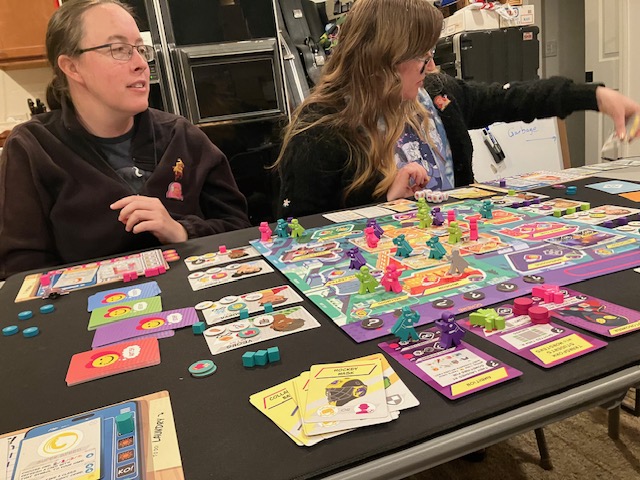
I think this game shines better as a cooperative game.
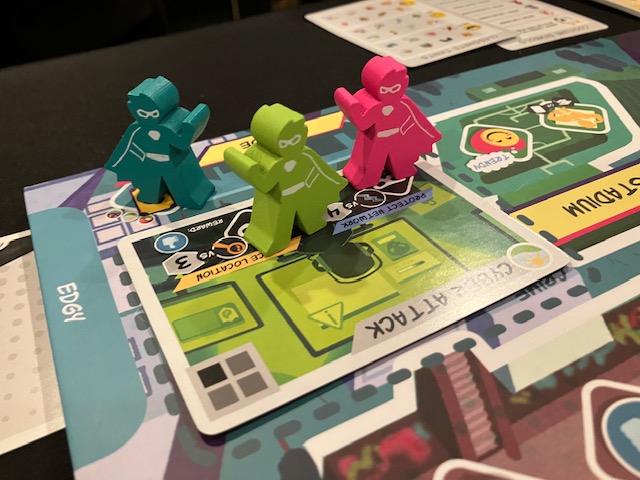
The fact that TEAMWORK was now a mechanic really helped push the game forward: if another player is in the same city neighborhood as other heroes, they can contribute cards towards fighting crime! This leads to another level of strategy over the solo game, as players now can help each other! See above as the three heroes work together to take out the CyberAttack!
“Man! I need some help taking out this CyberAttack! Can you guys help me over by coming to my neighborhood?”
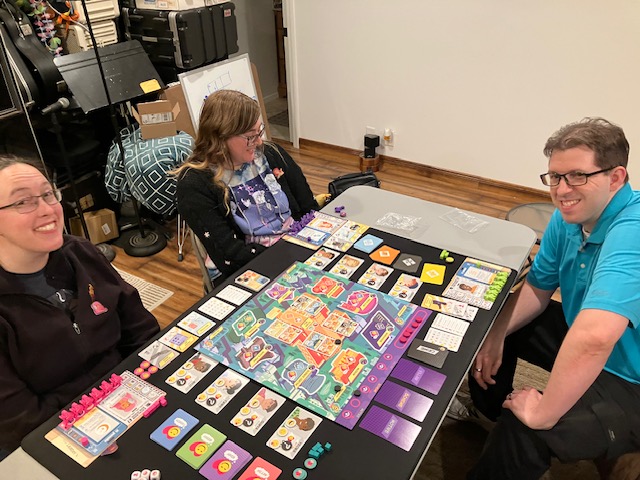
It felt very cooperative as we constantly consulted each other where to do, what to do, when to fight crime, when to help each other, when to do homework, and when to talk to classmates!
I think the best part of this game is the cooperation: you probably can’t win unless you really work together well. The game arc feels less “samey” in the cooperative mode as play will vary a lot more as everyone tries to figure out the “smartest” way to do everything! Some turns will have you do all the fighting! Some turns will have you talking! Some turns will have you supporting! It just depends on what’s best for the group, and that can change quite a bit more in the cooperative game.
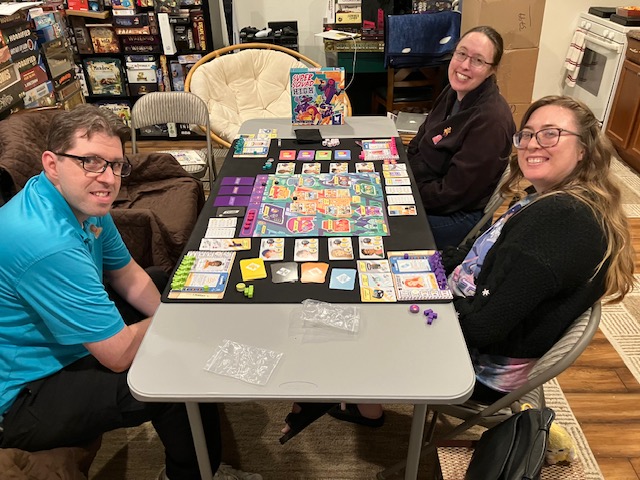
My friends all liked this game and had fun. They also liked the roleplay elements in meetups, which probably upped their score a little (most of my friends are also avoid RPGers).
We are looking at pretty much 7s across the board.
Campaign Modes
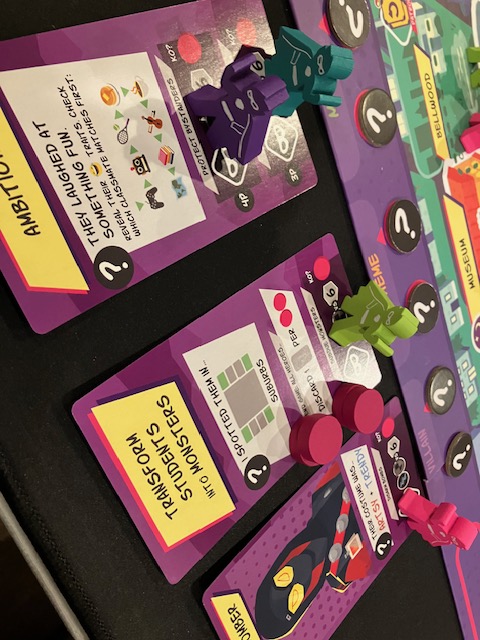
There is a campaign mode (Yearbook mode) for this game which … we didn’t play. It sounds like it might be funnish, but I think this game feels more like a lighter game. We all had fun and such, but the vibes from the game make this feel like a fun, light one-off game. It doesn’t quite feel like a campaign game? It just doesn’t look like the yearbook mode changes the game that much from game to game?
I think I am less likely to do Yearbook mode because I would do it solo, and I didn’t love solo mode.
I don’t know, maybe the yearbook mode is great. I just don’t think that’s the way my friends and I will play this. We will probably play it again, but in one-off mode.
Conclusion
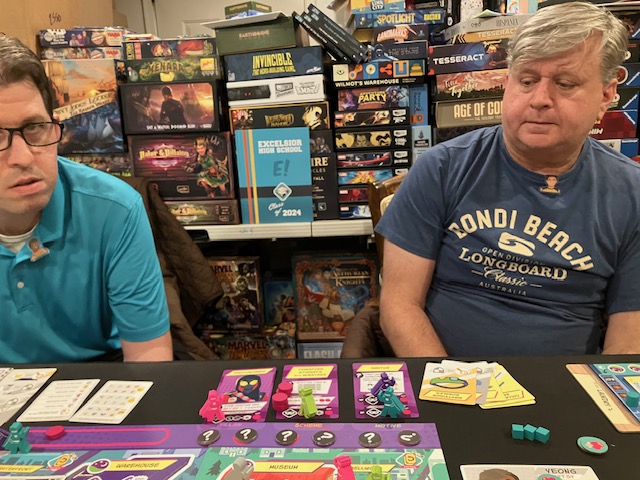
If you like the Superhero movie Sky High, with Superheroes in High School, there’s a good chance you will like this game. Even if you don’t love that theme, there’s still a fun light game here that you might still enjoy.
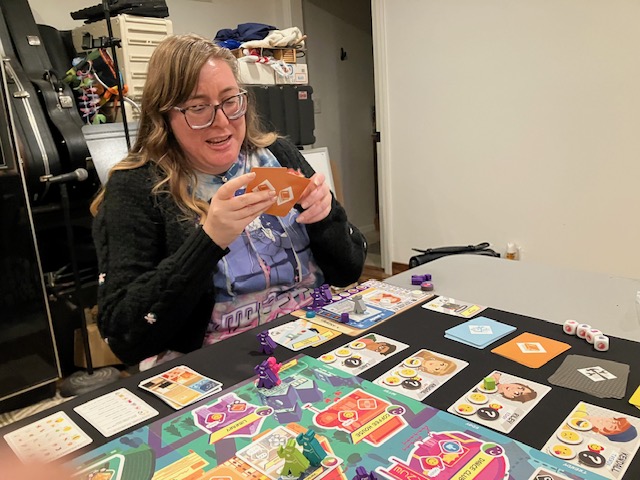
Be aware, if you do play Super Squad High, that you may or may not want the roleplay aspects of the game: make sure you figure this out beforehand, because if you hate the roleplaying/asking questions part of this game, you will hate this game! But if you know you will hate this, you can completely ignore that part and still enjoy this game.
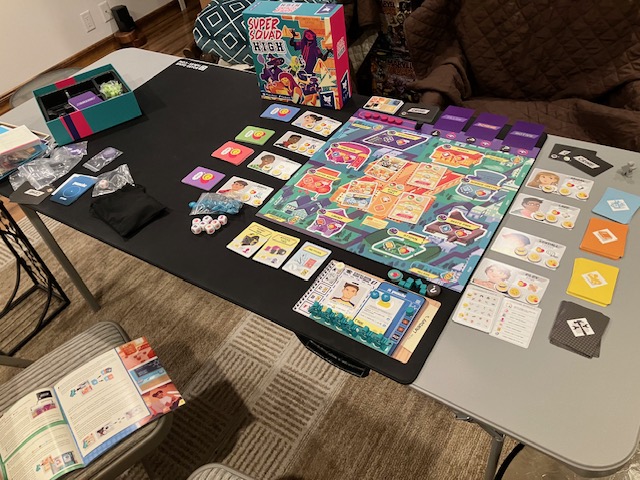
I didn’t love this game solo, mostly because it felt like it could be a bit samey from game to game. It was still fun, and it taught the game well enough for me to teach my friends: Solo game: 6/10.
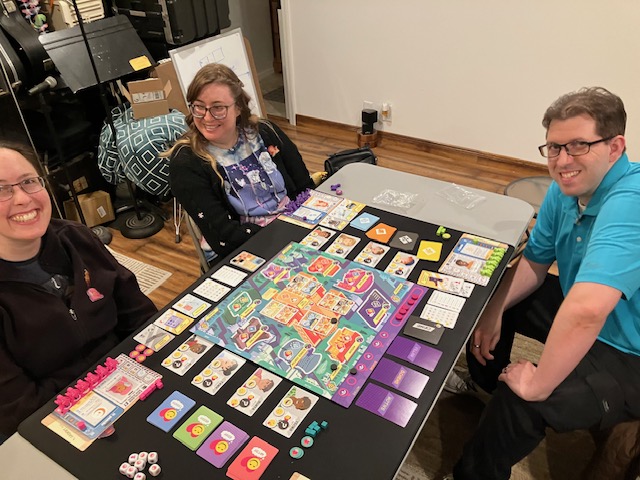
The cooperative version of this game is probably the best version: the Teamwork and strategies and discussions that emerge as you play really bring out the cooperation: I think the emergent cooperation is the funnest part of this game. All around, we gave this a 7/10 for cooperative play.
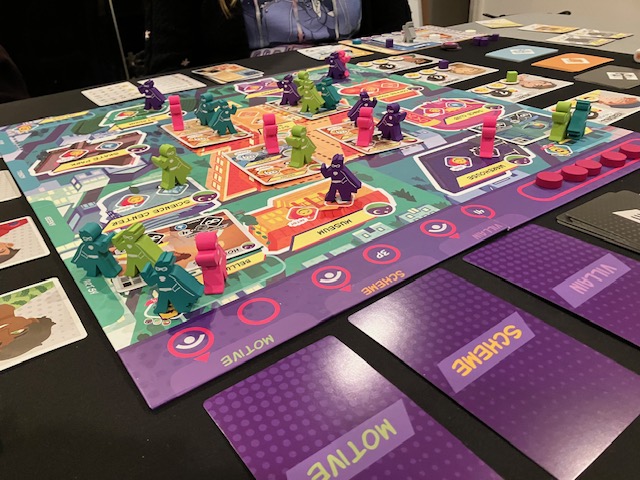
This is a pretty fun game that’s light and easy to bring to the table to have a light superhero experience. There’s a yearbook/campaign mode in the game (if you want it), but my group just liked this as an easy one-shot cooperative game.
 coopgestalt