What Vantage Is and Isn’t: A Review of Vantage

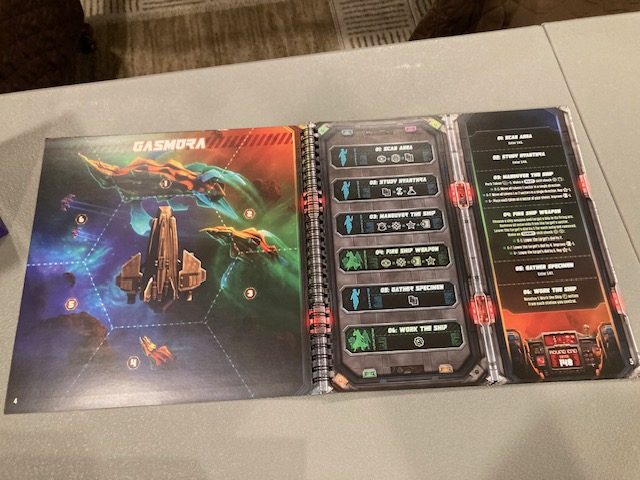
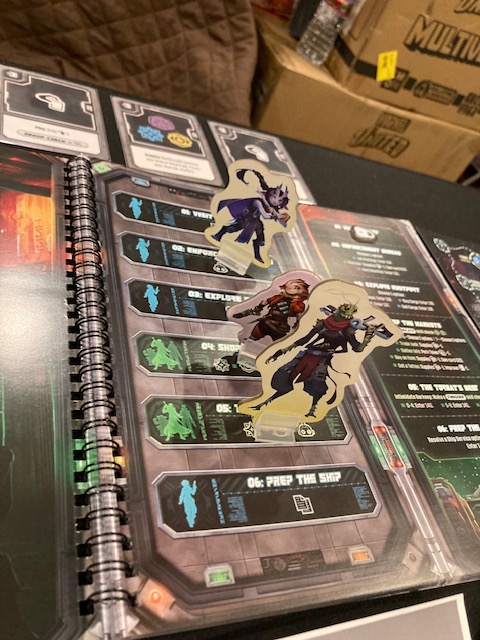
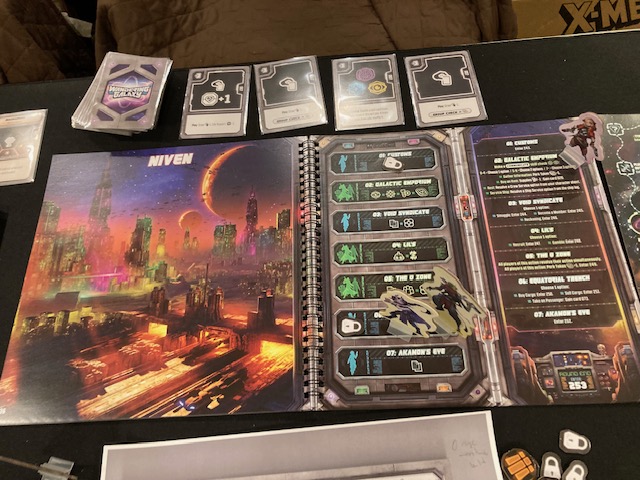
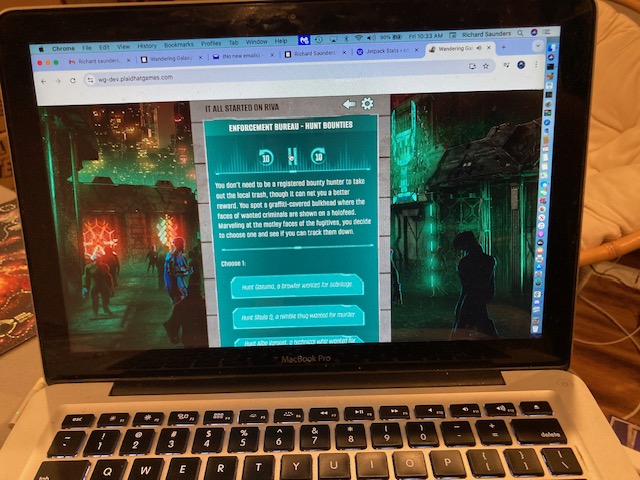
This week we take a look at a very hot game called Vantage: this is an open world game with thousands of cards! We show pictures of the game with some cards, and although they could be classified as spoilers, all of these pictures are out of context so I don’t think they are really spoilers. If you are really worried about spoilers, just jump to the Conclusion and avoid all the pictures!
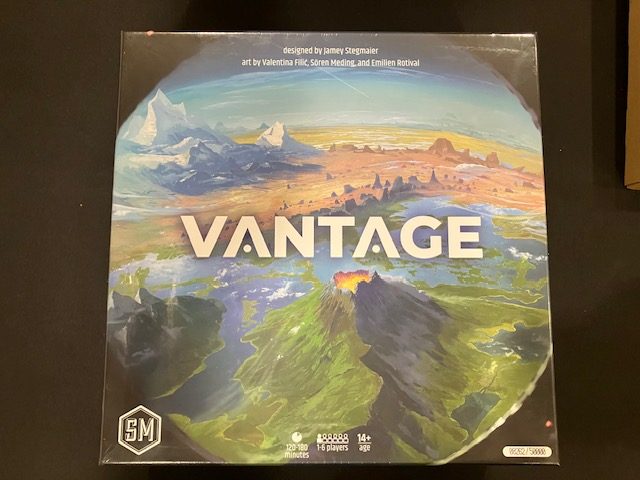
There’s already been a ton of reviews of Vantage: reviewers who got it early for free and Stonemaier Champions (members of a club who get Stonemaier games early with a discount).   I am neither of these: I am a plain Jane game player who paid full price for my copy of Vantage! I pre-ordered it from the web site like any schlub and I just got my copy about 2 weeks ago.  I am not a rabid Stonemaier fan,  nor I am not a prepaid reviewer!  I am just a guy who like cooperative games who pays for every single game he gets and never gets ANY consideration from any publisher.  So, my review may sound a little different than the others.
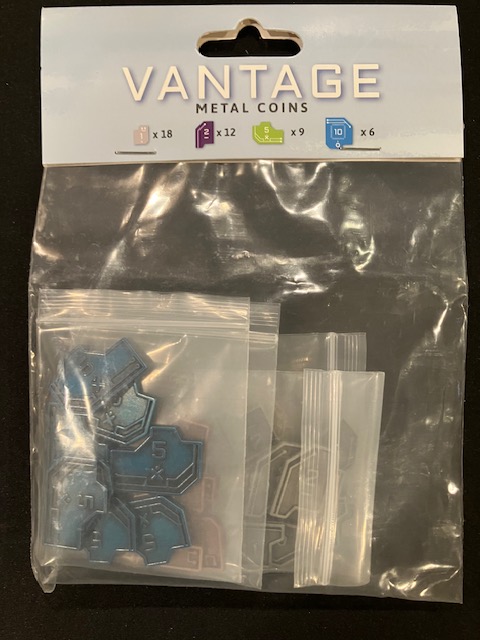
The funny thing is that I pre-ordered the Vantage coins about a year ago and they arrived a year ago.  Yes, they actually had the coins for the game a year ahead of the game itself!  That’s kinda funny.  The fact that I ordered these tells you, yes, I was interested in the game.
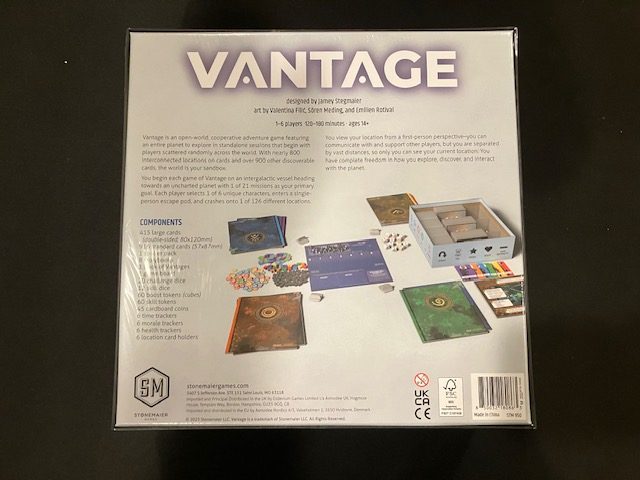
We are going to try something a little different: we are going to talk about what Vantage is and what Vantage isn’t.  Vantage doesn’t really fit directly into any mold of what other games are; it’s its own thing!  But, is it something you will want to play?  Is it something you will want to buy?  Let’s look more closely.

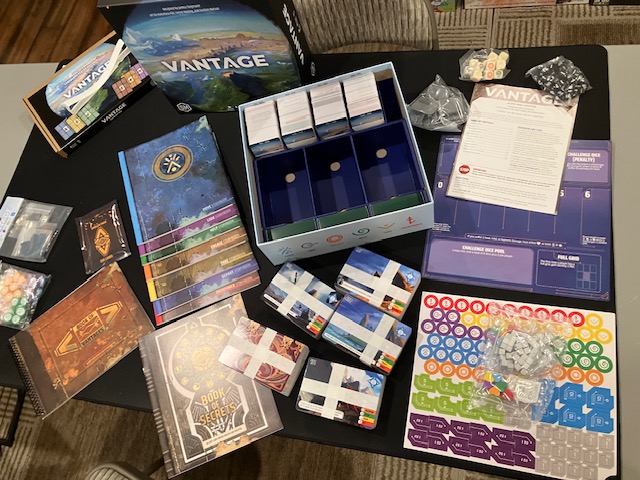
Unboxing
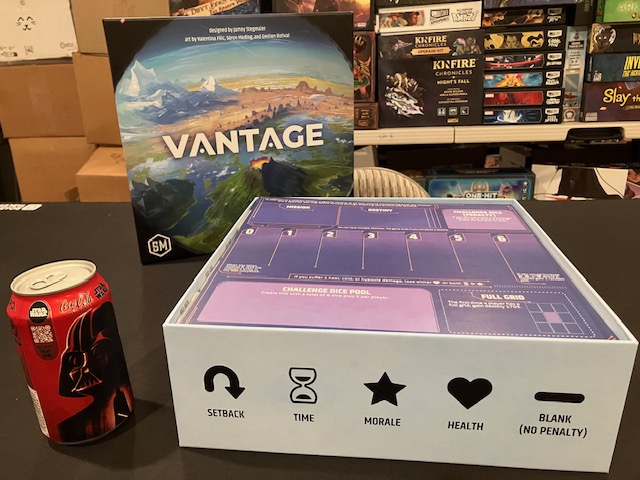
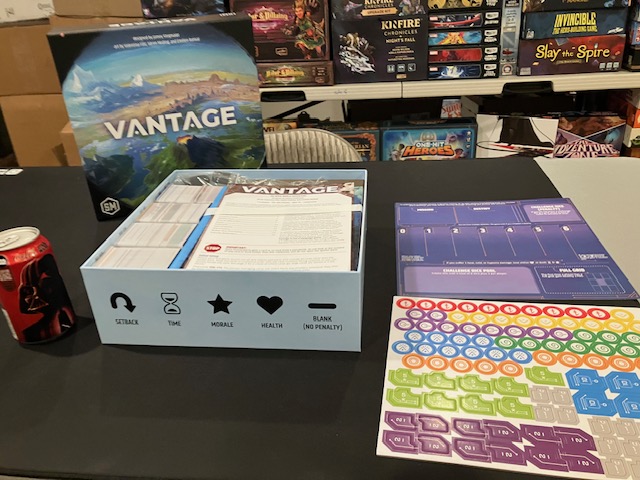
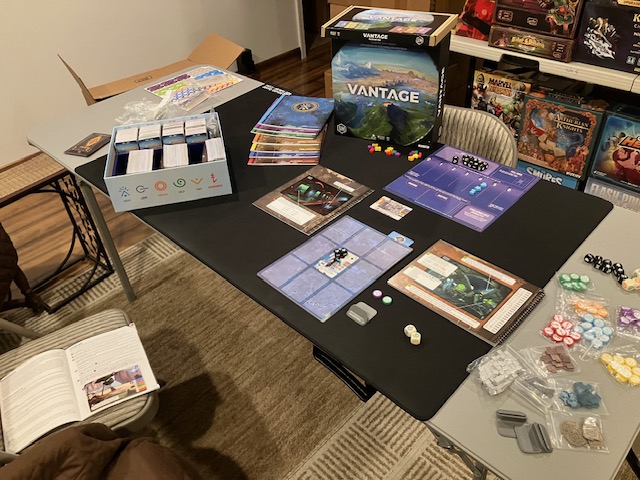
Vantage is a fairly standard sized box: see Coke Can above for scale.
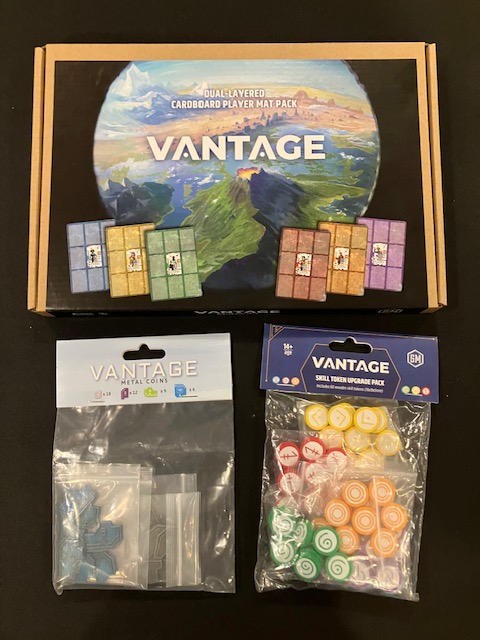
Let’s be clear: I bought ALL the extras for this game!  The wooden skill tokens, the metal coins, and the 2 layer player boards (see above).  I was very excited about this!
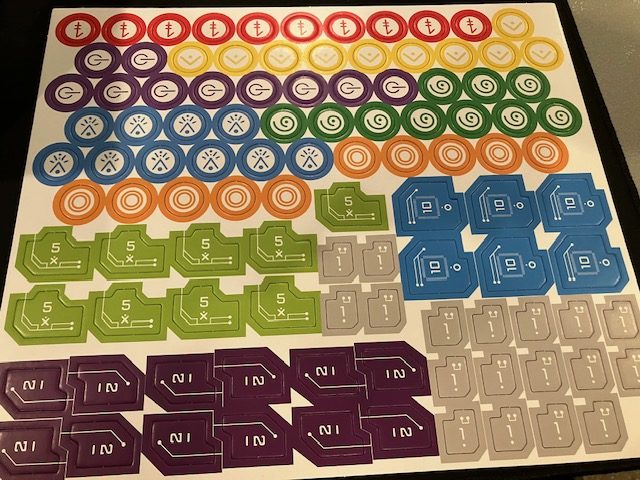
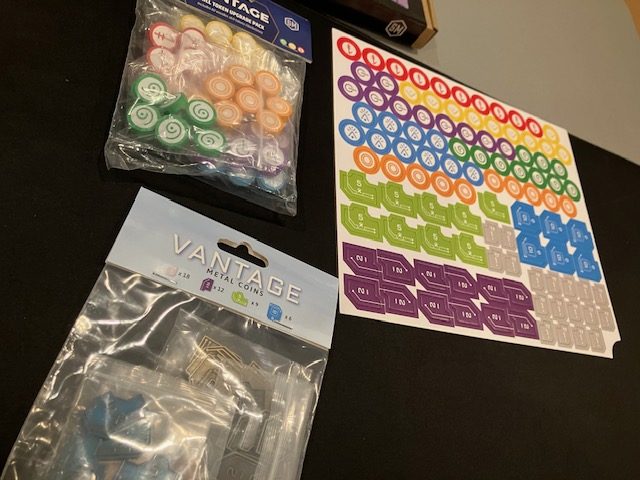
Because I bought all the extras, I didn’t need to punchout anything.  I just left this sheet untouched.
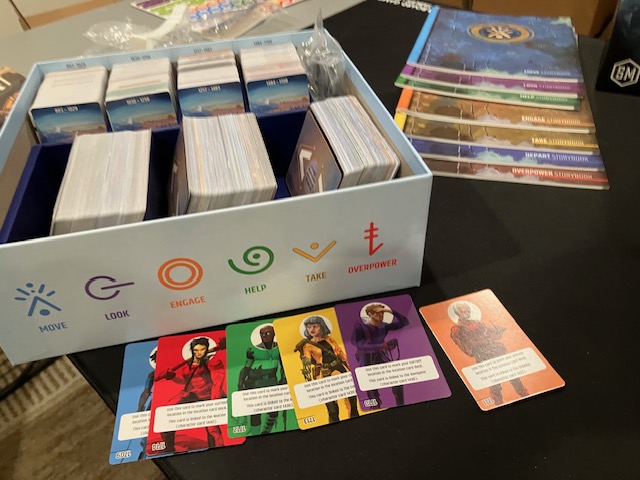
As you look at the box, you can see it’s got a lot of cards!  It’s actually pretty heavy!
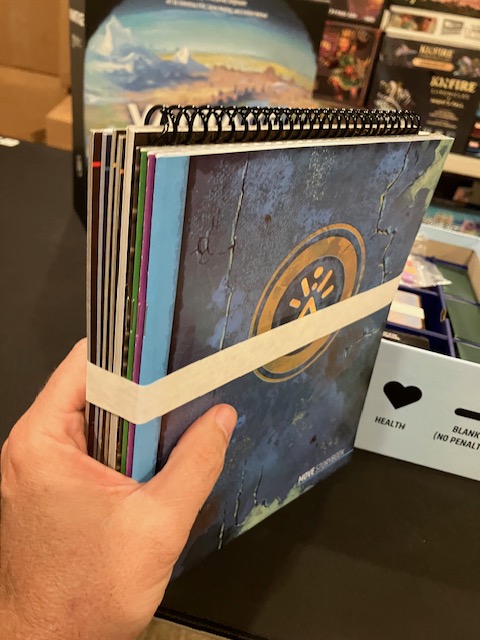
There are a LOT of books: see above.
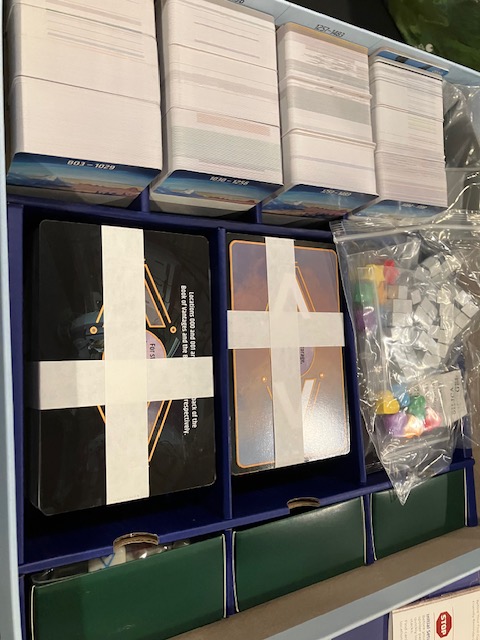
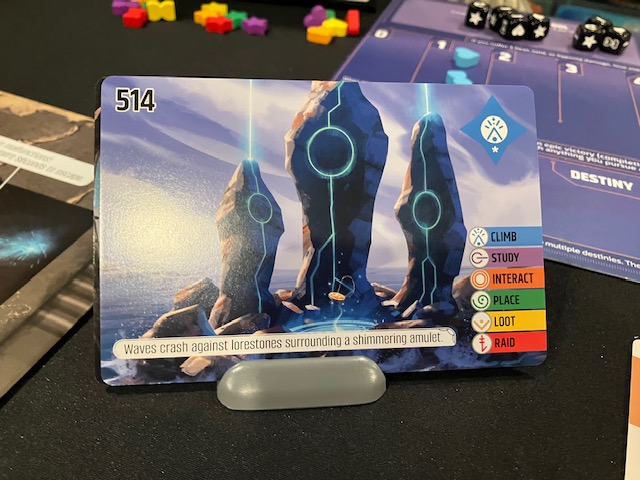
There are two flavors of cards: giant Location cards (see above) ..

And generic “little” cards which will come out as you play. Items, animals, … just different stuff that emerges with gameplay.
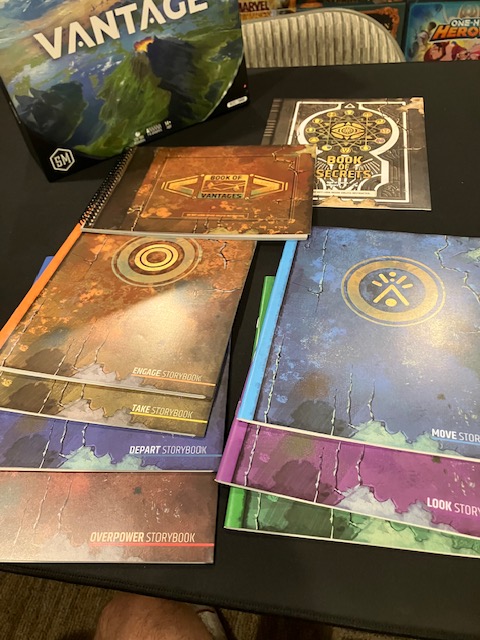
Notice just how many books there are!  They are called Storybooks: we’ll revisit that nomenclature later.
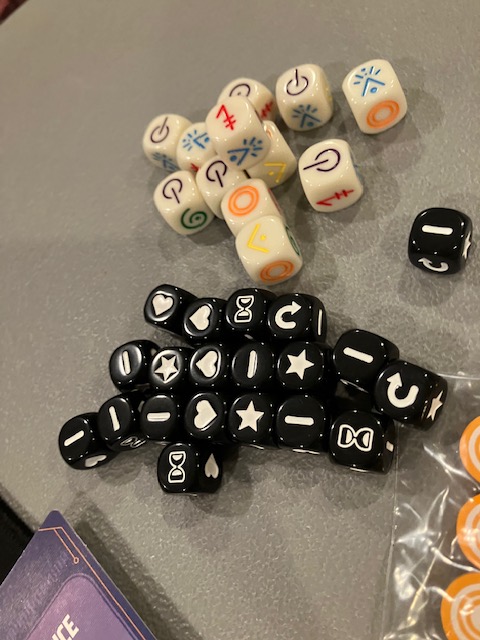
There’s two kinds of dice: Challege (black) and Skill (white) dice.
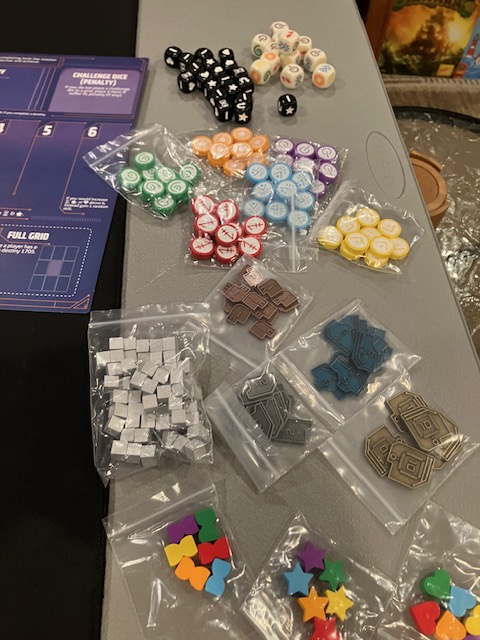
And there’s a ton of tokens!
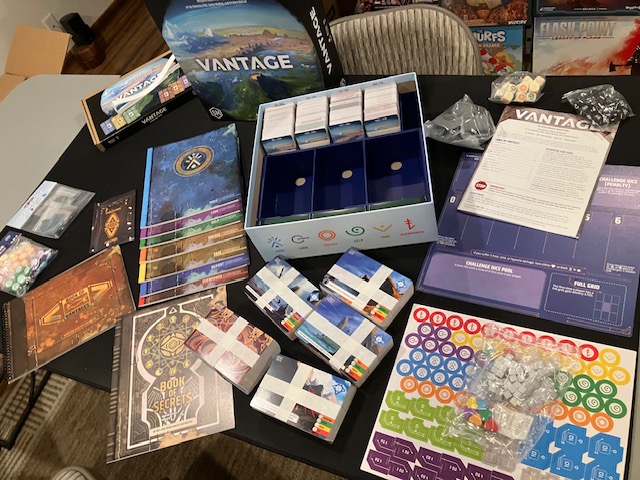
Overall, there is a LOT that comes with this box!  It looks really nice!

Rulebook
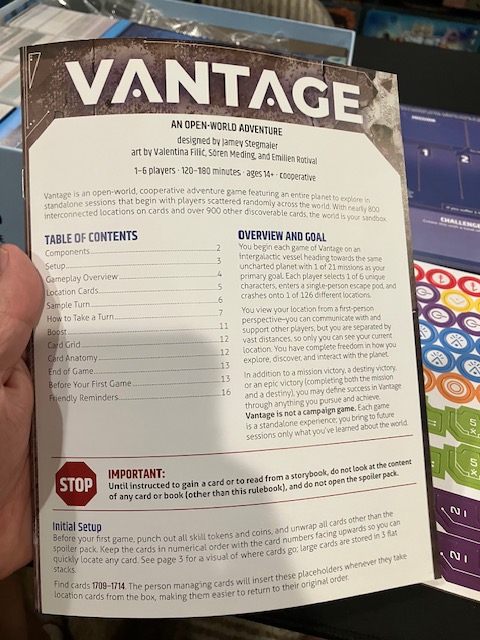
The rulebook is very good, modulo one or two issues.  The paper is a special “silky” paper that feels really nice.  Note! It has a Table of Contents!  Yay!  But no index!  Boo!
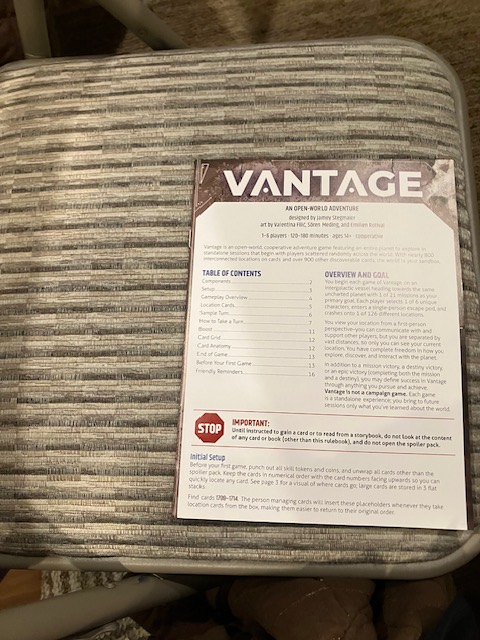
The rulebook gets a straight-up A on the Chair Test!
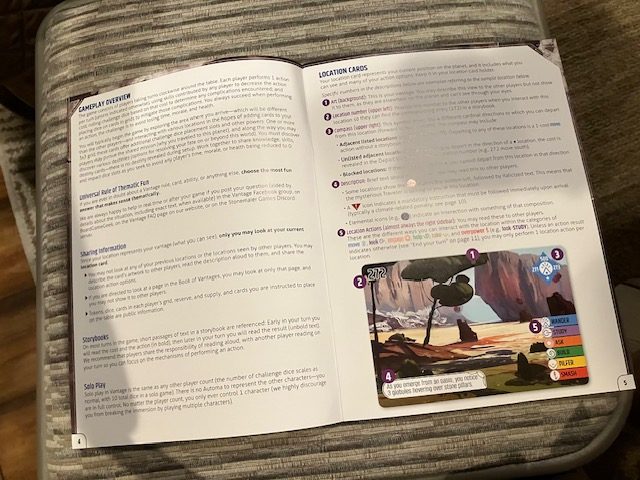
The rulebook fits PERFECTLY on the chair next to me, and it can lay open just right (see above).  The font is nice: it’s a good size (not too small, not too big) and it very readable.   It’s been a while since we’ve had a rulebook that gets a straight-up A on the Chair Test. Nice job!
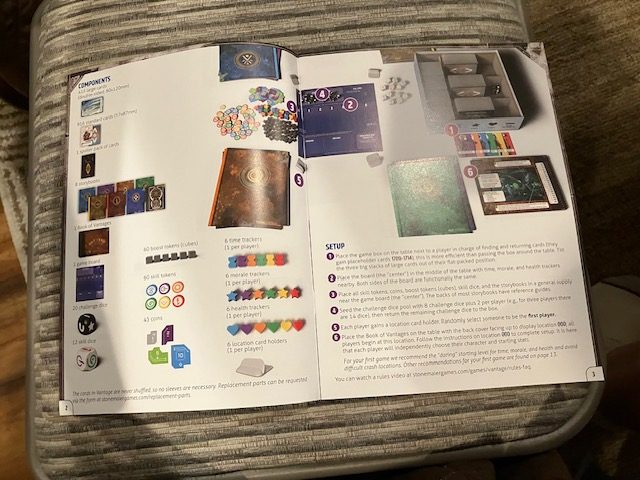
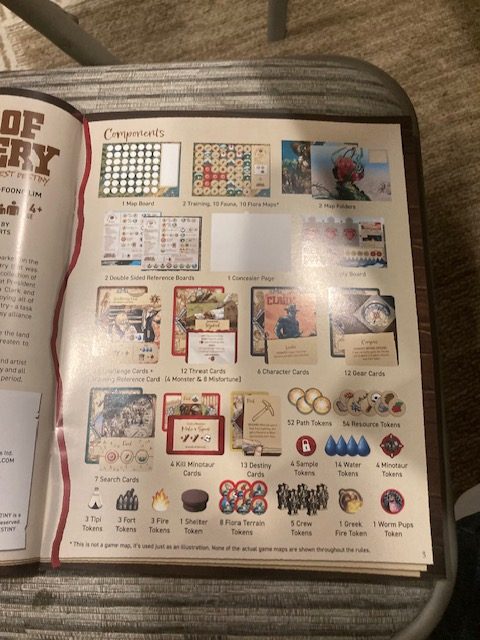
The Components and Set-Up are great: they are all on the same page, so it’s easy to correlate what things are and where they go!  Granted, Set-Up is pretty  “easy”, but this works really well. And the Components have pictures and are labelled.  Very nice!
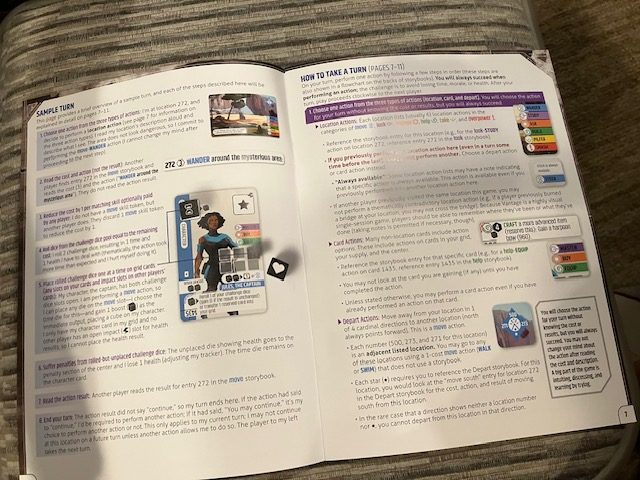
The rest of the rulebook is good: lots of pictures, lots of color to help distinguish things, and sidebars that help explain an issue (without being the only reference to that rule!).
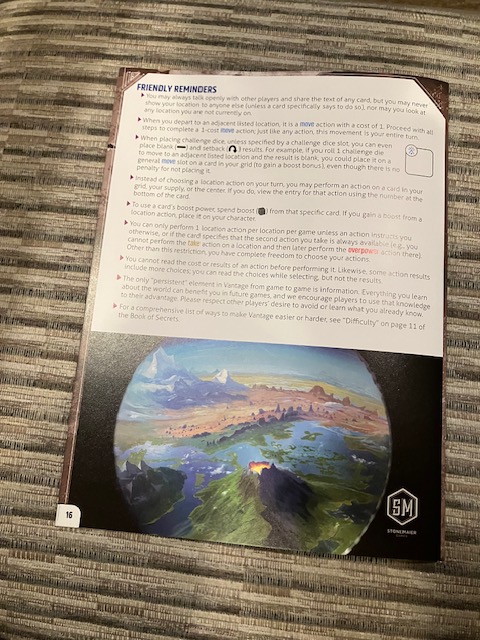
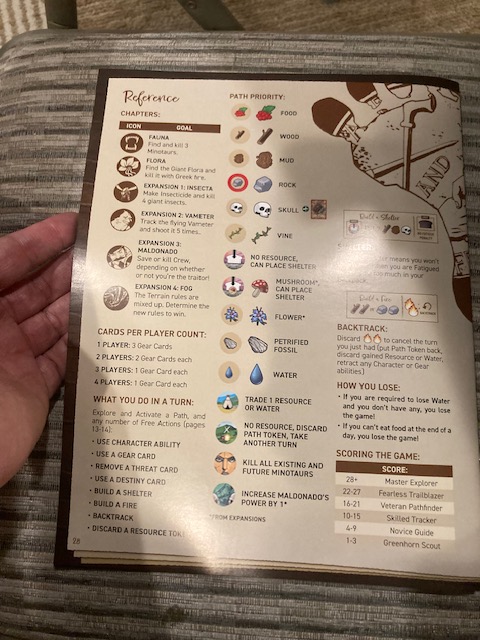
My only complaint is that the back of the rulebook doesn’t have a list of all Icons.  It has friendly reminders (see above), but I feel like that should inside the rulebook.
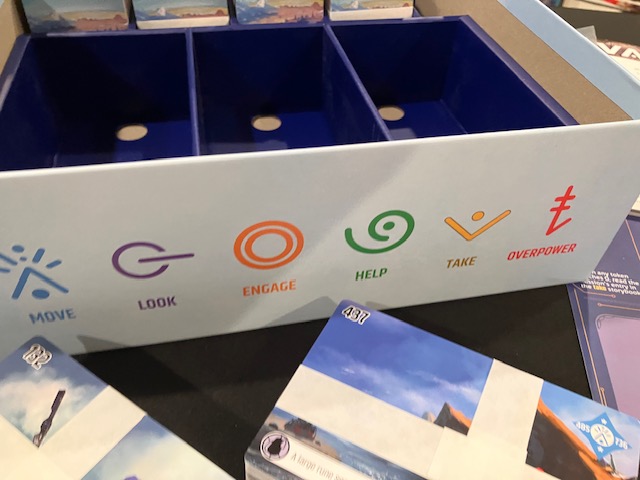
Now a lot of these Icons are on the side of the box (see above and below)
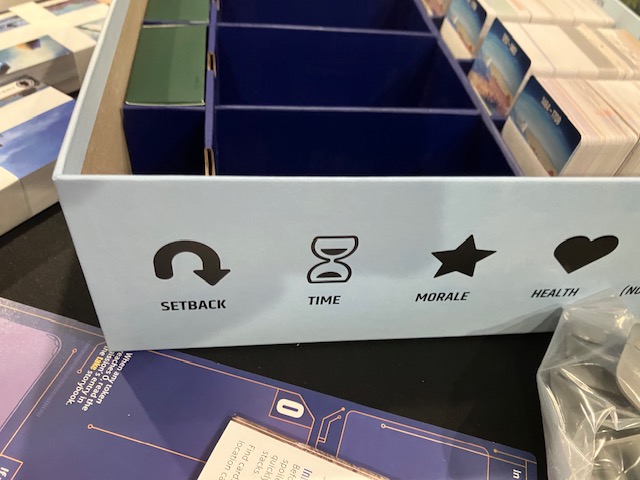
Or on the back of the books:
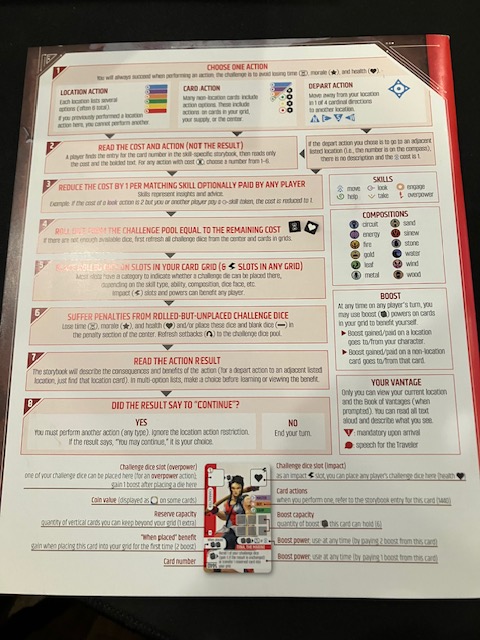
However, I was very annoyed that I couldn’t find what the little circle meant:
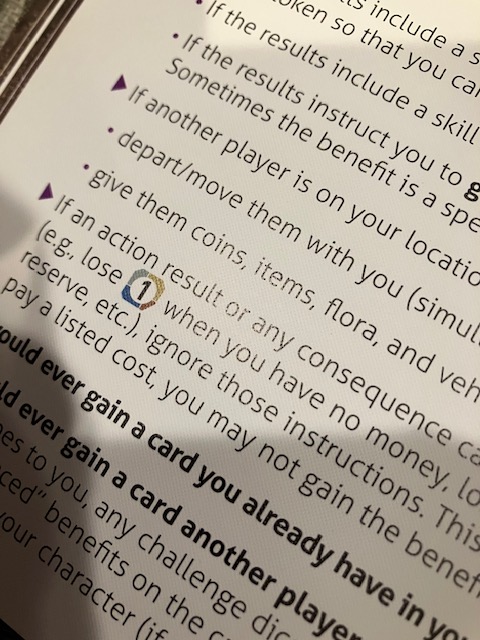
… until I just happened to find in the rulebook!  I think that means MONEY!  See, it frustrated me that I had to go searching for this.  It should have been on the back of the rulebook with a list of Icons!  I don’t know where this is defined except for the passing reference on page 10 where you have to infer the meaning!

That’s a pretty minor quibble, but it did slow me down for long enough that I was annoyed. And it really shouldn’t have been an issue, especially when the rest of the rulebook is so good!

But overall, the rulebook was very good.

What Is This?

The game bills itself as an Open-World Adventure (see the top of the page).  What does this mean?  We are going to explore this issue via what this game is … what this game isn’t !   If we hack away at the positive space of what the game IS and the negative space of what the game ISN’T, then hopefully that will be enough information for you to figure out if this is for you!

Is This a Storybook Game?
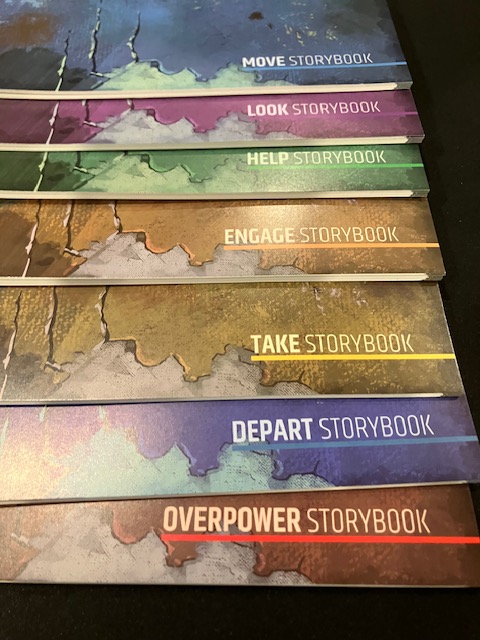
We’ve talked about Storybook games for years here at CO-OP Gestalt; we tend to love them! See our Top 10 Cooperative Storybook Games!
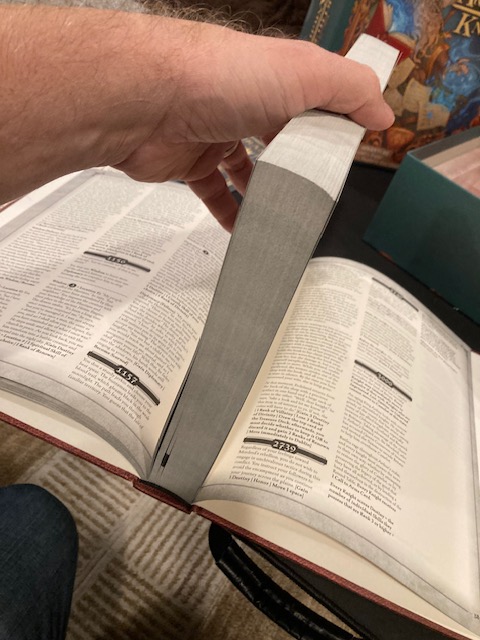
Recently, we reviewed and loved Tales of Arthurian Knights!  There is no question Tales of Arthurian Knights is a Storybook game with a beautiful hardbound book and tons of text! See above!
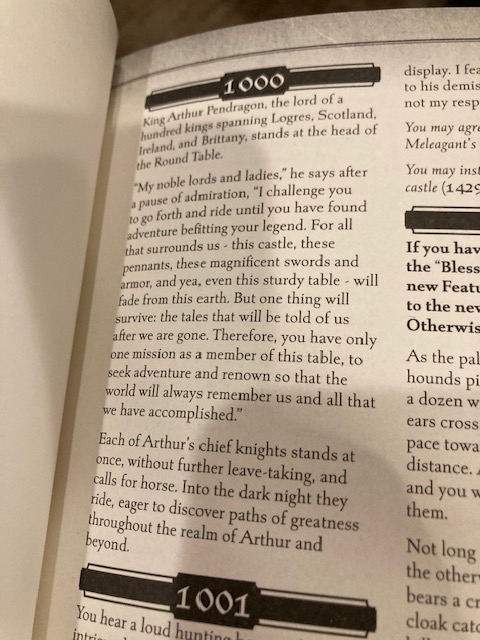
The text in the book flows and paints a picture of Arthur’s Knights! See how flavor exudes from the text above!
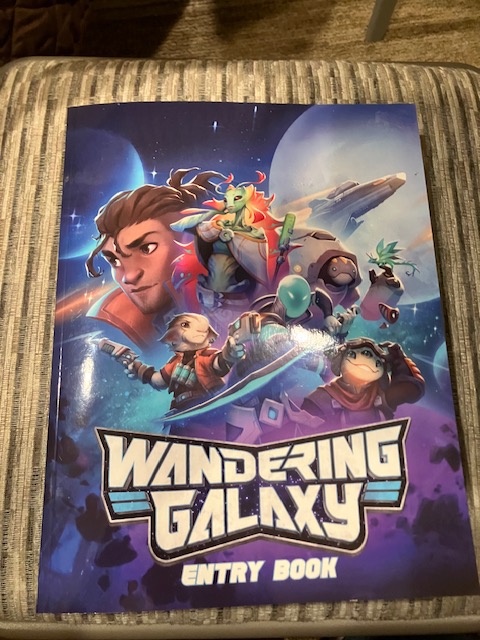
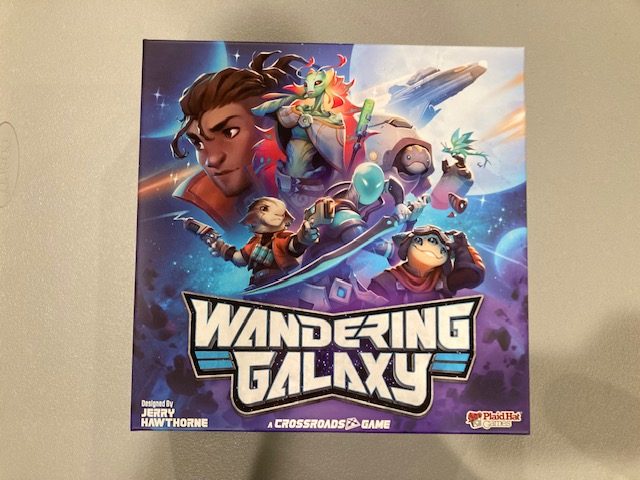
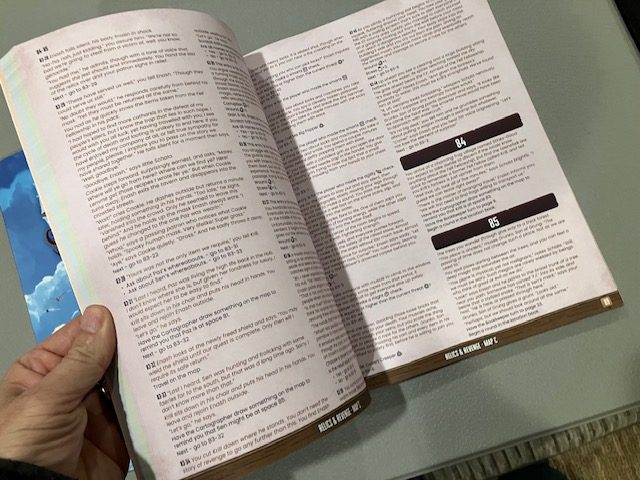
Another game that’s a Storybook game is Wandering Galaxy (see our review here).  In fact, the recent Kickstarter included two ways to enjoy this Story! On way is a full text experience from the entry book (above and below)!
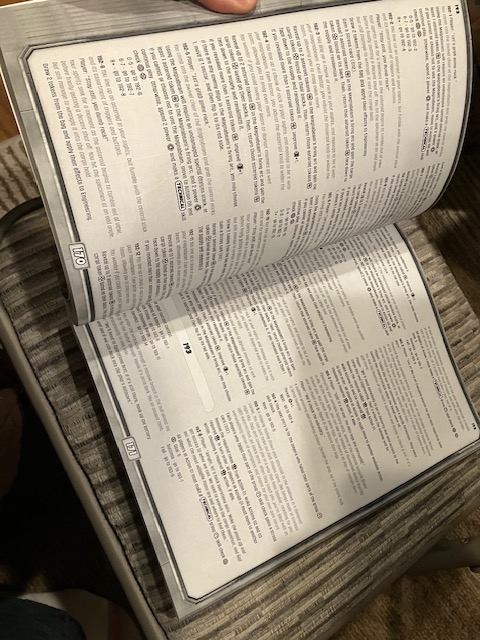
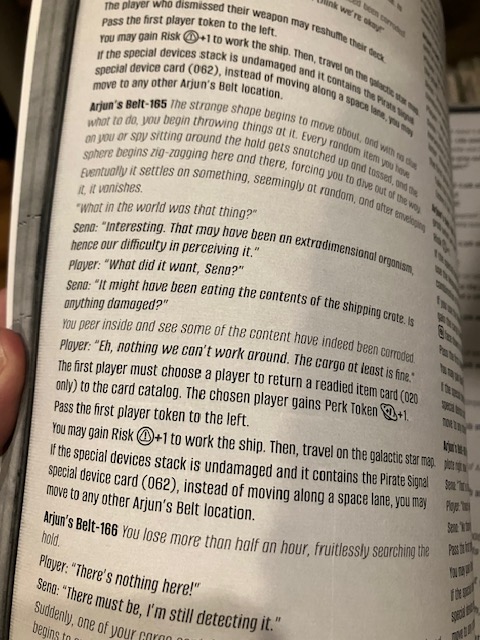
See more flavor exude from the text above!
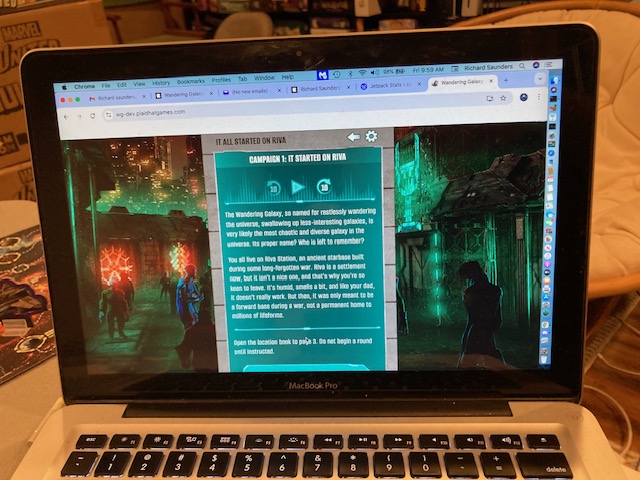
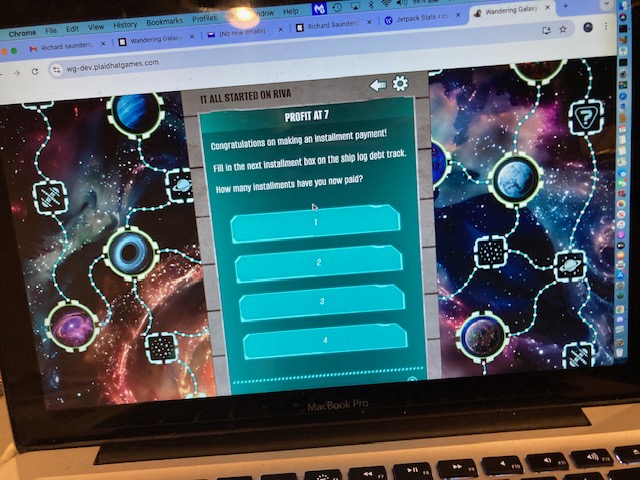
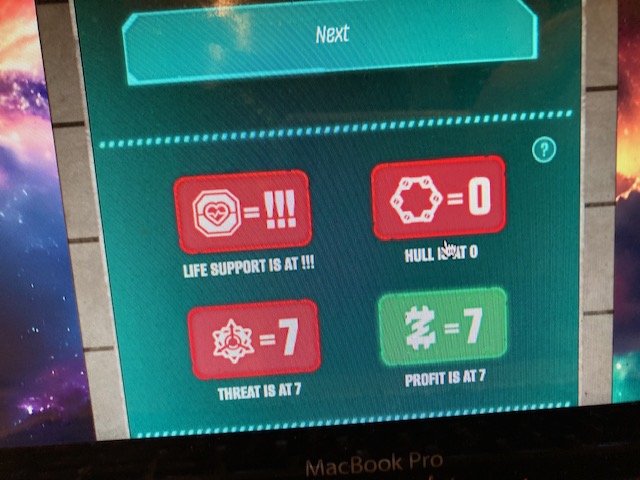
However, you can also enjoy the story text is from the app: it shows the story, but also has Voice Actors read out the text!  But there’s still a lot of flavor! (And silliness)  It’s very … flavorful!

Why am I going into so much detail about Storybook games?  Because I think Vantage is both a Storybook game and NOT a Storybook game!  It depends on how you look at it! What do I mean by this?
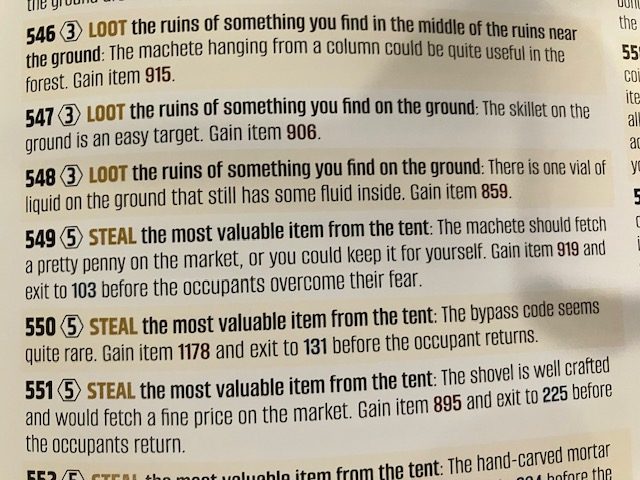
Many, if not most entries in the Storybook, are very very terse; almost like directions.  See above for examples. There’s not of flavor or story in this text!  Sure, there are entries with more flavor and story, but it feels like most of what’s in here is more directions than story.  I struggle a little with the appellation Storybook when that’s not much story.  That’s why I think this ISN’T a Storybook.
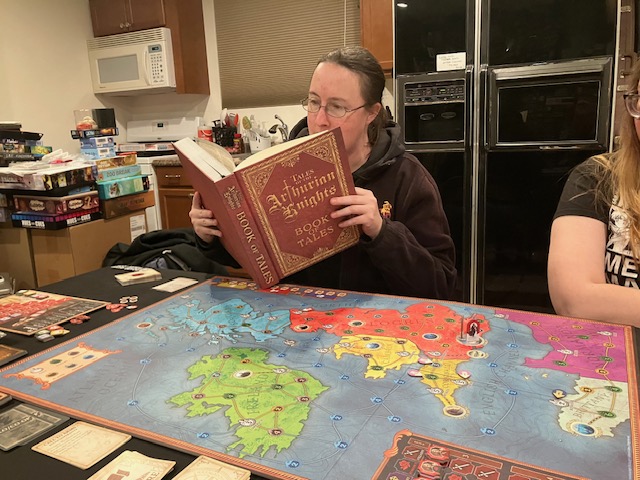
My friends LOVE Storybooks and text (see above), and Tales of Arthurian Knights is probably their favorite game of the year!  There is so much flavor, so much story, so much … flowery text in the storybook!  My friends LOVE this type of Storybook!
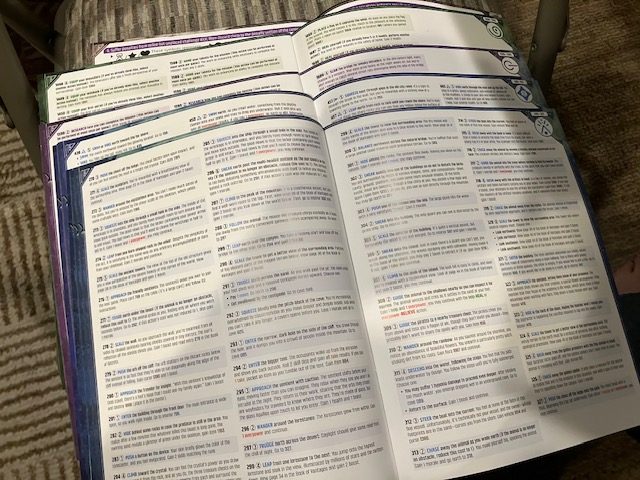
Before you go off and write me hate mail, I realize that a lot of people don’t like lots of flavor or Story text!  Some people prefer to just get to the game!  You could argue that this is just a very concise Storybook, but it’s still a Storybook!   That’s a very reasonable argument!

But I wanted to point out that some people would see the lack of flavor as a reason NOT to call this a Storybook game.  
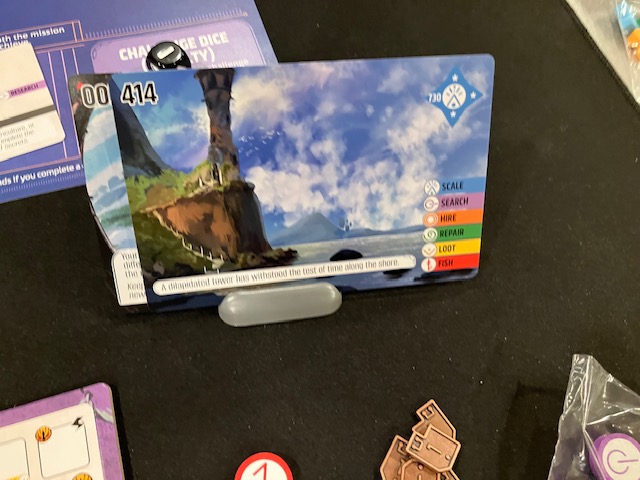
It’s also worth pointing out that a lot of Story in Vantage comes from the Location cards!  As you explore the world of Vantage, these little scenes truly paint a picture of what you see!  There’s no need for flowery text in a Storybook because you have beautiful images to tell the story!  Who needs flowery text when a picture paints a thousand words?
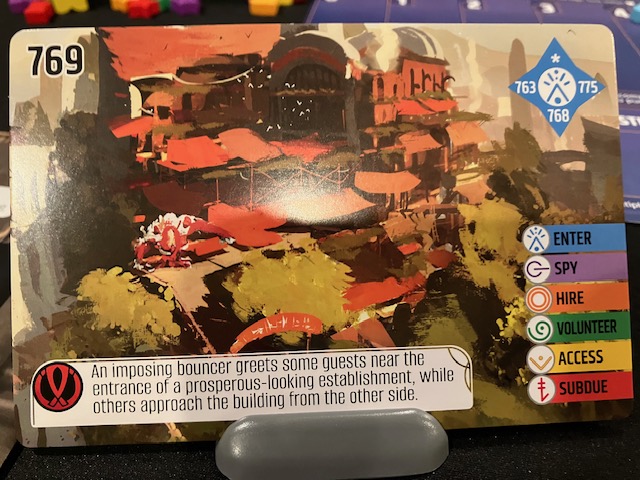
The Location cards are, strictly speaking, distinct from the Storybook.  You could argue that because the Location cards are technically not part of the Storybook, that makes the argument that the-Storybooks-aren’t-Storybooks even stronger!  The story is REALLY on the Location cards, not the Storybooks themselves!
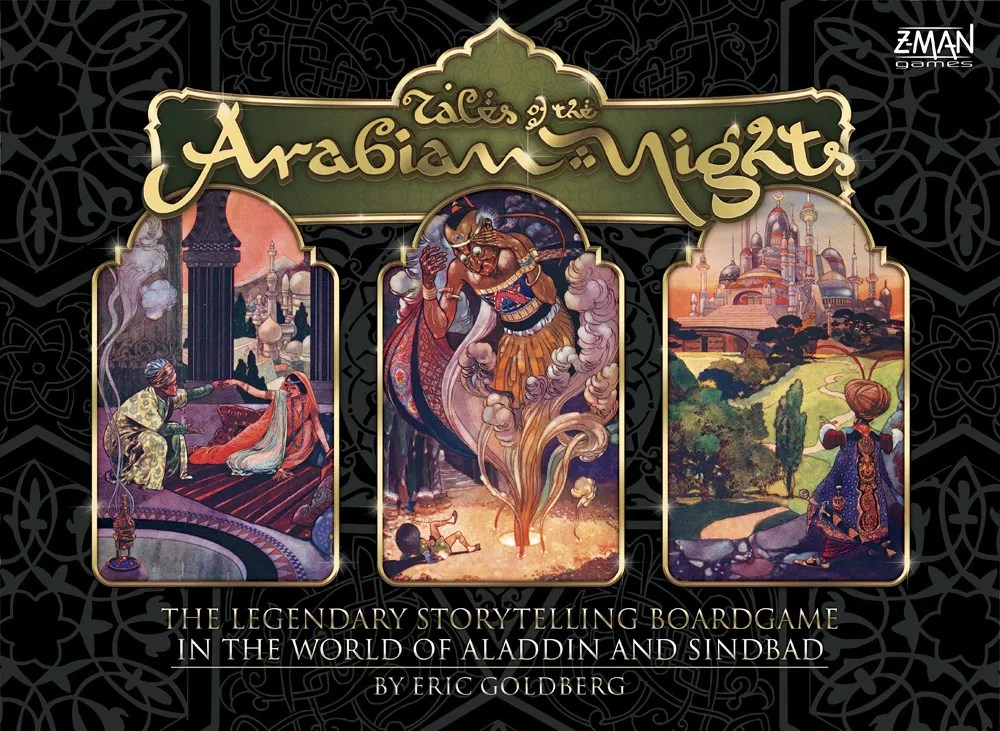
That’s a silly argument because Vantage as a full game includes lots of story.  But this is why I wanted to talk about why you could consider Vantage’s  Storybook NOT a Storybook!  These distinctions helps define what this game is.  There’s still story, but arguably it’s distributed among the cards and Storybook.  The Storybook is NOT the traditional Storybook of Tales of the Arabian NightsVantage’s Storybook is … different: it’s more like directions.

If you love flavor text and like reading flowery text aloud (like my friends do with Tales of Arthurian Nights or Wandering Galaxy), then Vantage maybe isn’t the game you are looking for.  But, you may still like the way the story comes out in Vantage (with the art and Storybook giving directional text).

Is This An Adventure Game?
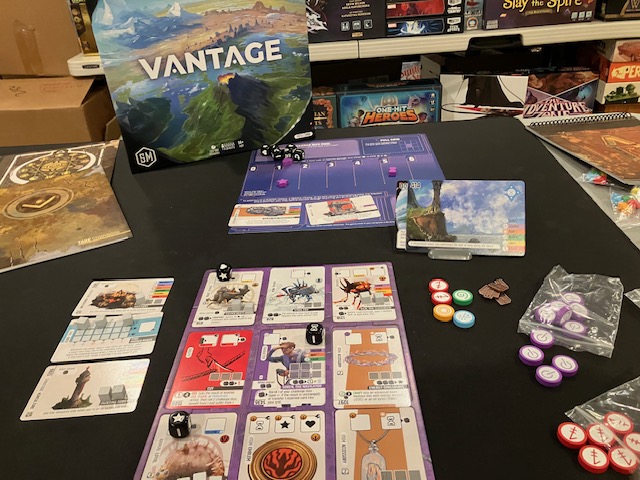
On the surface, the obvious answer seems “Yes! Vantage is an adventure game! Players explore and go adventures and interact with the objects/stuff around them!”
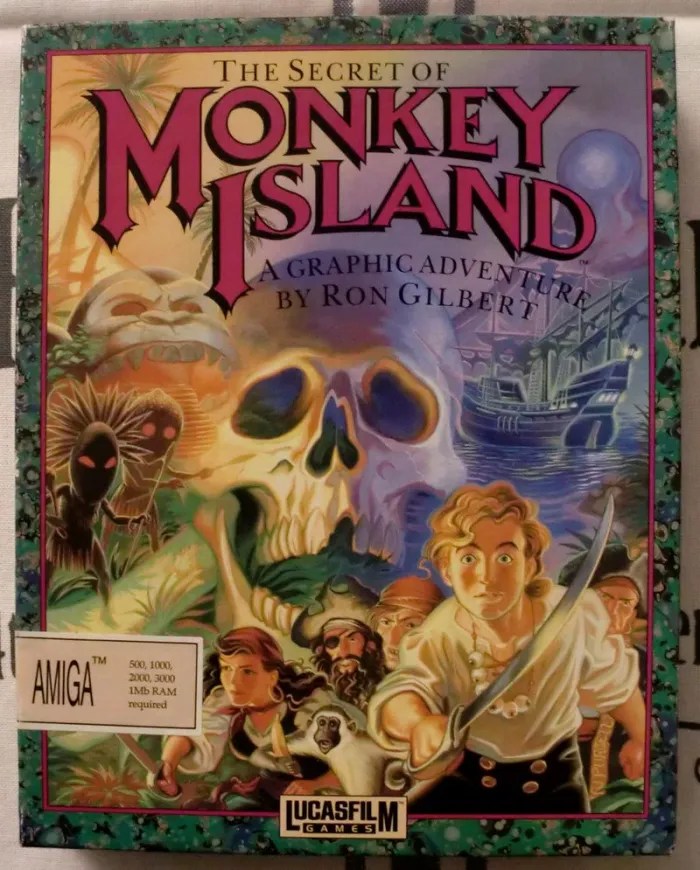
This is basically the same definition we gave for Point-And-Click Adventure games in our Top 10 Cooperative Point-and-Click Adventure Games!  

“What makes a board game a point-and-click adventure game? For us, it breaks down into three fundamental elements:

  1. You move along in a story!  You are part of a story: this is interactive fiction!
  2. You explore a world!  The game is about exploration and discovery, as you “move” from location to location.  In the point-and-click video games, you could “point-and-click” to move around a map!
  3. You solve puzzles by combining objects!  You need to find objects and combine them in unique ways to solve puzzles. In the point-and-click video games, you would “point-and-click” on items/verbs to combine them!”
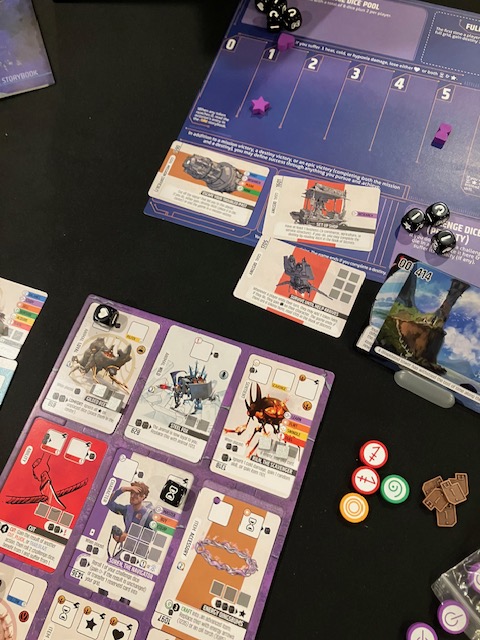
On the surface, it looks like Vantage meets these criteria … because it mostly does.  But let’s look deeper into the interactive fiction portion: although there are stories that emerge as you play Vantage, it’s not “quite” the same as interactive fiction where there is an overall story./puzzle you are completing.  This point can be countered by pointing out that there are many many stories in Vantage waiting to emerge!  That’s a fair point, but it’s worth pointing out that there’s not some overall story to this.  If you want a novel or plot to emerge (like The Secret of Monkey Island or Thimbleweed Park), Vantage is not the same thing.
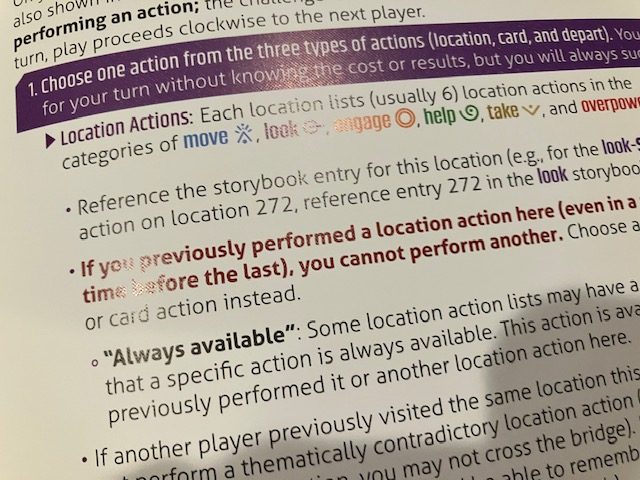
The more crucial thing is the rule that you can’t interact with a Location more than once!  See the rule from the Vantage rulebook above!  In most point-and-click adventures, it’s fundamental that you can go back and revisit a Location and interact in a different way or multiple times or just look everywhere!   This particular restriction seems … strange.  It’s one major reason I would call this NOT an Adventure game.  Or at least not a point-and-click Adventure game?  Maybe that’s the difference?  

Maybe we should revisit our definition of point-and-click Adventure games and add something like “You can generally interact with the environment over and over“.  (And to be fair, there are places in Vantage where you do get a few extra chances to interact with a Location, so don’t go sending me hate mail).
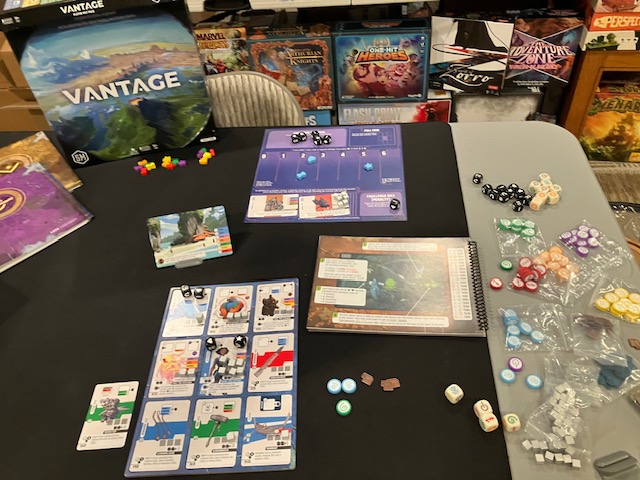
So, this is an Adventure game, but maybe not fully a point-and-click Adventure game?

One other thing also marks this down a little from the Adventure game for me: the exploration.

Is This An Exploration Game?
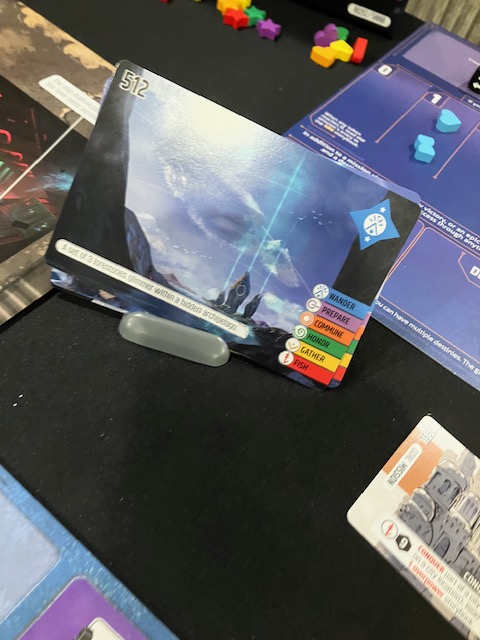
To say this isn’t an exploration game is crazy!  Players wander!  Players interact with new places!  How could you claim Vantage is not an exploration game?

Consider Earthborne Rangers: a prototypical cooperative exploration game where I joke it’s a 4x game: Explore, Explore, Explore, and Explore! See review here!
In Earthborne Rangers, you can play over and over and over … and come back to where you left off!  You have a map, and you get a feel for the world!  There’s a lot of adventures in this world … just like Vantage!  Like Vantage, you can keep coming back over and over and see more of the world!
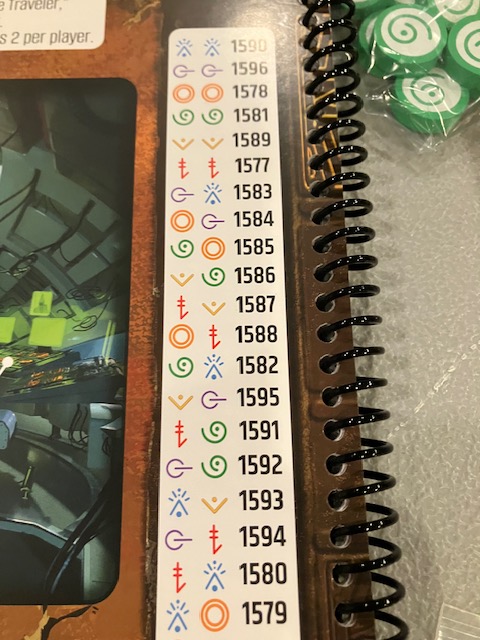
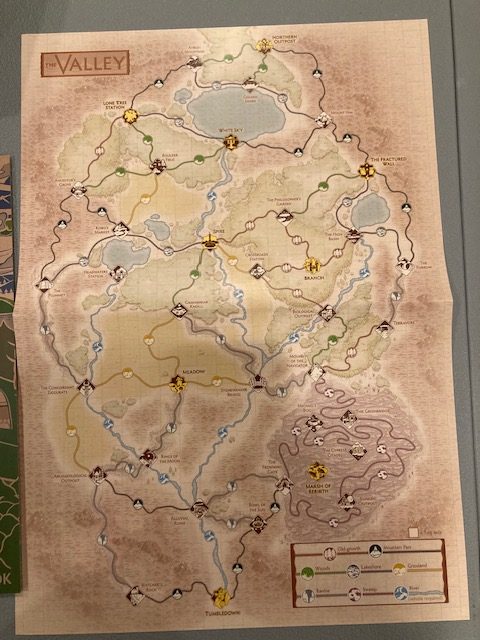
Vantage isn’t  a campaign.  You just crash land on the planet every time at a different place: see the chart above.   Every game is different, as seeded by the chart above.

So I finish a game of Vantage.  And it’s over.  My progress is essentially lost.  In Earthborne Rangers, I can continue where I left off and keep exploring.   That’s the difference; your exploration is lost in Vantage (but see below).

When I say I want to explore a topic, when I want to explore an issue, when I say I want to explore … I don’t want to lose all my progress!   Lack of progress can make the exploration feel pointless.   If I don’t have any vested interest, if I don’t have a desire to continue, it doesn’t feel like exploration, it just feels like random-stuff-happening-to-you.  And that (admittedly subtle point) is why the exploration in Vantage may not feel like exploration.
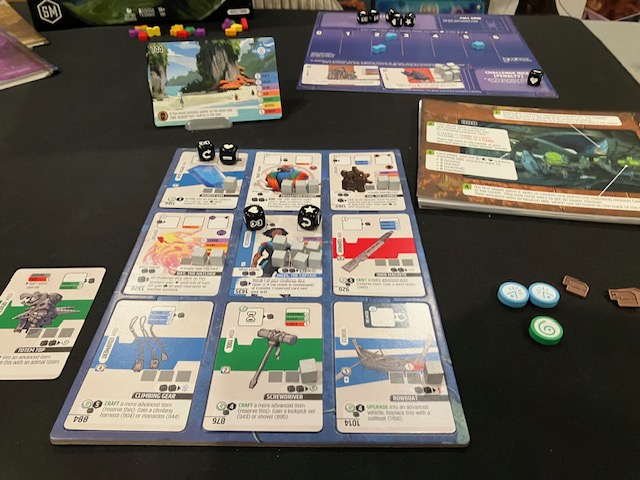
My first solo game of Vantage ended in a win… it was fine!  But it felt vaguely unsatisfying as “Well, I explored this world, but so what? I have no idea where I was or what I was going! I may never come back this way again, so who cares?”
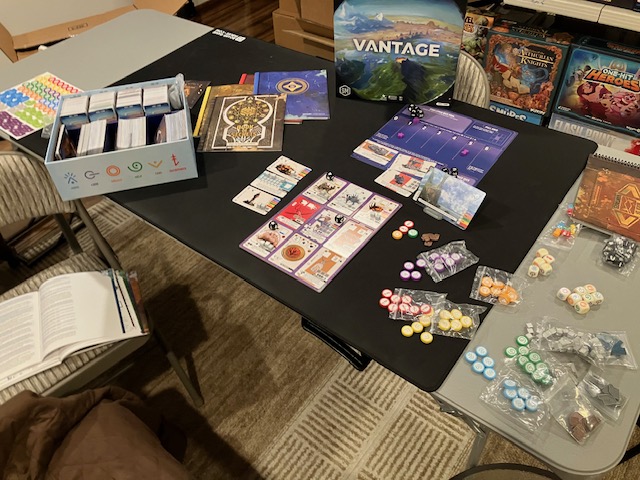
This unease went away a little when I played my second solo game: if you just take the game for what it is, as a carpe diem game and just enjoy it for what it is, then it’s a lot more fun!  This isn’t a game about trying to explore and keeping track of this planet, you just make decisions and live with them!  

Of course you explore when you play Vantage, but it’s not the type of exploration that persists from game to game.   But see below.

Is This a Campaign?
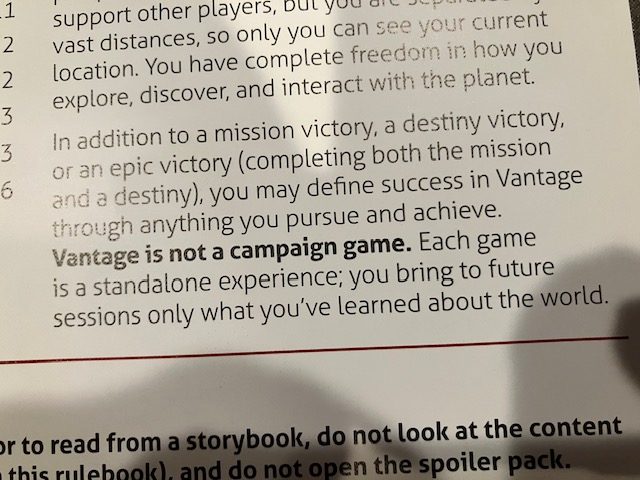
The rules state very clearly that this is NOT a campaign game.  See rule above!
If you play this sporadically and infrequently, then this is absolutely not a campaign.  There’s no memory of previous games.
But what if you play just enough that you start to remember things?  Then is it a campaign game because you can take advantage of what’s you’ve seen before!   Stated in a more mathematical way, as the number of plays going to infinity, this becomes a campaign game!  

I don’t know if you remember Dollhouse; it was a TV show where dolls (people) were wiped of their memories and implanted with new ones weekly. Over time, some of the dolls started to remember what they did in previous runs … and that’s kind of what Vantage feels like over time.  You are a doll from Dollhouse, and some of those implanted memories … stick.  I don’t know of any other game like this;  It’s a very different way to look at a game.

Vantage isn’t a campaign game.  But over time, it can become one.  Sorta.

Starfleet Mode
After my first solo play, I was a little depressed.  I liked this world!  I liked the pictures in the game!  I liked the basic gameplay!  And yet, all the exploration I did was lost.  All that work, gone.  In a later game (I want to say it was my third game), I got to a place where I could keep exploring for a while … and that was cool!  I like being in this world!  But whenever I finish a game, I think “I’d really like to come back to where I was and continue exploring and get to know this world better!”  I get a little depressed when I did all that exploration … for no reason?  
What I want is a Starfleet Mode or Exploration Mode or … frankly, a Campaign mode.  I understand that the game is all about getting your nine cards in a grid, and once you do that, the game kind of ends.  Maybe there could be a way to “continue” the game; maybe you just lose some of your cards and continue?  
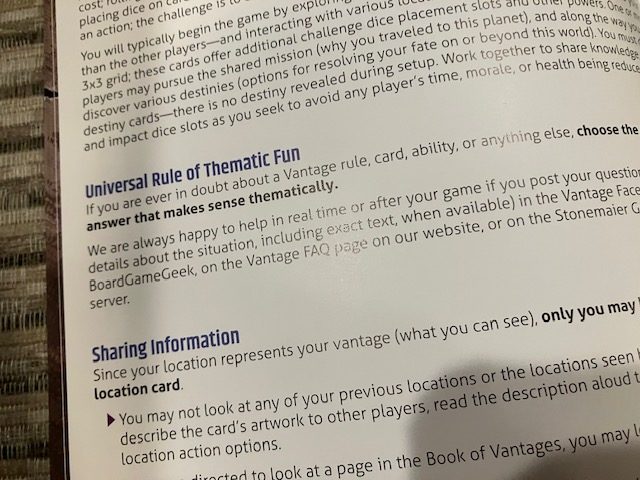
The rulebook is very “open” about how you play the game, from the Universal Rule of Thematic Fun (see above), to victory conditions even being kind of what you want!  It’s very open.  But I wanted a more systematic way to explore this world!  Every game starts fresh with you crash landing on a new place on the planet!    Sure, you can make up your own rules for a Starfleet Mode (My current set is: keep all but three cards and keep exploring, but get rid of your old destiny), but this feels like something we should more direction on (from the rulebook).

I want to continue exploring this planet in Starfleet Mode (my own term, it basically means  Campaign Mode) but it kind of bugs me off that I don’t have a systematic or defined way as defined by the rulebook.

Solo Mode
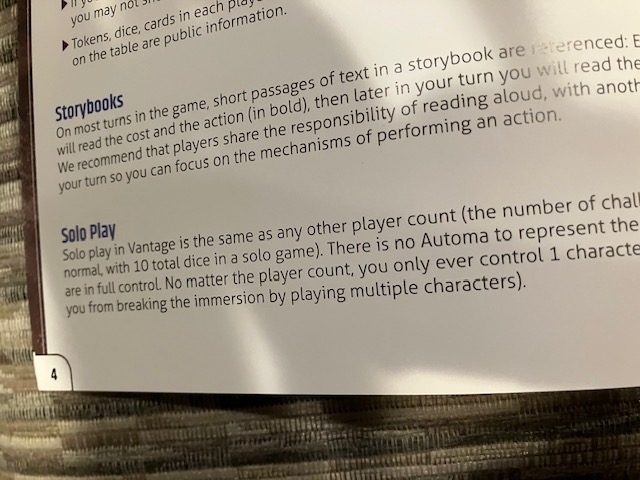
Vantage plays well solo: the rules are very well-defined at the bottom of page four.  (Thank you for following Saunders’ Law)!
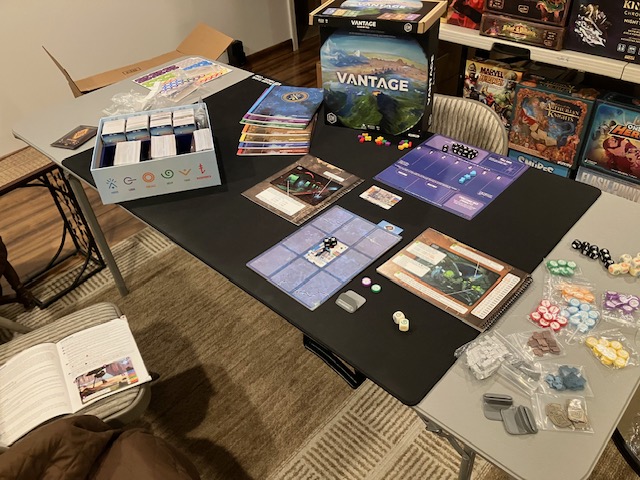
My first three games were solo games; I think it’s very important to play solo before you teach others.  There’s just enough rules that it’s better to have a sense of the game before you bring this out to a group.  Luckily, the solo mode is easy to get into and learn the game.
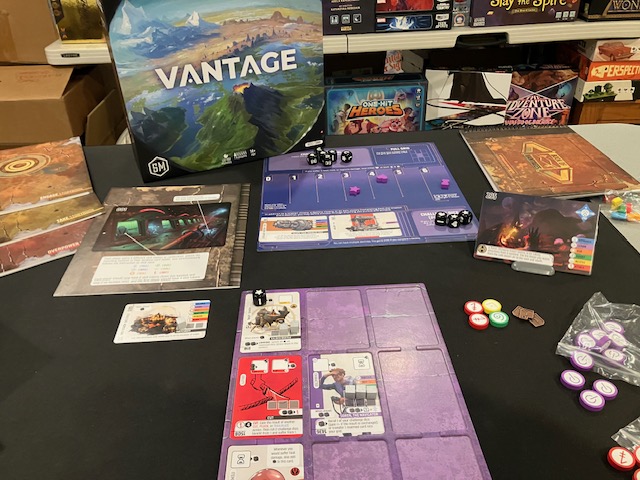
My first solo play left me a little … depressed.  I wanted more exploration, but I felt a little unsatisfied that I lost all the exploration I had done.   After thinking about this for a few days, I came back and played my second game.  This time, I was in carpe diem mode: I just played, made decisions, and took the consequences of my actions without caring too much.  I know I probably won’t come back to this part of the world anytime soon, so I just enjoyed what I was doing.  And my second game was much more enjoyable.  But I feel like I almost had to get depressed in my first game to appreciate what this is and what this isn’t.

A third solo game had get to do a little exploration.  And after my third game, I realized that every single one of solo games was VERY DIFFERENT.  I explored more Locations in some games, I interacted in others, the items I got influenced more what I did in other games.  That’s quite an accomplishment for a game! 

To teach the game: absolutely play this solo first, then bring this out to your friends.  Do I like this game enough to continue playing it solo?  Maybe?  If you enjoy the carpe diem flavor of this, where you just enjoy this game for what it is, then I think you will love the solo mode!  But, if you are like me, and wanted more persistent exploration, then you may feel a little unsatisfied.

I think a Starfleet Mode would make me want to play this again solo MUCH MORE.  Sure, I can make my own rules for that, but why aren’t these in the rulebook?  NOTE: (For all I know, the Starfleet Rules are in hidden somewhere in the Secret pouch, or the Books of Secrets, or somewhere else.  But I can only tell you that after about 5 plays, I haven’t seen anything like that).

Cooperative Mode
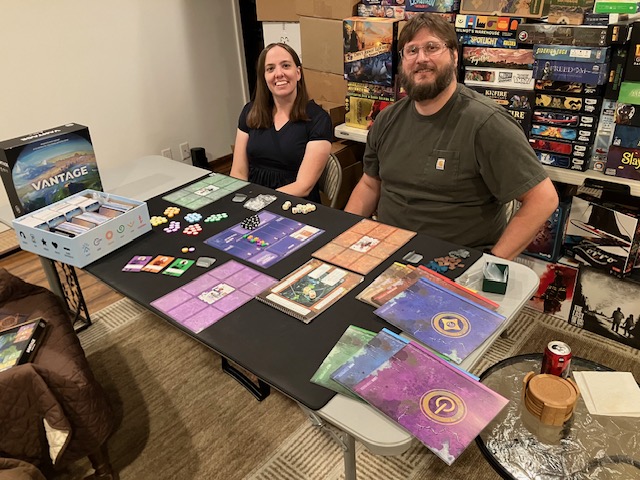
I invited my Escape Room buddies (Charlie and Allison) to play this with me.  
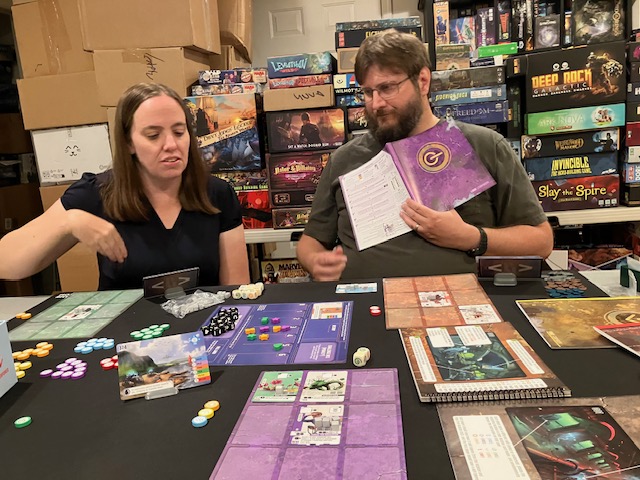
It was a hit!  We played a two-hour game and had a fun time exploring and reading to each other!  One of things you forget in Storybook games is that everyone stays involved as you read the Storybooks to each other!  
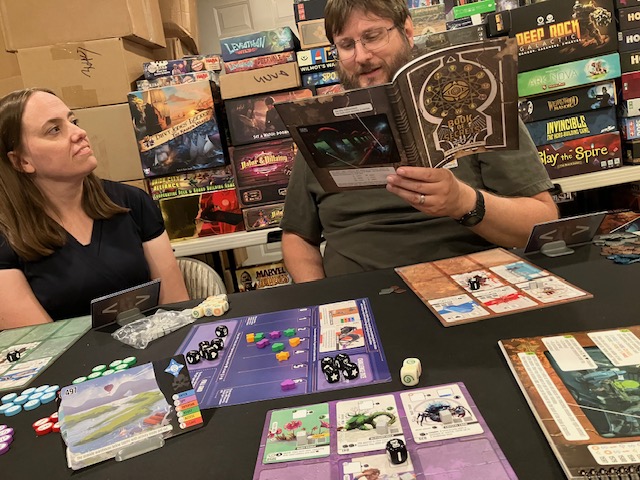
I asked Charlie and Allison what they thought? Would you play again?  Absolutely!  The vague sense of dissatisfaction I had in the solo game went away in the cooperative game, as we all stayed involved and just enjoyed the game for what it was.
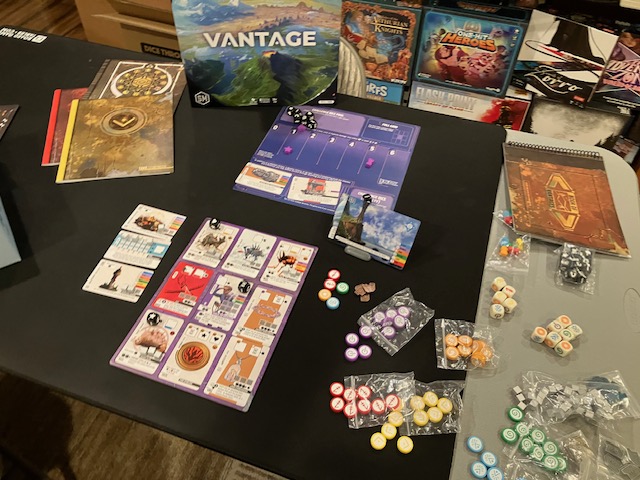
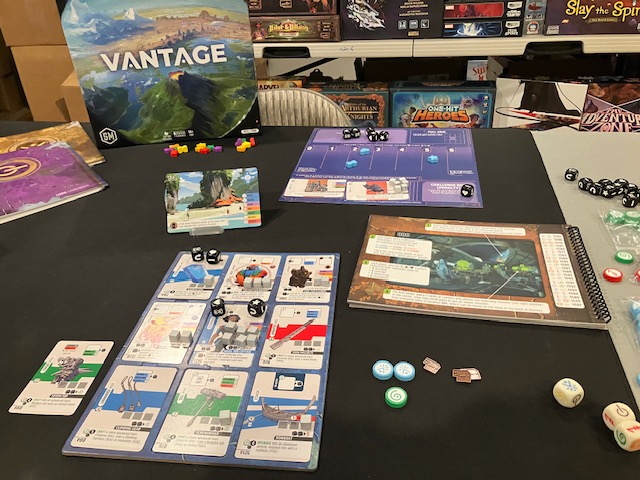
The cooperation was .. interesting.    In the cooperative game, we have all crash-landed at different points on the planet, so we are “kind of” playing multiplayer solitaire.  We each have our own viewpoint or vantage (see what I did there?), and we don’t really interact with other (although you can if you end up on the same space, but that’s generally not what happens).
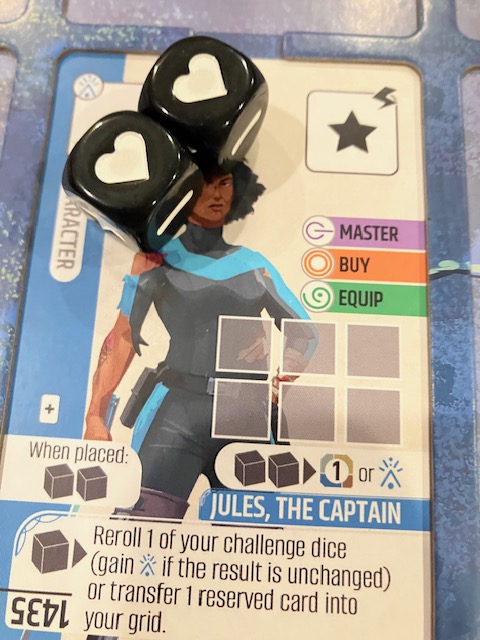
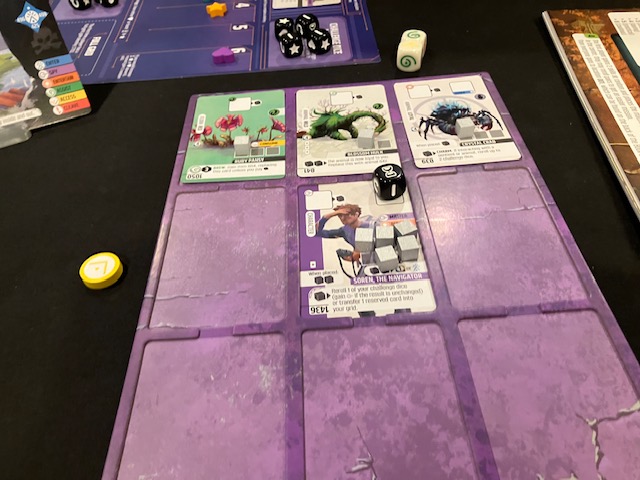
The cooperation comes in by either sharing skill tokens with each other (to mitigate die rolls), or sharing dice-placement locations with each other.  When you make Challenge rolls, you have to deal with the consequences;  you can mitigate the dice-rolls by doing dice-placement on appropriate spaces on characters.   See above as the Blue character can always mitigate a die for a Explore (blue) type roll.  Also, she has a “global” place for any character to mitigate Morale (the lightning bolt means “global: any character may use”).
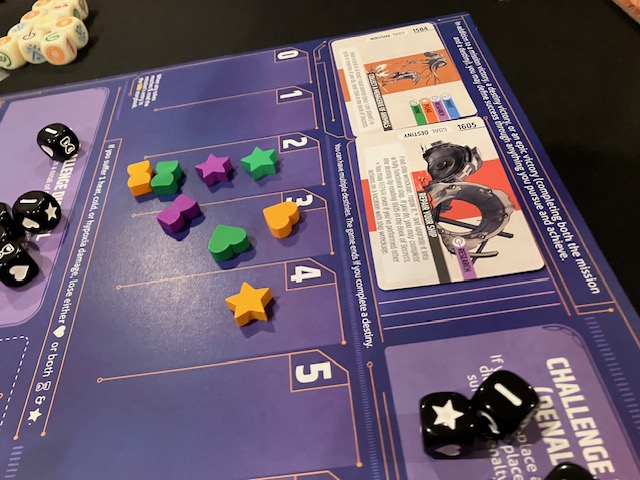
Any dice you can’t mitigate are either Morale, Health, or Time losses.  See above as each character has their own Morale, Health, and Time.  If any of these go to zero, the game is “over”.
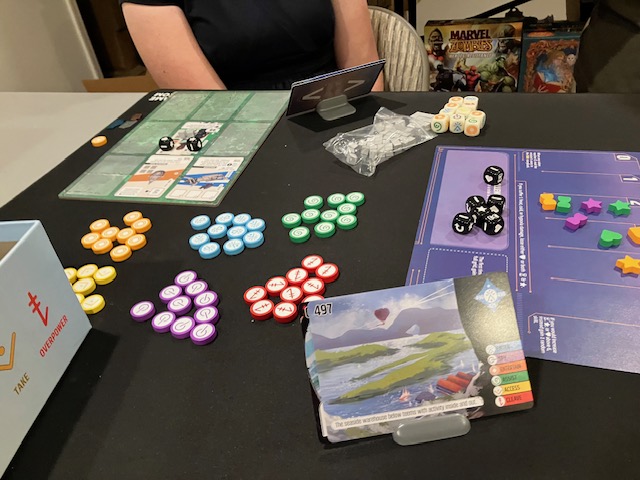
Thematically, it’s a little specious that we can share skill tokens and dice-placement spaces, because we aren’t on the same Locations (usually).   My own interpretation of this: I like to think that we are all in constant communication over some intercomm system, and we can share each other’s expertise!  So, the sharing skill tokens and dice-placement spaces, at least in my mind, is sharing expertise“Don’t eat that! Purple plants are generally dangerous!”  I kind of wish the rulebook had done more to explain this cooperation thematically.  But hopefully my explanation of sharing expertise works for you.
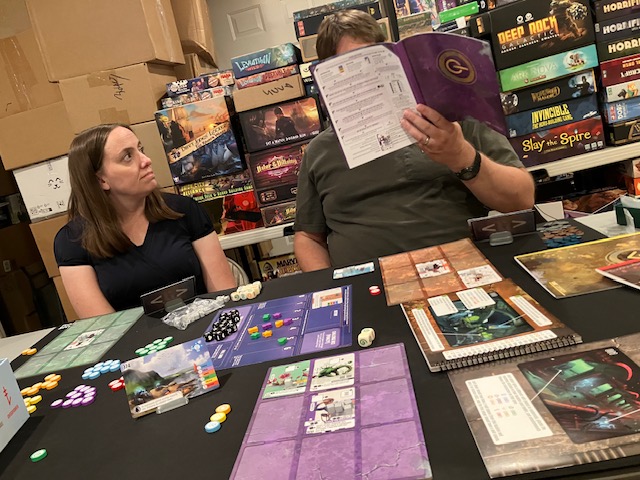
One more thing, I kind of think three or four is the best player count; With three, you are only “not involved” every third turn, and you can care about your friends stories … because there’s only three or four of them.  At higher player counts, I think you will “stop caring” and the game will become much more multiplayer solitaire (and you might get bored waiting for your turn).

Things We Were Unsure About

Locations: Charlie and Allison didn’t love that we couldn’t see each other’s Location pictures: but the rules are very clear about this.   I think the game would offer the explanation that it would “break immersion” if we could share pictures: you should only be experiencing your own story.  While I understand this explanation and maybe even might agree with it in theory, it’s so much more fun and cooperative to say “Look how cool this Location is!” .. and show it to everyone. It would actually make the game more cooperative, or at least more interactive.  In fact, if we go with premise that we have an intercomm system that we are communicating on, I’ve got to believe we have a camera on our phone!   🙂 Maybe the game should just allow you to share pictures every so often … the rules are a little draconian on this point, but maybe a little too much.
Bottleneck: The major bottleneck in the game was almost always waiting for Rich (me) to get the cards.  It was probably the most annoying part of the game.  The rulebook suggests that only one player should handle the cards … as it makes the game move faster …  but it feels there could be a better way to share the load on this. Me, as Rich, ALWAYS did all the work and it was annoying.  An easy easy thing would be to let one person handle the Location cards and one person handle the items.  At least then 2 people would be doing that in parallel and share the load!!   The decks can always easily be divided as well.  Maybe it’s too chaotic to split these decks, but I feel like there’s got to a better way to share the load: this is a cooperative game for goodness sakes.   

Conclusion

You might think, that after reading this, that I didn’t like this game.  But I did!  I just wanted to explore a lot of the issues so you understand what this game is and isn’t!  It’s not a campaign game, but it can be over the long haul.  It’s an exploration game, but it’s kind of not as you forget all the exploration you’ve done from game to game (usually).  It’s an adventure game, but it’s kind of isn’t as you can only interact with Locations once.  It’s a Storybook game, but it’s kind of not as the Storybook is more like directions (and the story exists in the Locations).  Vantage is just a little different, and I hope you got that from this review.
I liked the solo mode: it works well and it really teaches the game.  Be aware that you might feel vaguely dissatisfied in the solo game because you don’t get to continue your exploration from game to game.  If you go into the solo game with a carpe diem mindset, and just enjoy this for what it is, you will be much happier!   I’d probably give this a 7/10 for solo mode, but if there were a more systematic way to explore the Planet and keep the exploration going (especially in the solo mode), I’d probably bump this up to an 8 or a 9/10.  It’s a pretty neat world!

The cooperative mode was a hoot and we had a fun time playing!  The cooperation feels a little athematic unless you think of us all sharing an intercomm system!  Then the sharing of skills and dice-placement mitigation spaces is like sharing expertise amongst ourselves; that little premise really goes a long way towards making the game feel cooperative.  Of course, the Storybook reading to each other makes the game very interactive and fun too!  I’d give this 8/10 for cooperative play.  I’d probably never play with more than four players though.

If you are interested in Vantage, you should give this a try to see if you like it: It’s very different from other Storybook games like those in our Top 10 Cooperative Storybook Games!!  I freely admit I didn’t love my first play of Vantage that much; I had to play it a few times.  Maybe you want more flowery prose, maybe you want more story, then consider Wandering Galaxy or Tales of Arthurian Knights instead.   Maybe you want more persistent exploration, consider Earthborne Rangers instead.  But Vantage is such a different beast than many games out there, don’t judge it right away.  Give it  few times to see if you like it.  And it’s okay if you don’t like it.  It’s also okay if you do like it!
 

Corps of Discovery: A Cooperative and Solo Game

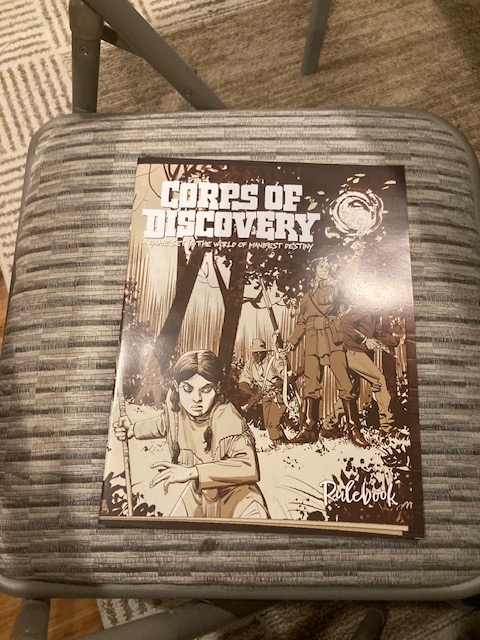
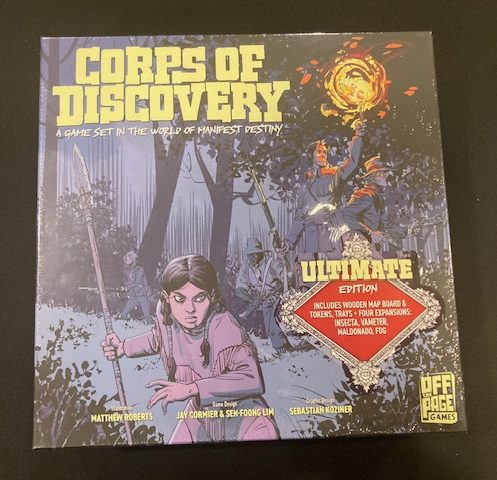
Corps of Discovery is a cooperative game that was on Kickstarter back in May 2024. This promised delivery in Jan 2025, and it was about 3 month late, arriving in late April 2025.

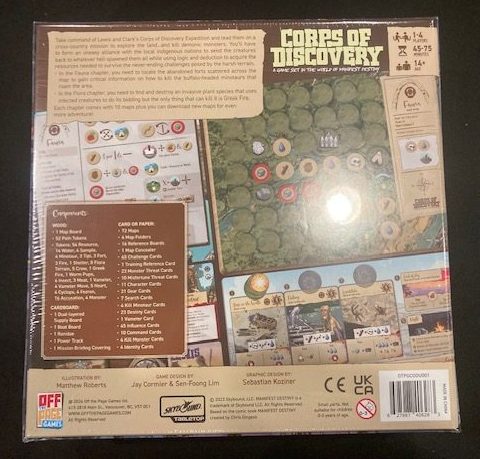
This looks like a thematic adventure/exploration game set the in era of Manifest Destiny and Lewis and Clark!  And it is NOT!  This is a deduction game, with bare hints of theme.  The text on the back of the box even hints at this being a thematic game:

“Take command of Lewis and Clark’s Corps of Discovery and lead them on a cross-country mission to explore the land … and kill demonic monsters.”

Sounds like a thematic exploration adventure, huh? Nope nope nope nope nope nope nope! Corps of Discovery is a deduction game! A cooperative deduction game, but a deduction game nonetheless! You need to know that going in or you will be severely disappointed by that description.

Let’s take a look!

Unboxing

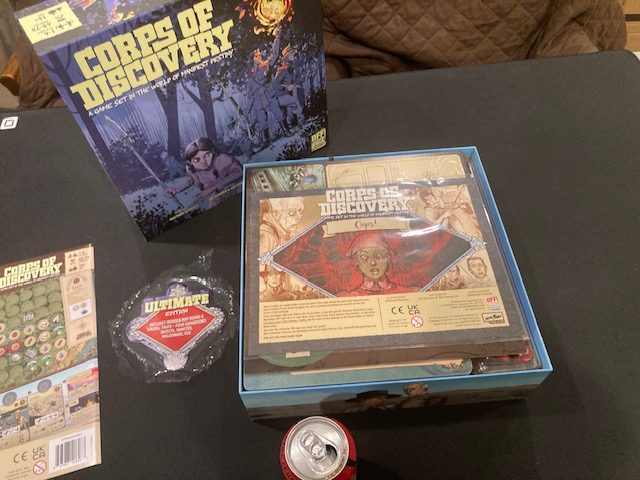
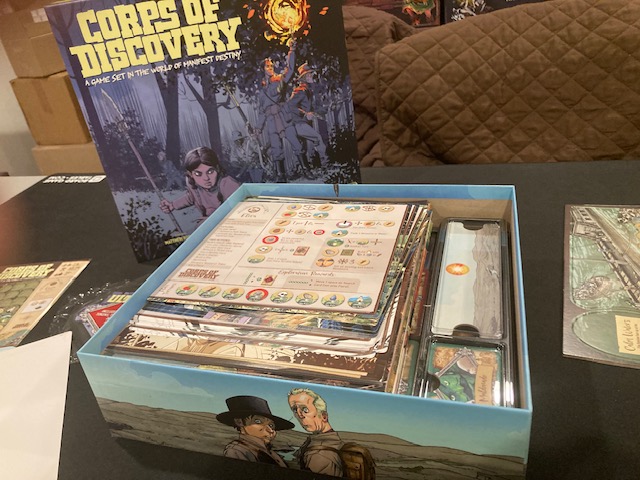
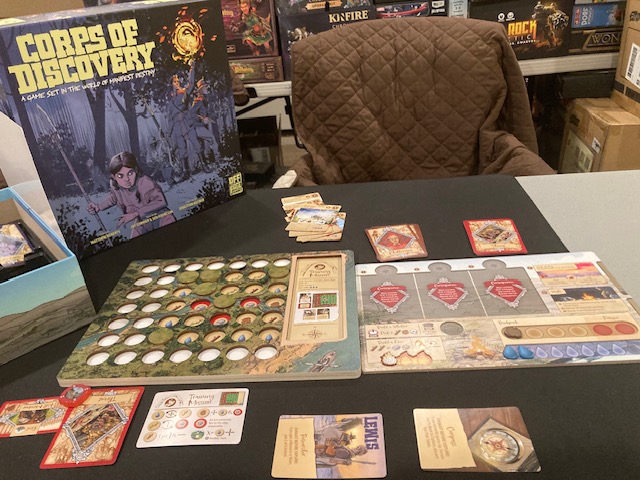
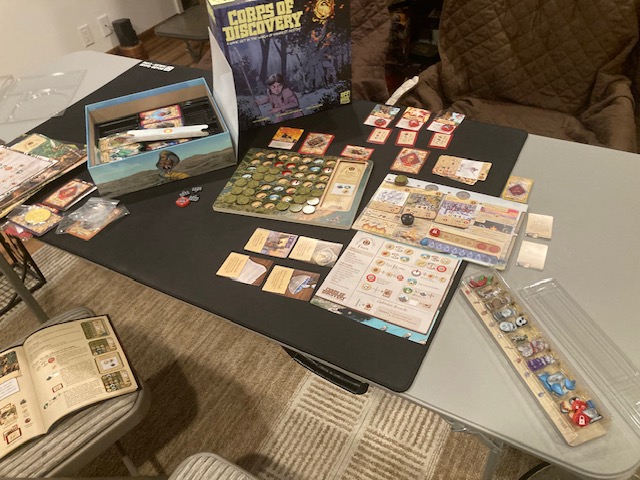
Corps of Discovery is a pretty standard sized Ticket To Ride style box.

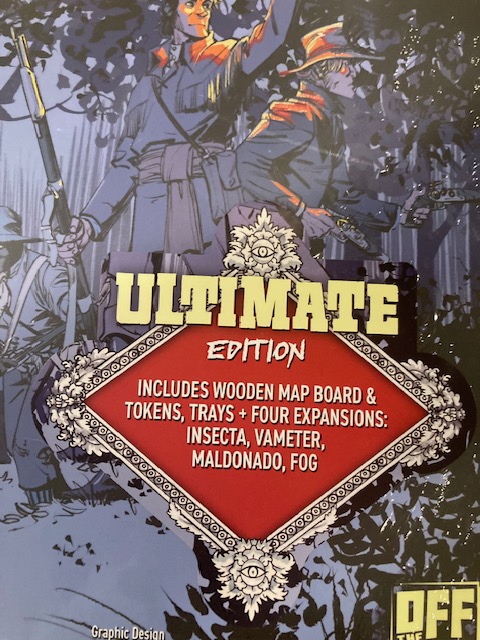
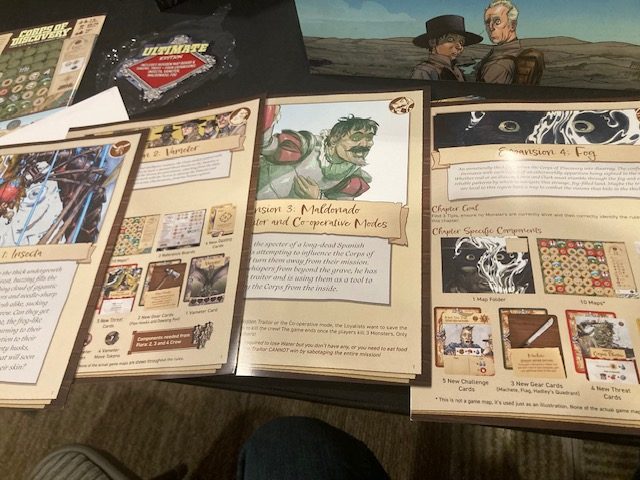
Now, we are showing the Ultimate edition of the game, which has slightly nicer components and a few expansions (see above).

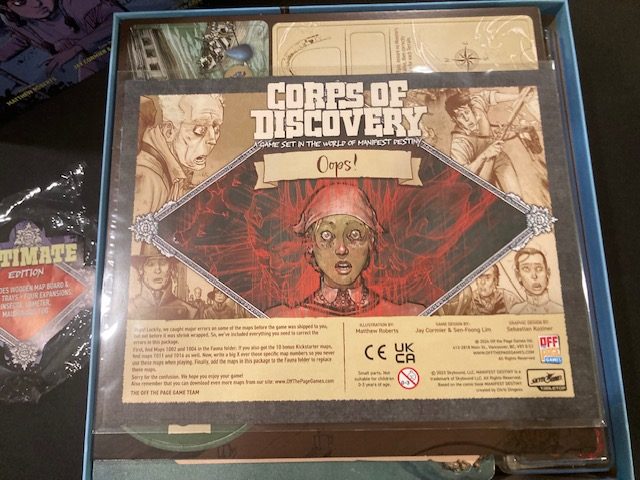
The unboxing starts poorly, as you have to “fix” some maps in the game.

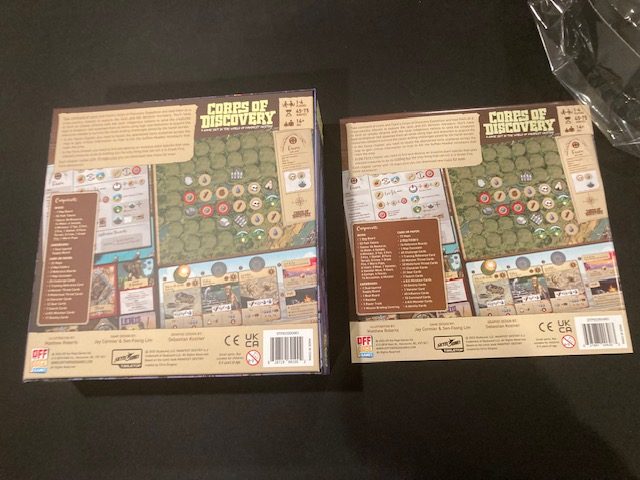
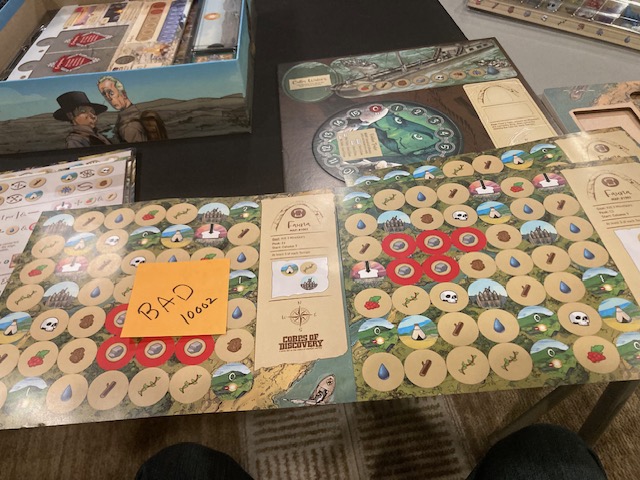
See above: as I have to X (or notate) which maps are bad.  Now, they aren’t full maps, there are just partial maps, so one side of the maps is good and the other side is bad!!  So, you still have to keep your “bad” maps, because one side is ok.   This started me off a little grumpy, but at least they fixed the problem.

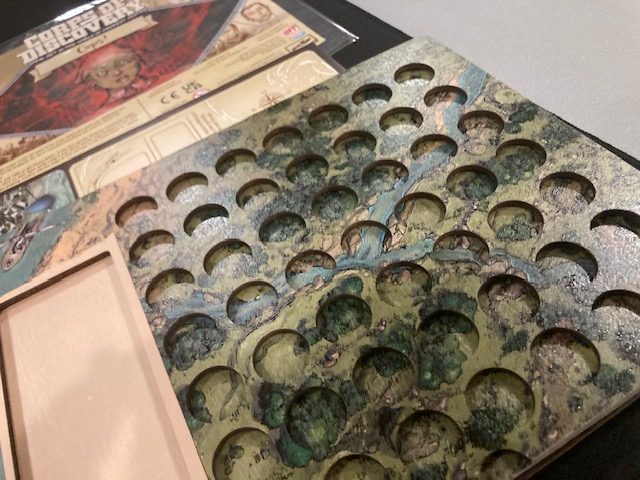
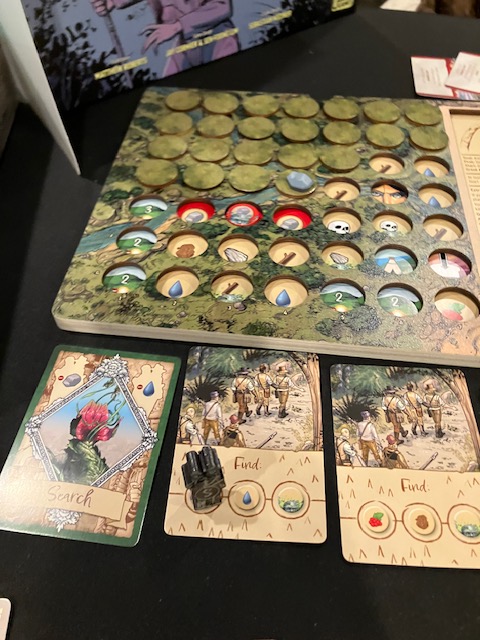
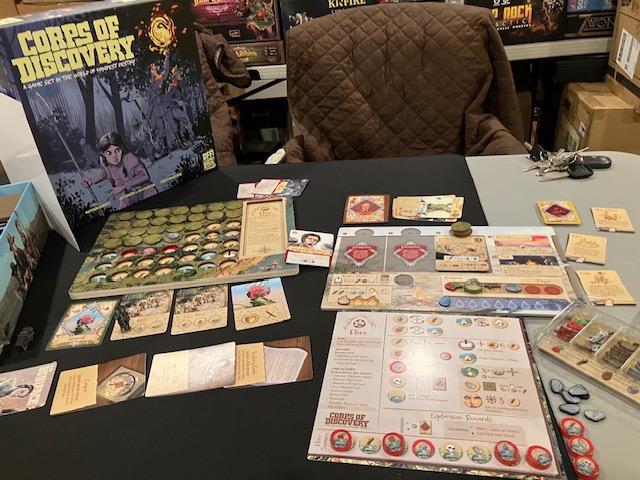
The main part of the game, the key part of the game is the map holder above: in the Ultimate Edition, this is a beautiful wooden map.

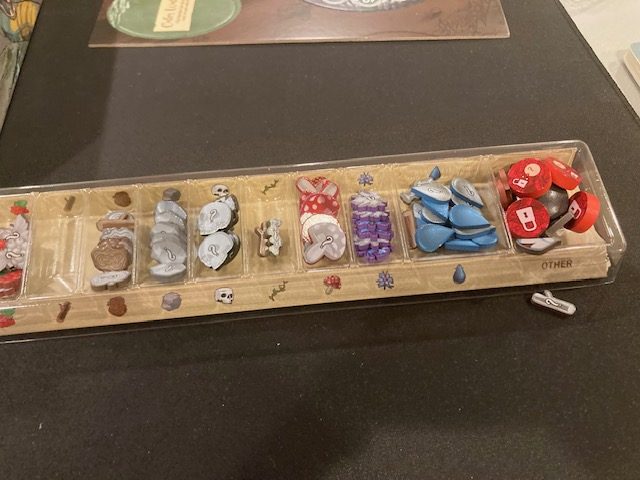
There are some resource tokens (and a holder, which got very badly shaken up in delivery).

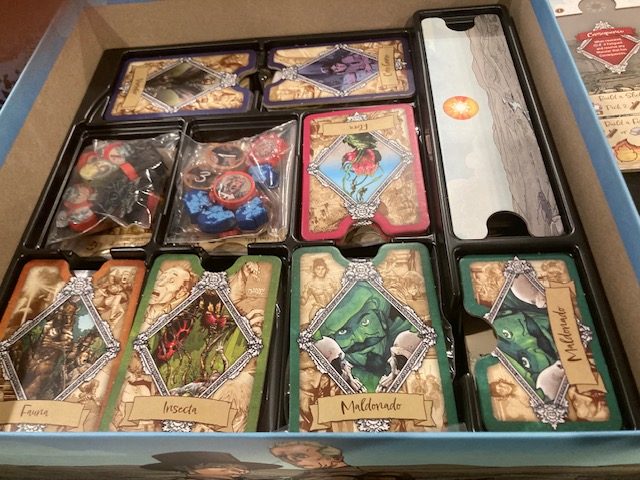
Underneath all that are BUNCHES and BUNCHES of maps!

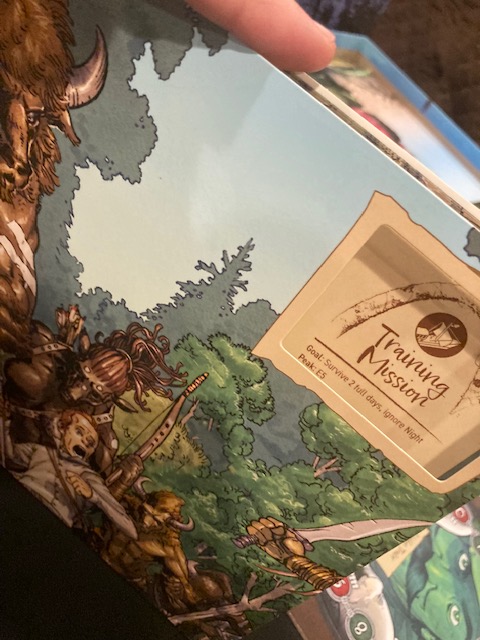
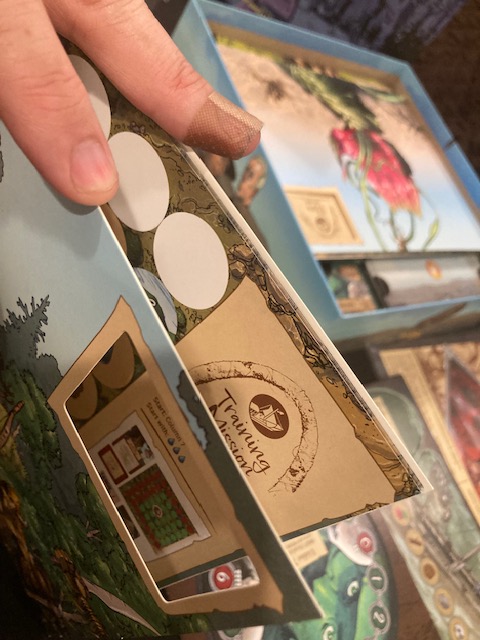
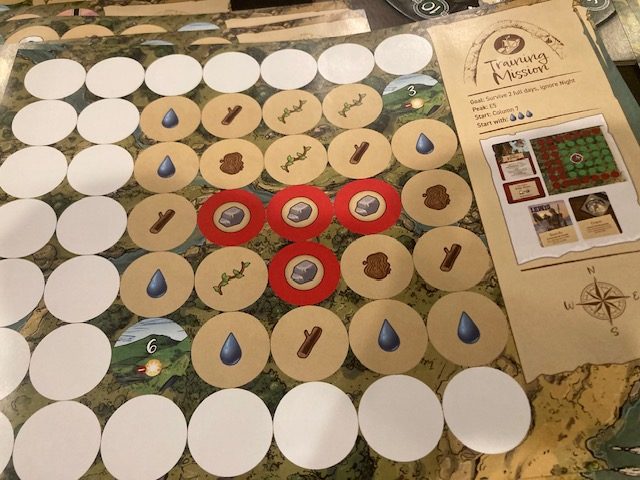
There are different “themes” of folders with different maps: see the training mission folder above.

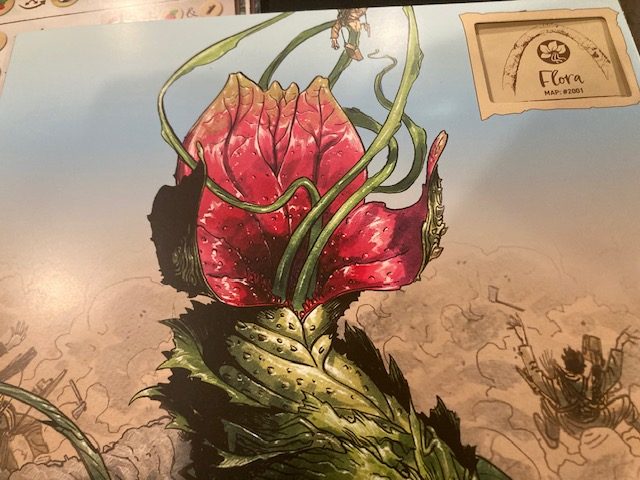
See the Flora map pack above.

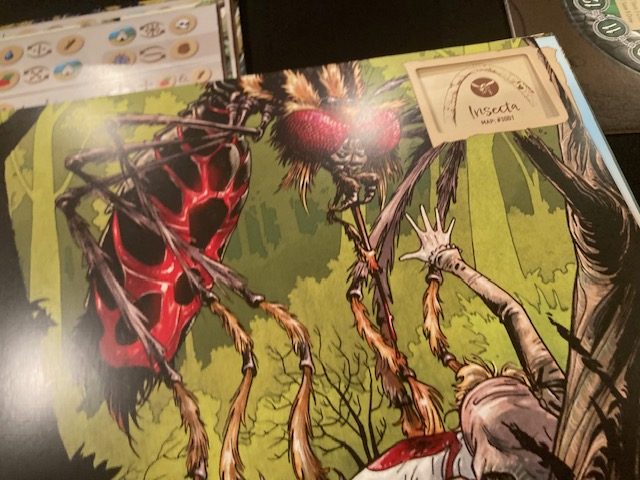
See the Insecta map pack above.

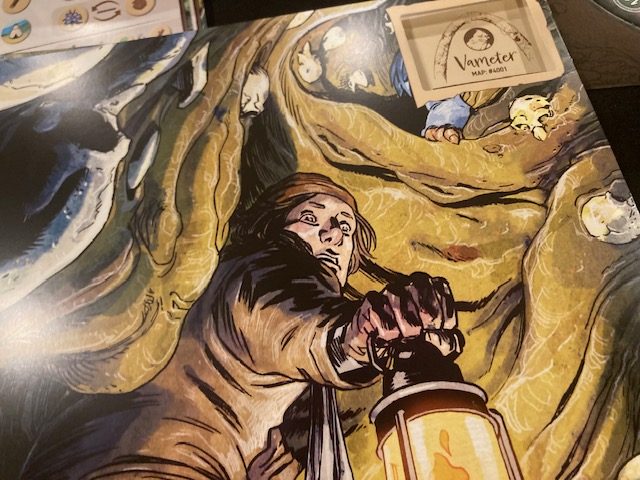
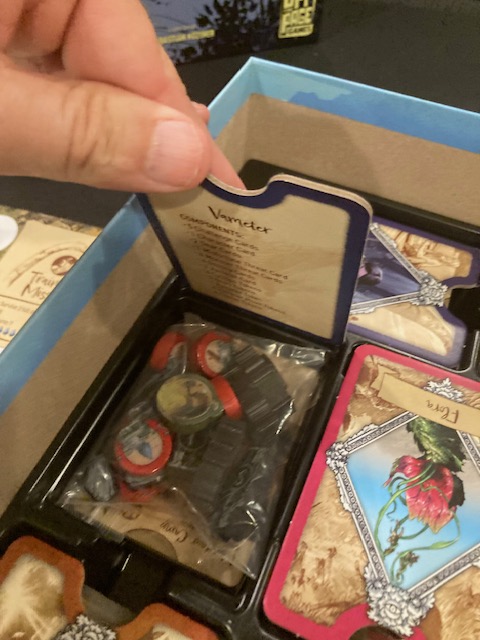
See Vameter map pack above.

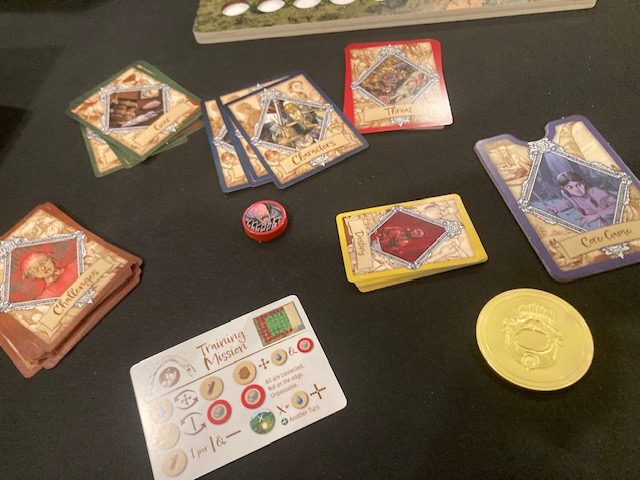
Coupled with these folders of maps are missions and the goals. See above.

Underneath all the maps are holders for the tokens for each Map pack.  Note that mine got shaken up a little, so the components are a little wonky.  I wish there had been a discussion somewhere of what all these things were, but you will figure it out … it could have been easier.

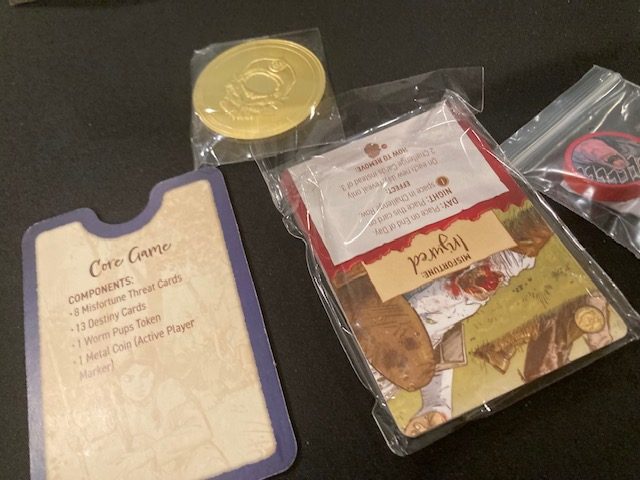
Basically, under each hard card are some components for the necessary map pack.

See above for some core components under the Core Game hard card.

The components are pretty nice, but you have to like the comic-book art style of the game. I do, but others may not.

The quality of these maps is a little flimsy, which isn’t a big deal if you are careful.

I was a little underwhelmed by the quality of the components, especially because of the errors on the maps! I did like the variety of maps, the comic-booky art, the wooden resources, and the wooden map holder. My friend Lon texted me after he got his copy: he was less than thrilled with the quality:

I saw you posting about Corps of Discovery. I will say, I am not super happy with detail and packing quality. The manuals and the backs of the expansion tiles have different numbers of items (that is just bad), so I don’t know which is right. Also, I’m missing 8 tokens…at least I think so. Since I don’t have an actual list of the number of individual resources, but it looks like I’m missing several of those, plus I know I’m missing two water, and 1 Tipi. On top of that they had the errored maps and tokens, with I’ll say substandard ways to fix them (proxy the tokens, and to save a few pennies, we’ll have you “x” out the bad maps, so we can print 2 sheets instead of 4).

Lon is also talking about the components page: it doesn’t give an accurate count of the resource tokens, so we don’t know if we got them all!!

You saw how messed up they were.  So, are we missing some?  I don’t know! They aren’t clearly enumerated the rulebook!

The component quality left a little to be desired, but I think Lon was grumpier about the components than I was.  The rulebook, however, left me MUCH grumpier than Lon.

Rulebook

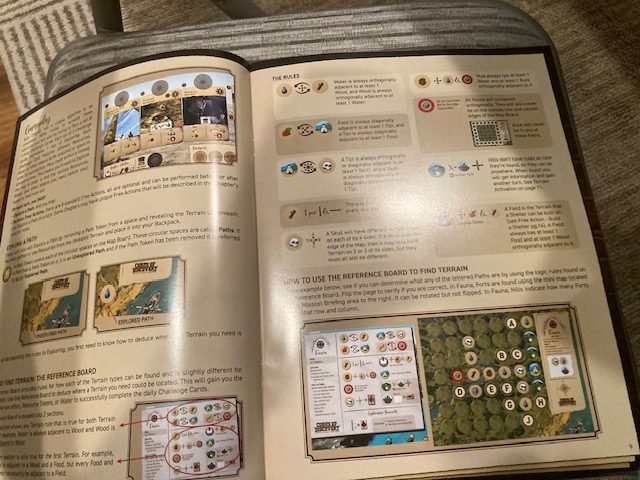
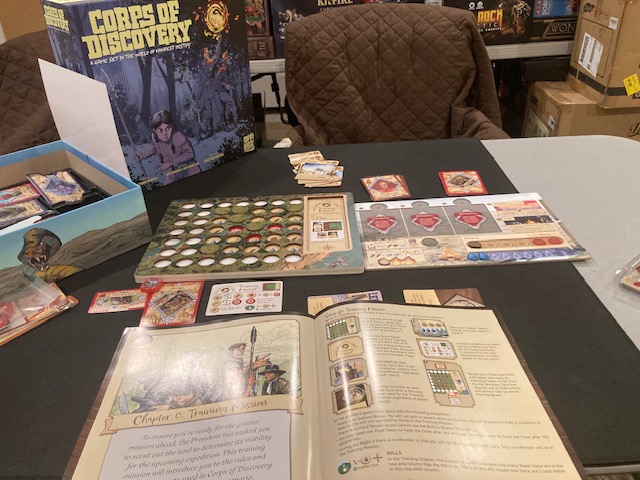
I have not been this frustrated with a rulebook in a very long time.  The rulebook looks like it might be okay (it actually gets an A- on the Chair Test),  but for a deduction game where every word matters, this rulebook struggles to specify the rules well.

A few weeks ago, I didn’t love Soul Raiders, but I even reprimanded the rulebook for too many examples.  Oh, if only that were the case this week!

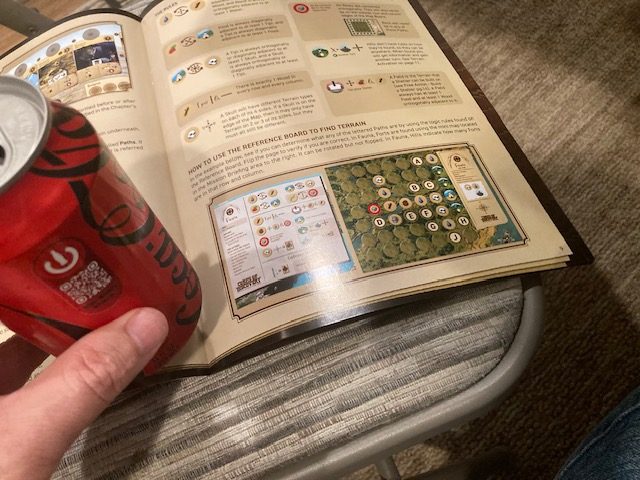
There was essentially ONE example on page 9; and it didn’t do a great job: the example crossed page boundaries, so it made it it harder to correlate the rule with the example.  It also was too small!  I struggled to read the page because it was a little too small in the rulebook! Also, some of the rules we so small because they were hidden in the text of the box!  

See Coke can above for scale: it’s too small!

This is a game where a single resource can make the difference between winning and losing.  Yet, there are so many places where things are poorly specified.    Some examples:

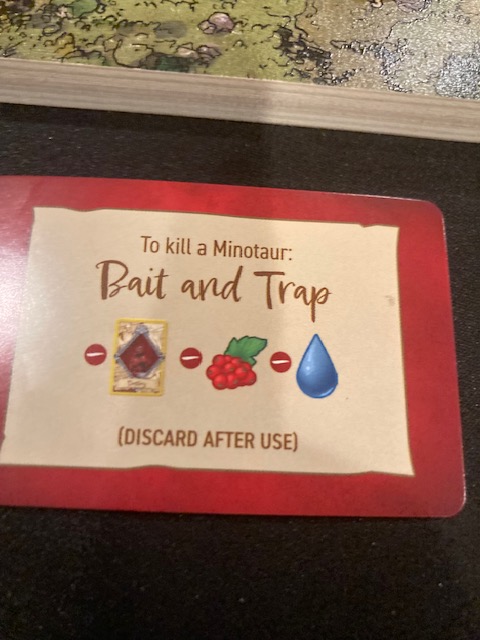
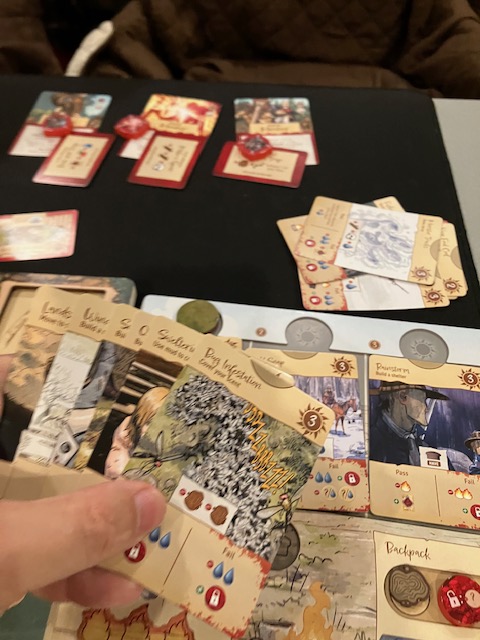
What happens when you discard a Challenge? (see Bait and Trap card above) Are there rules about which one? Can you discard one in progress?  Do you keep the path tokens for the next challenge that replaces it?  This makes a HUGE difference!   The summary icon page at the back of the rulebook DOES NOT show this and offers no explanation in the rulebook.

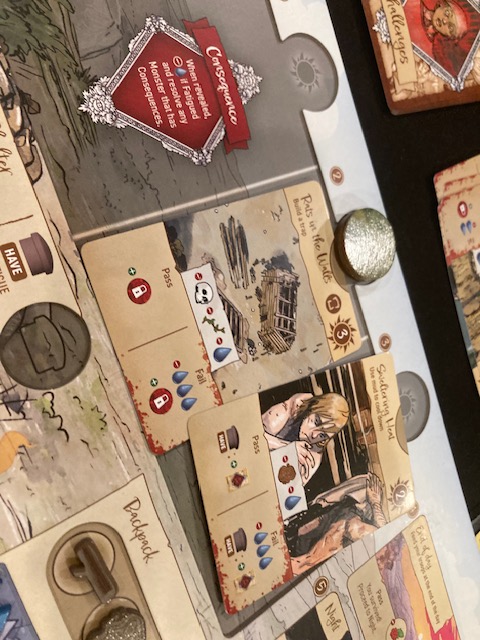
What happens when you add a Challenge?  (see Pass/Fail on Sweltering Challenge above).  Can you specify where the challenge goes in the day?  Before? After?  Can you put it to the front?  Can you choose NOT to add a challenge?  (Usually, you want to, but sometimes you want to move to the end of the day to reset all your Gear).  Again, there’s no specification anywhere and these rules make all the difference in the world.

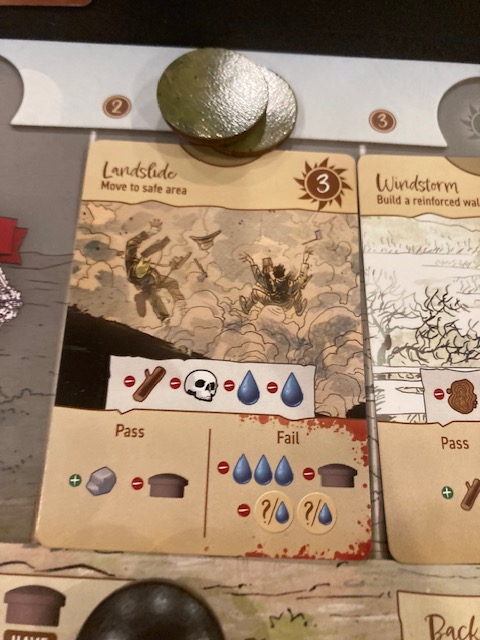
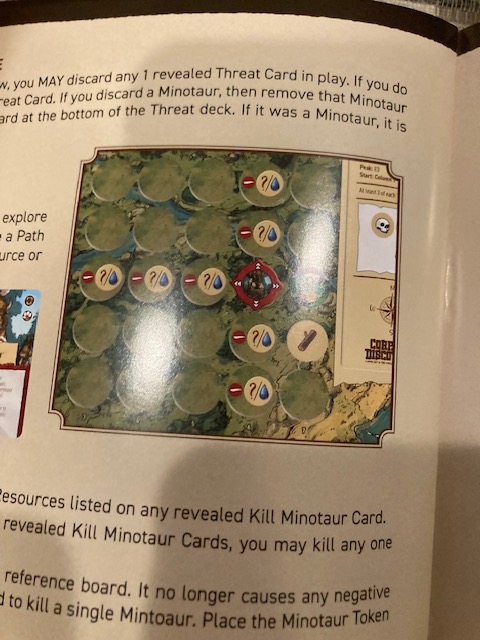
What does the ?/Water notation mean?  See above on the bottom of the Landslide card.  I went spare looking for it! 

It’s not on the back page with the summary of icons!! See above!! I figured it could maybe mean three things:
1) discard a water or some other token (I think this is the actual interpretation)
2) make it so the minotaur lines don’t require lossage
3) lose a water ONLY IF it’s on the ? side, or off the board (or remove a ? water from the board)
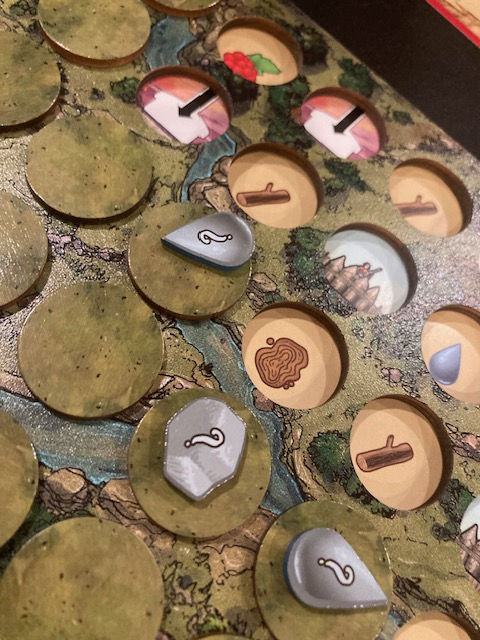
This is one place where the token iconography failed: the ? side is useful for the players to “mark” what they think resources are.  Corps of Discovery conflates the meaning of ? to be “any single resource” and also “notate where a resource might be”.  Which is it? 


The final meaning is not where you expect it on the rulebook: I expected an explanation on the last page with the icons: NOPE!  It’s hidden next to the path rules and Monster Threat Effect on page 10????  It’s not even clear if it’s supposed to be a token?   It sure looks like it from the picture, but I have none of these tokens in my game!!

Another problem: this page 9, which is arguably most important page in the rulebook, does not specify all the rules that appear in the Training Scenario!  It alludes to some of the rules, but isn’t clear.   See this posting over on BGG: With a little help from the internet, I figured out what was going on here.  But I feel like this page needs to explain a few more rules.

In a thematic game, I don’t mind making a few snap judgements for rules, but deduction is all about precision.  This game needs an Index, more examples, more clarifications, and some rules need to be actually specified.

Gameplay

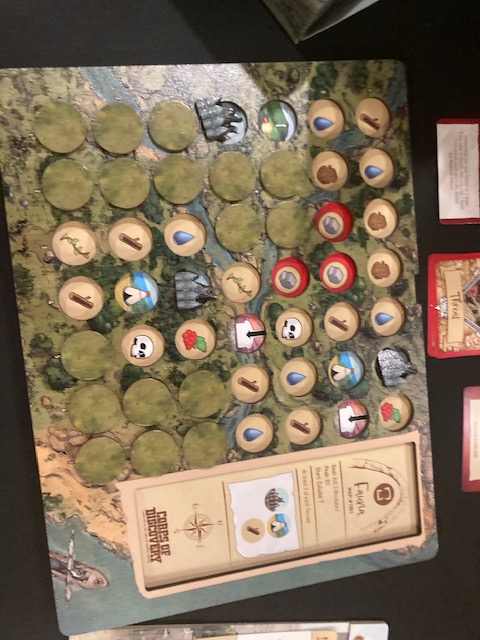
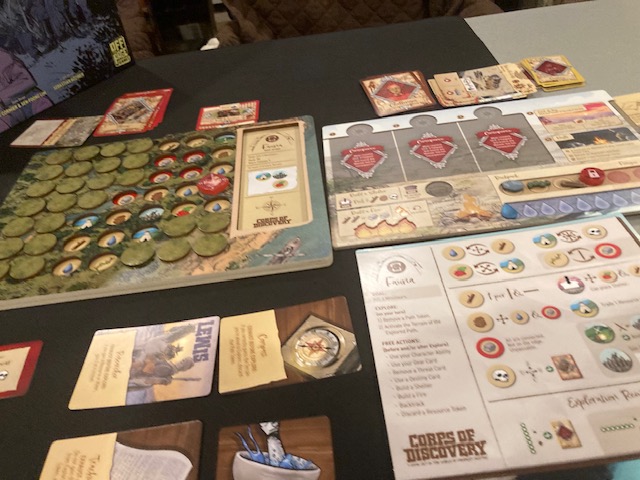
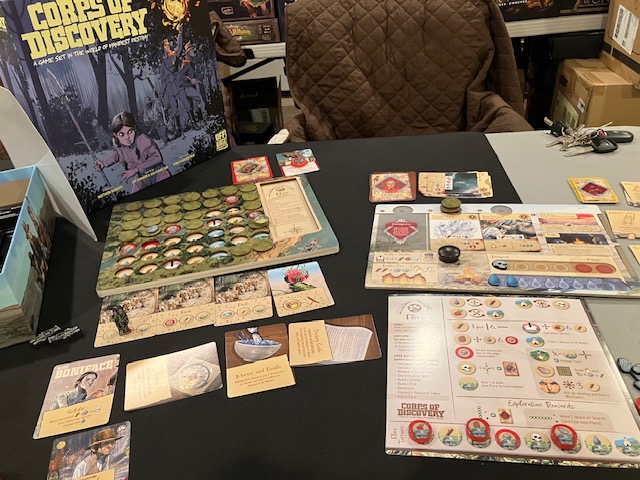
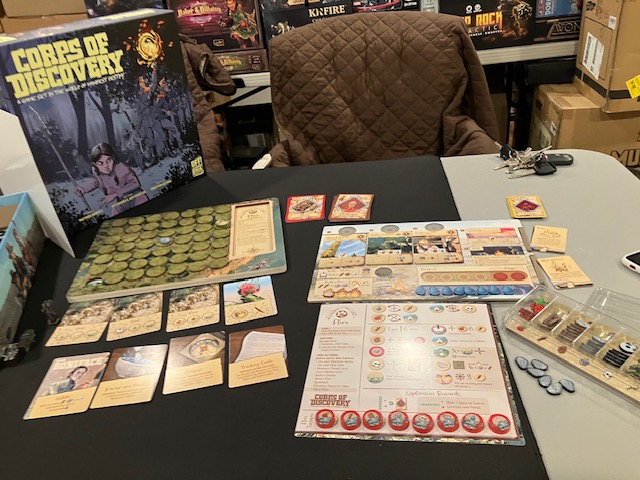
If I said this played like Minesweeper, would you get mad at me?  Players uncover spots of the board grid using deductive rules (board sideways to maybe not give any spoilers; each map is unique).  What’s revealed leads to more clues about what’s around you!

These spots have resources which you use to overcome challenges and monsters.

It’s Minesweeper, with resources and a lot more deduction rules.

10 Plays

I gave myself 10 plays to play the game: I played two of the Training Scenario, six of the Fauna Scenario, and two of the Flora Scenario.  This took place over two weekends with pretty much my the last weekend being consumed by this game.

I was able to beat the Minotaurs reliably in the Fauna scenarios after about 5 plays.

The Flora Scenarios kicked me around.  I lost.  Hard. And I didn’t have fun.

By the end, I was tired of looking for the fun in this game.  After my 10th game, I was done.

Randomness

Like I said, I was able to defeat the Minotaurs reliably after 5 games. But I noticed that my score ranged from 3 to almost a perfect score (27)!  I got “lucky” and just happened to have the right cards come out and the right resources emerge so I was just able to trounce the minotaurs!  This was right after a game where I barely won, and I got 3 points.  The score was more of a representation of “how lucky” I was; one game, I got lucky and obtained almost a perfect score! One game, where I got trounced by my Misfortunes, I won … but barely.   The score meant nothing:  It just noted how lucky I was.  To be clear, I didn’t play THAT differently between games.

In the Fauna games, the game felt VERY lucky; how far you could advance, and when you get the Flora Terrain tokens, just felt very lucky.  (Uncovering Flora tokens means you don’t get the resource, and you have NO IDEA if you will uncover a plain resource or a Flora resource).

In a game where Deduction is such an important part of the strategy, there seemed to be too much luck for me to want to come back to this.

Conclusion

I wanted to like this game so much.  I was initially a little disappointed that it wasn’t particularly thematic, but I still really like Deduction Games, so I was still so happy to move forward with what it was. A deduction game needs tight, well-written, and well-documented rules; sadly, that was not the case with this game!  The rulebook was one of the most frustrating rulebooks I have encountered in sometime.  To add insult to injury, I felt like a lot of scenario-specific rule were also under-specified.  Even powering through the rules and making the “best I can” with the rules as given, I found the game just too random for a game that just leans so heavily on hard deduction.

I gave Corps of Discovery so many chances; I forced my way through ten games, hoping to “finally” overcome the hump of rules.   But I rarely had fun playing: I was always just so angry at the randomness and poorly specified rules.  I am selling my copy. 

Maybe you’ll like it if you can power through it; maybe being forewarned about the pitfalls will help you like it.  Corps of Discovery has a really original premise, and it has some great ideas, but it just never came together for me.  Maybe it will for you.

EDIT: My copy has been sold.

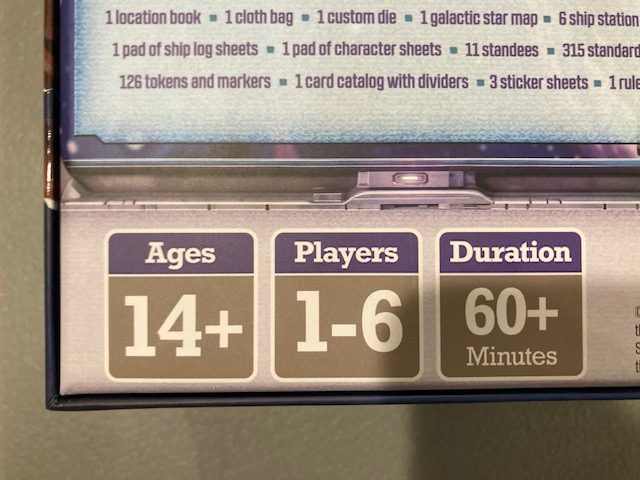
Wandering Galaxy Review: Who’s Wandering Here?

IMG_9059

To be clear: you are wandering the Galaxy, but it turns out the Galaxy itself is wandering (if you believe the intro text)! Wandering Galaxy is a cooperative adventure game for 1-6+ players and it is set in spaaaaaaaaaace!  This is a silly cooperative game that kind of feels like Firefly if it were a comedy (with just a little bit of Star Trek thrown in). (I mean, Firefly is already kind-of a comedy, but I digress). (But this may be too many parenthesis).

IMG_9060

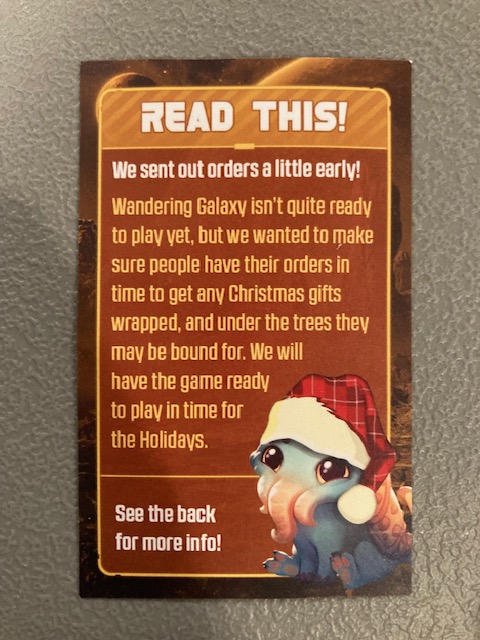
Wandering Galaxy was on Kickstarter back in July 2024, and promised delivery in December 2024.  And you know what?  They made it! My copy arrived about December 20th, 2024!  With some qualifiers … see below …
IMG_9056

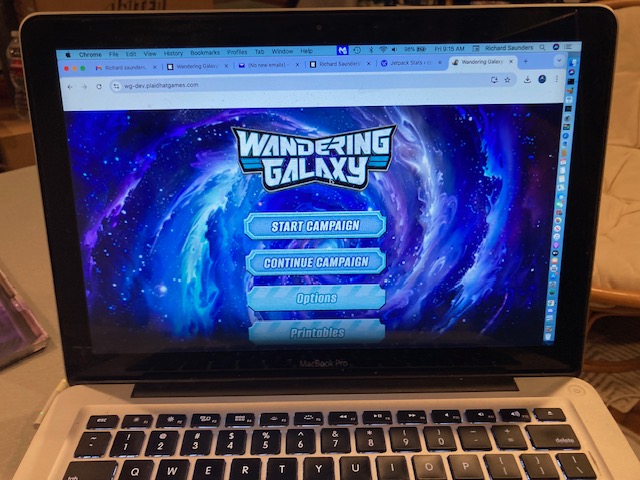
See above: So, the game wasn’t QUITE done, but the only thing left unfinished was the App. My physical copy arrived but the app still needed some work.  To be fair, I was able to play some of the game before the end of December, so it’s enough to say “Eh, close enough”.  I’ll call it on time.

IMG_9112

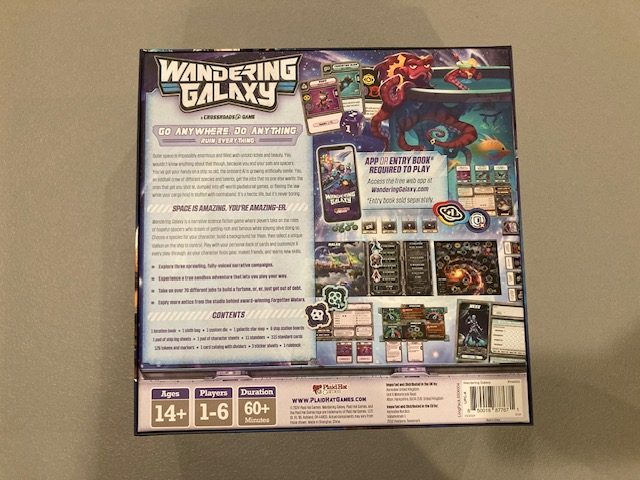
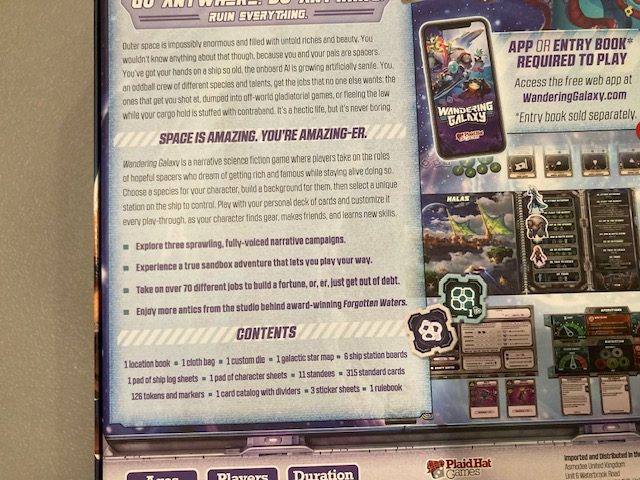
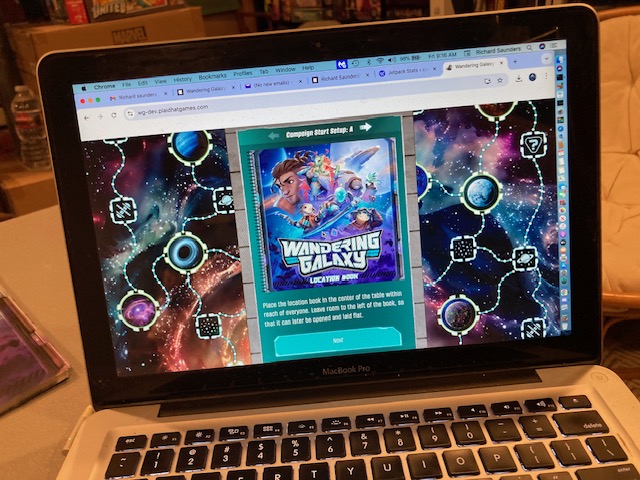
Let’s be clear!  Wandering Galaxy requires an App (or the Entry Book … more discussion later if you are violently opposed to an App).

IMG_9062

They say “App”, but it’s really more of a web portal situation: point your web browser at WanderingGalaxy.com and go!  It reads the text to you!!

IMG_9150

So, what is this?  Wandering Galaxy is a cooperative campaign game with many different mechanisms: story-telling, worker placement, bag-building, deck-building, pickup-and-deliver, and even a little bit of a real-time!   It is both paradoxically a lighter game and a heavier game!  The gameplay is light and fluffy and moves along quickly, but there’s a lot of stuff underneath the hood that keeps this from being “just” a dumb little game!

IMG_9113

What do I mean by this? Let’s take a look below!

Unboxing

IMG_9063

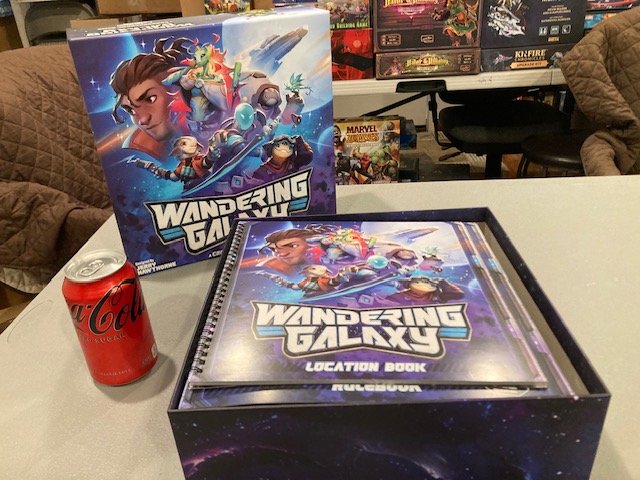
So, this is a pretty standard sized game box, about Ticket To Ride sized. See above with Coke can for perspective.

IMG_9079

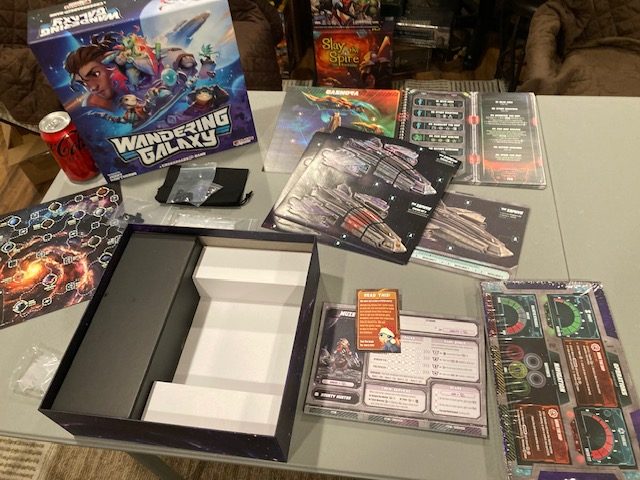
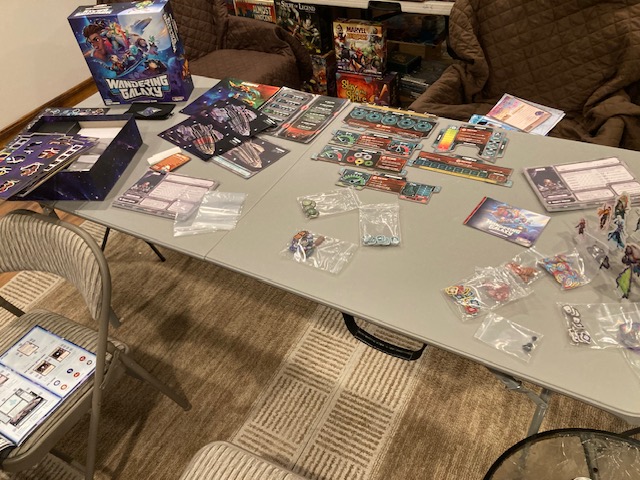
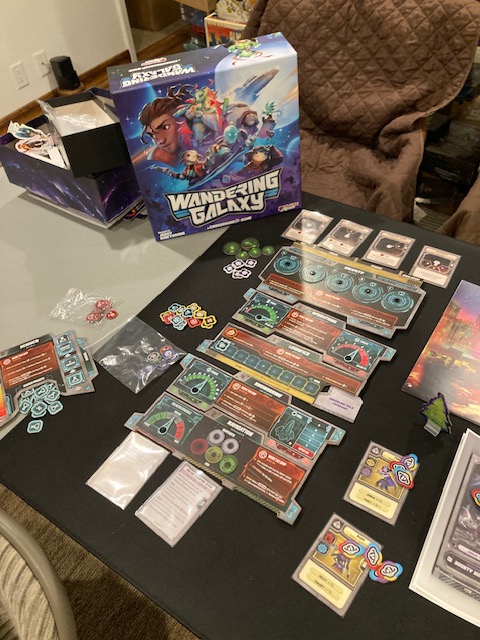
There’s a decent amount of stuff in here! See above!  Lots to punch out!
IMG_9099

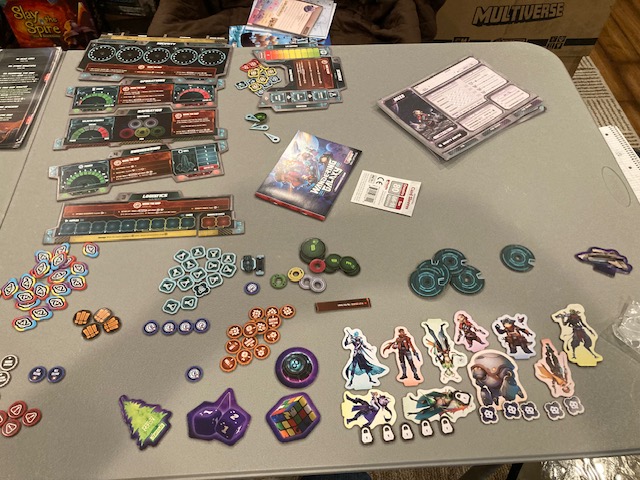
There’s a lot of tokens to punch out! Whew! Luckily the game includes some bags!
IMG_9081

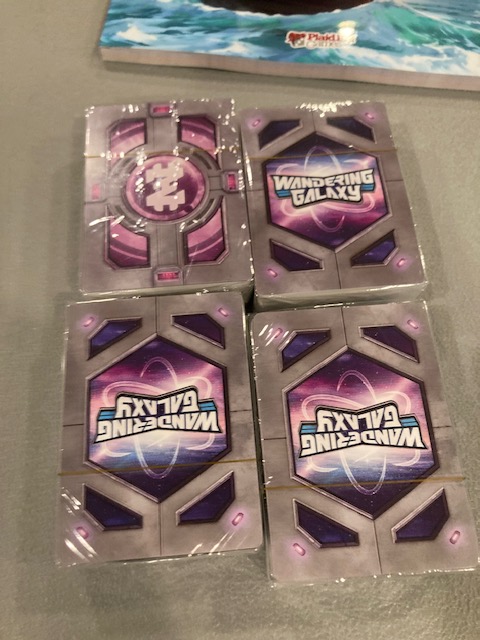
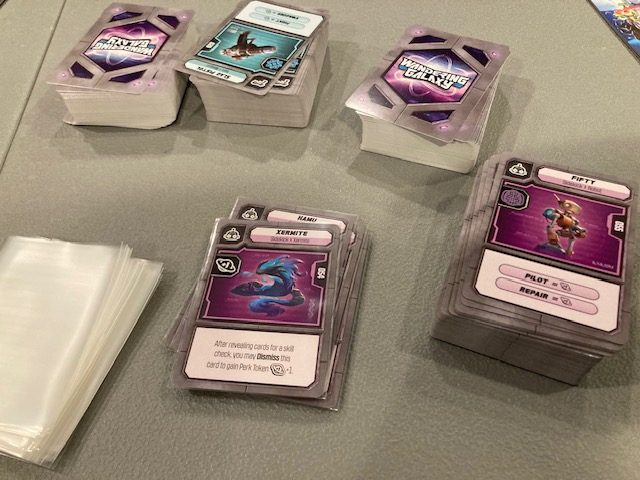
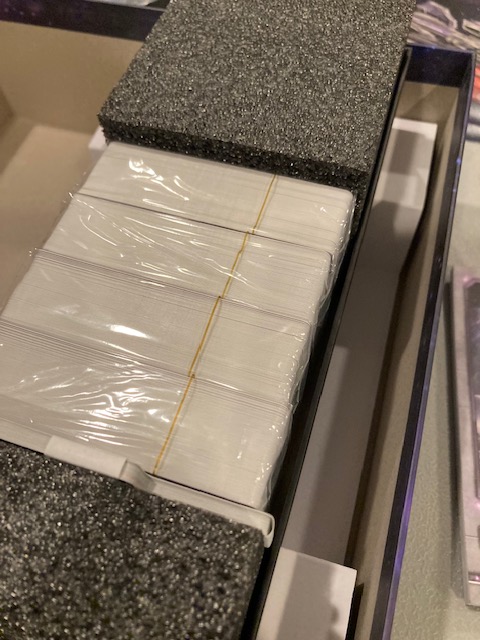
There’s also a fair number of cards in the game: remember how I said this was a deck-building game? There are the cards for your decks!

IMG_9094

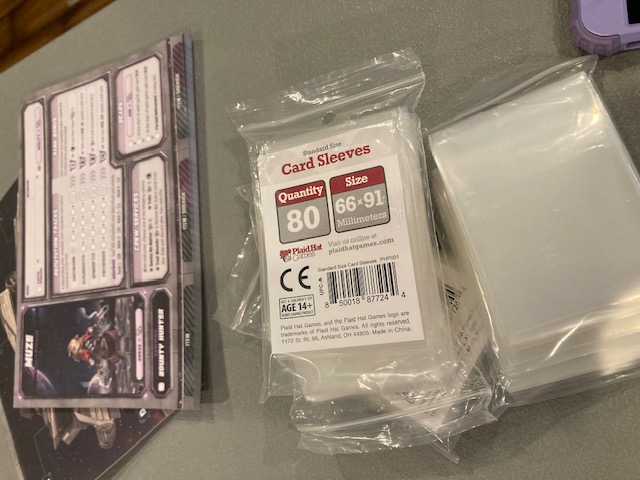
I got the sleeves for this: 9 times out of 10, if a game says it’s a deck-building game, you should probably sleeve it.  (This might be the 10th game).

IMG_9095

I spent WAY TOO Much time sleeving all the cards. See above!!!  This card-sleeving was one of the first things I did when I got the game.  I will say, after a few plays, I am not entirely convinced that this game needs sleeves.  If you didn’t get the sleeves, meh, don’t stress: I don’t think you needed them.  (I am addressing this to my friend Kurt who didn’t get the sleeves).

IMG_9096

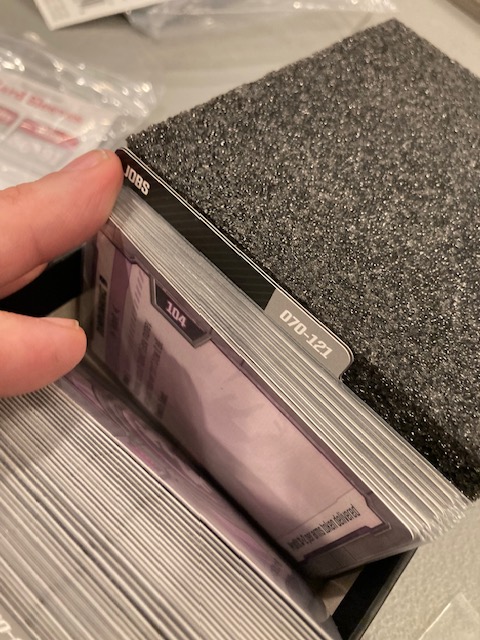
But there is a nice box for holding all the cards, with little dividers that clearly mark sections.  And it looks like it would fit WITH or WITHOUT sleeves just fine.  Little tip: it may look like some cards are missing (because of missing numbers), but probably not!  Some are missing for “future expansion”:  Check this BoardGameGeek thread for more details: Anyone missing cards?
IMG_9080

There’s a lot of other punch outs for the stations … see below.

IMG_9370

IMG_9107

There’s a lot here, but it is very cool looking!
Rulebook

IMG_9068

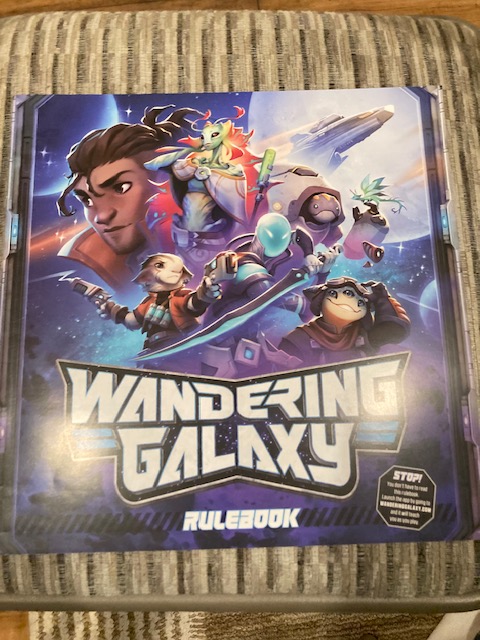
This rulebook … isn’t great.

IMG_9069

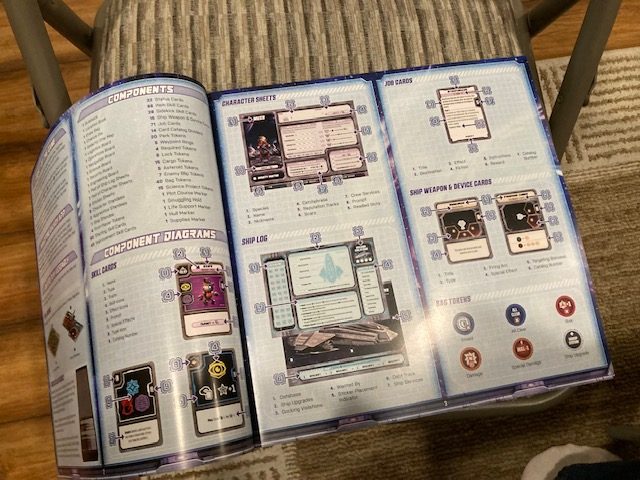
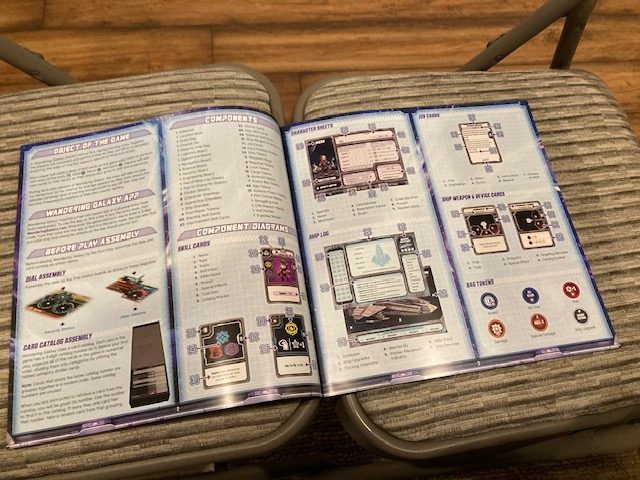
It flops over on the edges, probably get it a D on the Chair Test.

IMG_9084

In the end, I had to use the standard workaround of putting out two chairs with the spine in the middle.

IMG_9091

There’s a lot of stuff in here, but I also found there was a lot of stuff missing.  For example: The travel section discussions were unclear: Do you spend 3 power on each section? Do you have to stop in each section on your way to your destination?  The answer to both questions, according to this BoardGameGeek thread, is yes!!!  I think you will find yourself on BoardGameGeek a lot when you have questions!  Apparently the designer is very responsive on BoardGameGeek if you have questions, he answers quickly … so that’s good.  There is also a Discord channel (mentioned when you bring up the app).

IMG_9085

What I found is that the App is very good at helping you set everything up!  I tended to use the App for all my set-ups and only use the rulebook to look up a few rules.  In general, the App taught “most” stuff.  A lot of things were in the rulebook (and there’s even an index)!  But there was still a lot of stuff missing that you will have to look at BoardGameGeek for … Another example: What does a damage token do?  It’s unclear unless you read this BoardGameGeek thread!!

So, quick summary: use the App when you can, use the rulebook with the index if you have to, then use BoardGameGeek if things are still unclear.  You might go to BoardGameGeek more than you like. 

Story-Telling

IMG_9102

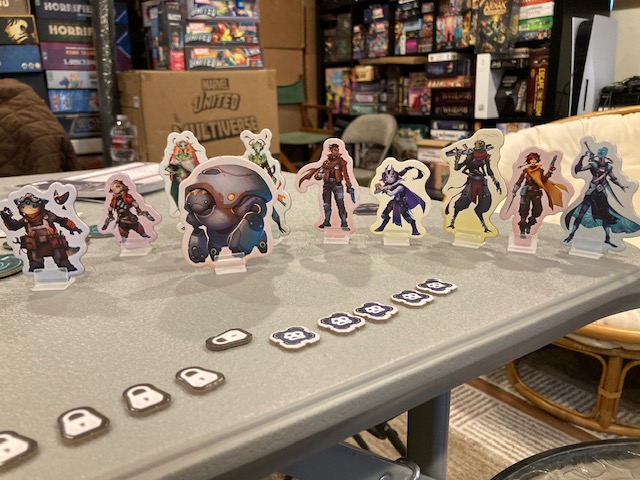
Everyone gets to play a different character in this game!  The art and style of the minis sets the tone for the game: see above!!  It’s very nice art, but with just a hint of silliness.

IMG_9074

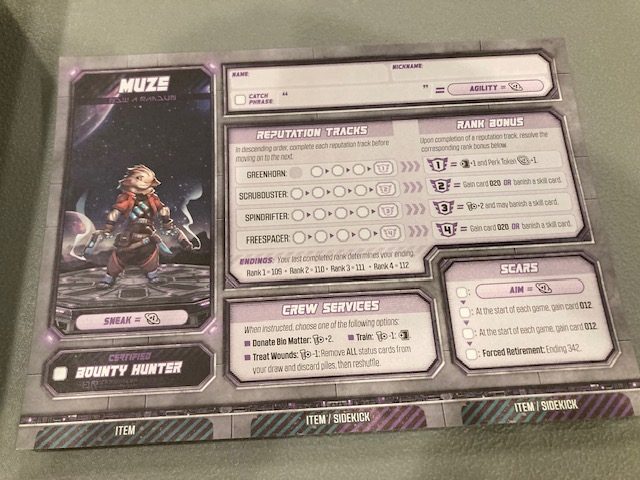
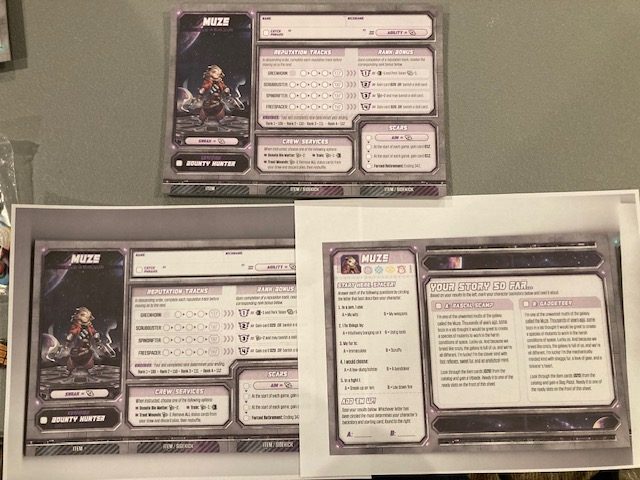
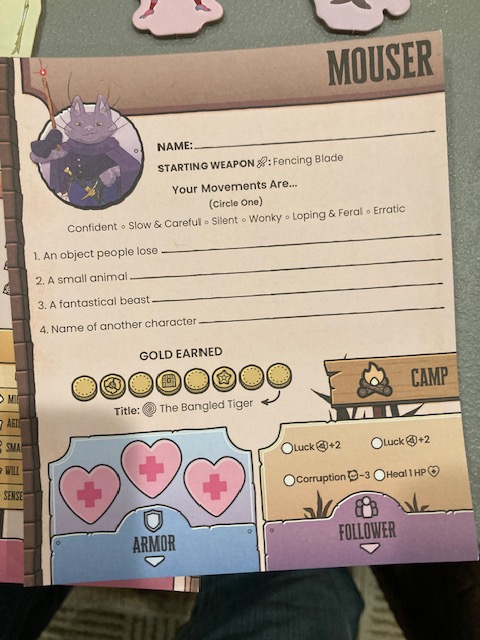
Each player chooses a character to play: there are quite a number of characters, and they each have their own special sheet.  See Muze above … that was my first character!!! I ended up making a copy of the character sheets (using my crappy home copier; it was good enough) so I didn’t mess up the original sheets that came with the game.  (There are a number of these sheets included with the game, but you can either print them yourself or just order more sheets from the web site if you don’t want to sully the sheets).

IMG_9076

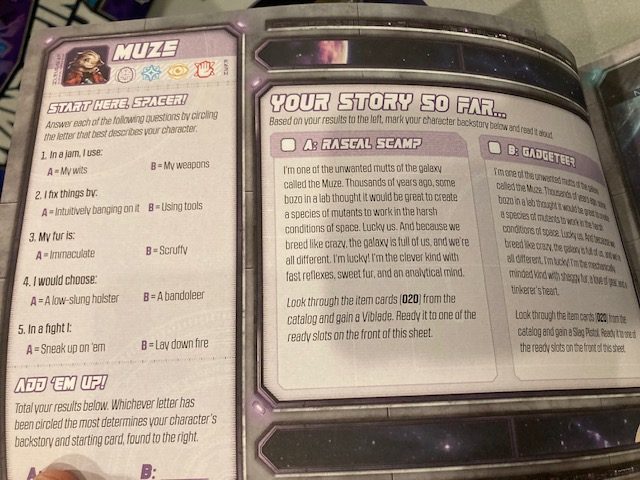
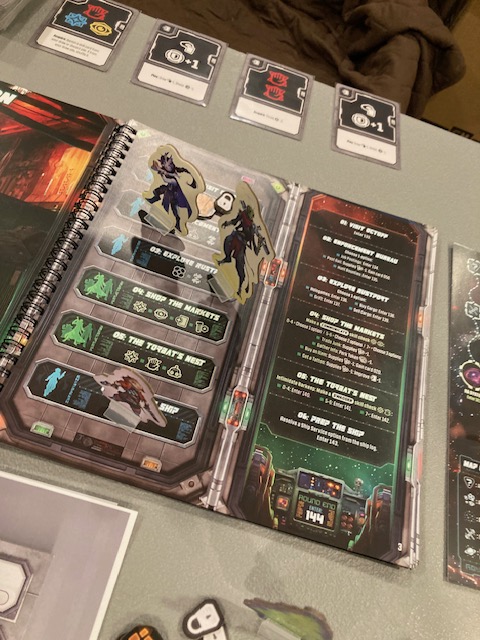
These character sheets are two-sided; the back has your “back-story” (no pun intended).  You fill out the little questionnaire on the left, and that informs your Story So Far… (on right side of the sheet).  This gives you some items and sets the tone for your hero!  This is part of the Story Telling aspect of the game.

IMG_9359

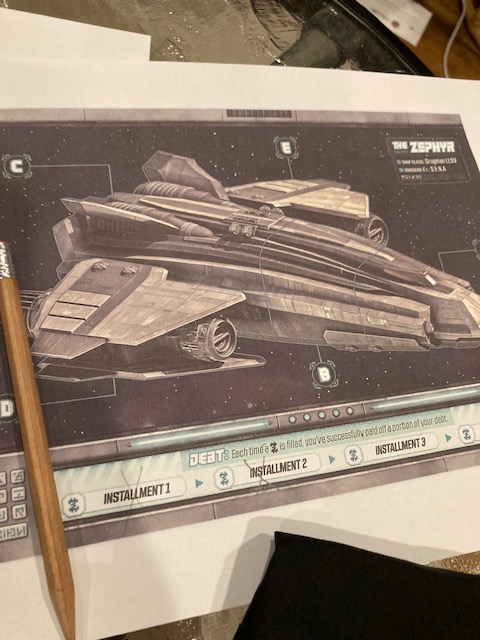
There’s also a sheet for the spaceship (I also made a copy as to not mess that up either).

IMG_9127

Of course, the App itself has most of the story!  It’s pretty cool; it’s narrated with different voices and is pretty funny.

I would say, first and foremost, this is a Story-Telling game.  All the other mechanisms in the game support that central tenet.  You are all characters being swept up in this space opera!

Worker Placement

IMG_9064

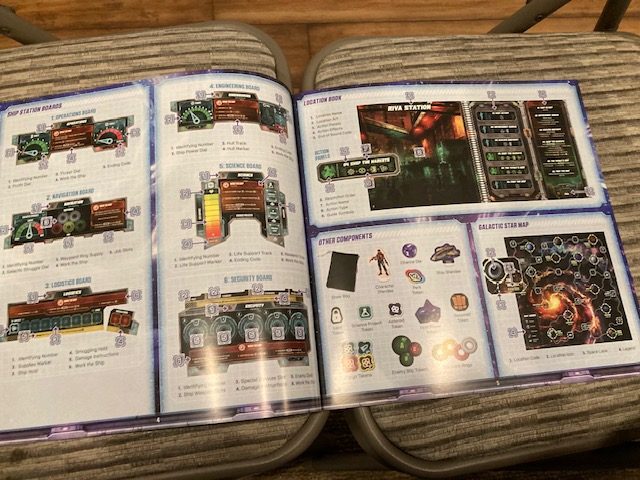
I’d say the next mechanism that you feel is the Worker Placement part of the game.  The Location book (above) has the location on the left and the Worker Placement spots on the right.

IMG_9358

Players look closely at the Icons on the worker placements places and place their dudes there.  This is cooperative worker placement, as you are all trying to work together to get certain things done.  To avoid too much “analysis paralysis” or “Alpha Playering” here, the players have 45 seconds to place their dudes!  (That’s the extent of the “real-time” part of this game.  if you were worried about me saying real-time, relax!  You can almost even ignore the real-time part … it’s really just to keep people from taking TOO LONG to play their dudes …)

IMG_9361

Once the dudes are placed, the right hand side of the page shows in detail what each action does.

IMG_9136

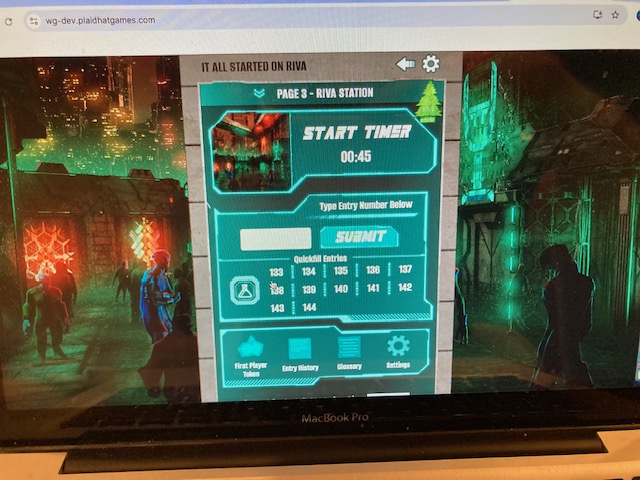
Sometimes your action triggers some text in the App; it gives a number (like 133, see below) and you lookup that entry in the App!

IMG_9129

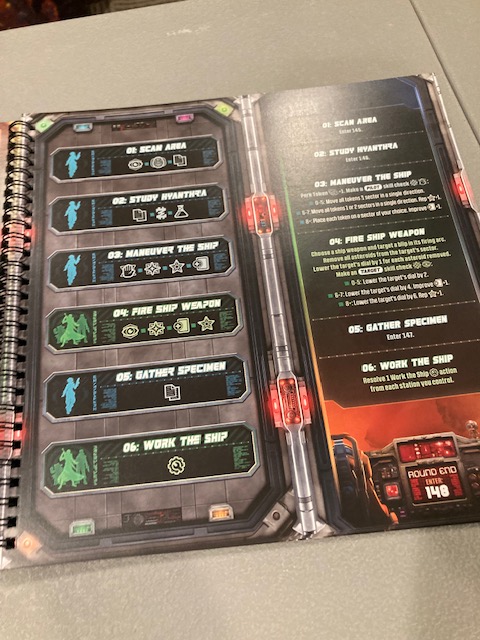
You spend a decent amount of time here on the Worker Placement pages. It wasn’t until my third game that I realized that the Combat also happens using the Worker Placement system …. what? Yep! You head to a special page where you are in “Combat!” Your actions move the ship (so enemies are in view), fire guns (port, starboard, ahead), or even work the ship to repair damage!

IMG_9065

This Worker Placement system seemed to work pretty well, and it’s cooperative.

Deck-Building

IMG_9131

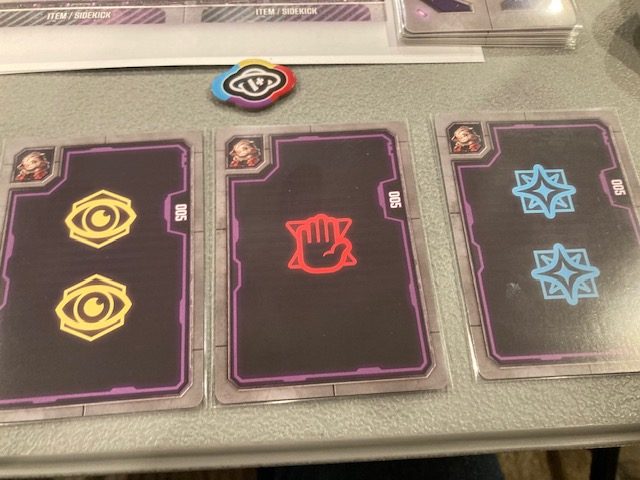
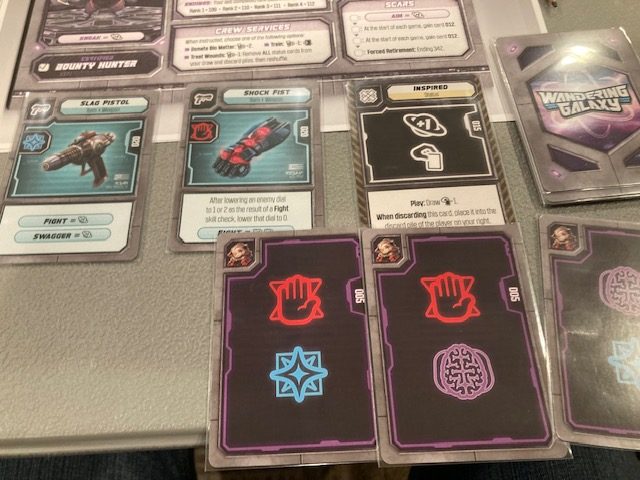
A lot of the game revolves around Skill checks … using your deck!  (I told you there was deck-building in here!)  When you need to make a Skill check (say Muze needs to SNEAK), you draw cards and add up the symbols that match that check!  SNEAK needs blue stars and red hands, so Muse has 3 above.   To be clear, the more symbols, the better!  (You can also use PERK tokens, the little Saturn token, for extra plusses, but you do have to discard those)

IMG_9151

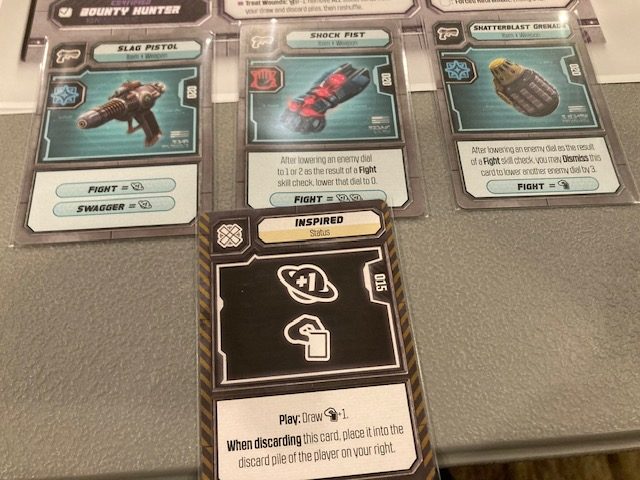
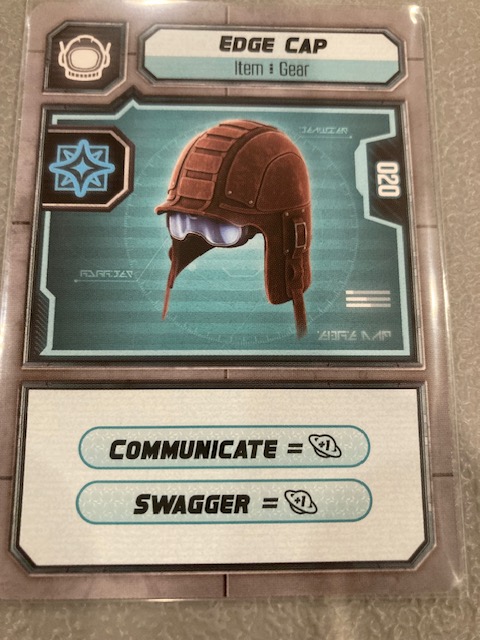
There’s also Items you can “hold” between hands, which you can choose to “help” in your Skill check.  That’s kind of a neat gizmo in the deck-building mechanism.

IMG_9135

At certain times during the game, you have a chance to add cards (or cull) you deck based on the actions you take!  There’s a nice set of 4 improvement card (above the the book, see above and below) that you can choose from!  I mean, it’s deck-building: you have to be able to improve your deck!

IMG_9361

Campaign

IMG_9362

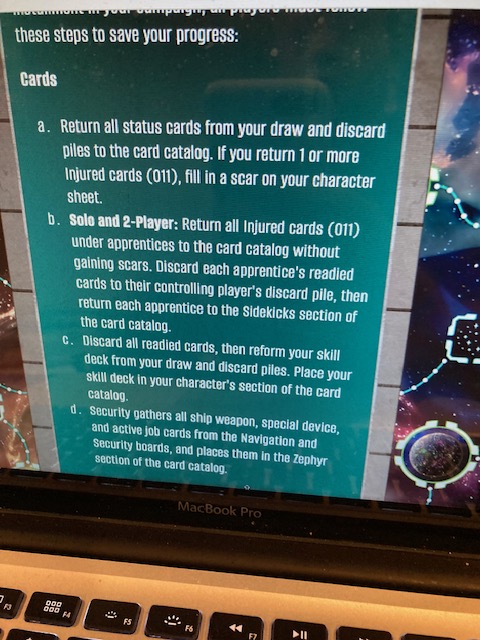
This is a campaign that can last … as long as you want it to!  There is also deck-advancement, as your deck build survives between games of the campaign (luckily, you lose things like Injuries that can clog your deck).

IMG_9113

So, when you finish your current game, you can just be done, or save off the game to play again later!  Nominally, your first full adventure (spanning many games) will be paying off the loan for your ship!

Bag-Building

IMG_9373

Even though there is deck-building in here (a deck for each character), there is also a bag-building portion! See the bag in the bottom right corner above!

IMG_9354

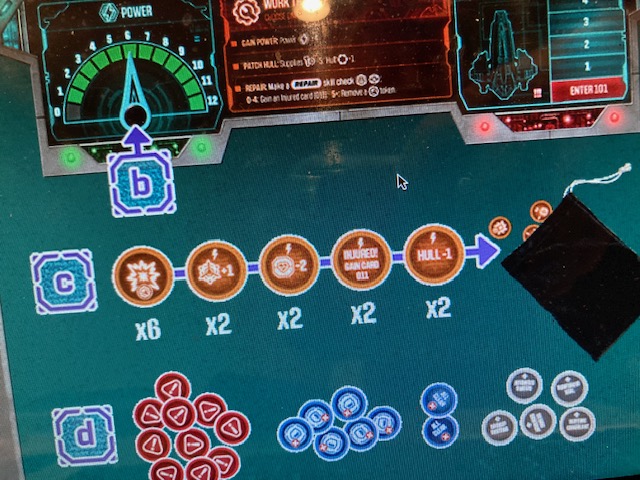
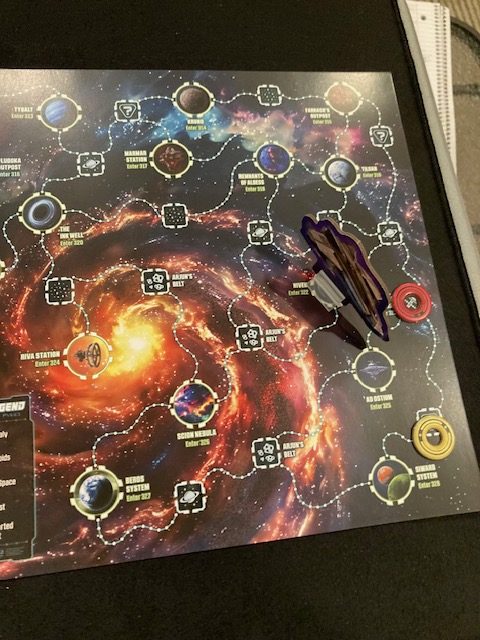
When you travel through space, you typically pull tokens from the bag to see “what happened” as you travel through space!!! (See the tokens you can pull above). Generally, travelling through space is tough on your ship as you take little bits of damage as you travel.

IMG_9365

You can take time at Space Ports and other places to “Work the Ship” to help fix it back up (putting tokens back in the bag).  It’s not a huge mechanism in the game, but it is important to be aware of what’s in the “travel bag” and try to keep it cleanish so that you don’t take too much damage as you travel.  The bag also controls threat, which is how the game can end … poorly.

Star Trek

IMG_9370

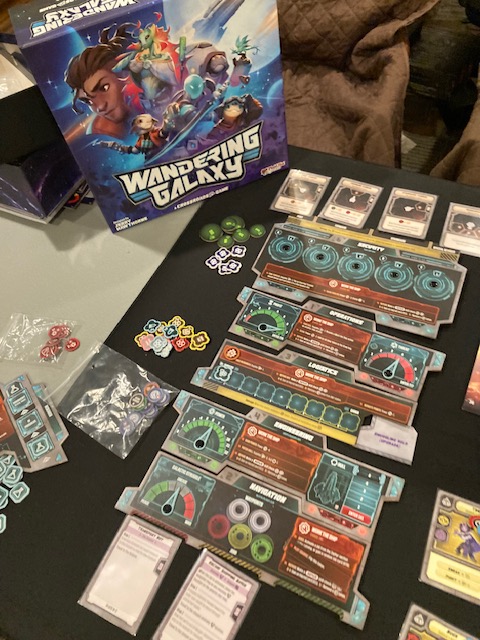
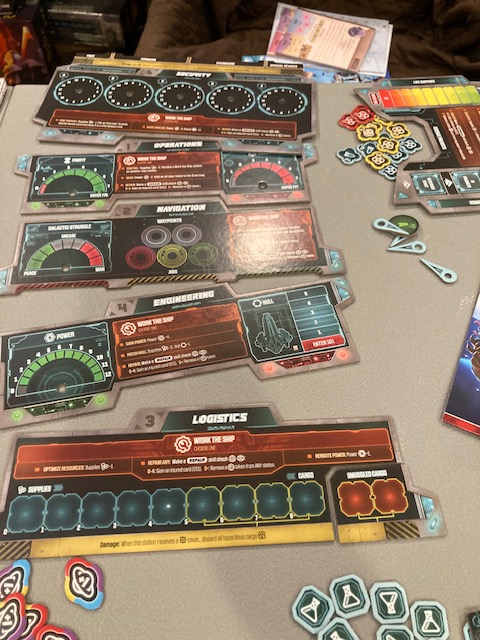
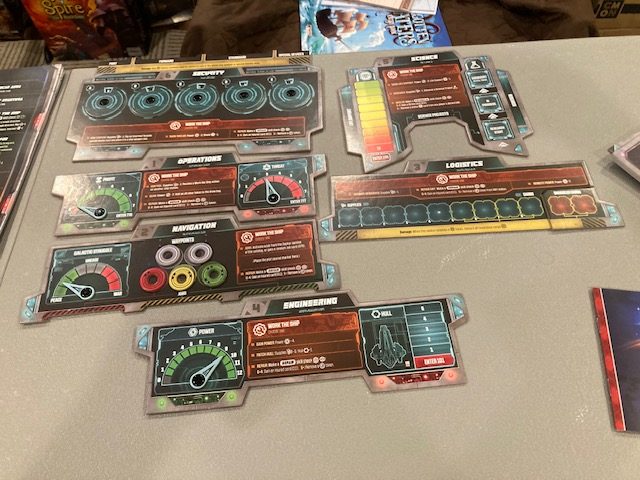
I said there was some Star Trek vibe in here as well … there is!  There are 6 “positions” of the ship that must be manned by the characters!   One player is the Engineer, one player handle Logistics, … Operations, Science, Navigation and Security!  In a game with fewer players, some players will have to man multiple stations!

IMG_9100

This reminds me of the characters sitting around the bridge of the Enterprise, with Spock manning the Science station, Worf manning the Security station, and Paris manning the Navigation station! (Look, I didn’t say WHICH Star Trek …)

IMG_5660
Cardboard!

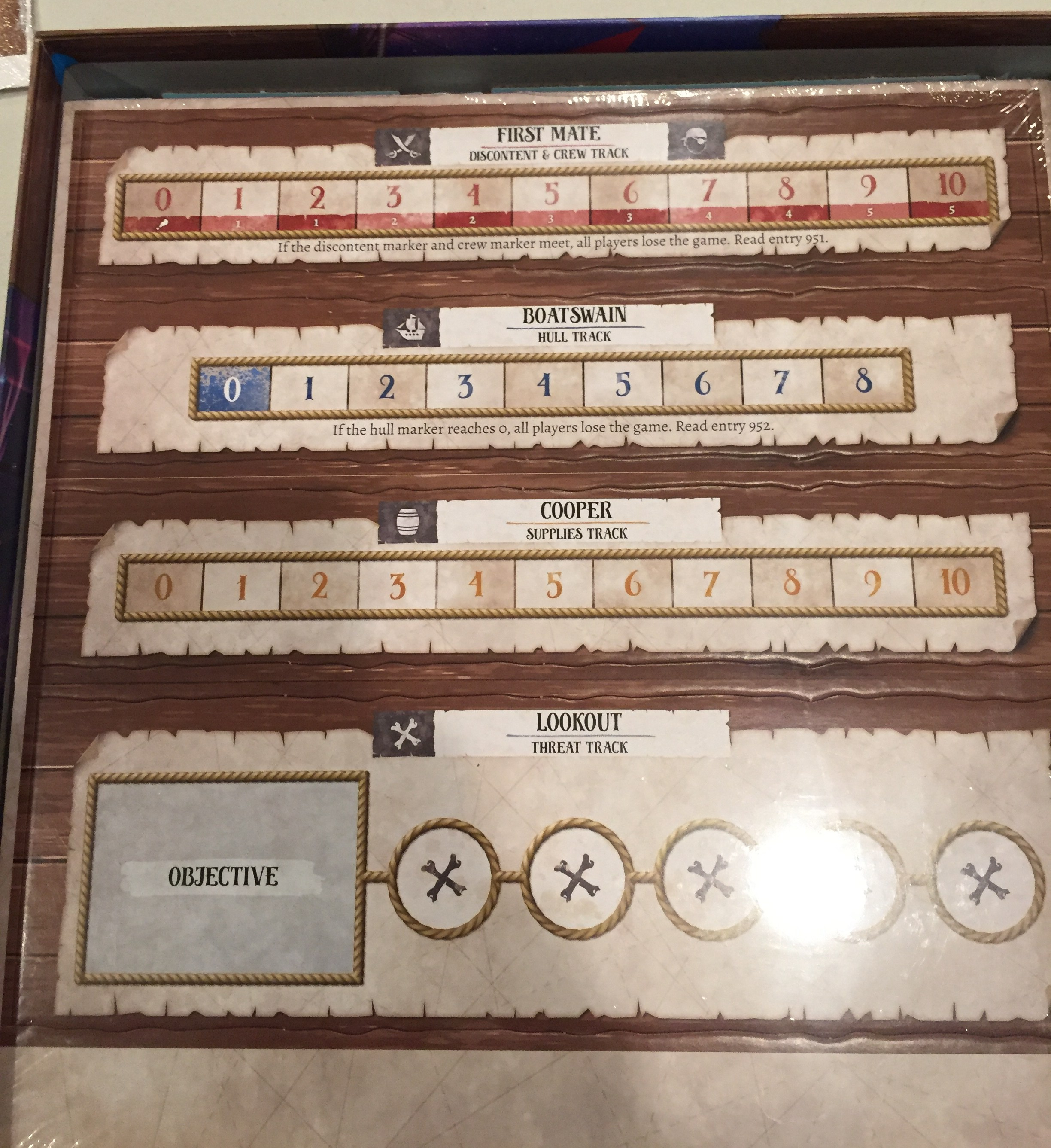
We’ve already seen this “station” idea in Forgotten Waters (see our review here) and Freelancers (see our review here)! Thematically, it worked great in Forgotten Waters (as pirates worked together to man the “stations” of a ship), and less so in Freelancers.

IMG_9379

Thematically, it works really well here too.  Basically, the stations help keep everyone involved in running the ship and contribute to the theme: we are flying a space ship together!

Pickup And Deliver

IMG_9369

One of the main activities in this game is pickup-and-deliver: you are a space-faring crew wandering the stars, looking for adventure, but usually you are delivering stuff to make ends meet!

IMG_9152

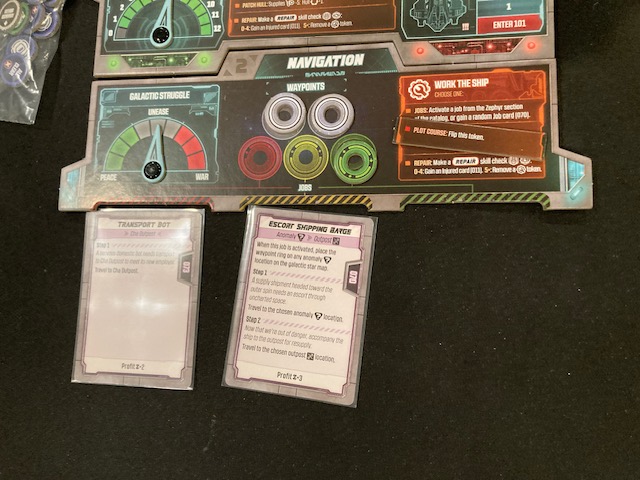
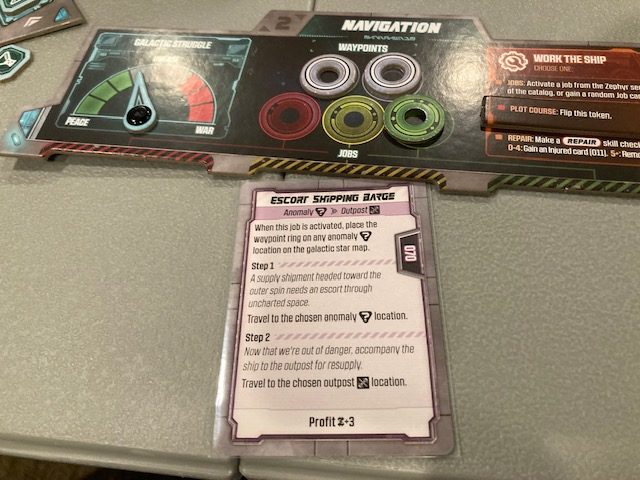
The Jobs you get (above) inform where you go on the star map (see below) by marking them with little waypoint markers.

IMG_9365

The yellow waypoint marker is the yellow job (Escort Shipping Barge).  This pickup-and-deliver mechanism sort of guides were you go in the game.  If you don’t like pickup-and-deliver, you might still like this game, as there are so many other mechanisms in the game.  If you do like pickup-and-deliver, then you will be happy.

Solo Play

IMG_9061

So, Wandering Galaxy embraces the solo player!  (Congratulations on following Saunders’ Law!).  I am surprised a little because the previous games in this series (Forgotten Waters and Freelancers) supported solo mode, but they were bastard step-children solo modes that were only supported by consulting the some arcane rules on the web site!  Okay, maybe I am exaggerating a little when I say that, but Wandering Galaxy really does embrace solo play.

IMG_9113

The rules and the App support solo play as a first-class mechanism!  The app asks you how many people are playing and helps you set-up the solo game in the normal flow! 

IMG_9114

The solo player still operates one the main characters: see above as I operate Muze … (notice I made a copy of the sheet…)

IMG_9120

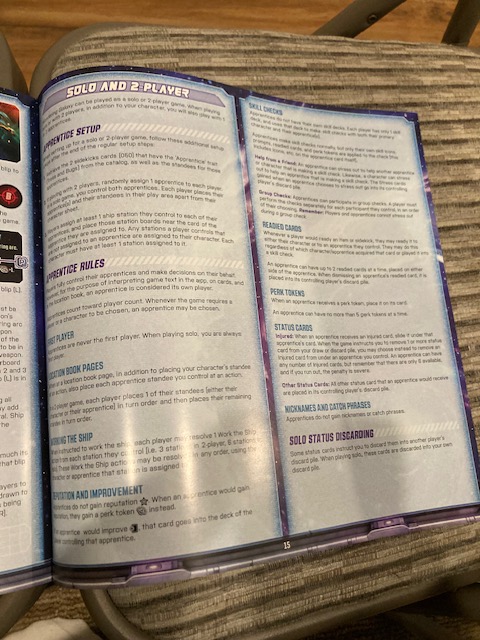
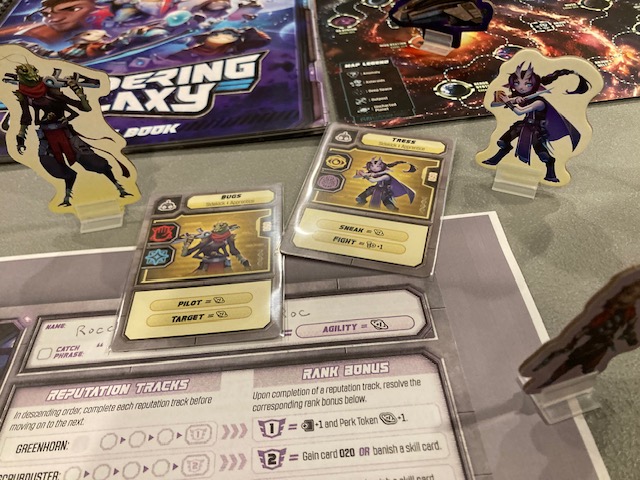
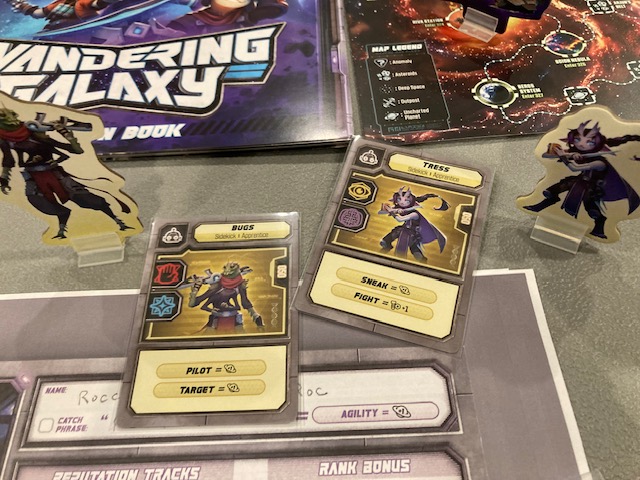
…. but the solo player gets to control two Sidekicks (see Bugs and Tress above).  These Sidekicks aren’t “full characters”, but they are much much easier to operate.  Normally, I don’t like solo rules that go too much outside the normal flow (I usually prefer to play multi-handed solo), but the app was so helpful in setting this up and getting to solo play that I didn’t mind!

IMG_9358

So, when the solo players does Worker Placement actions, the solo player plays his player, and the two Sidekicks as well.

IMG_9367

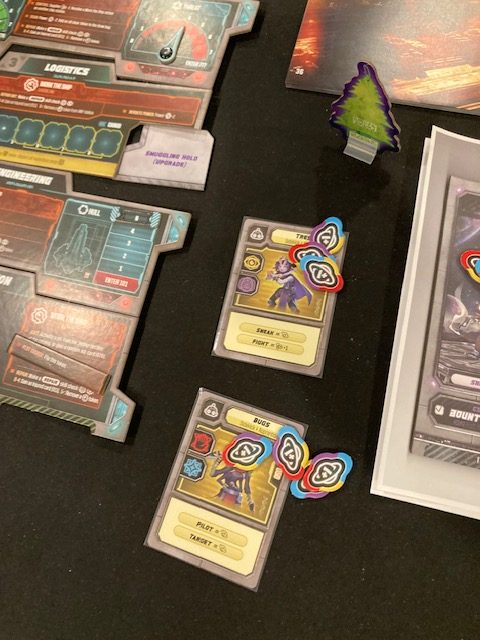
This means the solo player is also controlling all six stations!  Interestingly, you still have to assign one station for each of Bugs and Tress.  See above as Bugs and Tress each have a station (to their left).

IMG_9137

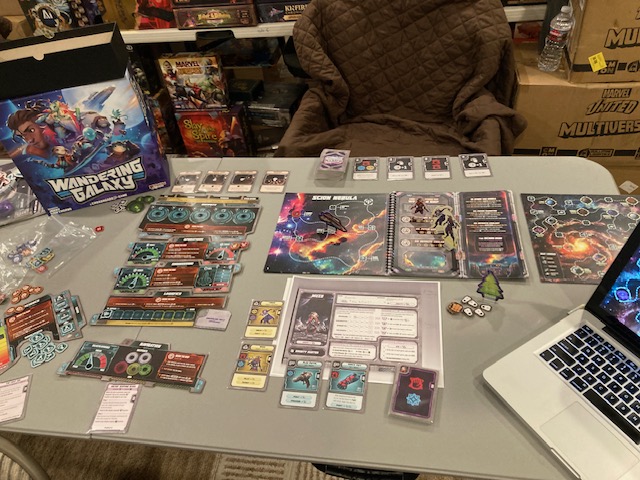
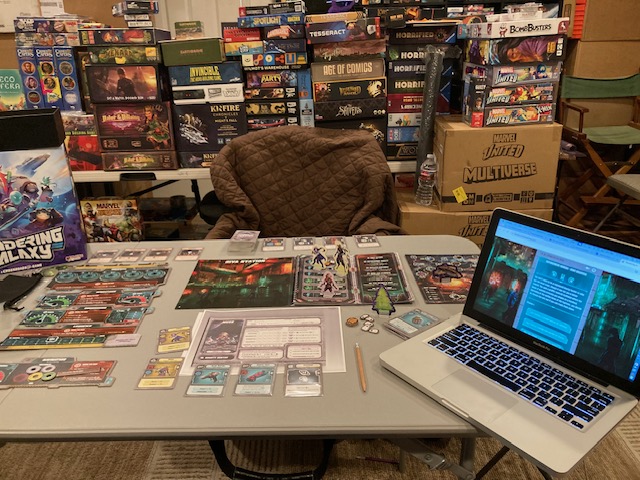
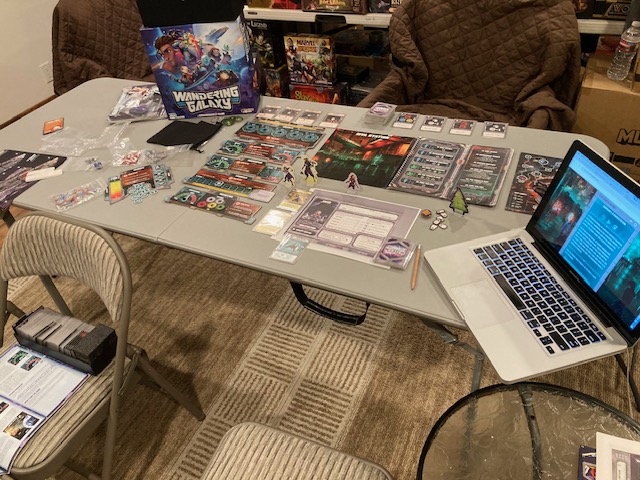
See above as I have the 6 stations, my character Muze, Bugs and Tress, the Worker Placement book, the map of the Galaxy and the App open!  Whew!

IMG_9355

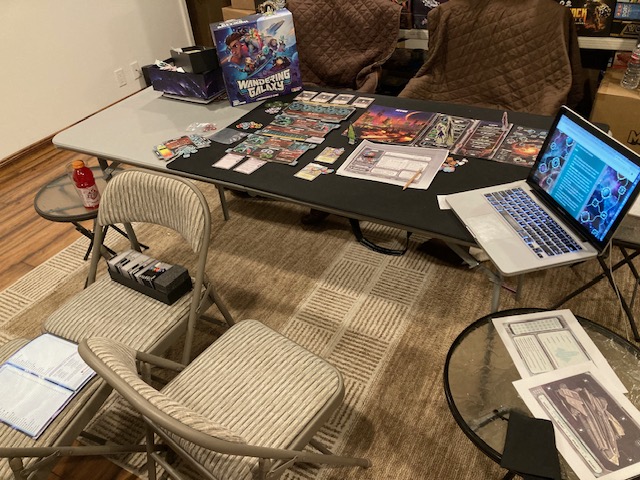
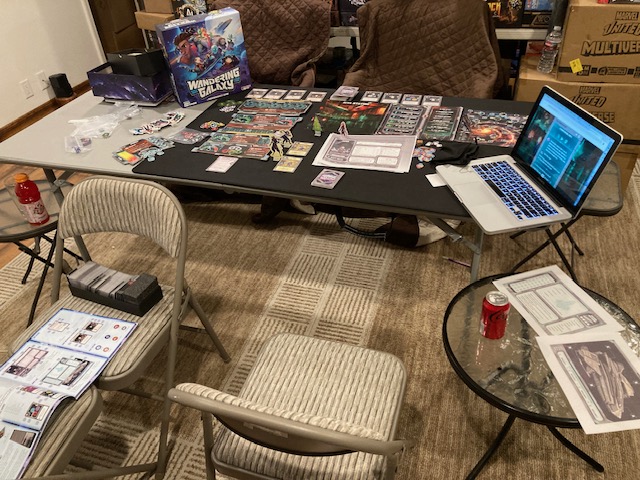
And then the solo player still has to manage the cards (see chair on the left with the card box) and the ship (see the table on the right with the ship)!  And, occasionally the solo player must still consult the rulebook!  See as the Rulebook sprawls across two chairs …Whew! 

IMG_9124

… and it’s actually not that bad.  Sure, there’s a lot of stuff to manage, but the App takes you through the game pretty darn well.   I played my first few games solo, and I had a good time.  I never felt like the ongoing maintenance (to keep the game moving forward) was too much work. 

IMG_9362

Setting up is a bit of work, as is tearing down (see above), but again, the App helps guide you through it.  I’ll be honest, the Rulebook for this game looks daunting (with set-up and rules), but let the App guide you and just use the rulebook when you “have to”!

IMG_9371

I thought the solo game worked well, even better than Forgottten Waters or Freelancers. I jumped right on and had a grand time. I would definitely play this again solo.  I honestly think the App made the solo play that much better.   

IMG_9121

What about the Sidekicks Bugs and Tress in the solo game?  They really are easy to operate: you just use your deck but get slightly different bonuses (depending on which character: Bugs is good at Piloting for example).  They kind of remind me of characters on Star Trek you see in the background all the time, but don’t get much development.  They aren’t full “main” characters who get their own story arcs … like “unnamed Corporal 2”.  For example, when Bugs or Tress would get REPUTATION (a fun way to move a character story forward), they just get a PERK token instead. Poor Bugs and Tress.  Maybe they’ll get higher billing in the next Star Trek show.  (We only have 13 shows, we need a 14th Star Trek show starring Bugs and Tress!!!) (And yes, I added extra exclamation points there, because that’s how strongly I feel about poor undeveloped Bugs and Tress!!!!)

Cooperative Game

IMG_9374

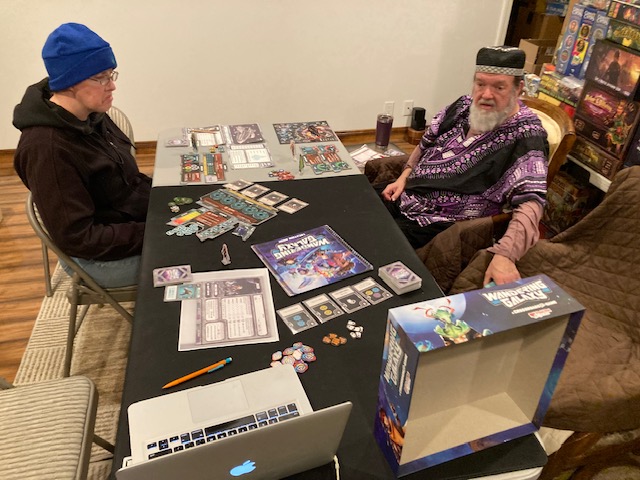
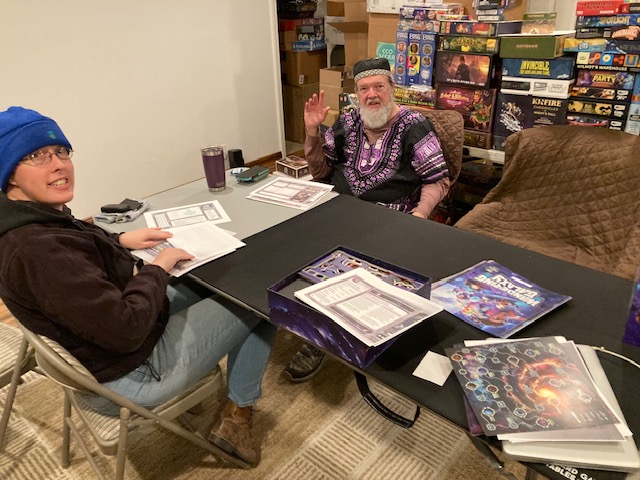
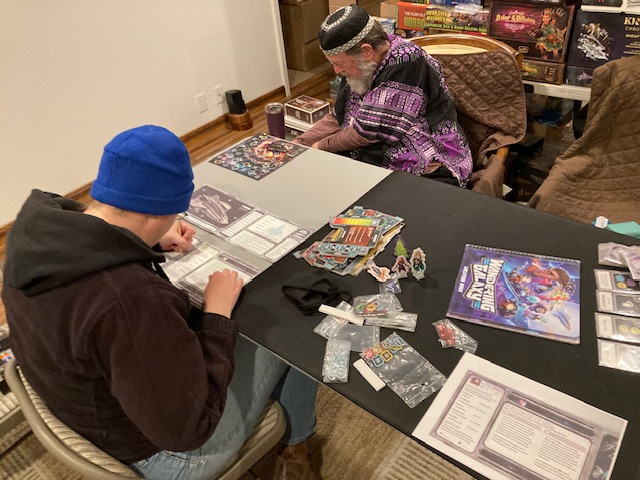
My crew showed up, ready to take the Galaxy by storm!  The crew was originally supposed to be a full complement of six, but space sickness and space madness and space baby-sitting caused us to winnow down to just three.  But what a great crew they were!!  Too bad the spaceship exploded on the pad.  But I digress … 

IMG_9377

Cooperative play worked really well.  Luckily, I had played the game solo enough to smooth out some of the rules (even still, there were ambiguities as we played which were frustrating).  Part of why this game works very well for a cooperative game is that each player owns their own station, which keeps them in involved as they play! And each player has their own character with their own worker placement token!  So, players are always involved (via the station and worker placement) as well as connecting (as they “bond”) with their character, and making shared decisions about the fate of the ship and crew!!! (More exclamation mark for you!!!)

IMG_9376

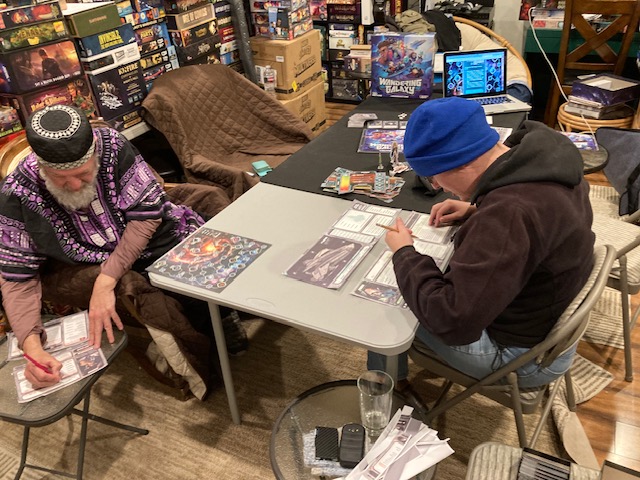
My friend Teresa liked her character so much that she took it home as a souvenir!

We ended up playing a one-off, but once my group regroups, I suspect we will settle in for a fuller campaign.  It is nice that you can play this as a full campaign or just a one off.

Sense Of Humor

IMG_9122

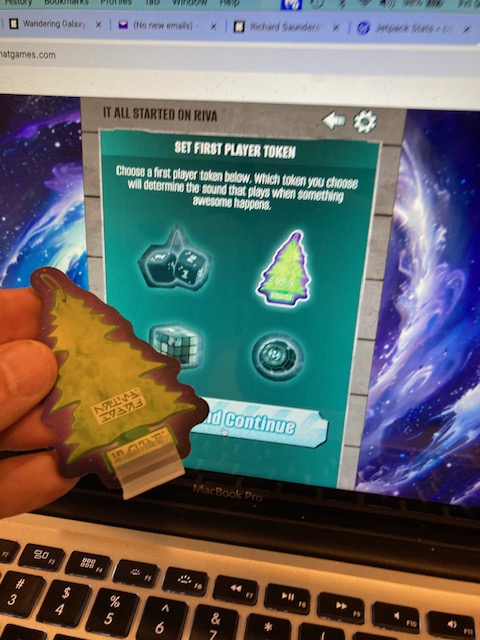
Just so you know: this game is kind of silly.  The story is silly, the voices are kind of silly, and even the first player token (I chose the Christmas Tree) is silly.    If you were looking for a grim-dark Star Trek game, that’s not this.

IMG_9097

The game has a sense of humor, but it’s not just ALL silliness.  You still have to build your deck, make smart decisions, deal with damage on your ship, pickup and deliver stuff, place workers, and generally make a lot of decisions.  But the undercurrents of the game … are a little silly.

IMG_9852

Even though Wandering Galaxy is silly, it’s still not quite as silly as Freelancers or Forgotten Waters: those games just seem to have sillier stories and sillier resolutions.  So, if you were just slightly annoyed by the silliness of Freelancers or Forgotten Waters, maybe Wandering Galaxy is a better choice for you … but it’s still silly.  Just not as silly.

IMG_9138

You know a game is silly when it brings out the silliness in you!  When we performed the Skill checks, we started singing the Lucky Charms cereal theme songs!  “Blue Stars, Yellow Eyes, Purple Brains!  Frosted Lucky Charms, they are magically delicious!”

Entry Book

IMG_1085

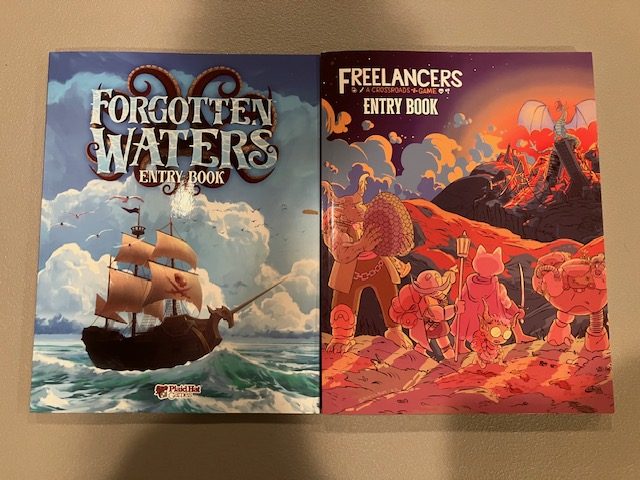
Some of you might have been very non-plussed by the necessity of the App in this game.  Well, if you like reading text from books, there are Entry Books available!   The Entry Book isn’t QUITE done at the time I received my copy, but it will be.  In the meantime, I did pickup the the Forgotten Waters and Freelancers Entry Books (those were part of the Kickstarter).

IMG_1086

Basically, all the reading and entries that the App does  is encapsulated in the Entry Book.  There’s something kind of nice about having a “backup” for this: I have had some games where the App goes dark (Rising 5, I am looking at you); with this Entry book, you can always still play the game if the App goes dark.

My friend Joe actually prefers the Entry Books: he uses these games for his English classes, as it encourages reading out loud!

What I Liked

IMG_9376

Supports Multiple Players Well: the game really works well with many player counts.  The station system helps keep everyone involved, even at higher player counts.   I am glad to see the Solo mode as a first class object.

IMG_9145

Story:  Really, this game is all about the story.  How do you want your adventure in space to proceed?  Life is what happens when you are making plans, especially in space!  Every player is involved as they explore, but generally the story just unfolds and everyone is along for the ride.  If you want to play a space opera rather than watch one, this is a good choice.

IMG_9143

The App:  Despite the app not being quite done (some of entries didn’t have full voice acting, and some entries were incomplete), the App worked quite well.  I think it’s really evolved and easy to use, especially for set-up and first play!  (I mean, they have had 2 iterations to get this right). It’s also good to know there is a backup Entry book in case the App ever goes dark …

IMG_9105

Sense of Humor:  I really like the silliness in this game.  It’s not quite as funny as Freelancers (which was much sillier) or Forgotten Waters, but it was funny.  Caveat Emptor: you may not like the silliness.

What I Didn’t Like

IMG_9085

Ambiguity: By far the biggest complaint is the ambiguity in the Rulebook.  There’s just too many places where things are NOT well specified. We’ve mentioned at least three things in this article alone where we had to go to BoardGameGeek to find the resolution!  The game still works, but it’s very unsettling to have just a few too many places where the rules are poorly specified.  Some of this is because maybe the game came out early; the App still needs some work, and maybe they will fix-up the ambiguity in the App. Unfortunately, the Rulebook can’t be amended (unless they put up a version 2.0).  Just prepare yourself to look stuff up on BoardGameGeek.

Conclusion

IMG_9374

I liked Wandering Galaxy and so did my friends!  It’s the next great game in the Crossroads games series (after Forgotten Waters and Freelancers).  It’s probably the most complicated of the three games, but it’s possibly the most thematic of the three.   Be aware that that there are a lot of mechanisms: deck-building, campaign, bag-building, pickup-and-deliver!  … but the game feels paradoxically both heavy and light!  The game glides along as you enjoy the story, with some heavier mechanisms behind the scenes.

IMG_1085

An App is required to play … unless you have the Entry book (at the time of this writing, the Entry Book for Wandering Galaxy is not out, but should be soon (the Forgotten Waters and Freelancers books are already out).  Despite the App not “quite” done at the time of this writing, it did a marvelous job bringing us into this world. It even embraced the solo player well!

IMG_9376

This is a great light-hearted cooperative adventure for you and your friends! It’s not “quite” as silly as Forgotten Waters and Freelancers, but it’s still pretty silly.

IMG_9112

This is probably an 8/10. The only real problem with the game was the ambiguities that kept coming up: If you are pick-up in this game, I suspect you will be looking up a lot of stuff on BoardGameGeek. But, since the App is a dynamic entity, hopefully they can address a lot of those issues within the App itself. Hopefully, by the time you read this, the App will have fixed all those problems and this will rise to a 8.5/10. It’s a really fun game.