Probably My Favorite Game of 2025! DC Super Heroes United: Batman Hush

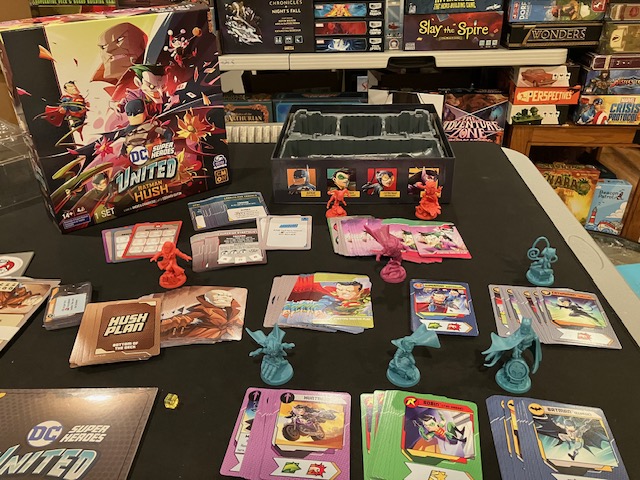
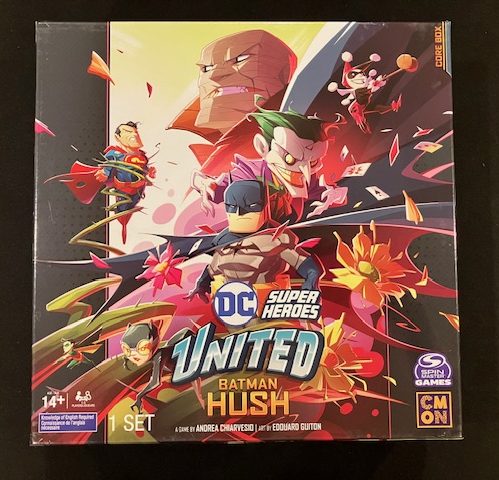
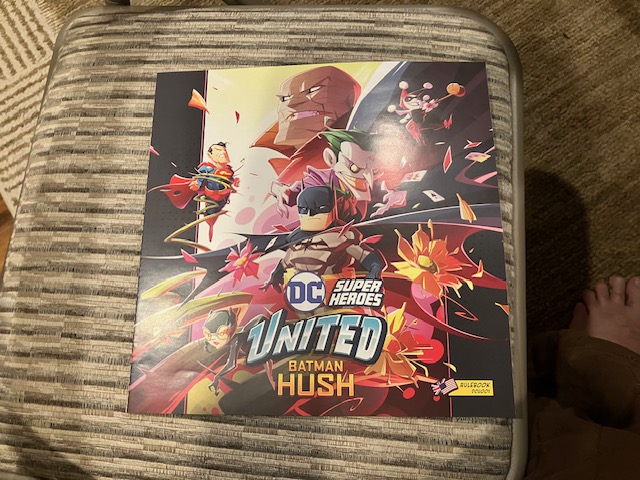
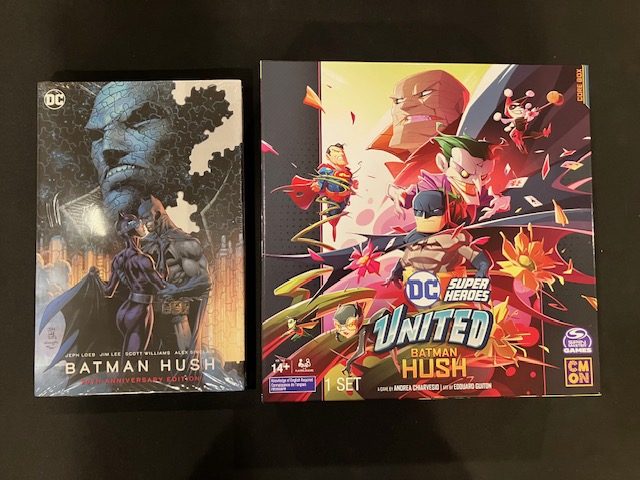
While we wait for the full delivery of DC Super Heroes United (which has run into multiple issues; CMON money issues, tariff issues, and staffing issues), CMON did manage to release DC Super Heroes United: Batman Hush (which we’ll just call Hush from now on, thank you). See above!
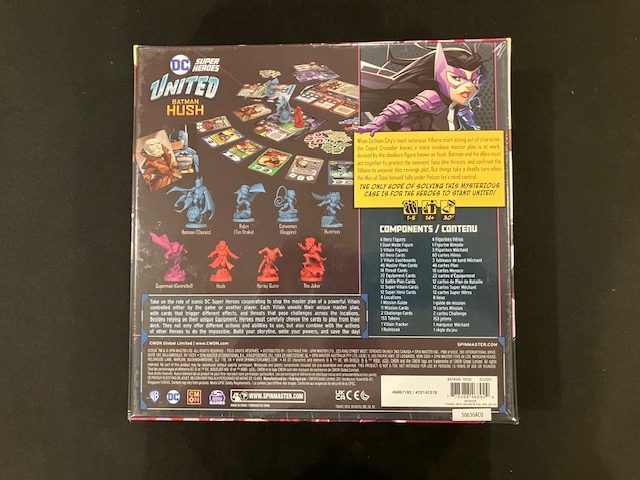
This was a “surprise” release that was available from Amazon sometime in August 2025; I ordered it instantly as soon as a I found out about it.  No one really expected this?  EDIT: Well, I missed a some memos … I didn’t expect it.  I mean, we expected DC United (it was #1 on our Top 10 Anticipated Cooperative Games of 2025 list), but Hush was not part of the original Kickstarter!
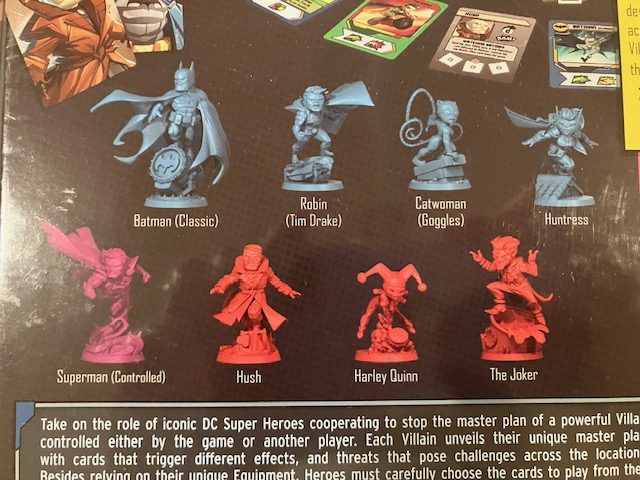
This game arrived at my house September 10th, 2025.

What is this?

Hush
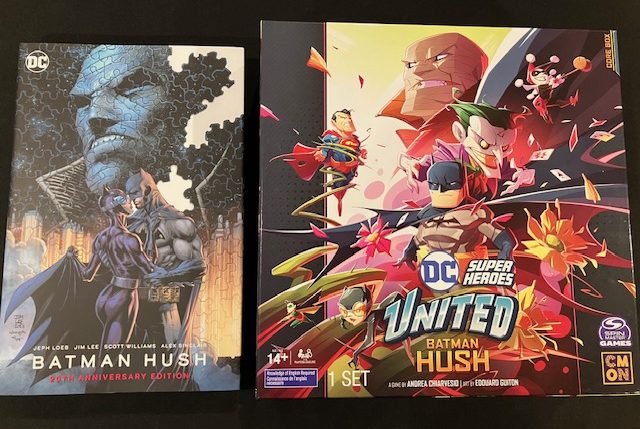
This game Hush is a standalone game in the Marvel/DC United series of games.  Yes, it is standalone; you don’t need any other sets to play this.  This is a cooperative superhero game where players take the role of your favorite DC Superheroes (Batman, Robin, Superman*, etc) and work together to defeat the villain!
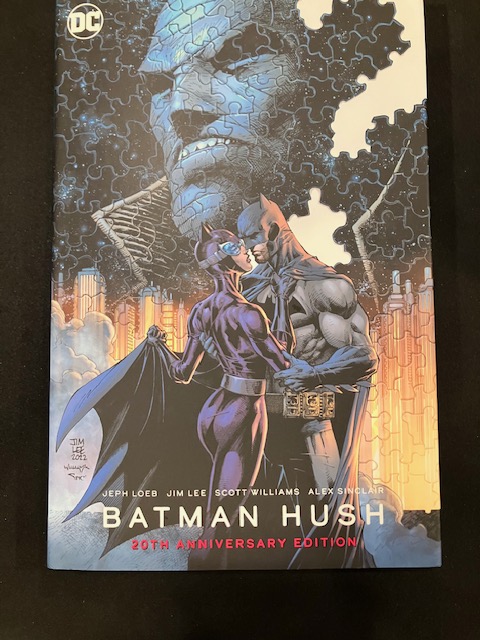
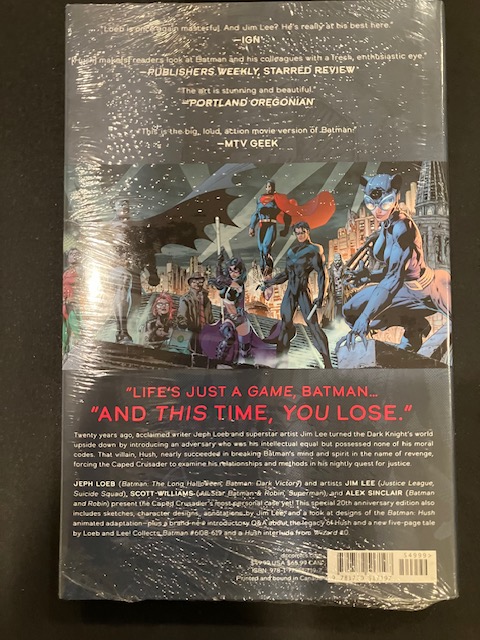
Hush is loosely based on the Jeph Loeb/Jim Lee/Scott Williams/Alex Sinclar Batman series called Hush: see the 20th Anniversary Edition hardback above.
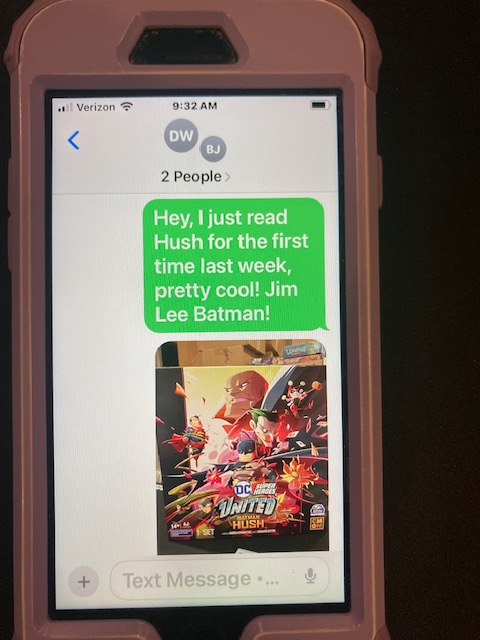
Surprisingly, I had never read Hush, which is weird because I love Batman and I love Jim Lee.  How have I never read this???  I texted my friends Bryan and Diana, who are huge Batman and Jim Lee fans about this!
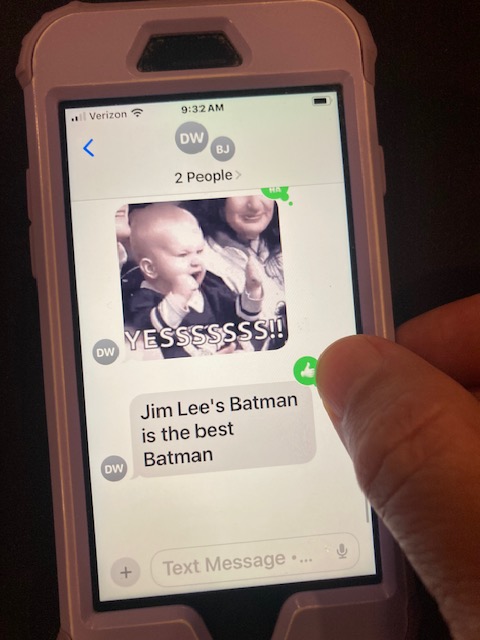
They think Jim Lee’s Batman is the best Batman (see above).  I went ahead and devoured the story over about 3 hours (below).
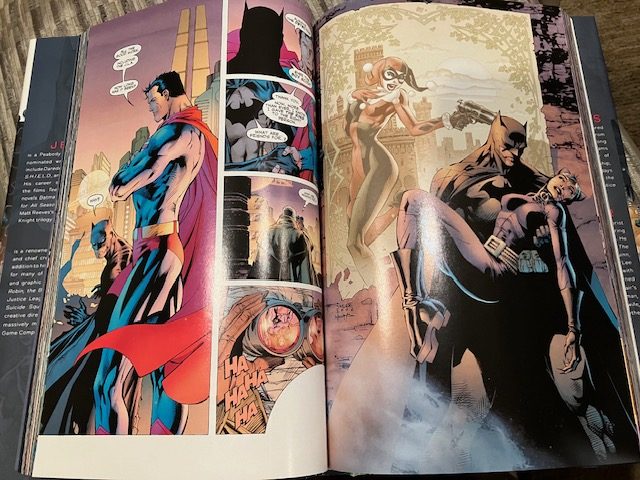
Hush is a great story; I’d recommend reading it if you’ve never read it.  It gives much more depth to the Hush villain(s) in the box.
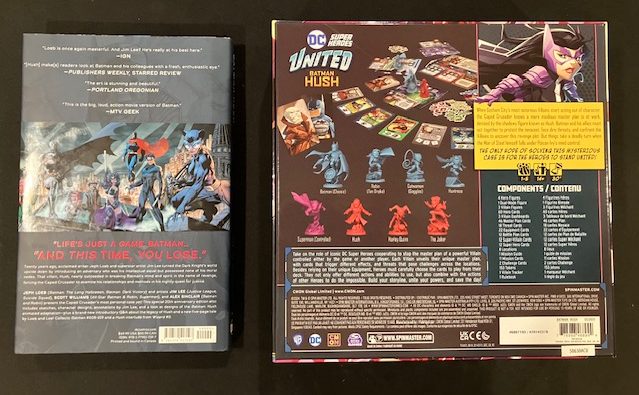
Strictly speaking, you do NOT to read the Hush graphic novel/series to play the game; it just helps flesh out the game.  So, if you are intimidated by the giant Hush graphic novel, don’t despair!  The game works fine without knowing the series, but be aware that there can be spoilers.  (Still, Hush was pretty cool; you should read it!)

Unboxing/Gameplay
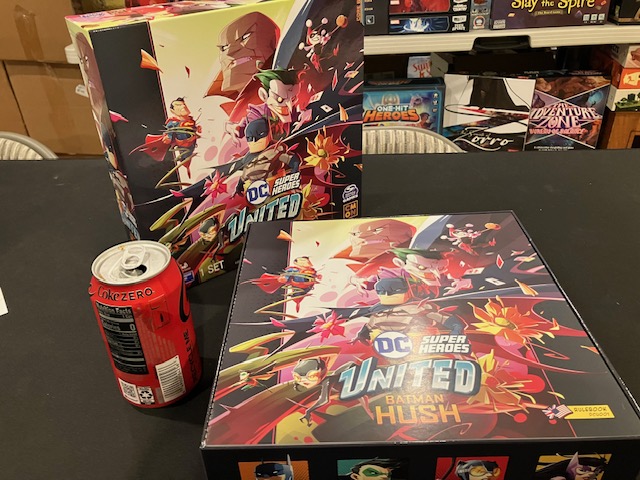
See box above with can of Coke for scale.
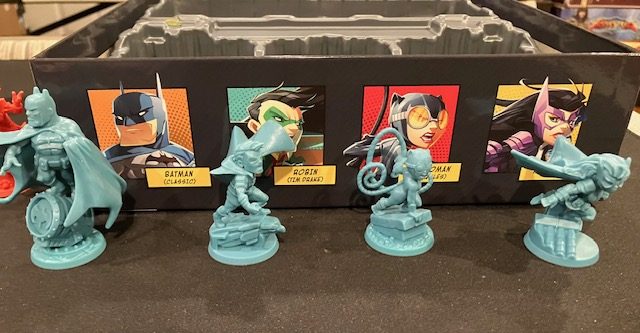
Each player chooses a hero to operate: Batman (classic), Robin (Tim Drake), Catwoman, or Huntress.
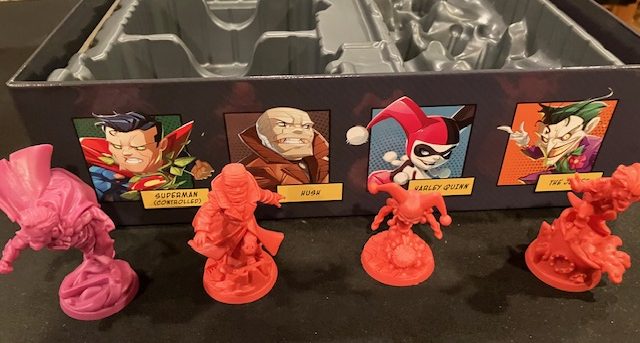
There must be a villain to fight: Hush, Harley Quinn, The Joker, or Superman (controlled).  Superman (controlled) can also be played as a Hero.
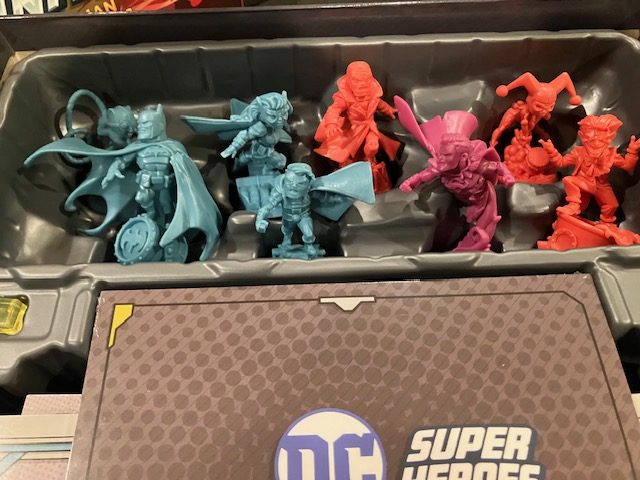
I recommend taking a picture of how the minis fit into the insert (or use mine above).  If they all get out out-of-whack, you can’t put the plastic cover over the minis (see below).
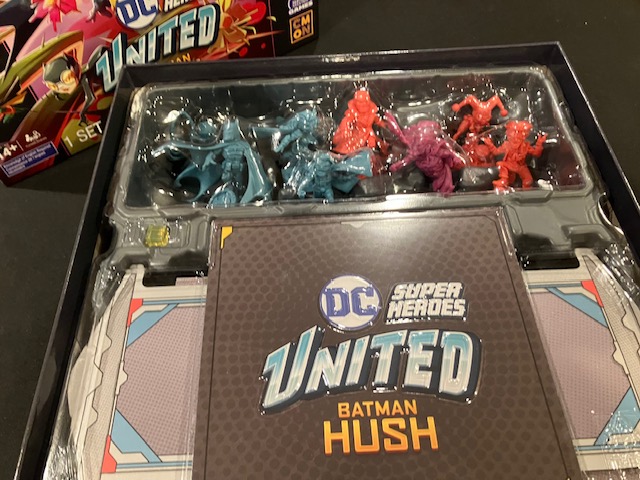
Each Hero gets their own deck, and each Villain gets their own (Master Plan) deck and Threats deck.
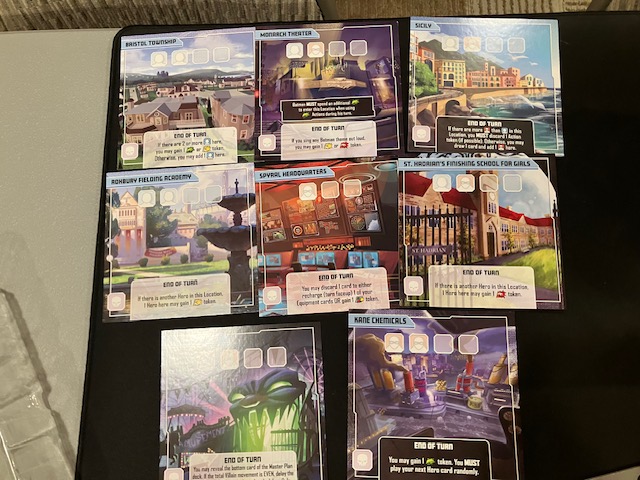
There are 8 locations that come with the box; you will set 6 of them out in a circle representing the city.
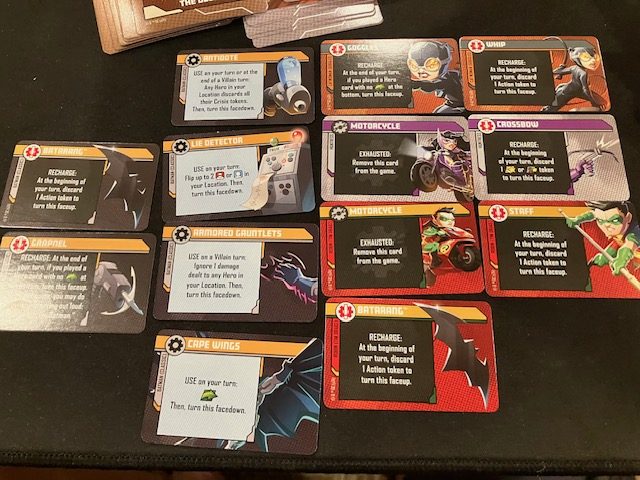
Most of the characters have equipment; the equipment cards are “newish” to Marvel United: they were introduced in Spidergeddon, but we were found we loved them in Marvel United: Multiverse (see review here).   The equipment cards augment the heroes, and basically give them more choices on their turn; however, they will either be discarded or need a recharge to reuse them.  See above.
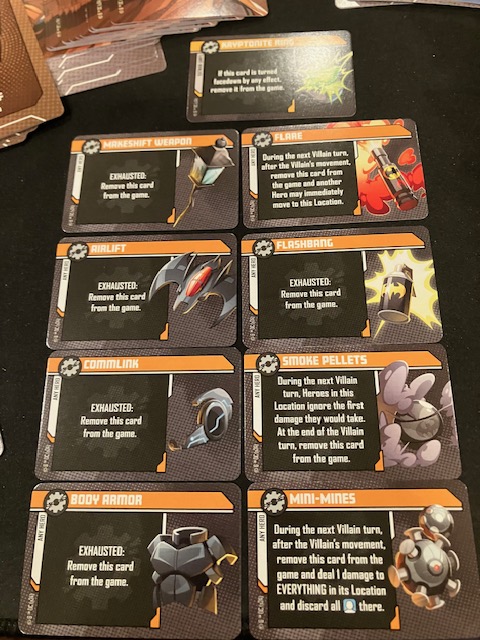
For heroes who don’t have equipment, there are also “generic” equipment cards any hero can use (see above).
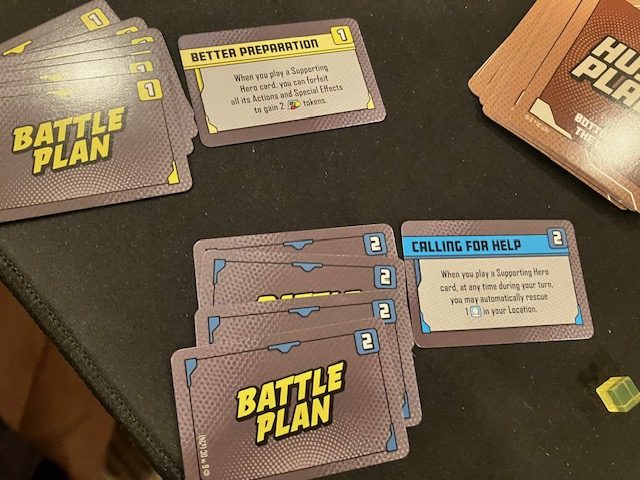
The game also comes with Battle Plan cards; they are for the built-in solo mode called Commander Mode.
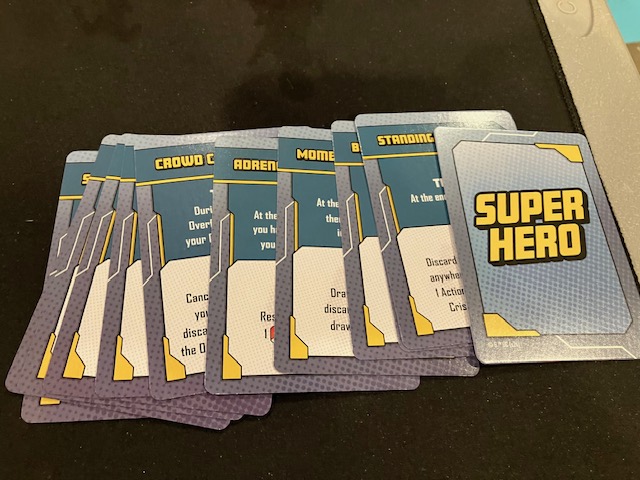
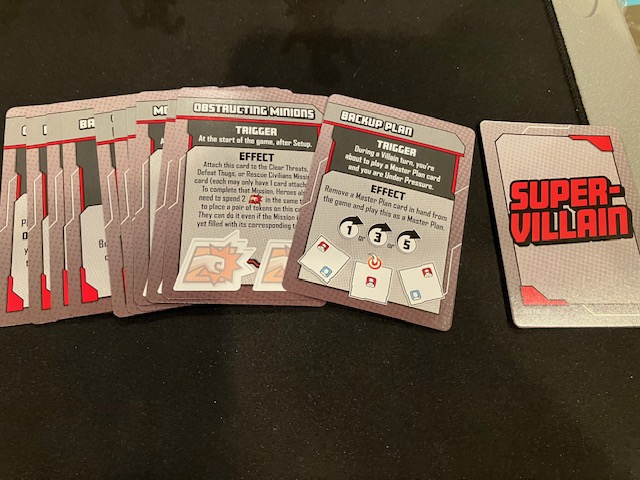
There is another way to play where one player can take control of the Villain and plays against all the heroes: this is a 1 vs. many mode using the Super-Hero and Super-Villain cards above.  We won’t be discussing this mode any more in this review; this is strictly a solo and cooperative mode review.
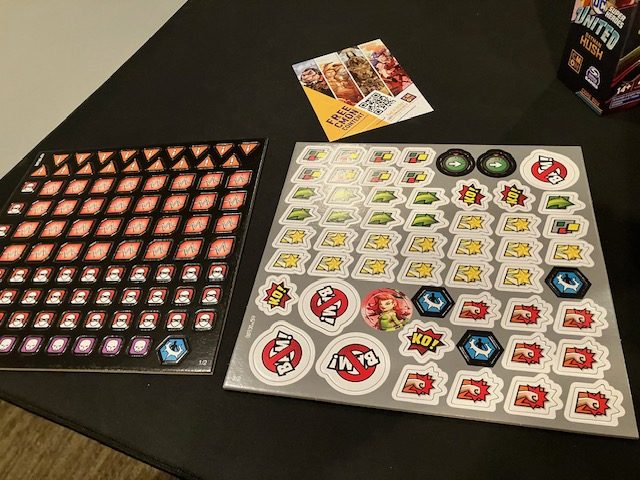
There are a tons of tokens for health, KOs, etc. See above.
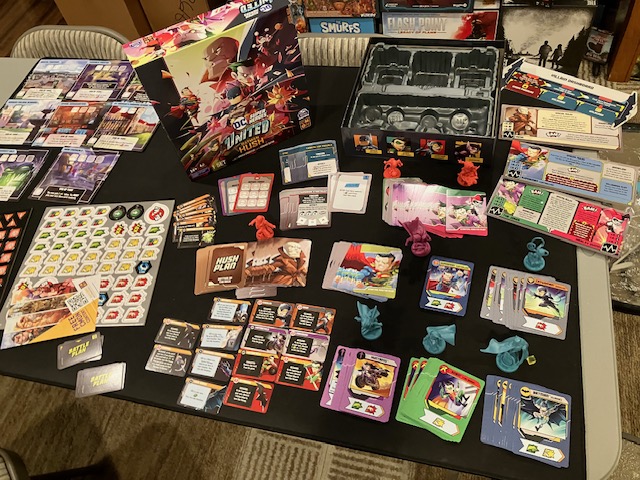
Overall, this game looks consistent and great.  The artwork and minis in the game are consistent with the look-and-feel of all the previous Marvel United games (except this is DC instead of Marvel).  For previous looks at Marvel United games, see here, here, here, here, here, and here.

Rulebook
The rulebook is good (it had better be after so many iterations), except for the form factor.
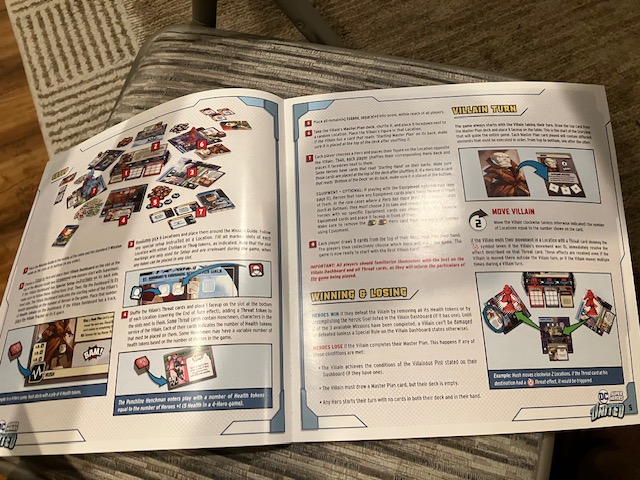
This gets a C+ or B- on the Chair Test; it does stay open on the chair next to me, it has a good-sized and readable font, it has lots of pictures, and it’s easy to read.  Unfortunately, it hangs down just enough to be annoying.  It does work with only one chair, if you sorta fudge it diagonally.
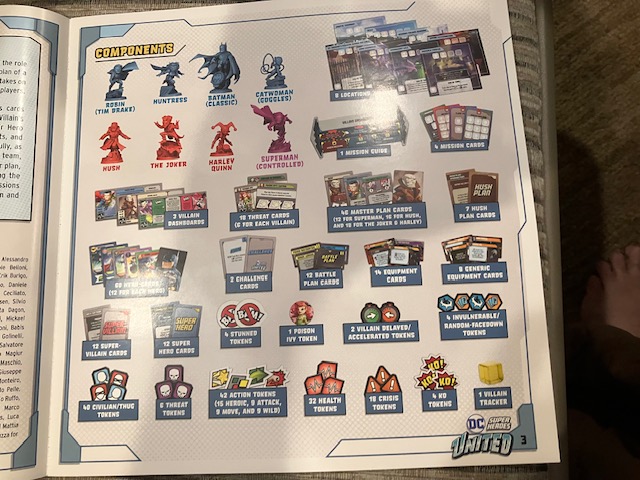
The Components page is great: see above.

The Set-Up is across two pages, but they are in the same span, and the picture and labels work well.
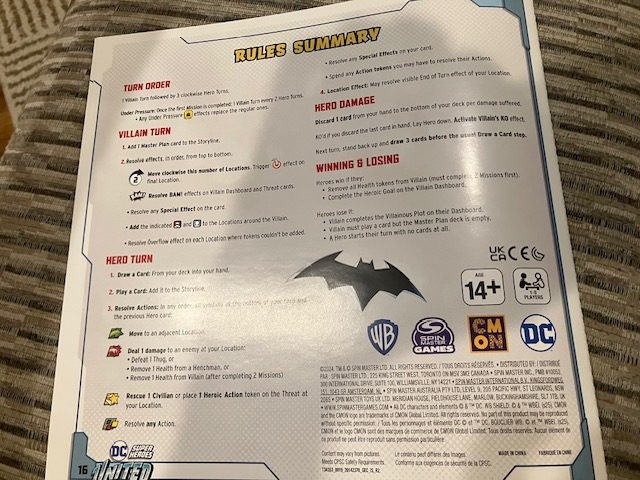
Some, not all, icons are on the back.

In general, this is a good rulebook: good components, good set-up, good font, good pictures, good back. The only complaint is the form factor.

What’s New?
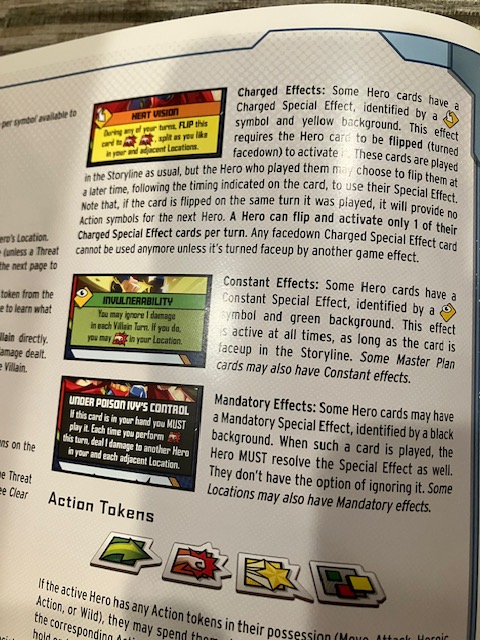
Most everything in Hush  we’ve seen in one of the previous Marvel Uniteds.  I have played a lot of Marvel United, but it’s hard to say you’ve played EVERYTHING across the massive amount of content in Seasons 1,2, and 3!  Here’s what was new to me:
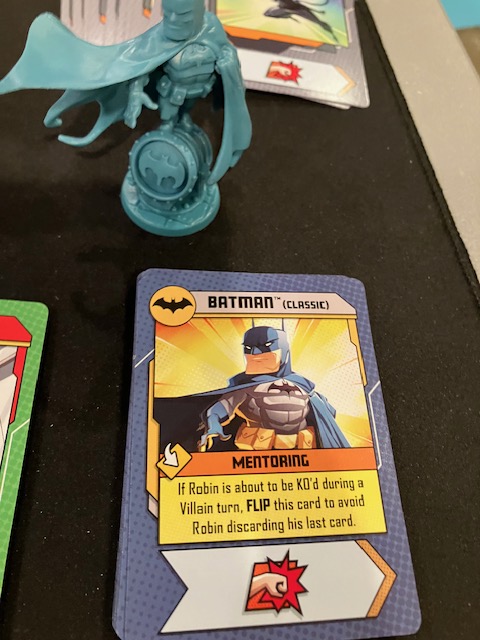
Charged Effects: The little yellow area/flip card allows to flip a card in the Storyline once it’s up.  In the example above, you can flip Batman’s card (only if it’s in the Storyline) above to stop Robin from being KO’d!  This is kinda neat; it’s like a one-time only effect that can only be activated AFTER the card has been put into play.
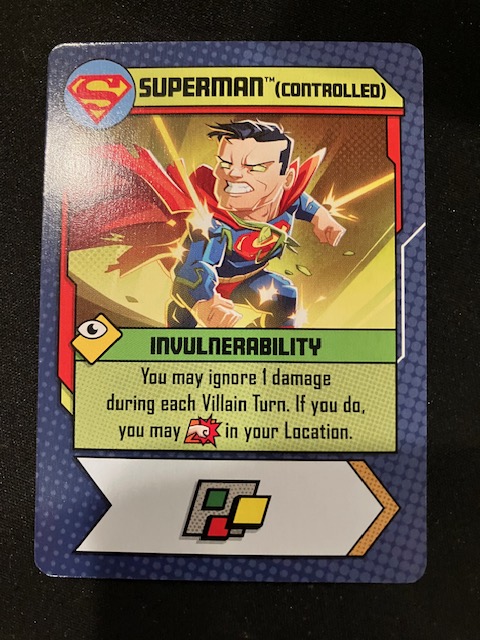
Constant Effects: These cards keep an ability active always once they are in play in the storyline! See above as Superman’s Invulnerability keeps damage off him!
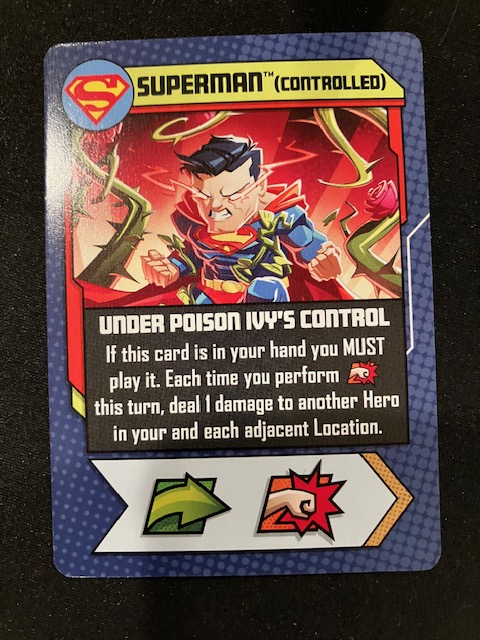
Mandatory Effects: These are mandatory things you MUST do on the card.  This Superman is controlled, and occasionally reverts to his controlled self … doing damage to Heroes around him.  See above.
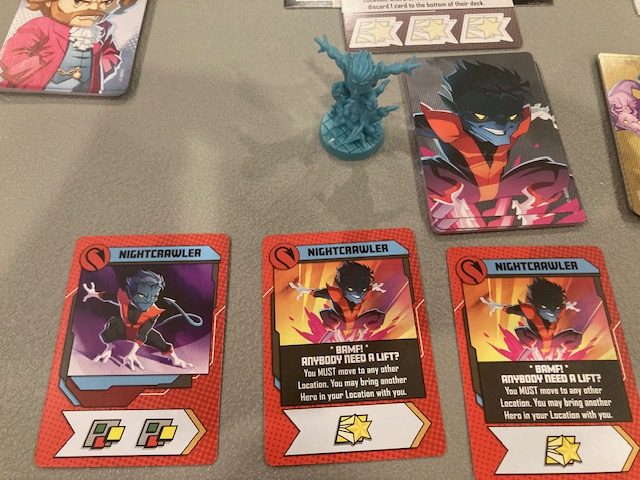
To be fair, we did see Mandatory Effects on the Nightcrawler’s cards back when we did the Dark Phoenix Saga: see here.
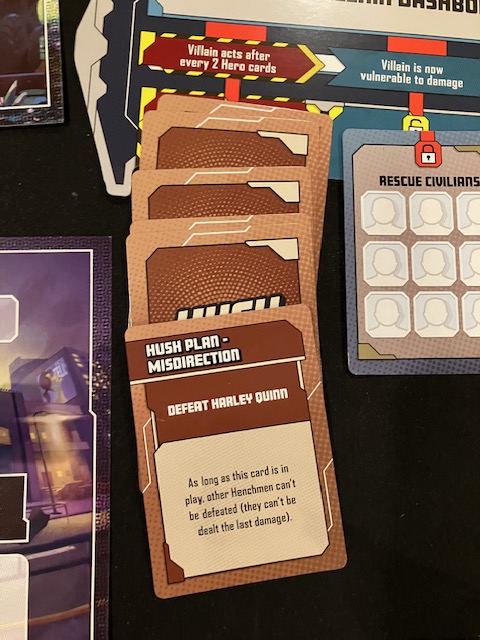
Hush Deck: if you are playing Hush, the Hush Plan deck replaces the Clear Threats on the dashboard.

Generally, the DC Superheroes United: Hush Batman or Hush feels very much like  the newer Marvel Uniteds with equipment, Charged Effects, Constant Effects, and Mandatory Effects being the newer things.  Otherwise, it feels like Marvel United, but DC instead!

Solo Mode Discussion
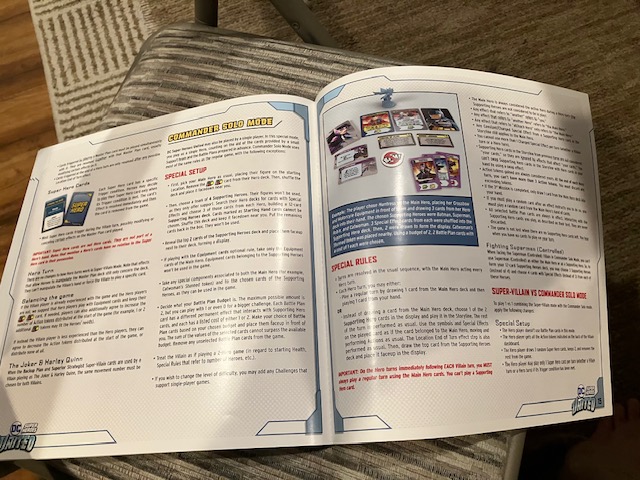
There is a solo mode called Commander Solo Mode (thanks for following Saunders’ Law and giving us a solo mode) that spans two pages.  And it’s pretty complicated.  But it is a true solo mode; you only operate one hero.

I think we saw the Commander Solo Mode first back in Spidergeddon, and we kinda liked it better than the solo mode in the original Marvel United … but frankly it still just feels too complicated.  It’s almost two pages of exceptions, new rules, changes, and special rules!  Look closely at those two pages above!  There’s SO MANY RULES FOR COMMAND SOLO MODE!

Frankly, it’s so easy to just pull out two heroes and alternate between them and just play solo (operating two heroes); it’s the way the game was meant to be played.  This is the way we play solo, partly because it’s significantly easier, partly because it’s easier to jump in (so we concentrate on the new rules of the Villain), partly because it’s the way Marvel United was meant to be played: 2-4 Players, and partly because we have to teach the cooperative game to our friends (so it’s better to play without all the solo rules exceptions for a better learning to teaching game).

You can disagree with me if you like, but I feel very strongly about this! Every time someone tries to put a solo mode in, I find it’s usually better and easier to just play two-handed solo instead (Leviathan Wilds, Leviathan Wilds: Deepvale Expansion, Lord of the Rings Pandemic to name just a few).  Frankly, the built-in solo mode for Lord of the Rings Pandemic almost caused me to hate the game … it wasn’t until I played 2-Handed solo that I found joy in Lord of the Rings Pandemic.

Play solo operating two heroes.  You’ll thank me.

Game 1: Batman and Robin vs. The Joker and Harley Quinn

Solo game: two-handed solo (one player operating Batman and Robin independently)
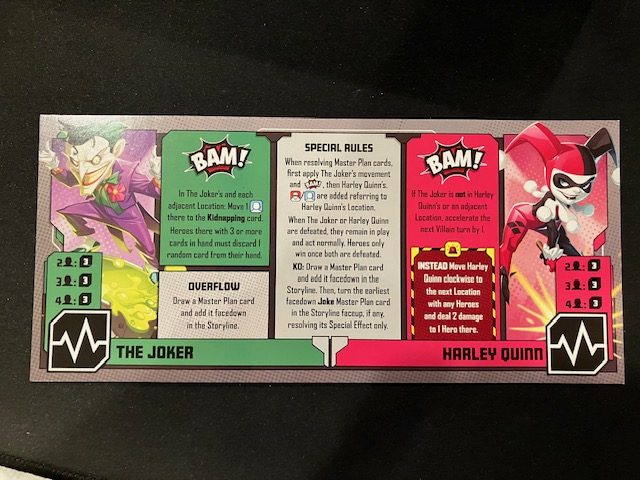
Our first game was Batman and Robin vs. The Joker and Harley Quinn.  Note that Harley Quinn and The Joker are a “team” you are playing against!  You can’t win until they are BOTH down!
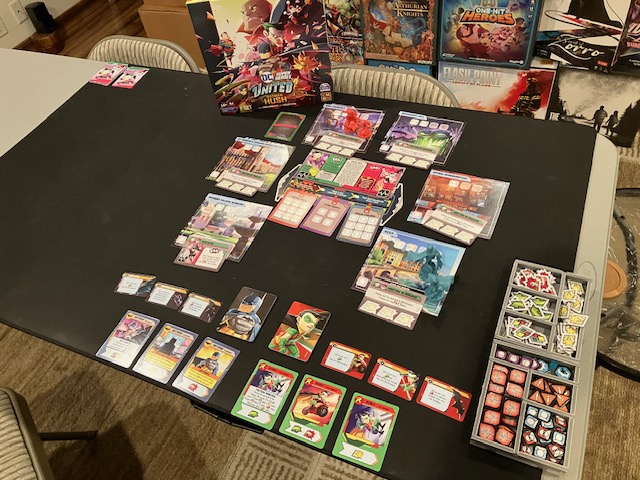
See Batman and Robin get ready to go!
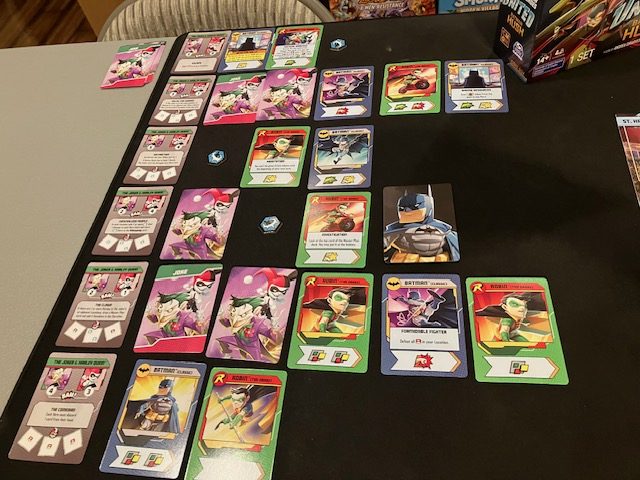
The storyline for Joker/Harley Quinn got convoluted as many times we’d have to put Master Plans into the storyline … they can come up at a later time, or when a character gets KO’d!
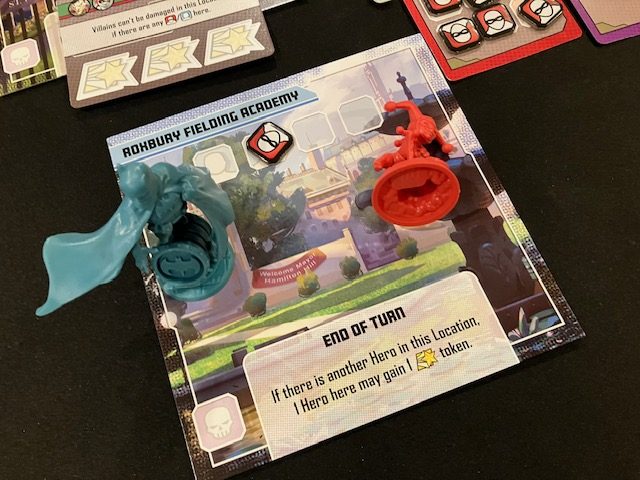
In the end, Batman  and Robin prevailed.  Batman took out Harley Quinn …
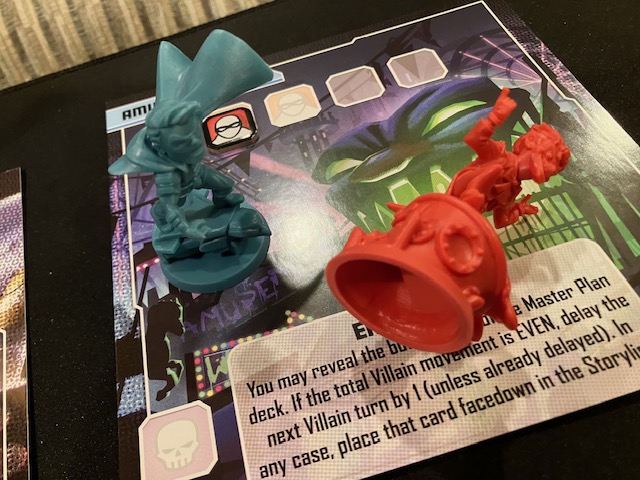
… and Robin (Tim Drake) took out the Joker.
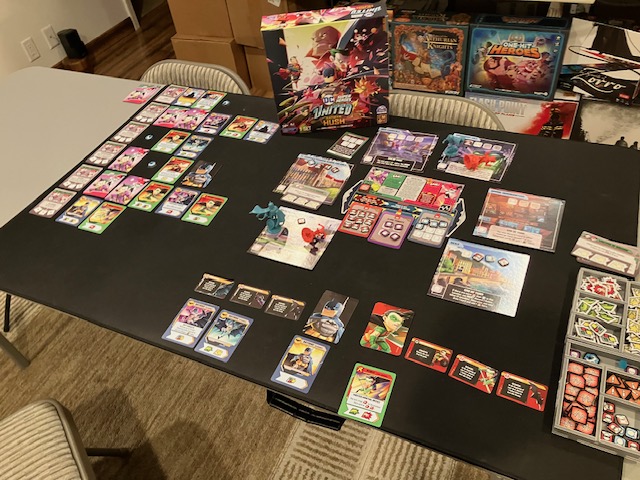
There are some neat ideas here, as the Joker kidnaps civilians (something he would SO DO in the comics),  Harley causes the Master Deck to dwindle, and “Jokes” appear in the Storyline!  This is a game about keeping the Master Plan deck under control by indirection!  Sometimes you do stuff to STOP the Master Deck from getting too small! If the Master Deck ever becomes empty … you lose!
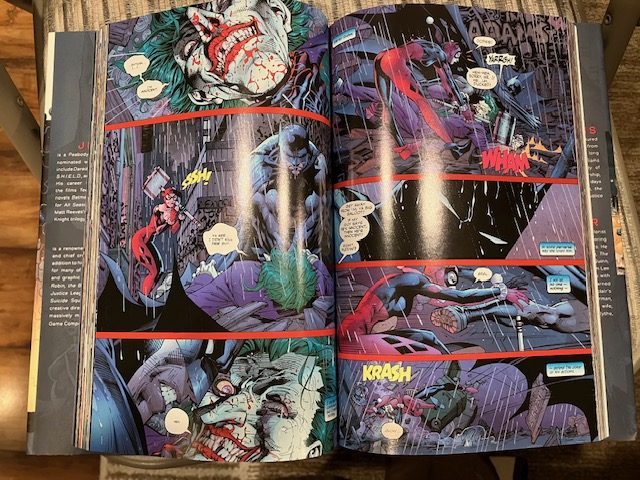
The Joker and Harley Quinn scenario felt incredibly thematic: Joker kidnapping, Harley causing chaos, and Joker’s “jokes” in the storyline occasionally springing on the Heroes! (It also had roots back in the Hush series: see snapshot above).
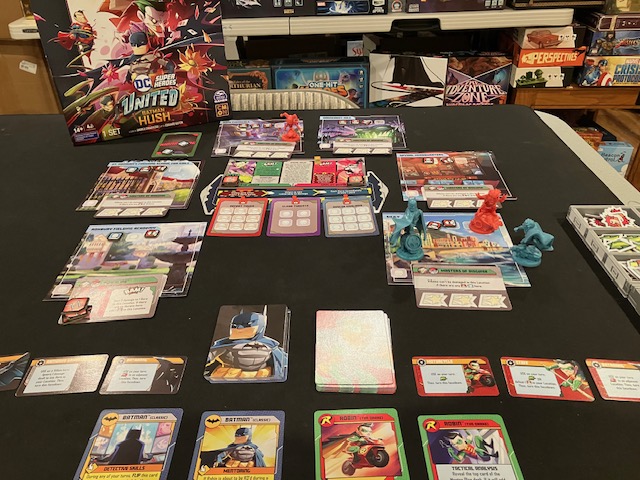
Batman and Robin’s decks were also on point: they both had the ability to “be a detective” and look at the next Master Plan card coming!  This was both incredibly useful and very thematic.

Games 2, 3, and 4: Catwoman and Huntress vs. Superman (controlled)

Solo game: two-handed solo (one player operating Catwoman and Huntress independently)
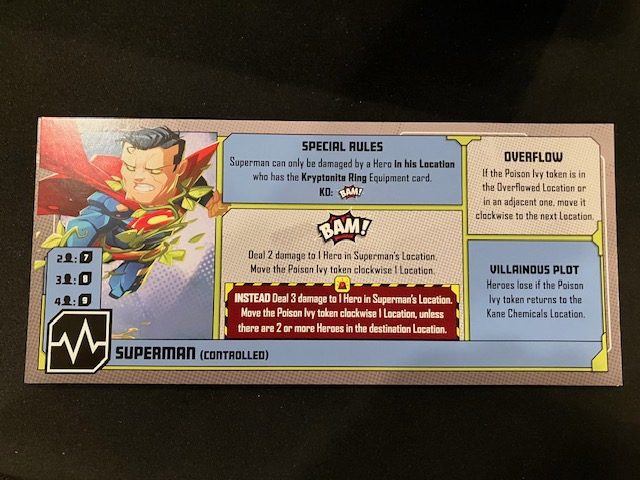
So, Superman (controlled) is hard.  I guess he should be; he’s Superman!
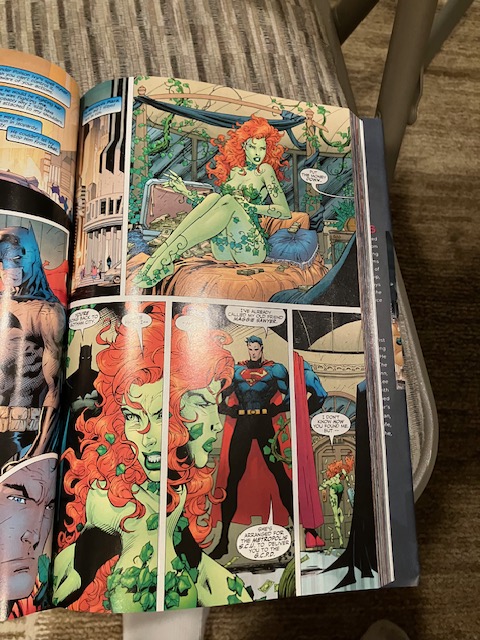
Superman is bad guy here because Poison Ivy is controlling him! See a still from the comic above!
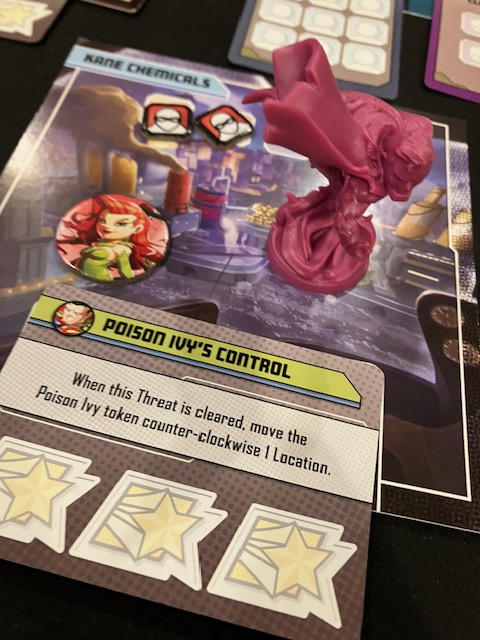
Superman is controlled by Poison Ivy (see above).   If Poison Ivy makes it around the board back to Kane Chemicals, the bad guys win!
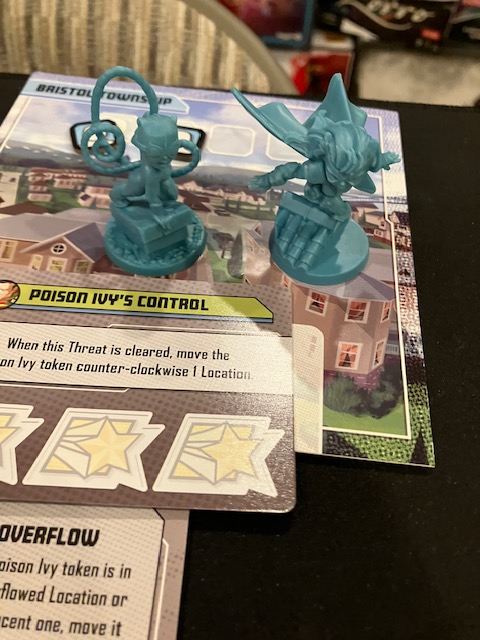
Over 3 games, Huntress and Catwoman struggled! They lost three games in a row!  In this particular scenario, heroism is very important!  Unfortunately, Huntress and Catwoman seem to have more punch than heroism!
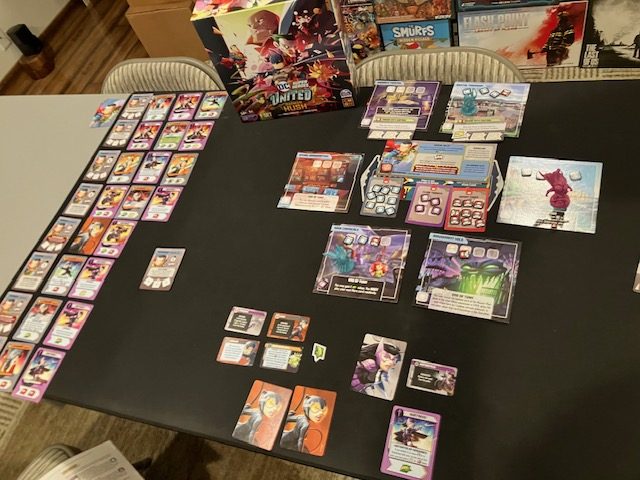
Huntress felt very thematic, as she could look at the top of the Master Plan deck (with espionage) and was very mobile and punchy.  Similarly with Catwoman, she had some disguise cards and was very punchy and mobile.  Unfortunately, they were a bad team against Superman (controlled). Honestly, this makes sense thematically: neither Catwoman or Huntress are known for their Heroism in the comic books … they tend to be more “self-interested” heroes!
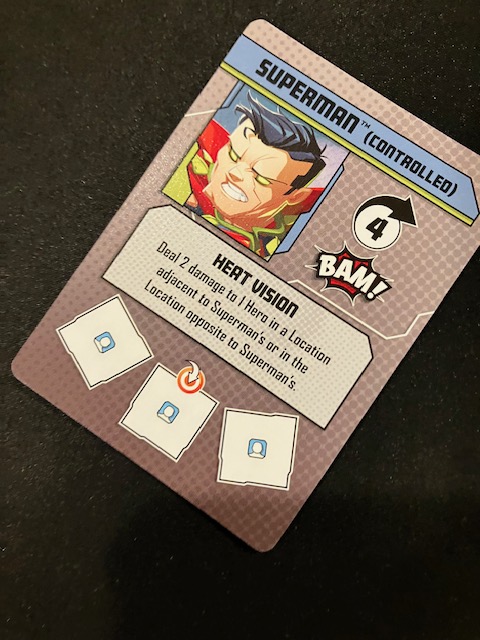
Still, I thought the Superman (controlled) villain was pretty cool! It felt thematic … and you even had to have a Kryptonite ring to hurt him!

I have played SO MANY games of Sentinels of the Multiverse where you lose because you just have the wrong heroes.  And that feels very much like the comic book universes!  (Sometimes, Spidey has to go visit Doctor Strange to handle a mystic bad guy!)  In this case, Huntress and Catwoman are the wrong Heroes for Superman … or at least, it’s a LOT harder to play them.

Game 5: Batman and Robin vs Superman (controlled)
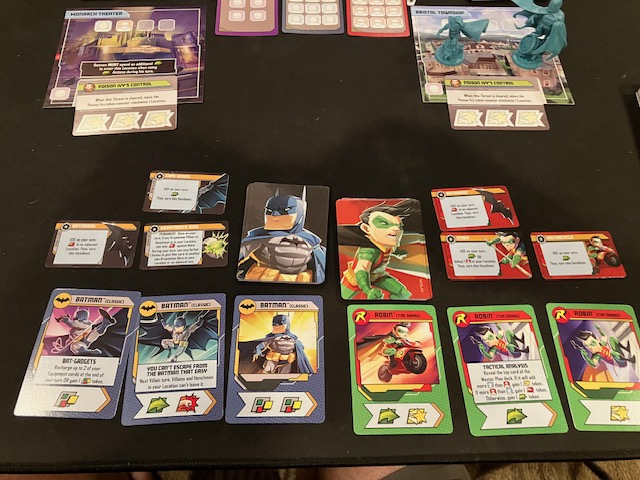
Batman and Robin did much better against Superman (controlled): they defeated him in one game.
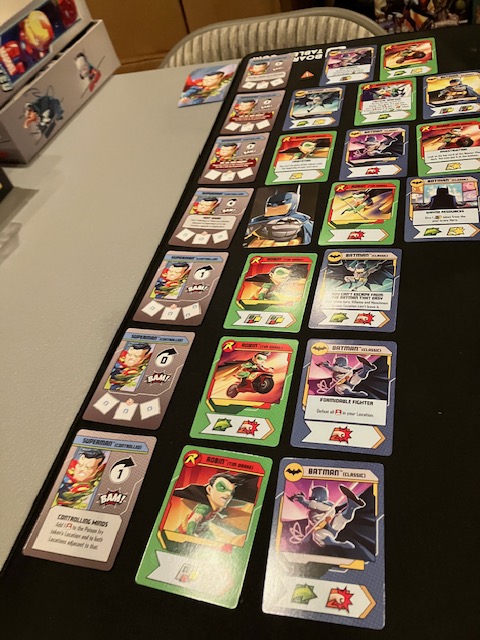
Batman and Robin control the Master Control deck much better and have a lot more Heroism to deal with Threats and civilians.
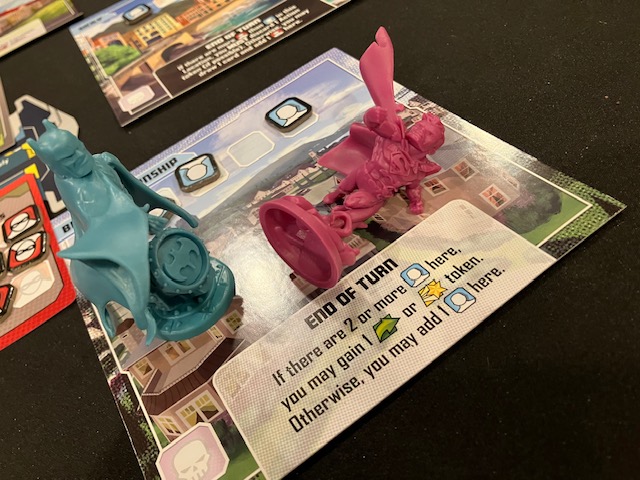
This win felt very thematic: Batman and Robin use their detective skills and heroism to keep the bad guy (a Superman controlled by Poison Ivy) at bay.

Game 6: Batman and Robin vs Hush

Solo game: two-handed solo (one player operating Batman and Robin independently)
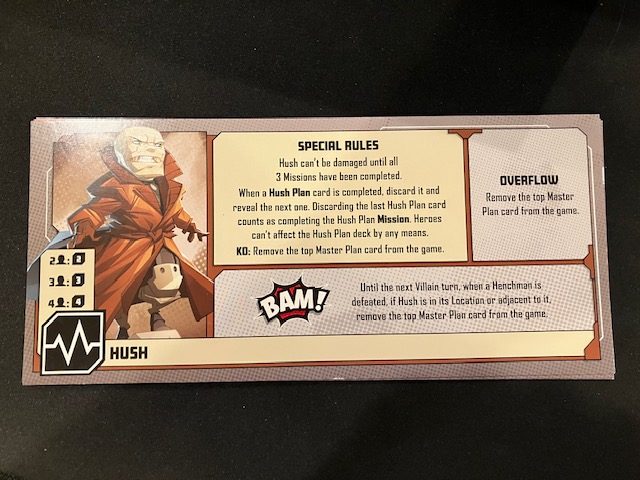
The Hush Villain is probably the most complicated to play.  You must complete all three Missions, but instead of Clear Threats, you have to clear six “Hush” threats (see below).
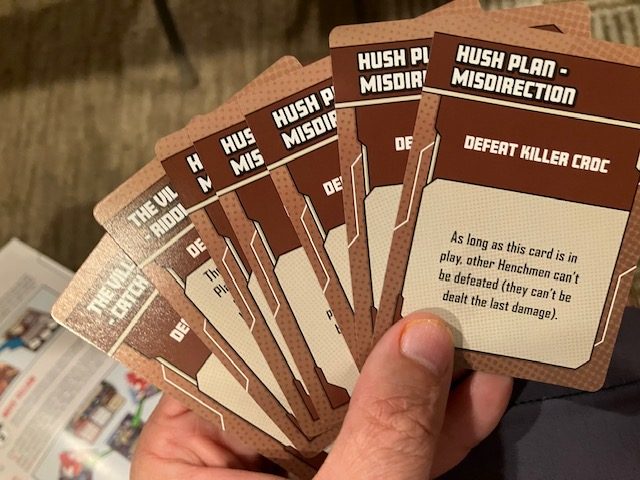
Like the comic book (very minor spoiler), the Hush Plan cards makes you “focus” on a particular Henchman on the board: you can only defeat them in a certain order.  This constrains how you have to defeat them!
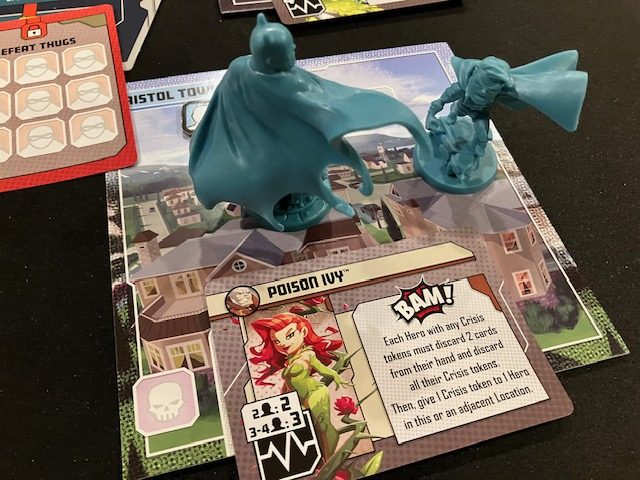
The Hush villain is much more about taking down Henchmen a little at a time, while “defeating” them in a particular order.  Batman and Robin have to “balance” how they spend their resources.
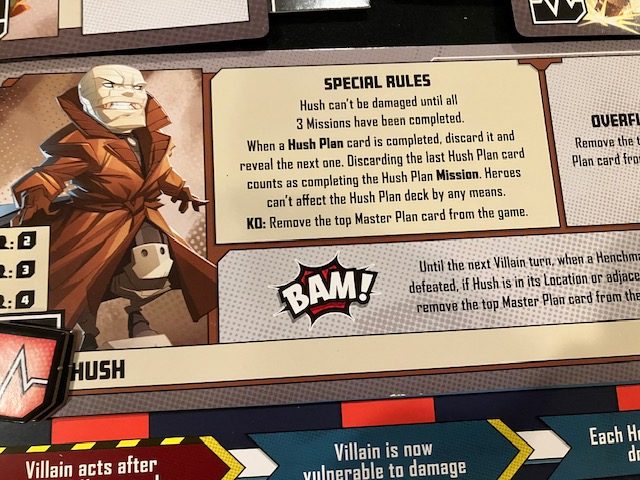
Of course, lots of things (like KO’s, see above) get rid of Master Plan cards.  Do you defeat a Henchman this turn at the cost of losing a Master Plan card?  Or do you wait a turn?  Defeating Hush is all about balance for the Heroes.  Hush himself is sewing Chaos into the world and dwindling the Master Plan deck!
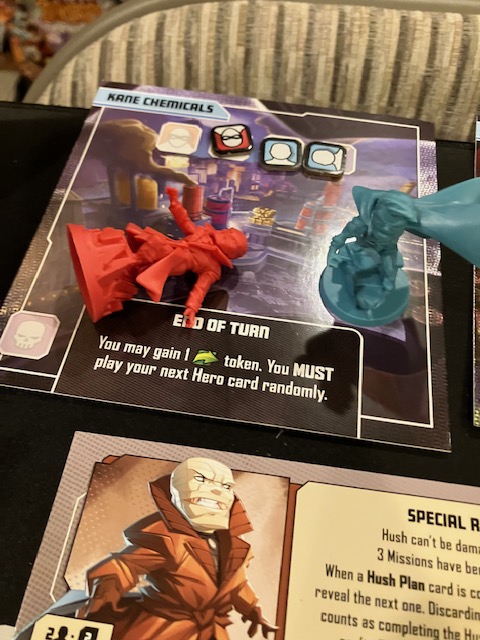
In the end, Robin had a good run and was able to move to Hush and take him down.
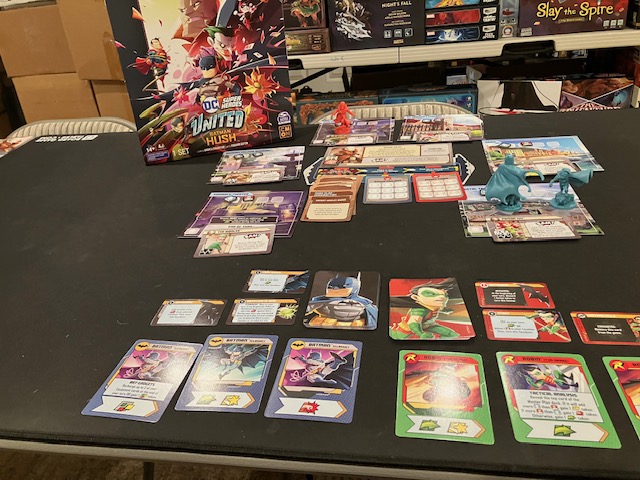
Even though it wasn’t a full saga like the comic, Hush felt like the story that unraveled in the comic.  Batman and Robin get “distracted” by Henchmen along the way as they try to uncover who Hush is … and that’s the last card of the Hush Plan deck!
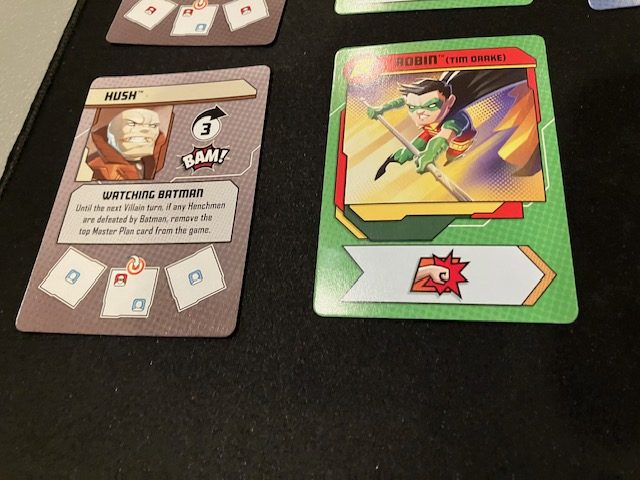
Although you can play the Hush Villain without reading the story, I strongly recommend you do read it before playing!  There is a major spoiler at the end of the Hush Deck that will spoil the entire Hush comic book.  The other two Villains (Superman and Joker/Harley Quinn) you can play without reading, but I suggest you probably read Hush before playing he Hush villain.

Game 7: Superman (controlled) and Huntress vs. Joker and Harley Quinn
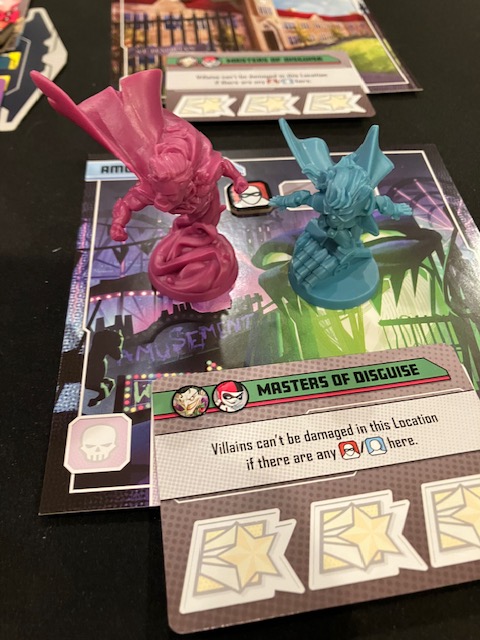
Don’t forget; you can play Superman (controlled) as a hero as well!
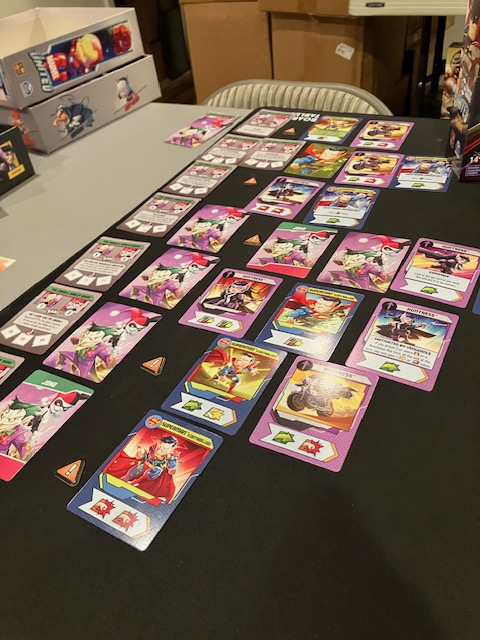
Supes deck is pretty strong.  And Huntress is great at punchy and movement.

Superman’s deck has a minor flaw that he might have to punch other Heroes (since he still has some residual control): see above.   That card kind of “balances” a very strong deck by giving him a “forced” card. Don’t you hate it when Poison Ivy asserts her control at exactly the wrong time?  That feels so comic booky!  I kind of enjoyed this!  Supes is great … except for the one time he isn’t!
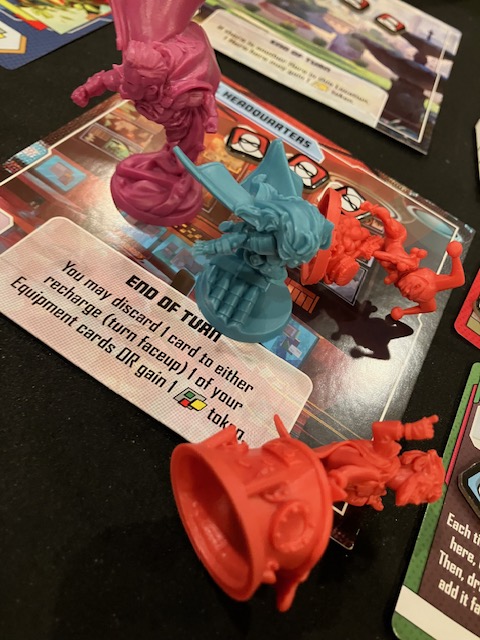
And Huntress redeemed herself by helping out Superman.

Game 8: Catwoman and Huntress vs. Joker and Harley Quinn
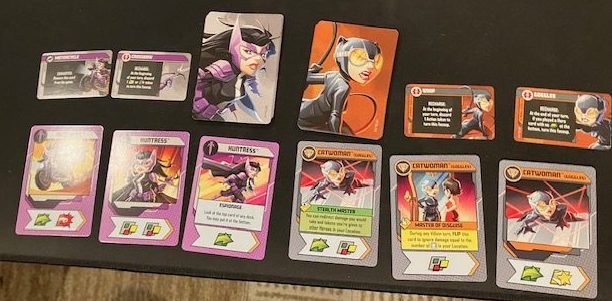
Just to make sure Catwoman and Huntress are good decks, I took them for a run against Joker and Harley Quinn.
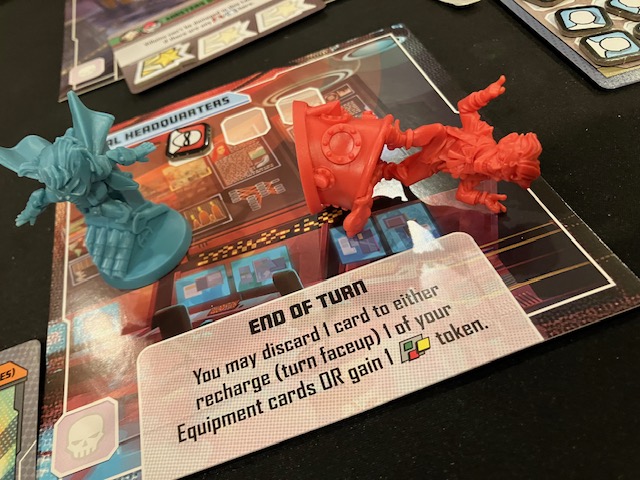
After losing to Superman three times, they acquitted themselves and beat Joker and Harley Quinn.

Cooperative Game
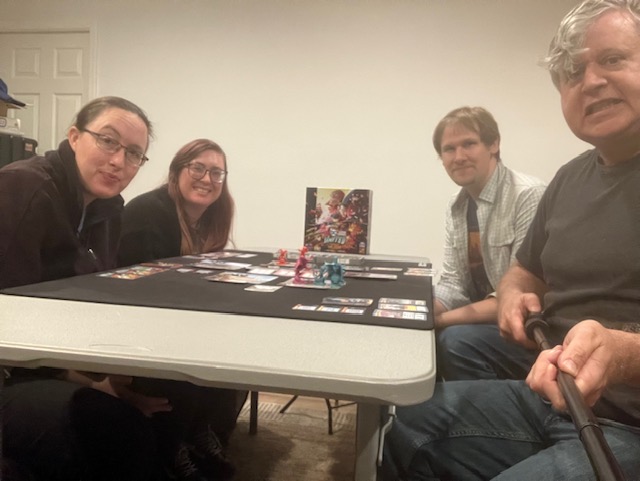
There weren’t any real surprises from the cooperative play; we’ve played this before as a team!
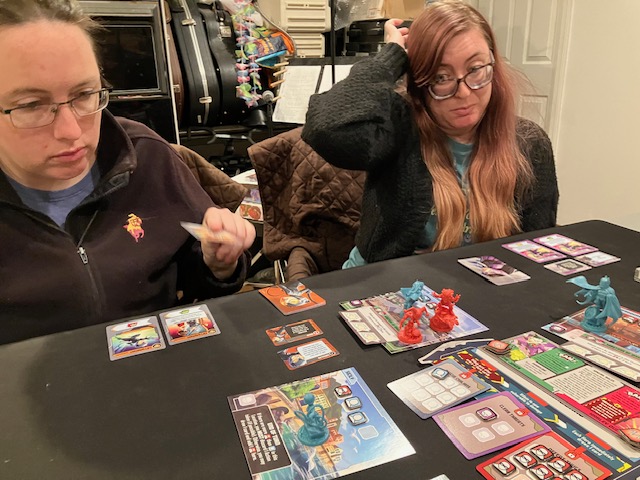
People discussed!  At one point, Andrew HAD to play a Controlled Superman card and he said “I suggest you all NOT be adjacent to me! I will punch you!”  So, Sara and Teresa made sure there was movement on previous cards.  Most of the discussion is “Oh! If you give me this … Oh!  What do you need?” and stuff like that.
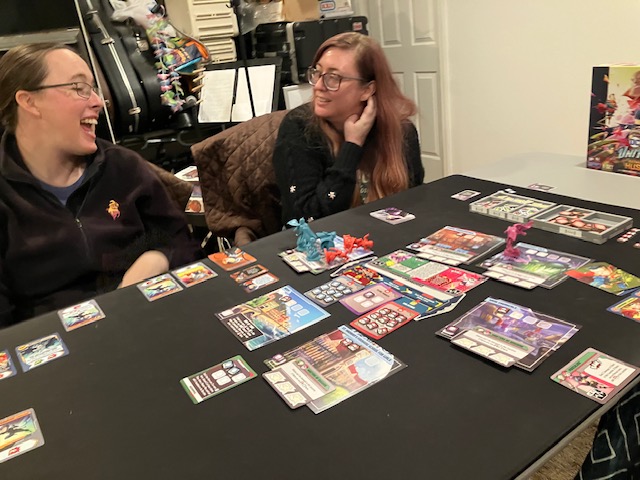
My group had a fun time playing this cooperatively.  The new abilities and equipment made them enjoy it that much more.

Judging by my group’s responses, I think this is the best version of the Marvel/DC United system so far.

Core Game?
I am somewhat surprised that Hush is a core box!  That means this is a completely standalone game!  I loved what I saw, but this doesn’t feel like it should be a “core set”?  The heroes in this set are great for new players, but the villains are really complicated!  Superman (controlled) is probably the easiest Villain to operate, but maybe the hardest to defeat?!  And both Hush and Joker/Harley Quinn are very different than most base Marvel United villains! They are much more complicated than (say) Red Skull from Marvel United, or even Ghost Rider from the Multiverse set!
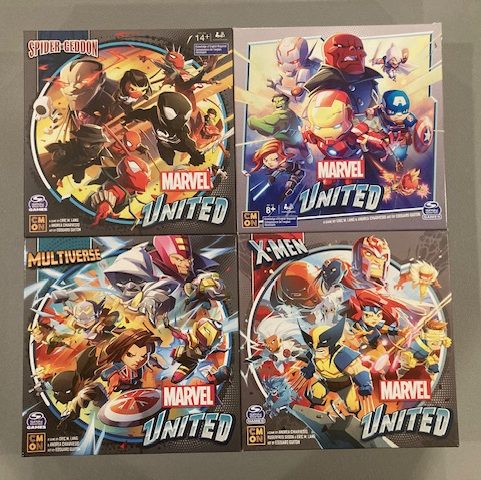
If I were to recommend someone start with a core set, I’d recommend the base Marvel United, Marvel United: X-Men, or Marvel United: Multiverse over DC SuperHeroes: Batman Hush… I think Hush is too much for a starting player.  Which is too bad, if you LOVE DC, this is the only set you can currently get! I am afraid Hush might accidentally turn off some intro players because of its extra complexity.

Plays Well With Marvel United?
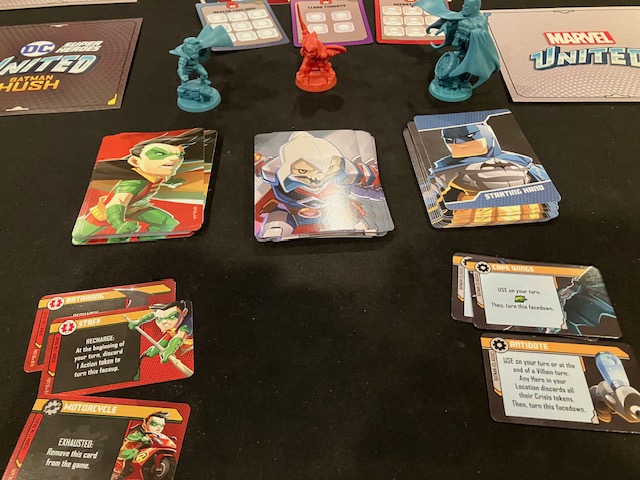
Of course, I had to make sure this played well with Marvel United, so I had Batman and Robin take on Taskmaster (from the base Marvel United set)!
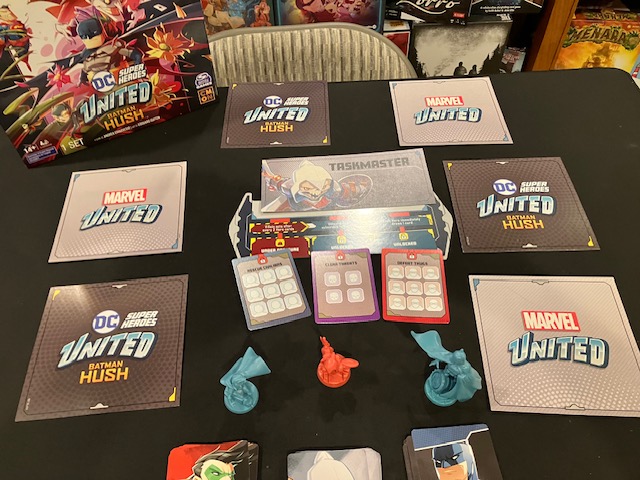
For funzies, I also used half of the Locations from Marvel United and half of the Locations from Hush!  See above.
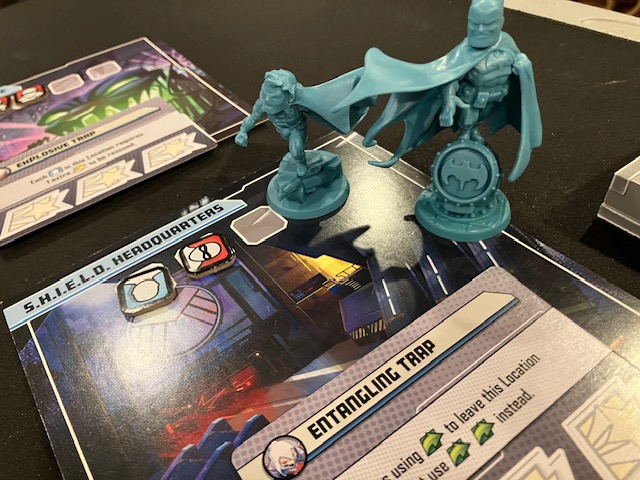
I got SUCH a kick out of mixing universes! I started giggling to myself when I had Batman and Robin start the game on SHIELD Headquarters!
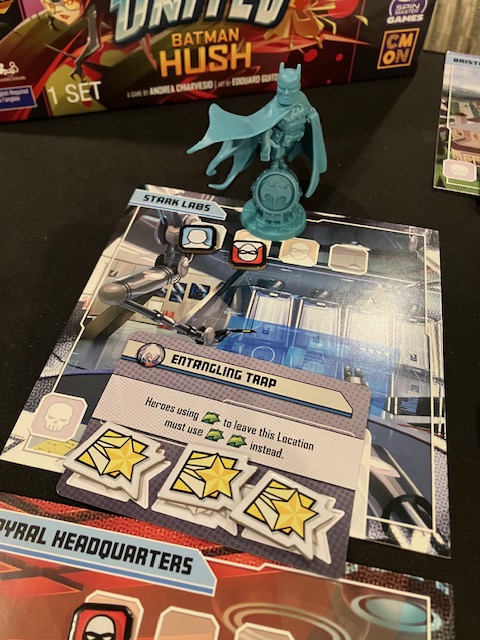
Then later in the game, Batman solved the Threat at Stark Labs!  I giggled even more thinking of Batman disassembling a Trap in Tony Stark’s lab!
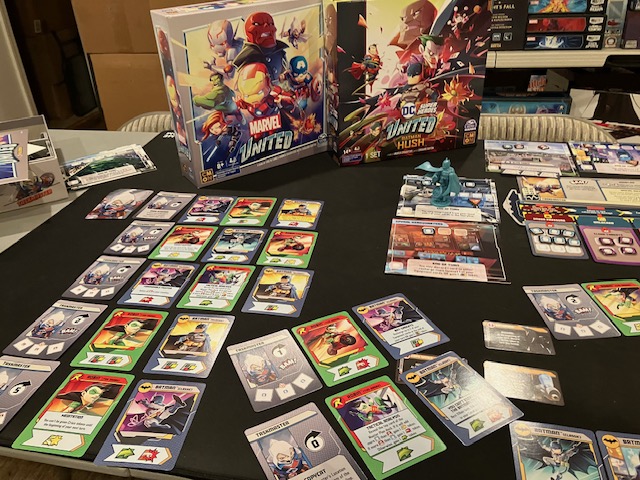
For the record, Taskmaster posed little threat to Batman and Robin.  More like “Lamemaster”.

I will say that I think later Heroes and Villains are stronger than earlier Heroes and Villains in the Marvel United games.  This game demonstrated that a little … but I still had a grand time!

Conclusion
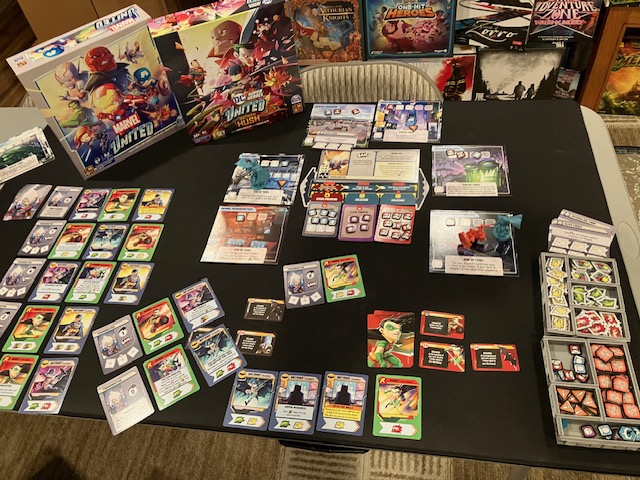
Currently, Hush is my game of the year for 2025!  I have played about 10 games of Hush and want to keep trying more and more!  I want to try Batman and Robin vs the Sentinels!  Will Superman do a great job against Galactus?  Can Batman and Spiderman team up?  How would Superman and Gladiator pair up as compatriots?  What about Superman vs. Gladiator?  There are SOOOO many cross universe games I want to try!
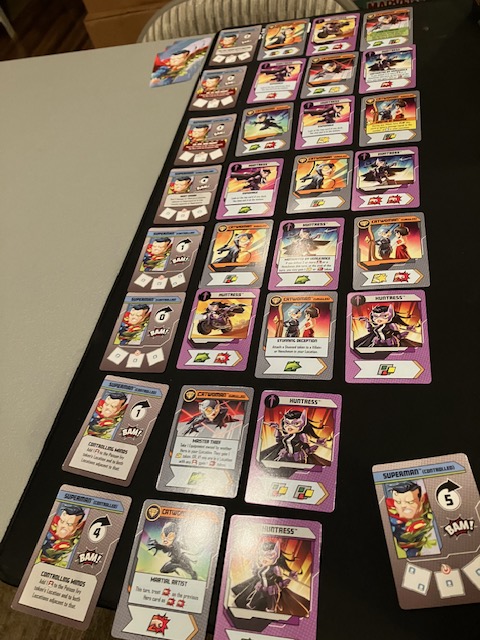
Even with all the fun things I can try combining Marvel United and DC Superheroes United, I still loved the Hush box by itself.  Each Villain presented a different puzzle to solve!  Each Hero has their own flavor and personality: Catwoman is more punchy than Robin, but Robin is more heroic!  And these differences are very flavorful!
This box also introduced me to the wonderful world of Jim Lee Batman (who is the best Batman according to Diana)! I am grateful that I got to experience Jim Lee’s Hush for the first time!
My only complaint is that the Villains in this box are all pretty complicated; I wish there had been a “simple” Villain (for newer players).  If you are an experienced Marvel United player, then this box is a no-brainer.  If you are a more introductory Marvel United player, I might recommend a different core box.

After all is said and done, Hush is a full up 10/10 for me.  I played so many games over a 2 week period and each one was a blast!  Even when I lost, it was fun to try to figure out “why I lost” and come back and revisit the game!

Even though Hush is an unexpected DC Superheroes United (this wasn’t part of the original announcements for DC United), there’s a reason DC Superheroes United  was #1 on my list of Top 10 Anticipated Cooperative Games For 2025!
How Is Only Murders in the Building like Casinopolis? A Quick Review of Casinopolis

Casinopolis arrived at my house just days before RichieCon 2025, about July 7th or so. Casinopolis was on Kickstarter back in February 2025 and promised delivery in June 2025, so it’s literally just a few days late.  I’m counting that as on time!  Especially in the Kickstarter world!

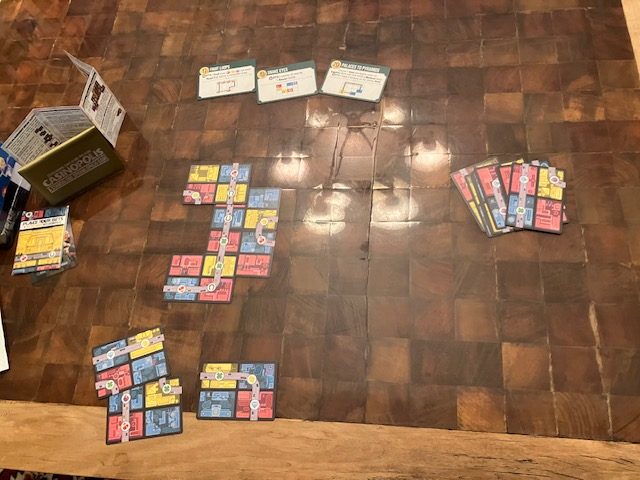
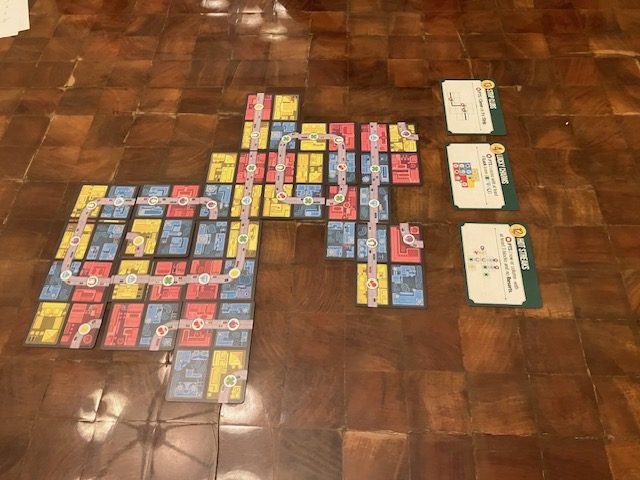
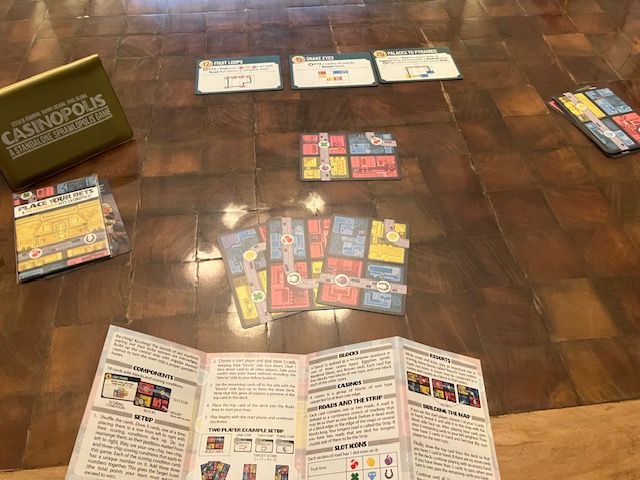
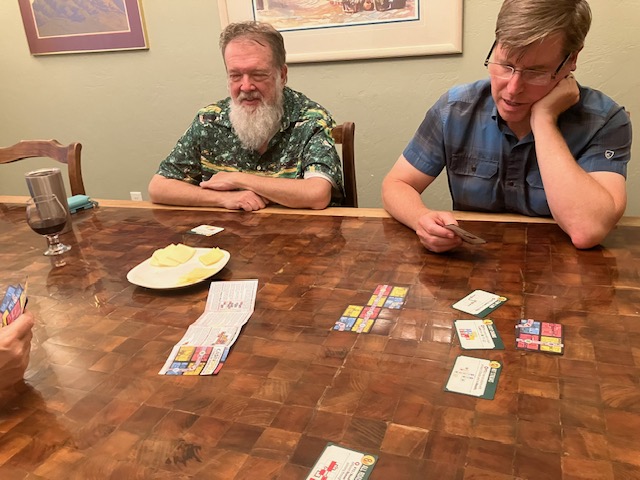
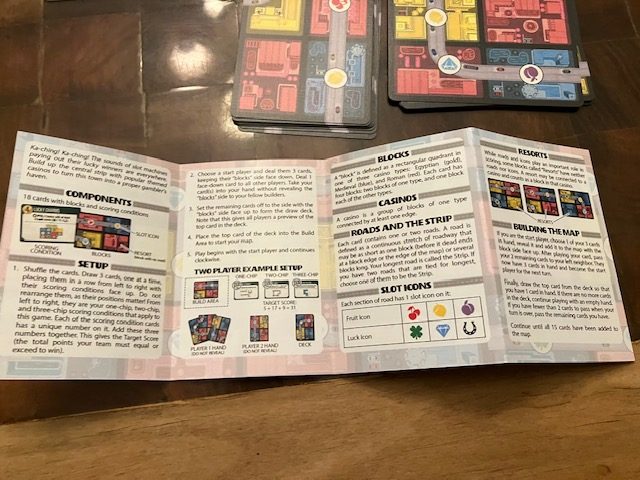
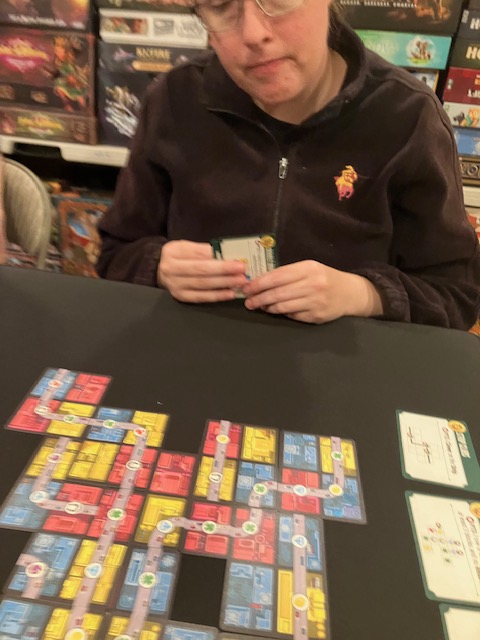
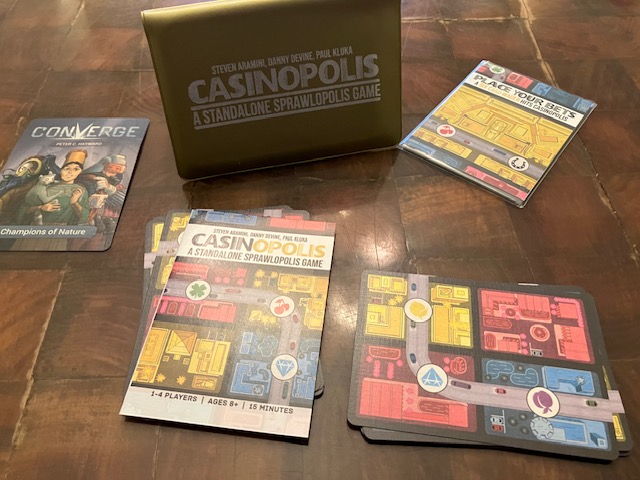
Casinopolis is a 1-4 Player solo and cooperative micro game; it only has 18 cards!  It’s a city-building game, where players place cards in the play area to build the city, based on the current scoring criteria.  See above for an example.

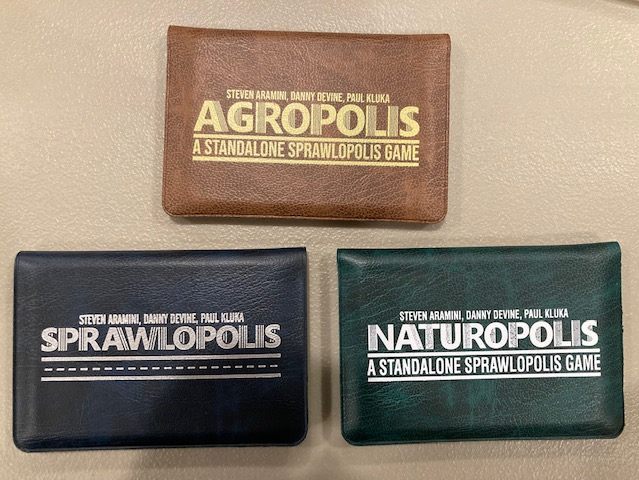
Casinopolis the the fourth entry in the Sprawlopolis line.   The original game was Sprawlopolis!  It spawned 3 more standalone versions of the game, giving a total of 4 games in the line: Sprawlopolis, Agropolis, Naturopolis, and the newest one we are looking at today: Casinopolis.

This line has been incredibly popular, both with my friends and gaming culture at large!  Sprawlopolis (the original) made the Top 10 Cooperative Games of 2019, the Top 10 “small” Cooperative Games, and the line made our  Top 10 Cooperative Tile-Playing/Placement Games!

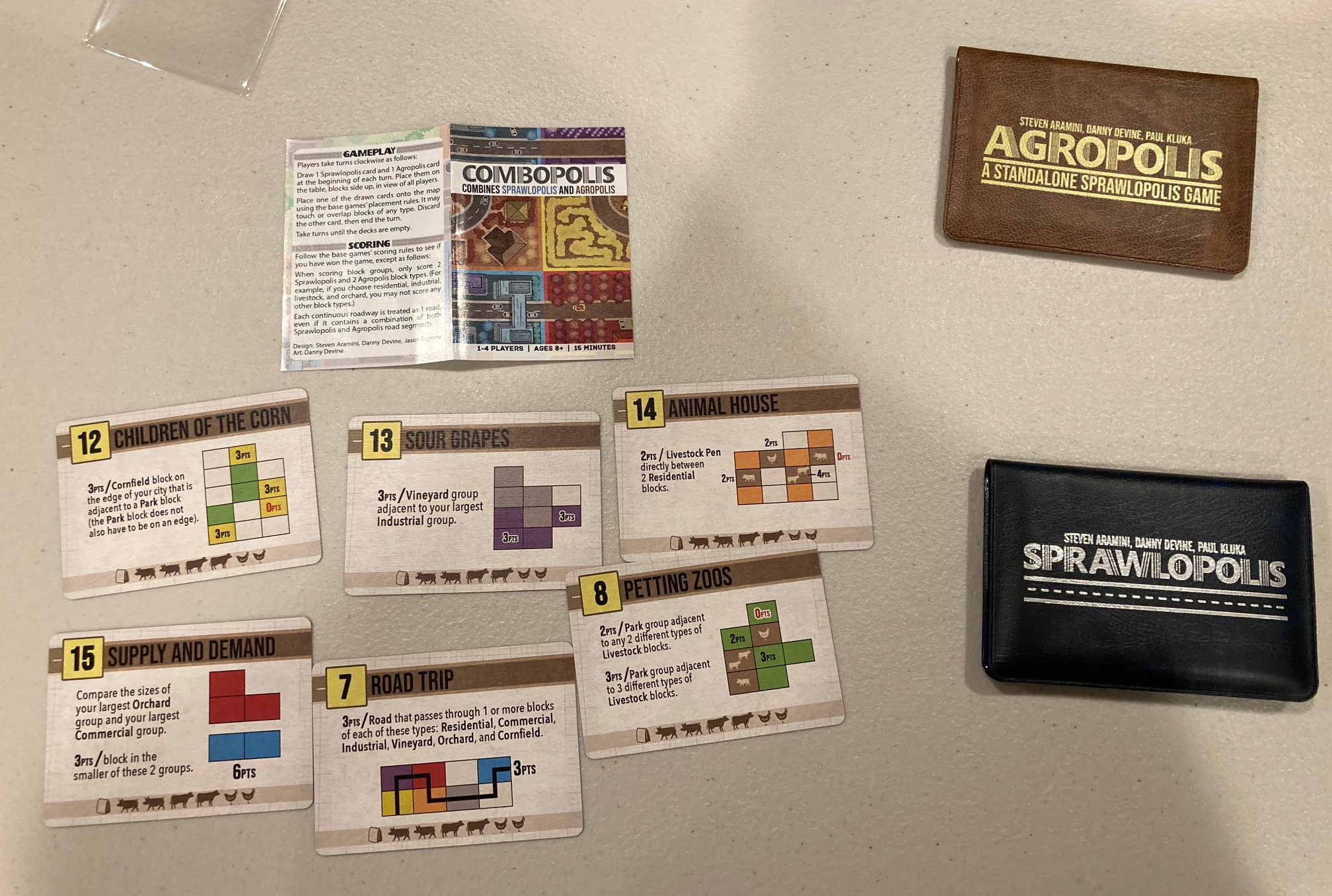
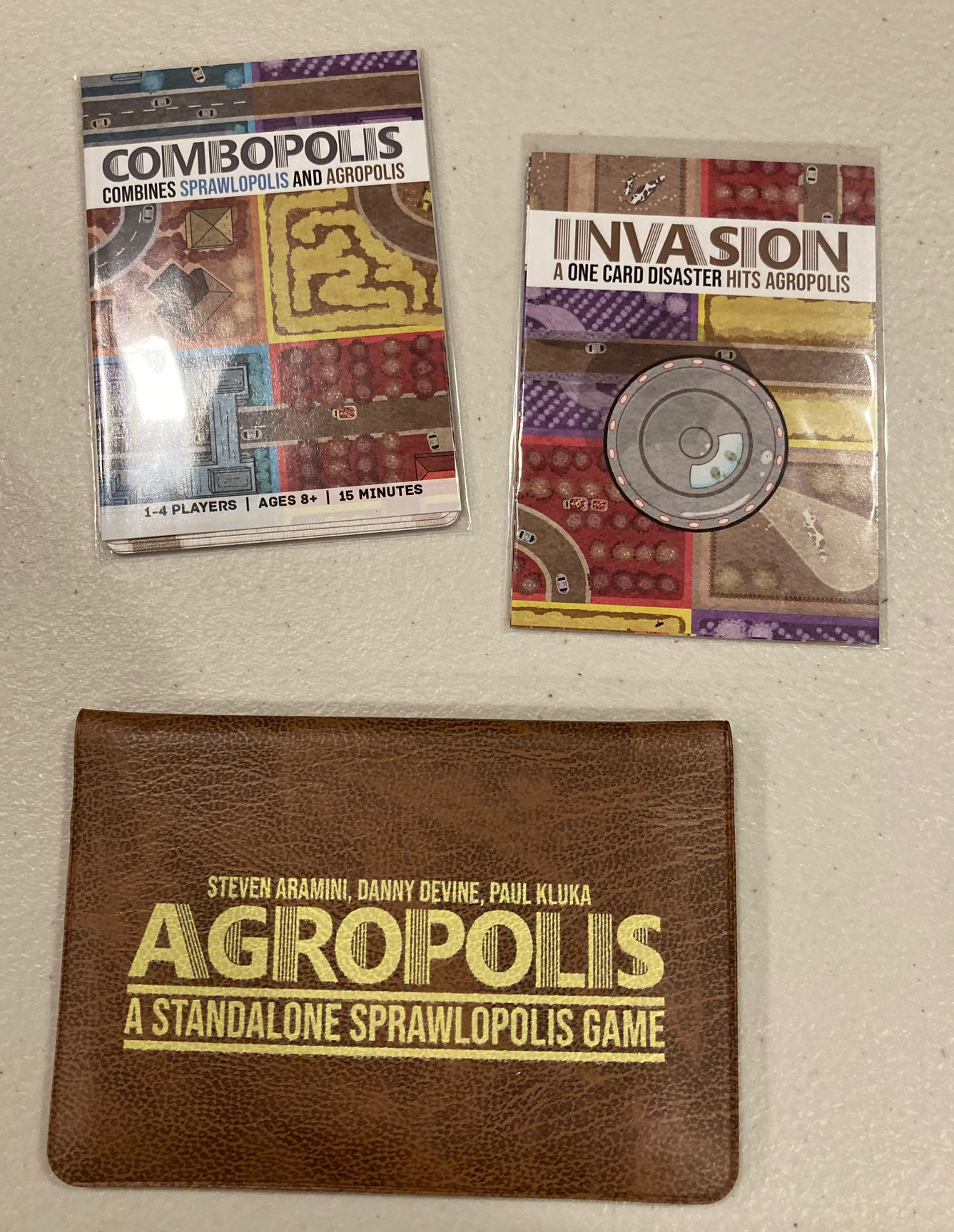
Each of these games has the same flavor: you are playing cards to build a city area with roads.  There are little differences between each version, but they are “essentially” the same game.  See our review of Argropolis here for an overview of the system!

What’s Different About Casinopolis?

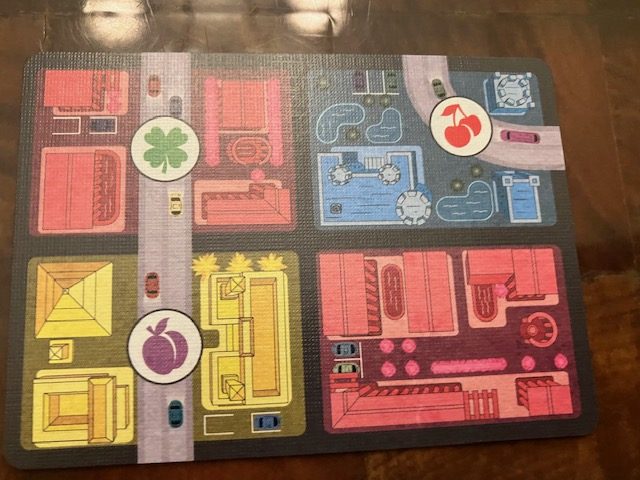
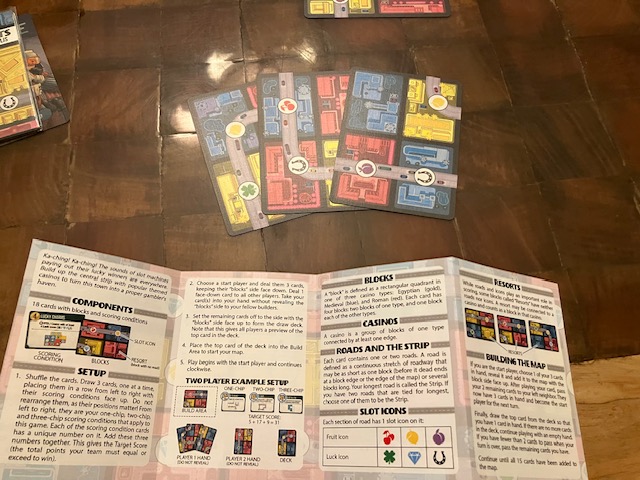
In this version, players are building casinos on the strip in Las Vegas.  There are three types of Casinos to be built: Egyptian (gold), Medieval (blue), and Roman (red).  See above.

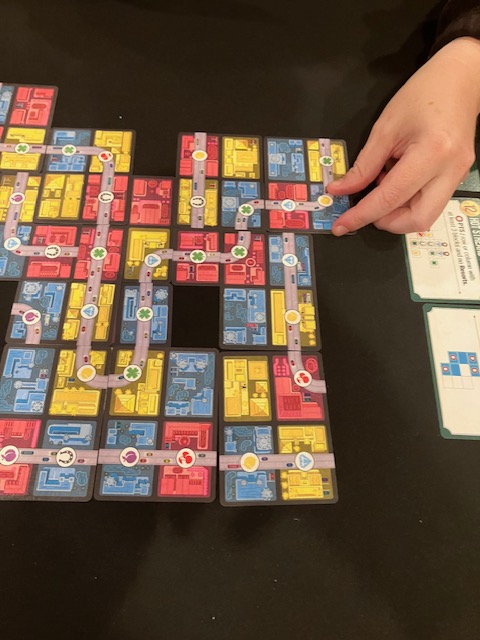
The strip is a new idea: the longest road becomes “the strip” and you only score the largest Casinos actually on the strip.  See the longest road above forming the strip!

Another new idea is the “symbols” on the roads.  Every time you can get three symbols (or more) of the same type (fruit or lucky), you score 3+ points!  The strip above scores a ton of points!

Of course, there are standard Sprawlopolis type rules, where you draw 3 cards at the start and they form the scoring criteria!  See above for an example.

There is also a notion of a “resort” which has no road or symbols or anything on it.  The resort type just “expands” your casino.

Why Would I Like Casinopolis Best?

Honestly, if the Las Vegas theme calls to you, then this is probably the best Sprawlopolis game for you.  The symbols on the roads should remind you of a Slot machine in Vegas, and the strip and the resort rules pull that theme home too.

If you like city theme, the original Sprawlopolis is probably for you.  If you like nature, Naturopolis is probably for you.  If you like the countryside, Agropolis is probably for you.  It’s all about which theme calls to you.

Only Murders In The Building

I really enjoyed the first three Seasons of the Hulu series Only Murders in the Building.  The first season was so new and interesting! I loved it! The following two seasons were good, just not quite as groundbreaking as the original show.  And by the time the fourth season was released, I was happy for it, but I wasn’t excited for it?  “Eh, I already know what this show does, but do I want to watch more?”  I am happy to watch it, and I will probably enjoy it, but it’s just more of the same.

And that is exactly how I feel about Casinopolis!  The original Sprawlopolis was groundbreaking and fun!  The two follow-ons were good, but by the time Casinopolis arrived on Kickstarter, I was like “Eh, I already know what this game is.  Do I want to play more?”  I am happy to play it, and I will probably enjoy it, but it’s just more of the same.

That sounds harsh, but it’s not meant to.  I like this line of games … a lot!  I just don’t know if I need four different versions of it!  Honestly, the Casinopolis is my least favorite of the four, but it may just be the theme.  If you love Vegas, this is the version I would recommend to you!

Conclusion

Casinopolis is more of the same, which is both good and bad.  Good because it really is a great game system!  Bad become the line is becoming diluted.   If you are looking to play any game in the Sprawlopolis line, I suggest you find the theme that speaks to you (city-building, farming, nature, or Vegas) and run with that.  You probably don’t need all four!

I have all four.  I don’t think I will get the fifth (I am sure they have another in the works) unless the theme really really really really really really really speaks to me.  Wait?  What’s this?  Superheropolis?  Darn you, Button Shy games … Now I have to get it!  (EDITOR: we have no idea if a new one is imminent or if it’s a superhero theme … don’t count on that…)

Bloomchasers: Add Some Coziness To Your Solo and Cooperative Life

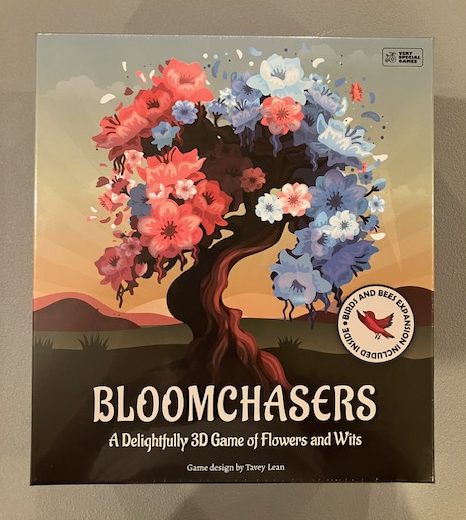
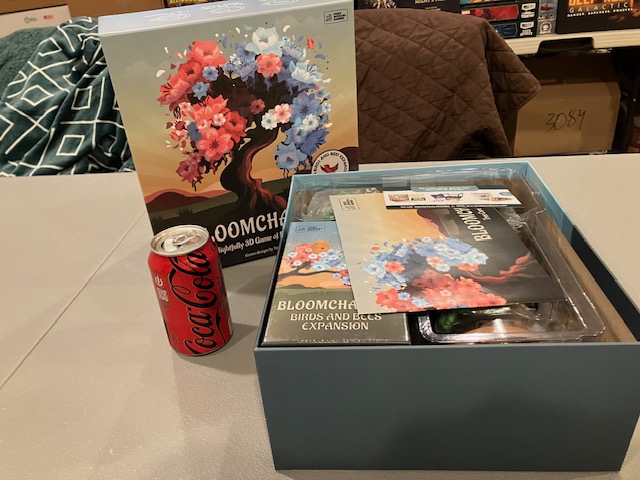
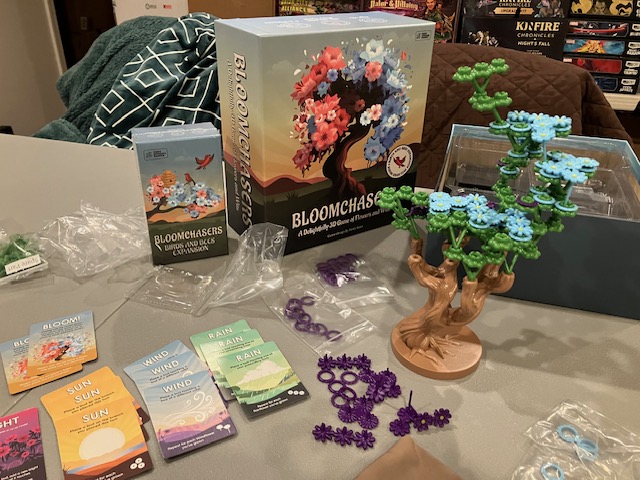
Bloomchasers is a solo, cooperative, and competitive game that was on Kickstarter back in April 2024 .   I backed it (see above) and it delivered May 20th, 2025 to my house!  It originally promised delivery in January 2025, so it was about 5 months late (which is not bad in Kickstarter terms).

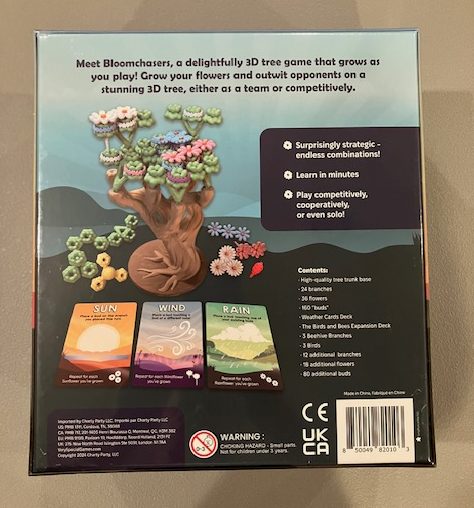
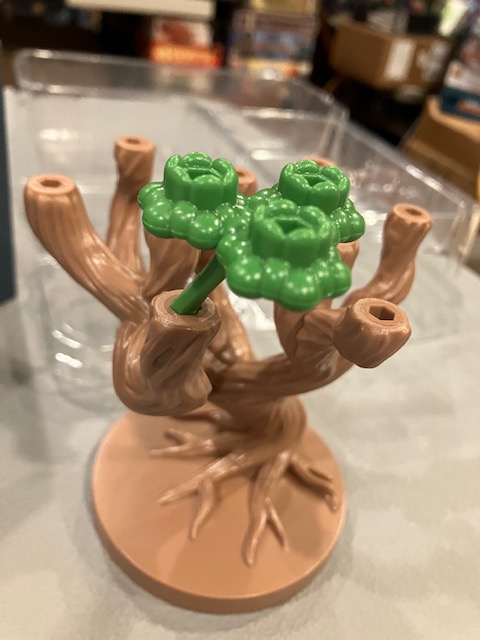
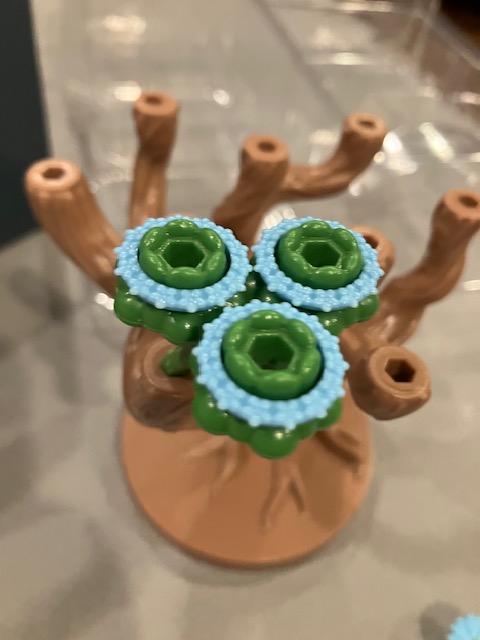
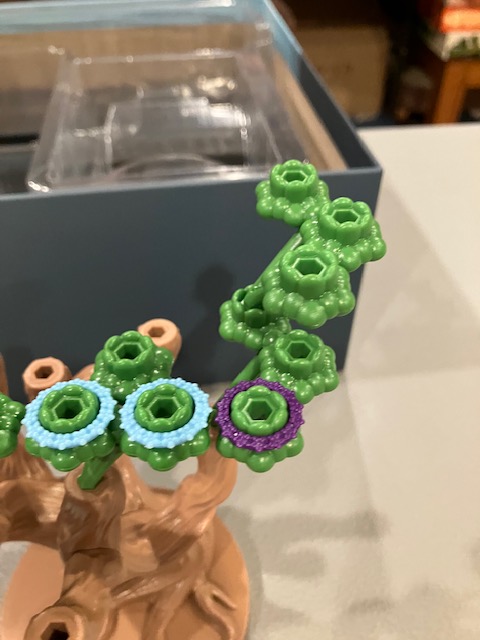
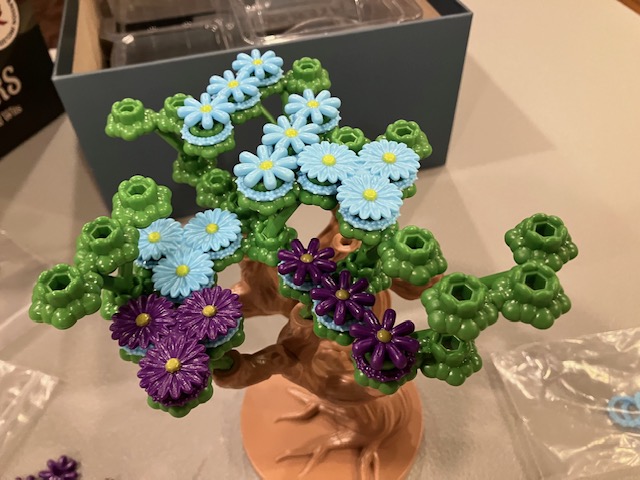
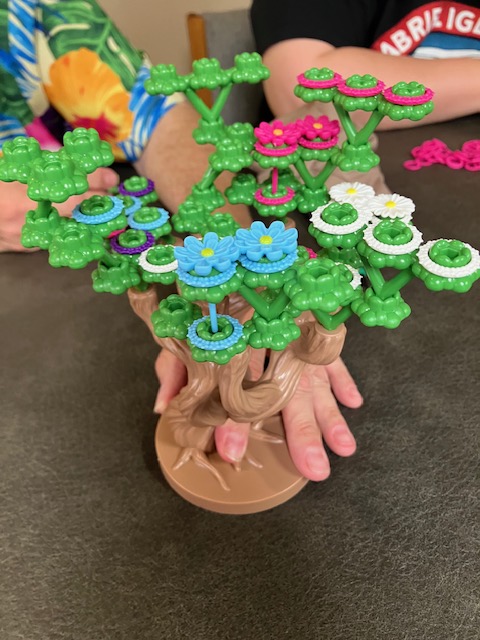
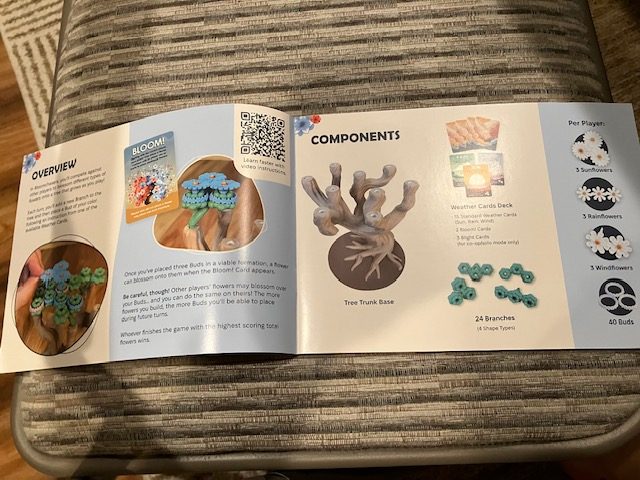
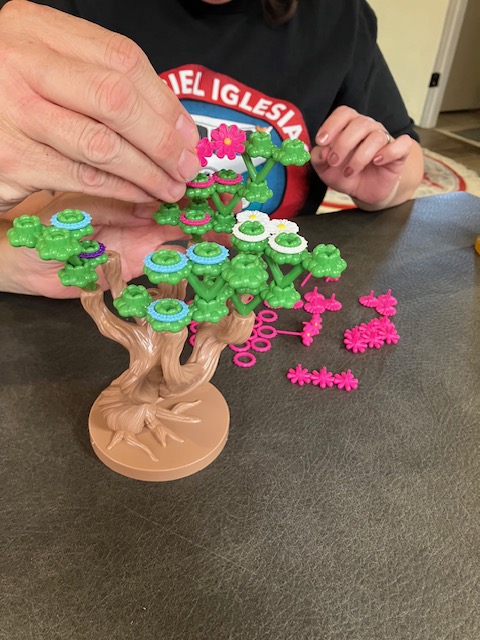
This is a hard game to describe; you build branches, buds, and flowers on a 3D tree!  It looks really cool! You can see what it looks like on the back of the box, but we’ll see some real pictures in our runthrough below.

Although there is a competitive mode, we are just focusing on the solo and cooperative modes.  Let’s take a look!

Unboxing

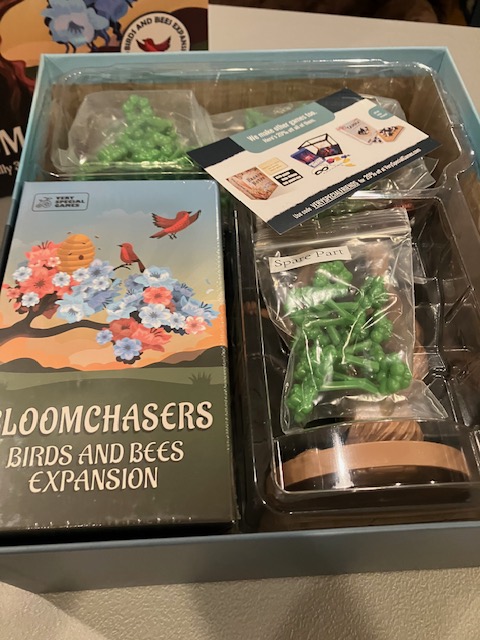
This particular edition has both the base game and expansion built in!  It’s a pretty big box! See the Coke can for perspective above.

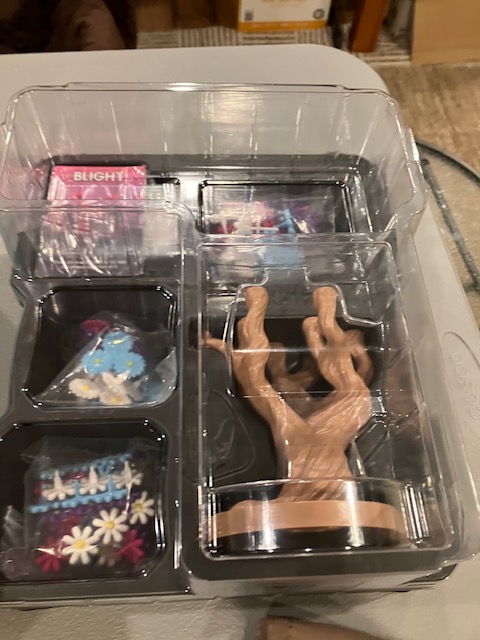
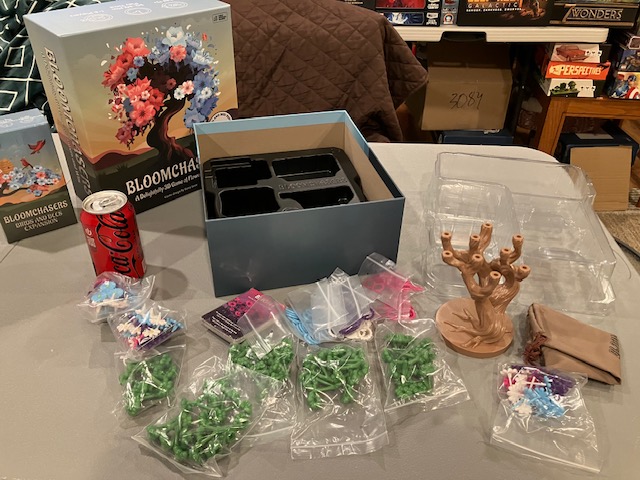
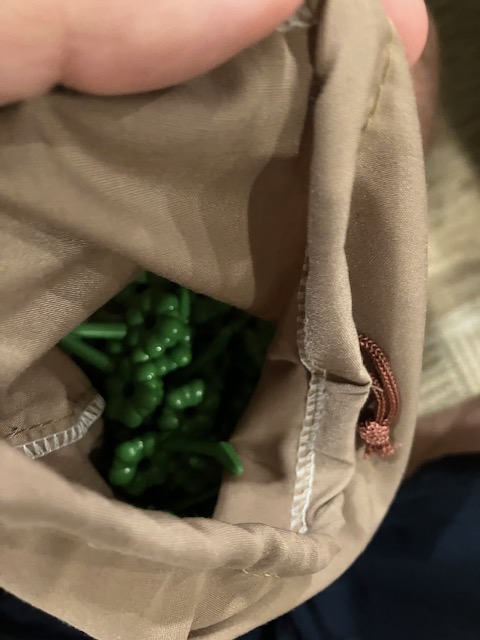
It has a lot of little plastic pieces for the trees.

The green pieces (they kinda like of look like broccoli) are the main branches the players put on the tree.

The tree is a giant piece you put the branches into and some flowers!

I mean, the game is unique looking and interesting!

Gameplay

Every turn, players take on branch (“brocolli”) and put it on the tree.

The branches go on the tree in any empty space (or in a space with your bud).

You put buds on the tree, (little circles), trying to certain layouts of your buds.

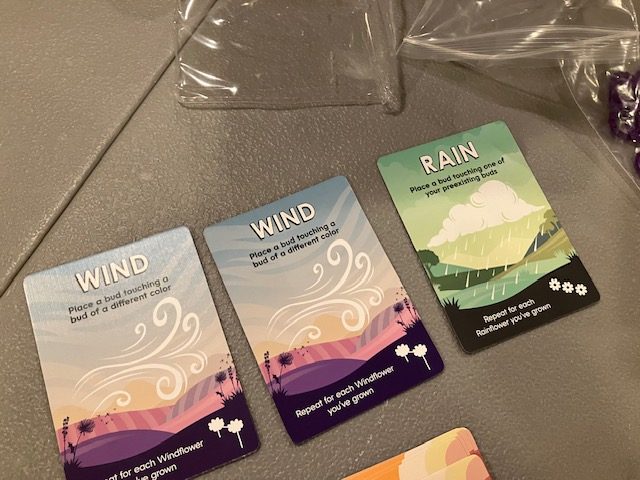
Before you place a bud, you have to use one of the weather cards which “defines” how you can put a bud on the tree.

During a “bloom” card, you can place flowers on your tree where blooms are!

Your goal is place as many flowers as possible, and you get points based on “the frequency” of the weather cards.  The frequency of weather cards matters because it’s easier and easier to place certain flowers if there are more weather cards.

You’ll notice at the bottom of the weather cards, that if you have flowers already played, you get to play MORE BUDS!

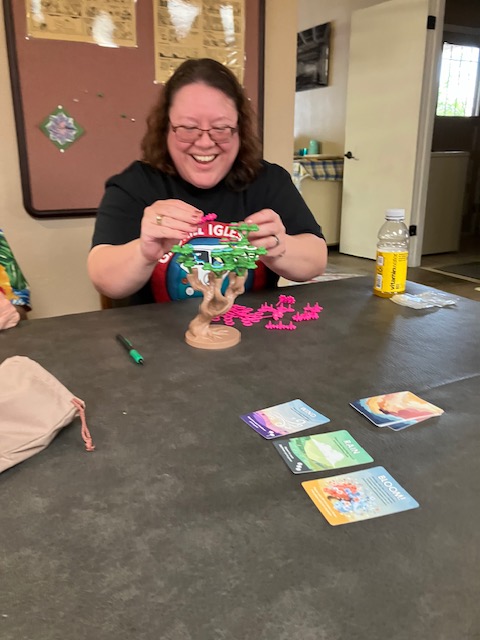
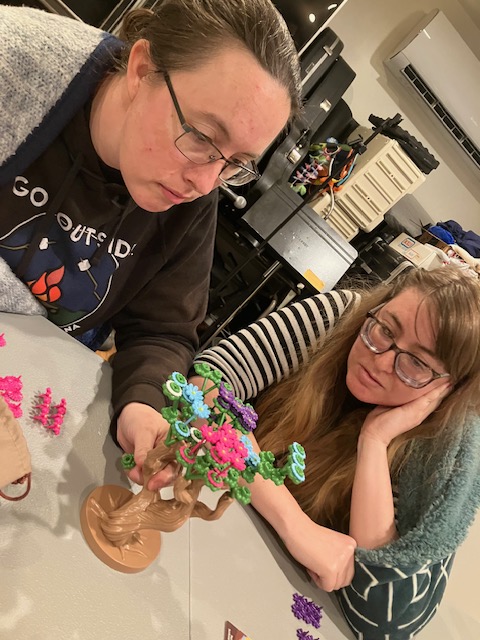
The game looks really great as you try to get as many flowers as you can!

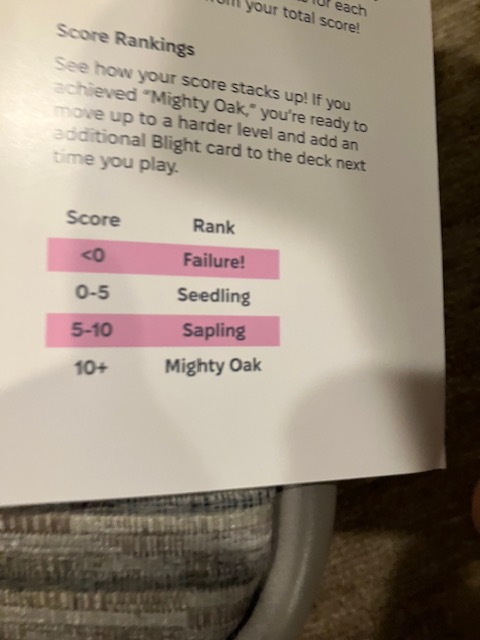
This is really a game about scoring and trying to do better than last time!  (Although, we found the scoring wonky in the solo and co-op)

Rulebook

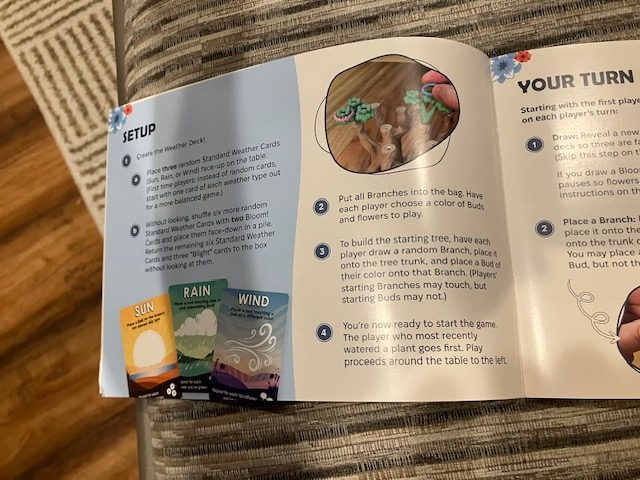
The rulebook is okay.  The form factor isn’t great; see above as it gets a B- (?) on the Chair Test.

The rules are described adequately, but it does miss several points that are quite important to play.

  1. What is considered adjacent?  It turns out adjacency is also a 3D concept!
  2. What is considered a bud?  Even after you place a flower on a bud, it is still considered a bud!
  3. How do the 3D flowers works?  It is described in the rulebook, but it needed a better pictures.  Everyone I played with always played this wrong the first time

All of these issues are addressed in this BoardGameGeek thread, and later in a thread with a FAQ:  I encourage you to follow up on this thread if you want to play!  Apparently the designer made several rulings on some of these issues during the kickstarter …

It’s a little frustrating that these fundamental issues were not addressed in the rulebook. But at least there is an avenue (BGG) to address the issues.

Dexterity Game

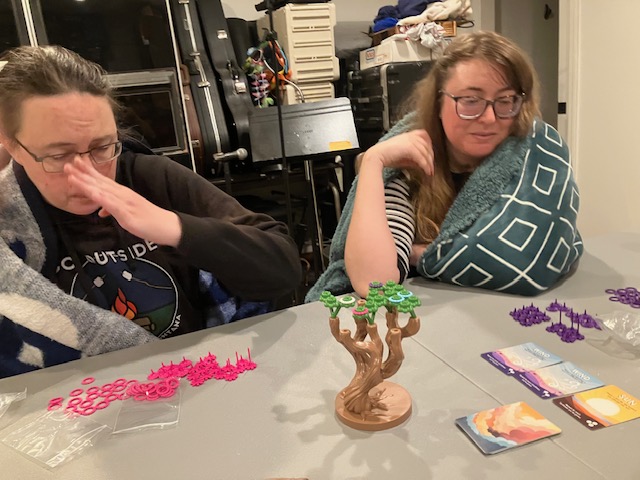
I played the game with two sets of friends; my first set of friends are “less dextrous” then myself, and they called this a dexterity game!  Many times, when trying to place buds, they would nudge the tree and cause buds to fall off.  It happened enough times that they declared, partly in jest, but partly in truth, that there is a little bit of dexterity element to the game!

The table we played on “may” have had something to do with that.   It was a little soft, and the table was quite large, which means we had to lean across a little more.

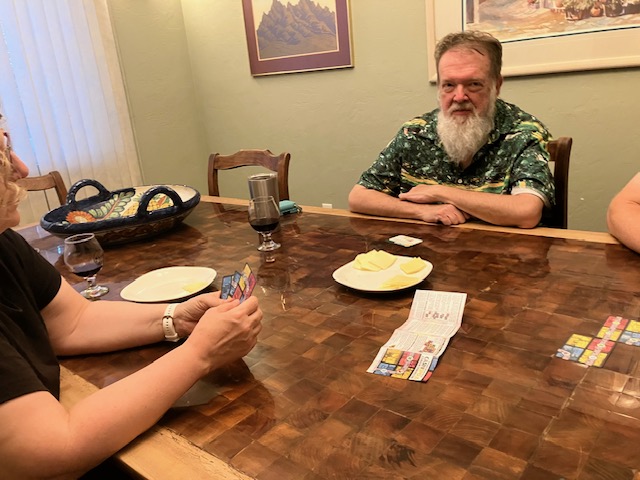
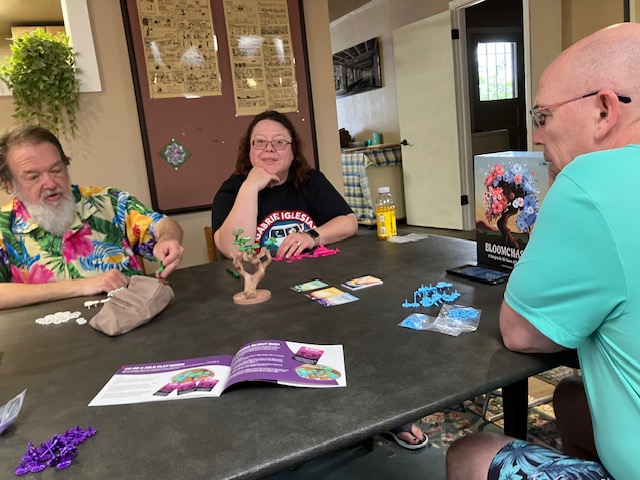
On the other hand, my other set of friends and I played on a harder CostCo table (see above) which was more stable and we were all “closer” together.  Although we didn’t struggle with the dexterity aspect as much, looking back on the games, we still had a few “knocking buds off” incidents.

I think the moral of the story; play on a harder table, try to keep your group close, and recognize there is a dexterity element to the game which may or may not affect your enjoyment of the game.

Randomness and Strategy

The game has some strategy, as your choices matter about how you place your buds.  But, when the Blight cards come out (which are the “bad news” branches) and when the Bloom cards come out (“good news”) are a little random; even after two Bloom cards come out, they get shuffled back in!  So you may get Blooms or Blights at the wrong time!

I personally think this extra randomness takes the pressure off the game.  If this game has far less randomness (if you could see which weather cards were coming,  if you could see which branches were coming,  if you have more foreknowledge when the blooms happened), I think the game would take on a different character as people would try very hard to plan things out.  But because there really is quite a bit of randomness, the game is more chill: “Eh, you get what you get and don’t have a fit”.    It’s weird to say this, but I think the randomness (which I usually don’t love) coupled with the theme, makes this a more enjoyable game.

The Joy

The Joy in this game is building a tree with flowers.  There are choices, which make you feel involved (which Weather card do you use? Where do you place a branch? Where do you place a bud?  What am I hoping for?), but because the Blooms and Blights and Weather cards are “fairly” random, you don’t feel like you “have” to optimize this game within an inch of its life.

Conclusion

My niece has a saying that she frequently quotes to her sister: “You get what you get, and don’t have a fit.”  And I think that encapsulates my feelings of this game.  It’s a cozy game where the joy is in building a beautiful tree with flowers.  Do you have choices and feel like they make a difference?  Yes, you can help your friends with your choices, you can set up your flowers, you can place buds strategically.  But because you know there is some randomness to the game, you don’t stress about your choices as much; “You get what you get, and don’t have a fit”.  I freely admit that the fun of building the 3D tree and the flower theme help that cozy feel.

Be aware that there may be a little bit of a dexterity element to this game, and that you should really consult BoardGameGeek to make sure you get rules clarified.  But otherwise, I liked this game and will keep it! 7/10.

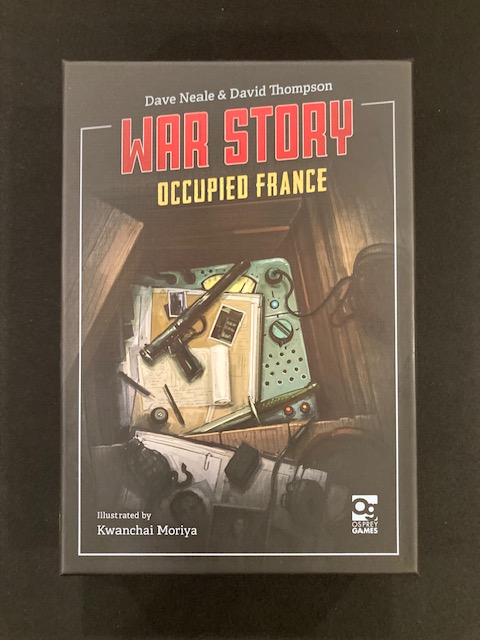
War Story: A Choose-Your-Own Adventure Game Where Choices Really Matter

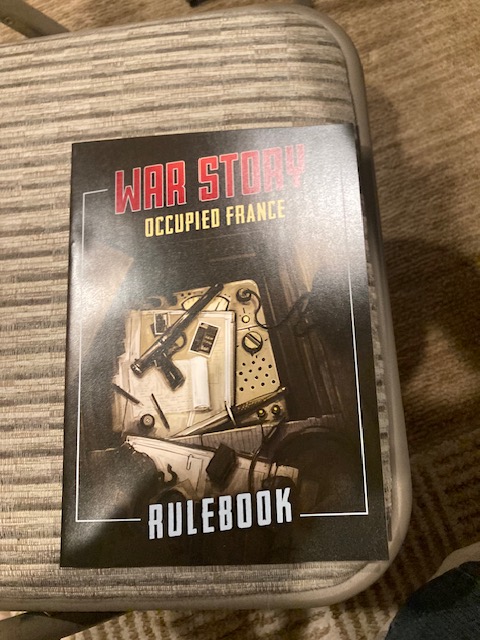
I pre-ordered War Story from GameNerdz on Oct 17th, 2024. I wanted to play it as soon as possible, so I went ahead and paid full shipping for it (I normally try to get to $75 or so to get free shipping); that’s how excited I was to get this! I paid for shipping to get it sent separately ASAP!

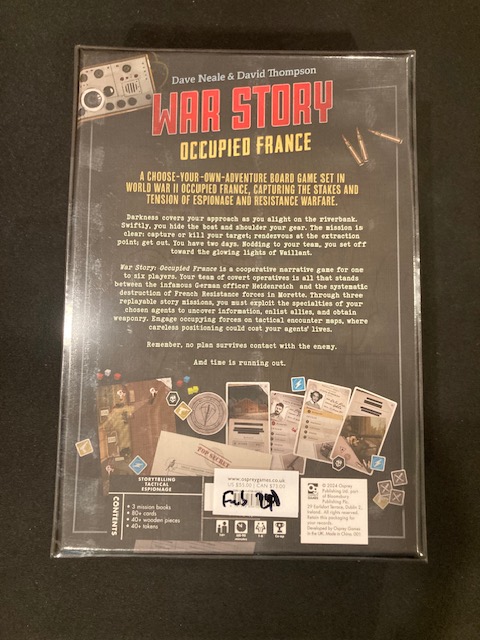
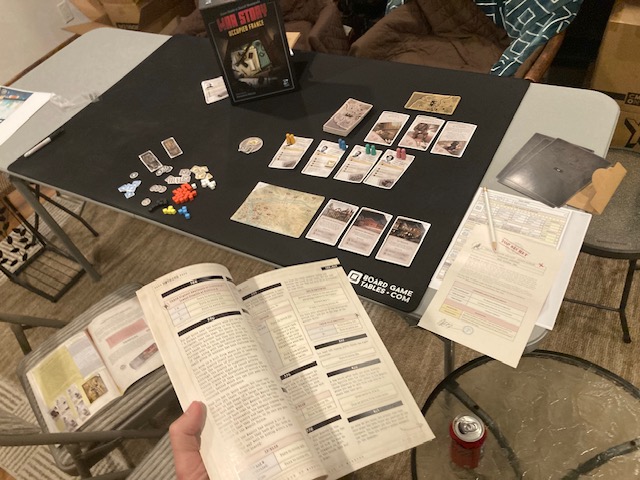
War Story arrived at my house on February 21, 2025 (I noted the date on the tab on the back).  Over about three days I played the entire campaign solo: one chapter a day for three days.  (This is a fully replayable campaign game, but you can also just play single chapters if you like).

What is War Story and why was I was I so excited to get it?  This is a Choose-Your-Own Adventure game set in World War II, but it is unique and different.

Let’s check it out!

Unboxing

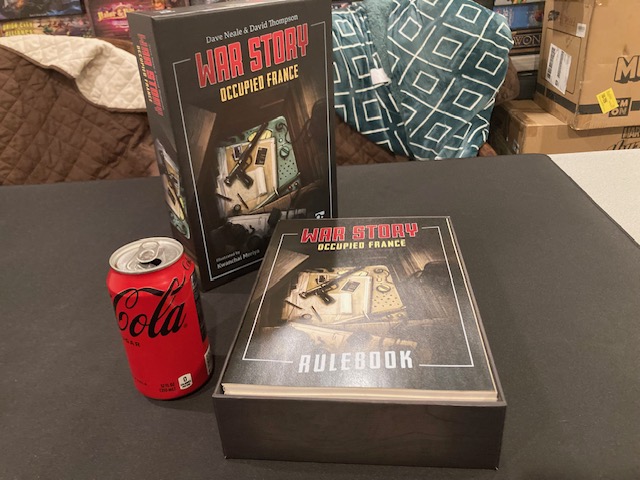
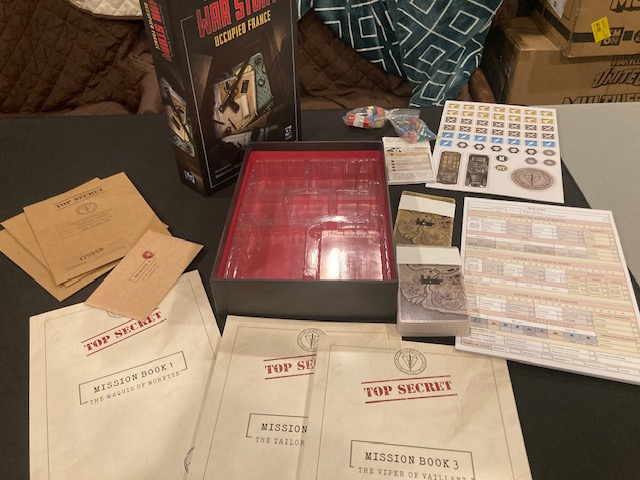
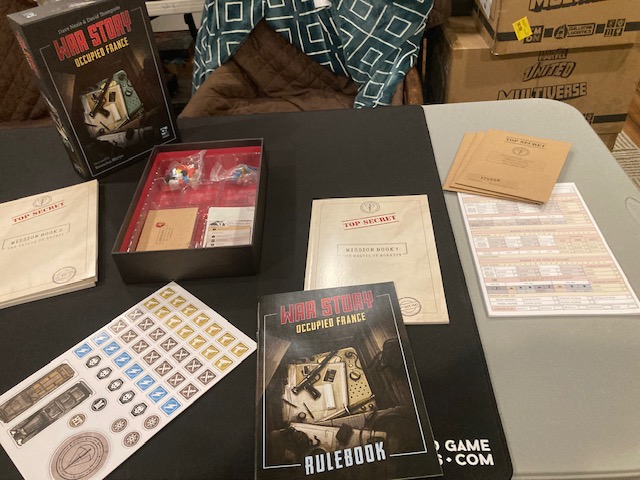
This is a smaller box (see Coke Can above for perspective) but it’s actually quite heavy; it’s brimming with books!

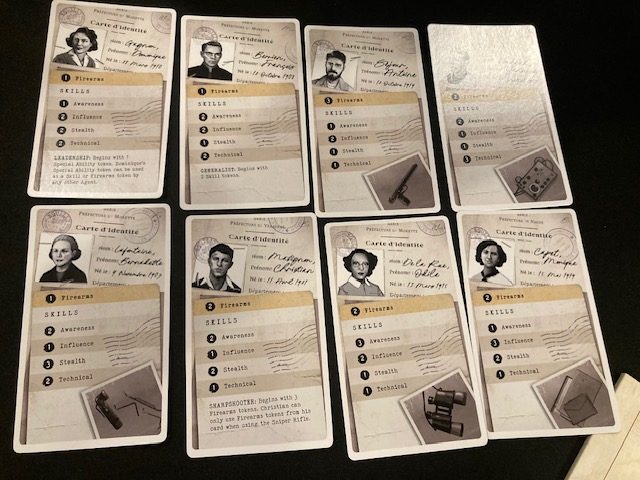
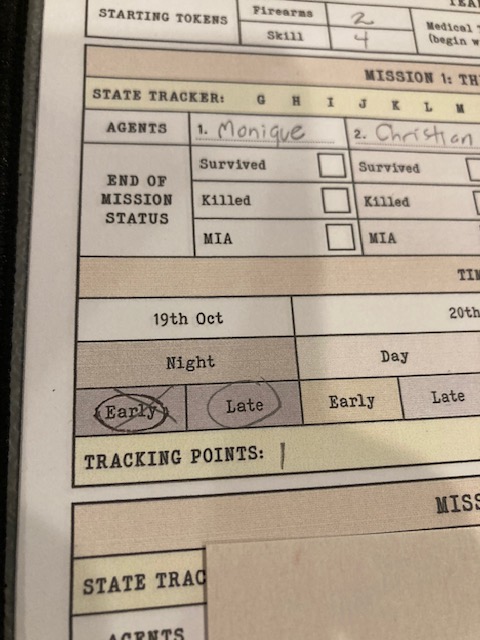
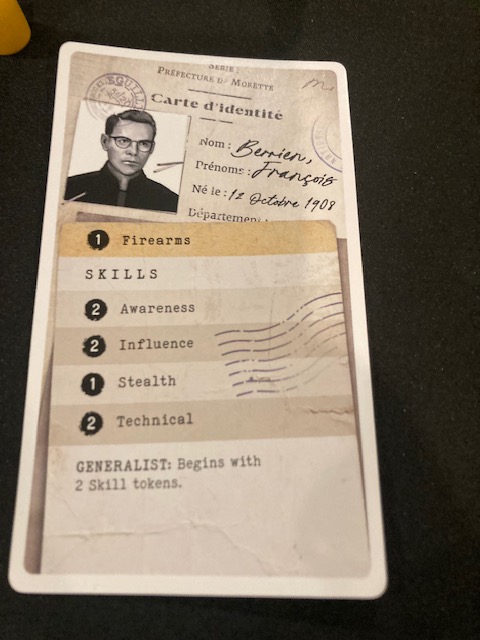
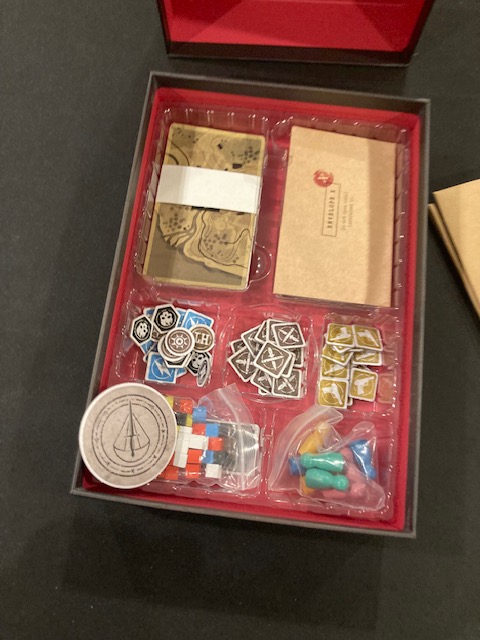
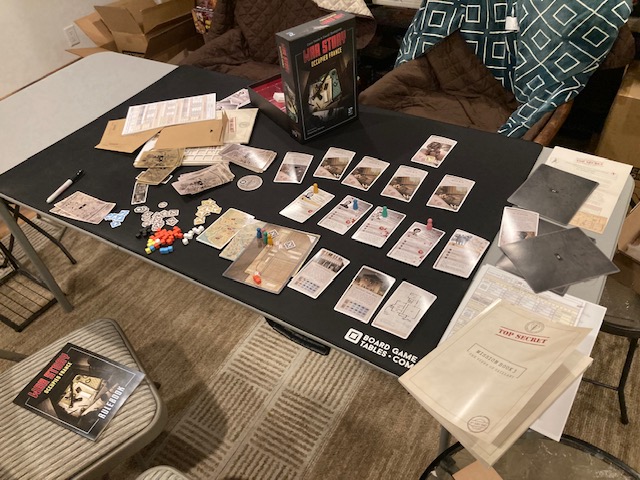
There’s thee Mission Books (see above), three big envelopes, one small envelope, a status pad, cards, and tokens. See above: there seems to be quite a bit in here for a Choose-Your-Own Adventure game!

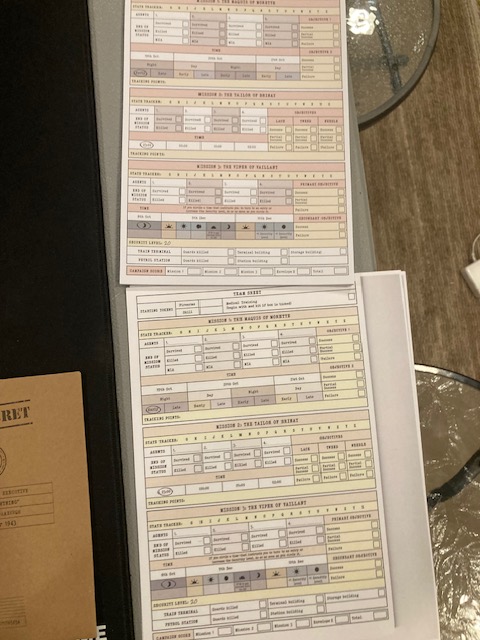
To preserve the longevity and replayability of the game, I went and made a few copies of the status sheets (see above).   See, even though this is a Choose-Your-Own Adventure game, it’s fairly replayable!   You need a status sheet for each game/campaign you play.

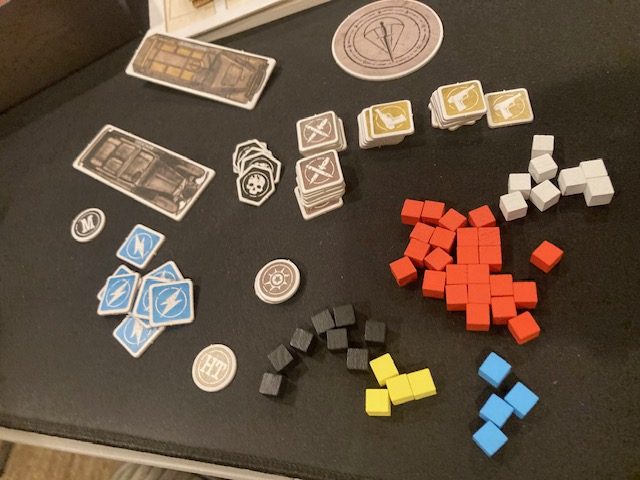
There’s a bunch of punchouts and tokens.  The cubes all have different uses that become clear as you play.  Spoiler: the orange cubes are the Nazis! (Although the are called red, they look more orange to me).

As you might guess from the components, there’s more to this game than first meets the eye.  Don’t be fooled by the Choose-Your-Own Adventure monicker: this is a pretty different game.

Rulebook

The rulebook is good.

The rulebook gets an A on the Chair Test: it can sit wide open on the chair next to me, within easy view when I need to see it (which is weird because the Mission Book completely fails the Chair Test: see more discussion below); they really got the Rulebook form factor right.

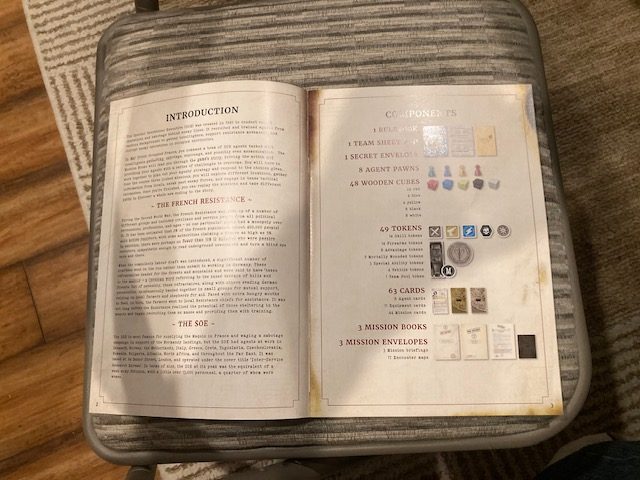
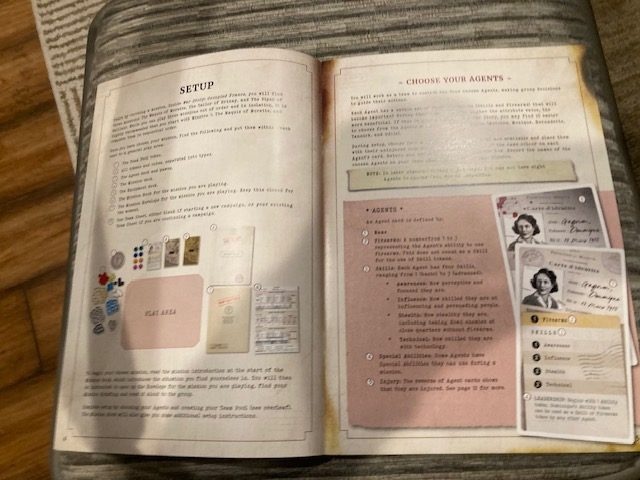
The Components and Set-Up pages are fine.  It’s a little confusing because the set-ups are intermingled between the mission books and the rulebooks, and there’s a few things that aren’t quite clear (unless you read closely): I had trouble finding where to setting the entry for starting tokens (at the top of the Status sheet).  Just be patient and I think everything reveals itself to you as you read.

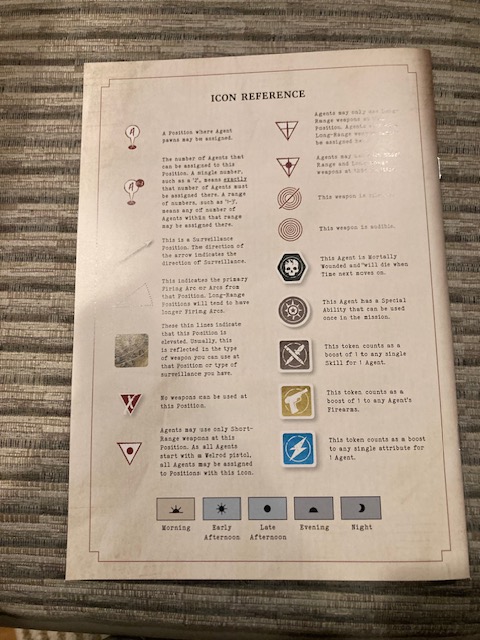
And the Rulebook ends with a nice summary of Icons. 

One quick note: I usually don’t like it when rulebooks use “thematic” fonts (this one uses a typewriter monospace font: see pictures above).  This thematic font doesn’t detract too much from reading the rules here, so I’ll give it a pass.

Good rulebook.

Gameplay

There’s a few minor minor spoilers in the pictures below, but they are from the first few minutes of the first mission, so they shouldn’t spoil too much.  Out of context, they aren’t much of a spoiler, but feel free to skip this section if you don’t want any surprise.

War Story nominally plays 1-6 players, but honestly it’s just a solo game where the other players just all help decisions together (kind of like Eila and Something Shiny: see review here).   The player(s) lead a group of 8 resistance fighters in France during World War II.  Your first choice in the game is to choose your crew of 4 for the first missions.

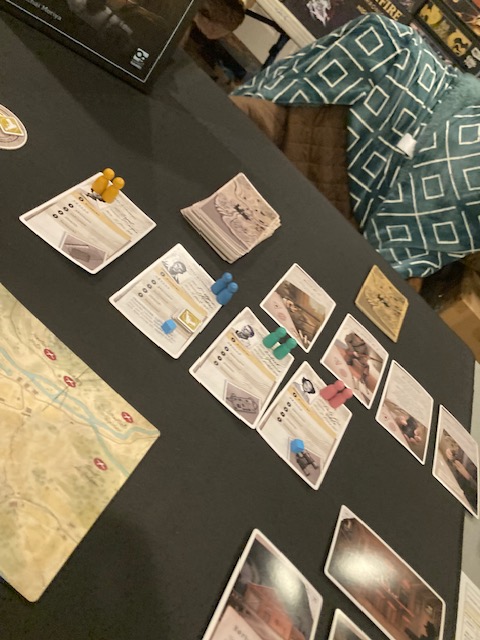
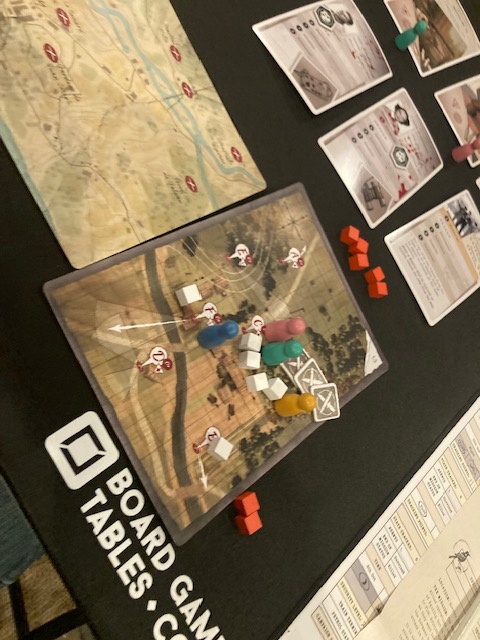
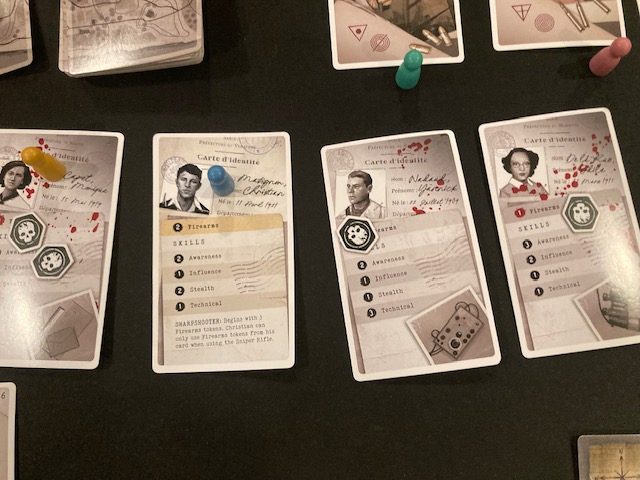
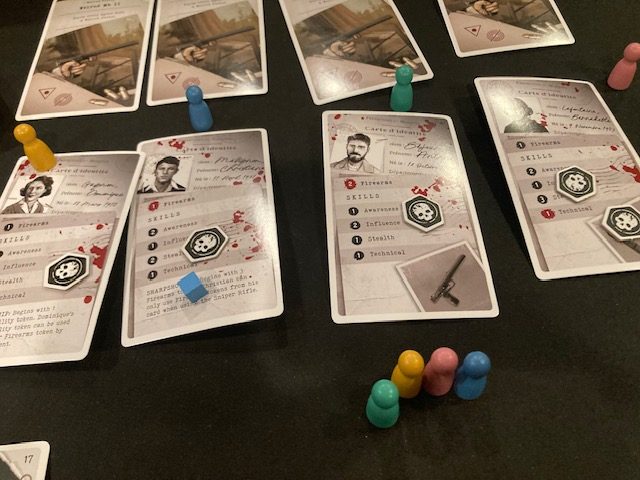
These 4 characters, whose names you must write down, will serve as your Agents during the missions.  You use the tokens to mark where the Agents act (there are 2: one to keep on the card for and one to move into the field; this way you remember which agent is which).

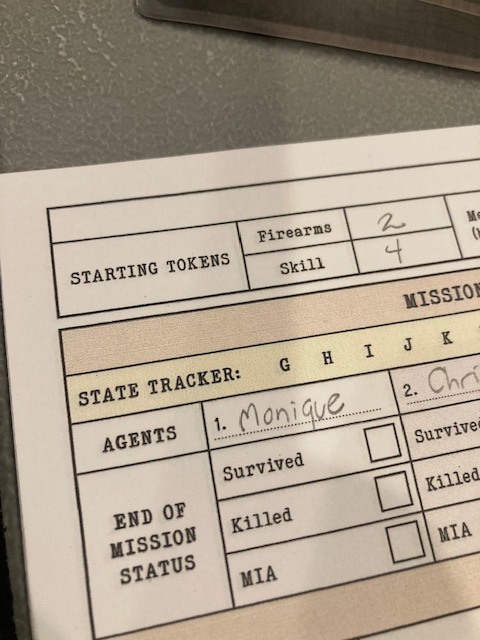
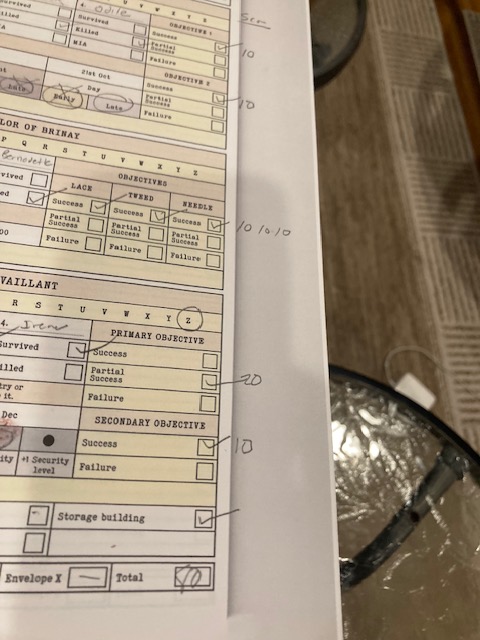
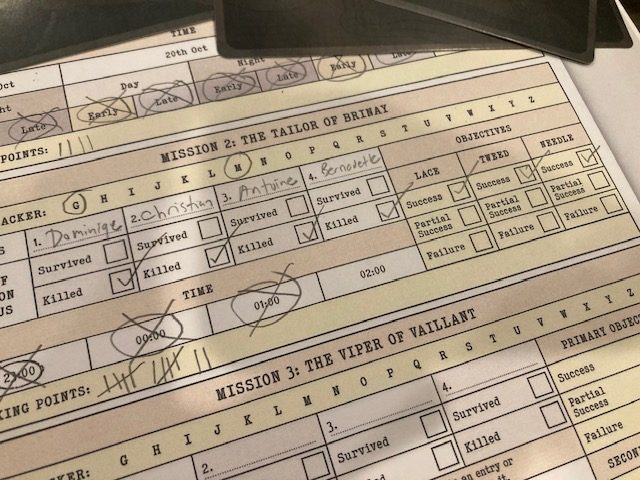
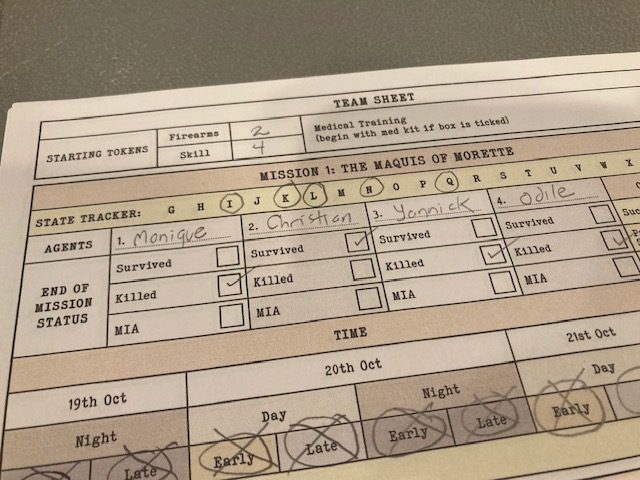
Your Status Sheet gives you a hint of what can happen to your Agents as you play: Survived, Killed, MIA.  See above.  If you think all your Agents are getting out alive, well, good luck to you.

And again, notice we wrote their names down.   I think it brings an emotional connection to the characters a little more than usual.

At this point, you open the first envelope and being reading the Mission Parameters!  See the Top Secret note above (too small to see anything unless you go zooming in, but that’s on you). See above!  This tells you what you need to do to “win” this mission!

Off to the right of the Status sheet are marks for the Primary and Secondary Objective(s); did you succeed? Partially Succeed? Fail?  These will all influence your final score.  

From here on out, it’s all about making choices and reading from the Mission Book. (Mission Book page blurred on purpose).

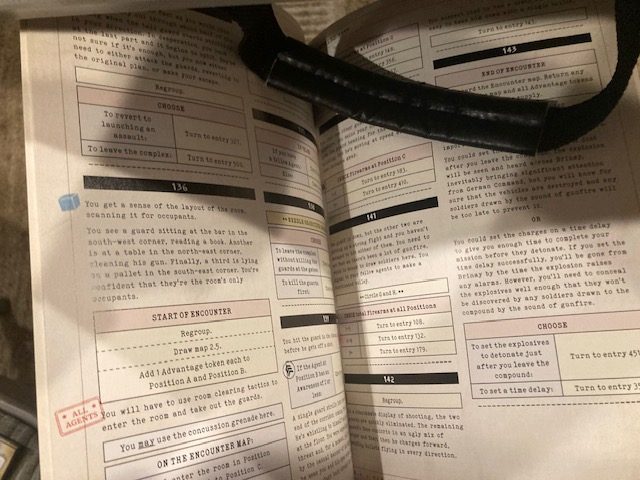
As you read from the book, things will happen, you make choices turn to entry 17, make a choice, turn to entry 31, and so on.

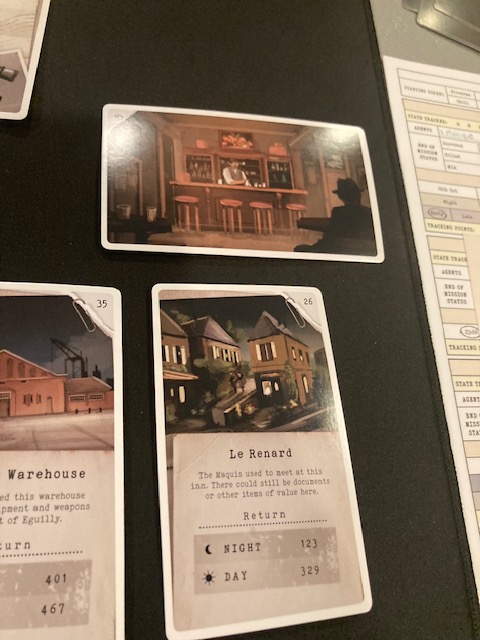
You have Locations you can visit as you start, and what entry you get in the rulebook depends on the time of day.

As the game unfolds, you will be told to “advance time” and move to the next time space (see As we move fro Early night to Late night).  What this means; what happens when you visit a location depends on the time of day.

It’s a Choose-Your-Own Adventure game!  Player read and choose, read and choose, read and choose … until it’s clear their chapter is up!

Combat

You will get into combat as you play, and combat will also be resolved using a Choose-Your-Own Adventure mechanism.  That’s right, your French Resistance fights the Nazis using a Choose-Your-Own Adventure mechanism!  “Do you shoot the guy coming right at you? Read section 12! Do you shoot the guy hiding in the bushes?  Read section 701!”

And let’s be clear, your Agents can die.

Death

Death is part of this game. You kill Nazi guards with your gun. You blow up Nazis with grenades. And your Agents will die. See above as Christian is the only survivor of Chapter 1. He definitely has some PTSD going.

Granted, you are generally “trying” to sneak around to achieve your objectives, and usually the sneakier you are, the better. But, combat will inevitably come up. And even it though it might seem weird at first to use Choose-Your-Own adventure books as a combat resolution mechanism, it does work. In some sense, you feel more vested in the combat as you are making hard decisions: “Do I shoot the guy coming at me because he is an immediate threat, or do I shoot the guy trying to come up behind me who might be an even worse later threat?” Somehow it feels more immediate.

So, combat will happen. People will die. Your Agents might die. Or you might have to put a bullet in the Nazi’s head. Be aware that death is at the forefront of this game. If that sounds too intense for you, then I suspect this game is not for you and you should just get out now.

Choices Matter

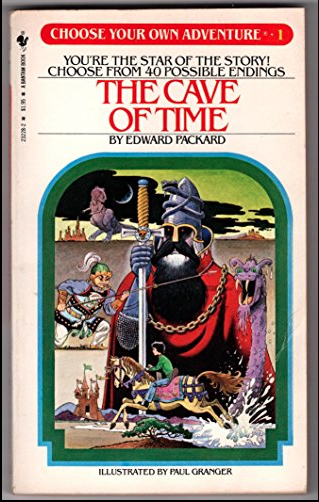
I know some of you (including myself) blanche a little when you hear Choose-Your-Own Adventure.  I still remember (40 years later?) how random my first Choose-Your-Own Adventure book was: The Cave of Time (see above).  What seemed like the right choice lead nowhere and the dumb choice led you to a cool adventure!  It didn’t seem like your choices mattered, you just “did stuff” and see what happened.  Choices didn’t “really” matter; you were just along for the ride.

That is very much NOT the case in War Story.  Of all the Choose-Your-Own Adventure games I have played, it feels like this is the one where the choices matter the most.

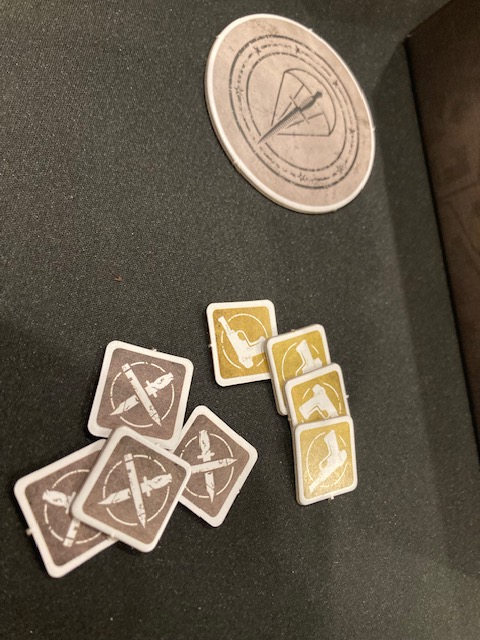
First of all, there are other choices in the game besides which entry you read. There will be Skill checks: “If your Sneak is 4+, read entry 12, else read entry 11″. You can choose to raise your Sneak by using Advantage tokens (either from a shared pool or sometimes a separate pool, depending on the Agent): see tokens above. You start with a limited amount of Advantage/Firearms tokens, and you have to choose when it’s best to choose a middling result or when you REALLY need an extraordinary success!!!

Second of all, as the progresses, the choices you made earlier WILL AFFECT your outcomes.  Did you let that Nazi survive?  Maybe that was a good choice, maybe that was a bad choice, but either way … it affects what happens to you later in the game!  See the State Tracker above for game 2 as Events G and M were circled.  Was it good I left that Nazi alive and showed mercy? Or not? Was that Event G?  I hope that doesn’t came back to bite me!!  And it might bite you, or it might help you.

Your choices matter here. They really matter.

Emotional

So, this game is pretty emotional.  You feel … close to the war, you feel close to the resistance, you feel close to death.  My second game of the campaign, all my Agents on the mission died.

I was left with one Agent left (poor Francois) as I headed into Chapter 3.  How well could I do with one agent?  There was so much emotion as my entire squad died … and poor Francois was all that was left.

Over three nights I played through the story.  This game is pretty emotional. Be aware.  

Binding

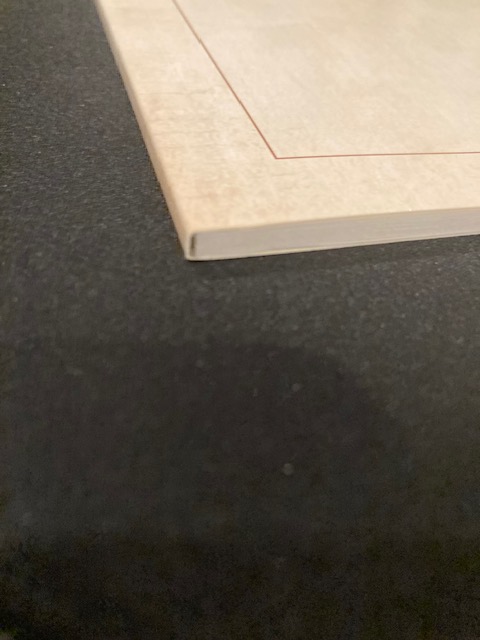
I need to say something about the binding on the Mission books:  I hate it.  War Story uses the thick glue binding for a large book.   This binding does NOT stay open; it is the worst choice for board games!

We had this same problem with the binding on the Freedom Five books from last year  (see review here), and the binding on the rulebook for the Forests of Admiron (see review here), and the binding on the Batman: Gotham City Chronicles Solo/Cooperative Expansion (see review here).  This type of binding does not lay flat.

You can’t hold these books open unless you completely counterfold the books!  (See above as I try to hold the Mission book open with a little leather thingee).  Even then, the books don’t really stay open!  It’s very frustrating!  If you “slip” and lose your place in the book, you lose the page you were on, as the book closes on you!!!  In my third chapter, I slipped a few times and had to literally replay the introduction three times so I could find where I left off!  It was very annoying and almost put me off the game.

This binding does not work.  Please, I beg you board game companies, don’t use this binding ever again!

I came in to play this game the first day I got it … I was so excited!!!  I saw the binding on the Mission books and I was immediately turned off.  In fact, I was so turned off by the binding, I went inside my house and did my Income Taxes.  The binding was so debilitating that I did my Taxes instead of playing this WONDERFUL game.  

Conclusion

And I don’t feel like I can say too much more, because I don’t want to give anything else away. I liked War Story! This is NOT the Choose-Your-Adventure books of yore, where nothing really matters: this is a Choose-Your-Own Adventure game where choices really matter! And you feel like you have choices!

Be aware that War Story is not for everyone: it’s gritty and people will die.  Nazis will die. Your Agents will die.  You will actively take part in the resistance and shoot Nazis in the head.  But this was the life of the French Resistance in World War II.  I think this game really captures the spirit and vibe of that time.  

I can’t give it a rating except to say you will probably know if you will like it based on the description in this review. I liked it, and I am glad I played it: It felt very emotional and really captured the vibe of World War II (I think; I wasn’t there). But I think you will know if this is for you or not.