A Short Review of a Ridiculous Game: Spirit of 77

My First Cooperative Game!

What was my first cooperative game?

This is a cooperative games blog.  We have mostly done Board and Card Games, but we have rarely have alluded to Role Playing Games (like Dungeons and Dragons/Pathfinder in this post).  BUT: the first cooperative game I played was the RPG Dungeons and Dragons.  Our characters worked together as a party to take down some big bad, explore the forest, heal each other, and save each other.   So, even though we nominally only talk about Board and Card Games, RPGs have a special place in my heart and … now my blog.

Get The Funk Out!

IMG_5227
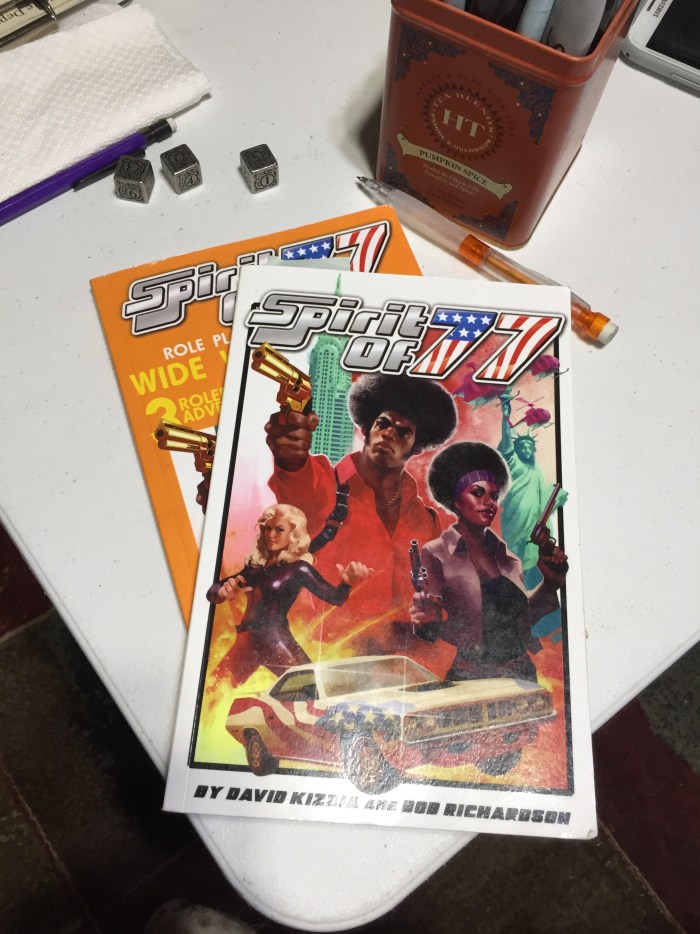
Spirit of 77: Get the Funk Out!

Spirit of 77 is a Role Playing Game set in the late 70s (77?).  It’s a cooperative experience as players work together to solve some of the most RIDICULOUS adventures you have every played.  Seriously.

Junkerman discovered Spirit of 77 at Isle of Games and was immediately smitten.  The idea that players take on the role of a 70s trope character sounded so funny!  Pick your favorite 70s TV show, and become that character!  70s cop?  70s martial artist?  70s Love Boat?  70s Fantasy Island?   Take your character and guide them through an adventure!

RPG

IMG_5226

The RPG itself is fairly simple.   It reminds me a little of FATE as you have plot points and you have simple roles.  You can succeed on a role, succeed with a cost, fail with a minor cost or fail miserably (paraphrase).  The fun part of the game is that you can “offer” up to the DJ (Oh yes, the Gamemaster is called the DJ for reasons that will become apparent) thematic reasons why your roll failed.

“I try to help BigFoot because he’s on fire!  I (roll) and succeed … but with minor cost.”

“So… what’s the cost?”

“Umm, I succeed in putting BigFoot out, but my afro is on fire now!”

The BEST part of the game is when you fail miserably.  Because, you don’t know what will happen next!

The DJ

One of the funnest parts of the game was that the Gamemaster, (I mean DJ), has a playlist for his adventure.  And this worked great and was very thematic.  As new events happen, the DJ would break out the next song (a 70s classic of course) and introduce the new event.

My favorite song: “Oh, that smell!” when we encountered the giant manure pile.

The Two Major Rules

Junkerman’s main rule: things that could NEVER succeed in real life will succeed in the Spirit of 77 world.   A simple example: CC’s character had a mechanic follow him around.  After we went through the time warp in the land of the lost (really), we needed him.   Even though we NEVER said he came with us through the time warp, he just showed up … because.

IMG_5222
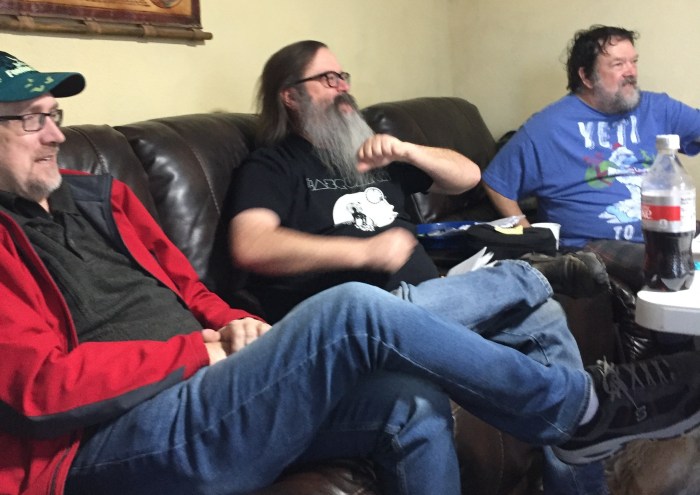
The dudes

And that’s the second rule: Given Choices, the Funniest One wins.  Our ethic in playing this game was  like the writer’s room for a comedy TV show: we were constantly trying to outdo each other and make each other laugh with ridiculous choices.  For example, we were given a chance to train BigFoot to do ONE complex thing.  What did we have him do?  Drive an AMC Pacer and jump 20 Ford Pintos in the Pacer.  Because it was funny (well, you had to be there I guess).


Conclusion

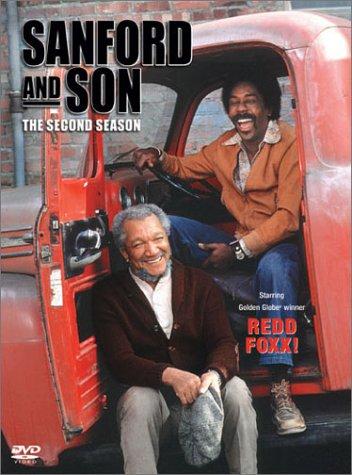
Image result for Sanford and Son

I grew up watching Sanford and Son the 70s TV show, so I thought it be fun to be Lamont Sanford, aka Son.   The premise would be that Lamont was trying to figure out how his father died.  And course, it was even funnier that Lamont was haunted by the ghost of his Dad who would show up and give him hints … “You Big Dummy!  You went through a warp gate!”

Our  last game ended when Bigfoot, whom we had befriended, was driving an AMC Pacer.  He had to break the top of the car so he could drive.  To win, we had to get Bigfoot to jump 20 cars (all Ford Pintos), while catching our other character in the air. Fireworks were going off in the background as Bigfoot jumped the pintos …

This is the most ridiculous game I have ever played!  And I have never had more fun.   As long as you have a group that doesn’t take itself too seriously, this can be the most fun RPG you have ever played.   We grew up in the 70s, and so maybe part of the fun was just making the 70s references.   But, we all had a great time.   This is a great cooperative game that is probably under your radar.


Review of Star Trek: Frontiers — Part I: Unboxing and First Impressions

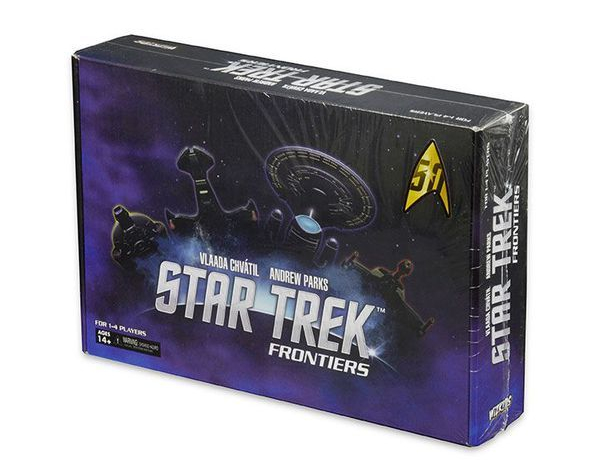
pic3000148
Cover of Star Trek: Frontier

I picked up Star Trek: Frontiers sometime ago: It came out in 2016 and my friend Josh and I have been “meaning” to play it for almost 2.5 years now!  We even had a sign-up for it at the first RichieCon in  2017,  but for whatever reason, it got dropped on the floor (not literally).  I decided to get it out this weekend and give it a try.   I don’t know why!  I think because it was at the bottom of a pile of games, and I was afraid it was going to get smooshed …

Mage Knight Retheme

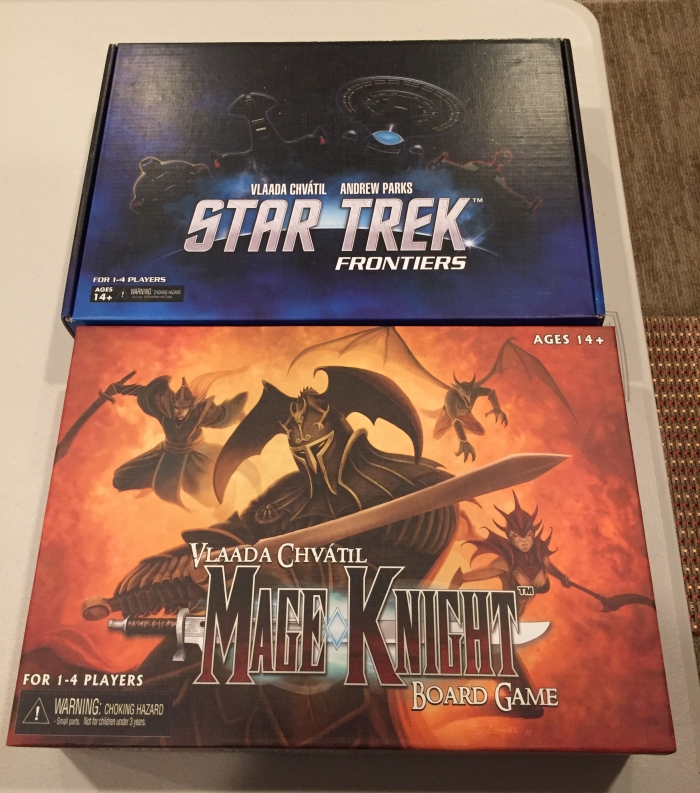
IMG_5269

So, Star Trek: Frontiers is a re-skin of the big hit Mage KnightMage Knight is a fully cooperative game (sorta) in which Knights work together to take down big bosses in a fantasy world.  Star Trek: Frontiers (STF) is all about the (newer) Star Trek universe … mostly a Deep Space 9 universe.   In STF, you can play Captain Cisco (from DS9) piloting the Defiant, Jean-Luc Picard (from Star Trek: The next Generation) piloting the Enterprise, General Martok (Klingon General from DS9), or Lursa and B’Etor (the Klingon sisters from both TNG  and DS9).  Choose a ship!

If you like the later Star Trek (DS9 and TNG), this theme is just for you.
Cartman Cooperative

cartman

So Star Trek: Frontiers is a fully cooperative game … mostly.  Sometime ago, I played Mage Knight and noticed it’s a different “flavor” of cooperative, which we dubbed Cartman Cooperative.  This is where each character tends to “do what they want”: it represents a fragile alliance of characters.    Think Gloomhaven or Legendary, where all players are working together (and they have to to win), but in the end, there’s some notions of victory (victory points, loot).  To be clear, Cartman Cooperative  is NOT semi-coop!  It’s still fully cooperative, but (notionally) each player is more independent.  Honestly, this depend on your group! We play Legendary (ignoring the victory points) and Gloomhaven (changing the loot rules) fully cooperatively: It’s easy to play Star Trek: Frontiers completely cooperatively as well.  Having said that, the Cartman Cooperative notion is very thematic: the alliance between the Klingons and the Federation are fragile, and even within the Federation and The Klingon Empire, alliances can be tense.

Solo Rules

IMG_5252
Solo rules from the Main Rulebook, NOT the walkthough!


Are there solo rules (i.e., Saunders’ Law) ?  Yes and No.  The main walkthough makes you play 2-4 players, but it refers to the solo scenario (above). So, there are solo rules, but they are very much outside the main rule set.  This is hard to deal with because the main walkthrough is SO DENSE WITH RULES.  The last thing you want are “auxiliary” rules  which requires to play a second “dummy” character.

Honestly, it wasn’t that hard to “fudge” the walkthough and just play one ship: all I had to do was use one less tile from the tile deck.  You can follow all the other rules and just play one ship just fine.

Components

The components are pretty nice.  Each player gets a ship (I, of course, chose the Defiant with Cisco commanding) and it’s a nice little mini ship.

The Enterprise and the Defiant

There are a LOT of components, and the game just BARELY FITS in the box.

The Borg cubes (which you don’t fight in your first game) are pretty cool.

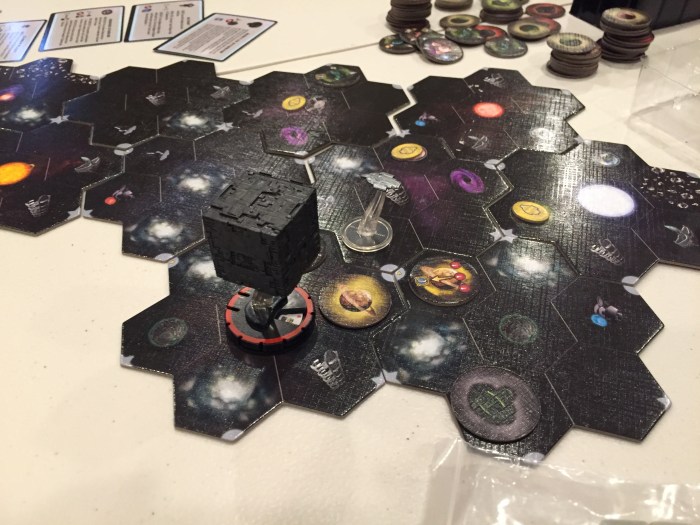
I like the components a lot, but a lot of them are a little dark!  The printing seems just a little darker than it should be?  Sometimes they were hard to read and distinguish.

IMG_5274
Tiles and tokens are all very dark: sometimes a little hard to read!

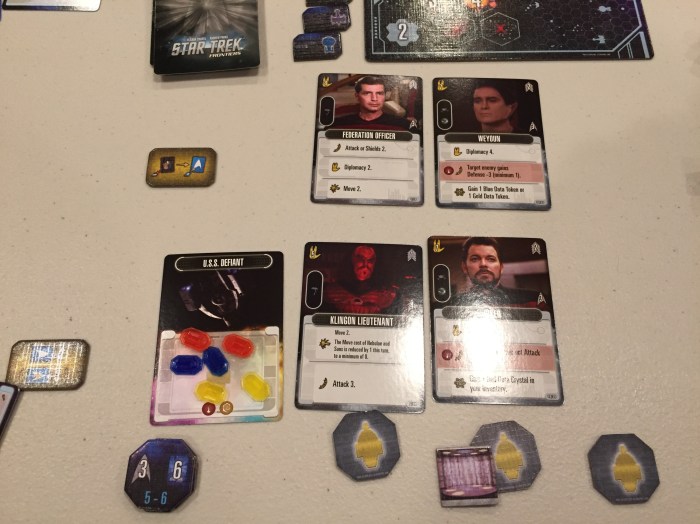
The cards have screen captures from the show: you will either love this or hate it!

IMG_5251
All cards have screen captures from the shows (TNG and DS9)

In the end, I enjoyed all the screen caps (“I think that’s from that DS9 episode where they fought the Dominion!”) and thought they were very thematic.  I do know some people tend NOT to like them.  Caveat Emptor.

Overall, I liked the game components.

Rulebook and Walkthrough

IMG_5285

Like Mage Knight, Star Trek: Frontiers is a very heavy game with both a Game Walkthough (see above) and a Full Rulebook (see below).  To ease you into the rules, the walkthough introduces most of the rules very piecemeal as you play (so you don’t have to capture all the rules right up front).  Honestly, this a great way to learn the game. Frankly, because of the complexity, you almost HAVE to learn the game this way!  This game has a LOT of rules!

IMG_5286
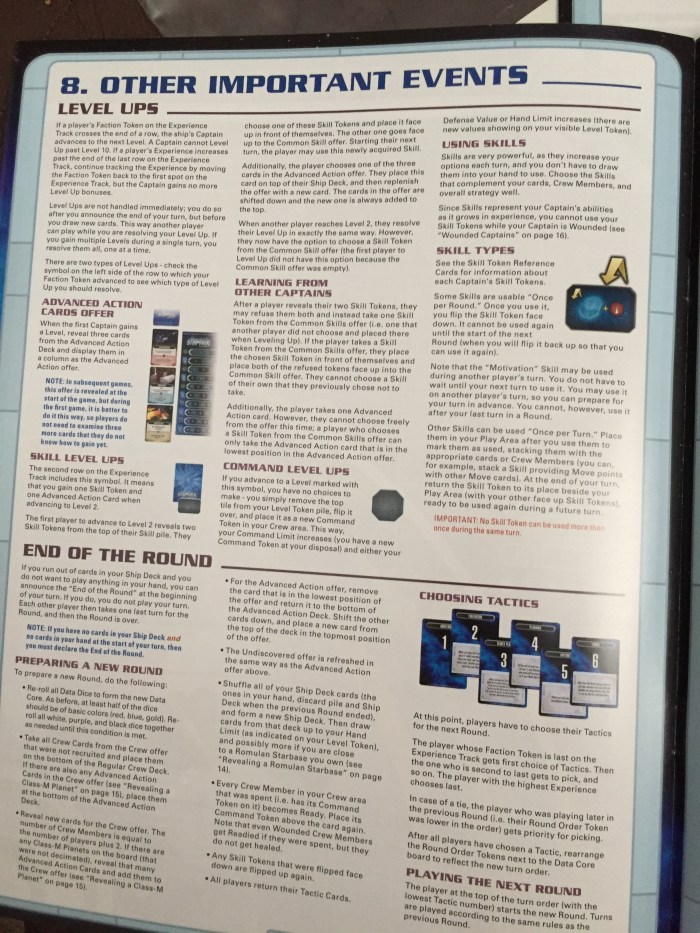
Full Rulebook: you only use this AFTER you’ve used the full Walkthrough

First Play: Playing through the Game Walkthrough

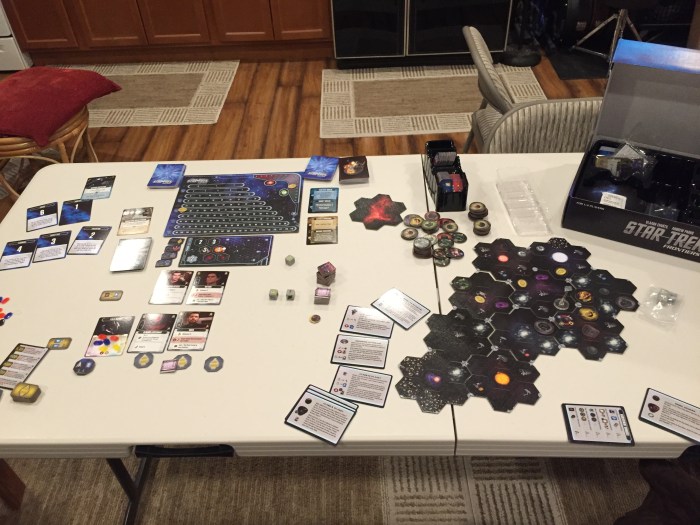
The Walkthough is quite good.  Like all good rulebooks, it shows you what the game looks like all set-up:

IMG_5282
Showing what the game looks like set-up

The one thing it DOESN’T do is give you a components list!  There are a LOT of components in this game, and I felt like a page with a list of components would have gone a loooong way towards helping you  get familiar with the game.   Basically, as you read the rules, you have to go hunting through the components to find what you want.  There’s a mental disconnect there: I have to switch between “search the components” and “learn the rules”, which can be a bit jarring with so many components.  This is no way a deal-breaker, but it seems more like a missed opportunity.

The font also seems very small in both books.   Arguably, it allows you to keep “concepts” strictly on a page (so I get that), but I am in the camp that prefers larger fonts.  My opinion.

IMG_5281
Font seems a little small

I did like that they used the Star Trek font for the headers, but a NORMAL font for the actual text!   The Star Trek font made the rulebook for thematic, but the NORMAL font made the rulebook readable!! (I hated how Obliveaon used the Comic Book font for the main text).

Introduce Concepts As You Play!

IMG_5275
Summary Cards for Different entities in the game

The main thing the walkthrough does exceptionally: it introduce rulesets AS YOU PLAY.  This works exceptionally well.  There’s both a rules section JUST for that entity/ruleset and a summary card.   For example, the first time you encounter a Class-M planet, there are rules in the Walkthough (luckily, in the order you expect to encounter them as you play) and a Summary card (see above).

IMG_5280
Rules introduced as you play

I likened this to having to “swap disks” when playing a computer game (for those of you who remember swapping disks for adventure games):  a new landscape comes out, and you have to change disks!

Regardless, this concept worked REALLY WELL: introduce concepts as you go: you only need to read the new rule section when you get there.  For my first play, I only glanced at the real Rulebook once or twice: my head was in the Walkthough most of the time.  When I DID look at the rulebook, it seemed fairly well organized.

First Play

IMG_5264
I found the Borg Ship!!!!

On my first play, I was able to get through and find the Borg ship!! Once you find the Borg Ship, the Walkthough is over.  Along the way, I fought Romulans, beamed down an away team, took over a Dominion space station, gathered some new Crew for my ship and Space Stations and planets, and even delved into “Unknown Technology”.    It was really fun!

IMG_5265
Crewman you can recruit to your deck!

At the end of the day, Star Trek: Frontiers has a lot of deck-building with hex-and-counter combat/movement.  There’s also a little bit of resource gathering.  But, many of the cool things you get in the game are cards that go to your hand: deck-building seems to take center stage!  Advancing your rank?  Get a new Advanced Action Card for your deck!  New Technology?  To your deck!  New crewman? To your deck!  But the way you handle each of those things is very different!  The notion of combat is still very important to the game: you fight Romulons, Borg, and Dominion … and you HAVE to if you want to level up so you can actually have a chance against the final BIG BOSS.

Level Up As You Play!

One of the things the game does well is that it has many ways to “level up” as you play:  You can get experience, resources, or cards!  You always get “something” on your turn!  You are always advancing, and that feels good!!  When it’s your turn, do you want to go to a planet and get a crewman?  (Get a Card!)  Do you need to get resources at a Starbase? (Gather Resources!)  Do you want to explore a new Quadrant?  (Get Experience!)  Do you want to fight Romulons? (Get Experience!)

As you play, you are either upping you experience, deck-building, or gathering resources!  The experience board (see upper right picture) tracks your experience, and when you get enough, you either get a new card and token or a new skill (upper right).  (You can also up your hand limit when you get experience).   You can deck-build by visiting all the locations in the galaxy and recruit crew/tech/actions to your deck.

You can also gather resources (aka data tokens/crystals, the colored tokens above) to help you power your cards.  Every card in the game has basic action and an advanced:

IMG_5251
All cards have screen captures from the game

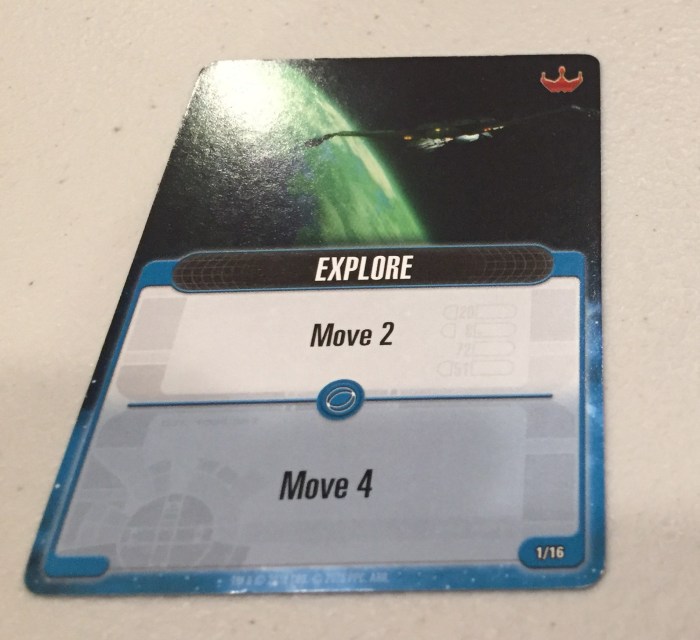
In the example above, if you spend a blue data token, you can get MOVE 4 instead of the base MOVE 2.

Thoughts on First Play

IMG_5263
Winning End game

In the end, I won!  I found the Borg Ship.  As you can see, there are a LOT of components.  And there are a LOT of rules.  I actually ended up playing this game over two days!  On Saturday, I set-up and ran through a few turns.   Honestly, I was pretty overwhelmed on the set-up and I just had to put the game down—it was too much for one full sitting!  I came back the next day and finished my game.  It probably took 6 hours from start to finish (including set-up).  It’s hard to separate the set-up and play time because of the “learn as you go” nature of the walkthrough.

There are a lot of rules.  I know I’ve said that a number of times, but you need to understand what you are getting yourself into if you play this game: Lots of rules, dense rulebook, lots of components.

At the end of the day (well, at the end of the second day), I had fun!  It was thematic, the game felt like a Star Trek game (even though I know it’s a Mage Knight reskin), and I really enjoyed all the decisions.

Star Trek vs Mage Knight

IMG_5270

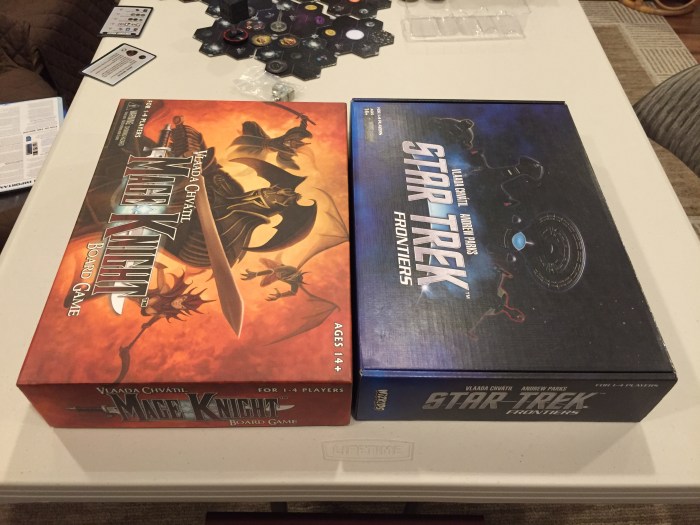
Weirdly, even though I like the Star Trek game better, I feel like the Mage Knight game has better components.  The Star Trek box is “weird”:

IMG_5268
Weird flap box?

It feels “cheap” with the fold-up corners, versus the “real box” of Mage Knight.  Also, the cards and components of the original game seem slightly better.

I have played Mage Knight, but it’s been a while.   My understanding is that the Diplomacy is new in Star Trek: Frontiers (and not in Mage Knight).  In my follow on review, I will explore this some more.

Conclusion

Of all the Star Treks, Deep Space 9 was my favorite.  It reminds me of a time when life was simpler. In Grad School,  me and some friends would get together with and watch Star Trek (both TNG and DS9).   Good times.

This game really has embraced the Star Trek theme!   Especially the Deep Space 9 Star Trek! And I think that theme permeates the game. Star Trek: Frontiers is a good game (well, duh, it’s basically Mage Knight).  I think I would actually prefer Star Trek: Frontiers to Mage Knight because of the theme.    But, this is just based on my first solo play of the base game.  I need to get this to the table with some friends.  Stay Tuned!  (Let’s see if I can get my friend to look at the rulebook beforehand …  “I have to read HOW many pages of rules before we play???”)


Top 10 Cooperative Board and Card Games of 2019

So 2019 is almost at end!  I played a lot of cooperative games this year: many of them I didn’t review because I didn’t like them after one play (which is not a fair review) or because they came in late in 2019 (so I didn’t get a chance to play them).    There were a LOT of good cooperative games this year!  If your favorite didn’t make this list it’s either because I didn’t play it, I didn’t like it, or I didn’t play it enough.

As usual, we address whether the game supports solo play (Saunders’s Law).  Anyways, here’s my favorites for the year!

Honorable Mentions

A. Yggdrasil Chronicles

Supports Solo Play?  Yes!  But the rules feel like they need a little tweaking.

This cooperative, legacy game is based on the original Yggdrasil from a few years ago.  The original Yggdrasil was bag-building/worker placement game which seemed to have a bit of a cult following, but most people seemed to think this was too hard.  The newer version added difficulty levels (probably in response to the perceived difficulty) as well as some legacy play.    It also added a movement mechanic and an amazing tree component (see above) which players move around and explore!  I just got it a few weeks ago, so I’ve only played this a few times, but I really like it!  I look forward to the legacy elements, but right now I can’t put it in my top ten because it needs more play.  But, so far, it looks beautiful and plays well!

B. Just One

Supports Solo Play?  No. This is a party game.

I originally got this game early in 2019 and thought it was a 2019 release.  Nope: it came out in 2018 (according to BoardGameGeek at least).  Having said that, this game was a staple at a lot of parties I went to later in the year!  It’s a great, simple cooperative party game!  One player tries to guess a word given only one word hints from other players (with the proviso that each word can only appear once)!   For me, 2019 was the year of Just One, but officially I think it has to be an Honorable Mention.

C. Sidekick Saga

Supports Solo Play?  Yes.  The solo player plays two characters.

There’s a couple of reasons this is honorable mention.  One: it’s technically being delivered as we speak so a lot of people won’t get this until 2020.  Second: I designed the game, so it probably shouldn’t even go on my list.  BUT, even after two years of living with it, I still love my game!  I love the Phil Cho art!  I love that there’s a notion of cooperative drafting (something I always wanted in Seven Wonders). I love the exploration, I love the story, I love the unique Superheroes.  The Secret ID/Hero flipping mechanism was unique (when I designed it: now Marvel:Champions has it as well), and I had never seen that before.

I wanted a Superhero story that told a story over a 6-Issue miniseries.  And that’s what Sidekick Saga is.


Okay! Onto the top 10!

10. Victoriana

IMG_4976
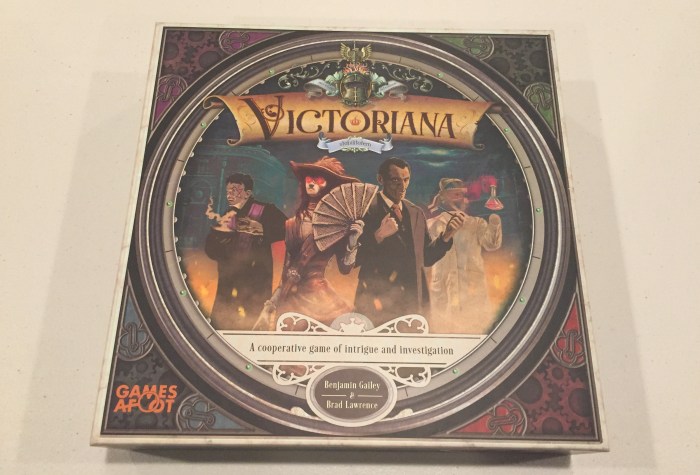
Victoriana: A cooperative game of Intrigue and Investigation

Supports Solo Play?  Yes!  The game clearly states “play two Characters” and it works well.

This Kickstarter game came at the end of 2019 after taking 2-3 years to deliver.    Players play characters from Victorian England trying to discover the plot to destroy/ravage England!    It’s kind of like Arkham Horror:2nd Edition (with the exploration, characters, feel, art) meets The Captain is Dead (with exploration and the card mechanics).   Those are two of my favorite games, so this game makes the list!

IMG_5014
Victoriana all set-up!

This is a real fun game: it would have made it a little bit higher but there’s a few things that hold it back. See my thoughts here.  In general, I think it’s a great game, especially if you like the Victorian mythos!

9. Marvel Champions

Supports solo play?  Yes!  Arguably, this game is played best solo.

Anyone who knows me knows I love Superheroes (see the Top 10 Cooperative Superhero Board and Card Games)!  So, this cooperative Living Card Game (LCG) based on the Lord of the Rings LCG was very tempting.  It’s real fun as each player takes the role of a superhero from the Marvel universe (one of Spiderman, She-Hulk, Iron Man, Captain Marvel, or Black Panther is included in the base game).  As a hero, the player(s) fight some Bad Guy: Rhino, Ultron and some others.  This is a pretty fun game!  It’s a Living Card Game (LCG) so there is lots of content probably planned for it (Fantasy Flight games, who makes this game, tends to milk these LCGs pretty hard). I have already pre-ordered the Captain America expansion!

It’s a fun game, but it’s not higher because the game feels just a little mechanical—you only have a small number of cards that are “hero specific”: The rest of the cards are generic cards (from a family of cards, but still).   The game feels like The DC Deck-Building game meets Sentinels of the Multiverse (SOTM).  The generic cards sometimes seem athematic (like in the DC Deck-Building game), but the “hero specific” cards are great and remind me of SOTM.   How does this compare to SOTM?  It seems 50-50: some of my friends like this more than SOTM, some like SOTM much more.   I personally like Marvel: Champions, but I don’t think it will supplant SOTM for me.

8. Sprawlopolis

Supports Solo Play?  Yes.

This is easily the smallest game on the list!  It is a cooperative city builder game, where players work together to get the most victory points (depending on their scoring conditions).  It’s a small (18-cards) game that fits in the little wallet above.

On the table, it looks big as you try to connect roads and build your city cooperatively.  Fun game: thank to Lon for showing this to me!

7. Crusoe Crew

IMG_4256(1)
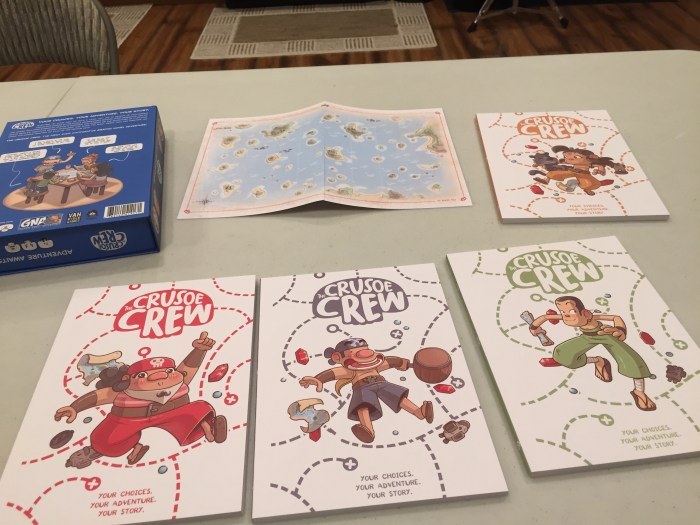
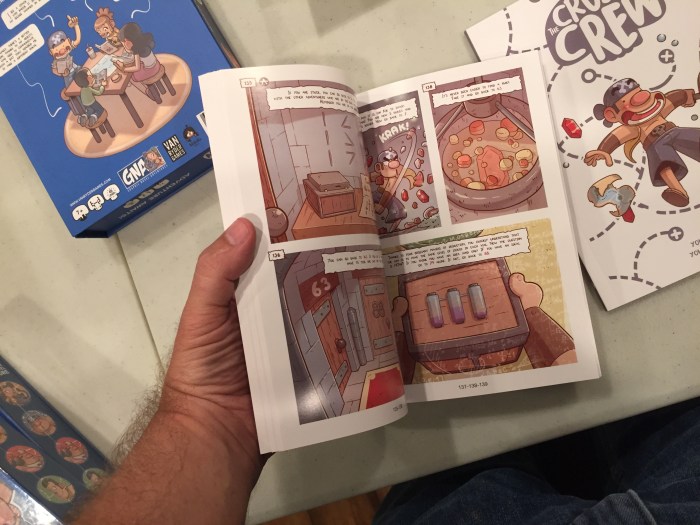
4 Books, a Map/Instructions and the box itself!

This was a Kickstarter where I got 3 copies for myself, my teacher friend, and my friend with a family of four!  The idea is so original and interesting: all players cooperatively follow along in a separate book for the same adventure, but each player sees something “slightly” different!

IMG_4259(1)

This game has really grown on me a little since the review (here and here).  My only real complaint is that the binding could be better.  But as a game, as an experience for 1-4 players, it’s unique and fun!

6. The Shipwreck Arcana

IMG_4429
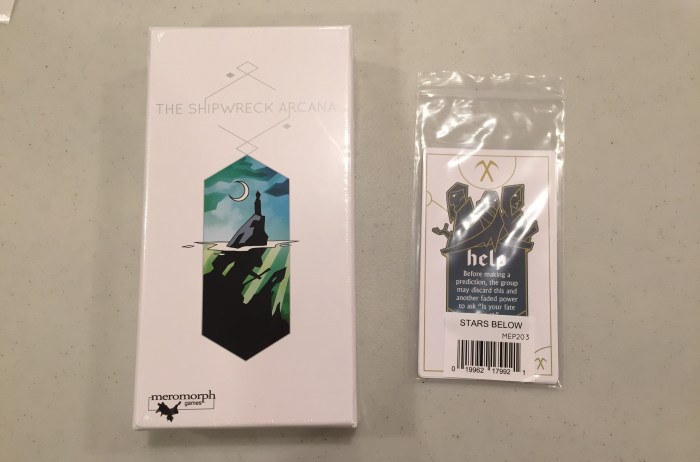
The Shipwreck Arcana and expansion

Supports solo play?  No! But see here for some rules for solo play rules.

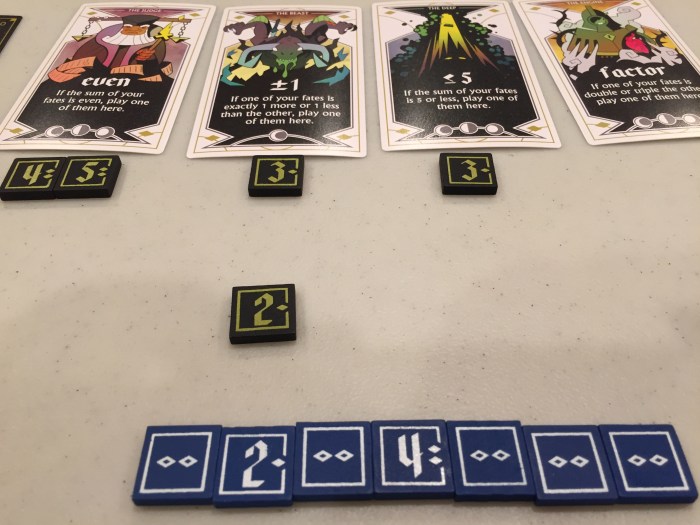
I usually don’t like cooperative games with some limited communication rules, but this one works!  This is a small, fairly straightforward deduction game where each player has a hidden number that the other players cooperatively are trying to guess.    One player gives a hint (by putting a number on one of the clue cards) and the other players can freely talk amongst each other trying to decipher what the clue means! (See below for clue examples)

IMG_4450

The Shipwreck Arcana is a little math-intensive, which some people may not like, but in general it was a hit with several of my game groups. It’s small, cheap, fun, and it’s a cooperative deduction game!

5. Set A Watch

img_4525.jpg

Set A Watch was a big surprise for me.  It was a Kickstarter and I backed it because it looked like a fun, simple game.  And it was!  (See review here). The surprise was how well it went over with all my game groups!  I have party game groups, mid-core gamer groups, and hard-core gamer groups!  All of the groups seemed to like this game!

IMG_4557

Players cooperatively roll and place dice on their character sheets.  One player stays back each turn to “watch the campfire” and the others go off to fight the creatures surrounding the campfire!  Sometimes it makes sense to use the die value directly to attack a monster, sometimes you assign dice to special abilities!  Each player has 3 special abilities, and you almost always feel like you are making useful, fun decisions.  On top of that, this is a very small box (really, the game just barely fits) that’s easy to lug around.  A real fun game that seems to span all game levels.

4. Escape Games

Escape-type games are still very popular!  Especially in my groups.   I group them all together here, although my favorite Escape Room game could have been a contender for the #1 spot on the whole list!

Supports Solo Play?  Yes, these all support solo play, but Escape Room games are generally much more fun with other people.

   iii. Unlock: Expedition Challenger (the dinosaur one)

I played this one at a party with 3 other players and it was real fun.  We all contributed (that can sometimes be an issue if too many people are playing), and the game was challenging and fun as we explored the jungle!

   ii. Deckscape: The Mystery of Eldorado

I really thought this would be my favorite escape room of the year after playing it!  The game had fun exploration puzzles, the help system with the guides was well done, and the game just flowed so well!  The theme of exploring the jungle really comes out.

   i. Deckscape: Behind the Curtain

Holy cow!  This almost made my favorite game of the year!  The puzzles were great, the theme really came through, and there were … toys (for lack of a better word) in this game that just really knocked the experience up!  There’s some things I’ve never seen before in an Escape Room game.  The magician theme really comes through for a fun fun escape room game!  This may be my favorite Escape room game of all time!

3. Thunderstone Quest (Barricades Mode: cooperative expansion)

Supports Solo Play?  Yes: The Barricades Mode expansion adds both cooperative and solo play.

IMG_4421

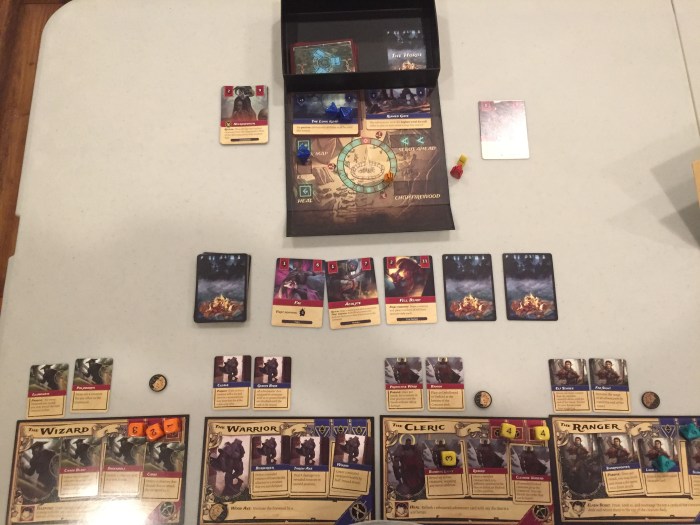
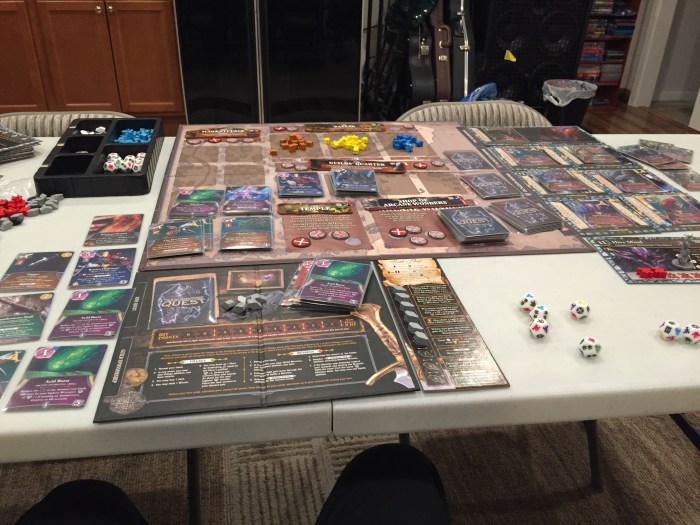
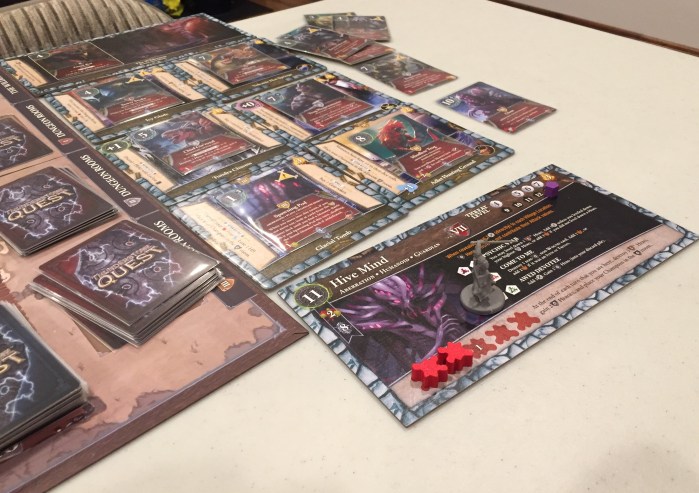
Thunderstone Quest is a dungeon-crawling, deck-building game.  The original game (upper left) was competitive.  The Barricades Mode (upper right) is an expansion that adds cooperative and solo play to the game. See my reviews here, here, and here!

IMG_4414

So, this game has amazing components! It ratchets up the deck-building experience with dungeon-dwelling, combat, barricades, abilities and some really great cooperative mechanics.  I would strongly recommend this game, but beware that it is pretty complicated.

2. Adventure Games: The Dungeon

Supports Solo Play?  Yes, but like the Escape Room games, it’s probably better to play with more people.

Longtime readers of this blog know that my favorite video game of all time is the Graphic Point-and-Click Adventure game known as Monkey Island.  In Point-and-Click Adventure games, players explore a world, combine some objects, and solve some puzzles.   The Adventure Games: The Dungeon was a board game version of the Point-and-Click adventure games!!  This was SUCH a surprise for me!  It looked fun, but it blew me away how fun this was when we played it.

It’s very much like the Escape Room games at number 4 on this list, but the game is much more about the story being told rather than the puzzles. The collaboration, the exploration, the story-telling is just great in this game.  There’s a lot of reading … the app supposedly will do all the storytelling for you, but it wasn’t ready when we played.  Thus, we had to read a LOT out text out of the storybook.  But! We had fun using our own accents when we read from the book, and that just uppped the fun.

There was another Adventure Games game that was very very good, but not quite as good as The Dungeon.    The Dungeon was almost my number 1.

1. Detective: City of Angels (cooperative mode built-in)

Supports Solo Play?  Yes, very well.

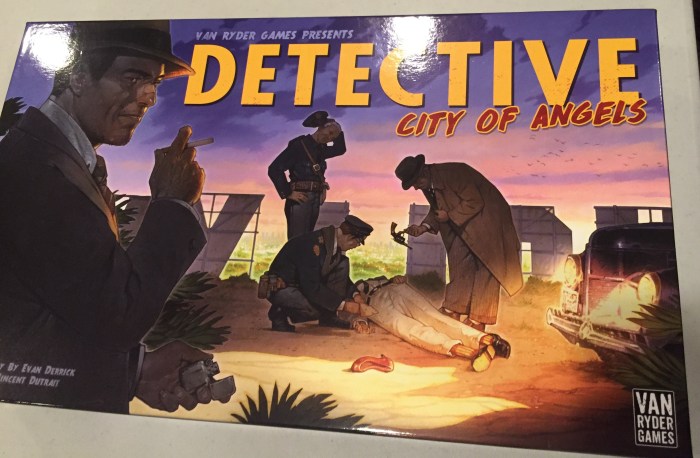
IMG_4689
Detective: City of Angels Box Lid

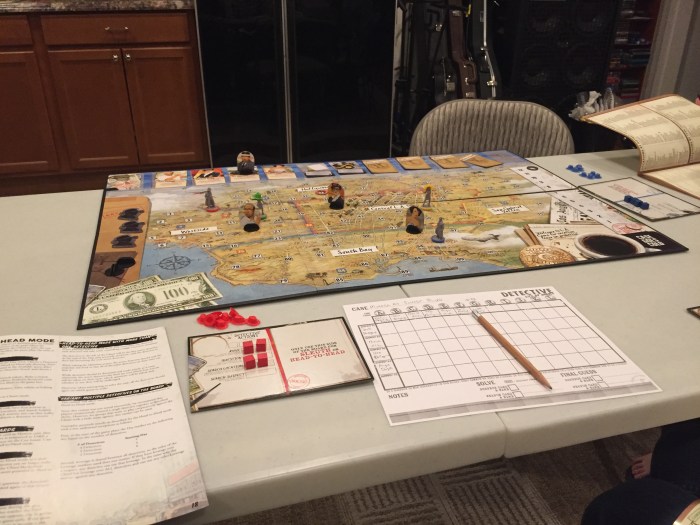
Detective: City of Angels is NOT a cooperative game by default! The cooperative mode is built-in and had great support,  but it is not the main way to play.  See here.  I don’t care!  The cooperative mode is everything I want in a deduction game!  A REAL mystery to solve!  (This limits the replayability: the game only comes with 9 cases)  Players work together, moving around the board, reading clues.  There is also a notion of “challenging” a witness because you think they are lying, which adds some fun tension to the game!!  You can “rough them up”, but if you do it too much, you lose time and credibility!

IMG_4735

The game amazing components, the art by Vincent Dutrait is fantastic, the game board is huge (and barely fits on my table above), the books are easy to read, the clue system and note-taking system are easy and intuitive.   This is what I wanted in Agents of SMERSH or Tales of the Arabian Nights: a story-telling game with a real story behind it!  I love mysteries, and this game really feels like I am working with friends to solve a mystery.   Just amazingly fun!!

Top 10 Cooperative Deckbuilding Games

The prototypical deckbuilder game, Dominion, started a revolution! It started a new type of game: the deckbuilder.  The deckbuilding mechanism, where you buy, cull, and build your deck has become a gaming staple.   In cooperative gaming circles, there used to be a dearth of games with this mechanism.  Now, there are a myriad of cooperative deckbuilding games!  Here’s our top 10 favorite cooperative deckbuilding games (or cooperative games where the deckbuilding mechanic is central to the game).

Notes

A surprising number of cooperative deckbuilders have a very similar theme: “Protect something that has XX hit points”.  As we go through our favorite games, we will point out when we have this theme.  We will also point out if the game have a viable solo mode (Saunders’ Law) and what makes the game unique and interesting.

10. Rebirth or DC Deckbuilding Game (with Crisis expansion)

  • Viable Solo Mode?  Yes, built-in: you control your main Superhero and an Ally.
  • Protect Something?  Yes.  Each Location in the city has 5 hit points, but each game has a very different winning/losing condition (as it is a campaign).
  • What makes it unique?  The DC art and the movement mechanism.
  • Expansions?  Tons for the original game (Teen Titans, Multiverse, etc) , and I they are all compatible with the new Rebirth game.

This entry is shared by Rebirth (a brand new implementation of the DC Deckbuilding game) with the original DC Deckbuilding game (with the the Crisis expansion).   The original DC game was a very simple deckbuilder that was very easy (some say too easy) to play.  The Crisis expansion (see below) added some rules to make the game cooperative, but it was a little clunky.  (You built some crisis decks and had to get through them).

The Rebirth reboot (what? Comic books rebooting?  That never happens!) kept the same simple mechanics of the DC Deckbuilding game and added some movement and some interesting choices about attacking and buying and moving.

Players work together and move around the city (see the circular city above) and you can only buy cards for your deck from your current location.  It added some new ideas and rejuvenated the DC Deckbuilding game.

9. Xenoshyft

  • Viable Solo Mode?  Yes, built-in.  This game probably works better with more players
  • Protect Something?  Yes, all players are protecting the home base (which has a number of hit points based on the number of players)
  • What makes it unique?  Each player has a battlefield where their marines fight the bugs (aliens), and the marines stay active on the battlefield even after the turn is over.
  • Expansions?  Yes, quite a few expansions that add extra cards, plus a full standalone game called Xenoshyft:Dreadmore (which adds a weather mechanic).

This game would probably be higher if it wasn’t so hard.  It’s a bit lucky, and you absolutely have to cull your deck hard to make any progress.  Even if you play just perfectly, there is a very good chance you will lose.

  I didn’t like this game at first, but then I realized I was playing wrong!  Each player has a battlefield (see above: the red area is where the bugs come in and the blue area is where the marines comes) and the main rule I missed was that marines STAY ON the battlefield, even after your turn is over.  So, there is some troops that stay between turns.   Probably the best part of the game is that you can play play cards to your compatriots area!!  Is your buddy getting overrun with bugs?   Help him out!  This game really encourage communication and fosters cooperation.

8. Legendary

  • Viable Solo Mode?  Yes, but surprisingly not built in.  You can try linearly scaling the set-up (for one player) or just play two characters.
  • Protect Something?  Depends on the Scheme.
  • What makes it unique?  Villains move across the city, and the Schemes really change up how the game plays out (and there are SOOO many expansions that add new schemes).
  • Expansions?  There are so many expansions, you almost can’t name them all.  There is a LOT of content for this game if you like it.

We must be careful here because STRICTLY SPEAKING, this is not a cooperative game: it’s a semi-coop (as all players can lose if they don’t work together a little) and whosoever has the most points at the end of the game, wins.  I know of no one who plays like this.  Every time I have played this game, we simply ignore the points.


This gaming system has a lot of versions to it: Aliens, Predator, Firefly, 007, X-files, to name a few.  If the Superhero theme doesn’t speak to you, probably one of those themes will.  For me, I do love the Superhero theme, which is why this is on my list.

I will say that this isn’t higher because the theme is a little lost in the deck building mechanism.  I want to BE a superhero, but in this game, I am really just “buying a team of superheroes” as a I build a deck of Superheroes.  Super fun, but not super thematic.

7. Venom Assault

  • Viable Solo Mode?  Yes, but unclear.  The rulebook says the game plays 1-5, but the set-up doesn’t describe a solo game anywhere (only 2-5).   Just play a single player “as-if” it’s a 2 player game. See here for more discussion of the solo game.
  • Protect Something?  No.
  • What makes it unique?  This game feels a lot like  Legendary (see above) with a GI Joe theme, but it adds some dice mechanics
  • Expansions?  There is one expansion called Villains and Valor which should be available in Q1 2020.

This game feels a lot like Legendary, but it seems to embrace the GI Joe theme pretty well and seems to integrate the theme into the game pretty well.

I picked this game up because I loved the art (by Phil Cho) but I was surprised how good the game actually was!  I feel this is an overlooked gem.  Luckily, an expansion is coming soon to give us more content.

6. Hero Realms: Ruin of Thandar

  • Viable Solo Mode?  Yes, built-in and very clear.
  • Protect Something? No (well, yourself)
  • What makes it unique?  This has the very simple deckbuilding mechanics of Hero Realms with a cooperative adventure on top!
  • Expansions?  There is one expansion called Village of Thandar coming out in Q1 2020.

This one surprised me!  I play the Star Realms app on my iPad all the time and really fell in love with the simplicity of the Star Realms deckbuilding.   Hero Realms is just Star Realms rethemed into a fantasy universe, but it also adds character specific abilities!

To be clear: this is an expansion for Hero Realms.  You need (a) the original Hero Realms box and (b) some character packs (there are 5 total: Cleric, Ranger, Wizard, Fighter, and Thief).  Once you have these, this expansion adds cooperative rules and a campaign!

This is fun, moves quickly (especially of you know Hero Realms or Star Realms already), and tells a nice story.  I was surprised how much this expansion captivated me.  The only real problems were (a) how small the text in the rulebook/adventure books are (b) the lack of replayability.  Once you have played through the scenario, you can replay it a different path (there is some branching in the game), but there’s not too much branching total.  I like it, I’ll play it all through again, and I look forward to the next expansion: the Village of Thandar.

5. The Big Book of Madness

  • Viable Solo Mode?  Yes, but not in the rulebook.  Just play 2 characters.
  • Protect Something?  No, just survive to the end of the book!
  • What makes it unique?  Lots of little touches: a book that you must close, previews of the badness coming, a particularly great rule for allowing someone else to go
  • Expansions?  There is one expansion coming out in 2020 called The Vth Element.

This game surprised me on how popular it was in my gaming circles.  Many of my friends have bought the game after playing my copy!  The game, in the wake of so many games, still comes out fairly regularly with my friends.  I think the Harry Potter theme (I know, not REALLY Harry Potter, but, c’mon) and the little touches really sell the game.

It’s been quite some time, but this is getting an expansion (The Vth Element) in 2020.

4. The Red Dragon Inn: Battle for Grayport

  • Viable Solo Mode?  No.  You can play two characters, but it’s kind of kludgy.
  • Protect Something?  Yes!  Some Location in town has Hit Points, and you have to protect that Location in the City!
  • What makes it unique?  The idea that only one character in your hand can act, but it can also be “your main character” is interesting.
  • Expansions?  There is one expansion called Pirates that’s already out

This game might seem like “it’s like everything else” now, but it was the first game I knew of where you had to protect the city (well, sorta … see later)!  I love the art, there is a ton of content and scenarios, and it has some really original ideas: For example: you can only play items (cards in your deck) on a character, but you can ALWAYS use your character (as well as other characters in your deck)!

This is one that has fallen under the radar, but I love this game!  I just wish it had a better solo mode.

3. Thunderstone Quest (with Barricades Expansion)

img_4421.jpg

  • Viable Solo Mode? Yes. Built-in with Barricades Expansion
  • Protect Something?  Yes!   Each Location in the town has essentially 4 hit points. But it can be protected by a barricade! If all city Locations are destroyed, you lose!
  • What makes it unique? The mix of dungeon mode and town mode
  • Expansions?  There are lots of expansions for Thunderstone Quest! What Lies Beneath, Ripples in Time, At The Foundations of the World, Vengeful Sands, Clockwork Destiny

To be clear, the base game is Thunderstone Quest AND YOU NEED THE Barricades Expansion to make it cooperative (and solo).  This is a big game with lots of rules (especially for the cooperative mode).  Take a look at my review here, here, and here.

IMG_4401

This is definitely a deckbuilder, it’s definitely complicated, it’s definitely beautiful (and has amazing production values), but it’s definitely fun.   Players go back and forth to the town (to refresh) and the dungeon (to level-up and fight monsters).   At the end of the day, this is a race against time: every turn, monsters are swarming the city and ruining parts of it.  At some point they will overwhelm the town unless you take out the Big Bad at the bottom of the dungeon.

IMG_4413
My first solo game: I’m just about to lose!

Even though it’s main mechanism is deck-building, there’s a lot to it: the game feels very thematic.

2. Shadow Rift

  • Viable Solo Mode? Sort of?  The game contains one Shadow Rift per player, so it scales.  (But the cover says it only works 2-6: I’ve played solo and it seems ok).
  • Protect Something?  Sort of?  You are protecting a city, but you are trying to prevent bad cards from coming into the city (as opposed to hit points of most deckbuilder games).
  • What makes it unique? The town is handled differently than other “protect the town” deckbuilder.
  • Expansions?  There are expansions, but it depends on whether you have the First Edition (cover above) or the Second Edition.   The Second Edition has more content.

This game has had surprising legs in my game groups.  It still comes out pretty frequently, even though it is probably the oldest game on this list.  It is the first cooperative deckbuilder that I know of!    It’s kind of a unique game:  it doesn’t really feel like any of the other deckbuilders on this list.

1. Aeon’s End (any of them)

  • Viable Solo Mode? Yes.  Built-in and works great.
  • Protect Something?  Yes.  You are protecting Gravehold from destruction (it has hit points).
  • What makes it unique? Cards ARE NOT SHUFFLED!  You have control over the order they come out in your deck!
  • Expansions?  There is a lot of content and expansions for this game.  There are straight-up expansions,
    Aeon’s End: The Depths [2nd Edition]
    Aeon’s End: The Nameless [2nd Edition]
    Aeon’s End: The Void [2nd Edition]
    Aeon’s End: The Outer Dark [2nd Edition]and
    and 4 standalone games.

One of my LEAST favorite elements of Dominion was the shuffling. Oy!  You’d watch and wait as the people next to you shuffled to get through the deck, then you’d have to shuffle your deck. …. Wouldn’t it be great if a game didn’t make you shuffle?  And that’s where Aeon’s End shines:  you do not shuffle your deck!

Depending on the mood you are in, there are really 4 different flavors of Aeon’s End.   They are all just variants on the base idea:  This is a cooperative deckbuilder where each player takes the role of a Mage who can cast spells out of breaches.   All players work together to take out the Bad Guy. There is no shuffling of cards, so you can exert control on the order that cards.

Aeon’s End: the original

IMG_3656

This is the original game and the simplest.  It’s a standalone game with a few scenarios and Bad Guys, but each game is standalone and doesn’t relate to previous games.

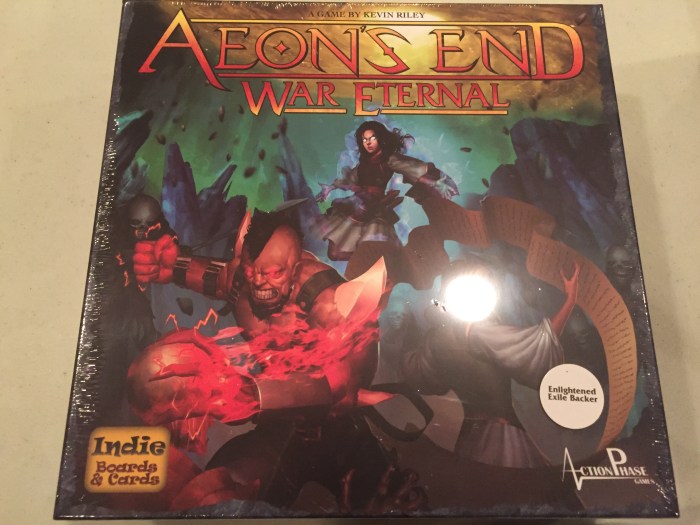
Aeon’s End: War Eternal

IMG_3657

This is standalone expansion (i.e., you can play the game with just this box). It really just adds more content, but it has a different feel with different characters.

Aeon’s End: Legacy

This is a legacy game where you add stickers, add new rules, and uncover a story.  If you and a group of friends are in the mood for an ongoing adventure where things really change, give this a try!   The game can be replayed, but only if you buy the recharge pack.

Aeon’s End: The New Age

This is a campaign game: new content is revealed as you play, but unlike the legacy game, you don’t add stickers or change the game.  You can always reset.  It includes a story, but it can always be reset.


At the end of the day, Aeon’s End is just a great deck-builder that has so much content and replayability you can play as much as you want!   There’s also a lot of new ideas that I haven’t seen elsewhere (even though it’s still a deckbuilder):

  1. Each player has a special ability that can be “charged”
  2. The decks don’t get shuffled
  3. Each mage has a bunch “breaches” where spells get cast from
  4. Players can go out of order if you have the spells

The game flows smooothly at the beginning as people are moving quickly, but at the end of the game, play slows down as players work together to make agonizing decisions.  The game really brings out the cooperation.  It’s a great time with lots (maybe too much) content!


Review of Victoriana—Part I: The Unboxing and First Impressions

IMG_4976
Victoriana: A cooperative game of Intrigue and Investigation

More than 3 years ago (in Oct. 2016), I Kickstarted Victoriana: A Cooperative Game of Intrigue and Investigation.   It was originally slated to deliver in August 2017.  It is now November 2019 and it just delivered to all the backers.  It took three years to deliver and was over two years late.  Was it worth the wait?

Unboxing

IMG_4971
Kickstarter stretch goals (and comes fro QML)

Upon opening the box, you see some extra content I paid for and some stretch goals.  The Ripper deck was part of the upper echelon tier, as the Time Traveller deck. Plus, I think Dr. Jeckyl and Mr. Hyde was a Kickstarter stretch goal?

img_4974.jpg

Rulebook

IMG_4977
First thing!

The first thing you see upon opening is the rulebook.  I spent a lot of time with my nose in this rulebook over the course of unboxing, unpunching, and first play.  It’s a good rulebook: it describes everything well, it has lots of visuals and explanations for rules, it has a good components page, a good set-up (well, ok set-up page) and in general was quite readable and intuitive.

IMG_4978
Components list: very pleased to see this on the first pages

The components page was great, describing the components.  And it was necessary: there are a LOT of components!

IMG_4979
The Set -UP

The Set-Up page was pretty good.  In the first few steps, there was some major confusion with one of the decks.  I’m still not convinced I got it right.  Crazily, everything after that was fine, but that very first deck as very confusing and sort of put me off a little bit.

IMG_4980
Sample few pages from rulebook

Like I said, the rulebook does a good job of explaining and showing pictures  of various parts of the game.  For example, the “Investigating Leads” section (see above) has a little sidebar explaining that rule with an example.

My only other (very minor) nitpick was that I didn’t know how to win the game until I got pretty deep into the rulebook.  How do I win?  What I am I supposed to do?  I feel like this should be explained RIGHT UP FRONT to help motivate/guide you through the rulebook.

In general, though, the rulebook was good.

Punchouts

IMG_4986

There are a LOT of cardboard pieces.  They all punched out pretty easily.  I wish the graphic design were slightly better.  Some of the tokens felt very generic, and some very easily evoked the Victorian theme of the game.  To be fair, the components were very clear and readable.

IMG_4989
Lots of components

Board

IMG_4983
Main Board

This is probably  (besides the rulebook) my favorite component in the game.  The board screams Victorian flavor: the color choices, the pictures, the Big Ben on the side.  This board really helped immerse me into the game.

My only complaint: I wish it were bigger.  Partly because it’s so cool looking, and partly because the board got cluttered as the game progressed.  The status tokens take up a lot of room, as do leads and other tokens.   At one point, I thought the game had a typo/misprint: “Where’s GREEN 10?? The board is messed up?  Is this a misprint??” After furtively looking for almost 3 minutes,  it turned out the green 10 was hidden under a lead token.  My fault  of course, but the board could be bigger.

Character Tokens

IMG_4996

The game has character tokens with Standees.  They work fine.  They are visually distinct enough to see the different ones.  Some people might complain that there aren’t minis.  Nah, I don’t care about that.

IMG_4989
Lots of components

What I DO care about is that there aren’t extra standees.  There’s just enough for the characters and then some Agents.  Every time you play the game anew, you have to (potentially) take the plastic standee bases off and put them on other cardboard standees.  My experience with Gloomhaven has me occasionally TEARING/BENDING the cardboard as I moved the plastic bases around.  This hasn’t happened YET to me (I’ve only played once), but I am quite worried the cardboard standees won’t do well in the future.  Caveat Emptor and be careful with your cardboard characters/standees.

The good news is that there is a lot of variety for characters (12 with extra).

IMG_4991

Cards

IMG_4990

There are a lot of cardboard punchouts and a lot of cards.   The cards, in general, look good and are very functional and readable.  The Henchmen, Masterminds, and Advantage cards are very evocative of the theme and easy to read.


The Plot cards are pretty awesome: I love how they look like headlines!  Also very evocative of the theme!

img_5007.jpg

The Lead cards are very easy to read/understand, if not super evocative of the theme.  But, the text is very evocative of the theme, and the cards are easy to read.

IMG_4995
Lead cards tell you what you need to do for either evidence or investigation!

Dice

IMG_5006
Dice!

The Dice are used to put things on the board (agents, leads, etc).  The Clock die is for “what time” a Lead comes into play.  The dice are nice and easy to read.  The only weird thing is that the occult sign, which is purple EVERYWHERE ELSE IN THE GAME, looks black on the colored die.  It’s not a big deal, but inconsistent.

First Play/Solo Play

IMG_5013
The first play! A solo game ( with two players )

Above is a set-up of a solo game.  Luckily, the rulebook has a solo mode (adhering to Saunders’ Law): the solo player plays two characters in the game.  I am normally worried that having two characters will be too much for a first play, but it seemed to go fine for me.      I had the rulebook open a lot.

The game has an interesting way to achieve balance: only two players play per round, then the “bad News Advances”.  I don’t think I’ve seen this way to balance a co-op before.

How To Win and Lose

IMG_5025
A Winning Game!

To win, you have to foil the conspiracy!   To do this, you need these things revealed:

  1. Find the point of conspiracy (one of 30 Locations on the board).  Basically, you explore the board and everytime you end on a Location, you can flip it to see if it is the conspiracy point  (place where the conspiracy happens )
  2. Find the evil plot (race through a deck of plots to find the one in use).  This involves culling a plot deck to get to the bottom.
  3. Reveal the Mastermind after defeating his Henchmen

Once you have all those revealed, you must discard the proper resources:

IMG_5020
Mastermind and Plot to be defeated by discarding resources!

These must be discarded at the point of conspiracy:

IMG_5021
The Carlton Club was the place of Conspiracy!

Once you do that, you win!

But of course, there are many ways to lose:

  1. All characters reduced to 0  Life
  2. Time runs out (21 rounds have passed)

Gameplay

IMG_5008
Player summary cards! Ya! Two for each player!

Gameplay is pretty straight forward: you explore London looking for (a) Leads or (b) Special Locations.  The Special Locations, in general, get you resources (occult, Science, Politics or Underground) which you need to follow leads.   If you try to follow a lead, and you don’t have the appropriate resources, the Lead goes cold.

After two players move/explore/follow leads, the timer counts down (the timer is Big Ben of course).    Then the next two players play.  The game continues until players win or lose!

Leads

IMG_5026

IMG_5015

Leads are placed on the board and slowly expire by rotating 90 degrees at the end of the turn.  If a lead rotates all the way around, the lead goes cold (you waited too long to follow it) and then players suffer a penalty (1 hit point).

If you DO get to a Location with a Lead before it goes cold, you have to spend some resources (see picture above for sample Lead cards).

Overall

IMG_5028

Overall, I like this game.  The art is thematic and evocative.  All the cards, and tokens and easy to read (although I do wish the board were bigger).  I enjoyed exploring London and following Leads and trying to foil the conspiracy.  It worked as a solo game and I want to play it again.

There were a lot of rules I didn’t cover: this is NOT an easy game.  I am sure I got some rules wrong in playing, but the rulebook was not problematic.  You probably want to play a solo game first before you try to teach others.

My main complaint is just a lot of little inconsistencies.  For a game that took 3 years to get to me, I expected slightly more polish.  The resource tokens seem like they should be more Victorian, the Occult symbol on the die should be purple, the game doesn’t fit together very well after you unbox it (see below), the board should be bigger, and a few things like that seemed out of place in this good game.

This is a good game.  Currently, I am going to give it a 7/10.  We’ll see how it works with my game group.

Appendix: Game Doesn’t Rebox Well?

IMG_5031
I had to work hard to make everything fit!

IMG_5034

IMG_5036
The Ripper expansion won’t fit at all


A Review of Direwild (A Cooperative Deckbuilder)

IMG_4753
Box Art!

Direwild was a Kickstarter from November, 2017.  It’s a cooperative deckbuilding game for 1-4 players.  I didn’t pick up the Kickstarter, but rather my FLGS .. and I still got the Kickstarter version (with miniatures).  I’ll be honest, I loved the art on the cover and what I saw!!  Between that, Kickstarter minis, AND it’s cooperative?  I picked it up!

Components

The components are pretty great.  The Kickstarter minis are real nice and add a lot of flavor.

The boards and character sheets are very colorful and full of the same art that drew me in.  Oh look!  Character sheets with variable player powers!  One of my favorite mechanisms!

The board sets the stage for how good this looks on the table.  I just love the art and the way things are organized.

The little boxes comes with separate components/cards FOR EACH CHARACTER!  Each character has it’s own unique stuff!  So very cool!

The components, for me, are just really amazing.

The Rulebooks

The rulebook is kind of divided into two books: Intro and Set-up, then Gameplay.

IMG_4757
Book 1: Intro and Set-up
IMG_4756
Book 2: Gameplay

For the most part this worked, as the set-up and intro aren’t something you need a lot.  I found that we referenced the Intro book a lot more than we expected (to look up certain effects and Icons like poison and pushback, see below).   It feels like those effects should have been described in the Gameplay book, but it’s a minor point (see below).

IMG_4770(1)
Discussions of effects and Icons like Poison and Pushback are in the Intro, when they probably should have been in the Gameplay book.

Set-Up

The rulebook has a VERY good section on setting up, with a list of all components …

IMG_4769
List of all Components!  And pictures!

And pictures on how to set-up!

IMG_4771(1)
Picture of how to set-up!

It was very easy to get the game set-up.  I was very pleased with how well the set-up book looked.  This was one of the better rulebooks for that I’ve seen in a while.

So, I got a game set-up pretty quickly!

IMG_4776(1)
Direwild all set-up and ready to play!


Solo Play

IMG_4768
Grrr … no solo play …

So does this game adhere to Saunders’ Law: A cooperative game should have a viable solo mode?  Nope!  The box CLEARLY says  only 2-4 players.  Well, sometimes a game will say it doesn’t have a solo mode, but has an “ad-hoc” variant listed in the rules.  Nope!  Not Direwild!

A standard trick is to simply have the solo player play two positions.  This game could have easily said that, but I didn’t see that anywhere.  So, STRICTLY SPEAKING, this game doesn’t have solo rules!  (And this game has a lot of rules—I can see why it would very intimidating to use 2 characters in your first solo game).

Many of you who read my blog know that I tend to come up with solo rules for cooperative games that don’t have any.  So I do below.    And why do I do this?  So I can play the game, get a sense of the mechanics so I can teach my friends!  AND if the game is great, I can play it by myself as well!

I don’t get why this game doesn’t have solo rules.  Either use my solo rules below or have a solo player take control of two characters!

A Preliminary Set of Solo Rules

IMG_4776(1)
Direwild all set-up and ready to play!

The picture above depicts a solo game set-up.  I have some simple tweaks to make the game solo: I am not 100% happy with them, but they are good enough to get you into the game so you can learn most of the rules.

Honestly, these tweaks are mostly just linear extrapolations of the rules that are already there.
In a solo game:

First, during set-up: anything that says set-up XXX per player , just follow those rules!  For example, the locks are two per player (so use 2) and the Karn regenerates Cards are one per player (so just use 1).

  1. (Step 4 of set-up) Populate the wilds with 7 cards.  This causes one card to be off the board.

    IMG_4937
    Linearly extrapolate: 1 Player has 7 Wilds slots!
  2. There is only 1 Minion per board (as there is one Minion per player).  When you set up for Step 11, You’ll use a 1 Level 1 Minion, 1 Level 2 Minion, and 1 Level 3 Minion.

    IMG_4936
    A 1 Player game only has 3 Minion cards! A level 1 Minion, A level 2 Minion and a Level 3 Minion! That’s it!
  3. I would also give the solo player 3-5 treasures to start the game.

And that’s pretty much the extent of the changes, and those are only to set-up! You play normally from there.

The reason these rules are “preliminary” is because I feel they need more testing, but they do get you into a solo game quickly, only operating 1 character.  Honestly, I died pretty quickly in the second round of the campaign, which is probably why you need two characters (who can watch each others back).  BUT this can get you far enough to learn the game.

Deckbuilding

IMG_4772(1)
basic intro cards

So, this is a deck-builder game.  Every character starts with some very simply cards (puppies and kittens) and has to use “charm” (the yellow hexagon) to buy more cards.  It’s a deckbuilder!  You buy cards from a tableau (called the Wilds).

IMG_4773(1)
Basic cards PLUS character specific starting cards

Each character starts with two special “character specific” cards that only they have.

Kittens have charm and can help buy more cards.  Puppies have attack which you can use to fight the Minions.  You buy better and better cards with more attack and more charm.  It’s a deck-builder!

Attack

IMG_4777(1)
Lead animal

When you are ready to Attack a Minion (you have to kill Minions on the board to advance to the next level), you choose a lead animal and then FLIP all your other animals to be support!  The BAT (above) becomes the lead card and ALL OTHER animals help support for more attack, move, or other effects.  Plus, now you can say you have a “Feisty, Furry, Wild, Scythed Bat!”  (The BAT above gets his normal 3 Attack, and another 3 from his supporting animals, plus an extra move).

This mechanic was really innovative and fun.  We enjoyed this idea quite a bit in the beginning.

High-Level Overview

IMG_4778(1)
Mid game

You move around the board, hiding behind walls, trying to avoid or engage the minion, and look for treasure.  Every turn, you can get better cards for a better deck, but Karn (the big bad) gets closer and closer to coming out … you can advance to the next scenario (there are 3) if you kill all the Minions.  If kill Karn at any point, you just win!

So, along with the deck-building, there is some movement and attempts at strategy on the board.

Solo Play Experience

IMG_4784
A losing 1-player game

So, I played the game solo a few times and was happy to get around.  I liked that you could save the game between sessions.  But I got stuck in Scenario 2: I couldn’t damage the Minion (because of his special ability) and I couldn’t get around it.  So I just died.  It was very frustrating to not be able to do anything.  I  chalked it up to “I was using my solo rules, so they obviously weren’t balanced”.

I had an okay time playing solo, but I was frustrated.

IMG_4783
I couldn’t get Lohri to have negative Stamina, so I just lost!

Multiplayer Game

IMG_4779

Oof.  This is hard to talk about.  At first, my friends LOVED the game!  Puppies and Kittens!  The art and graphic design were amazing!  But we played some games, and the word of the day was “frustrating“.   Teresa was frustrated because she felt she could never fight (she couldn’t seem to get a good deck doing).  Sara was frustrated because she could never disengage after getting ganged-up on by the Minions.  Andrew was frustrated because he never felt he had a choice.  We were all frustrated because we never really could cull our decks.  (We finally, after 4 games, found the Monkey, but is that the ONLY way to cull your deck????)

Teresa was having fun reading the little quotes on the cards and loving the art, but she stopped having fun when Sara just so frustrated it was papable.  Part of her frustation was her power was very random and it never worked for her.  (In fact, the only one who seemed to have a good power was the “Tank”).   The powers, which are supposed to differentiate the players, seemed unbalanced and not fun.

The game was frustrating.  My play group DID NOT have fun.  In fact, two of the players gave the game a 3/10 (and it only gets a 3 because the art is so good).

Balance and House Rules

IMG_4784

The game simply feels a little too lucky and a little unbalanced.  The main frustration was that people felt like they couldn’t do anything.  So, here’s some house  rules we came up that MIGHT help the game!

  1. Players should win ties.  Monsters win ties, and we got screwed over and over again because of that.
  2. Allow a single card cull per turn.  A player uses charm to “unbuy” a card for it’s charm amount (+1).   This would allow this to feel much more like a deck-builder.  Maybe Wounds would 3 or 4 Charm to “unbuy”?
  3. Use the 1-4 tokens for targetting, but just let the characters go and buy/attack in any order they want!    We felt this would increase the feel of cooperation as all characters would be looking at the Wilds at the same time and making decisions TOGETHER as to what to buy!  The “choose 1-4” order just seemed to serialize it too much (“Oh, it’s my turn.”)
  4. A few clarifications.  Monsters can only attack 1 person?  As we read the rules, it feels like the monsters can attack everyone that attacks it in the same round!  This seemed unbalancing and also not realistic.    We were thinking, maybe, it can only attack the first person?  Unless it has a special ability?  It seemed very unbalancing.
  5. Easier to disengage? You had to take a fatal wound to disengage.  This seemed too hard?
  6. Rebalance the Powers: Sara hated the random power she had. (Pick a type of card: if you draw it, you get +1! If not, take a wound!)

House Rules 4-6 would probably need a lot of playtest to validate/invalidate them, but Rules 1-3 seem important and doable.  The lack of culling (except for the Monkey?) seemed especially out of place in the game.

Conclusion

img_4755.jpg

The quote of the night:

The only thing fun about this game is complaining how unfun it was!

My playgroup DID NOT like this game at all.  I thought it was “ok” for solo, but it still feels unbalanced.  We all loved the components and artwork!! BUT the game feels very unbalanced and too lucky,  We think that MAYBE, MAYBE, with house rules (described previously), this might be a significantly better game. As it is, none of my game group really ever wants to play this again.  I wouldn’t mind playing it solo.

The components are amazing. I wish the game were better.  There’s a great game hiding in here!  There are some unique mechanics and ideas, but the balance seems off.


A Defense of Keeping Punchout Skeletons

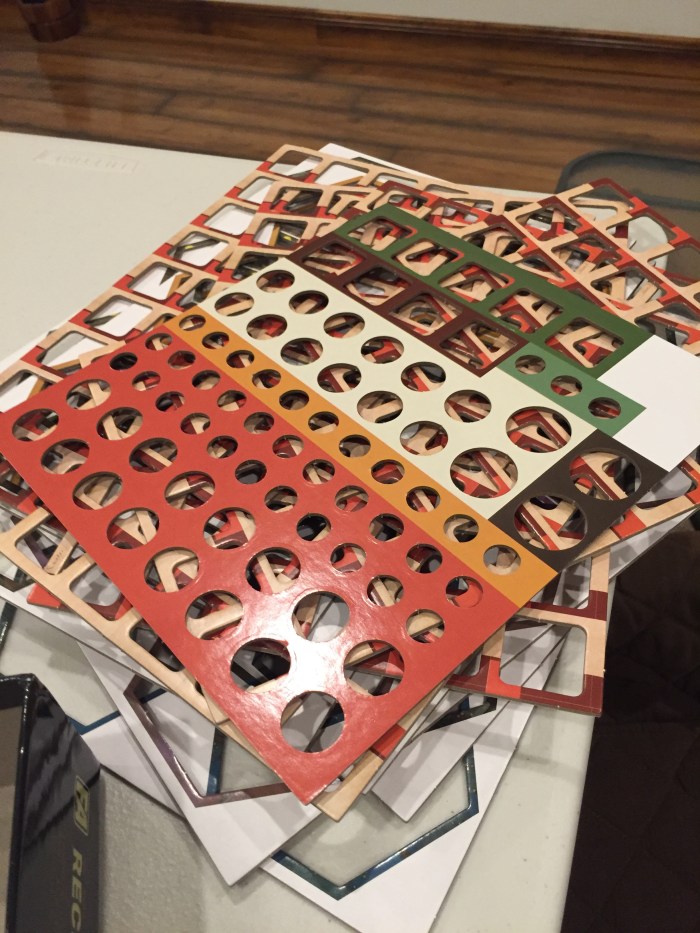
20103507118
Punchout Skeletons from the game Sidekick Saga

What do you do with the punchout skeletons from your board games?  A punchout skeleton is the leftover cardboard outline (see above) not used in the game.

“I throw them away.  Why are we still talking about this?”

Most people throw them away.  I don’t.

You Keep The Punchout Skeletons?

This particular post is motivated by a few things.   The first motive is a story by my friend’s father.

IMG_4850
Punchout skeletons for Nemo Rising

According to my friends Alison and Charlie: every time their Dad opens a new game, he punches it out.  He then looks at the punchout skeletons, laughs to himself and says “Oh Richie”. Then he just throws the punchout skeletons away!!!

I am Richie:  Yes, to be clear, Alison and Charlie’s Dad is laughing at me.  Because I keep the Skeleton Punchouts.

So I offer a four pronged defense of why I keep the skeletons.

Reason 1: You might need something you didn’t punch out!

New tray (2)
Plastic Insert for Sidekick Saga

This reason was motivated by a conversation I recently had with my manufacturer.  My manufacturer was trying to fit all the pieces of Sidekick Saga into a plastic insert/tray.   (see above) They asked:

“Do you need the blank tokens to fit in the tray as well?”

20103507118

YES!  Absolutely!  Sidekick Saga has a “Build-Your-Own-SuperHero” mechanic where you need some SOI tokens (blank square tokens on right) and Character Standees (bottom-most blank tokens).  Players can draw, print, glue or whatever works on these blank tokens.

THE MANUFACTURER THOUGHT SIDEKICK SAGA DID NOT NEED THE BLANK TOKENS!!  YOU ABSOLUTELY DO!

I have been chatting with the manufacturer for months, and they know the game really well.   But it didn’t register until they asked about them.

If you threw away the skeletons, you might have also thrown away the blank tokens …

Keeping the skeletons keeps you in the mindset of keeping all components (and not accidentally throwing anything away).

Reason 2: Double-Check for Components

IMG_4833
Nemo Rising: A newish cooperative game

I was recently unboxing and setting up a relatively new cooperative game called Nemo Rising. (This is a cooperative games blog after all).  During set-up, a question came up about the components.

IMG_4836
Components List from Nemo

I felt like I was missing something!! (This Rulebook could have used a picture of components …)

IMG_4850
Punchout skeletons for Nemo Rising

So, I went back and double-checked what I punched-out versus what was in the Components List.  It turns out a few  tokens were “hidden” somewhere on the table, but matching the punchouts skeletons to the components allowed me to “double-check” the component list with the actual components.

A side-effect of the “Double-Check” rationale is you can ALWAYS see if you have all the components of your game!!  Have you lost any components?  Did you buy a used game and want to verify the components?  If the punchout skeletons are included with the game, you can double-check the components!

Reason 3: Keep Rulebooks Flat

IMG_4804
Box for Battle for Greyport

I reviewed Battle for Greyport some time ago.   It’s a smallish box with a lot of components.  But the Rulebook lays awkwardly in the box.

img_4805.jpg
Rulebook hangs weirdly in the box!

If you look closely, you’ll see the rulebook is “kinda” supported by a few deck dividers.  And there’s a lot of empty space on the bottom left of the box, so the rulebook “droops” in that part of the box.  If only there was a way to keep the Rulebook flat!!!!!

img_4806.jpg
Punchout skeletons to the rescue!

The punchout skeletons can support the Rulebook (like a rulebook bra?) so that the Rulebook stays flat (in the box) and doesn’t bend weirdly.

This, to me, is the best reason to keep punchout skeletons: I like to keep my games in good shape, and keeping the Rulebook flat keeps it in good shape!!  (One of my pet peeves are Rulebooks that don’t lay flat!!   It’s hard to learn a game if you can’t put the Rulebook down FLAT on the table!! )

IMG_4807

A related benefit (if you have multiple punchout skeletons)  is that you can separate content.  For example, the Kickstarter version of Battle for Greyport came with content for The Red Dragon Inn (see above).    I can keep that content sandwiched between the skeletons to keep it separate from the main game.

Reason 4: Completionist

IMG_4691
Punchout Board for Detective: City of Angels

At the end of the day, I like to have everything that came with the board game.  I am a completionist.

If I need to ever sell a game, I can honestly say I am giving a buyer everything that came with the game!  I can show a buyer that I have all the pieces (because I can double-check components).  I can show a buyer that I care enough about my games to keep everything in good shape!  This gives a buyer confidence that my games are in good shape.

In Detective: City of Angels, it makes sense to keep the punchout skeleton because the game actually encourages you to put the people tokens BACK IN THE PUNCHOUT!! It shows  that you have a complete set of people!!!  Detective: City of Angels is a game that I could easily see selling because it has a limited number of cases: you can only play it so many times.   Keeping the punchout skeletons keeps the game together and complete so I could sell it more easily.

Reason 5: Pack the Game for Transport!

EDIT: This section is new as of April 4th, 2020.  In my organizing Sidekick Saga (from Reason 1), I noticed that keeping the Punchout Skeletons help keep the game together when it gets moved around.  The game was made to “fit” in the box when everything is new, so the game is pretty packed when you first open it: the game is “made” to be packed tightly.  If you get rid of the Punchout Skeletons, then the cards tend to be more free form: if you turn the box at weird angles (shipping, putting in your car, taking the game out of a box, etc), the cards can tend to “flow around” and leave their spaces.

When packling back up, this is how I store the standees: I don't want to keep taking the plastic bases off, so this is way to store them so that the bases stay on (on two empties too!)
Note the air … if we don’t pack the box, the cards will tend to wander!

Not so if you include all the Punchout Skeletons!!   With the Punchout Skeletons, everything fits “snug” in the box, and the cards won’t wander!  The Punchout Skeletons HOLD THE CARDS DOWN!

Packed tight!  Components won’t wander …. The Punchout Skeleton HOLD THE CARDS DOWN!

Of course, this depends on the game itself and how it uses space, but it’s been my experience that if you keep the Punchout Skeletons, you can keep it “packed tight” and avoid wandering cards.

Conclusion

IMG_4808
Using punchout skeletons to separate content

At the end of the day, I realize it does seem a little crazy to keep the punchboard skeletons.   I think Alison and Charlie’s Dad thinks I am especially crazy.  I hope I have convinced you that there are good reasons to keep your punchout skeletons. No?

Well, If you don’t want your punchout skeletons, can I have them?


Review of Detective: City of Angels (Cooperative Mode)

IMG_4689
Detective: City of Angels Box Lid

To be clear: this is a review of Detective: City of Angels by Van Ryder Games (see picture above) and NOT Detective by Portal Games.

I was one of the Kickstarter backers for Detective: City of Angels.  And this games was very late: so late that it made Zee Garcia’s “Most Anticipated Games” twice: once in 2018 and once in 2019.  It was supposed to deliver in Sept. 2018, and it delivered in August 2019.

IMG_4699

This game sat on my shelf for almost a month after I got it.  Every time I went to play it, I noticed “Oh, it’s a one vs. many or one vs. competitive.  Why did I get this?”   Until one day I opened the rules and reminded myself why I got it:

IMG_4708
The Three ways to play Detective: City of Angels.

Oh ya! There is a cooperative mode.  Most others reviews will focus on the Classic Mode or Head-to-Head Mode.  Nope.  We will only focus on this as a cooperative game.  (This is a cooperative games blog after all).

Unboxing

IMG_4690
Wow! What great art when you open the box!

When I first opened the box, I was blown away by the art on all the little character standees!  So colorful!  And the case boxes on the side were really cool!

IMG_4692
More Tokens

There are a lot of tokens: it turns out, you don’t use nearly as many for the cooperative game (you don’t use Snitch or money or A-L).  The Stress markers (upper right) and Final Guess are ONLY used in the cooperative game.

IMG_4693
Case Sheets (notes for solving)

This is definitely a deduction game with mystery aspects! Players will be filing out a case sheet … well, only one shared case sheet for the entire cooperative team (although we still each took our own notes separately when we played).  The Case Sheet is how you keep track of information you have uncovered.

IMG_4694
What a BIG Board!

The Board is HUGE and barely fits on my table.  In fact, when we played, all 4 players came to the front side or the edges of the table, while the board draped over the edge!  This board is huge!  And really cool …

IMG_4696
Case book: briefing

Each player gets a briefing book  …although technically, you could all probably share one in the cooperative game.  It makes it nice to follow along.

IMG_4700

This is the most important book in the cooperative game: players read sections of very thematic text out of this to gather information.

IMG_4701
Sections of the sleuth book to read!

The cards (and these are ONLY USED IN THE COOPERATIVE GAME) give the number of the section to read from the casebook when you are ready to investigate “something”.

The Chisel and Classic Mode Components

IMG_4697

There are a LOT of components (see below) related to the Chisel and the competitive mode.  You don’t need those components for cooperative play (although you WILL use the chisel book above to look at the final answer).  In competitive mode, the Chisel is sort of like a Dungeon Master (DM), running the adventure and reading thematic text and passages.  In the cooperative game, the reading is shared among the players, and rotates every turn  … there is no DM: the players are playing against the game.

There are a lot of tokens not used in competitive mode:

IMG_4710

IMG_4711

IMG_4705
Cooperative mode uses the hats, cubes, and miniatures, but not the other tokens.

The Rulebook


The rulebook is very colorful and very good.  The only problem is that the rulebook is geared towards Classic Mode (competitive mode) and the cooperative mode is discussed only after all the Classic Mode  are discussed (and a lot of those rules aren’t even relevant).

So, I struggled A LITTLE with the rules.  But, the Sleuth Mode did have its own section (and a pretty big section) for the cooperative play.  It even showed a set-up picture for JUST the cooperative play!

IMG_4800

I wish the game had been geared towards cooperative play (Sleuth Mode) rather than competitive play (Classic Mode), but I was able to get to the cooperative mode fairly quickly.

Gameplay

IMG_4712
Cooperative Mode Components
IMG_4714
A Solo Player game

The game plays by each character having 4 actions (represented by the 4 cubes).   Each player gets a chance to perform his 4 actions and play rotates around the board. After you perform your actions (move, search suspect or location, question), the day counter (on far right of board) moves down.  If it makes it to Day 1 (or the Final guess token, which moves up when you get too much stress), then you need to solve the WHO DUNNIT, HOW DO IT, and WHY DO IT  (suspect, weapon, motive).   If you fail, then you can go into overtime and take a few more turns.  And you solve the case or you don’t!

The active player performs his actions, while the player to his left consults the Sleuth Cards (for what happens when he searches, or questions), and the player to his right reads from the Sleuth book, describing “What happened.”

The game plays a LOT like Agents of SMERSH or Tales of the Arabian Nights: The game is story driven with a lot of reading.  However, there is also a lot of thematic air as well! You don’t just read: players get to make a choice!  After the text is is read, you may challenge it!  You may think the suspect is lying and shake them up!  Sometimes, you get new info (“I knew they were lying!”) … and sometimes you cause STRESS (“I told you I wasn’t lying!!!  I’m calling the cops!”)  If you cause TOO MUCH STRESS, then you shorten the game (make the final guess marker move up).

I thought it was very thematic to be able to “rough up” your suspects.

Solo Play

IMG_4716
Solo Game set up with the first Scenario

So this games works great as a solo mode.  The solo mode is essentially the cooperative mode, but with only 1 detective.  So congratulations to Detective: City of Angels  on following Saunders’ Law: All cooperative games need a viable solo mode.

I played solo, I learned the game, I had fun … even though I did lose.  I worried about story-telling part: usually reading lots of text for a solo player doesn’t work well for me (like in Robit Riddle or Crusoe Crew), but because I had a choice to “challenge” the response after reading, I felt like I had more choice!  It kept me engaged.

This game worked well as a solo game.

Multiple Players

IMG_4734

The game worked very well with multiple players!  Even though there’s only one active player, someone is always doing something!  One player is active taking their turn, one player is consulting the Sleuth card (to figure where to read in the Sleuth book), and one player is reading the Sleuth book!   Even in a 4 player game, the 4th player can be taking notes on the case cards!


IMG_4737

Everyone is active!  And then the mystery itself was interesting!

The Cases

IMG_4735

To be clear, this is a game of deduction and solving a mystery (I’ve only seen murder so far).  This isn’t Clue or Awkward Guests where you eliminate things with precision (“Oh here’s a card: cross off the jealousy icon”).  You have to listen to the WAY certain suspects answer the questions, you have to look at the evidence carefully, and you have to understand something of human nature.   If you want a mystery that solved precisely and methodically like Clue, this may not be for you.    You really have to put the pieces together by understanding human nature as well as the evidence!
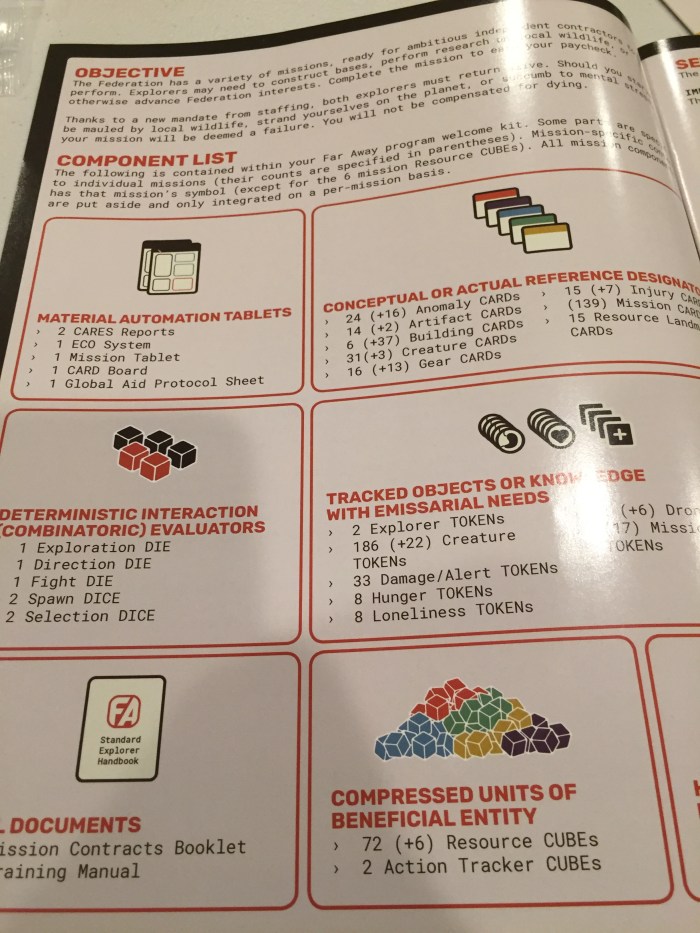
There are certainly elements of deduction that are very important, but I felt like really finding the final solution required looking below the surface.
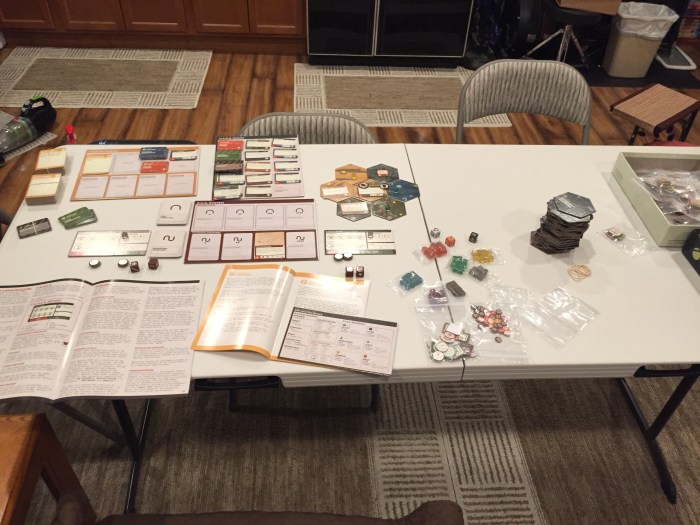
Conclusion

IMG_4715

At the end of the day, this is a fantastic game.  I liked it as a solo game and my friends and I all enjoyed this as a cooperative mystery.  (It came up several times: we like this MUCH MORE than the Portal Games Detective! My group did not like the Portal game, as it felt too much like work).   We all had FUN!

Detective: City of Angels plays a lot like Agents of SMERSH and Tales of Arabian Nights. There’s a lot of story, and players read from the storybook.  But there’s a mystery to unlock!  That’s both boon and bane!  That same mystery that makes Detective: City of Angels so much more thematic and engaging than Agents of SMERSH and Tales of Arabian Nights also limits Detective: City of Angels’ replayability.  There’s only 9 Cases that come in the core box!  And once you have played them, you are really done with them (unless you come back years later).  Luckily, there is one expansion already done and another expansion on Kickstarter as we speak!

At the end of the day, I would probably give this an 8 on the BoardGameGeek scale.  Fun game.


Review of The Forests of Adrimon (Hexplore It!)

IMG_4729
HexPlore It! The Cover for The Forests of Adrimon

The Forests of Adrimon is the second in a series of three HexPlore It games.  The third just recently funded on Kickstarter, and I think the second one (The Forests) just came into retail distribution.  I knew it was a Kickstarter, but I picked it up from a retail store.

Fantasy Cooperative Game

58725461827__23034C3B-2647-4E17-8D90-79D25619AE3E
Basic Set-Up

So, TFOA (The Forests of Adrimon) is a cooperative game for 1-6 players.  It’s an exploration game (within a forest) in a fantasy universe.   It’s probably called HexPlore It because the world is made of … wait for it … hexes.

IMG_4576
The Floromancer Character Role

Each player in the game takes on the role a single hero in the game: you choose both a Race (see below) and a Role Mat/Profession (see above).

IMG_4733
Races

The Heroes all work and move together around the hex map, trying to level up to beat … the big Bad Boss … Adrimon!

First Play: Solo Experience

IMG_4573

So, my first play was a solo adventure.  They adhere to Saunders’ Law and have a very viable solo experience.   Set-up took a while: there are A LOT of components.

IMG_4567

Here’s the thing: I HATED my first play.  I lost within a few rounds, even after I “cheated” a few times to stay in the game.  I HAD to be doing something wrong!  I felt like I had no chance to level up, and the Dice just work against me!

And I was doing something wrong:  so here’s a public service message if you play the game:

You can use gold to update your Abilities and Skills and Health and Hit Points. 

IMG_4570
Skills! The first update costs 3, then 4, then 5 … around the rim of the skills!

I missed this rule in the first playthrough (which is clearly on page 13 of the rulebook), and didn’t think I had a chance.  Once you know you can spend gold to update these, you realize how precious and important gold is!!

10-Sided Dice Rolls

IMG_4583
10-sided dice for Navigate, Explore, Survive

At the beginning of every turn, each player rolls 3 10-sided dice for Navigate (green), Explore (yellow), Survival (blue).  If you fail (roll over your skill value), there are consequences (get lost, no gold, lose food).  In the beginning of the game, your stats are very low and you are just barely surviving!!!  So, you find yourself barely getting by.

Public Service Announcement: spend your gold to up you Explore ASAP:  this makes it more likely to get 2 gold per turn, which you can use to up your other stats!

Second Playthrough: 2-Player Game

IMG_4636

Our second game went MUCH BETTER once we realized that we could use our gold to up our stats.

The game, in broad terms, seemed to play out like this:

  1. In the first half of the game, we explored and found Relics (special items needed to beat the big Bad at the end).   We tended to avoid combat, and in fact our first combat was halfway through the game!
  2. In the second half of the game, we embraced combat and fought a few more things.  We also ended up spending a lot of time in the cities trying to up more of our stats, getting ready for the final combat (and trying to get more Relics).
  3. The final combat was pretty intense: almost a half hour and we should have died, but we won!

We had fun, but there are a lot of things that were … suboptimal.

Dry-Erase Markers and Mats

Each player in the game uses a mat which works with a dry-erase marker.

IMG_4732
Dry-erase markers

So, because 8 (?) role mats were dry-erase, almost ALL mats in the game were dry-erase, even though they didn’t need to be!  There were 10 mats for a lot of BIG BAD villains, and they were dry-erase, there were Location mats, Game Turn Mats, Sentinel Mats, .. 18 total!  And frankly, the only ones that “really needed” dry-erase were the character mats (as you constantly updated stats, and erased and drew).

“Why is this a big deal?  The dry-erase of the other mats didn’t get in the way did it?”

No, but here’s the thing, the dry-erase didn’t quite work in the game.  Here’s why:

  1. The dry-erase markers in the game were TOO FAT!  They SHOULD HAVE BEEN ultra-fine dry-erase markers!
  2. The area (for the backpack) for writing equipment was too tiny and didn’t work for keeping track of your stuff!

Take a look at your mat:

IMG_4576
A Character

Now, take a look at the “backpack” area:  it’s a small 2 inch by 2 inch area where you have to write TONS of stuff, with a fat marker!

IMG_4577
Backpack

Can you read that? I can’t and I wrote it!

Suggestions for the Mats

There are 3 suggestions to fix this:

  1. Get rid of the dry-erase mechanism altogether and use pencil and paper
  2. Use ultra-fine markers and make the backpack area a little bigger
  3. Use the back of the unused characters as your backpack instead of trying to fit your backpack in a smaller area.

The back of the character mats is pretty cool: they have pictures:

IMG_4730
The backs of the character mats

These pictures are REALLY COOL!  But I don’t think I EVER looked at the picture in the entire game!!   BUT, if you just had a “blank” tableau on the back, then the characters could use two mats to play: one for the character, and one for the backpack!  You might even be able to keep the fat markers!

img_4731-1.jpg
Use two mats! One for the normal character stats (left), and the back of an unused character (right) for a backpack! Here, the back of an unused character is a cool but never seen picture!

It’s weird that SO MANY MATS are in the game, and only the character mats (and Battle mat) need to be dry-erase; it seems a waste that the other 11 are dry-erase.   All we could figure out was that they did that for manufacturing: it was cheaper to make ALL 18 mats dry-erase.

The dry-erase works “ok” for the stats, but it doesn’t really work for the equipment.

Time To Play

IMG_4575

The back of the box says that the gametime 60-180+.  Um, it took us EIGHT HOURS!  After the first FOUR HOURS, we set the game aside (see above) so we could come back to it later.    The second play took ANOTHER FOUR HOURS!!

Granted, it was only the second game, but I feel like I had most of the rules by that point, so maybe an hour of that would be “learning stuff”.

Be aware, if you play the game and get to the end, it may take you 6-8 hours.  We joked that it was only 60-180 minutes if you died early.

The Rulebook

IMG_4585
The rulebook

There were a lot of problems with the rulebook.

  1. Black background, white text.  This is a personal pet peeve of mine: it’s almost always harder to read!! But, people like to do it because it looks more “thematic” (Oh, this is a dark game).
  2. It’s too small.  This is a big game and the rulebook seems “too small”.  A lot of rules which would belong together on a page span multiple pages and make it harder to read.  For example, combat takes almost 28 pages to describe!  It was very frustrating to read about combat as you paged through the book!
  3. The rulebook won’t stay open.  If I wanted to keep the rulebook open, I had to “hold it” open!  I am used to board game rulebooks that just stay open when you put them on the table.  The binding of the rulebook forced you to hold it open to see things!
  4. The text was too close to the binding.  In other words, I had to “force” the book open to see all the text that was close to the binding.
IMG_4568
Black background, white text!  Have to hold rulebook open! Text too close to binding! 

The rulebook itself did describe most of the rules.  But, a lot of rules were also on dry-erase boards.    IMG_4584(1)

For example, a lot of stuff for the Waypost is on this dry-erase board (above).  Similarly, rules for Sentinels, the Battle Sites, the Enthralled Cities, and Elowen’s Grove were on other dry-erase boards.    We got used to it when we played, but it was non-intuitive that the rules were so spread out.

After we played, I was used to having the rules spread over multiple boards and in fact, I think I liked it: we weren’t “so tied” to the rulebook.   But, I think I wanted more in the rulebook.

Summary Overall

img_4642.jpg

In the end, my friend and I had a good time playing the game, in spite of the everything.   It felt fairly balanced.   We did “game the game” a little by spending way too much time in the Enthralled Cities.   We were surprised that Combat wasn’t more upfront (that could have just been the way we played).

We felt like there were too many rules for what it was.  The rulebook (grumble) was constantly held open as we had to look up stuff.

We played it, we won, but we don’t think we have a desire to play it again! It almost felt like a story/legacy game: once you’ve played it all the way through, you are done because you know what to expect!

Conclusion and Score

img_4574.jpg
A Winning game!

I’d probably give the components a 5-7/10 (it would be 8 or better but the dry-erase system didn’t work that well).  The pictures were awesome and thematic, and I felt like I was in a forest with the hexes.

The rulebook was a 6/10: it should be less, but because it actually taught the game, I have to give it at least a 6.

The gameplay was fun ONCE WE GOT INTO IT:   7/10 for gameplay.

The game was too long and doesn’t have a lot of replayability.   BUT I plan to give the game to some friends and have them play.  If you look at this game as a legacy game with a 6-8 hour playtime AND YOU KNOW THAT’S WHAT YOU ARE GETTING, then this game would be a lot more fun.

I am really conflicted on what to give this game as an “overall”: When we played it, we had fun, but that was despite the issues.    If you know what you are getting into, I think this could be a good game.


Review of Set A Watch

IMG_4524
The Deluxe Kickstarter slip cover

Set A Watch is a Kickstarter game that was active in late September 2018 and delivered here to the USA in late June/early July.   It’s a cooperative game about keeping watch at a campfire and defeating monsters who would attack your campfire.

IMG_4527
Set A Watch: a cooperative fighting game: protect the campfire!

Set A Watch is light to medium weight game for 1-4 players (although, see below).   Each player takes a very different role (Cleric, Knight, Beastmaster, etc): there are 8 roles in the game (6 or 7 in the retail version I think), with each player taking a different role.  It’s a smallish game in a smallish box (barely fitting in the box, but it does fit).

IMG_4529
Barely fits in box!

Note that the “board” is in the top of the box!  It’s pretty cool, but I had some trouble keeping the edge (leftmost edge in picture) down during play.

Characters

IMG_4535
Beast Master uses 8-sided dice!

Each player chooses a character, with 5 special abilities (only 3 at a time can be used in the empty positions on the card).  Each player also has a special ability back at camp (Set Trap above).

IMG_4536
Cleric uses 6-sided dice!

Each character gets 3 dice which you role at the start of your turn.  Some characters get 6-sided dice and some get 8-sided dice.  It’s pretty obvious: the 6-sideds are red/orange/yellow, and the 8-sideds are green/blue/purple.

IMG_4532
I wish the 8-sided dice used white for the colors so they were easier to see

The dice are the key element to the game!  Whenever you do anything, you assign dice to either abilities or just use the straight-up value to fight monsters with the direct value! Although it seems like the 8-sided heroes have an advantage, as they will tend to roll more potential damage, the 6-sided heroes have abilites that don’t depend as strongly on the value.  We’ll see more below …

Components

img_4531.jpg

The components are really nice.  The box has a magnetic clasp (ooooh!), the rulebook is pretty good, the cards have nice art, the dice are decent (although the 8-sided are harder to read), and in general the game looks really nice.

You even get some nice wooden bits: there are 3 different fire tokens to represent “how high the fire is”!  The higher the fire, the more of the creatures you can see!  Usually, a higher fire is a good thing!  The other wooden bits are a token to show “how many times you watched the fire”.   Everybody has to watch the fire twice before the big battle at the end ….

Solo Play??

IMG_4542
You must ALWAYS have 4 characters out, no matter the player count!

So, in Set A Watch, you must ALWAYS have 4 characters in play, regardless of the the player count.   This means that in a solo game, the solo character MUST PLAY 4 characters at a time!  Oi!! Although this game, strictly speaking, follows Saunders’ Law (every cooperative game must have a viable solo mode), it’s a bit much for the first play!! Playing 4 characters for a game you DON’T KNOW is really intimidating!!   I really wish this game had a balancing act for fewer players (like changing the number of monsters that come out depending on the number of players), but it is what it is.

Set-Up

IMG_4547

Each player takes a Character and the corresponding dice.  HINT!!!  The back of the character cards is a player summary card!!! Since there are 8 characters and only 4 ever playing, make sure you give everyone a “unplayed character” to use as a reference card!!!   And this makes me very happy: in all the games I played, the player summary card was worth its weight in gold!!  People who hadn’t played got almost everything they needed from either the player summary part of the front part of their card.

IMG_4549
The Warrior!

Once you choose your character, you choose 3 of your 5 powers to populate your character.  The other two remain dormant (although you can swap them in during the campfire phase later).  These 3 power cards represent your “hit points”: if all three of them are ever disabled, you cannot participate in combat.  You can heal from the Cleric, or back at the campfire.

IMG_4540
Set-up!

The Rulebook has a nice picture of set-up, although the “Line” (where all creatures come out) is impractical.  This is what I ended up doing, putting the line below the board …

IMG_4551
Initial Set-Up

Once you get the game set-up, it flows pretty quickly.  It’s a little fiddly to set-up.  There’s spaces for the Horde and Unused Locations in the box …

IMG_4541
Unused Locations and The Hoarde in the box!

But everything else is the sides (the Graveyard and the Unhallowed).  The difficulty of the game is controlled by how many Summon cards in the creature deck.  The more there are, the harder the game is! The Summon cards bring in the Unhallowed, which are nastier monsters!

img_4561.jpg

Gameplay

To Win, the players have to travel all the way back home (The Fobidden Tower).  There are 8 locations to move from, and when they get home, they have to do a final stand to defend their home (from the Hoard as well!).

IMG_4562
Home!

The gameplay is simple: at the start of the turn, everyone rolls their dice, and a decision is made!  One character watches the campfire for the night and the other 3 go and fight the monsters that would attack the campfire!  If any monsters make it through (aren’t defeated) , the adventurers gets wounded, and the remnants go the Horde.

Everyone must stay back (at the campfire) twice, but in the final combat at the Forbidden Tower, EVERYONE FIGHTS!

Campfire Phase

IMG_4555
The character decides to check the map and use his double to get rid of monster in the Horde!

Everyone looks at their dice to decide who stay back at the Campfire this turn.   Everyone must stay back exactly twice.  Whoever stays back decides what to do with their dice: they can heal, chop firewood, check the map, scout ahead.  If they roll doubles they can “activate Runes!” (do very special stuff )!  If you roll doubles, this might be a reason to have your character stay back this turn!  Again, the character summary sheet lets you know everything you can do!

img_4554.jpg

In our case, the player uses his doubles to VANQUISH and get rid of one monster from the Horde!  Important safety tip, you MUST FIGHT all monsters in the Horde when you make it back home!  So, it’s important to keep the Horde under control …

So, the guy back at camp just hangs out while his compatriots go fight!

Watch Phase

IMG_4559

Each character, in Player Selected Turn Order (PSTO) (i.e., any order they want) can play any amount of dice they want.  I can play 2, you can play 1, then I can play 1 more, etc.

You can use Dice directly as their value for damage against a monster.  The monster’s health is in the upper right corner.

img_4553.jpg

For example: if I have a 7 or 8, I can kill the Bandit with 1 die!  Since this is a cooperative game, I can play a 3 and you can play a 4 (or more) and together we can take it out!  Once a die is used, that’s it for that die this turn.

The second thing you can do it to use your die to activate one of your special abilities!

IMG_4563
Use dice to activate special powers!

For example: the Wizard has used two of his abilities this turn (each ability can only be activated once).  This is notated by putting one of the dice on the ability.

Finally, you can “exhaust” one of your abilities to use it again (without needing a die).  Unfortunately, unless you heal yourself, that ability is gone for the rest of the game.  (You can heal yourself back at camp or the Cleric can heal you).

Once all the monsters in the line are taken care of, you go to the next round!  There’s a notion of keeping your firewood high enough to see more monsters, and there’s some other rules, but that’s the basic game.

Thoughts

IMG_4565
A winning game!

So, this game has gone over like gangbusters in all my game groups.  I have played it solo, we have played it in my serious groups, a couple of lighter groups, and my Las Cruces group (which is notorious for very different opinions on games than my other groups).  And everyone has liked it!

The game plays quickly (an hour), everyone feels engaged most of the time, and bad dice rolls can be mitigated by the special powers!  I was worried that when a player “stayed back at camp”, that would cause that player to get annoyed for that turn (they are doing stuff, but not quite as much as the other players).  In the end, everyone “got it”!  Someone has to stay back and take it for the team this round!  And it seemed a very cooperative decision … since everyone has to stay back exactly twice, I don’t think anyone felt slighted.

The solo play works once you know the game, but always playing 4 characters is annoying.  I wish there were a better solo mode, this one is good enough to have fun with.

In the end, this game has been a hit in all my game groups.  It’s smallish, fast, fun, easy to learn, and there’s a ton of variety between the different characters.  This gets an 8 on the BoardGameGeek scale!  Good  game!