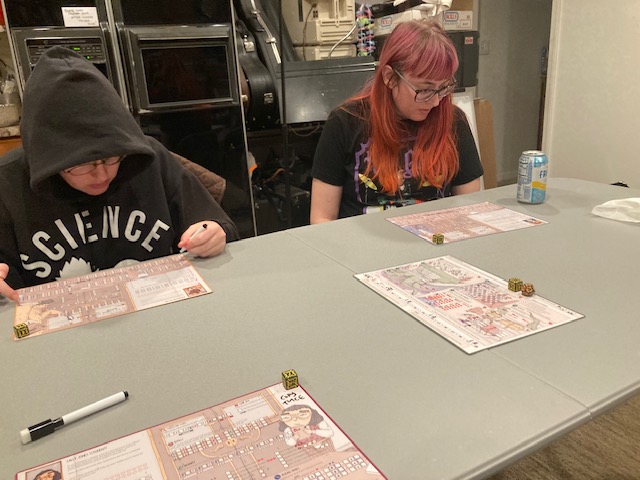
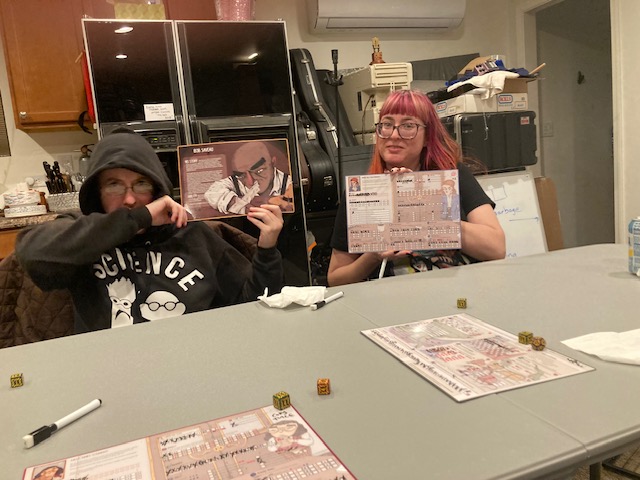
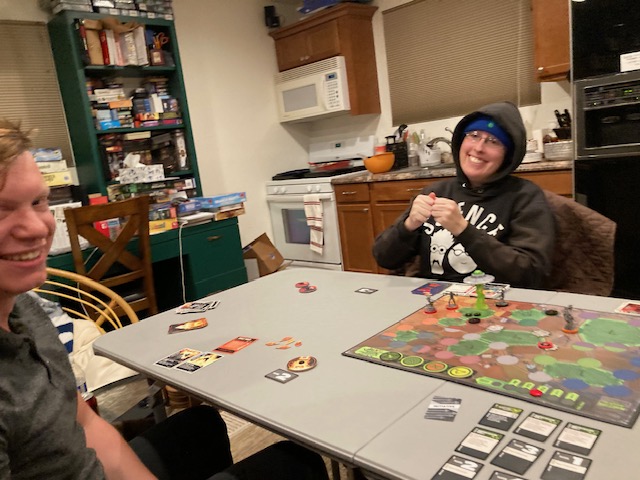
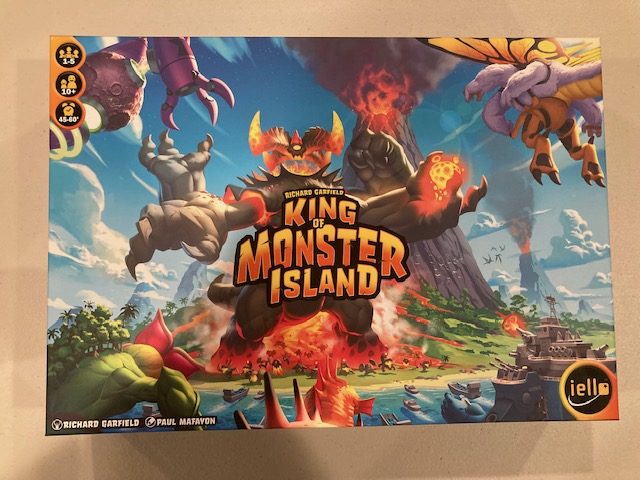
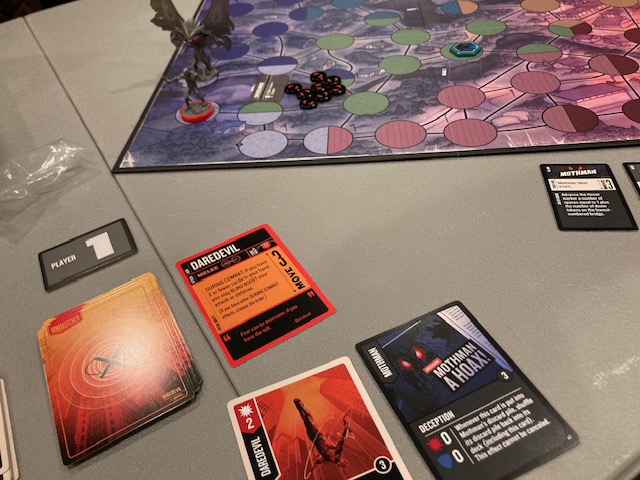
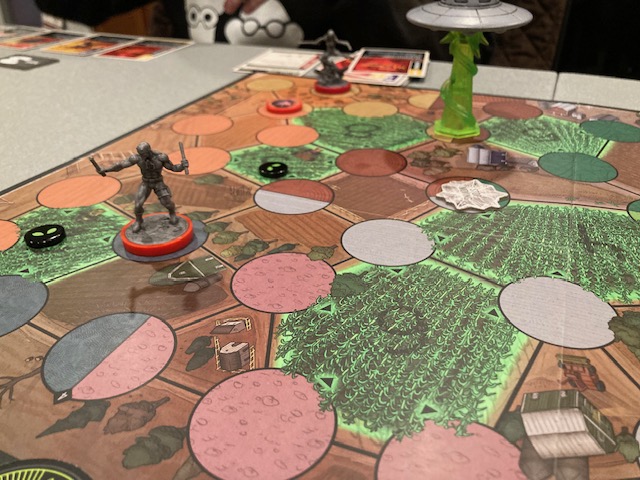
Is This How Amazon Trains Their Staff? A Four-Way Review of Express Route: A Cooperative Pick-Up And Deliver Game

IMG_1209

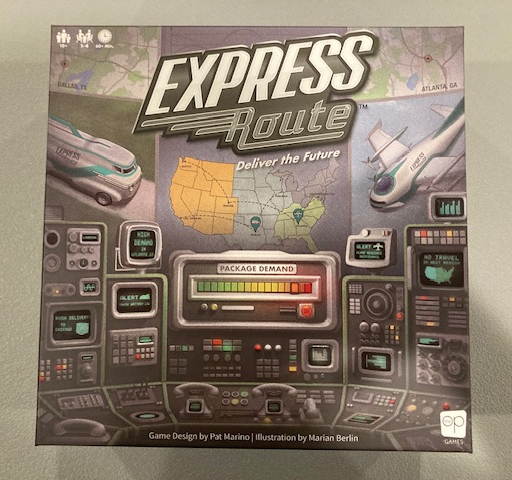
My friend Robert loves his map and train games! Last year, we re-played Pandemic Iberia (a cooperative hidden train game with a map: see our retro review here) and had a grand time! This year, we were able to play a new game that just came out with the last two months: Express Route. I ordered this from The Op’s website and it arrived a few weeks ago (Oct 2023).

IMG_1207

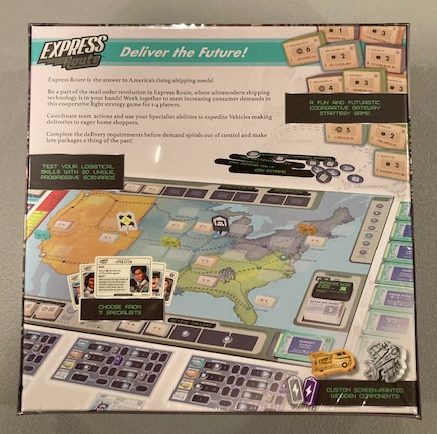
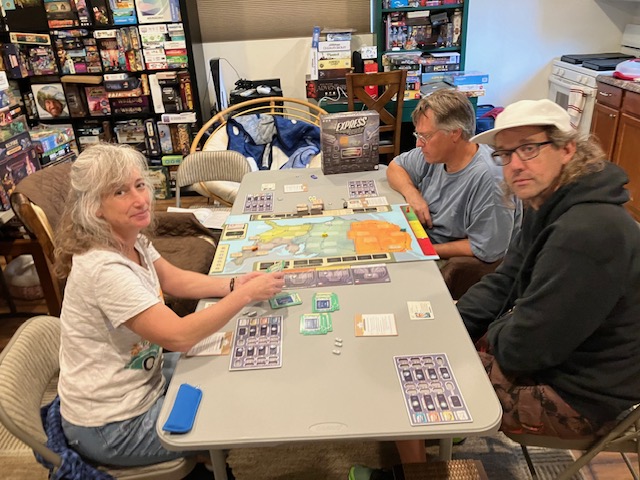
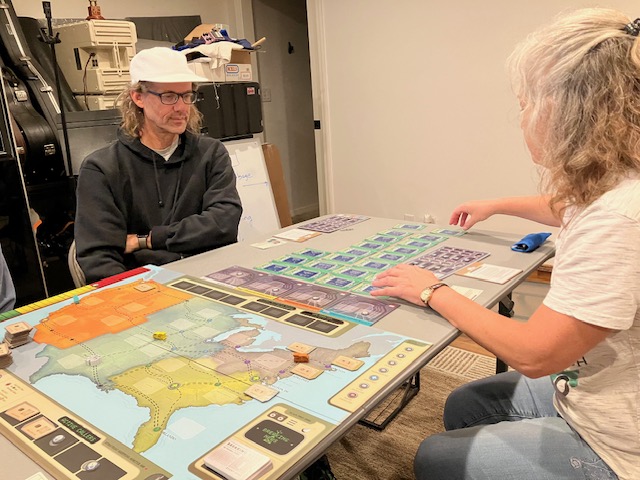
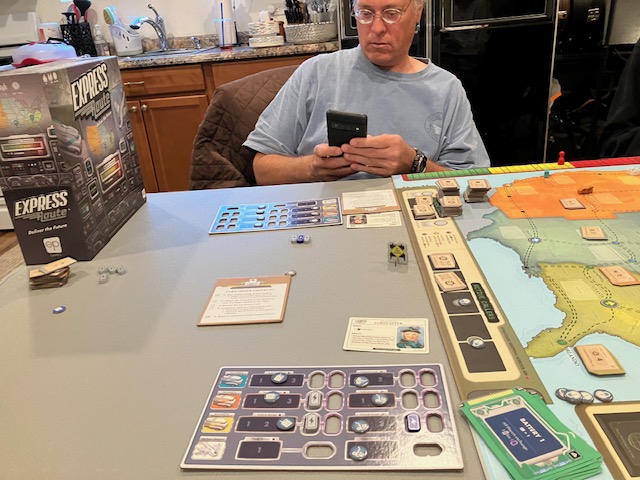
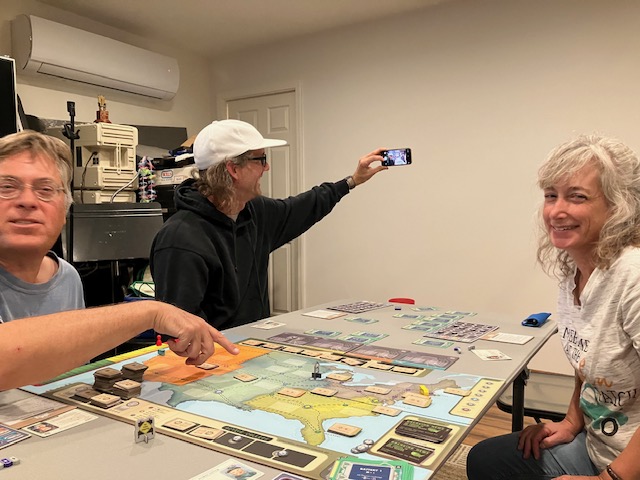
Express Route is a cooperative 1-4 Player game where players work together to deliver packages under time constraints! (This is called a pick-up and deliver game). The joke throughout the night was “Is this how Amazon trains its staff to deliver packages?” This is a game all about delivering packages across America.

Unboxing

IMG_1211

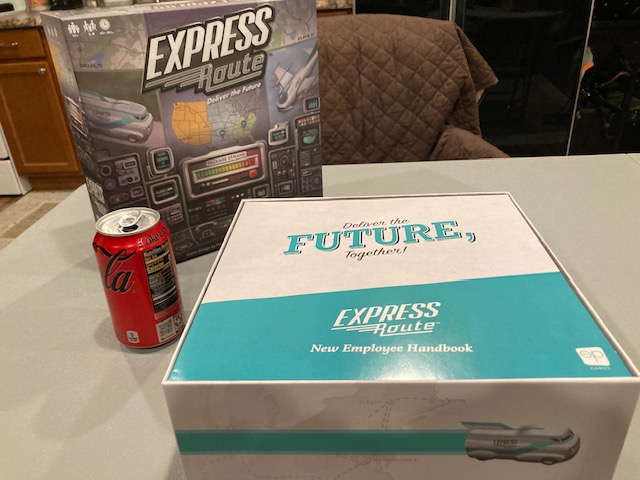
This is a surprisingly big box: it’s standard width and length (like a Ticket To Ride sized box), but it’s quite tall/thick! See our Coke can for perspective above and below.

IMG_1210

The rulebook is shaped just like box .. see above.

IMG_1230

Under the rulebook is a map and a bunch of cardboard punchouts.

IMG_1231

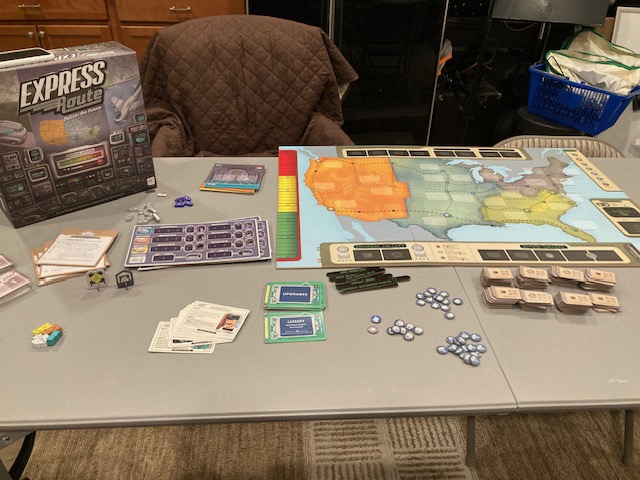
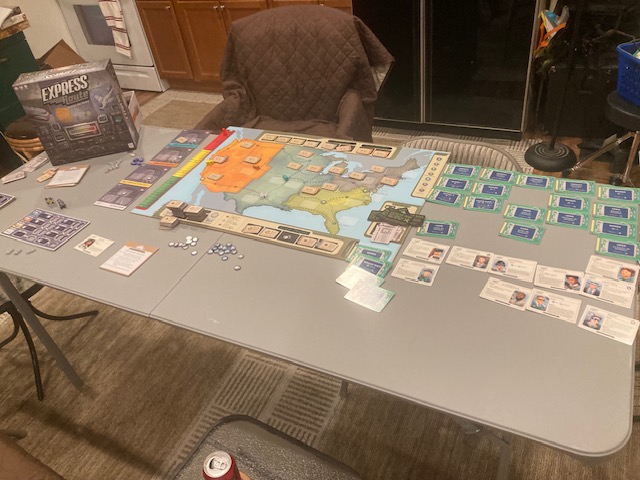
The map is gigantic! See as it takes up the entire one side of my table! See the Coke can above for more perspective.

IMG_1233

There’s quite a number of things to punch out: there’s five giant punch out boards! You punch out tokens, summaries, but mostly the packages! There are SO MANY little cardboard packages that come with this game. See below.

IMG_1247

See some more tokens above.

There’s also a number of cards: player cards (left), upgrade cards (middle) and some bad news cards (called “Breaking News”, right).

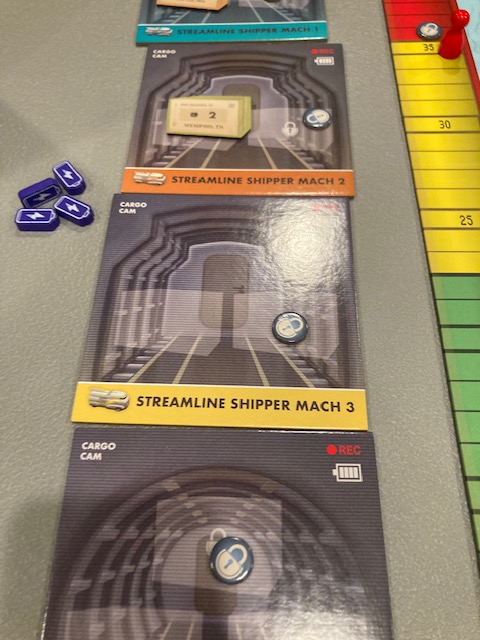
There’s also numerous thicker boards (cargo: left, player: middle) and some wood tokens (right).

IMG_1254

The components overall very functional (easy to read), but nothing in this game looks great or fabulous. I guess it’s very thematic for a package delivery: it just looks ordinary. Again, the game is very functional, it’s just not particularly good looking.

Rulebook

IMG_1227

This rulebook isn’t bad, but I struggled a little with it.

IMG_1229

This rulebook gets about a C+ or B- on the Chair Test. It flops open and makes it harder to read the edges (see above). The font isn’t small (so that’s good), but it isn’t big. It’s okay for readability on the chair test, and it does stay open. The pages just needs to be slightly smaller.

IMG_1213

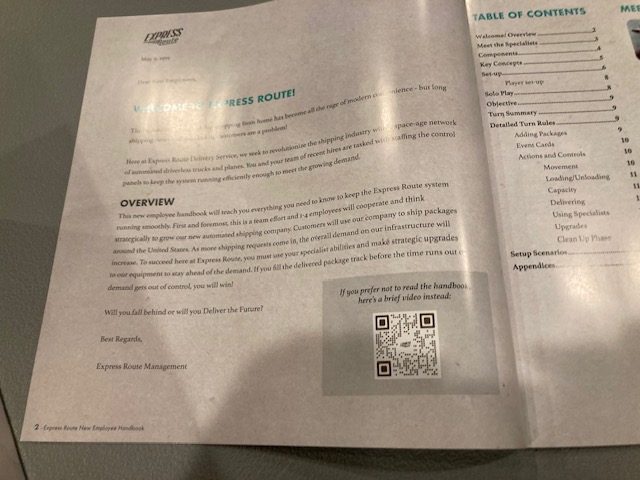
The intro is fine, and it has a link to learn the rules online: I prefer to learn from the rulebook, but some people prefer videos.

IMG_1250 (1)

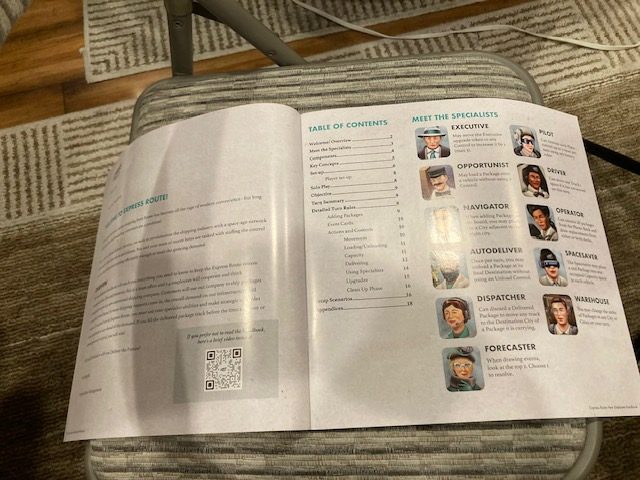
The Table of Contents is fine. There’s no Index (fail), but there are Appendices with some FAQ/extra info.

IMG_1216

The components page is great!  There’s pictures with labels correlating the components! 

IMG_1257

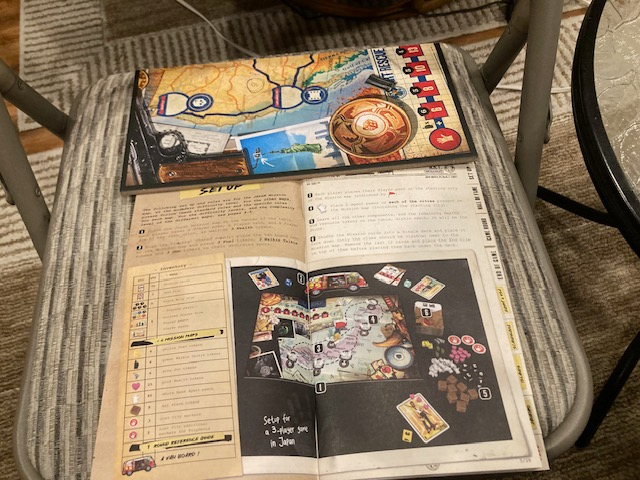
And a lot of people could learn from this set-up page!

  • You can leave it open (see above) while you are setting it up!
  • It spans two pages for the board: it seems necessary and proper that the board takes a full two pages
  • The arrows do a good job of pointing to what’s relevant as you set-up

My only complaint about the set-up is that the steps weren’t numbered, but maybe they didn’t have to be!

The rest of the rules were okay, but they seemed very wordy.  Not sure if it was the font, the organization, lack of highlighting, lack of elaboration in some places?

IMG_1260

One rule that seems like it needed more discussion was the Demand Track: there are three different actions depending on whether its green, yellow, or red. But, there were a number of questions we had: if you are in the red, do you do the green and yellow actions as well? (not clear: I am pretty sure the answer is no). And here’s some confusion about how to fill the telephone track as well.

IMG_1226

And the back of the rulebook contained no good summaries: it was just empty.

This wasn’t a bad rulebook, but I struggled through about four games before I felt like I finally got everything. This wasn’t a complex game, but something about the rulebook (The organization? The Way rules were expressed? Lack of an Index?) just didn’t flow for me.

I learned the game. The rulebook was good enough for that, but be aware you may have to struggle a little though it.

Gameplay

IMG_1242

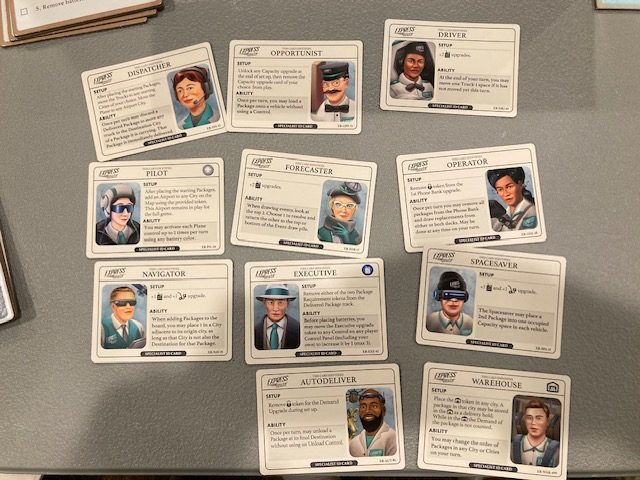
Each player takes the role of a character in the game: each character (there are 11, see above) has a special set-up ability (usually a few more movement or loads), and then a special ability to use during the game.

IMG_1270

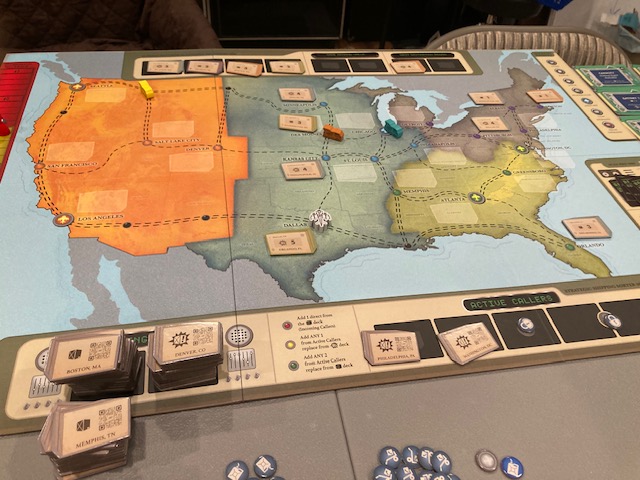
All the players ares working together to deliver packages using the four vehicles (three trucks and one airplane) on the board. See the yellow, teal, brown, and white tokens on the board above. To be clear, no one player owns any vehicle: player share control of all delivery vehicles!!

IMG_1268

Each vehicle has its own capacity: each truck starts with a capacity of 1 and can be upgraded to 2 (the airplane starts with 2 and can be upgraded to 3).

IMG_1271

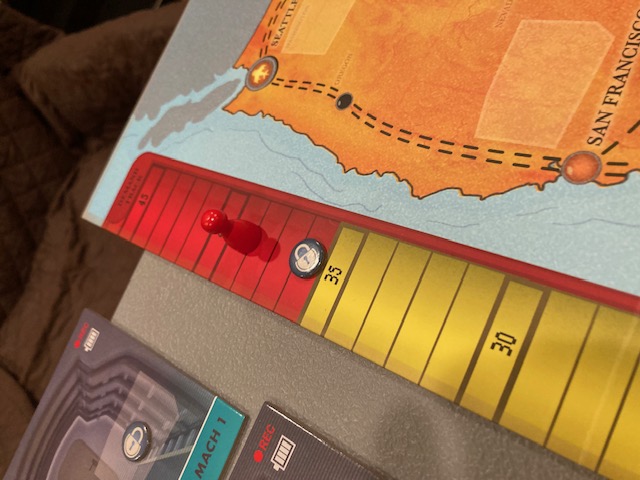
Players need to deliver packages to keep the demand under control: if the demand every reaches the top of the track (45 or 35, depending on unlocks), players all lose! Amazon has failed to deliver their packages and customers are very grumpy!

IMG_1264

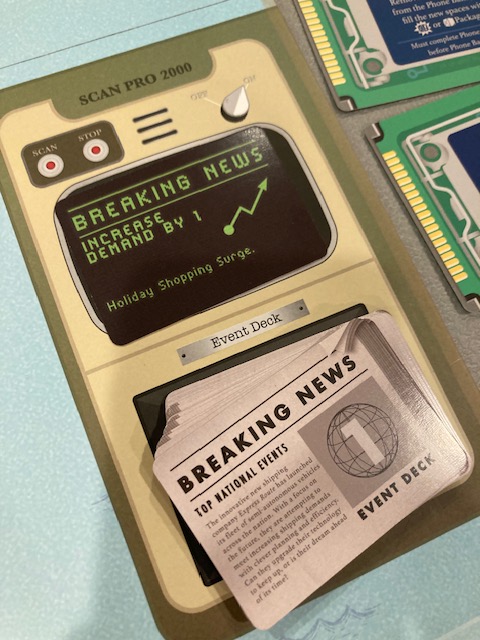
Every turn a bad news (“Breaking News”) happens which messes up the players: these get progressively worse as the game progresses.

IMG_1259

And some new packages are placed on the map every turn, spiking demand!

IMG_1265

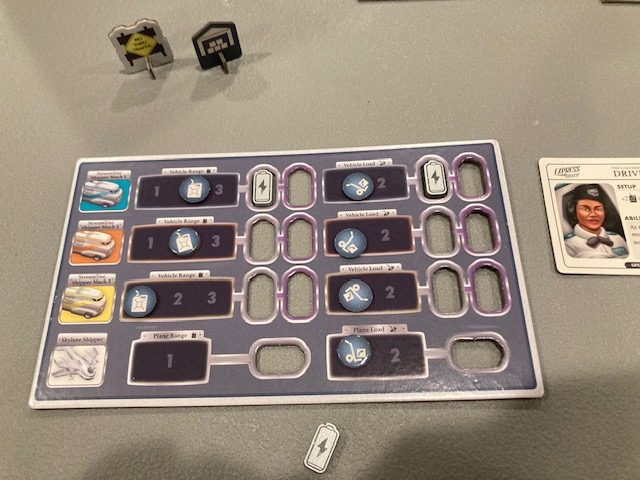
Each player has 3 actions (denoted by the 3 batteries): they can move the vehicles a few spaces or load/unload: see the player board above.

IMG_1280

If players can collectively deliver 4 normal packages and then another 4 packages (with special constraints), you win!

IMG_1258

One of the ways the game is interesting is that you can spend packages to get upgrades! Even though you need 8 packages delivered to win, you will have to spend some of those deliveries to upgrade you vehicles speed, capacity, and other things! (Thematically, this feels weird: am I stealing packages and selling them to upgrade my business?????)

IMG_1283

Players win if they deliver the proper 8 packages, but they lose if the demand spikes too high! Also problematic: If the Bad News (“Breaking News”) deck ever runs out, players all lose! Can your group deliver all the packages needed in time?

Solo Play

IMG_1251

Solo Play is specified right up front on the components page! Thank you for following Saunders’ Law and having a viable solo mode!

IMG_1276

The balance mechanism for one player or multiple players is simple: For every three actions the players take, a new package and a new Bad News card comes out! That’s it! So, it doesn’t matter how many players you have: every three actions taken by any player has the game respond the same way.

IMG_1286

It took me a number of games to get the flow of the game. At first, the game felt impossible! I lost my first game badly, and I was afraid I could never win! It was at the point I realized you could trade delivered packages for upgrades, and then the light came on! The upgrades are essential to winning! I think I struggled with the upgrade rule because it seems so athematic: “I am going to sell some of my packages to upgrade my company!” Wait, is this legal?

IMG_1283

I played a few more games and finally got the main flow, and I even won a game!

IMG_1273

The game was decent solo: it allowed me to learn the game (modulo a few rules) so I could teach my friends. It felt pretty necessary to learn the same solo before playing in a group: there’s just too many rules to get down beforehand!

I don’t know if I’ll play Express Route again solo: that’s not necessarily the fault of the game, I am just not enamored with this theme.

Cooperative Play

IMG_0063

Express Route was more fun with a group: we played our first group game with 4 people.

IMG_0066

Because the balancing mechanism is so simple (bad news, package, 3 actions, repeat), playing multiple players didn’t seem to slow down the game too much. There was a lot of discussion about how the game worked, there was discussion about the long-term planning, there was discussion as we played. It was pretty fun.

IMG_0073

One problem we had: there were a few places where if felt “a little” like the Alpha Player reared his ugly head (see the discussion of Alpha Player Syndrome if you don’t know what an Alpha Player is). It wasn’t a big deal, but there were some places were it felt like there was a little tension as we tried to decide the fate of our packages. This is definitely a game where you drink each other’s Kool-Aid: all players share control of the delivery vehicles, and there’s no way you can win unless you really work talk and work together!! This is not a multiplayer solitaire cooperative game by any means! That’s both good and bad, depending on what you want in a cooperative game.

IMG_9141 (1)

My friends and I had fun playing cooperatively.

Four Way Thoughts

IMG_0076

After we played, I reached out to my friends and asked for their reactions. It was kind of fun to watch the discussion: here’s what I saw!

“I never got a number score for (Express Route) the delivery game.  What do you think (out of 10)?  – Rich

“8?” – Becca

“You liked it that much? :)” – Rich

“I did like it and would be willing to play it again.  I haven’t played many co-op games though” – Becca

“7? definitely fun to play, fun theme, minor downside not sure I liked the dynamic of how you need to buy your way into the red part of the meter though maybe there’s a way to make sure you understand and use the card options you should buy” – Robert

“I am also a 7.  There were a few instructions that were unclear.  Flow was good.  Our game kept us strategizing the whole time.  I was concerned how quickly the meter shot into the red, but that kept us thinking the whole time.”

“Okay, yeah, 7 … all good points” – Becca

So, Express Route is a 7/10 from my friends!

IMG_1272

I think I am just 6.5/10: I just don’t love the theme.  I also felt like only 3 actions per turn sometimes made it feel like you couldn’t do a lot on your turn. Despite those thoughts, the were some good moments, especially in the cooperative game.

Conclusion

IMG_0071

Express Route is a good pick-up and delivery game: it’s very strategic and keeps players engaged as they play. Be aware that this game really needs everyone to stay involved to win: if you wanted a cooperative game where you do your own thing, this is not the game for you! Express Route demands everyone’s full attention if you want any chance to win … otherwise, you might be inviting the Alpha Player to your table.

IMG_0070

My friends all liked Express Route more than I did, as they all gave it a 7/10! For me, the theme just doesn’t do a lot for me (and I wish I had more than 3 actions per turn), but I recognize the game is interesting, and I had some fun! I would give this only a 6.5/10, but realize I am in the minority: my friends liked it better. Caveat Emptor.

I will keep Express Route for my map-loving friends.

A Review of The A.R.T. Project: A Cooperative Art Game With Not a Lot of Art

The A.R.T. Project is a cooperative game from The Op which was first available in November 2023: I had seen it in previews and reviews, but I wasn’t able to get a copy until The Op put it on sale on their web site in November 2023. It arrived in mid November, and I was excited to get it to the table!

IMG_1126

This is a cooperative game for 1-6 players (we’ll come back to that) and plays pretty quickly: the box says 40 minutes, but we’ve gotten through games a little quicker.

IMG_1127

Let’s take a look!

Unboxing

IMG_1188

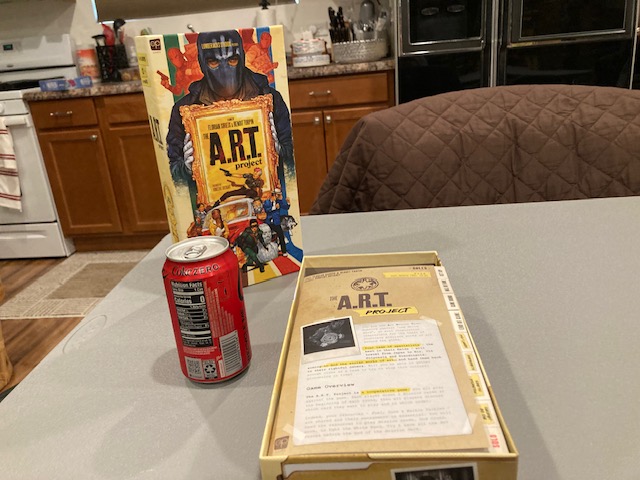
I mean, you can’t NOT comment on that cover: that’s one of nicest covers I have seen this year!  It is distinctive, colorful, and just beautiful!! That Vincent Dutrait art is just fantastic.

IMG_1128

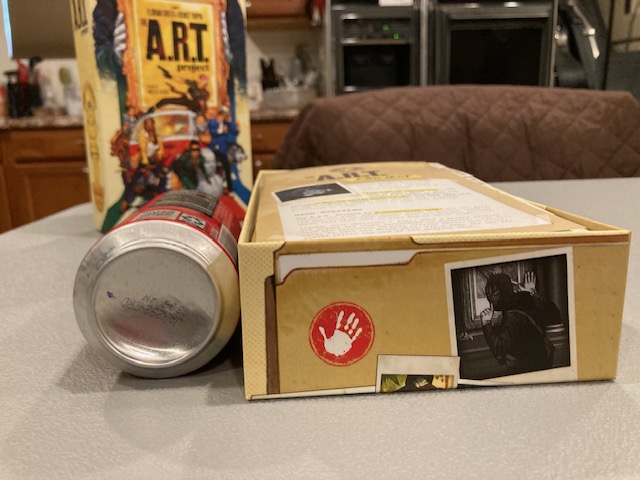
This game box has a weird profile: it’s long and thin, but it is surprisingly thick. See a picture with a coke can above: it feels about the size of 4 coke cans. It’s a weird size.

IMG_1129

Seriously weird size.

IMG_1130

The rulebook is pretty good (see discussion below).

IMG_1136

There are a lot of little components in the game: mostly wood. They are pretty nice: the little crates are kinda cool too: see above and below.

IMG_1149

There are three double-sided maps, and a punchout van, all beautifully illustrated by Vincent Dutrait. See above.

IMG_1144

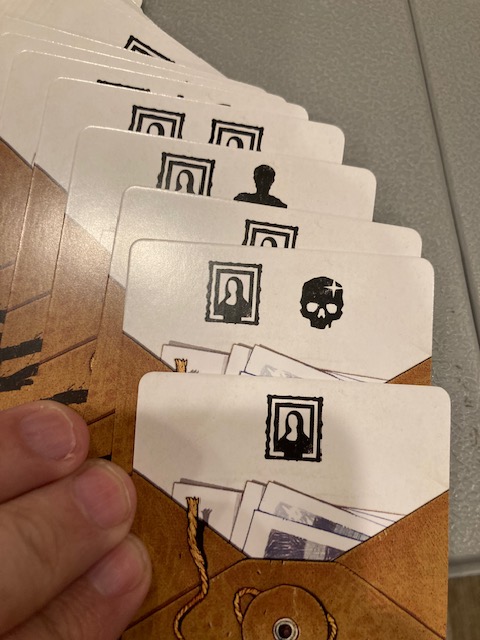
There are a bunch of cards: mostly Mission/Clue cards with icons (see above).

IMG_1186

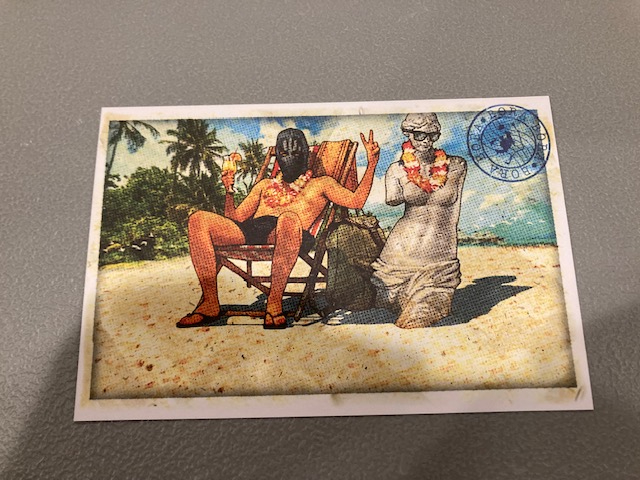
And the game comes with a postcard … I am not making this up: see above.

IMG_1141

Overall the game components are pretty great: the Vincent Dutrait art especially stands out.

Rulebook

IMG_1142

The rulebook is pretty good.  I was able to learn the game from it.

IMG_1148

It gets a C+ on the Chair Test.  It does fit well on the chair next to me, but I had to hold it open … which means I had to fold against the spine to force it to stay open without my hand.  Not a big deal, but somehow it feels “wrong” to have to break the spine (not really) of the rulebook to keep it open.

IMG_1150

Even after “breaking the spine”, I still needed to hold the rulebook down with an unused board.

IMG_1157

The font choice is interesting: it’s a mono-width font! It looks like a typewriter or computer terminal. I think the idea is that the typewriter font is thematic as a “briefing font” (the rulebook is organized as an old-timey folder). I normally don’t like thematic fonts (see our review of Oblievaeon), but they didn’t detract too much from reading in this case. I think what saved the font is that it was BIG and easy to read.

IMG_1131

One thing that did work really well in the rulebook is the tabs: it was easy to thumb to the place you want. Unfortunately, this game didn’t have an index. I needed to look up some rules a few times and had to page through the entire book to find what I wanted.

IMG_1154

Despite the rulebook not staying open and lack of an Index, it was pretty good. I learned the rules from it.

Gameplay

IMG_1415

This game has a very Pandemic vibe: you roam a map keeping cities from being lost (overrun in Pandemic), and occasionally picking up art at specific location (meeting up in Pandemic).

If too many HAND Agents (5) are ever at a city, the city becomes lost (Pandemic Legacy anyone?) and players can neither move through nor pick-up art there. HAND Agents also block players from picking up Art: See above as there are four HAND Agents blocking us from picking up two pieces of art (crates)!

IMG_1405

To eliminate HAND agents, you’ll roll dice (your colored die, colored compatriot dice, and black ally dice if you can get them) and try to beat the current HAND combat value (notated at the top of the board).

IMG_1176

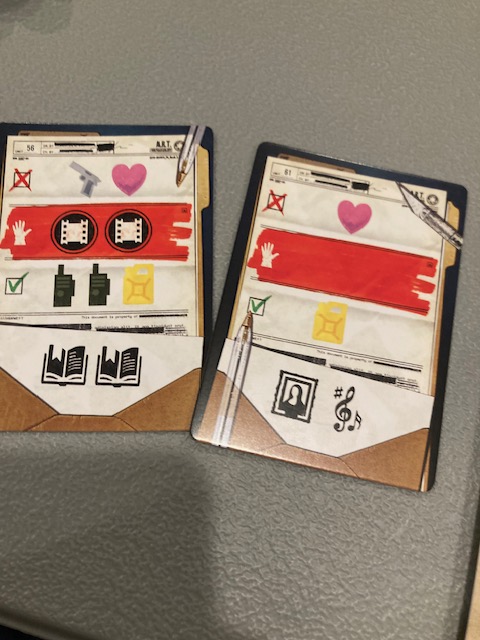
At the start of each round, each player will choose one of two Mission cards to execute: the card then executes top to bottom. The top “red X” is the penalty (lose heart or lose heart and gun), the red line is where the HAND Agents show up, and the “green check” mark shows your immediate reward. The other reward you get is a “clue” where art might show up .. note the Icons on the bottom of the card. When you get three Icons of the same type, you “find” a piece of art in that city! (A Mission card, once executed “flips” and becomes said clue)

IMG_1175

See above as we collect a lot of clues, but not enough to find any art! (You can also discard clues for rerolls).

IMG_1416

If you can find all 7 pieces of Art (represented by crates) before the Mission/clue deck runs out, anyone dies, there are 3 lost cities, or it’s impossible to get art, you win!

There are some other rules but that’s the gist.

Solo Play

IMG_1166

There is an entire section (well, 2 pages) of the manual devoted to solo play: there is a viable solo mode (congratulations on following Saunders’ Law).

IMG_1171

The main difference in solo mode is that you draw 3 Mission cards per turn (instead of 2) and choose 2 of them (instead of 1): see above. The other rule is that you have a helper (see green pawn below) who can pick up art and roll dice WITH you, but can’t attack HAND agents without you.

IMG_1182

And that’s about it!! The solo game moves pretty quickly. I was able to learn the rules playing solo, but I think I could have taught this game without too much work if I hadn’t played solo. It’s a pretty straightforward game.

IMG_1178

I have to admit to being a little underwhelmed by my solo game; It was okay. I spent quite a bit of time trying to decide why I was underwhelmed: we’ll discuss that more below.

IMG_1170

The solo game was okay. I am not sure I’ll play it again?

Cooperative Mode

IMG_1399

The cooperative mode was better than the solo mode. The best part of the cooperative mode was discussing which Mission cards to execute and in what order!

IMG_1401

There is no player order, which I really like! Thus, the players must work together to discuss the order in which Mission cards are played!!! There are a lot of competing constraints! We have try keep the Art crates within reach, while trying to keep both the HAND Agents under control BUT not losing any cities! The choices of which cards to execute (and the order) and that discussion are probably the best part of the game!

IMG_1177

In a 3-Player game, there was a lot of discussion! There was a lot of “what if”, there was a lot of “we should do this”, there was a lot of what “what do we do next turn”. This was a nice cooperative experience.

Themeless

IMG_1415

As great at the components are, as great as the Vincent Dutrait art is, as great as this idea is (saving art), … at the end of the day, the game felt rather themeless.

IMG_1172

Part of the issue is that you spend most of the game looking at black-and-white icons! Although they are supposed to represent “art”, they could be anything! We would rescuing refugees from around the world! We could be fighting guerillas! We could be curing diseases!

IMG_1416

And then, what you find is not “art”, but “crates”! The crates are cool components, but I never felt like I was saving art … anything could have been in those crates! Drugs? Guns? People? I really wanted to see the art in the A.R.T. Project!

IMG_1188

That Vincent Dutrait cover is AMAZING! It may be my favorite cover this year!! I wanted Vincent Dutrait’s art renderings of paintings, busts, film, … art!

What we got … were brown crates.

For a game named The A.R.T. Project, I expected a lot more art … and I got black-and-white icons and brown crates.

Player Count

IMG_1413

This is a game where the player count will make or break the game. The solo game is good enough to show the game, but not necessarily great. The 2 or 3-Player mode is probably optimal for offering the best experience! There’s just enough banter choosing the clues cards to execute, but not enough choice to overwhelm: we all made choices and we felt like we mattered.

IMG_1402

In a 4-6 player game, there’s almost no way you could find optimal Mission card orderings without either (a) taking too long (which isn’t fun) or (b) making sub-optimal choices (which will lose the game). The resources (gas cans, walkie-talkies, etc) are also very limited to 6, which makes them even more constrained in a large game. The 4-6 players games are just be too chaotic. The rulebook itself even warns players away from the 5-6 player game until you’ve played a lot: I am not convinced I would ever want to play with more than 3 players!

No Variable Powers

IMG_1145

At the start of the game, each player chooses one of 6 characters! See the amazing Vincent Dutrait art above! I wanted the blue guy because of the dog!! What cool thing could the dog do??

IMG_1168

The answer: nothing. The characters aren’t distinct in any way. It doesn’t matter what character you play, except for your pawn color: I think this was a missed opportunity. Once you choose your character, it doesn’t really matter anymore once the game goes on.

This is another reason the game felt “themeless”: I had no attachment to my character at all. I just moved a blue pawn on the map picking up brown crates.

Conclusion

IMG_1415

I really wanted to love The A.R.T. Project, but I was underwhelmed by it. I was expecting this amazing art and theme, but the main gameplay centers on black-and-white icons and brown crates … which could be anything! Granted, the art you do get from Vincent Dutrait is amazing, but that art is outside the main game arc: you don’t really embrace it. The lack of variable player powers was also surprising too: all players felt exactly the same, further contributing to the theme feeling pasted on.

IMG_1404

There is a decent game here. The game shines best in a small group of 2-3 Players , with the choosing the Mission cards being the highlight of the game (as you choose both the good things and bad things together). At this optimal number of players (2-3), I would give it a 7.0/10, but my friends would still only give it a 6/10 (Teresa) and 5/10 (Sara); Sara and Teresa were even more disappointed by the themeless/artless nature of the game than I was.

The solo game is probably a 6/10. And I would avoid player counts above 3: I think the game really becomes significantly worse at higher player counts.

IMG_1406

Even though I don’t love this game, I will keep it: it’s a light and quick (at about 20-30 minutes) cooperative game which I might bring out for new players .. Or if I want a quick cooperative game. If you do decide to get The A.R.T. Project, I strongly recommend keeping the game to 1-3 players or you might hate it.

Surprisingly Thematic! A Review of Roll For Great Old Ones: A Cooperative Roll-and-Write Game

IMG_0850

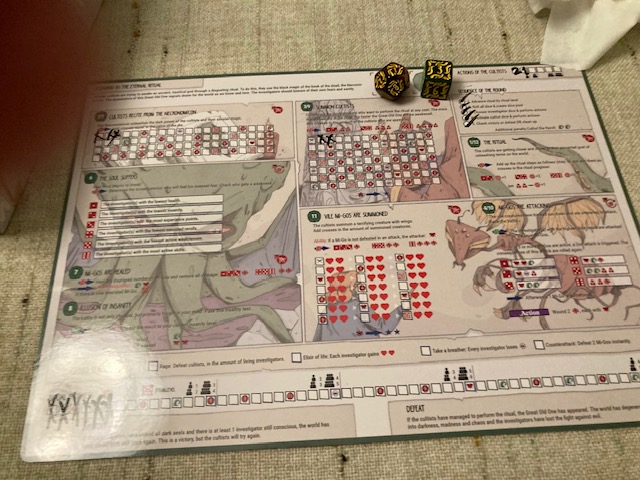
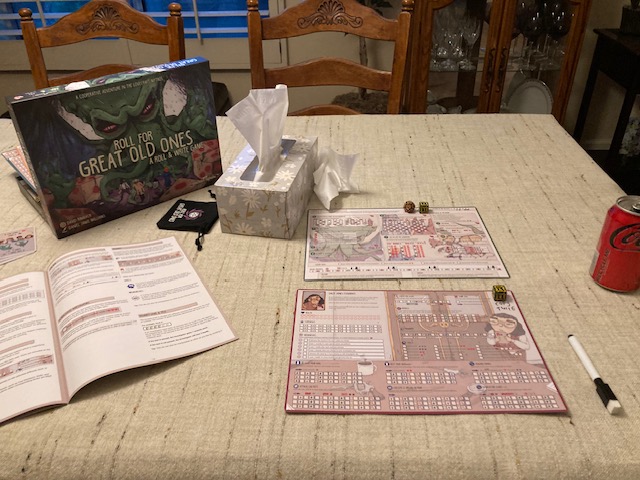
Roll For Great Old Ones is a cooperative roll-and-write game that was on Kickstarter back in February 2023 and delivered to me Oct 31, 2023: I remember that date, because I was trying to get my friends to play this for our Halloween game! (We ended up playing something else).

IMG_0852

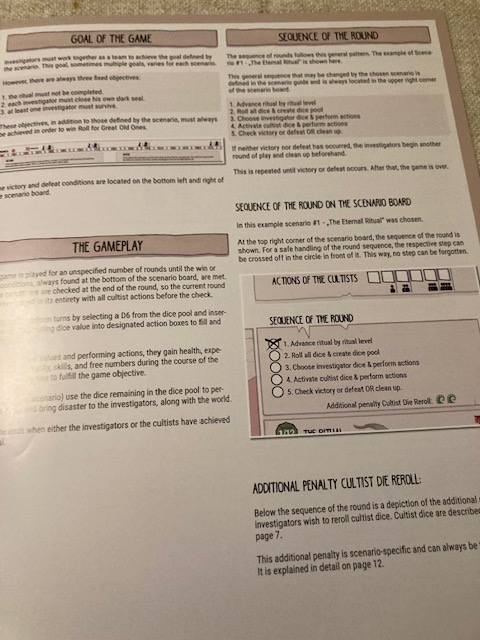
Roll for Great Old Ones is a cooperative roll-and-write game: if you don’t know roll-and-write games, think of Yahtzee! In Yahtzee, you roll dice (roll) and fill out a sheet with numbers (write). We’ve seen some recent examples of cooperative roll-and-write games: Find The Source (see our review here) and Escape: The Roll and Write game (see our review here). Let’s take a look at this one!

Unboxing

IMG_0849

This game has a weird profile: see above. It’s very thin and long and kind of an awkward size.

IMG_0855

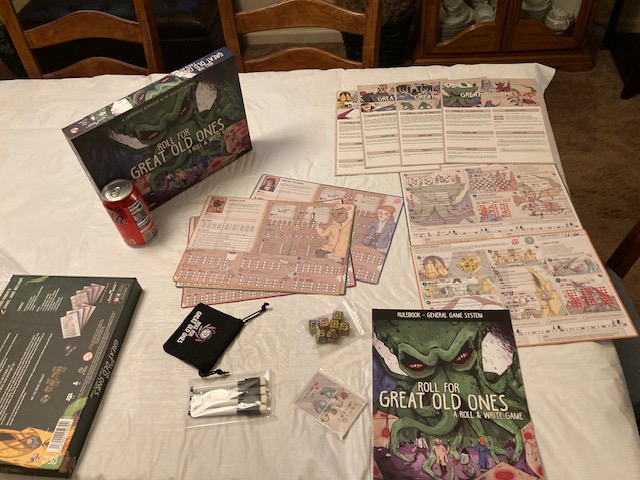
Arguably, it doesn’t have to be too thick because all it contains are some sheets, dice, pens, and a rulebook. And that’s it! It all fits into that thin box (see above).

IMG_1189

The game looks pretty good, if you don’t mind the crazy, maybe off-putting art.

IMG_0859

I think the art’s supposed to be a little crazy and unhinged because Cthulu-type games typically have that insane/going-crazy aspects to them. So I think it works. But the art is weird.

Rulebook

IMG_0866

The rulebook is okay to pretty good.

IMG_0867

The game starts with a good description of what the game is, but there is no component break-down.

IMG_0869

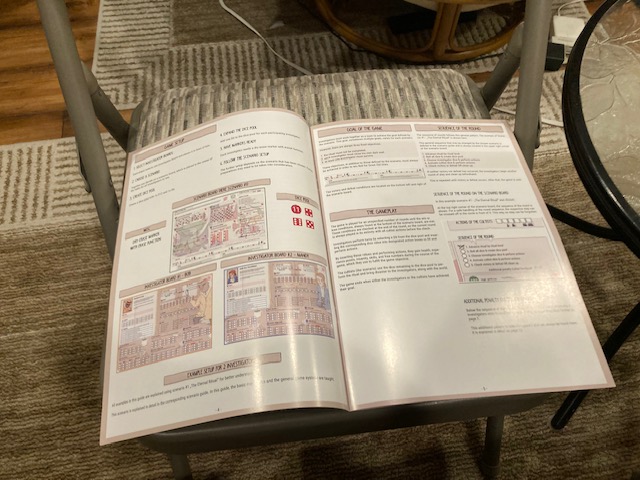
To be fair, you don’t need a component breakdown since there are so few components. The set-up page works pretty well.

IMG_0870

The rulebook does a pretty good job of showing examples while it explains each sections, and it has cutaways of the appropriate section of the board: that was very useful to further our understanding.

IMG_0879

I didn’t love the font here: it wasn’t visually appealing. There’s also a lot of white space all over the book, which makes me think the font could have been significantly bigger. But, font and font-size are a very specific criticism most people might not even notice: it bugged me.

IMG_0873

I would say this rulebook taught the game decently: I had questions as I played and I was generally able to find elaborations/clarifications for rules. Having said that, I think this game really needs an index: there are a lot of concepts here for a simple roll-and-write, and I think an Index would have helped a lot.

IMG_0899

I will give the game props for having a very useful back cover (summaries of symbols): I referred to this a fair number of times when I played.

IMG_1190

The rulebook gets a B on the Chair Test: it does fit okay on a chair next to the table, but it does flop a little. The font is also too small to see easily on the chair.

IMG_0882

A slightly smaller form factor, a larger font, a better font, and an Index could easily move this to a very good or excellent rulebook. The rulebook, as it is, is ok to pretty good: it will teach the game decently.

Gameplay

IMG_0858

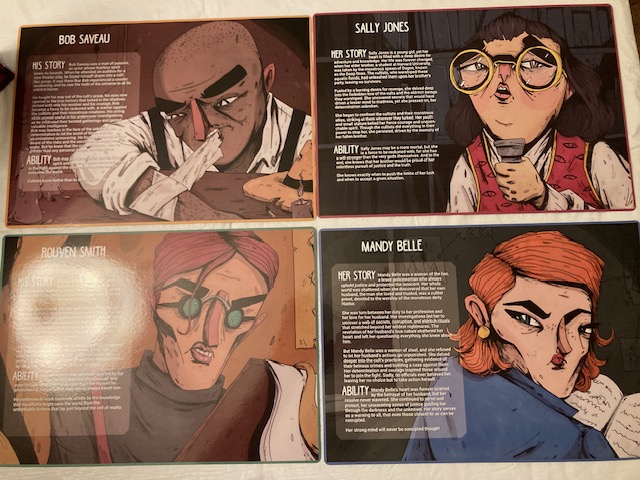
Each player takes one of four characters to play during the game: Each character has a specific laminated sheet with a special power!

IMG_0893

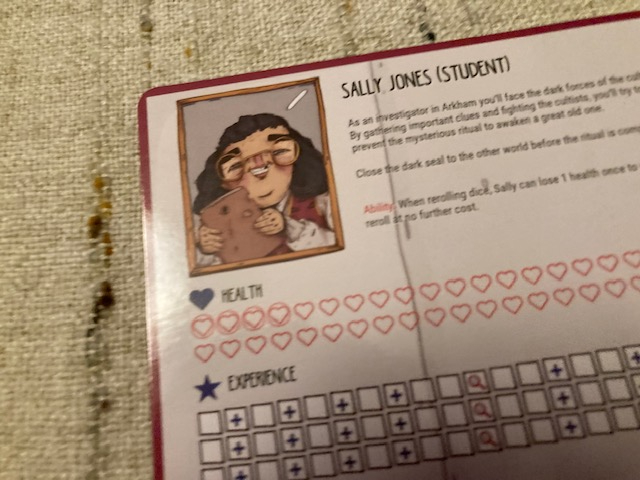
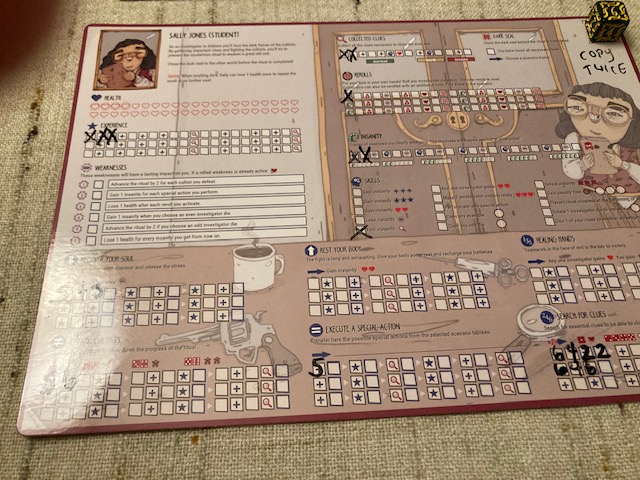
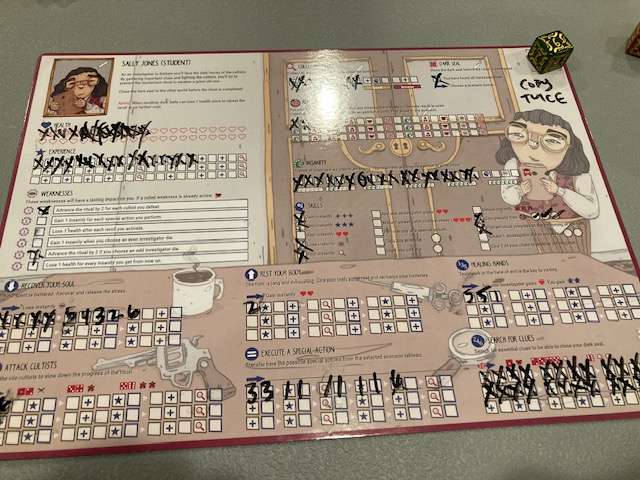
For example, Sally Jones (see above) has her special ability where she can spend a health for a free reroll.

IMG_0862

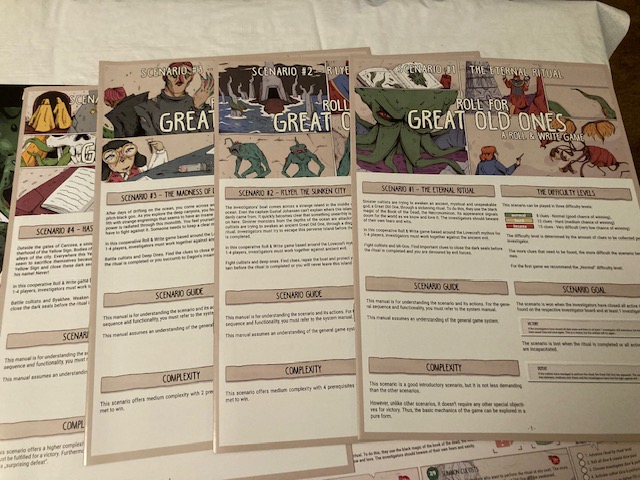
After choosing a character, you choose one of four scenarios that come in the game. The scenarios are documented in two places: a rulebook for each scenario (see above) ..

IMG_0907

… and a sheet specific to that scenario (There are 2 double-sided scenario cards, so 4 total Scenarios).

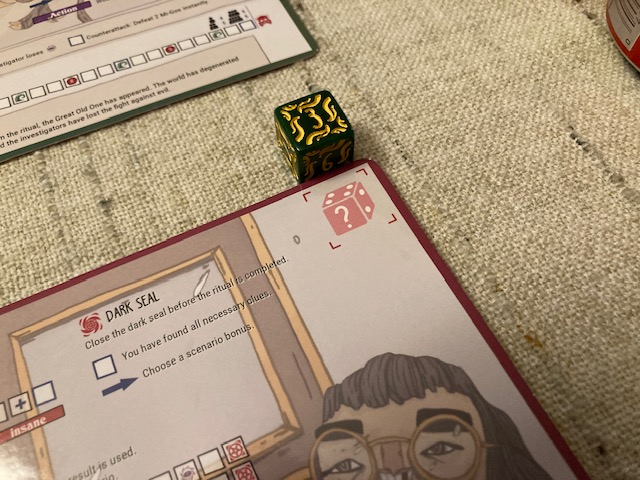
Once you get into the game, the main arc is pretty simple: roll some dice (1 bad news dice: the d12) and a few d6 (one more than the number of players). Each player will choose one d6 to put on their sheet:

IMG_0892

And with that die, they will activate “something” on their sheet!

IMG_0901

An easy to forget rule is that you get to use the die’s value TWICE, so I put a note underneath the die!

IMG_0906

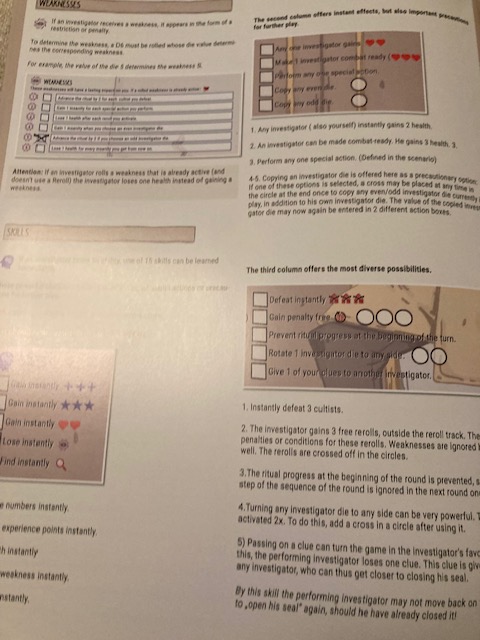
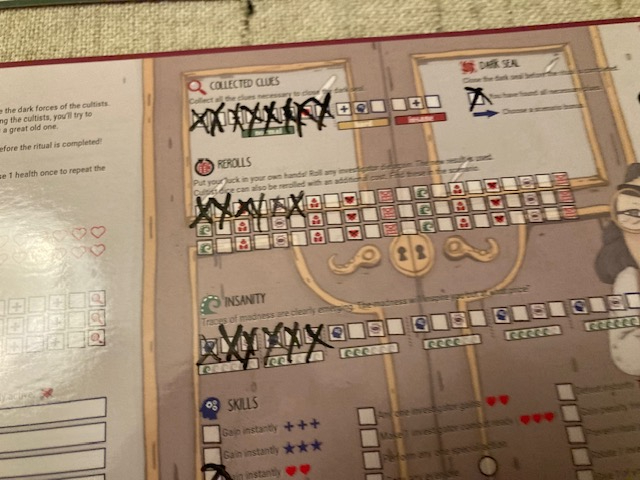
The bottom of your sheet shows you 6 major actions you may be able to activate with your value (if it’s odd, even, ascending, descending, same, different, etc). You fill in little squares at the bottom! These squares will have cascading effects as you fill them in: some allowing you to fill in the experience track, some allowing more numbers to be filled in, some allowing other actions! There’s all sorts of things you can do you if fill enough boxes: heal sanity, cure weakness, kill some cultists, activate a special action, but the most important thing: discover clues!

IMG_0909

In order to win, each character must find enough clues to fill in their own DARK SEAL!  See above as Sally Jones is able to find the Dark Seal and win the the game!

IMG_0917

Another great thing this game has are institutional rerolls!  You can reroll just about any die in the game … at a cost.  The rerolls section of your board has a bunch of reroll squares: every other reroll is “free”, but the other come at a cost: summon more cultists, lose health, lose sanity, gain a weakness and some other stuff!  So, you can always reroll as many times as you want, but you will pay a cost.    It’s kind of cool that you can take a ton of rerolls if it means the difference between winning and losing!!  … It will just cost you … (evil laugh)…. but at least you can make that choice!

IMG_0907

How do lose? If all players go to zero health (only one player has to survive to win), or if the cultist ritual finishes (see ritual track at the bottom of the board), or a few other ways.  Players only win if they can all find their DARK SEAL and survive to the end of the turn!

Solo Play

IMG_0908

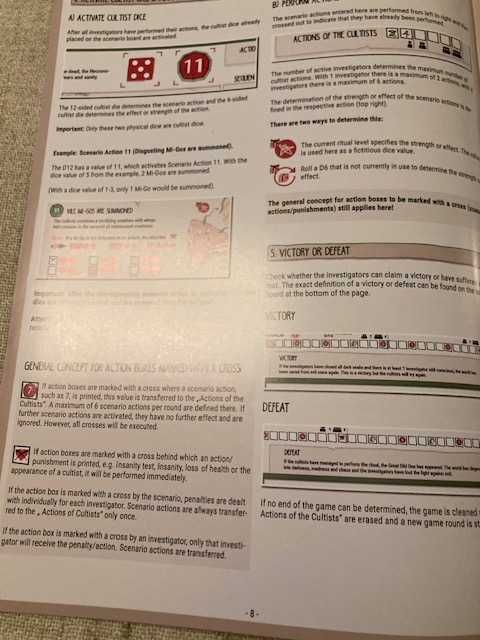
Thank you to Roll For the Great Old Ones for following Saunders’ Law: there is a viable solo mode! It’s easy: the solo player just takes control of one character and plays normally. Most of the scaling for the number of players for the game has to do with “how fast” the Cultist Ritual evolves. For a solo game, the Cultist Ritual doesn’t complete nearly as quickly. For example, at the beginning of scenario 1, the Ritual only completes one step for 1 player (2 steps for 2 players, etc 3 steps for 3 players, etc). There are some other places in the game that note the number of players, but they are usually clearly notated.

IMG_1200

I think it was very important to play this game solo before teaching it to my friends!! For a roll-and-write game, there are a surprising number of rules! I have played a number of solo games and I still feel like I miss a rule here and there.

IMG_1203

The Scenario sheet does a pretty good job of having the rules on the sheet, but after multiple plays, I realized I still needed to lookup the rules in the Scenario-specific book. There’s just a little too much to notate on the monster sheet, even with the tiny fonts it uses!

IMG_1202

It took a while to read through all the rules and get a sense of the game. But, I will say that, once I got into the flow, the game moved rather quickly! Roll some dice, choose some dice for you and the monster, assign your dice, mark off stuff, handle the monster, lather-rinse-repeat! The game moved at a pretty good clip once I got it.

IMG_1199

I was able to win my first game as Ms. Jones, but I think I cheated! Like I said, there are a lot of rules. You should probably play solo a few times to get a sense of the game before moving on to teach your friends!

IMG_1196

It felt like the solo game took up more space than it should: I had to have the rulebook on the chair next to me, the scenario book on the table, and then part of a table for the large player and monster sheet! Whew! It takes up more space than I expected! See above.

IMG_1191

After all is said and done, I liked the solo game. It wasn’t great, but I had fun.

Cooperative Play

IMG_1388

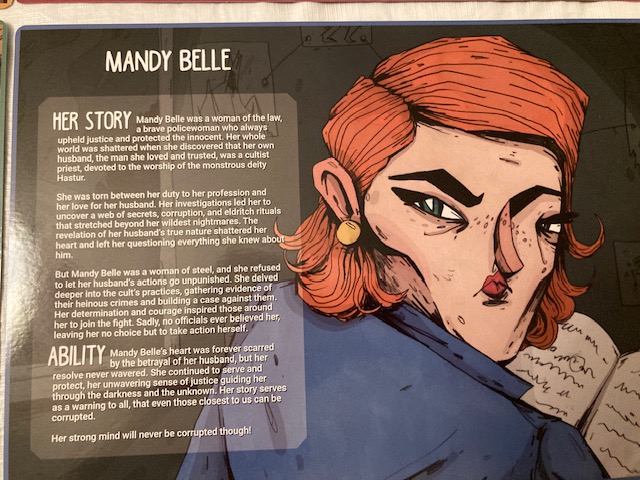
Cooperative play worked well. Each player takes a character and assumes the role of that character! In this case, Sara had to play Mandy Belle because of the red hair!

IMG_1391

A few more dice are rolled to create the dice pool in cooperative game: each player needs to get a die (a d6), and the monster still gets a d12 and a d6. So, part of the cooperation at the start of the round is figuring out which player should get which dice!! “I need an even to complete the clue! “ “Okay, I’ll take the 1! I need an odd!” But, just as important, we have to work together to make sure the monster gets a bad die from the leftovers! I really like this system, where we choose not only what we get but also what the monster gets! I may choose the 6 this turn so the monster can’t summon a ton of cultists! (The d6 for the monster is the “power” of the action, so 6 is usually very good from the monster’s perspective)

IMG_1394

There are also mechanisms in the game where your action can help a compatriot! One of the actions on your board is to heal a compatriot! This was very important in one game as Teresa healed me so I wouldn’t die!! If a character dies, everyone else continues, but the ritual still advances as if everyone were still playing! So, it’s best not to die.

IMG_1396

So, there are some mechanisms for cooperation, but not a ton. Generally, each player does the best they can on their sheet, and every so often, especially in the endgame, players can ask for help! There are just enough mechanisms (heal a compatriot, ressurect, give a compatriot a clue) to make this feel like a cooperative game and not just multiplayer solo, especially in the endgame.

IMG_1397

I think this game is better as a cooperative game than a solo game: there’s just enough cooperation that I enjoyed playing this while hanging with my friends. I still get to make my own choices on my own board, but I collaborate with my friends at the start and occasionally ask for help!

IMG_1391

To be clear, it’s very very very hard to have an Alpha Player in this game: everyone is very focused on their own board!! Maybe this is the strongest argument that this a good cooperative game!

What I Liked

IMG_1393

For a roll-and-write, this was surprisingly thematic! The weird art in the game, and the references to cultists and summoning evoked more theme than I expected! The dice were even creepy/Cthulu dice. There was even a sense of dread as the endgame approached as the Cultist Ritual looked like ot might succeed!

IMG_1203

I liked that the rules were “mostly” on the player and monster sheets, only requiring a few lookups during play.

IMG_1389

Even though there are a lot of rules, I was able to quickly teach this game to my friends! (You gotta learn the game solo first). Then, the game flowed well without too many questions or rule lookups.

IMG_1197

I liked that the game was pretty quick. My solo games went pretty quickly (40 minutes?) and our cooperative games went 80 minutes or so. The box says 60-90 minutes and I would that feels very accurate!

IMG_1391

I liked that everyone felt engaged: every one had their own board so they could make their own decisions! But there was still enough cooperation (picking die, using actions to help, etc) to keep discussion flowing!

IMG_1189

I also like that ther are multiple scenarios which are different enough to keep the game interesting.

IMG_1202

I also want to be clear: I am so glad the cards in this game is laminated! They worked really well when we played! The laminated cards also made it easy to clean and play another game!

What I Didn’t Like

IMG_1198

The game might have a few too many rules. I feel like every time I played that I missed a rule somewhere! “We won! Oh, but asterisk next to that win, we forgot the Migo rule!” I’m not sure what to do about that: as I mentioned, it would have been nice if everything could have been notated on the sheets, but I think the game just ran out of space. Maybe bigger sheets? Cards with rules on them instead of a full rulebook? (I can imagine a card with the MiGo Summoning rules: that way it can be next to the board and everyone can see it/pick it up when its relevant?)

IMG_0904

The dry-erase pens were okay (I would have preferred finer tips on the pens, but they worked ok), but the erasers on the end kinda sucked. We ended up using kleenex to clean the boards instead.

IMG_0855

The art may be divisive. My friends loved it (and thought it thematic), I still don’t love it, but it does go with the game.

I also thought the rulebook could use a few spruce-ups (better font, bigger font, less white space, an Index), but we already covered that.

Conclusion

IMG_0864

Roll for Great Old Ones surprised me! It was more thematic than I suspected for a roll-and-write game, and it was fun! The only real problem with the game is that there are just a few too many rules: you absolutely want to learn this game solo before you play it cooperatively. I think our cooperative games went so much better because I had soloed previously, and thus I was able to get the group into the game quickly!

IMG_0908

The solo game is pretty good. It’s quick and easy to set-up and it flows quickly once you have the rules down. I had a nice time and will probably play solo again. The solo game is probably a 7.0/10.

IMG_1394

The cooperative game was a little better than the solo game: everyone is engaged in their own board, but there’s still enough cooperation to keep discussion flowing! I’d give the cooperative game a 7.5/10.

IMG_0903

The best part of this cooperative roll-and-write are that there are are two strong mitigation methods to controlling the dice: which dice you select and when you reroll! I got this because it was a cooperative roll-and-write, but I was worried about it: I need not have worried! This is a good game: solo game is 7.0/10, cooperative game is 7.5/10 (maybe even better).

Would You Rather Watch or Play a Murder Mystery? A Review of Suspects: Eternal Detective Claire Harper

IMG_0609

Would you rather watch or play a murder mystery? I have to admit, I am a sucker for the BBC murder mysteries like Midsomer Murders, Sherlock, Death in Paradise, and so many others! As I watch, I am constantly trying to figure out the twist before the end .. sometimes it’s easy (as the show offers up clues), and sometimes it’s hard (as the show hides things until the very end)! Still, it’s always fun to try to solve the mysteries along with Sherlock, Richard, Humphrey, and your favorite Detective Investigators (DIs)!

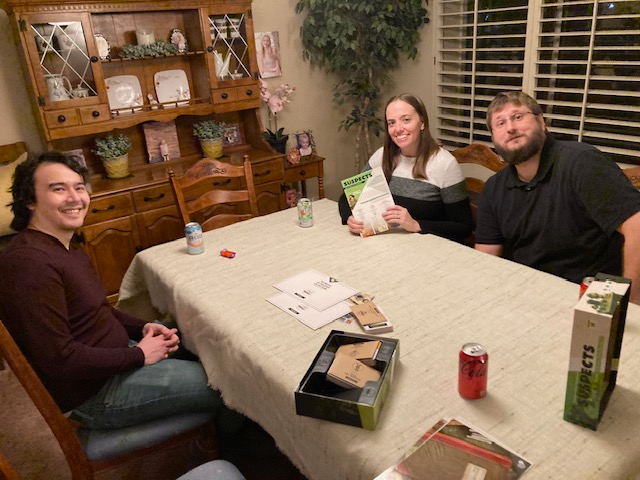
IMG_1210

We originally reviewed the original Suspects: Claire Harper Takes The Stage back in 2022 (see our review here), and we liked it so much it made the #4 position of our Top 10 Cooperative Games of 2022! So, we were very excited when “the green box” Suspects: Eternal Detective Claire Harper was available for order! From now on, we’ll just call Suspects: Eternal Detective Claire Harper “the green box” and the original “the orange box”!

IMG_0610

Interestingly, “the green box” came out in 2022 (if you believe BGG): I think it was released overseas first in non-English language editions. The English version of Suspects didn’t seem to get released to the USA until very recently: my copy of Suspects “the green box” didn’t arrive until October 2023! So, it’s strictly speaking a 2022 release, but I really don’t think it was available in the USA until 2023! So, that’s why we are reviewing it now. No spoilers are given as we discuss the game, but don’t look too closely at any pictures!

Unboxing

IMG_0611

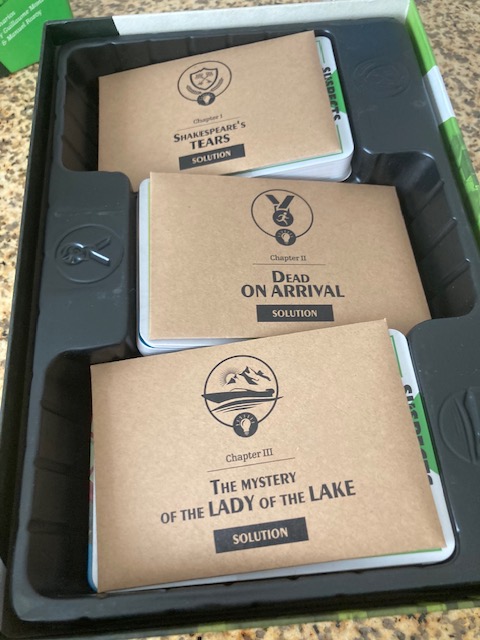
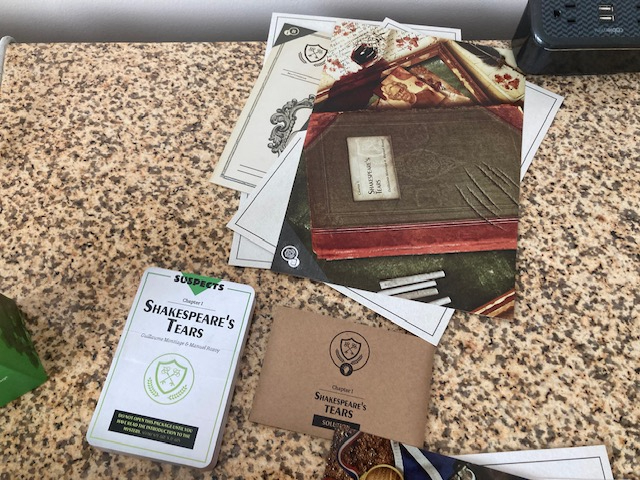
This is pretty much just like the “orange box” in term of contents: a rulebox, some large cards, and three separate decks of cards. See the water bottle for perspective.

IMG_0617

The rulebook is barely four pages, but it’s easy to read.

IMG_0612

IMG_0615

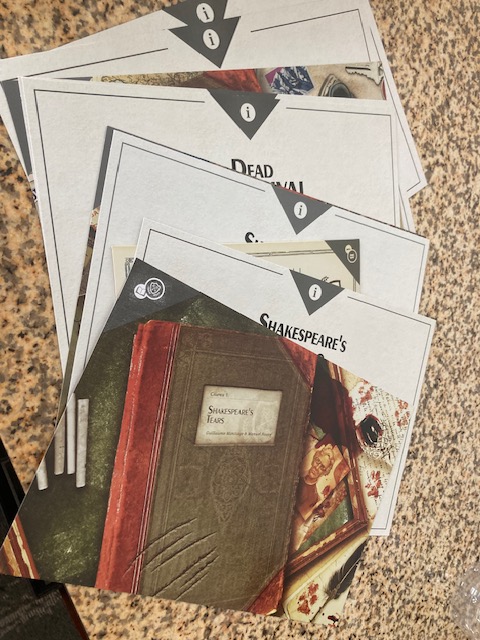
The large cardboard cards are all part of the three different cases that come in the game.

IMG_0616

But the core of the game are the the cards for the three cases, each in their own separate deck!

Like the original “orange box” Suspects, when you solve the mysteries, you are done with them forever. It’s kind of like watching a TV show mystery: you can watch the mystery again, but you already know the solution so it maybe less fun. Luckily, you can fully reset the three mysteries and give them to someone else! I originally gave my “orange box” of Suspects to Charlie and Allison after I played all the way through.

IMG_0619

The game looks really great! I love the art that comes with the game!

IMG_0629

The game has a very high production and looks great.

Gameplay

IMG_0628

The mystery is all in the cards  See above!  

IMG_0623

As you play, more and more cards come out which give a clearer and clearer picture of the mystery! The tension here is that your score is based on how many cards you look out, so the fewer cards that are revealed, the better your score! Honestly, in all my three games, we generally ignored the score and concentrated on solving the mystery .. because that’s the fun part!

IMG_0613

Solo Play: Shakespeare’s Tears (Mystery 1)

IMG_0621

So, this game plays great as a solo game: Thank you following Saunders’ Law and having a viable solo mode! The solo mode works without any modifications to the game. It’s just you as the investigative team!

IMG_0627

Over the course of an hour and a half, I lived in the world of the S. Elizabeth school and became embroiled in a murder there! I lost track of time as I became immersed in the game play!

IMG_0624

I really felt like I had just become directly involved in one of my BBC Murder Mysteries! There was a clear arc, there was exploration, there was thought, there was deduction … there was fun! I had an absolute blast playing the first mystery by myself. It may rank as one of my favorite gaming sessions of the year, as I was so immersed in the mystery!

IMG_0614

Fantastic time: 9.5/10 soloing this first mystery!

Cooperative Play: Dead on Arrival (Mystery 2)

Interestingly, Dead on Arrival did not go nearly as well. Was it that it didn’t work for cooperative play? No (as we’ll see below), the real problem was that everyone in the game group was actually quite tired and there is a fair amount of tedious paperwork keeping track of certain movements.

123_1 (3)

Everyone was still involved as we played, but there was a significant amount of bookkeeping that could be described as tedious.

123_1 (2)

To help with the tedious bookkeeping, we “borrowed” a clear sheet from the Star Trek: Cryptic Escape Room game: this allowed us to do the bookkeeping without messing up the original sheets in the game (using clear sheet and dry-erase markers).

123_1 (1)

I ended up getting most of the answer myself, but I couldn’t convince my friends, so they ended spending another 15 minutes trying to double-check the bookkeeping.

In the end, everyone had fun, but the conclusion was “Don’t attempt a Murder Mystery Game when you are really tired!!” I do think the tedious bookkeeping in this Mystery was more than I’ve seen in other mysteries, so that detracted a little from the game. 7.0/10.0

Cooperative Play: The Mystery of the Lady of the Lake (Mystery 3)

IMG_0926

Cooperative play in the final mystery went over like gang-busters! As a group of 4, we had so much fun following clues, conjecturing solutions, and playing the game!

IMG_0925

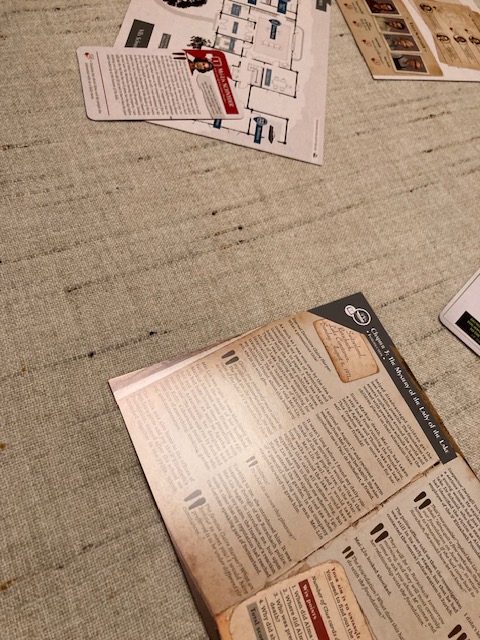
The cooperative play really emerged in this mystery: play rotated around the table as we conjectured and explored! We were all engaged the entire time! We honed in on different alibis and why they worked or failed! This was a truly engaging cooperative play!

IMG_0923

This experience was a 9.0/10.0. My only complaint was that I think you needed a lot more cards revealed to really get the mystery than previous mysteries: I am not sure you could even hope to get the whole thing and still get a perfect score.

Thoughts

IMG_0620

Ignore the scoring system for the most part: just enjoy the mystery. The scoring system gives you a way to keep track of how far you are, but mysteries 2 and 3 both felt like there’s no way you could get a perfect score. Don’t obsess on the score: enjoy the mystery!

IMG_0920

One thing to note is that the mystery is constrained by the cards: you can only follow where the cards lead you. Some “purists” might think this makes the Suspects mysteries more “on rails”, as you can only follow where the rails (the cards) lead you. Those of you who want a more “open world” to solve your mystery should consider some of the games on the Top 10 Cooperative Detetctive Games like Sherlock Holmes: Consulting Detective or Mythos Tales. These games have a more open world where you can truly explore, but that does make it easier to get off track. Both the strength and weakness of Suspects is that the mystery is constrained to a 90 – 120 minute adventure.

Conclusion

IMG_0921

Why watch a mystery when you can play it? Suspects has the just the right amount of mystery and the right amount of constraint for a 90 minute (solo) or two hour (cooperative) mystery game! If you want an open world mystery, Suspects may not be right for you, but it gives such great mysteries in a constrained format!

We loved Suspects (the green box) both solo and cooperatively: Averaging the scores of 9.5, 7, and 9 gives about an 8.5/10 overall for Suspects (the green box), aka Suspects: Eternal Detective Claire Harper! Fantastic game.

Daredevil Saves The World! A Slightly Askew Review of UnMatched Adventures: Tales To Amaze

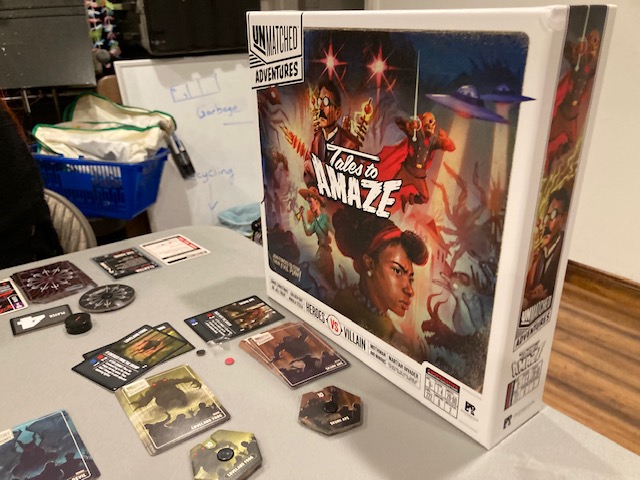
I have really been looking forward to Unmatched Adventures: Tales to Amaze! It promised delivery in Aug 2023, but it arrived at my house sometime the week of October 15th: I think I was literally the last person of the Kickstarter to get it, because I already see it In Stock at places like Miniatures Market and GameNerdz. But I am not bitter. Really. I’m not!

IMG_0971

I have been excited to get this because it adds a cooperative and solo mode to Unmatched: a very head-to-head skirmish game for 2 people (and 4 people if you squint, but the base UnMatched is really a 2-Player game).

IMG_1073

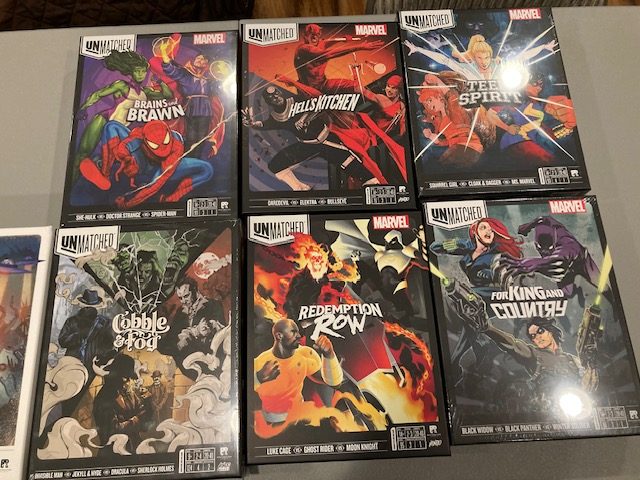
I have been SO EXCITED for the coming of Unmatched Adventures, that I have been buying Unmatched sets so I can have a wide variety of the characters! If you look closely (above), you’ll see I have all the Marvel sets (I love Superheroes: see our Top 10 Cooperative Superhero Games) and Cobble and Fog with Sherlock Holmes (I love Detectives: see our Top 10 Cooperative Detective Games). Honestly, I have been prepping for this day all year!!

UnMatched: Me vs Me

IMG_9770

So, you have to understand, neither me nor my friends like skirmish and/or head-to-head games. None of my friends play Magic (well, Mark does) or any games of that ilk. Dice Throne is the closest thing to my friends like head-to-head games, but even then we prefer to play with the Dice Throne Adventures module which makes the game cooperative! See our Review of Dice Throne Adventures base game here and Dice Throne Adventures with Marvel characters here!

IMG_9772

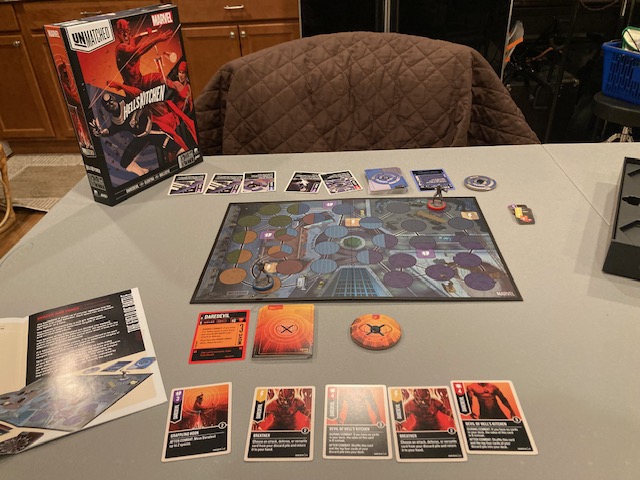
I’ve had a lot of these UnMatched sets for months, and no one (including me) was really interested in play them. I finally broke down one day and opened up Hell’s Kitchen so I could be ready to play UnMatched Adventures with Daredevil!

IMG_9775

My first UnMatched game was a me vs me game of Daredevil vs. Bullseye. I basically alternated between the two characters, switching positions as I played. I kind of “pretended” I didn’t know what the other side would do (our Changing Perspectives Idea), and got through a couple of games to learn the mechanics.

IMG_9781

UnMatched is a quick head-to-head game where you move around a board and fight, spoiling each others turns with great moves and great cardplay! It’s a back-and-forth game that’s over quickly: each game seems to be about 20-30 minutes in my experience. Bullseye won the first round, but I think Daredevil is harder to play well. We’ll see this again later …

First Battle

IMG_0977

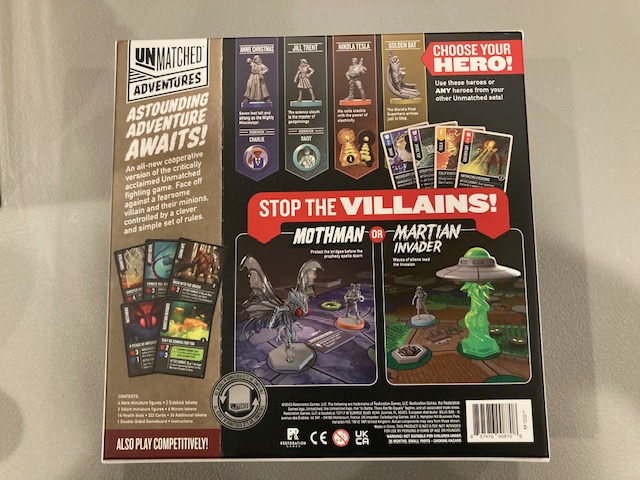
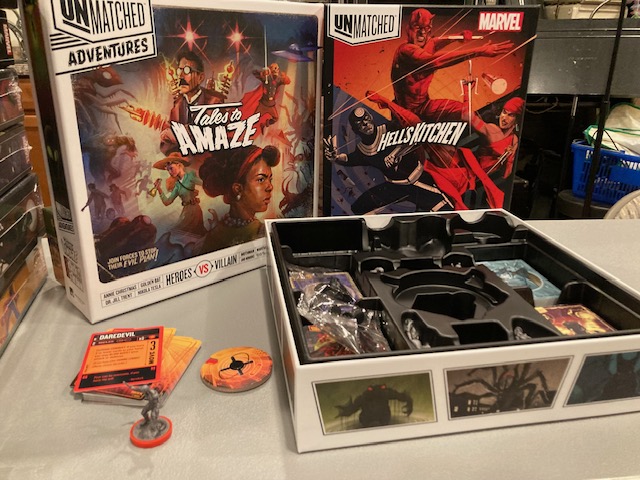
Unmatched Adventures: Tales to Amaze comes with four characters you can play: Tesla, Golden Bat, Dr. Jill Trent, and Christmas Annie. Nope. I chose to play with Daredevil for my first game!

IMG_1008

Why? I have literally no emotional attachment to any of the characters in the base box! But Daredevil? Bullseye? Electra? I was collecting comic books when Frank Miller did his run on first run on Daredevil, then his Electra stories, and Daredevil Born Again! Then later when Mark Waid took up the writing, I fell in love with Daredevil again! Just about the the entire reason I got UnMatched Adventures was to play Daredevil in a solo or cooperative adventure! Remember, me and my friends don’t like head-to-head games!

IMG_0979

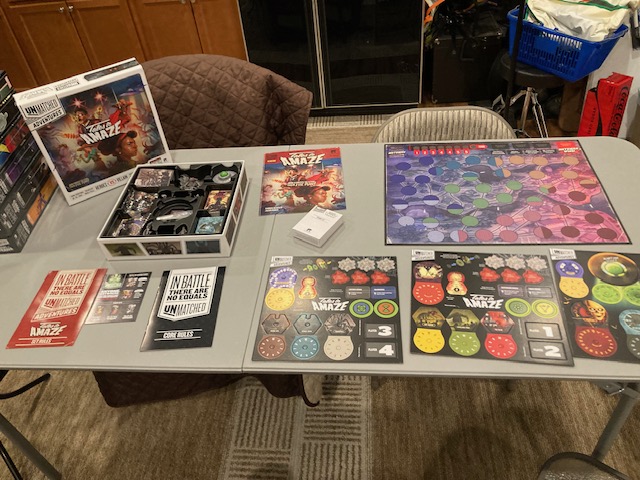
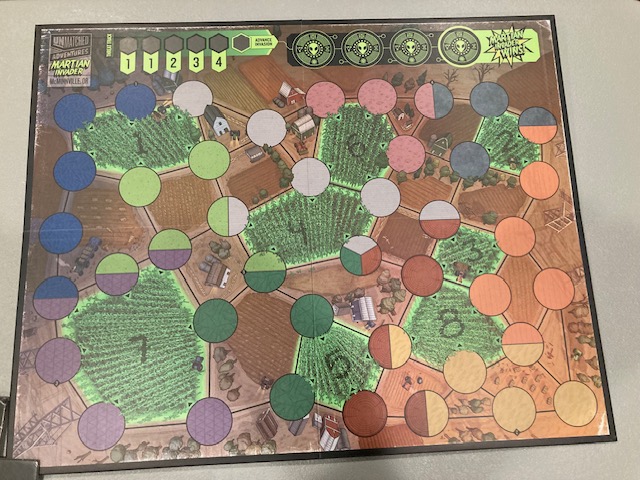
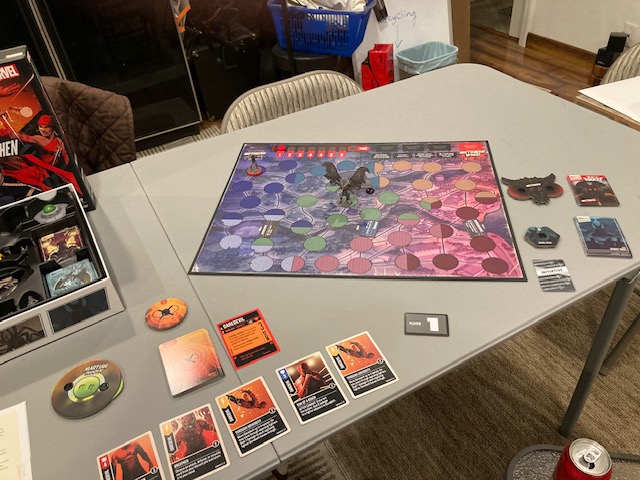
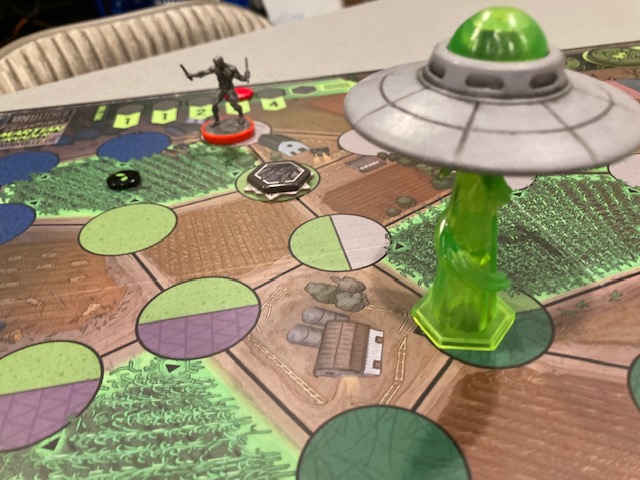
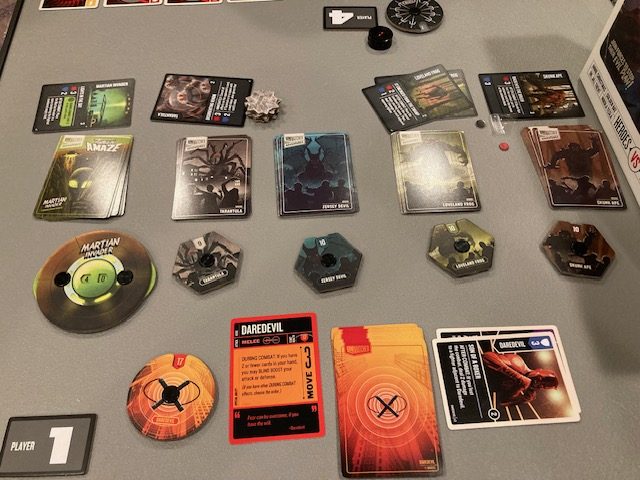
Included with the game are two scenarios: Mothman (see map above) …

IMG_0978

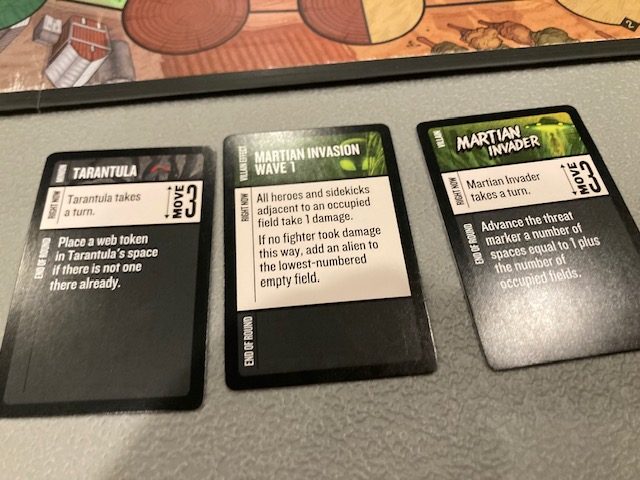
.. and Martian Invaders (other side of the map).

IMG_1030

Daredevil is a solo hero! It makes sense that he will take on the Mothman by himself!

Solo Play

IMG_1061

So, congratulations to UnMatched Adventures for following Saunders’ Law and having a viable solo mode! And it is a true solo mode, where the solo player plays exactly one hero! To keep the play balanced with any number of heroes, UnMatched Adventures changes the scaling for solo mode in two ways.

IMG_1049

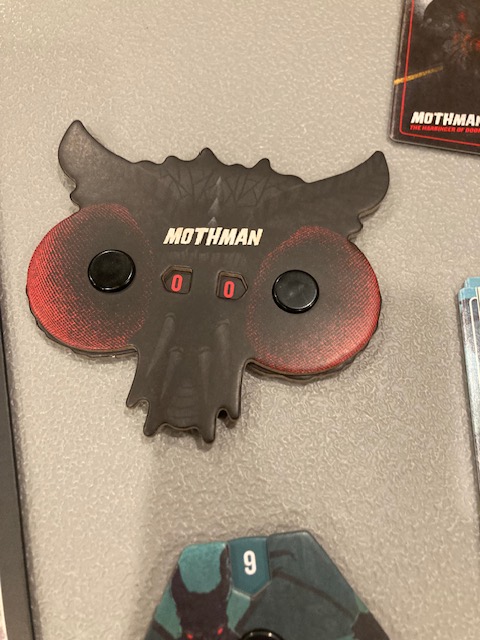
First: The hit points for the main Villain scales by the number of heroes. In this case, Mothman has 10 x (the number of heroes) = 10 x 1 = 10 hit points to start the game. The more heroes there are, the more hit points the Villain has! See Mothman’s hit point dial above (should be 10).

IMG_1064

Second: the number of Minions that help the main Villain are the same as the number of Heroes.  So, see above as the Tarantula minion (just one Minion for a one player game) helps the main villain!  The more Heroes there are, the more Minions there are!

IMG_1058

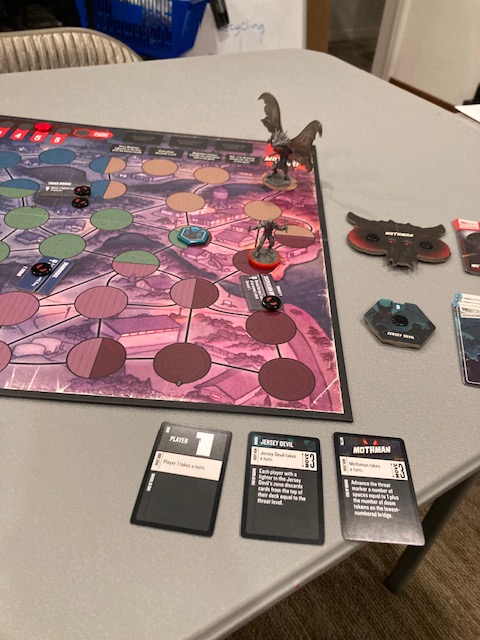
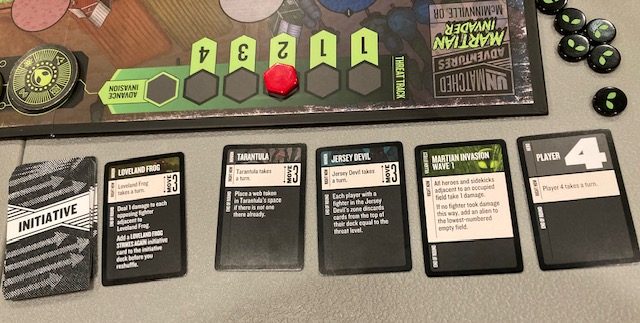
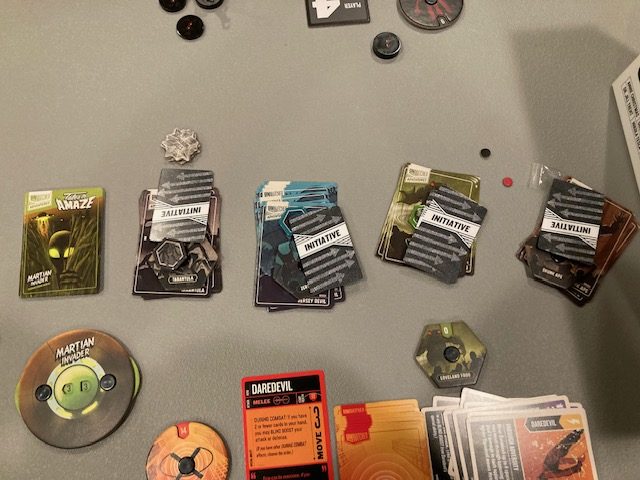
This all fits together as the players have an initiative deck with one of each Hero, Villain, and Minion. This deck will be shuffled every round to determine the player order for that round.

IMG_1048

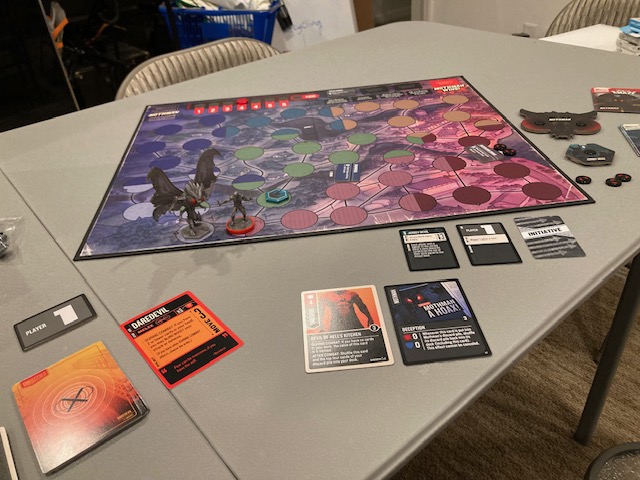
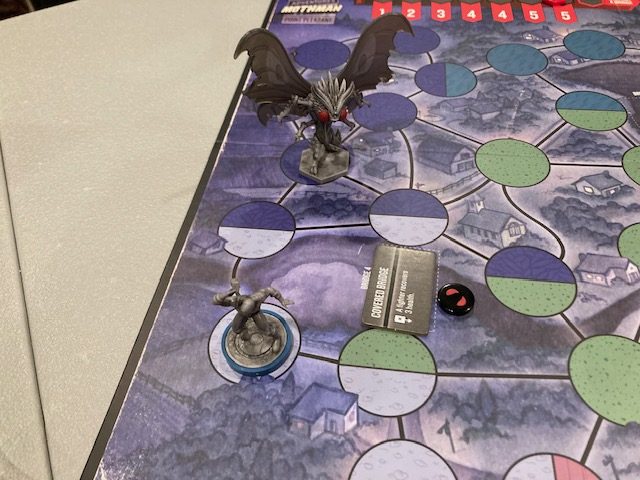
Each scenario has a very different objective and set-up: see above as Daredevil plays in the world of Mothman! He has to keep the bridges from being destroyed! The win condition is generally always the same: take the main Villain to 0 hit points!

IMG_1045

My first few solo games went south very quick. I was surprised how quickly the game played and how quickly I lost! I did remember that Daredevil was a little harder to play because of the way his deck works, so I played a few games as Bullseye to gain some confidence that the game can be beaten!

IMG_1056

After a few games with Bullseye, I was able finally to beat the Mothman. One thing to note: it was very easy to play multiple games back-to-back because the game moves so quickly! It’s typically over in about 20 minutes! I retackled Mothman with Daredevil and was finally able to beat him!

IMG_1039

I liked that this game was hard to beat out-of-the box. I had to play 5 or 6 games before I finally figured out a winning strategy, especially with Daredevil (who’s a little harder to play).

IMG_1063

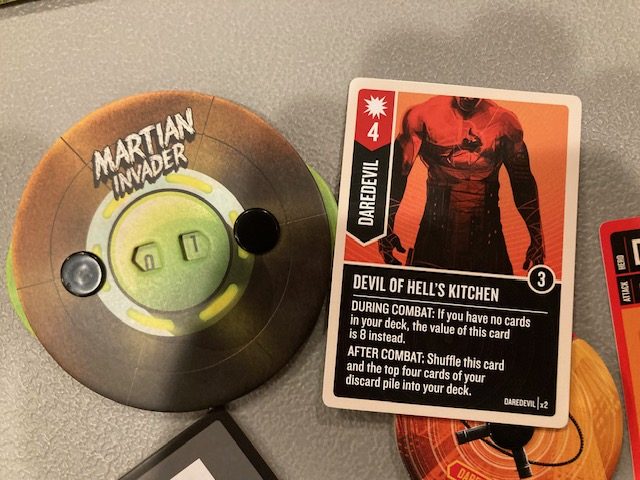
I then launched Daredevil into a solo game with The Martian Invader (see above) and Tarantula and did much better!

In case you were worried, Daredevil did save the world. Twice! I mean, that’s the name of this story: “Daredevil saves the World!

Cooperative Play

IMG_1109

So, I think the time on the side of the box is not quite right: it says 20-60 minutes.  I really feel like the solo game is 20 minutes, so that’s right.  But the cooperative game, since it scales by the number of players, should be 20 minutes per player! That more jibes with what we saw in our cooperative plays: “about 20-30 minutes per player”.   Our 4-Player game (see above) took about 2 hours.

IMG_1113

I will say that I think this game is much stronger as a cooperative game than a solo game for a bunch of reasons.  

IMG_1119

First of all, all the randomness we saw in the solo game seemed to be “smoothed out” more in the cooperative game!  This makes sense as more cards and more players just makes the game seem less punishing: the “randomness” we saw in the solo game was distributed over multiple good guys and bad guys, so the game felt less punishing.

IMG_1115

There was also a lot of cooperation where we had to keep the Alien Fields under control: we talked a lot about “who would take the hit” (someone typically needs to discard a card when the Martians attack), but we also collaborated as to when we take the damage so the next person can clean up!  Such a simple combat system made this easy to talk and think about our strategy!

IMG_1120

We also seemed to just have fun playing: see Sara and Teresa smiling as we play!  This is a fun but kinda silly game with Martians invading.  The game is simple enough that we don’t get stuck in the rules, but each player has enough “unique mechanisms” that each player feels “unique” and “involved” as we play.

IMG_1123

In one cooperative game, in the final turns in the Martian Invader game just had us barely defeating the Martian Invader!  Daredevil got to play his “smart bomb” and do 8 damage on the penultimate turn to bring the win within reach!  It was a fantastic moment! The Electra crushed the final Martian with the Hand and we won!

IMG_1121

I think this game is much stronger as a cooperative game than a solo game: It really does keep everyone involved and feeling unique, but with simple enough rules to keep the game flowing.

Zero Emotional Attachment

IMG_0996

This gorgeous game comes with 4 Heroes I don’t think I’ll ever play. I have literally zero emotional attachment to any of them: Tesla was kind of a jerk, and I’ve never heard of the Golden Bat, Jill Trent, or Annie Christmas. Are they made up? As of right now, all of the base hero cards of UnMatched Adventures are still in shrink wrap. I am looking forward to trying out Cloak and Dagger, Ghost Rider, Spiderman, Dr. Strange, She-Hulk, Sherlock Holmes … ! I’d literally rather play a hero from any other UnMatched set than what’s included in UnMatched Adventures. The new heroes may be fantastic, but I just don’t have any emotional attachment to them the way I do every other character in UnMatched! ( I do admit, I might try Golden Bat, but only because he’s a Superhero).

IMG_0989

I feel bad saying this, but I wish UnMatched Adventures came with 4 solo/cooperative Scenarios and no new heroes rather than 2 solo/cooperative Scenarios and 4 new heroes. I’d rather have spent my money on new Scenarios! Hopefully, this set does well so we will get some more Scenarios on the future.

IMG_1109

Even in the cooperative game, when I gave everyone a chance to play “whomever they want”, we ended up playing Ghost Rider, Black Widow, Electra, and Daredevil.  Given a choice, I am not convinced people will ever want to play the heroes that come in the base box.

Having said that, I have heard that other people really do like the new Heroes. Caveat Emptor.

Setting Solo Expectations

IMG_1052

So, I was very disappointed in my first few solo games of UnMatched Adventures! They were over quickly and felt very random. I was depressed how random they were!

IMG_9777

And then I realized: this is how the head-to-head game feels! Players parry and feint and bluff and sometimes play devastating cards that destroy the opponent! If one player draws the right card at the right time, especially in the endgame, you can get completely devastated! It doesn’t feel random where you are playing head-to-head because it looks intentional: the other player plays cards on purpose. But the game looks random in head-to-head mode if you can’t see the other player! Cards come out “at random” and mess with you! So, that experience has been captured in the solo mode very well!

IMG_1074

I think I was a victim of my own expectations: I wanted a complex framework to play Daredevil through many of the Adventures in UnMatched Adventures! That’s not what this is! The solo mode still feels like UnMatched: it’s a quick game with quick turns, quick play, and sometimes devastating and seemingly random card play! And that’s what I saw over about many games in this universe : a quick game with seeming randomness. But it was fun once I set my expectations!

IMG_4182

We should actually be happy that the solo and cooperative game of UnMatched Adventures retain the quick feel of UnMatched! Recall that King of Monster Island (a cooperative game in the King of Tokyo Universe) was surprisingly more complicated than its competitive brethren King of Tokyo! See our Review here for more discussion! King of Monster Island was complicated enough that I had trouble recommending it to people would just wanted “a cooperative King of Tokyo“, because it was so much more!

IMG_1059

In our case, I can recommend UnMatched Adventures to people who just want “solo or cooperative UnMatched“. UnMatched Adventures is just a little more complicated, but it still retains the feel of the base game.

If I want a quick 20 minute solo game with one of my favorite Marvel heroes fighting Mothman or Martian Invaders, UnMatched Adventures offers a quick solo or cooperative romp!

IMG_1118

I do want to say that I did NOT have to lower my expectations for the cooperative game: UnMatched Adventures really knocked it out of the park (for cooperative play): it was quick, fun, engaging, simple, but still strategic.

Randomness

IMG_1037

There is a lot of randomness in this game: let’s be clear. You have no idea what cards the Villain/Minions will draw, you have no idea what order the characters will get to play (it’s a random shuffle every round), you have no idea what special tokens will be drawn, and you have no idea if your attack or defense will be cancelled! Like we said above, this is just par for the course for this UnMatched, and that’s okay.

IMG_1038

I would normally rage against this much randomness: recall how the randomness of the Trace rolls really downwardly influenced our rating of Tamashii: Chronicle of Ascend. (See our review here). The difference here is that UnMatched (and to a lesser extend, UnMatched Adventures) is a simple and quick game. If you get screwed by too much Randomness, oh well! It’s over quickly and you can play again! Tamashii was a 2-3 hour game where that extra spicy randomness could ruin a long and carefully planned game!

IMG_1114

I will also point out that the randomness I saw in the solo game was significantly less pronounced in the cooperative game: there was just fewer opportunities to be overwhelmed by a random draw because there so many cards (bad guy cards and initiative cards).

Random Initiative Order

IMG_1066

Just hear me out: I still hate the Random Initiative Order we see here (the Initiative Deck is reshuffled every round to re-order play), especially in the solo game. We’ve seen this same initiative mechanism in Aeon’s End and Adventure Tactics: see our discussion here in Seven House Rules for Cooperative Games. The problem is simply that the player(s) can get completely shut-out if the bad guys take all their turns at the end of a round and then start the beginning of the next round. For example, in a solo game, the solo player could have to wait 4 turns without being able to do anything … and meanwhile getting pummeled! ! It’s no fun, it feels unfair, and it can completely decimate the solo player.

One simple suggestion is to just keep the Initiative Order static so that they always come out in the same order. Another suggestion is to make it so the bad guys can never have more than 2 turns in a row: if the third turn would have the bad guys play, simply reshuffle until a player card is drawn.

IMG_1115

Having said that, the cooperative play did not seem to have this same problem: the pathologically bad Initiative draws are much less likely to happen the more cards you have! So, as we played cooperatively, it just seemed like we never saw ourselves get completely screwed! Even if one character got beat up, there were still enough characters around to keep the game going.

Said another way, I think the solo game needs a mechanism to keep the Initiative cards from having pathologically bad draws, but I think the cooperative game has enough cards to mitigate this effect without needing anything special.

Conclusion

IMG_0996

UnMatched Adventures is a gorgeous production with amazing minis, amazing components, good rulebooks, and a really good insert that holds everything. The production is outstanding and it is a sight to behold: see above.

IMG_0966

Would I recommend buying UnMatched Adventures by itself if you just want the solo/cooperative game? I don’t know? For the solo game, probably not, at least without a few fixes (see our discussions above about the Initiative deck). The solo game is pretty good, but you need to set your expectations a little. On the other hand, the cooperative game was fantastic out-of-the-box and we had so much fun playing! I would strongly recommend the game for the cooperative experience!

IMG_1116

Unfortunately, neither me nor my friends had any emotional attachment to any characters that come in the box, so I would recommend picking up an UnMatched set where you like the characters (Cobble and Fog, Hell’s Kitchen, etc) if you want to play in this universe. I really wish UnMatched Adventures had contained 4 solo/cooperative Scenarios (instead of just the 2 Scenarios and the 4 new Heroes), but I suppose it would be too hard to sell just an expansion without any Heroes (although, technically Dice Throne Adventures did and it worked just fine).

IMG_1074

Just make sure you set your expectation to what this is: the solo game game is a quick and furious game of UnMatched, but the cooperative game really shines! This game can still be pretty random, but that’s okay for a fun-filled romp of 20-60 minutes (well, realistically 20-30 minutes per player)! Once I set my expectations, I enjoyed it much more. UnMatched Adventures: Tales To Amaze takes UnMatched and makes it solo/cooperative without giving up the spirit and feel of the game.

IMG_1052

This wasn’t quite what I expected, but it was still fun. Objectively, this is probably a 9/10 for the cooperative game, but I may just call it a 7/10 for the solo game. But I still had fun!

A Review of Earthborne Rangers: A Cooperative 4x game … eXplore, eXplore, eXplore, and eXplore

IMG_0647

Earthborne Rangers is a cooperative exploration game for 1-4 players: it uses a deck-advancement as a main mechanism (see more discussion below). I was super excited to get my copy, as Earthborne Rangers made the #7 position of my Top 10 Anticipated Cooperative Games of 2022! This game was on Kickstarter back in August 2021 and promised delivery in July 2022. It delivered to my house in late October 2023, so that makes it a year and a few months late. Interestingly, this game has a different reason for being late than most Kickstarters …

IMG_0659

To quote the Kickstarter page:

Earthborne Rangers: A sustainably produced customizable, cooperative card game set in the wilderness of the far future for 1 – 4 players.

You’ll notice the game has no plastic! It’s all paper! One of the loftier goals of the Kickstarter was to try to make a game locally, using sustainable components (i.e., all paper, no plastic). The Kickstarter was very good at keeping the backers up-to-date, but they struggled to find manufacturing that was both local and purely sustainable. A few compromises were made (see the Kickstarter updates), so that contributed to the lateness of delivery. This is one of the few “really late” games I think I can forgive because they encountered “unique” manufacturing problems.
IMG_0649

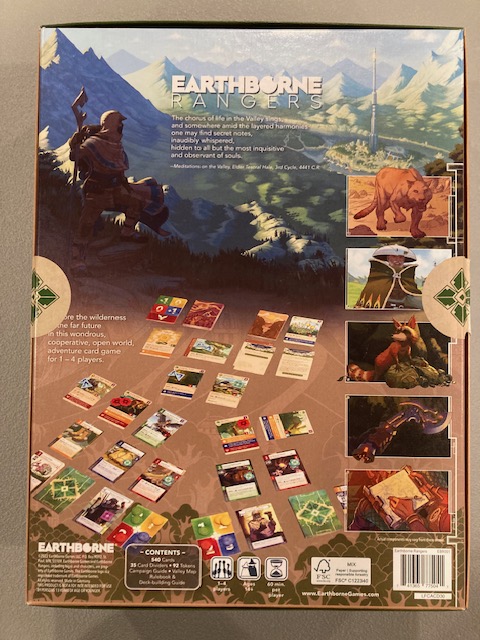
As you can see by the back of the box, the game looks gorgeous! It looks like they did a pretty good job!

Before We Begin
IMG_0800

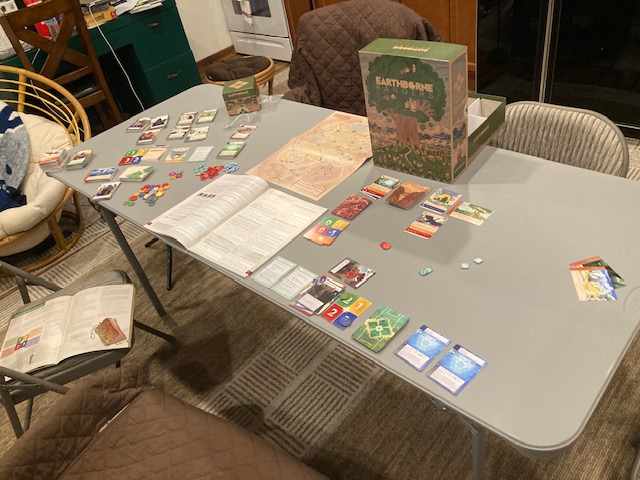
Before we begin, we just want to say: we like this game.  We are saying that because there is a rocky road ahead!  We will have to get grumpy at a few things in the game! We will have to give warnings and helpful tips to keep you on-track, and they might even sound bad.  We are trying to help you navigate around the game so you can get the best experience!  There are just enough things that could derail you from wanting to play, but with a little forewarning, you can avoid the pitfalls.  So, be on the lookout for our warnings and helpful hints!  Remember, we like this game!

Basic Unboxing and a Warning!

IMG_0645

The Kickstarter version comes with an extra box (more cards to make the deck-building have more choices) and a VERY IMPORTANT envelope!

IMG_0651

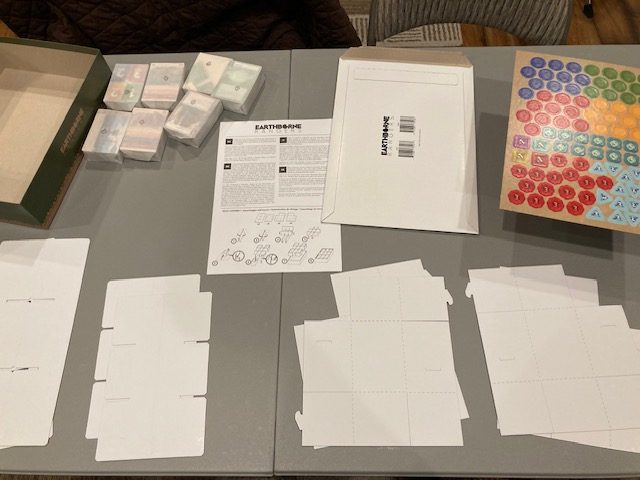
The envelope contains some components that (ahem) either were missing or were printed wrong. Make sure you get this envelope if you get the game new! (I suspect this will be fixed if they do a second printing).

IMG_0652

Basically, the cardholder from the base box (all cardboard, no plastic) is missing several sheets and the punchouts from the base box are misprinted. Really, the punchout misprint is just that they don’t have 3s on the other side: you could probably work with the base, but you might run out of counters. (You can also just punch it out to have more tokens).

IMG_0668

A bigger problem is that you really need the cardholder: this game is all about the cards!
IMG_0674

Base box components on the left, envelope contents on the right.
IMG_0675

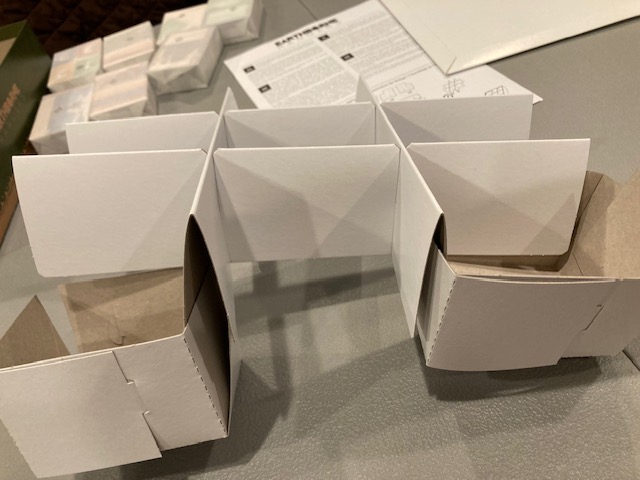
Honestly, building the little card holder was kind of fun.

IMG_0677

But let’s look inside the main box now!!
IMG_0660

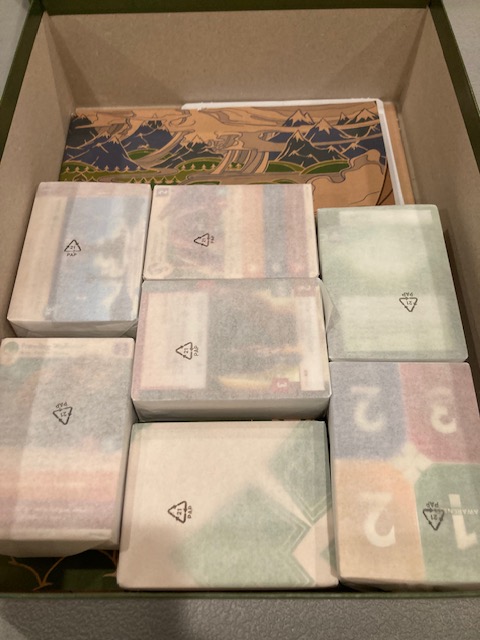
The main box contains mostly cards (540 according to the back of the box), a Campaign Box, a Rulebook, tokens, and a Valley Map.

IMG_0662

The Valley Guide (above) is a campaign/scenario book. There is a little bit of a “storybook” vibe going on here as the scenario book has text to read and decisions to make. See below for a snapshot of a page within the “Lure of the Valley” book.

In case you were worried there might not be enough content, the scenario book is 56 pages long! And the font is tiny, so there’s quite of bit of text.

IMG_0670

The rulebook is a big of a monster at 48 pages. We’ll discuss both of these books more below.
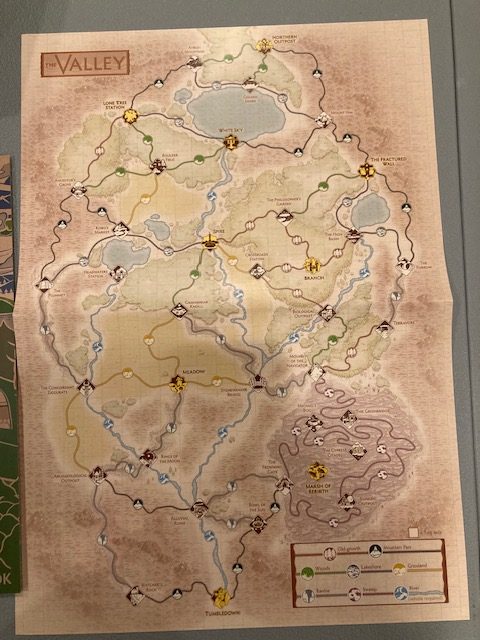
IMG_0669

The map shows the valley you are exploring! You will need this to figure out what terrains you will be traversing, what places are important, and where do you want to go! This map is quite important to the ongoing game.

IMG_0689 (1)

But of course, the showpiece of this game are the cards. They are gorgeous! I love the art!
IMG_0688

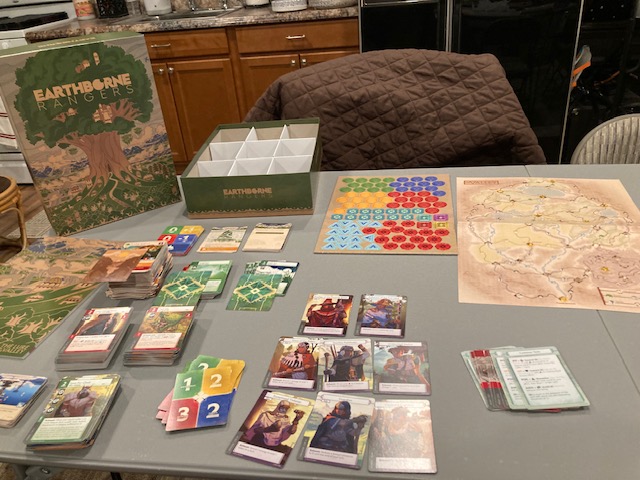
Overall, this game looks like it was worth the wait! Just make sure you get the envelope if you get the game new!

Uncarding and a STRONG Warning!

IMG_0661

One of first things I do when I get a game is to find the Components page (see below: page 6) and try to correlate all of the components to their picture. In this case, it was mostly cards.

IMG_0682

Many games aren’t labelled well (like this one *cough*), so you have kind of “immerse” yourself in the components to get a sense of the game/components/labelling. The picture that comes on page 6 seems great! … but seems is the important word!!! GIANT WARNING COMING!

IMG_0689 (1)

I initially tried to match the cards exactly to the picture on the components page: Warning!! BE VERY CAREFUL! The Components page really doesn’t note that cards are grouped by “sets”, and as you go through trying to correlate the components picture to the cards, you may lose track of cards and what sets they belong to!

IMG_0687

For example, notice the Traveller cards above have both Gear and Moments cards in them (see above), but if you tried to sort the cards by Moment cards and Gear cards (as implied by the Components page), you’d really mess up your decks! Keep the sets together! In this case, keep all the Traveller cards together.
IMG_0686

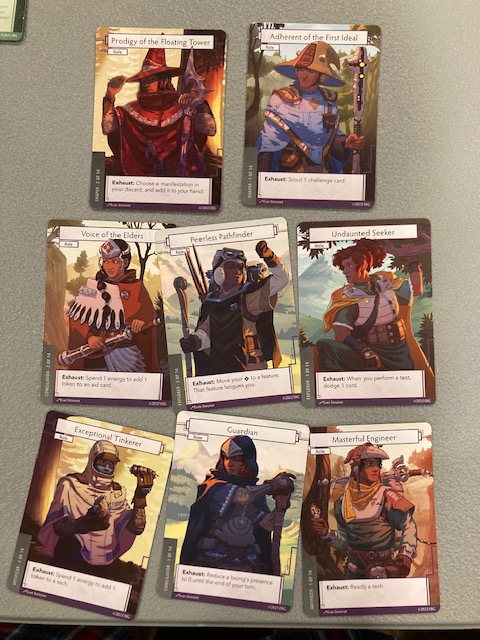
Similarly, the role cards seem belong together according to the Components page. . Nope! Each role should stay in in respective Specialty deck (Explorer, Shaper, etc).
IMG_0754

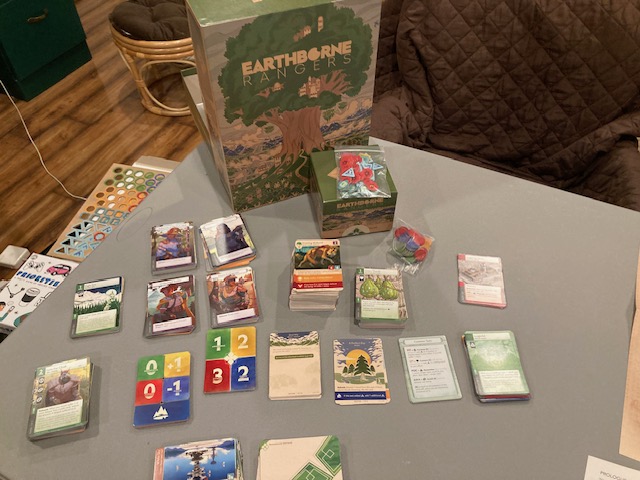
Don’t let the Components page fool you. Try to keep the decks sorted by the set (labelled on the left side of the card). I was very grumpy when I realized that although the Components page is “technically” correct in how it counts cards, but it’s NOT how you will store or play with cards.

IMG_0803

The Card Dividers are probably a better way to help you uncard your game. Try to use those (as they are labelled in the appropriate sets), and just use Components page as a guide to what the “kinds” of cards are contained within the game. I’ve never had an uncarding make me so grumpy.

Rulebook and a Helpful Tip!

IMG_0670

This is a good rulebook generally. I think it could have done better in a few places, but generally it was good.

IMG_0678

The game gets an A- on The Chair Test, it flops over the edges a little, so it almost got a B+, but the font is huge! The sections are well-labelled and colorful ! I could easily see the rules next to me as I was playing, and it was easy to page through: solid A-.
IMG_0679

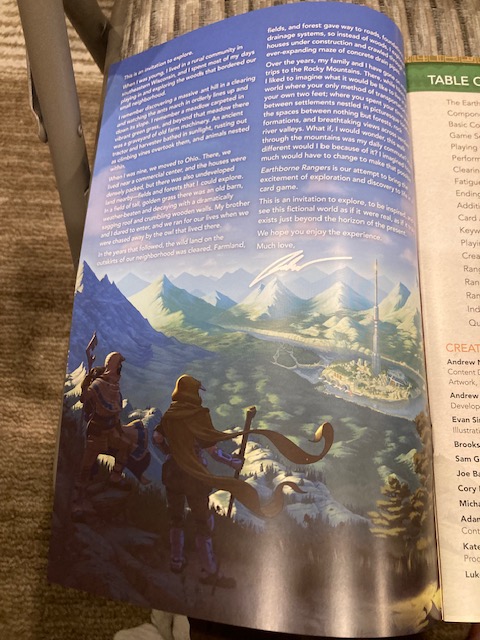
I don’t normally talk too much about the Introduction, but it was pretty heartfelt. It gave me a strong sense of “Hey, these folk really like exploration” and gave me a sense of confidence that maybe they would get exploration right in the game!
IMG_0680

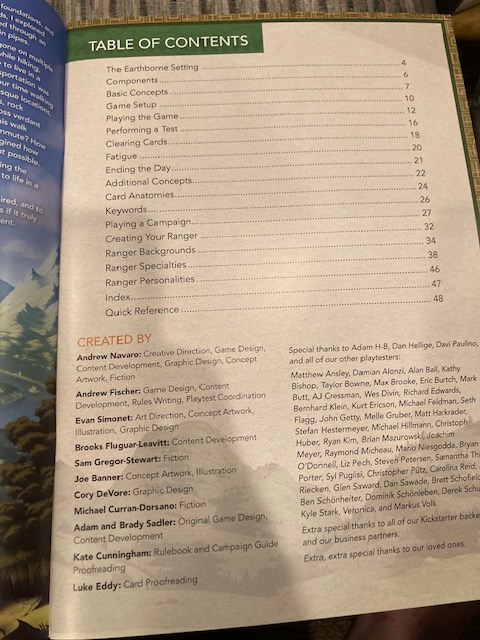
This game has both a good Table of Contents (sections in order they appear) and an Index (keywords sorted in alphabetical order with a reference to a page number). Thank you! The Index saved me from searching the rulebook a number of times. See picture below.

IMG_0672

The font is big, the sections are well-laid out, and there seem to be a lot of pictures.

There’s even a few good, BIG examples that helped me get through a couple of rules.
IMG_0761

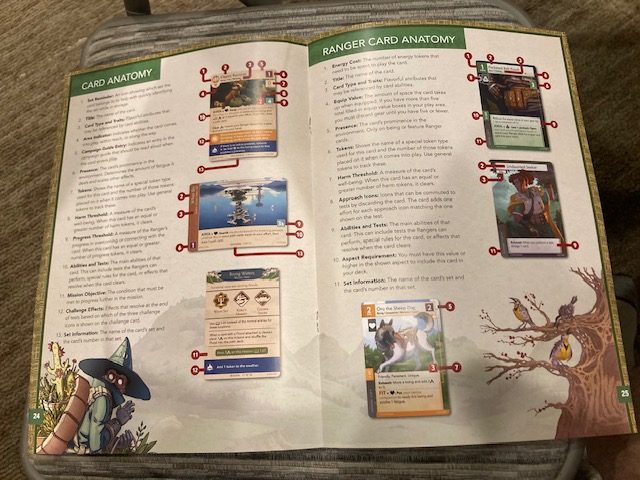
My biggest complaint is that Card Anatomy cards didn’t come until halfway through the rules! (Right where the staple is! When you read a lot of rulebooks, you tend to notice stupid things like where the staple is). I wish this picture had been further up, maybe right after or before the Components! This page, once I found it, helped me understand a lot more of the game! Helpful Tip! Find the Card Anatomy pages (24 and 25) to help you understand the rules!

IMG_0762

The rulebook does a lot of stuff right, but it looks more dauntingly long (48 pages). At page 33, however, the rules end the “detailed card explanations happen” … so the rules aren’t THAT long. Well, I guess 33 pages of rules is still pretty long.
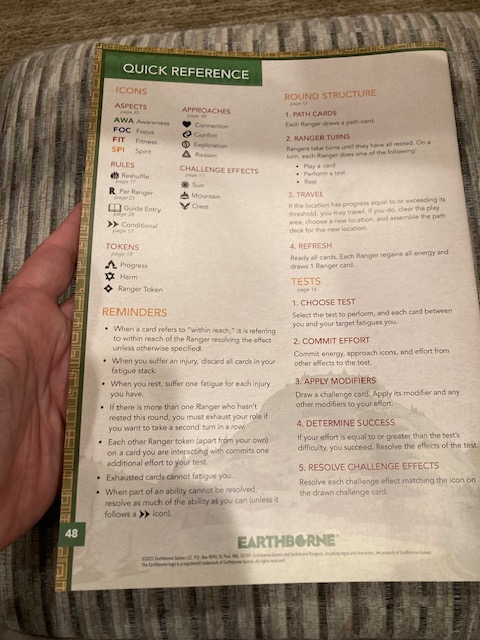
IMG_0706

And the rules end with a nice reference on the back.

Seriously, this is a good rulebook: I would call it great except for the problems with the Components page (see previous section on Uncarding) and having the Card Anatomy later in the rulebook. But, the big font, the great layout, the clean pictures, the well-chosen colors, the decent examples, the good Table of Contents, and great Index make this is a good rulebook.

It is a big long. It might take a you a while to read it. And you need to read the rules. Really.

The Prologue: A Missed Opportunity and a Helpful Tip
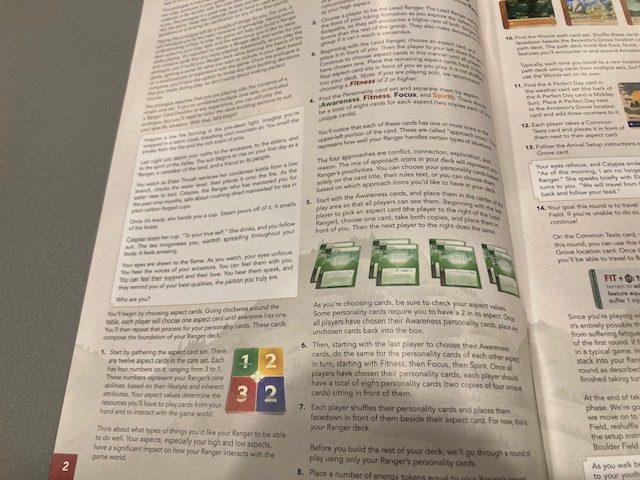
IMG_0757

Earthborne Rangers includes a Prologue for first play at the start of the Scenario Book. See above.
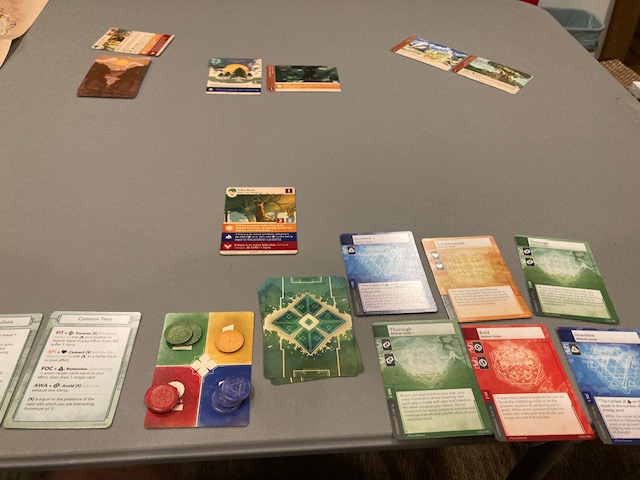
IMG_0776

Unfortunately, there were a lot of problems with it. First, the prologue still requires you to read the entire rulebook … wait, what? I loved how Tamashii (see our review from a few weeks ago) stepped your through the rules as you played: you didn’t have to read the rules all at once … the Prologue sort of “guided” you through the rules. Nope, not Earthborne Ranger. You still have to read all the rules before you play the Prologue!

IMG_0724

Secondly, the font for the Scenario book (where the Prologue resides) was way too too small! It was so hard to read and follow the directions of Prologue! And this was after the rulebook was so readable with a big font! I really struggled reading this tiny font! I don’t mind this tiny font for the Scenario book “story parts”: you read the story parts once out loud to people. But a tiny font is terrible for rules: you have to set down the rulebook pick it up, lose your place, reference the rules again. That tiny font made me very grumpy: please don’t use tiny fonts for rules!

IMG_0757

Third, the gameplay in the Prologue was poorly described and documented. Many times, it was unclear where you were within a turn (“Wait, did I Refresh? Was I supposed to Travel?”). Because this was a an “abbreviated” version of the game, some rules weren’t there yet, other were, and the turn placement was underspecified. The main problem was that the Prologue was that there were too many “exceptions” from the basic flow of the game: “Wait, is that a rule because I am playing the Prologue and not the main game? What does the main game do?

IMG_0779

After two tries, I got through the Prologue, but I think newcomers should should go ahead and play through the main game normally. This is a huge missed opportunity and a potential turn-off: I think a lot of newer gamers will be completely put-off by this Prologue and not want to play again. The Prologue should have been a way to introduce people to the game! Spoiler: this is a good game! The Prologue just didn’t work. It’s unfortunate, because a Prologue should make me want to play the game! Consider Tainted Grail’s amazing introduction (see here), or Valor and Villainy: LLiudwick’s Labyrinth phenomenal introduction (see here), or even Tamashii: Chronicle of Ascend’s introduction (see here) as examples of good prologues! Earthborne Rangers’ Prologue turned me off: Too many exceptions to the rules, poorly documented gameplay status, tiny font, and still required full reading of the rules.

Helpful Tip: Just read the rules and play a normal game. You’ll struggle a little, but it’s better to struggle with the real rules and real gameplay than to struggle with a Prologue and its abbreviated/incomplete rules.

Gameplay

IMG_0781

This is generally an exploration game. You have to explore this world and “do things” in this world. But what you have to do varies from game to game! Sometimes, you’ll be trying to find stuff, sometimes you’ll want to travel, and sometimes you’ll befriend creatures, sometimes other stuff! That’s what so interesting about this game: you are exploring this world, but that means many things! Discovering new Locations! New Gear! New items! New creatures! It’s all about exploration. Earthborne Rangers has a little bit of an “open world” video game feel to it.

IMG_0805

Now, I’ve called this game a deck-building game, but it’s really more of a deck-advancement game. We first used that term (deck-advancement) back in our review of Adventure Tactics (see here).   Basically, this means your deck is fairly static in the game: new cards only come into your deck at the end of a complete game session (“a day”), and only then available for the next distinct play session.

IMG_0837

See above as the Quiet card comes into my hand as a reward.  I guess strictly speaking this “could” be a deck-building game because you may choose to swap some newer reward cards during the Camping phase … so, you can “deck-build”, but it’s so much slower! In a normal deck-builder game, you generally get one new card every turn. Here in Earthborne Rangers, you might some new cards every tenth turn (when you get a reward). So, it’s probably better to call this a deck-advancement game with a trickle of deck-building.
IMG_0830

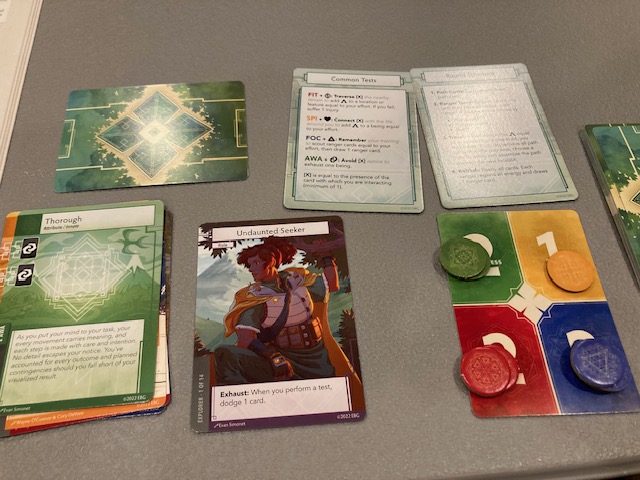
Another interesting feature is that the deck is your stamina: kind of like Gloomhaven!  As you play cards or suffer ill effects, you place cards either in discard stack (where they can’t generally come back: see left of role card) or fatigue deck (where you can soothe to bring them back, see above discard).  If you are ever instructed to remove fatigue and you can’t (because your deck is empty), then the day must end.  The deck is your stamina!
IMG_0827

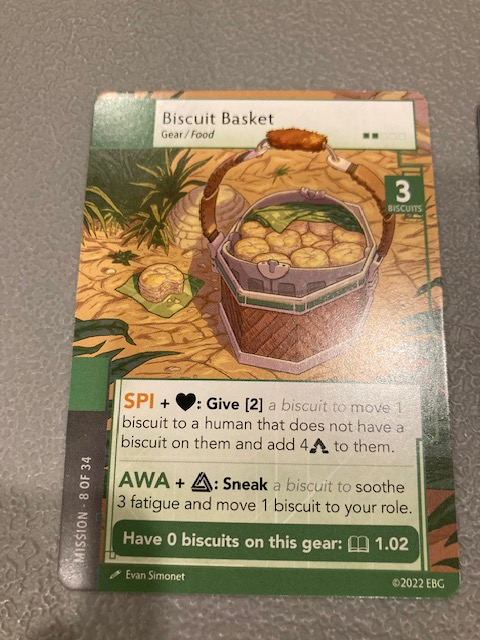
You get rewards in the game as you encounter when you succeed at missions you take in.  One of my missions in an early game was to deliver biscuits!

IMG_0823

Most obstacles in the game (befriend, fight, climb, run, anything) are overcome by doing a test.  For the Harvest test (above), I have to spend at least 1 AWAreness, and (REASON: the triangle) and get at least two successes to succeed.  The AWAreness can come usually only come from your Aspect card.  The REASON can come from discarding any cards.

IMG_0776

You can see the two green AWAness energy tokens on my Aspect card (above).  In my hand next to it, I have several cards, with a few (blue cards) having the REASON triangle (in the upper left corner). 
IMG_0780

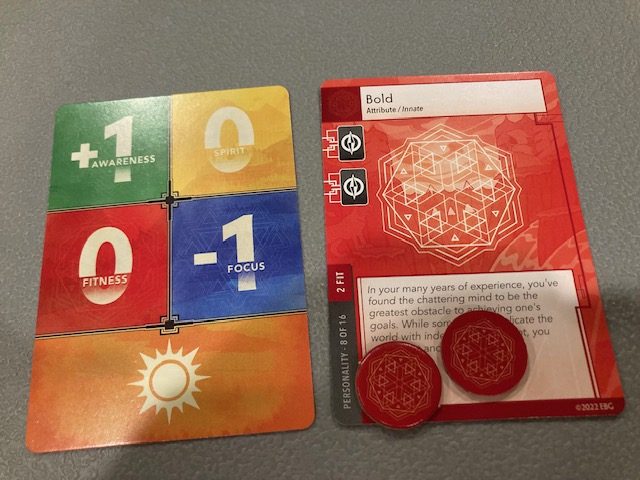
Once I choose what to commit (cards and tokens), I draw a Challenge Card (above, left).  The +1, 0, 0, -1 modify the result depending on whether on the type of test.  My AWA test would get +1, but a FOCus based test would get -1!  So, if you can equal or beat the challenge level (usually 1, but sometimes harder), you succeed!  Every point over may allow you “more success”, which may equate to more tokens/successes/traverses/harms on a card.

I like this mechanism because it’s not too random: you can still take a chance and hope to get lucky, but you always have a pretty good sense of whether or not your test will succeed or fail.  Do you want to push your luck and use fewer tokens/cards? Or do you want to go for it? Since your cards are your stamina, it is useful to preserve them …
IMG_0838

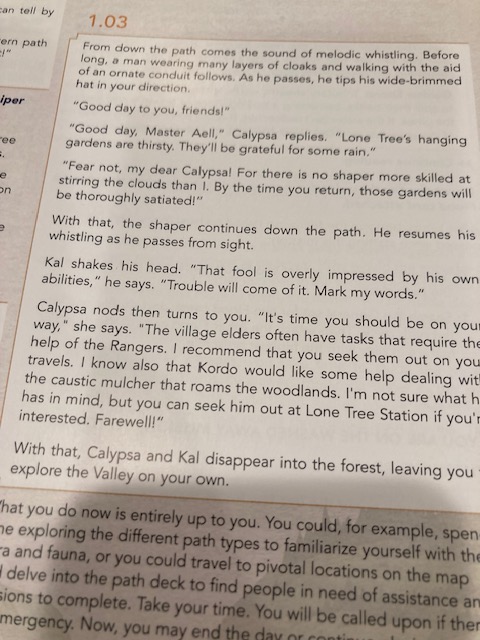
So, you go around the board, exploring, moving around the map, doing challenges, and occasionally reading from the Story book.  

IMG_0828

It’s an open-world video game! In card form!

Paper or Plastic?

IMG_0685

So, the game’s production really embraces the no plastic/only paper vibe! The cards come wrapped not in plastic, but paper!
IMG_0650

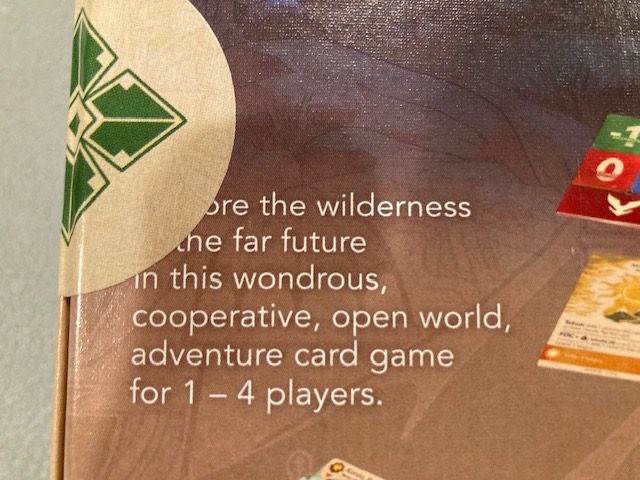
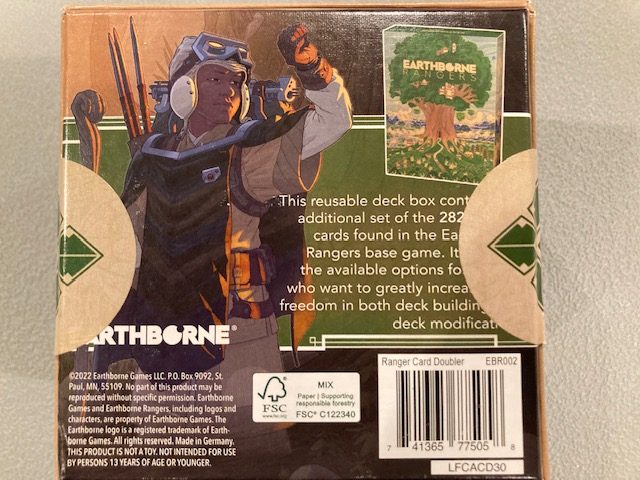
There’s no plastic on the outside of the box, only stickers (see above) to hold it together! My only problem with the stickers is that they cover “important” text (see above) … the expansion box has the same problem …(see below).
IMG_0656

But, the game definitely stays in that vibe: there’s no plastic anywhere to be seen in the game.

But that brings up two important questions: “Do I sleeve my cards” and “How do I store my tokens?

IMG_0758

Let’s tackle the second question first. How do I store my tokens? I have two plastic baggies left over from a previous different game, so I used those. But, if you don’t have any plastic baggies, the tokens will flop around in the box: you really need some way to store them. I would have preferred if Earthborne Rangers had given me paper baggies for my tokens. I feel kind of guilty using plastic baggies in my game!

IMG_0713

On the subject of guilt: It’s a deck-building game, so you have to sleeve it, right? In deck-building games (or deck-advancement games), you constantly cycle through your cards, you constantly touch your cards, and you generally handle the cards a lot. But, somehow it feels wrong to sleeve this game? There were certainly no options for plastic sleeves from the Kickstarter. But, it’s a deck-building game, so you sleeve it, right? But, it’s a game that strives for sustainability, so you can’t sleeve it, right? What do I do?

At the moment, I haven’t sleeved it. I could say that’s it because I am so enlightened, but I think it might just be just because I’m lazy: there’s 540 cards here.

What I Wished Were Different
IMG_0771

The Location cards are not sorted Alphabetically if you use the natural order of the cards (by the card number within he Locations: see above). I suppose I could just sort my deck alphabetically. It just makes it easier to find a Location card when you are looking.

IMG_0791

These Location cards are beautiful! See above! I adore the art: I wish they were fully double-sized or even larger cards so I could enjoy the art that much more. It feels like the art is a little under appreciated at the smaller size.
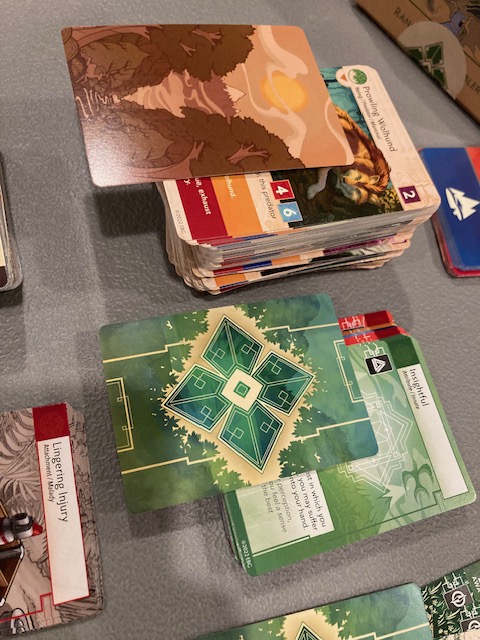
IMG_0707

I wish the cards were better labelled. The back of the cards are not labelled so I don’t know what’s what. The Components section of the rulebook (grrr) would have been done better to show the front and the backs of the cards. Those orange backed cards? Those are Path Cards: you can see me trying to figure that out when I was sorting my cards! The rulebook refers to them as Path Cards, but the cards themselves do NOT label themselves with that! There are quite a number of examples of “unlabelled cards” in the game. After some time, you get familiar with the cards, and then you maybe don’t need the labels. But I prefer labels: if I come back to this game in 3 months, I want to be able to just jump back in!

What I Like

IMG_0782 (1)

The art and layout and readability are just great! Let me emphasize: I love the art!

IMG_0778

I think it does a good job making the game feel like we are exploring.

I like how you can customize your character deck by choosing Background, Specialty, and Personalities: every character deck is VERY different! Your deck is what you want it to be! That level of customization really draws you into the game: “I made this! This is my character!” It really helps immerse you in the game by giving you that sense of ownership.

IMG_0838

I like the story that comes out as you play. The story doesn’t come out every turn, but every so often, a little bit of story comes out and enhances the gameplay that much more. I actually kind of like that the story only occasionally comes out … sometimes, I get tired of reading the entire games (sometimes I like that: Agents of SMERSH was a great Storybook game with lots of reading, but you know what you are getting into).

What I Don’t Like

IMG_0682

The Components page. Grr.

IMG_0699

The Prologue. Grr.

IMG_0671

The amount of rules. There’s a lot of rules. I think they are all necessary, but there are a lot of rules. The 48 page rulebook belies the number of rules.

Solo Play
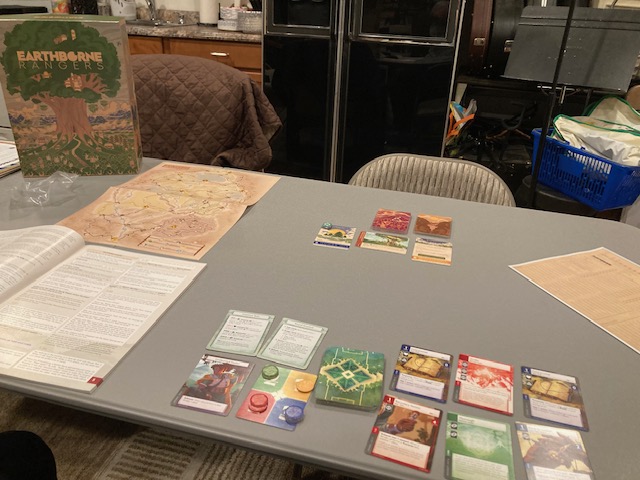
IMG_0821

So, thank you to Earthborne Rangers for following Saunders’ Law and having a viable solo mode! The solo mode is a true solo mode: you play exactly one character (you do not have to play multiple characters). You play one Ranger and explore the world!

IMG_0781

The balance is kept in the game by scaling most of the tests to be based on the number of Rangers (in the solo game, there’s just one Ranger: you!): This is denoted by an “R” next to the challenge. For example, to traverse away from the Ancestor’s Grove Location (see above), you need 4 traverse tokens PER Ranger to move away: Notice the 4R on the lower right of the card.

IMG_0832

The solo game still takes up a lot of space. You’ll notice my solo game uses the right half of the table for the main play space …
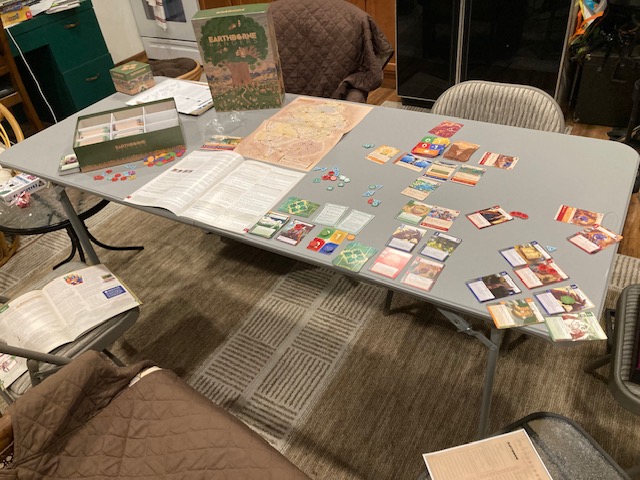
IMG_0840

.. and I have to use the left side of the table for the Storybook, tokens, and rest of the cards. It’s even worse, because I have to have the rulebook on the chair next to me … and finally the campaign sheet (more discussion below) to my right! Whew! This game takes up a lot of space!
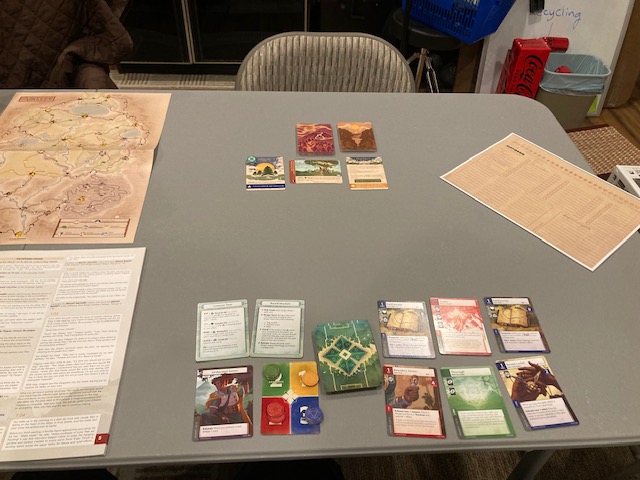
IMG_0819

As implied by everything on the table, there is a fair bit of maintenance per turn to get keep the game going. The biggest maintenance hits seem to be when you travel: you have to prepare a new Path Deck, sorting old cards, then shuffling and combining decks to make the new deck! Whew! There was quite a bit of maintenance, and it can be a tad overwhelming. After a 2.5 hour game, I was wiped! Luckily, you can either (a) leave the game set-up and continue later or (b) choose to end the day (choose to camp) and end the game session, putting it back in the box.

IMG_0808

Putting the game away with your chosen cards isn’t too bad: the dividers that come with the game help keep the cards sorted pretty well.

IMG_0796

I do like the solo game and I want to play it again. I feel a little like I am playing a solo video game, exploring a world and having adventures! The only downside is how much maintenance you do as you play. Some of this overhead goes away as you become so familiar with the game, but there’s sort of an incompressible amount of maintenance per game and it’s substantial. Just be aware that there will b a lot of maintenance to keep the game going for a solo player.

Cooperative Play

IMG_0947 (1)

Even after investing 10 hours into the game and playing the game solo multiple times, I still found I was learning rules when I was teaching my friends!  There is a lot to unpack in the game!

IMG_0948

My first thought was that maaayyyyybeeee we could do simultaneous play when we played cooperatively to move the game forward quicker (like we did with Tamashii: see a few weeks ago).  The game has a lot of turns that could be overlapping.  Nope!  Basically, I had to be the rules shepherd to make sure I was available to answer questions, so it was not really possible to play simultaneously, at least in our first cooperative play.  In general, we tended to play our turns solo without too much interaction, so it seemed like simultaneous play might be a useful thing here.  I think it will be in future games, once we ALL have internalized the game.

IMG_0957

There was a mechanism to try to help foster cooperation: the Ranger tokens: see the rules above. Unfortunately, that’s the only elaboration of the rules!  And, also unfortunately, the rules seemed poorly specified: how often could you move The Ranger Token?  Just once per turn?  Does it have stay on the card you put it until the card goes away?  We chose to allow only one move per round.  It helped foster cooperation a little more, but not hugely.
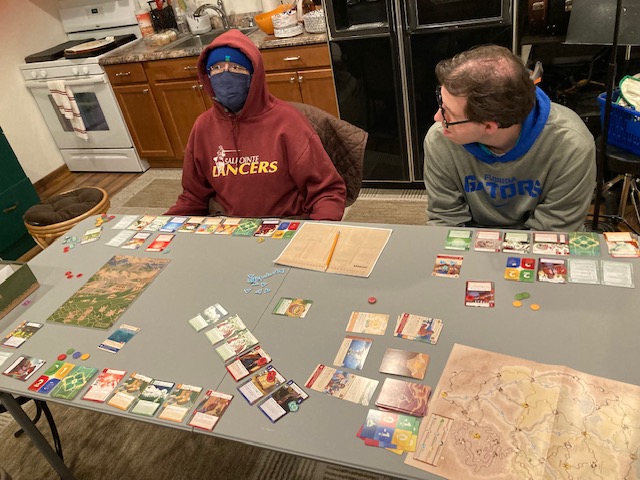
IMG_0959

We played almost three hours in our first cooperative game, and we barely scratched the surface of the game.  We ended up ending the Day early: not because we ran out of cards, but because everyone had to leave!!  The real problem is that the game seems to really drag as you wait for your turn to come around: there is a lot of thinking each player needs to do (and looking up rules), so each player’s turn took some time.  I think, as players internalize the game more, that you can do some simultaneous play to move the game forward. But, even after three hours of living in this world, my players still wanted to take turns in sequence because they still had questions for me.

IMG_0952

The general cooperative consensus was that people liked the game, but felt it had too many rules.  Everyone was willing to play again: they liked a lot of the ideas, but it felt a little grindy.

IMG_0956

I do want to mention that the game has an interesting way to help each other (to cooperate): you can actually do actions on other Ranger’s area!  So, if a player is really stuck on a card, other players can help!  So, if you have any cards in front of you, you have to bypass them to help you fellow Ranger … and each card will cause Fatigue.  I wanted to point this out, because I thought this was a unique way to allow cooperation!  There is a penalty if you are “dealing with your own stuff” (active cards in front of you), but you can still make the choice to help your fellow Rangers if they are really floundering!  This mechanism feels unique.

Campaign
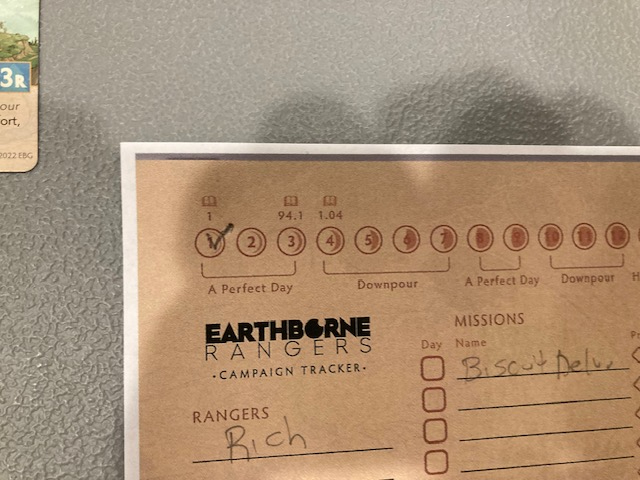
IMG_0817

This game is a campaign game.  As a deck-advancement game, you are always upgrading your hand at the end of each “day” (game session), and putting your newly augmented deck back in the box for your next game!

IMG_0839

Unlike most campaign games, the goals in Earthborne Rangers aren’t dramatic or overwhelming: it seems like most missions I have encountered so far feel more like “Side Quests”.  Remember, this is an exploration game!  So, taking on a bunch of missions is okay … you just may defer them to later sessions …

IMG_0843

In the end, I think the campaign will be “fairly easy” to come back to.  It’s pretty easy to put away your cards and come back another day.  The only hard part would be remembering the story and what you have seen … I think I wish there were more mechanisms for “noting” what cards and entries in the storybook you have seen so you can “remind” yourself what you’ve seen.   Oh wait! That’s what the campaign sheet is for!!

Writing
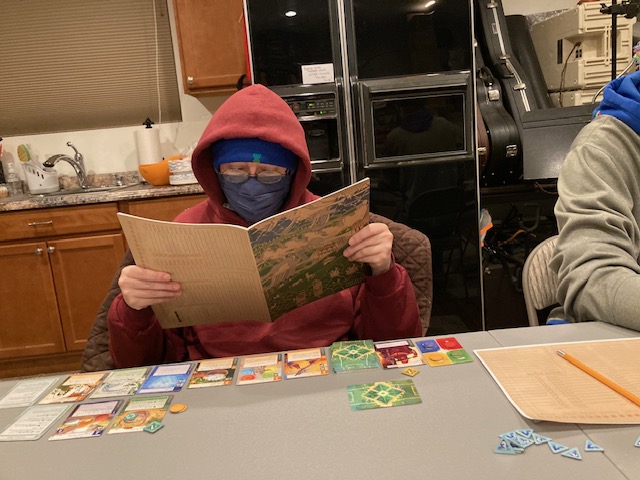
IMG_0958

A quick note about the writing and the campaign.  I like the writing!  The writing seems to bring out the personalities of different people you encounter, and there are some points of humour as you play.  The world you inhabit in Earthborne Rangers feels … fleshed out.  I think this is a different kind of game, and that’s good!  It’s not a “dungeon dweller”, it’s not a “beat up all the bad guys”, it’s more of a “hey, let’s explore this world!” And part of that exploration is the people you meet along the way: these people have personality that comes through.

Conclusion

IMG_0795

It was a bit of a rough road to get though the first few games of Earthborne Rangers: there were some stumbling blocks along the way, but hopefully we’ve pointed them out so you can deal with them appropriately in your own journey …if you wish to pursue Earthborne Rangers.

IMG_0754

After struggling to get through a number of solo games, I do like the game!  The overhead to set-up, the maintenance while playing, and the work to tear-down is significant enough that it will dampen your enthusiasm for the solo game.  Having said that, I do like the solo game quite a bit: I like the sense of exploration and wonder of the game (highly augmented by the amazing art)! I’d give the solo game an 8 or 8.5/10.0 I think.  I think I was able to get a point where I had internalized most of the rules, so I could move forward and enjoy the world despite the huge number of rules.
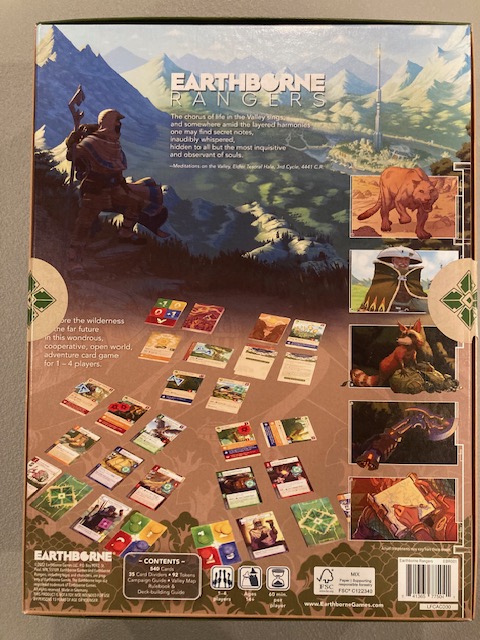
IMG_0648

The cooperative game reduces a lot of the set-up/maintenance/tear-down issues by sharing the load, and the game seems to scale well. Unfortunately, the game seems to bog down more in the cooperative mode, as you seem to be always waiting for your compatriots.   I’d give it a solid 7/10.0 for a cooperative game.  If your players can internalize the game to embrace some simultaneous play more, I think the game will open up a little more to maybe a 7.5/10 or even higher!! Unfortunately,  even after 3 hours of playing cooperatively with a rules shepherd, the game still felt a little grindy because of all the rules questions and waiting for other players.

IMG_0813 

Build your character, explore the world: Earthborne Rangers reminds me very much of an open-world video game with tons of exploration! This is a really fun game: Just be aware there is steep learning curve which may or may not scare you away.

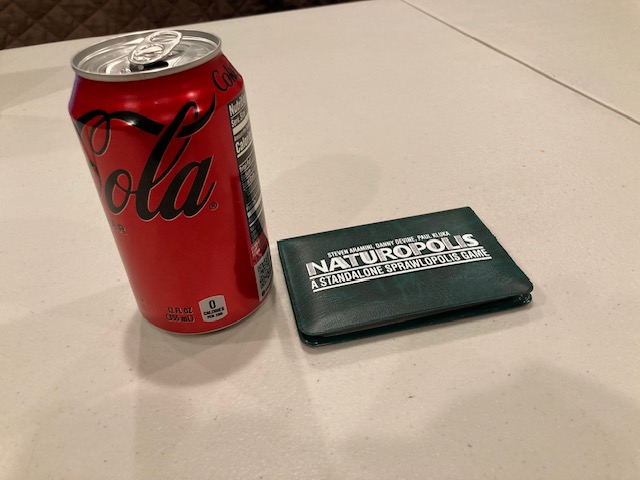
Interlude: Playing A Deckscape in Wonderland at the Airport

Recently, I got stuck for a three-hour layover at the airport. I had brought a few games for just such and emergency! One of them was Deckscape In Wonderland!

Table Space

IMG_6789

If you can find a decent sized table (at a cafe or in the club or just around), the Deckscape games will work fine. I had brought Deckscape in Wonderland!

IMG_6790

I had a plant on my table that I had to put the side as I played … but I put it back when I was done.

IMG_6788

Although I could have brought any number of Deckscape games, Deckscape in Wonderland was the one I brought that day.

IMG_6800

As you are playing, you will end up taking over some of the table: see above.

What is Deckscape?

IMG_6794

If you’ve never played the Deckscape games before, it’s just an (oversized) deck of cards with a little adventure of puzles contained therein. The game is one-and-done: once you’ve played the game, you’ve seen all the puzzles and exploration … and will probably just want to pass this of to a friend.

IMG_6795

The game works by reading the top of the card, and it tells you what to do: see above. Usually, this involves solving a puzzle before you flip the card over to the other size. Once you think you have solved the presented puzzle, you flip the card and see if you are right! Either way, (if you are right or wrong), you still continue on the next card. If you are wrong, however, you get an X—these Xs accumulate and are detrimental to your final score.

IMG_6793

There’s a neat little mirror in this game you have to use to solve puzzles!

Game Arc

IMG_6796

The game lasts about an hour as you try to get to the end of the deck. Along the way, you will solve puzzles. The game recommends a pencil and paper to help with some of the puzzles, but I didn’t need any for my play.

IMG_6802

When you get to the very end (the last card is 64: note the upper left corner), you’re done! Your score is then based on how many Xs you got. Honestly, I didn’t care for the score too much. But it’s nice to do better than worse.

Airport Game

IMG_6797

In some ways, this is the worst Deckscape game to play at the airport, and some ways the best. What do I mean by that?

Of all the Deckscape games, Deckscape in Wonderland is probably the most “meta” and “outside the box” of all the Deckscape games … which makes sense when you consider the source material: Lewis Carrol is known to have many hidden puzzles and metajokes in his Alice books. Thus, when you are tired and grumpy because you are stuck in the airport for three hours, sometimes your brain doesn’t work as well. Maybe this game is best to be played when you are at full capacity?

IMG_6798

On the other hand, the game is so inviting and colorful and fresh, it’s invigorating to play! The colors, the puzzles, the simple mechanisms are a perfect lift-me-up when you are stuck at the airport and grumpy. I found that when playing Deckscape in Wonderland, that the hour just zoomed by! I had so much fun playing!

Conclusion

IMG_6791

I really liked the Deckscape in Wonderland game. It’s not my favorite Deckscape game, but it’s close (my favorite is probably Behind the Curtain): it may be #2? I wish I had more of a brain when I played it, because this one is slightly more challenging than previous Deckscapes.

IMG_6792

But the thing is: I had a blast playing it, even when I was tired. The fun vibe, the colors, the interesting puzzles, the simplicity of the game was invigorating! After playing through for an hour, I was very glad I had brought this with me to the airport.

For first-timers, I probably recommend taking a different Deckscape game to the airport (maybe Time Test), but if you have played any of these, try Deckscape in Wonderland. What a wonderful way to pass an hour at the airport! The form factor was perfect: small deck of cards, easy to play, small playing surface, and easy to clean-up.

Maybe I should have brought three Deckscape game to take up the three hours at the airport?


P.S. I didn’t get any funny looks when playing this at the airport. At least, I didn’t notice if I did because I was having so much fun!

A Review of Tamashii: Chronicle of the Ascend. Is This What Programming is Really Like?

Tamashii: Chronicle of the Ascend is a cooperative programming game from Gamefound This game was originally on Gamefound back in April 2022. It delivered to my house in late September 2023.

This is a cooperative game for 1-4 players, taking 90 minutes (more on that later) for ages 16+. We were very excited to get Tamashii: it was #9 on our Top 10 Anticipated Cooperative Board and Card Games of 2023! Our only concern was that it was an Awaken Realms game … (well, strictly speaking, it’s an Awake Realms Lite game). Even though their games are gorgeous with amazing production, we’ve had mixed luck with their games. For example, our Tainted Grail (another game from Awaken Realms) experience started amazingly (see Part I) only to be tarnished by the grind of the game (see Part II). Let’s hope Tamashii endures!

Unboxing

IMG_0327

Like all Awaken Realms games, the box Tamashii comes in is pretty well padded and packed. It’s a quality box!

IMG_0328

The game comes with a nice letter from the publishers (on top).

IMG_0329

The game itself is pretty big (but not as big as other Awaken Realms games).

IMG_0331

See the Coke can above for scale.

IMG_0342

What’s inside?

IMG_0344

The rulebook is right on top: it’s a big square thing.

IMG_0364

There’s a nice lost Page rulebook.

IMG_0368

There are quite a number of punchout sheets: some of these will be unnecessary to punch out because they are minis which replace them.

IMG_0369

IMG_0370

I really like that there is a sheet showing where all the minis go on top of the minis! I wish they were labelled (more on that later).

IMG_0371

The minis themself are pretty cool: Lots of cyber-anime minis! This game is set in a post-apocalyptic cyber future in Japan, so these minis really capture that.

IMG_0372

Underneath the minis are a special set-up sheet (for first timers).

IMG_0373

There’s a bunch of bad guy cards! (You don’t necessarily see these right away).

There’s a bunch of cards, dice, player boards, scenario books, and bags!

IMG_0399

There’s a lot in this box! It looks pretty good!

First Time

IMG_0380

My first time through was a little daunting. Was I supposed to read the rulebook first? The Unboxing Guide above “sort of” showed what you needed to do, but like most games this big, it makes sense to correlate components and labels from the rulebook. This correlating gives you names for later references (“forward referencing”).

IMG_0346

IMG_0403

Our first couple of hours with the game was just unboxing, looking at components, figuring out what everything was, and using the Unboxing Guide to get going. Don’t expect to jump right in to this game! There will be a lot of reading and correlating of components.

Rulebook

IMG_0344

This rulebook is … pretty good to good.

IMG_0345

It gets a C+ on the Chair Test, as I can’t really put it on the chair next to me without it flopping all over the place. Now, the font is big enough to read some of it, and for some of my solo plays, I was able to use the Chair to hold the rulebook. But my first few plays absolutely had me putting this monster square rulebook on my player table (thus eliminating some play space).

IMG_0346

The Table of the Contents and Components (with names) on the first two pages is fabulous.

IMG_0347

The set-up on the next page is quite good too (if a little “small”).

The rest of the rulebook is pretty well notated with Labels and pictures. I don’t necessarily love the organization, as a I struggled a few times looking for a rule.

IMG_0363

BUT: Most importantly, it has an index! Not only an index, the “main definition” of a keyword is highlighted in BOLD so it’s easy to go find where a rule is! This Index really saved the rulebook for me. I don’t quite get the organization, but the fact that the Table of Contents and Index are so well done makes this a very usable rulebook.

IMG_0353

The rules are a big long, but they all seem to be here. I think I had most of my questions answered when reading or playing without too much bother.

IMG_0343

But then the rulebook ends with a BANG putting a nice “important Keywords, Key Phrases and Icons” on the back!

I didn’t love the form factor (C+ on the Chair Test), I didn’t love how long the rulebook was, and I didn’t love the organization, but the Index, Table of Contents, and back cover made this a pretty good to good rulebook.

First Few Days

IMG_0401

My first few days with this game were very strictly delineated. First day: unpack the game and get a sense of all the components: this was a few hours. See above.

IMG_0426 (1)

Second day, set-up the game and start reading through the rulebook, at least a little. This was a few hours too.

IMG_0416

The third day was to be playing through the first Scenario: PROLOGUE. I didn’t have to read the whole rulebook before I played, I just had to read portions as “new rules” were revealed. The little prologue did a good job of not getting caught up in the rules. So, you’d play a few turns to get the hang of some introductory rules, then uncover the next part which had new rules. Then you’d stop and read the few new rules. Then return to playing, getting a sense of the new rules. Then stop, read a few new rule. Return to playing, get a sense, read some new rules and so on … until you got all the rules!

IMG_0419

This piecemeal way of learning the rules worked pretty well. So, at the end of Day 3, I had a pretty good sense of the main rules of the game. The previous two days were shortish, but day 3 was pretty long at about 3.5 hours. It’s a lot of work to play, read, play, read, play read! Make sure you give yourself plenty of time to play.

Gameplay

IMG_0406

This is a bag-building game! Each player had their own bag, and they can cull tokens, add tokens, and generally do bag-building like operations. These tokens are placed on your console (see below).

IMG_0447

The tokens are yellow, green, blue, and red. Each of these corresponds to an Asset in the game: yellow is reroll, red is extra dice during combat, green is shielding, and blue is memory for upgrades.

IMG_0429

As you pull tokens from your bag, you put them on the your Launcher in the light-blue spaces. Then you “program” moving the tokens around to form patterns. “Programming” is essentially two operations: moving a token 1 space or swapping two adjacent tokens. What you are trying ot form is patterns!

IMG_0482

The basic patterns are three in a row: if you can launch that program, you get that resource!

IMG_0429

In this example, I can launch three programs simulaneously: A red basic patterm (giving me one energy), a blue basic patterm (giving me one memory), and a green basic pattern (giving me one shield).

IMG_0407

Up your assets to reflect the new status!

IMG_0430

As the programs launch, you place the used tokens in the “Dump” (think discard) just below your board. We just launched the red program above to get 1 red energy!

IMG_0432

As you launch programs, your launcher becomes empty and your dump becomes full. If you ever need to draw a token from your bag and you can’t, you immediately take all tokens from the Dump into your bag and start drawing from there (the “Dump” is like a discard pile in a deck-building game).

IMG_0508

Although this is a deck-building .. pardon me … bag-building game, it is also an exploration game. There are numerous scenarios in the game, and each scenario sets-up a different topology of tiles to explore. Unexplored tiles are flipped over with a “honeypot” token on each one: when you explore it, you flip the token and usually get an asset or something good. It depends on the scenario of course, but usually exploration is good as it opens up the map: you can’t move quickly through tiles you haven’t explored!

IMG_0416

The scenario is controlled by a little book that describes set-up: see above for the PROLOGUE set-up! Each scenario has a little story where you make some “Choose Your Own Adventure” Choices while completing challenges. The game flow is controlled by a Deck for your scenario.

IMG_0422

Usually there in an objective to each part of the story!

IMG_0423

Some of the challenges to overcome are defeating enemies in combat. Combat is a little different in this game: enemies “attach” to you and you have to fight them in the combat phase. This seems pretty thematic: the idea is that you are running around the city trying to get away from the big bad AI, so occasionally they will catch site of you!

IMG_0518

You can either launch programs to do damage, or you can just straight up attack with dice. See above as the DISRUPTER can be harmed with yellow/? program or y/y/core.

IMG_0446

You’ll see the CODER character has 2 ATTack dice when we does fight.

IMG_0445

Oneof the cooler elements of the game is that you can upgrade your body to get better Skills: ATTack, or MOVe or PROgramming! You can inhabit the CODER body if you launch the program in the lower left!

There’s also many ways to upgrade your character while you are playing: you spent memory (blue) or EXP (experience) to get AUGMENTS, get new tokens for your bag, cull tokens from your bag, and other ways!

IMG_0513

If you can fight, explore, upgrade, and and hack your way to the final card, you win!  

Whew.  Yes, there are a lot of rules to this game. BUT, there are three reference cards (everyone gets their own copy) to help!

IMG_0506

Solo Play

IMG_0420

The game has solo rules that work pretty well (thank you for following Saunders’ Law!). There is a half of a page near the back of the rulebook that describes how to play solo: see above. It looks a little daunting at first, bt there are really just two main rules: Use the JORDAN BOT to help you explore, and when you see the PLAY ICON, it counts as just 1 player. So, you only have to play 1 character to play solo.

IMG_0421

The JORDAN BOT (see card above) basically helps you get the board explored more quickly, and he’s easy to just move without any special rules or skills. Occasionally, you can launch programs from the JORDAN BOT (which can be useful) for 1 battery. See above.

Solo play went pretty well: I think you pretty much have to play this solo first to teach your friends! There are sooo many rules!! Now, once you get the majority of the rules under your belt, it’s easy to teach the rules so you can your friends can move forward quickly.  The game is pretty intuitive once you get over the rules hump.   Like I said earlier, it took me three days to get to my first solo game.  But once I got there, the game seemed to open up.

IMG_0520 (1)

Later on, after playing cooperatively with my friends, I went back and played some more scenarios solo.  This is a pretty thinky solo game, which I like.  The game says 90 minutes, but I still haven’t had a game that short yet. Most games have been at least 2.5 hours, if not more.  I do admit that some of that is “we tend to be thinky”, but I don’t think we are are prone to Analysis Paralysis.  

IMG_0516

I like the game solo, but there are a few problems that I am still unsure about: see below.

Cooperative Play

IMG_0475

It was absolutely essential to play solo before teaching my friends. Even with me being familiar with the game, it still took 2.5 to 3 hours to teach and play the PROLOGUE with my friends.

IMG_0479

Andrew tends to be the most thinky of our group, and that definitely contributed to the length of the game, but I still am not convinced this game can be 90 minutes!

IMG_0490

How did it work cooperatively? There aren’t that many mechanisms that allow players to share, at least in the PROLOGUE. So, the intro game felt like we were all kind of playing our own game without much interaction. There are no shared monsters, at least in the beginning! All monsters are fought in solitaire … at the beginning. In fact, we house ruled the game to do simultaneous play at most steps to move the game along quicker!

IMG_0481

By default, the Planning Phase is Simultaneous (see the Turn Order card above), but after we played for about an hour, we realized that the Action and Combat steps could also be simulataneous! That really sped up the game!

IMG_0489

Now, at some point, we started getting AUGMENTS and skills which allowed us to help our neighbors, which should have made us stop play simultaneously. The “helps” for your neighbors were still simple enough that we could continue playing simultaneously, but we are all engineers and computer scientists! Engineering/Computer Science skills tend to embrace concurrency and recognize when there might be simultaneous-play collisions. At some point, unfortunately, I expect we will have to start playing serially again, which will slow down the game.

IMG_0478

My friends liked the game enough to play again. I think the choice to move to simultaneous play helped that: the game might hve been too long with out that decision.

Campaign

IMG_0511

So, this is a campaign game, but it may not be what you expect. As you complete scenarios in the game, you do not level-up your character, and you do not unlock new items for your character.  

IMG_0514

Instead, when you complete a scenario, you unlock items and make them “generally available”.  For example, at the end of the first PE0x283 scenario, I unlocked 5 new cards (new enemy) and some new Faction augments.  BUT NONE OF THE CHARACTERS GOT THEM immediately. These new cards are now “available” as part of the game: the new monsters “may” come out when you shuffle the enemy deck, and you “may” get the new faction Augments when you get to draw one, and so on.

IMG_0519

To be clear: your character starts from scratch at the beginning of each new scenario!  So, the only level ups you get are ones that you may see when you have to draw from a particular deck. Basically, the game gets more “stuff available” as you play, which you may or may not see depending on where you go/what you do.  

IMG_0503

Do, I like this?  I like that the game gets more and more stuff as you play, so there will be cool new stuff to see.  But, I didn’t love that your character doesn’t level up between scenarios.  I think I was expecting some kind of level up system, and I was a little disappointed that there wasn’t one.

This may just be setting your expectations for the game. Just be aware.

Level Ups During The Game

IMG_0456

Even though your character doesn’t progress as you play, there are still many opportunities to level-up as you play.  Whenever you kill an enemy, you get a EXP token: every two EXP allows you to do some cool upgrades. You can also spend BLUE (memory) to cull and add more tokens to you bag.

IMG_0439

And then there’s the LEVEL UP card which gives you some focus on some level up you can achieve.

IMG_0513

So, even though you don’t get the dopamine hit of “leveling up” at the end of each scenario, there still is leveling up as you play.

Traces

IMG_0517

By far my least favorite mechanism in the game is the Trace: there’s a pink trace to the left of your player board that shows where the trace roll is currently at: see above.

We didn’t talk about this in the Gameplay section, but the way enemies attach themselves to you is by rolling dice based on your current “trace” roll. Basically, the higher your Trace, the more dice you roll: every “o” you roll attaches an enemy to you!  In practice, it “feels like” you get about 2 enemies every 3 turns.  So, some turns you won’t have enemies attacking you (which frees you to actually explore and upgrade), but then other turns you may have 3 enemies on you!

IMG_0518

What I dislike about this is the randomness of it.  Every dice you roll gives you about  50-50 chance of getting an enemy.  You can mitigate this a little by using the rerolls, but you need to understand that the re-rolls are very scarce resources!! And even with a reroll, you may still get the enemies.   It was frustrating because the Trace elements “force” you to play as fast as you can: every time you move or stay still, you up your Trace rating.  In fact, you are encouraged not to sit in one place too long because your Trace score goes up faster.  Arguably, this is very thematic!  You are traipsing around the city being followed by the big bad AI, so you need to keep moving!

IMG_0486

But it was the least fun aspect of the game.  If you rolled poorly, you would get 1 enemy per turn.  And maybe you waste your rerolls to try to slow it down, but that just means you don’t get your rerolls for combat when you need them the most!

I found the Trace to be a little too random, and it forced the game to push forward a little too much.  I just wanted it scaled back just a little…

In one game, I was able to keep the Traces down so I only got a monster every 2 or 3 turns, and in one game I was inundated with monsters almost every turn!  And that’s very unbalancing, as you  have to “waste” your programming to fight, waste your rerolls to mitigate the rolls, and waste your time. Too many monsters was just not fun.

IMG_0515

I wish the Traces felt more balanced. What I saw: Roll badly on Traces and you lose the game. Roll well on the Traces and you win the game.  So, it doesn’t matter how great the rest of the game is, as the Trace rolls seem to define the game. And that frustrated the heck out of me.  It caused me to lower my score of  what’s a pretty good game otherwise.

(Half-formed idea for a house-rule: maybe you always get one free reroll? Or maybe you can spend a memory to just lower the Trace track?  Just give me something more so I can mitigate the Traces a little more).

And Yes, I know there’s a mechanism for eliminating an enemy with a program without getting EXP, and that does help to mitigate the enemies a little more, but it still consumes resources and may only work for a few times, depending on how many corruption tokens you get. Even with that, I still felt so under the gun all the time… I never felt like I could just “enjoy” the puzzles or enjoy this fairly cool world .. I just had to run around as fast I could. Tamashii is a cool world with cool art and cool ideas … but I couldn’t enjoy it as much.

House Rules

IMG_0477

Our experience is that the game is significantly longer than 90 minutes. So, in the cooperative mode, we strongly advise that you play each section simultaneously as much as you can.  Our beginning games seemed like it was pretty easy to play Planning, Movement, and Combat simulataenously without issue.  It made the game seem shorter and more engaging.  

At some point, you won’t be able to use simultaneous play, but  I think your cooperative game will be that much more enjoyable the more you enable it.

Error Bars

IMG_0399

I like this game and would give it a 7.  The randomness of the Traces and some of the scenarios brings that down for me.  But how much?

In a game where the rolling feels balanced or better, I will give this a 7, but in a game where a few rolls (especially on the Traces) completely screw up a two hour game, I will be much more feisty and want to give this a 5 or 6.

I feel like this game doesn’t deserve a 5: there’s too much to like! But it’s also doesn’t deserve a 6, it makes the game sounds too midling. But it also doesn’t deserve a 7: the randomness can really ruin a game.

So I will give it a range of 5-7:  that range indicates what the game can be when things are fairly balanced (a 7), but how awful it can be when the dice conspire against you.

To be clear: if this were a faster game with fewer rules, the randomness wouldn’t be so devastating.  But, after putting 2 hours into a game (with lots of rules) and having it ruined by a few bad Traces rolls… that is very frustrating because there’s so much investment.  

I think some minor rebalancing of the Traces or a slightly different mechanism for attaching enemies would easily make this game a strong 7.5/10.

Miscellaneous

IMG_0487

I really wish the minis were labelled somewhere in the game. I have absolutely no idea when to pull these out. Are these enemies? Bodies to inhabit? The Big Bad Guys? As we inhabited some new bodies in one game, we looked and looked and looked to see if any of the minis were it. Maybe? I remember that Tainted Grail did a pretty good job of labelling, so this was a little disappointing. I have all these great minis … and I am not sure when to use them!

IMG_0496

Since this is a ongoing campaign, there is a little checklist you use as you play (see above) to mark progress. . I strongly recommend either printing out a new copy or just photocopying these! I have at least two games going now, one solo and one cooperative, and I need multiple copies! See below.

IMG_0497

Programming

Is this game like what programming is really like in the real world? Not really.  Not at all, actually.  But the idea of using patterns to represent little programs was still fun.  There is some tie to computer science: a lot of times, especially in early computer science, people would study arrays of data looking for optimal ways to rearrange said data (sort it, heapify it, merge it, etc).  And the little programming in Tamashii of swap/move tokens “kinda” feels like trying to find the optimal moves in data.  So, ya, there’s an element of programming?  Maybe?

Conclusion

IMG_0504

I’ve played this mostly solo and I would give it a range value: 5-7 out of ten. When the randomness doesn’t bowl you over, this is a solid game which I like. When the dice and randomness of the game destroy you, it’s not so fun.

My friends (who haven’t played quite as much) would give the cooperative game:
Teresa: 7 and I want to play again
Andrew: 6 and I’ll play again if you want.

Tamashii is pretty good, but it may be a little long:  luckily, it’s easy to shorten by simply adding more simultaneous play in the cooperative game.  But I think the deciding factor will be if you like the extra “spicy” randomness of the Trace rolls.  That extra randomness of Trace rolls will either excite you or disgust you: decide for yourself.

A Review of 14 Frantic Minutes! (The game, not the 14 Minutes)

14 Frantic Minutes! is a cooperative real-time polyomino tiles (aka Tetris pieces) game that was on Kickstarter back in November 2022 and delivered to me in mid-July 2023. Considering that it promised delivery in November 2023, this is fantastic! We had a streak of 6-in-a-row of Kickstarters delivering on-time or early!

IMG_9434

This is a game for 1-4 players, Ages 8+, and an accurate gameplay length at 14 minutes … if you play real-time with the timer.

I backed this game for three reasons: (1) cooperative, (2) tile-laying, and (3) the art.  Call me a shallow gamer, but I really like the art-style for this game!  But, cooperative tile-laying games have been really tearing up the scene for us lately, with Race For The Raft being one of the best tile-laying games of the year (see out review here)!  Will 14 Frantic Minutes! make our Top 10 Cooperative Tile-Laying Games?   Stay with us until the conclusion to find out!

Unboxing

IMG_9487

14 Frantic Minutes! is a smaller box game than many games we have seen lately: see the box above with a can of Coke for reference.

IMG_9436

The box looks fairly empty, with no too many components.

IMG_9437

There’s a rulebook, some plastic bags, cards, a bunch of tiles, and some punchouts.

IMG_9448

I did say this is a polyomino tile-laying game, but there are surprisingly few polyomino tiles! See above.

IMG_9449

The majority of the heft in the box are the 30 Security Lock cards (which I think are poorly named and/or labelled). These are the playfields for the polyomino tiles.

There are also a small number of cards: they are not linen-finished.

IMG_9455

And that’s about it! The components look pretty nice, if a little repetitive (that Evil Guy on the cover is on a lot of cards and components).

Gameplay

IMG_9486

Gameplay is pretty straight-forward: there are 7 Challenge cards showing what connections need to be made (each card is a “room”).

IMG_9461

At the start of the game, you “flip” the first Challenge card (labelled “1” above: this is the difficulty of the connection) and start!

IMG_9452

Each connection card looks something like the above: it indicates what spaces need to connected to the main unit (the Switch). To be clear, all of the shown node symbols need to be connected to the Switch to move to the next room.

IMG_9482

See above as the white/yellow/green and blue nodes all connect to the main switch!

IMG_9476

Players each have a small supply of polyomino tiles, and are all working together to place them on the board to create the circuit! There is no turn order, as players just frantically place their tiles on the board! About the only rule constraining the players is that they can ONLY play their tiles (or the neutral player tiles in a 3-Player game). Other than that, players can talk, show tiles, and communicate as much as they want!

IMG_9487

This is a real-time game! You have 14 minutes (using supplied timer) to get through all 7 rooms!

IMG_9472

Every time you complete a circuit, you flip the next card and grab a new room (aka Security Lock Cards) and start the next circuit!

IMG_9480

The timer occasionally makes the evil bad guy “levil augh” and close a door: whenever that happens, he moves forward one room (at the top). If the badguy ever reaches your current circuit/room (at the top), players lose! If you can do all circuits before the bad guy reaches you, you win!

Solo Play

IMG_9460

So, this game follows Saunders’ Law and has a very viable solo mode. The rules do a very nice job of telling players how to set-up for 1 to 4 Players. Basically, there are 4 sets of 5 polyomino tiles for 4 players. In a solo game, the solitary player gets all 20 tiles! (In a 4-Player game, each player gets one set of 5 tiles). See the solo player above all set-up with all the polyomino tiles in the lower left!

IMG_9485

To get familiar with the pieces, I played my first game without the timer. I strongly recommend everyone do this! I think you need to get comfortable with the pieces to have any chance at this. It probably took me a half hour to do an “untimed” version of the first 7 circuits.

IMG_9483

My next game was timed using the app: and boy did I do terrible! I think I only got to room 4 before I lost. But that’s okay! This game is pretty quick to set-up and try again. Seriously 14 minutes for a game is easy to try again.

IMG_9479

I kind of enjoyed this without the timer as a relaxing puzzle. It sounds like it would be “too easy” when the timer isn’t goading you, but it’s really not! At least, not at first. I found myself looking forward to just relaxing and playing without the timer. I think once that gets too easy, then maybe the timer makes sense?

Cooperative Play

IMG_9602

Cooperative play started the same way as solo play: we ended up playing a full game without the timer. It took about 35 minutes. We had fun, it gave us a chance to learn the pieces .. and it was still hard! Sometimes 3 people end up getting in each others way!

IMG_9604

We did win the 3-Player game with the timer … we think. The problem is that the app stopped because Andrew’s phone shut off after 5 minutes. But we think we won?

IMG_9603

Generally we all liked the game, if we didn’t love it.

Problems

IMG_9438

The biggest problem with the game is the “app”. You can only download using the little Q-box on the front of the rulebook. (Alternately, you can use a timer that resets every 2 minutes). Andrew didn’t want to download it because it took him to a “sketchy” dropbox location. I downloaded without (I think) incident. The other problem was that the laugh and door close weren’t always clear: it seemed like we struggled trying to figure out what the noises meant and then sometimes didn’t hear them! “Is the laugh the next room, or is it the door close?” I think it’s the door close, but in frantic real-time, sometimes we didn’t hear it! It needed to be clearer … louder?

IMG_9439

There were some things that weren’t clear the first few times we played: some of the connections are unclear (when it leaves a colored Node, can it come off in any direction? After many plays, I think the answer is no). But these problem go away after a few full plays: you get familiar with the components and get a sense of how everything works.

Replayability

Even though this is a small box game, I think there is still a decent amount of replayability in here. You can make the game harder by varying the Challenge cards (higher numbers are harder), and the 30 Room Cards give lots of different layouts in which to build your circuits!

Conclusion

IMG_9605

We had fun playing. The game doesn’t really embrace the non-real-time option to play, but I personally think I had the most fun playing without the timer. I saw this is just a fun little puzzle.

IMG_9470

We wish the app were better, but with a little experience, we got it going.

IMG_9455

This feels like a fun little cooperative filler: you can guarantee it’s at most 14 minutes! It’s easy to set-up and easy to play. I can see this being a perfect convention game to play while you are waiting to get to your next game…

I liked it the most:

Rich: 7/10
Teresa: 6/10
Andrew: 5.5-6/10

I think this would make my Top 10 Cooperative Tile-Laying Games, just not near the top of the list.

A Review of Find The Source: A Solo/Cooperative Roll-And-Write

Find The Source is a solo and cooperative roll-and-write game from Kickstarter. This game was on Kickstarter from Dec. 13th 2022 to Jan. 12th, 2023 and it arrived at my house Oct 4th, 2023. It promised delivery June 2023, so it’s about 4 to 5 months late (depending on how you count it). I used to say “that’s pretty typically late for a Kickstarter game“, but recently games have been arriving a lot sooner Still, it’s not egregiously late, so it’s no big deal. (I still have Kickstarters that are years late, so 4 to 5 months is nothing).

IMG_0245

This is a game for 1 to 3 players. The game box says 15 minutes for play time, and wow does that feel wrong! The solo game might be 15 minutes once you know the game, but the cooperative game feels much longer, like 30 minutes to 60 minutes! So, this is still a quick game, just not as quick as the box might say.

IMG_0242

The 3-player upper limit is a bit odd, but this is mostly because the game only has a limited number of boards.

Let’s take a look!

Unboxing

IMG_0246

I paid extra from the Kickstarter to get the boxed version.  See the Fresca can above for scale.  Now, most people from the Kickstarter (2563/2733 backers) actually just did back the the print-and-play version for this: the print-and-play was only $5 (versus $39 for the actual physical version).  Recall that we tried print-and-play with The Legends of Storm City (another cooperative roll-and-write) at the start of the year, and our conclusion was the print-and-play was too much work and and too much money for us: we’d prefer the physical version.  So, we put our money where our mouth was and we got the physical version!

IMG_0247

There’s a nice intro from the developers just inside the box: the little touches help.

IMG_0248

There’s a built-in expansion (adding three different boards): the rules are in a teeny sheet at the top.

IMG_0249

The game is mostly dry-erase boards and dice: see above! The box is filled all the way to the top with boards.

IMG_0250

These are the cardboard boards for the expansions.

IMG_0251

The rulebooks are tri-fold pamphets?!? There’s two rulebooks actually! One for solo play (see above) and one for multiplayer play (see below).

IMG_0291 (1)
The multiplayer rulebook

IMG_0255 (1)

There are 9 player boards in 3 sets of 3 (labelled A, B, and C). When you play a multiplayer game, everyone in the group must get a board from the same set (we figured this out later: it wasn’t clear from the rules). The reason: each player board has a set of 6 items and they all have to be the same items so you can “give” items to each other (without having to read another board).

IMG_0281 (1)

Basically, the three sets give the players some variety: the items are different depending on which set you use.

IMG_0256 (1)

The other 9 boards are 3 sets of the 3 city tiles: like the player boards, when playing multiplayer, all players must get a tile from the same set (labelled 1,2,3). Each city has different locations with different abilities and layouts. Again, the three sets of cities are for variety.

IMG_0258 (1)

And then there’s 9 dice (3 for each player) and 3 dry-erase markers with cool looking erasers. Overall, this is why I paid $39 for this: I get nice dry-erase boards, nice dice, nice markers (well, OKAY dry-erase markers) and a nice package. I am totally glad I paid the $39 for a nice package, rather than trying to print everything myself and wasting time/energy when the printed version is nice!

Rulebook

IMG_0253 (1)

I don’t love that the rulebooks are trifold pamphlets.

IMG_0291 (1)
The multiplayer rulebook

I do like that the recommend way to play is to learn the game is to read the solo rulebook first and THEN play multiplayer. So, read the solo pamphlet first, play a game, and then you can teach your friends multiplayer!

I’d probably give this a C on the Chair Test! Why? Even though it fits well on the chair, the font is really tiny and impossible to read on the chair next to me. I had to have the rules pamphlet on the table as I played: that font is pretty small!

IMG_0252 (1)

Overall, the rules were okay. There were a few misses in explanations, but it did a good enough job teaching the game. I just wish the rulebook, pardon me, pamphlet, had bigger fonts and more of a rulebook presence.

Gameplay

IMG_0292 (1)

This is a roll-and-write game.

Every turn, every player rolls two dice (doubles are always rerolled) until you get two different values. You get the choose one of the dice to use: this is the number of Actions you get this turn. (Mark the actions on the third die and put it on your sheet: see below).

IMG_0270 (1)

Why would you not always choose the bigger number for number of Actions? For one, the bigger number costs an energy! Each player has a limited amount of energy at the top of the player sheet: if any player ever runs out, game over!

IMG_0279 (1)

The second reason is that if you choose the lower number of actions, you get to upgrade one of your five skills!

IMG_0280 (1)

Everytime you X a skill, you make it a little better. For example, I upped the REROLL skill and get 1 reroll of the dice per turn! Early in the game, it may make sense to take the lower number to up your skills.

IMG_0299 (1)

To the left of your player board is the city! See Above. Players use Actions to fight gangs, move, activate locations, and investigate! In case it wasn’t clear from the name of the game, the purpose of the game is to Find the Source!! The Source is a city location where the big bad hides out .. you have to find the Location of the Source, storm in there, and take out all Agent Teams at that Location! If you do that, you win! Players lose if they ever run out of energy or can’t manage to take down the Location of the Source.

Find the Source

IMG_0284 (1)

Locations have a little folder on them: to help find the Source, you have to spend an action to Investigate (put an X on the folder). Once enough Locations are investigated in a row, a player can HACK to find a portion of the Location (which column, or set of rows).

IMG_0277 (1)

Once you find the Source, you will populate it with Agent Teams, and all players will have to take out the Source on their board to win (the Source is the same on all player boards).

Solo Play

IMG_0265 (1)

It’s so interesting that the game has a separate rulesheet for solo mode! And in fact, it suggests that you play a solo game before expanding to the Multiplayer Game! So, this game absolutely follows Saunders’ Law! I would say this game was probably solo first, then the multiplayer tacked on: at least that’s what it feels like.

IMG_0283 (1)

Solo set-up is pretty easy! Find a player board and a city board and stick them together! There’s 3 different types of player boards (where the Items vary) and 3 different types of cities (where the Location abilities vary), so there’s some variety in the game! Note that the boards actually physically fit together very nicely: they are slotted.

IMG_0285 (1)

The solo game was pretty fun. My first game was a win, but I cheated: I forgot to pay energy costs when I used Locations. Later games were closer, but still fun.

IMG_0287 (1)

Overall, the game was longer than 15 minutes as the box says. I tend to ponder more, so I suspect my solo games going forward would be 20-30 minutes for the solo games.

IMG_0286 (1)

The game is really Find The Source to win, but there is also a notion of score, so you can try to do better on later games and “best” your high scores.

IMG_0288 (1)

As I played, I always felt engaged. I had to think ahead of what I wanted to do, choose when to take fewer actions to upgrade skills, but always balance energy and ammo. Honestly, the solo game worked pretty well. I can imagine playing this when I am waiting for someone to come over, or if I want to kill 20 minutes. It’s pretty easy to get going, the rules are simple (once you know them), and the game sets-up so quickly!

Cooperative Play

IMG_0294 (1)

The cooperative game is very similar to the solo game! Every player gets a board (making sure the player and city boards match), and does everything the solo player would do on their board only. The difference is that the investigate and HACK Actions are shared, so when any player investigates, ALL players mark information! The HACK Action becomes a lot harder, as more players have to investigate rows of the city to enable the HACK. So, players need to coordinate as they play: “I will investigate King Casino this turn! Someone else needs to investigate there too so we can HACK!”

IMG_0297 (1)

The other major difference is that players can use an Action to “share” Ammo, Health, and Items! If one player is lacking on a turn, players can “give”!

IMG_0301 (1)

Players all win or lose together: if any player runs out of energy, then all players lose! Once the Source has been discovered, it’s the same on all city boards! So, each player must “handle a different entrance” of the Source Location and take out the Agents! Players when when all players have handled the Agents at their entrance!

IMG_0286 (1)

Score still matters: if the players win, all players compute their individual scores and the LOWEST score is the score for the team! That’s why the “share” action is so important: if one player is rolling well and another is rolling poorly, there is a way to share the wealth to try to keep all scores up.

IMG_0295 (1)

This game felt “a little” like multi-player solitaire, as each player tends to concentrate on their own board. The shared Investigate/Hack actions did help elicit some cooperation (as did the share action). This isn’t a game where everyone is engaging in massive amounts of cooperation, but there is enough that you still will enjoy playing with your friends. And the Alpha Player seems to lay dormant, as everyone is too busy focusing on their own board…

Some Issues

IMG_0264 (1)

The erasers for the game are fantastic … they do work well! (I don’t think I’ve ever seen white dry erasers) But the included dry-erase markers have too “fat” of a marker: the writing on the board looks messy. Nowhere is that more obvious than the scoring section: it looks messy.

IMG_0286 (1)

We ended up using ultra-fine dry erase markers when we played again!

IMG_0296 (2)

These are a lot easier to read!

IMG_0300 (1)

Sara used the purple ultra-fine marker and it looked cleaner! Honestly, we’ve had this issue with “too fat” dry-erase markers with HexPloreIt (see our review here) and other games that use dry-erase markers. It would be nice if game used ultra-fine markers.

IMG_0282 (2)

Another issue we had was “where are we in the city???” The current city Location is the “highest number” to the left of the city, but as you go back and forth between city board and player board, it might be nice to have some kind of pawn to show where you were …

IMG_0324 (1)

So, even though the game doesn’t come with a pawn, we recommend getting one for your board: we stole that one out of Mechanical Beast (a cooperative tile game that’s not quite a tile laying game: see our Top 10 Cooperative Tile-Placement/Tile-Laying Games). It’s a minor thing, but it helps.

Cool Stuff

IMG_0264 (1)

The erasers on the pens are fantastic: I know I already said that, but they were some of the best dry-erase erasers I’ve seen! They worked really well!

IMG_0260 (1)

A Cool feature: The boards are two-sided! See above! One side is black-and-white, and one is color! So, if you find the color version too “busy”, you can use the black-and-white side instead! All my friends and me chose the color side, but I definitely admit the black-and-white side is much less busy.

IMG_0291 (1)
The multiplayer rulebook

There is a campaign to try: it basically just takes you though all the boards. I personally found that one game was “just right”, I’m not sure I need the campaign, but it’s cool that it is there.

It’s also cool there is some variety in the boards: it won’t be the same game everytime and it’s really easy to use different player and city boards.

Conclusion

IMG_0292 (1)

There aren’t a lot of cooperative roll-and-write games. We liked Escape: the Roll and Write Game (see review here), and The Legends of Storm City Roll and Write Game (see review here) was a bit of a miss for most of my group, but I think Find The Source may be our current favorite cooperative roll-and-write game! It’s got great components, it has solid rules, has interesting choices as you play, it’s easy to set-up, it’s easy to learn, it’s easy to play, it’s quick to tear-down, it’s quick, and it’s fun. It might be a little samey if you play too much, but it’s easy to pull this out occasionally and play in 20-60 minutes (depending on your player count). One caveat: You should probably get some ultra-fine markers, and a pawn or three.

I’d say this is a solid 7.5/10.