
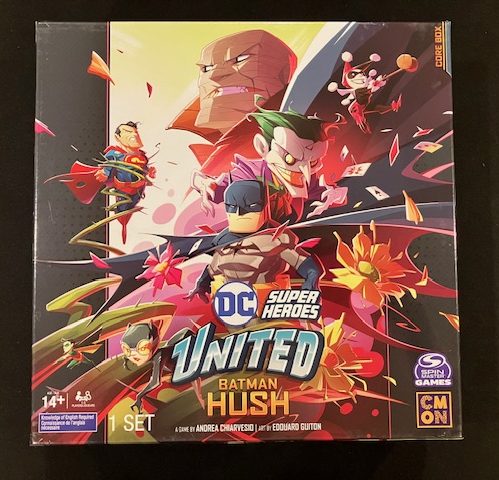
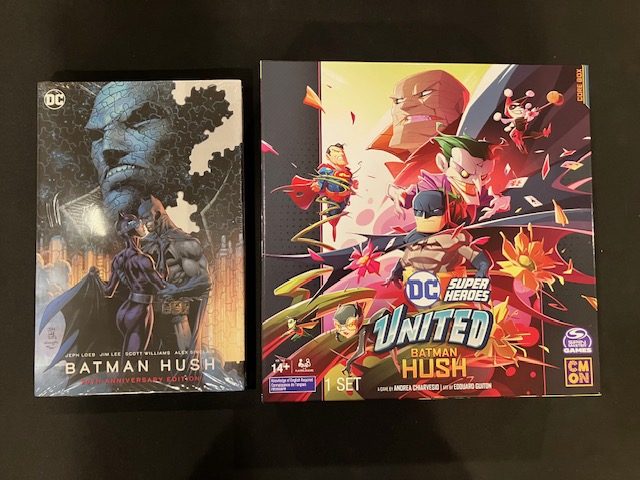
While we wait for the full delivery of DC Super Heroes United (which has run into multiple issues; CMON money issues, tariff issues, and staffing issues), CMON did manage to release DC Super Heroes United: Batman Hush (which we’ll just call Hush from now on, thank you). See above!
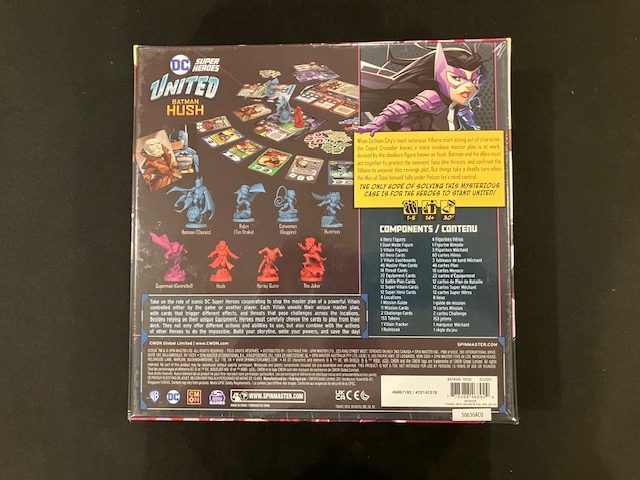
This was a “surprise” release that was available from Amazon sometime in August 2025; I ordered it instantly as soon as a I found out about it. No one really expected this? EDIT: Well, I missed a some memos … I didn’t expect it. I mean, we expected DC United (it was #1 on our Top 10 Anticipated Cooperative Games of 2025 list), but Hush was not part of the original Kickstarter!
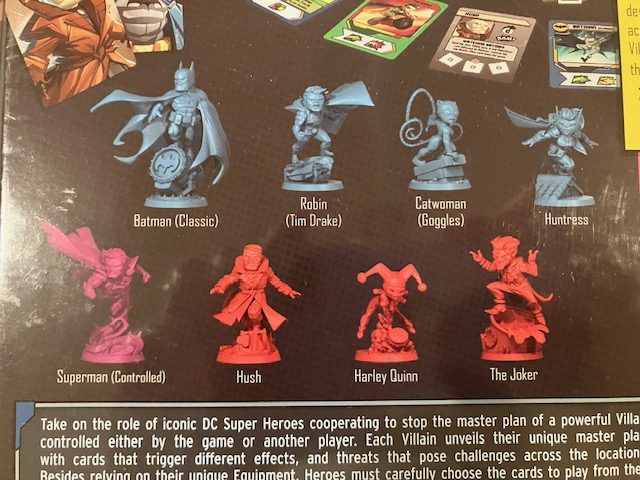
This game arrived at my house September 10th, 2025.
What is this?
Hush
This game Hush is a standalone game in the Marvel/DC United series of games. Yes, it is standalone; you don’t need any other sets to play this. This is a cooperative superhero game where players take the role of your favorite DC Superheroes (Batman, Robin, Superman*, etc) and work together to defeat the villain!
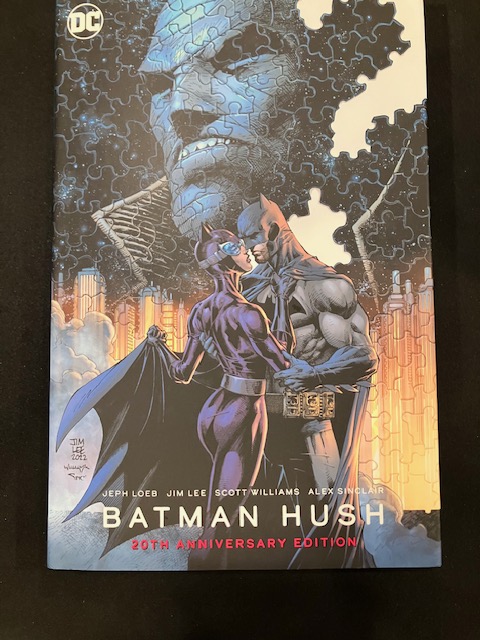
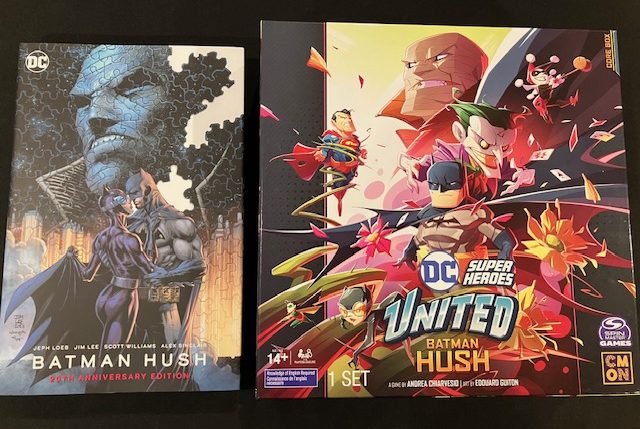
Hush is loosely based on the Jeph Loeb/Jim Lee/Scott Williams/Alex Sinclar Batman series called Hush: see the 20th Anniversary Edition hardback above.
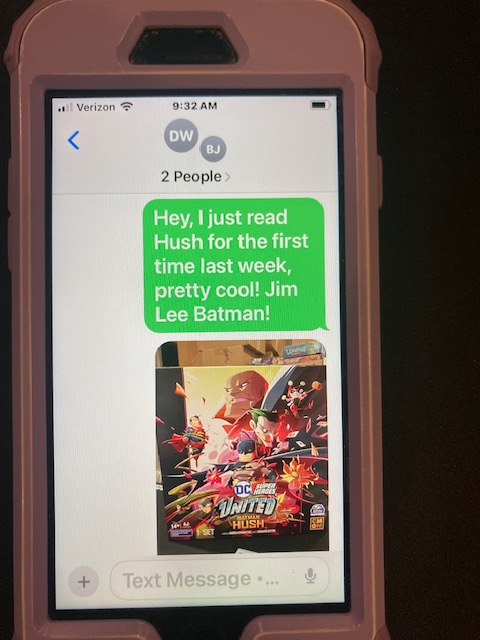
Surprisingly, I had never read Hush, which is weird because I love Batman and I love Jim Lee. How have I never read this??? I texted my friends Bryan and Diana, who are huge Batman and Jim Lee fans about this!
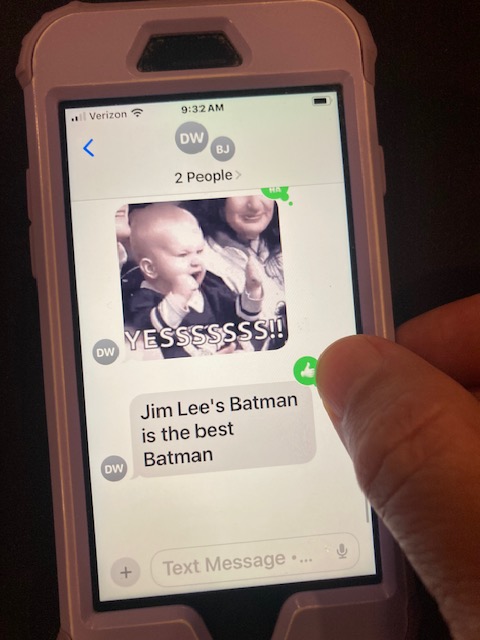
They think Jim Lee’s Batman is the best Batman (see above). I went ahead and devoured the story over about 3 hours (below).
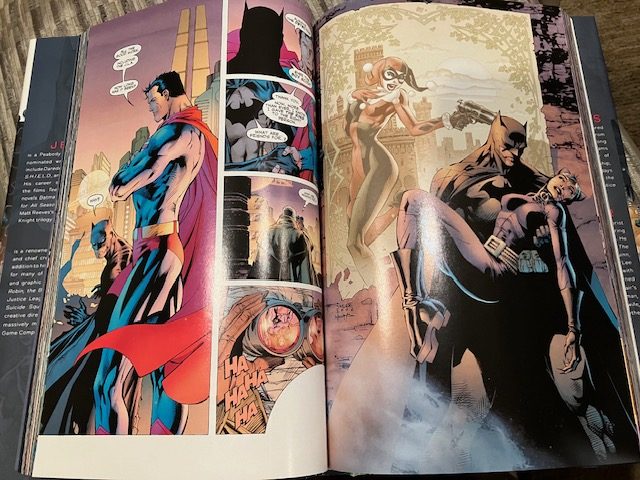
Hush is a great story; I’d recommend reading it if you’ve never read it. It gives much more depth to the Hush villain(s) in the box.
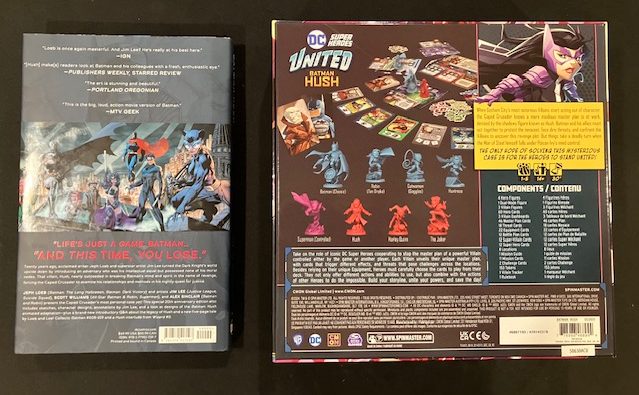
Strictly speaking, you do NOT to read the Hush graphic novel/series to play the game; it just helps flesh out the game. So, if you are intimidated by the giant Hush graphic novel, don’t despair! The game works fine without knowing the series, but be aware that there can be spoilers. (Still, Hush was pretty cool; you should read it!)
Unboxing/Gameplay
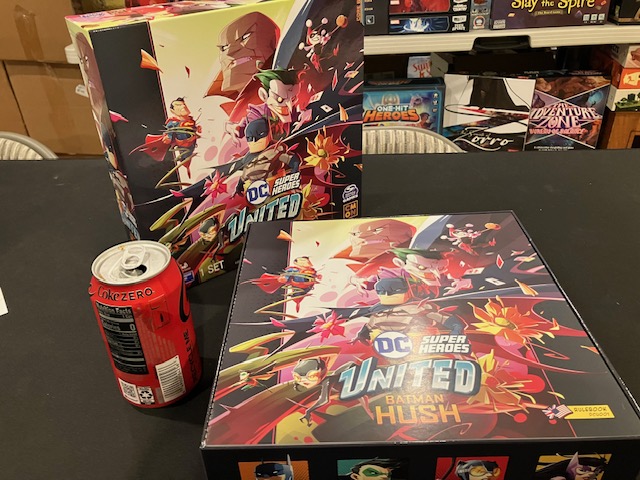
See box above with can of Coke for scale.
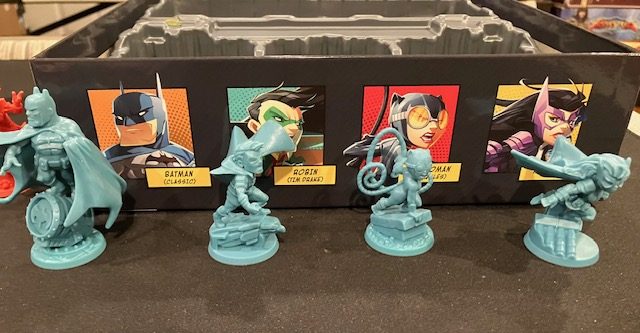
Each player chooses a hero to operate: Batman (classic), Robin (Tim Drake), Catwoman, or Huntress.
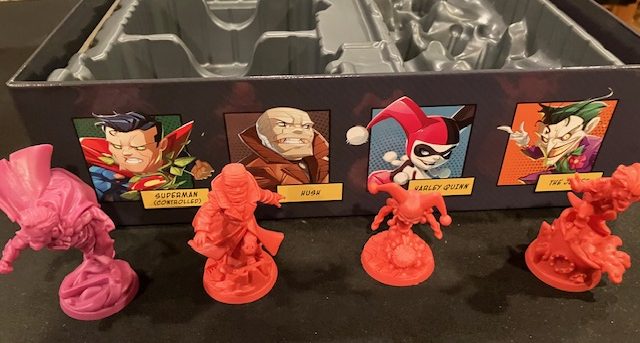
There must be a villain to fight: Hush, Harley Quinn, The Joker, or Superman (controlled). Superman (controlled) can also be played as a Hero.
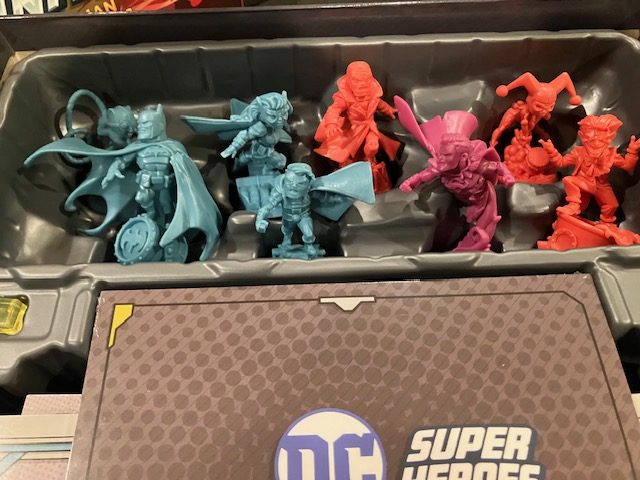
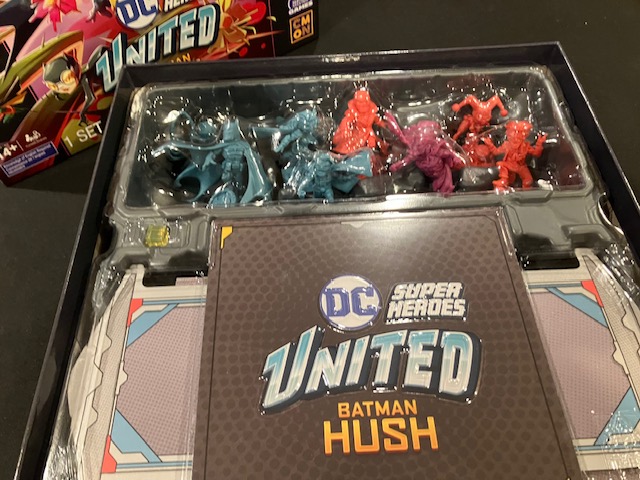
I recommend taking a picture of how the minis fit into the insert (or use mine above). If they all get out out-of-whack, you can’t put the plastic cover over the minis (see below).
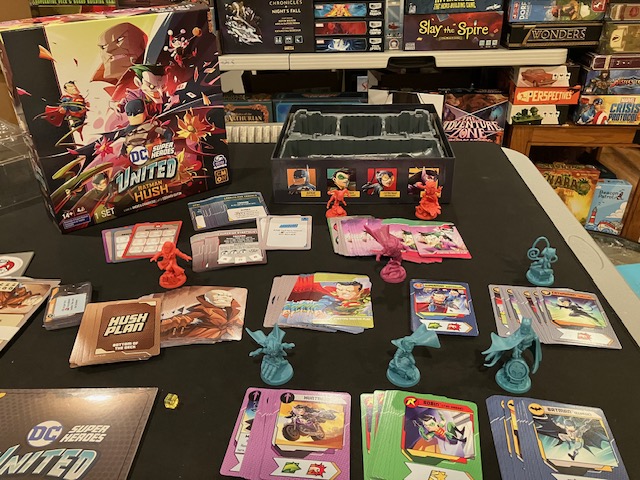
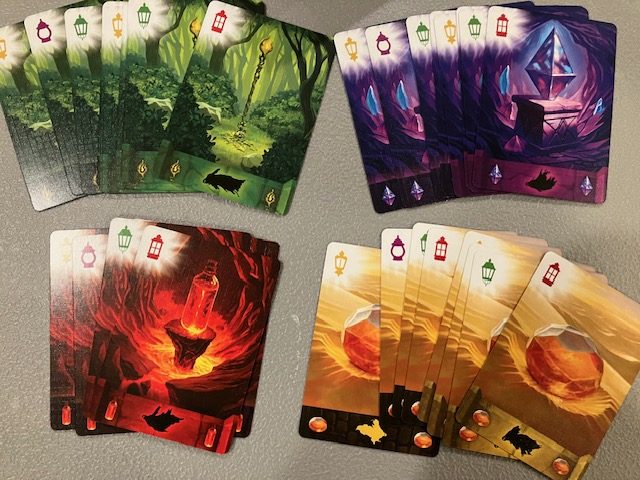
Each Hero gets their own deck, and each Villain gets their own (Master Plan) deck and Threats deck.
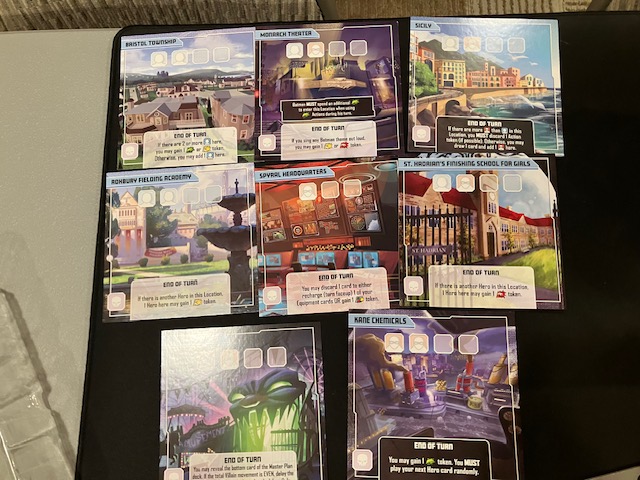
There are 8 locations that come with the box; you will set 6 of them out in a circle representing the city.
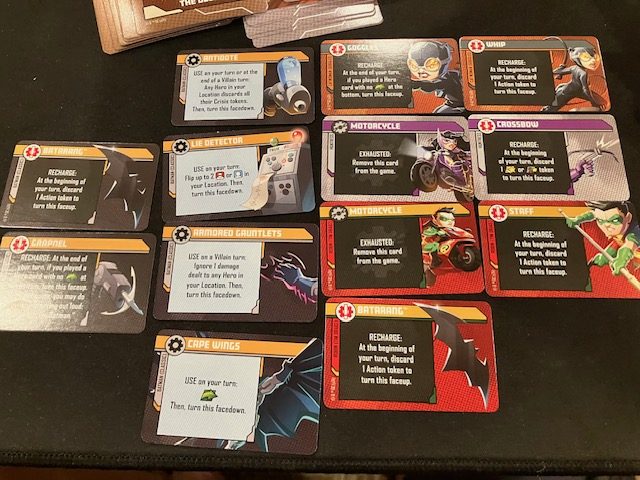
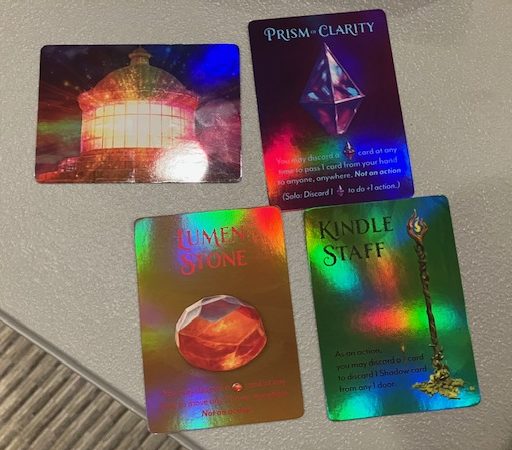
Most of the characters have equipment; the equipment cards are “newish” to Marvel United: they were introduced in Spidergeddon, but we were found we loved them in Marvel United: Multiverse (see review here). The equipment cards augment the heroes, and basically give them more choices on their turn; however, they will either be discarded or need a recharge to reuse them. See above.
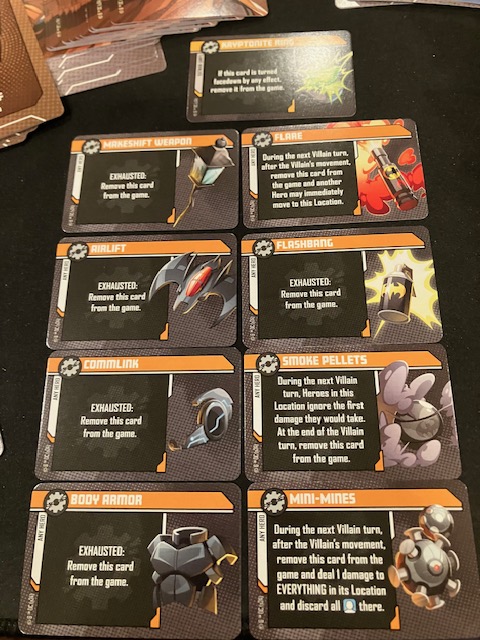
For heroes who don’t have equipment, there are also “generic” equipment cards any hero can use (see above).
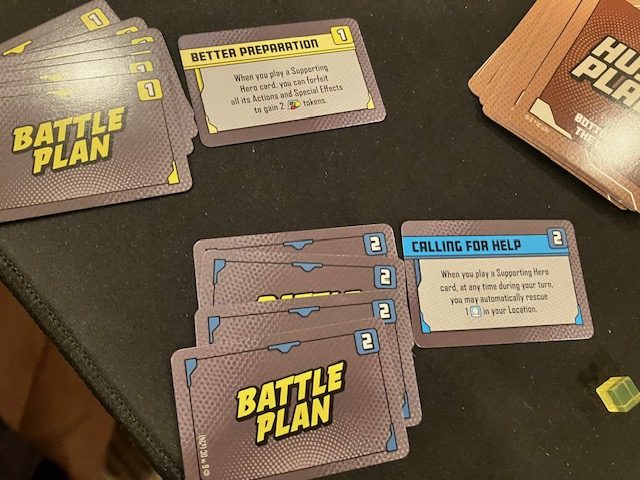
The game also comes with Battle Plan cards; they are for the built-in solo mode called Commander Mode.
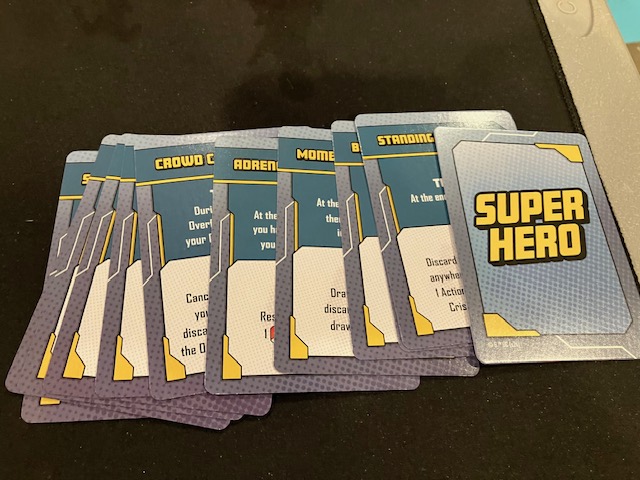
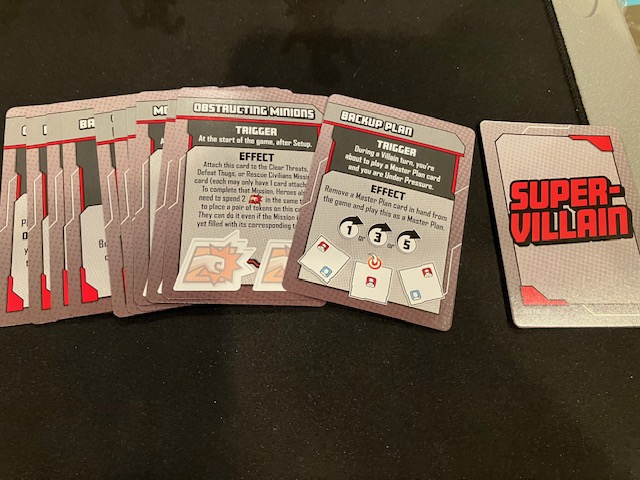
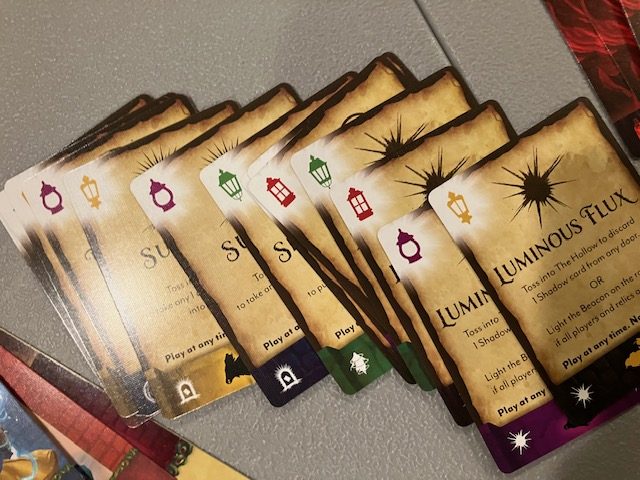
There is another way to play where one player can take control of the Villain and plays against all the heroes: this is a 1 vs. many mode using the Super-Hero and Super-Villain cards above. We won’t be discussing this mode any more in this review; this is strictly a solo and cooperative mode review.
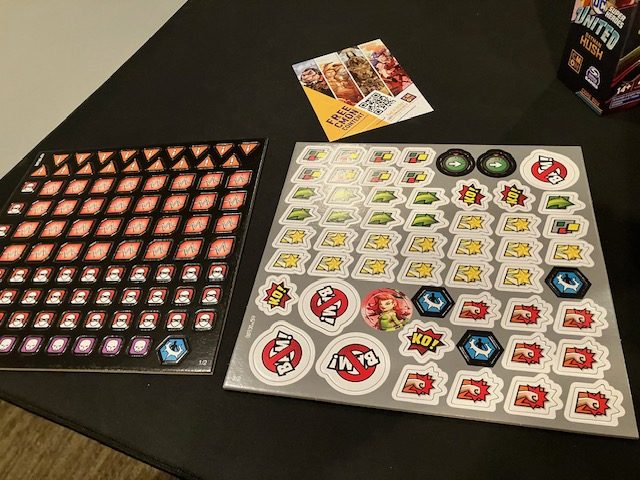
There are a tons of tokens for health, KOs, etc. See above.
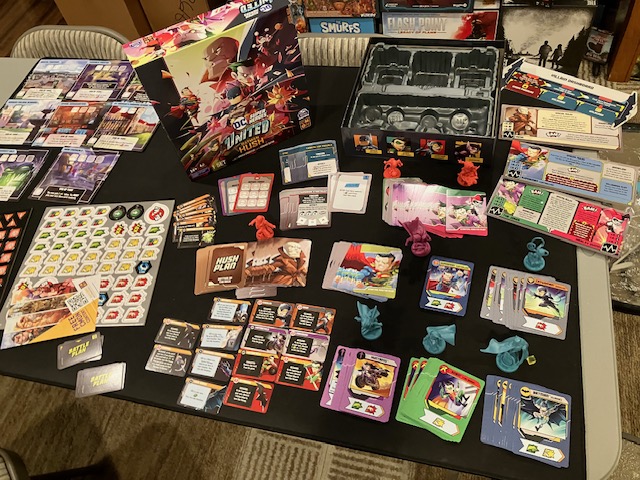
Overall, this game looks consistent and great. The artwork and minis in the game are consistent with the look-and-feel of all the previous Marvel United games (except this is DC instead of Marvel). For previous looks at Marvel United games, see here, here, here, here, here, and here.
Rulebook
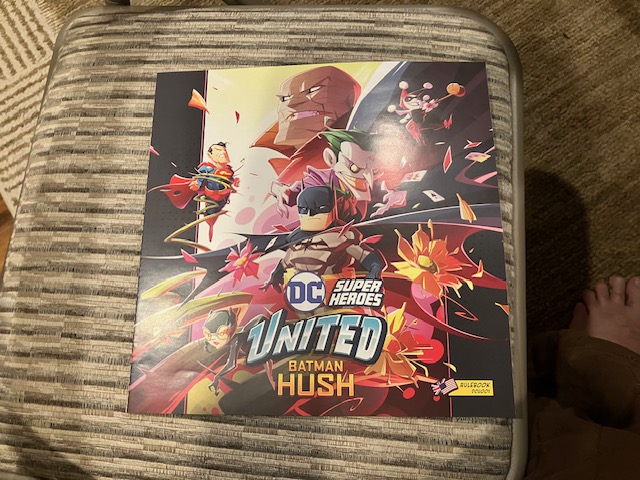
The rulebook is good (it had better be after so many iterations), except for the form factor.
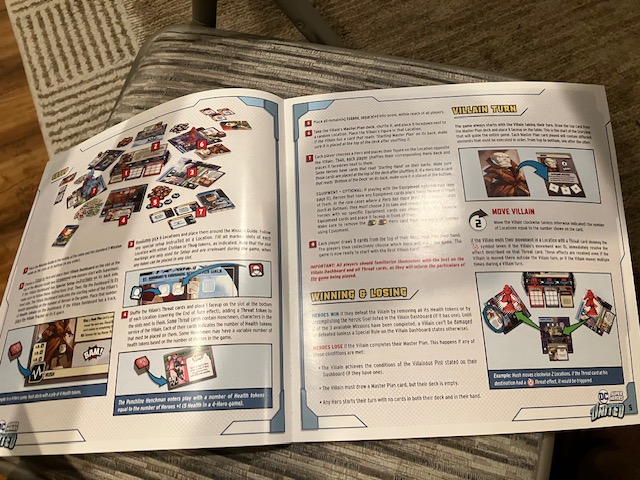
This gets a C+ or B- on the Chair Test; it does stay open on the chair next to me, it has a good-sized and readable font, it has lots of pictures, and it’s easy to read. Unfortunately, it hangs down just enough to be annoying. It does work with only one chair, if you sorta fudge it diagonally.
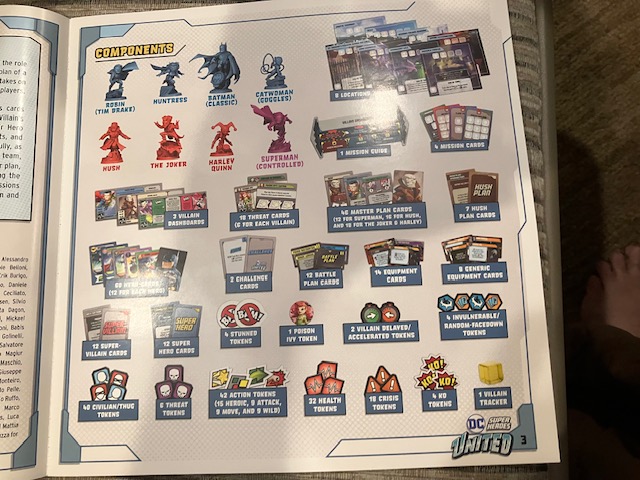
The Components page is great: see above.
The Set-Up is across two pages, but they are in the same span, and the picture and labels work well.
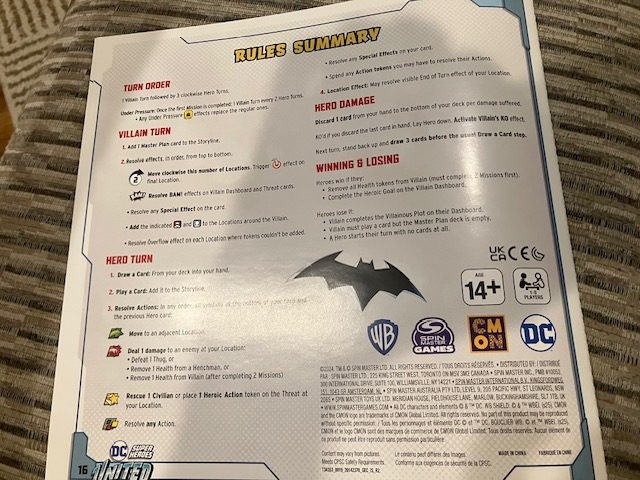
Some, not all, icons are on the back.
In general, this is a good rulebook: good components, good set-up, good font, good pictures, good back. The only complaint is the form factor.
What’s New?
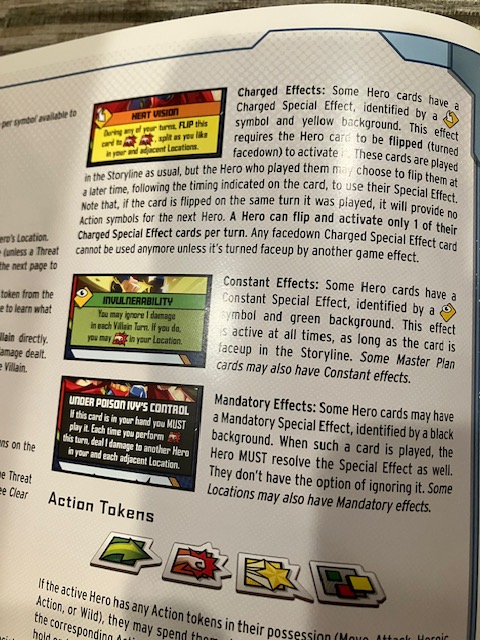
Most everything in Hush we’ve seen in one of the previous Marvel Uniteds. I have played a lot of Marvel United, but it’s hard to say you’ve played EVERYTHING across the massive amount of content in Seasons 1,2, and 3! Here’s what was new to me:
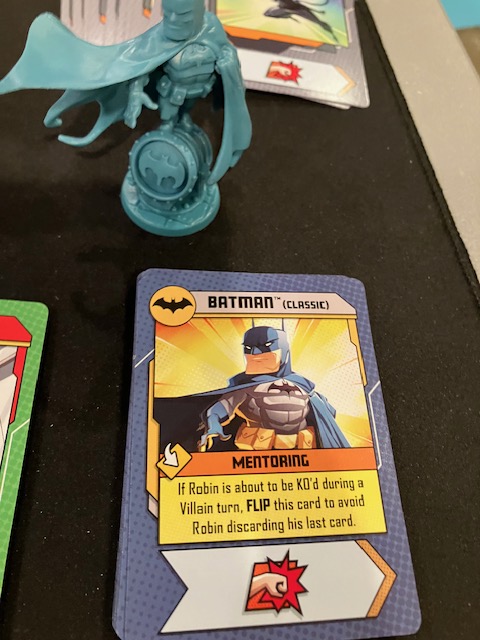
Charged Effects: The little yellow area/flip card allows to flip a card in the Storyline once it’s up. In the example above, you can flip Batman’s card (only if it’s in the Storyline) above to stop Robin from being KO’d! This is kinda neat; it’s like a one-time only effect that can only be activated AFTER the card has been put into play.
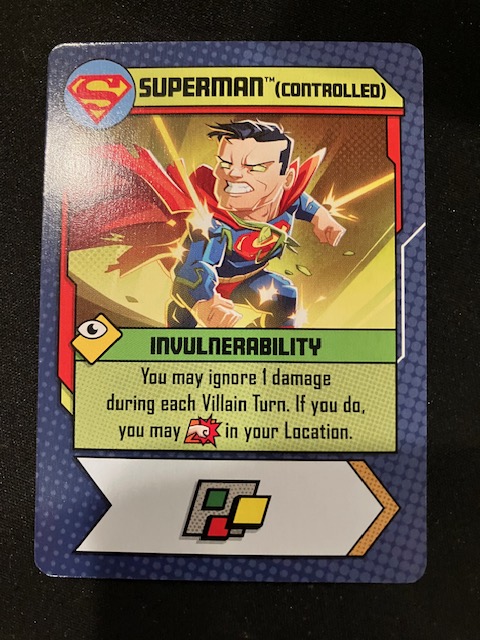
Constant Effects: These cards keep an ability active always once they are in play in the storyline! See above as Superman’s Invulnerability keeps damage off him!
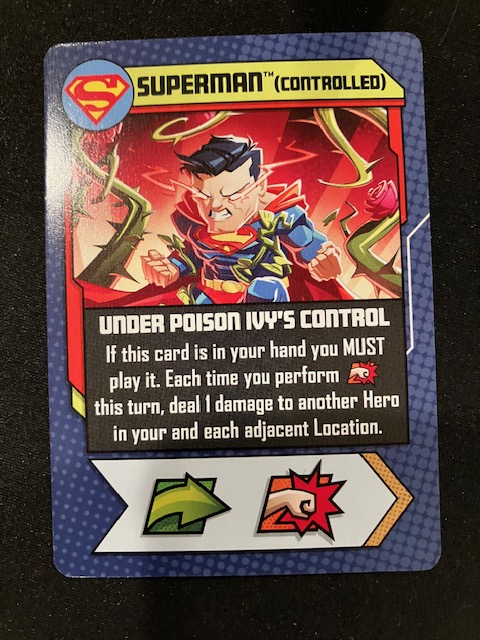
Mandatory Effects: These are mandatory things you MUST do on the card. This Superman is controlled, and occasionally reverts to his controlled self … doing damage to Heroes around him. See above.
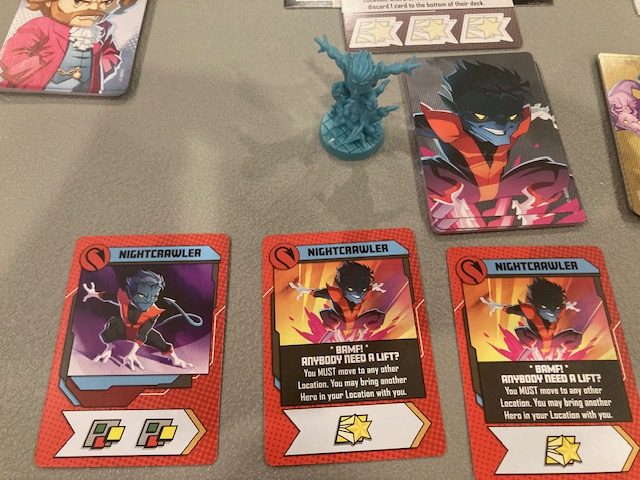
To be fair, we did see Mandatory Effects on the Nightcrawler’s cards back when we did the Dark Phoenix Saga: see here.
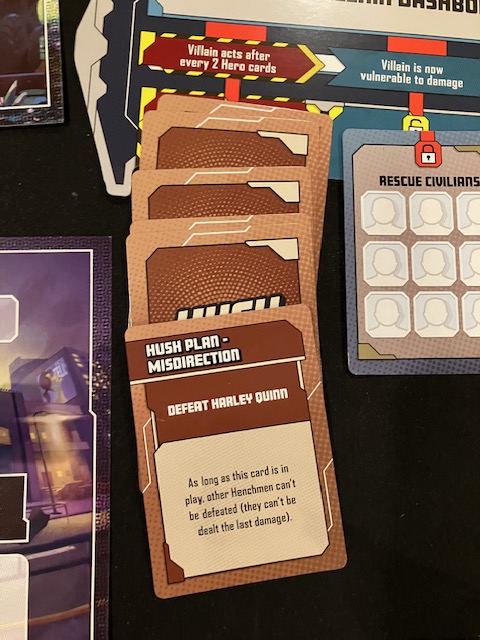
Hush Deck: if you are playing Hush, the Hush Plan deck replaces the Clear Threats on the dashboard.
Generally, the DC Superheroes United: Hush Batman or Hush feels very much like the newer Marvel Uniteds with equipment, Charged Effects, Constant Effects, and Mandatory Effects being the newer things. Otherwise, it feels like Marvel United, but DC instead!
Solo Mode Discussion
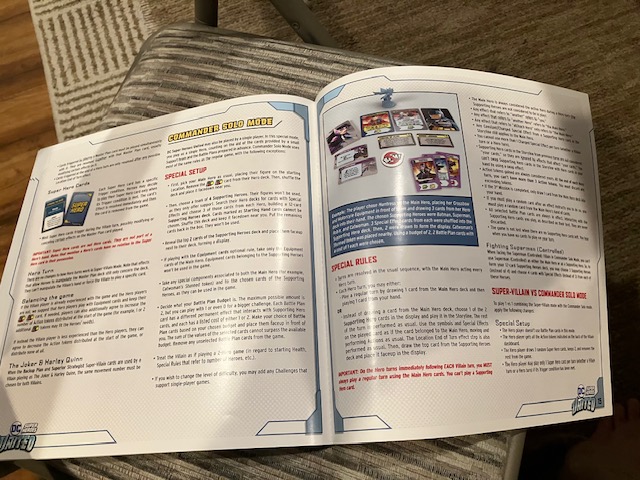
There is a solo mode called Commander Solo Mode (thanks for following Saunders’ Law and giving us a solo mode) that spans two pages. And it’s pretty complicated. But it is a true solo mode; you only operate one hero.
I think we saw the Commander Solo Mode first back in Spidergeddon, and we kinda liked it better than the solo mode in the original Marvel United … but frankly it still just feels too complicated. It’s almost two pages of exceptions, new rules, changes, and special rules! Look closely at those two pages above! There’s SO MANY RULES FOR COMMAND SOLO MODE!
Frankly, it’s so easy to just pull out two heroes and alternate between them and just play solo (operating two heroes); it’s the way the game was meant to be played. This is the way we play solo, partly because it’s significantly easier, partly because it’s easier to jump in (so we concentrate on the new rules of the Villain), partly because it’s the way Marvel United was meant to be played: 2-4 Players, and partly because we have to teach the cooperative game to our friends (so it’s better to play without all the solo rules exceptions for a better learning to teaching game).
You can disagree with me if you like, but I feel very strongly about this! Every time someone tries to put a solo mode in, I find it’s usually better and easier to just play two-handed solo instead (Leviathan Wilds, Leviathan Wilds: Deepvale Expansion, Lord of the Rings Pandemic to name just a few). Frankly, the built-in solo mode for Lord of the Rings Pandemic almost caused me to hate the game … it wasn’t until I played 2-Handed solo that I found joy in Lord of the Rings Pandemic.
Play solo operating two heroes. You’ll thank me.
Game 1: Batman and Robin vs. The Joker and Harley Quinn
Solo game: two-handed solo (one player operating Batman and Robin independently)
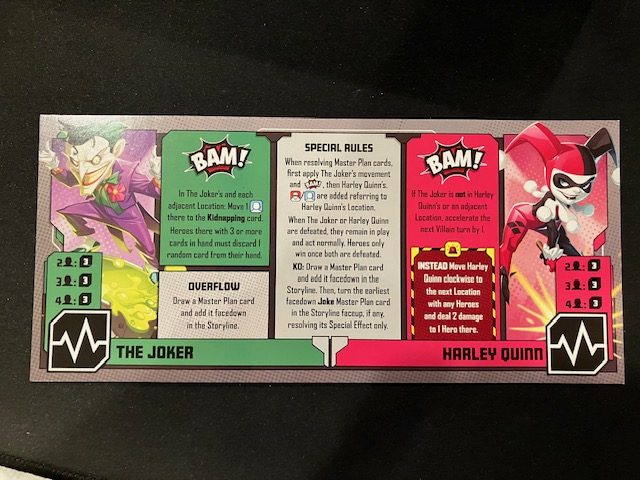
Our first game was Batman and Robin vs. The Joker and Harley Quinn. Note that Harley Quinn and The Joker are a “team” you are playing against! You can’t win until they are BOTH down!
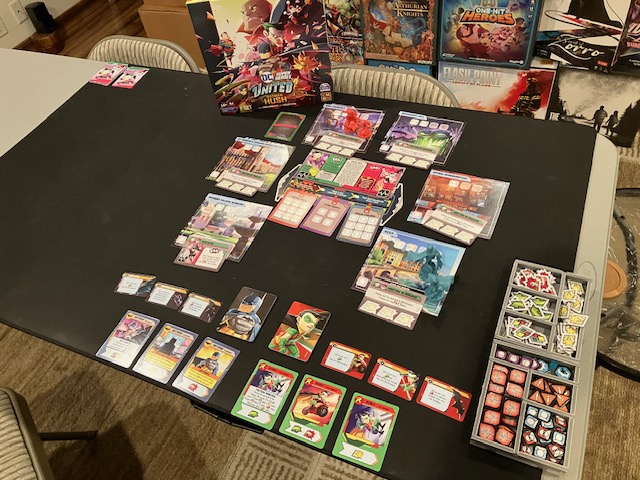
See Batman and Robin get ready to go!
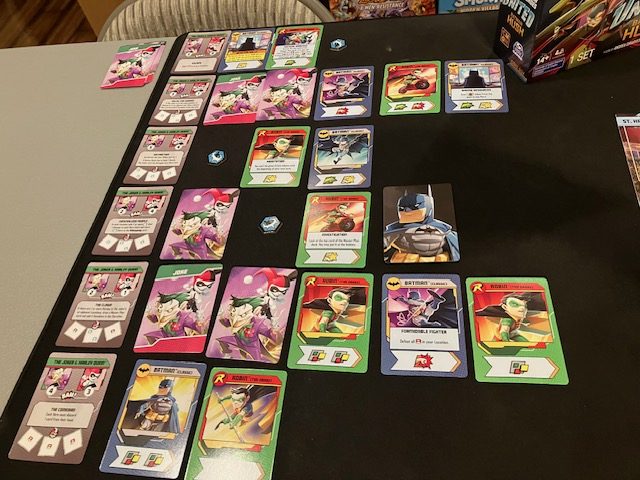
The storyline for Joker/Harley Quinn got convoluted as many times we’d have to put Master Plans into the storyline … they can come up at a later time, or when a character gets KO’d!
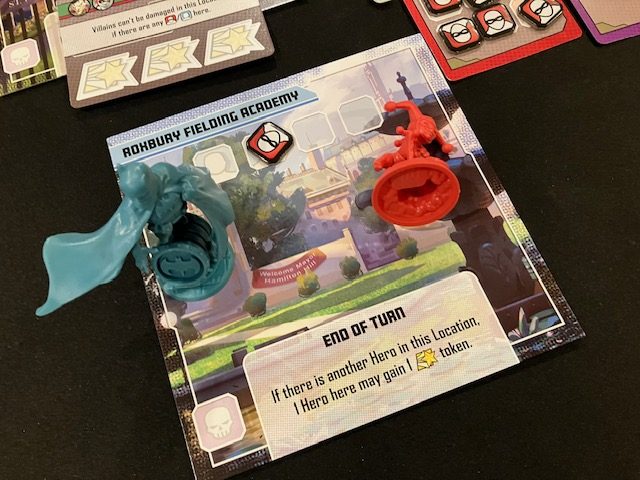
In the end, Batman and Robin prevailed. Batman took out Harley Quinn …
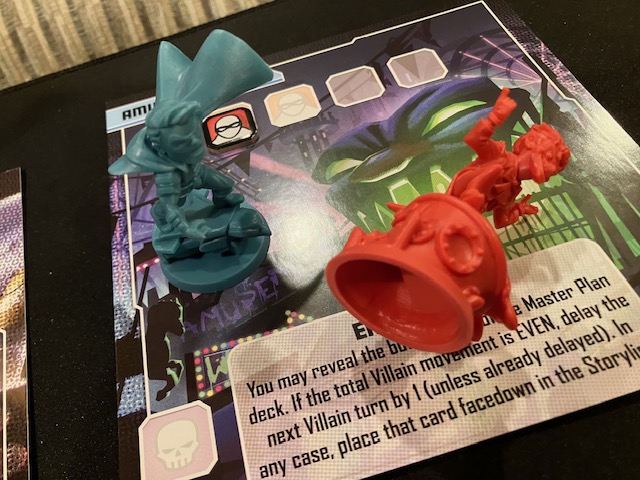
… and Robin (Tim Drake) took out the Joker.
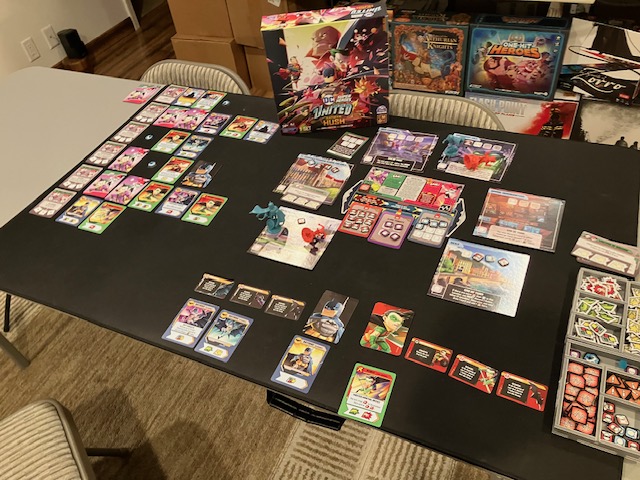
There are some neat ideas here, as the Joker kidnaps civilians (something he would SO DO in the comics), Harley causes the Master Deck to dwindle, and “Jokes” appear in the Storyline! This is a game about keeping the Master Plan deck under control by indirection! Sometimes you do stuff to STOP the Master Deck from getting too small! If the Master Deck ever becomes empty … you lose!
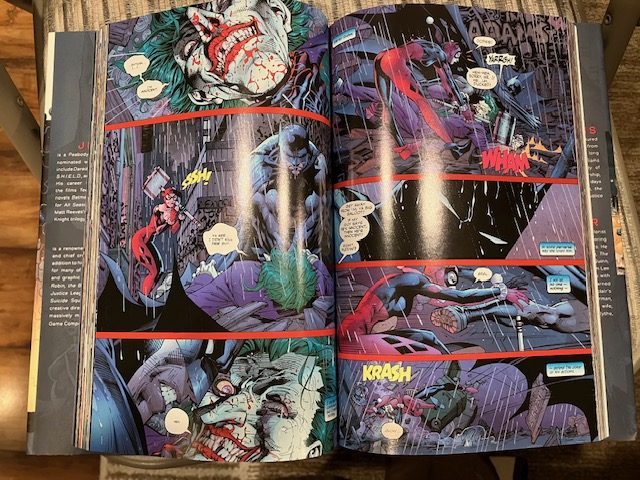
The Joker and Harley Quinn scenario felt incredibly thematic: Joker kidnapping, Harley causing chaos, and Joker’s “jokes” in the storyline occasionally springing on the Heroes! (It also had roots back in the Hush series: see snapshot above).
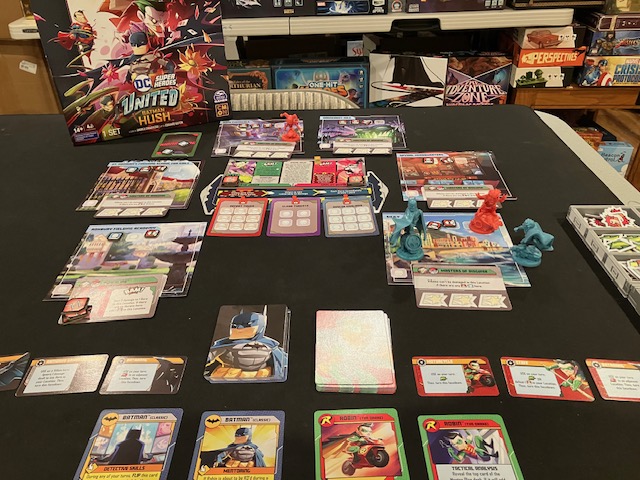
Batman and Robin’s decks were also on point: they both had the ability to “be a detective” and look at the next Master Plan card coming! This was both incredibly useful and very thematic.
Games 2, 3, and 4: Catwoman and Huntress vs. Superman (controlled)
Solo game: two-handed solo (one player operating Catwoman and Huntress independently)
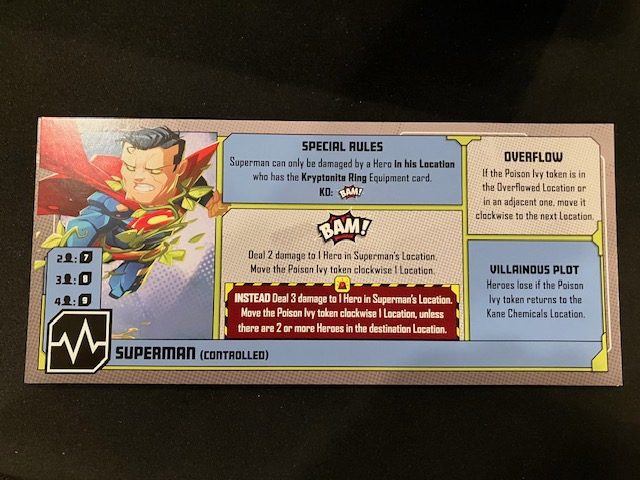
So, Superman (controlled) is hard. I guess he should be; he’s Superman!
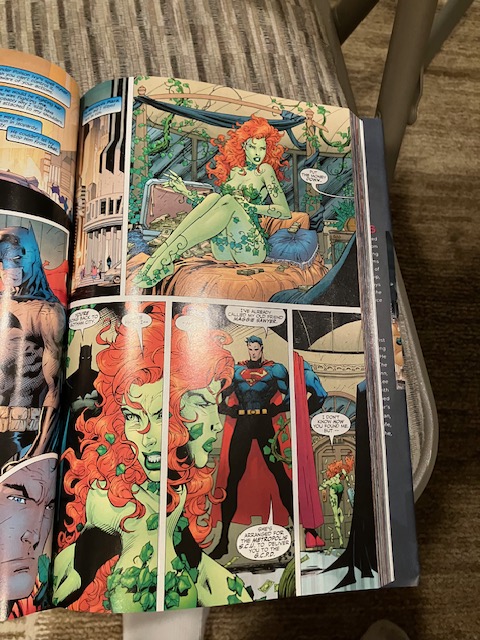
Superman is bad guy here because Poison Ivy is controlling him! See a still from the comic above!
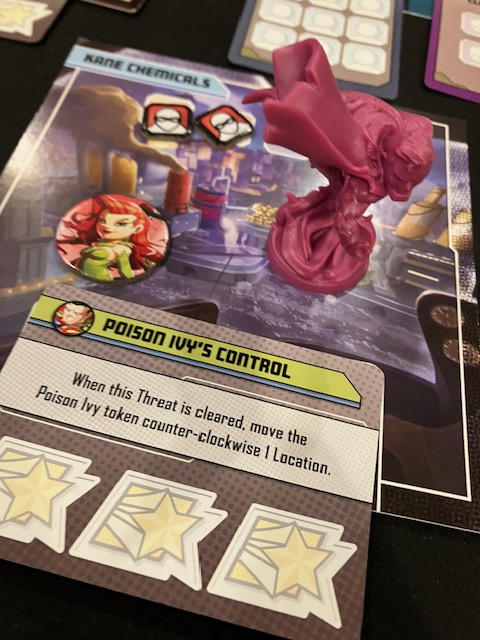
Superman is controlled by Poison Ivy (see above). If Poison Ivy makes it around the board back to Kane Chemicals, the bad guys win!
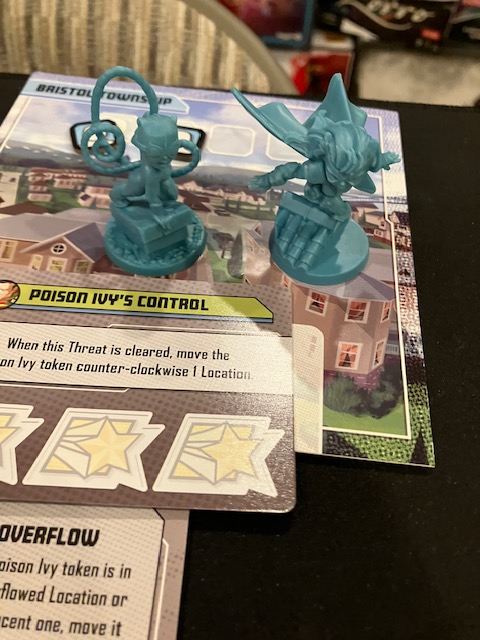
Over 3 games, Huntress and Catwoman struggled! They lost three games in a row! In this particular scenario, heroism is very important! Unfortunately, Huntress and Catwoman seem to have more punch than heroism!
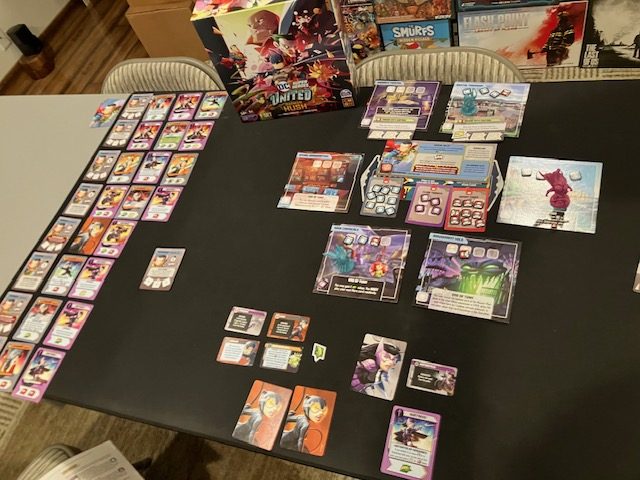
Huntress felt very thematic, as she could look at the top of the Master Plan deck (with espionage) and was very mobile and punchy. Similarly with Catwoman, she had some disguise cards and was very punchy and mobile. Unfortunately, they were a bad team against Superman (controlled). Honestly, this makes sense thematically: neither Catwoman or Huntress are known for their Heroism in the comic books … they tend to be more “self-interested” heroes!
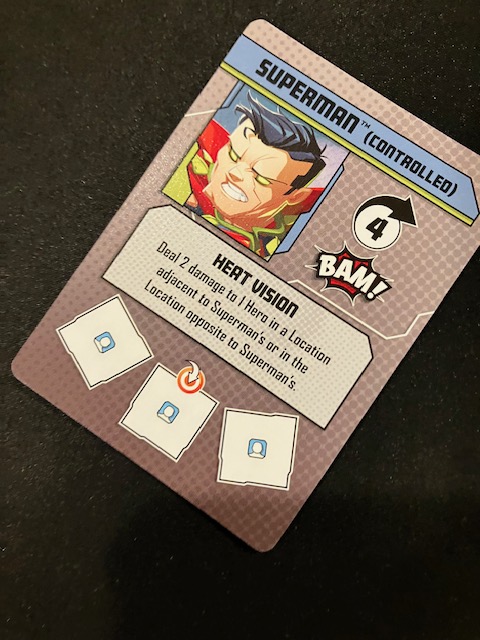
Still, I thought the Superman (controlled) villain was pretty cool! It felt thematic … and you even had to have a Kryptonite ring to hurt him!
I have played SO MANY games of Sentinels of the Multiverse where you lose because you just have the wrong heroes. And that feels very much like the comic book universes! (Sometimes, Spidey has to go visit Doctor Strange to handle a mystic bad guy!) In this case, Huntress and Catwoman are the wrong Heroes for Superman … or at least, it’s a LOT harder to play them.
Game 5: Batman and Robin vs Superman (controlled)
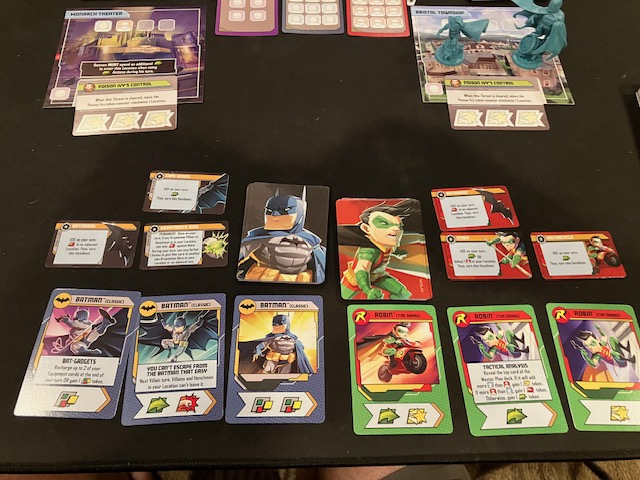
Batman and Robin did much better against Superman (controlled): they defeated him in one game.
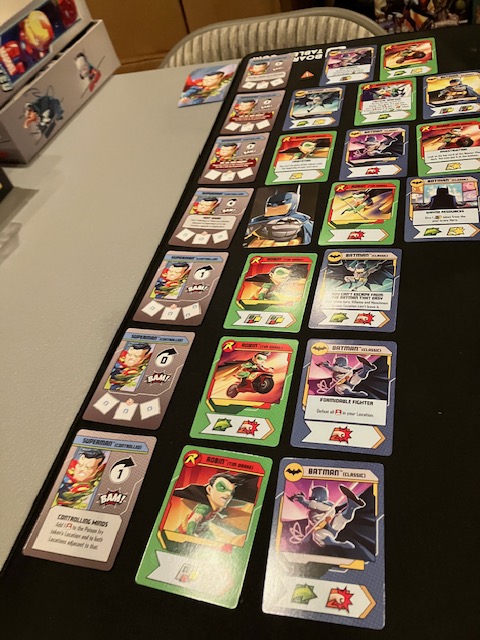
Batman and Robin control the Master Control deck much better and have a lot more Heroism to deal with Threats and civilians.
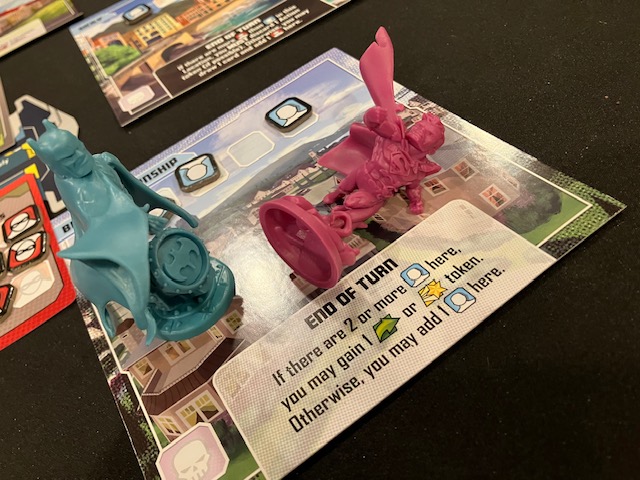
This win felt very thematic: Batman and Robin use their detective skills and heroism to keep the bad guy (a Superman controlled by Poison Ivy) at bay.
Game 6: Batman and Robin vs Hush
Solo game: two-handed solo (one player operating Batman and Robin independently)
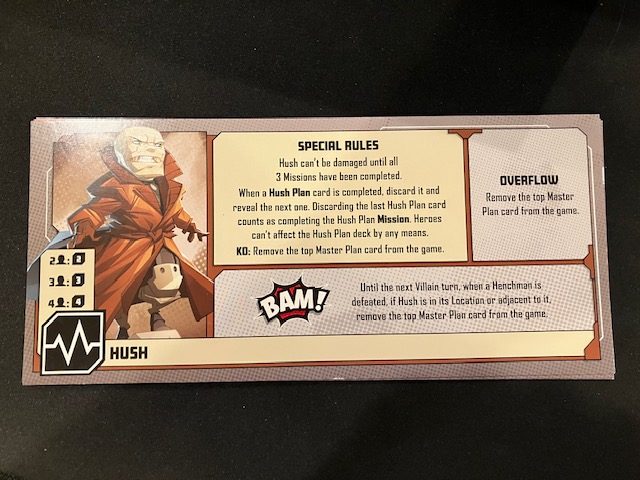
The Hush Villain is probably the most complicated to play. You must complete all three Missions, but instead of Clear Threats, you have to clear six “Hush” threats (see below).
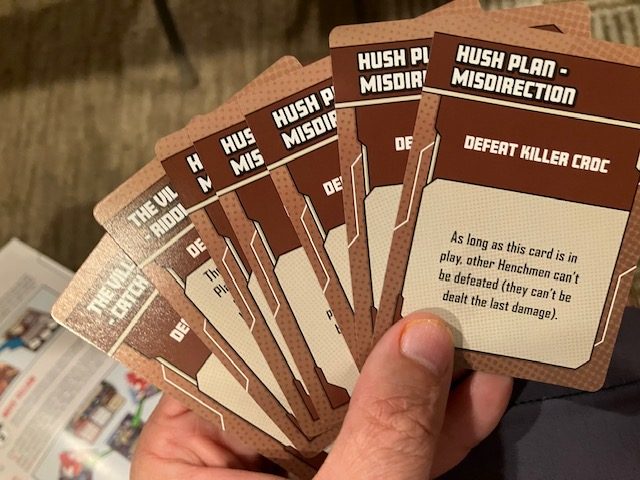
Like the comic book (very minor spoiler), the Hush Plan cards makes you “focus” on a particular Henchman on the board: you can only defeat them in a certain order. This constrains how you have to defeat them!
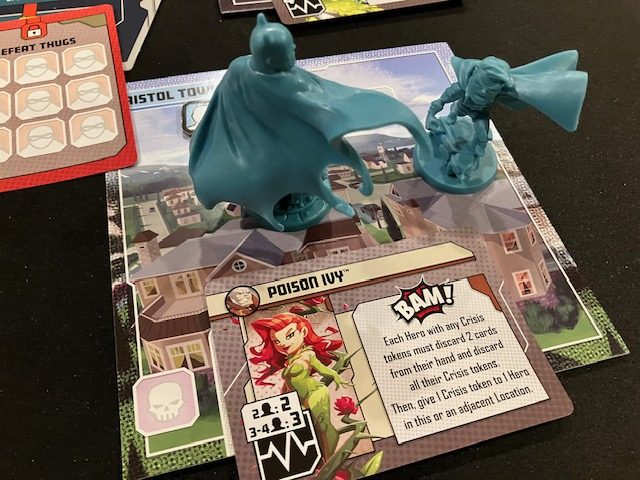
The Hush villain is much more about taking down Henchmen a little at a time, while “defeating” them in a particular order. Batman and Robin have to “balance” how they spend their resources.
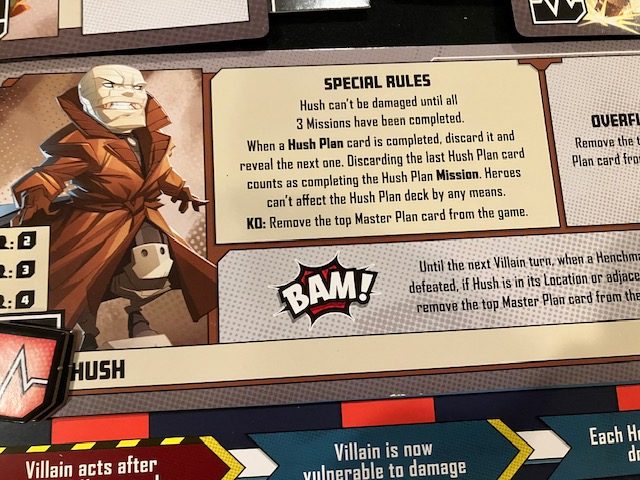
Of course, lots of things (like KO’s, see above) get rid of Master Plan cards. Do you defeat a Henchman this turn at the cost of losing a Master Plan card? Or do you wait a turn? Defeating Hush is all about balance for the Heroes. Hush himself is sewing Chaos into the world and dwindling the Master Plan deck!
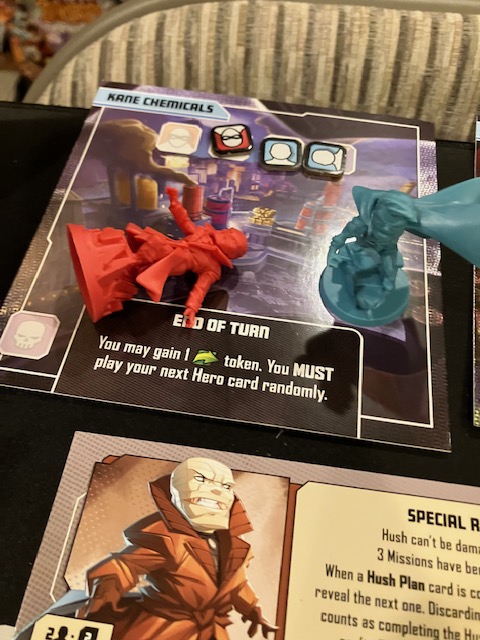
In the end, Robin had a good run and was able to move to Hush and take him down.
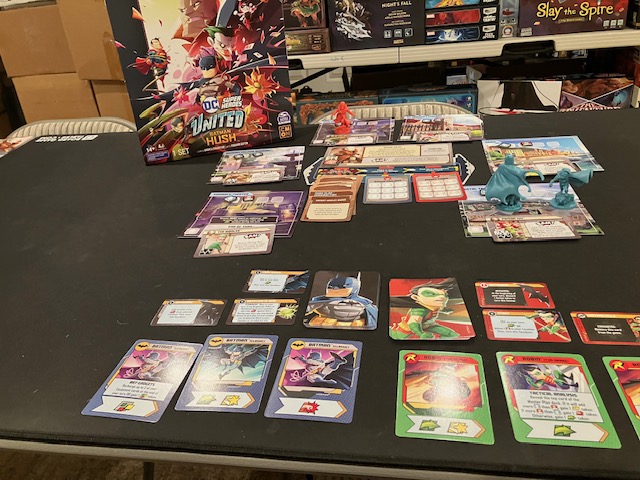
Even though it wasn’t a full saga like the comic, Hush felt like the story that unraveled in the comic. Batman and Robin get “distracted” by Henchmen along the way as they try to uncover who Hush is … and that’s the last card of the Hush Plan deck!
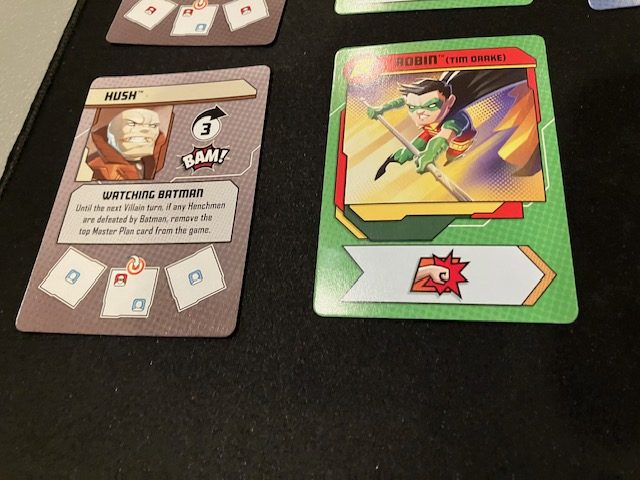
Although you can play the Hush Villain without reading the story, I strongly recommend you do read it before playing! There is a major spoiler at the end of the Hush Deck that will spoil the entire Hush comic book. The other two Villains (Superman and Joker/Harley Quinn) you can play without reading, but I suggest you probably read Hush before playing he Hush villain.
Game 7: Superman (controlled) and Huntress vs. Joker and Harley Quinn
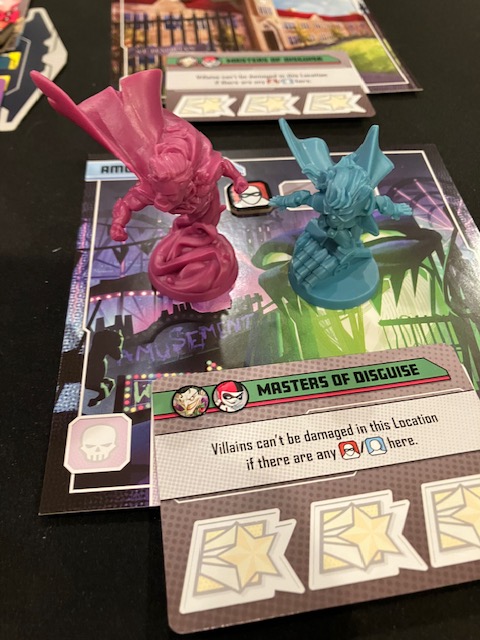
Don’t forget; you can play Superman (controlled) as a hero as well!
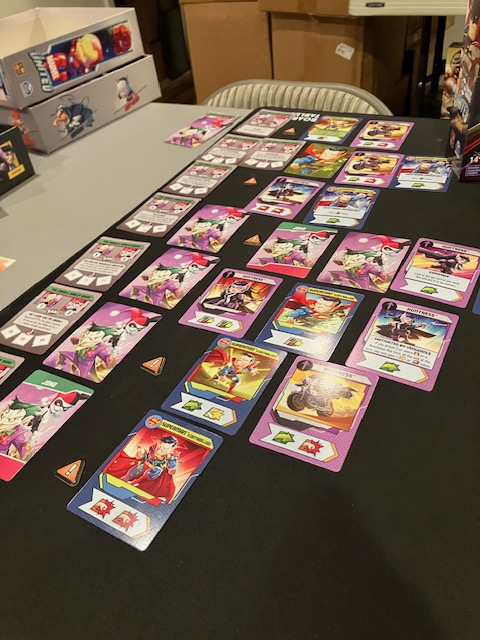
Supes deck is pretty strong. And Huntress is great at punchy and movement.
Superman’s deck has a minor flaw that he might have to punch other Heroes (since he still has some residual control): see above. That card kind of “balances” a very strong deck by giving him a “forced” card. Don’t you hate it when Poison Ivy asserts her control at exactly the wrong time? That feels so comic booky! I kind of enjoyed this! Supes is great … except for the one time he isn’t!
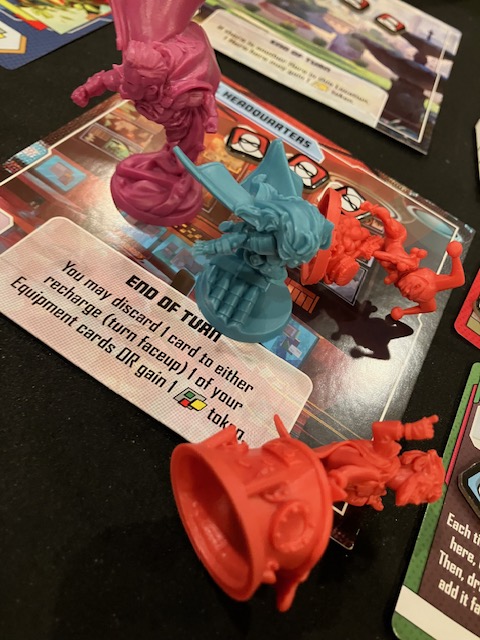
And Huntress redeemed herself by helping out Superman.
Game 8: Catwoman and Huntress vs. Joker and Harley Quinn
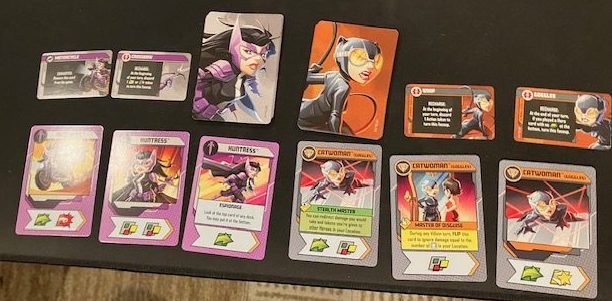
Just to make sure Catwoman and Huntress are good decks, I took them for a run against Joker and Harley Quinn.
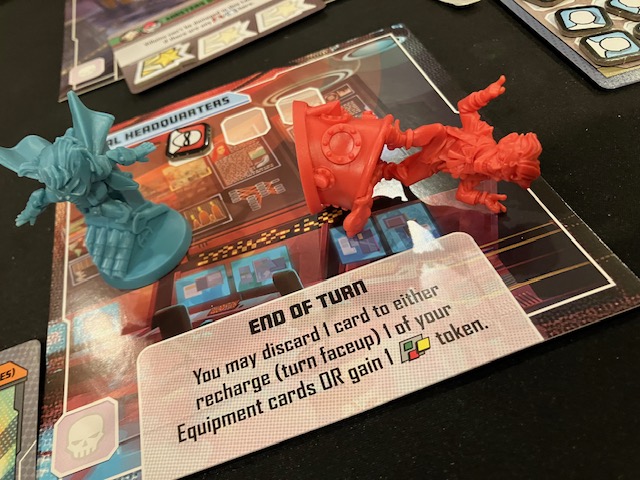
After losing to Superman three times, they acquitted themselves and beat Joker and Harley Quinn.
Cooperative Game
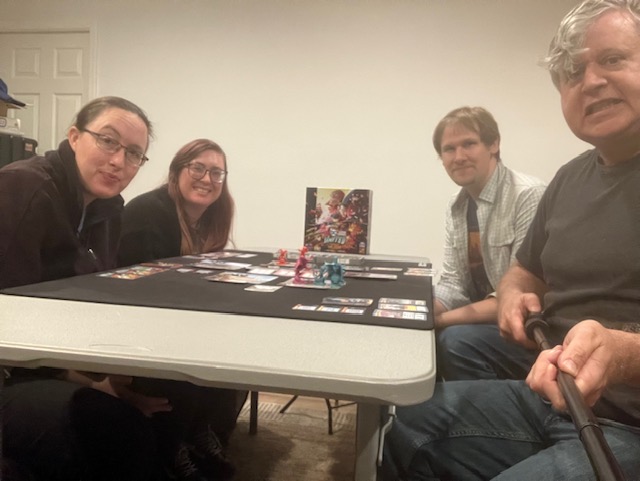
There weren’t any real surprises from the cooperative play; we’ve played this before as a team!
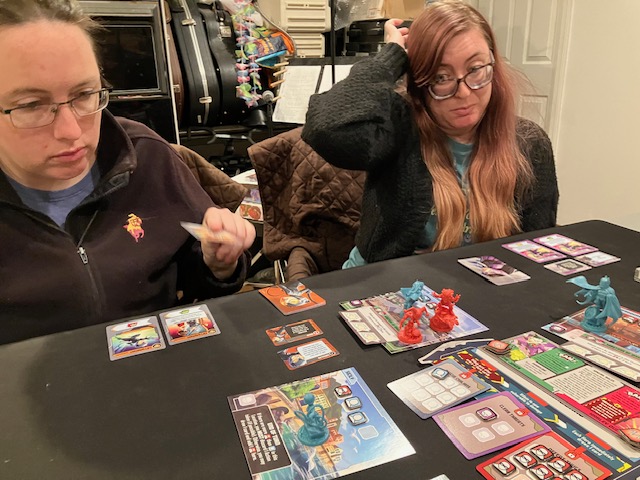
People discussed! At one point, Andrew HAD to play a Controlled Superman card and he said “I suggest you all NOT be adjacent to me! I will punch you!” So, Sara and Teresa made sure there was movement on previous cards. Most of the discussion is “Oh! If you give me this … Oh! What do you need?” and stuff like that.
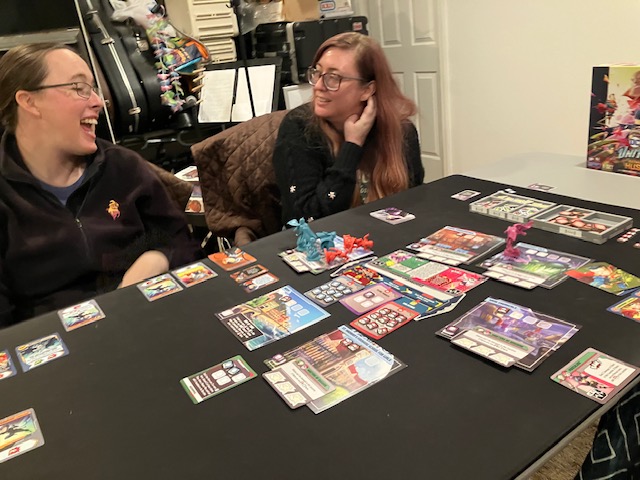
My group had a fun time playing this cooperatively. The new abilities and equipment made them enjoy it that much more.
Judging by my group’s responses, I think this is the best version of the Marvel/DC United system so far.
Core Game?
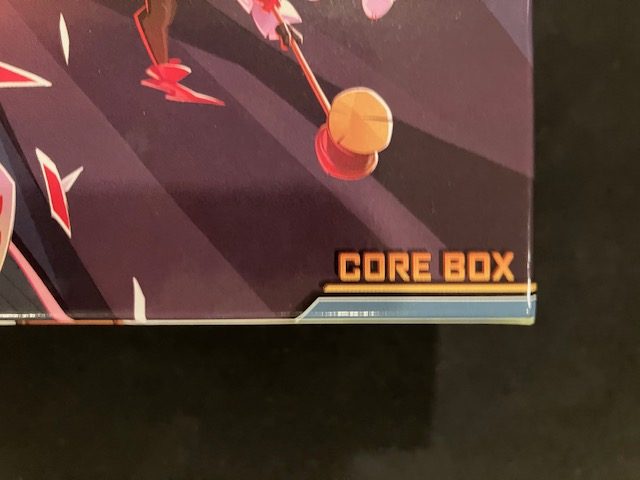
I am somewhat surprised that Hush is a core box! That means this is a completely standalone game! I loved what I saw, but this doesn’t feel like it should be a “core set”? The heroes in this set are great for new players, but the villains are really complicated! Superman (controlled) is probably the easiest Villain to operate, but maybe the hardest to defeat?! And both Hush and Joker/Harley Quinn are very different than most base Marvel United villains! They are much more complicated than (say) Red Skull from Marvel United, or even Ghost Rider from the Multiverse set!
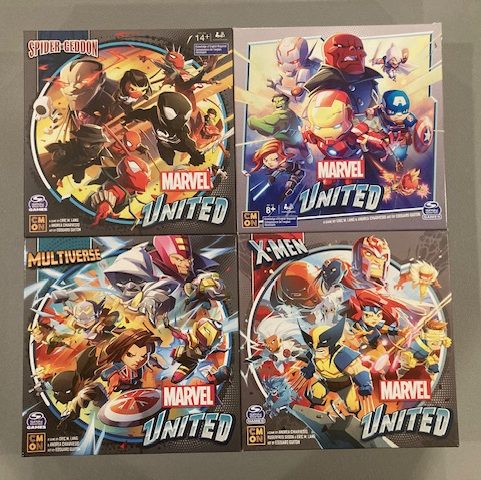
If I were to recommend someone start with a core set, I’d recommend the base Marvel United, Marvel United: X-Men, or Marvel United: Multiverse over DC SuperHeroes: Batman Hush… I think Hush is too much for a starting player. Which is too bad, if you LOVE DC, this is the only set you can currently get! I am afraid Hush might accidentally turn off some intro players because of its extra complexity.
Plays Well With Marvel United?
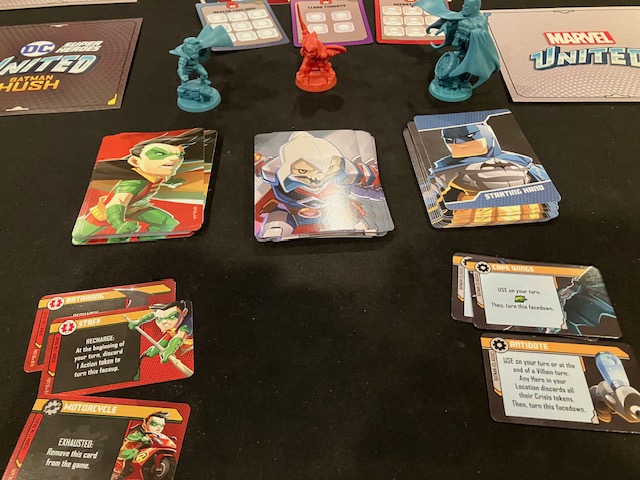
Of course, I had to make sure this played well with Marvel United, so I had Batman and Robin take on Taskmaster (from the base Marvel United set)!
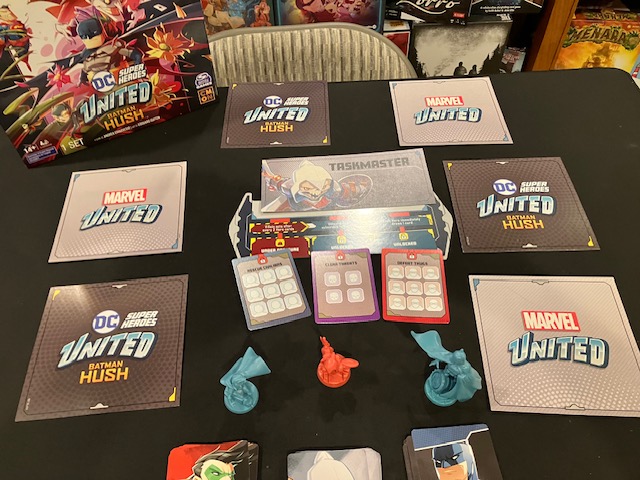
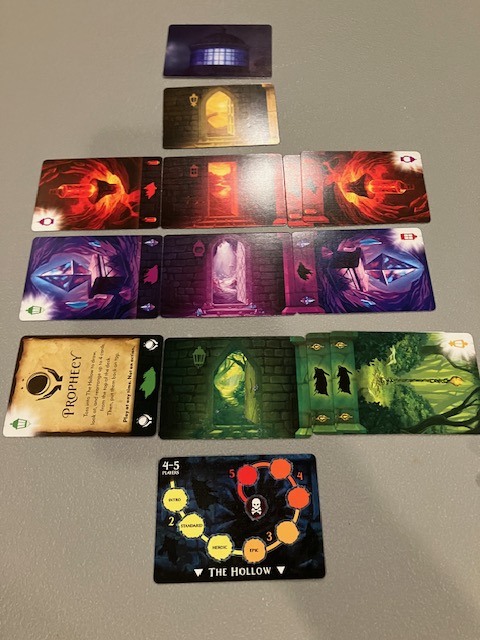
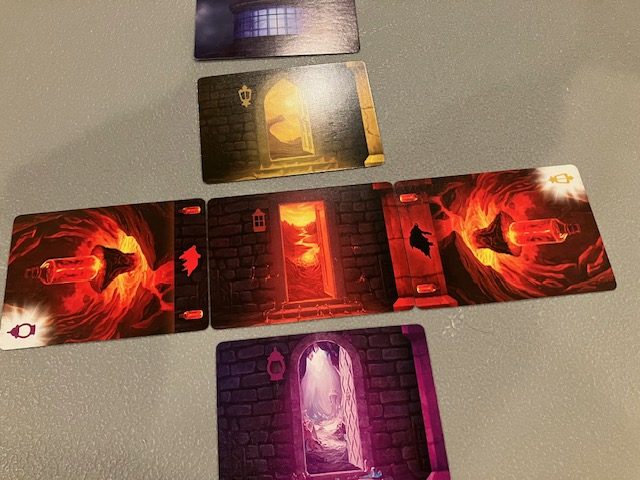
For funzies, I also used half of the Locations from Marvel United and half of the Locations from Hush! See above.
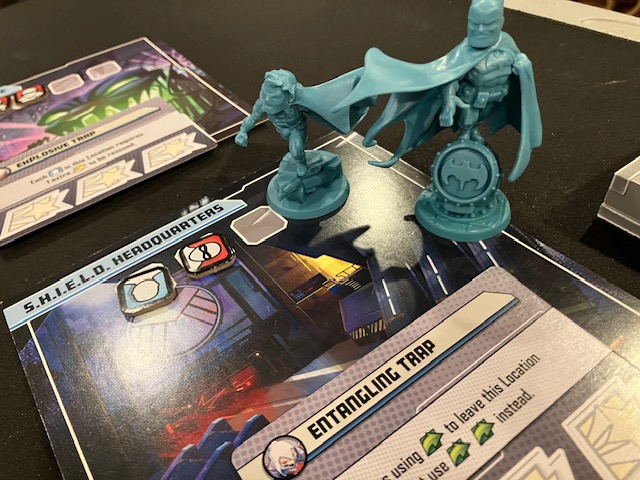
I got SUCH a kick out of mixing universes! I started giggling to myself when I had Batman and Robin start the game on SHIELD Headquarters!
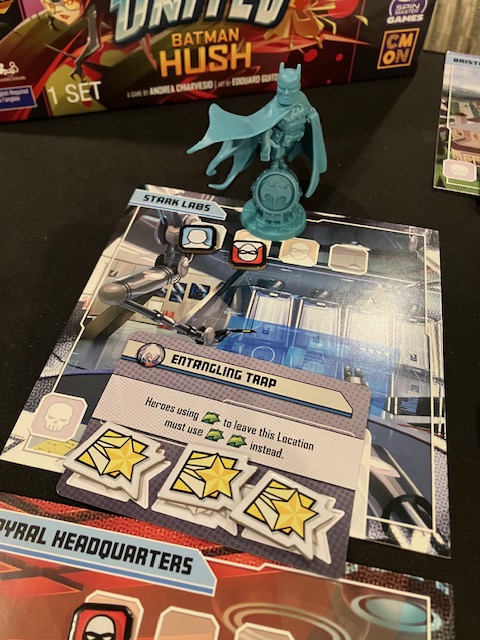
Then later in the game, Batman solved the Threat at Stark Labs! I giggled even more thinking of Batman disassembling a Trap in Tony Stark’s lab!
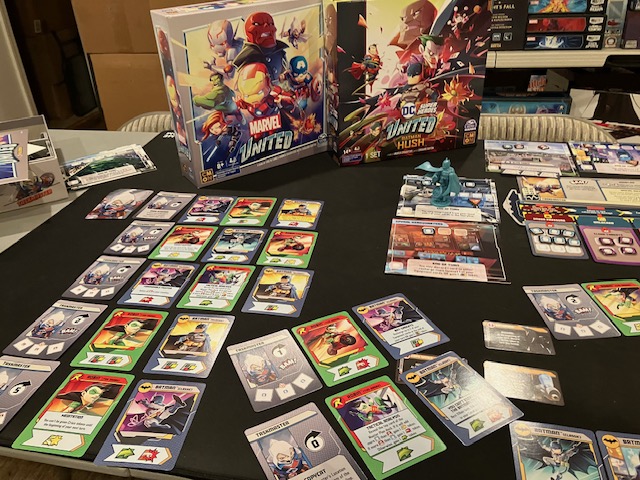
For the record, Taskmaster posed little threat to Batman and Robin. More like “Lamemaster”.
I will say that I think later Heroes and Villains are stronger than earlier Heroes and Villains in the Marvel United games. This game demonstrated that a little … but I still had a grand time!
Conclusion
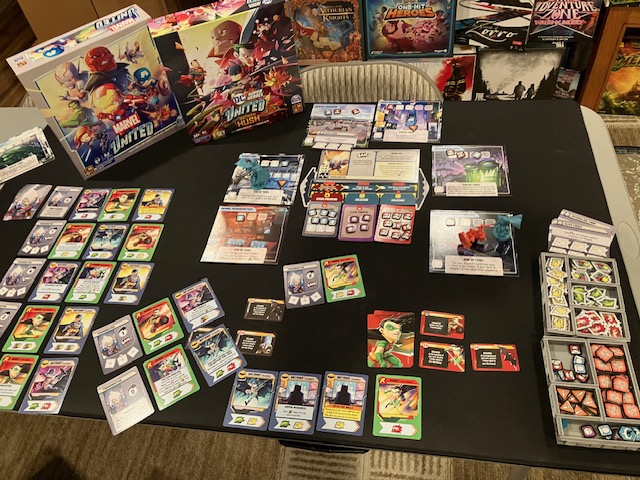
Currently, Hush is my game of the year for 2025! I have played about 10 games of Hush and want to keep trying more and more! I want to try Batman and Robin vs the Sentinels! Will Superman do a great job against Galactus? Can Batman and Spiderman team up? How would Superman and Gladiator pair up as compatriots? What about Superman vs. Gladiator? There are SOOOO many cross universe games I want to try!
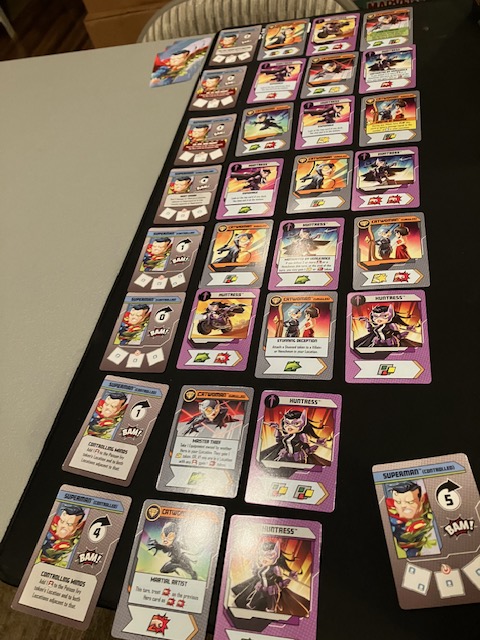
Even with all the fun things I can try combining Marvel United and DC Superheroes United, I still loved the Hush box by itself. Each Villain presented a different puzzle to solve! Each Hero has their own flavor and personality: Catwoman is more punchy than Robin, but Robin is more heroic! And these differences are very flavorful!
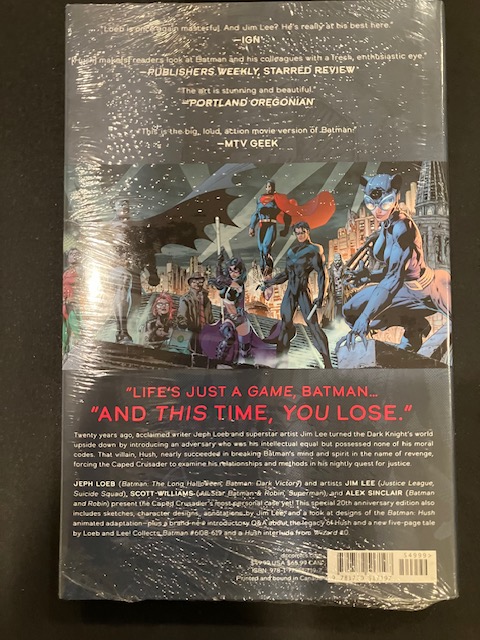
This box also introduced me to the wonderful world of Jim Lee Batman (who is the best Batman according to Diana)! I am grateful that I got to experience Jim Lee’s Hush for the first time!
My only complaint is that the Villains in this box are all pretty complicated; I wish there had been a “simple” Villain (for newer players). If you are an experienced Marvel United player, then this box is a no-brainer. If you are a more introductory Marvel United player, I might recommend a different core box.
After all is said and done, Hush is a full up 10/10 for me. I played so many games over a 2 week period and each one was a blast! Even when I lost, it was fun to try to figure out “why I lost” and come back and revisit the game!
Even though Hush is an unexpected DC Superheroes United (this wasn’t part of the original announcements for DC United), there’s a reason DC Superheroes United was #1 on my list of Top 10 Anticipated Cooperative Games For 2025!





 coopgestalt