More Solitaire than Sherlock: A Review of Sherlock Solitaire (the Solo and Cooperative Game)

This review has been sitting in my hopper for over a year now; not sure why I didn’t get it out earlier!

IMG_3314

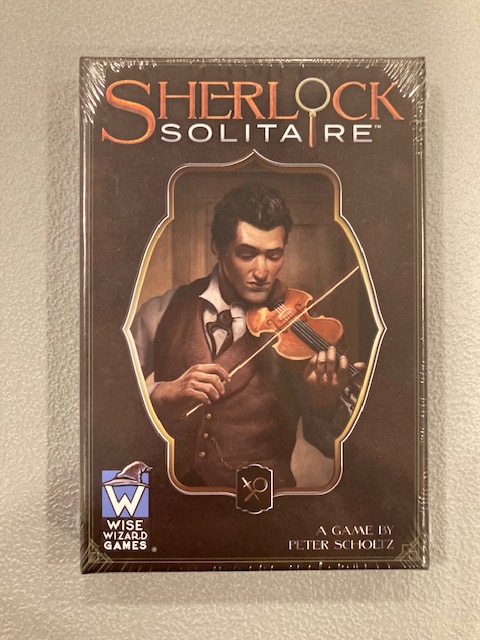
Sherlock Solitaire is a very small cooperative card game for 1-2 players.  This released early in 2024: I had heard about it from my friend Sam and so I quickly ordered it from Wise Wizard website about a month ago (early March 2024).  It delivered pretty quickly!  I got it to the table solo, but I didn’t want to finish my review until I tried it two-player cooperative .. Sam really wanted to play, but he was busy most of March.  

IMG_3318

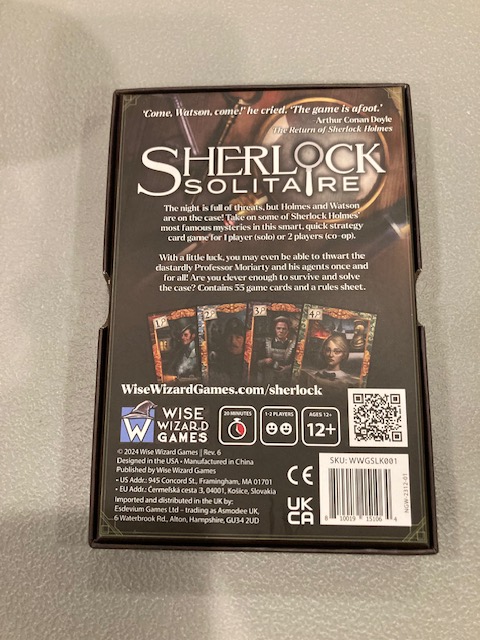
This is a very small and thin package.   It plays 1-2 players, is about 20 minutes, and plays ages 12+.

Let’s take a look!

Unboxing

IMG_3316

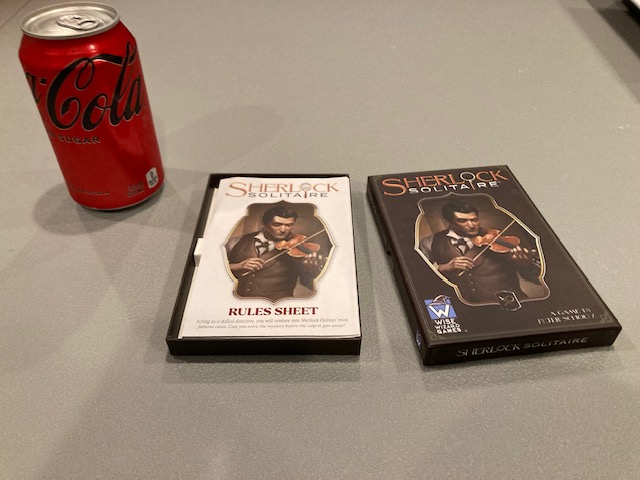
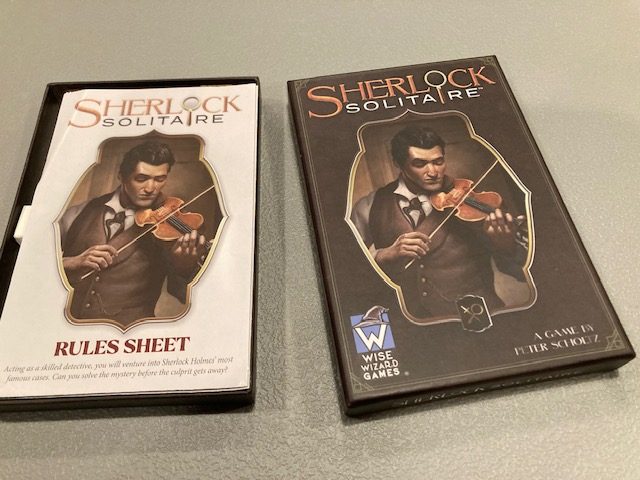
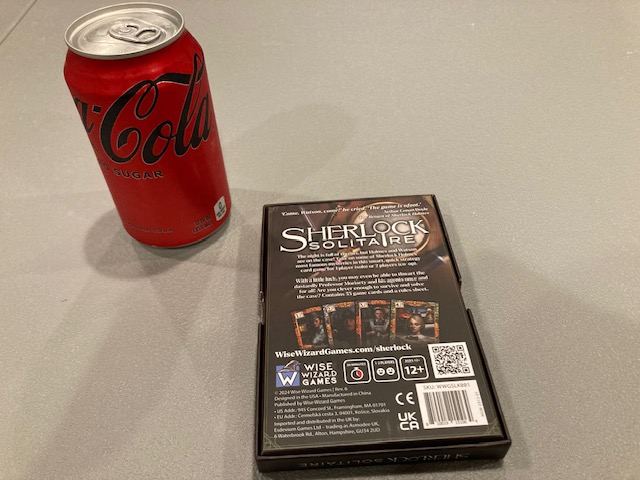
Sherlock Solitaire is a teeny tiny box and very thin: see the Coke can above for perspective.

IMG_3319

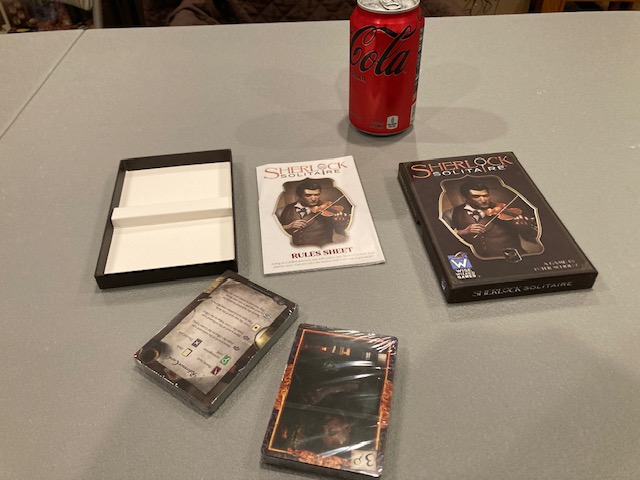
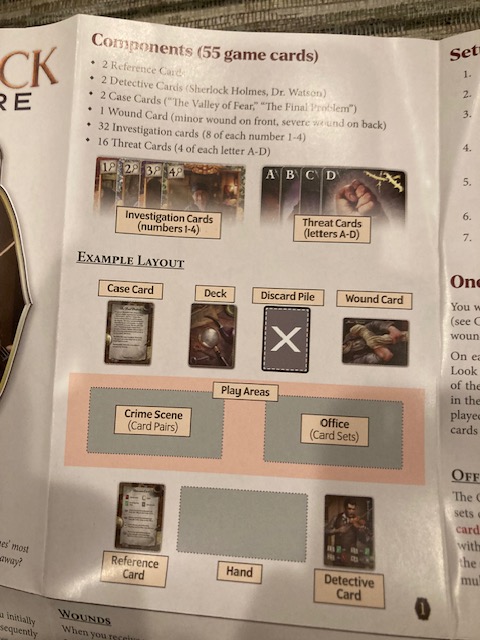
Except for the instruction pamphlet, it’s all cards .. just 55 cards.

IMG_3335

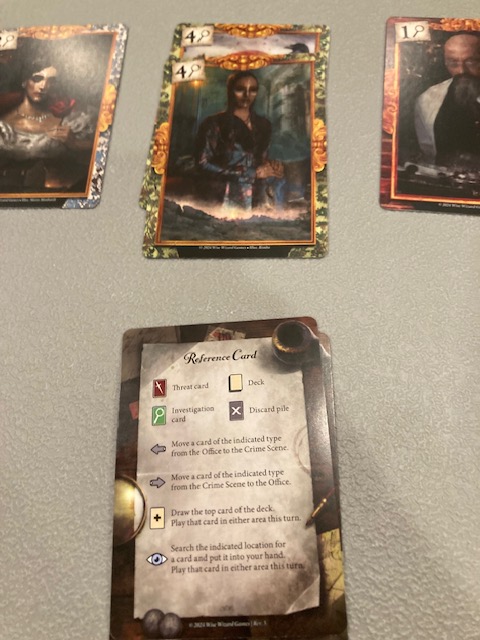
The cards are pretty gorgeous.

IMG_3337

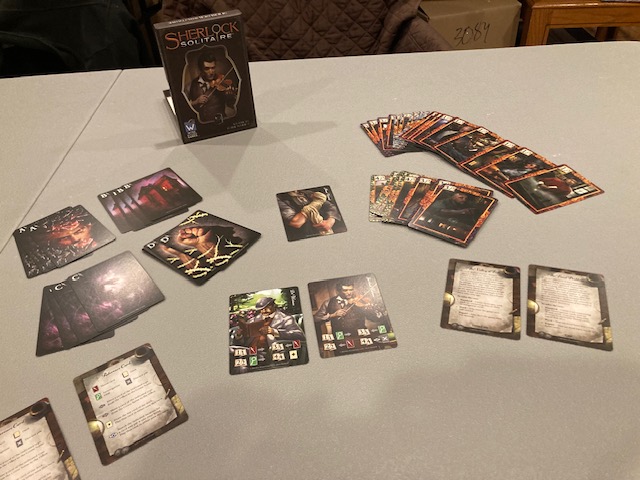
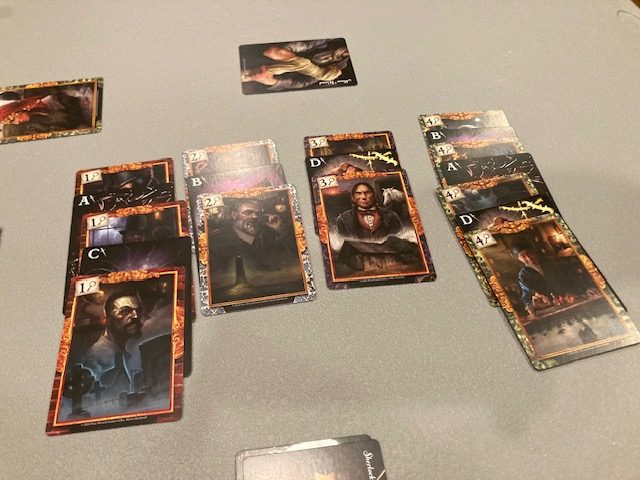
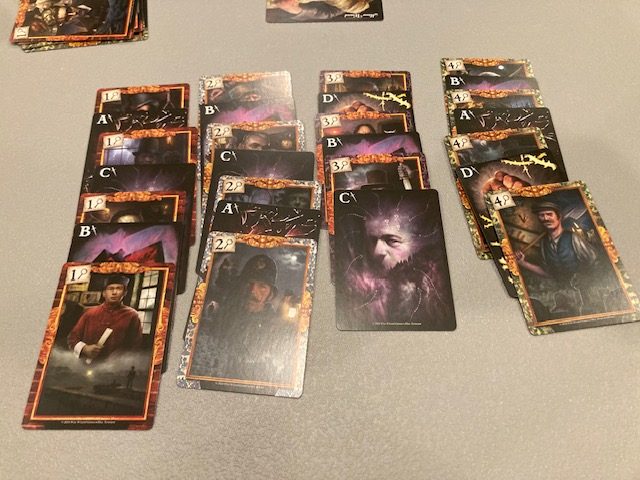
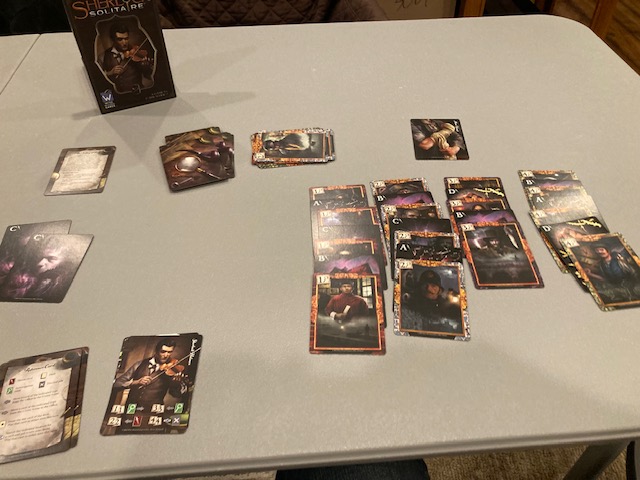
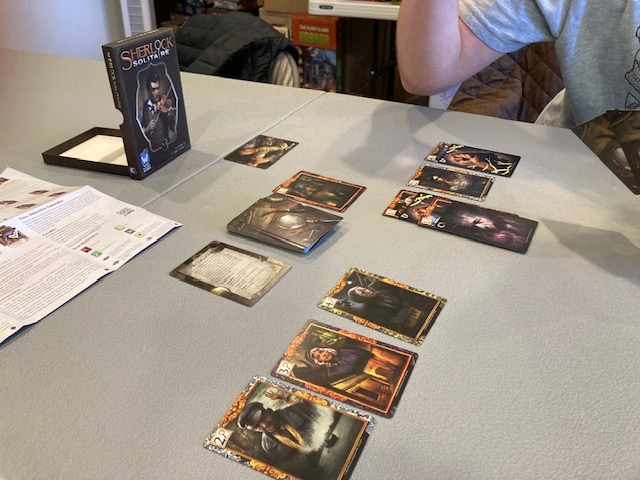
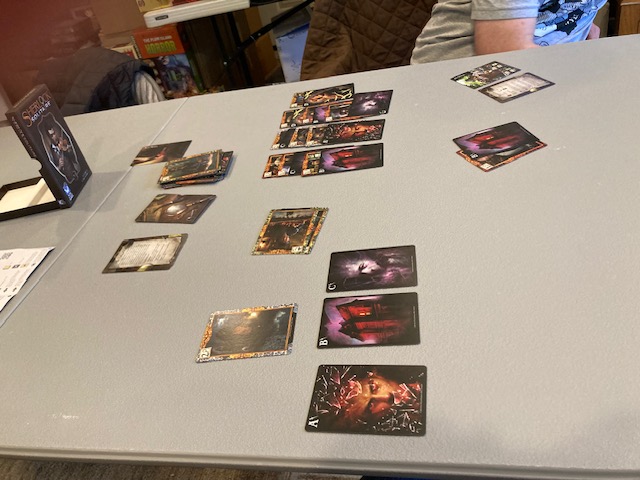
The game is very pretty on the table: see above.  

Rulesheet Not a Rulebook

IMG_3315

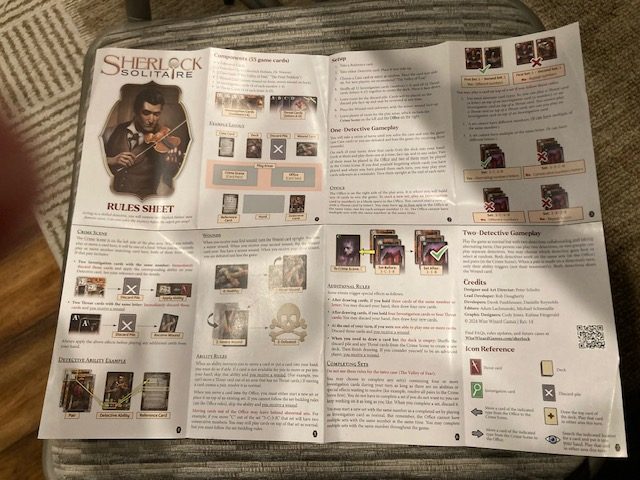
The rulebook is not a rulebook but a rulesheet: see above.  Sigh. It’s a pamphlet.

IMG_3320

Considering it’s a pamphlet, it actually does ok on the Chair Test!  It fits on the chair next to me and I can read it!  The font is a little small (because it’s a folded pamphlet), but it worked on the chair next to me, as I consulted it during gameplay.

IMG_3322

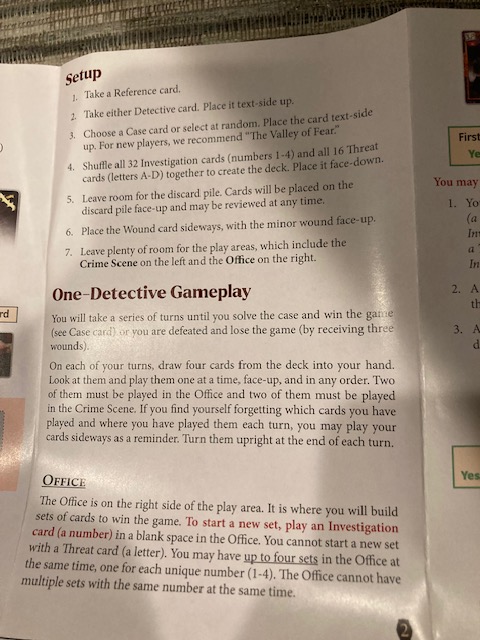
The set-up was pretty good: see the picture above.

IMG_3323

The rules are a little sparse, but they does work.

IMG_3324

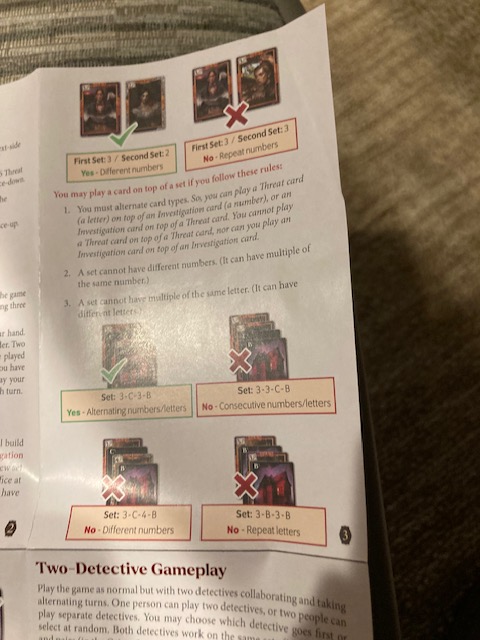
It even does a decent job at showing examples and counter-examples of “what is a set”! I appreciated that set of pictures!

IMG_3328

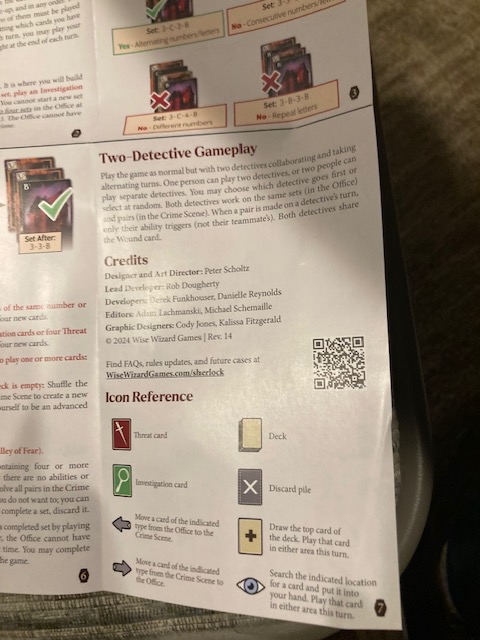
Given the constraints of a pamphlet, this rulesheet worked pretty well.  The pictures were all informative.  There were a number of places where some clarifications could have been provided, but the ruleset was simple enough and consistent enough that we were able to extrapolate rules when needed.

This was a decent to pretty good rulesheet.  

Gameplay

IMG_3331

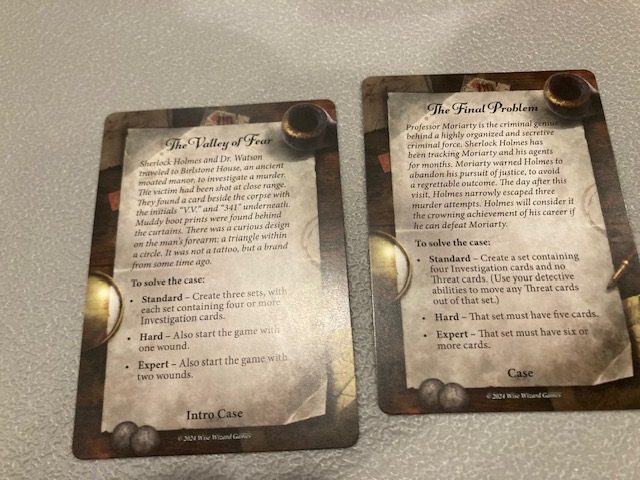
Choose a starting scenario: The Intro Case (The Valley of Fear) is just to get you into the game, so it has simpler win conditions.  The Final Problem has a much harder win condition.

IMG_3329

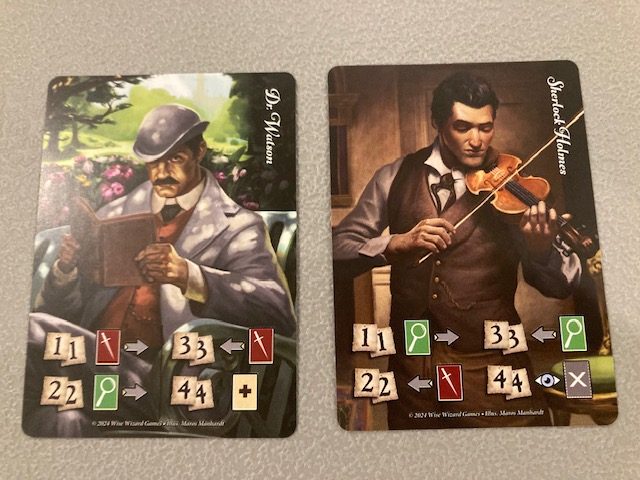
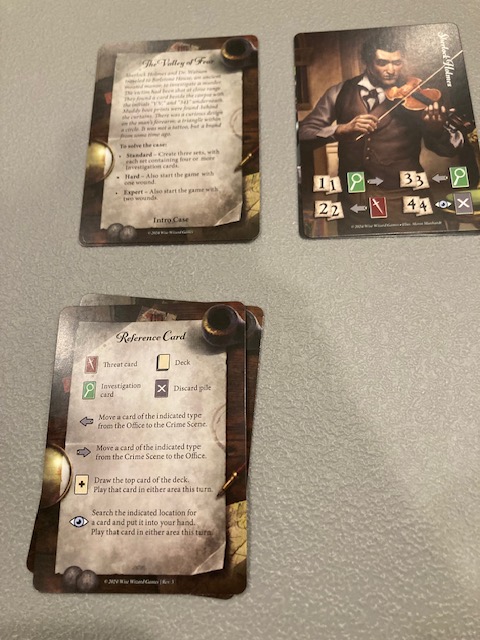
Each player (works for 1-2 players) takes either the Watson card or the Sherlock Holmes card.  See above.   The bottom of the card shows the special abilities of each player!

IMG_3334

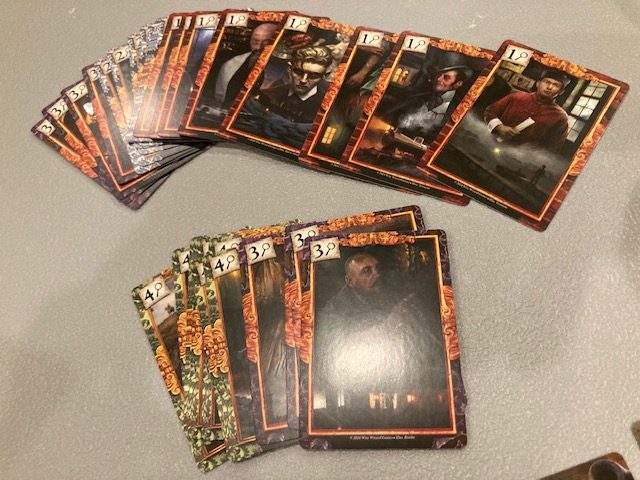
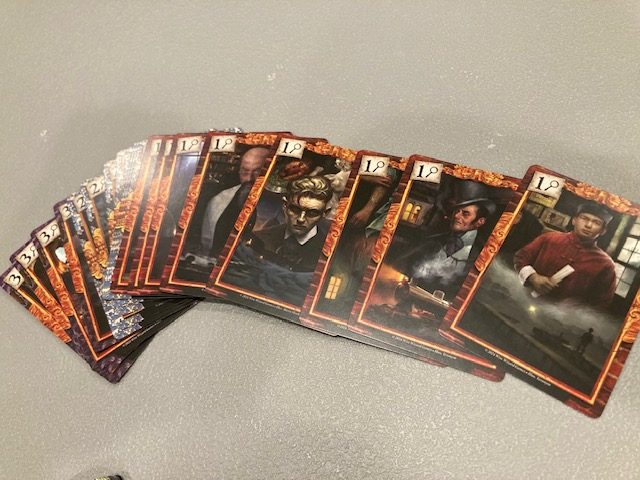
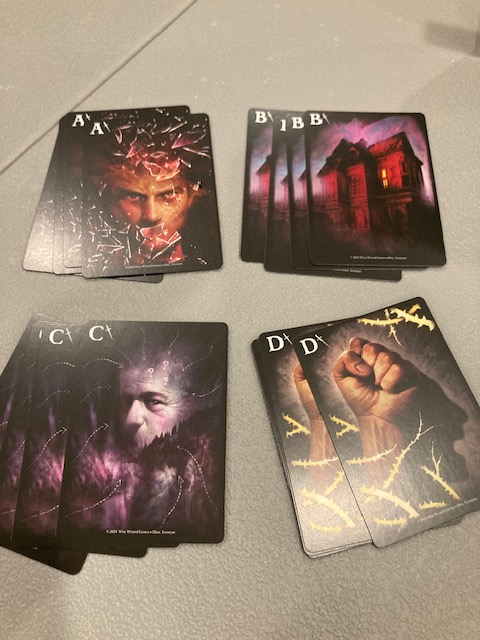
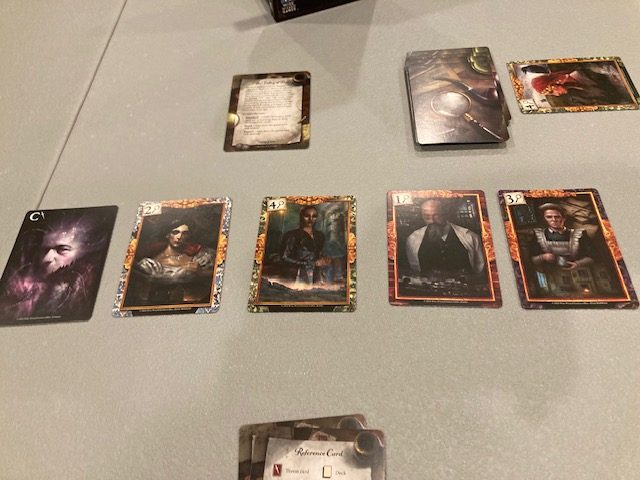
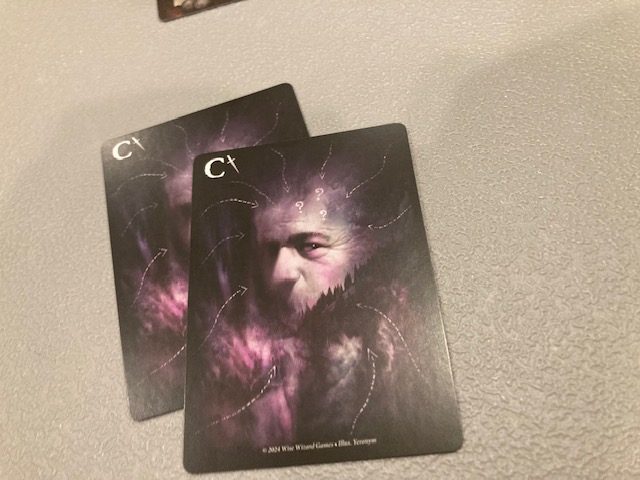
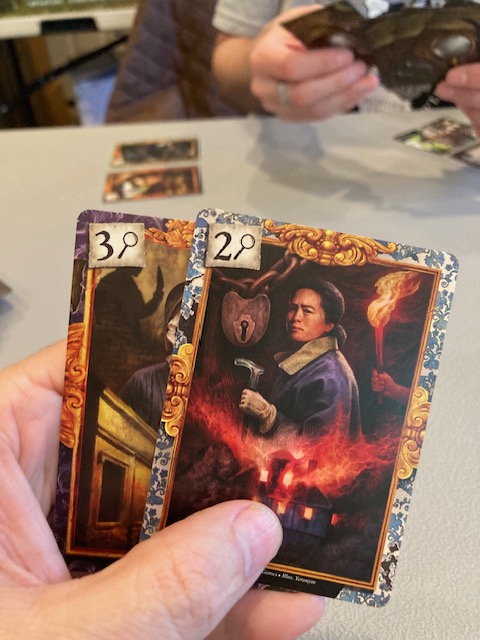
Basically, each character gets 4 cards on their turn to play to one of two areas: the Crime Scene or the Office.   There are two types of cards: Investigator cards (labelled 1-4: see above) and Threat Cards (labelled A-D, see below).

IMG_3336

Over the course of the game, the player(s) must play two cards to the Crime Scene and two cards to the Office each turn.

IMG_3343

In the Office, you are trying to make sets of cards: you have to alternate investigator and threat cards  (numbers and letters … see above).  All investigators (numbers) must be in the same column, and all letters must be distinct in a column: these are the “sets” the players are making.  If you get 3 full sets (4 investigators), you win!

IMG_3344

However, you still have to play two cards to the Crime Scene as well: see above.  If you ever get 2 of any type of card, you immediately discard those two cards and “do something!”  

IMG_3347

Two threat cards?  You take a wound! See two threats above …

The wound card is a “timer” of sorts: if you ever get 3 wounds, you lose!

IMG_3649

If you get two investigators on the Crime Scene, you invoke your special powers!

IMG_3342

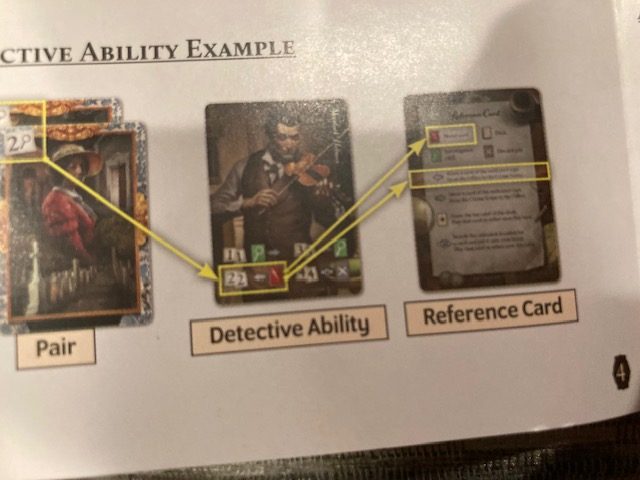
The rulesheet does a nice job of summarizing of how to use your special powers … see above.  

IMG_3346

If you get enough sets, you win!  If you get 3 wounds, you lose!  It all happens in about 20 minutes.

Solo Play

IMG_3323

A game called Sherlock Solitaire had better have a solo mode! It does (thank you for following Saunders’ Law): it’s the main way to play!

IMG_3349

Once I got past my first few games (after I had to decipher the rulesheet), the game moved pretty quickly.  

IMG_3342

The best part of the game was when I could be clever and play my special abilities in a clever way to move cards to/from the Crime Scene/Office.   The worst part was when I just played cards and didn’t feel like I had a lot of choice.  The game was a fairly engaging way to spend 20 minutes.  It really did feel like a game of Solitaire as I moved cards around.

More Solitaire Than Sherlock

IMG_3317

With a name like Sherlock Solitaire, you might be expecting something more like a mystery. No, this is a lot more Solitaire than Sherlock: you are just playing cards like a game of Solitaire.

IMG_3335

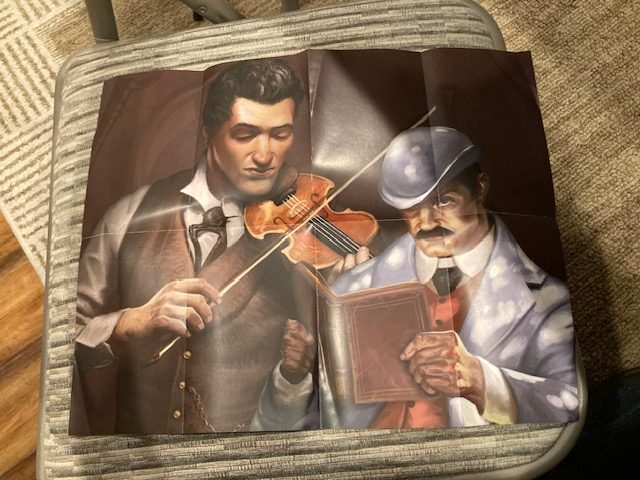
Don’t get me wrong: I love the art! The art that comes with this game is gorgeous and very evocative of the Sherlock Holmes stories!

IMG_3341

In the end, though, there is no mystery to solve. There isn’t really a lot of theme: this could have been a Cthulu game, a Zombie game, or a Smurf game. Or anything. Nothing about the gameplay really has to be in a Victorian Sherlock Universe.

IMG_3338

The art is really the only thing that makes you think of Sherlock Holmes: and it is phenomenal art!

Two Player Game

IMG_3656

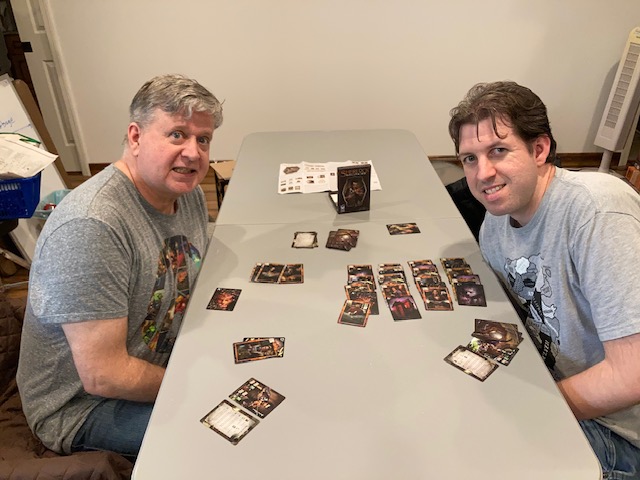
I had to wait almost a whole month to play with Sam!! He was interested in the game, but was busy with family and work all March.

IMG_3643

There are two ways to play Sherlock Solitaire 2-Player: 

  1. Play as the solo game, but both players together make all the decisions
  2. Each player takes Sherlock and Watson, and alternates turns

We chose to alternate turns.  The solo game with 2 players making all the decisions seemed less fun … and at that point, it’s just the solo game anyways.

IMG_3646

What we found was that … the second player got a little bored.   There is no strategy in a 2-Player game, as you have no idea what cards you get until your turn.  What that means is that if you are waiting for you turn,  you can do nothing useful!!  You just sit there waiting for your turn.

IMG_3648

The two-player game was much less interesting, as someone was always “waiting” with nothing to do.

… until we tried a little house rule.

House Rule for Two Players

IMG_3649

When it’s not your turn, draw some cards! Instead of sitting there “doing nothing” during your friend’s turn, you can then “be thinking” about what you want to do when it’s your turn! To keep this from being too overpowering (from the game balance perspective), we choose to just draw two cards at the end of the turn and two at the beginning of the turn.

IMG_3648

That way, we were still playing four cards per turn, but had a hint of what we could on our turn.

Weirdly, me and Sam didn’t feel like this changed the game balance too much, and in fact didn’t change our turn too much, but it felt like it mattered!  With this simple rule, we both felt more engaged, even if it didn’t change the game too much!  We felt like we mattered more, even if it was just a small amount! And that made a big difference.

Conclusion

IMG_3321

If you were expecting something with a mystery of some sort, then Sherlock Solitaire may be a big disappointment.  There’s a lot more Solitaire than Sherlock in this game: it’s basically just a card game about making sets and moving cards.

IMG_3319

The special powers of the Sherlock and Watson characters make the game interesting, as you can make many moves in the game that make you feel clever. 

IMG_3337

And despite the lack of theme to this all card game, the art is still very nice and evocative.

IMG_3648

As a solo game, I’d probably give a 5.5 or 6/10.  I might play it again: it’s pretty straight forward and quick … and there are moments where I feel clever.  I freely admit that the art brings it up the score a little bit: the fantastic look makes this game stand out on the table.

IMG_3656

As a two-player game, I would give the unaltered game a 5/10: there was just too much downtime between turns. If, however, we played with our house rule (always having two cards in your hand), then I would bump this up to a 6.5/10! We felt much more engaged even if it was just our preception! My favorite way of playing Sherlock Solitaire was 2-Player with our house rule: that’s probably how I’d play it again.

Soul Raiders: A Solo and Cooperative Review

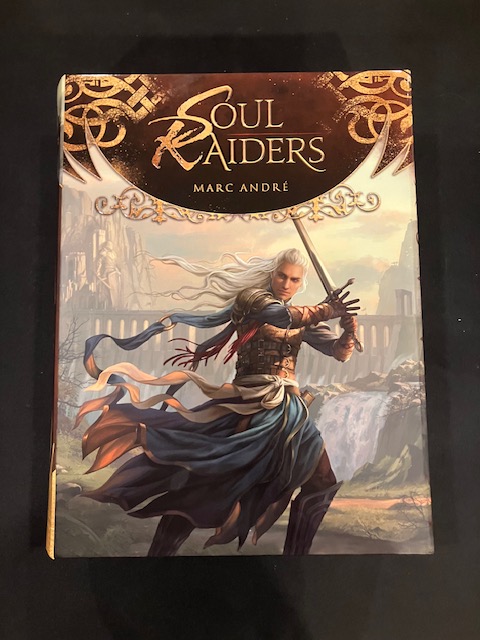
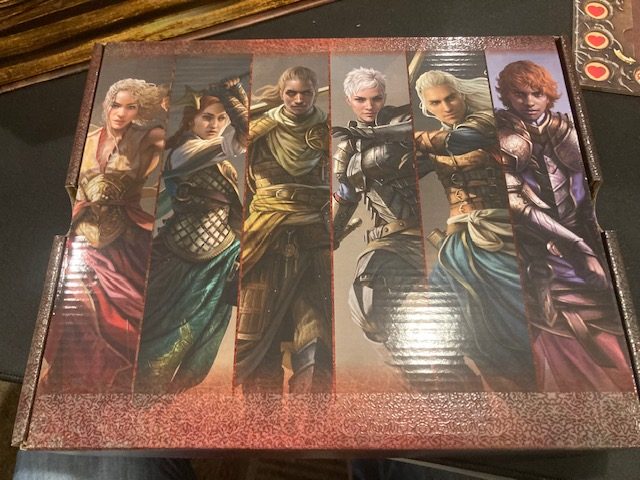
Soul Raiders is a cooperative fantasy adventure game that was on Kickstarter back in July 2021 and promised delivery in December 2022.  I backed the deluxe Grimoire Edition (above). Well, it finally arrived last month (March 2025), so it’s about 2.3 years late.  This wasn’t on my Top 10 Anticipated Cooperative Games of 2022, but it probably was my #11 or #12!
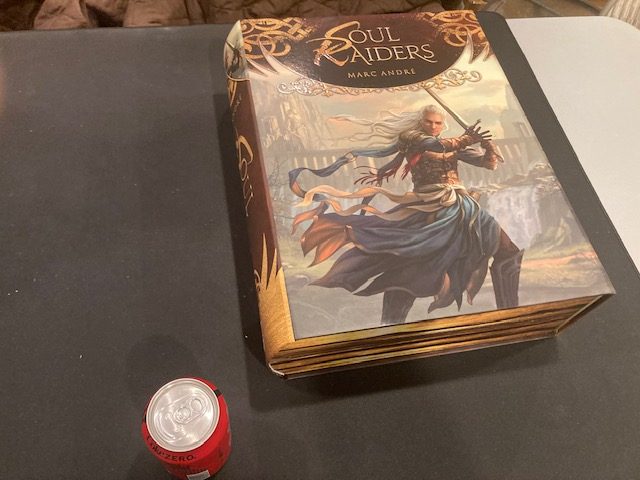
This sat unplayed in the box longer than it should have; I think I was scared of how big it was! Look how big it is!!!  Did I have the cycles to even try it?

Well, I finally got around to getting out and trying it … was it worth it?

Unboxing
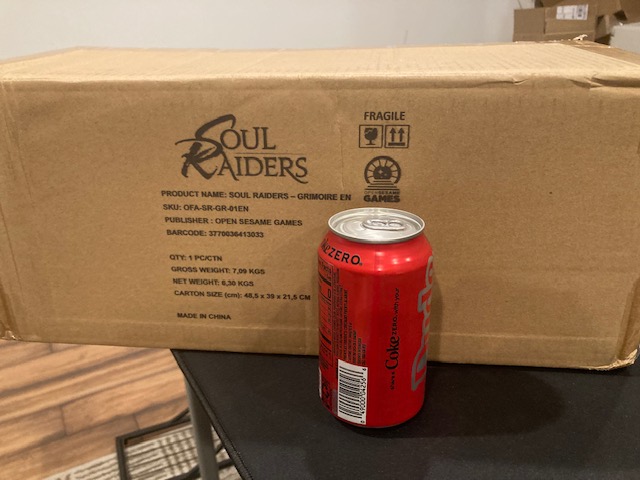
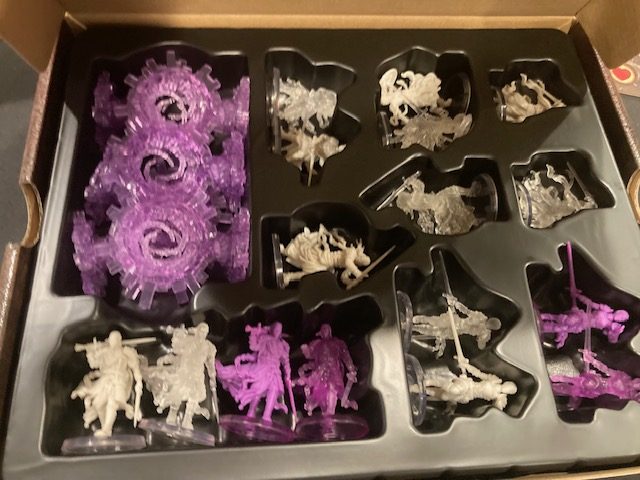
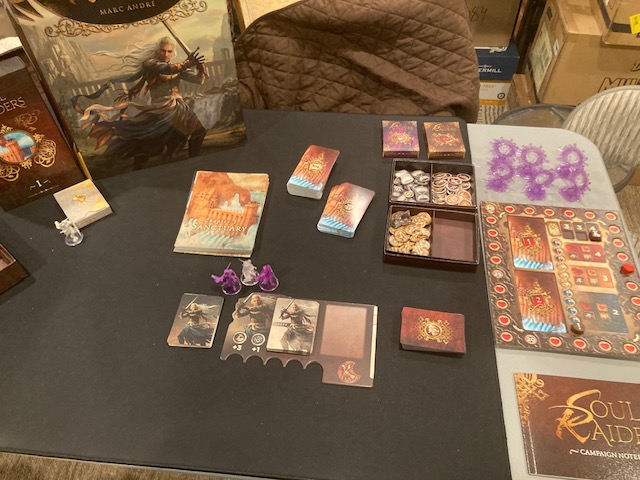
Although this unboxing here is to show you what’s in the box, it’s also here to remind me how to put the box together!  So, it’s for me and you!
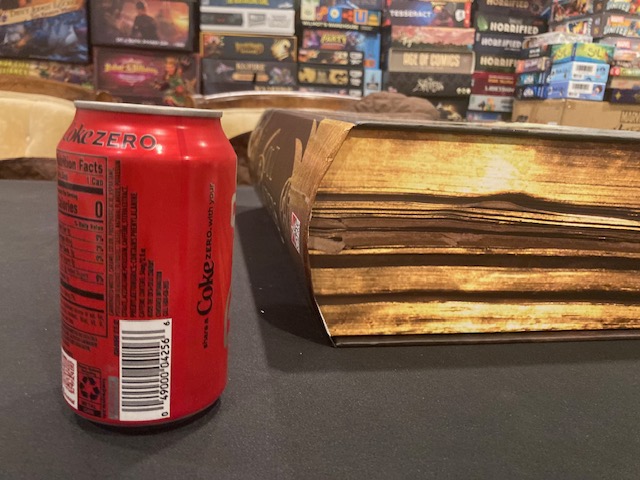
This is a BIG box.  This is the Grimoire Edition.
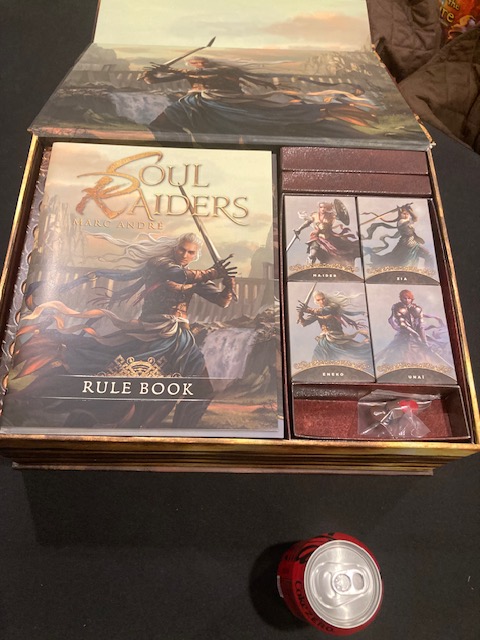
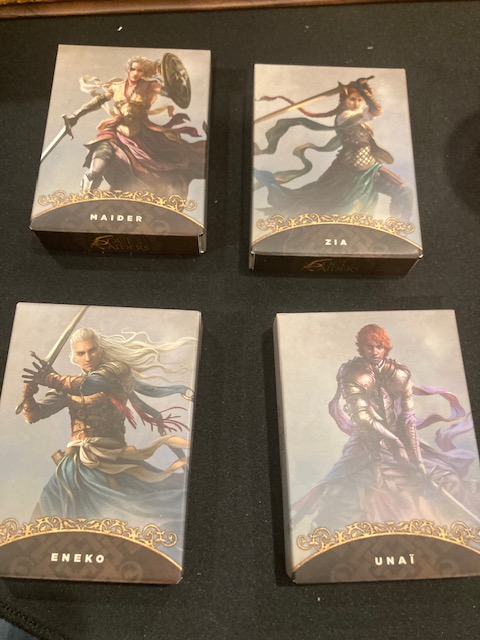
It’s got a lot of stuff packed in: see the character boxes above (this is a cooperative fantasy adventure game).
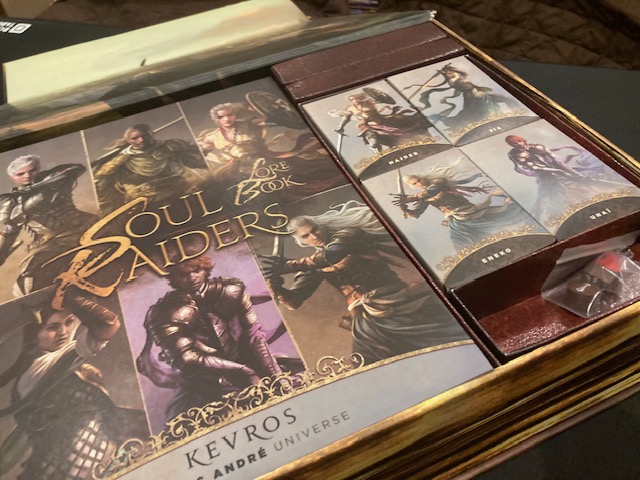
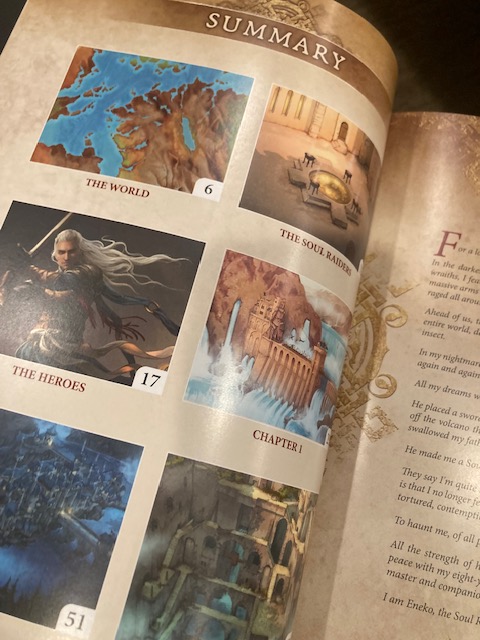
This game is so grandiose, it has it’s own lore book!
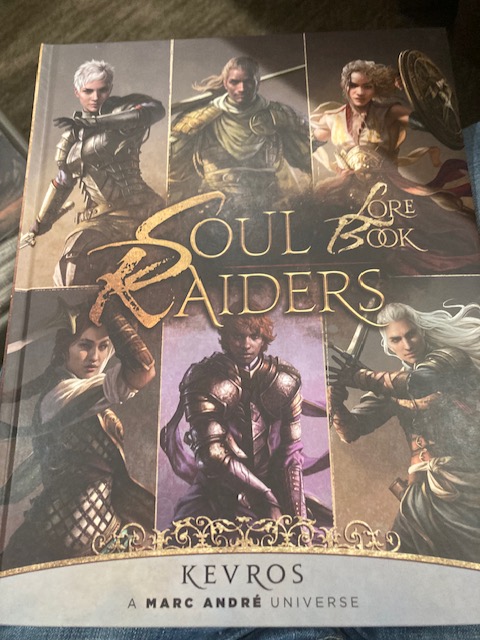
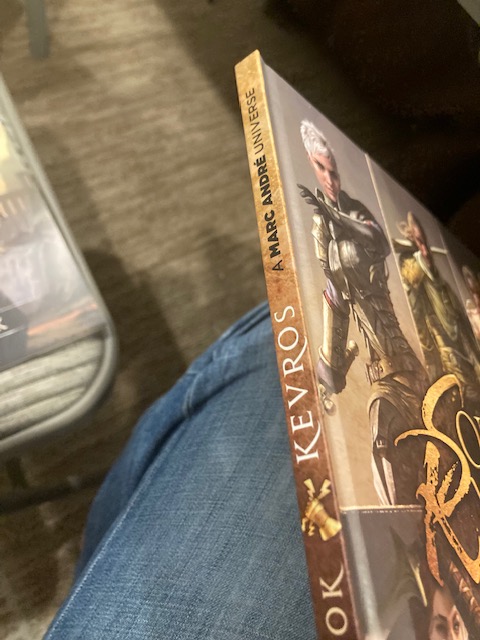
If you really want to get into a fantasy universe, this might be the right game for you!
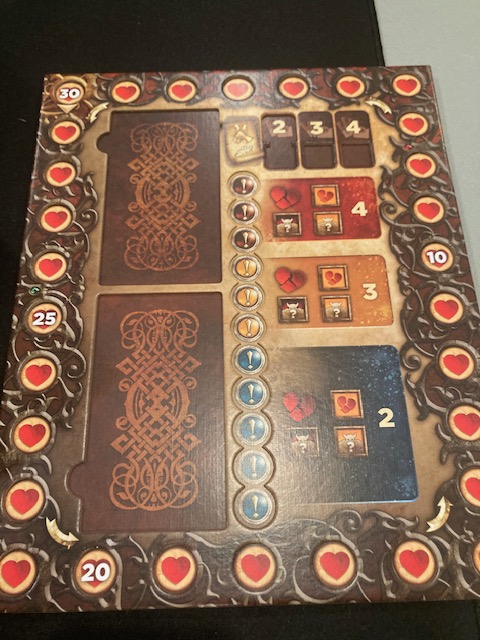
This dual-layered board (above) keeps track of a lot of shared attributes and state of the game.
There’s lot of little boxes to store your game between sessions.
There’s some fabulous minis.
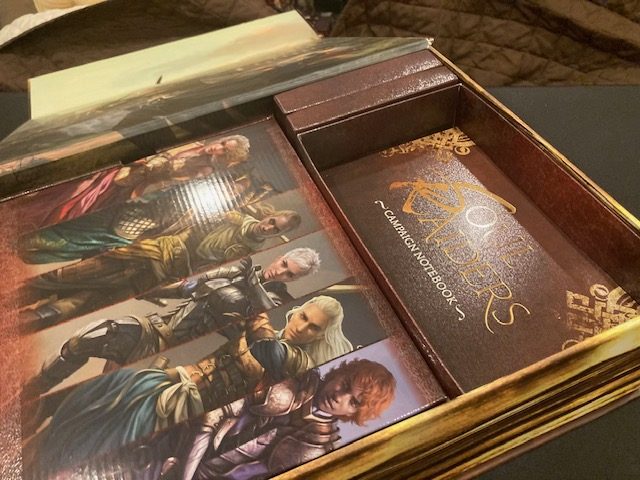

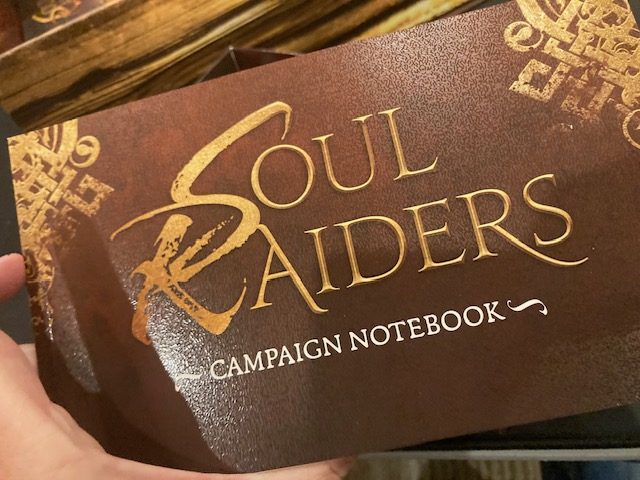
The campaign notebook allows to save the game between chapters.
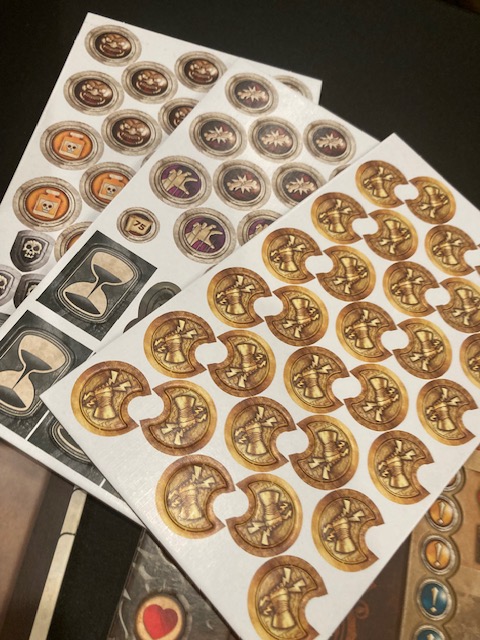
There’s a bunch of cardboard tokens.
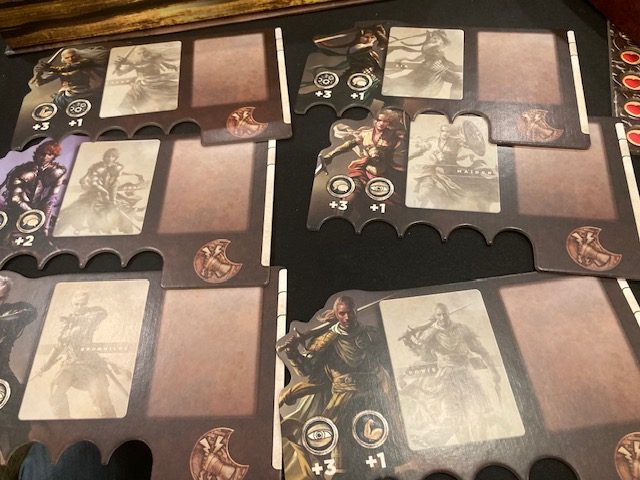
And boards for the characters.
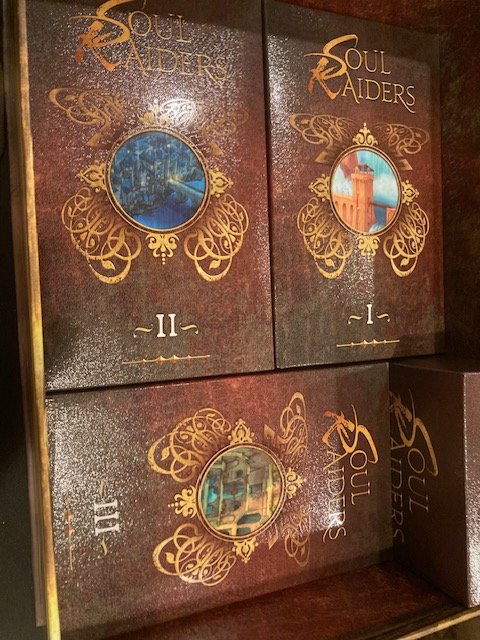
Underneath all that, are the three main chapters of the game.
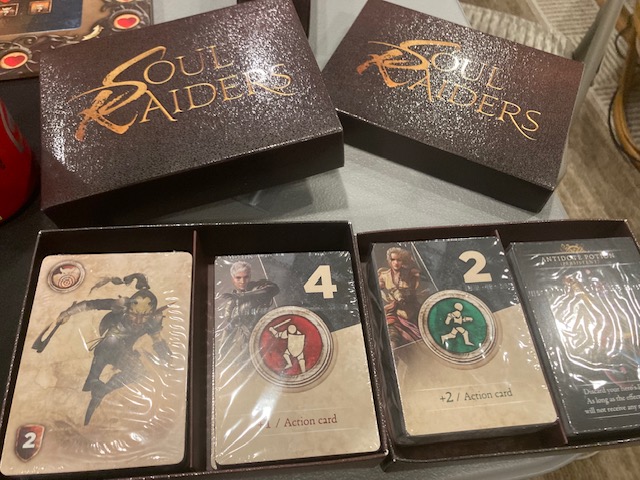
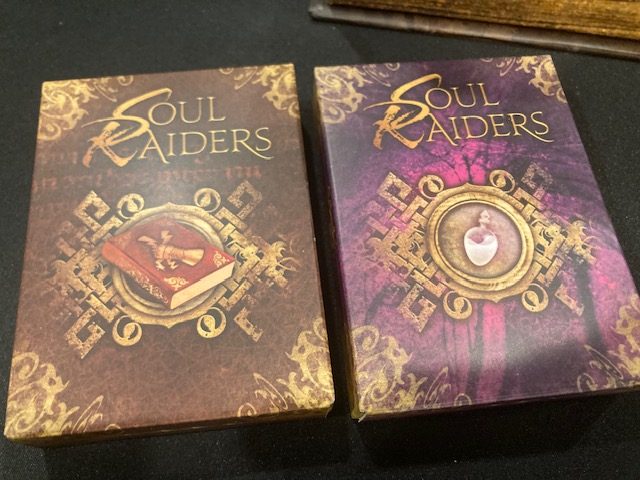
The cards of the game are in two boxes: see above.
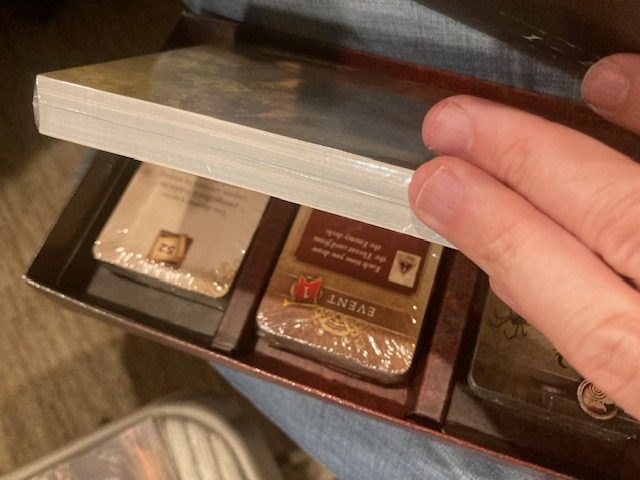
Each of the chapter boxes has huge Location cards and little cards.
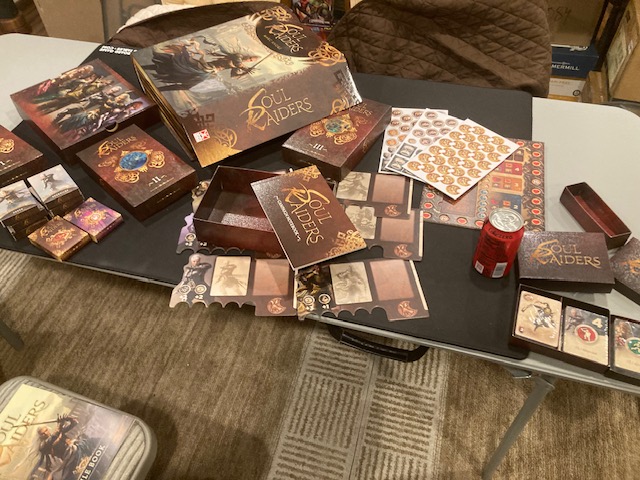
This game is GORGEOUS.  The production is GORGEOUS.

Consult the pictures above for when you need to repack your box!

Rulebook
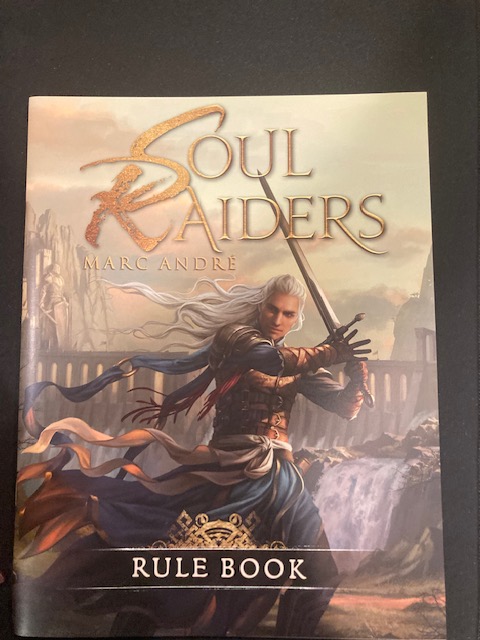
The rulebook is good.  Well, ish.
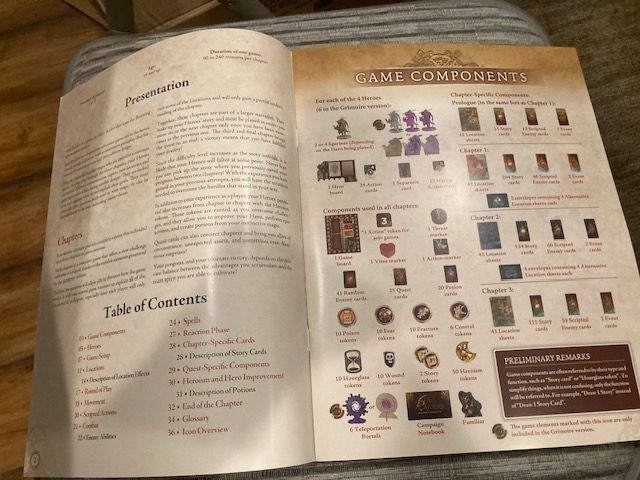
It gets about a B+ on the Chair Test: it overhangs on the chair next to me just a little (see above), but it lays flat and open, it has a big readable fonts, and it has lot of pictures.
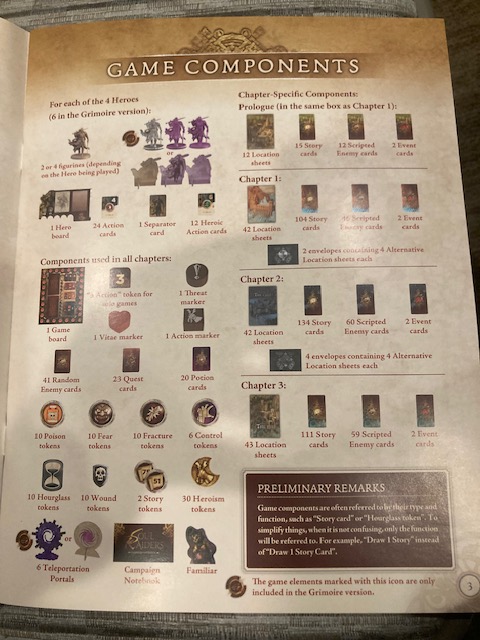
The components page is well-labelled and notated (see above).  It even breaks up the cards by chapters.
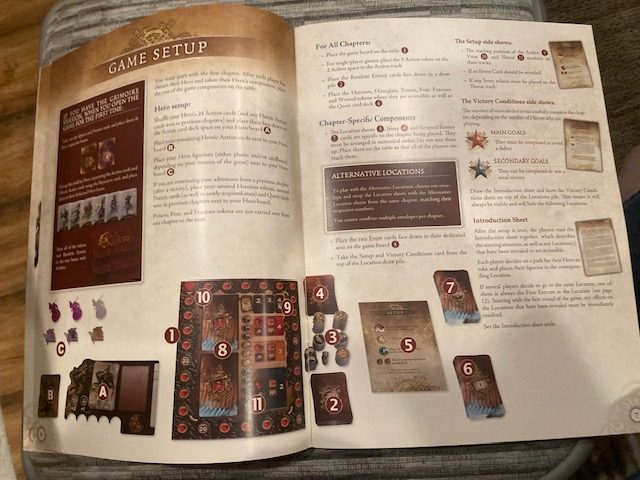
The set-up works pretty well, although it doesn’t show how the story cards will be laid out (which we need to discuss more).
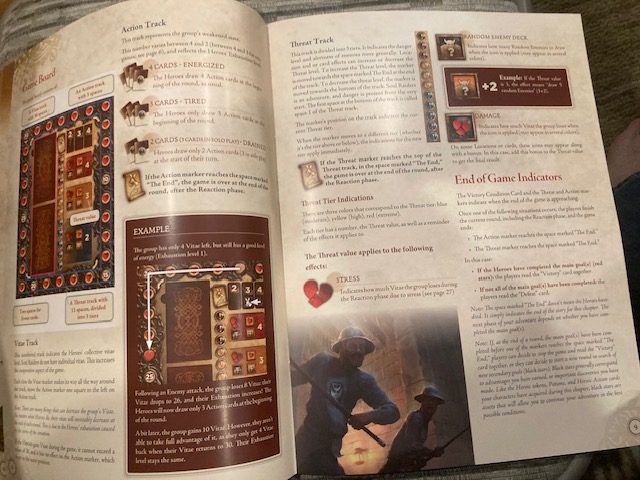
This is a gorgeous rulebook that’s written pretty well, it has lots of examples and lots of pictures.
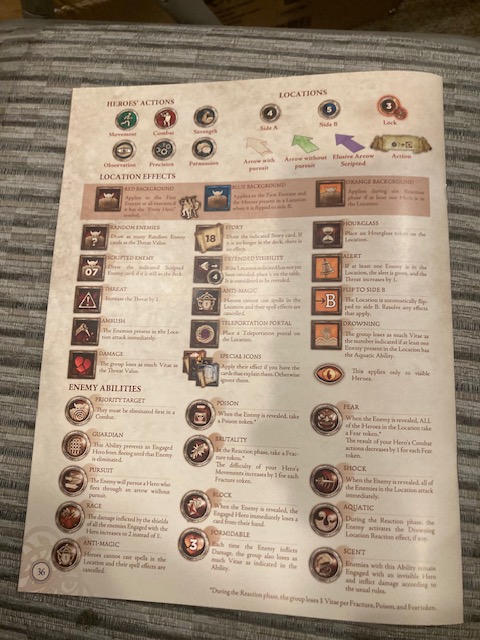
It even ends with a very useful summary of icons on the back!

Although I liked this rulebook a lot, it made the mistake of putting too much content into the examples.  I like it when rules have clear definitions, then maybe use the examples to help explain and/or clarify.  Unfortunately, I think this leaned a little too much into using the examples AS the rules a few times.    Don’t get me wrong, I am glad the examples are there, but I wanted clear succinct rules as well.  (I think the last time we noticed this “rules in examples” phenomena was back Sleeping Gods rules: see link here).

The rulebook was generally good, and it frankly looks gorgeous (like the rest of the game).

Gameplay

The best way to describe this game? It feels like it a video game: a  Point-And-Click (fantasy) Adventure game with lots of monster fighting.
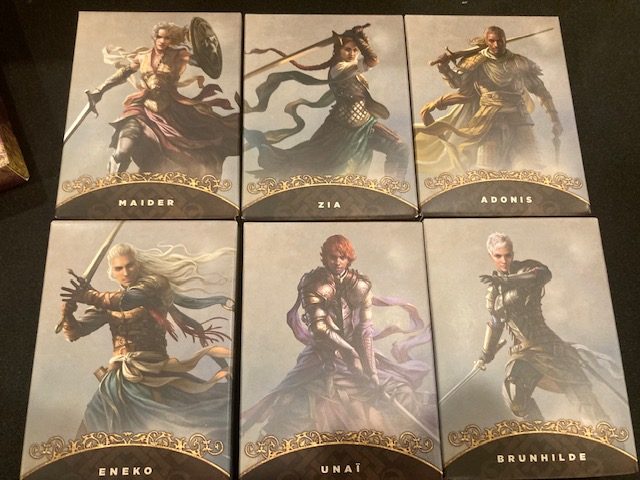
Each player takes the role of one of six characters: see the character boxes above.
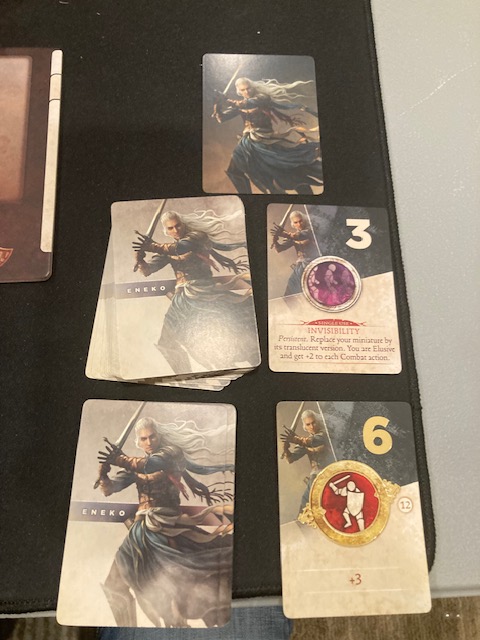
Each character has his own set of cards: there’s basic Action cards (above top) and Heroic Action cards (above bottom).  Notice the Heroic Action cards have a special foil on them so you can tell them apart!
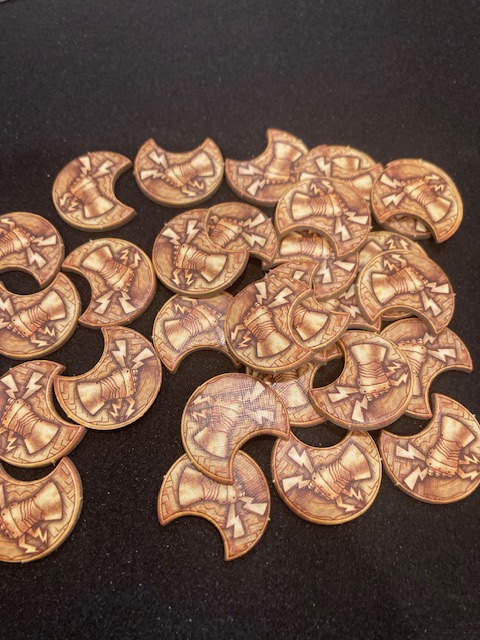
These Heroic Action cards are earned (in order) by spending Heroism tokens (3 to earn a new Heroic Action card).  Cool fact; you can spend 3 Heroism tokens at ANY time to immediately earn a new card! Very useful when you need a card immediately!
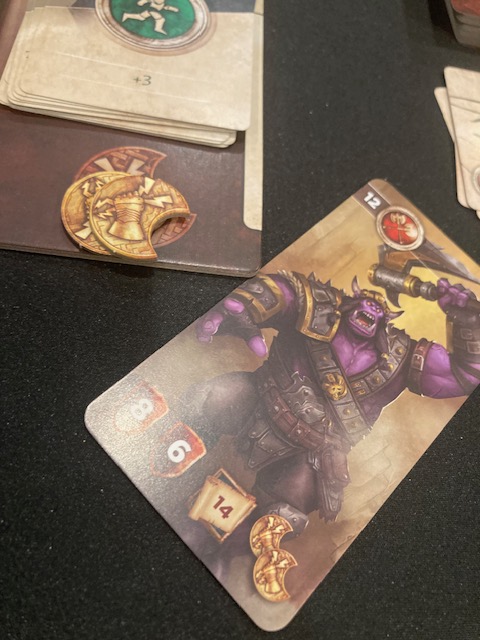
You get Heroism tokens are various plot points in the story, but the most reliable way to getting Heroism Tokens is by defeating BIG BAD MONSTERS!  Defeating the one above opens Story Card 14, but also earns the player 2 Heroism tokens!
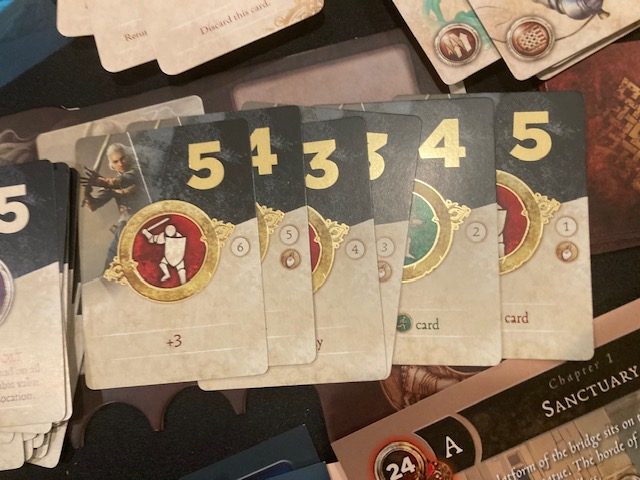
By the end of Chapter 1, I had been able to earn 6 new Heroic Actions cards! (Heroic Action Cards must be earned in order: note the numbers on far right).
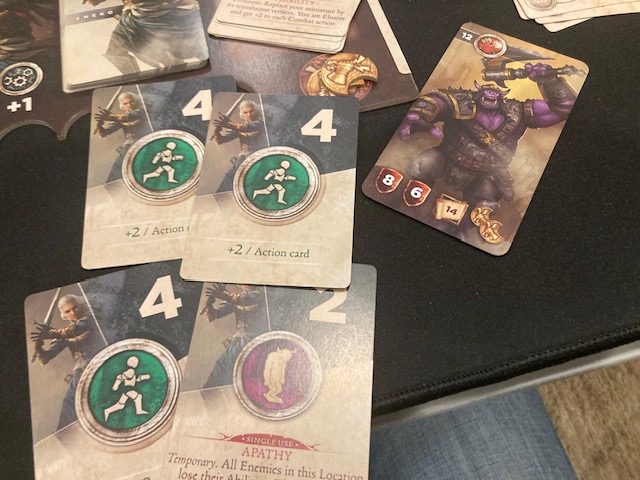
The cards are you primary currency for “getting things done”.  Some cards are more attuned to movement (as you must explore) … see above …
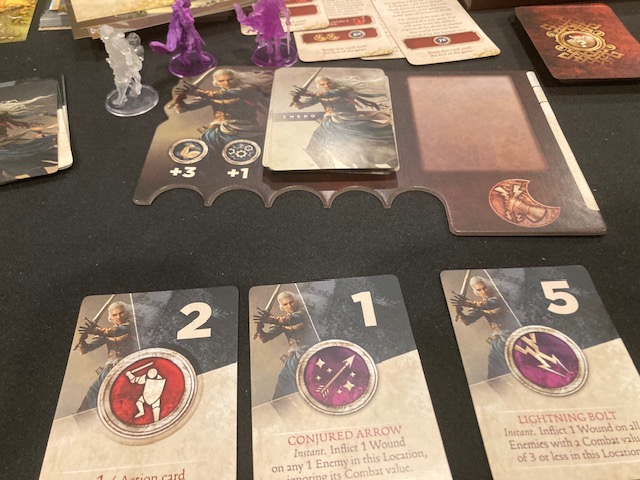
… and some cards are more attuned to fighting!  See above.  Basically, you can always use the value on the card for whatever you want, but the card will have “bonuses” if you use it for the specific specialization!

For example, Heroic Action card #6 (the top one) has a basic value of 5, but if you use it for fighting, you get an extra +3!

Example above: Even though the cards I drew were all movement-centric, I can use the values on the cards for fighting: 4+4 = 8 takes out the first shield on the bad guy, and 4+2 = 6 takes out the second shield!  I used all my cards, and I didn’t get any advantages, but I was able to do what I needed!

Basically, your character explores the world, moves around, interacts with the world, and fights monsters!  All actions are based on the values on your cards!
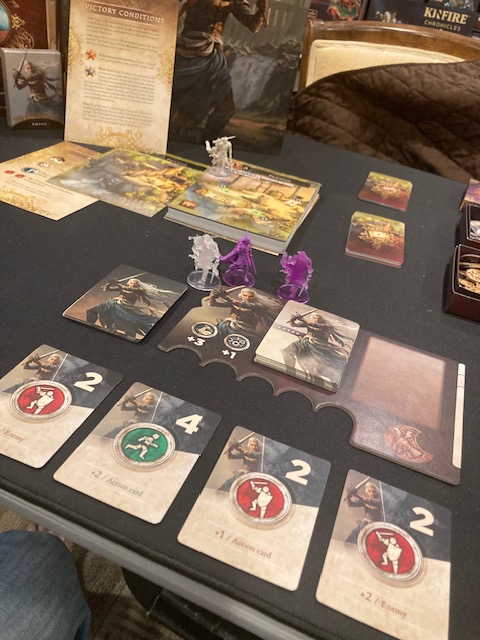
Basically, you character(s) move around on the Location sheets and explore!
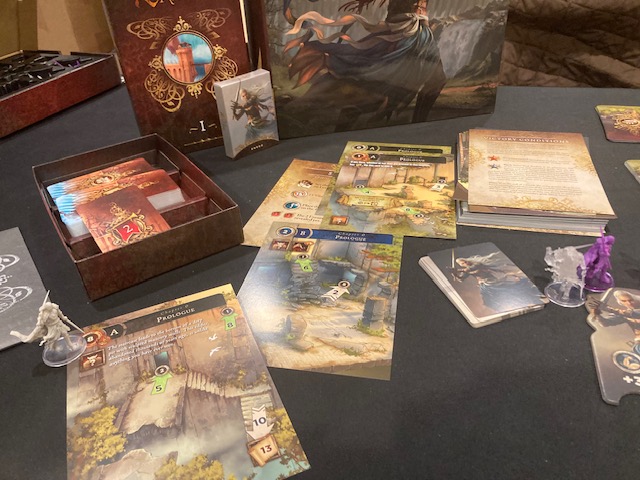
The Locations have arrows which tell you how much its cost to move between Locations: see above and below.
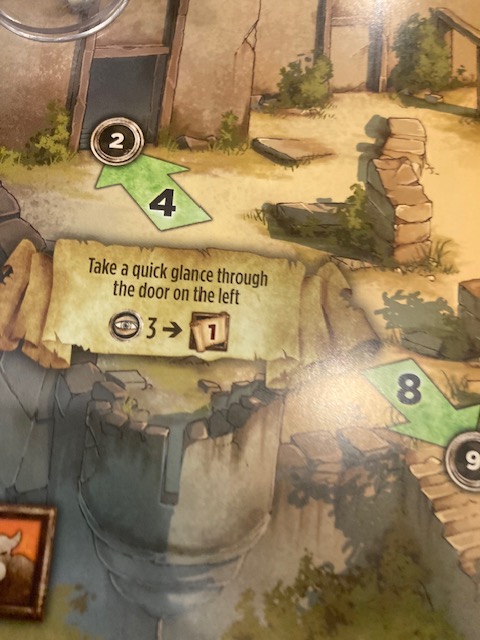
For example, to move to Location 2, I need to spend 4 points from my cards.
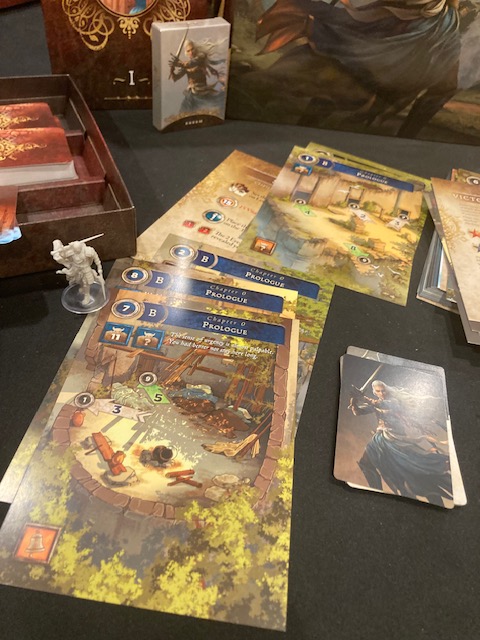
This is kind of a choose-your-own adventure tale!  You decide which paths to take, which monsters to fight, which puzzles to interact with!  It feels very much like a choose-your-own adventure!
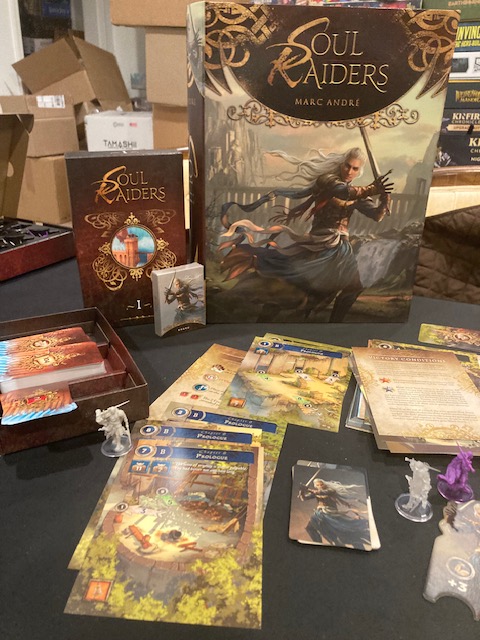
What’s cool is that each Location has pretty great art (a little comic-booky, but I like it) which describes all the things you can do at that Location … kind of like a choose-your-own-adventure book does in each section.
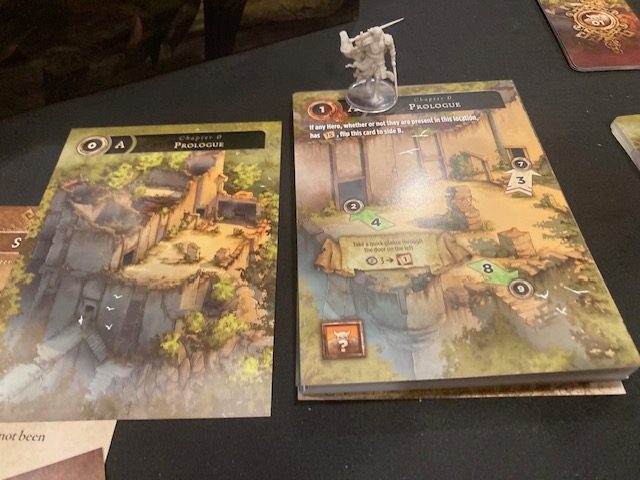
See above as the character starts on the maps!
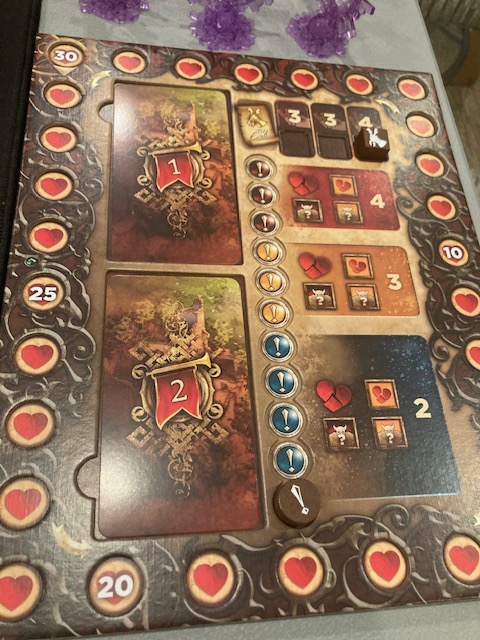
An interesting thing that happens is that there is a “clock” pushing the game forward.  At the end of every “turn” after you’ve played all your cards, the Vitae track moves down.  Basically, every time it “wraps around” back to 30, you drop the Action token one space (upper right).  If your threat or the action space ever get to the end, the game is over!
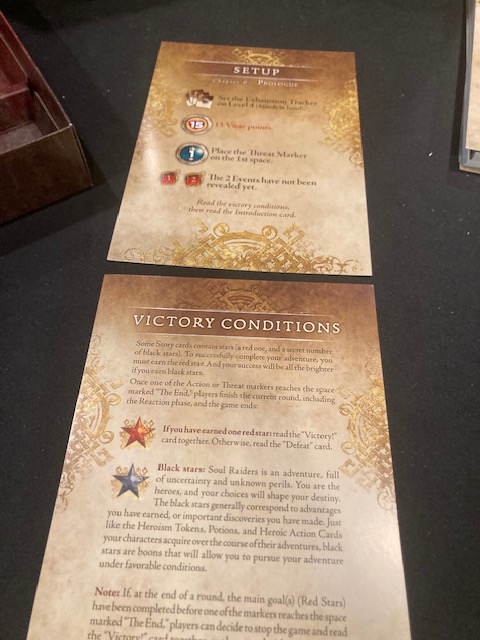
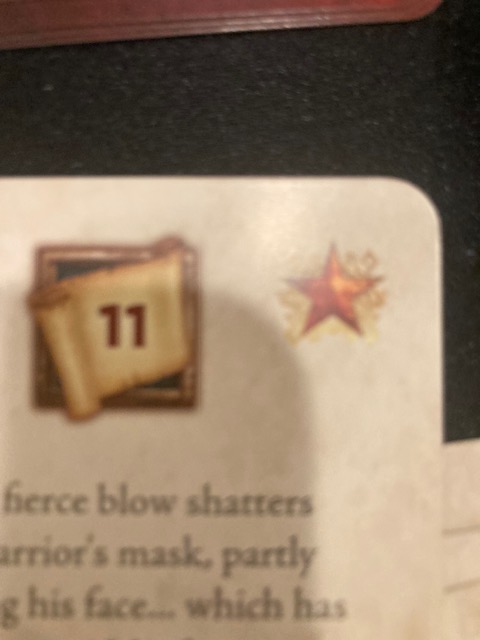
To win, you need to find the Red Stars on the story cards.  If you don’t find appropriate story cards, you lose!
Explore, fight monsters, interact with your world: this is an adventure game!  The way the movement works, it feels very much like a choose-your-adventure game (as the Locations could just be pages numbers in a book!)   This game also feels like a Point-And-Click Adventure game too!  See our Top 10 Point-And-Click Adventure Board Games for more discussion of this genre!

Solo Play
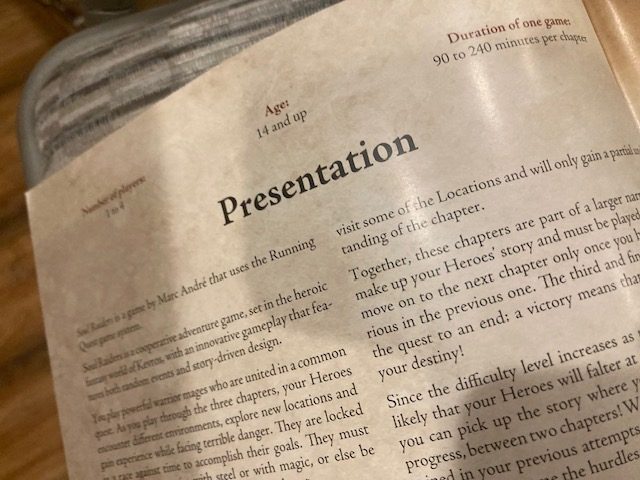
So, this game supports the solo player (thank you for following Saunders’ Law).  This is a true solo game: the solo player operates one character.

The only real change for solo play is on the Game board:
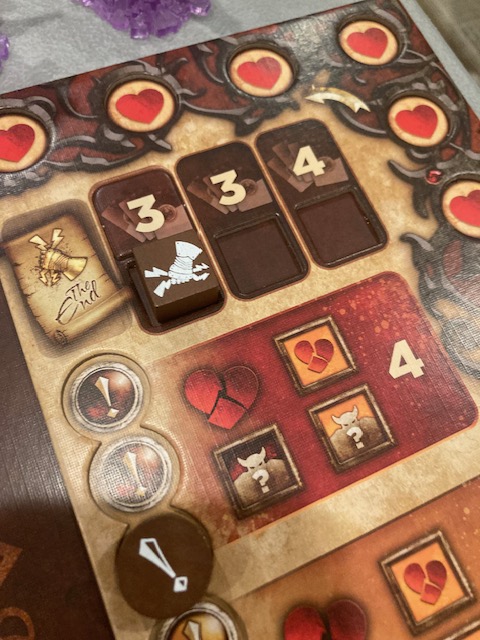
On the Game Board, the final space has a “3” marker on it (instead of 2).  This is the number of cards you draw every turn, so the solo player has that extra advantage that (on the last set of rounds) they get three Action cards instead of two.  And that’s the only change!
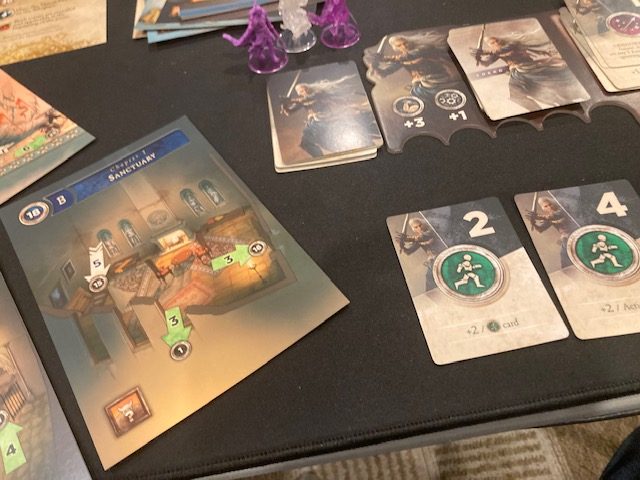
The solo player explores, fights, and interacts … but just by himself!  There’s no real balancing anywhere else.    It seems a little weird that there are no other balancing mechanisms, but basically what tends to happen is that more enemies come out as more people play, so that tends to balance the game.  We’ll address that a little more in the cooperative section.

Cooperative
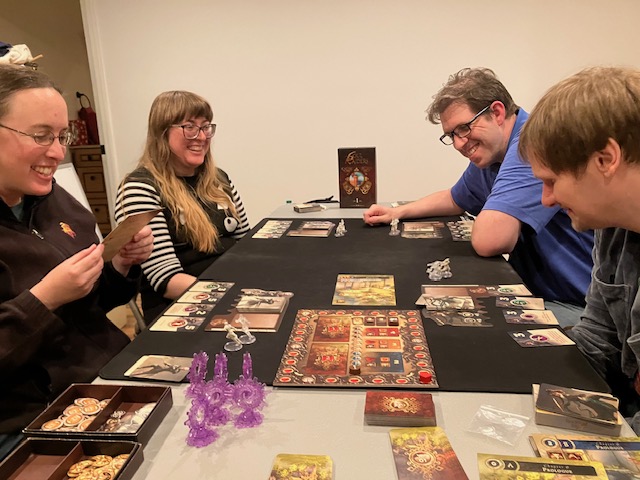
The cooperative game brought up a lot of rules I didn’t have to deal with in the solo game!  When you explore new Locations, whether or not someone is already there “changes” how the Location works!
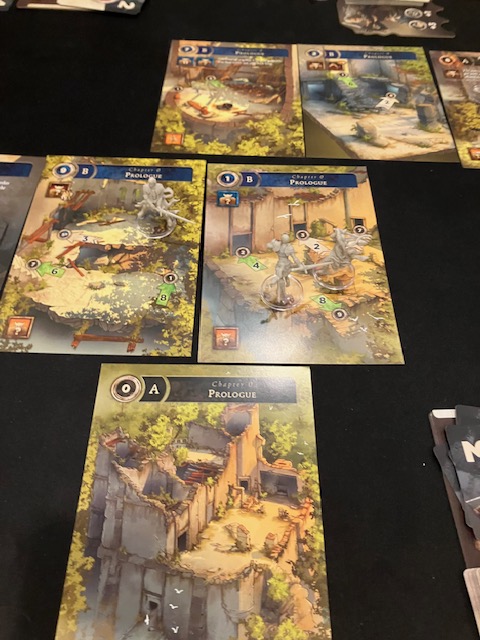
Unfortunately, the Icons were very confusing about this.  A slight change of color AND whether its on side A or B makes a big difference.  It actually took us almost half the game sessions to get this right!
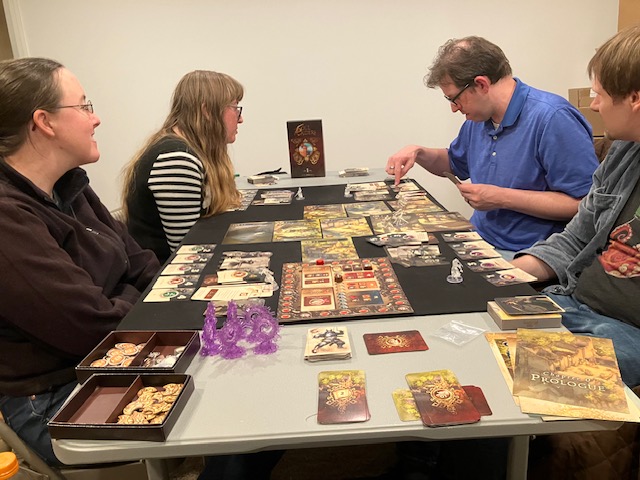
Although the cooperative game has a sense of Player Selected Turn Order, there really is no turn order!  Players just play when they want and support each other if it made sense.  Although I love this idea, as it should make the game go faster, the game tended to serialize as each player waited to see what happened to see if they needed help.  “Let’s wait to see what Sam gets!”   I love this from a cooperative point of view, as it lets us support each other!! Unfortunately, what really happened more often than not is that the game really just slowed down behind one (the current active player).  To be fair, there were also plenty of times when concurrent play kept the game moving forward.  This system worked pretty well from a cooperative point of view.  From a length of game point of view, this was not optimal.
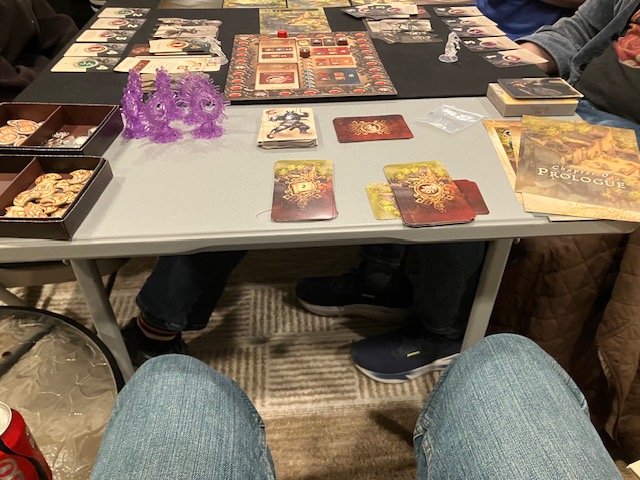
Although this game is a 1-4 Player game, I was the fifth player and “the rules guy”.  I just read the rules and taught the game and looked up clarifications.  Sadly, this was a very busy position for most of the game!  I would constantly be looking up rules clarifications, icon clarifications, and other things.  I had played the solo game for about 8 hours, and I was still struggling to find some rules!

There are good moments of cooperation as the players supported each other.  Me being the “rule guy” actually worked pretty well, although it was sort of depressing that I had to fill this role.

Urgency
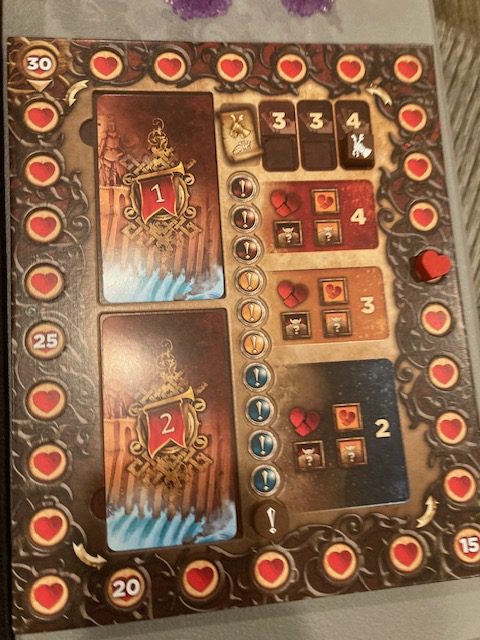
This game has, essentially, a built-in clock.  Every time you have finished playing all your cards, you have to take “Vitae” damage (basically, a shared hit point pool) based on the the current.  The threat will go up occasionally as monsters or other things happen.   And you can’t “usually” just rest on a Location: almost all Locations force you to fight new monsters if you stay there.
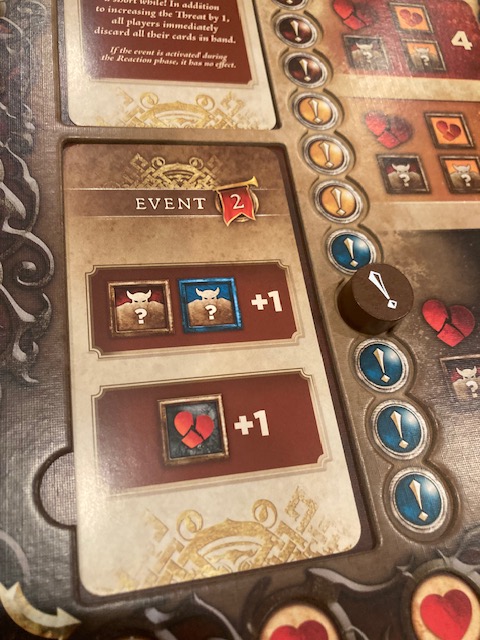
So the game is just always pushing forward:   This is both good and bad.  If you are looking for a contemplative adventure/exploration game, this isn’t really it.  If you want an adventure game that doesn’t stand still, but presents a sense of “you have to keep moving“, this is the adventure game for you.   Here’s a very bad analogy; some sharks have to keep moving in water or they die.  That’s kind of what you feel like here: players always have to keep moving (exploring) or you die.

Whether you like that urgency or not is up to you.

Kind of a Big Mess
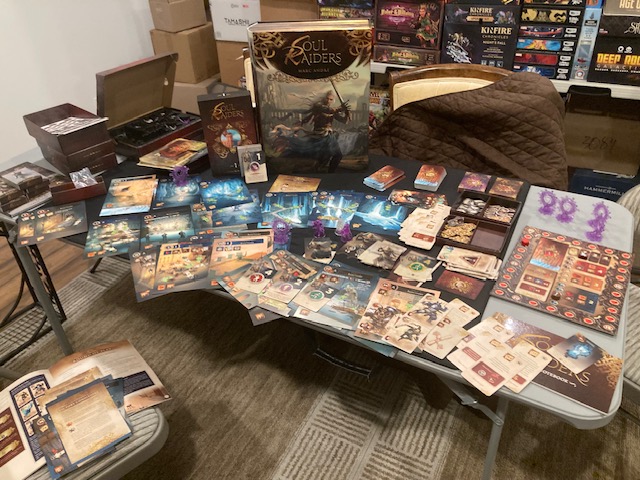
When you take out the Location cards, there’s no real rhyme or reason to them.  They don’t form a map (like Arydia Locations did: see that review here), they are more like “pages of a book”.  See my big mess after finishing chapter 1!
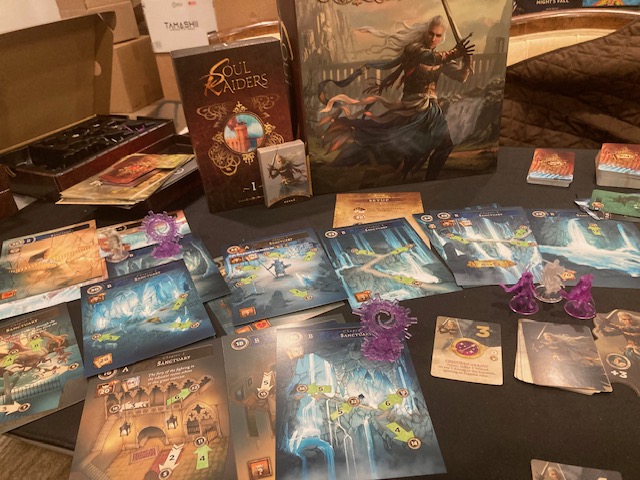
The problem is that you WANT to see the connections from previous Locations you visited!  So you try to keep a lot of Locations out as you play so you can see how you came here.  And you can see my big mess above as I try to keep some Locations out.  To be clear: the Locations DO NOT form a map! (The rulebook even emphasizes this point).
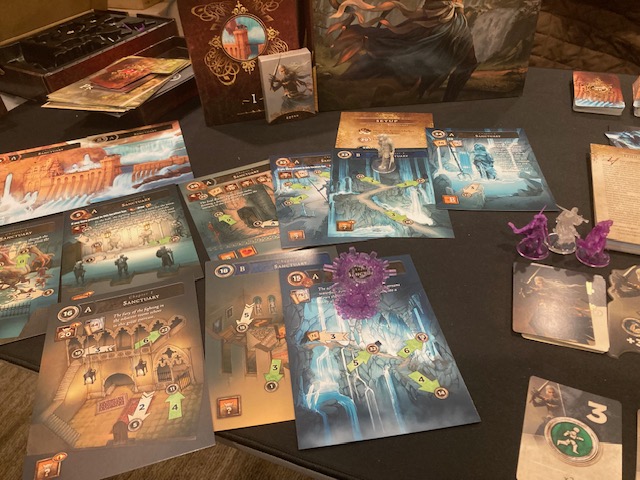
So, the Locations that come out are kind of a mess.  Shrug.  It feels like there should be a better way to deal with it?

Portals
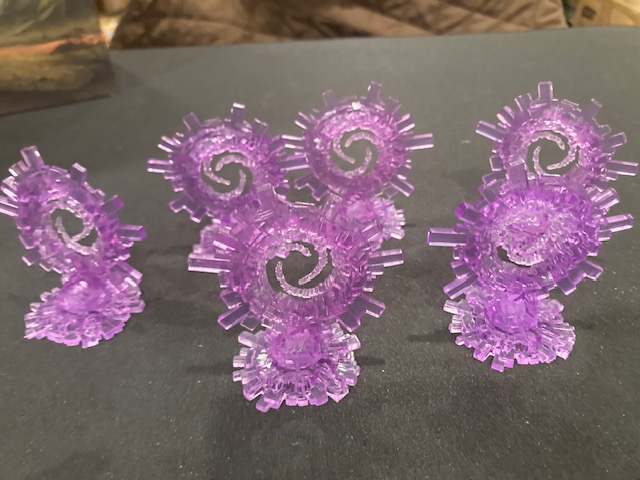
There are some very cool minis for portals!  See above!

You can see above as I have built at least one early in the game!  I was hoping to make this spot an easy one to come back since there are no “monster spawners” there!

And yet, I don’t think I took full advantage of the portals.  At all. I don’t think I used them once.  Which is a real shame, because they are so nice!

This is where I feel like this is even more like a Video game … where you replay the level to get the highest score and use the portals to their best advantage.  I played Chapter One and got a few extras, but not enough.  I feel like what I would do in a video game is replay it until I got the perfect score for that level!  I think to do that, I think you’d almost have to use the portals.

Maybe the portals will become more useful later on.  I was … disappointed with them.  Given how you never really get to just “think” (see Urgency section above), the only time it feels like you might be able to take full advantage of them is to replay the level.  Remember how I said this feels like a video game?  That min-max feeling emphasizes that point even more …

Save Game
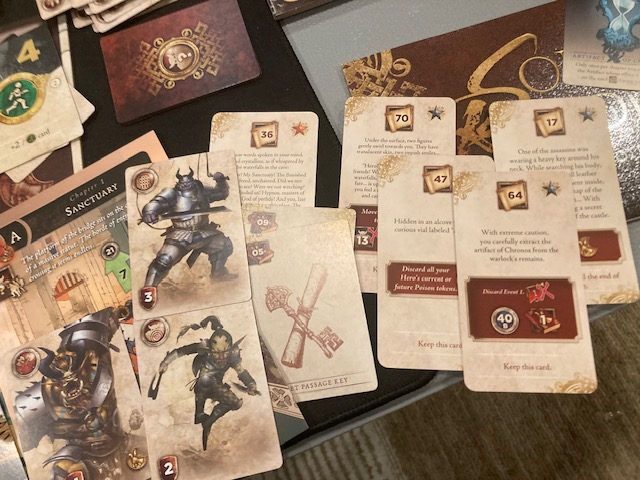
This is a campaign.  You will need to save you game between chapters.  Unless you can leave the game set-up (and it is a table hog), you will have to save your game.
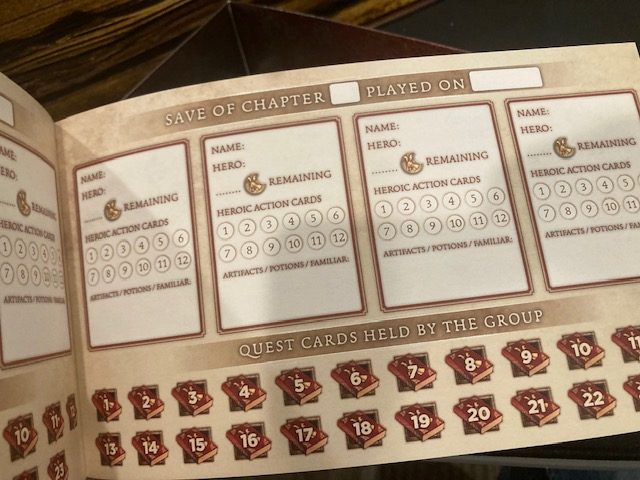
You can either use the campaign book   (above) …
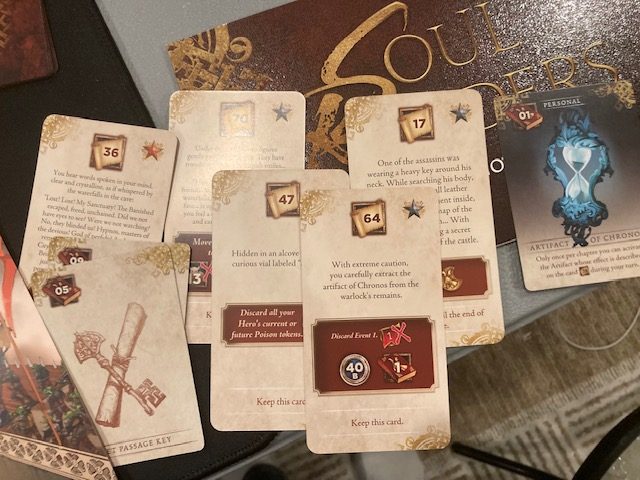
Or just take a picture of your game and extras at the end (see above).  The cards are pretty well marked.
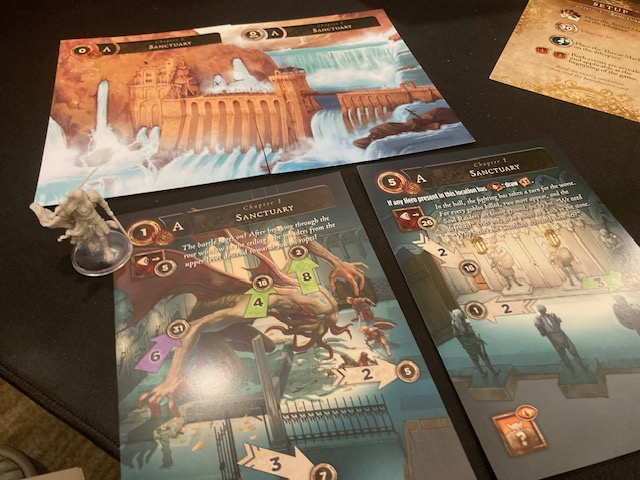
Let’s be clear: this is a campaign you can reset!  I have a solo game going, but we are also playing a cooperative game at the same time.  Sure, I’ll have to “pick” the cards out I want, but it’s fairly easy to reset the campaign to replay it from scratch.  This is not a legacy game.

Too Many Rules?
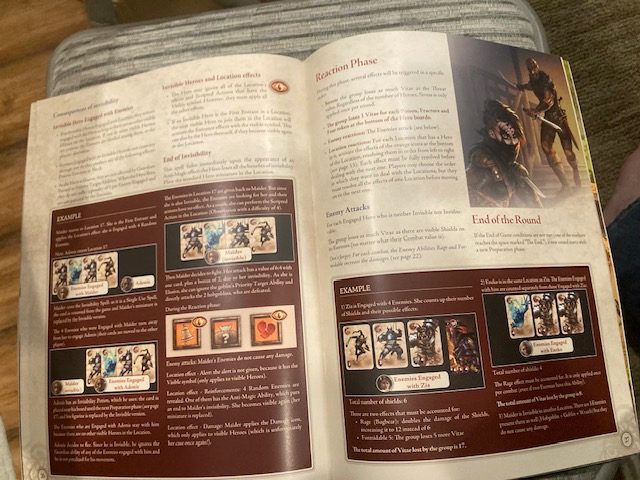
For such a lavish game, it’s both really simple and really complicated.  The basic card play is really straight forward, but all the little rules for combat and especially movement feel very complicated.  If you enter a Location with someone else, it has a different effect depending on the Icon in there, which has subtle difference between other Icons.
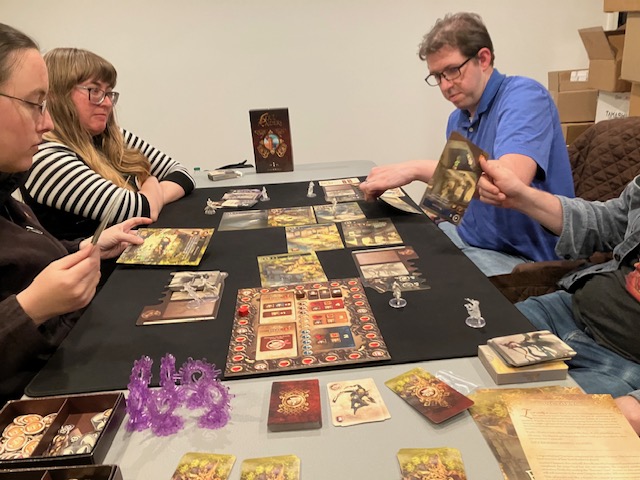
The fact that my role as “The Rules Guy” (as the 5th player and NOT playing the game) was pretty active the entire game might be an indicator that maybe there’s a few too many rules.

Reactions

Oof, Soul Raiders did not go over well with my group. My friends compared this to Tainted Grail (see part I and part II here) where it was just a grind to explore.   Andrew even commented: “This doesn’t feel like an exploration game, even though it kind of looks like one!  I have no mental model for how the map lays out because it’s so clumsy!”  Sara commented that the “.. Exploration feels like Tainted Grail because you just keep getting monsters!  You don’t really feel like you advance!”
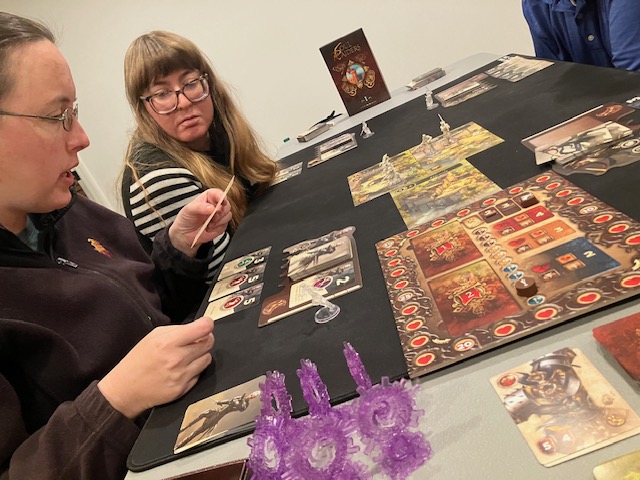
Andrew pointed out, “It’s not even really choose-your-own Adventure, because you don’t really have a lot of choices!  You left, right, or forward most of the time! And it feels randoms!”   
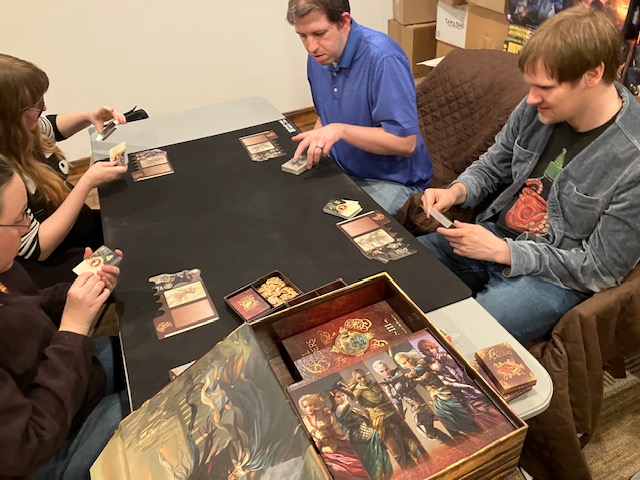
The reactions were ok to not great.

Sara and Andrew: 5/10.  “Don’t really want to play it again.  It didn’t feel like exploration. It felt too grindy like Tainted Grail.”

Sam: 5.5/10 “I’d play it again, but I really didn’t love it.  I thought Luddite from last week was more thematic than Soul Raiders!”

Teresa:  6.5/10 “I had okay fun and would play again.”

Rich: As a cooperative game, I definitely saw what my friends saw with the grindiness, and I could see why my friends didn’t love it.  As a solo game, I’m right on the fence of recommending it:  I’ll give it a 7/10 for the solo game, and maybe I could see it working as an intimate 2-Player game.  I think as a solo player, I became more invested in the story, but I still had some of the problems that my friends had. I love the art, and I really like the simplicity of the card system.  I also really like the upgrade system (where you can IMMEDIATELY grab a card with 3 Heroism).  I think there is some interesting stuff happening in the story, but the game does fall to the grind sometimes.

Conclusion

Soul Riders is a gorgeous cooperative adventure with a sense of urgency.  That urgency adds to it’s video game feel: it’s kind of a Point-And-Click Adventure in a board game, with exploring and interacting, but also lots of fighting!
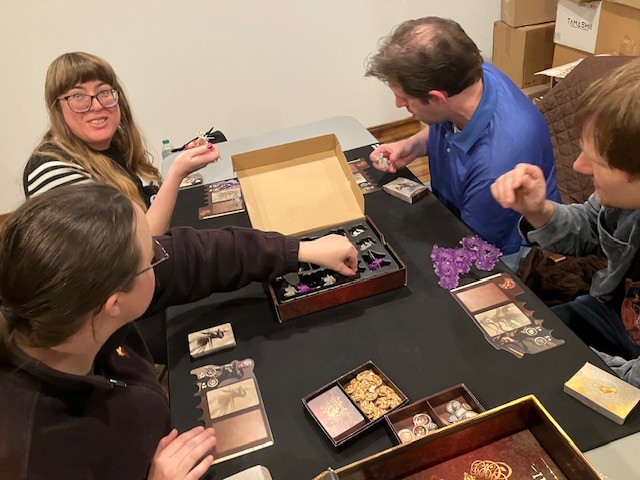
Unfortunately, this game didn’t go over very well with my friends as a cooperative game, with scores ranging between 5/10 and 6.5/10.  Soul Raiders reminded my friends too much of the grindiness of the original Tainted Grail in both its exploration and fighting.  And that grindiness was a big turn off. Having said that, the system worked well from a cooperative perspective, because my friends seemed to cooperate well!
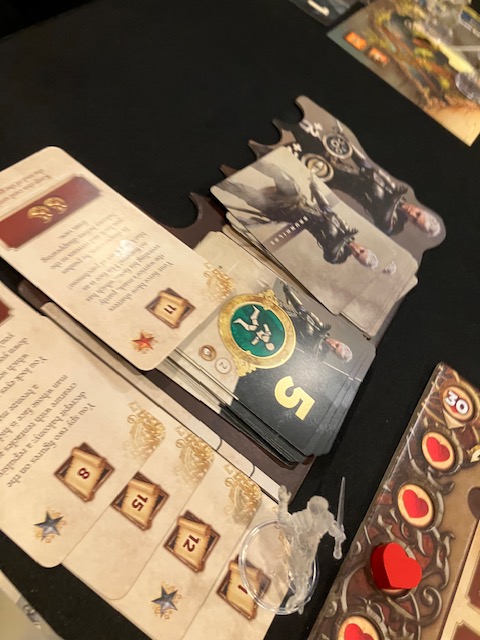
As a solo player, I become fairly invested in the story and I enjoyed it a little more.  I think the solo player can reflect a little more than a cooperative team, so maybe that urgency in the game is less intrusive for the solo player?  I do think that an intimate  2-Player game could go over well as the solo game.

Hopefully this review can tell you whether or not that Soul Raiders is right for you.

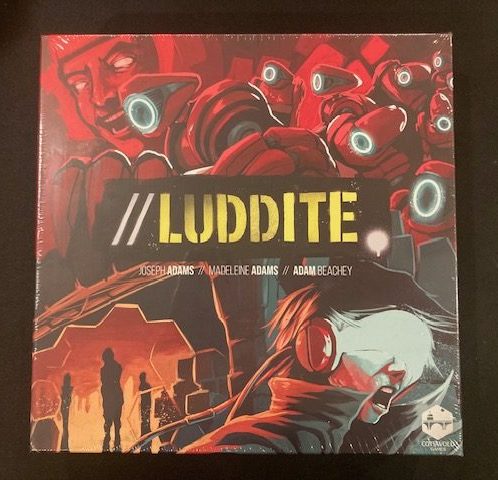
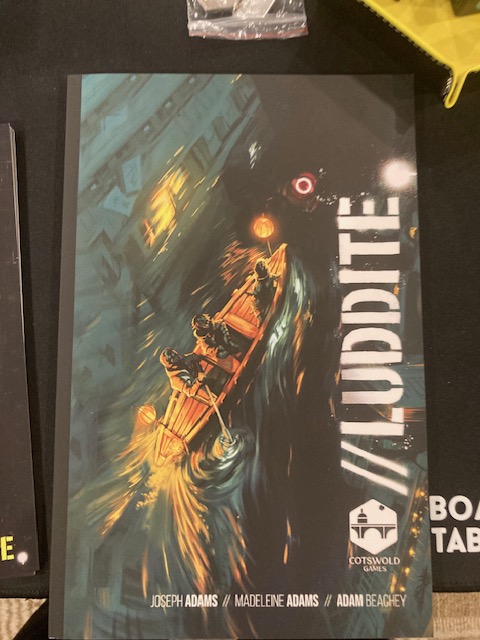
Luddite Can Be An Experience, If You Let It. A Review

Luddite arrived at my house about a month or more ago, but I have been afraid to open it.  Why?  I mean Luddite was the #5 entry on my Top 10 Anticipated Cooperative Games of 2024!  I paid money and Kickstarted it!! Why was I worried?

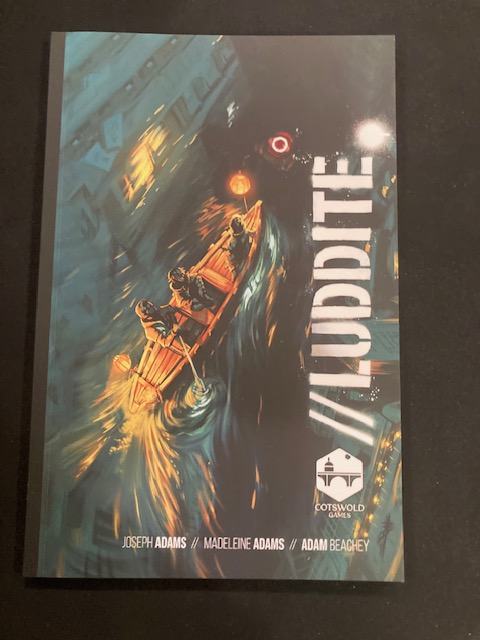
Luddite “looks” big because it has a graphic novel associated with it; there’s a lot of story here.  I was afraid I’d mentally have to prepare myself to embrace it.

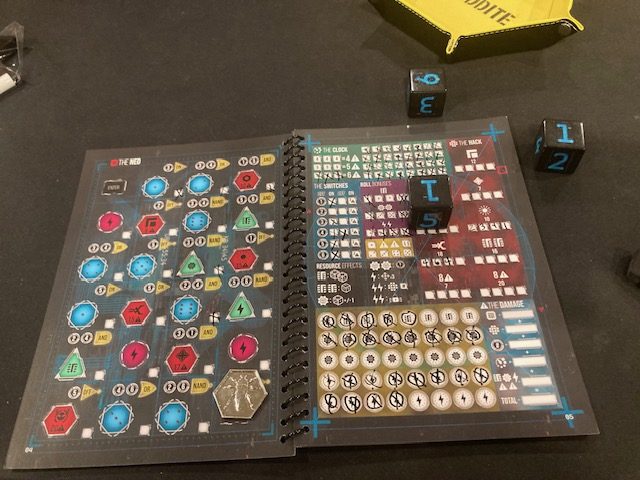
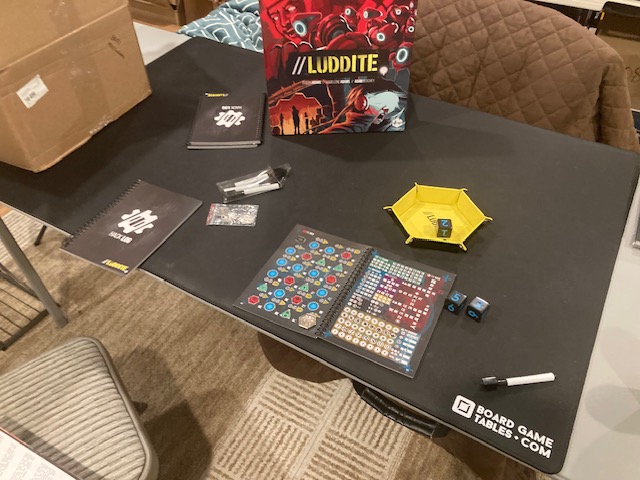
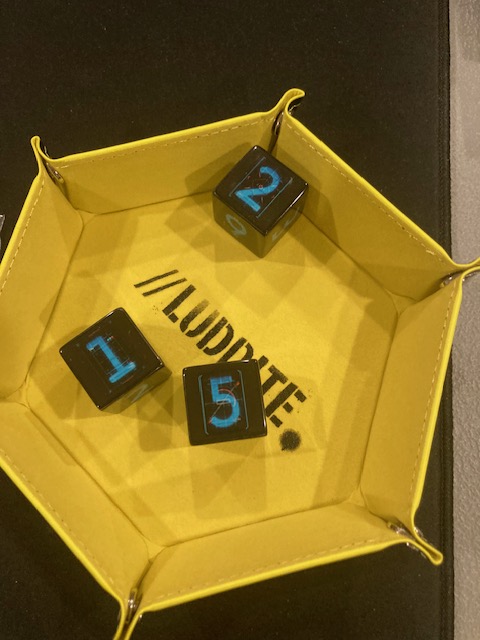
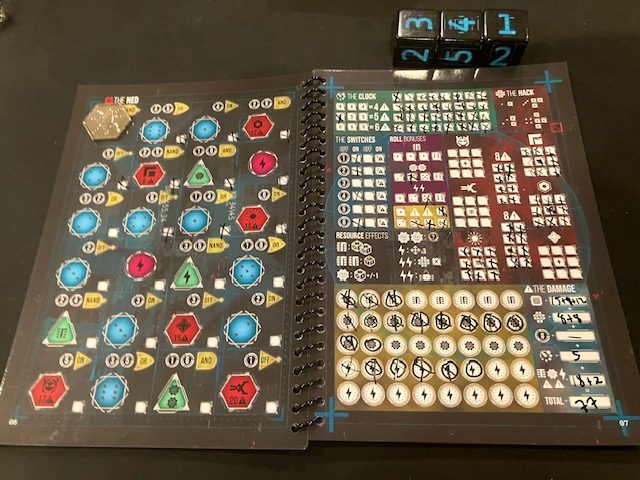
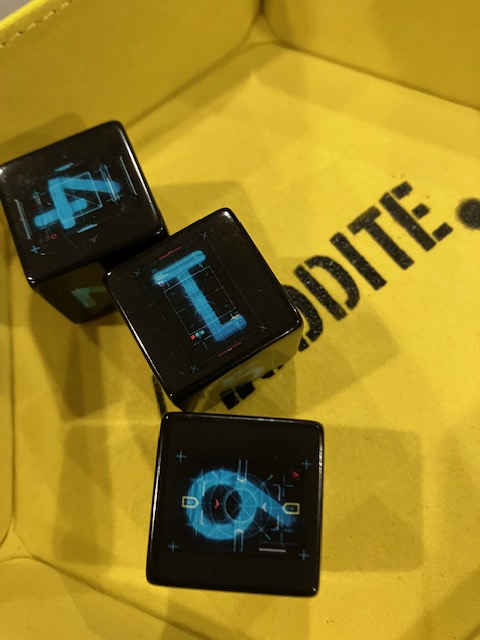
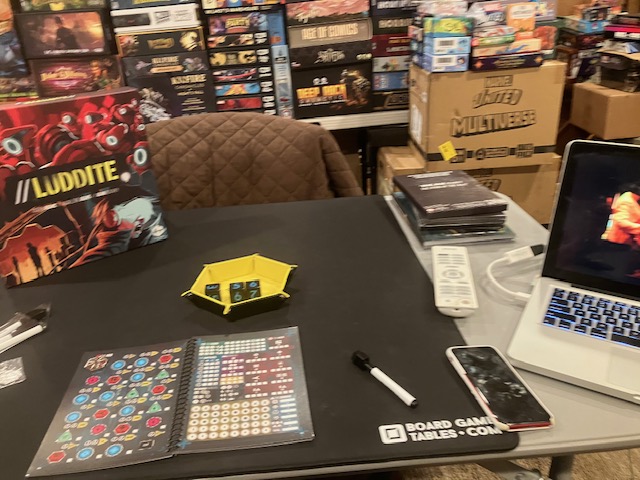
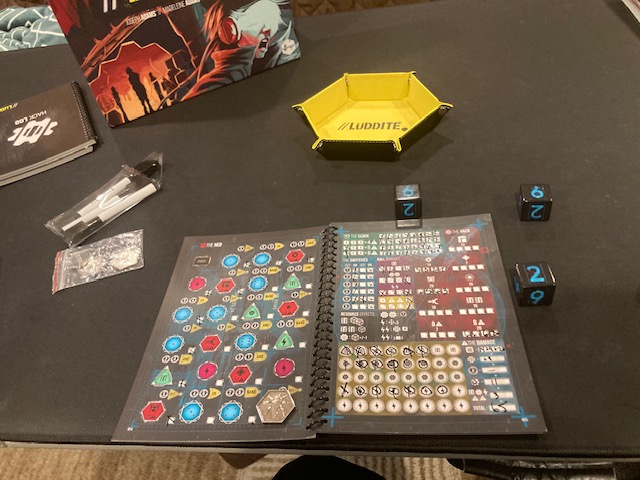
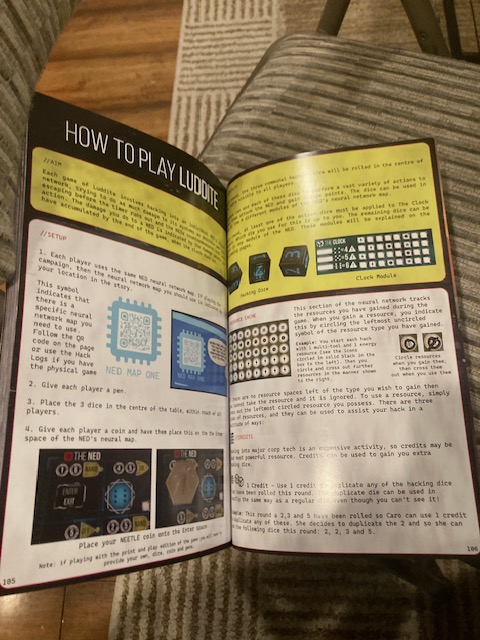
I don’t know why I worried!  At the end of the day, this is “just” a roll-and-write game!   You roll 3 dice, mark off spaces on your sheet above (See above) and try to score points (aka damage)! The base game is pretty straight-forward!

The object is to do enough damage to move to the next level! You need 60 at easy difficulty; see above as I miss by 1!  Heart-breaking!

In order to inflict the damage, you have to “move” the metal token (left side above; from the START to the END): if you don’t move that token, you can’t do any damage at all!  So, while trying to get “points” (aka, damage), you also have to make sure the token above moves!

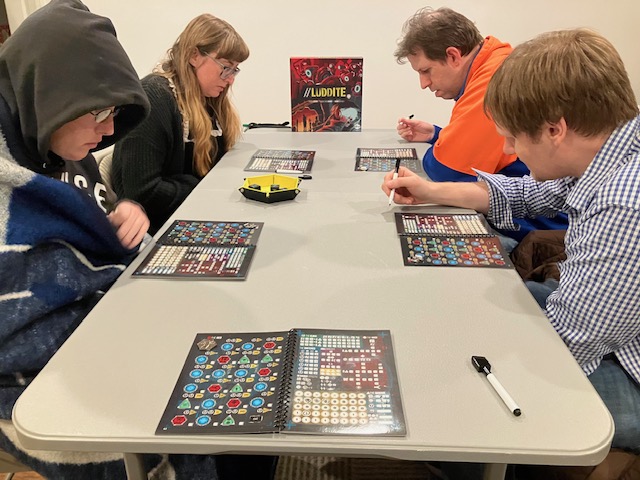
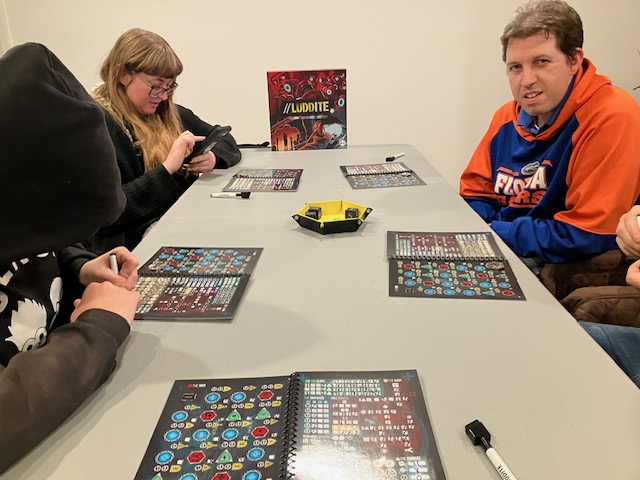
The game plays solo, cooperatively, and competitively.  The solo game is all about doing enough damage,  and the competitive game is “who can do the most damage to win”.   The cooperative game is really just multiplayer solitaire: take the scores of all players and average them to get a score; if that score is high enough, players collectively win!

To be clear, there is NO cooperation in the cooperative game; each player just takes their own book and plays completely independently.  Players can’t help each other, they can’t share anything, they can’t use a dice on another players board … nothing.  This is as multiplayer solitaire as you can get.   If you want an experience where you are working with your friends, chatting, strategizing, working together, … this isn’t the game for you.  BUT if you have friends who are “suspicious” of cooperative games, or people who don’t like the cooperative games, this can still work for you! 
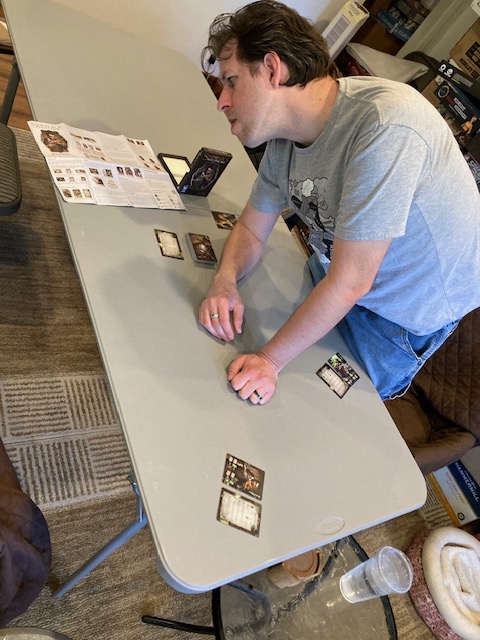
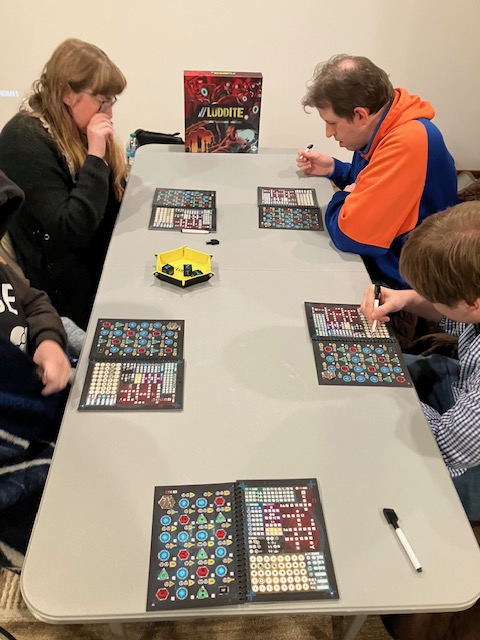
No one will tell you what to do, as everyone’s head is down and looking at their own board! See above!  And no one gets in anyone else’s board in any way!

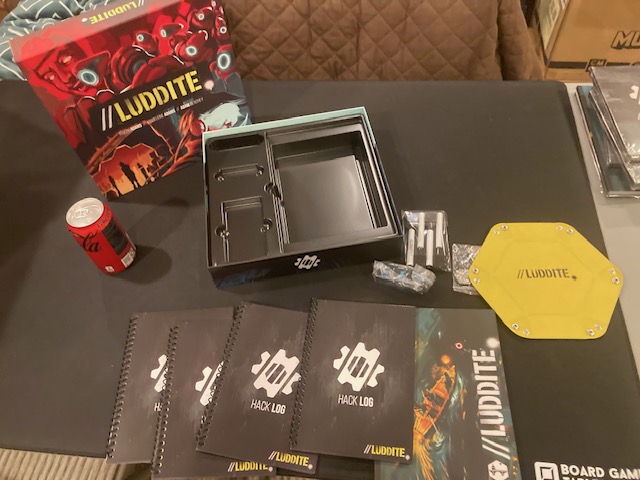
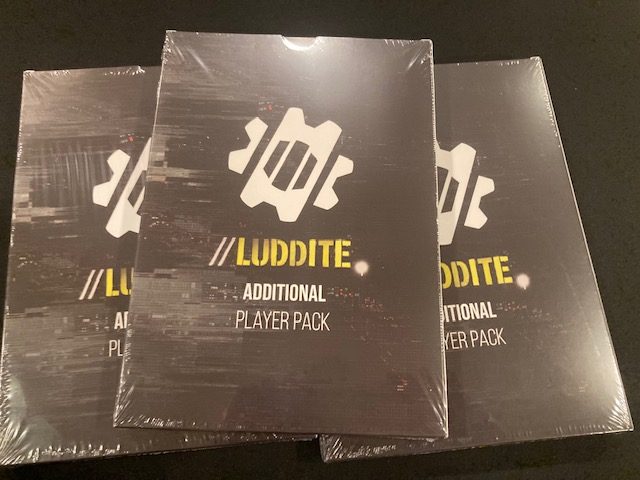
I made the mistake of getting 3 more “Additional Player Packs” (see above), but what this means is that 3 more people can play!    Basically, Luddite can scale to as many people as you want because there is no interaction between players!!  I am thinking of trying a 7-Player game of Luddite at RichieCon this year! (I have 4 packs in the base game and 3 packs from additional buys = 7 player boards!)

So, you can view this complete lack of player interaction as a good thing or bad thing, depending on the group you are playing with.
Solo Experience

If this was all there was to Luddite, there’s not much making it stand out, is there?  It’s a pretty good roll-and-write game for the solo player, and it’s a pretty good cooperative roll-and-write that scales to any number of players … even if there is no player interaction.
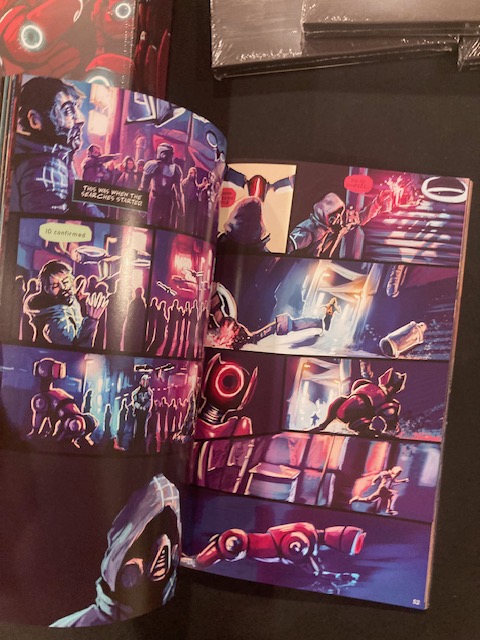
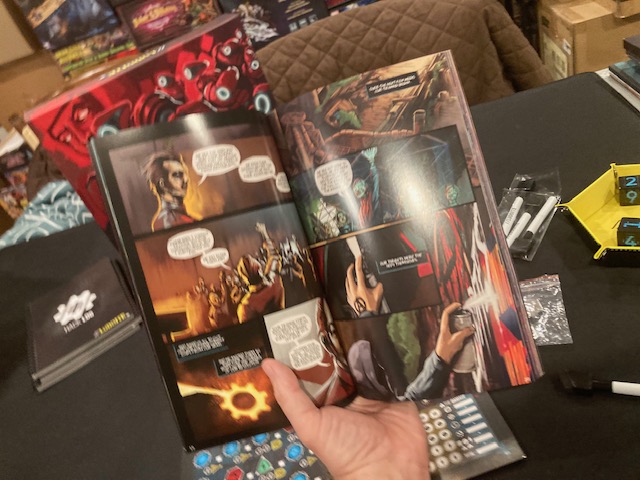
However, if you let it … this game can be an experience!  The Graphic Novel that comes with the game tells the story of some people who have been “made redundant” by AI and how they are fighting back!

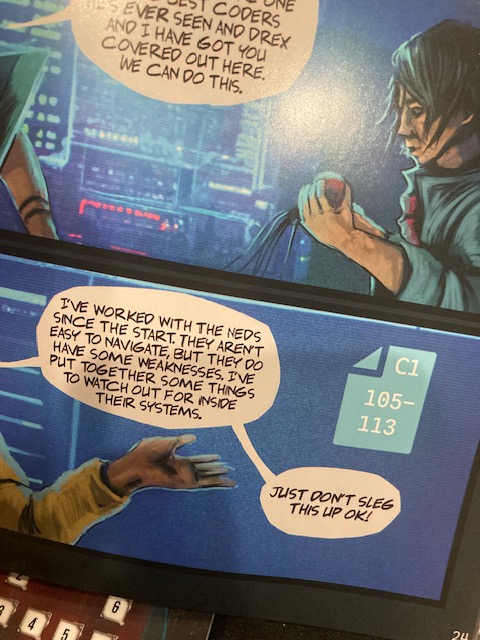
The Graphic Novel gives you a back-story, then at certain places, tells you what chapter/pages to turn to! See above!

This was more immersive than I expected.  If you let it, this game can feel very immersive.  For my solo experience, I read the graphic novel that came with the game …

… and each new game is a progression of the story, even if the boards look very similar. See above as I win (solo) chapter 3!

Somehow, it seems for a game named Luddite (Luddite: someone who eschews technology) … that you HAVE to read the physical graphic novel, right?

Cooperative Experience

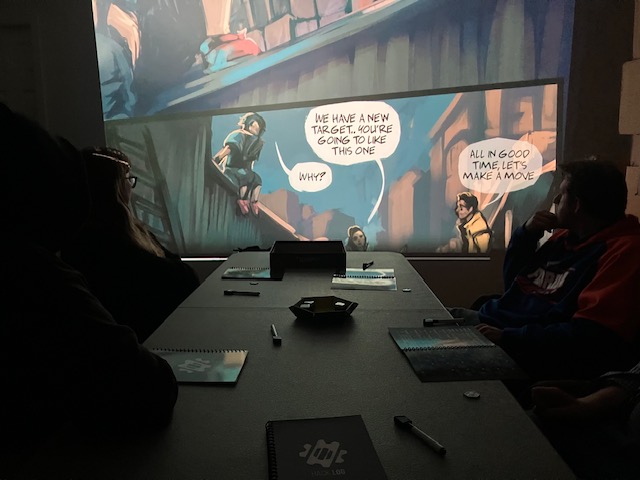
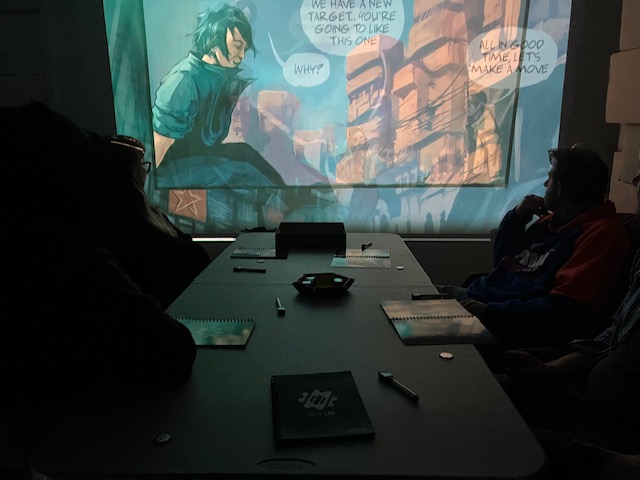
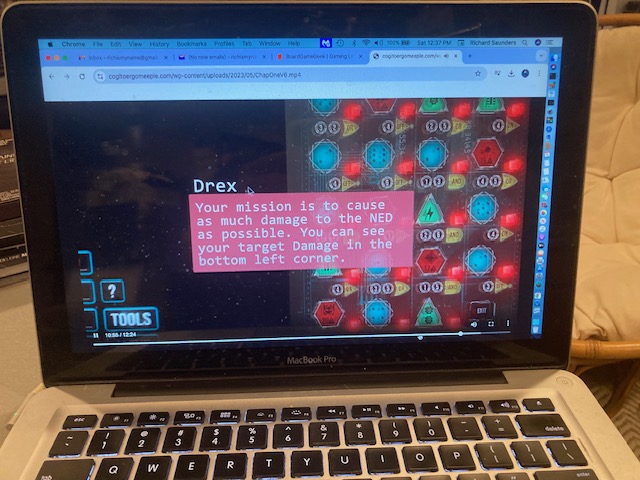
It turns out, the comic book is also online … in a video!  It has voice-acting, and shows the comic progressing!  See above!

For the cooperative game, it’s “harder” to enjoy the graphic novel in its physical form … you have to pass it around, or wait for others to read it, or read over people’s shoulders.  But, if you go to the Cotswold Group website, they have the entire graphic novel online! (And even a little tutorial)

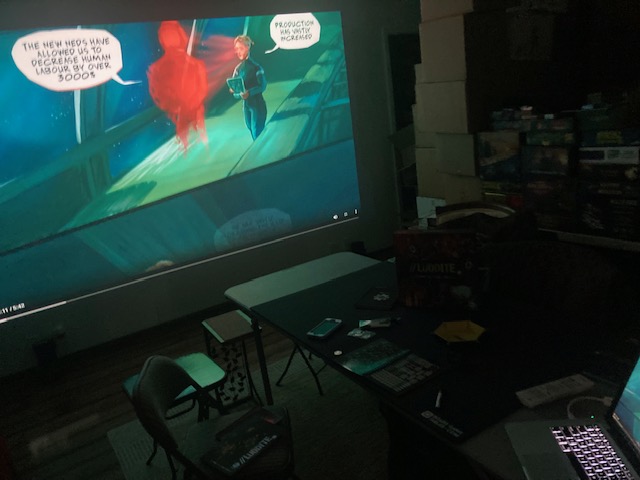
So, even though it’s seem against the spirit of a gamed named Luddite, the cooperative experience is made so much better by watching the comics-turned-to-videos!  Arguably, that experience engulfs you and all your friends into the game!  It’s a shared story you are all experiencing!

To be fair, it helps the experience if you can show the video on a big screen or TV: see above. It feels more immersive that way.

House Rule/Hack (Get it? Hack? In a game about Hacking?)

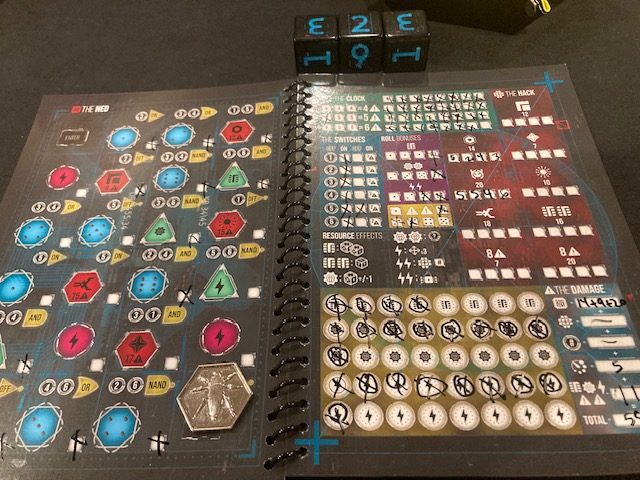
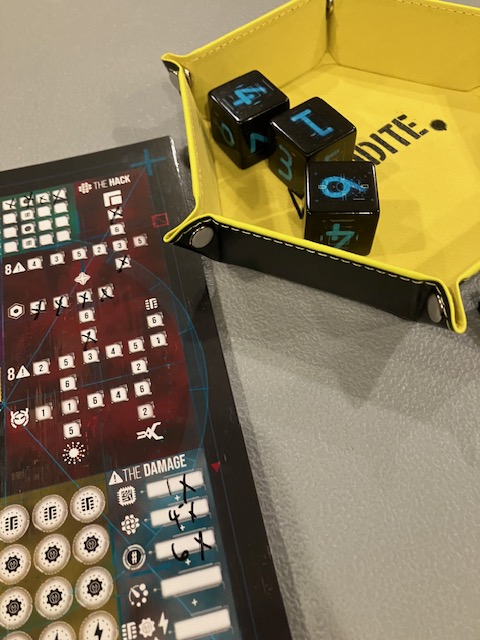
The dice are a shared resource everyone shares in the cooperative game: they are rolled and placed in the middle for everyone to see!  But sometimes, in the heat of playing, you may forget which dice you used for which activity.  Surprisingly, there’s no place on the sheet to “notate” which dice we used !!

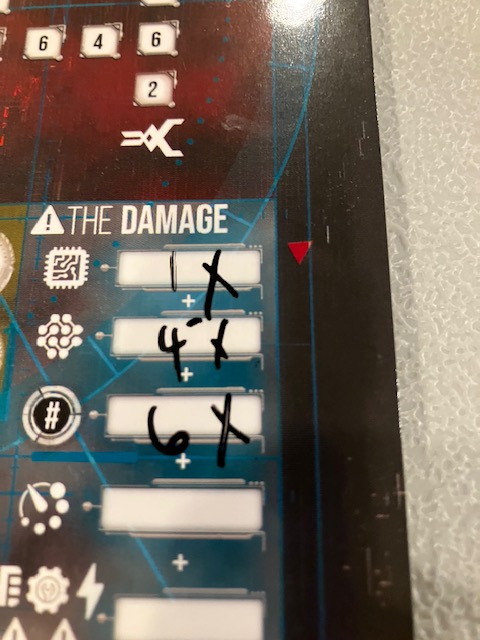
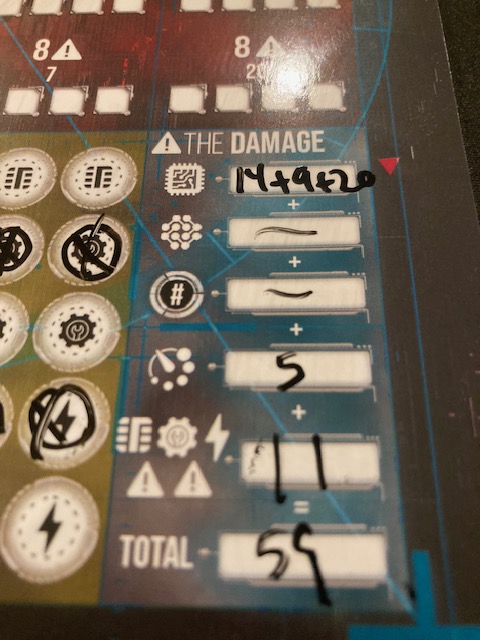
Since you don’t compute your damage until the very end of the game,  you can use the Damage section!  

This little house rule/hack made it easier to play the game cooperatively, as you could all independently note the dice rolled and how/when/where you used them.  

Conclusion

If you let Luddite be an experience that carries you along in its story (either as a graphic novel or comic-turned-video), I think this can be a really fun and immersive experience.

A reductionist might say “Luddite just a roll-and-write” …  but at least it’s a good one. I really enjoyed all my plays of this.   The base game is pretty straightforward and quick, and it has lots of meaningful decisions.

The cooperative game has literally no interaction between players, which can be a curse or a blessing, depending on the group you are playing with.   But, because of that lack of interaction, this game can scale to pretty much any number … as long as you have the boards!

This is a good solo roll-and-write (7/10), and a pretty good cooperative roll-and-write (6.5/10 or 7/10, depending on what you want), but it’s the story and experience that elevates this just enough that I would recommend you try this: 7.5/10.

I still think it’s hilarious that a game called Luddite has such a great online presence.  I mean, a game called Luddite should ONLY have the physical version, right?

Appendix: Binding

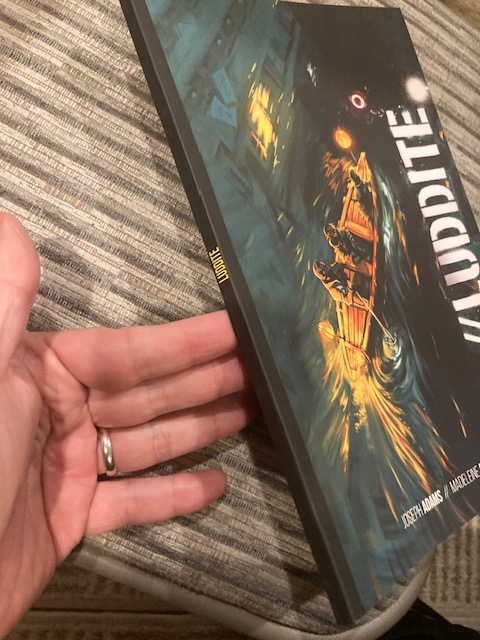
I normally despise this kind of binding, especially on something you need to hold open! See my review of War Story, Freedom Five, and Forests of Admiron if you don’t believe me!  For a graphic novel, it’s “okay” since you are just reading it and holding it open. See below.

Where this binding fails is when you have to read the directions in the back of the book!  See below as I try to wedge the book into the edge so it’ll stay open!  I hate this kind of binding for rulebooks!

See above as I attempt to hold it open!!!   Honestly, the rules should have been in a second standalone book that could be lain flat and open.  As a graphic novel, this kind of binding is “fine”.  But the rules portion of the graphic novel (in the same book, this really made me grumpy.  


One-Hit Heroes: A Solo and Cooperative Review. Insert Funny Phrase Here.

I know, I know. You really want me to make some kind of funny phrase like “One-Hit Heroes is a one-hit wonder” or “One-Hit and it’s out!” But those aren’t really apt descriptions, so insert your own funny phrase above! Let’s look below to see what it’s REALLY like!

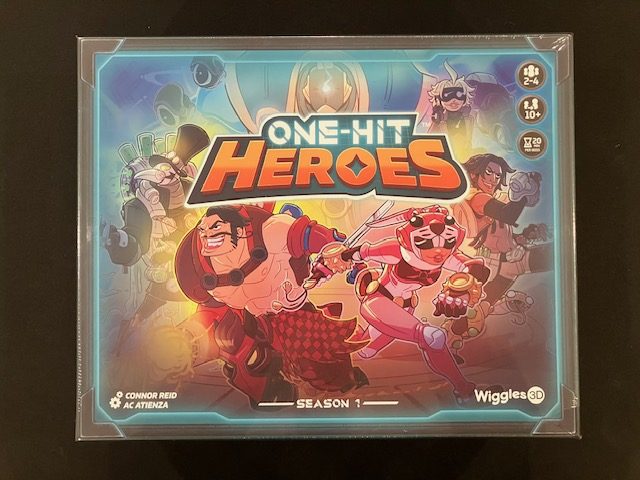
One-Hit Heroes is  cooperative boss-battling game I backed on Kickstarter back in April 2024.  It promised delivery in March 2025, and lo-and-behold, it arrived March 29, 2025!  So, it made it! Barely!

I hav to admit I was a little spicy with the delivery, as they literally left it ON THE STREET!  See picture above!  The package is literally on the street in front of my mailbox! Oi!

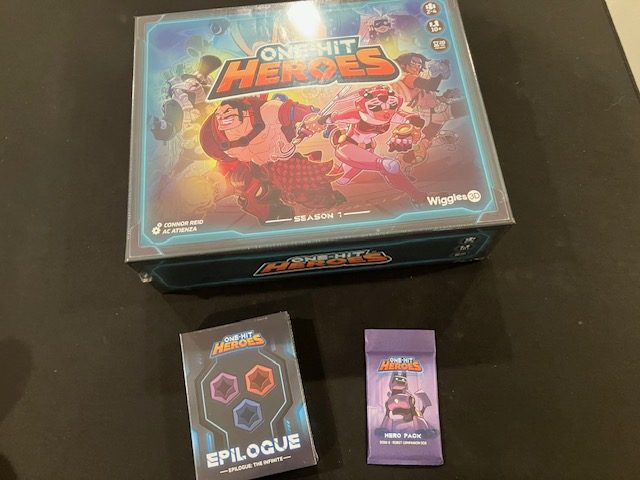
Luckily, everything was fine: the box and everything was in perfect shape.  (I got two little upgrades with the box; a epilogue box and an extra hero pack: see above).

I was pretty excited for this! This was #6 on my Top 10 Anticipated Cooperative Games of 2025!

Let’s take a closer look!

Unboxing

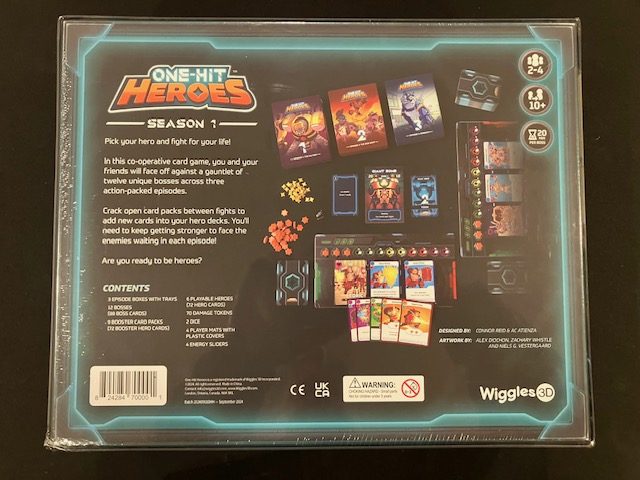
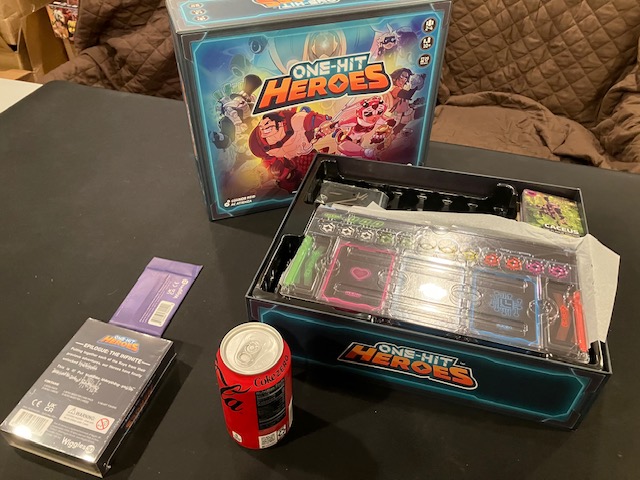
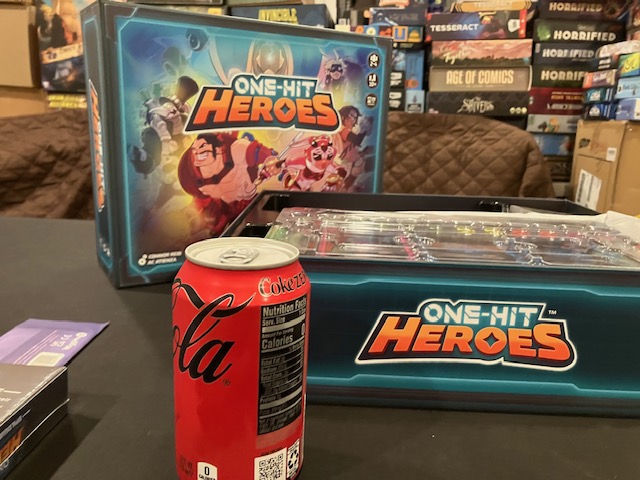
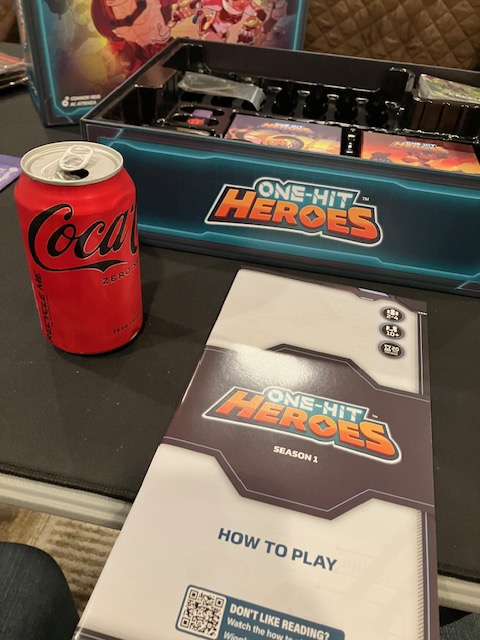
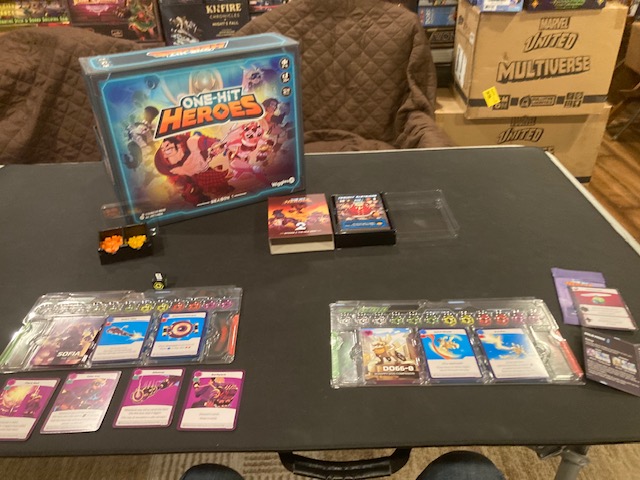
This is a medium sized box; see above and below for perspective.

It does have a slightly weird shape; it’s not a Ticket To Ride sized box.  However, it’s not too bulky or too awkwardly shaped.

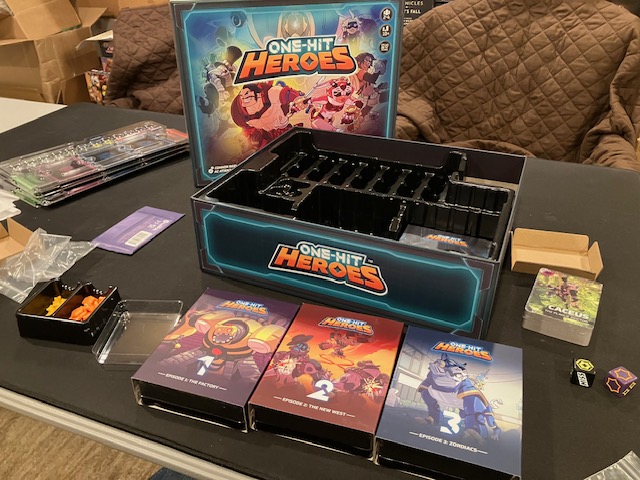
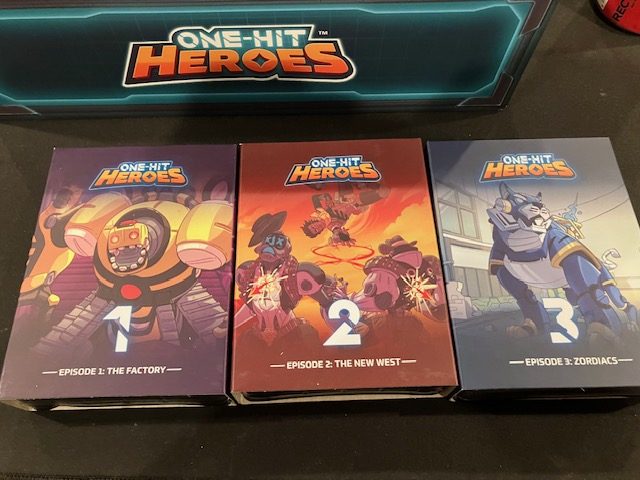
It contains some cards and tokens, as well as three separate “Episodes”.  See above.

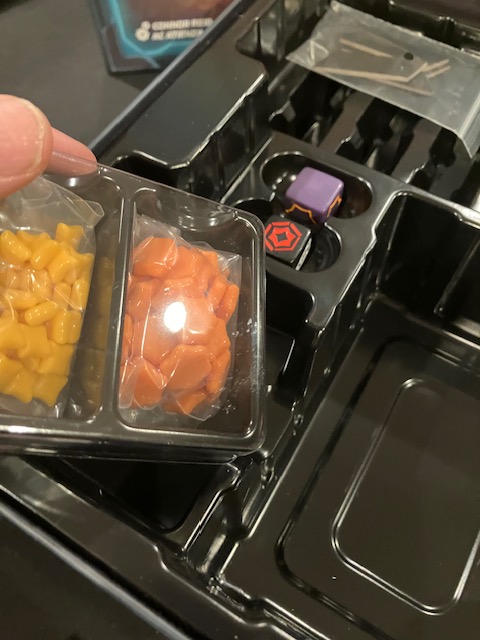
The components are all pretty high-quality. The cards are NOT linen-finished and are all very shiny.  That’s actually my major complaint with the components of the game; when playing, the games seems very “shiny”: the cards, plastic trays, are all “shiny” and can be distracting.

Rulebook

The rulebook is good.

The rulebook feels like it has a weird form factor (look how loooooong and thin it is above) …

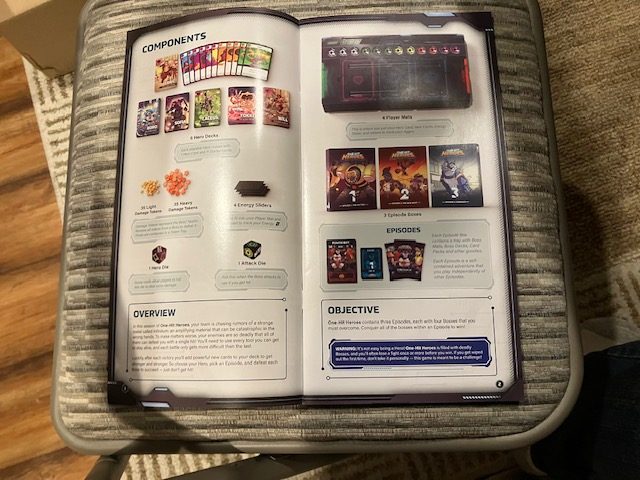
… but when you open it up, it fits PERFECTLY on the chair next to me! See above!! The rulebook stays open, it’s easy to read, and there is no pages drooping over the edges!  One-Hit Heroes gets an A on the Chair Test! See above!

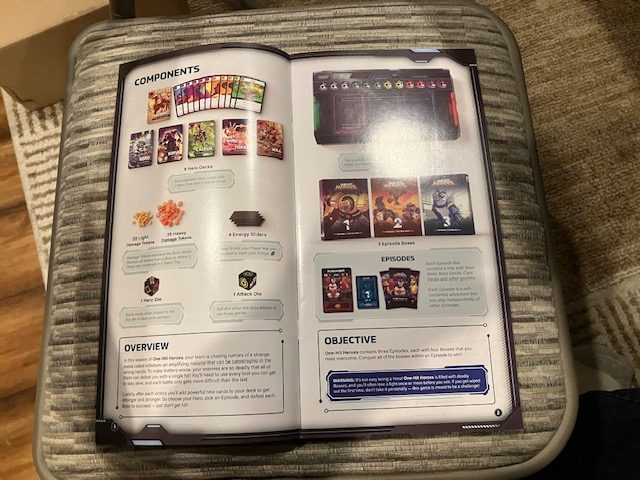
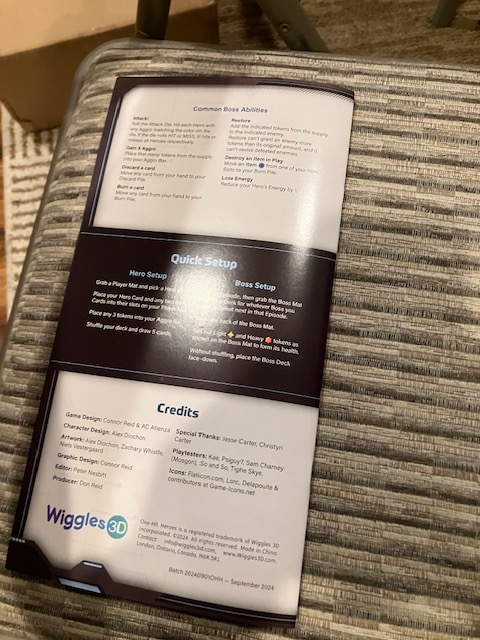
The Component page is nice; it shows and adds correlative text to everything.

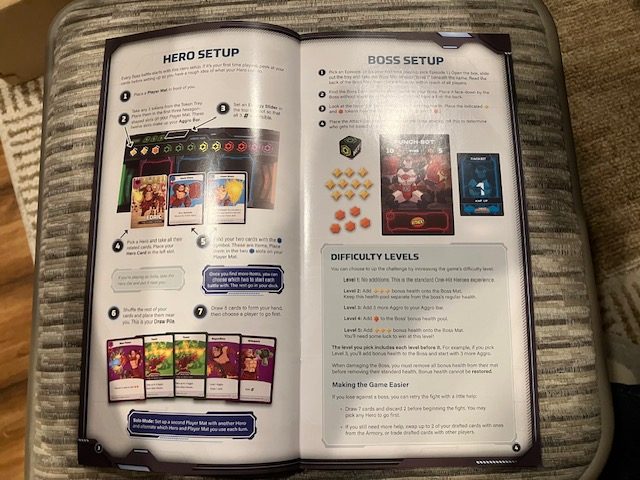
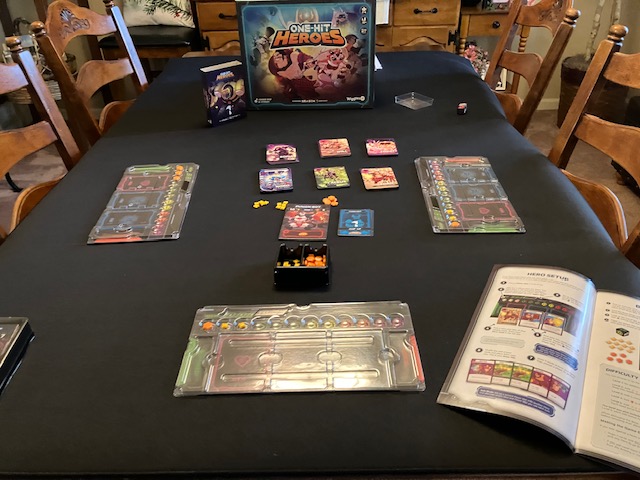
The Set-Up page looks good and is easy to follow, for both the Heroes and the Boss.  See above.

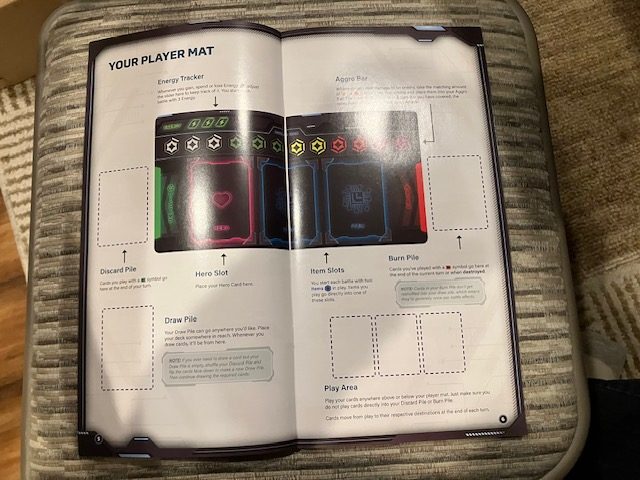
It does a great job explaining the player mats!

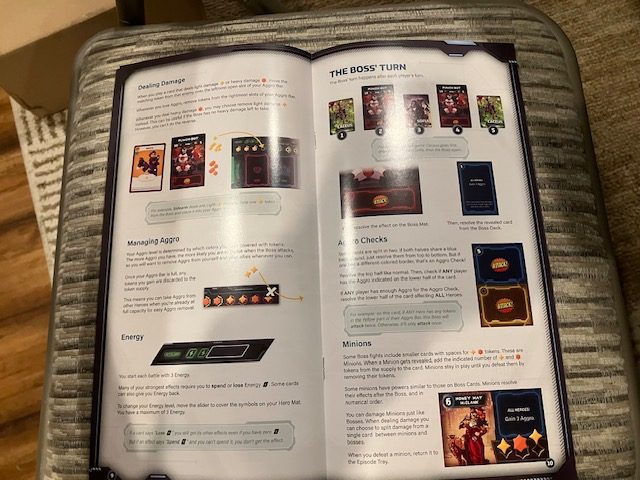
Overall, the text is big, easy to read, has a legible font, and is annotated with many pictures describing play.  There are also parenthetical phrases notated for “extra information”.

The back of the rulebook could have been a little better, but whatever, this was a good rulebook.  It explained the game, showed the components and set-up, and was fairly easy to read.

Gameplay

Players work together to take down a boss; a single boss battle takes about 20 minutes (the box is pretty accurate in its time).  An “Episode” in the game is 4 to 5 boss battles, which each boss getting harder and harder.

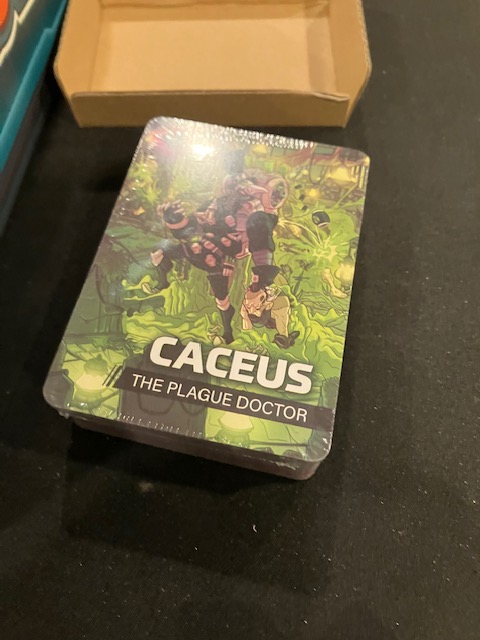
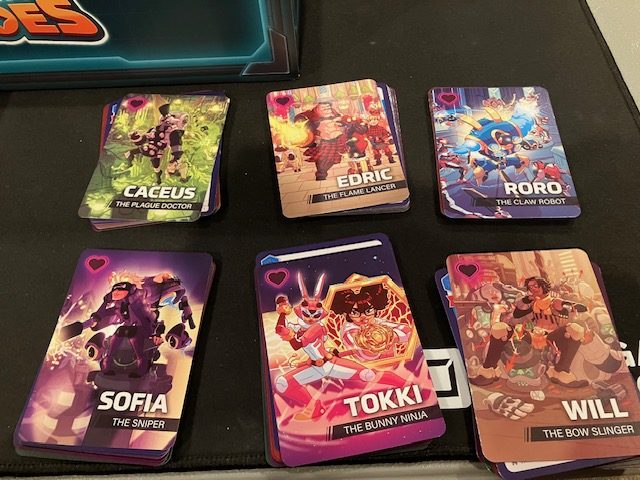
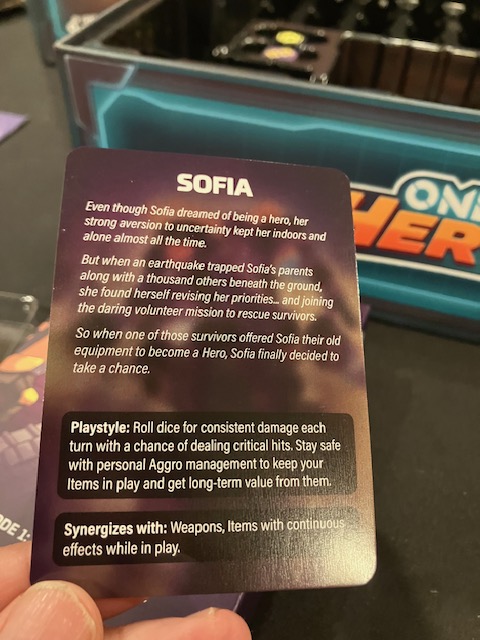
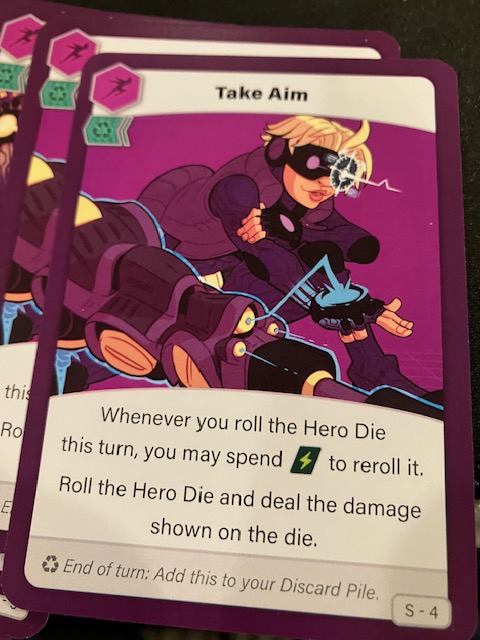
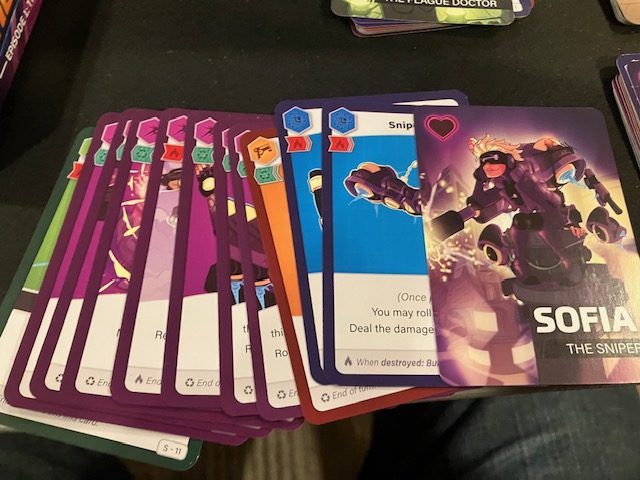
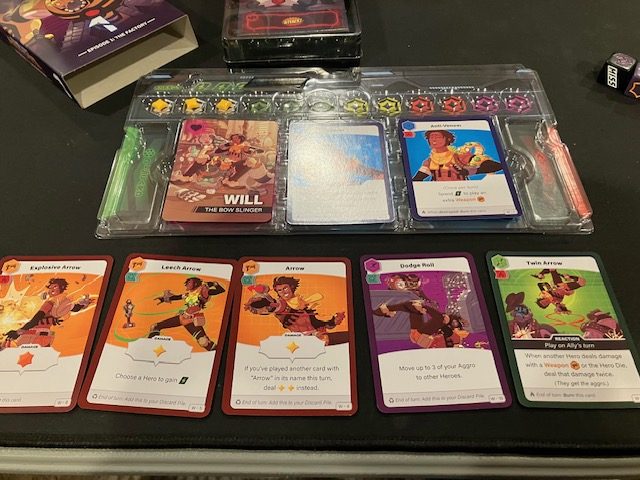
Each player takes and plays one character of the six above.  Each deck has 11 cards with very different personalities.  Take Sofia, for instance; her story is on the back of her card!

What do her cards look like?

See some of the cards from Sofia above.

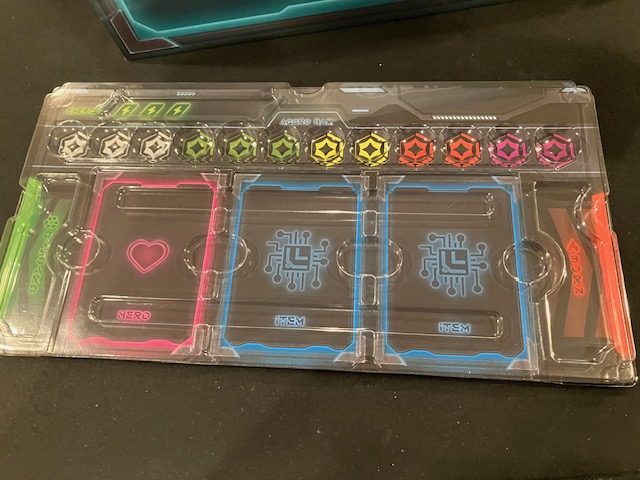
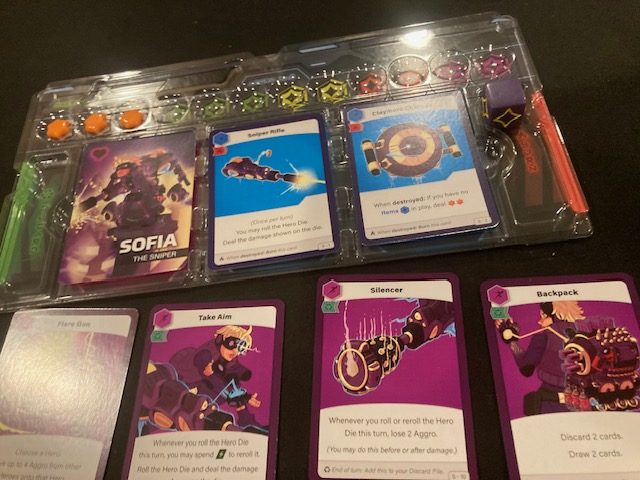
Each player grabs a tray  (above) for their character and puts the cards into the tray (below).

As the game name implies (One-Hit Heroes), the Heroes can only take one hit before they die! Even more so, if any character dies, all players lose!  It’s up to the players to stop from getting hit!

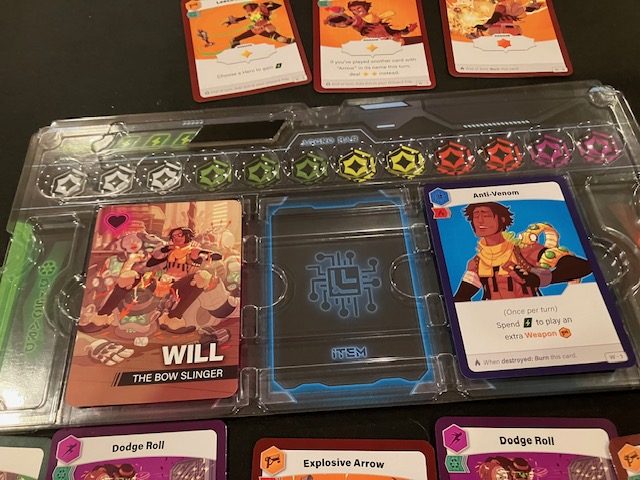
Each character has two items slots for Items that “help” (see above), but arguably the Items are more important for stopping a hit!  Players can destroy an item to avoid a hit!  (Thematically, the item takes the hit instead of the character).

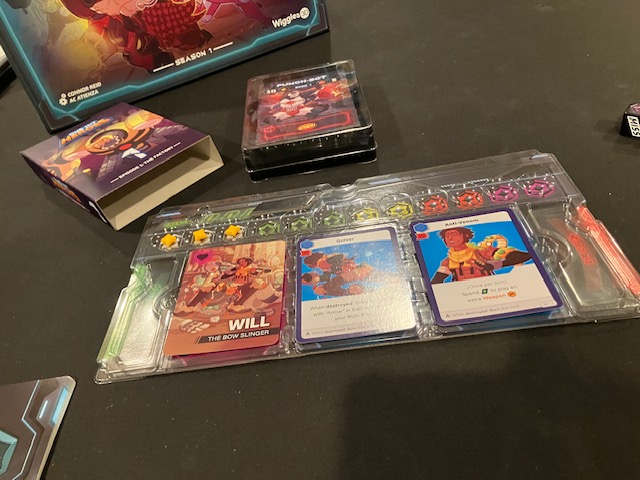
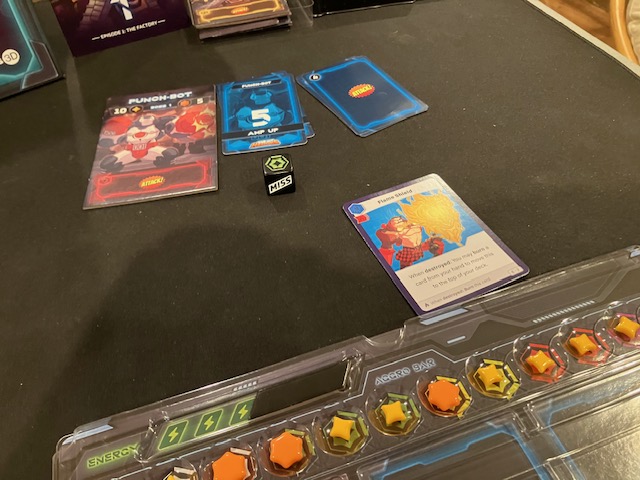
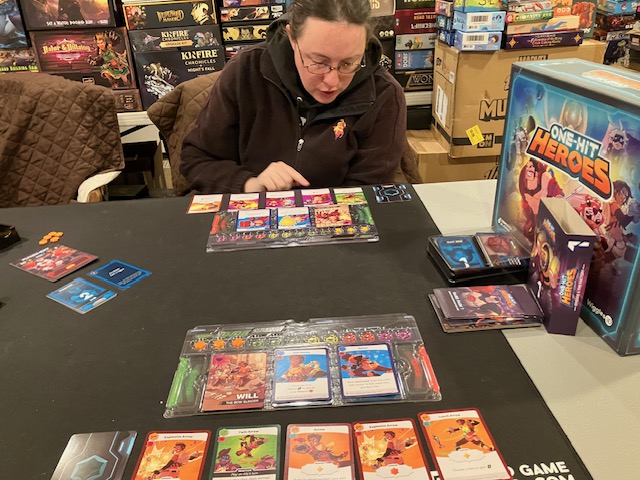
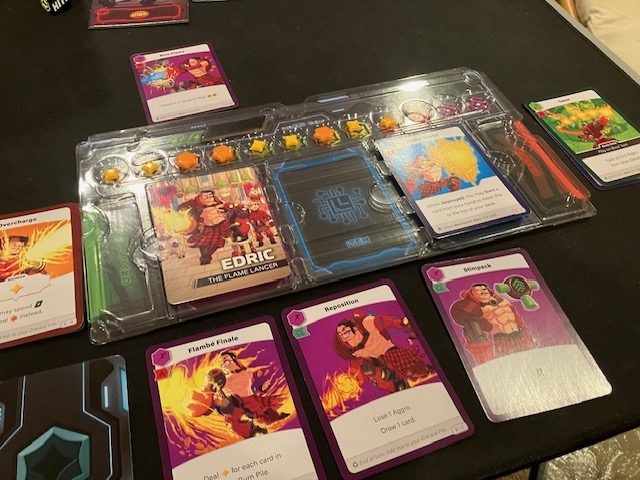
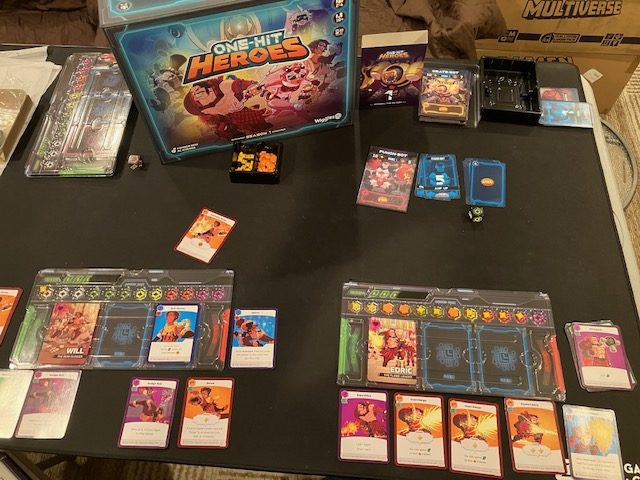
Items are a coarse way to stop hits; it’s usually better to stay out of way of hits if possible (since you only have two items)!  One-Hit Heroes uses a notion of an “Aggro track” for each hero.  See the track running left to right at the top of the tray? It’s empty for Will right now.

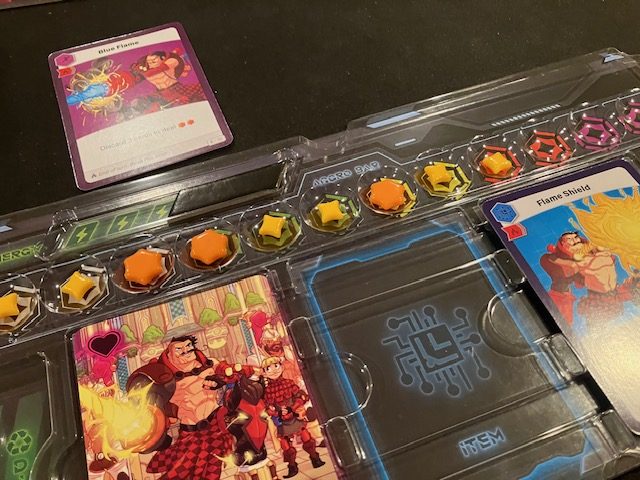
… but Edric (above) has a track almost full of Aggro!  Basically, the fuller the track, the more likely you are to incur the wrath of the boss and take a hit!

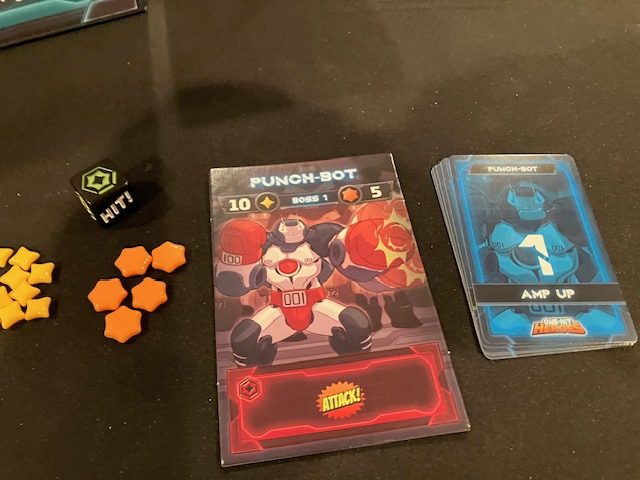
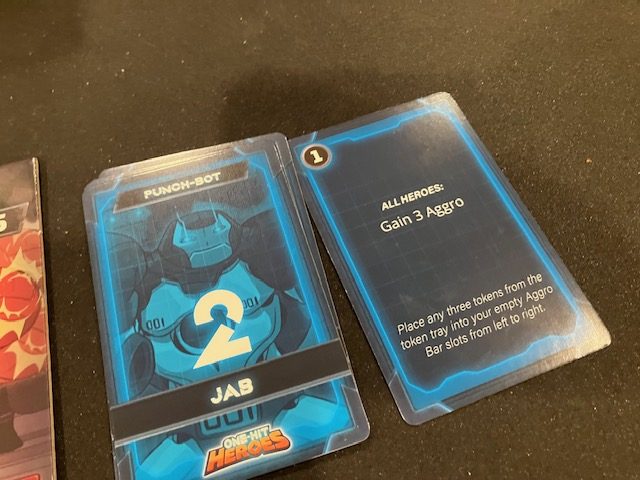
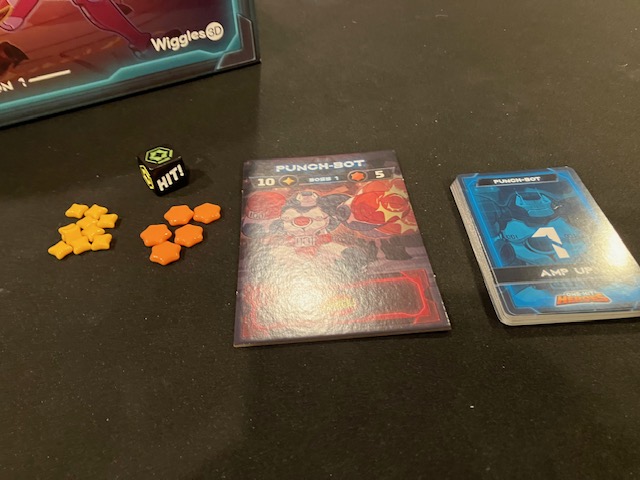
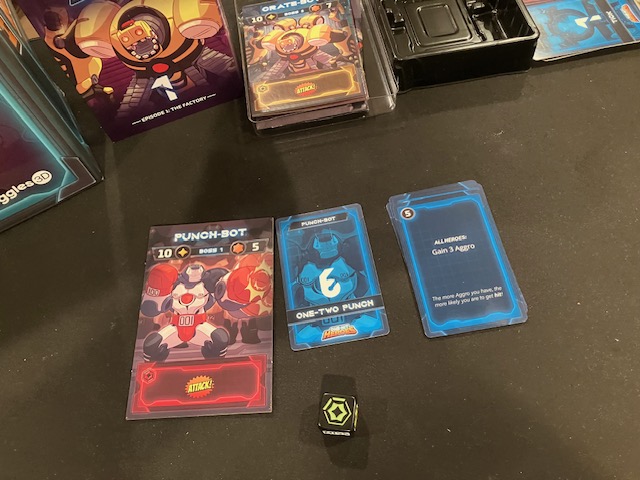
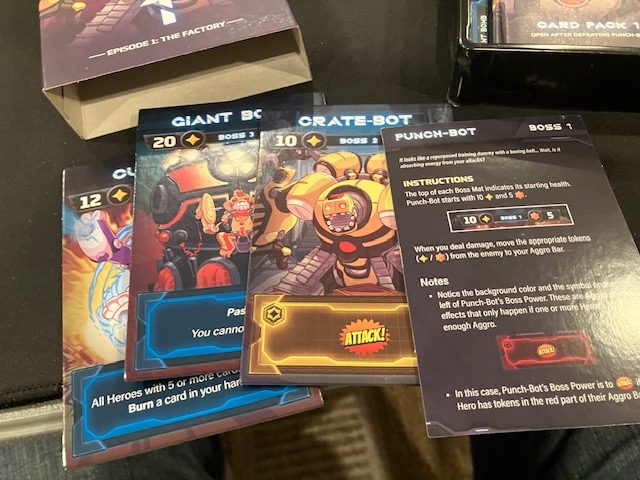
This is a boss-battler after all!  The Punch-Bot (the very first boss from the very first episode) only attacks when a Heroes’ Aggro is in the “red range”.  So, if the players can keep their Aggro low, Punch-Bot won’t even attack!

But, Aggro will go up.  Either from bad news cards  (like above) …

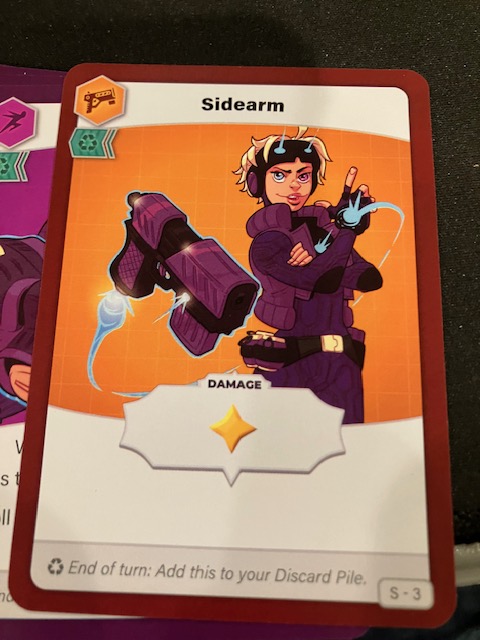
… or every Attack you do ups your own Aggro! If Sofia uses here Sidearm (above) to so one yellow damage, then does one damage to the Punch-Bot, but takes 1 Aggro!  Every attack you do that does damage causes Aggro back to yourself!

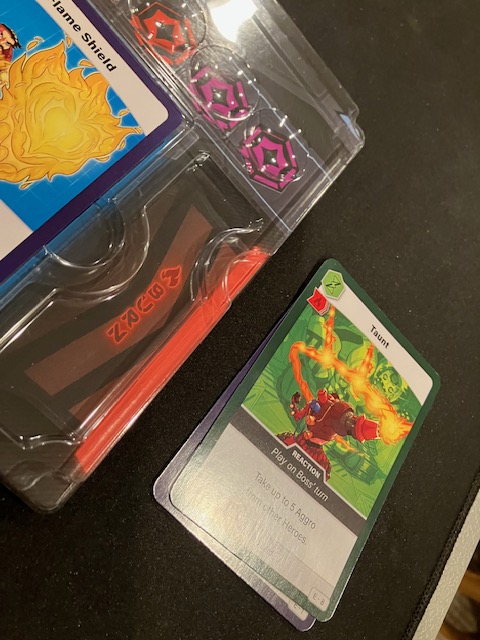
Luckily, each player has cards to manage Aggro; some cards (like Taunt above) will move Aggro around, and other cards will just discard it.    Every Hero has a different way of dealing with Aggro; some move it around, some discard it, some avoid it as much as possible, and some have cards that help others!  Each Hero has a different flavor of cards!

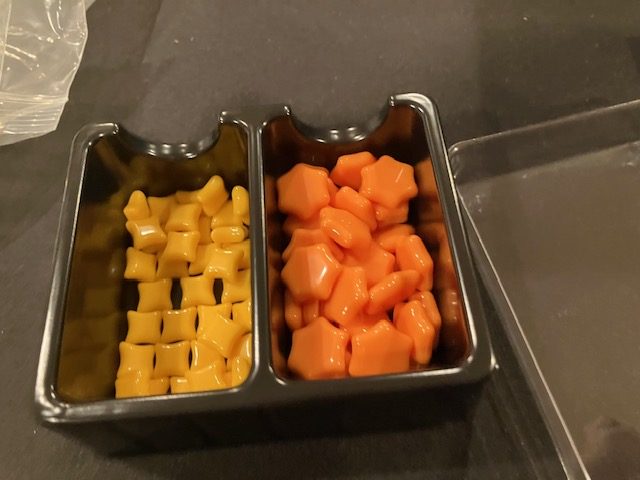
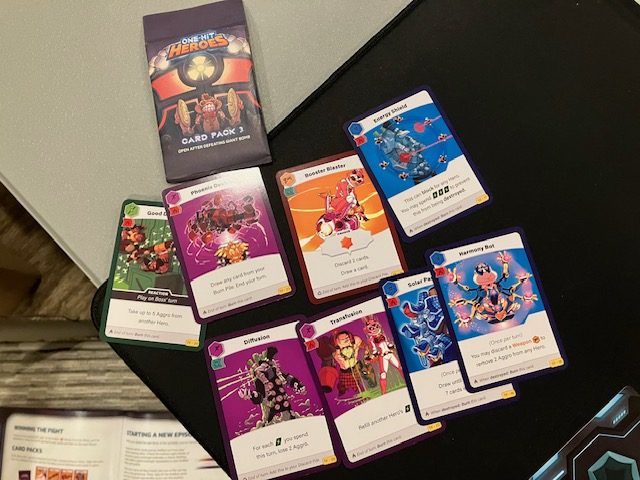
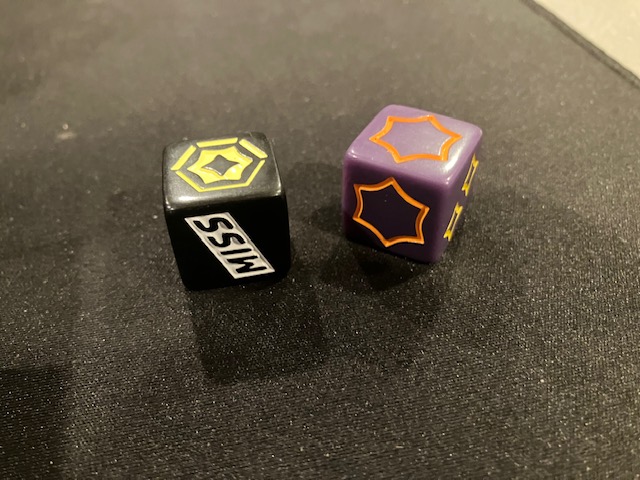
Interestingly, there are two different kinds of damage: yellow and orange (light and heavy damage, respectively).

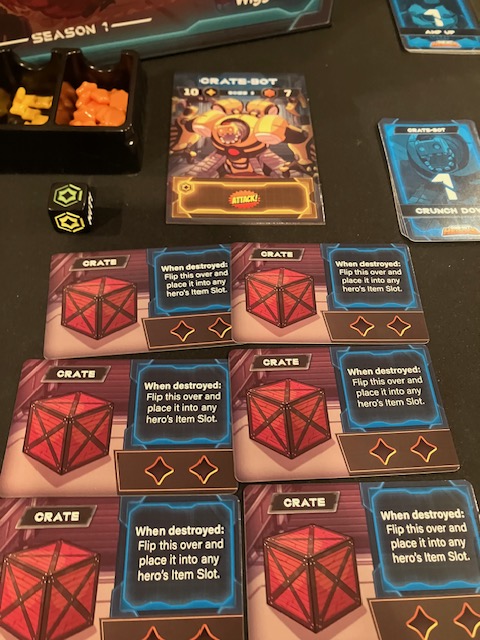
To take out a boss, you have to do both all yellow and all orange damage.  Punch-Bot (above) needs to take 10 light damage and 5 heavy damage to take him out.

If players can defeat the Boss before said boss does one-hit to anyone, the players win! If the boss does one-hit to anyone (and it can’t be blocked or avoided), all players lose!  It’s a boss-battler!

Solo Play: Built-In Mode

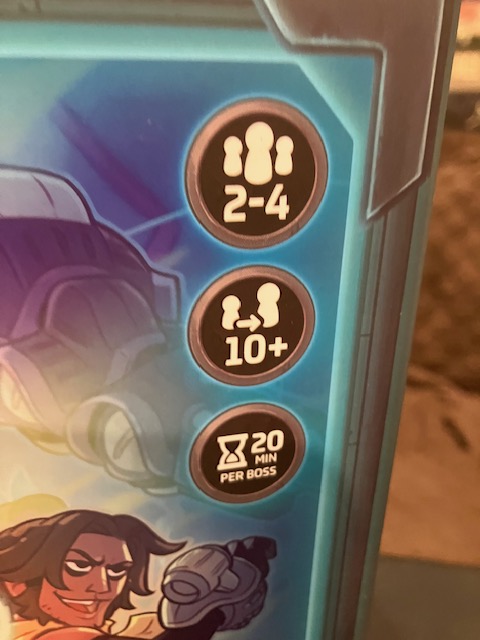
The box is confusing; it implies there are no solo modes!  2-4 Players means no solo mode, right?  Nope!  There are actually two solo modes!

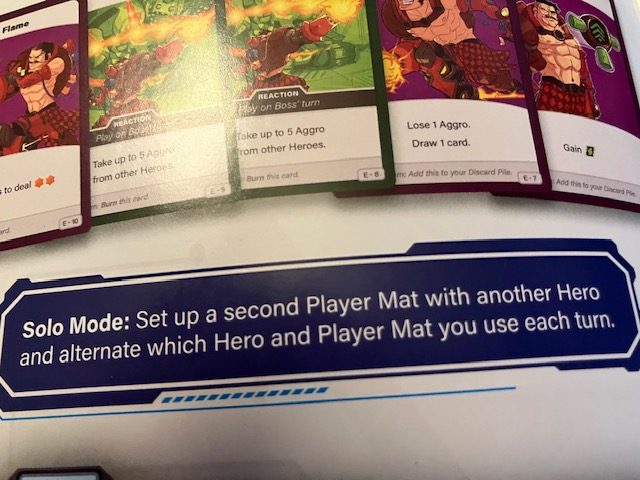
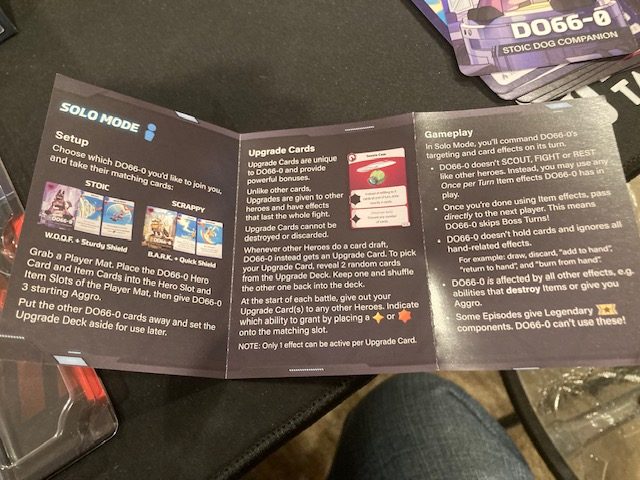
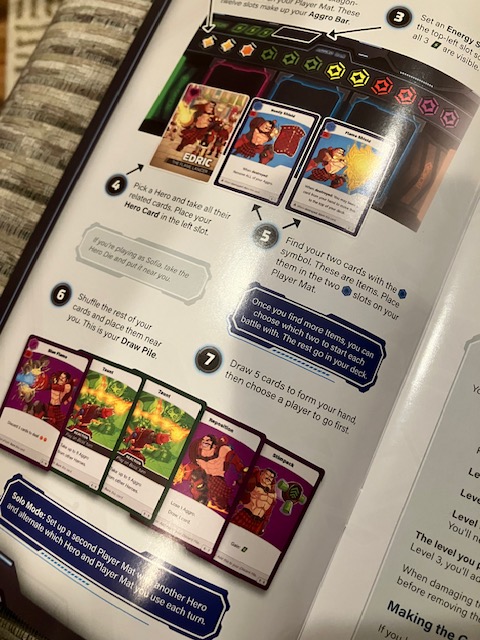
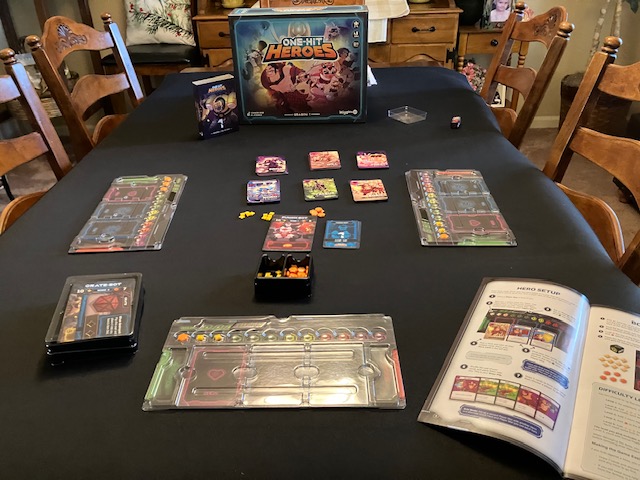
The first  solo mode is described in the Hero Set-up on page 3 (see above).  Basically, the solo mode is that the solo player has to alternate between two Heroes!  The solo description (above) is simple and very functional; it’s all you need.

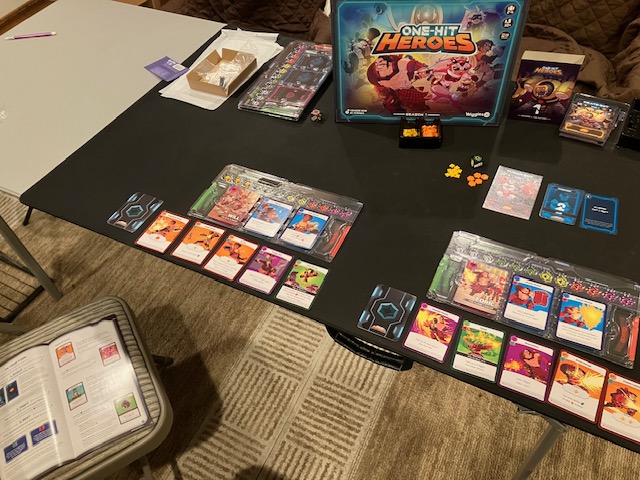
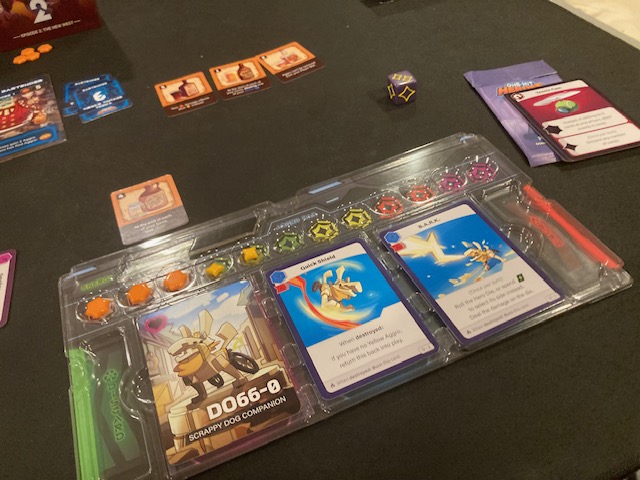
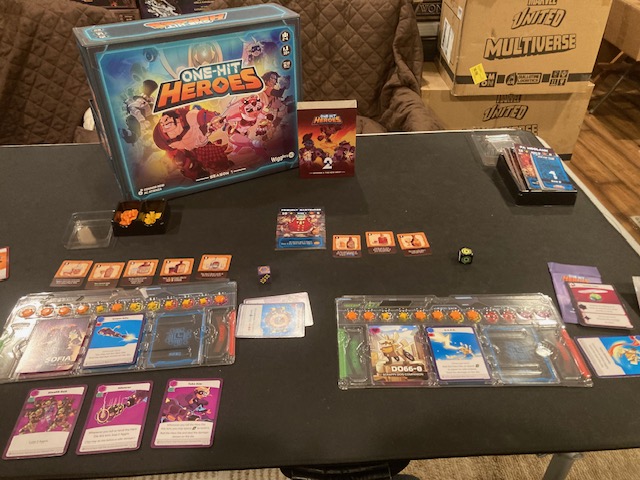
For my first solo game, I played Will and Edric against Punch-Bot from Episode 1!  See above!

The game balance in this game is kept by having a Hero go, the Boss go, the next Hero go, and so on.  Basically, heroes and the boss alternate, so you can “kinda” have any number of heroes.

From a game balance perspective, I always worry that you need to adjust the hit points for the number of players … but since each Hero has exactly 1 hit point, that’s not really a problem here, is it?  Well, it didn’t seem to be: I was able to play all the way through Episode 1 (four boss battles) and I had a great time!  It was close; strictly speaking, as I lost a battle at one point, but it’s very easy to reset and play again since the game is only 20 minutes per boss.

This solo mode emphasizes that characters must work together to keep Aggro under control; in order to survive, both players will be doing things to move and discard Aggro.

Solo Mode 2: Do66-0 Pack

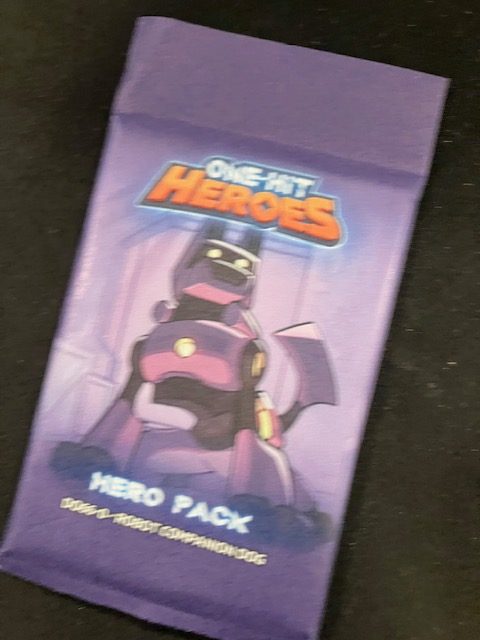
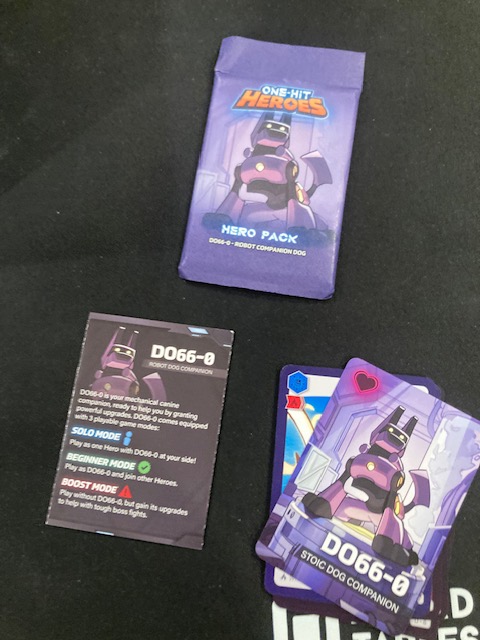
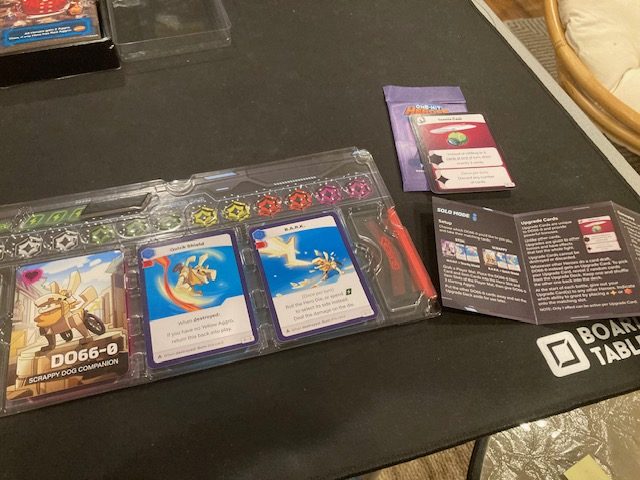
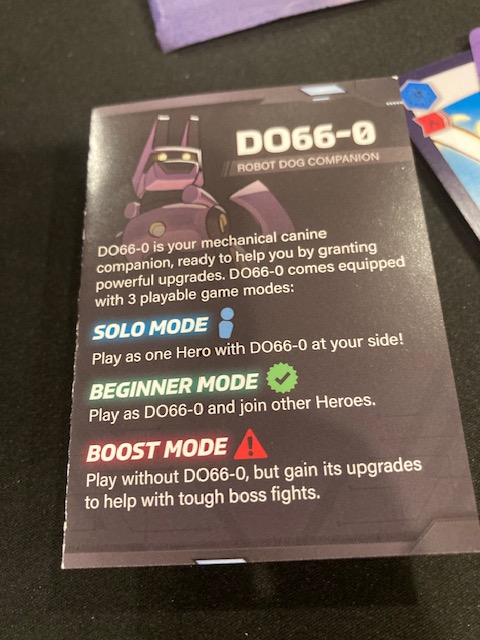
The second Solo mode does NOT come with the game; you must purchase the D066-0 Hero Pack (see above).

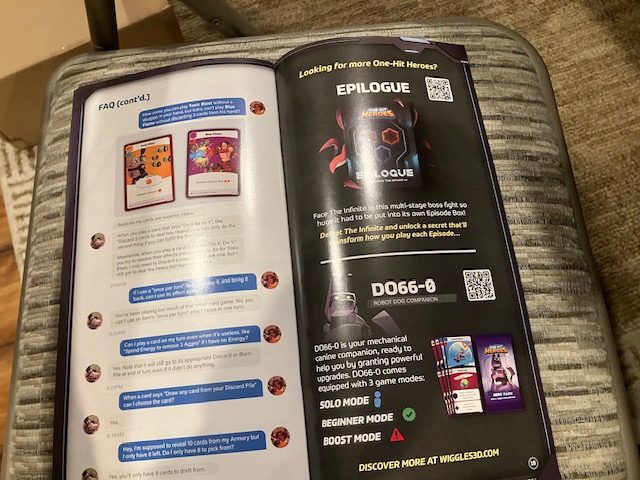
There is a little discussion of the DO66-0 pack (and a link) in the back of the instruction book.

Basically, the DO66-0 mode is a companion that you play in solo mode INSTEAD of a second Hero.

It’s much easier to play with DOGG-0:  DO66-0 gets a turn without having to provoke an extra Boss turn.    But, he also can’t do much, as he has no cards to play!  All he can really do is block and roll the damage dice … no cards.

In fact, it’s so easy to play, you can give DOGG-0 to younger players and have them play with you (that’s what Beginner Mode is).

I got to be honest, I didn’t enjoy DO66-O solo mode that much.  DO66-0 does very little on his turn: “about” one damage per turn, depending on what you roll on the damage dice. (He does add new stuff once you start drafting, and that does make him a little better).

I actually think the better use of DO66-0 is to bring in younger kids so at least they can participate; he’s so simple to play and kids can feel like they are helping.

I prefer the base (original) solo mode; it’s two characters and is how the game as meant to be played.  The base solo mode emphasizes how important the sharing and cooperation is in the game, especially to mitigate Aggro problems.    This DO66-0 solo mode was “fine”, but I probably won’t come back to it.

Cooperative Mode: Casual Gamers

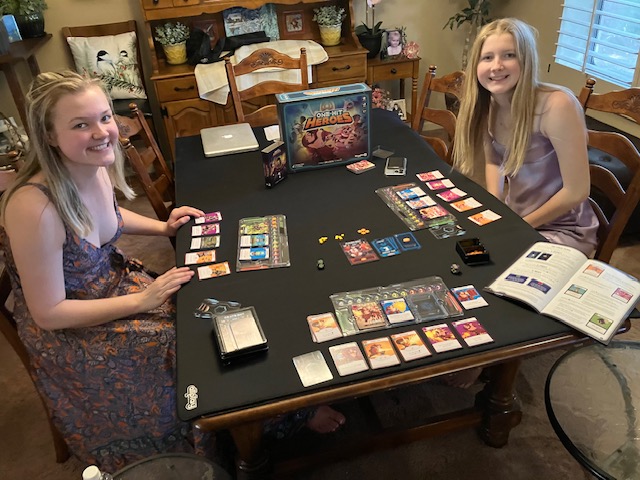
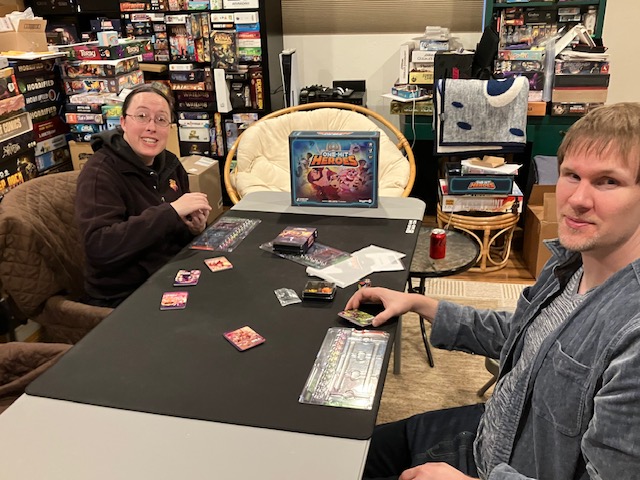
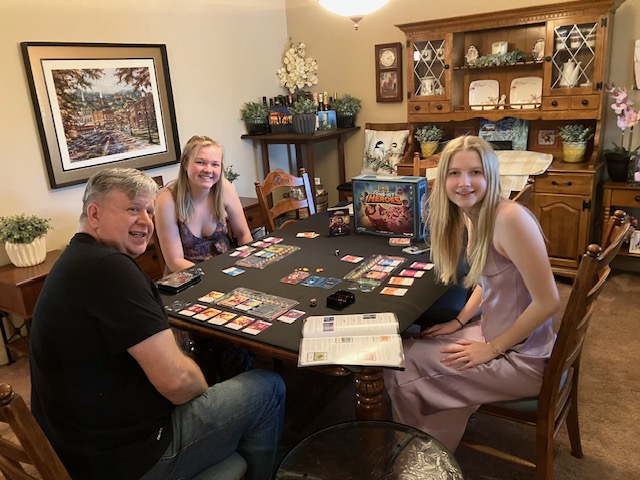
My first experience cooperatively was with some casual gamers: my nieces.  We just played through a single boss: a 20-minute game.

The game was easy to explain to non-gamers!  They got the gist of the game pretty quickly, but needed a few clarifications.

I think my nieces liked the game and appreciated how short it was.  They did want to play again, but we ran out of time (it was like, Spring Break or something).

What I found: One-Hit Heroes is a pretty simple game to explain, even to non-gamers.  The hardest part was explaining some of the text on the cards, but even that wasn’t so bad.  My nieces like the game and would play again.  They also appreciated how simple it was to learn and play.

Cooperative Play: Gamers


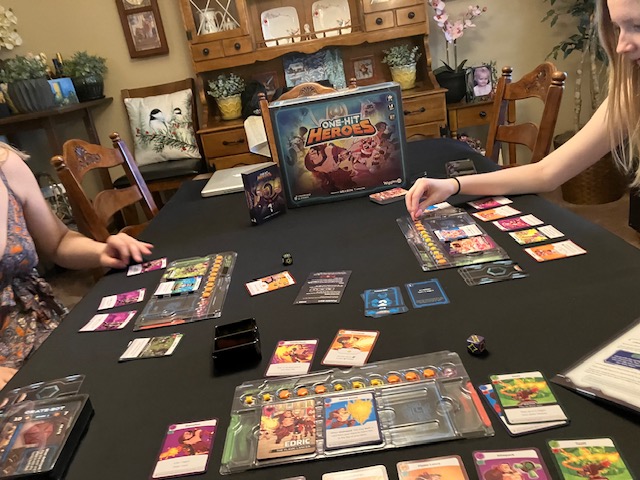
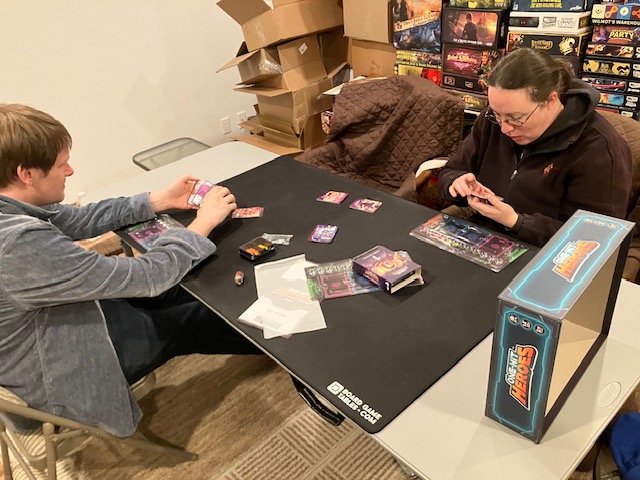
Me and a subset of my gaming group played through Episode 1 cooperatively.

One-Hit Heroes has a nice way of eliciting cooperation; you will lose if you don’t.  🙂 Maybe a better way to say that is that the game goes cause conversations to happen: “Uh oh! I am about to die!  Can anyone save me?  Should we do some stuff before the next villain?”

The cooperation seems to come out fairly organically; and thank goodness everything is open hand with full communications!  There’s no “oh, I can’t show you this because of limited communication“.  Nope!  People talk, people realize they might die, so people cooperate to block, steal Aggro (in a good way!), and try figure out the best way to move forward.

And the ability to see what’s coming ALSO helps!  By seeing the bad news coming up, but not actually here yet, seems to encourage discussion and cooperation.

Overall, the Episode 1 went well; we cooperated, we discussed, we planned, we had a good time.

Teresa was a 7/10, Andrew was a 6.5/10 (which is actually quite high for him).

Episodes

A single Boss battle is about 20 minutes.  If that’s all this game were, I’d be a little down about it.  Luckily, the Episode really fills out the game.  An Episode is a series of 4-5 related bosses, with upgrading happening between bosses!

Episode 1 has four bosses: see above.  All the bosses are all very different, and have very different arcs as you fight them.

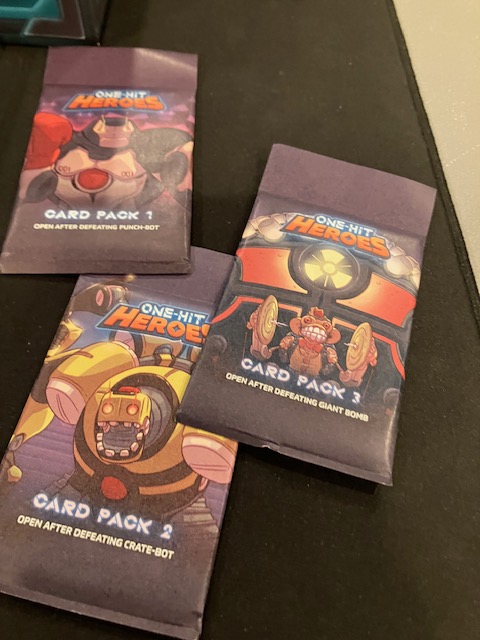
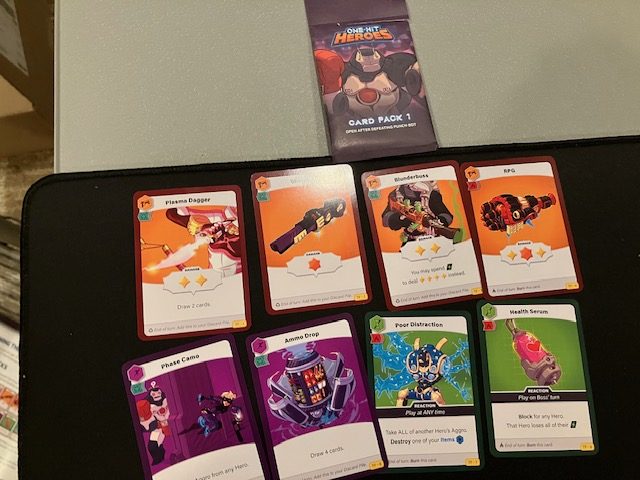
Arguably the best part of this game are the upgrade decks!  After you defeat each boss, players get a chance to draft and add two new cards to their deck!

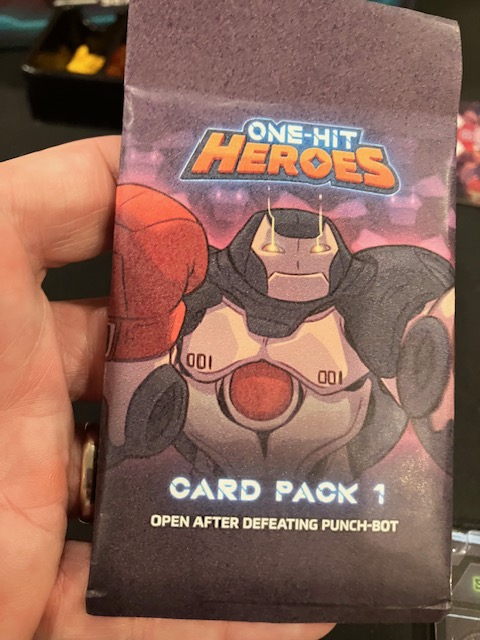
Skip the next few pictures if you don’t want too many spoilers.

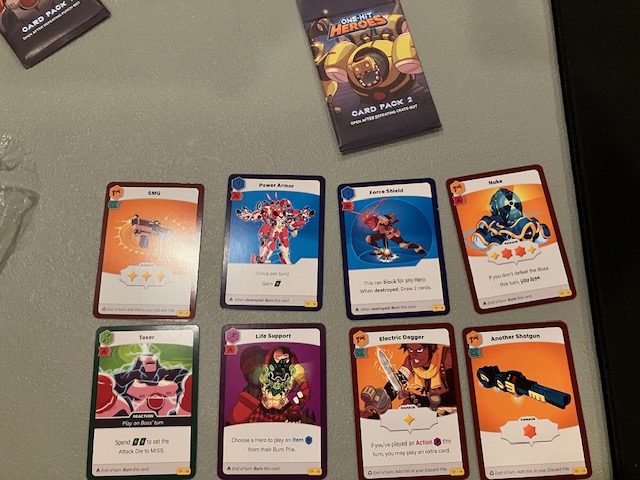
Basically, the players “draft” and each get two cards to upgrade their deck!  This is basically deck-advancement like we saw in Adventure Tactics (see here): your deck gets better and better between games!

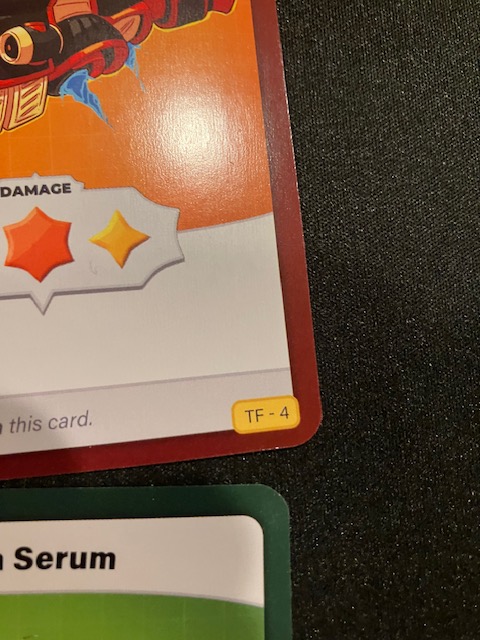
The decks are also labelled at the bottom right so you can separate them back to their original decks.

And after every boss, you get another 2 cards until you finish the episode!

I will say this: the game says to “draft” until you get two cards, but I think it might be more cooperative to just ‘decide as a group’ what you get.  This is the House Rule we implemented: let me and my friends choose the paths we want our heroes to take!  I understand why “drafting” works, because then you don’t have to worry about arguing over cards, Alpha Players telling people what to take, and so on.  But, if you have anything of a reasonable group, I would suggest just choosing as a group the cards you each want.  Caveat Emptor.  If you have a slightly contentious group (or are playing at a convention where you don’t know anyone), maybe drafting is the better solution.

I’ll say this again: the upgrades are probably one of the funnest parts of the game.  Unfortunately, your upgrades don’t travel with you between Episodes: you have to start fresh to a new Episode.

Things I Liked

Upgrades: Upgrading your deck is one of the more satisfying and fun parts of the game!

Arcs:  Given how simple this game is, the arcs on the different types of Bosses are all very different! It’s actually quite impressive how differently each boss plays! And fun!

Components: The components are pretty nice and I like art. It’s comic-booky and attractive without being too “cute”.

Simple: This game is easy to teach and easy to learn.  I found even casual gamers got into it pretty quickly.

What I Didn’t Like

Too Random: The game can be too random.  I lost a few games because of one die roll.  It’s not too big of a deal because it’s just 20 minutes per game, but it is frustrating that an entire game can go amiss because of one die roll!

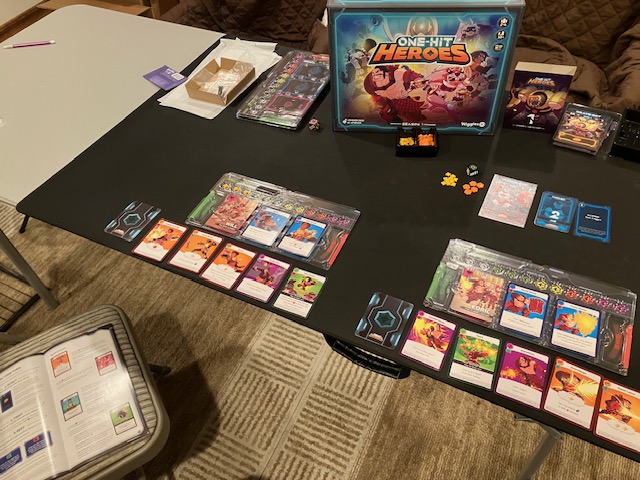
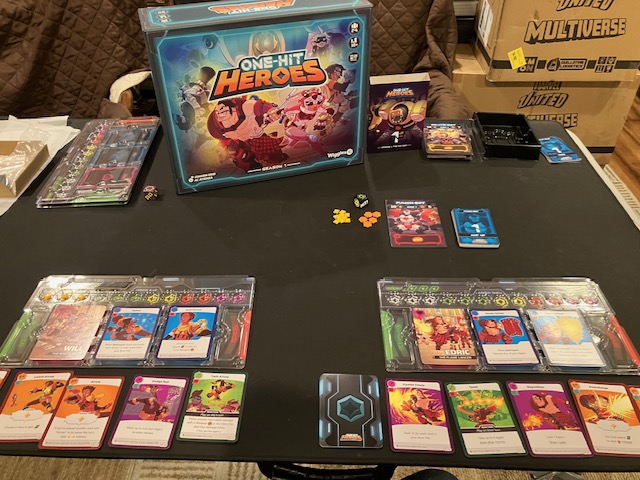
Too shiny: It’s too hard to capture in pictures, but the game is too shiny.  The cards aren’t linen-finished, so they tend to have glare, especially in harder light.  And the plastic trays also have a lot of glare: I tried to capture some of that in the picture above.  I think this game would be a lot better with duller, linen-finished cards and a tray that was less shiny.  The glare was distracting enough that we had to point it out.

No Continuations? As cool as the Episodes are, and even thematic within, the game game doesn’t feel super thematic.  While there is continuation within an episode as you keep getting upgrades, there’s no hook that keeps you vaulting into the next episode: remember, you lose ALL your upgrades between episodes, so you start fresh.  That actually feels a little debilitating!  I’d rather the episodes built on each other you felt the deck was YOUR CREATION … as it is, you start anew every episode.   There’s no “hook”: your deck resets and you start over.  Kind of a bummer? I just spent the episode building my deck … and now it’s gone.

Conclusion

One-Hit Heroes fits well into many groups; casual gamers, gamery gamers, and even solo gamers!  The base game is easy to teach and play at 20 minutes, which makes it easy to bring out.  My favorite part of the game, though, was upgrading my deck within an Episode!  It’s fun to figure out how you want to advance your character!

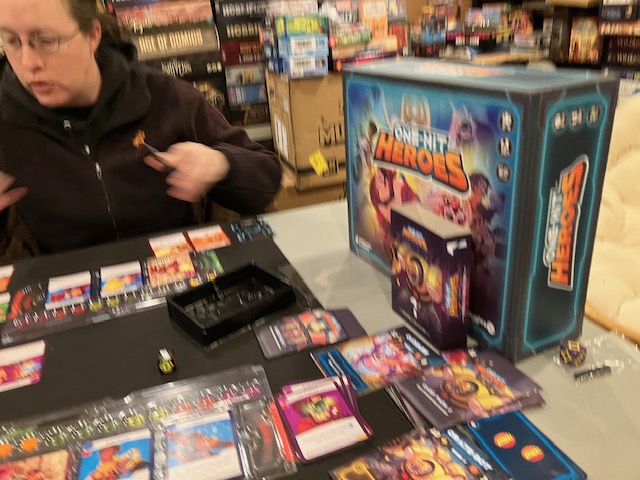
The game looks great on the table and has a fun table presence!

My only real complaint is that I feel that there’s a theme or overriding reason to keep playing after I finish an Episode. I really like the upgrading my deck between Bosses in an Episode, and it’s sort of frustrating that you just “throw it all away” at the end of an Episode!

As a solo player, I’d probably give this a 7.5 or 8/10.  The game is much more fun, I think, as a cooperative experience at an 8.5/10.  It would actually give it a little higher score if the dice rolls didn’t make or break so many games!  But, since the game is so quick at 20 minutes per game, it’s usually not a big deal. 

Neat game.  I think you’ll have fun with just about any group you bring it out to.