

Kinfire Chronicles was a game on Kickstarter back in September 2022. My copy arrived at my house in late July 2023, being early by one week! The Kickstarter originally promised delivery in August 2023, and it actually arrived early! Is this the start of a new trend? My Race To The Raft (from a few weeks ago) arrived early from its Kickstarter!

Kinfire Chronicles is cooperative dungeon crawling type game for 1-4 players.

The game box says 45-60 minutes, but I suspect that really varies, as there are quite a number of scenarios in the box! It probably really depends on the scenario. The Age 14+ seems appropriate, but the art makes me think younger players will be attracted to the game …

The game has almost a comic book vibe and art style, which might be appealing to younger players, but I think the game is complex enough to require older (14+) players.
Unboxing

The Kickstarter delivery box was pretty big: see the Coke can for scale.


So I backed the Kickatarter game at The Premium Collection Level, which means I get an extra box called the Upgrade Kit … which has some cool upgrades we’ll see later.

The base box and the Upgrade Kit are both pretty big boys!
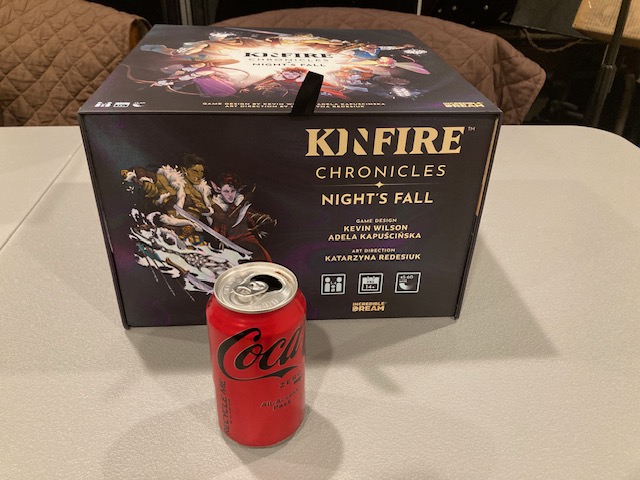
I am spending a lot of time on the unboxing because this is a weird beast. First of all, notice the pull tab? That’s so you can pull out the board. But, you might not notice at first: the top and left and right of the box IS A GAME BOARD!
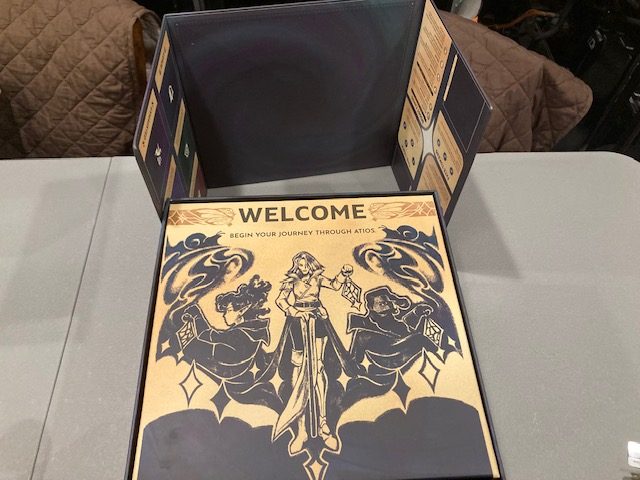


Weird, huh? The pull tab pulls out the Welcome box (see above). Word of Warning!! don’t pull too hard on the pull tab! I accidentally tore my box a little:

The Welcome Box includes the Map Atlas:
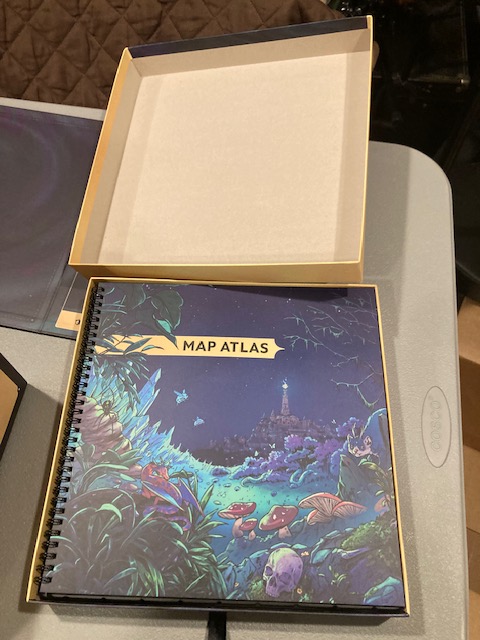
This Map Atlas makes me think this is going to be something like Artisans of Splendent Vale, with combat taking place on the map (and it does: see above): it also has an Artisans of Splendent Vale vibe from the art too (see below)?

Below the Map Atlas are the rest of the intro components.

There are some hit point wheels to make your characters, tokens, and the instruction manual.

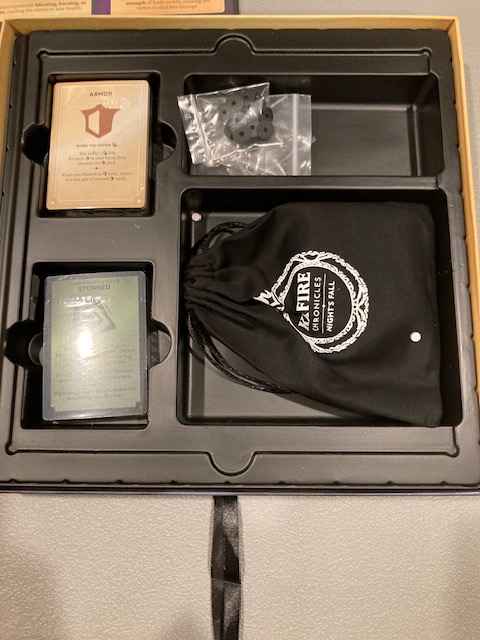
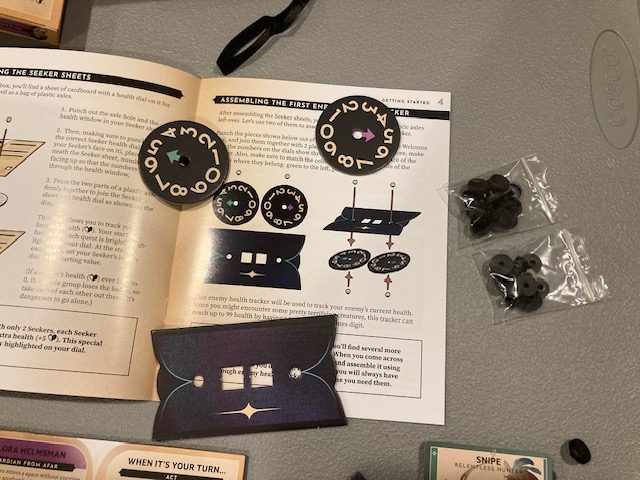
The cards and nice and Linen-finished. The wheels (for notating hit points) were just “okay”, they kind of slipped and slided in the plastic knobs. They worked, and the instructions for putting them together were good, but they felt cheap.

Below the Welcome Box are a bunch of other boxes! These boxes look like “Adventure Boxes” (and indeed, the joke was that this looked like a DVD collection).


Other boxes are character boxes: the game comes with six characters you can play: see above.
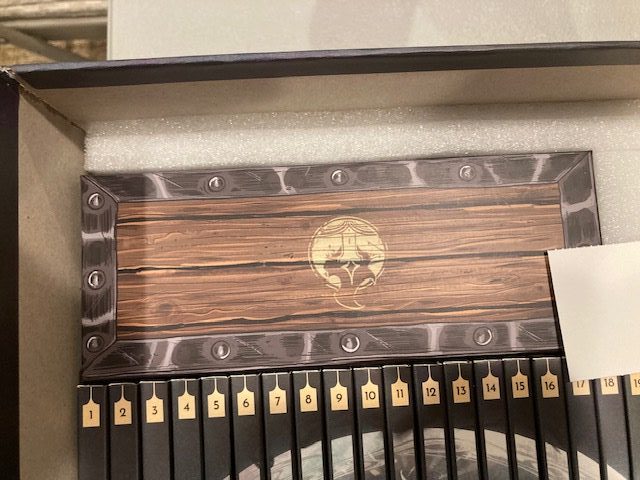
Finally, the big box above the DVD collection is a box full of “unlocks”. You aren’t supposed to open it, but I peeked inside real quick: it looks like a bunch of cards that will get unlocked as you play.

The components are really nice, the art style is comic-booky and consistent, and the boxes all forbode that a lot of adventure coming! The cards are linen-finished and very nice. Overall, the components (those that I have seen: I suspect a lot more will be unlocked as we play) were very nice.
We’ll unbox the the Upgrade Kit in the Appendix if you want to see that.
Forteller

Before I got too far, I made sure I got the Forteller App and the Kinfire Chronicles content. I used Forteller in the Isofarian Guard Review (if you are wondering where that review is, I deleted the review after not liking the game but realizing I may have misplayed some of it), and I had kind of the same experience. Using the Forteller app was suboptimal.

The app was not a good experience. It’s not a clear menu system, it’s not clear how to use the code (I got a free code with the Upgrade box), it’s not clear that you are currently downloading it. After cursing at Forteller a few times, I finally got the content on my phone.

And after all that … I forgot to use it in my first adventure! After I finished my first playthrough, I went ahead and listened to what was in the app. I think the app will augment the experience. but I was annoyed that my user experience with the app was suboptimal.
Rulebook
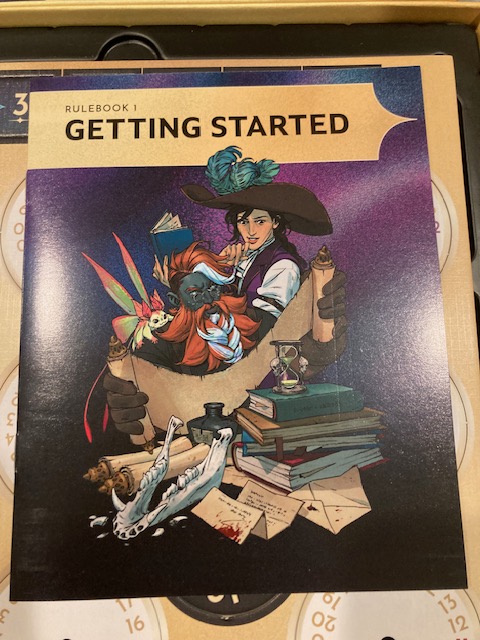
This game takes a different tact for teaching the rules: it teaches them “a little bit at a time”. The first rulebook, called Getting Started (from the Welcome Box) tells you how to set-up and get going.

But it’s just a slice of the rules. This first rulebook is just about getting set-up:


It’s clear that more rules will come out when you open later of the DVD boxes.
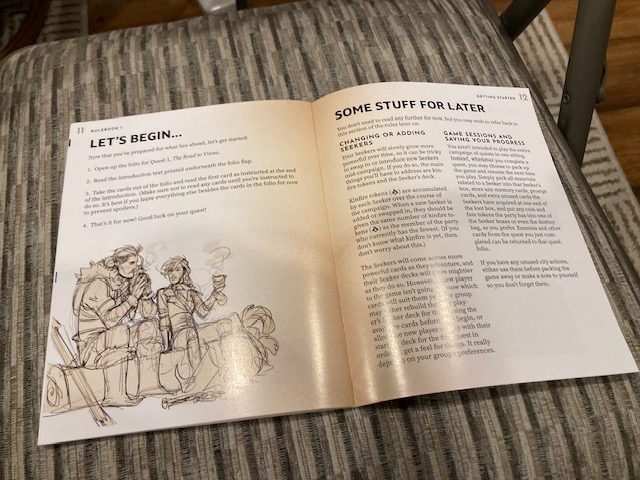
The rulebook gets a B+ on The Chair Test: it folds open well, is easy to read, and looks nice but the font is a little small for the rulebook.
This piecemeal approach for the rulebook seems to work for the game: rather than being inundated by tons of rules (I am looking at YOU Gloomhaven with a 56 page rulebook), this game does the Jaws of the Lion: Gloomhaven thing (see our review here) and slowly brings you into the game. I find this approach is a breath of fresh air, and not stressful! Sometimes knowing you will slowly be brought into a game takes some of the stress away: “we’ll learn it as we go”.
I wonder if that approach will make this game standout: I am already excited to play it again!
Character Set-Up
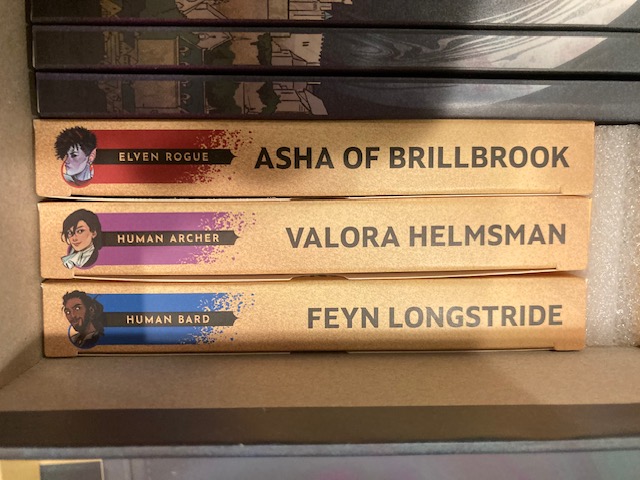
This is a cooperative dungeon crawler game set in a fantasy universe. Each player takes the role of one of six pre-generated characters: see three of them above. Each character is a prototypical fantasy character: see the Bard, Archer, and Rogue above.

Each player gets a box with their components.

The back of the box describes some backstory as well as each character’s special power.
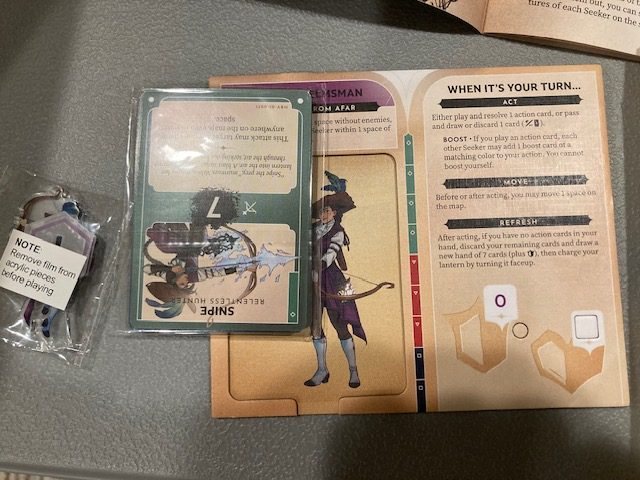
Each box has a player mat (specific to that character), a deck of 18 cards, and a little acrylic standee.

You end up having to assemble your character standee and the little hit points wheel. NOTE! Not all wheels are the same! Make sure you find the one for your character! (I got the wrong one for my characters at first).
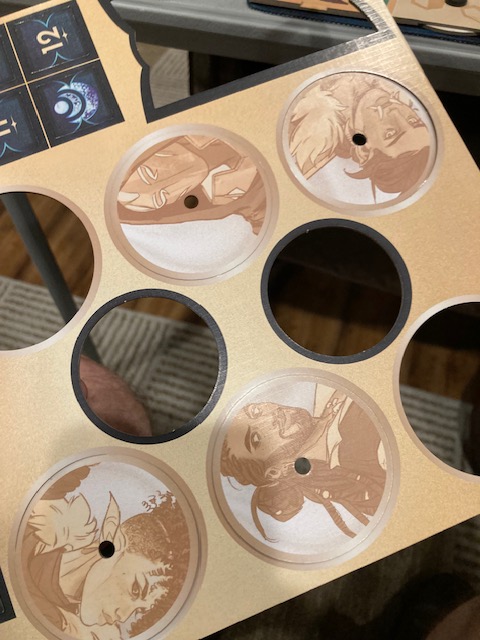
The hit point wheels are specific to the characters, as each character has different starting hit points to balance their powers (like the Magic User in AD&D had a 4-sided die for hit point dice and the Rogue had a 6-sided die for hit points).
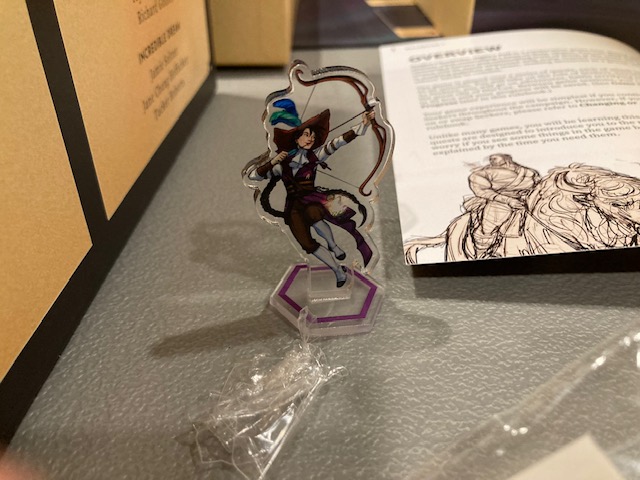
Don’t forget to take the plastic off the standees! They look much nicer!

Notice how each mat describes the special abilities AND what you can do in a turn! Very nice!

The cards are also nice linen-finished cards. They are very easy to read, even if they won’t win any awards for design: they are very functional.
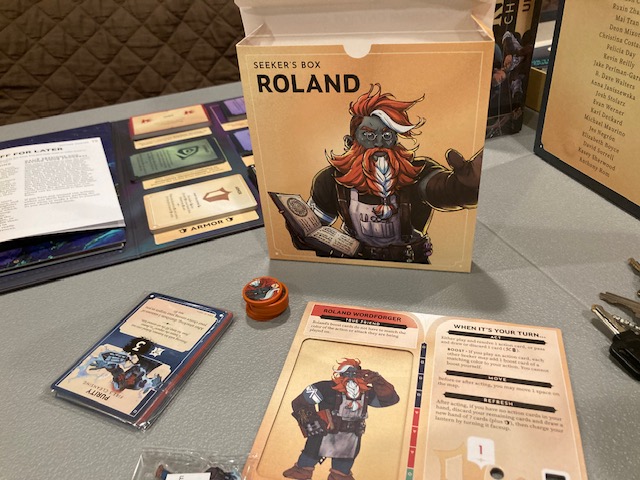
For my first game, I played with Roland and Valora.
Gameplay
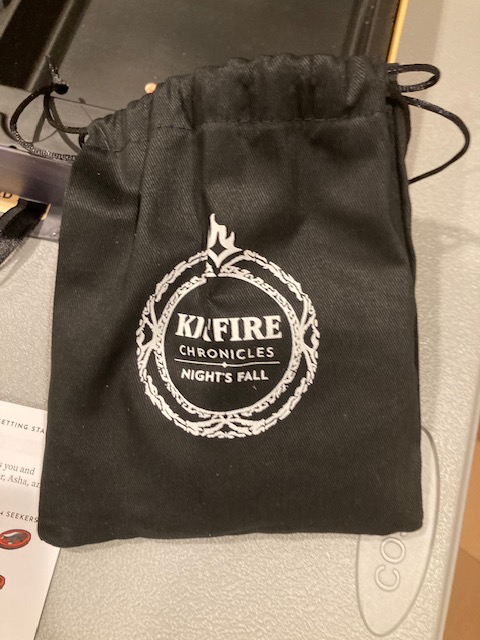
You might find this hard to believe, but this is a bag-pulling game. I can’t say YET if it’s a bag-building game just yet, as I don’t know if later boxes will have more tokens … but I strongly suspect this will be a bag-building game. Let’s just call it a bag-pulling game for now.

There are a bunch of tokens that go in the bag: see above for all KNOWN tokens (seriously, I will bet you $10 that later Adventure boxes will have more tokens). But you don’t put all of them in the bag at the beginning:
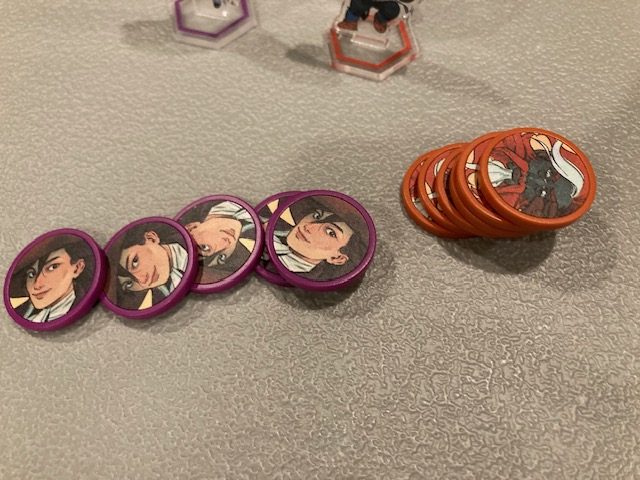
Each character has their own tokens: you only put (some of) your characters tokens in the bag. These tokens, when drawn, let you know its your turn!

The rulebook has some nice pictures of what goes in the bag. The 1-12 will be events “probably bound” to the bad guy: so when those are drawn, the bad guy will act.
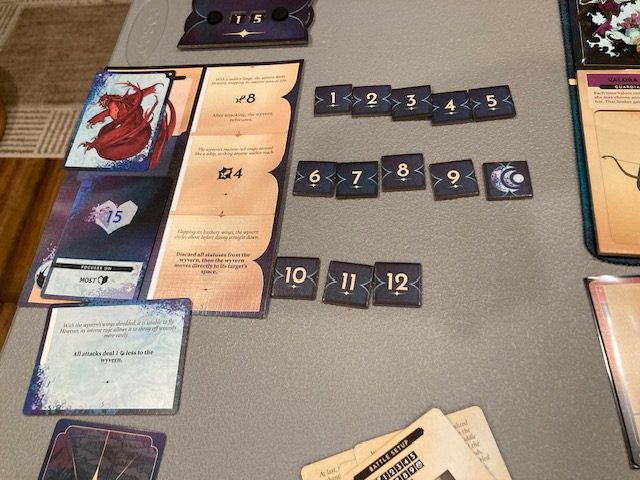
In the first adventure, you see the Wyvern set-up: see above. If the token drawn matches the numbers, then the Wyvern goes, invoking the ability next to it (the Wyvern has three actions it can perform).
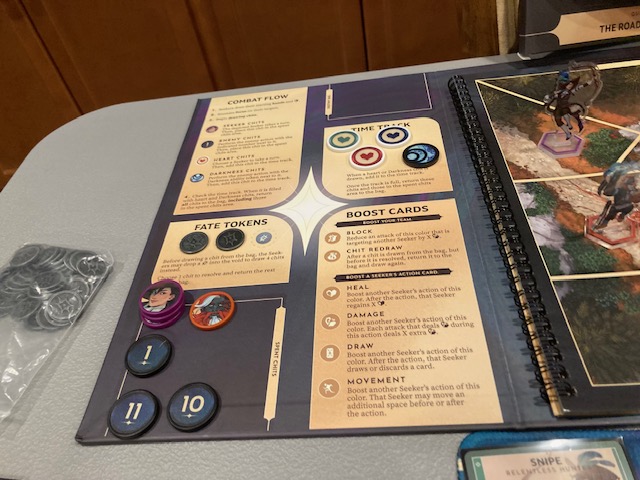
The board really does document all the tokens fairly well: see the Combat Flow text above, marking all the tokens, what they do, and the remains going in the overflow.

The only two bag tokens we didn’t discuss were the heart and the curse token: they cause time to advance. If the time advances 4 times, everything goes back into the bag and it resets!
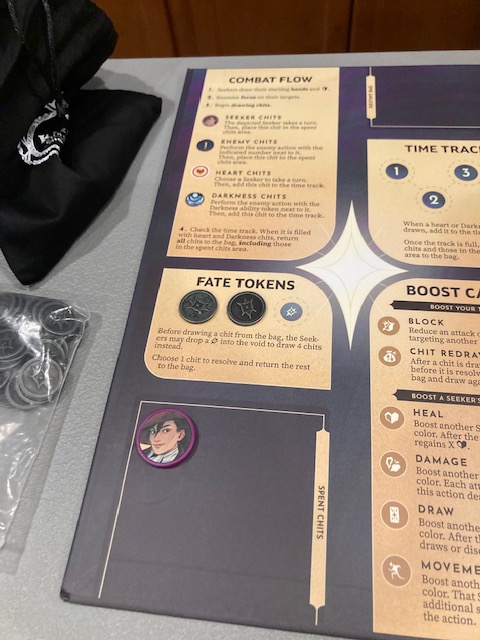
During combat, if you are really worried about losing, you can discard a Fate Tokens to draw 4 tokens from the bag and choose just the one you want. This one little mechanism seems a very thoughtful way to help you out of a jam.

So, the tokens really control when players and monsters acts! When a Valora token is drawn, then Valora can act and can play an action card: see above. (Note: there are rules for always making sure you have at least one action card).
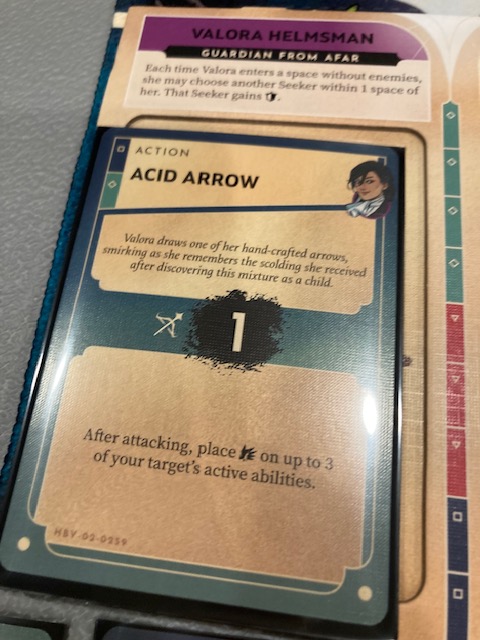
An action card is labelled clearly with the word ACTION at the top: see above.

Note that there are 3 types of action cards, color-coded as to the type of action: red, green, and blue.

After you play your card, your compatriots can all play a single BOOST card to try and help you (this is a cooperative game after all). Each other player can play a single BOOST: note that you can NOT BOOST yourself I like this mechanism, as it clearly is designed to keep everyone involved as you play! Even though it’s “my action”, all my compatriots can BOOST my action!
The color is important, as you can only BOOST the same color. I suspect there are more complicated rules for BOOST coming as we play further…
First Adventure

As I said before, the rules for the game come out piecemeal, so the intro to combat came in the first Adventure Box: The Road To Vinna.

Oh, the intro to the first adventure was under the flap for the first box! I almost missed it because I am not used to important text being on the box itself!

Inside the box proper was a rulebook, some cardboard (with the Wyvern cardboard), and some cards.
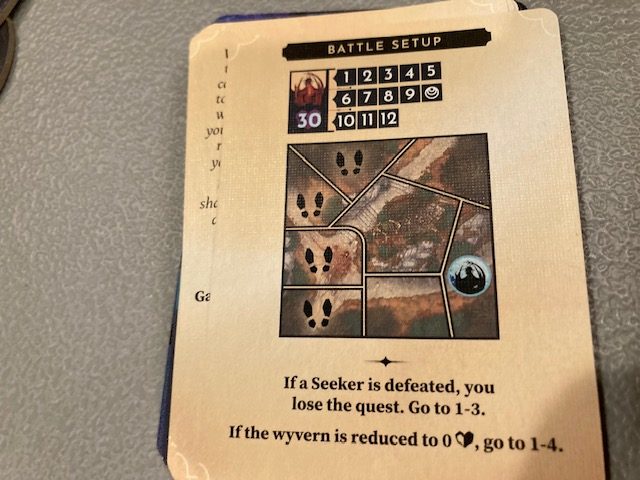
The little deck of cards in the Adventure Box controls the story. They tell you how to set-up the Bad Guy, the story, and what happens. See above for the set-up card.

See above for some of the story: a little spoiler, so don’t read too close. I am just pointing out that the story unfolds from the cards.
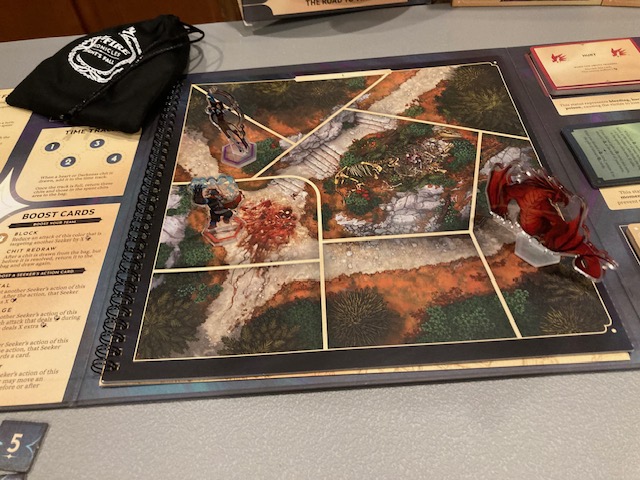
So, we set-up on map:
Set-up the Wyvern:
Set-up our two characters and our bag, and we’re off! Fighting the Wyvern! The cards from the Adventure Box control the story, and the Bag controls the combat.
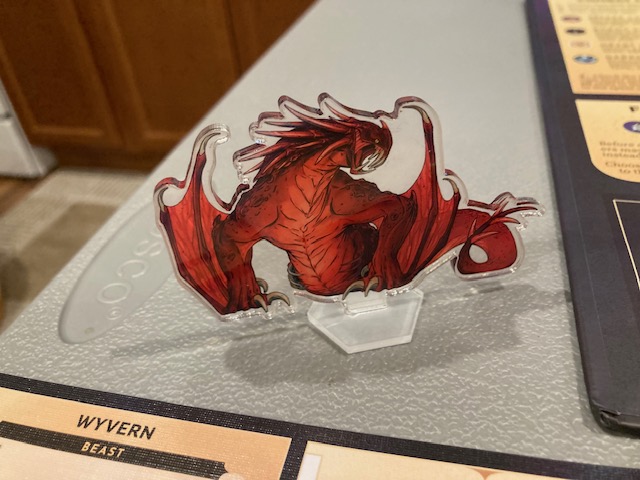
Incidentally, the acrylic standees from my pictures come from the Upgrade box: the base box has a cardboard standee.
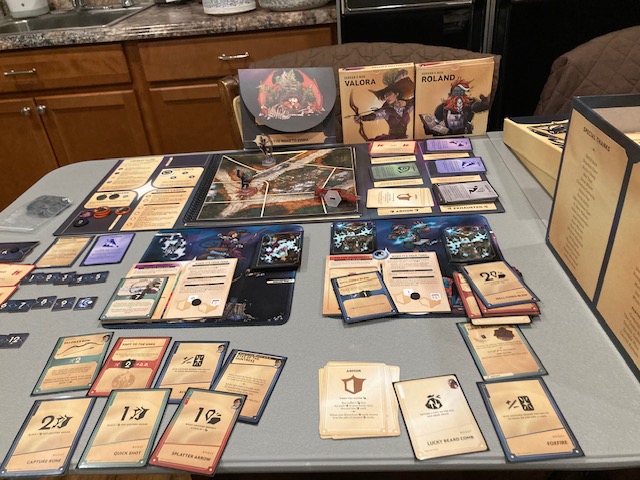
So, after several rounds of pretty quick combat, we defeated the Wyvern! Pretty easy and pretty quickly! I’d say the combat rules were pretty intuitive. I had a few questions over the combat, but I always seemed to find a clarification either on the board or in the rulebook in a few minutes. (Can I have multiple conditions on a Wyvern’s ability? Yes. How does Armor work? Do I have to discard all of them? No. Etc)
Solo Play

So, thanks to Kinfire Chronicles to having solo play! (Yay for following Saunders’ Law): The rules do say it’s probably better to play Kinfire Chronicles with multiple people, but the solo player can take the role of two characters to proceed. And that’s what I did.

It’s a little harder to play two characters, because there is a lot of info for each character: the action cards, the Lantern ability (which flips active when you have to redraw cards), and the Boost cards. So, when you draw a character token, you have to play one of their action cards THEN consult the other character to see what BOOST card to play (if any).

It’s interesting that the main rule that makes this game really standout as a cooperative game (the BOOST cards played outside a player’s turn) actually detract a little from the solo game. It’s still a good mechanism, but it’s just a little more maintenance and context switching for the solo player.
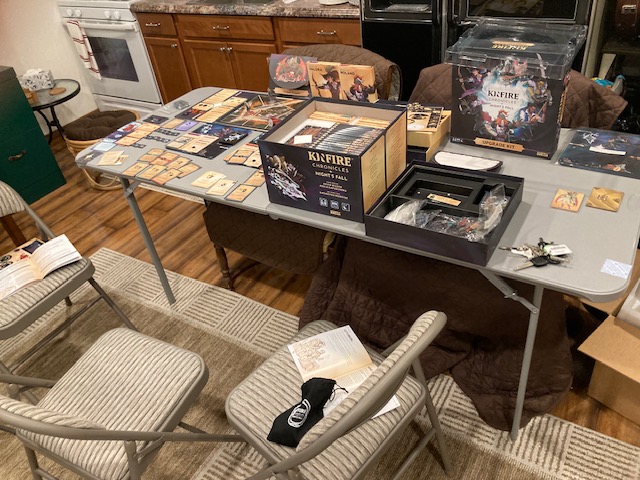
The game is a little of a table hog: see above as I set-up two characters to play a solo game.

I will say that there the game flowed decently well, but that first play was rocky is just a few places. There could have slightly better directions on set-up, there could have been some better pictures of set-up, and a few tokens could have been labelled better. But I figured it out.
Cooperative Play

I set out Kinfire Chronicles for my group: they seemed really excited to play. “We love the art! The game looks cool! Oh wait, it’s a campaign? Let’s finish our other campaigns first! We need to finish the Valor and Villany cooperative campaign first!!!” (We started the Valor and Villainy cooperative campaign a few months ago: recall that we talked about that here).

That’s right, it’s a campaign over 21 adventures. There are so many campign games out there right now, that I wonder if that will be a detriment to this game? I liked this game cooperatively, and even tried to sell it to my group, but they made it clear they want to finish our current campaign!
What I Liked
I really like the art: it has a comic-book vibe.

I love the Acryclic Standees!! They look so cool! I think I like Acrylic Standees better than cardboard standees and plastic miniatures! Recall how great the acrylic standees looked in Tokyo Sidekick!
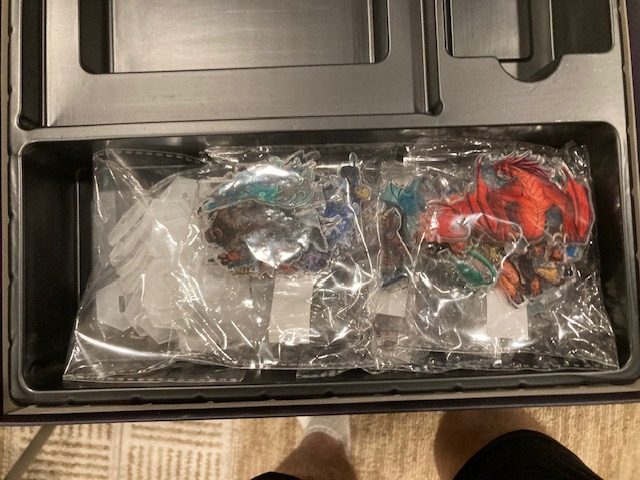
I like the fact that you CAN buy the acrylic standees for all the monsters in the UPGRADE box!

I like they the rules come out piecemeal: you don’t feel like you have to learn everything at once! You can just take in what you have so far. I think this really reduces the stress of learning the game.

I really like the compnents: they all seem pretty high quality.
I like that you can use forteller with this (even if the app could be better).
What I Didn’t Like
I both like and don’t like that it’s a campaign game: this means this will require an investment by my players … which I currently don’t have! I am excited to play through the game, and I can’t until I get my group through Lludwick’s Labyrinth!

Some of the boxes tore a little too easily. I think the Tab on outside of the box might be too much.
Although it’s a cool engineering feat that the main board is the outside-the-box protector, but is that a good idea? I’d much rather have my box be a normal box (with the board inside) and not have to worry that I might damage the board if I stack it wrong.


My biggest concern is the token/bag system. I didn’t love it in Isofarian Guard. I think my main concern is that teh bag system feels like the order system in Aeon’s End, Adventure Tactics, and Astro Knights: the players have a possibility of being completely shutout for a number of turns in a row if you just draw many monster tokens in a row! And that’s not fun. We discussed this in detail in my blog entry for Seven House Rules for Cooperative Games. This bag system is my biggest concern. (And yes, I am aware there are the FATE tokens to help mitigate that: that does ease my concern a little). Will it be too random?
Conclusion
I am cautiously optimistic that me and my group will like Kinfire Chronicles. My solo experience was good, but it’s interesting to me that the solo experience is actually a little tarnished by the BOOST system which I think will work great for cooperative play! I think this game will be more fun as a group, but it still works as a solo game pretty well.
Even though there are a lot of campaign games out there, and Kinfire Chronicles is fighting to be a voice in that space, I think its piecemeal approach to doling out the rules slowly makes this very appealing as a campaign game: there’s no stress about learning 56 pages of rules! You just learn as you play: that maybe Kinfire Chronicles greatest strength!

I really like what I’ve seen so far, I love the acrylic standees, I love the art, and everything looks great. If you have are interested in the game, I would recommend getting the UPGRADE Kit if you can: it really does make the game shine a little more. See our unboxing of that in the Appendix below.

My only real concern is that the bag-pulling part will make the game too random for me. Luckily, there is the mitigation method with the FATE tokens, but that is still a limited resource. I am going to have to see how the game plays out once I have convinced my friends to embrace Kinfire Chronicles. I don’t think it will be a problem getting them to play: it’s just that there are too many campaign games and we have to finish those first!
Appendix: Unboxing The Upgrade Kit
The UPGRADEKit came with the Premium Collection Kickstarter pledge.
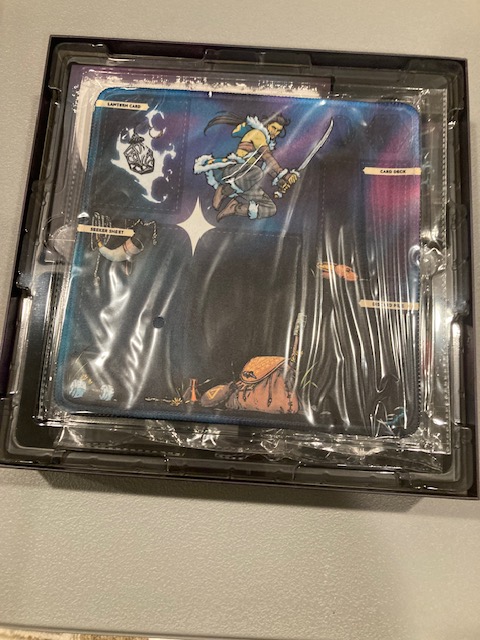
You get 6 nice little mats for the 6 different characters:
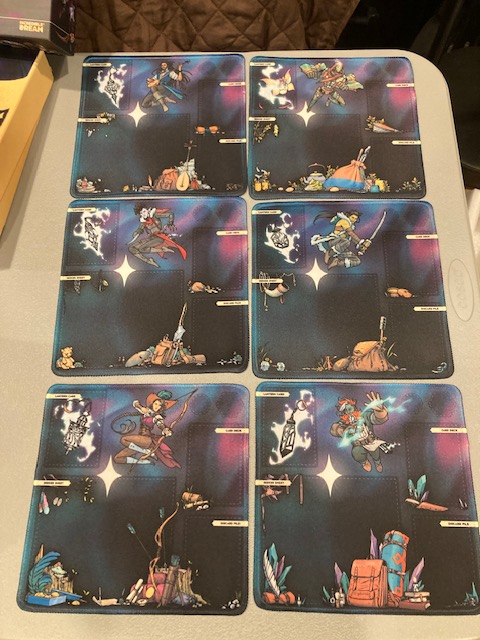
Each character has their own mat! The mats are nice because they tell you where to put the cards.

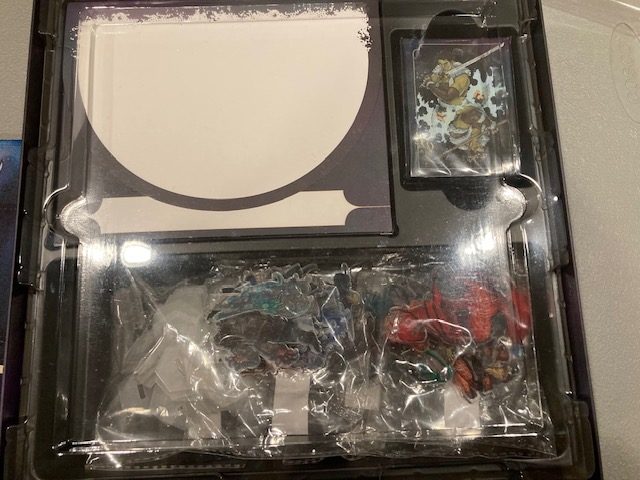
What else is in here?
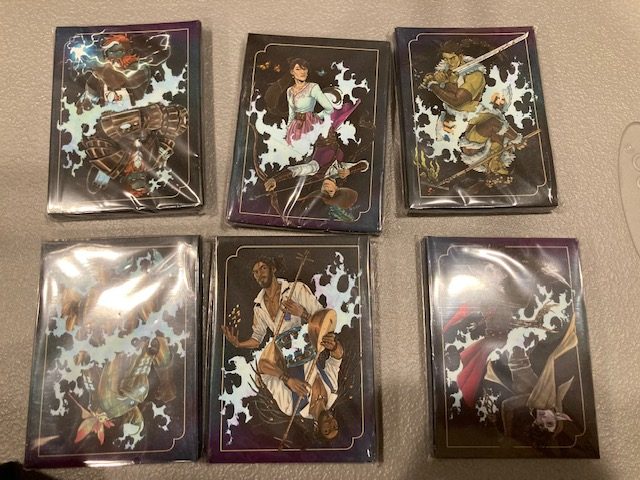
See the beautiful sleeves for the cards! Seriously! These are great! On the order of the sleeves for Dice Throne!

The only issue with he sleeves is that it feels like you shouldn’t sleeve your Lantern card (because it has a different back than your other cards.

I get the forteller code!
The best part of the UPGRADE box is the amazing number of acrylic standees you get for the monsters!
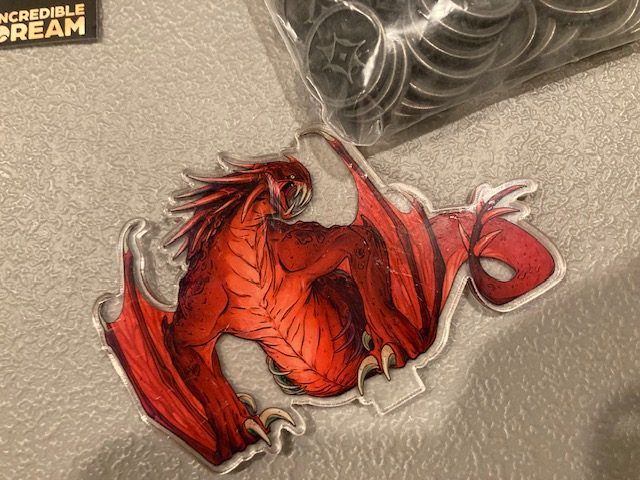
YOu also get metal coins …
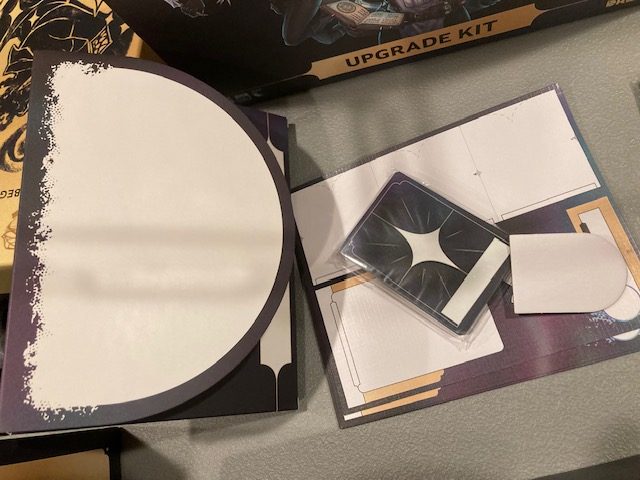
A make-your-own Adventure and Monster Box .. (pretty cool)

And a few other alternative art cards for the characters and a “secret” sealed envelope!!!
I am so glad I backed to get the UPGRADE Box. It’s worth it for Acrylic Standees, sleeves, and character mats. The other bits are just gravy.
 coopgestalt
6 thoughts on “First Impressions of Kinfire Chronicles (A Solo/Cooperative Dungeon Crawler)”