

My friend Nevin (yes, he’s that Nevin from the C++ committee) introduced me to the competitive game of Carsassone many years ago: he and I live in different cities, but base Carcassonne was a game we could play over the Internet. At the time, it was one of a very few games you could play online. At a hotel in Chicago, Nevin showed me the game, hoping to strike my fancy so we could play online! Alas, it didn’t really strike my fancy. Nevin tried a few times afterwards to get me interested, but for some reason, Carcassonne didn’t work for me.

Fast-forward to 2022: Mists Over Carscassone is a cooperative version of Carcassonne taking Germany by storm! It even becomes a nominee in the 17th Annual Golden Geek Awards for 2022 for best cooperative game! I have heard about this game for sometime, but I haven’t been able to get it over the USA! Officially, I believe it’s due to be released in the USA August 2023, but I was able to find a US store that had a copy in stock and ordered it! It arrived late May 2023.

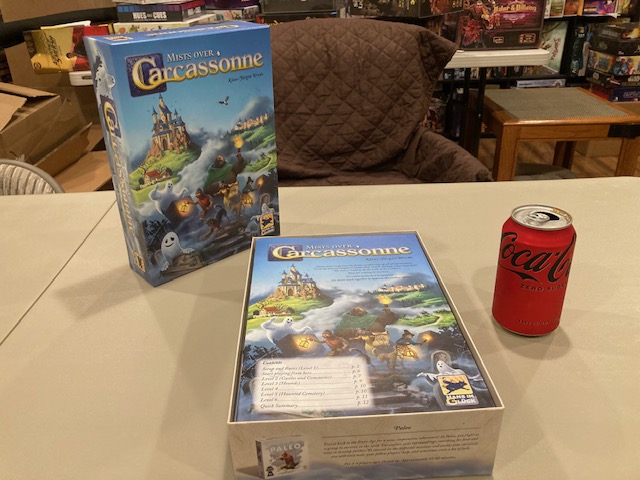
Mists Over Carcassonne is a cooperative tile-playing game for 1 to 5 Players: it is for ages 8 and up and lasts 35 minutes, as per the box. These parameters seem in sync with reality.
To be clear: this is a standalone game! You do not need the original Carcassonne to play.
Components
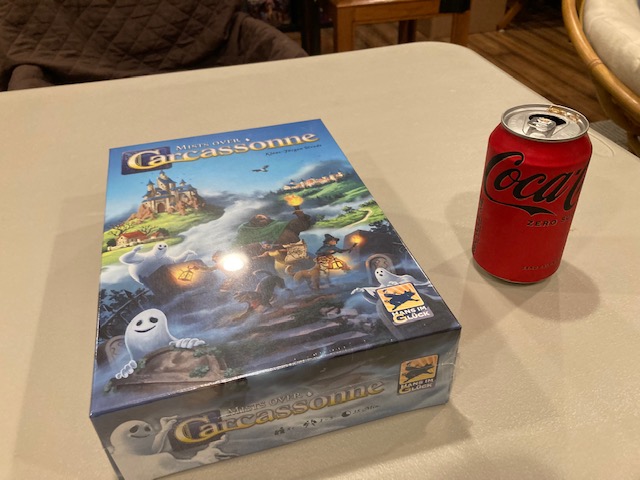
This is a smallish box. It’s a pretty standard size for a Euro game (about the size of Agricola), but it looks small compared to all the kickstarters we have been looking at lately (Deep Rock Galactic, Valor and Villainy: LLudwick’s Labyrinth, The Isofarian Guard, etc.).
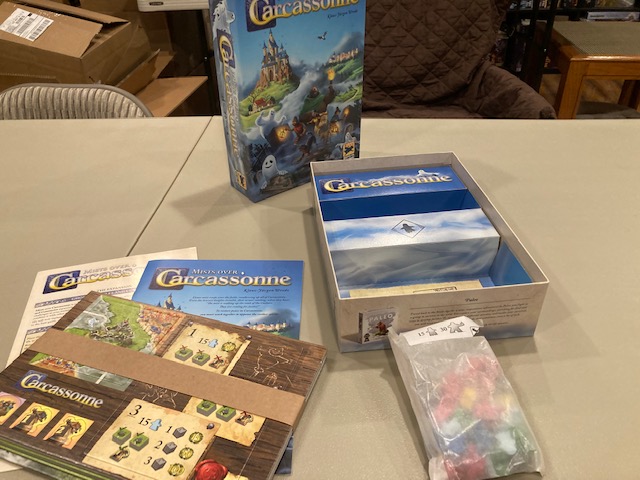
This is a tile-laying game, so the majority of the pieces will be tiles in punchout boards. There are also some meeples (and ghosts), a rulebook, and an expansion manual.
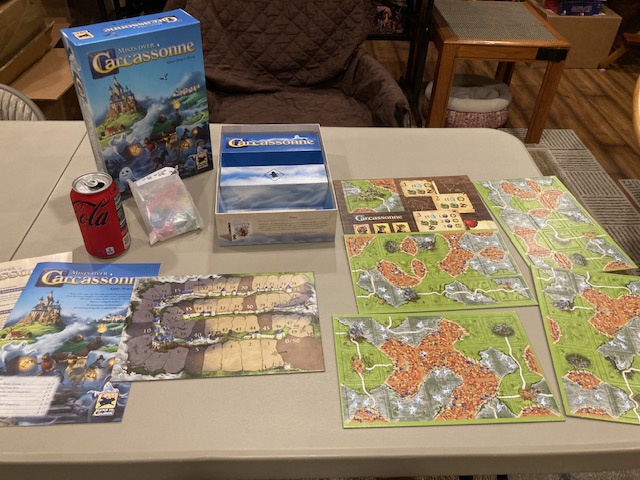
You can see a lot of the tiles above in “pre-punchout” form (above) and “post-punchout” form (below).

The meeples are in a curious wax packet.
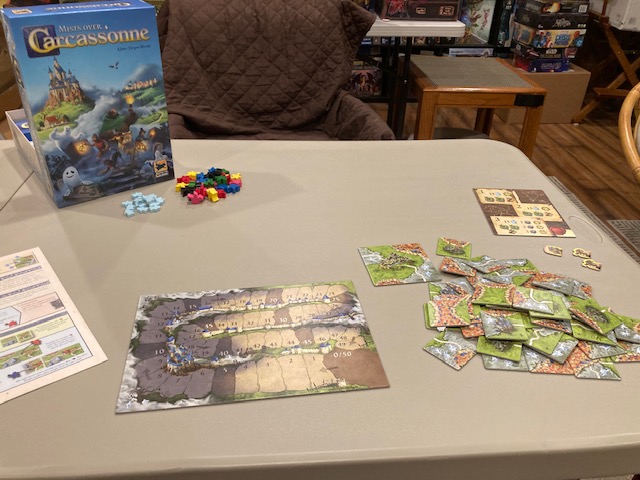
The game’s components are good enough: they are usable and easy to read.
Rulebook
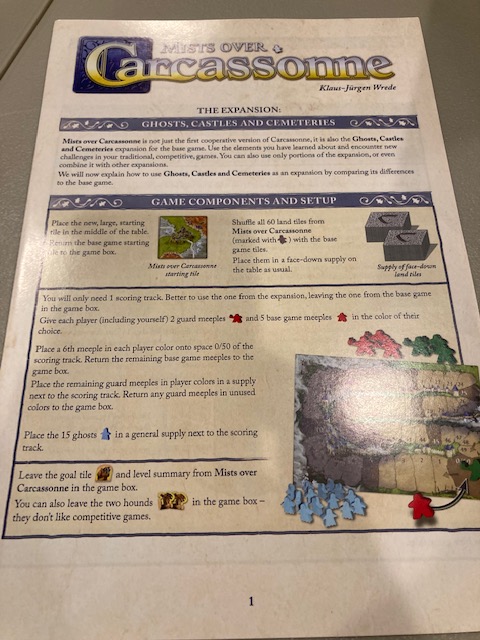
The rulebook is good: it explains the game well even to people haven’t played Carcassonne! (Well, I did play 15-20 years ago, but I don’t remember a thing).
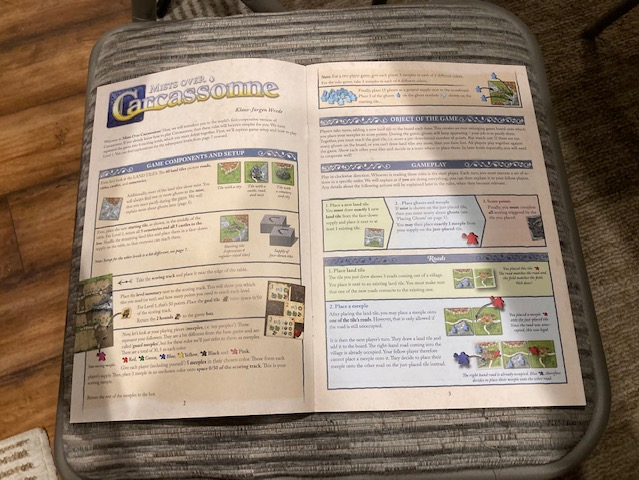
Mists Over Carcassonne gets a full A on the Chair Test: the rulebook fits perfectly on the chair next to me, and is easy to look up rules!
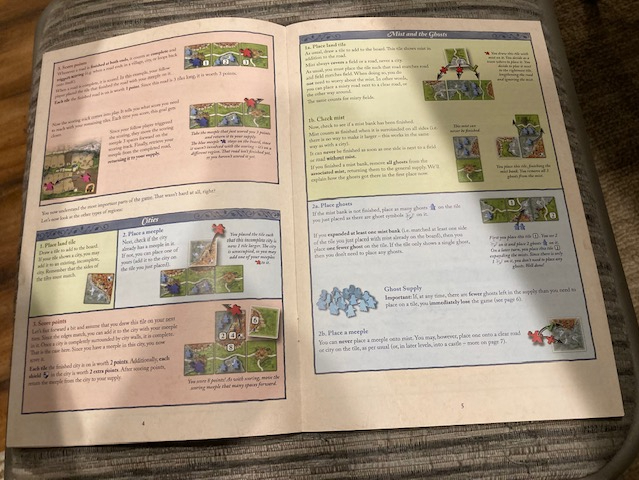
My only real complaint is the game shows how the game plays though examples with limited description of the rules. This works because, through a well-selected series of examples, you see how the game plays. But I felt like I could never go look up a rule: I’d just have to look at the example to understand the rules. This style is great for a first time player like myself, but I don’t like it when I don’t have a full grasp on the rules. I suspect this rulebook style has evolved over time for the Carcassonne series; they’ve certainally had a lot of feedback and chances to make the best rulebooks: maybe this style works best for them.
It may just be me: I had this same problem with Sleeping Gods rulebook, The Flourish rulebook, and (to a lesser extent) The Isofarian Guard rulebooks. Please, just tell me succinctly and completely what the rules are, using the examples to illustrate the point: don’t let the example become the sole realization of the rule.
“Excuse me, Rich? Rich? Are you paying attention? Look At the back of the Rulebook!”
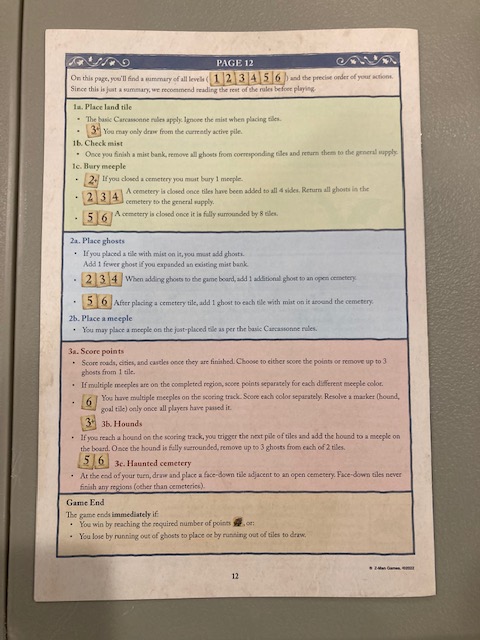
Oh! After playing the game like 6 or 7 times, I finally saw the back of the rulebook! This is the best of all worlds: this is a very concise description of all the rules, with an explicit ordering of operations (many of our questions came up were order of operations questions) AND it uses the back of the rulebook for something useful. Okay, I am eating crow here … this rulebook is great. Just make sure you look at the back cover!!!
I learned the game from the rulebook: the font was good, the text was readable, the examples were good. Job well done. Just make sure you look at the back of the rulebook!
Gameplay

This is a Victory Point game: in order to win, the players must work together to get the desired score (as set by the level). There are 6 levels of difficulty in the game, with different scoring constraints.
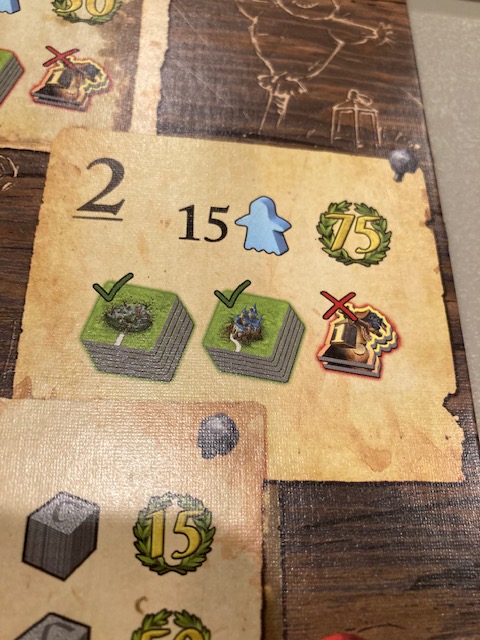
The Victory Points needed are described very iconically on one of the boards: for level 2, you need 75 victory points: See above. This same board also describes the starting conditions: for level 2, you start with 15 ghosts, the graveyards, and the castles, but not the hounds.
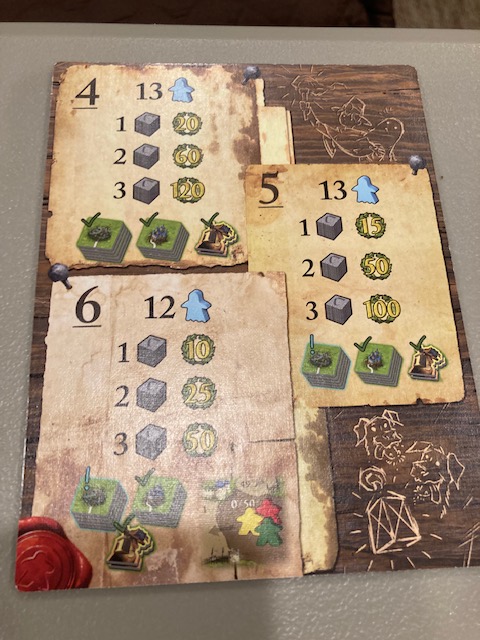
Levels 4, 5, 6 starting conditions get worse and worse as the game gets harder and harder … see above!
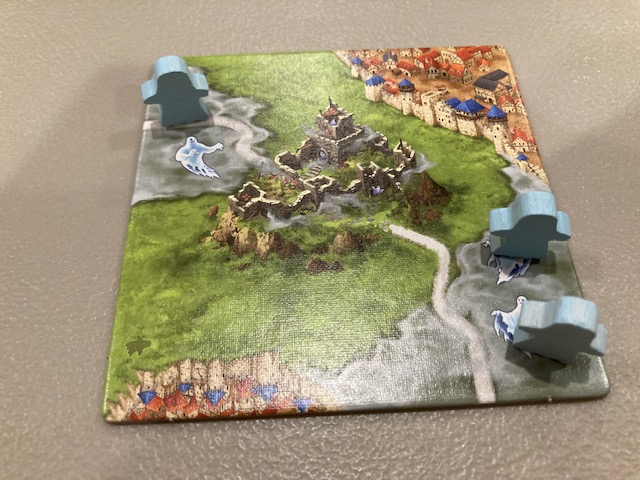
The starting tile is placed out (above) with starting ghosts. This is a tile-laying game: you place a tile every turn, trying to score points while trying to keep the ghosts under control. If you ever place a tile and can’t place the appropriate number of ghosts, you immediately lose. The ghosts are a limited resource: you have to keep them under control as you play.

See above as the tile place will have 2 ghosts.
Basically, a player has a very simple turn: pick a tile (face-down, you can’t get see it), place it legally (roads must connect roads: no dead-ends, stuff like that), and then place a meeple on the placed tile if legal and desired. The meeple placed on the tile helps that player to “own” that road, castle, city, etc. for scoring later. When you actually “close” a road, city, whatever, then you have the opportunity to score!

Notice the tile above closes the city so players can score!
Cities score 2 points for each tile in the close city, Roads score 1 point per tile in the closed road, and there are other scoring criteria.
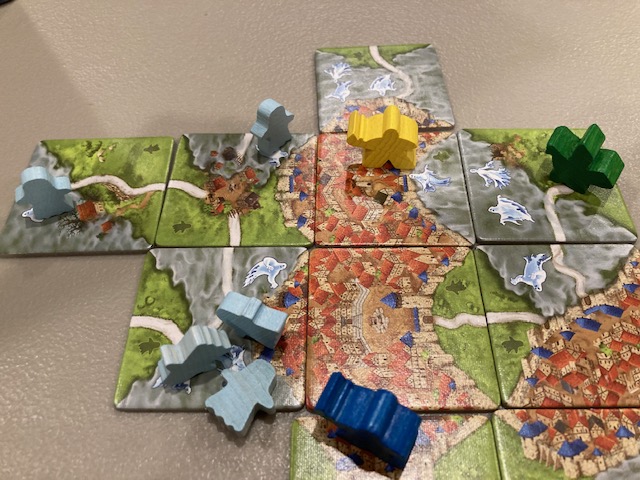
You only score when you “close” something, so if you make it to the VP limit after scoring, you immediately win! You lose if you run out of ghosts or tiles. That’s it!
Ghosts
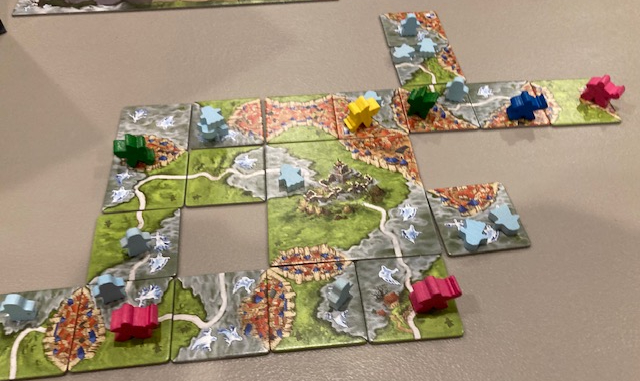
Although you can lose my running out of tiles, every single game we have lost were because we ran out of ghosts! See a losing game with too many ghosts above! (Strictly speaking, we lost because we couldn’t place enough ghosts on the next tile to come out).
There are three ways to mitigate ghosts:
- When you would score (because you “closed” something), you may instead chose to remove 3 or fewer ghosts from any single tile.
- When you place a tile and “close” a mist area, you can remove all ghosts in the closed mists
- When you place a tile and “extend” a mist area, you put one fewer ghost out
This gives the players really interesting choices every single turn: do I set-up a scoring opportunity, do I “close” mists to mitigate ghosts, or can I do both and reduce the number of ghosts? The hardest choice is to forego scoring in order to keep the ghosts in line! Such a hard decision!
What I enjoyed about this is that a tile is both good news AND a bad news at the same time! Does the tile have what I want? How many ghosts do I need to worry about? Can I leverage my tile to do any good? Do I just have to mitigate ghosts? And the players have so many choices on their turn.
Ghosts “scare” The Alpha Player Away!
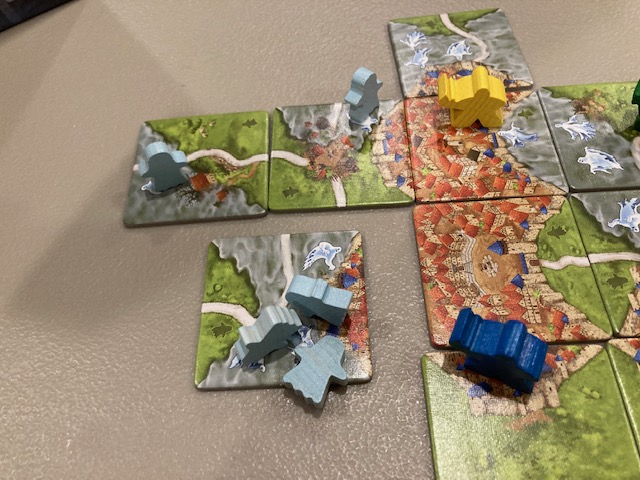
One of the nicer things about Mists Over Carcassonne is that the Alpha Player can be kept at bay (the Alpha Player is that annoying guy who attempts to takes over the game: See our full discussion of the Alpha Player “Problem” here). How? Because on your turn, you get a tile in your hands and you have the agency to to try to place it. The other players can’t necessarily see the tile, so the Alpha Player can’t see your tile, unless you choose to show it! But, you can ask for help with the tile, if you like!! Each player can do what they want: what I’ve found is that everyone helps by pointing out places the tile can/can’t go, reminds each other of the ghosts situation, reminds each other of places we’ve set-up cooperative scoring, but in the end: it’s the player’s choice where the tile goes! It really depends on how play is evolving: if the game feels collaborative, the player can place the tile and show all players the tile …. but if the game feels “Alpha Playery”, the player can just keep the tile hidden in their hand until they are ready to play.
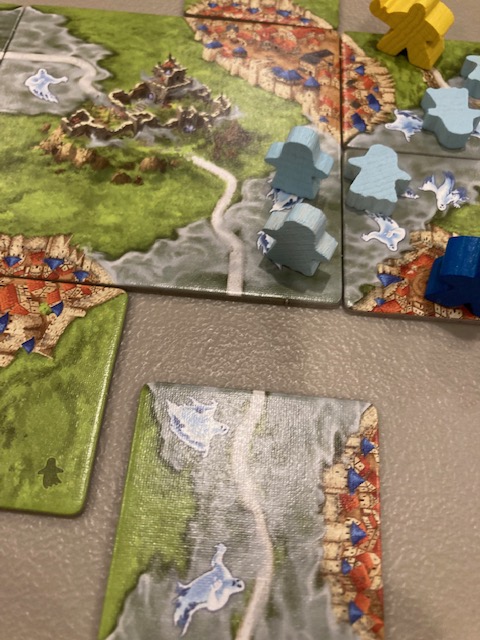
By physically taking a tile into his hands, that player is “owning” the tile and tacitly rebuking the Alpha Player: “This is my tile, let me place it”. The Alpha Player Problem is typically not a problem with most of my game groups, but I believe Mists Over Carcassonne is a cooperative game that will have less issue with The Alpha Player.
Solo Play
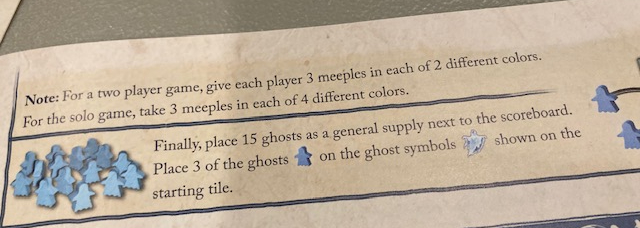
This game fully supports solo play (thank you for following Saunders’ Law): At the top of page 3 of the rule is simple and explained: “For the solo game, take 3 meeples of 4 different colors”.
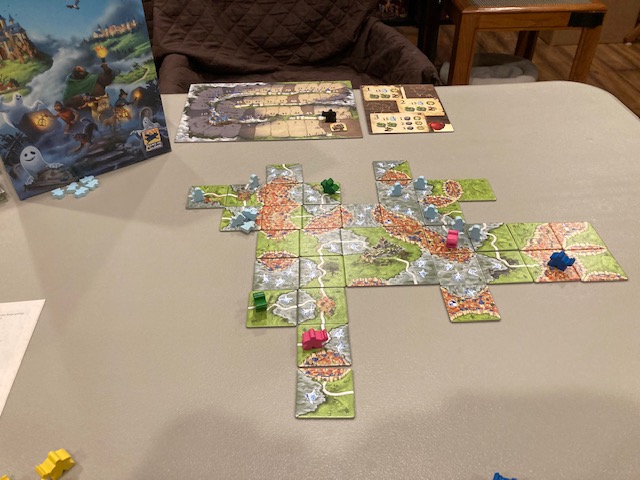
As the solo player plays, he has the choice to play different colored meeples out when places a tile: see above as the solo player has a many different colored meeples out!


You might ask, “Why does the solo player have 4 different colored meeples?” One rule we haven’t covered yet is that when you close an area, you can close an area belonging to multiple different meeples, and you score for each colored meeple! Consider the example above: When the solo player closes the city, both the pink and blue meeples are in that same city, so when it’s closed, BOTH colors score! Blue scores 5 tiles*2 points=10, pink scores 5 tiles*2 points=10 so this one tile scores the group (or solo player) 20 points!
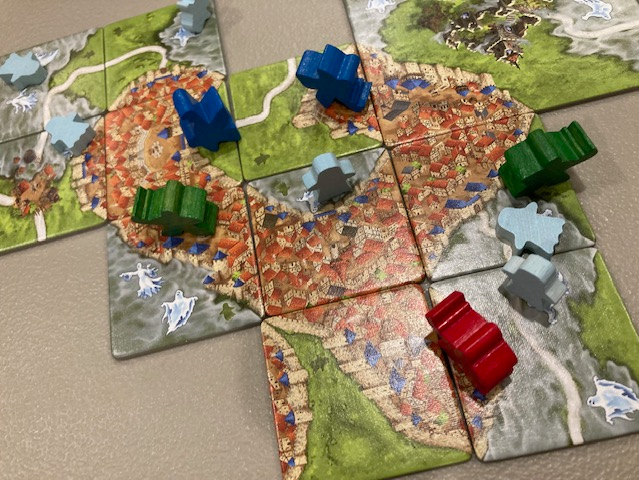
This shared points rule is critical to winning the game, as they are worth so much! It makes Mists Over Carcassonne more strategic, as you try to set-up more complex scoring opportunities! Again, more choices for the players: do I try to set-up a shared point situation so we can all score? Even at the cost of the ghosts going crazy?
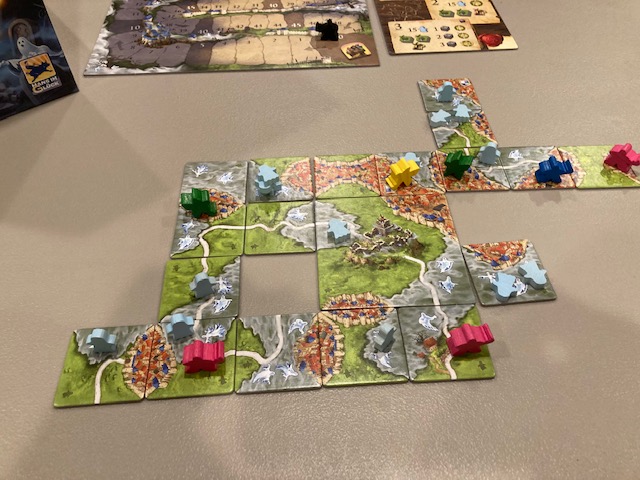
I played about 4 to 5 solo games over a couple of nights: I was able to beat Level 1 a few times, then got trounced at Level 2. The thing is, this game is so easy to set-up and get to the table quickly, and it really is about 35 minutes. If you want a nice “end of the night” puzzle, the solo game works well for that. It’s a nice, quiet puzzle. If it ever gets too easy, there are 6 levels to try, each harder than the last!
Oh yes, and the solo game did its job: I was able to learn the game so I could teach it to my friends.
Cooperative Play
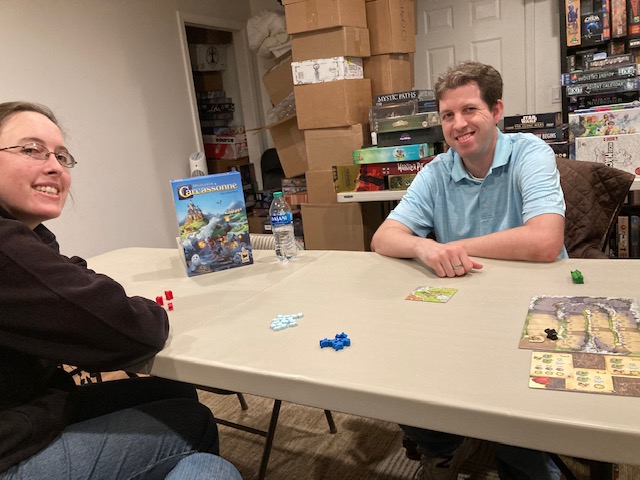
Cooperative plays worked fabulously: it was easy to teach the game … and my friends jumped right in.
The best part of cooperative play is that so many discussions flowed easily, as everyone saw things others didn’t see! There is a maxim in Open Source software called Linus’ Law: “given enough eyeballs, all bugs are shallow “. I think that same idea applies here: many eyeballs on all the tile possibilities really opened up the game.
After we trounced Level 1, we jumped to Level 2: This is a good sign: my friends wanted to keep playing even after we won our first game!
Conclusion
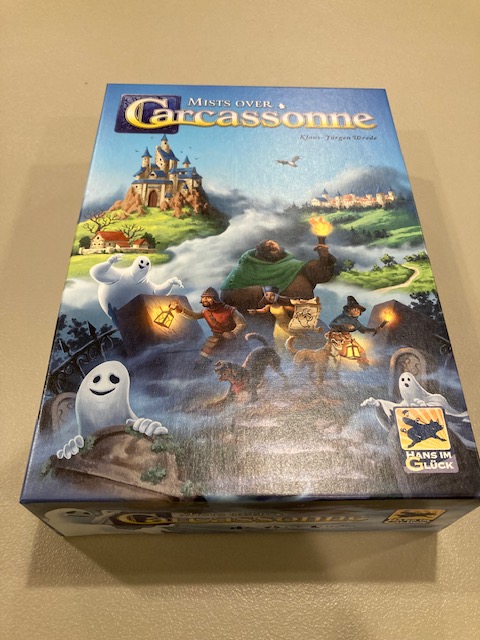
This is a really easy game to get to the table: both solo and cooperatively. Mists Over Carcassonne has lots of hidden depth and strategy for such a simple set of rules. Every turn feels juicy as you have many choices: do I set-up scoring, do I score, do I mitigate ghosts, do I set-up shared scoring, and the best turns are when you can do many things with just one tile!
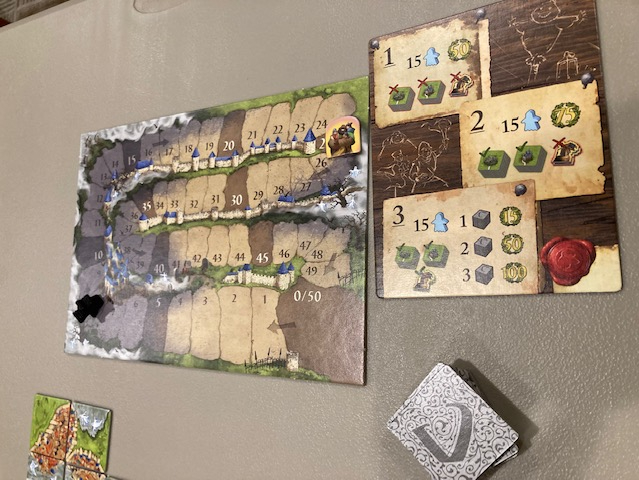
The solo game feels like a nice puzzle: do I want a puzzle for 35 minutes? Mists Over Carcassonne quickly sets-up and presents a nice challenge, which can easily be scaled to your ability (via the Level system).
The cooperative game works really well too, as the system tends to encourage discussion: your compatriots see things that you don’t! The collaborative strategizing about shared scoring and ghost mitigating seems to naturally flow.
Even if you didn’t love Carcassonne (I am one of those few), Mists Over Carcassonne solo and cooperative modes might be something that still appeals to you. This game is easy to teach to anyone and offers lots of replayability with its Level system. Fantastic Game: 8.5/10

Oh yes, Mists Over Carcassonne is also a straight-up expansion to competitive Carcassonne. So, even more reason to consider it!
Yes Nevin, you are probably getting this for your Birthday…
 coopgestalt
Interesting. Do you need the original to play?
LikeLike
Nope!
LikeLike
Hi,
Just wanted to let you know that I’ve been reading your blog for a while and enjoy it a lot. I think you generally give a good sense of how a game feels to play and what stories arise as you play it. Also, I appreciate the high frequency of content here.
Thanks!
LikeLike
Hi,
Just wanted to let you know that I’ve been reading your blog for a while and enjoy it a lot. I think you generally give a good sense of how a game feels to play and what stories arise as you play it. Also, I appreciate the high frequency of content here.
Thanks!
LikeLike
Well thank you! I am glad you enjoy it!
LikeLike
Whoo Hoo!
LikeLike
WHoo Hoo indeed! 🙂
LikeLike