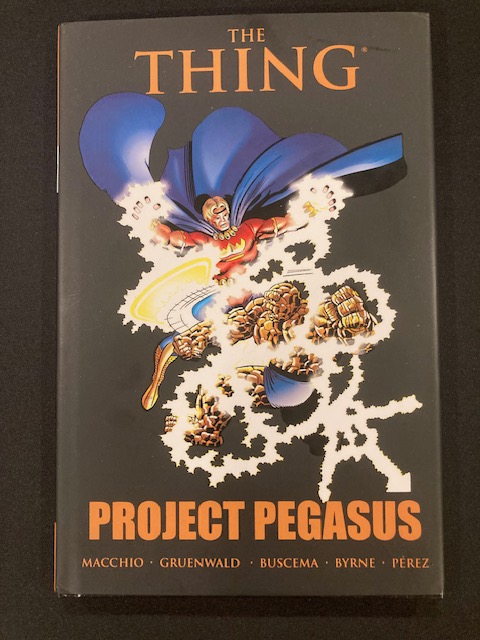
The Project PEGASUS series was one of my favorite comic series when I was a kid. It took place in Marvel Two-In-One Issues 42, 43, and 53-58 back in 1978 and 1979. There are several reasons I liked this story: it featured the Thing and a really interesting cast of characters, including Quasar and Man-Thing! Plus, it’s one of the few times you see the art of John Byrne and George Perez together.
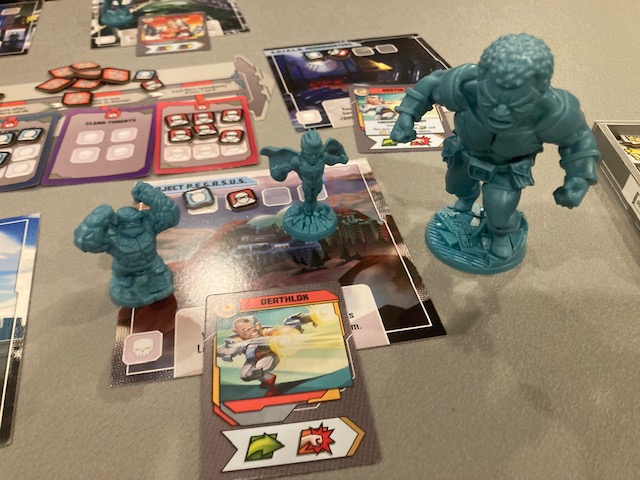
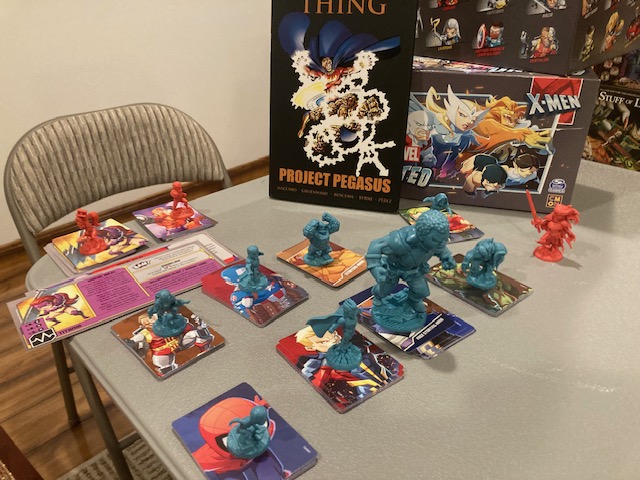
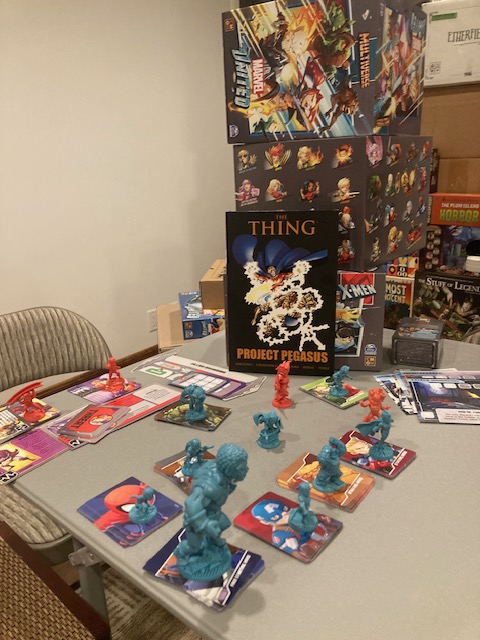
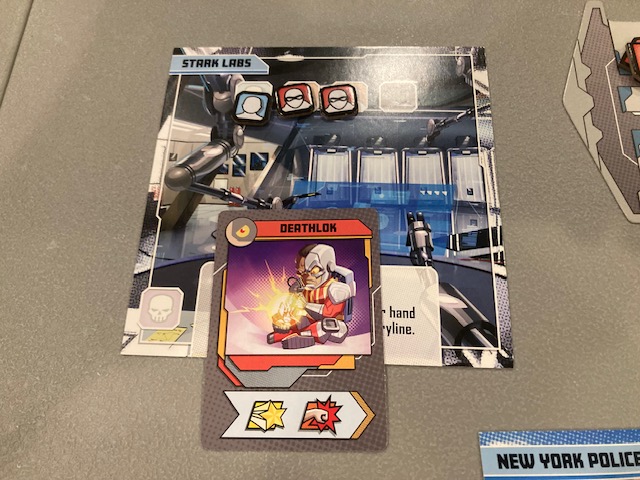
Once Season 3 of Marvel United arrived, I saw that Project PEGASUS was indeed a Location from the Multiverse base set: see above (we reviewed the base Multiverse set here)!
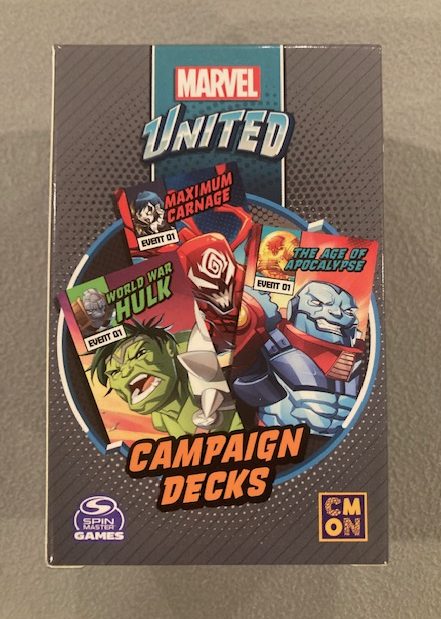
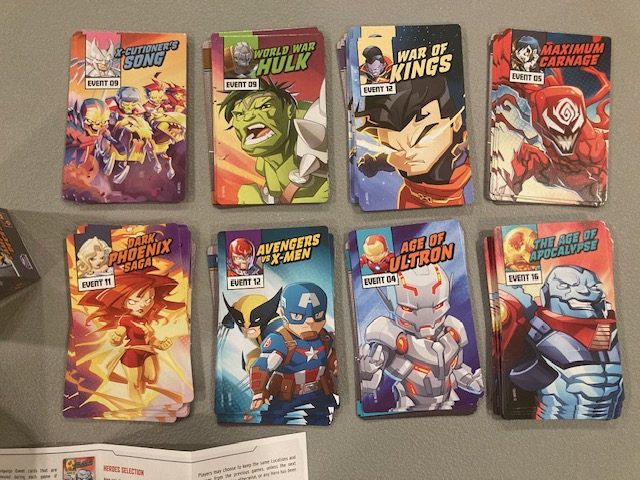
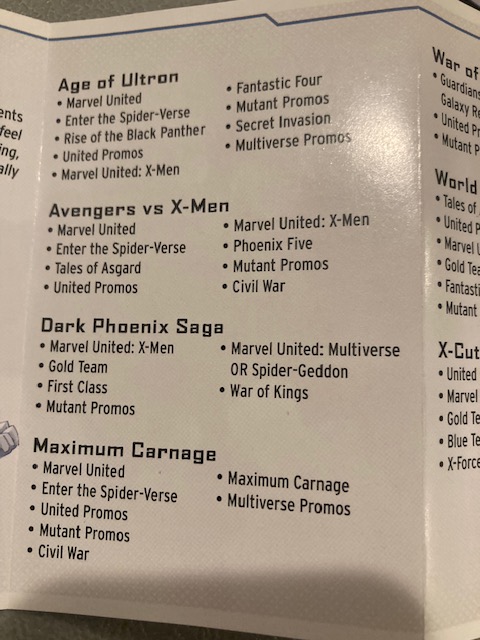
See all the great series of Marvel Comics! But where’s the campaign for Project PEGASUS?
Never mind, I’ll do it myself.
The Road To Development
Over the past month, I have read and re-read the Project PEGASUS series (a burden of joy) to get a sense of what its campaign might look like. See above as I have taken out most of the content I need!
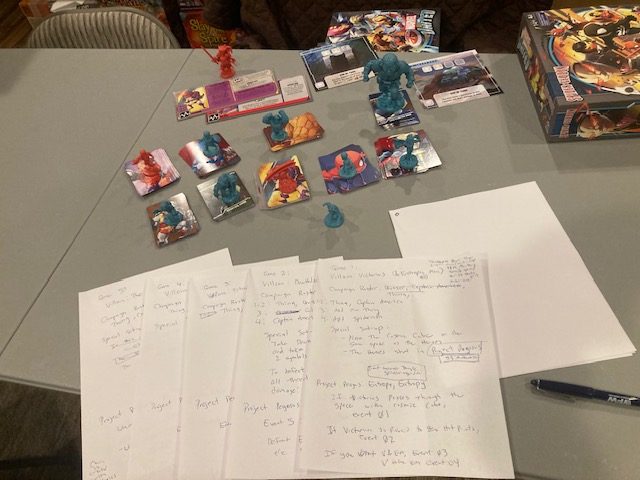
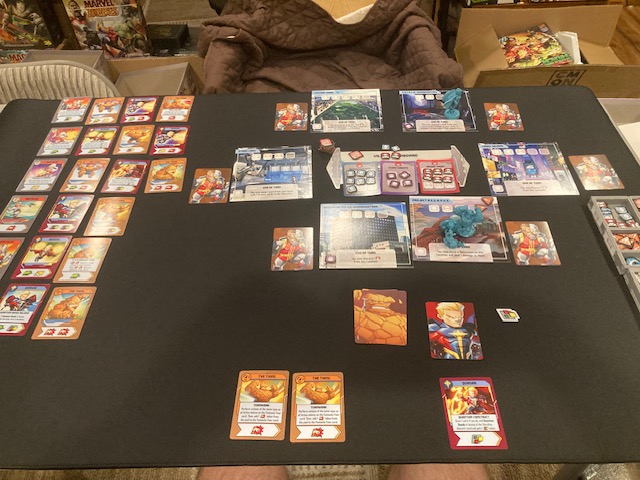
After coming up with a general outline of what the Villains, Heroes, and Games should be, I started to put something together! See above for written notes on the first draft of this campaign.
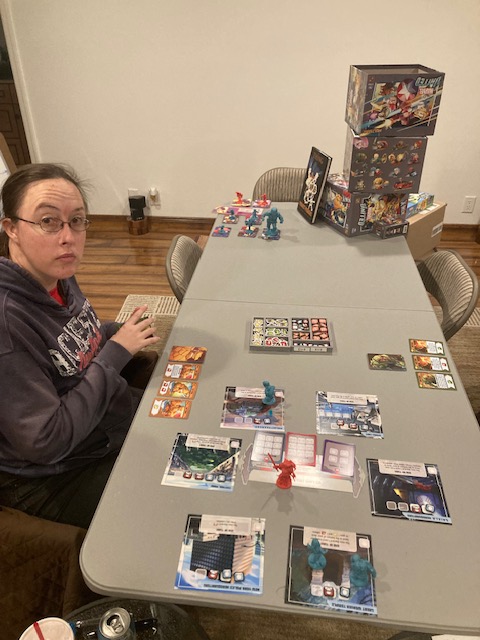
I’ve have also had some play testing from my friends, as well as many many many solo games (with 2, 3, and 4 Heroes).
In the end, I am very proud of the Campaign I came up with: it follows the story of Project PEGASUS pretty well and adds some new ideas to Marvel United.
Over the last few weeks, the campaign has evolved quite a bit: I have some added some new Villains and Heroes for the final cut.
Some of the ideas in the Project PEGASUS campaign are a little outside the box, because even though Season 3 made this all possible, I will still missing some pieces (Heroes/Villains/etc) to make the campaign complete. So, I had to improvise using what I had.
I am very proud of what I did for Games 1 and 5, and especially Game 2. But be aware that those games are a little different.
What Do I Need?
Like all of the campaigns, The Project PEGASUS campaign needs a lot of pieces stolen from all parts of Marvel United. See the complete list below.
• Base Marvel United • Spider-Geddon Marvel United • Multiverse Marvel United • Season 1 Stretch Goals • Season 3 Stretch Goals • Fantastic Four • World War Hulk • Annihilation • Civil War • Enter The Spider-Verse • War of Kings
Current State
The current draft of the campaign is at version 1.0.1. I fully expect there to be revisions made as me and others playtest it. UPDATE: We are now at 1.1.0: we had some explanation clean-up and a few balance adjustments to Game 1! Oct 20th, 2024 UPDATE: Updated to 1.2.0: Added explanation of how to play solo, updated Game 2 with better descriptions and a rules fix/clarification.
Feel free to download the PDF below and give it a try!!! If there is interest, I can try making the form factor more like cards (with Rules cards and Event cards), but right now the Events are presented alongside the Games of interest in the PDF document below.
If you have any feedback (too easy, too hard, spelling problems, unclear rules), please email us at returnfromsubroutine @ gmail.com
Leviathan Wilds was on Kickstarter first in July 2022, but then they pulled it down and re-tooled it: they were on again on May 2023 (see Kickstarter link here) and ended funding at a pretty good level at about $208K. This cooperative boss-battler game was on my Top 10 Anticipated Cooperative Games of 2024 and finally delivered to me in early May 2024 (about 2 weeks ago).
This game has a very interesting theme: it’s basically the old PS2 game Shadow Of The Colossus!
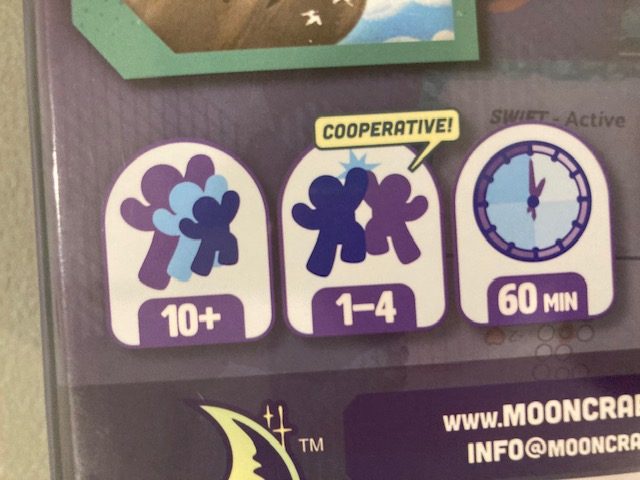
The board game plays 1-4 players, but the original PS2 game was a solo game! In the original PS2 game, players have to take down very large creatures by climbing their huge bodies and attacking certain points, all the while with the Colossus attacking them! It’s a very interesting theme!
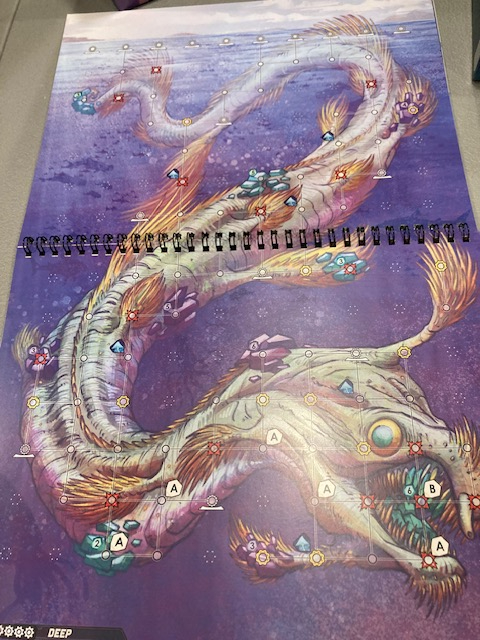
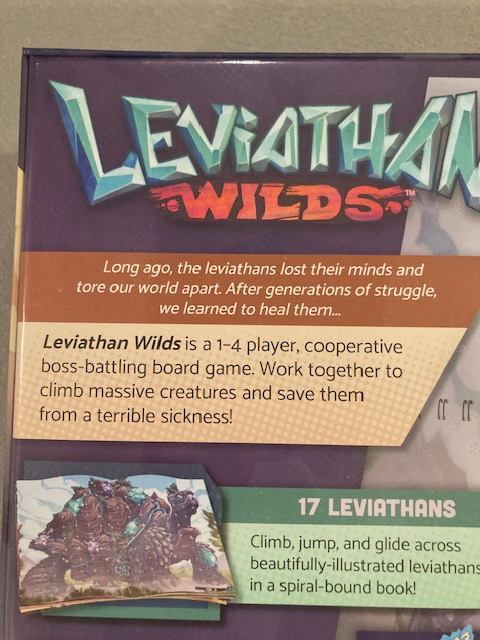
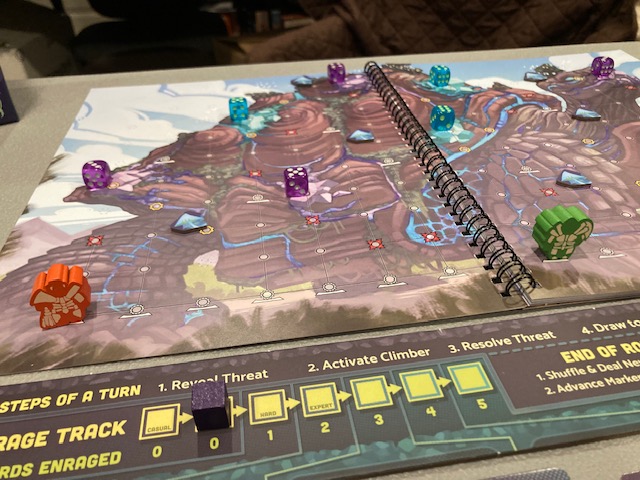
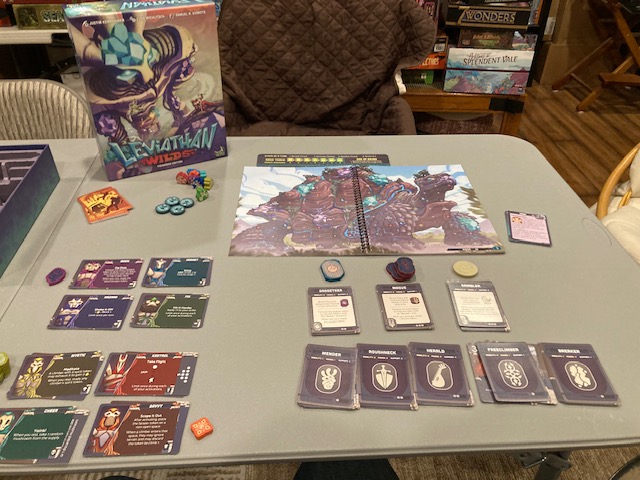
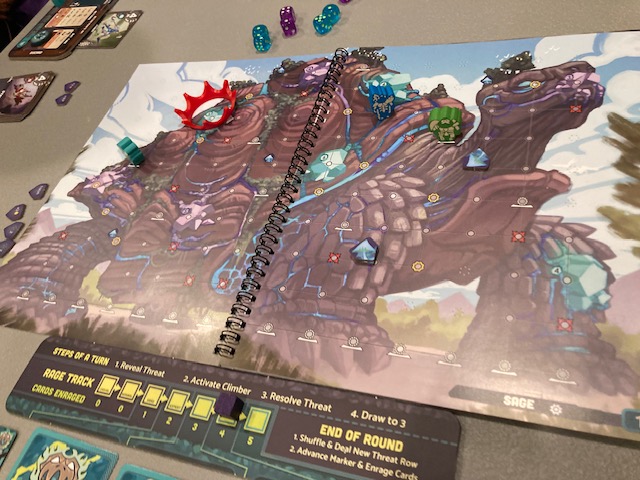
In this board game (see sample above), you fight one of 17 Leviathans (you can’t call them Colossus … you wanna get sued?) and win if you can free the Leviathan of its constraints! Leviathan Wilds has a friendlier theme than the original Shadows Of the Colossus: rather than attacking the Leviathan, you are healing the Leviathan by taking out the Binding Crystals. So, when you and your friends cooperatively win … you have freed the Leviathan, rather than killing it!
Let’s take a look!
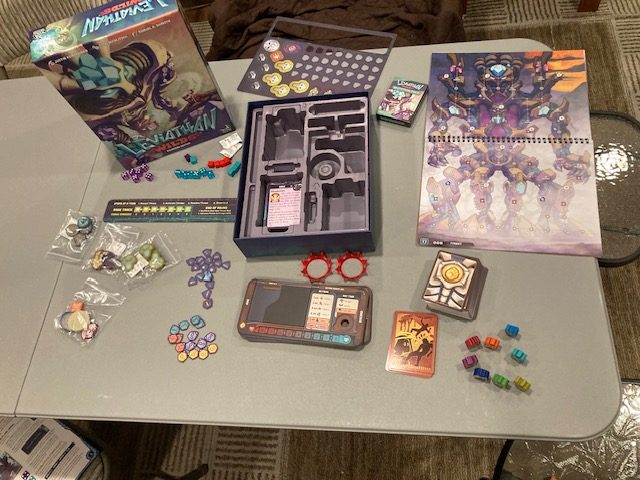
Unboxing and Gameplay
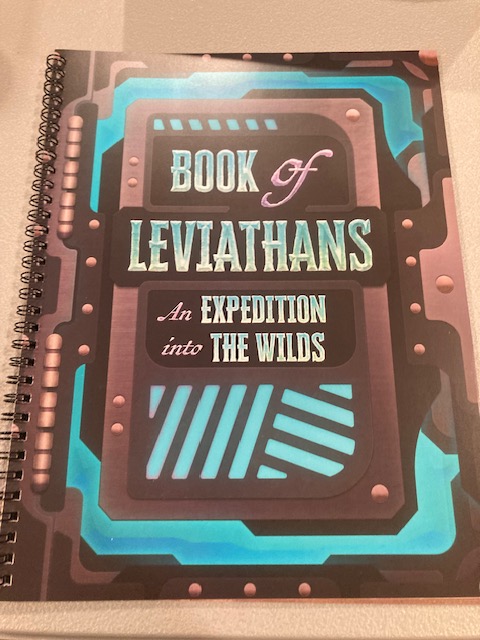
Players choose a Leviathan to help from the Book of Leviathans.
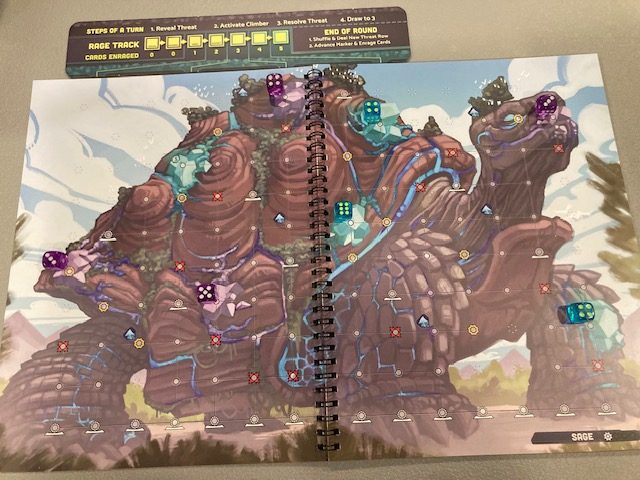
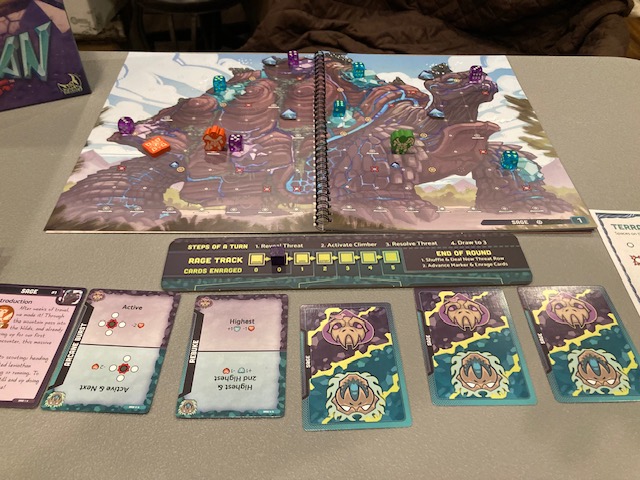
Each Leviathan is a massive 2-page spread from the book! Sage, above, is the suggested first Leviathan to help.
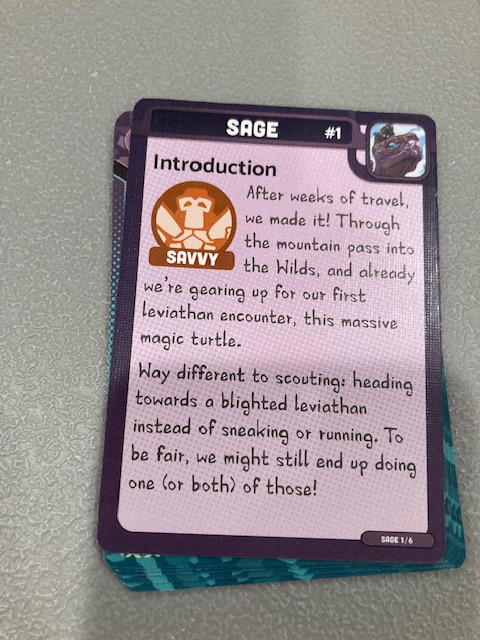
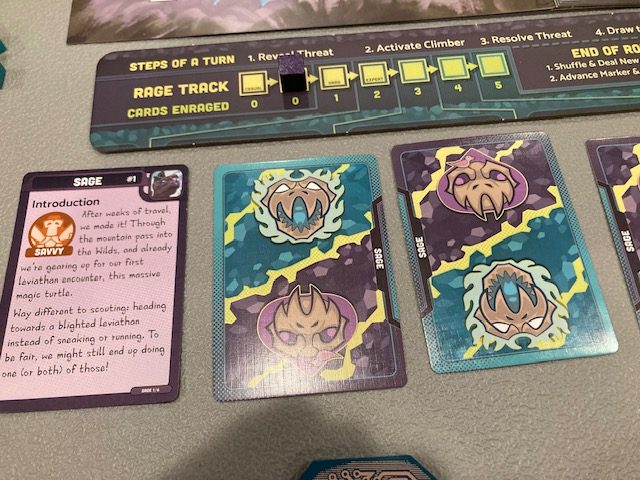
Each Leviathan has its own small deck of Threat cards (5) and some story cards. See the Introduction above.
The 5 Threat Cards (just below the Leviathan) control what the Leviathan does at the end of the turn(s).
Some Threat Cards attack the current player with an area of effect!
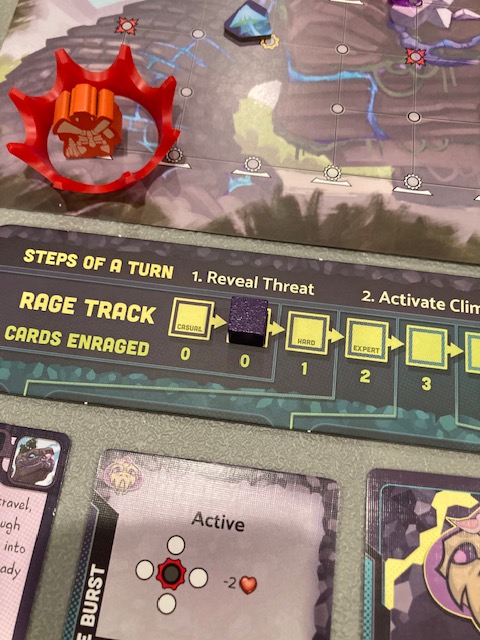
See above as the area of effect above on the Threat Card (it’s just the orthogonally adjacent to the original site). If your climber can get out of the area by the time your activation is complete, you can avoid the attack completely!
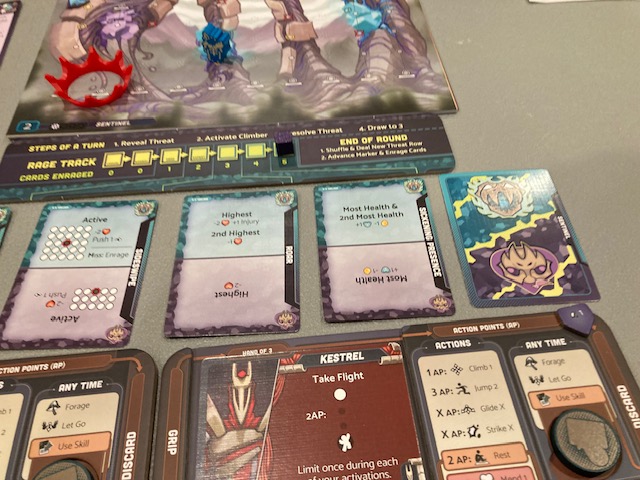
At the end of 5 turns, the Threat deck is reshuffled and comes out again. To escalate the game’s difficulty, each Threat Card has two rotations: blue and purple, with the blue rotation being the “harder” challenge! See above!! As the game progresses, more and more of the blue sides are revealed, making the game harder!
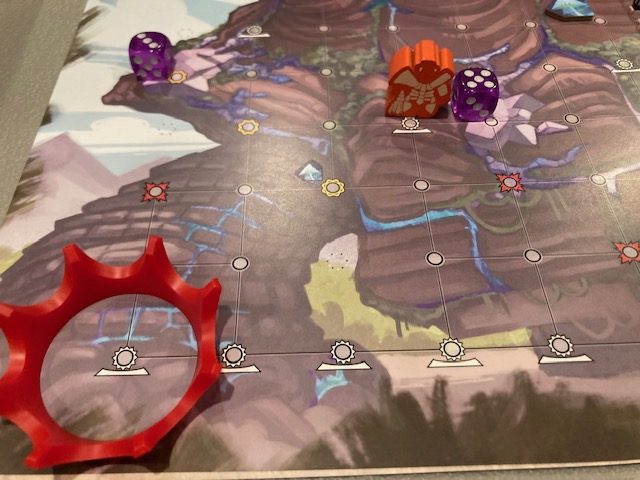
To win, players cooperatively must take out all the Binding Crystals (represented by dice) at various points around the Leviathan. See one such Binding Crystal above. You spend Action Points (or cards) to reduce the value of the die, until it is zero, at which point you remove it!
There are quite a number of Binding Crystals set-up at the start of the game (purple and blue: purple Binding Points are straight-forward, blue Binding Points have side-effects). See above.
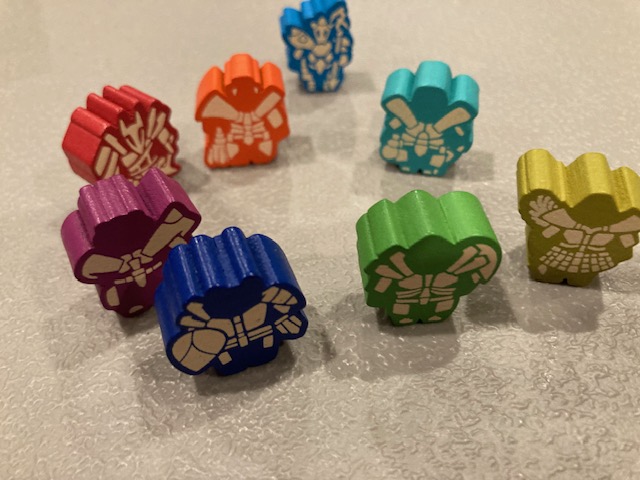
Each player takes control of one of eight Climbers! These Climbers climb (duh) the Leviathan to take out the Binding Crystals! See the eight different Climbers above and below.
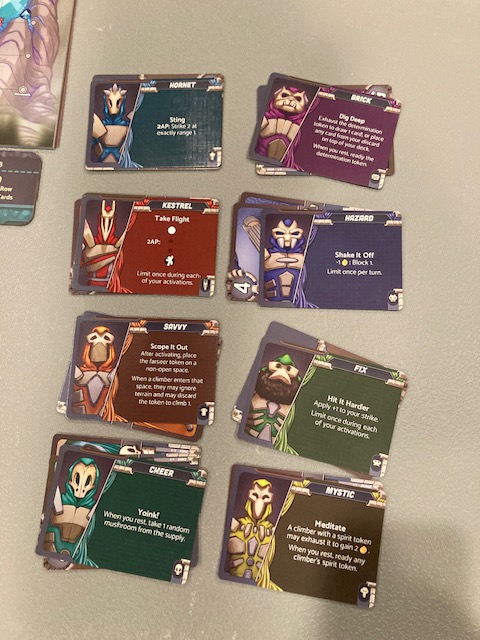
Each climber has a personality and special unique ability: see above. Each climber also has a small hand of cards.
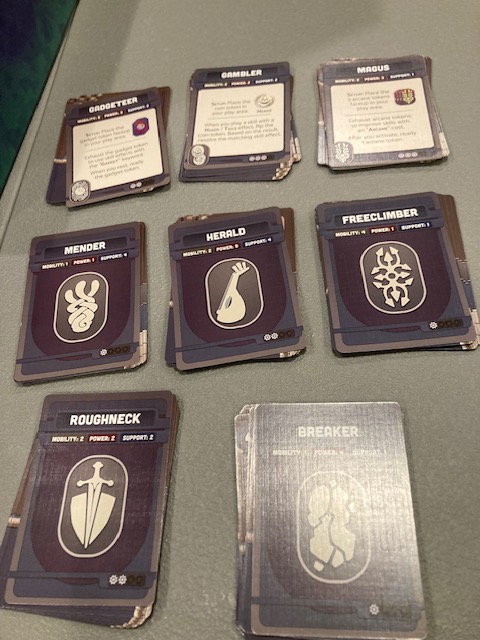
Climbers then choose a Class (one of eight) to play: See above. Each class also adds a number of cards to your deck.
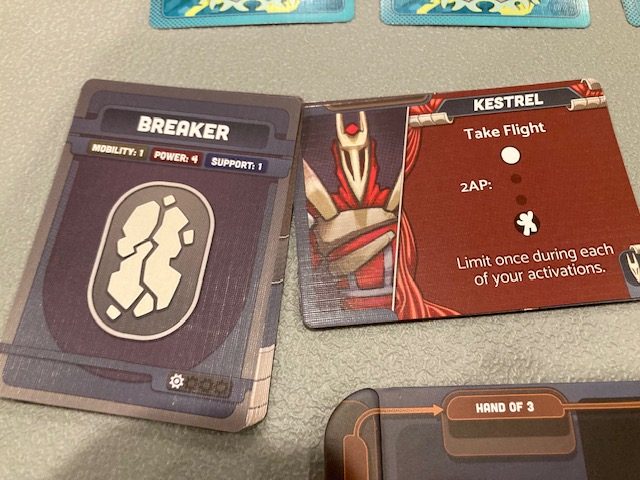
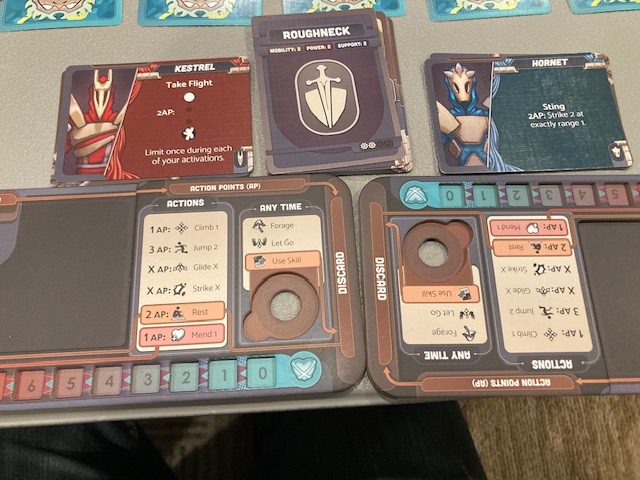
Combined together, the Climber and Class form your personality and your deck! See above as Kestrel the Breaker takes form and becomes a character in the game!
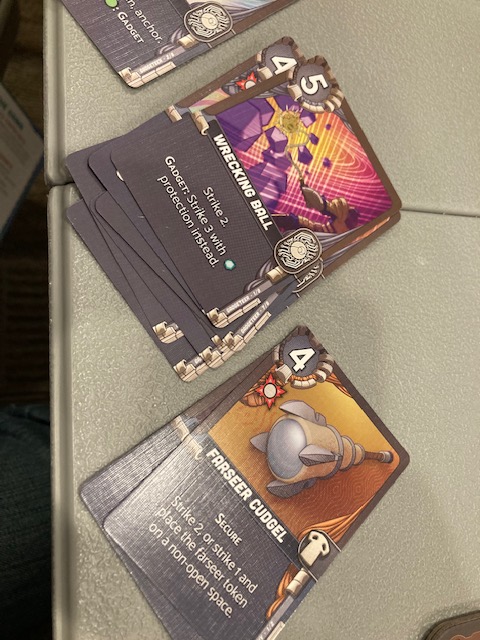
The deck is what powers your character! You have three multi-use cards (in hand) every turn that you can use for Actions Points or their Special Abilities! See above and below.
Players have a certain number of Action Points per turn, depending on which card they play to start their turn. Like we said, the cards are all multi-use cards: you can either play them to get Action Points (upper left corner), or as-is to get its effect (bottom of the card).
There are basic Actions (see above for a list of actions on your character board) that each cost a number of Action Points. Some Climbers (like Kestrel) have special Actions only they can perform with their Action Points.
Every turn, a Threat card comes out, specifying what the Leviathan does. You may/will take that effect after you activate … sometimes you can avoid the effect completely if you play smartly (by either blocking or moving out of the way). The player takes his full activation and DOES STUFF: moving around, playing cards, and trying to take out the Binding Points. Threat cards take effect after the activation, and play moves to the next Climber.
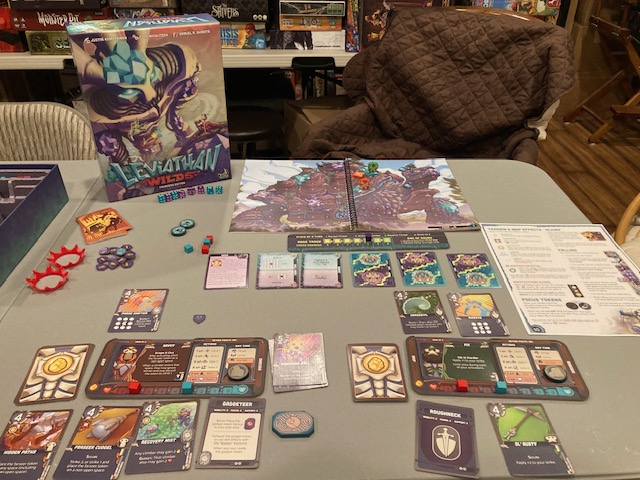
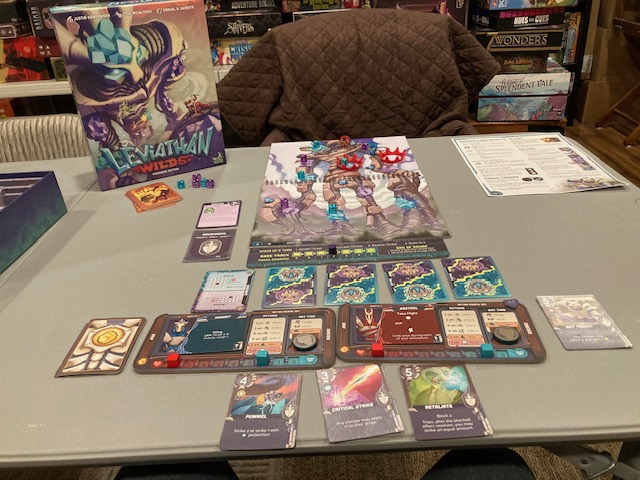
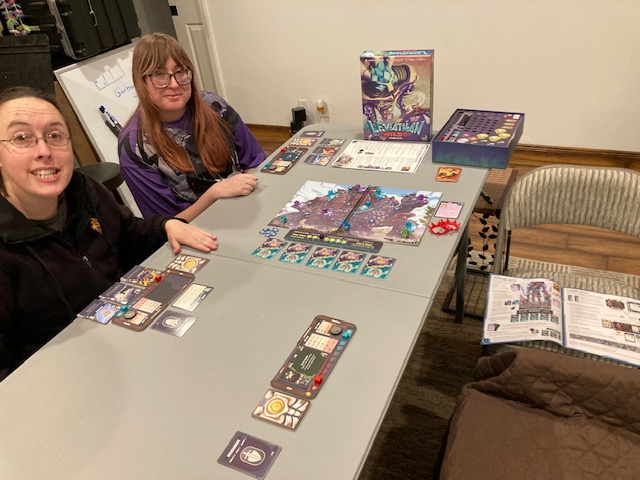
Repeat until players take out all Binding Crystals or lose (by dying)! See above for a winning game with two Climbers!
Cool Things
The number of cards in your deck represents your grip: if your deck (left) is ever empty, you immediately fall until you hit a platform! This deck sort of reminds of Gloomhaven, but rather than the deck being your hit points, the deck represents how “well” you are holding on! It’s a cool ballet in the game, knowing when to rest (to recoup your grip) and when to push ahead (to get stuff done).
The multi-use cards are quite clever: you HAVE to choose a card to play for its Action Points at the start of your turn, but that means you can’t use the special ability on it! It’s a very clever way to make players really think about what they want to do with the cards they have!
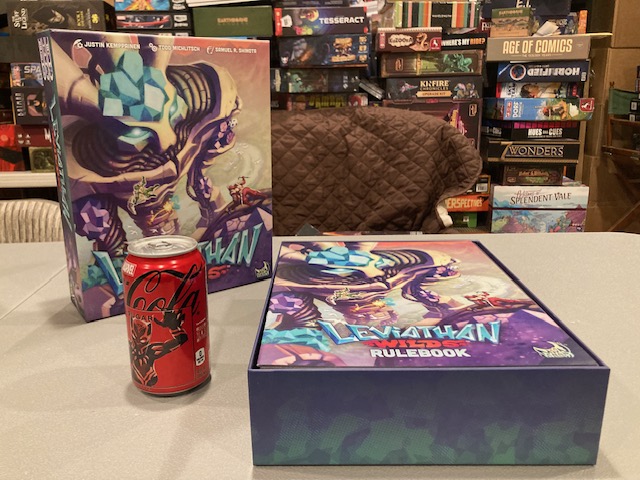
The components are pretty top notch in this game.
There’s a lot of variety in this game: there are 64 combinations of Climber/Class, each with their own unique deck! There’s also 17 Leviathans, each with a very different Threat Deck! Some of the fun in this game is exploring the best combos for the different Leviathans! I expect to lose many games as I learn some of the later Leviathans … but with loss comes knowledge on how to win!
It’s also clever that the Threats don’t take effect until AFTER you have activated your turn: this sort of represents the interplay in a Video Game! You see what the Leviathan is about to do, and you can react! Sometimes you can mitigate the effect and sometimes you can’t, but it’s a clever way to that Video Game interplay.
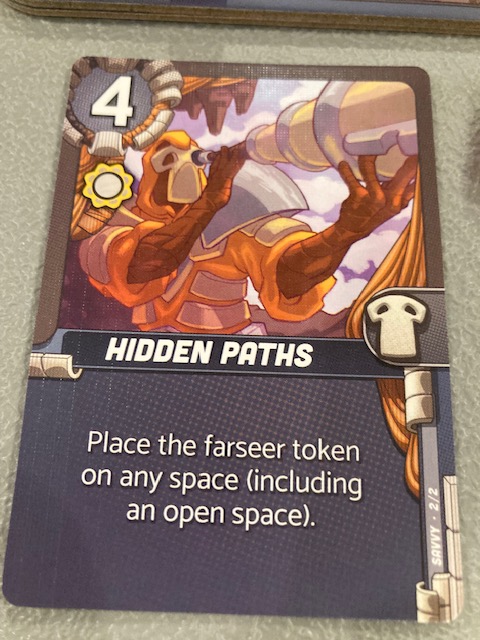
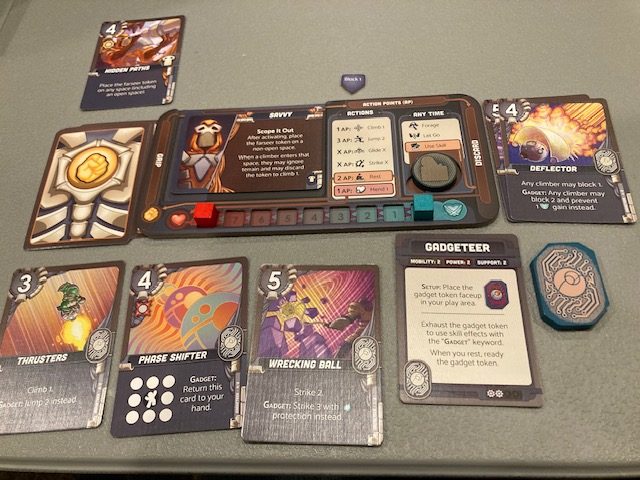
One other multi-use card thing that’s cool is some cards that you play as Action Points have a “blocking” icon underneath the Action Points! If you play Hidden Paths above for 4 Actions Points, that also means you can’t lose any “grip” (cards from your deck) during your activation!
So that means you can using the cards for Action Points as well as possible blocking! That makes the choices even more delicious! The multi-use cards are just fantastic in this game.
Solo Play: Two Modes
So, Congratulations on offering an official solo mode! (Thank you for following Saunders’ Law!) The official solo mode has the solo player operate two characters with a combined deck.
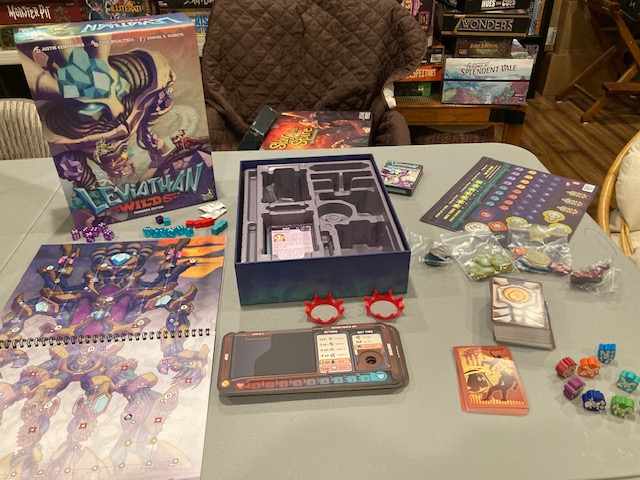
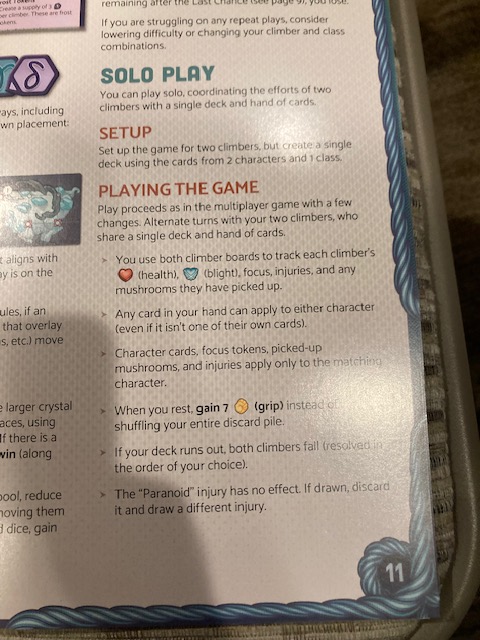
The Solo Play is described on page 11 of the rulebook (see above).
The solo player chooses two Climber and one Class deck, and then combines them to form “the solo deck”: both characters use this same deck for their play. Play alternates between the two Climbers, using that same deck for both characters. The idea, I think, is to reduce management overhead by only having one deck.
This is the official solo mode (above). It is fine. I played and was able to win with the second Leviathan.
However, I think the better solo mode is simply to take complete control of two Climbers, each with their own deck! (Like above)! I like the “solo player takes control of two Climbers with separate decks” rule better than the official solo mode. Why?
The official solo mode has “exceptional” rules you have to remember (only get 7 cards when you rest, both chars fall when the grip runs out, etc).
The solo player with two characters with separate decks is more like the cooperative game; I have to teach my friends this game, so I’d rather just learn the cooperative game as it is!
Basically, the official solo mode has exceptions to the base rules which I have to remember. I’d much rather just play the game in “normal” mode without any exceptions: it makes it that much easier to teach!
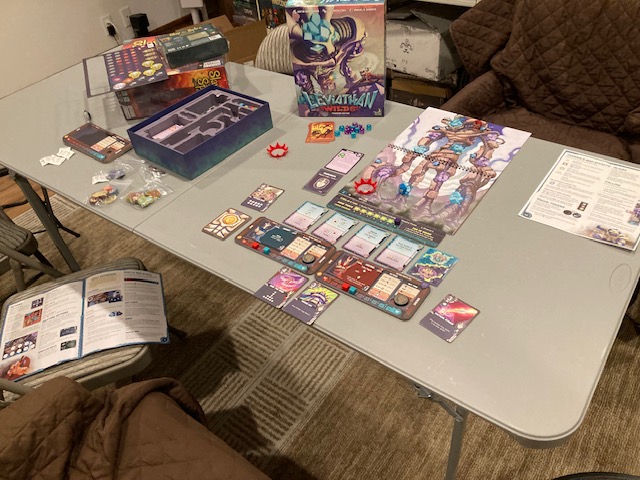
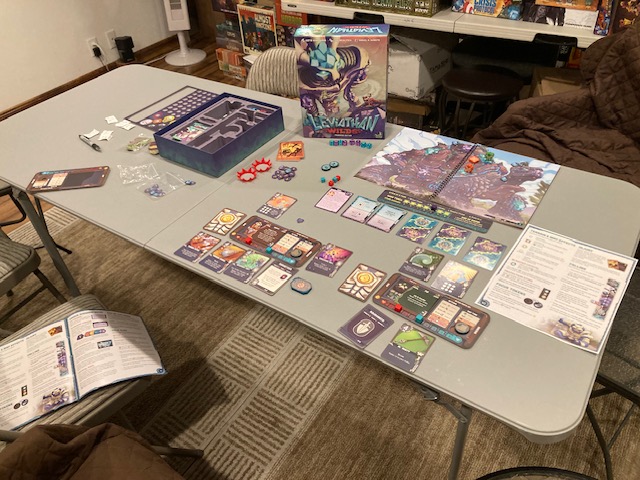
Both solo modes are very fine and very fun and very playable. The official solo mode has less management and takes up less space (see above). The unofficial solo mode with two Climbers and two decks requires operating more cards and takes up more space, but it feels more like the normal game (see below). I personally prefer the latter: play as if it were a 2-Player game, just alternating between the characters. Decide for yourself! They both work!
Cooperative Mode
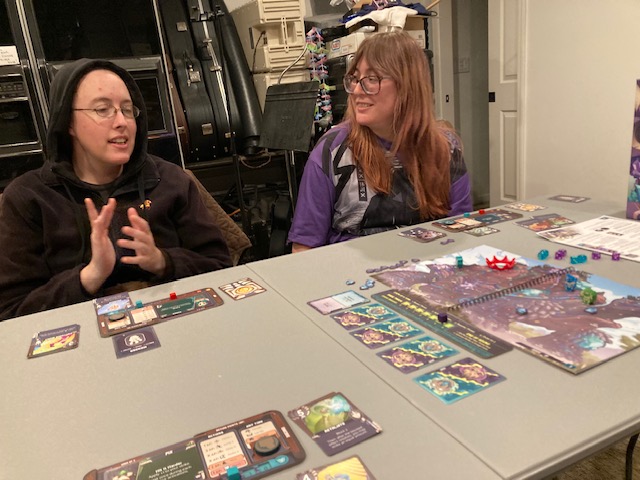
Cooperative mode works great! Sara had a chance to watch a rules playthrough earlier, so we were able to jump right in!
We tended to mostly play our own characters, with a little bit of coordination about which Binding Crystals to go after. I think each player felt very different: my Climber/Class had a lot of blocking power, and Sara’s never saw a single blocking card!
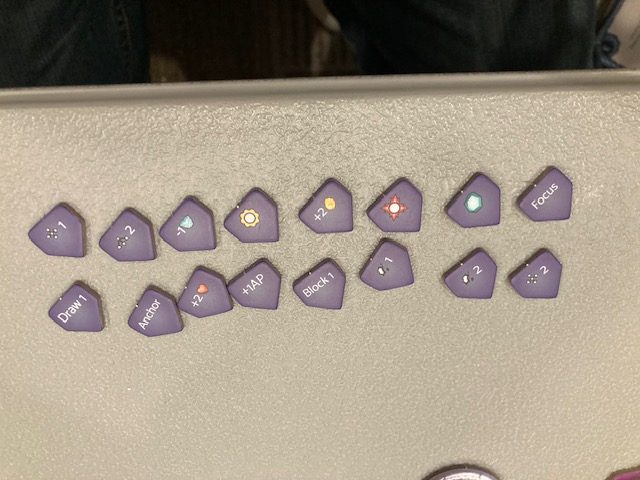
Sara also reminded of a rule that tends to evoke more cooperation … you can throw Mushrooms to each other! The maps have some Mushrooms (see above) scattered about! And Mushrooms all do good things! You can throw a mushroom to help your compatriot … if you are close enough!
Generally, this game went over very well ! The theme really impressed by friends, they loved the art, and they loved the quick 60-minute game!
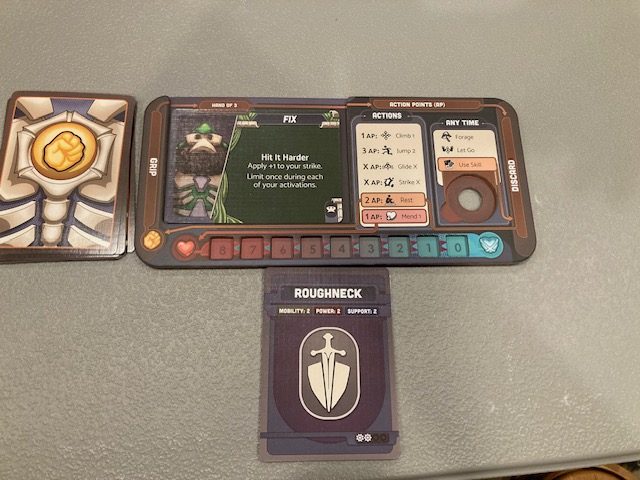
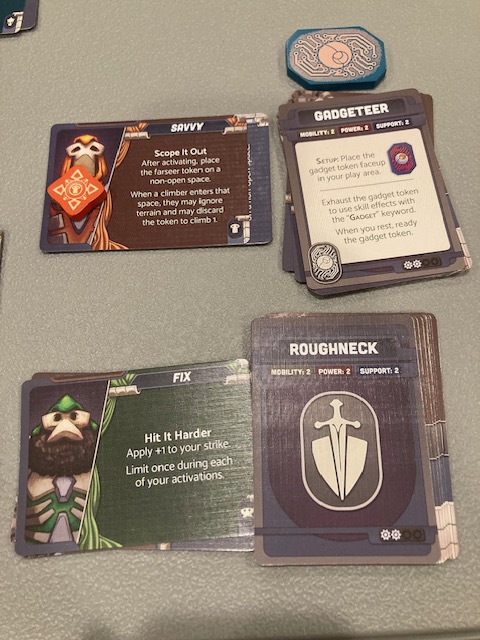
I think the amount of cooperation depends a little on the Climber/Class pairs you choose. The “Saavy” Climber (see above) tends to be very useful at helping everyone in the game at some point, so playing “Saavy” will elicit more cooperation! “Fix” (above), on the other hand, is just focused on “Hit It Harder”, so he will tend to just do his own thing.
The amount of cooperation will depend on a lot of things: the Climbers, the Classes, the Mushrooms, and the topology of the Leviathan! The game may feel multi-player solitaire in some games, and incredibly cooperative in other games!
Conclusion
Leviathan Wilds was, luckily, a good game! I was a little nervous about it, because frankly I hadn’t heard too much about it from any other source. But I think this game is great! It has some really unique ideas that make it feel almost like a video game: deferring Threat activation until after the player finishes, player cards that can be played instantly, multi-use cards, Threat Cards that rotate to get harder (levelling up!), and a Leviathan topology to maneuver!
I am a big fan of this game: the official solo mode works well enough (although I prefer the unofficial solo mode), but the cooperative mode works even better. There’s not too many rules, the game is a short 60 minutes, and yet it feels like this is a deep game with lots of replayability! The Climber/Class combination system works great for keeping the game interesting! The 17 Leviathans give the players lost of creatures to help!
This is a fun, fun game. Right now it sits at an 8.5/10 for me, but this could easily go up to a 9 or 9.5. This totally deserved to be on my Top 10 Anticipated Cooperative Games of 2024! It’s a blast!







 coopgestalt