
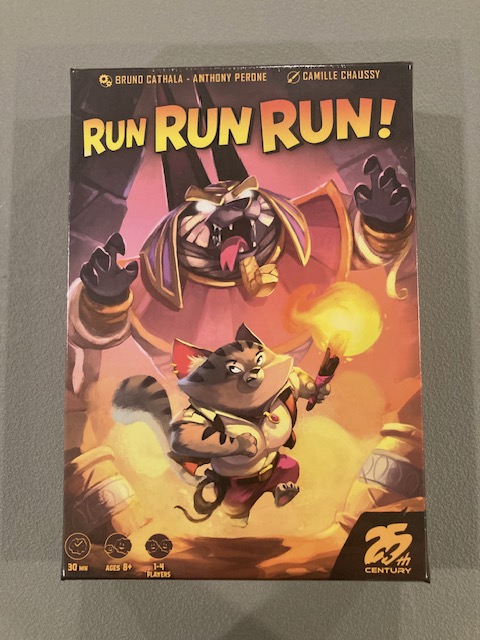
Run Run Run! is a cooperative game from Kickstarter: it was up on Kickstarter in February 2024 (with several other games) promising delivery in May 2024. It actually delivered in late August 2024, so it was about 3 months late. Eh, that’s pretty good for Kickstarters.
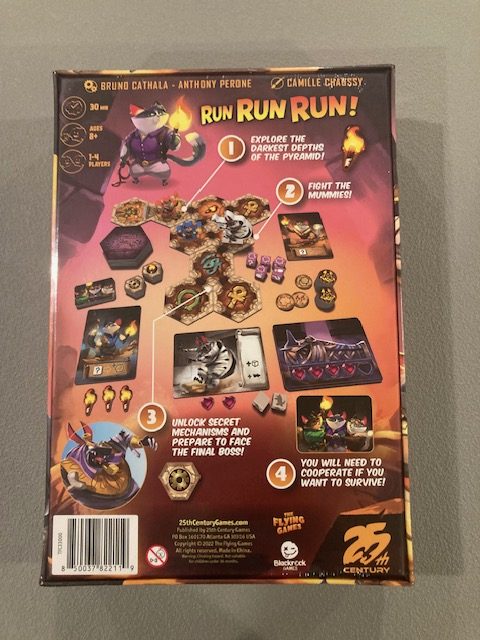
With a name like Run Run Run!, this sounds like it should be a real-time cooperative game, but it’s mostly cooperative tile-laying game. See our Top 10 Cooperative Tile-Laying Games for more discussion of the tile-laying genre. Run Run Run! is also a little bit of a boss-battler game.
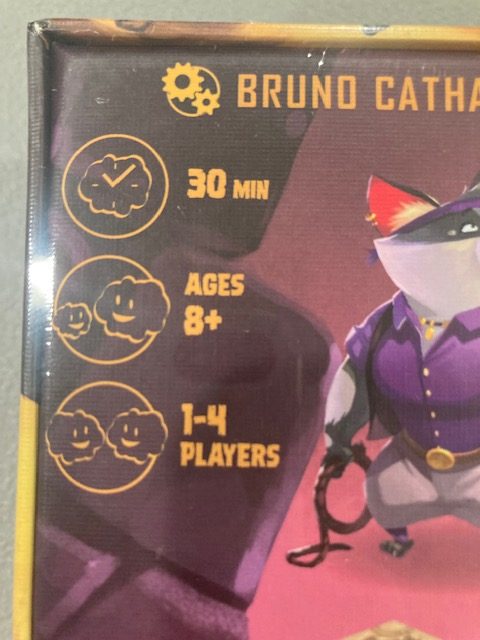
This is a light-weight cooperative game for 1-4 players taking about 30 minutes: the game time listed on the box seems accurate enough.
So, this game was part of an “import Kickstarter” where they found games from around the world and imported them to the USA. Apparently, this is an older game by Bruno Cathala and Antony Perone. BoardGameGeek lists the game as a 2021 game, although for some of us here in USA, this is a brand new game (including me). This is the 2nd Edition of the game, so I guess it’s new in that respect.
Let’s take a look!
Unboxing and Gameplay
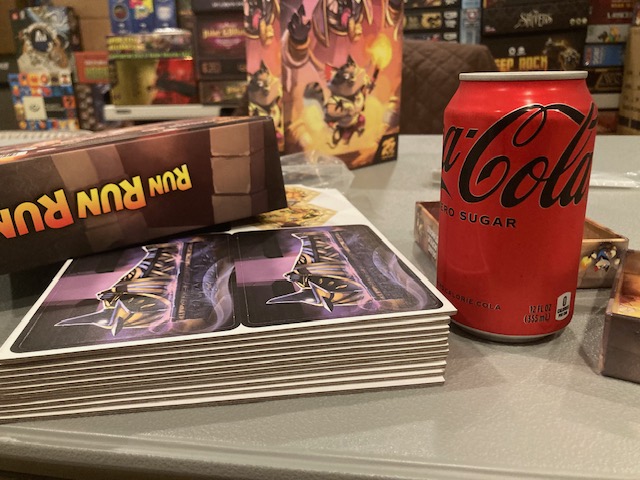
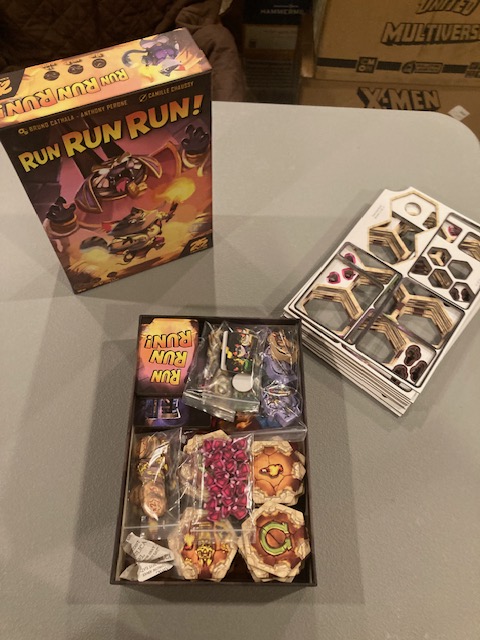
This is a game with a LOT of tiles: more than half the box was filled with punch outs. The first 30 minutes of my unboxing was just punching out all the tiles and other components! We did say this was a cooperative tile-laying game!
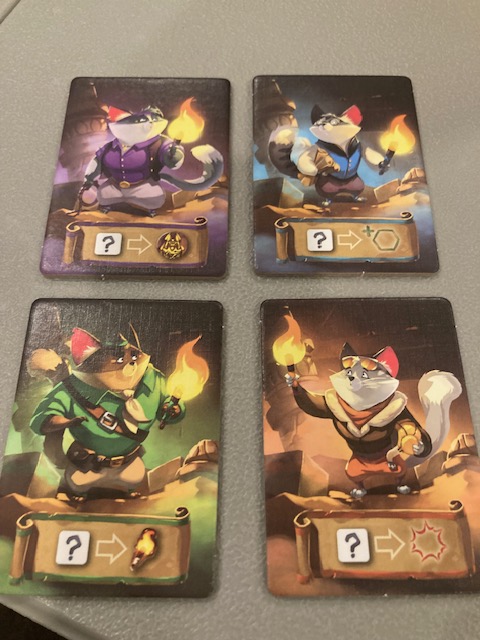
Players assume the roles of one of four explorer cats (Catventurers to use the nomenclature of the game)! See above! Each explorer cat has a special power that is invoked when they roll a ‘?’ on the dice …
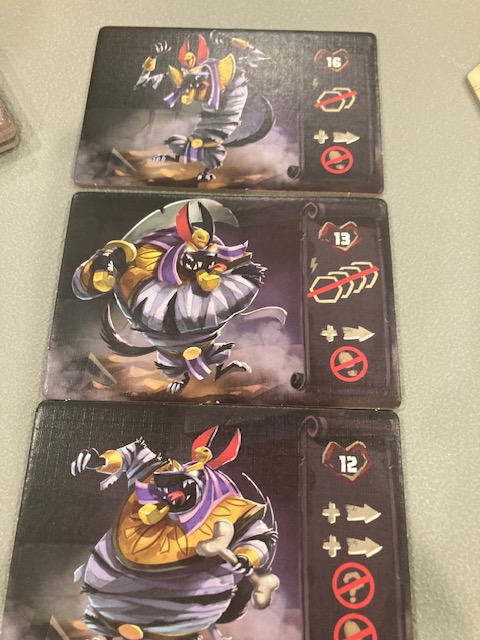
This is also a cooperative boss-battler game: you will face one of the three Final Boss Mummy’s above! To win, you have to take out the Final Boss before it makes it back to the Relic room!
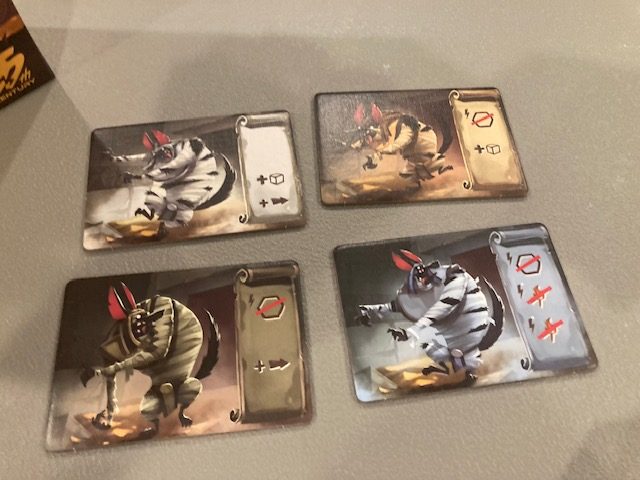
Along the way, lesser Mummies will be summoned to slow you down. If any of the Mummies ever make it to the room with the Relics of the Pharaoh, all players instantly lose! You need to keep all Mummies OUT of the that room!!
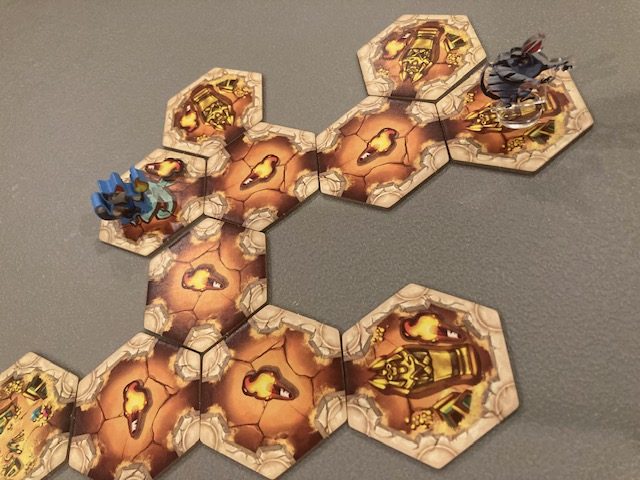
Players lay out tiles, one at a time, trying to build a maze out.
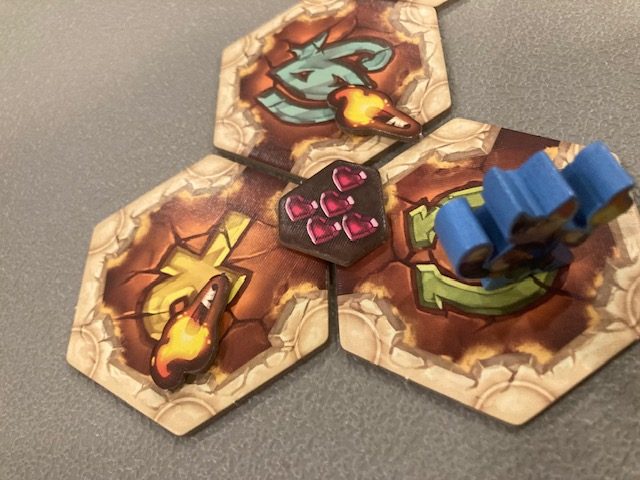
To unlock the Final Boss, you have to build three tiles adjacent to each other with different symbols! And you have to do this three times (or more)!! See above! This is the only way to unlock the Final Boss, but every time you do that build, you invoke a “trap”! See above as the Mummy summon triggers a “trap” that gives the Final Boss 5 more hit points!
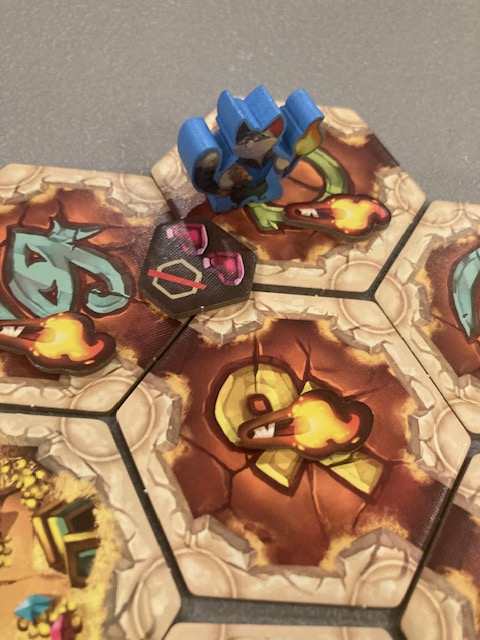
Torches are an important part of the game: you need to put torches in rooms to see! You start with 5 collective torches, and if you can’t place a torch, you get closer to summoning a Mummy!
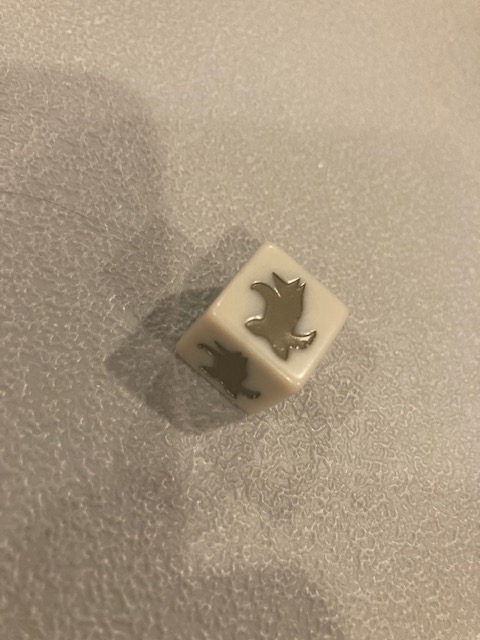
At the start of the Mummies’ turn, you roll a die (or more…)! If you roll the monster symbol (see above), you have to move all Mummies closer to the Relic Room AND you also come closer to summoning a new Mummy!
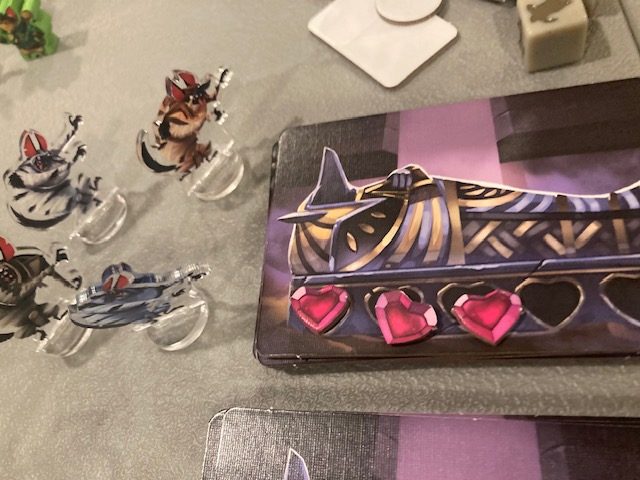
Every time you roll a monster, you have to put a heart on the current top Mummy tomb!
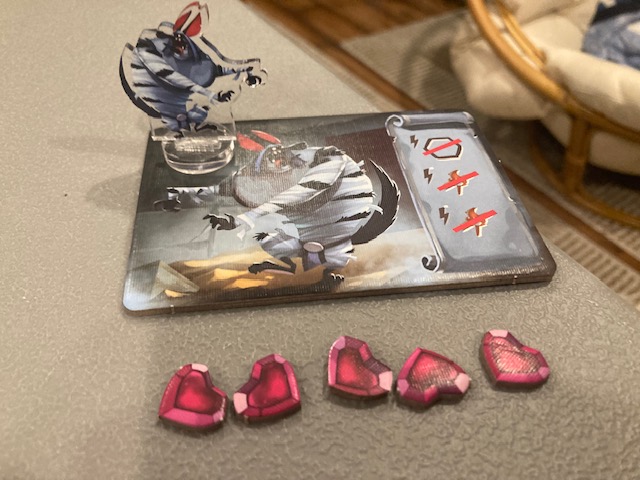
If a mummy get 5 hearts, it has been summoned the Mummy and that Mummy goes on the board! Where on the board? Player’s decide!
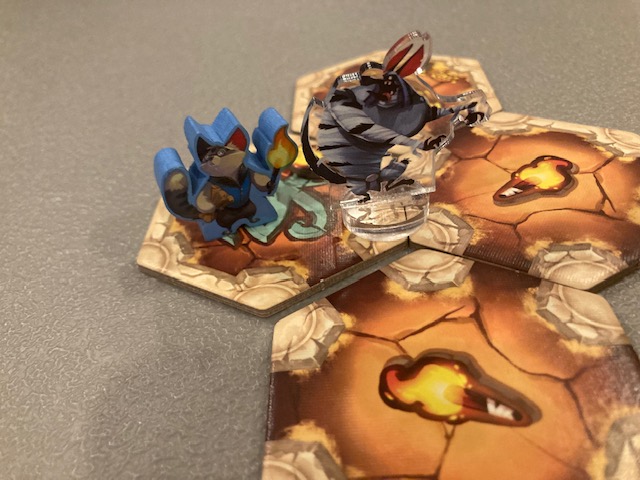
Usually you put the mummy as far away from the Relic Room as possible (see above), or right next to a Catventurer so they can fight it!
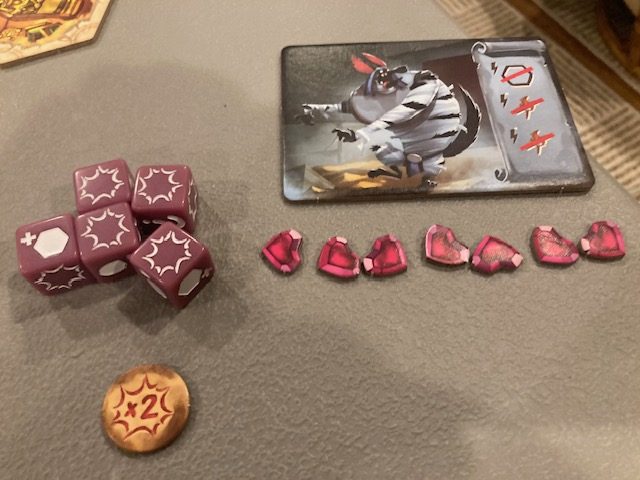
Mummies are defeated by rolling dice! See the attack dice above! Some symbols give you a successful Attack: note above we do 4 damage to a Mummy with 7 hit points! But since we have have the x2 token, we do all 8 damage and take it out in one shot!
How do we get dice?
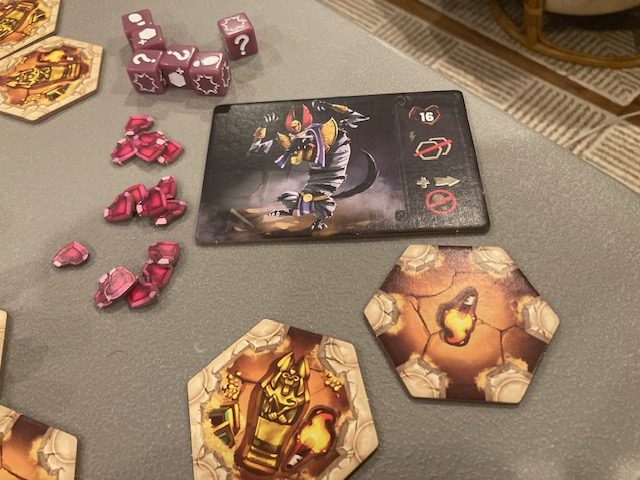
Every exit on a tile you discard give you an attack die! For example, to get all 6 attack die above, we can discard the one tile with all 6 exits to get all 6 dice (6 is the max).
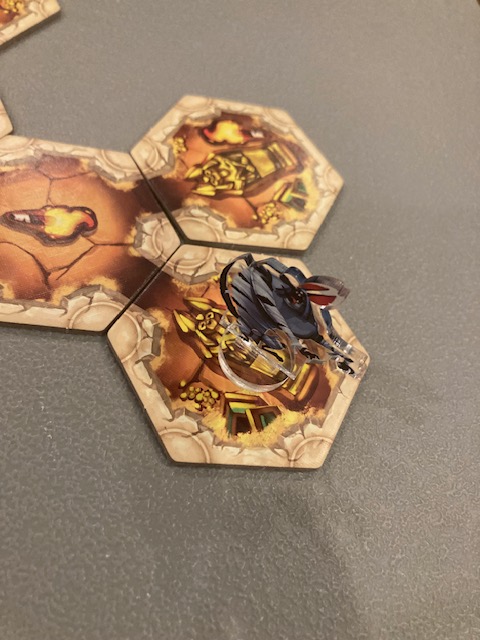
How did we get the x2 token? Whenever we explore a Sarcophagus room (with the little golden coffin, see above), we get a Sarcophagus token … one of which may be a 2x! See above!
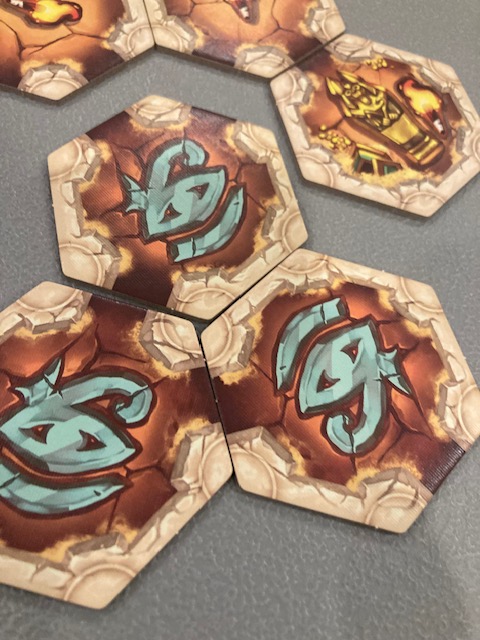
Oh yes, if we ever run out of torches, we can get new ones in a couple of ways. One: if we build three rooms adjacent (see above) the same symbol, we immediately get 5 torches!
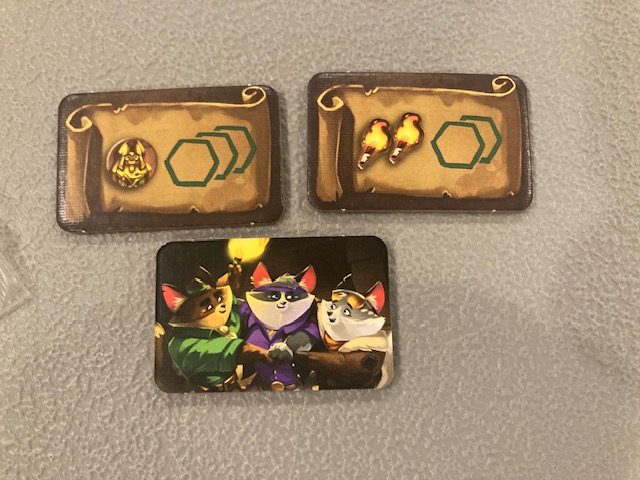
There’s also a cooperate action which can give more torches (or tiles if needed). See above.
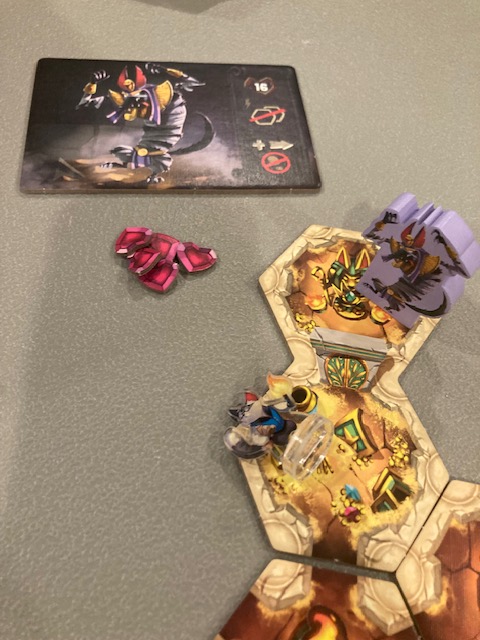
If we can take out the Final Boss before he reaches the Relic Room, we win! See above as we LOSE as the Mummy enters the Relic Room!
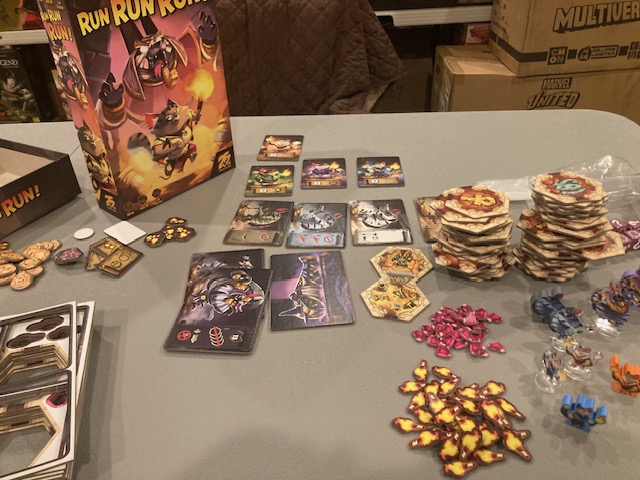
The production for this game is pretty great with tons of thick cardboard tokens! The art is super cute and the game looks like a high quality, but cute, production!
Oh, and this is a cooperative cat game! It may not be clear at first, but we are all cats working together!
Rulebook
The rulebook is good.
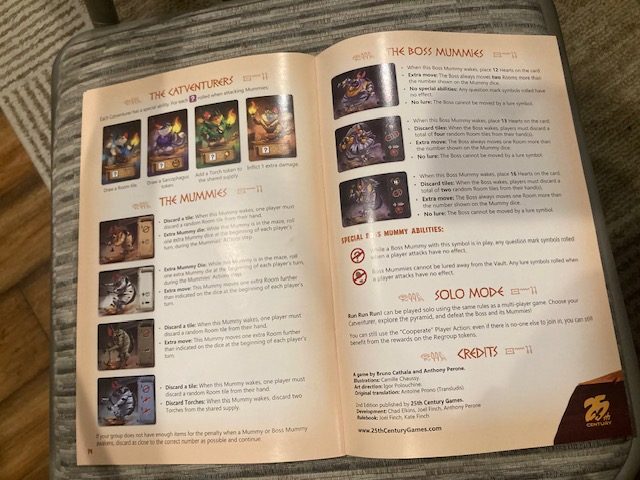
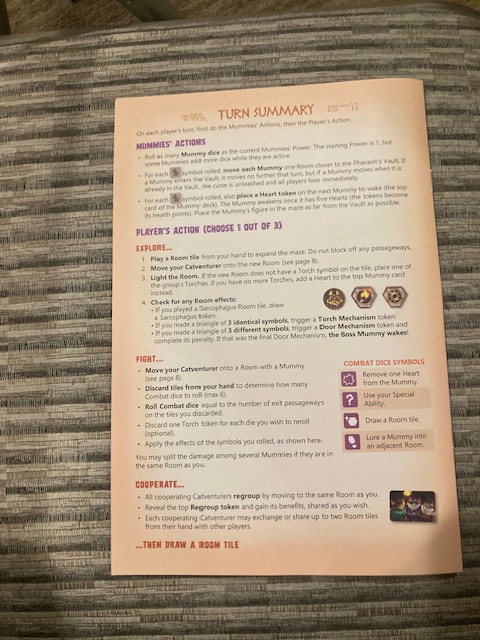
The rulebook gets an almost perfect score on the Chair Test with an A! See above as it fits perfectly on the chair next to me, it stays open, it has readable fonts, and it has good pictures! This would probably get an A+ on the Chair Test if the fonts were just a little bit bigger.
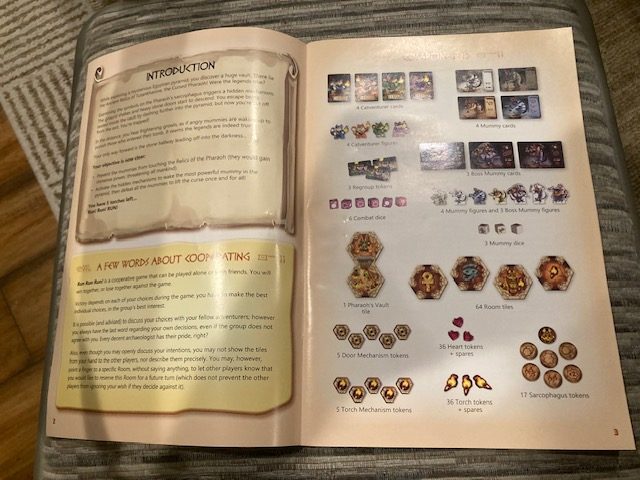
The Components page is great: it shows all the components with annotations. See above.
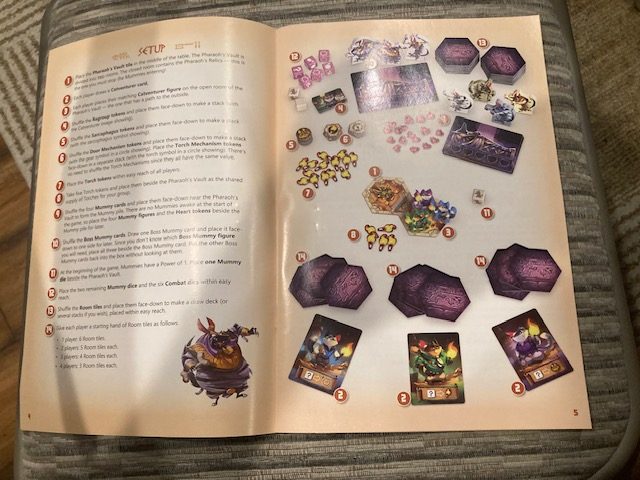
The set-up pages are perfect: the entire set-up is pictured and each step is labelled with a relevant number! I can leave this open, and set-up the entire game from these two pages!
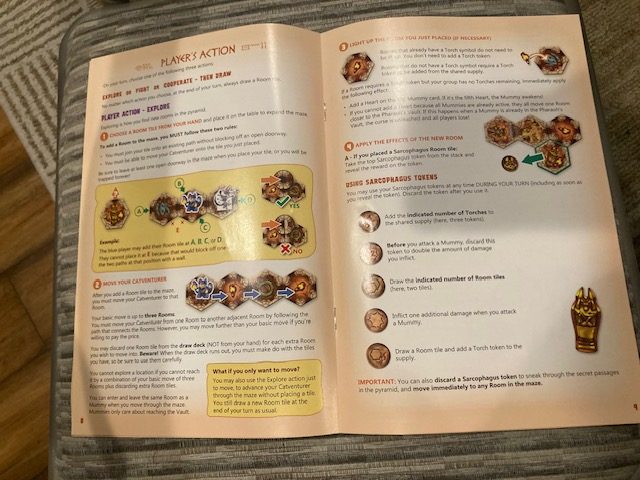
The rest of the rulebook is pretty good.
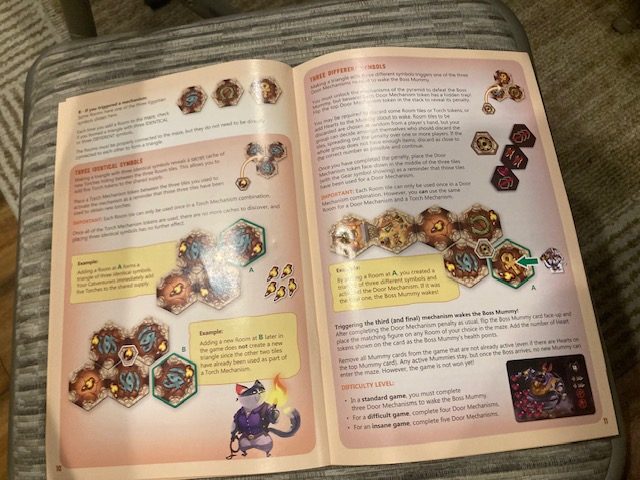
My only real complaint is that they didn’t show/explain all the possible Trap tokens that can come out. I had to “guess” what they meant. It was mostly intuitive, but not always.
The last page of the rulebook is useful: this is where I wish they would listed all the trap and Sarcophagus tokens with more description. Still, at least the back of the rules was useful.
There’s no index, but this is a 30 minute game, so I don’t think it needs it.
In general, this is a good rulebook.
Solo Play
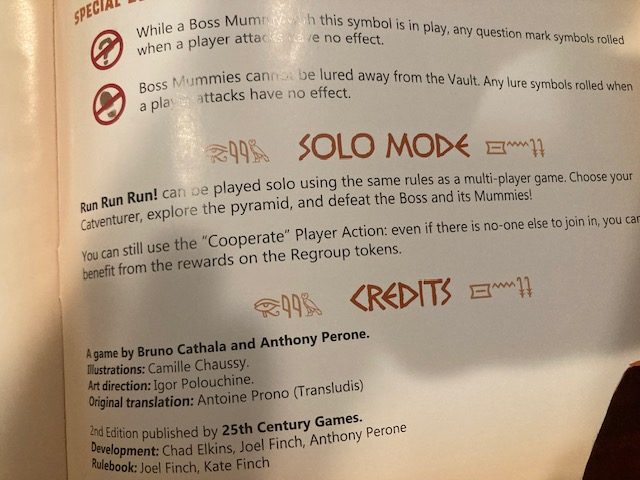
This has a solo mode! (Congratulations on following Saunders’ Law!). So, there’s a very small section describing the Solo Mode on the very last page of the rulebook. See above. The solo game basically plays true solo: you play one Catventurer (the Cat Explorer) and play the game as-is! The only rule that needs some “slight” expansion is the COOPERATE action: you can still play the COOPERATE action, but only the solo cat gets the rewards! This is great! No real changes: just play the game as-is!
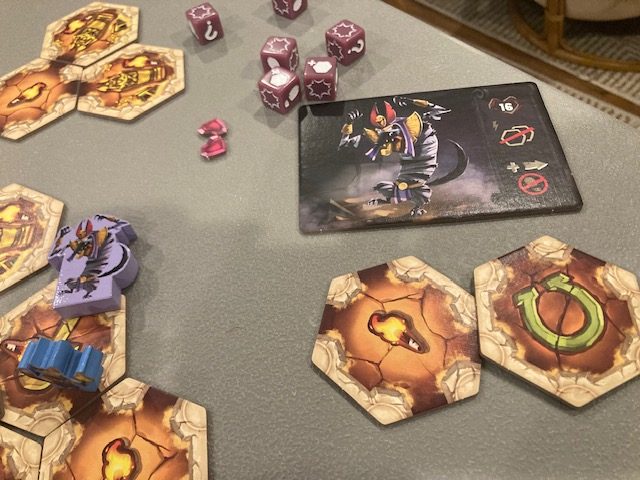
My first game was a win, as I killed the final Mummy on his way to the end! See above!
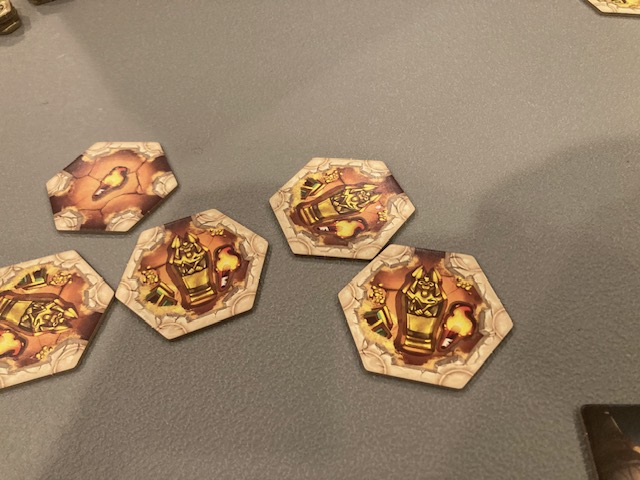
My initial tile selection wasn’t great (as only one room has more than one exit), but I soon got a lot more branching rooms. I also had a lot of Sarcophagus rooms …
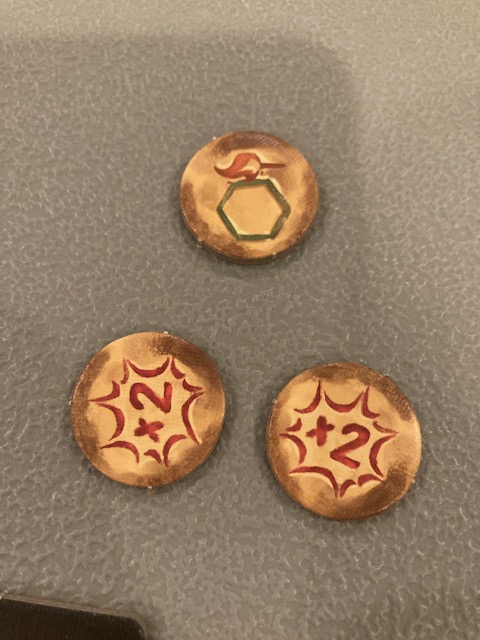
Those Sarcophagus rooms enabled me to get some great tokens at the start of the game! I saved those 2x tokens for the end game, because I knew how hard the final Mummy would be!
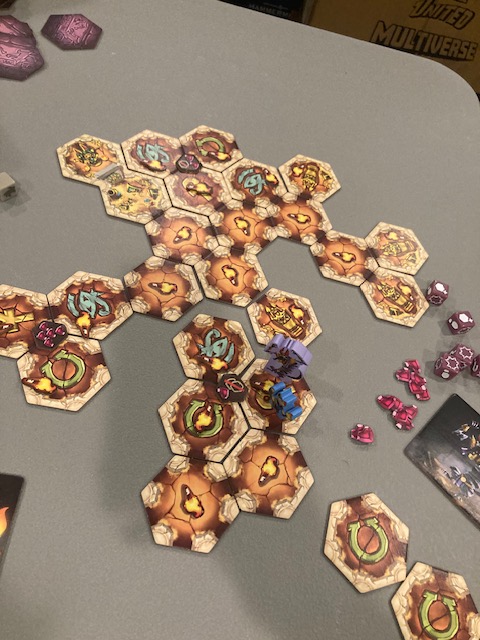
I played my first game very well: I kept the Mummy’s under control and I had plenty of tiles going into the final battle, and I was able to build enough space so that the Mummies were far enough back that I could take them out!
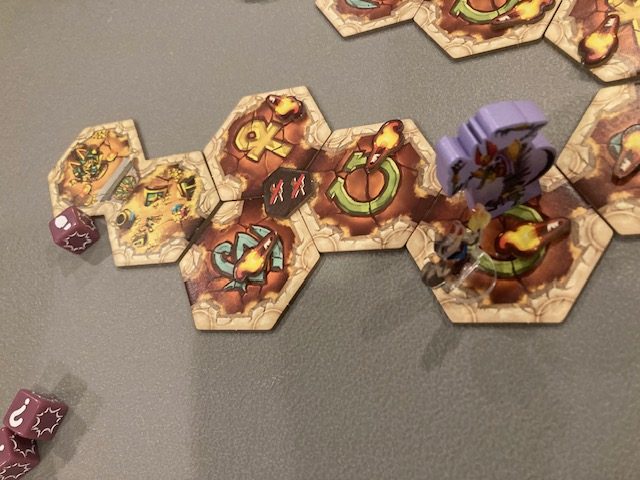
My second game was a close loss: I made the mistake of not having enough of the temple built!
I was able to knock the Mummy down to 5 hit points, but he just moved too fast! He made it to the Relic Room and I lost! See above!
I admit my final loss was depressing because I rolled so poorly; not on the Attack dice but on the Mummy movement! It’s basically a 50% chance that the Mummy will move every turn, and he moved EVERY TURN after he came out! The Mummy screamed to the exit and I lost!
Cooperative Play

Cooperative play went pretty well.

There was shared workload setting up and playing. There are enough components in the game (torches, tiles, 5x torch, sarcophagus tokens, mummies, player tokens, etc) that it was nice to share the workload of taking care of the tokens.

We were able to take out the final mummy!
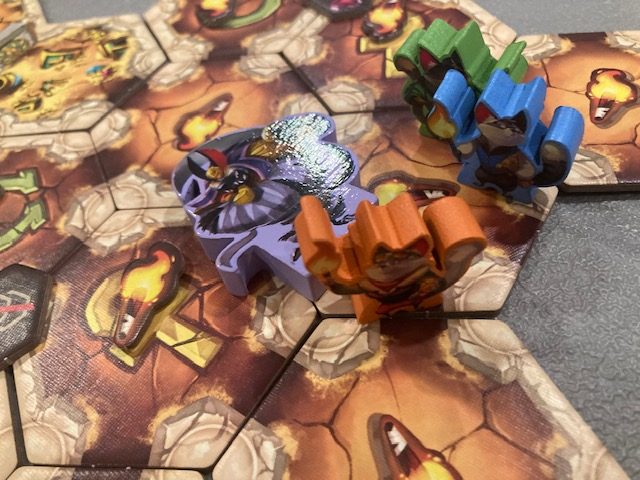
Basically, after he came out, were were able to all pounce on him and do as much damage as we could!
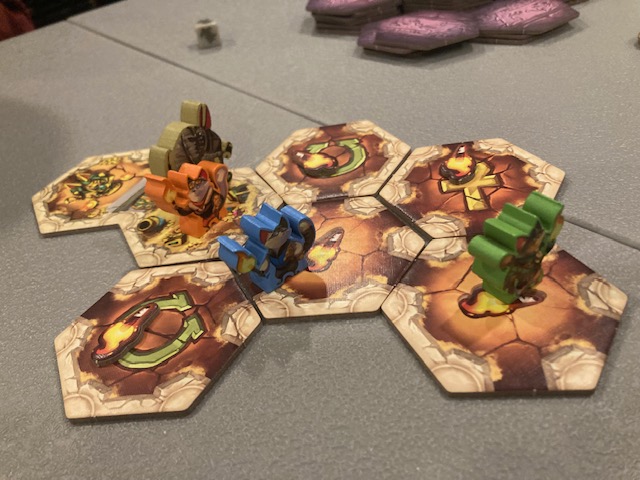
The cooperation in this game was interesting. We didn’t “love” that you couldn’t talk about the tiles you have, but you were allowed to “point” to to where you were going to build, and that seemed enough to allow us to all move forward. There was never any “fine-grained” cooperation (“I’ll build this tile, you build this tile”) as we played … because there can’t be! The cooperation was more “coarse-grained” in that each cat did their own thing on the way to helping the party: “I’ll take out the light mummy if you can just build! Oh! I need help with this!” The game was kind-of multiplayer solitaire with many moments of high-level cooperation.
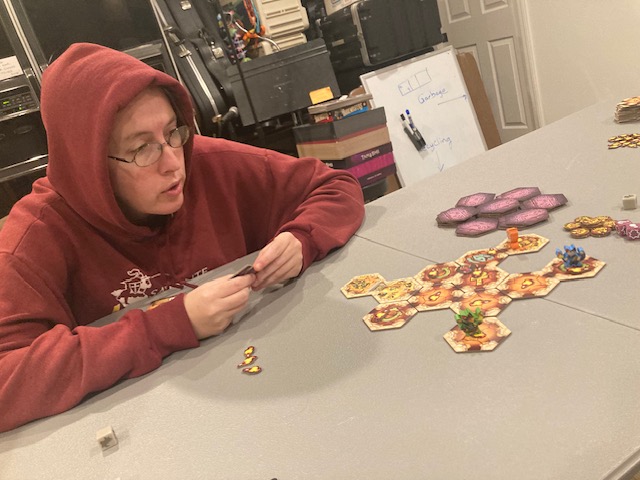
If you don’t like cooperative games because of Alpha Player Syndrome (because the Alpha Player tells everyone what to do), then Run Run Run! is game that keeps the Alpha Player at bay pretty well. Because you can’t do any fine-grain cooperation with tiles, the group decides more of the high-level actions together! Everyone stays involved on their turn by choosing the tile to play, but everyone stays involved with the group as they makes high-level decisions together.
With some retrospective, I liked the amount of cooperation the game elicited, even if we did have some communication restrictions.
Communications Restrictions
My groups don’t tend to like communications restrictions because we get together to play, talk, and strategize together! We are friends and we want to talk to each other! Some games with communications restrictions work, and some don’t! And it’s a razor’s edge of difference.

Run Run Run! works mainly because it doesn’t stop all communications: you can’t really show your tiles and talk about them precisely. The rule is (from page 2):
“Also, even though you may openly discuss your intentions, you may not show the tiles from your hand to the other players, nor describe them precisely. You may, however, point a finger to a specific Room, without saying anything…”
The rule is still imprecise (“What does it mean I can’t describe them precisely? Can I tell you it’s a symbol?“), but I think the intent seems to be don’t tell/show others your hand. Other than that, talk as much as you want! That seems to work!
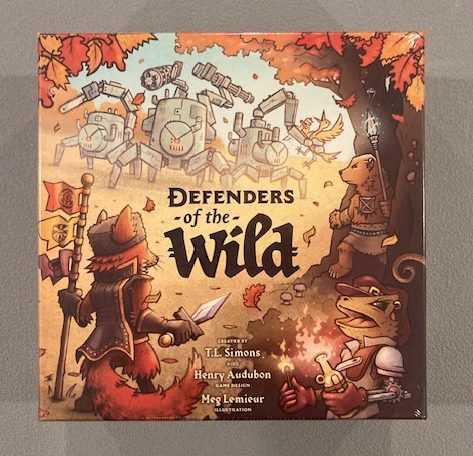
Compare this against the Communications Restrictions in Defenders of the Wild (see our review here):
“At the start of each round, all players must cease communication and maintain silence while choosing a defender card from their hand to play…”
The restriction is much more draconian, and squanders an opportunity to make a multi-player solitaire game even more cooperative!
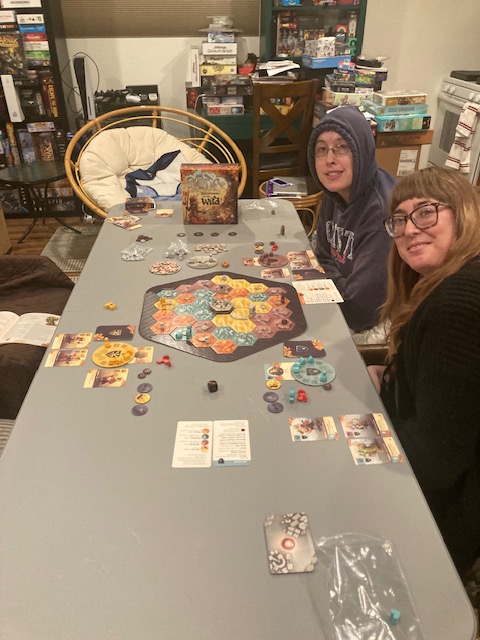
What’s the difference? In Run Run Run!, you simply can’t share your tiles, but in Defenders of the Wild, you can’t talk at all (for that phase)!! I think this very minor difference makes a world of difference: I liked playing and talking and cooperating in Run Run Run!, and I am annoyed in Defenders of the Wild by the restriction. (I still don’t think the communications restriction rules work at all in Defenders of the Wild, but maybe the rule should have been simply been “You can’t show/discuss your Defenders“).
It’s a fine line, but the Communications Restriction works in Run Run Run!, but not in Defenders of the Wild.
Try It Out
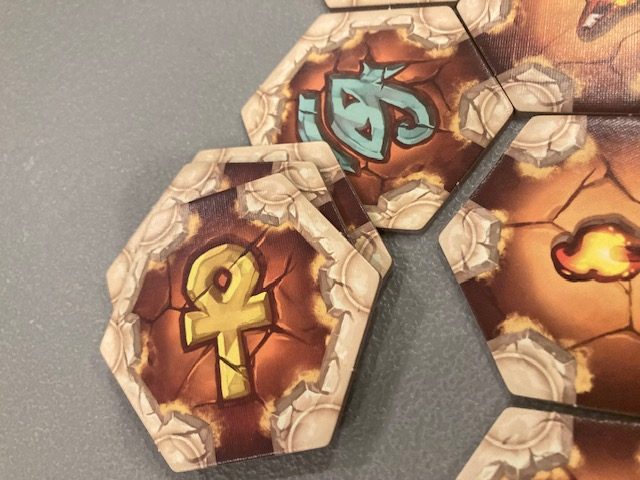
Since this game has communication restrictions, one of the things you are NOT allowed to do it show your tiles to any other person. The problem is, sometimes you want to “try stuff out!” See above as we have a bunch of tiles we want to play with and see what we can do!
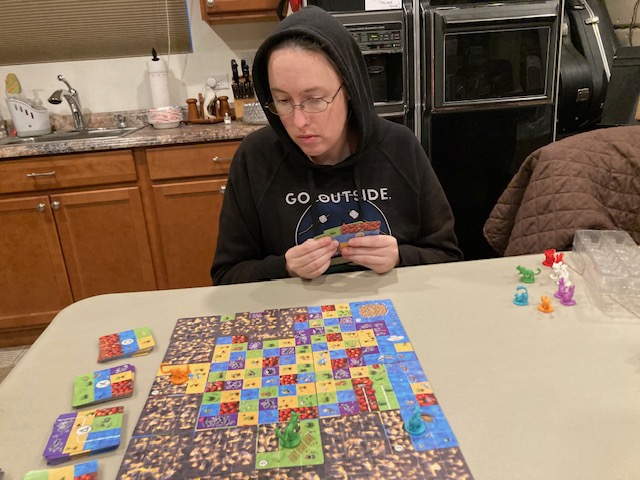
In our review of Race To The Raft (another cooperative cat game with tile-laying), we saw the same problem! You aren’t allowed to share what you have in your hand in Race To The Raft either, and many times you want to “try” stuff out!
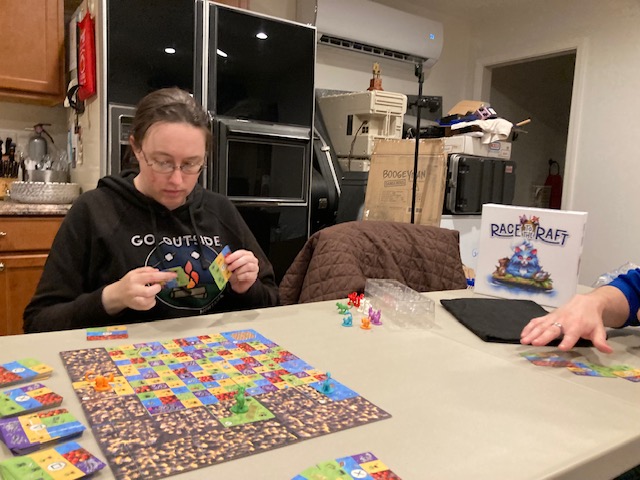
In Race To The Raft, we developed the house rule “look away while I try stuff” so we didn’t break the spirit of the game! That way, you can still try stuff out, while preserving the confidentiality of the tiles. We ended up doing something like this in Run Run Run!
It’s a shame: neither Run Run Run! nor Race To The Raft nor many of the cooperative tile games games on our Top 10 Cooperative Tile-Laying/Tile-Placement Games have any acknowledgement of this very human phenomenon: People want to try stuff out! Please, if you make a cooperative tile-laying game, please have some sort of rule for addressing this issue:
“If you wish to try out some tile layout ideas on your turn, please ask others to look away so you don’t overshare your tiles!”
Otherwise, you make people dislike your game because no one feels like they can “play with” and/or “try stuff”! Or people come up with a house rule like the one above anyways.
Acrylic Standees
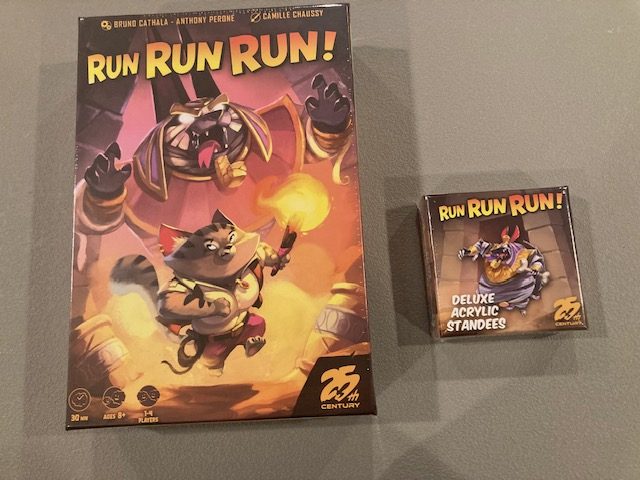
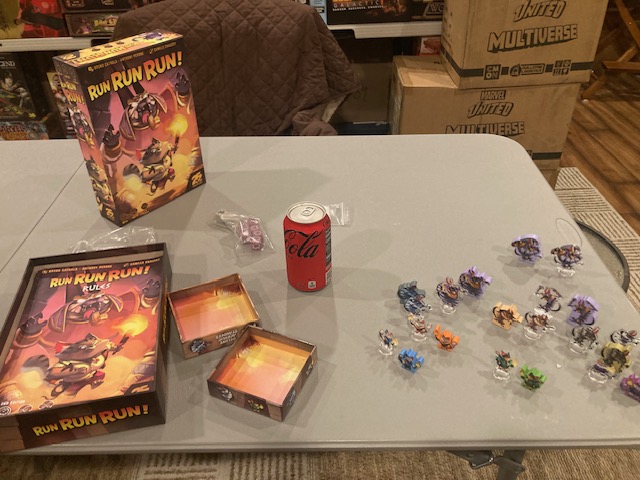
I am a huge fan of acrylic standees! I loved them in Tokyo Sidekick (see review here) and Kinfire Chronicles (see review here) and Weirdwood Manor (see review here)! So, when this Kickstarter offered a deluxe side of Acrylic Standees, I was in!
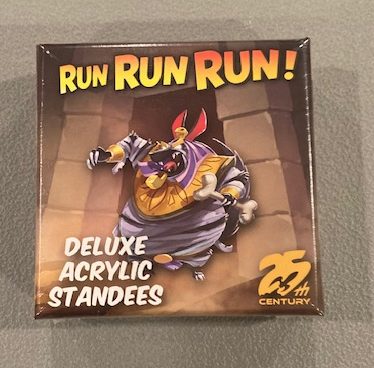
This is a small box full of replacements for the wood standees that come with the game.
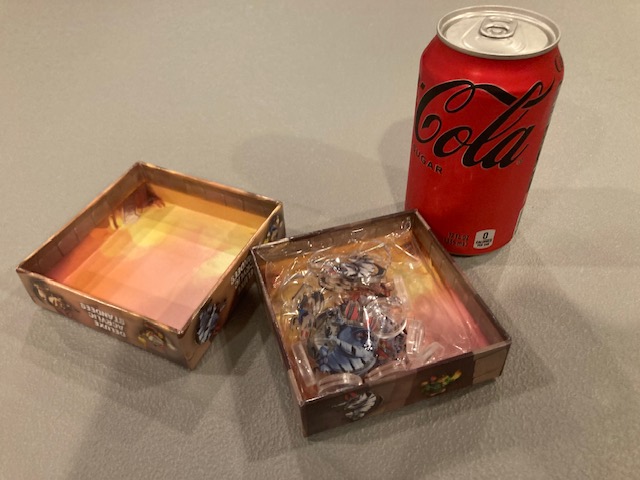
It’s a small box (it turns out, you can fit that box into the final game box with some creative packing).
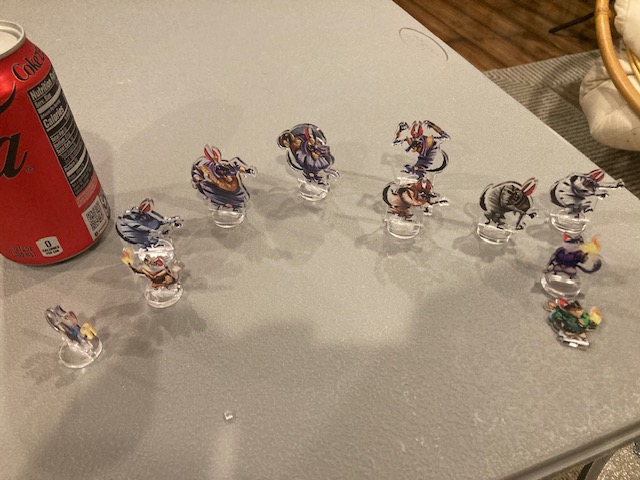
See above the the standees!
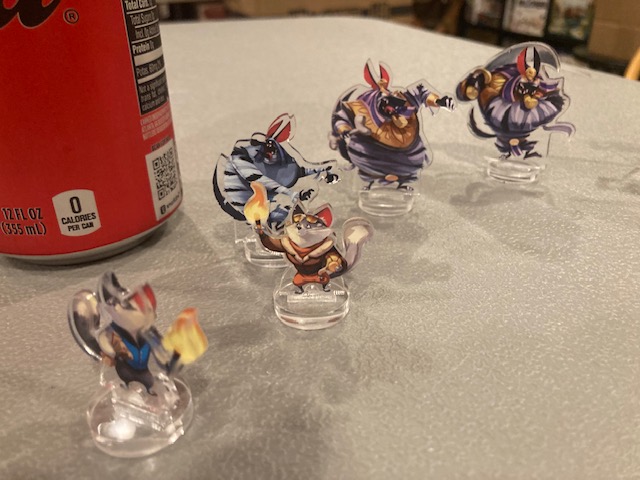
They are pretty nice! See above!
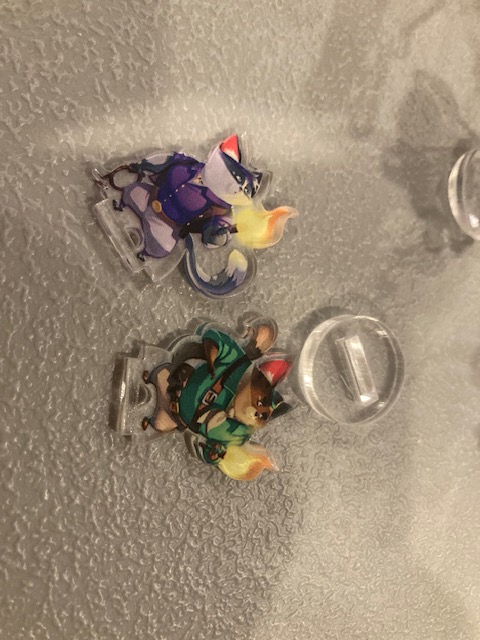
Unfortunately, I had two that were broken. I think they can be fixed with a little glue, but it was still a bummer. (They had fallen out if their standees, and they really didn’t fit back in).
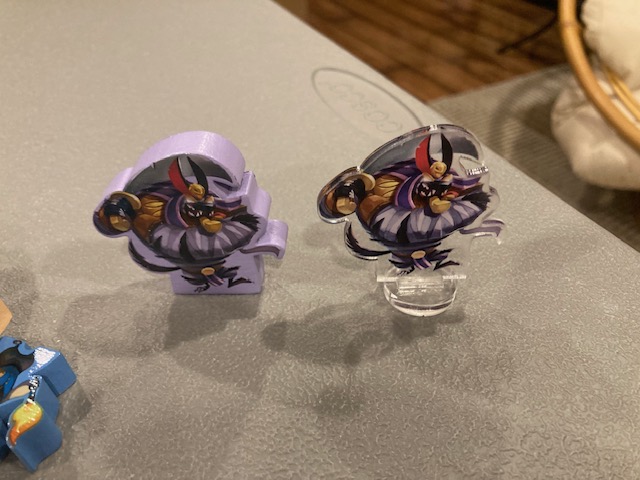
My friends and I did a comparison of the Acrylic Standees to the wood meeples: see above and below.
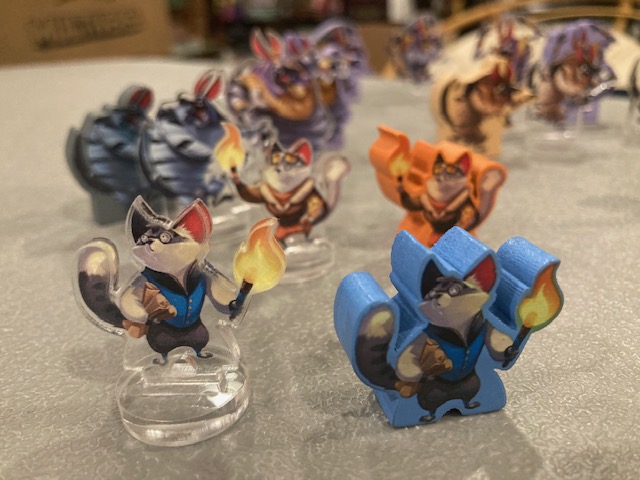
Which do you prefer?
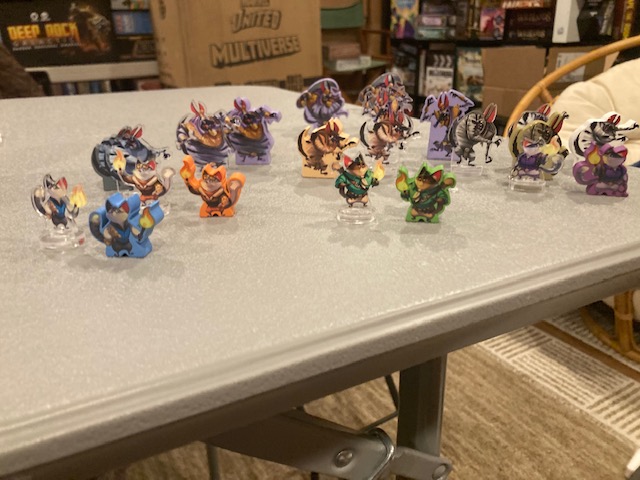
In the end … both me and friends preferred the COLORED wooden meeples. Whaaaattttt???? It’s not that the acrylic standees weren’t gorgeous, but the wooden ones were (1) more HEFTY and (2) we could distinguish the colors easily from the wooden standees! The wooden meeples made the game easier to play.
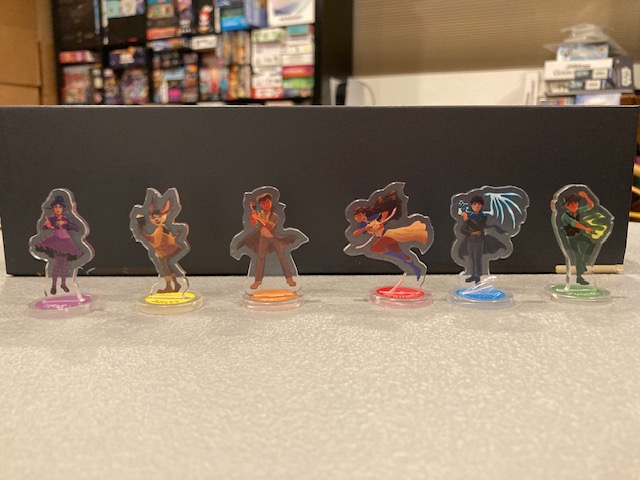
In our review of Weirdwood Manor, we also loved the Acrylic Standees! See above! One of the major differences here as that Weirdwood Manor standees are color-coded ON THE BASE! See above! This color-coded base makes it that much easier to distinguish the standees across the table! I think if Run Run Run! had added color to bases, that would have made them that much better!
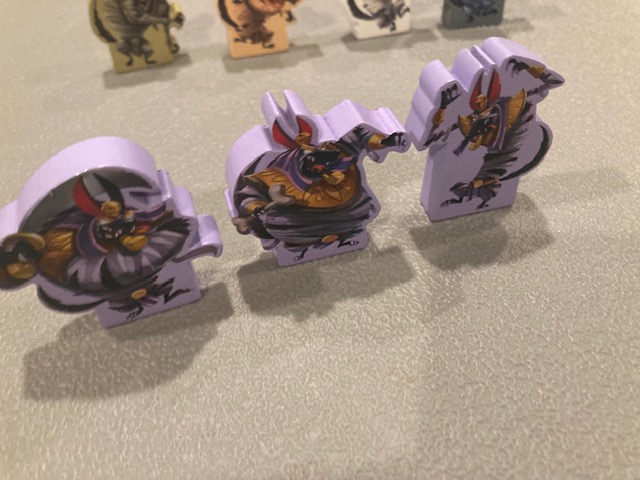
In the end, my friends preferred the wooden meeples. And I think I do too.
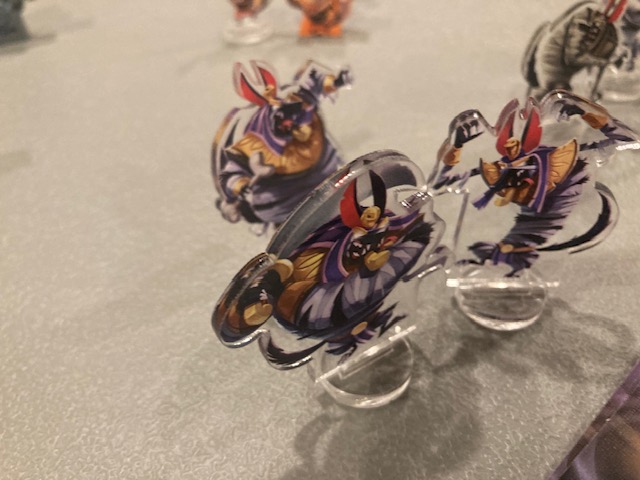
A good compromise might be to mix them: use the wooden meeples for the characters (so you can see each player’s color very easily) and then use the acrylic standees for the mummies! That way, you get a nice differentiation on the board between the good guys and the bad guys!
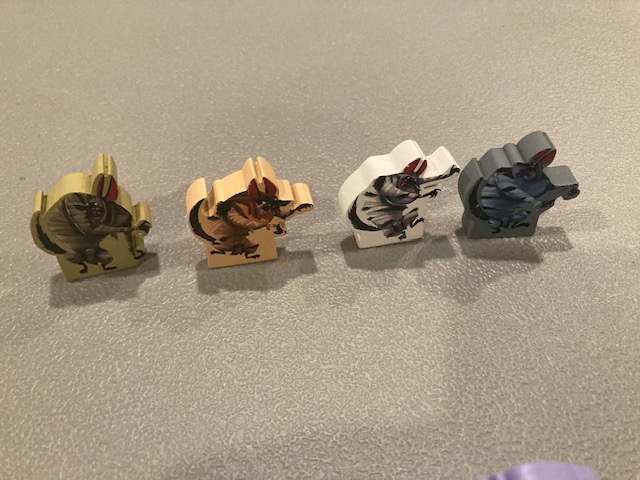
But, you really don’t have to get the Acrylic Standees; the wooden meeples that come the game are very very very good.
What I Liked
One: This Is A Little game! This is a fun little cooperative game that’s only 30 minutes.
Two: Wooden Standees: The wooden standees that come with the game are much better than you think; it is nice that you have the option for Acrylic standees, but you don’t need them.
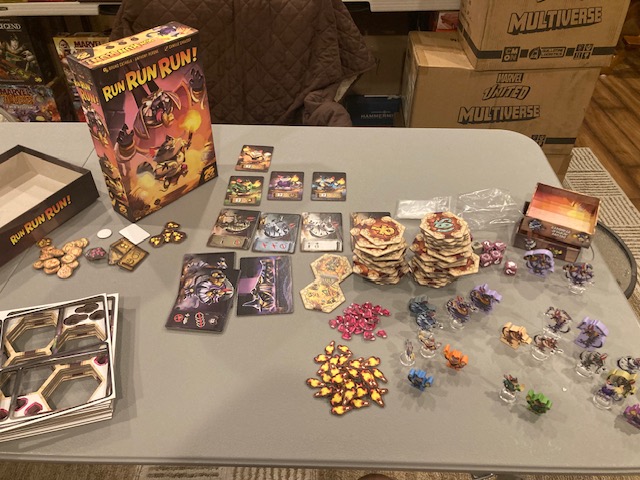
Three: High Quality: The components are pretty high-quality, from thick cardboard tiles, wooden standees, and thick readable tokens.
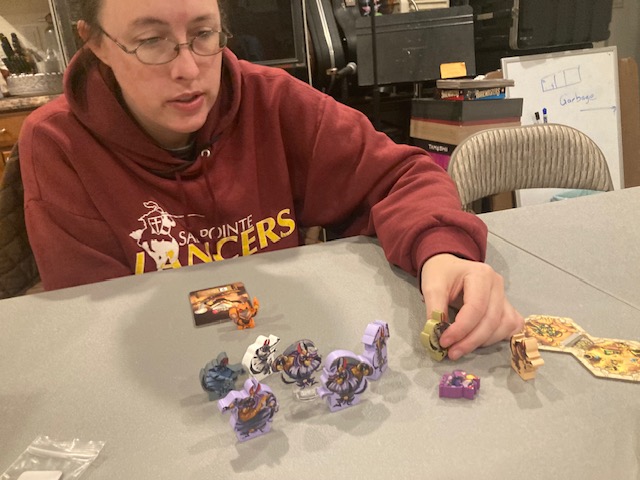
Four: Limitations Okay: I generally don’t like Communications Limitations in my cooperative games, as they tend to suppress the reason I get together with my friends: to talk! In this game, the restriction on NOT sharing your tiles didn’t seem to get in the way of us still communicating: we still made plans as a group and had a good time.
What I Didn’t Like
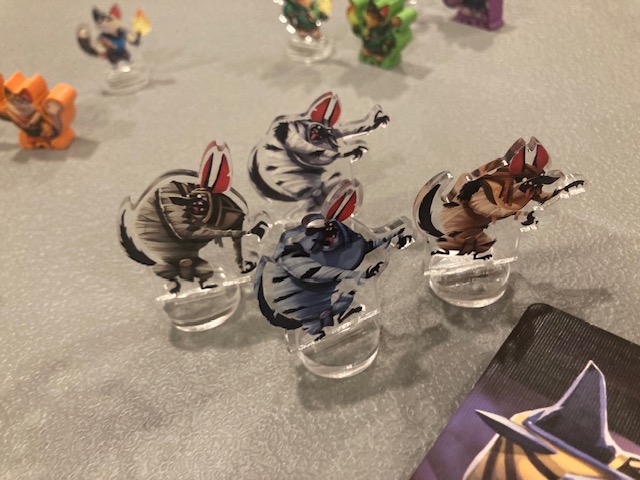
One: Acrylic Standees: I am slightly annoyed that the Acrylic Standees weren’t better: some of mine were broken, and they really needed colored bases to help distinguish them on the board. They are still gorgeous, but not as “mind-blowing” as I had hoped.
Two: Random. The game is pretty random; it all depends on what you roll on the monster dice and what tiles you draw!!!
Maybe you get terrible starting tiles!! I think there needs to be a Mulligan House Rule at the start of the game where you can redraw your tiles).
Also, the monster dice gets rolled every turn and there’s a 50-50 chance (greater with more dice) that something bad will happen. I lost my last solo game because the monster moved EVERY SINGLE TURN when I rolled badly 5 turns in a row! I simply couldn’t stop him and there’s no dice mitigation for that!
Reactions
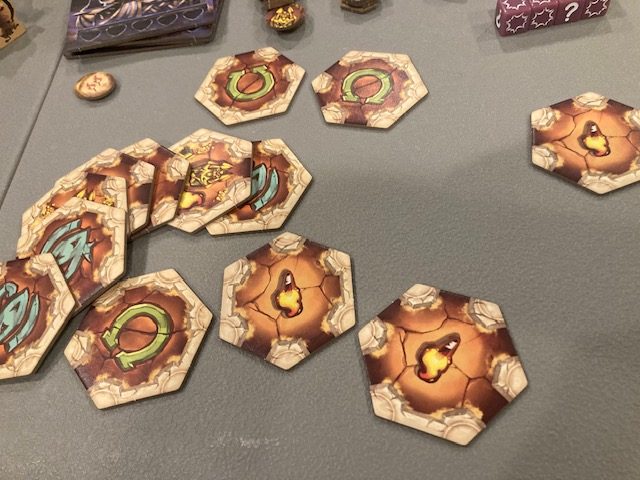
Rich: “I generally liked it. As I look reflect back on it, I liked it a little better cooperatively than solo. Even though I generally don’t like communications limits, we still strategized as a group and were able to get stuff done, while still having agency on our own turns. The randomness of the game is a little much (as dice and tile draws control the fate of the party), but since it’s only 30 minute game, it’s not a big deal if you get wrecked. It’s probably a 6.5/10 for solo, 7/10 for cooperative”
Andrew: “5.5 or 6? It was pretty good. I like cat games.”
Teresa: “6 or 7, it was pretty fun.”
Conclusion
Run Run Run! is a light cooperative tile-playing game which just so happens to be a boss battler. The game seems to unfold as multi-player solitaire, as each player cannot share what tiles they have. But, a higher level cooperation seems to emerge as players take on high-level roles as they play (“You kill the mummy, I’ll build out!“) If you are looking for a game with mechanisms that tend to suppress Alpha Player Syndrome without losing too much cooperation, Run Run Run! seems to strike a good balance of being cooperative but still giving each player some agency.
There is some randomness in the game, as it really depends what you roll and draw! Luckily, this is only a 30 minute game, so even if you get wrecked, it’s a short game.
I would recommend Run Run Run! if you like the theme and are looking for a light cooperative tile-laying game … with cats!! I am very sad that I can’t recommend the Arcylic Standees: all of my friends (and myself) preferred the wooden meeples that come with the game.
Run Run Run! would probably make my Top 10 Cooperative Tile-Laying/Tile-Placement Games, just not near the top of the list.
 coopgestalt