
Over the course of a few weeks, I played Lord of the Rings: Fate of the Fellowship many many many times and different ways trying to find the joy and fun. I have to admit, it was an Epic Struggle! I gave this game way more chances than I should have because of its theme and designer, but I struggled with it. Follow me in my journey to see if I keep Lord of the Rings: Fate of the Fellowship in my collection or throw it into Mount Doom along with the Ring!
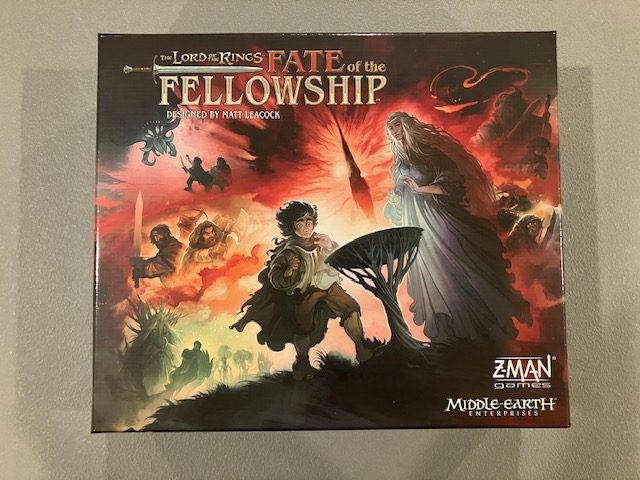
My journey to play Lord of the Rings: Fate of the Fellowship began back in January 24, 2025! The game was up for pre-order on the Asmodee web site, and I pre-ordered with an expectation that it would arrive in late May or early June (as was the original promise).
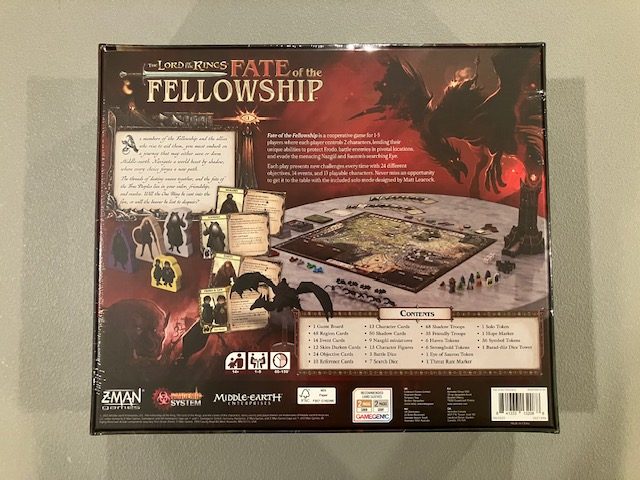
Well, things changed (Asmodee had trouble shipping) and it didn’t deliver to me until Monday August 19th. This was frustrating because I had seen SO MANY people put up reviews on BGG, and yet, as a paying customer who ordered early, I didn’t get mine until 7 or 8 months later.
I was very excited for this: this is a game in the Pandemic System (see above)! What that means is that it’s not quite Pandemic, but if you squint, you can see the elements of Pandemic in the game! I generally love Pandemic and its ilk (see reviews of Pandemic: Ibera, Star Wars : The Clone Wars Pandemic, and World of Warcraft Pandemic), but I have not loved all Pandemics (see our review of Freedom Five). Will this be a good Pandemic or a bad Pandemic? (What a strange sentence)
Let’s follow this Journey!
Rulebook
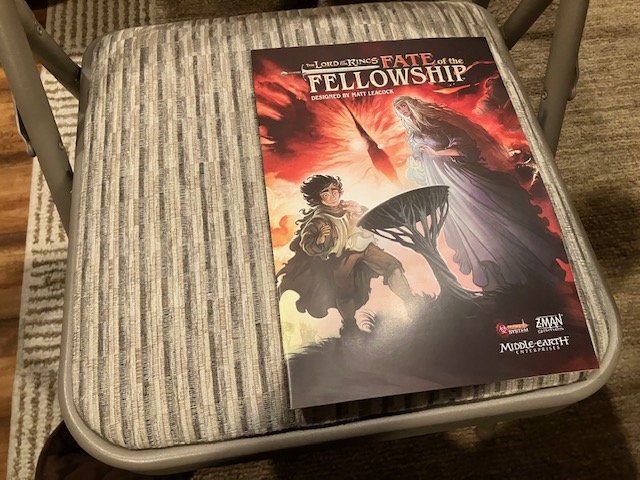
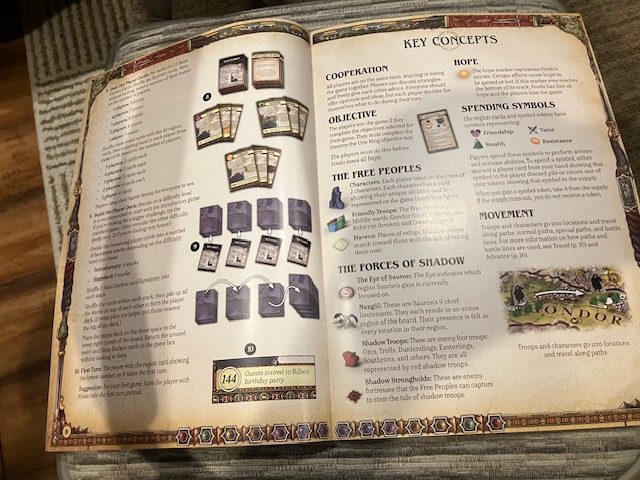
The rulebook is very good and is the first thing you see when you unpack the game. This rulebook gets an A on the Chair Test!
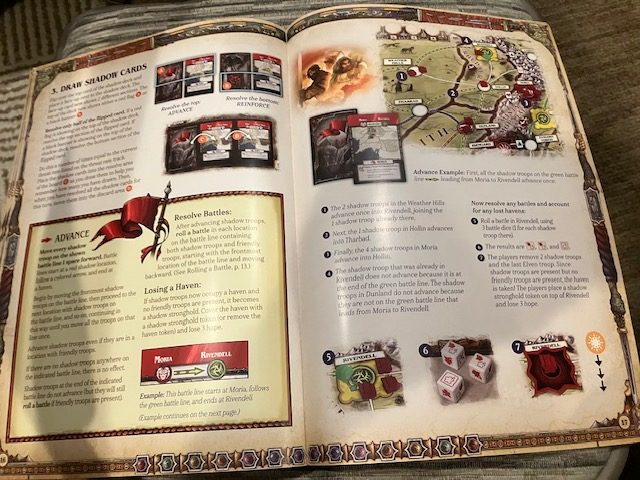
The rulebook opens up and stays open on the chair next to me. The font is big, the pictures are well-annotated, and it’s easy to read on the chair next to me!
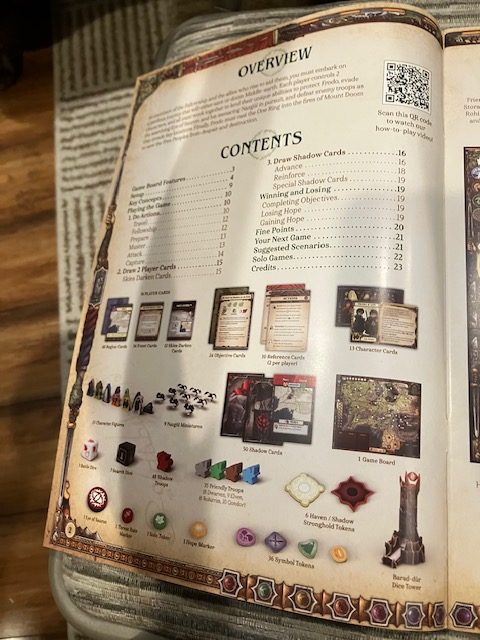
The Component page is well-labelled with pictures and text: see above.
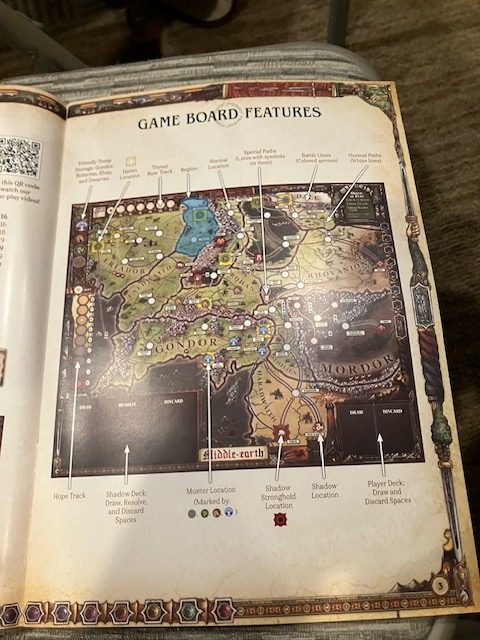
The Game Board Features is really nice as you try to understand this world.
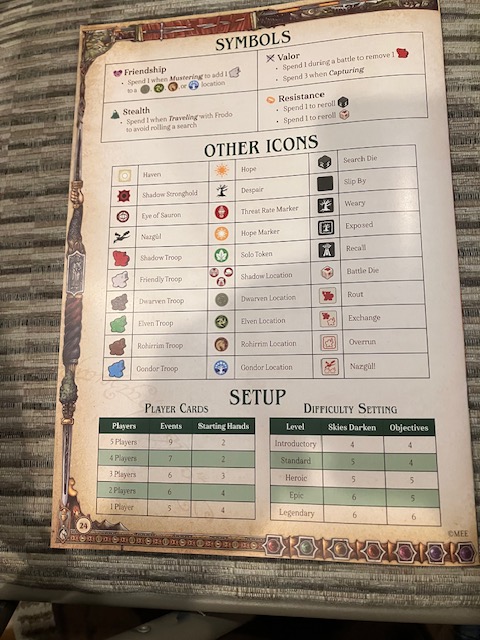
Generally, this was a good rulebook with a Table of contents (yay), but no Index (boo!). The back of the rulebook shows useful info and icons.
There is one issue with solo rules that’s not well-specified (see below).
Generally, this was a good rulebook.
Unboxing and Set-Up: Building the Dice Tower!
Total time: it took me about 2 hours to unbox and set-up for my first game
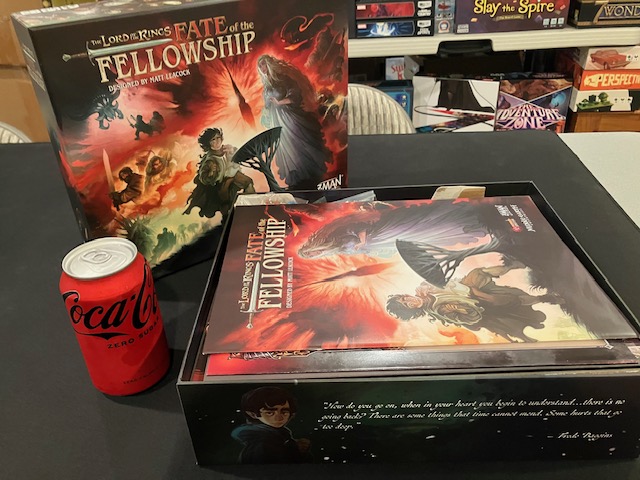
See Box above with Can of Coke for scale.
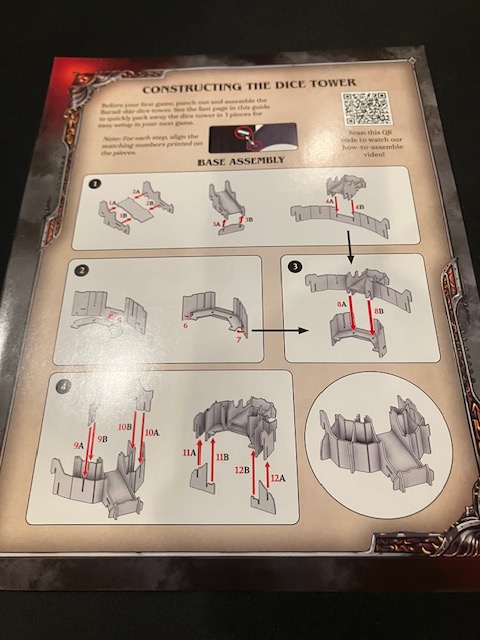
The first part of the game unboxing was building the dice tower: this consumed about 20 minutes! The directions are pretty good, but it was annoying. Unfortunately, this was a little foreshadowing for the game itself.
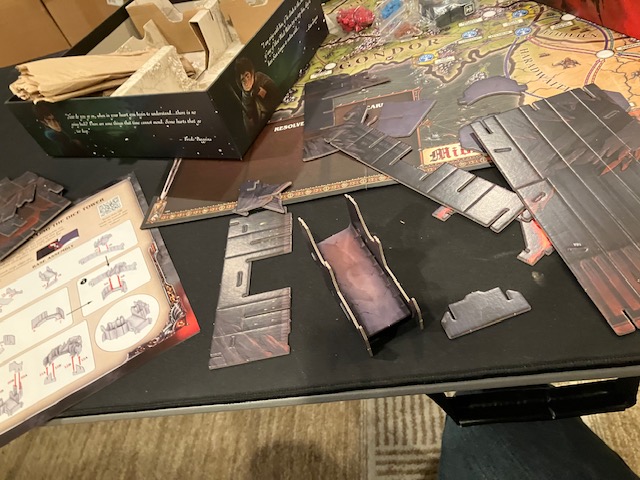
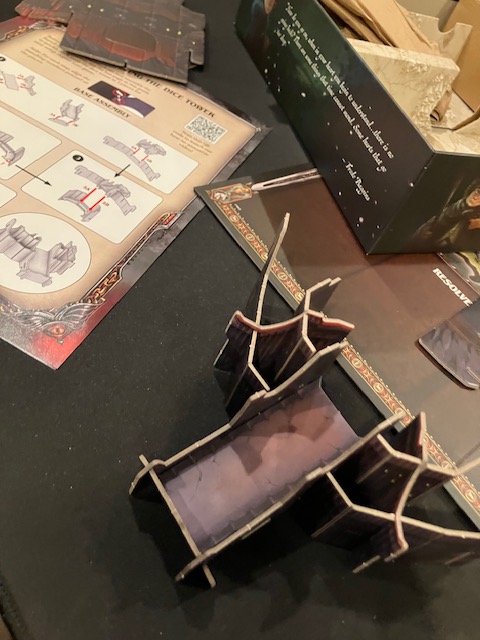
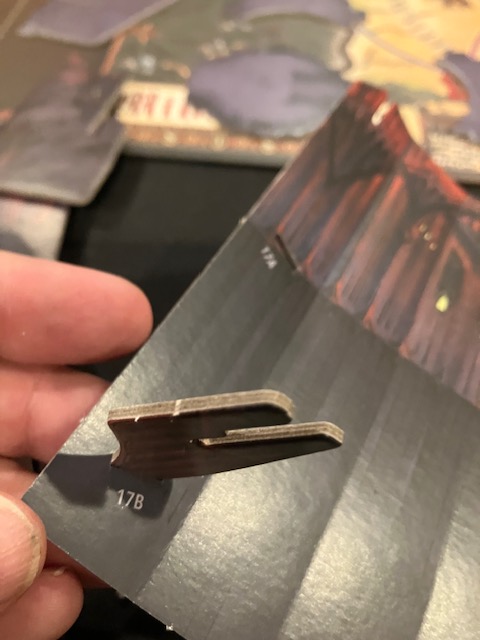
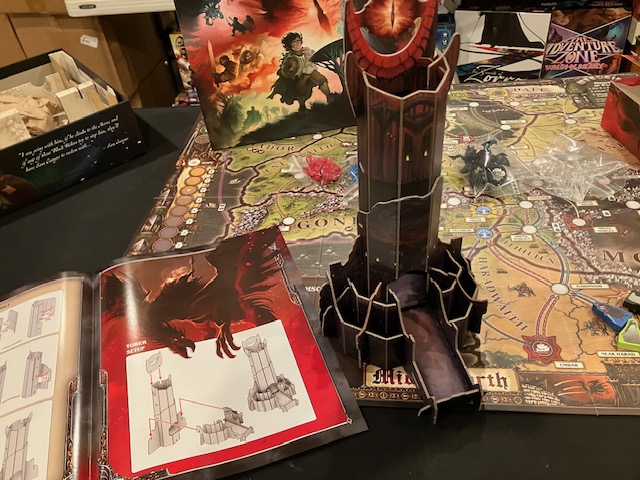
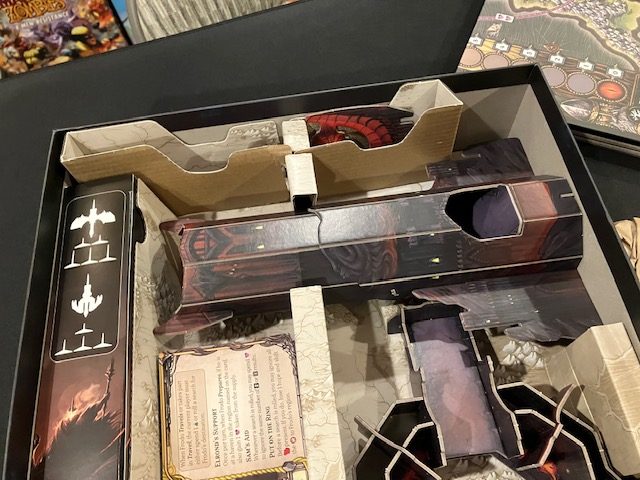
In the end, the Dice Tower looks really cool (see above), but holy cow, this was kind of annoying to build. Once you’ve built it, it does come apart easily and go back into the box (in 3 pieces: see below).
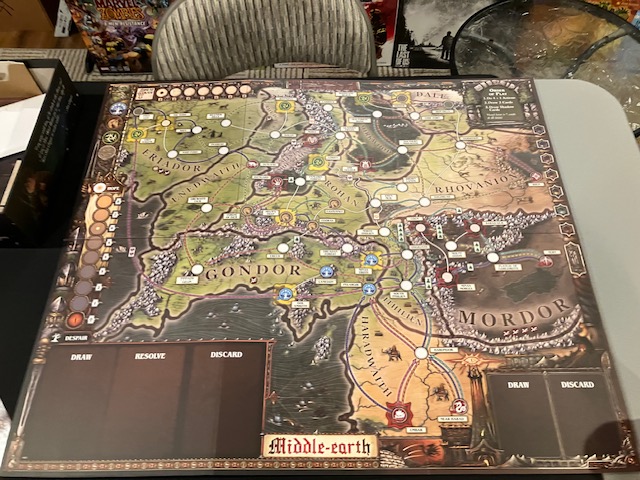
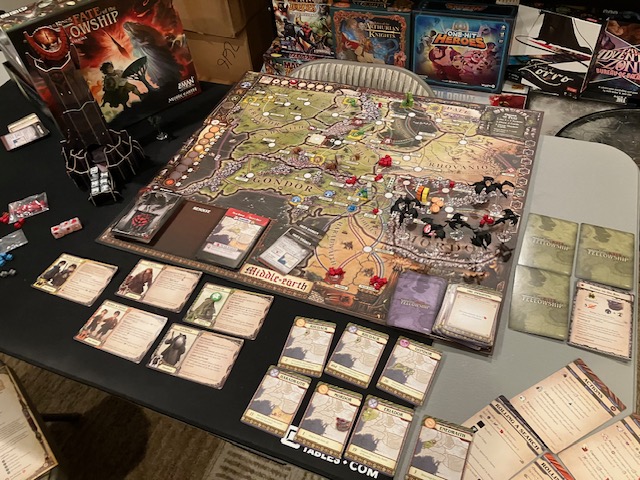
The board is a huge 6-fold board. It’s very busy and very daunting at first glance: see above. It does get better once you get to know the board, but, yes, it is very busy.
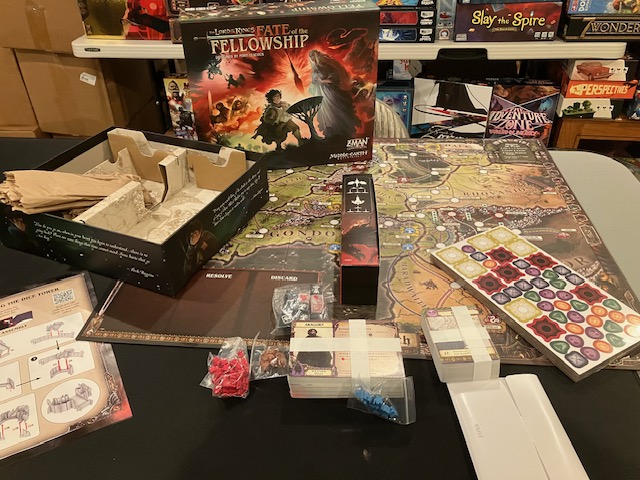
I was told by my friends who LOVE Lord of the Rings that this board is very accurate and consistent with the map at the front of the books.
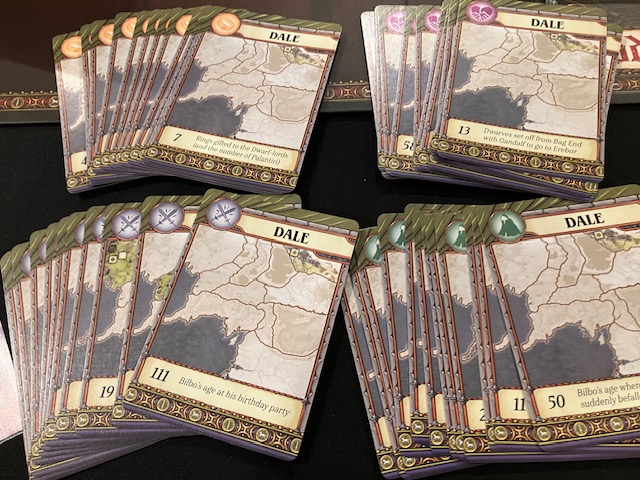
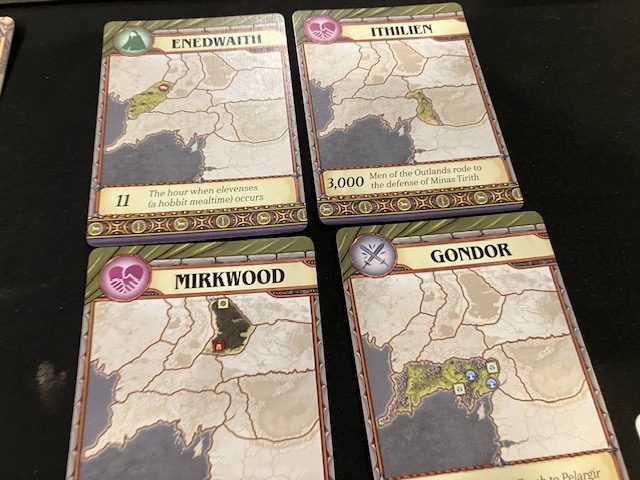
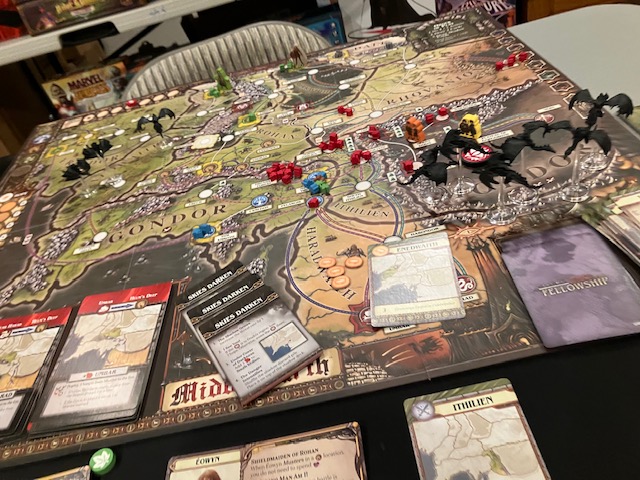
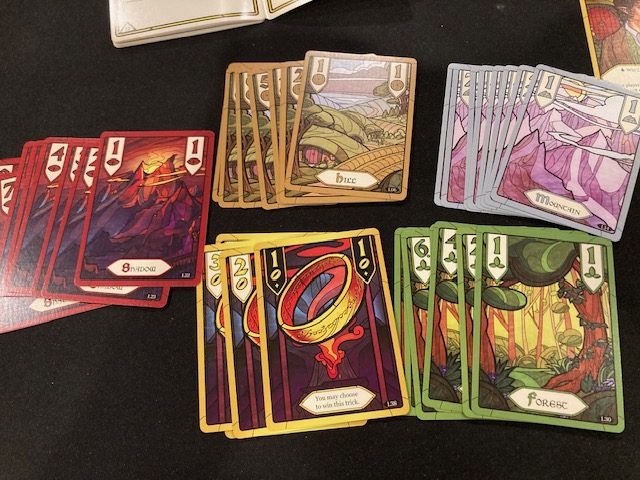
If you squint, you can see the Pandemic underneath! The Region cards feel very similar to the player cards we’ve seen from Pandemic!
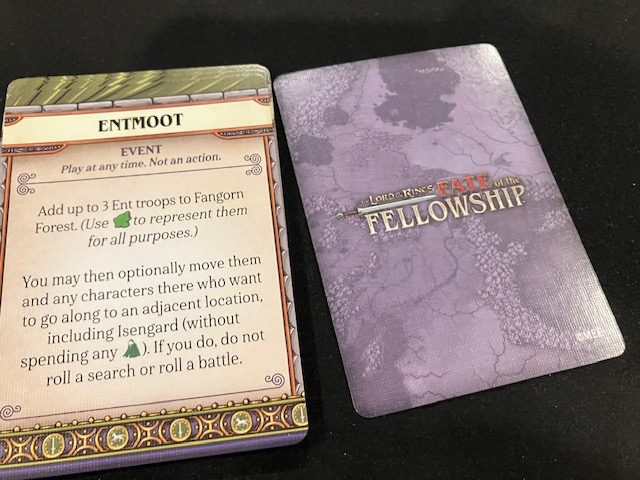
Just like Pandemic, there’s Events (of course, they are flavored for this universe).
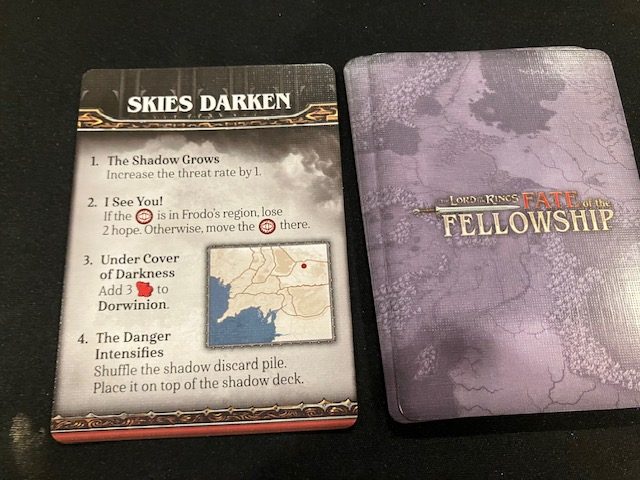
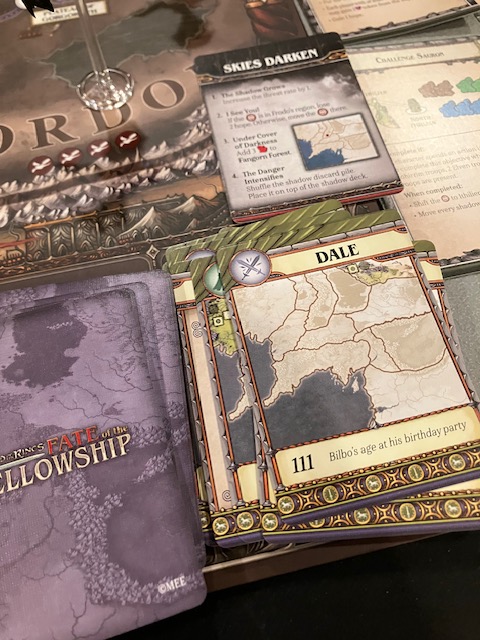
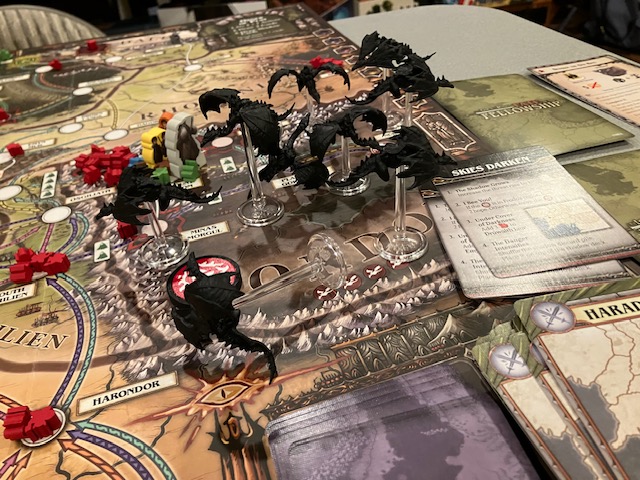
The Skies Darken cards (above) are very much like the Epidemic cards from the original Pandemic!
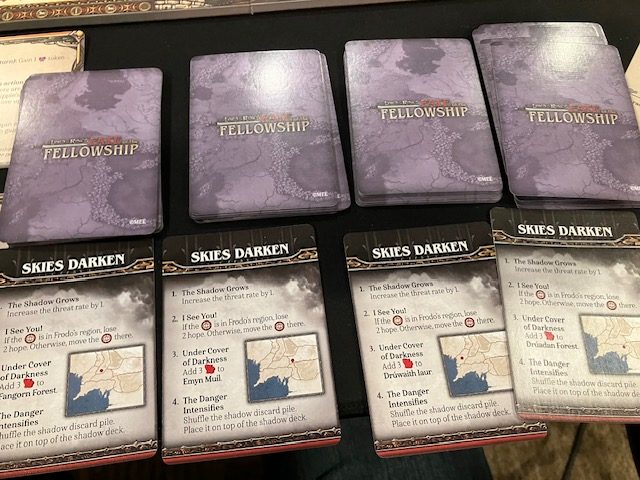
Like the original Pandemic, you divide the deck into fourths and put one of these “bad news” into each part of the Region cards. That way you get one Skies Darken at about every quarter of the game!
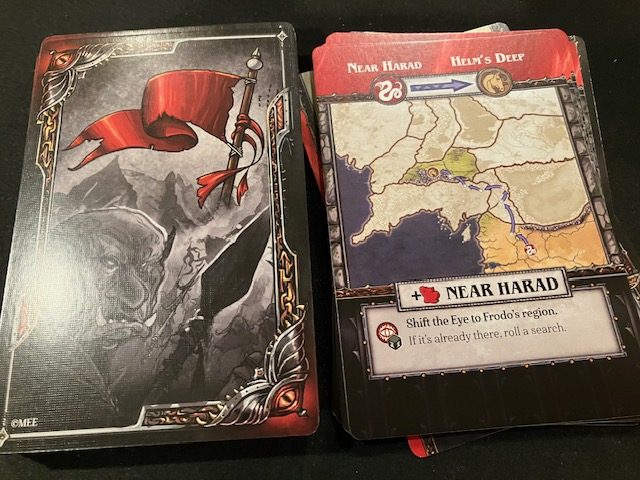
The true Bad News deck is the called the Shadow Cards; you get two (or more) per turn. This is just like the Infection Deck from Pandemic. There’s a big difference though! If the Shadow Card to the left of the card you play is a red banner (see above), you activate the TOP part of card!
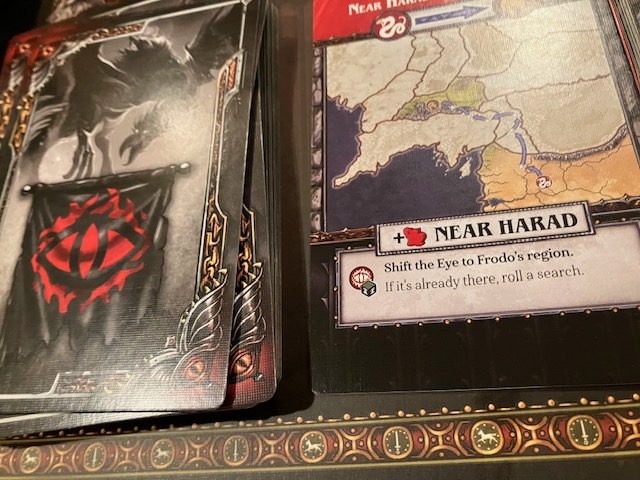
If the left card is a black Banner, you activate the BOTTOM part. The bad news you get depends on the top card of the deck! This can have wild swings to the game!
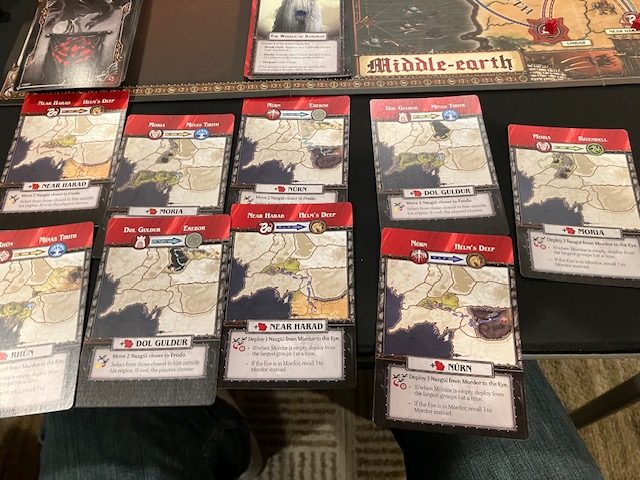
Like Pandemic, these Shadow Cards go to the top of the Shadow Deck and will come out again and again, whenever you draw a Skies Darken! You seed the game with “troops” (not disease cubes) very much like the disease cubes.
If you’ve played Pandemic in any form, those Skies Darken cards will feel VERY familiar.
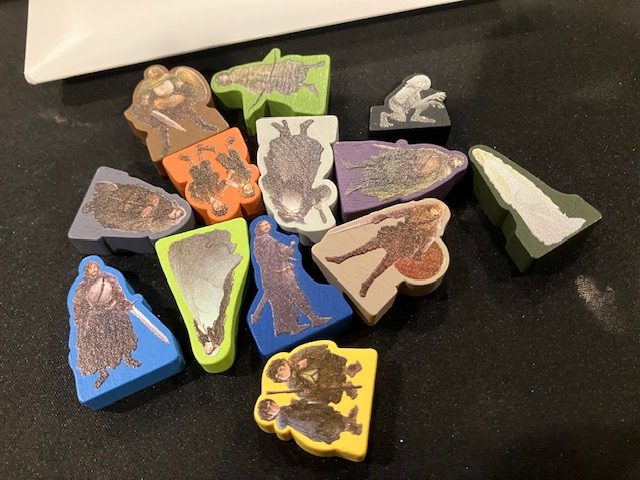
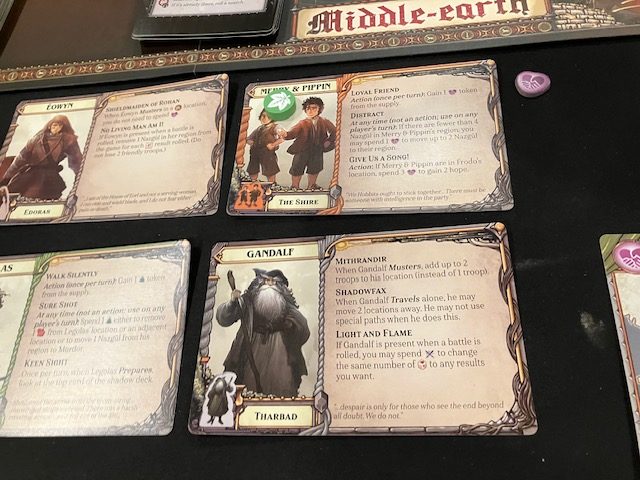
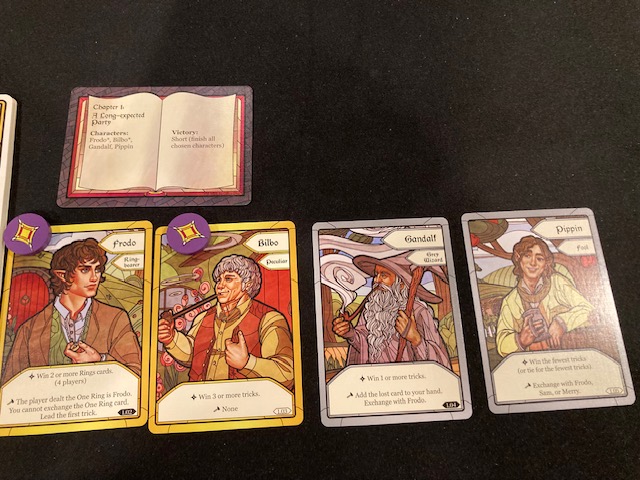
Every player will play TWO characters! Not just one! That’s different!
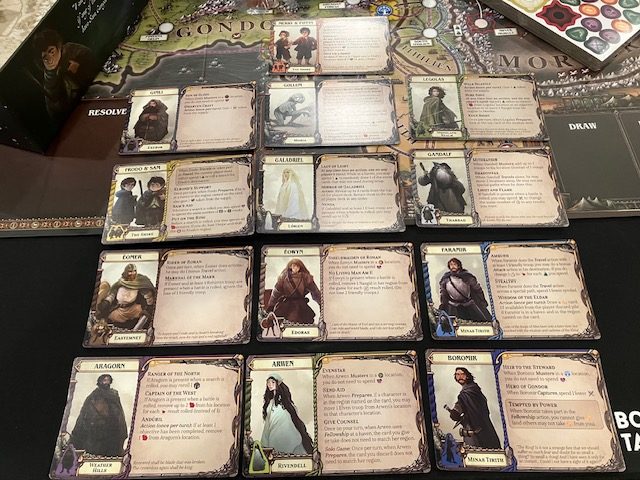
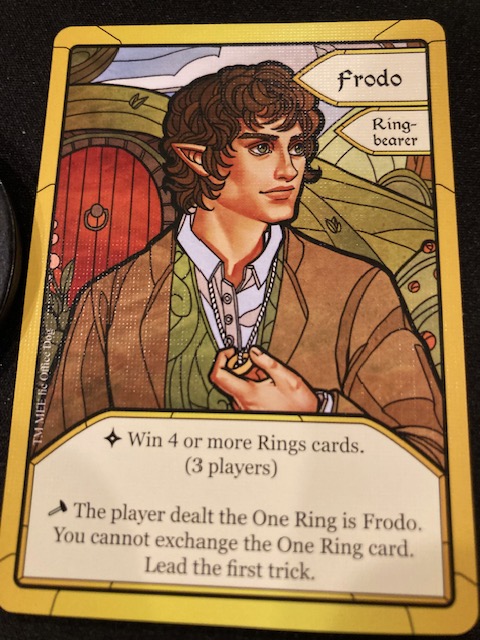
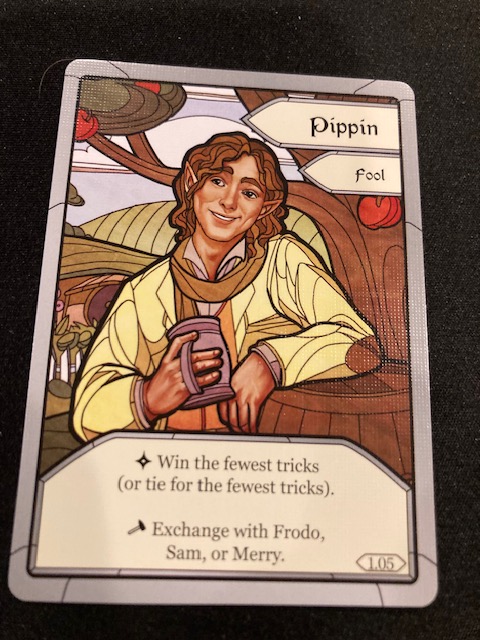
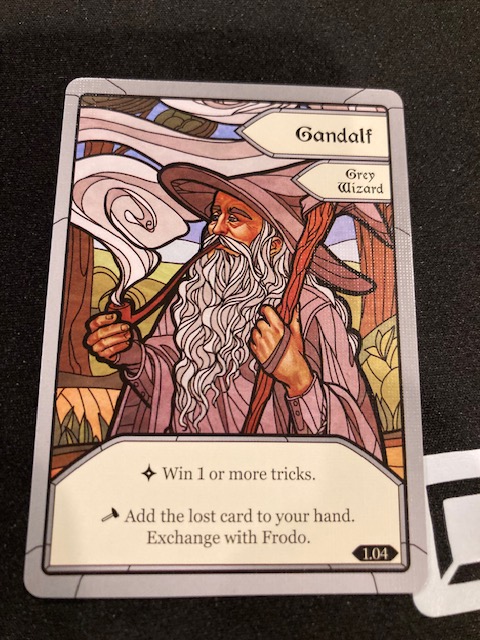
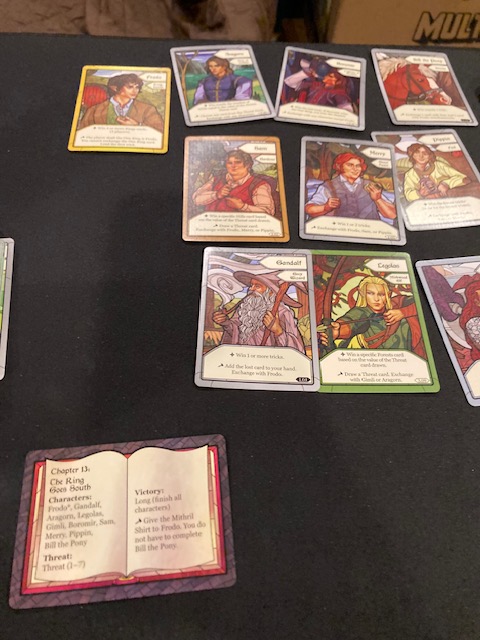
The characters should be very familiar to the LOTR fans! See above!
One characters gets 4 actions (like Pandemic), and other only gets 1 Action Point. That’s a little different.
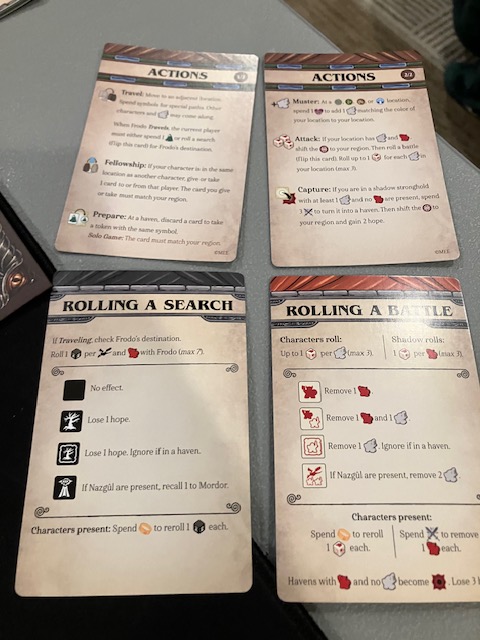
With those 4 Actions (see documented above), you do things like Pandemic. However, there are a lot of differences here! This is where the game starts to drift from the original game a LOT more, as you can attack (with dice), capture Havens, Prepare, Fellowship! There’s SOME Pandemic here, but the actions you get really are very different. For example, you can trade in a card for token for hand-management reasons, but only at a Haven!
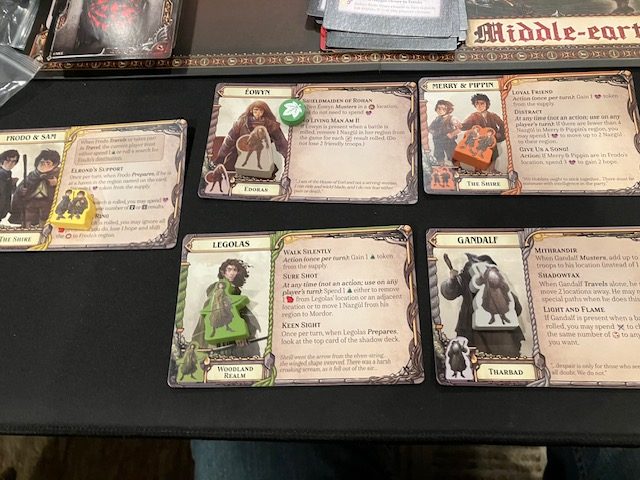
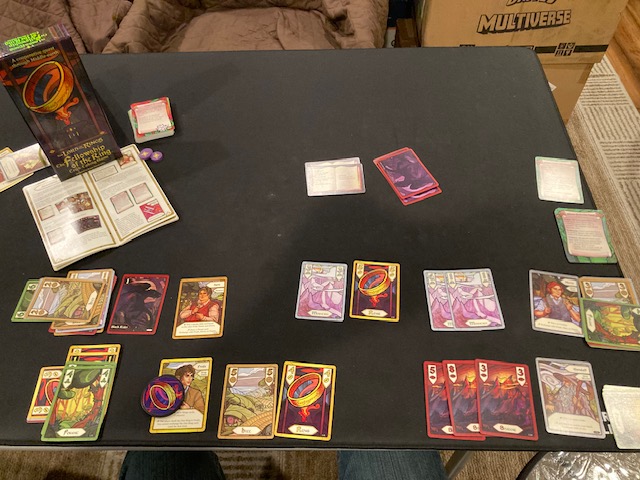
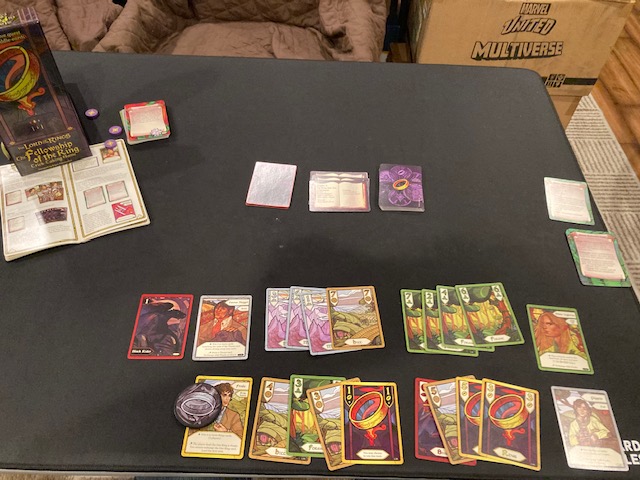
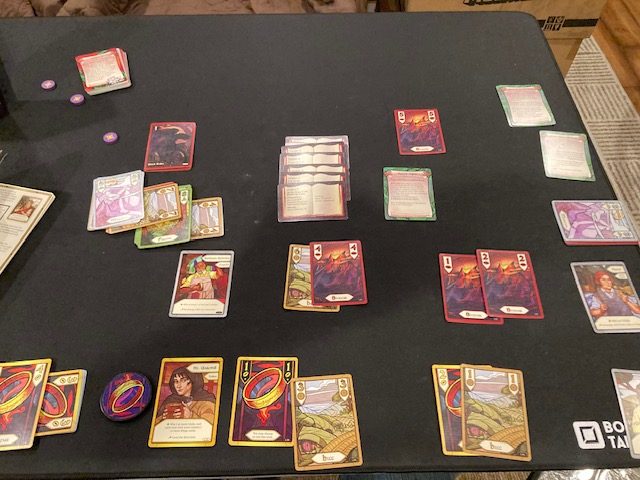
So I decided to start my journey using the Solo Rules/Set-up! See above as I operate 5 characters (well, 4 and 1).
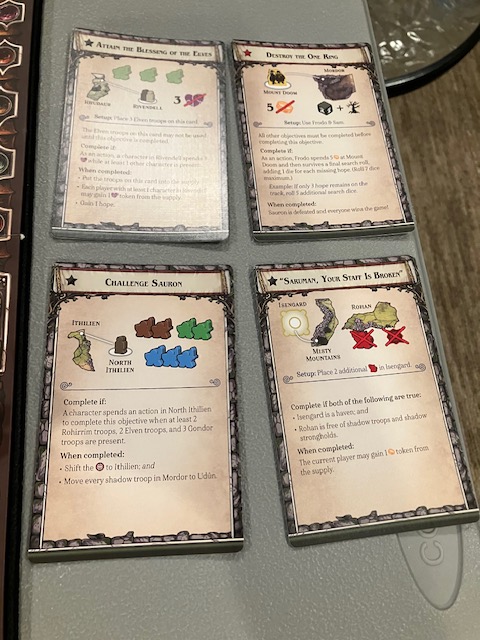
Winning, as you might guess, is throwing the Ring into Mount Doom: see above, top right! But before you can do that, you must fulfill the previous three missions! Each of these missions (see above) is very different: Attain the Blessing of the Elves, Challenge Sauron, Sauraman Your Staff Is Broken! This is reminiscent of Pandemic, where you had to stop 4 diseases! Here, you have to fulfill 4 very different missions! (There are actually a number of different missions to choose from, but you always have Destroy One Ring as the final mission!)
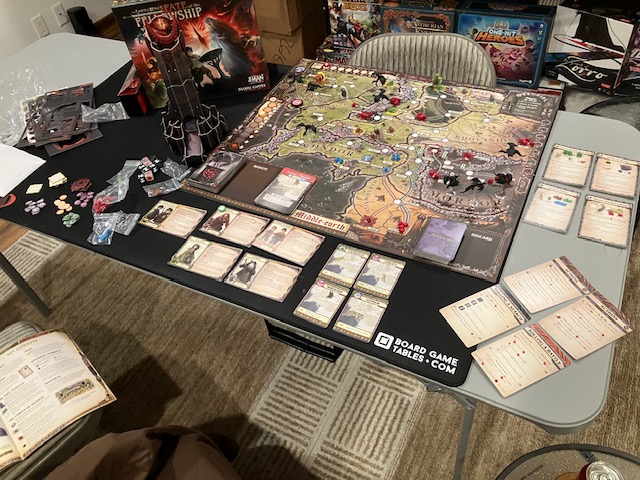
At the end of Day 0, I was pretty exhausted! Putting together the Dice Tower and setting up the game took a lot of work!
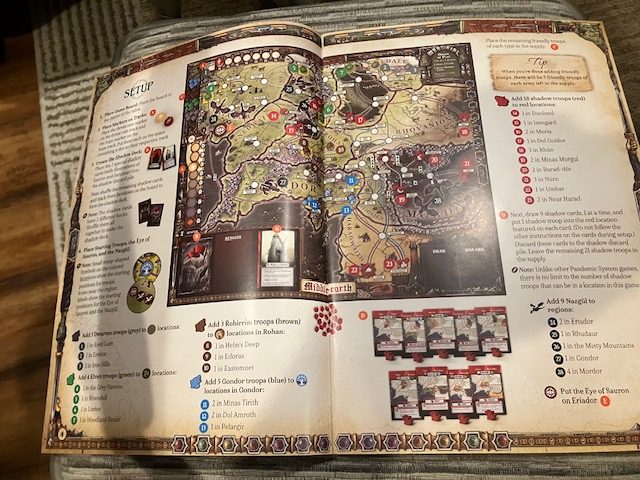
The Set-up actually spans 5 pages! That’s right, 5 pages!
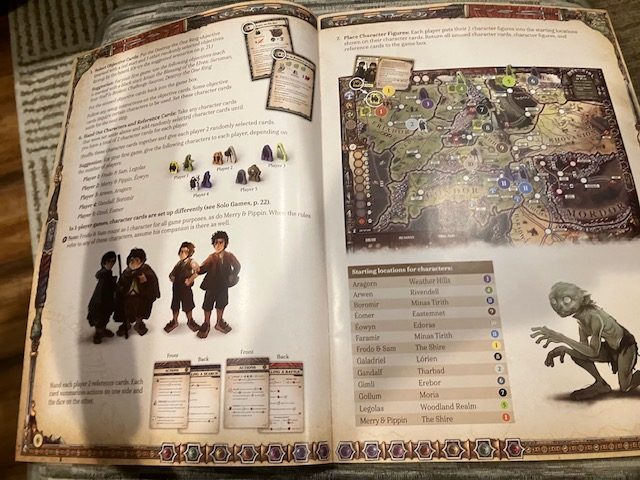
At the end of Day 0, I was too tired to move forward and play my first game.
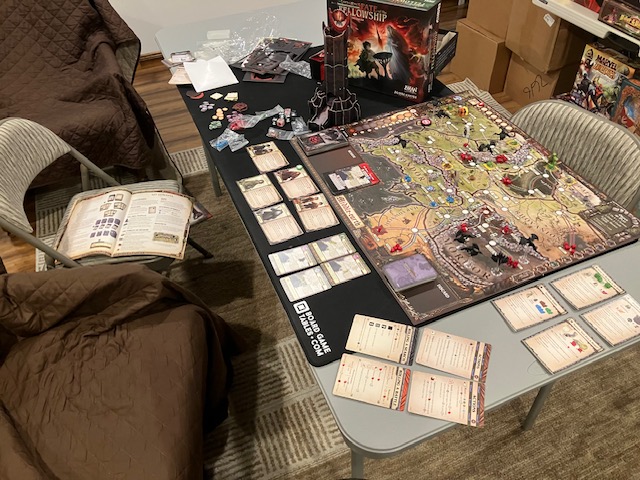
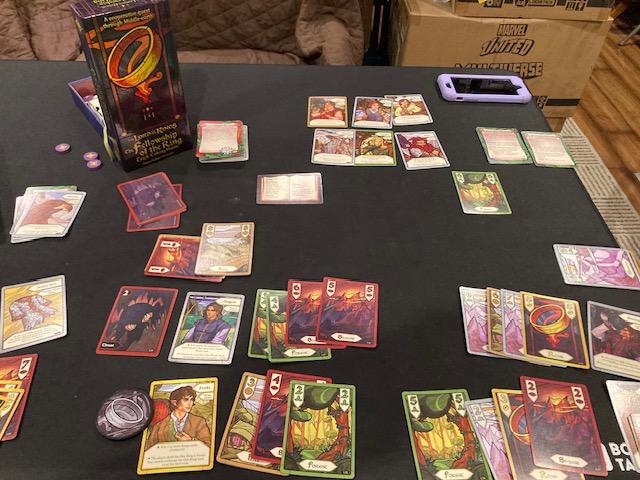
It looks cool set-up on the table though! See that Dice Tower! That cool LOTR board!
Playing Solo Mode Using Two Kinds of Solo Rules
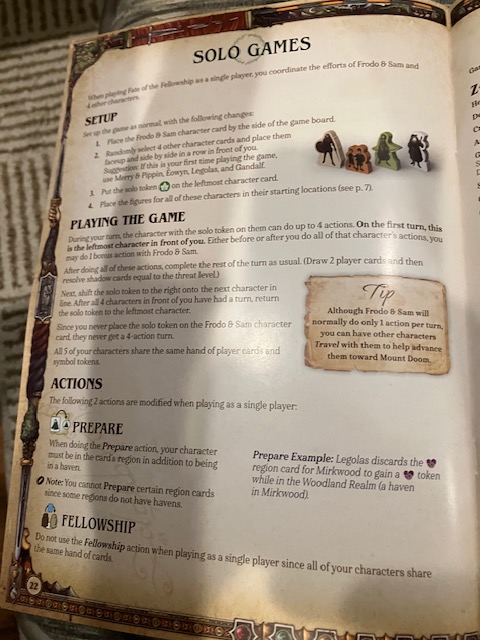
The solo rules are well documented on page 22. See above! (And thank you for following Saunders’ Law!) These rules are generally very good and very clear. One problem I had: it’s not quite clear if you can share the tokens between all 5 characters, … but you can sort of infer that you can (because when a single players plays two characters, they can share tokens); it should have been stated more explicitly. EDIT: Yes, the rule is there! I missed it, and I could have sworn I looked like 3 times. My mistake!!!
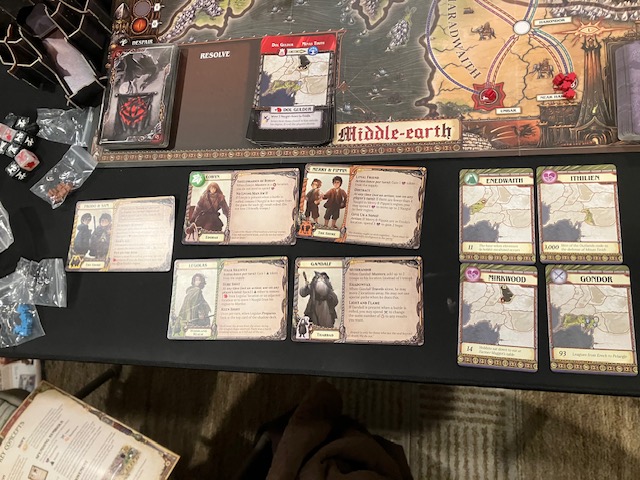
The solo player plays 5 characters … well 4 characters and (Frodo and Sam). You choose 4 characters to play (although the rulebook suggests characters for your first few games), but you always get Frodo and Sam (since Frodo has to throw the Ring Into Mount Doom) as the fifth character. Yes, Frodo and Sam is considered one character.
There is only one hand of cards for the solo player, so all the cards are shared among the 5 characters. This is both boon and bane; you don’t have to worry about sharing cards (indeed, the Fellowship action which shares cards, is disabled in the solo game), but you also are stuck with the 7-Card hand limit for all characters.
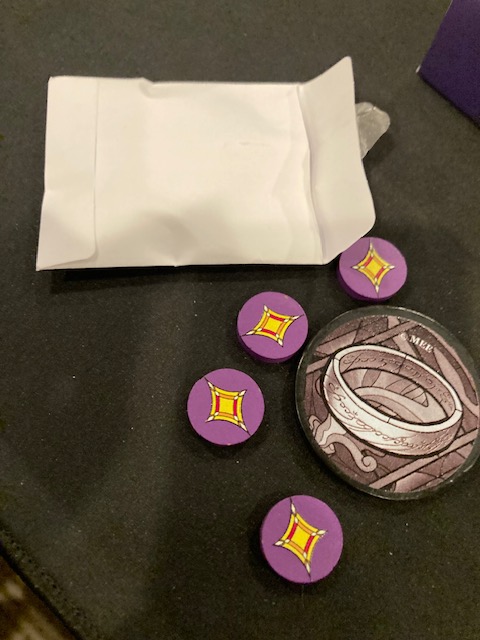
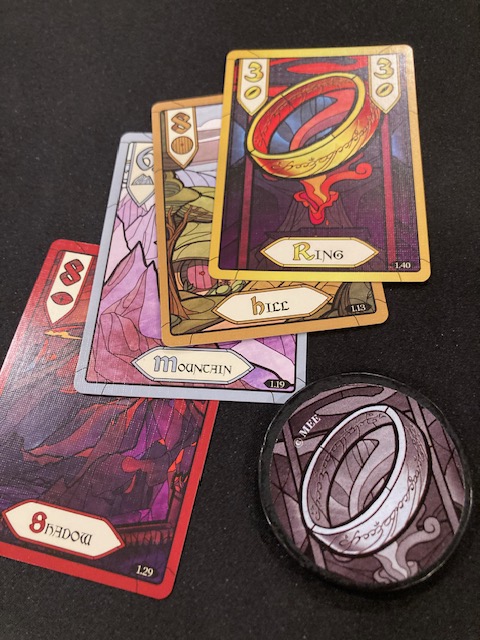
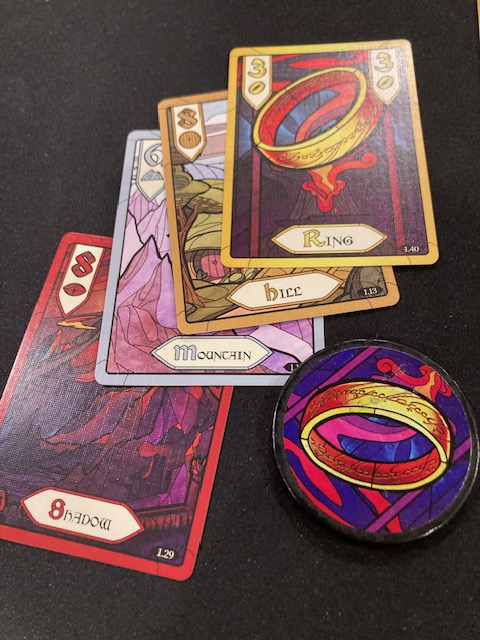
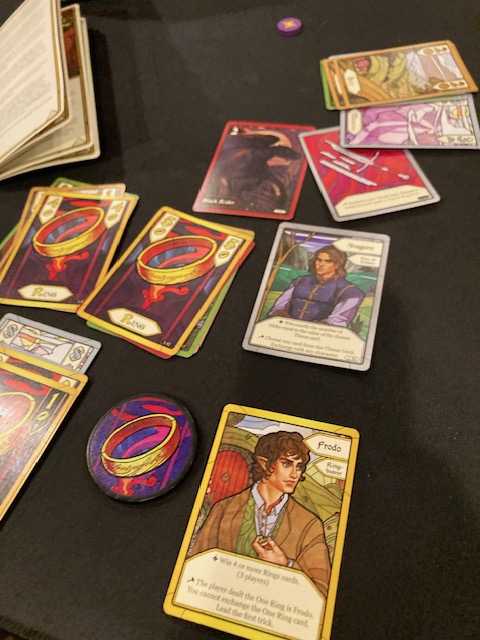
You move the little green solo token around (above) to show which character you are activating this turn; the character you activate gets 4 actions, and then Sam and Frodo get one action. That’s right, Sam and Frodo always get one action and the other character gets four actions.
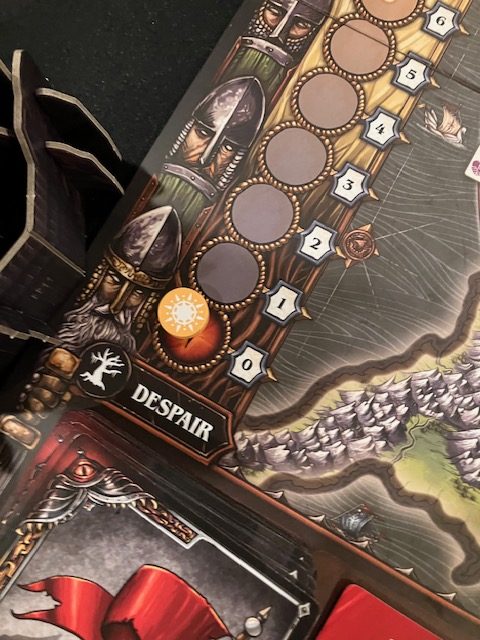
My first game ended in a loss after about 14 turns as my Hope went to zero. That’s right! If your Hope track ever goes to zero, you immediately lose! There are MANY things that cause your Hope to suffer: Search Checks, Losing a Haven, running out of cards. In other Pandemics , the end generally comes when the player cards runs out. Every game of Fate of the Fellowship I have lost was because the Hope went to zero very early in the game. It’s VERY EASY to lose via Hope in this game. You have to be very careful with Hope, and it’s generally hard to get Hope back (but not impossible).
It was very weird to me that I lose before I was even barely one-fourth through the game: I had only gotten one Skies Darken!
Although I lost because I lost Hope, generally my combats were terrible; I rolled poorly.
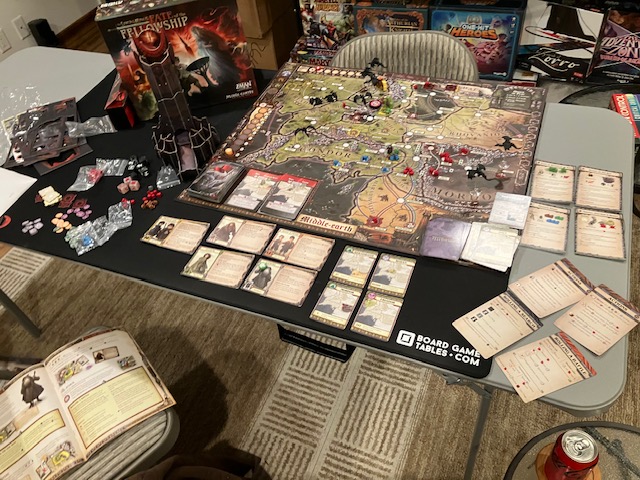
Nonetheless, I realized I had played a LOT of rules wrong. You have to understand that there are lots and lots and lots and lots and lots and lots of little rules in this game that you have to keep track of. As someone who has played many many many games of Pandemic, I think I expected something more akin to the original Pandemic. Nope! This game is very different and requires you to bend your brain a lot more.
I was grumpy how hard I lost (as I said, I have played lots of Pandemic), but I realized how many rules I got wrong and things I missed, so my first game just got me the “feel” of the game; I should expect to lose.
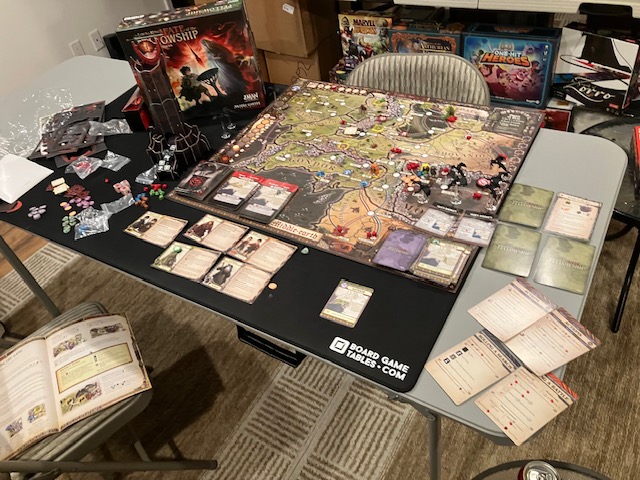
My next solo game was a win, but I realized I STILL got a bunch of rules wrong.
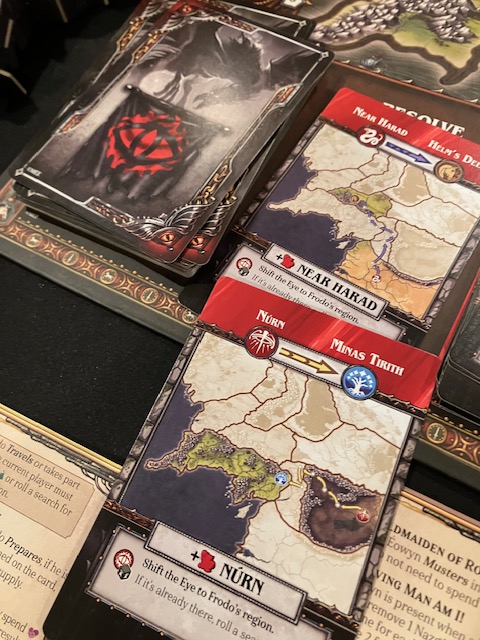
My third game was a complete loss in 3 turns. That’s right, 3 turns! I got two “Shift The Eye To Frodo’s Region” and the Eye was there. I had 5 search dice to roll, twice. I lost because I lost all hope. In turn 3. That’s right, 3 turns.
I was ready to throw this game into Mount Doom; this games feels so messy and random. Sure, I’ve had games of Pandemic go bad, but never this bad. Lost. In. 3. Turns.
I played a fourth game and lost after about halfway through the deck. By losing Hope of course.
I took a break to think about this. I realized that one of my problems was that I sometimes felt like I couldn’t do anything because I ran out of cards quickly. This is because all 5 characters share the (7-card limit) deck. When you have turns where you maybe don’t want to move (or can’t move), then you can spend some actions turning cards into tokens at a Haven. With all characters sharing this hand, this “sometimes” action causes your hand to go to zero cards quite a bit.
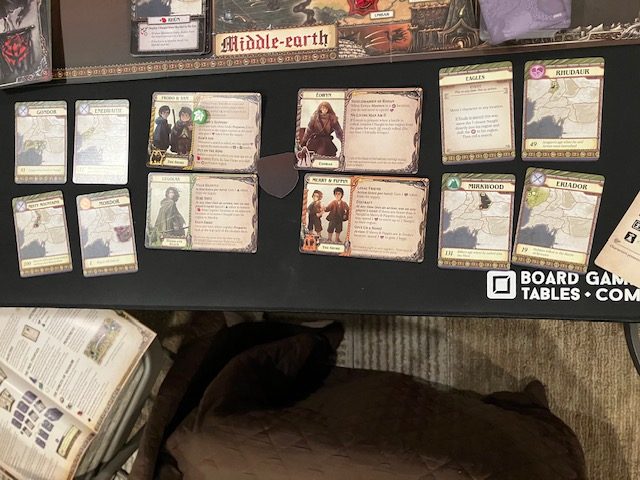
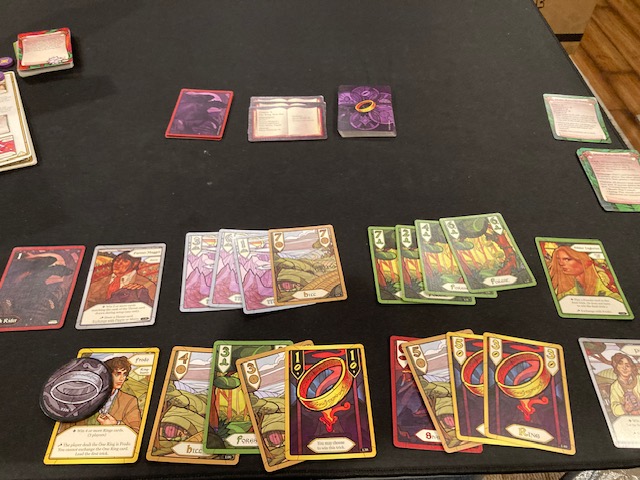
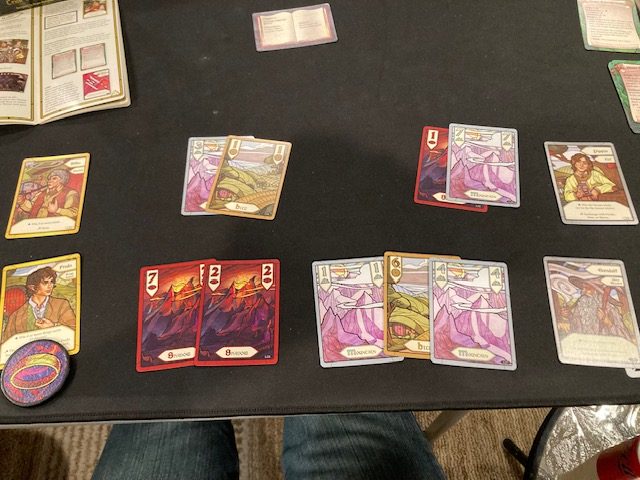
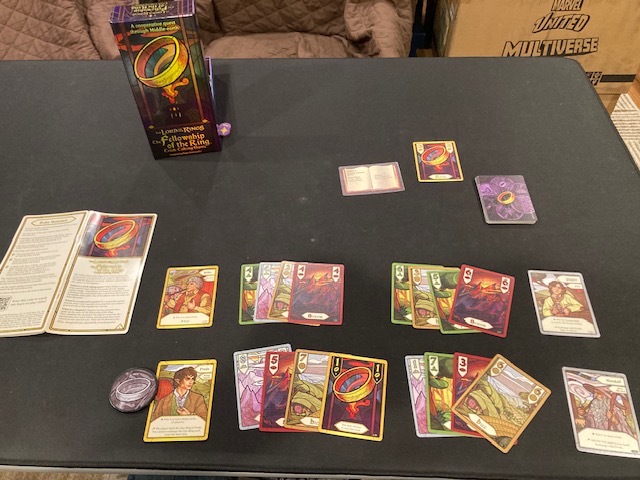
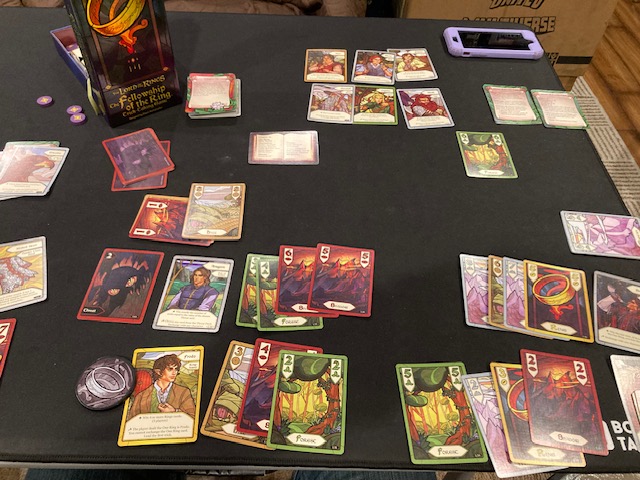
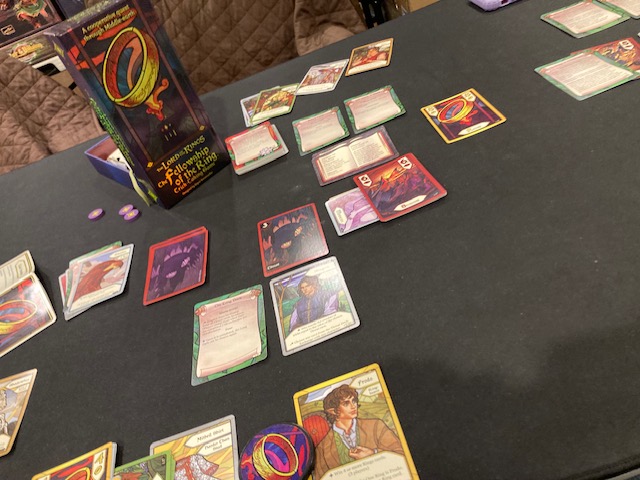
So, I decided to play the traditional solo game: play the cooperative game two-handed, alternating between two players. See above. After playing this way, I don’t think I can go back to the solo mode as written. With playing 2-handed solo, I felt like I had more options (“how should I activate my characters? 4 or 1 or 1 and 4? Who should move? Do I need to share?”). Basically, the Fellowship option is important, but you don’t use it that much in a game—it’s generally better to have more cards in the 2-Player mode.
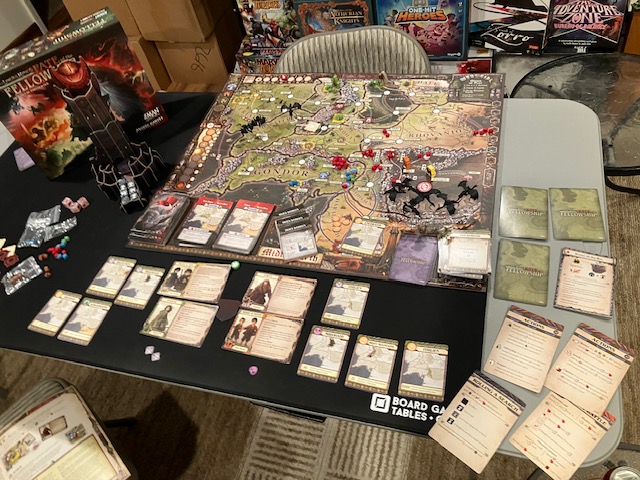
After 7 solo games, I think that the two-handed solo game is superior way to play solo. The solo player simply feels like he has more choice in actions (to choose how to divvy actions), more cards work with (spread over two hands), more mobility around the board (to deal with bad news as it pops up). To be honest, I didn’t start having fun until I started playing 2-handed solo.
I felt like the built-in solo mode might actually do the game a disservice. I kind of hated my first five solo games; it wasn’t until I went to the two-handed solo mode that I actually started having fun. If you had caught me in my first 5 solo games, this game would be burning in Mount Doom right now. I am someone who loves Pandemic, I am someone who loves Matt Leacock designs, I am someone who has played a lot of Pandemic in his life. Yet, the built-in solo mode almost caused me to hate this game. Caveat Emptor.
I recommend the two-handed solo mode.
Two Player
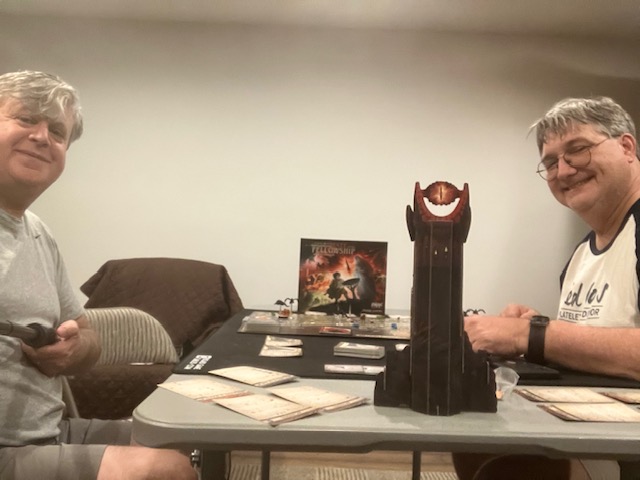
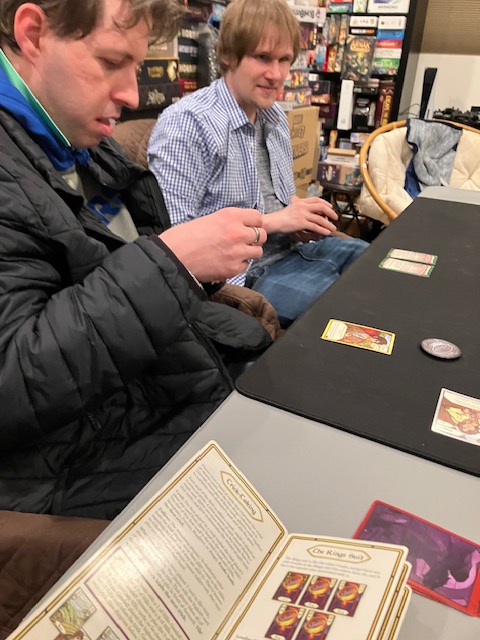
One of the things that convinced me that the 2-Player solo game was superior to the built-in solo mode was playing two players!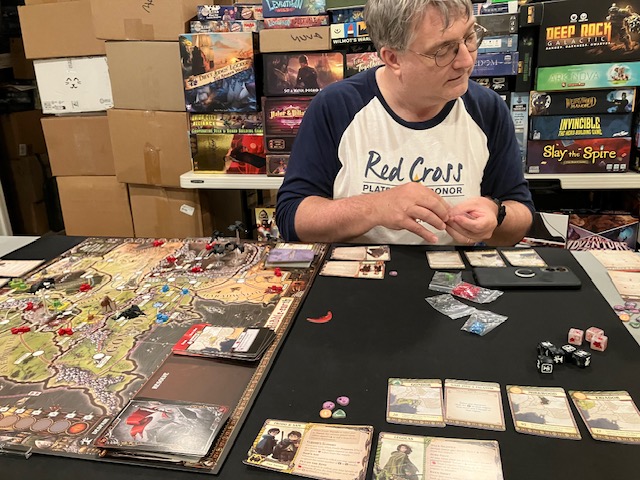
Over one Sunday, my friend Don and I played a 2-Player game and had fun! Now, be aware that I had played many many solo games my this point, so I had the rules down, I had the strategy down, I had the teach down.
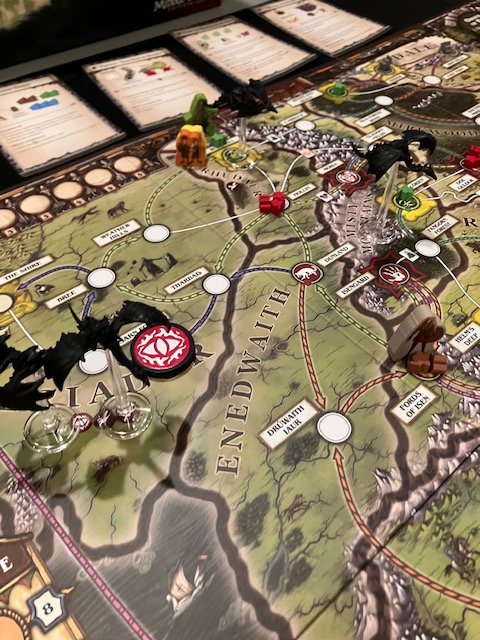
I think we lost, but I don’t care? We had fun: Don definitely knows like LOTR better than me and he thought it was fun. He also reminded me that several of his Pandemic games went south in a few turns.
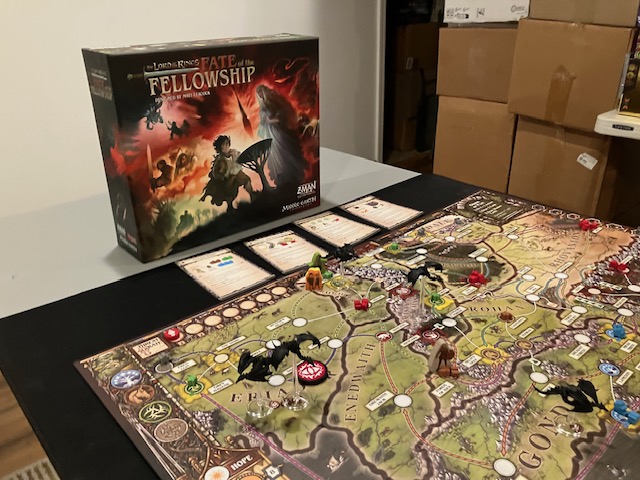
It felt like there were more options in a 2-Player game. This cemented, in my mind at least, that the 2-handed solo mode is superior.
4-Player Game
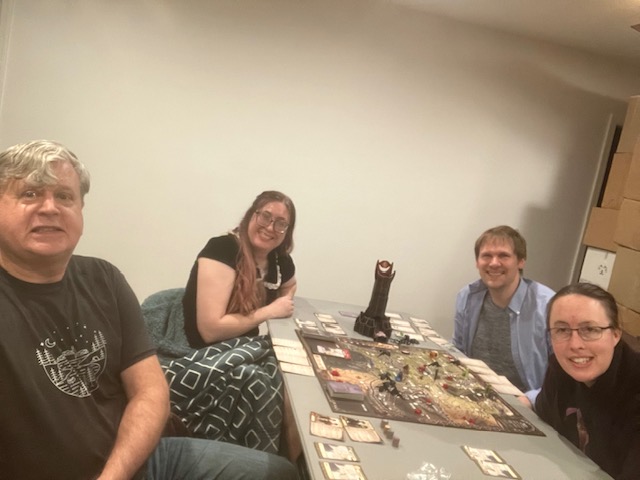
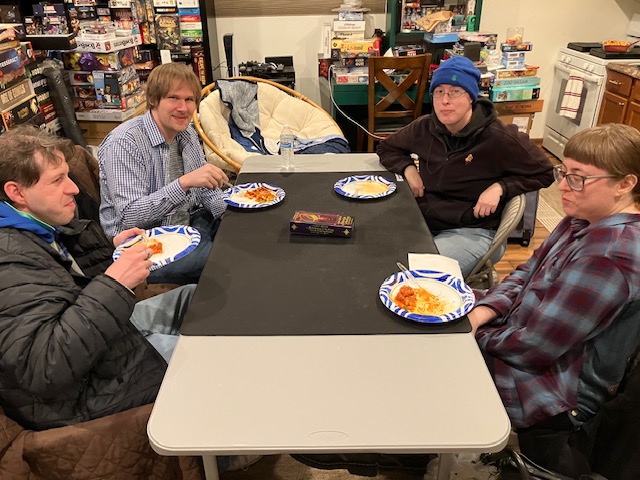
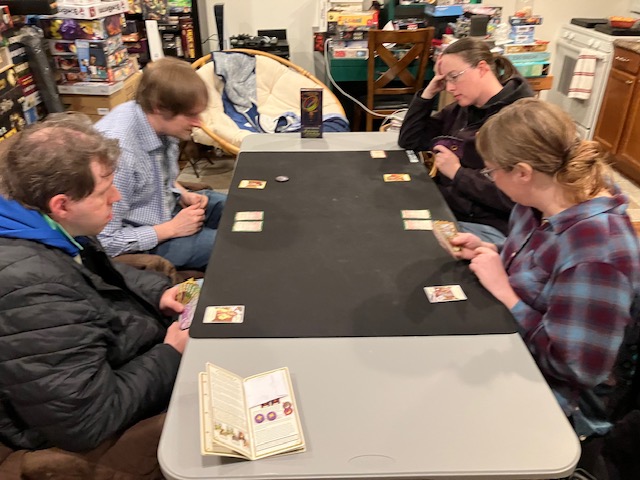
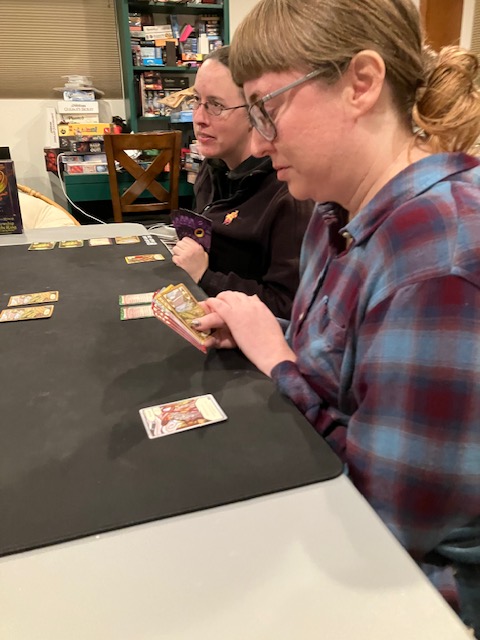
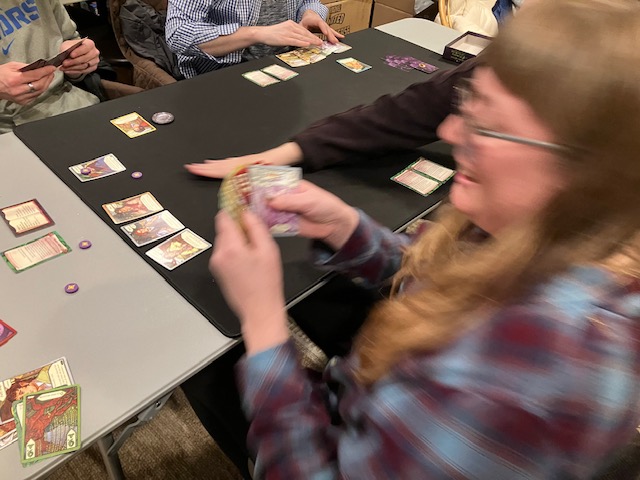
So, after teaching the 2-Player game, we went into the 4-Player game.
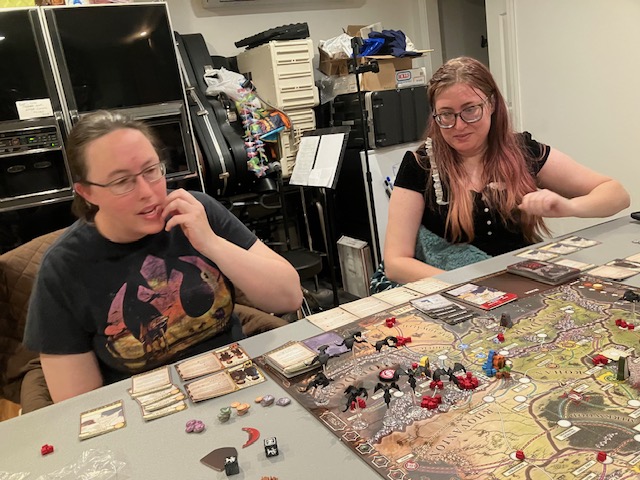
The game was fun, but we saw more of the randomness emerge It was also frustrating that sometimes players couldn’t do anything. The muster action can only be done on certain locations IF you have friendship cards. The Prepare action can only be done on a Haven. So, if you didn’t have friendship or weren’t on a Haven (because you were out fighting), sometimes turns felt a little anti-climactic (as you couldn’t do much).
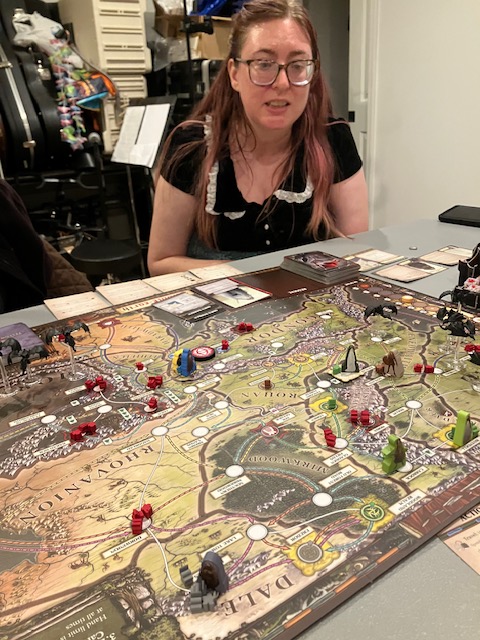
I was reminded by friends Charlie and Allison (after they played Pandemic Legacy: Season 1), that 2-Player Pandemic is easier than 4-Player Pandemic. Usually because 2-Players can deal with Bad News “quicker”, as you only have to alternate players. In a 4-Player Pandemic, the only person who can deal with some “bad News” is 3 turns away.
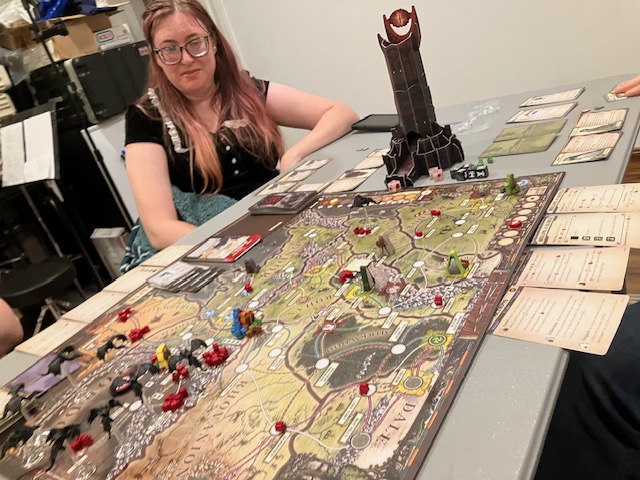
I think we saw this in our game of Pandemic; we came close to winning, but needed just a few more turns. We didn’t “quite” deal with the Bad News as efficiently as we should have.
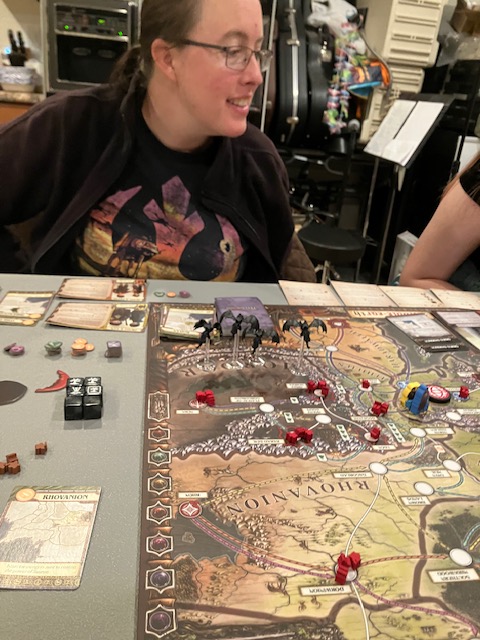
Did we have fun? Yes. Did we love it? No? We liked it. We would play again, if only to wipe the shame from our faces for losing.
Randomness
There are 4 major axes of Randomness in this game.
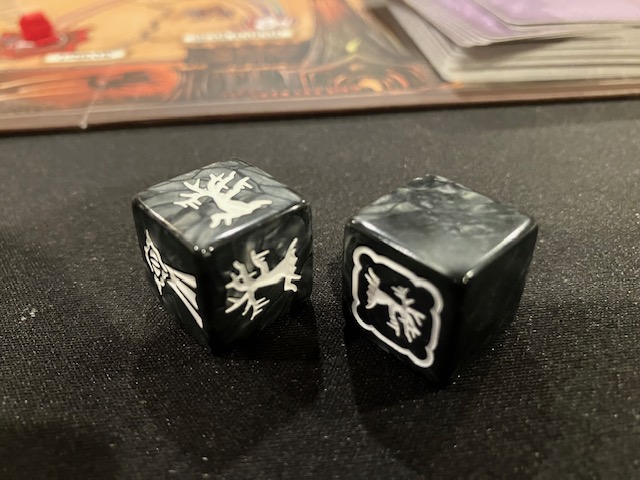
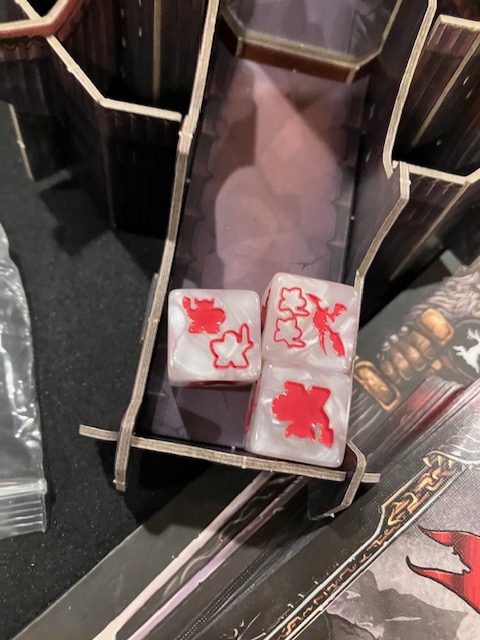
Axis 1: The Search Dice. These must be rolled whenever Frodo travels (if he can’t sneak), or if a Shadows card forces a Search roll. The number of dice depend on the number of Nazguls in your region. See above for all 6 faces. If you roll an “evil tree” (see above), you lose Hope. Remember, if your Hope goes to 0, you lose. You can re-roll some dice, at the cost of some resources. They are re-rolls, not guarantees.
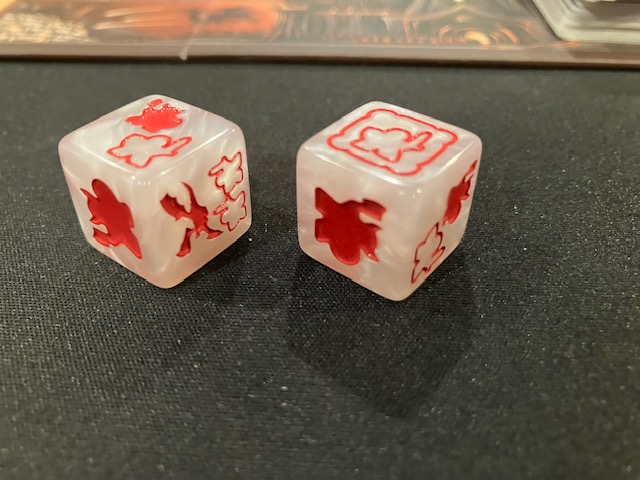
Axis 2: Combat dice. See above for all 6 faces. The red faces mean the bad guys lose a troop. The white faces mean the good guys lose a troop. A particularly bad roll can wipe out all the good guy troops and completely screw you. You can re-roll if you have a character in the region, at the cost of a ring. You can use swords to eliminate bad guys if you still have anything left (if you have a character there).
Axis 3: Shadow Cards. What bad news do you get? Even though the Shadow cards go back to the top of the deck (like Pandemic), the bad news you suffer depends on the next card at the top of the deck. That little difference almost adds an extra axis of randomness.
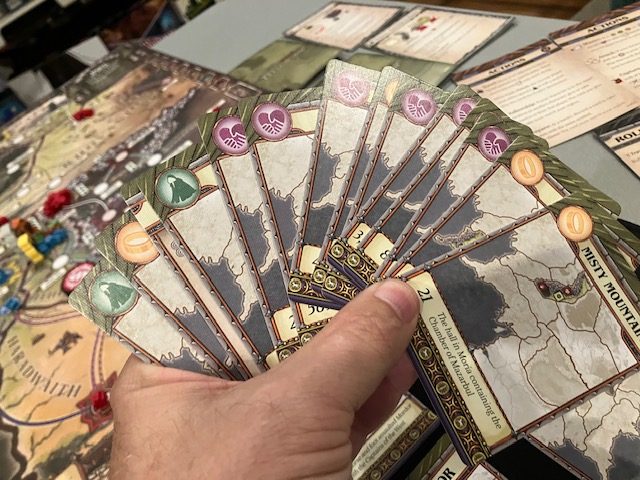
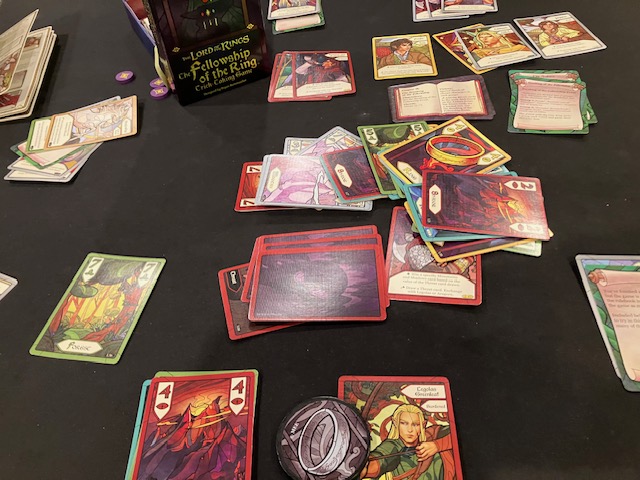
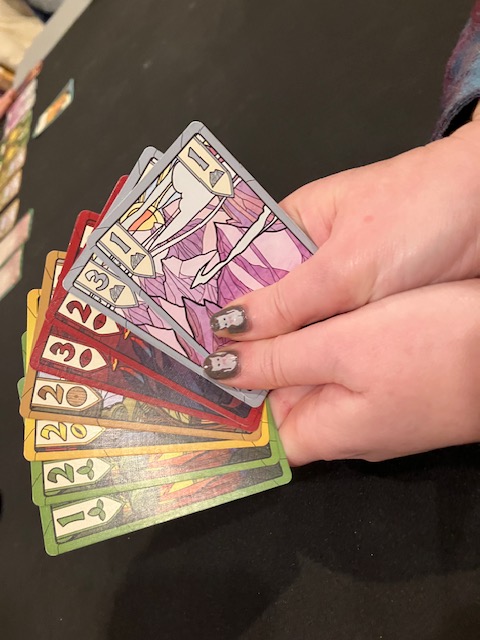
Axis 4: Cards. Which cards do you get? In one game, I waited 10? 12? 14? turns and could not get a sword! See above! This basically meant my mission to win Isengard was thwarted and wasted time/resources.
This 4-axes of randomness (5 axes if you count the extra randomness of Shadow cards) can be debilitating. There are ways to mitigate this, of course, but sometimes you just get screwed. Pandemic kind of only had the 2-axes of randomness, and it felt plenty hard.
Be aware. This game is much more random than the original Pandemic. It may be too random for you.
Conclusion
It’s hard to recommend Fate of the Fellowship. The extra randomness (relative to base Pandemic) inherent in the game with the Search Dice and Combat Dice can really bring your game down. I also think that the recommended solo mode is flawed; and I think it will do a disservice to players if they decide to start with that. If you do want to play solo, I recommend 2-handed solo: you will feel like you have more options and more choices.
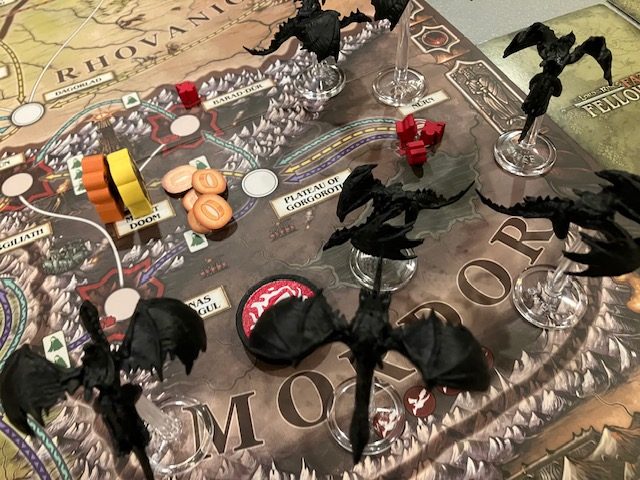
The game also feels like you can’t do things sometimes; you can only muster at hubs, you may only prepare at Havens, you may not move Frodo unless you either sneak or roll search. The game feels like there are a lot more constraints on “useful” things you can do you on your turn … because there are more constraints, I think part of this experience is just realizing how important Havens and hubs are and getting used to that. But, it “feels like” you can do less and that can be frustrating.
It took me almost 6 plays before I started having fun and figuring out the game works. There are a lot of complex systems, there is a lot more randomness, there are many more constraints on player actions. It may take you a while to really get this game; it has a huge learning curve.
Having said all that, Fate of the Fellowship is incredibly thematic, with the map, the missions, the special powers, and the characters! All of my friends who love Lord of the Rings really feel like they nailed the game.
So what’s my final recommendation? If you love the theme, you can probably suffer through learning the rules and love this game. If you are a Lord of the Rings fan, you will probably enjoy this world despite all the complexity and randomness. Losing is just excuse to embrace this universe and game some more!
If you just like Lord of the Rings, be aware that this game has a huge learning curve, a lot of complexity, and a lot of randomness! Much more so than base Pandemic. If you can get past all that and learn the game, you can come to like it, but be aware it may take quite a number of plays to get to that point. However, if you have a good shepherd (someone who knows the game and strategies), those first few games can be much more fun: my friends all had fun playing right away because I had done all the painful prep work.
My final score is a range: 4 to 7 out of 10. That’s a huge range because I hated the extra randomness (that’s the 4), but when it was fun, it was fun (that’s the 7). So am I keeping it? Yes.
Be aware this probably won’t work for you right out of the box; you may have to live with it.
Was this a good Pandemic or a bad Pandemic? It was a Grey Pandemic.
 coopgestalt