
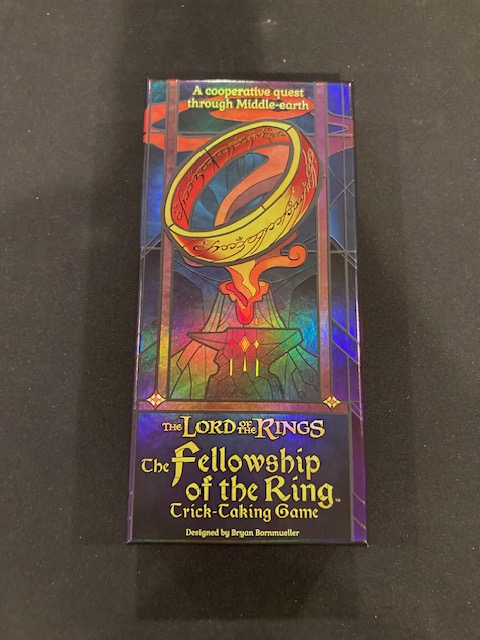
This is a mouthful of a title: The Lord of the Rings, The Fellowship of the Ring: Trick-Taking Game. See the full title above! BoardGameGeek lists it as The Fellowship of the Ring: Trick-Taking Game. Whew! We’ll stay with the “shorter” title.
I ordered my copy directly from Asmodee, and it arrived mid January 2025. I tried VERY hard to get the game as soon as it came out! I was very excited for it!! I saw a TON of reviewers get it earlier in 2024, but as a plain-old boring paying customer, the earliest I could get my copy was straight from Asmodee’s web site in January 2025 (after pre-ordering it back in November (?) 2024).
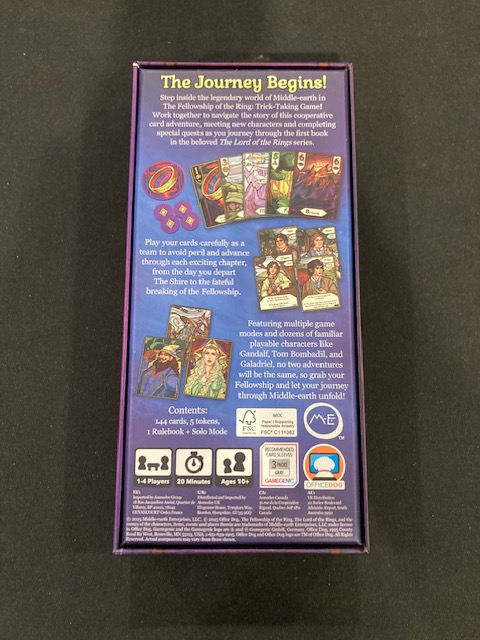
So, what is this game? It’s a small-box game for 1-4 players, Ages 10+ with a “listed” playing time of 20 minutes. That time is reasonable accurate for describing a single game, but this is, at its heart, a campaign game! So, it’s a campaign of 18 chapters, and each chapter can have multiple games. So, a chapter is “not necessarily” one game, but many times is. (After you complete the campaign, there is a standalone mode so you can continue playing).
This game (you’ll notice I am staying away from saying the full name) is a cooperative trick-taking game! Players work together to take tricks, but under certain conditions! One of the biggest parts of the game is that it is a Limited Communication game: players are not allowed (in any way) to discuss the cards in their hands as they play. All they can do is deduce what other people have by what cards they played.
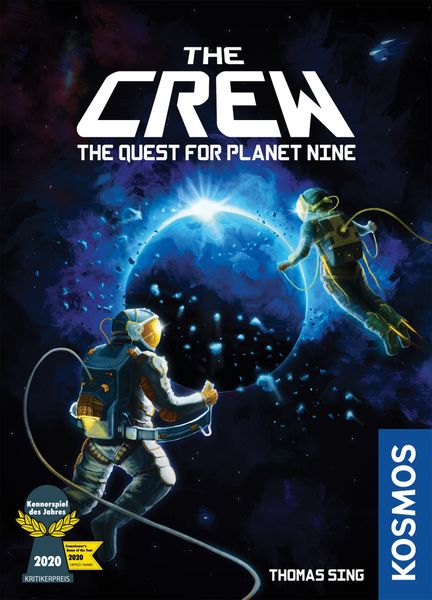
Those of you paying attention might say “Hey! That sounds like the Crew! That’s a cooperative trick-taking game too, right?” Yup! We liked The Crew quite a bit, as it made the #2 position on our Top 10 Cooperative Space Games! There’s a lot of similarities between the two: they both have ongoing campaigns that start easy and get harder, they both are smaller box games, and they both are Limited Communication games. The best description of Fellowship of the Ring: Trick-Taking game is Lord of the Rings meets The Crew. But there are some interesting differences, which we will discuss!
Unboxing and Gameplay
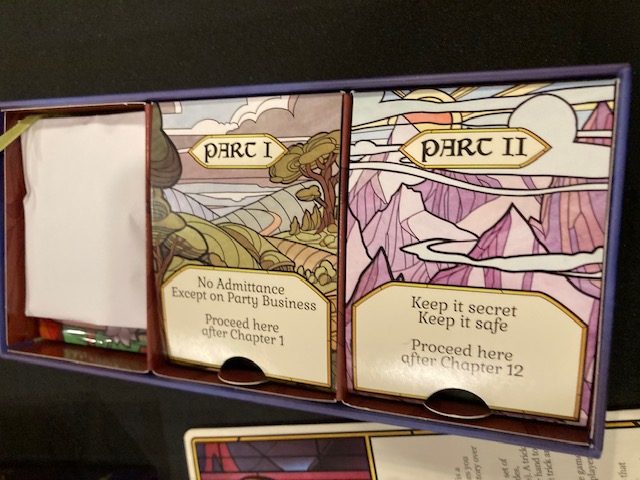
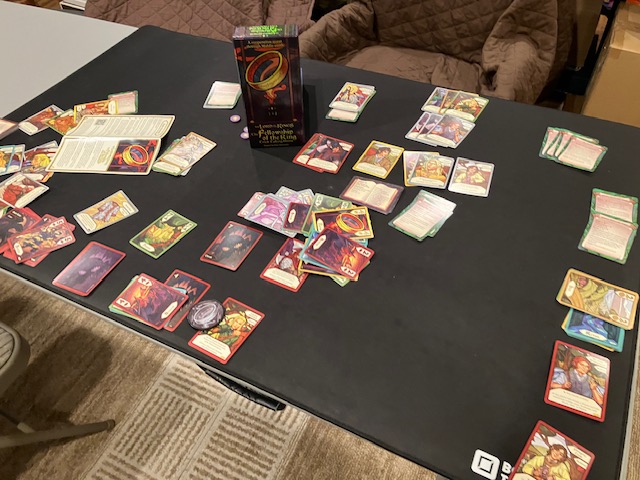
This is almost exclusively a card game. There are 3 decks in the game: the intro deck (far left), Part I deck (first 12 chapters) and Part II deck (last 6 chapters).
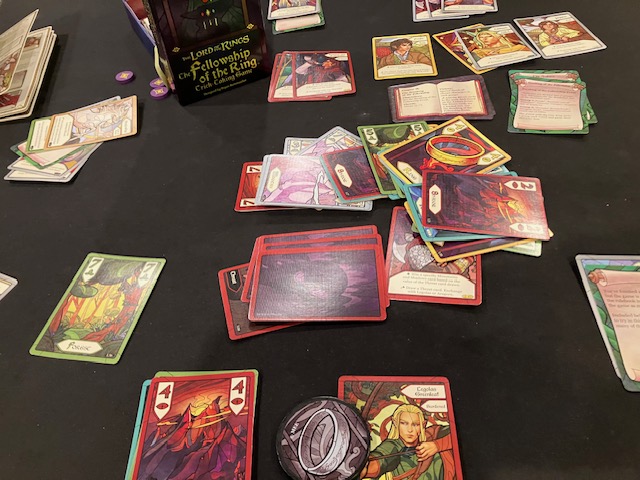
So many cards. See above.
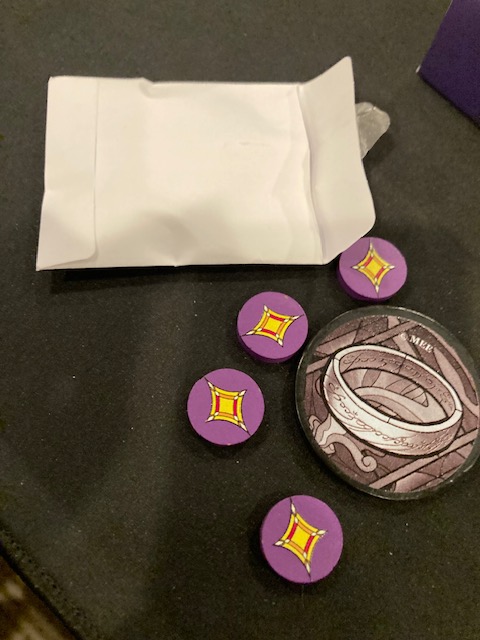
There are some tokens; the purple tokens are used to notate “required” characters: when you play, ever player must take a character, and certain characters are required for certain chapter. The big Ring card is used to denote when Rings have been played, and thus allow leading with them (see more discussion below).
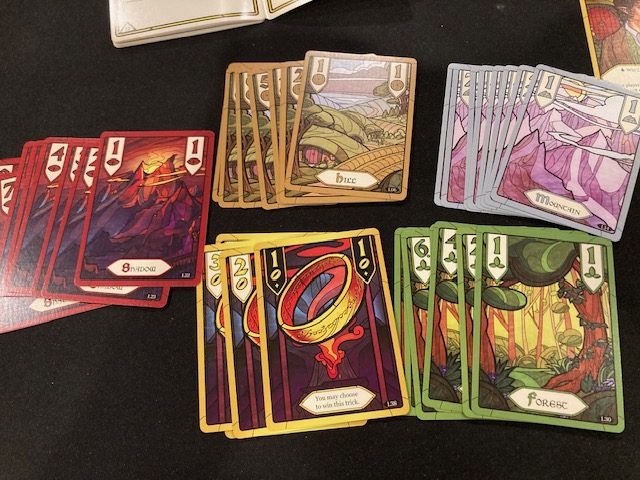
This a trick-taking game, so there are suits. Rather than “boring” hearts, spades, diamonds, etc, the suits are thematic Shadows, Hills, Mountains, Rings, and Forest. See above.
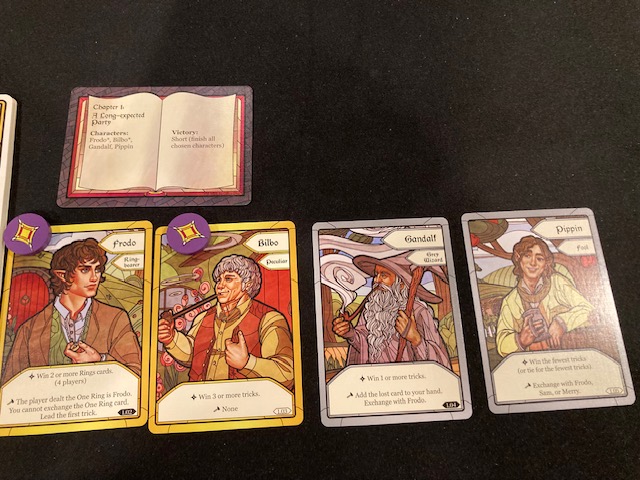
Each player will assume the role of a Lord of the Rings character (you may assume multiple characters depending on the player count).
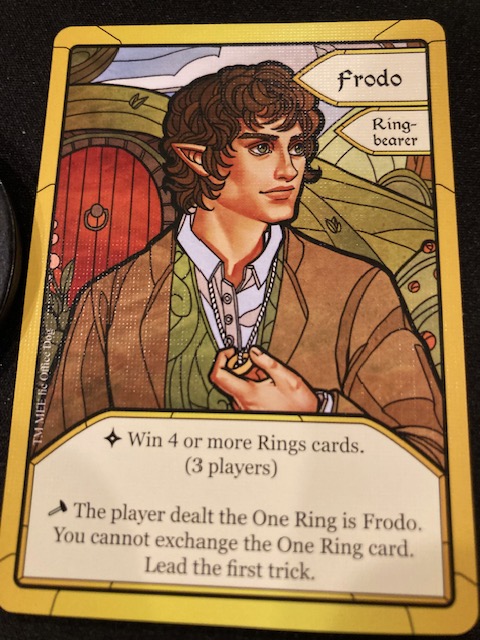
Each character has a win condition: in order to win a game, you (usually) hav to satisfy all characters’ winning conditions!!! Notice Frodo’s “win” condition: he must win 4 or more of the Rings cards in the tricks he wins.
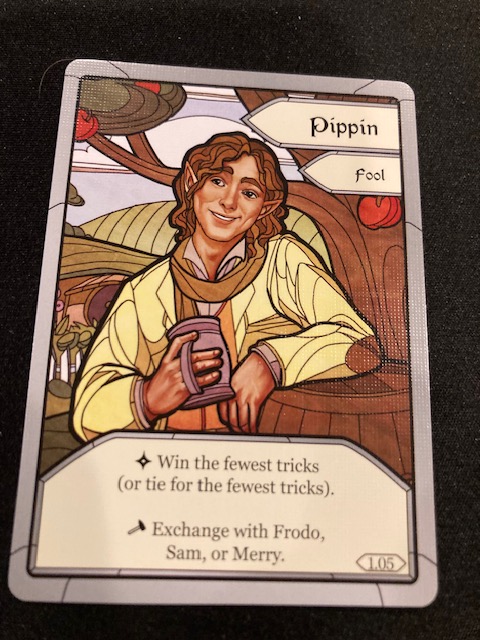
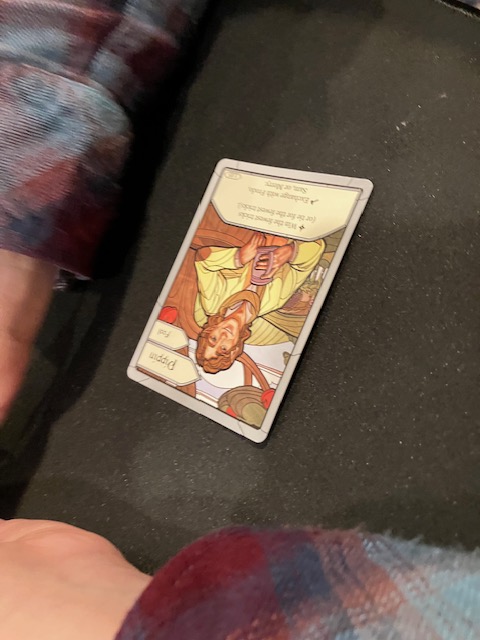
Pippin’s win condition is to win the fewest tricks: see above. You’ll also note that at the start of the game, some characters are allowed to “exchange” cards with other characters. You can’t still talk about your cards in hand, but you can give away obvious cards. For example: you really don’t want Pippin to have too many high cards (since he has to lose most tricks), so you may give away an 8 of Hills.
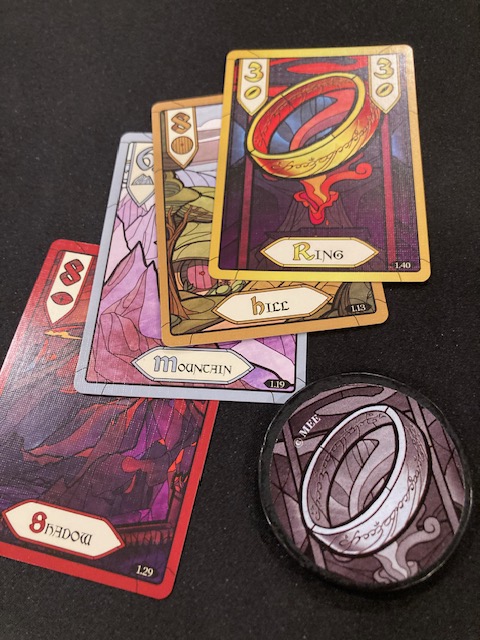
An interesting rule of the game is that a player can’t lead with a Ring card unless a Ring has already been played into a previously won trick (by being sloughed off when a player couldn’t match the lead suit). The Ring token is on the black-and-white to show: “Nope: you can’t lead a trick with a Ring suit“.
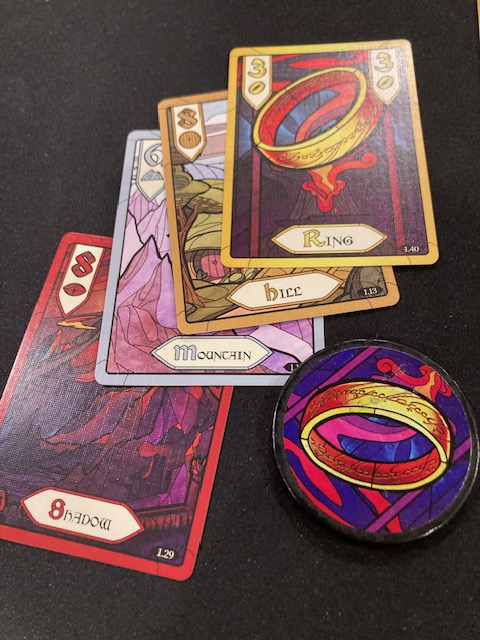
Once at least one Ring has come out, then Ring cards may be lead! See the colorful side of the Ring above! It now means “Yep! You can lead tricks with Ring cards now!“.
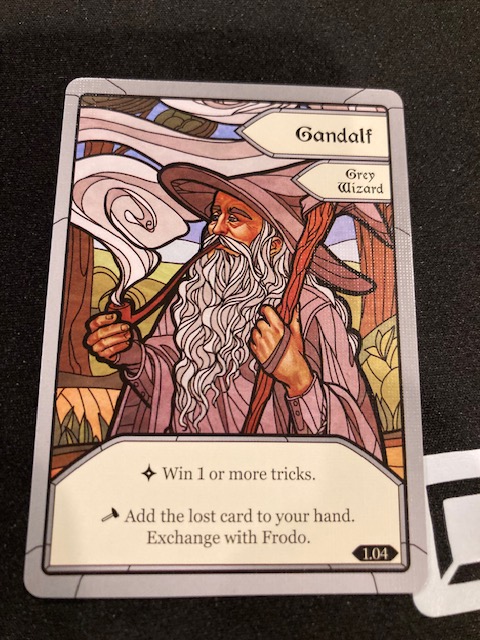
There are lots of little special rules in the game. For example, after dealing out all the cards, one card is always “lost” (to make the math work, there is always one extra card). But Gandalf has a special rule that he can take the lost card into his hand!
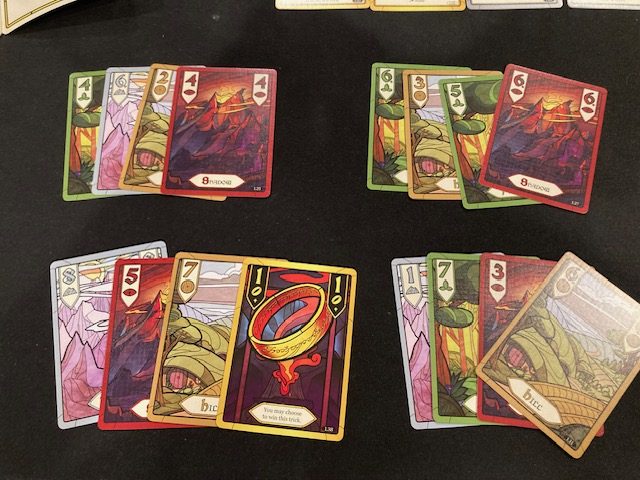
Each character is dealt a hand of cards and uses those to play a trick-taking game! The holder of the 1 Ring always starts the game. Frodo is almost always in play, and he always starts with the 1 Ring: see above.
Players continue playing until all their win conditions are satisfied … and they win! If, at any point, the win conditions can’t be satisified, the game is lost. In the campaign, losing means you just play the same game again until you win (usually).
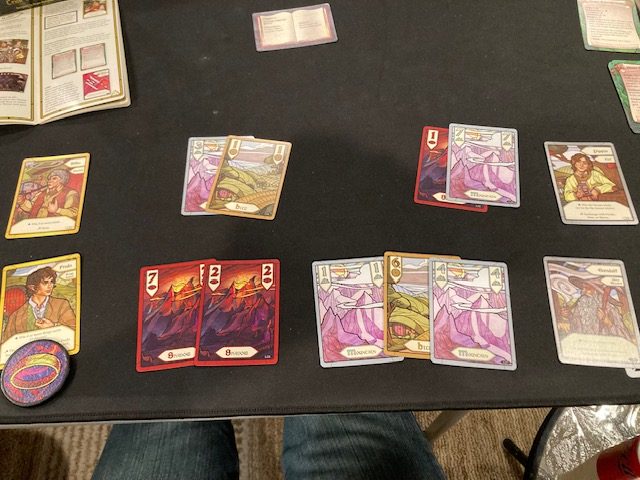
A winning game moves to the next … game. In the beginning of the campaign, that usually means the next Chapter: these are called “Short games” (see below).
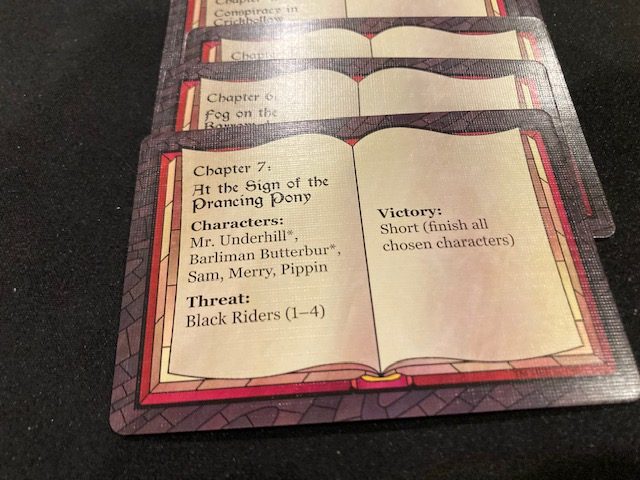
Later in the campaign, you may have to play multiple games to advance to the next chapter. These are called “Long” games (see below).
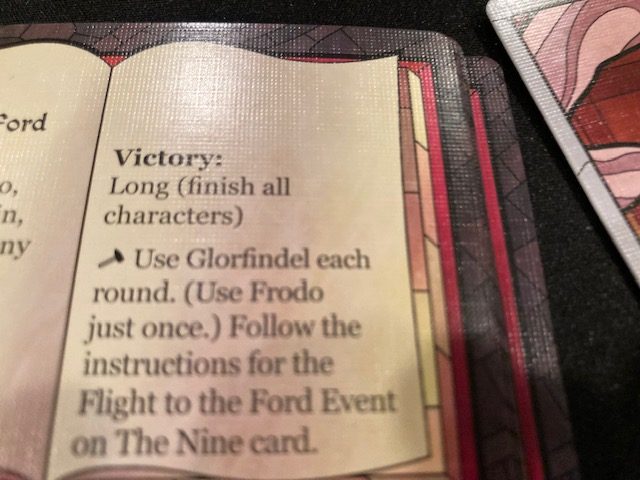
If you can get through all 18 chapters of the campaign, you win!
Solo Play
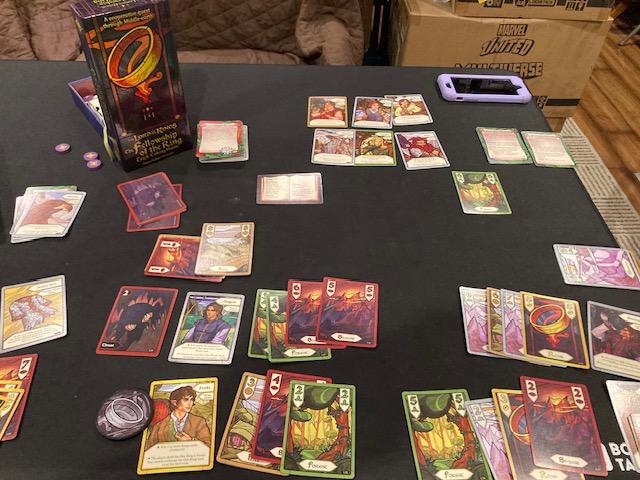
There is a solo mode for the game! (Thank you for following Saunders’ Law!) Given that The Crew (the game that this will be compared to over and over) DID NOT have a solo mode, this is huge!
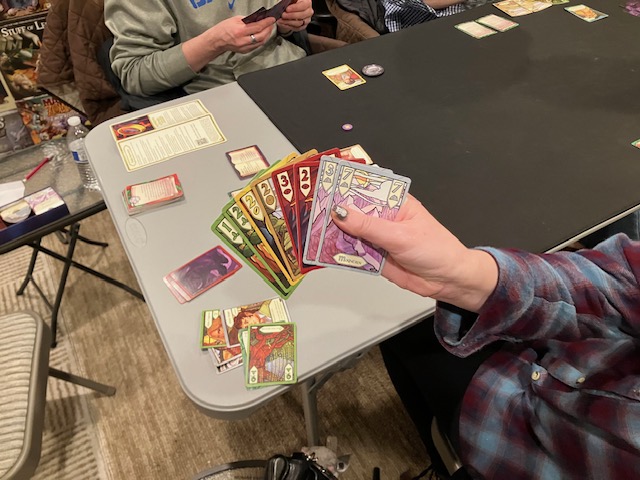
The solo mode has very different rules than the main cooperative game! During the main cooperative game, all cards are dealt out, and the players (cooperatively) make decisions about what to play based on what they see in their entire hand! See above as a cooperative player has a whole bunch of cards!
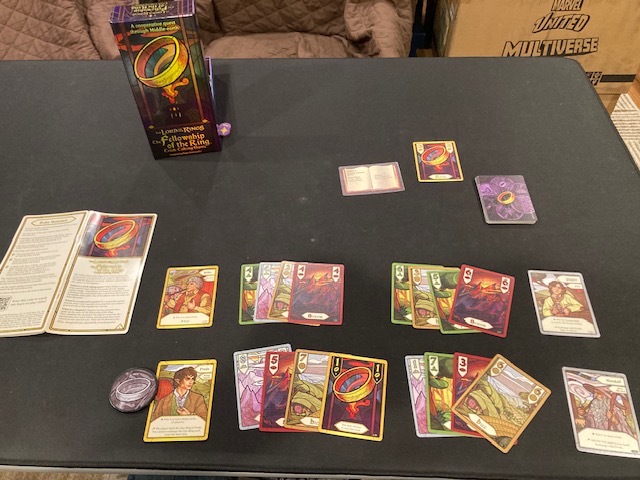
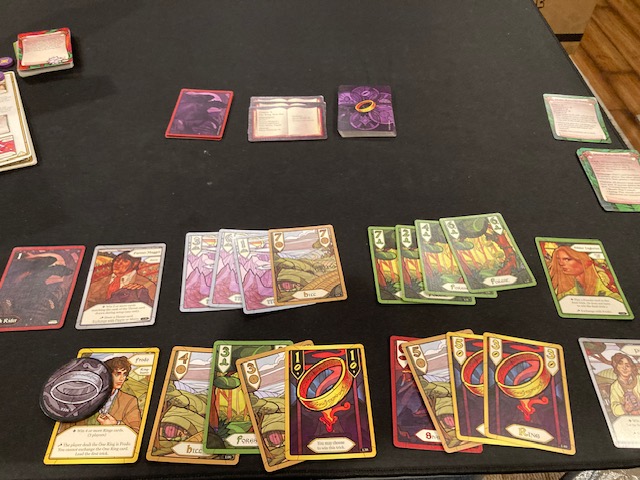
In the solo game, the solo player assumes the role of 4 of the characters, and only gets “part” of each hand (4 cards each to start)! See above as Chapter 1 has the solo player playing 4 characters with 4 cards each!
Each character gets 4 cards (see above) and will get a new cards after a trick is taken! So, the solo player has to decide how to play cards based on seeing ALL Characters cards, but not all cards per hand!
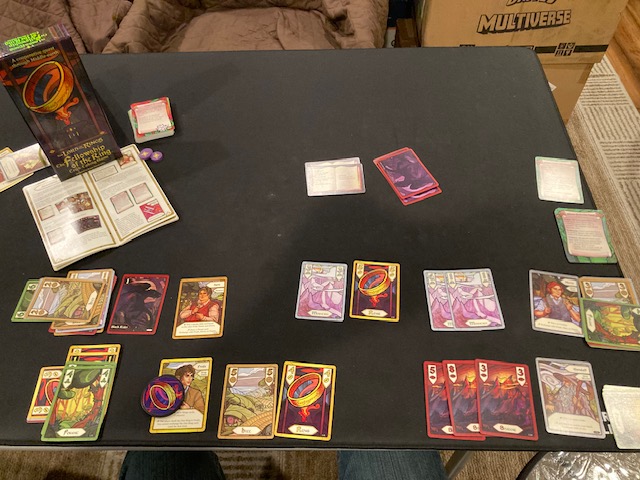
So, this is a solo mode which requires the solo player to operate 4 characters! Normally, I worry about the intellectual overload, the context-switching between characters, and general maintenance. But it’s really not an issue here! Each character is very simple to operate: they don’t have special powers, they simply have a special winning condition. It’s really easy to look at the board (see above) and get a sense what each character should play!!
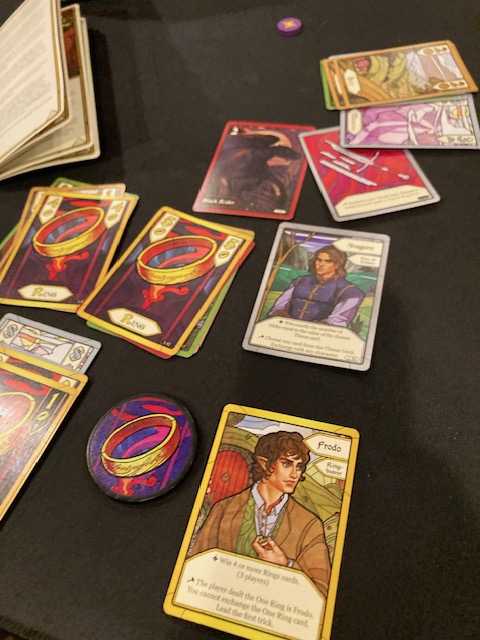
The solo mode requires you to look at all the cards in all the hands of all the characters and make decisions to achieve their win goals. That sounds daunting, but it really isn’t. You know EXACTLY what each character will play; what you don’t know (for sure) is what card each character will get next. The randomness in the solo game is based on what card each player gets next round. I never found this randomness too debilitating. I had a few games where the cards went against me, but it was easy to replay that game … remember, this is a 20-minute game, so any randomness in the deals (even if it completely sucks), will be over soon and you can play another game.
Said another way, I didn’t think there was too much randomness in this game to make me dislike it.
To emphasize the point that this is an easy game to get into, let me tell you that I played through the entire 18-Chapter solo game when I was sick! I wasn’t at my best, but the LOTR trick-taking game is really easy to get into! Each game is “only” 20 minutes or so, so when I got tired when I was sick, I could go take a nap, and come back again!
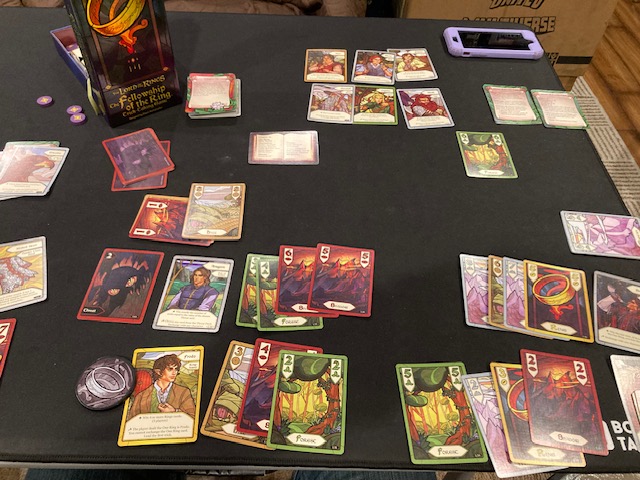
Let’s be clear, even though the solo game is easy to pick-up, easy to play, and easy to keep coming back to, there’s still a lot of engaging decisions! Part of the reason I liked the solo game so much was that it was engaging and “distracted” me from being sick!
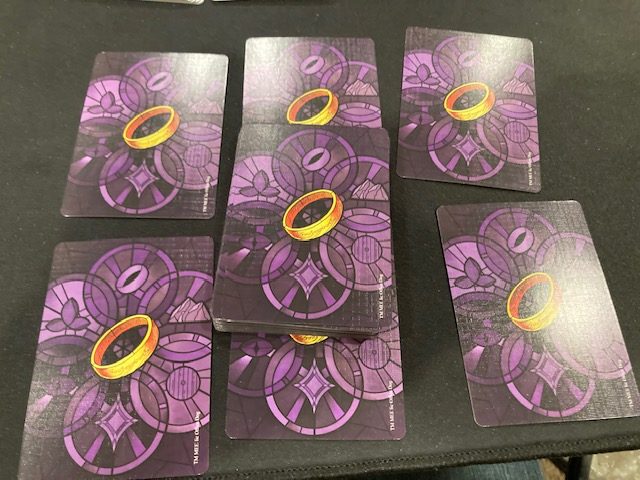
The amount of manintenance as you play the game is pretty minimal; it’s real easy to play solo. But there is a lot of maintenance between games: Honestly, the worst part of the game is the constant shuffling. You need to make sure you do a really good job shuffling the cards, because a bad shuffle may cause you to lose the game! So, I ended up doing a pile shuffle after every game just to make sure thing were shuffled!
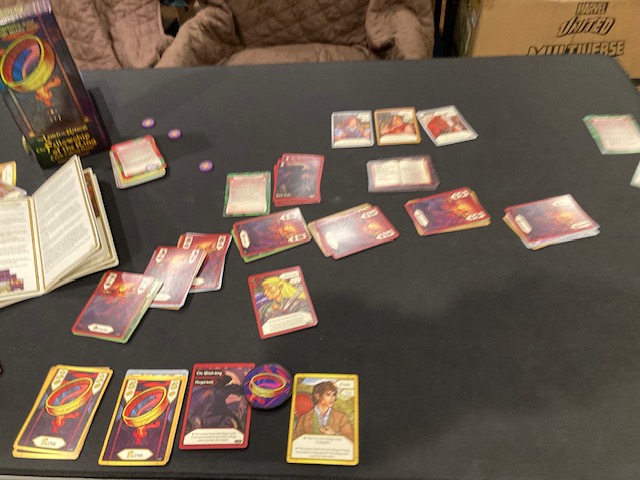
As a solo game, this game is a huge win! It’s easy to learn, easy to play, and engaging enough to keep coming back to! Like I said, I played the entire 18-Chapter campaign solo when I was sick, and it was great! It’s easy enough to play when you are “distracted”, but fun enough to keep you engaged!
Major win for having a solo mode: What’s the score?
The Crew: 0, Fellowship of the Ring: Trick-Taking Game: 1.
I liked the solo game, and even though I have defeated the entire game, I will keep it in my collection to play again solo.
Cooperative Mode
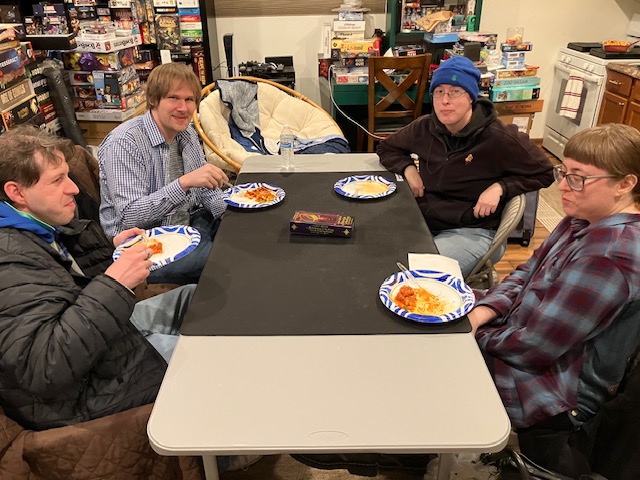
So, there are actually several cooperative modes based on the number of players. It “feels like” the best way to play the game is 4-Players (or 3-Player). (The 2-Player game is really very different; I can’t comment on that as I never got a chance to play it. I have to admit the 2-Player mode looks very daunting).
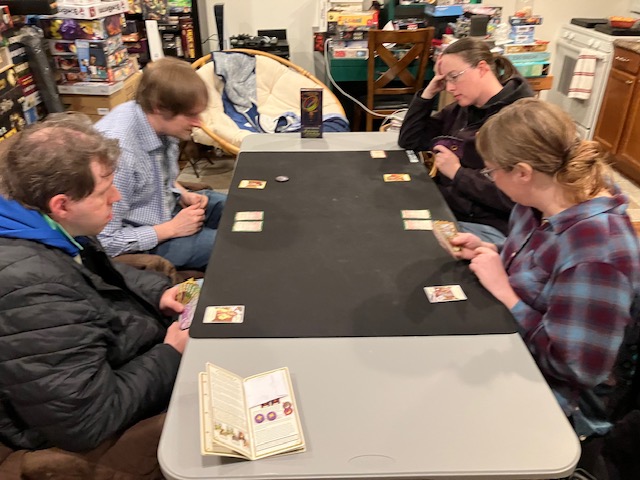
My 4-Player group sat down and played though 12 games (8 chapters) in one night over 3 hours! They won most games pretty handily, but it kept getting harder and harder! By game 8, they had to replay it 3 times! Game 8 features Tom Bombadil pretty prominently, and the joke was that game 8 was just as annoying as Tom Bombadil!
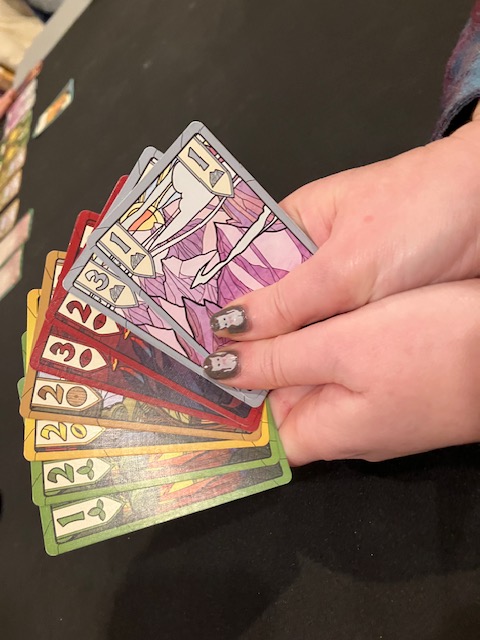
The major differences between the solo and 4-Player cooperative game:
1) The solo player sees all hands, but only a limited number of cards
2) The cooperative player sees all cards in their hand, but only can see their hand
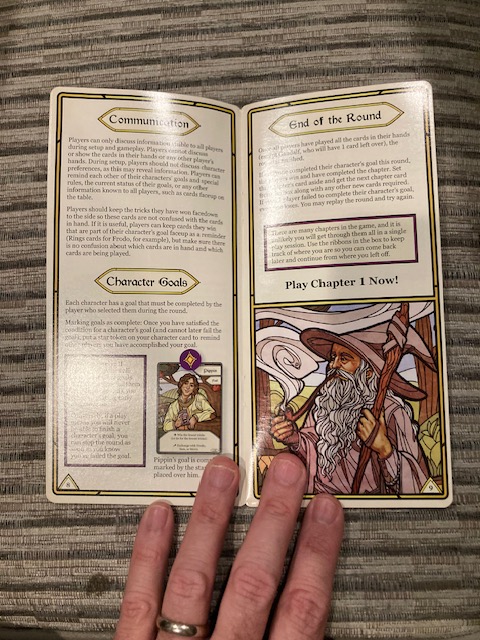
The Limited Communication rules are VERY Clear from the rulebook: you pretty much can’t talk about anything except public information, such as player’s winning conditions and special rules. Anything in your hand can’t be discussed AT ALL!
After playing through 8 Chapters, my friends basically said they liked this better than The Crew and it was more thematic! They liked the art, the cards, the character win goals.
The Crew: 0; Fellowship of the Ring: Trick-Taking Game: 2 (theme, art)
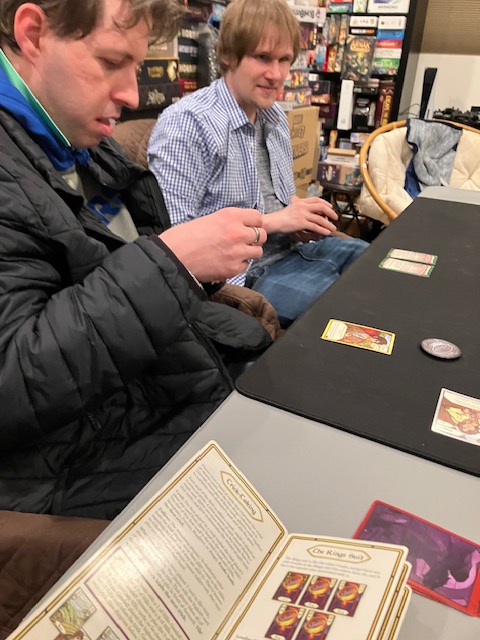
I like to point out that the Crew has the “very limited communication” with the communication tokens. I actually prefer that part of the Crew: I don’t love that there is NO communication really in this game (but see below). Recall, in the Crew, every player “can communicate” once at a critical juncture with “highest card” or “lowest card” or “only card. There is no such mechanism in Fellowship of the Ring: Trick-Taking Game: the rules for limited communication are pretty brutal.
The Crew: 1 (has some critical communication); Fellowship of the Ring: Trick-Taking Game: 2
One Ring To House Rule Them All
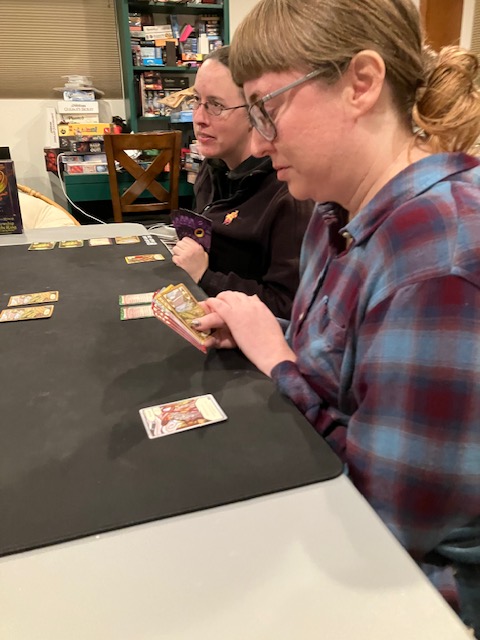
Let me tell you what happened in the 4-Player cooperative game: when choosing characters to play, my friends ended up talking a little about which characters to choose. “Oh, I should probably be Pippin, my hand sucks.” “Ya, I can be Tom Bombadil I guess”. Here’s the thing: the rules are VERY CLEAR that they can’t do that!
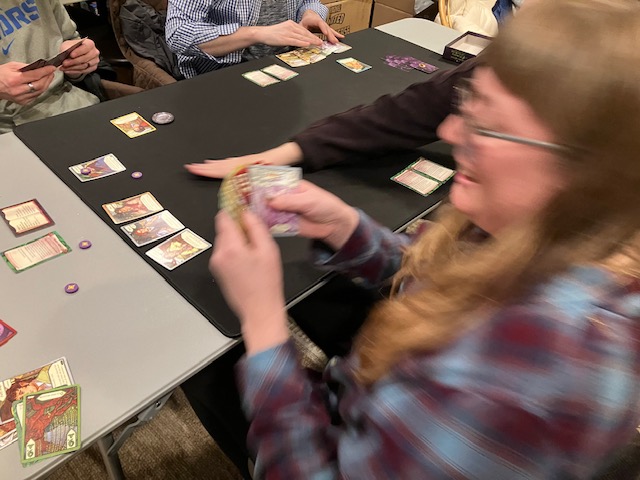
I read the rulebook aloud to my friends: this explicitly say they can’t do this …
“During setup, players should not discuss character preferences, as this may reveal information”
My friends hated this rule! This is the one and only chance to really communicate on the game, and they felt like it made the game more fun! “Give us SOME choice! This is a house rule for us!”
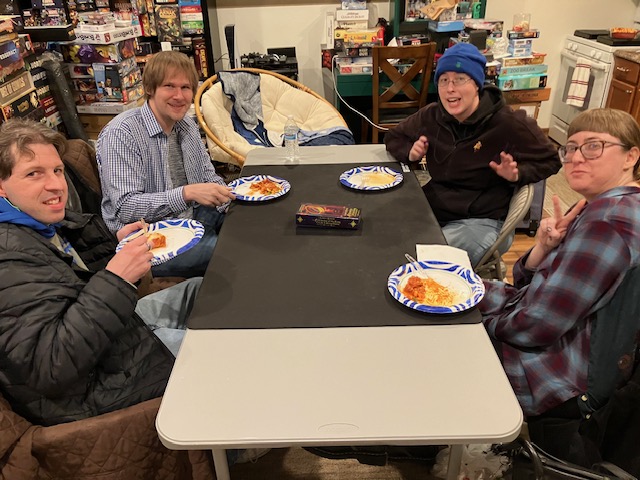
I didn’t mention this, but I ended just watching and shepherding my friends through 8 chapters (I was the fifth wheel and didn’t play). And watching my friends “discuss” which characters to play seemed to engage them and made them talk! They REALLY had fun picking characters! I think it also gave them more “skin” in the game, as they weren’t just “saddled” with a character, they had a choice in the pick!
It’s very explicit in the rules that players can’t reveal any intent on characters, but I think that’s a mistake. I think the game is more engaging and more fun if players have some choice there! Honestly, this helps combat the problem I have with this game: there’s no “special communication” allowed (like The Crew!). Watching the game, it was VERY clear that allowing the players to help choose their characters was more fun, so we made it a house rule:
“Players can communicate preferences for choosing characters, but just can’t reveal what’s in their hands”.
With the house rule:
The Crew: 1; Fellowship of the Ring: Trick-Taking Game: 3 (house rule)
Without the house rule:
The Crew: 1; Fellowship of the Ring: Trick-Taking Game: 2 (no house rule)
The Campaign
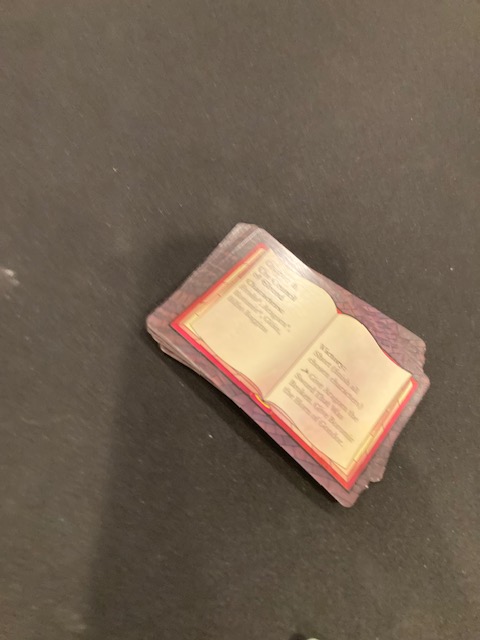
The Campaign is … just the game getting harder and harder. The campaign follows the story in the book really well; one of my players is a big Lord of the Rings fan, and they noted how well the Chapters followed the book. But, at the end of the day, each game is pretty much independent of the previous game. There is no “levelling-up”, there are no major penalties for losing—each game just gets “harder”. Certain characters are “revealed” as you play, but generally the campaign is just harder and harder games. It’s a linear campaign.
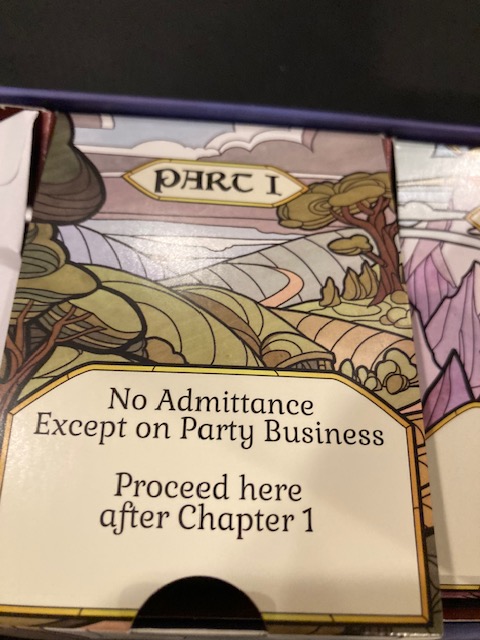
If you were looking for a more operatic campaign with levelling-up, branching narrative, satisfying punishments, debilitating punishments, and state changing, this isn’t the game for you. But, if you want a bunch of games in a row that nominally follow the plot of the book The Fellowship of the Ring (without too much maintenance in between), this is a good game for you.
What Do You Do When The Campaign Is Over?
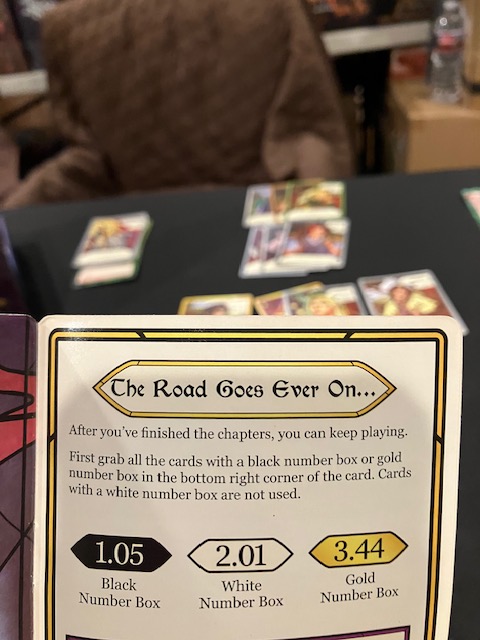
There are rules for playing the game after you finish the campaign: see rulebook above. Honestly, I would just rather play the campaign again; the campaign is easy to reset, and setting up games “post campaign” looks messy.
What I Liked
The art: This stained-glass art for the characters was very thematic and very appealing. The art on the Mountains, Rings, Shadows, etc. suits was also very thematic. The art and theme is much more appealing in this game than the Crew:
The Crew: 1; Fellowship of the Ring: Trick-Taking Game: 4(with house rule and art)
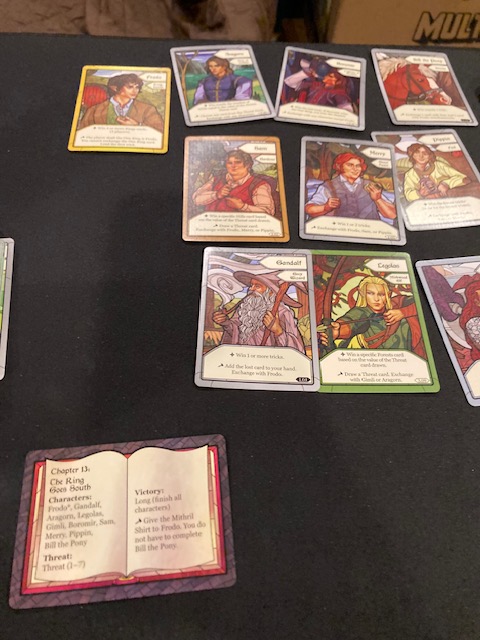
The Characters: The character art and win conditions were all very interesting. One of my players pointed out they liked that the win Conditions changed every time, but they followed the characters! The Crew is a little different in that the win conditions just a condition. I think it’s a win for the Fellowship of the Ring: Trick-Taking Game that there are characters. Having characters makes the game a little more engaging! For my group at least.
The Crew: 1; Fellowship of the Ring: Trick-Taking Game: 5(with house rule and art and characters)
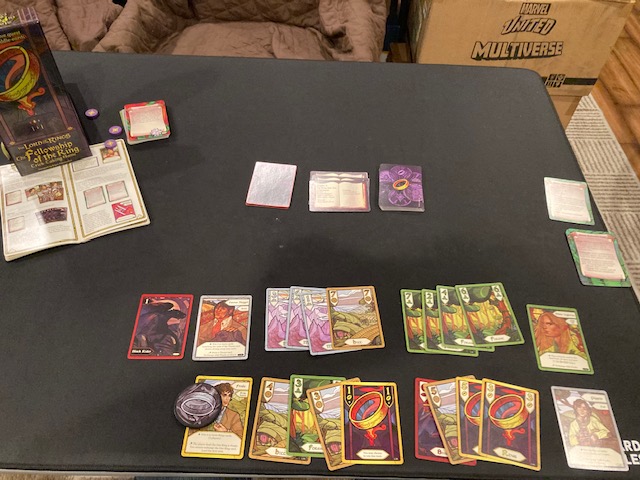
Solo mode: The solo mode is good. It’s easy to get into, and it’s easy to start/stop it at any time. We’ve already noted that the Crew does NOT have a solo mode, whereas this does.
What I Didn’t Like
Communications too limited: I think the Crew has the major advantage by giving players “chances” to do communication at critical times: There is no such mechanism in this game. I don’t want to undersell this point: this is one of the major reasons I adore the Crew! The whole idea of communicating a critical piece of information at JUST THE RIGHT TIME is such an engaging and interesting mechanism in the Crew. There is nothing like that here.
I will say that the House Rule we proposed (allow characters to more interactively choose characters) goes a long way towards alleviating this issue.
So much shuffling! Just be aware how much shuffling there is … you may want to sleeve your cards. Since each game is only 20 minutes, these cards get touched and shuffled a lot. I currently don’t have my cards sleeved, but maybe I should.
Conclusion
The Lord of the Rings Fellowship of the Ring: Trick-Taking Game is a fantastic game that I think people will adore. I watched as my group just jumped in and played 3 hours, and they had a ball! I watched as I played solo over the entire campaign, and I had a ball!
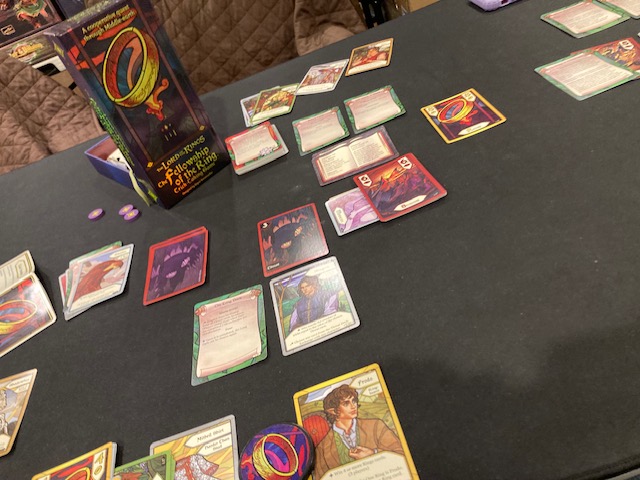
The best description I have of this game is The Crew meets Lord of the Rings! It’s a very thematic co-op, at least moreso than The Crew. My friends all preferred this over the Crew … but only if they had the House Rule that they could talk more about character selection. Watching them play cooperatively, I would strongly recommend this House Rule: it really seemed to make the game more engaging for my friends!
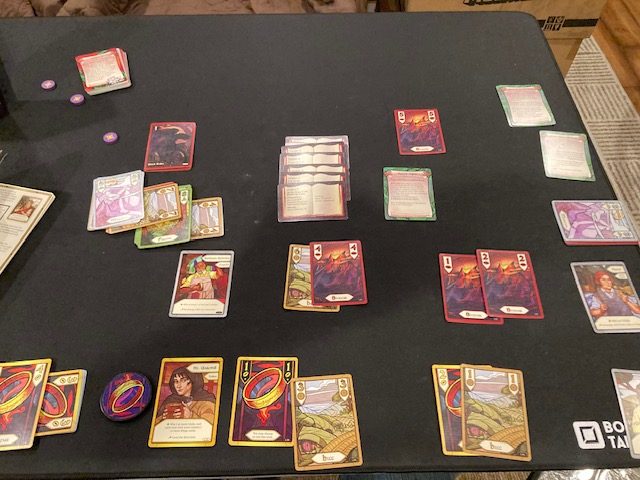
The solo game was very engaging and I would play it again.
This is a very easy game to jump into, either cooperatively or solo, and it’s easy to play (with lots of fun decisions). I personally prefer The Crew over this (because of the critical communication rule), but my friends all preferred this game. If I want to play solo, I can’t play The Crew, but I can play this.
Great game. I will keep both The Crew and Fellowship of the Ring: Trick-Taking game in my collection, but it appears my friends all prefer Fellowship of the Ring: Trick-Taking game.
You might want to sleeve your game if you pick it up. My cards have started getting a little grody.
 coopgestalt