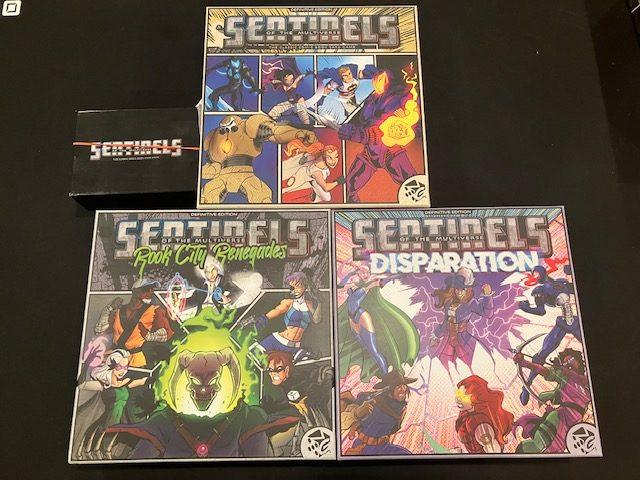
Disparation: The Final Chapter? A Solo and Cooperative Review of the Sentinels of the Multiverse Expansion

I have a lot of reviews queued up to go out, but I really wanted to talk about this expansion a lot.  It means a lot to me, so it jumped the queue.

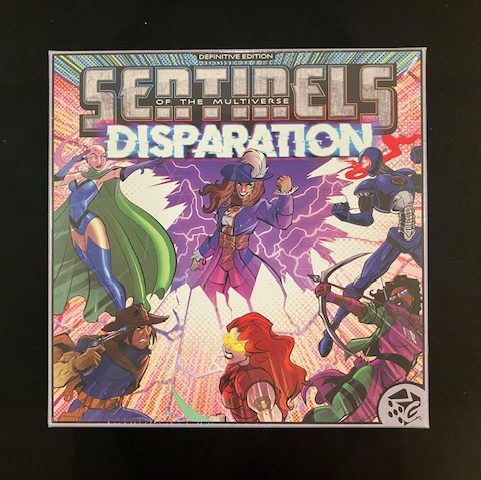
Never before has an expansion been so appropriately named: Disparation.  Why is that?  Because it is likely the final hurrah from the Sentinels of the Multiverse line of games!

To be clear; Disparation is an expansion for  the Sentinels of the Multiverse: Definitive Edition; this is the most recent and modern version of Sentinels of the Multiverse.  For a full discussion of different versions (1st, 2nd, definitive), see a link to our review of Sentinels of the Multiverse: Definitive Edition here.

In April 17th, 2025, Flat River Group (who owns the Sentinels of the Multiverse line of games and Greater Than Games) announced that they were essentially shuttering the business.  Essentially, there were shutting down the company in response to the tariff crisis: see link here.  The wording suggests that maybe they can come out of it, but it’s unclear. In a recent visit (in 2026) to my FLGS, I asked them about Greater Than Games, and they said “No, they’ve shut down”.

Now, as someone who had kickstarted (well, it was on BacketKit) the Disparation expansion  back in something like March 2023, I was concerned!  Would this mean they would just abandon this?  It had already been 2 years since the BackerKit project, and the project seemed to be taking forever.

In fact, one of the Updates about the time of the announcement indicated that they had just starting printing the expansion, but then shut it down?!!?!  Over the past year or so since the announcement, me and other backers of Disparation have been on pins and needles.  Would Disparation be abandoned in light of the current situation?

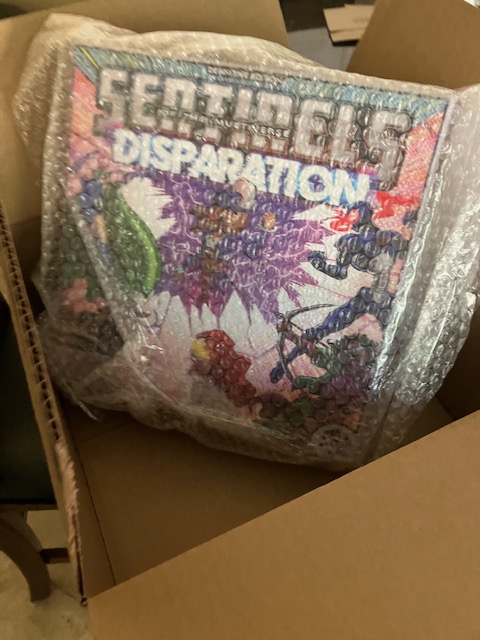
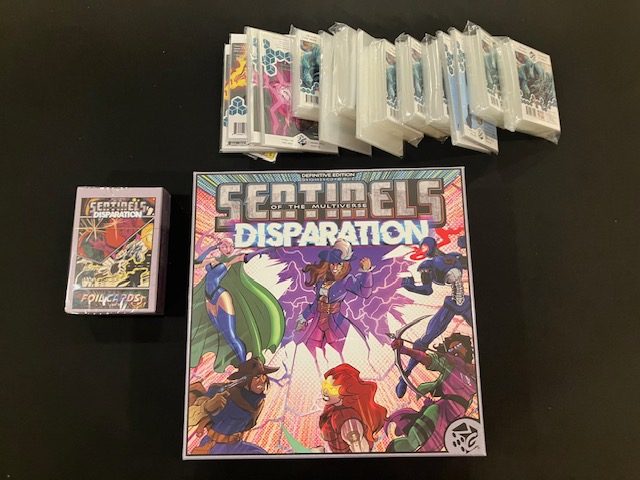
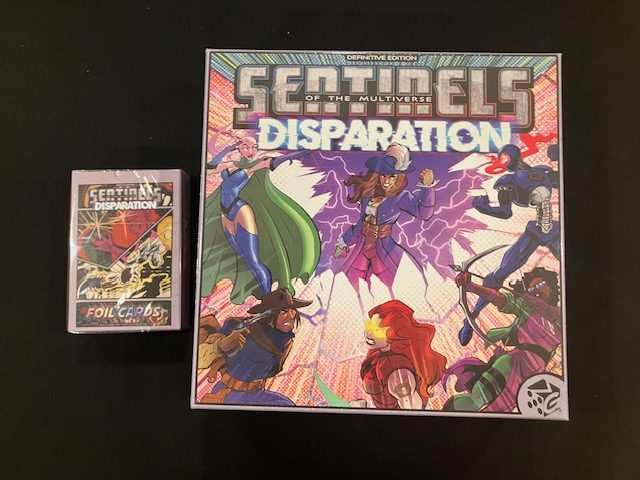
As you might guess, we finally got some good news back in September in this update!!  It was printing and would be delivered in Q2026!  So, on January 18th, 2026, my copy of Disparation finally arrived: see above!   I was overjoyed! I never thought I’d see this!

I do not know what the status of Greater Than Games/Flat River Group currently is.  I was a BackerKit backer and got my copy, but I don’t know if this will ever see retail.  If you see it somewhere, pick it up!  It may very likely never come back in print (at least, that’s the current feel).

Let’s take a look!

Unboxing

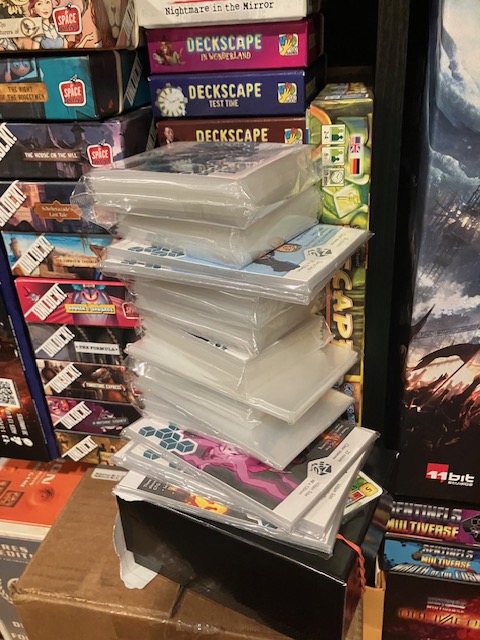
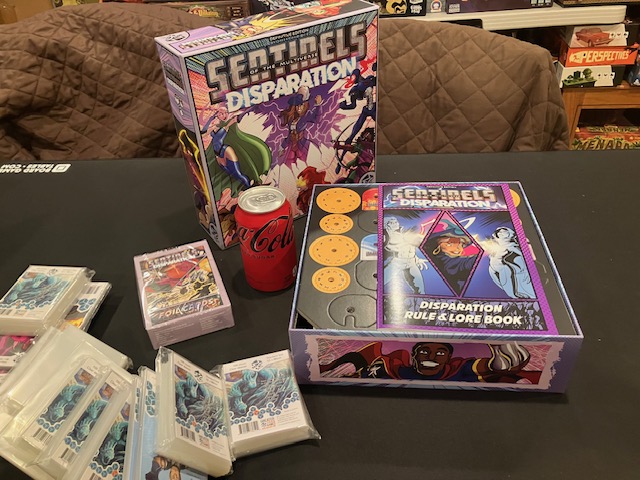
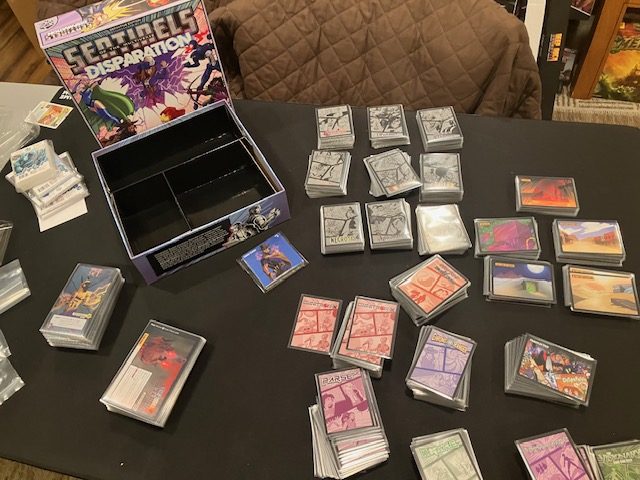
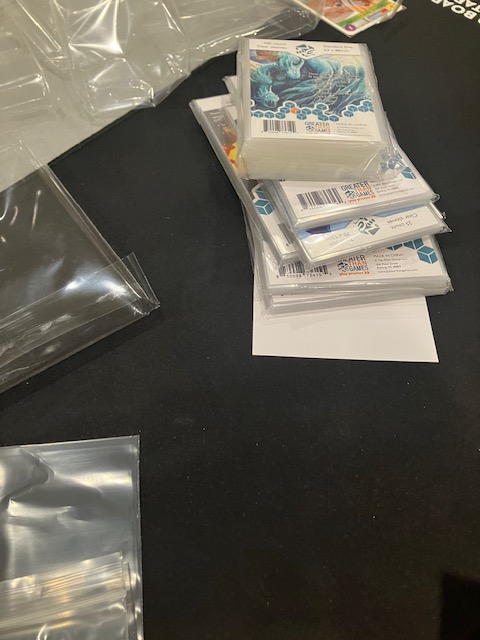
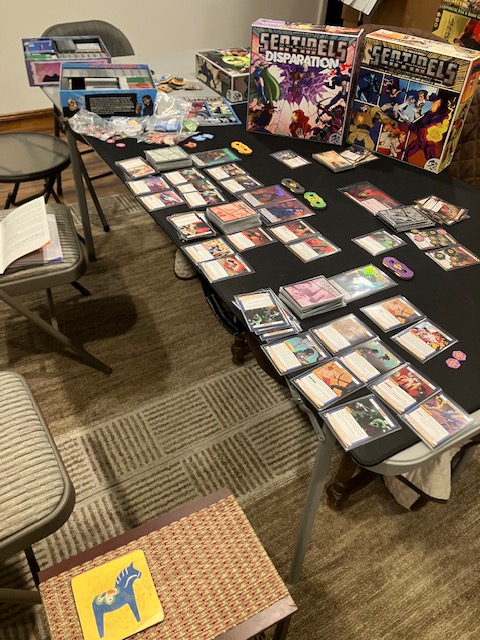
Strictly speaking, this unboxing started ALMOST TWO YEARS ago!  Waaaaay before they had the tariff crisis, I was sent all the sleeves for the game!  That’s right, two years before the game itself arrived, I had the sleeves … waiting on a box (see above).  I put the sleeves with the original Sentinels of the Multiverse token box to remind myself WHAT these sleeves were for!  See above!

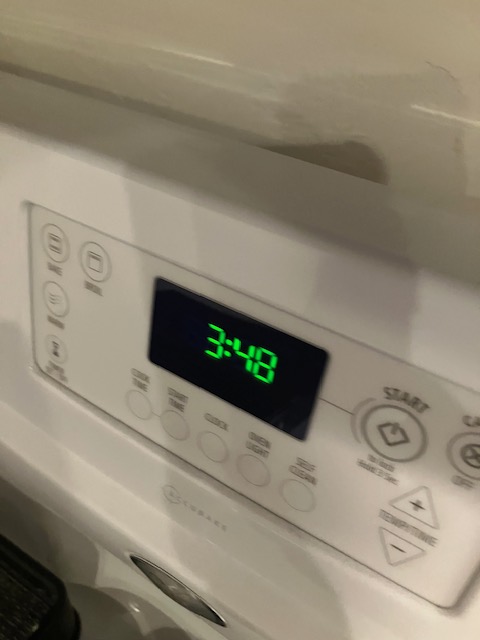
But, once I brought the game to my game room, it was 2:06pm.

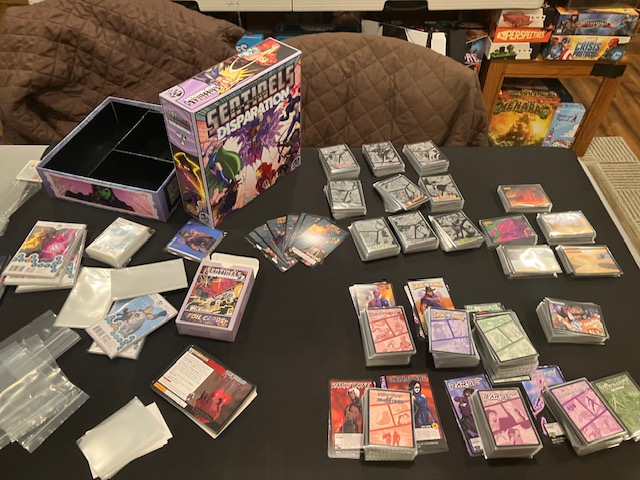
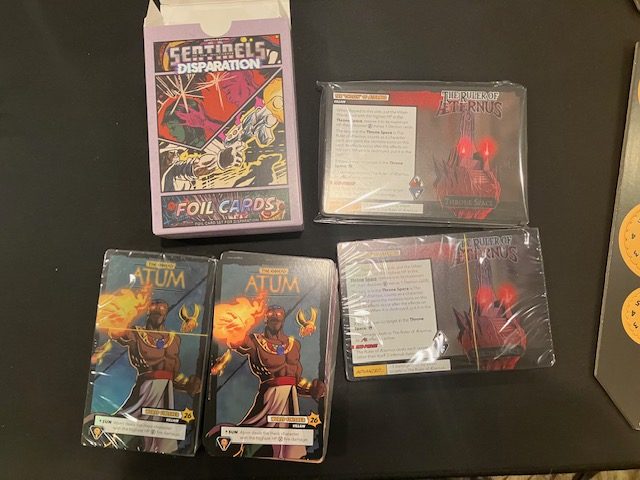
In fact, I had gotten the foil cards and the Disparation box and sleeves for it.

See Coke can above for scale.

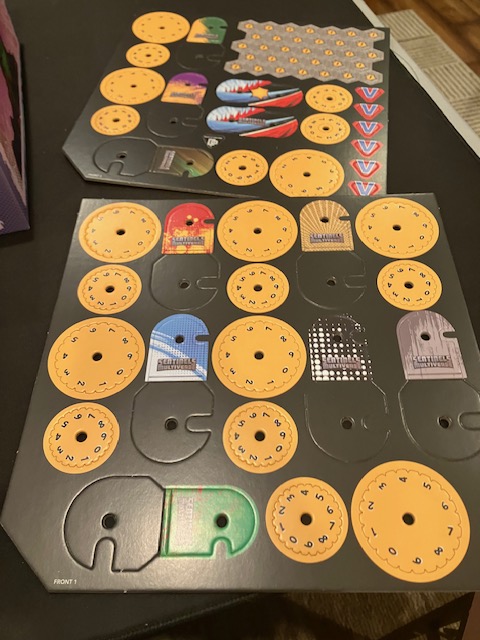
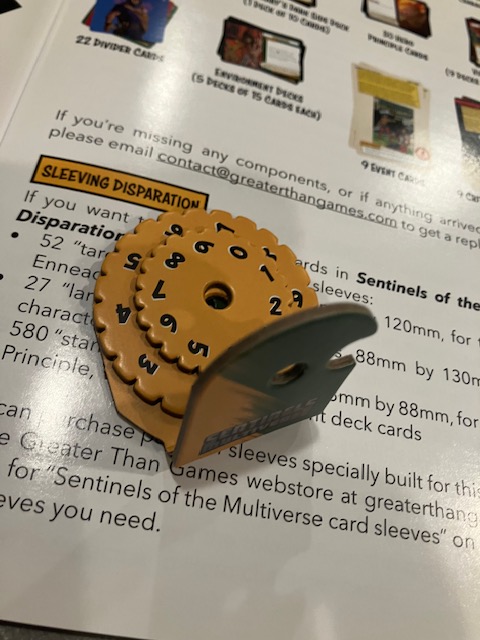
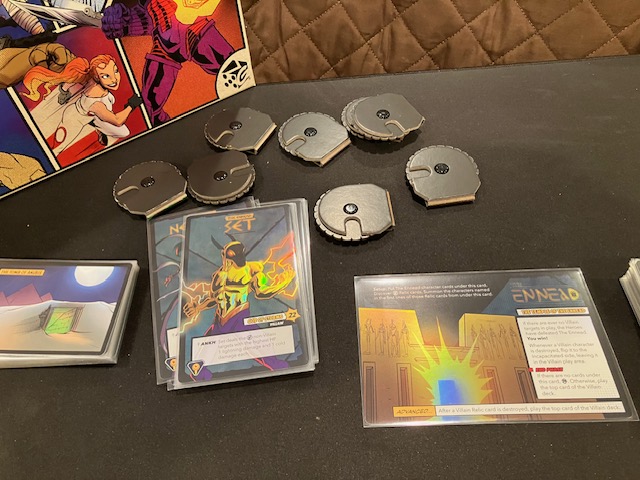
There’s a number of punchouts for this: most of these are little hit point wheels for the Ennead Villain set!

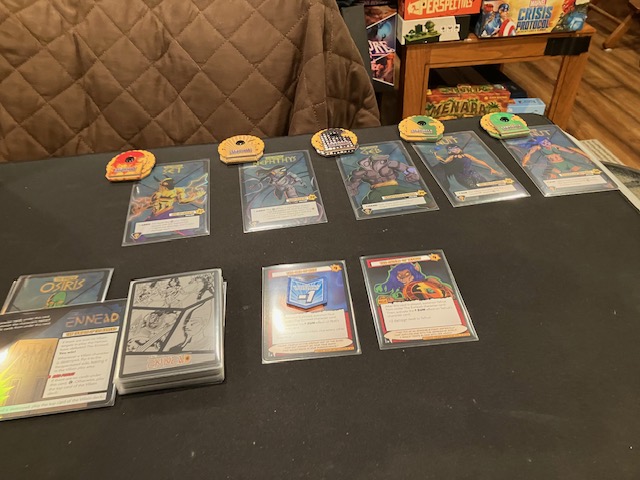
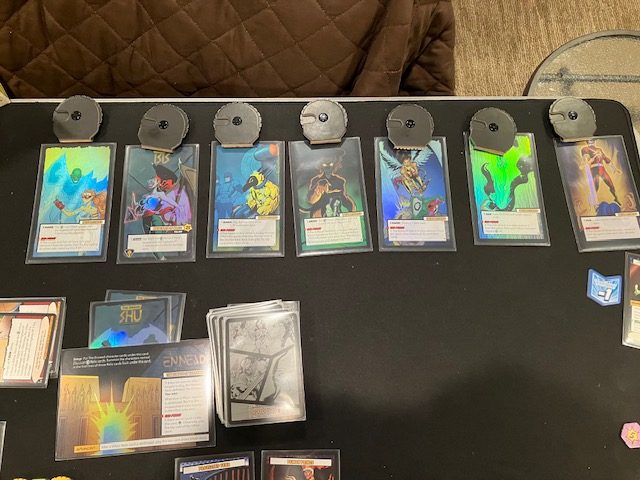
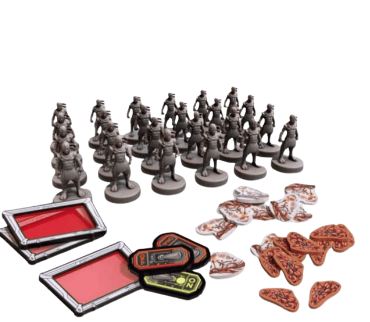
One of the bigger Villains in this set is the Ennead!  See above! There are (potentially) 9 Bad guys that may emerge as you fight the Ennead!!  So, this set includes 9 more spinners to note hit points.

These hit point spinners were a little clumsy to build, and they are a little clumsy to use.  You have to hold one of the wheels down with your fingernail while you spin the other wheel.  Not ideal.

But most of this expansion is cards: cards, cards, cards!

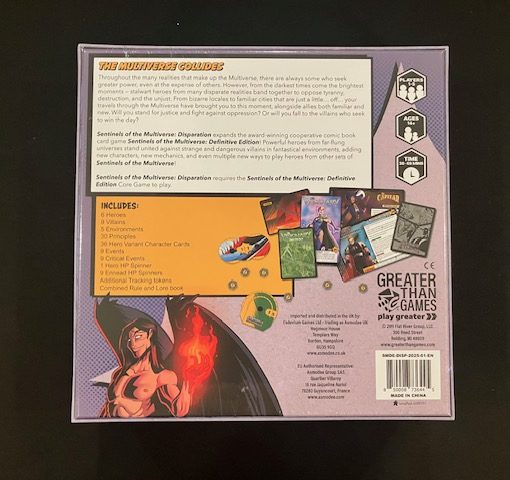
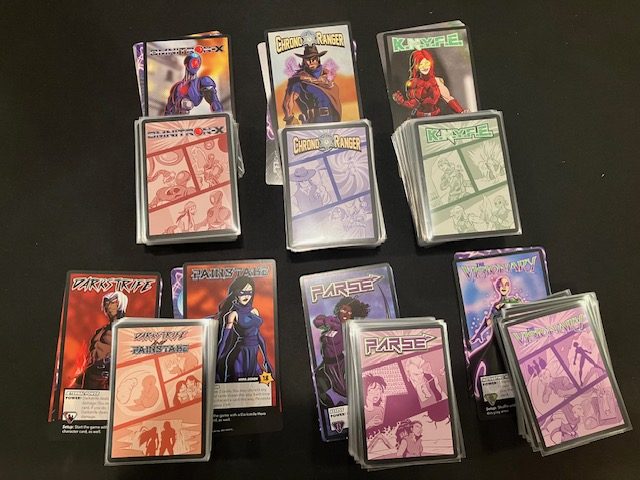
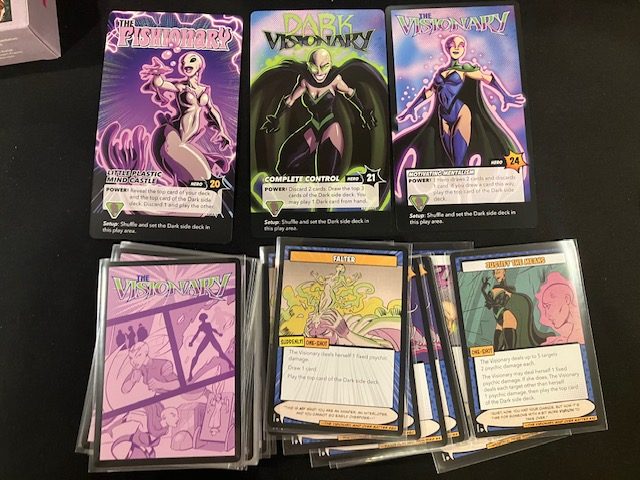
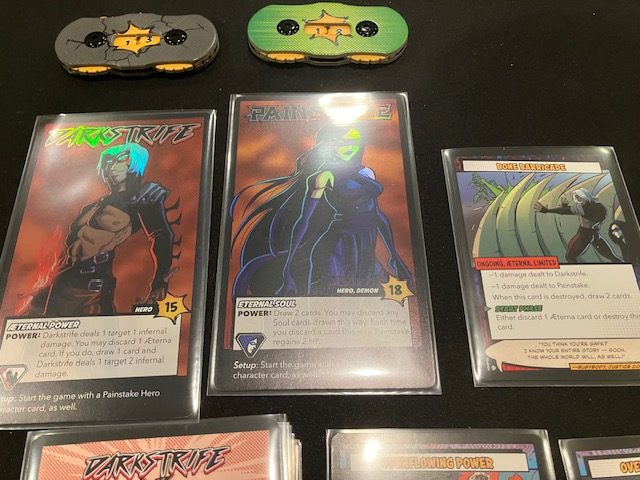
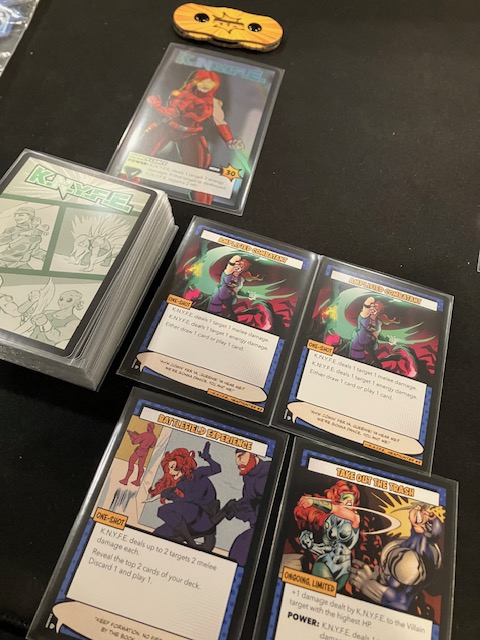
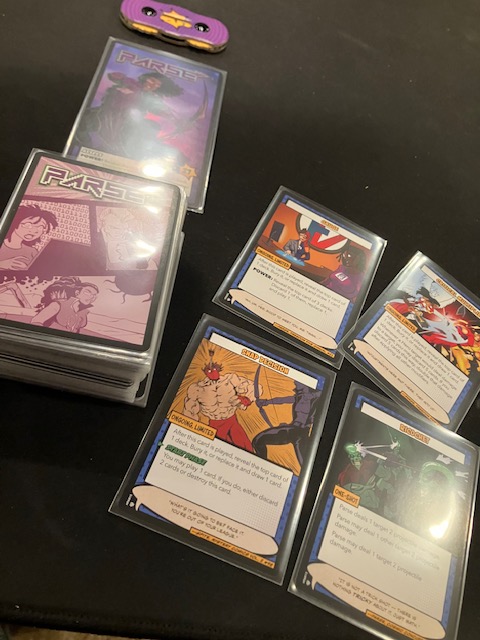
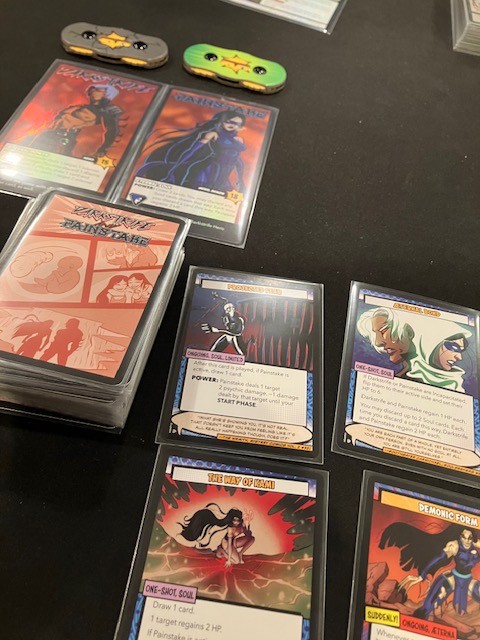
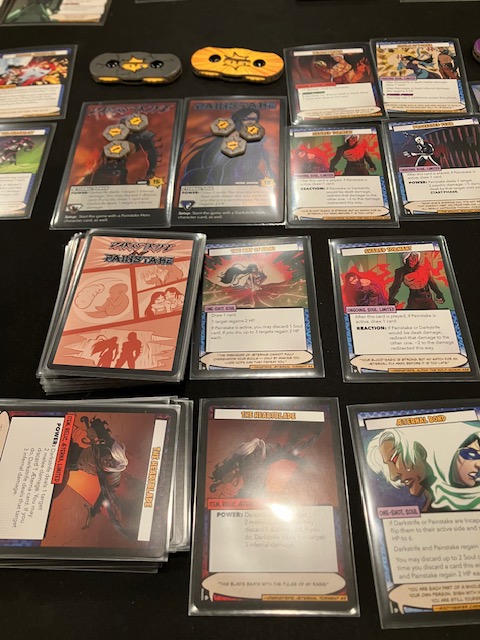
There’s 6 new Heroes, with 6 new hero decks and new Giant Hero cards!  (One of the heroes is a set of two twins called Darkstrife and Painstake, but they are officially one hero deck and one hero).  If you know the original 1st/2nd edition of Sentinels of The Multiverse, all of these heroes are familiar … except Darkstrife and Painstake are new.

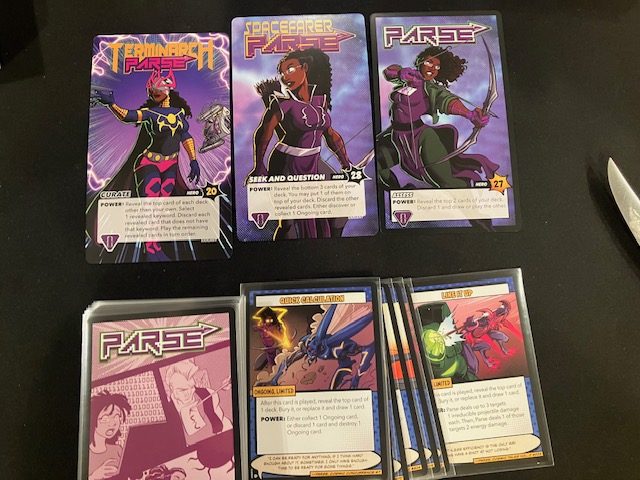
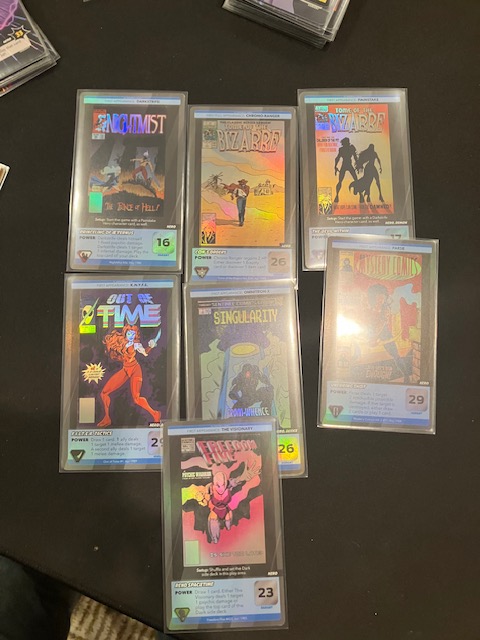
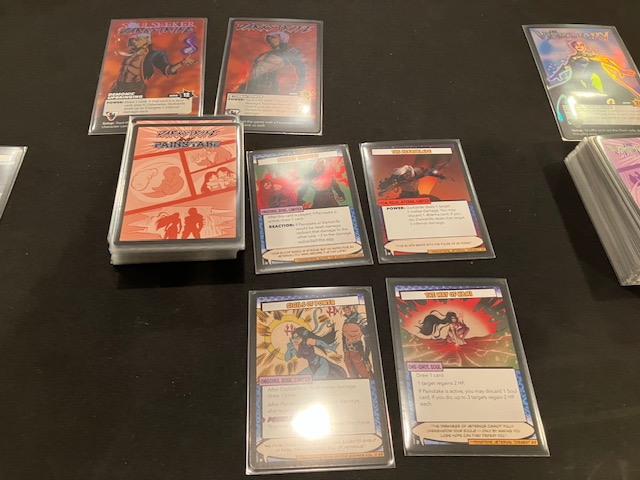
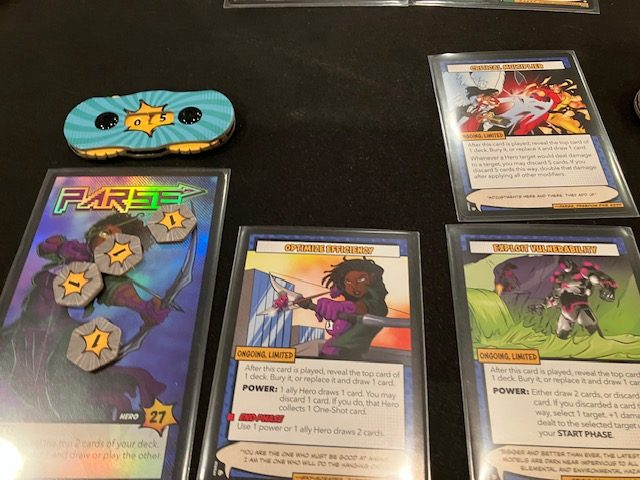
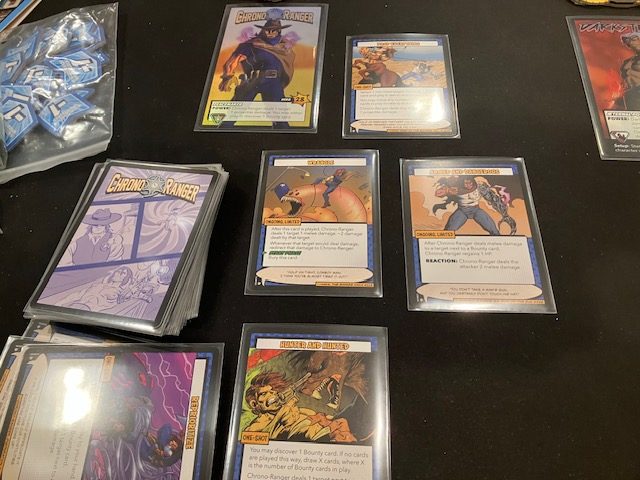
Each new Hero actually has three base Hero cards for slightly different starting Powers!  They use the same Deck, but the starting power varies slightly! See Parse above with her three different multiverse characters!

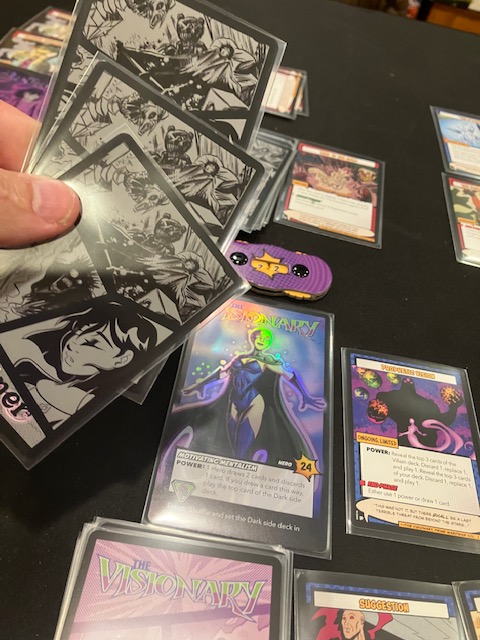
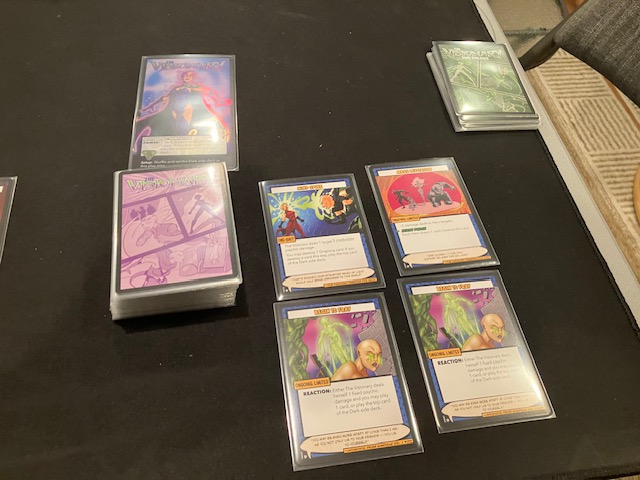
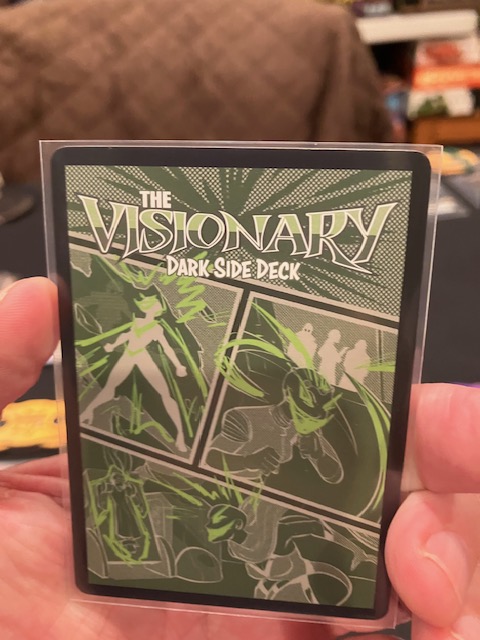
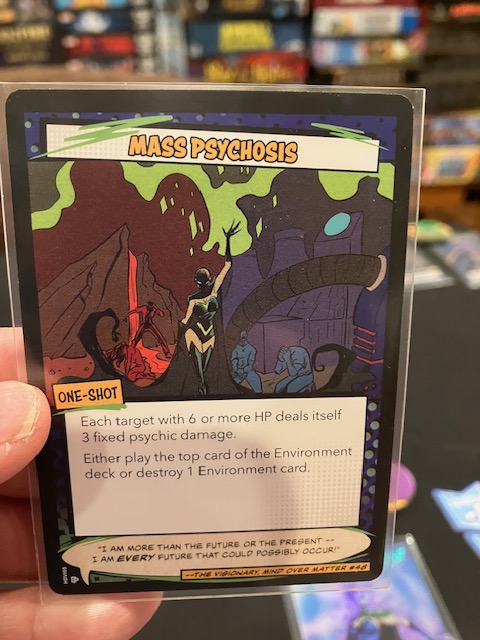
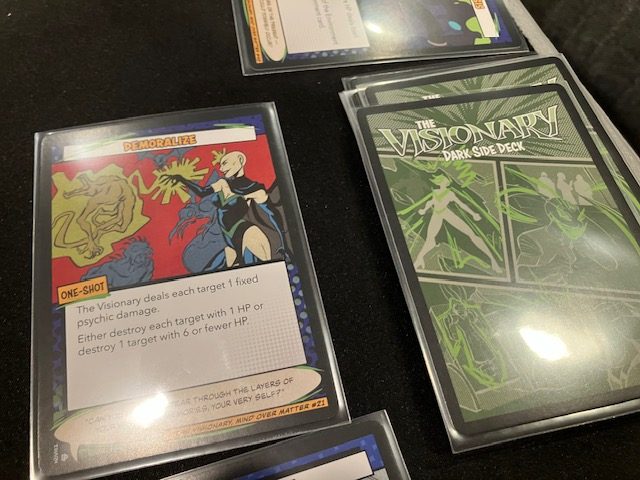
And See Visionary above!

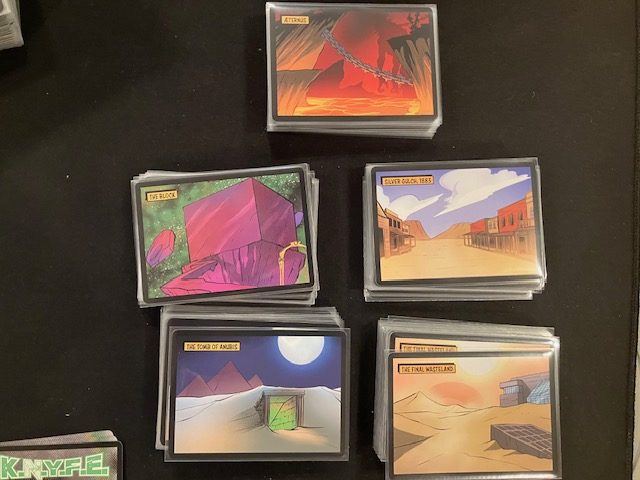
There are 5 new environments (anyone who has played the 2nd edition will recognize all of these).

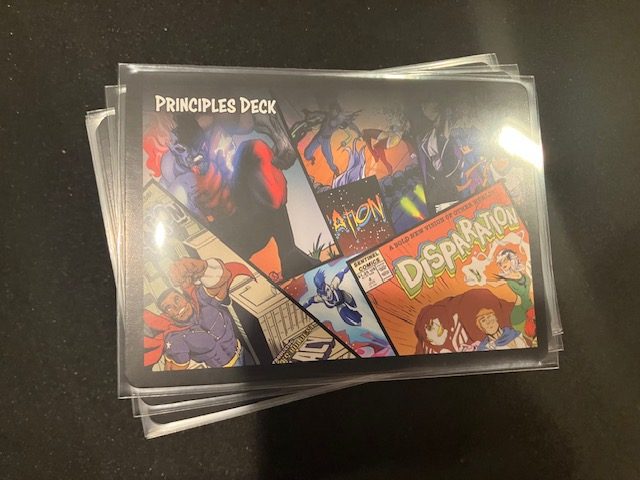
There are Principles cards: these allow a slightly different way where you must adhere to some basic Principles as you play.  It sort of gives your character a direction/sense of how it should be played.    You don’t have to play with these; they are optional.  (They don’t change the game THAT much).

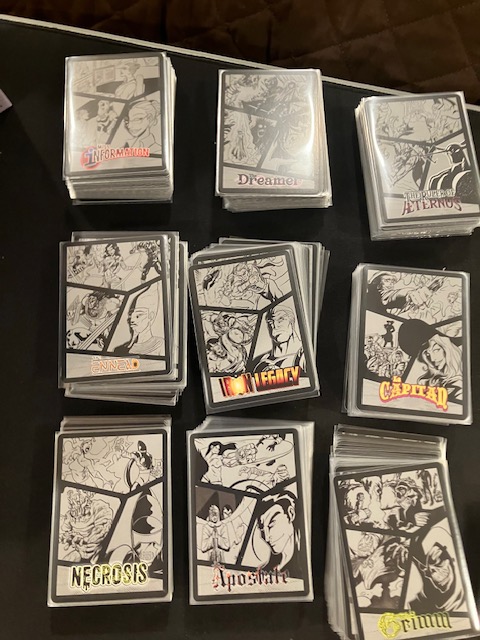
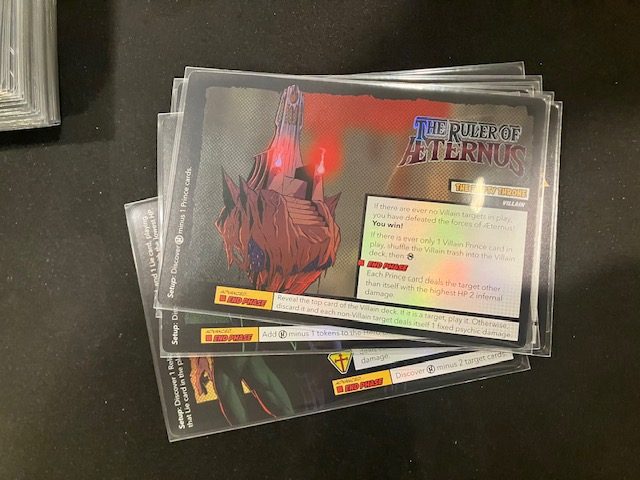
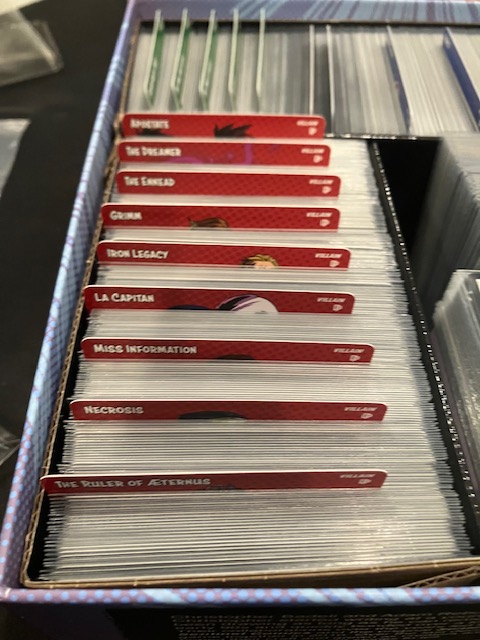
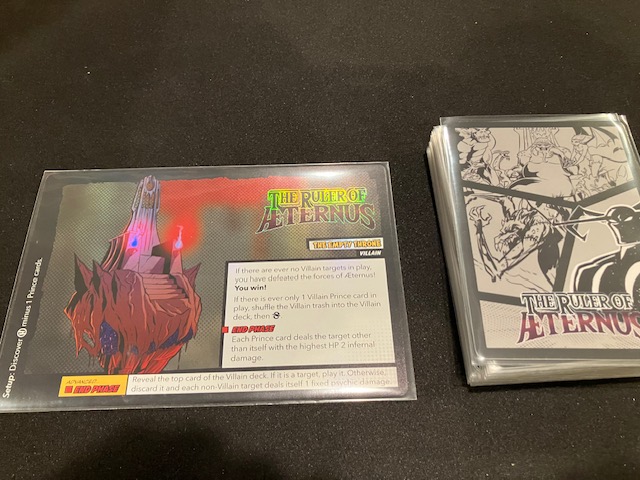
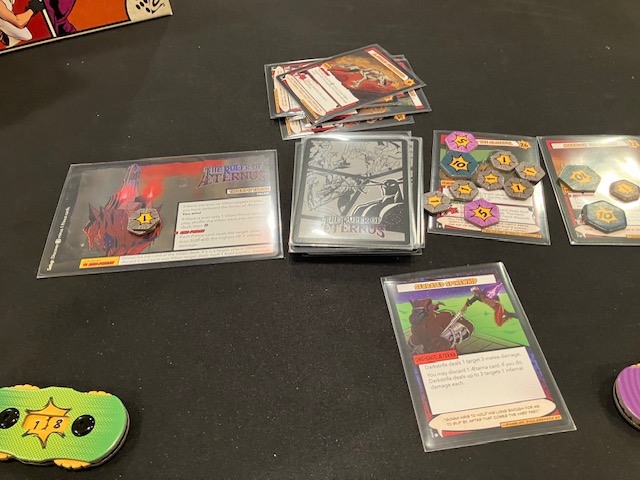
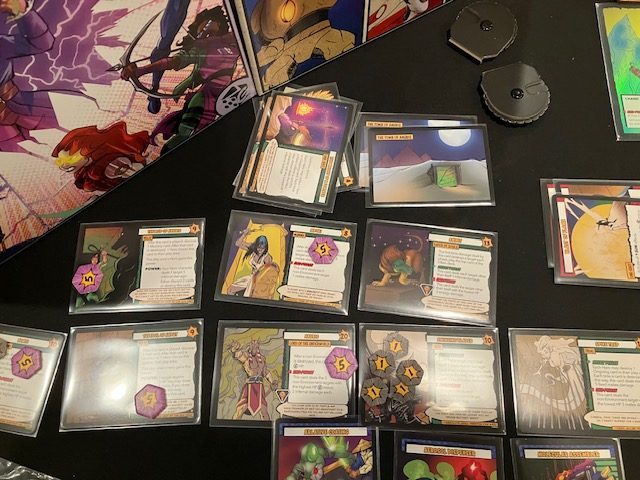
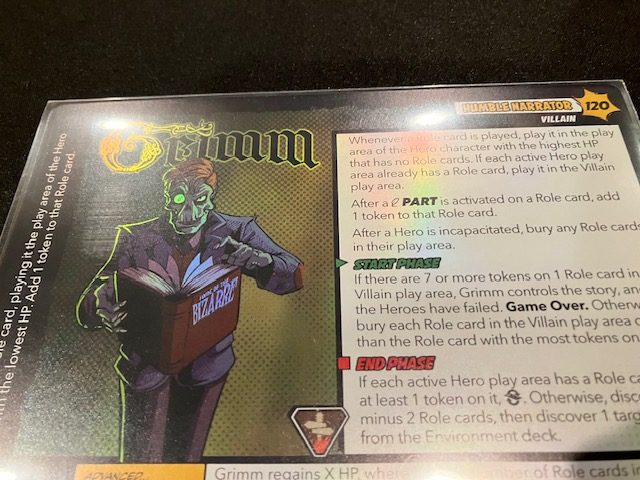
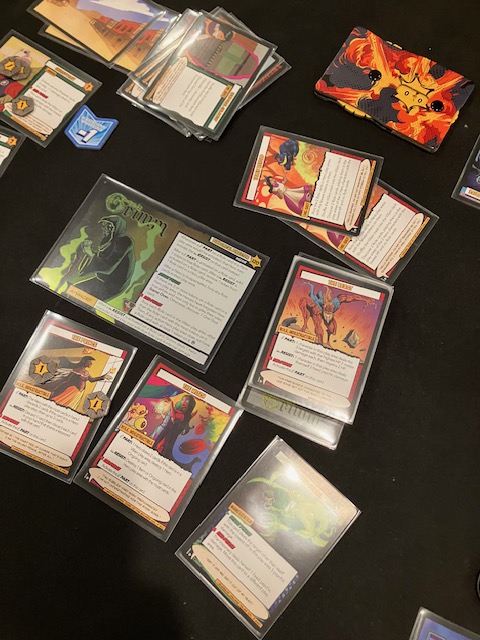
There are nine new Villains(!) !  That’s right!  Nine!  Those of you familiar with 2nd Edition will recognize most of them, but Grimm, Necrosis, and Ruler of Aeterna are all brand new villains.  See above.

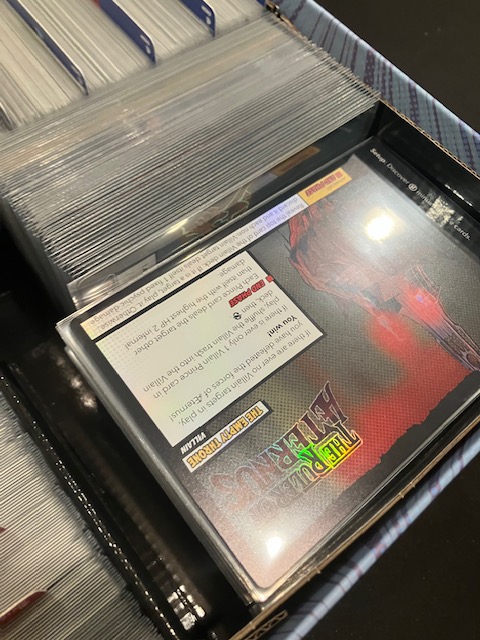
Of course, there are giant cards to note the Villains. See above.

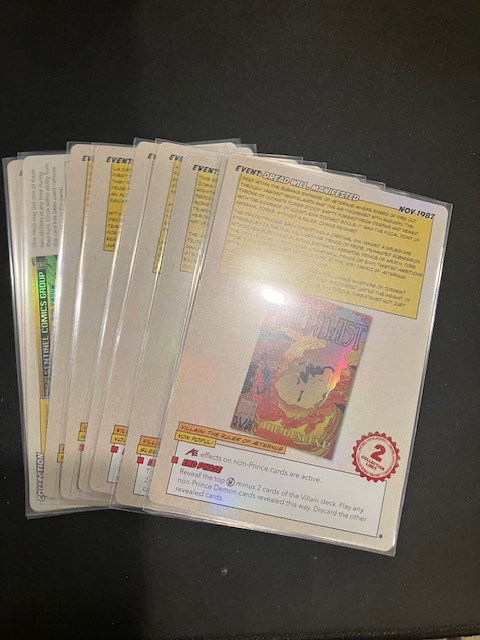
There are also Event cards which explore the Sentinels comics lore; they mostly set-up some special fights with special powers and rewards.

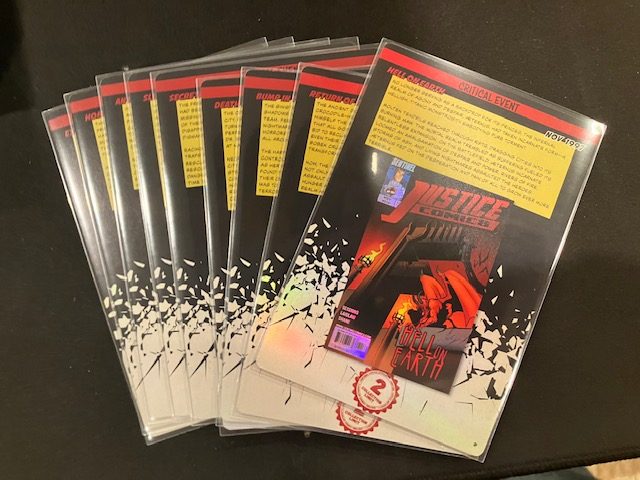
There are also Critical Event (cards) which are like Events, but replace the Villain with alternate version of said Villain; these are usually much harder fights.

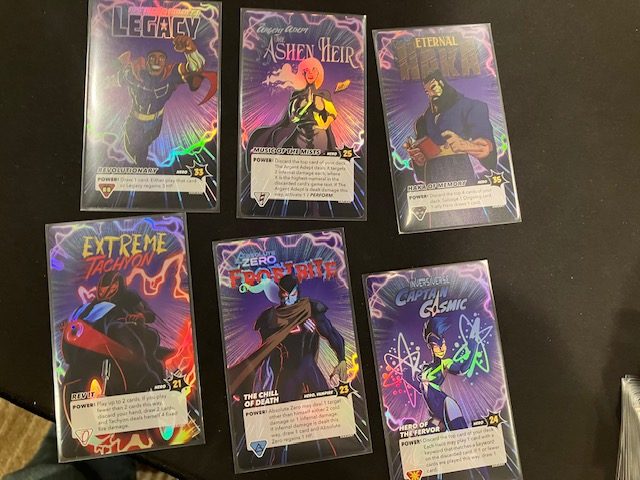
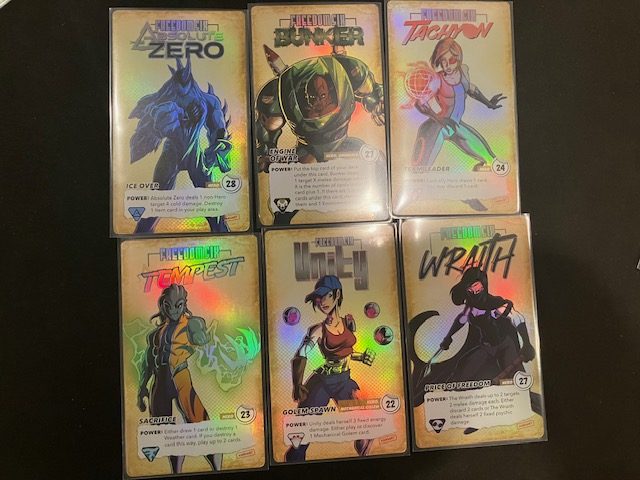
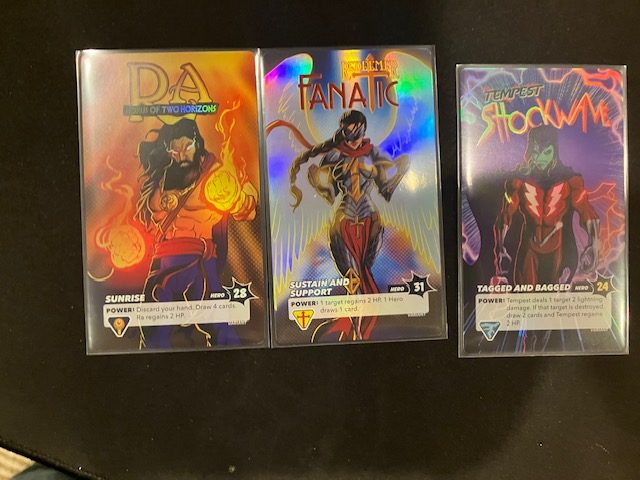
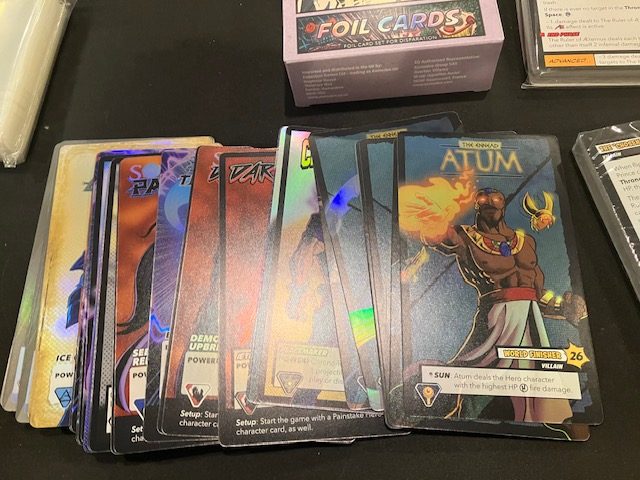
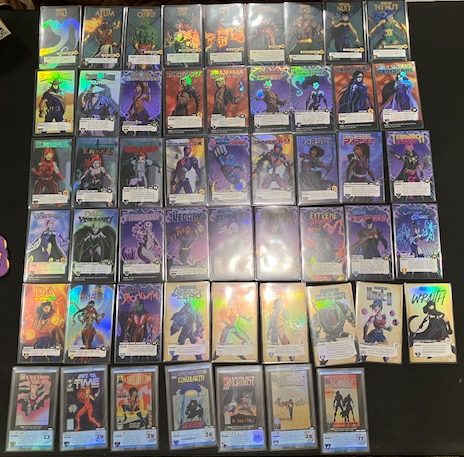
As well as Hero variants for this set, there are plenty of variant Heroes from other sets!  See above!  (To be clear, I am showing the FOIL versions of these cards, not the ones that came with the game … these are the exact same cards, except for the foiling.  See more discussion of FOIL cards below).

There are also 1st appeareance variants, which allow you to play a hero with yet a different variant!

There are a TON of cards in here, and they all look cool.   I have to admit, this set feels a little … dark?  The vibe, the art, the basic heroes all seem a little .. darker than the base game.

The Sleevening

This is definitely a game that has a sleevening event.  (We coined this term way back in when we unboxed ObliveaonSee link here!)

The worst part of this was putting sleeves on SO MANY cards!  Remember how I said I starting the unboxing at 2:06?

By the time I finished sleevening the game and finishing the unboxing, it was 3:48!  An hour and 42 minutes! Oi!

I’m of two minds about sleevening this game.  For one, I like it, because it protects the cards and I can enjoy years of play without worrying about wear and tear!

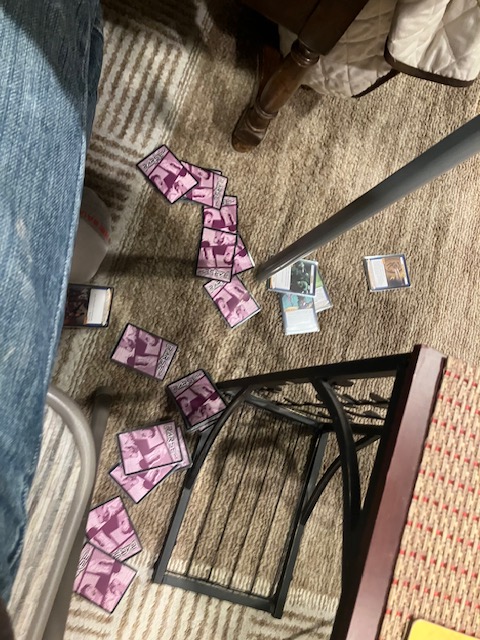
On the other hard, the sleeves make the cards much more slippery and harder to manage! See above as one slip-up caused all the cards for Parse to go everywhere!  The sleeves are just slippery!

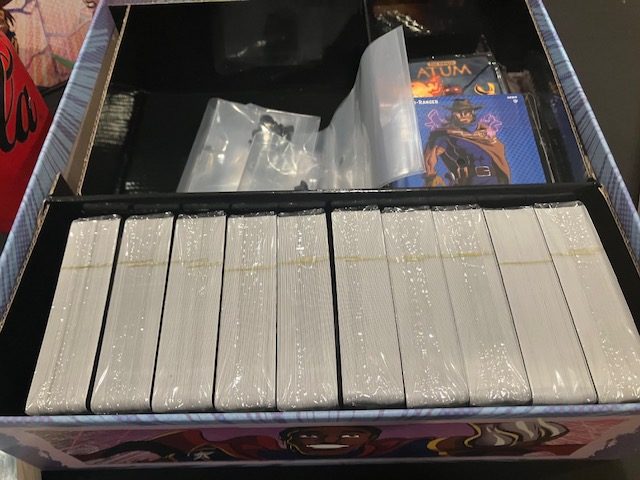
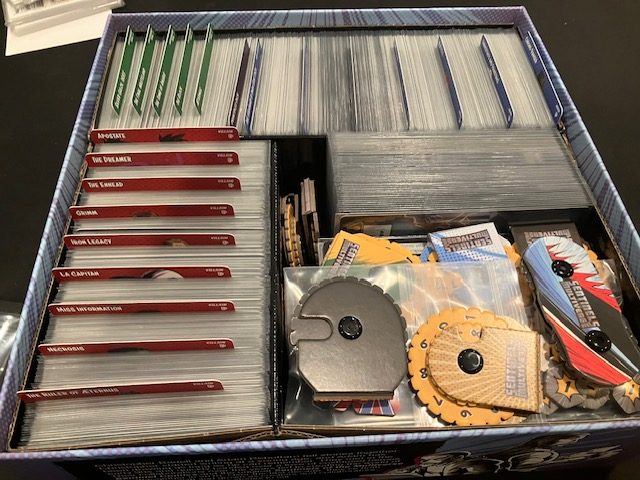
The good news is that the game fits well (if a little snug) into to the box.  See the Villains above!

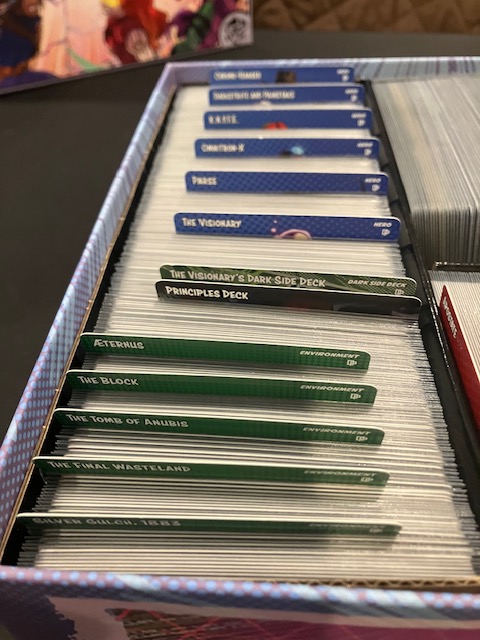
The Heroes and Environments fit pretty well!

And the rest of larger cards sit pretty well in the bigger compartment.

It all fits when sleeved, if a little tight. See above.

Foil Cards

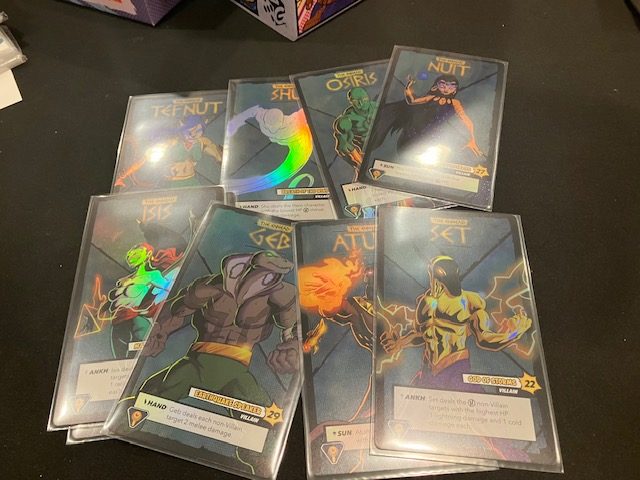
As part of the BackerKit, you could get an optional set of Foil Card versions of all the large cards.  Basically, all the big cards have foil versions of them: see above.

It’s harder to see the foiled cards (see above) and how cool they look in my pictures!  See above as I try (and fail) to capture how cool the foiled versions look!

Do you need the Foil versions?  Not at all, and in fact, some people don’t like the foil versions of the cards because they think they are harder to read.  I STRONGLY disagree with that sentiment!!! I LOVE LOVE LOVE the foil versions!  They look so comic-booky, and capture the “foil versions” of comics from the 90s.   They also just have a cool table presence.

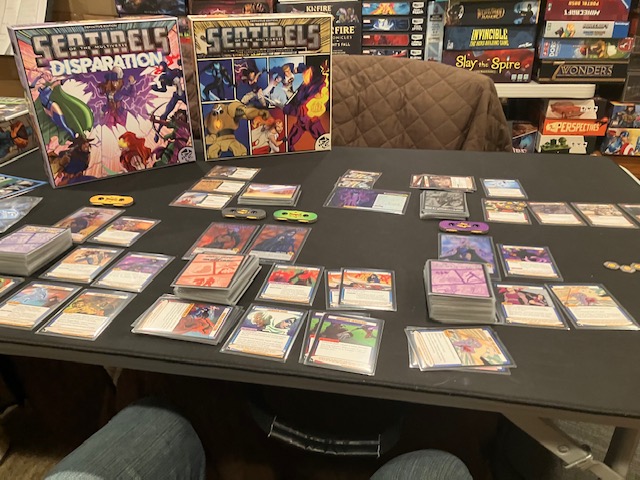
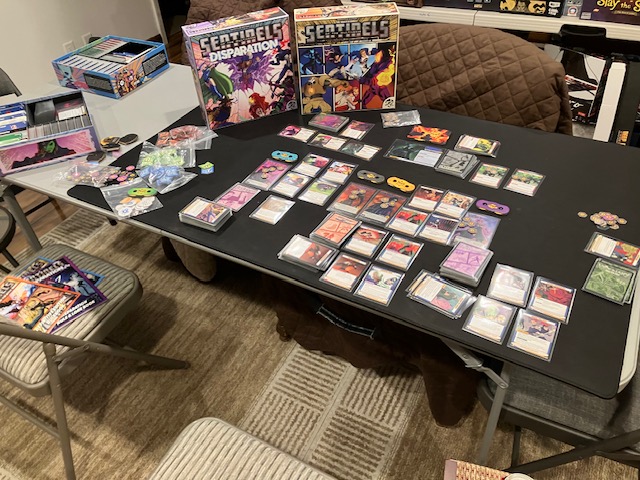
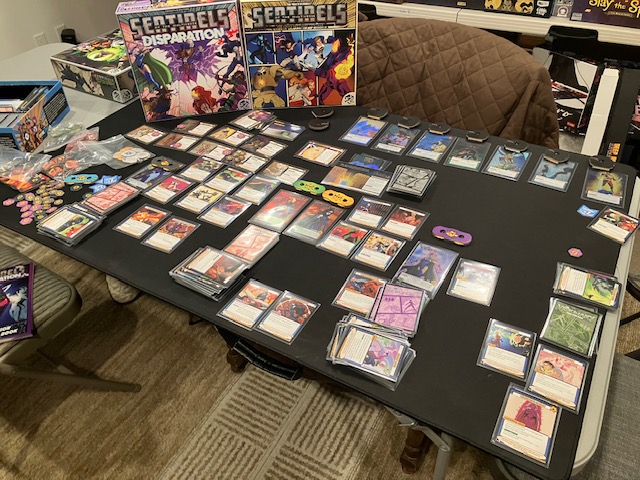
You do  NOT need the Foil cards; the game works fine without it.  I personally think the foiled cards are one of the coolest upgrades ever for any game, but especially for a superhero game like Sentinels of the Multiverse.  Decide for yourself; see above with a bunch of the foil cards laid out.

I also think that Marvel Champions is missing an opportunity; it would be so cool if Marvel Champions had foil cards AND oversized Hero/Villain cards like Sentinels of the Multiverse. Can you imagine how cool a foiled, giant Iron Man card would look???

Solo Play

We always get a little nostalgic when we discuss solo play for Sentinels of the Multiverse!  It was actually the original 1st edition of the game that made us coin Saunders’ Law!  The 1st edition did not have a solo mode, so we had to make one up!  It was our frustration with that which made us grumpy and said “there should be a law that all cooperative games should have a good solo mode!”  We were being a little silly, but it stuck.

The definitive edition has a solo mode; you must play three heroes.  Admittedly, this solo mode is a little clumsy because Sentinels of the Multiverse has a learning curve (it’s always had this learning curve;  you have to play a super hero deck a number of times to learn that hero), and throwing three new heroes at the solo player can be daunting!

So, it’s harder to recommend this as a solo game for newer gamers, but frankly, I think I have played Sentinels of the Multiverse solo more than any other game.  I have played it THAT many times (to be fair, that includes the app).  The solo game works great, just be prepared to read lots of cards to get a sense of everything.


Inspires A Story

What I like about Sentinels is how it inspires a different story every game. There’s a story in the set-up, what characters you choose, what environment you choose, what Villain you choose. And then there’s the story that unfolds as you play!

The Dreamer of Silver Gulch

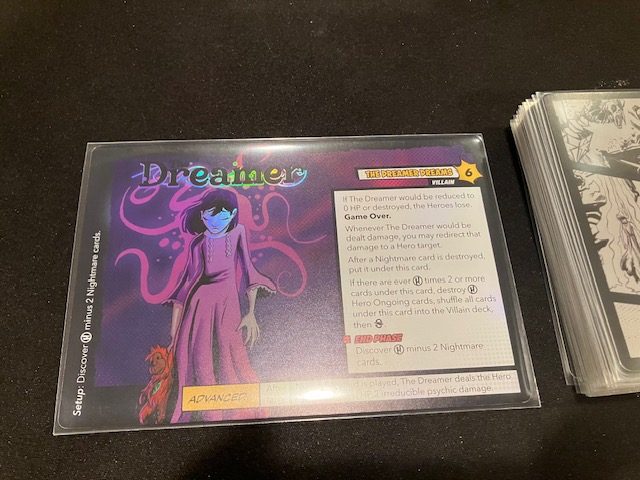
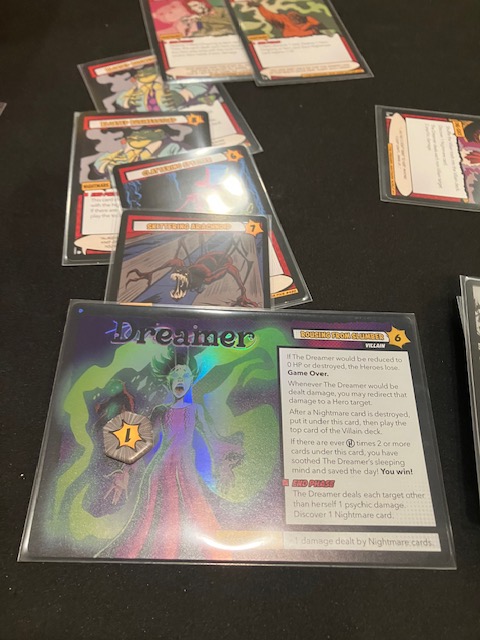
The Chrono Ranger is a cosmic ranger who wanders the multiverse seeking to help others.  He found an old Western town in trouble named Silver Gulch … it was a little girl who was having nightmares.

The townfolk were scared of this little girl .. they called her The Dreamer, but the ChronoRanger knew it wasn’t the kid’s fault; he had to help her.  He knew who to call to help her.

Darkstrife and Painstrike are brother and sister who knew the torment of bad dreams and what it does to little kids, having experienced their own in life.  He knew they’d want to help.

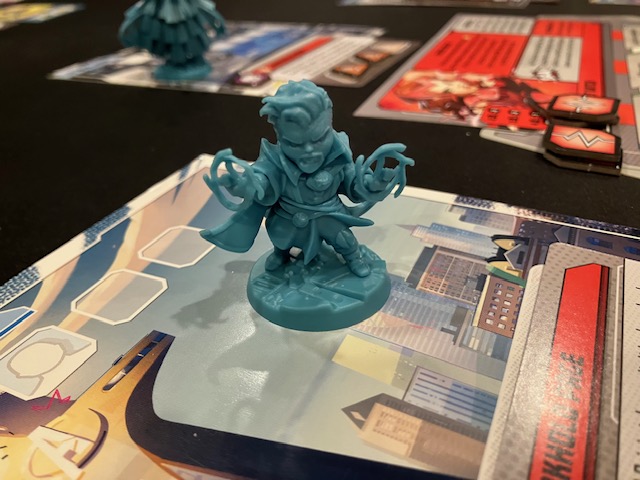
And then there’s Visionary.  She’s a little unstable, but her mental abilities would be perfect for helping this little girl.

ChronoRanger, Darkstrife and Painstrike, and the Visionary were an eclectic team, but they all wanted to help this little girl!  It was surprising how well they worked together, given how diverse they were!  Darkstrife and Painstrike were constantly pushing themselves too hard and discarding so much of their essense, but Visionary helped them find new energy and new avenues by constantly feeding them new ideas (and cards!).  ChronoRanger was the glue that held them together, just constantly keeping the pressure on the monsters in the little girl’s dreams! 

In the end, these heroes saved a little girl by keeping her nightmares in check .. and Silver Gulch, the town where she lived!

The Dreamer was just one of many stories that emerged as a I played 5 or 6 solo games over the first week of getting this!.


New Rulers

As Darkstrife and Painstrike finished helping the Dreamer, they were called BACK to their own realm of nightmares!  It’s time for a new battles for the realm of Aeternus, and Darkstrife ad Painstrike, having been from Aeturnus are called back!

The twins know they need no nonsense to keep the Ruler of Aeternus under control, so they call on KNYFE!  She’s no nonsense!

And even though Parse is a little goodie-goodie for their taste, her ability to see into the heart of any situation is needed! 

Can there heroes keep the new Ruler of Aeternus from branching out into our world?

The battle rages to be the new ruler!  Parse and KNYFE help keep the rulers under control, but it’s Painstrife who knows the way to end this; kill all combatants AT THE SAME TIME, so there is no one left to become a ruler!

After the battle rages, it ends anti-climatically with all hopefuls to the throne being banished at the same time.    But that’s the best way this could have ended!

God fight!

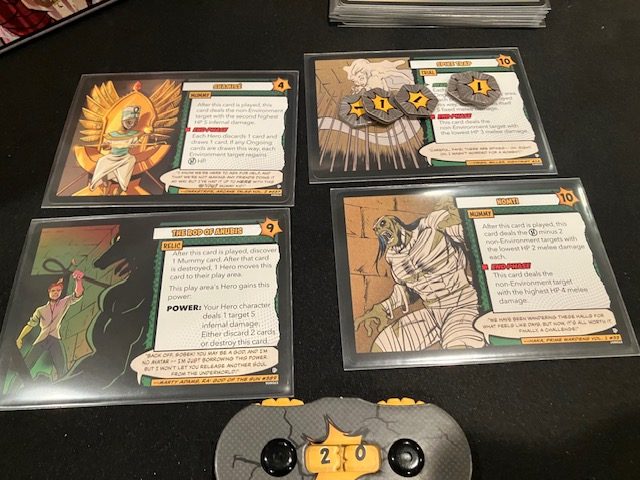
An archeologist went to the Tomb of Anubis and accidentally summoned The Ennead!  But this created quite the clash of Gods as Anubis  also fought to break free as well!  The gods were fighting!  

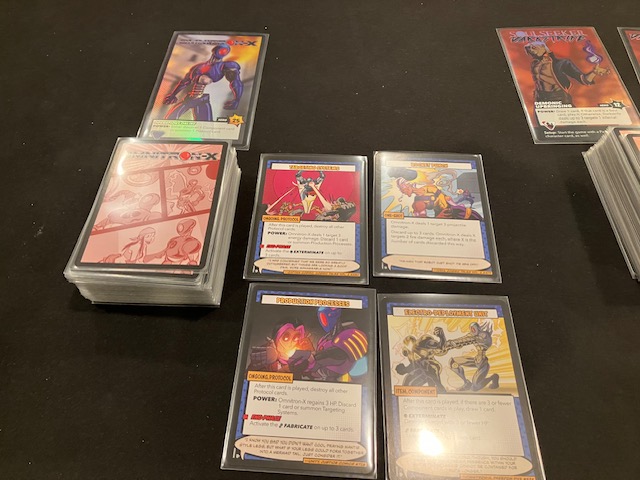
Always monitoring the world for problems,Omnitron-X was first on the scene!  Knowing that magic and gods were outside his purview, he summoned help!

Darkstrife and Painstake were the obvious choices, since they had a background in the arcana!

And the Visionary followed!  

This was a battle for the ages and members of the Ennead kept getting summoned!  

And inside the Tomb of Anubis, this conflict kept spilling out!

Finally, after some heavy fighting, the heroes were able to keep only 7 of the 9 Ennead summoned, before taking them out!

Anubis and his tomb of minions were surprisingly helpful in keeping the gods under control, as they were lashing out all the time!  Normally, this lashing hits the Heroes, but with so many powerful Ennead in play,  Anubis was focused on the Ennead!

Somewhat surprisingly, it was The Visionary’s Dark Side that made the difference! 

Basically, Visionary would lash out at everyone when she was under stress, and the heroes were lucky it helped them more than hurt them!

Cooperative Play

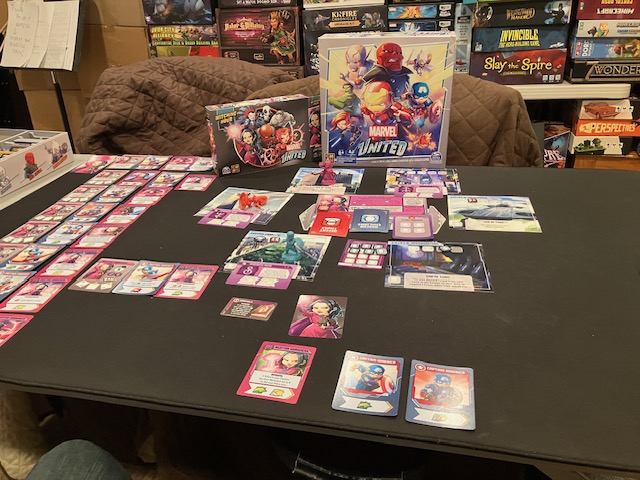
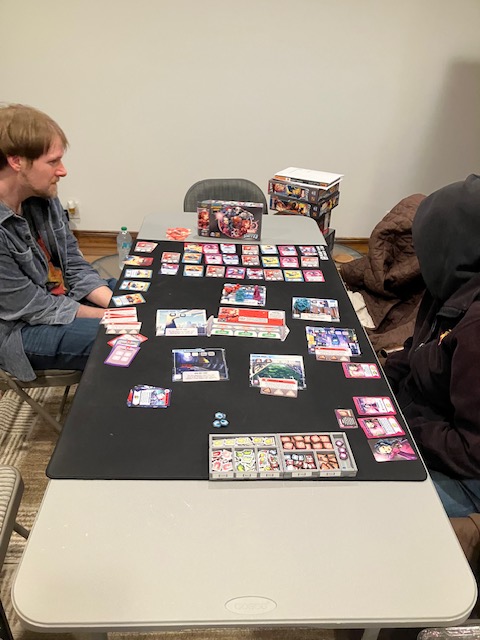
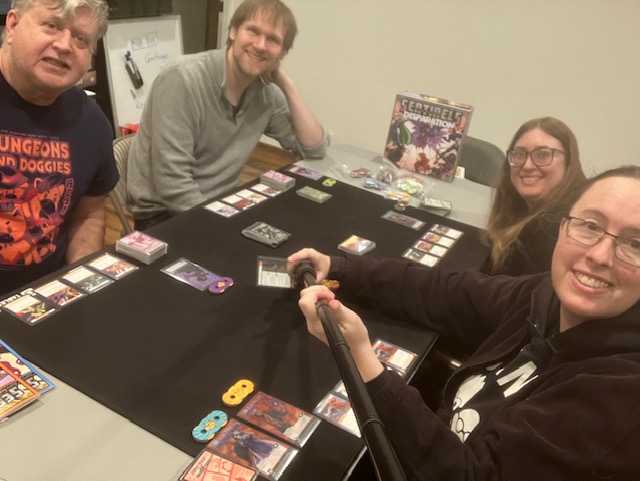
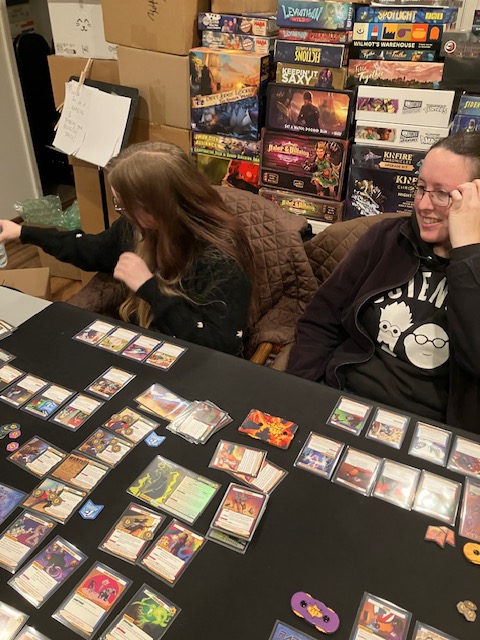
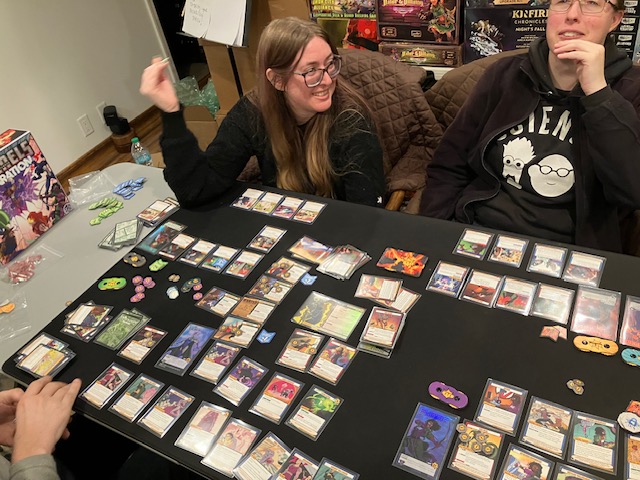
Despite never playing any of these characters … my friends and I had a fun time fighting: Grimm!

“Let us tell the story of a group of Heroes who almost got lost in their own tale!”  For some reason, Grimm sounded like the Cryptkeeper from Tales from the Crypt … not sure why … And this is the kind of detail that emerges as you play and have fun with it!  
The Sheriff of Silver Gulch hung out the entire game!  He sounded like Sam Elliot.  And he helped keep the outlaws of Silver Gulch under control.

We made a lot of mistakes as we played, but we really had fun.

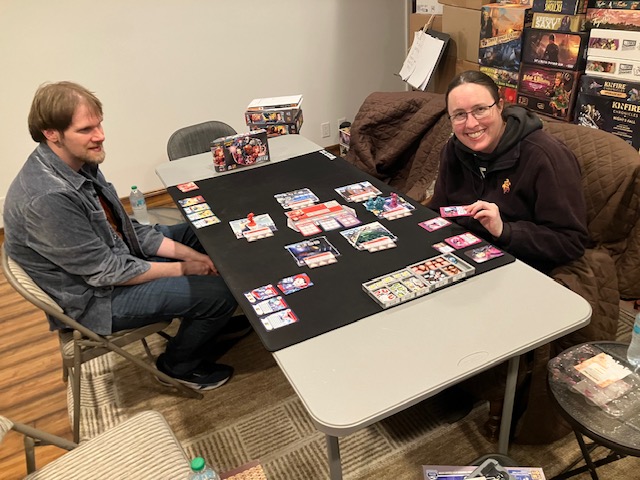
It took a while: 2.5 hours, because my friends had to read all their cards!  But we still had fun.  

The story that emerges, the voices that emerge, the silly vignettes that emerge … that is fun.  We cooperated well as different ways to change ROLES (a Grimm villain thing) came out, Visionary kept pumping up the cards, Parse would double some damage …. so many different ways to talk, cooperate, engage, and have fun.

And we stopped Grimm from being … well, grim.  We won!

Back on Top

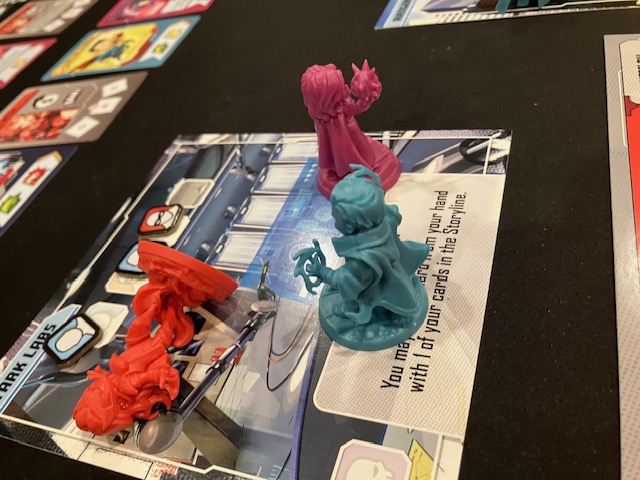
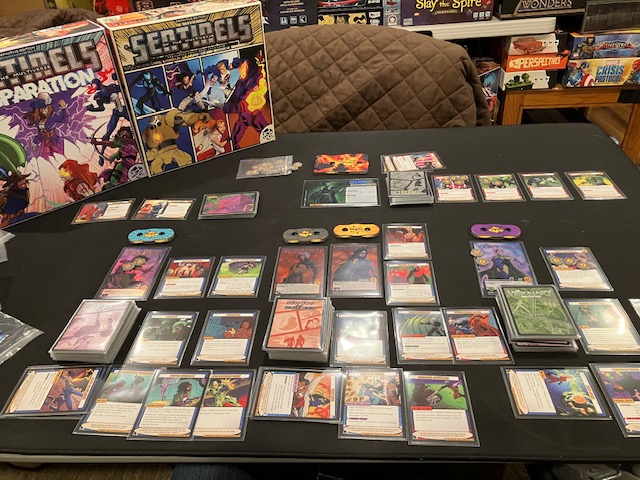
Every game tells a story (see above as the heroes battle Necrosis! Ewww!).  I had forgotten how much I love this system.  It’s so easy to explain the basic gameplay, but there is so much variety in the environments and villains and heroes, that each game plays out so deeply and differently.

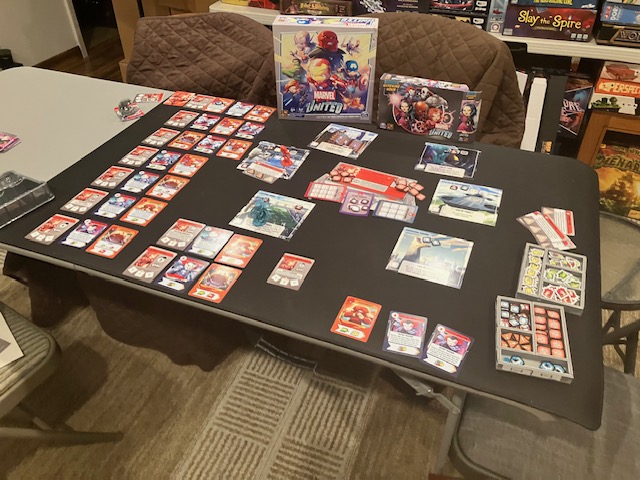
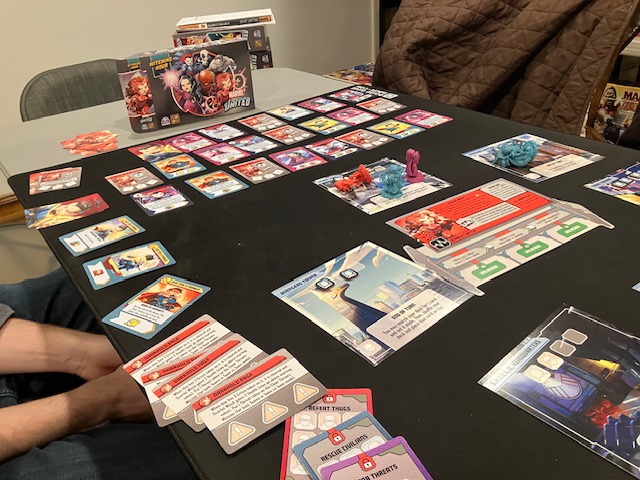
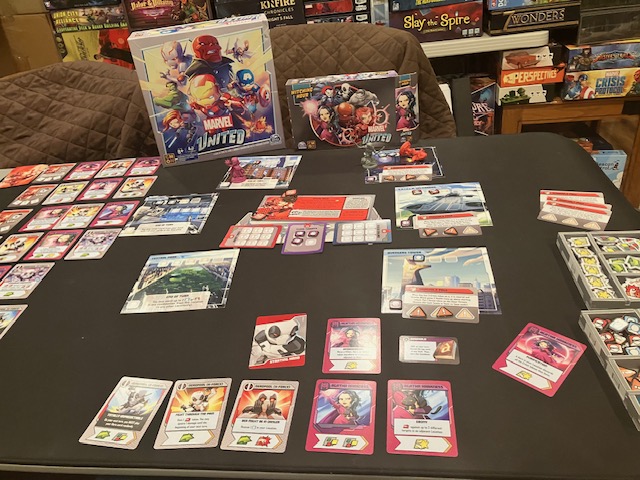
Recently, Marvel United had jumped to the top of my list!  It’s such a neat game!  
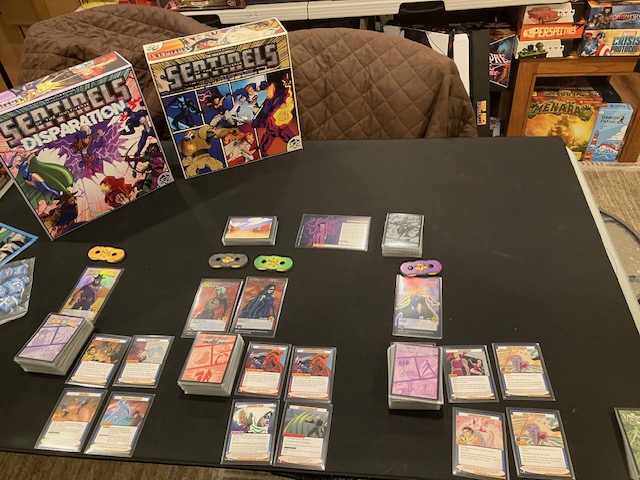
But, Disparation reminded me of all the subtle interactions and cooperations that can emerge from the game!  As I played new games, the joy of playing Sentinels emerged!

I had never really embraced Parse in the 2nd edition, but she was really fun to play!  She has some neat ideas!  And she seems like a bright character! 

And holy cow, Darkstrife and Painstake are so interesting to play! They are a little messy and complicated, but once you get the feel of this set of twins, they are fun to play!

And Visionary, who was more of a support character became SO INTERESTING with her Dark Side deck!  I was able to keep Visionary’s Dark Side under control when we helped the little girl, but her dark side was SO CRITICALLY IMPORTANT when we took on the Ennead!  She also worked so well with Darkstrife and Paintake; this was a cooperation I hadn’t seem before!  She kept the twins in cards so they could fully utilize their abilities!

I saw new ways of cooperating and interacting emerge as we played.  

I think Disparation reminded me how great Sentinels of the Multiverse is: it’s my #1 game again!


Things To Look Out For

Expansion: TO be clear, this is an expansion for Sentinels of the Multiverse: Definitive Edition.  First of all, make sure you have the Definitive edition (not 2nd edition) if you want to pick this up.   Strictly speaking, you need the tokens and rulebook from the base game to make this work.  BUT, if you really wanted to, you could get away with this being a standalone game … all you really need are heroes, villains, and environments!!  And those are all in there!  The base game has hit point spinners and the rulebook … but if you really wanted to, you could use paper and pencil to keep track of hit points (I did that back in the 1st edition of the game) .. and of course, the rulebook is on-line.  So, you COULD play this as a standalone game if you really wanted to … but it’s probably better to just make sure you have the base game.

Foil cards: You don’t need the foil cards.  But, they are pretty cool. If you do pick this up, try to get the Foil cards at the same time! 

So much text!  I love this game, but I always warn people about this!! It takes a while to get to know a Hero deck before you can use it well; you have to enjoy the process of playing with a deck you don’t know and reading lots of text to get to the point where you feel useful!  If you don’t love that process, then this probably isn’t the game for you.

Conclusion

So, this expansion reminds me why Sentinels of the Multiverse is my favorite game of all time.  I love the art, I love the stories it inspires, I love the gameplay, I love the new ways that cooperation emerges.  There was a time when I didn’t love the art, but the art style has grown on me.

There is also so much content in this box: 9 villains (with many variants), 6 heroes (with many variants), 5 environments.    I love Marvel Champions too, but from a bang-for-the-buck perspective, Sentinels gives you so much more content.

I have to apologize for gushing about this expansion because I am not sure if this will be available outside the BackerKit kickstarter.  If you see it, pick it up immediately: it’s my favorite expansion in some time (and I have seen some good expansions).  And it may not be around much longer … which is too bad.  It’s probably my favorite expansion of the year: 10/10.


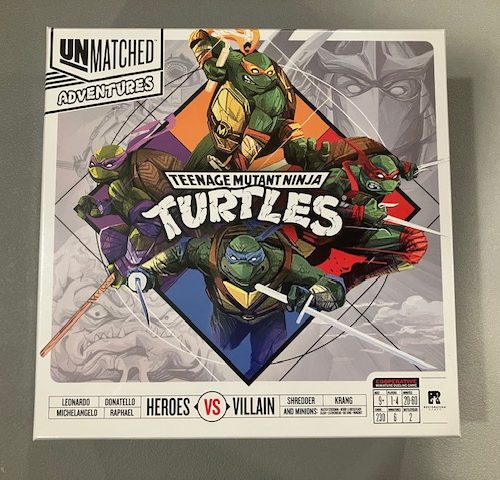
A Review of Unmatched Adventures: Teenage Mutant Ninja Turtles.

Welcome to 2026! Some of the games that came out in December 2025 feel like they are on the cusp of 2026! Do we count them as 2025 or 2026? We’ll start this month with a game we received in early December … it was early enough that we got in enough plays in to count it as a 2025 release!

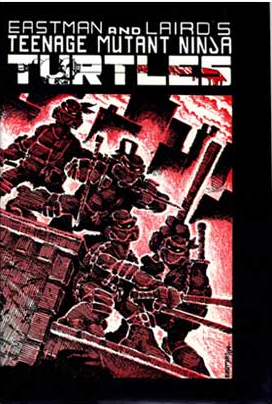
So, I never got into the Teenage Mutant Ninja Turtles. When I was in college, my friend CC was really into the black-and-white Eastman/Laird turtles, but they all had the same color headband … because they were in black-and-white. See below.

The reason I picked up this set because I really like what the original Unmatched Adventures did for the Unmatched universe:  It makes the game cooperative!  See original review here!  So, is it worth picking up the TMNT set even if you don’t like the turtles?  

Let’s take a look!

Unboxing

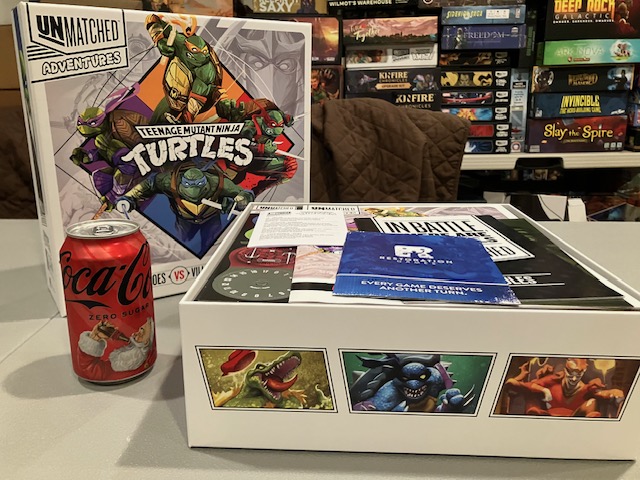
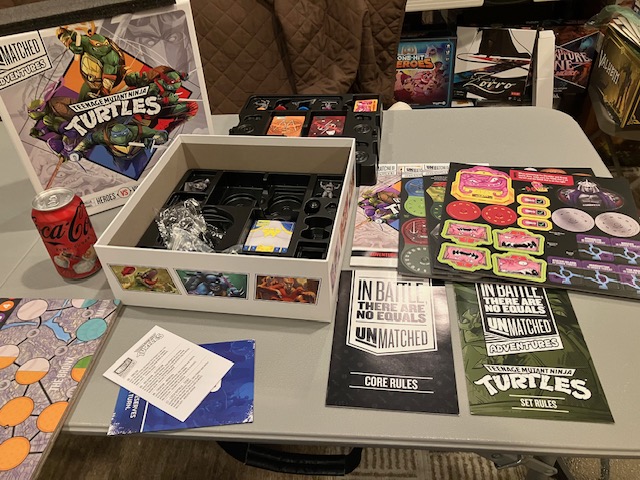
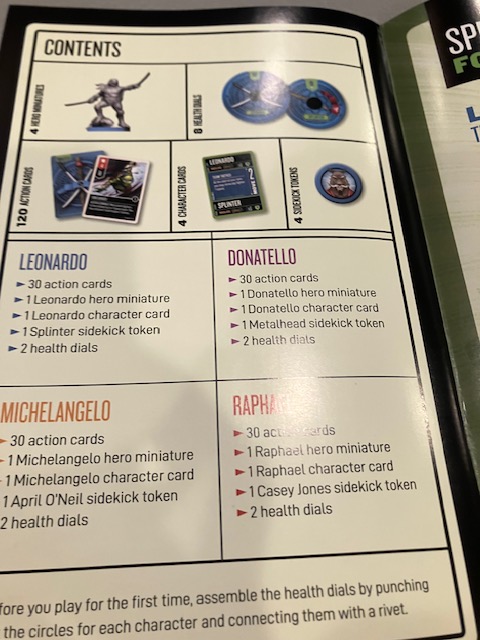
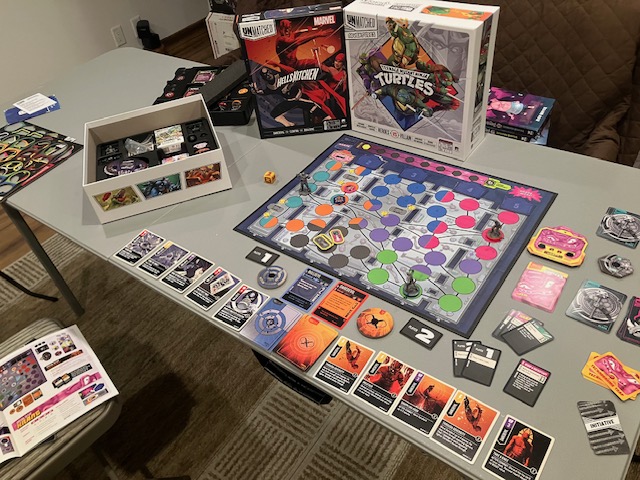
See TNMT box above with Can of Coke for perspective.  This is a pretty normal sized box, but it is taller.

It’s taller because it breaks into two sections.  The top section holds the four turtles: their minis, their cards, their sidekicks, and their initiative cards.   The top of the box is JUST the plain Unmatched turtles.  If you wanted to play turtle vs turtle in a standard Unmatched head-to-head game, you’d only need the top.  To be clear: you can use any of these turtles in the standard Unmatched game with any other set (Rafael vs Bullseye?  Donatello vs. Sherlock Holmes? Michelangelo vs. Bruce Lee? Leonardo vs. Tyrannosaurus Rex?) to play out any head-to-head fight you want.

If, however, you want to play the cooperative Unmatched Adventures part of this box, everything you need (except the initiative cards) is in the bottom part.

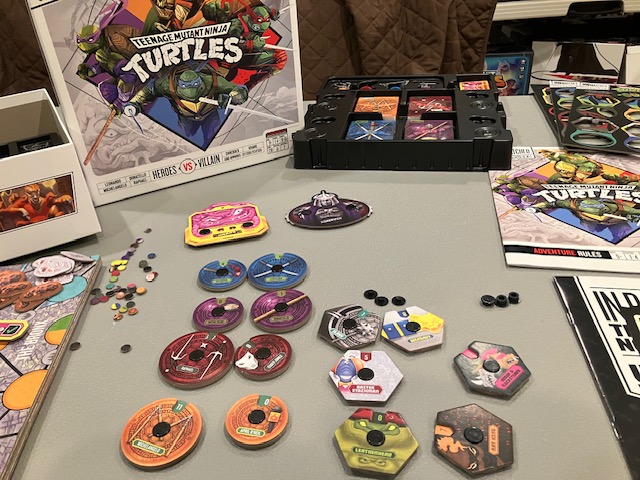
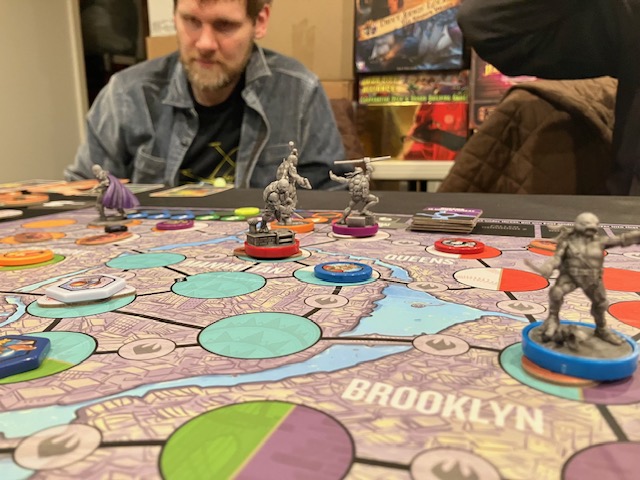
There’s minis for Shredder and Krang (the two big bad bosses you fight in the two scenarios), and a bunch of tokens for the minions, the cards and some dice!

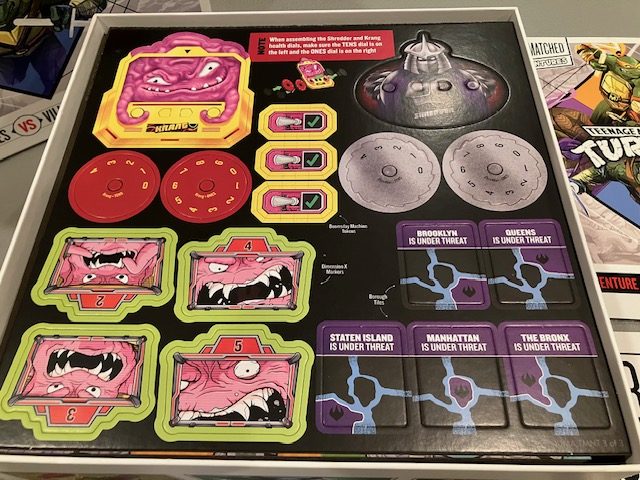
There is a LOT of cardboard to punch out. See above. 

Most of the cardboard is for the spinners: these are hit point markers for the turtles (4), the minions (6), and the sidekicks (4).  I think I spent more than an hour punching out the spinners and putting them together; this might have the worst part of the game (although I have friends who love to punch stuff out for fun).

These inserts are exceptional, as everything fit back into the insert very well.  Everything in its place—see above as the spinners fit in really well into the grooves.

The pieces are all nice (and I only got the standard retail version: there’s a version/auxilary with a lot more minis).

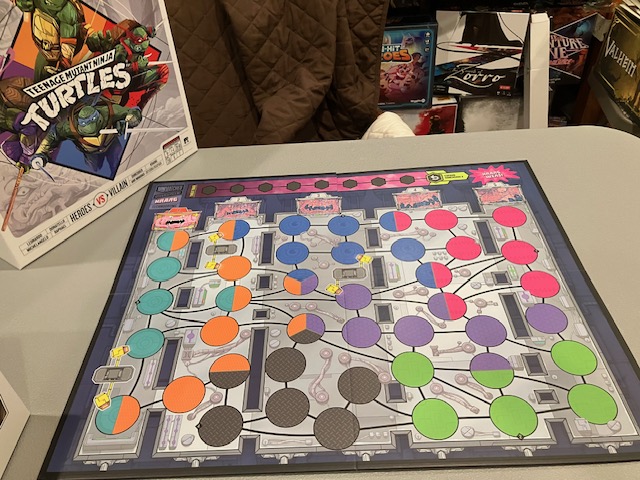
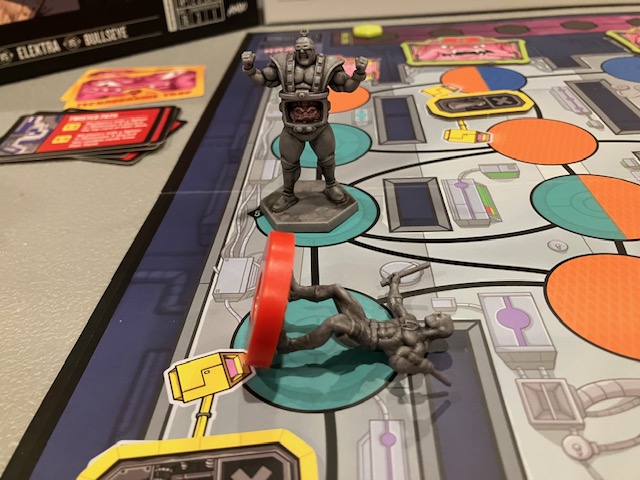
The two-sided board is easy to read/see.  Each big bad boss has his own side of the board: Shredder or Krang. See above for Krang’s side.

The production on this game is fantastic: see above.

Rulebook

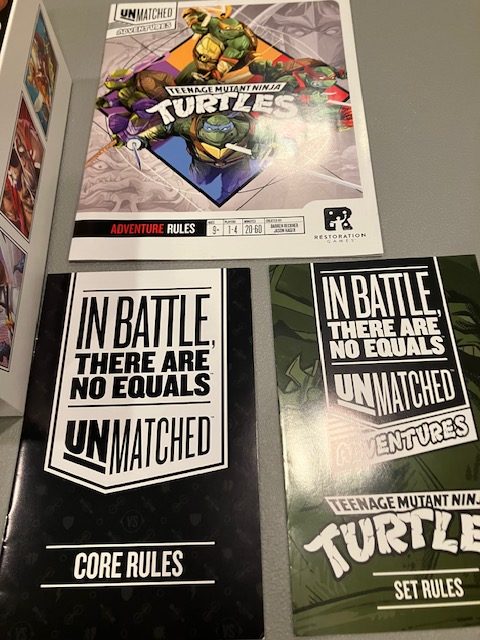
There are three rulebooks that come with this: core rules, set rules, and adventure rules.

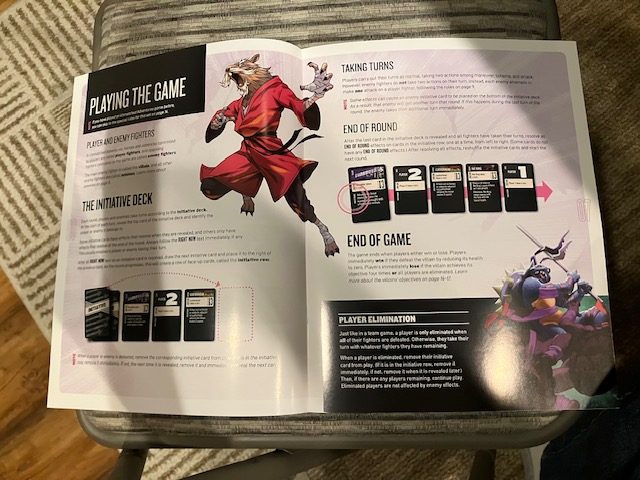
The core rules are the basic head-to-head Unmatched rules which describe how to play head-to-head: the way Unmatched was originally meant to play.  This ruleset has evolved over many sets, so it’s great and describes the game well.   The Unmatched Adventures requires players to know the basics of the core game: the three things you can do (scheme, attack, or maneuver), the combat rules, set-up, and such.  This is a good rulebook that has evolved very well over time.

The set rules (above) simply describe and give more detail on the specifics of the turtles and their special powers. See above.

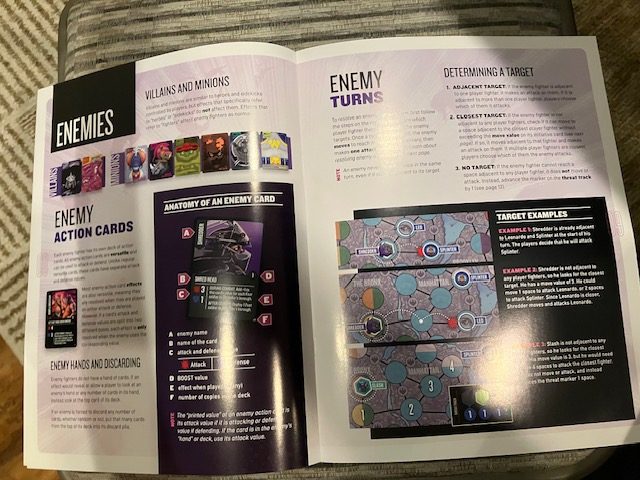
The Unmatched Adventures rulebook describes how to play cooperatively against one of two game-run big bad bosses: Shredder or Krang!

The Adventures rulebook does pretty well on the Chair Test: it droops ever so slightly over the edges, but the font is readable, the pictures and useful, it stays flat on the chair next to me, and it’s easy to read. B+/A-.  See above.

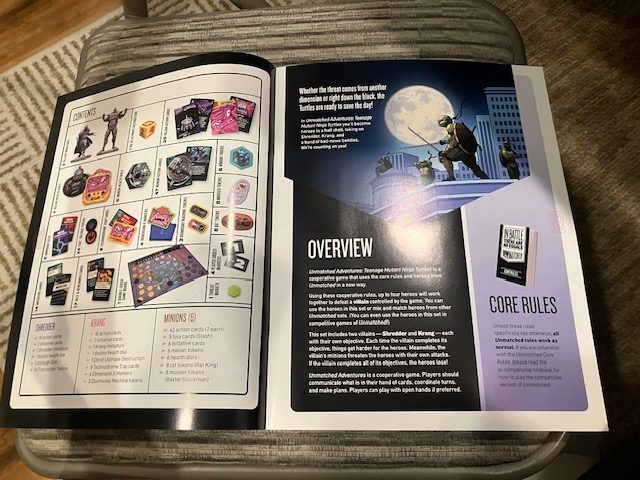
The Contents page is great: annotated pictures of everything.

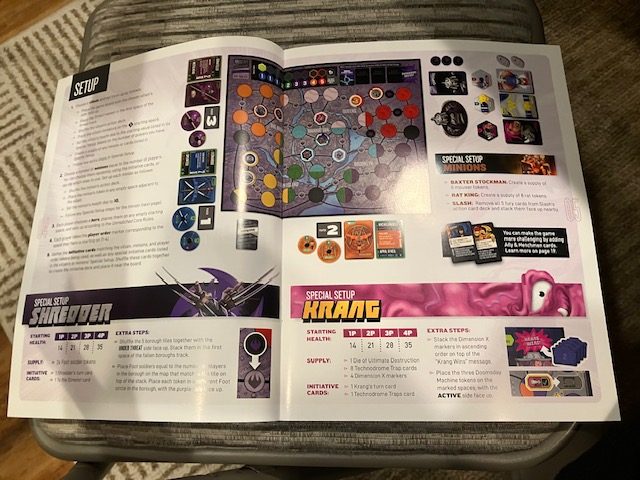
The set-up is perfect: it spans two pages (without crossing a page-turn boundary), and it is well notated.  See above.

In general, this is a good rulebook.

We wish there had been just a little more description in a few places:  for the Minions (For example: can we ever get rid of the Mousers?  The lack of text implies not, but I wish they would have stated it explicitly), and I just wanted a little bit more.  There was also some discrepancy between turns and rounds (especially on Raphael) that tripped us up, and some of the text of Krang was unclear of the relationship between the machines and the zones. 

Generally, good rulebook though.

Gameplay

This is a variable turn order game, with the initiative deck dictating when the good guys (the players) go and when the bad guys (the big boss and his minions) go.  The gameplay is very similar to what we saw in Unmatched Adventures: see that review here.  

I still have some problems in general with variable turn order games: see a very full discussion here: A Discussion of Variable Turn Order and How To Mitigate Its Randomness.  

Some of my favorite games have variable turn order, but that still doesn’t mean I love the mechanism; it seems to be a necessary evil for some games.  As we dive into different player counts, we’ll see how this affects the game.

Solo Play

To be clear, Unmatched Adventures supports solo play! (Thanks for following Saunders’ Law).  See 1-4 Players on box!

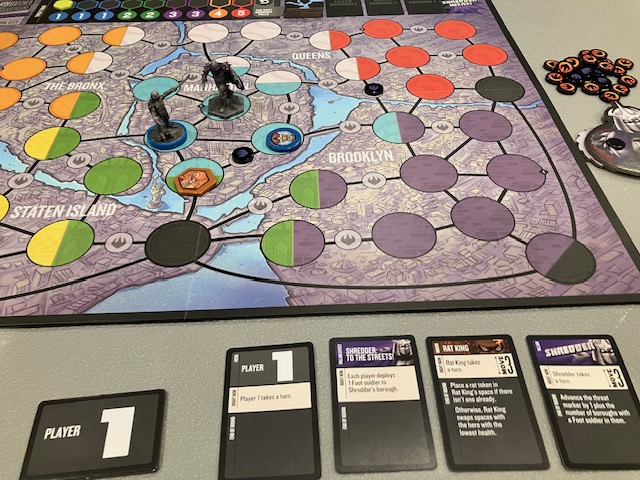
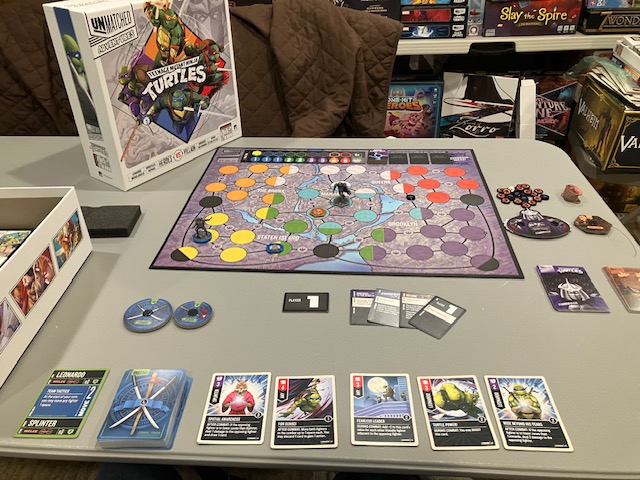
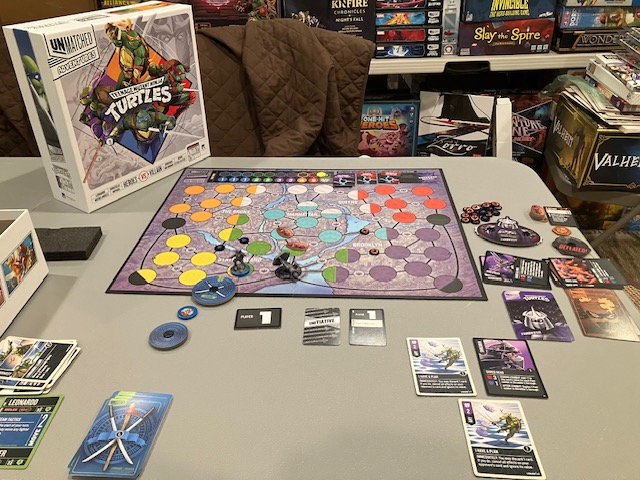
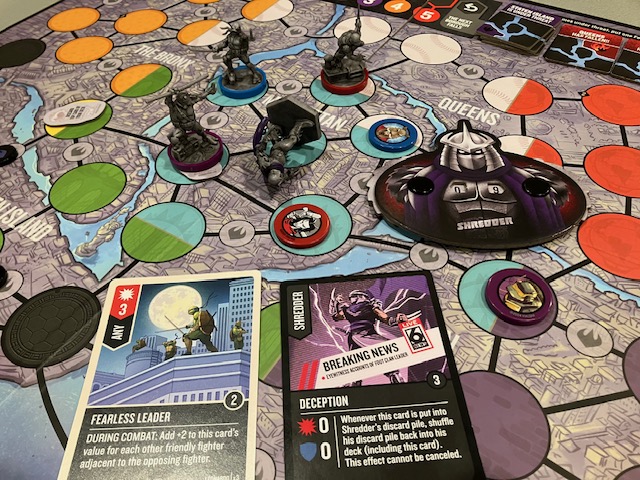
In fact, Unmatched Adventures support pure solo, as one player controls one character! See above as Leonardo takes on Shredder all by himself!

There are two main mechanisms for game balance at different player counts:
1. The big bad boss Hit Points (Shredder above) scale for the number of players.  It’s 7 * (number of players + 1), so 7 * 2 = 14 hit points for the solo game.

2. The number of minions is the same as the number of players.  My solo game (above) has one minion: Rat King!

The solo player still has to manage his deck as well as the Big Bad Boss and Minion deck.  There is some maintenance as you play solo, but it’s not too bad.

I think the worst part of the solo game is how small the initiative deck is: only 4 cards!  One for the player/sidekick, one for the minion, and two for Shredder!   I still liked the solo game, but I was often frustrated when the bad guys got so many turns in a row!  In the worst case, the bad guys can get 6 unanswered turns in a row!  

I still liked the solo game.  I like how it’s true solo play (you only have to play one character), I just noted the variable turn order felt overwhelming sometimes … to be fair, that does sometimes describe how a true head-to-head game feels: sometimes the other guy will just mess you up!  (This just re-emphasizes some of these same feelings of the solo mode in our previous review).

As usual, we recommend playing solo first so you can learn the game to teach your friends cooperatively.  And the true solo mode works, if a touch random.

Cooperative Play (4-Players) With No Fans

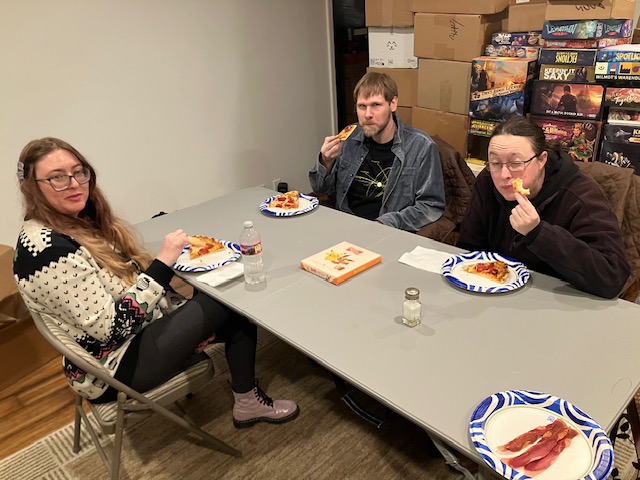
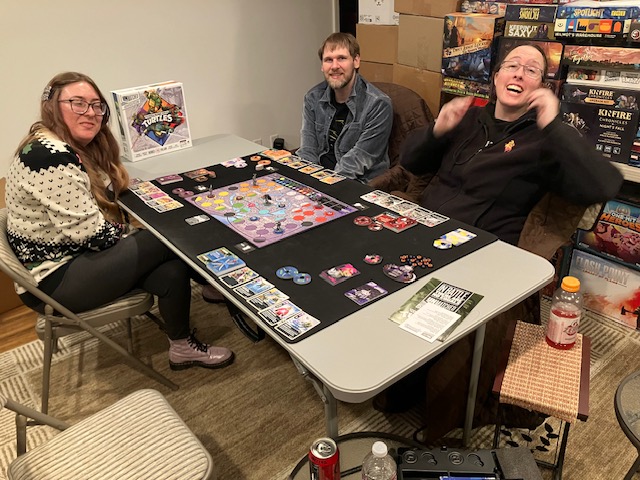
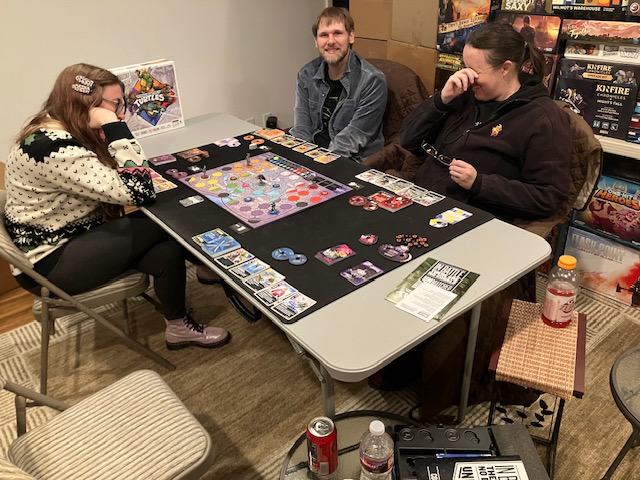
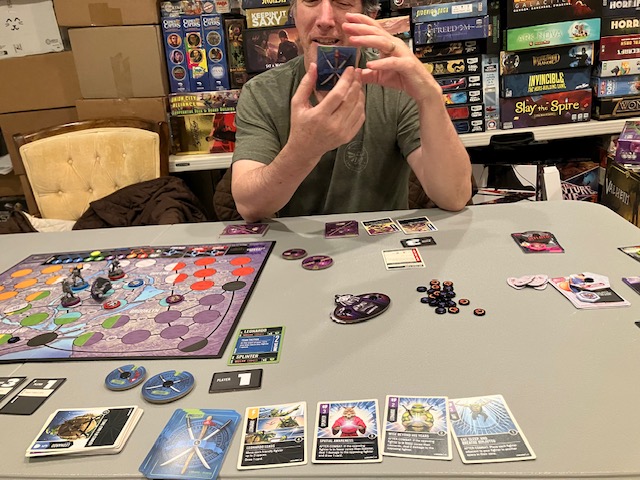
It goes without saying that we had to eat Pizza first before we played a full-up all four turtles game!  I am not a TMNT fan, but even I know they eat pizza!  

The four player cooperative game went over pretty well.   Like we noted in previous Unmatched Adventures, the variable turn order problems are much less pronounced with more players.  There are enough initiative cards that players don’t get stuck with the bad guys getting too many turns in a row.

A problem we had with 4 players is that it was sometimes too hard to get around Shredder to do damage!  Each of the turtles gets a sidekick, so there are 8 good guys (4 turtles and 4 sidekicks (April, Casey Jones, etc) and sometimes it was a little frustrating as they couldn’t get some of the good guy to do anything useful!   This does feel a little like a first-world problem (“Oh no, we can’t all do damage to Shredder!”), but it did cause some frustration in my group as sometimes you couldn’t get anything done on your turn because there was no place to move to!

We generally had fun and took down Shredder as all 4 turtles!

Interestingly, no one in my group was a TMNT fan!  They all knew of the turtles, all were okay with the turtles, but no one was “a fan”.  Despite not being fans, we all had fun playing the turtles. 

Generally, I think the game is more fun cooperatively than solo.

Cooperative Play (3-Player) With A Big Fan

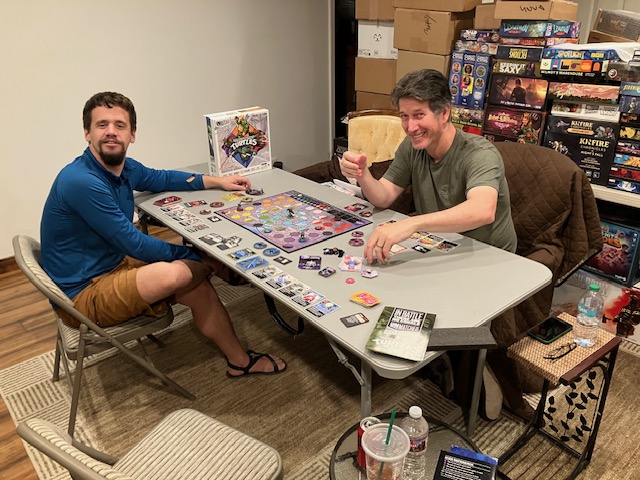
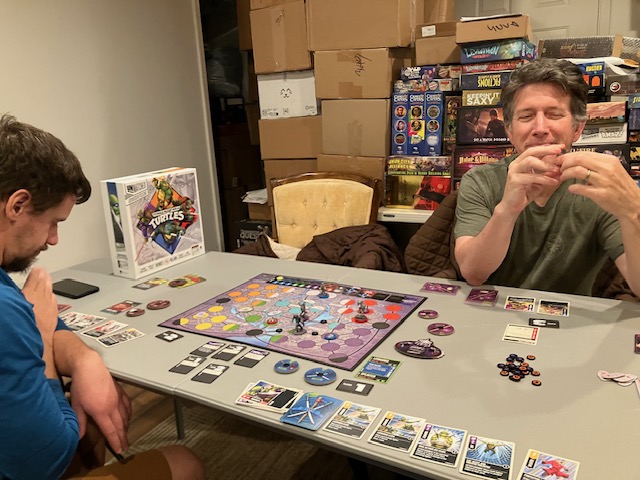
My friends Jon is a huge TMNT fan; so I had to make sure to get is opinion when he played.

In general, he liked it.  I do think a 3-player game was a little better than 4-player game you get back to your turn quicker,  and vying for space around the board wasn’t quite as bad.  4-Player still worked, but I do think 3-Player is better. 

Solo Play (2-Player)

For comparison purposes, I did want to see how (a) how other heroes played in this world (b) how the Krang scenario played (c) how 2-Player/2-handed solo played.   So, I played a two-handed solo game of Daredevil and Bullseye against Krang!  See above!  It’s an unlikely alliance, but Daredevil and Bullseye have teamed up to protect their city!

The first game went horribly as Krang took out Daredevil early. Bullseye just looked at the board, said “no way”, and walked away (he is, after all, a villain).  Krang won!

After resetting, Daredevil and Bulleye used their abilities better together and Daredevil took Krang our with a Feint on the very last round (see below) … he only had to do one damage, but the Feint cancels all bad-guy effects!  So, Daredevil‘s Feint won the game! It was great!

This was a very thematic session of two games: Daredevil and Bullseye failed in the their first team-up (Daredevil  Comics #992), but then after learning from their failure, they were able to go in and take out Krang! (Daredevil Comics #993).  It just felt like two comics back-to-back!

I think I enjoyed two-handed solo more than pure solo.  Like I have said many times, the presence of more heroes in the initiative deck helps “smooth out” the randomness of the variable turn order system.  And, in this case especially, it felt very comic-booky over two issues.

Dice Throne Adventures/Missions vs. Unmatched Adventures

What Dice Thone Adventures does for Dice Throne, Unmatched Adventures does for Unmatched: it takes a head-to-head game and turns it into a cooperative adventure!  If you weren’t sure which one to get, let’s do a quick comparison. 

  1. Both have Marvel Characters
    1. Dice Throne has 8 Marvel generic and 9 X-Men=17 characters
    2. Unmatched has 16 generic Marvel characters (only 1 X-Man).
  2. Both have a ton of other/non-IP characters.
    1. Dice Throne has 16 from Season 1 and 2, plus Santa and Krampus, 4 for Outcasts, another 4 from Vanguard = 26?
    2. Unmatched has sooo many characters, I can’t even count. See here!

The fun of these systems is that there are SO MANY characters to choose from both.  Dice Throne has a slight advantage in Marvel characters, but Unmatched probably has more characters overall.

The one thing I will say is that I think it’s easier to jump into a Unmatched Adventures game than a Dice Throne Adventures game.   We found out the hard way that you HAVE to play your Dice Throne character(s) beforehand, otherwise the rules overhead will be too much.  Usually, this means playing a quick head-to-head Dice Throne game to see how the characters work.  As we’ve seen in this review (and the Unmatched Adventures review), we’ve been able to drop new players into the  Unmatched Adventures game and they immediately understand!   

Dice Throne Adventures is a little more tactical (but see randomness issues below), but the powers of the Dice Throne Adventures are pretty neat too.  I’d recommend playing them both to see which one you like better; they both scratch a similar itch.

Scenarios

Of the two scenarios, I liked the Shredder experience more: it was  less random.  

The Krang scenario had a little too much luck for me.

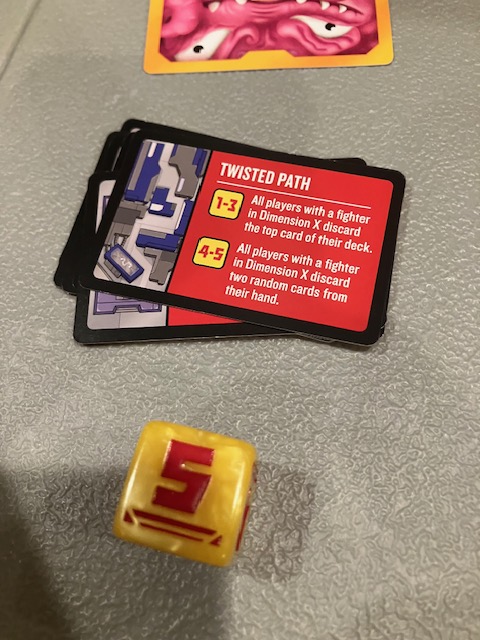
This deck in particular (see above) was very random and kind of made me mad a few times.  And you have to roll every round to maybe/maybe not activate machines.  I didn’t love the randomness of the Krang scenario.

Overall, I will probably play the Shredder experience a lot more than Krang, but Krang is a unique experience for which I will “tolerate” the randomness now and then.  Of all the scenarios from both Unmatched: Adventures: Mothman, Aliens, Shredder, and Krang Krang was by far my least favorite.   

Unfortunately, the randomness of the Krang scenario does bring my rating down a little for this set.  It makes it a little harder to recommend this for a non-turtles person.

Sharing the Load

Because there is one minion per player (for scaling to the number of players), we shared the load by having each player operate one of the minions.   I liked this because it makes everyone feel a little more invested! If I were running everything myself, then people would feel less involved (and I would be grumpy because I was doing everything).  Since everyone has to run at least one of the minions, that makes the game feels more interactive.

I liked that we could share the load; it made the game feel more cooperative.

Conclusion

Everyone liked  Unmatched Adventures: Teenage Mutant Ninja Turtles; it was fun at all player counts, with pure solo possibly being the weakest.  Even if you don’t know/don’t like the TMNT, this is still a good get because it expands the Unmatched Adventures world and gives you two more scenarios!   (Be aware that one of the scenarios is more random than the others,  so that might have an influence on your decision).   And the turtles were fun to play, even though we didn’t know/love them.

Overall, Unmatched Adventures: Teenage Mutant Ninja Turtles is probably about a 7.5/10 or 8/10.  If you love TNMT, that probably adds another 1 or even 2 points to that score.  If you are turtles fan, be aware there is a mini-upgrade kit (see above) which turns a lot of tokens into cool minis … you might want that.

To be clear, this is a standalone set. If you love TNMT and don’t really care about any of the other Unmatched warriors, this is perfect for you: you don’t need anything else. If you just liked Unmatched Adventures system, this does add more scenarios for you! Just be aware that Krang is a little more random.

We liked this enough to be on our Top 10 Cooperative Expansions of 2025!