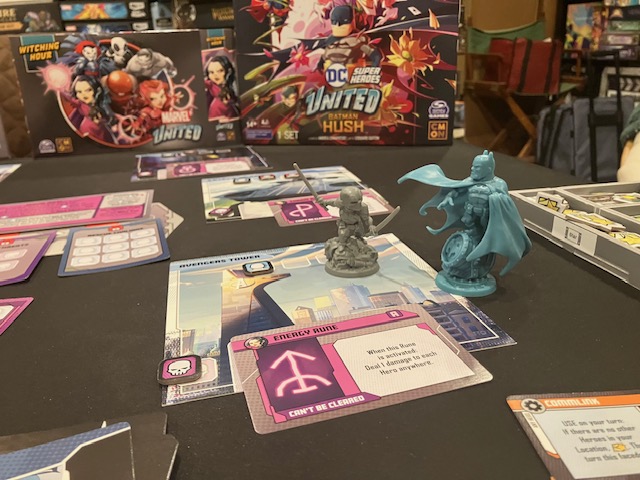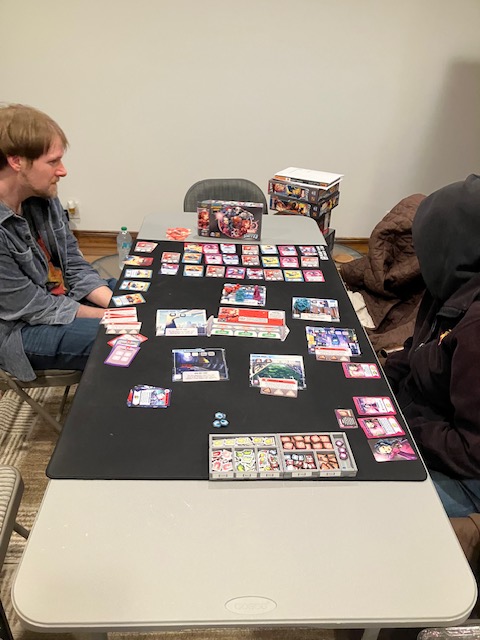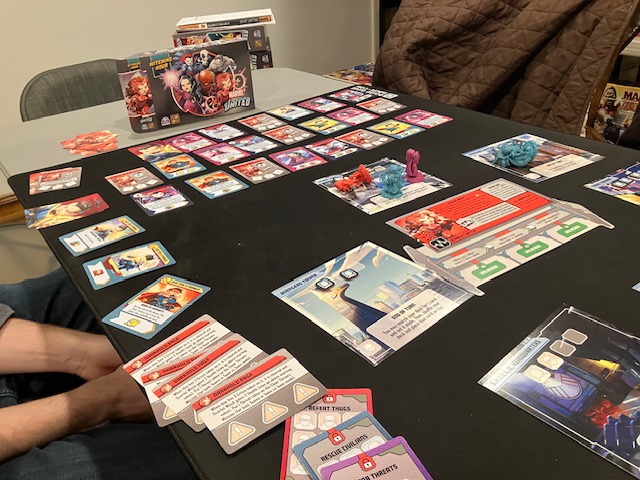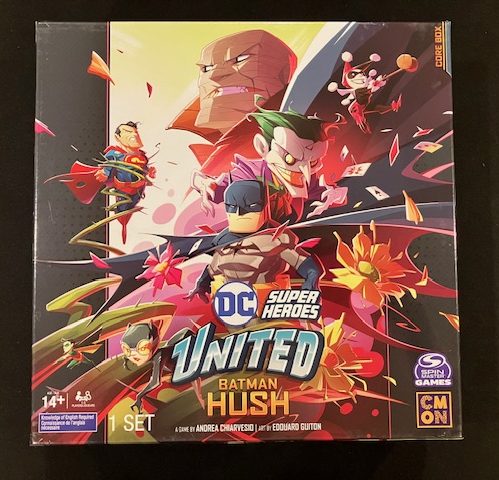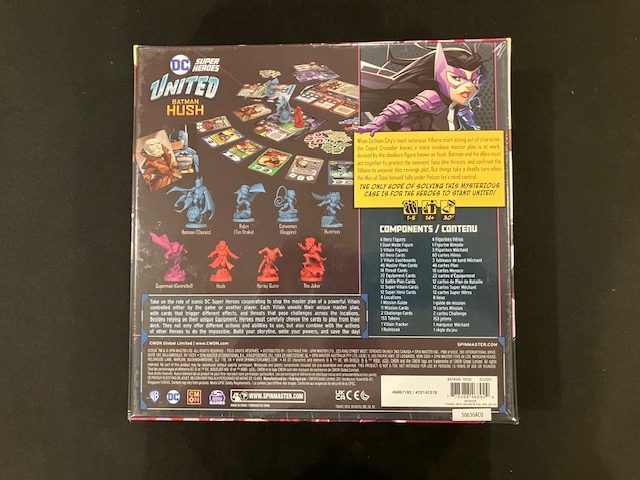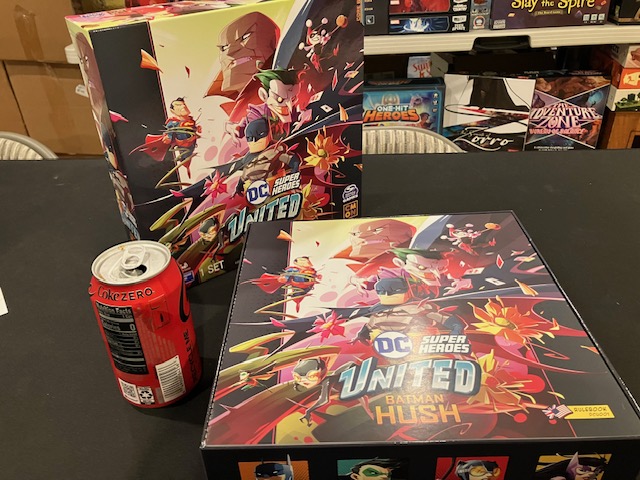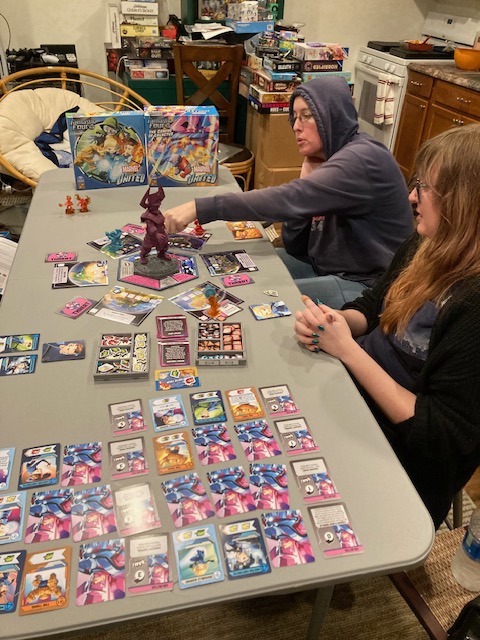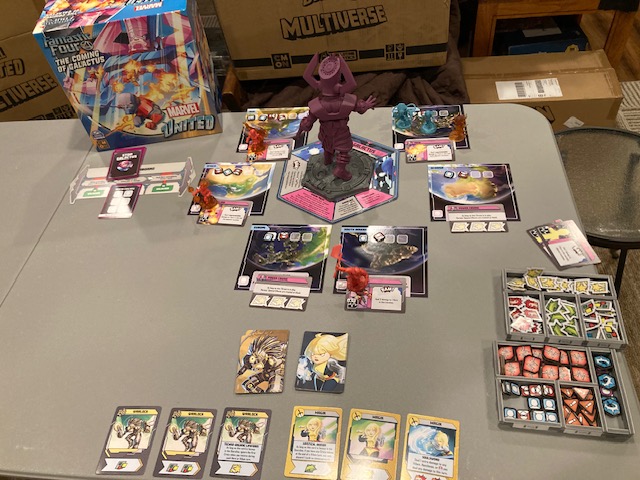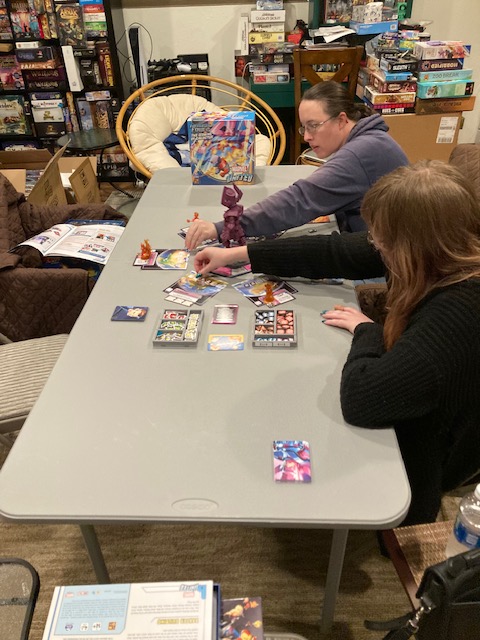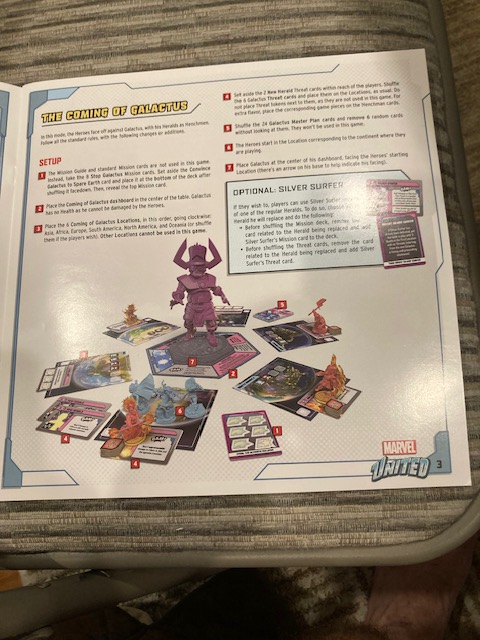
Probably My Favorite Game of 2025! DC Super Heroes United: Batman Hush

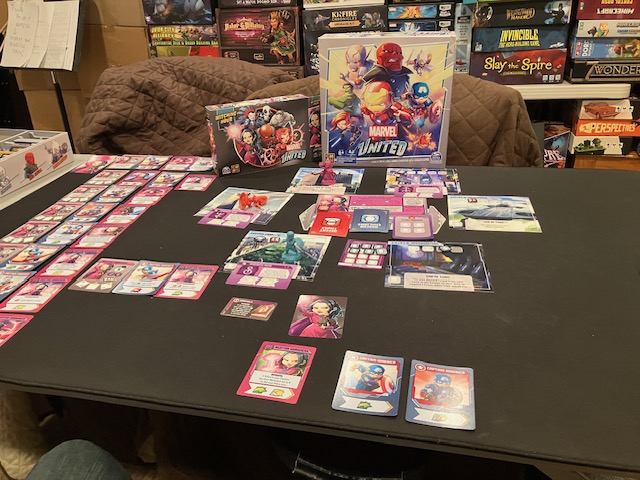
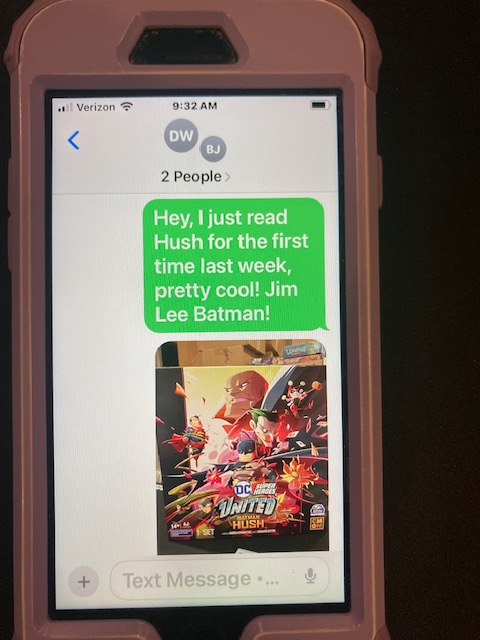
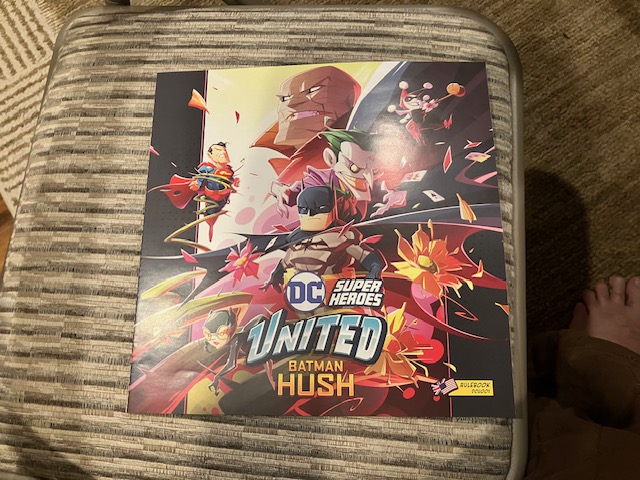
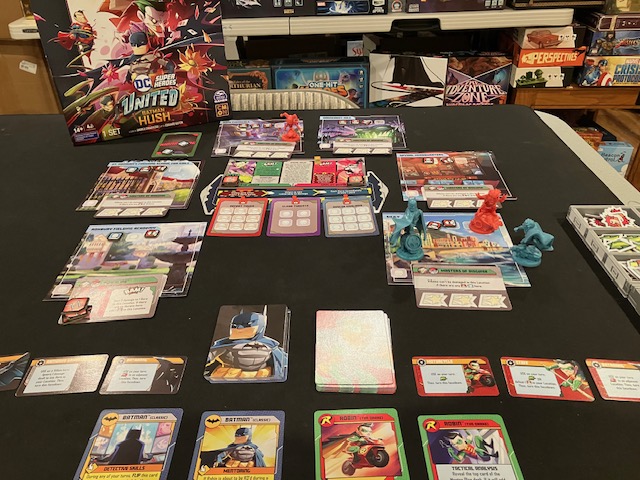
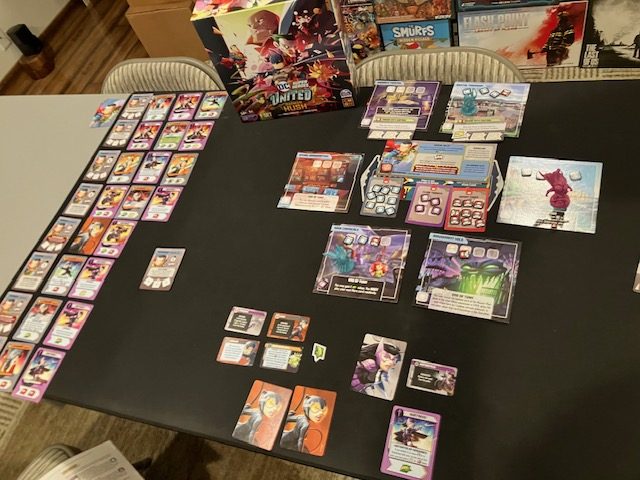
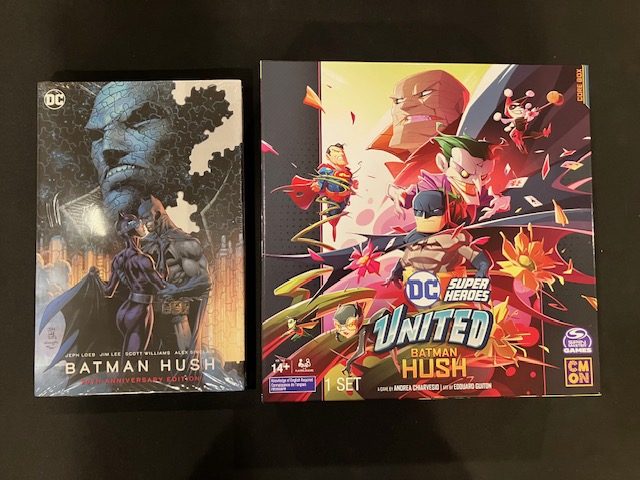
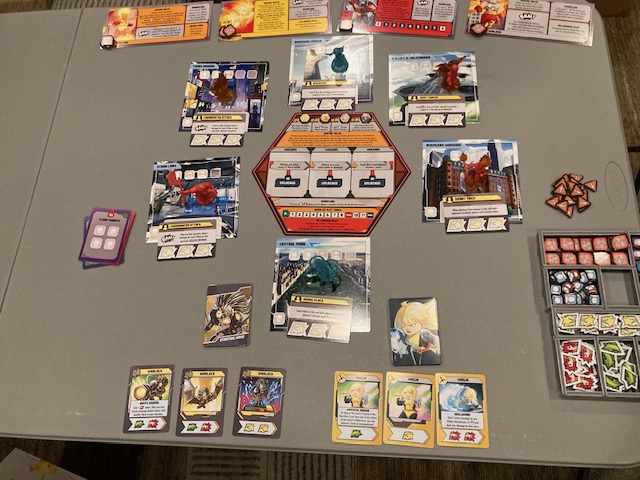
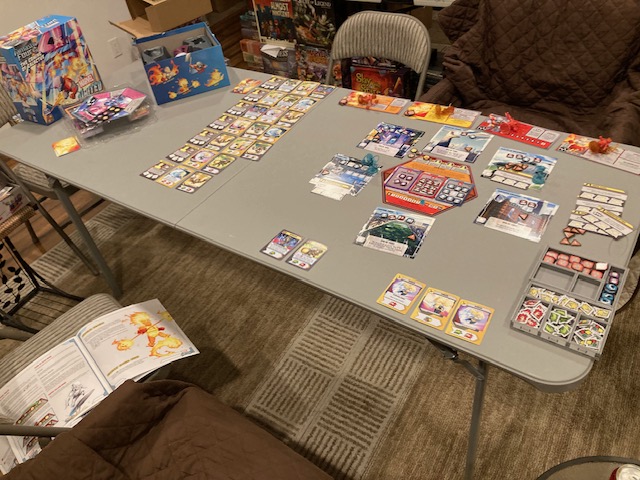
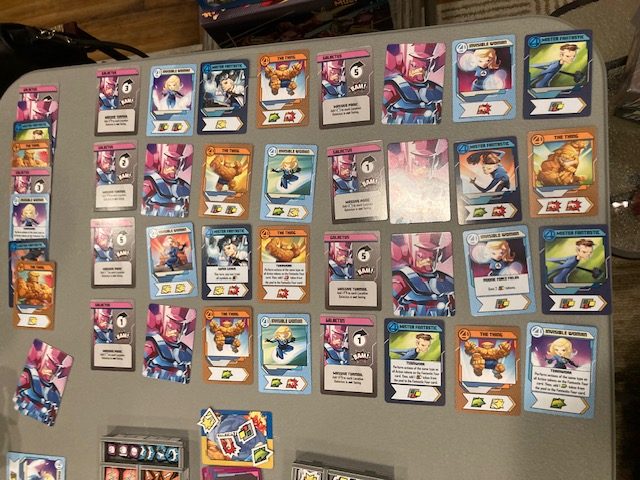
While we wait for the full delivery of DC Super Heroes United (which has run into multiple issues; CMON money issues, tariff issues, and staffing issues), CMON did manage to release DC Super Heroes United: Batman Hush (which we’ll just call Hush from now on, thank you). See above!

This was a “surprise” release that was available from Amazon sometime in August 2025; I ordered it instantly as soon as a I found out about it.  No one really expected this?  EDIT: Well, I missed a some memos … I didn’t expect it.  I mean, we expected DC United (it was #1 on our Top 10 Anticipated Cooperative Games of 2025 list), but Hush was not part of the original Kickstarter!

This game arrived at my house September 10th, 2025.

What is this?

Hush

This game Hush is a standalone game in the Marvel/DC United series of games.  Yes, it is standalone; you don’t need any other sets to play this.  This is a cooperative superhero game where players take the role of your favorite DC Superheroes (Batman, Robin, Superman*, etc) and work together to defeat the villain!

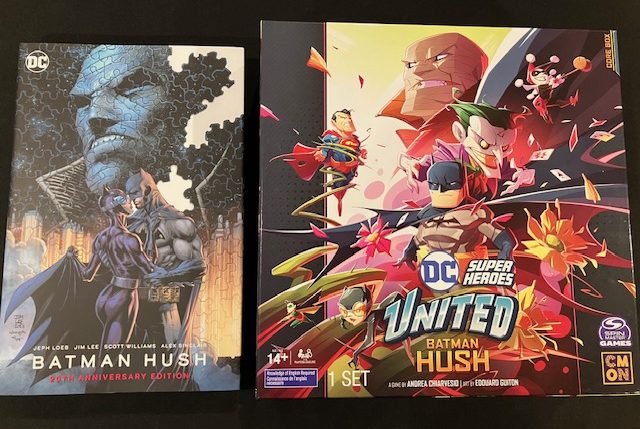
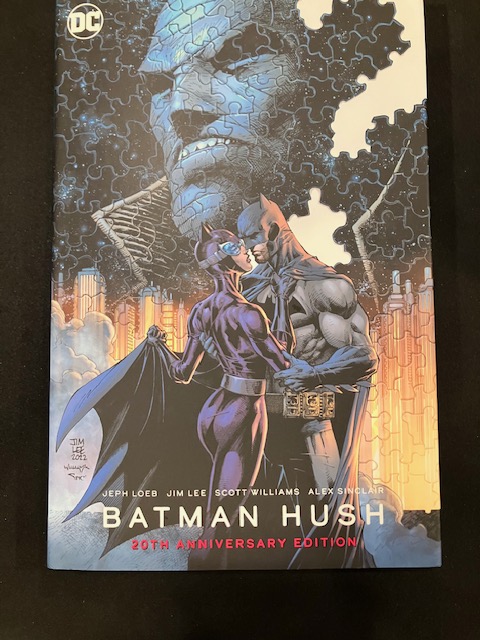
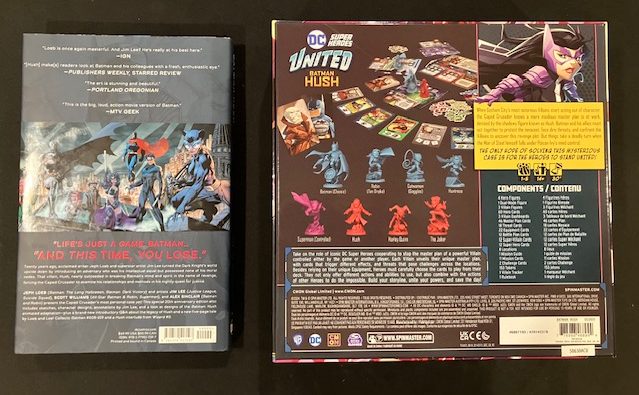
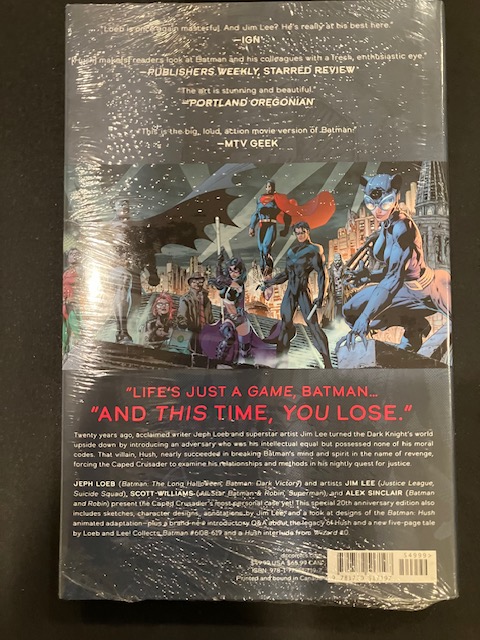
Hush is loosely based on the Jeph Loeb/Jim Lee/Scott Williams/Alex Sinclar Batman series called Hush: see the 20th Anniversary Edition hardback above.

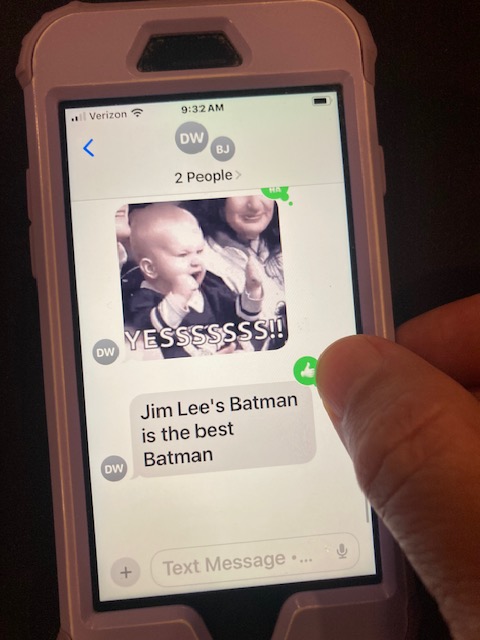
Surprisingly, I had never read Hush, which is weird because I love Batman and I love Jim Lee.  How have I never read this???  I texted my friends Bryan and Diana, who are huge Batman and Jim Lee fans about this!

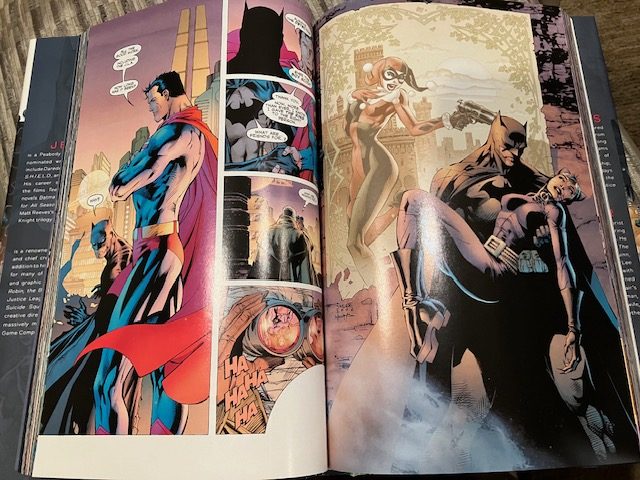
They think Jim Lee’s Batman is the best Batman (see above).  I went ahead and devoured the story over about 3 hours (below).

Hush is a great story; I’d recommend reading it if you’ve never read it.  It gives much more depth to the Hush villain(s) in the box.

Strictly speaking, you do NOT to read the Hush graphic novel/series to play the game; it just helps flesh out the game.  So, if you are intimidated by the giant Hush graphic novel, don’t despair!  The game works fine without knowing the series, but be aware that there can be spoilers.  (Still, Hush was pretty cool; you should read it!)

Unboxing/Gameplay

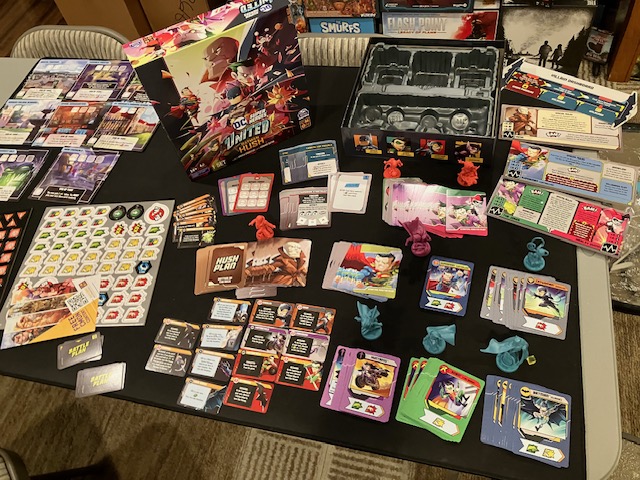
See box above with can of Coke for scale.

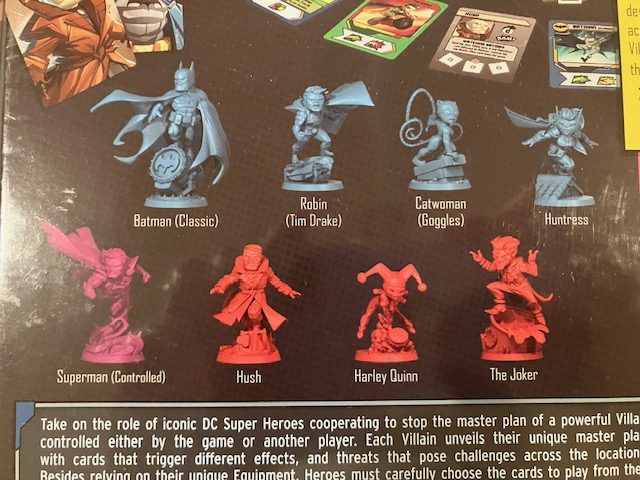
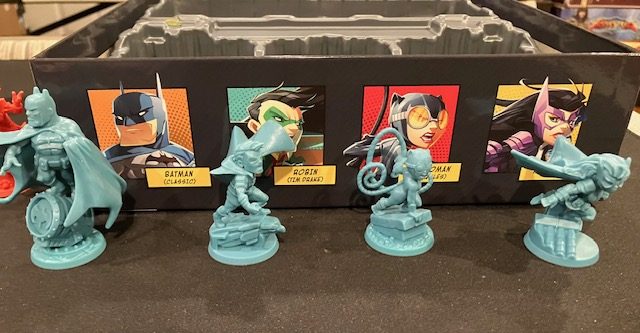
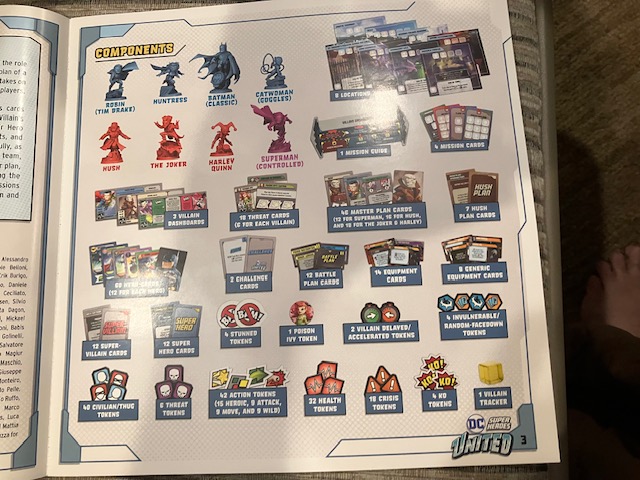
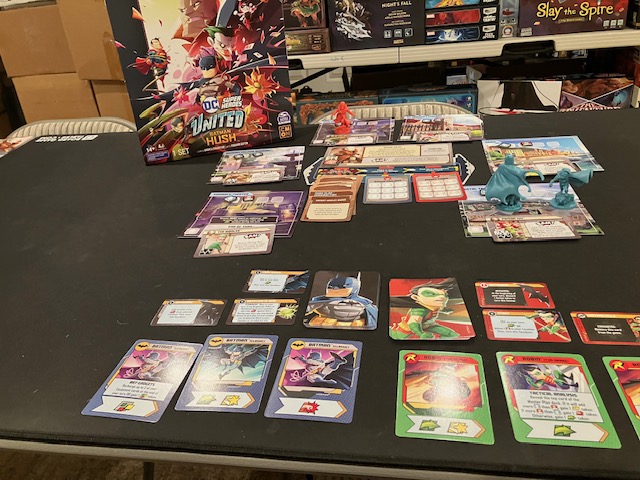
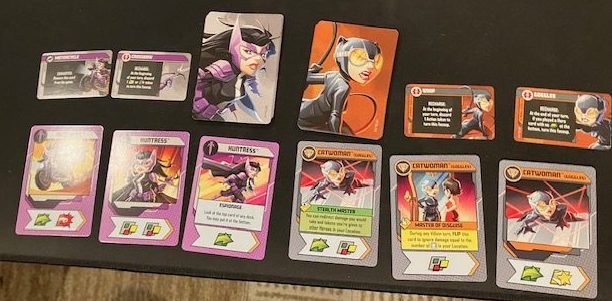
Each player chooses a hero to operate: Batman (classic), Robin (Tim Drake), Catwoman, or Huntress.

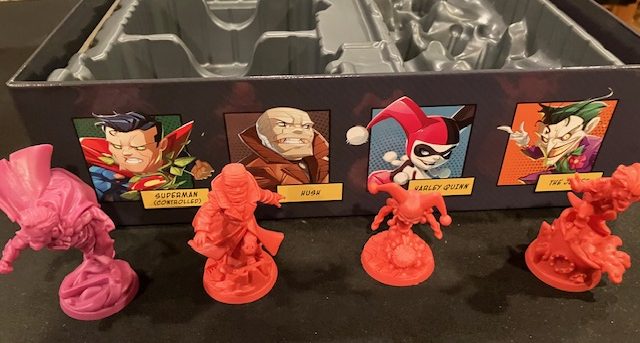
There must be a villain to fight: Hush, Harley Quinn, The Joker, or Superman (controlled).  Superman (controlled) can also be played as a Hero.

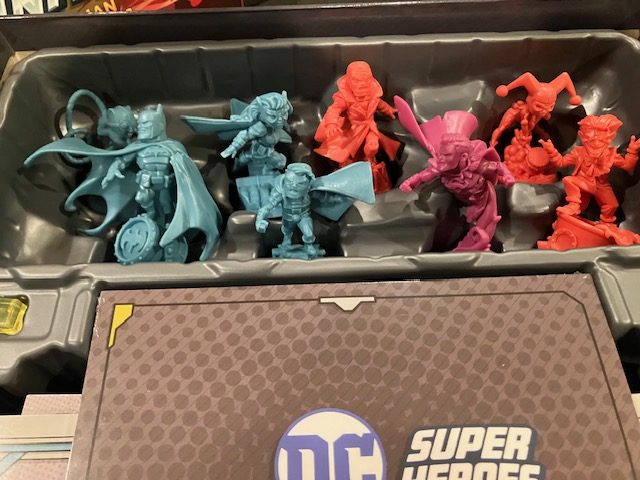
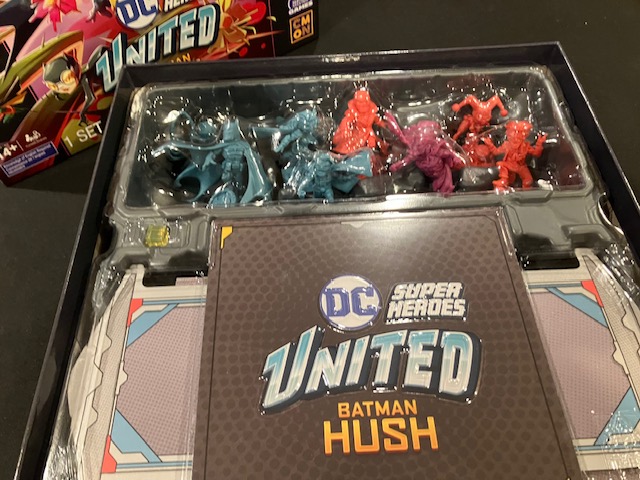
I recommend taking a picture of how the minis fit into the insert (or use mine above).  If they all get out out-of-whack, you can’t put the plastic cover over the minis (see below).

Each Hero gets their own deck, and each Villain gets their own (Master Plan) deck and Threats deck.

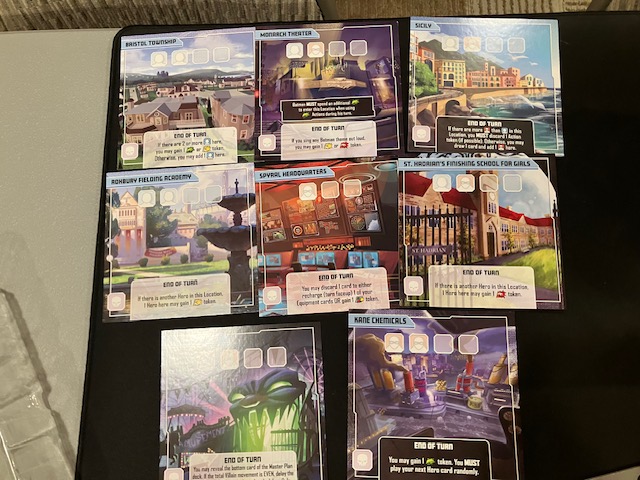
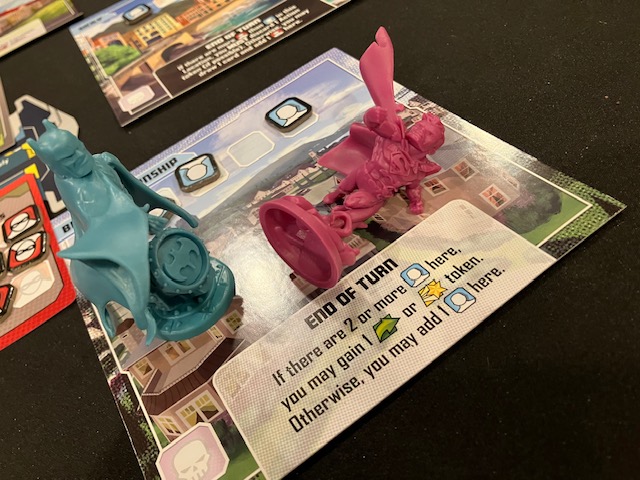
There are 8 locations that come with the box; you will set 6 of them out in a circle representing the city.

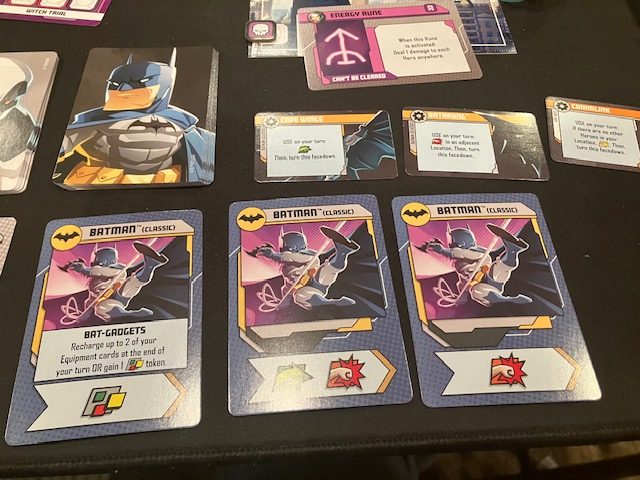
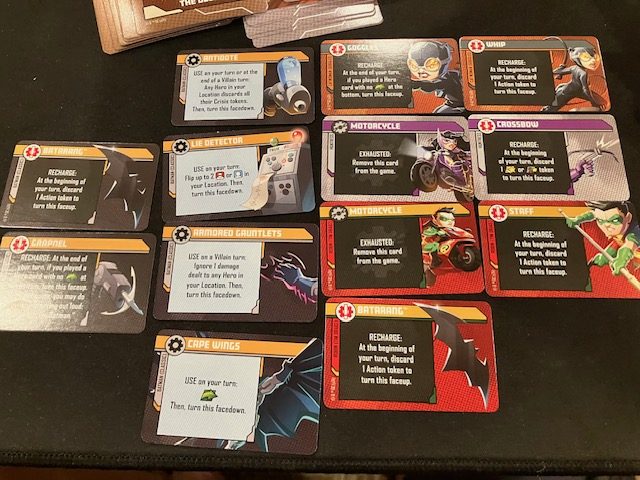
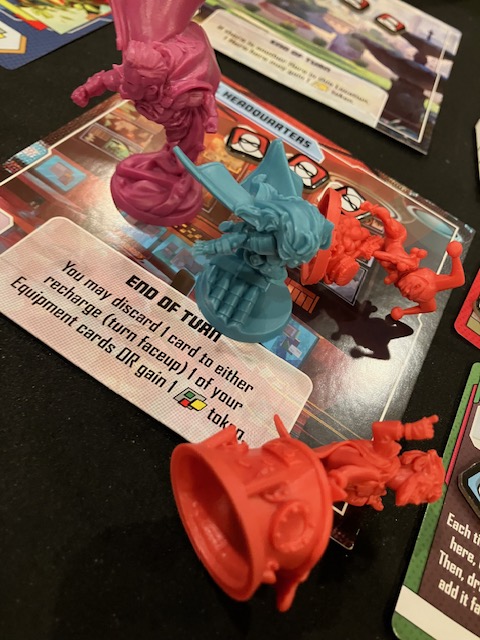
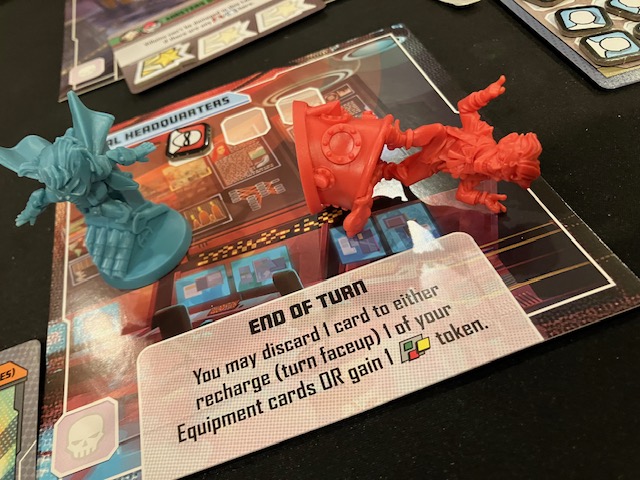
Most of the characters have equipment; the equipment cards are “newish” to Marvel United: they were introduced in Spidergeddon, but we were found we loved them in Marvel United: Multiverse (see review here).   The equipment cards augment the heroes, and basically give them more choices on their turn; however, they will either be discarded or need a recharge to reuse them.  See above.

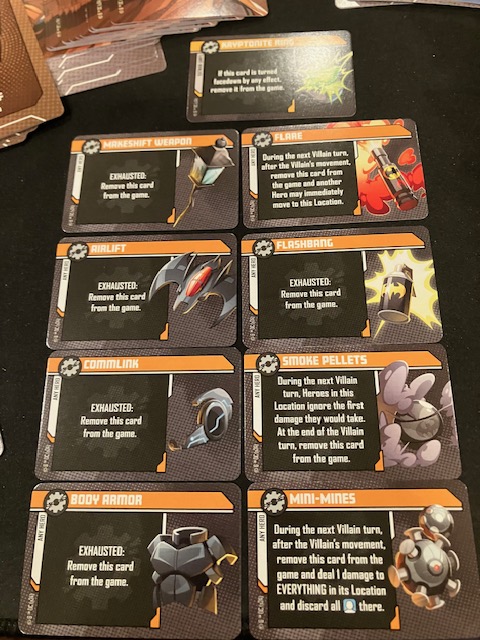
For heroes who don’t have equipment, there are also “generic” equipment cards any hero can use (see above).

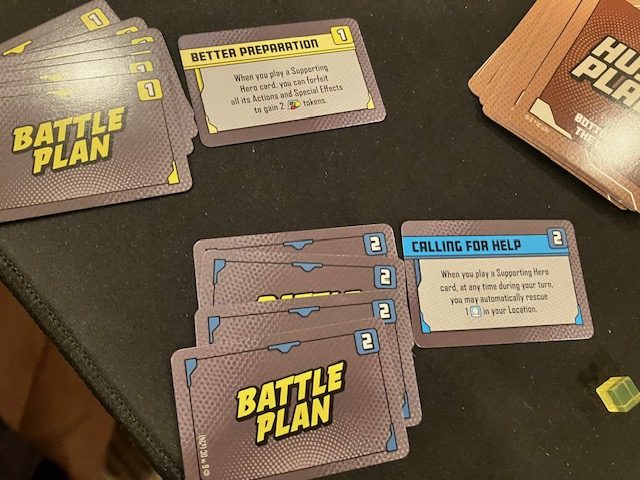
The game also comes with Battle Plan cards; they are for the built-in solo mode called Commander Mode.

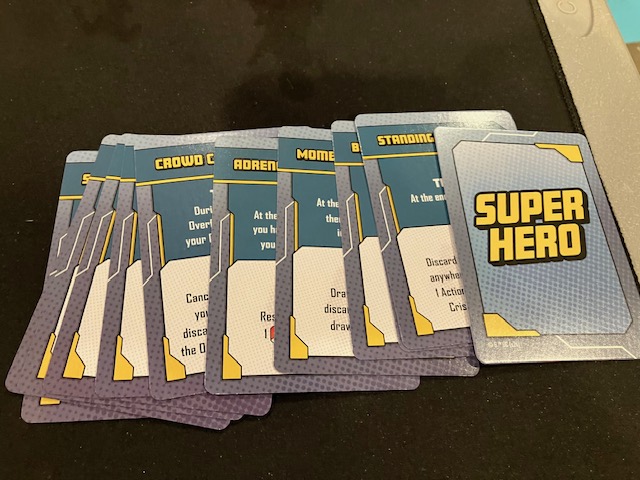
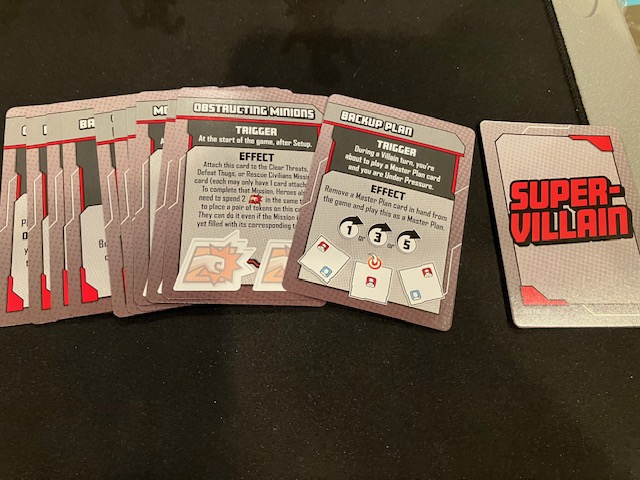
There is another way to play where one player can take control of the Villain and plays against all the heroes: this is a 1 vs. many mode using the Super-Hero and Super-Villain cards above.  We won’t be discussing this mode any more in this review; this is strictly a solo and cooperative mode review.

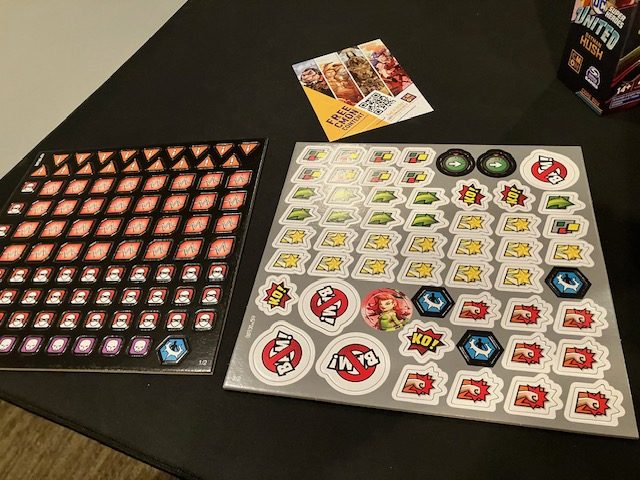
There are a tons of tokens for health, KOs, etc. See above.

Overall, this game looks consistent and great.  The artwork and minis in the game are consistent with the look-and-feel of all the previous Marvel United games (except this is DC instead of Marvel).  For previous looks at Marvel United games, see here, here, here, here, here, and here.

Rulebook

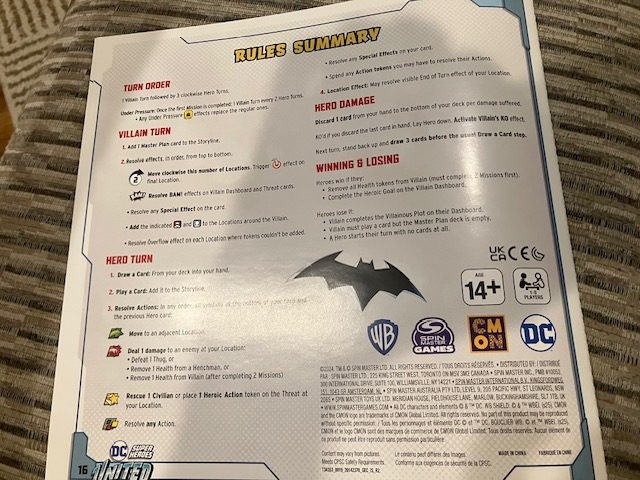
The rulebook is good (it had better be after so many iterations), except for the form factor.

This gets a C+ or B- on the Chair Test; it does stay open on the chair next to me, it has a good-sized and readable font, it has lots of pictures, and it’s easy to read.  Unfortunately, it hangs down just enough to be annoying.  It does work with only one chair, if you sorta fudge it diagonally.

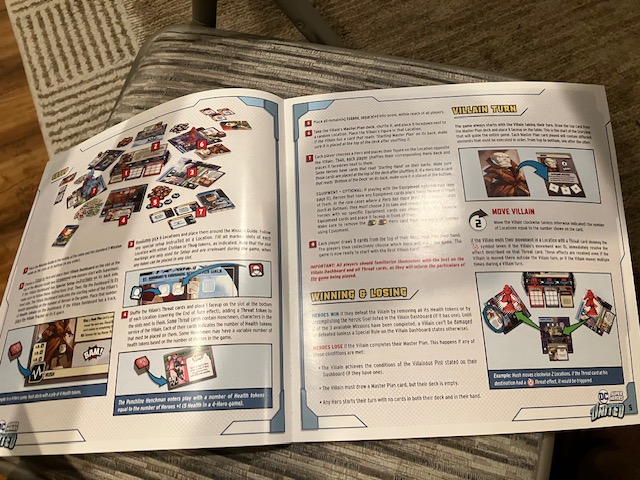
The Components page is great: see above.

The Set-Up is across two pages, but they are in the same span, and the picture and labels work well.

Some, not all, icons are on the back.

In general, this is a good rulebook: good components, good set-up, good font, good pictures, good back. The only complaint is the form factor.

What’s New?

Most everything in Hush  we’ve seen in one of the previous Marvel Uniteds.  I have played a lot of Marvel United, but it’s hard to say you’ve played EVERYTHING across the massive amount of content in Seasons 1,2, and 3!  Here’s what was new to me:

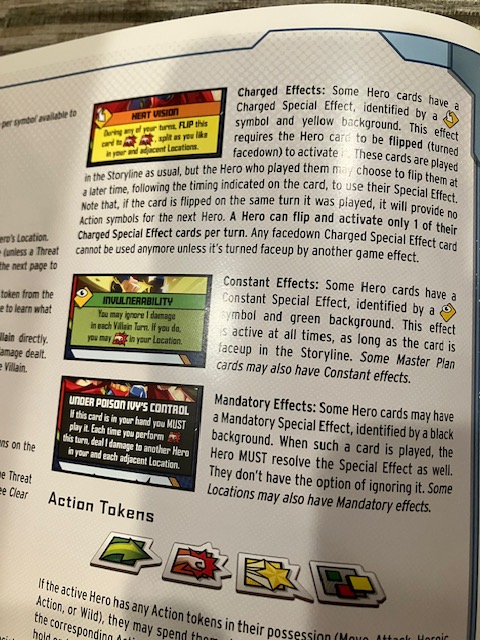
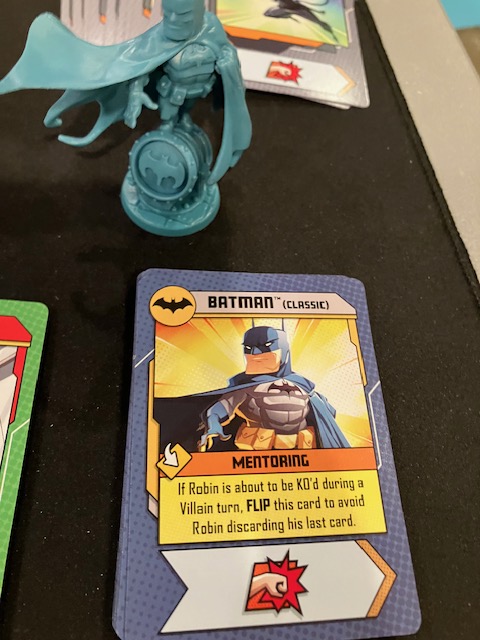
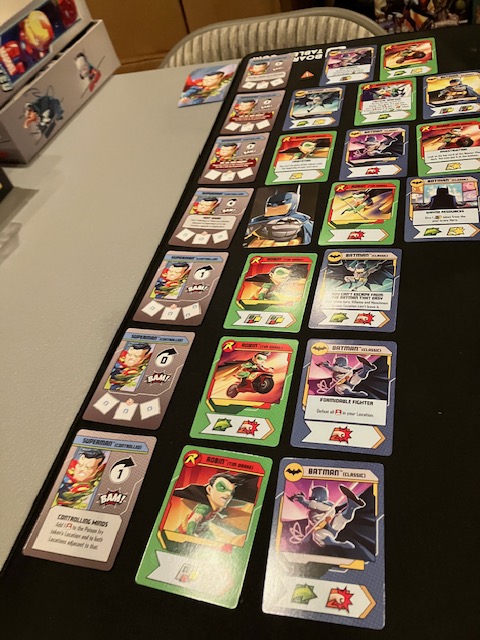
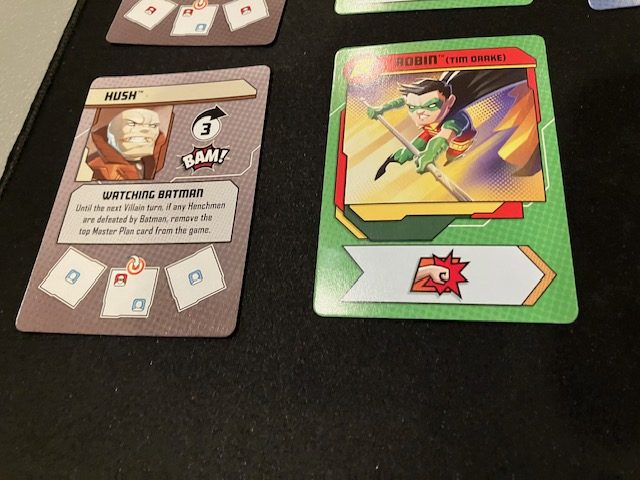
Charged Effects: The little yellow area/flip card allows to flip a card in the Storyline once it’s up.  In the example above, you can flip Batman’s card (only if it’s in the Storyline) above to stop Robin from being KO’d!  This is kinda neat; it’s like a one-time only effect that can only be activated AFTER the card has been put into play.

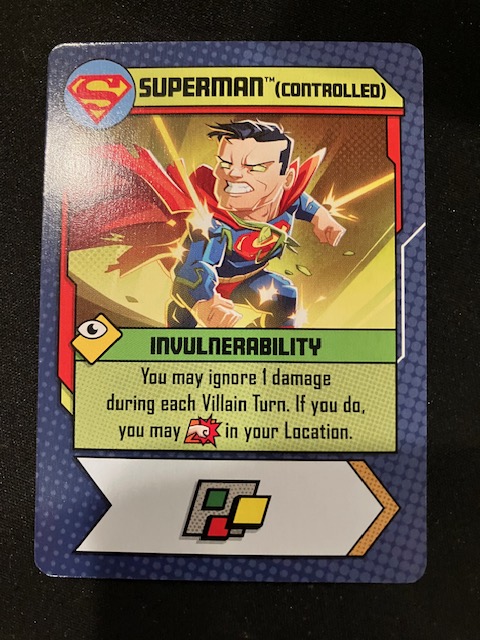
Constant Effects: These cards keep an ability active always once they are in play in the storyline! See above as Superman’s Invulnerability keeps damage off him!

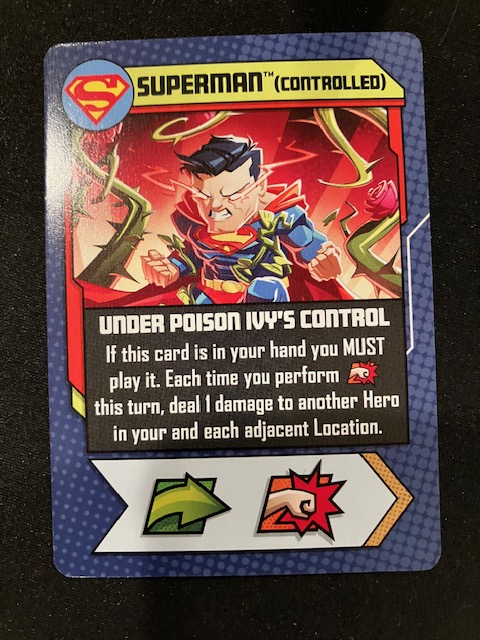
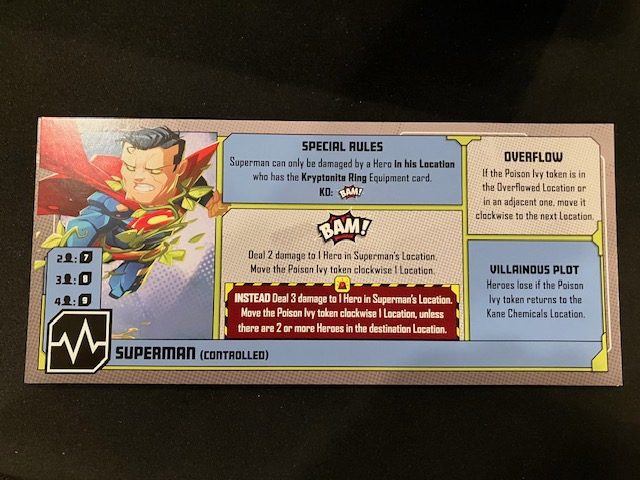
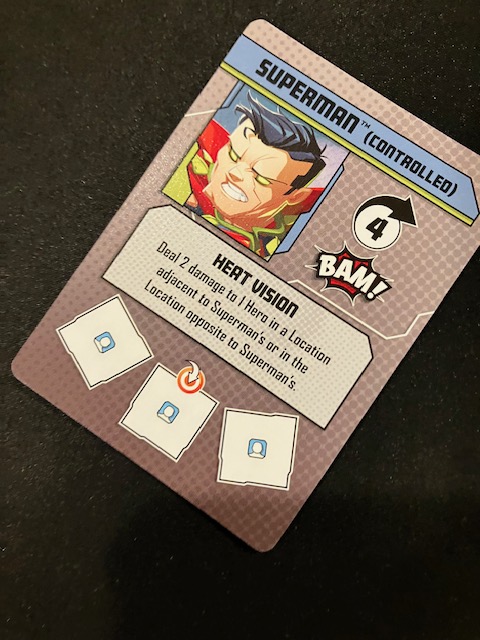
Mandatory Effects: These are mandatory things you MUST do on the card.  This Superman is controlled, and occasionally reverts to his controlled self … doing damage to Heroes around him.  See above.

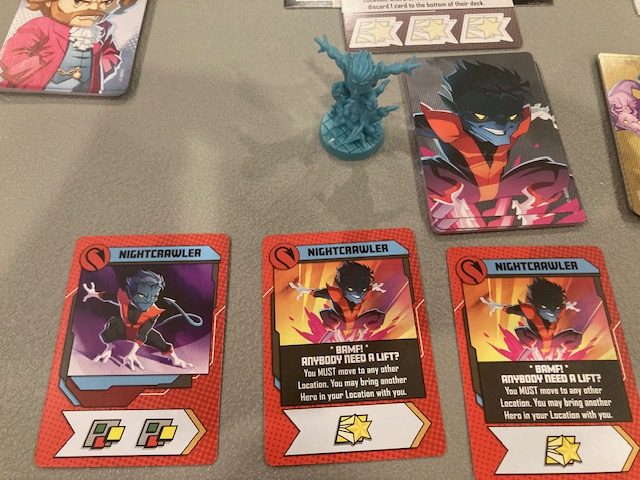
To be fair, we did see Mandatory Effects on the Nightcrawler’s cards back when we did the Dark Phoenix Saga: see here.

Hush Deck: if you are playing Hush, the Hush Plan deck replaces the Clear Threats on the dashboard.

Generally, the DC Superheroes United: Hush Batman or Hush feels very much like  the newer Marvel Uniteds with equipment, Charged Effects, Constant Effects, and Mandatory Effects being the newer things.  Otherwise, it feels like Marvel United, but DC instead!

Solo Mode Discussion

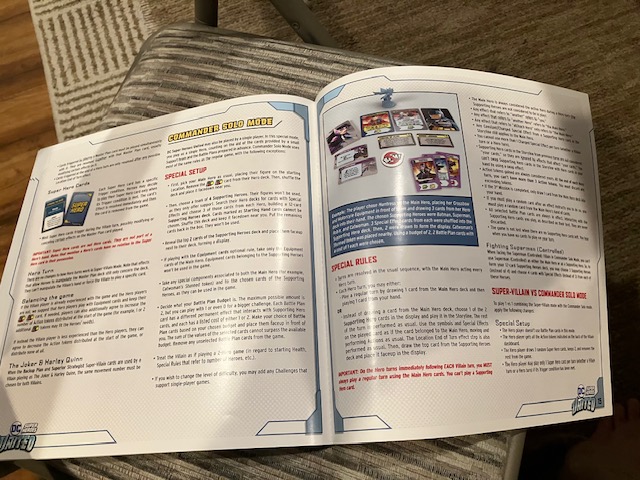
There is a solo mode called Commander Solo Mode (thanks for following Saunders’ Law and giving us a solo mode) that spans two pages.  And it’s pretty complicated.  But it is a true solo mode; you only operate one hero.

I think we saw the Commander Solo Mode first back in Spidergeddon, and we kinda liked it better than the solo mode in the original Marvel United … but frankly it still just feels too complicated.  It’s almost two pages of exceptions, new rules, changes, and special rules!  Look closely at those two pages above!  There’s SO MANY RULES FOR COMMAND SOLO MODE!

Frankly, it’s so easy to just pull out two heroes and alternate between them and just play solo (operating two heroes); it’s the way the game was meant to be played.  This is the way we play solo, partly because it’s significantly easier, partly because it’s easier to jump in (so we concentrate on the new rules of the Villain), partly because it’s the way Marvel United was meant to be played: 2-4 Players, and partly because we have to teach the cooperative game to our friends (so it’s better to play without all the solo rules exceptions for a better learning to teaching game).

You can disagree with me if you like, but I feel very strongly about this! Every time someone tries to put a solo mode in, I find it’s usually better and easier to just play two-handed solo instead (Leviathan Wilds, Leviathan Wilds: Deepvale Expansion, Lord of the Rings Pandemic to name just a few).  Frankly, the built-in solo mode for Lord of the Rings Pandemic almost caused me to hate the game … it wasn’t until I played 2-Handed solo that I found joy in Lord of the Rings Pandemic.

Play solo operating two heroes.  You’ll thank me.

Game 1: Batman and Robin vs. The Joker and Harley Quinn

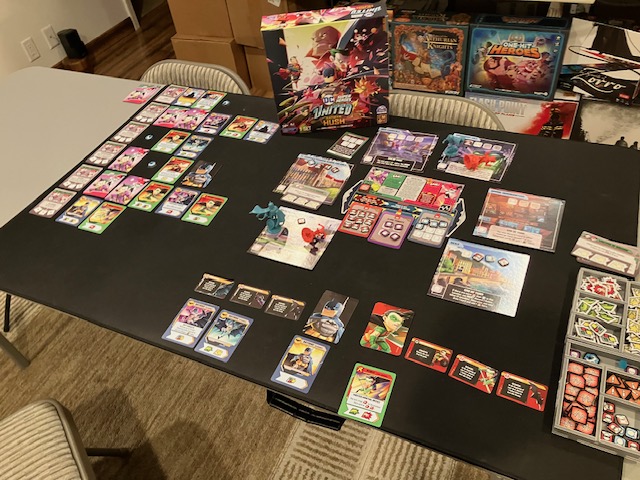
Solo game: two-handed solo (one player operating Batman and Robin independently)

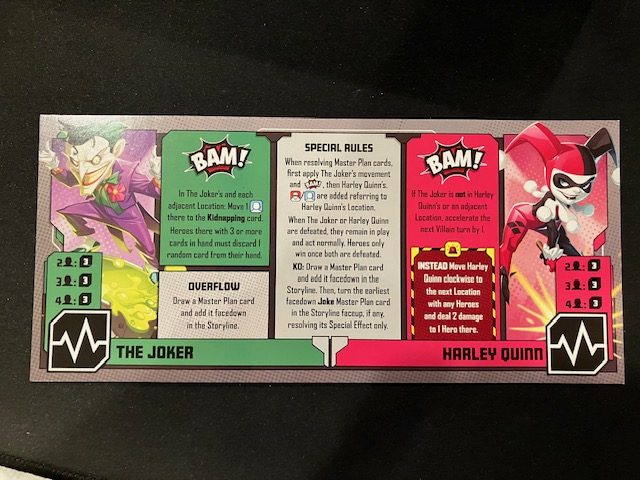
Our first game was Batman and Robin vs. The Joker and Harley Quinn.  Note that Harley Quinn and The Joker are a “team” you are playing against!  You can’t win until they are BOTH down!

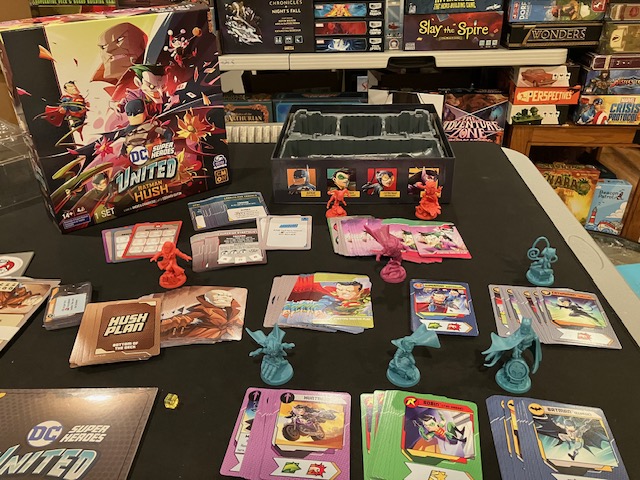
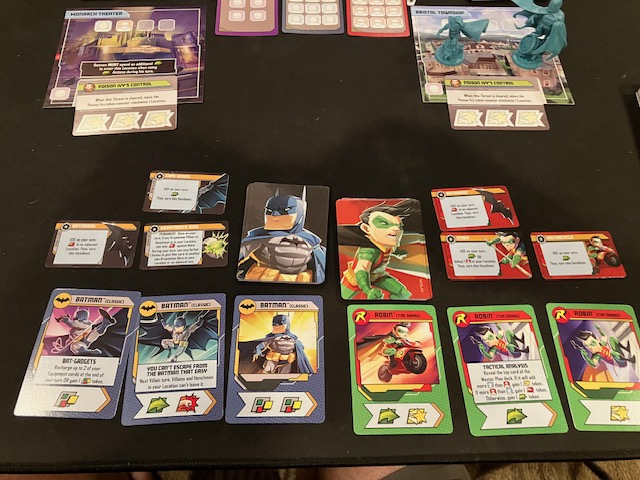
See Batman and Robin get ready to go!

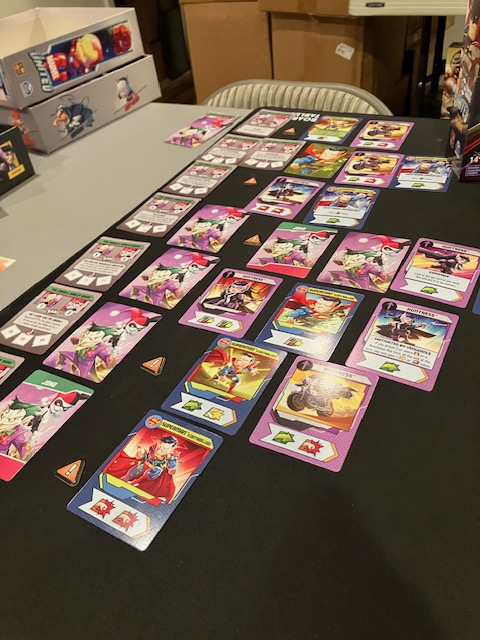
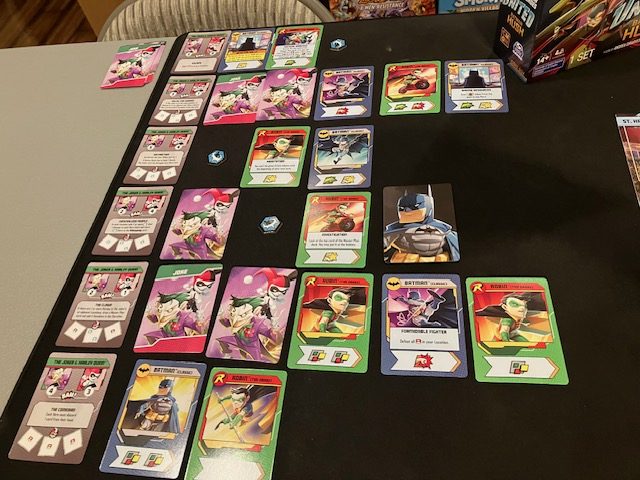
The storyline for Joker/Harley Quinn got convoluted as many times we’d have to put Master Plans into the storyline … they can come up at a later time, or when a character gets KO’d!

In the end, Batman  and Robin prevailed.  Batman took out Harley Quinn …

… and Robin (Tim Drake) took out the Joker.

There are some neat ideas here, as the Joker kidnaps civilians (something he would SO DO in the comics),  Harley causes the Master Deck to dwindle, and “Jokes” appear in the Storyline!  This is a game about keeping the Master Plan deck under control by indirection!  Sometimes you do stuff to STOP the Master Deck from getting too small! If the Master Deck ever becomes empty … you lose!

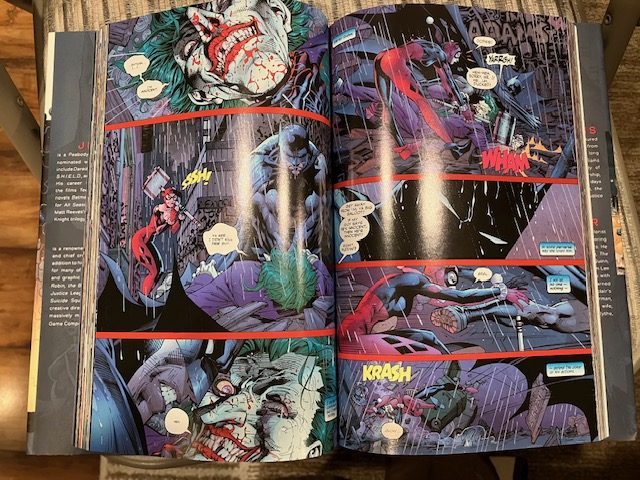
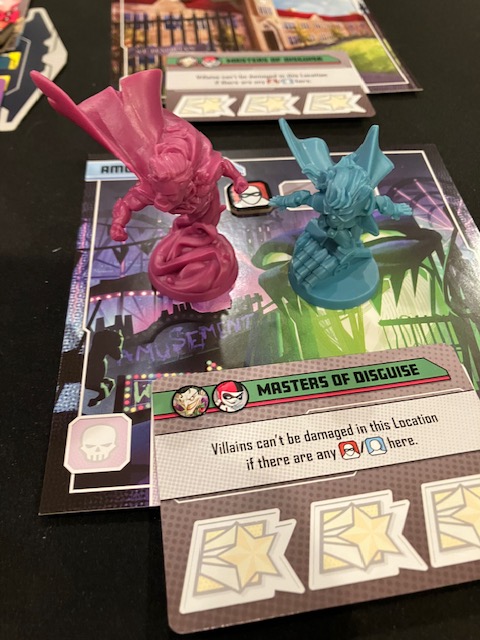
The Joker and Harley Quinn scenario felt incredibly thematic: Joker kidnapping, Harley causing chaos, and Joker’s “jokes” in the storyline occasionally springing on the Heroes! (It also had roots back in the Hush series: see snapshot above).

Batman and Robin’s decks were also on point: they both had the ability to “be a detective” and look at the next Master Plan card coming!  This was both incredibly useful and very thematic.

Games 2, 3, and 4: Catwoman and Huntress vs. Superman (controlled)

Solo game: two-handed solo (one player operating Catwoman and Huntress independently)

So, Superman (controlled) is hard.  I guess he should be; he’s Superman!

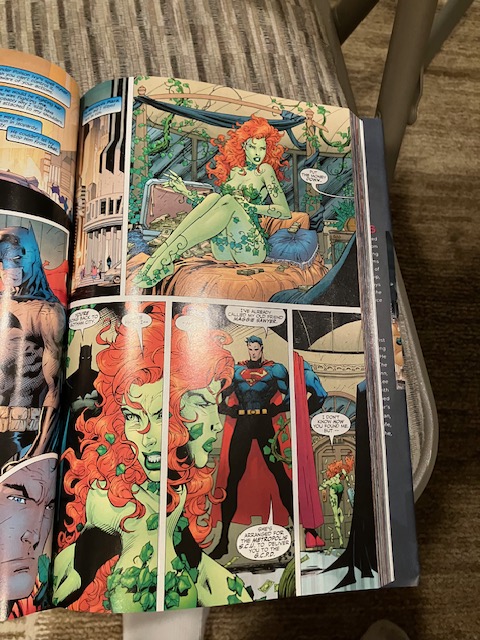
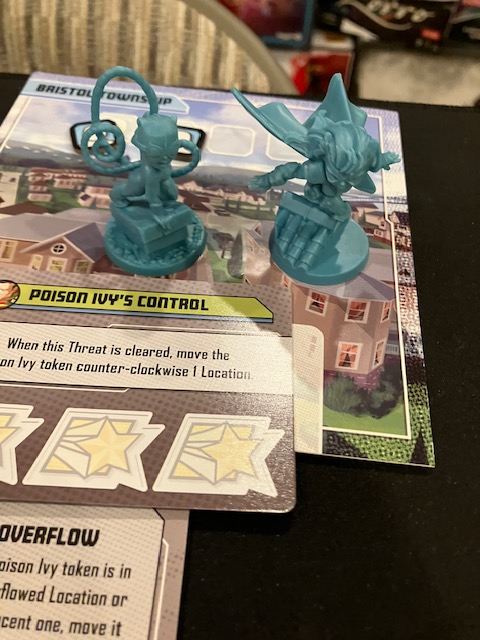
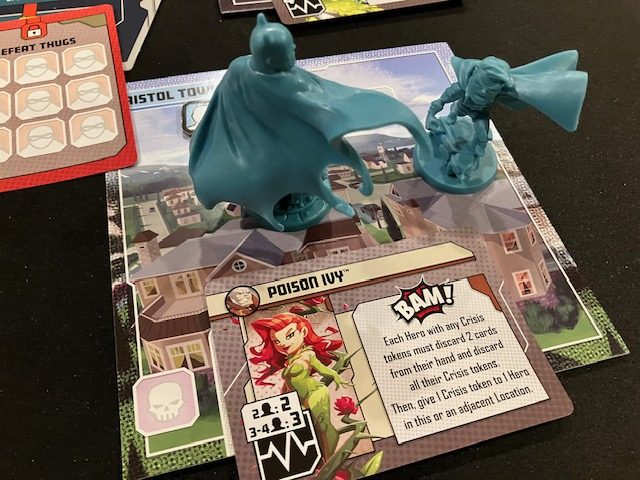
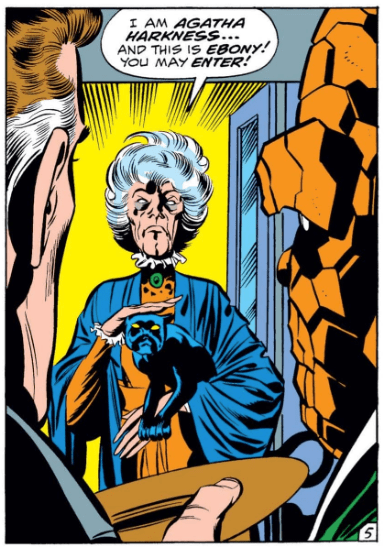
Superman is bad guy here because Poison Ivy is controlling him! See a still from the comic above!

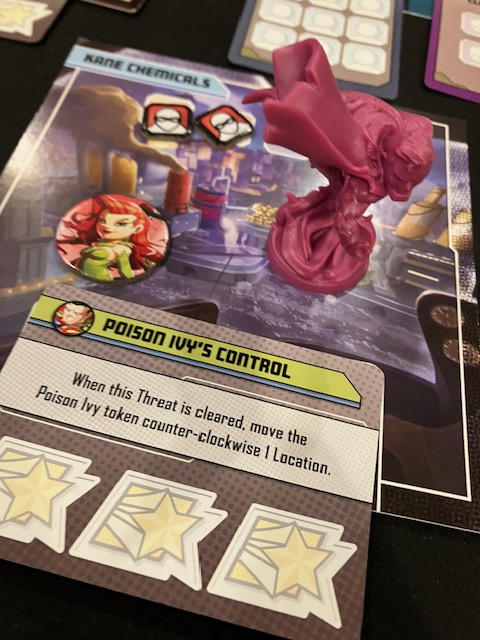
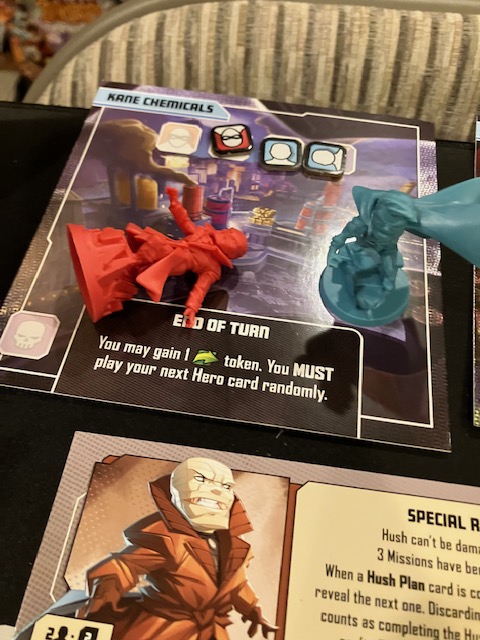
Superman is controlled by Poison Ivy (see above).   If Poison Ivy makes it around the board back to Kane Chemicals, the bad guys win!

Over 3 games, Huntress and Catwoman struggled! They lost three games in a row!  In this particular scenario, heroism is very important!  Unfortunately, Huntress and Catwoman seem to have more punch than heroism!

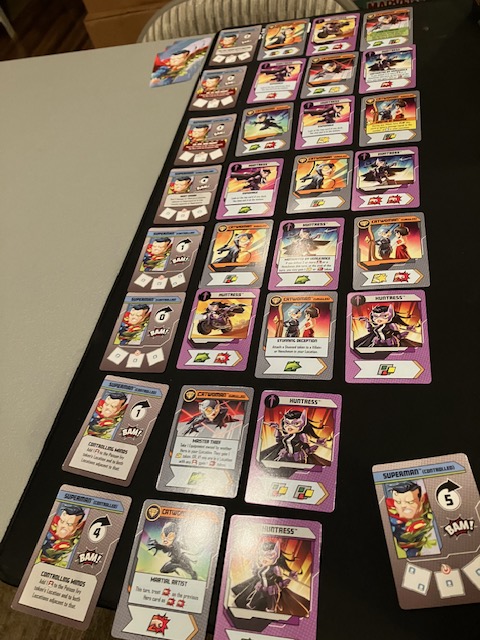
Huntress felt very thematic, as she could look at the top of the Master Plan deck (with espionage) and was very mobile and punchy.  Similarly with Catwoman, she had some disguise cards and was very punchy and mobile.  Unfortunately, they were a bad team against Superman (controlled). Honestly, this makes sense thematically: neither Catwoman or Huntress are known for their Heroism in the comic books … they tend to be more “self-interested” heroes!

Still, I thought the Superman (controlled) villain was pretty cool! It felt thematic … and you even had to have a Kryptonite ring to hurt him!

I have played SO MANY games of Sentinels of the Multiverse where you lose because you just have the wrong heroes.  And that feels very much like the comic book universes!  (Sometimes, Spidey has to go visit Doctor Strange to handle a mystic bad guy!)  In this case, Huntress and Catwoman are the wrong Heroes for Superman … or at least, it’s a LOT harder to play them.

Game 5: Batman and Robin vs Superman (controlled)

Batman and Robin did much better against Superman (controlled): they defeated him in one game.

Batman and Robin control the Master Control deck much better and have a lot more Heroism to deal with Threats and civilians.

This win felt very thematic: Batman and Robin use their detective skills and heroism to keep the bad guy (a Superman controlled by Poison Ivy) at bay.

Game 6: Batman and Robin vs Hush

Solo game: two-handed solo (one player operating Batman and Robin independently)

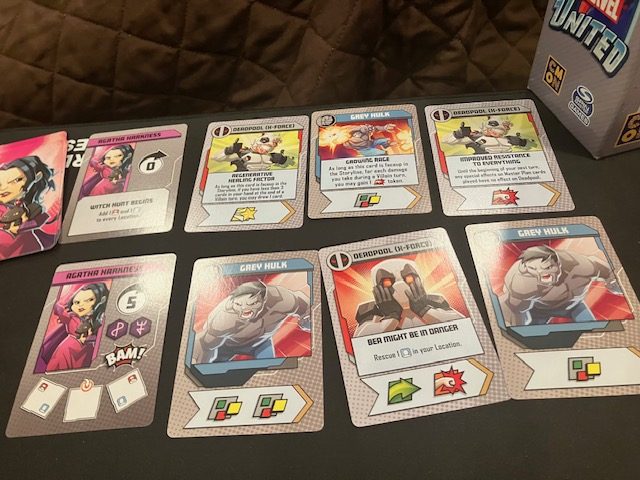
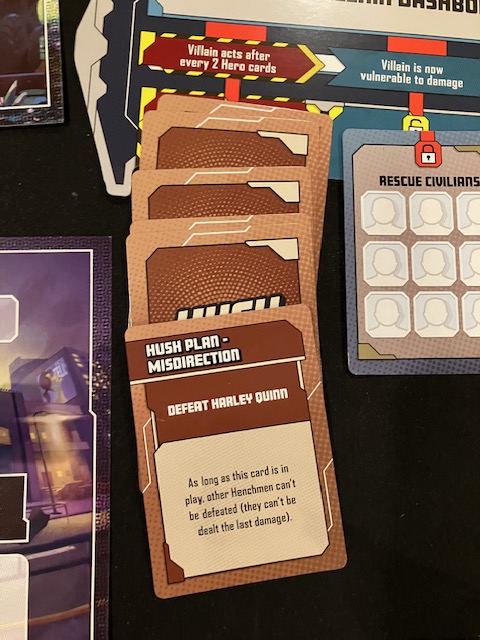
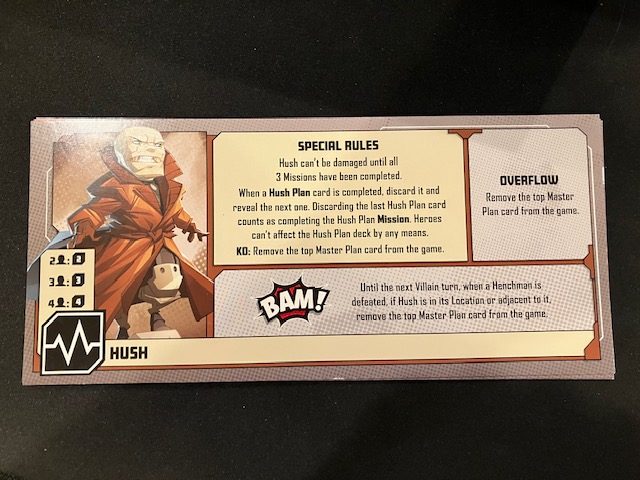
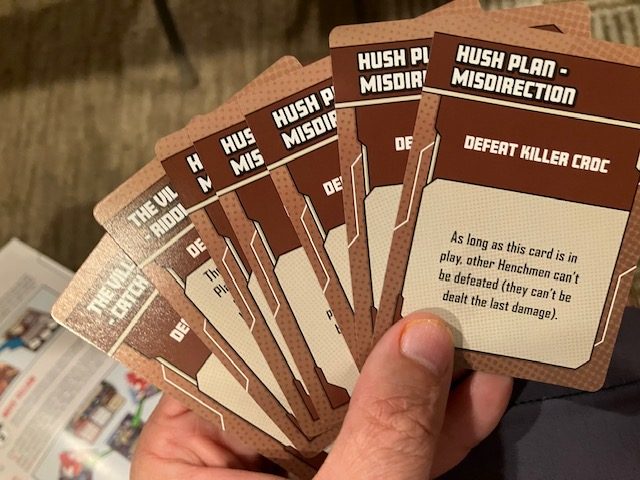
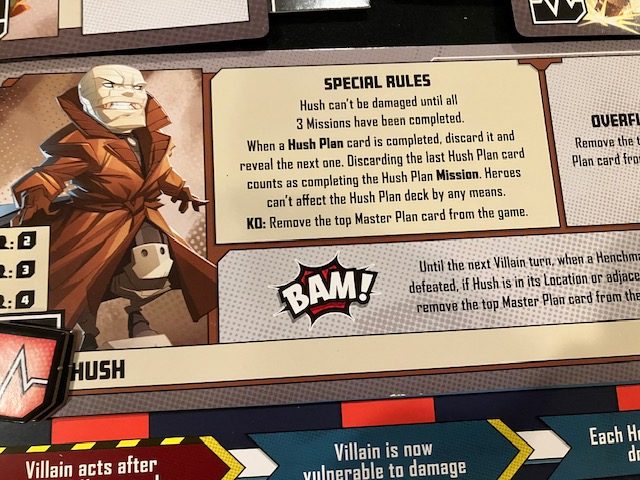
The Hush Villain is probably the most complicated to play.  You must complete all three Missions, but instead of Clear Threats, you have to clear six “Hush” threats (see below).

Like the comic book (very minor spoiler), the Hush Plan cards makes you “focus” on a particular Henchman on the board: you can only defeat them in a certain order.  This constrains how you have to defeat them!

The Hush villain is much more about taking down Henchmen a little at a time, while “defeating” them in a particular order.  Batman and Robin have to “balance” how they spend their resources.

Of course, lots of things (like KO’s, see above) get rid of Master Plan cards.  Do you defeat a Henchman this turn at the cost of losing a Master Plan card?  Or do you wait a turn?  Defeating Hush is all about balance for the Heroes.  Hush himself is sewing Chaos into the world and dwindling the Master Plan deck!

In the end, Robin had a good run and was able to move to Hush and take him down.

Even though it wasn’t a full saga like the comic, Hush felt like the story that unraveled in the comic.  Batman and Robin get “distracted” by Henchmen along the way as they try to uncover who Hush is … and that’s the last card of the Hush Plan deck!

Although you can play the Hush Villain without reading the story, I strongly recommend you do read it before playing!  There is a major spoiler at the end of the Hush Deck that will spoil the entire Hush comic book.  The other two Villains (Superman and Joker/Harley Quinn) you can play without reading, but I suggest you probably read Hush before playing he Hush villain.

Game 7: Superman (controlled) and Huntress vs. Joker and Harley Quinn

Don’t forget; you can play Superman (controlled) as a hero as well!

Supes deck is pretty strong.  And Huntress is great at punchy and movement.

Superman’s deck has a minor flaw that he might have to punch other Heroes (since he still has some residual control): see above.   That card kind of “balances” a very strong deck by giving him a “forced” card. Don’t you hate it when Poison Ivy asserts her control at exactly the wrong time?  That feels so comic booky!  I kind of enjoyed this!  Supes is great … except for the one time he isn’t!

And Huntress redeemed herself by helping out Superman.

Game 8: Catwoman and Huntress vs. Joker and Harley Quinn

Just to make sure Catwoman and Huntress are good decks, I took them for a run against Joker and Harley Quinn.

After losing to Superman three times, they acquitted themselves and beat Joker and Harley Quinn.

Cooperative Game

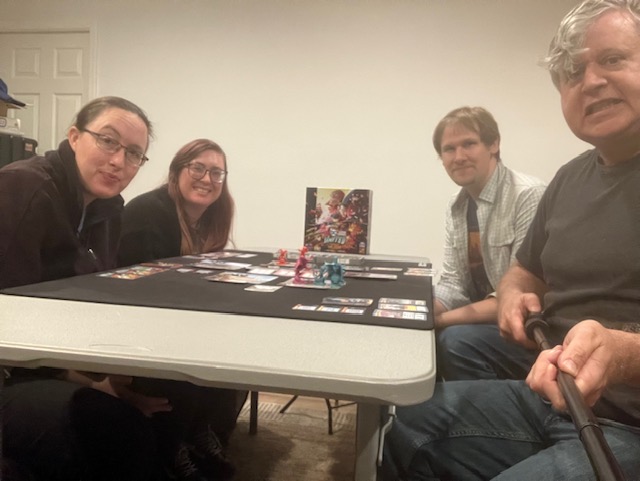
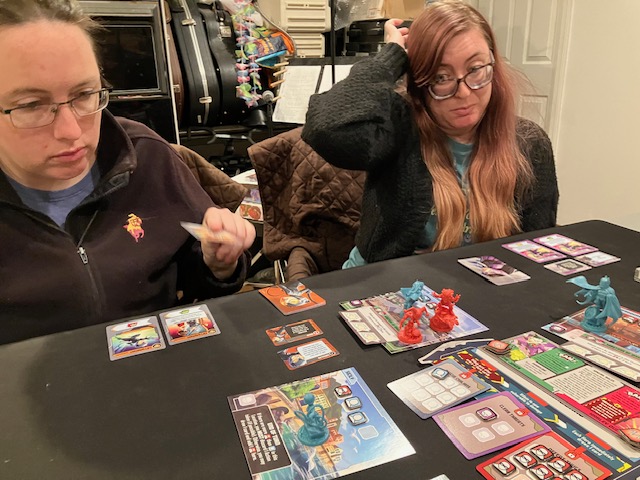
There weren’t any real surprises from the cooperative play; we’ve played this before as a team!

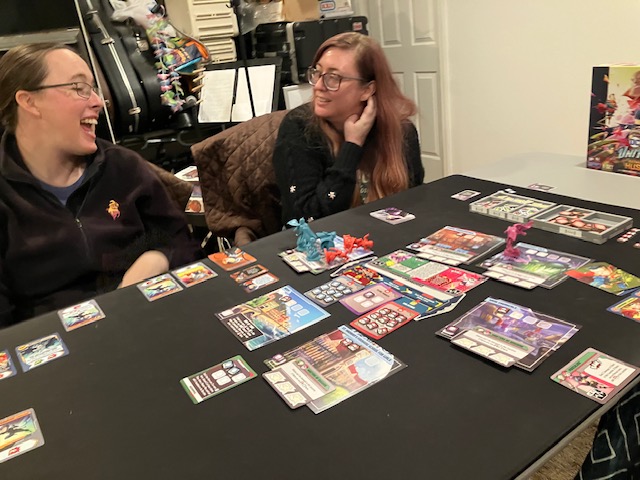
People discussed!  At one point, Andrew HAD to play a Controlled Superman card and he said “I suggest you all NOT be adjacent to me! I will punch you!”  So, Sara and Teresa made sure there was movement on previous cards.  Most of the discussion is “Oh! If you give me this … Oh!  What do you need?” and stuff like that.

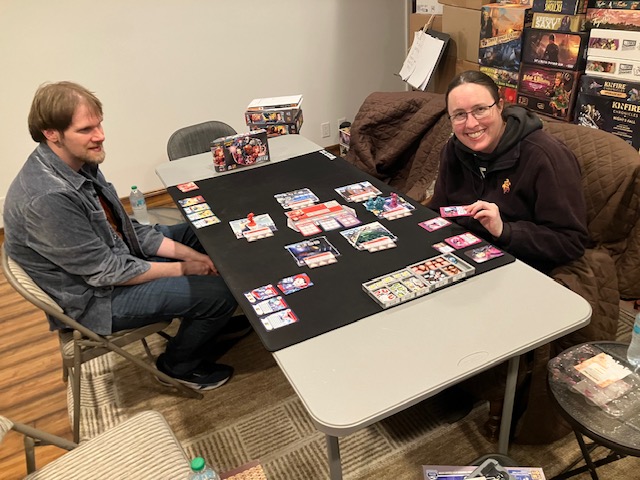
My group had a fun time playing this cooperatively.  The new abilities and equipment made them enjoy it that much more.

Judging by my group’s responses, I think this is the best version of the Marvel/DC United system so far.

Core Game?

I am somewhat surprised that Hush is a core box!  That means this is a completely standalone game!  I loved what I saw, but this doesn’t feel like it should be a “core set”?  The heroes in this set are great for new players, but the villains are really complicated!  Superman (controlled) is probably the easiest Villain to operate, but maybe the hardest to defeat?!  And both Hush and Joker/Harley Quinn are very different than most base Marvel United villains! They are much more complicated than (say) Red Skull from Marvel United, or even Ghost Rider from the Multiverse set!

If I were to recommend someone start with a core set, I’d recommend the base Marvel United, Marvel United: X-Men, or Marvel United: Multiverse over DC SuperHeroes: Batman Hush… I think Hush is too much for a starting player.  Which is too bad, if you LOVE DC, this is the only set you can currently get! I am afraid Hush might accidentally turn off some intro players because of its extra complexity.

Plays Well With Marvel United?

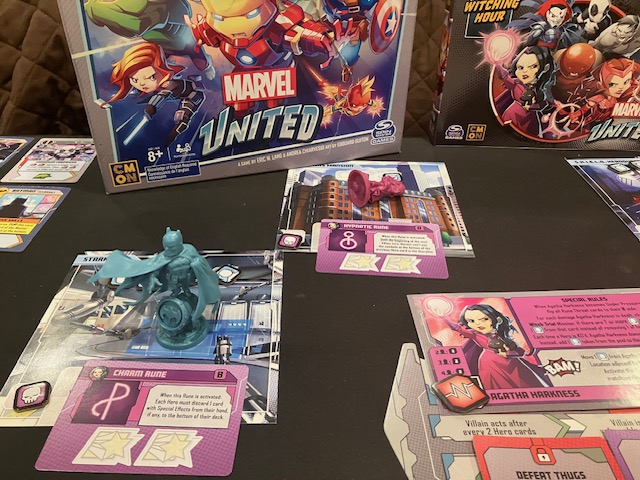
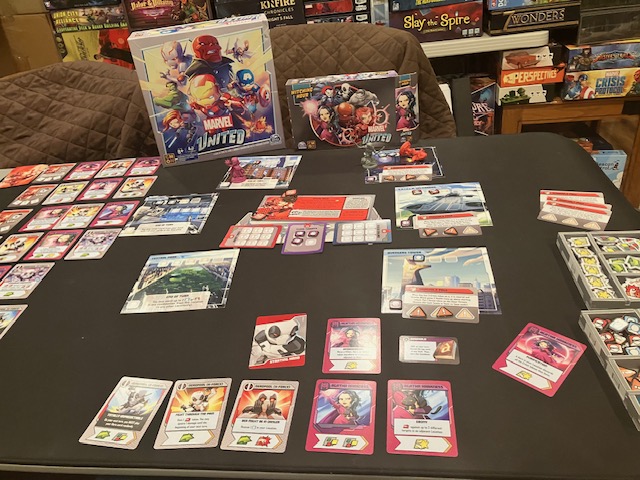
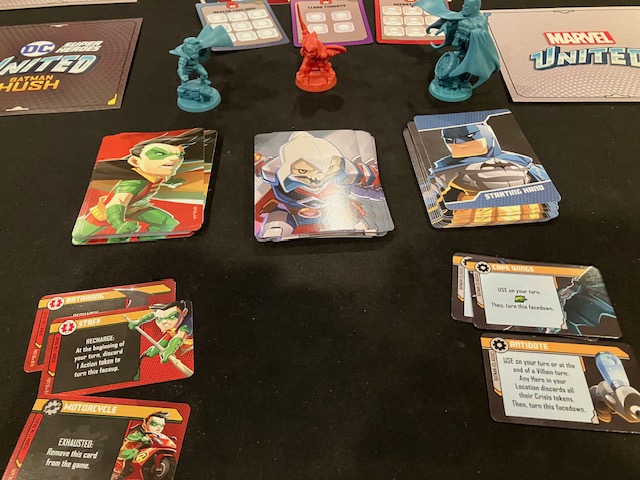
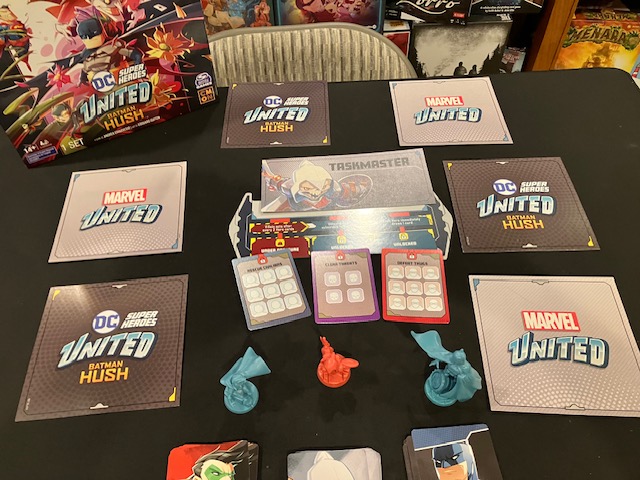
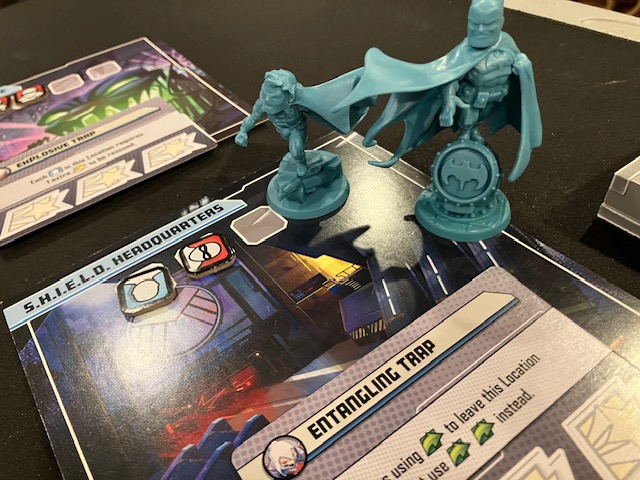
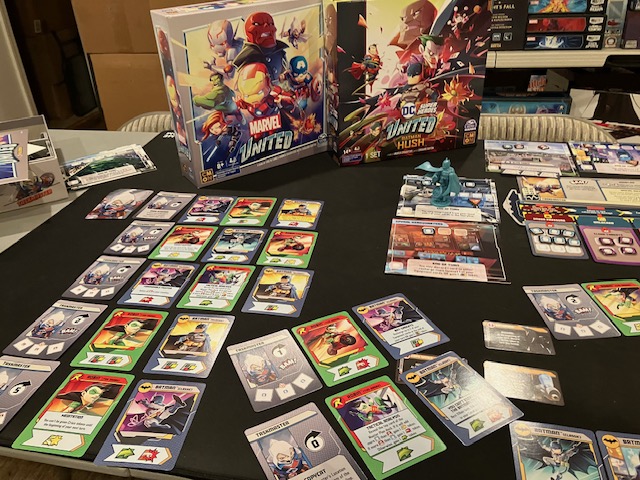
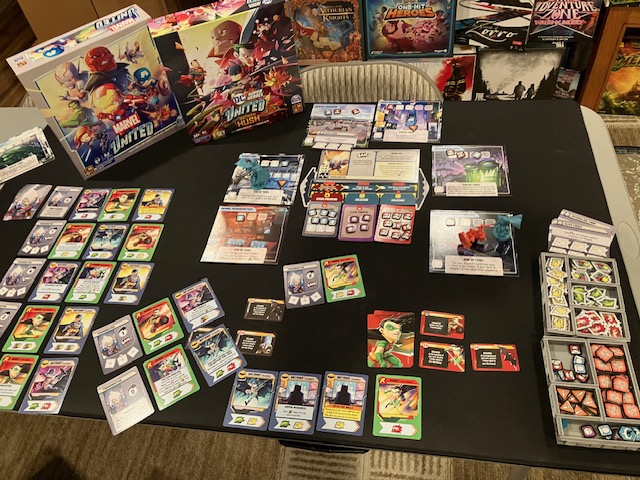
Of course, I had to make sure this played well with Marvel United, so I had Batman and Robin take on Taskmaster (from the base Marvel United set)!

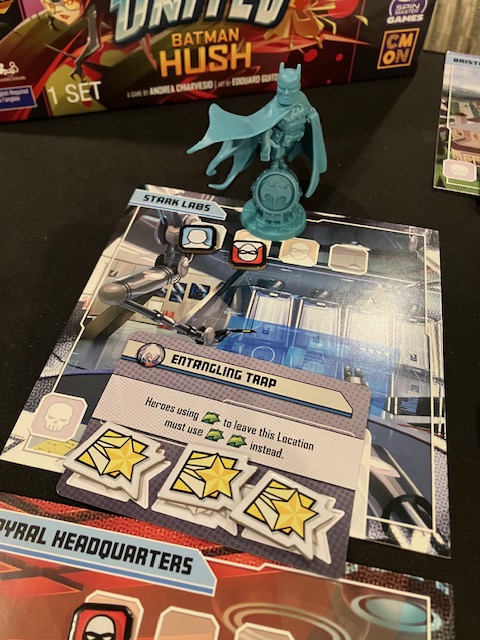
For funzies, I also used half of the Locations from Marvel United and half of the Locations from Hush!  See above.

I got SUCH a kick out of mixing universes! I started giggling to myself when I had Batman and Robin start the game on SHIELD Headquarters!

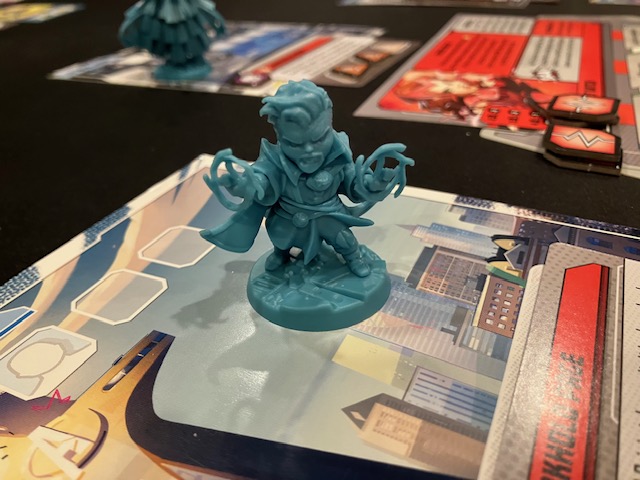
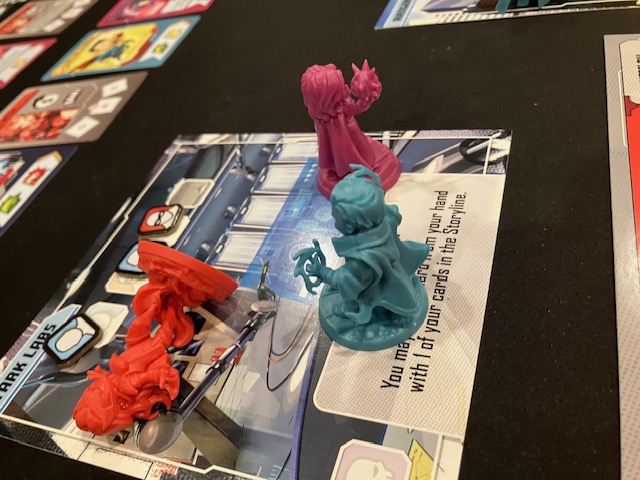
Then later in the game, Batman solved the Threat at Stark Labs!  I giggled even more thinking of Batman disassembling a Trap in Tony Stark’s lab!

For the record, Taskmaster posed little threat to Batman and Robin.  More like “Lamemaster”.

I will say that I think later Heroes and Villains are stronger than earlier Heroes and Villains in the Marvel United games.  This game demonstrated that a little … but I still had a grand time!

Conclusion

Currently, Hush is my game of the year for 2025!  I have played about 10 games of Hush and want to keep trying more and more!  I want to try Batman and Robin vs the Sentinels!  Will Superman do a great job against Galactus?  Can Batman and Spiderman team up?  How would Superman and Gladiator pair up as compatriots?  What about Superman vs. Gladiator?  There are SOOOO many cross universe games I want to try!

Even with all the fun things I can try combining Marvel United and DC Superheroes United, I still loved the Hush box by itself.  Each Villain presented a different puzzle to solve!  Each Hero has their own flavor and personality: Catwoman is more punchy than Robin, but Robin is more heroic!  And these differences are very flavorful!

This box also introduced me to the wonderful world of Jim Lee Batman (who is the best Batman according to Diana)! I am grateful that I got to experience Jim Lee’s Hush for the first time!

My only complaint is that the Villains in this box are all pretty complicated; I wish there had been a “simple” Villain (for newer players).  If you are an experienced Marvel United player, then this box is a no-brainer.  If you are a more introductory Marvel United player, I might recommend a different core box.

After all is said and done, Hush is a full up 10/10 for me.  I played so many games over a 2 week period and each one was a blast!  Even when I lost, it was fun to try to figure out “why I lost” and come back and revisit the game!

Even though Hush is an unexpected DC Superheroes United (this wasn’t part of the original announcements for DC United), there’s a reason DC Superheroes United  was #1 on my list of Top 10 Anticipated Cooperative Games For 2025!

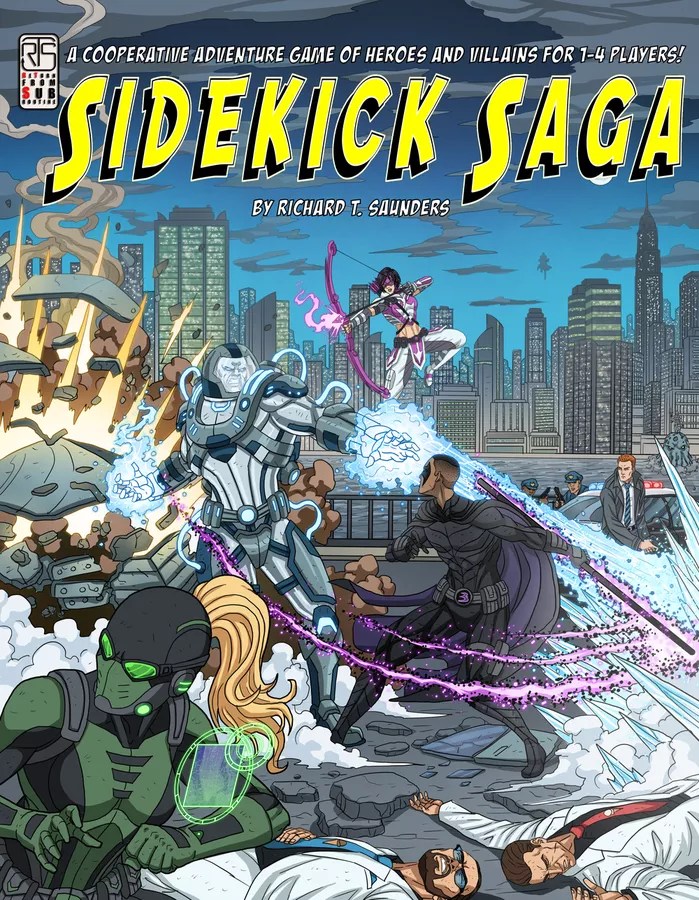
Designer’s Diary for Sidekick Saga

As we pass the 6th Anniversary of Sidekick Saga being on Kickstarter, let’s look back to the original design and development process! This was a labor of love for me; I have collected comics since I was 10 years old, and I think I still have every comic I every bought! I love comic books and Super Heroes! I wanted a cooperative Super Hero game with a story, as none really existed at the time!! Let’s look back and see how this design came about! For the record, all pictures in this diary are from my own personal comic collection! See below as I go hunting for comics!

Inspirations

But let’s jump in … what inspired Sidekick Saga?

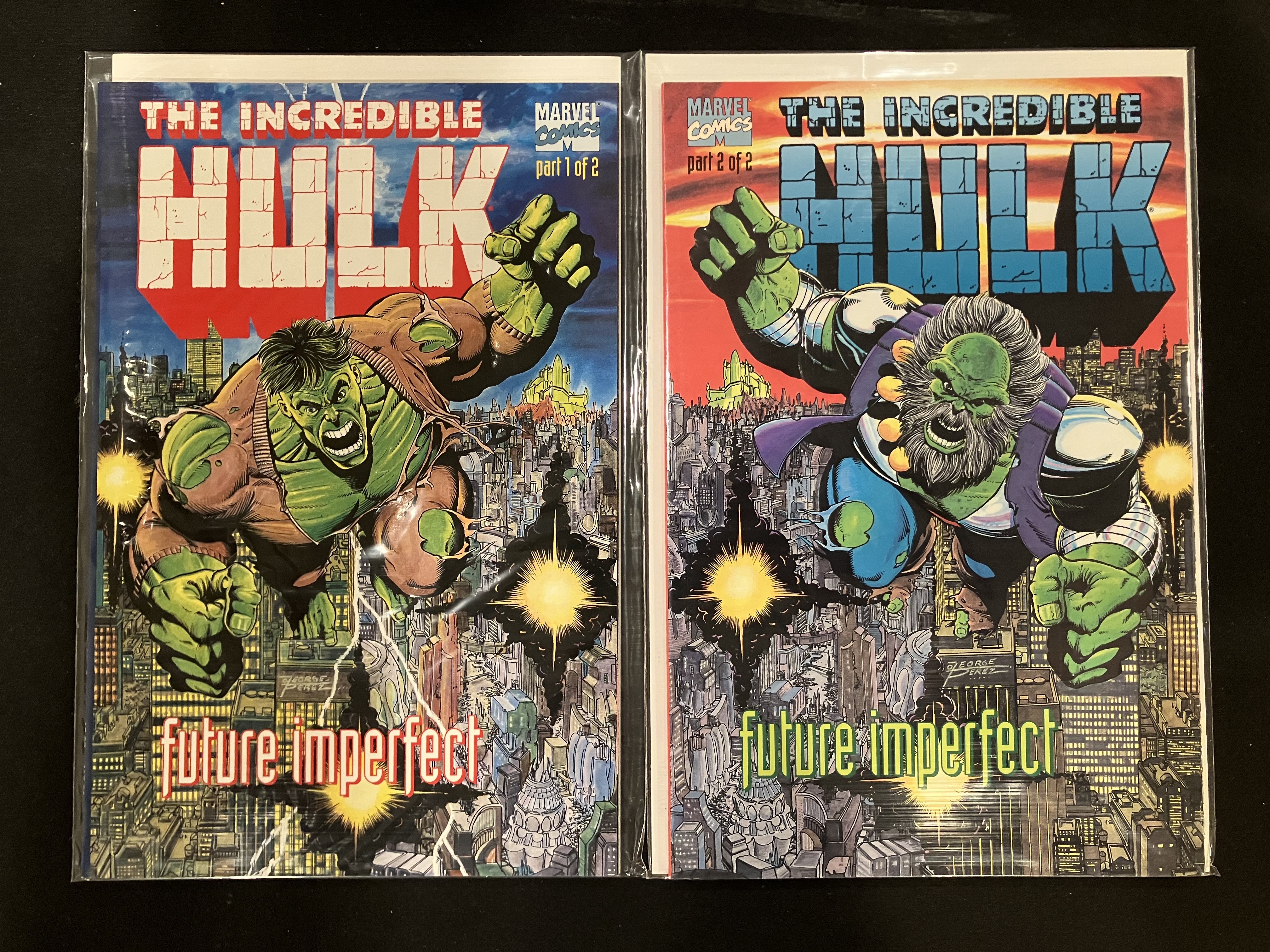
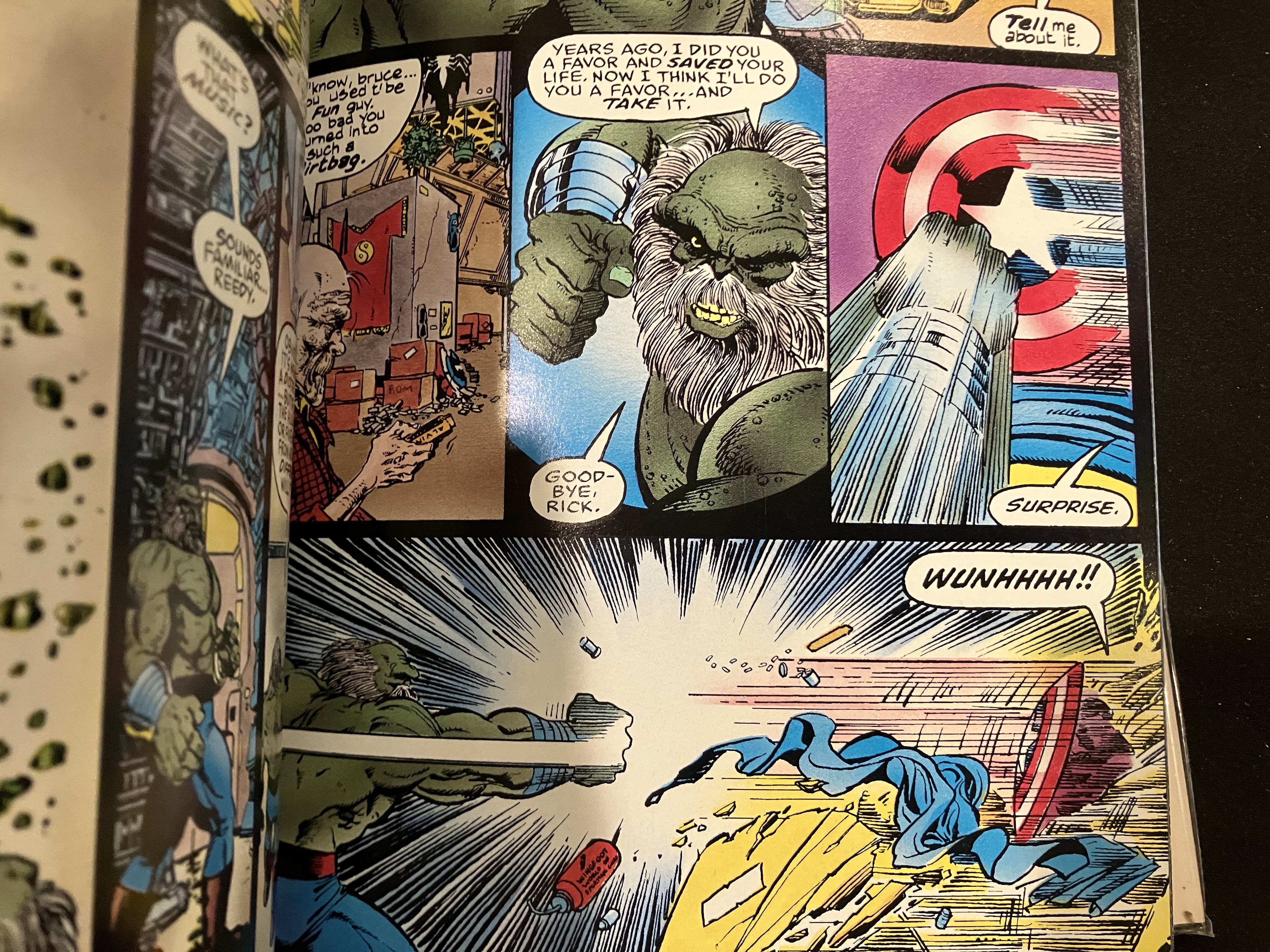
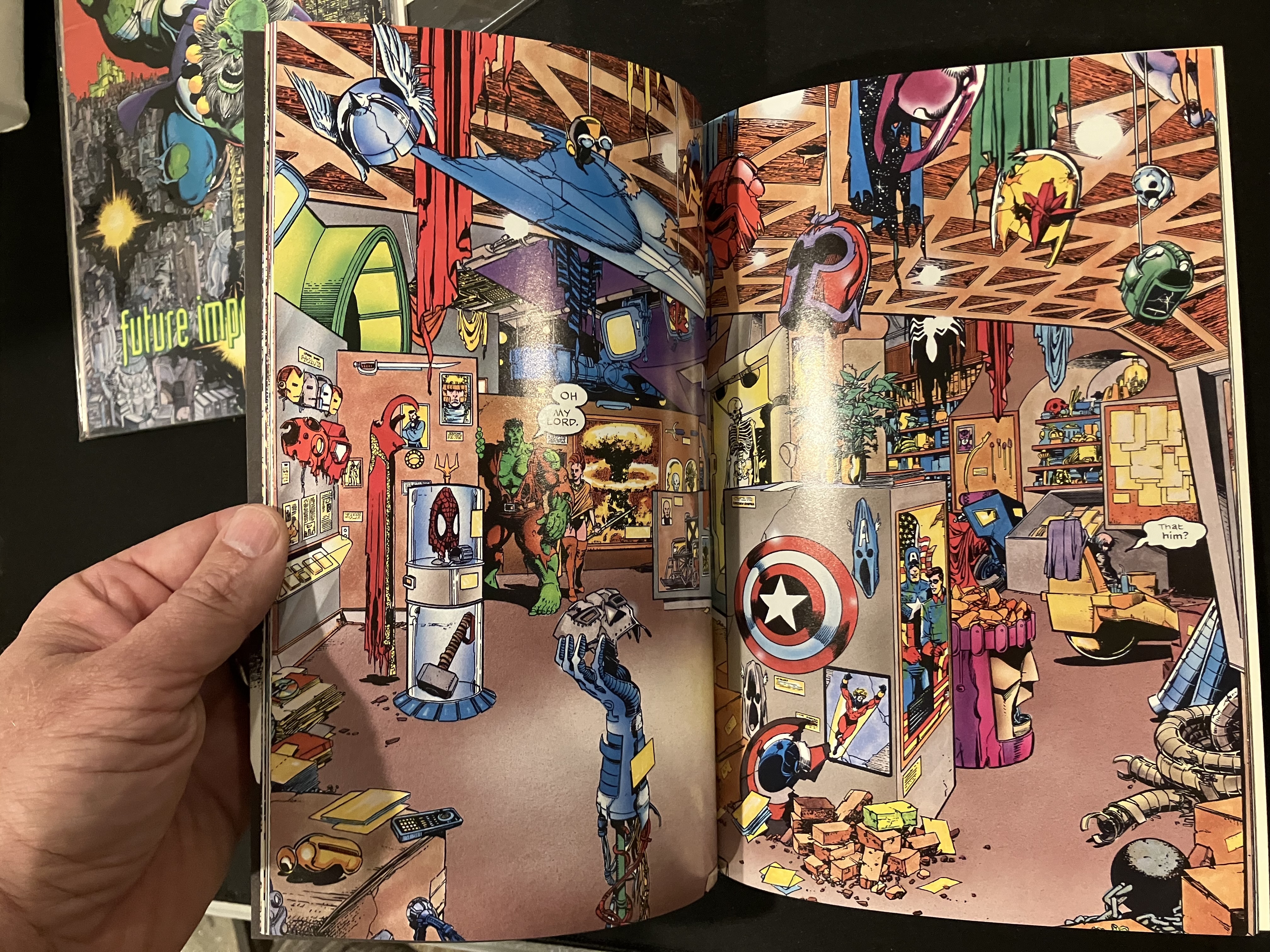
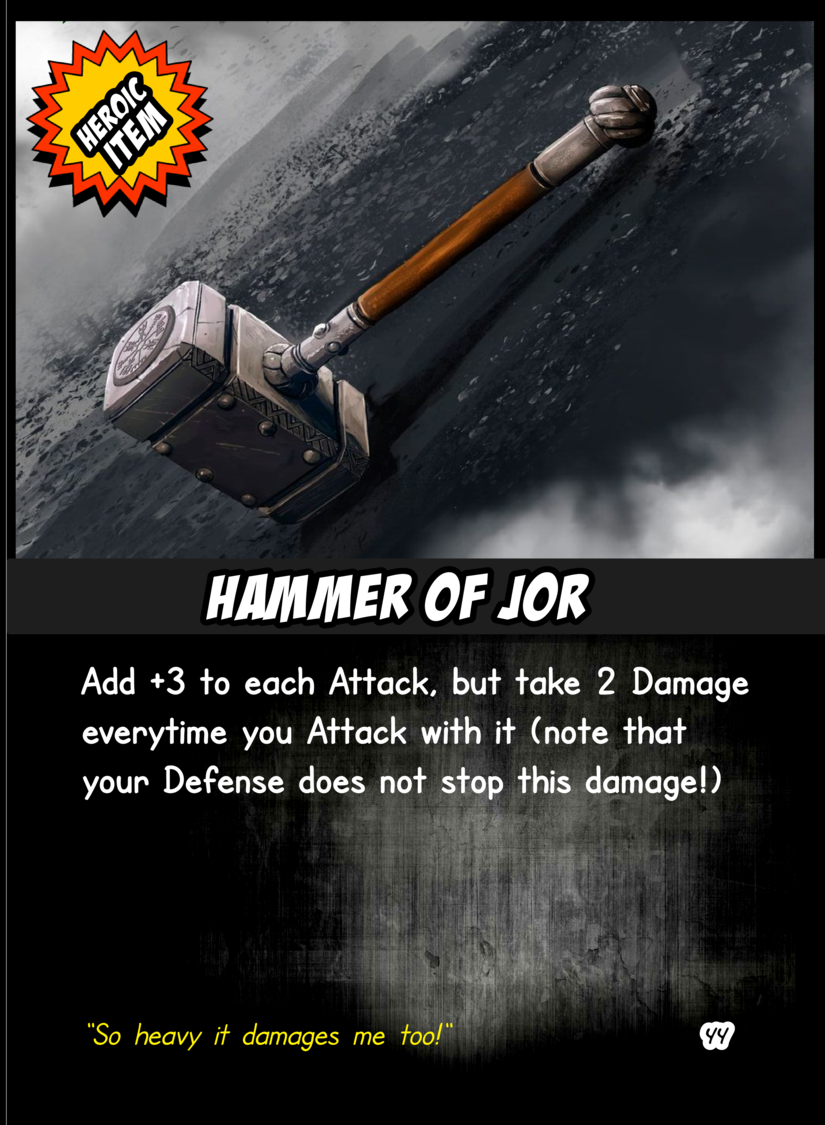
Sidekick Saga started life from an inspiration in (surprise) a comic book: Future Imperfect by Peter David and George Perez.  There’s one very notable scene in Future Imperfect when Rick Jones, (the sidekick of the piece, and sidekick of many heroes like Captain America and Hulk), keeps the Maestro at bay using a collection of “artifacts”: Iron Man’s gauntlets, Captain America’s shield, Thor’s Hammer!

The sidekick, by being smart, was able to hold his own (with a little help) with the Maestro, an incredibly powerful villain!

The scene above, with its collection of items, stirred something within me … 

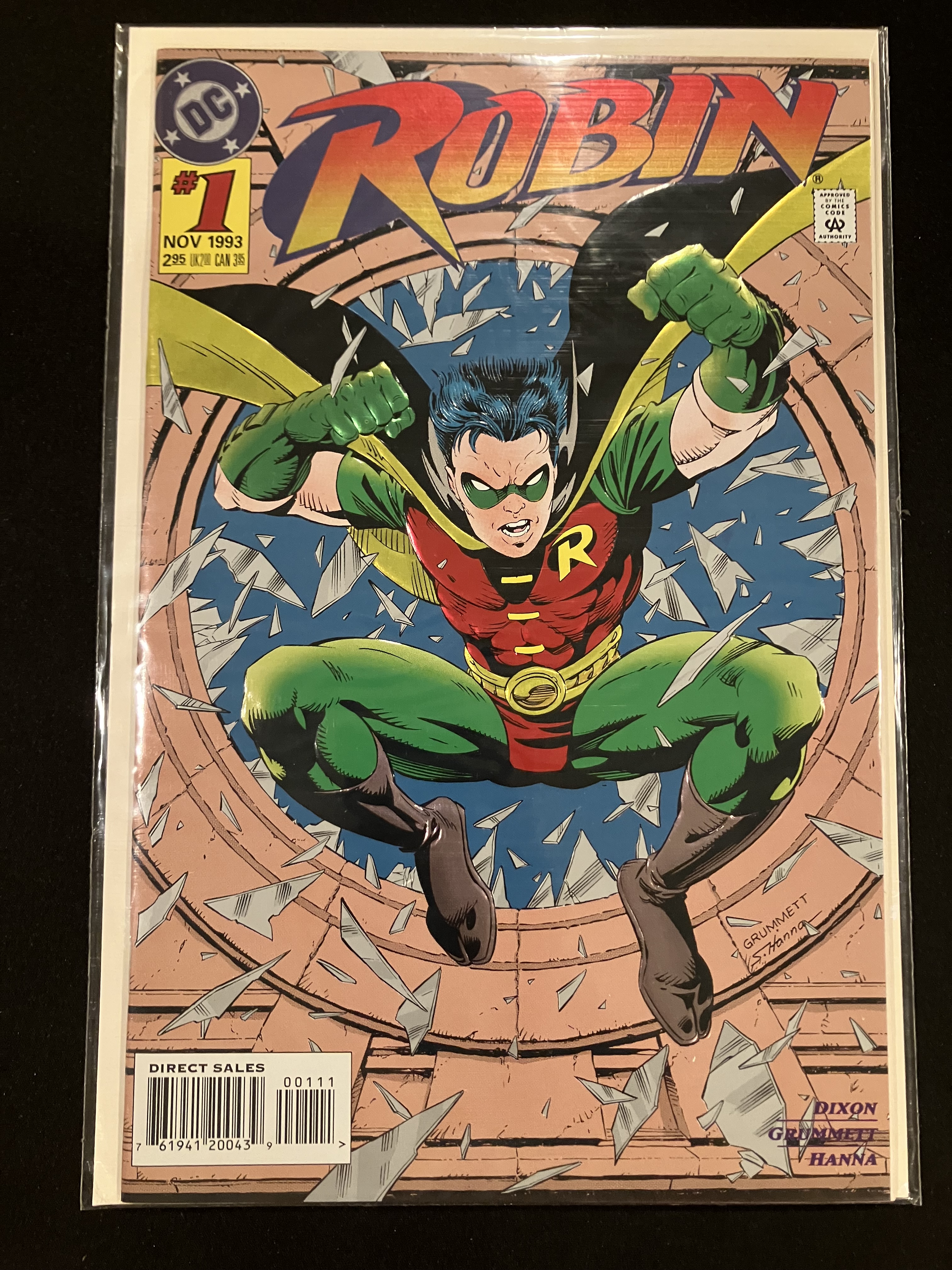
Another comic that inspired Sidekick Saga was the 1990’s Robin (by Chuck Dixon, Tom Grummett, and Scott Hanna). In this era, Tim Drake became the third Robin, and frankly, was the smartest of all the Robins! He figured out Batman’s identity! In this series, the Tim Drake’s Robin patrols Gotham without Batman, but has help from The Huntress, Oracle, and even Commissioner Gordon!  Tim Drake is mostly just a normal human doing the best he can to ward off evil, using his smarts and his fellow heroes to fight crime!  The cooperation of the Arkham Sidekicks was pivotal to their success!

Another unlikely source of inspiration was Buffy The Vampire Slayer Season 5 finale.  Some SPOILERS: in the Season Finale, Buffy used pretty much EVERY WEAPON at her disposal, from other episodes in Season 5, to fight the big bad at the end! There was something familiar about this approach; it’s what Rick Jones did in Future Imperfect!  In this case, it inspired more of the idea that some important items persist from game to game.  It also kept alive the idea that “collecting stuff” was an important part to battling the big bad!

A final unlikely source of inspiration was a game called Seven Wonders.  You heard me. It was interesting that, at the time, my friends were very bi-modal on two games: they either loved Seven Wonders and hated Sentinels of the Multiverse or hated Seven Wonders and loved Sentinels of the MultiverseWhat if I could unite these groups and have the notion of cooperative drafting? What if, rather than working against each other in a drafting game, you could pass each other what we needed? This created the whole idea of Supply Lines: cooperative drafting, much like Seven Wonders (it even had a directionality of the Ages): see above.

Putting all these elements together served as the basis of Sidekick Saga: I wanted a cooperative drafting game (where players would pass each other cards they needed) where players explored the city looking for technology to help them fight the big bads! And every card should matter!  You might not think something matters (like stuff in Season 5 of Buffy), but then all of a sudden, it becomes important!

Leads and Legacy

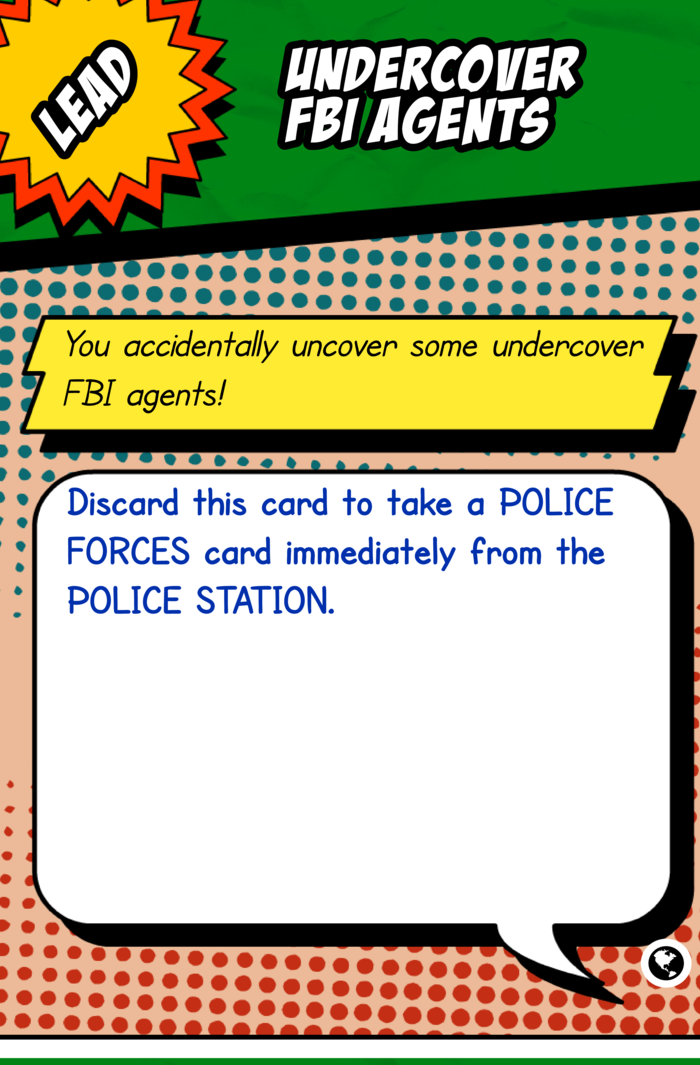
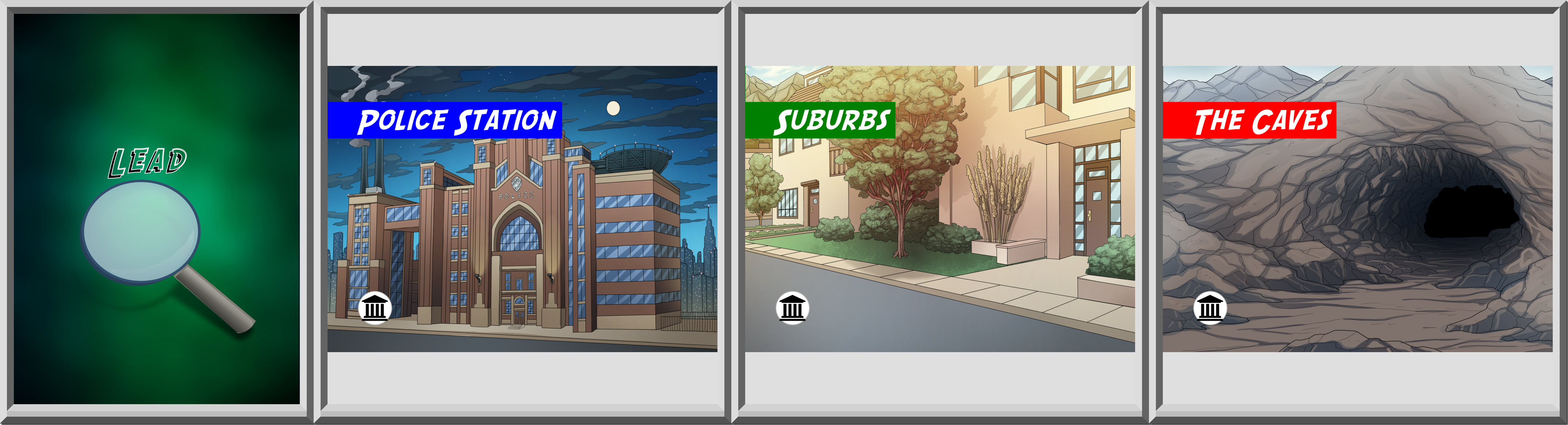
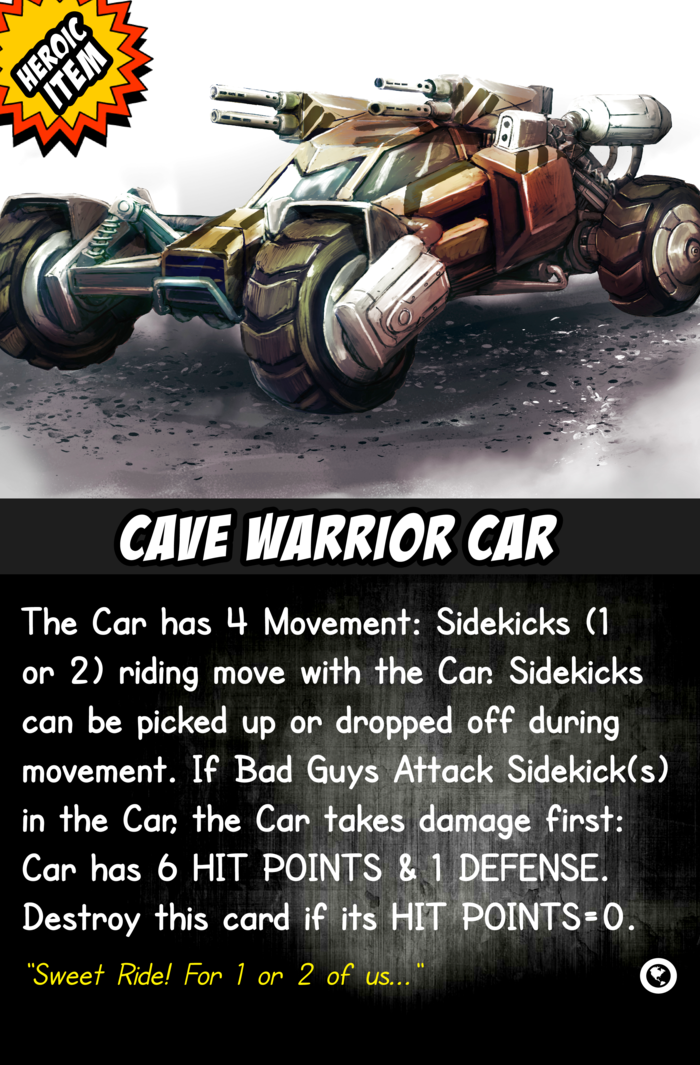
As the development of the game progressed, I need to refine the exploration-type mechanic to the game.  For the Sidekicks to succeed, they had to find stuff (like Buffy or Rick Jones)!  Some stuff was incredibly useful, so it seemed like you had to “pay” for it somehow! This introduced the idea of Leads (originally they were called clues, but I was worried this might invoke too much of a Clue game comparison): if you hunt down enough Leads, you can find where Jor’s Hammer (I didn’t want to get sued), the Star Shield, or the Cave Warrior’s car (which looks nothing like the Batmobile) would be stored!    I originally considered the idea of having to have “different kinds of Leads“, but dismissed it quickly as it would too frustrating if you got the wrong types of LeadsLeads were generic: if you got 6 Leads, you could get the Cave Warrior Car which would help you move around the city faster AND protect yourself!

We dubbed these very special Items as Heroic Items: these were very special items that were hard to find!  They might take three to six turns to get one of them during the game, so you didn’t want to lose them between issues!  So, Sidekick Saga became a “legacy” game when any Heroic Items you obtained persisted from game to game! 

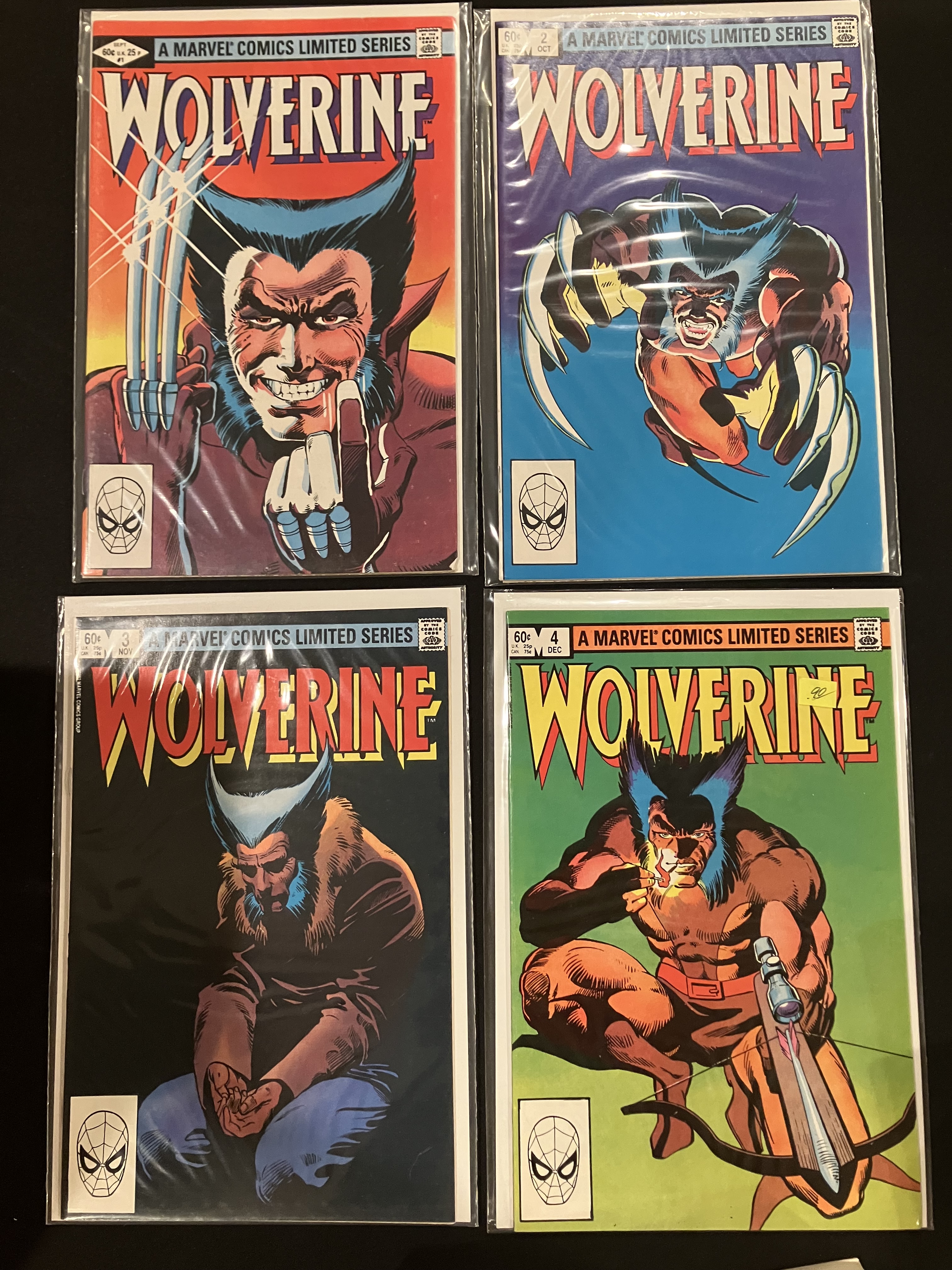
Honestly, I really liked the idea of a story spanning multiple issues! It’s very typical of comic books of my era: a massive story would unfold over 4 to 6 issues of the comic!  Think of the amazing story that unfurled from Issues 1 – 4 of the original Wolverine mini-series!  Things would change massively from issue to issue, and what the heroes did really mattered! So, the idea of a legacy comic story was something I really really wanted to embrace.

(And the time Sidekick Saga was in development, there were NO Super Hero board games with an ongoing /legacy story)

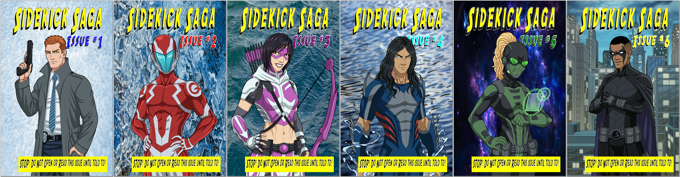
In this case, each “game” would be an issue of a comic book series. What was the story? All the Super Heroes had disappeared!  What had happened to them?  All that was left were the under-powered Sidekicks!  Could these lowly Sidekick keep the bad guys at bay while they tried to solve the mystery of what happened to all the Super Heroes?  That was the story I wanted; that was the story that would make the Sidekicks take center stage!

So, Heroic Items, would persist from issue to issue. It introduced a tension; do heroes pursue Leads to get a Heroic Items, at the cost of making it harder to defeat the current bad guys?

To help alleviate some of this tension, The Leads became multi-use cards; you could either save them up to get a Heroic Item, or you could use them directly (Leads would also do something useful for you). This gave players more agency, more choice: they could pursue Leads, but could also just use them as needed (for immediate help or later help)!

Exploration

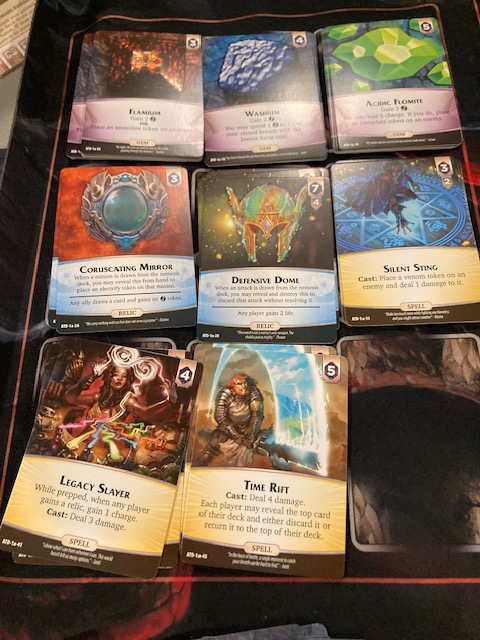
The exploration idea came from playing cooperative deck-building games like Aeon’s End; nine different things you could get! I liked cooperative deck-building games, but to me it always seemed an inversion of what I wanted: In deck-building games, you know what you buy, but you typically have no control over when it comes out!  What if you inverted that idea and made it so you don’t know exactly what you get, but once you get the cards, you can  play them whenever you want!?

That’s the idea of the city; each Location in the city has 8 cards, and those cards are “related” by a theme: The Police Station has Police cards, Rincon Labs has Scientists and Technology, The Suburbs have a lot of Research/Lead cards, etc. You have an idea what you will get, but maybe not exactly. Then, once you get stuff from a Location, you can play it whenever you want!

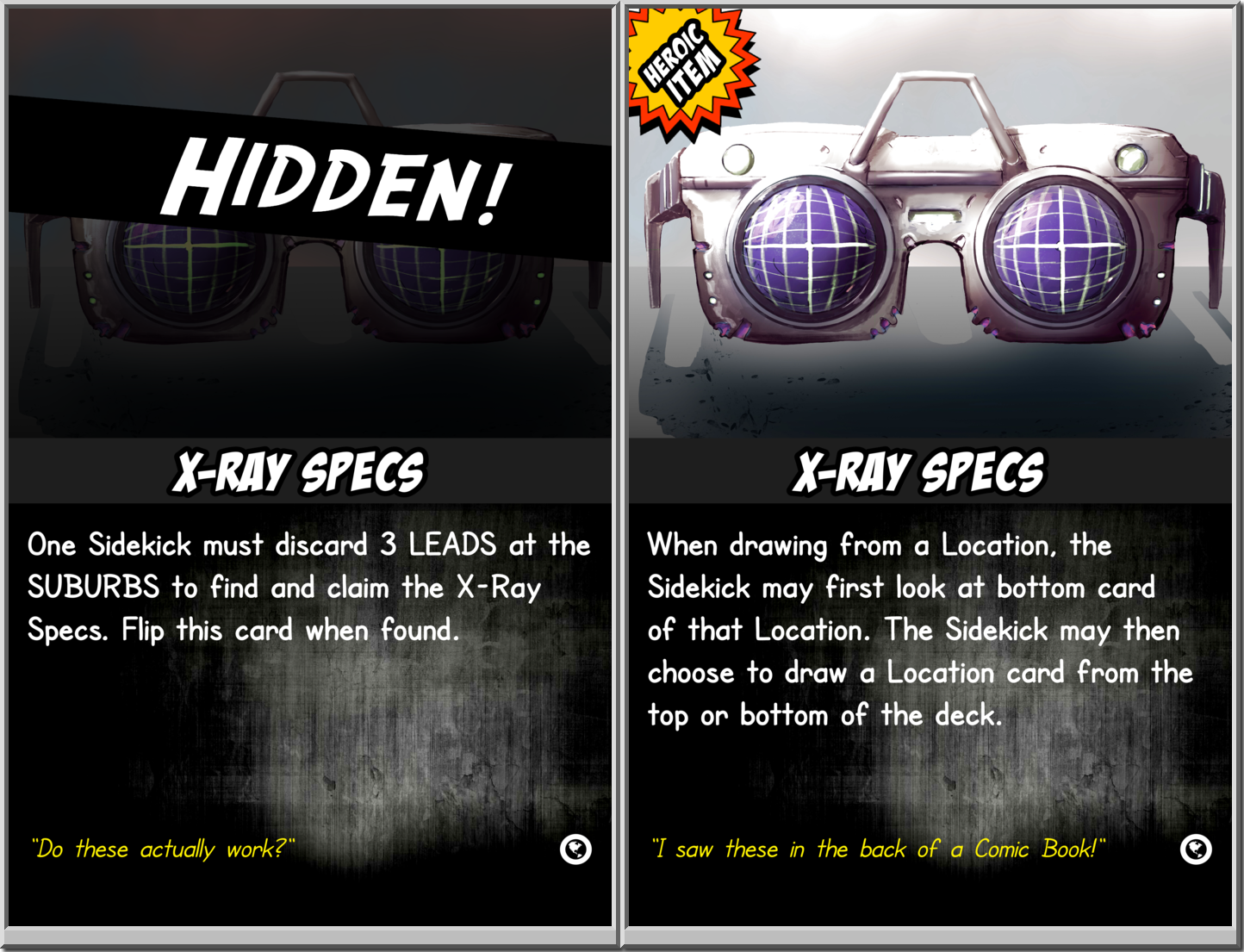
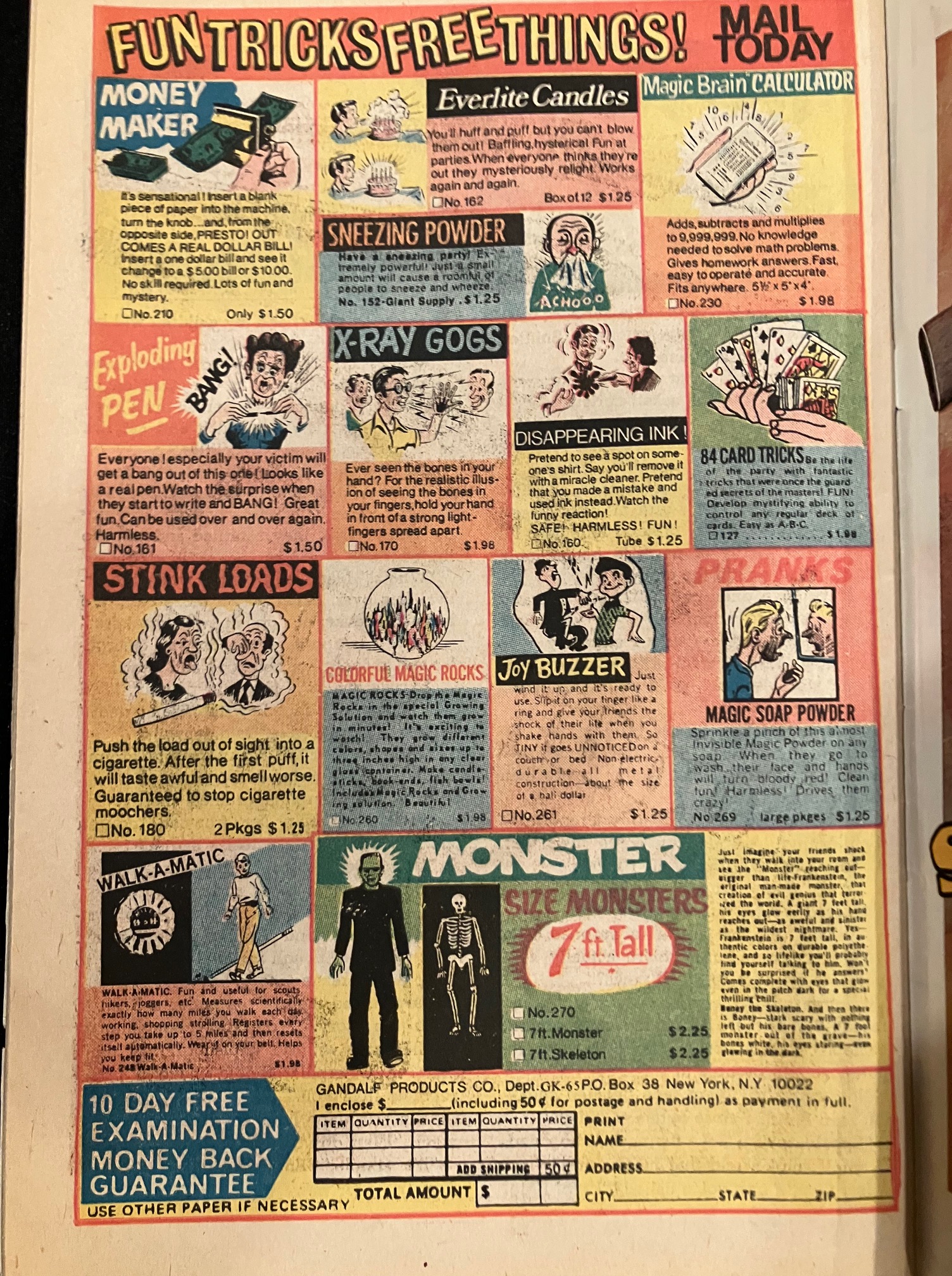
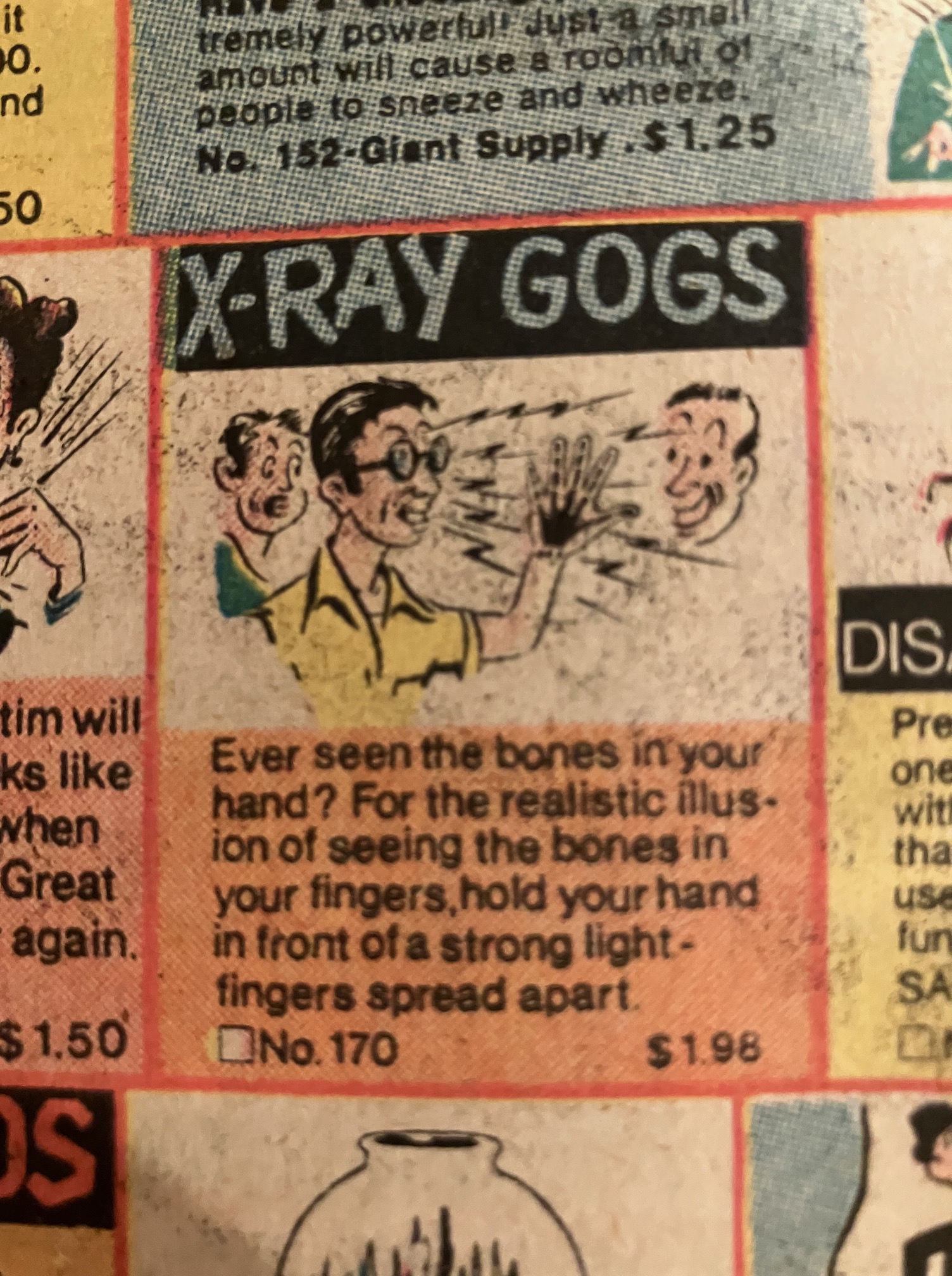
But through Heroic Items like the X-Ray glasses, you might have a little more control. And X-Ray glasses are an inside joke for anyone who grew up with comics; there were always ads for these things in the comics!

So, players move around the city and explore locations looking for technology and Leads to help them in their quest to take down the big bad!

Secret Identity and Hero Modes

Another thing I wanted was the tension of Secret Identity vs Hero form. The Secret Identity is absolutely am essential tool to keep the Sidekicks out of trouble!  (At the time I was exploring this idea, Marvel Champions had not come out yet, and to my knowledge, it was an original idea to have players go from Secret Identity to Hero and back. I documented my playtest here on my Unpub play of Sidekick Saga, which was 6 months before Marvel Champions was released; so, don’t go saying I copied Marvel Champions on this!)

But, I also wanted the Secret Identity mode to be useful; when you go into Secret Identity, you escape combat, but that’s also a main way to get Leads in the game!  The Secret Identity is all about doing research away from combat!! When you are in Secret Identity mode, you get BOTH a Lead AND a card on your Location!  But, of course, while you are doing this research, the Bad Guys are getting more and more powerful since you aren’t fighting crime!  It’s that tension you see in comics all the time! When do I go into Secret Identity mode to research (and stay out of the Bad Guy’s way) and when do I go into Hero mode to fight crime? That’s a big part of being a Sidekick!  It’s also a big part of the game!

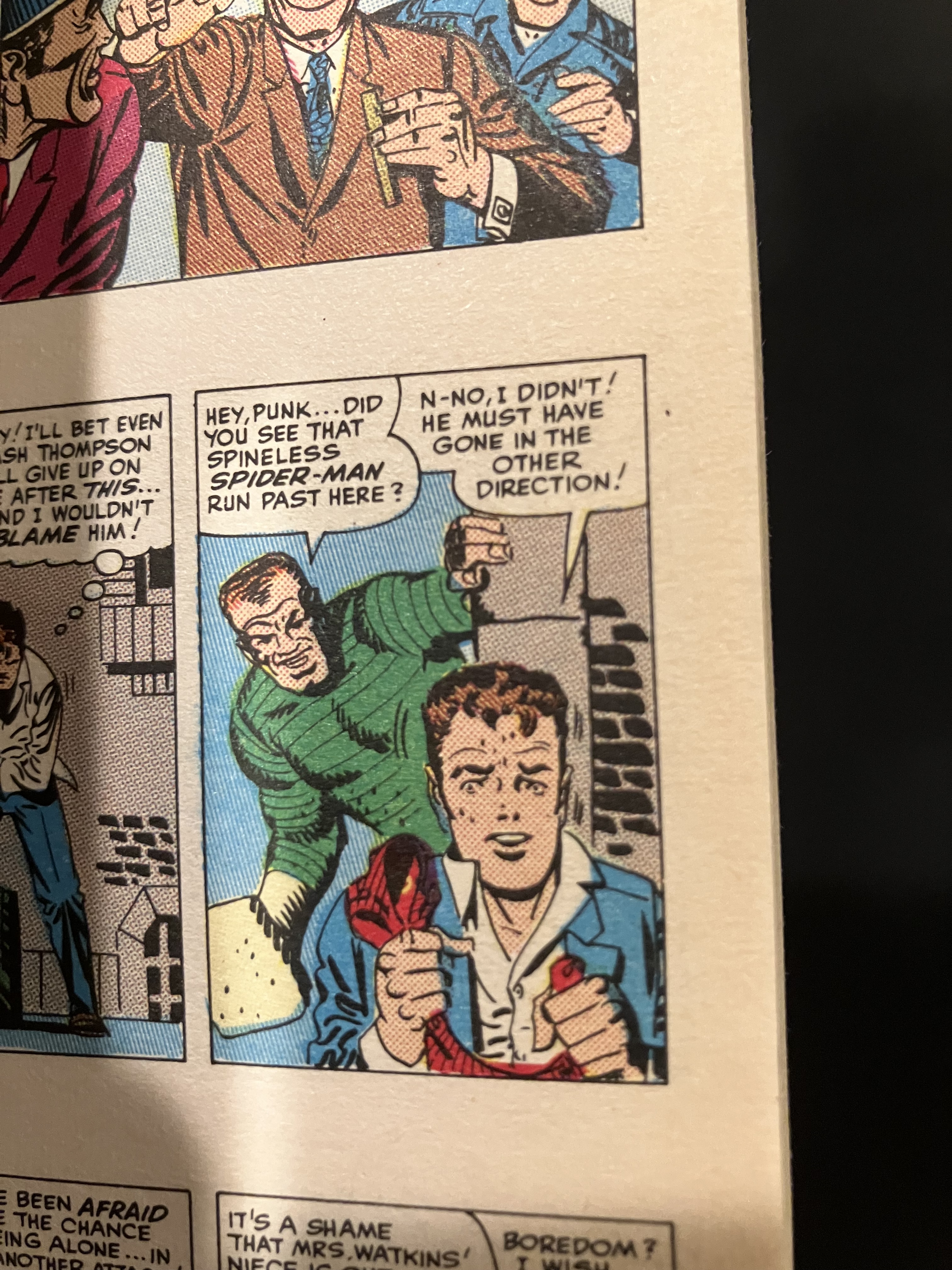
I still remember a particular scene in The Amazing Spider-man #18 where Spider-man changes back to Peter Parker to escape the Sandman.  See above!

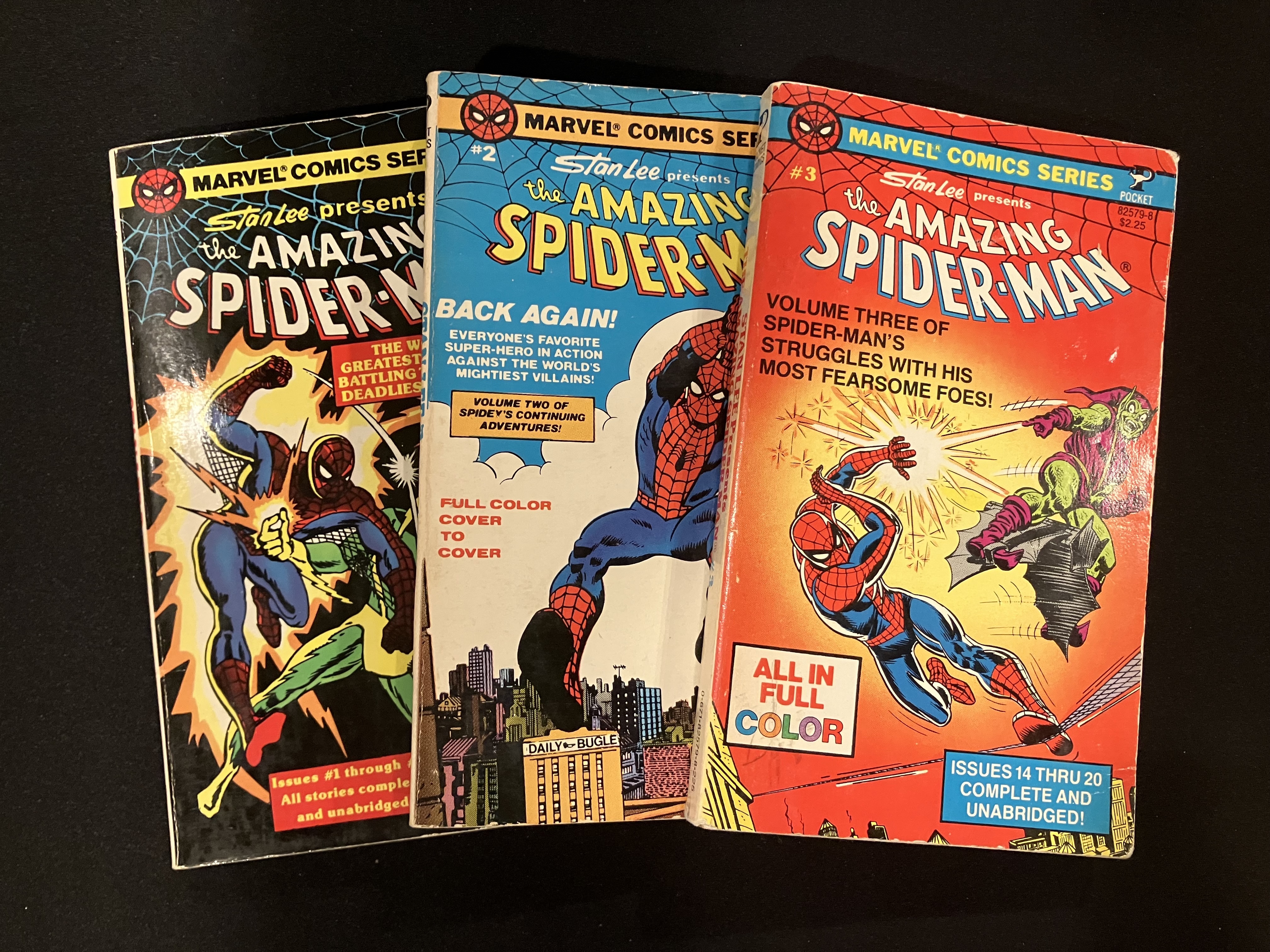
Those original Stan Lee/Steve Ditko Spider-man comics (which I read when I was a young kid), had quite the influence on me! I still remember those scenes! (I didn’t have the original Spider-man comics that are worth tons … I was just a kid! I just had the little collection of books : see above). But Peter Parker used his Secret Identity as a tool so many times in those early Spider-mans … I really wanted a mechanic like this this in the game to capture that!

Advancement

One of the funnest part of Dungeons and Dragons is leveling-up: I wanted to make sure there usually some notion of leveling-up between issues: new powers, new Heroic Items, new heroes, … something to give fun choices between issues! I also wanted to make sure losing wasn’t so devastating!

If the players lose an issue, then new items, new Heroic Items, new things are introduced into the game .. and they get to try again! I wanted this to be a self-balancing game; if it was too hard, then new stuff would come out to help the Sidekicks!

Protection Hierarchy

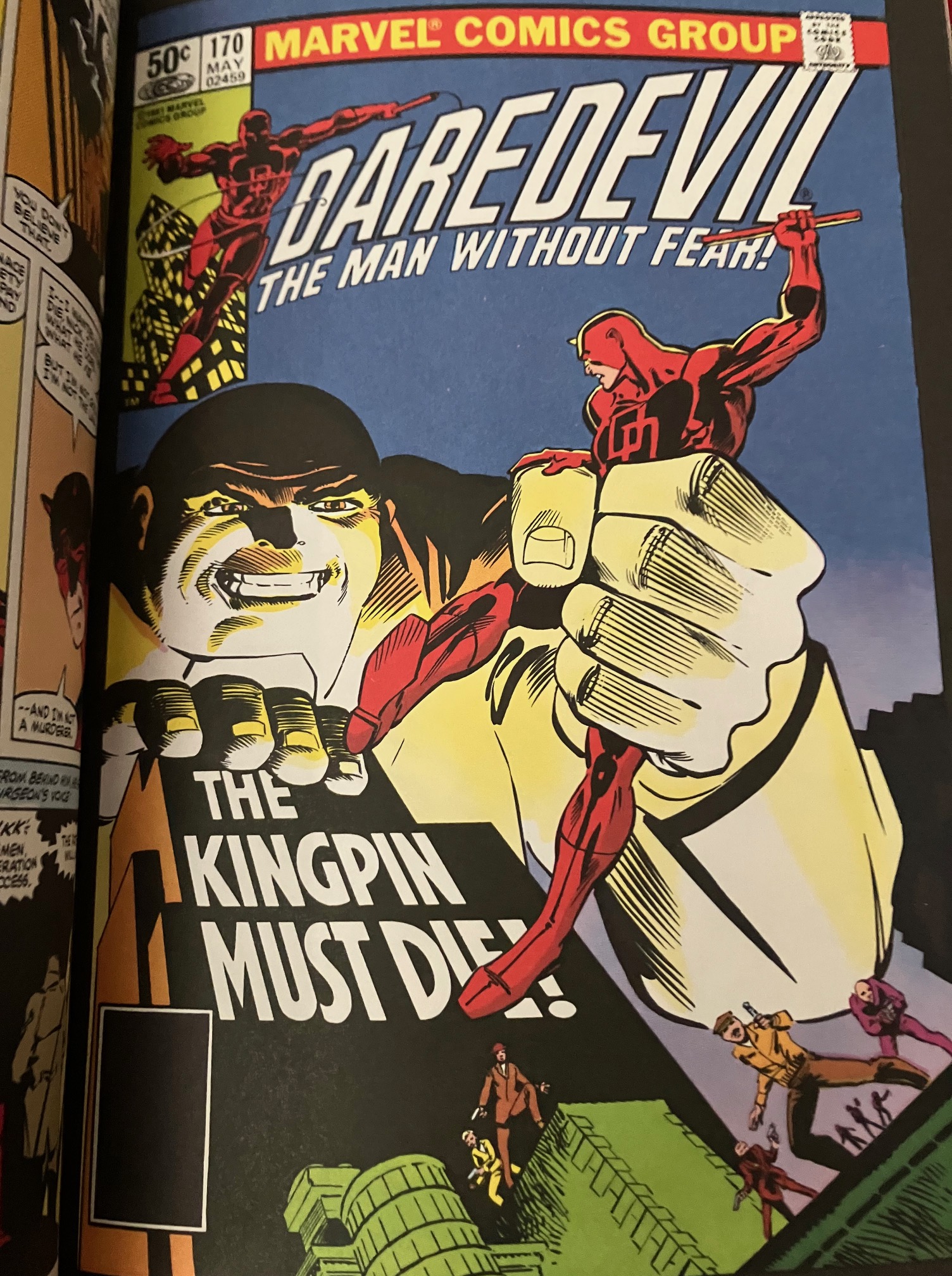
One of the final pieces of the puzzle was the Protection Hierarchy; I remember reading many Daredevil or Batman comics where the hero has to work from the bottom-up to uncover the network of the Kingpin/crime lord who is running the city! And typically, the phrase “Stop protecting your higher ups; they don’t care about you!!!” comes up when the good guys question the underlings … what if that were actually a mechanism?  What if you couldn’t actually even take out the bad guys higher up in the criminal network until you’ve “dealt with” with all of their subordinates?  What if the subordinates actually “protected” the higher-ups? 

And that’s exactly what the Protection Hierarchy is in Sidekick Saga: you can’t attack any upper level bad guys until you deal with the subordinates first!  The lower level bad guys protect the higher one! (But, of course, the upper level bad guys can do stuff to YOU … because it’s hard to be a Hero!)

Hacking

If there’s any one mechanism that is really inspired by the Robin or Birds of Prey comics, it’s Oracle and her hacking abilities.  

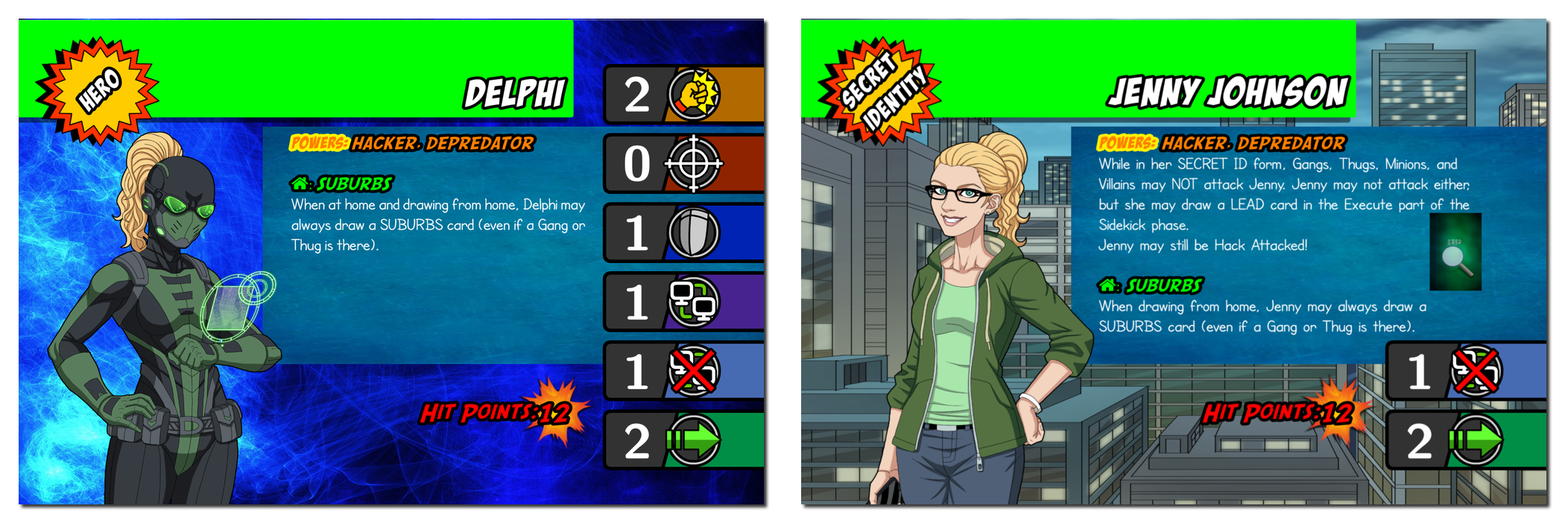
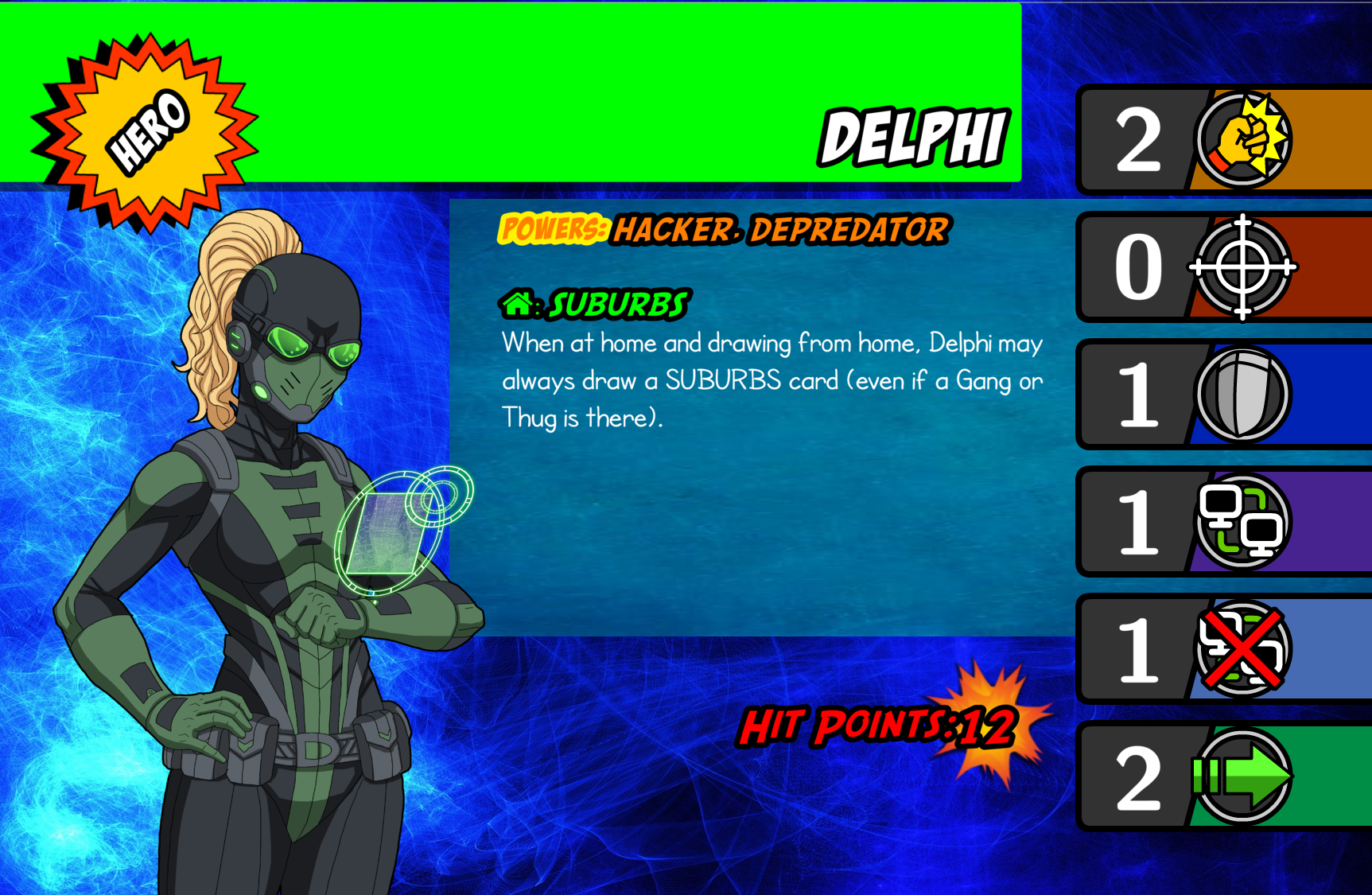
Oracle is a hacker who helps Robin (well, she helps the Dick Grayson Robin more, but that’s beside the point) by finding out information and “distracting” the bad guys with her hacking. How could we represent this idea in the game?  Delphi (inspired by Oracle) can hack the bad guys and put them into disarray!

 The idea of disarray is that the bad guy is so busy “dealing” with the results of Delphi’s hacks, they couldn’t do anything else. I loved the idea that even if you can’t take out a bad guy, maybe you can keep it out the way for some time. Thematically, the idea of “causing an alarm to go off”, “turning off the power in the building”, etc. are things that a hacker would do.  And what does it do?  It distracts the bad guy (puts them in disarray) for a few turns.

The idea of hacking was further improved by allowing hacking to bypass the Protection Hierarchy! Delphi can hack the upper level bad guys and keep them from wrecking the Sidekicks!

Art

I don’t love the art in most Super Hero board games: it always feels like they get artists who are great artists, but don’t “get” Super Heroes!!   It felt like they didn’t love Super Heroes like I did!  I just remember that I never loved a lot of the art of the first few Super Hero games I played, and I wanted something different for Sidekick Saga:  I wanted an artist who got Super Heroes.  I wanted someone who’s art really embraced that ethic!

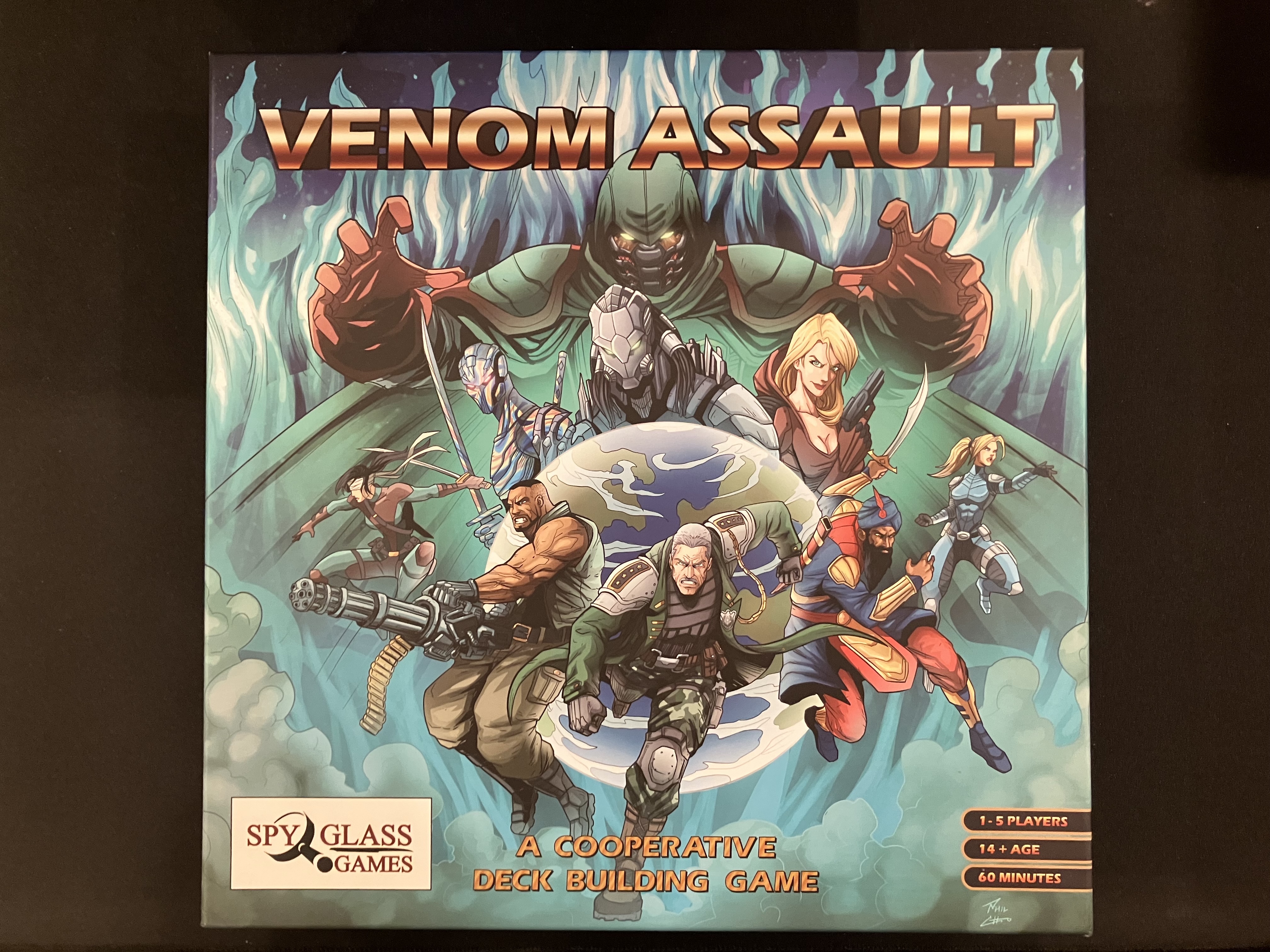
One of my favorite parts of working on Sidekick Saga was working with the artists, especially Phil Cho!  I adored his art from Venom Assault (see BGG entry here) and his Deviant Art page showed that he really understood Super Heroes!   I contacted Phil, and he was very willing to  help out. 

To this day, the cover for Sidekick Saga is one of  my favorite pieces of art of all time, maybe because it has such personal meaning to me. Given more time, I would have had Phil Cho do all the art in the game, but I had promised my Kickstarter backers delivery quickly, so I did work with a few other artists to help out.

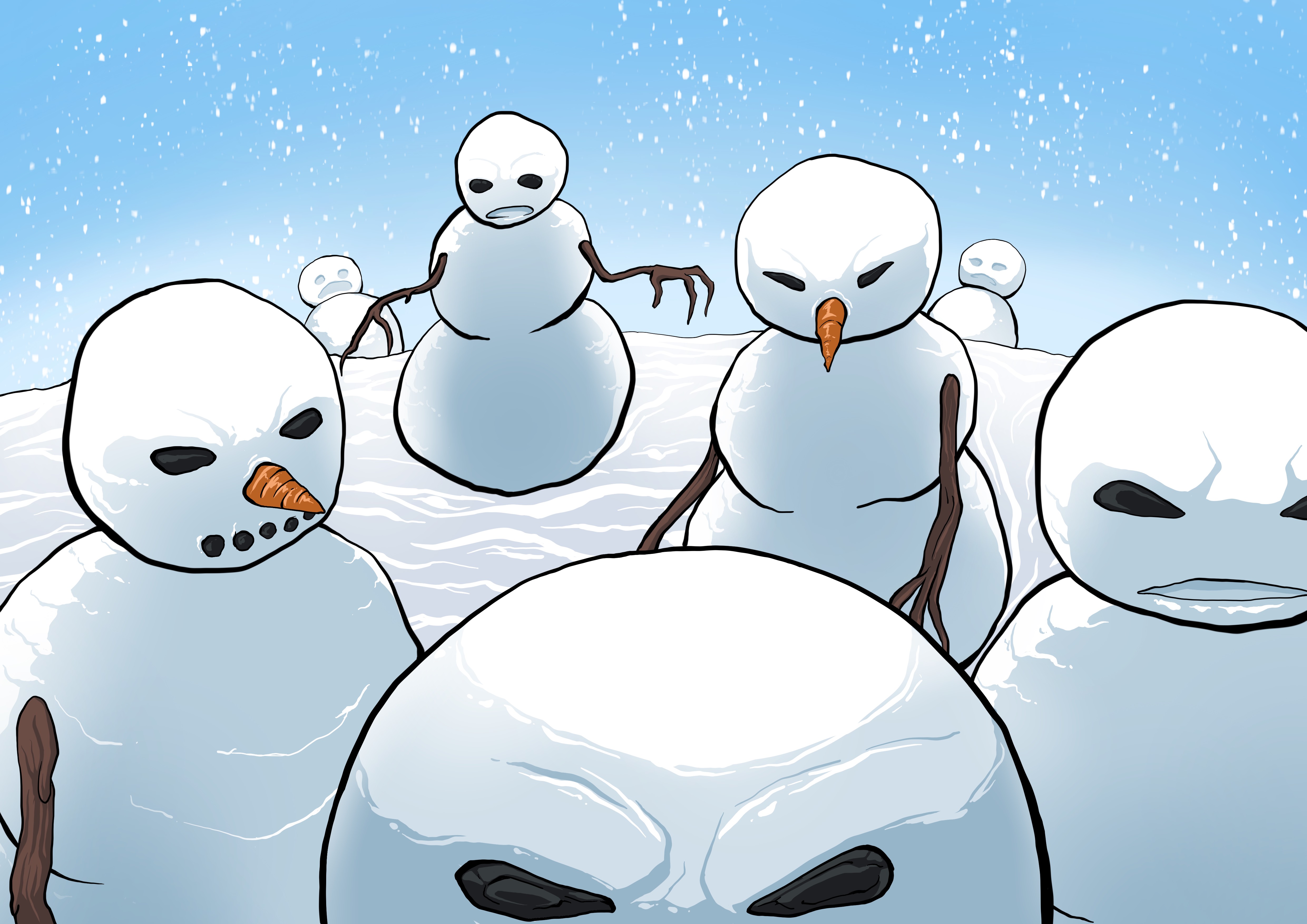
Christina Murphy did a fantastic job stepping up and “matching” Phil’s art! One of my favorite of her pieces is the army of snowmen! So creepy and so what I wanted!

I also had William Liberto help out, mostly with the Heroic Items: I wanted all the Heroic Items to have a similar and consistent vibe, and he did a  great job!

Final Thoughts

I am very proud of Sidekick Saga! It’s the game I wanted!  It’s a Super Hero game with an overarching story! It has exploration, it has cooperative drafting, it has every card being useful in one way or another (by being multi-use or directly useful), and it has ways for the Sidekicks to be clever in their combinations!  I play the entire Sidekick Saga at least one a year, and I am always happy that the game unfolds differently every time!  How could I use all the cards and powers I  had to defeat the bad guys?  It’s different every time!

I know Sidekick Saga didn’t have a great critical reception, but I am grateful to all my backers who supported the original Kickstarter and all the people who reached out to me over the years in support; thank you to all of you.  

When Calls Galactus, You Gotta Answer The Phone! A Review of Marvel United: The Coming of Galactus

IMG_6265

So, Marvel United: Multiverse was the #1 spot on our Top 10 Anticipated Cooperative Games of 2014: it has so many expansions for Marvel United!  But, let’s get one thing straight!  The main reason we were so looking forward to this was one reason: Galactus.  And his Heralds. 

IMG_6191

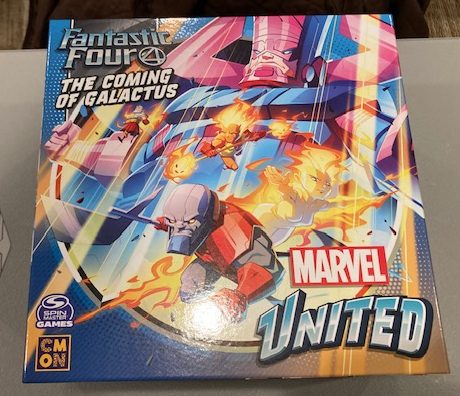
The Coming of Galactus: Marvel United was easily our most anticipated game or expansion of 2024!  This expansion is yet another expansion in the Marvel United line;  we have reviewed the base game (see here and here) and the Marvel United: X-Men  (see here and here), and we talked about the Expansion Absorption here.  In general, we have raved about Marvel UnitedMarvel United is a cooperative super-hero game for 1-4 players (there are one vs. many expansions that that player count to 1-5, but we aren’t discussing those here).

IMG_6188

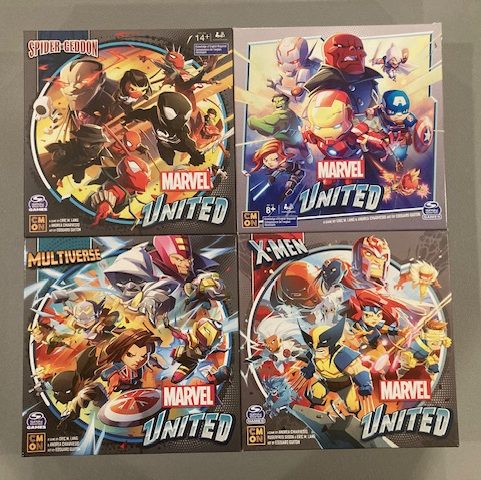
To be clear: you need at least one of the four base Marvel United games to play The Coming of Galactus: This is NOT a stand-alone game.  You need at least one of: Marvel United, X-Men: Marvel United, Spider-Geddon: Marvel United, or the newest Multiverse: Marvel United

See Multiverse: Marvel United above.

Let’s take a look!

Unboxing (Admit It: You Just Want To See The Minis)

IMG_6204

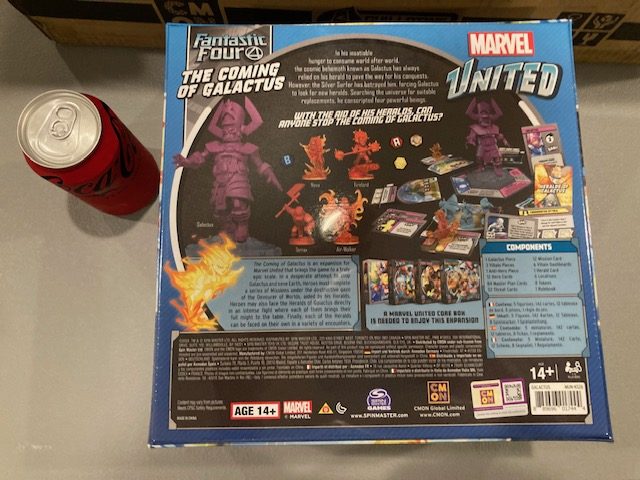
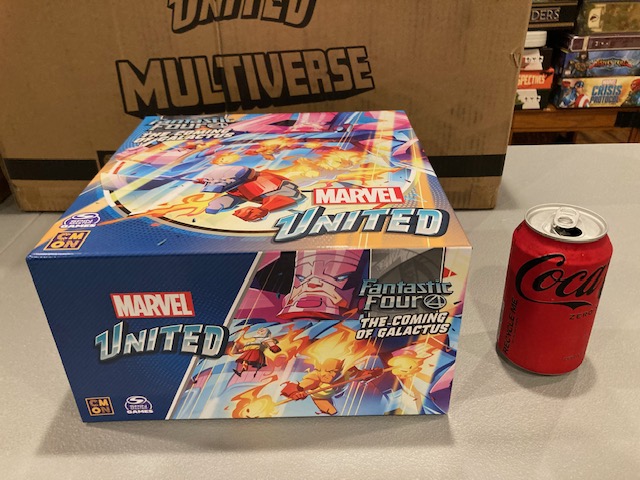
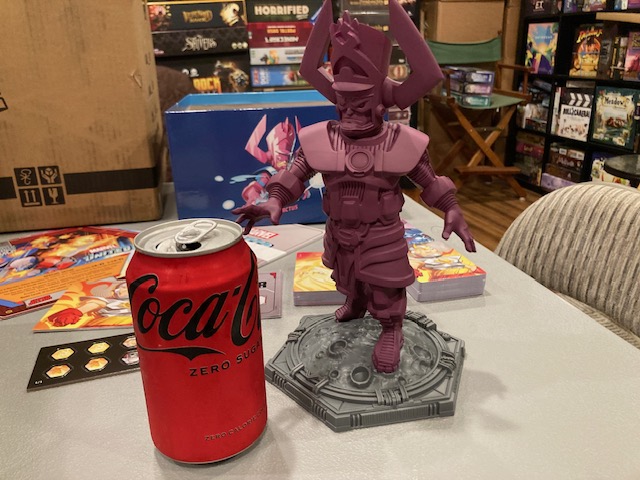
This is a pretty big boy of a box. See the box with a can of Coke for perspective.

IMG_6183

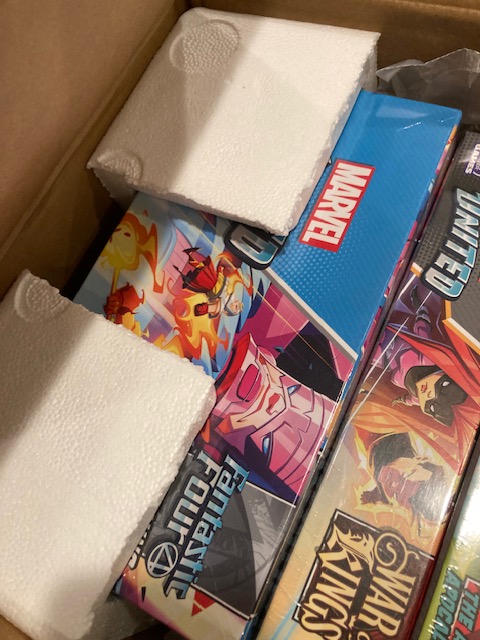
It’s the same width and height of all the other Marvel United expansions, but it’s a very deep box! The Marvel United people have done a good job at keeping all the boxes consistent so it’s a little easier to store.

IMG_6205

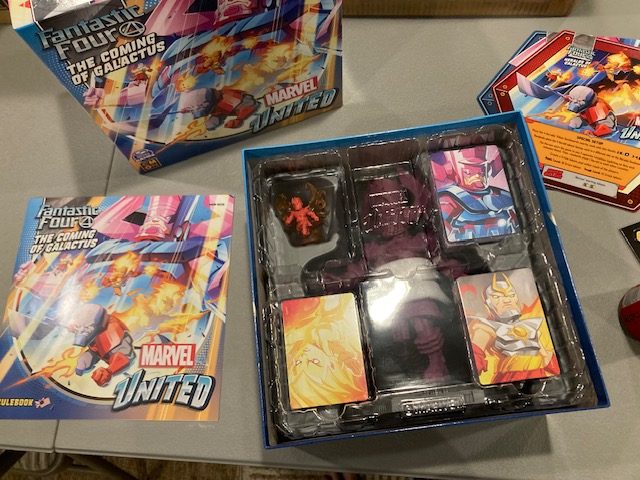
This looks pretty cool when you open it up: you can see Galactus peering at you: there’s an 8-page rulebook and some new center locations.

IMG_6207

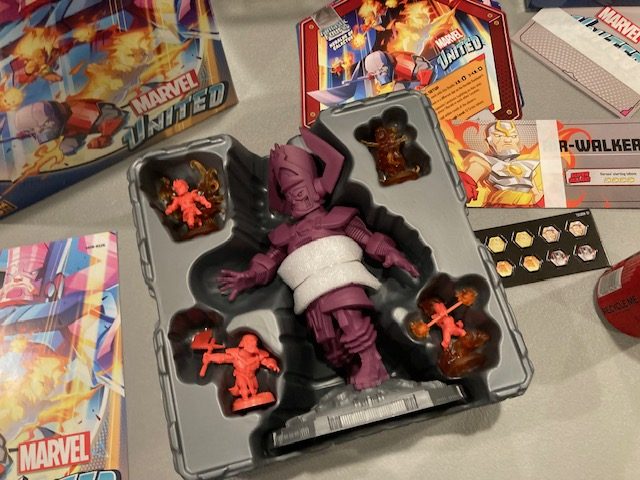
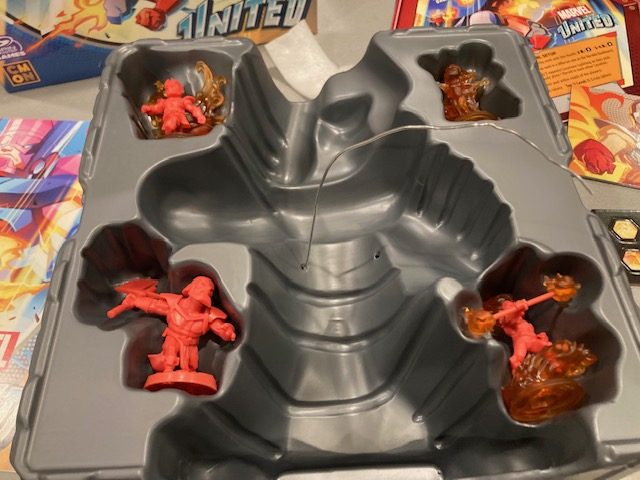
Admit it, you just want to see the Galactus mini! See above as we he is “swaddled” in a little foam blanket with a wire holding him in. 

IMG_6209

I think Galactus is just invading Earth because he wants a Coke.  See above.

IMG_6210

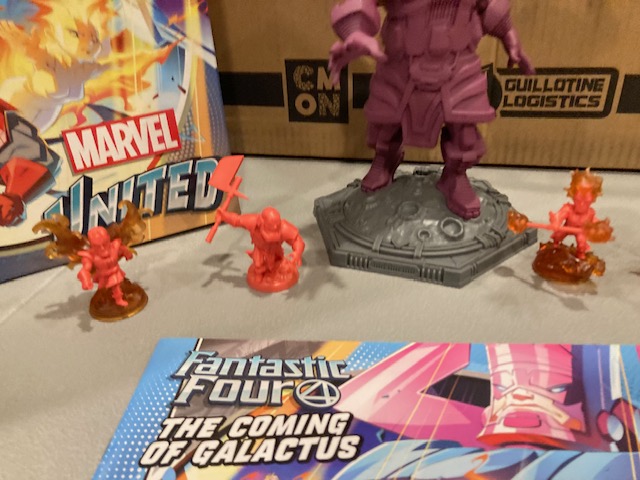
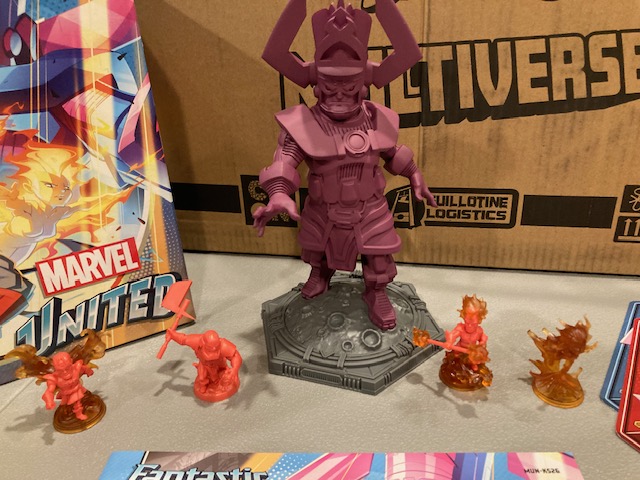
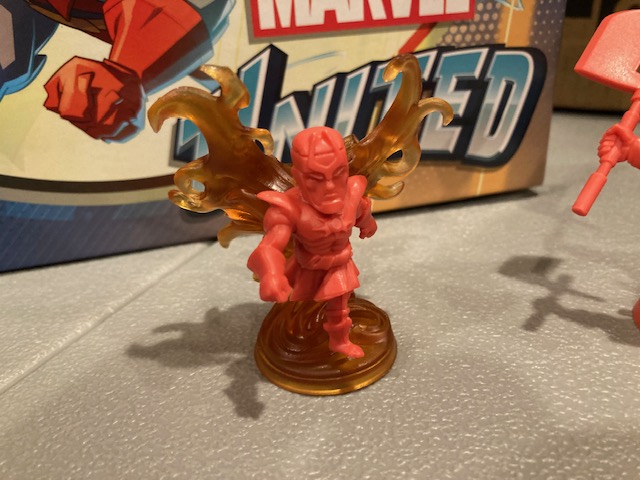
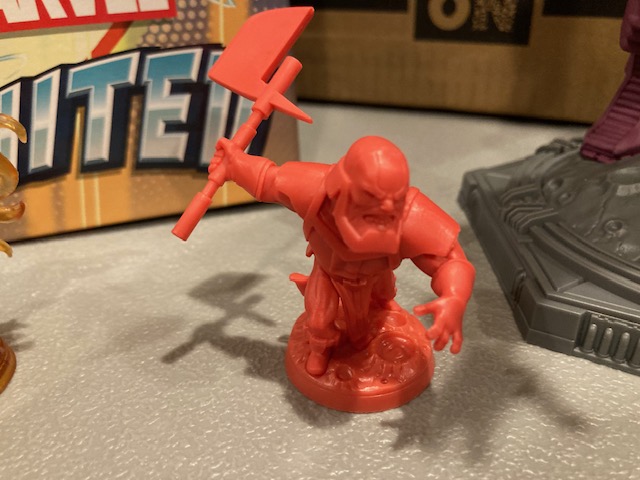
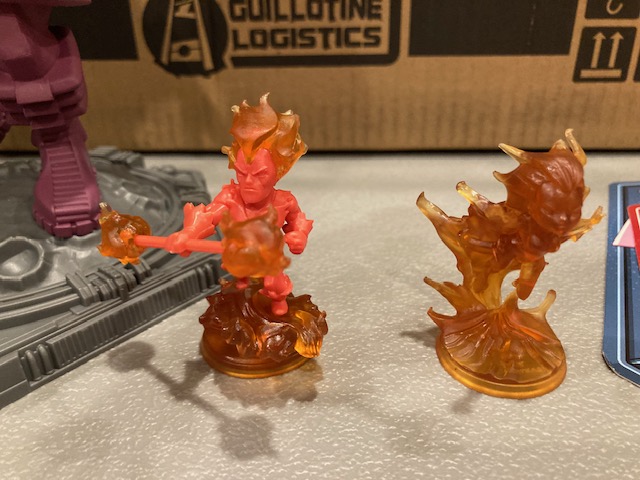
His heralds are also pretty cool minis (see the wire sticking out from Galactus above). See above and below.

IMG_6211

IMG_6212

IMG_6213

Gabriel: The Air-Walker!

IMG_6214

Terrax!

IMG_6215

Firelord and Nova (aka Frankie Raye)! 

IMG_6216

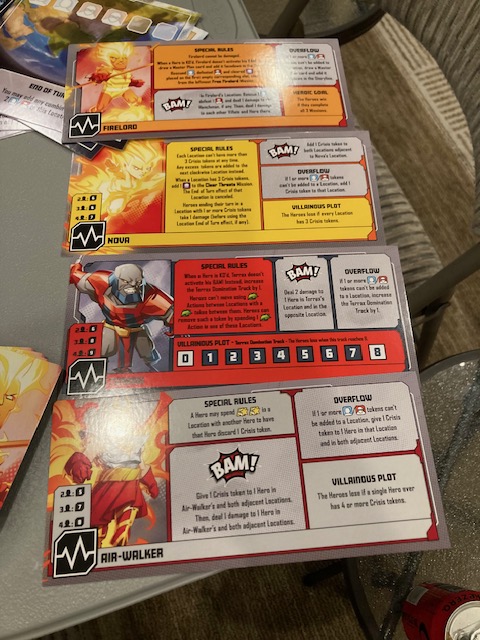
Each Herald also has his own Villain Sheet. See above.

IMG_6218

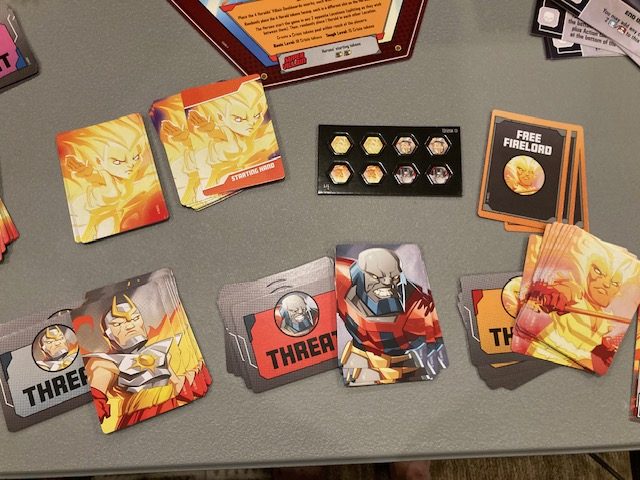
The Herald bad guys cards are pretty cool: see above.  Also note that Frankie Ray (Nova) is can be either a bad guy or a good guy!  Did you know Nova was in the Fantastic Four for a short time???

IMG_6219

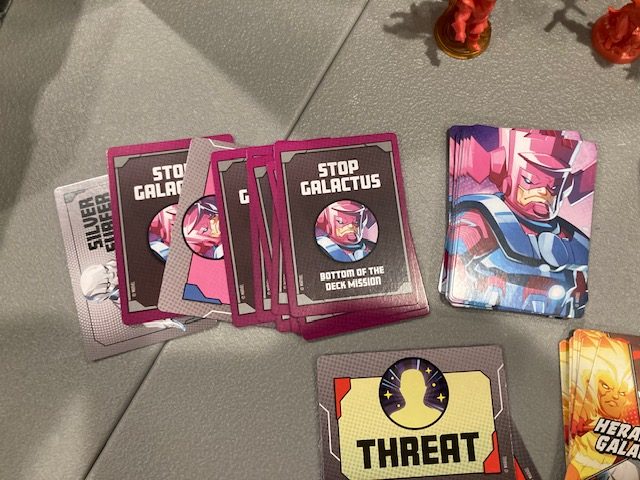
But, it’s Galactus‘ cards that we care about!! See above.

IMG_6217

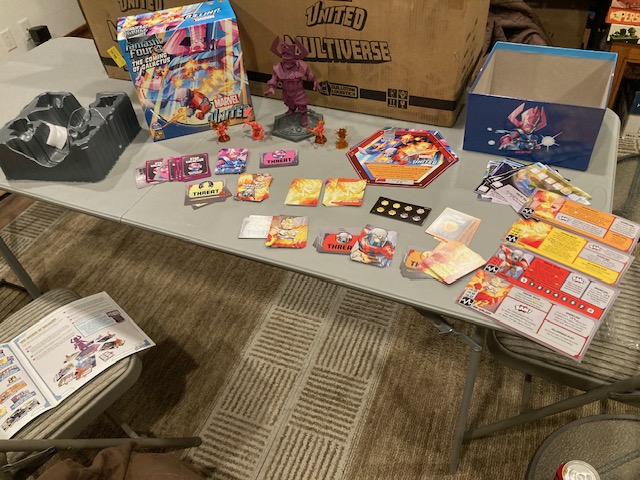
This expansion looks fantastic.  I was so excited to get it played! See it all unpacked above!

Gameplay (The Coming of Galactus Mode)

There are basically two gameplay modes in this expansion.  The first one is fighting Galactus; this is called The Coming of Galactus.

IMG_6224

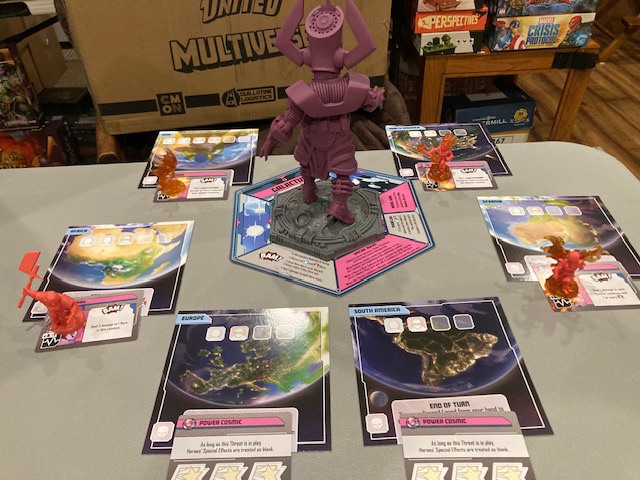
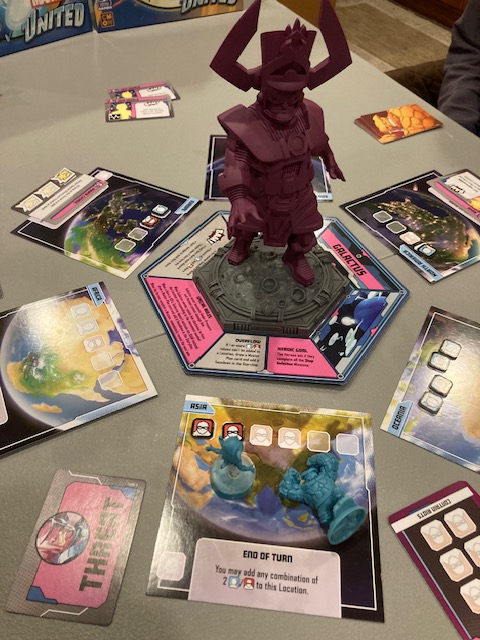
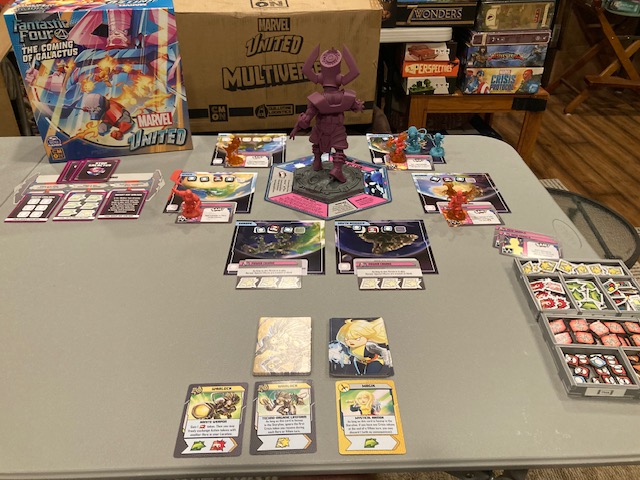
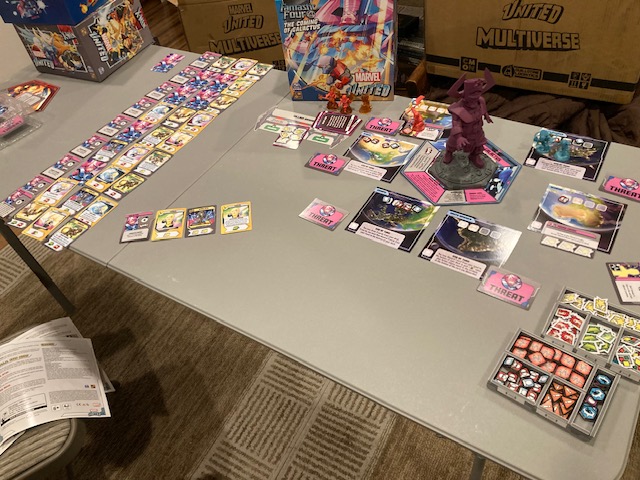
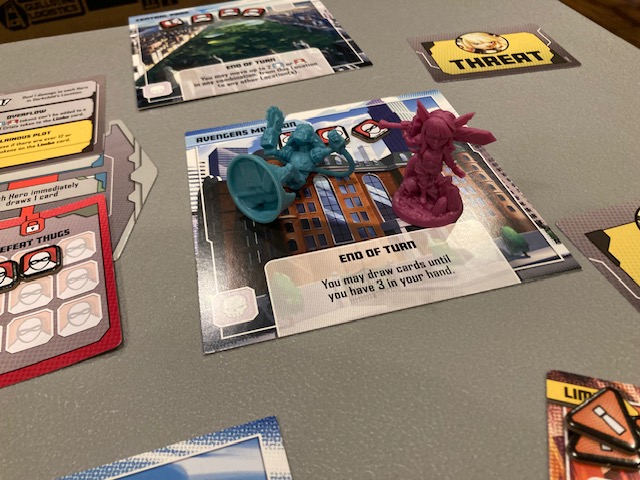
Galactus sits in the middle of 6 regions of Earth: these are all special locations that come in the box.  Note that the game has a funny starting condition: the players start in the region of Earth they are playing the game in!

IMG_6261

Galactus’ Master Plan cards have him rotate (kind of like Thanos rotates in Thanos Rising, if you have ever played that game).  The region he stops on gets hit pretty hard.

IMG_6357

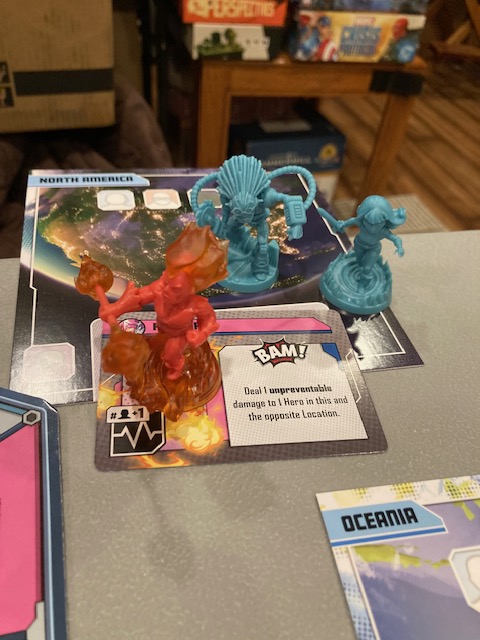
When Galactus BAMS! a region, everyone takes a damage, all civilians and thugs are removed, and all the other BAMS! activate.  It’s pretty brutal if he rotates to your space. See above as the Thing gets KO’d!

IMG_6350

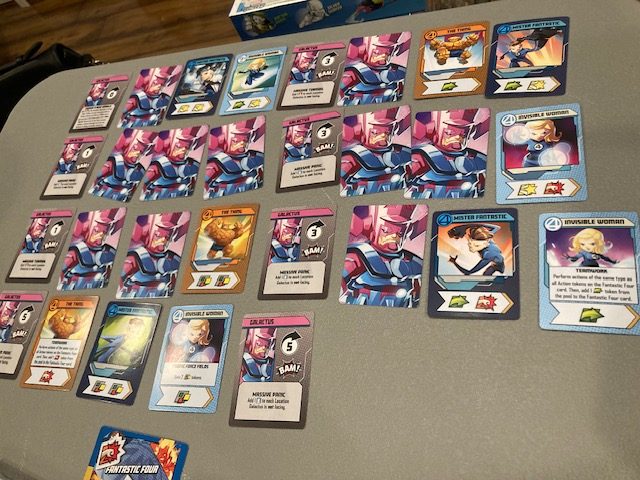
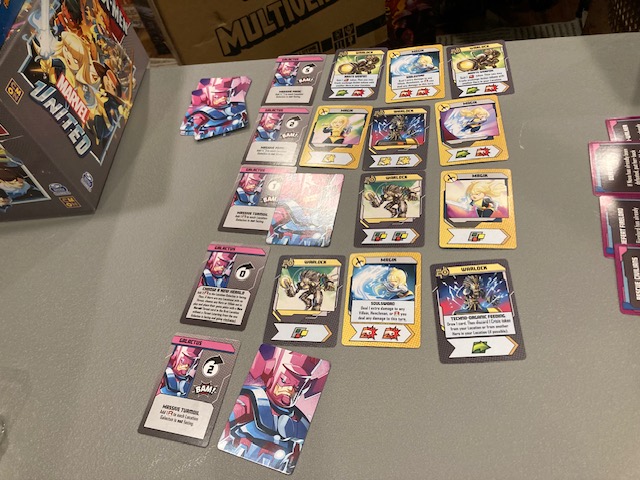
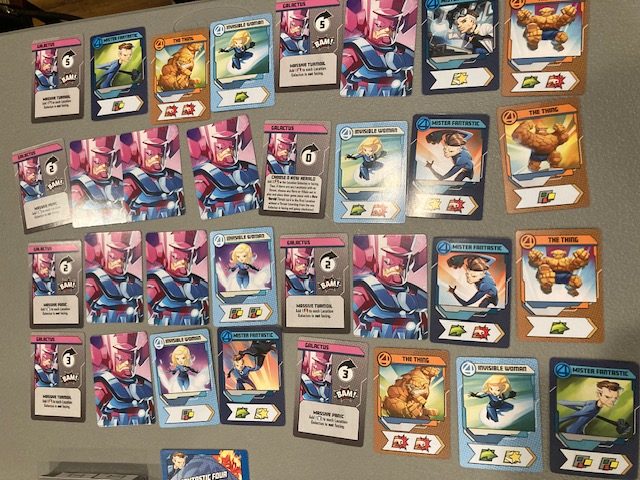
If a region ever gets overfilled OR a hero is KO’d, then a Galactus Master Plan card is put face down in the storyline!  This makes it even harder for the good guys to get anything done, as Galactus is taking away actions!   See above as heroes lose because Galactus just takes over the storyline and the heroes can’t get anything done!

IMG_6237

To win, the players must overcome 8 challenges!  Calm Down Civilians, Steal The Ultimate Nullifier, Take Down Air-walker, etc (see three of them above)!

IMG_6359

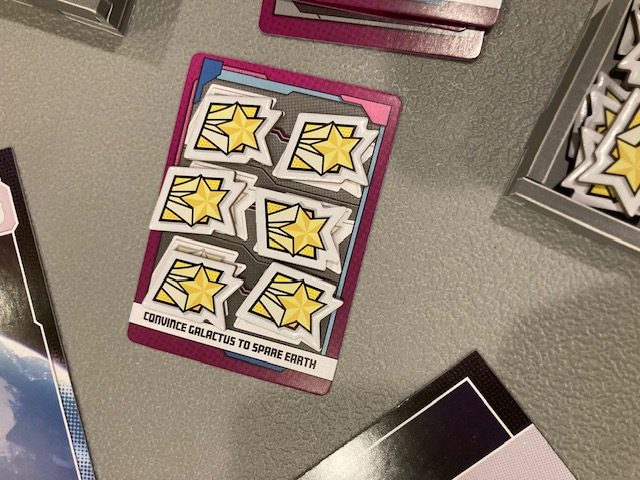
The final Challenge is always the same: “Convince Galactus to Spare Earth!”  Yes, you cannot take down Galactus, buy you can reason with him.  This is an interesting new mechanism, as you have to put the tokens down in PAIRS (i.e., no single stars) to succeed on this Challenge.

IMG_6364

If you ever run out of storyline cards, or any hero completely dies, the game is over as Galactus has eaten earth!  Your one chance to win is to “reason” with Galactus!

Solo Play (The Coming Of Galactus)

screenshot-from-2020-10-18-09-45-18

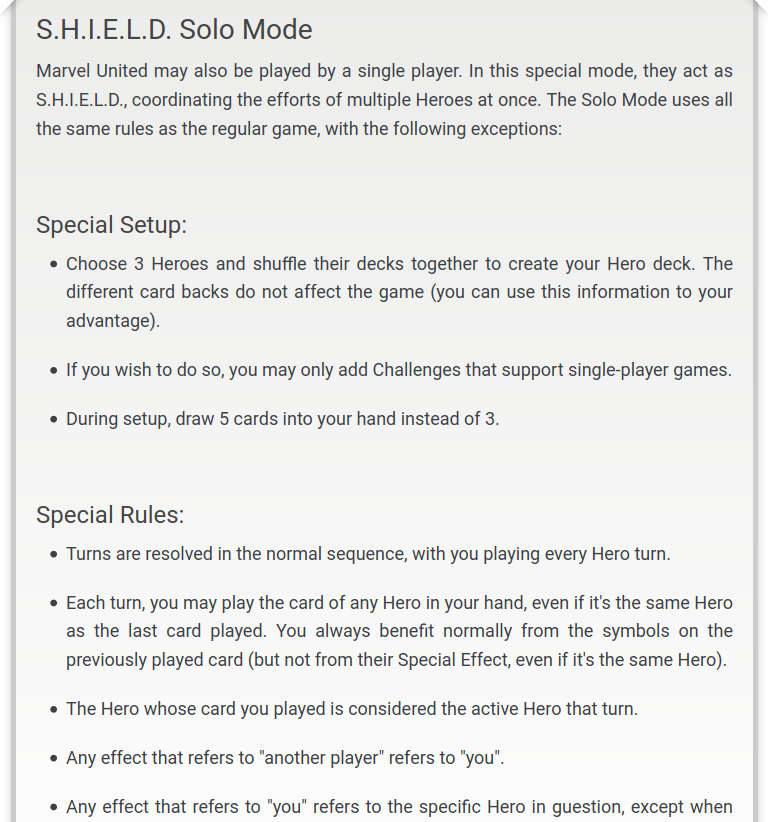
So, Marvel United has two official Solo Modes and one unofficial Solo Mode.  (Thank you for following Saunders’ Law!)  The original Marvel United and X-Men: Marvel United have a fairly contorted solo mode (called S.H.I.E.L.D. solo mode: see SOME of the rules above) which was far too complex; it wasn’t appealing to us at all.  In fact, it became a standard counter-example in our discussion of solo modes: How To Play A Cooperative Game Solo? 

IMG_1624

The newest Spider-Geddon: Marvel United (and Multiverse: Marvel United) has a new solo mode called Commander Mode!  We definitely liked it more than the original S.H.I.E.L.D. solo mode!  Spider-Geddon: Marvel United made our Top 10 Solo Games of 2023 because of the new solo mode!

IMG_6229

But, at the end of the day, I prefer two-handed solo for Marvel United.  Why?   Because it’s easy: there are no special rules, you just play Marvel United the way it’s “meant” to be played!!  Since there are SO MANY NEW THINGS for Marvel United (Team Decks, Items, New Expansions, etc), the last thing I want are new rules that I have to consult for solo mode.  Alternating between two heroes playing is the easiest way to get going so I can concentrate on all the new stuff.

IMG_6231

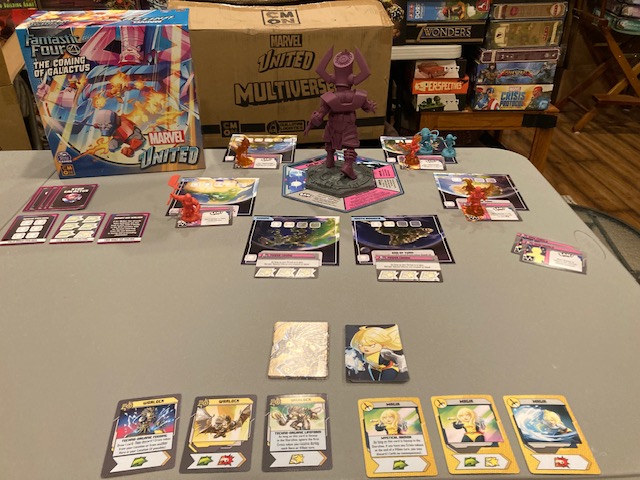
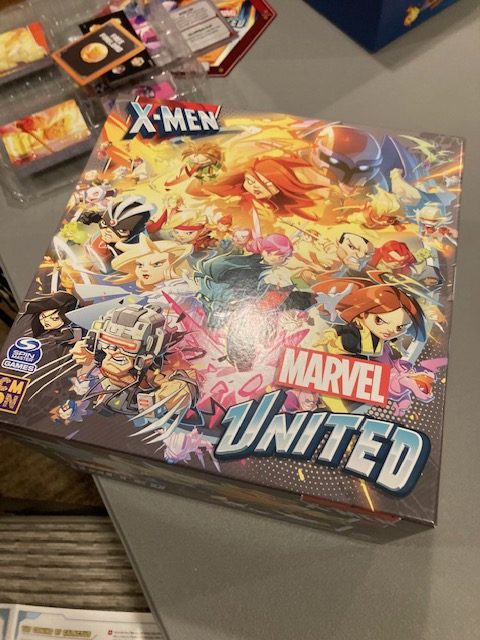
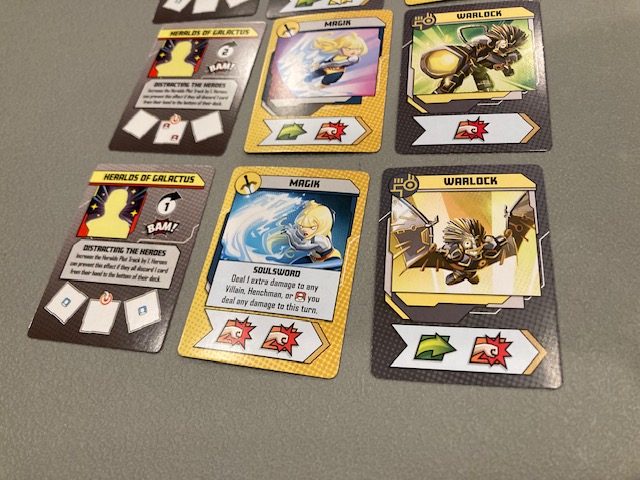
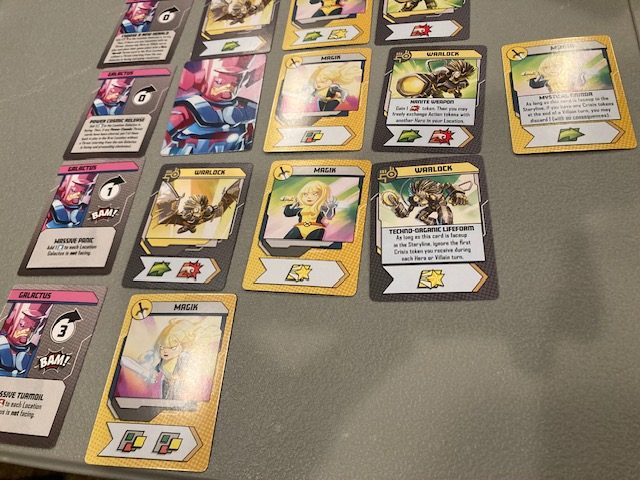
For The Coming of Galactus first play, I chose Magik and Warlock (see above) from the X-Men: Stretch Goals set (see below).   Those are my favorite two characters!  Since I am learning a bunch of new rules, I wanted to play with characters I already knew.  This is called “change as few things as possible to make it easier to learn“.

IMG_6226

Somehow, it seemed right that a galactic refuge outcast like Warlock and a dimension hopping outcast like Magik would take on Galactus.  The outcasts are the only ones crazy enough to take on the World-Eating Villain!

IMG_6230

So, I ended up playing two games with these heroes: I won the first and just barely lost the second. But I cheated in the first game.

IMG_6237

How did I cheat in my first solo game?  I kept three of the Challenges out all times (see above).  Recall, the only way to win is take get to the last Challenge and defeat that!  But I think the right thing to do is only show a single Challenge at a time!!  So, I think I won the first game because I cheated.  Learn my mistake: only one Challenge is active at a time!

IMG_6243

One of the things that makes the Galactus scenario so hard is that every KO (and overflow) causes Galactus to put a Master Plan face down!  See above as an overflow happens and Galactus clogs the storyline!  This is terrible because you lose a turn (Magik and Warlock only have two plays now before the next Master Plan) AND Galactus is closer to winning!

IMG_6238

My second game was a loss, but a heart-breaking loss as I simply ran out of cards!  This time, I played correctly with the Challenges (only one Challenge up at any time).  

IMG_6263

See above as Warlock and Magik need literally one more card to win!  This was both cool and heart-breaking at the same time!  I think if I had Magik’s Soul Sword (Items are new in the Multiverse expansions), I may been able to pull this off!

IMG_6381

What a blast!  Magik and Warlock were a surprisingly good team against Galactus.  This is partly because their Special Effects don’t matter as much with Galactus (as their special Effects tend to deal with Crisis tokens: see above)!  Why do I say that?

IMG_0836

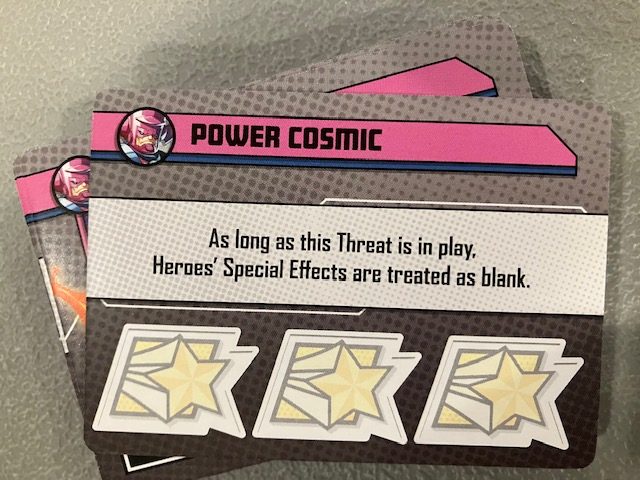
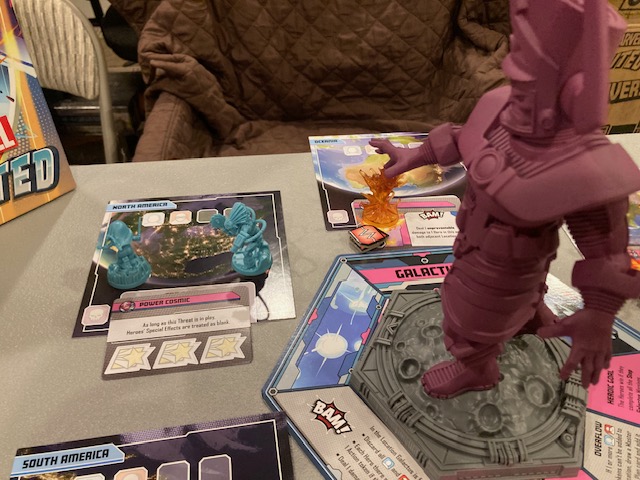
The two Power Cosmic Threat cards (see above) disable ALL SPECIAL EFFECTS until you defeat them!!!   This game is so tight, you almost never have a chance to disable these Power Cosmic Threats, so all the Special Effects you have become useless! In a game without Crisis tokens, Warlock and Magik didn’t care too much that their “specials” are disabled.  I remember thinking when I first started: “Oh, Magik and Warlock are bad choices, because their specials mostly deal with Crisis tokens“.  Nope! Since they are disabled most of the time (if not the entire game), they didn’t care! 

Overall, I had a great time playing solo.  This was SO MUCH FUN!

IMG_6357

Cooperative Mode (The Coming Of Galactus)

IMG_6347

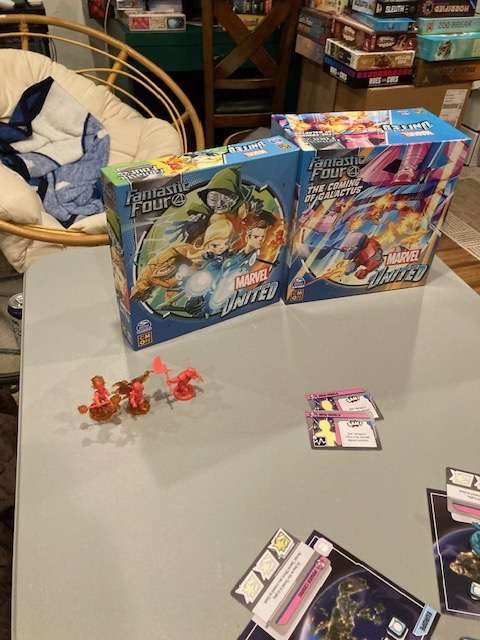
For cooperative mode, we played a 3-Player game with members of the Fantastic Four.  The Fantastic Four is a special expansion for the base game: we reviewed it here.

IMG_6361

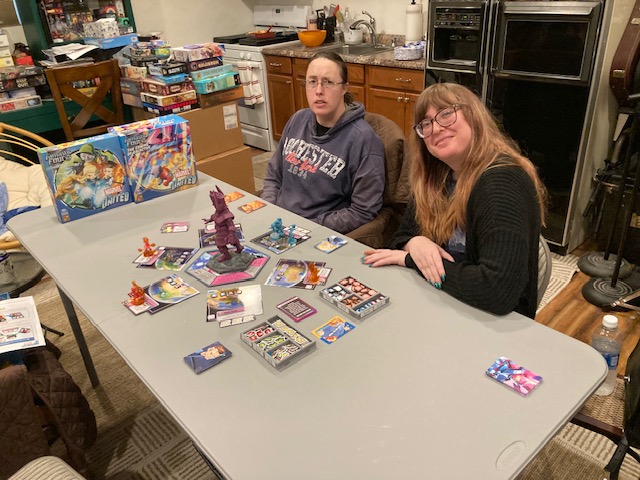
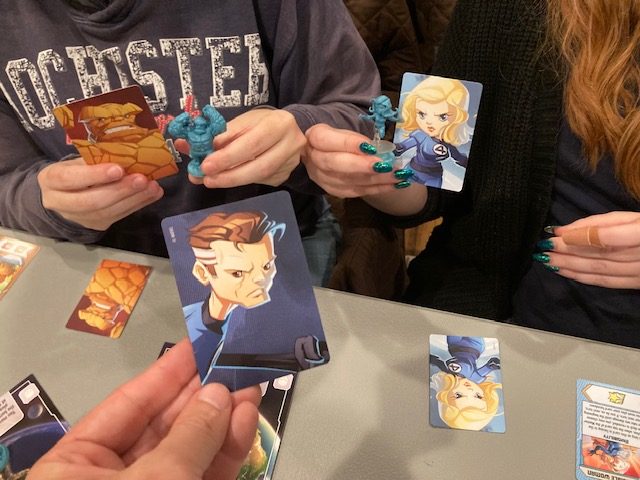
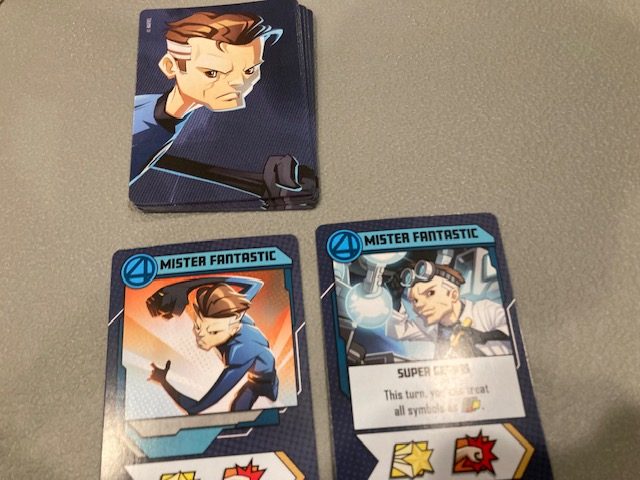
I played Mr. Fantastic, Sara played Invisible Girl, and Teresa played The Thing.

IMG_6349

Over the coarse of one night, we ended up playing The Coming of Galactus three times!

IMG_6350

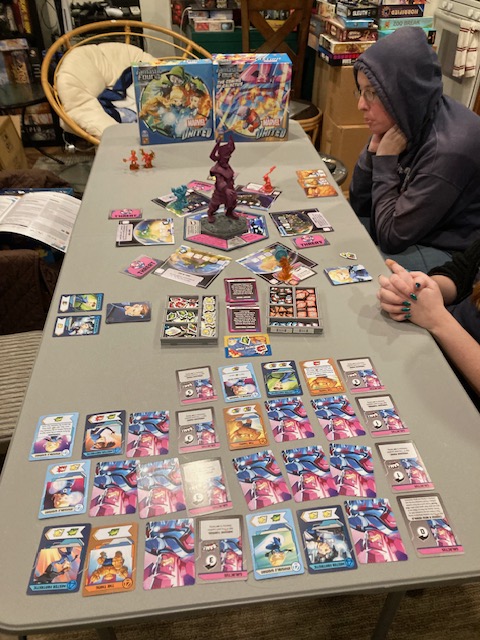
Our first loss was crushing, as we got KO’d and overflowed so many times that Galactus clogged the storyline.  We learned a lot from this first play: most importantly, don’t let the Civilians or Thugs overflow!  The consequences are too dire!

IMG_6354

It was a crushing defeat (see above), but we all wanted to try again!

IMG_6356

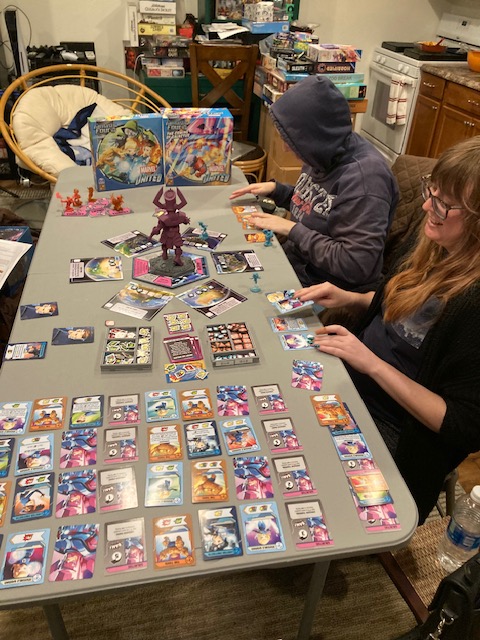
We did significantly better the second time, but still lost as we ran out of time! See above!

IMG_6363

In our third and final play, we were able to win!  We learned a lot about the game: what to do, what NOT to do, what strategies to take!  

IMG_6365

That hardest part of this is that it’s just so easy to be crushed by Galactus if you aren’t careful, but the game is quick enough to reset and play again!  After three plays, we finally eked out a victory.  We had fun, but we all started getting a little loopy:

IMG_6360

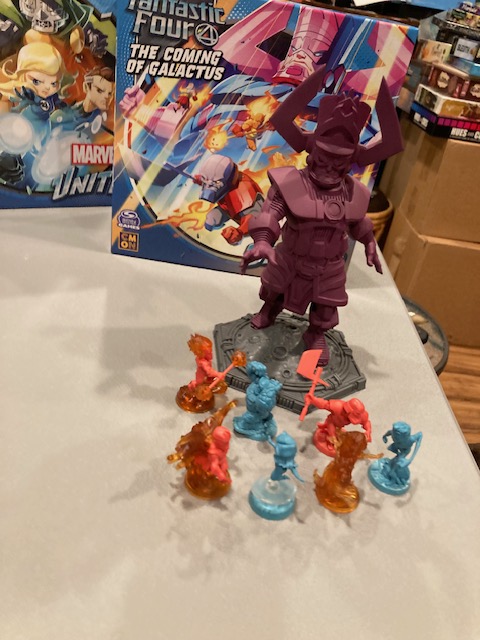
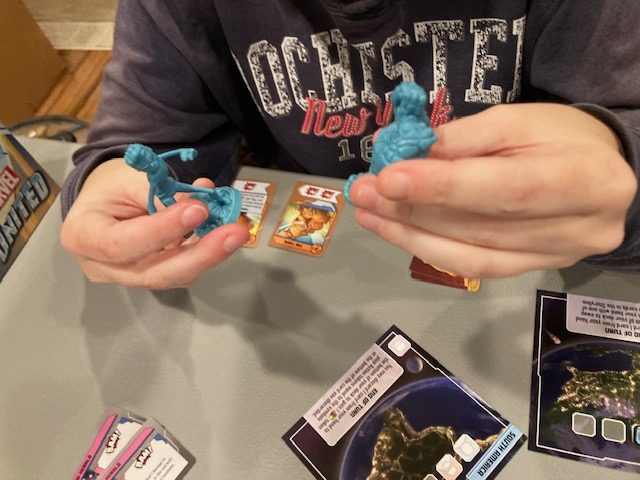
When I wasn’t looking, Teresa started playing with the figures. Apparently, Sue Richards ran off with Nova.

Solo Play (The Heralds of Galactus)

IMG_6374

The Heralds of Galactus is a secondary way to play this expansion. 

IMG_6216

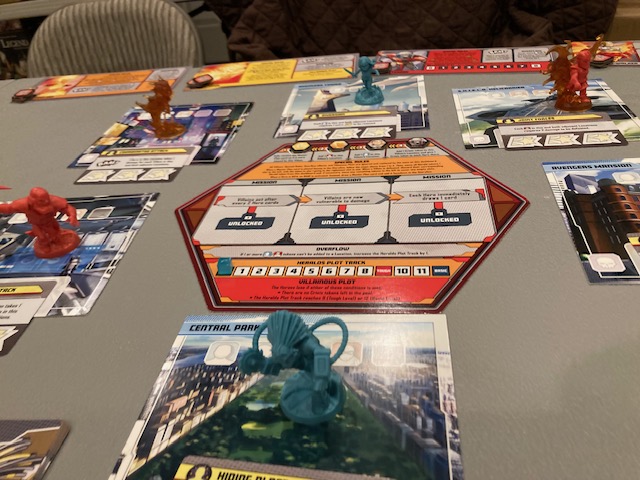
 While each of the Heralds has its own board (see above), and you can play each Herald separately as the main Villian, the mode: The Heralds of Galactus has you fighting all the Heralds at once!  See below!

IMG_6396

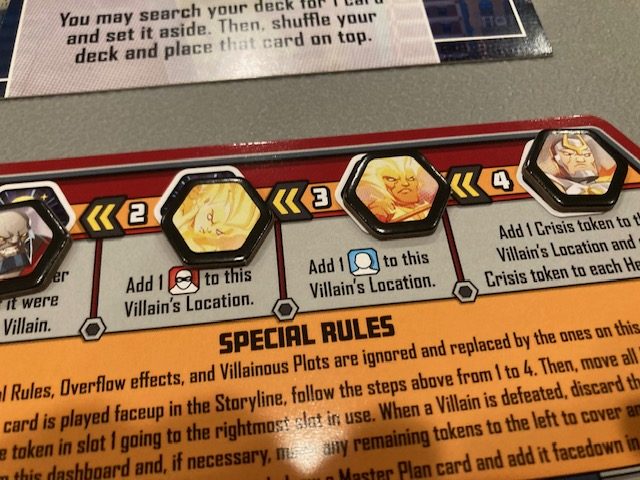
This is a really interesting way to run the Heralds:  all of them are out on the board, and all of the their dashboards are out as well.  As you play, the Heralds cycle-through each other.   

IMG_6375

There’s a little track at the top that keeps track of which Herald is next.

IMG_6371

This was a fun way to play; the Heralds each got a chance to do their thing, but it wasn’t too overwhelming as each Herald gets their “special” BAM! every 4 turns (as they cycle through).  It’s kind of cool that this mode does seem to work.

IMG_6399

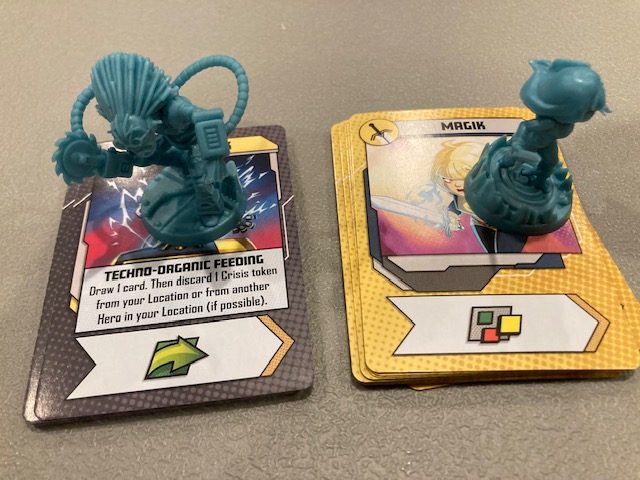
I played this mode solo with .. you guessed it: Magik and Warlock.

IMG_6385

In the The Heralds of Galactus mode, Magik and Warlock are perfect choices!  Why?

IMG_6393

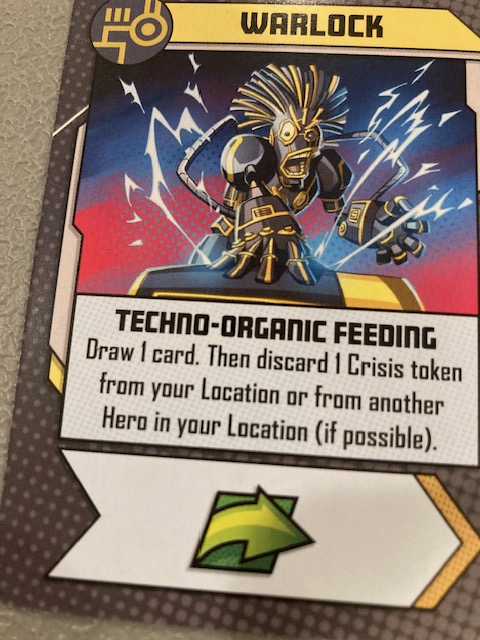
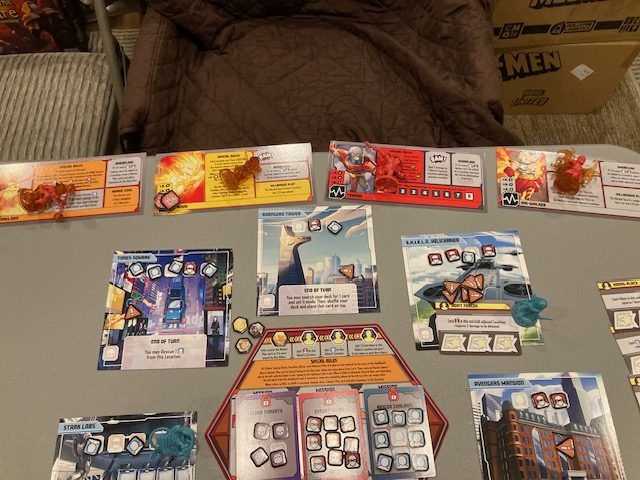
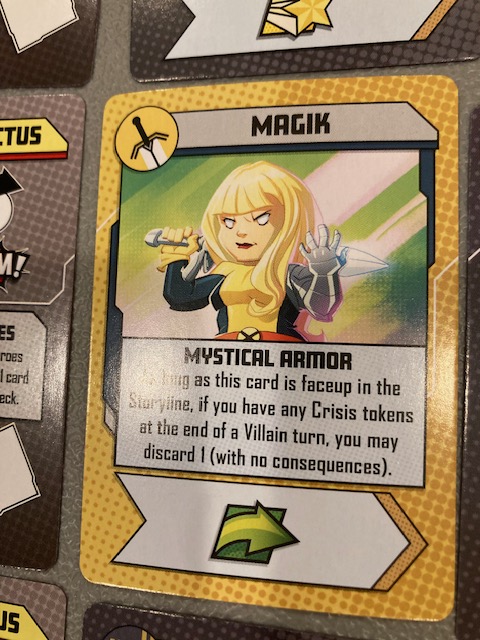
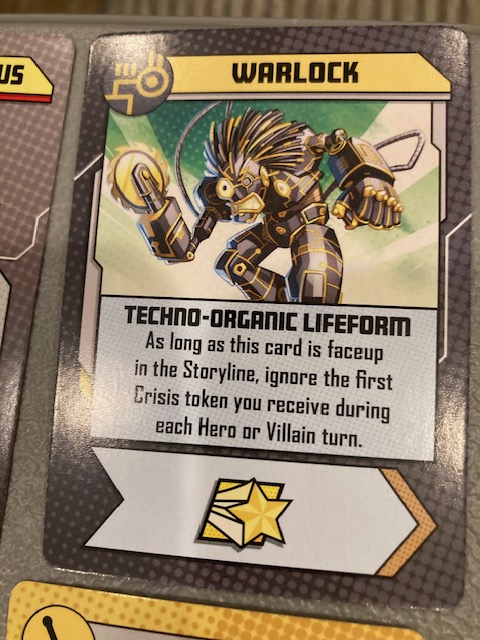
This Scenario focuses quite a bit on the Crisis Tokens.  Both Magik and Warlock manage Crisis tokens VERY WELL!  See Magik’s Mystical Armor above and Warlock’s Techo-Organic Lifeform below!

IMG_6394

IMG_6398

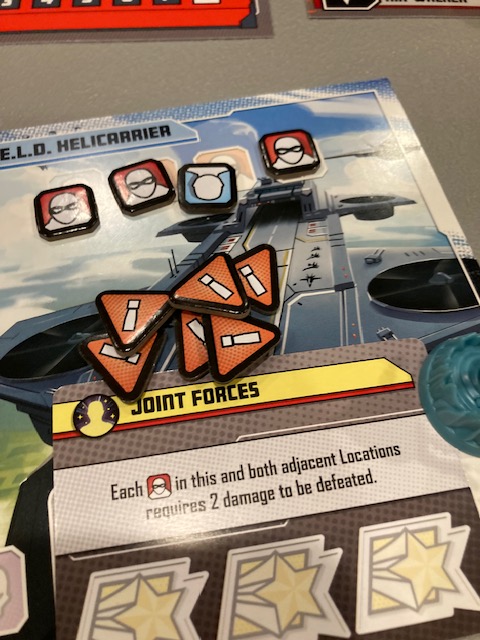
One of the things the Heroes need to worry about is the dwindling supply of Crisis Tokens that come out during play: if they ever all come out, the player’s immediately lose! See above as the S.H.I.E.L.D. Hellicarrier gets a lot of Crisis tokens!

IMG_6373

In my solo game, I was never in danger of losing by running out of Crisis tokens! Warlock’s first card allows him to discard Crisis! And once Magik got her Armor out, she didn’t have to worry about Crisis tokens either.   The Heroes could concentrate on what mattered and mostly ignore the Crisis tokens! Warlock and Magik did a great job taking down the Heralds!

IMG_6388

In the end, this mode (The Heralds of Galactus) is a little more of a by-the-numbers expansion, but I liked it.  I liked thee way the Heralds cycled through to create a unique experience.

Controversy!  What Does Facedown Mean?

IMG_6362

There has been some discussion on BoardGameGeek (see this thread here) about what it means to “put a Villain Master Plan facedown into the Storyline“.   This is especially important to the Galactus scenario, as a Hero getting KO’d forces a Galactus Master Plan to get added  facedown to the storyline … and we know heroes get KO’d all the time with Galactus!

My original stance is that a card facedown takes up space in storyline  and causes the players to have fewer actions.   Other people in the BGG  thread feel that you shouldn’t lose turns because it doesn’t explicitly say that.

Let’s explore this issue.  What does it mean to place a Master Plan card facedown in the storyline?  Let’s take a look at the Point and Counterpoint!

Point: A Facedown card causes the Heroes the lose an action!

1. Simplicity: If the purpose of the facedown rule is  to simply reduce the number of cards in the Villain’s Master Plan deck (and thus end the game earlier), the rule would have been written to be simpler:

   “Discard a card from the Villain’s Master Plan deck”.

If the rule were written like that, I would 100% agree that the players don’t lose an action.  But since the rule states explicitly to place a card facedown in the Storyline, it implies it takes up space!  What does it mean to take up space? To lose an action!

2. Thematic/Cartoon

IMG_0839

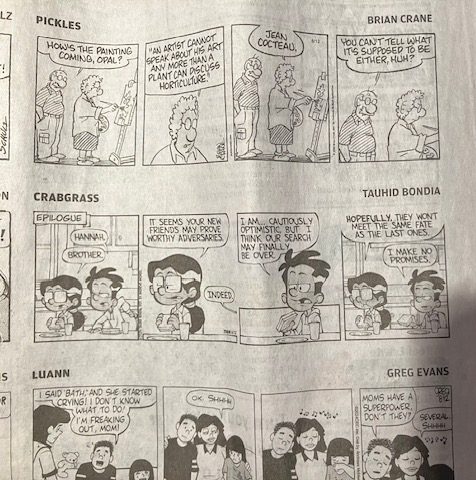
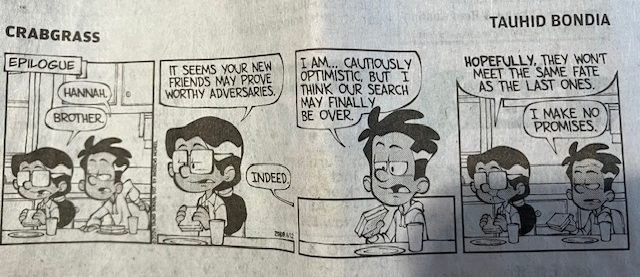
Take a look at this snapshot of a cartoon page from a newspaper.

IMG_0838

In this snapshot above, each panel of each cartoon takes up space. If a panel is removed or covered, then there is physically less space!

That lack of space means the cartoons have less space to tell their stories.

IMG_6350

Much like the storyline in Marvel United: reduced space means fewer panels for the players to act and tell their story!

3) Thematic/Game Balance

IMG_6329

It always struck me that a KO should be fairly devastating: a hero has been knocked out, and it feels it should be a big deal!

So, when a KO from Galactus causes “one Master Plan facedown in the storyline”, that feels it should be reasonably devastating!  If we just lose one Master Plan card, but keep all three turns, that feels lame to me!  It doesn’t feel like it is thematic or balanced! In fact, I have seen players gets KO’d on purpose just so they could get  back to full cards!

If the heroes must lose an action (because there’s less space in the story), then it feels more thematic and frankly more balanced.

A KO should be a big event the players try to avoid: it should have grave repercussions.  That leads me to believe the players should lose an action as well as reduce the number of Master Plan cards. (In Galactus especially: there are 18 Master Plan cards, so it’s almost never a problem that you run out of Master Plan cards, at least in my experience!)

4) Symmetry

IMG_0839

Take a look at the cartoon page again. See above.

IMG_6356

Now, take a look at a storyline where the players lose a turn whenever a Master Plan is played facedown to the storyline. It looks symmetric: like a page of a comic. See above.

IMG_6497

Now, take a look at a storyline were players get all three turns; the facedown Master Plan cards cause the storyline to have ragged edges and no longer look like a real comic page.

Humans naturally like symmetry: I would argue that the natural tendency is for humans to want the symmetry of the panels and suggests that the panels should stay symmetric and avoid the ragged edges.

In conclusion, the rule about placing a Villain Master Card facedown in the storyline, both thematically and physically, implies less space and fewer actions for the players.  The fact that the rule is NOT written in the simpler form of “discard a card from the Villain Master Plan” implies there’s more to the rule than just reducing the cards in the Villain Master Plan Deck; it implies reduced space and thus fewer actions.

Counter Point: The facedown card in the storyline should NOT cause players to lose an action!

The rule that says “place a Villain Master Plan card facedown in the storyline” says nothing about losing turns.  Since it’s not said explicitly, players do not lose turns.

—————————————-Choose a side.  Which side do you land on?

If you chose that side that facedown implies fewer actions, the game becomes harder, as the heroes have fewer actions in the game in response to the Villain.

If you choose the side that that says “facedown does NOT imply fewer actions”, the game becomes easier, as the characters always get all three of their actions.

IMG_6492

From my playtesting, I have tried the game with both facedown  interpretations (fewer actions or full actions) … and in both solo and cooperative modes!! And guess what? The game still works either way.

One way is just harder than the other.

What I Liked

IMG_6365

One) The minis are all amazing.  

IMG_6359

Two) The new idea in this expansion (have to place PAIRS of tokens, 8 challenges, cycling through Heralds) keep this game new and fresh.

IMG_6362

Three) I still love how this game looks, especially with the storyline. It feels like you are looking at a comic book storyline!

IMG_6355

Four) I like that the Coming of Galactus mode is hard, but it seems like you can still learn from it to come up with strategies!

IMG_6258

Five) I had such a good time playing this solo (two-handed solo mode).

What I Didn’t Like

IMG_6346

One) My friends didn’t like this nearly as much a I did.  Their main criticism was “the game was too random“.  I agree there is a lot of randomness in the game (Where does Galactus turn to? What cards come out? Where are the Heralds?), but I would argue that, after three cooperative games, we had discovered strategies that worked because we got better every game!  We were able to win!  And I think we could do it again!

IMG_6256

Two)  In The Coming of Galactus mode, you simply have to take damage and get KO’d.  Some Marvel United expansions MIGHT have a player or two get KO’d.  Not here!  Each hero will probably get KO’d at least once or twice or more!  You have to get comfortable with the idea: “you will have to take damage and you will have to get KO’d multiple times”.  If you don’t like that feeling, then this game will not be for you.  Once you sort of “get used” to that, I don’t think it’s that bad.

IMG_6222

Three) I wish the rules were explained just a little better.  A sentence being more explicit and saying “There is only one Challenge active at any time: once you complete the Challenge, flip over the next!”.   This is the problem with so many expansions; sometimes they don’t have time to make things a little clearer.

IMG_0836

Four) The Power Cosmic is the most frustrating Threat in the Coming of Galactus mode!  And there are TWO COPIES of it!  So, for most of the game, you don’t get to take advantage of your Special Effects on your Hero cards!  All the things that make the Heroes “special” are taken from them!  I got “lucky” in my solo games and used two characters (Magik and Warlock) that didn’t really care, but The Fantastic Four were really hampered by this!   But, I think we won our very last cooperative game because we were able to enable the Fantastic Four Special Powers in the very last few rounds! 
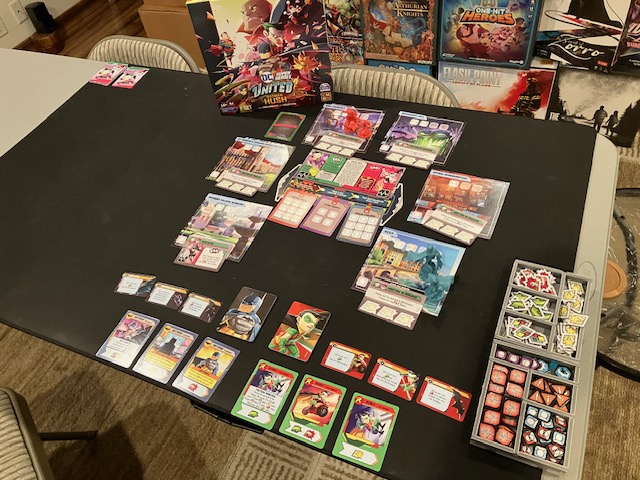
This can be very thematic: “The Fantastic Four lost a lot of their powers, but once they got them back, they rocked!!!”  I could see this being  comic book arc: the heroes must overcome obstacles to get their powers back, and then rally in a climactic ending!  BUT this can be very frustrating if you don’t deal with it correctly.  My friends did not like this: they said it made it feel like you couldn’t do very much, and it was frustrating.

Conclusion

IMG_6358

This was a very divisive expansion.  The Coming of Galactus might be my favorite expansion of the year so far at a 9.0/10, Teresa likes it at about a 7/10, but my friend Sara gives it a 4.0/10.    Her thoughts were that the randomness of Galactus, the absolute beating the heroes takes, and Power Cosmic Threat cards take away from the fun.  And I get that.  But I thought that it was all very thematic! Once you get comfortable with the idea that “you will get beaten up a lot“, you can strategize and come up with ways to defeat Galactus … which we did, but it just took us three games.

I will point out that we all WANTED to play three games to defeat Galactus. It was easy enough to replay three games in one night, and very satisfying once we were finally able to defeat the mighty Galactus.

Cooperative Rules For Comic Hunters

IMG_8355

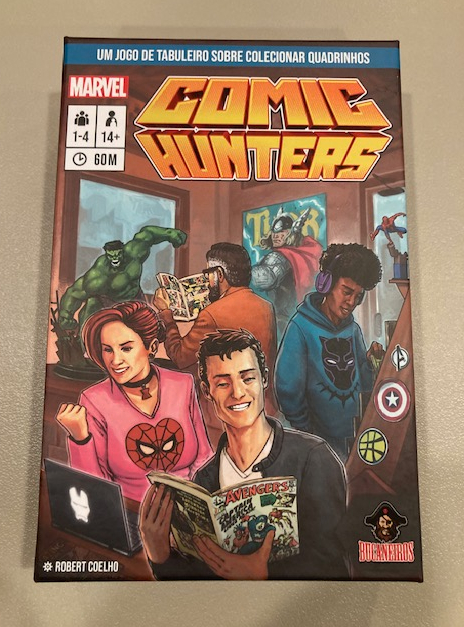
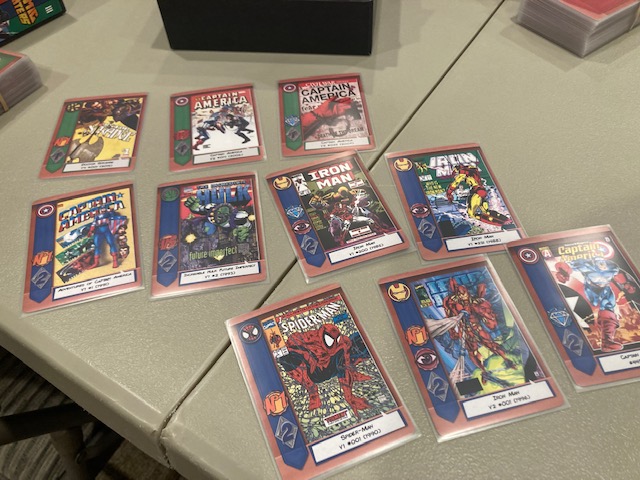
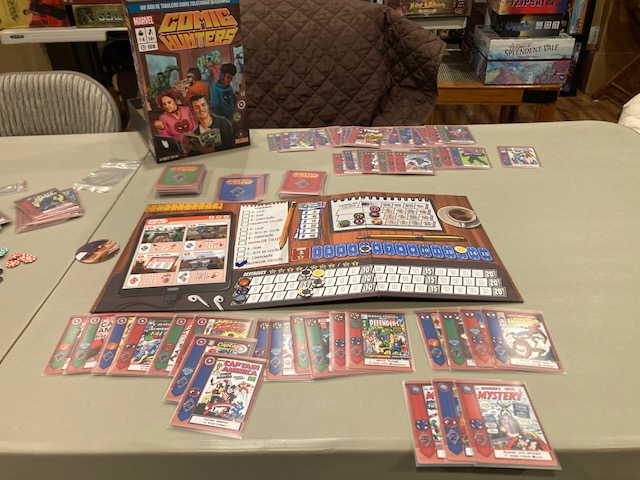
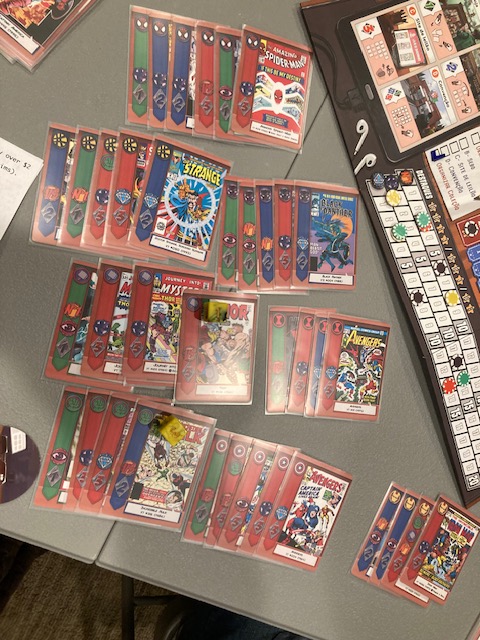
Comic Hunters is a game originally from Brazil: it took the world by storm as a drafting game with 4 different types of drafting and also Marvel comics covers as the cards (see below)! We really liked it! See our review here!!
IMG_8357

This game has been so popular that they translated the rules to English, and it has been selling for $200 or more on e-bay!

IMG_8299

After all this popularity, it looks like Arcane Wonders is going to pick up the game in the United States: see here! You don’t have to pay $200 for it anymore!

IMG_8281

My only lament was that the game was either solo-only or fully competitive … until now.

Development of Cooperative Rules

IMG_3055

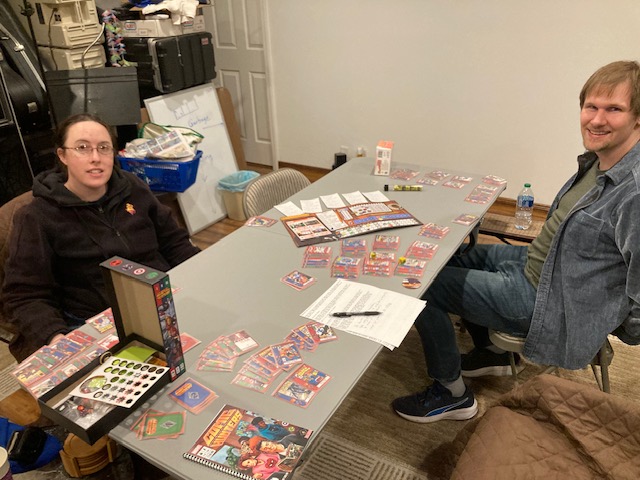
These cooperative rules for Comic Hunters have been in development for about 6 months now.  (Let’s be clear: I have no affiliation with any of the developers or companies, I am just a fan of the game).   I’ve had some basic ideas, thrown some away, playtested, tried new ideas, lather rinse repeat …

IMG_3058

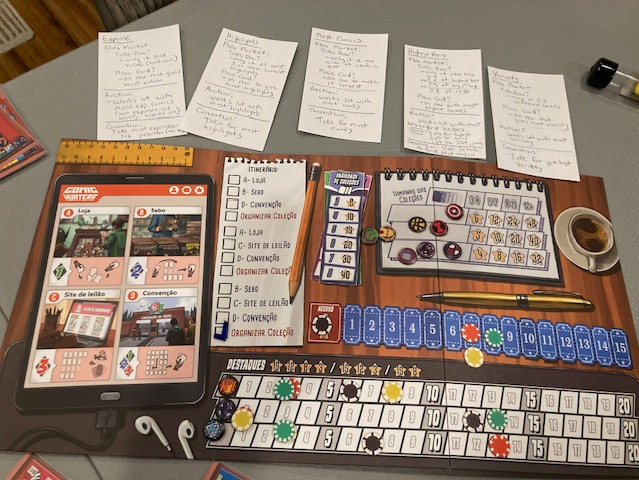
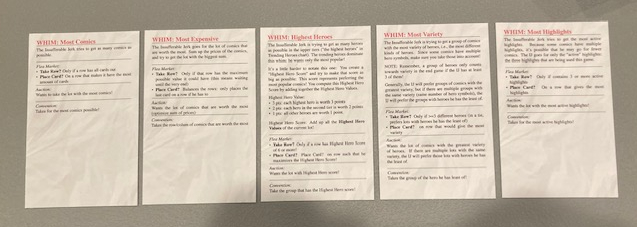
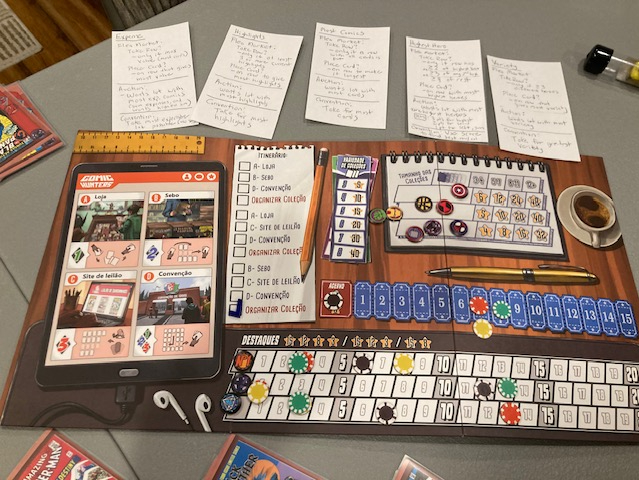
You can see version 0.9 of my beautiful, hand-crafted Whim cards above.

IMG_3060

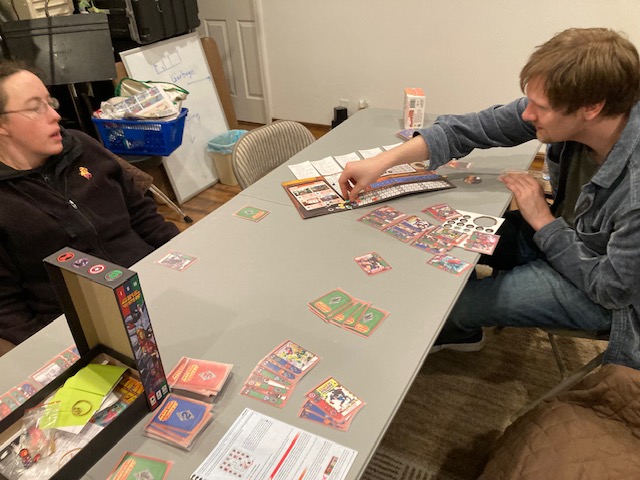
We’ve been playtesting at 2 and 3 player counts: the current rules only work for a 2 to 3 player cooperative game.  We run out of cards when we try to play 4 players (see why below), so currently the cooperative mode only supports 2 or 3 players.

IMG_3056

There’s been quite a bit of playtesting and editing: hopefully you’ll find this something you can enjoy!

Introduction

IMG_3054

Here’s the introduction from the rulebook:

You and your friends have been collecting comics together for years! You love to go to the comic store, conventions, and flea markets together, looking for some rarities.  Sure, there have been some friendly rivalries for comics along the way, but you and your friends love comics.  If only your allowances were bigger, but that makes you appreciate the comics you do have a little more…

Then one day the Jerk comes into your life: he’s an Insufferable Jerk who just ruins everything!  He thinks he knows everything, he thinks his way is the only way to do anything, and he puts down everything about you and your friends.  He just happens to be rich and inserts himself into your groups.  He tells everyone his collection of comics is the best! He is so annoying!
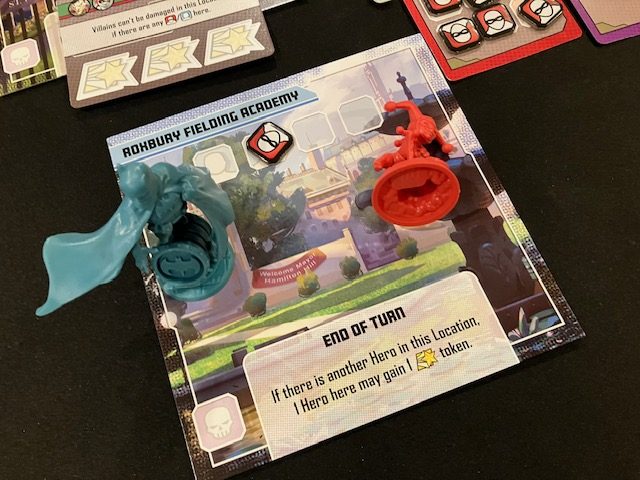
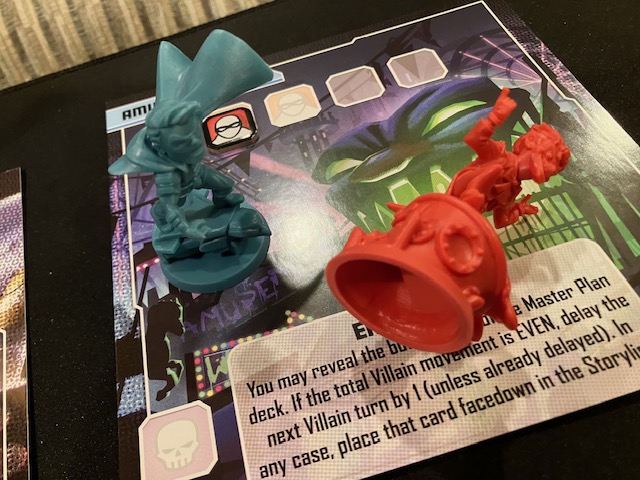
Your job in cooperative Comic Hunters is to get bragging rights over the Insufferable Jerk (sometimes referred to as IJ).  In order to win the game, players must get bragging rights over the Insufferable Jerk in all aspects of comic collecting.  To do this, at least one of the cooperative players must outdo the Insufferable Jerk in every aspect of the game:

   a) Combined, your collections must have more variety than IJ!

   b) From size perspective, at least one player must have more comics of a hero for each hero!

   c) For each highlight, at least one player must beat IJ!

   d) At least one player must have more Secret Stash points than IJ!

As a group, if you can outdo the Insufferable Jerk in every single aspect of comic collecting, you can shut him up! You hope to teach him collecting comics is supposed to be fun, not some sort of power play.

Players work together get the best comic collection they can, as a group.

Downloads

IMG_3067

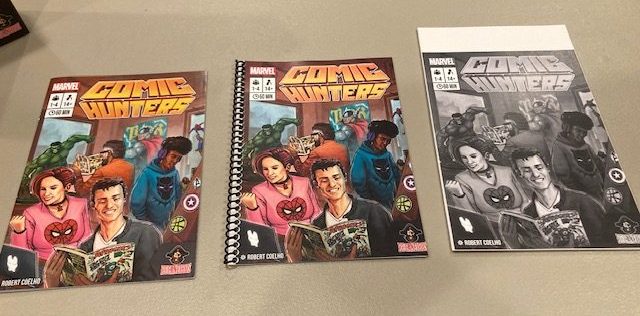
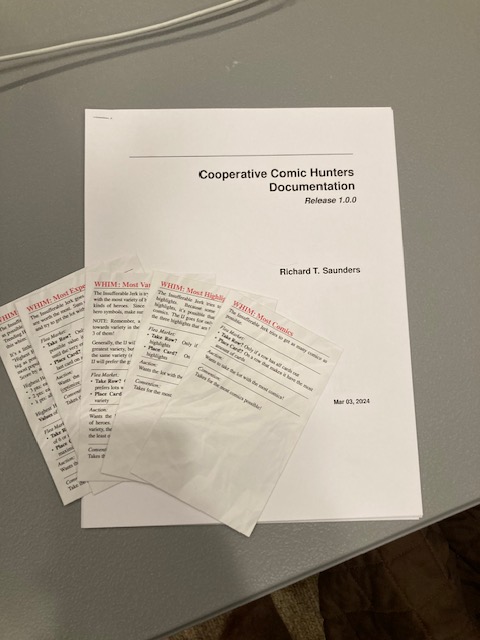
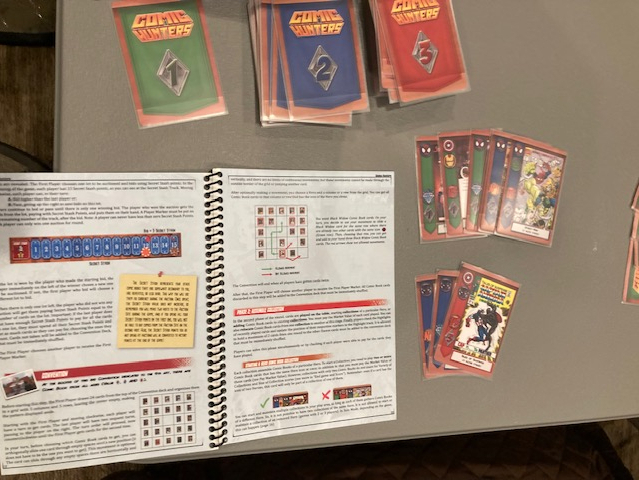
See above for the version 1.0.0 of the game! (The current version is 1.0.2 in the downloads section: the changes are mostly just very minor clarifications and rewordings). To play cooperative Comic Hunters, you need three things:

  1. A copy of the original game Comic Hunters
  2. The cooperative rulebook:  see the PDF download at the end of post.
  3. The 5 Whim Cards: see the PDF download at the end of the post.

The cooperative rulebook you might want to print, but you can always just look at in online (see below). The 5 Whim cards you must print! They will be “about” 3x5in when you print them.
IMG_3065

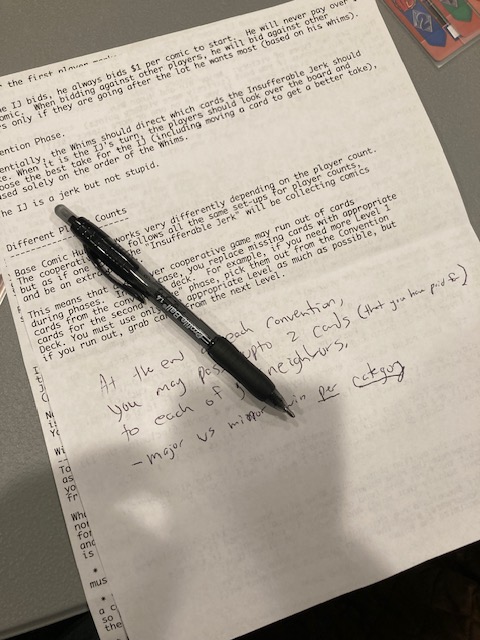
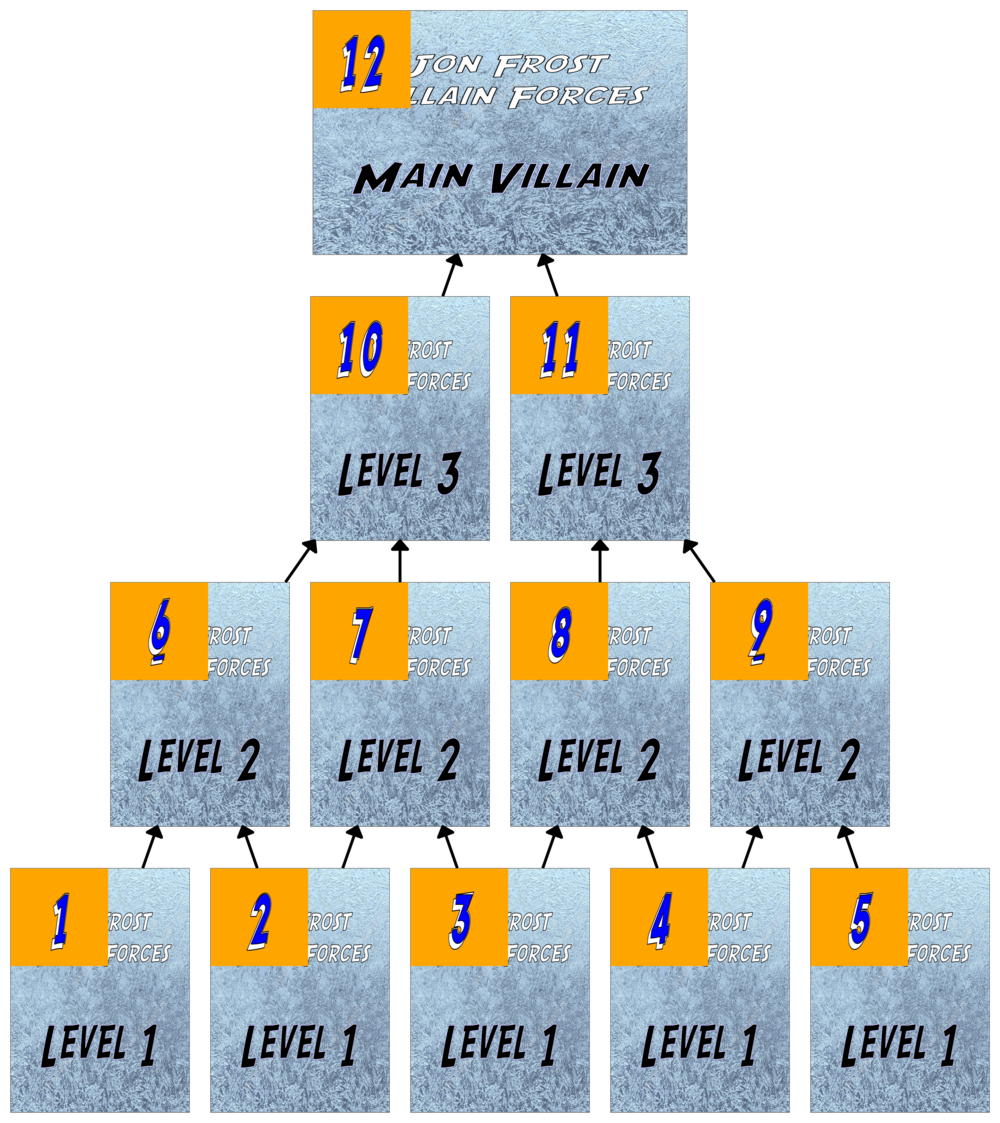
The cards are all one-sided, so you want to print each card on a separate page and par it down to about 3×5. I used cardstock for mine. The idea is that these cards will go above the comic board:

IMG_3057

These Whim cards are the AI that controls how the Insufferable Jerk works.

Feel free to download and try this out! I currently am keeping all rights to this, but I may release this to the public domain later on.
Feedback

IMG_3051

We’d appreciate any feedback!  Problems?  Mistakes?  Please feel free to reach out to us at returnfromsubroutinellc@gmail.com or post on BGG in Comic Hunters section!

See downloads below (remember, you need to download 2 things).