Aetherspire: A Solo and Cooperative Review

Welcome to 2026! This month, we are looking at games that were on the 2025/2026 cusp. This one we received December 18th, but we couldn’t get it played fully until January 2026, so we are counting it for our lists as a 2026 release! Take a look below!

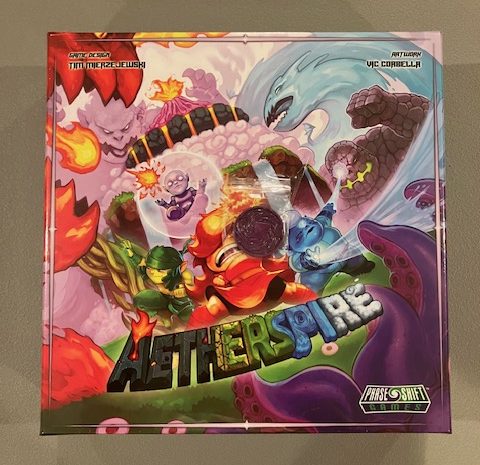
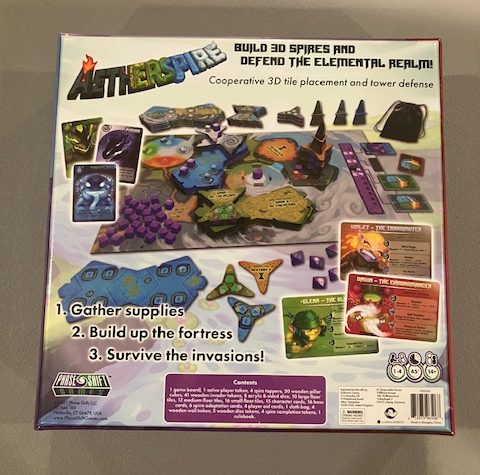
Aetherspire is a cooperative tower-defense, 3-D building game that was on Kickstarter back in October 2024; it promised delivery in October 2025.  There were some miscommunications, and some retail stores had copies (in late  November 2025) before Kickstarter backers (my copy arrived December 18th, 2025).  I admit seeing this in retail before I got my copy made me a little grumpy (since I kickstarted and paid real money to back this), but I guess I am just glad to see this game get out there.

This is a really interesting looking game (“3-D building?? What is that??? That sounds cool!”) that piqued my curiosity in last year’s Top 10 Anticipated Cooperative Games of 2025!   But because of the late arrival, we couldn’t get it played fully (solo and cooperatively) until 2026, so we are counting it (for our internal purposes) as 2026 release.

Let’s take a look!

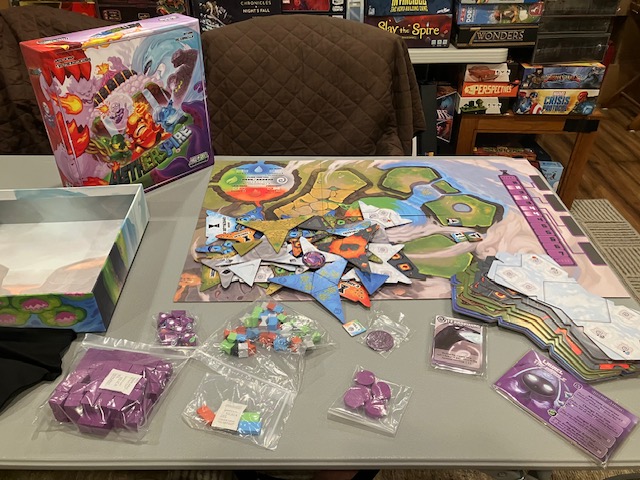
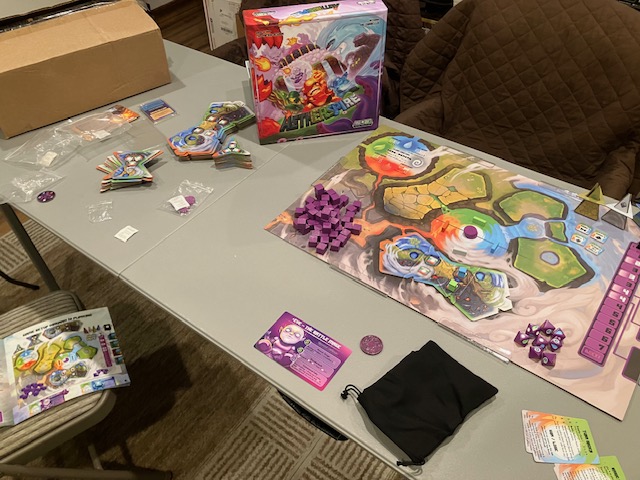
Unboxing

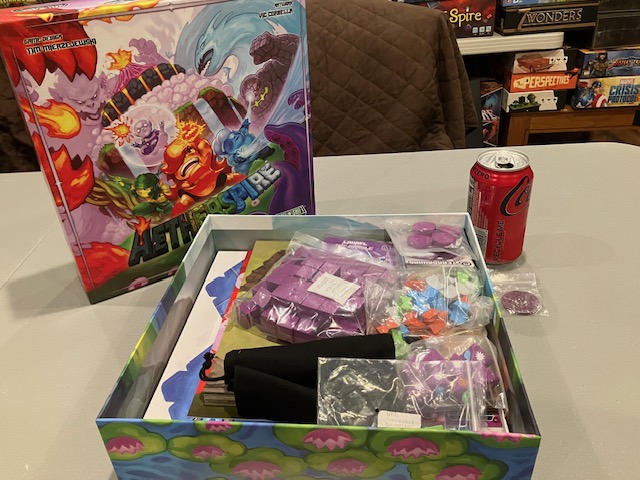
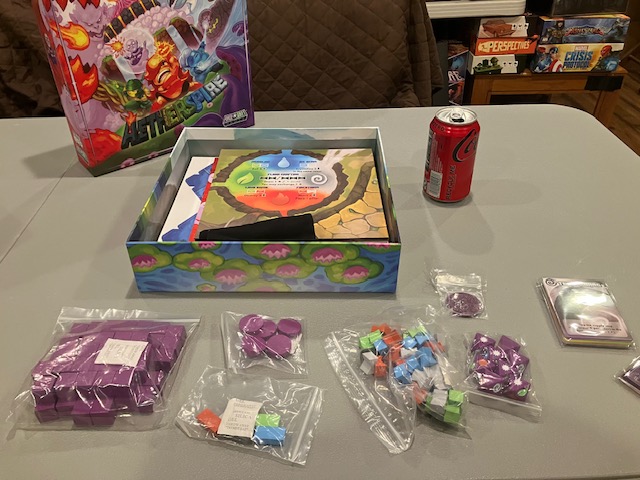
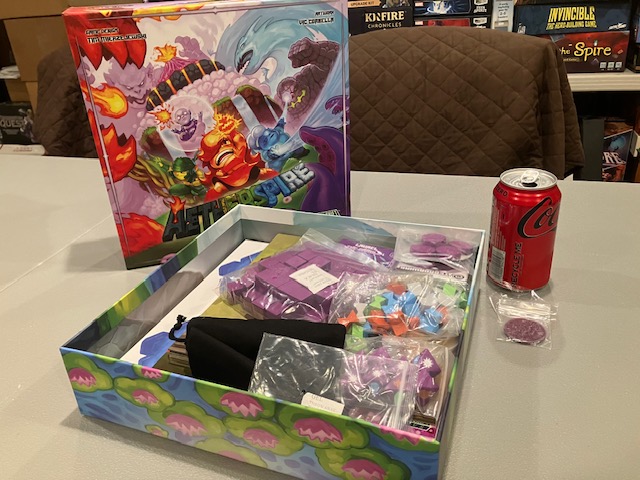
See Coke Can above for scale.  

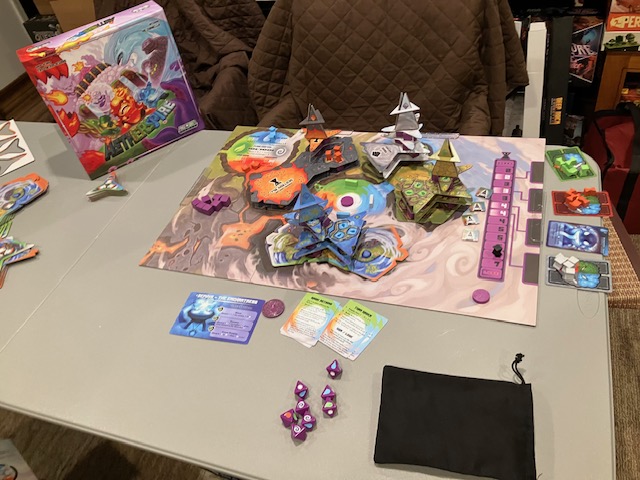
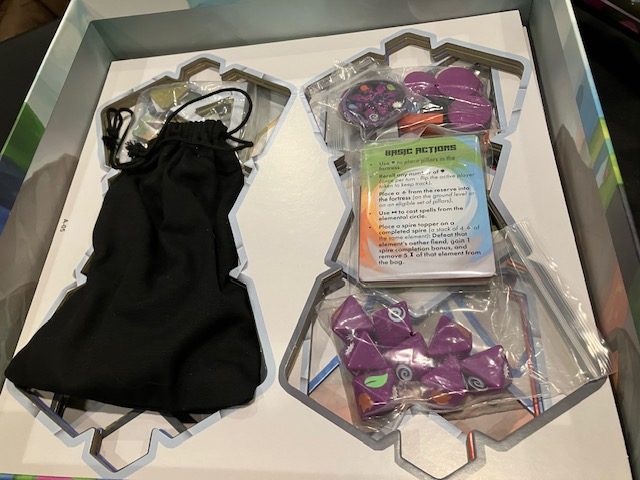
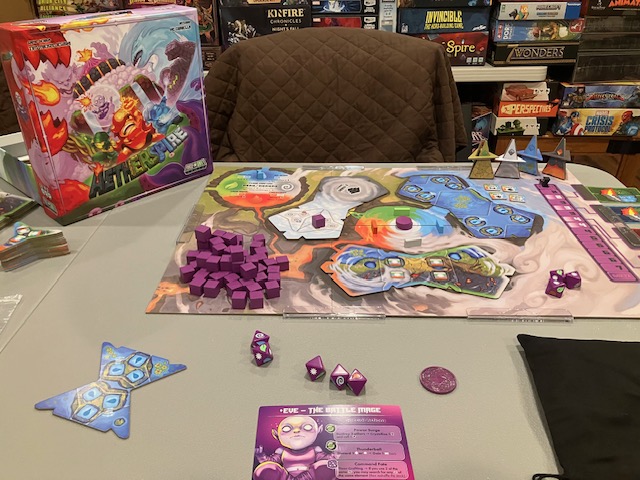
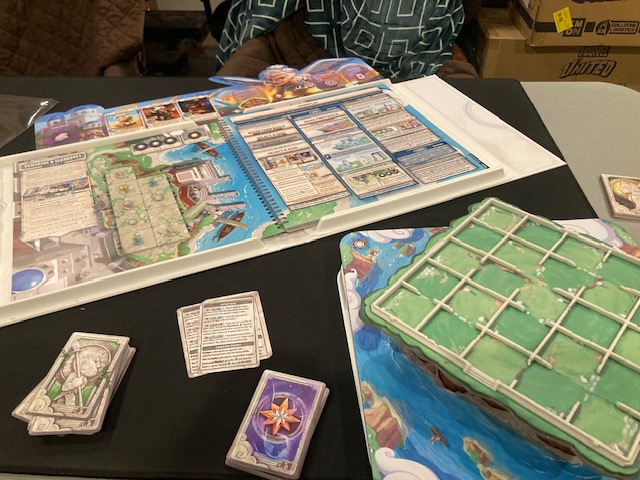
There are quite a number of really nice components in this box.

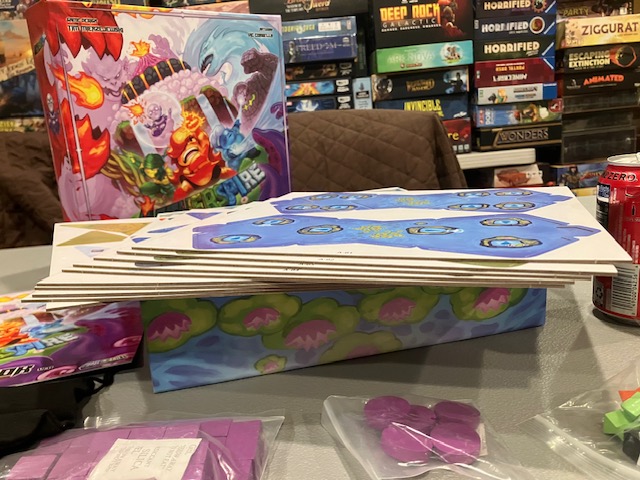
There is QUITE a bit of cardboard to punch out!

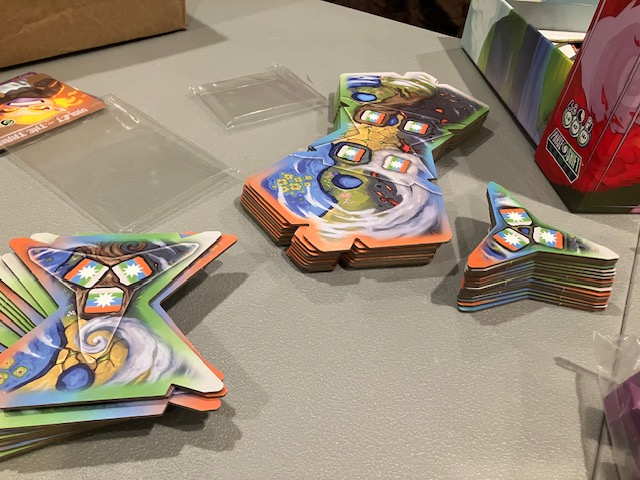
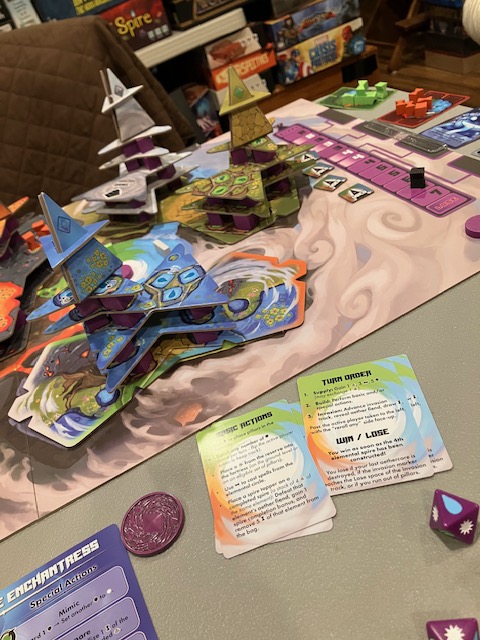
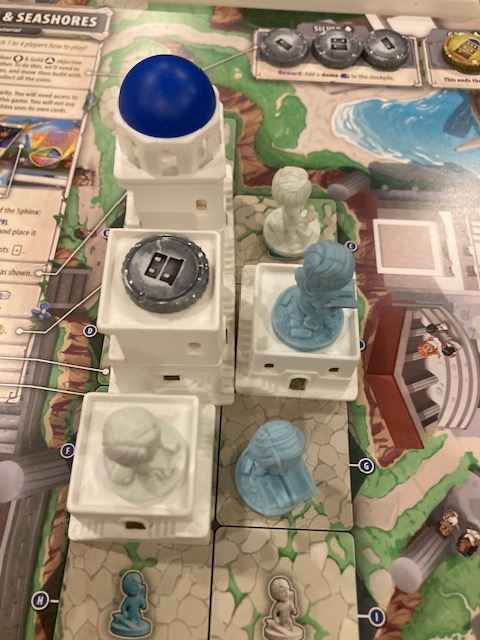
Most of the cardboard is for pieces to build 3-D structures on the board!  See above!

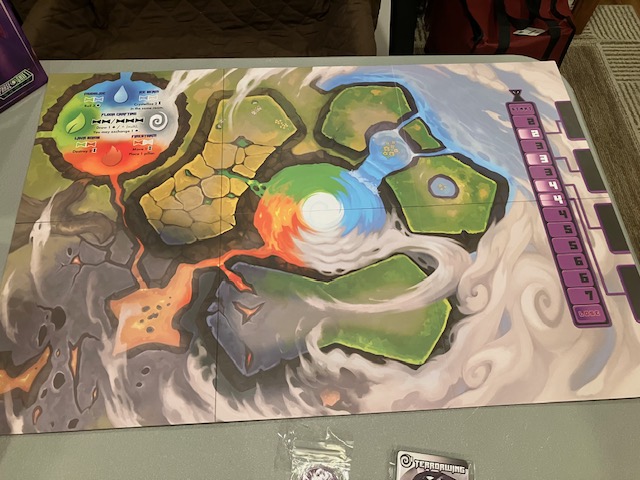
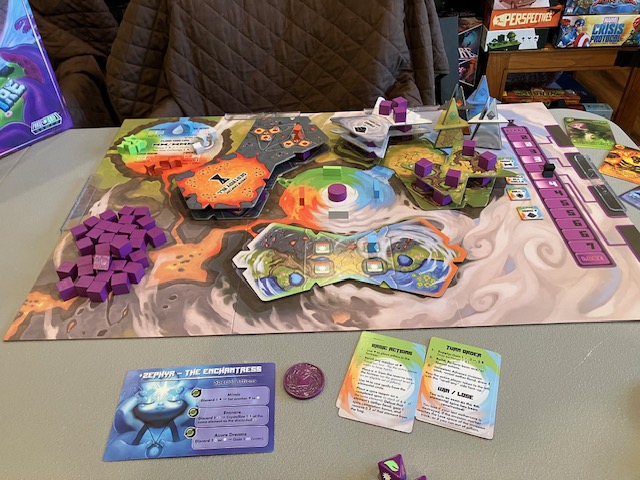
There’s also a really nice board where you build!

Overall, these components are pretty great!  (In the previous Kickstarter that failed, the components were even nicer, but they were a little too expensive, which is why this regrouped and relaunched.  To be honest, I am very happy with the quality of the current version).

Gameplay

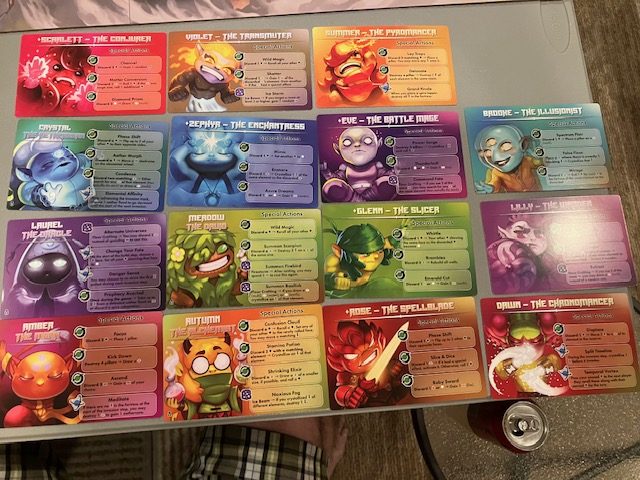
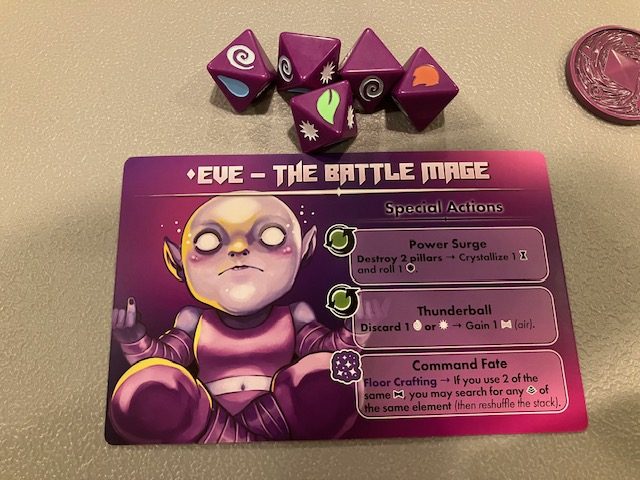
Each player takes control of one of 15 (!) characters; each character has special powers.

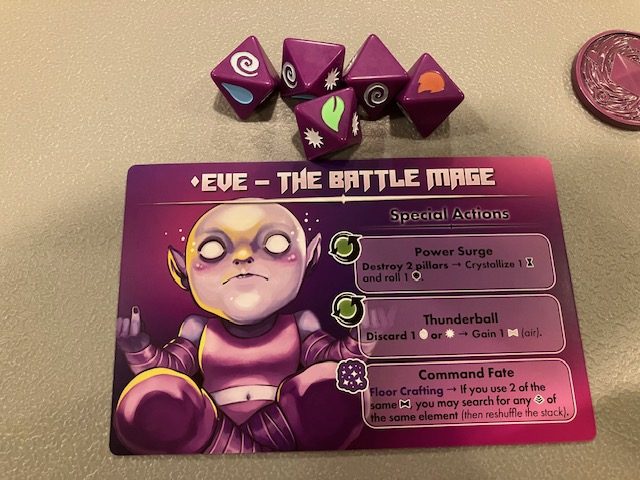
Each character’s power are notated on the sheet (see above). Generally, these special powers allow the character to manipulate tiles, manipulate dice, and/or manipulate spires.  

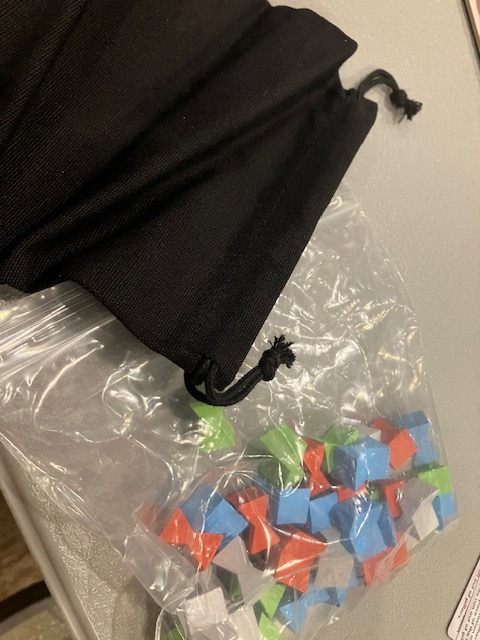
This is a bag-pulling game; it’s not really bag-building, as bag-building implies players put stuff in there for purposely to change the odds.  Having said that, there are decisions players make during the game that do change the distribution of the pieces … so you could argue this is a bag-building game?  Maybe?

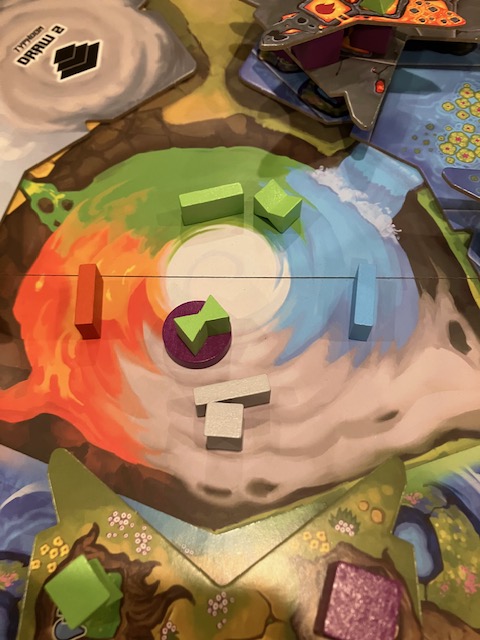
The pieces you put into the bag are dual purpose: they are both the invaders (that clog spaces on your board) and spell-pieces that allow you to use special powers!

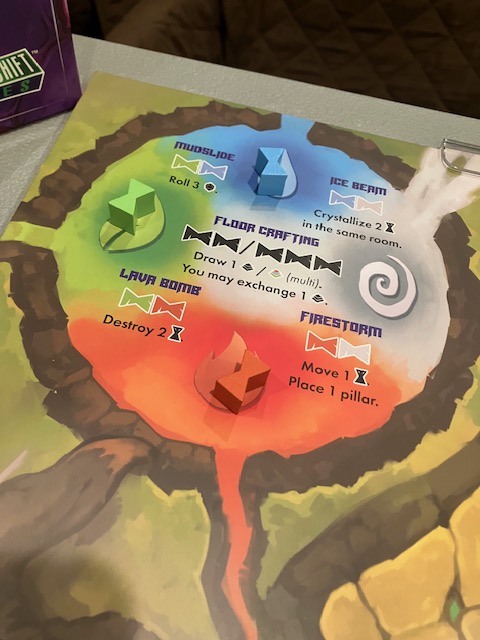
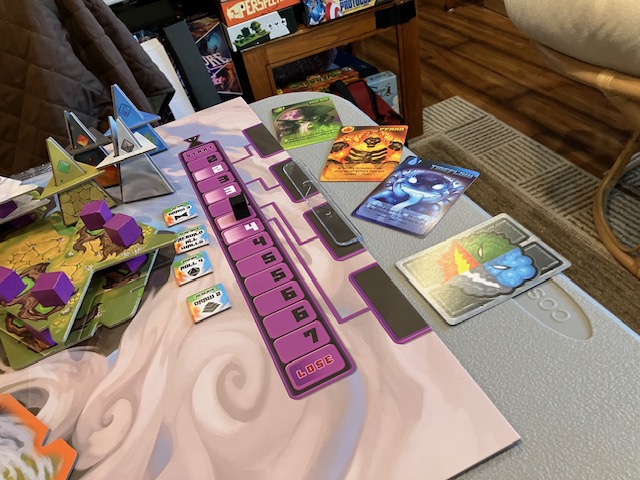
At the start of each player’s turn, he/she get 3 pieces that go into the spell area above.  Discarding combinations of the pieces allow the players to cast spells to help them!  See above!!!  The spell is the important thing here (Lava Bomb destroys invaders!), but again the pieces do go back into the bag, so what pieces you use for spells has at least some bag-building implications.

During the end of every turn, using the same bag, the invaders are pulled and placed on the pieces in the middle!  The invaders clog spaces so you can’t build!  

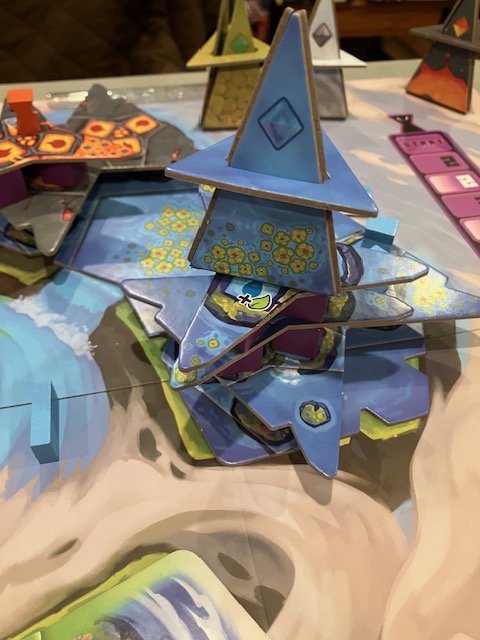
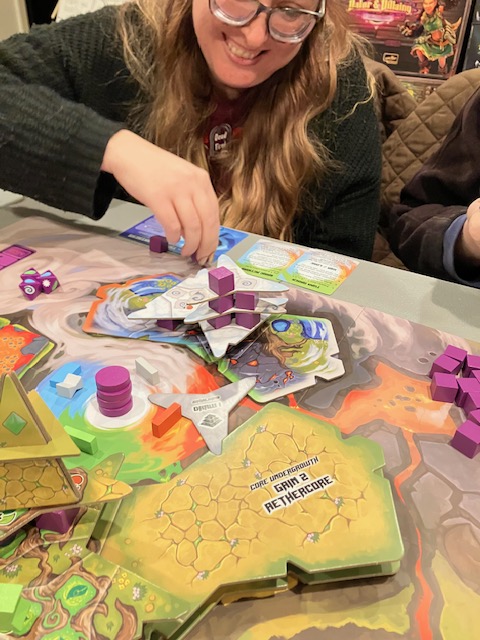
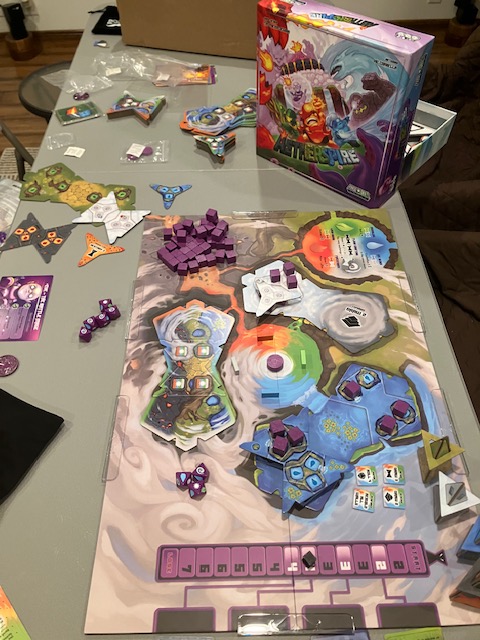
As the game unfurls, you are trying to build spires of height 4 (for each element).  You use puple pillars to build bases for the next levels: see above.

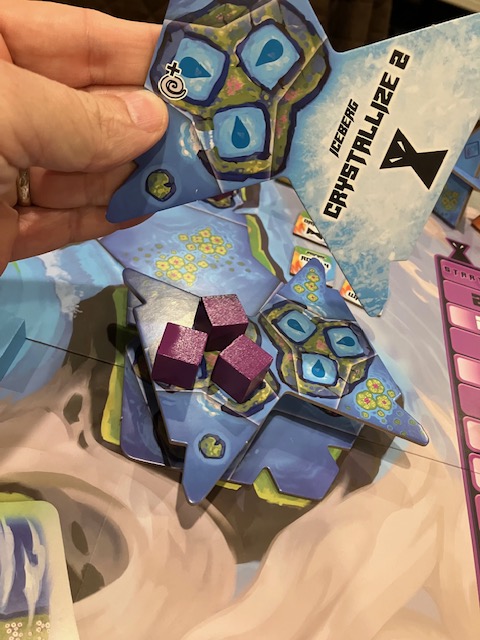
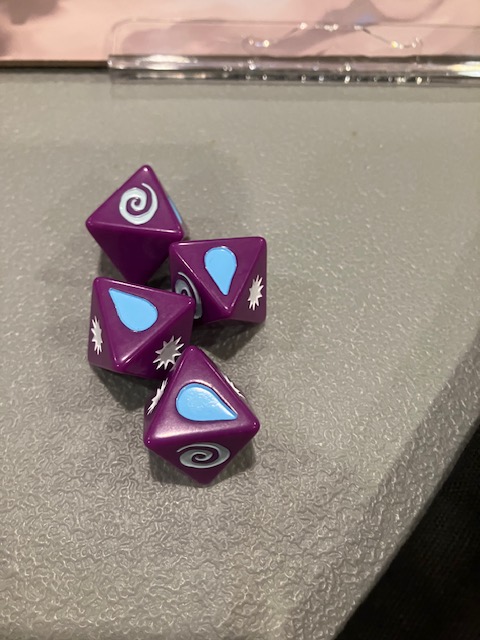
The purple dice are “generally” how you build purple pillars!  Note above as the player can build three pillars on water spaces, and one pillar on an ice space!  There are other powers and spells to build pillars, but generally the purple dice build the purple pillars.  

At the start of every player’s turn, they get to roll 5 dice, and they help determine what the player can build/do that turn!

A completed structure of height 4 (where all levels are the same element) allows the player to build a spire!  See above!  Once all four spires have been built, players win!

If there are no empty spaces for the invaders to occupy, then they tear down the walls and attack the gooey center!  If all the purple (circular) pieces in the middle are removed, players lose!

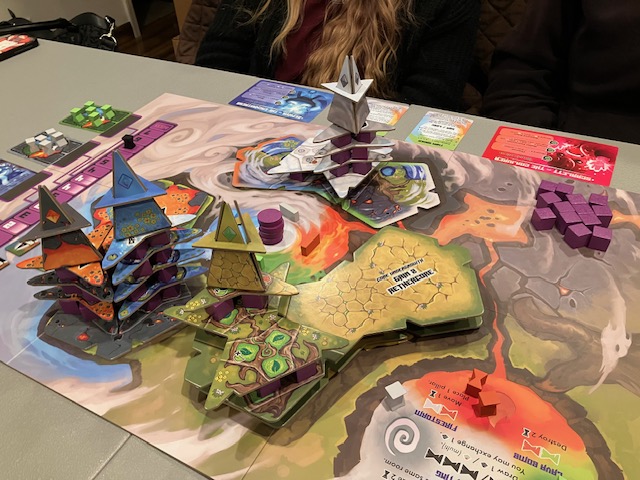
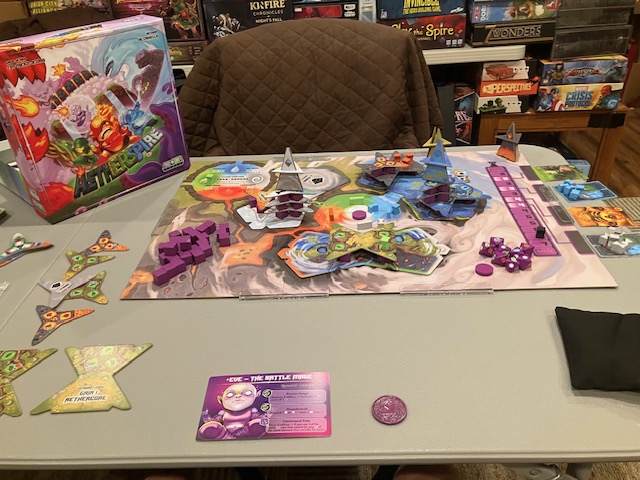
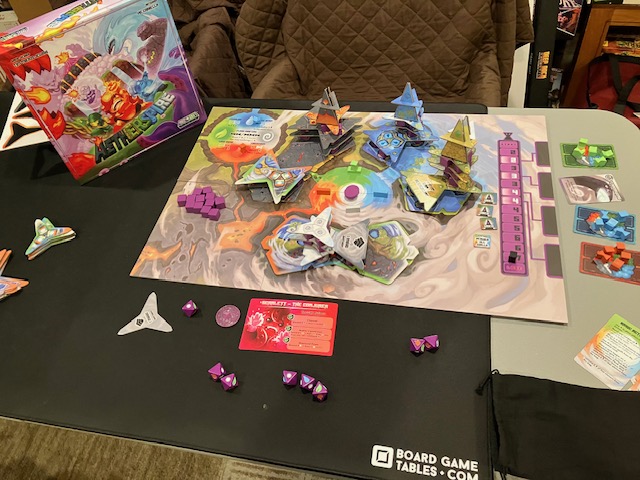
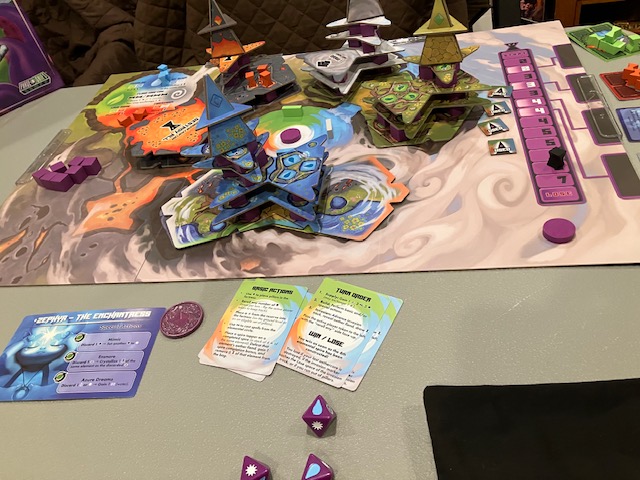
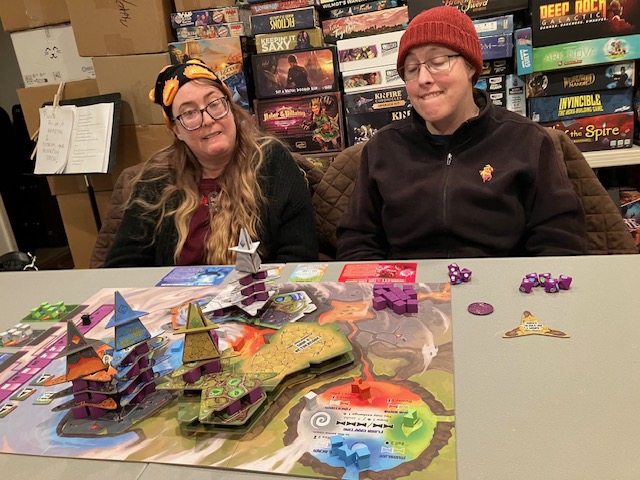
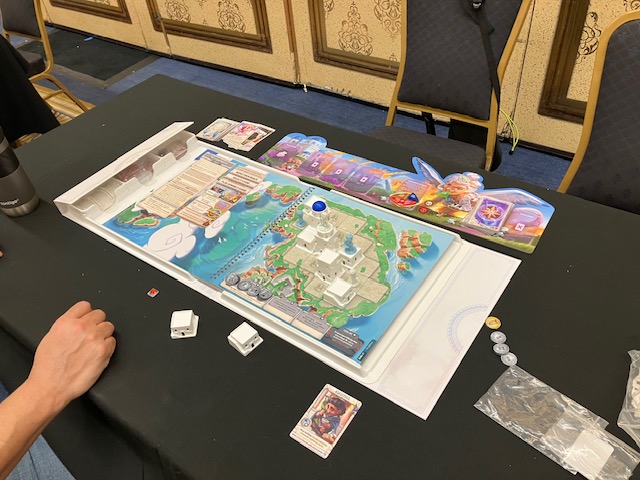
A winning game looks like the above!  3-D towers built with 4 spires!  Pretty cool!

Along the way, during the bad news phase, the spirits of the elements are awoken.

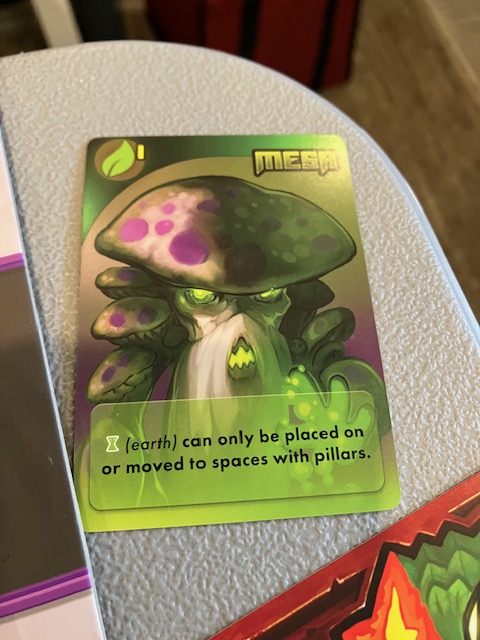
Each one of these has special powers which makes it harder to build the spires.  But building a full spire will KILL the appropriate spirit, so some of the game may be deciding which one to go after!

There are other ways to lose, but usually you will lose when too many invaders come out and there’s no place for them to go!  (If you wait too many turns, you run out of time and just lose: see above).

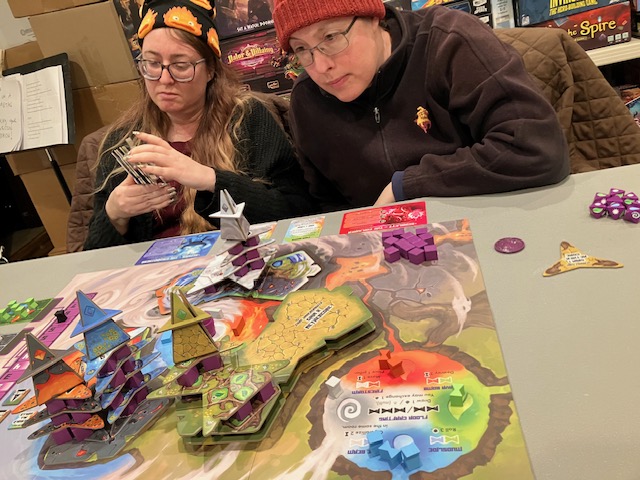
Even if you don’t win, a “nearly-completed” gane looks pretty cool!  See above!

Rulebook

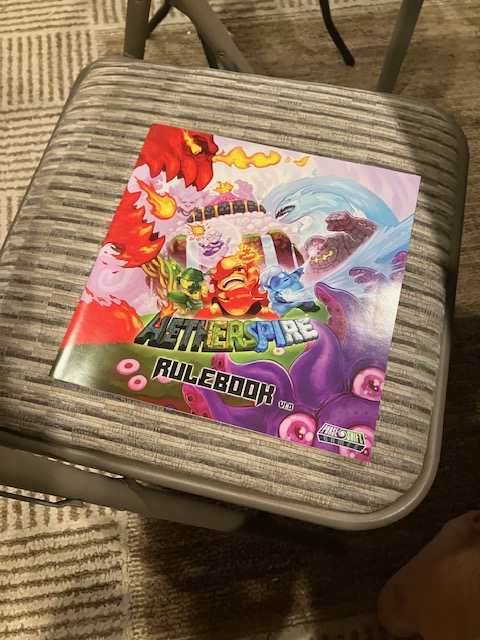
The rulebook is good.  

The font is pretty big and readable, the rulebook stays open next to me on the chair, but there is a little bit of droopage over the edges, so this gets about a B+ on the Chair test.

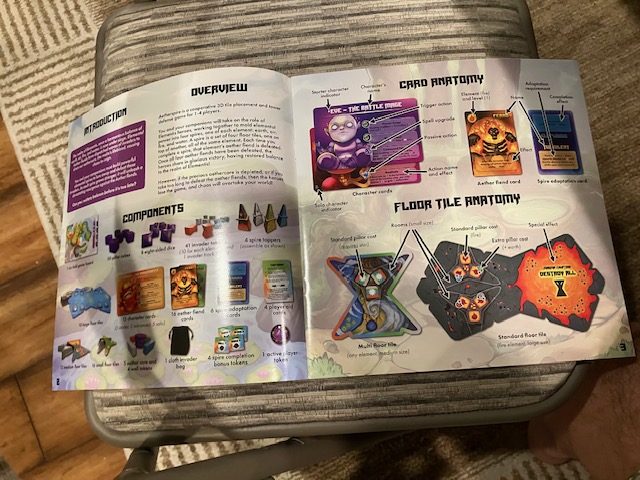
The Components are well-documented with pictures and annotating text.

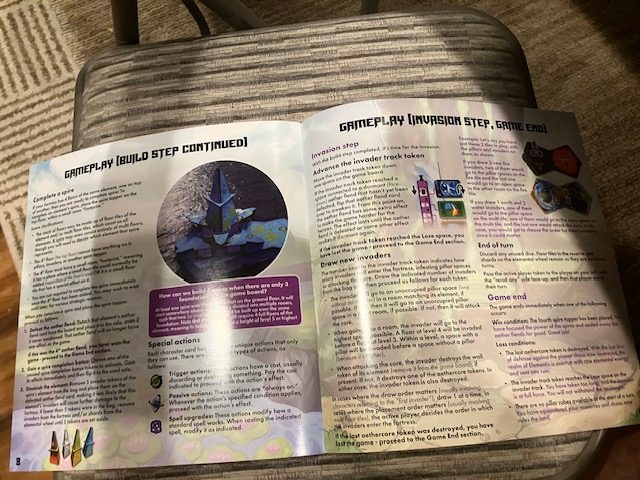
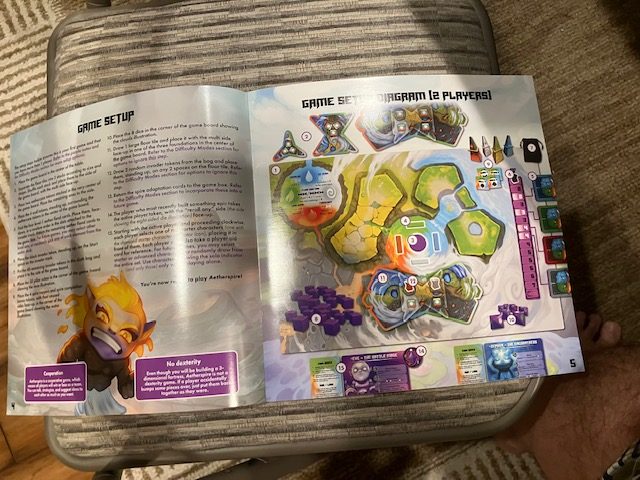
The set-up is perfect: it spans two adjacent pages, stays open, and marks where everything goes.

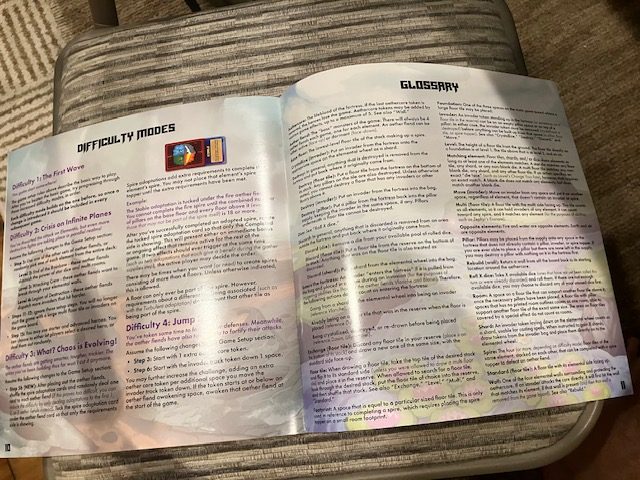
There’s no index, but there is a glossary (see above), and we found that to be good enough.

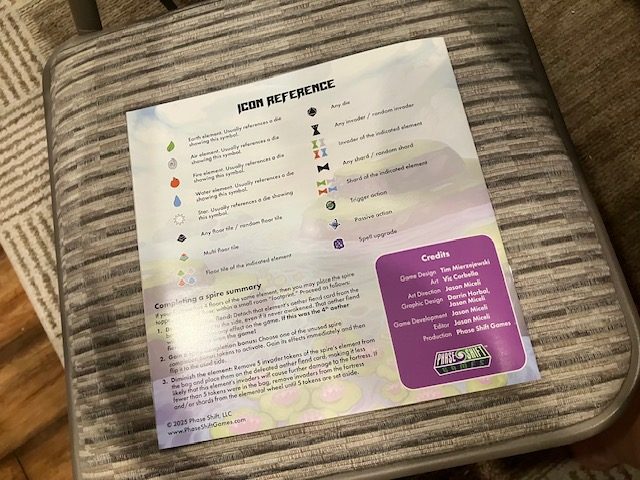
The rules end with a nice Icon reference.  See above.

Generally, this was a good rulebook.  There were a few questions on some edge-cases on rules (see our BGG post here), but the designer seems pretty engaged and answered our questions over there pretty quickly.

Overall, nice job.

Building vs. Dexterity

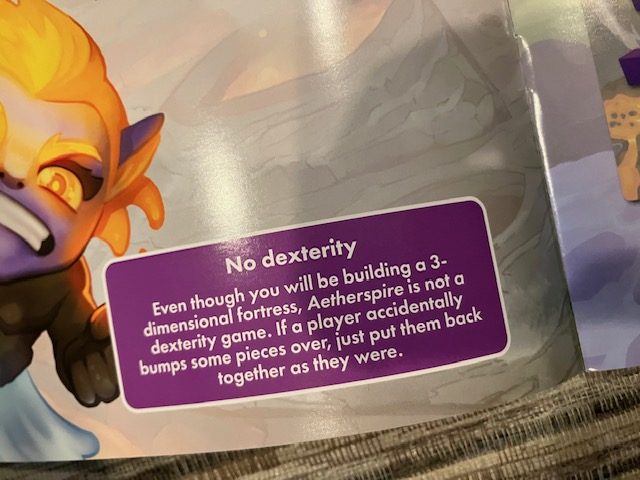
The rulebook makes it VERY clear this is not a dexterity game.   See above.  In all my plays of the game, I never really had any problem knocking stuff over.  (EDIT: update, yes, in our cooperative game we had an “oops” moment, but it was easy to rebuild).  But I like this acknowledgement!  This game is about building cool towers!

Solo Mode

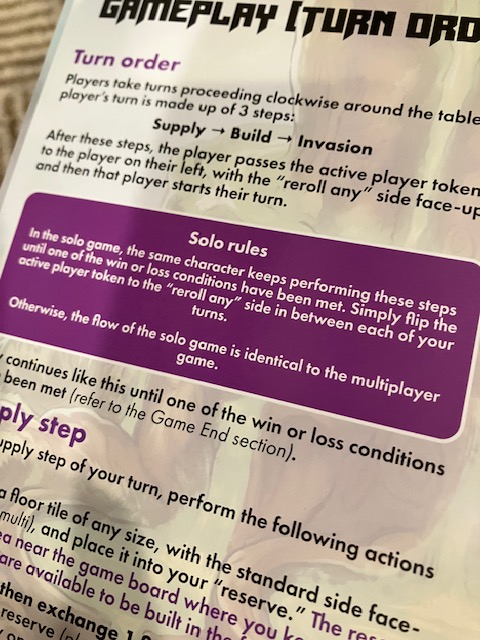
Yes!  This rulebook does a GREAT JOB of acknowledging how the solo mode works! See above!  Thank you for following Saunders’ Law!  The game is true solo, were the solo player operates one character and pretty much plays the game just like normal (no real changes).   I applaud this solo mode!

Over the course of a week, I played about 3 solo games with different characters. The purple guy!  See above!

The blue guy!

…and the red guy!

Strictly speaking, I didn’t win any of my games!  I cheated in my middle game just to see what the endgame looked like (and it was a minor cheat, but it was still a cheat).

This game is hard.  You have to balance the randomness of the dice with the number of invaders points and the scarcity of spell components.  Every decision you make has some repercussion: if you kill some invaders with a spell, then the spell components go back into the bag … which kills the invaders, but changes the distribution in the bag!  If you build too much too soon, you may build so that the invaders have no place to land and they end up breaking down the walls!

I have, over the course of my plays, developed some strategies.  There is some strategy, but also a lot of tactics, as you have to play the dice as they are given.

The randomness can be a little frustrating sometimes, but usually there are just enough mechanisms to deal that randomness (you always get a free re-roll every turn, your special powers can do stuff to  “useless” dice, and the spells can help.  Having said that, the game can sometimes feel just a touch too random.  At the end of day, if you roll poorly, you will lose.

But I liked the way all the systems of the game worked together; they all interacted in interesting ways.  I had fun playing.

As a solo gamer, it’s easy to get this out and start playing.  The amount of maintenance per turn isn’t too bad, and the game moves along as quickly as the solo player likes.   The only “bad part” is how much work it is to clean up the game at the end; there are a lot of components that need to be separated!

Cooperative Play

Cooperative play went over very well!

Using a minor house rule (see below), we were able to win a game!  It was very satisfying.  

In the cooperative game, there’s no real mechanisms to encourage cooperation.  Each player’s turn is very multi-player solitaire!  A player rolls the dice and decides how to use the dice and the spells and deal with the invaders.    A lot of people I know really like this style of cooperative game, as it’s much harder to have an Alpha Player ruin the game … since I can only use my own powers and my own dice.  (Typically, none of the special powers of your character can be used outside of your turn).   So, it might seem this game isn’t particularly cooperative.

Even though the game has no mechanisms to encourage cooperation, a lot of “high-level” cooperation occurs!  Which invaders do we deal with?  Which spells do we use?  How do I use rerolls?  What Spires do we complete?   It’s all high-level discussions.

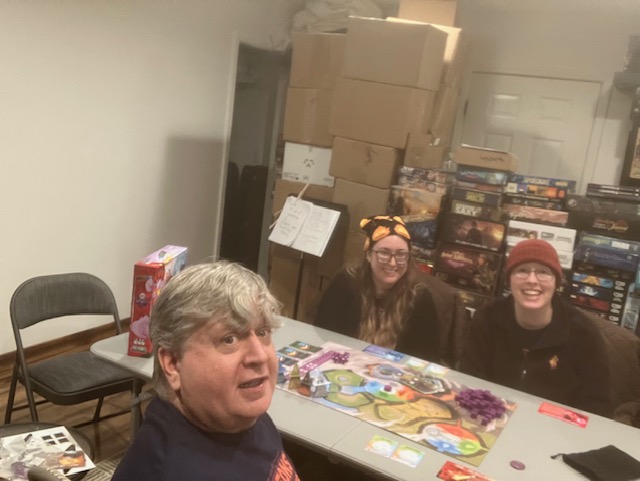
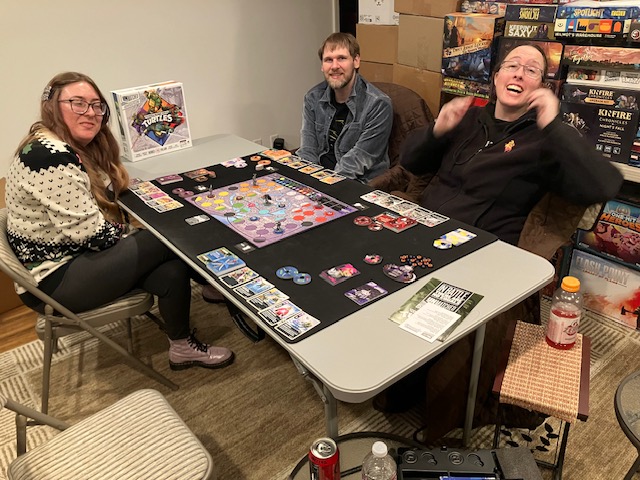
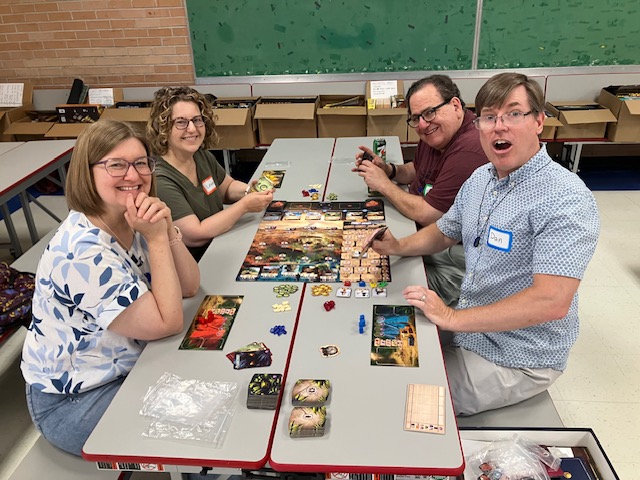
My friends and I, who cooperate very well, had a great time playing this.  We talked a lot about high-level strategy and interacted/discussed/cooperated quite a bit.

I also think this would be an excellent game to play at a convention!  Since you may not know other players very well at conventions, a multi-player solitaire game is a good choice.  It’s harder for Alpha Players to show their ugly head, and each player can execute their own turn, but still conversing with other players!

House Rule: Re-rolls Must Roll Something Different!

There is a very frustrating thing with using re-rolls as a mitigation mechanic: if you re-roll and roll EXACTLY THE SAME THING.  As a house rule, we suggest that, if you roll the same thing on a re-roll, you can re-roll until you get something different.

Some Component Issues

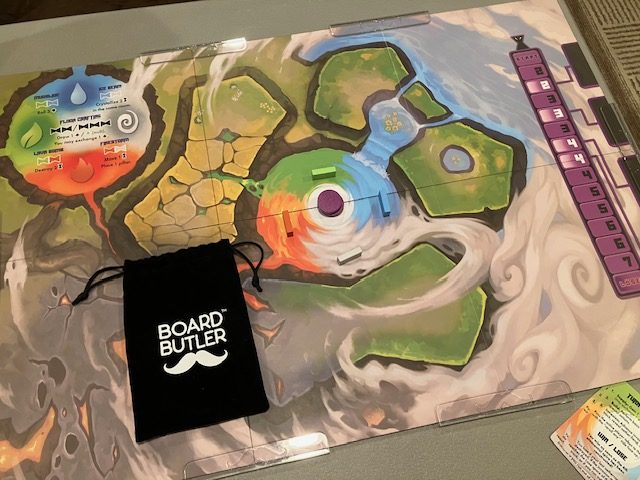
My board had trouble laying flat; I had to use a Board Butler (see above) to make sure the board stayed flat.  I feel like this is a bigger deal in this game because you are building a 3-D structure and the board NEEDS to be flat and stable.  After my third game, it was a little better and I didn’t need the board butler. 

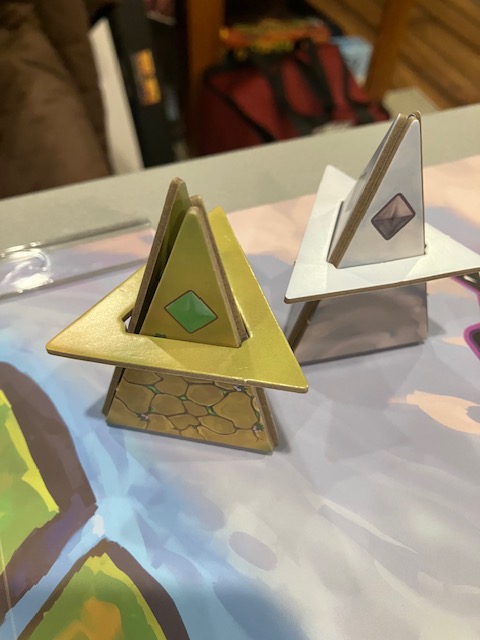
The spires didn’t seem very “stable”.  See as the green spire just kinda opens up, but the white spire stays very compact.  I suspect a little glue might fix this issue.  It’s not a big deal, but it was annoying to try to move the spires around when they sometimes kind of open up or fall apart.  Again, I think a little bit of glue will fix this, so it’s not a big deal.

Randomness

There’s a lot of ways to mitigate randomness in this game, and there are a lot great decision points;  I really like all the places where you can make choices.  For example, at the start of every turn, you get one building piece (you choose the pile), but you can still swap away if you get something you don’t want!  I also like that you essentially have a re-roll every turn! (But see our House Rule above).  I also like that the spell pieces are also the invaders!  It’s cool that you have to think about how the invaders and spell pieces distribute into the bag! All your choices seem important.

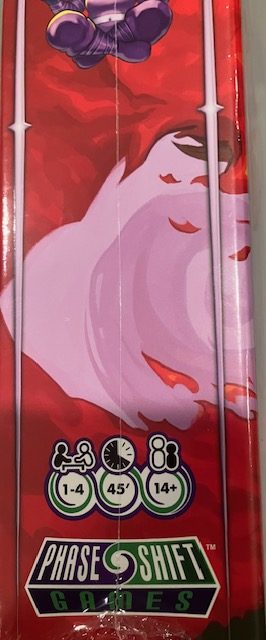
At the very end of the day, though, this is still a dice game.  If you roll poorly and there are no mitigations left, you will lose.  It’s not a big deal because generally there’s enough mitigation so that you don’t have this feeling too often.  Be aware: occasionally, you will be grumpy when you roll badly.   You have to decide if that’s too much for you.  The good news is that the game is pretty quick.  I think 45 minutes estimate might be too little shy; my games were more like 60 to 90 minutes.

Conclusion

Aetherspire is a really neat tower-defense and 3-D building game.  I liked it and my friends like it.

The structures you build are very cool and look great!  It’s fun to be part of that process! See above!  It’s a very kinesthetic and interactive experience!

The game can be just a little random, but there are enough mitigation methods (plus our House Rule) that it’s not usually a problem.  At the end of the day, this is still a dice game that can still stab you in the eye.

My friends and I had a great time playing this! It looks good, it’s fun to build, and there’s enough choices that you always feel like you can do something!

Me and my friends all agree in this one: 8/10 for cooperative mode! It was so much fun!  8/10 for both solo and cooperative mode … although the cooperative might have been a little higher if there just a few more mechanisms for cooperation: the cooperative mode is pretty much multiplayer solitaire with a few high-level discussions of strategy … but that may be what you want at a convention … or to avoid the dreaded Alpha Player.

Side Note: This probably would have made my Top 10 Cooperative Games of 2025 if I had gotten it a little bit earlier … be on the lookout for this on my Top 10 Cooperative Games of 2026!

A Review of Unmatched Adventures: Teenage Mutant Ninja Turtles.

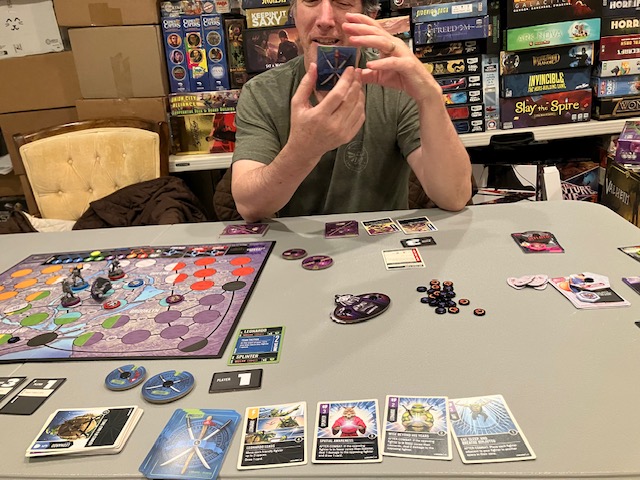
Welcome to 2026! Some of the games that came out in December 2025 feel like they are on the cusp of 2026! Do we count them as 2025 or 2026? We’ll start this month with a game we received in early December … it was early enough that we got in enough plays in to count it as a 2025 release!

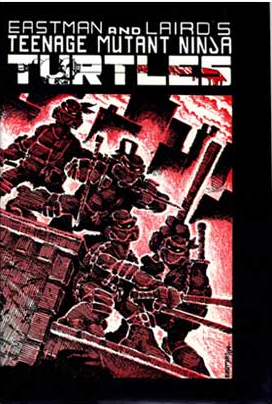
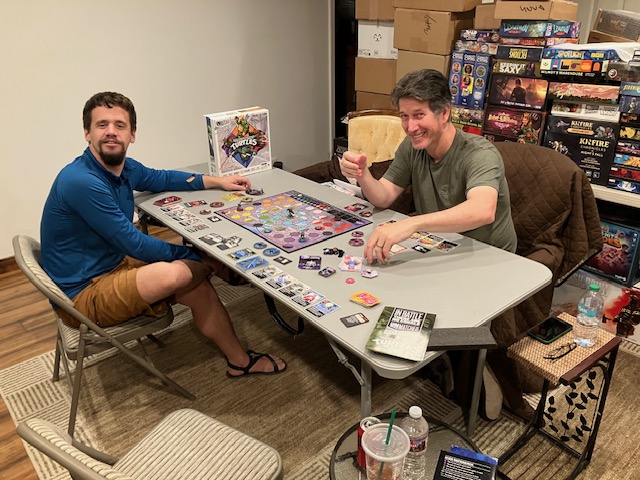
So, I never got into the Teenage Mutant Ninja Turtles. When I was in college, my friend CC was really into the black-and-white Eastman/Laird turtles, but they all had the same color headband … because they were in black-and-white. See below.

The reason I picked up this set because I really like what the original Unmatched Adventures did for the Unmatched universe:  It makes the game cooperative!  See original review here!  So, is it worth picking up the TMNT set even if you don’t like the turtles?  

Let’s take a look!

Unboxing

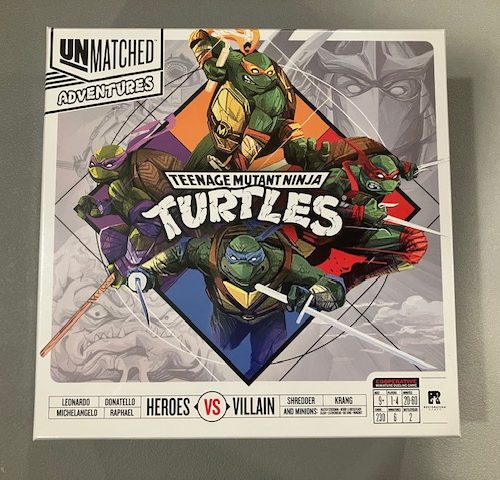
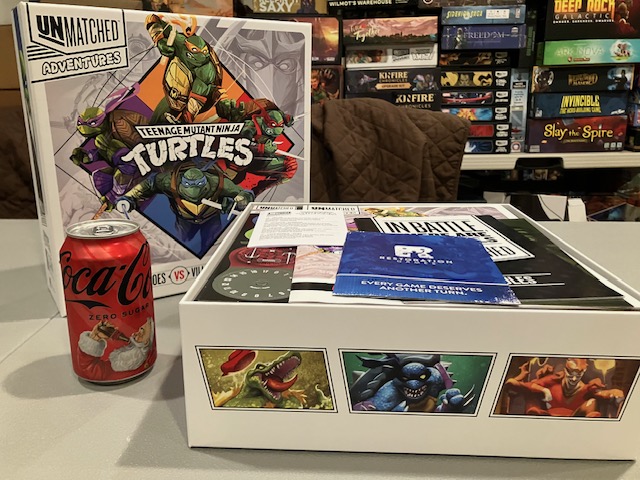
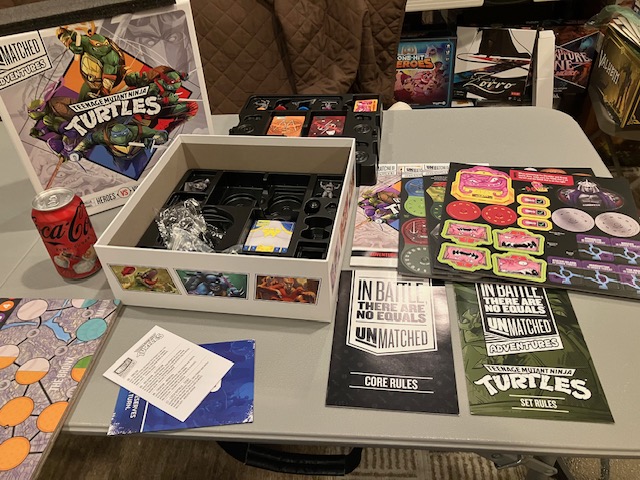
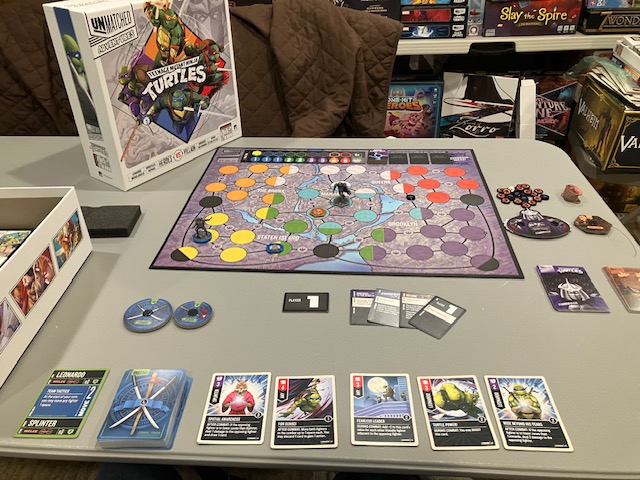
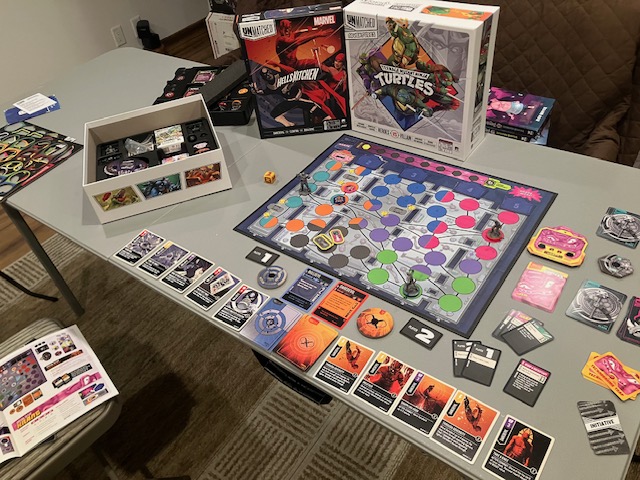
See TNMT box above with Can of Coke for perspective.  This is a pretty normal sized box, but it is taller.

It’s taller because it breaks into two sections.  The top section holds the four turtles: their minis, their cards, their sidekicks, and their initiative cards.   The top of the box is JUST the plain Unmatched turtles.  If you wanted to play turtle vs turtle in a standard Unmatched head-to-head game, you’d only need the top.  To be clear: you can use any of these turtles in the standard Unmatched game with any other set (Rafael vs Bullseye?  Donatello vs. Sherlock Holmes? Michelangelo vs. Bruce Lee? Leonardo vs. Tyrannosaurus Rex?) to play out any head-to-head fight you want.

If, however, you want to play the cooperative Unmatched Adventures part of this box, everything you need (except the initiative cards) is in the bottom part.

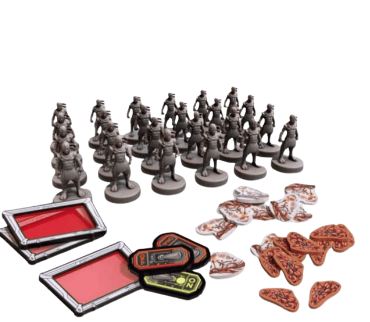
There’s minis for Shredder and Krang (the two big bad bosses you fight in the two scenarios), and a bunch of tokens for the minions, the cards and some dice!

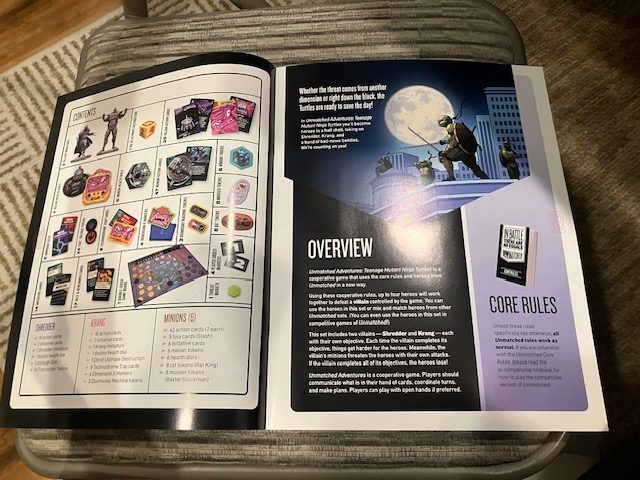
There is a LOT of cardboard to punch out. See above. 

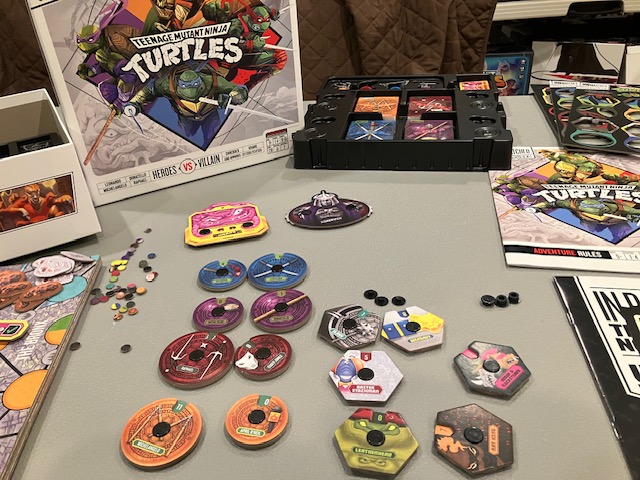
Most of the cardboard is for the spinners: these are hit point markers for the turtles (4), the minions (6), and the sidekicks (4).  I think I spent more than an hour punching out the spinners and putting them together; this might have the worst part of the game (although I have friends who love to punch stuff out for fun).

These inserts are exceptional, as everything fit back into the insert very well.  Everything in its place—see above as the spinners fit in really well into the grooves.

The pieces are all nice (and I only got the standard retail version: there’s a version/auxilary with a lot more minis).

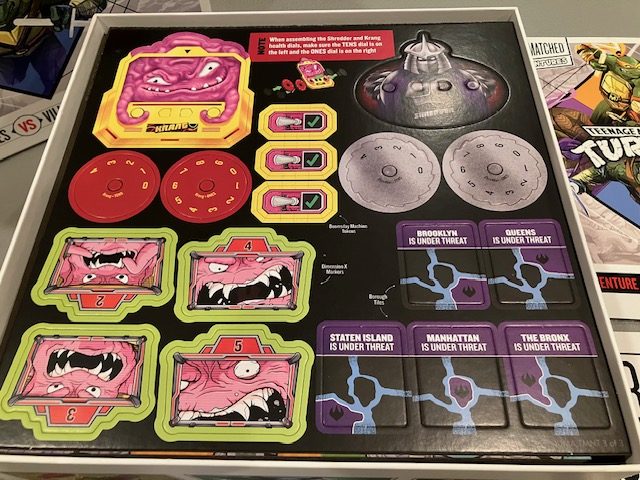
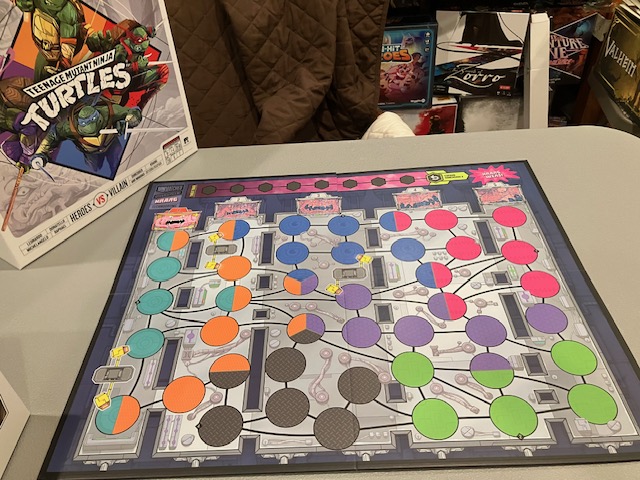
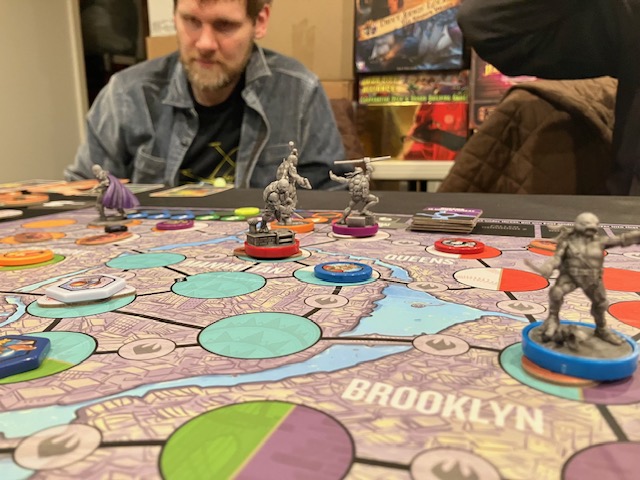
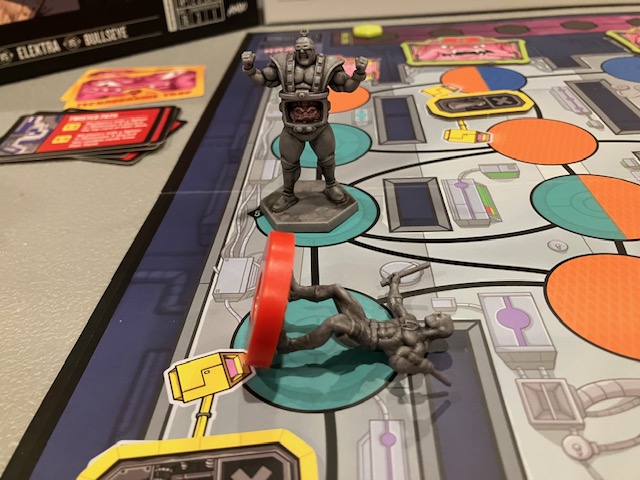
The two-sided board is easy to read/see.  Each big bad boss has his own side of the board: Shredder or Krang. See above for Krang’s side.

The production on this game is fantastic: see above.

Rulebook

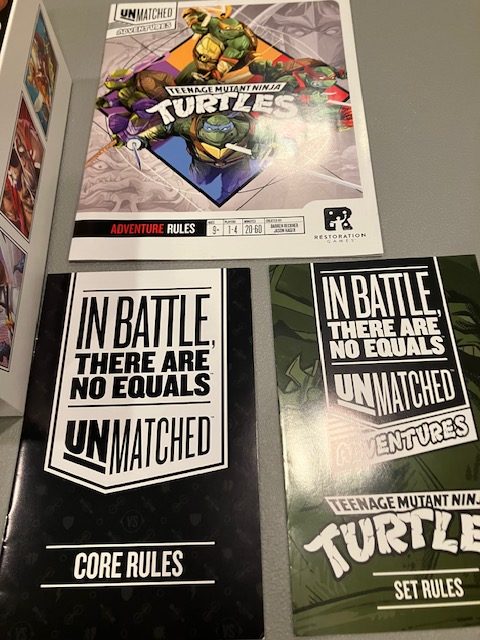
There are three rulebooks that come with this: core rules, set rules, and adventure rules.

The core rules are the basic head-to-head Unmatched rules which describe how to play head-to-head: the way Unmatched was originally meant to play.  This ruleset has evolved over many sets, so it’s great and describes the game well.   The Unmatched Adventures requires players to know the basics of the core game: the three things you can do (scheme, attack, or maneuver), the combat rules, set-up, and such.  This is a good rulebook that has evolved very well over time.

The set rules (above) simply describe and give more detail on the specifics of the turtles and their special powers. See above.

The Unmatched Adventures rulebook describes how to play cooperatively against one of two game-run big bad bosses: Shredder or Krang!

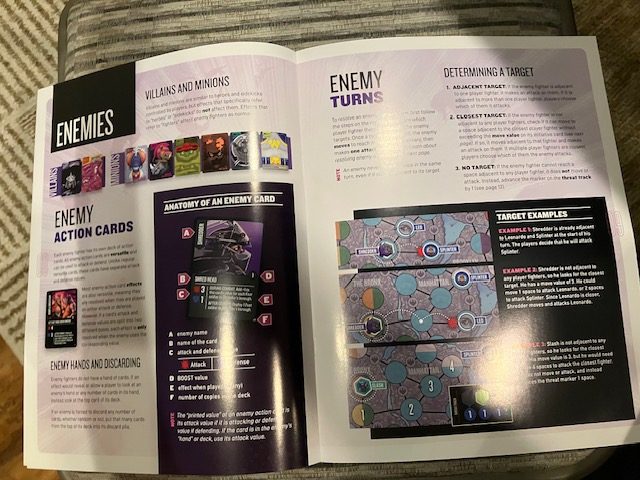
The Adventures rulebook does pretty well on the Chair Test: it droops ever so slightly over the edges, but the font is readable, the pictures and useful, it stays flat on the chair next to me, and it’s easy to read. B+/A-.  See above.

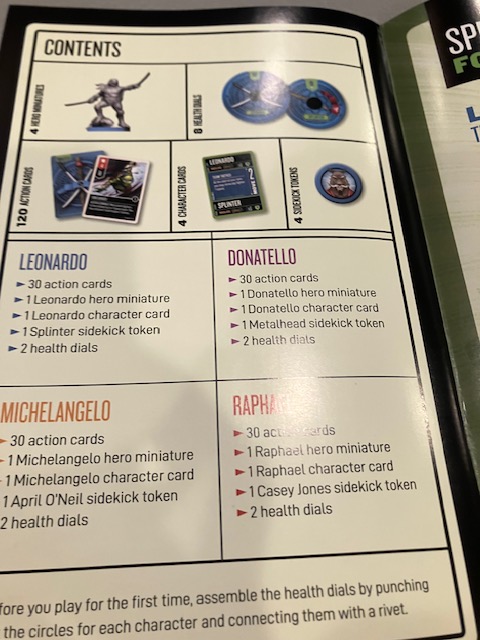
The Contents page is great: annotated pictures of everything.

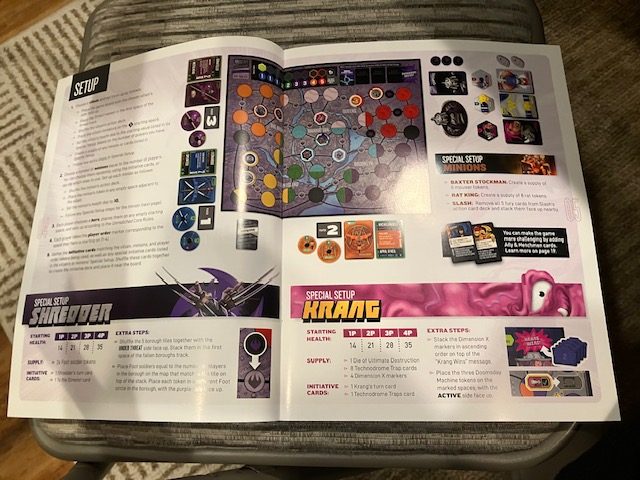
The set-up is perfect: it spans two pages (without crossing a page-turn boundary), and it is well notated.  See above.

In general, this is a good rulebook.

We wish there had been just a little more description in a few places:  for the Minions (For example: can we ever get rid of the Mousers?  The lack of text implies not, but I wish they would have stated it explicitly), and I just wanted a little bit more.  There was also some discrepancy between turns and rounds (especially on Raphael) that tripped us up, and some of the text of Krang was unclear of the relationship between the machines and the zones. 

Generally, good rulebook though.

Gameplay

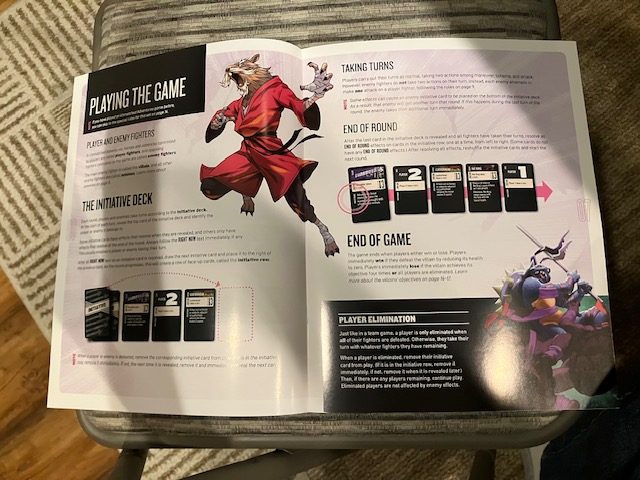
This is a variable turn order game, with the initiative deck dictating when the good guys (the players) go and when the bad guys (the big boss and his minions) go.  The gameplay is very similar to what we saw in Unmatched Adventures: see that review here.  

I still have some problems in general with variable turn order games: see a very full discussion here: A Discussion of Variable Turn Order and How To Mitigate Its Randomness.  

Some of my favorite games have variable turn order, but that still doesn’t mean I love the mechanism; it seems to be a necessary evil for some games.  As we dive into different player counts, we’ll see how this affects the game.

Solo Play

To be clear, Unmatched Adventures supports solo play! (Thanks for following Saunders’ Law).  See 1-4 Players on box!

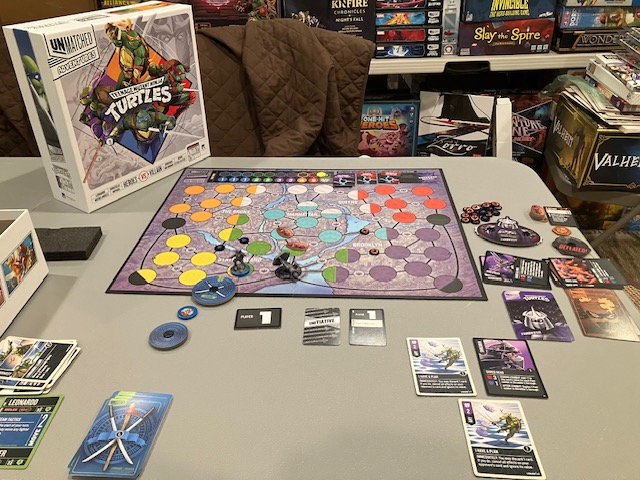
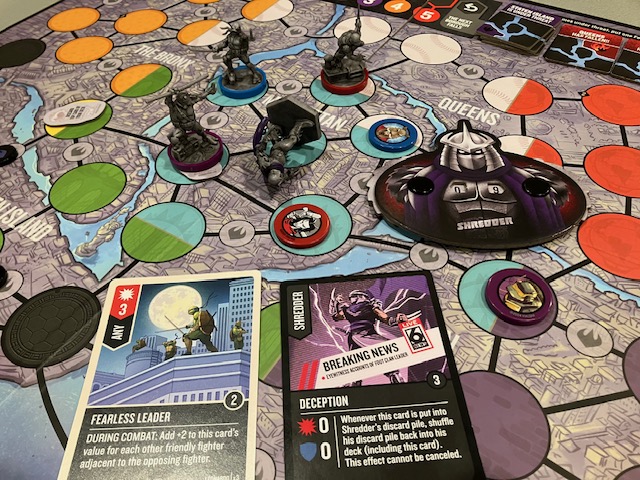
In fact, Unmatched Adventures support pure solo, as one player controls one character! See above as Leonardo takes on Shredder all by himself!

There are two main mechanisms for game balance at different player counts:
1. The big bad boss Hit Points (Shredder above) scale for the number of players.  It’s 7 * (number of players + 1), so 7 * 2 = 14 hit points for the solo game.

2. The number of minions is the same as the number of players.  My solo game (above) has one minion: Rat King!

The solo player still has to manage his deck as well as the Big Bad Boss and Minion deck.  There is some maintenance as you play solo, but it’s not too bad.

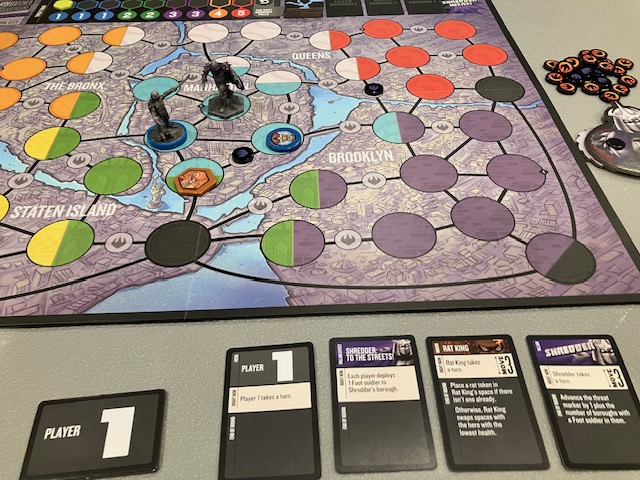
I think the worst part of the solo game is how small the initiative deck is: only 4 cards!  One for the player/sidekick, one for the minion, and two for Shredder!   I still liked the solo game, but I was often frustrated when the bad guys got so many turns in a row!  In the worst case, the bad guys can get 6 unanswered turns in a row!  

I still liked the solo game.  I like how it’s true solo play (you only have to play one character), I just noted the variable turn order felt overwhelming sometimes … to be fair, that does sometimes describe how a true head-to-head game feels: sometimes the other guy will just mess you up!  (This just re-emphasizes some of these same feelings of the solo mode in our previous review).

As usual, we recommend playing solo first so you can learn the game to teach your friends cooperatively.  And the true solo mode works, if a touch random.

Cooperative Play (4-Players) With No Fans

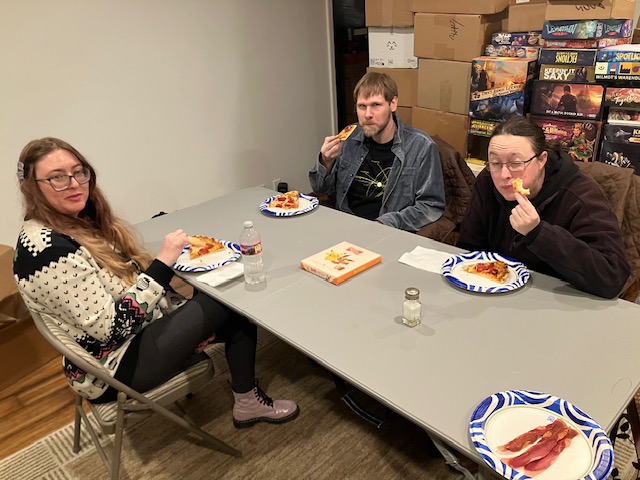
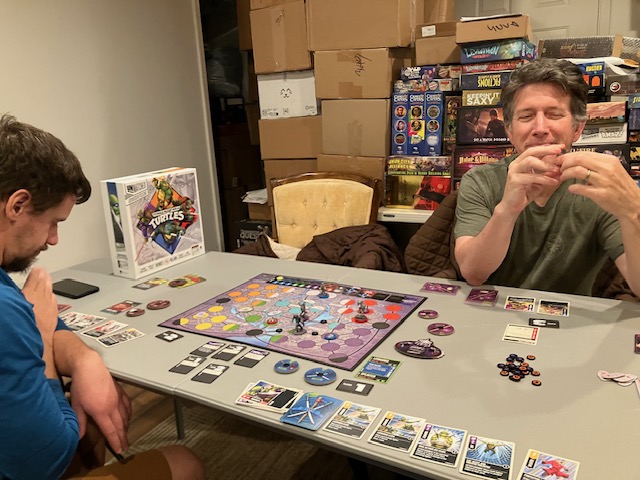
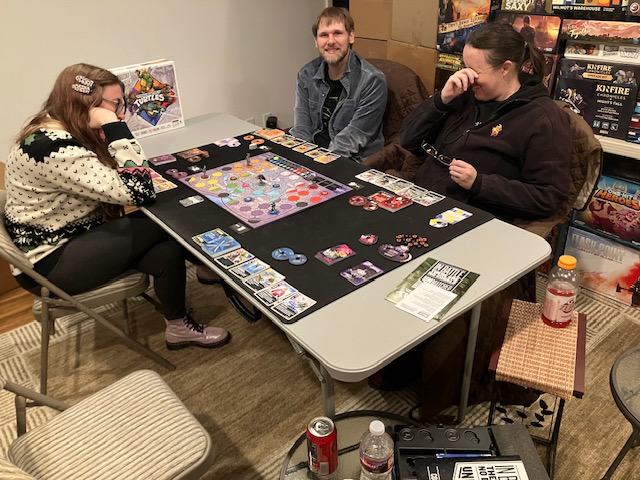
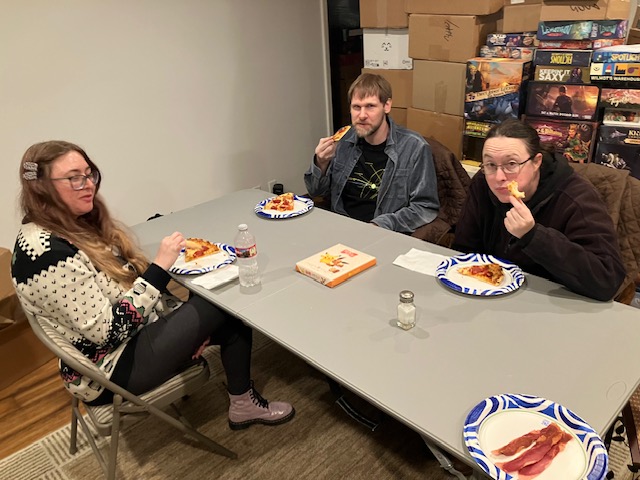
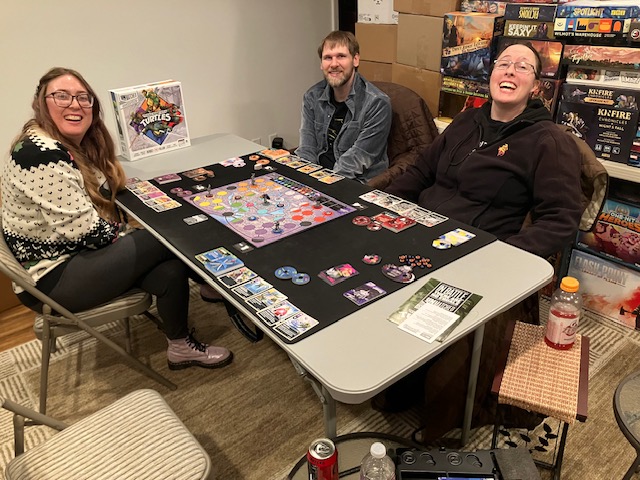
It goes without saying that we had to eat Pizza first before we played a full-up all four turtles game!  I am not a TMNT fan, but even I know they eat pizza!  

The four player cooperative game went over pretty well.   Like we noted in previous Unmatched Adventures, the variable turn order problems are much less pronounced with more players.  There are enough initiative cards that players don’t get stuck with the bad guys getting too many turns in a row.

A problem we had with 4 players is that it was sometimes too hard to get around Shredder to do damage!  Each of the turtles gets a sidekick, so there are 8 good guys (4 turtles and 4 sidekicks (April, Casey Jones, etc) and sometimes it was a little frustrating as they couldn’t get some of the good guy to do anything useful!   This does feel a little like a first-world problem (“Oh no, we can’t all do damage to Shredder!”), but it did cause some frustration in my group as sometimes you couldn’t get anything done on your turn because there was no place to move to!

We generally had fun and took down Shredder as all 4 turtles!

Interestingly, no one in my group was a TMNT fan!  They all knew of the turtles, all were okay with the turtles, but no one was “a fan”.  Despite not being fans, we all had fun playing the turtles. 

Generally, I think the game is more fun cooperatively than solo.

Cooperative Play (3-Player) With A Big Fan

My friends Jon is a huge TMNT fan; so I had to make sure to get is opinion when he played.

In general, he liked it.  I do think a 3-player game was a little better than 4-player game you get back to your turn quicker,  and vying for space around the board wasn’t quite as bad.  4-Player still worked, but I do think 3-Player is better. 

Solo Play (2-Player)

For comparison purposes, I did want to see how (a) how other heroes played in this world (b) how the Krang scenario played (c) how 2-Player/2-handed solo played.   So, I played a two-handed solo game of Daredevil and Bullseye against Krang!  See above!  It’s an unlikely alliance, but Daredevil and Bullseye have teamed up to protect their city!

The first game went horribly as Krang took out Daredevil early. Bullseye just looked at the board, said “no way”, and walked away (he is, after all, a villain).  Krang won!

After resetting, Daredevil and Bulleye used their abilities better together and Daredevil took Krang our with a Feint on the very last round (see below) … he only had to do one damage, but the Feint cancels all bad-guy effects!  So, Daredevil‘s Feint won the game! It was great!

This was a very thematic session of two games: Daredevil and Bullseye failed in the their first team-up (Daredevil  Comics #992), but then after learning from their failure, they were able to go in and take out Krang! (Daredevil Comics #993).  It just felt like two comics back-to-back!

I think I enjoyed two-handed solo more than pure solo.  Like I have said many times, the presence of more heroes in the initiative deck helps “smooth out” the randomness of the variable turn order system.  And, in this case especially, it felt very comic-booky over two issues.

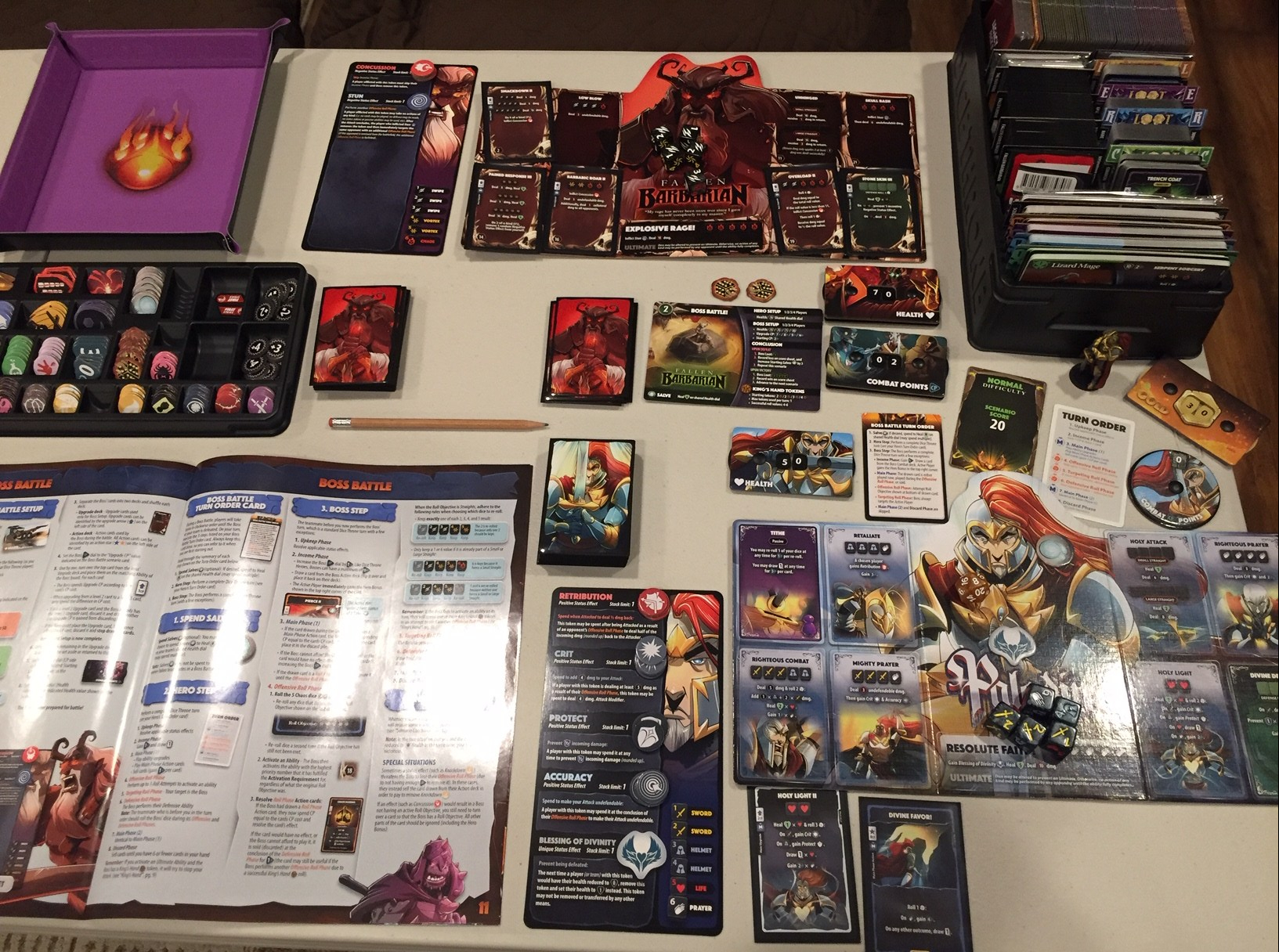
Dice Throne Adventures/Missions vs. Unmatched Adventures

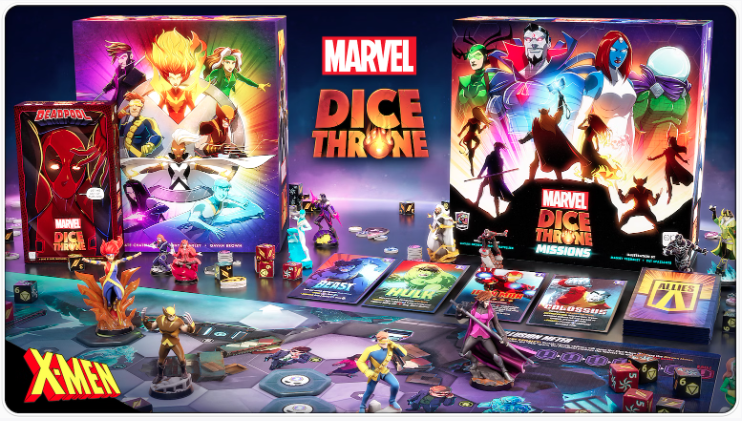
What Dice Thone Adventures does for Dice Throne, Unmatched Adventures does for Unmatched: it takes a head-to-head game and turns it into a cooperative adventure!  If you weren’t sure which one to get, let’s do a quick comparison. 

  1. Both have Marvel Characters
    1. Dice Throne has 8 Marvel generic and 9 X-Men=17 characters
    2. Unmatched has 16 generic Marvel characters (only 1 X-Man).
  2. Both have a ton of other/non-IP characters.
    1. Dice Throne has 16 from Season 1 and 2, plus Santa and Krampus, 4 for Outcasts, another 4 from Vanguard = 26?
    2. Unmatched has sooo many characters, I can’t even count. See here!

The fun of these systems is that there are SO MANY characters to choose from both.  Dice Throne has a slight advantage in Marvel characters, but Unmatched probably has more characters overall.

The one thing I will say is that I think it’s easier to jump into a Unmatched Adventures game than a Dice Throne Adventures game.   We found out the hard way that you HAVE to play your Dice Throne character(s) beforehand, otherwise the rules overhead will be too much.  Usually, this means playing a quick head-to-head Dice Throne game to see how the characters work.  As we’ve seen in this review (and the Unmatched Adventures review), we’ve been able to drop new players into the  Unmatched Adventures game and they immediately understand!   

Dice Throne Adventures is a little more tactical (but see randomness issues below), but the powers of the Dice Throne Adventures are pretty neat too.  I’d recommend playing them both to see which one you like better; they both scratch a similar itch.
Scenarios

Of the two scenarios, I liked the Shredder experience more: it was  less random.  

The Krang scenario had a little too much luck for me.

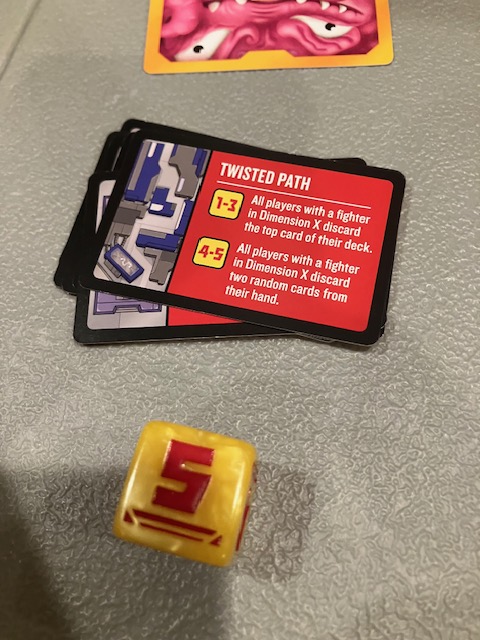
This deck in particular (see above) was very random and kind of made me mad a few times.  And you have to roll every round to maybe/maybe not activate machines.  I didn’t love the randomness of the Krang scenario.

Overall, I will probably play the Shredder experience a lot more than Krang, but Krang is a unique experience for which I will “tolerate” the randomness now and then.  Of all the scenarios from both Unmatched: Adventures: Mothman, Aliens, Shredder, and Krang Krang was by far my least favorite.   

Unfortunately, the randomness of the Krang scenario does bring my rating down a little for this set.  It makes it a little harder to recommend this for a non-turtles person.

Sharing the Load

Because there is one minion per player (for scaling to the number of players), we shared the load by having each player operate one of the minions.   I liked this because it makes everyone feel a little more invested! If I were running everything myself, then people would feel less involved (and I would be grumpy because I was doing everything).  Since everyone has to run at least one of the minions, that makes the game feels more interactive.

I liked that we could share the load; it made the game feel more cooperative.

Conclusion

Everyone liked  Unmatched Adventures: Teenage Mutant Ninja Turtles; it was fun at all player counts, with pure solo possibly being the weakest.  Even if you don’t know/don’t like the TMNT, this is still a good get because it expands the Unmatched Adventures world and gives you two more scenarios!   (Be aware that one of the scenarios is more random than the others,  so that might have an influence on your decision).   And the turtles were fun to play, even though we didn’t know/love them.

Overall, Unmatched Adventures: Teenage Mutant Ninja Turtles is probably about a 7.5/10 or 8/10.  If you love TNMT, that probably adds another 1 or even 2 points to that score.  If you are turtles fan, be aware there is a mini-upgrade kit (see above) which turns a lot of tokens into cool minis … you might want that.

To be clear, this is a standalone set. If you love TNMT and don’t really care about any of the other Unmatched warriors, this is perfect for you: you don’t need anything else. If you just liked Unmatched Adventures system, this does add more scenarios for you! Just be aware that Krang is a little more random.

We liked this enough to be on our Top 10 Cooperative Expansions of 2025!

Top 10 Cooperative Board and Card Game Expansions of 2025!

Welcome to the end of 2025!  There were some great games that came out, but also some great expansions that really contributed to the world of cooperative games!  As usual, we qualify our expansions are one of three types:

  1. Stand-Alone Expansion: Some games you thought might be on the Top 10 Cooperative Board and Card Games of 2025 might have just ended up on this list because they are stand-alone games that can be played without a base game, but at the end of the day they also expand a base game!
  2. Makes The Game Cooperative: Some expansions take a competitive base game and make the game fully cooperative with the expansion! We saw a number of these type of expansions on the Top 10 Games That Can Be Played Fully Cooperatively!
  3. More Content: Some expansions just add more content (more cards, etc.) to the base cooperative game!

We also continue with the newer characterization: Does It Require Another Expansion

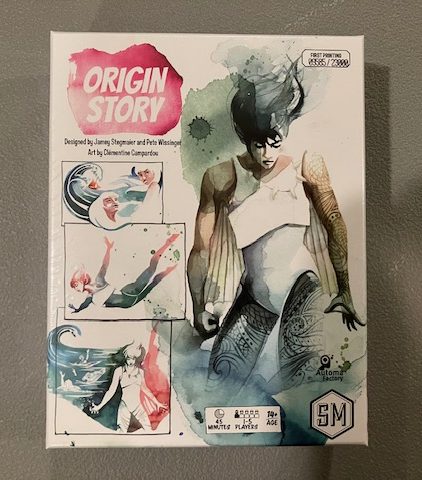
Honorable Mention: Origin Story

Expansion TypeMakes The Game Cooperative
Solo Mode: Well, you could play the 3-character co-op mode as a solo player, but there’s already a 3-character solo mode in there.
Requires Another Expansion?  No

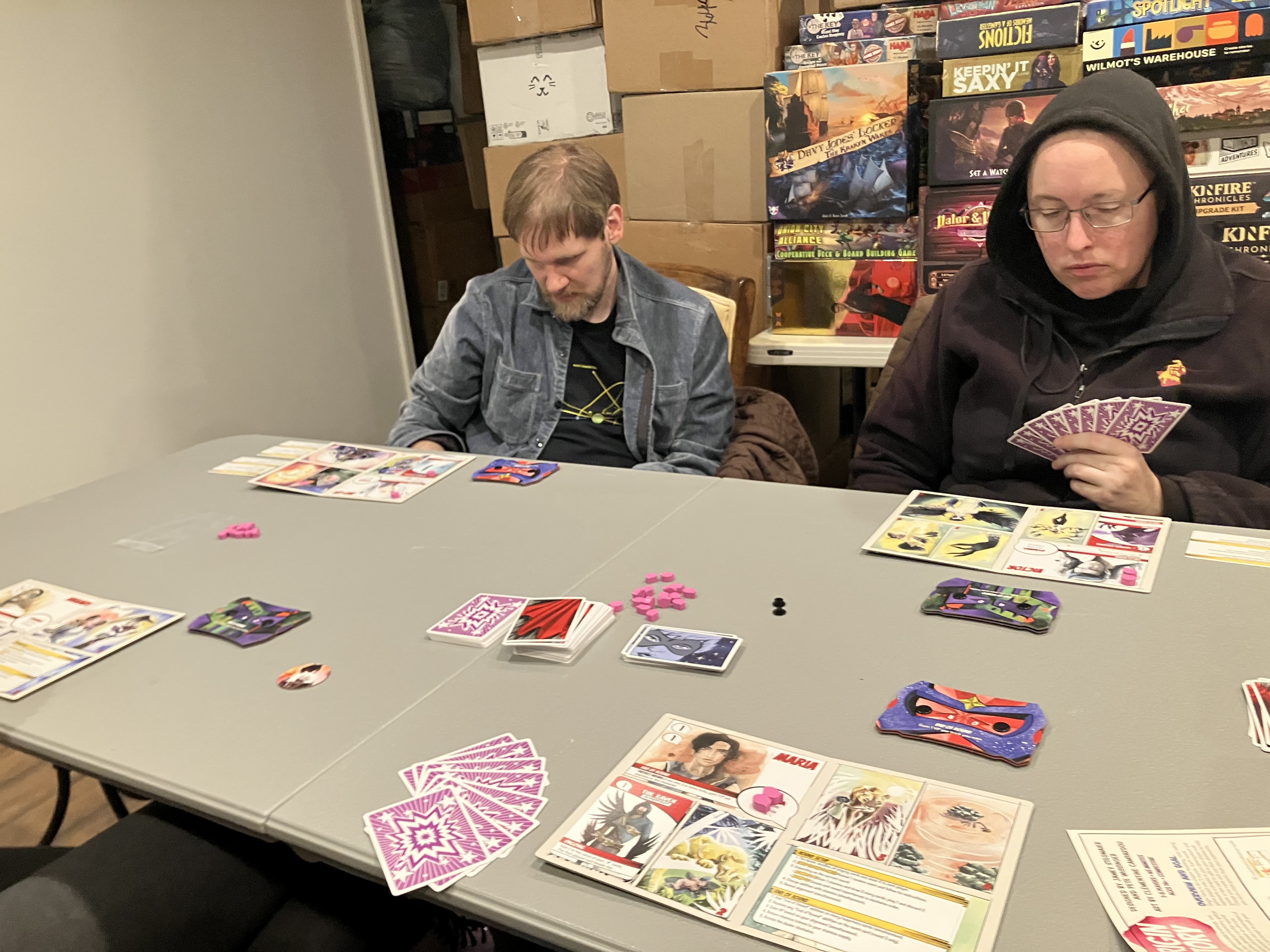
This is an odd duck … because it’s not a real “official” expansion.  This is a homebrew set of rules to make the really wonderful game Origin Story into a cooperative game!  See link here for rules.

We played Origin Story, admired how well it works, especially with the powers, strategizing a limit of 5 rounds … and the artwork is amazing. While playing, we couldn’t help to think “Being a Super Hero game, is there a way to play cooperatively?” We fervently decided a new mode of gameplay should be added: a cooperative mode! Over a month or so, we developed some simple rules to make an optional cooperative mode for Origin Story. These rules probably need a little more play-testing, but frankly, we all enjoyed the game in a whole new way with this cooperative mode. Now, as well as playing the current mode to be the best Super Hero and win, all the Super Heroes can now work together to save the planet in a cooperative mode!

A Super Hero game should be cooperative: see this free set of rules here.

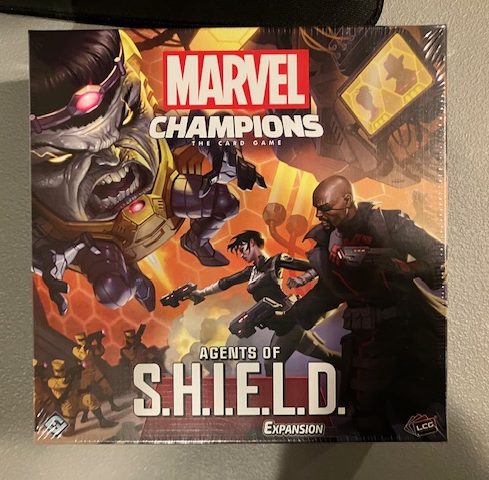
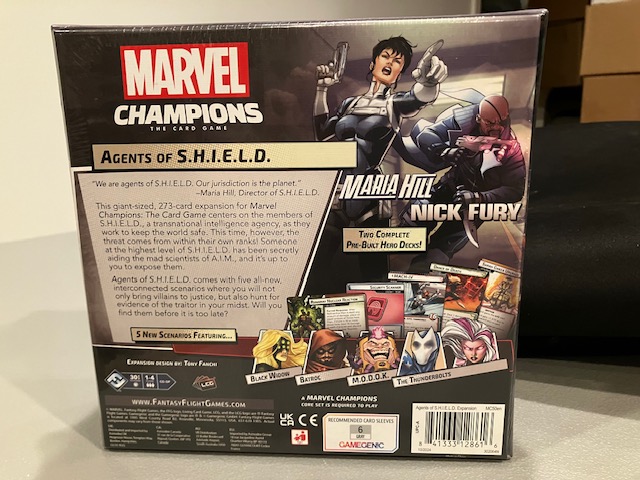
10. Marvel Champions: Agents of SHIELD

Expansion TypeMore Content
Solo Mode: No new solo mode, just the original
Requires Another Expansion?  No

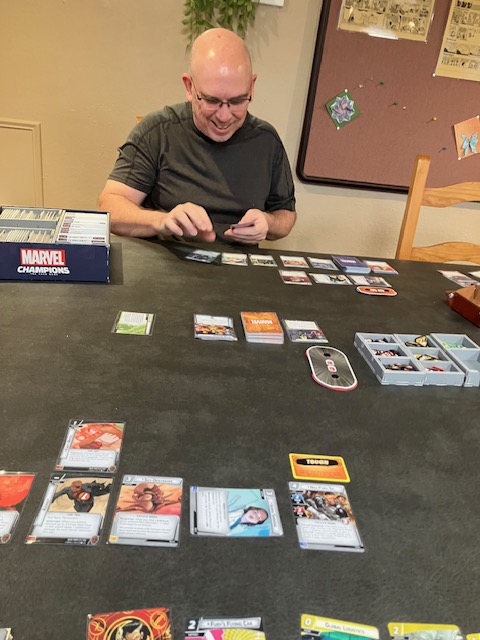
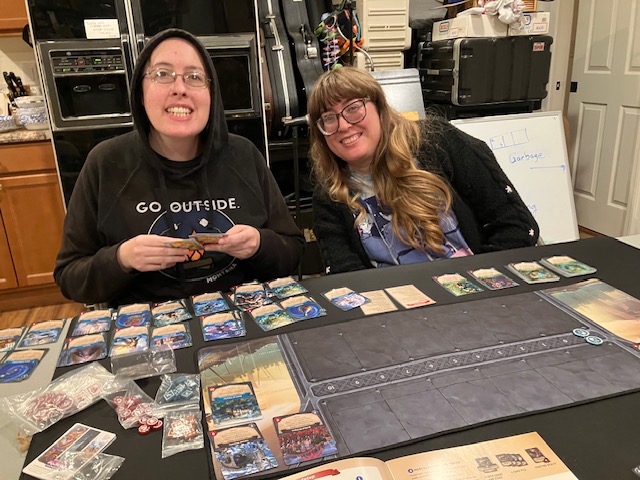
More than any other game on this list, I play this with my buddy Junkerman (see above).   He loves Marvel Champions, even more than me!  (So much so, that he has his own blog about it: see Aspect Expressions Blog here!)   Marvel Champions is a game where you get the expansions because they offer you characters or some kind of adventure!

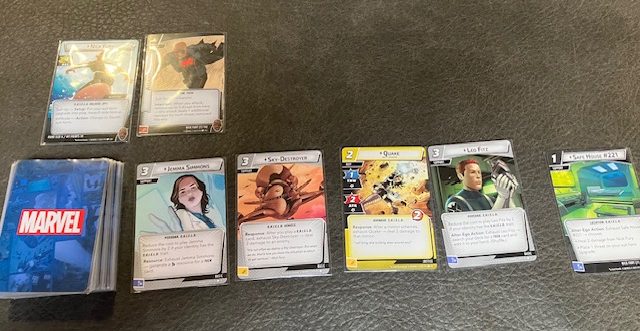
In this case, we get Maria Hill and Nick Fury as characters, running them through an adventure of 5 Scenarios as Agents of SHIELD!

I think what sold me more than anything else was the fact that Nick Fury gets a Flying Car!  Once I saw Nick Fury had that, you couldn’t stop me from playing him!  A Flying Car!! Agents of SHIELD is just more content in the Marvel Champions universe; good stuff.

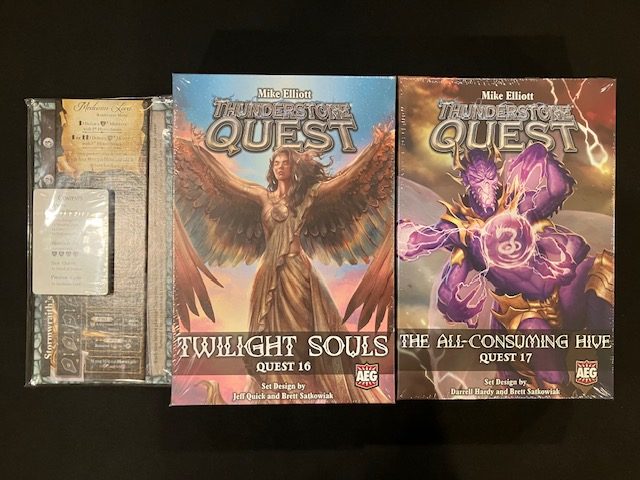
9. Thunderstone Quest: Twilight Souls/The All-Consuming Horde

Expansion TypeMore Content
Solo Mode: Needs The Barricades Mode Expansion for solo
Requires Another Expansion?  Yes: To play solo or cooperatively, you need The Barricades Mode Expansion 

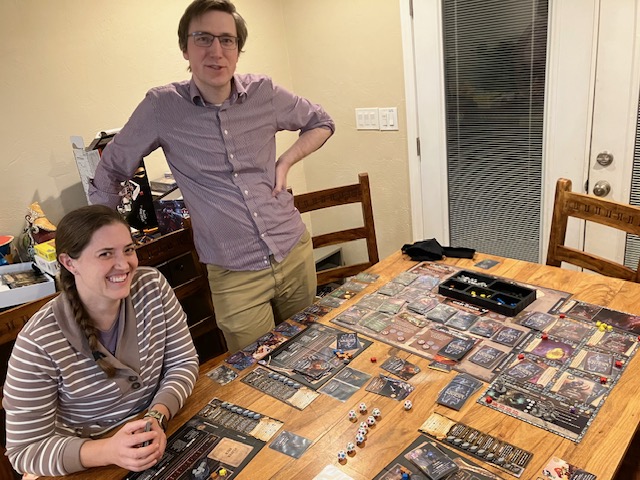
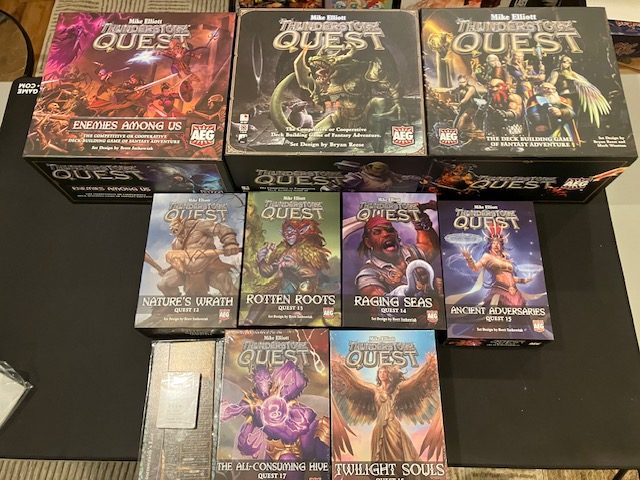
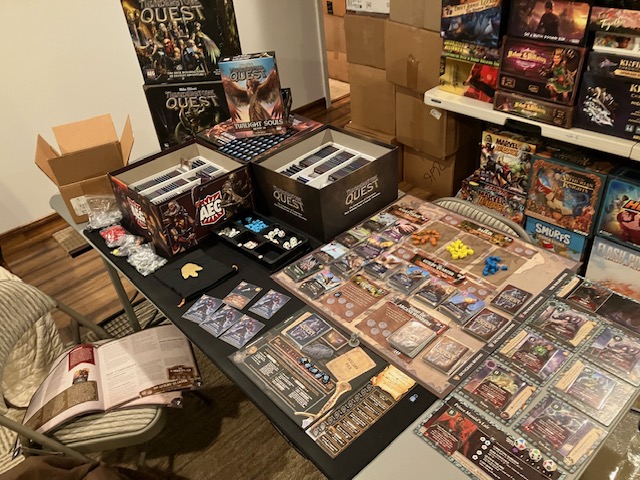
If Junkerman is my Marvel Champions buddy, then Nathan and Caroline are my Thunderstone Quest buddies!   I have played most of the recent Thunderstone Quest expansions with them!  See above as we finish The All-Consuming Hive, having rescued peoples from a living dungeon!

It’s kind of gotten ridiculous how many Quests there are (see above).  But, these expansions still offered something new and expanded the game and made it more fun!

It’s gotten a little ridiculous (I know I have already said that), but I still like to play Thunderstone Quest solo or cooperatively (see above as a I play Twilight Souls solo).  You can still use these two new expansions in the base competitive game, but if you want to play solo or cooperatively, don’t forget that you need the Barricades Mode expansion!

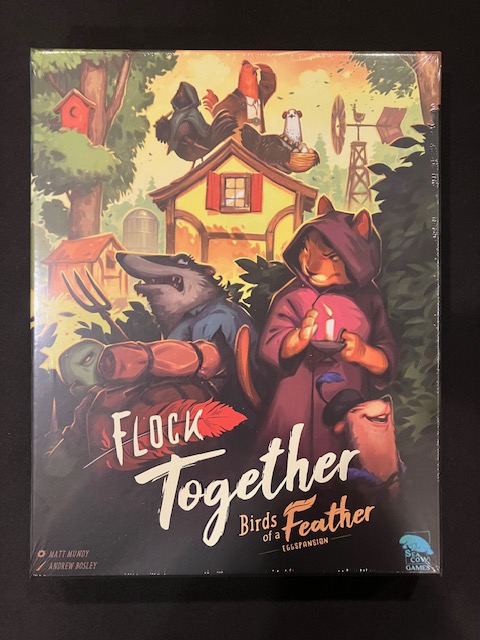
8. Flock Together: Birds of a Feather Eggspansion

Expansion TypeMore Content
Solo Mode: No new solo mode, just the original
Requires Another Expansion?  No

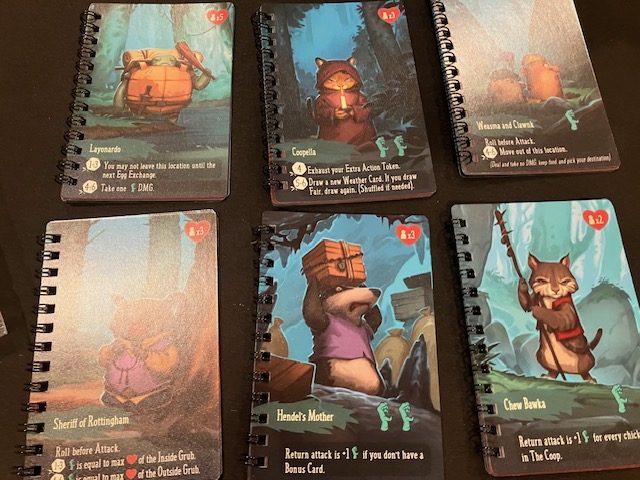
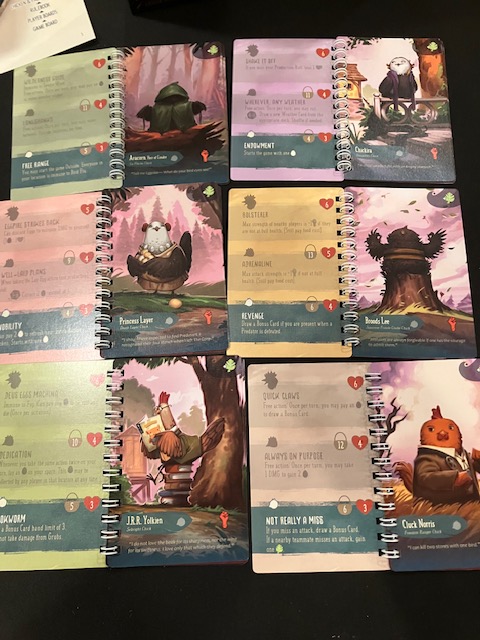
This is the easiest type of expansion to recommend; it just adds more of everything you already like to the game!  This eggspansion (be prepared for lots of Chicken puns) adds some new cards, some new players boards (so you can play up to 6) … but, most importantly, it adds 6 new predators with 6 new chicken puns (see above) … Chew Bawka?  Oi!

… and 6 new player chickens (with even more chicken puns)!  If you liked the base cooperative game Flock Together (see our original review here), this is just more stuff of the stuff you already like!  You like Chicken Puns, right?  See our review of the expansion here!

7. Skytear Horde: Campaigns

Expansion TypeMore Content, Standalone Expansion
Solo Mode: No new solo mode, just the original
Requires Another Expansion?  No

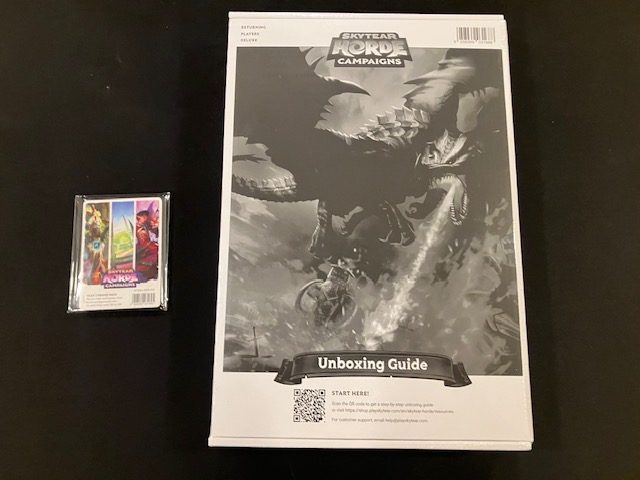
I never know whether this series should go on my Top 10 Solo Games of 2025 or my Top 10 Cooperative Expansions of 2025!  This year, because I was able to get it played cooperatively in a some good sessions, I am counting is a cooperative (standalone) expansion!

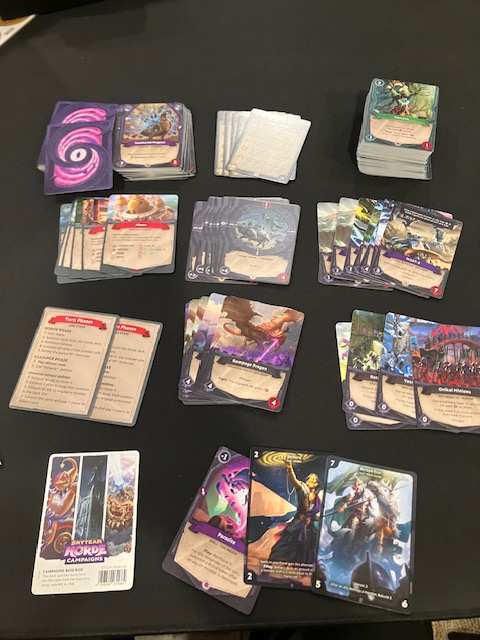
This expansion is mostly just new cards!  If you like Skytear Horde (see our original review here), this just gives you more cards … more content … for this cooperative tower defense game.  

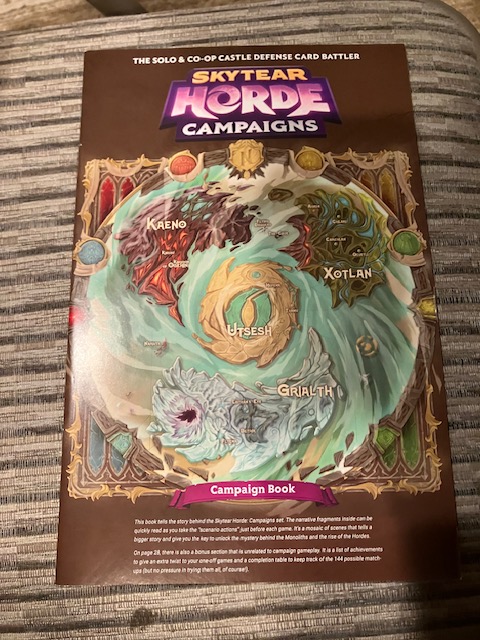
There is a campaign book in here that is both good and bad.  It’s not particularly well-written, but once you get how the campaign modes work, I think they add a lot to the base Skytear Horde game!   See our review here where we discuss the good and bad of Skytear Horde: Campaigns!

In fact, I conjecture that this campaign mode could be a phenomenal way to teach the game!  I taught my friends the game using the campaign mode, and they really responded well to this!  Basically, the game comes out piecemeal in campaign mode, making it easier to digest.  For this to work, however, you really need someone who knows the game  to teach this mode.  Check out or review of Skytear Horde: Campaigns if you want more information!

6. Leviathan Wilds: Deepvale Expansion

Expansion TypeMore Content
Solo Mode: No new solo mode, just the original
Requires Another Expansion?  No

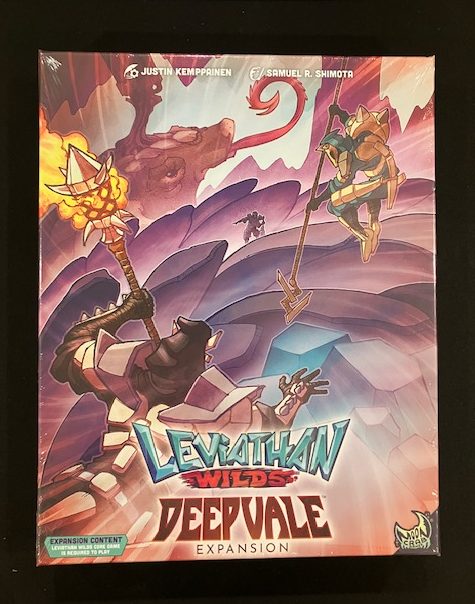
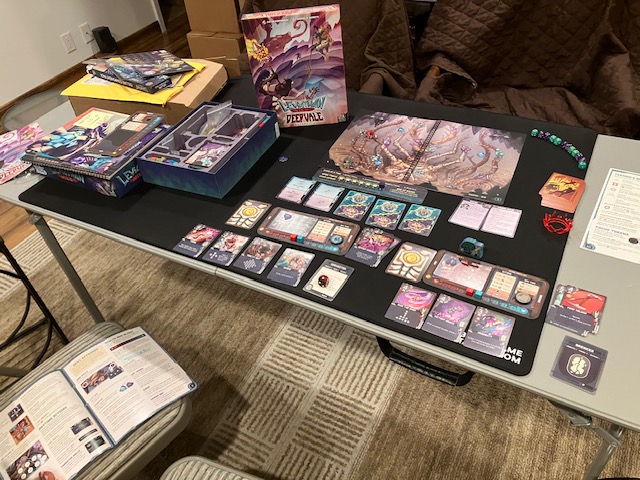
This really is just a more stuff you already like expansion!  If you liked the original game of Leviathan Wilds (see out review here of a game that made our #3 on Top 10 Cooperarive Games of 2024), this just gives you more of the stuff you like!

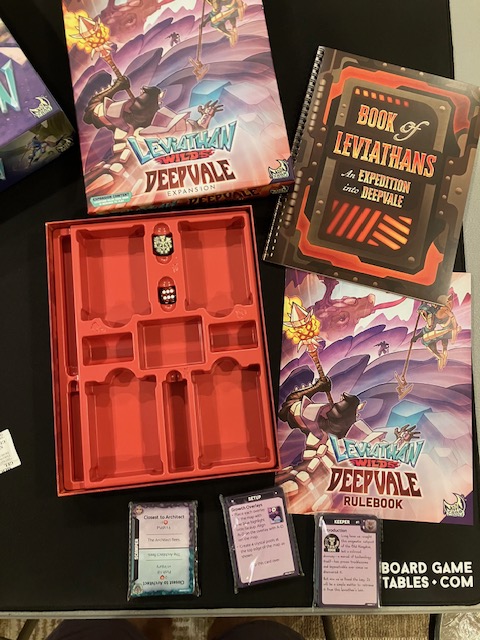
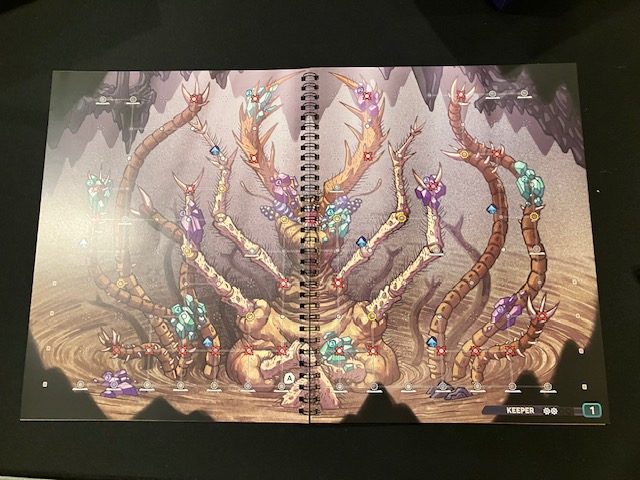
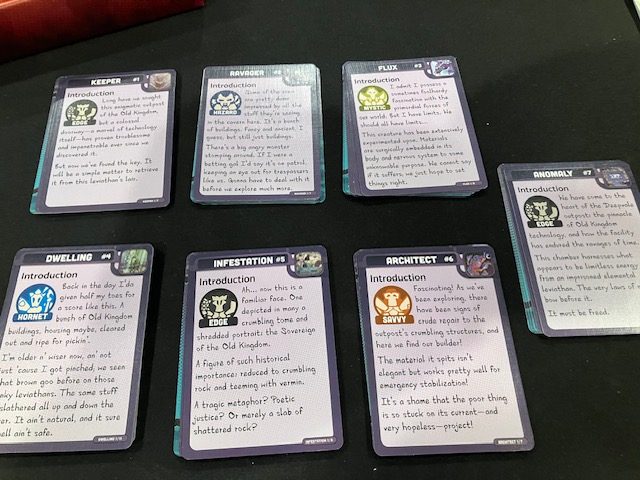
There’s 7 new Leviathans, and oof, they seem creepier than the original Leviathans! And of course, rage decks for each Leviathan.

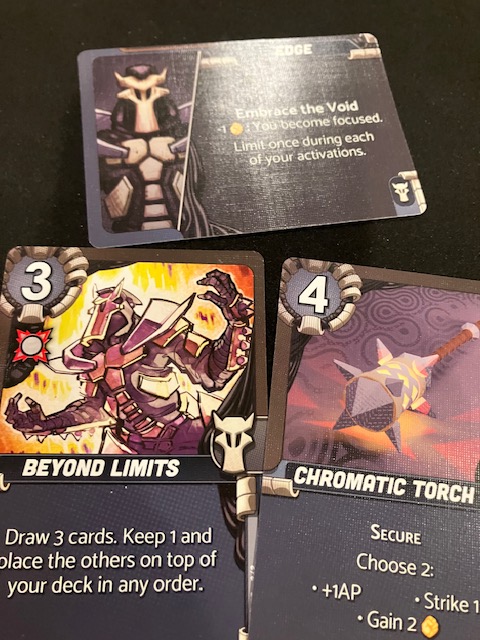
We also get a new climber!  The Edge!  

This is really just more stuff for Leviathan Wilds! Nothing groundbreaking!  (Ha, pun intended).  See our review of Leviathan Wilds: Deepvale Expansion to see if you might want to pick up this expansion!

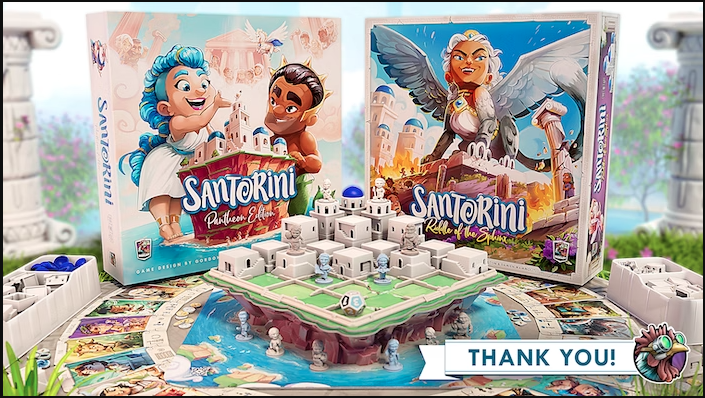
5. Santorini: Riddle of the Sphinx

Expansion TypeMakes The Game Cooperative
Solo Mode: Yes
Requires Another Expansion?  No 

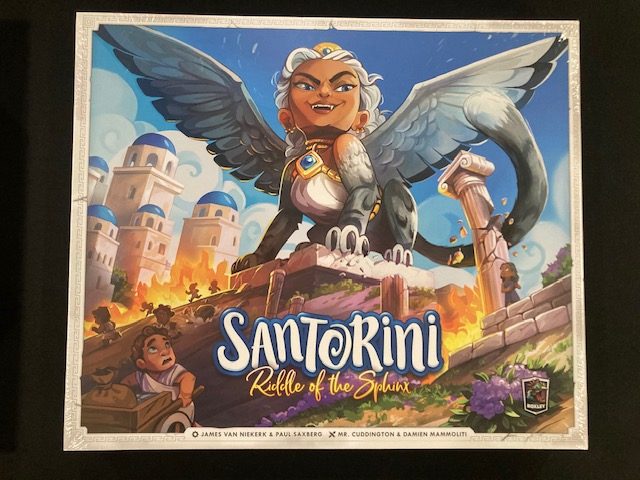
More than any expansion that came out this year, this expansion is a puzzle.  It doesn’t even require THAT much from the base game Santorini; mostly just the building pieces and some minis!  It’s also a very different kind of game than the original Santorini!

I played it both solo and cooperatively.  It’s much easier to play this solo; each scenario is just a puzzle you are trying to solve!  The puzzles are about placing city pieces out, using god powers, and trying to get more city pieces (as city pieces are scarce)!

I was able to get some cooperative games played, and as long as everyone promises to NOT be an Alpha Player, they can work well!   This expansion isn’t for everyone, as not everyone is going to like the very puzzly scenarios The Riddle of the Sphinx presents!  But if a puzzle building game using the pieces of Santorini sounds fun to you, check out our review of Santorini: Riddle of the Sphinx to see if this might be an expansion you enjoy!

4. Unmatched Adventures: Teenage Mutant Ninja Turtles

Expansion Type: Stand-Alone Expansion, Makes The Game Cooperative
Solo Mode: Yes
Requires Another Expansion?  No, but you can play with any Unmatched set.

Of course, we had to eat pizza before we played Teenage Mutant Ninja Turtles: Unmatched Adventures.

Our favorite part of this expansion is that it adds two more scenarios to the Unmatched Adventures system!  Recall that we loved Unmatched Adventures (see review here), but our main complaint was that the box only came with two scenarios … now we have two more! 

I am not personally a TMNT fan, but I really enjoyed the new heroes and villains.  My friend Jon (above), who is a huge TMNT fan, really liked the game.  I think knowing the IP might move this game to a 10/10 for some people: it really does capture a lot of TMNT feel (with the sewers being a fun way to travel around the city)!  See our review here to see if this is something you might like!

3. Dice Throne Adventures: Unchained

Expansion TypeMakes The Game Cooperative, More Content
Solo Mode: Yes (true solo)
Requires Another Expansion?  Yes: this is an expansion for Dice Throne Adventures (and I am also assuming  you have one of the base Dice Throne character boxes)

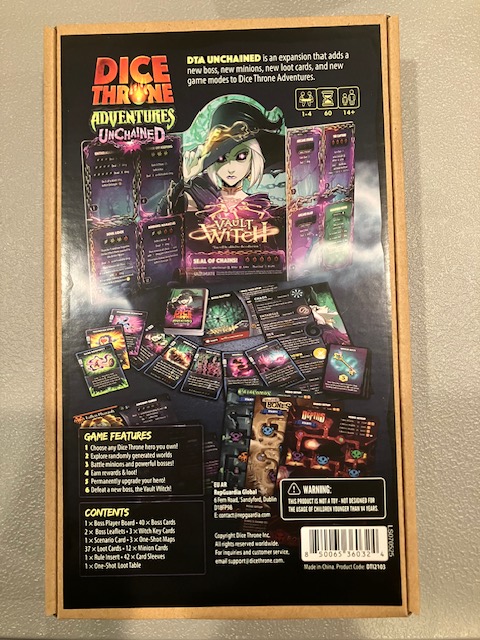
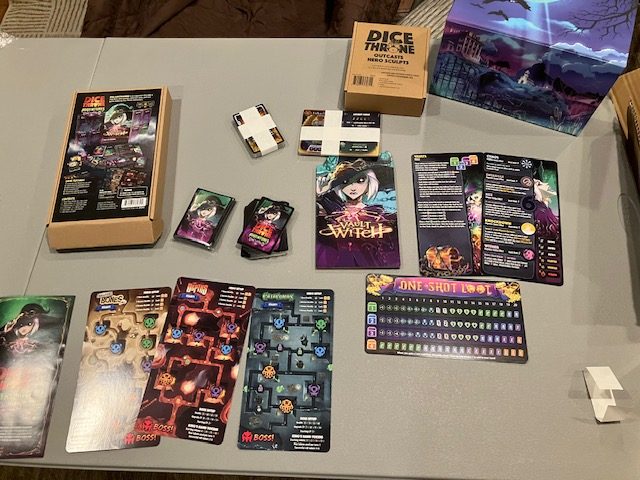
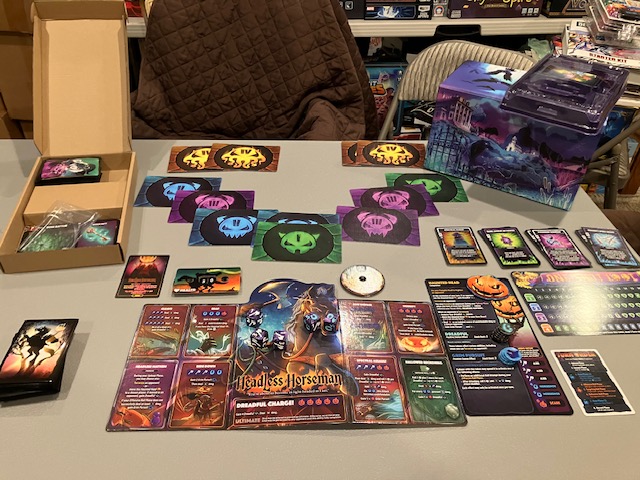
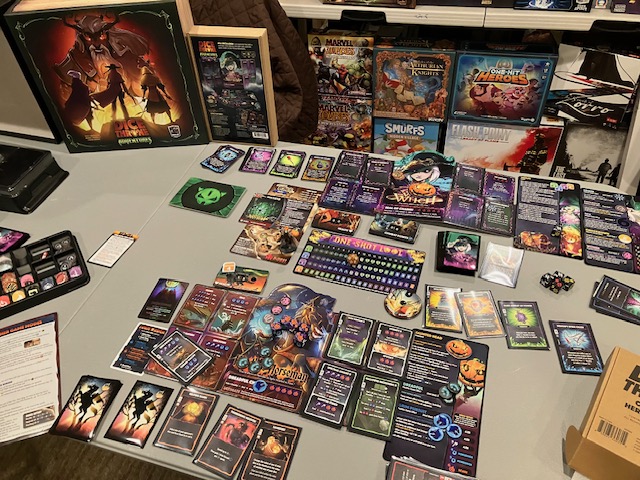
Firstly, this is an expansion that just adds more stuff: more Minions, more Loot, and another boss to fight in Dice Throne Adventures!  And yes, this is an expansion to an expansion!  The original Dice Throne Adventures (which Unchained expands) took the base Dice Throne game and made it solo and cooperative!

But this expansion fixes three major problems!  Firstly, there we no solo one-shots in the original Dice Throne AdventuresUnchained allows the solo player to play a one-off little solo Adventure!  Unchained adds the Minion Rush solo mode (see above), which allows the solo player to take a new character and try it out in a limited little adventure!

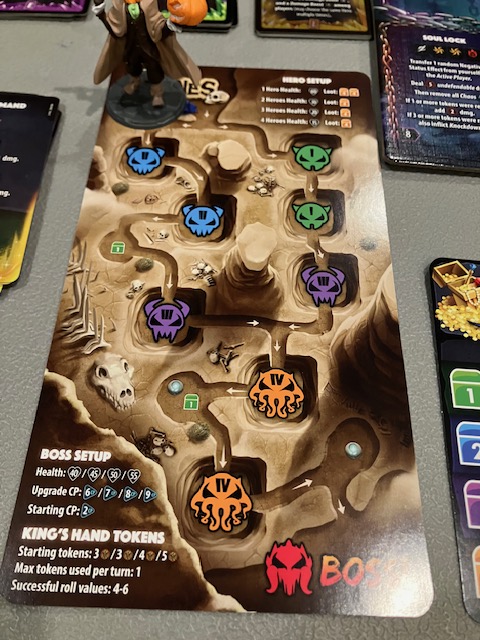
Secondly, Dice Throne Adventures had the problem that the adventure is way too long and too involved.  Unchained fixes Dice Throne Adventures by adding a one-shot cooperative adventure, which is a condensed little Minion dash/Boss battle!  There’s 6 new maps (see one above) that allow the cooperative players to go through a little adventure in one game session!

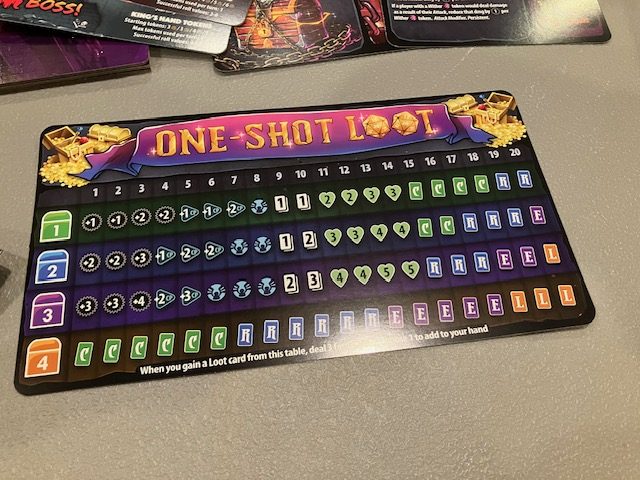
Finally, Unchained fixes the “slow upgrade” problem of Dice Throne Adventures! It seems to take forever to upgrade your cards in Dice Throne Adventures, but in the new Minion Rush and One-Shot Adventures, you get a new One-Shot Loot chart!  See above! And this time, Loot goes directly into your hand, so you feel the effects of upgrading quickly!

Overall, I think Unchained is an essential upgrade for Dice Throne AdventuresSee our review here to see if you agree!

2. Marvel Dice Throne Missions

Expansion TypeMakes The Game Cooperative
Solo Mode: Yes (true solo)
Requires Another Expansion?  No (but I am assuming  you have one of the base Dice Throne character boxes)

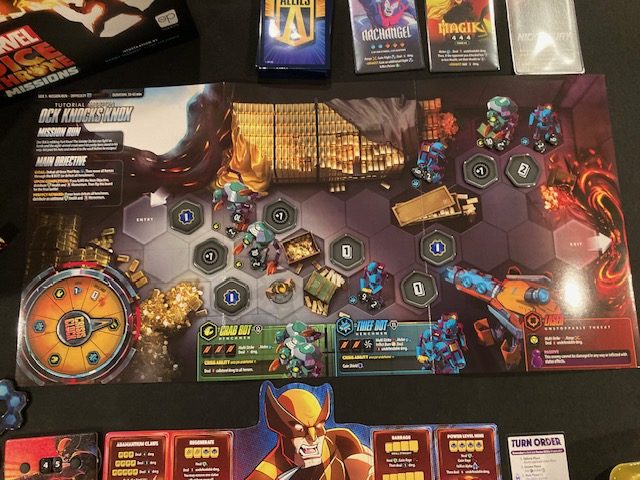
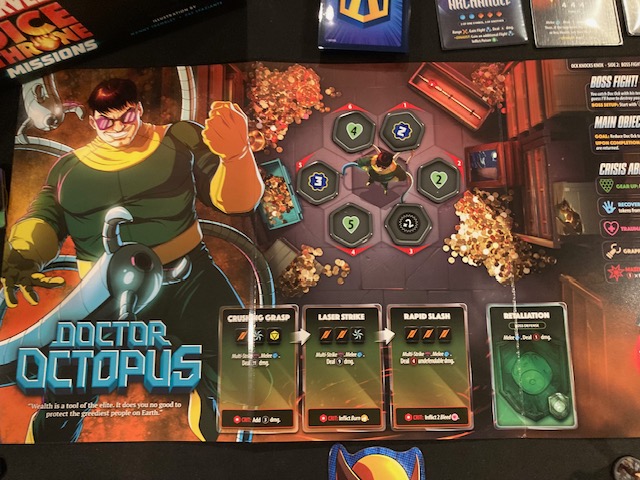
This expansion takes the base Dice Throne and adds two-sided Missions to the game.   These missions are usually more exploration on first side (with mini fights against minions) and then fight the big bad boss on the other side (see Doctor Octopus).   You can also choose to do longer campaigns with a notion of experience points to help you upgrade.

This game supports true solo so you can take your favorite Dice Throne character through as many missions as you want!  You might have noticed that the Missions are VERY Marvel character specific (it is called Marvel Missions), but there’s no reason you couldn’t take any Dice Throne characters on these missions!

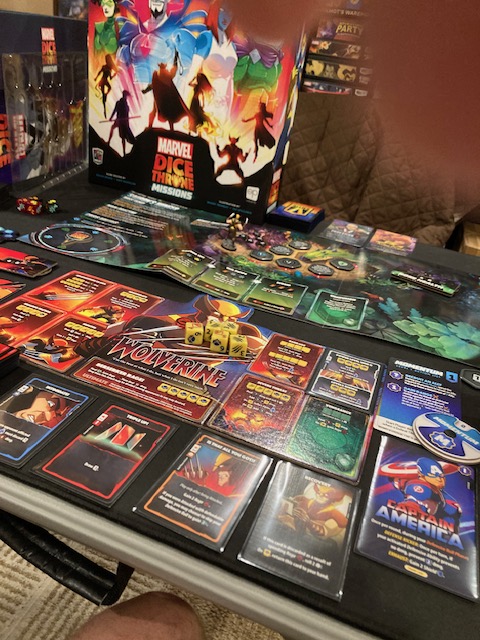
I enjoyed the heck out of this as a solo game (especially with Wolverine), but my friends bounced off the cooperative game! I think the mistake there was in NOT letting them  try out their hero in a quick head-to-head mode; I think that would have made all the difference!  See our review of Marvel Dice Throne Missions here! In the end, I personally loved it, so it had to made near the top of the list!!

1. Kinfire Council: Winds of Change

Expansion TypeMakes The Game Cooperative, More Content
Solo Mode: Yes (two-handed, with special rules*)
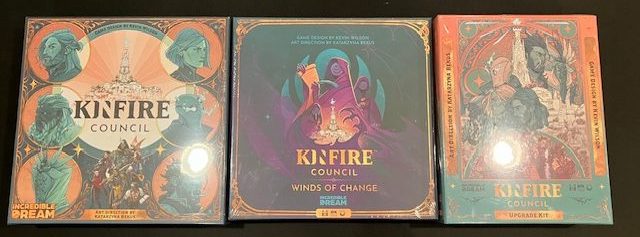
Requires Another Expansion?  No (but you might want the Kinfire Council upgrade kit with wooden bits, see far right)

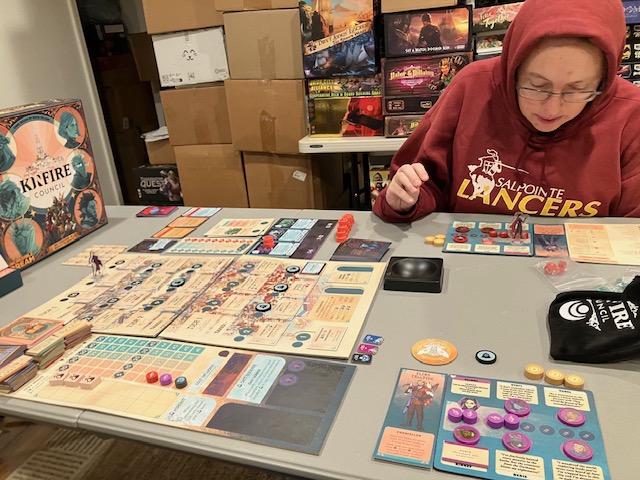
Kinfire Council is a pretty cool worker placement game … that I would never want to play in its original form.  Wait, Why? It’s rife with back-stabbing, traitoring, and some indirect take-that!  The Councilors may side with the city or may side with the Cult trying to take over the city! The base game is all about intrigue within the city!   But, as part of the original Kickstarter, Kinfire Council also had the Winds of Change expansion which took out the base back-stabby/traitory traits, replacing them with both a solo and a cooperative mode!

With the Winds of Change expansion, players are city Councillors trying to stop the Cult from ruining their city!  Along the way, they vote, upgrade spaces, upgrade workers, arrest cultists, stop threats, build a tower for inspiration, and so many other things!  To be fair, the expansion doesn’t change the gameplay THAT much (there is a really neat base worker placement scheme here), but the cooperative mode made me and my friends feel that much more engaged!  “This is our city, darn it!  We’re not going to let the Cultists take over!! “

I was very surprised just how much I liked this game with the expansion!  Me and all my friends all liked it too!   We played over multiple game sessions over multiple game nights with multiple groups; it was so fun! We even added a little House Rule to make the game more fun, more cooperative, and more interactive!  See our review of Kinfire Council + Winds of Change to see what our House Rule is, and if this is something you might like!

I am kind of surprised this made my #1 expansion! It’s gone up in my estimation every time I have played it! It’s just that … I want to play it more! I am so excited by this, I am going to go out of my way to teach it at Dice Tower West this March! We’ll be playing the cooperative version with my House Rules if you want to play! I just loved how interactive the cooperative version was!!