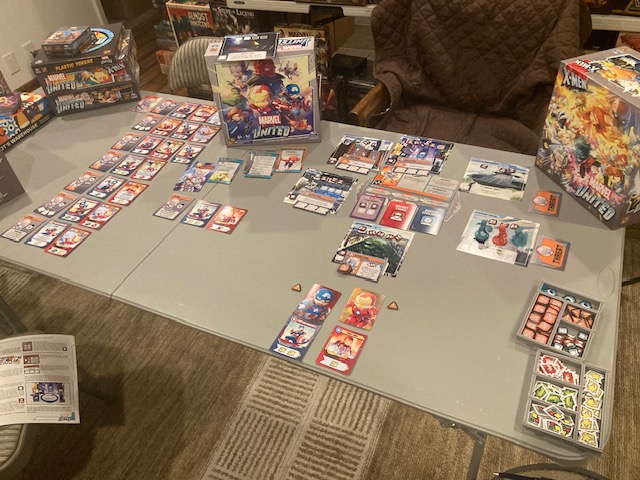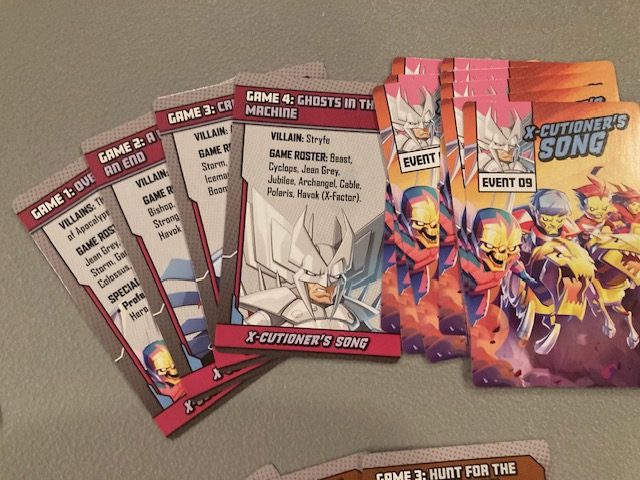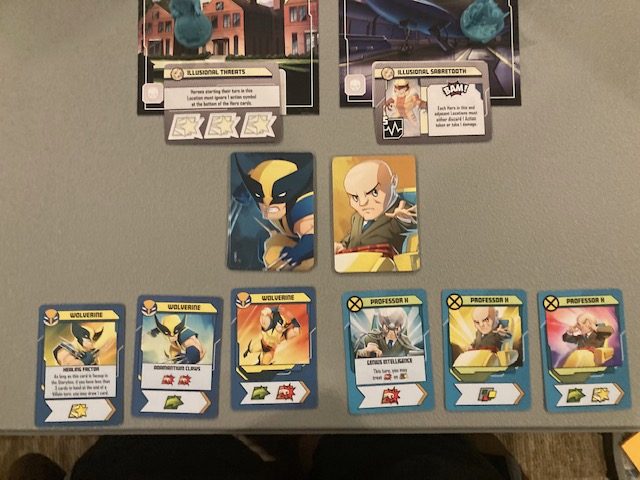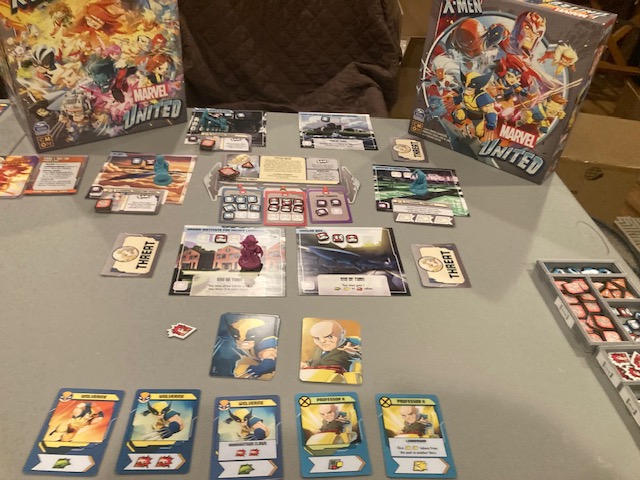
Project PEGASUS: A Campaign for Marvel United

IMG_7430

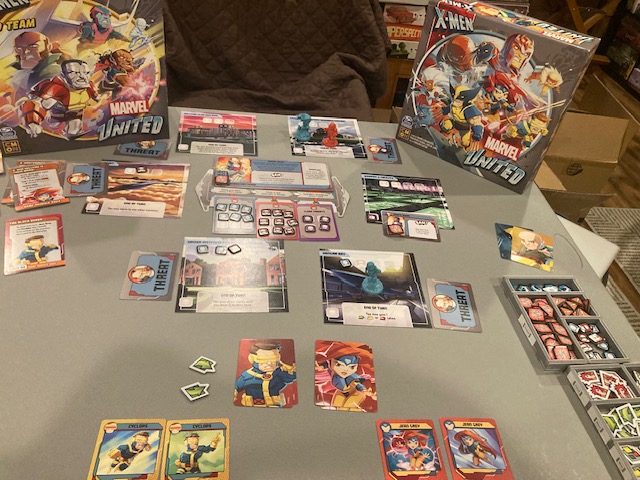
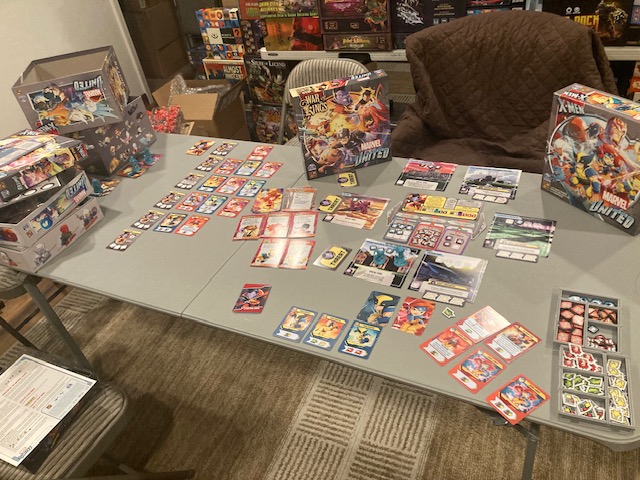
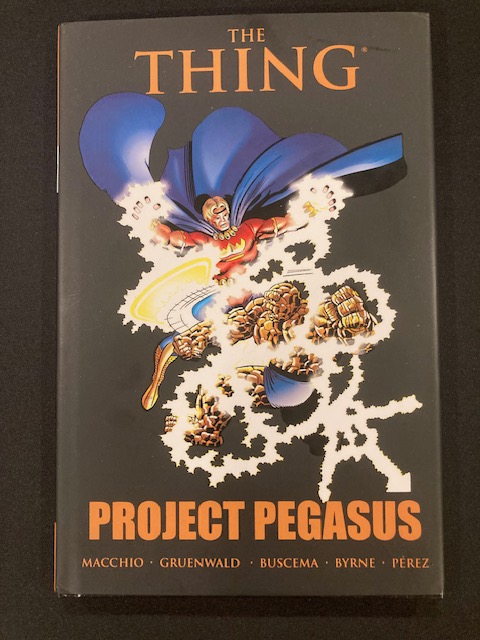
The Project PEGASUS series was one of my favorite comic series when I was a kid. It took place in Marvel Two-In-One Issues 42, 43, and 53-58 back in 1978 and 1979. There are several reasons I liked this story: it featured the Thing and a really interesting cast of characters, including Quasar and Man-Thing! Plus, it’s one of the few times you see the art of John Byrne and George Perez together.

IMG_7404

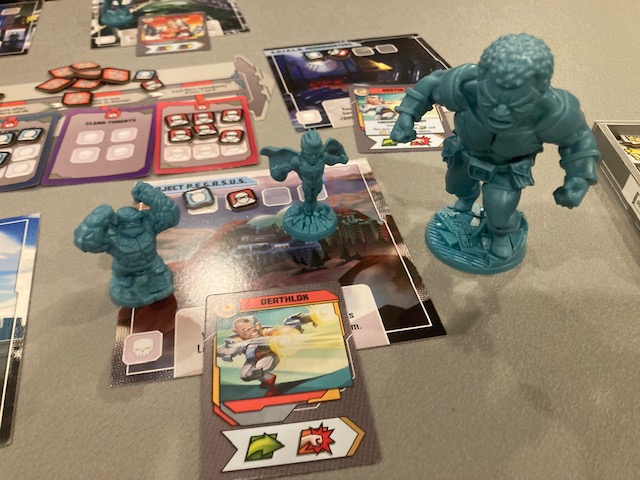
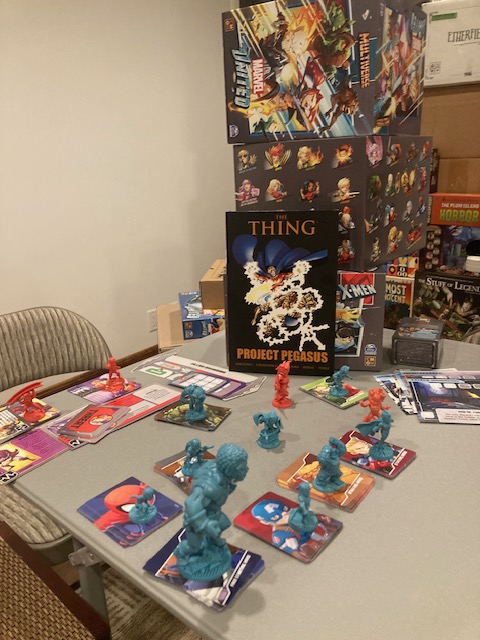
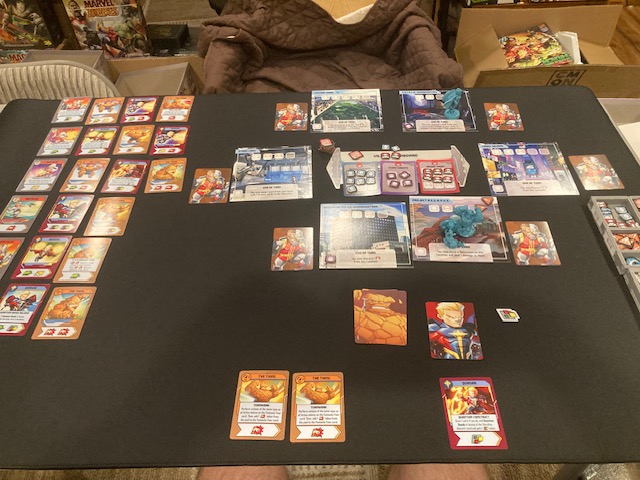
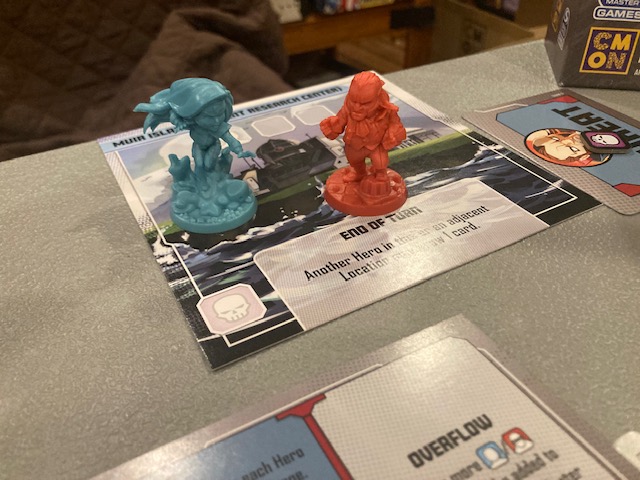
Once Season 3 of Marvel United arrived, I saw that Project PEGASUS was indeed a Location from the Multiverse base set: see above (we reviewed the base Multiverse set here)!

IMG_6665

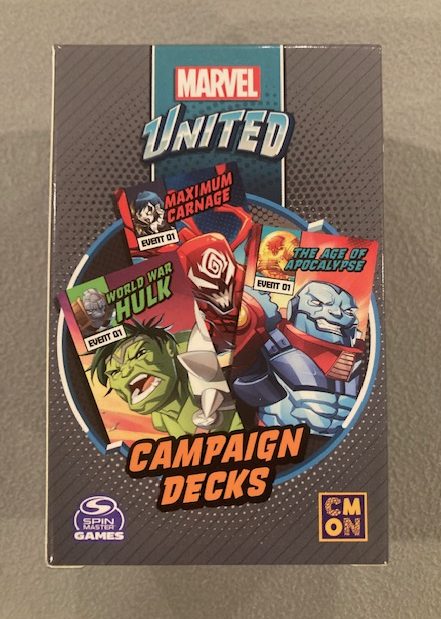
We also got a chance to play some of the campaigns that came from the Marvel United Campaign Decks!   See last week as we reviewed some of these experiences!

IMG_6672

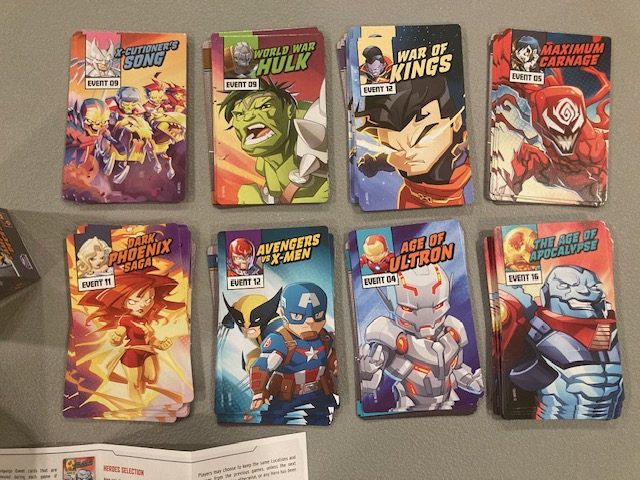
See all the great series of Marvel Comics!  But where’s the campaign for Project PEGASUS?

Never mind, I’ll do it myself.

The Road To Development

IMG_7386

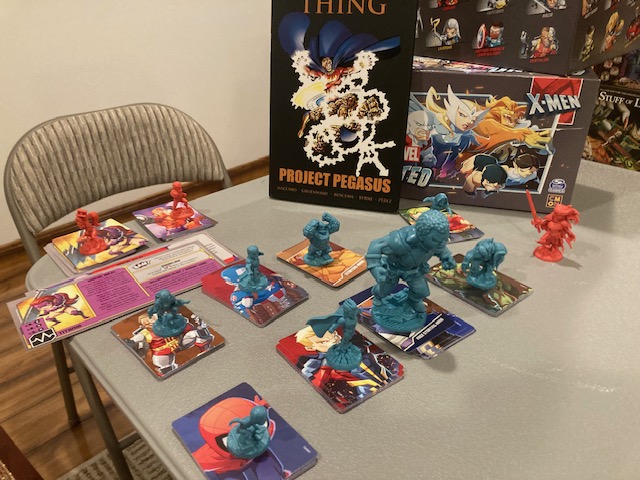
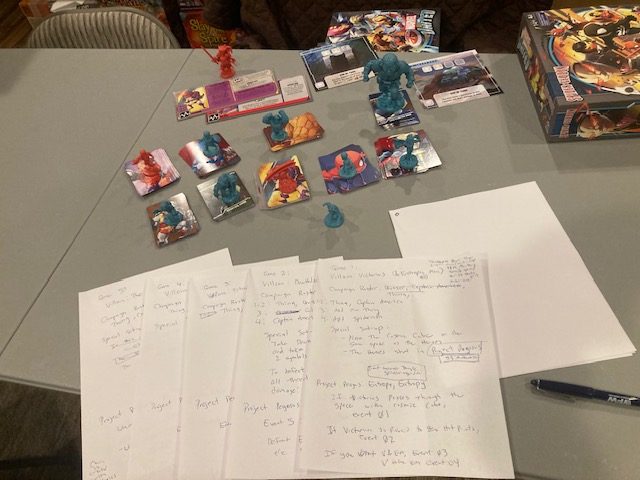
Over the past month, I have read and re-read the Project PEGASUS series (a burden of joy) to get a sense of what its campaign might look like.  See above as I have taken out most of the content I need!

IMG_7368

After coming up with a general outline of what the Villains, Heroes, and Games should be, I started to put something together!  See above for written notes on the first draft of this campaign.

IMG_7388

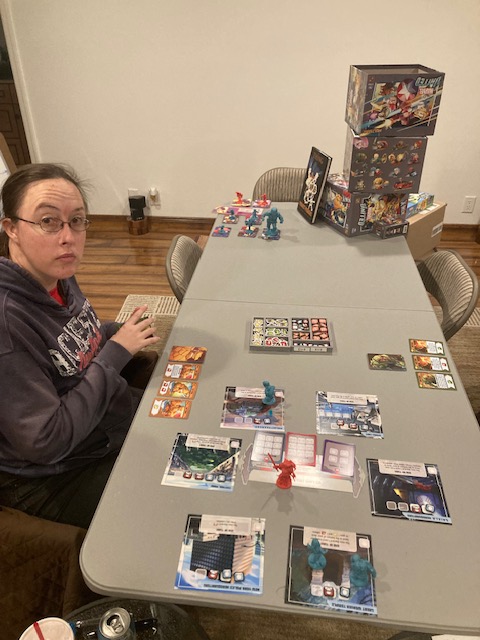
I’ve have also had some play testing from my friends, as well as many many many solo games (with 2, 3, and 4 Heroes).

In the end, I am very proud of the Campaign I came up with: it follows the story of Project PEGASUS pretty well and adds some new ideas to Marvel United.

IMG_7429

Over the last few weeks, the campaign has evolved quite a bit: I have some added some new Villains and Heroes for the final cut. 

IMG_7406

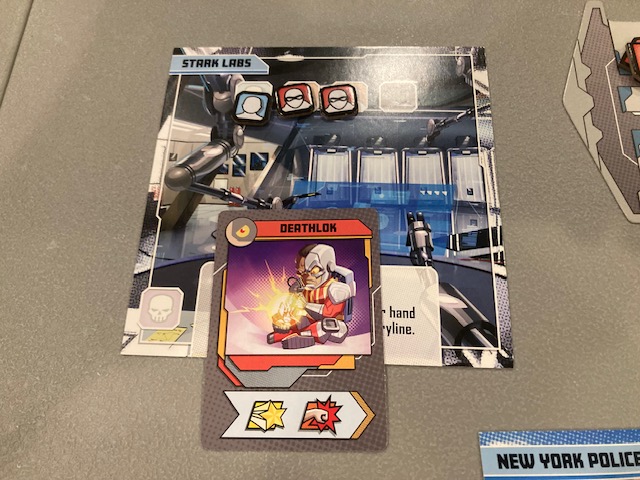
Some of the ideas in the Project PEGASUS campaign are a little outside the box, because even though Season 3 made this all possible, I will still missing some pieces (Heroes/Villains/etc) to make the campaign complete.  So, I had to improvise using what I had. 

I am very proud of what I did for Games 1 and 5, and especially Game 2.  But be aware that those games are a little different.

What Do I Need?

IMG_7017

Like all of the campaigns, The Project PEGASUS campaign needs a lot of pieces stolen from all parts of Marvel United. See the complete list below.

• Base Marvel United
• Spider-Geddon Marvel United
• Multiverse Marvel United
• Season 1 Stretch Goals
• Season 3 Stretch Goals
• Fantastic Four
• World War Hulk
• Annihilation
• Civil War
• Enter The Spider-Verse
• War of Kings

Current State

IMG_7431

The current draft of the campaign is at version 1.0.1.  I fully expect there to be revisions made as me and others playtest it. 
UPDATE: We are now at 1.1.0: we had some explanation clean-up and a few balance adjustments to Game 1!
Oct 20th, 2024 UPDATE: Updated to 1.2.0: Added explanation of how to play solo, updated Game 2 with better descriptions and a rules fix/clarification.

Feel free to download the PDF below and give it a try!!!   If there is interest, I can try making the form factor more like cards (with Rules cards and Event cards), but right now the Events are presented alongside the Games of interest in the PDF document below.

 If you have any feedback (too easy, too hard, spelling problems, unclear rules), please email us at returnfromsubroutine @ gmail.com

We’d love to hear from you!  How did it go?


Campaign Decks for Marvel United: How Much Story Do They Add?

IMG_6665

The Campaign Decks were part of the Multiverse Marvel United Absorption Expansion Explosion (where we received so much new context for Marvel United)! !

IMG_7013

The Campaign Decks give you just that: campaigns you can play through using the Marvel United system.

Let’s take a look!

Unboxing and Gameplay

IMG_6666

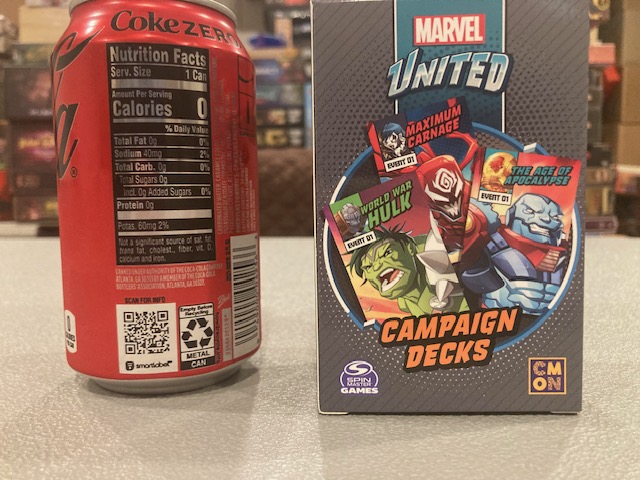
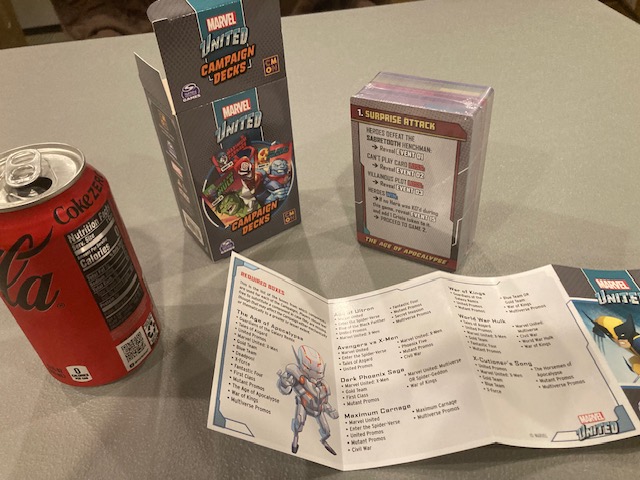
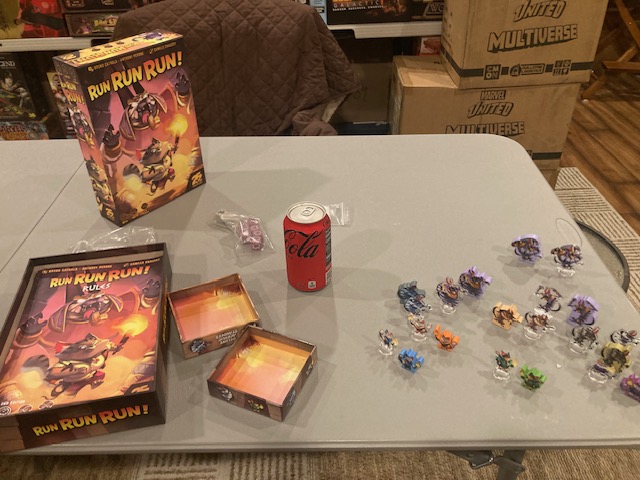
This is a surprisingly small box of cards: see Coke Can above for scale.

IMG_6667

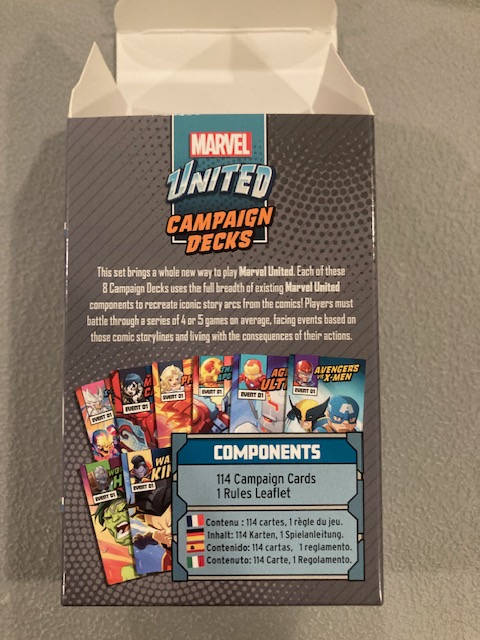
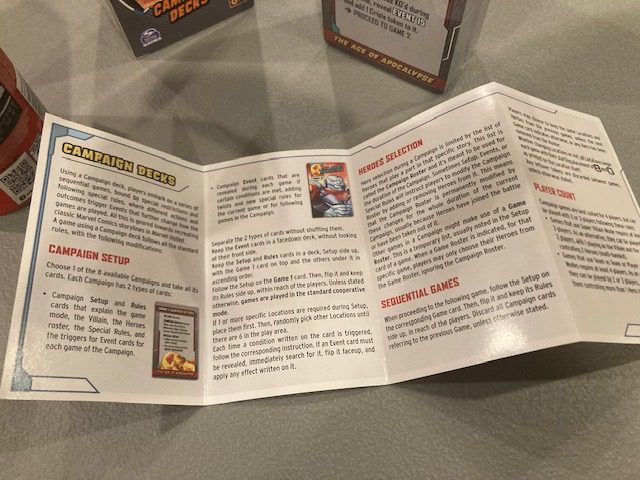
The game comes with a very small pamphlet (sigh, I am not a fan of pamphlets) and 114 cards for 8 campaigns.

IMG_6672

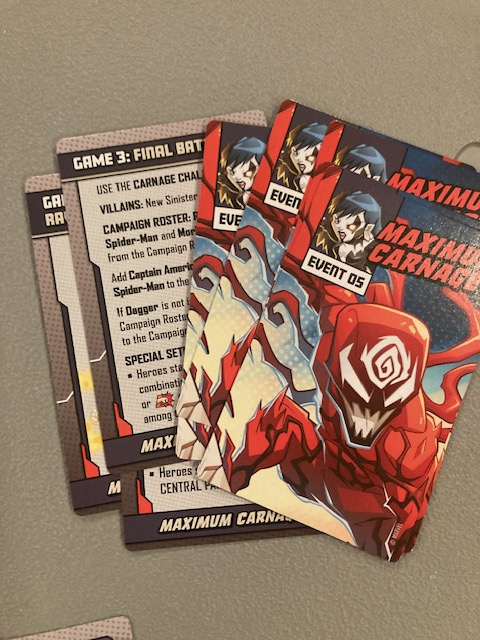
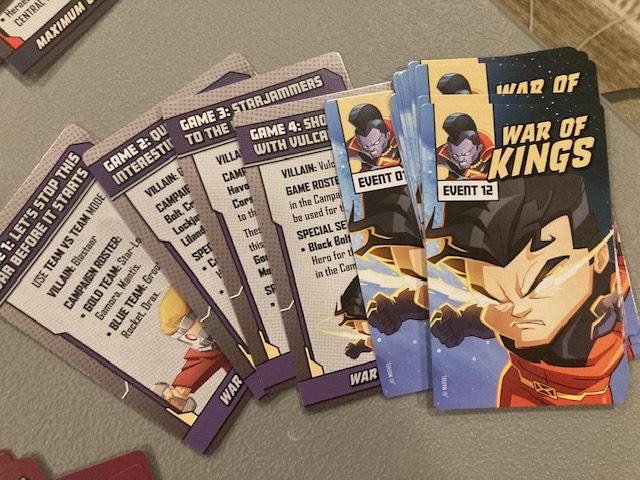
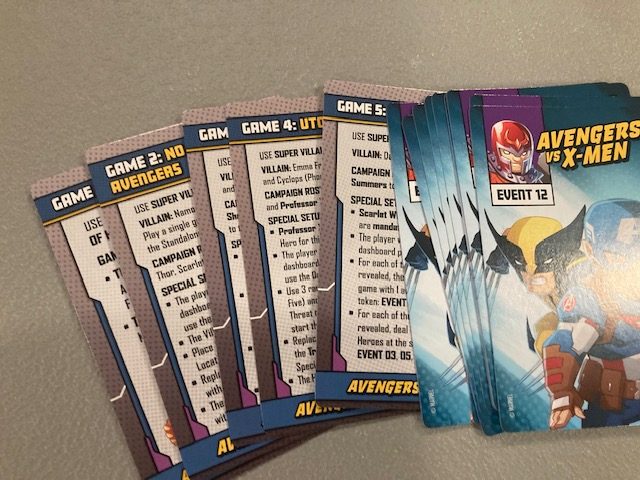
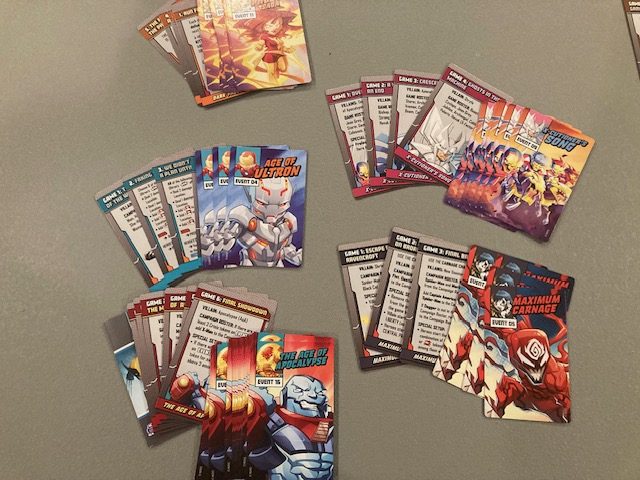
Each campaign is 8 to 23 cards each, with Age of Ultron and Maximum Carnage being 8 cards, X-Cutioner’s Song and World War Hulk being 13 cards,  War Of Kings and Dark Phoenix Saga being 16 cards,  Avengers vs X-Men being 17 cards, and The Age of Apocalypse being a whopping 23 cards!

IMG_7015

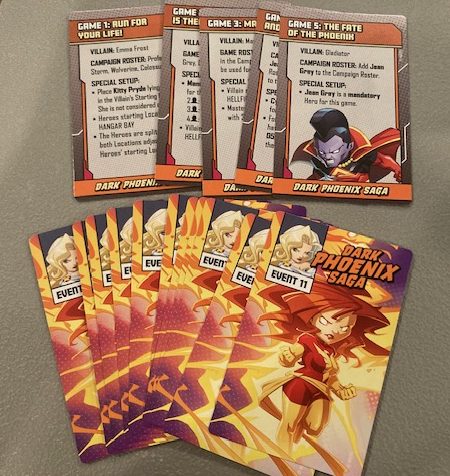
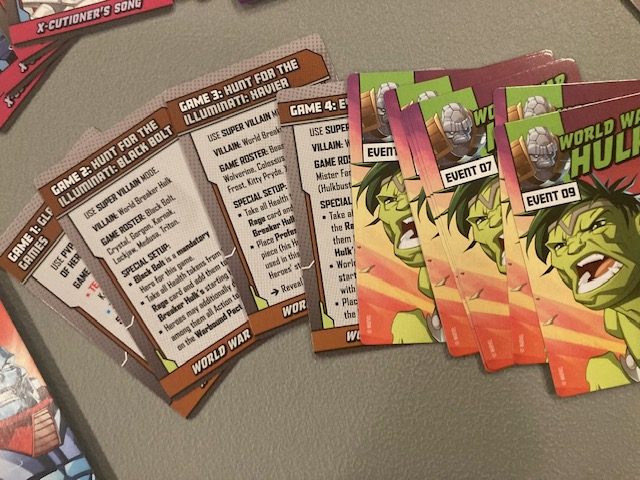
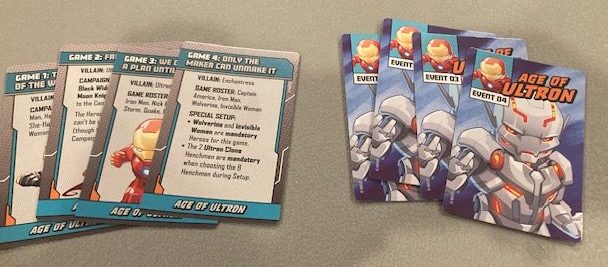
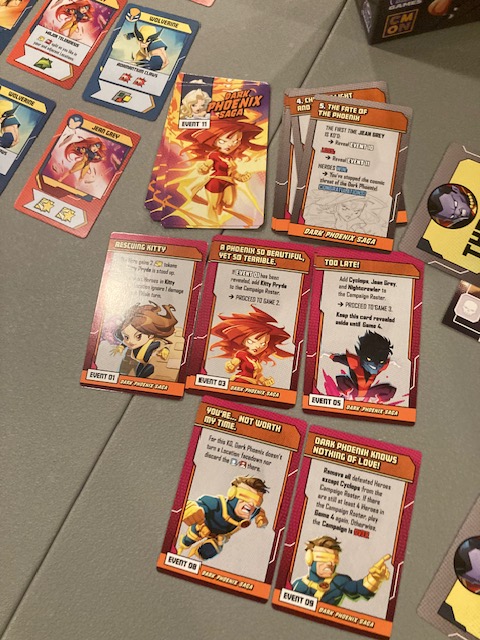
Each campaign has two types of cards: Campaign Set-Up and Rule cards (top cards: each game in a campaign is defined by one of these) and Campaign Event cards (bottom cards: which are brought out during certain points of the campaign).

IMG_6673

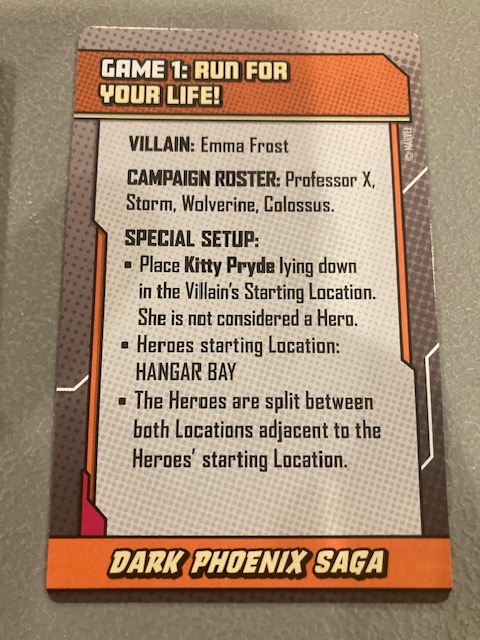
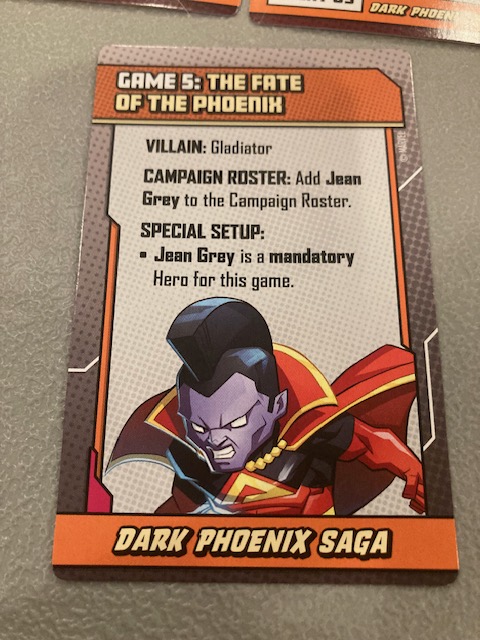
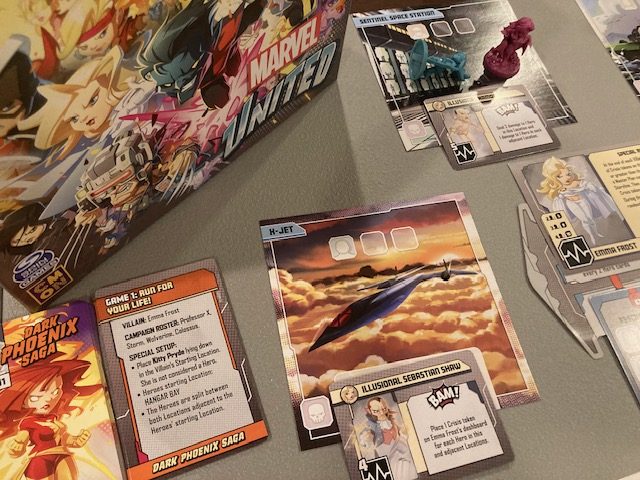
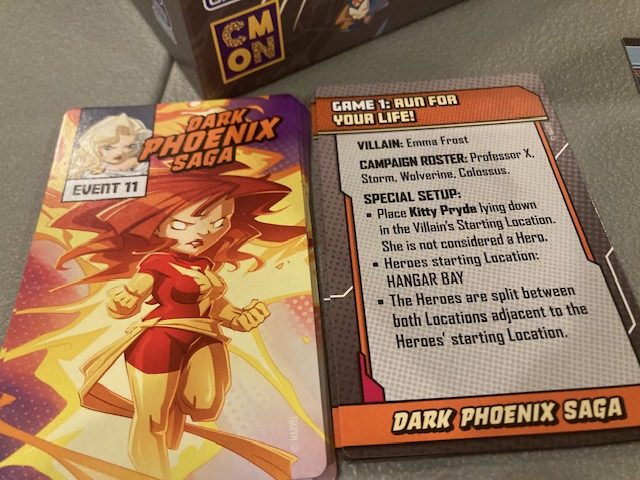
The front of the Campaign Set-Up and Rules card define the parameters of each encounter: the Villain you will fight (Emma Frost above), the Heroes you can operate (Prof. X, Storm, Wolverine, Colossus above), and special set-up or rules (split the start-up, must start with HANGAR BAY, etc.). See above.

IMG_7014

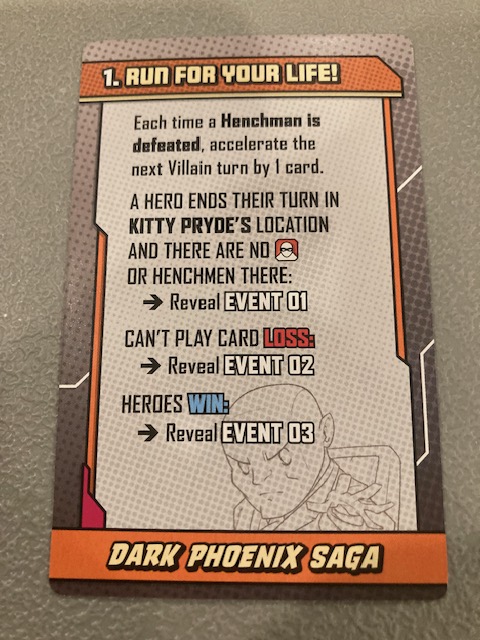
The back side of the Campaign Set-Up and Rules defines special rules for that scenario, as well as  triggers to bring out Event cards: see above.  Warning: minor spoiler below!!

IMG_6868

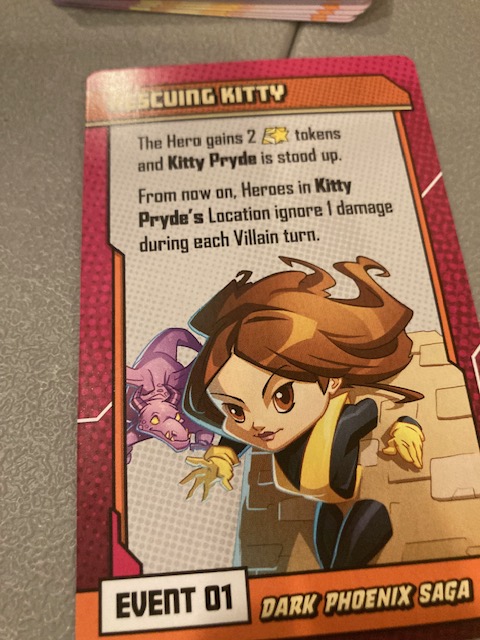
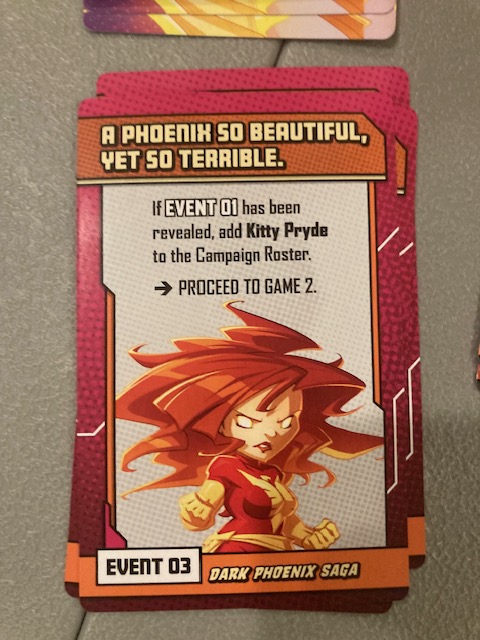
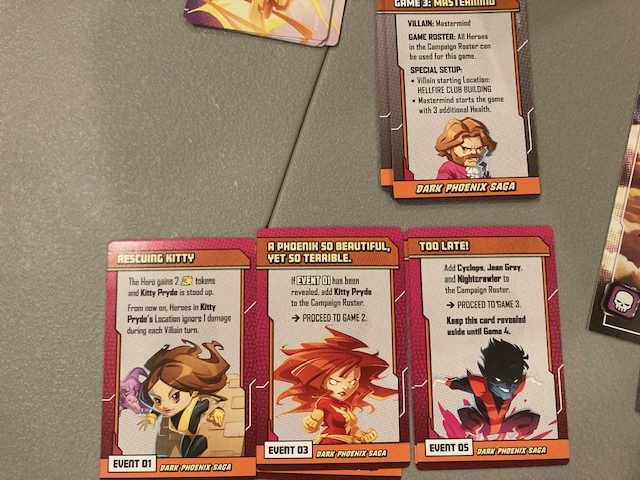
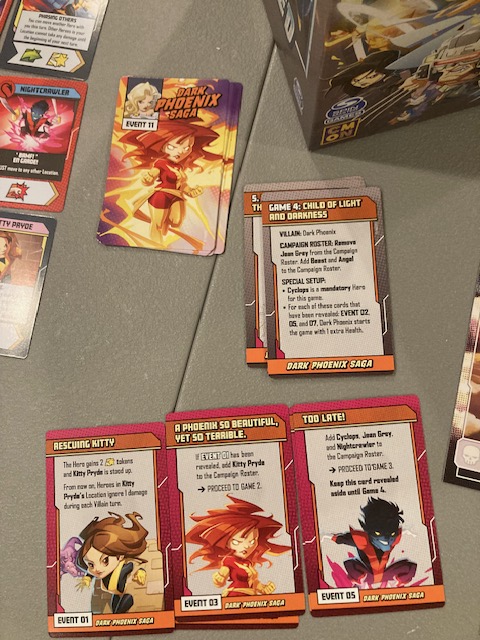
Events are related to the scenario you are fighting: see as Event 01 brings some rules into play once you rescue Kitty Pride.  Many times, Events just add Heroes to your roster: this is important, as it gives you more choices of Heroes to play when you fight (and some Heroes are better in certain scenarios).

Basically, these cards control the progression of games.

IMG_6668

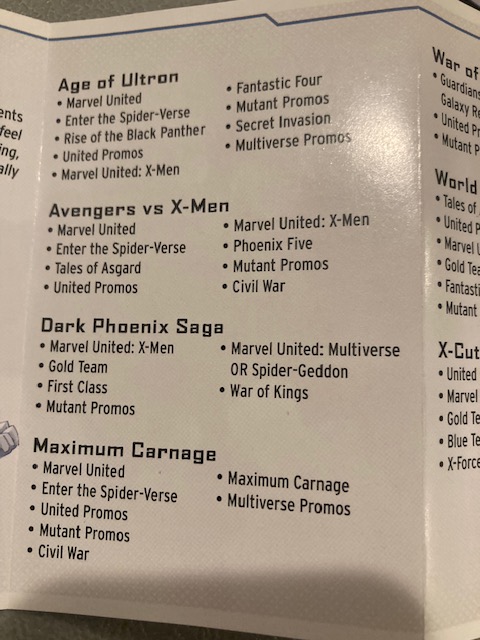
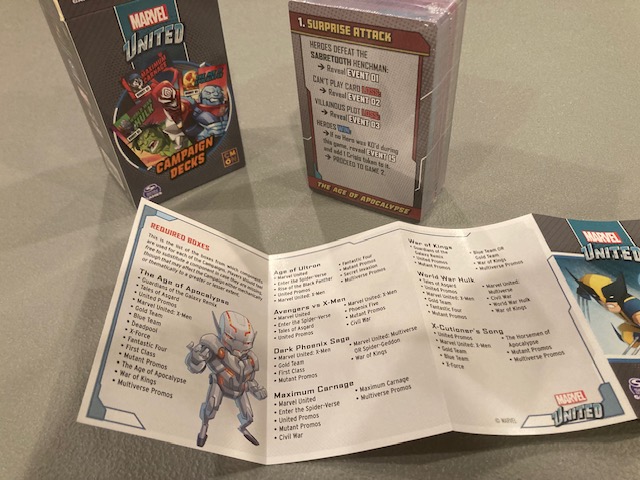
Generally, you need almost all of the Marvel United content to play these Campaigns.  The back of the pamphlet tells you ALL the base games/expansions you need to play through!

IMG_7017

See how The Dark Phoenix Saga, Age of Ultron, and Maximum Carnage all require a whole bunch of expansions! And a very disparate set of expansion as well!

IMG_6669

These expansion all look really cool … but how do they play?

Campaign Flavors

Not all campaigns are created alike.

IMG_6836

The World War Hulk campaign requires players to play in the one-vs-many mode known as Super Villain Mode in the game: this is definitely not solo or full cooperative!

IMG_6832

The Maximum Carnage campaign requires the players to do The Carnage Challenge (at least for games 2 and 3).

IMG_6835

The War of Kings requires team vs. team mode, at least for the first game, then the game goes back to being solo and/or cooperative for games 2, 3, and 4.

IMG_6837

The Avengers vs X-Men is mostly Super Villain Mode (one-vs.-many), and game 1 is a special PVP mode: Clash of Heroes.

IMG_6841

The rest of the decks (Age of Apocalypse, Age of Ultron, X-Cutioner’s Song, and Dark Phoenix Saga) can all be played solo or cooperatively.

We’ll only be looking at those decks you can play solo or cooperatively today.  Over about 2 weeks, we were able to get through a few campaigns.  Let’s take a look!

Campaigns and Spoilers?

IMG_6888

So, to talk about the campaigns, we have to talk about some of the stuff that happens.  However, that could mean spoilers.  We have done two full playthroughs in this review: decide if you want to read them or just jump ahead to the Conclusion!

The first campaign is the Age of Ultron story.  There are some very minor spoilers in this section (just below), but if you want to go in the game without knowing anything, skip to the Conclusion!

The second campaign is the Dark Phoenix Saga. There are some pretty significant spoilers in that playthrough, both in terms of reveals and stories!   If you know X-Men #131-137, the story won’t have have any spoilers, but some of the events/happenings may still be spoilers.  Since this playthrough has Major Spoilers, we’ve moved this section ALL THE WAY TO THE END to the Appendix section.  Feel free to read it if you want more of a feel what the Campaigns look like, and you don’t care about Major Spoilers

You have been warned. 

Age Of Ultron Campaign: Minor Spoilers Ahead

IMG_6677

The Age Of Ultron campaign is 3 to 4 games long (depending on how well you do). This is probably the best campaign to start with.  (There a few minor spoiler ahead: skip ahead to the Conclusion if you want to avoid any spoilers).

IMG_6680

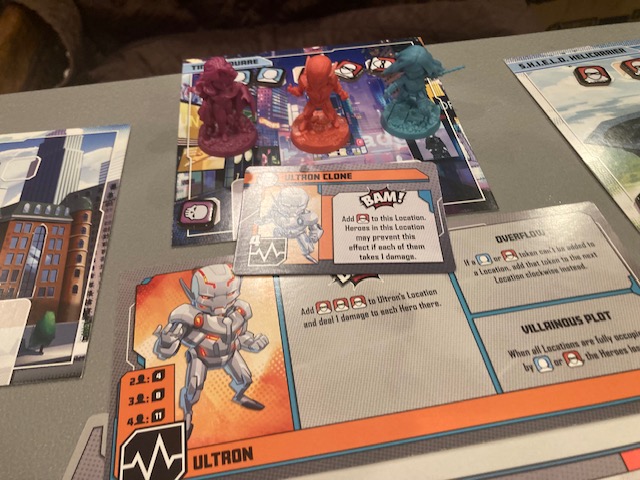
Basically, you fight Ultron a LOT, and he gets stronger and stronger as you play!

IMG_6681

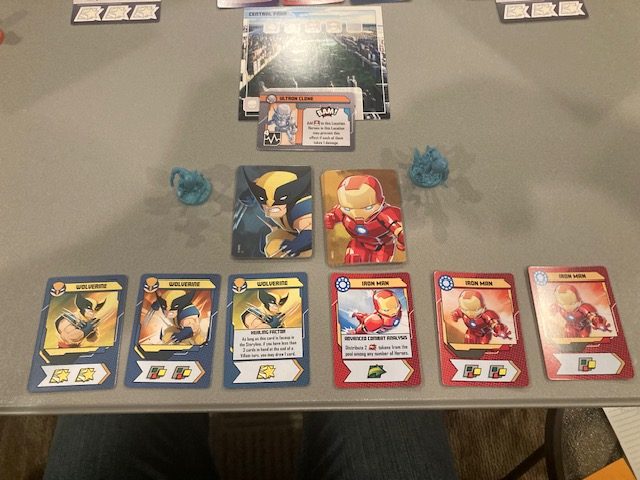
Each game will usually have a different set of Heroes you can play: I started the campaign with Wolverine and Iron Man, but was told (by the Campaign Set-Up and Rules card) that I had to use some different Heroes for Game 2.  I liked that I had to change Heroes (it kept the game interesting), as I had to try to pick a good set of Heroes to play together.

IMG_6700

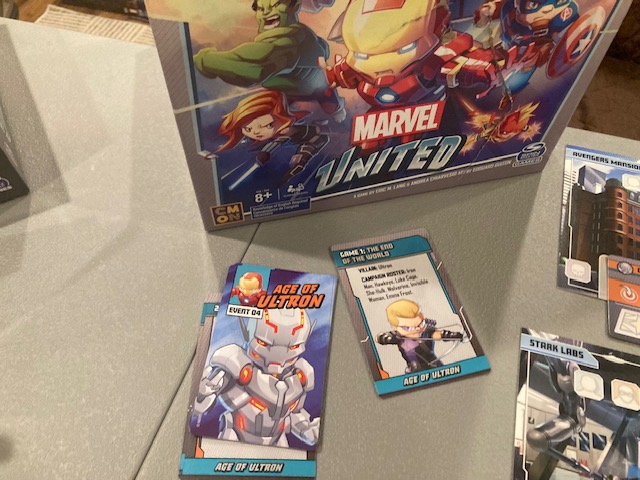
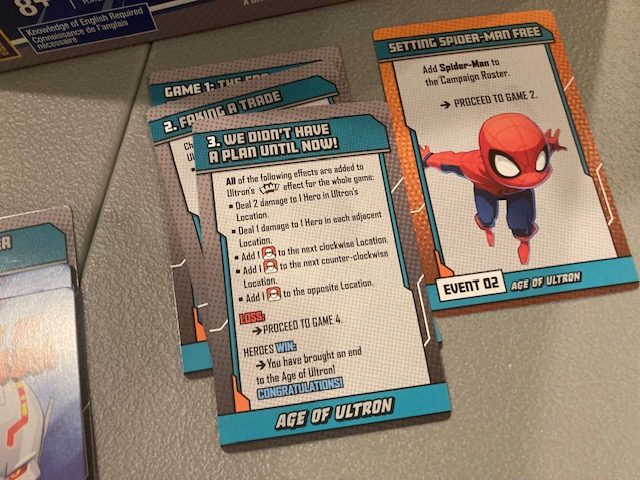
Winning or losing a game usually gets you an event: so far, many good events I see add a new Hero to the Campaign Roster (see above as Spider-Man joins the roster as a new Hero I can play!)

IMG_6697

My second game used Emma Frost and Black Widow together.  Wow, were they good together!  Black Widow‘s predictive power made a huge difference!  They took out Ultron!

IMG_6704

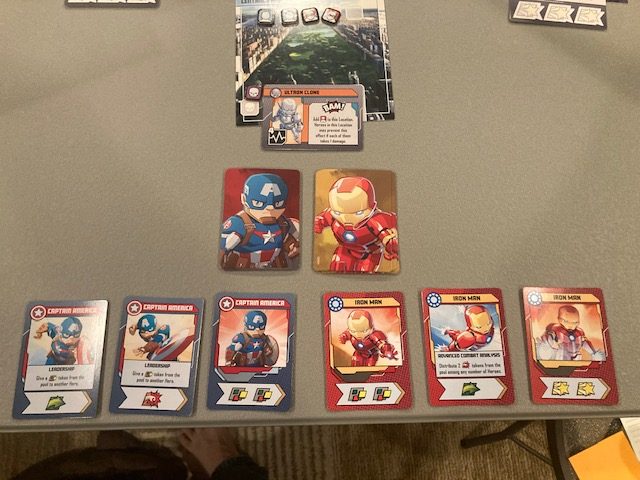
Finally, I used Captain America and Iron Man for my Game 3!  They (barely) kept Ultron under control …

IMG_6710

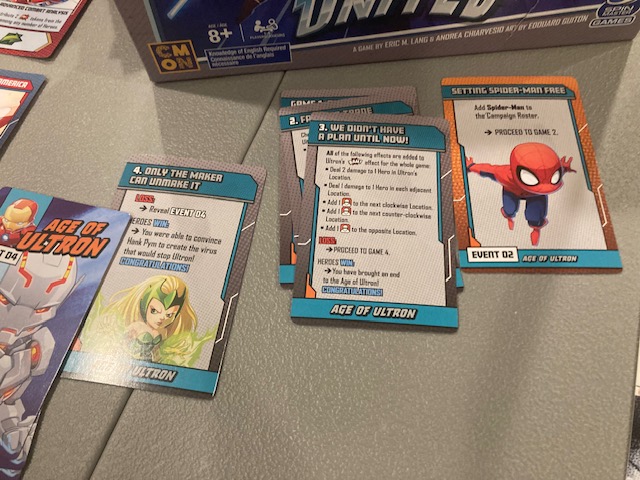
Basically, by (barely) defeating Ultron in game 3, I was able to avoid a final Game 4 (which gives a few more chances to defeat Ultron).

There wasn’t a lot of story per se in this campaign, as my Heroes were just doing the best they could in each Game.  It was, however, very thematic to have Ultron get better and better and better in each game! Really, he was quite tough by the time Cap and Iron Man took him on. I probably should have lost (and had to play Game 4).

IMG_6709

It was fun to play the Age of Ultron campaign, Ultron had an interesting progression, but there really wasn’t any story. 

Conclusion

IMG_6840

In the end, the Campaign Decks reminded me a lot of Set A Watch: Doomed Run (see our review here).   Why is that?  Each particular game of Set A Watch: Doomed Run is thematic, but the story tying them together is very very loose: it’s so loose you can drop players in and out of the campaign as you play!  And I think that’s true here as well! Each Campaign game is thematic and fun, but it doesn’t really twist and turn very much; each Campaign is fairly linear.  If you were looking for a thematic story with lots twists and turns to entertain you, the Campaign Decks aren’t really that.

IMG_7017

There’s a few “twists” I saw, but in general, I think the purpose of the Marvel United Campaign Decks is an excuse to relive your favorite comics and an excuse to play through the ridiculous amount of Marvel United content.  There’s a lot of theme, especially if you know the stories involved, but the Campaign Decks don’t present a deep, dark, complex adventures: they are just an excuse to play Marvel United and relive your favorite comics!  As long as you know what the Campaign Decks are, they might be right up your alley.

Just be aware HOW MUCH Marvel United Content you must have in order to play these!

Appendix: Dark Phoenix Saga Campaign: Major Spoilers!!

IMG_7015

NOTE: There are MAJOR SPOILERS ahead!  Skip this Appendix if you don’t want any spoilers!!

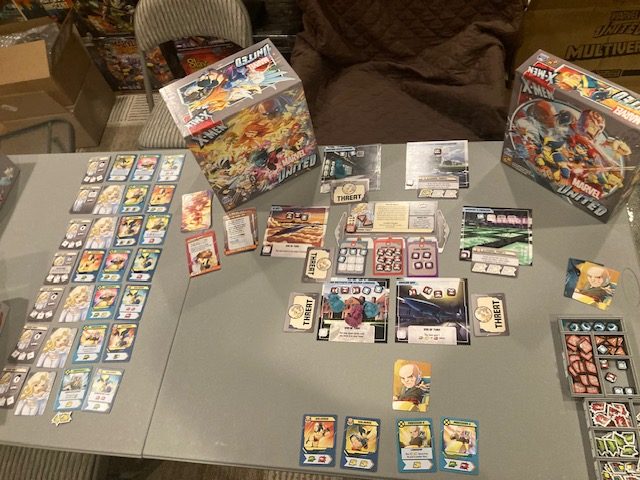
The Dark Phoenix Saga campaign is a little longer at five games.  Honestly, it will probably be more: you will almost certainly lose a few games, because the game gets hard! I lost two games along the way, but was able to come to a successful conclusion (so six games total).

IMG_6845

I was really looking forward the Dark Phoenix Saga: when Jean Grey fights for her life in X-Men #137, it was a very powerful and moving story. Could the Campaign capture some of this?

IMG_6844

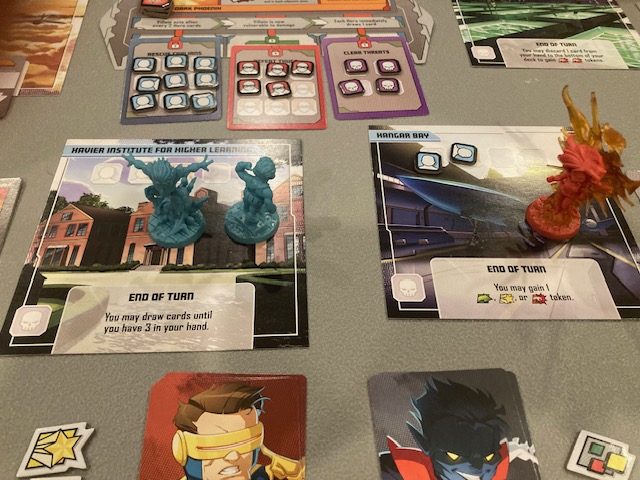
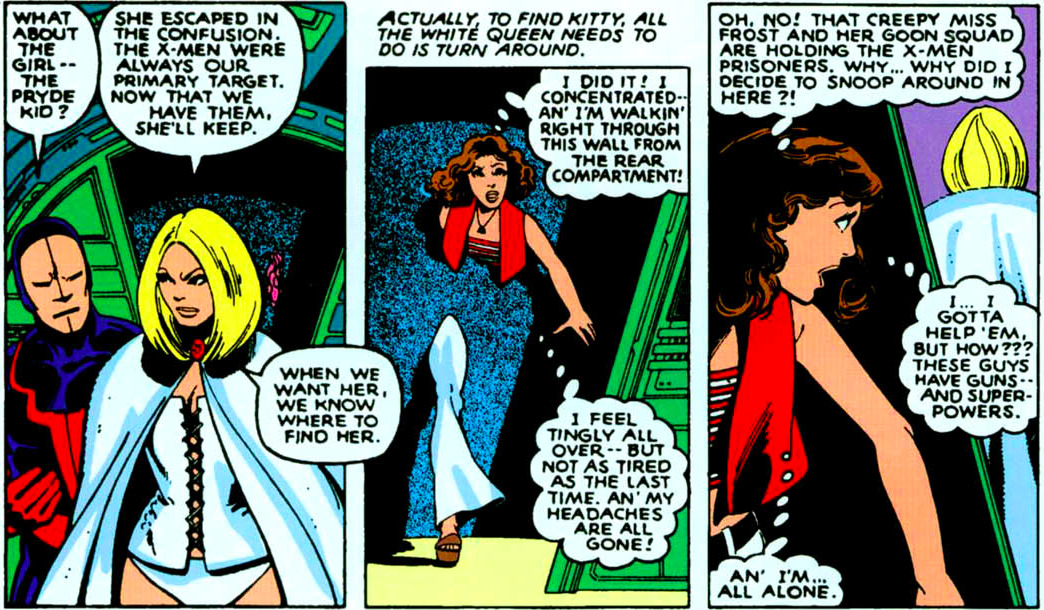
Well, the Dark Phoenix Saga starts Game 1 with Emma Frost and Kitty Pryde (ShadowCat): see set-up above! This is reminiscent of issue X-Men #131 where Kitty Pryde wanders the Hellfire club trying save her compatriots … see below.

kityp

IMG_6848

In this Game 1, I had Wolverine and Professor X take on Emma Frost.  Remember, you have choices of which heroes you can use!  Part of the fun of the campaign is trying to find the best heroes…

IMG_6851

Well, it turns out I played my first game so very wrong (I missed some of the threat effects and special rules about accelerating the Master Plans, and didn’t realize I was supposed to find Kitty), so I restarted halfway through.  

IMG_6868

Wolverine and Professor X were able to find Kitty and take out Emma Frost.

IMG_6869

This led to Game 2:

IMG_6872

IMG_6875

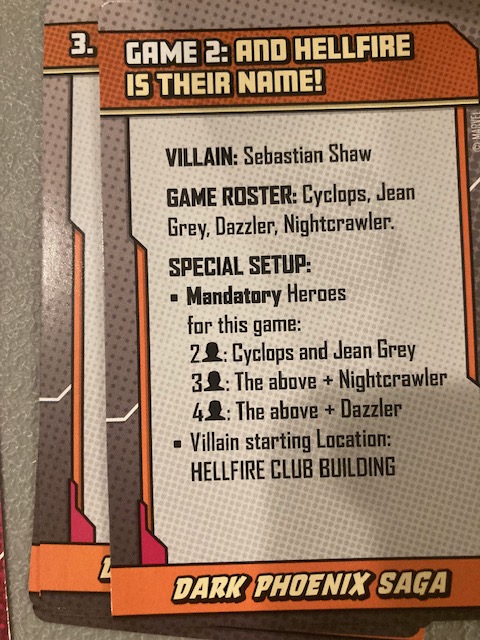
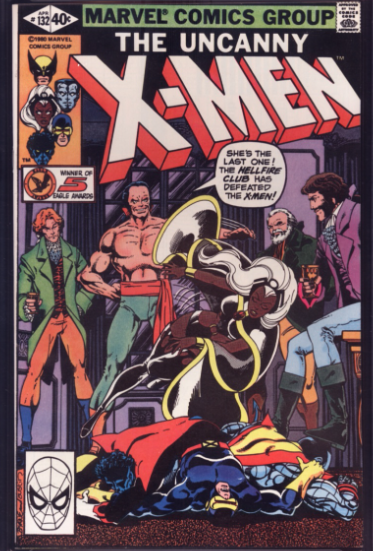
Game 2’s villain is Sebastian Shaw: a Hellfire club member!  We are firmly in issues #131-#137 of the X-Men now!  It feels like we are in X-Men #132 fighting Shaw!

xmen132

IMG_6882

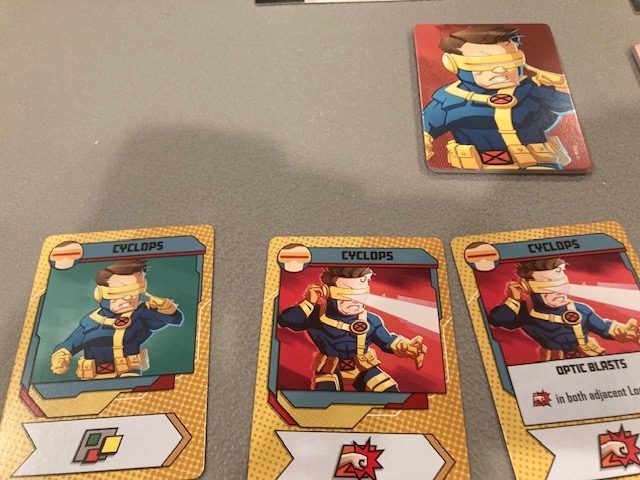
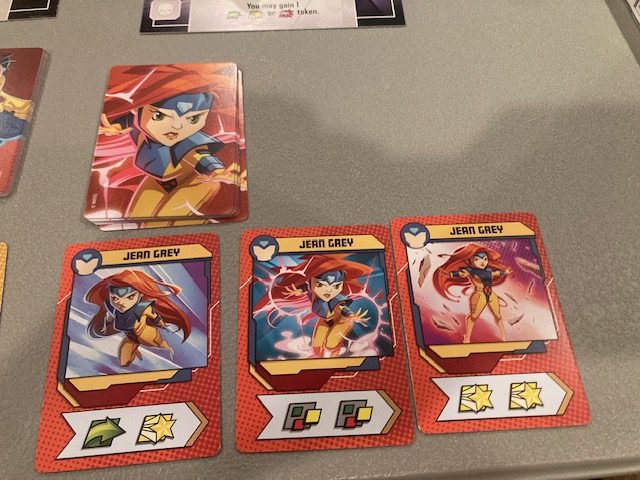
We were required to play Jean Grey and Cyclops: definitely very thematic!

IMG_6883

And why isn’t Jean Grey called Marvel Girl like in the comic … but I digress … I mean, her secret identify is her hero name?  No, she should be Marvel Girl (Jean Grey).

IMG_6887

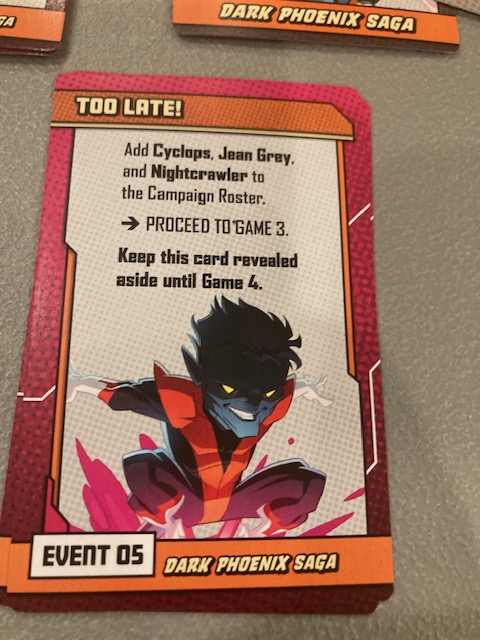
Shaw was rough: I ran out of cards (losing the game) and had to flip Event 5.  To be fair, this loss feels very thematic, as Sebastian Shaw really trounced the X-Men in this particular series of comics!!

IMG_6890

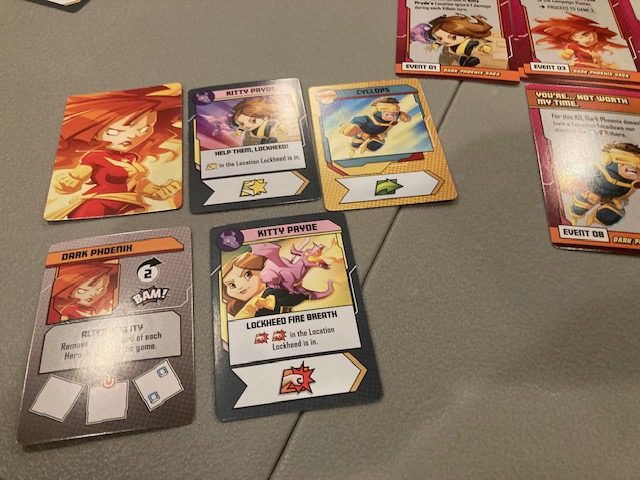
Too late!  But, at least I had Nightcrawler on my Roster now …

IMG_6891

The next game up (Game 3) had us fight the villain Mastermind: he’s the evil creature trying to take over Jean Grey‘s mind!

IMG_6894

IMG_6893

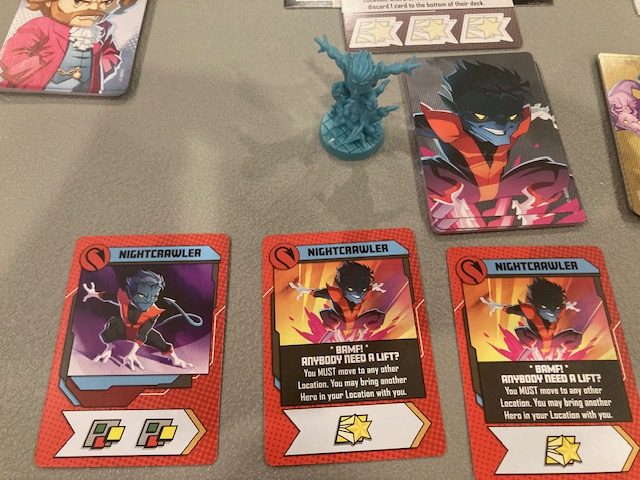
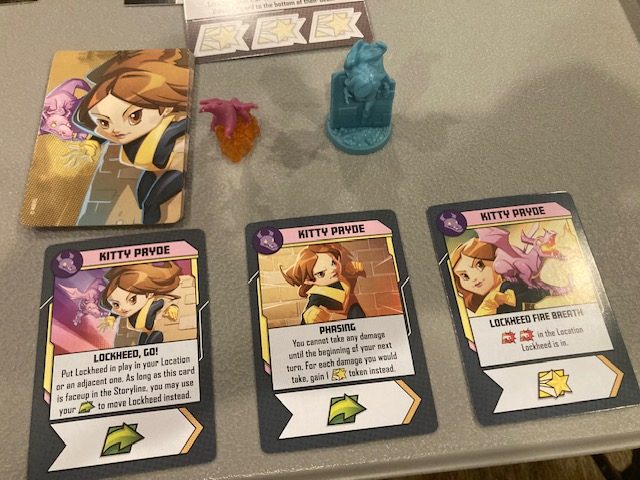
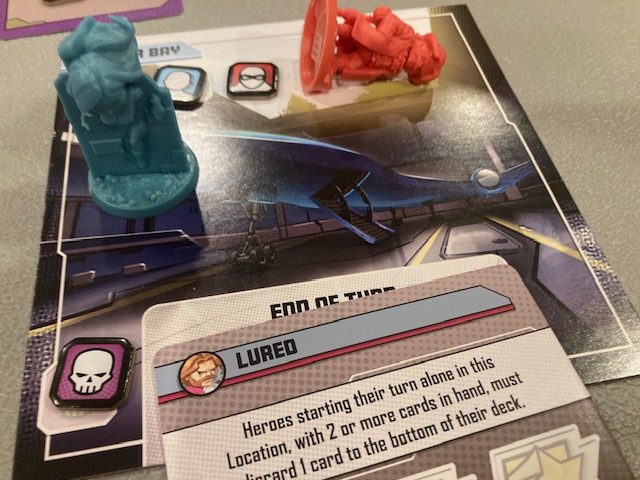
We get to choose heroes in this Game!  If you look carefully at the Threats, you realize you want to try to keep the Heroes together (bad things happen to lone heroes).  Nightcrawler pretty much HAS to teleport every turn (the black text on his cards means you are forced to do that), so it would be easy to keep the Heroes together.  When the Heroes WOULD take damage, Kitty was able to phase and mitigate that!!  This was a great combination of Heroes for this game.  And it felt thematic: Kitty’s phasing kept them safe, and Nightcrawler’s teleportation kept them together.

IMG_6899  

This was thematic from the character’s perspective.  The story not as much (I should have used Wolverine: Wolverine fights alone!)

IMG_6904

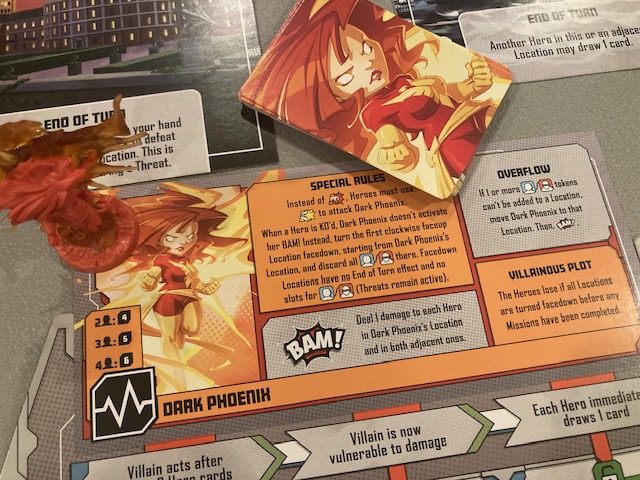
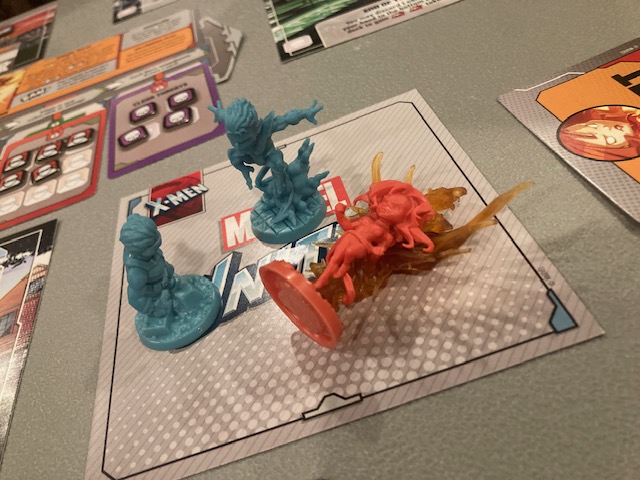
Then Jean Grey becomes Dark Phoenix.  Oof!!!!  There’s some really thematic stuff that happens in this part of the game, but I don’t want to give away too much.

IMG_6905

Dark Phoenix was one of the hardest battles I have ever had.  

IMG_6906

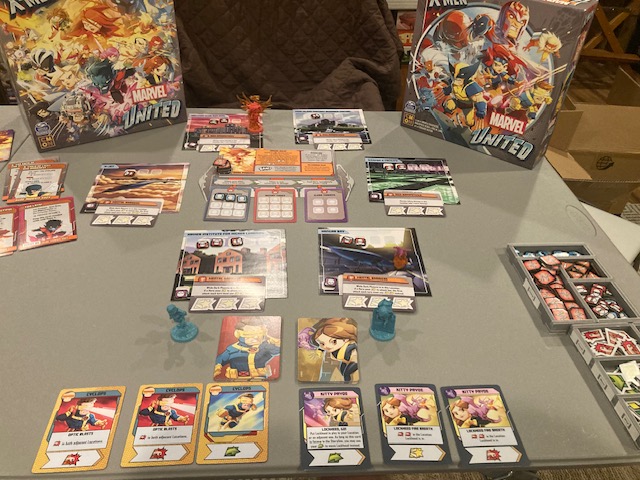
I started with Kitty and Cyclops, but after losing to Dark Phoenix once,  I had to “remove Kitty” from play.  I could only keep playing as long as I had 4 Heroes in my Roster.

IMG_6917

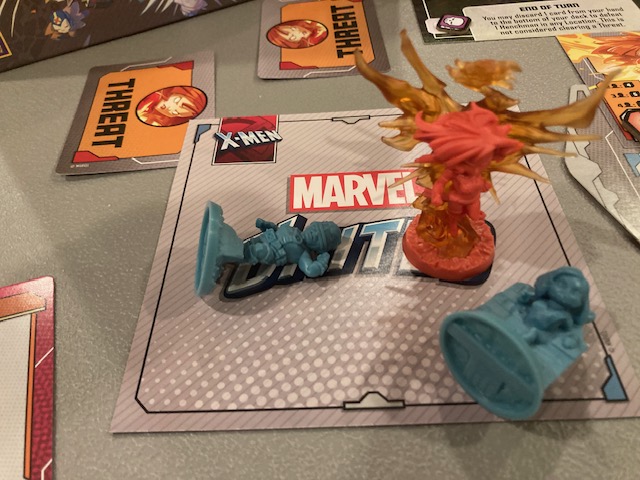
See above as Dark Phoenix easily takes out Cyclops and Kitty.

IMG_6924

I get to try again: For my next trial against Dark Phoenix, I brought out Nightcrawler  (and you are required to keep Cyclops).

IMG_6927

I was able to eke out a win, but just barely.

IMG_6914

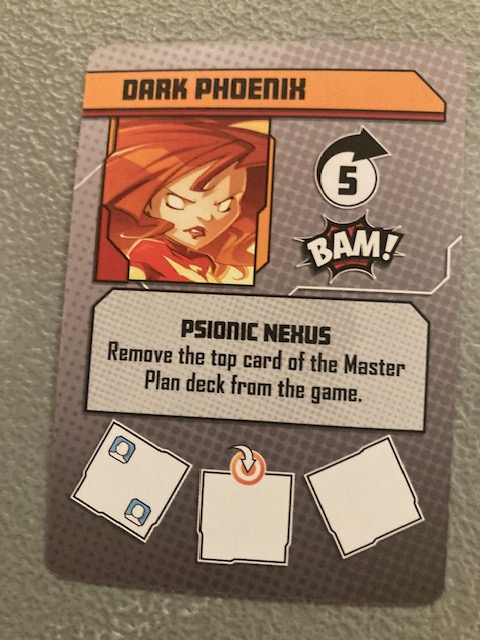
Dark Phoenix’s Master Plan cards are just rough!

IMG_6910

I fully expected to need 3 or more games to beat Dark Phoenix.  I mean, she’s Dark Phoenix.

IMG_6930

Even though the X-Men were able to defeat Dark Phoenix, … things happened while Jean Grey was Dark Phoenix. Like, she ate a sun and destroyed a world, so she must stand trial. 

darkphoenixsaga18

And Gladiator is the one to deal with her. 

IMG_6936

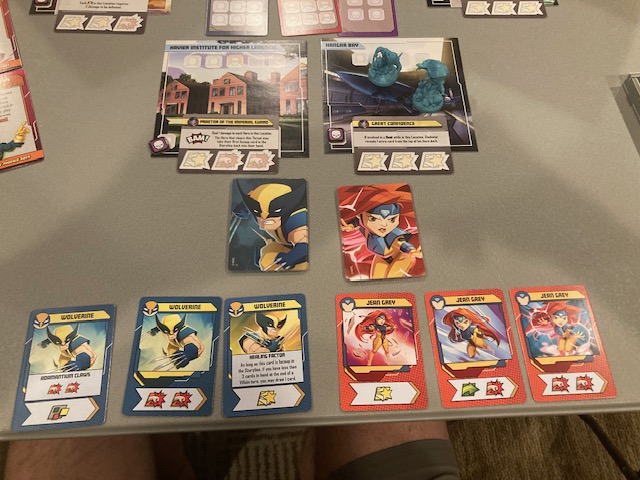
Jean Grey must fight, since she’s fighting for her own life.  The choice of Wolverine is important here: we know from playing Gladiator from the War Of Kings, it’s important to always have a full hand!  Since Wolverine has his healing factor, he is an exceptional character to play against Gladiator.

IMG_6953

In the end, Wolverine and Jean Grey were able to defeat Gladiator.  And win the campaign!

IMG_1884a

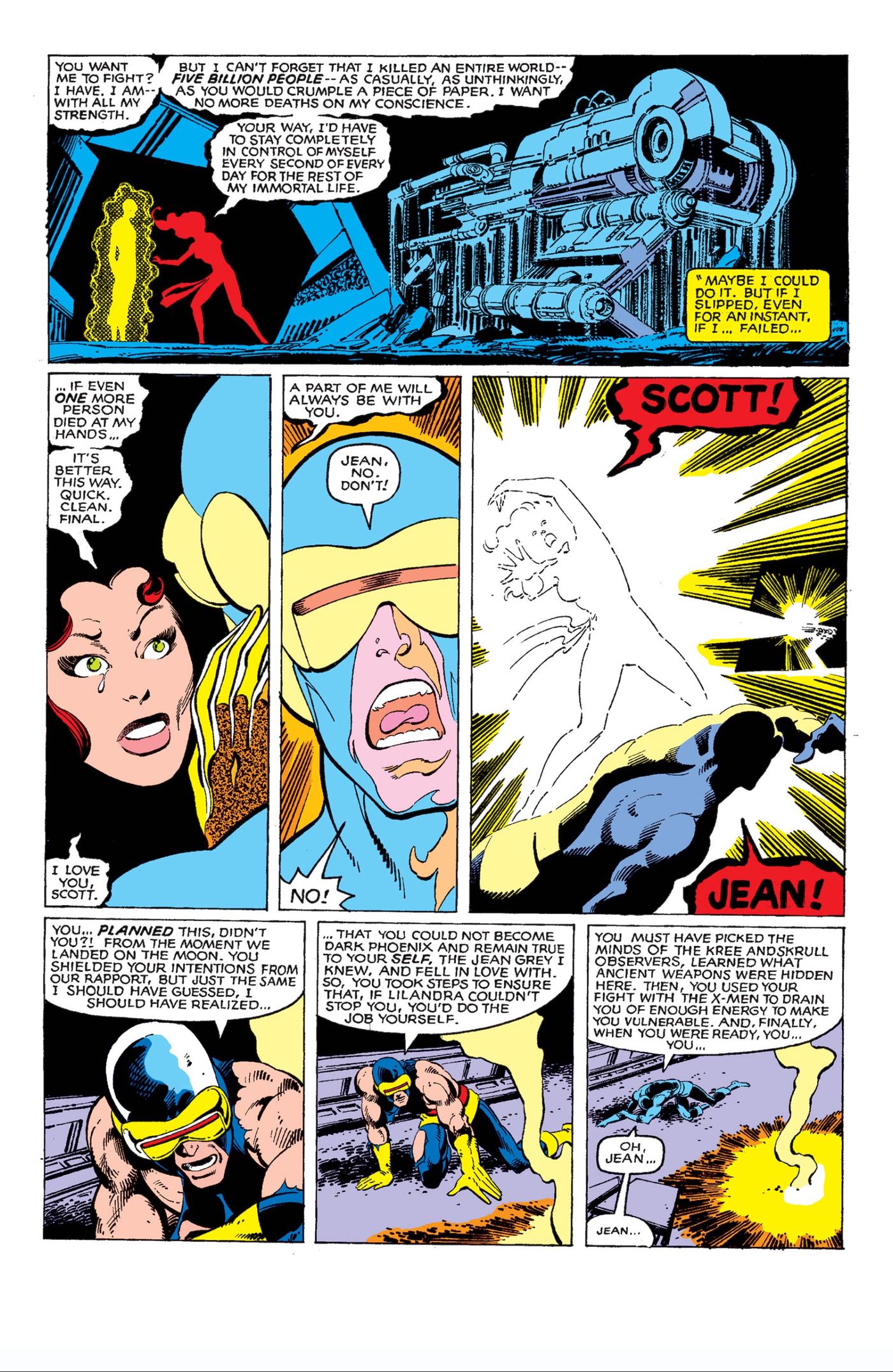
Although, technically, Jean Grey doesn’t survive … they don’t tell you that … see above …

IMG_6952

I know the Dark Phoenix story and wow, this felt incredibly thematic!   From how hard Dark Phoenix herself is, to some events in the deck, the Dark Phoenix Saga Campaign Deck was very thematic.  To be fair, the Campaign Deck didn’t “tell a story”, but it sure reminded me of one of my favorite X-Men stories of all time. 

Run Run Run! See Cats Run! Run Cats Run! A Review of Run Run Run!

IMG_7037

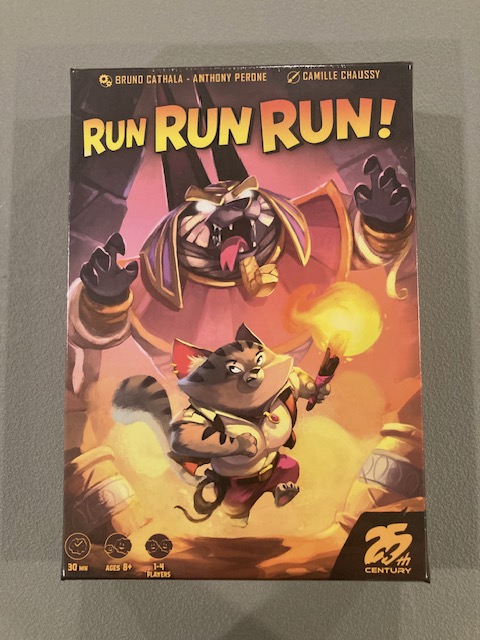
Run Run Run! is a cooperative game from Kickstarter: it was up on Kickstarter in February 2024 (with several other games) promising delivery in May 2024. It actually delivered in late August 2024, so it was about 3 months late. Eh, that’s pretty good for Kickstarters.
IMG_7041

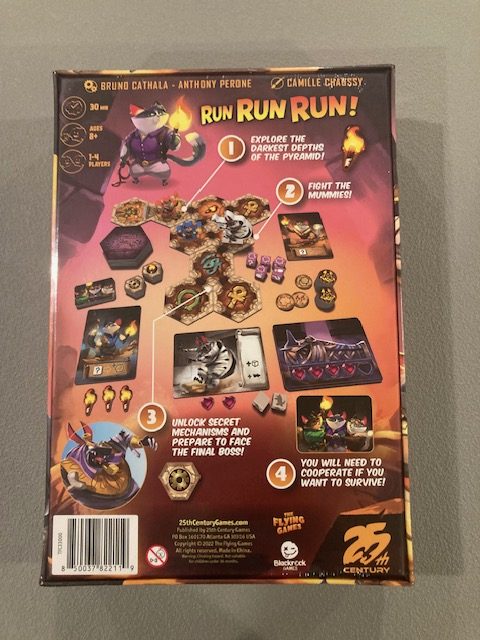
With a name like Run Run Run!, this sounds like it should be a real-time cooperative game, but it’s mostly cooperative tile-laying game. See our Top 10 Cooperative Tile-Laying Games for more discussion of the tile-laying genre.  Run Run Run! is also a little bit of a boss-battler game.
IMG_7042

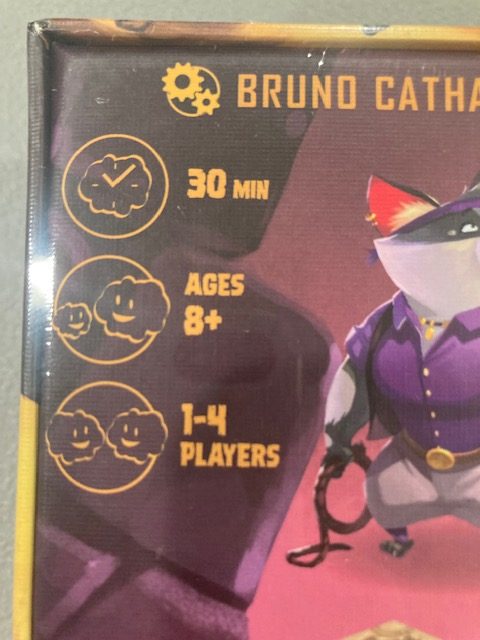
This is a light-weight cooperative game for 1-4 players taking about 30 minutes: the game time listed on the box seems accurate enough.
IMG_7128

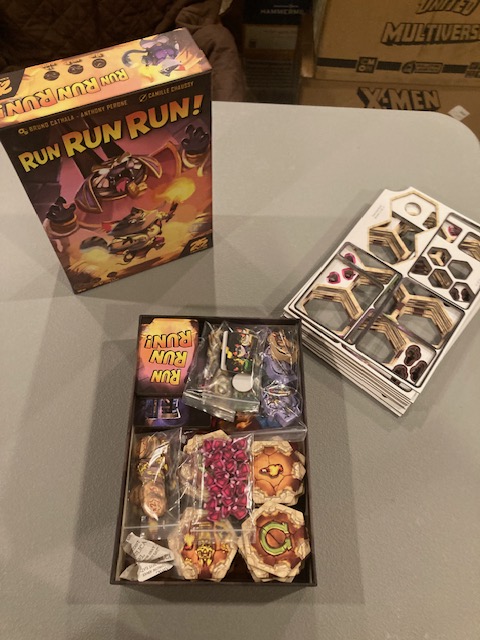
So, this game was part of an “import Kickstarter” where they found games from around the world and imported them to the USA.  Apparently, this is an older game by Bruno Cathala and Antony Perone.  BoardGameGeek lists the game as a 2021 game, although for some of us here in USA, this is a brand new game (including me).  This is the 2nd Edition of the game, so I guess it’s new in that respect.

Let’s take a look!

Unboxing and Gameplay
IMG_7068

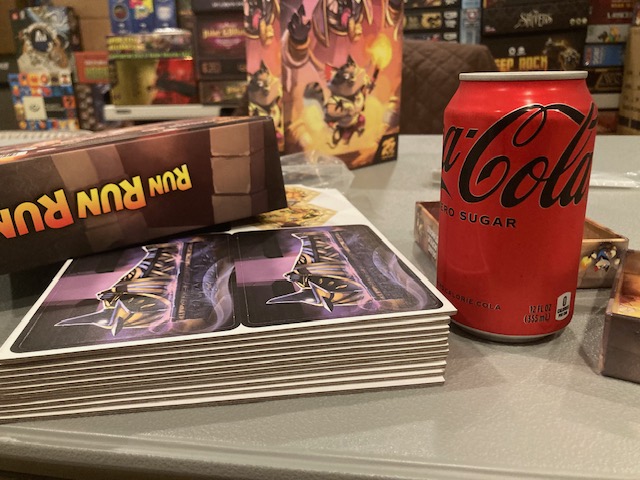
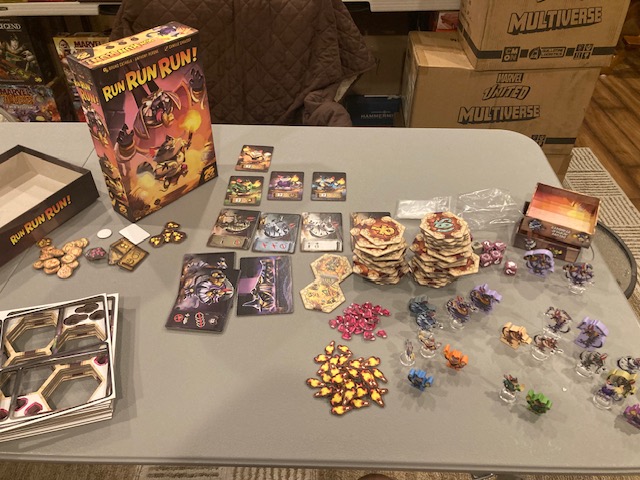
This is a game with a LOT of tiles: more than half the box was filled with punch outs. The first 30 minutes of my unboxing was just punching out all the tiles and other components! We did say this was a cooperative tile-laying game!
IMG_7079

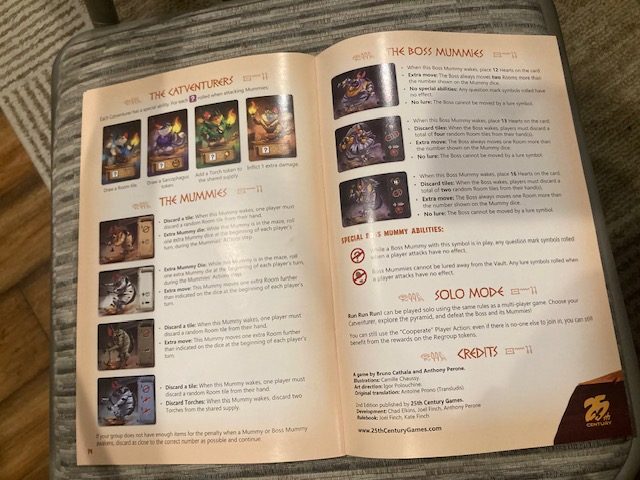
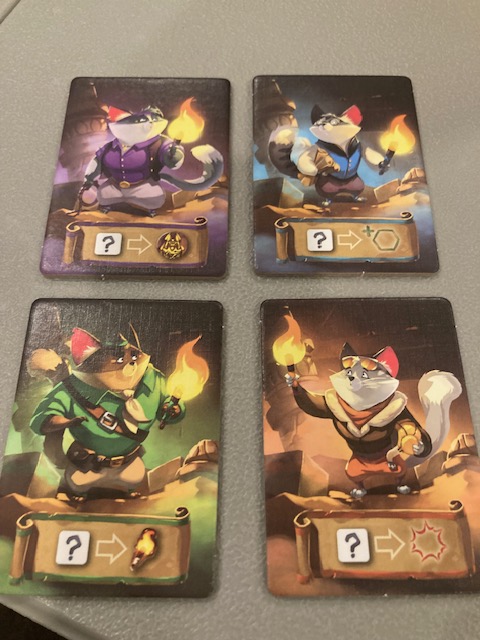
Players assume the roles of one of four explorer cats (Catventurers to use the nomenclature of the game)! See above! Each explorer cat has a special power that is invoked when they roll a ‘?’ on the dice …
IMG_7080

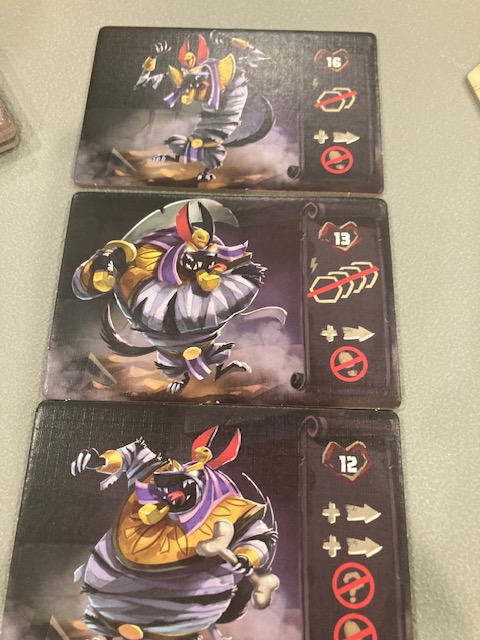
This is also a cooperative boss-battler game: you will face one of the three Final Boss Mummy’s above! To win, you have to take out the Final Boss before it makes it back to the Relic room!
IMG_7081

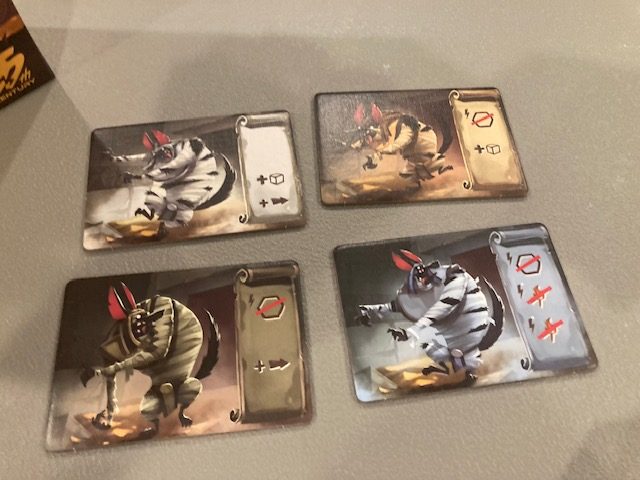
Along the way, lesser Mummies will be summoned to slow you down. If any of the Mummies ever make it to the room with the Relics of the Pharaoh, all players instantly lose! You need to keep all Mummies OUT of the that room!!
IMG_7105

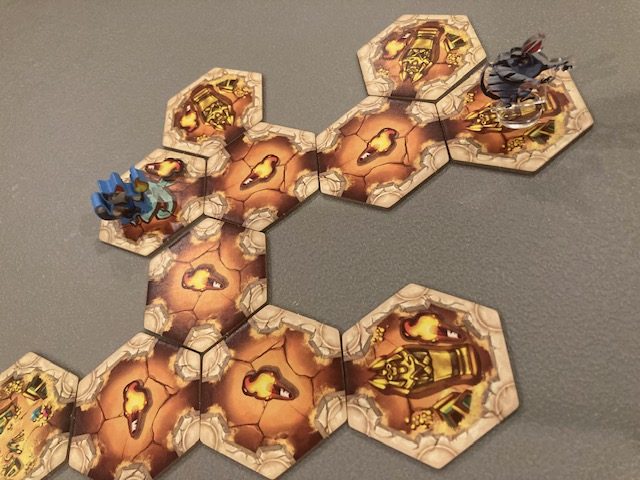
Players lay out tiles, one at a time, trying to build a maze out.
IMG_7111

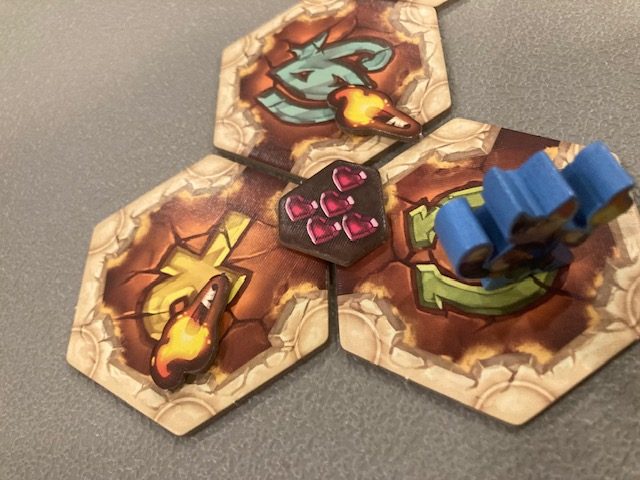
To unlock the Final Boss, you have to build three tiles adjacent to each other with different symbols!  And you have to do this three times (or more)!!  See above!  This is the only way to unlock the Final Boss, but every time you do that build, you invoke a “trap”!  See above as the Mummy  summon triggers a “trap” that gives the Final Boss 5 more hit points!
IMG_7106

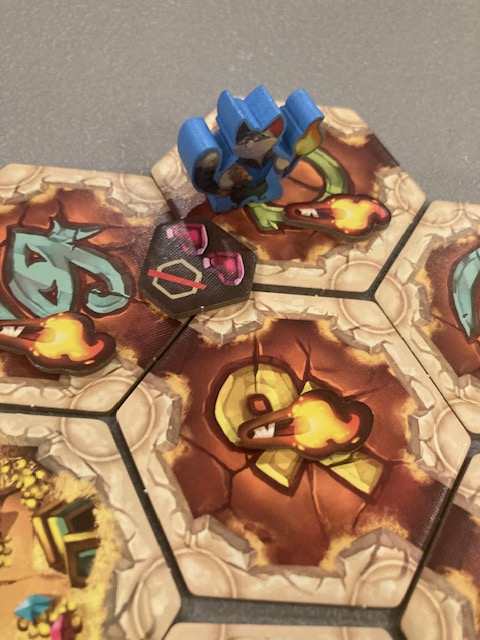
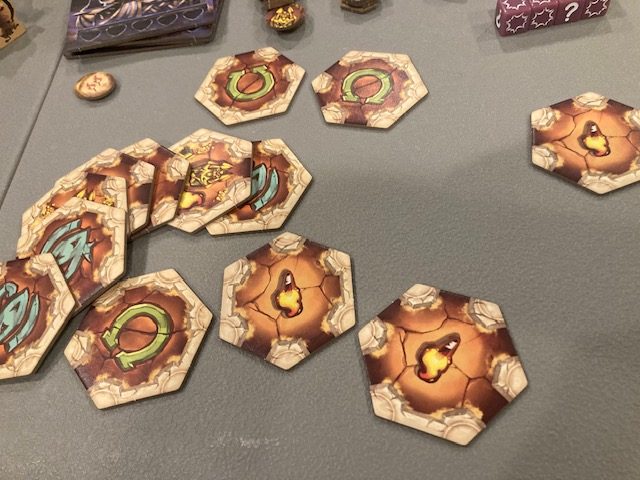
Torches are an important part of the game: you need to put torches in rooms to see!  You start with 5 collective torches, and if you can’t place a torch, you get closer to summoning a Mummy!
IMG_7096

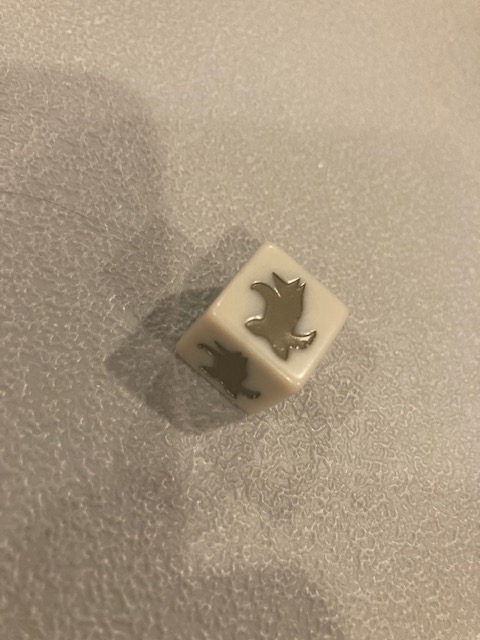
At the start of the Mummies’ turn, you roll a die (or  more…)! If you roll the monster symbol (see above), you have to move all Mummies closer to the Relic Room AND you also come closer to summoning a new Mummy!
IMG_7108

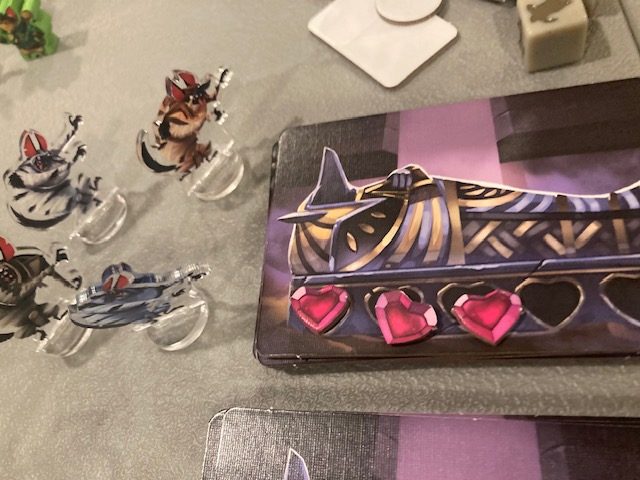
Every time you roll a monster, you have to put a heart on the current top Mummy tomb!
IMG_7101

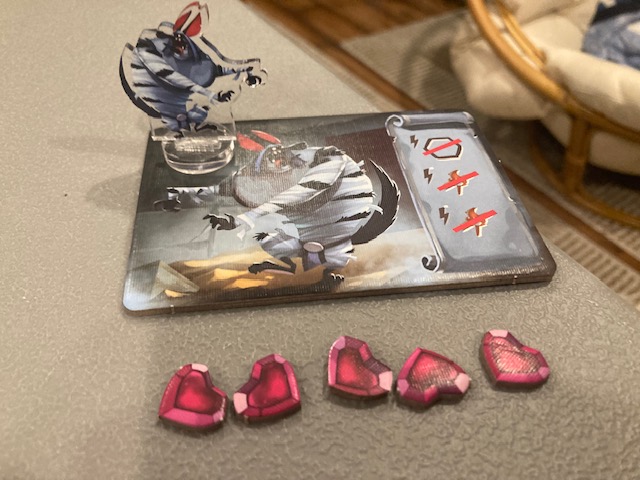
If a mummy get 5 hearts, it has been summoned the Mummy and that Mummy goes on the board! Where on the board? Player’s decide!
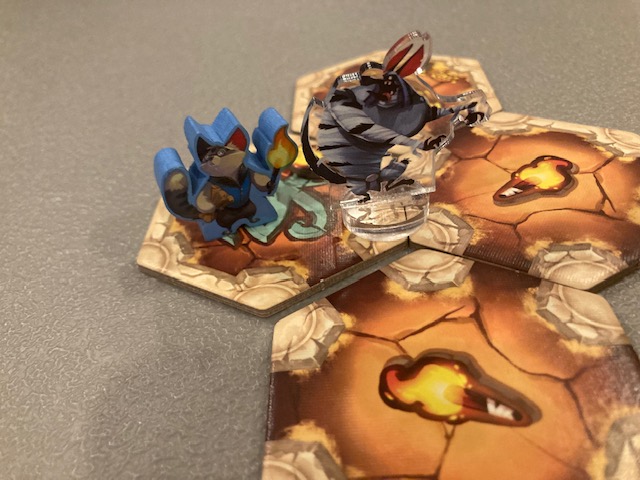
IMG_7102

Usually you put the mummy as far away from the Relic Room as possible (see above), or right next to a Catventurer so they can fight it!
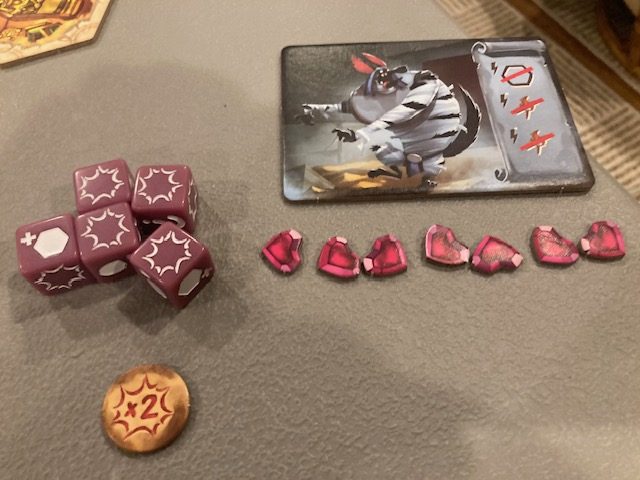
IMG_7107

Mummies are defeated by rolling dice!  See the attack dice above!  Some symbols give you a successful Attack: note above we do 4 damage to a Mummy with 7 hit points! But since we have have the x2 token, we do all 8 damage and take it out in one shot!

How do we get dice?
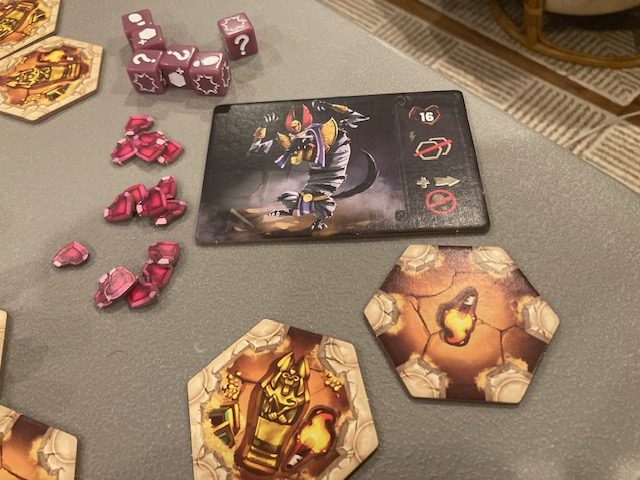
IMG_7114

Every exit on a tile you discard give you an attack die!  For example, to get all 6 attack die above, we can discard the one tile with all 6 exits to get all 6 dice (6 is the max).
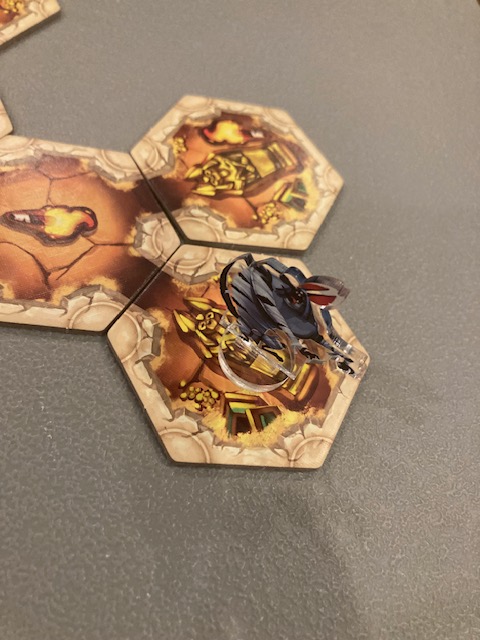
IMG_7104

How did we get the x2 token?  Whenever we explore a Sarcophagus room (with the little golden coffin, see above), we get a Sarcophagus token … one of which may be a 2x!  See above!
IMG_7112

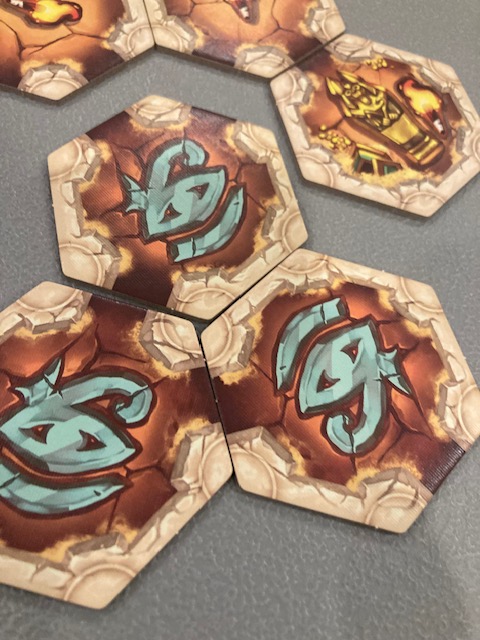
Oh yes, if we ever run out of torches, we can get new ones in a couple of ways. One: if we build three rooms adjacent (see above) the same symbol, we immediately get 5 torches!
IMG_7345

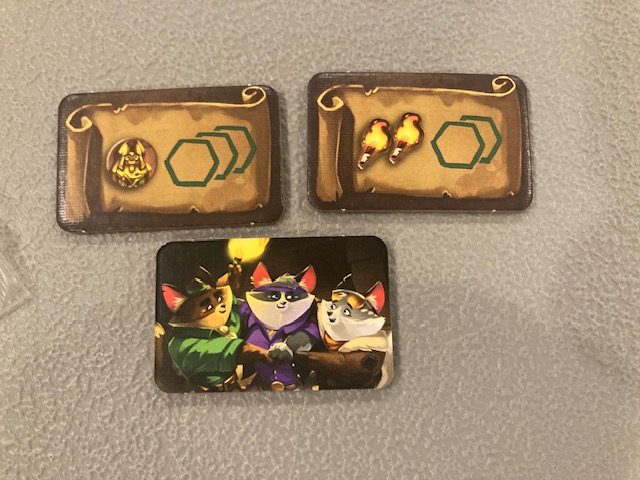
There’s also a cooperate action which can give more torches (or tiles if needed). See above.
IMG_7195

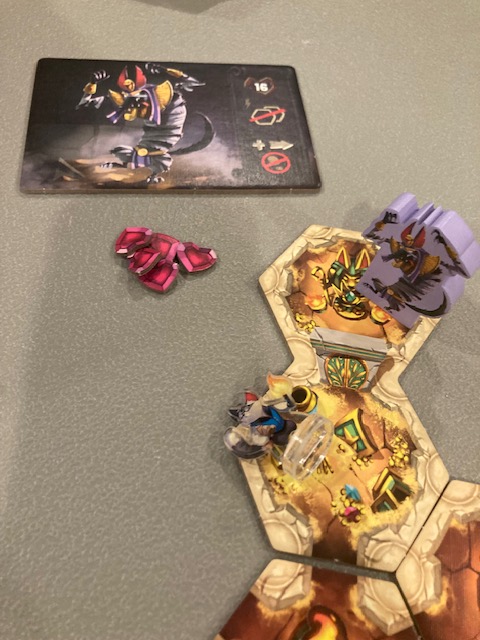
If we can take out the Final Boss before he reaches the Relic Room, we win! See above as we LOSE as the Mummy enters the Relic Room!
IMG_7078

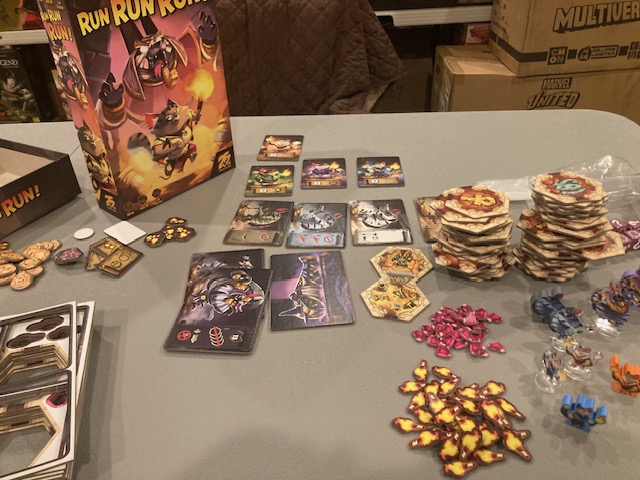
The production for this game is pretty great with tons of thick cardboard tokens! The art is super cute and the game looks like a high quality, but cute, production!

Oh, and this is a cooperative cat game! It may not be clear at first, but we are all cats working together!

Rulebook
IMG_7059

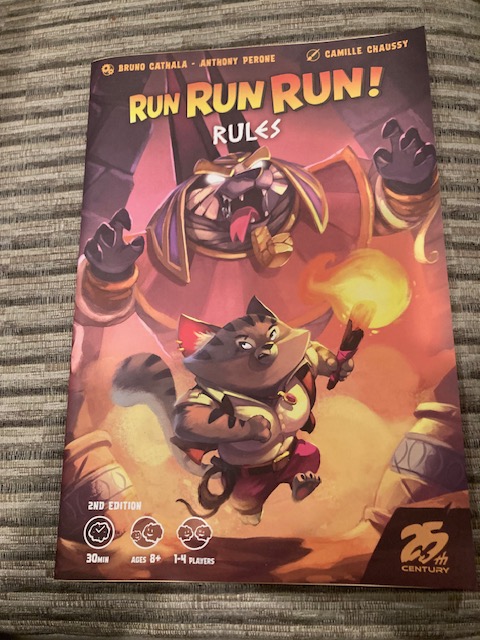
The rulebook is good.

IMG_7066

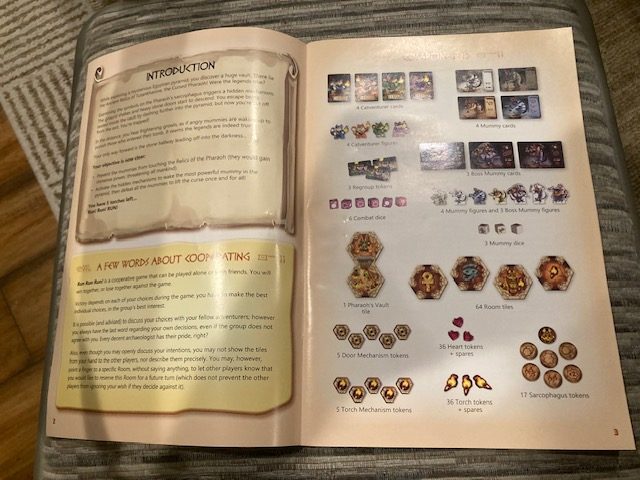
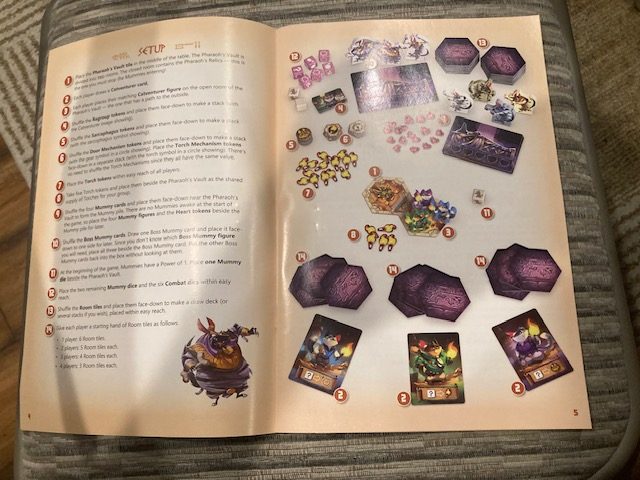
The rulebook gets an almost perfect score on the Chair Test with an A!  See above as it fits perfectly on the chair next to me, it stays open, it has readable fonts, and it has good pictures!  This would probably get an A+ on the Chair Test if the fonts were just a little bit bigger.  
IMG_7060

The Components page is great: it shows all the components with annotations. See above.
IMG_7061

The set-up pages are perfect: the entire set-up is pictured and each step is labelled with a relevant number!  I can leave this open, and set-up the entire game from these two pages!
IMG_7063

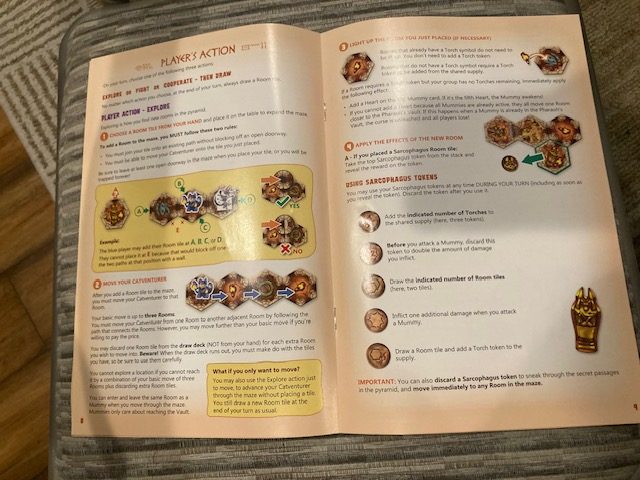
The rest of the rulebook is pretty good.
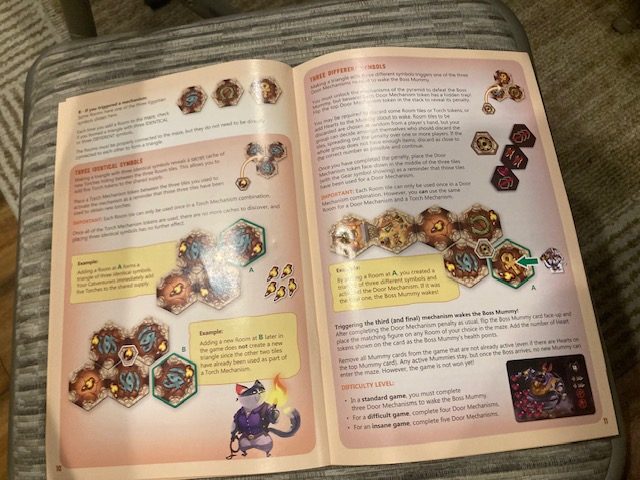
IMG_7064

My only real complaint is that they didn’t show/explain all the possible Trap tokens that can come out. I had to “guess” what they meant.   It was mostly intuitive, but not always.
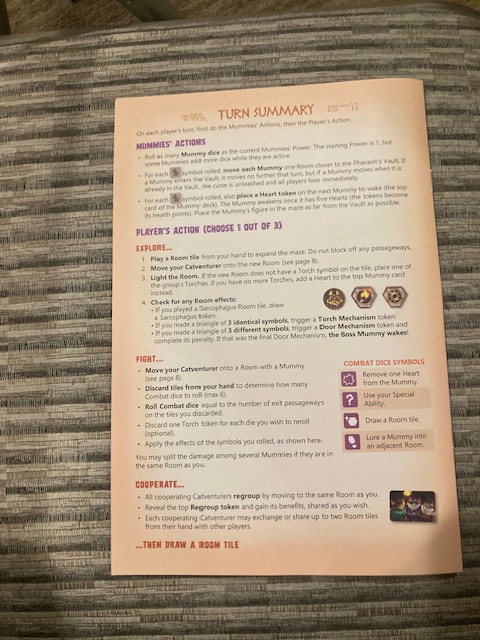
IMG_7067

The last page of the rulebook is useful: this is where I wish they would listed all the trap and Sarcophagus tokens with more description. Still, at least the back of the rules was useful.

There’s no index, but this is a 30 minute game, so I don’t think it needs it.

In general, this is a good rulebook.

Solo Play
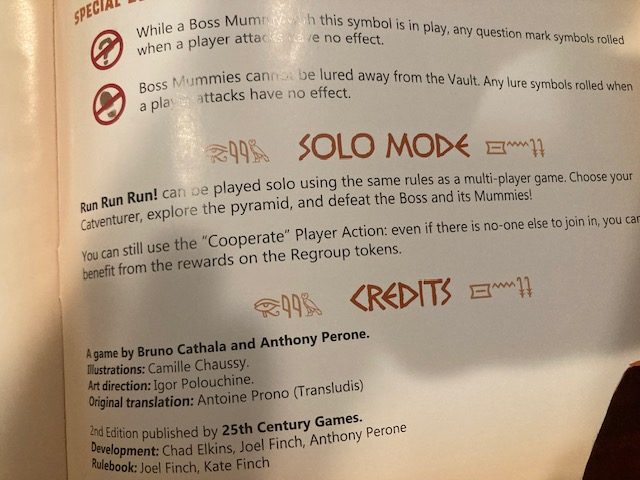
IMG_7084

 This has a solo mode! (Congratulations on following Saunders’ Law!).  So, there’s a very small section describing the Solo Mode on the very last page of the rulebook.  See above.  The solo game basically plays true solo: you play one Catventurer (the Cat Explorer) and play the game as-is!  The only rule that needs some “slight” expansion is the COOPERATE action: you can still play the COOPERATE action, but only the solo cat gets the rewards!  This is great!  No real changes: just play the game as-is!
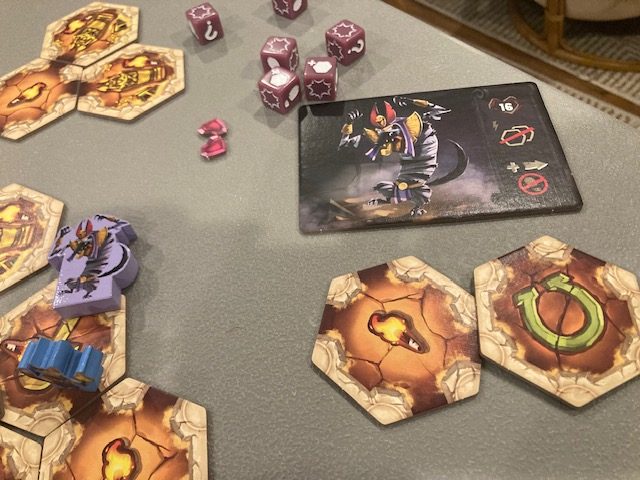
IMG_7120

My first game was a win, as I killed the final Mummy on his way to the end! See above!
IMG_7095

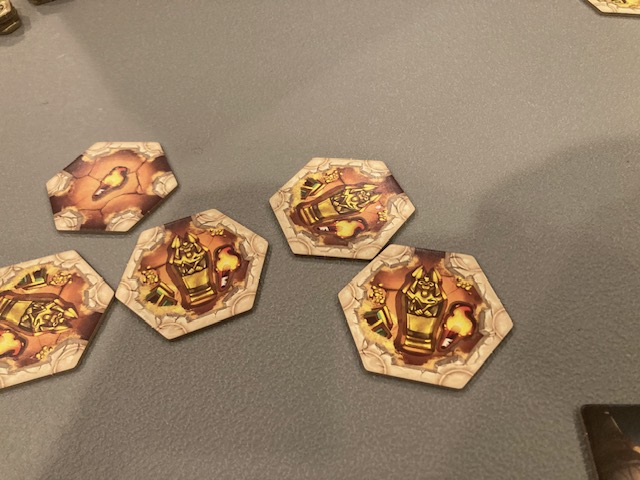
My initial tile selection wasn’t great (as only one room has more than one exit), but I soon got a lot more branching rooms.   I also had a lot of Sarcophagus rooms …
IMG_7099

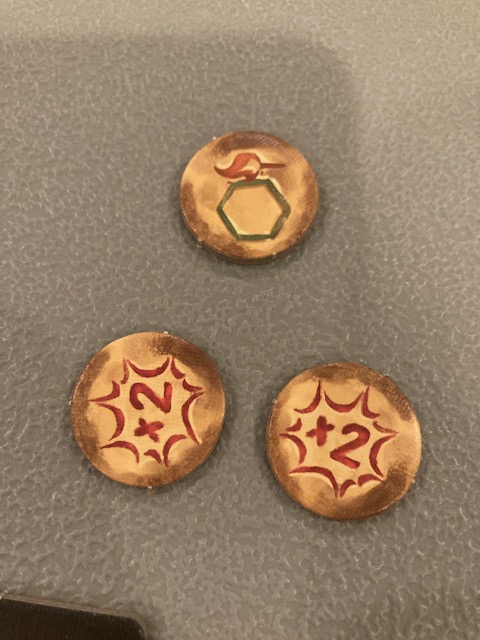
Those Sarcophagus rooms enabled me to get some great tokens at the start of the game!  I saved those 2x tokens for the end game, because I knew how hard the final Mummy would be!
IMG_7118

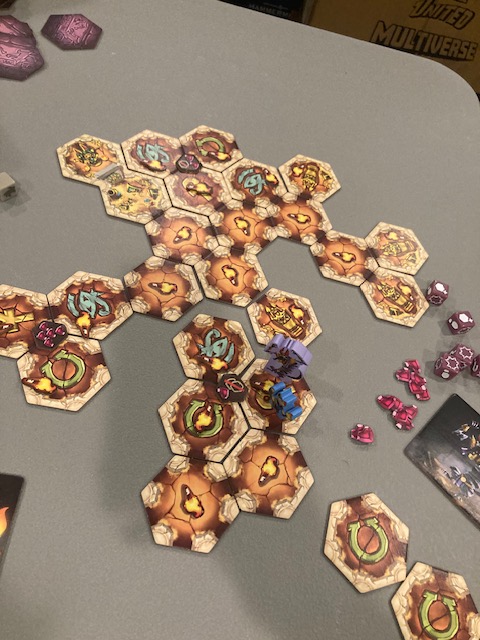
I played my first game very well: I kept the Mummy’s under control and I had plenty of tiles going into the final battle, and I was able to build enough space so that the Mummies were far enough back that I could take them out!
IMG_7191

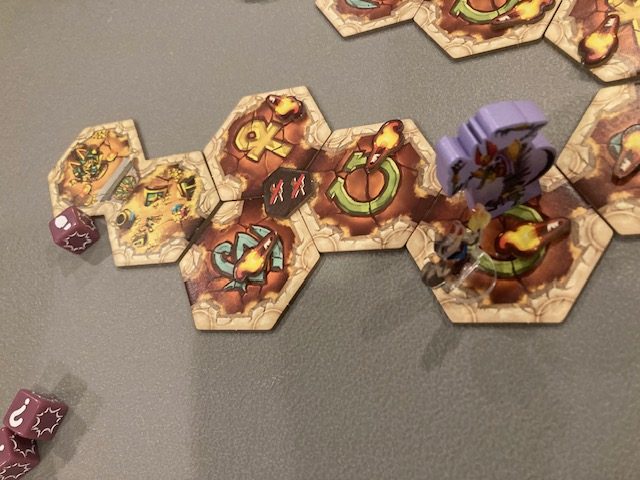
My second game was a close loss: I made the mistake of not having enough of the temple built!  

IMG_7195

I was able to knock the Mummy down to 5 hit points, but he just moved too fast!  He made it to the Relic Room and I lost! See above!

I admit my final loss was depressing because I rolled so poorly; not on the Attack dice but on the Mummy movement!  It’s basically a 50% chance that the Mummy will move every turn, and he moved EVERY TURN after he came out!  The Mummy screamed to the exit and I lost!

Cooperative Play

IMG_7199

Cooperative play went pretty well.

IMG_7198

There was shared workload setting up and playing.  There are enough components in the game (torches, tiles, 5x torch, sarcophagus tokens, mummies, player tokens, etc) that it was nice to share the workload of taking care of the tokens.

IMG_7203

We were able to take out the final mummy!
IMG_7202

Basically, after he came out, were were able to all pounce on him and do as much damage as we could!
IMG_7200

The cooperation in this game was interesting.   We didn’t “love” that you couldn’t talk about the tiles you have, but you were allowed to “point” to to where you were going to build, and that seemed enough to allow us to all move forward.  There was never any “fine-grained” cooperation (“I’ll build this tile, you build this tile”) as we played … because there can’t be!   The cooperation was more “coarse-grained” in that each cat did their own thing on the way to helping the party:  “I’ll take out the light mummy if you can just build!  Oh! I need help with this!”  The game was kind-of multiplayer solitaire with many moments of high-level cooperation.
IMG_7201

If you don’t like cooperative games because of Alpha Player Syndrome (because the Alpha Player tells everyone what to do), then Run Run Run! is game that keeps the Alpha Player at bay pretty well. Because you can’t do any fine-grain cooperation with tiles, the group decides more of the high-level actions together! Everyone stays involved on their turn by choosing the tile to play, but everyone stays involved with the group as they makes high-level decisions together.

With some retrospective, I liked the amount of cooperation the game elicited, even if we did have some communication restrictions.

Communications Restrictions

IMG_7203

My groups don’t tend to like communications restrictions because we get together to play, talk, and strategize together!  We are friends and we want to talk to each other!   Some games with communications restrictions work, and some don’t!  And it’s a razor’s edge of difference.

IMG_7196

Run Run Run! works mainly because it doesn’t stop all communications: you can’t really show your tiles and talk about them precisely.  The rule is (from page 2):

“Also, even though you may openly discuss your intentions, you may not show the tiles from your hand to the other players, nor describe them precisely. You may, however, point a finger to a specific Room, without saying anything…”

The rule is still imprecise (“What does it mean I can’t describe them precisely? Can I tell you it’s a symbol?“), but I think the intent seems to be don’t tell/show others your hand.  Other than that, talk as much as you want!  That seems to work!
IMG_6529

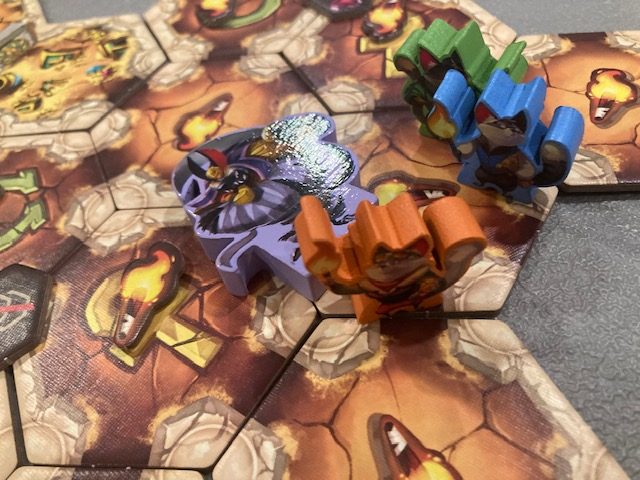
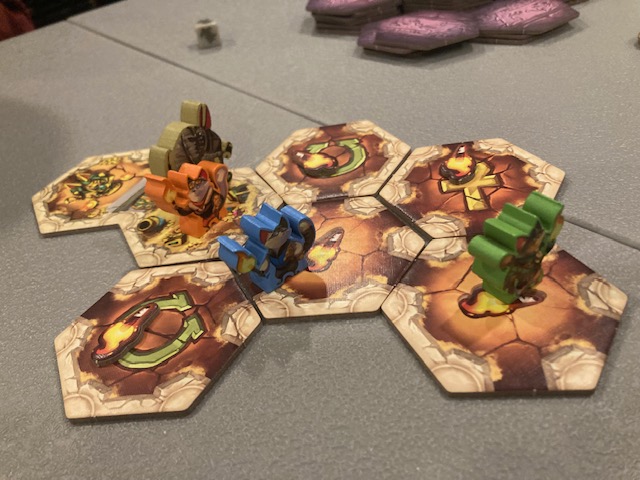
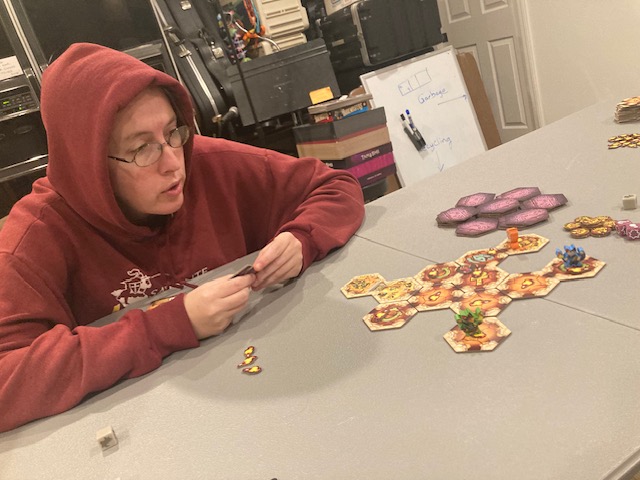
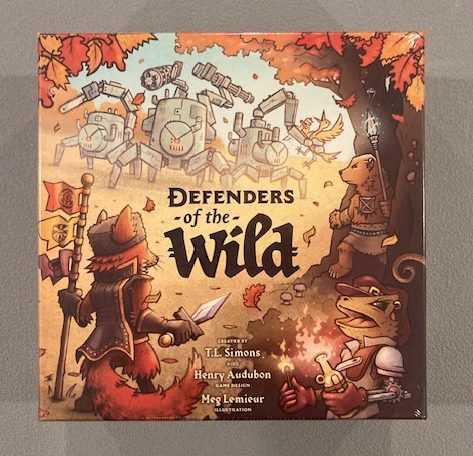
Compare this against the Communications Restrictions in Defenders of the Wild (see our review here):

“At the start of each round, all players must cease communication and maintain silence while choosing a defender card from their hand to play…”

The restriction is much more draconian, and squanders an opportunity to make a multi-player solitaire game even more cooperative!
IMG_6713

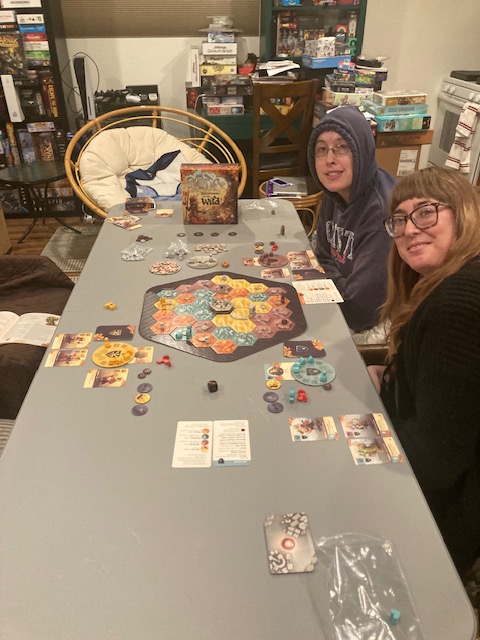
What’s the difference?  In Run Run Run!, you simply can’t share your tiles, but in Defenders of the Wild, you can’t talk at all (for that phase)!!  I think this very minor difference makes a world of difference: I liked playing and talking and cooperating in Run Run Run!, and I am annoyed in Defenders of the Wild by the restriction.  (I still don’t think the communications restriction rules work at all in Defenders of the Wild, but maybe the rule should have been simply been “You can’t show/discuss your Defenders“).

It’s a fine line, but the Communications Restriction works in Run Run Run!, but not in Defenders of the Wild.

Try It Out
IMG_7100

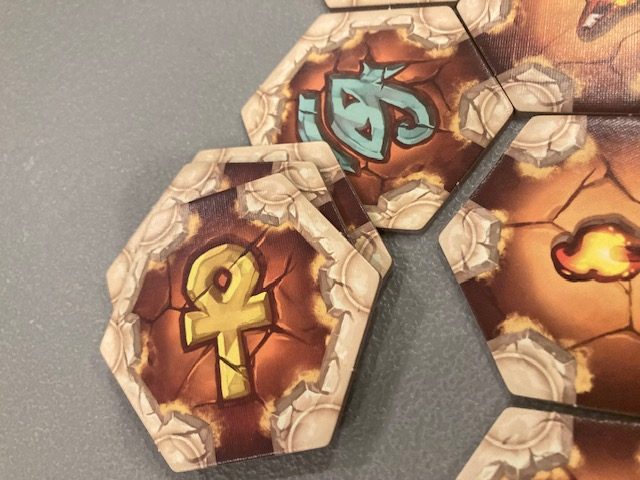
Since this game has communication restrictions, one of the things you are NOT allowed to do it show your tiles to any other person.  The problem is, sometimes you want to “try stuff out!” See above as we have a bunch of tiles we want to play with and see what we can do!
IMG_8771

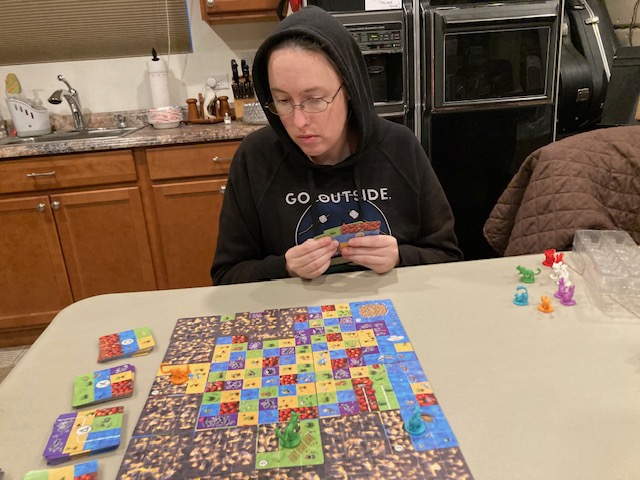
In our review of Race To The Raft (another cooperative cat game with tile-laying), we saw the same problem!  You aren’t allowed to share what you have in your hand in Race To The Raft either, and many times you want to “try” stuff out! 
IMG_8766

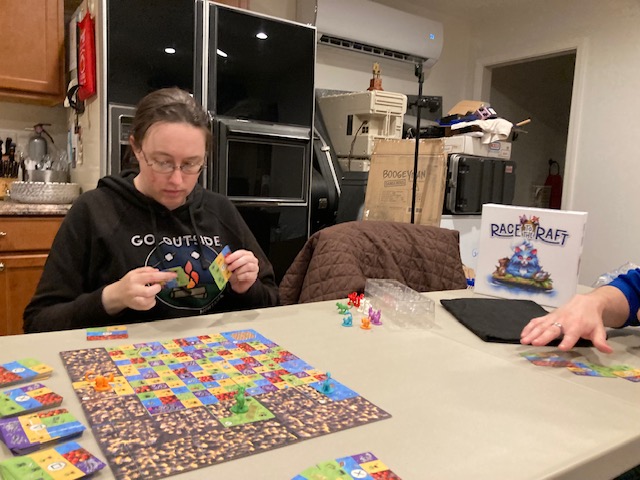
In Race To The Raft, we developed the house rule “look away while I try stuff” so we didn’t break the spirit of the game!  That way, you can still try stuff out, while preserving the confidentiality of the tiles.   We ended up doing something like this in Run Run Run!

It’s a shame: neither Run Run Run! nor Race To The Raft nor many of the cooperative tile games games on our Top 10 Cooperative Tile-Laying/Tile-Placement Games have any acknowledgement of this very human phenomenon: People want to try stuff out!  Please, if you make a cooperative tile-laying game, please have some sort of rule for addressing this issue:

“If you wish to try out some tile layout ideas on your turn, please ask others to look away so you don’t overshare your tiles!”

Otherwise, you make people dislike your game because no one feels like they can “play with” and/or “try stuff”! Or people come up with a house rule like the one above anyways.  

Acrylic Standees
IMG_7039

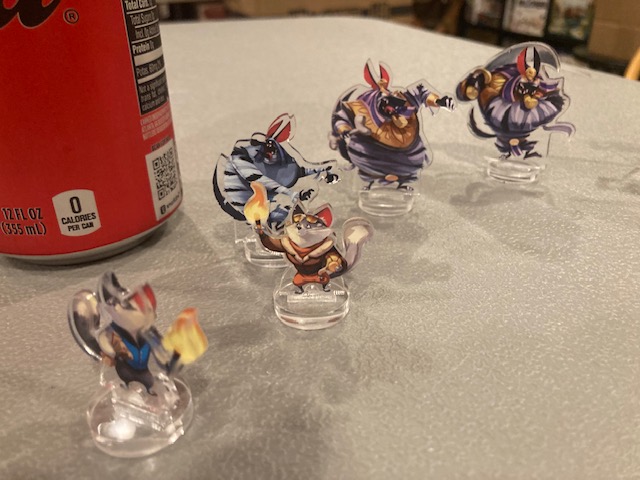
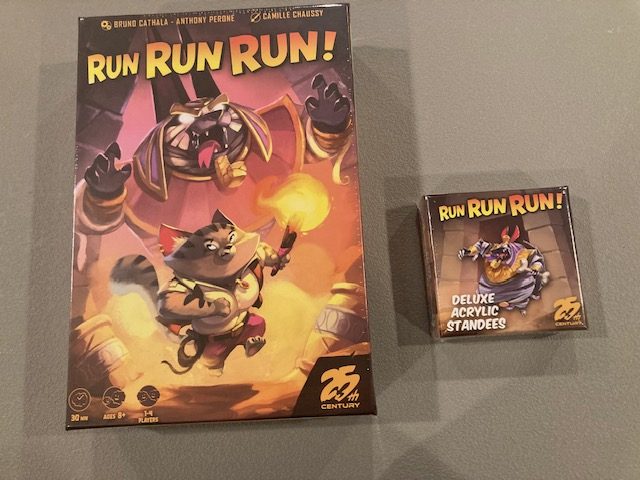
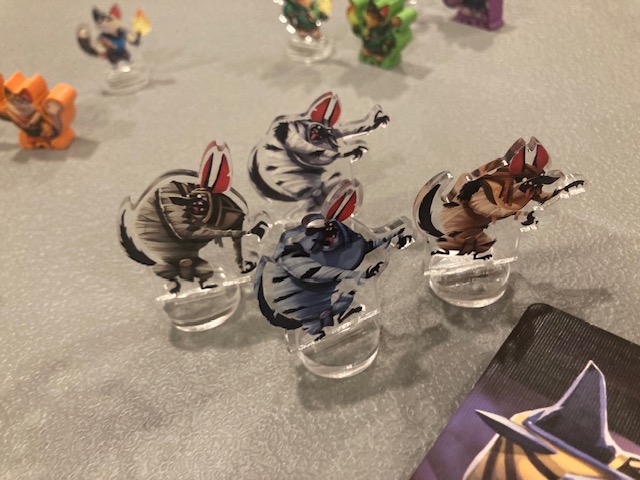
I am a huge fan of acrylic standees!  I loved them in Tokyo Sidekick (see review here) and Kinfire Chronicles (see review here) and Weirdwood Manor (see review here)! So, when this Kickstarter offered a deluxe side of Acrylic Standees, I was in!

IMG_7040

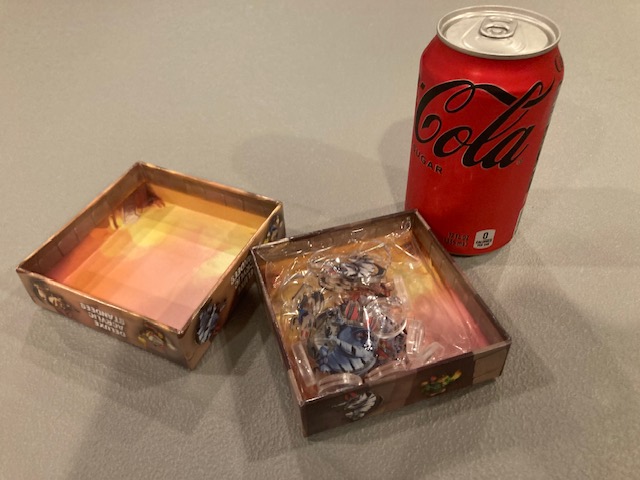
This is a small box full of replacements for the wood standees that come with the game.
IMG_7045

It’s a small box (it turns out, you can fit that box into the final game box with some creative packing).
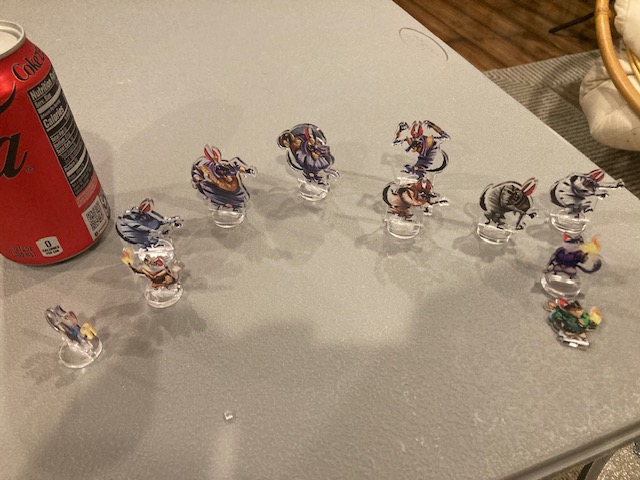
IMG_7046

See above the the standees!

IMG_7048

They are pretty nice! See above!

IMG_7050

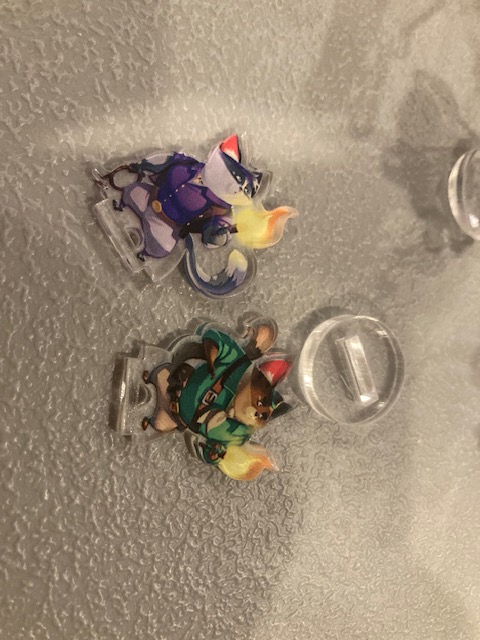
Unfortunately, I had two that were broken.  I think they can be fixed with a little glue, but it was still a bummer. (They had fallen out if their standees, and they really didn’t fit back in).
IMG_7054

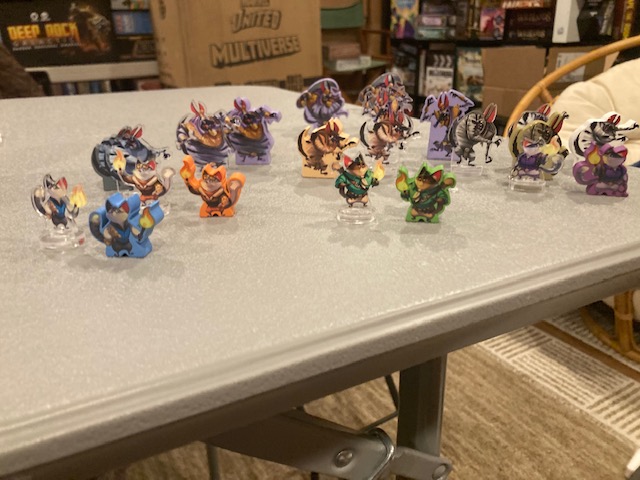
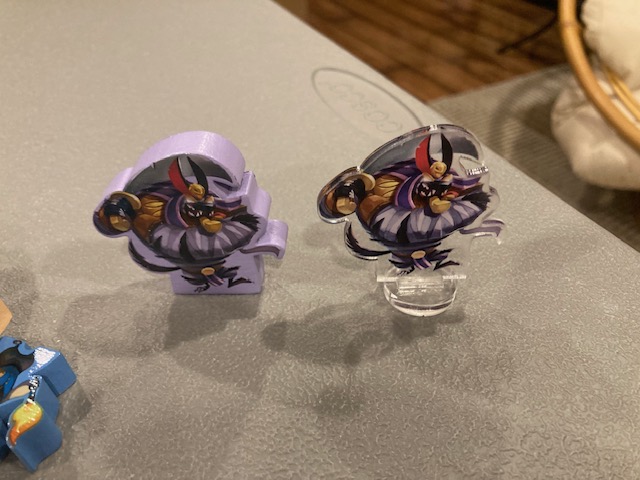
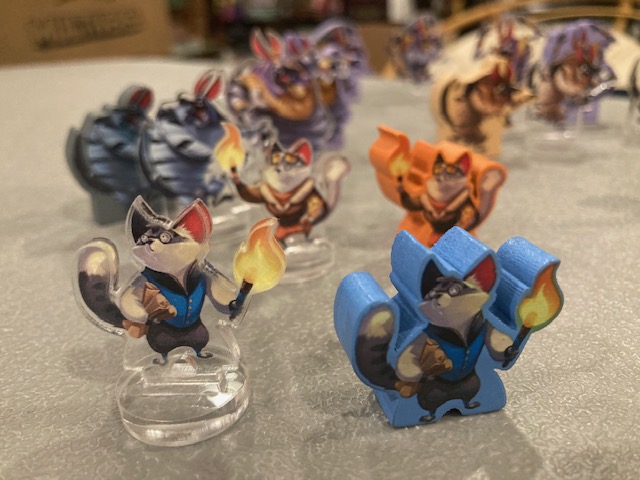
My friends and I did a comparison of the Acrylic Standees to the wood meeples: see above and below.
IMG_7057

Which do you prefer?

IMG_7056

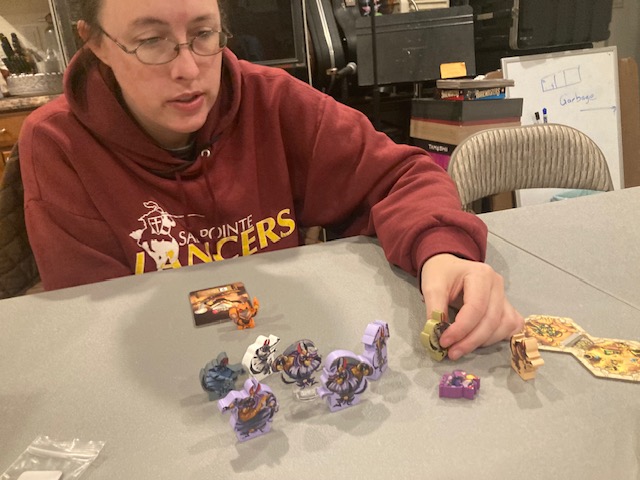
In the end … both me and friends preferred the COLORED wooden meeples.  Whaaaattttt???? It’s not that the acrylic standees weren’t gorgeous, but the wooden ones were (1) more HEFTY and  (2) we could distinguish the colors easily from the wooden standees!  The wooden meeples made the game easier to play.
IMG_5465

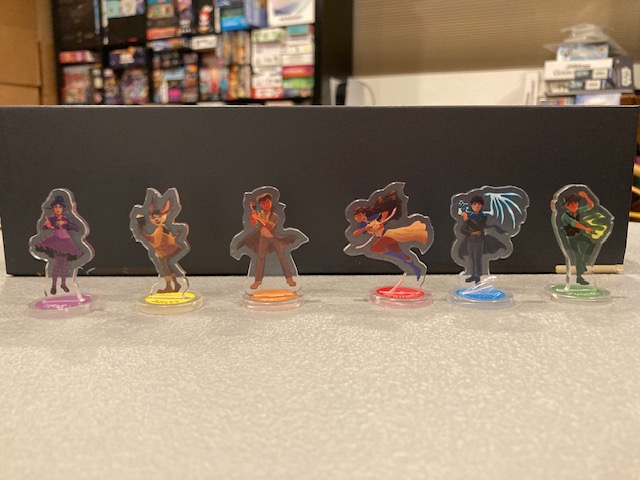
In our review of Weirdwood Manor, we also loved the Acrylic Standees!  See above!  One of the major differences here as that Weirdwood Manor standees are color-coded ON THE BASE!  See above!  This color-coded base makes it that much easier to distinguish the standees across the table!  I think if Run Run Run! had added color to bases,  that would have made them that much better!
IMG_7085

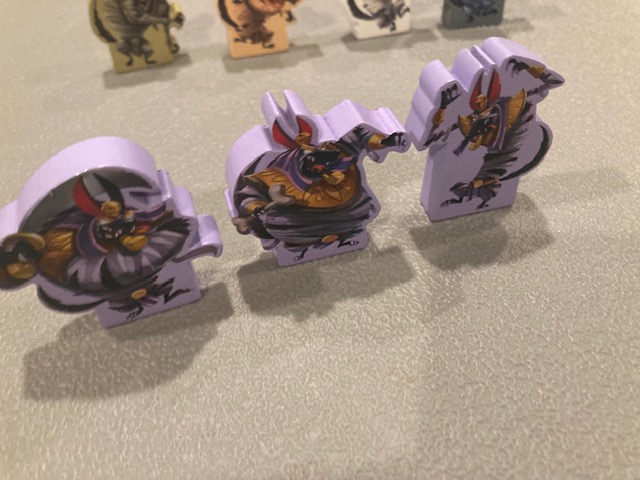
In the end, my friends preferred the wooden meeples.  And I think I do too.  
IMG_7087

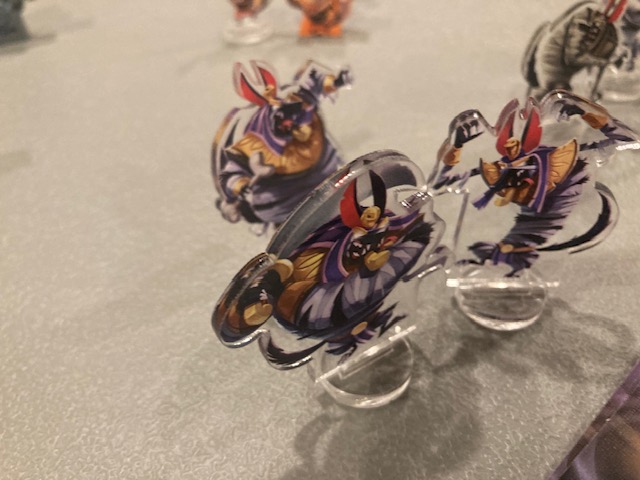
A good compromise might be to mix them: use the wooden meeples for the characters (so you can see each player’s color very easily) and then use the acrylic standees for the mummies!  That way, you get a nice differentiation on the board between the good guys and the bad guys!
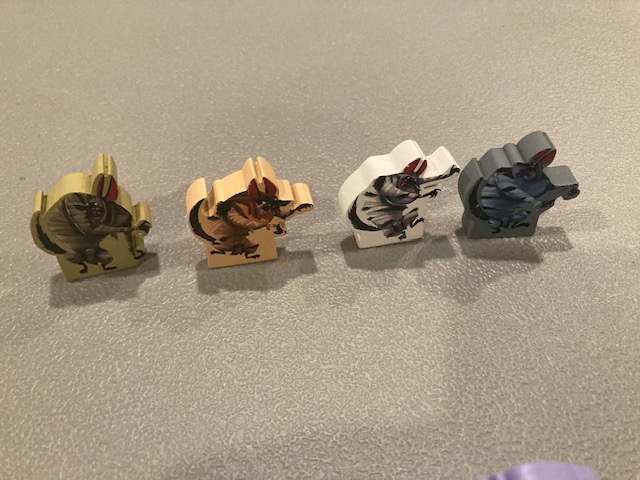
IMG_7086

But, you really don’t have to get the Acrylic Standees; the wooden meeples that come the game are very very very good.  

What I Liked

IMG_7196

One: This Is A Little game! This is a fun little cooperative game that’s only 30 minutes.

IMG_7057

Two: Wooden Standees: The wooden standees that come with the game are much better than you think; it is nice that you have the option for Acrylic standees, but you don’t need them.
IMG_7077

Three: High Quality: The components are pretty high-quality, from thick cardboard tiles, wooden standees, and thick readable tokens.
IMG_7197

Four: Limitations Okay: I generally don’t like Communications Limitations in my cooperative games, as they tend to suppress the reason I get together with my friends: to talk!   In this game, the restriction on NOT sharing your tiles didn’t seem to get in the way of us still communicating: we still made plans as a group and had a good time.

What I Didn’t Like
IMG_7088

One: Acrylic Standees: I am slightly annoyed that the Acrylic Standees weren’t better: some of mine were broken, and they really needed colored bases to help distinguish them on the board.   They are still gorgeous, but not as “mind-blowing” as I had hoped.

IMG_7195

Two: Random. The game is pretty random; it all depends on what you roll on the monster dice and what tiles you draw!!!   

Maybe you get terrible starting tiles!! I think there needs to be a Mulligan House Rule at the start of the game where you can redraw your tiles).   

Also, the monster dice gets rolled every turn and there’s a 50-50 chance (greater with more dice) that something bad will happen.   I lost my last solo game because the monster moved EVERY SINGLE TURN when I rolled badly 5 turns in a row!  I simply couldn’t stop him and there’s no dice mitigation for that!

Reactions
IMG_7194

Rich: “I generally liked it.  As I look reflect back on it, I liked it a little better cooperatively than solo. Even though I generally don’t like communications limits, we still strategized as a group and were able to get stuff done, while still having agency on our own turns.  The randomness of the game is a little much (as dice and tile draws control the fate of the party), but since it’s only 30 minute game, it’s not a big deal if you get wrecked.  It’s probably a 6.5/10 for solo, 7/10 for cooperative”

Andrew: “5.5 or 6? It was pretty good. I like cat games.”

Teresa: “6 or 7, it was pretty fun.”

Conclusion
IMG_7058

Run Run Run! is a light cooperative tile-playing game which just so happens to be a boss battler.  The game seems to unfold as multi-player solitaire, as each player cannot share what tiles they have.  But, a higher level cooperation seems to emerge as players take on high-level roles as they play (“You kill the mummy, I’ll build out!“)  If you are looking for a game with mechanisms that tend to suppress Alpha Player Syndrome without losing too much cooperation, Run Run Run! seems to strike a good balance of being cooperative but still giving each player some agency.

IMG_7096

There is some randomness in the game, as it really depends what you roll and draw!  Luckily, this is only a 30 minute game, so even if you get wrecked, it’s a short game.

IMG_7056

I would recommend Run Run Run! if you like the theme and are looking for a light cooperative tile-laying game … with cats!! I am very sad that I can’t recommend the Arcylic Standees: all of my friends (and myself) preferred the wooden meeples that come with the game.  

Run Run Run! would probably make my Top 10 Cooperative Tile-Laying/Tile-Placement Games, just not near the top of the list.

A Message From the Stars: A Cooperative Word and Math Deduction Game. A Review.

IMG_4351

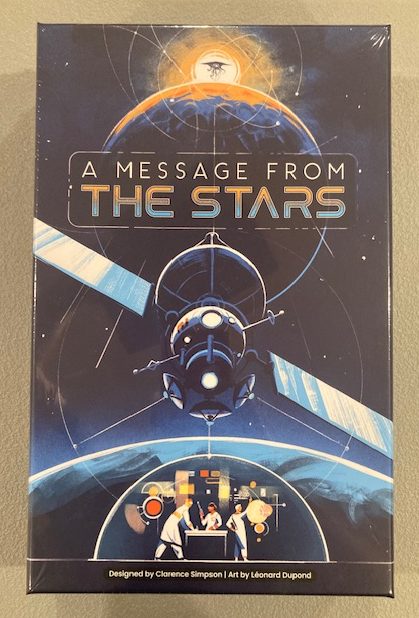
A Message From The Stars is a cooperative word game that was on Kickstarter back in October 2023.  It was a group of games (Through the Desert, Switchbacks, and A Message From The Stars) that was part of the same Kickstarter: see link here.   The only game we care about here today is A Message From The Stars.  This arrived at my house in last April 2024, after promising delivery in May 2024!  That’s right! It delivered early!  Congratulations to All Play for delivering early!

IMG_4350

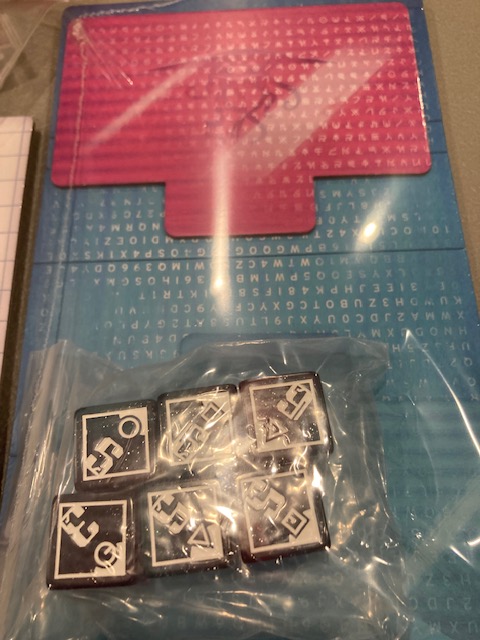
As a Kickstarter, it came with a little bit extra: fancy dice and dice holders!  See above right.

IMG_4352

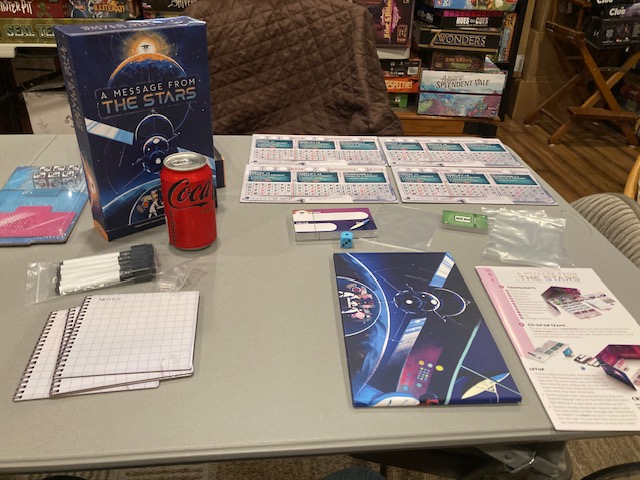
At first blush, this looks like it might be a party game!  It’s a smaller box and the player count is 2-8+ !

IMG_4353

You should heed the label on the back of the game: The Strategy Line (see above).  This isn’t really a party game?  I guess Codenames, another word game, is considered a party game, but this is deeper than Codenames and much harder. Message From The Stars is much more of a deduction game with math and word elements.

Let’s Take A Look!

Unboxing and Gameplay

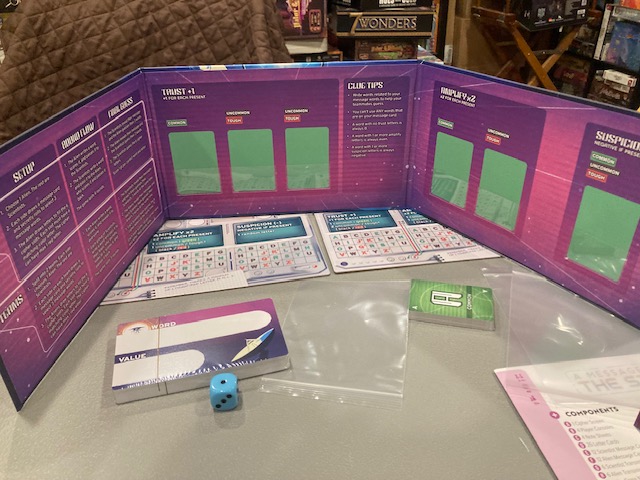
IMG_4354

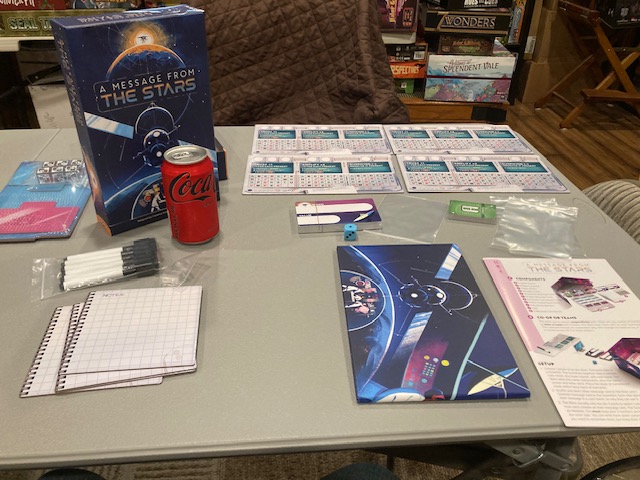
Even the size of the box suggests it might a party game: it’s relatively small.  See the Coke Can above for scale.

IMG_4365

This is a game about two teams: the Aliens and the Scientists!  The two teams are trying to guess (cooperatively) each others words and some important letters!   This is, at its core, a word game.

IMG_4378

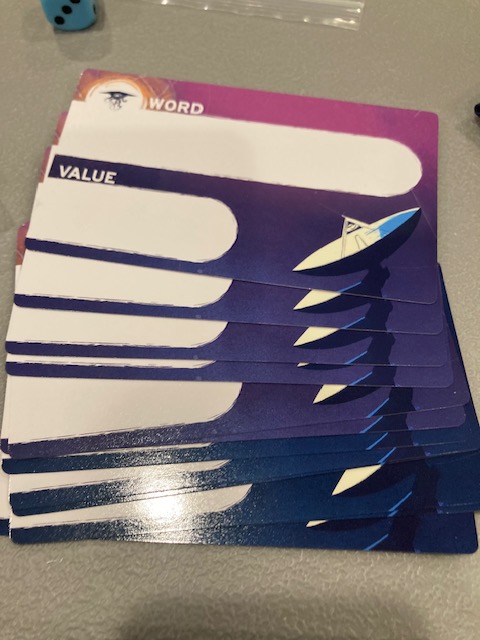
Each team gets a card with some words on it: see above. The words are in three groups.

IMG_4385

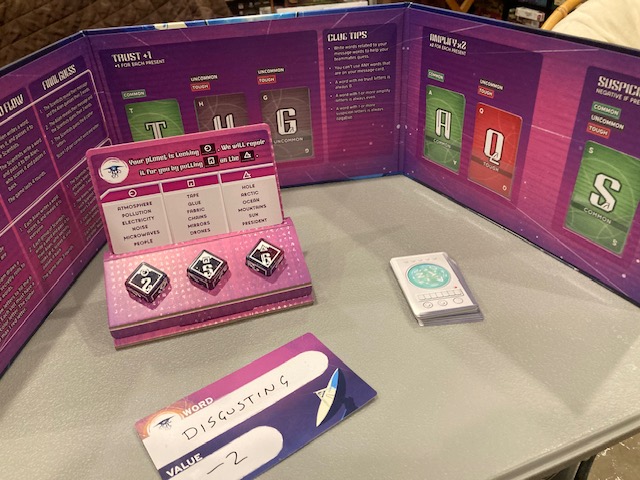
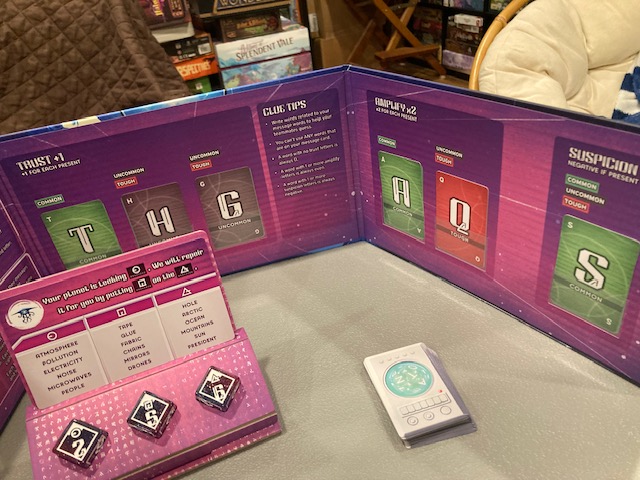
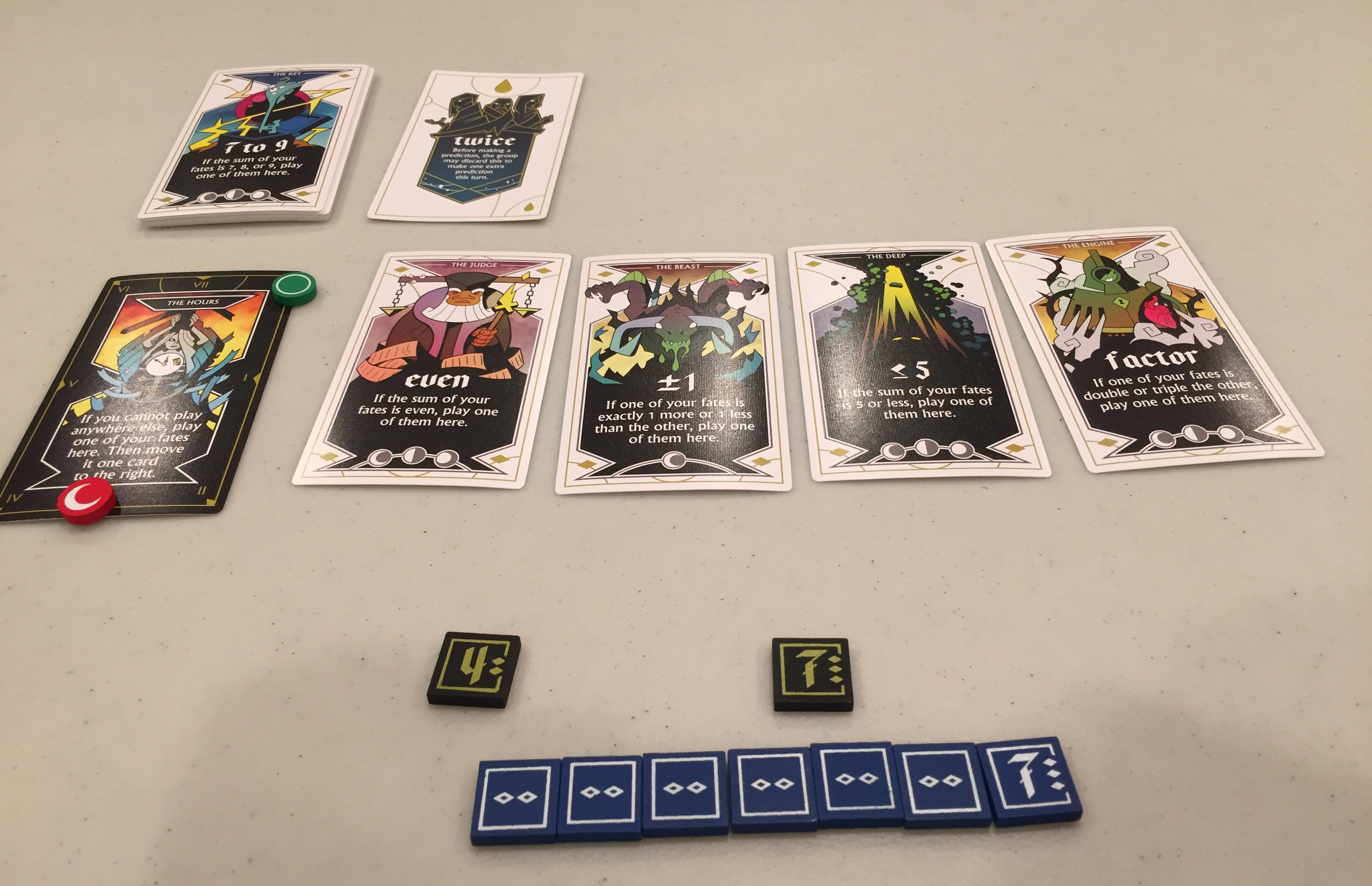
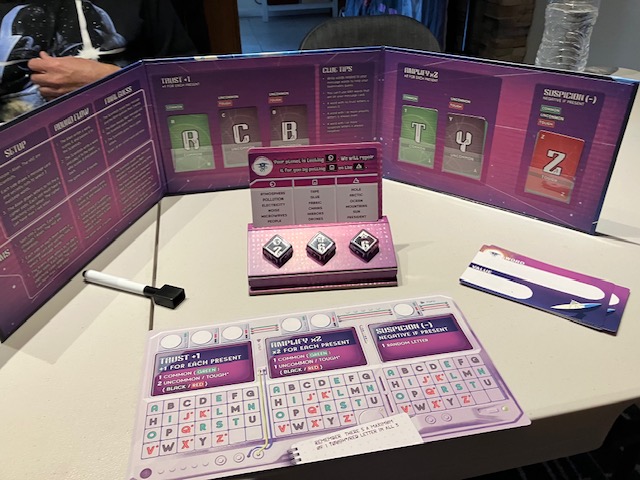
Each team (Aliens or Scientists) rolls some dice to choose randomly a word per column.  The Kickstarter expansion that came with the game (see more discussion of this below) holds the card and the dice; this is so you can see what words the Alien (pink above) is trying to communicate to the Scientists! The words are  Pollution (2), Mirrors (5), and President (6).

IMG_4383

The Scientists do something similar: the words the Scientists are trying to communicate to the Aliens are Atlantis (2) , Field (4), and Factory (5).  See above.

IMG_4363

You might think this sounds like a lot of party games.  But hold on! It gets more complicated! It this were just about guessing words, then, ya, this would be a by-the-numbers party game.  What makes this more complex is that you are also trying communicate which letters are important as well as the words!

IMG_4376

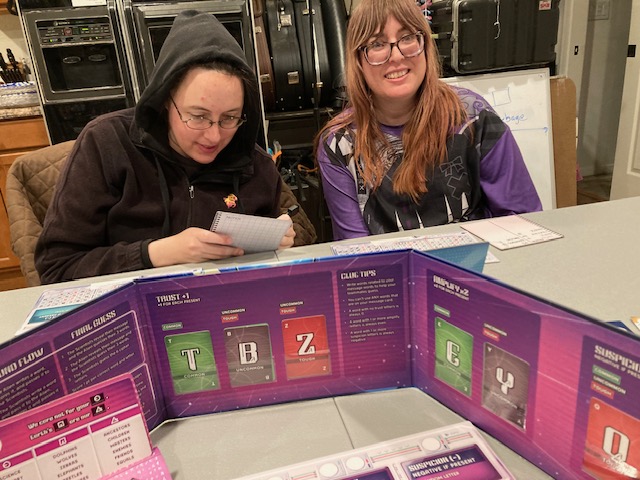
There is a deck of 26 cards with the letters on the alphabet.  Each label is labelled with its frequency in words in the English Language: A is a very common letter (green above) and Z is a very very uncommon and labelled a “tough” letter (red above).  The Alien will be randomly choosing 6 of these letters!

IMG_4359

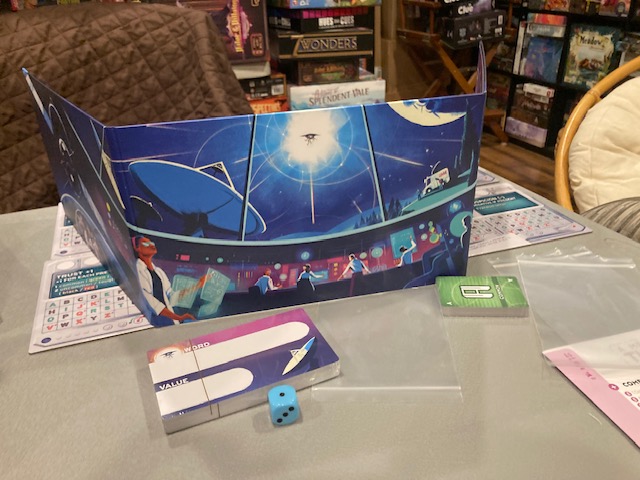
Behind the Alien Screen are places for 6 letters: Trust, Amplify, and Suspicious letters. See above and below.

IMG_4390

To be clear: this isn’t a cooperative game where you “win” or “lose”!  You just get a final score that tells you how well you did!  The final score of this cooperative game is a metric of how well the Scientists and Aliens communicated!  The final score is the number of words guess correctly (max 6: 3 words from the Aliens and 3 words from the Scientists) plus the number of letters guessed correctly (max 6)!  The maximum score is 6 + 6 = 12, which represents perfect communication.

IMG_4377

The game last 4 rounds (in the cooperative mode), which each side providing single word clues to the other side in a round.

IMG_4393

For example, over the course of the game, you can see the 4 clues the Aliens (above) provided to the Scientists.

Basically, in just 4 words (and a hash value), the Aliens have to communicate their 3 words and 6 letters, and the Scientists must communicate their 3 words similarly!

IMG_4387

The hardest part of this game, which takes it away from a party game and into a deduction game, is that each clue word is also “scored” by how many matching letters it has!

IMG_4391

Remember those 6 letters the Alien has?  If the word clue contains some of those 6 letters, the “hash score” value is given along with the word.  Disgusting is given a score of  – 2  for three reasons:

  1. It contains the letter T (Trust +1), which starts the value off at 1
  2. It contains the letter G (Trust +1), which increments the value to 2
  3. Finally, it contains the S (Suspicious -), which negates the value to -2

The rules for the score are not simple, and it takes a few turns to kind of get what’s going on there.  You’ll notice that the word DISGUSTING is doing double-duty: it’s trying to communicate some of the letters AND also a clue on the first column (“Pollution”)!  Is DISGUSTING enough to imply POLLUTION?

IMG_4355

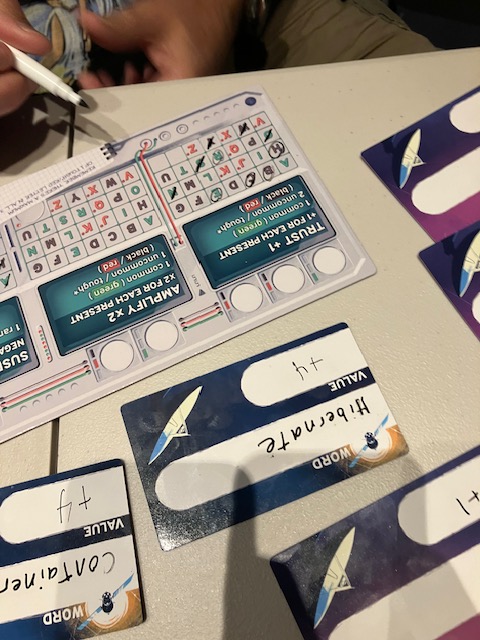
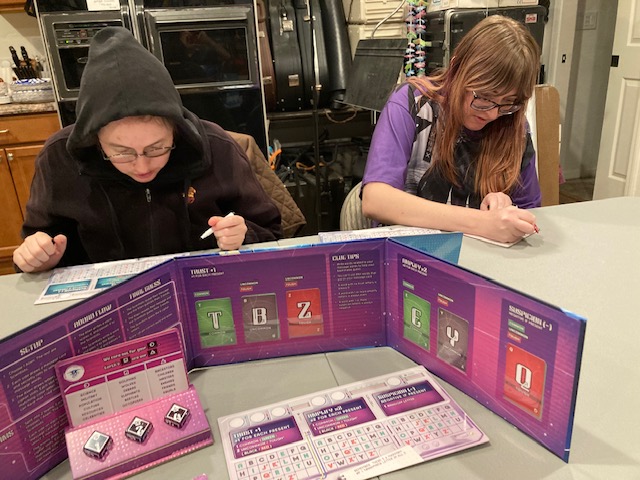
There are a number of dry-erase boards for helping keep track of the word “hash scores” so you can try to reverse-engineer why the score was made!

IMG_0393

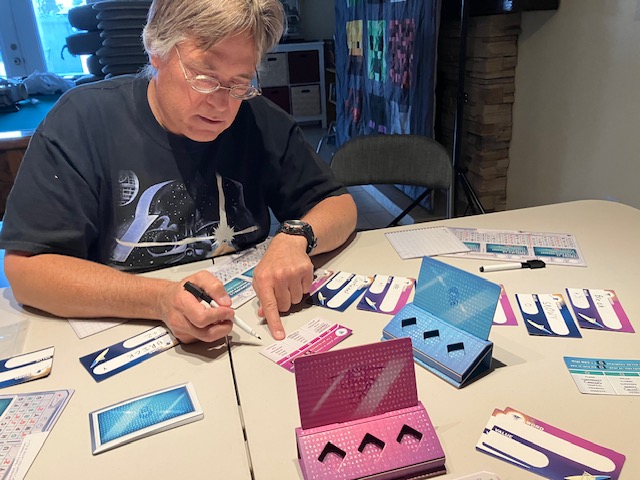
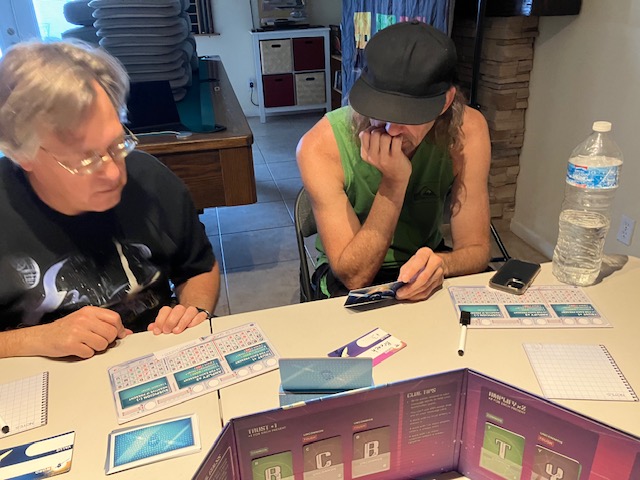
See as Jeff (above) tries to reverse engineer “Hibernate” and “container” to see why they got their scores. Notice how nice and thin the letters are!

IMG_4363

This game has fantastic components: everything in the game is dry-erase (the cards and the boards) so it’s easy to re-use them over and over!  Perhaps the best part is that the game uses ultra-fine dry-erase markers!  Recall how “thick” dry-erase markers ruined both The Revenant Society (see link here) and The Forests of Admiron (see link here).   I am glad to see the A Message From The Stars got the better dry-erase markers!!  This makes a huge difference in a word game!

IMG_4364

For a game that looks like party game, A Message From The Stars has really, really good components.  Except for the die that comes with the base game …

IMG_4363

The base game comes with just a single die you roll.  See above.  You probably want the expansion (below) with the cool dice.

The Expansion

IMG_4367

You probably want to get the dice and box expansion (see above). It makes the game that much easier to play.

IMG_4372

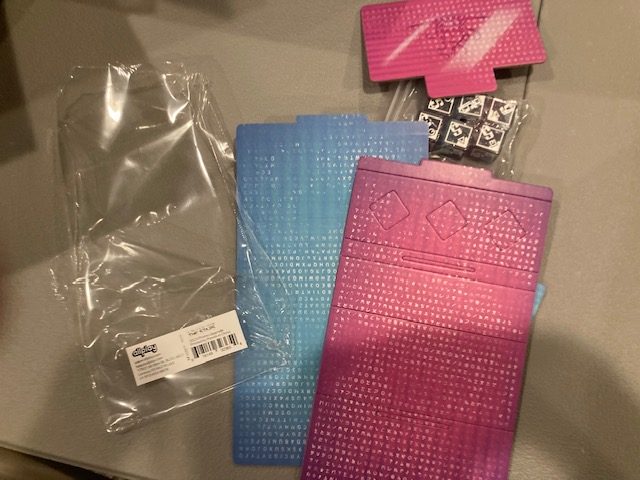
As a warning, there are absolutely NO INSTRUCTIONS on how to build the dice holders!  I had to look up an image online to see what they looked like!  As a community service, I am providing some pictures (below) of the what they look like when assembled!

IMG_4373

Almost there …

IMG_4374

Done!  Notice how nice the dice are too.  These holders just make the game a little easier to play.

Solo Play

IMG_4353

There is absolutely no solo play in this game!  See the box above!  This is a game for 2 to 8+ players!  Boo for not following Saunders’ Law!!

IMG_4391

Since there was no solo play, I just “pretended” to play both sides (mostly the Alien side) so I could get a sense of how everything works.  Once you see how the scoring system works, it clicks!  But it does take a little bit to “get” how this game works.  “Oh, my WORD is supposed to be both a clue for the words AND the letters!! Oh, that’s hard!

IMG_4389

I get why there’s no solo mode: you really can’t have any knowledge of what the other side is doing for their clues.  This is a game with a lot of implications and connotations and indirections with your word clues: it requires a good grasp of the English language and some math skills, but also knowledge of implicit and explicit meanings of words.

IMG_4448
Basic Set-up (for a solo game): After a few turns where the DOOM token has moved up to 3, and the Guesses token is only at 0! I haven’t guessed anything right yet!

We’ve discussed The Changing Perspectives Idea here before, where you run both sides and “pretend” you don’t know what the other side is doing.  That’s a lot harder here in A Message From the Stars because the clues have so much open interpretation!  The Changing Perspectives Idea works so well in Shipwreck Arcana (see link here) because all information is precise: you can use logic to dictate your choices rather than any implications.   Here, in A Message From The Stars, not only do your words have connotation and denotation and context, but they also are chosen to help with the letters! There’s too much “innuendo” and “vaguery” in words for a clean Changing Perspectives Idea to work here.

So, no solo mode.  

Cooperative Mode

IMG_4614

So, we’ve tried this a number of groups.   Sara and Teresa and myself played a 3-Player game (I was the Alien, they were the Scientists).

IMG_4613

They groked this game pretty quickly, and we got into it.  They liked it!  Sara and I have had good luck with Word Games; I played the Paperback Adventures, another word game, with Sara and we both loved it! See our adventures here!  And Teresa is very smart and precise.  Between the two of them and myself, we had a very good time.  But, me, Sara, and to a lesser extent Teresa, really like word games.   And the math Sara didn’t know, Teresa filled in on.  They were a perfect complement to each other.

IMG_0387

Unfortunately, not all my sessions went that well.  See above, as Robert’s look of confusion (upper right) belies his disinterest in the game!  Robert’s a smart guy, but the rules are a little intimidating.  I give Robert a little bit of a pass because he was busy trying to get some work done in the background.  We didn’t have his full attention … and it’s clear this game requires your full attention!

IMG_0390

At some point, Robert just walked away and left me and Jeff to play.

IMG_0394

Jeff and I had a good time.  But Jeff didn’t love the game: his Math and deduction skills were good, but he doesn’t like word games.  He generally expressed an “admiration” for the game: “This is a good game, just not for me”.

Group Dependent

IMG_4612

This is a game that is very group dependent. It has a weird cross-section: you have to like word games, you have to be able to do some math, and you have to be able to do logical deductions. It’s a very cool cross-section! And I love it! I love word games! I love math! I love deduction!

IMG_0391

But the rules, especially for scoring the letters, can be very intimidating.  This definitely does not feel like a party game: it’s a very contemplative game as you traverse word, math, and deduction skills.

IMG_0390

That picture of Robert walking away is kind of ominous and a little telling: you have to be completely focused on this game for it to be fun.   Otherwise, it’s too easy to get lost.
Know your group.  This game is very group dependent, more than many other games.

Conclusion

IMG_0389

I give A Message From The Stars a very strong recommendation … but only for certain groups.  That cross-section of people who like words, maths, and deduction seems like a small set.   I think you’ll know from the description of the game whether this is for you or not.  
IMG_4364

The components are great, and the production is quite good for this word game.  They even used ultra-fine dry erase markers!  That’s a gold star from me!  

I really liked this game, but you need to decide for yourself if this is a game for you and your friends.  If you are unsure, give the game a try at a convention or a game store.  I really liked it, and so did some of my friends.  But not all of them.