
Welcome Back to Variable Turn Order Month! Last week we looked at Astro Knights: Eternity with its card-based Variable Turn Order System! This week, we discuss the game Plum Island Horror with its bag-based Variable Turn Order system!

The Plum Island Horror is a cooperative tower-defense game for 1-4 players from GMT. This arrived at my house the first week of January 2024.

That’s right! I said a cooperative game from GMT! For those of you who don’t know, GMT usually focuses on very complex wargames. I was intrigued when they said they had a cooperative game!

Interestingly, GMT rates the complexity of their games, and they give The Plum Island Horror a Low to Medium score (see above). We’ll examine this claim later. They also claim the game is 45 minutes per player: we’ll examine that as well.
GMT P500

This game came of interest to me back in June 29th, 2021: that was when I “pre-ordered” my copy. See, The Plum Island Horror was part of GMT’s P500 program (see link here). Basically, GMT won’t print a game until they have at least 500 people express interest with a credit card! Once they hit that magic number of 500 people, they hit the print button! I was actually getting worried because I hadn’t heard anything in a while, so I sent GMT an email back in Oct 2023, and they told me the game was at the printers! Huzzah! My copy finally arrived January 11th 2024! That was quite a wait!

At the time of this writing, it looks like you can order a copy of this game if you are interested: see here. At this time, it’s $95. I only paid $64, but that’s because I was willing to wait and be part of the P500 program. Let’s see if this is worth it!
Unboxing

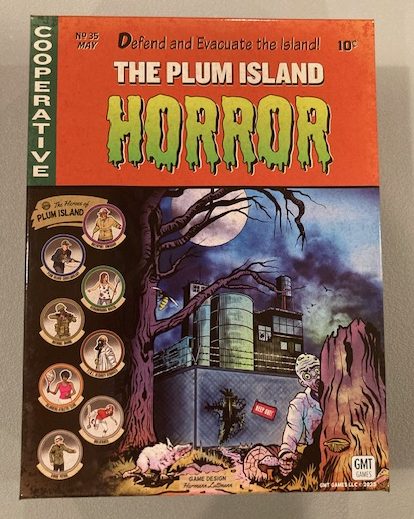
This is a fairly normal sized box, if a little tall. See the Coke Can above for perspective.

There’s quite a bit in this box: there’s two rulebooks (a base rulebook and a reference guide: reminds me of Marvel Champions and other FFG games where they have two rulebooks!)

There’s 6 factions in the game, so you have a board for each of those, as well as some mutations (bad guys) and NPCs (they help you)


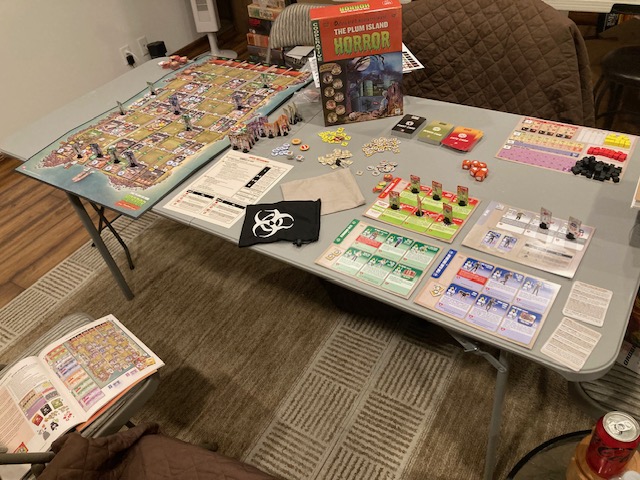
There’s quite a number of punchouts. One you take those out, you find a BIG board, and I mean BIG! It’s an 8-fold board!

On my table, it actually won’t fit in one direction! It’s huge!

See above as the board drapes off of BOTH ends of my table. Luckily, it’s still playable like this! (You can lay it the other way without it draping, but for my first solo game, the above layout was best).

One complaint about this board is that it didn’t really lay flat very well. Even after being set up for about 10 hours (spoilers), it still wasn’t “flat”. I suppose I should have put some heavy books on it.

Underneath the board are the rest of the components: some cubes, some dice, and 3 decks of cards.

Overall, the components were surprisingly good for a GMT game. I only say that because GMT has (historically) been more into wargames where the aesthetic matters less. This one looks pretty good, if not great. I am happy with the components. Lots to punch out, though!
Rulebook

From The Chair Test, I wanted to give it an A-, but it droops over just enough to earn it a B+. But the font is good and big, and … the pages aren’t shiny! I think I liked unshiny pages: almost every other rulebook in the world is “glossy”, but that glossy glare can sometimes get in the way of reading. I think I prefer more “dull” paper like in this rulebook. It just seems easier to read in heavy light.

From a content perspective, this might be one of the best rulebooks I have encountered. The rules were well-specified and well-notated. It has a Table of Contents!


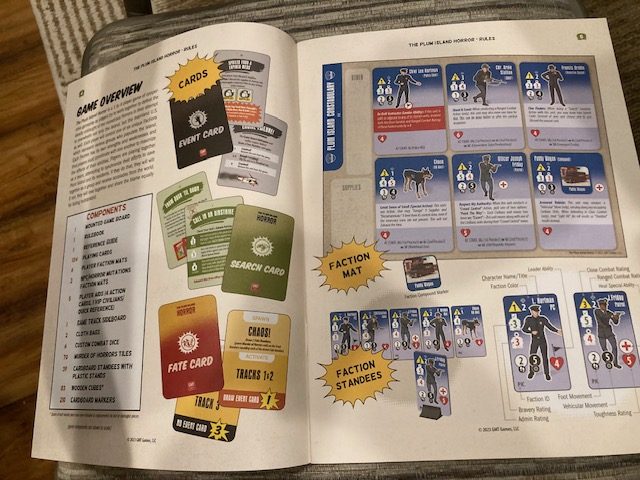
It has great components pages (with notations, see above)!
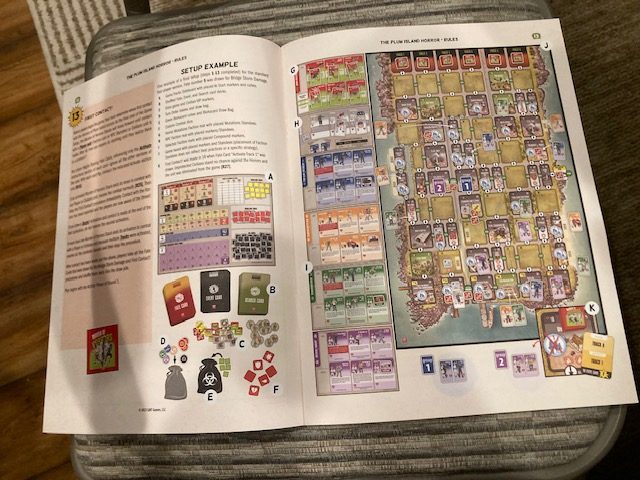
It has a great set-up page with a great picture!


The rules seem very well-specified rules!
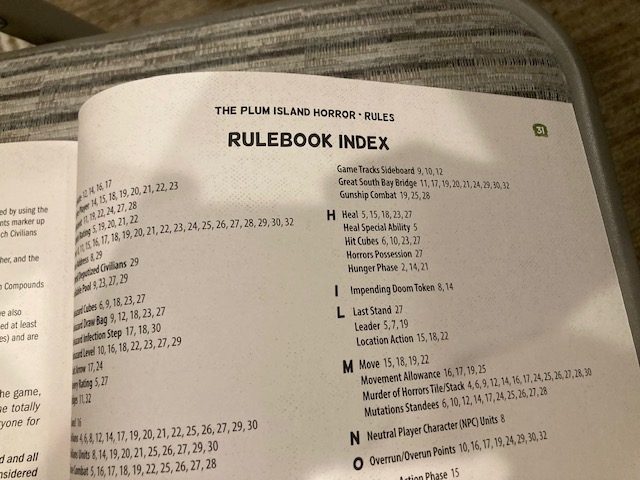
And it has an index! Really, I was very impressed with this rulebook. It even uses the back cover for a useful summary!
The rulebook is quite long at over 30 pages. But, this is a GMT game with lots of tactical rules. Spoiler Alert, this is a heavier game than most co-ops we discuss here at CO-OP Gestalt.
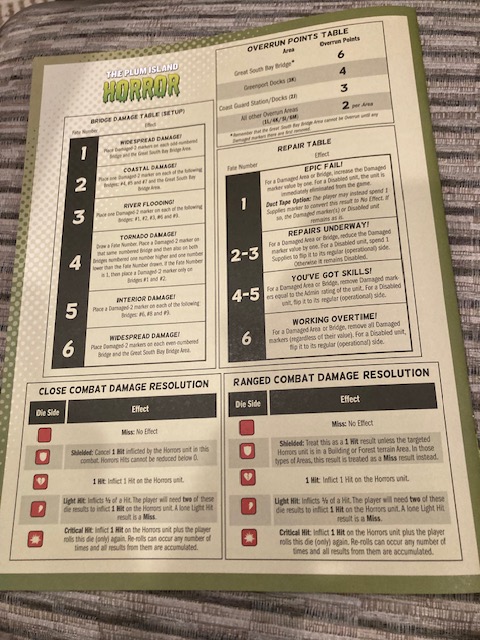
Honestly, this is a great rulebook. My only frustration was with the Reference Guide that comes with the game!
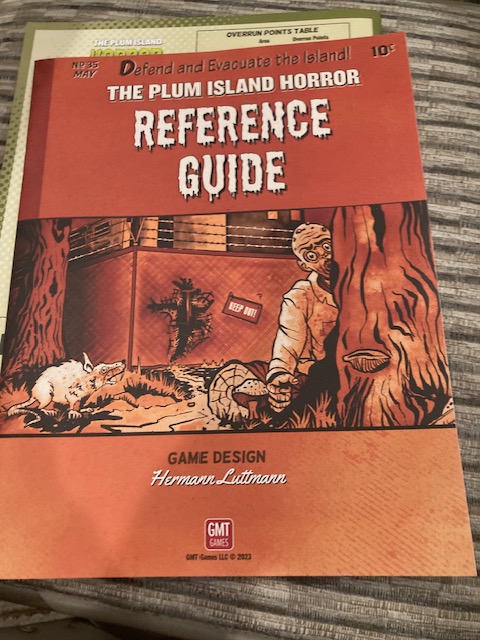
The Reference Guide is what you are “supposed to” use once you know the game. I only looked at it once (the rulebook was good enough for just about everything). The one time I went in for an elaboration of a rule, (about the VIP Civilians) … they weren’t in the Reference Guide! But they were in the Rulebook!! Look in the index for The Reference Guide and The Rulebook: VIP Civilians only seemed to be referenced in the rulebook!! It may just be an oversight, but .. I was fine with just the rulebook. Maybe after a few more plays I can use the Reference Guide … stick with the rulebook for your first few plays and use the Index! UPDATE: Another player manned the Reference Guide in some other games, and The Reference Guide really needs a better Index! This is surprising, given that the Rulebook is quite good with a decent (not perfect) index!
Gameplay

This is a really big and complicated game. Wait, that’s not quite right: the basic flow is pretty straight forward, but there are lots of rules with many many subrules that influence that.

There’s basically three phases in each round: The Hunger Phase, Activity Phase, and End Phase. The game plays over “3 days” (Oct 25, Oct 26th, and Oct 26th), each of which is divided into 3 rounds: morning, afternoon and night. Basically, you have 9 turns to save the world!
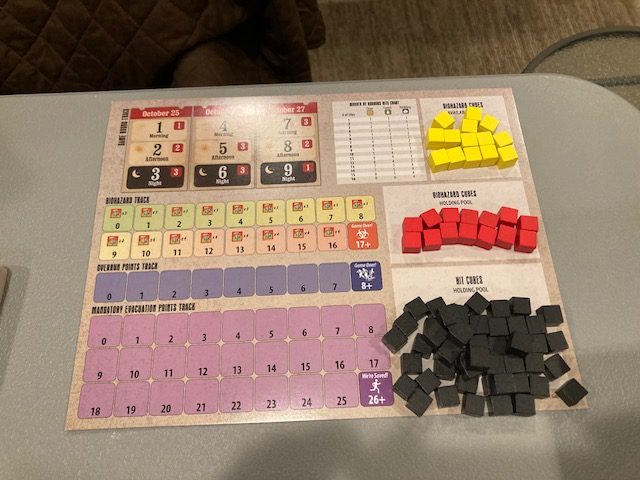
The Hunger Phase only happens in the night rounds: you have to feed your people! Yes, even after all these years away, just like Agricola, you have to feed your people at the end of the day. Luckily, the game gives you two rounds before to get supplies to feed your people.
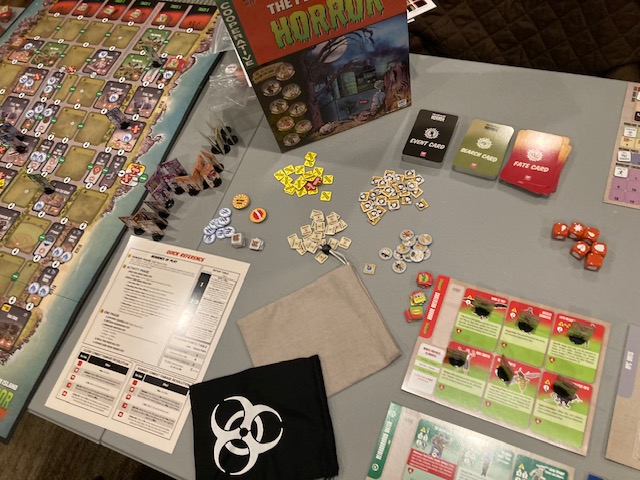
Supplies are the universal resource: just about everything requires supplies! Feeding your people, ranged shots (that’s right, if you want to fire at range, you have to spend supplies!), building your fort, and other places in the game. Everyone starts the game with two supplies! You can get supplies through exploring Plum Island, searching, or using special powers of your faction. Let’s be clear, supplies are a scarce resource! It’s hard to really gets lots of supplies!
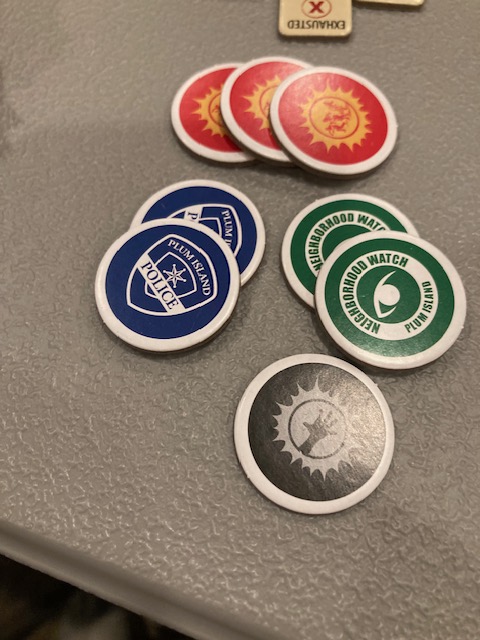
The Activity phase is all about drawing one of the 8 tokens from the bag. There are always 8 tokens: 4 player tokens (players act), 3 (Red) Fate tokens (which spawn Horrors) and Impending Doom (black) tokens (which draw a bad news Event card). Basically, you draw these tokens from the bag until they are all out: basically, this is the Variable Turn Order system in The Plum Island Horror: tokens in a bag. The order you draw these tokens dictate how the bad news unfolds and when the players get to play.
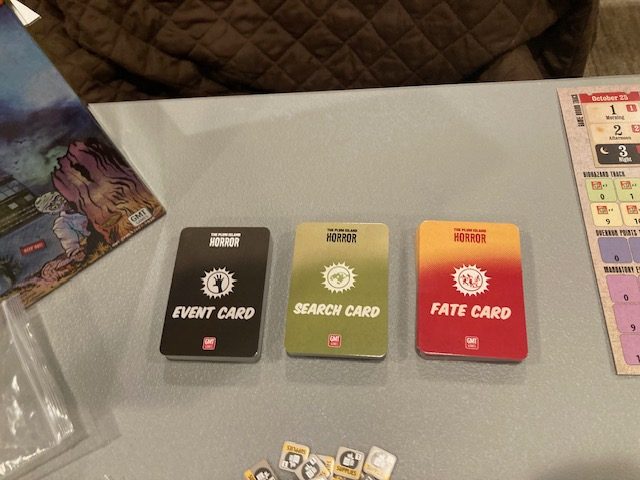
The three main decks of the game are Events, Search, and Fate cards.
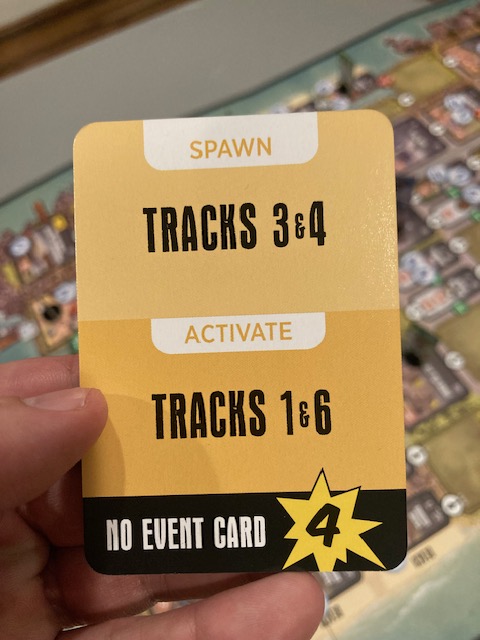
Fate cards are drawn when you draw a (red) fate token and cause Horrors to spawn and move! The SPAWN tells you which track to put Horrors on, and the ACTIVATE tells you on which track to move Horrors!
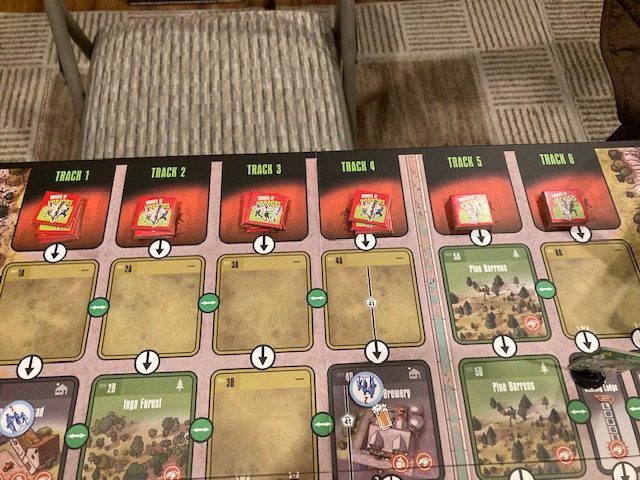
There are 6 tracks at the top of the board (see above), and the Horrors basically start there and move down the board. If any Horrors make it to the bottom of the board, that’s bad: it triggers an overrun which can quickly end the game.
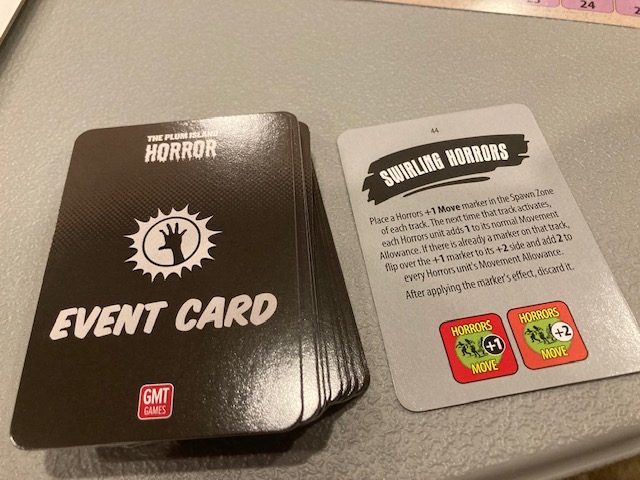
The Event cards come out when you draw the (black) Impending Doom token: all sorts of bad news can happen!

“Search” is an action players can take (if their token is drawn): it basically is a random good news card (usualllllly).
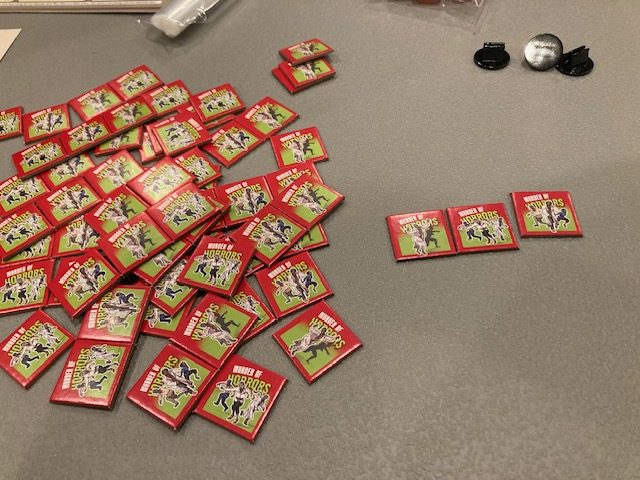
The main villains of The Plum Island Horror are the Horrors! See above! There are tons and tons of these Horror tokens, representing evil mutant creatures created from research labs! If players don’t keep these in check, they will overrun Plum Island and players will lose!

If the Horrors are the “generic” bad guys, the Horror Mutations are the “super bad guys”: see above for a sheet with 6 Horror Mutations! These are brought into play by the Event cards.
Each player will choose one of 6 factions to play. Each faction has its own character, strengths, and weaknesses. These are the 5 or 6 tokens on the board this player will control. That’s right: you control 5 (6) characters on your turn! It’s a lot!
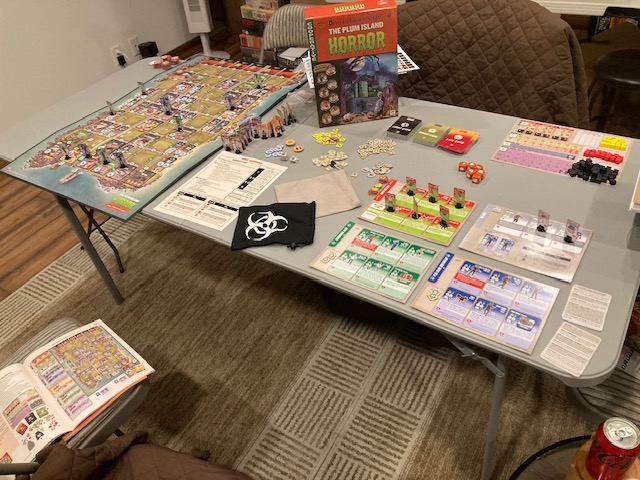
There’s lots of other rules (and I mean a lot of other rules) but basically, players try to keep the Horrors under control while saving enough citizens to win. But, you don’t win: you just survive to the end of round 9!
Horrors
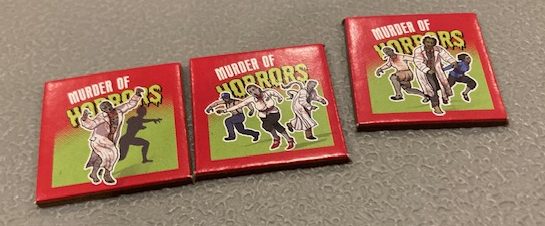
When is a Zombie not a Zombie? When it’s a Horror!!
I keep saying Horrors (and the game is called The Plum Island Horrors). But, really, these are zombies. If you look through the rulebook, the word Zombie appears nowhere in this game!! I suspect this is a branding thing: the developers probably didn’t want people to dismiss this “Oh that’s just a zombie game”. But, it really is a zombie game!! The Horrors descend upon you like zombies, they bunch up like zombies, they suck up other things they kill like zombies …
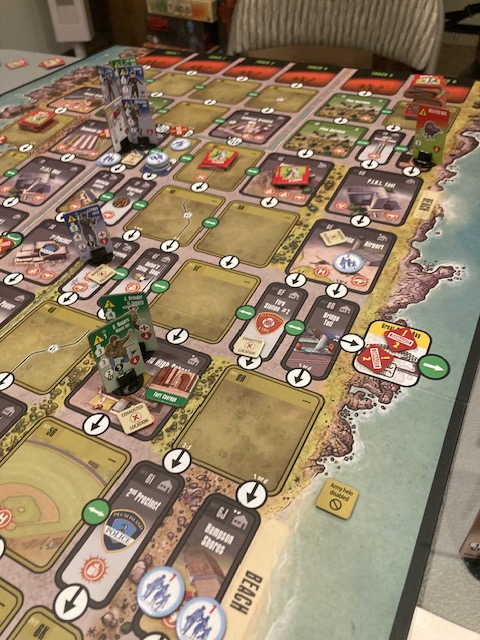
So, let’s address the evil undead zombie elephant in the room: this is a zombie game! But it’s much more than that! There are a lot of moving parts, there are a lot of rich tactical decisions, there are interesting mechanisms, and there are a lot of decisions. This is not a shallow Zombie game, this is a deep Zombie game! (There’s a sentence you thought you’d never hear). But I get it: I hear “Zombie game” and I am almost instantly turned off. The Plum Island Horror is much more than that. So, we call them Horrors.
A Day with The Plum Island Horror
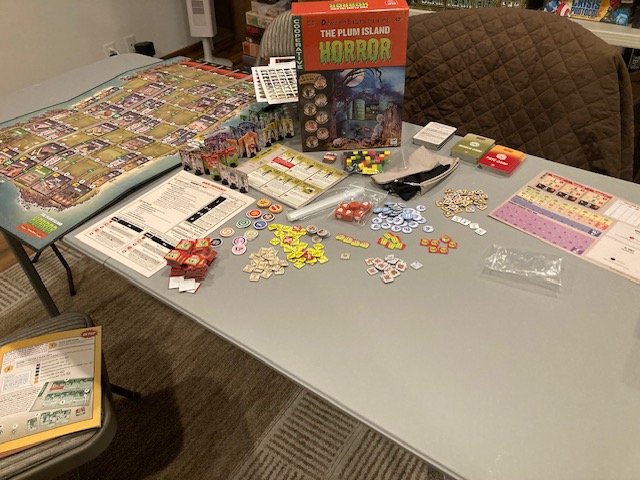
My first day with The Plum Island Horror was a long day spread over 10 hours between set-up, reading, play, and tear-down. Yep, 10 hours. Let’s take a look at that!
Set-Up: One Hour
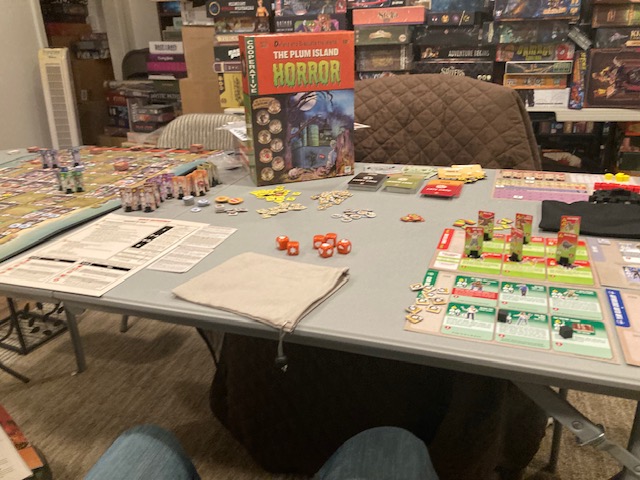
The rulebook is very very good for setting up the game! I unboxed and was able to set-up the game in about an hour!


This rulebook has a really good first few pages: it’s easy to see what all the components are and getting set up! The pictures were really good! I got going right away! “Man, this is going to be easy!” … or so I thought …
Rulebook Reading: Two Hours
Over the course of two hours after setting everything up, I read the rulebook. I read this like a technical manual, going slowly trying to make sure I understood every rule as I read it. I realized I would forget some rules as I went, but at least I will have seen everything. This was a good, if a little dry read (there were some humor points littered in there to keep everyone on their toes).
Solo First Play: Five Hours

The main flow of the game is simple, but there are so many places with little rules in the game: for example, if you get into close combat, you have to put a toxic cube in the bag. If you do ranged combat, you have to spend a supply. In both combats, you roll the orange dice, but the dice mean different things depending on the terrain and the type of combat. The Horrors are worth 1/2 in one type of area, 1/3 in another, and 1/4 in a different! And these are just some of the rules: they are littered all over the place.

There’s also NPCs that can come out, the Horror Mutations that can come out, and then each of the factions has 6 very different powers! To get the most out of your turns, you have to make sure you understand what every one of your faction units can do! There’s a lot of thinking and reading.

I made SO MANY mistakes in my first game. I had to keep going back to the rulebook to look stuff up, or I’d just forget a rule and then realize later … oops! So, a five hour game was spent both playing and with my nose in the rulebook. I technically “won” the game, but I cheated so many times (on accident, but to be fair, I cheated both ways: for me and against me).
The back of the box says 45 minutes per player. After a few plays, I don’t quite believe believe that. If you want to have any chance of winning, you have to understand a lot of rules and doing some analysis of the map. I think the game is more like an Hour plus 45 minutes per player. My 5 hour game was a learning game … I don’t think that’s representative of the length, but I can’t see playing this solo in 45 minutes! … Maybe an hour and 45 minutes!

The game was overwhelming in many ways: overwhelming because of a lot of rules, overwhelming in length, and the Horrors themselves can overwhelm you!
Reboxing: One Hour
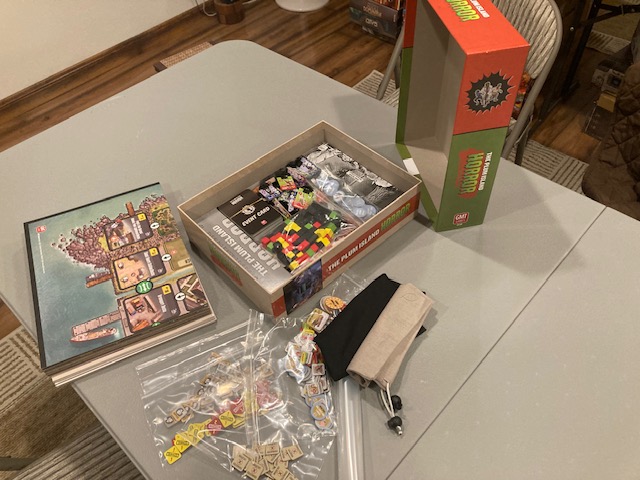
Putting this back together was surprisingly annoying. If you want to keep the insert (which is nice because it holds the board up, so I think you want to keep it), then everything won’t fit!
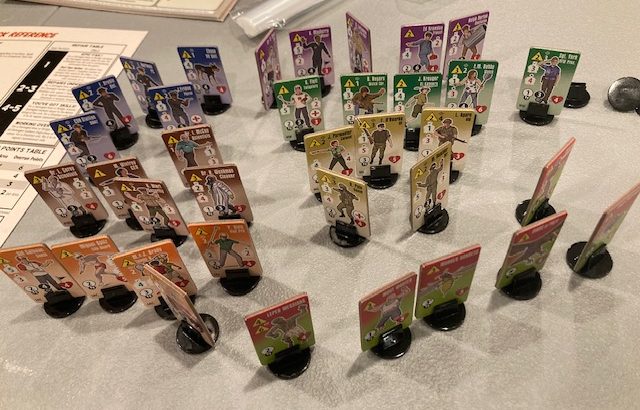
First of all, you DO NOT want to take little bases of the 48+ (?) miniatures Ridiculous: anyone who has Gloomhaven knows the damage done to the standees as you constantly take the plastic bases on and off. Just leave them on! But, this does make everything harder to pack away.
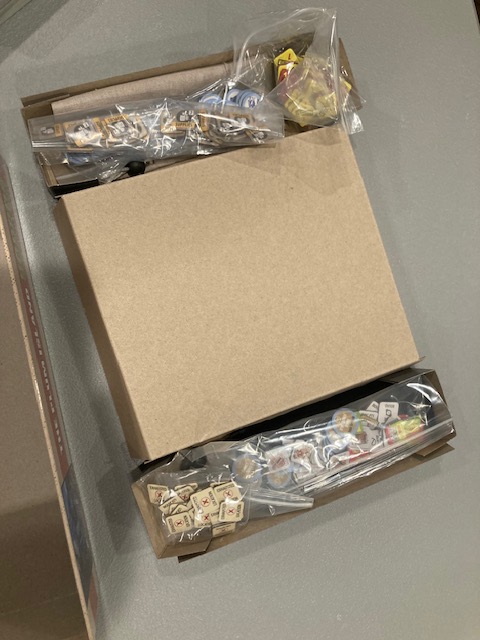
To make everything fit, I take the insert off and put a lot of tokens (and the bags) in the wells of the edges on the insert.
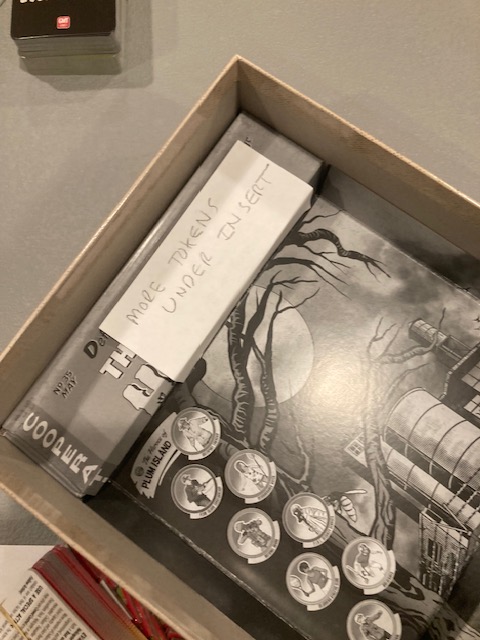
Then put the box on top of the insert UPSIDE DOWN (and put it flush to the bottom). I then put a note in the box to remind myself that there are tokens underneath the insert! If I come back to this in a year, I want to make sure I remind myself!

Finally, I put all the standees and cards (and rest of the tokens) in the big space flush so that I can put the board and manuals on top! Whew! This was more annoying than it should have been.
Day One Overview
My 10 hour day with The Plum Island Horror was exhausting. I got though a game, but I messed up so many times. That was good, I think I know what to do next time! I hoped to learn from my mistakes. But, just be aware: if you see that “45 minutes per player” and think this is an easy-to-learn co-op, you might want to reset your expectations. The main flow of the game is easy to teach/learn, but it’s all the little rules that will trip you up if you aren’t careful.
Solo Game
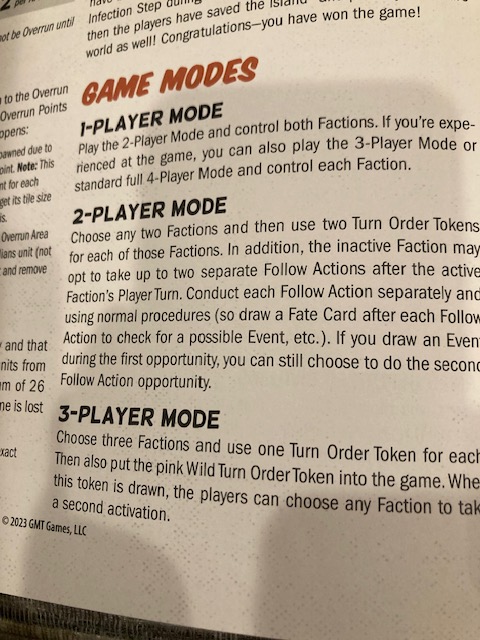
Yes, there is a viable solo mode! (Congratulations on following Saunders’ Law)! One of the last pages of the rulebook covers how to play this solo. See above.
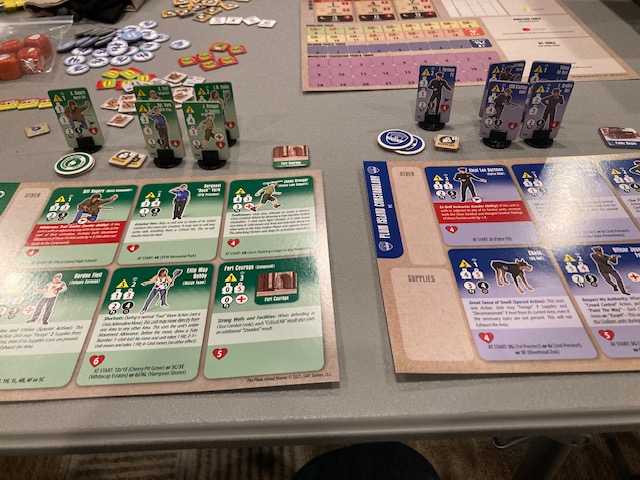
Basically, the solo player takes hold of two factions and plays those two factions. The only real change to the game is that the tokens for the Variable Turn Order bag now have TWO tokens of each faction color!
See above as I have two blue tokens and two green tokens for my two factions. In a four player game, all the tokens would be different colors (one for each different faction of each different player). So, The Plum Island Horror just balances the game so they that the players always 4 turns during the Activity phase! In the solo game, each faction goes twice (resulting in 4 turns for the players). (The three player game has a wild token where players can choose who goes extra).
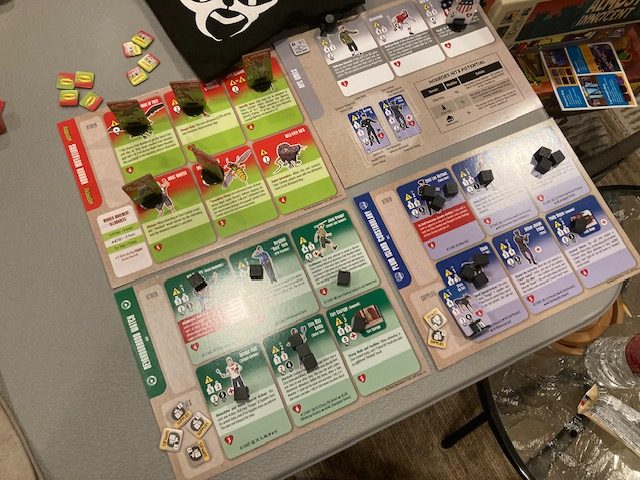
The solo game did seem to work, but from a maintenance point of view, the solo game is a lot of work! The solo player has to do a lot of work for the Horrors, has to adjust the board for two factions, learn the special abilities of two factions (rather than one), and just run a fairly complex game with lots of minor rules by himself! Like I said, I was exhausted after I finished my first game.
Will I play it again solo? I honestly don’t know. Even after I know the game, I feel like a game will be about 2 hours, and that doesn’t include set-up or tear-down! Remember, there are a lot of components to this game! Honestly, the amount of work and time the solo player must do probably holds it back from playing too much solo play in the future.
Having said that, it’s a different solo game than other games I have played. If I want this heavier experience, I can see pulling it out again.
Cooperative Play
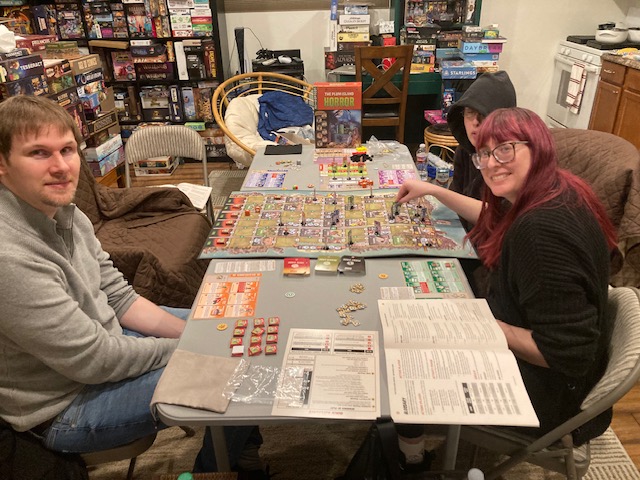
The cooperative game took about 20 minutes to set-up: I had played enough to give a quick description of the game as we set-up and discussed the rules (as we handled the pieces: very important). We then proceeded to play for 4 hours. Ahem. Yes, 4 hours.
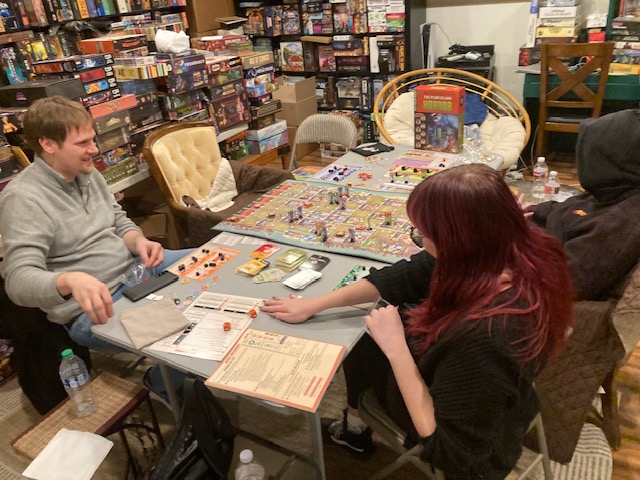
There was no stopping as we played: we normally stop at some “major end point” and celebrate with cake or something. Nope: we powered through this game: 4 hours of play. And my friends are very experienced players. The suspected time is 45 minutes per player, which would be 180 minutes or 3 hours. We ended up being 1 hour + 45 minutes per player or 4 hours.
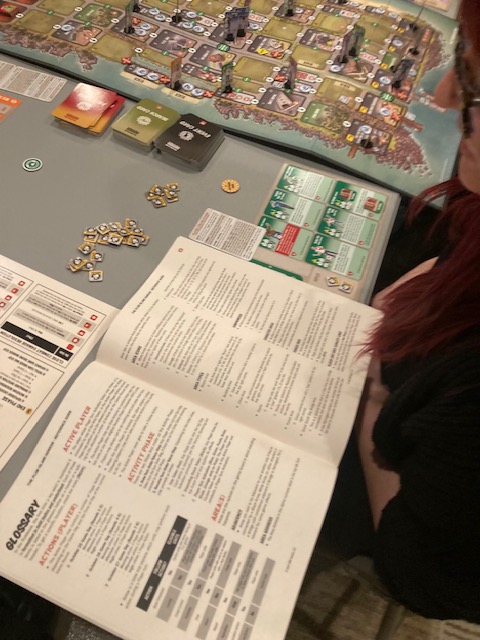
A positive remark that came from the group was “this didn’t seem like 4 hours!” We were all fairly engaged as we played and the game moved along.
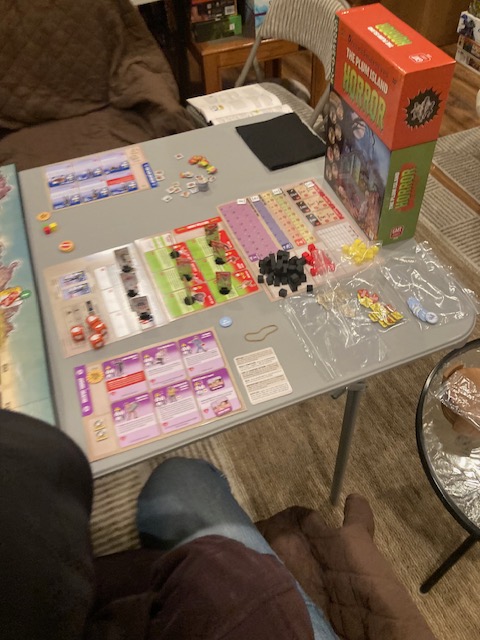
Unfortunately, most of my group told me that they had fun playing, but probably wouldn’t play it again because it’s too long. It’s just too long.

As we played, we started getting more and more into our factions: my Dog was instrumental in keeping us alive and keeping the toxicity down (“Good boy”). And Andrew’s golfing and tennis buddies were terrific for picking on horrors remotely: they were pretty hilarious. (“I say, good shot! I got three horrors!”) Identifying with our factions kept us engaged.
Follow
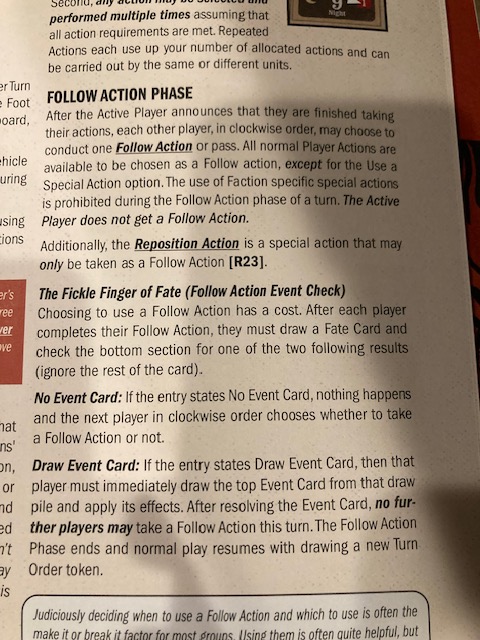
From a cooperative games perspective, one of the most interesting aspects of the game was the Follow Action Phase: After a player goes, each other player is allowed to choose to perform a non-special action each … at a cost: they must each draw a Fate card and look only at the bottom of it!!!
If you are lucky, you will draw a Fate card that says “NO EVENT CARD” at the bottom … and there is no cost for following and doing a single action. Whew. See an example card above.

If you are unlucky, you will draw a Fate card with the red “DRAW EVENT CARD” at the bottom”: you must draw an Event Card (aka Bad News card!)! My very poor computations seems to indicate that you will draw a “No event Card” every 2 out 3 times, and a “Draw Event” every 1 out of 3 times. So, it’s a decent risk, but it’s still as risk.
This was a nice mechanism: you could still do something after a compatriot went: “We really need to save those civilians or they’ll die! I’ll take the risk of enduring an Event Card!“ Or you might decide: “Meh. There’s nothing super useful, I won’t take the risk”. This follow mechanism was a really nice way to keep everyone involved! Even after a player played, we’d all be talking about things we need to worry about and, if we really had to … we could still do something.
When I said the 4-Player game took four hours, I think the follow mechanism is what kept us involved the whole time: we were always doing something together on someone’s turn.
Game Arc
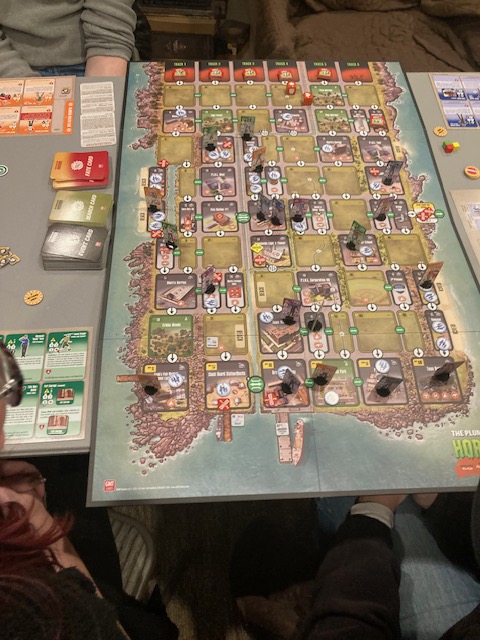
The Game Arc is odd: after we saved “enough” civilians on Round 5, my players thought “Surely the game is over?” Nope! We have to play all the way to round 9 to make sure we survive and don’t trigger any of the other losing conditions! (Toxicity, overruns, dead factions). The first part of the game arc seems to always be “save the civilians!” and the latter game arc just seems less interesting: we just stay alive? Somehow, that win condition seemed more like an endurance test.
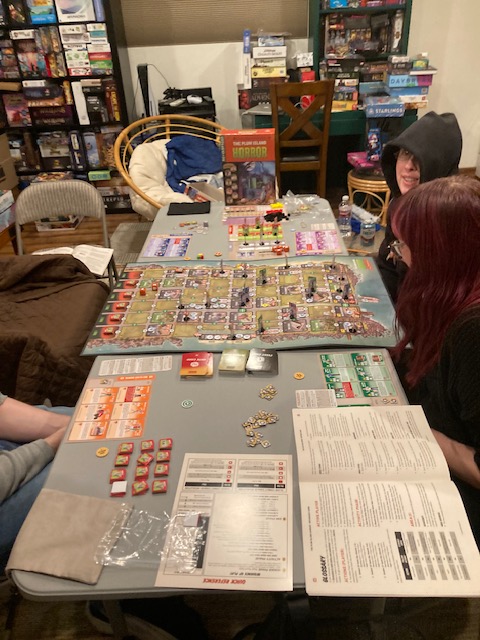
And this game is a little bit of an endurance test! It’s long! It’s not quite a slog, but the game definitely has an endurance factor. And most zombie games are about surviving the zombie attacks … even though this isn’t a zombie game. *cough* It’s a horror game. So, you have to survive to win. My players didn’t like the second part of the game quite as much.
What I Liked
The components are well-labelled and easy to read. Colors are used well to distinguish entities.
The component quality is good. This game won’t went any awards for best design or best components of the year, but the were good enough.
I liked the comic book vibe of the rulebook. It worked well: they used the comic book tropes well, during set-up especially.
I think my favorite thing about this game is the Follow Action phase: it really promoted a sense of cooperation and engagement: you always felt like you could do something if you really had to … it just had a cost. I don’t like to feel too constrained in a game: this one mechanism really elevated the game for me.
The rulebook was very good.
What I Didn’t Like
The board may have been too big. Several times during the game, we hit, knocked it around (moving pieces), or accidentally knocked pieces down as we draped our sleeve across the game! You could argue this is our fault for putting the board long ways, but otherwise we ran out of room! It’s cool the board is so big, but it could have a touch smaller?
Of course, this is a Variable Turn Order game, and that comes with its own problems. My main problem with Variable Turn Order is that you can get completely screwed if too many bad news tokens come out at the end of the round, and then at the beginning of the next round! It is possible for the Horrors to have 8 completely unanswered turns in this game! In a game that’s 4 hours for a 4-Player game, this kind of randomness can be so debilitating! “Well, I am so glad we set-up for 20 minutes, played for 3 hours, and then lost because of something we could do nothing about!”
There are no mechanisms to mitigate Variable Turn Order—that’s the problem with it. Our stock suggestion is to make it so the Horrors can never have more than X turns in a row (where X=2 or X=3 depending on your tolerance) . One easy way to do this: if he players have two turns in a row, they must draw a horror token. If the horrors have two turns in a row, the players must draw a player token. This is more of a balancing mechanism, but simple enough.
We’ll talk more about more mechanisms for mitigating Variable Turn Order at the end of the month!
I didn’t love the Reference Guide. The rulebook was good enough for just about everything, and in fact, the index for the Reference Guide seemed incomplete.
This game is very long and has a weird game arc. I don’t like that The Plum Island Horror is almost (key word, almost) a slog: it’s an endurance test (which is very thematic), but almost overwhelming.
Conclusion
The Plum Island Horror is going to be for very specific kinds of players. It’s length and complexity will probably scare away most casual and semi-casual gamers; even experienced gamers may find this too long and complex. I believe the estimate for game length is off: the box say 45 minutes per player, whereas we saw something more like 1 hour + 45 minutes per player. This is a long game.

But it’s worth playing The Plum Island Horror: I think the Follow Action mechanism makes this a very engaging cooperative game. Perhaps the most telling quote from my friends was “That didn’t seem like 4 hours! In a good way!“ That quote may tell you all you need to know: it’s a long game, but it does keep you involved.
 coopgestalt
3 thoughts on “When Is A Zombie Not a Zombie? A Review of The Plum Island Horror! A Cooperative Game by GMT”