

Roll For Great Old Ones is a cooperative roll-and-write game that was on Kickstarter back in February 2023 and delivered to me Oct 31, 2023: I remember that date, because I was trying to get my friends to play this for our Halloween game! (We ended up playing something else).

Roll for Great Old Ones is a cooperative roll-and-write game: if you don’t know roll-and-write games, think of Yahtzee! In Yahtzee, you roll dice (roll) and fill out a sheet with numbers (write). We’ve seen some recent examples of cooperative roll-and-write games: Find The Source (see our review here) and Escape: The Roll and Write game (see our review here). Let’s take a look at this one!
Unboxing

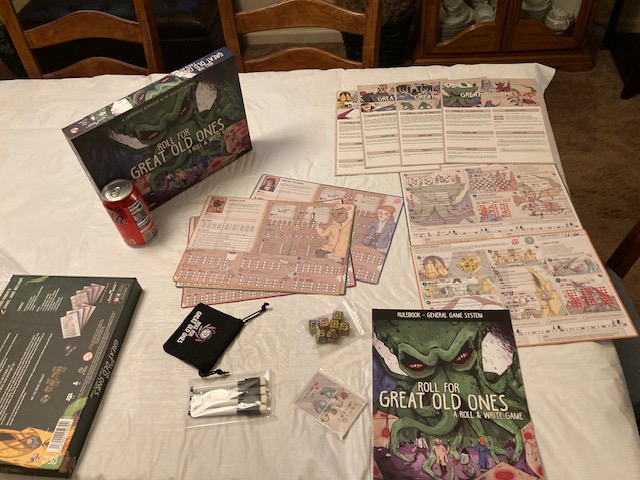
This game has a weird profile: see above. It’s very thin and long and kind of an awkward size.
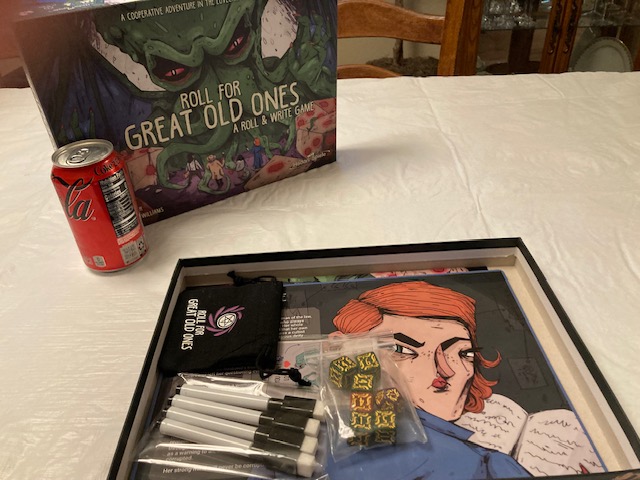
Arguably, it doesn’t have to be too thick because all it contains are some sheets, dice, pens, and a rulebook. And that’s it! It all fits into that thin box (see above).
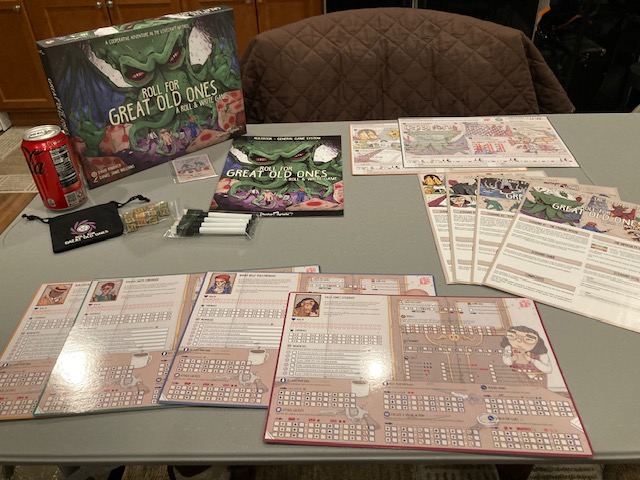
The game looks pretty good, if you don’t mind the crazy, maybe off-putting art.
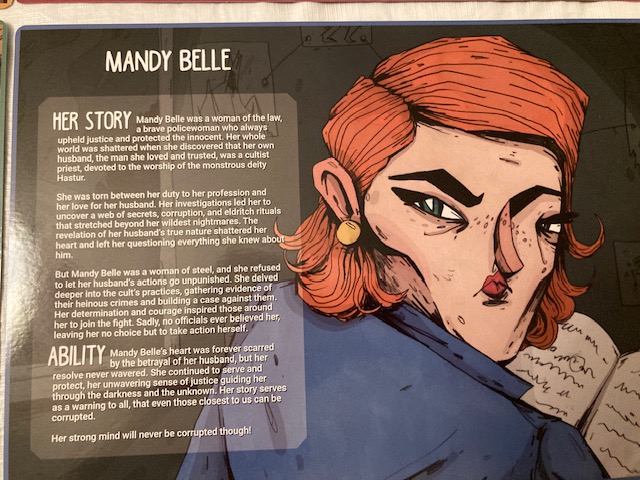
I think the art’s supposed to be a little crazy and unhinged because Cthulu-type games typically have that insane/going-crazy aspects to them. So I think it works. But the art is weird.
Rulebook

The rulebook is okay to pretty good.

The game starts with a good description of what the game is, but there is no component break-down.

To be fair, you don’t need a component breakdown since there are so few components. The set-up page works pretty well.
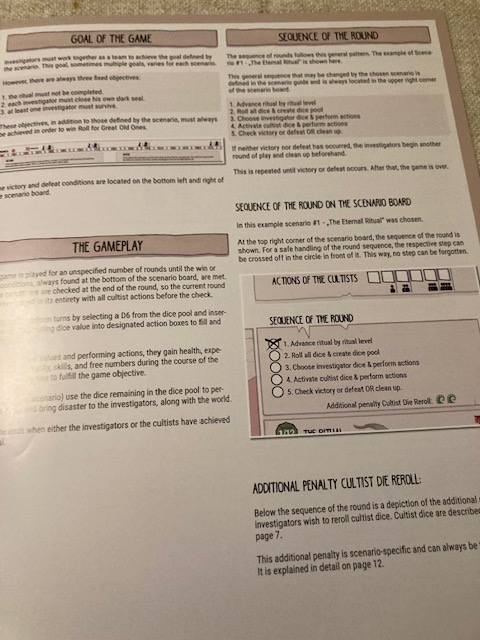
The rulebook does a pretty good job of showing examples while it explains each sections, and it has cutaways of the appropriate section of the board: that was very useful to further our understanding.
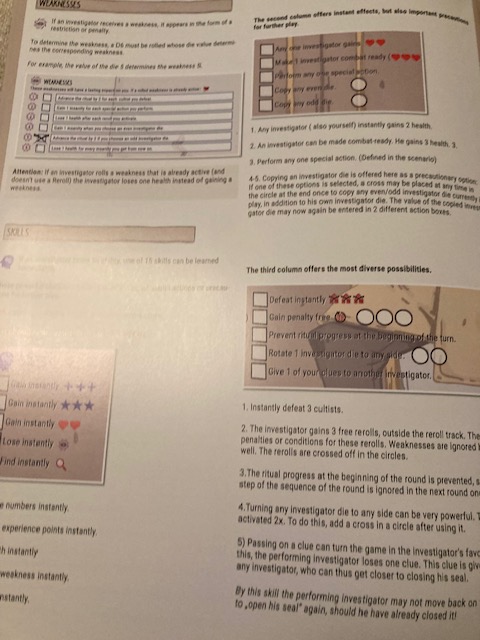
I didn’t love the font here: it wasn’t visually appealing. There’s also a lot of white space all over the book, which makes me think the font could have been significantly bigger. But, font and font-size are a very specific criticism most people might not even notice: it bugged me.
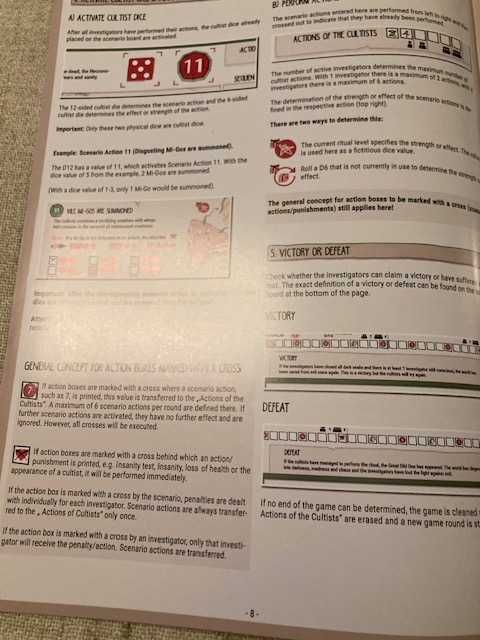
I would say this rulebook taught the game decently: I had questions as I played and I was generally able to find elaborations/clarifications for rules. Having said that, I think this game really needs an index: there are a lot of concepts here for a simple roll-and-write, and I think an Index would have helped a lot.

I will give the game props for having a very useful back cover (summaries of symbols): I referred to this a fair number of times when I played.
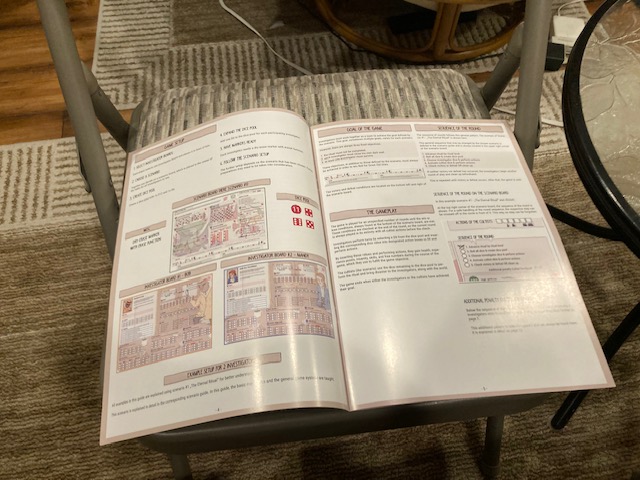
The rulebook gets a B on the Chair Test: it does fit okay on a chair next to the table, but it does flop a little. The font is also too small to see easily on the chair.

A slightly smaller form factor, a larger font, a better font, and an Index could easily move this to a very good or excellent rulebook. The rulebook, as it is, is ok to pretty good: it will teach the game decently.
Gameplay
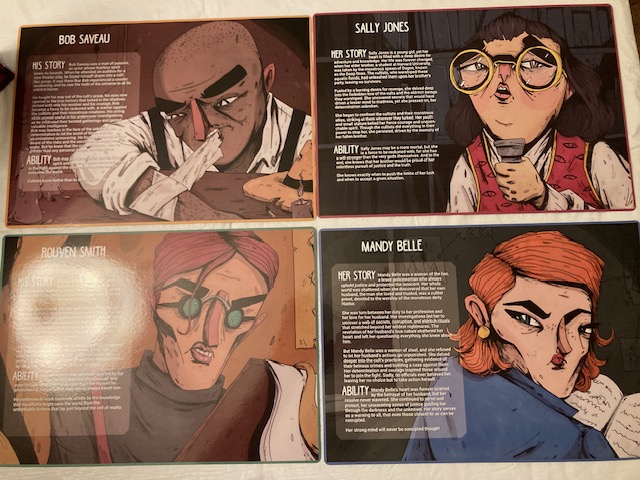
Each player takes one of four characters to play during the game: Each character has a specific laminated sheet with a special power!
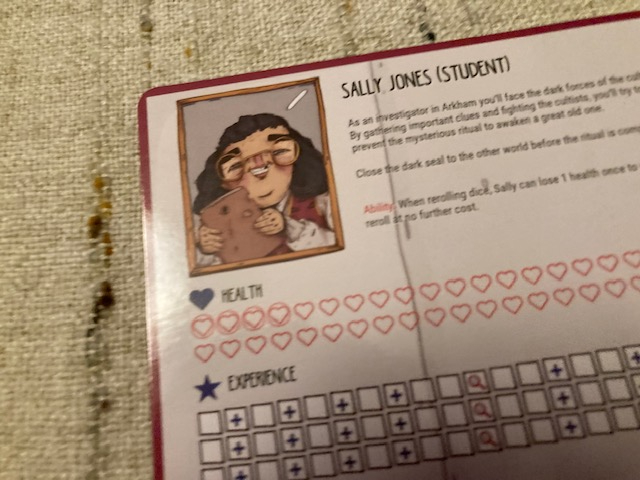
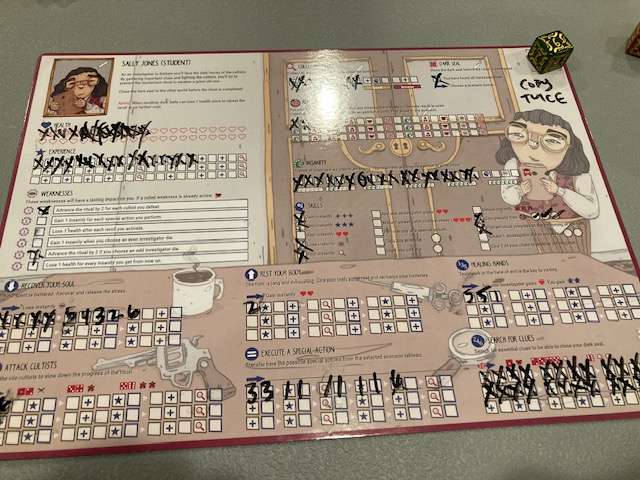
For example, Sally Jones (see above) has her special ability where she can spend a health for a free reroll.
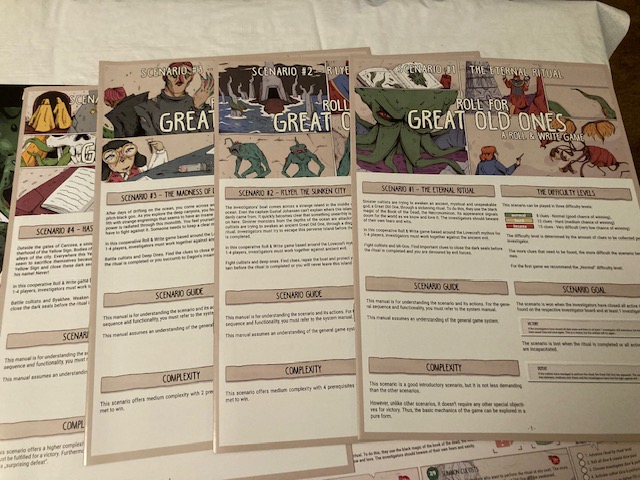
After choosing a character, you choose one of four scenarios that come in the game. The scenarios are documented in two places: a rulebook for each scenario (see above) ..
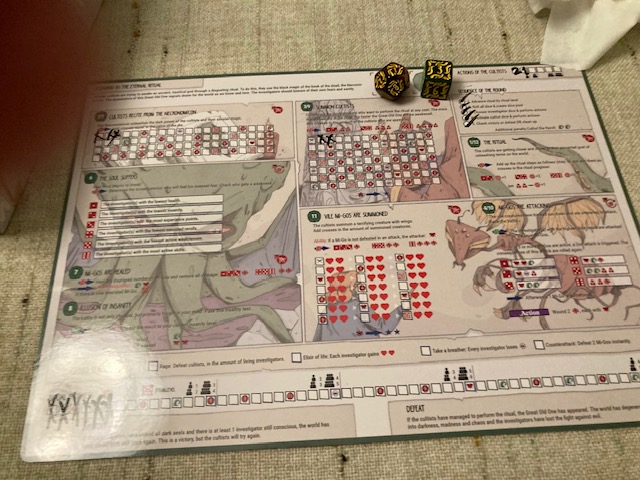
… and a sheet specific to that scenario (There are 2 double-sided scenario cards, so 4 total Scenarios).

Once you get into the game, the main arc is pretty simple: roll some dice (1 bad news dice: the d12) and a few d6 (one more than the number of players). Each player will choose one d6 to put on their sheet:
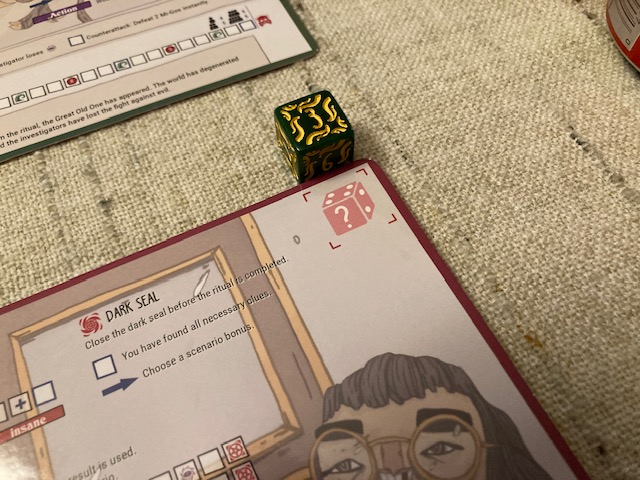
And with that die, they will activate “something” on their sheet!

An easy to forget rule is that you get to use the die’s value TWICE, so I put a note underneath the die!
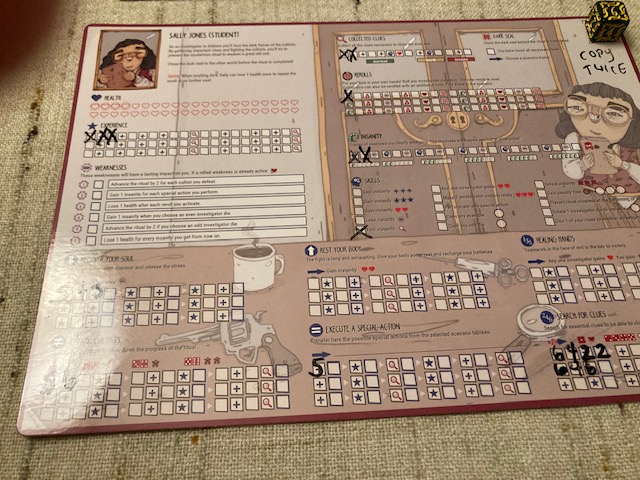
The bottom of your sheet shows you 6 major actions you may be able to activate with your value (if it’s odd, even, ascending, descending, same, different, etc). You fill in little squares at the bottom! These squares will have cascading effects as you fill them in: some allowing you to fill in the experience track, some allowing more numbers to be filled in, some allowing other actions! There’s all sorts of things you can do you if fill enough boxes: heal sanity, cure weakness, kill some cultists, activate a special action, but the most important thing: discover clues!

In order to win, each character must find enough clues to fill in their own DARK SEAL! See above as Sally Jones is able to find the Dark Seal and win the the game!
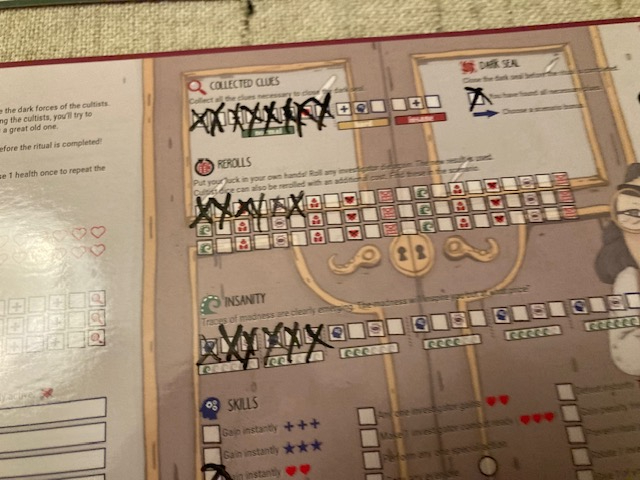
Another great thing this game has are institutional rerolls! You can reroll just about any die in the game … at a cost. The rerolls section of your board has a bunch of reroll squares: every other reroll is “free”, but the other come at a cost: summon more cultists, lose health, lose sanity, gain a weakness and some other stuff! So, you can always reroll as many times as you want, but you will pay a cost. It’s kind of cool that you can take a ton of rerolls if it means the difference between winning and losing!! … It will just cost you … (evil laugh)…. but at least you can make that choice!
How do lose? If all players go to zero health (only one player has to survive to win), or if the cultist ritual finishes (see ritual track at the bottom of the board), or a few other ways. Players only win if they can all find their DARK SEAL and survive to the end of the turn!
Solo Play

Thank you to Roll For the Great Old Ones for following Saunders’ Law: there is a viable solo mode! It’s easy: the solo player just takes control of one character and plays normally. Most of the scaling for the number of players for the game has to do with “how fast” the Cultist Ritual evolves. For a solo game, the Cultist Ritual doesn’t complete nearly as quickly. For example, at the beginning of scenario 1, the Ritual only completes one step for 1 player (2 steps for 2 players, etc 3 steps for 3 players, etc). There are some other places in the game that note the number of players, but they are usually clearly notated.

I think it was very important to play this game solo before teaching it to my friends!! For a roll-and-write game, there are a surprising number of rules! I have played a number of solo games and I still feel like I miss a rule here and there.

The Scenario sheet does a pretty good job of having the rules on the sheet, but after multiple plays, I realized I still needed to lookup the rules in the Scenario-specific book. There’s just a little too much to notate on the monster sheet, even with the tiny fonts it uses!

It took a while to read through all the rules and get a sense of the game. But, I will say that, once I got into the flow, the game moved rather quickly! Roll some dice, choose some dice for you and the monster, assign your dice, mark off stuff, handle the monster, lather-rinse-repeat! The game moved at a pretty good clip once I got it.

I was able to win my first game as Ms. Jones, but I think I cheated! Like I said, there are a lot of rules. You should probably play solo a few times to get a sense of the game before moving on to teach your friends!

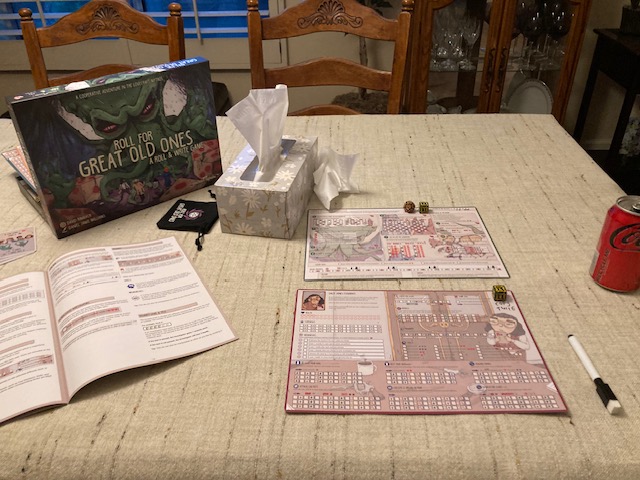
It felt like the solo game took up more space than it should: I had to have the rulebook on the chair next to me, the scenario book on the table, and then part of a table for the large player and monster sheet! Whew! It takes up more space than I expected! See above.

After all is said and done, I liked the solo game. It wasn’t great, but I had fun.
Cooperative Play

Cooperative play worked well. Each player takes a character and assumes the role of that character! In this case, Sara had to play Mandy Belle because of the red hair!
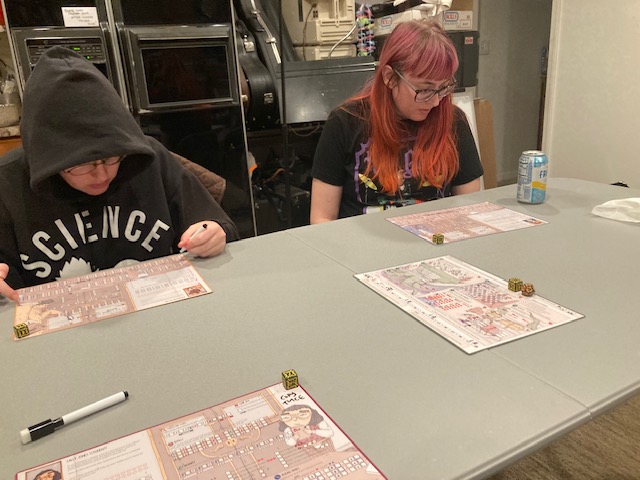
A few more dice are rolled to create the dice pool in cooperative game: each player needs to get a die (a d6), and the monster still gets a d12 and a d6. So, part of the cooperation at the start of the round is figuring out which player should get which dice!! “I need an even to complete the clue! “ “Okay, I’ll take the 1! I need an odd!” But, just as important, we have to work together to make sure the monster gets a bad die from the leftovers! I really like this system, where we choose not only what we get but also what the monster gets! I may choose the 6 this turn so the monster can’t summon a ton of cultists! (The d6 for the monster is the “power” of the action, so 6 is usually very good from the monster’s perspective)
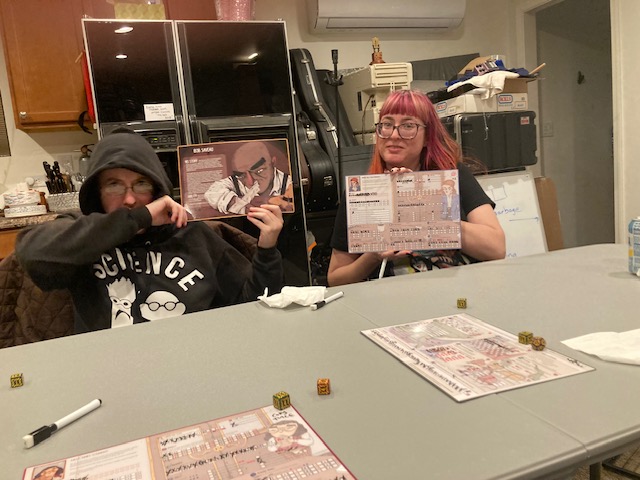
There are also mechanisms in the game where your action can help a compatriot! One of the actions on your board is to heal a compatriot! This was very important in one game as Teresa healed me so I wouldn’t die!! If a character dies, everyone else continues, but the ritual still advances as if everyone were still playing! So, it’s best not to die.

So, there are some mechanisms for cooperation, but not a ton. Generally, each player does the best they can on their sheet, and every so often, especially in the endgame, players can ask for help! There are just enough mechanisms (heal a compatriot, ressurect, give a compatriot a clue) to make this feel like a cooperative game and not just multiplayer solo, especially in the endgame.
I think this game is better as a cooperative game than a solo game: there’s just enough cooperation that I enjoyed playing this while hanging with my friends. I still get to make my own choices on my own board, but I collaborate with my friends at the start and occasionally ask for help!
To be clear, it’s very very very hard to have an Alpha Player in this game: everyone is very focused on their own board!! Maybe this is the strongest argument that this a good cooperative game!
What I Liked

For a roll-and-write, this was surprisingly thematic! The weird art in the game, and the references to cultists and summoning evoked more theme than I expected! The dice were even creepy/Cthulu dice. There was even a sense of dread as the endgame approached as the Cultist Ritual looked like ot might succeed!
I liked that the rules were “mostly” on the player and monster sheets, only requiring a few lookups during play.

Even though there are a lot of rules, I was able to quickly teach this game to my friends! (You gotta learn the game solo first). Then, the game flowed well without too many questions or rule lookups.

I liked that the game was pretty quick. My solo games went pretty quickly (40 minutes?) and our cooperative games went 80 minutes or so. The box says 60-90 minutes and I would that feels very accurate!
I liked that everyone felt engaged: every one had their own board so they could make their own decisions! But there was still enough cooperation (picking die, using actions to help, etc) to keep discussion flowing!
I also like that ther are multiple scenarios which are different enough to keep the game interesting.
I also want to be clear: I am so glad the cards in this game is laminated! They worked really well when we played! The laminated cards also made it easy to clean and play another game!
What I Didn’t Like

The game might have a few too many rules. I feel like every time I played that I missed a rule somewhere! “We won! Oh, but asterisk next to that win, we forgot the Migo rule!” I’m not sure what to do about that: as I mentioned, it would have been nice if everything could have been notated on the sheets, but I think the game just ran out of space. Maybe bigger sheets? Cards with rules on them instead of a full rulebook? (I can imagine a card with the MiGo Summoning rules: that way it can be next to the board and everyone can see it/pick it up when its relevant?)

The dry-erase pens were okay (I would have preferred finer tips on the pens, but they worked ok), but the erasers on the end kinda sucked. We ended up using kleenex to clean the boards instead.
The art may be divisive. My friends loved it (and thought it thematic), I still don’t love it, but it does go with the game.
I also thought the rulebook could use a few spruce-ups (better font, bigger font, less white space, an Index), but we already covered that.
Conclusion
Roll for Great Old Ones surprised me! It was more thematic than I suspected for a roll-and-write game, and it was fun! The only real problem with the game is that there are just a few too many rules: you absolutely want to learn this game solo before you play it cooperatively. I think our cooperative games went so much better because I had soloed previously, and thus I was able to get the group into the game quickly!
The solo game is pretty good. It’s quick and easy to set-up and it flows quickly once you have the rules down. I had a nice time and will probably play solo again. The solo game is probably a 7.0/10.
The cooperative game was a little better than the solo game: everyone is engaged in their own board, but there’s still enough cooperation to keep discussion flowing! I’d give the cooperative game a 7.5/10.
The best part of this cooperative roll-and-write are that there are are two strong mitigation methods to controlling the dice: which dice you select and when you reroll! I got this because it was a cooperative roll-and-write, but I was worried about it: I need not have worried! This is a good game: solo game is 7.0/10, cooperative game is 7.5/10 (maybe even better).
 coopgestalt
2 thoughts on “Surprisingly Thematic! A Review of Roll For Great Old Ones: A Cooperative Roll-and-Write Game”