

14 Frantic Minutes! is a cooperative real-time polyomino tiles (aka Tetris pieces) game that was on Kickstarter back in November 2022 and delivered to me in mid-July 2023. Considering that it promised delivery in November 2023, this is fantastic! We had a streak of 6-in-a-row of Kickstarters delivering on-time or early!
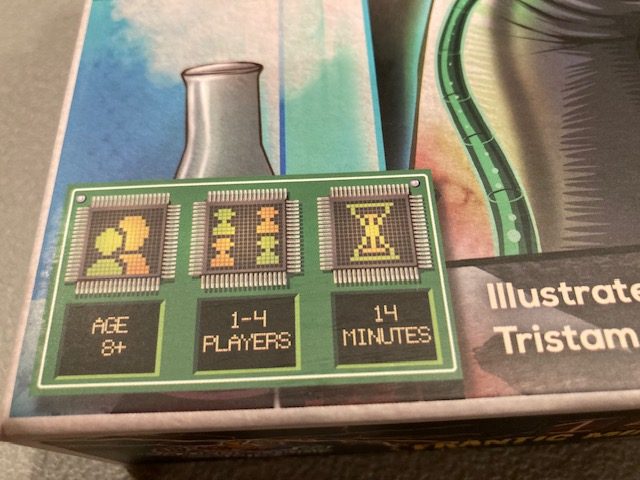
This is a game for 1-4 players, Ages 8+, and an accurate gameplay length at 14 minutes … if you play real-time with the timer.

I backed this game for three reasons: (1) cooperative, (2) tile-laying, and (3) the art. Call me a shallow gamer, but I really like the art-style for this game! But, cooperative tile-laying games have been really tearing up the scene for us lately, with Race For The Raft being one of the best tile-laying games of the year (see out review here)! Will 14 Frantic Minutes! make our Top 10 Cooperative Tile-Laying Games? Stay with us until the conclusion to find out!
Unboxing
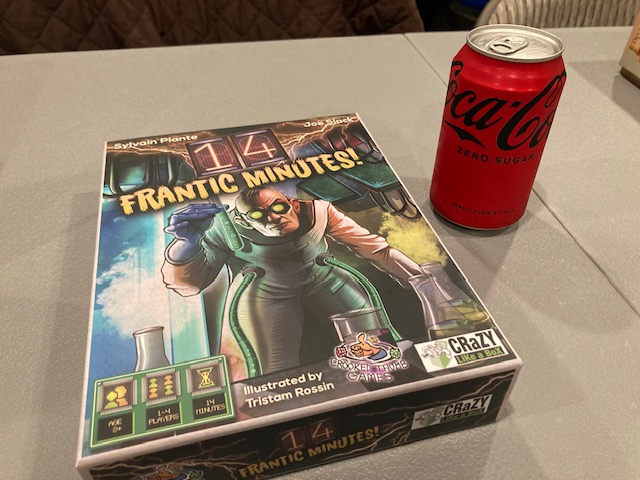
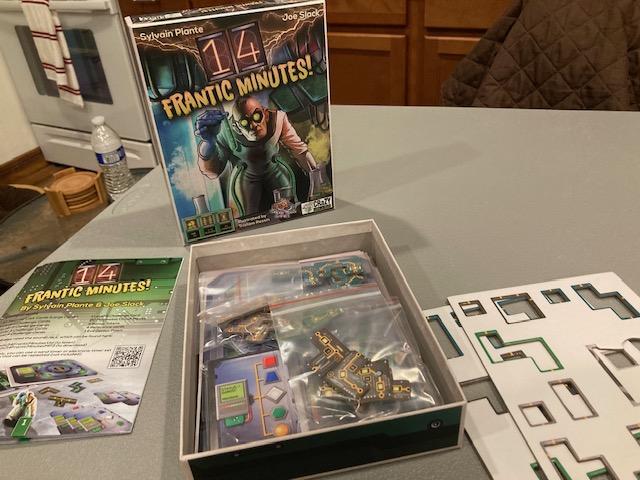
14 Frantic Minutes! is a smaller box game than many games we have seen lately: see the box above with a can of Coke for reference.
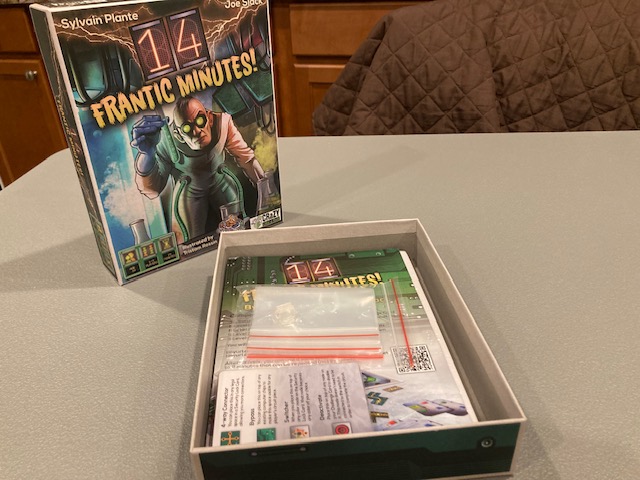
The box looks fairly empty, with no too many components.
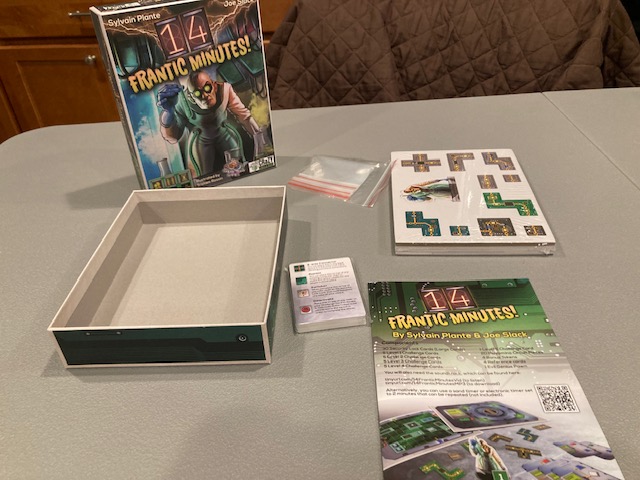
There’s a rulebook, some plastic bags, cards, a bunch of tiles, and some punchouts.
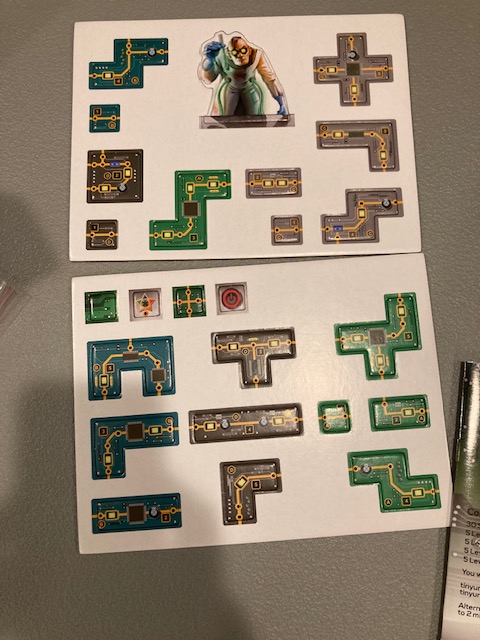
I did say this is a polyomino tile-laying game, but there are surprisingly few polyomino tiles! See above.
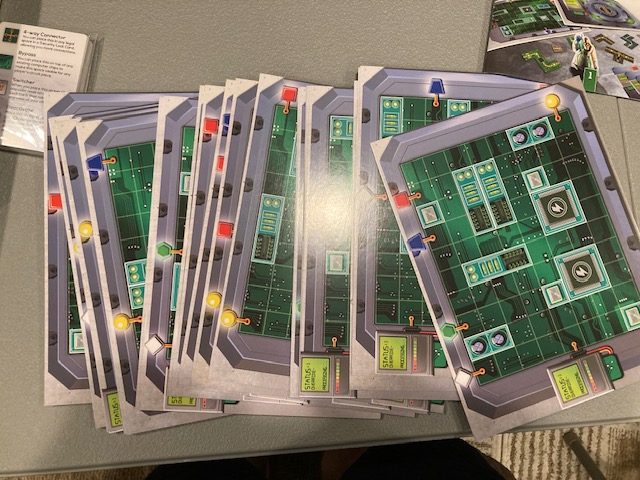
The majority of the heft in the box are the 30 Security Lock cards (which I think are poorly named and/or labelled). These are the playfields for the polyomino tiles.


There are also a small number of cards: they are not linen-finished.
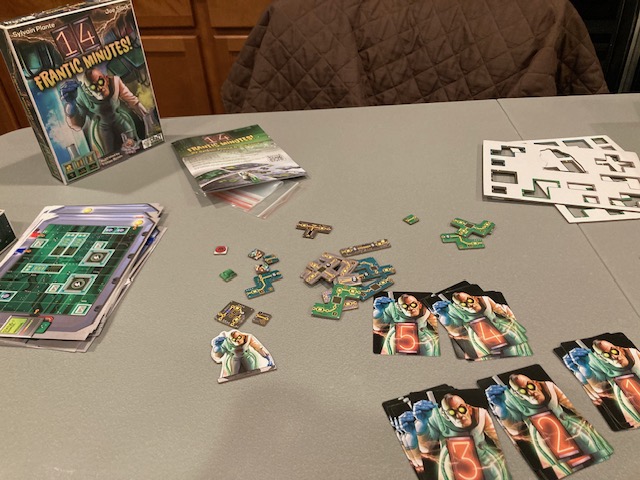
And that’s about it! The components look pretty nice, if a little repetitive (that Evil Guy on the cover is on a lot of cards and components).
Gameplay
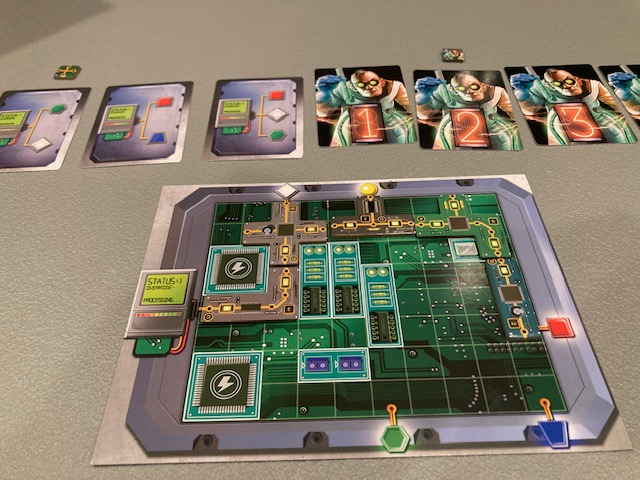
Gameplay is pretty straight-forward: there are 7 Challenge cards showing what connections need to be made (each card is a “room”).
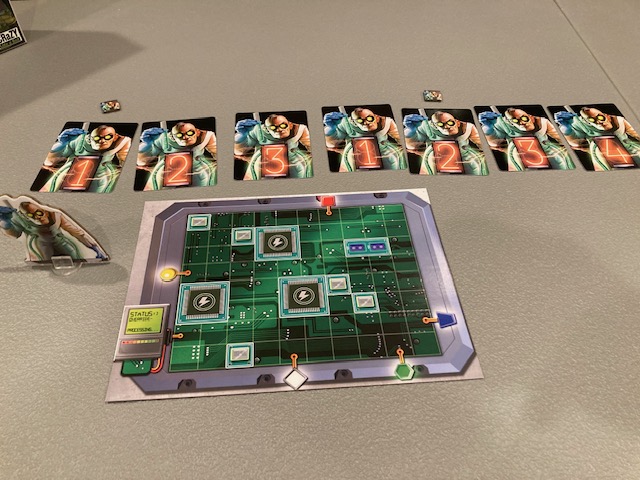
At the start of the game, you “flip” the first Challenge card (labelled “1” above: this is the difficulty of the connection) and start!
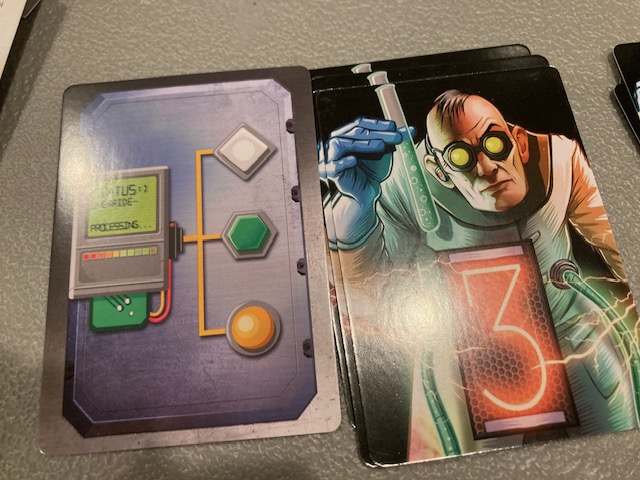
Each connection card looks something like the above: it indicates what spaces need to connected to the main unit (the Switch). To be clear, all of the shown node symbols need to be connected to the Switch to move to the next room.
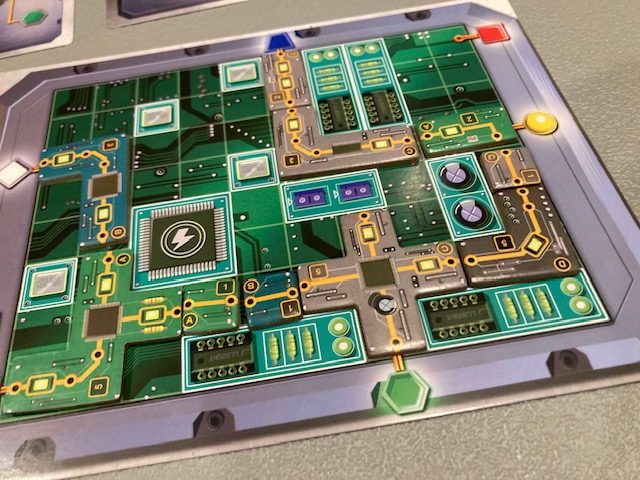
See above as the white/yellow/green and blue nodes all connect to the main switch!
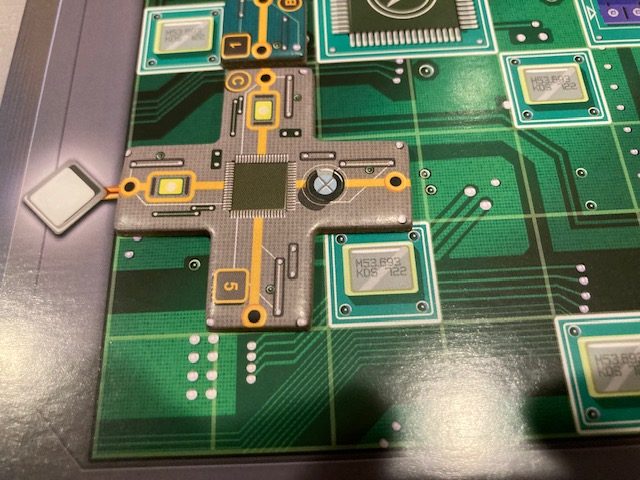
Players each have a small supply of polyomino tiles, and are all working together to place them on the board to create the circuit! There is no turn order, as players just frantically place their tiles on the board! About the only rule constraining the players is that they can ONLY play their tiles (or the neutral player tiles in a 3-Player game). Other than that, players can talk, show tiles, and communicate as much as they want!
This is a real-time game! You have 14 minutes (using supplied timer) to get through all 7 rooms!
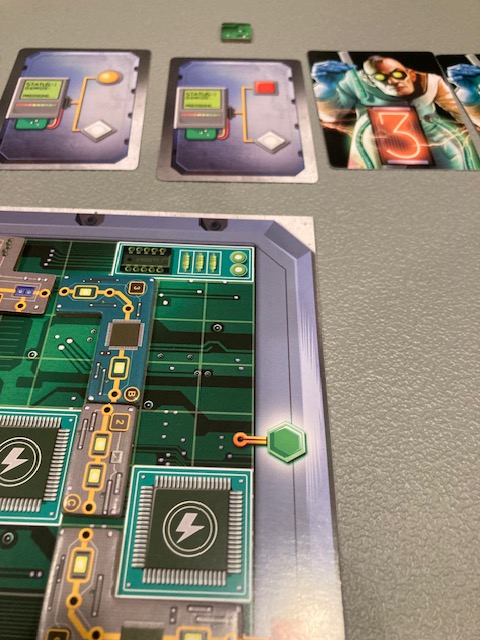
Every time you complete a circuit, you flip the next card and grab a new room (aka Security Lock Cards) and start the next circuit!
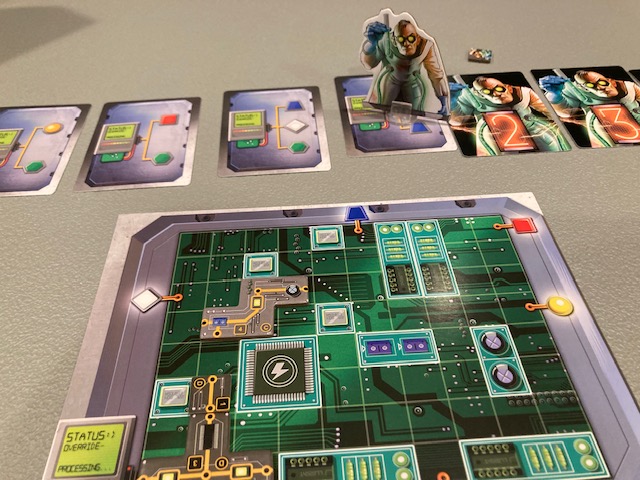
The timer occasionally makes the evil bad guy “levil augh” and close a door: whenever that happens, he moves forward one room (at the top). If the badguy ever reaches your current circuit/room (at the top), players lose! If you can do all circuits before the bad guy reaches you, you win!
Solo Play
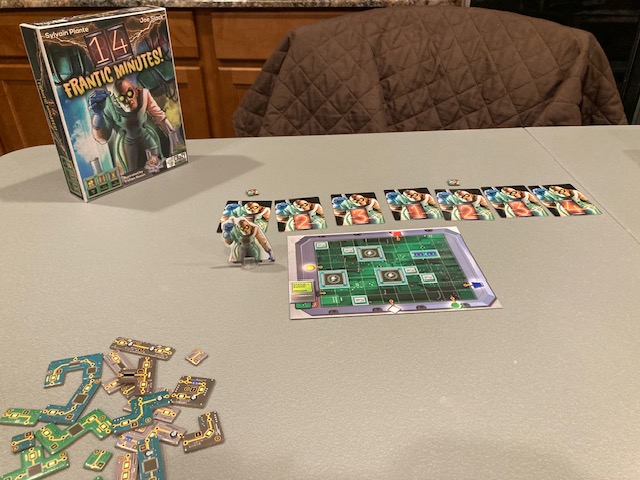
So, this game follows Saunders’ Law and has a very viable solo mode. The rules do a very nice job of telling players how to set-up for 1 to 4 Players. Basically, there are 4 sets of 5 polyomino tiles for 4 players. In a solo game, the solitary player gets all 20 tiles! (In a 4-Player game, each player gets one set of 5 tiles). See the solo player above all set-up with all the polyomino tiles in the lower left!
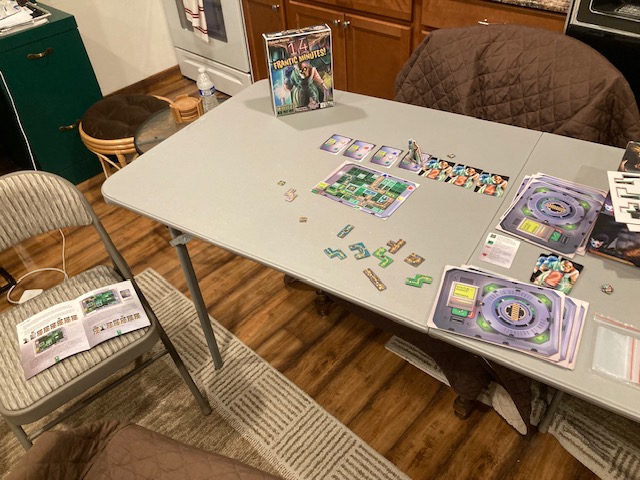
To get familiar with the pieces, I played my first game without the timer. I strongly recommend everyone do this! I think you need to get comfortable with the pieces to have any chance at this. It probably took me a half hour to do an “untimed” version of the first 7 circuits.
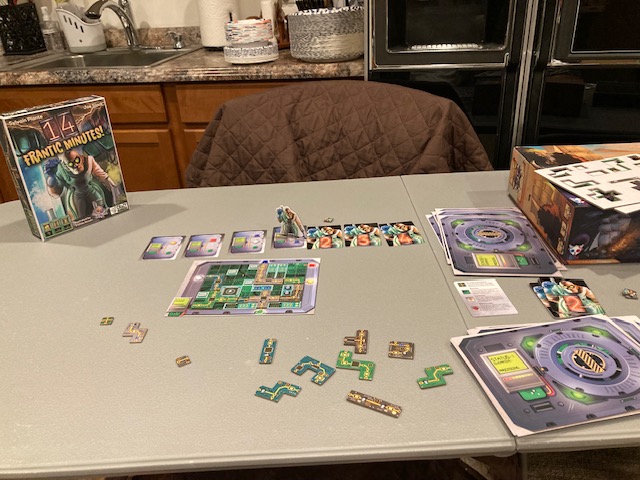
My next game was timed using the app: and boy did I do terrible! I think I only got to room 4 before I lost. But that’s okay! This game is pretty quick to set-up and try again. Seriously 14 minutes for a game is easy to try again.
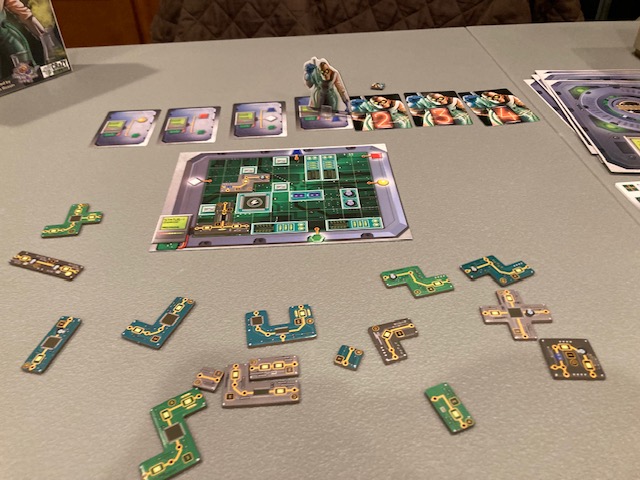
I kind of enjoyed this without the timer as a relaxing puzzle. It sounds like it would be “too easy” when the timer isn’t goading you, but it’s really not! At least, not at first. I found myself looking forward to just relaxing and playing without the timer. I think once that gets too easy, then maybe the timer makes sense?
Cooperative Play
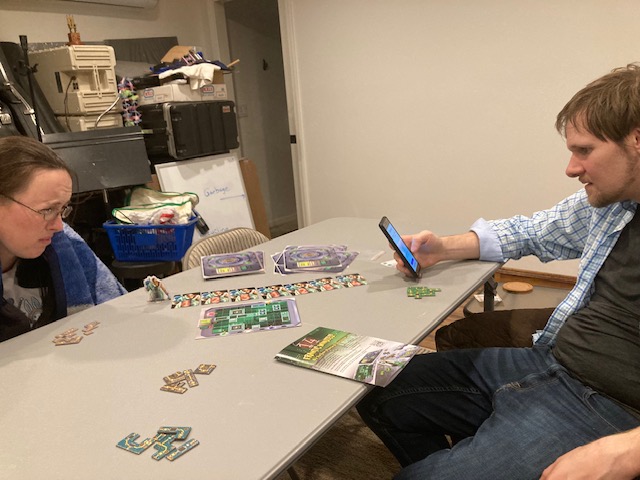
Cooperative play started the same way as solo play: we ended up playing a full game without the timer. It took about 35 minutes. We had fun, it gave us a chance to learn the pieces .. and it was still hard! Sometimes 3 people end up getting in each others way!
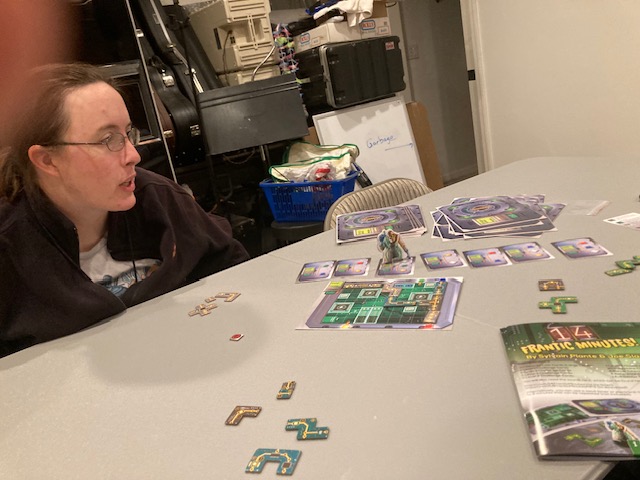
We did win the 3-Player game with the timer … we think. The problem is that the app stopped because Andrew’s phone shut off after 5 minutes. But we think we won?
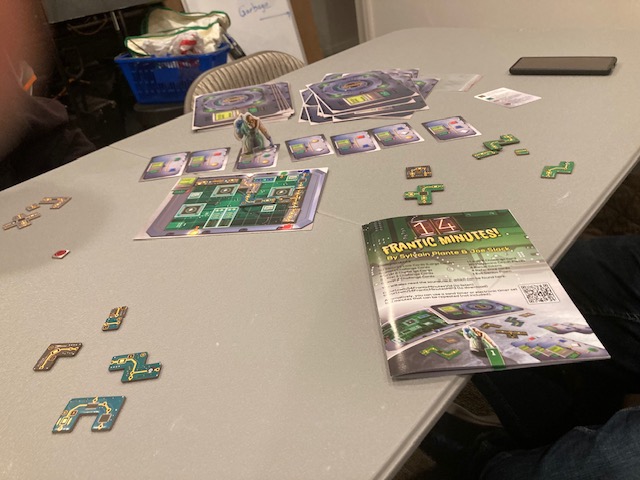
Generally we all liked the game, if we didn’t love it.
Problems
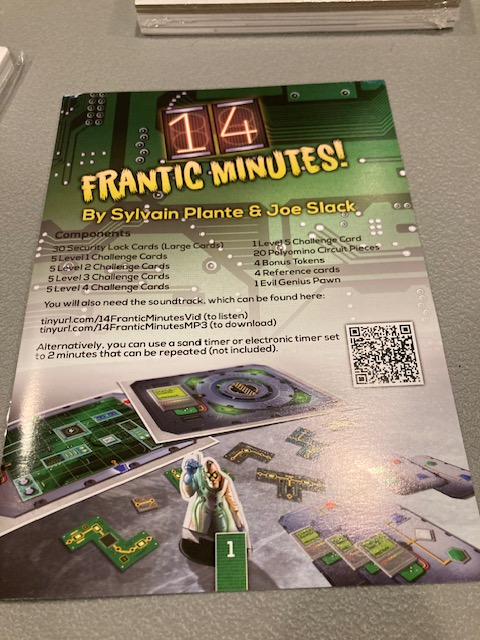
The biggest problem with the game is the “app”. You can only download using the little Q-box on the front of the rulebook. (Alternately, you can use a timer that resets every 2 minutes). Andrew didn’t want to download it because it took him to a “sketchy” dropbox location. I downloaded without (I think) incident. The other problem was that the laugh and door close weren’t always clear: it seemed like we struggled trying to figure out what the noises meant and then sometimes didn’t hear them! “Is the laugh the next room, or is it the door close?” I think it’s the door close, but in frantic real-time, sometimes we didn’t hear it! It needed to be clearer … louder?
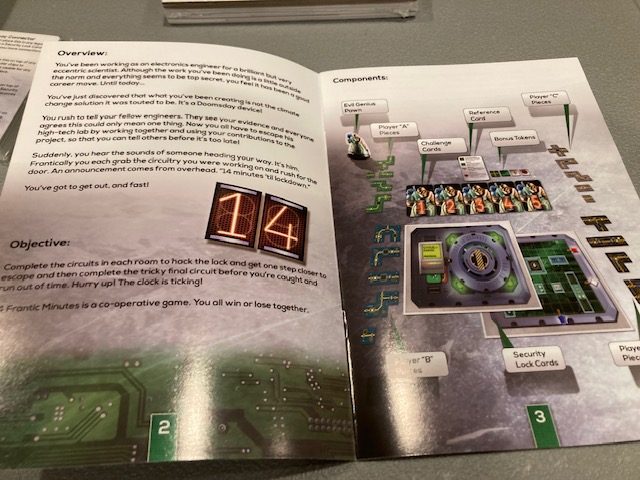
There were some things that weren’t clear the first few times we played: some of the connections are unclear (when it leaves a colored Node, can it come off in any direction? After many plays, I think the answer is no). But these problem go away after a few full plays: you get familiar with the components and get a sense of how everything works.
Replayability

Even though this is a small box game, I think there is still a decent amount of replayability in here. You can make the game harder by varying the Challenge cards (higher numbers are harder), and the 30 Room Cards give lots of different layouts in which to build your circuits!
Conclusion
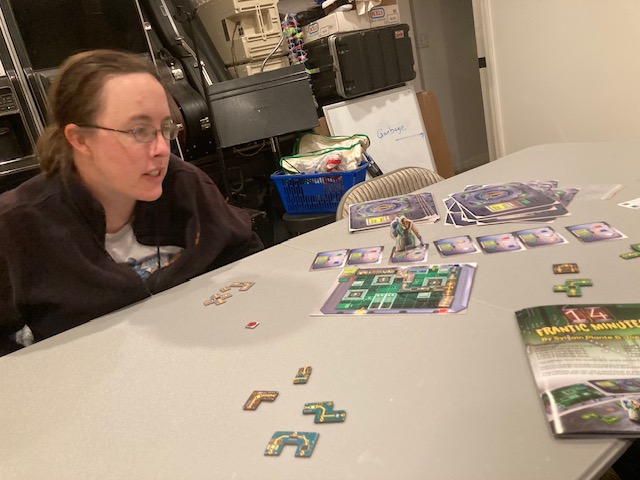
We had fun playing. The game doesn’t really embrace the non-real-time option to play, but I personally think I had the most fun playing without the timer. I saw this is just a fun little puzzle.
We wish the app were better, but with a little experience, we got it going.
This feels like a fun little cooperative filler: you can guarantee it’s at most 14 minutes! It’s easy to set-up and easy to play. I can see this being a perfect convention game to play while you are waiting to get to your next game…
I liked it the most:
Rich: 7/10
Teresa: 6/10
Andrew: 5.5-6/10
I think this would make my Top 10 Cooperative Tile-Laying Games, just not near the top of the list.
 coopgestalt
One thought on “A Review of 14 Frantic Minutes! (The game, not the 14 Minutes)”