

Find The Source is a solo and cooperative roll-and-write game from Kickstarter. This game was on Kickstarter from Dec. 13th 2022 to Jan. 12th, 2023 and it arrived at my house Oct 4th, 2023. It promised delivery June 2023, so it’s about 4 to 5 months late (depending on how you count it). I used to say “that’s pretty typically late for a Kickstarter game“, but recently games have been arriving a lot sooner Still, it’s not egregiously late, so it’s no big deal. (I still have Kickstarters that are years late, so 4 to 5 months is nothing).

This is a game for 1 to 3 players. The game box says 15 minutes for play time, and wow does that feel wrong! The solo game might be 15 minutes once you know the game, but the cooperative game feels much longer, like 30 minutes to 60 minutes! So, this is still a quick game, just not as quick as the box might say.
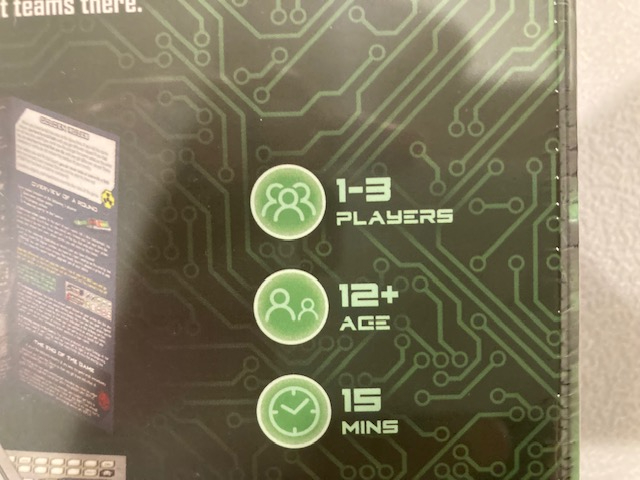
The 3-player upper limit is a bit odd, but this is mostly because the game only has a limited number of boards.
Let’s take a look!
Unboxing

I paid extra from the Kickstarter to get the boxed version. See the Fresca can above for scale. Now, most people from the Kickstarter (2563/2733 backers) actually just did back the the print-and-play version for this: the print-and-play was only $5 (versus $39 for the actual physical version). Recall that we tried print-and-play with The Legends of Storm City (another cooperative roll-and-write) at the start of the year, and our conclusion was the print-and-play was too much work and and too much money for us: we’d prefer the physical version. So, we put our money where our mouth was and we got the physical version!

There’s a nice intro from the developers just inside the box: the little touches help.

There’s a built-in expansion (adding three different boards): the rules are in a teeny sheet at the top.

The game is mostly dry-erase boards and dice: see above! The box is filled all the way to the top with boards.
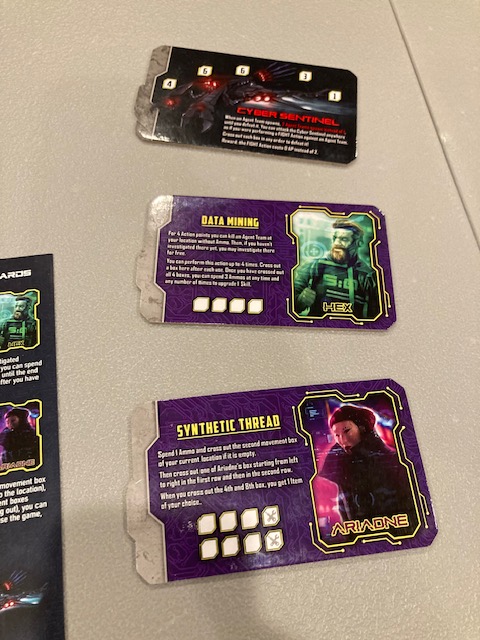
These are the cardboard boards for the expansions.

The rulebooks are tri-fold pamphets?!? There’s two rulebooks actually! One for solo play (see above) and one for multiplayer play (see below).


There are 9 player boards in 3 sets of 3 (labelled A, B, and C). When you play a multiplayer game, everyone in the group must get a board from the same set (we figured this out later: it wasn’t clear from the rules). The reason: each player board has a set of 6 items and they all have to be the same items so you can “give” items to each other (without having to read another board).
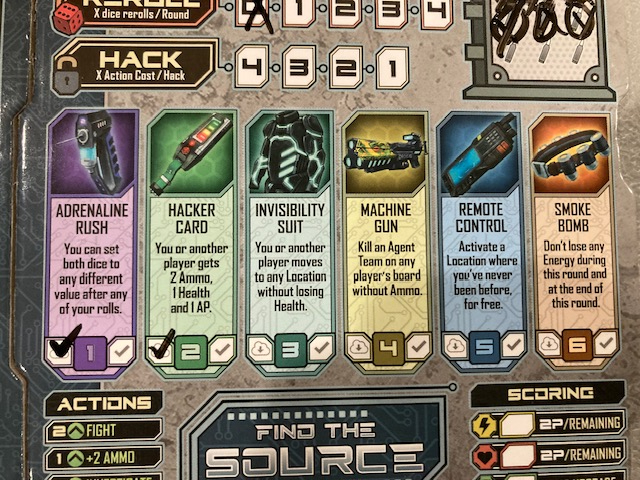
Basically, the three sets give the players some variety: the items are different depending on which set you use.
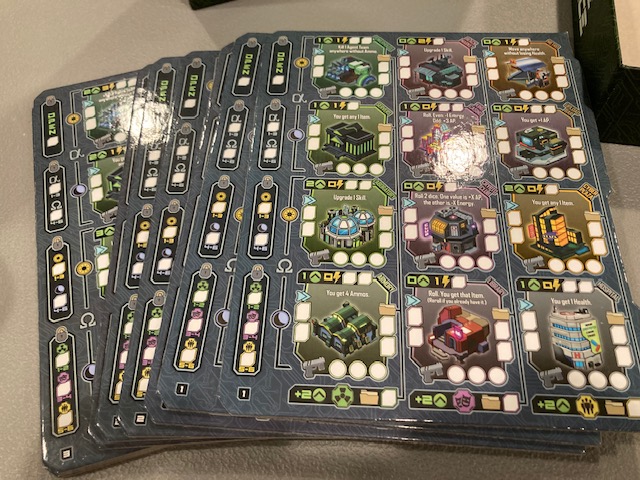
The other 9 boards are 3 sets of the 3 city tiles: like the player boards, when playing multiplayer, all players must get a tile from the same set (labelled 1,2,3). Each city has different locations with different abilities and layouts. Again, the three sets of cities are for variety.
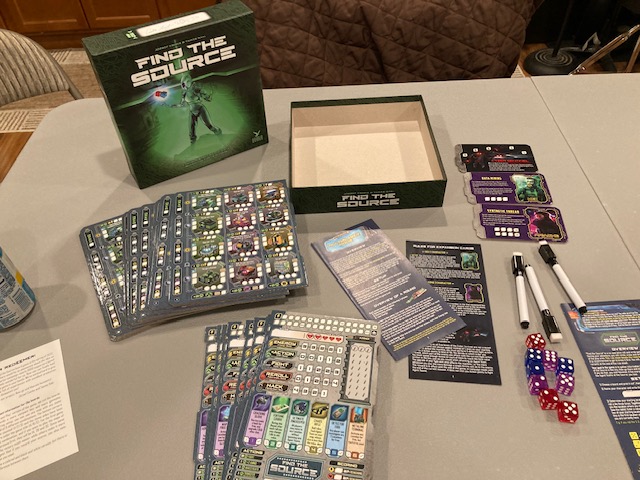
And then there’s 9 dice (3 for each player) and 3 dry-erase markers with cool looking erasers. Overall, this is why I paid $39 for this: I get nice dry-erase boards, nice dice, nice markers (well, OKAY dry-erase markers) and a nice package. I am totally glad I paid the $39 for a nice package, rather than trying to print everything myself and wasting time/energy when the printed version is nice!
Rulebook
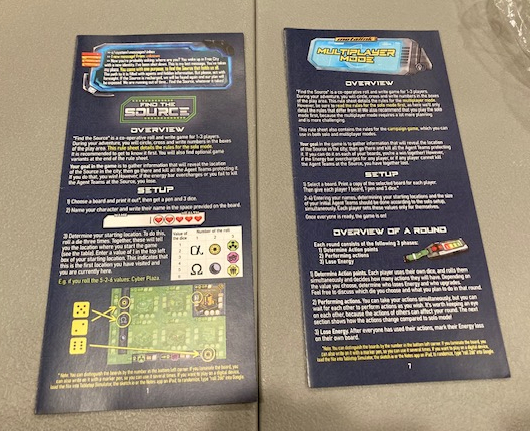
I don’t love that the rulebooks are trifold pamphlets.
I do like that the recommend way to play is to learn the game is to read the solo rulebook first and THEN play multiplayer. So, read the solo pamphlet first, play a game, and then you can teach your friends multiplayer!

I’d probably give this a C on the Chair Test! Why? Even though it fits well on the chair, the font is really tiny and impossible to read on the chair next to me. I had to have the rules pamphlet on the table as I played: that font is pretty small!

Overall, the rules were okay. There were a few misses in explanations, but it did a good enough job teaching the game. I just wish the rulebook, pardon me, pamphlet, had bigger fonts and more of a rulebook presence.
Gameplay

This is a roll-and-write game.

Every turn, every player rolls two dice (doubles are always rerolled) until you get two different values. You get the choose one of the dice to use: this is the number of Actions you get this turn. (Mark the actions on the third die and put it on your sheet: see below).

Why would you not always choose the bigger number for number of Actions? For one, the bigger number costs an energy! Each player has a limited amount of energy at the top of the player sheet: if any player ever runs out, game over!
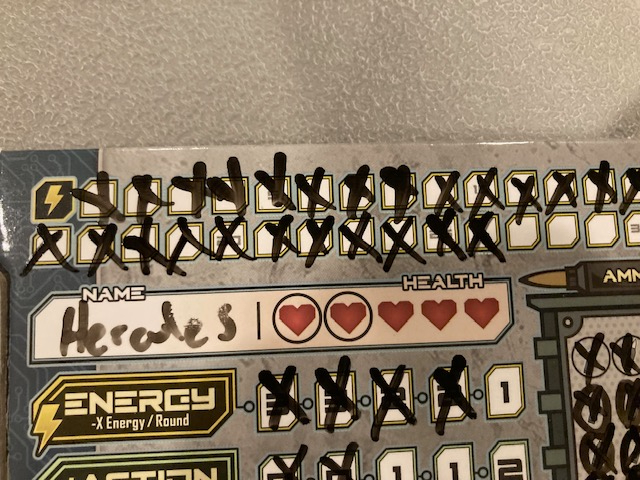
The second reason is that if you choose the lower number of actions, you get to upgrade one of your five skills!
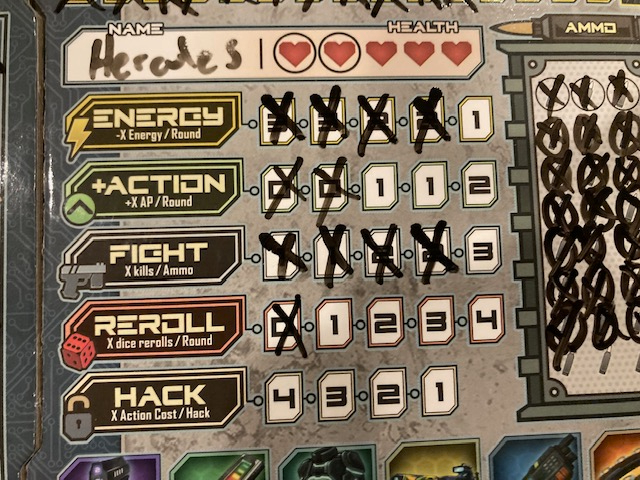
Everytime you X a skill, you make it a little better. For example, I upped the REROLL skill and get 1 reroll of the dice per turn! Early in the game, it may make sense to take the lower number to up your skills.
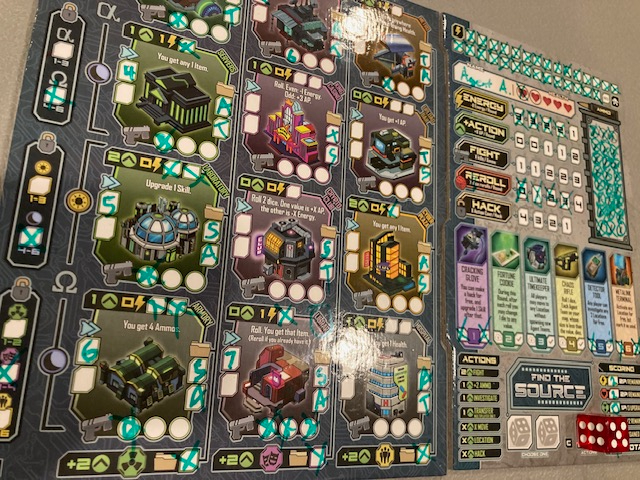
To the left of your player board is the city! See Above. Players use Actions to fight gangs, move, activate locations, and investigate! In case it wasn’t clear from the name of the game, the purpose of the game is to Find the Source!! The Source is a city location where the big bad hides out .. you have to find the Location of the Source, storm in there, and take out all Agent Teams at that Location! If you do that, you win! Players lose if they ever run out of energy or can’t manage to take down the Location of the Source.
Find the Source

Locations have a little folder on them: to help find the Source, you have to spend an action to Investigate (put an X on the folder). Once enough Locations are investigated in a row, a player can HACK to find a portion of the Location (which column, or set of rows).

Once you find the Source, you will populate it with Agent Teams, and all players will have to take out the Source on their board to win (the Source is the same on all player boards).
Solo Play
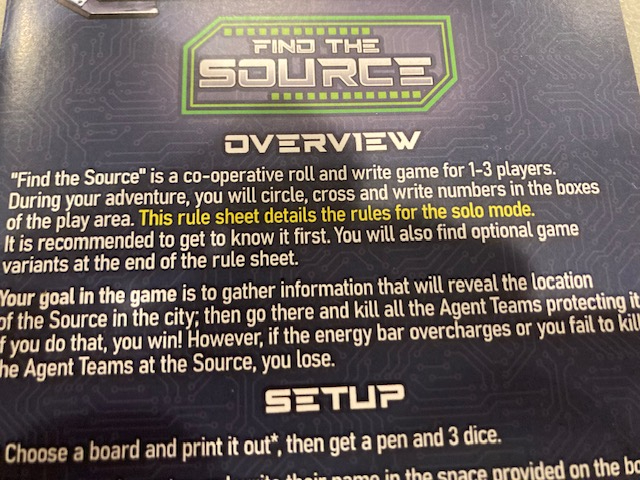
It’s so interesting that the game has a separate rulesheet for solo mode! And in fact, it suggests that you play a solo game before expanding to the Multiplayer Game! So, this game absolutely follows Saunders’ Law! I would say this game was probably solo first, then the multiplayer tacked on: at least that’s what it feels like.

Solo set-up is pretty easy! Find a player board and a city board and stick them together! There’s 3 different types of player boards (where the Items vary) and 3 different types of cities (where the Location abilities vary), so there’s some variety in the game! Note that the boards actually physically fit together very nicely: they are slotted.

The solo game was pretty fun. My first game was a win, but I cheated: I forgot to pay energy costs when I used Locations. Later games were closer, but still fun.

Overall, the game was longer than 15 minutes as the box says. I tend to ponder more, so I suspect my solo games going forward would be 20-30 minutes for the solo games.

The game is really Find The Source to win, but there is also a notion of score, so you can try to do better on later games and “best” your high scores.

As I played, I always felt engaged. I had to think ahead of what I wanted to do, choose when to take fewer actions to upgrade skills, but always balance energy and ammo. Honestly, the solo game worked pretty well. I can imagine playing this when I am waiting for someone to come over, or if I want to kill 20 minutes. It’s pretty easy to get going, the rules are simple (once you know them), and the game sets-up so quickly!
Cooperative Play
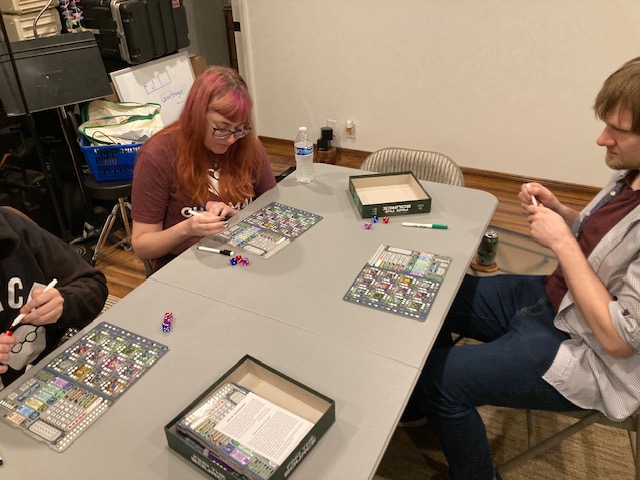
The cooperative game is very similar to the solo game! Every player gets a board (making sure the player and city boards match), and does everything the solo player would do on their board only. The difference is that the investigate and HACK Actions are shared, so when any player investigates, ALL players mark information! The HACK Action becomes a lot harder, as more players have to investigate rows of the city to enable the HACK. So, players need to coordinate as they play: “I will investigate King Casino this turn! Someone else needs to investigate there too so we can HACK!”

The other major difference is that players can use an Action to “share” Ammo, Health, and Items! If one player is lacking on a turn, players can “give”!

Players all win or lose together: if any player runs out of energy, then all players lose! Once the Source has been discovered, it’s the same on all city boards! So, each player must “handle a different entrance” of the Source Location and take out the Agents! Players when when all players have handled the Agents at their entrance!
Score still matters: if the players win, all players compute their individual scores and the LOWEST score is the score for the team! That’s why the “share” action is so important: if one player is rolling well and another is rolling poorly, there is a way to share the wealth to try to keep all scores up.
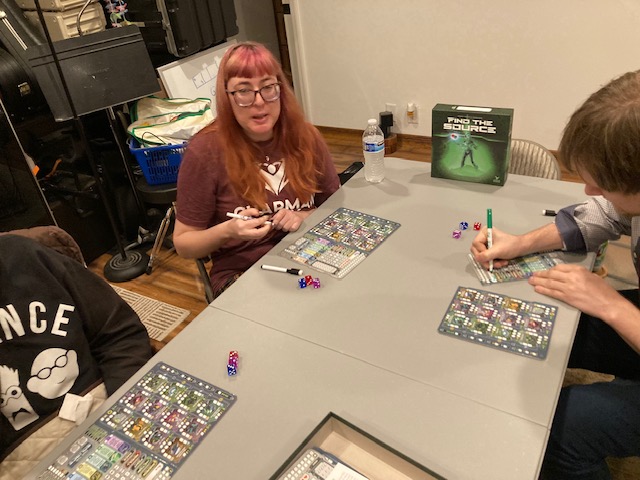
This game felt “a little” like multi-player solitaire, as each player tends to concentrate on their own board. The shared Investigate/Hack actions did help elicit some cooperation (as did the share action). This isn’t a game where everyone is engaging in massive amounts of cooperation, but there is enough that you still will enjoy playing with your friends. And the Alpha Player seems to lay dormant, as everyone is too busy focusing on their own board…
Some Issues

The erasers for the game are fantastic … they do work well! (I don’t think I’ve ever seen white dry erasers) But the included dry-erase markers have too “fat” of a marker: the writing on the board looks messy. Nowhere is that more obvious than the scoring section: it looks messy.
We ended up using ultra-fine dry erase markers when we played again!
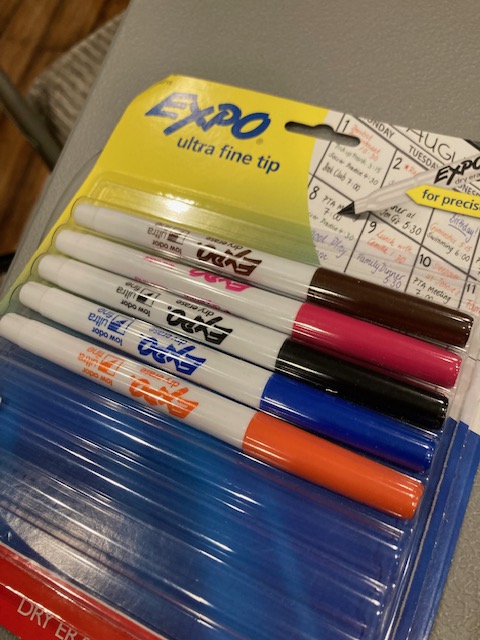
These are a lot easier to read!

Sara used the purple ultra-fine marker and it looked cleaner! Honestly, we’ve had this issue with “too fat” dry-erase markers with HexPloreIt (see our review here) and other games that use dry-erase markers. It would be nice if game used ultra-fine markers.
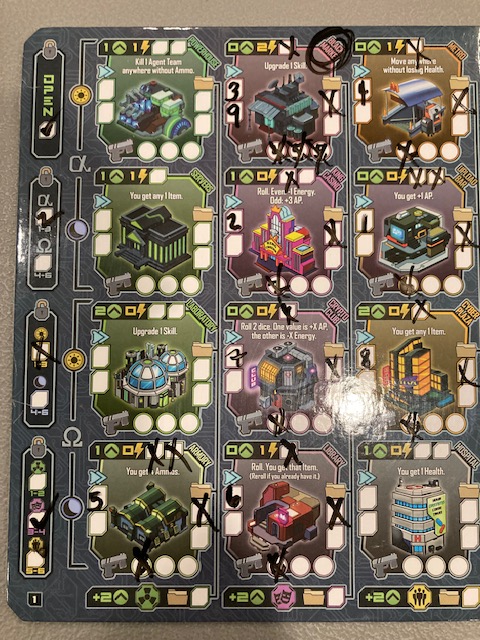
Another issue we had was “where are we in the city???” The current city Location is the “highest number” to the left of the city, but as you go back and forth between city board and player board, it might be nice to have some kind of pawn to show where you were …

So, even though the game doesn’t come with a pawn, we recommend getting one for your board: we stole that one out of Mechanical Beast (a cooperative tile game that’s not quite a tile laying game: see our Top 10 Cooperative Tile-Placement/Tile-Laying Games). It’s a minor thing, but it helps.
Cool Stuff
The erasers on the pens are fantastic: I know I already said that, but they were some of the best dry-erase erasers I’ve seen! They worked really well!
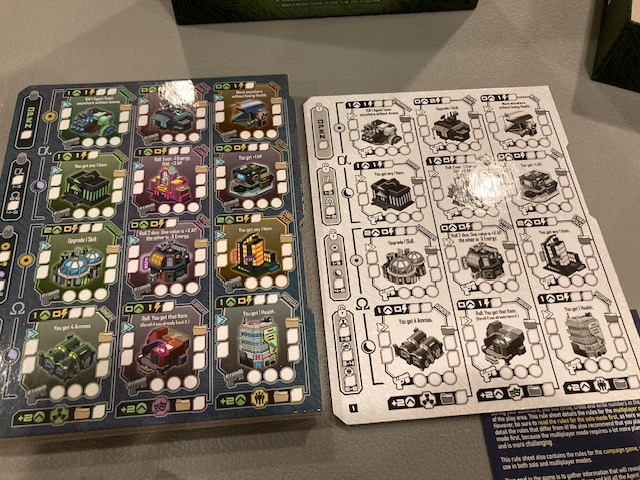
A Cool feature: The boards are two-sided! See above! One side is black-and-white, and one is color! So, if you find the color version too “busy”, you can use the black-and-white side instead! All my friends and me chose the color side, but I definitely admit the black-and-white side is much less busy.
There is a campaign to try: it basically just takes you though all the boards. I personally found that one game was “just right”, I’m not sure I need the campaign, but it’s cool that it is there.


It’s also cool there is some variety in the boards: it won’t be the same game everytime and it’s really easy to use different player and city boards.
Conclusion
There aren’t a lot of cooperative roll-and-write games. We liked Escape: the Roll and Write Game (see review here), and The Legends of Storm City Roll and Write Game (see review here) was a bit of a miss for most of my group, but I think Find The Source may be our current favorite cooperative roll-and-write game! It’s got great components, it has solid rules, has interesting choices as you play, it’s easy to set-up, it’s easy to learn, it’s easy to play, it’s quick to tear-down, it’s quick, and it’s fun. It might be a little samey if you play too much, but it’s easy to pull this out occasionally and play in 20-60 minutes (depending on your player count). One caveat: You should probably get some ultra-fine markers, and a pawn or three.
I’d say this is a solid 7.5/10.

 coopgestalt
3 thoughts on “A Review of Find The Source: A Solo/Cooperative Roll-And-Write”