

Pandemic Iberia is a cooperative “secret train” game: This is all the description I needed to entice my friend Robert in! He’s a huge fan of maps and trains! He’s also a huge fan of Pandemic (probably because of the map on the board). So, I was surprised that he had never encountered Pandemic Iberia! It has all of his favorite things: maps, trains, and Pandemic!

Even though Pandemic Iberia was released in 2016 (some 6 years ago), it’s still a great game! That’s why we occasionally do these Retro Reviews: to shine a light on some really great older games. Our last Retro Review was Now Boarding! See that review here.
And this review is also for Greg: Greg told me he likes train games, so I wanted him to see what Pandemic Iberia looked like.
Play Twice (Back-to-Back)
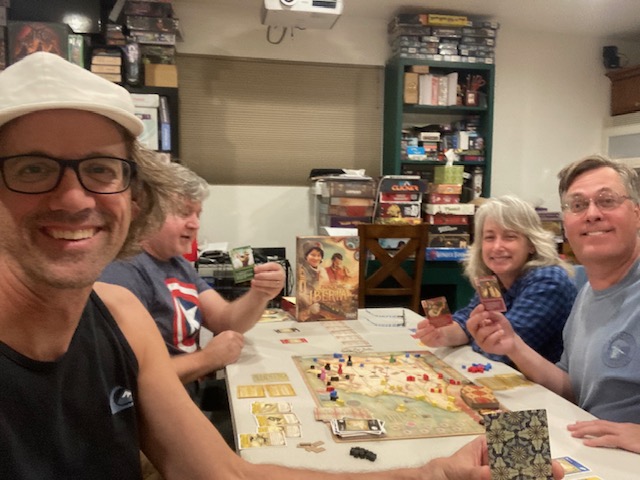
When I used to play more with my friend Jeremy, he had instituted the rule that “we must play every new game twice: back-to-back!” The rationale is that the first game is a learning game (where everyone is learning the rules, the mechanisms, and the flow of the game), but it’s the second game is when it all comes together. While the game is still fresh in everyone’s mind, we can dive into the second play!
And that’s what we did for Pandemic Iberia! Although we had all played Pandemic before, Pandemic Iberia is just different enough that it took a little more thought to get into it. So, the first game was a learning game (and we lost horribly). The second game was much more focused and directed, because we learned from our mistakes in the first game!
So many Pandemics…
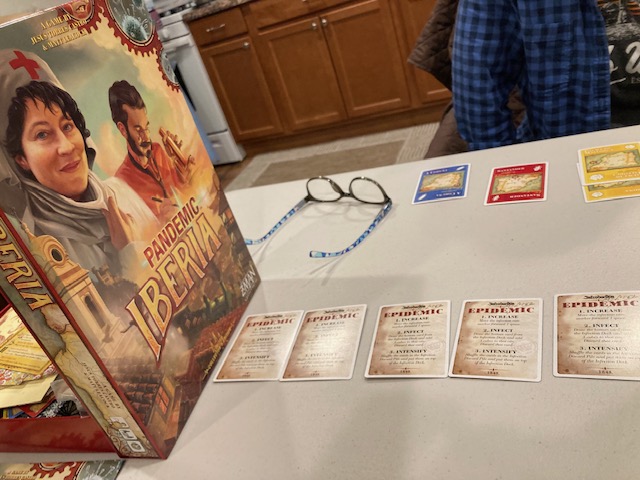
Pandemic Iberia was the “first” Pandemic variant! Since then, we have seen so many different variants: Wrath of the Lich King (A World of Warcraft Pandemic), Star Wars: Clone Wars, Pandemic Legacy Seasons 0, 1, 2, Fall of Rome, The Dice Game, and I am sure there are some that I am forgetting! (Becca would argue that Flashpoint: Fire Rescue is her favorite Pandemic game, even though it’s not even in the Pandemic universe! Its gameplay is just similar to Pandemic, but with a firefighting theme).
Unlike the later games like Star Wars: Clone Wars (which we reviwed here) and Wrath of the Lich King (which we reviewed here), Pandemic Iberia is still very much Pandemic! You are still curing diseases, you are still roaming a map, you are still dealing with outbreaks! It still feels like Pandemic.

Don’t get me wrong! I loved the Star Wars: Clone Wars (A Pandemic system) game: It made my Top 10 Cooperative Games of 2022, but you had to really squint to the see the Pandemic underneath. Pandemic Iberia is much closer to the source material.
What’s Different?
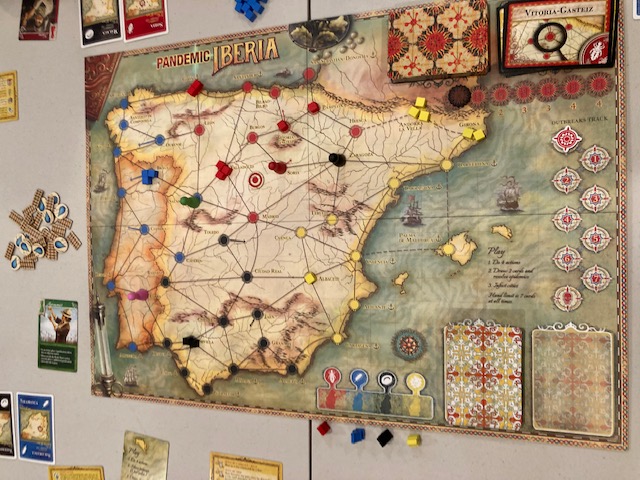
In Pandemic Iberia, you still move around the map trying to quell the diseases. You still have to discard 5 cards of the same color at a Hospital (rather than a research station, but it’s the same thing) to research a disease. You still have to research 4 diseases to win. You still have to worry about outbreaks infecting adjacent cities, You still have to be leery of cities with 3 disease cubes!
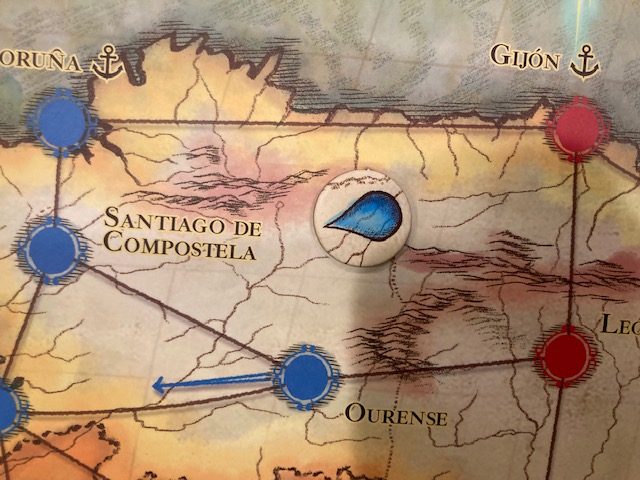
One very interesting new idea in Pandemic Iberia is the “region” idea. Regions are areas on the board enclosed by brown lines: see the region above surrounded by Ourense, Leon, Gijon, A Corona, and Santiago De Compostela. There are a number of places in the game that utilize this new idea. The most obvious is the “Purify Water” action, which is a new type of action. At the cost of an action and a card, you can “Purify Water” and place some Purification Tokens (the water drop above) in a region! Each purification token prevents the addition of one disease cube into a city adjacent to the region that contains it (the token is discarded after it prevents a disease).
This is really interesting, because it allows players a mechanism to prevent future infections without having to be in the region! Some of the characters (like the Nurse) also have special abilities based on regions.
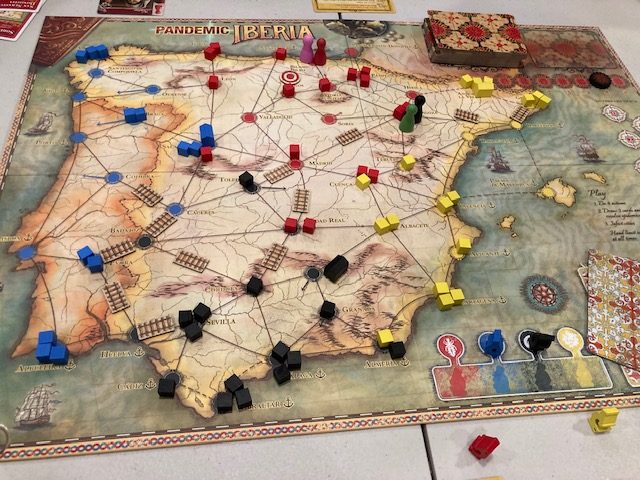
One other major change is how big movement is handled. Gone are the ideas of direct flights: you must either take the train, or travel from port city to port city.
The “secret train” idea is that you can build a network of train tracks on the board. When the game starts, there are no tracks! You must build out the infrastructure! See above as we have quite a nice train infrastructure on the board. So, when you take the train, you can move to any city in the connected network for just one action! But, that means someone else had to help build the train network on previous turns!
Of course Robert chose the special power that makes it so he can build two train tracks for one action: that’s partly how we got our network up so quickly!
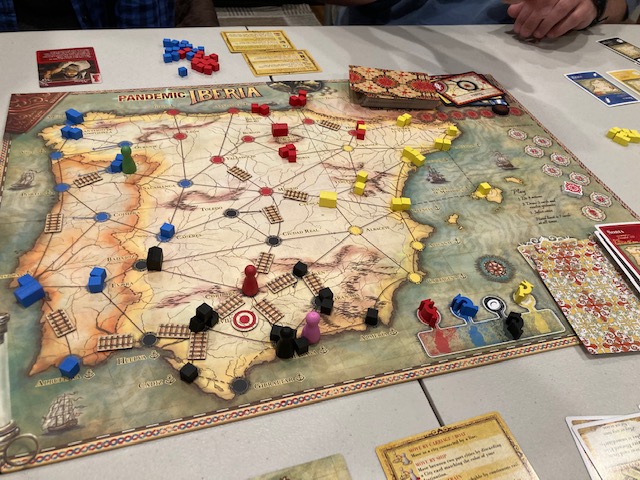
The port city to port city travel requires you to discard a card, but then you can move from a port city to any port city (with the color of the card you discarded). All port cities are marked with Anchors (see above).
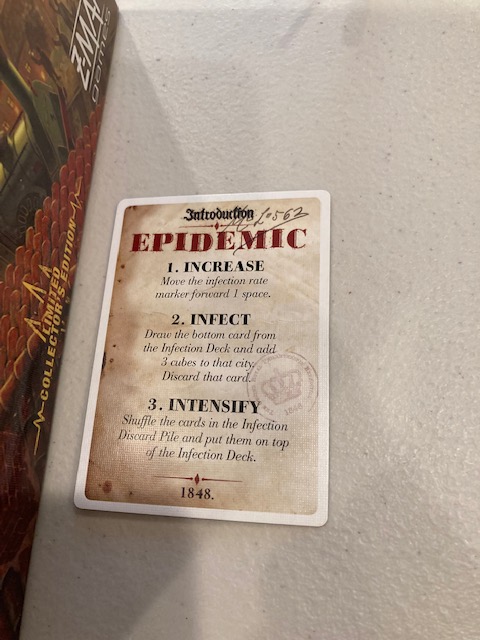
You still have to deal with Epidemics like in Pandemic. Unfortunately, once you research a disease you don’t “cure it” or “eradicate it” like you did in base Pandemic. This is a thematic twist: this is a game set in 1848, so you don’t quite have the technology to cure! All you can do is research. You still need to research all 4 disease to win!
What We Liked
We really liked the theme! With the real-world pandemic making us weary of the world-wide Pandemic, there was something charming about casting back to a previous era (1848) on the Iberian peninsula. The map of Iberia, the art on the backs of cards, the style of the game really transported us to a simpler time. Somehow, harkening back to an older era with a smaller map made this “whole Pandemic thing” feel more palatable, and dare I say, fun?
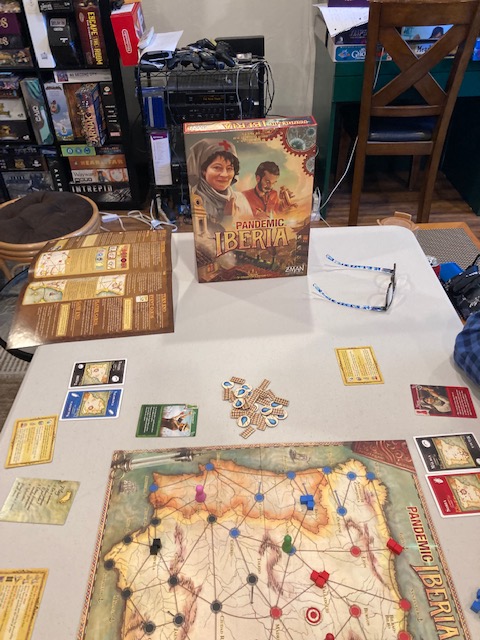
We really liked how the new ideas: the regions, the railroads, the ports, the purify waters! The railroads in particular were such a nice touch: they make the game feel even more strategic. A lot of Pandemic is keeping the diseases under control, but spending actions early in the game to set-up a train network (with the topology of our choosing) made the game feel harder, but more interesting! We had to figure out when it made sense to spend actions for building tracks!
And the purify waters action/region ideas was just a new and really cool way to “prevent” outbreaks even if you weren’t there! Again, it made the game that much more strategic.
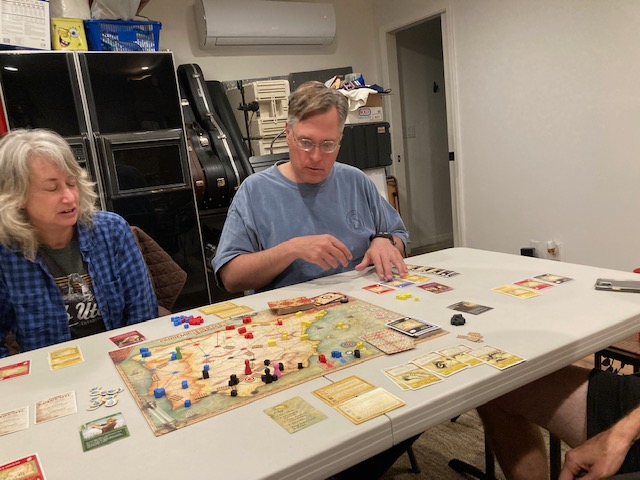
The game is absolutely harder. We lost our first game. But it made us want to try again! By pulling together and playing better as a group, the game absolutely encouraged that much more cooperation. It was clear: we had to cooperate well or we die.

A minor thing, but a thing nonetheless: I enjoyed that there was always something interesting you could do with all of your actions! Even if you had an action left over, you could choose to either “purify water” in a adjacent region, or build a train track. I have had games of Pandemic where I threw away actions (to end up in the right space to trade), so it was nice to feel like you could always do something!
Intensity

Strictly speaking, Pandemic Iberia is harder than Pandemic. It requires a lot of thought, planning, and cooperation to win. Pandemic Iberia is a very intense game: you may love that, or you may hate that. Jeff and Becca like the original Pandemic better because it has a little more laid-back feel: they feel like you can sit back and enjoy your turns a little more in Pandemic. They still enjoyed Pandemic Iberia, but thought it was much more manic that base Pandemic.
Robert adores the trains and strategy and I believe Pandemic Iberia is now his favorite Pandemic. I think I am with Robert: I love the new systems and the strategy they introduce.
Conclusion
Pandemic Iberia was a hit with my group! It’s like a 9/10! It’s a very hard, very strategic version of Pandemic. If you are looking for the next step-up in strategy from Pandemic, consider checking out the very first variant: Pandemic Iberia. It’s charming setting but manic gameplay might be just what you are looking for in a difficult, but strategic cooperative game.
Greg, I really do think you’d like Pandemic Iberia.
 coopgestalt
3 thoughts on “A Retro Review of Pandemic Iberia”