
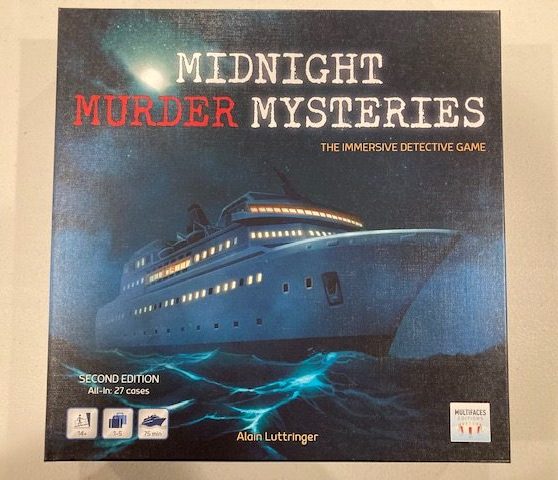
Midnight Murder Mysteries is a cooperative detective/deduction game that was on Kickstarter back in June 2022. Ir promised delivery in January 2023, but it only arrived at my house sometime in April 2023 … a few months late for a Kickstarter isn’t bad.
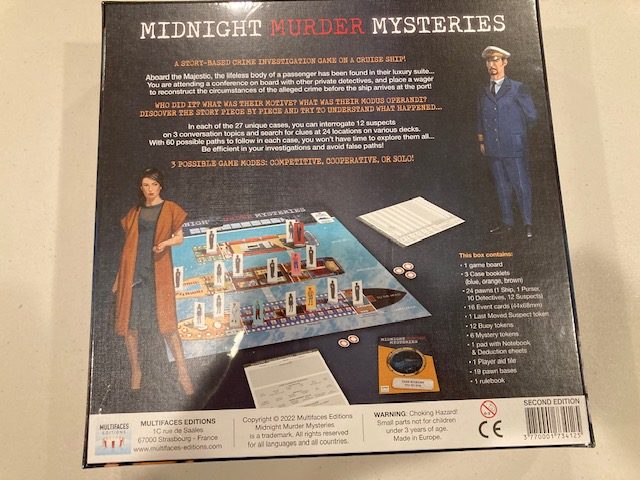
This is the 2nd Edition of the original game. I have no knowledge of the original edition, but I do love mystery/detective games: See our Top 10 Cooperative Detective Games! That’s why I backed this game. Let’s take a look! (There is also a competitive mode, but we don’t review that here).
What Is This?
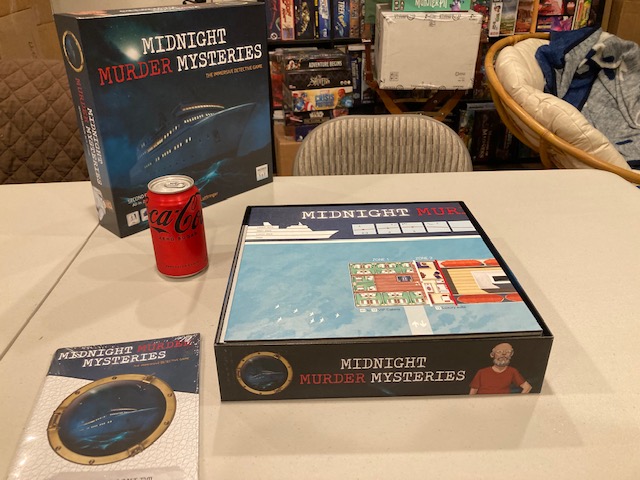
This is a detective/mystery game. Players work solo or cooperatively to uncover a murder! (There is also a competitive mode, but we don’t review that here). There are about 9*3 or 27 cases here in 3 case books (the Kickstarter version has an extra casebook bringing it to 36 cases).

Each case in the case book is described on two pages: the premise (left above) and the paths (right above). As you investigate, you can investigate a location or talk to a suspect (if you are in the same space as that entity). You can ask each suspect about their alibi, what they may have witnessed, and possible motives: each of those questions is a separate action. Each investigate has a number next to it which leads you to an entry in the same book.
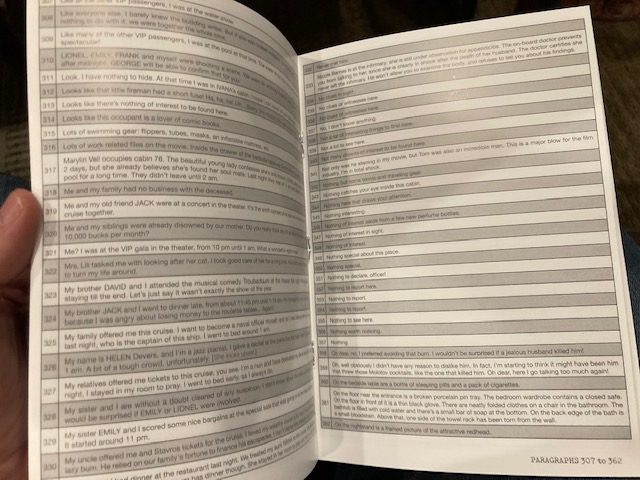
Each entry (see above) gives some information which you can mark off on your clue sheet (see below).
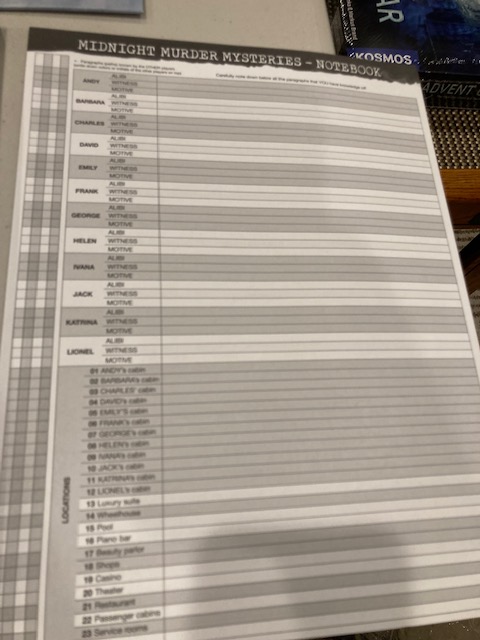
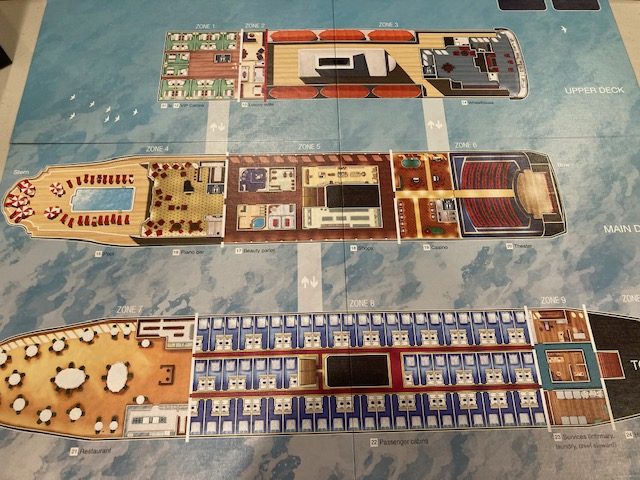
You can only get the information from a suspect if you are in the same location, so you will be having to walk around a ship to find them!
There is a built-in timer: you must solve the murder before the ship gets back to port!
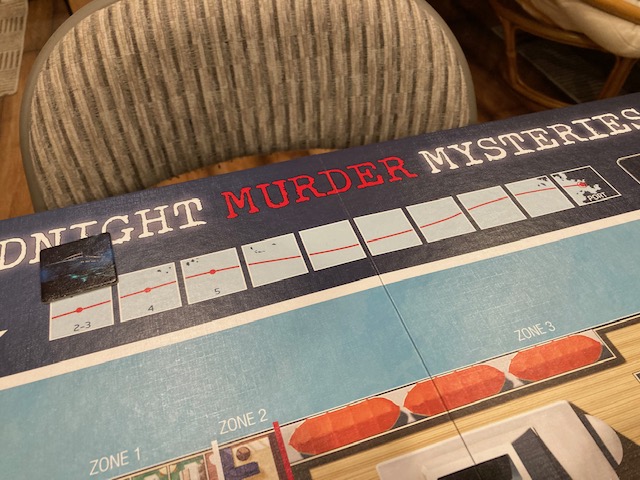
The timer (above) gives you “about” 10 turns to solve the murder!

Once you are forced to (or choose to) solve the murder, you flip over your clue sheet and fill in CULPRIT, MOTIVE, and MODUS OPERANDI … and a backup, just in case you are wrong. You read the solution and score your investigation with a 100 being perfect and 0 being, well, terrible.
This game is all about trying to optimize your actions to get the most info before you run out of time!
Components
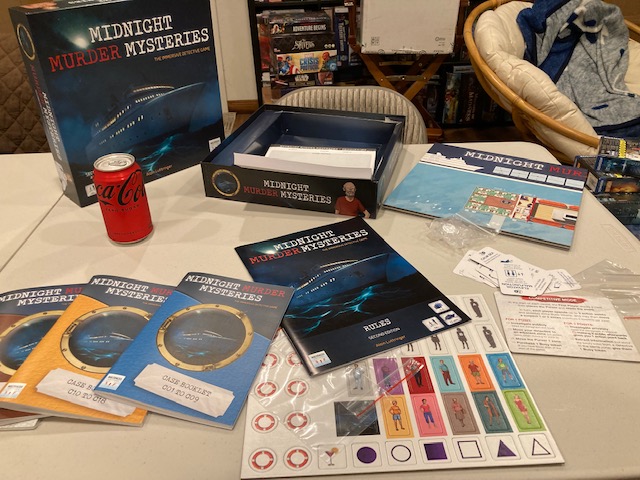
The components are pretty good. The case books are readable (if a little small). The board is well-labelled and easy to navigate.


One major complaint about the components is that the bases DO NOT fit well into the standees.

The stands are way too tight. I ripped the first Suspect standee. See above and below.


See the tear at the bottom? After that, I used a plastic knife to hold the base open so none of the other standees would rip. See above. I do wish they had included a few more bases because I am never taking these out again!
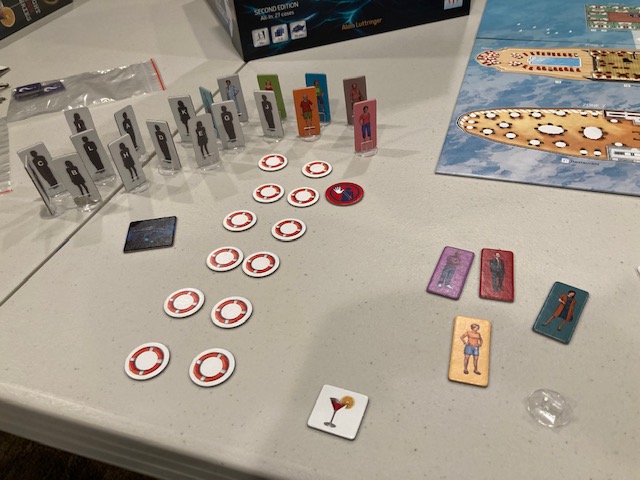
However, assembly is a one-time thing. Just be very careful putting your standees together.
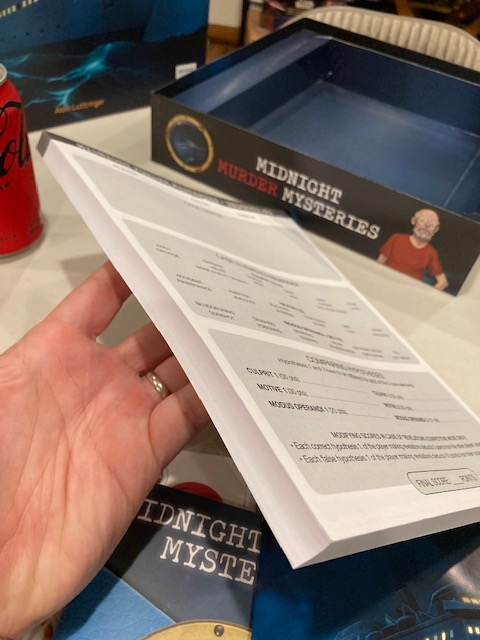
I think the most impressive component is the HUGE clue pad: there are so many clue sheets! See above.
Solo Game
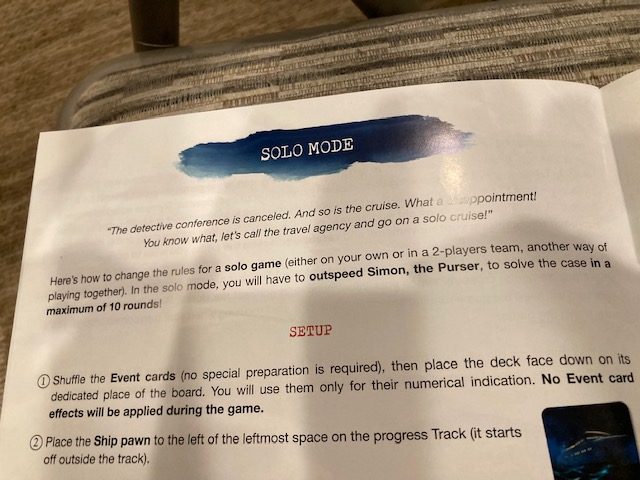
There is a solo mode (see rules above): You are trying to solve the murder before Simon the Purser. Simon is running around the ship (as are you), and you are both trying to solve the mystery before the other.
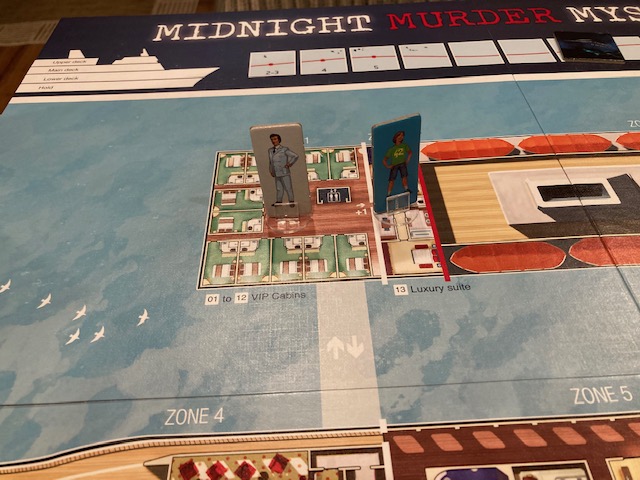
The solo mode is okay: it kind of gives you a sense of how the game works. If Simon is in an area with you, you can’t investigate unless you use an action point to move him away. His movement is controlled by the event deck, but he can essentially teleport to any location on the ship. This is frustrating since movement is so much more expensive for the solo player.

There is also a notion of publicly and privately investigating, but it really is just a counting exercise: public investigating is only one action point, but Simon gets to cross off a path. When Simon has 30 PATHS crossed off, you trigger the end of game! … and you see if you have solved it, getting some points based on where Simon was.
The solo mode was okay: I found it to just be “optimizing actions” to avoid Simon getting to 30, so it didn’t really feel like he was investigating. My own investigations were fun enough, but there was a lot of Simon upkeep.
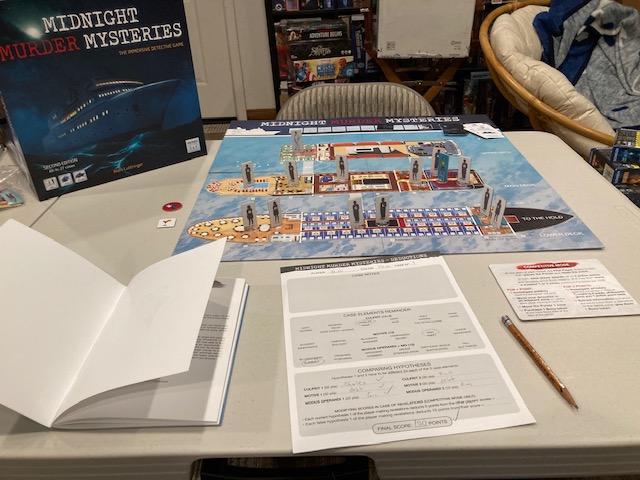
Solo mode taught the basics of the game. It was good enough for that, but I wasn’t compelled to play it solo again.
Cooperative Play

Cooperative play was good…ish. It’s weird that players don’t share information (mostly) until the very end of the game. Each player conducts their own investigation, but there is no real sharing of information as the game plays! Each player is conducting their own private investigation, reading from the book independently. As they play, the can share whether a location is “good, bad, or meh” information AND THAT’S all the information can be shared!! So that game proceeds in a lot of silence as players read (silently to themselves) from the case book.
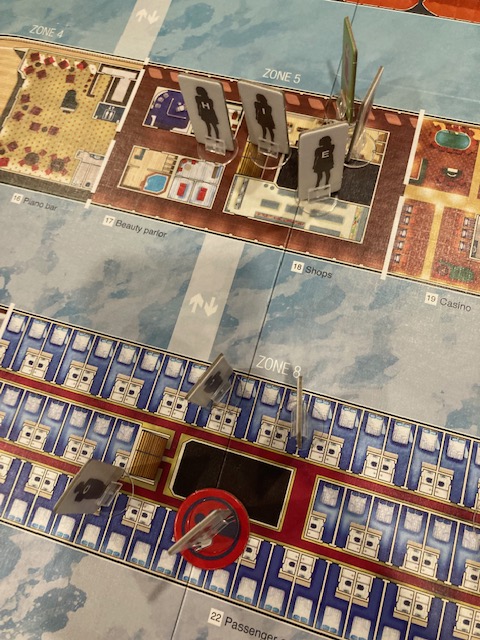
But, the end of the game was explosive! People could barely contain themselves when they could finally talk to each other. “Do you know what I found?? I couldn’t tell anyone! Oh my gosh!!” No one could communicate (much) for most of the game and it was like a dam burst at the endgame!! It was like everyone just exploded!! It was exciting and furious, as information about the murder flew around the table. The end of the game was absolutely the best part of the game, as players shared and postulated together, trying to come up with the murderer, means, and motive. It was boisterous and exciting.
Strategy

There is strategy to the game, even though the Suspects come out very randomly. Movement is precious in this game, so players have to come up with some strategy to get the fewest moves and most investigations. There’s some rules that seems “throwaway” when you first see them: At the end of your turn, you can move a SUSPECT up to two zones. Okay? Turns out it’s critical to use this to move the SUSPECTS to you rather than wasting your own actions. So, there will be a lot of discussion about who to move to help the others. My first game, I didn’t get why that was important, until I saw how much moving wasted my actions. There is some strategy to optimizing your investigations.
The Alpha Player Lurks

One of the things we don’t touch on a lot here in Co-op Gestalt is the threat of the Alpha Player (see our discussion here for more elaboration of the Alpha Player Problem). A lot of people have had cooperative experiences ruined by an Alpha Player, including myself. I, generally, have been fairly lucky that my game groups get along well and cooperate well: the Alpha Player is (almost) never a problem for my groups. However, it’s important to remember that the shadow of the Alpha Player is always lurking nearby, waiting to ruin a cooperative game … so, it’s good when games feel like they have explicit mechanisms to safeguard against the Alpha Player.
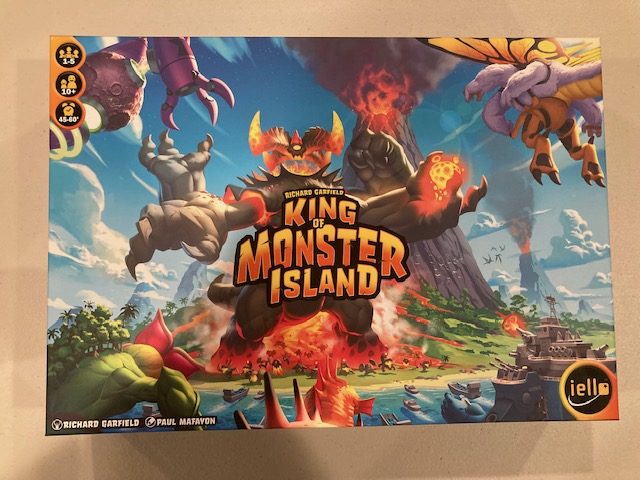
Recall from our review of King of Monster Island that we liked the game, but the turns felt pretty independent without much interaction. Although this generated a negative reaction at first, we realized that this might actually be a positive: this game guards against the Alpha Player! If you are in a situation where you might be playing with an Alpha Player (your brother, you-know-the-guy-in-your-game-group, maybe even yourself), this would be a good entry: the fiercely independent dice rolls keep the Alpha Player at bay as each player enjoys their own turn!

And Midnight Murder Mysteries also seems to keep the Alpha Player at bay! Each player fills out their suspect sheet independently , makes their way around the board independently, and pursues their own investigation … independently! The only time the players really cooperate is at the very end when they share all the info they have. So, as the players play, there really is no chance for the Alpha Player to tell you what to do!
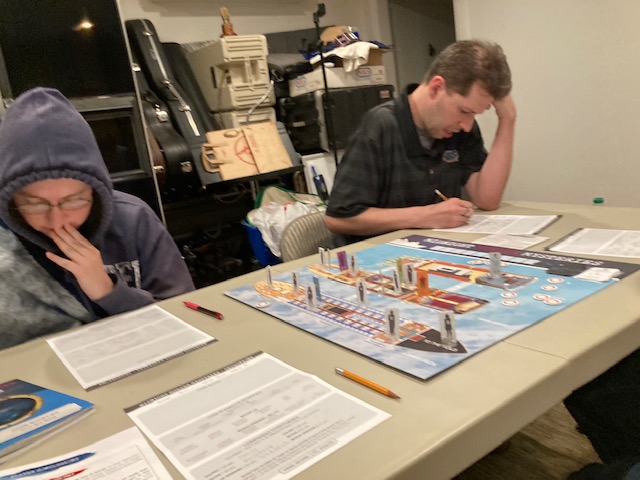
There is a cost, though for warding off the Alpha Player: there’s really no interaction as you play. I tended to role-play an annoying kid, and we all sort of did stuff to be silly just to engage a little. So, again, that could be a positive or a negative: you can use the time to talk as friends about whatever you want, but you aren’t engaging in the game proper.
Downtime: The Main Problem and a Potential Fix

The main problem with Midnight Murder Mysteries is that there is a lot of downtime while you wait for the other players to “read silently” their chosen path from the casebook. Now, there are a few places when investigators can share, but we found that the bulk of the time was just waiting for the previous player to finish reading silently. This downtime kind of took a toll on us as we played.

But the downtime can be alleviated! Although I got two copies of the game for gifting (one for myself, one for a friend), I think that was a happy accident! We think the way to play best cooperatively is play simultaneously! Each player reads of out their own independent casebook and pursues their own independent path each turn from their own independent book! Players will need to figure out who to move before the round begins, but during the round, the “reading of the book” can take place simultaneously. This can pretty much remove all downtime and the game can go much faster.
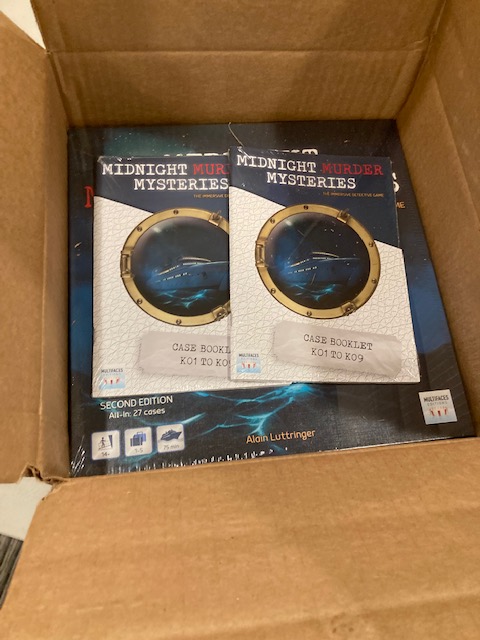
The only way this can work is if you have multiple copies of the case book. It turns out that some of the cases are online in the Print and Play. So, if you have multiple devices, you can access the case books online so that each player will have their own case book! Or if you have multiple copies of the game (like me), you can physically share multiple physical copies.
Granted, there are some issues that need to be resolved: how do you handle things that are supposed to happen in order? Generally, the only things that seemed to matter were either the sharing of information or the moving of suspects. If the players decide, as as group, which suspects should be moving before the turn begins (rather than piecemeal), then that can work. It might take some tweaking, but since this is a cooperative game, the players can decide together how to deal with this!
In general, this simultaneous play house rule takes this cooperative game from something we liked okay to something that is fun and quick to play we liked a lot more! With simultaneous investigations, that 75 minute play reduces substantially (depending on how many case books you have)! Some of the casebooks are online for the Print and Play version: that’s probably your best bet to have multiple copies of the case books.
Conclusion
Midnight Murder Mysteries is a curious beast. The solo game isn’t great, but it’s good enough to teach the game. The cooperative mode isn’t very interactive until the very end, but this can be both boon and bane. The Alpha Player will never take over this game because each player in the cooperative mode will have their own investigation which won’t be influenced by the Alpha Player, but this comes at the cost of some interaction. Luckily, the endgame is explosive and highly interactive and really makes up for the earlier lack of interaction.
The worst part of the cooperative game is the downtime between turns, as you wait for each player to read silently from the case book. With a simple house rule, by just using multiple copies of the case book and investigating simultaneously, you can get rid of a lot of waiting and make the game that much more punchier! Without the house rule, the game is probably a 5.5/10 or 6/10. With the house rule, the game really speeds up and becomes a 7/10 or 7.5/10.
But, it depends on how you want to play! Do you want to play a game where you and your friends can hang out just shoot the breeze while you play? Then play Midnight Murder Mysteries cooperatively as-is: no Alpha Player will come and ruin your game. If you want your game punchier and more intense, consider playing simultaneously with multiple case books. The thing is, you can choose what’s best for your group!
 coopgestalt